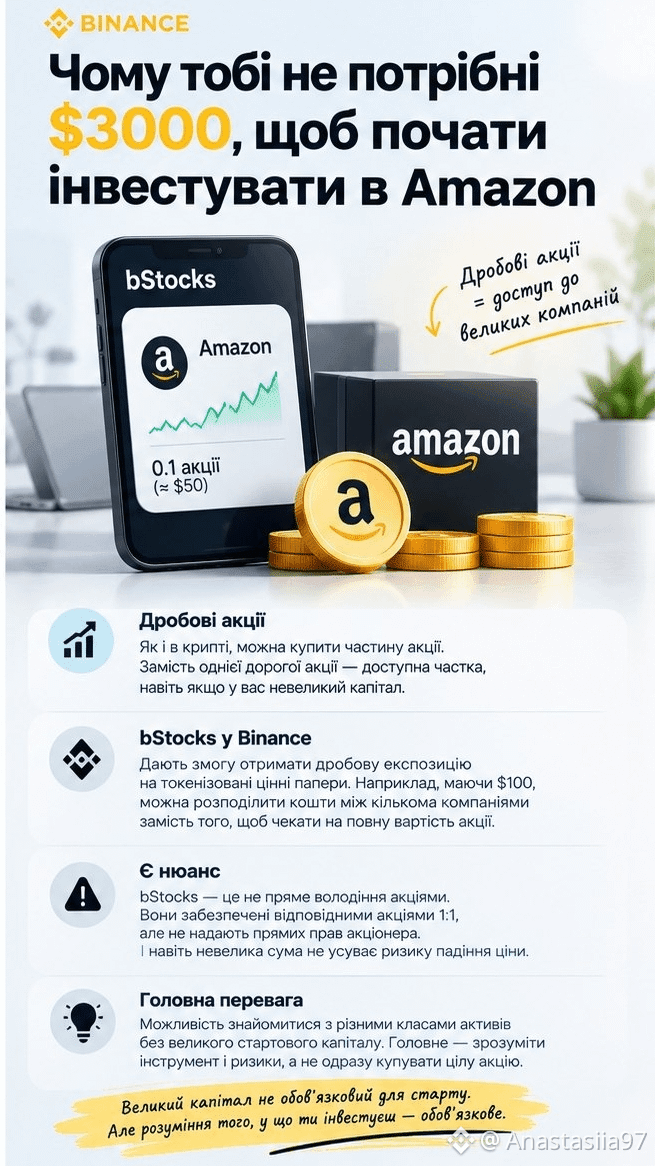
Why you don’t need $3000 to start investing in Amazon
If an Amazon stock costs thousands of dollars, that doesn’t mean you need to have the entire amount for your first purchase. Just like in crypto, where you can buy a fraction of BTC, you can invest in stocks with small amounts—as long as the chosen platform supports fractional positions.
That’s where bStocks come in. They let you get fractional exposure to available tokenized securities directly within the Binance ecosystem. For example, with $100, you can split part of your funds among several available companies instead of waiting until you’ve saved up for a whole share.
But there’s an important nuance: bStocks are not direct ownership of shares. They’re backed by the corresponding shares 1:1, but they don’t grant direct shareholder rights. And even a small amount doesn’t eliminate the risk of a price drop.
For me, the main advantage of this approach is the ability to explore different asset classes without a large starting capital. Because for your first step, it’s more important to understand the instrument and its risks than to immediately buy a whole share.
A large capital is not required to start. But understanding what you’re investing in is mandatory.
If an Amazon stock costs thousands of dollars, that doesn’t mean you need to have the entire amount for your first purchase. Just like in crypto, where you can buy a fraction of BTC, you can invest in stocks with small amounts—as long as the chosen platform supports fractional positions.
That’s where bStocks come in. They let you get fractional exposure to available tokenized securities directly within the Binance ecosystem. For example, with $100, you can split part of your funds among several available companies instead of waiting until you’ve saved up for a whole share.
But there’s an important nuance: bStocks are not direct ownership of shares. They’re backed by the corresponding shares 1:1, but they don’t grant direct shareholder rights. And even a small amount doesn’t eliminate the risk of a price drop.
For me, the main advantage of this approach is the ability to explore different asset classes without a large starting capital. Because for your first step, it’s more important to understand the instrument and its risks than to immediately buy a whole share.
A large capital is not required to start. But understanding what you’re investing in is mandatory.