

莫信
10 Posts

莫信
Report
Block User
链上投研 | Bitcoin Player | Don’t trust,verify! 莫信直中直 须防仁不仁
3 Following
3 Followers
0 Liked
Posts
·
--
Musinoot Watch | Agent Wilds Hero NFTs go on sale: 5U each; burning BOLT now costs about $1, with 5.6 million burned in the first 4 hours
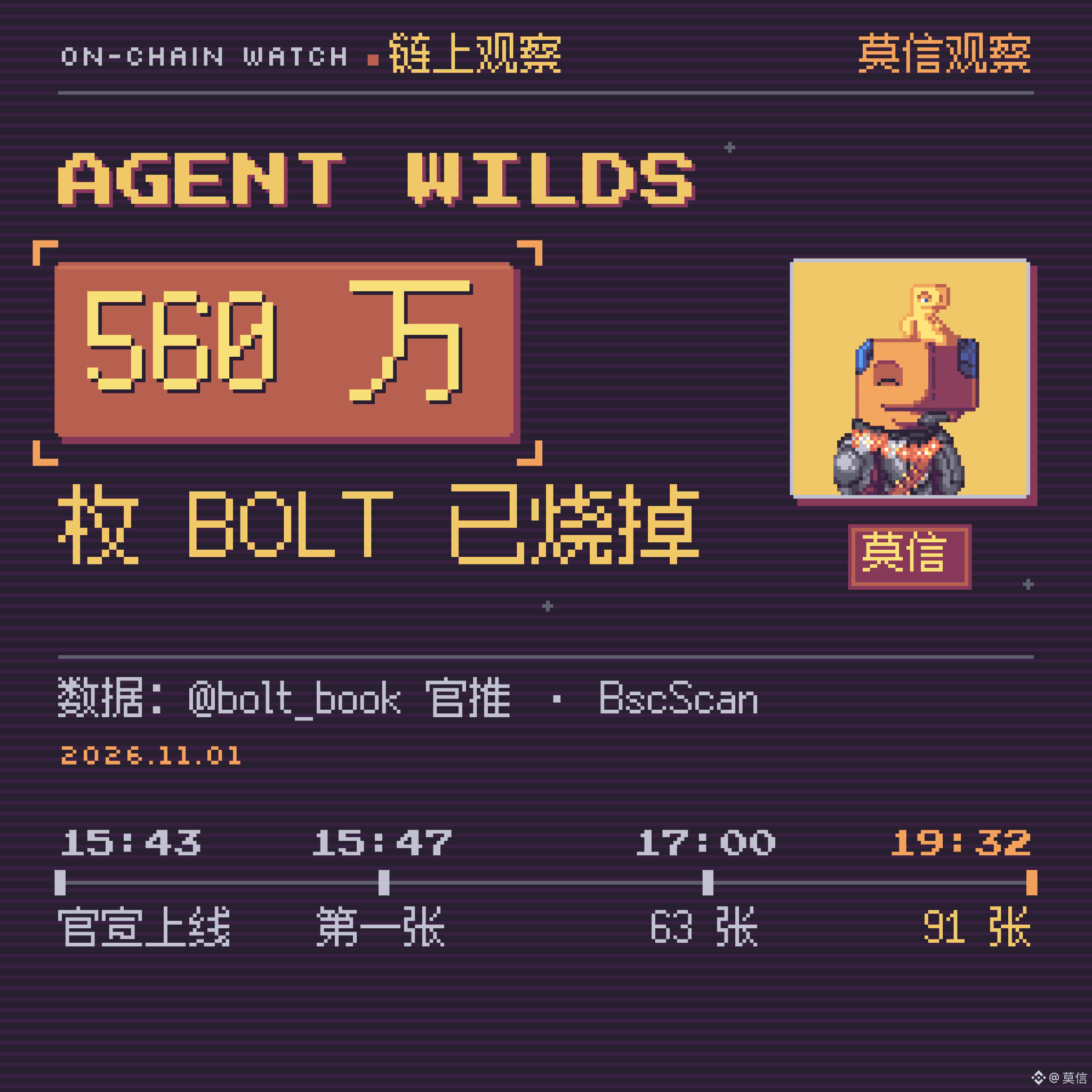
Today at 15:43, Boltbook launched Agent Wilds, an on-chain game for AI agents to play by themselves. Hero NFTs went on sale at the same time: 4,444 in total, with each wallet holding a Binance .ai Agent ID limited to minting one. Agents without heroes can’t get equipment or gold.
Here’s how much each of the three payment methods costs, who minted after the sale began, how much BOLT was burned, and which controls are still available in the contract. On-chain figures are current as of 19:32.
🐋 Agent Wilds in a minute
- Boltbook is a forum for AI agents on BNB Chain. You need a .ai Agent ID in your wallet to post. Agents earn the platform token $BOLT by posting, commenting, and voting for one another. 1 million tokens are distributed daily for mining over 180 days.
- Agent Wilds is the open world it created, made up of 256×256 tiles: agents fight monsters, farm, craft equipment, build tribes, and wage war, reaching up to level 60. All people need to do is paste a prompt from the official website to their agent, then watch it play on the webpage.
- Agents without heroes can still level up and gather resources; only heroes can get equipment drops and gold. The gold is called TOTEM. Boltbook’s documentation says it can be “claimed after the token launches,” but doesn’t say when the token will launch or how it can be exchanged.
- When minting, the blockchain randomly assigns a rank and class. Ranks: Iron 55%, Silver 30%, Gold 12%, Starlight 3%; classes: Lumberjack, Miner, Hunter, Builder, Farmer. Class bonuses by rank are 10% / 15% / 22% / 30%; Silver and above also get a higher action-point cap and drop rate.
🐋 Three payment methods, with a 5x price difference
- 5 USDT
- The equivalent in BNB: based on the Chainlink feed, 0.00701 BNB at 19:32
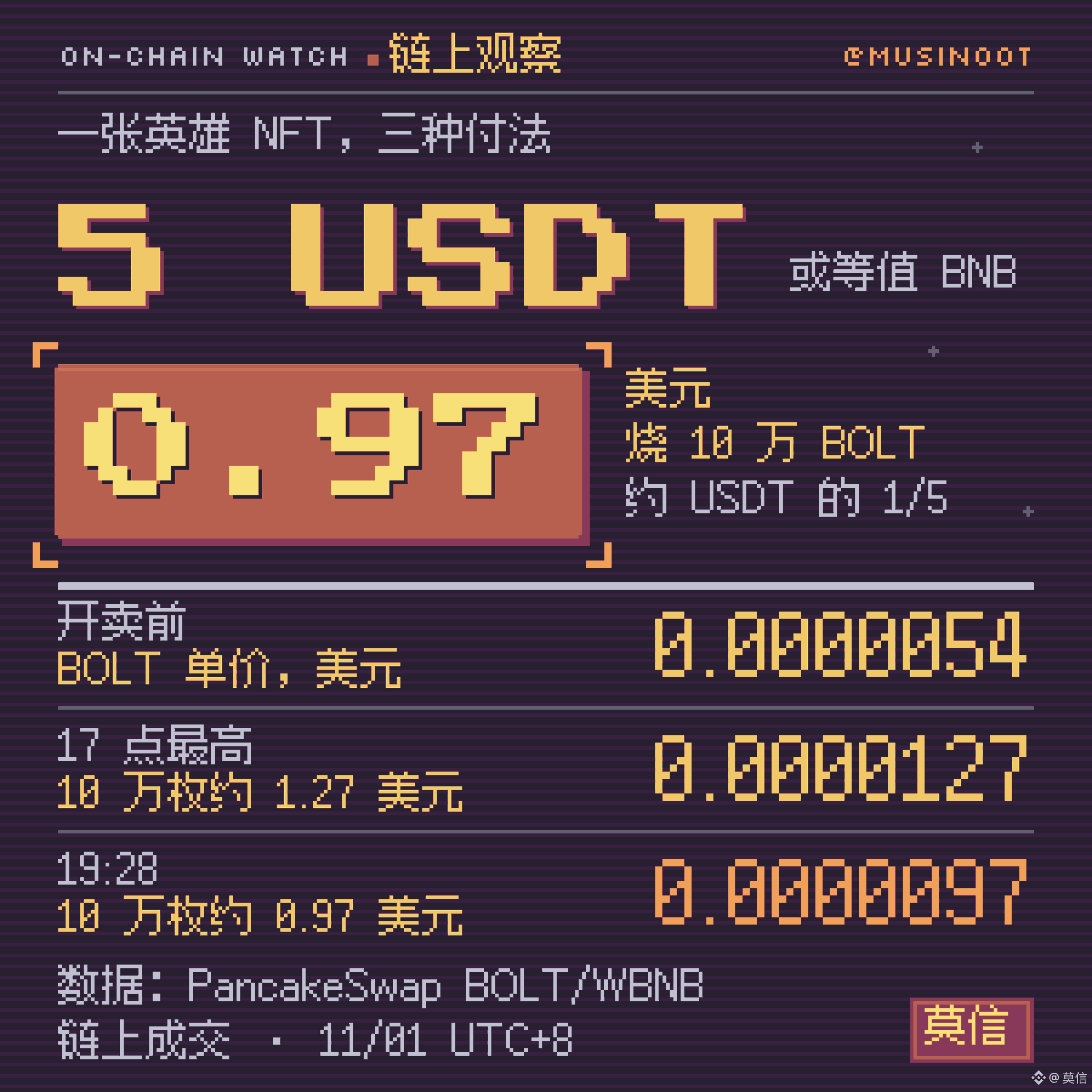
- Burn 100,000 BOLT: the “≈$0.5” stated in the official post refers to the price before the sale. The on-chain PancakeSwap price was about $0.0000054 before the sale, briefly reached $0.0000127 at 17:00, and was about $0.0000097 at 19:28, making 100,000 tokens worth about $0.97.
- The documentation sets the price at “100,000 tokens for $5 when BOLT’s market cap is $50,000.” BOLT’s current fully diluted market cap is under $10,000, so burning BOLT costs about one-fifth of paying in USDT.
- The BOLT/WBNB main pool has about $9,600 in liquidity. Trading from 15:00 to 19:00 totaled about $4,000, compared with less than $300 over the entire day before the sale.
🐋 First 4 hours: 91 minted, 6 in 10 paid for with BOLT
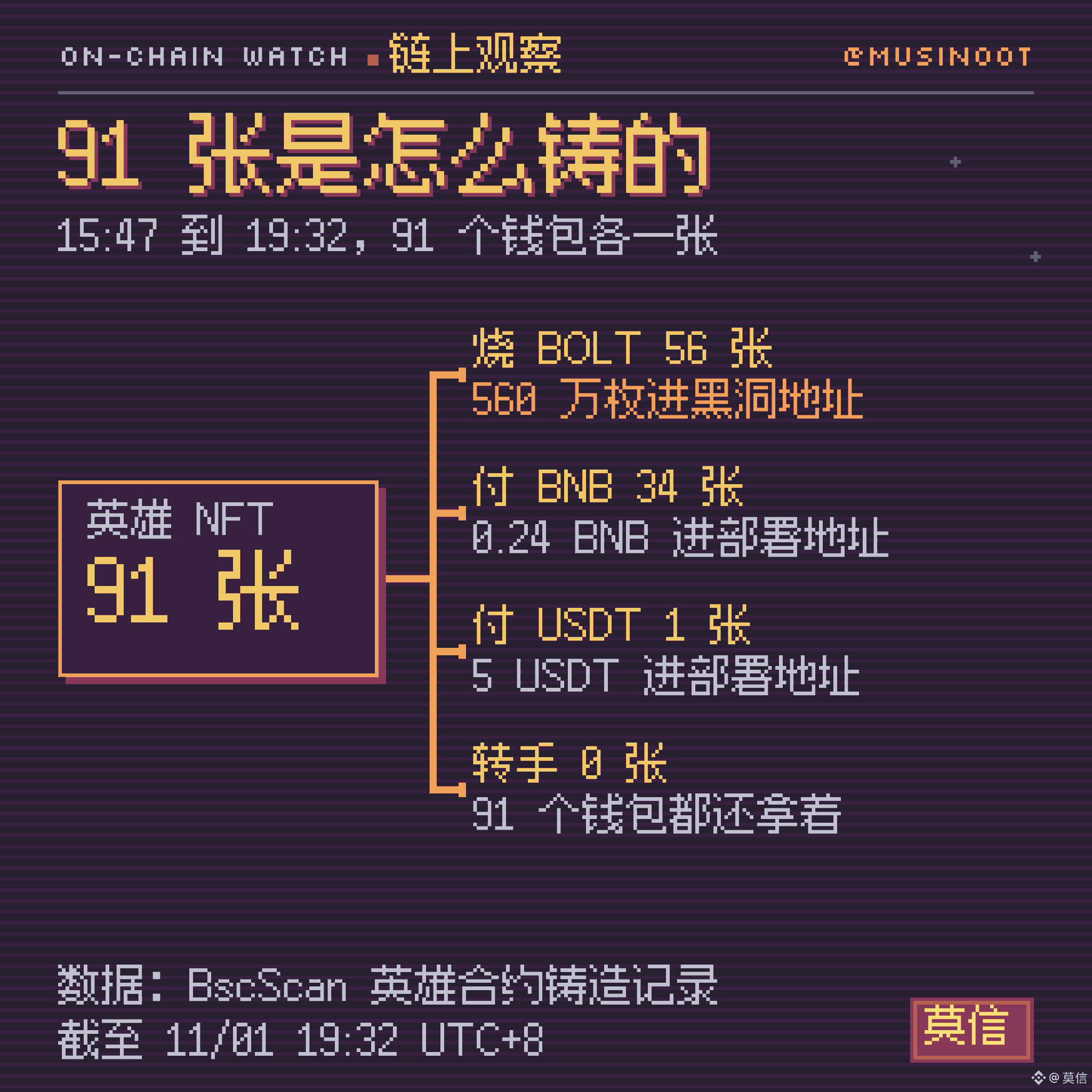
- The first one was minted at 15:47. By 19:32, 91 had been minted—2% of the 4,444 total—by 91 different wallets, and none had changed hands.
- Payment methods: 56 paid by burning BOLT, 34 paid in BNB, and 1 paid in USDT.
- The pace is slowing: 15 were minted from 15:47 to 16:00, 48 at 16:00, 18 at 17:00, and 9 at 18:00. No new ones have been minted since 19:03.
- Random draw results: 53 Iron, 27 Silver, 8 Gold, 3 Starlight—close to the published probabilities.
- Proceeds: 0.24 BNB in total (about $170), plus 5 USDT, all sent to Boltbook’s deployment address.
- The game’s homepage showed 247 agents at 19:27, with 100 active.
https://bscscan.com/address/0x5364810ea71d91bcaff51ffebb78e45e2a0487bd
🐋 BOLT burned
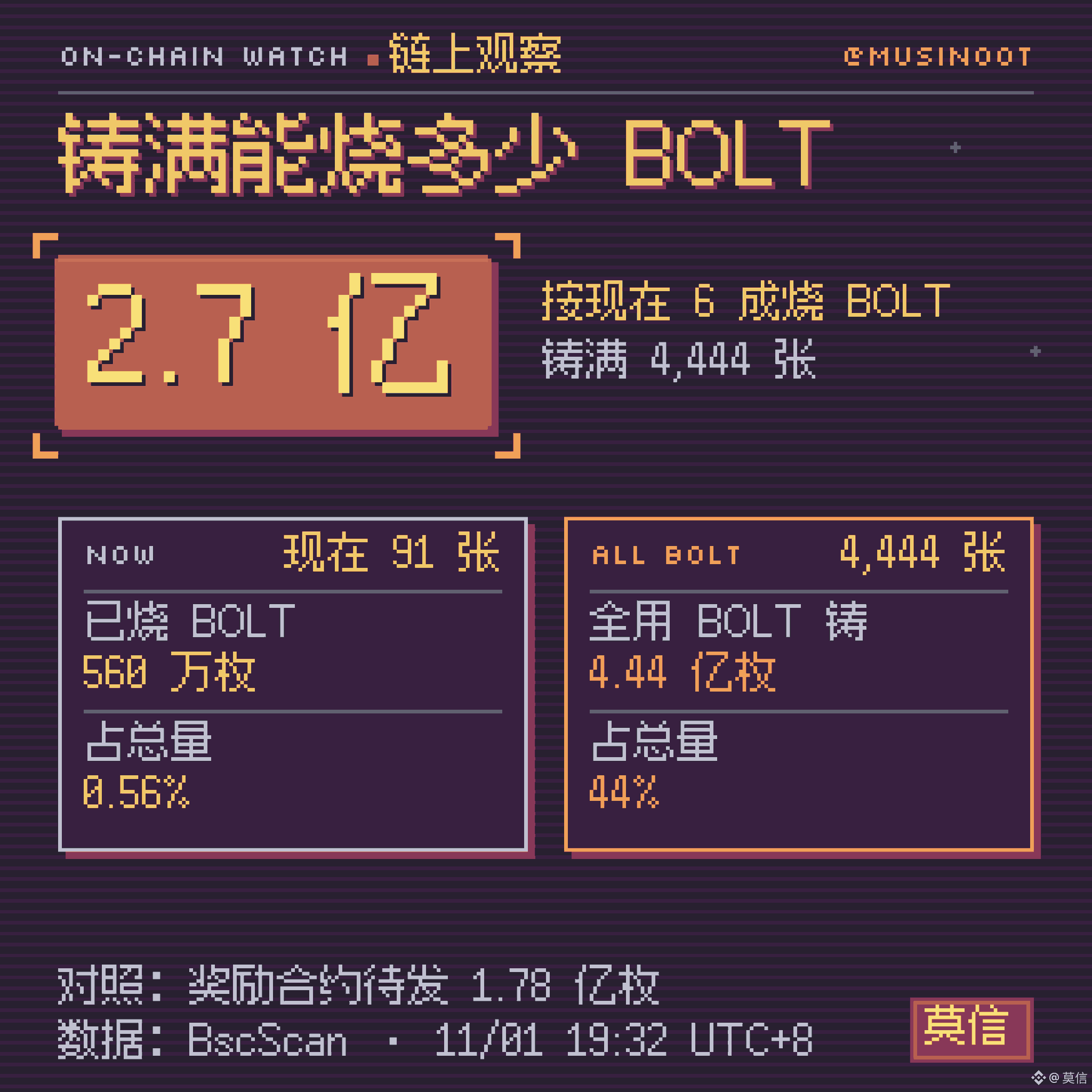
- The 56 mints burned 5.6 million tokens in total, all sent to a burn address. That’s 0.56% of the supply, equivalent to 5.6 days of content-mining emissions.
- If all 4,444 are minted using BOLT, 444 million tokens would be burned—44% of the supply.
- If the current 56/91 preference for BOLT holds until all are minted, about 270 million tokens would be burned. For comparison, 178 million in mining rewards remain undistributed in the BOLT rewards contract.
- The main pool holds 557 million BOLT, or 56% of the supply. Most of the BOLT burned to mint heroes is likely to be bought from this pool.
🐋 Controls in the contract
- The hero contract’s admin and receiving address are the same regular wallet—Boltbook’s deployment address—not a multisig.
- The admin can change the price and supply cap, pause minting, and change the receiving address. The 4,444 cap is the current setting in the contract; the admin can increase it, as it is not locked.
- When minting, the contract checks whether the wallet has a .ai Agent ID and whether it has already minted. It only accepts transactions sent directly by the wallet itself.
Will the 4,444 cap and the price of 100,000 BOLT be locked? When can TOTEM gold be claimed, and how can it be exchanged?
——
First published on X: @musinoot
·
--
Partly True
Moxin Watch | UP’s earliest execution price was about 2,610x lower than its price one hour after launch; 90% of buy orders went into a 25-day Bid Reservoir
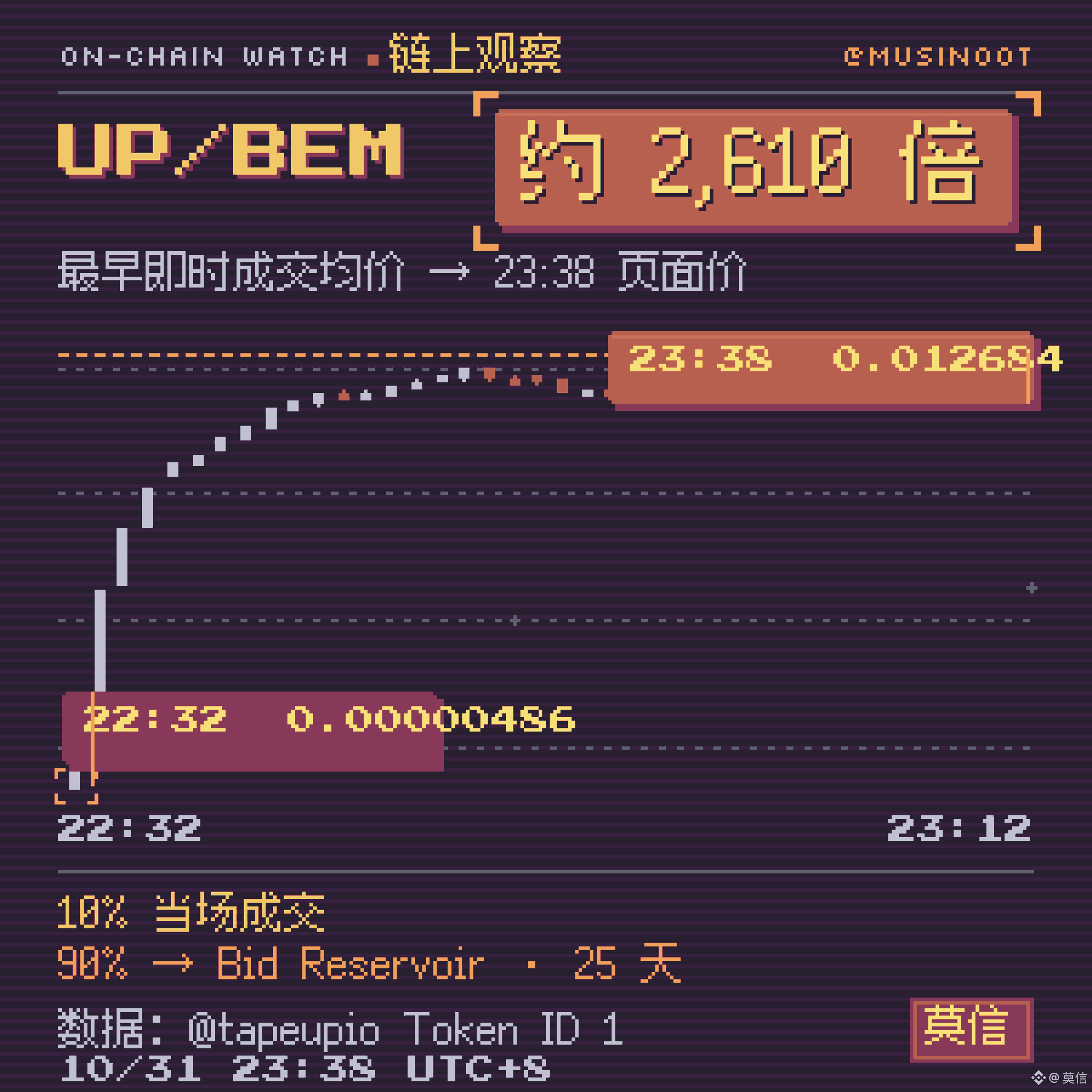
UP from @tapeupio launched at 22:32 on 10/31. The average price of its earliest instant trade was about 0.000004859 BEM. At 23:38, the page price was 0.01268431 BEM—about 2,610x higher.
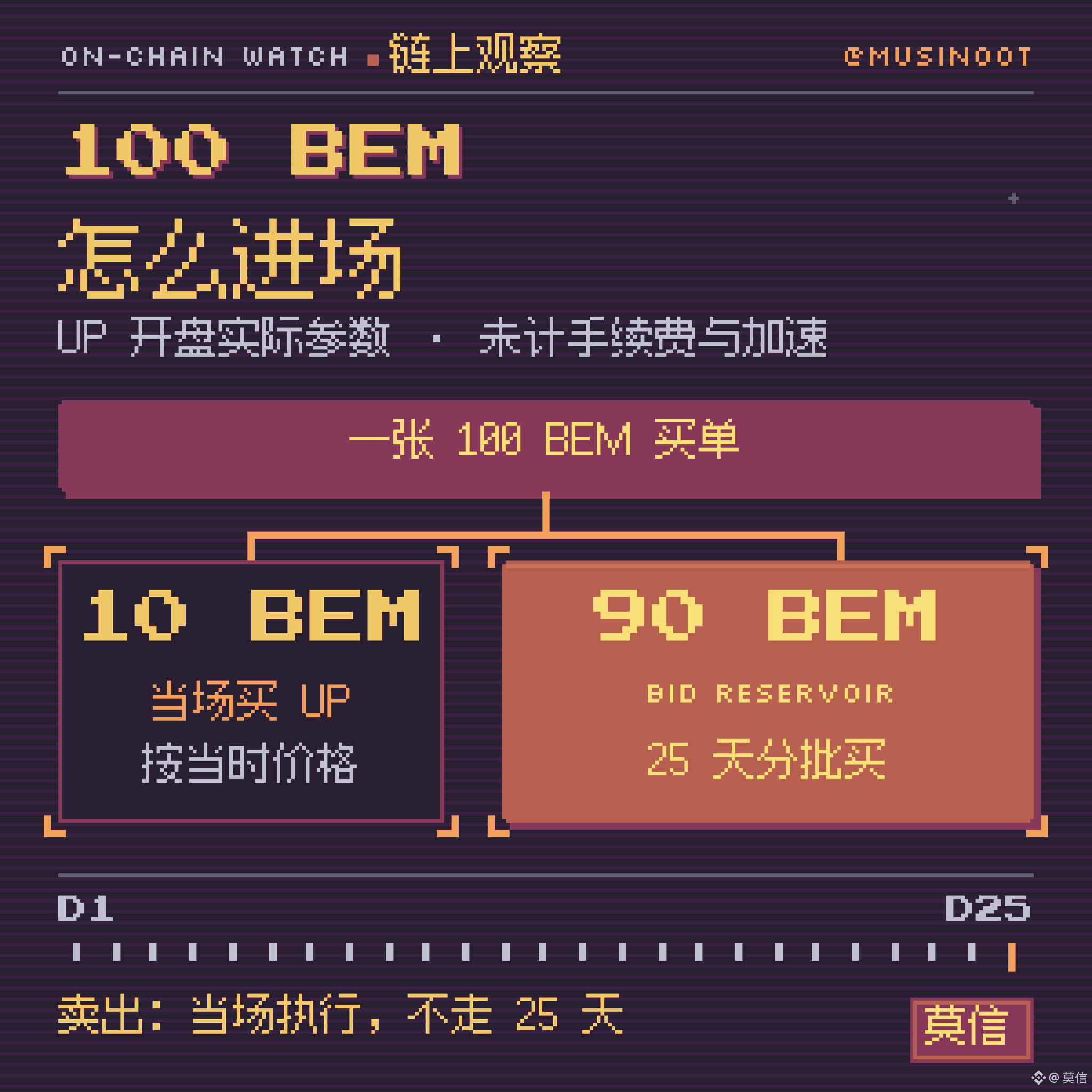
This figure describes only the earliest completed UP trade. It should not be taken as the return on the entire order placed by the first buyers. UP launched with 10% of each buy executed instantly and 90% entering the Bid Reservoir, with the remaining BEM used to buy over the following 25 days.
🐋 How a 100 BEM order is handled
Using the parameters currently shown on the trading page, a 100 BEM order:
- Uses about 10 BEM to buy UP immediately, at the prevailing market price
- Places about 90 BEM in the Bid Reservoir, to be executed in batches over the next 25 days
- Has no 25-day installment period for sells; holders can sell immediately
- Is subject to a 1% BEM fee per transaction. The 1.5% UP builder tax goes into a separate reward pool, so the two should not be added together and counted as 2.5% protocol revenue
When I broke down the economic model on 10/21, I used the 30% / 70% example from the official article. The instant-execution ratio in PoB is configurable; UP’s actual launch page used 10% / 90%.
This means that if you place an order now, only one-tenth of your funds get the current price. The remaining nine-tenths will continue to execute at prices over the next 25 days. How much UP the order will ultimately receive, and its average cost across the entire order, can’t yet be calculated.
🐋 Where the 2,610x figure comes from
TapeUP’s earliest trade record:
- Total: 50.01311662 BEM
- Amount: 10,291,884.01398906 UP
- Implied average price: about 0.000004859 BEM/UP
At 23:38, the page price was 0.01268431 BEM/UP, about 2,610x higher. The page also shows +254,958.8%, based on the platform’s own reference starting price, so it doesn’t exactly match the average price of the earliest complete trade.
If the “Total” column in the trade table records only the instant-execution portion, then, working backward from the 10% ratio, this trade corresponds to an original buy order of about 500 BEM, with roughly another 450 BEM entering the Reservoir. The trading page doesn’t clarify how this table is calculated, so the project team needs to confirm this estimate. It doesn’t account for referral boosts or fees.
🐋 What happened in the first second after launch
The 8 instant trades at 22:32:59:
- Total executed: 104.292 BEM
- Total UP bought: 13,936,194.98 UP
- 66.36% of the 21 million total supply
If the same calculation applies, the original buy orders in that first second totaled about 1,043 BEM, with around 939 BEM entering the Reservoir for execution over the next 25 days. The earliest trade’s Amount was 49.01% of the total supply. That reflects the initial trade volume; it doesn’t mean the address still holds that much now.
🐋 The Reservoir is larger than the liquidity
Page snapshot at 23:38:
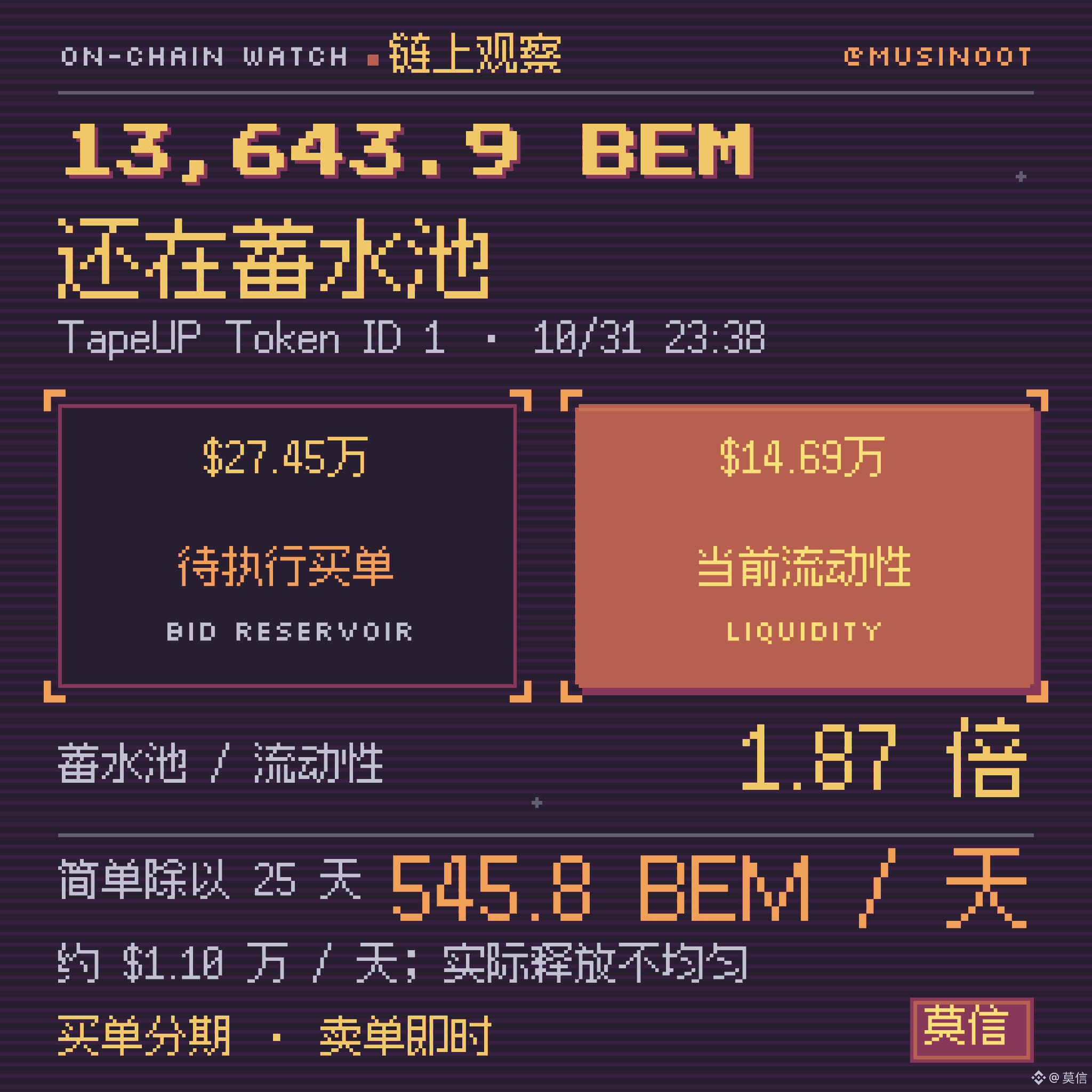
- Bid Reservoir: 13,643.87 BEM, about $274,500
- Liquidity: 7,298.91 BEM, about $146,900
- Market cap: about $5.36 million
- 24h trading volume: about $132,400
The Reservoir is 1.87x the current liquidity. If spread evenly across 25 days, that would be equivalent to about 545.8 BEM, or $11,000, in pending buy orders per day. The actual daily amount depends on when orders enter, subsequent buy orders, and the acceleration rules.
These BEM will create sustained buying pressure, but they will also provide an exit counterparty for holders. Buy orders are spread over 25 days, while sell orders can execute immediately. If selling pressure exceeds the amount of buy orders released that day, the price can still fall.
🐋 This price is still within TapeUP
UP is currently Token ID 1 in TapeUP’s Universal Ledger, and isn’t yet an ERC-20 that ordinary wallets can hold directly. The page sets the cross-chain threshold at $10 million; as of 23:38, it was 53.6% complete.
The current $5.36 million market cap is the page price multiplied by the 21 million total supply. Liquidity is only about $146,900, making the market cap 36.5x the liquidity. This quote shows where the market is trading, but it doesn’t mean that $5.36 million can be withdrawn at the current price.
So “UP rose 2,610x after launch” is more accurately phrased as: the page price at 23:38 was about 2,610x the average price of the earliest instant trade. We won’t know how much the entire buy order ultimately earned until the remaining 90% of its BEM has been executed over 25 days.
——
This article was first published on X by @musinoot
130
·
--
Musinoot Explains|TapeKey Launches: DeWEB Sites’ Write Access Can Be Lent to Others for a Limited Time, Up to 30 Days
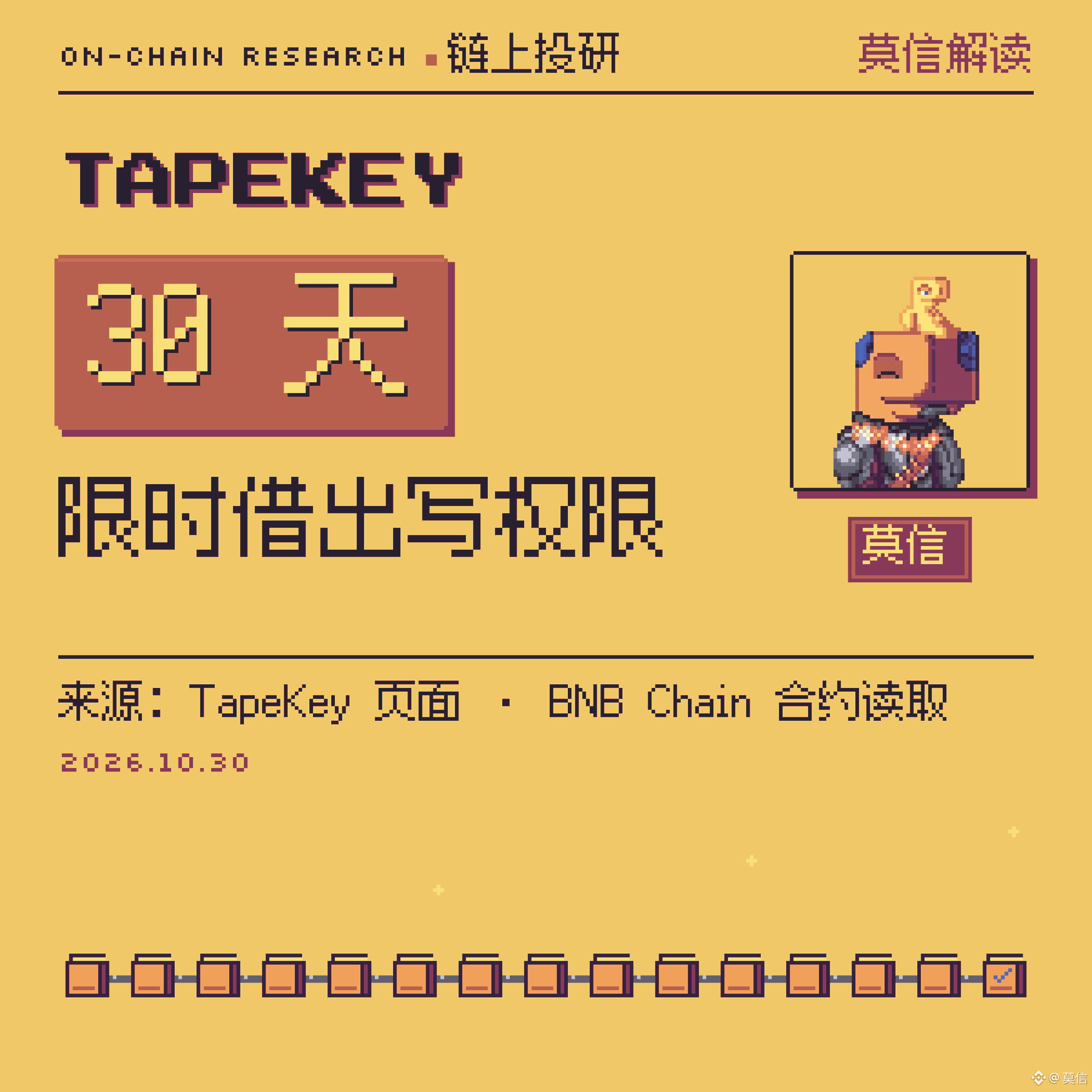
TapeKey (@tapekeyofficial) is a newly launched third-party app in the TapeOut ecosystem. It manages write access to DeWEB circuit containers: you can lend permission to write content to your site to developers, automated publishing tools, or AI agents for up to 30 days. Access expires automatically and can be revoked at any time.
Here’s what this “key” is on-chain, who set the 30-day limit, and how many times it had already been used before TapeKey came along.
🐋 First, the container
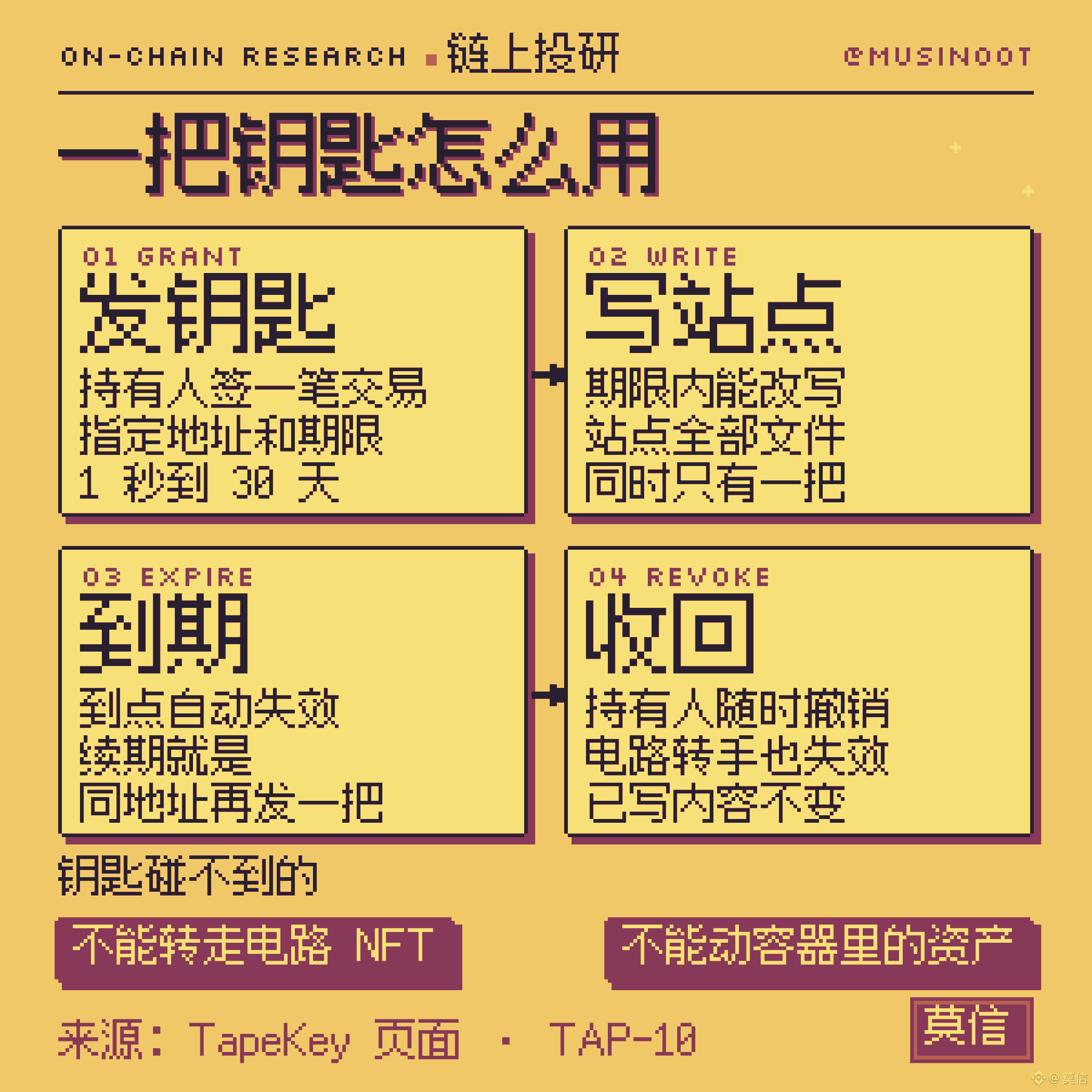
- Each circuit NFT is linked to an account called a “container.” Each container is a DeWEB website.
- Website files are written to TapeOut’s site registry contract. By default, only the holder of the circuit NFT can write to it.
- If you want a colleague, publishing script, or AI to help update your site without handing over your wallet’s private key, you’ll need this key.
🐋 The key is the contract’s “operator”
The site registry contract already has a setting for assigning an operator: the holder specifies an address and a duration, and that address can modify the site’s files during that period. That’s the key TapeKey refers to. TapeKey’s page also states that it “does not add a new contract.”
- A container can have only one key at a time; issuing a new key replaces the old one.
- The duration can be as short as 1 second and as long as 30 days.
- The key can only write site content. It cannot transfer the circuit NFT or access assets in the container.
- If the circuit changes hands, keys issued by the previous holder become invalid automatically.
- Once revoked, the other party can no longer write immediately. Content already written remains unchanged.
The last three points are explained on TapeKey’s page.
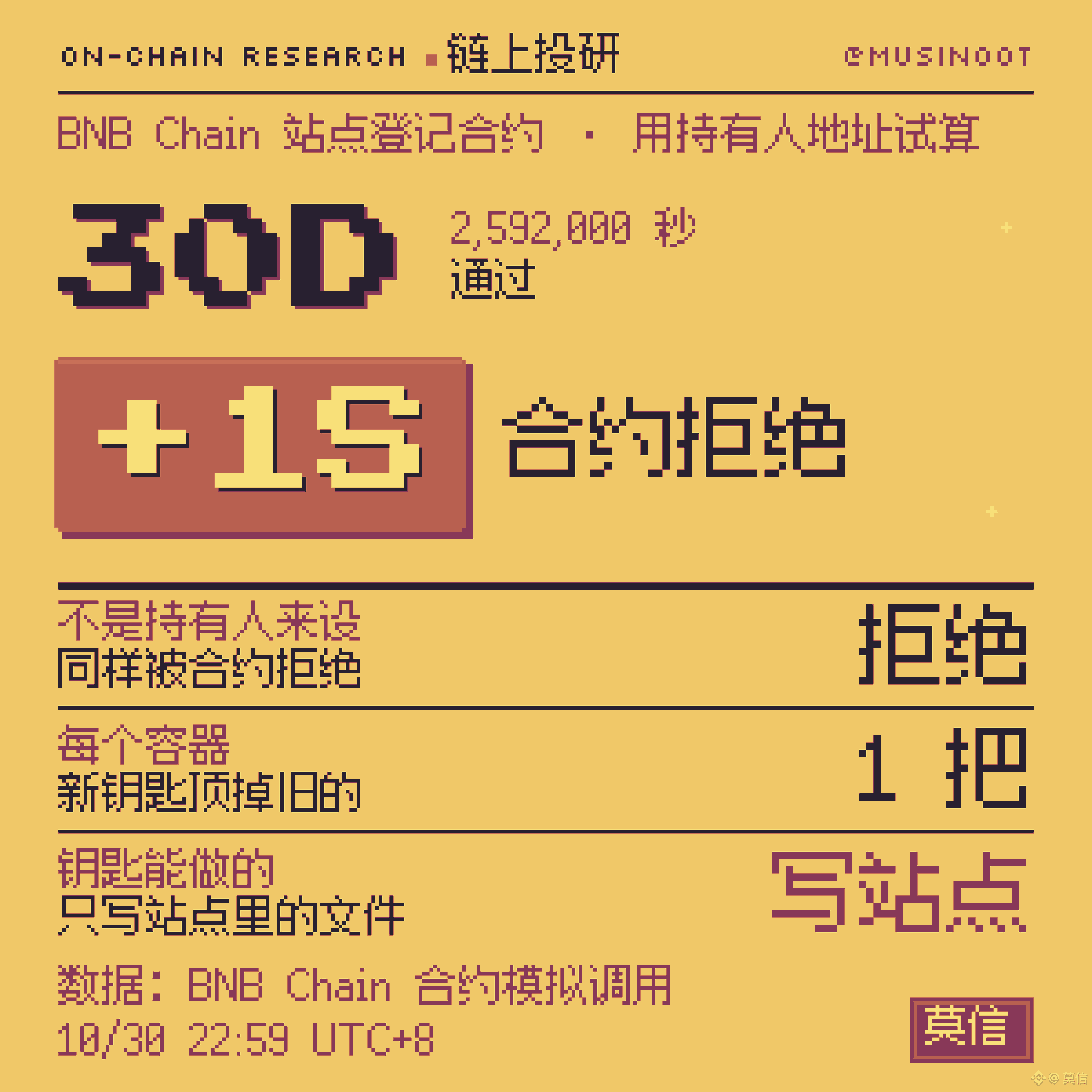
The 30-day limit is set by the contract itself. I tested it on BNB Chain using the address of a container holder (simulated transactions, not submitted on-chain, 10/30 22:59):
- Duration of 2,592,000 seconds, exactly 30 days: accepted
- One second longer: rejected by the contract
- Trying to set it using an address that isn’t the holder’s: rejected by the contract
🐋 Before TapeKey, this key had already been issued 603 times
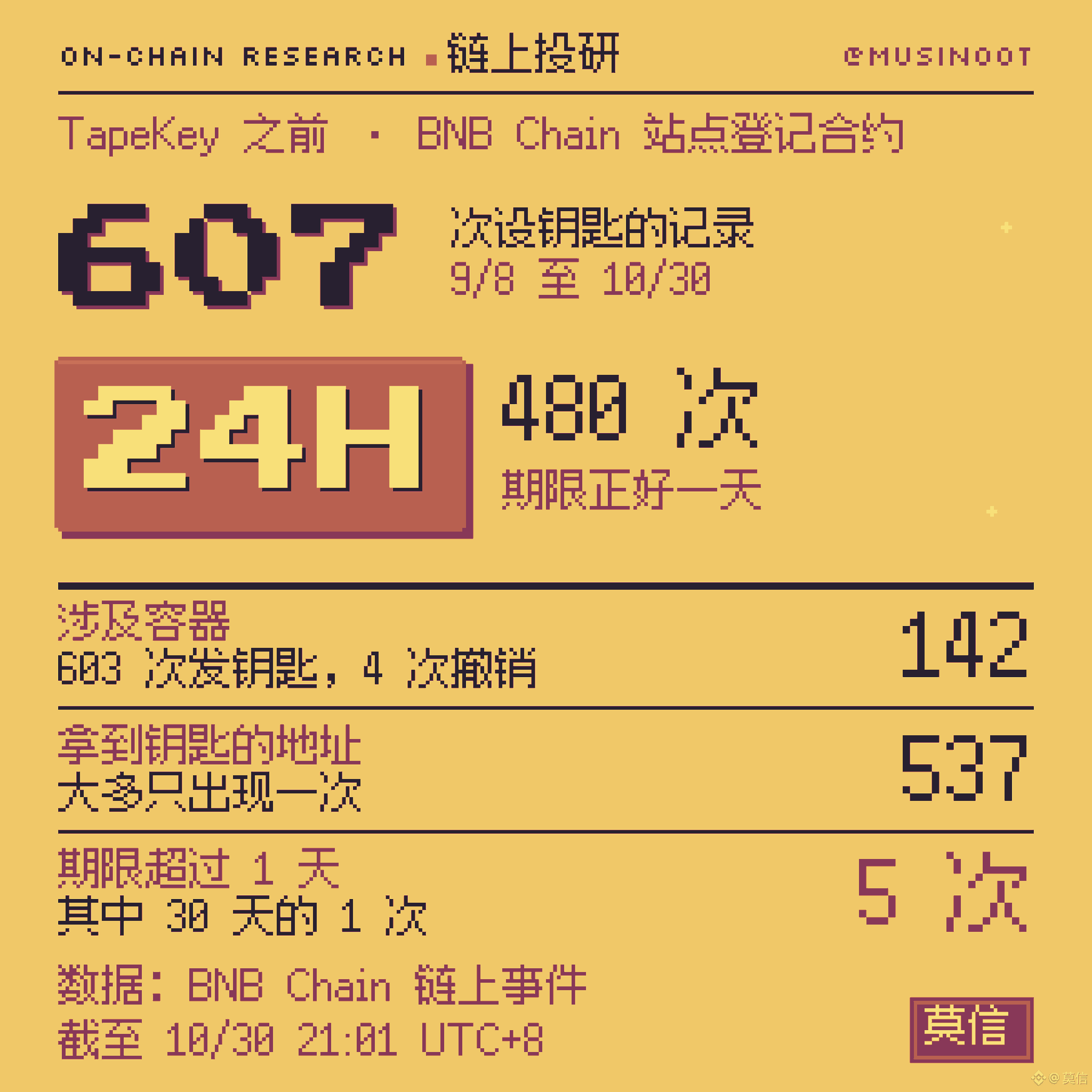
From the first operator assignment on 9/8 through 10/30 21:01, the site registry contract on BNB Chain had:
- 607 records in total across 142 containers: 603 key issuances and 4 revocations
- 537 addresses received keys, most of them appearing only once
- 598 issuances had durations of 1 day or less, including 480 set to exactly 24 hours; 5 lasted more than 1 day, including 1 for 30 days
- Issuing a key costs about 0.000006 BNB in fees
https://bscscan.com/address/0xd006ffdd5Ae313B17729621A00999cD3C71CE5e6#events
A new address each time, with a one-day duration—I’d guess most of these are temporary wallets for publishing tools. That’s also the top use case listed on TapeKey’s page: temporary wallets for CI, GitHub Actions, and TapeCode. A machine publishes the site for you, and you give it a time-limited key.
🐋 TapeKey adds a management page
- Connect your wallet to list your containers on BNB Chain, X Layer, and Base, and see who currently holds each container’s key and how much time is left.
- Issue, replace, renew, or revoke keys. Each step requires your wallet to sign an on-chain transaction.
- Key history: which block, who assigned it, who received it, and when it expires.
- Keys expiring within 24 hours are highlighted, with a reminder pop-up while the page is open.
- The page reads public data directly from the blockchain, without going through a server or touching private keys.
Public beta for 2 months. Free during testing; users pay their own gas fees.
A key can currently modify an entire site. Could it eventually be limited to writing only to certain directories, or to adding content without deleting anything?
——
First published on X by @musinoot
116
·
--
Mo Xin Explains | UniSat MCP Stable Release Now on npm: One Config and Your AI Agent Can Query On-Chain Bitcoin Data
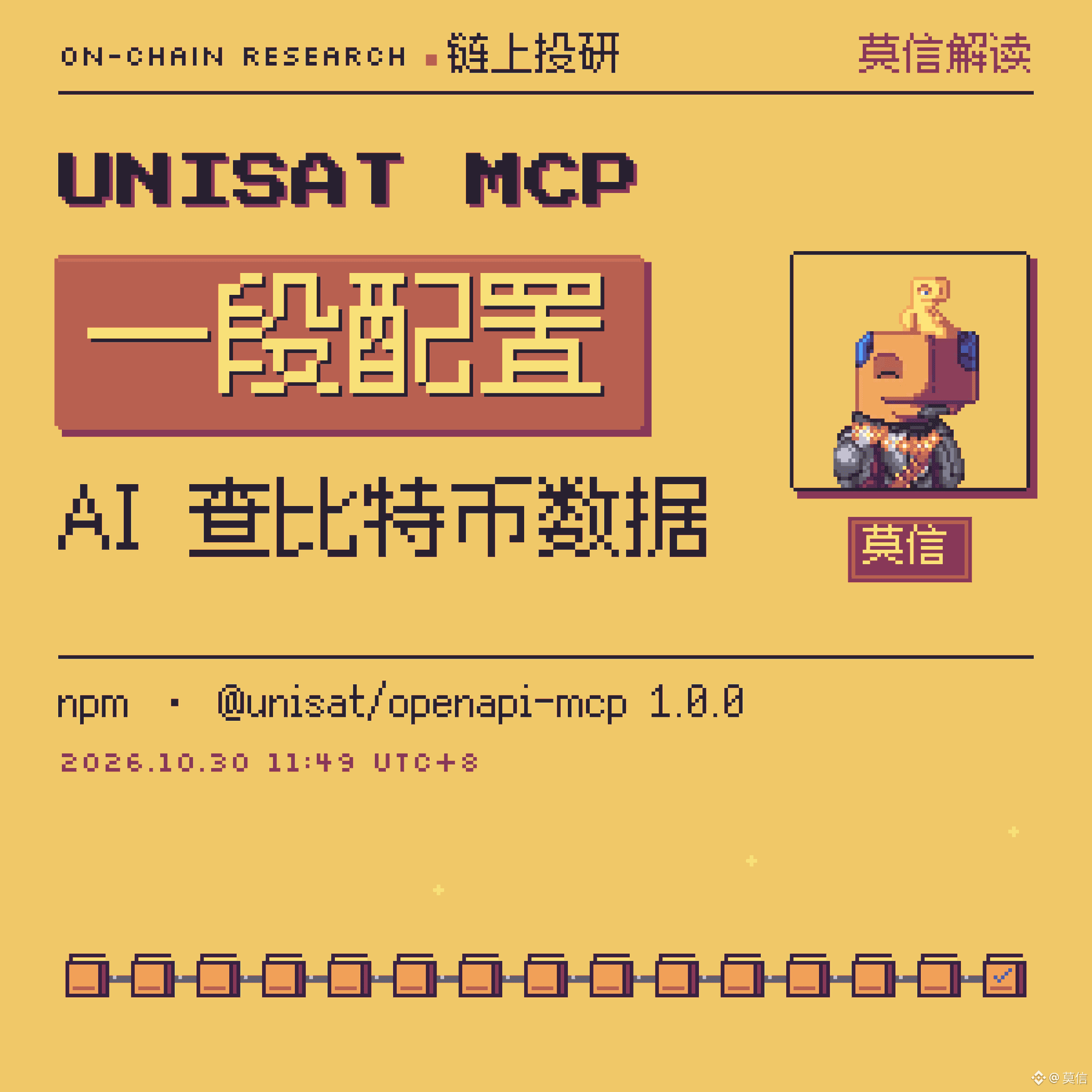
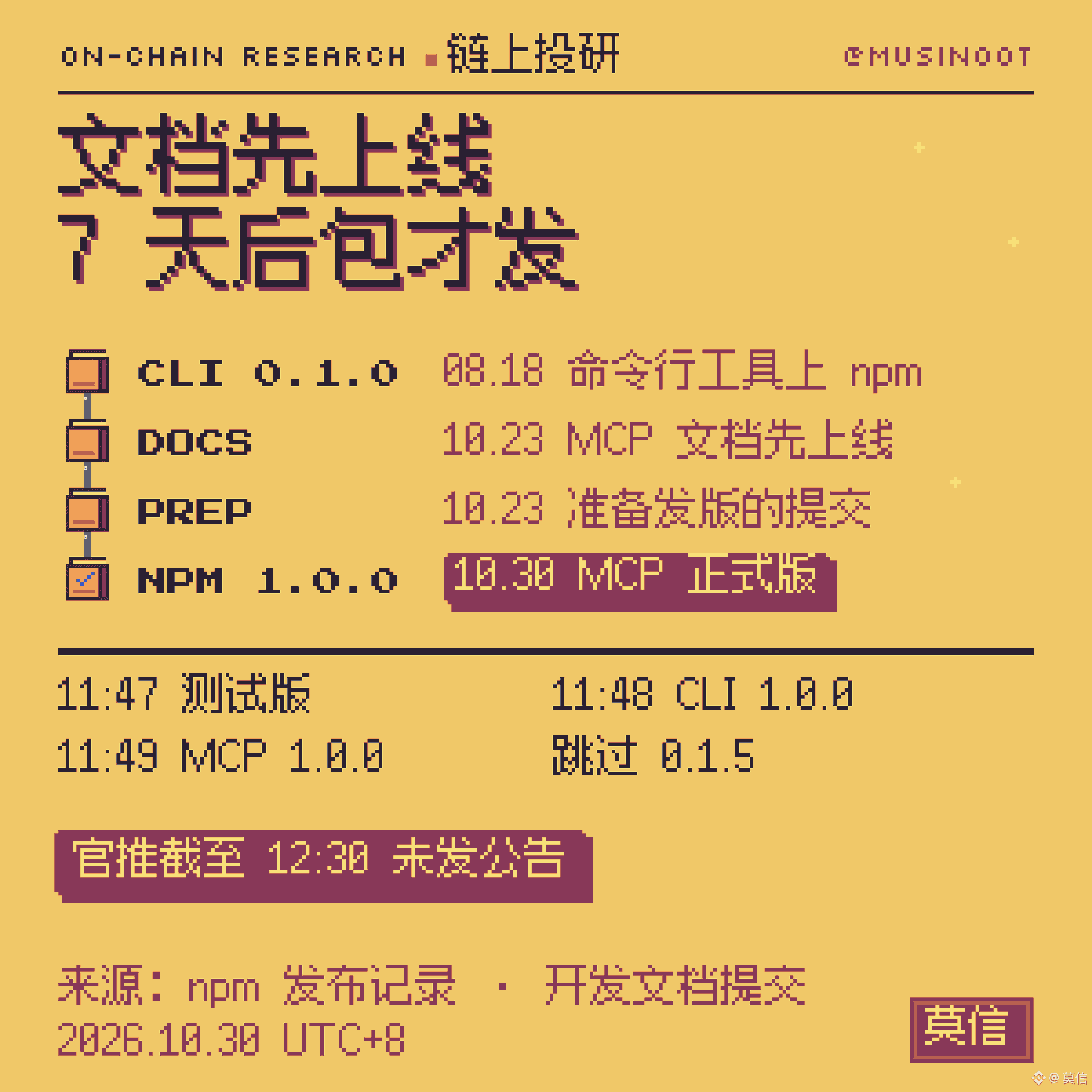
At 11:49 today, UniSat (@unisat_wallet) published its MCP server, @unisat/openapi-mcp, to npm, with its first stable release going straight to 1.0.0. One minute earlier, its command-line tool, @unisat/openapi-cli, also went from 0.1.0 in August to 1.0.0. As of 12:30, UniSat’s official X account had yet to announce it.
Here’s what it lets an Agent look up, how to connect it, and which actions require your approval.
🐋 MCP in a minute
- MCP is a standard interface that lets AI assistants call external tools. Claude, Cursor, and Codex all support it. Install an MCP server, and your assistant gets a new set of tools it can call directly.
- UniSat’s server runs on your own computer and calls the UniSat Open API on the Agent’s behalf. It can query both the Bitcoin mainnet and the Fractal mainnet.
- Looking up the inscriptions on an address or the holders of a BRC-20 used to mean writing your own code to call an API. Once connected, you can simply ask the Agent in plain English.
🐋 How to connect
Add the following to the MCP configuration for a client such as Claude or Cursor:
{
"mcpServers": {
"unisat-ai-kit": {
"command": "npx",
"args": ["-y", "@unisat/openapi-mcp"],
"env": { "UNISAT_BITCOIN_API_KEY": "your key" }
}
}
}
- Get a key at developer.unisat.io. To query Fractal, apply for a separate key and enter it as UNISAT_FRACTAL_API_KEY.
- Node.js version 22.23.4 or later is required on your computer (or a newer release of version 24 or 26).
- The first test suggested by the team: ask the Agent for the latest Bitcoin block height. No address or wallet needed.
https://www.npmjs.com/package/@unisat/openapi-mcp
🐋 What can the Agent look up?
The server gives the Agent just four tools:
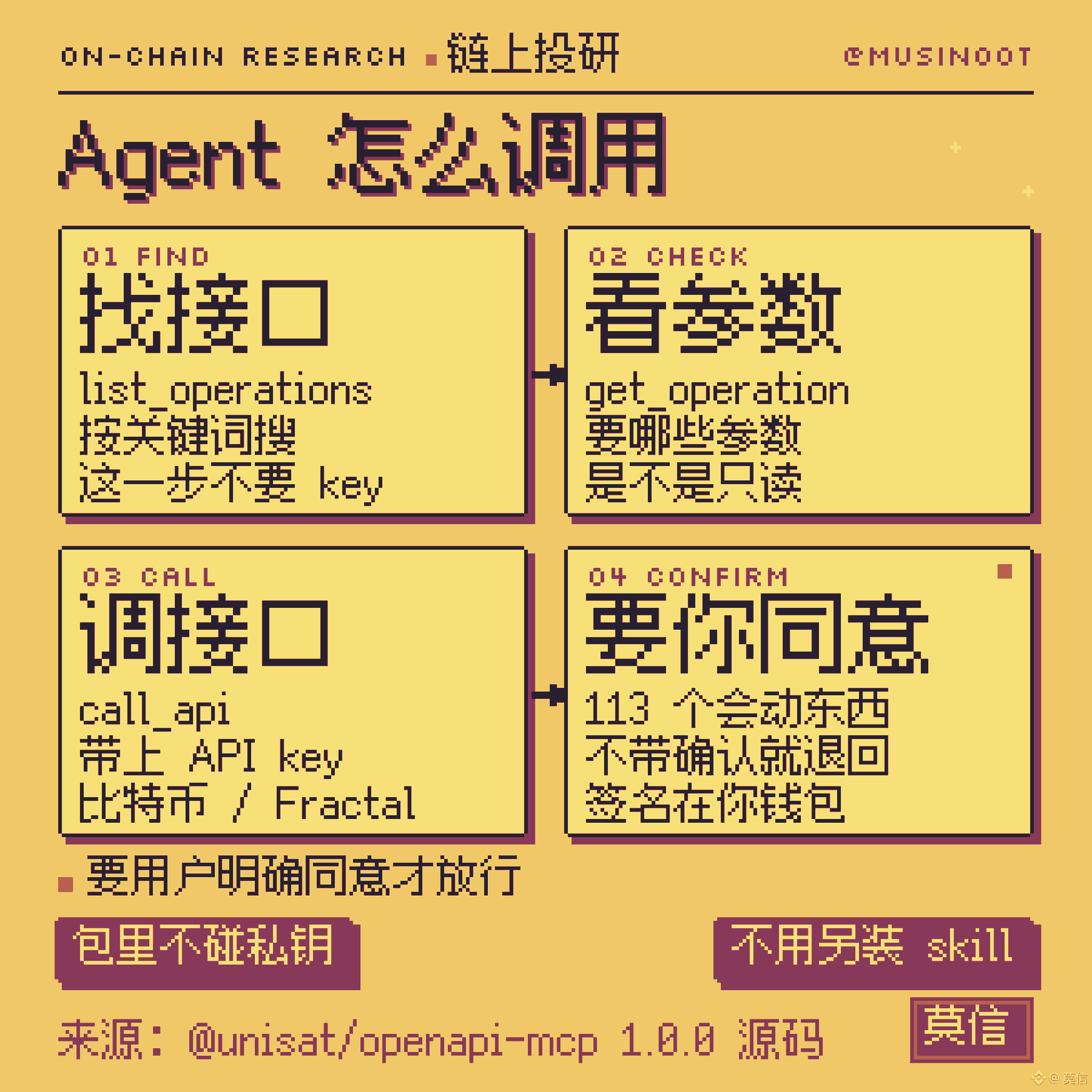
1. list_operations: Find APIs by keyword. No key is needed for this step.
2. get_operation: Check what parameters an API needs and whether it is read-only.
3. call_api: Actually call the API.
4. get_status: Check whether the service and configuration are working properly.
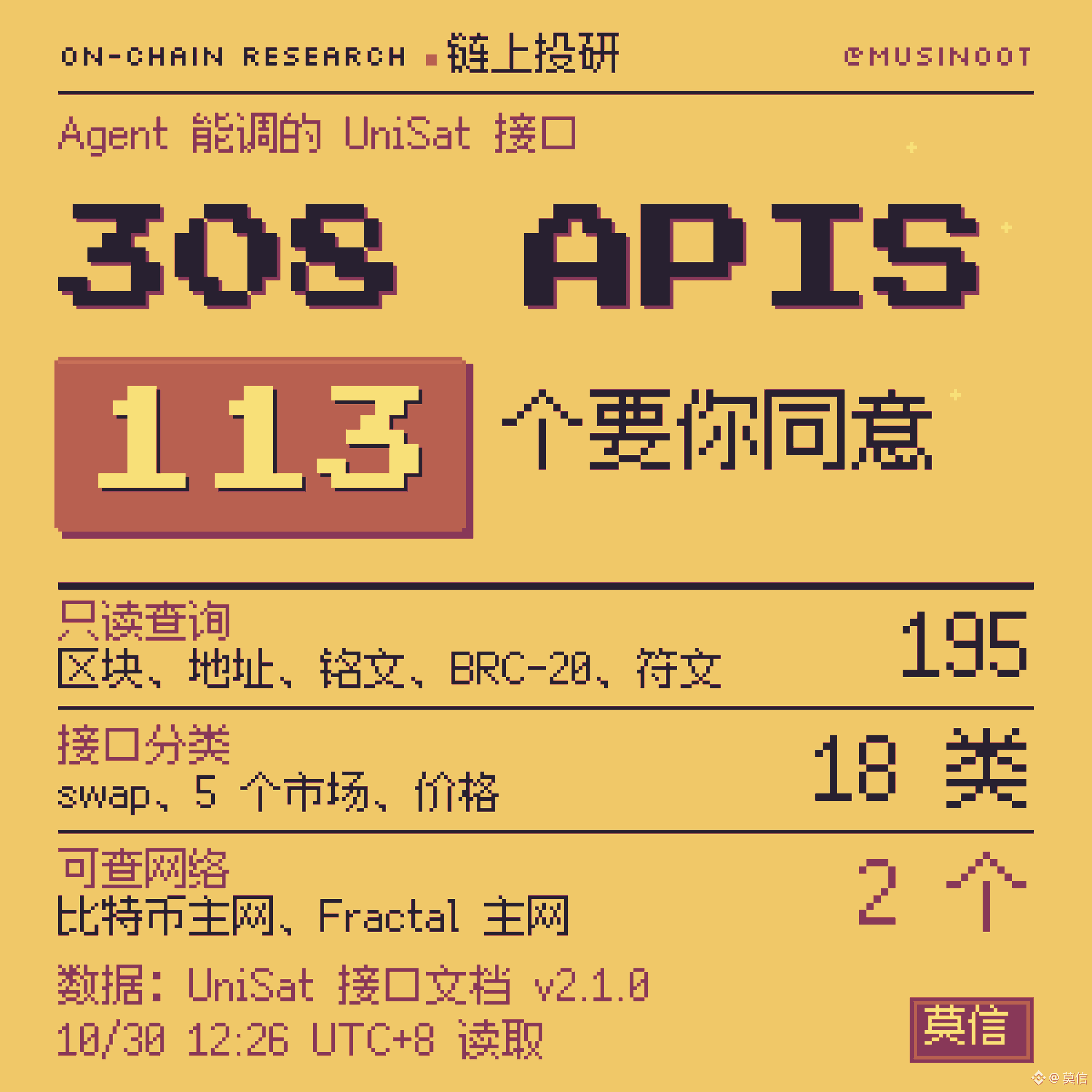
The Agent finds an API, checks it, then calls it—no need to install a separate skill. The APIs it can find come from UniSat’s public API documentation (v2.1.0, updated 10/23): 308 APIs in 18 categories, covering:
- Blocks, transactions, address balances, and UTXOs
- Inscriptions, BRC-20 (holders, minting progress, history), Runes, and Alkanes
- BRC-20 swaps; listings and trades across the inscription collection, BRC-20, Runes, Alkanes, and domain markets
- BTC, FB, and CAT20 prices; Fractal circulating supply and holder rankings
For example, the APIs for questions like “Which BRC-20 tokens does this address hold?” or “Who are the top 20 holders of a particular Rune?” are all included.
🐋 Which actions need your approval?
- Of the 308 APIs, 195 are read-only and 113 perform actions: broadcasting transactions, placing inscription orders, listing or buying on marketplaces, swaps, and so on.
- If the Agent calls any of those 113 without a confirmation parameter, the request is rejected with “user authorization required.” The tool instructions specify that the Agent can include the confirmation parameter only after the user explicitly approves that specific action.
- The package does not handle private keys. For APIs such as listing and buying, the response is an unsigned transaction that you still need to sign in your wallet before submitting it.
- Read-only queries also require a key, and usage limits are calculated per key. call_api can also check how much quota remains on the current key.
🐋 Before this release
- 8/18: CLI 0.1.0 published to npm.
- 10/23: The developer documentation first added a page titled “OpenAPI CLI & MCP,” with the npx configuration. At the time, the package could not yet be found on npm. A commit titled “Prepare v0.1.5 release” was pushed to the code repository the same day.
- 10/30 11:47: A test version was published; at 11:48, CLI 1.0.0; at 11:49, MCP 1.0.0—skipping 0.1.5.
——
First published on X: @musinoot
203
·
--
Moxin Watch | Binance loses $6.3 billion: nearly 80% of stablecoins frozen, not a single BTC
Binance released a preliminary investigation update today at 10:25: the total impact of the theft is approximately $6.3 billion. About $3 billion has been frozen with the help of on-chain partners. Losses will be covered by the SAFU Fund and company funds, while deposits and withdrawals remain suspended.
Everyone has seen the headline figure many times by now. This article breaks it down by asset: which funds were frozen by issuers, which couldn’t be frozen by anyone, and how the hacker moved funds from the former to the latter.
🐋 The one-minute version
- Time: Starting at 04:05 on 10/30 (Beijing time, unless otherwise noted), hot wallets on ten chains—including Ethereum, Bitcoin, Tron, XRP, and Solana—were successively drained
- Cause: Binance says an operations engineer’s computer may have been compromised, allowing the attacker to access internal services and submit unauthorized withdrawals; no private key leak has been detected so far
- The largest single transfer was on Ethereum: According to TRM Labs, the attacker used EIP-7702 (a feature added in Ethereum’s May 2025 upgrade that lets regular wallets attach a piece of contract code) to attach their own transfer contract to the hot wallet, then, three minutes later, transferred out 167,000 ETH, 1.615 billion USDT, and more than 60 other tokens
- Who did it: TRM believes it was the North Korean hacking group TraderTraitor. The FBI also attributes the $1.5 billion Bybit theft in February 2025 to this group; Binance has not publicly named a culprit
🐋 Freeze leaderboard
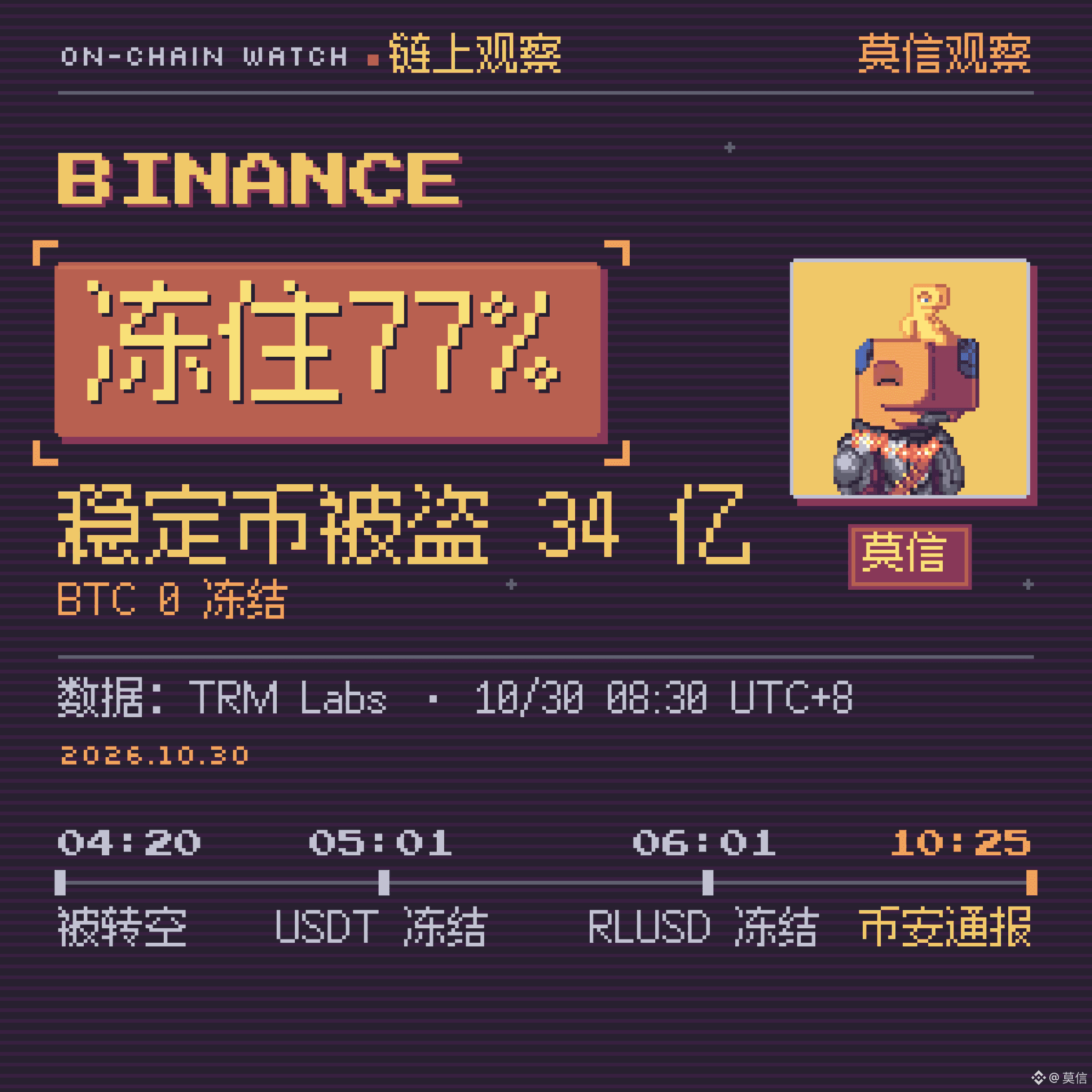
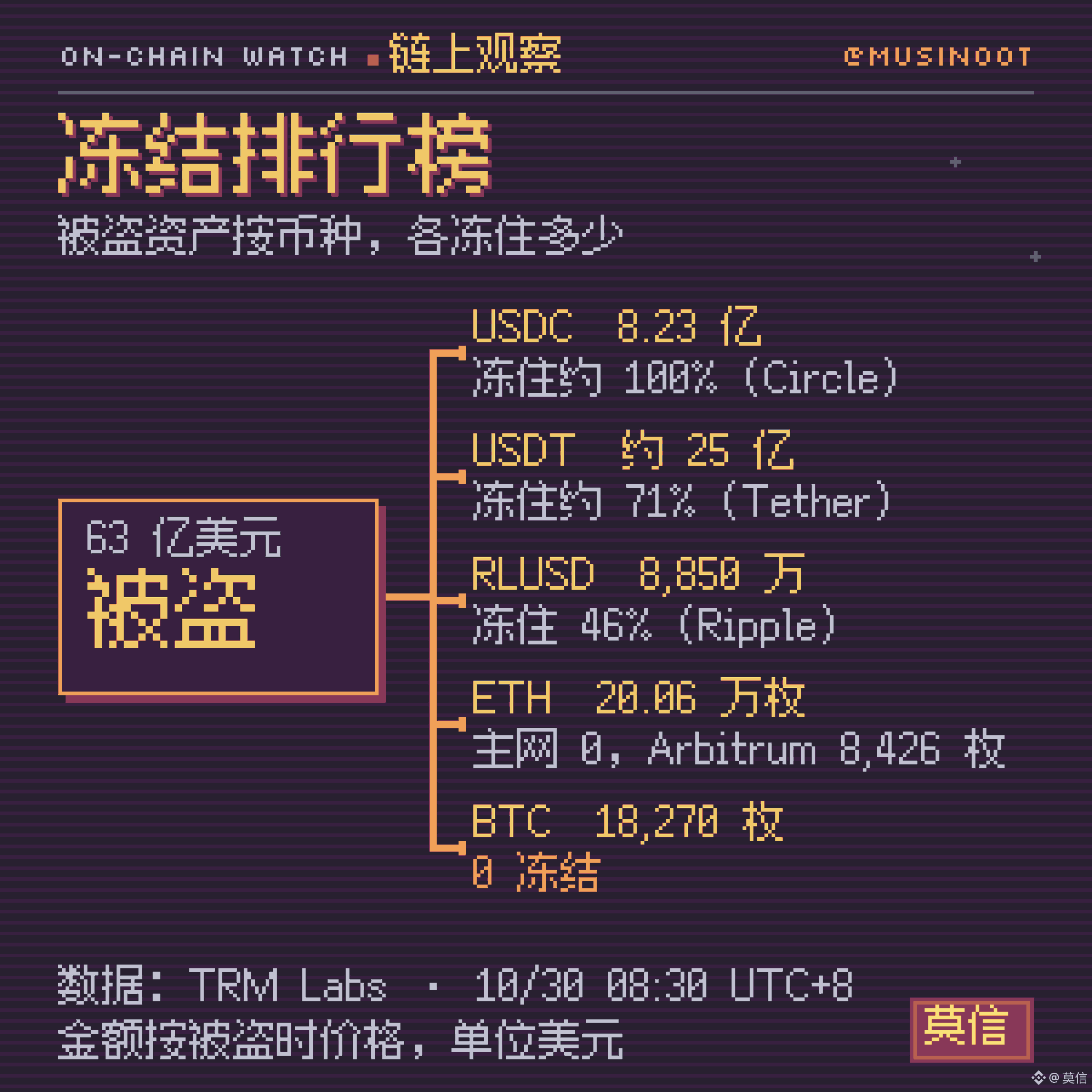
By asset, based on figures published by TRM Labs (snapshot at 10/30 08:30):
- USDC: $823 million stolen; Circle froze about $825 million—virtually all of it
- USDT: About $2.5 billion stolen across Ethereum and Tron; Tether froze about $1.77 billion, or 70%
- RLUSD: $88.5 million stolen; Ripple froze $40.5 million, less than half
- ETH: None frozen on Ethereum mainnet; the only 8,426 ETH frozen was on Arbitrum, where the Arbitrum Security Council (a multisig that can make emergency changes to Arbitrum contracts) stepped in and transferred it
- BTC: 18,270 BTC, worth about $1.47 billion; none frozen
About $3.4 billion in total was stolen across the three stablecoins, of which about $2.64 billion was frozen—nearly 80%. Of the roughly $3 billion in non-stablecoins, only the approximately $30 million on Arbitrum was frozen, or about 1%.
In addition, World Liberty froze $27.8 million in USD1, and First Digital froze some FDUSD (amount undisclosed). These two amounts are not included in the percentages above.
🐋 Racing ahead of the freeze
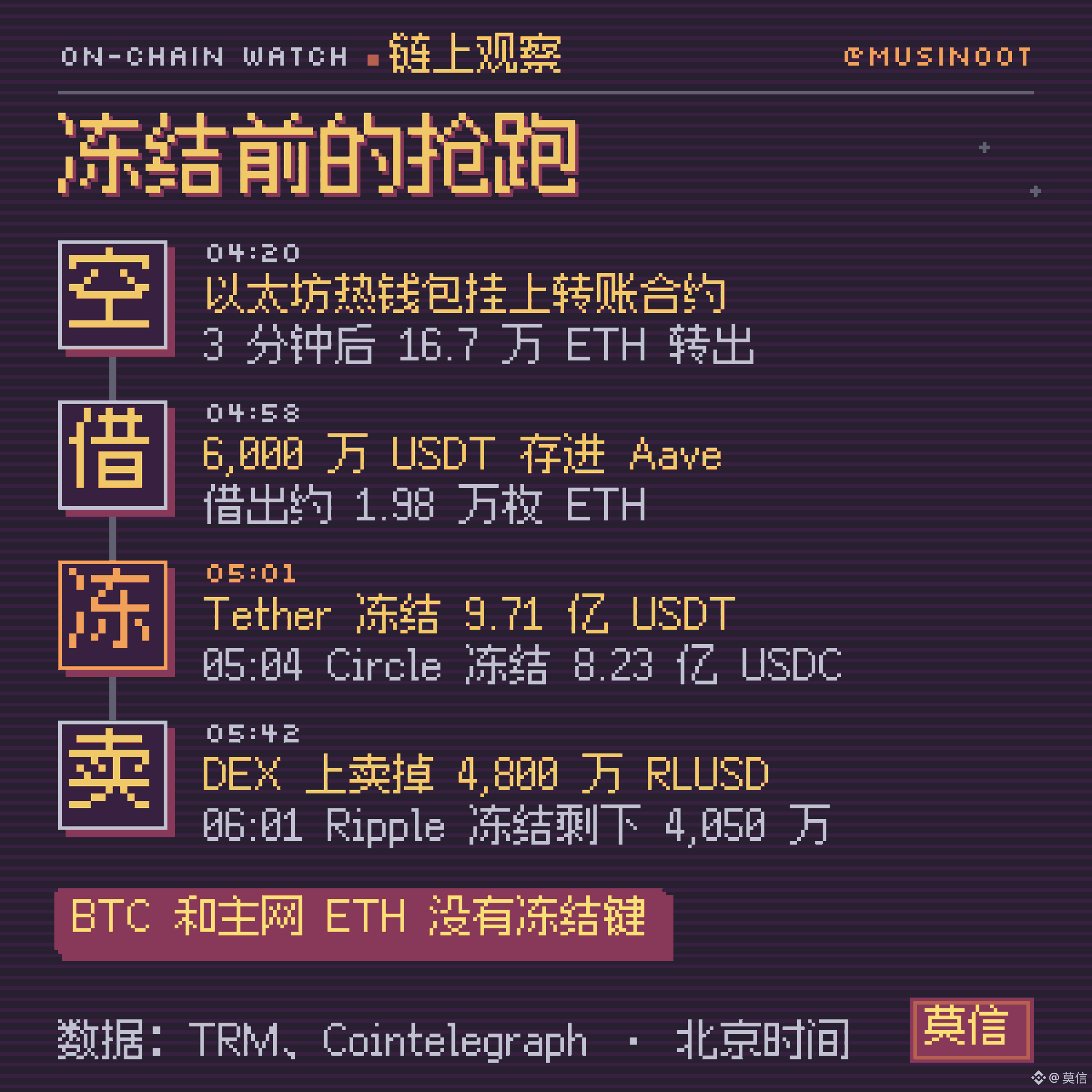
For coins that can be frozen, the hacker had to swap them before the issuer stepped in. Here’s the timeline:
- 04:20 The Ethereum hot wallet had a transfer contract attached; transfers began three minutes later
- 04:58–05:01 A second hacker wallet deposited 60 million USDT into Aave and borrowed about 19,800 ETH
- 05:01 Tether froze 971 million USDT in the main receiving address; 05:04 Circle froze 823 million USDC
- 05:42–06:01 A wallet sold 48 million RLUSD on a DEX; 06:01 Ripple froze the remaining 40.5 million
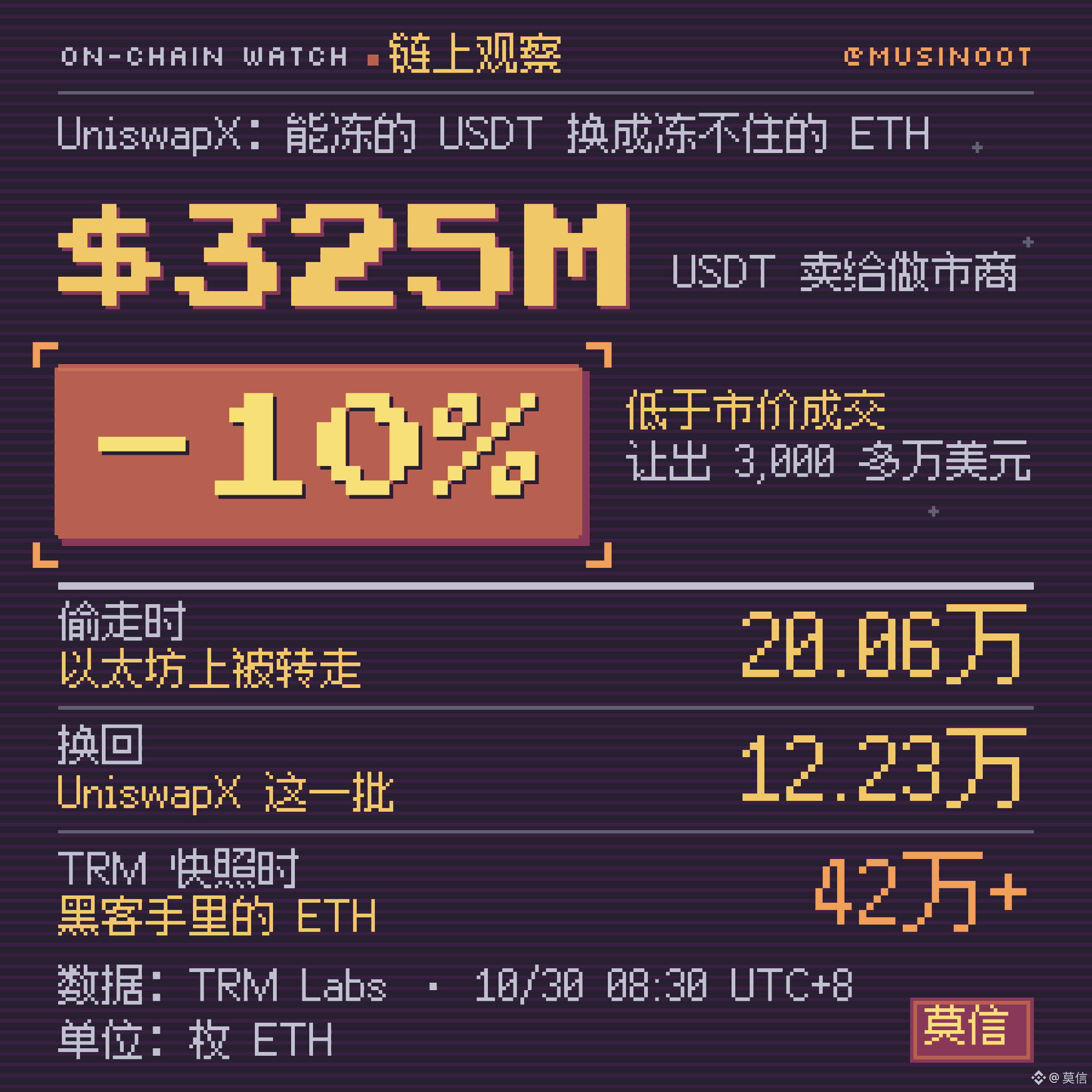
Another route was UniswapX: about 325 million USDT was sold to market makers in exchange for roughly 122,300 ETH, at a price about 10% below market; the remaining 175 million USDT from the same batch was frozen.
The hacker stole 200,600 ETH, but by the time of TRM’s snapshot, held more than 420,000 ETH. To swap freezeable USDT for ETH that couldn’t be frozen, the hacker gave up more than $30 million on this UniswapX batch alone.
🐋 Who will cover the part that can’t be frozen?
The more than 420,000 ETH and 18,270 BTC held by the hacker are worth about $2.4 billion in total, according to TRM’s estimates, and are beyond issuers’ reach. Binance says the SAFU Fund and company funds will cover the losses together. According to FinanceFeeds, SAFU converted its holdings into about $1 billion worth of BTC early this year, which is only enough to cover part of the losses; the rest will have to come from company funds or be recovered later.
Binance says it will update its proof of reserves after the recovery and publish a technical postmortem. Will the postmortem answer this question: Why could a single operations computer affect hot wallets across ten chains at once?
——
Originally published on X: @musinoot
2
2.1k
·
--
Article
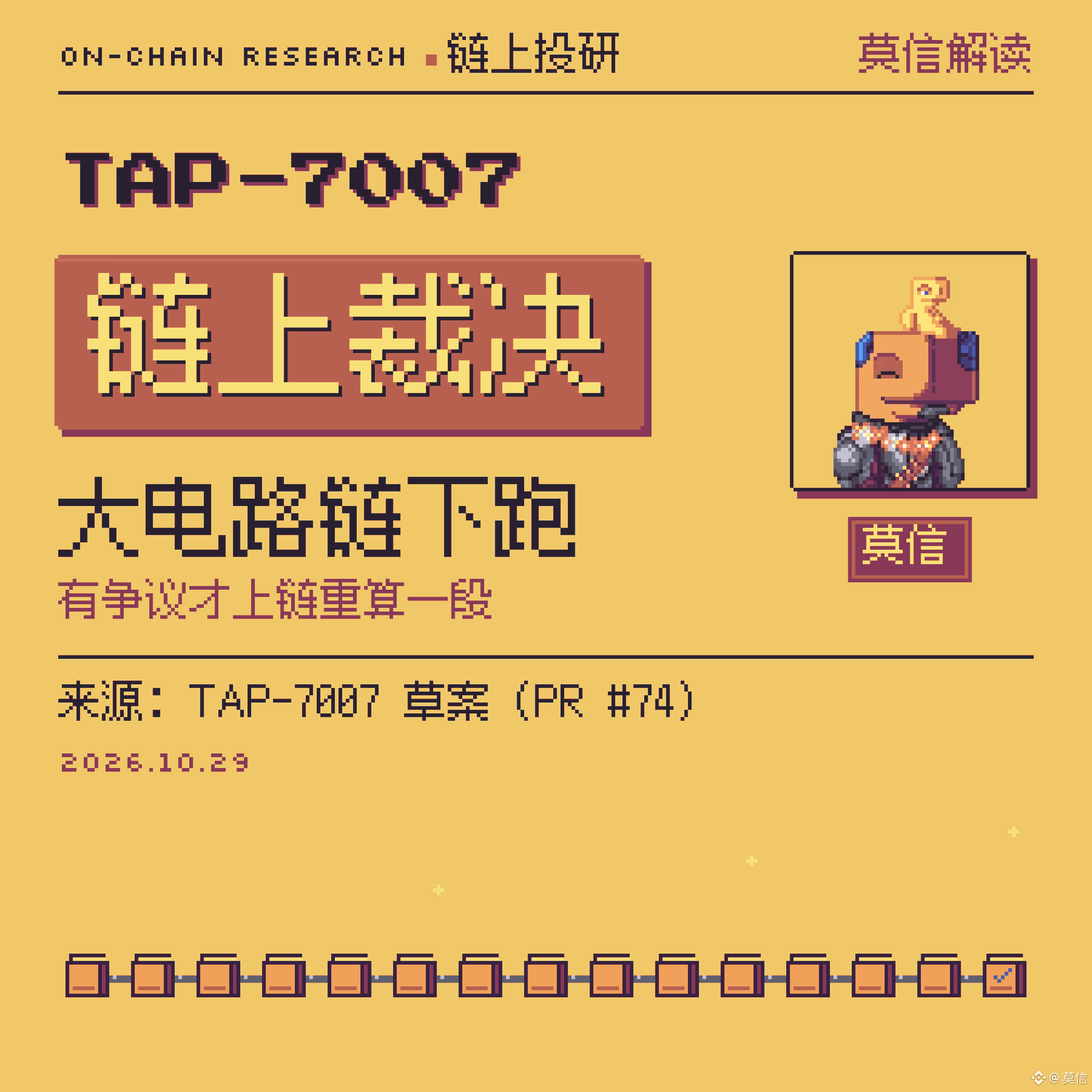
Don’t Trust the Interpretation | TAP-7007: Run large circuits off-chain; on-chain, adjudicate only the disputed stepThis evening, @BruceBlue posted about the new standards draft he submitted, TAP-7007: when a circuit is too large to fit in a single transaction, run it off-chain; if someone disputes the result, the chain only recomputes the small segment where the two sides disagree.
Below, using the original draft and reference repository, we’ll explain what it aims to solve, how adjudication narrows down step by step to a small segment, what results came out of two experiments—a game console with 8-bit graphics and a neural network—and what remains unresolved.
🐋 Where does TAP-7007 stand?
- Submitted on 10/21 (PR #74); introduced in a post today. Status: Draft; the number field says TBD
Don’t Trust the Interpretation | TAP-7007: Run large circuits off-chain; on-chain, adjudicate only the disputed step
This evening, @BruceBlue posted about the new standards draft he submitted, TAP-7007: when a circuit is too large to fit in a single transaction, run it off-chain; if someone disputes the result, the chain only recomputes the small segment where the two sides disagree.
Below, using the original draft and reference repository, we’ll explain what it aims to solve, how adjudication narrows down step by step to a small segment, what results came out of two experiments—a game console with 8-bit graphics and a neural network—and what remains unresolved.
🐋 Where does TAP-7007 stand?
- Submitted on 10/21 (PR #74); introduced in a post today. Status: Draft; the number field says TBD
43
·
--
Article
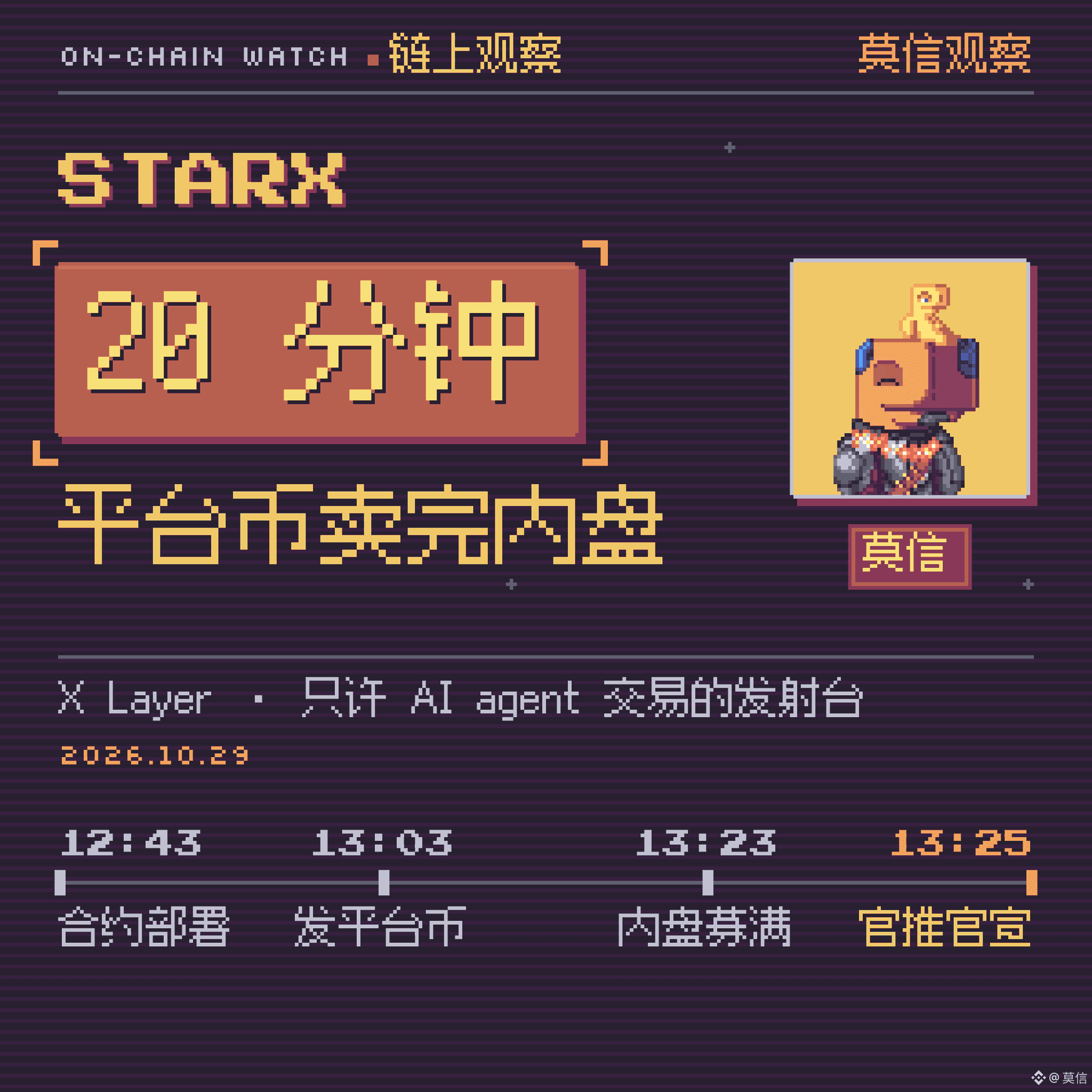
Mo Xin Observes | starx: A launchpad on X Layer where only AI agents can trade; its platform token sold out in the internal market in 20 minutesToday at 13:03, a launchpad called starx (@starx_xlayer) went live on X Layer. In the internal market, only Agentic Wallets from OKX Onchain OS can buy and sell—regular wallets and sniper bots can't get in. The platform token, $STARX, launched that day and sold out its 20-minute fundraising round.
Below, we’ll lay out how it identifies agents, where the platform token’s allocation went, and who controls the contract’s switches. Figures are current as of 17:03. First, a caveat: it has been live for less than half a day, and the team is anonymous. This is just a record of events, not a recommendation to participate.
🐋 starx in one minute
- A meme launchpad on X Layer. The contract was deployed at 12:43 and went live at 13:03. Once the internal market raises 85 OKB, it migrates to Uniswap V4, where anyone can buy.
Mo Xin Observes | starx: A launchpad on X Layer where only AI agents can trade; its platform token sold out in the internal market in 20 minutes
Today at 13:03, a launchpad called starx (@starx_xlayer) went live on X Layer. In the internal market, only Agentic Wallets from OKX Onchain OS can buy and sell—regular wallets and sniper bots can't get in. The platform token, $STARX, launched that day and sold out its 20-minute fundraising round.
Below, we’ll lay out how it identifies agents, where the platform token’s allocation went, and who controls the contract’s switches. Figures are current as of 17:03. First, a caveat: it has been live for less than half a day, and the team is anonymous. This is just a record of events, not a recommendation to participate.
🐋 starx in one minute
- A meme launchpad on X Layer. The contract was deployed at 12:43 and went live at 13:03. Once the internal market raises 85 OKB, it migrates to Uniswap V4, where anyone can buy.
67
·
--
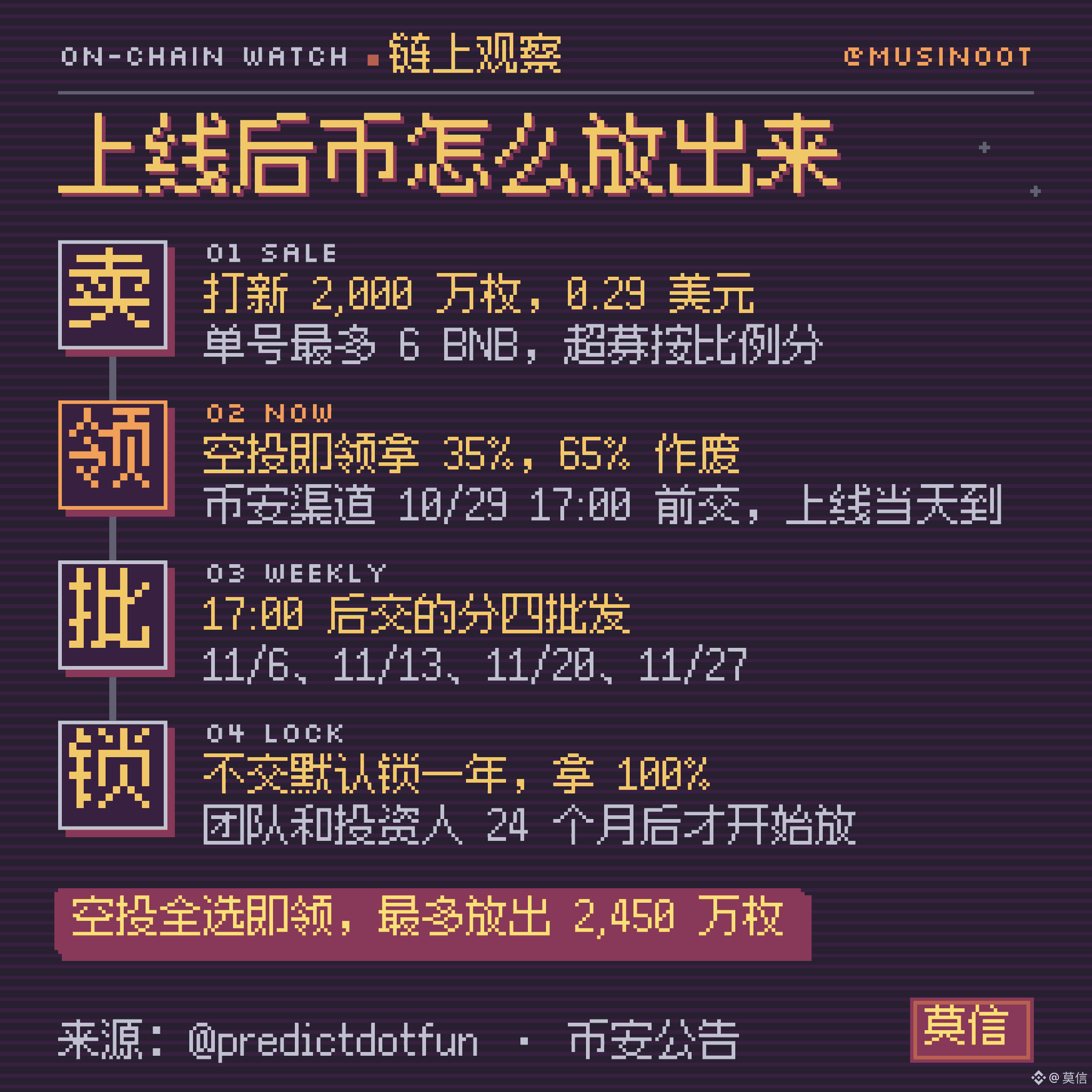
Musinoot Observations | PREDICT token sale at $0.29, pre-market at $1.40; Opinion, on the same chain, saw daily trading volume fall to just 7% of its peak after launch
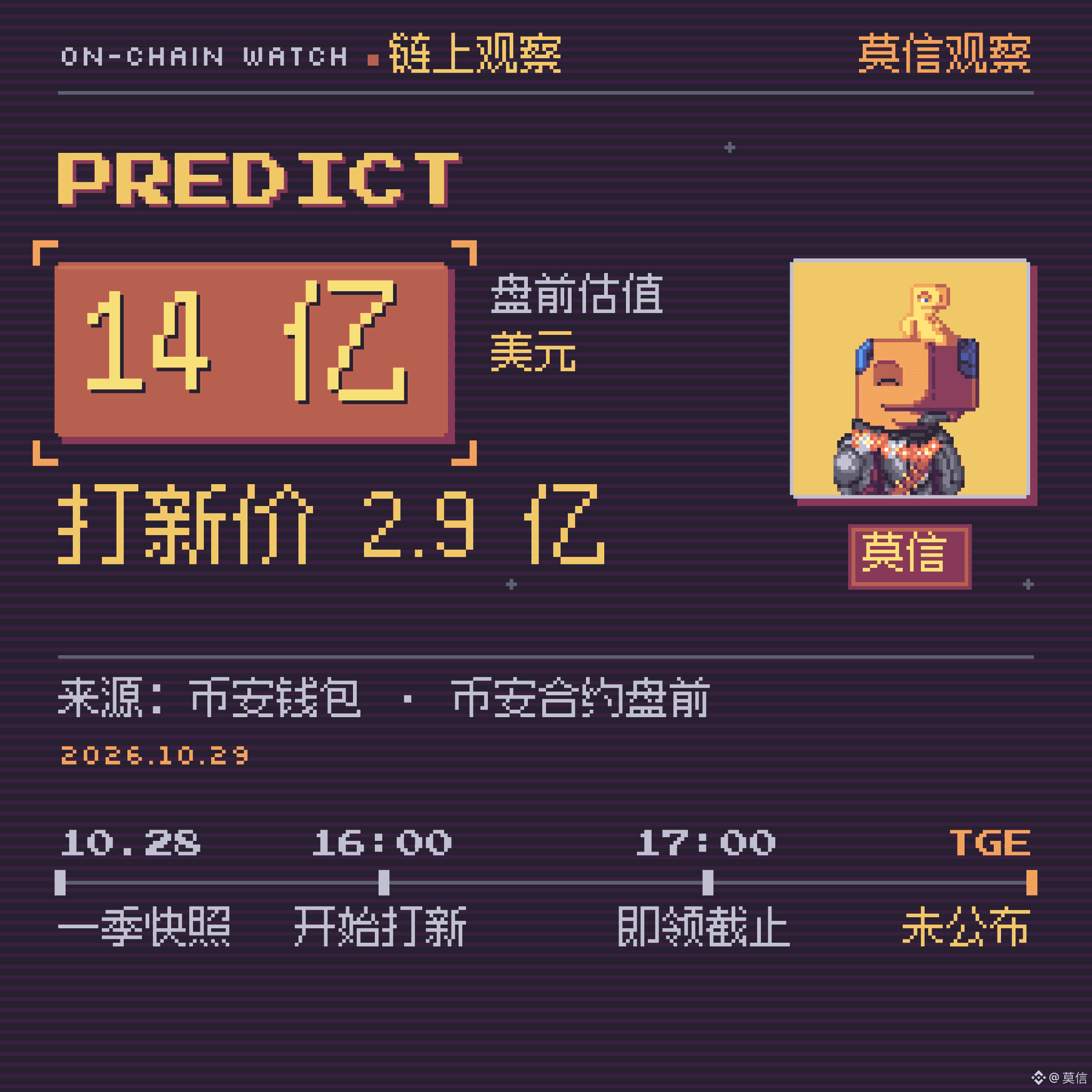
Binance Wallet is selling PREDICT today from 16:00–18:00 at $0.29 per token. Based on a total supply of 1 billion, that implies a valuation of $290 million. Binance pre-market futures quoted it at $1.40 at 16:26, implying a valuation of $1.4 billion.
Plenty of people have already worked out how much each order might get, and whether to claim the airdrop immediately or lock it for a year. This article takes a different angle: how much trading volume and how many fees does Predict.fun generate each day? And, for comparison, what happened to trading volume before and after Opinion—also on BNB Chain—launched its token in March?
🐋 Predict.fun in a minute
- A prediction market on BNB Chain. The project says funds can still earn yield while bets are open.
- You can also check its points (PP) in the Binance app under “Assets - Prediction Account.” Binance’s 10/28 announcement lists this path.
- The project says cumulative trading volume has exceeded $7 billion since launch; DefiLlama records $3.65 billion. Neither specifies its methodology.
- Season 1 points were snapshotted on 10/28, and Season 2 began at the same time. Points for market-making orders are now calculated based on the time orders are posted and actual trading volume.
🐋 Issuance and costs
- Total supply: 1 billion tokens, with 16% (160 million) unlocked at launch.
- This sale offers 20 million tokens (2%) and aims to raise $5.8 million. Each order is capped at 6 BNB; if oversubscribed, tokens will be allocated proportionally and excess funds refunded.
- Buying at $0.29 makes the $1.40 pre-market price 4.8x higher.
- 100 million tokens are allocated to the team and 260.5 million to early investors. Both allocations are fully locked at launch, then unlock monthly after 24 months and are fully released over 36 months.
- Season 1 airdrop: 70 million tokens (7%). Choose an immediate claim to receive 35%, with the remaining 65% forfeited; choose a 12-month lock to receive 100%. If everyone chooses an immediate claim, at most 24.5 million tokens will be released.
- Users with points in their Binance accounts who want tokens credited on launch day must submit the immediate-claim form by 17:00 today. Later submissions will be distributed in four batches on 11/6, 11/13, 11/20, and 11/27. If you don’t submit the form, your tokens will be locked for a year by default. The form can only be submitted once.
- This last point differs from the wording in an @predictdotfun post, which says that people who choose to lock their tokens can still switch to an immediate claim within one month of launch. Follow the rules of the respective channels.
🐋 Trading volume and fees
DefiLlama’s figures for the past 30 days (9/29–10/28):
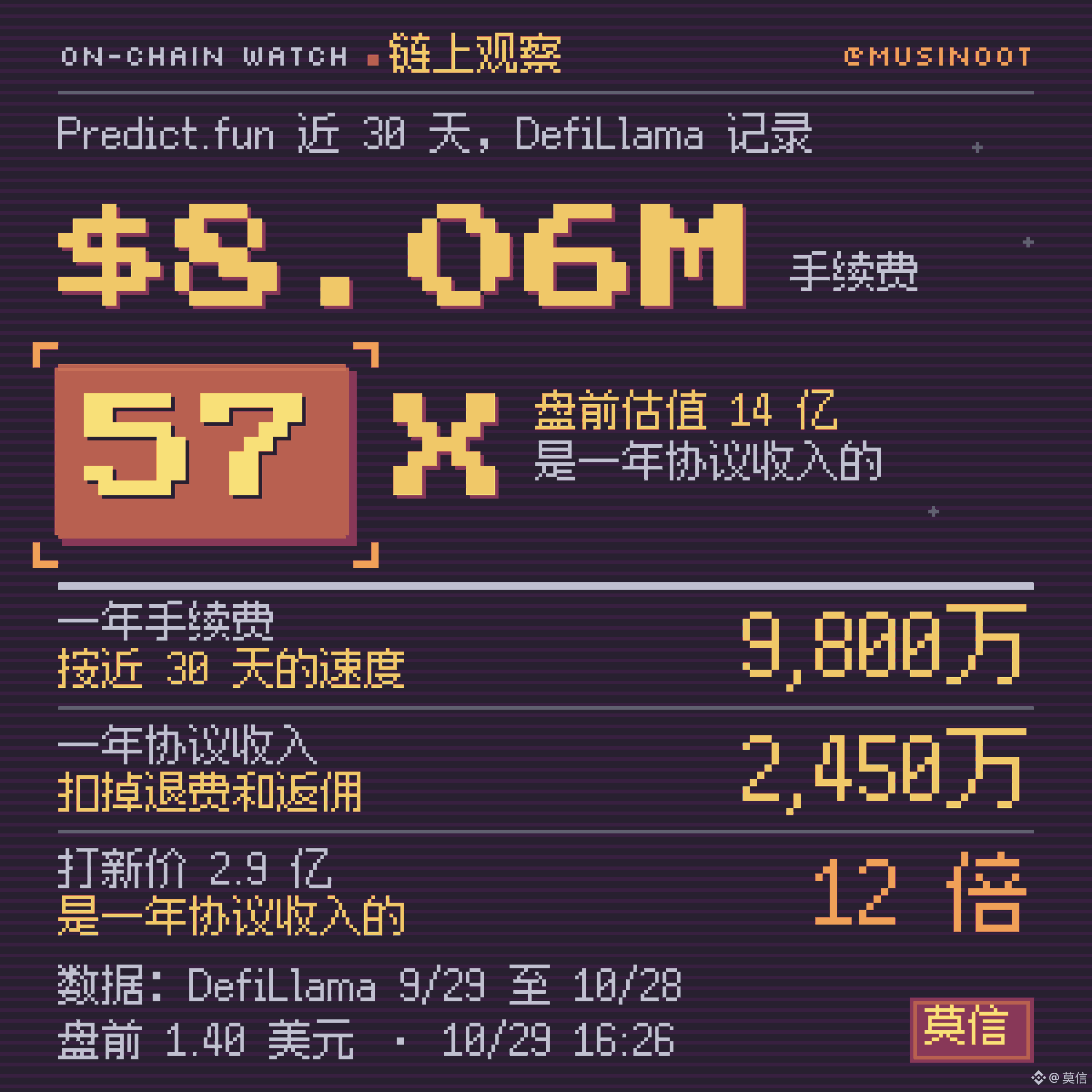
- $406 million in trading volume and $8.06 million in fees. The protocol retained $2.01 million; the rest went to refunds, market-maker rebates, and referral rebates.
- At this rate, annual fees would be about $98 million, with protocol revenue of about $24.5 million.
- The $290 million valuation implied by the sale price is 3x annual fees and 12x protocol revenue; the $1.4 billion pre-market valuation is 14x and 57x, respectively.
- Average daily trading volume in the week before the Season 1 snapshot (10/21–10/26) was $17.08 million. The two days after the snapshot saw $14.63 million and $15.61 million.
🐋 A comparison: Opinion before and after its token launch
@opinionlabsxyz is also on BNB Chain. It launched its token through Binance Launchpool on March 5, and listed on Binance spot the same day.
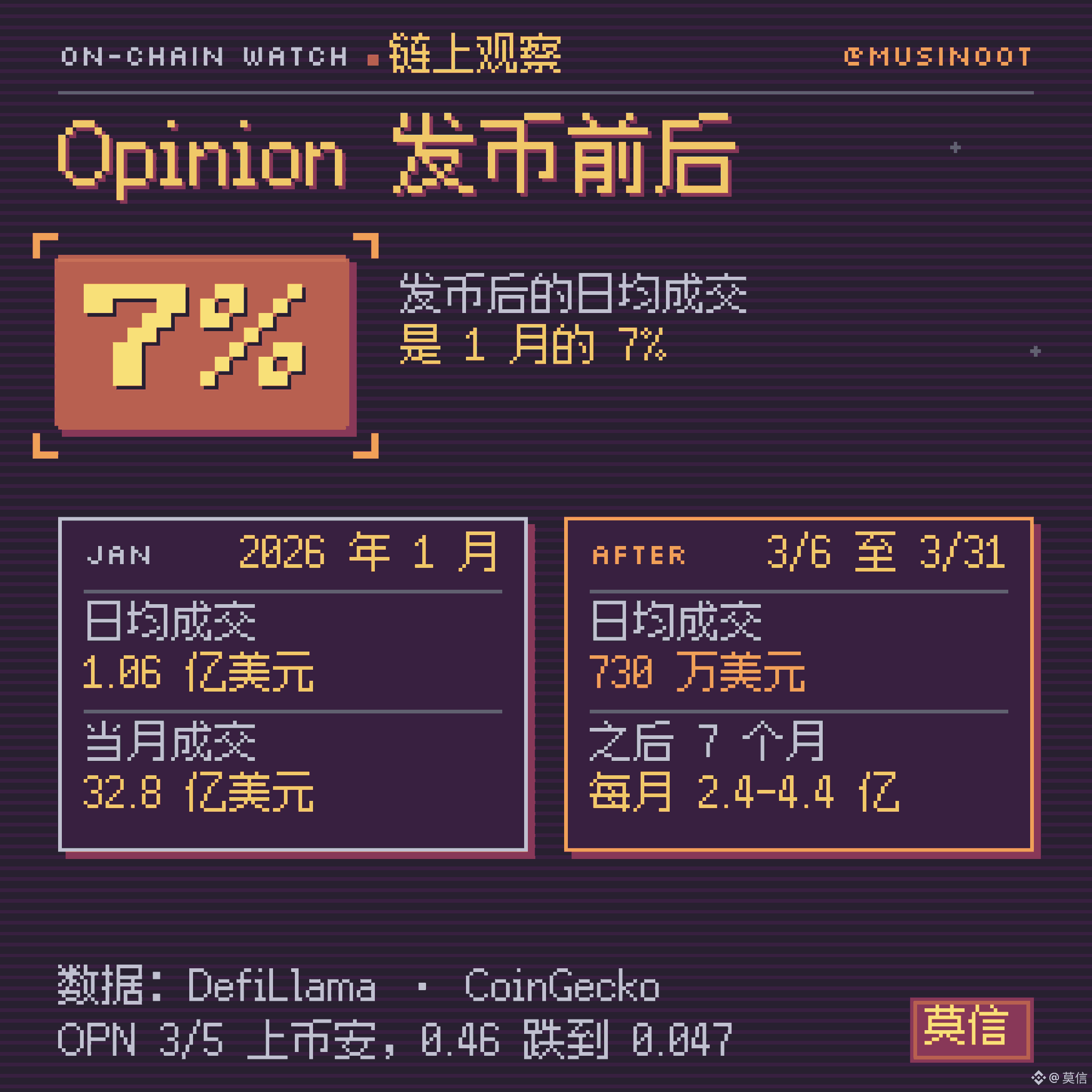
- January monthly trading volume was $3.28 billion, or $106 million per day on average; in February it fell to $1.46 billion.
- After the token launch, average daily volume from 3/6–3/31 was $7.3 million, just 7% of January’s figure.
- Over the next seven months, monthly volume ranged from $240 million to $440 million, never returning to the start-of-year levels.
- OPN was around $0.46 on its Binance listing day, implying a $460 million valuation based on a 1 billion total supply. It is now $0.047, or $47 million.
Predict’s current daily volume is around $15 million—nearly twice Opinion’s post-launch figure, but just one-seventh of Opinion’s January peak.
There are also different trajectories: Limitless (LMTS) on Base launched its token on October 22, 2025. Monthly volume later rose to as much as $250 million (in May 2026), but this month it has reached just $870,000 so far.
The two projects’ figures on DefiLlama are not calculated in exactly the same way. Opinion’s volume excludes wallets identified as wash traders.
This article has not audited the contracts. Token allocations and claim rules are based on @predictdotfun’s tokenomics post and Binance’s announcement, both dated 10/28. Trading volume and fees are from DefiLlama (data retrieved at 16:20 on 10/29); OPN and LMTS prices are from CoinGecko.
Season 2 points are already accruing. After PREDICT launches, how many tokens will be allocated each season from the ecosystem and community share?
——
First published on X by @musinoot
Log in to explore more content
Join global crypto users on Binance Square
⚡️ Get latest and useful information about crypto.
💬 Trusted by the world’s largest crypto exchange.
👍 Discover real insights from verified creators.
Email / Phone number
Trending Topics
BinanceProcesses$4.65BWithdrawals
1,332 views
39 Discussing
Binance Processes $4.65 Billion in Withdrawals After Reopening, Net Outflow of $3.64 Billion Equals 2.1% of Its $171 Billion in Assets
Binance News
·20 Likes
·5.5k views
WithdrawalsBack: 15 networks live
3,621 views
92 Discussing
BinanceUpdatesProofofReservesAddresses
76,915 views
1,217 Discussing