Musinoot Explains|TapeKey Launches: DeWEB Sites’ Write Access Can Be Lent to Others for a Limited Time, Up to 30 Days
TapeKey (@tapekeyofficial) is a newly launched third-party app in the TapeOut ecosystem. It manages write access to DeWEB circuit containers: you can lend permission to write content to your site to developers, automated publishing tools, or AI agents for up to 30 days. Access expires automatically and can be revoked at any time.
Here’s what this “key” is on-chain, who set the 30-day limit, and how many times it had already been used before TapeKey came along.
🐋 First, the container
- Each circuit NFT is linked to an account called a “container.” Each container is a DeWEB website.
- Website files are written to TapeOut’s site registry contract. By default, only the holder of the circuit NFT can write to it.
- If you want a colleague, publishing script, or AI to help update your site without handing over your wallet’s private key, you’ll need this key.
🐋 The key is the contract’s “operator”
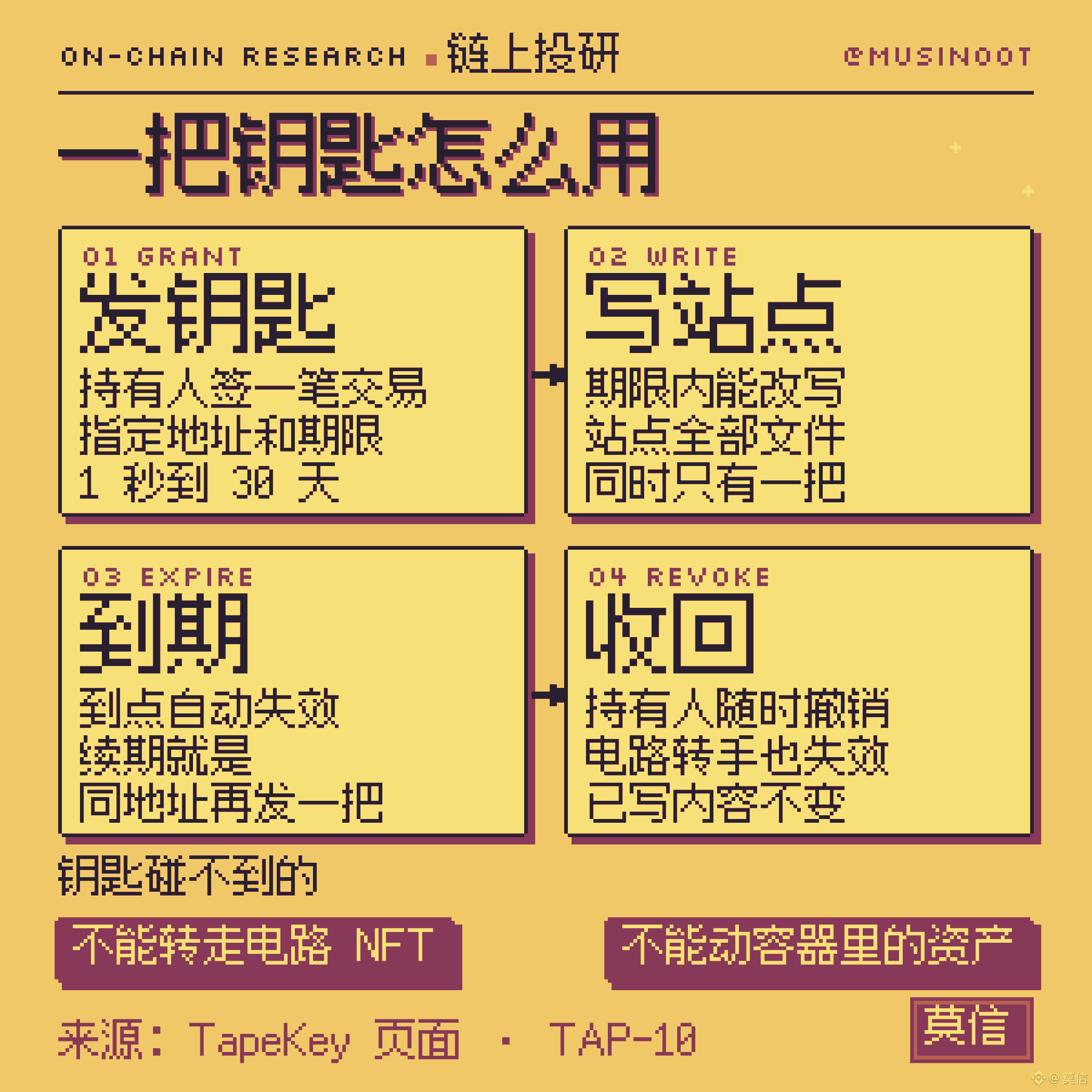
The site registry contract already has a setting for assigning an operator: the holder specifies an address and a duration, and that address can modify the site’s files during that period. That’s the key TapeKey refers to. TapeKey’s page also states that it “does not add a new contract.”
- A container can have only one key at a time; issuing a new key replaces the old one.
- The duration can be as short as 1 second and as long as 30 days.
- The key can only write site content. It cannot transfer the circuit NFT or access assets in the container.
- If the circuit changes hands, keys issued by the previous holder become invalid automatically.
- Once revoked, the other party can no longer write immediately. Content already written remains unchanged.
The last three points are explained on TapeKey’s page.
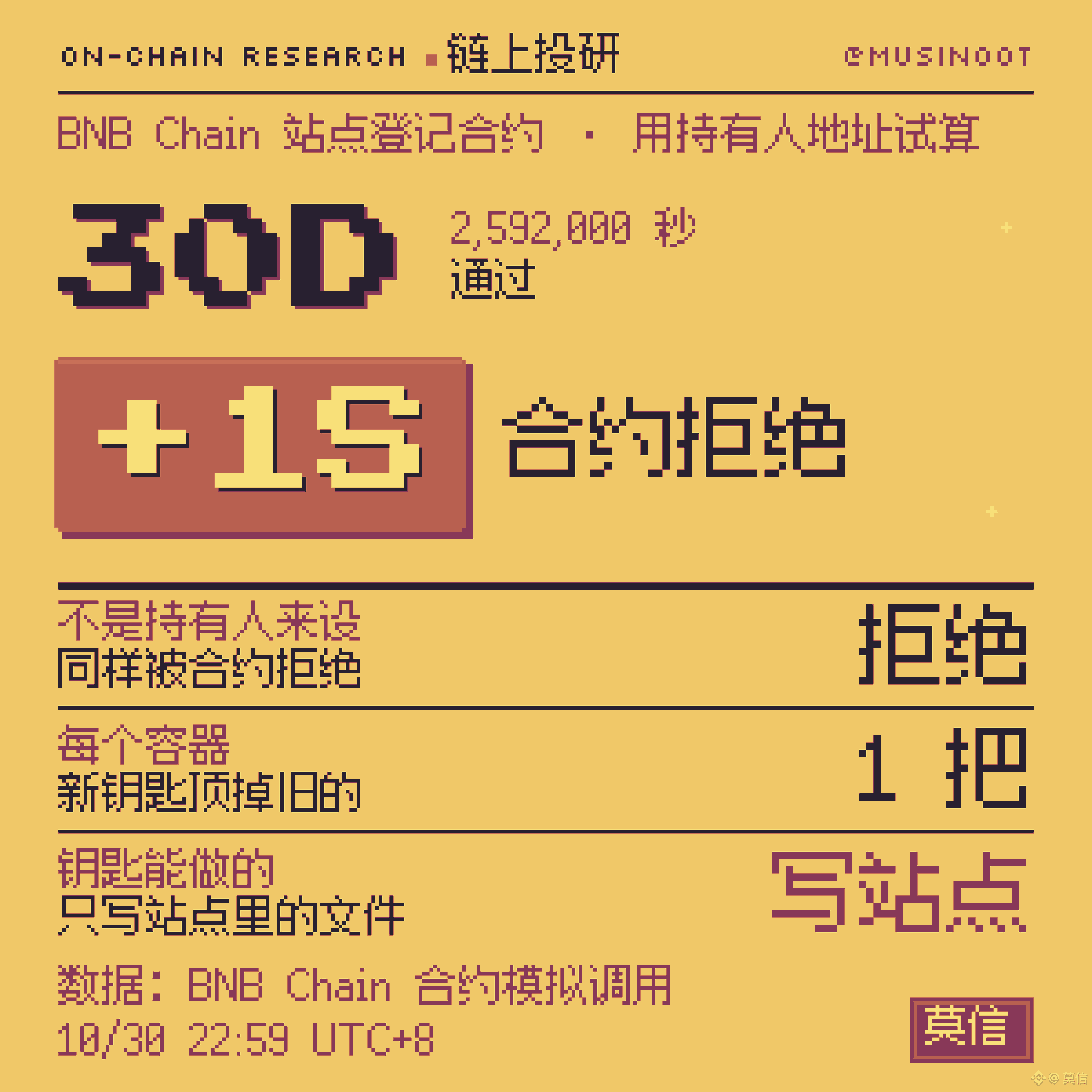
The 30-day limit is set by the contract itself. I tested it on BNB Chain using the address of a container holder (simulated transactions, not submitted on-chain, 10/30 22:59):
- Duration of 2,592,000 seconds, exactly 30 days: accepted
- One second longer: rejected by the contract
- Trying to set it using an address that isn’t the holder’s: rejected by the contract
🐋 Before TapeKey, this key had already been issued 603 times
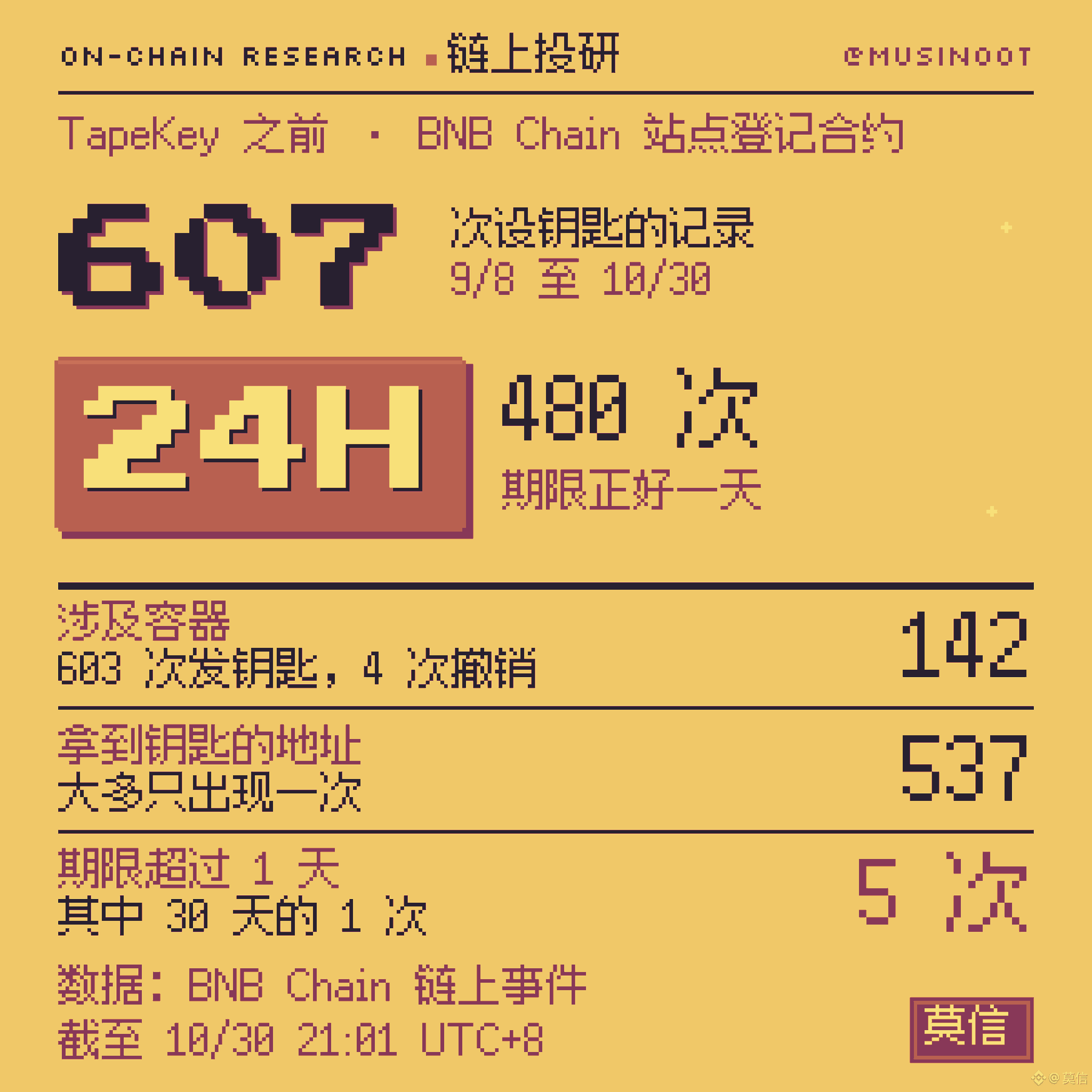
From the first operator assignment on 9/8 through 10/30 21:01, the site registry contract on BNB Chain had:
- 607 records in total across 142 containers: 603 key issuances and 4 revocations
- 537 addresses received keys, most of them appearing only once
- 598 issuances had durations of 1 day or less, including 480 set to exactly 24 hours; 5 lasted more than 1 day, including 1 for 30 days
- Issuing a key costs about 0.000006 BNB in fees
https://bscscan.com/address/0xd006ffdd5Ae313B17729621A00999cD3C71CE5e6#events
A new address each time, with a one-day duration—I’d guess most of these are temporary wallets for publishing tools. That’s also the top use case listed on TapeKey’s page: temporary wallets for CI, GitHub Actions, and TapeCode. A machine publishes the site for you, and you give it a time-limited key.
🐋 TapeKey adds a management page
- Connect your wallet to list your containers on BNB Chain, X Layer, and Base, and see who currently holds each container’s key and how much time is left.
- Issue, replace, renew, or revoke keys. Each step requires your wallet to sign an on-chain transaction.
- Key history: which block, who assigned it, who received it, and when it expires.
- Keys expiring within 24 hours are highlighted, with a reminder pop-up while the page is open.
- The page reads public data directly from the blockchain, without going through a server or touching private keys.
Public beta for 2 months. Free during testing; users pay their own gas fees.
A key can currently modify an entire site. Could it eventually be limited to writing only to certain directories, or to adding content without deleting anything?
——
First published on X by @musinoot