
MIND FLARE
4.7k Posts

MIND FLARE
 Square Verified+
Report
Block User
🔥Blogger (crypto)| They call us dreamers but we ‘re the ones who don’t sleep| Trading Crypto with Discipline, Not with Emotion(Sharing market insights)

ASTER Holder
Frequent Trader
1.1 Years
367 Following
34.2K+ Followers
13.1K Liked
Posts
All
Quotes
Videos
Live
PINNED
·
--
Bullish
$DEXE is still in a repair phase. Price has faded from 2.707 and now sits below both MA7 (2.325) and MA25 (2.366). The key is whether 2.24–2.27 keeps absorbing sellers. If that base holds, reclaiming 2.32–2.37 could open 2.42 again. Lose 2.24, and the next meaningful support sits around 2.12–2.02.
$NIL looks much healthier. Price is holding above MA7 (0.0514) and MA25 (0.0491) after pushing to 0.05395. As long as 0.0514–0.0520 holds, this looks more like consolidation near the highs than a failed breakout. A clean move through 0.05395–0.0543 would confirm another expansion leg, while losing 0.0514 would weaken that setup.
My read: NIL is consolidating strength; DEXE still needs a reclaim before momentum turns constructive.
{spot}(DEXEUSDT)
{spot}(NILUSDT)
#DEXE/USDT #NIL
$DEXE is still in a repair phase. Price has faded from 2.707 and now sits below both MA7 (2.325) and MA25 (2.366). The key is whether 2.24–2.27 keeps absorbing sellers. If that base holds, reclaiming 2.32–2.37 could open 2.42 again. Lose 2.24, and the next meaningful support sits around 2.12–2.02.
$NIL looks much healthier. Price is holding above MA7 (0.0514) and MA25 (0.0491) after pushing to 0.05395. As long as 0.0514–0.0520 holds, this looks more like consolidation near the highs than a failed breakout. A clean move through 0.05395–0.0543 would confirm another expansion leg, while losing 0.0514 would weaken that setup.
My read: NIL is consolidating strength; DEXE still needs a reclaim before momentum turns constructive.
#DEXE/USDT #NIL
$NIL looks much healthier. Price is holding above MA7 (0.0514) and MA25 (0.0491) after pushing to 0.05395. As long as 0.0514–0.0520 holds, this looks more like consolidation near the highs than a failed breakout. A clean move through 0.05395–0.0543 would confirm another expansion leg, while losing 0.0514 would weaken that setup.
My read: NIL is consolidating strength; DEXE still needs a reclaim before momentum turns constructive.
#DEXE/USDT #NIL
$NIL > 0.054
30%
$DEXE > 2.37
55%
Both retrace
8%
Wait for support
7%
40 votes • Voting closed
7
3
77
187.8k
PINNED
·
--
Bullish
$TUT has the cleaner 1H trend. The move from 0.0357 → 0.0846 is still forming higher highs and higher lows, with price holding well above the rising MA7. The catch is extension: at 0.0825, it’s already stretched from short-term support. 0.0846–0.0870 is the immediate resistance zone; 0.0748–0.0720 is where I’d want to see buyers defend if momentum cools.
$1000CAT is different. Most of its +42% move came from one expansion candle, and now volume is fading while price consolidates underneath 0.00227–0.00244. Holding 0.00206–0.00211 would make this look like absorption after the impulse. Lose 0.00206, and the probability of a deeper reset toward 0.00185–0.00171 increases.
My read: TUT has stronger trend quality 1000CAT has the more interesting compression setup.
{spot}(TUTUSDT)
{spot}(1000CATUSDT)
#TUT #1000cat
Which breaks first?
$TUT has the cleaner 1H trend. The move from 0.0357 → 0.0846 is still forming higher highs and higher lows, with price holding well above the rising MA7. The catch is extension: at 0.0825, it’s already stretched from short-term support. 0.0846–0.0870 is the immediate resistance zone; 0.0748–0.0720 is where I’d want to see buyers defend if momentum cools.
$1000CAT is different. Most of its +42% move came from one expansion candle, and now volume is fading while price consolidates underneath 0.00227–0.00244. Holding 0.00206–0.00211 would make this look like absorption after the impulse. Lose 0.00206, and the probability of a deeper reset toward 0.00185–0.00171 increases.
My read: TUT has stronger trend quality 1000CAT has the more interesting compression setup.
#TUT #1000cat
Which breaks first?
$1000CAT is different. Most of its +42% move came from one expansion candle, and now volume is fading while price consolidates underneath 0.00227–0.00244. Holding 0.00206–0.00211 would make this look like absorption after the impulse. Lose 0.00206, and the probability of a deeper reset toward 0.00185–0.00171 increases.
My read: TUT has stronger trend quality 1000CAT has the more interesting compression setup.
#TUT #1000cat
Which breaks first?
$TUT > 0.0846
45%
$1000CAT > 0.00244
18%
Both pull back
28%
Wait for support
9%
74 votes • Voting closed
18
1
114
292.4k
·
--
$BTC is starting to look heavy on the 1H.
At $77,675, price is trading below MA7 ($78,005), MA25 ($78,366) and MA99 ($79,977). More importantly, every bounce since $78,564 has been sold into, while the latest decline is coming with stronger red volume. That keeps short-term control with sellers.
$77,650 is the immediate line I’m watching. If BTC loses that level on a clean 1H close, the move can extend toward $77.3K–$77.0K before buyers get another meaningful test.
For bulls, simply bouncing isn’t enough. BTC first needs to reclaim $77.9K–$78.0K. Above that, $78.22K–$78.36K becomes the real resistance zone. Until those levels are recovered, I’d treat upside candles as relief bounces rather than a confirmed reversal.
The interesting part here is that BTC doesn’t need a huge dump to stay bearish it only needs to keep failing below the falling short term averages.
{spot}(BTCUSDT)
#BTC
$BTC is starting to look heavy on the 1H.
At $77,675, price is trading below MA7 ($78,005), MA25 ($78,366) and MA99 ($79,977). More importantly, every bounce since $78,564 has been sold into, while the latest decline is coming with stronger red volume. That keeps short-term control with sellers.
$77,650 is the immediate line I’m watching. If BTC loses that level on a clean 1H close, the move can extend toward $77.3K–$77.0K before buyers get another meaningful test.
For bulls, simply bouncing isn’t enough. BTC first needs to reclaim $77.9K–$78.0K. Above that, $78.22K–$78.36K becomes the real resistance zone. Until those levels are recovered, I’d treat upside candles as relief bounces rather than a confirmed reversal.
The interesting part here is that BTC doesn’t need a huge dump to stay bearish it only needs to keep failing below the falling short term averages.
#BTC
At $77,675, price is trading below MA7 ($78,005), MA25 ($78,366) and MA99 ($79,977). More importantly, every bounce since $78,564 has been sold into, while the latest decline is coming with stronger red volume. That keeps short-term control with sellers.
$77,650 is the immediate line I’m watching. If BTC loses that level on a clean 1H close, the move can extend toward $77.3K–$77.0K before buyers get another meaningful test.
For bulls, simply bouncing isn’t enough. BTC first needs to reclaim $77.9K–$78.0K. Above that, $78.22K–$78.36K becomes the real resistance zone. Until those levels are recovered, I’d treat upside candles as relief bounces rather than a confirmed reversal.
The interesting part here is that BTC doesn’t need a huge dump to stay bearish it only needs to keep failing below the falling short term averages.
#BTC
Bounce from $77.6K
26%
Break toward $77K
35%
Reclaim $78.3K
30%
More chop first
9%
23 votes • Voting closed
3
3.9k
·
--
Bullish
REZ is trying to turn the first spike into a proper higher base, while VTHO is still working through post-breakout cooling.
At 0.003632, $REZ is above MA7 (0.003388), MA25 (0.003245) and MA99 (0.003170). That bullish MA stack matters because the pullback from 0.00405 has not broken the new structure. The immediate fight is 0.00365–0.00388; acceptance above that zone would put 0.00405 back in play. On the downside, 0.00342–0.00338 is the first support, with 0.00325–0.00320 as the stronger invalidation area. Volume has cooled after the impulse, so the next breakout needs participation—not just another thin wick.
$VTHO at 0.000678 is still above MA25 and MA99, so the larger 1H trend remains constructive, but short-term momentum is weaker because price is sitting just under MA7 (0.000688). A reclaim of 0.000694–0.000700 would improve the setup and reopen 0.000749. If buyers fail to defend 0.000650–0.000623, the move can unwind toward 0.00055–0.000514.
Right now, REZ has the cleaner trend structure. VTHO needs a reclaim before I’d trust fresh continuation.
{spot}(VTHOUSDT)
{spot}(REZUSDT)
#VTHO #REZ
REZ is trying to turn the first spike into a proper higher base, while VTHO is still working through post-breakout cooling.
At 0.003632, $REZ is above MA7 (0.003388), MA25 (0.003245) and MA99 (0.003170). That bullish MA stack matters because the pullback from 0.00405 has not broken the new structure. The immediate fight is 0.00365–0.00388; acceptance above that zone would put 0.00405 back in play. On the downside, 0.00342–0.00338 is the first support, with 0.00325–0.00320 as the stronger invalidation area. Volume has cooled after the impulse, so the next breakout needs participation—not just another thin wick.
$VTHO at 0.000678 is still above MA25 and MA99, so the larger 1H trend remains constructive, but short-term momentum is weaker because price is sitting just under MA7 (0.000688). A reclaim of 0.000694–0.000700 would improve the setup and reopen 0.000749. If buyers fail to defend 0.000650–0.000623, the move can unwind toward 0.00055–0.000514.
Right now, REZ has the cleaner trend structure. VTHO needs a reclaim before I’d trust fresh continuation.
#VTHO #REZ
At 0.003632, $REZ is above MA7 (0.003388), MA25 (0.003245) and MA99 (0.003170). That bullish MA stack matters because the pullback from 0.00405 has not broken the new structure. The immediate fight is 0.00365–0.00388; acceptance above that zone would put 0.00405 back in play. On the downside, 0.00342–0.00338 is the first support, with 0.00325–0.00320 as the stronger invalidation area. Volume has cooled after the impulse, so the next breakout needs participation—not just another thin wick.
$VTHO at 0.000678 is still above MA25 and MA99, so the larger 1H trend remains constructive, but short-term momentum is weaker because price is sitting just under MA7 (0.000688). A reclaim of 0.000694–0.000700 would improve the setup and reopen 0.000749. If buyers fail to defend 0.000650–0.000623, the move can unwind toward 0.00055–0.000514.
Right now, REZ has the cleaner trend structure. VTHO needs a reclaim before I’d trust fresh continuation.
#VTHO #REZ
$REZ breakout
33%
$VTHO reclaim
59%
Both retrace
4%
Wait for retest
4%
27 votes • Voting closed
1
2
7.3k
·
--
Bullish
$IOST has the cleaner 1H structure. The breakout from 0.00090 expanded with volume, and price is still holding above MA7 near 0.00100 despite the rejection from 0.001189. If 0.00100–0.00097 holds, this looks more like a breakout retest than distribution, with 0.00110 → 0.001189 back in play. Lose 0.00097, and 0.00093–0.00090 becomes the next support zone.
$SOPH has much stronger momentum, but it is also far more extended. Price nearly doubled and is trading well above MA7 at 0.00786. The rejection wick from 0.01167 plus heavy volume shows real supply entering near the top. Holding 0.0090–0.0093 keeps continuation alive, but losing that area could accelerate a reset toward 0.0079–0.00735. A clean reclaim of 0.01045 would improve the odds of another attempt at 0.01167.
My read: IOST offers the healthier structure; SOPH offers the bigger momentum but also the bigger exhaustion risk.
#IOST #SOPH
{spot}(IOSTUSDT)
{spot}(SOPHUSDT)
Which setup holds better?
$IOST has the cleaner 1H structure. The breakout from 0.00090 expanded with volume, and price is still holding above MA7 near 0.00100 despite the rejection from 0.001189. If 0.00100–0.00097 holds, this looks more like a breakout retest than distribution, with 0.00110 → 0.001189 back in play. Lose 0.00097, and 0.00093–0.00090 becomes the next support zone.
$SOPH has much stronger momentum, but it is also far more extended. Price nearly doubled and is trading well above MA7 at 0.00786. The rejection wick from 0.01167 plus heavy volume shows real supply entering near the top. Holding 0.0090–0.0093 keeps continuation alive, but losing that area could accelerate a reset toward 0.0079–0.00735. A clean reclaim of 0.01045 would improve the odds of another attempt at 0.01167.
My read: IOST offers the healthier structure; SOPH offers the bigger momentum but also the bigger exhaustion risk.
#IOST #SOPH
Which setup holds better?
$SOPH has much stronger momentum, but it is also far more extended. Price nearly doubled and is trading well above MA7 at 0.00786. The rejection wick from 0.01167 plus heavy volume shows real supply entering near the top. Holding 0.0090–0.0093 keeps continuation alive, but losing that area could accelerate a reset toward 0.0079–0.00735. A clean reclaim of 0.01045 would improve the odds of another attempt at 0.01167.
My read: IOST offers the healthier structure; SOPH offers the bigger momentum but also the bigger exhaustion risk.
#IOST #SOPH
Which setup holds better?
$IOST > 0.00110
41%
$SOPH > 0.01045
41%
Both retrace
4%
Wait for support
14%
22 votes • Voting closed
3
1
32
54.5k
·
--
Bullish
$CHIP is holding above MA7 around 0.0541, but price is compressing just below 0.0565–0.0570 while volume cools. That’s constructive as long as 0.0530–0.0540 keeps holding; a breakout above 0.0565 could restart momentum, while losing 0.0530 opens a deeper retest toward 0.0507–0.0475.
$MUBARAK looks stronger at this stage. It absorbed the first breakout pullback and is already pressing back into the 0.03226–0.03256 resistance zone with price well above MA7 and MA25. Holding 0.0305–0.0296 keeps the higher-low structure intact; below that, 0.0280 becomes the key reset level.
My read: CHIP is consolidating under resistance, while MUBARAK is actively testing it. MUBARAK has the cleaner momentum edge unless CHIP breaks 0.0565 with volume.
{spot}(CHIPUSDT)
{spot}(MUBARAKUSDT)
#CHIP #MUBARAK
Which breaks first?
$CHIP is holding above MA7 around 0.0541, but price is compressing just below 0.0565–0.0570 while volume cools. That’s constructive as long as 0.0530–0.0540 keeps holding; a breakout above 0.0565 could restart momentum, while losing 0.0530 opens a deeper retest toward 0.0507–0.0475.
$MUBARAK looks stronger at this stage. It absorbed the first breakout pullback and is already pressing back into the 0.03226–0.03256 resistance zone with price well above MA7 and MA25. Holding 0.0305–0.0296 keeps the higher-low structure intact; below that, 0.0280 becomes the key reset level.
My read: CHIP is consolidating under resistance, while MUBARAK is actively testing it. MUBARAK has the cleaner momentum edge unless CHIP breaks 0.0565 with volume.
#CHIP #MUBARAK
Which breaks first?
$MUBARAK looks stronger at this stage. It absorbed the first breakout pullback and is already pressing back into the 0.03226–0.03256 resistance zone with price well above MA7 and MA25. Holding 0.0305–0.0296 keeps the higher-low structure intact; below that, 0.0280 becomes the key reset level.
My read: CHIP is consolidating under resistance, while MUBARAK is actively testing it. MUBARAK has the cleaner momentum edge unless CHIP breaks 0.0565 with volume.
#CHIP #MUBARAK
Which breaks first?
$MUBARAK > 0.0323
46%
$CHIP > 0.0565
43%
Both reject
6%
Both continue
5%
35 votes • Voting closed
1
28
59.4k
·
--
Bullish
$ACE has the cleaner 1H continuation structure. The breakout through 0.183–0.196 came with strong volume, and price is still accepting near the highs instead of immediately giving the move back. 0.205–0.196 is now the key support band; hold it and 0.2206–0.224 remains the next resistance test. A loss of 0.196 would expose the stronger 0.183–0.175 reset zone.
$SC already went through its expansion phase. After tagging 0.001099, price has compressed around 0.00086 while volume fades and remains below MA7 near 0.000892. Bulls need to reclaim 0.000892–0.000921 before another push toward 0.00102–0.00110 becomes convincing. 0.000834–0.000826 is the support that cannot keep failing; below it, 0.000793 becomes the more realistic magnet.
My read: ACE is holding breakout acceptance; SC is still proving whether its spike can turn into a base.
#ACE #SC
{spot}(ACEUSDT)
{spot}(SCUSDT)
Which confirms first?
$ACE has the cleaner 1H continuation structure. The breakout through 0.183–0.196 came with strong volume, and price is still accepting near the highs instead of immediately giving the move back. 0.205–0.196 is now the key support band; hold it and 0.2206–0.224 remains the next resistance test. A loss of 0.196 would expose the stronger 0.183–0.175 reset zone.
$SC already went through its expansion phase. After tagging 0.001099, price has compressed around 0.00086 while volume fades and remains below MA7 near 0.000892. Bulls need to reclaim 0.000892–0.000921 before another push toward 0.00102–0.00110 becomes convincing. 0.000834–0.000826 is the support that cannot keep failing; below it, 0.000793 becomes the more realistic magnet.
My read: ACE is holding breakout acceptance; SC is still proving whether its spike can turn into a base.
#ACE #SC
Which confirms first?
$SC already went through its expansion phase. After tagging 0.001099, price has compressed around 0.00086 while volume fades and remains below MA7 near 0.000892. Bulls need to reclaim 0.000892–0.000921 before another push toward 0.00102–0.00110 becomes convincing. 0.000834–0.000826 is the support that cannot keep failing; below it, 0.000793 becomes the more realistic magnet.
My read: ACE is holding breakout acceptance; SC is still proving whether its spike can turn into a base.
#ACE #SC
Which confirms first?
$ACE > 0.2206
42%
$SC > 0.000921
33%
Both pull back
17%
Wait for support
8%
24 votes • Voting closed
2
11
9.6k
·
--
Bullish
$ZKC is still the stronger momentum setup. After the run to 0.0744, price pulled back but is holding almost exactly around MA7 at 0.0675. That matters because the move hasn’t broken structure yet. 0.066–0.0616 is the key support zone; if buyers defend it, 0.0688 → 0.0744 remains open. Lose 0.0616, and the next meaningful reset is closer to 0.0544–0.0501.
$PROM is much more compressed. Price is trapped between MA7 (6.979) and MA25 (6.931) after rejecting 7.434, while volume is fading. That usually means the next move needs confirmation rather than prediction. Holding 6.90–6.93 keeps a push toward 7.20–7.43 possible. A clean loss of that area brings 6.48–6.34 back into play.
My read: ZKC is cooling inside an uptrend; PROM is sitting at a decision point.
{spot}(ZKCUSDT)
{spot}(PROMUSDT)
#ZKC #PROM
Which confirms first?
$ZKC is still the stronger momentum setup. After the run to 0.0744, price pulled back but is holding almost exactly around MA7 at 0.0675. That matters because the move hasn’t broken structure yet. 0.066–0.0616 is the key support zone; if buyers defend it, 0.0688 → 0.0744 remains open. Lose 0.0616, and the next meaningful reset is closer to 0.0544–0.0501.
$PROM is much more compressed. Price is trapped between MA7 (6.979) and MA25 (6.931) after rejecting 7.434, while volume is fading. That usually means the next move needs confirmation rather than prediction. Holding 6.90–6.93 keeps a push toward 7.20–7.43 possible. A clean loss of that area brings 6.48–6.34 back into play.
My read: ZKC is cooling inside an uptrend; PROM is sitting at a decision point.
#ZKC #PROM
Which confirms first?
$PROM is much more compressed. Price is trapped between MA7 (6.979) and MA25 (6.931) after rejecting 7.434, while volume is fading. That usually means the next move needs confirmation rather than prediction. Holding 6.90–6.93 keeps a push toward 7.20–7.43 possible. A clean loss of that area brings 6.48–6.34 back into play.
My read: ZKC is cooling inside an uptrend; PROM is sitting at a decision point.
#ZKC #PROM
Which confirms first?
$ZKC > 0.0744
36%
$PROM > 7.43
43%
Both retrace
15%
Wait for support
6%
33 votes • Voting closed
3
64
112k
·
--
I made a rough list of what Dusk still needs before regulated assets can move through it at scale.
Some items were easy to imagine the community supporting: new dApps, wallets, trading tools and liquidity programs.
The rest were much less exciting.
Security audits.
Custody integrations.
Compliance tooling.
Issuer onboarding.
Legal and reporting infrastructure.
Long term maintenance of software that users may never notice.
That list made me look at the OpenDusk vote from another angle.
If approved, burned block rewards would fund a community treasury for ecosystem development. The obvious benefit is that funding decisions would no longer sit entirely with the Dusk Foundation.
But community funding introduces its own bias.
Visible products are easier to explain and promote. A new exchange interface can show users, volume and screenshots. A custody connector or reporting module may take months to build and generate almost no public excitement, even if an institution cannot operate without it.
This matters more for Dusk than for a general purpose chain.
Dusk is not only trying to attract crypto users. It is trying to support issuers, regulated venues and financial institutions. Their most important requirements may be the least attractive proposals in a public vote.
So the real OpenDusk test may not be whether the community can choose projects.
It may be whether the community can fund necessary work that does not look exciting.
I would watch how proposals are evaluated when a popular consumer dApp competes with an audit, compliance integration or settlement tool for the same treasury capital.
If OpenDusk consistently funds what receives the most attention, it may create activity without completing the institutional stack.
Sometimes the strongest governance decision is paying for infrastructure nobody will celebrate but every serious market participant will eventually need.
@Dusk_Foundation $DUSK #dusk
{spot}(DUSKUSDT)
What should OpenDusk prioritize first?
I made a rough list of what Dusk still needs before regulated assets can move through it at scale.
Some items were easy to imagine the community supporting: new dApps, wallets, trading tools and liquidity programs.
The rest were much less exciting.
Security audits.
Custody integrations.
Compliance tooling.
Issuer onboarding.
Legal and reporting infrastructure.
Long term maintenance of software that users may never notice.
That list made me look at the OpenDusk vote from another angle.
If approved, burned block rewards would fund a community treasury for ecosystem development. The obvious benefit is that funding decisions would no longer sit entirely with the Dusk Foundation.
But community funding introduces its own bias.
Visible products are easier to explain and promote. A new exchange interface can show users, volume and screenshots. A custody connector or reporting module may take months to build and generate almost no public excitement, even if an institution cannot operate without it.
This matters more for Dusk than for a general purpose chain.
Dusk is not only trying to attract crypto users. It is trying to support issuers, regulated venues and financial institutions. Their most important requirements may be the least attractive proposals in a public vote.
So the real OpenDusk test may not be whether the community can choose projects.
It may be whether the community can fund necessary work that does not look exciting.
I would watch how proposals are evaluated when a popular consumer dApp competes with an audit, compliance integration or settlement tool for the same treasury capital.
If OpenDusk consistently funds what receives the most attention, it may create activity without completing the institutional stack.
Sometimes the strongest governance decision is paying for infrastructure nobody will celebrate but every serious market participant will eventually need.
@Dusk $DUSK #dusk
What should OpenDusk prioritize first?
Some items were easy to imagine the community supporting: new dApps, wallets, trading tools and liquidity programs.
The rest were much less exciting.
Security audits.
Custody integrations.
Compliance tooling.
Issuer onboarding.
Legal and reporting infrastructure.
Long term maintenance of software that users may never notice.
That list made me look at the OpenDusk vote from another angle.
If approved, burned block rewards would fund a community treasury for ecosystem development. The obvious benefit is that funding decisions would no longer sit entirely with the Dusk Foundation.
But community funding introduces its own bias.
Visible products are easier to explain and promote. A new exchange interface can show users, volume and screenshots. A custody connector or reporting module may take months to build and generate almost no public excitement, even if an institution cannot operate without it.
This matters more for Dusk than for a general purpose chain.
Dusk is not only trying to attract crypto users. It is trying to support issuers, regulated venues and financial institutions. Their most important requirements may be the least attractive proposals in a public vote.
So the real OpenDusk test may not be whether the community can choose projects.
It may be whether the community can fund necessary work that does not look exciting.
I would watch how proposals are evaluated when a popular consumer dApp competes with an audit, compliance integration or settlement tool for the same treasury capital.
If OpenDusk consistently funds what receives the most attention, it may create activity without completing the institutional stack.
Sometimes the strongest governance decision is paying for infrastructure nobody will celebrate but every serious market participant will eventually need.
@Dusk $DUSK #dusk
What should OpenDusk prioritize first?
Security audits
50%
Custody rails
0%
Compliance
50%
Consumer dApps
0%
4 votes • Voting closed
2
550
·
--
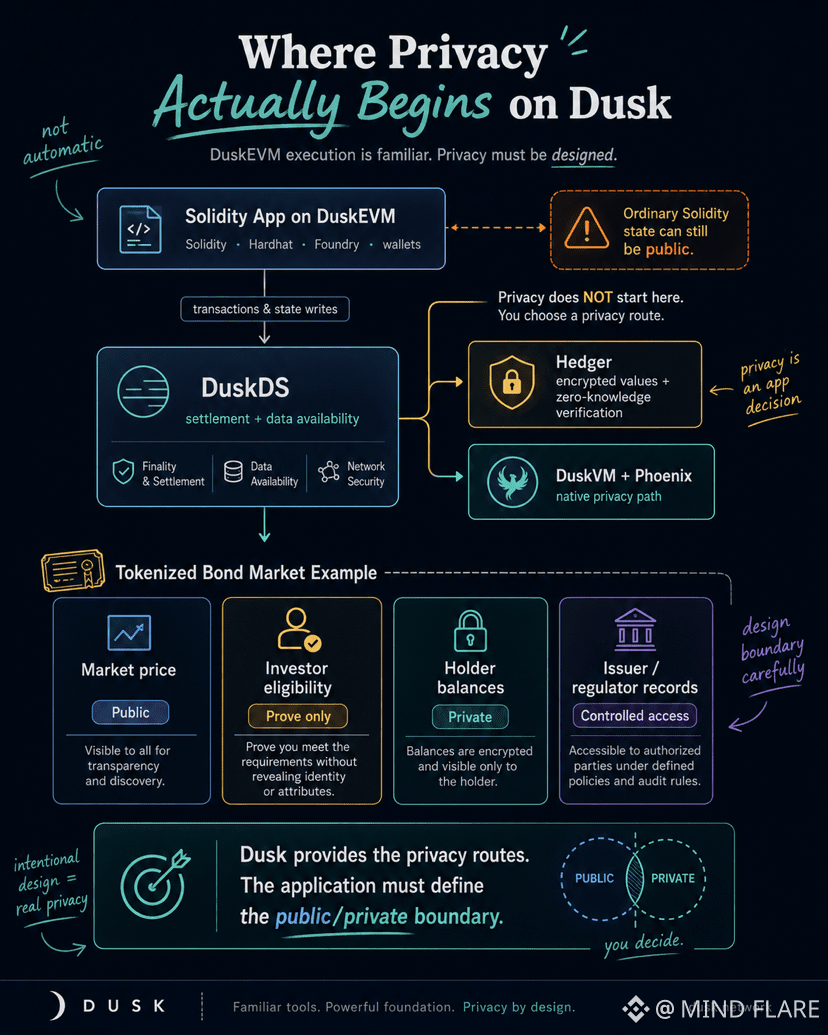
I tried to trace where privacy actually begins inside a Solidity application on @Dusk_Foundation .
I assumed a contract deployed on DuskEVM would somehow inherit Dusk’s privacy because its data and settlement eventually pass through DuskDS.
That is not quite how the stack works.
DuskEVM gives developers familiar EVM execution. They can use Solidity, Hardhat, Foundry and existing wallets. DuskDS sits underneath as the settlement and data availability base.
But an ordinary Solidity contract can still publish its state like any other EVM application.
Confidentiality has to be designed into the application through Hedger, or handled closer to Dusk’s native privacy path through DuskVM and Phoenix. It is not automatically added because the contract happens to run inside the Dusk ecosystem.
That boundary made me stop.
Imagine a tokenized bond market.
The market price may need to remain public.
Investor eligibility only needs to be proven.
Holder balances should probably stay private.
The issuer or regulator may require controlled access to specific records.
Those four pieces cannot simply be placed inside the same public Solidity state.
Hedger is meant to solve part of this by keeping values encrypted while zero knowledge proofs verify that the transaction followed its rules. But the developer still has to decide what enters the encrypted flow, what remains public and who receives disclosure rights.
One poor design choice could expose sensitive financial data before any cryptography gets a chance to protect it.
So I’m less focused on how many cryptographic primitives Dusk supports.
I’m watching whether its tools make the public/private boundary clear enough for ordinary Solidity teams to use correctly.
Dusk can provide the privacy routes. It cannot make that architecture decision for every application.
#dusk $DUSK
{spot}(DUSKUSDT)
I tried to trace where privacy actually begins inside a Solidity application on @Dusk .
I assumed a contract deployed on DuskEVM would somehow inherit Dusk’s privacy because its data and settlement eventually pass through DuskDS.
That is not quite how the stack works.
DuskEVM gives developers familiar EVM execution. They can use Solidity, Hardhat, Foundry and existing wallets. DuskDS sits underneath as the settlement and data availability base.
But an ordinary Solidity contract can still publish its state like any other EVM application.
Confidentiality has to be designed into the application through Hedger, or handled closer to Dusk’s native privacy path through DuskVM and Phoenix. It is not automatically added because the contract happens to run inside the Dusk ecosystem.
That boundary made me stop.
Imagine a tokenized bond market.
The market price may need to remain public.
Investor eligibility only needs to be proven.
Holder balances should probably stay private.
The issuer or regulator may require controlled access to specific records.
Those four pieces cannot simply be placed inside the same public Solidity state.
Hedger is meant to solve part of this by keeping values encrypted while zero knowledge proofs verify that the transaction followed its rules. But the developer still has to decide what enters the encrypted flow, what remains public and who receives disclosure rights.
One poor design choice could expose sensitive financial data before any cryptography gets a chance to protect it.
So I’m less focused on how many cryptographic primitives Dusk supports.
I’m watching whether its tools make the public/private boundary clear enough for ordinary Solidity teams to use correctly.
Dusk can provide the privacy routes. It cannot make that architecture decision for every application.
#dusk $DUSK
I assumed a contract deployed on DuskEVM would somehow inherit Dusk’s privacy because its data and settlement eventually pass through DuskDS.
That is not quite how the stack works.
DuskEVM gives developers familiar EVM execution. They can use Solidity, Hardhat, Foundry and existing wallets. DuskDS sits underneath as the settlement and data availability base.
But an ordinary Solidity contract can still publish its state like any other EVM application.
Confidentiality has to be designed into the application through Hedger, or handled closer to Dusk’s native privacy path through DuskVM and Phoenix. It is not automatically added because the contract happens to run inside the Dusk ecosystem.
That boundary made me stop.
Imagine a tokenized bond market.
The market price may need to remain public.
Investor eligibility only needs to be proven.
Holder balances should probably stay private.
The issuer or regulator may require controlled access to specific records.
Those four pieces cannot simply be placed inside the same public Solidity state.
Hedger is meant to solve part of this by keeping values encrypted while zero knowledge proofs verify that the transaction followed its rules. But the developer still has to decide what enters the encrypted flow, what remains public and who receives disclosure rights.
One poor design choice could expose sensitive financial data before any cryptography gets a chance to protect it.
So I’m less focused on how many cryptographic primitives Dusk supports.
I’m watching whether its tools make the public/private boundary clear enough for ordinary Solidity teams to use correctly.
Dusk can provide the privacy routes. It cannot make that architecture decision for every application.
#dusk $DUSK
1
392
·
--
Bullish
$ONG rejected 0.0930 and has now slipped below the MA7 at 0.0869. That turns 0.0869–0.0898 into the first reclaim zone. If 0.0835–0.0817 holds while volume contracts, this can become a healthy reset before another attempt at 0.0930. Lose that area and 0.0796–0.0789 becomes the stronger support.
$PROM had a much sharper supply response at 4.991, with the rejection arriving on heavy volume. The difference is price is still holding above its rising MA7 near 4.27. As long as 4.15–4.27 survives, the trend isn’t broken and 4.60 → 4.99 can come back into play. A clean loss of 4.15 would expose MA25 around 3.88.
My read: ONG needs a reclaim; PROM needs support to survive. Neither is a clean chase here.
{spot}(ONGUSDT)
{spot}(PROMUSDT)
#ONG #PROM
Which resolves first?
$ONG rejected 0.0930 and has now slipped below the MA7 at 0.0869. That turns 0.0869–0.0898 into the first reclaim zone. If 0.0835–0.0817 holds while volume contracts, this can become a healthy reset before another attempt at 0.0930. Lose that area and 0.0796–0.0789 becomes the stronger support.
$PROM had a much sharper supply response at 4.991, with the rejection arriving on heavy volume. The difference is price is still holding above its rising MA7 near 4.27. As long as 4.15–4.27 survives, the trend isn’t broken and 4.60 → 4.99 can come back into play. A clean loss of 4.15 would expose MA25 around 3.88.
My read: ONG needs a reclaim; PROM needs support to survive. Neither is a clean chase here.
#ONG #PROM
Which resolves first?
$PROM had a much sharper supply response at 4.991, with the rejection arriving on heavy volume. The difference is price is still holding above its rising MA7 near 4.27. As long as 4.15–4.27 survives, the trend isn’t broken and 4.60 → 4.99 can come back into play. A clean loss of 4.15 would expose MA25 around 3.88.
My read: ONG needs a reclaim; PROM needs support to survive. Neither is a clean chase here.
#ONG #PROM
Which resolves first?
$ONG reclaims
52%
$PROM holds
43%
Both retrace
0%
Wait for support
5%
21 votes • Voting closed
7
1
63
139.5k
·
--
Verified
I kept seeing selective disclosure across @Dusk_Foundation material, so I went looking for the actual point where the protocol decides who gets to see what.
The docs led me through three different pieces.
Moonlight handles public account activity.
Phoenix handles shielded transfers.
Citadel lets a user prove an attribute such as residency or investor status without revealing the rest of their identity.
So far, clear.
Then I reached the Assets & Regulations page and found the detail that made me pause.
Dusk describes selective disclosure as a pattern, but says the exact access-control design depends on the legal and product requirements of the asset.
That means Dusk provides the privacy and identity tools, but it does not appear to impose one universal disclosure policy on every application.
The issuer, venue or application still has to decide which credential is accepted, which transfer should fail and which party is allowed to receive specific information.
That changed how I was looking at the privacy claim.
The blockchain can hide a position from the public and prove that the holder is eligible. But the difficult part has not disappeared. It has moved into the rules surrounding the asset.
For example, a tokenized bond issuer may need ownership data for servicing. A venue may only need proof that a buyer is eligible. A regulator may need transaction records for a defined investigation.
Those three parties should not automatically receive the same view.
Dusk’s architecture can support that separation. But the quality of the final system will depend on how carefully each application defines those permissions and who is able to change them later.
This is the part I would inspect before focusing on the ZK language.
Not simply whether the data is private, but who writes the disclosure policy for the first live assets on Dusk, and whether investors can see those rules before entering the market.
#dusk $DUSK
{spot}(DUSKUSDT)
What matters most in Dusk’s disclosure policy?
I kept seeing selective disclosure across @Dusk material, so I went looking for the actual point where the protocol decides who gets to see what.
The docs led me through three different pieces.
Moonlight handles public account activity.
Phoenix handles shielded transfers.
Citadel lets a user prove an attribute such as residency or investor status without revealing the rest of their identity.
So far, clear.
Then I reached the Assets & Regulations page and found the detail that made me pause.
Dusk describes selective disclosure as a pattern, but says the exact access-control design depends on the legal and product requirements of the asset.
That means Dusk provides the privacy and identity tools, but it does not appear to impose one universal disclosure policy on every application.
The issuer, venue or application still has to decide which credential is accepted, which transfer should fail and which party is allowed to receive specific information.
That changed how I was looking at the privacy claim.
The blockchain can hide a position from the public and prove that the holder is eligible. But the difficult part has not disappeared. It has moved into the rules surrounding the asset.
For example, a tokenized bond issuer may need ownership data for servicing. A venue may only need proof that a buyer is eligible. A regulator may need transaction records for a defined investigation.
Those three parties should not automatically receive the same view.
Dusk’s architecture can support that separation. But the quality of the final system will depend on how carefully each application defines those permissions and who is able to change them later.
This is the part I would inspect before focusing on the ZK language.
Not simply whether the data is private, but who writes the disclosure policy for the first live assets on Dusk, and whether investors can see those rules before entering the market.
#dusk $DUSK
What matters most in Dusk’s disclosure policy?
The docs led me through three different pieces.
Moonlight handles public account activity.
Phoenix handles shielded transfers.
Citadel lets a user prove an attribute such as residency or investor status without revealing the rest of their identity.
So far, clear.
Then I reached the Assets & Regulations page and found the detail that made me pause.
Dusk describes selective disclosure as a pattern, but says the exact access-control design depends on the legal and product requirements of the asset.
That means Dusk provides the privacy and identity tools, but it does not appear to impose one universal disclosure policy on every application.
The issuer, venue or application still has to decide which credential is accepted, which transfer should fail and which party is allowed to receive specific information.
That changed how I was looking at the privacy claim.
The blockchain can hide a position from the public and prove that the holder is eligible. But the difficult part has not disappeared. It has moved into the rules surrounding the asset.
For example, a tokenized bond issuer may need ownership data for servicing. A venue may only need proof that a buyer is eligible. A regulator may need transaction records for a defined investigation.
Those three parties should not automatically receive the same view.
Dusk’s architecture can support that separation. But the quality of the final system will depend on how carefully each application defines those permissions and who is able to change them later.
This is the part I would inspect before focusing on the ZK language.
Not simply whether the data is private, but who writes the disclosure policy for the first live assets on Dusk, and whether investors can see those rules before entering the market.
#dusk $DUSK
What matters most in Dusk’s disclosure policy?
Clear access rules
0%
Public permissions
67%
Change controls
33%
Investor consent
0%
3 votes • Voting closed
5
686
·
--
Bullish
I used to read more assets and users on @Dusk_Foundation as a straightforward bullish argument for $DUSK
The latest ecosystem plan made me separate two very different value loops.
The first is native to the network. If more applications settle transactions through Dusk, more Dusk is used for fees and more economic activity reaches validators and stakers.
The second loop is less automatic.
Dusk Trade and the planned ECSP operation could generate product revenue by connecting European businesses with investors and distributing regulated offerings. But revenue earned by a product does not automatically become demand for its network token.
Dusk appears aware of that gap. The team is exploring several ways to connect product income back to DUSK: distributions to stakers, buybacks and burns, or community governed allocation.
That distinction matters to me.
Exploring is not the same as having a fixed mechanism. A buyback creates a different effect from a staker distribution, while leaving allocation to governance introduces another decision layer entirely.
The interesting part is that Dusk may control both sides of the loop: the products that originate activity and the infrastructure where that activity settles. If an SME offering begins through the ECSP route, reaches investors through Dusk Trade and continues generating onchain transfers or servicing events, value can potentially move through the same ecosystem more than once.
But that outcome needs to be measured, not assumed.
I would watch how many offerings actually reach the platform, how much capital they raise, how much subsequent activity settles on Dusk and what portion of product revenue if any is formally connected to DUSK.
The strongest token utility story would not be the ecosystem grew.
It would be showing exactly how that growth reaches the token.
#dusk
{spot}(DUSKUSDT)
Which mechanism would connect Dusk ecosystem growth to $DUSK most effectively?
I used to read more assets and users on @Dusk as a straightforward bullish argument for $DUSK
The latest ecosystem plan made me separate two very different value loops.
The first is native to the network. If more applications settle transactions through Dusk, more Dusk is used for fees and more economic activity reaches validators and stakers.
The second loop is less automatic.
Dusk Trade and the planned ECSP operation could generate product revenue by connecting European businesses with investors and distributing regulated offerings. But revenue earned by a product does not automatically become demand for its network token.
Dusk appears aware of that gap. The team is exploring several ways to connect product income back to DUSK: distributions to stakers, buybacks and burns, or community governed allocation.
That distinction matters to me.
Exploring is not the same as having a fixed mechanism. A buyback creates a different effect from a staker distribution, while leaving allocation to governance introduces another decision layer entirely.
The interesting part is that Dusk may control both sides of the loop: the products that originate activity and the infrastructure where that activity settles. If an SME offering begins through the ECSP route, reaches investors through Dusk Trade and continues generating onchain transfers or servicing events, value can potentially move through the same ecosystem more than once.
But that outcome needs to be measured, not assumed.
I would watch how many offerings actually reach the platform, how much capital they raise, how much subsequent activity settles on Dusk and what portion of product revenue if any is formally connected to DUSK.
The strongest token utility story would not be the ecosystem grew.
It would be showing exactly how that growth reaches the token.
#dusk
Which mechanism would connect Dusk ecosystem growth to $DUSK most effectively?
The latest ecosystem plan made me separate two very different value loops.
The first is native to the network. If more applications settle transactions through Dusk, more Dusk is used for fees and more economic activity reaches validators and stakers.
The second loop is less automatic.
Dusk Trade and the planned ECSP operation could generate product revenue by connecting European businesses with investors and distributing regulated offerings. But revenue earned by a product does not automatically become demand for its network token.
Dusk appears aware of that gap. The team is exploring several ways to connect product income back to DUSK: distributions to stakers, buybacks and burns, or community governed allocation.
That distinction matters to me.
Exploring is not the same as having a fixed mechanism. A buyback creates a different effect from a staker distribution, while leaving allocation to governance introduces another decision layer entirely.
The interesting part is that Dusk may control both sides of the loop: the products that originate activity and the infrastructure where that activity settles. If an SME offering begins through the ECSP route, reaches investors through Dusk Trade and continues generating onchain transfers or servicing events, value can potentially move through the same ecosystem more than once.
But that outcome needs to be measured, not assumed.
I would watch how many offerings actually reach the platform, how much capital they raise, how much subsequent activity settles on Dusk and what portion of product revenue if any is formally connected to DUSK.
The strongest token utility story would not be the ecosystem grew.
It would be showing exactly how that growth reaches the token.
#dusk
Which mechanism would connect Dusk ecosystem growth to $DUSK most effectively?
🔘 Buybacks and burns
67%
🔘 Revenue for stakers
0%
🔘 Community allocation
33%
🔘 A hybrid model
0%
3 votes • Voting closed
1
4
957
·
--
@Dusk_Foundation says more ecosystem activity should mean more DUSK used for network fees.
Technically, yes.
DUSK is used for settlement and staking on DuskDS, while DuskEVM and DuskVM also use it for execution.
Then I tried looking at that flow as a normal Dusk Trade customer.
Someone investing in a European SME bond probably does not want to buy a separate gas token, bridge it and calculate fees before subscribing.
The smoother product design would hide most of that.
Dusk Trade could sponsor fees, bundle transactions or handle DUSK behind the interface while the investor simply sees euros and the asset being purchased.
That would still create DUSK usage underneath.
But it changes who creates the demand.
Instead of every new investor buying DUSK personally, the application or settlement operator may purchase and manage the gas inventory for thousands of users.
That makes raw user growth a weak shortcut for estimating token demand.
Ten thousand investors whose actions are bundled into a small number of settlements may use less gas than one active financial application constantly moving assets between contracts.
I am not saying the fee utility is weak. I am saying the conversion rate is unknown.
It depends on transaction batching, sponsored fees, settlement frequency and how activity moves between Dusk Trade, DuskEVM and DuskDS.
The useful metric would be DUSK consumed per euro of product volume.
Until that number exists, more users means more token demand is directionally right but impossible to price properly.
#dusk $DUSK
{spot}(DUSKUSDT)
What will drive the most $DUSK fee demand?
@Dusk says more ecosystem activity should mean more DUSK used for network fees.
Technically, yes.
DUSK is used for settlement and staking on DuskDS, while DuskEVM and DuskVM also use it for execution.
Then I tried looking at that flow as a normal Dusk Trade customer.
Someone investing in a European SME bond probably does not want to buy a separate gas token, bridge it and calculate fees before subscribing.
The smoother product design would hide most of that.
Dusk Trade could sponsor fees, bundle transactions or handle DUSK behind the interface while the investor simply sees euros and the asset being purchased.
That would still create DUSK usage underneath.
But it changes who creates the demand.
Instead of every new investor buying DUSK personally, the application or settlement operator may purchase and manage the gas inventory for thousands of users.
That makes raw user growth a weak shortcut for estimating token demand.
Ten thousand investors whose actions are bundled into a small number of settlements may use less gas than one active financial application constantly moving assets between contracts.
I am not saying the fee utility is weak. I am saying the conversion rate is unknown.
It depends on transaction batching, sponsored fees, settlement frequency and how activity moves between Dusk Trade, DuskEVM and DuskDS.
The useful metric would be DUSK consumed per euro of product volume.
Until that number exists, more users means more token demand is directionally right but impossible to price properly.
#dusk $DUSK
What will drive the most $DUSK fee demand?
Technically, yes.
DUSK is used for settlement and staking on DuskDS, while DuskEVM and DuskVM also use it for execution.
Then I tried looking at that flow as a normal Dusk Trade customer.
Someone investing in a European SME bond probably does not want to buy a separate gas token, bridge it and calculate fees before subscribing.
The smoother product design would hide most of that.
Dusk Trade could sponsor fees, bundle transactions or handle DUSK behind the interface while the investor simply sees euros and the asset being purchased.
That would still create DUSK usage underneath.
But it changes who creates the demand.
Instead of every new investor buying DUSK personally, the application or settlement operator may purchase and manage the gas inventory for thousands of users.
That makes raw user growth a weak shortcut for estimating token demand.
Ten thousand investors whose actions are bundled into a small number of settlements may use less gas than one active financial application constantly moving assets between contracts.
I am not saying the fee utility is weak. I am saying the conversion rate is unknown.
It depends on transaction batching, sponsored fees, settlement frequency and how activity moves between Dusk Trade, DuskEVM and DuskDS.
The useful metric would be DUSK consumed per euro of product volume.
Until that number exists, more users means more token demand is directionally right but impossible to price properly.
#dusk $DUSK
What will drive the most $DUSK fee demand?
More users
50%
App activity
0%
Settlements
50%
Transaction size
0%
2 votes • Voting closed
7
10
1.1k
·
--
Bullish
$SC just printed a classic liquidity expansion: one huge 1H candle pushed to 0.000935, followed immediately by a sharp rejection. That makes 0.00067–0.00062 the important hold zone now. If buyers absorb the pullback there, 0.000766 → 0.00086 can be retested. Lose 0.00062, and the spike starts looking more like exhaustion than continuation.
$TRUMP is further into the post-pump phase. Since the 3.68 rejection, price has been making lower highs and is now below MA7 at 2.64. Bulls need to reclaim 2.64–2.75 before momentum improves. Otherwise 2.45, then MA25 near 2.27, are the levels I’d watch.
My read: SC still has momentum but needs to prove the breakout can hold. TRUMP needs a reclaim before I trust another upside leg.
{spot}(SCUSDT)
{spot}(TRUMPUSDT)
#SC #TRUMP
Which confirms first?
$SC just printed a classic liquidity expansion: one huge 1H candle pushed to 0.000935, followed immediately by a sharp rejection. That makes 0.00067–0.00062 the important hold zone now. If buyers absorb the pullback there, 0.000766 → 0.00086 can be retested. Lose 0.00062, and the spike starts looking more like exhaustion than continuation.
$TRUMP is further into the post-pump phase. Since the 3.68 rejection, price has been making lower highs and is now below MA7 at 2.64. Bulls need to reclaim 2.64–2.75 before momentum improves. Otherwise 2.45, then MA25 near 2.27, are the levels I’d watch.
My read: SC still has momentum but needs to prove the breakout can hold. TRUMP needs a reclaim before I trust another upside leg.
#SC #TRUMP
Which confirms first?
$TRUMP is further into the post-pump phase. Since the 3.68 rejection, price has been making lower highs and is now below MA7 at 2.64. Bulls need to reclaim 2.64–2.75 before momentum improves. Otherwise 2.45, then MA25 near 2.27, are the levels I’d watch.
My read: SC still has momentum but needs to prove the breakout can hold. TRUMP needs a reclaim before I trust another upside leg.
#SC #TRUMP
Which confirms first?
$SC holds support
53%
$TRUMP reclaims
42%
Both retrace
0%
Wait for setup
5%
19 votes • Voting closed
3
8k
·
--
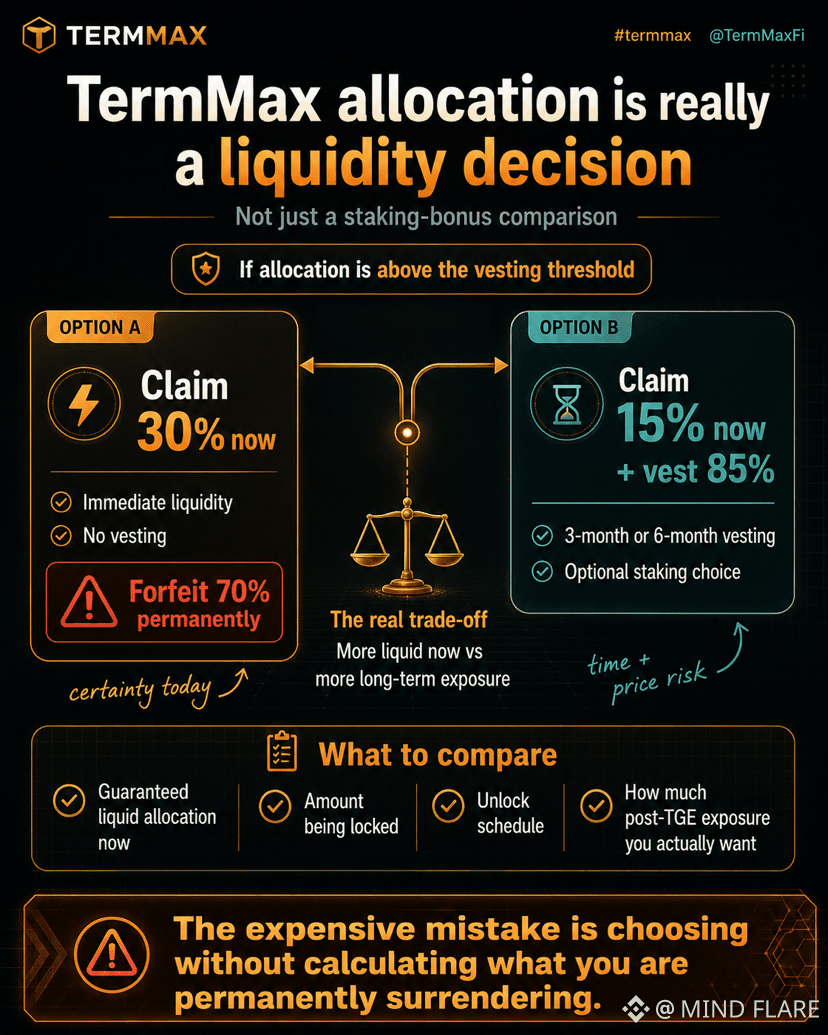
I went through @termmax allocation options, and the biggest number wasn’t the staking bonus.
It was the 70% a user can permanently give up.
If an allocation is above the vesting threshold, one option is to claim 30% immediately and forfeit everything else.
The alternative provides 15% now while the remaining 85% vests over three or six months, with an additional staking choice.
That makes this less of a normal claim page and more of a liquidity decision.
The larger bonus may look attractive, but it compensates users for accepting time and price risk. A token unlocked months later could be worth more or considerably less than it is around TGE.
The 30% route offers more immediate liquidity, but the sacrificed 70% can never be recovered.
So I wouldn’t compare these paths using bonus percentages alone.
I would compare the guaranteed liquid allocation available now against the amount being locked, the unlock schedule and how much exposure I actually want after TGE.
$TMX is making users choose between certainty today and greater long-term exposure.
Neither path is automatically better. The expensive mistake would be selecting one without calculating what is permanently being surrendered.
#TermMax
I went through @TermMax allocation options, and the biggest number wasn’t the staking bonus.
It was the 70% a user can permanently give up.
If an allocation is above the vesting threshold, one option is to claim 30% immediately and forfeit everything else.
The alternative provides 15% now while the remaining 85% vests over three or six months, with an additional staking choice.
That makes this less of a normal claim page and more of a liquidity decision.
The larger bonus may look attractive, but it compensates users for accepting time and price risk. A token unlocked months later could be worth more or considerably less than it is around TGE.
The 30% route offers more immediate liquidity, but the sacrificed 70% can never be recovered.
So I wouldn’t compare these paths using bonus percentages alone.
I would compare the guaranteed liquid allocation available now against the amount being locked, the unlock schedule and how much exposure I actually want after TGE.
$TMX is making users choose between certainty today and greater long-term exposure.
Neither path is automatically better. The expensive mistake would be selecting one without calculating what is permanently being surrendered.
#TermMax
It was the 70% a user can permanently give up.
If an allocation is above the vesting threshold, one option is to claim 30% immediately and forfeit everything else.
The alternative provides 15% now while the remaining 85% vests over three or six months, with an additional staking choice.
That makes this less of a normal claim page and more of a liquidity decision.
The larger bonus may look attractive, but it compensates users for accepting time and price risk. A token unlocked months later could be worth more or considerably less than it is around TGE.
The 30% route offers more immediate liquidity, but the sacrificed 70% can never be recovered.
So I wouldn’t compare these paths using bonus percentages alone.
I would compare the guaranteed liquid allocation available now against the amount being locked, the unlock schedule and how much exposure I actually want after TGE.
$TMX is making users choose between certainty today and greater long-term exposure.
Neither path is automatically better. The expensive mistake would be selecting one without calculating what is permanently being surrendered.
#TermMax
3
616
·
--
Bullish
Verified
I went through @Dusk_Foundation recent SME financing expecting the usual argument about fractional ownership.
The table inside it points to a less visible problem.
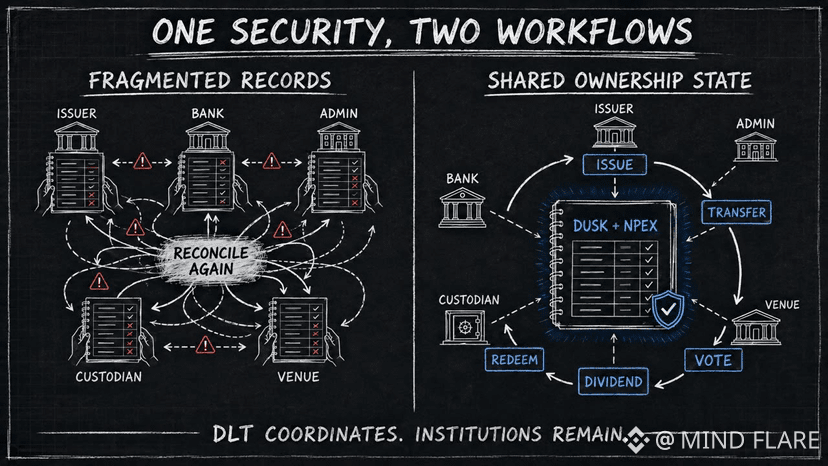
When an SME issues a bond or share certificate, the work does not end after investors buy it. Ownership records must stay accurate for transfers, voting, interest, dividends and redemption.
Today, those records can pass between the issuer, administrator, bank, custodian, registrar and trading venue. Each handoff creates another place where data must be checked or reconciled.
This is where the NPEX partnership starts making sense.
The AFM register confirms NPEX as an authorized multilateral trading facility. It already provides SME financing and secondary trading, so Dusk is not designing around an imaginary market.
The proposed DLT model could connect investor eligibility, issuance, ownership, settlement and later corporate actions around one controlled ownership state.
But Dusk’s own article includes an important warning.
Tokenization cannot replace the issuer, administrator, notary or venue. Voting still requires an approved decision. Dividends still require correct calculations and available funds. Disputes and incorrect payments still need accountable people.
So the token only reduces reconciliation if the parties accept its ownership state as operationally and legally authoritative.
If they keep the old registers unchanged beside it, DLT becomes another database to reconcile.
That is the real test for NPEX and Dusk under the EU DLT Pilot path: not whether an SME security can be tokenized, but whether one record can remain useful from issuance through trading, dividends and final redemption.
A faster trade is helpful.
Five years without conflicting ownership records would be the bigger result.
#dusk $DUSK
{spot}(DUSKUSDT)
I went through @Dusk recent SME financing expecting the usual argument about fractional ownership.
The table inside it points to a less visible problem.
When an SME issues a bond or share certificate, the work does not end after investors buy it. Ownership records must stay accurate for transfers, voting, interest, dividends and redemption.
Today, those records can pass between the issuer, administrator, bank, custodian, registrar and trading venue. Each handoff creates another place where data must be checked or reconciled.
This is where the NPEX partnership starts making sense.
The AFM register confirms NPEX as an authorized multilateral trading facility. It already provides SME financing and secondary trading, so Dusk is not designing around an imaginary market.
The proposed DLT model could connect investor eligibility, issuance, ownership, settlement and later corporate actions around one controlled ownership state.
But Dusk’s own article includes an important warning.
Tokenization cannot replace the issuer, administrator, notary or venue. Voting still requires an approved decision. Dividends still require correct calculations and available funds. Disputes and incorrect payments still need accountable people.
So the token only reduces reconciliation if the parties accept its ownership state as operationally and legally authoritative.
If they keep the old registers unchanged beside it, DLT becomes another database to reconcile.
That is the real test for NPEX and Dusk under the EU DLT Pilot path: not whether an SME security can be tokenized, but whether one record can remain useful from issuance through trading, dividends and final redemption.
A faster trade is helpful.
Five years without conflicting ownership records would be the bigger result.
#dusk $DUSK
The table inside it points to a less visible problem.
When an SME issues a bond or share certificate, the work does not end after investors buy it. Ownership records must stay accurate for transfers, voting, interest, dividends and redemption.
Today, those records can pass between the issuer, administrator, bank, custodian, registrar and trading venue. Each handoff creates another place where data must be checked or reconciled.
This is where the NPEX partnership starts making sense.
The AFM register confirms NPEX as an authorized multilateral trading facility. It already provides SME financing and secondary trading, so Dusk is not designing around an imaginary market.
The proposed DLT model could connect investor eligibility, issuance, ownership, settlement and later corporate actions around one controlled ownership state.
But Dusk’s own article includes an important warning.
Tokenization cannot replace the issuer, administrator, notary or venue. Voting still requires an approved decision. Dividends still require correct calculations and available funds. Disputes and incorrect payments still need accountable people.
So the token only reduces reconciliation if the parties accept its ownership state as operationally and legally authoritative.
If they keep the old registers unchanged beside it, DLT becomes another database to reconcile.
That is the real test for NPEX and Dusk under the EU DLT Pilot path: not whether an SME security can be tokenized, but whether one record can remain useful from issuance through trading, dividends and final redemption.
A faster trade is helpful.
Five years without conflicting ownership records would be the bigger result.
#dusk $DUSK
3
4
914
·
--
Bullish
I initially misunderstood Moonlight and Phoenix as two privacy settings for the same Dusk transaction.
The separation is more useful than that.
Moonlight supports public account activity when transparency is acceptable. Phoenix provides shielded transfers when balances and transaction details should remain confidential.
This means an application does not need to force every action into one visibility model.
A regulated venue could keep general market activity public while protecting private settlement flows or sensitive investor positions and disclose specific evidence only when required.
@Dusk_Foundation is not making privacy mandatory everywhere.
It is making transaction visibility a design choice.
#dusk $DUSK
{spot}(DUSKUSDT)
If you were building a regulated venue on Dusk, where would you use Phoenix privacy first?
I initially misunderstood Moonlight and Phoenix as two privacy settings for the same Dusk transaction.
The separation is more useful than that.
Moonlight supports public account activity when transparency is acceptable. Phoenix provides shielded transfers when balances and transaction details should remain confidential.
This means an application does not need to force every action into one visibility model.
A regulated venue could keep general market activity public while protecting private settlement flows or sensitive investor positions and disclose specific evidence only when required.
@Dusk is not making privacy mandatory everywhere.
It is making transaction visibility a design choice.
#dusk $DUSK
If you were building a regulated venue on Dusk, where would you use Phoenix privacy first?
The separation is more useful than that.
Moonlight supports public account activity when transparency is acceptable. Phoenix provides shielded transfers when balances and transaction details should remain confidential.
This means an application does not need to force every action into one visibility model.
A regulated venue could keep general market activity public while protecting private settlement flows or sensitive investor positions and disclose specific evidence only when required.
@Dusk is not making privacy mandatory everywhere.
It is making transaction visibility a design choice.
#dusk $DUSK
If you were building a regulated venue on Dusk, where would you use Phoenix privacy first?
🔘 Settlement
57%
🔘 User balances
14%
🔘 Trading positions
29%
🔘 Every transaction
0%
7 votes • Voting closed
3
814
·
--
I paused at @termmax example where an FT is bought for $0.80 and redeemed for $1 at maturity.
That produces a 25% return, but it does not mean every TermMax market offers a 25% fixed rate.
The return comes from two things: the price paid for the FT and the time remaining until maturity.
A move from $0.80 to $1 over one year is very different from the same move over three months. This is why the TermMax interface calculates effective APY alongside slippage and fees before the trade.
That detail matters.
What is fixed is the FT’s claim to one debt token at maturity. Its purchase price, early exit price and available liquidity can still move.
So a lender knows the destination, but the quality of the trade still depends on where they entered and how long they must wait.
I would not judge a TermMax market from its displayed rate alone.
I would check the FT price, maturity date, effective APY and whether enough liquidity exists if I need to exit early.
The redemption value may be fixed.
The return is only attractive if the entry price makes sense.
#TermMax
What would you check first before buying an FT?
I paused at @TermMax example where an FT is bought for $0.80 and redeemed for $1 at maturity.
That produces a 25% return, but it does not mean every TermMax market offers a 25% fixed rate.
The return comes from two things: the price paid for the FT and the time remaining until maturity.
A move from $0.80 to $1 over one year is very different from the same move over three months. This is why the TermMax interface calculates effective APY alongside slippage and fees before the trade.
That detail matters.
What is fixed is the FT’s claim to one debt token at maturity. Its purchase price, early exit price and available liquidity can still move.
So a lender knows the destination, but the quality of the trade still depends on where they entered and how long they must wait.
I would not judge a TermMax market from its displayed rate alone.
I would check the FT price, maturity date, effective APY and whether enough liquidity exists if I need to exit early.
The redemption value may be fixed.
The return is only attractive if the entry price makes sense.
#TermMax
What would you check first before buying an FT?
That produces a 25% return, but it does not mean every TermMax market offers a 25% fixed rate.
The return comes from two things: the price paid for the FT and the time remaining until maturity.
A move from $0.80 to $1 over one year is very different from the same move over three months. This is why the TermMax interface calculates effective APY alongside slippage and fees before the trade.
That detail matters.
What is fixed is the FT’s claim to one debt token at maturity. Its purchase price, early exit price and available liquidity can still move.
So a lender knows the destination, but the quality of the trade still depends on where they entered and how long they must wait.
I would not judge a TermMax market from its displayed rate alone.
I would check the FT price, maturity date, effective APY and whether enough liquidity exists if I need to exit early.
The redemption value may be fixed.
The return is only attractive if the entry price makes sense.
#TermMax
What would you check first before buying an FT?
Entry price
33%
Time remaining
17%
Effective APY
33%
Exit liquidity
17%
6 votes • Voting closed
3
5
959
·
--
I initially assumed a fixed rate lending protocol would calculate one protocol wide rate for each market.
@termmax Range Order Tool points to a different model.
Market makers can create lending only, borrowing only or two way quotes, then define the pricing curve and the range where their liquidity is active. The V2 order contract reflects this directly through functions such as createOrder and setCurveAndPrice.
That means the rate shown to a user is not simply the TermMax rate.
It is the price produced by available liquidity, the maker’s chosen curve, the order range and the size of the trade.
I find that more interesting than a fixed formula because different maturities and collateral markets do not necessarily need the same pricing shape.
A market maker can concentrate liquidity near the rates where they are actually willing to lend or borrow instead of funding an entire curve.
But customization does not automatically create a good market.
If only a few makers are quoting, a displayed rate can look precise while meaningful size moves quickly into a worse range. The tool provides control; it cannot guarantee competing liquidity.
The numbers I would watch are not only headline APRs.
I would look at quote depth, spreads, overlapping ranges and how much size can trade before the rate changes materially.
A fixed rate can be known in advance.
That does not mean the market producing it is deep.
#TermMax
What best proves a fixed rate market has real depth?
I initially assumed a fixed rate lending protocol would calculate one protocol wide rate for each market.
@TermMax Range Order Tool points to a different model.
Market makers can create lending only, borrowing only or two way quotes, then define the pricing curve and the range where their liquidity is active. The V2 order contract reflects this directly through functions such as createOrder and setCurveAndPrice.
That means the rate shown to a user is not simply the TermMax rate.
It is the price produced by available liquidity, the maker’s chosen curve, the order range and the size of the trade.
I find that more interesting than a fixed formula because different maturities and collateral markets do not necessarily need the same pricing shape.
A market maker can concentrate liquidity near the rates where they are actually willing to lend or borrow instead of funding an entire curve.
But customization does not automatically create a good market.
If only a few makers are quoting, a displayed rate can look precise while meaningful size moves quickly into a worse range. The tool provides control; it cannot guarantee competing liquidity.
The numbers I would watch are not only headline APRs.
I would look at quote depth, spreads, overlapping ranges and how much size can trade before the rate changes materially.
A fixed rate can be known in advance.
That does not mean the market producing it is deep.
#TermMax
What best proves a fixed rate market has real depth?
@TermMax Range Order Tool points to a different model.
Market makers can create lending only, borrowing only or two way quotes, then define the pricing curve and the range where their liquidity is active. The V2 order contract reflects this directly through functions such as createOrder and setCurveAndPrice.
That means the rate shown to a user is not simply the TermMax rate.
It is the price produced by available liquidity, the maker’s chosen curve, the order range and the size of the trade.
I find that more interesting than a fixed formula because different maturities and collateral markets do not necessarily need the same pricing shape.
A market maker can concentrate liquidity near the rates where they are actually willing to lend or borrow instead of funding an entire curve.
But customization does not automatically create a good market.
If only a few makers are quoting, a displayed rate can look precise while meaningful size moves quickly into a worse range. The tool provides control; it cannot guarantee competing liquidity.
The numbers I would watch are not only headline APRs.
I would look at quote depth, spreads, overlapping ranges and how much size can trade before the rate changes materially.
A fixed rate can be known in advance.
That does not mean the market producing it is deep.
#TermMax
What best proves a fixed rate market has real depth?
Quote depth
60%
Tight spreads
40%
Range overlap
0%
Trade size
0%
5 votes • Voting closed
2
4
798
Log in to explore more content
Join global crypto users on Binance Square
⚡️ Get latest and useful information about crypto.
💬 Trusted by the world’s largest crypto exchange.
👍 Discover real insights from verified creators.
Email / Phone number
Trending Topics
USAugustPPIRisesLessThanExpected
41,718 views
729 Discussing
🚨 US AUG PPI: Rises LESS Than Expected! Bullish for Crypto? 🚀
PPI +0.4% MoM as expected, but CORE PPI only +0.2% vs +0.3% expected - cooling!
What it means:
• Wholesale inflation softer than feared
• Fed rate hike chance now 62% - but dovish signals coming
• Core PCE revisions expected downward - bullish
• BTC usually pumps on softer PPI
Fed meeting Sep 15-16 - Market now expects pause, not hike?
Is this the green light for Q4 rally?
#Bitcoin #PPI #Fed #CryptoNews #BTC#usaugustppiriseslessthanexpected
True News
·1 Likes
·1.3k views
SECApprovesNasdaqTexasCommodityTrustRule
24,265 views
538 Discussing
ECBRaisesRatesSecondTimeTo2.5%
21,872 views
390 Discussing