
#chip
chip
1.9M views
9,278 Discussing
Hot
Latest

·
--
Article
High Beta Altcoins Face Liquidity SqueezeBitcoin slides below $78,000, dragging high beta assets into a liquidity crunch.
When major assets struggle to hold structure, altcoins face a deeper test.
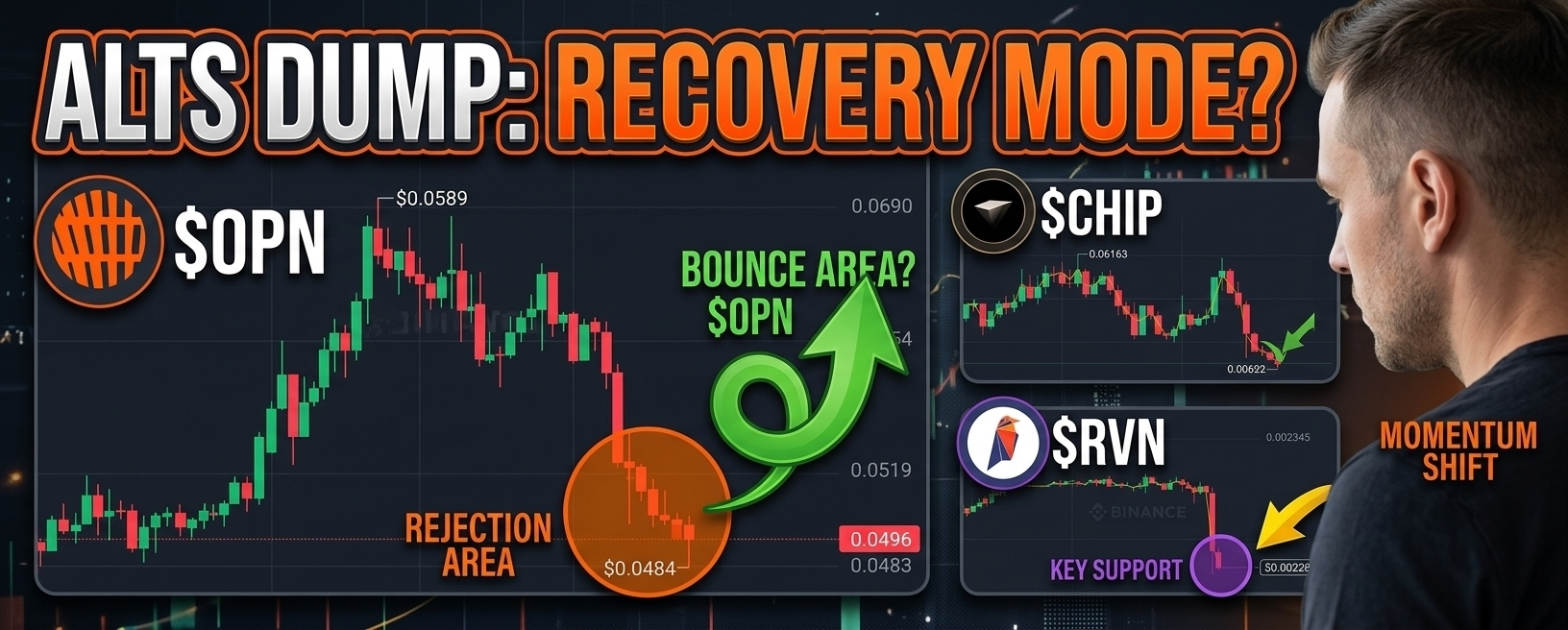
$CHIP , $OPN , and $RVN are dropping fast, but their pain comes from very different sources.
Market Context
Bitcoin is hovering near $78,000, retreating from recent highs. Rising Treasury yields and geopolitical uncertainty are forcing capital out of risk assets. In this environment, money exits the thinnest liquidity first. Altcoins are feeling that rotation directly. The market isn't asking "what to buy" right now; it's deciding "what to sell first."
Primary Coin: CHIP
CHIP's narrative rests on GPU-backed lending, bringing compute assets into on-chain finance. The protocol's TVL once hit $283 million, heavily concentrated in GPU and data center loans. This AI-DeFi crossover makes it a rare asset in the current market.
But there is a growing divergence between narrative strength and price structure.
CHIP started around $0.021 to $0.022 in mid-August, rallying to a high of $0.0616. That near triple is significant, meaning heavy short-term supply is stacked between $0.05 and $0.06. At the current $0.047, price has broken below the recent consolidation floor. The 24-hour volume is expanding, suggesting real distribution rather than a quiet pullback.
The $0.046 to $0.048 zone is the immediate demand area. The more critical support sits near $0.041, which marks the structural origin of the previous breakout. Losing that level invalidates the entire rebound structure. To the upside, $0.052 to $0.055 is a dense turnover zone. Any recovery needs to find acceptance inside that band first.
For spot buyers watching the AI narrative, the current price doesn't offer a clear risk-reward advantage. Parabolic moves typically require time to digest. A better approach is watching for price stabilization between $0.041 and $0.044, paired with daily lower wicks. If the zone gets tested repeatedly without new lows, sellers are exhausting.
A daily close below $0.041 confirms a structural failure of the rebound.
{spot}(CHIPUSDT)
Support: $0.041 to $0.044
Resistance: $0.052 to $0.055
Secondary Coin: OPN
OPN's decline has a specific supply backdrop. The token has a total supply of 1 billion, with 23.5 percent allocated to airdrops. Only 3.5 percent unlocked on TGE, with the rest vesting linearly over 7 months. Teams, advisors, and investors hold over 54 percent.
That means constant supply pressure isn't a risk; it's an active reality.
From the $0.0589 high, price has dropped over 15 percent to $0.0496. On the 4-hour chart, it broke below $0.0535, a structural support tested multiple times. With a market cap around $10 million and 24-hour volume near $3.78 million, liquidity depth is extremely thin. A single large sell order causes significant slippage at this size.
OPN's reality is simple: supply is unlocking, and demand isn't stepping in fast enough to absorb it. The prediction market thesis holds long-term value, but token holders face real dilution. For spot buyers considering a left-side entry, acceptance is required. Until the unlock cycle ends, every bounce risks being capped by new supply. The safer approach is waiting for monthly unlock data to improve, or for a clear base to form near $0.045 before evaluating size.
A decisive break below $0.048 with sustained volume confirms unlock pressure remains in control.
{spot}(OPNUSDT)
Support: $0.045 to $0.048
Resistance: $0.054 to $0.058
Supporting Coin: RVN
RVN's drop is fundamentally different. It's not about narrative fading or token unlocks; it's a clear fundamental catalyst.
On August 7, the RVN network experienced a consensus vulnerability at block height 4,487,776. Vulnerable nodes accepted invalid blocks, prompting officials to advise exchanges to pause RVN deposits and withdrawals. The chain reaction followed.
On September 10, Upbit announced it would terminate trading support for RVN on October 12, covering RVN/KRW, RVN/BTC, and RVN/USDT pairs. Upbit noted RVN was previously flagged as a caution asset, and after review, the risk factors remained unresolved. South Korea has been a critical liquidity source for RVN. Losing Upbit means that liquidity vanishes.
Price plummeted from $0.00315 to $0.00232, a drop of nearly 25 percent. The 4-hour chart shows a near-vertical red candle with zero room for bulls to react.
The current price looks cheap, but cheap isn't a reason to buy. The liquidity shock from the delisting isn't fully priced in, and whether other exchanges follow is a lingering risk. Until the exchange liquidity structure stabilizes, RVN's price discovery mechanism is impaired. Spot buyers should not step in during the fall. Letting the market finish pricing the delisting and watching volume dry up is the rational play.
If the $0.0023 level breaks, price enters a new liquidity vacuum.
{spot}(RVNUSDT)
Support: $0.0023 to $0.0025
Resistance: $0.0030 to $0.0032
Three Coin Comparison
CHIP's issue is post-rally supply digestion, but the narrative remains intact, and structural support is clear.
OPN's issue is continuous dilution. Small market cap, poor liquidity, and bounces capped by unlocks.
RVN's issue is the most direct: exchange liquidity is bleeding out. This is a structural wound requiring time to heal.
From a spot trading perspective, CHIP's behavior at key support is most worth watching because its decline is market-driven, not fundamental. OPN requires a shift in unlock cadence. RVN requires the liquidity event to fully settle.
Final Market View
Bitcoin's behavior near $78,000 will dictate the short-term rhythm for altcoins. If Bitcoin stabilizes here, high beta selling pressure will naturally subside. If Bitcoin continues lower, every support level mentioned above faces a sterner test.
CHIP's $0.041, OPN's $0.048, and RVN's $0.0023. These three levels offer the clearest structural clarity right now.
Until macro pressure releases, patience is worth more than action.
Which of these levels would make you seriously evaluate a spot position?
Educational only. Not financial advice. Manage risk.
#chip #OPN #rvn #altcoins #SpotTrading
High Beta Altcoins Face Liquidity Squeeze
Bitcoin slides below $78,000, dragging high beta assets into a liquidity crunch.
When major assets struggle to hold structure, altcoins face a deeper test.
$CHIP , $OPN , and $RVN are dropping fast, but their pain comes from very different sources.
Market Context
Bitcoin is hovering near $78,000, retreating from recent highs. Rising Treasury yields and geopolitical uncertainty are forcing capital out of risk assets. In this environment, money exits the thinnest liquidity first. Altcoins are feeling that rotation directly. The market isn't asking "what to buy" right now; it's deciding "what to sell first."
Primary Coin: CHIP
CHIP's narrative rests on GPU-backed lending, bringing compute assets into on-chain finance. The protocol's TVL once hit $283 million, heavily concentrated in GPU and data center loans. This AI-DeFi crossover makes it a rare asset in the current market.
But there is a growing divergence between narrative strength and price structure.
CHIP started around $0.021 to $0.022 in mid-August, rallying to a high of $0.0616. That near triple is significant, meaning heavy short-term supply is stacked between $0.05 and $0.06. At the current $0.047, price has broken below the recent consolidation floor. The 24-hour volume is expanding, suggesting real distribution rather than a quiet pullback.
The $0.046 to $0.048 zone is the immediate demand area. The more critical support sits near $0.041, which marks the structural origin of the previous breakout. Losing that level invalidates the entire rebound structure. To the upside, $0.052 to $0.055 is a dense turnover zone. Any recovery needs to find acceptance inside that band first.
For spot buyers watching the AI narrative, the current price doesn't offer a clear risk-reward advantage. Parabolic moves typically require time to digest. A better approach is watching for price stabilization between $0.041 and $0.044, paired with daily lower wicks. If the zone gets tested repeatedly without new lows, sellers are exhausting.
A daily close below $0.041 confirms a structural failure of the rebound.
Support: $0.041 to $0.044
Resistance: $0.052 to $0.055
Secondary Coin: OPN
OPN's decline has a specific supply backdrop. The token has a total supply of 1 billion, with 23.5 percent allocated to airdrops. Only 3.5 percent unlocked on TGE, with the rest vesting linearly over 7 months. Teams, advisors, and investors hold over 54 percent.
That means constant supply pressure isn't a risk; it's an active reality.
From the $0.0589 high, price has dropped over 15 percent to $0.0496. On the 4-hour chart, it broke below $0.0535, a structural support tested multiple times. With a market cap around $10 million and 24-hour volume near $3.78 million, liquidity depth is extremely thin. A single large sell order causes significant slippage at this size.
OPN's reality is simple: supply is unlocking, and demand isn't stepping in fast enough to absorb it. The prediction market thesis holds long-term value, but token holders face real dilution. For spot buyers considering a left-side entry, acceptance is required. Until the unlock cycle ends, every bounce risks being capped by new supply. The safer approach is waiting for monthly unlock data to improve, or for a clear base to form near $0.045 before evaluating size.
A decisive break below $0.048 with sustained volume confirms unlock pressure remains in control.
Support: $0.045 to $0.048
Resistance: $0.054 to $0.058
Supporting Coin: RVN
RVN's drop is fundamentally different. It's not about narrative fading or token unlocks; it's a clear fundamental catalyst.
On August 7, the RVN network experienced a consensus vulnerability at block height 4,487,776. Vulnerable nodes accepted invalid blocks, prompting officials to advise exchanges to pause RVN deposits and withdrawals. The chain reaction followed.
On September 10, Upbit announced it would terminate trading support for RVN on October 12, covering RVN/KRW, RVN/BTC, and RVN/USDT pairs. Upbit noted RVN was previously flagged as a caution asset, and after review, the risk factors remained unresolved. South Korea has been a critical liquidity source for RVN. Losing Upbit means that liquidity vanishes.
Price plummeted from $0.00315 to $0.00232, a drop of nearly 25 percent. The 4-hour chart shows a near-vertical red candle with zero room for bulls to react.
The current price looks cheap, but cheap isn't a reason to buy. The liquidity shock from the delisting isn't fully priced in, and whether other exchanges follow is a lingering risk. Until the exchange liquidity structure stabilizes, RVN's price discovery mechanism is impaired. Spot buyers should not step in during the fall. Letting the market finish pricing the delisting and watching volume dry up is the rational play.
If the $0.0023 level breaks, price enters a new liquidity vacuum.
Support: $0.0023 to $0.0025
Resistance: $0.0030 to $0.0032
Three Coin Comparison
CHIP's issue is post-rally supply digestion, but the narrative remains intact, and structural support is clear.
OPN's issue is continuous dilution. Small market cap, poor liquidity, and bounces capped by unlocks.
RVN's issue is the most direct: exchange liquidity is bleeding out. This is a structural wound requiring time to heal.
From a spot trading perspective, CHIP's behavior at key support is most worth watching because its decline is market-driven, not fundamental. OPN requires a shift in unlock cadence. RVN requires the liquidity event to fully settle.
Final Market View
Bitcoin's behavior near $78,000 will dictate the short-term rhythm for altcoins. If Bitcoin stabilizes here, high beta selling pressure will naturally subside. If Bitcoin continues lower, every support level mentioned above faces a sterner test.
CHIP's $0.041, OPN's $0.048, and RVN's $0.0023. These three levels offer the clearest structural clarity right now.
Until macro pressure releases, patience is worth more than action.
Which of these levels would make you seriously evaluate a spot position?
Educational only. Not financial advice. Manage risk.
#chip #OPN #rvn #altcoins #SpotTrading
When major assets struggle to hold structure, altcoins face a deeper test.
$CHIP , $OPN , and $RVN are dropping fast, but their pain comes from very different sources.
Market Context
Bitcoin is hovering near $78,000, retreating from recent highs. Rising Treasury yields and geopolitical uncertainty are forcing capital out of risk assets. In this environment, money exits the thinnest liquidity first. Altcoins are feeling that rotation directly. The market isn't asking "what to buy" right now; it's deciding "what to sell first."
Primary Coin: CHIP
CHIP's narrative rests on GPU-backed lending, bringing compute assets into on-chain finance. The protocol's TVL once hit $283 million, heavily concentrated in GPU and data center loans. This AI-DeFi crossover makes it a rare asset in the current market.
But there is a growing divergence between narrative strength and price structure.
CHIP started around $0.021 to $0.022 in mid-August, rallying to a high of $0.0616. That near triple is significant, meaning heavy short-term supply is stacked between $0.05 and $0.06. At the current $0.047, price has broken below the recent consolidation floor. The 24-hour volume is expanding, suggesting real distribution rather than a quiet pullback.
The $0.046 to $0.048 zone is the immediate demand area. The more critical support sits near $0.041, which marks the structural origin of the previous breakout. Losing that level invalidates the entire rebound structure. To the upside, $0.052 to $0.055 is a dense turnover zone. Any recovery needs to find acceptance inside that band first.
For spot buyers watching the AI narrative, the current price doesn't offer a clear risk-reward advantage. Parabolic moves typically require time to digest. A better approach is watching for price stabilization between $0.041 and $0.044, paired with daily lower wicks. If the zone gets tested repeatedly without new lows, sellers are exhausting.
A daily close below $0.041 confirms a structural failure of the rebound.
Support: $0.041 to $0.044
Resistance: $0.052 to $0.055
Secondary Coin: OPN
OPN's decline has a specific supply backdrop. The token has a total supply of 1 billion, with 23.5 percent allocated to airdrops. Only 3.5 percent unlocked on TGE, with the rest vesting linearly over 7 months. Teams, advisors, and investors hold over 54 percent.
That means constant supply pressure isn't a risk; it's an active reality.
From the $0.0589 high, price has dropped over 15 percent to $0.0496. On the 4-hour chart, it broke below $0.0535, a structural support tested multiple times. With a market cap around $10 million and 24-hour volume near $3.78 million, liquidity depth is extremely thin. A single large sell order causes significant slippage at this size.
OPN's reality is simple: supply is unlocking, and demand isn't stepping in fast enough to absorb it. The prediction market thesis holds long-term value, but token holders face real dilution. For spot buyers considering a left-side entry, acceptance is required. Until the unlock cycle ends, every bounce risks being capped by new supply. The safer approach is waiting for monthly unlock data to improve, or for a clear base to form near $0.045 before evaluating size.
A decisive break below $0.048 with sustained volume confirms unlock pressure remains in control.
Support: $0.045 to $0.048
Resistance: $0.054 to $0.058
Supporting Coin: RVN
RVN's drop is fundamentally different. It's not about narrative fading or token unlocks; it's a clear fundamental catalyst.
On August 7, the RVN network experienced a consensus vulnerability at block height 4,487,776. Vulnerable nodes accepted invalid blocks, prompting officials to advise exchanges to pause RVN deposits and withdrawals. The chain reaction followed.
On September 10, Upbit announced it would terminate trading support for RVN on October 12, covering RVN/KRW, RVN/BTC, and RVN/USDT pairs. Upbit noted RVN was previously flagged as a caution asset, and after review, the risk factors remained unresolved. South Korea has been a critical liquidity source for RVN. Losing Upbit means that liquidity vanishes.
Price plummeted from $0.00315 to $0.00232, a drop of nearly 25 percent. The 4-hour chart shows a near-vertical red candle with zero room for bulls to react.
The current price looks cheap, but cheap isn't a reason to buy. The liquidity shock from the delisting isn't fully priced in, and whether other exchanges follow is a lingering risk. Until the exchange liquidity structure stabilizes, RVN's price discovery mechanism is impaired. Spot buyers should not step in during the fall. Letting the market finish pricing the delisting and watching volume dry up is the rational play.
If the $0.0023 level breaks, price enters a new liquidity vacuum.
Support: $0.0023 to $0.0025
Resistance: $0.0030 to $0.0032
Three Coin Comparison
CHIP's issue is post-rally supply digestion, but the narrative remains intact, and structural support is clear.
OPN's issue is continuous dilution. Small market cap, poor liquidity, and bounces capped by unlocks.
RVN's issue is the most direct: exchange liquidity is bleeding out. This is a structural wound requiring time to heal.
From a spot trading perspective, CHIP's behavior at key support is most worth watching because its decline is market-driven, not fundamental. OPN requires a shift in unlock cadence. RVN requires the liquidity event to fully settle.
Final Market View
Bitcoin's behavior near $78,000 will dictate the short-term rhythm for altcoins. If Bitcoin stabilizes here, high beta selling pressure will naturally subside. If Bitcoin continues lower, every support level mentioned above faces a sterner test.
CHIP's $0.041, OPN's $0.048, and RVN's $0.0023. These three levels offer the clearest structural clarity right now.
Until macro pressure releases, patience is worth more than action.
Which of these levels would make you seriously evaluate a spot position?
Educational only. Not financial advice. Manage risk.
#chip #OPN #rvn #altcoins #SpotTrading
1
329

·
--
Bullish
CHIP shorts just got squeezed near $0.04754.
The $4.1081K liquidation keeps upside liquidity in focus.
$CHIP
{future}(CHIPUSDT)
🟢 LIQUIDITY ZONE HIT 🟢
Short liquidation spotted 🧨
$4.1081K cleared at $0.04754
Upside liquidity swept — watch reaction 👀
🎯 TP Targets:
TP1: ~$0.04802
TP2: ~$0.04849
TP3: ~$0.04897
#chip
CHIP shorts just got squeezed near $0.04754.
The $4.1081K liquidation keeps upside liquidity in focus.
$CHIP
🟢 LIQUIDITY ZONE HIT 🟢
Short liquidation spotted 🧨
$4.1081K cleared at $0.04754
Upside liquidity swept — watch reaction 👀
🎯 TP Targets:
TP1: ~$0.04802
TP2: ~$0.04849
TP3: ~$0.04897
#chip
The $4.1081K liquidation keeps upside liquidity in focus.
$CHIP
🟢 LIQUIDITY ZONE HIT 🟢
Short liquidation spotted 🧨
$4.1081K cleared at $0.04754
Upside liquidity swept — watch reaction 👀
🎯 TP Targets:
TP1: ~$0.04802
TP2: ~$0.04849
TP3: ~$0.04897
#chip
74

·
--
$CHIP -18.04% | $ONG -16.78% | $TUT -13.16%
#CHIP slipped to $0.0483, down ‑18.04% on $4.4 M volume. The drop hints at weakening buyer interest amid broader market pressure.
#ONG is now $0.0795, down ‑16.78% with $2.0 M traded. Since Ontology MainNet launched in 2018, periodic ONG releases may be diluting short‑term demand.
#TUT fell to $0.0205, down ‑13.16% on a relatively healthy $6.9 M volume. The token’s origin from a tutorial‑focused dev adds a novelty factor, but that doesn’t guarantee stability.
👀 Watch the $0.02‑$0.03 range for TUT as a potential support zone this week.
#Binance #Write2Earn
$CHIP -18.04% | $ONG -16.78% | $TUT -13.16%
#CHIP slipped to $0.0483, down ‑18.04% on $4.4 M volume. The drop hints at weakening buyer interest amid broader market pressure.
#ONG is now $0.0795, down ‑16.78% with $2.0 M traded. Since Ontology MainNet launched in 2018, periodic ONG releases may be diluting short‑term demand.
#TUT fell to $0.0205, down ‑13.16% on a relatively healthy $6.9 M volume. The token’s origin from a tutorial‑focused dev adds a novelty factor, but that doesn’t guarantee stability.
👀 Watch the $0.02‑$0.03 range for TUT as a potential support zone this week.
#Binance #Write2Earn
#CHIP slipped to $0.0483, down ‑18.04% on $4.4 M volume. The drop hints at weakening buyer interest amid broader market pressure.
#ONG is now $0.0795, down ‑16.78% with $2.0 M traded. Since Ontology MainNet launched in 2018, periodic ONG releases may be diluting short‑term demand.
#TUT fell to $0.0205, down ‑13.16% on a relatively healthy $6.9 M volume. The token’s origin from a tutorial‑focused dev adds a novelty factor, but that doesn’t guarantee stability.
👀 Watch the $0.02‑$0.03 range for TUT as a potential support zone this week.
#Binance #Write2Earn
1
181

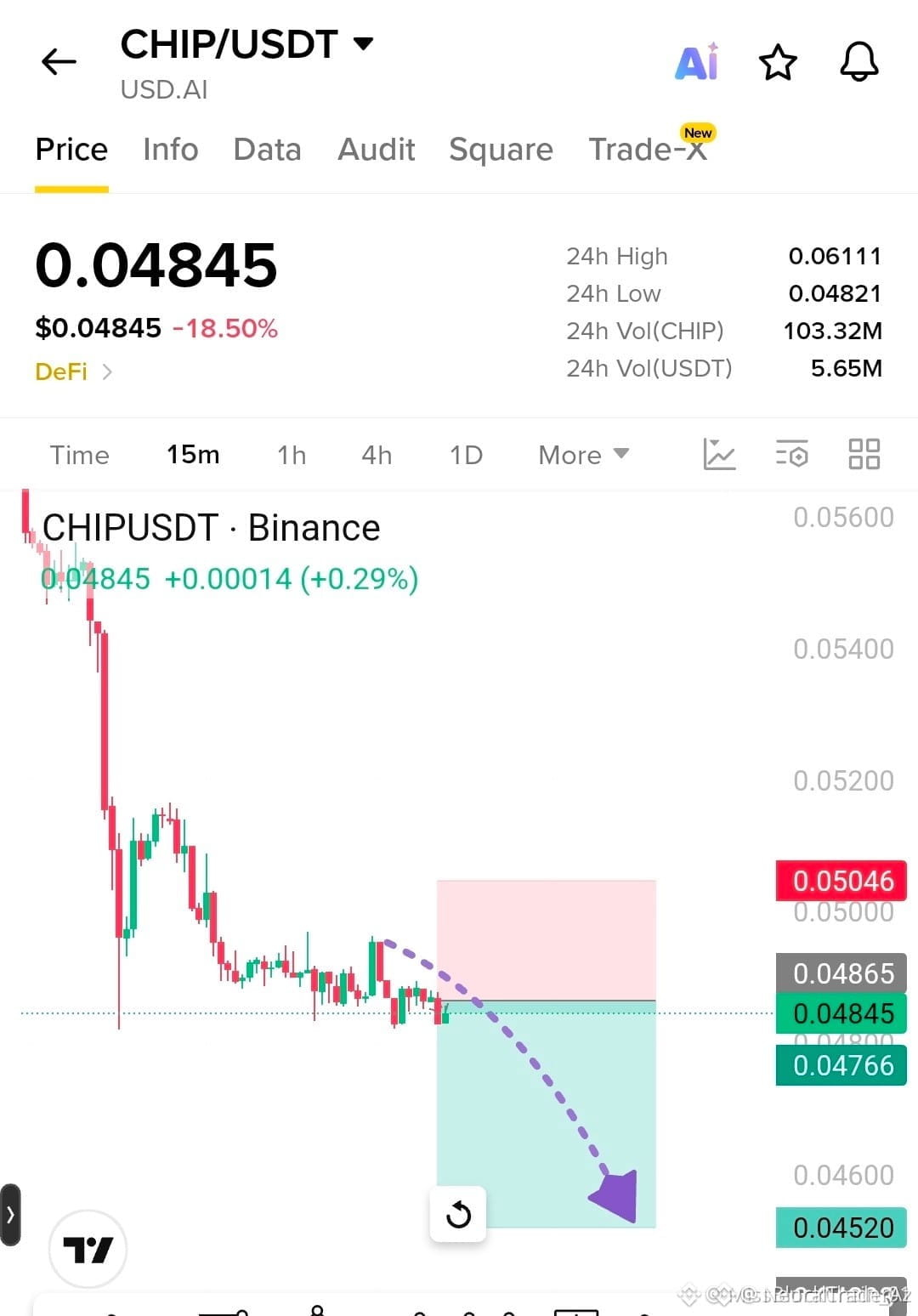
🔴 $CHIP SLIDES DEEPER AS SELLERS HOLD THE REINS! 💥
Entry: 0.04845-0.04865 ⚡
Target: 0.04766 / 0.04640 / 0.04520 🚀
Stop Loss: 0.05046 ⚠️
📊 The 15‑minute structure stays aggressively bearish, with a clear down‑trend order block anchoring below 0.04865. 🦈 Every failed rally has been devoured by liquidity pools, confirming smart‑money accumulation on the short side. 📌 Rejection at the upper bound signals another wave of downside pressure, aligning with the institutional sweep pattern observed over the past session.
💡 With three tiered targets, the trade offers a layered R‑R profile that rewards persistence while keeping exposure tight. 💬 How are you positioning your short entries as the price tests the next liquidity basin? 👇
⚠️ Not financial advice. Always manage your risk. 🛡️
🏷️ #CHIP #ShortSetup #Bearish #LiquidityHunt #Crypto
🦈 🔥
🔴 $CHIP SLIDES DEEPER AS SELLERS HOLD THE REINS! 💥
Entry: 0.04845-0.04865 ⚡
Target: 0.04766 / 0.04640 / 0.04520 🚀
Stop Loss: 0.05046 ⚠️
📊 The 15‑minute structure stays aggressively bearish, with a clear down‑trend order block anchoring below 0.04865. 🦈 Every failed rally has been devoured by liquidity pools, confirming smart‑money accumulation on the short side. 📌 Rejection at the upper bound signals another wave of downside pressure, aligning with the institutional sweep pattern observed over the past session.
💡 With three tiered targets, the trade offers a layered R‑R profile that rewards persistence while keeping exposure tight. 💬 How are you positioning your short entries as the price tests the next liquidity basin? 👇
⚠️ Not financial advice. Always manage your risk. 🛡️
🏷️ #CHIP #ShortSetup #Bearish #LiquidityHunt #Crypto
🦈 🔥
Entry: 0.04845-0.04865 ⚡
Target: 0.04766 / 0.04640 / 0.04520 🚀
Stop Loss: 0.05046 ⚠️
📊 The 15‑minute structure stays aggressively bearish, with a clear down‑trend order block anchoring below 0.04865. 🦈 Every failed rally has been devoured by liquidity pools, confirming smart‑money accumulation on the short side. 📌 Rejection at the upper bound signals another wave of downside pressure, aligning with the institutional sweep pattern observed over the past session.
💡 With three tiered targets, the trade offers a layered R‑R profile that rewards persistence while keeping exposure tight. 💬 How are you positioning your short entries as the price tests the next liquidity basin? 👇
⚠️ Not financial advice. Always manage your risk. 🛡️
🏷️ #CHIP #ShortSetup #Bearish #LiquidityHunt #Crypto
🦈 🔥
141

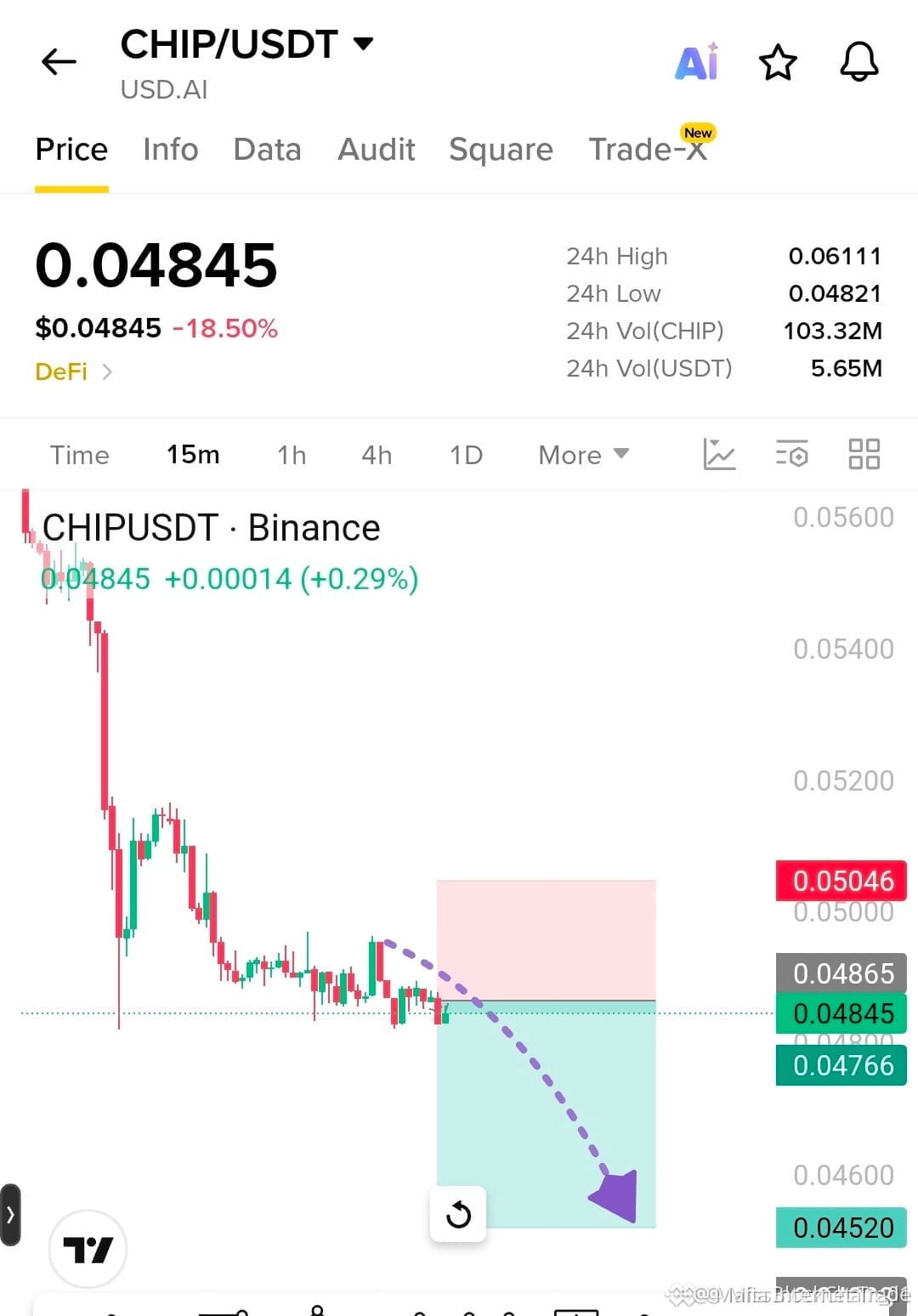
🔴 $CHIP SLIDES DEEPER AS SELLERS HOLD THE REINS 📉
Entry: 0.04845‑0.04865 ⚡
Target: 0.04766 / 0.04640 / 0.04520 🚀
Stop Loss: 0.05046 ⚠️
📊 The 15‑minute chart is screaming bearish, with a clean structure break and no bounce off the nearby resistance. A hard reject below 0.04865 would flip the next order block and unleash fresh downside pressure. ⚡
🌊 Smart money is already sweeping liquidity, carving a path toward the lower targets. Each TP level acts as a profit lane for aggressive shorts, while the SL sits just above the last swing high, keeping risk tight. 🔍
💬 Are you positioned to catch the next wave down? 👇
⚠️ Not financial advice. Always manage your risk. 🛡️
🏷️ #CHIP #ShortSetup #Bearish #Crypto #Liquidity
🔥 🦈
🔴 $CHIP SLIDES DEEPER AS SELLERS HOLD THE REINS 📉
Entry: 0.04845‑0.04865 ⚡
Target: 0.04766 / 0.04640 / 0.04520 🚀
Stop Loss: 0.05046 ⚠️
📊 The 15‑minute chart is screaming bearish, with a clean structure break and no bounce off the nearby resistance. A hard reject below 0.04865 would flip the next order block and unleash fresh downside pressure. ⚡
🌊 Smart money is already sweeping liquidity, carving a path toward the lower targets. Each TP level acts as a profit lane for aggressive shorts, while the SL sits just above the last swing high, keeping risk tight. 🔍
💬 Are you positioned to catch the next wave down? 👇
⚠️ Not financial advice. Always manage your risk. 🛡️
🏷️ #CHIP #ShortSetup #Bearish #Crypto #Liquidity
🔥 🦈
Entry: 0.04845‑0.04865 ⚡
Target: 0.04766 / 0.04640 / 0.04520 🚀
Stop Loss: 0.05046 ⚠️
📊 The 15‑minute chart is screaming bearish, with a clean structure break and no bounce off the nearby resistance. A hard reject below 0.04865 would flip the next order block and unleash fresh downside pressure. ⚡
🌊 Smart money is already sweeping liquidity, carving a path toward the lower targets. Each TP level acts as a profit lane for aggressive shorts, while the SL sits just above the last swing high, keeping risk tight. 🔍
💬 Are you positioned to catch the next wave down? 👇
⚠️ Not financial advice. Always manage your risk. 🛡️
🏷️ #CHIP #ShortSetup #Bearish #Crypto #Liquidity
🔥 🦈
108

·
--
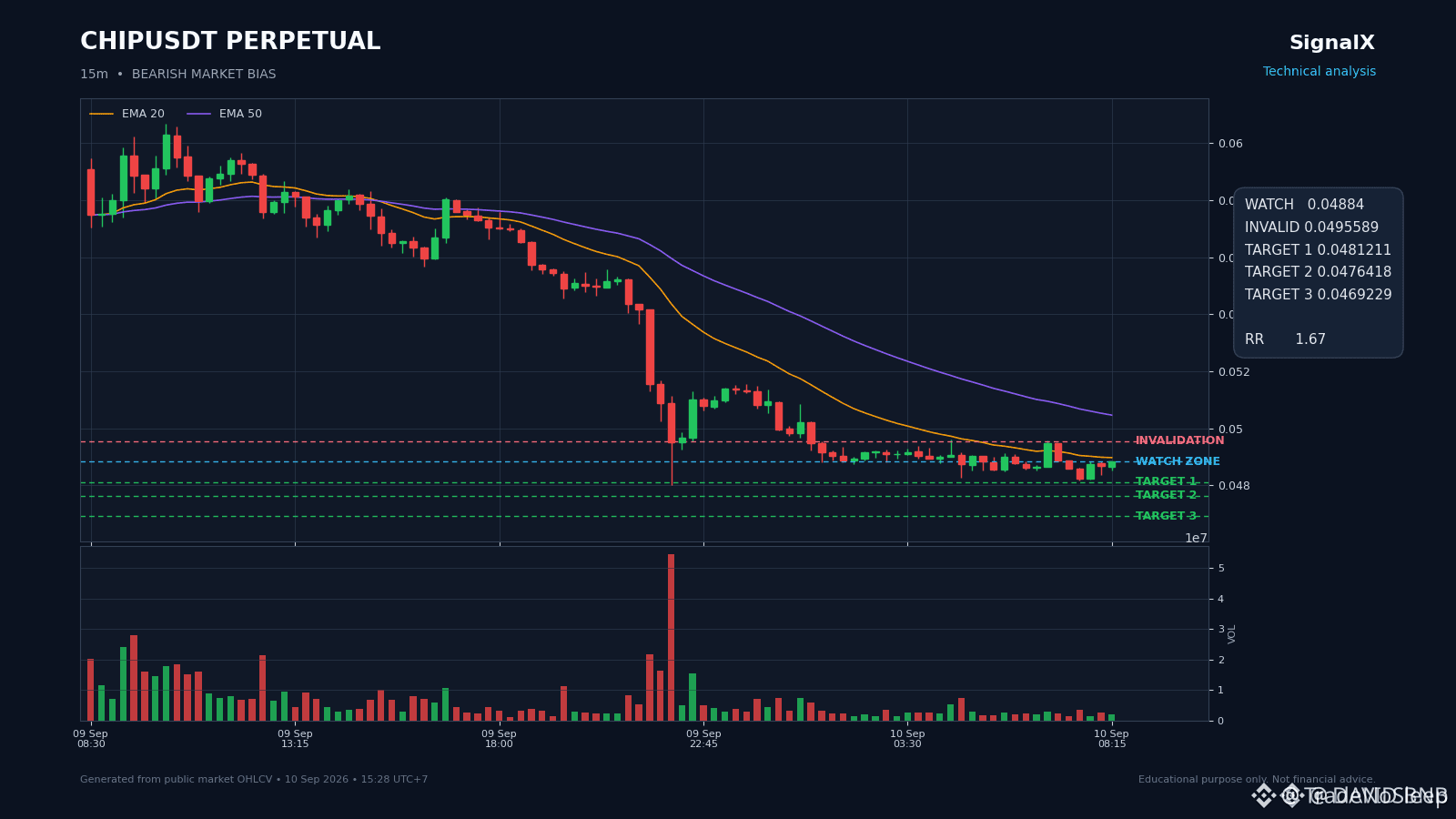
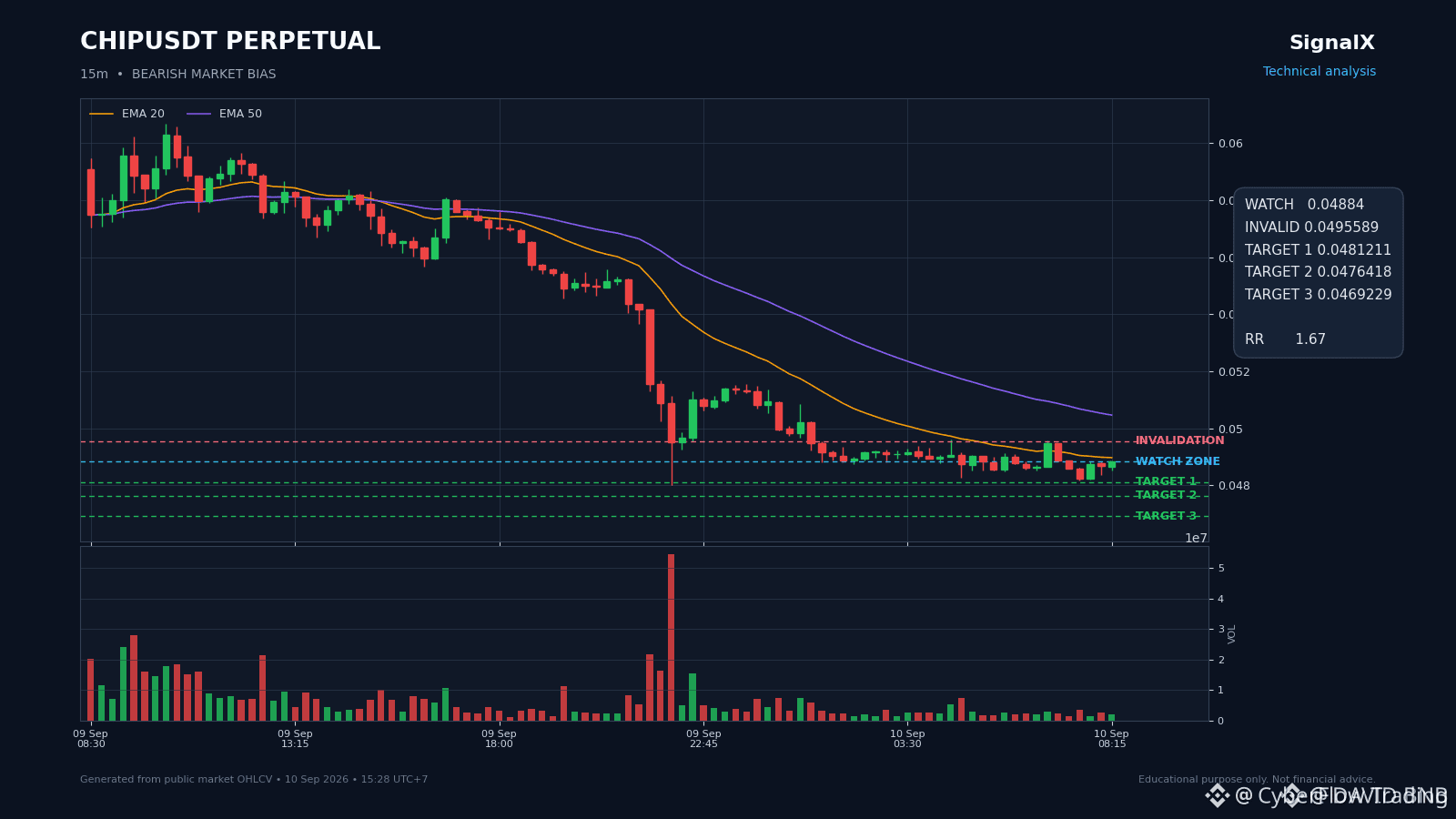
🔴 $CHIP BEARISH BREAKDOWN APPROACHING KEY LIQUIDITY ZONE
Entry: 0.04884 ⚡
Target: 0.0481211 🚀
Stop Loss: 0.0495589 ⚠️
📊 The recent candle cluster hovers over a tight reaction zone, where smart money has been siphoning liquidity on the downside. 🌊 Volume spikes hint at a controlled sell‑off, and the price is respecting the 0.04884 threshold as a fresh demand block. 🔍
📈 With the stop perched just above the invalidation level, the trade offers a crisp risk‑reward profile as the market eyes the next technical target at 0.04812. 📌 Are you ready to ride the bearish thrust or waiting for a reversal cue? 💬
⚠️ Not financial advice. Always manage your risk. 🛡️
🏷️ #CHIP #BearishSetup #LiquiditySweep #Crypto
🔥 🦈
🔴 $CHIP BEARISH BREAKDOWN APPROACHING KEY LIQUIDITY ZONE
Entry: 0.04884 ⚡
Target: 0.0481211 🚀
Stop Loss: 0.0495589 ⚠️
📊 The recent candle cluster hovers over a tight reaction zone, where smart money has been siphoning liquidity on the downside. 🌊 Volume spikes hint at a controlled sell‑off, and the price is respecting the 0.04884 threshold as a fresh demand block. 🔍
📈 With the stop perched just above the invalidation level, the trade offers a crisp risk‑reward profile as the market eyes the next technical target at 0.04812. 📌 Are you ready to ride the bearish thrust or waiting for a reversal cue? 💬
⚠️ Not financial advice. Always manage your risk. 🛡️
🏷️ #CHIP #BearishSetup #LiquiditySweep #Crypto
🔥 🦈
Entry: 0.04884 ⚡
Target: 0.0481211 🚀
Stop Loss: 0.0495589 ⚠️
📊 The recent candle cluster hovers over a tight reaction zone, where smart money has been siphoning liquidity on the downside. 🌊 Volume spikes hint at a controlled sell‑off, and the price is respecting the 0.04884 threshold as a fresh demand block. 🔍
📈 With the stop perched just above the invalidation level, the trade offers a crisp risk‑reward profile as the market eyes the next technical target at 0.04812. 📌 Are you ready to ride the bearish thrust or waiting for a reversal cue? 💬
⚠️ Not financial advice. Always manage your risk. 🛡️
🏷️ #CHIP #BearishSetup #LiquiditySweep #Crypto
🔥 🦈
2

🔴 $CHIP SLIDES INTO DEEP SELL ZONE – LIQUIDITY SWEEP LOOMS! 🚨
Entry: 0.04884 ⚡
Target: 0.0481211 🚀
Target: 0.0476418 🚀
Target: 0.0469229 🚀
Stop Loss: 0.0495589 ⚠️
📊 The market’s been throttling around the 0.04884 reaction zone, with sellers anchoring order flow and squeezing the range. 🦈 Liquidity is evaporating as each dip hits the 0.04812‑0.04692 corridor, hinting at a deeper pullback. Volume spikes on the 4H echo a smart‑money squeeze, priming the next leg toward the 0.0469 floor.
💬 Are you positioning short now or waiting for the next liquidity grab? 👇
⚠️ Not financial advice. Always manage your risk. 🛡️
🏷️ #CHIP #ShortSetup #Bearish #Crypto
🐻 💎
🔴 $CHIP SLIDES INTO DEEP SELL ZONE – LIQUIDITY SWEEP LOOMS! 🚨
Entry: 0.04884 ⚡
Target: 0.0481211 🚀
Target: 0.0476418 🚀
Target: 0.0469229 🚀
Stop Loss: 0.0495589 ⚠️
📊 The market’s been throttling around the 0.04884 reaction zone, with sellers anchoring order flow and squeezing the range. 🦈 Liquidity is evaporating as each dip hits the 0.04812‑0.04692 corridor, hinting at a deeper pullback. Volume spikes on the 4H echo a smart‑money squeeze, priming the next leg toward the 0.0469 floor.
💬 Are you positioning short now or waiting for the next liquidity grab? 👇
⚠️ Not financial advice. Always manage your risk. 🛡️
🏷️ #CHIP #ShortSetup #Bearish #Crypto
🐻 💎
Entry: 0.04884 ⚡
Target: 0.0481211 🚀
Target: 0.0476418 🚀
Target: 0.0469229 🚀
Stop Loss: 0.0495589 ⚠️
📊 The market’s been throttling around the 0.04884 reaction zone, with sellers anchoring order flow and squeezing the range. 🦈 Liquidity is evaporating as each dip hits the 0.04812‑0.04692 corridor, hinting at a deeper pullback. Volume spikes on the 4H echo a smart‑money squeeze, priming the next leg toward the 0.0469 floor.
💬 Are you positioning short now or waiting for the next liquidity grab? 👇
⚠️ Not financial advice. Always manage your risk. 🛡️
🏷️ #CHIP #ShortSetup #Bearish #Crypto
🐻 💎
50

·
--
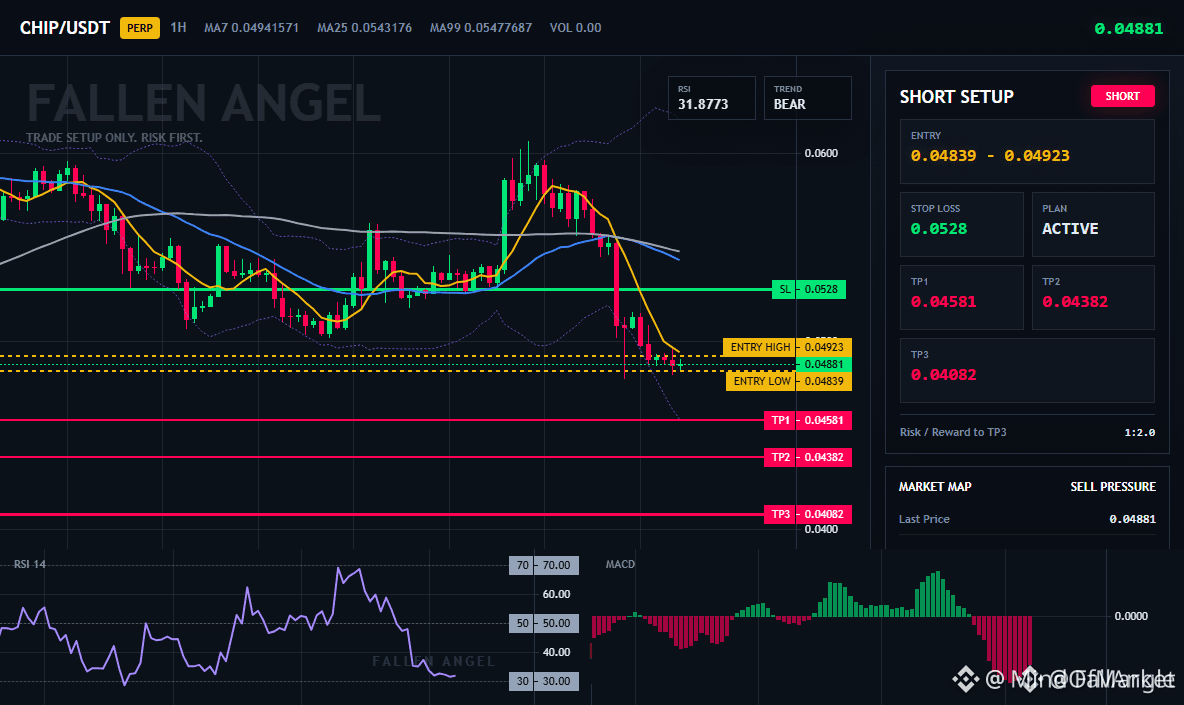
🔴 $CHIP PLUNGES INTO LIQUIDITY SWEEP, SHORT SETUP LOCKED! 🚨
Entry: 0.04839-0.04923 ⚡
Target: 0.04581 🚀
Target: 0.04382 🚀
Target: 0.04082 🚀
Stop Loss: 0.05280 ⚠️
📊 The price is trapped within a tight demand zone, a classic smart‑money choke point where sellers have been forced to absorb every sell‑off. ⚡ Volume spikes on the 1H chart confirm aggressive buying pressure as the market seeks liquidity below the block. 🌊 Each TP aligns with successive liquidity pools, offering a stair‑step R:R ladder that rewards disciplined scaling out. 💡 The structure suggests a continued down‑trend until the next major swing low is tested. 💬 How deep will the short cascade run before the next institutional re‑entry? 👇
⚠️ Not financial advice. Always manage your risk. 🛡️
🏷️ #CHIP #ShortSetup #LiquiditySweep #Crypto
🦈 🔥
🔴 $CHIP PLUNGES INTO LIQUIDITY SWEEP, SHORT SETUP LOCKED! 🚨
Entry: 0.04839-0.04923 ⚡
Target: 0.04581 🚀
Target: 0.04382 🚀
Target: 0.04082 🚀
Stop Loss: 0.05280 ⚠️
📊 The price is trapped within a tight demand zone, a classic smart‑money choke point where sellers have been forced to absorb every sell‑off. ⚡ Volume spikes on the 1H chart confirm aggressive buying pressure as the market seeks liquidity below the block. 🌊 Each TP aligns with successive liquidity pools, offering a stair‑step R:R ladder that rewards disciplined scaling out. 💡 The structure suggests a continued down‑trend until the next major swing low is tested. 💬 How deep will the short cascade run before the next institutional re‑entry? 👇
⚠️ Not financial advice. Always manage your risk. 🛡️
🏷️ #CHIP #ShortSetup #LiquiditySweep #Crypto
🦈 🔥
Entry: 0.04839-0.04923 ⚡
Target: 0.04581 🚀
Target: 0.04382 🚀
Target: 0.04082 🚀
Stop Loss: 0.05280 ⚠️
📊 The price is trapped within a tight demand zone, a classic smart‑money choke point where sellers have been forced to absorb every sell‑off. ⚡ Volume spikes on the 1H chart confirm aggressive buying pressure as the market seeks liquidity below the block. 🌊 Each TP aligns with successive liquidity pools, offering a stair‑step R:R ladder that rewards disciplined scaling out. 💡 The structure suggests a continued down‑trend until the next major swing low is tested. 💬 How deep will the short cascade run before the next institutional re‑entry? 👇
⚠️ Not financial advice. Always manage your risk. 🛡️
🏷️ #CHIP #ShortSetup #LiquiditySweep #Crypto
🦈 🔥
10

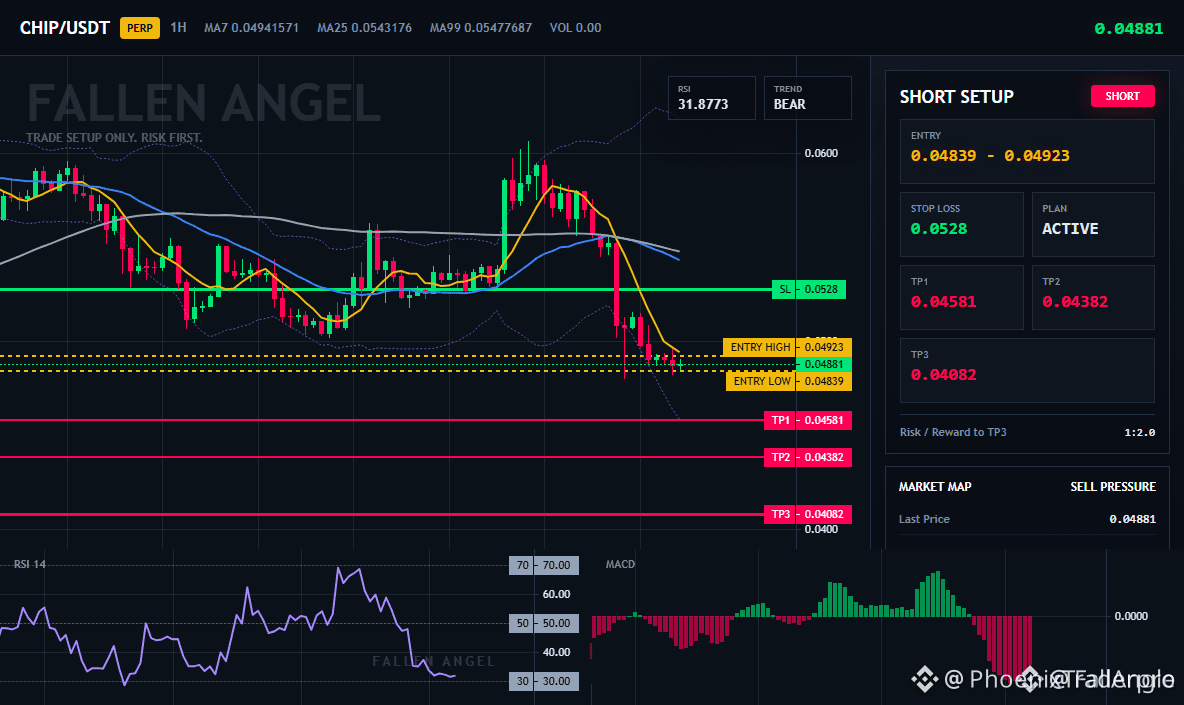
🔴 $CHIP PLUNGING THROUGH LIQUIDITY SWEEP – SHORT ALERT! 🦈
Entry: 0.04839-0.04923 ⚡
Target: 0.04581 🚀
Target: 0.04382 🚀
Target: 0.04082 🚀
Stop Loss: 0.05280 ⚠️
📊 The price is locked inside a tight demand bucket, and smart‑money sharks are flushing out the last liquidity. ⚡ Volume spikes on the 15‑min chart confirm sellers are in full control, while the order block at 0.0485 holds firm. 🦈 Each TP lines up with historic swing lows, giving a clean R:R ladder from 0.8 up to 2.0. 📌 This is a textbook short‑only play—no fluff, just pure pressure.
💬 Are you ready to ride the downside wave? 👇
⚠️ Not financial advice. Always manage your risk. 🛡️
🏷️ #CHIP #ShortSetup #LiquiditySweep #Crypto
🔥 💎
🔴 $CHIP PLUNGING THROUGH LIQUIDITY SWEEP – SHORT ALERT! 🦈
Entry: 0.04839-0.04923 ⚡
Target: 0.04581 🚀
Target: 0.04382 🚀
Target: 0.04082 🚀
Stop Loss: 0.05280 ⚠️
📊 The price is locked inside a tight demand bucket, and smart‑money sharks are flushing out the last liquidity. ⚡ Volume spikes on the 15‑min chart confirm sellers are in full control, while the order block at 0.0485 holds firm. 🦈 Each TP lines up with historic swing lows, giving a clean R:R ladder from 0.8 up to 2.0. 📌 This is a textbook short‑only play—no fluff, just pure pressure.
💬 Are you ready to ride the downside wave? 👇
⚠️ Not financial advice. Always manage your risk. 🛡️
🏷️ #CHIP #ShortSetup #LiquiditySweep #Crypto
🔥 💎
Entry: 0.04839-0.04923 ⚡
Target: 0.04581 🚀
Target: 0.04382 🚀
Target: 0.04082 🚀
Stop Loss: 0.05280 ⚠️
📊 The price is locked inside a tight demand bucket, and smart‑money sharks are flushing out the last liquidity. ⚡ Volume spikes on the 15‑min chart confirm sellers are in full control, while the order block at 0.0485 holds firm. 🦈 Each TP lines up with historic swing lows, giving a clean R:R ladder from 0.8 up to 2.0. 📌 This is a textbook short‑only play—no fluff, just pure pressure.
💬 Are you ready to ride the downside wave? 👇
⚠️ Not financial advice. Always manage your risk. 🛡️
🏷️ #CHIP #ShortSetup #LiquiditySweep #Crypto
🔥 💎
32
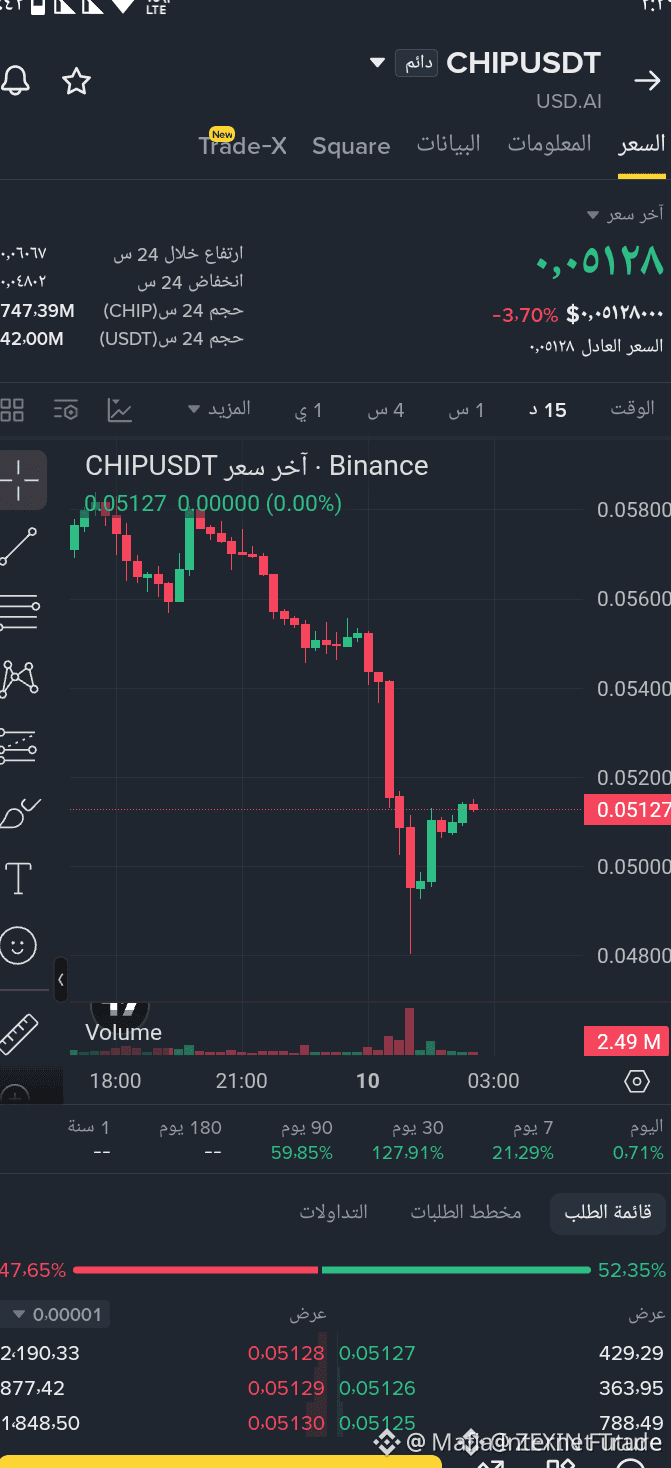
🚀 $CHIP SURGES AFTER SHORT SQUASH – FULL TP ON THE HORIZON! 💥
Entry: 0.04800 ⚡
🦈📊 Shorts got clipped hard as $CHIP snapped back from 0.04800, carving a fresh demand column that’s swallowing liquidity like a shark in a feeding frenzy. The order flow shows a bullish surge, with volume spikes confirming that the push isn’t a flash‑crash but a genuine reclaim of the upside. 🚀⚡ Momentum is still charging, and every tick above the 0.04800 pivot adds fresh fire to the rally. 💬 Are you loading up or waiting for the next wave?
⚠️ Not financial advice. Always manage your risk. 🛡️
🏷️ #CHIP #LongSetup #Momentum #Crypto
🚀 🔥
🚀 $CHIP SURGES AFTER SHORT SQUASH – FULL TP ON THE HORIZON! 💥
Entry: 0.04800 ⚡
🦈📊 Shorts got clipped hard as $CHIP snapped back from 0.04800, carving a fresh demand column that’s swallowing liquidity like a shark in a feeding frenzy. The order flow shows a bullish surge, with volume spikes confirming that the push isn’t a flash‑crash but a genuine reclaim of the upside. 🚀⚡ Momentum is still charging, and every tick above the 0.04800 pivot adds fresh fire to the rally. 💬 Are you loading up or waiting for the next wave?
⚠️ Not financial advice. Always manage your risk. 🛡️
🏷️ #CHIP #LongSetup #Momentum #Crypto
🚀 🔥
Entry: 0.04800 ⚡
🦈📊 Shorts got clipped hard as $CHIP snapped back from 0.04800, carving a fresh demand column that’s swallowing liquidity like a shark in a feeding frenzy. The order flow shows a bullish surge, with volume spikes confirming that the push isn’t a flash‑crash but a genuine reclaim of the upside. 🚀⚡ Momentum is still charging, and every tick above the 0.04800 pivot adds fresh fire to the rally. 💬 Are you loading up or waiting for the next wave?
⚠️ Not financial advice. Always manage your risk. 🛡️
🏷️ #CHIP #LongSetup #Momentum #Crypto
🚀 🔥
187

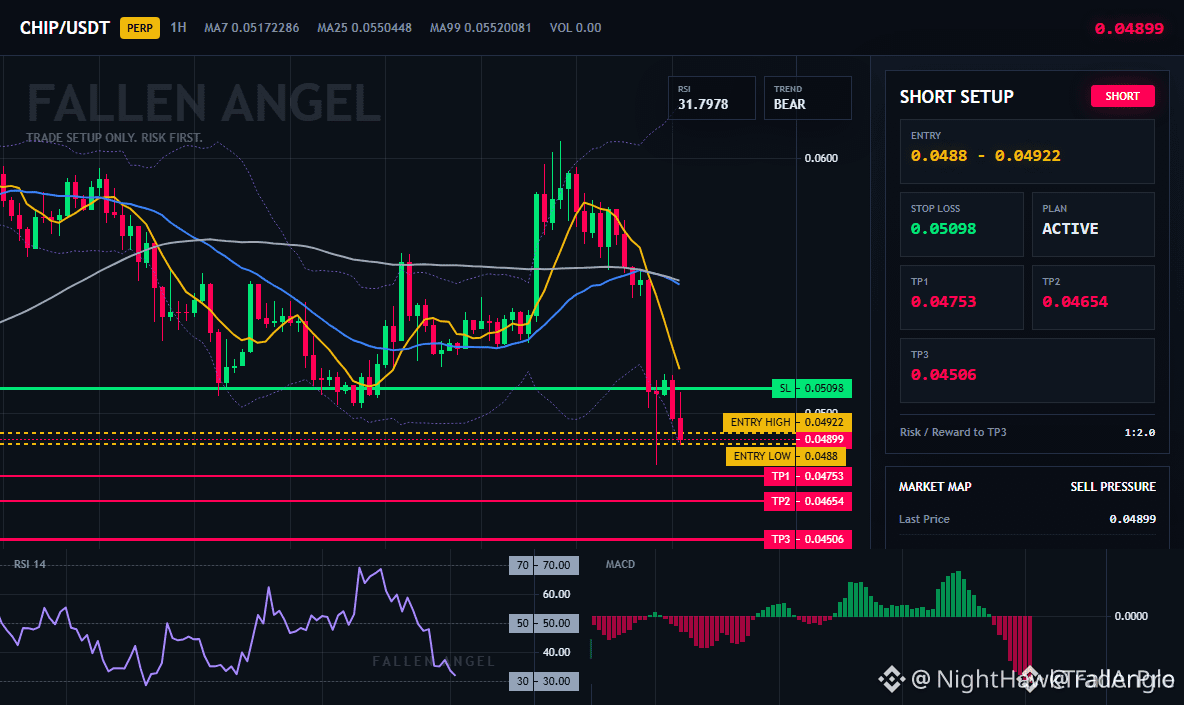
🔴 $CHIP PLUNGES INTO DEEP SHORT ZONE – 10X RISK REWARD! 🚨
Entry: 0.04880-0.04922 ⚡
Target: 0.04753, 0.04654, 0.04506 🚀
Stop Loss: 0.05098 ⚠️
📊 The order block at 0.04880‑0.04922 has already swallowed three rounds of buying pressure, signalling smart‑money liquidity sweep. 🦈 Sellers are anchoring the market, and the next wave of short bids is primed to cascade down the ladder. ⚡ With 10x leverage, the R:R climbs to 1:2 by the third target, while the stop sits just above the recent swing high. Volume spikes confirm the bearish tilt, making this a high‑conviction flip. 💬 Are you ready to ride the down‑trend or waiting for the next liquidity trap? 👇
⚠️ Not financial advice. Always manage your risk. 🛡️
🏷️ #CHIP #ShortSetup #Crypto #Leverage
🔥 💎
🔴 $CHIP PLUNGES INTO DEEP SHORT ZONE – 10X RISK REWARD! 🚨
Entry: 0.04880-0.04922 ⚡
Target: 0.04753, 0.04654, 0.04506 🚀
Stop Loss: 0.05098 ⚠️
📊 The order block at 0.04880‑0.04922 has already swallowed three rounds of buying pressure, signalling smart‑money liquidity sweep. 🦈 Sellers are anchoring the market, and the next wave of short bids is primed to cascade down the ladder. ⚡ With 10x leverage, the R:R climbs to 1:2 by the third target, while the stop sits just above the recent swing high. Volume spikes confirm the bearish tilt, making this a high‑conviction flip. 💬 Are you ready to ride the down‑trend or waiting for the next liquidity trap? 👇
⚠️ Not financial advice. Always manage your risk. 🛡️
🏷️ #CHIP #ShortSetup #Crypto #Leverage
🔥 💎
Entry: 0.04880-0.04922 ⚡
Target: 0.04753, 0.04654, 0.04506 🚀
Stop Loss: 0.05098 ⚠️
📊 The order block at 0.04880‑0.04922 has already swallowed three rounds of buying pressure, signalling smart‑money liquidity sweep. 🦈 Sellers are anchoring the market, and the next wave of short bids is primed to cascade down the ladder. ⚡ With 10x leverage, the R:R climbs to 1:2 by the third target, while the stop sits just above the recent swing high. Volume spikes confirm the bearish tilt, making this a high‑conviction flip. 💬 Are you ready to ride the down‑trend or waiting for the next liquidity trap? 👇
⚠️ Not financial advice. Always manage your risk. 🛡️
🏷️ #CHIP #ShortSetup #Crypto #Leverage
🔥 💎
107
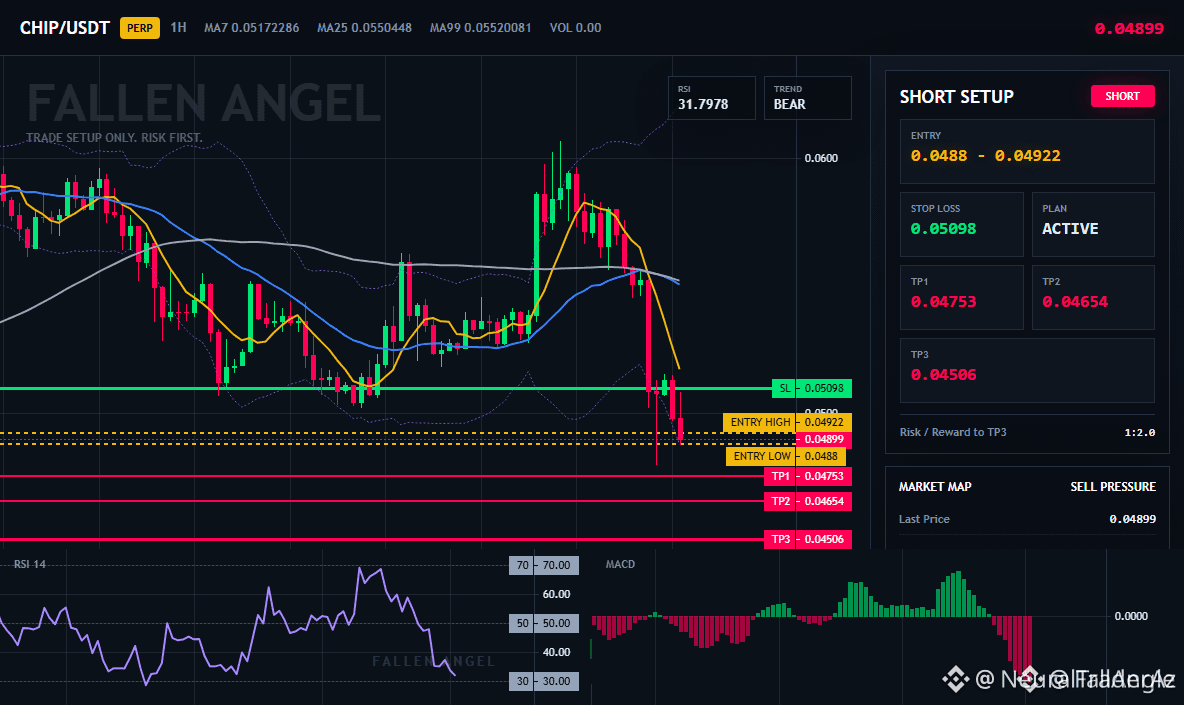
🔴 $CHIP SHORT 10X ON LIQUIDITY SWEEP! 💥
Entry: 0.04880-0.04922 ⚡
Target: 0.04753 🎯
Target: 0.04654 🎯
Target: 0.04506 🎯
Stop Loss: 0.05098 ⚠️
The token is entrenched in a bearish order block just below 0.049, where smart money has already absorbed buying pressure. 📊 The 4H volume profile shows a sharp liquidity sink, setting the stage for a disciplined short cascade.
Our entry corridor 0.04880‑0.04922 aligns with the last failed bullish retest, while the three descending targets map the next three liquidity pools at 0.04753, 0.04654, and 0.04506. ⚡ Each level improves the R:R, with TP3 offering a clean 2:1 payoff.
💬 Are you ready to lock in the downside and let the smart money run? 👇
⚠️ Not financial advice. Always manage your risk. 🛡️
🏷️ #CHIP #ShortSetup #LiquiditySweep #Crypto
🦈 🔥
🔴 $CHIP SHORT 10X ON LIQUIDITY SWEEP! 💥
Entry: 0.04880-0.04922 ⚡
Target: 0.04753 🎯
Target: 0.04654 🎯
Target: 0.04506 🎯
Stop Loss: 0.05098 ⚠️
The token is entrenched in a bearish order block just below 0.049, where smart money has already absorbed buying pressure. 📊 The 4H volume profile shows a sharp liquidity sink, setting the stage for a disciplined short cascade.
Our entry corridor 0.04880‑0.04922 aligns with the last failed bullish retest, while the three descending targets map the next three liquidity pools at 0.04753, 0.04654, and 0.04506. ⚡ Each level improves the R:R, with TP3 offering a clean 2:1 payoff.
💬 Are you ready to lock in the downside and let the smart money run? 👇
⚠️ Not financial advice. Always manage your risk. 🛡️
🏷️ #CHIP #ShortSetup #LiquiditySweep #Crypto
🦈 🔥
Entry: 0.04880-0.04922 ⚡
Target: 0.04753 🎯
Target: 0.04654 🎯
Target: 0.04506 🎯
Stop Loss: 0.05098 ⚠️
The token is entrenched in a bearish order block just below 0.049, where smart money has already absorbed buying pressure. 📊 The 4H volume profile shows a sharp liquidity sink, setting the stage for a disciplined short cascade.
Our entry corridor 0.04880‑0.04922 aligns with the last failed bullish retest, while the three descending targets map the next three liquidity pools at 0.04753, 0.04654, and 0.04506. ⚡ Each level improves the R:R, with TP3 offering a clean 2:1 payoff.
💬 Are you ready to lock in the downside and let the smart money run? 👇
⚠️ Not financial advice. Always manage your risk. 🛡️
🏷️ #CHIP #ShortSetup #LiquiditySweep #Crypto
🦈 🔥
13
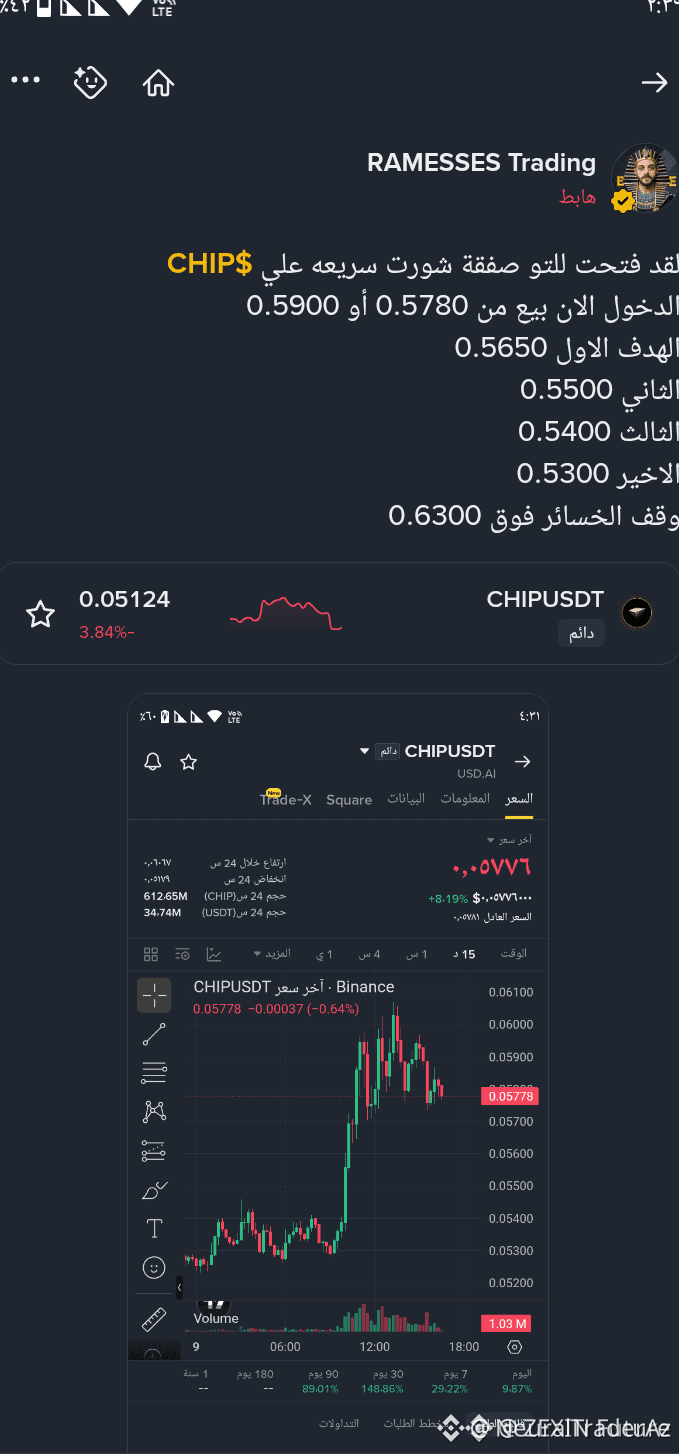
🚀 $CHIP REIGNITES WITH POWERFUL PUSH ABOVE 0.04800! 💥
Entry: 0.04800 ⚡
🦈 Smart money has re‑established a fresh demand column at 0.04800, snapping the last short‑side liquidity sweep. Volume on the 1‑hour chart is expanding, confirming institutional accumulation. 📊
Momentum accelerates as the price breaks above the prior swing, leaving a clean bullish gap. The RSI flips into bullish territory while the prior resistance now acts as support, setting the stage for a multi‑session rally. ⚡
With the short camp capitulating, the next leg could target the next structural high. 💡 Stay alert for a retest of the 0.05200 resistance‑turned‑support as the market consolidates. 💬 Are you ready to ride the next wave or waiting for a deeper pullback? 👇
⚠️ Not financial advice. Always manage your risk. 🛡️
🏷️ #CHIP #LongSetup #Liquidity #Crypto
🔥 💎
🚀 $CHIP REIGNITES WITH POWERFUL PUSH ABOVE 0.04800! 💥
Entry: 0.04800 ⚡
🦈 Smart money has re‑established a fresh demand column at 0.04800, snapping the last short‑side liquidity sweep. Volume on the 1‑hour chart is expanding, confirming institutional accumulation. 📊
Momentum accelerates as the price breaks above the prior swing, leaving a clean bullish gap. The RSI flips into bullish territory while the prior resistance now acts as support, setting the stage for a multi‑session rally. ⚡
With the short camp capitulating, the next leg could target the next structural high. 💡 Stay alert for a retest of the 0.05200 resistance‑turned‑support as the market consolidates. 💬 Are you ready to ride the next wave or waiting for a deeper pullback? 👇
⚠️ Not financial advice. Always manage your risk. 🛡️
🏷️ #CHIP #LongSetup #Liquidity #Crypto
🔥 💎
Entry: 0.04800 ⚡
🦈 Smart money has re‑established a fresh demand column at 0.04800, snapping the last short‑side liquidity sweep. Volume on the 1‑hour chart is expanding, confirming institutional accumulation. 📊
Momentum accelerates as the price breaks above the prior swing, leaving a clean bullish gap. The RSI flips into bullish territory while the prior resistance now acts as support, setting the stage for a multi‑session rally. ⚡
With the short camp capitulating, the next leg could target the next structural high. 💡 Stay alert for a retest of the 0.05200 resistance‑turned‑support as the market consolidates. 💬 Are you ready to ride the next wave or waiting for a deeper pullback? 👇
⚠️ Not financial advice. Always manage your risk. 🛡️
🏷️ #CHIP #LongSetup #Liquidity #Crypto
🔥 💎
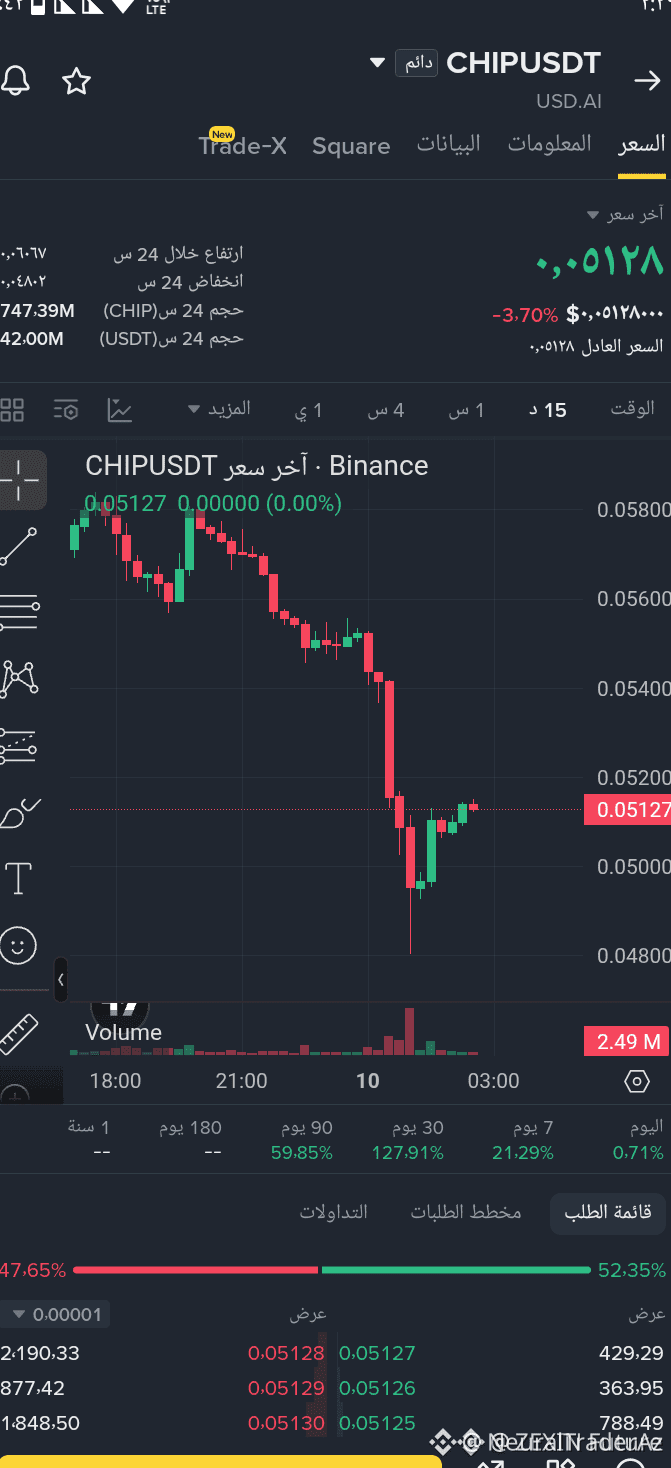
132

·
--
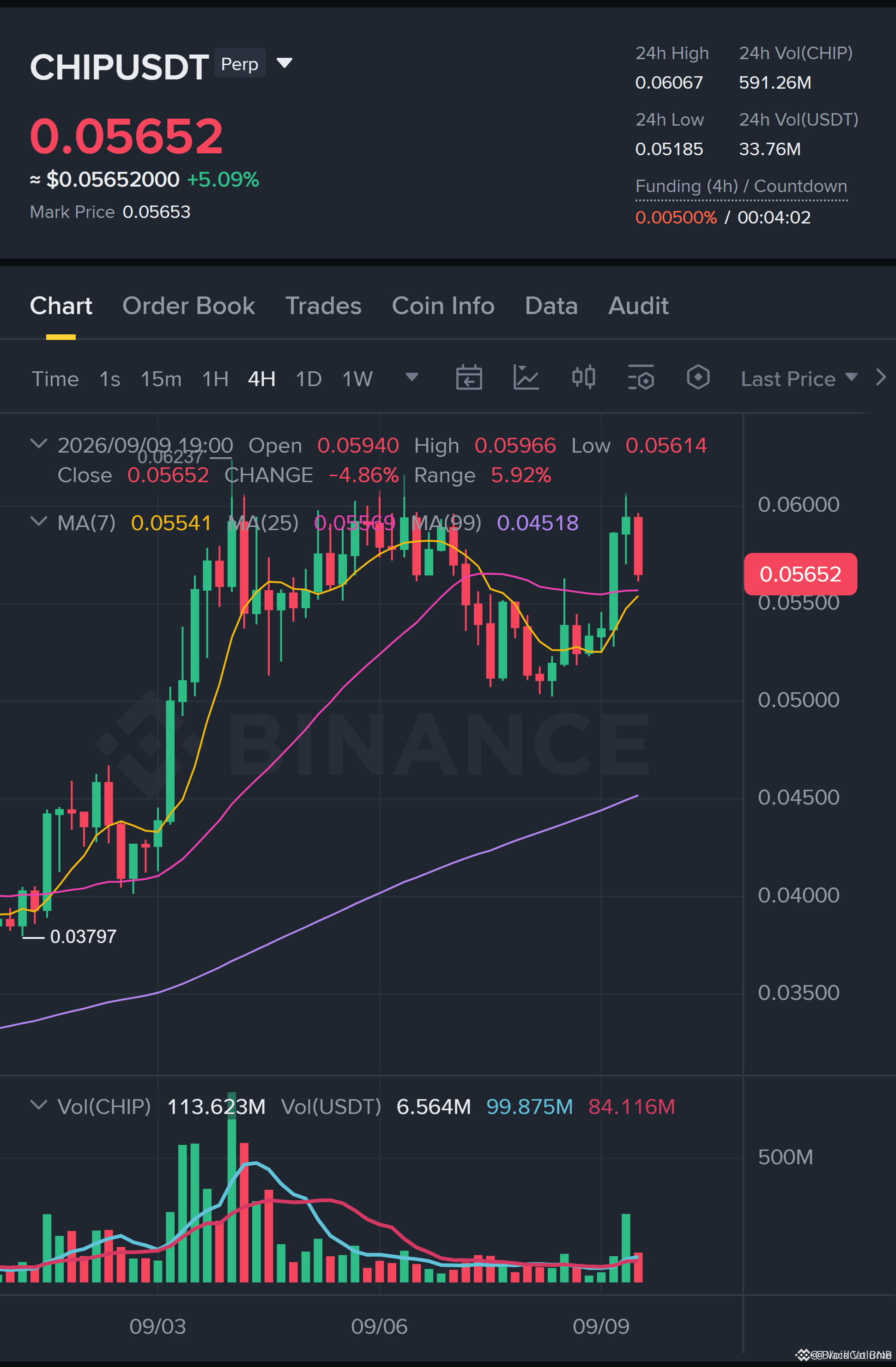
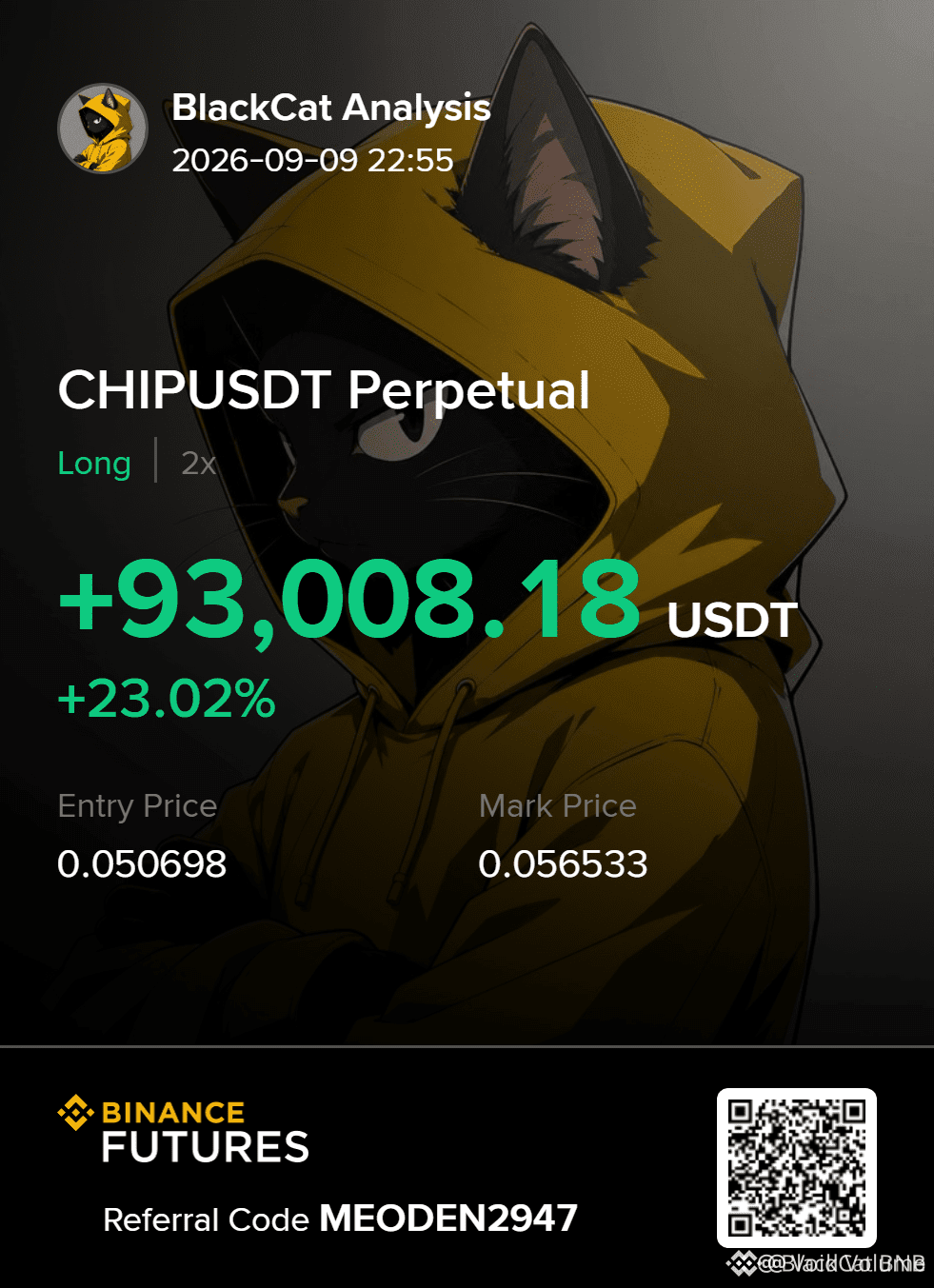
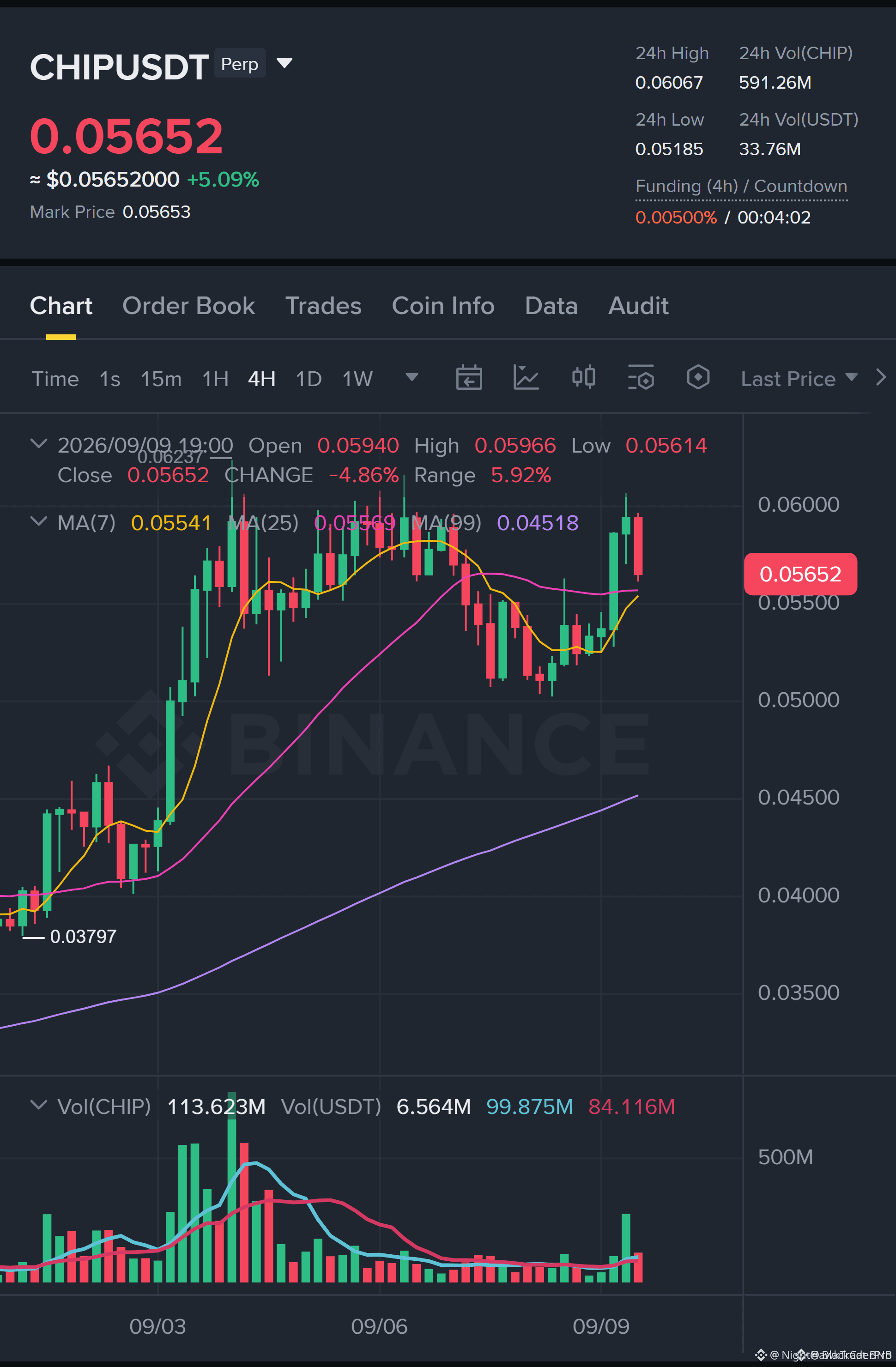
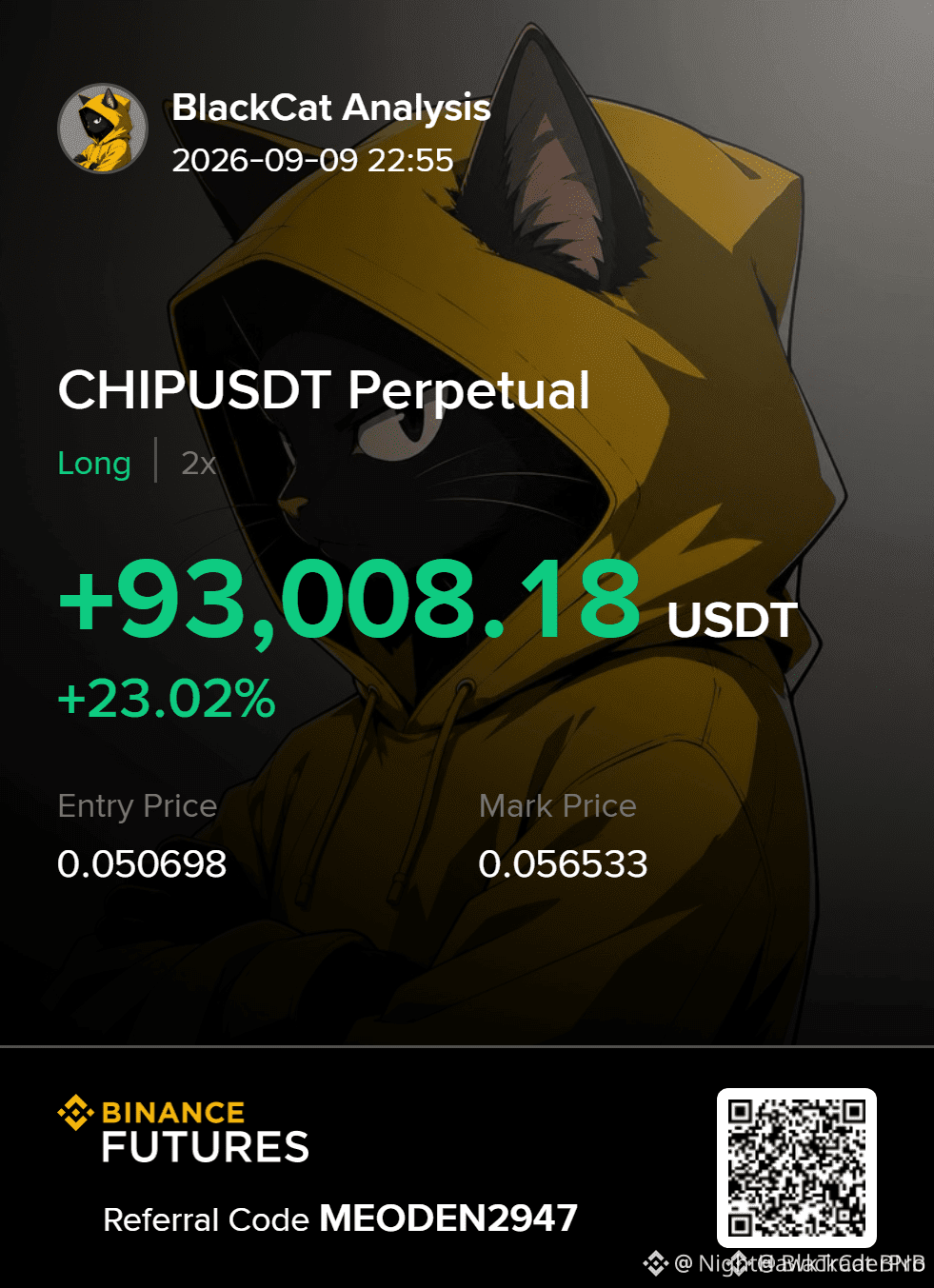
🚀 $CHIP SURGES INTO LONG ZONE AS 1H STRUCTURE BULLISH 🟢
Entry: 0.05579-0.05614 ⚡
Target: 0.05838 🚀
Target: 0.06057 🚀
Target: 0.0616 🚀
Stop Loss: 0.05464 ⚠️
The 1‑hour market structure is carving a higher low, confirming smart‑money accumulation in the 0.0558‑0.0561 band. 📊 Each retest has been met with aggressive buying, erasing liquidity pools below the stop level. 🦈
With the next bullish order block intact, price can punch toward the first profit node at 0.05838, then cascade to 0.06057 and finally 0.0616, delivering R:R up to 4.2. ⚡ The risk is tightly capped at 0.05464, leaving ample upside for a disciplined scale‑out. 📈
💬 Are you allocating to the full zone or waiting for a breakout confirmation?
⚠️ Not financial advice. Always manage your risk. 🛡️
🏷️ #CHIP #LongSetup #OrderBlock #Crypto
🚀 🔥
🚀 $CHIP SURGES INTO LONG ZONE AS 1H STRUCTURE BULLISH 🟢
Entry: 0.05579-0.05614 ⚡
Target: 0.05838 🚀
Target: 0.06057 🚀
Target: 0.0616 🚀
Stop Loss: 0.05464 ⚠️
The 1‑hour market structure is carving a higher low, confirming smart‑money accumulation in the 0.0558‑0.0561 band. 📊 Each retest has been met with aggressive buying, erasing liquidity pools below the stop level. 🦈
With the next bullish order block intact, price can punch toward the first profit node at 0.05838, then cascade to 0.06057 and finally 0.0616, delivering R:R up to 4.2. ⚡ The risk is tightly capped at 0.05464, leaving ample upside for a disciplined scale‑out. 📈
💬 Are you allocating to the full zone or waiting for a breakout confirmation?
⚠️ Not financial advice. Always manage your risk. 🛡️
🏷️ #CHIP #LongSetup #OrderBlock #Crypto
🚀 🔥
Entry: 0.05579-0.05614 ⚡
Target: 0.05838 🚀
Target: 0.06057 🚀
Target: 0.0616 🚀
Stop Loss: 0.05464 ⚠️
The 1‑hour market structure is carving a higher low, confirming smart‑money accumulation in the 0.0558‑0.0561 band. 📊 Each retest has been met with aggressive buying, erasing liquidity pools below the stop level. 🦈
With the next bullish order block intact, price can punch toward the first profit node at 0.05838, then cascade to 0.06057 and finally 0.0616, delivering R:R up to 4.2. ⚡ The risk is tightly capped at 0.05464, leaving ample upside for a disciplined scale‑out. 📈
💬 Are you allocating to the full zone or waiting for a breakout confirmation?
⚠️ Not financial advice. Always manage your risk. 🛡️
🏷️ #CHIP #LongSetup #OrderBlock #Crypto
🚀 🔥
96



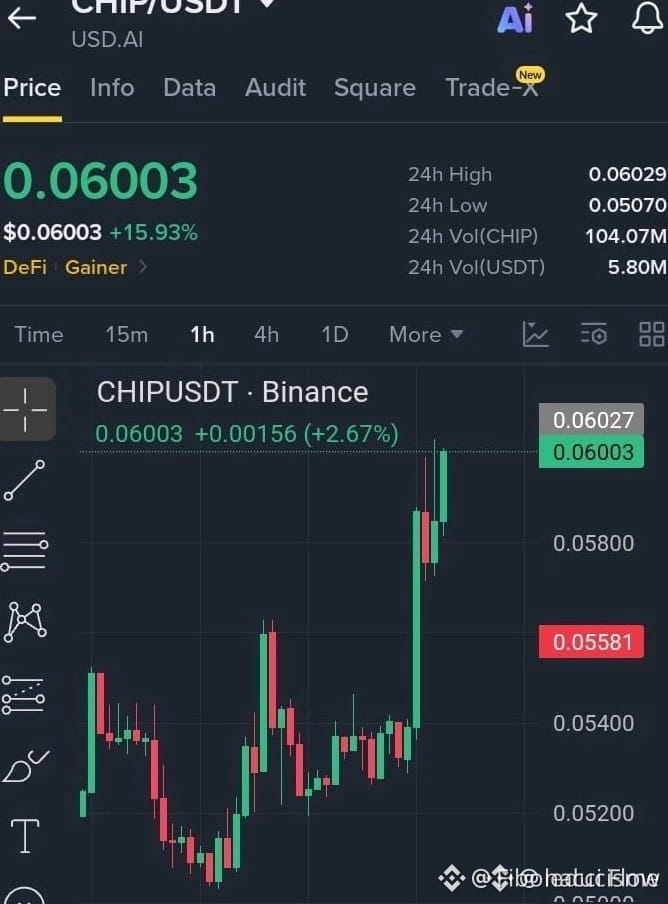
🚀 $CHIP SURFING H1 LIQUIDITY SWEEP – LONG SETUP IGNITES 🟢
Entry: 0.05980-0.06030 ⚡
Target: 0.06250/0.06500/0.06800 🚀
Stop Loss: 0.05581 ⚠️
Buy pressure is roaring, with volume inflows crushing the 0.0600 barrier and carving a fresh demand zone. 📊 The H1 candle demands a clean close above 0.06030 to lock in the swing.
Smart‑money is loading the order block; every tick above that level fuels a momentum surge that could rocket the token toward the 0.06800 ceiling. 🌊⚡
💬 Are you ready to ride this wave or waiting for the next liquidity dump? 👇
⚠️ Not financial advice. Always manage your risk. 🛡️
🏷️ #CHIP #LongSetup #Crypto #Momentum #Breakout
🔥 💎
🚀 $CHIP SURFING H1 LIQUIDITY SWEEP – LONG SETUP IGNITES 🟢
Entry: 0.05980-0.06030 ⚡
Target: 0.06250/0.06500/0.06800 🚀
Stop Loss: 0.05581 ⚠️
Buy pressure is roaring, with volume inflows crushing the 0.0600 barrier and carving a fresh demand zone. 📊 The H1 candle demands a clean close above 0.06030 to lock in the swing.
Smart‑money is loading the order block; every tick above that level fuels a momentum surge that could rocket the token toward the 0.06800 ceiling. 🌊⚡
💬 Are you ready to ride this wave or waiting for the next liquidity dump? 👇
⚠️ Not financial advice. Always manage your risk. 🛡️
🏷️ #CHIP #LongSetup #Crypto #Momentum #Breakout
🔥 💎
Entry: 0.05980-0.06030 ⚡
Target: 0.06250/0.06500/0.06800 🚀
Stop Loss: 0.05581 ⚠️
Buy pressure is roaring, with volume inflows crushing the 0.0600 barrier and carving a fresh demand zone. 📊 The H1 candle demands a clean close above 0.06030 to lock in the swing.
Smart‑money is loading the order block; every tick above that level fuels a momentum surge that could rocket the token toward the 0.06800 ceiling. 🌊⚡
💬 Are you ready to ride this wave or waiting for the next liquidity dump? 👇
⚠️ Not financial advice. Always manage your risk. 🛡️
🏷️ #CHIP #LongSetup #Crypto #Momentum #Breakout
🔥 💎
84
🚀 $CHIP RIDE THE 4X RISK/REWARD WAVE! 💎
Entry: 0.05579-0.05614 ⚡
Target: 0.05838 / 0.06057 / 0.0616 🚀
Stop Loss: 0.05464 ⚠️
📊 The 1H structure is hammering higher, carving a clean bullish stair‑step that whispers “keep buying.” 🦈 Smart money is stacking orders just above the 0.05614 ceiling, and volume spikes confirm the pressure is flipping to the long side. ⚡ Each target adds a fresh layer of upside, with the third tier flirting with a 4.23R payoff if the momentum stays intact. 💡 Are you ready to scale in as the liquidity pool drains beneath us? 👇
⚠️ Not financial advice. Always manage your risk. 🛡️
🏷️ #CHIP #LongSetup #Crypto #Breakout #Momentum
🔥 🚀
🚀 $CHIP RIDE THE 4X RISK/REWARD WAVE! 💎
Entry: 0.05579-0.05614 ⚡
Target: 0.05838 / 0.06057 / 0.0616 🚀
Stop Loss: 0.05464 ⚠️
📊 The 1H structure is hammering higher, carving a clean bullish stair‑step that whispers “keep buying.” 🦈 Smart money is stacking orders just above the 0.05614 ceiling, and volume spikes confirm the pressure is flipping to the long side. ⚡ Each target adds a fresh layer of upside, with the third tier flirting with a 4.23R payoff if the momentum stays intact. 💡 Are you ready to scale in as the liquidity pool drains beneath us? 👇
⚠️ Not financial advice. Always manage your risk. 🛡️
🏷️ #CHIP #LongSetup #Crypto #Breakout #Momentum
🔥 🚀
Entry: 0.05579-0.05614 ⚡
Target: 0.05838 / 0.06057 / 0.0616 🚀
Stop Loss: 0.05464 ⚠️
📊 The 1H structure is hammering higher, carving a clean bullish stair‑step that whispers “keep buying.” 🦈 Smart money is stacking orders just above the 0.05614 ceiling, and volume spikes confirm the pressure is flipping to the long side. ⚡ Each target adds a fresh layer of upside, with the third tier flirting with a 4.23R payoff if the momentum stays intact. 💡 Are you ready to scale in as the liquidity pool drains beneath us? 👇
⚠️ Not financial advice. Always manage your risk. 🛡️
🏷️ #CHIP #LongSetup #Crypto #Breakout #Momentum
🔥 🚀
68

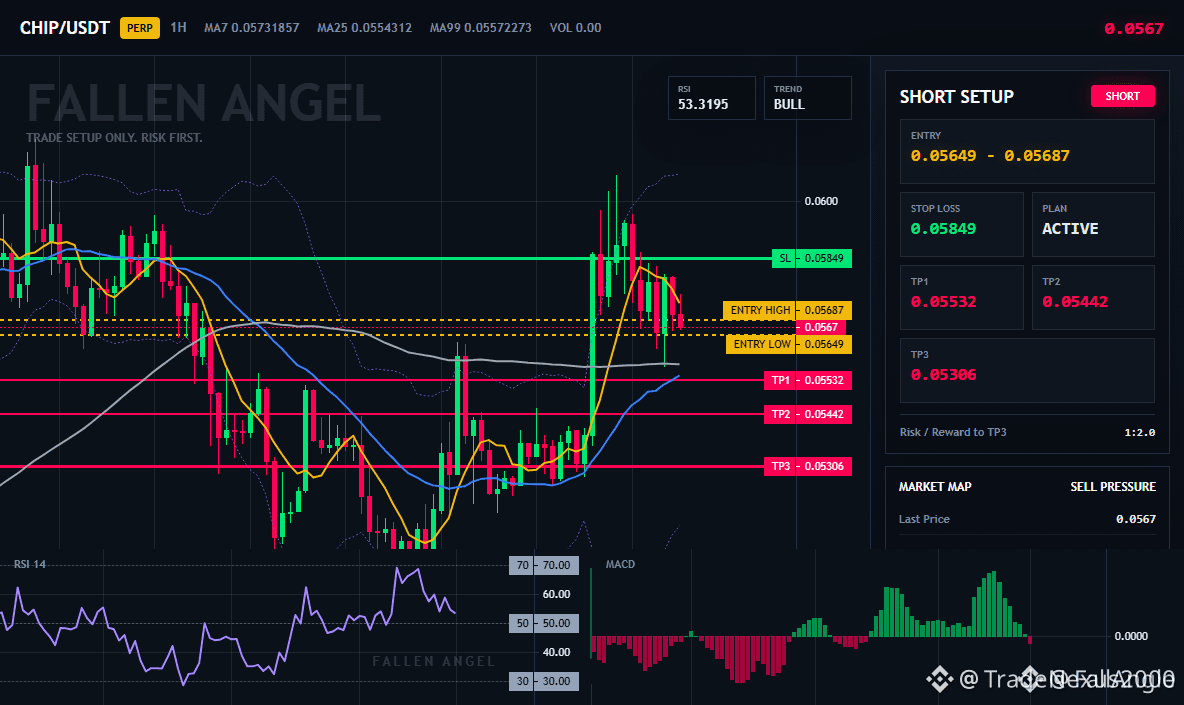
🔴 $CHIP BREAKS ZONE, SHORT 10X – PICK YOUR PLAY! 🚨
Entry: 0.05649-0.05687 ⚡
Target: 0.05532 🚀
Target: 0.05442 🚀
Target: 0.05306 🚀
Stop Loss: 0.05849 ⚠️
📊 Institutional short pressure surged as price tore through the pre‑mapped liquidity zone, confirming the order‑block breach. 🦈 Volume on the 4H chart spiked, indicating smart‑money liquidation.
💡 Each descending TP improves the R:R, now topping a 1:2 profile on the deepest level. 📌 Watch the 0.05849 barrier – a break flips the bias back bullish.
💬 Are you scaling in at the top of the range or waiting for a retest? 👇
⚠️ Not financial advice. Always manage your risk. 🛡️
🏷️ #CHIP #ShortSetup #LiquidityHunt #Crypto
🔥 💎
🔴 $CHIP BREAKS ZONE, SHORT 10X – PICK YOUR PLAY! 🚨
Entry: 0.05649-0.05687 ⚡
Target: 0.05532 🚀
Target: 0.05442 🚀
Target: 0.05306 🚀
Stop Loss: 0.05849 ⚠️
📊 Institutional short pressure surged as price tore through the pre‑mapped liquidity zone, confirming the order‑block breach. 🦈 Volume on the 4H chart spiked, indicating smart‑money liquidation.
💡 Each descending TP improves the R:R, now topping a 1:2 profile on the deepest level. 📌 Watch the 0.05849 barrier – a break flips the bias back bullish.
💬 Are you scaling in at the top of the range or waiting for a retest? 👇
⚠️ Not financial advice. Always manage your risk. 🛡️
🏷️ #CHIP #ShortSetup #LiquidityHunt #Crypto
🔥 💎
Entry: 0.05649-0.05687 ⚡
Target: 0.05532 🚀
Target: 0.05442 🚀
Target: 0.05306 🚀
Stop Loss: 0.05849 ⚠️
📊 Institutional short pressure surged as price tore through the pre‑mapped liquidity zone, confirming the order‑block breach. 🦈 Volume on the 4H chart spiked, indicating smart‑money liquidation.
💡 Each descending TP improves the R:R, now topping a 1:2 profile on the deepest level. 📌 Watch the 0.05849 barrier – a break flips the bias back bullish.
💬 Are you scaling in at the top of the range or waiting for a retest? 👇
⚠️ Not financial advice. Always manage your risk. 🛡️
🏷️ #CHIP #ShortSetup #LiquidityHunt #Crypto
🔥 💎
74
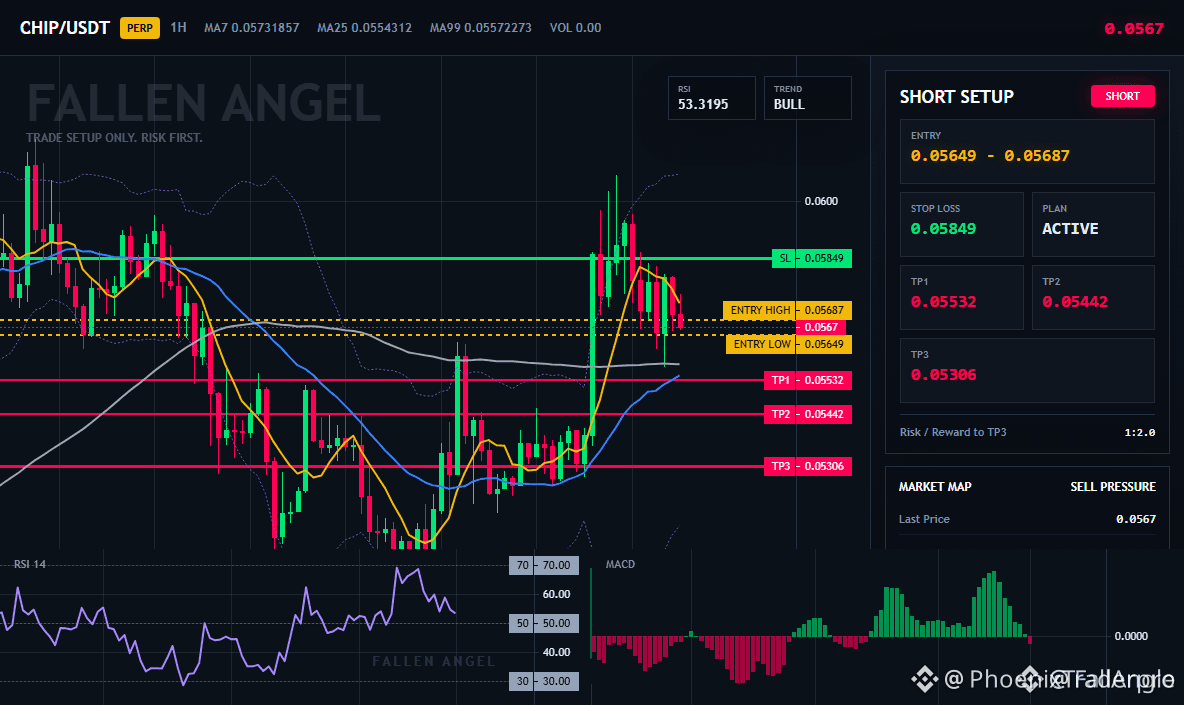
🔴 $CHIP BREAKS ZONE, SHORT ON 10X 🚨
Entry: 0.05649 ⚡
Target: 0.05306 🚀
Stop Loss: 0.05849 ⚠️
📊 The liquidity zone just crumbled, and smart‑money sharks are sweeping the floor. 🦈 Volume spikes on the 15‑min chart confirm sellers are taking the reins, pushing price deeper into the short corridor. ⚡ With a clean entry band, the trade rides the wave of aggressive short pressure.
💡 Three tiered profit targets lock in a 1:0.8 to 1:2 R:R ladder, giving you flexibility as the market burns down. 📌 The risk is tight, but the upside is crisp. 💬 Are you ready to flip the bid side or waiting for the next liquidity trap? 👇
⚠️ Not financial advice. Always manage your risk. 🛡️
🏷️ #CHIP #ShortSetup #Crypto #Leverage
🚀 💎
🔴 $CHIP BREAKS ZONE, SHORT ON 10X 🚨
Entry: 0.05649 ⚡
Target: 0.05306 🚀
Stop Loss: 0.05849 ⚠️
📊 The liquidity zone just crumbled, and smart‑money sharks are sweeping the floor. 🦈 Volume spikes on the 15‑min chart confirm sellers are taking the reins, pushing price deeper into the short corridor. ⚡ With a clean entry band, the trade rides the wave of aggressive short pressure.
💡 Three tiered profit targets lock in a 1:0.8 to 1:2 R:R ladder, giving you flexibility as the market burns down. 📌 The risk is tight, but the upside is crisp. 💬 Are you ready to flip the bid side or waiting for the next liquidity trap? 👇
⚠️ Not financial advice. Always manage your risk. 🛡️
🏷️ #CHIP #ShortSetup #Crypto #Leverage
🚀 💎
Entry: 0.05649 ⚡
Target: 0.05306 🚀
Stop Loss: 0.05849 ⚠️
📊 The liquidity zone just crumbled, and smart‑money sharks are sweeping the floor. 🦈 Volume spikes on the 15‑min chart confirm sellers are taking the reins, pushing price deeper into the short corridor. ⚡ With a clean entry band, the trade rides the wave of aggressive short pressure.
💡 Three tiered profit targets lock in a 1:0.8 to 1:2 R:R ladder, giving you flexibility as the market burns down. 📌 The risk is tight, but the upside is crisp. 💬 Are you ready to flip the bid side or waiting for the next liquidity trap? 👇
⚠️ Not financial advice. Always manage your risk. 🛡️
🏷️ #CHIP #ShortSetup #Crypto #Leverage
🚀 💎
41
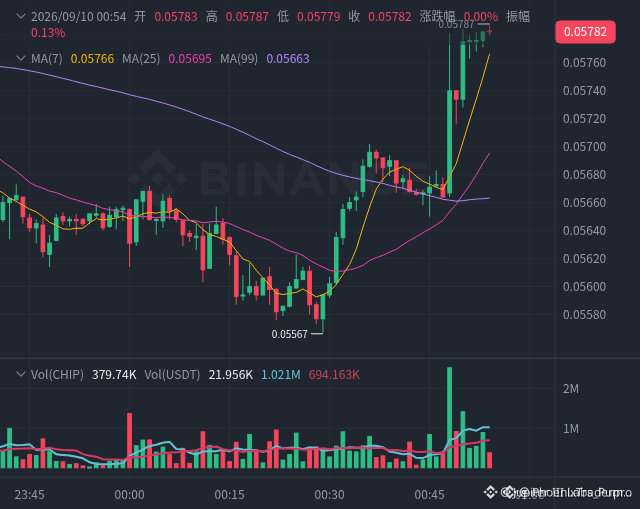
🦈 $CHIP WHALE ACCUMULATION SURGING! 🚀
Open interest is climbing 2.5% across the 30M and 1H frames while price sits flat, a classic smart‑money loading pattern. 🦈📊 The whales are stacking positions, and the $CHIP balance sheet is quietly bulging. 💰
The accumulation score sits at 71, top‑trader long‑short ratio nudges bullish, and ATR still leaves room for a clean breakout. 🔍 💬 Are you positioned to catch the next leg when the whales finally flip the script? 👇
⚠️ Not financial advice. Always manage your risk. 🛡️
🏷️ #CHIP #WhaleAccumulation #OI #Crypto
🚀 💎
🦈 $CHIP WHALE ACCUMULATION SURGING! 🚀
Open interest is climbing 2.5% across the 30M and 1H frames while price sits flat, a classic smart‑money loading pattern. 🦈📊 The whales are stacking positions, and the $CHIP balance sheet is quietly bulging. 💰
The accumulation score sits at 71, top‑trader long‑short ratio nudges bullish, and ATR still leaves room for a clean breakout. 🔍 💬 Are you positioned to catch the next leg when the whales finally flip the script? 👇
⚠️ Not financial advice. Always manage your risk. 🛡️
🏷️ #CHIP #WhaleAccumulation #OI #Crypto
🚀 💎
Open interest is climbing 2.5% across the 30M and 1H frames while price sits flat, a classic smart‑money loading pattern. 🦈📊 The whales are stacking positions, and the $CHIP balance sheet is quietly bulging. 💰
The accumulation score sits at 71, top‑trader long‑short ratio nudges bullish, and ATR still leaves room for a clean breakout. 🔍 💬 Are you positioned to catch the next leg when the whales finally flip the script? 👇
⚠️ Not financial advice. Always manage your risk. 🛡️
🏷️ #CHIP #WhaleAccumulation #OI #Crypto
🚀 💎
37
Log in to explore more content
Join global crypto users on Binance Square
⚡️ Get latest and useful information about crypto.
💬 Trusted by the world’s largest crypto exchange.
👍 Discover real insights from verified creators.
Email / Phone number
Trending Topics
1
#USAugustPPIRisesLessThanExpected
18,924 views
467 Discussing
2
#SECApprovesNasdaqTexasCommodityTrustRule
13,626 views
397 Discussing
3
#ECBRaisesRatesSecondTimeTo2.5%
10,248 views
286 Discussing
4
#USContinuingJoblessClaims1.774M
16,425 views
376 Discussing
5
#USAugustPPIYoYRisesTo5.4%
16,532 views
296 Discussing
6
#AppleDebutsFoldablePhone
87,300 views
1,386 Discussing
7
#TSMCAugustRevenueUp53.3%YoY
21,373 views
516 Discussing
8
#IranSaysReadyToEscalateWarWithUS
31,321 views
513 Discussing
9
#EUExtendsCentralContactPointToCASPs
26,333 views
516 Discussing
10
#US10YTreasuryYieldHitsHighestSinceNov2023
57,694 views
788 Discussing