

交易员-阿成
1k Posts

交易员-阿成
Report
Block User
🌏公众号:加密财神 X:@lmf8848 一名职业交易者,拥有顶级策略揭秘,擅长洞悉市场脉络,擅长合约长.中.短.日内波段,现货市场长线埋伏,8年实战经验,现货稳定有90%胜率,稳定收益达到85%以上。
2 Following
179 Followers
141 Liked
Posts
All
Quotes
PINNED
·
--
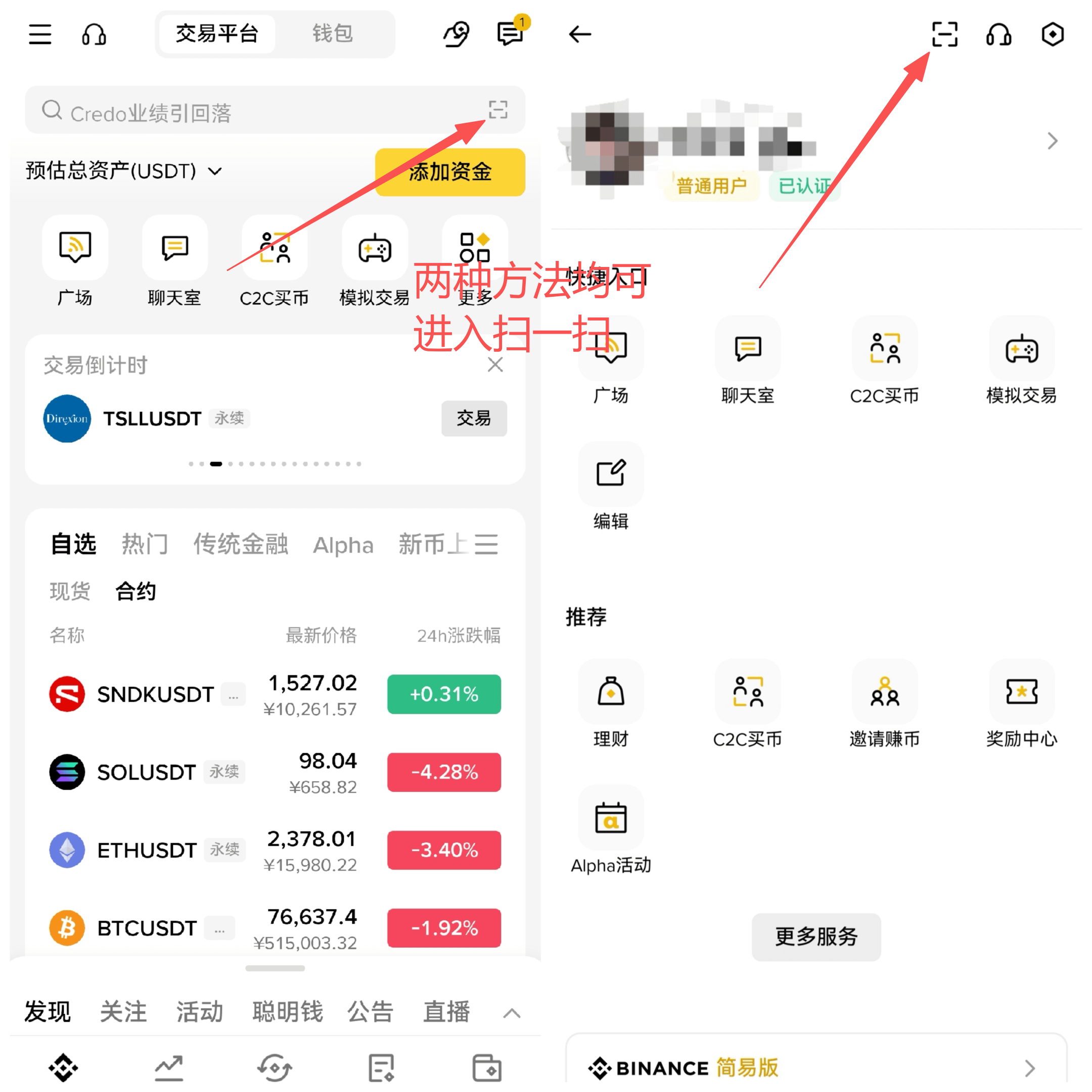
Binance has now launched a new feature — you can chat via direct messages within the platform.
If you’d like to connect or get in touch for advice, you can scan the QR code below to add us directly.
Binance has now launched a new feature — you can chat via direct messages within the platform.
If you’d like to connect or get in touch for advice, you can scan the QR code below to add us directly.
If you’d like to connect or get in touch for advice, you can scan the QR code below to add us directly.

4
55
·
--
What makes a trading signal effective? Let the chart speak. 👇
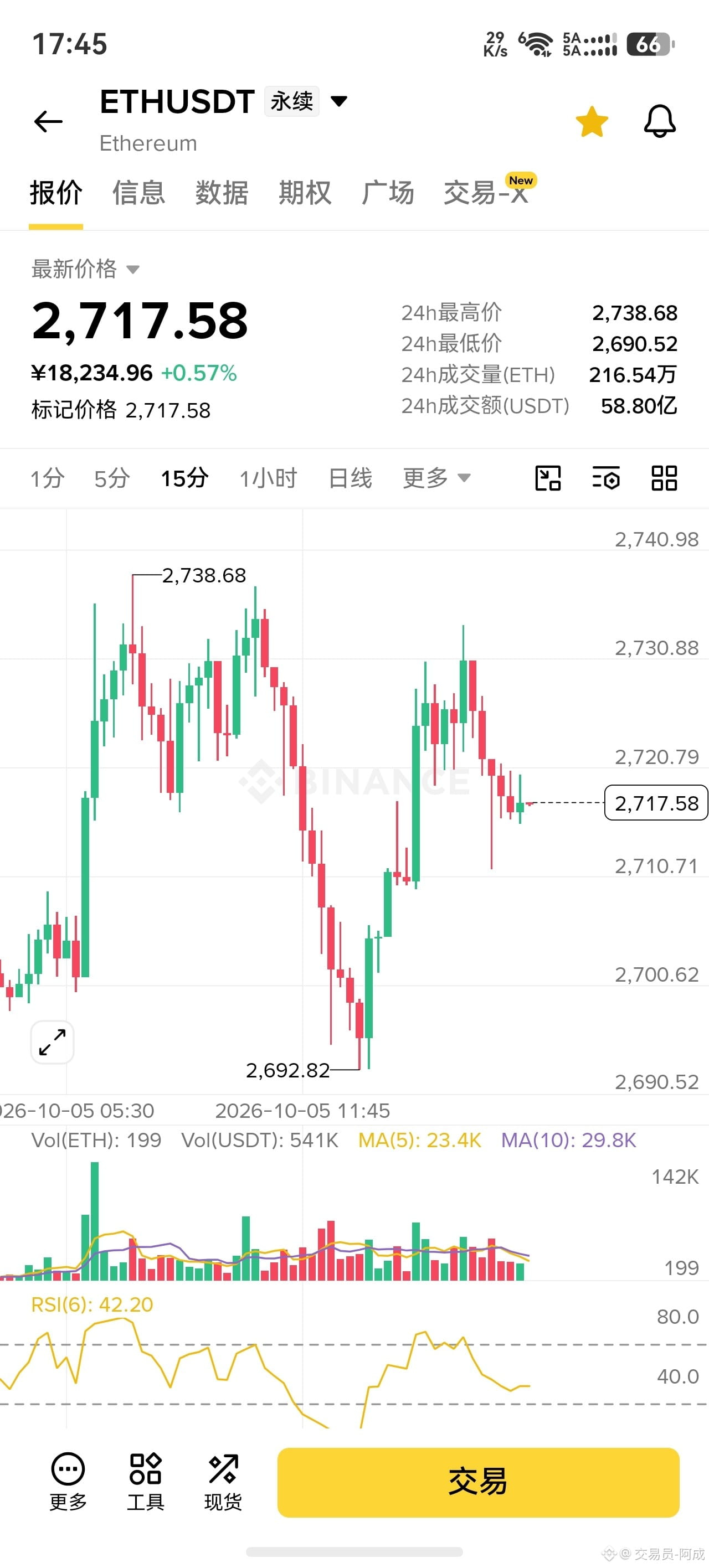
Around 10 a.m., I gave a precise strategy: short ETH at 2735, set a stop-loss at 2785, and target a 40-point move.
No ambiguity, no fluff—just action.
By the afternoon, the price had dropped to a low of 2692, comfortably hitting the take-profit target.
Even if you’re asleep in the meantime, you can wake up to find your take-profit order already filled automatically. That’s the beauty of planned trading—you don’t need to watch the charts every second; you just need to stick to your rules.
This trade captured the full 40 points.
A lot of the time, you lose money not because the market is bad, but because you can’t hold your position, don’t dare to enter, or pick a terrible entry point.
Follow the rhythm, and making money can actually be simple.
Brother Cheng mainly trades futures on major cryptocurrencies and popular altcoins, as well as short-term spot trades. He’s good at spotting promising gems and finding coins with 100x potential. If you want to recover your losses and grow your account, join my chatroom and I’ll help you get back on track: #比特币现货ETF三季度净流入63.4亿美元
What makes a trading signal effective? Let the chart speak. 👇
Around 10 a.m., I gave a precise strategy: short ETH at 2735, set a stop-loss at 2785, and target a 40-point move.
No ambiguity, no fluff—just action.
By the afternoon, the price had dropped to a low of 2692, comfortably hitting the take-profit target.
Even if you’re asleep in the meantime, you can wake up to find your take-profit order already filled automatically. That’s the beauty of planned trading—you don’t need to watch the charts every second; you just need to stick to your rules.
This trade captured the full 40 points.
A lot of the time, you lose money not because the market is bad, but because you can’t hold your position, don’t dare to enter, or pick a terrible entry point.
Follow the rhythm, and making money can actually be simple.
Brother Cheng mainly trades futures on major cryptocurrencies and popular altcoins, as well as short-term spot trades. He’s good at spotting promising gems and finding coins with 100x potential. If you want to recover your losses and grow your account, join my chatroom and I’ll help you get back on track: #比特币现货ETF三季度净流入63.4亿美元
Around 10 a.m., I gave a precise strategy: short ETH at 2735, set a stop-loss at 2785, and target a 40-point move.
No ambiguity, no fluff—just action.
By the afternoon, the price had dropped to a low of 2692, comfortably hitting the take-profit target.
Even if you’re asleep in the meantime, you can wake up to find your take-profit order already filled automatically. That’s the beauty of planned trading—you don’t need to watch the charts every second; you just need to stick to your rules.
This trade captured the full 40 points.
A lot of the time, you lose money not because the market is bad, but because you can’t hold your position, don’t dare to enter, or pick a terrible entry point.
Follow the rhythm, and making money can actually be simple.
Brother Cheng mainly trades futures on major cryptocurrencies and popular altcoins, as well as short-term spot trades. He’s good at spotting promising gems and finding coins with 100x potential. If you want to recover your losses and grow your account, join my chatroom and I’ll help you get back on track: #比特币现货ETF三季度净流入63.4亿美元


125
·
--
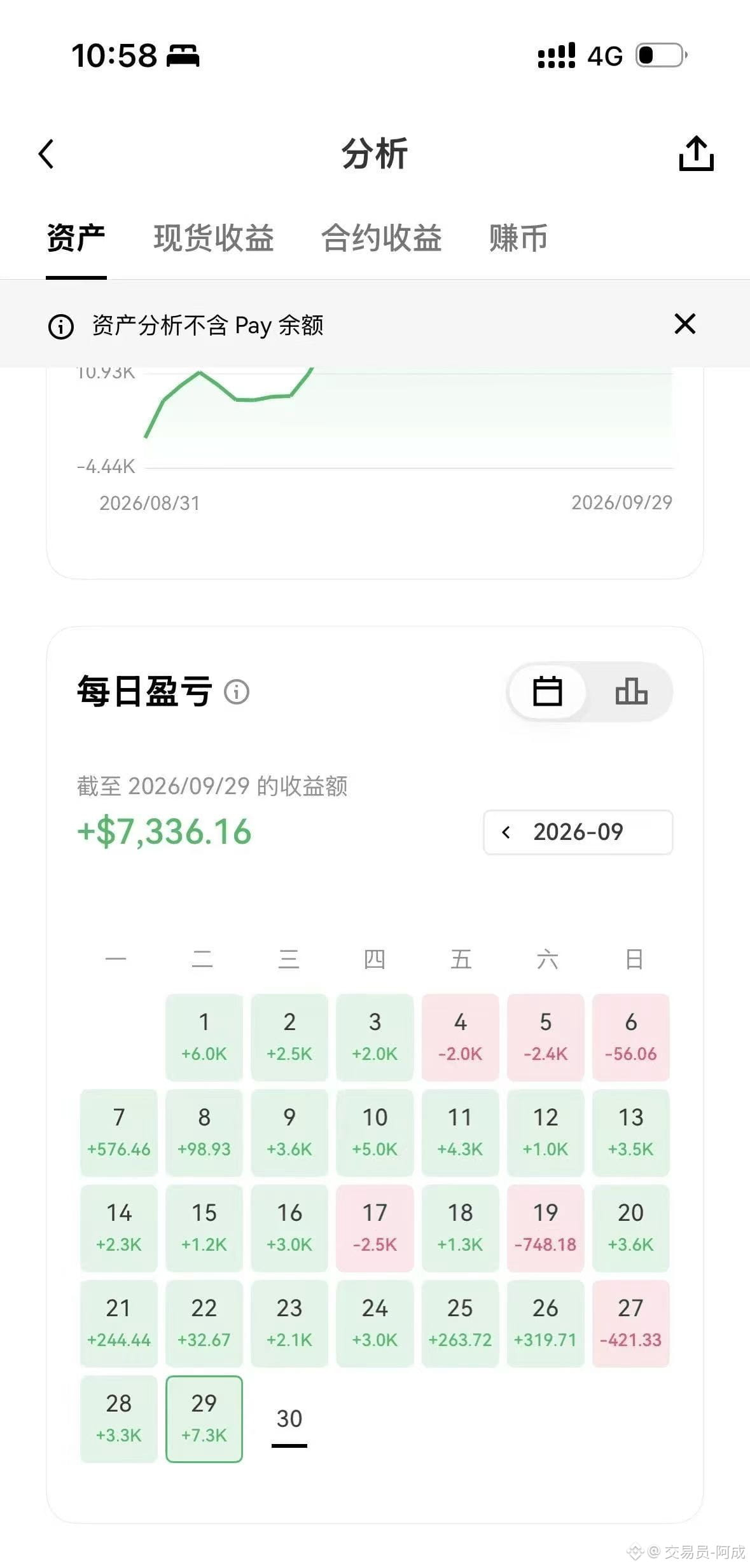
I’ve been trading crypto for ten years, and the tuition I’ve paid could’ve bought me a car.
These days, I consistently make around 50% a year, thanks to a few down-to-earth tricks—the eighth one is the most ruthless.
1. Keep your hands off the buy button. If the market hasn’t formed a pattern I’ve practiced spotting hundreds of times, I’d rather watch videos than place a trade. If you can’t control yourself, don’t blame the market for not giving you a chance.
2. The night-owl strategy. Fake news flies around during the day, and chasing it just makes you exit liquidity. After 9 p.m., the big players have finished dinner, and the price action finally shows its true colors. Most of my gains over the past few years came from trades I picked up late at night.
3. Take a bite while the meat’s still in your mouth. If I make 1,000U, I immediately transfer 300 to my bank card and do whatever I want with the rest. I’ve seen too many people make enough for a car, refuse to cash out, and end up losing even their bicycle. Once the money’s in your pocket, it’s yours.
4. Before placing a trade, check three indicators: MACD for direction, RSI to avoid chasing highs, and Bollinger Bands to watch for reversals. This can help you avoid 80% of the pitfalls.
5. Use a “moving castle” for stop-losses: make 100U, move your stop-loss up by 50U, and keep repeating the process to lock in your profits.
6. Every Friday at 3 p.m., transfer 30% to your bank card—force yourself to secure your gains.
7. In fast-moving markets, watch the 1-hour chart. When the market’s moving sideways, switch to the 4-hour chart to find support. Use different timeframes for different market conditions; don’t get stuck in one way of thinking.
8. And most importantly: leverage over 10x is practically asking to get wrecked; beginners should practice with 3x. Shitcoins are all just scythes for chopping down retail traders—stay away. Place no more than 3 trades a day. The fewer trades you make, the longer you’ll survive.
The more laid-back you are, the fatter your wallet gets. If you want to learn this no-nonsense approach, come talk to me. #比特币现货ETF三季度净流入63.4亿美元
I’ve been trading crypto for ten years, and the tuition I’ve paid could’ve bought me a car.
These days, I consistently make around 50% a year, thanks to a few down-to-earth tricks—the eighth one is the most ruthless.
1. Keep your hands off the buy button. If the market hasn’t formed a pattern I’ve practiced spotting hundreds of times, I’d rather watch videos than place a trade. If you can’t control yourself, don’t blame the market for not giving you a chance.
2. The night-owl strategy. Fake news flies around during the day, and chasing it just makes you exit liquidity. After 9 p.m., the big players have finished dinner, and the price action finally shows its true colors. Most of my gains over the past few years came from trades I picked up late at night.
3. Take a bite while the meat’s still in your mouth. If I make 1,000U, I immediately transfer 300 to my bank card and do whatever I want with the rest. I’ve seen too many people make enough for a car, refuse to cash out, and end up losing even their bicycle. Once the money’s in your pocket, it’s yours.
4. Before placing a trade, check three indicators: MACD for direction, RSI to avoid chasing highs, and Bollinger Bands to watch for reversals. This can help you avoid 80% of the pitfalls.
5. Use a “moving castle” for stop-losses: make 100U, move your stop-loss up by 50U, and keep repeating the process to lock in your profits.
6. Every Friday at 3 p.m., transfer 30% to your bank card—force yourself to secure your gains.
7. In fast-moving markets, watch the 1-hour chart. When the market’s moving sideways, switch to the 4-hour chart to find support. Use different timeframes for different market conditions; don’t get stuck in one way of thinking.
8. And most importantly: leverage over 10x is practically asking to get wrecked; beginners should practice with 3x. Shitcoins are all just scythes for chopping down retail traders—stay away. Place no more than 3 trades a day. The fewer trades you make, the longer you’ll survive.
The more laid-back you are, the fatter your wallet gets. If you want to learn this no-nonsense approach, come talk to me. #比特币现货ETF三季度净流入63.4亿美元
These days, I consistently make around 50% a year, thanks to a few down-to-earth tricks—the eighth one is the most ruthless.
1. Keep your hands off the buy button. If the market hasn’t formed a pattern I’ve practiced spotting hundreds of times, I’d rather watch videos than place a trade. If you can’t control yourself, don’t blame the market for not giving you a chance.
2. The night-owl strategy. Fake news flies around during the day, and chasing it just makes you exit liquidity. After 9 p.m., the big players have finished dinner, and the price action finally shows its true colors. Most of my gains over the past few years came from trades I picked up late at night.
3. Take a bite while the meat’s still in your mouth. If I make 1,000U, I immediately transfer 300 to my bank card and do whatever I want with the rest. I’ve seen too many people make enough for a car, refuse to cash out, and end up losing even their bicycle. Once the money’s in your pocket, it’s yours.
4. Before placing a trade, check three indicators: MACD for direction, RSI to avoid chasing highs, and Bollinger Bands to watch for reversals. This can help you avoid 80% of the pitfalls.
5. Use a “moving castle” for stop-losses: make 100U, move your stop-loss up by 50U, and keep repeating the process to lock in your profits.
6. Every Friday at 3 p.m., transfer 30% to your bank card—force yourself to secure your gains.
7. In fast-moving markets, watch the 1-hour chart. When the market’s moving sideways, switch to the 4-hour chart to find support. Use different timeframes for different market conditions; don’t get stuck in one way of thinking.
8. And most importantly: leverage over 10x is practically asking to get wrecked; beginners should practice with 3x. Shitcoins are all just scythes for chopping down retail traders—stay away. Place no more than 3 trades a day. The fewer trades you make, the longer you’ll survive.
The more laid-back you are, the fatter your wallet gets. If you want to learn this no-nonsense approach, come talk to me. #比特币现货ETF三季度净流入63.4亿美元
150
·
--
$PUMPBTC is nearing delisting, and this surge is the final frenzy.
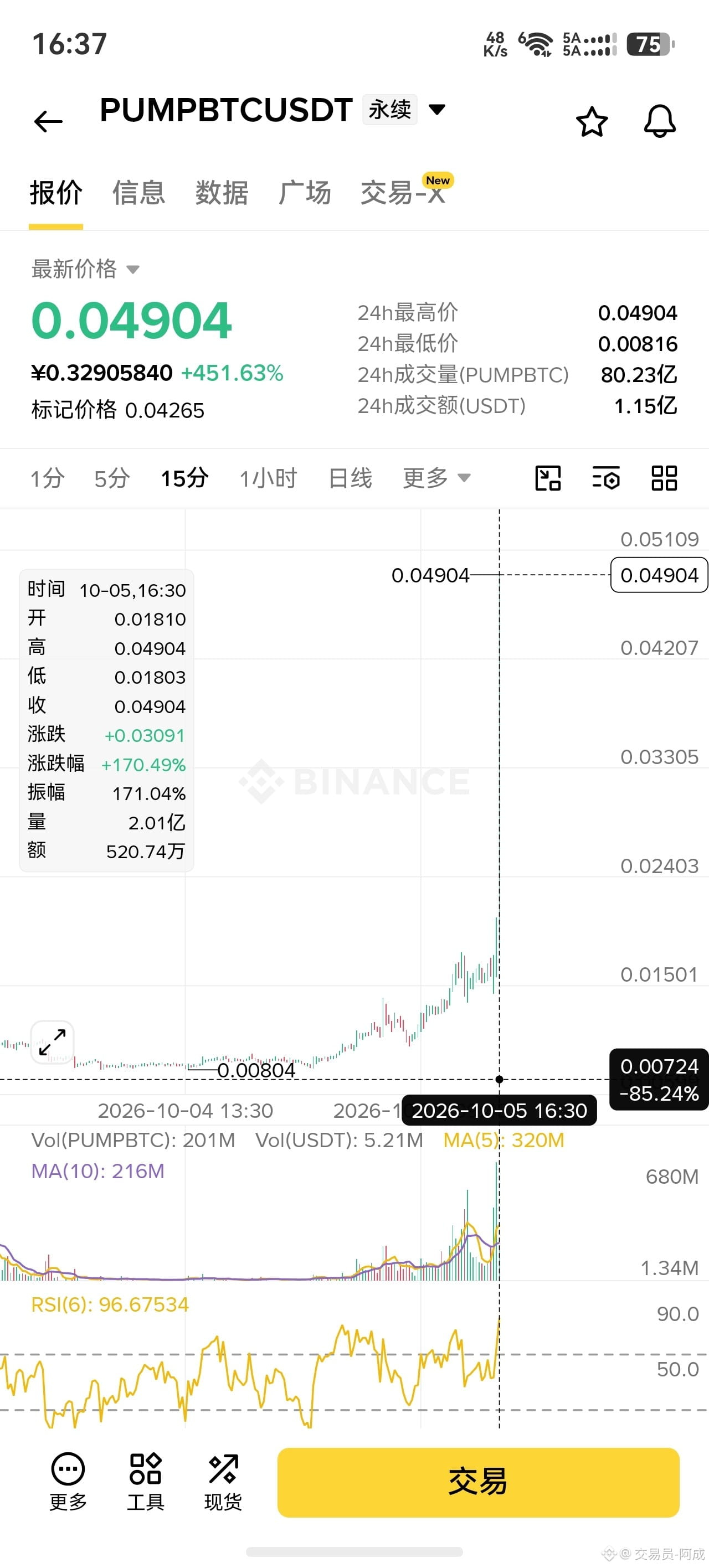
It was aggressively pumped from 0.008 to 0.049, up 451% in 24 hours, with a single candlestick swinging 170%. The RSI has surged above 96, signaling extreme overbought conditions.
Put simply, this isn’t the start of a new rally—it’s a final pump by major players to lure buyers in before delisting. With delisting approaching, they’re creating the illusion of easy profits through a sharp price spike, enticing retail investors to rush in and become their exit liquidity.
There’s no fundamental support for this kind of price action, and liquidity could dry up quickly. Once the major players have finished selling and pull their orders, there may be no buyers to step in. The price could plunge off a cliff, leaving anyone who enters likely stuck with heavy losses. The coin also faces the risk of becoming impossible to trade normally.
For now, it’s best to watch from a distance. Don’t let excitement cloud your judgment and chase the final scraps of this rally.
In a setup like this, buying in means being the last one left holding the bag.
If you have any thoughts, feel free to discuss them with me.
$PUMPBTC is nearing delisting, and this surge is the final frenzy.
It was aggressively pumped from 0.008 to 0.049, up 451% in 24 hours, with a single candlestick swinging 170%. The RSI has surged above 96, signaling extreme overbought conditions.
Put simply, this isn’t the start of a new rally—it’s a final pump by major players to lure buyers in before delisting. With delisting approaching, they’re creating the illusion of easy profits through a sharp price spike, enticing retail investors to rush in and become their exit liquidity.
There’s no fundamental support for this kind of price action, and liquidity could dry up quickly. Once the major players have finished selling and pull their orders, there may be no buyers to step in. The price could plunge off a cliff, leaving anyone who enters likely stuck with heavy losses. The coin also faces the risk of becoming impossible to trade normally.
For now, it’s best to watch from a distance. Don’t let excitement cloud your judgment and chase the final scraps of this rally.
In a setup like this, buying in means being the last one left holding the bag.
If you have any thoughts, feel free to discuss them with me.
It was aggressively pumped from 0.008 to 0.049, up 451% in 24 hours, with a single candlestick swinging 170%. The RSI has surged above 96, signaling extreme overbought conditions.
Put simply, this isn’t the start of a new rally—it’s a final pump by major players to lure buyers in before delisting. With delisting approaching, they’re creating the illusion of easy profits through a sharp price spike, enticing retail investors to rush in and become their exit liquidity.
There’s no fundamental support for this kind of price action, and liquidity could dry up quickly. Once the major players have finished selling and pull their orders, there may be no buyers to step in. The price could plunge off a cliff, leaving anyone who enters likely stuck with heavy losses. The coin also faces the risk of becoming impossible to trade normally.
For now, it’s best to watch from a distance. Don’t let excitement cloud your judgment and chase the final scraps of this rally.
In a setup like this, buying in means being the last one left holding the bag.
If you have any thoughts, feel free to discuss them with me.
585
·
--
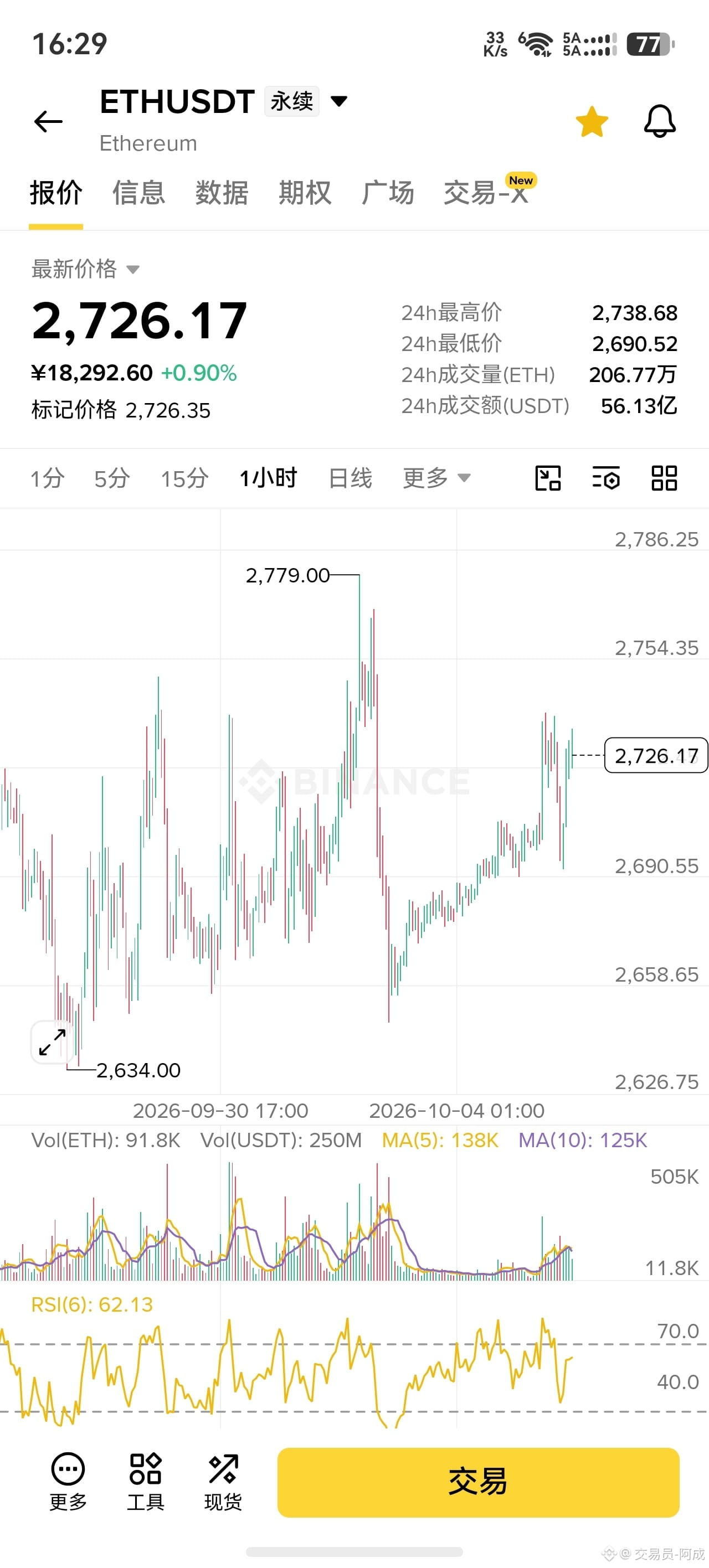
With U.S. stocks opening tonight, the key thing to watch for ETH isn’t its small moves right now, but whether it can hold around 2750.
On this 1-hour chart, ETH is currently around 2726. It climbed in a choppy move from 2634, reached a high of 2779, then pulled back quickly. It has now climbed back above 2720, which suggests there is still buying support below. The current price today is also basically around 2727, consistent with the chart screenshot.
Here are the key levels I’ve marked out for tonight:
First resistance: 2740–2755
This is the first short-term resistance zone. If ETH moves up here on strong volume after the U.S. market opens and manages to hold, it could easily test 2779 again.
Second resistance: 2779–2786
This is tonight’s most important resistance zone. 2779 is the previous high, and around 2786 is the upper price band on the chart. ETH will have a chance to open up more upside only if it breaks through this zone on strong volume and holds above it.
First support: 2690–2700
This level is crucial. The quick rebound after today’s pullback shows that the bulls are still in the picture. If there’s a shakeout after the U.S. market opens but 2690 holds, I’d see it as a normal pullback.
Second support: 2658–2665
If 2690 gives way, this is the next line of defense. Below that is around 2634, also an important low in this 1-hour structure.
My outlook for tonight is fairly simple:
Bullish above 2700, with 2750 as the dividing line and 2779 as the breakout level.
If ETH breaks above 2755 on strong volume after the U.S. market opens, I’ll be watching 2779 closely. If it breaks through 2779, then I’ll look for a possible push toward 2800.
But if it meets clear selling pressure around 2750, or even falls below 2690, don’t stubbornly chase longs. In the short term, it could easily head back toward 2660 to find support.
Also, U.S. markets are generally cautious in premarket trading today. S&P futures are slightly weaker, and the 10-year Treasury yield is still around 5.26%, so the first move after tonight’s open could be quite volatile.
In a nutshell: 2690 is ETH’s key bull-bear line tonight. A break above 2755 would put 2779 in focus, and only a decisive break above 2779 would fully open up the upside.
If I were trading this myself, I wouldn’t blindly chase here at 2726. I’d wait for the U.S. market open to show a direction, buy a pullback to support, or follow a breakout through resistance. I only take trades I understand.
With U.S. stocks opening tonight, the key thing to watch for ETH isn’t its small moves right now, but whether it can hold around 2750.
On this 1-hour chart, ETH is currently around 2726. It climbed in a choppy move from 2634, reached a high of 2779, then pulled back quickly. It has now climbed back above 2720, which suggests there is still buying support below. The current price today is also basically around 2727, consistent with the chart screenshot.
Here are the key levels I’ve marked out for tonight:
First resistance: 2740–2755
This is the first short-term resistance zone. If ETH moves up here on strong volume after the U.S. market opens and manages to hold, it could easily test 2779 again.
Second resistance: 2779–2786
This is tonight’s most important resistance zone. 2779 is the previous high, and around 2786 is the upper price band on the chart. ETH will have a chance to open up more upside only if it breaks through this zone on strong volume and holds above it.
First support: 2690–2700
This level is crucial. The quick rebound after today’s pullback shows that the bulls are still in the picture. If there’s a shakeout after the U.S. market opens but 2690 holds, I’d see it as a normal pullback.
Second support: 2658–2665
If 2690 gives way, this is the next line of defense. Below that is around 2634, also an important low in this 1-hour structure.
My outlook for tonight is fairly simple:
Bullish above 2700, with 2750 as the dividing line and 2779 as the breakout level.
If ETH breaks above 2755 on strong volume after the U.S. market opens, I’ll be watching 2779 closely. If it breaks through 2779, then I’ll look for a possible push toward 2800.
But if it meets clear selling pressure around 2750, or even falls below 2690, don’t stubbornly chase longs. In the short term, it could easily head back toward 2660 to find support.
Also, U.S. markets are generally cautious in premarket trading today. S&P futures are slightly weaker, and the 10-year Treasury yield is still around 5.26%, so the first move after tonight’s open could be quite volatile.
In a nutshell: 2690 is ETH’s key bull-bear line tonight. A break above 2755 would put 2779 in focus, and only a decisive break above 2779 would fully open up the upside.
If I were trading this myself, I wouldn’t blindly chase here at 2726. I’d wait for the U.S. market open to show a direction, buy a pullback to support, or follow a breakout through resistance. I only take trades I understand.
On this 1-hour chart, ETH is currently around 2726. It climbed in a choppy move from 2634, reached a high of 2779, then pulled back quickly. It has now climbed back above 2720, which suggests there is still buying support below. The current price today is also basically around 2727, consistent with the chart screenshot.
Here are the key levels I’ve marked out for tonight:
First resistance: 2740–2755
This is the first short-term resistance zone. If ETH moves up here on strong volume after the U.S. market opens and manages to hold, it could easily test 2779 again.
Second resistance: 2779–2786
This is tonight’s most important resistance zone. 2779 is the previous high, and around 2786 is the upper price band on the chart. ETH will have a chance to open up more upside only if it breaks through this zone on strong volume and holds above it.
First support: 2690–2700
This level is crucial. The quick rebound after today’s pullback shows that the bulls are still in the picture. If there’s a shakeout after the U.S. market opens but 2690 holds, I’d see it as a normal pullback.
Second support: 2658–2665
If 2690 gives way, this is the next line of defense. Below that is around 2634, also an important low in this 1-hour structure.
My outlook for tonight is fairly simple:
Bullish above 2700, with 2750 as the dividing line and 2779 as the breakout level.
If ETH breaks above 2755 on strong volume after the U.S. market opens, I’ll be watching 2779 closely. If it breaks through 2779, then I’ll look for a possible push toward 2800.
But if it meets clear selling pressure around 2750, or even falls below 2690, don’t stubbornly chase longs. In the short term, it could easily head back toward 2660 to find support.
Also, U.S. markets are generally cautious in premarket trading today. S&P futures are slightly weaker, and the 10-year Treasury yield is still around 5.26%, so the first move after tonight’s open could be quite volatile.
In a nutshell: 2690 is ETH’s key bull-bear line tonight. A break above 2755 would put 2779 in focus, and only a decisive break above 2779 would fully open up the upside.
If I were trading this myself, I wouldn’t blindly chase here at 2726. I’d wait for the U.S. market open to show a direction, buy a pullback to support, or follow a breakout through resistance. I only take trades I understand.
158
·
--
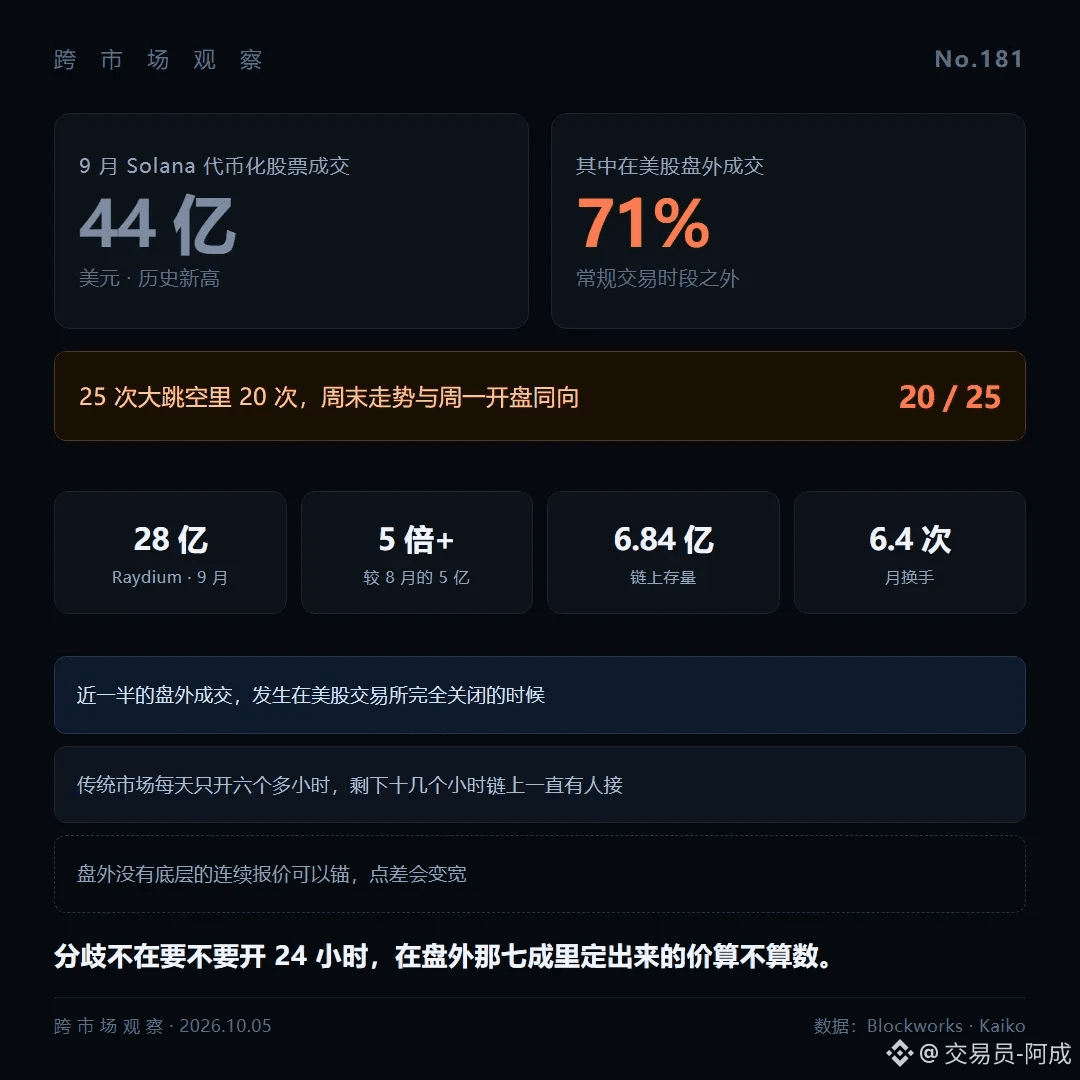
Seventy percent of tokenized stock trading takes place when the U.S. stock market is closed.
▪️ In September, tokenized stock trading on Solana reached $4.4 billion, a record high. Raydium accounted for about $2.8 billion, more than five times its August volume.
▪️ According to Kaiko, 71% of tokenized stock trading on Uniswap in September took place outside regular U.S. market hours, with nearly half occurring while the exchanges were completely closed.
▪️ Of 25 major price gaps, weekend price movements on-chain pointed in the same direction as Monday’s opening gap 20 times.
▪️ And liquidity is concentrated in just a few pools: in some snapshots, Raydium routed more than 90% of all tokenized stock activity across the chain.
The debate isn’t about whether U.S. stocks should trade 24 hours a day. It’s about whether prices set during those off-hours—those 70%—should count. When the underlying market is closed, there are no continuous on-chain quotes to anchor prices. Spreads widen, and prices may make their move before the market reopens.
What’s truly unusual isn’t the volume, but the timing. Traditional markets are open for just over six hours a day. For the dozen or so hours that remain, these stocks are still being traded on-chain. Off-hours demand was always there; it just had nowhere to go.
Do you treat those off-hours prices as a signal, or dismiss them as noise?
If you want to make it in crypto but don’t know where to start, or want to get up to speed quickly and learn about information asymmetries, come chat with me. You’ll get firsthand insights and in-depth analysis!
Seventy percent of tokenized stock trading takes place when the U.S. stock market is closed.
▪️ In September, tokenized stock trading on Solana reached $4.4 billion, a record high. Raydium accounted for about $2.8 billion, more than five times its August volume.
▪️ According to Kaiko, 71% of tokenized stock trading on Uniswap in September took place outside regular U.S. market hours, with nearly half occurring while the exchanges were completely closed.
▪️ Of 25 major price gaps, weekend price movements on-chain pointed in the same direction as Monday’s opening gap 20 times.
▪️ And liquidity is concentrated in just a few pools: in some snapshots, Raydium routed more than 90% of all tokenized stock activity across the chain.
The debate isn’t about whether U.S. stocks should trade 24 hours a day. It’s about whether prices set during those off-hours—those 70%—should count. When the underlying market is closed, there are no continuous on-chain quotes to anchor prices. Spreads widen, and prices may make their move before the market reopens.
What’s truly unusual isn’t the volume, but the timing. Traditional markets are open for just over six hours a day. For the dozen or so hours that remain, these stocks are still being traded on-chain. Off-hours demand was always there; it just had nowhere to go.
Do you treat those off-hours prices as a signal, or dismiss them as noise?
If you want to make it in crypto but don’t know where to start, or want to get up to speed quickly and learn about information asymmetries, come chat with me. You’ll get firsthand insights and in-depth analysis!
▪️ In September, tokenized stock trading on Solana reached $4.4 billion, a record high. Raydium accounted for about $2.8 billion, more than five times its August volume.
▪️ According to Kaiko, 71% of tokenized stock trading on Uniswap in September took place outside regular U.S. market hours, with nearly half occurring while the exchanges were completely closed.
▪️ Of 25 major price gaps, weekend price movements on-chain pointed in the same direction as Monday’s opening gap 20 times.
▪️ And liquidity is concentrated in just a few pools: in some snapshots, Raydium routed more than 90% of all tokenized stock activity across the chain.
The debate isn’t about whether U.S. stocks should trade 24 hours a day. It’s about whether prices set during those off-hours—those 70%—should count. When the underlying market is closed, there are no continuous on-chain quotes to anchor prices. Spreads widen, and prices may make their move before the market reopens.
What’s truly unusual isn’t the volume, but the timing. Traditional markets are open for just over six hours a day. For the dozen or so hours that remain, these stocks are still being traded on-chain. Off-hours demand was always there; it just had nowhere to go.
Do you treat those off-hours prices as a signal, or dismiss them as noise?
If you want to make it in crypto but don’t know where to start, or want to get up to speed quickly and learn about information asymmetries, come chat with me. You’ll get firsthand insights and in-depth analysis!
448
·
--
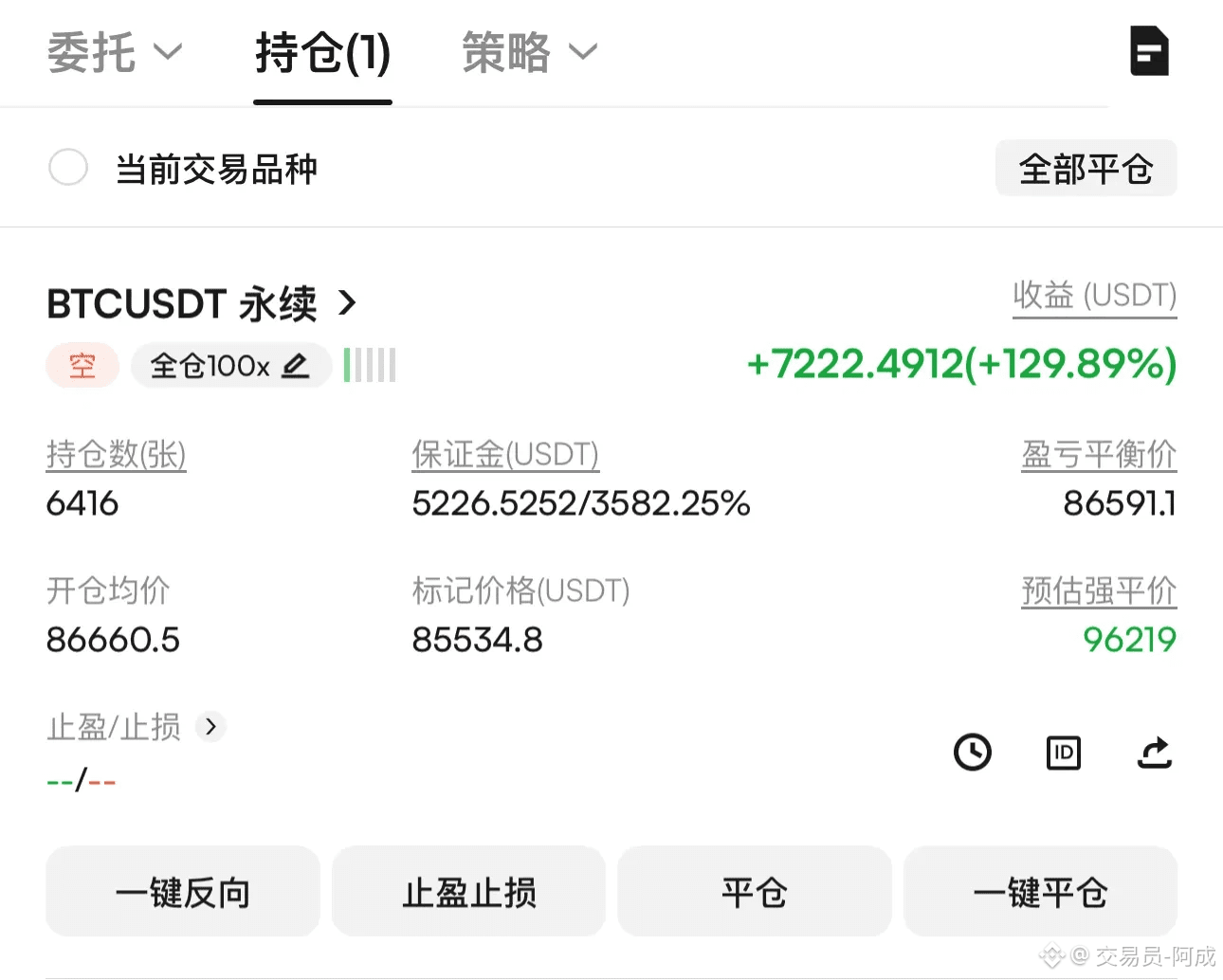
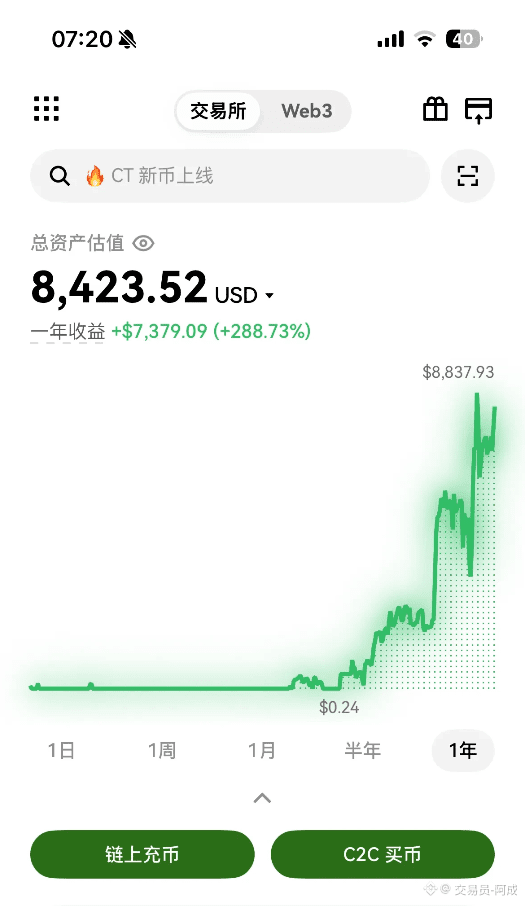
That bear market, I lost 300,000. I wasn’t liquidated—I watched helplessly as the market slid lower and lower, like a fool in a pot of slowly heating water, telling myself that if I just held on, it would come back. It wasn’t until my account hit zero that I realized everything was gone.
I couldn’t sleep. I wiped my social media clean. My relatives avoided me, and my friends drifted away. The question I dreaded most was, “How have you been lately?”—because I didn’t even have the energy to pretend I was okay. For a while, I wanted to give up. I even thought maybe this was just how my life would be from now on.
Then I came across a line: “Losing more is only the beginning. Refusing to let go is the end.” It hit me like a slap in the face. That’s right—I could lose my money, but I couldn’t lose myself too.
I dug out the last 5,000 U in my wallet. I stopped trading futures and stopped dreaming of getting rich overnight. I just did my research and made one trade at a time, steadily. Even if I made only a few dozen dollars, I treated it as a way to rebuild my confidence.
At my lowest, I ate just one meal a day and stared at candlestick charts until my eyes ached. But deep down, I knew: this time, my goal was to survive, not to make a comeback.
And so, with 5,000 U, I kept building it up—slowly, slowly.
I won’t claim I’m especially successful now, but I’ve finally understood this: a real comeback isn’t about winning back a certain amount of money. It’s about daring to stand back up after losing everything.
If you’re going through the hardest stretch of your life too, don’t be afraid to go slowly, to start small, or to begin again from scratch. As long as you stay in the game, there’s still a chance.
If you’d like to keep moving forward together, come talk to me.
That bear market, I lost 300,000. I wasn’t liquidated—I watched helplessly as the market slid lower and lower, like a fool in a pot of slowly heating water, telling myself that if I just held on, it would come back. It wasn’t until my account hit zero that I realized everything was gone.
I couldn’t sleep. I wiped my social media clean. My relatives avoided me, and my friends drifted away. The question I dreaded most was, “How have you been lately?”—because I didn’t even have the energy to pretend I was okay. For a while, I wanted to give up. I even thought maybe this was just how my life would be from now on.
Then I came across a line: “Losing more is only the beginning. Refusing to let go is the end.” It hit me like a slap in the face. That’s right—I could lose my money, but I couldn’t lose myself too.
I dug out the last 5,000 U in my wallet. I stopped trading futures and stopped dreaming of getting rich overnight. I just did my research and made one trade at a time, steadily. Even if I made only a few dozen dollars, I treated it as a way to rebuild my confidence.
At my lowest, I ate just one meal a day and stared at candlestick charts until my eyes ached. But deep down, I knew: this time, my goal was to survive, not to make a comeback.
And so, with 5,000 U, I kept building it up—slowly, slowly.
I won’t claim I’m especially successful now, but I’ve finally understood this: a real comeback isn’t about winning back a certain amount of money. It’s about daring to stand back up after losing everything.
If you’re going through the hardest stretch of your life too, don’t be afraid to go slowly, to start small, or to begin again from scratch. As long as you stay in the game, there’s still a chance.
If you’d like to keep moving forward together, come talk to me.
I couldn’t sleep. I wiped my social media clean. My relatives avoided me, and my friends drifted away. The question I dreaded most was, “How have you been lately?”—because I didn’t even have the energy to pretend I was okay. For a while, I wanted to give up. I even thought maybe this was just how my life would be from now on.
Then I came across a line: “Losing more is only the beginning. Refusing to let go is the end.” It hit me like a slap in the face. That’s right—I could lose my money, but I couldn’t lose myself too.
I dug out the last 5,000 U in my wallet. I stopped trading futures and stopped dreaming of getting rich overnight. I just did my research and made one trade at a time, steadily. Even if I made only a few dozen dollars, I treated it as a way to rebuild my confidence.
At my lowest, I ate just one meal a day and stared at candlestick charts until my eyes ached. But deep down, I knew: this time, my goal was to survive, not to make a comeback.
And so, with 5,000 U, I kept building it up—slowly, slowly.
I won’t claim I’m especially successful now, but I’ve finally understood this: a real comeback isn’t about winning back a certain amount of money. It’s about daring to stand back up after losing everything.
If you’re going through the hardest stretch of your life too, don’t be afraid to go slowly, to start small, or to begin again from scratch. As long as you stay in the game, there’s still a chance.
If you’d like to keep moving forward together, come talk to me.
489
·
--
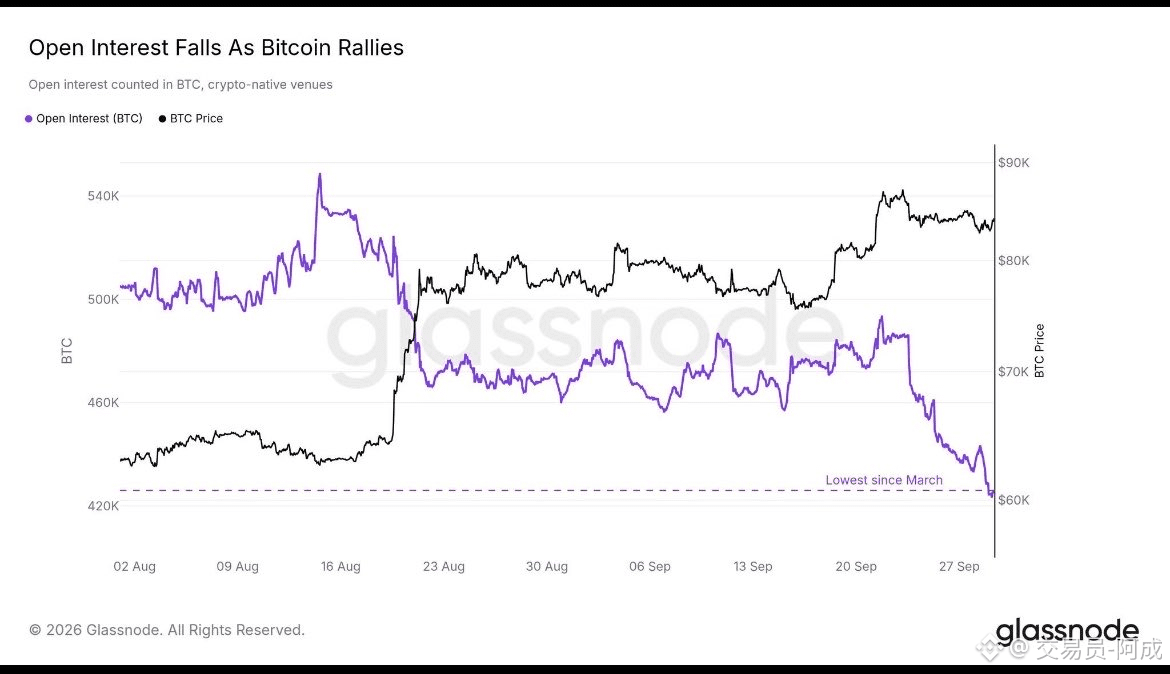
From the August low to now, the price has risen about 35%—but Open Interest (OI) has actually fallen nearly 20%, dropping to its lowest level since March. This divergence is worth taking a closer look at.
Normally, when a rally is driven by bulls chasing prices higher, it tends to look like this: prices rise, OI increases, and leverage builds up. The higher the market climbs, the more liquidation bombs are buried beneath it. Once there’s a pullback, longs get liquidated, prices fall, triggering even more liquidations—and a cascading sell-off follows.
But right now, the opposite is happening: prices are moving up while the market continues to deleverage.
What does this tell us? At the very least, this rally isn’t the typical kind built on a pile-up of highly leveraged longs—and the market is becoming less vulnerable to large-scale long liquidations.
So when should we be cautious? If prices keep rising while OI starts expanding rapidly again, that would signal a major return of speculative capital and an increasing risk of overheating.
But for now, that’s not what we’re seeing.
The underlying structure of this rally may be healthier than the price action suggests. The rise hasn’t been explosive, but it has a firmer foundation—a caution for those chasing the rally, but a positive sign for spot holders.
Want to talk about how this divergence might develop? Get in touch.
If you want to build a deeper understanding of crypto but don’t know where to start, or want to get up to speed quickly and learn about information asymmetries, come chat with me. You’ll gain access to firsthand insights and in-depth analysis!
From the August low to now, the price has risen about 35%—but Open Interest (OI) has actually fallen nearly 20%, dropping to its lowest level since March. This divergence is worth taking a closer look at.
Normally, when a rally is driven by bulls chasing prices higher, it tends to look like this: prices rise, OI increases, and leverage builds up. The higher the market climbs, the more liquidation bombs are buried beneath it. Once there’s a pullback, longs get liquidated, prices fall, triggering even more liquidations—and a cascading sell-off follows.
But right now, the opposite is happening: prices are moving up while the market continues to deleverage.
What does this tell us? At the very least, this rally isn’t the typical kind built on a pile-up of highly leveraged longs—and the market is becoming less vulnerable to large-scale long liquidations.
So when should we be cautious? If prices keep rising while OI starts expanding rapidly again, that would signal a major return of speculative capital and an increasing risk of overheating.
But for now, that’s not what we’re seeing.
The underlying structure of this rally may be healthier than the price action suggests. The rise hasn’t been explosive, but it has a firmer foundation—a caution for those chasing the rally, but a positive sign for spot holders.
Want to talk about how this divergence might develop? Get in touch.
If you want to build a deeper understanding of crypto but don’t know where to start, or want to get up to speed quickly and learn about information asymmetries, come chat with me. You’ll gain access to firsthand insights and in-depth analysis!
Normally, when a rally is driven by bulls chasing prices higher, it tends to look like this: prices rise, OI increases, and leverage builds up. The higher the market climbs, the more liquidation bombs are buried beneath it. Once there’s a pullback, longs get liquidated, prices fall, triggering even more liquidations—and a cascading sell-off follows.
But right now, the opposite is happening: prices are moving up while the market continues to deleverage.
What does this tell us? At the very least, this rally isn’t the typical kind built on a pile-up of highly leveraged longs—and the market is becoming less vulnerable to large-scale long liquidations.
So when should we be cautious? If prices keep rising while OI starts expanding rapidly again, that would signal a major return of speculative capital and an increasing risk of overheating.
But for now, that’s not what we’re seeing.
The underlying structure of this rally may be healthier than the price action suggests. The rise hasn’t been explosive, but it has a firmer foundation—a caution for those chasing the rally, but a positive sign for spot holders.
Want to talk about how this divergence might develop? Get in touch.
If you want to build a deeper understanding of crypto but don’t know where to start, or want to get up to speed quickly and learn about information asymmetries, come chat with me. You’ll gain access to firsthand insights and in-depth analysis!
152
·
--
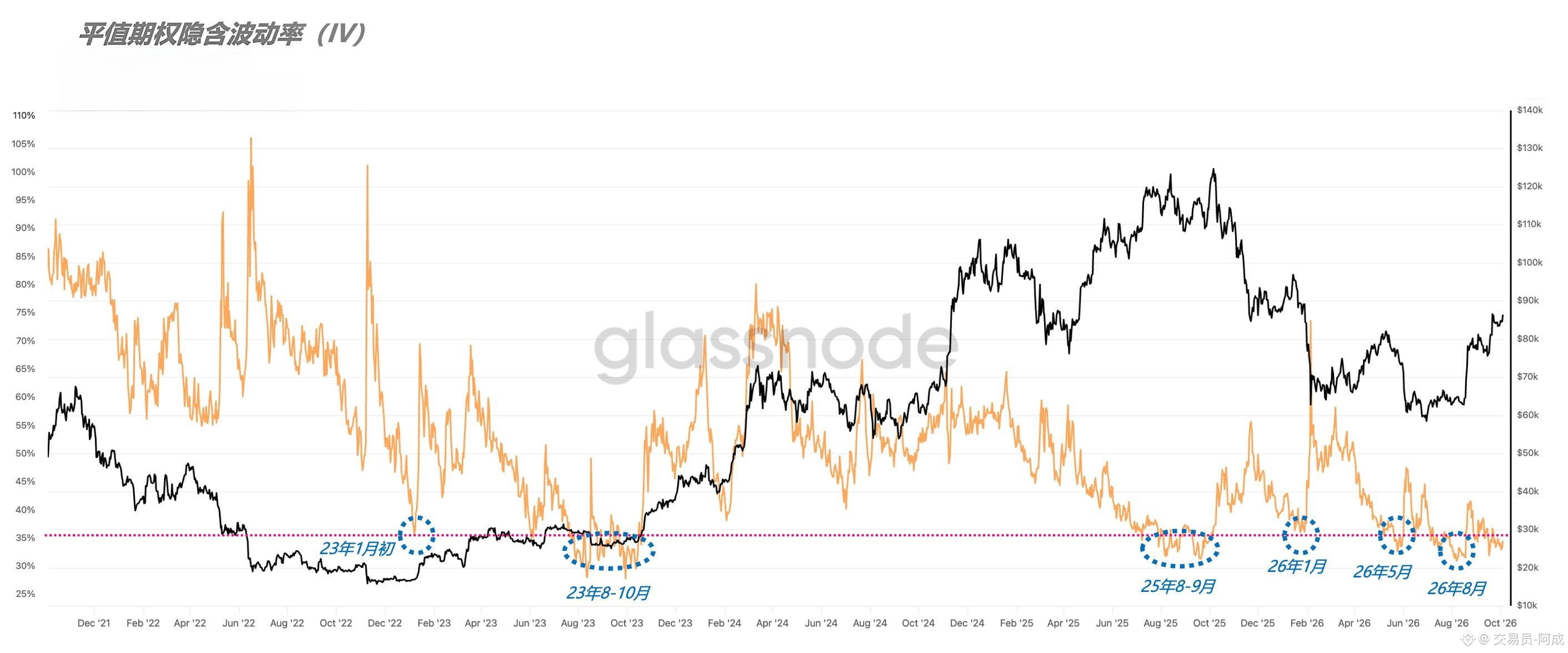
In the past five years, the BTC 1-month ATM IV has fallen to 35% or below only six times in total—every single time, it happened right before a major market turning point.
Let's review these six historical moments:
1、Early Jan 23: the bear market ends, ushering in the first round of rallies
2、Aug–Oct 23: the shift from bearish to bullish completes, and the bull market officially begins
3、Aug–Sep 25: the bull market tops out and the first round of selloff follows
4、Jan 26: the bear market rebound tops out and quickly rolls over
5、May 26: the rebound high ends, and the market plunges sharply
6、Aug 26: the bear market ends and another uptrend restarts
And now, this is the 7th time.
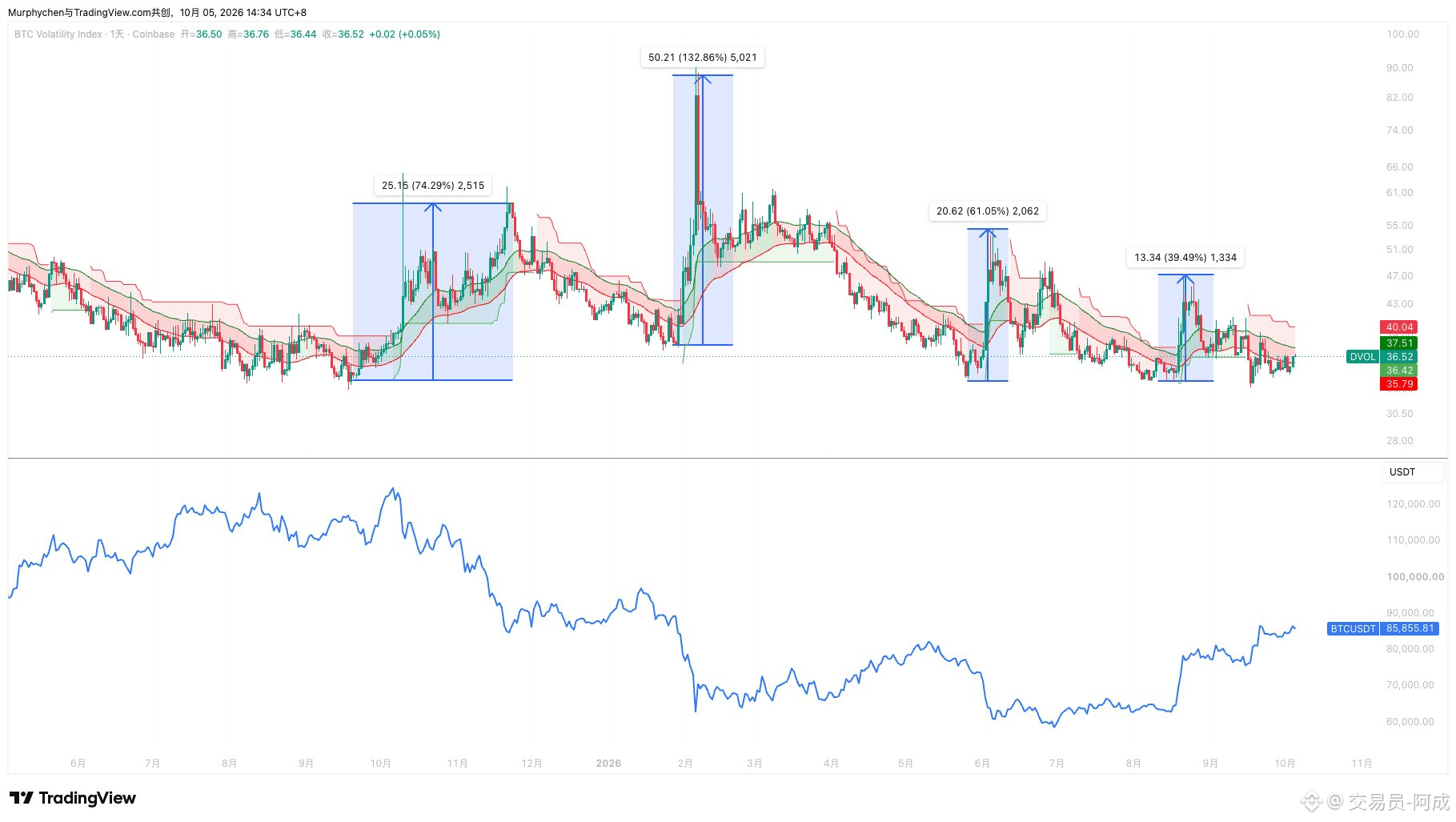
I’ve marked the timing of the most recent four occurrences on the DVOL volatility index—once you see it, the pattern is obvious:
After Sep 25, the market rises 75%.
After Jan 26, it rises 133%.
After May 26, it rises 61%.
After Aug 26, it rises 40%.
When you look back at history, which one didn’t come with a real opportunity?
There’s no need to rush into betting blindly on one direction—long or short.
Many people focus on catching upswings and downswings, but they ignore the signals volatility provides.
“Your wealth has boundaries defined by your cognition.” Put here, it really carries weight.
Understanding cycle signals and waiting patiently for opportunities matters far more than opening trades too frequently.
If you want to dive deep into the crypto world but can’t find your footing, and you want a fast way to get started and understand the information gap, come chat with me in my room—get firsthand insights and in-depth analysis!
In the past five years, the BTC 1-month ATM IV has fallen to 35% or below only six times in total—every single time, it happened right before a major market turning point.
Let's review these six historical moments:
1、Early Jan 23: the bear market ends, ushering in the first round of rallies
2、Aug–Oct 23: the shift from bearish to bullish completes, and the bull market officially begins
3、Aug–Sep 25: the bull market tops out and the first round of selloff follows
4、Jan 26: the bear market rebound tops out and quickly rolls over
5、May 26: the rebound high ends, and the market plunges sharply
6、Aug 26: the bear market ends and another uptrend restarts
And now, this is the 7th time.
I’ve marked the timing of the most recent four occurrences on the DVOL volatility index—once you see it, the pattern is obvious:
After Sep 25, the market rises 75%.
After Jan 26, it rises 133%.
After May 26, it rises 61%.
After Aug 26, it rises 40%.
When you look back at history, which one didn’t come with a real opportunity?
There’s no need to rush into betting blindly on one direction—long or short.
Many people focus on catching upswings and downswings, but they ignore the signals volatility provides.
“Your wealth has boundaries defined by your cognition.” Put here, it really carries weight.
Understanding cycle signals and waiting patiently for opportunities matters far more than opening trades too frequently.
If you want to dive deep into the crypto world but can’t find your footing, and you want a fast way to get started and understand the information gap, come chat with me in my room—get firsthand insights and in-depth analysis!
Let's review these six historical moments:
1、Early Jan 23: the bear market ends, ushering in the first round of rallies
2、Aug–Oct 23: the shift from bearish to bullish completes, and the bull market officially begins
3、Aug–Sep 25: the bull market tops out and the first round of selloff follows
4、Jan 26: the bear market rebound tops out and quickly rolls over
5、May 26: the rebound high ends, and the market plunges sharply
6、Aug 26: the bear market ends and another uptrend restarts
And now, this is the 7th time.
I’ve marked the timing of the most recent four occurrences on the DVOL volatility index—once you see it, the pattern is obvious:
After Sep 25, the market rises 75%.
After Jan 26, it rises 133%.
After May 26, it rises 61%.
After Aug 26, it rises 40%.
When you look back at history, which one didn’t come with a real opportunity?
There’s no need to rush into betting blindly on one direction—long or short.
Many people focus on catching upswings and downswings, but they ignore the signals volatility provides.
“Your wealth has boundaries defined by your cognition.” Put here, it really carries weight.
Understanding cycle signals and waiting patiently for opportunities matters far more than opening trades too frequently.
If you want to dive deep into the crypto world but can’t find your footing, and you want a fast way to get started and understand the information gap, come chat with me in my room—get firsthand insights and in-depth analysis!
1
503
·
--
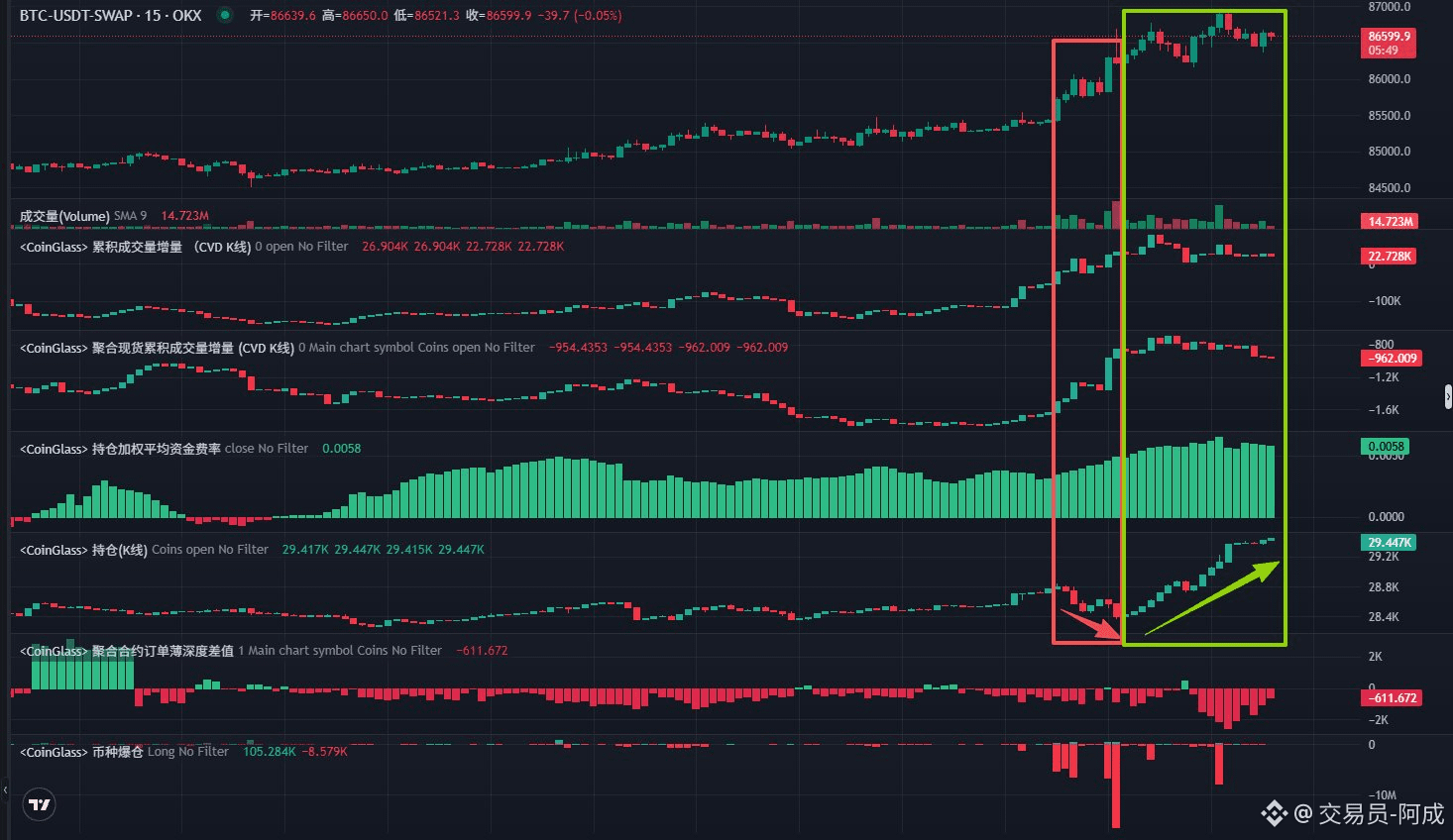
This weekend’s BTC pump is quite interesting—the first half was a hard push upward by liquidating short sellers: from 85,400 to 86,600, Binance’s BTC and ETH on margin (combined) were liquidated for 33 million, accounting for 52%; OKX saw total liquidations of 21.3 million, and most of the liquidated positions were shorts. The two platforms together contributed more than 80%.
What about the second half? Derivatives open interest keeps increasing: whales add longs, while retail traders add shorts. So that liquidation spike around 87,400 may well be revisited again—but beyond that, there won’t be as much fuel.
Overall, it’s still a back-and-forth, chop-and-bleed type of game: the overall bottom is rising, building strength for the future. The outlook for Q4 is generally optimistic, with October being the start.
At 10 PM tonight there’s an ISM services sector data release: if it keeps weakening, it will reinforce expectations of no rate hike in October—small positive. Otherwise it’s a negative. The impact isn’t huge, but it’s very likely this will be used as an opportunity to finish the liquidation of the shorts around 87,400.
In one sentence: both longs and shorts are waiting for the other to make the first mistake—don’t chase when it goes up, don’t panic when it drops, and only talk after the cleanup is done.
If you want to dig deeper into the crypto world but can’t find a starting point, and you want to get up to speed quickly to understand the information gaps, come chat with me in my group for real-time insights and in-depth analysis!
This weekend’s BTC pump is quite interesting—the first half was a hard push upward by liquidating short sellers: from 85,400 to 86,600, Binance’s BTC and ETH on margin (combined) were liquidated for 33 million, accounting for 52%; OKX saw total liquidations of 21.3 million, and most of the liquidated positions were shorts. The two platforms together contributed more than 80%.
What about the second half? Derivatives open interest keeps increasing: whales add longs, while retail traders add shorts. So that liquidation spike around 87,400 may well be revisited again—but beyond that, there won’t be as much fuel.
Overall, it’s still a back-and-forth, chop-and-bleed type of game: the overall bottom is rising, building strength for the future. The outlook for Q4 is generally optimistic, with October being the start.
At 10 PM tonight there’s an ISM services sector data release: if it keeps weakening, it will reinforce expectations of no rate hike in October—small positive. Otherwise it’s a negative. The impact isn’t huge, but it’s very likely this will be used as an opportunity to finish the liquidation of the shorts around 87,400.
In one sentence: both longs and shorts are waiting for the other to make the first mistake—don’t chase when it goes up, don’t panic when it drops, and only talk after the cleanup is done.
If you want to dig deeper into the crypto world but can’t find a starting point, and you want to get up to speed quickly to understand the information gaps, come chat with me in my group for real-time insights and in-depth analysis!
What about the second half? Derivatives open interest keeps increasing: whales add longs, while retail traders add shorts. So that liquidation spike around 87,400 may well be revisited again—but beyond that, there won’t be as much fuel.
Overall, it’s still a back-and-forth, chop-and-bleed type of game: the overall bottom is rising, building strength for the future. The outlook for Q4 is generally optimistic, with October being the start.
At 10 PM tonight there’s an ISM services sector data release: if it keeps weakening, it will reinforce expectations of no rate hike in October—small positive. Otherwise it’s a negative. The impact isn’t huge, but it’s very likely this will be used as an opportunity to finish the liquidation of the shorts around 87,400.
In one sentence: both longs and shorts are waiting for the other to make the first mistake—don’t chase when it goes up, don’t panic when it drops, and only talk after the cleanup is done.
If you want to dig deeper into the crypto world but can’t find a starting point, and you want to get up to speed quickly to understand the information gaps, come chat with me in my group for real-time insights and in-depth analysis!
239
·
--
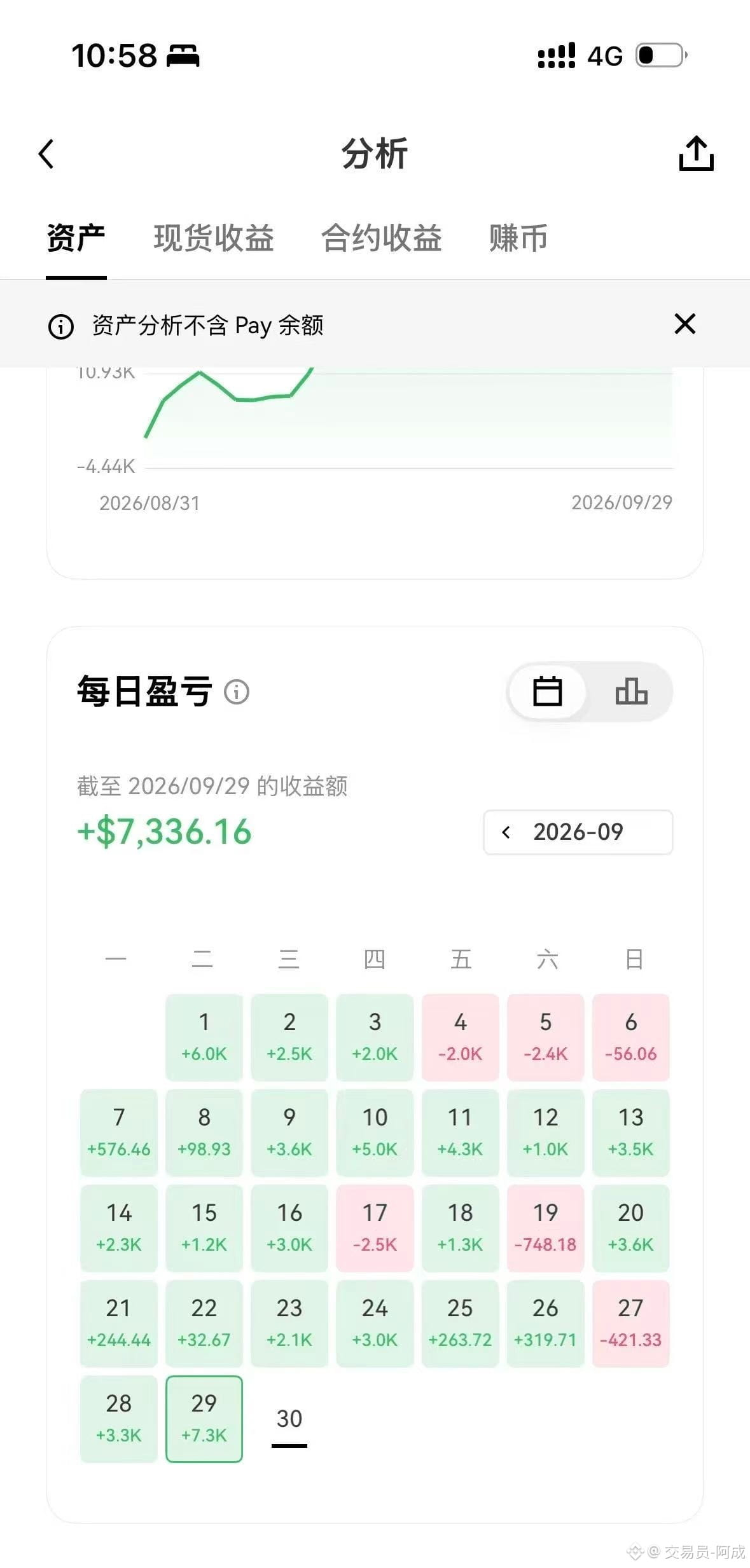
The dumbest way to trade crypto—and it helped me 5x my account in 3 months? It’s 100 times simpler than reading candlestick charts, drawing trendlines, or watching data.
Honestly, I can’t even make sense of candlestick charts. MACD, RSI, Bollinger Bands—they all give me a headache. I tried learning them before, and ended up losing even more. But this clueless trader has taken 8,000 USDT to 120,000 USDT over the past 3 months—not through luck, but by finding a method so dumb I’m almost embarrassed to say it out loud. But it works.
I don’t pick coins. I watch people. Every day before the market opens, I do just one thing: see which whales are making moves and which projects are suddenly attracting smart money. I go where the big players go. If they’re making money, I follow along and take my share. It’s that simple.
Candlestick charts can lie, but on-chain money flows don’t.
I don’t try to guess whether prices will rise or fall either. I only look for high-probability setups. My favorite kind of coin is one that’s plunged for three days straight on heavy volume, sentiment has collapsed, but the core wallets haven’t sold. Why? Because a real crash isn’t the end—it’s the start of a new round of gains. Every chance to double your money is hiding in the moment when everyone else is most afraid.
The first lesson I teach people is: don’t talk about faith, projects, or dreams. You’re not a VC, an angel investor, or a CEO. You’re in crypto for one reason—to watch your account balance. If it’s up, you’re right; if it’s down, you’re wrong. Why overcomplicate it?
I share a strategy every morning at 10 and review the trades at night. Clear stop-losses, precise entries, against human nature but with a high win rate. Those who’ve followed along have gotten used to us watching our account while others panic, and making money while others take losses.
I’m not saying this to show off. I just want you to know that even if you’re the most clueless retail trader in crypto, the right method can still help you make steady gains.
Whether you’ve lost 100,000, 500,000, or 5 million, what you’re missing isn’t another pile of useless information—it’s a strategy you can put into action right away. If you want to turn things around, come talk to me. Use the dumbest method to beat this market.
The dumbest way to trade crypto—and it helped me 5x my account in 3 months? It’s 100 times simpler than reading candlestick charts, drawing trendlines, or watching data.
Honestly, I can’t even make sense of candlestick charts. MACD, RSI, Bollinger Bands—they all give me a headache. I tried learning them before, and ended up losing even more. But this clueless trader has taken 8,000 USDT to 120,000 USDT over the past 3 months—not through luck, but by finding a method so dumb I’m almost embarrassed to say it out loud. But it works.
I don’t pick coins. I watch people. Every day before the market opens, I do just one thing: see which whales are making moves and which projects are suddenly attracting smart money. I go where the big players go. If they’re making money, I follow along and take my share. It’s that simple.
Candlestick charts can lie, but on-chain money flows don’t.
I don’t try to guess whether prices will rise or fall either. I only look for high-probability setups. My favorite kind of coin is one that’s plunged for three days straight on heavy volume, sentiment has collapsed, but the core wallets haven’t sold. Why? Because a real crash isn’t the end—it’s the start of a new round of gains. Every chance to double your money is hiding in the moment when everyone else is most afraid.
The first lesson I teach people is: don’t talk about faith, projects, or dreams. You’re not a VC, an angel investor, or a CEO. You’re in crypto for one reason—to watch your account balance. If it’s up, you’re right; if it’s down, you’re wrong. Why overcomplicate it?
I share a strategy every morning at 10 and review the trades at night. Clear stop-losses, precise entries, against human nature but with a high win rate. Those who’ve followed along have gotten used to us watching our account while others panic, and making money while others take losses.
I’m not saying this to show off. I just want you to know that even if you’re the most clueless retail trader in crypto, the right method can still help you make steady gains.
Whether you’ve lost 100,000, 500,000, or 5 million, what you’re missing isn’t another pile of useless information—it’s a strategy you can put into action right away. If you want to turn things around, come talk to me. Use the dumbest method to beat this market.
Honestly, I can’t even make sense of candlestick charts. MACD, RSI, Bollinger Bands—they all give me a headache. I tried learning them before, and ended up losing even more. But this clueless trader has taken 8,000 USDT to 120,000 USDT over the past 3 months—not through luck, but by finding a method so dumb I’m almost embarrassed to say it out loud. But it works.
I don’t pick coins. I watch people. Every day before the market opens, I do just one thing: see which whales are making moves and which projects are suddenly attracting smart money. I go where the big players go. If they’re making money, I follow along and take my share. It’s that simple.
Candlestick charts can lie, but on-chain money flows don’t.
I don’t try to guess whether prices will rise or fall either. I only look for high-probability setups. My favorite kind of coin is one that’s plunged for three days straight on heavy volume, sentiment has collapsed, but the core wallets haven’t sold. Why? Because a real crash isn’t the end—it’s the start of a new round of gains. Every chance to double your money is hiding in the moment when everyone else is most afraid.
The first lesson I teach people is: don’t talk about faith, projects, or dreams. You’re not a VC, an angel investor, or a CEO. You’re in crypto for one reason—to watch your account balance. If it’s up, you’re right; if it’s down, you’re wrong. Why overcomplicate it?
I share a strategy every morning at 10 and review the trades at night. Clear stop-losses, precise entries, against human nature but with a high win rate. Those who’ve followed along have gotten used to us watching our account while others panic, and making money while others take losses.
I’m not saying this to show off. I just want you to know that even if you’re the most clueless retail trader in crypto, the right method can still help you make steady gains.
Whether you’ve lost 100,000, 500,000, or 5 million, what you’re missing isn’t another pile of useless information—it’s a strategy you can put into action right away. If you want to turn things around, come talk to me. Use the dumbest method to beat this market.
43
·
--
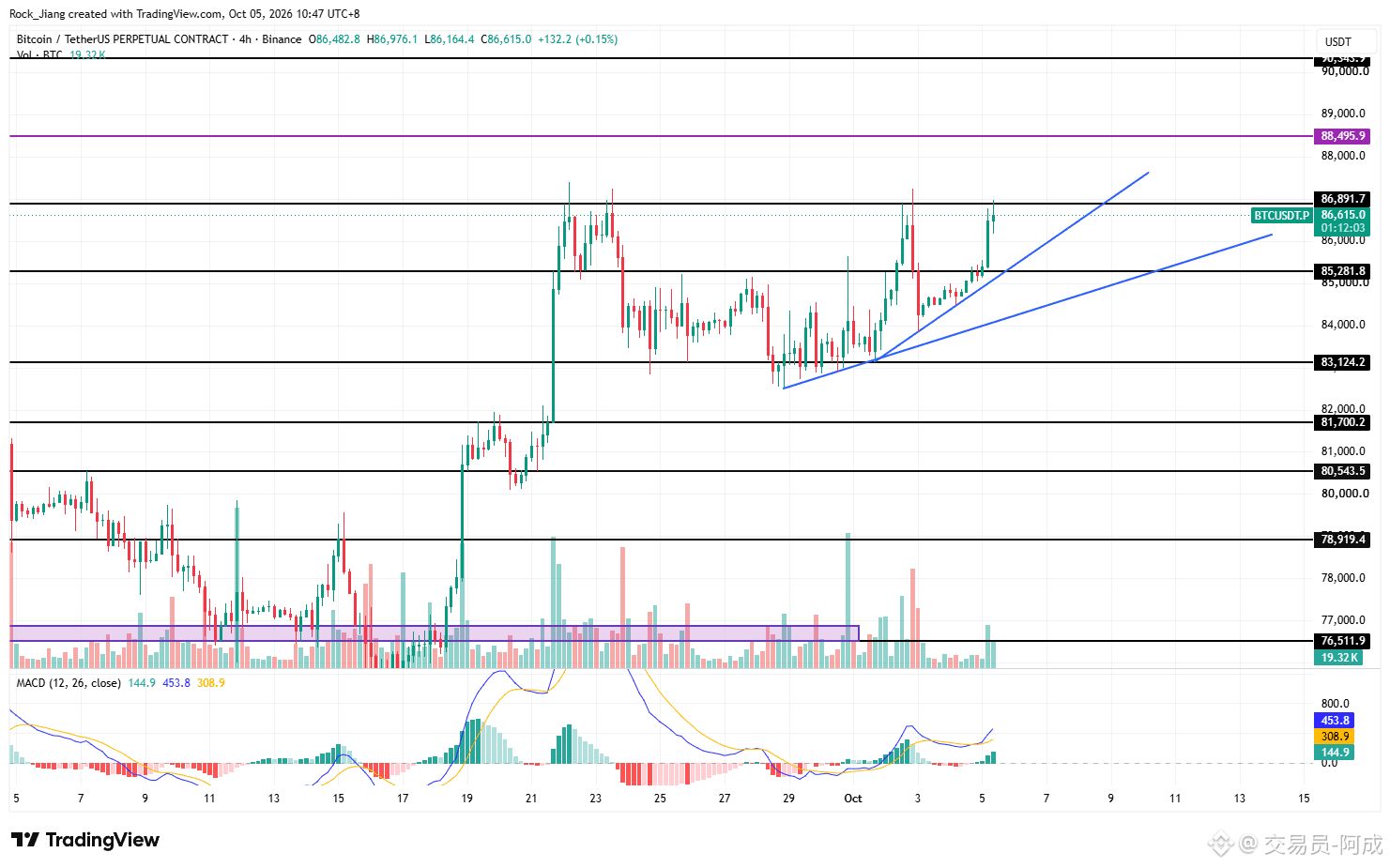
10.5 Monday Morning Market Overview
BTC is consolidating and rising; the bullish trend is still ongoing.
The daily chart closed with a real bullish candle, forming two consecutive bullish days; the weekly chart is even three straight bullish days—clearly showing that the bulls are in control.
As mentioned in yesterday’s early review: if price holds above 8.52, you can go long in line with the trend, with take-profit at 8.68. If it meets resistance at 8.68, you can also try a short. For friends who follow the rhythm, this move offers opportunities on both long and short sides to capture profits.
Currently, price is forming a rising triangle consolidation structure. The key level to watch is the resistance at 8.68. If price breaks out with volume and holds above it, the bullish trend will keep opening up. The upside targets are 8.84, and above that, 9.03.
8.52 is a crucial support and also the 0.382 retracement level between the high and low points. Multiple conditions align here, making it the preferred spot to buy on a pullback.
After a bullish divergence at the MACD bottom, a golden cross has taken shape—technical signals are bullish.
Two entry approaches:
1) Left-side setup: go long near 8.52, with defense at 8.42, targeting 8.62 and 8.68.
2) Right-side confirmation: wait for a candle breakout and acceptance above 8.68, then chase longs along the trend, with defense at 8.58, targeting 8.78 and 8.84.
Gegē typically structures positions using mainstream-coin perps and popular altcoin contracts, focusing mainly on spot short-term setups. He’s good at catching small leaders (“golden dogs”) and discovering 100x coins. If you want to recover your funds and turn the tables, come to my chat room—I’ll get you back on the shore.
10.5 Monday Morning Market Overview
BTC is consolidating and rising; the bullish trend is still ongoing.
The daily chart closed with a real bullish candle, forming two consecutive bullish days; the weekly chart is even three straight bullish days—clearly showing that the bulls are in control.
As mentioned in yesterday’s early review: if price holds above 8.52, you can go long in line with the trend, with take-profit at 8.68. If it meets resistance at 8.68, you can also try a short. For friends who follow the rhythm, this move offers opportunities on both long and short sides to capture profits.
Currently, price is forming a rising triangle consolidation structure. The key level to watch is the resistance at 8.68. If price breaks out with volume and holds above it, the bullish trend will keep opening up. The upside targets are 8.84, and above that, 9.03.
8.52 is a crucial support and also the 0.382 retracement level between the high and low points. Multiple conditions align here, making it the preferred spot to buy on a pullback.
After a bullish divergence at the MACD bottom, a golden cross has taken shape—technical signals are bullish.
Two entry approaches:
1) Left-side setup: go long near 8.52, with defense at 8.42, targeting 8.62 and 8.68.
2) Right-side confirmation: wait for a candle breakout and acceptance above 8.68, then chase longs along the trend, with defense at 8.58, targeting 8.78 and 8.84.
Gegē typically structures positions using mainstream-coin perps and popular altcoin contracts, focusing mainly on spot short-term setups. He’s good at catching small leaders (“golden dogs”) and discovering 100x coins. If you want to recover your funds and turn the tables, come to my chat room—I’ll get you back on the shore.
BTC is consolidating and rising; the bullish trend is still ongoing.
The daily chart closed with a real bullish candle, forming two consecutive bullish days; the weekly chart is even three straight bullish days—clearly showing that the bulls are in control.
As mentioned in yesterday’s early review: if price holds above 8.52, you can go long in line with the trend, with take-profit at 8.68. If it meets resistance at 8.68, you can also try a short. For friends who follow the rhythm, this move offers opportunities on both long and short sides to capture profits.
Currently, price is forming a rising triangle consolidation structure. The key level to watch is the resistance at 8.68. If price breaks out with volume and holds above it, the bullish trend will keep opening up. The upside targets are 8.84, and above that, 9.03.
8.52 is a crucial support and also the 0.382 retracement level between the high and low points. Multiple conditions align here, making it the preferred spot to buy on a pullback.
After a bullish divergence at the MACD bottom, a golden cross has taken shape—technical signals are bullish.
Two entry approaches:
1) Left-side setup: go long near 8.52, with defense at 8.42, targeting 8.62 and 8.68.
2) Right-side confirmation: wait for a candle breakout and acceptance above 8.68, then chase longs along the trend, with defense at 8.58, targeting 8.78 and 8.84.
Gegē typically structures positions using mainstream-coin perps and popular altcoin contracts, focusing mainly on spot short-term setups. He’s good at catching small leaders (“golden dogs”) and discovering 100x coins. If you want to recover your funds and turn the tables, come to my chat room—I’ll get you back on the shore.
169
·
--
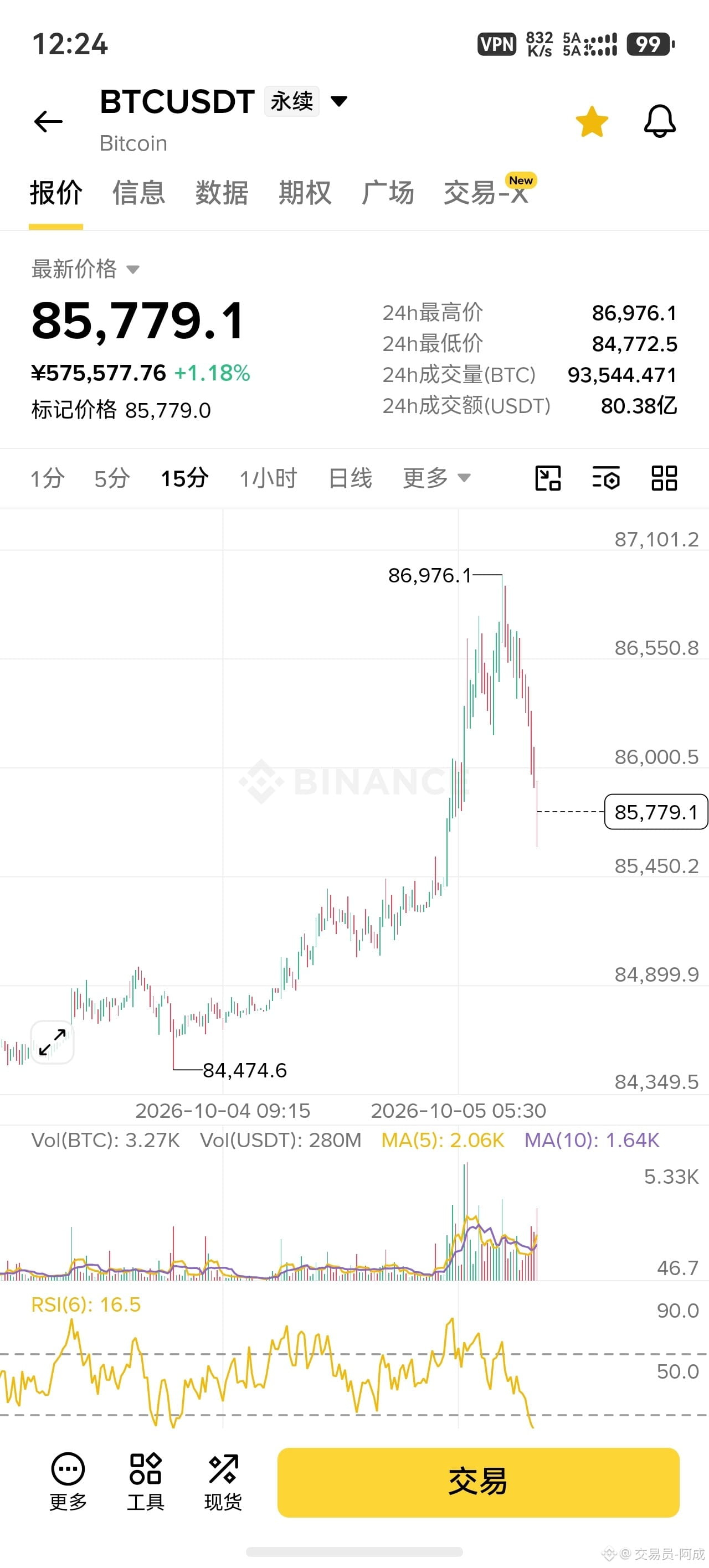
Bitcoin has a real macro turnaround—Nonfarm at 29,000, and the rate-hike probability dropping from 70% to 25%. There’s real buyer power—Binance saw net buys of 618 million in one hour, and the 85,000 sell-wall was eaten. There’s real whale accumulation—addresses holding 10 to 10,000 BTC increased by 41,025 coins in 10 days, and the accumulation trend chart is repeating the contraction pattern seen before the two big rallies in 2025. There’s real regulatory leverage— the SEC’s 760-page proposal opened the door itself during the legislative vacuum.
But Bitcoin also has real problems: ETF inflows fell from 2.4 billion to 82.9 million, and liquidity “no longer clearly noticeable” above 87,000 means upside sell pressure may be thinner, but the bid side is also thin. The distribution zone from 90k to 95k has historically been touched only during a very small number of times, and after options settlement, the market makers’ hedging adjustment direction remains uncertain.
87,000 is not a “breakout.” 87,000 is the point where, after the sell-wall is eaten, buyers are testing how much resistance remains overhead. If volume can push and hold above 88,400, 90k is the next gate. If 88,400 is rejected, 84,500–84,600 is the next line of defense.
Don’t talk about “chasing” on nights when 648 million short positions get buried alive. First see whether 88,400 can be eaten. If it’s eaten, 90k is waiting. If it can’t be eaten, 84,500 holds the floor.
Brother Cheng usually plans mainly with mainstream coin futures and popular altcoin contracts, focusing on short-term spot trades. He’s good at catching golden dogs and digging out 100x coins. If you want to claw back losses and turn the tables, come to my chat room—I’ll get you back to shore #比特币冲击8.7万美元遇阻回落
Bitcoin has a real macro turnaround—Nonfarm at 29,000, and the rate-hike probability dropping from 70% to 25%. There’s real buyer power—Binance saw net buys of 618 million in one hour, and the 85,000 sell-wall was eaten. There’s real whale accumulation—addresses holding 10 to 10,000 BTC increased by 41,025 coins in 10 days, and the accumulation trend chart is repeating the contraction pattern seen before the two big rallies in 2025. There’s real regulatory leverage— the SEC’s 760-page proposal opened the door itself during the legislative vacuum.
But Bitcoin also has real problems: ETF inflows fell from 2.4 billion to 82.9 million, and liquidity “no longer clearly noticeable” above 87,000 means upside sell pressure may be thinner, but the bid side is also thin. The distribution zone from 90k to 95k has historically been touched only during a very small number of times, and after options settlement, the market makers’ hedging adjustment direction remains uncertain.
87,000 is not a “breakout.” 87,000 is the point where, after the sell-wall is eaten, buyers are testing how much resistance remains overhead. If volume can push and hold above 88,400, 90k is the next gate. If 88,400 is rejected, 84,500–84,600 is the next line of defense.
Don’t talk about “chasing” on nights when 648 million short positions get buried alive. First see whether 88,400 can be eaten. If it’s eaten, 90k is waiting. If it can’t be eaten, 84,500 holds the floor.
Brother Cheng usually plans mainly with mainstream coin futures and popular altcoin contracts, focusing on short-term spot trades. He’s good at catching golden dogs and digging out 100x coins. If you want to claw back losses and turn the tables, come to my chat room—I’ll get you back to shore #比特币冲击8.7万美元遇阻回落
But Bitcoin also has real problems: ETF inflows fell from 2.4 billion to 82.9 million, and liquidity “no longer clearly noticeable” above 87,000 means upside sell pressure may be thinner, but the bid side is also thin. The distribution zone from 90k to 95k has historically been touched only during a very small number of times, and after options settlement, the market makers’ hedging adjustment direction remains uncertain.
87,000 is not a “breakout.” 87,000 is the point where, after the sell-wall is eaten, buyers are testing how much resistance remains overhead. If volume can push and hold above 88,400, 90k is the next gate. If 88,400 is rejected, 84,500–84,600 is the next line of defense.
Don’t talk about “chasing” on nights when 648 million short positions get buried alive. First see whether 88,400 can be eaten. If it’s eaten, 90k is waiting. If it can’t be eaten, 84,500 holds the floor.
Brother Cheng usually plans mainly with mainstream coin futures and popular altcoin contracts, focusing on short-term spot trades. He’s good at catching golden dogs and digging out 100x coins. If you want to claw back losses and turn the tables, come to my chat room—I’ll get you back to shore #比特币冲击8.7万美元遇阻回落

4
2
9k
·
--
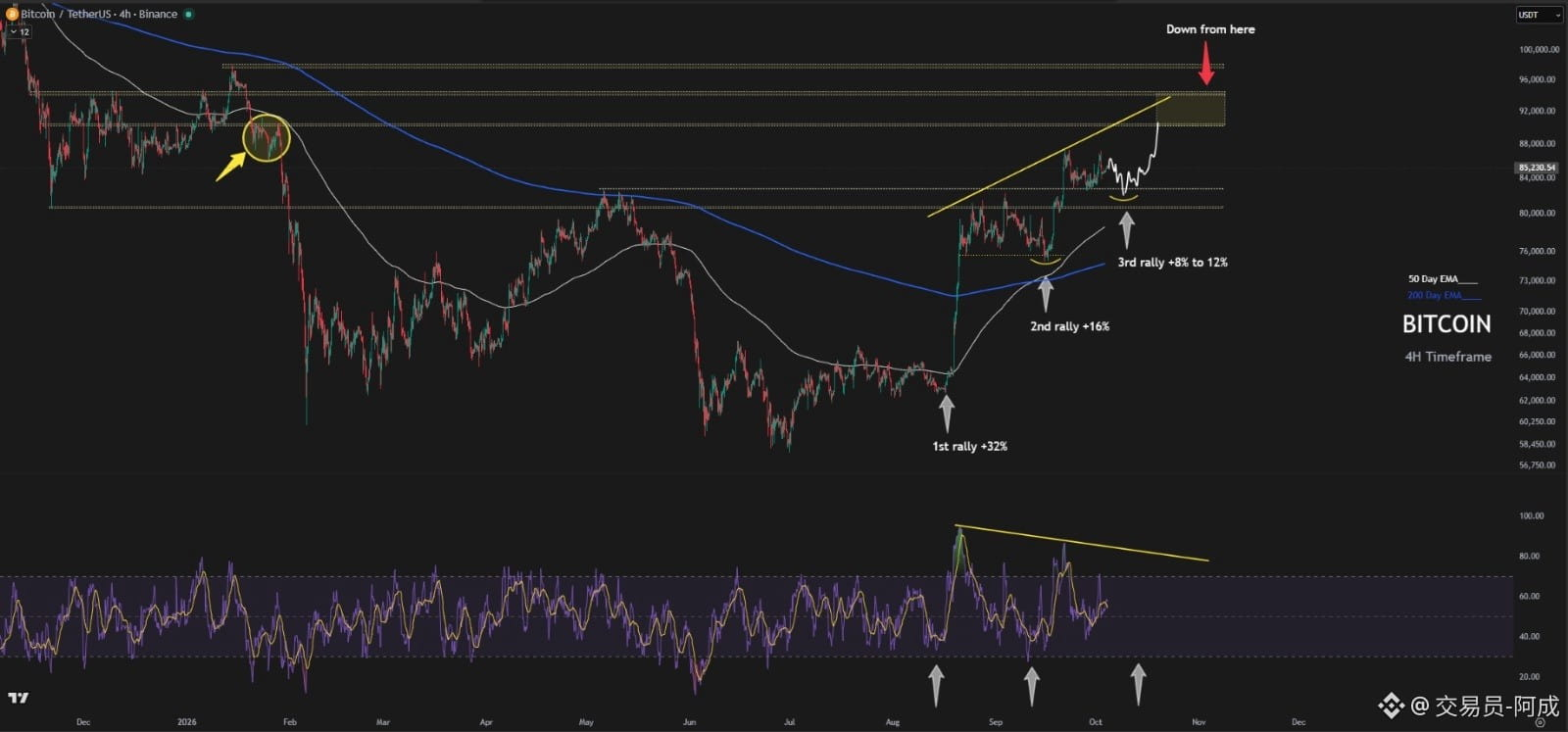
My view hasn’t changed: wait for a run-up to higher levels, then a major pullback is next.
The weekly close is strong—bullish momentum is still there—but at this stage I choose to stand by and not rush into a trade.
My plan is very clear: I only intend to set up a short position around the 90K area. This short isn’t simply about trying to catch the top; it’s an anti-trend hedge to protect the BTC spot holdings I already have, which I will not take profit on and exit for now.
If this week’s BTC continues to range-bound consolidation, and the price quickly drops to sweep the lower lows, in the 81K–82K range, I will consider going long.
I still believe this support level can hold through a test, leading to the final push higher. The target is 90K–93K.
The yellow-highlighted area is the bulls’ biggest hurdle. Even if it breaks through forcibly, it’s very likely just a short-term wick to sweep liquidity—followed by rejection and a pullback, bringing a round of deeper declines.
Trading isn’t about blindly going long or short. Distinguish the roles of spot and futures, and set up hedges properly—that’s the key to surviving in the market long term.
If you have a different opinion, feel free to exchange ideas together.
My view hasn’t changed: wait for a run-up to higher levels, then a major pullback is next.
The weekly close is strong—bullish momentum is still there—but at this stage I choose to stand by and not rush into a trade.
My plan is very clear: I only intend to set up a short position around the 90K area. This short isn’t simply about trying to catch the top; it’s an anti-trend hedge to protect the BTC spot holdings I already have, which I will not take profit on and exit for now.
If this week’s BTC continues to range-bound consolidation, and the price quickly drops to sweep the lower lows, in the 81K–82K range, I will consider going long.
I still believe this support level can hold through a test, leading to the final push higher. The target is 90K–93K.
The yellow-highlighted area is the bulls’ biggest hurdle. Even if it breaks through forcibly, it’s very likely just a short-term wick to sweep liquidity—followed by rejection and a pullback, bringing a round of deeper declines.
Trading isn’t about blindly going long or short. Distinguish the roles of spot and futures, and set up hedges properly—that’s the key to surviving in the market long term.
If you have a different opinion, feel free to exchange ideas together.
The weekly close is strong—bullish momentum is still there—but at this stage I choose to stand by and not rush into a trade.
My plan is very clear: I only intend to set up a short position around the 90K area. This short isn’t simply about trying to catch the top; it’s an anti-trend hedge to protect the BTC spot holdings I already have, which I will not take profit on and exit for now.
If this week’s BTC continues to range-bound consolidation, and the price quickly drops to sweep the lower lows, in the 81K–82K range, I will consider going long.
I still believe this support level can hold through a test, leading to the final push higher. The target is 90K–93K.
The yellow-highlighted area is the bulls’ biggest hurdle. Even if it breaks through forcibly, it’s very likely just a short-term wick to sweep liquidity—followed by rejection and a pullback, bringing a round of deeper declines.
Trading isn’t about blindly going long or short. Distinguish the roles of spot and futures, and set up hedges properly—that’s the key to surviving in the market long term.
If you have a different opinion, feel free to exchange ideas together.
152
·
--
A fan went from 1,200U to 13,000U in less than a month—not by doubling a single order, but by eating it up in segments.
When he first arrived, his condition was very typical: doing more than ten orders a day, making a little money and then taking more—his rhythm was completely messed up. I told him to stop and only follow the rhythm. In the first week, he basically did only one thing: trade only the setups with room—if the upper pressure doesn’t break, stay flat; if the lower support doesn’t break, scale in more. For each order, he didn’t get greedy. He took around 1% and locked half first.
Many people look down on this kind of profit, but the account stabilized from right here.
Next, I added another layer of logic: don’t chase the first move—only trade after a second confirmation. If it spikes but can’t hold and then falls back, that’s when you short. If it drops and doesn’t break the low before bouncing, that’s when you go long. The win rate improved immediately.
In the second week, his change was obvious: he went from making a mess of trades to doing only two or three orders a day, and the account started moving upward instead. One trade is especially memorable: during the rebound, many people tried to catch the bottom. I didn’t let him enter then. I waited until the rebound weakened and the high failed to hold—then I gave him the short. That one trade netted nearly 4%. He said: “Turns out waiting in a ratio is more important than chasing.”
In the third week, he only slowly increased position size—not by going all-in at once, but by moving like this: trial entry, confirmation, add to the position, then lock in profit. The account went from 3,000U to 6,000U.
In the last week, he still did the same things, but with more principal, the returns were amplified. After a few trend moves, he went straight from 8,000U to 13,000U.
Throughout the whole process, there was no liquidation and no gambling on direction—everything was built from ordinary operations: wait for the right spot, do confirmation, control position size, and lock in profit.
You’re still thinking about doubling on one order; that’s not something I can help you do here. But if you want to build your account steadily upward, this path is the answer. If you want to follow along, come and chat with me.
A fan went from 1,200U to 13,000U in less than a month—not by doubling a single order, but by eating it up in segments.
When he first arrived, his condition was very typical: doing more than ten orders a day, making a little money and then taking more—his rhythm was completely messed up. I told him to stop and only follow the rhythm. In the first week, he basically did only one thing: trade only the setups with room—if the upper pressure doesn’t break, stay flat; if the lower support doesn’t break, scale in more. For each order, he didn’t get greedy. He took around 1% and locked half first.
Many people look down on this kind of profit, but the account stabilized from right here.
Next, I added another layer of logic: don’t chase the first move—only trade after a second confirmation. If it spikes but can’t hold and then falls back, that’s when you short. If it drops and doesn’t break the low before bouncing, that’s when you go long. The win rate improved immediately.
In the second week, his change was obvious: he went from making a mess of trades to doing only two or three orders a day, and the account started moving upward instead. One trade is especially memorable: during the rebound, many people tried to catch the bottom. I didn’t let him enter then. I waited until the rebound weakened and the high failed to hold—then I gave him the short. That one trade netted nearly 4%. He said: “Turns out waiting in a ratio is more important than chasing.”
In the third week, he only slowly increased position size—not by going all-in at once, but by moving like this: trial entry, confirmation, add to the position, then lock in profit. The account went from 3,000U to 6,000U.
In the last week, he still did the same things, but with more principal, the returns were amplified. After a few trend moves, he went straight from 8,000U to 13,000U.
Throughout the whole process, there was no liquidation and no gambling on direction—everything was built from ordinary operations: wait for the right spot, do confirmation, control position size, and lock in profit.
You’re still thinking about doubling on one order; that’s not something I can help you do here. But if you want to build your account steadily upward, this path is the answer. If you want to follow along, come and chat with me.
When he first arrived, his condition was very typical: doing more than ten orders a day, making a little money and then taking more—his rhythm was completely messed up. I told him to stop and only follow the rhythm. In the first week, he basically did only one thing: trade only the setups with room—if the upper pressure doesn’t break, stay flat; if the lower support doesn’t break, scale in more. For each order, he didn’t get greedy. He took around 1% and locked half first.
Many people look down on this kind of profit, but the account stabilized from right here.
Next, I added another layer of logic: don’t chase the first move—only trade after a second confirmation. If it spikes but can’t hold and then falls back, that’s when you short. If it drops and doesn’t break the low before bouncing, that’s when you go long. The win rate improved immediately.
In the second week, his change was obvious: he went from making a mess of trades to doing only two or three orders a day, and the account started moving upward instead. One trade is especially memorable: during the rebound, many people tried to catch the bottom. I didn’t let him enter then. I waited until the rebound weakened and the high failed to hold—then I gave him the short. That one trade netted nearly 4%. He said: “Turns out waiting in a ratio is more important than chasing.”
In the third week, he only slowly increased position size—not by going all-in at once, but by moving like this: trial entry, confirmation, add to the position, then lock in profit. The account went from 3,000U to 6,000U.
In the last week, he still did the same things, but with more principal, the returns were amplified. After a few trend moves, he went straight from 8,000U to 13,000U.
Throughout the whole process, there was no liquidation and no gambling on direction—everything was built from ordinary operations: wait for the right spot, do confirmation, control position size, and lock in profit.
You’re still thinking about doubling on one order; that’s not something I can help you do here. But if you want to build your account steadily upward, this path is the answer. If you want to follow along, come and chat with me.
2
1
469
·
--
Weekly Report, October Week 1 — The four words for this week: Go long, but protect against needles.
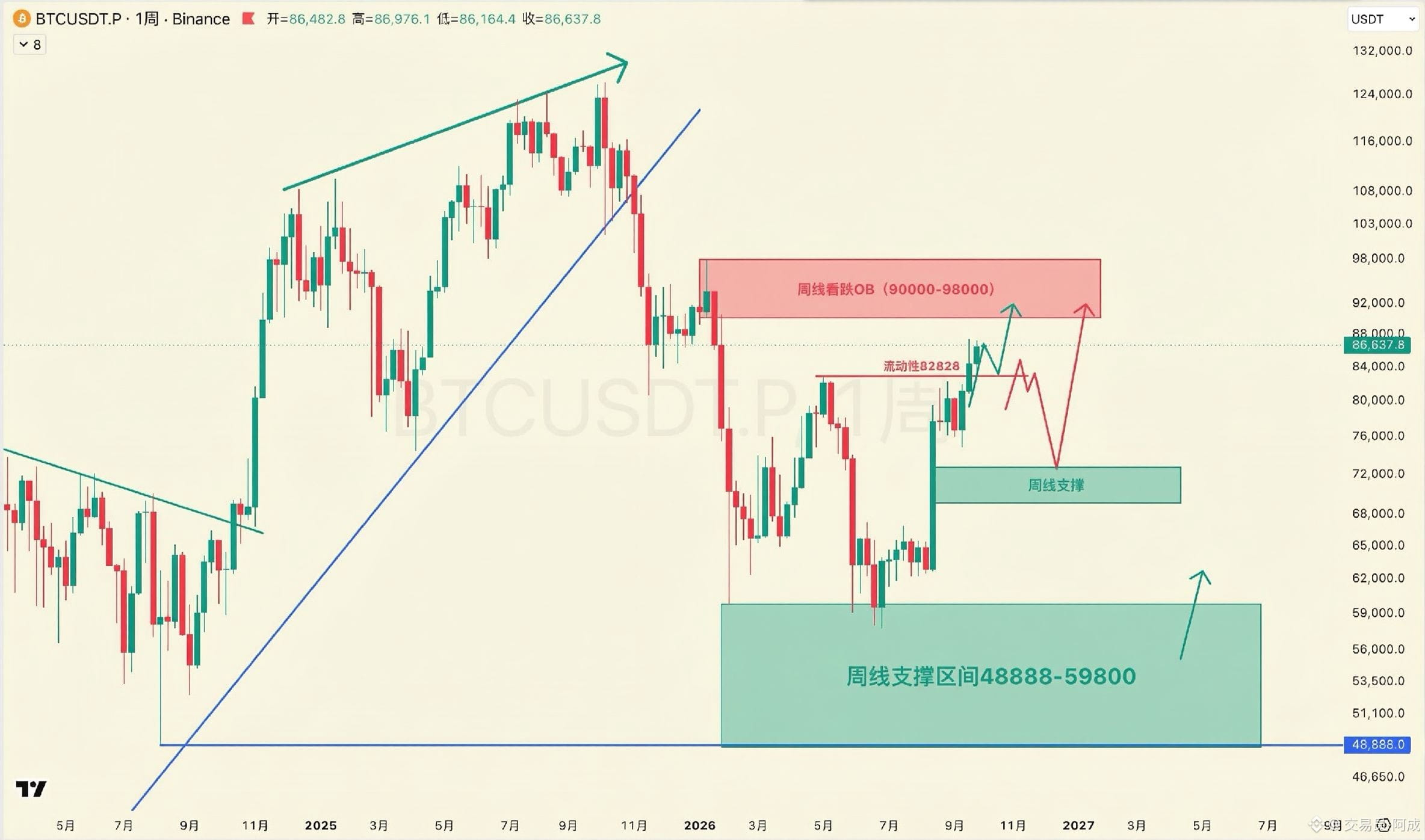
【Weekly Line】Last week completed a test of the previous high and closed higher in the red-line pattern. The probability of the “red-line script” is already very low. Price is 86,500; observation level is 83,000: hold it. Target: above 90,000. But note that even if it really pushes up above 90,000, it’s likely just a spike/needle, and the weekly body is unlikely to close above it.
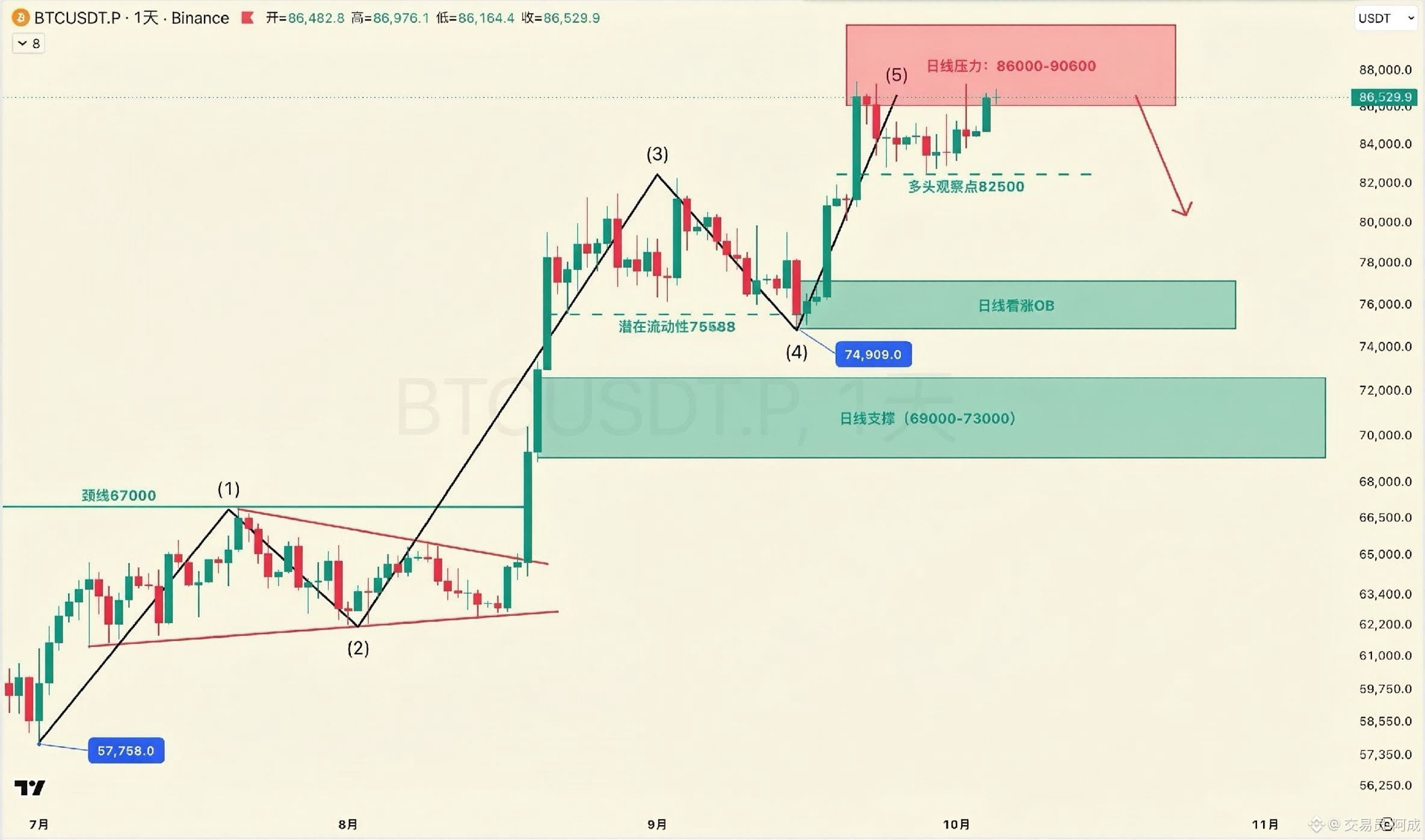
【Daily Line】From the rally that began at 74,090—this is the final leg of the move that started from 57,758. Once this leg finishes, it will be followed by a major pullback. Daily resistance from 86,000 to 90,600 continues to suppress price, and it also has multiple instances of bearish divergence. I’ve raised the bullish observation level to 82,500: if price breaks below it, the pullback begins. Downside targets: 79,000 and then 73,000.
【4-Hour】The 85,000 breakout mentioned last Friday has already been completed. It also tested above 86 and then pulled back. Dropping 3,000 dollars landed right on the 84,000 support. Last time it failed to break the previous high and fell; this time it’s likely to truly go test the previous high at 87,385. 4-hour support is 84,900 to 85,600.
In three sentences: Weekly is slightly bullish; daily is watchful for a pullback; the 4-hour timeframe looks for a push higher. The key is whether it can get past 87,385—if it does, you’ll see above 90,000; if it doesn’t, 82,500 is the watershed level.
If you want to go deeper into the crypto market but can’t find a clear path, and you want to quickly get started and understand the information gap, come chat with me in my room for real-time insights and in-depth analysis!
Weekly Report, October Week 1 — The four words for this week: Go long, but protect against needles.
【Weekly Line】Last week completed a test of the previous high and closed higher in the red-line pattern. The probability of the “red-line script” is already very low. Price is 86,500; observation level is 83,000: hold it. Target: above 90,000. But note that even if it really pushes up above 90,000, it’s likely just a spike/needle, and the weekly body is unlikely to close above it.
【Daily Line】From the rally that began at 74,090—this is the final leg of the move that started from 57,758. Once this leg finishes, it will be followed by a major pullback. Daily resistance from 86,000 to 90,600 continues to suppress price, and it also has multiple instances of bearish divergence. I’ve raised the bullish observation level to 82,500: if price breaks below it, the pullback begins. Downside targets: 79,000 and then 73,000.
【4-Hour】The 85,000 breakout mentioned last Friday has already been completed. It also tested above 86 and then pulled back. Dropping 3,000 dollars landed right on the 84,000 support. Last time it failed to break the previous high and fell; this time it’s likely to truly go test the previous high at 87,385. 4-hour support is 84,900 to 85,600.
In three sentences: Weekly is slightly bullish; daily is watchful for a pullback; the 4-hour timeframe looks for a push higher. The key is whether it can get past 87,385—if it does, you’ll see above 90,000; if it doesn’t, 82,500 is the watershed level.
If you want to go deeper into the crypto market but can’t find a clear path, and you want to quickly get started and understand the information gap, come chat with me in my room for real-time insights and in-depth analysis!
【Weekly Line】Last week completed a test of the previous high and closed higher in the red-line pattern. The probability of the “red-line script” is already very low. Price is 86,500; observation level is 83,000: hold it. Target: above 90,000. But note that even if it really pushes up above 90,000, it’s likely just a spike/needle, and the weekly body is unlikely to close above it.
【Daily Line】From the rally that began at 74,090—this is the final leg of the move that started from 57,758. Once this leg finishes, it will be followed by a major pullback. Daily resistance from 86,000 to 90,600 continues to suppress price, and it also has multiple instances of bearish divergence. I’ve raised the bullish observation level to 82,500: if price breaks below it, the pullback begins. Downside targets: 79,000 and then 73,000.
【4-Hour】The 85,000 breakout mentioned last Friday has already been completed. It also tested above 86 and then pulled back. Dropping 3,000 dollars landed right on the 84,000 support. Last time it failed to break the previous high and fell; this time it’s likely to truly go test the previous high at 87,385. 4-hour support is 84,900 to 85,600.
In three sentences: Weekly is slightly bullish; daily is watchful for a pullback; the 4-hour timeframe looks for a push higher. The key is whether it can get past 87,385—if it does, you’ll see above 90,000; if it doesn’t, 82,500 is the watershed level.
If you want to go deeper into the crypto market but can’t find a clear path, and you want to quickly get started and understand the information gap, come chat with me in my room for real-time insights and in-depth analysis!
151
·
--
After trading crypto for so many years, I’ve found the dumbest method—and yet it’s the one that lets you actually get the meat: grind it out slowly, without rushing. First, let me talk about three things you must absolutely not do:
First, don’t rush in when prices are pumping. This sounds against human nature, but the truth is: real money is made when others are panicking and you reach out, and when others are going crazy and you pull back. If you can turn "buying when it’s falling" into your instinct, then you’ve truly entered the game.
Second, don’t press your order size. Pressing just means you think the direction is right, so you go all in hoping to double in one shot. But the main players will shake you out, poke in a few liquidations, and you’re gone. Even if your direction is right, it doesn’t matter if you can’t withstand those moves.
Third, never go all-in. Once you go all-in, you’re done: no money to average down when the market comes, and no ability to act when opportunities appear. This market never lacks opportunities, but for those who go all-in, the opportunity cost is the highest—they can only watch others.
Now, here are six short-line rules for day trading—each one is bought with real losses:
One: If consolidation happens at high levels, don’t rush to run—there’s usually still a new high. If consolidation happens at low levels, don’t rush to buy—there’s usually still a new low. Wait until the direction of the breakout is clear, then act. Don’t guess.
Two: Don’t trade during sideways range. Most people lose money because they can’t control their hands—they end up losing patience and principal together in the chop.
Three: Buy when the daily candle closes bearish; sell when it closes bullish. Following the mood is more accurate than making random guesses.
Four: If the drop is slow, the rebound is also slow. If the drop is fast, you may get a sharp snap-back. Once you understand the rhythm, you can catch opportunities.
Five: Build a position like a pyramid—add in batches, always keep a back hand.
Six: After a big surge or big crash, there will inevitably be consolidation. After consolidation, there will inevitably be a breakout. Don’t hold on to the highs too tightly when it’s time to sell; don’t rush to go all-in at the lows. Once the direction shows up, go when you should.
These rules look simple, but not many people can actually do them—I’ve lost enough that I finally became honest and followed them.
The market never lacks opportunities. What it lacks are people who can control their impulses, endure the wait, and still be alive. If you want to grind out the rhythm with me, come chat with me.
After trading crypto for so many years, I’ve found the dumbest method—and yet it’s the one that lets you actually get the meat: grind it out slowly, without rushing. First, let me talk about three things you must absolutely not do:
First, don’t rush in when prices are pumping. This sounds against human nature, but the truth is: real money is made when others are panicking and you reach out, and when others are going crazy and you pull back. If you can turn "buying when it’s falling" into your instinct, then you’ve truly entered the game.
Second, don’t press your order size. Pressing just means you think the direction is right, so you go all in hoping to double in one shot. But the main players will shake you out, poke in a few liquidations, and you’re gone. Even if your direction is right, it doesn’t matter if you can’t withstand those moves.
Third, never go all-in. Once you go all-in, you’re done: no money to average down when the market comes, and no ability to act when opportunities appear. This market never lacks opportunities, but for those who go all-in, the opportunity cost is the highest—they can only watch others.
Now, here are six short-line rules for day trading—each one is bought with real losses:
One: If consolidation happens at high levels, don’t rush to run—there’s usually still a new high. If consolidation happens at low levels, don’t rush to buy—there’s usually still a new low. Wait until the direction of the breakout is clear, then act. Don’t guess.
Two: Don’t trade during sideways range. Most people lose money because they can’t control their hands—they end up losing patience and principal together in the chop.
Three: Buy when the daily candle closes bearish; sell when it closes bullish. Following the mood is more accurate than making random guesses.
Four: If the drop is slow, the rebound is also slow. If the drop is fast, you may get a sharp snap-back. Once you understand the rhythm, you can catch opportunities.
Five: Build a position like a pyramid—add in batches, always keep a back hand.
Six: After a big surge or big crash, there will inevitably be consolidation. After consolidation, there will inevitably be a breakout. Don’t hold on to the highs too tightly when it’s time to sell; don’t rush to go all-in at the lows. Once the direction shows up, go when you should.
These rules look simple, but not many people can actually do them—I’ve lost enough that I finally became honest and followed them.
The market never lacks opportunities. What it lacks are people who can control their impulses, endure the wait, and still be alive. If you want to grind out the rhythm with me, come chat with me.
First, don’t rush in when prices are pumping. This sounds against human nature, but the truth is: real money is made when others are panicking and you reach out, and when others are going crazy and you pull back. If you can turn "buying when it’s falling" into your instinct, then you’ve truly entered the game.
Second, don’t press your order size. Pressing just means you think the direction is right, so you go all in hoping to double in one shot. But the main players will shake you out, poke in a few liquidations, and you’re gone. Even if your direction is right, it doesn’t matter if you can’t withstand those moves.
Third, never go all-in. Once you go all-in, you’re done: no money to average down when the market comes, and no ability to act when opportunities appear. This market never lacks opportunities, but for those who go all-in, the opportunity cost is the highest—they can only watch others.
Now, here are six short-line rules for day trading—each one is bought with real losses:
One: If consolidation happens at high levels, don’t rush to run—there’s usually still a new high. If consolidation happens at low levels, don’t rush to buy—there’s usually still a new low. Wait until the direction of the breakout is clear, then act. Don’t guess.
Two: Don’t trade during sideways range. Most people lose money because they can’t control their hands—they end up losing patience and principal together in the chop.
Three: Buy when the daily candle closes bearish; sell when it closes bullish. Following the mood is more accurate than making random guesses.
Four: If the drop is slow, the rebound is also slow. If the drop is fast, you may get a sharp snap-back. Once you understand the rhythm, you can catch opportunities.
Five: Build a position like a pyramid—add in batches, always keep a back hand.
Six: After a big surge or big crash, there will inevitably be consolidation. After consolidation, there will inevitably be a breakout. Don’t hold on to the highs too tightly when it’s time to sell; don’t rush to go all-in at the lows. Once the direction shows up, go when you should.
These rules look simple, but not many people can actually do them—I’ve lost enough that I finally became honest and followed them.
The market never lacks opportunities. What it lacks are people who can control their impulses, endure the wait, and still be alive. If you want to grind out the rhythm with me, come chat with me.
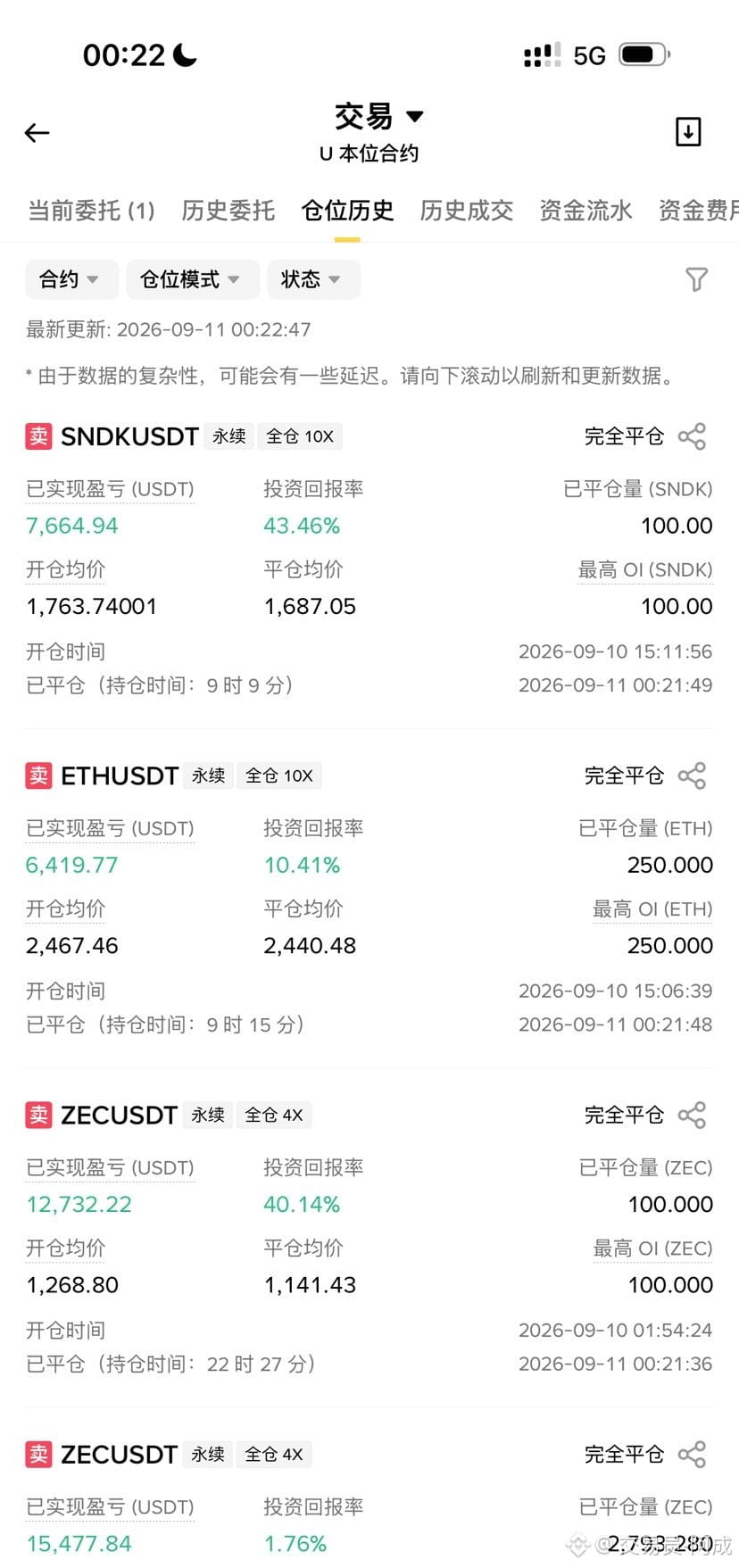
316
·
--
We may soon enter the most boring phase of the market—so boring that most people can’t stand it.
First, let’s use 2023 as a reference: back then, BTC formed a re-accumulation range, spent more than seven months grinding, and then broke out aggressively to set new highs. If this round mirrors the 2023 fractal, it would mean: another corrective dip, followed immediately by a decisive push higher, and only then would the next re-accumulation phase begin.
But there’s a key variable—the cycle is compressing, and it’s getting shorter and shorter. So these moves may unfold faster, and they may not be as obvious as they were in the previous cycle. That corrective move might only deviate slightly from the current range’s lower bound, or sweep down through liquidity—then the real big expansion comes.
The path I expect is: a breakout that takes BTC into the mid-$90,000s, where the next larger re-accumulation range starts to form—roughly extending from $87,000 to $97,000.
Even if the cycle compresses, this range could last three to five months. If the correction and expansion don’t unfold until November or December, then in the first quarter of 2027, most of the time will be spent consolidating within this range.
So my attitude is: the big picture is still extremely bullish, but over the next few months, it may very well be far more boring than most people expect—that’s a very realistic possibility.
Boring doesn’t mean there’s no action—it just means the pace changes.
If you want to go deep into the crypto space but can’t find a clear direction, and you want a fast start to understand the information edge, come chat with me in my group—we’ll share first-hand intel and in-depth analysis!
We may soon enter the most boring phase of the market—so boring that most people can’t stand it.
First, let’s use 2023 as a reference: back then, BTC formed a re-accumulation range, spent more than seven months grinding, and then broke out aggressively to set new highs. If this round mirrors the 2023 fractal, it would mean: another corrective dip, followed immediately by a decisive push higher, and only then would the next re-accumulation phase begin.
But there’s a key variable—the cycle is compressing, and it’s getting shorter and shorter. So these moves may unfold faster, and they may not be as obvious as they were in the previous cycle. That corrective move might only deviate slightly from the current range’s lower bound, or sweep down through liquidity—then the real big expansion comes.
The path I expect is: a breakout that takes BTC into the mid-$90,000s, where the next larger re-accumulation range starts to form—roughly extending from $87,000 to $97,000.
Even if the cycle compresses, this range could last three to five months. If the correction and expansion don’t unfold until November or December, then in the first quarter of 2027, most of the time will be spent consolidating within this range.
So my attitude is: the big picture is still extremely bullish, but over the next few months, it may very well be far more boring than most people expect—that’s a very realistic possibility.
Boring doesn’t mean there’s no action—it just means the pace changes.
If you want to go deep into the crypto space but can’t find a clear direction, and you want a fast start to understand the information edge, come chat with me in my group—we’ll share first-hand intel and in-depth analysis!
First, let’s use 2023 as a reference: back then, BTC formed a re-accumulation range, spent more than seven months grinding, and then broke out aggressively to set new highs. If this round mirrors the 2023 fractal, it would mean: another corrective dip, followed immediately by a decisive push higher, and only then would the next re-accumulation phase begin.
But there’s a key variable—the cycle is compressing, and it’s getting shorter and shorter. So these moves may unfold faster, and they may not be as obvious as they were in the previous cycle. That corrective move might only deviate slightly from the current range’s lower bound, or sweep down through liquidity—then the real big expansion comes.
The path I expect is: a breakout that takes BTC into the mid-$90,000s, where the next larger re-accumulation range starts to form—roughly extending from $87,000 to $97,000.
Even if the cycle compresses, this range could last three to five months. If the correction and expansion don’t unfold until November or December, then in the first quarter of 2027, most of the time will be spent consolidating within this range.
So my attitude is: the big picture is still extremely bullish, but over the next few months, it may very well be far more boring than most people expect—that’s a very realistic possibility.
Boring doesn’t mean there’s no action—it just means the pace changes.
If you want to go deep into the crypto space but can’t find a clear direction, and you want a fast start to understand the information edge, come chat with me in my group—we’ll share first-hand intel and in-depth analysis!
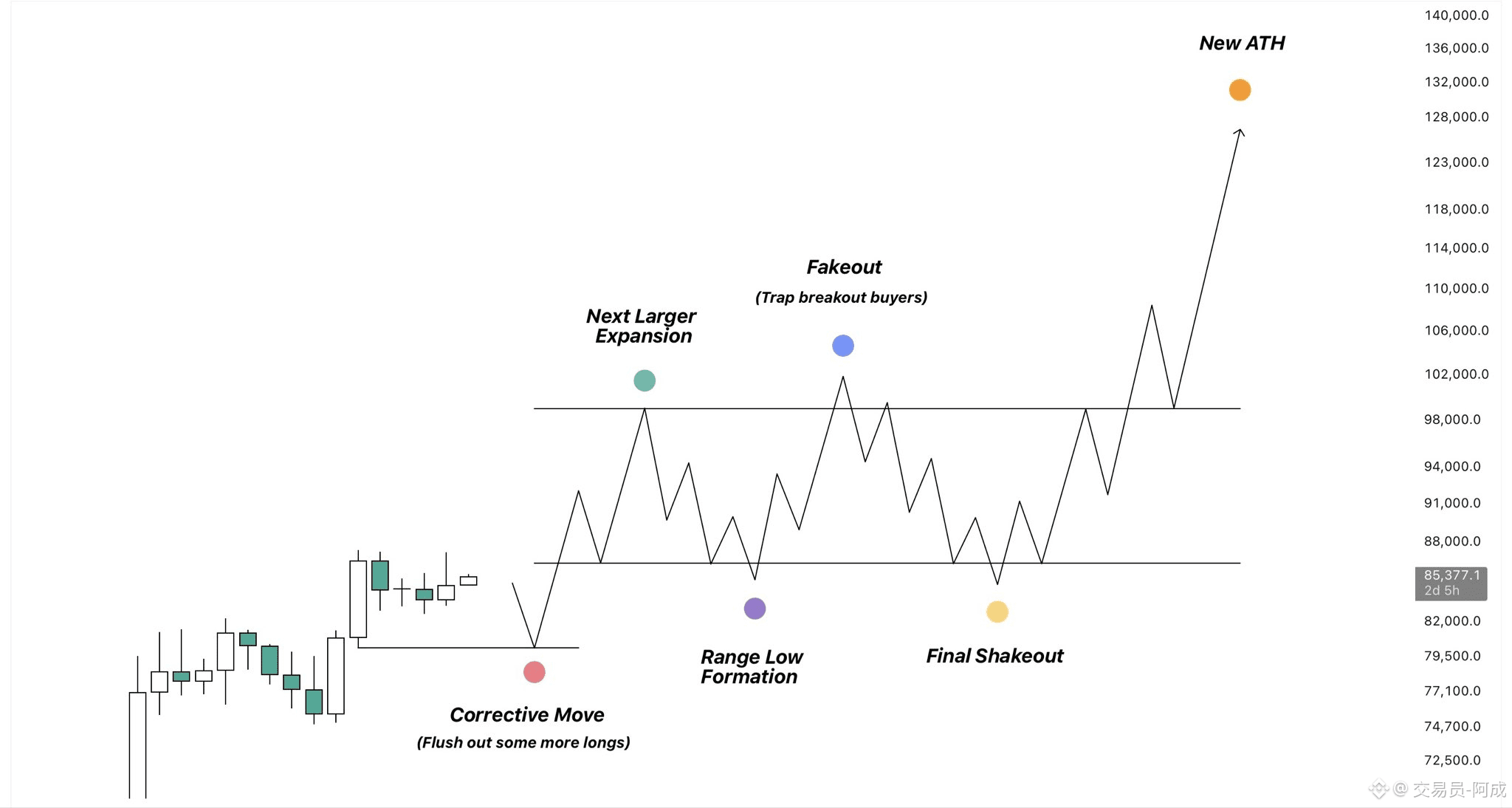
293
·
--
The testnet moved first—won’t the mainnet be far behind?
The NU7 upgrade for $ZEC was just activated on the testnet, at block height 4465026.
First, my take: this message has no direct impact on price, but it’s a positive boost for sentiment.
So what does testnet activation mean? In plain terms, new features get run through in a no-risk sandbox first. Once everything runs smoothly, then they go live on the mainnet.
What’s truly worth watching is when the mainnet catches up. That’s the timing when capital is actually willing to tell a story.
In this stage, don’t see the words “upgrade” and rush in. Between the testnet and the mainnet, there are who knows how many patches.
To be honest, $ZEC has had some activity lately anyway. This kind of news is just adding fuel to the fire—it’s not the match that lights it.
My stance: slightly positive, but I won’t chase. Wait until the mainnet timeline is out.
The straight truth is: testnet activation is for developers, not for the trading screen. #Zcash现货ETF首现周度净流出9360万美元
The testnet moved first—won’t the mainnet be far behind?
The NU7 upgrade for $ZEC was just activated on the testnet, at block height 4465026.
First, my take: this message has no direct impact on price, but it’s a positive boost for sentiment.
So what does testnet activation mean? In plain terms, new features get run through in a no-risk sandbox first. Once everything runs smoothly, then they go live on the mainnet.
What’s truly worth watching is when the mainnet catches up. That’s the timing when capital is actually willing to tell a story.
In this stage, don’t see the words “upgrade” and rush in. Between the testnet and the mainnet, there are who knows how many patches.
To be honest, $ZEC has had some activity lately anyway. This kind of news is just adding fuel to the fire—it’s not the match that lights it.
My stance: slightly positive, but I won’t chase. Wait until the mainnet timeline is out.
The straight truth is: testnet activation is for developers, not for the trading screen. #Zcash现货ETF首现周度净流出9360万美元
The NU7 upgrade for $ZEC was just activated on the testnet, at block height 4465026.
First, my take: this message has no direct impact on price, but it’s a positive boost for sentiment.
So what does testnet activation mean? In plain terms, new features get run through in a no-risk sandbox first. Once everything runs smoothly, then they go live on the mainnet.
What’s truly worth watching is when the mainnet catches up. That’s the timing when capital is actually willing to tell a story.
In this stage, don’t see the words “upgrade” and rush in. Between the testnet and the mainnet, there are who knows how many patches.
To be honest, $ZEC has had some activity lately anyway. This kind of news is just adding fuel to the fire—it’s not the match that lights it.
My stance: slightly positive, but I won’t chase. Wait until the mainnet timeline is out.
The straight truth is: testnet activation is for developers, not for the trading screen. #Zcash现货ETF首现周度净流出9360万美元
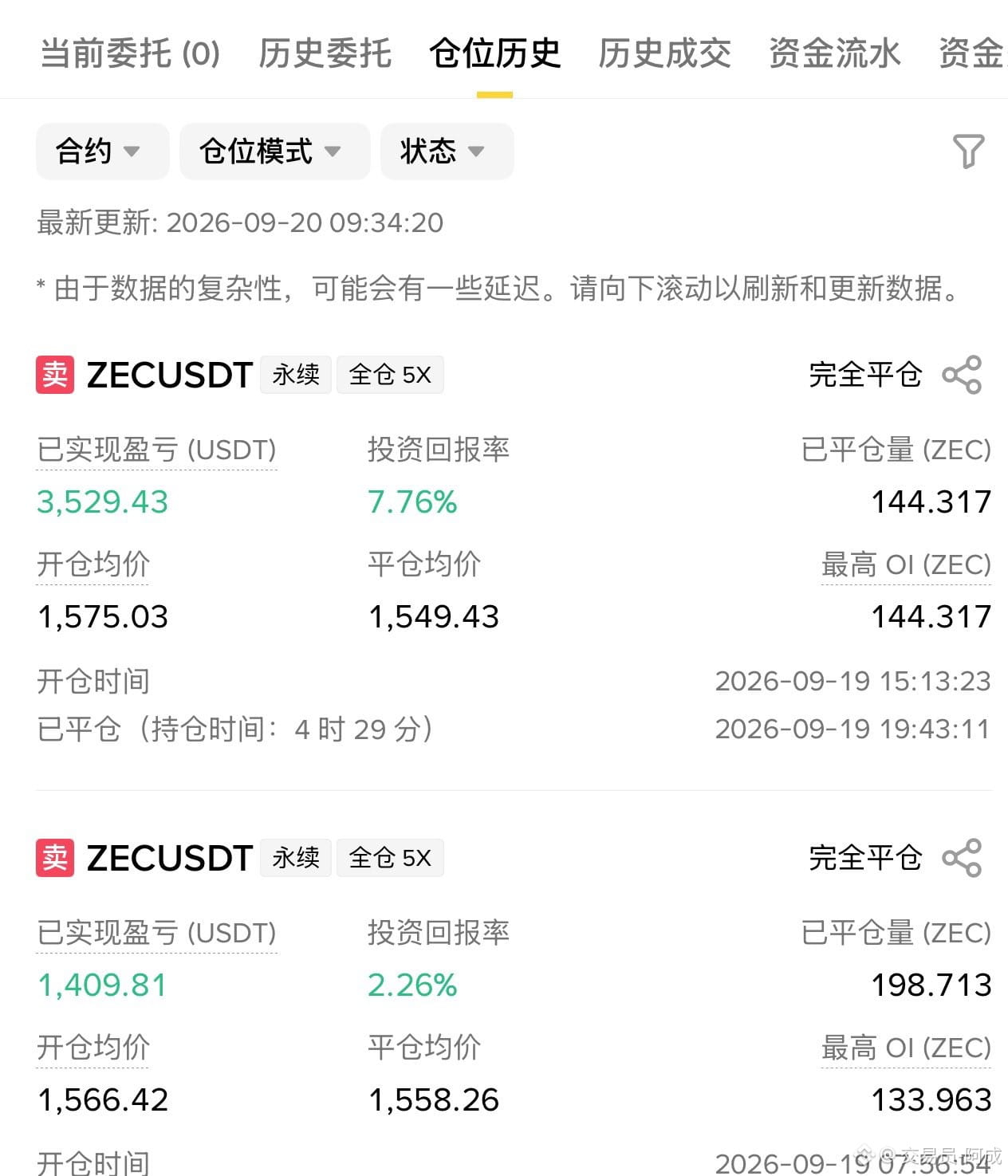
200
·
--
Why only trade three or four waves a year, yet you can keep doubling?
A few days ago, a fan who trades spot asked me: “You don’t really stare at the charts on a regular basis. You only make a few moves a year—how is it that you always manage to double?” I put down my tea cup and told him a few honest things.
First, zoom out to the timeframe. Any price fluctuation below the daily chart is noise in my eyes—hourly charts are only for structure. What truly determines whether I place a trade or not is the daily chart, and even more so the weekly.
Many people open a dozen trades a day and think they’re working hard, but that’s not trading—it’s doing labor for the exchange.
Keep your trial positions light, like throwing a stone to test the road. I never go in all-in. I first use extremely small size to see how the market reacts. After the weekly close confirms the direction, I add gradually, step by step. I set my stop loss outside the opposite low of the weekly candle—wide enough that the market can breathe freely, wide enough that I can sleep.
From opening to closing, the shortest holding period is at least one month. During this month, I don’t watch the charts. After each day’s close, I spend three minutes checking: where are we now? Is the trend still intact? Once I have that, I’m good. The rest of the time is for reading and working out.
Why do so many people fail to hold? Because they only see unrealized profit and loss. When it goes up a little, they want to run. When it dips a bit, they get scared. In my eyes, there’s only one thing: the life or death of the trend. If the structure hasn’t broken, then that trade is simply treated as if it never existed.
In ten small stop-losses, nine times you’re just doing nothing. But the tenth time will bring all the costs back at once—and it even comes with an entire year’s living expenses as a bonus. Big money is given by the market, not “pointed out” by your fingers.
Afraid of being tense? Start with 0.1 lot. If you feel panicky the moment you open a position, it means your size is too heavy—reduce it to the point where you can sleep. As your trading frequency drops, leverage naturally rises. No matter how sharp the system is, it can’t withstand high-frequency erosion.
Catch three or four waves a year. Each wave targets 50%. After compounding, that’s how you end up doubling.
Don’t fear that there are few opportunities. In the crypto market, volatility is never in short supply. What you should fear is that you treat every fluctuation as “a real market,” and end up messing with yourself.
Cheng Ge usually plans trades using mainstream coin futures and popular altcoin contracts. Spot short-term trading is mainly for him as well—he’s good at catching golden dogs and digging for 100x coins. If you want to recover your funds and turn things around, come to my chat room—I’ll help get you back on solid ground. $GTC
$PUMPBTC
$BTW
Why only trade three or four waves a year, yet you can keep doubling?
A few days ago, a fan who trades spot asked me: “You don’t really stare at the charts on a regular basis. You only make a few moves a year—how is it that you always manage to double?” I put down my tea cup and told him a few honest things.
First, zoom out to the timeframe. Any price fluctuation below the daily chart is noise in my eyes—hourly charts are only for structure. What truly determines whether I place a trade or not is the daily chart, and even more so the weekly.
Many people open a dozen trades a day and think they’re working hard, but that’s not trading—it’s doing labor for the exchange.
Keep your trial positions light, like throwing a stone to test the road. I never go in all-in. I first use extremely small size to see how the market reacts. After the weekly close confirms the direction, I add gradually, step by step. I set my stop loss outside the opposite low of the weekly candle—wide enough that the market can breathe freely, wide enough that I can sleep.
From opening to closing, the shortest holding period is at least one month. During this month, I don’t watch the charts. After each day’s close, I spend three minutes checking: where are we now? Is the trend still intact? Once I have that, I’m good. The rest of the time is for reading and working out.
Why do so many people fail to hold? Because they only see unrealized profit and loss. When it goes up a little, they want to run. When it dips a bit, they get scared. In my eyes, there’s only one thing: the life or death of the trend. If the structure hasn’t broken, then that trade is simply treated as if it never existed.
In ten small stop-losses, nine times you’re just doing nothing. But the tenth time will bring all the costs back at once—and it even comes with an entire year’s living expenses as a bonus. Big money is given by the market, not “pointed out” by your fingers.
Afraid of being tense? Start with 0.1 lot. If you feel panicky the moment you open a position, it means your size is too heavy—reduce it to the point where you can sleep. As your trading frequency drops, leverage naturally rises. No matter how sharp the system is, it can’t withstand high-frequency erosion.
Catch three or four waves a year. Each wave targets 50%. After compounding, that’s how you end up doubling.
Don’t fear that there are few opportunities. In the crypto market, volatility is never in short supply. What you should fear is that you treat every fluctuation as “a real market,” and end up messing with yourself.
Cheng Ge usually plans trades using mainstream coin futures and popular altcoin contracts. Spot short-term trading is mainly for him as well—he’s good at catching golden dogs and digging for 100x coins. If you want to recover your funds and turn things around, come to my chat room—I’ll help get you back on solid ground. $GTC
$PUMPBTC
$BTW
A few days ago, a fan who trades spot asked me: “You don’t really stare at the charts on a regular basis. You only make a few moves a year—how is it that you always manage to double?” I put down my tea cup and told him a few honest things.
First, zoom out to the timeframe. Any price fluctuation below the daily chart is noise in my eyes—hourly charts are only for structure. What truly determines whether I place a trade or not is the daily chart, and even more so the weekly.
Many people open a dozen trades a day and think they’re working hard, but that’s not trading—it’s doing labor for the exchange.
Keep your trial positions light, like throwing a stone to test the road. I never go in all-in. I first use extremely small size to see how the market reacts. After the weekly close confirms the direction, I add gradually, step by step. I set my stop loss outside the opposite low of the weekly candle—wide enough that the market can breathe freely, wide enough that I can sleep.
From opening to closing, the shortest holding period is at least one month. During this month, I don’t watch the charts. After each day’s close, I spend three minutes checking: where are we now? Is the trend still intact? Once I have that, I’m good. The rest of the time is for reading and working out.
Why do so many people fail to hold? Because they only see unrealized profit and loss. When it goes up a little, they want to run. When it dips a bit, they get scared. In my eyes, there’s only one thing: the life or death of the trend. If the structure hasn’t broken, then that trade is simply treated as if it never existed.
In ten small stop-losses, nine times you’re just doing nothing. But the tenth time will bring all the costs back at once—and it even comes with an entire year’s living expenses as a bonus. Big money is given by the market, not “pointed out” by your fingers.
Afraid of being tense? Start with 0.1 lot. If you feel panicky the moment you open a position, it means your size is too heavy—reduce it to the point where you can sleep. As your trading frequency drops, leverage naturally rises. No matter how sharp the system is, it can’t withstand high-frequency erosion.
Catch three or four waves a year. Each wave targets 50%. After compounding, that’s how you end up doubling.
Don’t fear that there are few opportunities. In the crypto market, volatility is never in short supply. What you should fear is that you treat every fluctuation as “a real market,” and end up messing with yourself.
Cheng Ge usually plans trades using mainstream coin futures and popular altcoin contracts. Spot short-term trading is mainly for him as well—he’s good at catching golden dogs and digging for 100x coins. If you want to recover your funds and turn things around, come to my chat room—I’ll help get you back on solid ground. $GTC
$PUMPBTC
$BTW
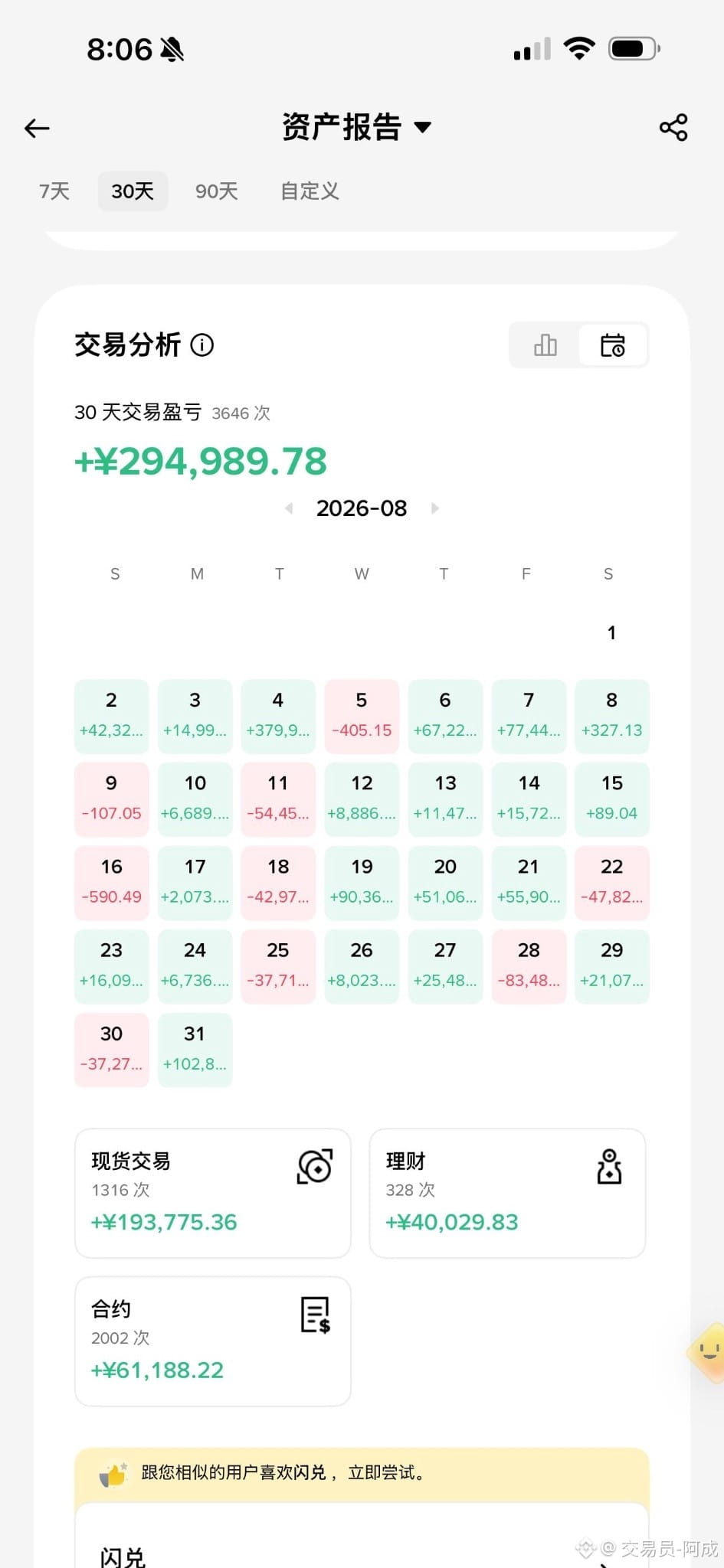
509
Log in to explore more content
Join global crypto users on Binance Square
⚡️ Get latest and useful information about crypto.
💬 Trusted by the world’s largest crypto exchange.
👍 Discover real insights from verified creators.
Email / Phone number