
KuProfit
74 Posts

KuProfit
Report
Block User
11 Following
27 Followers
113 Liked
Posts
·
--
You guessed the market direction. Why can you still lose money?
It seems simple logic:
You think an asset will rise → you buy → it rises → you earn.
But a correct forecast does not guarantee a profitable trade.
Imagine this:
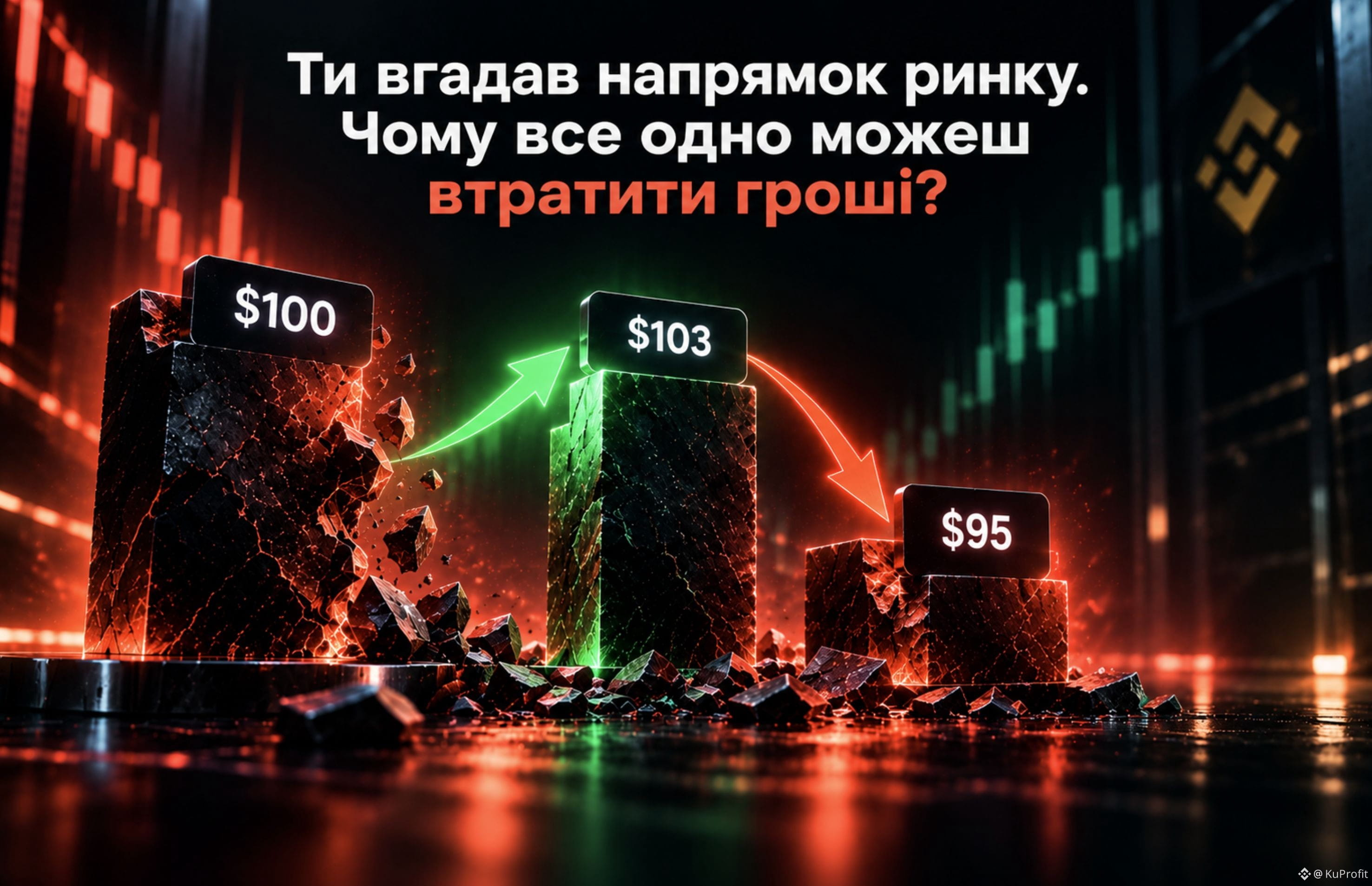
You bought an asset for $100, expecting it to rise to $110.
The asset really started to grow—but only to $103.
Then it reversed and fell to $95.
You identified the direction correctly, but the move wasn’t enough for your trade to deliver the result you needed.
There’s another nuance—time.
You may correctly predict that an asset will increase, but if it does so after you’ve already closed your position or after the instrument’s expiration, the forecast won’t help you.
That’s why there’s a difference between:
“I correctly predicted where the price would go”
and
“My trade made money.”
The outcome depends not only on direction, but also on:
the size of the move;
entry and exit timing;
position size;
the instrument’s terms;
commissions and other costs.
Guessing the direction is only part of the trade.
You can be right about the market, but wrong in how you set up the position.
#Trading #RiskManagement
You guessed the market direction. Why can you still lose money?
It seems simple logic:
You think an asset will rise → you buy → it rises → you earn.
But a correct forecast does not guarantee a profitable trade.
Imagine this:
You bought an asset for $100, expecting it to rise to $110.
The asset really started to grow—but only to $103.
Then it reversed and fell to $95.
You identified the direction correctly, but the move wasn’t enough for your trade to deliver the result you needed.
There’s another nuance—time.
You may correctly predict that an asset will increase, but if it does so after you’ve already closed your position or after the instrument’s expiration, the forecast won’t help you.
That’s why there’s a difference between:
“I correctly predicted where the price would go”
and
“My trade made money.”
The outcome depends not only on direction, but also on:
the size of the move;
entry and exit timing;
position size;
the instrument’s terms;
commissions and other costs.
Guessing the direction is only part of the trade.
You can be right about the market, but wrong in how you set up the position.
#Trading #RiskManagement
It seems simple logic:
You think an asset will rise → you buy → it rises → you earn.
But a correct forecast does not guarantee a profitable trade.
Imagine this:
You bought an asset for $100, expecting it to rise to $110.
The asset really started to grow—but only to $103.
Then it reversed and fell to $95.
You identified the direction correctly, but the move wasn’t enough for your trade to deliver the result you needed.
There’s another nuance—time.
You may correctly predict that an asset will increase, but if it does so after you’ve already closed your position or after the instrument’s expiration, the forecast won’t help you.
That’s why there’s a difference between:
“I correctly predicted where the price would go”
and
“My trade made money.”
The outcome depends not only on direction, but also on:
the size of the move;
entry and exit timing;
position size;
the instrument’s terms;
commissions and other costs.
Guessing the direction is only part of the trade.
You can be right about the market, but wrong in how you set up the position.
#Trading #RiskManagement
131
·
--
What’s better: buy an asset right away or split the purchase into several parts?
You have $1,000 and you decided to buy an asset.
There are two options:
$1,000 at once
or
$200 now + $200 later + another $200, and so on.
📈 If the asset starts to grow right away, buying the entire amount at the start gives you full exposure to the move.
📉 If the price drops, a split purchase leaves part of your capital available for the next entries at a lower price.
But it’s important:
splitting the purchase doesn’t automatically make the investment profitable.
You’re only changing the way you enter the position.
All at once → more exposure right now.
In parts → less exposure right now, but more capital for the next buys.
So the question isn’t which approach is always better.
The question is different:
Do you want to get full exposure immediately, or keep capital for the next entry points?
That’s the main difference between the two approaches.
#Trading #Investing
What’s better: buy an asset right away or split the purchase into several parts?
You have $1,000 and you decided to buy an asset.
There are two options:
$1,000 at once
or
$200 now + $200 later + another $200, and so on.
📈 If the asset starts to grow right away, buying the entire amount at the start gives you full exposure to the move.
📉 If the price drops, a split purchase leaves part of your capital available for the next entries at a lower price.
But it’s important:
splitting the purchase doesn’t automatically make the investment profitable.
You’re only changing the way you enter the position.
All at once → more exposure right now.
In parts → less exposure right now, but more capital for the next buys.
So the question isn’t which approach is always better.
The question is different:
Do you want to get full exposure immediately, or keep capital for the next entry points?
That’s the main difference between the two approaches.
#Trading #Investing
You have $1,000 and you decided to buy an asset.
There are two options:
$1,000 at once
or
$200 now + $200 later + another $200, and so on.
📈 If the asset starts to grow right away, buying the entire amount at the start gives you full exposure to the move.
📉 If the price drops, a split purchase leaves part of your capital available for the next entries at a lower price.
But it’s important:
splitting the purchase doesn’t automatically make the investment profitable.
You’re only changing the way you enter the position.
All at once → more exposure right now.
In parts → less exposure right now, but more capital for the next buys.
So the question isn’t which approach is always better.
The question is different:
Do you want to get full exposure immediately, or keep capital for the next entry points?
That’s the main difference between the two approaches.
#Trading #Investing

197
·
--
If a stock drops by 20%, how much does it need to rise to get back?
At first glance, the answer seems to be 20%.
But no.
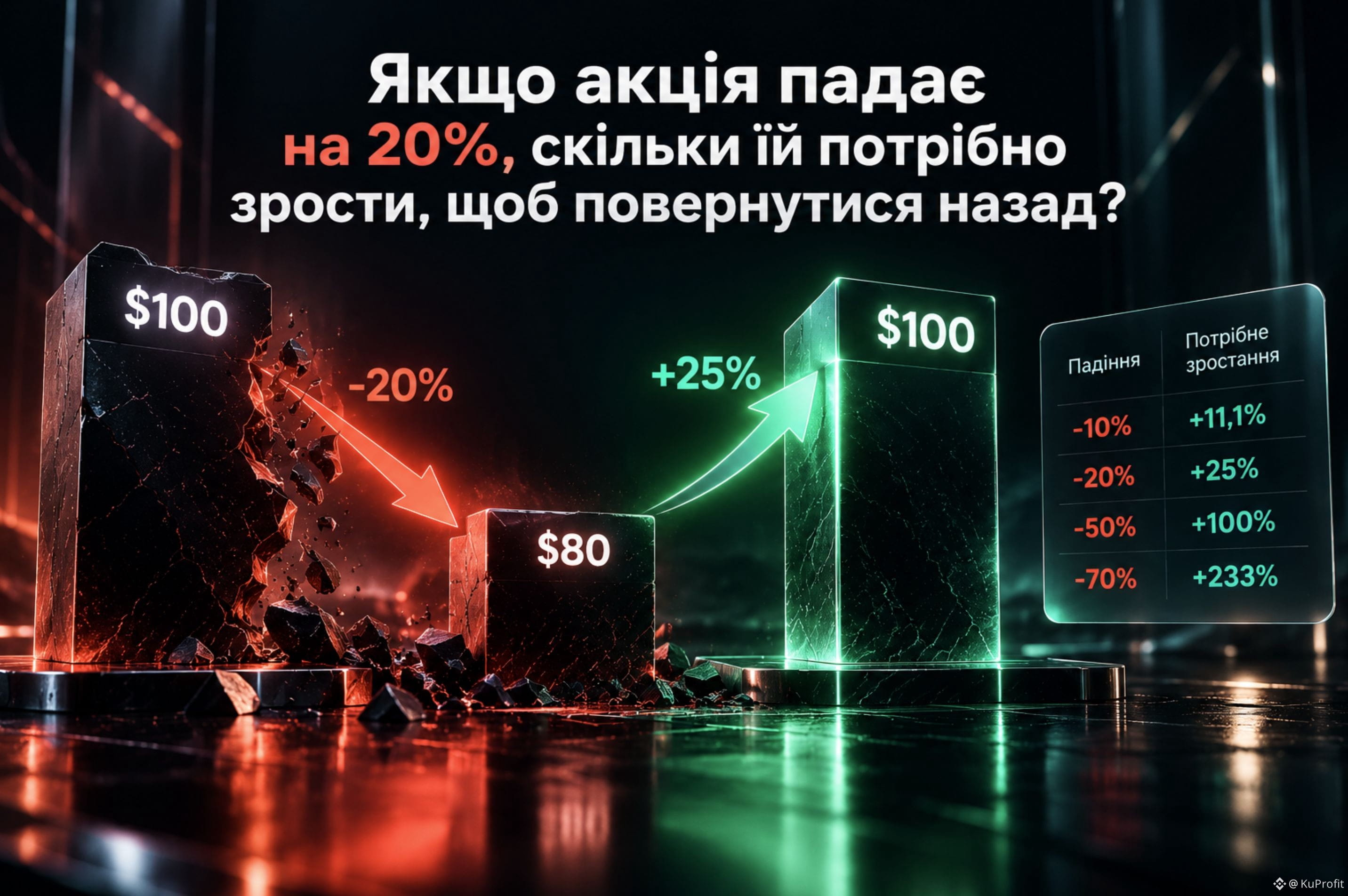
Let’s imagine the stock cost $100.
It fell by 20% → it’s left with $80.
To get from $80 back to $100, it needs to increase by 25%.
So:
$100 → -20% → $80 → +25% → $100
Why is that?
Because the percentage is calculated based on the new, lower value.
And the more an asset drops, the more it needs to rise to recover:
-10% → +11.1%
-20% → +25%
-50% → +100%
-70% → +233%
That’s why a 50% drop is not a situation you can fix with an ordinary 50% rise.
In my view, this is one of the most important things to remember when assessing risk:
percentages down and up are not symmetrical.
#Trading #Investing
If a stock drops by 20%, how much does it need to rise to get back?
At first glance, the answer seems to be 20%.
But no.
Let’s imagine the stock cost $100.
It fell by 20% → it’s left with $80.
To get from $80 back to $100, it needs to increase by 25%.
So:
$100 → -20% → $80 → +25% → $100
Why is that?
Because the percentage is calculated based on the new, lower value.
And the more an asset drops, the more it needs to rise to recover:
-10% → +11.1%
-20% → +25%
-50% → +100%
-70% → +233%
That’s why a 50% drop is not a situation you can fix with an ordinary 50% rise.
In my view, this is one of the most important things to remember when assessing risk:
percentages down and up are not symmetrical.
#Trading #Investing
At first glance, the answer seems to be 20%.
But no.
Let’s imagine the stock cost $100.
It fell by 20% → it’s left with $80.
To get from $80 back to $100, it needs to increase by 25%.
So:
$100 → -20% → $80 → +25% → $100
Why is that?
Because the percentage is calculated based on the new, lower value.
And the more an asset drops, the more it needs to rise to recover:
-10% → +11.1%
-20% → +25%
-50% → +100%
-70% → +233%
That’s why a 50% drop is not a situation you can fix with an ordinary 50% rise.
In my view, this is one of the most important things to remember when assessing risk:
percentages down and up are not symmetrical.
#Trading #Investing
86
·
--
Regular stock purchases—does it really mean “buy cheaper”?
Binance has recently added Stock Recurring Buy, a feature that lets you automatically buy selected stocks and ETFs according to a set schedule.
At first glance, it’s simple:
choose an asset → set a schedule → the system buys it automatically.
But there’s a point that’s easy to miss.
Binance warns that the price during each automatic execution may differ from the price at the time the plan was created.
So if today I set up an AAPL purchase for $100 every Monday, that doesn’t mean that next Monday I’ll buy it at today’s price.
I’ll buy for the scheduled amount, but at the market price at the moment of execution.
And that’s where the difference between:
“ I invest regularly”
and
“ I buy regularly at a good price”
becomes interesting to me.
The first Recurring Buy really can automate.
The second—nobody guarantees it.
The order executes automatically without any additional confirmation, so the price for the next purchase can change.
That’s why I don’t see Recurring Buy as a way to guess the right price, but as a way to avoid having to decide every time:
“Buy now or wait?”
Automation removes some of the manual work.
But it doesn’t remove market risk.
#TradFi
Regular stock purchases—does it really mean “buy cheaper”?
Binance has recently added Stock Recurring Buy, a feature that lets you automatically buy selected stocks and ETFs according to a set schedule.
At first glance, it’s simple:
choose an asset → set a schedule → the system buys it automatically.
But there’s a point that’s easy to miss.
Binance warns that the price during each automatic execution may differ from the price at the time the plan was created.
So if today I set up an AAPL purchase for $100 every Monday, that doesn’t mean that next Monday I’ll buy it at today’s price.
I’ll buy for the scheduled amount, but at the market price at the moment of execution.
And that’s where the difference between:
“ I invest regularly”
and
“ I buy regularly at a good price”
becomes interesting to me.
The first Recurring Buy really can automate.
The second—nobody guarantees it.
The order executes automatically without any additional confirmation, so the price for the next purchase can change.
That’s why I don’t see Recurring Buy as a way to guess the right price, but as a way to avoid having to decide every time:
“Buy now or wait?”
Automation removes some of the manual work.
But it doesn’t remove market risk.
#TradFi
Binance has recently added Stock Recurring Buy, a feature that lets you automatically buy selected stocks and ETFs according to a set schedule.
At first glance, it’s simple:
choose an asset → set a schedule → the system buys it automatically.
But there’s a point that’s easy to miss.
Binance warns that the price during each automatic execution may differ from the price at the time the plan was created.
So if today I set up an AAPL purchase for $100 every Monday, that doesn’t mean that next Monday I’ll buy it at today’s price.
I’ll buy for the scheduled amount, but at the market price at the moment of execution.
And that’s where the difference between:
“ I invest regularly”
and
“ I buy regularly at a good price”
becomes interesting to me.
The first Recurring Buy really can automate.
The second—nobody guarantees it.
The order executes automatically without any additional confirmation, so the price for the next purchase can change.
That’s why I don’t see Recurring Buy as a way to guess the right price, but as a way to avoid having to decide every time:
“Buy now or wait?”
Automation removes some of the manual work.
But it doesn’t remove market risk.
#TradFi

1
312
·
--
Why can two contracts for one stock have different price mechanics?
I noticed one detail in TradFi Perpetuals.
Binance offers contracts in formats USDT-Priced and Quanto.
At first glance, if the underlying asset is the same, the difference is only in the name.
But the mechanics are different.
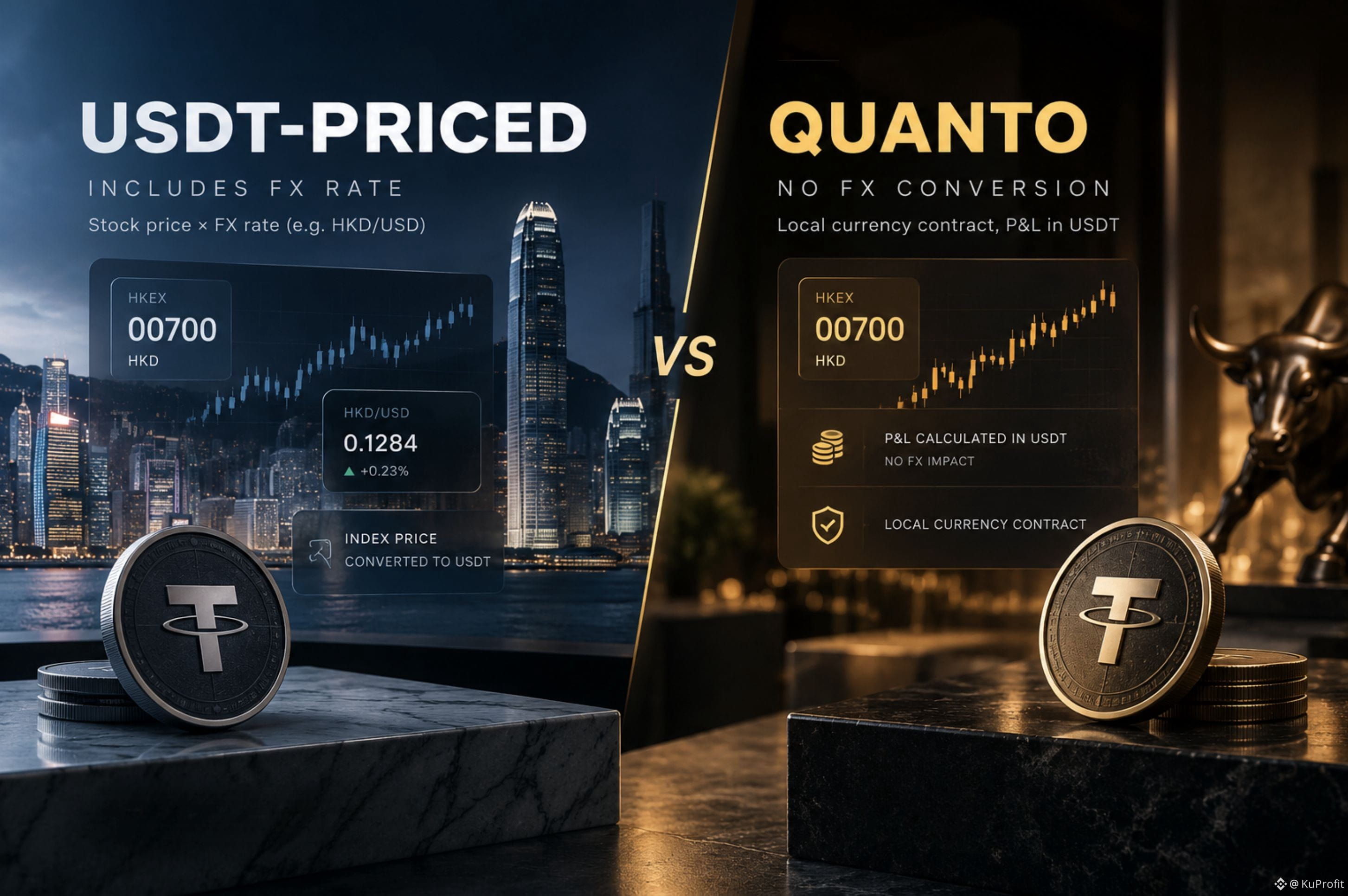
In an USDT-Priced contract, the index price is formed from the stock price on its main exchange, taking the exchange rate into account.
For a Hong Kong stock, that means: price on HKEX + HKD/USD exchange rate.
With Quanto, the approach is different: the contract is denominated in the local currency, but margin and P&L are calculated in USDT without conversion using the FX rate.
And this is where an interesting difference arises.
If the stock itself hasn’t changed, but HKD/USD moves, the result for a USDT-Priced contract can differ from Quanto.
So two contracts may track the same underlying, yet have different sensitivity to the currency factor.
For me, this is a good example of why when choosing a derivative, it’s not enough to look only at the underlying asset.
You also need to look at how the price is formed and how P&L is calculated.
Sometimes an important part of the risk is not in the asset itself, but in the contract’s mechanics.
#TradFi
Why can two contracts for one stock have different price mechanics?
I noticed one detail in TradFi Perpetuals.
Binance offers contracts in formats USDT-Priced and Quanto.
At first glance, if the underlying asset is the same, the difference is only in the name.
But the mechanics are different.
In an USDT-Priced contract, the index price is formed from the stock price on its main exchange, taking the exchange rate into account.
For a Hong Kong stock, that means: price on HKEX + HKD/USD exchange rate.
With Quanto, the approach is different: the contract is denominated in the local currency, but margin and P&L are calculated in USDT without conversion using the FX rate.
And this is where an interesting difference arises.
If the stock itself hasn’t changed, but HKD/USD moves, the result for a USDT-Priced contract can differ from Quanto.
So two contracts may track the same underlying, yet have different sensitivity to the currency factor.
For me, this is a good example of why when choosing a derivative, it’s not enough to look only at the underlying asset.
You also need to look at how the price is formed and how P&L is calculated.
Sometimes an important part of the risk is not in the asset itself, but in the contract’s mechanics.
#TradFi
I noticed one detail in TradFi Perpetuals.
Binance offers contracts in formats USDT-Priced and Quanto.
At first glance, if the underlying asset is the same, the difference is only in the name.
But the mechanics are different.
In an USDT-Priced contract, the index price is formed from the stock price on its main exchange, taking the exchange rate into account.
For a Hong Kong stock, that means: price on HKEX + HKD/USD exchange rate.
With Quanto, the approach is different: the contract is denominated in the local currency, but margin and P&L are calculated in USDT without conversion using the FX rate.
And this is where an interesting difference arises.
If the stock itself hasn’t changed, but HKD/USD moves, the result for a USDT-Priced contract can differ from Quanto.
So two contracts may track the same underlying, yet have different sensitivity to the currency factor.
For me, this is a good example of why when choosing a derivative, it’s not enough to look only at the underlying asset.
You also need to look at how the price is formed and how P&L is calculated.
Sometimes an important part of the risk is not in the asset itself, but in the contract’s mechanics.
#TradFi
69
·
--
If Stock Perpetuals trade 24/7, why are Stock Options only during regular hours?
I’m used to the fact that on Binance, traditional assets can be found in an entirely different trading model.
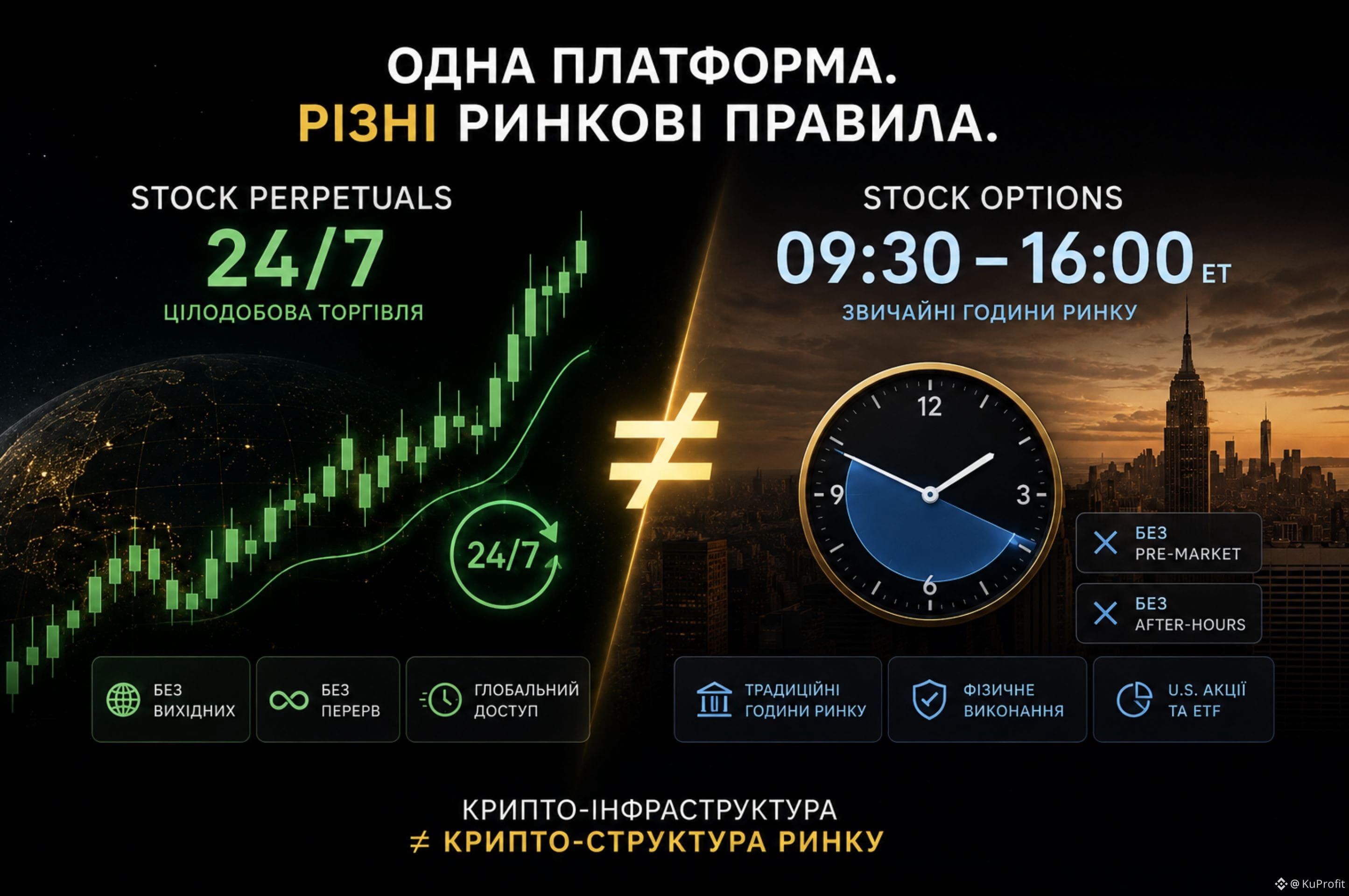
For example, Stock Perpetuals trade 24/7.
So I became curious about what happens to Stock Options.
Binance launches options on U.S. stocks and ETFs, but they don’t move to a 24/7 mode. For most of these options, trading happens during regular U.S. market hours, without pre-market and after-hours.
If two TradFi instruments are available on the same platform, why can one be traded 24/7 while the other is still tied to traditional market hours?
For me, this is a good example of how crypto infrastructure ≠ crypto market structure.
Moving a financial instrument to a new environment doesn’t automatically mean all its operating rules change.
The logic of the financial instrument itself may still remain partly traditional.
So now I’m interested in looking at the development of TradFi on Binance a little differently:
what exactly changes when traditional financial instruments move into a crypto-native environment—and what still remains tied to the old market model?
#TradFi #StockOptions
If Stock Perpetuals trade 24/7, why are Stock Options only during regular hours?
I’m used to the fact that on Binance, traditional assets can be found in an entirely different trading model.
For example, Stock Perpetuals trade 24/7.
So I became curious about what happens to Stock Options.
Binance launches options on U.S. stocks and ETFs, but they don’t move to a 24/7 mode. For most of these options, trading happens during regular U.S. market hours, without pre-market and after-hours.
If two TradFi instruments are available on the same platform, why can one be traded 24/7 while the other is still tied to traditional market hours?
For me, this is a good example of how crypto infrastructure ≠ crypto market structure.
Moving a financial instrument to a new environment doesn’t automatically mean all its operating rules change.
The logic of the financial instrument itself may still remain partly traditional.
So now I’m interested in looking at the development of TradFi on Binance a little differently:
what exactly changes when traditional financial instruments move into a crypto-native environment—and what still remains tied to the old market model?
#TradFi #StockOptions
I’m used to the fact that on Binance, traditional assets can be found in an entirely different trading model.
For example, Stock Perpetuals trade 24/7.
So I became curious about what happens to Stock Options.
Binance launches options on U.S. stocks and ETFs, but they don’t move to a 24/7 mode. For most of these options, trading happens during regular U.S. market hours, without pre-market and after-hours.
If two TradFi instruments are available on the same platform, why can one be traded 24/7 while the other is still tied to traditional market hours?
For me, this is a good example of how crypto infrastructure ≠ crypto market structure.
Moving a financial instrument to a new environment doesn’t automatically mean all its operating rules change.
The logic of the financial instrument itself may still remain partly traditional.
So now I’m interested in looking at the development of TradFi on Binance a little differently:
what exactly changes when traditional financial instruments move into a crypto-native environment—and what still remains tied to the old market model?
#TradFi #StockOptions
130
·
--
A penalty usually sounds like a cost of failure.
But if part of that cost goes to the actor resolving the position, is it really just a penalty?
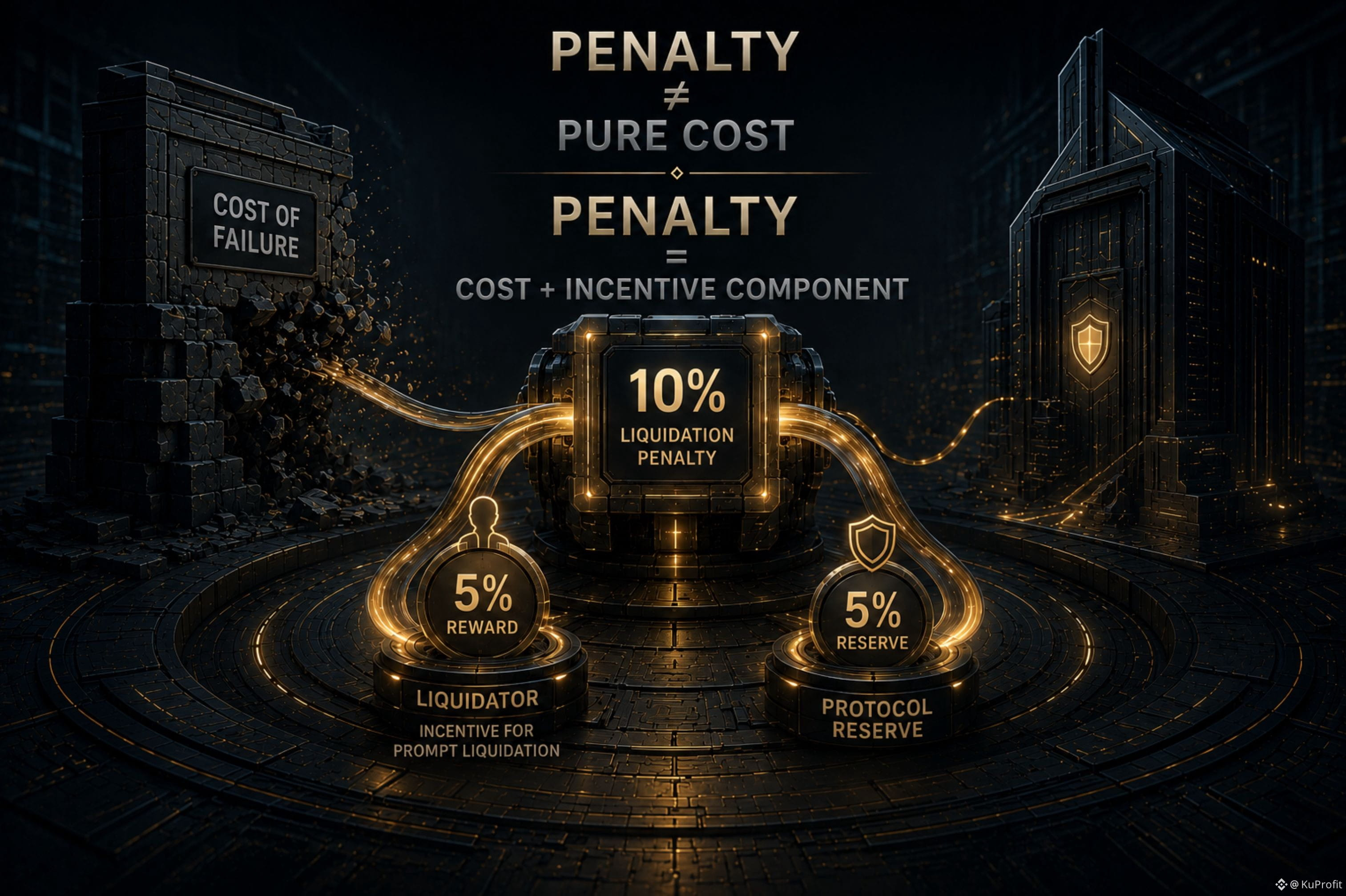
In TermMax, liquidation applies a 10% penalty based on the liquidated debt value. That penalty is charged against the borrower’s collateral.
But where it goes is the more interesting part.
5% is allocated to the liquidator as a reward.
5% goes to the protocol reserve.
TermMax describes the liquidator reward as an incentive for prompt liquidation.
So the penalty is doing more than assigning a cost to a failed position.
Part of it creates an economic incentive for the actor performing the liquidation.
That changes the mental model:
liquidation penalty ≠ purely punitive cost.
It is also part of the incentive architecture behind liquidation.
So when looking at a liquidation penalty, maybe the better question isn't only how much does it cost?
It’s:
Who does that cost incentivize — and what role does it play in the liquidation process?
#termmax @termmax
A penalty usually sounds like a cost of failure.
But if part of that cost goes to the actor resolving the position, is it really just a penalty?
In TermMax, liquidation applies a 10% penalty based on the liquidated debt value. That penalty is charged against the borrower’s collateral.
But where it goes is the more interesting part.
5% is allocated to the liquidator as a reward.
5% goes to the protocol reserve.
TermMax describes the liquidator reward as an incentive for prompt liquidation.
So the penalty is doing more than assigning a cost to a failed position.
Part of it creates an economic incentive for the actor performing the liquidation.
That changes the mental model:
liquidation penalty ≠ purely punitive cost.
It is also part of the incentive architecture behind liquidation.
So when looking at a liquidation penalty, maybe the better question isn't only how much does it cost?
It’s:
Who does that cost incentivize — and what role does it play in the liquidation process?
#termmax @TermMax
But if part of that cost goes to the actor resolving the position, is it really just a penalty?
In TermMax, liquidation applies a 10% penalty based on the liquidated debt value. That penalty is charged against the borrower’s collateral.
But where it goes is the more interesting part.
5% is allocated to the liquidator as a reward.
5% goes to the protocol reserve.
TermMax describes the liquidator reward as an incentive for prompt liquidation.
So the penalty is doing more than assigning a cost to a failed position.
Part of it creates an economic incentive for the actor performing the liquidation.
That changes the mental model:
liquidation penalty ≠ purely punitive cost.
It is also part of the incentive architecture behind liquidation.
So when looking at a liquidation penalty, maybe the better question isn't only how much does it cost?
It’s:
Who does that cost incentivize — and what role does it play in the liquidation process?
#termmax @TermMax
93
·
--
A TermMax position has two different LTV boundaries for a reason.
One limits how far the position can be opened.
The other marks where liquidation can begin.
It’s easy to treat LTV as one number that tells you how risky a position is.
But TermMax separates that into two thresholds:
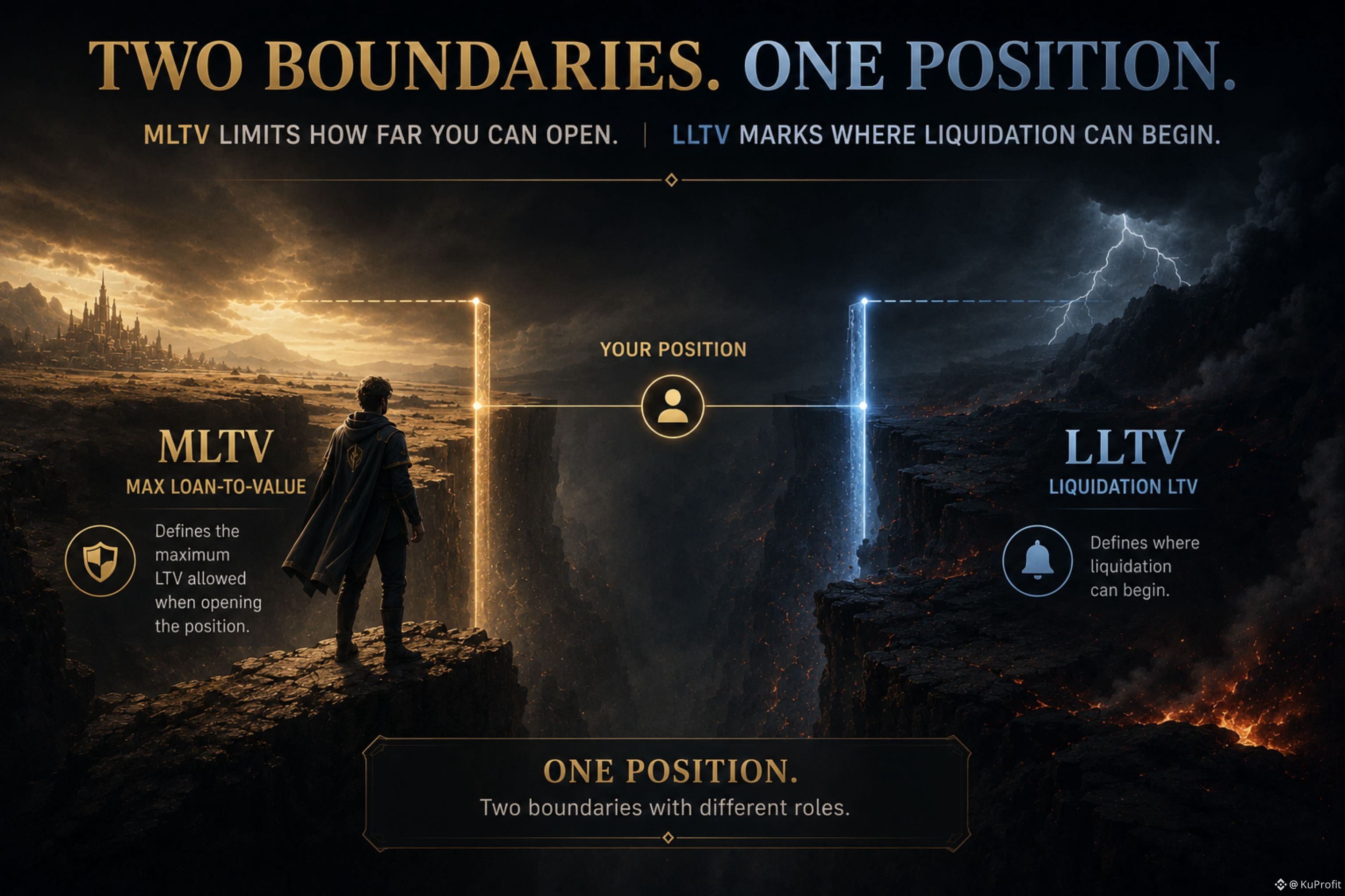
MLTV sets the maximum borrowing capacity for the initial position.
LLTV defines the LTV threshold at which liquidation can begin.
The gap between them is part of the protocol’s design: a buffer between the borrowing limit and the liquidation boundary.
That does not mean a guaranteed safety margin or a fixed percentage move the collateral can absorb.
The more useful way to look at it is this:
A position has one boundary for how far it can be opened and another for when liquidation can begin.
So when comparing TermMax markets, looking at “LTV” alone can hide an important distinction.
The better question is:
Where can the position start — and where does the liquidation boundary sit?
Two LTV numbers.
One position.
Different jobs.
#termmax @termmax
A TermMax position has two different LTV boundaries for a reason.
One limits how far the position can be opened.
The other marks where liquidation can begin.
It’s easy to treat LTV as one number that tells you how risky a position is.
But TermMax separates that into two thresholds:
MLTV sets the maximum borrowing capacity for the initial position.
LLTV defines the LTV threshold at which liquidation can begin.
The gap between them is part of the protocol’s design: a buffer between the borrowing limit and the liquidation boundary.
That does not mean a guaranteed safety margin or a fixed percentage move the collateral can absorb.
The more useful way to look at it is this:
A position has one boundary for how far it can be opened and another for when liquidation can begin.
So when comparing TermMax markets, looking at “LTV” alone can hide an important distinction.
The better question is:
Where can the position start — and where does the liquidation boundary sit?
Two LTV numbers.
One position.
Different jobs.
#termmax @TermMax
One limits how far the position can be opened.
The other marks where liquidation can begin.
It’s easy to treat LTV as one number that tells you how risky a position is.
But TermMax separates that into two thresholds:
MLTV sets the maximum borrowing capacity for the initial position.
LLTV defines the LTV threshold at which liquidation can begin.
The gap between them is part of the protocol’s design: a buffer between the borrowing limit and the liquidation boundary.
That does not mean a guaranteed safety margin or a fixed percentage move the collateral can absorb.
The more useful way to look at it is this:
A position has one boundary for how far it can be opened and another for when liquidation can begin.
So when comparing TermMax markets, looking at “LTV” alone can hide an important distinction.
The better question is:
Where can the position start — and where does the liquidation boundary sit?
Two LTV numbers.
One position.
Different jobs.
#termmax @TermMax
92
·
--
The interesting part may start when liquidation doesn’t fully resolve the loan.
The usual mental model is simple:
collateral → liquidation → debt resolved.
But that isn’t always the end of the process.
If a loan remains unpaid at maturity, it enters a two-hour liquidation window. If the loan is still unpaid or only partially liquidated after that window, Physical Delivery begins.
That changes the recovery path.
Instead of treating the remaining position as simply “the collateral,” TermMax creates a redemption pool containing underlying and collateral tokens.
FT holders can then redeem through that pool and receive a proportional distribution based on their FT share relative to the total outstanding FT in the market.
That doesn’t mean guaranteed recovery.
It also doesn’t mean the lender simply receives the collateral.
But this creates a different question: what happens to the remaining asset value when liquidation doesn’t fully resolve the position?
Physical Delivery doesn’t remove that risk. It defines the next resolution mechanism.
#termmax @termmax
The interesting part may start when liquidation doesn’t fully resolve the loan.
The usual mental model is simple:
collateral → liquidation → debt resolved.
But that isn’t always the end of the process.
If a loan remains unpaid at maturity, it enters a two-hour liquidation window. If the loan is still unpaid or only partially liquidated after that window, Physical Delivery begins.
That changes the recovery path.
Instead of treating the remaining position as simply “the collateral,” TermMax creates a redemption pool containing underlying and collateral tokens.
FT holders can then redeem through that pool and receive a proportional distribution based on their FT share relative to the total outstanding FT in the market.
That doesn’t mean guaranteed recovery.
It also doesn’t mean the lender simply receives the collateral.
But this creates a different question: what happens to the remaining asset value when liquidation doesn’t fully resolve the position?
Physical Delivery doesn’t remove that risk. It defines the next resolution mechanism.
#termmax @TermMax
The usual mental model is simple:
collateral → liquidation → debt resolved.
But that isn’t always the end of the process.
If a loan remains unpaid at maturity, it enters a two-hour liquidation window. If the loan is still unpaid or only partially liquidated after that window, Physical Delivery begins.
That changes the recovery path.
Instead of treating the remaining position as simply “the collateral,” TermMax creates a redemption pool containing underlying and collateral tokens.
FT holders can then redeem through that pool and receive a proportional distribution based on their FT share relative to the total outstanding FT in the market.
That doesn’t mean guaranteed recovery.
It also doesn’t mean the lender simply receives the collateral.
But this creates a different question: what happens to the remaining asset value when liquidation doesn’t fully resolve the position?
Physical Delivery doesn’t remove that risk. It defines the next resolution mechanism.
#termmax @TermMax
133
·
--
Why does TSLAB have a 60% collateral factor but a 70% liquidation threshold on Venus?
At first, those numbers looked like two ways of saying the same thing to me.
If Venus recognizes 60% of the asset's value for borrowing, why is the liquidation threshold 70%?
Then I realized I was mixing two different risk parameters.
The collateral factor answers one question:
How much of the supplied asset's value can count toward borrowing capacity?
The liquidation threshold answers another:
At what point does the position become eligible for liquidation?
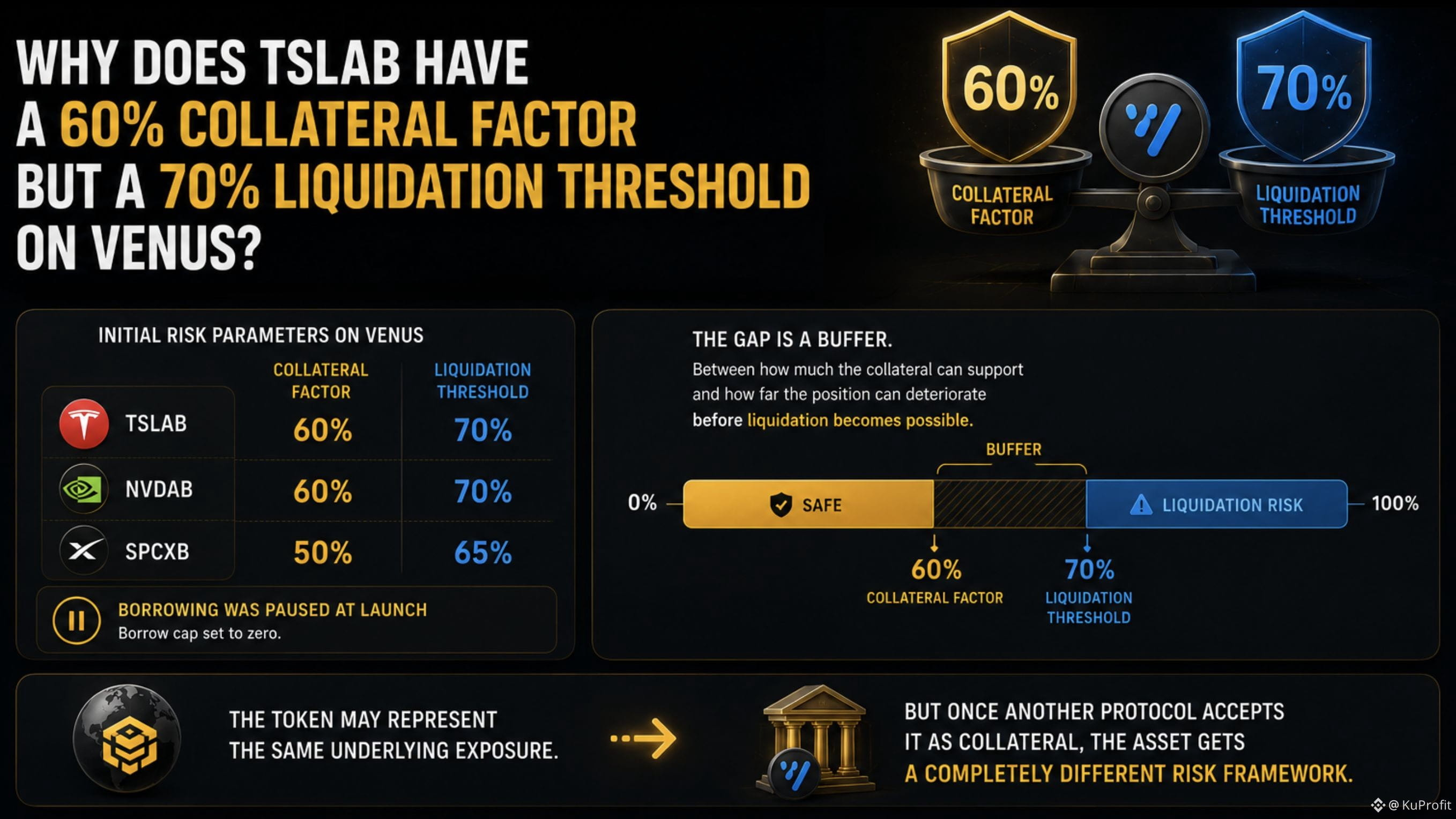
For TSLAB and NVDAB, Venus initially set:
60% collateral factor
70% liquidation threshold
For SPCXB:
50% collateral factor
65% liquidation threshold.
And there's an important detail: borrowing was paused at launch, with the borrow cap set to zero.
So these numbers weren't evidence that users were already borrowing against bStocks. They were the initial risk parameters for how those markets would be treated.
That made me look at the two percentages differently.
The collateral factor limits how much borrowing capacity the collateral can create.
The liquidation threshold defines where the position crosses into liquidation risk.
So the gap between them isn't a contradiction.
It's a buffer between:
“How much can this collateral support?”
and
“How far can the position deteriorate before liquidation becomes possible?”
For me, that's one of the more interesting things about bringing tokenized stocks into DeFi.
The token may represent the same underlying exposure.
But once another protocol accepts it as collateral, the asset gets a completely different risk framework.
#bstockscis @BinanceCIS
Why does TSLAB have a 60% collateral factor but a 70% liquidation threshold on Venus?
At first, those numbers looked like two ways of saying the same thing to me.
If Venus recognizes 60% of the asset's value for borrowing, why is the liquidation threshold 70%?
Then I realized I was mixing two different risk parameters.
The collateral factor answers one question:
How much of the supplied asset's value can count toward borrowing capacity?
The liquidation threshold answers another:
At what point does the position become eligible for liquidation?
For TSLAB and NVDAB, Venus initially set:
60% collateral factor
70% liquidation threshold
For SPCXB:
50% collateral factor
65% liquidation threshold.
And there's an important detail: borrowing was paused at launch, with the borrow cap set to zero.
So these numbers weren't evidence that users were already borrowing against bStocks. They were the initial risk parameters for how those markets would be treated.
That made me look at the two percentages differently.
The collateral factor limits how much borrowing capacity the collateral can create.
The liquidation threshold defines where the position crosses into liquidation risk.
So the gap between them isn't a contradiction.
It's a buffer between:
“How much can this collateral support?”
and
“How far can the position deteriorate before liquidation becomes possible?”
For me, that's one of the more interesting things about bringing tokenized stocks into DeFi.
The token may represent the same underlying exposure.
But once another protocol accepts it as collateral, the asset gets a completely different risk framework.
#bstockscis @BinanceCIS
At first, those numbers looked like two ways of saying the same thing to me.
If Venus recognizes 60% of the asset's value for borrowing, why is the liquidation threshold 70%?
Then I realized I was mixing two different risk parameters.
The collateral factor answers one question:
How much of the supplied asset's value can count toward borrowing capacity?
The liquidation threshold answers another:
At what point does the position become eligible for liquidation?
For TSLAB and NVDAB, Venus initially set:
60% collateral factor
70% liquidation threshold
For SPCXB:
50% collateral factor
65% liquidation threshold.
And there's an important detail: borrowing was paused at launch, with the borrow cap set to zero.
So these numbers weren't evidence that users were already borrowing against bStocks. They were the initial risk parameters for how those markets would be treated.
That made me look at the two percentages differently.
The collateral factor limits how much borrowing capacity the collateral can create.
The liquidation threshold defines where the position crosses into liquidation risk.
So the gap between them isn't a contradiction.
It's a buffer between:
“How much can this collateral support?”
and
“How far can the position deteriorate before liquidation becomes possible?”
For me, that's one of the more interesting things about bringing tokenized stocks into DeFi.
The token may represent the same underlying exposure.
But once another protocol accepts it as collateral, the asset gets a completely different risk framework.
#bstockscis @BinanceCIS
118
·
--
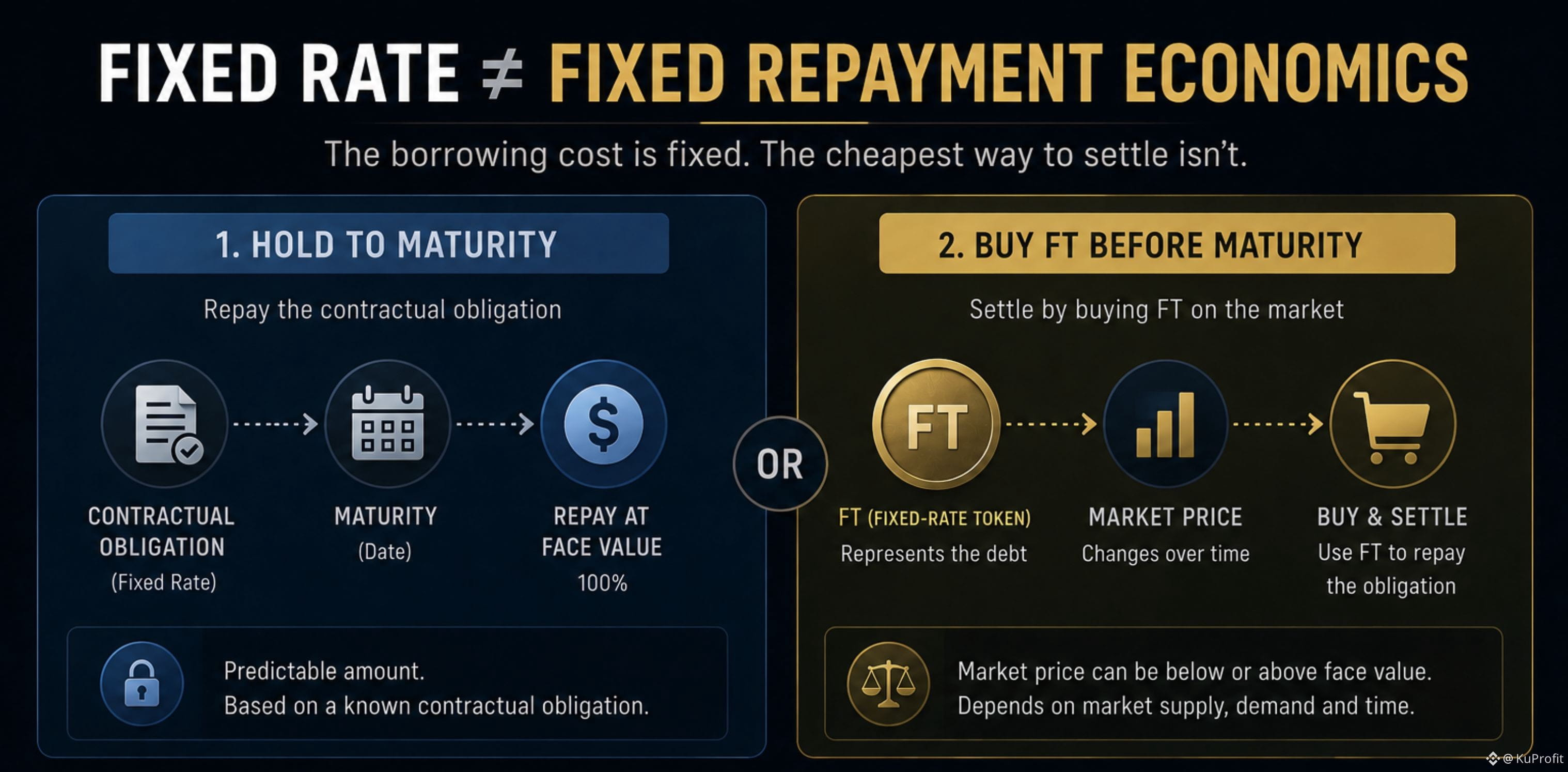
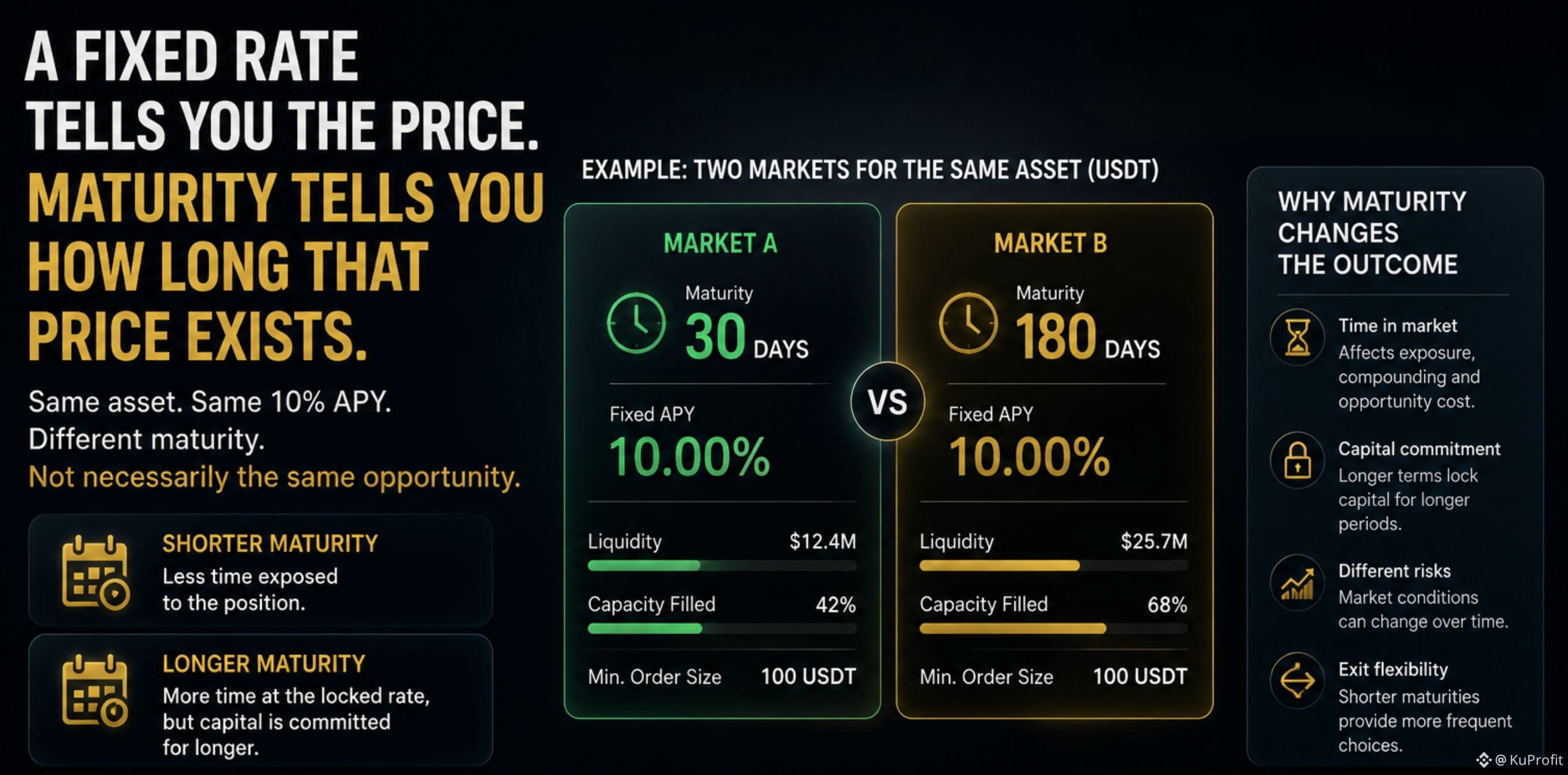
A fixed rate tells you the price.
The maturity tells you how long that price exists.
That distinction is easy to miss when looking at a TermMax market.
Right now, the app shows markets with very different maturity dates — some only weeks away, others much further out.
So imagine two markets:
Same asset.
Same 10% APY.
Different maturity.
They are not necessarily the same opportunity.
The shorter one may mean less time exposed to the position.
The longer one gives you more time at the locked rate, but also keeps your capital committed for longer.
That's why I wouldn't sort fixed-rate markets by APY alone.
I'd look at:
→ rate
→ maturity
→ liquidity
→ size
→ exit conditions
The rate is the headline.
Maturity is the timeline behind it.
#termmax @termmax
A fixed rate tells you the price.
The maturity tells you how long that price exists.
That distinction is easy to miss when looking at a TermMax market.
Right now, the app shows markets with very different maturity dates — some only weeks away, others much further out.
So imagine two markets:
Same asset.
Same 10% APY.
Different maturity.
They are not necessarily the same opportunity.
The shorter one may mean less time exposed to the position.
The longer one gives you more time at the locked rate, but also keeps your capital committed for longer.
That's why I wouldn't sort fixed-rate markets by APY alone.
I'd look at:
→ rate
→ maturity
→ liquidity
→ size
→ exit conditions
The rate is the headline.
Maturity is the timeline behind it.
#termmax @TermMax
The maturity tells you how long that price exists.
That distinction is easy to miss when looking at a TermMax market.
Right now, the app shows markets with very different maturity dates — some only weeks away, others much further out.
So imagine two markets:
Same asset.
Same 10% APY.
Different maturity.
They are not necessarily the same opportunity.
The shorter one may mean less time exposed to the position.
The longer one gives you more time at the locked rate, but also keeps your capital committed for longer.
That's why I wouldn't sort fixed-rate markets by APY alone.
I'd look at:
→ rate
→ maturity
→ liquidity
→ size
→ exit conditions
The rate is the headline.
Maturity is the timeline behind it.
#termmax @TermMax
87
·
--
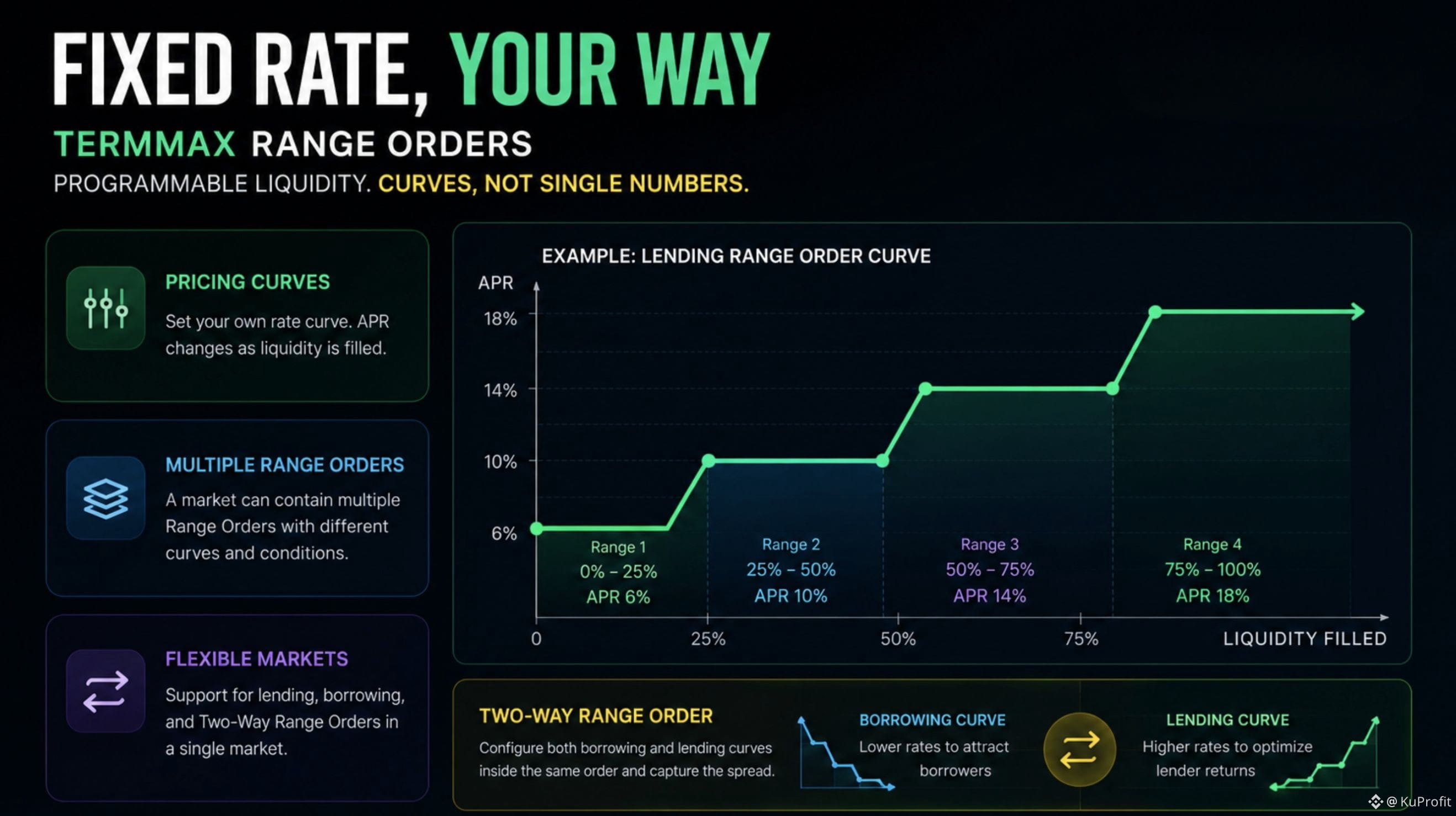
Not every fixed rate in DeFi has to be a single number.
TermMax takes a different approach to liquidity.
Its Range Orders allow a market to use a pricing curve where the rate changes as liquidity is consumed.
So instead of:
→ one rate for the entire market
you can have:
→ one rate for the first liquidity range
→ another rate for the next range
→ different conditions deeper in the curve
A single Market can contain multiple Range Orders, and TermMax supports both lending and borrowing curves.
There’s also a Two-Way Range Order, where borrowing and lending liquidity can be configured inside the same order.
For me, this is one of the more interesting parts of TermMax: fixed-rate markets become programmable liquidity markets rather than simple “fixed APR” products.
#termmax @termmax
Not every fixed rate in DeFi has to be a single number.
TermMax takes a different approach to liquidity.
Its Range Orders allow a market to use a pricing curve where the rate changes as liquidity is consumed.
So instead of:
→ one rate for the entire market
you can have:
→ one rate for the first liquidity range
→ another rate for the next range
→ different conditions deeper in the curve
A single Market can contain multiple Range Orders, and TermMax supports both lending and borrowing curves.
There’s also a Two-Way Range Order, where borrowing and lending liquidity can be configured inside the same order.
For me, this is one of the more interesting parts of TermMax: fixed-rate markets become programmable liquidity markets rather than simple “fixed APR” products.
#termmax @TermMax
TermMax takes a different approach to liquidity.
Its Range Orders allow a market to use a pricing curve where the rate changes as liquidity is consumed.
So instead of:
→ one rate for the entire market
you can have:
→ one rate for the first liquidity range
→ another rate for the next range
→ different conditions deeper in the curve
A single Market can contain multiple Range Orders, and TermMax supports both lending and borrowing curves.
There’s also a Two-Way Range Order, where borrowing and lending liquidity can be configured inside the same order.
For me, this is one of the more interesting parts of TermMax: fixed-rate markets become programmable liquidity markets rather than simple “fixed APR” products.
#termmax @TermMax
2
58
·
--
Why can one token transfer have a raw amount and a UI amount?
I used to think a token transfer had one amount: the number recorded on-chain.
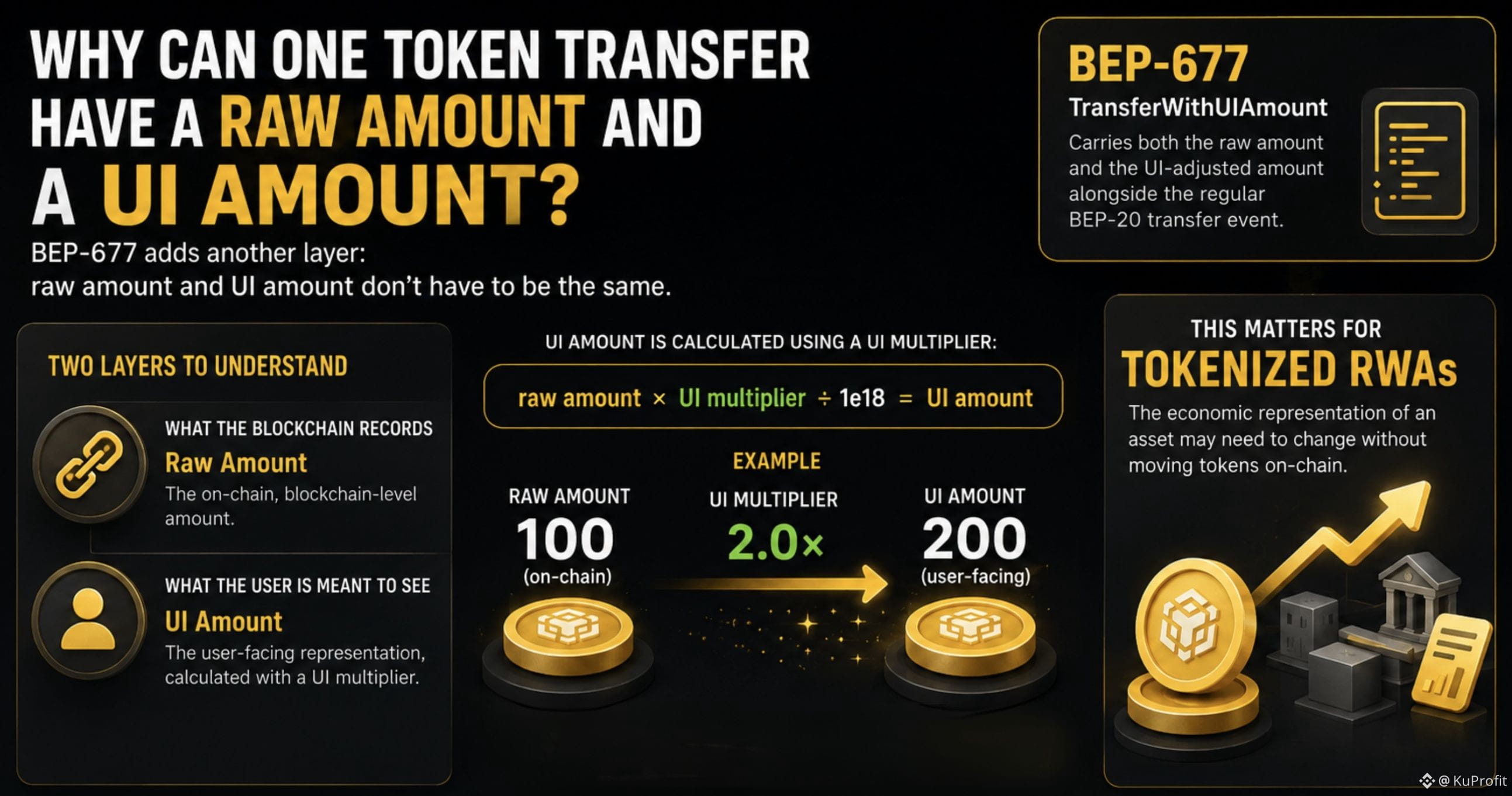
But BEP-677 adds another layer: the raw amount and the UI amount don't have to be the same.
So what exactly is the number I'm looking at?
The raw amount is the blockchain-level amount.
The UI amount is the user-facing representation, calculated using a UI multiplier:
raw amount × UI multiplier ÷ 1e18 = UI amount
For example, a 2.0× multiplier can make 100 raw units appear as 200 UI units — without changing the raw balance.
And BEP-677 goes one step further.
It defines TransferWithUIAmount, which carries both the raw amount and the UI-adjusted amount alongside the regular BEP-20 transfer event.
That may sound like a small technical detail.
But it solves a real problem for tokenized RWAs: the economic representation of an asset may need to change without moving tokens on-chain.
That's also why this caught my attention when looking at bStocks.
Binance describes bStocks as BEP-20 tokens on BNB Smart Chain and says they integrate BEP-677 / Scaled UI Amount for RWA use cases.
So there are really two layers worth looking at:
what the blockchain records
vs.
what the user is meant to see.
When you look at a token balance, which layer are you actually looking at?
#bstockscis @BinanceCIS
Why can one token transfer have a raw amount and a UI amount?
I used to think a token transfer had one amount: the number recorded on-chain.
But BEP-677 adds another layer: the raw amount and the UI amount don't have to be the same.
So what exactly is the number I'm looking at?
The raw amount is the blockchain-level amount.
The UI amount is the user-facing representation, calculated using a UI multiplier:
raw amount × UI multiplier ÷ 1e18 = UI amount
For example, a 2.0× multiplier can make 100 raw units appear as 200 UI units — without changing the raw balance.
And BEP-677 goes one step further.
It defines TransferWithUIAmount, which carries both the raw amount and the UI-adjusted amount alongside the regular BEP-20 transfer event.
That may sound like a small technical detail.
But it solves a real problem for tokenized RWAs: the economic representation of an asset may need to change without moving tokens on-chain.
That's also why this caught my attention when looking at bStocks.
Binance describes bStocks as BEP-20 tokens on BNB Smart Chain and says they integrate BEP-677 / Scaled UI Amount for RWA use cases.
So there are really two layers worth looking at:
what the blockchain records
vs.
what the user is meant to see.
When you look at a token balance, which layer are you actually looking at?
#bstockscis @BinanceCIS
I used to think a token transfer had one amount: the number recorded on-chain.
But BEP-677 adds another layer: the raw amount and the UI amount don't have to be the same.
So what exactly is the number I'm looking at?
The raw amount is the blockchain-level amount.
The UI amount is the user-facing representation, calculated using a UI multiplier:
raw amount × UI multiplier ÷ 1e18 = UI amount
For example, a 2.0× multiplier can make 100 raw units appear as 200 UI units — without changing the raw balance.
And BEP-677 goes one step further.
It defines TransferWithUIAmount, which carries both the raw amount and the UI-adjusted amount alongside the regular BEP-20 transfer event.
That may sound like a small technical detail.
But it solves a real problem for tokenized RWAs: the economic representation of an asset may need to change without moving tokens on-chain.
That's also why this caught my attention when looking at bStocks.
Binance describes bStocks as BEP-20 tokens on BNB Smart Chain and says they integrate BEP-677 / Scaled UI Amount for RWA use cases.
So there are really two layers worth looking at:
what the blockchain records
vs.
what the user is meant to see.
When you look at a token balance, which layer are you actually looking at?
#bstockscis @BinanceCIS
2
1
81
·
--
If a bStock lives on a public blockchain, what still controls whether a transfer is allowed?
At first, I assumed that a BEP-20 token on BNB Smart Chain would behave like any other on-chain asset:
wallet → transaction → transfer.
But bStocks add another layer.
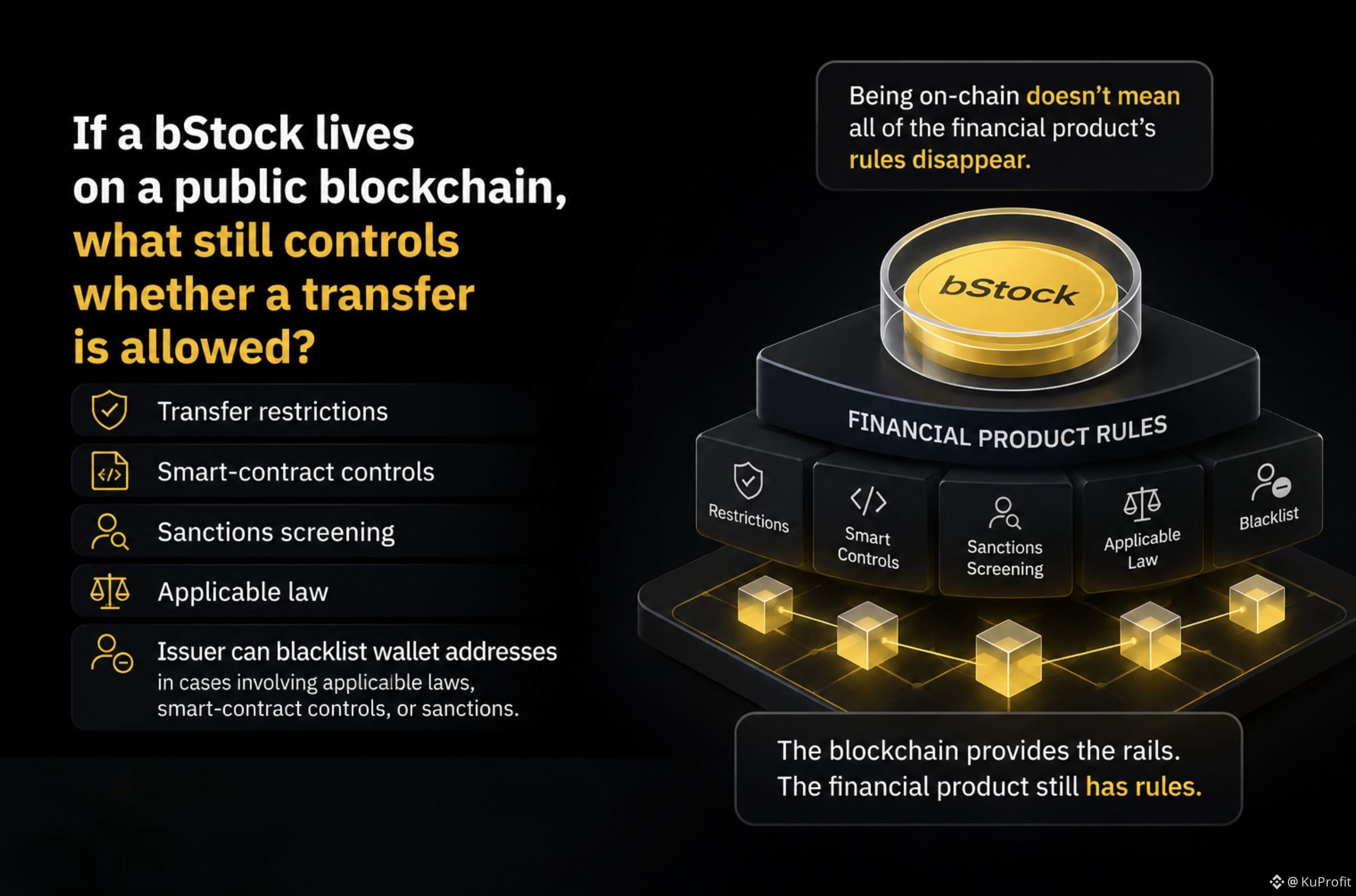
You can withdraw a bStock to a compatible BNB Smart Chain wallet for self-custody.
Yet withdrawals are still subject to transfer restrictions, smart-contract controls, sanctions screening, and applicable law.
And there is an even more interesting detail:
The issuer reserves the right to blacklist wallet addresses in cases involving applicable laws, smart-contract controls, or sanctions.
So being on-chain doesn't mean all of the financial product's rules disappear.
The blockchain provides the rails.
The financial product still has rules.
Self-custody changes where I hold the token — not which rules apply to the product.
That distinction changed how I think about bStocks.
Instead of asking only:
“Is this token on-chain?”
I'd also ask:
“What still determines whether the transfer is allowed?”
#bstockscis @BinanceCIS
If a bStock lives on a public blockchain, what still controls whether a transfer is allowed?
At first, I assumed that a BEP-20 token on BNB Smart Chain would behave like any other on-chain asset:
wallet → transaction → transfer.
But bStocks add another layer.
You can withdraw a bStock to a compatible BNB Smart Chain wallet for self-custody.
Yet withdrawals are still subject to transfer restrictions, smart-contract controls, sanctions screening, and applicable law.
And there is an even more interesting detail:
The issuer reserves the right to blacklist wallet addresses in cases involving applicable laws, smart-contract controls, or sanctions.
So being on-chain doesn't mean all of the financial product's rules disappear.
The blockchain provides the rails.
The financial product still has rules.
Self-custody changes where I hold the token — not which rules apply to the product.
That distinction changed how I think about bStocks.
Instead of asking only:
“Is this token on-chain?”
I'd also ask:
“What still determines whether the transfer is allowed?”
#bstockscis @BinanceCIS
At first, I assumed that a BEP-20 token on BNB Smart Chain would behave like any other on-chain asset:
wallet → transaction → transfer.
But bStocks add another layer.
You can withdraw a bStock to a compatible BNB Smart Chain wallet for self-custody.
Yet withdrawals are still subject to transfer restrictions, smart-contract controls, sanctions screening, and applicable law.
And there is an even more interesting detail:
The issuer reserves the right to blacklist wallet addresses in cases involving applicable laws, smart-contract controls, or sanctions.
So being on-chain doesn't mean all of the financial product's rules disappear.
The blockchain provides the rails.
The financial product still has rules.
Self-custody changes where I hold the token — not which rules apply to the product.
That distinction changed how I think about bStocks.
Instead of asking only:
“Is this token on-chain?”
I'd also ask:
“What still determines whether the transfer is allowed?”
#bstockscis @BinanceCIS
4
2
97
·
--
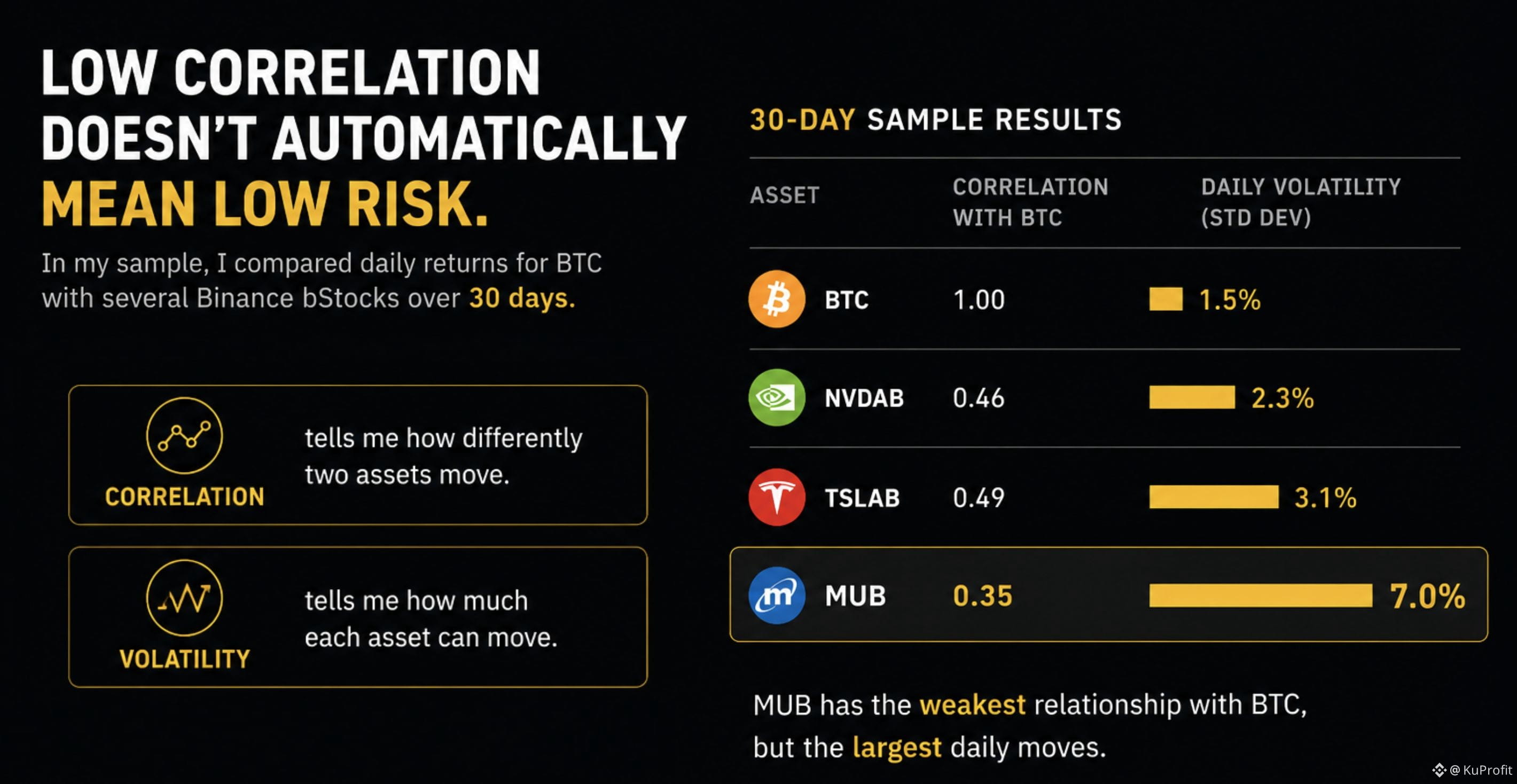
Low correlation doesn’t automatically mean low risk.
I used to think adding stocks to a crypto-heavy portfolio was almost automatically a diversification move.
So I ran a simple 30-day check.
I compared daily returns for BTC with several Binance bStocks, including NVDAB, TSLAB and MUB.
The result was more interesting than I expected.
In my sample, MUB showed the weakest relationship with BTC — around 0.35 correlation.
But MUB also had by far the largest daily moves, with daily volatility around 7%, versus roughly 1.5% for BTC.
That changed how I think about diversification through bStocks.
Correlation tells me how differently two assets move.
It doesn't tell me how much each one can move.
So I wouldn't call an asset “diversifying” just because it doesn't move exactly like BTC.
I'd ask two separate questions:
How differently does it move?
And how much does it move?
For me, that's a much better way to think about portfolio diversification.
#bstockscis @BinanceCIS
Low correlation doesn’t automatically mean low risk.
I used to think adding stocks to a crypto-heavy portfolio was almost automatically a diversification move.
So I ran a simple 30-day check.
I compared daily returns for BTC with several Binance bStocks, including NVDAB, TSLAB and MUB.
The result was more interesting than I expected.
In my sample, MUB showed the weakest relationship with BTC — around 0.35 correlation.
But MUB also had by far the largest daily moves, with daily volatility around 7%, versus roughly 1.5% for BTC.
That changed how I think about diversification through bStocks.
Correlation tells me how differently two assets move.
It doesn't tell me how much each one can move.
So I wouldn't call an asset “diversifying” just because it doesn't move exactly like BTC.
I'd ask two separate questions:
How differently does it move?
And how much does it move?
For me, that's a much better way to think about portfolio diversification.
#bstockscis @BinanceCIS
I used to think adding stocks to a crypto-heavy portfolio was almost automatically a diversification move.
So I ran a simple 30-day check.
I compared daily returns for BTC with several Binance bStocks, including NVDAB, TSLAB and MUB.
The result was more interesting than I expected.
In my sample, MUB showed the weakest relationship with BTC — around 0.35 correlation.
But MUB also had by far the largest daily moves, with daily volatility around 7%, versus roughly 1.5% for BTC.
That changed how I think about diversification through bStocks.
Correlation tells me how differently two assets move.
It doesn't tell me how much each one can move.
So I wouldn't call an asset “diversifying” just because it doesn't move exactly like BTC.
I'd ask two separate questions:
How differently does it move?
And how much does it move?
For me, that's a much better way to think about portfolio diversification.
#bstockscis @BinanceCIS
2
1
115
·
--
4–21× is a big number. But what does it actually tell us?
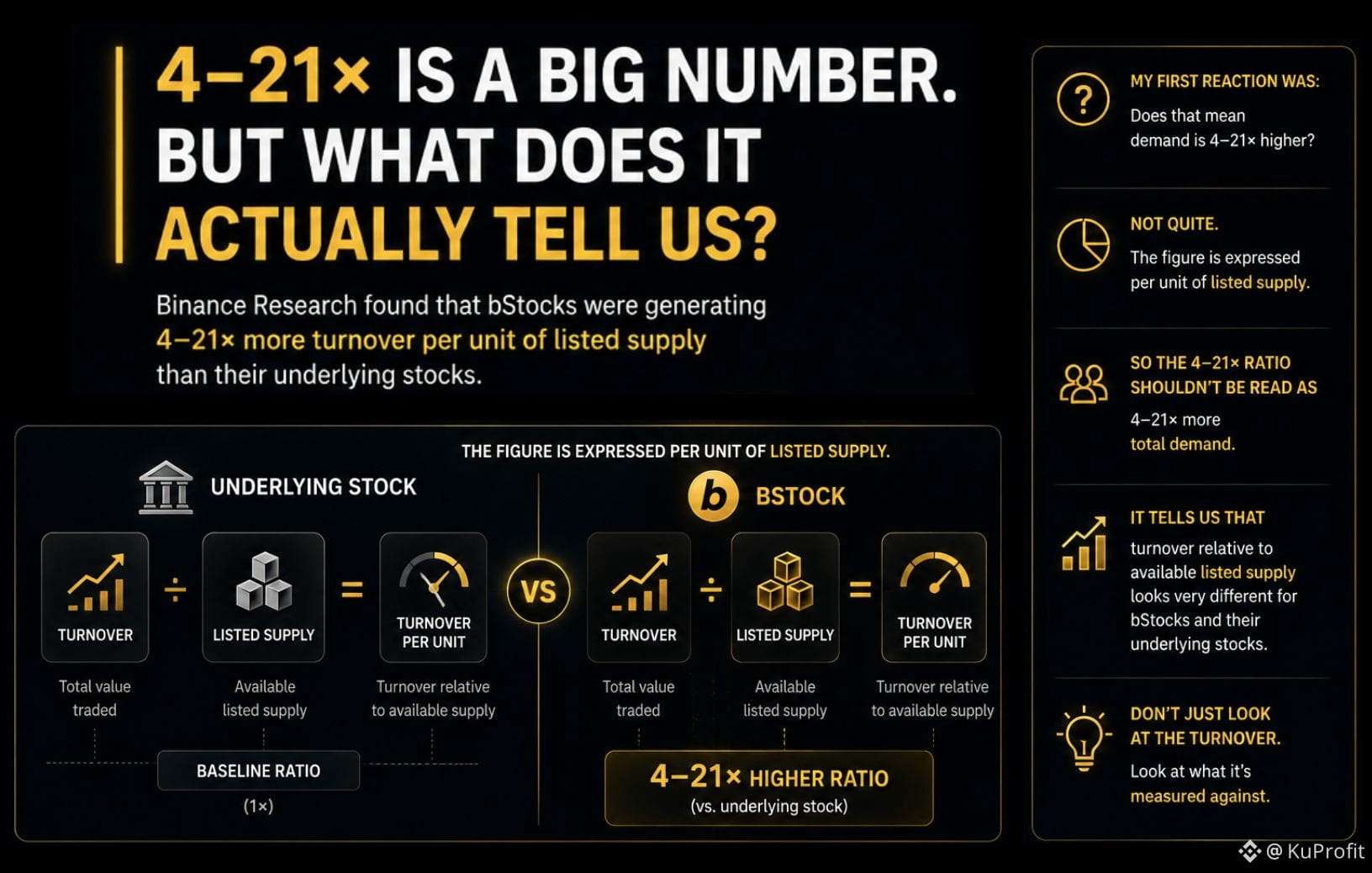
Binance Research found that bStocks were generating 4–21× more turnover per unit of listed supply than their underlying stocks.
My first reaction was:
Does that mean demand is 4–21× higher?
Not quite.
The figure is expressed per unit of listed supply.
So the 4–21× ratio shouldn't be read as 4–21× more total demand.
It tells us that turnover relative to available listed supply looks very different for bStocks and their underlying stocks.
That's what I find interesting about the number.
The headline is 4–21×.
But the better question is:
4–21× relative to what?
Because when you compare market activity, the denominator can change the story just as much as the numerator.
Don't just look at the turnover. Look at what it's measured against.
#bstockscis @BinanceCIS
4–21× is a big number. But what does it actually tell us?
Binance Research found that bStocks were generating 4–21× more turnover per unit of listed supply than their underlying stocks.
My first reaction was:
Does that mean demand is 4–21× higher?
Not quite.
The figure is expressed per unit of listed supply.
So the 4–21× ratio shouldn't be read as 4–21× more total demand.
It tells us that turnover relative to available listed supply looks very different for bStocks and their underlying stocks.
That's what I find interesting about the number.
The headline is 4–21×.
But the better question is:
4–21× relative to what?
Because when you compare market activity, the denominator can change the story just as much as the numerator.
Don't just look at the turnover. Look at what it's measured against.
#bstockscis @BinanceCIS
Binance Research found that bStocks were generating 4–21× more turnover per unit of listed supply than their underlying stocks.
My first reaction was:
Does that mean demand is 4–21× higher?
Not quite.
The figure is expressed per unit of listed supply.
So the 4–21× ratio shouldn't be read as 4–21× more total demand.
It tells us that turnover relative to available listed supply looks very different for bStocks and their underlying stocks.
That's what I find interesting about the number.
The headline is 4–21×.
But the better question is:
4–21× relative to what?
Because when you compare market activity, the denominator can change the story just as much as the numerator.
Don't just look at the turnover. Look at what it's measured against.
#bstockscis @BinanceCIS
2
2
105
·
--
When does buying a US stock actually begin?
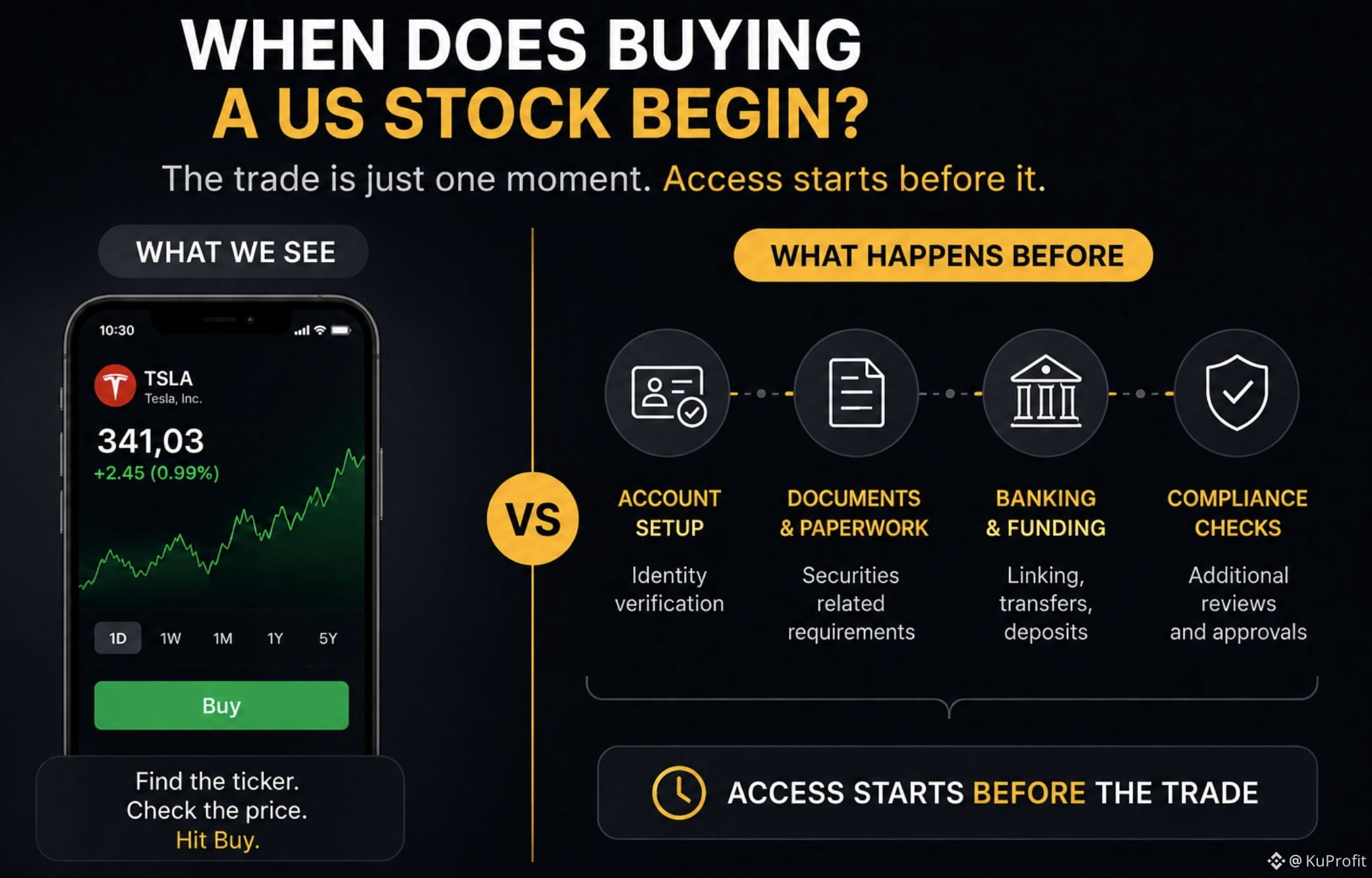
When I picture buying a US stock, I usually start at the same place:
Find the ticker.
Check the price.
Hit Buy.
But that skips a part of the process that's easy to overlook.
Getting access to the asset in the first place.
One part of that can be the securities paperwork required before you can access the stock.
And that made me rethink what I actually mean when I say:
“I want to buy this stock.”
The order itself is only one moment in the process.
There can be requirements that come before I ever get to the order screen.
That's where bStocks made me look at the process differently.
The underlying stock hasn't changed.
But the path to getting exposure to it can look different.
So I started asking:
“How much of buying a US stock happens before I ever get to the Buy button?”
For me, that's an easy part of investing to overlook.
We tend to focus on the trade because it's the visible part.
But access starts before the trade.
#bstockscis @BinanceCIS
When does buying a US stock actually begin?
When I picture buying a US stock, I usually start at the same place:
Find the ticker.
Check the price.
Hit Buy.
But that skips a part of the process that's easy to overlook.
Getting access to the asset in the first place.
One part of that can be the securities paperwork required before you can access the stock.
And that made me rethink what I actually mean when I say:
“I want to buy this stock.”
The order itself is only one moment in the process.
There can be requirements that come before I ever get to the order screen.
That's where bStocks made me look at the process differently.
The underlying stock hasn't changed.
But the path to getting exposure to it can look different.
So I started asking:
“How much of buying a US stock happens before I ever get to the Buy button?”
For me, that's an easy part of investing to overlook.
We tend to focus on the trade because it's the visible part.
But access starts before the trade.
#bstockscis @BinanceCIS
When I picture buying a US stock, I usually start at the same place:
Find the ticker.
Check the price.
Hit Buy.
But that skips a part of the process that's easy to overlook.
Getting access to the asset in the first place.
One part of that can be the securities paperwork required before you can access the stock.
And that made me rethink what I actually mean when I say:
“I want to buy this stock.”
The order itself is only one moment in the process.
There can be requirements that come before I ever get to the order screen.
That's where bStocks made me look at the process differently.
The underlying stock hasn't changed.
But the path to getting exposure to it can look different.
So I started asking:
“How much of buying a US stock happens before I ever get to the Buy button?”
For me, that's an easy part of investing to overlook.
We tend to focus on the trade because it's the visible part.
But access starts before the trade.
#bstockscis @BinanceCIS
2
99
·
--
Why would conversion itself need to follow the market clock?
I understand why stock trading has traditionally followed market hours.
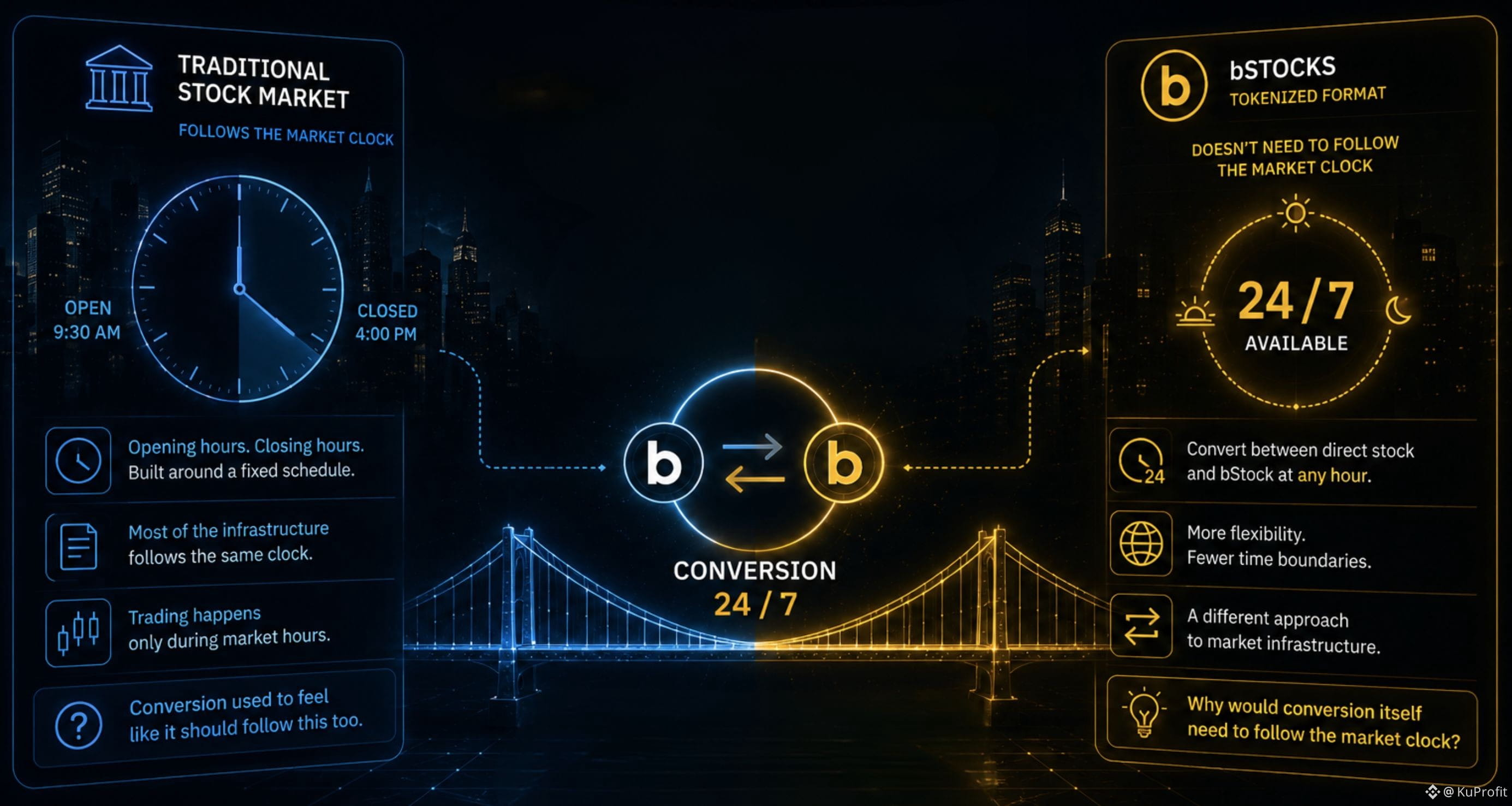
The underlying market has opening hours. It has closing hours.
And most of the infrastructure around stocks is built around that schedule.
But then I came across something about bStocks that made me stop and think:
conversion is available at any hour.
At first, I thought of conversion as something that would naturally follow the same clock as the underlying stock.
But if I can move between a direct stock and a bStock outside traditional market hours, that assumption starts to look less obvious.
The interesting part isn't simply that conversion is available at any hour.
It's what that changes.
The underlying market can have its own trading schedule, while conversion between the two formats can be available at any hour.
And that made me wonder:
Why would conversion itself need to follow the market clock?
For me, that's one of the more interesting differences between traditional market infrastructure and a tokenized format.
The market may still have its own hours.
But the bridge between the two formats doesn't necessarily have to.
#bstockscis @BinanceCIS
Why would conversion itself need to follow the market clock?
I understand why stock trading has traditionally followed market hours.
The underlying market has opening hours. It has closing hours.
And most of the infrastructure around stocks is built around that schedule.
But then I came across something about bStocks that made me stop and think:
conversion is available at any hour.
At first, I thought of conversion as something that would naturally follow the same clock as the underlying stock.
But if I can move between a direct stock and a bStock outside traditional market hours, that assumption starts to look less obvious.
The interesting part isn't simply that conversion is available at any hour.
It's what that changes.
The underlying market can have its own trading schedule, while conversion between the two formats can be available at any hour.
And that made me wonder:
Why would conversion itself need to follow the market clock?
For me, that's one of the more interesting differences between traditional market infrastructure and a tokenized format.
The market may still have its own hours.
But the bridge between the two formats doesn't necessarily have to.
#bstockscis @BinanceCIS
I understand why stock trading has traditionally followed market hours.
The underlying market has opening hours. It has closing hours.
And most of the infrastructure around stocks is built around that schedule.
But then I came across something about bStocks that made me stop and think:
conversion is available at any hour.
At first, I thought of conversion as something that would naturally follow the same clock as the underlying stock.
But if I can move between a direct stock and a bStock outside traditional market hours, that assumption starts to look less obvious.
The interesting part isn't simply that conversion is available at any hour.
It's what that changes.
The underlying market can have its own trading schedule, while conversion between the two formats can be available at any hour.
And that made me wonder:
Why would conversion itself need to follow the market clock?
For me, that's one of the more interesting differences between traditional market infrastructure and a tokenized format.
The market may still have its own hours.
But the bridge between the two formats doesn't necessarily have to.
#bstockscis @BinanceCIS
93
·
--
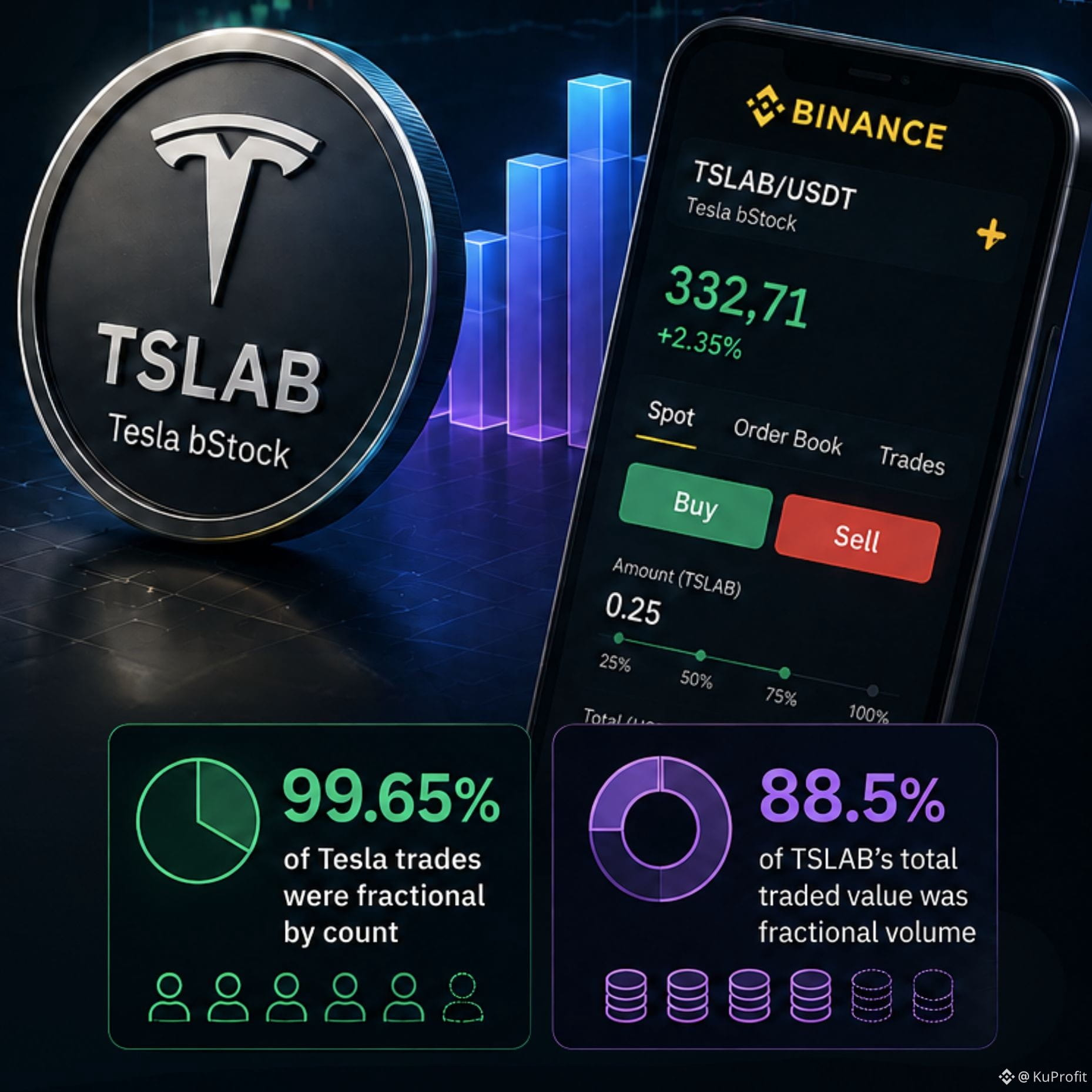
If 99.65% of Tesla trades are fractional by count, is fractional ownership really just an access feature?
When I first thought about fractional ownership, I saw it mainly as an accessibility feature.
A way to buy exposure to an expensive stock without needing enough capital for a whole share.
Then I came across the early data for TSLAB.
Roughly 99.65% of Tesla trades were fractional by count.
And fractional volume represented 88.5% of TSLAB's total traded value.
That made me look at fractional ownership differently.
If fractional trades account for almost all activity by trade count, and still represent the vast majority of traded value, it starts to look like more than a feature designed for smaller investors.
It made me wonder:
What if fractional ownership isn't just changing who can access a stock, but how exposure to that stock is actually traded?
A whole-share model makes the unit of investment fairly obvious.
Fractional trading separates the size of the position from the price of one whole share.
You can decide how much exposure you want without first asking whether you can afford one complete share.
And I think that's the more interesting part.
The question isn't simply:
“Can I buy a fraction of Tesla?”
It's:
“What happens when the fraction becomes the normal unit of the trade?”
For me, that's a much more interesting question about fractional ownership than simply calling it an accessibility feature.
#bstockscis @BinanceCIS
If 99.65% of Tesla trades are fractional by count, is fractional ownership really just an access feature?
When I first thought about fractional ownership, I saw it mainly as an accessibility feature.
A way to buy exposure to an expensive stock without needing enough capital for a whole share.
Then I came across the early data for TSLAB.
Roughly 99.65% of Tesla trades were fractional by count.
And fractional volume represented 88.5% of TSLAB's total traded value.
That made me look at fractional ownership differently.
If fractional trades account for almost all activity by trade count, and still represent the vast majority of traded value, it starts to look like more than a feature designed for smaller investors.
It made me wonder:
What if fractional ownership isn't just changing who can access a stock, but how exposure to that stock is actually traded?
A whole-share model makes the unit of investment fairly obvious.
Fractional trading separates the size of the position from the price of one whole share.
You can decide how much exposure you want without first asking whether you can afford one complete share.
And I think that's the more interesting part.
The question isn't simply:
“Can I buy a fraction of Tesla?”
It's:
“What happens when the fraction becomes the normal unit of the trade?”
For me, that's a much more interesting question about fractional ownership than simply calling it an accessibility feature.
#bstockscis @BinanceCIS
When I first thought about fractional ownership, I saw it mainly as an accessibility feature.
A way to buy exposure to an expensive stock without needing enough capital for a whole share.
Then I came across the early data for TSLAB.
Roughly 99.65% of Tesla trades were fractional by count.
And fractional volume represented 88.5% of TSLAB's total traded value.
That made me look at fractional ownership differently.
If fractional trades account for almost all activity by trade count, and still represent the vast majority of traded value, it starts to look like more than a feature designed for smaller investors.
It made me wonder:
What if fractional ownership isn't just changing who can access a stock, but how exposure to that stock is actually traded?
A whole-share model makes the unit of investment fairly obvious.
Fractional trading separates the size of the position from the price of one whole share.
You can decide how much exposure you want without first asking whether you can afford one complete share.
And I think that's the more interesting part.
The question isn't simply:
“Can I buy a fraction of Tesla?”
It's:
“What happens when the fraction becomes the normal unit of the trade?”
For me, that's a much more interesting question about fractional ownership than simply calling it an accessibility feature.
#bstockscis @BinanceCIS
102
·
--
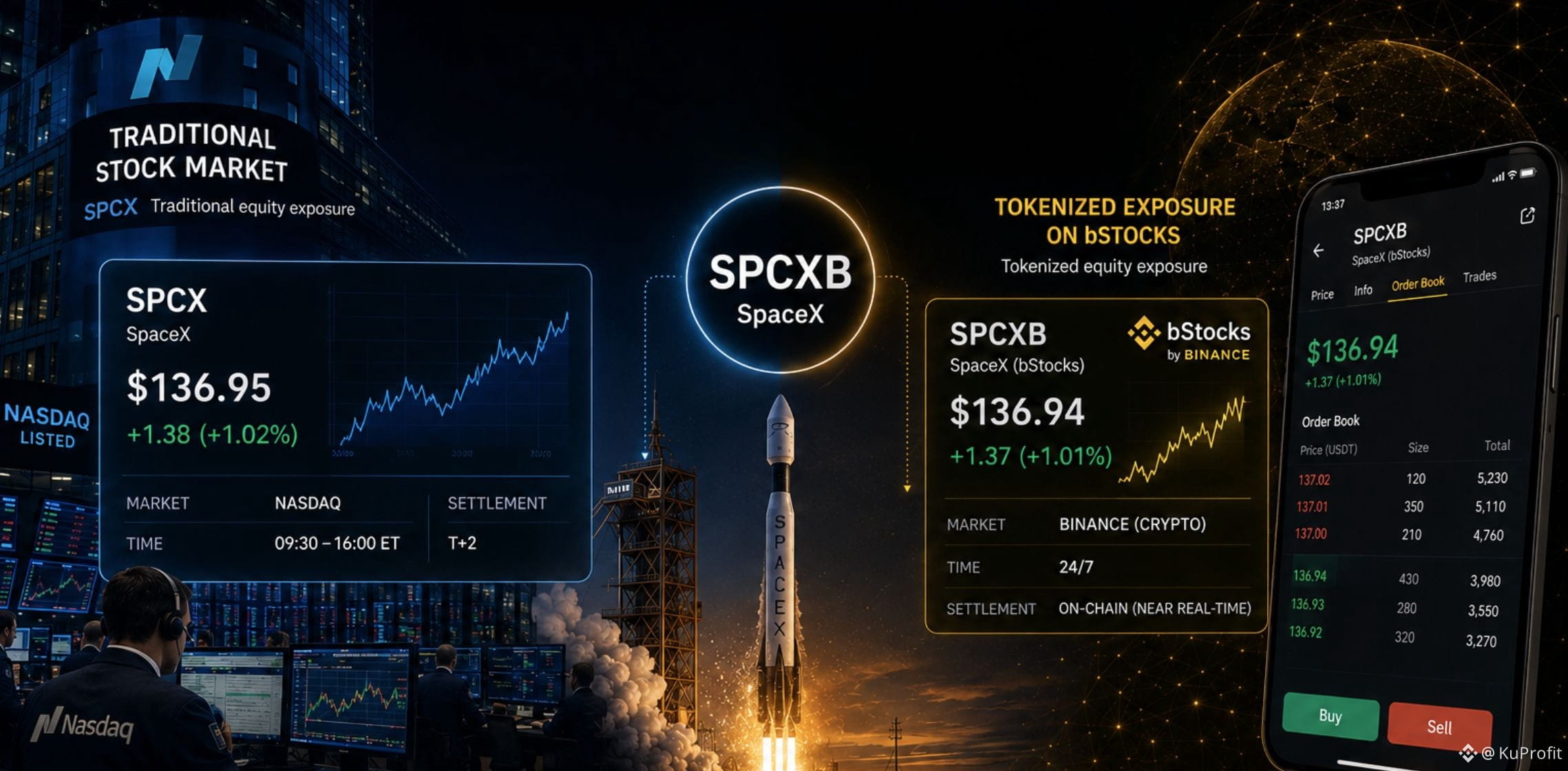
What changes when exposure to the same public company exists in two different market structures?
I started thinking about this when I looked at SPCXB.
SpaceX is now a public company, but exposure to its equity is also available in tokenized form through bStocks.
That creates an interesting situation.
The underlying company is the same.
But the market through which that exposure is accessed isn't.
On one side, there's the traditional stock market.
On the other, there's a tokenized form of the exposure trading within a crypto-native environment.
So I started wondering:
What happens to price discovery when the same underlying exposure is accessible through two different market structures?
The underlying stock has its own market price, while the tokenized version trades through a separate market environment with its own order book and trading mechanics.
And that's the part I find interesting.
Tokenization doesn't change SpaceX itself.
It changes the format in which exposure to the company can exist and be traded.
So when I look at SPCXB, I'm not only asking:
“What do I think about SpaceX?”
I'm also asking:
“What can we learn when the same underlying exposure is accessible through two different market structures?”
For me, that's a more interesting question about tokenization than simply asking whether a stock can be turned into a token.
#bstockscis @BinanceCIS
What changes when exposure to the same public company exists in two different market structures?
I started thinking about this when I looked at SPCXB.
SpaceX is now a public company, but exposure to its equity is also available in tokenized form through bStocks.
That creates an interesting situation.
The underlying company is the same.
But the market through which that exposure is accessed isn't.
On one side, there's the traditional stock market.
On the other, there's a tokenized form of the exposure trading within a crypto-native environment.
So I started wondering:
What happens to price discovery when the same underlying exposure is accessible through two different market structures?
The underlying stock has its own market price, while the tokenized version trades through a separate market environment with its own order book and trading mechanics.
And that's the part I find interesting.
Tokenization doesn't change SpaceX itself.
It changes the format in which exposure to the company can exist and be traded.
So when I look at SPCXB, I'm not only asking:
“What do I think about SpaceX?”
I'm also asking:
“What can we learn when the same underlying exposure is accessible through two different market structures?”
For me, that's a more interesting question about tokenization than simply asking whether a stock can be turned into a token.
#bstockscis @BinanceCIS
I started thinking about this when I looked at SPCXB.
SpaceX is now a public company, but exposure to its equity is also available in tokenized form through bStocks.
That creates an interesting situation.
The underlying company is the same.
But the market through which that exposure is accessed isn't.
On one side, there's the traditional stock market.
On the other, there's a tokenized form of the exposure trading within a crypto-native environment.
So I started wondering:
What happens to price discovery when the same underlying exposure is accessible through two different market structures?
The underlying stock has its own market price, while the tokenized version trades through a separate market environment with its own order book and trading mechanics.
And that's the part I find interesting.
Tokenization doesn't change SpaceX itself.
It changes the format in which exposure to the company can exist and be traded.
So when I look at SPCXB, I'm not only asking:
“What do I think about SpaceX?”
I'm also asking:
“What can we learn when the same underlying exposure is accessible through two different market structures?”
For me, that's a more interesting question about tokenization than simply asking whether a stock can be turned into a token.
#bstockscis @BinanceCIS
128
Log in to explore more content
Join global crypto users on Binance Square
⚡️ Get latest and useful information about crypto.
💬 Trusted by the world’s largest crypto exchange.
👍 Discover real insights from verified creators.
Email / Phone number
Trending Topics
SaylorHintsStrategyBitcoinBuy
2.2M views
11,188 Discussing
#SaylorHintsStrategyBitcoinBuy
🚀 Michael Saylor Teases Strategy's Next Massive Bitcoin Move! 🧡
Crypto markets are buzzing after Michael Saylor dropped another classic, cryptic hint on X! Posting Strategy's iconic treasury chart, he added just three words: "A little more orange." 📊⚡
investors know what that means—orange dots signal fresh $BTC acquisitions! Following a short pause focused on share buybacks, Strategy looks ready to add to its massive 845,050 BTC stash.
With holdings already worth billions, traders are watching SEC disclosures closely. Will Saylor break the internet with another megabuy this week? 💸📈
#Strategy #bitcoin #Saylor 💎🙌
#Nadeemgujjar143
@A锦源 @Andy-加密不落客 @marya adenya @aasho
$BTC
$BNB
NADEEM Gujjar143
·0 Likes
·17 views
BOJRaisesRatesTo31YearHigh
171,174 views
2,571 Discussing
BuffettStepsDownAsBerkshireChairman
82,651 views
1,324 Discussing