
johnnyphan
29 Posts

johnnyphan
Report
Block User
Builder | Investor | Operator. Gaming • AI • Crypto. Sharing insights on digital economies, emerging technology, and market opportunities.

SAHARA Holder
Occasional Trader
8.8 Years
0 Following
1 Followers
1 Liked
Posts
·
--
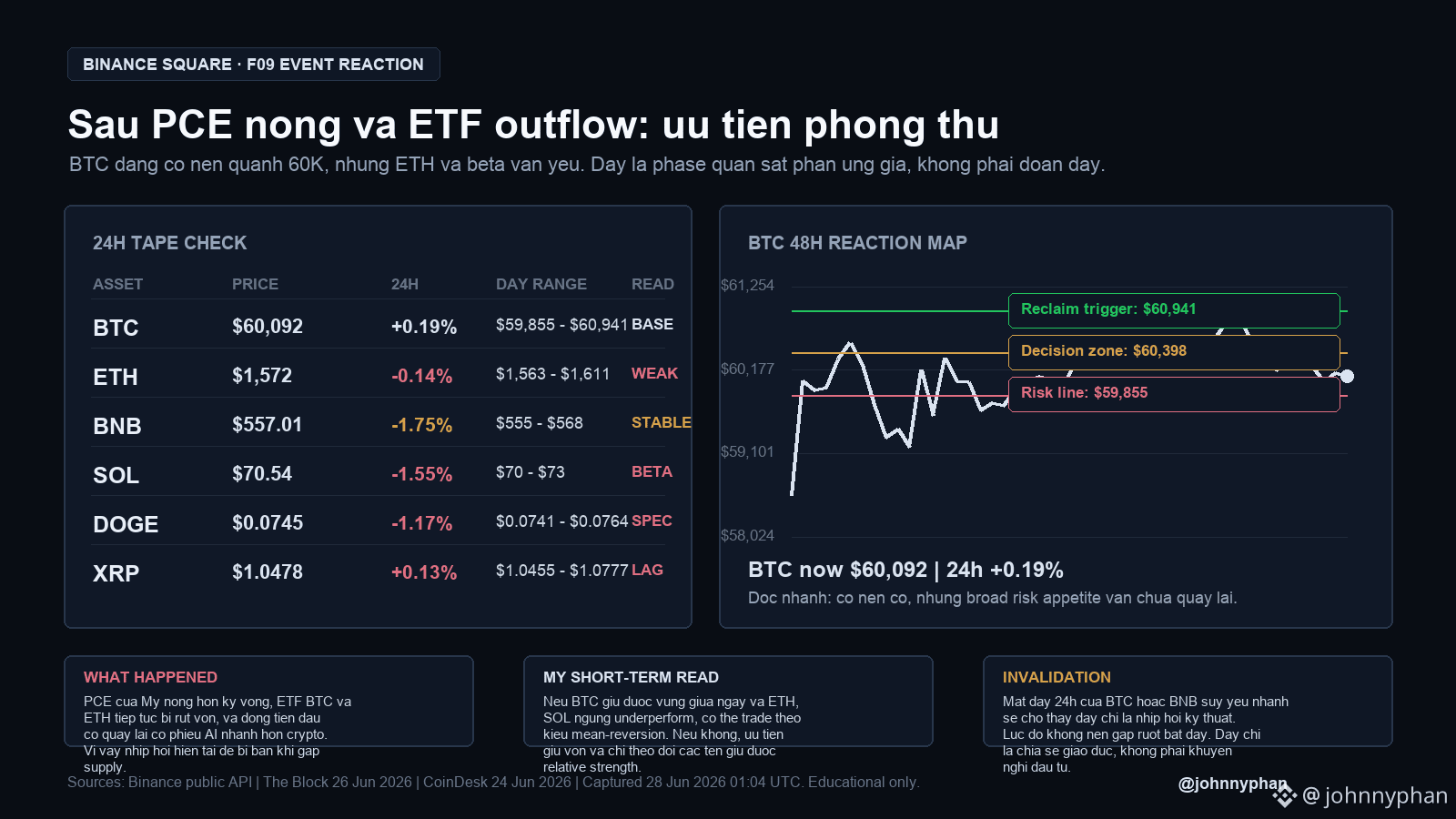
The market is showing one key thing: the rebound that had been absent has returned—risk-on is back.
- The US PCE is still hot, BTC/ETH ETFs are not stable yet, and capital flows are currently favoring AI stocks over crypto.
- BTC is holding a range around 60K, but ETH and SOL are still underperforming, so I see this as more of a rotation/asset-allocation phase rather than broad, long-term buying.
- BNB is holding up better than many other altcoins with beta exposure. If BTC holds at 59.8K–60K, traders may look for short-term breakout/technical setups; if not, priority should be to hold capital.
- Invalidation: if BTC loses the 24h level or BNB weakens rapidly, this rebound is at risk of reversing.
Question for everyone: right now, do you prioritize holding BTC/BNB, or do you rotate into alts only after confirmation?
For educational purposes only, not investment advice.
#Bitcoin #Ethereum #BNB #CryptoTrading
Open an account here if you need more tools: https://www.binance.com/register?ref=FUTURECRYPTO
The market is showing one key thing: the rebound that had been absent has returned—risk-on is back.
- The US PCE is still hot, BTC/ETH ETFs are not stable yet, and capital flows are currently favoring AI stocks over crypto.
- BTC is holding a range around 60K, but ETH and SOL are still underperforming, so I see this as more of a rotation/asset-allocation phase rather than broad, long-term buying.
- BNB is holding up better than many other altcoins with beta exposure. If BTC holds at 59.8K–60K, traders may look for short-term breakout/technical setups; if not, priority should be to hold capital.
- Invalidation: if BTC loses the 24h level or BNB weakens rapidly, this rebound is at risk of reversing.
Question for everyone: right now, do you prioritize holding BTC/BNB, or do you rotate into alts only after confirmation?
For educational purposes only, not investment advice.
#Bitcoin #Ethereum #BNB #CryptoTrading
Open an account here if you need more tools: https://www.binance.com/register?ref=FUTURECRYPTO
- The US PCE is still hot, BTC/ETH ETFs are not stable yet, and capital flows are currently favoring AI stocks over crypto.
- BTC is holding a range around 60K, but ETH and SOL are still underperforming, so I see this as more of a rotation/asset-allocation phase rather than broad, long-term buying.
- BNB is holding up better than many other altcoins with beta exposure. If BTC holds at 59.8K–60K, traders may look for short-term breakout/technical setups; if not, priority should be to hold capital.
- Invalidation: if BTC loses the 24h level or BNB weakens rapidly, this rebound is at risk of reversing.
Question for everyone: right now, do you prioritize holding BTC/BNB, or do you rotate into alts only after confirmation?
For educational purposes only, not investment advice.
#Bitcoin #Ethereum #BNB #CryptoTrading
Open an account here if you need more tools: https://www.binance.com/register?ref=FUTURECRYPTO
168
·
--
It's not that any green tree is always a dip-buying signal.
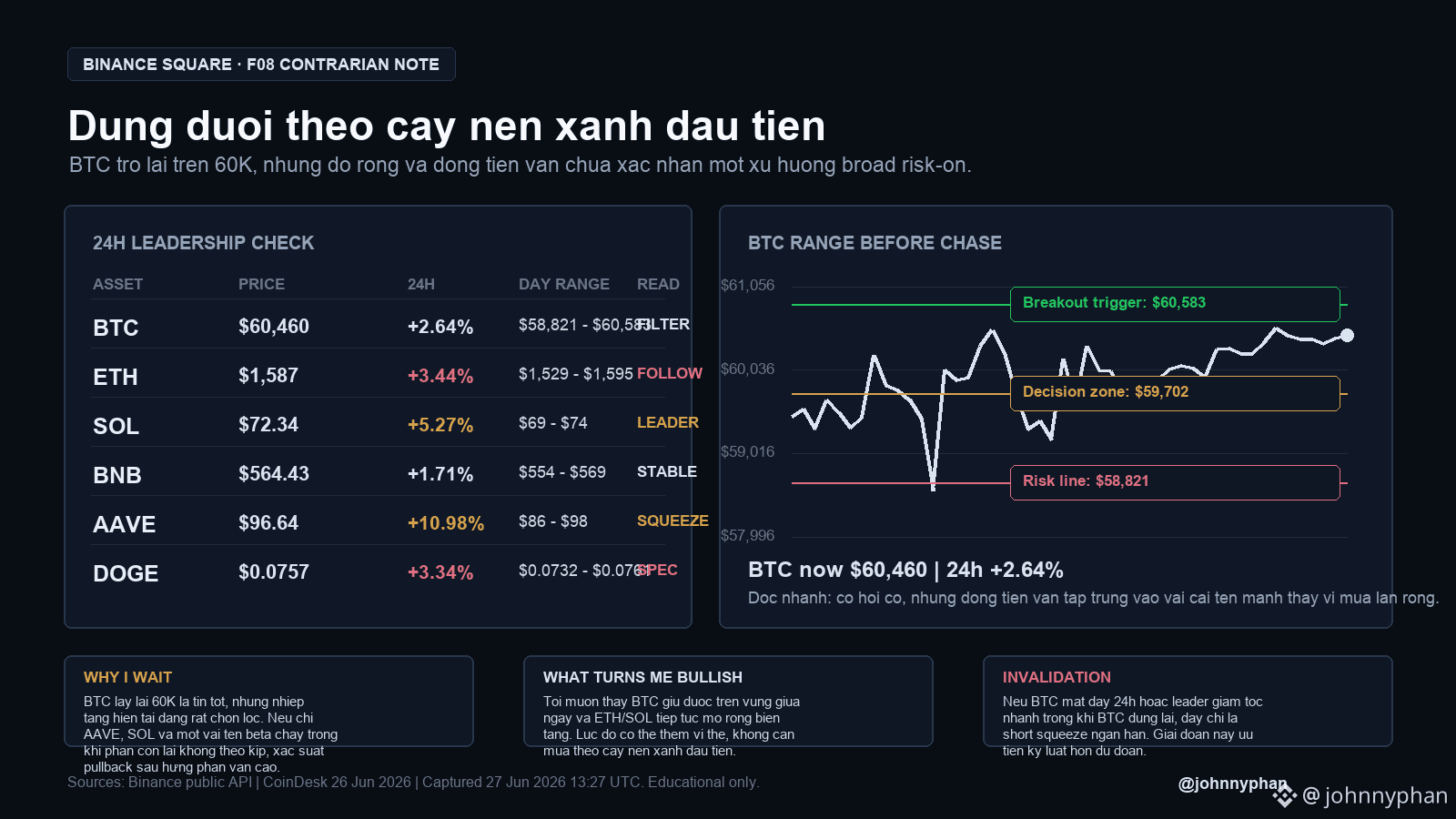
1/ BTC has regained the 60K area after sweeping down to 58.8K, but the recovery still looks very selective. Capital is currently prioritizing AAVE and the Solana ecosystem more than broadening across the whole market.
2/ 24h data on Binance at the time of writing: BTC +2.64%, ETH +3.44%, SOL +5.27%, AAVE +10.98%. This is a sign of having a leader, not a full broad risk-on yet. Buying after the first green candlestick is often paying a premium for a trend that hasn’t been confirmed.
3/ In the short term, I prioritize two conditions: BTC holding the 59.7K–60K zone and ETH/SOL continuing to expand their trading range. If BTC loses that area and drops to around 58.8K within the next 24h, the more reasonable scenario would be range trading or a breakout attempt, but not an all-in position.
4/ Risk of invalidation: the leader slows down, volume doesn’t follow through, or BTC stalls while altcoin beta turns bearish. In this phase, discipline matters more than prediction.
Which leader are you watching if BTC continues to hold 60K? This article is for educational purposes only and is not investment advice. If you need an account to track the market, you can start at https://www.binance.com/register?ref=FUTURECRYPTO
#Bitcoin #Solana #AAVE #Crypto
It's not that any green tree is always a dip-buying signal.
1/ BTC has regained the 60K area after sweeping down to 58.8K, but the recovery still looks very selective. Capital is currently prioritizing AAVE and the Solana ecosystem more than broadening across the whole market.
2/ 24h data on Binance at the time of writing: BTC +2.64%, ETH +3.44%, SOL +5.27%, AAVE +10.98%. This is a sign of having a leader, not a full broad risk-on yet. Buying after the first green candlestick is often paying a premium for a trend that hasn’t been confirmed.
3/ In the short term, I prioritize two conditions: BTC holding the 59.7K–60K zone and ETH/SOL continuing to expand their trading range. If BTC loses that area and drops to around 58.8K within the next 24h, the more reasonable scenario would be range trading or a breakout attempt, but not an all-in position.
4/ Risk of invalidation: the leader slows down, volume doesn’t follow through, or BTC stalls while altcoin beta turns bearish. In this phase, discipline matters more than prediction.
Which leader are you watching if BTC continues to hold 60K? This article is for educational purposes only and is not investment advice. If you need an account to track the market, you can start at https://www.binance.com/register?ref=FUTURECRYPTO
#Bitcoin #Solana #AAVE #Crypto
1/ BTC has regained the 60K area after sweeping down to 58.8K, but the recovery still looks very selective. Capital is currently prioritizing AAVE and the Solana ecosystem more than broadening across the whole market.
2/ 24h data on Binance at the time of writing: BTC +2.64%, ETH +3.44%, SOL +5.27%, AAVE +10.98%. This is a sign of having a leader, not a full broad risk-on yet. Buying after the first green candlestick is often paying a premium for a trend that hasn’t been confirmed.
3/ In the short term, I prioritize two conditions: BTC holding the 59.7K–60K zone and ETH/SOL continuing to expand their trading range. If BTC loses that area and drops to around 58.8K within the next 24h, the more reasonable scenario would be range trading or a breakout attempt, but not an all-in position.
4/ Risk of invalidation: the leader slows down, volume doesn’t follow through, or BTC stalls while altcoin beta turns bearish. In this phase, discipline matters more than prediction.
Which leader are you watching if BTC continues to hold 60K? This article is for educational purposes only and is not investment advice. If you need an account to track the market, you can start at https://www.binance.com/register?ref=FUTURECRYPTO
#Bitcoin #Solana #AAVE #Crypto
271
·
--
This week's AI watchlist isn't just about stacking up names. It's a test to see which tokens are getting the cash flow love and which ones are getting left behind.
I'm keeping an eye on 3 groups:
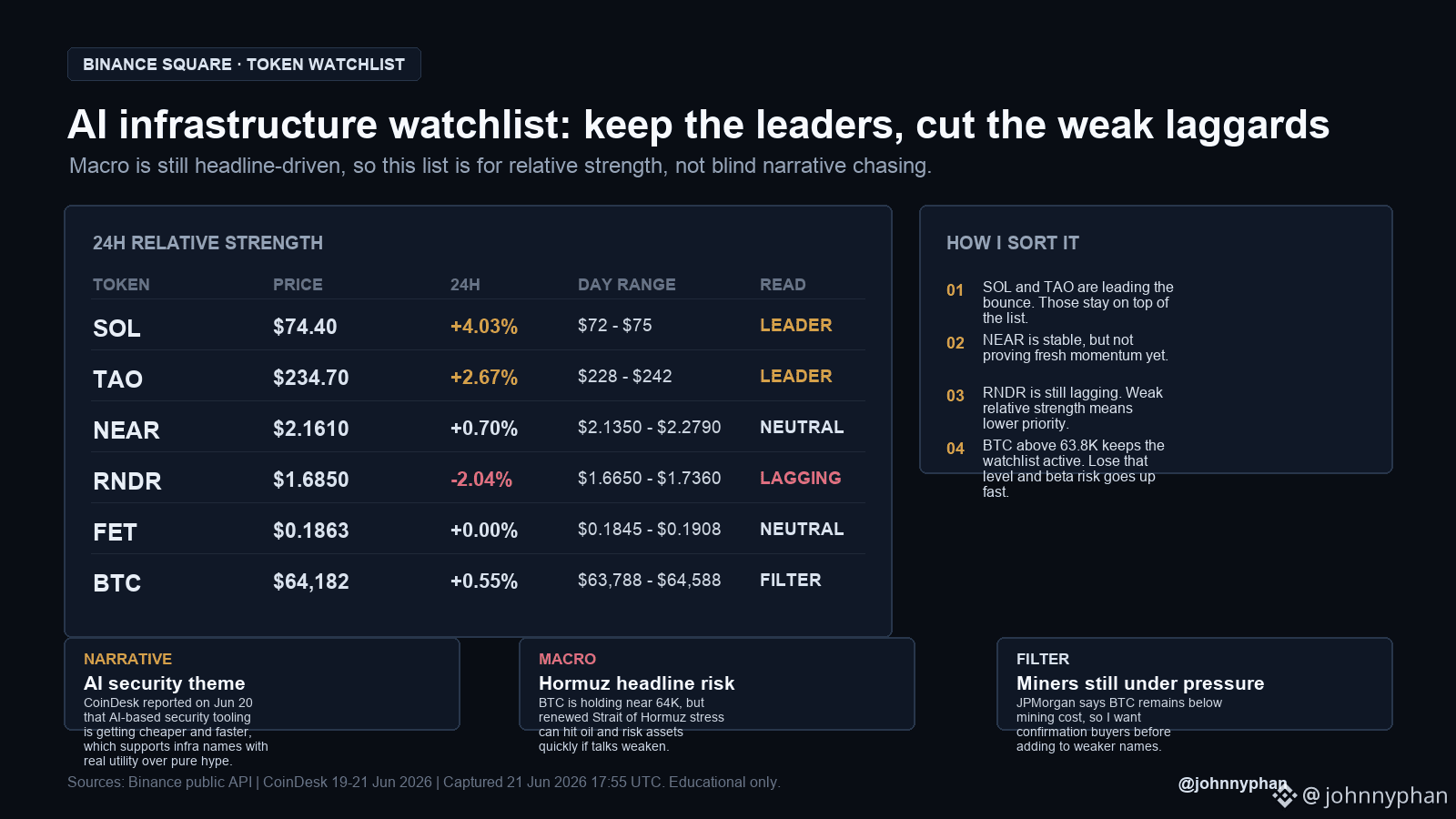
- The current leaders are SOL and TAO. Both are holding up better than the market over the last 24 hours, so they deserve to be at the top of the watchlist over the rest.
- NEAR and FET aren't looking bad yet, but they haven't shown any fresh confirmations either. With these two, I'm just looking to monitor their reactions around the range rather than chasing prices.
- RNDR is still lagging. When a narrative token is underperforming compared to BTC during a market rebound, I see that as a signal to lower priority.
Key points I noticed from the narrative:
CoinDesk on 6/20 reported that AI security tools are getting cheaper and faster, meaning the "AI utility" narrative is more grounded than tokens that only thrive on speculation. But macro factors remain the primary filter: Hormuz risks haven't disappeared, and JPMorgan says BTC is still trading below estimated mining costs.
Short-term market read:
If BTC holds the 63.8K-64K range, the AI watchlist can still run in a selective leader direction.
If BTC loses this range, I prefer to reduce beta before considering adding positions in the AI group.
Invalidation point:
If SOL and TAO lose their relative strength while BTC is moving sideways, the thesis of "only holding leaders" loses short-term value.
In the AI infrastructure group, which names are you holding in this week's watchlist?
If you want to start tracking and trading on Binance, you can check it out here: https://www.binance.com/register?ref=FUTURECRYPTO
This content is for educational purposes only and is not investment advice.
#AIcrypto #TAO #SOL #BinanceSquare
This week's AI watchlist isn't just about stacking up names. It's a test to see which tokens are getting the cash flow love and which ones are getting left behind.
I'm keeping an eye on 3 groups:
- The current leaders are SOL and TAO. Both are holding up better than the market over the last 24 hours, so they deserve to be at the top of the watchlist over the rest.
- NEAR and FET aren't looking bad yet, but they haven't shown any fresh confirmations either. With these two, I'm just looking to monitor their reactions around the range rather than chasing prices.
- RNDR is still lagging. When a narrative token is underperforming compared to BTC during a market rebound, I see that as a signal to lower priority.
Key points I noticed from the narrative:
CoinDesk on 6/20 reported that AI security tools are getting cheaper and faster, meaning the "AI utility" narrative is more grounded than tokens that only thrive on speculation. But macro factors remain the primary filter: Hormuz risks haven't disappeared, and JPMorgan says BTC is still trading below estimated mining costs.
Short-term market read:
If BTC holds the 63.8K-64K range, the AI watchlist can still run in a selective leader direction.
If BTC loses this range, I prefer to reduce beta before considering adding positions in the AI group.
Invalidation point:
If SOL and TAO lose their relative strength while BTC is moving sideways, the thesis of "only holding leaders" loses short-term value.
In the AI infrastructure group, which names are you holding in this week's watchlist?
If you want to start tracking and trading on Binance, you can check it out here: https://www.binance.com/register?ref=FUTURECRYPTO
This content is for educational purposes only and is not investment advice.
#AIcrypto #TAO #SOL #BinanceSquare
I'm keeping an eye on 3 groups:
- The current leaders are SOL and TAO. Both are holding up better than the market over the last 24 hours, so they deserve to be at the top of the watchlist over the rest.
- NEAR and FET aren't looking bad yet, but they haven't shown any fresh confirmations either. With these two, I'm just looking to monitor their reactions around the range rather than chasing prices.
- RNDR is still lagging. When a narrative token is underperforming compared to BTC during a market rebound, I see that as a signal to lower priority.
Key points I noticed from the narrative:
CoinDesk on 6/20 reported that AI security tools are getting cheaper and faster, meaning the "AI utility" narrative is more grounded than tokens that only thrive on speculation. But macro factors remain the primary filter: Hormuz risks haven't disappeared, and JPMorgan says BTC is still trading below estimated mining costs.
Short-term market read:
If BTC holds the 63.8K-64K range, the AI watchlist can still run in a selective leader direction.
If BTC loses this range, I prefer to reduce beta before considering adding positions in the AI group.
Invalidation point:
If SOL and TAO lose their relative strength while BTC is moving sideways, the thesis of "only holding leaders" loses short-term value.
In the AI infrastructure group, which names are you holding in this week's watchlist?
If you want to start tracking and trading on Binance, you can check it out here: https://www.binance.com/register?ref=FUTURECRYPTO
This content is for educational purposes only and is not investment advice.
#AIcrypto #TAO #SOL #BinanceSquare
21
·
--
New week, not lacking in catalysts, but this isn't the kind of market to go all-in on the narrative.
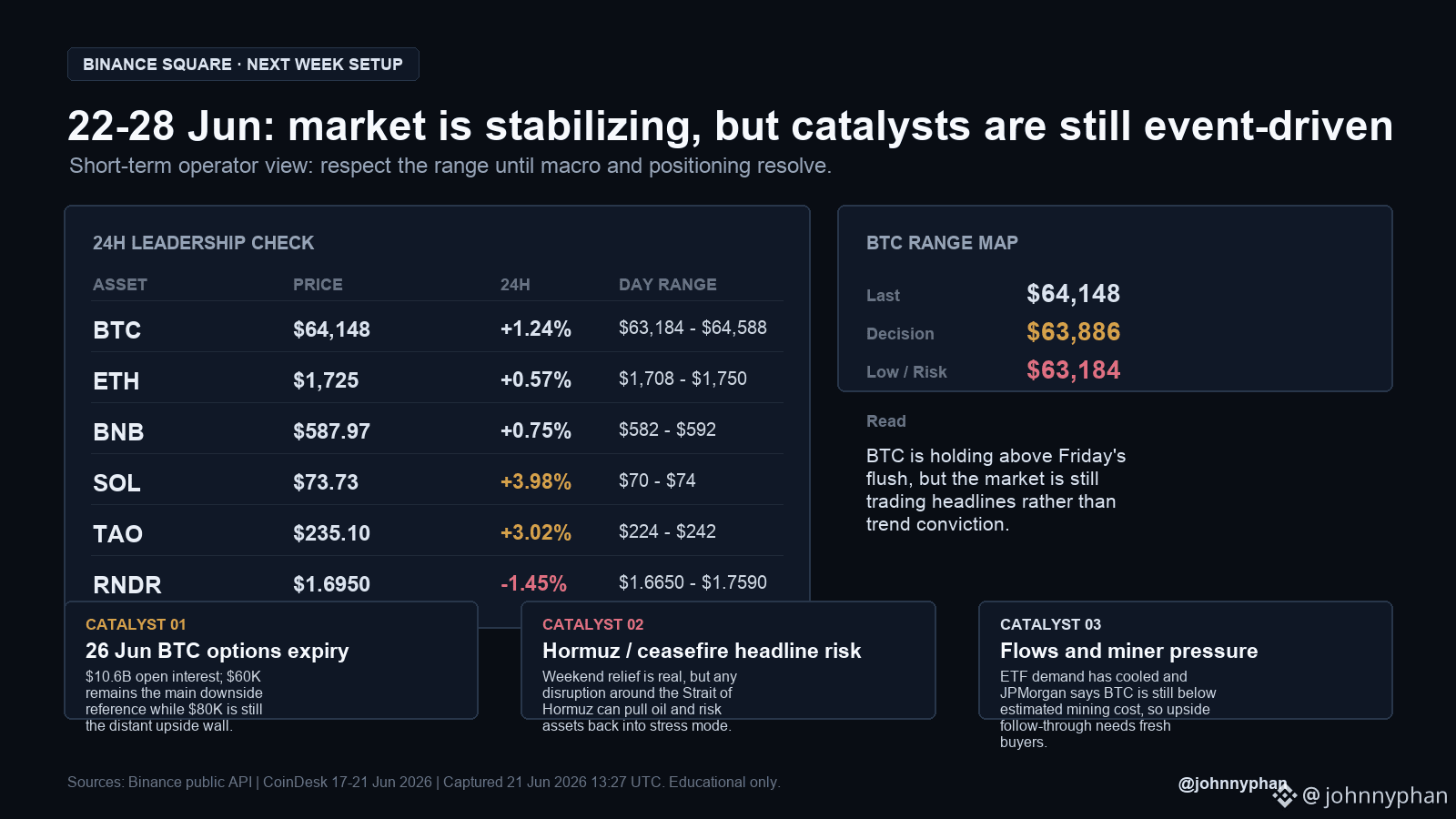
BTC is holding around 64K after a bounce over the weekend. SOL and TAO are outperforming the market in the last 24 hours, but RNDR is still lagging, so the current flow of funds is selective rather than broad risk-on.
3 points I'm watching for the week of 22-28/6:
- On 26/6, there's an options expiry for BTC around 10.6 billion USD. When positioning is skewed, volatility can spike quickly over the weekend.
- The Hormuz situation and the US-Iran ceasefire negotiations remain major macro variables. If oil bounces back, crypto could easily lose its risk-on vibe.
- ETF flows have cooled down, and JPMorgan estimates BTC is still trading below mining costs, so every bounce needs new buyers to confirm.
Short-term market read:
As long as BTC holds above the 63K-63.2K range, it has a shot at testing the 64.6K-65K area.
If it loses this range, I'd prioritize reducing beta rather than trying to catch the bottom on altcoins.
Invalidation point: if headlines are positive but BTC can't hold the middle of the range, that's usually just a short squeeze rather than a new trend.
Are you preparing a watchlist for the new week with BTC, SOL, or the AI group?
If you want to start tracking and trading on Binance, you can check it out here: https://www.binance.com/register?ref=FUTURECRYPTO
This is educational content, not investment advice.
#BTC #BinanceSquare #CryptoMarket #TradingSetup
New week, not lacking in catalysts, but this isn't the kind of market to go all-in on the narrative.
BTC is holding around 64K after a bounce over the weekend. SOL and TAO are outperforming the market in the last 24 hours, but RNDR is still lagging, so the current flow of funds is selective rather than broad risk-on.
3 points I'm watching for the week of 22-28/6:
- On 26/6, there's an options expiry for BTC around 10.6 billion USD. When positioning is skewed, volatility can spike quickly over the weekend.
- The Hormuz situation and the US-Iran ceasefire negotiations remain major macro variables. If oil bounces back, crypto could easily lose its risk-on vibe.
- ETF flows have cooled down, and JPMorgan estimates BTC is still trading below mining costs, so every bounce needs new buyers to confirm.
Short-term market read:
As long as BTC holds above the 63K-63.2K range, it has a shot at testing the 64.6K-65K area.
If it loses this range, I'd prioritize reducing beta rather than trying to catch the bottom on altcoins.
Invalidation point: if headlines are positive but BTC can't hold the middle of the range, that's usually just a short squeeze rather than a new trend.
Are you preparing a watchlist for the new week with BTC, SOL, or the AI group?
If you want to start tracking and trading on Binance, you can check it out here: https://www.binance.com/register?ref=FUTURECRYPTO
This is educational content, not investment advice.
#BTC #BinanceSquare #CryptoMarket #TradingSetup
BTC is holding around 64K after a bounce over the weekend. SOL and TAO are outperforming the market in the last 24 hours, but RNDR is still lagging, so the current flow of funds is selective rather than broad risk-on.
3 points I'm watching for the week of 22-28/6:
- On 26/6, there's an options expiry for BTC around 10.6 billion USD. When positioning is skewed, volatility can spike quickly over the weekend.
- The Hormuz situation and the US-Iran ceasefire negotiations remain major macro variables. If oil bounces back, crypto could easily lose its risk-on vibe.
- ETF flows have cooled down, and JPMorgan estimates BTC is still trading below mining costs, so every bounce needs new buyers to confirm.
Short-term market read:
As long as BTC holds above the 63K-63.2K range, it has a shot at testing the 64.6K-65K area.
If it loses this range, I'd prioritize reducing beta rather than trying to catch the bottom on altcoins.
Invalidation point: if headlines are positive but BTC can't hold the middle of the range, that's usually just a short squeeze rather than a new trend.
Are you preparing a watchlist for the new week with BTC, SOL, or the AI group?
If you want to start tracking and trading on Binance, you can check it out here: https://www.binance.com/register?ref=FUTURECRYPTO
This is educational content, not investment advice.
#BTC #BinanceSquare #CryptoMarket #TradingSetup
11
·
--
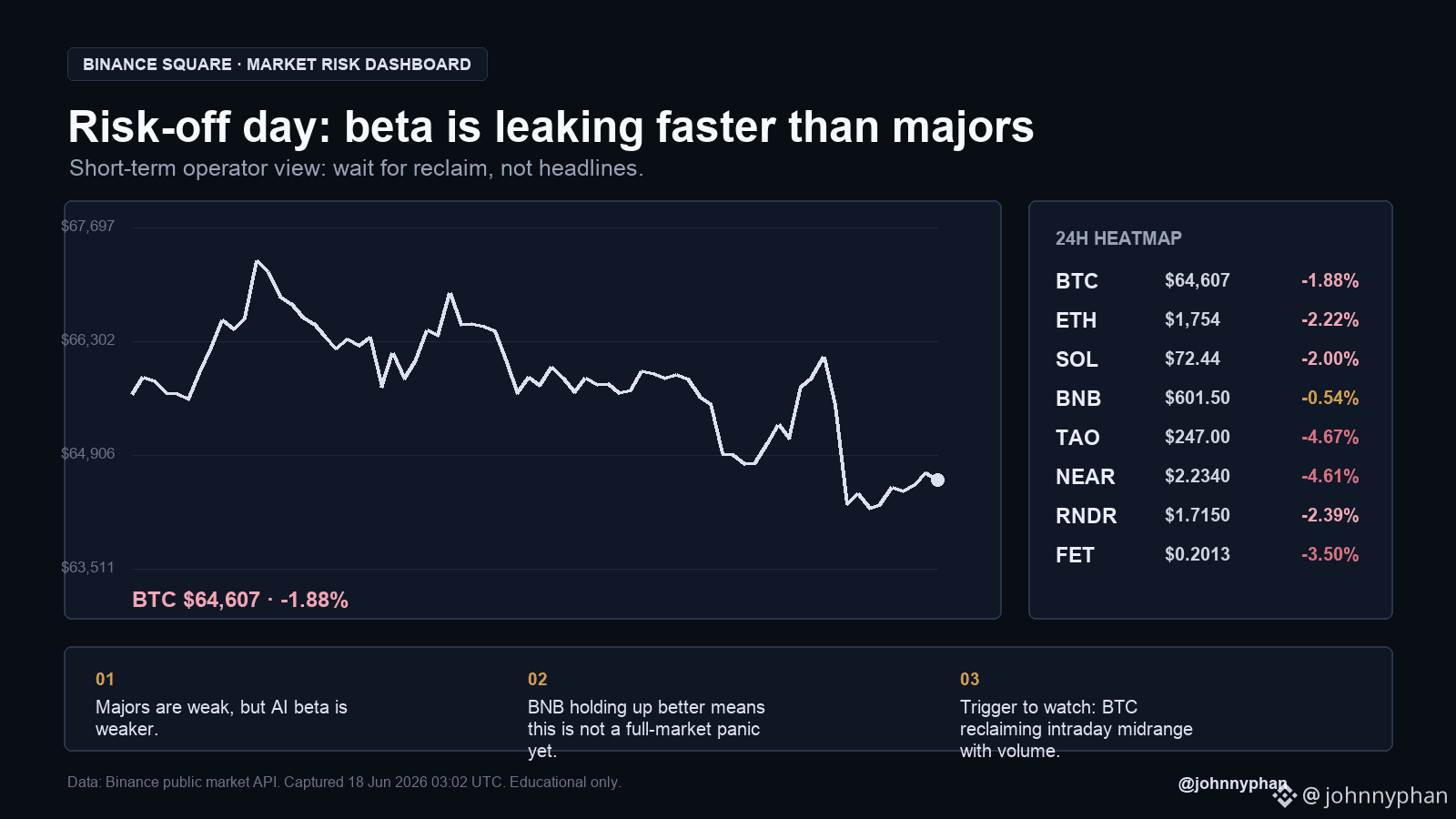
Today isn't the day to buy just because it's 'cheaper than yesterday'.
The short-term dashboard is saying something pretty clear: the market is weak, but beta is weaker than the majors.
Here’s what I’m seeing:
- BTC is down about 1.9%, ETH and SOL are also down over 2%.
- BNB is down less, so this doesn't feel like full panic yet.
- AI beta coins like TAO, NEAR, and FET are getting sold off harder than BTC.
- When the narrative tokens drop faster than the majors, I prioritize waiting for a reclaim instead of trying to catch the bottom.
Here’s the scenario I’m watching:
If BTC reclaims the midrange during the day with volume, alt/AI may see a technical bounce.
If BTC loses the intraday low again, beta could continue to get dumped first.
Key point: good opportunities don’t just come from strong tokens, but from when the market gives you a clearer risk/reward.
If you’re just starting to track the market on Binance, you can create an account here: https://www.binance.com/register?ref=FUTURECRYPTO
Are you waiting for BTC to reclaim or trying to catch the bottom on AI tokens?
Not financial advice.
#BTC #AIcrypto #MarketAnalysis #BinanceSquare
Today isn't the day to buy just because it's 'cheaper than yesterday'.
The short-term dashboard is saying something pretty clear: the market is weak, but beta is weaker than the majors.
Here’s what I’m seeing:
- BTC is down about 1.9%, ETH and SOL are also down over 2%.
- BNB is down less, so this doesn't feel like full panic yet.
- AI beta coins like TAO, NEAR, and FET are getting sold off harder than BTC.
- When the narrative tokens drop faster than the majors, I prioritize waiting for a reclaim instead of trying to catch the bottom.
Here’s the scenario I’m watching:
If BTC reclaims the midrange during the day with volume, alt/AI may see a technical bounce.
If BTC loses the intraday low again, beta could continue to get dumped first.
Key point: good opportunities don’t just come from strong tokens, but from when the market gives you a clearer risk/reward.
If you’re just starting to track the market on Binance, you can create an account here: https://www.binance.com/register?ref=FUTURECRYPTO
Are you waiting for BTC to reclaim or trying to catch the bottom on AI tokens?
Not financial advice.
#BTC #AIcrypto #MarketAnalysis #BinanceSquare
The short-term dashboard is saying something pretty clear: the market is weak, but beta is weaker than the majors.
Here’s what I’m seeing:
- BTC is down about 1.9%, ETH and SOL are also down over 2%.
- BNB is down less, so this doesn't feel like full panic yet.
- AI beta coins like TAO, NEAR, and FET are getting sold off harder than BTC.
- When the narrative tokens drop faster than the majors, I prioritize waiting for a reclaim instead of trying to catch the bottom.
Here’s the scenario I’m watching:
If BTC reclaims the midrange during the day with volume, alt/AI may see a technical bounce.
If BTC loses the intraday low again, beta could continue to get dumped first.
Key point: good opportunities don’t just come from strong tokens, but from when the market gives you a clearer risk/reward.
If you’re just starting to track the market on Binance, you can create an account here: https://www.binance.com/register?ref=FUTURECRYPTO
Are you waiting for BTC to reclaim or trying to catch the bottom on AI tokens?
Not financial advice.
#BTC #AIcrypto #MarketAnalysis #BinanceSquare
196
·
--
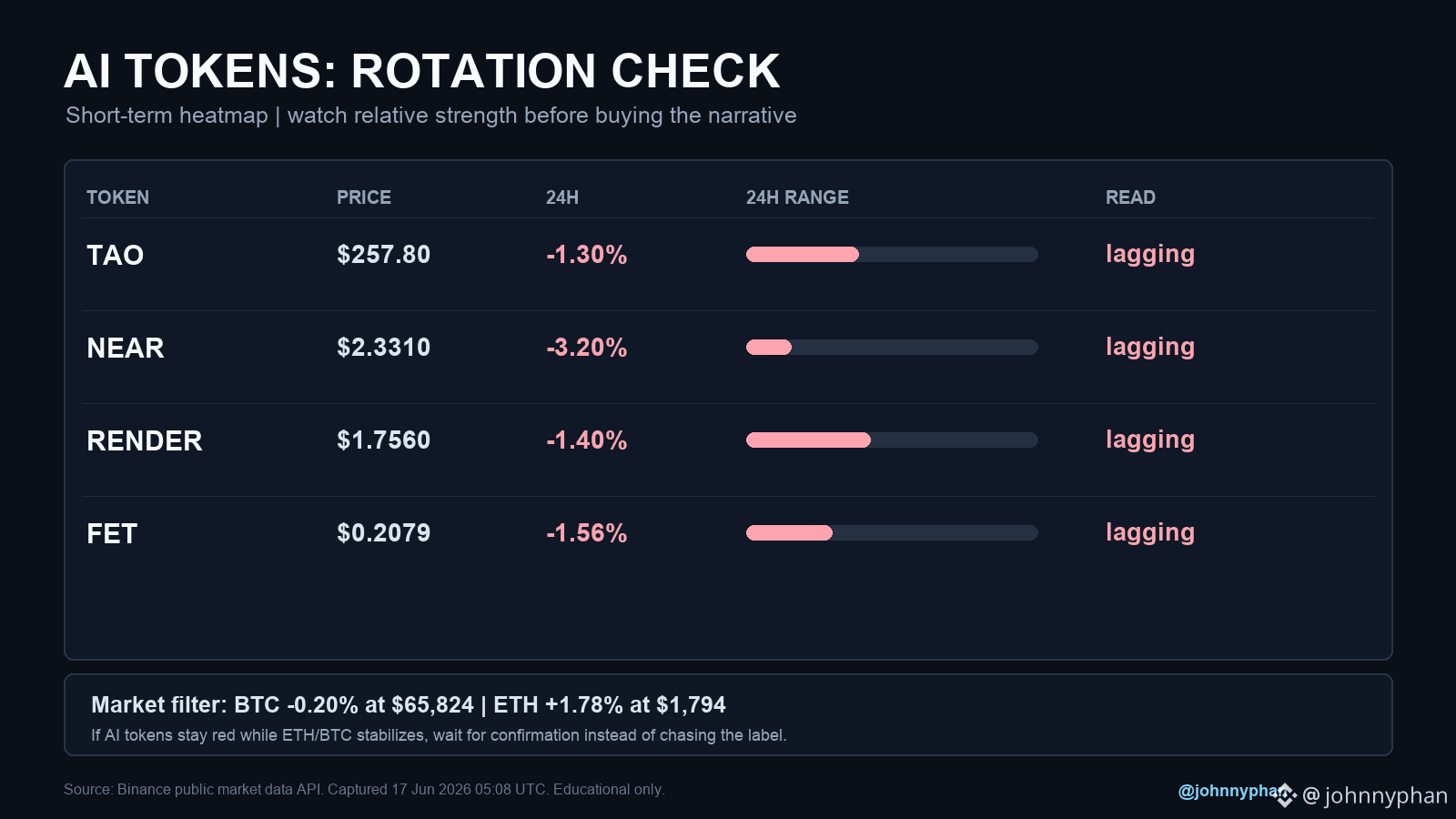
AI tokens today are still lacking real leadership.
Quick glance at the heatmap:
- BTC is pretty much going sideways.
- ETH is showing better green than the market.
- However, TAO, NEAR, RENDER, and FET are still in the red over the last 24 hours.
Main insight: the AI narrative is still attractive, but short-term capital hasn't confirmed it yet. When AI tokens drop while BTC/ETH stays stable, I see that as a signal to be patient, not a FOMO signal.
Here's how I filter opportunities:
1. Prioritize tokens that hold the higher range throughout the day.
2. Wait for volume to come back, not just AI headlines.
3. If BTC loses its range, AI beta tends to get sold off harder.
In the AI group, are you keeping an eye on TAO, RENDER, NEAR, or FET?
If you want to track and trade on Binance, my referral link is here: [https://www.binance.com/register?ref=FUTURECRYPTO](https://www.binance.com/register?ref=FUTURECRYPTO) https://www.binance.com/register?ref=FUTURECRYPTO
#AIcrypto #TAO #RENDER #CryptoMarket
AI tokens today are still lacking real leadership.
Quick glance at the heatmap:
- BTC is pretty much going sideways.
- ETH is showing better green than the market.
- However, TAO, NEAR, RENDER, and FET are still in the red over the last 24 hours.
Main insight: the AI narrative is still attractive, but short-term capital hasn't confirmed it yet. When AI tokens drop while BTC/ETH stays stable, I see that as a signal to be patient, not a FOMO signal.
Here's how I filter opportunities:
1. Prioritize tokens that hold the higher range throughout the day.
2. Wait for volume to come back, not just AI headlines.
3. If BTC loses its range, AI beta tends to get sold off harder.
In the AI group, are you keeping an eye on TAO, RENDER, NEAR, or FET?
If you want to track and trade on Binance, my referral link is here: https://www.binance.com/register?ref=FUTURECRYPTO https://www.binance.com/register?ref=FUTURECRYPTO
#AIcrypto #TAO #RENDER #CryptoMarket
Quick glance at the heatmap:
- BTC is pretty much going sideways.
- ETH is showing better green than the market.
- However, TAO, NEAR, RENDER, and FET are still in the red over the last 24 hours.
Main insight: the AI narrative is still attractive, but short-term capital hasn't confirmed it yet. When AI tokens drop while BTC/ETH stays stable, I see that as a signal to be patient, not a FOMO signal.
Here's how I filter opportunities:
1. Prioritize tokens that hold the higher range throughout the day.
2. Wait for volume to come back, not just AI headlines.
3. If BTC loses its range, AI beta tends to get sold off harder.
In the AI group, are you keeping an eye on TAO, RENDER, NEAR, or FET?
If you want to track and trade on Binance, my referral link is here: https://www.binance.com/register?ref=FUTURECRYPTO https://www.binance.com/register?ref=FUTURECRYPTO
#AIcrypto #TAO #RENDER #CryptoMarket
44
·
--
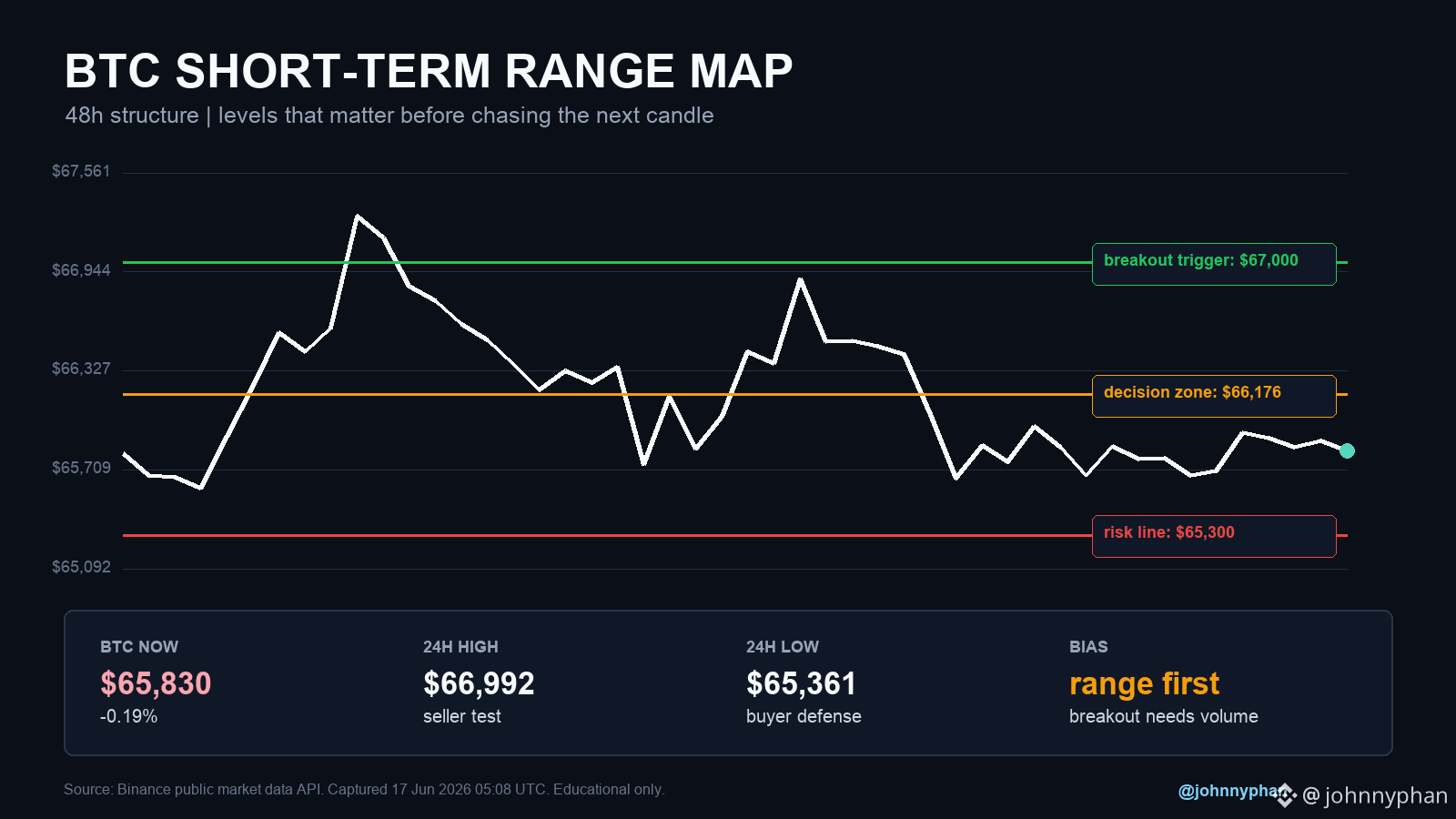
BTC is in the trickiest zone: price is almost flat, but the 24h range is wide enough to sweep both longs and shorts.
Quick Insight:
- BTC around 65.9K, 24h is nearly flat.
- ETH is stronger than BTC today, but BNB is weaker.
- With this setup, I'm not chasing green candles. I'm waiting for one of two signals: a clear reclaim of the 24h highs, or a retest of the 24h lows without breaking down.
My short-term plan:
Break and hold above the resistance zone: might reopen the narrative for 67K-69K.
Losing the 24h low: prioritize capital preservation, as the range could open down deeper.
Are you leaning towards a breakout or a fake pump in the next 24-48h?
CTA: if you're rebuilding your watchlist on Binance, you can use this link to get started: https://www.binance.com/register?ref=FUTURECRYPTO
#BTC #Bitcoin #CryptoTrading #MarketAnalysis #BinanceSquare
BTC is in the trickiest zone: price is almost flat, but the 24h range is wide enough to sweep both longs and shorts.
Quick Insight:
- BTC around 65.9K, 24h is nearly flat.
- ETH is stronger than BTC today, but BNB is weaker.
- With this setup, I'm not chasing green candles. I'm waiting for one of two signals: a clear reclaim of the 24h highs, or a retest of the 24h lows without breaking down.
My short-term plan:
Break and hold above the resistance zone: might reopen the narrative for 67K-69K.
Losing the 24h low: prioritize capital preservation, as the range could open down deeper.
Are you leaning towards a breakout or a fake pump in the next 24-48h?
CTA: if you're rebuilding your watchlist on Binance, you can use this link to get started: https://www.binance.com/register?ref=FUTURECRYPTO
#BTC #Bitcoin #CryptoTrading #MarketAnalysis #BinanceSquare
Quick Insight:
- BTC around 65.9K, 24h is nearly flat.
- ETH is stronger than BTC today, but BNB is weaker.
- With this setup, I'm not chasing green candles. I'm waiting for one of two signals: a clear reclaim of the 24h highs, or a retest of the 24h lows without breaking down.
My short-term plan:
Break and hold above the resistance zone: might reopen the narrative for 67K-69K.
Losing the 24h low: prioritize capital preservation, as the range could open down deeper.
Are you leaning towards a breakout or a fake pump in the next 24-48h?
CTA: if you're rebuilding your watchlist on Binance, you can use this link to get started: https://www.binance.com/register?ref=FUTURECRYPTO
#BTC #Bitcoin #CryptoTrading #MarketAnalysis #BinanceSquare
177
·
--
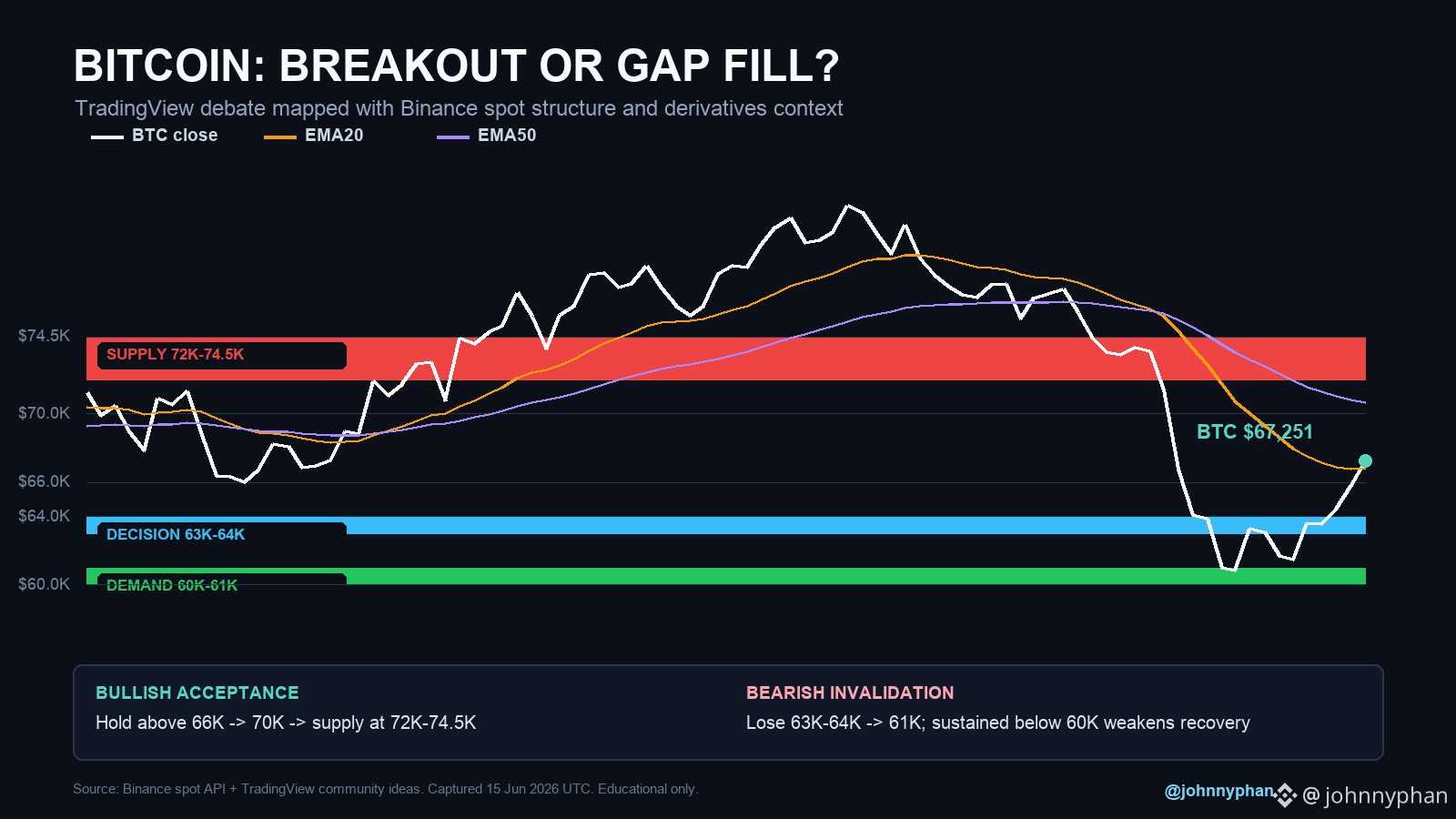
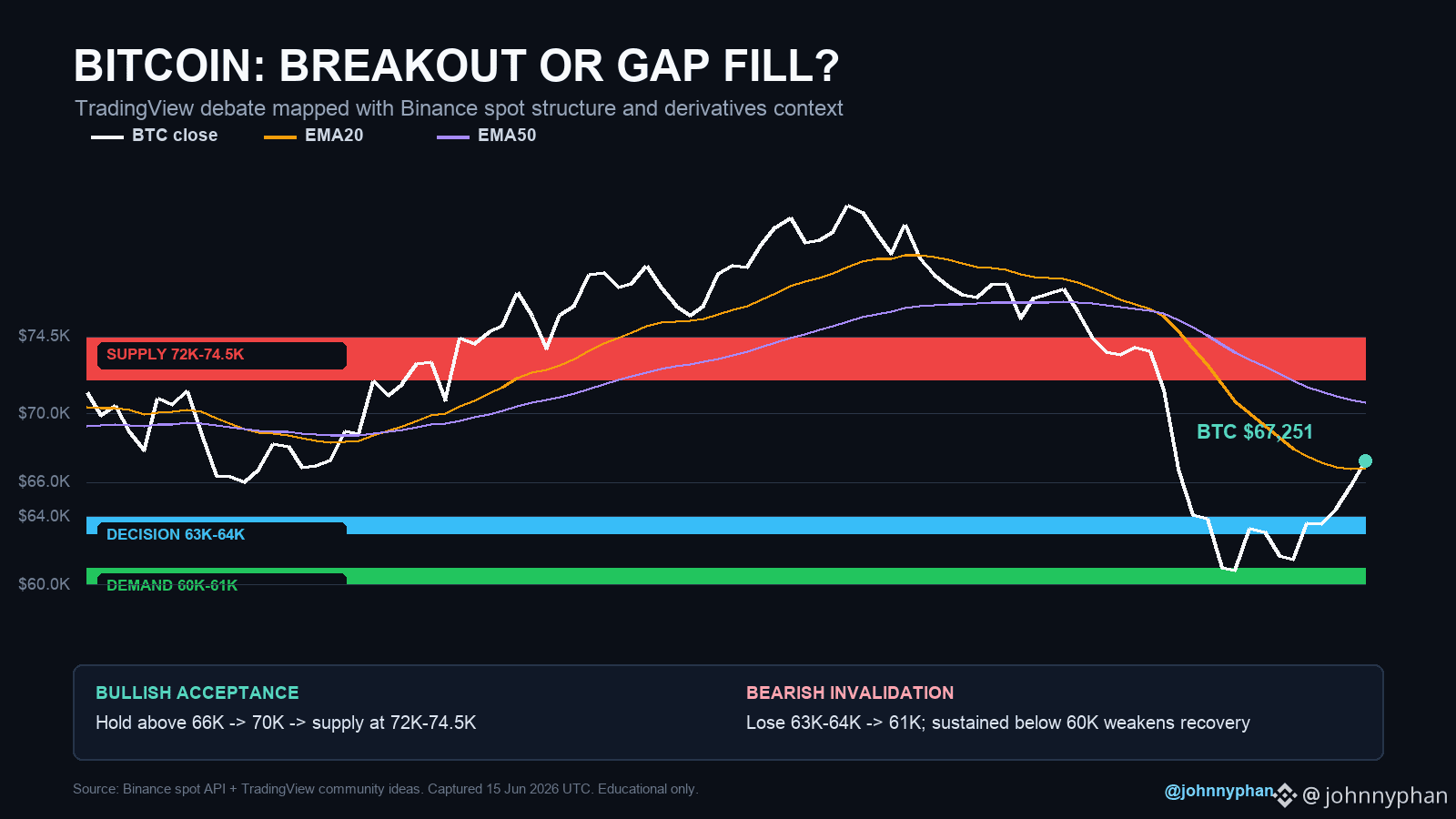
TradingView is split into two camps regarding Bitcoin:
Bullish camp:
• holding above 66K
• breaking EMA50 around 70.7K
• target 72K-74.5K
Bearish camp:
• a retracement could fill the 64K area
• losing 63K opens the path to 61K
• closing below 60K invalidates the recovery thesis
Current Binance data:
• BTC is around 67.25K
• slight negative funding
• 7D OI increased by 6.7%
• taker buy/sell ratio above 1
• price above EMA20 but still below EMA50
Conclusion: recovery has a short-term advantage, but 70K is the crucial confirmation zone.
Read the full analysis and 3 scenarios:
https://www.binance.com/square/post/334440115460050
If you're new to following the market on Binance:
https://www.binance.com/register?ref=FUTURECRYPTO
Not investment advice.
Which scenario do you choose: breakout at 70K, retest at 64K or drop back to 60K?
#Bitcoin #BTC #TradingView
TradingView is split into two camps regarding Bitcoin:
Bullish camp:
• holding above 66K
• breaking EMA50 around 70.7K
• target 72K-74.5K
Bearish camp:
• a retracement could fill the 64K area
• losing 63K opens the path to 61K
• closing below 60K invalidates the recovery thesis
Current Binance data:
• BTC is around 67.25K
• slight negative funding
• 7D OI increased by 6.7%
• taker buy/sell ratio above 1
• price above EMA20 but still below EMA50
Conclusion: recovery has a short-term advantage, but 70K is the crucial confirmation zone.
Read the full analysis and 3 scenarios:
https://www.binance.com/square/post/334440115460050
If you're new to following the market on Binance:
https://www.binance.com/register?ref=FUTURECRYPTO
Not investment advice.
Which scenario do you choose: breakout at 70K, retest at 64K or drop back to 60K?
#Bitcoin #BTC #TradingView
Bullish camp:
• holding above 66K
• breaking EMA50 around 70.7K
• target 72K-74.5K
Bearish camp:
• a retracement could fill the 64K area
• losing 63K opens the path to 61K
• closing below 60K invalidates the recovery thesis
Current Binance data:
• BTC is around 67.25K
• slight negative funding
• 7D OI increased by 6.7%
• taker buy/sell ratio above 1
• price above EMA20 but still below EMA50
Conclusion: recovery has a short-term advantage, but 70K is the crucial confirmation zone.
Read the full analysis and 3 scenarios:
https://www.binance.com/square/post/334440115460050
If you're new to following the market on Binance:
https://www.binance.com/register?ref=FUTURECRYPTO
Not investment advice.
Which scenario do you choose: breakout at 70K, retest at 64K or drop back to 60K?
#Bitcoin #BTC #TradingView
152
·
--
Article
Bitcoin breakout or gap fill? Decoding the ongoing debate on TradingViewBITCOIN BREAKOUT OR GAP FILL? DECRYPTING THE CURRENT DEBATE ON TRADINGVIEW
Crypto ideas updated on TradingView are currently divided into two distinct camps.
The bulls believe Bitcoin has reclaimed the 63K-64K area, paving the way to 66K, 70K, and the supply zone of 72K-74.5K.
The bears argue that the bounce is weakening, and BTC may revisit the liquidity area around 64K before retesting 61K.
Instead of following sentiment, I check the arguments against Binance spot and futures data.
Bitcoin breakout or gap fill? Decoding the ongoing debate on TradingView
BITCOIN BREAKOUT OR GAP FILL? DECRYPTING THE CURRENT DEBATE ON TRADINGVIEW
Crypto ideas updated on TradingView are currently divided into two distinct camps.
The bulls believe Bitcoin has reclaimed the 63K-64K area, paving the way to 66K, 70K, and the supply zone of 72K-74.5K.
The bears argue that the bounce is weakening, and BTC may revisit the liquidity area around 64K before retesting 61K.
Instead of following sentiment, I check the arguments against Binance spot and futures data.
Crypto ideas updated on TradingView are currently divided into two distinct camps.
The bulls believe Bitcoin has reclaimed the 63K-64K area, paving the way to 66K, 70K, and the supply zone of 72K-74.5K.
The bears argue that the bounce is weakening, and BTC may revisit the liquidity area around 64K before retesting 61K.
Instead of following sentiment, I check the arguments against Binance spot and futures data.
6
·
--
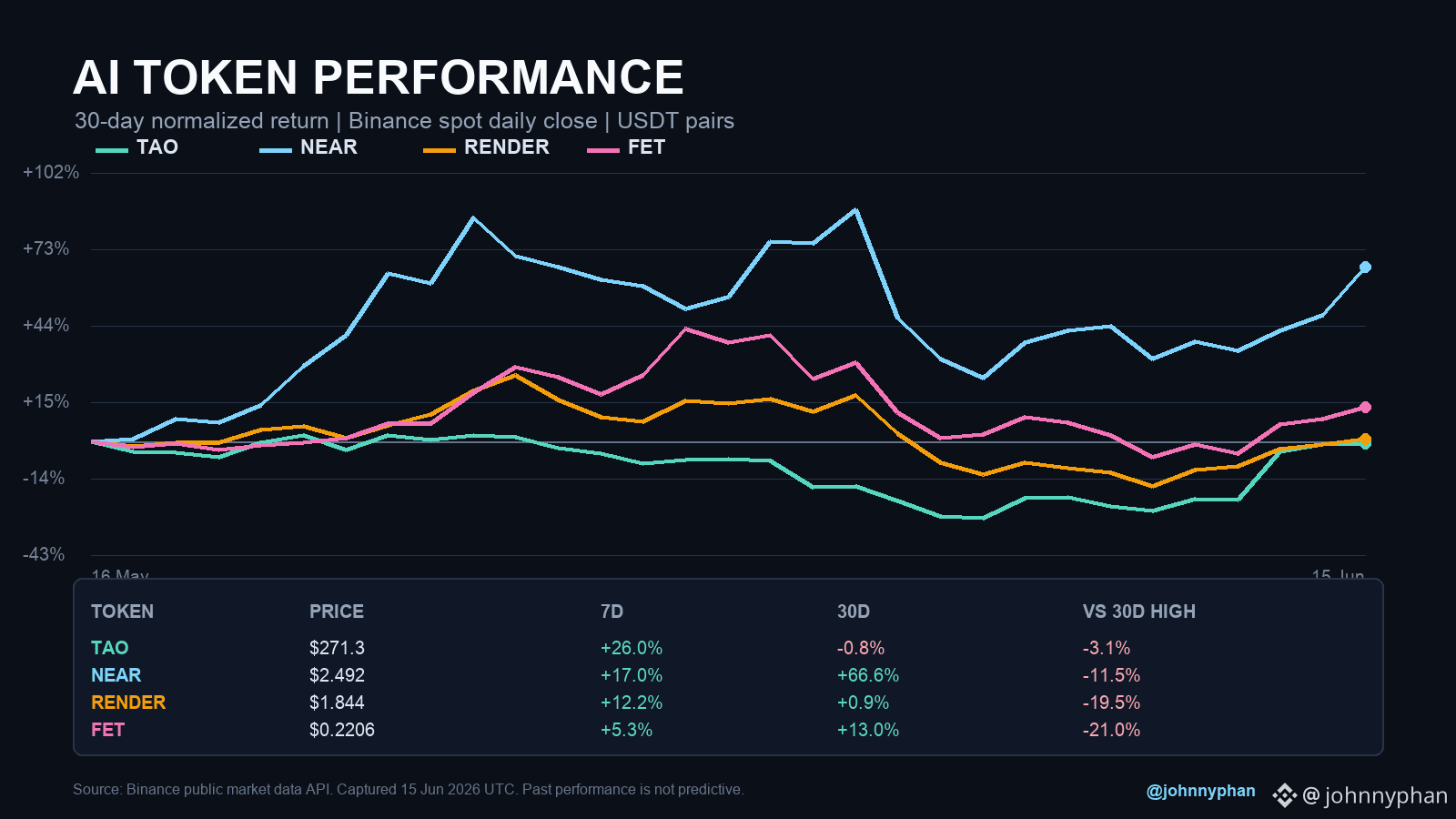
The AI token is bouncing back, but the 30-day chart shows each token is in a different stage.
Key Metrics:
• NEAR leads 30D performance: +66.6%
• TAO leads 7D momentum: +26.0%
• RENDER is nearly flat 30D: +0.9%
• FET is up 13.0% in 30D but is still about 21% away from its recent peak.
Insight:
NEAR is leading the mid-term trend.
TAO is testing a short-term breakout.
RENDER is just in the recovery phase.
FET needs an additional catalyst to absorb the supply above.
Read the full chart analysis:
https://www.binance.com/square/post/334438084674161
If you’re just getting started tracking the market on Binance:
https://www.binance.com/register?ref=FUTURECRYPTO
Not investment advice. Data from Binance spot daily close, as of 15/06/2026 UTC.
Are you prioritizing TAO, NEAR, RENDER or FET?
#AI #Crypto #TAO
The AI token is bouncing back, but the 30-day chart shows each token is in a different stage.
Key Metrics:
• NEAR leads 30D performance: +66.6%
• TAO leads 7D momentum: +26.0%
• RENDER is nearly flat 30D: +0.9%
• FET is up 13.0% in 30D but is still about 21% away from its recent peak.
Insight:
NEAR is leading the mid-term trend.
TAO is testing a short-term breakout.
RENDER is just in the recovery phase.
FET needs an additional catalyst to absorb the supply above.
Read the full chart analysis:
https://www.binance.com/square/post/334438084674161
If you’re just getting started tracking the market on Binance:
https://www.binance.com/register?ref=FUTURECRYPTO
Not investment advice. Data from Binance spot daily close, as of 15/06/2026 UTC.
Are you prioritizing TAO, NEAR, RENDER or FET?
#AI #Crypto #TAO
Key Metrics:
• NEAR leads 30D performance: +66.6%
• TAO leads 7D momentum: +26.0%
• RENDER is nearly flat 30D: +0.9%
• FET is up 13.0% in 30D but is still about 21% away from its recent peak.
Insight:
NEAR is leading the mid-term trend.
TAO is testing a short-term breakout.
RENDER is just in the recovery phase.
FET needs an additional catalyst to absorb the supply above.
Read the full chart analysis:
https://www.binance.com/square/post/334438084674161
If you’re just getting started tracking the market on Binance:
https://www.binance.com/register?ref=FUTURECRYPTO
Not investment advice. Data from Binance spot daily close, as of 15/06/2026 UTC.
Are you prioritizing TAO, NEAR, RENDER or FET?
#AI #Crypto #TAO
212
·
--
Article
AI Token Chart: What Are TAO, NEAR, RENDER, and FET Saying About the Flow of Funds?AI TOKEN CHART: WHAT ARE TAO, NEAR, RENDER, AND FET SAYING ABOUT THE FLOW OF FUNDS?
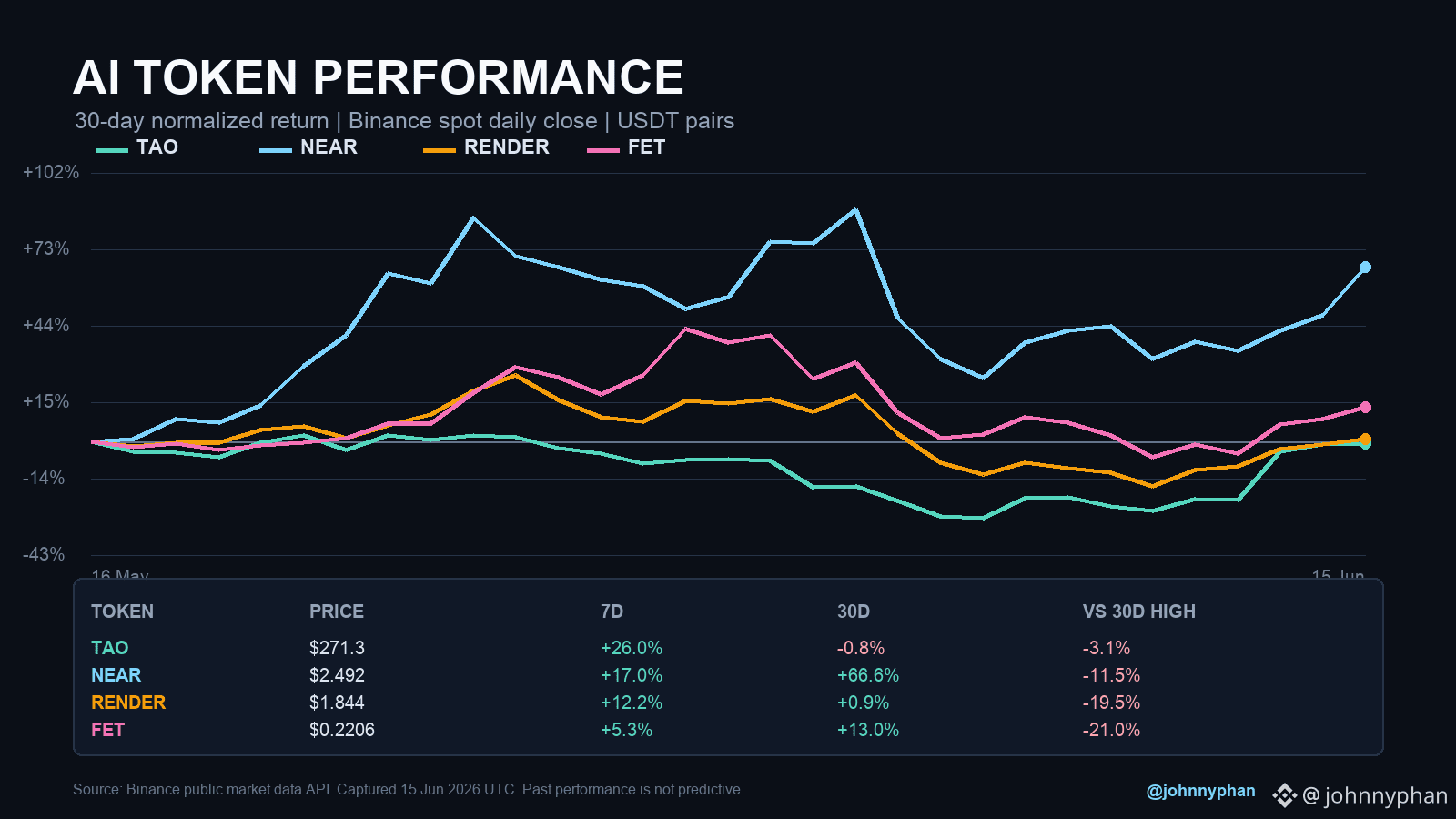
AI crypto is bouncing back strongly, but the 30-day candlestick shows that the money flow isn't evenly distributed.
I've normalized the prices of TAO, NEAR, RENDER, and FET to a baseline of 0% for comparing relative performance. Data is sourced from Binance spot daily closes over the last 31 sessions, ending on 15/06/2026 UTC.
This is not investment advice. Past charts do not guarantee future results.
AI Token Chart: What Are TAO, NEAR, RENDER, and FET Saying About the Flow of Funds?
AI TOKEN CHART: WHAT ARE TAO, NEAR, RENDER, AND FET SAYING ABOUT THE FLOW OF FUNDS?
AI crypto is bouncing back strongly, but the 30-day candlestick shows that the money flow isn't evenly distributed.
I've normalized the prices of TAO, NEAR, RENDER, and FET to a baseline of 0% for comparing relative performance. Data is sourced from Binance spot daily closes over the last 31 sessions, ending on 15/06/2026 UTC.
This is not investment advice. Past charts do not guarantee future results.
AI crypto is bouncing back strongly, but the 30-day candlestick shows that the money flow isn't evenly distributed.
I've normalized the prices of TAO, NEAR, RENDER, and FET to a baseline of 0% for comparing relative performance. Data is sourced from Binance spot daily closes over the last 31 sessions, ending on 15/06/2026 UTC.
This is not investment advice. Past charts do not guarantee future results.
75
·
--
Avalanche is having a 'second act': custom Layer 1 and institutional RWA.
Avalanche9000 has significantly lowered the barriers to deploying private chains. This aligns with:
• tokenized assets
• gaming
• enterprise finance
• regulated markets
The biggest risk is liquidity fragmentation and whether activity on sovereign L1s can create enough demand for AVAX.
Check out the full analysis:
https://www.binance.com/square/post/334435924580449
If you're new to the market on Binance:
https://www.binance.com/register?ref=FUTURECRYPTO
Not investment advice.
What do you think is the biggest advantage of Avalanche: RWA, gaming, or custom enterprise L1?
#Avalanche #AVAX #RWA
Avalanche is having a 'second act': custom Layer 1 and institutional RWA.
Avalanche9000 has significantly lowered the barriers to deploying private chains. This aligns with:
• tokenized assets
• gaming
• enterprise finance
• regulated markets
The biggest risk is liquidity fragmentation and whether activity on sovereign L1s can create enough demand for AVAX.
Check out the full analysis:
https://www.binance.com/square/post/334435924580449
If you're new to the market on Binance:
https://www.binance.com/register?ref=FUTURECRYPTO
Not investment advice.
What do you think is the biggest advantage of Avalanche: RWA, gaming, or custom enterprise L1?
#Avalanche #AVAX #RWA
Avalanche9000 has significantly lowered the barriers to deploying private chains. This aligns with:
• tokenized assets
• gaming
• enterprise finance
• regulated markets
The biggest risk is liquidity fragmentation and whether activity on sovereign L1s can create enough demand for AVAX.
Check out the full analysis:
https://www.binance.com/square/post/334435924580449
If you're new to the market on Binance:
https://www.binance.com/register?ref=FUTURECRYPTO
Not investment advice.
What do you think is the biggest advantage of Avalanche: RWA, gaming, or custom enterprise L1?
#Avalanche #AVAX #RWA
76
·
--
Sui shouldn’t just be seen as a fast chain.
The more compelling thesis is a financial + data stack:
• Sui for parallel execution
• DeepBook for shared on-chain liquidity
• Walrus for decentralized data/storage
Key metrics to watch are organic volume, user retention, and the ability to absorb token unlocks, not just TVL driven by incentives.
Read the full analysis:
https://www.binance.com/square/post/334435836355714
If you're new to tracking the market on Binance:
https://www.binance.com/register?ref=FUTURECRYPTO
Not investment advice.
Do you want me to dive deeper into DeepBook, Walrus, or Sui's token unlock?
#Sui #DeepBook #DeFi
Sui shouldn’t just be seen as a fast chain.
The more compelling thesis is a financial + data stack:
• Sui for parallel execution
• DeepBook for shared on-chain liquidity
• Walrus for decentralized data/storage
Key metrics to watch are organic volume, user retention, and the ability to absorb token unlocks, not just TVL driven by incentives.
Read the full analysis:
https://www.binance.com/square/post/334435836355714
If you're new to tracking the market on Binance:
https://www.binance.com/register?ref=FUTURECRYPTO
Not investment advice.
Do you want me to dive deeper into DeepBook, Walrus, or Sui's token unlock?
#Sui #DeepBook #DeFi
The more compelling thesis is a financial + data stack:
• Sui for parallel execution
• DeepBook for shared on-chain liquidity
• Walrus for decentralized data/storage
Key metrics to watch are organic volume, user retention, and the ability to absorb token unlocks, not just TVL driven by incentives.
Read the full analysis:
https://www.binance.com/square/post/334435836355714
If you're new to tracking the market on Binance:
https://www.binance.com/register?ref=FUTURECRYPTO
Not investment advice.
Do you want me to dive deeper into DeepBook, Walrus, or Sui's token unlock?
#Sui #DeepBook #DeFi
66
·
--
BNB Chain is trying to juggle three tough things at once: EVM compatibility, high performance, and large distribution.
After recent upgrades:
• block time has dropped significantly
• faster finality
• increased network bandwidth
But speed only matters if it translates into payments, trading, consumer apps, and real AI-agent activity.
Read the full analysis:
https://www.binance.com/square/post/334435751019266
If you’re just starting to keep an eye on the market on Binance:
https://www.binance.com/register?ref=FUTURECRYPTO
This is not investment advice.
In your opinion, what’s the strongest use case for BNB Chain: trading, payments, or consumer apps?
#BNBChain #BNB #Web3
BNB Chain is trying to juggle three tough things at once: EVM compatibility, high performance, and large distribution.
After recent upgrades:
• block time has dropped significantly
• faster finality
• increased network bandwidth
But speed only matters if it translates into payments, trading, consumer apps, and real AI-agent activity.
Read the full analysis:
https://www.binance.com/square/post/334435751019266
If you’re just starting to keep an eye on the market on Binance:
https://www.binance.com/register?ref=FUTURECRYPTO
This is not investment advice.
In your opinion, what’s the strongest use case for BNB Chain: trading, payments, or consumer apps?
#BNBChain #BNB #Web3
After recent upgrades:
• block time has dropped significantly
• faster finality
• increased network bandwidth
But speed only matters if it translates into payments, trading, consumer apps, and real AI-agent activity.
Read the full analysis:
https://www.binance.com/square/post/334435751019266
If you’re just starting to keep an eye on the market on Binance:
https://www.binance.com/register?ref=FUTURECRYPTO
This is not investment advice.
In your opinion, what’s the strongest use case for BNB Chain: trading, payments, or consumer apps?
#BNBChain #BNB #Web3
43
·
--
Solana has won part of the speed race. The next test is reliability.
Three catalysts to watch:
• Alpenglow: faster consensus and finality
• Firedancer: client diversity and resilience
• stablecoin/payments: real demand beyond speculation
High TPS isn't enough. Solana needs to prove quality activity, a stable network, and sustainable validator economics.
Read the full analysis:
https://www.binance.com/square/post/334435699144274
If you're new to tracking the market on Binance:
https://www.binance.com/register?ref=FUTURECRYPTO
Not investment advice.
Which catalyst is most important for Solana: Alpenglow, Firedancer, or payments?
#Solana #SOL #Crypto
Solana has won part of the speed race. The next test is reliability.
Three catalysts to watch:
• Alpenglow: faster consensus and finality
• Firedancer: client diversity and resilience
• stablecoin/payments: real demand beyond speculation
High TPS isn't enough. Solana needs to prove quality activity, a stable network, and sustainable validator economics.
Read the full analysis:
https://www.binance.com/square/post/334435699144274
If you're new to tracking the market on Binance:
https://www.binance.com/register?ref=FUTURECRYPTO
Not investment advice.
Which catalyst is most important for Solana: Alpenglow, Firedancer, or payments?
#Solana #SOL #Crypto
Three catalysts to watch:
• Alpenglow: faster consensus and finality
• Firedancer: client diversity and resilience
• stablecoin/payments: real demand beyond speculation
High TPS isn't enough. Solana needs to prove quality activity, a stable network, and sustainable validator economics.
Read the full analysis:
https://www.binance.com/square/post/334435699144274
If you're new to tracking the market on Binance:
https://www.binance.com/register?ref=FUTURECRYPTO
Not investment advice.
Which catalyst is most important for Solana: Alpenglow, Firedancer, or payments?
#Solana #SOL #Crypto
28
·
--
Ethereum doesn't need to be the fastest chain to maintain its leading position.
The important thesis is:
• Ethereum serves as the settlement and security layer for rollups
• Blob scaling is expanding data capacity for Layer 2
• Glamsterdam could enhance block production and L1 execution
The biggest risk isn't TPS. It's fragmented liquidity and whether ETH can capture enough value as activity shifts to Layer 2.
Read the full analysis:
https://www.binance.com/square/post/334435639799602
If you're just starting to watch the market on Binance:
https://www.binance.com/register?ref=FUTURECRYPTO
Not investment advice.
What do you think is Ethereum's biggest advantage: security, liquidity, or Layer 2?
#Ethereum #ETH #Layer2
Ethereum doesn't need to be the fastest chain to maintain its leading position.
The important thesis is:
• Ethereum serves as the settlement and security layer for rollups
• Blob scaling is expanding data capacity for Layer 2
• Glamsterdam could enhance block production and L1 execution
The biggest risk isn't TPS. It's fragmented liquidity and whether ETH can capture enough value as activity shifts to Layer 2.
Read the full analysis:
https://www.binance.com/square/post/334435639799602
If you're just starting to watch the market on Binance:
https://www.binance.com/register?ref=FUTURECRYPTO
Not investment advice.
What do you think is Ethereum's biggest advantage: security, liquidity, or Layer 2?
#Ethereum #ETH #Layer2
The important thesis is:
• Ethereum serves as the settlement and security layer for rollups
• Blob scaling is expanding data capacity for Layer 2
• Glamsterdam could enhance block production and L1 execution
The biggest risk isn't TPS. It's fragmented liquidity and whether ETH can capture enough value as activity shifts to Layer 2.
Read the full analysis:
https://www.binance.com/square/post/334435639799602
If you're just starting to watch the market on Binance:
https://www.binance.com/register?ref=FUTURECRYPTO
Not investment advice.
What do you think is Ethereum's biggest advantage: security, liquidity, or Layer 2?
#Ethereum #ETH #Layer2
106
·
--
Verified
Avalanche 2026: Can Custom L1s and RWA Create a Second Act for AVAX?AVALANCHE 2026: CAN CUSTOM L1S AND RWA CREATE A ‘SECOND ACT’ FOR AVAX?
Avalanche was once known for Subnets. After Avalanche9000 and Etna, the strategy has become clearer: help organizations and applications deploy sovereign Layer 1s with low costs, custom configurations, and near-instant finality.
This thesis is particularly relevant for gaming, payments, enterprise, and real-world assets. However, custom chains also pose fragmentation risks.
This is not investment advice. This is an analysis of architecture, catalysts, and risks.
Avalanche 2026: Can Custom L1s and RWA Create a Second Act for AVAX?
AVALANCHE 2026: CAN CUSTOM L1S AND RWA CREATE A ‘SECOND ACT’ FOR AVAX?
Avalanche was once known for Subnets. After Avalanche9000 and Etna, the strategy has become clearer: help organizations and applications deploy sovereign Layer 1s with low costs, custom configurations, and near-instant finality.
This thesis is particularly relevant for gaming, payments, enterprise, and real-world assets. However, custom chains also pose fragmentation risks.
This is not investment advice. This is an analysis of architecture, catalysts, and risks.
Avalanche was once known for Subnets. After Avalanche9000 and Etna, the strategy has become clearer: help organizations and applications deploy sovereign Layer 1s with low costs, custom configurations, and near-instant finality.
This thesis is particularly relevant for gaming, payments, enterprise, and real-world assets. However, custom chains also pose fragmentation risks.
This is not investment advice. This is an analysis of architecture, catalysts, and risks.
5
·
--
Sui 2026: High-speed mainnet or financial stack for on-chain market?SUI 2026: HIGH-SPEED MAINNET OR FINANCIAL STACK FOR ON-CHAIN MARKET?
Sui is often mentioned for its object-centric architecture and parallel processing capability. However, the more attractive catalyst in 2026 may lie in financial infrastructure: DeepBook, stablecoins, trading, and decentralized data through Walrus.
The question is whether Sui can turn good tech into liquidity and user retention.
Not investment advice. This is an analysis of the ecosystem, catalysts, and risks.
Sui 2026: High-speed mainnet or financial stack for on-chain market?
SUI 2026: HIGH-SPEED MAINNET OR FINANCIAL STACK FOR ON-CHAIN MARKET?
Sui is often mentioned for its object-centric architecture and parallel processing capability. However, the more attractive catalyst in 2026 may lie in financial infrastructure: DeepBook, stablecoins, trading, and decentralized data through Walrus.
The question is whether Sui can turn good tech into liquidity and user retention.
Not investment advice. This is an analysis of the ecosystem, catalysts, and risks.
Sui is often mentioned for its object-centric architecture and parallel processing capability. However, the more attractive catalyst in 2026 may lie in financial infrastructure: DeepBook, stablecoins, trading, and decentralized data through Walrus.
The question is whether Sui can turn good tech into liquidity and user retention.
Not investment advice. This is an analysis of the ecosystem, catalysts, and risks.
43
·
--
Solana 2026: From high-speed chain to infrastructure for the Internet marketSOLANA 2026: FROM HIGH-SPEED CHAIN TO INFRASTRUCTURE FOR THE INTERNET MARKET
Solana has proven that blockchain can serve trading, payments, and consumer apps with a fast experience. But the next step is harder: can the network maintain stable performance as demand surges and become reliable infrastructure for institutions?
Alpenglow, Firedancer, and compute upgrades in 2026 are critical tests.
Not investment advice. This is an analysis of infrastructure, catalysts, and risks for Solana.
Solana 2026: From high-speed chain to infrastructure for the Internet market
SOLANA 2026: FROM HIGH-SPEED CHAIN TO INFRASTRUCTURE FOR THE INTERNET MARKET
Solana has proven that blockchain can serve trading, payments, and consumer apps with a fast experience. But the next step is harder: can the network maintain stable performance as demand surges and become reliable infrastructure for institutions?
Alpenglow, Firedancer, and compute upgrades in 2026 are critical tests.
Not investment advice. This is an analysis of infrastructure, catalysts, and risks for Solana.
Solana has proven that blockchain can serve trading, payments, and consumer apps with a fast experience. But the next step is harder: can the network maintain stable performance as demand surges and become reliable infrastructure for institutions?
Alpenglow, Firedancer, and compute upgrades in 2026 are critical tests.
Not investment advice. This is an analysis of infrastructure, catalysts, and risks for Solana.
36
·
--
ETHEREUM 2026: IS ETH STILL THE LEADING MAINNET OR GIVING WAY TO FASTER L1s?ETHEREUM 2026: IS ETH STILL THE LEADING MAINNET OR GIVING WAY TO FASTER L1s?
Ethereum is often criticized for high fees, fragmented experiences, and slower speeds compared to newer Layer 1s. However, if we only compare TPS, we may be misjudging Ethereum's role.
The important thesis for 2026 isn't that Ethereum will become the fastest chain. The thesis is that Ethereum continues to serve as the settlement, data availability, and security layer for an increasingly large rollup economy.
ETHEREUM 2026: IS ETH STILL THE LEADING MAINNET OR GIVING WAY TO FASTER L1s?
ETHEREUM 2026: IS ETH STILL THE LEADING MAINNET OR GIVING WAY TO FASTER L1s?
Ethereum is often criticized for high fees, fragmented experiences, and slower speeds compared to newer Layer 1s. However, if we only compare TPS, we may be misjudging Ethereum's role.
The important thesis for 2026 isn't that Ethereum will become the fastest chain. The thesis is that Ethereum continues to serve as the settlement, data availability, and security layer for an increasingly large rollup economy.
Ethereum is often criticized for high fees, fragmented experiences, and slower speeds compared to newer Layer 1s. However, if we only compare TPS, we may be misjudging Ethereum's role.
The important thesis for 2026 isn't that Ethereum will become the fastest chain. The thesis is that Ethereum continues to serve as the settlement, data availability, and security layer for an increasingly large rollup economy.
9
Log in to explore more content
Join global crypto users on Binance Square
⚡️ Get latest and useful information about crypto.
💬 Trusted by the world’s largest crypto exchange.
👍 Discover real insights from verified creators.
Email / Phone number