
K线嘉豪
470 Posts

K线嘉豪
Report
Block User
134 Following
1.8K+ Followers
205 Liked
Posts
All
Quotes
Live
·
--
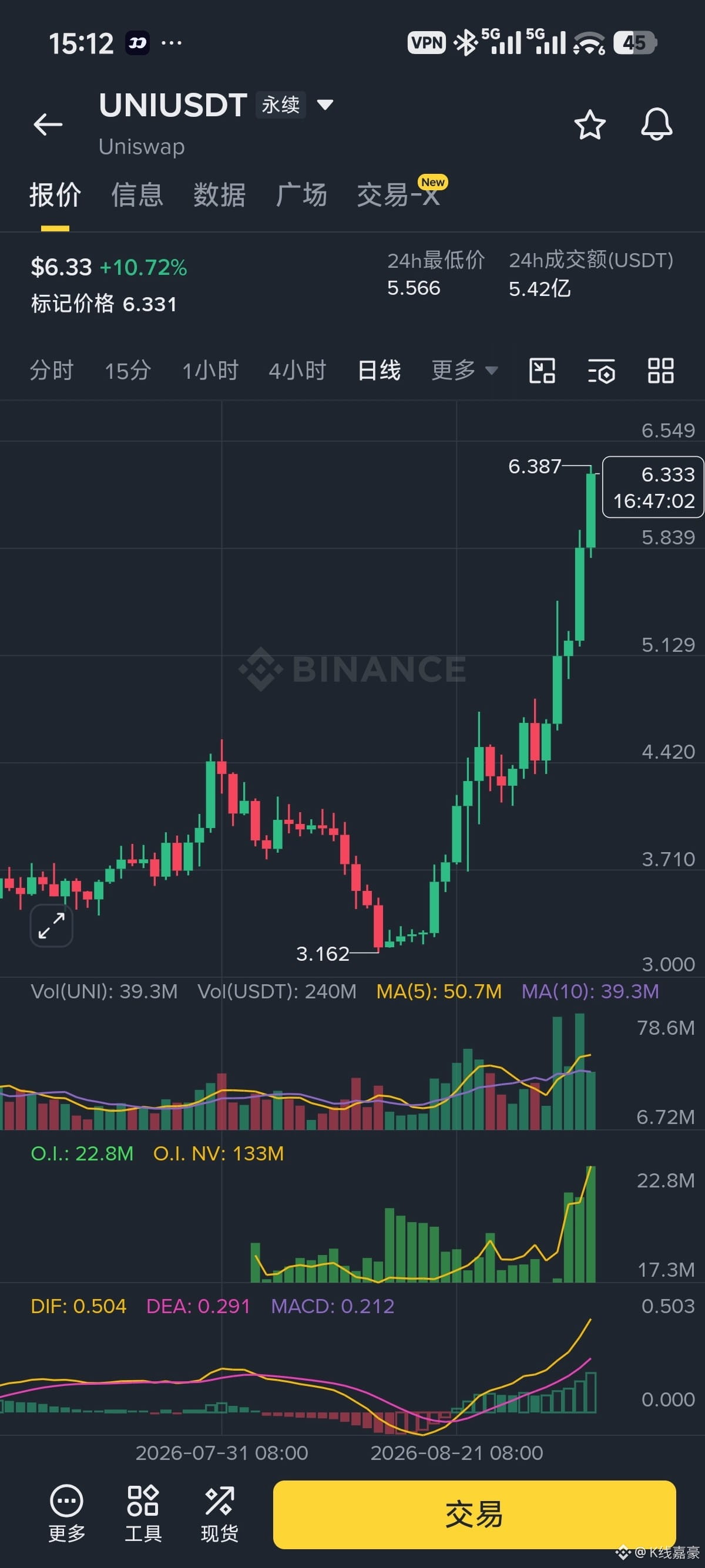
$UNI why do people say UNI will definitely go up?
Recently, the most obvious wealth effect has been the memes on Robinhood. If you have buddies who trade and “hit dog” (meme coins), you definitely know that the fees on Robinhood have become increasingly expensive. Unlike BSC’s low fees, Robinhood’s single transaction cost was 0.3u a couple of days ago, and now it has already risen to 1u—sometimes even 2u. During peak hours, it will be even higher.
Let me popularize it for those who don’t know: the “land dogs” on Robinhood are UNI v4 pool(s).
So during this meme craze, UNI will receive a massive amount of fee revenue. This will push UNI to keep rising.
As long as this dog-meme cycle doesn’t stop, UNI’s upward trend won’t end. 6 is still the bottom—stay confident and go for it boldly.
$UNI why do people say UNI will definitely go up?
Recently, the most obvious wealth effect has been the memes on Robinhood. If you have buddies who trade and “hit dog” (meme coins), you definitely know that the fees on Robinhood have become increasingly expensive. Unlike BSC’s low fees, Robinhood’s single transaction cost was 0.3u a couple of days ago, and now it has already risen to 1u—sometimes even 2u. During peak hours, it will be even higher.
Let me popularize it for those who don’t know: the “land dogs” on Robinhood are UNI v4 pool(s).
So during this meme craze, UNI will receive a massive amount of fee revenue. This will push UNI to keep rising.
As long as this dog-meme cycle doesn’t stop, UNI’s upward trend won’t end. 6 is still the bottom—stay confident and go for it boldly.
Recently, the most obvious wealth effect has been the memes on Robinhood. If you have buddies who trade and “hit dog” (meme coins), you definitely know that the fees on Robinhood have become increasingly expensive. Unlike BSC’s low fees, Robinhood’s single transaction cost was 0.3u a couple of days ago, and now it has already risen to 1u—sometimes even 2u. During peak hours, it will be even higher.
Let me popularize it for those who don’t know: the “land dogs” on Robinhood are UNI v4 pool(s).
So during this meme craze, UNI will receive a massive amount of fee revenue. This will push UNI to keep rising.
As long as this dog-meme cycle doesn’t stop, UNI’s upward trend won’t end. 6 is still the bottom—stay confident and go for it boldly.
4
3
2.1k
·
--
BTC 100k battle: some are afraid of heights, while others quietly stock up 🧐
Recently, price has been swinging back and forth around $100,000. On one side, there’s selling pressure from short-term profit-takers; on the other, the main players are quietly accumulating—often the market chooses its direction while most people are still hesitating.
🔗 On-chain signals worth watching:
▪️ Long-term holders (LTH) keep increasing their positions—the “diamond hands” aren’t backing out
▪️ The trend of net BTC outflows from exchanges continues; the pace of moving coins to cold wallets hasn’t stopped
▪️ BTC spot ETF inflows have recently improved—institutional capital is accumulating on the dips
In this stage of back-and-forth between bulls and bears, which side are you on?
👇 Drop your thoughts in the comments:
A. $100k is just the starting point—keep holding
B. Wait for a pullback to get in
C. Have already cleared out and am watching from the sidelines
#BTC #Bitcoin #Bitcoin
BTC 100k battle: some are afraid of heights, while others quietly stock up 🧐
Recently, price has been swinging back and forth around $100,000. On one side, there’s selling pressure from short-term profit-takers; on the other, the main players are quietly accumulating—often the market chooses its direction while most people are still hesitating.
🔗 On-chain signals worth watching:
▪️ Long-term holders (LTH) keep increasing their positions—the “diamond hands” aren’t backing out
▪️ The trend of net BTC outflows from exchanges continues; the pace of moving coins to cold wallets hasn’t stopped
▪️ BTC spot ETF inflows have recently improved—institutional capital is accumulating on the dips
In this stage of back-and-forth between bulls and bears, which side are you on?
👇 Drop your thoughts in the comments:
A. $100k is just the starting point—keep holding
B. Wait for a pullback to get in
C. Have already cleared out and am watching from the sidelines
#BTC #Bitcoin #Bitcoin
Recently, price has been swinging back and forth around $100,000. On one side, there’s selling pressure from short-term profit-takers; on the other, the main players are quietly accumulating—often the market chooses its direction while most people are still hesitating.
🔗 On-chain signals worth watching:
▪️ Long-term holders (LTH) keep increasing their positions—the “diamond hands” aren’t backing out
▪️ The trend of net BTC outflows from exchanges continues; the pace of moving coins to cold wallets hasn’t stopped
▪️ BTC spot ETF inflows have recently improved—institutional capital is accumulating on the dips
In this stage of back-and-forth between bulls and bears, which side are you on?
👇 Drop your thoughts in the comments:
A. $100k is just the starting point—keep holding
B. Wait for a pullback to get in
C. Have already cleared out and am watching from the sidelines
#BTC #Bitcoin #Bitcoin
63
·
--
🔥 XAU is consolidating and building momentum—gold’s “triple moat” is still deepening
1️⃣ Geopolitical risks continue to heat up
Turbulence in the Middle East and intensifying great-power competition haven’t changed the logic behind allocating safe-haven assets. Every geopolitical “pulse” acts as a catalyst for gold.
2️⃣ Fed rate cuts are just a matter of time
With inflation data easing moderately and cracks appearing in the jobs market, the market has reached a consensus on this year’s rate cuts. Falling real yields = a tailwind for gold 🌬️
3️⃣ Global central banks “buy, buy, buy” can’t stop
The People’s Bank of China has been increasing its holdings, and India/Poland are also stockpiling gold. Under the broader trend of de-dollarization, sovereign demand for gold is structural—not just short-term.
📊 For this pullback in XAU, do you think it’s just a shakeout or a shift in trend?
👇 Leave your take in the comments
A. Gold will definitely break to new highs within the year 📈
B. Range-bound consolidation is dominant—buy low, sell high ⚖️
C. The safe-haven premium has already been priced in; expect the pullback 🔻
#XAU/USD #黄金 #Gold #避险资产 #Binance Square
🔥 XAU is consolidating and building momentum—gold’s “triple moat” is still deepening
1️⃣ Geopolitical risks continue to heat up
Turbulence in the Middle East and intensifying great-power competition haven’t changed the logic behind allocating safe-haven assets. Every geopolitical “pulse” acts as a catalyst for gold.
2️⃣ Fed rate cuts are just a matter of time
With inflation data easing moderately and cracks appearing in the jobs market, the market has reached a consensus on this year’s rate cuts. Falling real yields = a tailwind for gold 🌬️
3️⃣ Global central banks “buy, buy, buy” can’t stop
The People’s Bank of China has been increasing its holdings, and India/Poland are also stockpiling gold. Under the broader trend of de-dollarization, sovereign demand for gold is structural—not just short-term.
📊 For this pullback in XAU, do you think it’s just a shakeout or a shift in trend?
👇 Leave your take in the comments
A. Gold will definitely break to new highs within the year 📈
B. Range-bound consolidation is dominant—buy low, sell high ⚖️
C. The safe-haven premium has already been priced in; expect the pullback 🔻
#XAU/USD #黄金 #Gold #避险资产 #Binance Square
1️⃣ Geopolitical risks continue to heat up
Turbulence in the Middle East and intensifying great-power competition haven’t changed the logic behind allocating safe-haven assets. Every geopolitical “pulse” acts as a catalyst for gold.
2️⃣ Fed rate cuts are just a matter of time
With inflation data easing moderately and cracks appearing in the jobs market, the market has reached a consensus on this year’s rate cuts. Falling real yields = a tailwind for gold 🌬️
3️⃣ Global central banks “buy, buy, buy” can’t stop
The People’s Bank of China has been increasing its holdings, and India/Poland are also stockpiling gold. Under the broader trend of de-dollarization, sovereign demand for gold is structural—not just short-term.
📊 For this pullback in XAU, do you think it’s just a shakeout or a shift in trend?
👇 Leave your take in the comments
A. Gold will definitely break to new highs within the year 📈
B. Range-bound consolidation is dominant—buy low, sell high ⚖️
C. The safe-haven premium has already been priced in; expect the pullback 🔻
#XAU/USD #黄金 #Gold #避险资产 #Binance Square
40
·
--
MU Micron Technology: The War of HBM Has Just Begun 🔥
Brothers, today let’s talk about Micron.
What’s the situation with HBM (high-bandwidth memory) right now? Four words: severe supply shortage.
AI data centers are seeing explosive growth in demand for HBM. NVIDIA’s GB200, AMD’s MI300 series—every AI accelerator card is crazily consuming HBM. One GB200 uses 8 HBM3E chips, and when data centers deploy, it’s tens of thousands of cards at a time. Just calculate how massive the demand volume is.
The three major players—Samsung, SK hynix, and Micron—are all expanding production, but capacity release simply can’t keep up with the order growth rate. SK hynix’s HBM capacity for 2026 has already been fully booked, and Samsung is working overtime to ramp up. In this seller’s market, pricing power is completely in the hands of suppliers.
On Micron’s side, HBM3E has already entered NVIDIA’s supply chain, and the production scale in the second half of 2026 is still ramping up. Compared with SK hynix, Micron still has a smaller share in the HBM market, but its growth rate is fast—so the opportunity is there.
From an investment perspective:
• MU’s current valuation is discounted relative to SK hynix
• HBM gross margin is far higher than traditional DRAM, and earnings have strong upside leverage
• The HBM market CAGR for 2026–2027 is expected to be over 50%
The risks are also clear: the cyclical nature of semiconductors, geopolitics, and competitive pressure from Samsung/SK hynix.
What do you think about Micron? How much HBM share do you think it can take from SK hynix? Let’s discuss in the comments 👇
#MU #美光科技 #HBM #AI芯片
MU Micron Technology: The War of HBM Has Just Begun 🔥
Brothers, today let’s talk about Micron.
What’s the situation with HBM (high-bandwidth memory) right now? Four words: severe supply shortage.
AI data centers are seeing explosive growth in demand for HBM. NVIDIA’s GB200, AMD’s MI300 series—every AI accelerator card is crazily consuming HBM. One GB200 uses 8 HBM3E chips, and when data centers deploy, it’s tens of thousands of cards at a time. Just calculate how massive the demand volume is.
The three major players—Samsung, SK hynix, and Micron—are all expanding production, but capacity release simply can’t keep up with the order growth rate. SK hynix’s HBM capacity for 2026 has already been fully booked, and Samsung is working overtime to ramp up. In this seller’s market, pricing power is completely in the hands of suppliers.
On Micron’s side, HBM3E has already entered NVIDIA’s supply chain, and the production scale in the second half of 2026 is still ramping up. Compared with SK hynix, Micron still has a smaller share in the HBM market, but its growth rate is fast—so the opportunity is there.
From an investment perspective:
• MU’s current valuation is discounted relative to SK hynix
• HBM gross margin is far higher than traditional DRAM, and earnings have strong upside leverage
• The HBM market CAGR for 2026–2027 is expected to be over 50%
The risks are also clear: the cyclical nature of semiconductors, geopolitics, and competitive pressure from Samsung/SK hynix.
What do you think about Micron? How much HBM share do you think it can take from SK hynix? Let’s discuss in the comments 👇
#MU #美光科技 #HBM #AI芯片
Brothers, today let’s talk about Micron.
What’s the situation with HBM (high-bandwidth memory) right now? Four words: severe supply shortage.
AI data centers are seeing explosive growth in demand for HBM. NVIDIA’s GB200, AMD’s MI300 series—every AI accelerator card is crazily consuming HBM. One GB200 uses 8 HBM3E chips, and when data centers deploy, it’s tens of thousands of cards at a time. Just calculate how massive the demand volume is.
The three major players—Samsung, SK hynix, and Micron—are all expanding production, but capacity release simply can’t keep up with the order growth rate. SK hynix’s HBM capacity for 2026 has already been fully booked, and Samsung is working overtime to ramp up. In this seller’s market, pricing power is completely in the hands of suppliers.
On Micron’s side, HBM3E has already entered NVIDIA’s supply chain, and the production scale in the second half of 2026 is still ramping up. Compared with SK hynix, Micron still has a smaller share in the HBM market, but its growth rate is fast—so the opportunity is there.
From an investment perspective:
• MU’s current valuation is discounted relative to SK hynix
• HBM gross margin is far higher than traditional DRAM, and earnings have strong upside leverage
• The HBM market CAGR for 2026–2027 is expected to be over 50%
The risks are also clear: the cyclical nature of semiconductors, geopolitics, and competitive pressure from Samsung/SK hynix.
What do you think about Micron? How much HBM share do you think it can take from SK hynix? Let’s discuss in the comments 👇
#MU #美光科技 #HBM #AI芯片
93
·
--
SNDK Western Digital|Storage Infrastructure in the AI Era
AI model training data volumes are growing exponentially, and enterprise SSD demand is booming. Western Digital’s NAND Flash production capacity is running at full load, with data center customers lining up to buy.
Storage chips are one of the most certain beneficiary tracks in the AI space—no matter who wins the AI race, data still has to be stored. SNDK—are you in this time or not?
#SNDK #西部数据 #存储芯片 #AI #SSD
SNDK Western Digital|Storage Infrastructure in the AI Era
AI model training data volumes are growing exponentially, and enterprise SSD demand is booming. Western Digital’s NAND Flash production capacity is running at full load, with data center customers lining up to buy.
Storage chips are one of the most certain beneficiary tracks in the AI space—no matter who wins the AI race, data still has to be stored. SNDK—are you in this time or not?
#SNDK #西部数据 #存储芯片 #AI #SSD
AI model training data volumes are growing exponentially, and enterprise SSD demand is booming. Western Digital’s NAND Flash production capacity is running at full load, with data center customers lining up to buy.
Storage chips are one of the most certain beneficiary tracks in the AI space—no matter who wins the AI race, data still has to be stored. SNDK—are you in this time or not?
#SNDK #西部数据 #存储芯片 #AI #SSD
150
·
--
🪙 BTC is consolidating around ,000, and the market is in a “fear” zone (Fear & Greed Index: 33). But on-chain signals are quietly building up!
📊 Three key data points worth watching:
1️⃣ Long-term holders continue to add
On-chain data shows that addresses holding for more than 155 days are still accumulating. It seems HODLers are not panicking at current prices.
2️⃣ Exchange BTC continues to see net outflows
Major exchanges such as Binance show steady declines in BTC reserves—moving BTC out of exchanges often means investors are choosing to hold long-term rather than trade short-term.
3️⃣ Spot ETF inflows
Despite price fluctuations, BTC spot ETFs continue to show net inflows. Institutional demand has not faded.
🤔 Fear sentiment vs on-chain accumulation—who’s right and who’s wrong?
Historically, when the Fear & Greed Index is below 40, the odds of entering have often been pretty good. Of course, history doesn’t guarantee the future—DYOR!
What do you think? Is the ,000–,000 range an opportunity or a trap? Let’s discuss in the comments below 👇
#BTC #比特币 #Bitcoin #加密市场 #DYOR
🪙 BTC is consolidating around ,000, and the market is in a “fear” zone (Fear & Greed Index: 33). But on-chain signals are quietly building up!
📊 Three key data points worth watching:
1️⃣ Long-term holders continue to add
On-chain data shows that addresses holding for more than 155 days are still accumulating. It seems HODLers are not panicking at current prices.
2️⃣ Exchange BTC continues to see net outflows
Major exchanges such as Binance show steady declines in BTC reserves—moving BTC out of exchanges often means investors are choosing to hold long-term rather than trade short-term.
3️⃣ Spot ETF inflows
Despite price fluctuations, BTC spot ETFs continue to show net inflows. Institutional demand has not faded.
🤔 Fear sentiment vs on-chain accumulation—who’s right and who’s wrong?
Historically, when the Fear & Greed Index is below 40, the odds of entering have often been pretty good. Of course, history doesn’t guarantee the future—DYOR!
What do you think? Is the ,000–,000 range an opportunity or a trap? Let’s discuss in the comments below 👇
#BTC #比特币 #Bitcoin #加密市场 #DYOR
📊 Three key data points worth watching:
1️⃣ Long-term holders continue to add
On-chain data shows that addresses holding for more than 155 days are still accumulating. It seems HODLers are not panicking at current prices.
2️⃣ Exchange BTC continues to see net outflows
Major exchanges such as Binance show steady declines in BTC reserves—moving BTC out of exchanges often means investors are choosing to hold long-term rather than trade short-term.
3️⃣ Spot ETF inflows
Despite price fluctuations, BTC spot ETFs continue to show net inflows. Institutional demand has not faded.
🤔 Fear sentiment vs on-chain accumulation—who’s right and who’s wrong?
Historically, when the Fear & Greed Index is below 40, the odds of entering have often been pretty good. Of course, history doesn’t guarantee the future—DYOR!
What do you think? Is the ,000–,000 range an opportunity or a trap? Let’s discuss in the comments below 👇
#BTC #比特币 #Bitcoin #加密市场 #DYOR
45
·
--
Can gold still rise? Let’s talk about XAU’s three underlying logics 🥇
1️⃣ Geopolitical risks are far from over
The situation in the Middle East keeps shifting, the Russia-Ukraine standoff remains unresolved, and great-power competition is intensifying—global risk-off sentiment simply hasn’t cooled. As the ultimate safe-haven asset, gold is hard to truly turn bearish in this environment. Every pullback is an opportunity for safe-haven capital to step in.
2️⃣ The Fed rate-cut cycle is still ongoing
Even though there are debates about the pace of cuts, the big picture hasn’t changed. As interest rates move lower, the U.S. dollar tends to weaken and the cost of holding gold decreases—this is a direct positive for gold prices. Historically, gold has performed well in each rate-cut cycle.
3️⃣ Central banks around the world are still aggressively buying gold
In 2024, global central banks purchased over 1,000 tons of gold. In 2025, purchases remain at a high level, and 2026 data isn’t bad either. Central banks in countries like China, Poland, and India continue to increase their holdings. Central bank buying gold isn’t a short-term move; it’s a strategic allocation adjustment. This trend doesn’t reverse easily, so gold’s bottom is very solid.
Summary: There may be short-term volatility, but the medium- to long-term logic is clear. With safe-haven demand + rate cuts + central bank buying, three “buffs” stack together.
What do you think? At this level, would you get in on gold? Let’s chat in the comments 👇
#XAU #XAUUSDT #黄金 #Gold
Can gold still rise? Let’s talk about XAU’s three underlying logics 🥇
1️⃣ Geopolitical risks are far from over
The situation in the Middle East keeps shifting, the Russia-Ukraine standoff remains unresolved, and great-power competition is intensifying—global risk-off sentiment simply hasn’t cooled. As the ultimate safe-haven asset, gold is hard to truly turn bearish in this environment. Every pullback is an opportunity for safe-haven capital to step in.
2️⃣ The Fed rate-cut cycle is still ongoing
Even though there are debates about the pace of cuts, the big picture hasn’t changed. As interest rates move lower, the U.S. dollar tends to weaken and the cost of holding gold decreases—this is a direct positive for gold prices. Historically, gold has performed well in each rate-cut cycle.
3️⃣ Central banks around the world are still aggressively buying gold
In 2024, global central banks purchased over 1,000 tons of gold. In 2025, purchases remain at a high level, and 2026 data isn’t bad either. Central banks in countries like China, Poland, and India continue to increase their holdings. Central bank buying gold isn’t a short-term move; it’s a strategic allocation adjustment. This trend doesn’t reverse easily, so gold’s bottom is very solid.
Summary: There may be short-term volatility, but the medium- to long-term logic is clear. With safe-haven demand + rate cuts + central bank buying, three “buffs” stack together.
What do you think? At this level, would you get in on gold? Let’s chat in the comments 👇
#XAU #XAUUSDT #黄金 #Gold
1️⃣ Geopolitical risks are far from over
The situation in the Middle East keeps shifting, the Russia-Ukraine standoff remains unresolved, and great-power competition is intensifying—global risk-off sentiment simply hasn’t cooled. As the ultimate safe-haven asset, gold is hard to truly turn bearish in this environment. Every pullback is an opportunity for safe-haven capital to step in.
2️⃣ The Fed rate-cut cycle is still ongoing
Even though there are debates about the pace of cuts, the big picture hasn’t changed. As interest rates move lower, the U.S. dollar tends to weaken and the cost of holding gold decreases—this is a direct positive for gold prices. Historically, gold has performed well in each rate-cut cycle.
3️⃣ Central banks around the world are still aggressively buying gold
In 2024, global central banks purchased over 1,000 tons of gold. In 2025, purchases remain at a high level, and 2026 data isn’t bad either. Central banks in countries like China, Poland, and India continue to increase their holdings. Central bank buying gold isn’t a short-term move; it’s a strategic allocation adjustment. This trend doesn’t reverse easily, so gold’s bottom is very solid.
Summary: There may be short-term volatility, but the medium- to long-term logic is clear. With safe-haven demand + rate cuts + central bank buying, three “buffs” stack together.
What do you think? At this level, would you get in on gold? Let’s chat in the comments 👇
#XAU #XAUUSDT #黄金 #Gold
53
·
--
🔥 SK hynix: the HBM king, the hidden champion behind the AI weapons merchant
Many people only know Nvidia, but overlook the most critical memory supplier behind it—SK hynix.
📊 A few hardcore data points:
• HBM (high-bandwidth memory) global market share exceeds 50%, firmly number one
• The exclusive HBM supplier position for Nvidia H100/B200 remains unshaken to this day
• Q2 DRAM revenue surged—thanks entirely to HBM3E shipments
🚀 HBM4 is on the way:
SK hynix plans to mass-produce HBM4 in the second half of 2025. Bandwidth will double again, customized for next-gen AI chips. Samsung and Micron are chasing, but the gap can’t be closed in just one or two quarters.
The more powerful the AI compute, the more explosive the HBM demand—this is SK hynix’s moat.
👇 Who do you like more?
A. SK hynix keeps crushing
B. Samsung stages a comeback and catches up
C. Micron quietly swoops in
Comment section—let’s hear your take! $SKHY
🔥 SK hynix: the HBM king, the hidden champion behind the AI weapons merchant
Many people only know Nvidia, but overlook the most critical memory supplier behind it—SK hynix.
📊 A few hardcore data points:
• HBM (high-bandwidth memory) global market share exceeds 50%, firmly number one
• The exclusive HBM supplier position for Nvidia H100/B200 remains unshaken to this day
• Q2 DRAM revenue surged—thanks entirely to HBM3E shipments
🚀 HBM4 is on the way:
SK hynix plans to mass-produce HBM4 in the second half of 2025. Bandwidth will double again, customized for next-gen AI chips. Samsung and Micron are chasing, but the gap can’t be closed in just one or two quarters.
The more powerful the AI compute, the more explosive the HBM demand—this is SK hynix’s moat.
👇 Who do you like more?
A. SK hynix keeps crushing
B. Samsung stages a comeback and catches up
C. Micron quietly swoops in
Comment section—let’s hear your take! $SKHY
Many people only know Nvidia, but overlook the most critical memory supplier behind it—SK hynix.
📊 A few hardcore data points:
• HBM (high-bandwidth memory) global market share exceeds 50%, firmly number one
• The exclusive HBM supplier position for Nvidia H100/B200 remains unshaken to this day
• Q2 DRAM revenue surged—thanks entirely to HBM3E shipments
🚀 HBM4 is on the way:
SK hynix plans to mass-produce HBM4 in the second half of 2025. Bandwidth will double again, customized for next-gen AI chips. Samsung and Micron are chasing, but the gap can’t be closed in just one or two quarters.
The more powerful the AI compute, the more explosive the HBM demand—this is SK hynix’s moat.
👇 Who do you like more?
A. SK hynix keeps crushing
B. Samsung stages a comeback and catches up
C. Micron quietly swoops in
Comment section—let’s hear your take! $SKHY
65
·
--
$MU Micron - HBM: The real bottleneck in AI computing!
🚀 GPUs are flying off the shelves, but what’s not in shortest supply isn’t computing chips—it’s high-bandwidth memory (HBM)!
Core logic:
• HBM production capacity will still fall short of demand in 2026, with orders from all three major manufacturers fully booked
• Micron’s HBM3E is already in mass production, supplying NVIDIA H200, with 30% lower power consumption than competing products
• 12-layer HBM3E sample shipments in the second half of the year; management’s target is an HBM share of 20%+
📊 Key catalyst: NVIDIA’s GB300 enters mass production in Q4, with each chip paired with 192GB of HBM3E—Micron’s core should benefit!
🔥 Do you think Micron can make a comeback in the HBM race?
A. Yes! The technical roadmap is leading—catching up from behind
B. Hard! SK hynix’s first-mover advantage is too strong
C. Depends on NVIDIA—it’s hard to say
Let’s discuss in the comments 👇
#MU #美光科技 #HBM #AI chips
$MU Micron - HBM: The real bottleneck in AI computing!
🚀 GPUs are flying off the shelves, but what’s not in shortest supply isn’t computing chips—it’s high-bandwidth memory (HBM)!
Core logic:
• HBM production capacity will still fall short of demand in 2026, with orders from all three major manufacturers fully booked
• Micron’s HBM3E is already in mass production, supplying NVIDIA H200, with 30% lower power consumption than competing products
• 12-layer HBM3E sample shipments in the second half of the year; management’s target is an HBM share of 20%+
📊 Key catalyst: NVIDIA’s GB300 enters mass production in Q4, with each chip paired with 192GB of HBM3E—Micron’s core should benefit!
🔥 Do you think Micron can make a comeback in the HBM race?
A. Yes! The technical roadmap is leading—catching up from behind
B. Hard! SK hynix’s first-mover advantage is too strong
C. Depends on NVIDIA—it’s hard to say
Let’s discuss in the comments 👇
#MU #美光科技 #HBM #AI chips
🚀 GPUs are flying off the shelves, but what’s not in shortest supply isn’t computing chips—it’s high-bandwidth memory (HBM)!
Core logic:
• HBM production capacity will still fall short of demand in 2026, with orders from all three major manufacturers fully booked
• Micron’s HBM3E is already in mass production, supplying NVIDIA H200, with 30% lower power consumption than competing products
• 12-layer HBM3E sample shipments in the second half of the year; management’s target is an HBM share of 20%+
📊 Key catalyst: NVIDIA’s GB300 enters mass production in Q4, with each chip paired with 192GB of HBM3E—Micron’s core should benefit!
🔥 Do you think Micron can make a comeback in the HBM race?
A. Yes! The technical roadmap is leading—catching up from behind
B. Hard! SK hynix’s first-mover advantage is too strong
C. Depends on NVIDIA—it’s hard to say
Let’s discuss in the comments 👇
#MU #美光科技 #HBM #AI chips
94
·
--
SNDK Western Digital|AI Dividend for Storage Chips
NAND Flash prices rebounded for two consecutive quarters, and demand for SSDs from AI data centers far exceeded expectations. After SanDisk was split into an independent entity, it moved forward with lighter operations, and enterprise SSD orders are booked out until next year.
AI training requires massive data storage—storage chips are the backbone of the AI era
SNDK Western Digital|AI Dividend for Storage Chips
NAND Flash prices rebounded for two consecutive quarters, and demand for SSDs from AI data centers far exceeded expectations. After SanDisk was split into an independent entity, it moved forward with lighter operations, and enterprise SSD orders are booked out until next year.
AI training requires massive data storage—storage chips are the backbone of the AI era
NAND Flash prices rebounded for two consecutive quarters, and demand for SSDs from AI data centers far exceeded expectations. After SanDisk was split into an independent entity, it moved forward with lighter operations, and enterprise SSD orders are booked out until next year.
AI training requires massive data storage—storage chips are the backbone of the AI era
132
·
--
🪙 How long can gold keep rising? Three core logics explained clearly
Brothers, today we won’t talk about short-term trades—we’ll talk about gold’s underlying logic. Why has the gold price kept climbing? Three major driving forces, and none of them have gone out yet.
🔥 Geopolitical risk keeps escalating
The situation in the Middle East, the stalemate in Russia-Ukraine, and big-power competition—global tensions are flaring up one after another. What is the safe-haven asset? Gold. As long as geopolitical risk doesn’t cool down, it’s hard for gold’s risk-off premium to fade away. Don’t expect peace to break out overnight—this underlying support won’t disappear in the near term.
📉 Rate-cut expectations for the Fed are heating up
The market is pricing in rate cuts this year. Inflation data is gradually easing, and more signs point to a cooling economy. Once the rate-cut cycle begins, the dollar weakens—and gold benefits directly. The historical pattern is simple: rate cuts = gold goes up. Now the market is front-running, and the gold price is already reflecting this expectation.
🏦 Central bank gold-buying boom: the real long-term players
Global central banks have been net buyers of gold for years. China, India, Poland, and Türkiye have all been adding. Why? De-dollarization and reserve diversification are the major trends. Central banks’ buying power is not something retail investors can match—this is the most solid bottom support for gold.
📍 With these three layers of logic combined, gold’s medium- to long-term trend remains clear. Of course, volatility in the short term is normal—pullbacks are actually opportunities.
What do you think? How far can this gold rally go?
Comment with your view below 👇
$XAU #XAUUSDT #黄金 #Gold
🪙 How long can gold keep rising? Three core logics explained clearly
Brothers, today we won’t talk about short-term trades—we’ll talk about gold’s underlying logic. Why has the gold price kept climbing? Three major driving forces, and none of them have gone out yet.
🔥 Geopolitical risk keeps escalating
The situation in the Middle East, the stalemate in Russia-Ukraine, and big-power competition—global tensions are flaring up one after another. What is the safe-haven asset? Gold. As long as geopolitical risk doesn’t cool down, it’s hard for gold’s risk-off premium to fade away. Don’t expect peace to break out overnight—this underlying support won’t disappear in the near term.
📉 Rate-cut expectations for the Fed are heating up
The market is pricing in rate cuts this year. Inflation data is gradually easing, and more signs point to a cooling economy. Once the rate-cut cycle begins, the dollar weakens—and gold benefits directly. The historical pattern is simple: rate cuts = gold goes up. Now the market is front-running, and the gold price is already reflecting this expectation.
🏦 Central bank gold-buying boom: the real long-term players
Global central banks have been net buyers of gold for years. China, India, Poland, and Türkiye have all been adding. Why? De-dollarization and reserve diversification are the major trends. Central banks’ buying power is not something retail investors can match—this is the most solid bottom support for gold.
📍 With these three layers of logic combined, gold’s medium- to long-term trend remains clear. Of course, volatility in the short term is normal—pullbacks are actually opportunities.
What do you think? How far can this gold rally go?
Comment with your view below 👇
$XAU #XAUUSDT #黄金 #Gold
Brothers, today we won’t talk about short-term trades—we’ll talk about gold’s underlying logic. Why has the gold price kept climbing? Three major driving forces, and none of them have gone out yet.
🔥 Geopolitical risk keeps escalating
The situation in the Middle East, the stalemate in Russia-Ukraine, and big-power competition—global tensions are flaring up one after another. What is the safe-haven asset? Gold. As long as geopolitical risk doesn’t cool down, it’s hard for gold’s risk-off premium to fade away. Don’t expect peace to break out overnight—this underlying support won’t disappear in the near term.
📉 Rate-cut expectations for the Fed are heating up
The market is pricing in rate cuts this year. Inflation data is gradually easing, and more signs point to a cooling economy. Once the rate-cut cycle begins, the dollar weakens—and gold benefits directly. The historical pattern is simple: rate cuts = gold goes up. Now the market is front-running, and the gold price is already reflecting this expectation.
🏦 Central bank gold-buying boom: the real long-term players
Global central banks have been net buyers of gold for years. China, India, Poland, and Türkiye have all been adding. Why? De-dollarization and reserve diversification are the major trends. Central banks’ buying power is not something retail investors can match—this is the most solid bottom support for gold.
📍 With these three layers of logic combined, gold’s medium- to long-term trend remains clear. Of course, volatility in the short term is normal—pullbacks are actually opportunities.
What do you think? How far can this gold rally go?
Comment with your view below 👇
$XAU #XAUUSDT #黄金 #Gold
86
·
--
SK hynix, HBM king—no suspense!🦞
The HBM market landscape is very clear—Hynix alone holds over 50% of the share, while Samsung and Micron are trailing behind. The key barrier isn’t capacity, but yield. Hynix’s HBM3E yield is the best in the industry. Nvidia’s H200 and B200 HBM are all supplied by them.
Why does “Old Huang” keep pushing hard on Hynix? It’s simple: AI training fears the VRAM bottleneck the most. HBM is the GPU’s “lifeline”—low latency, high bandwidth, and high energy efficiency. You can’t miss any of these. Hynix is currently the only supplier that can deliver all three at once.
With the global AI arms race underway, TSMC is producing CoWoS at full capacity, and Hynix is producing HBM at full capacity. The key players along this chain are all operating at maximum output. Hynix’s HBM4 is also on the way—its lead hasn’t narrowed; it’s actually widening.
A soul-searching question: How long can Hynix’s HBM moat last?
Think no one can shake it in the short term—扣 👍, think Samsung can turn the tables within two years—扣 🔥, and think Micron is the dark horse—扣 🐴
#SKHYNIX #HBM #AI芯片 #英伟达
SK hynix, HBM king—no suspense!🦞
The HBM market landscape is very clear—Hynix alone holds over 50% of the share, while Samsung and Micron are trailing behind. The key barrier isn’t capacity, but yield. Hynix’s HBM3E yield is the best in the industry. Nvidia’s H200 and B200 HBM are all supplied by them.
Why does “Old Huang” keep pushing hard on Hynix? It’s simple: AI training fears the VRAM bottleneck the most. HBM is the GPU’s “lifeline”—low latency, high bandwidth, and high energy efficiency. You can’t miss any of these. Hynix is currently the only supplier that can deliver all three at once.
With the global AI arms race underway, TSMC is producing CoWoS at full capacity, and Hynix is producing HBM at full capacity. The key players along this chain are all operating at maximum output. Hynix’s HBM4 is also on the way—its lead hasn’t narrowed; it’s actually widening.
A soul-searching question: How long can Hynix’s HBM moat last?
Think no one can shake it in the short term—扣 👍, think Samsung can turn the tables within two years—扣 🔥, and think Micron is the dark horse—扣 🐴
#SKHYNIX #HBM #AI芯片 #英伟达
The HBM market landscape is very clear—Hynix alone holds over 50% of the share, while Samsung and Micron are trailing behind. The key barrier isn’t capacity, but yield. Hynix’s HBM3E yield is the best in the industry. Nvidia’s H200 and B200 HBM are all supplied by them.
Why does “Old Huang” keep pushing hard on Hynix? It’s simple: AI training fears the VRAM bottleneck the most. HBM is the GPU’s “lifeline”—low latency, high bandwidth, and high energy efficiency. You can’t miss any of these. Hynix is currently the only supplier that can deliver all three at once.
With the global AI arms race underway, TSMC is producing CoWoS at full capacity, and Hynix is producing HBM at full capacity. The key players along this chain are all operating at maximum output. Hynix’s HBM4 is also on the way—its lead hasn’t narrowed; it’s actually widening.
A soul-searching question: How long can Hynix’s HBM moat last?
Think no one can shake it in the short term—扣 👍, think Samsung can turn the tables within two years—扣 🔥, and think Micron is the dark horse—扣 🐴
#SKHYNIX #HBM #AI芯片 #英伟达
192
·
--
🔥 HBM chips are selling like crazy! Micron is in the spotlight of the AI wave 🚀
A few key data points:
• HBM3E production capacity for all of 2026 has already been fully booked, with supply still outstripping demand
• NVIDIA’s GB300/GH300 platforms fully adopt HBM3E, and Micron is a key supplier
• AI data center capital expenditures are still seeing large year-over-year growth in 2026, and none of Microsoft/Google/Amazon have cut back
Why should you pay attention?
Micron’s HBM market share is quickly catching up to SK hynix. With the expansion of fabs in the U.S. coming online, the capacity bottleneck is starting to ease. Continued improvements in HBM yields mean there is still room for gross margin improvement.
This is not a “story that’s already run its course.” With data center expansion plus a rebound in PC/AI terminal demand, visibility from 24H2 through 2027 looks very strong.
📊 What do you think about Micron’s outlook for the second half?
#MU #HBM #半导体 #US stock analysis
(The above content is for information sharing only and does not constitute investment advice)
🔥 HBM chips are selling like crazy! Micron is in the spotlight of the AI wave 🚀
A few key data points:
• HBM3E production capacity for all of 2026 has already been fully booked, with supply still outstripping demand
• NVIDIA’s GB300/GH300 platforms fully adopt HBM3E, and Micron is a key supplier
• AI data center capital expenditures are still seeing large year-over-year growth in 2026, and none of Microsoft/Google/Amazon have cut back
Why should you pay attention?
Micron’s HBM market share is quickly catching up to SK hynix. With the expansion of fabs in the U.S. coming online, the capacity bottleneck is starting to ease. Continued improvements in HBM yields mean there is still room for gross margin improvement.
This is not a “story that’s already run its course.” With data center expansion plus a rebound in PC/AI terminal demand, visibility from 24H2 through 2027 looks very strong.
📊 What do you think about Micron’s outlook for the second half?
#MU #HBM #半导体 #US stock analysis
(The above content is for information sharing only and does not constitute investment advice)
A few key data points:
• HBM3E production capacity for all of 2026 has already been fully booked, with supply still outstripping demand
• NVIDIA’s GB300/GH300 platforms fully adopt HBM3E, and Micron is a key supplier
• AI data center capital expenditures are still seeing large year-over-year growth in 2026, and none of Microsoft/Google/Amazon have cut back
Why should you pay attention?
Micron’s HBM market share is quickly catching up to SK hynix. With the expansion of fabs in the U.S. coming online, the capacity bottleneck is starting to ease. Continued improvements in HBM yields mean there is still room for gross margin improvement.
This is not a “story that’s already run its course.” With data center expansion plus a rebound in PC/AI terminal demand, visibility from 24H2 through 2027 looks very strong.
📊 What do you think about Micron’s outlook for the second half?
#MU #HBM #半导体 #US stock analysis
(The above content is for information sharing only and does not constitute investment advice)
164
·
--
SNDK storage chip track—under the AI boom, how much room is left?
Brothers, there’s been quite a lot of movement in the storage chip sector lately.
Since last Q4, NAND Flash prices have stabilized and rebounded. The biggest driver is the expansion of AI data centers. Training large language models isn’t just about GPUs—massive amounts of training data also need faster storage read/write speeds, and demand for SSDs and HBM has surged in tandem.
After SanDisk was spun off from Western Digital and listed independently, it’s been operating with a lighter load, focusing on the NAND Flash and SSD business. Its Q2 earnings show that data-center SSD shipments increased dramatically year over year, and AI server orders are booked out into next year.
Storage chips are AI’s "shovel"—no matter which big model wins, storage has to be bought. That logic is solid.
In the near term: AI capex is still accelerating, and storage demand has fundamental support. But keep in mind that NAND prices can be volatile—what you earn is from the trend, not quick money from short-term moves.
Do you think SNDK’s valuation is reasonable right now? Is the AI storage demand a real incremental increase, or just capital hype? Let’s talk in the comments below 👇
SNDK storage chip track—under the AI boom, how much room is left?
Brothers, there’s been quite a lot of movement in the storage chip sector lately.
Since last Q4, NAND Flash prices have stabilized and rebounded. The biggest driver is the expansion of AI data centers. Training large language models isn’t just about GPUs—massive amounts of training data also need faster storage read/write speeds, and demand for SSDs and HBM has surged in tandem.
After SanDisk was spun off from Western Digital and listed independently, it’s been operating with a lighter load, focusing on the NAND Flash and SSD business. Its Q2 earnings show that data-center SSD shipments increased dramatically year over year, and AI server orders are booked out into next year.
Storage chips are AI’s "shovel"—no matter which big model wins, storage has to be bought. That logic is solid.
In the near term: AI capex is still accelerating, and storage demand has fundamental support. But keep in mind that NAND prices can be volatile—what you earn is from the trend, not quick money from short-term moves.
Do you think SNDK’s valuation is reasonable right now? Is the AI storage demand a real incremental increase, or just capital hype? Let’s talk in the comments below 👇
Brothers, there’s been quite a lot of movement in the storage chip sector lately.
Since last Q4, NAND Flash prices have stabilized and rebounded. The biggest driver is the expansion of AI data centers. Training large language models isn’t just about GPUs—massive amounts of training data also need faster storage read/write speeds, and demand for SSDs and HBM has surged in tandem.
After SanDisk was spun off from Western Digital and listed independently, it’s been operating with a lighter load, focusing on the NAND Flash and SSD business. Its Q2 earnings show that data-center SSD shipments increased dramatically year over year, and AI server orders are booked out into next year.
Storage chips are AI’s "shovel"—no matter which big model wins, storage has to be bought. That logic is solid.
In the near term: AI capex is still accelerating, and storage demand has fundamental support. But keep in mind that NAND prices can be volatile—what you earn is from the trend, not quick money from short-term moves.
Do you think SNDK’s valuation is reasonable right now? Is the AI storage demand a real incremental increase, or just capital hype? Let’s talk in the comments below 👇
SNDKUS-3.69%
86
·
--
BTC Bitcoin continues to trade sideways, with the $100,000 mark repeatedly fought over. On-chain data shows that long-term holders are still adding to their positions, while net outflows from exchanges continue. In the short term, volatility is tightening, and a big move may be coming soon.
Are you just holding and watching for now, or have you already boarded? Share your trading strategy 👇
#BTC #Bitcoin #Bitcoin
BTC Bitcoin continues to trade sideways, with the $100,000 mark repeatedly fought over. On-chain data shows that long-term holders are still adding to their positions, while net outflows from exchanges continue. In the short term, volatility is tightening, and a big move may be coming soon.
Are you just holding and watching for now, or have you already boarded? Share your trading strategy 👇
#BTC #Bitcoin #Bitcoin
Are you just holding and watching for now, or have you already boarded? Share your trading strategy 👇
#BTC #Bitcoin #Bitcoin
130
·
--
🥇 XAU (Gold) — Safe-Haven King Reaches New High!
Geopolitical tensions + rate-cut expectations + central banks’ continued net gold buying are making the gold bulls unstoppable. In 2024–2025, global central banks added gold to their reserves in large, consecutive moves; with the trend of de-dollarization, gold’s monetary role is being repriced.
Technically, as gold holds key support levels, the trend remains upward. Do you think gold will break to new highs?
#XAU #黄金 #避险资产 #Central bank gold buying
🥇 XAU (Gold) — Safe-Haven King Reaches New High!
Geopolitical tensions + rate-cut expectations + central banks’ continued net gold buying are making the gold bulls unstoppable. In 2024–2025, global central banks added gold to their reserves in large, consecutive moves; with the trend of de-dollarization, gold’s monetary role is being repriced.
Technically, as gold holds key support levels, the trend remains upward. Do you think gold will break to new highs?
#XAU #黄金 #避险资产 #Central bank gold buying
Geopolitical tensions + rate-cut expectations + central banks’ continued net gold buying are making the gold bulls unstoppable. In 2024–2025, global central banks added gold to their reserves in large, consecutive moves; with the trend of de-dollarization, gold’s monetary role is being repriced.
Technically, as gold holds key support levels, the trend remains upward. Do you think gold will break to new highs?
#XAU #黄金 #避险资产 #Central bank gold buying
24
·
--
🔥 SNDK (SanDisk/Western Digital) storage chip sector keeps heating up!
With NAND Flash prices stabilizing and rebounding, and data center demand driving growth, the storage sector is entering a new round of a favorable business cycle. Under Western Digital’s dual-track layout of HDD + SSD, AI server storage demand has become a new growth engine.
Storage chips are the invisible beneficiaries of AI infrastructure—when computing power surges, data storage demand surges too.
What do you think about SNDK’s outlook going forward?👇
#SNDK #存储芯片 #NAND #AIinfrastructure
🔥 SNDK (SanDisk/Western Digital) storage chip sector keeps heating up!
With NAND Flash prices stabilizing and rebounding, and data center demand driving growth, the storage sector is entering a new round of a favorable business cycle. Under Western Digital’s dual-track layout of HDD + SSD, AI server storage demand has become a new growth engine.
Storage chips are the invisible beneficiaries of AI infrastructure—when computing power surges, data storage demand surges too.
What do you think about SNDK’s outlook going forward?👇
#SNDK #存储芯片 #NAND #AIinfrastructure
With NAND Flash prices stabilizing and rebounding, and data center demand driving growth, the storage sector is entering a new round of a favorable business cycle. Under Western Digital’s dual-track layout of HDD + SSD, AI server storage demand has become a new growth engine.
Storage chips are the invisible beneficiaries of AI infrastructure—when computing power surges, data storage demand surges too.
What do you think about SNDK’s outlook going forward?👇
#SNDK #存储芯片 #NAND #AIinfrastructure
355
·
--
Final low-position opportunity!
64500 won’t last too long! Next stop 66000!
Stop loss at 63500! Risk-reward ratio is perfect!
Move fast if you don’t have a position! Don’t regret it!
#BTC #Bitcoin
Final low-position opportunity!
64500 won’t last too long! Next stop 66000!
Stop loss at 63500! Risk-reward ratio is perfect!
Move fast if you don’t have a position! Don’t regret it!
#BTC #Bitcoin
64500 won’t last too long! Next stop 66000!
Stop loss at 63500! Risk-reward ratio is perfect!
Move fast if you don’t have a position! Don’t regret it!
#BTC #Bitcoin
58
Log in to explore more content
Join global crypto users on Binance Square
⚡️ Get latest and useful information about crypto.
💬 Trusted by the world’s largest crypto exchange.
👍 Discover real insights from verified creators.
Email / Phone number
Trending Topics
ClarityActFacesProceduralVoteSept15
28,535 views
490 Discussing
Tuesday, September 15, 2:15pm ET. Mark it. 🗓️
The Senate votes on whether to even debate the CLARITY Act, the bill that would finally define which coins are securities vs commodities under US law.
Needs 60 votes. Republicans have 53. Several Democrats need to cross over, and it's not guaranteed.
Fail this vote = the bill is dead for 2026, likely until 2029 (midterms eat the calendar after this).
Pass this vote = doors open to real debate, still a long way to actual law.
Biggest crypto regulation moment of the year happens in a few days.
#ClarityActFacesProceduralVoteSept15
NewbieToNode
·3 Likes
·1.8k views
US2YearYieldRisesTo4.61%
26,168 views
533 Discussing
US10YearTreasuryYieldNears5%
13,766 views
303 Discussing