

祈愿88
82 Posts

祈愿88
Report
Block User
🔥crypto小白成长日记。自研ai辅助调研、决策、交易、写作系统。

Top traders by profit in 30D
Open Trade

AAOIB Holder
Frequent Trader
2.6 Years
17 Following
47 Followers
92 Liked
1 Badges
Posts
Portfolio
·
--

Article
ENA jumped 80% in 10 days—what exactly happened?$ENA From Sept 17, when it was $0.149, it has risen to about $0.27 now. In 10 days it jumped about 80%, and on Sept 25 alone it surged 19%.
(Binance spot, as of 02:00 Beijing time on Sept 27)
ENA has been getting criticized for almost a year: the project is very profitable, yet the token price has been stuck down. Why has it suddenly been moving up this time?
First, figure out what ENA is:
Ethena issued a stablecoin called USDe. How it makes money is this: it buys spot assets like ETH, while simultaneously opening short positions in the same amount—so that gains and losses offset each other exactly when the market moves up or down. When the market is favorable, there are more long positions, and longs have to pay the shorts a "funding fee". This money is USDe’s profit. ENA is the project’s token.
ENA jumped 80% in 10 days—what exactly happened?
$ENA From Sept 17, when it was $0.149, it has risen to about $0.27 now. In 10 days it jumped about 80%, and on Sept 25 alone it surged 19%.
(Binance spot, as of 02:00 Beijing time on Sept 27)
ENA has been getting criticized for almost a year: the project is very profitable, yet the token price has been stuck down. Why has it suddenly been moving up this time?
First, figure out what ENA is:
Ethena issued a stablecoin called USDe. How it makes money is this: it buys spot assets like ETH, while simultaneously opening short positions in the same amount—so that gains and losses offset each other exactly when the market moves up or down. When the market is favorable, there are more long positions, and longs have to pay the shorts a "funding fee". This money is USDe’s profit. ENA is the project’s token.
(Binance spot, as of 02:00 Beijing time on Sept 27)
ENA has been getting criticized for almost a year: the project is very profitable, yet the token price has been stuck down. Why has it suddenly been moving up this time?
First, figure out what ENA is:
Ethena issued a stablecoin called USDe. How it makes money is this: it buys spot assets like ETH, while simultaneously opening short positions in the same amount—so that gains and losses offset each other exactly when the market moves up or down. When the market is favorable, there are more long positions, and longs have to pay the shorts a "funding fee". This money is USDe’s profit. ENA is the project’s token.
71
·
--
$ENA 10The price jumped 80%—what exactly happened?
ENA rose from about $0.149 on September 17 to around $0.27 now. In 10 days it climbed about 80%, and on just September 25 it was up 19%.
*(Binance spot, as of 02:00 Beijing time on September 27)*
For almost a year, ENA has been getting criticized: the project is making money, but the coin price has just been stuck. Why did it suddenly turn around this time?
First, let’s get clear on what ENA is:
Ethena issues a stablecoin called USDe. Its way of earning is: while buying spot assets like ETH, it simultaneously opens an equal amount of short positions. Price movements cancel each other out. When market conditions are good, there are more longs, so the long side has to pay the short side a “funding fee.” That money is USDe’s profit. ENA is the token of this project.
There are 3 reasons behind this surge👇
1️⃣ ENA is finally going to distribute profits
Ethena has accumulated over $1 billion in earnings, but most of the money goes to people who hold USDe. ENA holders don’t receive a share—basically: the company is very profitable, but shareholders aren’t paid dividends.
In early September, a community vote passed a “fee switch”: once the USDe size reaches $7.5 billion, the protocol revenue will be used to buy ENA in the market. As long as people keep buying, the price has support—so everyone ran ahead to get in early.
⚠️ But USDe is currently about $4.9 billion, and buybacks haven’t started yet.
2️⃣ It’s been connected to US stocks—fixing USDe’s old shortcoming
USDe’s yield relies entirely on crypto funding fees. When crypto market sentiment cools, yields drop; people redeem, and the scale shrinks. In 2025, USDe peaked at about $15 billion, then kept shrinking—by the end of August it was down to around $4 billion.
On September 25, Ethena announced it would also add tokenized US stocks and US stock futures from Binance, using the same “spot + short” approach to earn from the stock market. With more earning channels, it’s easier for USDe to grow—bringing it closer to the $7.5 billion buyback threshold. That day, ENA jumped 19%.
3️⃣ People who kept dumping the market have been cleared out
Since around October last year, a group of early investors started selling as soon as their tokens unlocked, and ENA has been suppressed so it couldn’t rise. By late August, the foundation directly bought back the tokens in that group that hadn’t unlocked yet—so from then on, they would have no tokens left to sell.
On top of that, around September 19, BTC broke above $80,000 and the broader market rebounded—ENA took off along with it.
Next, watch 2 things:
📅 October 5: the remaining investors’ tokens will fully unlock all at once. However, this group previously refused to buy at full price when the foundation offered to purchase—suggesting they’re not in a hurry to sell, but you still need to be careful.
📈 USDe scale: it rose from about $4 billion last month to $4.9 billion now, and only when it reaches $7.5 billion will buybacks truly begin.
My take: this move isn’t just pure emotion. “ENA can finally get paid” + “the dumpers are gone” + “a new US-stock story” all makes logical sense. But since buybacks haven’t truly started yet, and the October 5 unlock is right around the corner, the next ups and downs likely won’t be very gentle.
How far do you think ENA can still run this time? Let’s discuss in the comments👇
#ENA #Ethena #USDe
The above content is for information sharing only and does not constitute investment advice.
$ENA 10The price jumped 80%—what exactly happened?
ENA rose from about $0.149 on September 17 to around $0.27 now. In 10 days it climbed about 80%, and on just September 25 it was up 19%.
*(Binance spot, as of 02:00 Beijing time on September 27)*
For almost a year, ENA has been getting criticized: the project is making money, but the coin price has just been stuck. Why did it suddenly turn around this time?
First, let’s get clear on what ENA is:
Ethena issues a stablecoin called USDe. Its way of earning is: while buying spot assets like ETH, it simultaneously opens an equal amount of short positions. Price movements cancel each other out. When market conditions are good, there are more longs, so the long side has to pay the short side a “funding fee.” That money is USDe’s profit. ENA is the token of this project.
There are 3 reasons behind this surge👇
1️⃣ ENA is finally going to distribute profits
Ethena has accumulated over $1 billion in earnings, but most of the money goes to people who hold USDe. ENA holders don’t receive a share—basically: the company is very profitable, but shareholders aren’t paid dividends.
In early September, a community vote passed a “fee switch”: once the USDe size reaches $7.5 billion, the protocol revenue will be used to buy ENA in the market. As long as people keep buying, the price has support—so everyone ran ahead to get in early.
⚠️ But USDe is currently about $4.9 billion, and buybacks haven’t started yet.
2️⃣ It’s been connected to US stocks—fixing USDe’s old shortcoming
USDe’s yield relies entirely on crypto funding fees. When crypto market sentiment cools, yields drop; people redeem, and the scale shrinks. In 2025, USDe peaked at about $15 billion, then kept shrinking—by the end of August it was down to around $4 billion.
On September 25, Ethena announced it would also add tokenized US stocks and US stock futures from Binance, using the same “spot + short” approach to earn from the stock market. With more earning channels, it’s easier for USDe to grow—bringing it closer to the $7.5 billion buyback threshold. That day, ENA jumped 19%.
3️⃣ People who kept dumping the market have been cleared out
Since around October last year, a group of early investors started selling as soon as their tokens unlocked, and ENA has been suppressed so it couldn’t rise. By late August, the foundation directly bought back the tokens in that group that hadn’t unlocked yet—so from then on, they would have no tokens left to sell.
On top of that, around September 19, BTC broke above $80,000 and the broader market rebounded—ENA took off along with it.
Next, watch 2 things:
📅 October 5: the remaining investors’ tokens will fully unlock all at once. However, this group previously refused to buy at full price when the foundation offered to purchase—suggesting they’re not in a hurry to sell, but you still need to be careful.
📈 USDe scale: it rose from about $4 billion last month to $4.9 billion now, and only when it reaches $7.5 billion will buybacks truly begin.
My take: this move isn’t just pure emotion. “ENA can finally get paid” + “the dumpers are gone” + “a new US-stock story” all makes logical sense. But since buybacks haven’t truly started yet, and the October 5 unlock is right around the corner, the next ups and downs likely won’t be very gentle.
How far do you think ENA can still run this time? Let’s discuss in the comments👇
#ENA #Ethena #USDe
The above content is for information sharing only and does not constitute investment advice.
ENA rose from about $0.149 on September 17 to around $0.27 now. In 10 days it climbed about 80%, and on just September 25 it was up 19%.
*(Binance spot, as of 02:00 Beijing time on September 27)*
For almost a year, ENA has been getting criticized: the project is making money, but the coin price has just been stuck. Why did it suddenly turn around this time?
First, let’s get clear on what ENA is:
Ethena issues a stablecoin called USDe. Its way of earning is: while buying spot assets like ETH, it simultaneously opens an equal amount of short positions. Price movements cancel each other out. When market conditions are good, there are more longs, so the long side has to pay the short side a “funding fee.” That money is USDe’s profit. ENA is the token of this project.
There are 3 reasons behind this surge👇
1️⃣ ENA is finally going to distribute profits
Ethena has accumulated over $1 billion in earnings, but most of the money goes to people who hold USDe. ENA holders don’t receive a share—basically: the company is very profitable, but shareholders aren’t paid dividends.
In early September, a community vote passed a “fee switch”: once the USDe size reaches $7.5 billion, the protocol revenue will be used to buy ENA in the market. As long as people keep buying, the price has support—so everyone ran ahead to get in early.
⚠️ But USDe is currently about $4.9 billion, and buybacks haven’t started yet.
2️⃣ It’s been connected to US stocks—fixing USDe’s old shortcoming
USDe’s yield relies entirely on crypto funding fees. When crypto market sentiment cools, yields drop; people redeem, and the scale shrinks. In 2025, USDe peaked at about $15 billion, then kept shrinking—by the end of August it was down to around $4 billion.
On September 25, Ethena announced it would also add tokenized US stocks and US stock futures from Binance, using the same “spot + short” approach to earn from the stock market. With more earning channels, it’s easier for USDe to grow—bringing it closer to the $7.5 billion buyback threshold. That day, ENA jumped 19%.
3️⃣ People who kept dumping the market have been cleared out
Since around October last year, a group of early investors started selling as soon as their tokens unlocked, and ENA has been suppressed so it couldn’t rise. By late August, the foundation directly bought back the tokens in that group that hadn’t unlocked yet—so from then on, they would have no tokens left to sell.
On top of that, around September 19, BTC broke above $80,000 and the broader market rebounded—ENA took off along with it.
Next, watch 2 things:
📅 October 5: the remaining investors’ tokens will fully unlock all at once. However, this group previously refused to buy at full price when the foundation offered to purchase—suggesting they’re not in a hurry to sell, but you still need to be careful.
📈 USDe scale: it rose from about $4 billion last month to $4.9 billion now, and only when it reaches $7.5 billion will buybacks truly begin.
My take: this move isn’t just pure emotion. “ENA can finally get paid” + “the dumpers are gone” + “a new US-stock story” all makes logical sense. But since buybacks haven’t truly started yet, and the October 5 unlock is right around the corner, the next ups and downs likely won’t be very gentle.
How far do you think ENA can still run this time? Let’s discuss in the comments👇
#ENA #Ethena #USDe
The above content is for information sharing only and does not constitute investment advice.
2
192
·
--
Binance finally lets you buy $HYPE spot—are they about to dump it to us? 😂😂😂
Binance finally lets you buy $HYPE spot—are they about to dump it to us? 😂😂😂
126
·
--
Bullish
$AR ready, initiate, target breakthrough 5.3
$AR ready, initiate, target breakthrough 5.3
1
316
·
--
I finally held on until I got my money back, but unfortunately I didn’t keep adding to my position. This time it was just to verify my trading ability. CL is really brainless long in over 90—when it keeps rising, you should keep adding; there shouldn’t be any hesitation.😭😭😭
I finally held on until I got my money back, but unfortunately I didn’t keep adding to my position. This time it was just to verify my trading ability. CL is really brainless long in over 90—when it keeps rising, you should keep adding; there shouldn’t be any hesitation.😭😭😭
265
·
--
Can the big monster from the last bull market $AR rise again and wreak havoc?
Can the big monster from the last bull market $AR rise again and wreak havoc?
2
2.1k
·
--

Article
VVV’s market cap exceeds Venice’s prior round equity valuation—it’s being traded like an “on-chain AI stock”After it set a new all-time high today, I didn’t keep researching how much higher it could go. Instead, I recalculated this share buyback-and-burn model from scratch. My conclusion is this: the market is treating VVV as a “shadow equity” position in the Venice chain, but the value the token is actually capturing right now is far smaller than all the revenue the company itself generates. At roughly $23.5 per token, VVV’s circulating market cap is already about $1.13 billion, with a fully diluted valuation close to $2.7 billion. For comparison, when Venice completed its $65 million Series A round this July, the company’s valuation was $1 billion. This comparison isn’t meant to simply conclude that “VVV is overpriced.” Equity and tokens are not the same kind of asset in the first place, but it reveals how the market currently understands VVV: investors are no longer satisfied with viewing it as a tool to pay for AI inference fees. They are pre-pricing Venice’s future business growth, revenue, and cash flow.
The issue is right here. VVV holders don’t own Venice equity, and they don’t have any right to receive company profit distributions. The path for Venice’s business growth to flow into VVV is fairly direct—primarily paid subscriptions and API credits triggering buybacks and burns in the market, plus DIEM needing to lock up staked VVV. If the company earns one dollar, it doesn’t mean that dollar will all flow to the token. Today’s just-completed monthly burn very clearly illustrates this difference. In this round, a total of 16,563 VVV were burned. Based on 1,207 TWAP trades before that, the estimated inflow was about $311,000 USDC. It’s real demand, and it’s real burning—but the purchases happened in the prior month; they weren’t a single, suddenly placed order for hundreds of thousands of dollars into the market tonight.
What’s even more worth watching is the claim that “it’s already deflationary.” VVV’s current annualized emissions are about 2.5 million tokens, and the plan for October is to reduce that further to 2 million. Using the recent 24-hour subscription and API programmatic buyback speed, plus a rough annualization based on the historical monthly buyback average, I estimate the observable buyback size is roughly $7.2 million per year. $7.2 million sounds like a lot, but at a token price of $23.5, it can only buy back about 307,000 VVV—roughly 12% of the current annualized emissions. Even if business growth increases buybacks further, this order of magnitude still suggests VVV is currently in a “reducing inflation” phase, not already achieving net deflation.
There’s also a reflexivity problem: buybacks are denominated in dollars. The higher the coin price, the fewer VVV can be burned for the same amount of business revenue. Price increases will strengthen market confidence in buybacks, but they also reduce the token-supply impact of each dollar spent on buybacks. To maintain the same burn efficiency, Venice’s revenue growth must outpace VVV’s price growth.
Why is VVV still rising so hard? Because it has at least three things that most AI tokens don’t: a real AI product that is actually used, a clear pathway for revenue to enter buybacks and burns, and less than 30% of the supply that is freely circulating. The market doesn’t need to instantly buy up millions of VVV; as long as marginal demand suddenly jumps, limited liquidity is enough to drive a fast repricing.
So my mid-term view on VVV remains somewhat bullish. But the reason isn’t that “it has become a deflationary asset.” Instead, it may be turning into one of the few AI tokens with a real value-capture experiment. Today’s historic high shows the market is willing to pay in advance for this expectation. Next, it will be up to business growth and actual burn results to prove whether that close-to-$2.7 billion fully diluted valuation is discovering real value early—or has already priced in too much of the future.
VVV’s market cap exceeds Venice’s prior round equity valuation—it’s being traded like an “on-chain AI stock”
After it set a new all-time high today, I didn’t keep researching how much higher it could go. Instead, I recalculated this share buyback-and-burn model from scratch. My conclusion is this: the market is treating VVV as a “shadow equity” position in the Venice chain, but the value the token is actually capturing right now is far smaller than all the revenue the company itself generates. At roughly $23.5 per token, VVV’s circulating market cap is already about $1.13 billion, with a fully diluted valuation close to $2.7 billion. For comparison, when Venice completed its $65 million Series A round this July, the company’s valuation was $1 billion. This comparison isn’t meant to simply conclude that “VVV is overpriced.” Equity and tokens are not the same kind of asset in the first place, but it reveals how the market currently understands VVV: investors are no longer satisfied with viewing it as a tool to pay for AI inference fees. They are pre-pricing Venice’s future business growth, revenue, and cash flow.
The issue is right here. VVV holders don’t own Venice equity, and they don’t have any right to receive company profit distributions. The path for Venice’s business growth to flow into VVV is fairly direct—primarily paid subscriptions and API credits triggering buybacks and burns in the market, plus DIEM needing to lock up staked VVV. If the company earns one dollar, it doesn’t mean that dollar will all flow to the token. Today’s just-completed monthly burn very clearly illustrates this difference. In this round, a total of 16,563 VVV were burned. Based on 1,207 TWAP trades before that, the estimated inflow was about $311,000 USDC. It’s real demand, and it’s real burning—but the purchases happened in the prior month; they weren’t a single, suddenly placed order for hundreds of thousands of dollars into the market tonight.
What’s even more worth watching is the claim that “it’s already deflationary.” VVV’s current annualized emissions are about 2.5 million tokens, and the plan for October is to reduce that further to 2 million. Using the recent 24-hour subscription and API programmatic buyback speed, plus a rough annualization based on the historical monthly buyback average, I estimate the observable buyback size is roughly $7.2 million per year. $7.2 million sounds like a lot, but at a token price of $23.5, it can only buy back about 307,000 VVV—roughly 12% of the current annualized emissions. Even if business growth increases buybacks further, this order of magnitude still suggests VVV is currently in a “reducing inflation” phase, not already achieving net deflation.
There’s also a reflexivity problem: buybacks are denominated in dollars. The higher the coin price, the fewer VVV can be burned for the same amount of business revenue. Price increases will strengthen market confidence in buybacks, but they also reduce the token-supply impact of each dollar spent on buybacks. To maintain the same burn efficiency, Venice’s revenue growth must outpace VVV’s price growth.
Why is VVV still rising so hard? Because it has at least three things that most AI tokens don’t: a real AI product that is actually used, a clear pathway for revenue to enter buybacks and burns, and less than 30% of the supply that is freely circulating. The market doesn’t need to instantly buy up millions of VVV; as long as marginal demand suddenly jumps, limited liquidity is enough to drive a fast repricing.
So my mid-term view on VVV remains somewhat bullish. But the reason isn’t that “it has become a deflationary asset.” Instead, it may be turning into one of the few AI tokens with a real value-capture experiment. Today’s historic high shows the market is willing to pay in advance for this expectation. Next, it will be up to business growth and actual burn results to prove whether that close-to-$2.7 billion fully diluted valuation is discovering real value early—or has already priced in too much of the future.
The issue is right here. VVV holders don’t own Venice equity, and they don’t have any right to receive company profit distributions. The path for Venice’s business growth to flow into VVV is fairly direct—primarily paid subscriptions and API credits triggering buybacks and burns in the market, plus DIEM needing to lock up staked VVV. If the company earns one dollar, it doesn’t mean that dollar will all flow to the token. Today’s just-completed monthly burn very clearly illustrates this difference. In this round, a total of 16,563 VVV were burned. Based on 1,207 TWAP trades before that, the estimated inflow was about $311,000 USDC. It’s real demand, and it’s real burning—but the purchases happened in the prior month; they weren’t a single, suddenly placed order for hundreds of thousands of dollars into the market tonight.
What’s even more worth watching is the claim that “it’s already deflationary.” VVV’s current annualized emissions are about 2.5 million tokens, and the plan for October is to reduce that further to 2 million. Using the recent 24-hour subscription and API programmatic buyback speed, plus a rough annualization based on the historical monthly buyback average, I estimate the observable buyback size is roughly $7.2 million per year. $7.2 million sounds like a lot, but at a token price of $23.5, it can only buy back about 307,000 VVV—roughly 12% of the current annualized emissions. Even if business growth increases buybacks further, this order of magnitude still suggests VVV is currently in a “reducing inflation” phase, not already achieving net deflation.
There’s also a reflexivity problem: buybacks are denominated in dollars. The higher the coin price, the fewer VVV can be burned for the same amount of business revenue. Price increases will strengthen market confidence in buybacks, but they also reduce the token-supply impact of each dollar spent on buybacks. To maintain the same burn efficiency, Venice’s revenue growth must outpace VVV’s price growth.
Why is VVV still rising so hard? Because it has at least three things that most AI tokens don’t: a real AI product that is actually used, a clear pathway for revenue to enter buybacks and burns, and less than 30% of the supply that is freely circulating. The market doesn’t need to instantly buy up millions of VVV; as long as marginal demand suddenly jumps, limited liquidity is enough to drive a fast repricing.
So my mid-term view on VVV remains somewhat bullish. But the reason isn’t that “it has become a deflationary asset.” Instead, it may be turning into one of the few AI tokens with a real value-capture experiment. Today’s historic high shows the market is willing to pay in advance for this expectation. Next, it will be up to business growth and actual burn results to prove whether that close-to-$2.7 billion fully diluted valuation is discovering real value early—or has already priced in too much of the future.
1
428
·
--
Bullish
Partly True
$哈基米 is not a coin that appeared only today.
Today, Binance announced the launch of the HAKIMI USDT perpetual contract. After the announcement, the on-chain price quickly surged from about $0.017, briefly reaching nearly $0.09 intraday, with a 24-hour gain once approaching 400%. But if you describe it only as an “exchange-listing rally,” you are underestimating HAKIMI.
Its main trading pool was established in October 2025. On the fourth day after launch, the price had already climbed to about $0.093; then enthusiasm faded, and by March this year it had dropped to a low of about $0.0044, with a maximum drawdown of more than 95%. For most memes, the story would have ended there. HAKIMI did not.
From peak to trough, the community kept updating, memes kept being produced, and Chinese groups, English groups, content groups, and announcement channels gradually took shape. Today it has more than 65,000 holder addresses, and its X account has posted about 2,700 pieces of content in total. The numbers may not be astonishing, but they prove this is not a crowd that only shows up when prices rise.
What makes HAKIMI most special is that the culture came before the token. It began with a misheard version of the “honey song,” then moved into cat videos, parody edits, AI covers, and countless derivative creations, and only after that became an on-chain asset. Most memes deploy a contract first and then look for a story; HAKIMI had a public memory first, and only later got a coin.
That is also why I am moderately bullish on it in the medium term. There are many memes that can pump once, but very few that can lose 95% and still keep the community from dispersing, then eventually wait for a Binance contract listing. The contract did not create HAKIMI; it merely opened a new liquidity gateway for this Chinese meme that has been alive for nearly a year.
For the short term, I am actually cautiously bearish. The price expanded several times within hours, and the contract brings leverage and two-sided speculation. The initial funding rate has already turned clearly positive, and chasing-long positions are becoming crowded. Binance also made it clear that a contract listing does not mean a spot listing.
My view is this: cautiously bearish over the next 24–72 hours, and bullish over the next 1–3 months. In the short term, sentiment needs to cool off; in the long term, it depends on whether the community can turn one contract listing into the next wave of cultural spread.
The Binance contract is not HAKIMI’s starting point.
It is more like a stamp that the market, nearly a year late, finally put on this still-living Chinese meme.
{future}(哈基米USDT)
$哈基米 is not a coin that appeared only today.
Today, Binance announced the launch of the HAKIMI USDT perpetual contract. After the announcement, the on-chain price quickly surged from about $0.017, briefly reaching nearly $0.09 intraday, with a 24-hour gain once approaching 400%. But if you describe it only as an “exchange-listing rally,” you are underestimating HAKIMI.
Its main trading pool was established in October 2025. On the fourth day after launch, the price had already climbed to about $0.093; then enthusiasm faded, and by March this year it had dropped to a low of about $0.0044, with a maximum drawdown of more than 95%. For most memes, the story would have ended there. HAKIMI did not.
From peak to trough, the community kept updating, memes kept being produced, and Chinese groups, English groups, content groups, and announcement channels gradually took shape. Today it has more than 65,000 holder addresses, and its X account has posted about 2,700 pieces of content in total. The numbers may not be astonishing, but they prove this is not a crowd that only shows up when prices rise.
What makes HAKIMI most special is that the culture came before the token. It began with a misheard version of the “honey song,” then moved into cat videos, parody edits, AI covers, and countless derivative creations, and only after that became an on-chain asset. Most memes deploy a contract first and then look for a story; HAKIMI had a public memory first, and only later got a coin.
That is also why I am moderately bullish on it in the medium term. There are many memes that can pump once, but very few that can lose 95% and still keep the community from dispersing, then eventually wait for a Binance contract listing. The contract did not create HAKIMI; it merely opened a new liquidity gateway for this Chinese meme that has been alive for nearly a year.
For the short term, I am actually cautiously bearish. The price expanded several times within hours, and the contract brings leverage and two-sided speculation. The initial funding rate has already turned clearly positive, and chasing-long positions are becoming crowded. Binance also made it clear that a contract listing does not mean a spot listing.
My view is this: cautiously bearish over the next 24–72 hours, and bullish over the next 1–3 months. In the short term, sentiment needs to cool off; in the long term, it depends on whether the community can turn one contract listing into the next wave of cultural spread.
The Binance contract is not HAKIMI’s starting point.
It is more like a stamp that the market, nearly a year late, finally put on this still-living Chinese meme.
Today, Binance announced the launch of the HAKIMI USDT perpetual contract. After the announcement, the on-chain price quickly surged from about $0.017, briefly reaching nearly $0.09 intraday, with a 24-hour gain once approaching 400%. But if you describe it only as an “exchange-listing rally,” you are underestimating HAKIMI.
Its main trading pool was established in October 2025. On the fourth day after launch, the price had already climbed to about $0.093; then enthusiasm faded, and by March this year it had dropped to a low of about $0.0044, with a maximum drawdown of more than 95%. For most memes, the story would have ended there. HAKIMI did not.
From peak to trough, the community kept updating, memes kept being produced, and Chinese groups, English groups, content groups, and announcement channels gradually took shape. Today it has more than 65,000 holder addresses, and its X account has posted about 2,700 pieces of content in total. The numbers may not be astonishing, but they prove this is not a crowd that only shows up when prices rise.
What makes HAKIMI most special is that the culture came before the token. It began with a misheard version of the “honey song,” then moved into cat videos, parody edits, AI covers, and countless derivative creations, and only after that became an on-chain asset. Most memes deploy a contract first and then look for a story; HAKIMI had a public memory first, and only later got a coin.
That is also why I am moderately bullish on it in the medium term. There are many memes that can pump once, but very few that can lose 95% and still keep the community from dispersing, then eventually wait for a Binance contract listing. The contract did not create HAKIMI; it merely opened a new liquidity gateway for this Chinese meme that has been alive for nearly a year.
For the short term, I am actually cautiously bearish. The price expanded several times within hours, and the contract brings leverage and two-sided speculation. The initial funding rate has already turned clearly positive, and chasing-long positions are becoming crowded. Binance also made it clear that a contract listing does not mean a spot listing.
My view is this: cautiously bearish over the next 24–72 hours, and bullish over the next 1–3 months. In the short term, sentiment needs to cool off; in the long term, it depends on whether the community can turn one contract listing into the next wave of cultural spread.
The Binance contract is not HAKIMI’s starting point.
It is more like a stamp that the market, nearly a year late, finally put on this still-living Chinese meme.
1
1.1k
·
--
Bullish
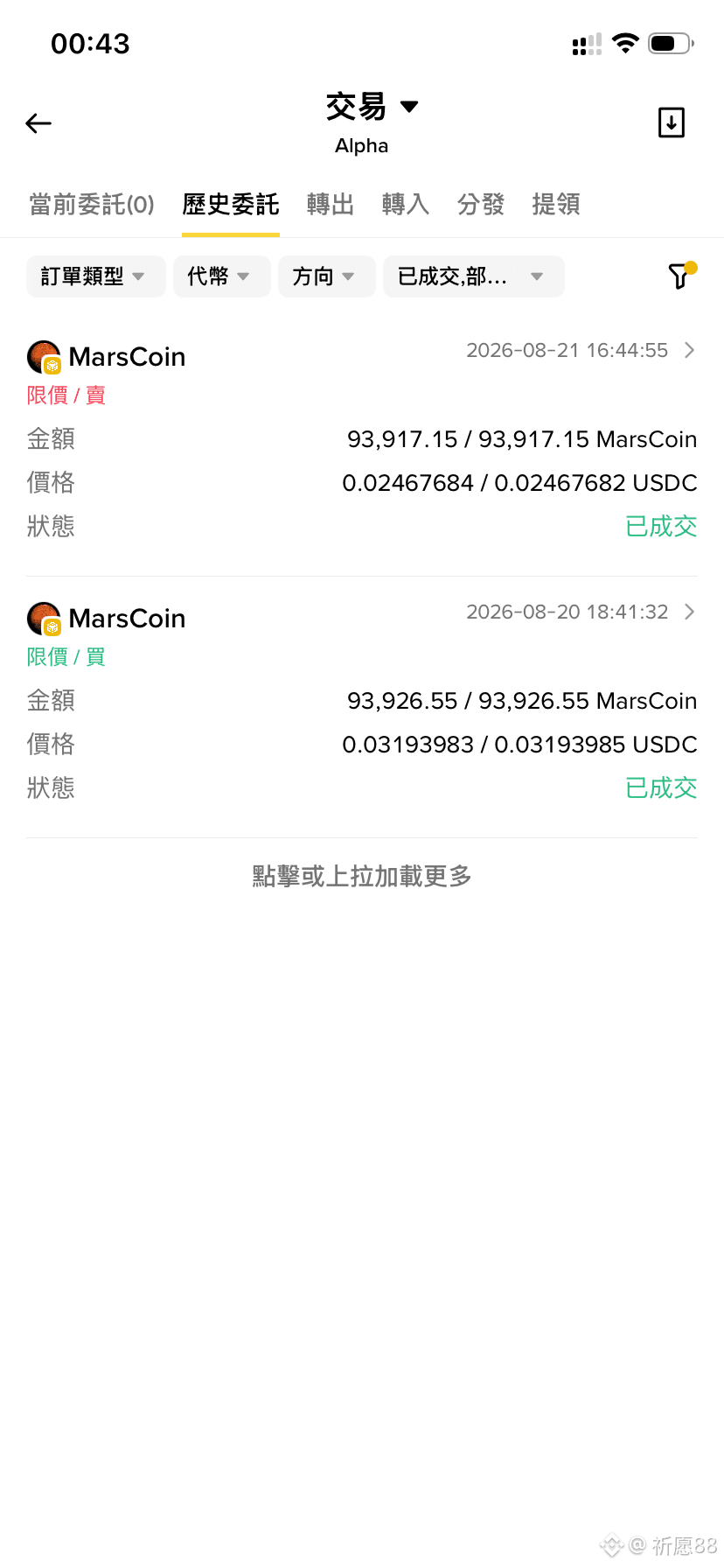
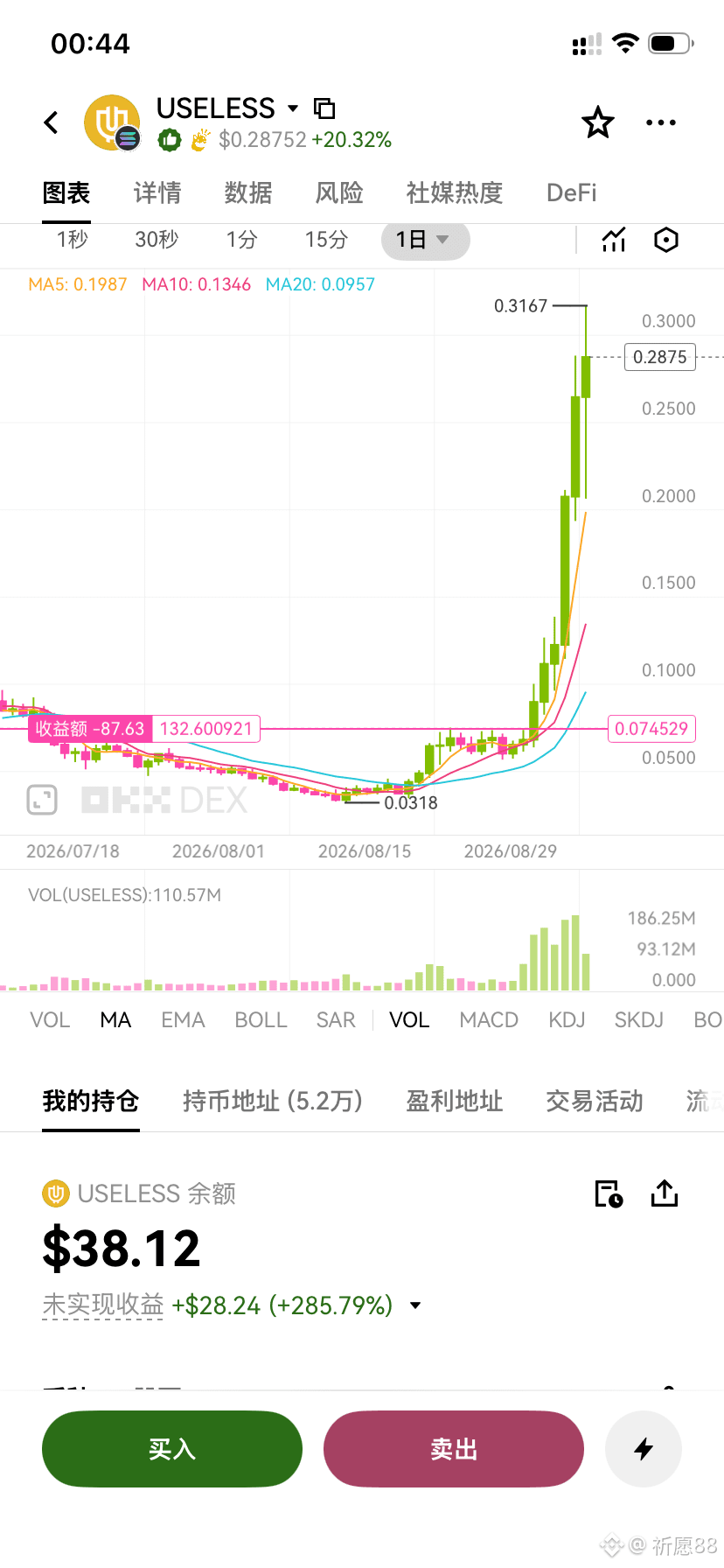
$MARSCOIN That big drop I’d been waiting for finally came, and I rushed in. Then I couldn’t hold back and even stopped out, losing 500u. $USELESS First I bought 10u and added it to my watchlist, planning to buy in at a 30 million market cap, because that BONK wave had already dumped a lot of chips out, so I didn’t dare follow in.
I was really confused. A coin I liked had the food spoon-fed right to my mouth. Damn it, but once it got right in front of me I still couldn’t hold it, and I just can’t make decisions.😭😭😭
{future}(USELESSUSDT)
$MARSCOIN That big drop I’d been waiting for finally came, and I rushed in. Then I couldn’t hold back and even stopped out, losing 500u. $USELESS First I bought 10u and added it to my watchlist, planning to buy in at a 30 million market cap, because that BONK wave had already dumped a lot of chips out, so I didn’t dare follow in.
I was really confused. A coin I liked had the food spoon-fed right to my mouth. Damn it, but once it got right in front of me I still couldn’t hold it, and I just can’t make decisions.😭😭😭
I was really confused. A coin I liked had the food spoon-fed right to my mouth. Damn it, but once it got right in front of me I still couldn’t hold it, and I just can’t make decisions.😭😭😭
423
·
--
Bullish
641
·
--
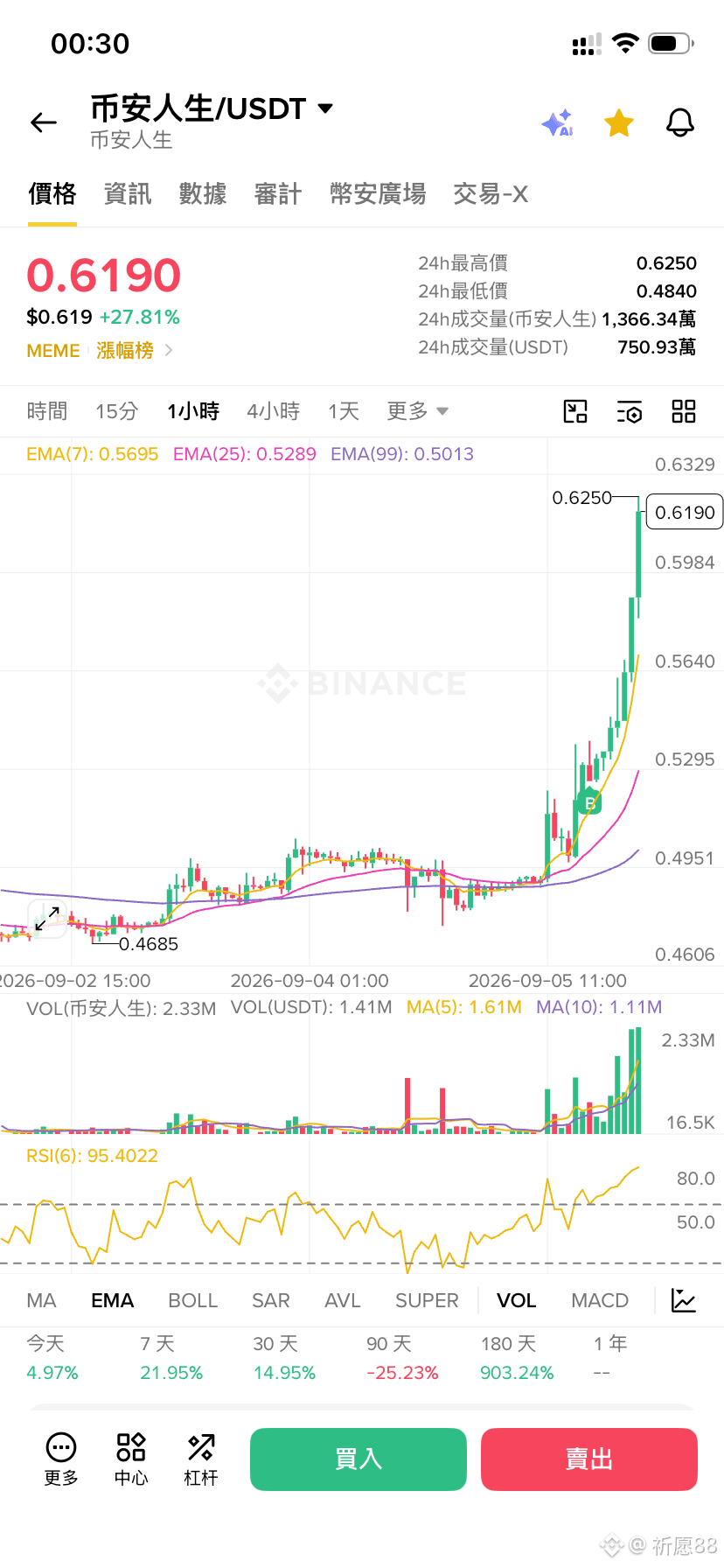
I am willing to rate $币安人生 highly, not because it has any technical innovation, but because it has accomplished something that the vast majority of Meme coins cannot do: it has made the name itself an asset.
Most Meme coins, once you take away the animal avatar and the candlestick chart, nobody remembers why they exist. Binance Life is different. It is a complete Chinese expression that needs no translation and no explanation from the project team. In just four characters it contains Binance, the wealth effect, the self-deprecating humor of the Chinese crypto community, and everyone’s imagination of “making it.”
More importantly, it has moved from a community meme into Binance spot trading, while still keeping the Chinese trading name “Binance Life.” Many people underestimate this: it means a narrative created by the Chinese community, without rebranding and without changing its name, has entered directly into one of the world’s largest crypto trading venues.
Today Binance Life rose about 14.4%, while BNB rose about 6.9% over the same period. A stronger BNB of course provided the environment, but it shows that the market is not only trading ecosystem momentum; it is also trading its unique cultural premium.
In the end, competition among Meme coins is not about whose code is more complex, but about whose name is easier to remember, to spread, and to mention again and again. Animal avatars can be copied, contracts can be copied, and even hot trends can be copied; but once the four characters “Binance Life” are bound to the Chinese crypto world, later entrants will find it very hard to take that away.
At this point, it is no longer a temporary hot topic, but one of the most recognizable Chinese cultural symbols in the BNB ecosystem. Whenever BNB strengthens and Binance again becomes the market’s focal point, capital may once again remember it. This ability to be awakened repeatedly is what gives a Meme its real vitality.
So my view is very clear: over the next 1–4 weeks, I am bullish on Binance Life.
Of course, it is not cheap, and it will not keep rising without falling. But in the world of Memes, I would rather choose a name that the whole market can remember than a hundred tokens whose stories need to be explained by the project team every day.
The strongest thing about Binance Life is that it does not need to prove who it is.
Its name has already told the whole story.
I am willing to rate $币安人生 highly, not because it has any technical innovation, but because it has accomplished something that the vast majority of Meme coins cannot do: it has made the name itself an asset.
Most Meme coins, once you take away the animal avatar and the candlestick chart, nobody remembers why they exist. Binance Life is different. It is a complete Chinese expression that needs no translation and no explanation from the project team. In just four characters it contains Binance, the wealth effect, the self-deprecating humor of the Chinese crypto community, and everyone’s imagination of “making it.”
More importantly, it has moved from a community meme into Binance spot trading, while still keeping the Chinese trading name “Binance Life.” Many people underestimate this: it means a narrative created by the Chinese community, without rebranding and without changing its name, has entered directly into one of the world’s largest crypto trading venues.
Today Binance Life rose about 14.4%, while BNB rose about 6.9% over the same period. A stronger BNB of course provided the environment, but it shows that the market is not only trading ecosystem momentum; it is also trading its unique cultural premium.
In the end, competition among Meme coins is not about whose code is more complex, but about whose name is easier to remember, to spread, and to mention again and again. Animal avatars can be copied, contracts can be copied, and even hot trends can be copied; but once the four characters “Binance Life” are bound to the Chinese crypto world, later entrants will find it very hard to take that away.
At this point, it is no longer a temporary hot topic, but one of the most recognizable Chinese cultural symbols in the BNB ecosystem. Whenever BNB strengthens and Binance again becomes the market’s focal point, capital may once again remember it. This ability to be awakened repeatedly is what gives a Meme its real vitality.
So my view is very clear: over the next 1–4 weeks, I am bullish on Binance Life.
Of course, it is not cheap, and it will not keep rising without falling. But in the world of Memes, I would rather choose a name that the whole market can remember than a hundred tokens whose stories need to be explained by the project team every day.
The strongest thing about Binance Life is that it does not need to prove who it is.
Its name has already told the whole story.
Most Meme coins, once you take away the animal avatar and the candlestick chart, nobody remembers why they exist. Binance Life is different. It is a complete Chinese expression that needs no translation and no explanation from the project team. In just four characters it contains Binance, the wealth effect, the self-deprecating humor of the Chinese crypto community, and everyone’s imagination of “making it.”
More importantly, it has moved from a community meme into Binance spot trading, while still keeping the Chinese trading name “Binance Life.” Many people underestimate this: it means a narrative created by the Chinese community, without rebranding and without changing its name, has entered directly into one of the world’s largest crypto trading venues.
Today Binance Life rose about 14.4%, while BNB rose about 6.9% over the same period. A stronger BNB of course provided the environment, but it shows that the market is not only trading ecosystem momentum; it is also trading its unique cultural premium.
In the end, competition among Meme coins is not about whose code is more complex, but about whose name is easier to remember, to spread, and to mention again and again. Animal avatars can be copied, contracts can be copied, and even hot trends can be copied; but once the four characters “Binance Life” are bound to the Chinese crypto world, later entrants will find it very hard to take that away.
At this point, it is no longer a temporary hot topic, but one of the most recognizable Chinese cultural symbols in the BNB ecosystem. Whenever BNB strengthens and Binance again becomes the market’s focal point, capital may once again remember it. This ability to be awakened repeatedly is what gives a Meme its real vitality.
So my view is very clear: over the next 1–4 weeks, I am bullish on Binance Life.
Of course, it is not cheap, and it will not keep rising without falling. But in the world of Memes, I would rather choose a name that the whole market can remember than a hundred tokens whose stories need to be explained by the project team every day.
The strongest thing about Binance Life is that it does not need to prove who it is.
Its name has already told the whole story.
1
2
936
·
--
Returning from the high and taking over Binance life
Returning from the high and taking over Binance life
1
389
·
--
Holding $币安人生 5K USDT
$币安人生 Chinese meme king with a market cap of 500 million is way too little, right? The goal is 2 billion
$币安人生 Chinese meme king with a market cap of 500 million is way too little, right? The goal is 2 billion
112
·
--
$ARB has shown a clearly independent trading pattern over the past 24 hours: based on the same completed hourly candles on Binance, ARB is up about 15.9%, while BTC is up about 0.2% over the same period. This suggests that the move is not just a broad-market rebound—there are new pricing signals emerging within Arbitrum itself.
The more “solid” variable this time, beyond the buzz of “Robinhood Chain is hot,” is the H1 progress just released by the Arbitrum Foundation. According to official disclosure, ArbitrumDAO generated $6.19 million in revenue in the first half of the year, coming from four revenue streams, with protocol revenue’s combined gross margin exceeding 97%. In the first month after Robinhood Chain mainnet went live, the AEP authorization fee already accounted for 35% of the DAO’s July revenue. What the market is starting to see is that Orbit may not only deliver technology—it could also continue to generate enterprise-chain authorization revenue.
On-chain scale can temporarily support this narrative. When DefiLlama captured it, Robinhood Chain’s own 24-hour gas fees were about $44.5 million, up 18.75% versus the previous rolling window. However, its 24-hour DEX trading volume was about $1.553 billion, down 6.96% versus the prior window. So right now it’s high-activity and high-attention, but not all indicators are still accelerating.
My view is quite clear: broadly bullish for the next 1–3 months, and cautiously bullish over the coming days. I’m bullish because Arbitrum’s business model is beginning to be validated by financial data. It’s not that DAO revenue has already become direct cash flow to ARB holders—at present, officials only confirm that the holder-governed DAO and its assets and revenues exist, but they have not公布 any arrangement for distributing those revenues directly to token holders. If Robinhood Chain fees fall quickly and other AEP revenue doesn’t take over, while DAO revenue fails over the long term to form a clear ARB value return, I would downgrade the stance to neutral; further deterioration would turn it into a bearish view.
{spot}(ARBUSDT)
$ARB has shown a clearly independent trading pattern over the past 24 hours: based on the same completed hourly candles on Binance, ARB is up about 15.9%, while BTC is up about 0.2% over the same period. This suggests that the move is not just a broad-market rebound—there are new pricing signals emerging within Arbitrum itself.
The more “solid” variable this time, beyond the buzz of “Robinhood Chain is hot,” is the H1 progress just released by the Arbitrum Foundation. According to official disclosure, ArbitrumDAO generated $6.19 million in revenue in the first half of the year, coming from four revenue streams, with protocol revenue’s combined gross margin exceeding 97%. In the first month after Robinhood Chain mainnet went live, the AEP authorization fee already accounted for 35% of the DAO’s July revenue. What the market is starting to see is that Orbit may not only deliver technology—it could also continue to generate enterprise-chain authorization revenue.
On-chain scale can temporarily support this narrative. When DefiLlama captured it, Robinhood Chain’s own 24-hour gas fees were about $44.5 million, up 18.75% versus the previous rolling window. However, its 24-hour DEX trading volume was about $1.553 billion, down 6.96% versus the prior window. So right now it’s high-activity and high-attention, but not all indicators are still accelerating.
My view is quite clear: broadly bullish for the next 1–3 months, and cautiously bullish over the coming days. I’m bullish because Arbitrum’s business model is beginning to be validated by financial data. It’s not that DAO revenue has already become direct cash flow to ARB holders—at present, officials only confirm that the holder-governed DAO and its assets and revenues exist, but they have not公布 any arrangement for distributing those revenues directly to token holders. If Robinhood Chain fees fall quickly and other AEP revenue doesn’t take over, while DAO revenue fails over the long term to form a clear ARB value return, I would downgrade the stance to neutral; further deterioration would turn it into a bearish view.
The more “solid” variable this time, beyond the buzz of “Robinhood Chain is hot,” is the H1 progress just released by the Arbitrum Foundation. According to official disclosure, ArbitrumDAO generated $6.19 million in revenue in the first half of the year, coming from four revenue streams, with protocol revenue’s combined gross margin exceeding 97%. In the first month after Robinhood Chain mainnet went live, the AEP authorization fee already accounted for 35% of the DAO’s July revenue. What the market is starting to see is that Orbit may not only deliver technology—it could also continue to generate enterprise-chain authorization revenue.
On-chain scale can temporarily support this narrative. When DefiLlama captured it, Robinhood Chain’s own 24-hour gas fees were about $44.5 million, up 18.75% versus the previous rolling window. However, its 24-hour DEX trading volume was about $1.553 billion, down 6.96% versus the prior window. So right now it’s high-activity and high-attention, but not all indicators are still accelerating.
My view is quite clear: broadly bullish for the next 1–3 months, and cautiously bullish over the coming days. I’m bullish because Arbitrum’s business model is beginning to be validated by financial data. It’s not that DAO revenue has already become direct cash flow to ARB holders—at present, officials only confirm that the holder-governed DAO and its assets and revenues exist, but they have not公布 any arrangement for distributing those revenues directly to token holders. If Robinhood Chain fees fall quickly and other AEP revenue doesn’t take over, while DAO revenue fails over the long term to form a clear ARB value return, I would downgrade the stance to neutral; further deterioration would turn it into a bearish view.
long
50%
short
50%
4 votes • Voting closed
225
·
--
My current thoughts are very straightforward: $XAU in the 4200-4400 range—building multiple positions there feels very comfortable; allocating just 10%-20% of the position size is enough. On the $QQQ side, I’d also allocate 10%-20%. The remaining 60% or more of the position size goes entirely to crypto assets like $BTC —I won’t leave even half a cent in cash.
Honestly, even if gold goes down, the downside is extremely limited; it won’t really drop much. If later the crypto assets fall, I’ll sell all the gold and switch the entire portfolio into the crypto market to go all out. If crypto assets don’t fall, I’ll just hold the gold steadily and let it appreciate.
I really don’t want to keep holding onto a huge pile of cash anymore. High-quality assets have to be held for the long term.
My current thoughts are very straightforward: $XAU in the 4200-4400 range—building multiple positions there feels very comfortable; allocating just 10%-20% of the position size is enough. On the $QQQ side, I’d also allocate 10%-20%. The remaining 60% or more of the position size goes entirely to crypto assets like $BTC —I won’t leave even half a cent in cash.
Honestly, even if gold goes down, the downside is extremely limited; it won’t really drop much. If later the crypto assets fall, I’ll sell all the gold and switch the entire portfolio into the crypto market to go all out. If crypto assets don’t fall, I’ll just hold the gold steadily and let it appreciate.
I really don’t want to keep holding onto a huge pile of cash anymore. High-quality assets have to be held for the long term.
Honestly, even if gold goes down, the downside is extremely limited; it won’t really drop much. If later the crypto assets fall, I’ll sell all the gold and switch the entire portfolio into the crypto market to go all out. If crypto assets don’t fall, I’ll just hold the gold steadily and let it appreciate.
I really don’t want to keep holding onto a huge pile of cash anymore. High-quality assets have to be held for the long term.
260
·
--
Verified
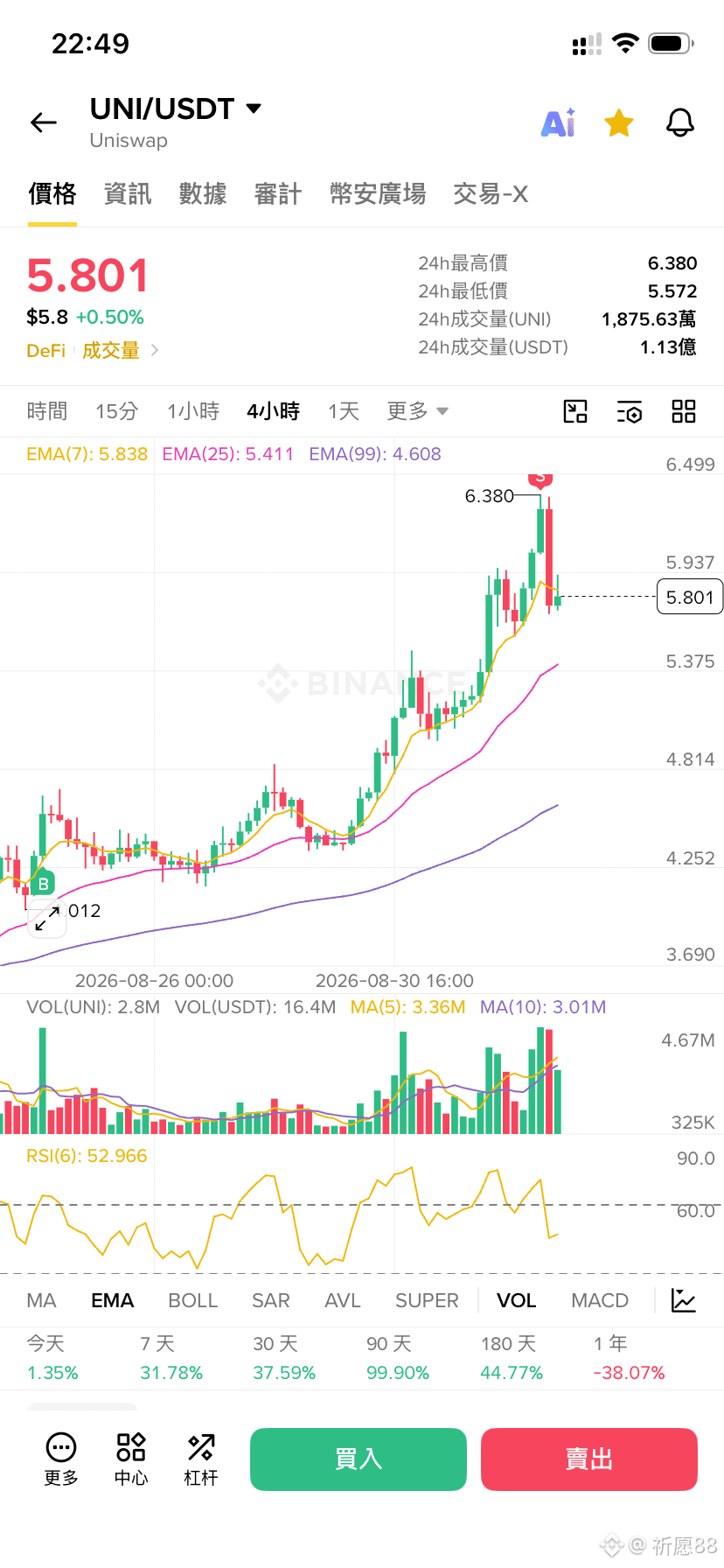
30D trade $UNI 15.8K USDT
$UNI Uniswap’s business has been booming for a long time and is no longer news, but for a long period, this prosperity was not naturally equated with the value of $UNI . As a governance token, the long-standing discount issue of UNI has kept the protocol’s business growth and the token itself separated by a vague, invisible wall.
Recent market performance is breaking this habitual perception. In this round of fixed snapshot, UNI was up about 15.3% over the past 24 hours, while BTC was down about 1.9% over the same period—its trend is clearly diverging from the broader market. Even more noteworthy is the change in the income structure: according to DefiLlama’s data for the full day on September 1, Robinhood Chain contributed roughly 68% of the protocol’s daily revenue.
This “protocol usage—fee collection—token burning” linkage mechanism is not new. UNIfication had already established rules that protocol fees enter the TokenJar, and that extracting fees requires burning UNI in Firepit, before later expanding this to Robinhood Chain. The latest rally may have multiple factors; a more cautious judgment is that the conspicuous scale of real revenue has caused the market to pay renewed attention to this old mechanism. It needs to be made clear: UNI burning is supply contraction, which does not mean dividends to holders or direct allocation of protocol cash flows.
The market is starting to reassess this value linkage, rather than simply declaring that the discount has disappeared. Only if the transmission from protocol usage to changes in UNI supply can continue to be clearly observed can the governance token’s discount truly loosen.
$UNI Uniswap’s business has been booming for a long time and is no longer news, but for a long period, this prosperity was not naturally equated with the value of $UNI . As a governance token, the long-standing discount issue of UNI has kept the protocol’s business growth and the token itself separated by a vague, invisible wall.
Recent market performance is breaking this habitual perception. In this round of fixed snapshot, UNI was up about 15.3% over the past 24 hours, while BTC was down about 1.9% over the same period—its trend is clearly diverging from the broader market. Even more noteworthy is the change in the income structure: according to DefiLlama’s data for the full day on September 1, Robinhood Chain contributed roughly 68% of the protocol’s daily revenue.
This “protocol usage—fee collection—token burning” linkage mechanism is not new. UNIfication had already established rules that protocol fees enter the TokenJar, and that extracting fees requires burning UNI in Firepit, before later expanding this to Robinhood Chain. The latest rally may have multiple factors; a more cautious judgment is that the conspicuous scale of real revenue has caused the market to pay renewed attention to this old mechanism. It needs to be made clear: UNI burning is supply contraction, which does not mean dividends to holders or direct allocation of protocol cash flows.
The market is starting to reassess this value linkage, rather than simply declaring that the discount has disappeared. Only if the transmission from protocol usage to changes in UNI supply can continue to be clearly observed can the governance token’s discount truly loosen.
Recent market performance is breaking this habitual perception. In this round of fixed snapshot, UNI was up about 15.3% over the past 24 hours, while BTC was down about 1.9% over the same period—its trend is clearly diverging from the broader market. Even more noteworthy is the change in the income structure: according to DefiLlama’s data for the full day on September 1, Robinhood Chain contributed roughly 68% of the protocol’s daily revenue.
This “protocol usage—fee collection—token burning” linkage mechanism is not new. UNIfication had already established rules that protocol fees enter the TokenJar, and that extracting fees requires burning UNI in Firepit, before later expanding this to Robinhood Chain. The latest rally may have multiple factors; a more cautious judgment is that the conspicuous scale of real revenue has caused the market to pay renewed attention to this old mechanism. It needs to be made clear: UNI burning is supply contraction, which does not mean dividends to holders or direct allocation of protocol cash flows.
The market is starting to reassess this value linkage, rather than simply declaring that the discount has disappeared. Only if the transmission from protocol usage to changes in UNI supply can continue to be clearly observed can the governance token’s discount truly loosen.

送上最好的祝福!
From 祈愿88
1
329
·
--
Bullish
Finally, you’re here—the $APP $APP within 350
Finally, you’re here—the $APP $APP within 350
$app
From 祈愿88
123
·
--
$CRCLon I would call it the most lousy company in America
$CRCLon I would call it the most lousy company in America
246
·
--
$CRCLon Are you done? Start free fall? Trash company, hurry up and go bankrupt
$CRCLon Are you done? Start free fall? Trash company, hurry up and go bankrupt
63
Log in to explore more content
Join global crypto users on Binance Square
⚡️ Get latest and useful information about crypto.
💬 Trusted by the world’s largest crypto exchange.
👍 Discover real insights from verified creators.
Email / Phone number
Trending Topics
TrumpRejectsIranHormuzReopening
2,175 views
127 Discussing
TRUMP JUST KILLED THE HORMUZ RELIEF TRADE. 🚨
Iran offered a 7-day path to reopen the Strait of Hormuz if Washington eased military pressure and lifted its blockade. For oil markets, that was the cleanest bearish catalyst on the table.
Then Trump rejected Iran’s ceasefire terms.
The two sides are still far apart, and Washington has shown little urgency to return to the June framework.
That puts the market right back into the risk-premium trade:
Hormuz stays constrained → oil supply risk stays elevated.
Diplomacy fails → $CL and $BZ can reprice higher fast.
Any renewed strikes → volatility explodes again.
The Strait carried roughly one-fifth of global oil and LNG shipments before the war, so this isn’t just another geopolitical headline.
The market sold oil on hope.
Trump just removed a big piece of that hope. 👀
$CL $BZ #TrumpRejectsIranHormuzReopening #CircleTetherFreezeBitgetHackerWallet
KimHotbae
·1 Likes
·230 views
CircleTetherFreezeBitgetHackerWallet
25,358 views
358 Discussing
SECSaysTokenBuybacksNotAutoSecurities
6,559 views
143 Discussing