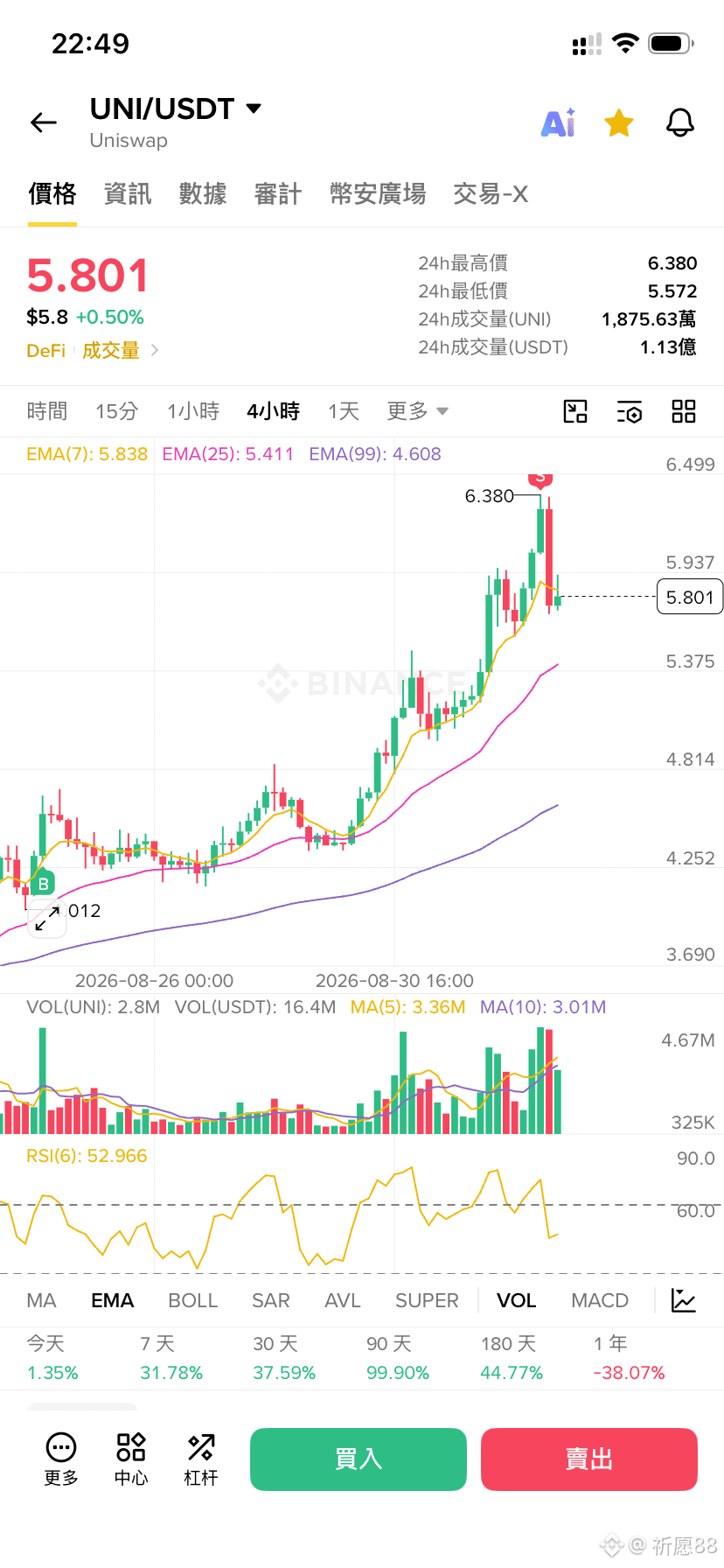
$UNI Uniswap’s business has been booming for a long time and is no longer news, but for a long period, this prosperity was not naturally equated with the value of $UNI . As a governance token, the long-standing discount issue of UNI has kept the protocol’s business growth and the token itself separated by a vague, invisible wall.
Recent market performance is breaking this habitual perception. In this round of fixed snapshot, UNI was up about 15.3% over the past 24 hours, while BTC was down about 1.9% over the same period—its trend is clearly diverging from the broader market. Even more noteworthy is the change in the income structure: according to DefiLlama’s data for the full day on September 1, Robinhood Chain contributed roughly 68% of the protocol’s daily revenue.
This “protocol usage—fee collection—token burning” linkage mechanism is not new. UNIfication had already established rules that protocol fees enter the TokenJar, and that extracting fees requires burning UNI in Firepit, before later expanding this to Robinhood Chain. The latest rally may have multiple factors; a more cautious judgment is that the conspicuous scale of real revenue has caused the market to pay renewed attention to this old mechanism. It needs to be made clear: UNI burning is supply contraction, which does not mean dividends to holders or direct allocation of protocol cash flows.
The market is starting to reassess this value linkage, rather than simply declaring that the discount has disappeared. Only if the transmission from protocol usage to changes in UNI supply can continue to be clearly observed can the governance token’s discount truly loosen.
Recent market performance is breaking this habitual perception. In this round of fixed snapshot, UNI was up about 15.3% over the past 24 hours, while BTC was down about 1.9% over the same period—its trend is clearly diverging from the broader market. Even more noteworthy is the change in the income structure: according to DefiLlama’s data for the full day on September 1, Robinhood Chain contributed roughly 68% of the protocol’s daily revenue.
This “protocol usage—fee collection—token burning” linkage mechanism is not new. UNIfication had already established rules that protocol fees enter the TokenJar, and that extracting fees requires burning UNI in Firepit, before later expanding this to Robinhood Chain. The latest rally may have multiple factors; a more cautious judgment is that the conspicuous scale of real revenue has caused the market to pay renewed attention to this old mechanism. It needs to be made clear: UNI burning is supply contraction, which does not mean dividends to holders or direct allocation of protocol cash flows.
The market is starting to reassess this value linkage, rather than simply declaring that the discount has disappeared. Only if the transmission from protocol usage to changes in UNI supply can continue to be clearly observed can the governance token’s discount truly loosen.