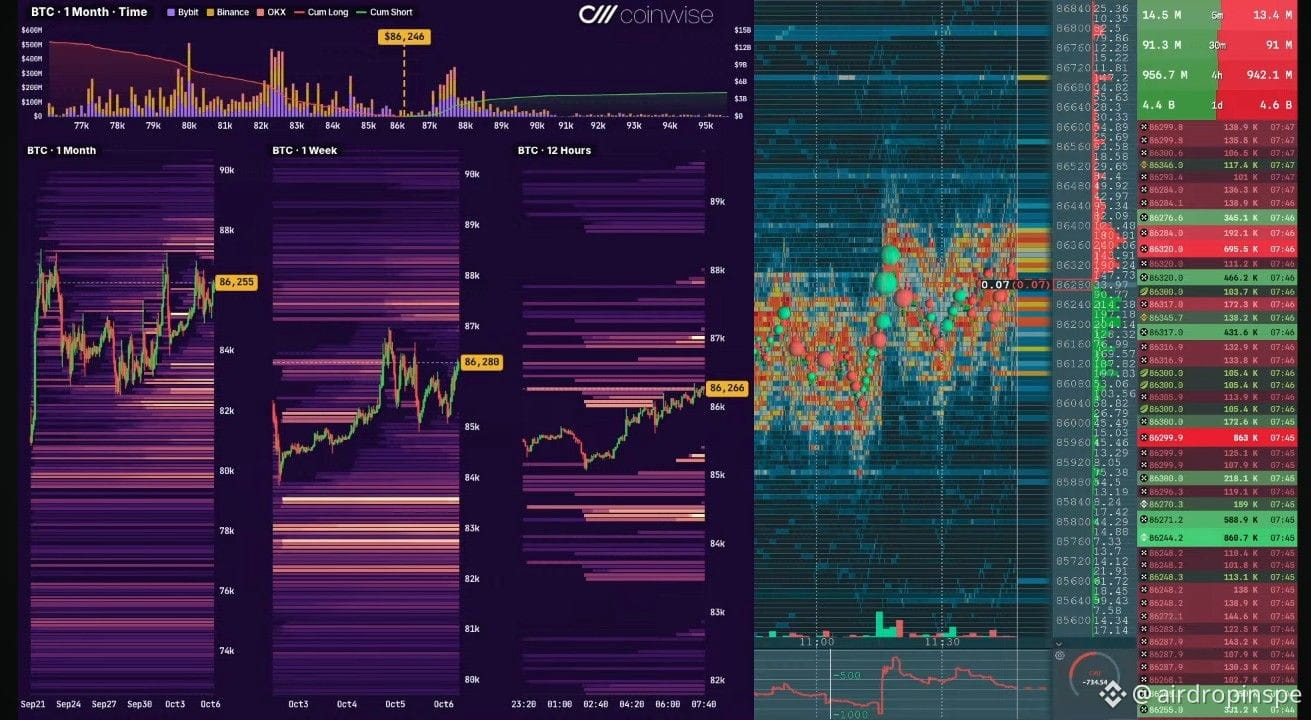
UPDATE: BTC chewed through the $85.7k wall and pumped to $86.2k! What’s the next Order Flow target? 🚀🔥 Yesterday’s sell wall got completely absorbed, and aggressive buyers took control. BTC is now trading around $86,266, confirming a solid intraday breakout. But looking at the updated Bookmap & Heatmap data, a new battlefield is forming! 🔍 Updated Order Flow Key Insights: • Wall Cleared: The heavy Ask liquidity at $85.7k is gone—buyers swallowed it and pushed price into acceptance above $86,000. • New Target Wall: Heatmap reveals a fresh wall of resting Ask liquidity waiting right above between $86,500 and $86,600. • Flow Shift: Green buy volume bubbles drove this rally, but we are now seeing mixed bubbles near $86.3k, indicating early absorption by limit sellers. 📊 The Game Plan (IF/THEN): 📈 Bullish Scenario: IF buyers maintain momentum and chew through the $86,500 - $86,600 wall, THEN expect the squeeze to continue toward $87,200+. 📉 Bearish Scenario: IF price gets rejected at $86,500 and loses the $86,000 flip zone, THEN expect a pullback to retest bid liquidity at $85,400. ⚠️ Invalidation: A breakdown below $85,800 invalidates the immediate bullish continuation structure. Did you ride the breakout above $85.7k, or are you taking profits before the $86.5k wall? Drop your strategy below! 👇 (Educational Market Analysis - Not Financial Advice) #Bitcoin #OrderFlow #CryptoTrading #Bookmap #BTCUPDATE
A $85,700 Sell Wall is waiting for BTC. Are retail buyers walking into a massive liquidity trap?
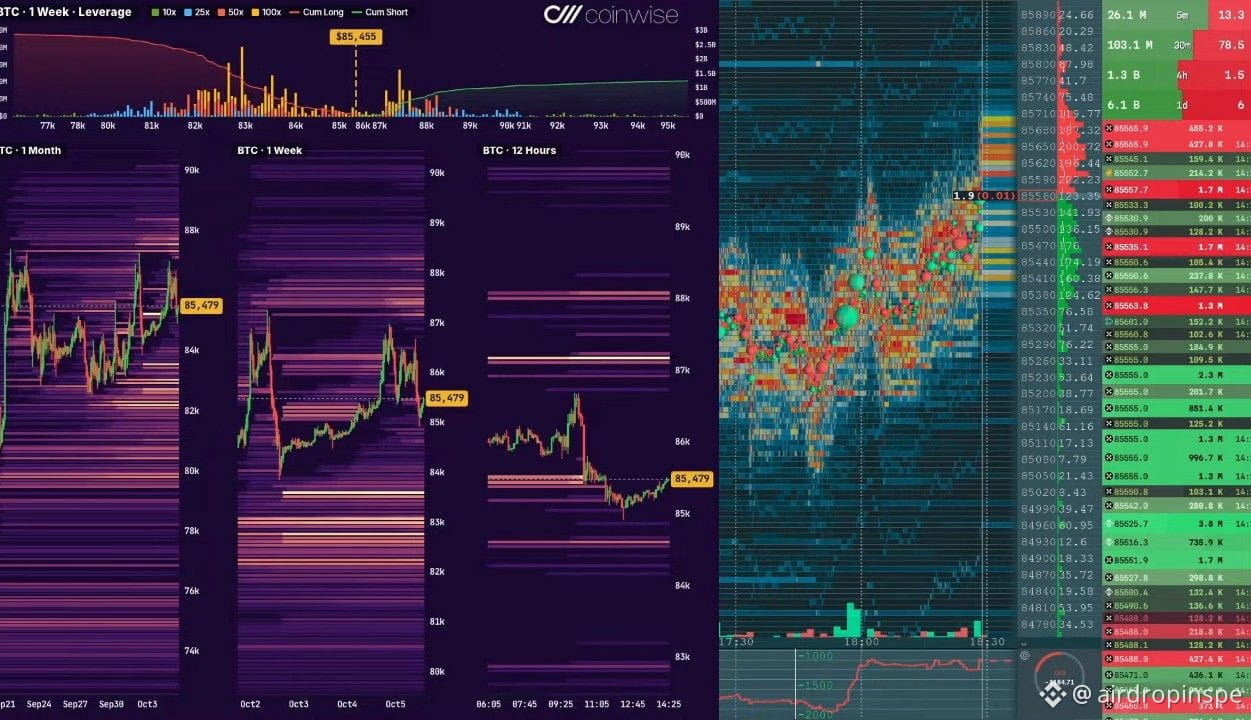
BTC is trapped. Aggressive buyers are walking straight into a massive liquidity wall. Who wins? 🩸🟢 Looking at the latest Bookmap & heatmap data, the Order Flow is telling a clear, objective story. After the recent drop, BTC is attempting a micro-relief bounce around $85,479, but the tape is flashing warning signs. 🔍 Key Order Flow Observations: • The Wall: There is dense resting ask liquidity (a heavy sell wall) sitting right above current price at $85,600 - $85,700. • The Flow: We see green volume bubbles indicating aggressive market buyers trying to push up. However, the negative CVD confirms underlying structural selling pressure. • Absorption Risk: Previous local tops showed large bubbles with zero continuation—clear limit seller absorption. 📊 The Game Plan (IF/THEN): 📈 Bullish Scenario: IF aggressive buyers can chew through the $85,700 wall with massive market buys (large green bubbles), THEN expect a rapid squeeze toward $86,500+. 📉 Bearish Scenario: IF price tags $85,600-$85,700 and gets absorbed (high volume, no progression), THEN expect an immediate reversal down to hunt the resting bid liquidity at $85,000. ⚠️ Invalidation: A confirmed hold above $85,700 invalidates the short-term bearish bias. Watch the tape closely at these levels. Are you bidding this dip or waiting for the $85.7k wall to trigger a rejection? Let me know below! 👇 (Educational Market Analysis - Not Financial Advice) #Bitcoin #OrderFlow #CryptoTrading #Liquidity #Bookmap
🔥 TRADERS, I WANT YOUR HONEST ANSWER.bnb You wake up, see a PERFECT setup, and you're ready to enter... Then you have to choose ONE thing to trust most: 📈 Technical Analysis 💧 Liquidity / Smart Money 📰 News & Market Sentiment 🧠 Your Own Experience Which one do YOU trust the most — and why? Don’t just vote. 👇 Tell me your reason in the comments. Let’s see what the Binance community really relies on. #Binance $ #Crypto_Jobs🎯 #TradingTales #BTC
**Stock-to-Flow Pattern Analysis and Bitcoin Price Predictions** Hello everyone, today we will talk about one of the most famous models used to predict the movement of the Bitcoin price, which is the Stock-to-Flow (S2F) model. This model is based on the scarcity of Bitcoin, as it links the current stock to the future production rate, which is greatly affected by halving events that reduce the number of new Bitcoins entering the market.
The importance of decentralization in file sharing
The importance of decentralization in file sharingDecentralized file sharing revolutionizes data access by eliminating dependence on centralized servers and utilizing P2P technology to distribute files across a network of nodes.Distributing and accessing data without depending on a centralized server is possible with decentralized file sharing. Rather, files are kept on a network of linked nodes, frequently through the use of peer-to-peer (P2P) technology. To enable file sharing, each network user can provide bandwidth and storage space. BitTorrent and InterPlanetary File System (IPFS) are two well-known instances of decentralized file-sharing protocols.The decentralization of file sharing has completely transformed the way users access and store digital content. In contrast to conventional centralized file-sharing systems, which store files on a single server, decentralized file-sharing uses a P2P mechanism. Dispersing files among a network of linked nodes promotes a more robust and secure system.Key components of decentralized file sharingDecentralized file sharing depends on a number of essential elements to allow for a dispersed and safe data exchange. Firstly, P2P networks, which enable direct user contact in the absence of a centralized server, are the backbone of a decentralized file-sharing system. By doing this, a robust system where participants directly share files is fostered.Blockchain technology is essential to maintaining integrity and trust in decentralized file-sharing networks. It improves the general security of transactions and file transfers by enabling transparent and impenetrable record-keeping. Smart contracts are self-executing c#ontracts with pre-established rules that automate tasks like access control and file verification.Furthermore, files are distributed throughout a network of nodes using decentralized storage systems, which often use protocols like BitTorrent or IPFS. This approach eliminates the need for a central server and enhances the availability and reliability of data due to its redundant nature.Cryptographic methods also protect the integrity and privacy of data. User confidence in decentralized file-sharing systems is increased by end-to-end encryption, which guarantees that only authorized parties may view the content. Together, these elements essentially provide a safe and dispersed setting for easy file sharing via the decentralized web.How does decentralized file sharing work?Decentralized file sharing operates on P2P networks by leveraging a distributed architecture rather than relying on a central server.Peer discoveryParticipants in the network (peers) need a way to discover one another, which is accomplished by using distributed hash tables (DHTs) or decentralized protocols. Peers build a network without a central authority by keeping track of other peers with whom they are linked.DHTs are decentralized systems that enable distributed storage and retrieval of key-value pairs across a network, while decentralized protocols enforce communication rules that enable peer-to-peer interactions without relying on a central authority or server.File distributionA file is split up into smaller parts where every component is dispersed among several network peers. This approach enhances file availability, as it is not stored in a single location, ensuring better accessibility and reliability.Dispersed storageBy distributing file portions over several nodes, decentralized storage systems lessen reliance on a single server. For instance, IPFS employs a content-addressed approach, in which files are recognized by their content as opposed to their physical location.Peer interactionPeers request and share file portions directly with one another. The coordination of file transfers no longer requires a central server, thanks to this direct connection. Every peer participates in the file distribution process by serving as both a client and a server.Blockchain and smart contractsBlockchain technology is incorporated into several decentralized file-sharing systems to increase security and transparency. Smart contracts are self-executing contracts with pre-established rules that can automate tasks such as access restriction and file verification and reward participants with tokens.Often, decentralized file-sharing systems use cryptographic techniques like end-to-end encryption to provide privacy and security for the shared files. This ensures that the content can only be accessed and deciphered by authorized users.Advantages of decentralized file sharingThe benefits of decentralized file sharing include enhanced resilience, improved privacy, scalability and censorship resistance.By removing a single point of failure, it improves reliability and resilience. In a peer-to-peer network, where files are dispersed among several nodes and peers, the system continues to function even in the event that some nodes go down.Also, decentralized file sharing, by its very nature, offers enhanced security and privacy. By ensuring that only authorized users can access and decode shared content, cryptographic solutions like end-to-end encryption help lower the danger of unauthorized spying or data breaches.Better scalability can also be attained as the network expands. In decentralized networks, more users add to the network’s capacity, allowing it to accommodate more demand and traffic without requiring modifications to the centralized infrastructure.Additionally, decentralized file sharing encourages resistance against censorship. It is harder for any organization to censor or limit access to particular files or information because there isn’t a single entity in charge of the network.Furthermore, decentralized file sharing frequently incorporates incentive mechanisms through token economies or other reward systems to encourage users to contribute resources like bandwidth and storage, thereby creating a cooperative and self-sufficient environment. Challenges and limitations of decentralized file sharingChallenges associated with decentralized file sharing involve scalability issues, consistency concerns, user adoption complexities, security risks and regulatory uncertainties.Firstly, as the network grows, scalability issues become more pressing. A poor user experience may result from increased involvement if it causes slower file retrieval times and greater bandwidth requirements.Moreover, in decentralized systems, problems with consistency and coordination could surface. It may be difficult to maintain consistency in file versions throughout the network in the absence of a central authority, which could result in conflicts and inconsistent data.Complicated interfaces and user acceptance present another difficulty. When compared to centralized options, decentralized file-sharing platforms frequently have a higher learning curve, which may put off consumers who are not familiar with P2P networks or blockchain technology.Furthermore, security vulnerabilities still exist, especially in the early phases of decentralized file-sharing deployments. As these systems grow more widely used, they are targeted by different types of attacks, which makes the continuous development of strong security measures necessary.Regulatory uncertainty is another difficulty. The adoption and long-term viability of decentralized file-sharing platforms may be impacted by the changing legal environment surrounding cryptocurrency and decentralized technology.The future landscape of decentralized file sharingThe future of decentralized file sharing involves blockchain technology, P2P networks and tokenization for secure, efficient and collaborative data exchange, which challenge traditional models.Decentralized file sharing is expected to bring about a more inclusive, secure and productive environment. Distributed ledger and blockchain technology will be essential in guaranteeing tamper-proof and transparent transactions and facilitating file sharing among users without depending on centralized intermediaries. Decentralized protocols powering peer-to-peer networks will enable direct data transmission between users, cutting down on latency and reliance on centralized servers. Strong encryption techniques will allay privacy concerns and provide consumers with more control over their data. Furthermore, tokenization could encourage resource sharing among users, resulting in the development of a collaborative ecosystem. Innovative file-sharing services will probably proliferate as decentralization gains pace, upending established paradigms and promoting a more robust and democratic digital environment.

The importance of Crypto in the American Stock Exchange and does the Stock Exchange control Crypto? The next article will be prepared What is #CME Group? #crypto2023 #stock #BTC #bitcoin $BTC

CME Group Inc. is a financial services company. Headquartered in Chicago, the company operates financial derivatives exchanges including the Chicago Mercantile Exchange, Chicago Board of Trade, New York Mercantile Exchange, and The Commodity Exchange. The company also owns 27% of S&P Dow Jones Indices.[2][3][4][5] It is the world's largest operator of financial derivatives exchanges. Its exchanges are platforms for trading in agricultural products, currencies, energy, interest rates, metals, futures contracts, options, stock indexes, and cryptocurrencies futures.CMEIn addition to its headquarters in Chicago,[6][7] the company also has offices in New York, Washington, and Houston in the U.S., as well as abroad in London, Bangalore, Beijing, Belfast, Calgary, Hong Kong, Seoul, Singapore, and TokyoCrypto in CME1Bitcoin futureCME’s Bitcoin futures contract, ticker symbol BTC, is a USD cash-settled contract based on the CME CF Bitcoin Reference Rate (BRR), which serves as a once-a-day reference rate of the U.S. dollar price of bitcoin. The BRR aggregates the trade flow of major bitcoin spot exchanges during a one-hour calculation window into the U.S. dollar price of one bitcoin as of 4 p.m. London Time.The Bitcoin futures contract trades Sunday through Friday, from 5 p.m. to 4 p.m. Central Time (CT).A single BTC contract has a value of five times the value of the BRR Index and is quoted in U.S. dollars per one bitcoin. The tick increments are quoted in multiples of $5 per bitcoin, meaning a one-tick move of the BTC future is equal to $25.BTC futures are block trade eligible with a minimum quantity threshold of five contracts.BTC futures expire the last Friday of the month, and are listed on the nearest six consecutive monthly contracts, inclusive of the nearest two December contracts.ExampleFor example, assume it’s January and the six consecutive contract months are January, February, March, April, May, and June. In addition, that year’s December contract plus next year’s December contract will also be listed. As one contract expires, the next contract to complete the six-month lineup is added. When the December contract expires, the June contract becomes active, in addition to the December contract for the next year. So, at any time, there are six consecutive monthly contracts and only two December contracts listed.This process continues throughout each year.Next article we continue#bitcoin #stock $BTC
Bitcoin and Energy: Debunking the 7 Biggest Bitcoin Energy Myths
The most common Bitcoin energy and BTC mining myths, debunked.الخرافة رقم 1: تعدين البيتكوين له بصمة كربونية كبيرة.الخرافة الثانية: تعمل عملة البيتكوين على مزاحمة القطاعات الأخرى من خلال التعدين وزيادة تكاليف الكهرباء.الخرافة الثالثة: تعدين البيتكوين مضر بشبكة الكهرباءالخرافة الرابعة: يعد تعدين البيتكوين أمرًا سيئًا للمجتمعات الضعيفة.الخرافة الخامسة: أصبح تعدين البيتكوين أقل مراعاة للبيئةالخرافة السادسة: تستهلك عملة البيتكوين قدرًا كبيرًا من الطاقة لكل معاملة.الخرافة السابعة: تعدين البيتكوين هو أمر إسراف بطبيعته.خاتمةIn this article, we'll debunk some of the biggest Bitcoin energy myths. The last part of this series will lay out the case for mining BTC to revolutionize energy production. But that is for another day. Today, we cover the seven biggest energy myths for the largest and oldest cryptocurrency and why they are wrong.Myth #1: Bitcoin mining has a big carbon footprint.That sounds bad but lacks context. First, Colombia's carbon footprint in 2018 only ranked 45th compared to the world’s biggest "polluters." Colombia made up 0.4% of the world's carbon emissions. In comparison, China's carbon footprint is 150x bigger, the U.S.' is more than 50x bigger, and even Poland's is more than 4x bigger. Natural gas flaring has a 10X bigger carbon footprint than BTC mining and generates no benefit if the excess energy isn't put to use.Second, one can argue that BTC mining is judged on a moralistic basis for no reason. The reasoning goes something like this:“BTC only good for speculation > Mining uses a lotta energy > More speculators bad, more miners bad.”Even if we assume that all Bitcoins are used for speculative purposes all of the time (which they aren't), this argument is flawed. For two reasons.First, what would be the carbon footprint if speculators used something other than BTC? What if all the money went to casinos? Horse racing? Critics pretend that mining generates a carbon footprint where otherwise there would be none, but that isn't true. All of these other speculation-driven sectors also have a carbon footprint. No one has ever inquired into the emissions of lotteries or sports books to the extent of Bitcoin’s.Second, we can't weigh Bitcoin's positive externalities (store of wealth, peer-to-peer money transfers) against its negative ones (mining). How do you quantify the intangible value created by BTC? And how do you compare it to its negative externalities? It's near impossible to make a rational case for either side. Somehow, though, the traditional financial industry does not get held up to the same standards.Myth #2: Bitcoin crowds out other sectors through mining and increases electricity costs.Bitcoin and Energy: Debunking the 7 Biggest Bitcoin Energy MythsTable of ContentsTech Deep DivesBitcoin and Energy: Debunking the 7 Biggest Bitcoin Energy MythsBy Ivan Cryptoslav6mCreated 1yr ago, last updated 1yr agoThe most common Bitcoin energy and BTC mining myths, debunked.Table of ContentsMyth #1: Bitcoin mining has a big carbon footprint.Myth #2: Bitcoin crowds out other sectors through mining and increases electricity costs.Myth #3: Bitcoin mining is bad for the power grid.Myth #4: Bitcoin mining is bad for vulnerable communities.Myth #5: Bitcoin mining is becoming less green.Myth #6: Bitcoin uses a lot of energy per transaction.Myth #7: Bitcoin mining is inherently wasteful.ConclusionOur article about mining bitcoin with flared natural gas covered how the Bitcoin network could potentially undergo a revolution and become an important part of energy production.But you know that won't convince the naysayers:In this article, we'll debunk some of the biggest Bitcoin energy myths. The last part of this series will lay out the case for mining BTC to revolutionize energy production. But that is for another day. Today, we cover the seven biggest energy myths for the largest and oldest cryptocurrency and why they are wrong.SubscribeJoin us in showcasing the cryptocurrency revolution, one newsletter at a time. Subscribe now to get daily news and market updates right to your inbox, along with our millions of other subscribers (that’s right, millions love us!) — what are you waiting for?Myth #1: Bitcoin mining has a big carbon footprint.According to Digicoinomist, BTC mining has the carbon footprint equivalent of Colombia:That sounds bad but lacks context. First, Colombia's carbon footprint in 2018 only ranked 45th compared to the world’s biggest "polluters." Colombia made up 0.4% of the world's carbon emissions. In comparison, China's carbon footprint is 150x bigger, the U.S.' is more than 50x bigger, and even Poland's is more than 4x bigger. Natural gas flaring has a 10X bigger carbon footprint than BTC mining and generates no benefit if the excess energy isn't put to use.Second, one can argue that BTC mining is judged on a moralistic basis for no reason. The reasoning goes something like this:“BTC only good for speculation > Mining uses a lotta energy > More speculators bad, more miners bad.”Even if we assume that all Bitcoins are used for speculative purposes all of the time (which they aren't), this argument is flawed. For two reasons.First, what would be the carbon footprint if speculators used something other than BTC? What if all the money went to casinos? Horse racing? Critics pretend that mining generates a carbon footprint where otherwise there would be none, but that isn't true. All of these other speculation-driven sectors also have a carbon footprint. No one has ever inquired into the emissions of lotteries or sports books to the extent of Bitcoin’s.Second, we can't weigh Bitcoin's positive externalities (store of wealth, peer-to-peer money transfers) against its negative ones (mining). How do you quantify the intangible value created by BTC? And how do you compare it to its negative externalities? It's near impossible to make a rational case for either side. Somehow, though, the traditional financial industry does not get held up to the same standards.Myth #2: Bitcoin crowds out other sectors through mining and increases electricity costs.Stories like this one are music to the ears of Bitcoin haters. However, one upstate New York town's story from several years ago is an anecdote and not hard data that shows a pattern. This argument also disregards two important acts.First, miners are by design incentivized to seek the cheapest energy source. That's why mining with flared gas is so attractive or mining in countries like Kazakhstan with low electricity costs. But most of the time, miners will not compete with retail consumers' demand for electricity.Second, failing power grids due to excess demand is market feedback. Bitcoin miners simply found a market inefficiency (cheap electricity) and closed it. In fact, Bitcoin miners provide valuable feedback. With correct regulation, you could even tax miners and redirect tax income to overhaul the grid.Myth #3: Bitcoin mining is bad for the power grid.We clarified that miners can't be blamed for poor infrastructure. But do they contribute to overloading it?Not necessarily. For instance, Texas miners turned off their rigs during a recent heatwave. Since mining rigs can be shut down at very short notice (think minutes), they can react in real-time to electricity demand. If anything, Bitcoin mining is good for the grid since it helps smooth out demand. We'll cover in the next article how exactly.Myth #4: Bitcoin mining is bad for vulnerable communities.This study argues that BTC mining takes advantage of "economic instabilities, weak regulations, and access to cheap energy and other resources."That is fair enough, but don't you think the solution is to...fix the economic instabilities and weak regulations?To reiterate a point already made: miners merely provide market feedback. One solution is not to ban market participants, but to improve the market's rules. Furthermore, a "worldwide ban" on mining is highly unrealistic since countries are incentivized to defect and capture the economic rents from miners looking for cheap electricity.Myth #5: Bitcoin mining is becoming less green.This study extrapolates a short-term trend (miners migrating from China to the U.S.) to conclude: Bitcoin mining is even more bad!However, if we look closer at the data, we can discern only two strong trends clearly:Mining with nuclear energy is rising, as is mining with natural gas. Mining with coal (very dirty, very bad) has been oscillating between 30% and 50%, but there's no clear trend. Mining with hydroelectric energy is in a slump, but it's been there before and recovered. Overall, the substitution of "hydroelectric BTC" for "natural gas BTC" could be systemic or just a short-term trend.Moreover, we established that the carbon footprint of BTC mining is a rounding error in the grand scheme of things. An increase of 17% from a tiny base is still a tiny number. So, this argument could be considered at least highly misleading.Myth #6: Bitcoin uses a lot of energy per transaction.This is another go-to argument of critics. However, it conflates the concept of marginal energy usage and overall energy usage. Lyn Alden explains this well with the following analogy (paraphrased):Your laundry machine uses the same amount of energy, regardless of whether it's full or not. The same way, mined BTC blocks use the same amount of energy, regardless of whether the blockspace is used or not.You can be angry at your laundry machine for being a polluter. You can choose to wash by hand, or you can think that washing your clothes is morally wrong in the first place. But the added pair of dirty socks does not increase or reduce CO2 used per washed sock.So no, you can't measure BTC energy usage linearly.Myth #7: Bitcoin mining is inherently wasteful.The final argument is mining is just wasteful and we should use other, already existing alternatives for storing value and transactions.Is that true?Firstly, energy does not equal electricity. Even if BTC mining nominally uses a lot of electricity, this isn't a problem if electricity is abundant and, even better, clean. We can solve the latter with regulation, and we have to solve the former regardless of mining bitcoin.Second, Bitcoin's market competitors are no better in terms of their environmental impact. In fact, mining gold and running bank branches leaves a bigger carbon footprint than mining bitcoin. Hass McCook went deep in his 10-part piece on the cost and sustainability of BTC, but the most important quotation is:"Bitcoin consumes/emits less than half of what the gold mining industry does, and less than one fifth of what Bank branches and ATMs do."So this one's also misleading, if not plain wrong.ConclusionNo, Bitcoin mining is not all peaches and cream.Yes, Bitcoin mining generates a carbon footprint.However, we should discuss the pros and cons of Bitcoin mining in a level-headed way. The facts are that the long-term effects of mining on the power grid are little understood. Bitcoin mining absolutely could become a way to price a negative externality like flared gas.But can it do so at scale? And could Bitcoin mining change the way we produce electricity? What role do policymakers and regulations play?We'll answer all of those questions in the final installment of this mini-series.#bitcoin #BTC #CoinMarketCap #Binance #Arbitrum $BTC $BNB $ETH
Ripple says U.S. banks will want to use XRP cryptocurrency after partial victory in SEC fight
Blockchain startup Ripple is confident U.S. banks and other financial institutions in the country will start showing interest in adopting XRP in cross-border payments after a landmark ruling determined the token was not, in itself, necessarily a security.The San Francisco-based firm expects to start talks with American financial firms about using its On-Demand Liquidity (ODL) product, which uses XRP for money transfers, in the third quarter, Stu Alderoty, Ripple's general counsel, told CNBC in an interview last week.Last week, a New York judge delivered a watershed ruling for Ripple determining that XRP, a cryptocurrency Ripple is closely associated with, in itself was "not necessarily a security on its face," contesting, in part, claims from the U.S. Securities and Exchange Commission against the company.Ripple has been fighting the SEC for the past three years over allegations from the agency that Ripple and two of its executives conducted an illegal offering of $1.3 billion worth via sales of XRP. Ripple disputed the claims, insisting XRP cannot be considered a security and is more akin to a commodity.Ripple's business suffered as a result, with the company losing at least one customer and investor. MoneyGram, the U.S. money transfer giant, ditched its partnership with Ripple in March 2021.Meanwhile, Tetragon, a U.K.-based investor that previously backed Ripple, sold its stake back to Ripple after unsuccessfully trying to sue the company to redeem its cash.Asked whether the ruling meant that American banks would return to Ripple to use its ODL product, Alderoty said: "I think the answer to that is yes."Ripple also uses blockchain in its business to send messages between banks, kind of like a blockchain-based alternative to Swift."I think we're hopeful that this decision would give financial institution customers or potential customers comfort to at least come in and start having the conversation about what problems they are experiencing in their business, real-world problems in terms of moving value across borders without incurring obscene fees," Alderoty told CNBC Friday."Hopefully this quarter will generate a lot of conversations in the United States with customers, and hopefully some of those conversations will actually turn into real business," he added.Ripple now sources most of its business from outside of the U.S., with Alderoty previously telling CNBC that, "[Ripple], its customers and its revenue are all driven outside of the U.S., even though we still have a lot of employees inside of the U.S.," he added.Ripple has over 900 employees globally, with roughly half of them based in the U.S.XRP is a cryptocurrency that Ripple uses to move money across borders. It is currently the fifth-largest cryptocurrency in circulation, with a market capitalization of $37.8 billion.The company uses the token as a "bridge" currency between transfers from one fiat currency to another – for example, U.S. dollars to Mexican pesos – to solve the issue of needing pre-funded accounts on the other end of a transfer to wait for the money to be processed.Ripple says XRP can enable money movements in a fraction of a second.Still, the ruling did not represent a total win for Ripple. While the judge stated XRP was not a security, they also said that some sales of the token did qualify as securities transactions.For example, about $728.9 million of sales of XRP to institutions the company worked with did qualify as securities, the judge said, stating there was a common enterprise, an expectation of profit.Alderoty conceded it was not a total win for Ripple and that the company would study the decision in due course to see how it affects its business."She [Judge Analisa Torres] found — although we had disagreed with her — that our earlier sales directly to institutional buyers had the attributes of a security and should have been registered," he said.He said Ripple's business as it stands would be unaffected by that component of the ruling as its customers are primarily located outside of the U.S."We'll study the the judge's decision, we'll look at our clients' needs to look at the market, and see if there's a situation here that complies with the four corners of what the judge found when it comes to institutions," he said.#xrp #Binance #Ripple #bitcoin

Ripple says U.S. banks will want to use XRP cryptocurrency after partial victory in SEC fight
Blockchain startup Ripple is confident U.S. banks and other financial institutions in the country will start showing interest in adopting XRP in cross-border payments after a landmark ruling determined the token was not, in itself, necessarily a security.The San Francisco-based firm expects to start talks with American financial firms about using its On-Demand Liquidity (ODL) product, which uses XRP for money transfers, in the third quarter, Stu Alderoty, Ripple's general counsel, told CNBC in an interview last week.Last week, a New York judge delivered a watershed ruling for Ripple determining that XRP, a cryptocurrency Ripple is closely associated with, in itself was "not necessarily a security on its face," contesting, in part, claims from the U.S. Securities and Exchange Commission against the company.Ripple has been fighting the SEC for the past three years over allegations from the agency that Ripple and two of its executives conducted an illegal offering of $1.3 billion worth via sales of XRP. Ripple disputed the claims, insisting XRP cannot be considered a security and is more akin to a commodity.Ripple's business suffered as a result, with the company losing at least one customer and investor. MoneyGram, the U.S. money transfer giant, ditched its partnership with Ripple in March 2021.Meanwhile, Tetragon, a U.K.-based investor that previously backed Ripple, sold its stake back to Ripple after unsuccessfully trying to sue the company to redeem its cash.Asked whether the ruling meant that American banks would return to Ripple to use its ODL product, Alderoty said: "I think the answer to that is yes."Ripple also uses blockchain in its business to send messages between banks, kind of like a blockchain-based alternative to Swift."I think we're hopeful that this decision would give financial institution customers or potential customers comfort to at least come in and start having the conversation about what problems they are experiencing in their business, real-world problems in terms of moving value across borders without incurring obscene fees," Alderoty told CNBC Friday."Hopefully this quarter will generate a lot of conversations in the United States with customers, and hopefully some of those conversations will actually turn into real business," he added.Ripple now sources most of its business from outside of the U.S., with Alderoty previously telling CNBC that, "[Ripple], its customers and its revenue are all driven outside of the U.S., even though we still have a lot of employees inside of the U.S.," he added.Ripple has over 900 employees globally, with roughly half of them based in the U.S.XRP is a cryptocurrency that Ripple uses to move money across borders. It is currently the fifth-largest cryptocurrency in circulation, with a market capitalization of $37.8 billion.The company uses the token as a "bridge" currency between transfers from one fiat currency to another – for example, U.S. dollars to Mexican pesos – to solve the issue of needing pre-funded accounts on the other end of a transfer to wait for the money to be processed.Ripple says XRP can enable money movements in a fraction of a second.Still, the ruling did not represent a total win for Ripple. While the judge stated XRP was not a security, they also said that some sales of the token did qualify as securities transactions.For example, about $728.9 million of sales of XRP to institutions the company worked with did qualify as securities, the judge said, stating there was a common enterprise, an expectation of profit.Alderoty conceded it was not a total win for Ripple and that the company would study the decision in due course to see how it affects its business."She [Judge Analisa Torres] found — although we had disagreed with her — that our earlier sales directly to institutional buyers had the attributes of a security and should have been registered," he said.He said Ripple's business as it stands would be unaffected by that component of the ruling as its customers are primarily located outside of the U.S."We'll study the the judge's decision, we'll look at our clients' needs to look at the market, and see if there's a situation here that complies with the four corners of what the judge found when it comes to institutions," he said.#xrp #Binance #Ripple #bitcoin
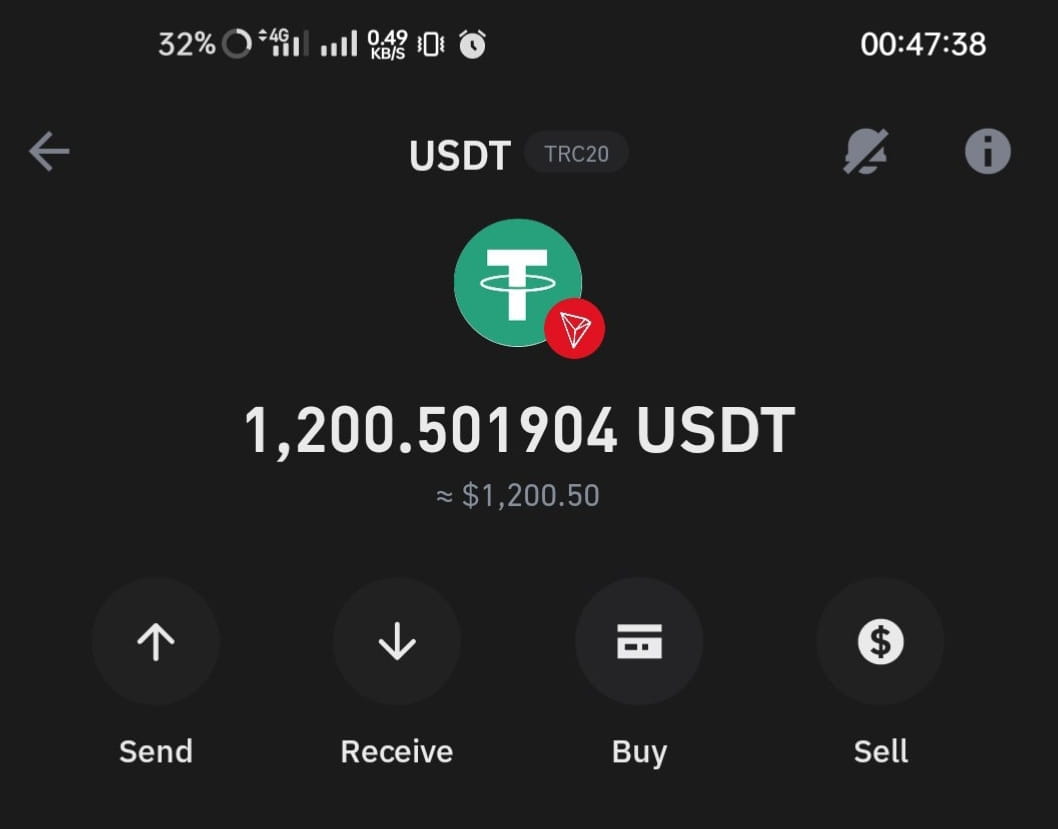
🎉🎉🎉🎉AIRDROP 🎉🎉🎉🎉 $BTC $ETH Dumping 1200 $usdt into a random wallet Distribution of 1000 people: $200 to the top 5 1-Follow 2-Rt and ❤️ Every coin you send gives you a referral 🅿️Drop your addresses ($TRX ONLY) #crypto2023 #cryptocurrency #bitcoin #BitVM #etf