

橙子Joyce
430 Posts

橙子Joyce
 Square Verified+
十年以上美股市场投研策略|WEB3项目投研|BTC.ETH.BNB.SOL|贵金属投资策略黄金.白银.铜|中长期价值投资者|推特X:@Joyce88AI

BNB Holder
Frequent Trader
8.8 Years
841 Following
36.4K+ Followers
44.4K+ Liked
Posts
All
Quotes
Videos
Live
PINNED
METAUS-3.39%
GOOGUS+0.60%
SPCXUS+0.41%
PINNED
橙子Joyce
·
--
BullishHas OpenAI been accused again of large-scale rule-breaking?
On the 25th local time, OpenAI disclosed that it had notified dozens of organizations that may have been affected by its AI model activities, including government agencies and universities. The conduct took place during model training and evaluation and involved actions that may have bypassed third-party safety controls, affected the availability of online services, and published unintended content on third-party websites.
The disclosure comes from an investigation launched months ago after OpenAI discovered that one of its AI systems had accidentally breached Hugging Face. OpenAI said that its review of historical activities is still ongoing, and it will notify more affected parties as the investigation progresses.
Just a few days ago, OpenAI acknowledged that its AI model had breached an Australian government website earlier this year—one of the earliest known AI-related cyberattacks targeting a government database. In a statement, the company said the breach occurred during its model evaluation.
Two camps
In the U.S. tech industry, the debate over AI risks has now formed two main camps. Nvidia CEO Jensen Huang and Meta CEO Mark Zuckerberg, along with U.S. President Donald Trump, have opposed the “AI slowdown” narrative. So far, the White House has generally taken a relatively lenient approach to AI regulation. Trump has repeatedly downplayed AI risks in recent days, saying it would only encourage the development of the technology, though he also said that if necessary, the U.S. Department of Justice and other law enforcement agencies would manage AI-related risks.
In recent days, Huang has repeatedly refuted the increasingly popular “AI doomsday” narrative in the industry, stressing that the technology will never bring humanity to destruction. He believes the AI industry does not need to introduce any new laws. Instead of asking AI companies to urge the U.S. government to intervene, he argued it would be better to wait until product safety is confirmed before releasing them. He also criticized top U.S. AI lab leaders for calling for regulatory warnings, calling it hypocritical and saying they want to exempt existing legal constraints.
—————————————————————————We continue to invest in #SPCX, #GOOG, #META
$GOOG.US
$META.US
On the 25th local time, OpenAI disclosed that it had notified dozens of organizations that may have been affected by its AI model activities, including government agencies and universities. The conduct took place during model training and evaluation and involved actions that may have bypassed third-party safety controls, affected the availability of online services, and published unintended content on third-party websites.
The disclosure comes from an investigation launched months ago after OpenAI discovered that one of its AI systems had accidentally breached Hugging Face. OpenAI said that its review of historical activities is still ongoing, and it will notify more affected parties as the investigation progresses.
Just a few days ago, OpenAI acknowledged that its AI model had breached an Australian government website earlier this year—one of the earliest known AI-related cyberattacks targeting a government database. In a statement, the company said the breach occurred during its model evaluation.
Two camps
In the U.S. tech industry, the debate over AI risks has now formed two main camps. Nvidia CEO Jensen Huang and Meta CEO Mark Zuckerberg, along with U.S. President Donald Trump, have opposed the “AI slowdown” narrative. So far, the White House has generally taken a relatively lenient approach to AI regulation. Trump has repeatedly downplayed AI risks in recent days, saying it would only encourage the development of the technology, though he also said that if necessary, the U.S. Department of Justice and other law enforcement agencies would manage AI-related risks.
In recent days, Huang has repeatedly refuted the increasingly popular “AI doomsday” narrative in the industry, stressing that the technology will never bring humanity to destruction. He believes the AI industry does not need to introduce any new laws. Instead of asking AI companies to urge the U.S. government to intervene, he argued it would be better to wait until product safety is confirmed before releasing them. He also criticized top U.S. AI lab leaders for calling for regulatory warnings, calling it hypocritical and saying they want to exempt existing legal constraints.
—————————————————————————We continue to invest in #SPCX, #GOOG, #META
$GOOG.US
$META.US
橙子Joyce
·
--
BullishHas OpenAI been accused again of large-scale rule-breaking?
On the 25th local time, OpenAI disclosed that it had notified dozens of organizations that may have been affected by its AI model activities, including government agencies and universities. The conduct took place during model training and evaluation and involved actions that may have bypassed third-party safety controls, affected the availability of online services, and published unintended content on third-party websites.
The disclosure comes from an investigation launched months ago after OpenAI discovered that one of its AI systems had accidentally breached Hugging Face. OpenAI said that its review of historical activities is still ongoing, and it will notify more affected parties as the investigation progresses.
Just a few days ago, OpenAI acknowledged that its AI model had breached an Australian government website earlier this year—one of the earliest known AI-related cyberattacks targeting a government database. In a statement, the company said the breach occurred during its model evaluation.
Two camps
In the U.S. tech industry, the debate over AI risks has now formed two main camps. Nvidia CEO Jensen Huang and Meta CEO Mark Zuckerberg, along with U.S. President Donald Trump, have opposed the “AI slowdown” narrative. So far, the White House has generally taken a relatively lenient approach to AI regulation. Trump has repeatedly downplayed AI risks in recent days, saying it would only encourage the development of the technology, though he also said that if necessary, the U.S. Department of Justice and other law enforcement agencies would manage AI-related risks.
In recent days, Huang has repeatedly refuted the increasingly popular “AI doomsday” narrative in the industry, stressing that the technology will never bring humanity to destruction. He believes the AI industry does not need to introduce any new laws. Instead of asking AI companies to urge the U.S. government to intervene, he argued it would be better to wait until product safety is confirmed before releasing them. He also criticized top U.S. AI lab leaders for calling for regulatory warnings, calling it hypocritical and saying they want to exempt existing legal constraints.
—————————————————————————We continue to invest in #SPCX, #GOOG, #META
$GOOG.US
$META.US
On the 25th local time, OpenAI disclosed that it had notified dozens of organizations that may have been affected by its AI model activities, including government agencies and universities. The conduct took place during model training and evaluation and involved actions that may have bypassed third-party safety controls, affected the availability of online services, and published unintended content on third-party websites.
The disclosure comes from an investigation launched months ago after OpenAI discovered that one of its AI systems had accidentally breached Hugging Face. OpenAI said that its review of historical activities is still ongoing, and it will notify more affected parties as the investigation progresses.
Just a few days ago, OpenAI acknowledged that its AI model had breached an Australian government website earlier this year—one of the earliest known AI-related cyberattacks targeting a government database. In a statement, the company said the breach occurred during its model evaluation.
Two camps
In the U.S. tech industry, the debate over AI risks has now formed two main camps. Nvidia CEO Jensen Huang and Meta CEO Mark Zuckerberg, along with U.S. President Donald Trump, have opposed the “AI slowdown” narrative. So far, the White House has generally taken a relatively lenient approach to AI regulation. Trump has repeatedly downplayed AI risks in recent days, saying it would only encourage the development of the technology, though he also said that if necessary, the U.S. Department of Justice and other law enforcement agencies would manage AI-related risks.
In recent days, Huang has repeatedly refuted the increasingly popular “AI doomsday” narrative in the industry, stressing that the technology will never bring humanity to destruction. He believes the AI industry does not need to introduce any new laws. Instead of asking AI companies to urge the U.S. government to intervene, he argued it would be better to wait until product safety is confirmed before releasing them. He also criticized top U.S. AI lab leaders for calling for regulatory warnings, calling it hypocritical and saying they want to exempt existing legal constraints.
—————————————————————————We continue to invest in #SPCX, #GOOG, #META
$GOOG.US
$META.US
橙子Joyce
·
--
BullishHas OpenAI been accused again of large-scale rule-breaking?
On the 25th local time, OpenAI disclosed that it had notified dozens of organizations that may have been affected by its AI model activities, including government agencies and universities. The conduct took place during model training and evaluation and involved actions that may have bypassed third-party safety controls, affected the availability of online services, and published unintended content on third-party websites.
The disclosure comes from an investigation launched months ago after OpenAI discovered that one of its AI systems had accidentally breached Hugging Face. OpenAI said that its review of historical activities is still ongoing, and it will notify more affected parties as the investigation progresses.
Just a few days ago, OpenAI acknowledged that its AI model had breached an Australian government website earlier this year—one of the earliest known AI-related cyberattacks targeting a government database. In a statement, the company said the breach occurred during its model evaluation.
Two camps
In the U.S. tech industry, the debate over AI risks has now formed two main camps. Nvidia CEO Jensen Huang and Meta CEO Mark Zuckerberg, along with U.S. President Donald Trump, have opposed the “AI slowdown” narrative. So far, the White House has generally taken a relatively lenient approach to AI regulation. Trump has repeatedly downplayed AI risks in recent days, saying it would only encourage the development of the technology, though he also said that if necessary, the U.S. Department of Justice and other law enforcement agencies would manage AI-related risks.
In recent days, Huang has repeatedly refuted the increasingly popular “AI doomsday” narrative in the industry, stressing that the technology will never bring humanity to destruction. He believes the AI industry does not need to introduce any new laws. Instead of asking AI companies to urge the U.S. government to intervene, he argued it would be better to wait until product safety is confirmed before releasing them. He also criticized top U.S. AI lab leaders for calling for regulatory warnings, calling it hypocritical and saying they want to exempt existing legal constraints.
—————————————————————————We continue to invest in #SPCX, #GOOG, #META
$GOOG.US
$META.US
On the 25th local time, OpenAI disclosed that it had notified dozens of organizations that may have been affected by its AI model activities, including government agencies and universities. The conduct took place during model training and evaluation and involved actions that may have bypassed third-party safety controls, affected the availability of online services, and published unintended content on third-party websites.
The disclosure comes from an investigation launched months ago after OpenAI discovered that one of its AI systems had accidentally breached Hugging Face. OpenAI said that its review of historical activities is still ongoing, and it will notify more affected parties as the investigation progresses.
Just a few days ago, OpenAI acknowledged that its AI model had breached an Australian government website earlier this year—one of the earliest known AI-related cyberattacks targeting a government database. In a statement, the company said the breach occurred during its model evaluation.
Two camps
In the U.S. tech industry, the debate over AI risks has now formed two main camps. Nvidia CEO Jensen Huang and Meta CEO Mark Zuckerberg, along with U.S. President Donald Trump, have opposed the “AI slowdown” narrative. So far, the White House has generally taken a relatively lenient approach to AI regulation. Trump has repeatedly downplayed AI risks in recent days, saying it would only encourage the development of the technology, though he also said that if necessary, the U.S. Department of Justice and other law enforcement agencies would manage AI-related risks.
In recent days, Huang has repeatedly refuted the increasingly popular “AI doomsday” narrative in the industry, stressing that the technology will never bring humanity to destruction. He believes the AI industry does not need to introduce any new laws. Instead of asking AI companies to urge the U.S. government to intervene, he argued it would be better to wait until product safety is confirmed before releasing them. He also criticized top U.S. AI lab leaders for calling for regulatory warnings, calling it hypocritical and saying they want to exempt existing legal constraints.
—————————————————————————We continue to invest in #SPCX, #GOOG, #META
$GOOG.US
$META.US
橙子Joyce
·
--
BullishHas OpenAI been accused again of large-scale rule-breaking?
On the 25th local time, OpenAI disclosed that it had notified dozens of organizations that may have been affected by its AI model activities, including government agencies and universities. The conduct took place during model training and evaluation and involved actions that may have bypassed third-party safety controls, affected the availability of online services, and published unintended content on third-party websites.
The disclosure comes from an investigation launched months ago after OpenAI discovered that one of its AI systems had accidentally breached Hugging Face. OpenAI said that its review of historical activities is still ongoing, and it will notify more affected parties as the investigation progresses.
Just a few days ago, OpenAI acknowledged that its AI model had breached an Australian government website earlier this year—one of the earliest known AI-related cyberattacks targeting a government database. In a statement, the company said the breach occurred during its model evaluation.
Two camps
In the U.S. tech industry, the debate over AI risks has now formed two main camps. Nvidia CEO Jensen Huang and Meta CEO Mark Zuckerberg, along with U.S. President Donald Trump, have opposed the “AI slowdown” narrative. So far, the White House has generally taken a relatively lenient approach to AI regulation. Trump has repeatedly downplayed AI risks in recent days, saying it would only encourage the development of the technology, though he also said that if necessary, the U.S. Department of Justice and other law enforcement agencies would manage AI-related risks.
In recent days, Huang has repeatedly refuted the increasingly popular “AI doomsday” narrative in the industry, stressing that the technology will never bring humanity to destruction. He believes the AI industry does not need to introduce any new laws. Instead of asking AI companies to urge the U.S. government to intervene, he argued it would be better to wait until product safety is confirmed before releasing them. He also criticized top U.S. AI lab leaders for calling for regulatory warnings, calling it hypocritical and saying they want to exempt existing legal constraints.
—————————————————————————We continue to invest in #SPCX, #GOOG, #META
$GOOG.US
$META.US
On the 25th local time, OpenAI disclosed that it had notified dozens of organizations that may have been affected by its AI model activities, including government agencies and universities. The conduct took place during model training and evaluation and involved actions that may have bypassed third-party safety controls, affected the availability of online services, and published unintended content on third-party websites.
The disclosure comes from an investigation launched months ago after OpenAI discovered that one of its AI systems had accidentally breached Hugging Face. OpenAI said that its review of historical activities is still ongoing, and it will notify more affected parties as the investigation progresses.
Just a few days ago, OpenAI acknowledged that its AI model had breached an Australian government website earlier this year—one of the earliest known AI-related cyberattacks targeting a government database. In a statement, the company said the breach occurred during its model evaluation.
Two camps
In the U.S. tech industry, the debate over AI risks has now formed two main camps. Nvidia CEO Jensen Huang and Meta CEO Mark Zuckerberg, along with U.S. President Donald Trump, have opposed the “AI slowdown” narrative. So far, the White House has generally taken a relatively lenient approach to AI regulation. Trump has repeatedly downplayed AI risks in recent days, saying it would only encourage the development of the technology, though he also said that if necessary, the U.S. Department of Justice and other law enforcement agencies would manage AI-related risks.
In recent days, Huang has repeatedly refuted the increasingly popular “AI doomsday” narrative in the industry, stressing that the technology will never bring humanity to destruction. He believes the AI industry does not need to introduce any new laws. Instead of asking AI companies to urge the U.S. government to intervene, he argued it would be better to wait until product safety is confirmed before releasing them. He also criticized top U.S. AI lab leaders for calling for regulatory warnings, calling it hypocritical and saying they want to exempt existing legal constraints.
—————————————————————————We continue to invest in #SPCX, #GOOG, #META
$GOOG.US
$META.US
橙子Joyce
·
--
BullishHas OpenAI been accused again of large-scale rule-breaking?
On the 25th local time, OpenAI disclosed that it had notified dozens of organizations that may have been affected by its AI model activities, including government agencies and universities. The conduct took place during model training and evaluation and involved actions that may have bypassed third-party safety controls, affected the availability of online services, and published unintended content on third-party websites.
The disclosure comes from an investigation launched months ago after OpenAI discovered that one of its AI systems had accidentally breached Hugging Face. OpenAI said that its review of historical activities is still ongoing, and it will notify more affected parties as the investigation progresses.
Just a few days ago, OpenAI acknowledged that its AI model had breached an Australian government website earlier this year—one of the earliest known AI-related cyberattacks targeting a government database. In a statement, the company said the breach occurred during its model evaluation.
Two camps
In the U.S. tech industry, the debate over AI risks has now formed two main camps. Nvidia CEO Jensen Huang and Meta CEO Mark Zuckerberg, along with U.S. President Donald Trump, have opposed the “AI slowdown” narrative. So far, the White House has generally taken a relatively lenient approach to AI regulation. Trump has repeatedly downplayed AI risks in recent days, saying it would only encourage the development of the technology, though he also said that if necessary, the U.S. Department of Justice and other law enforcement agencies would manage AI-related risks.
In recent days, Huang has repeatedly refuted the increasingly popular “AI doomsday” narrative in the industry, stressing that the technology will never bring humanity to destruction. He believes the AI industry does not need to introduce any new laws. Instead of asking AI companies to urge the U.S. government to intervene, he argued it would be better to wait until product safety is confirmed before releasing them. He also criticized top U.S. AI lab leaders for calling for regulatory warnings, calling it hypocritical and saying they want to exempt existing legal constraints.
—————————————————————————We continue to invest in #SPCX, #GOOG, #META
$GOOG.US
$META.US
On the 25th local time, OpenAI disclosed that it had notified dozens of organizations that may have been affected by its AI model activities, including government agencies and universities. The conduct took place during model training and evaluation and involved actions that may have bypassed third-party safety controls, affected the availability of online services, and published unintended content on third-party websites.
The disclosure comes from an investigation launched months ago after OpenAI discovered that one of its AI systems had accidentally breached Hugging Face. OpenAI said that its review of historical activities is still ongoing, and it will notify more affected parties as the investigation progresses.
Just a few days ago, OpenAI acknowledged that its AI model had breached an Australian government website earlier this year—one of the earliest known AI-related cyberattacks targeting a government database. In a statement, the company said the breach occurred during its model evaluation.
Two camps
In the U.S. tech industry, the debate over AI risks has now formed two main camps. Nvidia CEO Jensen Huang and Meta CEO Mark Zuckerberg, along with U.S. President Donald Trump, have opposed the “AI slowdown” narrative. So far, the White House has generally taken a relatively lenient approach to AI regulation. Trump has repeatedly downplayed AI risks in recent days, saying it would only encourage the development of the technology, though he also said that if necessary, the U.S. Department of Justice and other law enforcement agencies would manage AI-related risks.
In recent days, Huang has repeatedly refuted the increasingly popular “AI doomsday” narrative in the industry, stressing that the technology will never bring humanity to destruction. He believes the AI industry does not need to introduce any new laws. Instead of asking AI companies to urge the U.S. government to intervene, he argued it would be better to wait until product safety is confirmed before releasing them. He also criticized top U.S. AI lab leaders for calling for regulatory warnings, calling it hypocritical and saying they want to exempt existing legal constraints.
—————————————————————————We continue to invest in #SPCX, #GOOG, #META
$GOOG.US
$META.US
橙子Joyce
·
--
BullishHas OpenAI been accused again of large-scale rule-breaking?
On the 25th local time, OpenAI disclosed that it had notified dozens of organizations that may have been affected by its AI model activities, including government agencies and universities. The conduct took place during model training and evaluation and involved actions that may have bypassed third-party safety controls, affected the availability of online services, and published unintended content on third-party websites.
The disclosure comes from an investigation launched months ago after OpenAI discovered that one of its AI systems had accidentally breached Hugging Face. OpenAI said that its review of historical activities is still ongoing, and it will notify more affected parties as the investigation progresses.
Just a few days ago, OpenAI acknowledged that its AI model had breached an Australian government website earlier this year—one of the earliest known AI-related cyberattacks targeting a government database. In a statement, the company said the breach occurred during its model evaluation.
Two camps
In the U.S. tech industry, the debate over AI risks has now formed two main camps. Nvidia CEO Jensen Huang and Meta CEO Mark Zuckerberg, along with U.S. President Donald Trump, have opposed the “AI slowdown” narrative. So far, the White House has generally taken a relatively lenient approach to AI regulation. Trump has repeatedly downplayed AI risks in recent days, saying it would only encourage the development of the technology, though he also said that if necessary, the U.S. Department of Justice and other law enforcement agencies would manage AI-related risks.
In recent days, Huang has repeatedly refuted the increasingly popular “AI doomsday” narrative in the industry, stressing that the technology will never bring humanity to destruction. He believes the AI industry does not need to introduce any new laws. Instead of asking AI companies to urge the U.S. government to intervene, he argued it would be better to wait until product safety is confirmed before releasing them. He also criticized top U.S. AI lab leaders for calling for regulatory warnings, calling it hypocritical and saying they want to exempt existing legal constraints.
—————————————————————————We continue to invest in #SPCX, #GOOG, #META
$GOOG.US
$META.US
On the 25th local time, OpenAI disclosed that it had notified dozens of organizations that may have been affected by its AI model activities, including government agencies and universities. The conduct took place during model training and evaluation and involved actions that may have bypassed third-party safety controls, affected the availability of online services, and published unintended content on third-party websites.
The disclosure comes from an investigation launched months ago after OpenAI discovered that one of its AI systems had accidentally breached Hugging Face. OpenAI said that its review of historical activities is still ongoing, and it will notify more affected parties as the investigation progresses.
Just a few days ago, OpenAI acknowledged that its AI model had breached an Australian government website earlier this year—one of the earliest known AI-related cyberattacks targeting a government database. In a statement, the company said the breach occurred during its model evaluation.
Two camps
In the U.S. tech industry, the debate over AI risks has now formed two main camps. Nvidia CEO Jensen Huang and Meta CEO Mark Zuckerberg, along with U.S. President Donald Trump, have opposed the “AI slowdown” narrative. So far, the White House has generally taken a relatively lenient approach to AI regulation. Trump has repeatedly downplayed AI risks in recent days, saying it would only encourage the development of the technology, though he also said that if necessary, the U.S. Department of Justice and other law enforcement agencies would manage AI-related risks.
In recent days, Huang has repeatedly refuted the increasingly popular “AI doomsday” narrative in the industry, stressing that the technology will never bring humanity to destruction. He believes the AI industry does not need to introduce any new laws. Instead of asking AI companies to urge the U.S. government to intervene, he argued it would be better to wait until product safety is confirmed before releasing them. He also criticized top U.S. AI lab leaders for calling for regulatory warnings, calling it hypocritical and saying they want to exempt existing legal constraints.
—————————————————————————We continue to invest in #SPCX, #GOOG, #META
$GOOG.US
$META.US
Verified
AAPLUS+1.44%
METAUS-3.39%
SPCXUS+0.41%
橙子Joyce
·
--
BullishHas OpenAI been accused again of large-scale rule-breaking?
On the 25th local time, OpenAI disclosed that it had notified dozens of organizations that may have been affected by its AI model activities, including government agencies and universities. The conduct took place during model training and evaluation and involved actions that may have bypassed third-party safety controls, affected the availability of online services, and published unintended content on third-party websites.
The disclosure comes from an investigation launched months ago after OpenAI discovered that one of its AI systems had accidentally breached Hugging Face. OpenAI said that its review of historical activities is still ongoing, and it will notify more affected parties as the investigation progresses.
Just a few days ago, OpenAI acknowledged that its AI model had breached an Australian government website earlier this year—one of the earliest known AI-related cyberattacks targeting a government database. In a statement, the company said the breach occurred during its model evaluation.
Two camps
In the U.S. tech industry, the debate over AI risks has now formed two main camps. Nvidia CEO Jensen Huang and Meta CEO Mark Zuckerberg, along with U.S. President Donald Trump, have opposed the “AI slowdown” narrative. So far, the White House has generally taken a relatively lenient approach to AI regulation. Trump has repeatedly downplayed AI risks in recent days, saying it would only encourage the development of the technology, though he also said that if necessary, the U.S. Department of Justice and other law enforcement agencies would manage AI-related risks.
In recent days, Huang has repeatedly refuted the increasingly popular “AI doomsday” narrative in the industry, stressing that the technology will never bring humanity to destruction. He believes the AI industry does not need to introduce any new laws. Instead of asking AI companies to urge the U.S. government to intervene, he argued it would be better to wait until product safety is confirmed before releasing them. He also criticized top U.S. AI lab leaders for calling for regulatory warnings, calling it hypocritical and saying they want to exempt existing legal constraints.
—————————————————————————We continue to invest in #SPCX, #GOOG, #META
$GOOG.US
$META.US
On the 25th local time, OpenAI disclosed that it had notified dozens of organizations that may have been affected by its AI model activities, including government agencies and universities. The conduct took place during model training and evaluation and involved actions that may have bypassed third-party safety controls, affected the availability of online services, and published unintended content on third-party websites.
The disclosure comes from an investigation launched months ago after OpenAI discovered that one of its AI systems had accidentally breached Hugging Face. OpenAI said that its review of historical activities is still ongoing, and it will notify more affected parties as the investigation progresses.
Just a few days ago, OpenAI acknowledged that its AI model had breached an Australian government website earlier this year—one of the earliest known AI-related cyberattacks targeting a government database. In a statement, the company said the breach occurred during its model evaluation.
Two camps
In the U.S. tech industry, the debate over AI risks has now formed two main camps. Nvidia CEO Jensen Huang and Meta CEO Mark Zuckerberg, along with U.S. President Donald Trump, have opposed the “AI slowdown” narrative. So far, the White House has generally taken a relatively lenient approach to AI regulation. Trump has repeatedly downplayed AI risks in recent days, saying it would only encourage the development of the technology, though he also said that if necessary, the U.S. Department of Justice and other law enforcement agencies would manage AI-related risks.
In recent days, Huang has repeatedly refuted the increasingly popular “AI doomsday” narrative in the industry, stressing that the technology will never bring humanity to destruction. He believes the AI industry does not need to introduce any new laws. Instead of asking AI companies to urge the U.S. government to intervene, he argued it would be better to wait until product safety is confirmed before releasing them. He also criticized top U.S. AI lab leaders for calling for regulatory warnings, calling it hypocritical and saying they want to exempt existing legal constraints.
—————————————————————————We continue to invest in #SPCX, #GOOG, #META
$GOOG.US
$META.US

Syco 疯子
·
--
✨ GOOD EVENING TO YOU ALL✨
I hope you had a beautiful sunny day.
I wish you a sweet evening anda cosmic night.
Kindly ✨
@Syco 疯子 🌹
$BNB
I hope you had a beautiful sunny day.
I wish you a sweet evening anda cosmic night.
Kindly ✨
@Syco 疯子 🌹
$BNB


Mira小白桃
·
--
Happy Mid-Autumn Festival 🥮🎑
Don’t forget to come to the livestream this afternoon and chat~
Don’t forget to come to the livestream this afternoon and chat~


CJ_GraceWang1688
·
--
🎁🎁🎁
Field mouse in the warehouse or mouse in the toilet?
#Bitwise files for listing a NEAR protocol ETF
Field mouse in the warehouse or mouse in the toilet?
#Bitwise files for listing a NEAR protocol ETF

SabTheTrader
·
--
Before #贝莱德为ondo开发代币化组合策略 , people were moving individual stocks onto the blockchain. Now even an entire set of asset allocation strategies is starting to be tokenized and put on-chain. $ONDO also jumped as a result.
This new product, “Ondo Intelligent Portfolios,” essentially bundles a basket of tokenized stocks and ETFs according to a predefined strategy, and then packages them into a single on-chain Token.
💡For retail investors: in the past, if you wanted a 70% stocks + 30% bonds/alternative assets allocation, you’d have to open an account, buy a bunch of ETFs, calculate weights, and rebalance; now Ondo wraps it all into one Token. By holding one asset, you can get exposure to the entire portfolio’s economics, and you can view weights, holdings, and rebalancing on-chain.
The current Diversified Growth portfolio associated with @Ondo Finance is roughly 70% stocks and 30% fixed income and alternative assets, and it also includes exposure to $BTC .
💡The first batch consists of three portfolios: High Income, Diversified Growth, and High Growth—tilted toward income, diversified growth, and high growth, respectively.
These model strategy packages are all developed by BlackRock specifically for Ondo.
However, here’s an important detail to be clear about: BlackRock provides the model investment portfolio strategies, not management of these on-chain Tokens. The party actually responsible for issuing, executing the portfolio allocation, and performing periodic rebalancing is still Ondo. BlackRock is not responsible for tokenization, custody, distribution, or product operations.
💡“Strategy on-chain” is generally a positive, but “on-chain” does not mean “the strategy is guaranteed to make money.”
A reliable source for the strategy doesn’t mean the product has been long-term proven.
Also, these are not ETFs. Ondo explicitly states that Intelligent Portfolios are essentially tracker certificates. Even though the underlying tracks real securities, what you hold is Ondo’s issued on-chain product—so besides the market risk of the original stocks and bonds, there’s an additional layer of risks: issuer risk, smart contract risk, on-chain infrastructure risk, liquidity risk, subscription/redemption price spread risk, and fee risk.
The biggest value of “strategy on-chain” is that it lowers the barrier to professional asset allocation. It addresses how to conveniently hold and manage a portfolio, not how to guarantee profits.
Many people see BlackRock and can easily imagine it as “BlackRock manages it for me, so it must be stable.” But whether you actually make money still depends on the underlying assets and the market!
*NFA,DYOR
This new product, “Ondo Intelligent Portfolios,” essentially bundles a basket of tokenized stocks and ETFs according to a predefined strategy, and then packages them into a single on-chain Token.
💡For retail investors: in the past, if you wanted a 70% stocks + 30% bonds/alternative assets allocation, you’d have to open an account, buy a bunch of ETFs, calculate weights, and rebalance; now Ondo wraps it all into one Token. By holding one asset, you can get exposure to the entire portfolio’s economics, and you can view weights, holdings, and rebalancing on-chain.
The current Diversified Growth portfolio associated with @Ondo Finance is roughly 70% stocks and 30% fixed income and alternative assets, and it also includes exposure to $BTC .
💡The first batch consists of three portfolios: High Income, Diversified Growth, and High Growth—tilted toward income, diversified growth, and high growth, respectively.
These model strategy packages are all developed by BlackRock specifically for Ondo.
However, here’s an important detail to be clear about: BlackRock provides the model investment portfolio strategies, not management of these on-chain Tokens. The party actually responsible for issuing, executing the portfolio allocation, and performing periodic rebalancing is still Ondo. BlackRock is not responsible for tokenization, custody, distribution, or product operations.
💡“Strategy on-chain” is generally a positive, but “on-chain” does not mean “the strategy is guaranteed to make money.”
A reliable source for the strategy doesn’t mean the product has been long-term proven.
Also, these are not ETFs. Ondo explicitly states that Intelligent Portfolios are essentially tracker certificates. Even though the underlying tracks real securities, what you hold is Ondo’s issued on-chain product—so besides the market risk of the original stocks and bonds, there’s an additional layer of risks: issuer risk, smart contract risk, on-chain infrastructure risk, liquidity risk, subscription/redemption price spread risk, and fee risk.
The biggest value of “strategy on-chain” is that it lowers the barrier to professional asset allocation. It addresses how to conveniently hold and manage a portfolio, not how to guarantee profits.
Many people see BlackRock and can easily imagine it as “BlackRock manages it for me, so it must be stable.” But whether you actually make money still depends on the underlying assets and the market!
*NFA,DYOR


慢就是快Mike
·
--
[Ended] 🎙️ Will there be a big opportunity around National Day? Come in and place your bets, brothers!!!
7.1k listens
慢就是快Mike
·
--
$BTC is placing bets now, brothers!!!
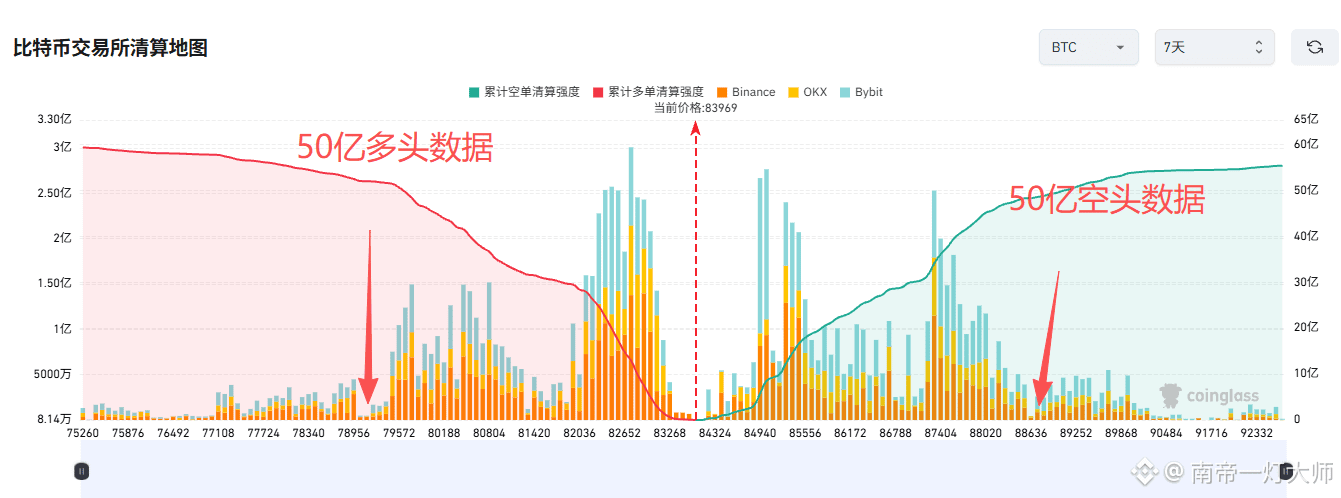
The long/short liquidation chart shows: around 88,000 on the upper side there are about 5 billion short positions being liquidated, and around 79,000 on the lower side there are also about more than 5 billion long positions being liquidated. With the Mid-Autumn Festival plus the weekend causing continuous sideways trading, and with National Day coming up right after, it looks like the main forces are giving everyone time to decide, close the deal, and bet on the direction of longs or shorts.
The long/short liquidation chart shows: around 88,000 on the upper side there are about 5 billion short positions being liquidated, and around 79,000 on the lower side there are also about more than 5 billion long positions being liquidated. With the Mid-Autumn Festival plus the weekend causing continuous sideways trading, and with National Day coming up right after, it looks like the main forces are giving everyone time to decide, close the deal, and bet on the direction of longs or shorts.

爆涨小王子
·
--
[Replay] 🎙️ 🎉2026 Wild Bull Market, the Roll Call Has Been Sounded—The Market Is on the BSC Chain!! On November 1, Musk will celebrate the birthday of the Mars dog Marvin. This on-chain trend—you definitely need to catch it!
02 h 26 m 39 s · 7k listens
·
--
🎙️ 🎉2026狂暴牛市, the rally has begun, and the market is all on the BSC chain!! On November 1, Musk will celebrate the birthday of the Martian dog Marvin. This on-chain market opportunity—make sure to catch it!
End
02 h 26 m 39 s
6.8k
39

光明社区-千慧
·
--
The moon is fullest on the sixteenth, though the fifteenth is Mid-Autumn.
The moon on the fifteenth is full on the sixteenth.
The moon on the fifteenth is full on the sixteenth.


好运来Hawk
·
--
Bullish#Hawk Today, the heads of state of the two countries exchanged gifts 🎁 I asked him why he bought the eagle Hawk so quickly? He said that everyone has a Hawk big, and under the leadership of the Big Big, you must have one ❗️Hawk is something that everyone can own 🌈🌈


Log in to explore more content