
玖玖说Web3
668 Posts
 LIVE
LIVE玖玖说Web3
Report
Block User
6年在圈子的经验,公众号:有亮星球。取每日CF资讯
9 Following
1.8K+ Followers
260 Liked
Posts
All
Live
·
--
🚨 BTC снова приближается к отметке $80,000!
Но ETF-потоки внезапно остыли — пробой или ложный выход?🔥
Группа: [点击进入玖玖的粉丝群](https://app.binance.com/uni-qr/YXXQJrPb)
Биткоин снова подошёл к очень ключевому уровню.
Сейчас цена вновь пытается закрепиться выше $77,000, и рынок внимательно следит за психологической отметкой $80,000. Ранее BTC ненадолго пробивал $80,000, но вскоре откатил — из‑за усиления ожиданий повышения ставок. Поэтому на этот раз главный вопрос не в том, «может ли цена коснуться $80,000», а в том, сможет ли она после пробоя удержаться.👀
Потому что выше $80,000 давление ещё сильнее.
Основная зона предложения, на которую сейчас смотрит рынок, находится в диапазоне $81,000–$86,000. Если средства, которые заходили в позиции на высоких уровнях, снова увидят, что цена возвращается, они могут принести более сильное давление продаж. Иными словами, даже если BTC пробьёт $80,000, это нельзя сразу трактовать как окончательный разворот тренда. Если же цена сможет дополнительно пробить недавний максимум $82,000 и закрепиться в районе $86,000, тогда фокус рынка может постепенно сместиться к $90,000.🚀
Но сейчас есть ещё более настораживающий сигнал:
приток средств в ETF замедляется.
В начале сентября спотовые BTC ETF демонстрировали недельный чистый приток почти на $1 млрд, но в последнее время приток заметно ослаб. 10 сентября даже зафиксирован отток примерно на $283 млн за один день.
Что это значит?
Институциональные деньги пока не так активны, как раньше.
Если BTC будет «продавливаться» выше $80,000 при отсутствии устойчивой поддержки со стороны ETF, то у продолжительности этого роста возникает большой вопрос.⚠️
И наоборот: если в дальнейшем ETF снова начнут давать чистый приток, а BTC сможет с увеличением объёма уверенно закрепиться выше $80,000, то достоверность пробоя резко возрастёт.
Снизу тоже нельзя терять бдительность. Если BTC вновь опустится ниже $75,000, рынок может снова протестировать зону $73,000–$75,000. А если и там не удержится, то структура на короткой дистанции заметно ослабнет.
Нажмите на аватар, чтобы вступить в чат группы Джиу Джи за ежедневными стратегиями🚀
#BTC #ETHETFsApproved
🚨 BTC снова приближается к отметке $80,000!
Но ETF-потоки внезапно остыли — пробой или ложный выход?🔥
Группа: 点击进入玖玖的粉丝群
Биткоин снова подошёл к очень ключевому уровню.
Сейчас цена вновь пытается закрепиться выше $77,000, и рынок внимательно следит за психологической отметкой $80,000. Ранее BTC ненадолго пробивал $80,000, но вскоре откатил — из‑за усиления ожиданий повышения ставок. Поэтому на этот раз главный вопрос не в том, «может ли цена коснуться $80,000», а в том, сможет ли она после пробоя удержаться.👀
Потому что выше $80,000 давление ещё сильнее.
Основная зона предложения, на которую сейчас смотрит рынок, находится в диапазоне $81,000–$86,000. Если средства, которые заходили в позиции на высоких уровнях, снова увидят, что цена возвращается, они могут принести более сильное давление продаж. Иными словами, даже если BTC пробьёт $80,000, это нельзя сразу трактовать как окончательный разворот тренда. Если же цена сможет дополнительно пробить недавний максимум $82,000 и закрепиться в районе $86,000, тогда фокус рынка может постепенно сместиться к $90,000.🚀
Но сейчас есть ещё более настораживающий сигнал:
приток средств в ETF замедляется.
В начале сентября спотовые BTC ETF демонстрировали недельный чистый приток почти на $1 млрд, но в последнее время приток заметно ослаб. 10 сентября даже зафиксирован отток примерно на $283 млн за один день.
Что это значит?
Институциональные деньги пока не так активны, как раньше.
Если BTC будет «продавливаться» выше $80,000 при отсутствии устойчивой поддержки со стороны ETF, то у продолжительности этого роста возникает большой вопрос.⚠️
И наоборот: если в дальнейшем ETF снова начнут давать чистый приток, а BTC сможет с увеличением объёма уверенно закрепиться выше $80,000, то достоверность пробоя резко возрастёт.
Снизу тоже нельзя терять бдительность. Если BTC вновь опустится ниже $75,000, рынок может снова протестировать зону $73,000–$75,000. А если и там не удержится, то структура на короткой дистанции заметно ослабнет.
Нажмите на аватар, чтобы вступить в чат группы Джиу Джи за ежедневными стратегиями🚀
#BTC #ETHETFsApproved
Но ETF-потоки внезапно остыли — пробой или ложный выход?🔥
Группа: 点击进入玖玖的粉丝群
Биткоин снова подошёл к очень ключевому уровню.
Сейчас цена вновь пытается закрепиться выше $77,000, и рынок внимательно следит за психологической отметкой $80,000. Ранее BTC ненадолго пробивал $80,000, но вскоре откатил — из‑за усиления ожиданий повышения ставок. Поэтому на этот раз главный вопрос не в том, «может ли цена коснуться $80,000», а в том, сможет ли она после пробоя удержаться.👀
Потому что выше $80,000 давление ещё сильнее.
Основная зона предложения, на которую сейчас смотрит рынок, находится в диапазоне $81,000–$86,000. Если средства, которые заходили в позиции на высоких уровнях, снова увидят, что цена возвращается, они могут принести более сильное давление продаж. Иными словами, даже если BTC пробьёт $80,000, это нельзя сразу трактовать как окончательный разворот тренда. Если же цена сможет дополнительно пробить недавний максимум $82,000 и закрепиться в районе $86,000, тогда фокус рынка может постепенно сместиться к $90,000.🚀
Но сейчас есть ещё более настораживающий сигнал:
приток средств в ETF замедляется.
В начале сентября спотовые BTC ETF демонстрировали недельный чистый приток почти на $1 млрд, но в последнее время приток заметно ослаб. 10 сентября даже зафиксирован отток примерно на $283 млн за один день.
Что это значит?
Институциональные деньги пока не так активны, как раньше.
Если BTC будет «продавливаться» выше $80,000 при отсутствии устойчивой поддержки со стороны ETF, то у продолжительности этого роста возникает большой вопрос.⚠️
И наоборот: если в дальнейшем ETF снова начнут давать чистый приток, а BTC сможет с увеличением объёма уверенно закрепиться выше $80,000, то достоверность пробоя резко возрастёт.
Снизу тоже нельзя терять бдительность. Если BTC вновь опустится ниже $75,000, рынок может снова протестировать зону $73,000–$75,000. А если и там не удержится, то структура на короткой дистанции заметно ослабнет.
Нажмите на аватар, чтобы вступить в чат группы Джиу Джи за ежедневными стратегиями🚀
#BTC #ETHETFsApproved

127
·
--
🚨 DOGE rebound structure suddenly improves!
0.10 is the key level—can Dogecoin truly break through this time?🐕🔥
Group: [点击进入玖玖的粉丝群](https://app.binance.com/uni-qr/YXXQJrPb)
After months of decline, DOGE has finally started showing some changes worth paying attention to recently.
At the moment, the price is consolidating around $0.084. Over the past period, it has stayed within the $0.07–$0.09 range and has not kept making fresh lows.📈
More importantly, DOGE has recently moved back above several EMA moving averages. This suggests the moving-average cluster that had been continuously suppressing the price is now attempting to turn into support.
Short-term signals are also beginning to improve. On the 4-hour timeframe, around $0.0839, DOGE has shown a TD sequence buy signal. Previously, similar signals triggered a few rounds of rebounds, with the highest single rise exceeding 11%.
But don’t jump to conclusions here yet ⚠️
Technical indicators only show that rebound conditions are improving—they cannot directly prove that the trend has already reversed. The real “life-or-death line” is still $0.09–$0.10. If DOGE can reclaim $0.09 and then break through $0.10 effectively, while also breaking above the long-term descending trendline, then market expectations for a “long-term selloff ending” may heat up noticeably.
Once a breakout is confirmed, the next focus should be the $0.113–$0.114 zone. If upward momentum keeps strengthening, further targets include $0.176–$0.177. Conversely, if DOGE keeps failing to break $0.10— or even falls back below $0.082—then this rebound may only be a repair move within a trading range. In weaker conditions, around $0.075 or even $0.074 could become important support again.⚠️
Currently, RSI is about 44, and momentum hasn’t entered a strong zone yet. MACD is still somewhat bearish, but the negative histogram is starting to shrink, which also indicates that downward pressure is easing.
So right now, what matters most for DOGE isn’t whether it can “surge immediately,” but whether it can reclaim key levels step by step.🔥
Click the avatar to join the Jiujiu chat group for daily strategies 🚀
#DOGE #狗狗币崛起 #DOGECOİN
🚨 DOGE rebound structure suddenly improves!
0.10 is the key level—can Dogecoin truly break through this time?🐕🔥
Group: 点击进入玖玖的粉丝群
After months of decline, DOGE has finally started showing some changes worth paying attention to recently.
At the moment, the price is consolidating around $0.084. Over the past period, it has stayed within the $0.07–$0.09 range and has not kept making fresh lows.📈
More importantly, DOGE has recently moved back above several EMA moving averages. This suggests the moving-average cluster that had been continuously suppressing the price is now attempting to turn into support.
Short-term signals are also beginning to improve. On the 4-hour timeframe, around $0.0839, DOGE has shown a TD sequence buy signal. Previously, similar signals triggered a few rounds of rebounds, with the highest single rise exceeding 11%.
But don’t jump to conclusions here yet ⚠️
Technical indicators only show that rebound conditions are improving—they cannot directly prove that the trend has already reversed. The real “life-or-death line” is still $0.09–$0.10. If DOGE can reclaim $0.09 and then break through $0.10 effectively, while also breaking above the long-term descending trendline, then market expectations for a “long-term selloff ending” may heat up noticeably.
Once a breakout is confirmed, the next focus should be the $0.113–$0.114 zone. If upward momentum keeps strengthening, further targets include $0.176–$0.177. Conversely, if DOGE keeps failing to break $0.10— or even falls back below $0.082—then this rebound may only be a repair move within a trading range. In weaker conditions, around $0.075 or even $0.074 could become important support again.⚠️
Currently, RSI is about 44, and momentum hasn’t entered a strong zone yet. MACD is still somewhat bearish, but the negative histogram is starting to shrink, which also indicates that downward pressure is easing.
So right now, what matters most for DOGE isn’t whether it can “surge immediately,” but whether it can reclaim key levels step by step.🔥
Click the avatar to join the Jiujiu chat group for daily strategies 🚀
#DOGE #狗狗币崛起 #DOGECOİN
0.10 is the key level—can Dogecoin truly break through this time?🐕🔥
Group: 点击进入玖玖的粉丝群
After months of decline, DOGE has finally started showing some changes worth paying attention to recently.
At the moment, the price is consolidating around $0.084. Over the past period, it has stayed within the $0.07–$0.09 range and has not kept making fresh lows.📈
More importantly, DOGE has recently moved back above several EMA moving averages. This suggests the moving-average cluster that had been continuously suppressing the price is now attempting to turn into support.
Short-term signals are also beginning to improve. On the 4-hour timeframe, around $0.0839, DOGE has shown a TD sequence buy signal. Previously, similar signals triggered a few rounds of rebounds, with the highest single rise exceeding 11%.
But don’t jump to conclusions here yet ⚠️
Technical indicators only show that rebound conditions are improving—they cannot directly prove that the trend has already reversed. The real “life-or-death line” is still $0.09–$0.10. If DOGE can reclaim $0.09 and then break through $0.10 effectively, while also breaking above the long-term descending trendline, then market expectations for a “long-term selloff ending” may heat up noticeably.
Once a breakout is confirmed, the next focus should be the $0.113–$0.114 zone. If upward momentum keeps strengthening, further targets include $0.176–$0.177. Conversely, if DOGE keeps failing to break $0.10— or even falls back below $0.082—then this rebound may only be a repair move within a trading range. In weaker conditions, around $0.075 or even $0.074 could become important support again.⚠️
Currently, RSI is about 44, and momentum hasn’t entered a strong zone yet. MACD is still somewhat bearish, but the negative histogram is starting to shrink, which also indicates that downward pressure is easing.
So right now, what matters most for DOGE isn’t whether it can “surge immediately,” but whether it can reclaim key levels step by step.🔥
Click the avatar to join the Jiujiu chat group for daily strategies 🚀
#DOGE #狗狗币崛起 #DOGECOİN

293
·
--
🚨 ETH suddenly shows strong momentum signal!
Spot ETH ETFs pulled in $216 million in a single day—will the $3,000 target really be getting closer now?🔥
Group: [点击进入玖玖的粉丝群](https://app.binance.com/uni-qr/YXXQJrPb)
Ethereum has recently started to regain market focus. At the moment, ETH is trading in a tight range around $2,478, while both technicals and flows are showing notable changes worth paying attention to.
On September 11, the U.S. spot Ethereum ETF saw net inflows of about $216 million in a single day. BlackRock’s ETHA product alone attracted roughly $149 million. In addition, products under Bitwise, BlackRock, and Fidelity also recorded clear inflows.
From the perspective of ETF flows, institutional demand for ETH is still relatively strong.📊
What’s even more interesting is that recently, BTC ETFs have shown noticeable outflows, while ETH continues to receive sustained attention and capital. Could this mean institutions are reconfiguring their positioning in terms of direction?
We can’t draw a conclusion yet, but this signal is worth monitoring.👀
Now let’s look at the technicals.
Analyst Ali Charts believes ETH at the 12-hour timeframe is forming a triangle consolidation structure.
Previously, similar structures have led to rapid breakouts—ETH gained about 31% in just three days.
If this time also breaks upward, $3,000 could once again become the market’s focal target.
However, $3,000 isn’t a “must-hit” price—it’s a potential target level under the current technical structure.
What truly determines whether the rally can continue higher is whether key levels can be broken.
At present, around $2,550 is an important short-term resistance. If ETH can break above it effectively, the next move could be a retest around $2,600.
On the downside, $2,490 and the $2,400 area are the key zones to watch.
If ETH breaks below $2,490, the market may retest the $2,400 support.⚠️
Room left for volatility.
Of course, Federal Reserve policy remains one of the biggest external variables.
Click the avatar to join the Jiujiu chat group for daily strategies🚀
#ETH #etf
🚨 ETH suddenly shows strong momentum signal!
Spot ETH ETFs pulled in $216 million in a single day—will the $3,000 target really be getting closer now?🔥
Group: 点击进入玖玖的粉丝群
Ethereum has recently started to regain market focus. At the moment, ETH is trading in a tight range around $2,478, while both technicals and flows are showing notable changes worth paying attention to.
On September 11, the U.S. spot Ethereum ETF saw net inflows of about $216 million in a single day. BlackRock’s ETHA product alone attracted roughly $149 million. In addition, products under Bitwise, BlackRock, and Fidelity also recorded clear inflows.
From the perspective of ETF flows, institutional demand for ETH is still relatively strong.📊
What’s even more interesting is that recently, BTC ETFs have shown noticeable outflows, while ETH continues to receive sustained attention and capital. Could this mean institutions are reconfiguring their positioning in terms of direction?
We can’t draw a conclusion yet, but this signal is worth monitoring.👀
Now let’s look at the technicals.
Analyst Ali Charts believes ETH at the 12-hour timeframe is forming a triangle consolidation structure.
Previously, similar structures have led to rapid breakouts—ETH gained about 31% in just three days.
If this time also breaks upward, $3,000 could once again become the market’s focal target.
However, $3,000 isn’t a “must-hit” price—it’s a potential target level under the current technical structure.
What truly determines whether the rally can continue higher is whether key levels can be broken.
At present, around $2,550 is an important short-term resistance. If ETH can break above it effectively, the next move could be a retest around $2,600.
On the downside, $2,490 and the $2,400 area are the key zones to watch.
If ETH breaks below $2,490, the market may retest the $2,400 support.⚠️
Room left for volatility.
Of course, Federal Reserve policy remains one of the biggest external variables.
Click the avatar to join the Jiujiu chat group for daily strategies🚀
#ETH #etf
Spot ETH ETFs pulled in $216 million in a single day—will the $3,000 target really be getting closer now?🔥
Group: 点击进入玖玖的粉丝群
Ethereum has recently started to regain market focus. At the moment, ETH is trading in a tight range around $2,478, while both technicals and flows are showing notable changes worth paying attention to.
On September 11, the U.S. spot Ethereum ETF saw net inflows of about $216 million in a single day. BlackRock’s ETHA product alone attracted roughly $149 million. In addition, products under Bitwise, BlackRock, and Fidelity also recorded clear inflows.
From the perspective of ETF flows, institutional demand for ETH is still relatively strong.📊
What’s even more interesting is that recently, BTC ETFs have shown noticeable outflows, while ETH continues to receive sustained attention and capital. Could this mean institutions are reconfiguring their positioning in terms of direction?
We can’t draw a conclusion yet, but this signal is worth monitoring.👀
Now let’s look at the technicals.
Analyst Ali Charts believes ETH at the 12-hour timeframe is forming a triangle consolidation structure.
Previously, similar structures have led to rapid breakouts—ETH gained about 31% in just three days.
If this time also breaks upward, $3,000 could once again become the market’s focal target.
However, $3,000 isn’t a “must-hit” price—it’s a potential target level under the current technical structure.
What truly determines whether the rally can continue higher is whether key levels can be broken.
At present, around $2,550 is an important short-term resistance. If ETH can break above it effectively, the next move could be a retest around $2,600.
On the downside, $2,490 and the $2,400 area are the key zones to watch.
If ETH breaks below $2,490, the market may retest the $2,400 support.⚠️
Room left for volatility.
Of course, Federal Reserve policy remains one of the biggest external variables.
Click the avatar to join the Jiujiu chat group for daily strategies🚀
#ETH #etf

134
·
--
🚨 XRP is at a critical moment! Trump accepts an 80% moral compromise—could the Sept. 15 CLARITY Act vote become the real turning point?🔥
Group: [点击进入玖玖的粉丝群](https://app.binance.com/uni-qr/YXXQJrPb)
The biggest variable for XRP lately may not be just price.
As the U.S. “CLARITY Act” moves into a crucial Senate vote, Trump reportedly has already accepted about 80% of a moral agreement proposed by both Republicans and Democrats.
That means one of the biggest political obstacles that previously stalled the bill is clearly shrinking.👀
This compromise plan mainly targets officials’ crypto interests, including stricter holding and trading limits, while also granting state attorneys general and federal agencies joint enforcement powers.
Why is this especially important for XRP?
Because what the CLARITY Act ultimately aims to resolve is the issue of regulatory boundaries for crypto assets in the U.S.
If the bill advances smoothly, the SEC and CFTC’s future regulatory scope for different digital assets may become clearer, and crypto businesses can also get more explicit compliance expectations.
But note this:
The procedural vote on Sept. 15 does not mean the bill has already passed, nor does it mean that XRP will be formally recognized as a security or commodity that day. The real key is whether this step can secure the 60 votes needed to move forward.⚖️
What’s interesting is that the XRP market currently isn’t showing any particularly drastic reaction to political developments. XRP is still trading in a tight range around $1.36, with the 24-hour price range roughly between $1.32 and $1.43. But on the capital-flow side, there is a change worth watching.📊 From Sept. 8 to 10, spot XRP ETF inflows totaled about $18.98 million, including roughly $12.29 million on Sept. 9 alone.
If the CLARITY Act continues to advance, and XRP ETF funds continue to flow in, regulatory expectations and institutional capital could form a reinforcing “resonance.” Conversely, if the Sept. 15 vote is blocked, or if Democrats and Republicans disagree again on issues like stablecoins, consumer protection, or illegal finance, market sentiment could cool quickly.⚠️
Click your avatar to join the Jiujiu chat group for daily strategies🚀
#xrp #CLARITY法案 #XRPETFApproval
🚨 XRP is at a critical moment! Trump accepts an 80% moral compromise—could the Sept. 15 CLARITY Act vote become the real turning point?🔥
Group: 点击进入玖玖的粉丝群
The biggest variable for XRP lately may not be just price.
As the U.S. “CLARITY Act” moves into a crucial Senate vote, Trump reportedly has already accepted about 80% of a moral agreement proposed by both Republicans and Democrats.
That means one of the biggest political obstacles that previously stalled the bill is clearly shrinking.👀
This compromise plan mainly targets officials’ crypto interests, including stricter holding and trading limits, while also granting state attorneys general and federal agencies joint enforcement powers.
Why is this especially important for XRP?
Because what the CLARITY Act ultimately aims to resolve is the issue of regulatory boundaries for crypto assets in the U.S.
If the bill advances smoothly, the SEC and CFTC’s future regulatory scope for different digital assets may become clearer, and crypto businesses can also get more explicit compliance expectations.
But note this:
The procedural vote on Sept. 15 does not mean the bill has already passed, nor does it mean that XRP will be formally recognized as a security or commodity that day. The real key is whether this step can secure the 60 votes needed to move forward.⚖️
What’s interesting is that the XRP market currently isn’t showing any particularly drastic reaction to political developments. XRP is still trading in a tight range around $1.36, with the 24-hour price range roughly between $1.32 and $1.43. But on the capital-flow side, there is a change worth watching.📊 From Sept. 8 to 10, spot XRP ETF inflows totaled about $18.98 million, including roughly $12.29 million on Sept. 9 alone.
If the CLARITY Act continues to advance, and XRP ETF funds continue to flow in, regulatory expectations and institutional capital could form a reinforcing “resonance.” Conversely, if the Sept. 15 vote is blocked, or if Democrats and Republicans disagree again on issues like stablecoins, consumer protection, or illegal finance, market sentiment could cool quickly.⚠️
Click your avatar to join the Jiujiu chat group for daily strategies🚀
#xrp #CLARITY法案 #XRPETFApproval
Group: 点击进入玖玖的粉丝群
The biggest variable for XRP lately may not be just price.
As the U.S. “CLARITY Act” moves into a crucial Senate vote, Trump reportedly has already accepted about 80% of a moral agreement proposed by both Republicans and Democrats.
That means one of the biggest political obstacles that previously stalled the bill is clearly shrinking.👀
This compromise plan mainly targets officials’ crypto interests, including stricter holding and trading limits, while also granting state attorneys general and federal agencies joint enforcement powers.
Why is this especially important for XRP?
Because what the CLARITY Act ultimately aims to resolve is the issue of regulatory boundaries for crypto assets in the U.S.
If the bill advances smoothly, the SEC and CFTC’s future regulatory scope for different digital assets may become clearer, and crypto businesses can also get more explicit compliance expectations.
But note this:
The procedural vote on Sept. 15 does not mean the bill has already passed, nor does it mean that XRP will be formally recognized as a security or commodity that day. The real key is whether this step can secure the 60 votes needed to move forward.⚖️
What’s interesting is that the XRP market currently isn’t showing any particularly drastic reaction to political developments. XRP is still trading in a tight range around $1.36, with the 24-hour price range roughly between $1.32 and $1.43. But on the capital-flow side, there is a change worth watching.📊 From Sept. 8 to 10, spot XRP ETF inflows totaled about $18.98 million, including roughly $12.29 million on Sept. 9 alone.
If the CLARITY Act continues to advance, and XRP ETF funds continue to flow in, regulatory expectations and institutional capital could form a reinforcing “resonance.” Conversely, if the Sept. 15 vote is blocked, or if Democrats and Republicans disagree again on issues like stablecoins, consumer protection, or illegal finance, market sentiment could cool quickly.⚠️
Click your avatar to join the Jiujiu chat group for daily strategies🚀
#xrp #CLARITY法案 #XRPETFApproval

1
234
·
--
🚨 Oil Prices Hit $100! BTC Breaks Below $77,000
Is the Iran situation escalating, pushing Bitcoin into even more dangerous territory? ⛽🔥
Group: [点击进入玖玖的粉丝群](https://app.binance.com/uni-qr/YXXQJrPb)
In this round of Bitcoin’s selloff, what’s really worth watching may not be the candlestick chart itself—but rather oil prices creating fresh problems for global markets. As tensions between the U.S. and Iran escalate, shipping through the Strait of Hormuz has been affected. Brent crude rose to around $107.82 at one point, and WTI also moved to near $103.
Once oil prices broke through $100, what the market worries about isn’t just energy costs anymore.
It’s—will inflation flare up again? ⚠️
Because rising energy prices will further push up costs like transportation and production.
And if this pressure keeps feeding through into the prices of goods and services, the Fed’s already complicated monetary policy environment could become even more difficult.
This is also one of the key reasons BTC is under pressure right now.
Currently, the Bitcoin price has once dipped to around $76,700, with a drop of more than 4% over the past week.
Meanwhile, the total market cap of the crypto market fell about 4.32% in 24 hours, and ETH has also pulled back.
In short, the market is facing something fairly
Tap the profile picture to join the Jiujiu chat group for daily strategies 🚀
#BTC #伊朗局势 #原油 #美联储
🚨 Oil Prices Hit $100! BTC Breaks Below $77,000
Is the Iran situation escalating, pushing Bitcoin into even more dangerous territory? ⛽🔥
Group: 点击进入玖玖的粉丝群
In this round of Bitcoin’s selloff, what’s really worth watching may not be the candlestick chart itself—but rather oil prices creating fresh problems for global markets. As tensions between the U.S. and Iran escalate, shipping through the Strait of Hormuz has been affected. Brent crude rose to around $107.82 at one point, and WTI also moved to near $103.
Once oil prices broke through $100, what the market worries about isn’t just energy costs anymore.
It’s—will inflation flare up again? ⚠️
Because rising energy prices will further push up costs like transportation and production.
And if this pressure keeps feeding through into the prices of goods and services, the Fed’s already complicated monetary policy environment could become even more difficult.
This is also one of the key reasons BTC is under pressure right now.
Currently, the Bitcoin price has once dipped to around $76,700, with a drop of more than 4% over the past week.
Meanwhile, the total market cap of the crypto market fell about 4.32% in 24 hours, and ETH has also pulled back.
In short, the market is facing something fairly
Tap the profile picture to join the Jiujiu chat group for daily strategies 🚀
#BTC #伊朗局势 #原油 #美联储
Is the Iran situation escalating, pushing Bitcoin into even more dangerous territory? ⛽🔥
Group: 点击进入玖玖的粉丝群
In this round of Bitcoin’s selloff, what’s really worth watching may not be the candlestick chart itself—but rather oil prices creating fresh problems for global markets. As tensions between the U.S. and Iran escalate, shipping through the Strait of Hormuz has been affected. Brent crude rose to around $107.82 at one point, and WTI also moved to near $103.
Once oil prices broke through $100, what the market worries about isn’t just energy costs anymore.
It’s—will inflation flare up again? ⚠️
Because rising energy prices will further push up costs like transportation and production.
And if this pressure keeps feeding through into the prices of goods and services, the Fed’s already complicated monetary policy environment could become even more difficult.
This is also one of the key reasons BTC is under pressure right now.
Currently, the Bitcoin price has once dipped to around $76,700, with a drop of more than 4% over the past week.
Meanwhile, the total market cap of the crypto market fell about 4.32% in 24 hours, and ETH has also pulled back.
In short, the market is facing something fairly
Tap the profile picture to join the Jiujiu chat group for daily strategies 🚀
#BTC #伊朗局势 #原油 #美联储

455
·
--
🚨 Goldman Sachs suddenly changes its stance!
Expect the Fed to hike rates by 25 bps in September—will BTC face more pressure next?🔥
Group: [点击进入玖玖的粉丝群](https://app.binance.com/uni-qr/YXXQJrPb)
Wall Street has released another signal that’s making markets nervous. Goldman Sachs has just revised its forecast, now expecting the Fed to raise interest rates by 25 basis points at its September monetary policy meeting.
Even more noteworthy is this—
Goldman’s earlier judgment was the exact opposite.
Previously, they expected the Fed would not change interest rates, but now they suddenly pivot to “a rate hike.” And Goldman itself emphasizes that this adjustment isn’t because the economic outlook has significantly changed.
What’s really driving them to change their view is that market expectations are shifting.👀
So what does it mean?
Simply put, more and more investors are now betting on a September rate hike.
When market pricing has already clearly leaned toward “a 25 bps hike,” Goldman believes sticking to the original view could actually underestimate policy risk.
That’s also what makes this update especially worth paying attention to:
The market may be shifting from “when will the Fed cut rates?” back to “will the Fed hike again?”
And for BTC, this is definitely not a signal you can ignore.⚠️
Because once interest rates rise, it usually triggers several knock-on effects:
The U.S. dollar could get support, bond yields may climb, and market expectations for liquidity in risk assets could be suppressed. And the crypto market is extremely sensitive to liquidity and rate expectations.
So if rate-hike expectations continue to heat up, BTC could face greater volatility pressure in the short term.
But there’s one detail you must pay attention to:
Goldman’s changed forecast this time does not mean the Fed has already decided to hike.
It reflects more about “how the market is pricing it.”
The final decision still lies with the Fed, and what truly matters is the upcoming inflation data, employment figures, and officials’ statements.📊
Click the avatar to join the Jiujiu chat group for daily strategies🚀
#美联储会议 #高盛 #BTC
🚨 Goldman Sachs suddenly changes its stance!
Expect the Fed to hike rates by 25 bps in September—will BTC face more pressure next?🔥
Group: 点击进入玖玖的粉丝群
Wall Street has released another signal that’s making markets nervous. Goldman Sachs has just revised its forecast, now expecting the Fed to raise interest rates by 25 basis points at its September monetary policy meeting.
Even more noteworthy is this—
Goldman’s earlier judgment was the exact opposite.
Previously, they expected the Fed would not change interest rates, but now they suddenly pivot to “a rate hike.” And Goldman itself emphasizes that this adjustment isn’t because the economic outlook has significantly changed.
What’s really driving them to change their view is that market expectations are shifting.👀
So what does it mean?
Simply put, more and more investors are now betting on a September rate hike.
When market pricing has already clearly leaned toward “a 25 bps hike,” Goldman believes sticking to the original view could actually underestimate policy risk.
That’s also what makes this update especially worth paying attention to:
The market may be shifting from “when will the Fed cut rates?” back to “will the Fed hike again?”
And for BTC, this is definitely not a signal you can ignore.⚠️
Because once interest rates rise, it usually triggers several knock-on effects:
The U.S. dollar could get support, bond yields may climb, and market expectations for liquidity in risk assets could be suppressed. And the crypto market is extremely sensitive to liquidity and rate expectations.
So if rate-hike expectations continue to heat up, BTC could face greater volatility pressure in the short term.
But there’s one detail you must pay attention to:
Goldman’s changed forecast this time does not mean the Fed has already decided to hike.
It reflects more about “how the market is pricing it.”
The final decision still lies with the Fed, and what truly matters is the upcoming inflation data, employment figures, and officials’ statements.📊
Click the avatar to join the Jiujiu chat group for daily strategies🚀
#美联储会议 #高盛 #BTC
Expect the Fed to hike rates by 25 bps in September—will BTC face more pressure next?🔥
Group: 点击进入玖玖的粉丝群
Wall Street has released another signal that’s making markets nervous. Goldman Sachs has just revised its forecast, now expecting the Fed to raise interest rates by 25 basis points at its September monetary policy meeting.
Even more noteworthy is this—
Goldman’s earlier judgment was the exact opposite.
Previously, they expected the Fed would not change interest rates, but now they suddenly pivot to “a rate hike.” And Goldman itself emphasizes that this adjustment isn’t because the economic outlook has significantly changed.
What’s really driving them to change their view is that market expectations are shifting.👀
So what does it mean?
Simply put, more and more investors are now betting on a September rate hike.
When market pricing has already clearly leaned toward “a 25 bps hike,” Goldman believes sticking to the original view could actually underestimate policy risk.
That’s also what makes this update especially worth paying attention to:
The market may be shifting from “when will the Fed cut rates?” back to “will the Fed hike again?”
And for BTC, this is definitely not a signal you can ignore.⚠️
Because once interest rates rise, it usually triggers several knock-on effects:
The U.S. dollar could get support, bond yields may climb, and market expectations for liquidity in risk assets could be suppressed. And the crypto market is extremely sensitive to liquidity and rate expectations.
So if rate-hike expectations continue to heat up, BTC could face greater volatility pressure in the short term.
But there’s one detail you must pay attention to:
Goldman’s changed forecast this time does not mean the Fed has already decided to hike.
It reflects more about “how the market is pricing it.”
The final decision still lies with the Fed, and what truly matters is the upcoming inflation data, employment figures, and officials’ statements.📊
Click the avatar to join the Jiujiu chat group for daily strategies🚀
#美联储会议 #高盛 #BTC

95
·
--
🚨 Brent crude oil jumped 3.46% at the open, breaking through $108—one ship in the Strait of Hormuz was hit and caught fire. Why you should be most nervous are the people holding Bitcoin?
Group: [点击进入玖玖的粉丝群](https://app.binance.com/uni-qr/YXXQJrPb)
👀 One-sentence update: This weekend, Yemen’s Houthi forces launched attacks on a civilian target in Saudi Arabia’s Jazan province in the south. A ship in the Strait of Hormuz was hit by shelling, caught fire, and the crew abandoned ship; the UK Maritime Trade Operations office (UKMTO) has confirmed. Separately, another Iranian-linked merchant vessel also suffered an incident, with 1 death and 4 injuries.
📊 Putting numbers in context: Brent rose 3.46% to $108.23, while U.S. WTI climbed 3.15% to $103.20. Saudi Arabia’s east–west crude pipelines were shut down after drone attacks, with a daily throughput capacity as high as 7 million barrels. Analysts warn that if disruptions to transport continue, oil prices could surge again toward the March high of $119.48.
🔥 What’s behind the numbers: Oil is the mother of inflation. When oil prices rise, inflation expectations strengthen too—making it harder for the Fed to pivot. Last week, markets already pushed the probability of a September rate hike above 57%. History has also offered a reminder: in 2022, Brent briefly surged above $120, and that same year Bitcoin slid from $47,000 down to $16,000. Energy shocks have never been good news for risk assets.
💡 What’s really worth watching isn’t just how many dollars oil prices gained today, but whether this round of “geopolitics + energy” shock will collide head-on with the Fed’s upcoming policy meeting. This week is FOMC—higher oil prices will make policy decisions even more of a tightrope. Meanwhile, crypto valuations are, at their core, “fed” by liquidity.
⚠️ A bucket of cold water: Geopolitical conflicts often come quickly and can fade quickly too. Oil prices might spike and then rapidly give back gains. But if shipping through the strait remains disrupted, risk-asset valuations can be repriced in minutes—don’t focus only on day-to-day price movement.
One camp says this is the strong return of the crypto “anti-inflation narrative,” while the other says liquidity tightening is the real problem. Which side are you on? Let’s discuss in the comments.
Click the avatar to watch the livestream + join the Jiǔjiǔ chat group to get daily strategy 🚀
#原油 #美联储 #比特币 #BTC
🚨 Brent crude oil jumped 3.46% at the open, breaking through $108—one ship in the Strait of Hormuz was hit and caught fire. Why you should be most nervous are the people holding Bitcoin?
Group: 点击进入玖玖的粉丝群
👀 One-sentence update: This weekend, Yemen’s Houthi forces launched attacks on a civilian target in Saudi Arabia’s Jazan province in the south. A ship in the Strait of Hormuz was hit by shelling, caught fire, and the crew abandoned ship; the UK Maritime Trade Operations office (UKMTO) has confirmed. Separately, another Iranian-linked merchant vessel also suffered an incident, with 1 death and 4 injuries.
📊 Putting numbers in context: Brent rose 3.46% to $108.23, while U.S. WTI climbed 3.15% to $103.20. Saudi Arabia’s east–west crude pipelines were shut down after drone attacks, with a daily throughput capacity as high as 7 million barrels. Analysts warn that if disruptions to transport continue, oil prices could surge again toward the March high of $119.48.
🔥 What’s behind the numbers: Oil is the mother of inflation. When oil prices rise, inflation expectations strengthen too—making it harder for the Fed to pivot. Last week, markets already pushed the probability of a September rate hike above 57%. History has also offered a reminder: in 2022, Brent briefly surged above $120, and that same year Bitcoin slid from $47,000 down to $16,000. Energy shocks have never been good news for risk assets.
💡 What’s really worth watching isn’t just how many dollars oil prices gained today, but whether this round of “geopolitics + energy” shock will collide head-on with the Fed’s upcoming policy meeting. This week is FOMC—higher oil prices will make policy decisions even more of a tightrope. Meanwhile, crypto valuations are, at their core, “fed” by liquidity.
⚠️ A bucket of cold water: Geopolitical conflicts often come quickly and can fade quickly too. Oil prices might spike and then rapidly give back gains. But if shipping through the strait remains disrupted, risk-asset valuations can be repriced in minutes—don’t focus only on day-to-day price movement.
One camp says this is the strong return of the crypto “anti-inflation narrative,” while the other says liquidity tightening is the real problem. Which side are you on? Let’s discuss in the comments.
Click the avatar to watch the livestream + join the Jiǔjiǔ chat group to get daily strategy 🚀
#原油 #美联储 #比特币 #BTC
Group: 点击进入玖玖的粉丝群
👀 One-sentence update: This weekend, Yemen’s Houthi forces launched attacks on a civilian target in Saudi Arabia’s Jazan province in the south. A ship in the Strait of Hormuz was hit by shelling, caught fire, and the crew abandoned ship; the UK Maritime Trade Operations office (UKMTO) has confirmed. Separately, another Iranian-linked merchant vessel also suffered an incident, with 1 death and 4 injuries.
📊 Putting numbers in context: Brent rose 3.46% to $108.23, while U.S. WTI climbed 3.15% to $103.20. Saudi Arabia’s east–west crude pipelines were shut down after drone attacks, with a daily throughput capacity as high as 7 million barrels. Analysts warn that if disruptions to transport continue, oil prices could surge again toward the March high of $119.48.
🔥 What’s behind the numbers: Oil is the mother of inflation. When oil prices rise, inflation expectations strengthen too—making it harder for the Fed to pivot. Last week, markets already pushed the probability of a September rate hike above 57%. History has also offered a reminder: in 2022, Brent briefly surged above $120, and that same year Bitcoin slid from $47,000 down to $16,000. Energy shocks have never been good news for risk assets.
💡 What’s really worth watching isn’t just how many dollars oil prices gained today, but whether this round of “geopolitics + energy” shock will collide head-on with the Fed’s upcoming policy meeting. This week is FOMC—higher oil prices will make policy decisions even more of a tightrope. Meanwhile, crypto valuations are, at their core, “fed” by liquidity.
⚠️ A bucket of cold water: Geopolitical conflicts often come quickly and can fade quickly too. Oil prices might spike and then rapidly give back gains. But if shipping through the strait remains disrupted, risk-asset valuations can be repriced in minutes—don’t focus only on day-to-day price movement.
One camp says this is the strong return of the crypto “anti-inflation narrative,” while the other says liquidity tightening is the real problem. Which side are you on? Let’s discuss in the comments.
Click the avatar to watch the livestream + join the Jiǔjiǔ chat group to get daily strategy 🚀
#原油 #美联储 #比特币 #BTC

223
·
--
🚨 Standard Chartered gives a DeFi project “coverage,” saying it’s like a central bank—target price 5x, from 0.065 to 0.325?
Group: [点击进入玖玖的粉丝群](https://app.binance.com/uni-qr/YXXQJrPb)
👀 Event in one sentence: For the first time, Standard Chartered covered a decentralized finance (DeFi) protocol—Sky (formerly MakerDAO). Digital asset research head Geoffrey Kendrick set a $0.325 target price, about 5 times the current $0.065, with an achievement window by late 2028.
📊 Putting numbers on it: Sky issues two stablecoins, USDS and DAI, sets governance rules, and lends to a small set of intermediaries at wholesale interest rates—Standard Chartered compares it to a “central bank in the crypto world.” Three agents—Spark, Grove, and Obex—have cumulatively borrowed $5.9 billion in USDS, paying a 3.8% base rate; among them, Grove directs funds into real-world assets such as BlackRock, Janus Henderson, and Apollo. The current staking yield is 4.2%.
🔥 What’s behind the numbers: This is mainstream banks’ first use of a “central bank” framework to value DeFi. The logic is straightforward—Sky earns wholesale spread and stablecoin revenue, then distributes it to SKY token holders via staking and buybacks. But the target price comes with conditions: the intermediary lending scale needs to grow about threefold, and the staking yield must hold up.
💡 What’s truly worth watching isn’t the specific figure of 0.325, but the fact that RWA and stablecoin yield are being repriced by traditional institutions. When big banks start writing research reports on on-chain protocols, the “institutionalization” threshold for DeFi has officially been crossed.
⚠️ A bucket of cold water: The 5x target price is a late-2028 story; in the meantime, it all hinges on a chain of conditions. The SKY token has high volatility, and governance and regulatory risks are not small. A research report is for reference, not a guarantee—don’t treat the target price as a reason to buy.
👀 One camp says banks are bullish on DeFi as a strong industry-affirming signal; the other says Wall Street’s research reports often come in the latter part of a move—so which side are you on?
Click the avatar to watch the livestream + join the Jiujiu chat group to get daily strategy 🚀
#DeFi #RWA #crypto-market
🚨 Standard Chartered gives a DeFi project “coverage,” saying it’s like a central bank—target price 5x, from 0.065 to 0.325?
Group: 点击进入玖玖的粉丝群
👀 Event in one sentence: For the first time, Standard Chartered covered a decentralized finance (DeFi) protocol—Sky (formerly MakerDAO). Digital asset research head Geoffrey Kendrick set a $0.325 target price, about 5 times the current $0.065, with an achievement window by late 2028.
📊 Putting numbers on it: Sky issues two stablecoins, USDS and DAI, sets governance rules, and lends to a small set of intermediaries at wholesale interest rates—Standard Chartered compares it to a “central bank in the crypto world.” Three agents—Spark, Grove, and Obex—have cumulatively borrowed $5.9 billion in USDS, paying a 3.8% base rate; among them, Grove directs funds into real-world assets such as BlackRock, Janus Henderson, and Apollo. The current staking yield is 4.2%.
🔥 What’s behind the numbers: This is mainstream banks’ first use of a “central bank” framework to value DeFi. The logic is straightforward—Sky earns wholesale spread and stablecoin revenue, then distributes it to SKY token holders via staking and buybacks. But the target price comes with conditions: the intermediary lending scale needs to grow about threefold, and the staking yield must hold up.
💡 What’s truly worth watching isn’t the specific figure of 0.325, but the fact that RWA and stablecoin yield are being repriced by traditional institutions. When big banks start writing research reports on on-chain protocols, the “institutionalization” threshold for DeFi has officially been crossed.
⚠️ A bucket of cold water: The 5x target price is a late-2028 story; in the meantime, it all hinges on a chain of conditions. The SKY token has high volatility, and governance and regulatory risks are not small. A research report is for reference, not a guarantee—don’t treat the target price as a reason to buy.
👀 One camp says banks are bullish on DeFi as a strong industry-affirming signal; the other says Wall Street’s research reports often come in the latter part of a move—so which side are you on?
Click the avatar to watch the livestream + join the Jiujiu chat group to get daily strategy 🚀
#DeFi #RWA #crypto-market
Group: 点击进入玖玖的粉丝群
👀 Event in one sentence: For the first time, Standard Chartered covered a decentralized finance (DeFi) protocol—Sky (formerly MakerDAO). Digital asset research head Geoffrey Kendrick set a $0.325 target price, about 5 times the current $0.065, with an achievement window by late 2028.
📊 Putting numbers on it: Sky issues two stablecoins, USDS and DAI, sets governance rules, and lends to a small set of intermediaries at wholesale interest rates—Standard Chartered compares it to a “central bank in the crypto world.” Three agents—Spark, Grove, and Obex—have cumulatively borrowed $5.9 billion in USDS, paying a 3.8% base rate; among them, Grove directs funds into real-world assets such as BlackRock, Janus Henderson, and Apollo. The current staking yield is 4.2%.
🔥 What’s behind the numbers: This is mainstream banks’ first use of a “central bank” framework to value DeFi. The logic is straightforward—Sky earns wholesale spread and stablecoin revenue, then distributes it to SKY token holders via staking and buybacks. But the target price comes with conditions: the intermediary lending scale needs to grow about threefold, and the staking yield must hold up.
💡 What’s truly worth watching isn’t the specific figure of 0.325, but the fact that RWA and stablecoin yield are being repriced by traditional institutions. When big banks start writing research reports on on-chain protocols, the “institutionalization” threshold for DeFi has officially been crossed.
⚠️ A bucket of cold water: The 5x target price is a late-2028 story; in the meantime, it all hinges on a chain of conditions. The SKY token has high volatility, and governance and regulatory risks are not small. A research report is for reference, not a guarantee—don’t treat the target price as a reason to buy.
👀 One camp says banks are bullish on DeFi as a strong industry-affirming signal; the other says Wall Street’s research reports often come in the latter part of a move—so which side are you on?
Click the avatar to watch the livestream + join the Jiujiu chat group to get daily strategy 🚀
#DeFi #RWA #crypto-market

119
·
--
🚨 Will the price of coins drop to $10,000? Bloomberg’s strategist says it in one sentence—shaking the bulls to their core
Group: [点击进入玖玖的粉丝群](https://app.binance.com/uni-qr/YXXQJrPb)
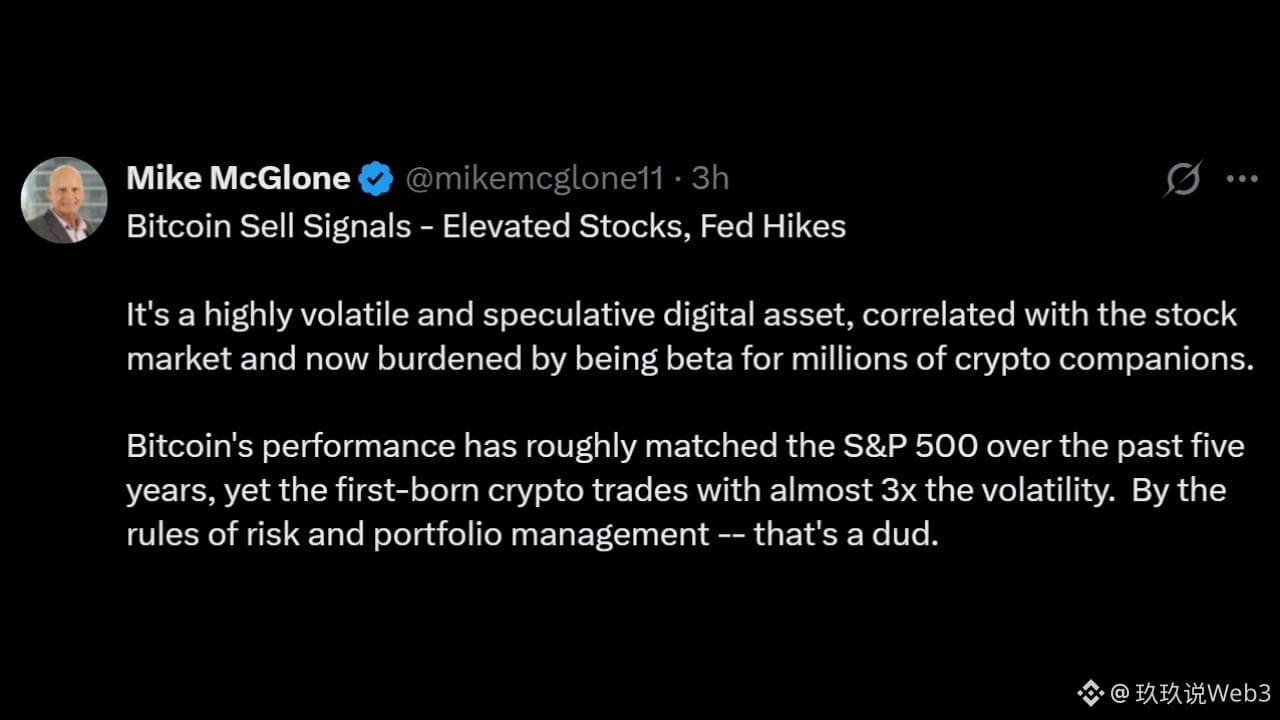
👀 One-sentence event: Bloomberg Intelligence senior commodities strategist Mike McGlone publicly warned that if the S&P 500 pulls back by about 20%, Bitcoin could keep sliding all the way to $10,000—calling it the “leading indicator” for the entire risk asset complex.
📊 Putting numbers on it: He points out three reasons—$80,000 has become Bitcoin’s new strong resistance, federal funds futures are pricing a 0.70% rate hike over the next year, and the S&P’s current valuation is still elevated compared with its 200-week moving average; and just in August, Bitcoin had already logged nearly a 25% monthly gain, while the S&P is also hovering near historical highs. Put together, these three factors form the “risk assets all step down” script he describes.
🔥 What’s behind the numbers: McGlone says that over the past five years, Bitcoin and the S&P’s走势 have been almost in sync, yet Bitcoin’s volatility has been about three times higher—so he simply classifies it under the “stock puppet” list, even mocking that by risk/reward rules it can only be considered a “dud.” The implication is that Bitcoin hasn’t really carved out an independent trend.
💡 What’s truly worth watching isn’t his $10,000 call, but the fact that institutional money is still using spot ETFs to buy the dips right now—the price structure hasn’t been broken through in one fell swoop. Both bulls and bears are waiting for the answer that the Sept. 16 Fed meeting will provide.
⚠️ A bucket of cold water: $10,000 is an extreme scenario, premised on U.S. equities actually falling 20%; conversely, if Bitcoin can still run with independent strength, this bearish logic will be disproven. You can listen to predictions—your position is on you. Throughout history, the voices calling for Bitcoin to go to zero or drop to four digits mostly have not been realized.
👀 One side says he’s a high-level risk sentry; the other says it’s just chasing traffic. Which side are you on? Chat in the comments below👇
Click the avatar to watch the live stream + join the Jiuji chat group for daily strategies 🚀
#美国10年期国债收益率逼近5% #美联储 #美股 #Bitcoin
🚨 Will the price of coins drop to $10,000? Bloomberg’s strategist says it in one sentence—shaking the bulls to their core
Group: 点击进入玖玖的粉丝群
👀 One-sentence event: Bloomberg Intelligence senior commodities strategist Mike McGlone publicly warned that if the S&P 500 pulls back by about 20%, Bitcoin could keep sliding all the way to $10,000—calling it the “leading indicator” for the entire risk asset complex.
📊 Putting numbers on it: He points out three reasons—$80,000 has become Bitcoin’s new strong resistance, federal funds futures are pricing a 0.70% rate hike over the next year, and the S&P’s current valuation is still elevated compared with its 200-week moving average; and just in August, Bitcoin had already logged nearly a 25% monthly gain, while the S&P is also hovering near historical highs. Put together, these three factors form the “risk assets all step down” script he describes.
🔥 What’s behind the numbers: McGlone says that over the past five years, Bitcoin and the S&P’s走势 have been almost in sync, yet Bitcoin’s volatility has been about three times higher—so he simply classifies it under the “stock puppet” list, even mocking that by risk/reward rules it can only be considered a “dud.” The implication is that Bitcoin hasn’t really carved out an independent trend.
💡 What’s truly worth watching isn’t his $10,000 call, but the fact that institutional money is still using spot ETFs to buy the dips right now—the price structure hasn’t been broken through in one fell swoop. Both bulls and bears are waiting for the answer that the Sept. 16 Fed meeting will provide.
⚠️ A bucket of cold water: $10,000 is an extreme scenario, premised on U.S. equities actually falling 20%; conversely, if Bitcoin can still run with independent strength, this bearish logic will be disproven. You can listen to predictions—your position is on you. Throughout history, the voices calling for Bitcoin to go to zero or drop to four digits mostly have not been realized.
👀 One side says he’s a high-level risk sentry; the other says it’s just chasing traffic. Which side are you on? Chat in the comments below👇
Click the avatar to watch the live stream + join the Jiuji chat group for daily strategies 🚀
#美国10年期国债收益率逼近5% #美联储 #美股 #Bitcoin
Group: 点击进入玖玖的粉丝群
👀 One-sentence event: Bloomberg Intelligence senior commodities strategist Mike McGlone publicly warned that if the S&P 500 pulls back by about 20%, Bitcoin could keep sliding all the way to $10,000—calling it the “leading indicator” for the entire risk asset complex.
📊 Putting numbers on it: He points out three reasons—$80,000 has become Bitcoin’s new strong resistance, federal funds futures are pricing a 0.70% rate hike over the next year, and the S&P’s current valuation is still elevated compared with its 200-week moving average; and just in August, Bitcoin had already logged nearly a 25% monthly gain, while the S&P is also hovering near historical highs. Put together, these three factors form the “risk assets all step down” script he describes.
🔥 What’s behind the numbers: McGlone says that over the past five years, Bitcoin and the S&P’s走势 have been almost in sync, yet Bitcoin’s volatility has been about three times higher—so he simply classifies it under the “stock puppet” list, even mocking that by risk/reward rules it can only be considered a “dud.” The implication is that Bitcoin hasn’t really carved out an independent trend.
💡 What’s truly worth watching isn’t his $10,000 call, but the fact that institutional money is still using spot ETFs to buy the dips right now—the price structure hasn’t been broken through in one fell swoop. Both bulls and bears are waiting for the answer that the Sept. 16 Fed meeting will provide.
⚠️ A bucket of cold water: $10,000 is an extreme scenario, premised on U.S. equities actually falling 20%; conversely, if Bitcoin can still run with independent strength, this bearish logic will be disproven. You can listen to predictions—your position is on you. Throughout history, the voices calling for Bitcoin to go to zero or drop to four digits mostly have not been realized.
👀 One side says he’s a high-level risk sentry; the other says it’s just chasing traffic. Which side are you on? Chat in the comments below👇
Click the avatar to watch the live stream + join the Jiuji chat group for daily strategies 🚀
#美国10年期国债收益率逼近5% #美联储 #美股 #Bitcoin
114
·
--
🚨 Funds are quietly switching sides: while one side sees a net outflow of $462 million in a single week, the other side is pulling in money in the opposite direction—who is being added to in September?
Group: [点击进入玖玖的粉丝群](https://app.binance.com/uni-qr/YXXQJrPb)
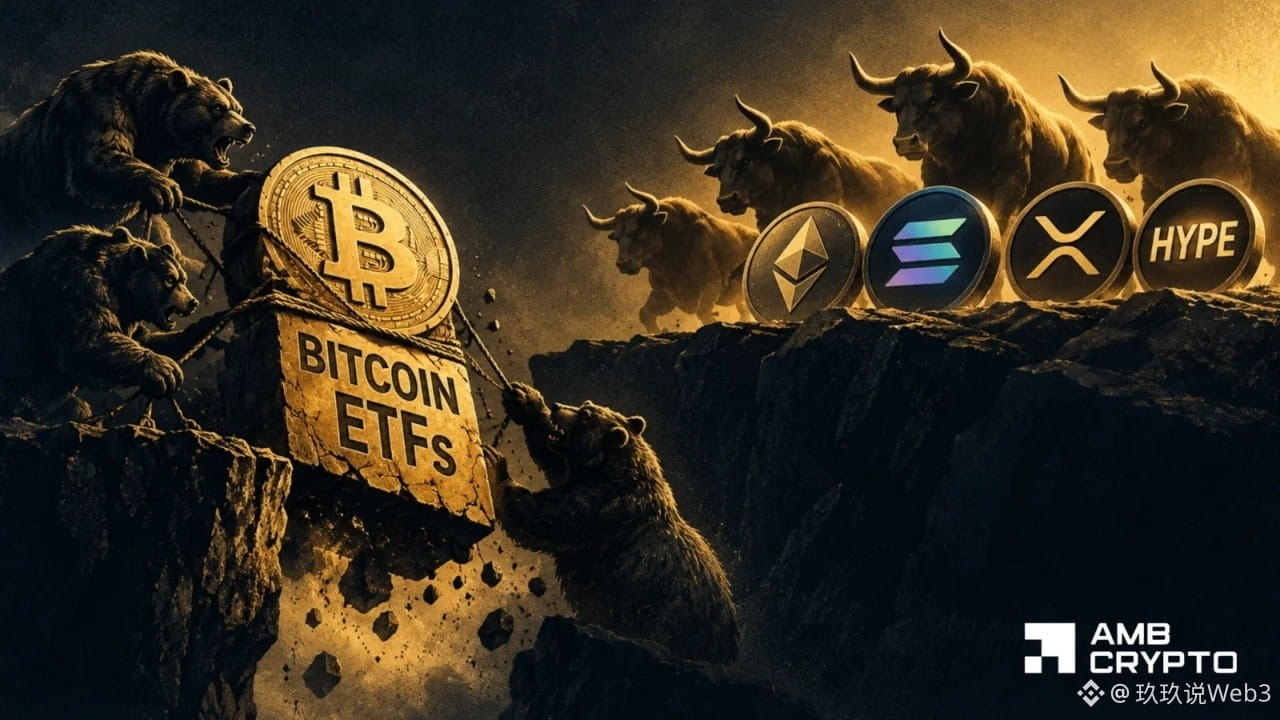
👀 One-sentence event: From September 8 to 11, U.S. spot Bitcoin ETF funds saw cumulative net outflows of about $462 million. During the same period, Ethereum spot ETF fund flows looked clearly different—funds are gradually switching between asset classes.
📊 Putting the numbers in context: Over four days, Bitcoin spot ETF funds recorded net outflows of $462.73 million. On September 10 alone, net outflows were $282.7 million—setting a new single-day outflow high for the week. ARKB and Grayscale’s GBTC were the main sources of selling pressure. Bitcoin’s price slipped by about 2.9%, falling toward around $77.3k.
🔥 What’s behind the numbers: In August, Bitcoin spot ETF funds still net added $3.52 billion. But September started and the funds were immediately pulled out. Ethereum spot ETF funds, however, moved differently. On September 9, it turned to net inflows of $34.7 million in a single day. The timing is offset from Bitcoin, suggesting short-term capital is rebalancing between assets.
💡 What’s really worth watching isn’t the outflow figures themselves, but the fact that funds are moving back and forth between Bitcoin and Ethereum. The market isn’t simply exiting—it’s reallocating positions and shifting capital elsewhere.
⚠️ A bucket of cold water: A weekly outflow doesn’t automatically mean a trend reversal. But September has already been relatively weak, and the Fed’s FOMC meeting is right around the corner—capital could change its stance at any time. Don’t treat one week’s data as the trend outright.
👀 In this round, will you switch along to Ethereum, or keep betting on Bitcoin? Chat in the comments below👇
Click the avatar to watch the live stream + join the Jiujiu chat group to get daily strategy 🚀
#以太坊etf连续11日净流入 #比特币 #ETF
🚨 Funds are quietly switching sides: while one side sees a net outflow of $462 million in a single week, the other side is pulling in money in the opposite direction—who is being added to in September?
Group: 点击进入玖玖的粉丝群
👀 One-sentence event: From September 8 to 11, U.S. spot Bitcoin ETF funds saw cumulative net outflows of about $462 million. During the same period, Ethereum spot ETF fund flows looked clearly different—funds are gradually switching between asset classes.
📊 Putting the numbers in context: Over four days, Bitcoin spot ETF funds recorded net outflows of $462.73 million. On September 10 alone, net outflows were $282.7 million—setting a new single-day outflow high for the week. ARKB and Grayscale’s GBTC were the main sources of selling pressure. Bitcoin’s price slipped by about 2.9%, falling toward around $77.3k.
🔥 What’s behind the numbers: In August, Bitcoin spot ETF funds still net added $3.52 billion. But September started and the funds were immediately pulled out. Ethereum spot ETF funds, however, moved differently. On September 9, it turned to net inflows of $34.7 million in a single day. The timing is offset from Bitcoin, suggesting short-term capital is rebalancing between assets.
💡 What’s really worth watching isn’t the outflow figures themselves, but the fact that funds are moving back and forth between Bitcoin and Ethereum. The market isn’t simply exiting—it’s reallocating positions and shifting capital elsewhere.
⚠️ A bucket of cold water: A weekly outflow doesn’t automatically mean a trend reversal. But September has already been relatively weak, and the Fed’s FOMC meeting is right around the corner—capital could change its stance at any time. Don’t treat one week’s data as the trend outright.
👀 In this round, will you switch along to Ethereum, or keep betting on Bitcoin? Chat in the comments below👇
Click the avatar to watch the live stream + join the Jiujiu chat group to get daily strategy 🚀
#以太坊etf连续11日净流入 #比特币 #ETF
Group: 点击进入玖玖的粉丝群
👀 One-sentence event: From September 8 to 11, U.S. spot Bitcoin ETF funds saw cumulative net outflows of about $462 million. During the same period, Ethereum spot ETF fund flows looked clearly different—funds are gradually switching between asset classes.
📊 Putting the numbers in context: Over four days, Bitcoin spot ETF funds recorded net outflows of $462.73 million. On September 10 alone, net outflows were $282.7 million—setting a new single-day outflow high for the week. ARKB and Grayscale’s GBTC were the main sources of selling pressure. Bitcoin’s price slipped by about 2.9%, falling toward around $77.3k.
🔥 What’s behind the numbers: In August, Bitcoin spot ETF funds still net added $3.52 billion. But September started and the funds were immediately pulled out. Ethereum spot ETF funds, however, moved differently. On September 9, it turned to net inflows of $34.7 million in a single day. The timing is offset from Bitcoin, suggesting short-term capital is rebalancing between assets.
💡 What’s really worth watching isn’t the outflow figures themselves, but the fact that funds are moving back and forth between Bitcoin and Ethereum. The market isn’t simply exiting—it’s reallocating positions and shifting capital elsewhere.
⚠️ A bucket of cold water: A weekly outflow doesn’t automatically mean a trend reversal. But September has already been relatively weak, and the Fed’s FOMC meeting is right around the corner—capital could change its stance at any time. Don’t treat one week’s data as the trend outright.
👀 In this round, will you switch along to Ethereum, or keep betting on Bitcoin? Chat in the comments below👇
Click the avatar to watch the live stream + join the Jiujiu chat group to get daily strategy 🚀
#以太坊etf连续11日净流入 #比特币 #ETF
184
·
--
🚨 Oil price risk dragging into 2027? IEA cuts supply expectations again—does the Bitcoin rate-cut script fall apart?
Group: [点击进入玖玖的粉丝群](https://app.binance.com/uni-qr/YXXQJrPb)
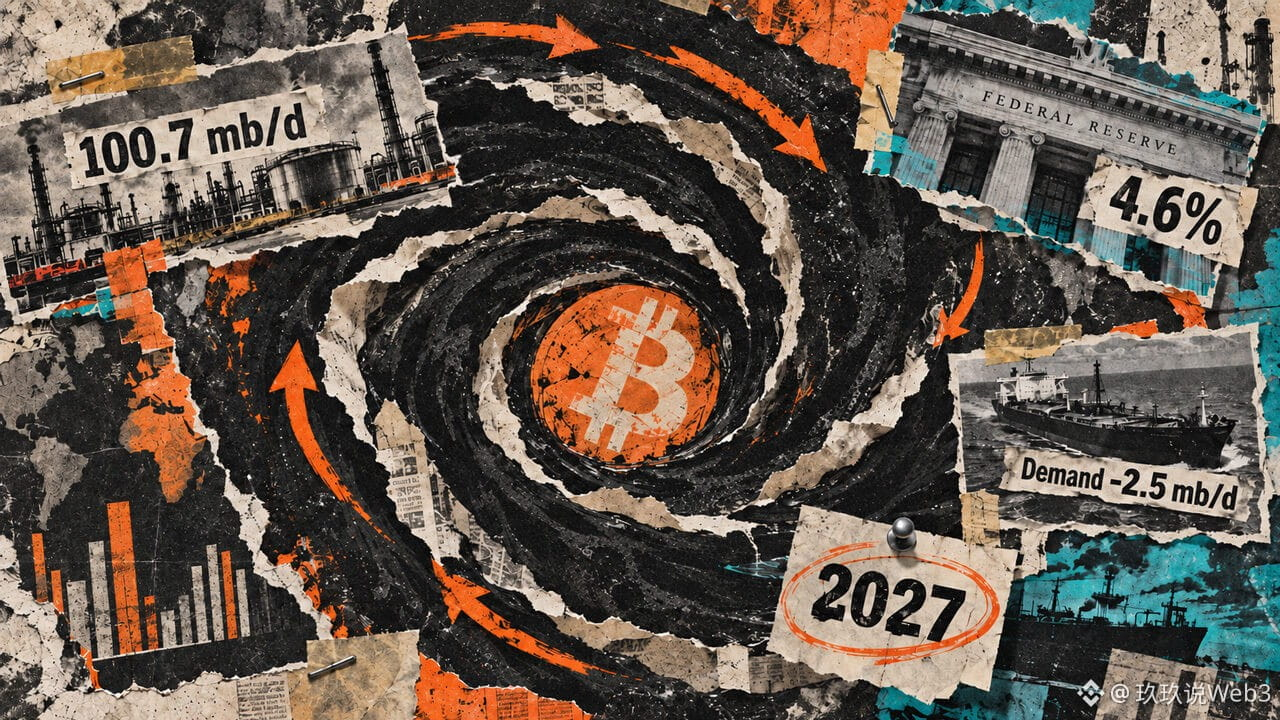
👀 One-sentence update: In its latest monthly report on September 11, the International Energy Agency (IEA) lowered its forecast for 2026 global oil supply from 102 million barrels per day to 100.7 million barrels per day, cutting a total of 1.3 million barrels per day at once.
📊 Putting the numbers in perspective: Supply is tightening, while demand is also weakening. The IEA expects global crude oil consumption in 2026 to decline year over year by 2.5 million barrels per day—about 940,000 barrels per day more downside than the August estimate. Even so, global observed inventories in August still fell by 95 million barrels, and the oil market didn’t ease.
🔥 Behind the numbers: Falling inventories, reduced supply, and soft demand—these three signals are all tied together, suggesting the oil market is both tight and awkward. If oil prices stay elevated, University of Michigan’s September survey shows one-year inflation expectations rising to 4.6%, immediately shrinking the market’s room for rate-cut hopes.
💡 What’s truly worth watching isn’t oil prices alone, but the transmission chain linking oil prices, inflation, U.S. Treasury yields, and crypto liquidity. The IEA itself also admits that Gulf-region supply won’t fully recover until 2027—meaning high oil prices won’t just be “over” in a few weeks.
⚠️ A bucket of cold water: Don’t equate falling oil prices with straightforward good news. As long as inflation expectations can’t come down, dollar funding costs won’t fall either. For risk assets like Bitcoin that heavily rely on liquidity, it’s hard to truly breathe easier.
👀 Do you think this oil-price fire will first burn inflation, or first burn Bitcoin? Let us know in the comments below 👇
Click the profile picture to watch the live stream + join the Jiujiu chat group to get daily strategies 🚀
#美国10年期国债收益率逼近5% #原油 #Bitcoin
🚨 Oil price risk dragging into 2027? IEA cuts supply expectations again—does the Bitcoin rate-cut script fall apart?
Group: 点击进入玖玖的粉丝群
👀 One-sentence update: In its latest monthly report on September 11, the International Energy Agency (IEA) lowered its forecast for 2026 global oil supply from 102 million barrels per day to 100.7 million barrels per day, cutting a total of 1.3 million barrels per day at once.
📊 Putting the numbers in perspective: Supply is tightening, while demand is also weakening. The IEA expects global crude oil consumption in 2026 to decline year over year by 2.5 million barrels per day—about 940,000 barrels per day more downside than the August estimate. Even so, global observed inventories in August still fell by 95 million barrels, and the oil market didn’t ease.
🔥 Behind the numbers: Falling inventories, reduced supply, and soft demand—these three signals are all tied together, suggesting the oil market is both tight and awkward. If oil prices stay elevated, University of Michigan’s September survey shows one-year inflation expectations rising to 4.6%, immediately shrinking the market’s room for rate-cut hopes.
💡 What’s truly worth watching isn’t oil prices alone, but the transmission chain linking oil prices, inflation, U.S. Treasury yields, and crypto liquidity. The IEA itself also admits that Gulf-region supply won’t fully recover until 2027—meaning high oil prices won’t just be “over” in a few weeks.
⚠️ A bucket of cold water: Don’t equate falling oil prices with straightforward good news. As long as inflation expectations can’t come down, dollar funding costs won’t fall either. For risk assets like Bitcoin that heavily rely on liquidity, it’s hard to truly breathe easier.
👀 Do you think this oil-price fire will first burn inflation, or first burn Bitcoin? Let us know in the comments below 👇
Click the profile picture to watch the live stream + join the Jiujiu chat group to get daily strategies 🚀
#美国10年期国债收益率逼近5% #原油 #Bitcoin
Group: 点击进入玖玖的粉丝群
👀 One-sentence update: In its latest monthly report on September 11, the International Energy Agency (IEA) lowered its forecast for 2026 global oil supply from 102 million barrels per day to 100.7 million barrels per day, cutting a total of 1.3 million barrels per day at once.
📊 Putting the numbers in perspective: Supply is tightening, while demand is also weakening. The IEA expects global crude oil consumption in 2026 to decline year over year by 2.5 million barrels per day—about 940,000 barrels per day more downside than the August estimate. Even so, global observed inventories in August still fell by 95 million barrels, and the oil market didn’t ease.
🔥 Behind the numbers: Falling inventories, reduced supply, and soft demand—these three signals are all tied together, suggesting the oil market is both tight and awkward. If oil prices stay elevated, University of Michigan’s September survey shows one-year inflation expectations rising to 4.6%, immediately shrinking the market’s room for rate-cut hopes.
💡 What’s truly worth watching isn’t oil prices alone, but the transmission chain linking oil prices, inflation, U.S. Treasury yields, and crypto liquidity. The IEA itself also admits that Gulf-region supply won’t fully recover until 2027—meaning high oil prices won’t just be “over” in a few weeks.
⚠️ A bucket of cold water: Don’t equate falling oil prices with straightforward good news. As long as inflation expectations can’t come down, dollar funding costs won’t fall either. For risk assets like Bitcoin that heavily rely on liquidity, it’s hard to truly breathe easier.
👀 Do you think this oil-price fire will first burn inflation, or first burn Bitcoin? Let us know in the comments below 👇
Click the profile picture to watch the live stream + join the Jiujiu chat group to get daily strategies 🚀
#美国10年期国债收益率逼近5% #原油 #Bitcoin
68
·
--
🚨 The upper 83,000 to 85,000 USD is being pressed down tightly—while 75,000 USD below has become the new lifeline. Yet on-chain data says the real big players actually didn’t bail this time?
Group: [点击进入玖玖的粉丝群](https://app.binance.com/uni-qr/YXXQJrPb)
👀 One-line event: Glassnode’s latest on-chain report notes that Bitcoin’s key resistance lies in the 83,000–85,000 USD range, while 75,000 USD below has become the main current support level.
📊 Numbers on display: The report labels 83,000–85,000 USD as the overhead pressure band and marks 75,000 USD as key support. At the same time, the data shows long-term holders have not made any aggressive sell-off. This contrasts sharply with the recent trading backdrop of consecutive net outflows from Bitcoin ETFs and the price repeatedly tug-of-warring around the 77,000 USD area.
🔥 What’s behind the numbers: On the chart, it looks like “buyers are running out of steam,” but on-chain it’s “the chips haven’t loosened.” While some funds have exited via ETFs, long-term holders didn’t follow through with dumping. This combination of “weak price, steady positioning” has historically appeared more often during the base-building phase rather than in outright capitulation.
💡 What’s truly worth watching isn’t whether it can break above 85,000 immediately, but whether the 75,000 line can hold. If it holds, pullbacks turn into momentum-building; if it breaks, then you’ll need to reassess the trend.
⚠️ A splash of cold water: On-chain indicators provide probabilities, not prophecies. “Long-term holders didn’t sell” doesn’t mean they won’t. On the macro front, rate-hike expectations from the Fed are still heating up—if the dollar and U.S. Treasury yields keep strengthening, 75,000 USD could face pressure as well.
👀 One camp says this is a classic shakeout and buildup; the other says it’s a continuation of the downtrend. Which side are you on? Discuss in the comments below 👇
Click the avatar to watch the live stream + join the Jiujiu chat group to get daily strategies 🚀
#比特币 #全球市场 #Web3
🚨 The upper 83,000 to 85,000 USD is being pressed down tightly—while 75,000 USD below has become the new lifeline. Yet on-chain data says the real big players actually didn’t bail this time?
Group: 点击进入玖玖的粉丝群
👀 One-line event: Glassnode’s latest on-chain report notes that Bitcoin’s key resistance lies in the 83,000–85,000 USD range, while 75,000 USD below has become the main current support level.
📊 Numbers on display: The report labels 83,000–85,000 USD as the overhead pressure band and marks 75,000 USD as key support. At the same time, the data shows long-term holders have not made any aggressive sell-off. This contrasts sharply with the recent trading backdrop of consecutive net outflows from Bitcoin ETFs and the price repeatedly tug-of-warring around the 77,000 USD area.
🔥 What’s behind the numbers: On the chart, it looks like “buyers are running out of steam,” but on-chain it’s “the chips haven’t loosened.” While some funds have exited via ETFs, long-term holders didn’t follow through with dumping. This combination of “weak price, steady positioning” has historically appeared more often during the base-building phase rather than in outright capitulation.
💡 What’s truly worth watching isn’t whether it can break above 85,000 immediately, but whether the 75,000 line can hold. If it holds, pullbacks turn into momentum-building; if it breaks, then you’ll need to reassess the trend.
⚠️ A splash of cold water: On-chain indicators provide probabilities, not prophecies. “Long-term holders didn’t sell” doesn’t mean they won’t. On the macro front, rate-hike expectations from the Fed are still heating up—if the dollar and U.S. Treasury yields keep strengthening, 75,000 USD could face pressure as well.
👀 One camp says this is a classic shakeout and buildup; the other says it’s a continuation of the downtrend. Which side are you on? Discuss in the comments below 👇
Click the avatar to watch the live stream + join the Jiujiu chat group to get daily strategies 🚀
#比特币 #全球市场 #Web3
Group: 点击进入玖玖的粉丝群
👀 One-line event: Glassnode’s latest on-chain report notes that Bitcoin’s key resistance lies in the 83,000–85,000 USD range, while 75,000 USD below has become the main current support level.
📊 Numbers on display: The report labels 83,000–85,000 USD as the overhead pressure band and marks 75,000 USD as key support. At the same time, the data shows long-term holders have not made any aggressive sell-off. This contrasts sharply with the recent trading backdrop of consecutive net outflows from Bitcoin ETFs and the price repeatedly tug-of-warring around the 77,000 USD area.
🔥 What’s behind the numbers: On the chart, it looks like “buyers are running out of steam,” but on-chain it’s “the chips haven’t loosened.” While some funds have exited via ETFs, long-term holders didn’t follow through with dumping. This combination of “weak price, steady positioning” has historically appeared more often during the base-building phase rather than in outright capitulation.
💡 What’s truly worth watching isn’t whether it can break above 85,000 immediately, but whether the 75,000 line can hold. If it holds, pullbacks turn into momentum-building; if it breaks, then you’ll need to reassess the trend.
⚠️ A splash of cold water: On-chain indicators provide probabilities, not prophecies. “Long-term holders didn’t sell” doesn’t mean they won’t. On the macro front, rate-hike expectations from the Fed are still heating up—if the dollar and U.S. Treasury yields keep strengthening, 75,000 USD could face pressure as well.
👀 One camp says this is a classic shakeout and buildup; the other says it’s a continuation of the downtrend. Which side are you on? Discuss in the comments below 👇
Click the avatar to watch the live stream + join the Jiujiu chat group to get daily strategies 🚀
#比特币 #全球市场 #Web3
55
·
--
🚨 Someone shouted “AI should slow down”? Solana co-founder directly dismantles it: what’s really anxious are those companies with trillion-dollar valuations?
Group: [点击进入玖玖的粉丝群](https://app.binance.com/uni-qr/YXXQJrPb)
👀 One-sentence event: Solana co-founder Anatoly Yakovenko publicly linked calls to “slow down AI development” with companies that carry trillion-dollar valuations yet face pressure to turn profits.
📊 The numbers laid out: the ones named are AI giants whose valuations are measured in trillions. Yakovenko’s view is that when the growth story requires ever more investment, calls for “slowing down” are often not about safety—they’re about the math.
🔥 Behind the numbers: this latest round of AI and crypto is actually one single funding chain—computing power, valuations, and narratives lift each other. When the most top-tier companies start worrying that “the money can’t keep burning,” that pressure will first show up in the AI narrative, and then flow—along with risk appetite—into the AI-related segments of crypto.
💡 What’s really worth watching isn’t who’s right or wrong, but this: when “slowing down” becomes a hot topic, it often means the slope of this narrative is starting to flatten. Once the slope changes, capital tends to pull first from the priciest tier.
⚠️ A bucket of cold water: the founder’s remarks come with a point of view, and Solana itself is involved in the AI narrative. Treating it as an industry perspective is fine—interpreting it as a buy/sell signal is over-reading.
👀 One camp says the “AI slowing down” theory is a pretext for self-protection; the other says it’s a sign the bubble should be popped. Which side are you on? Chat in the comments below 👇
Click the avatar to watch the live stream + join the Jiujiu chat group to get daily strategies 🚀
#AI #sol #Web3
🚨 Someone shouted “AI should slow down”? Solana co-founder directly dismantles it: what’s really anxious are those companies with trillion-dollar valuations?
Group: 点击进入玖玖的粉丝群
👀 One-sentence event: Solana co-founder Anatoly Yakovenko publicly linked calls to “slow down AI development” with companies that carry trillion-dollar valuations yet face pressure to turn profits.
📊 The numbers laid out: the ones named are AI giants whose valuations are measured in trillions. Yakovenko’s view is that when the growth story requires ever more investment, calls for “slowing down” are often not about safety—they’re about the math.
🔥 Behind the numbers: this latest round of AI and crypto is actually one single funding chain—computing power, valuations, and narratives lift each other. When the most top-tier companies start worrying that “the money can’t keep burning,” that pressure will first show up in the AI narrative, and then flow—along with risk appetite—into the AI-related segments of crypto.
💡 What’s really worth watching isn’t who’s right or wrong, but this: when “slowing down” becomes a hot topic, it often means the slope of this narrative is starting to flatten. Once the slope changes, capital tends to pull first from the priciest tier.
⚠️ A bucket of cold water: the founder’s remarks come with a point of view, and Solana itself is involved in the AI narrative. Treating it as an industry perspective is fine—interpreting it as a buy/sell signal is over-reading.
👀 One camp says the “AI slowing down” theory is a pretext for self-protection; the other says it’s a sign the bubble should be popped. Which side are you on? Chat in the comments below 👇
Click the avatar to watch the live stream + join the Jiujiu chat group to get daily strategies 🚀
#AI #sol #Web3
Group: 点击进入玖玖的粉丝群
👀 One-sentence event: Solana co-founder Anatoly Yakovenko publicly linked calls to “slow down AI development” with companies that carry trillion-dollar valuations yet face pressure to turn profits.
📊 The numbers laid out: the ones named are AI giants whose valuations are measured in trillions. Yakovenko’s view is that when the growth story requires ever more investment, calls for “slowing down” are often not about safety—they’re about the math.
🔥 Behind the numbers: this latest round of AI and crypto is actually one single funding chain—computing power, valuations, and narratives lift each other. When the most top-tier companies start worrying that “the money can’t keep burning,” that pressure will first show up in the AI narrative, and then flow—along with risk appetite—into the AI-related segments of crypto.
💡 What’s really worth watching isn’t who’s right or wrong, but this: when “slowing down” becomes a hot topic, it often means the slope of this narrative is starting to flatten. Once the slope changes, capital tends to pull first from the priciest tier.
⚠️ A bucket of cold water: the founder’s remarks come with a point of view, and Solana itself is involved in the AI narrative. Treating it as an industry perspective is fine—interpreting it as a buy/sell signal is over-reading.
👀 One camp says the “AI slowing down” theory is a pretext for self-protection; the other says it’s a sign the bubble should be popped. Which side are you on? Chat in the comments below 👇
Click the avatar to watch the live stream + join the Jiujiu chat group to get daily strategies 🚀
#AI #sol #Web3

96
·
--
Verified
🚨 Grayscale also wants to stuff Litecoin into an ETF: an old trust is being changed into LTCN and listed directly on NYSE Arca—so is this just a shell swap, or a whole new game?
Group: [点击进入玖玖的粉丝群](https://app.binance.com/uni-qr/YXXQJrPb)
👀 One-sentence update: Grayscale (Grayscale) has submitted filings, planning to rename its Litecoin trust and convert it into an ETF, listing it on NYSE Arca under the ticker LTCN. This follows the “convert an old trust into an ETF” route, not the launch of a brand-new fund.
📊 The numbers: This isn’t a product conjured out of thin air—it’s a “board conversion” of an already existing closed-end trust. Previously, Canary has already launched the first U.S. spot Litecoin ETF. Litecoin’s total supply cap is 84 million coins—four times Bitcoin’s—hence the industry saying “Bitcoin is digital gold, Litecoin is digital silver.”
🔥 What’s behind the numbers: Grayscale’s playbook for “converting” has already been tested in the past couple of years on Bitcoin and Ethereum. Closed-end trusts often trade at a discount for a long time; after converting to an ETF, that discount gets smoothed out, and capital inflows/outflows become more flexible. For existing holders, it’s a structural repair; for new capital, it’s like adding another brokerage-account channel to buy through.
💡 What’s truly worth watching isn’t just that there’s another Litecoin ETF—rather, the list of “ETFs for older coins” continues to grow. After LTC, who will be next?
⚠️ A bucket of cold water: Filing doesn’t equal approval. The trust-to-ETF conversion still has to pass regulatory review. And an ETF listing doesn’t automatically mean the price jumps right away—Litecoin’s on-chain activity and whale holdings are still in the lower range. Don’t treat the news as a buy signal by default.
👀 One side says this is a value return for an old coin; the other says the ETF is only a new shell for existing capital—where do you stand? Let’s chat in the comments 👇
Click the profile picture to watch the livestream + join the Jiujiu chat group to get daily strategies 🚀
#SEC收到灰度莱特币信托转ETF申请 #ETF #Web3
🚨 Grayscale also wants to stuff Litecoin into an ETF: an old trust is being changed into LTCN and listed directly on NYSE Arca—so is this just a shell swap, or a whole new game?
Group: 点击进入玖玖的粉丝群
👀 One-sentence update: Grayscale (Grayscale) has submitted filings, planning to rename its Litecoin trust and convert it into an ETF, listing it on NYSE Arca under the ticker LTCN. This follows the “convert an old trust into an ETF” route, not the launch of a brand-new fund.
📊 The numbers: This isn’t a product conjured out of thin air—it’s a “board conversion” of an already existing closed-end trust. Previously, Canary has already launched the first U.S. spot Litecoin ETF. Litecoin’s total supply cap is 84 million coins—four times Bitcoin’s—hence the industry saying “Bitcoin is digital gold, Litecoin is digital silver.”
🔥 What’s behind the numbers: Grayscale’s playbook for “converting” has already been tested in the past couple of years on Bitcoin and Ethereum. Closed-end trusts often trade at a discount for a long time; after converting to an ETF, that discount gets smoothed out, and capital inflows/outflows become more flexible. For existing holders, it’s a structural repair; for new capital, it’s like adding another brokerage-account channel to buy through.
💡 What’s truly worth watching isn’t just that there’s another Litecoin ETF—rather, the list of “ETFs for older coins” continues to grow. After LTC, who will be next?
⚠️ A bucket of cold water: Filing doesn’t equal approval. The trust-to-ETF conversion still has to pass regulatory review. And an ETF listing doesn’t automatically mean the price jumps right away—Litecoin’s on-chain activity and whale holdings are still in the lower range. Don’t treat the news as a buy signal by default.
👀 One side says this is a value return for an old coin; the other says the ETF is only a new shell for existing capital—where do you stand? Let’s chat in the comments 👇
Click the profile picture to watch the livestream + join the Jiujiu chat group to get daily strategies 🚀
#SEC收到灰度莱特币信托转ETF申请 #ETF #Web3
Group: 点击进入玖玖的粉丝群
👀 One-sentence update: Grayscale (Grayscale) has submitted filings, planning to rename its Litecoin trust and convert it into an ETF, listing it on NYSE Arca under the ticker LTCN. This follows the “convert an old trust into an ETF” route, not the launch of a brand-new fund.
📊 The numbers: This isn’t a product conjured out of thin air—it’s a “board conversion” of an already existing closed-end trust. Previously, Canary has already launched the first U.S. spot Litecoin ETF. Litecoin’s total supply cap is 84 million coins—four times Bitcoin’s—hence the industry saying “Bitcoin is digital gold, Litecoin is digital silver.”
🔥 What’s behind the numbers: Grayscale’s playbook for “converting” has already been tested in the past couple of years on Bitcoin and Ethereum. Closed-end trusts often trade at a discount for a long time; after converting to an ETF, that discount gets smoothed out, and capital inflows/outflows become more flexible. For existing holders, it’s a structural repair; for new capital, it’s like adding another brokerage-account channel to buy through.
💡 What’s truly worth watching isn’t just that there’s another Litecoin ETF—rather, the list of “ETFs for older coins” continues to grow. After LTC, who will be next?
⚠️ A bucket of cold water: Filing doesn’t equal approval. The trust-to-ETF conversion still has to pass regulatory review. And an ETF listing doesn’t automatically mean the price jumps right away—Litecoin’s on-chain activity and whale holdings are still in the lower range. Don’t treat the news as a buy signal by default.
👀 One side says this is a value return for an old coin; the other says the ETF is only a new shell for existing capital—where do you stand? Let’s chat in the comments 👇
Click the profile picture to watch the livestream + join the Jiujiu chat group to get daily strategies 🚀
#SEC收到灰度莱特币信托转ETF申请 #ETF #Web3
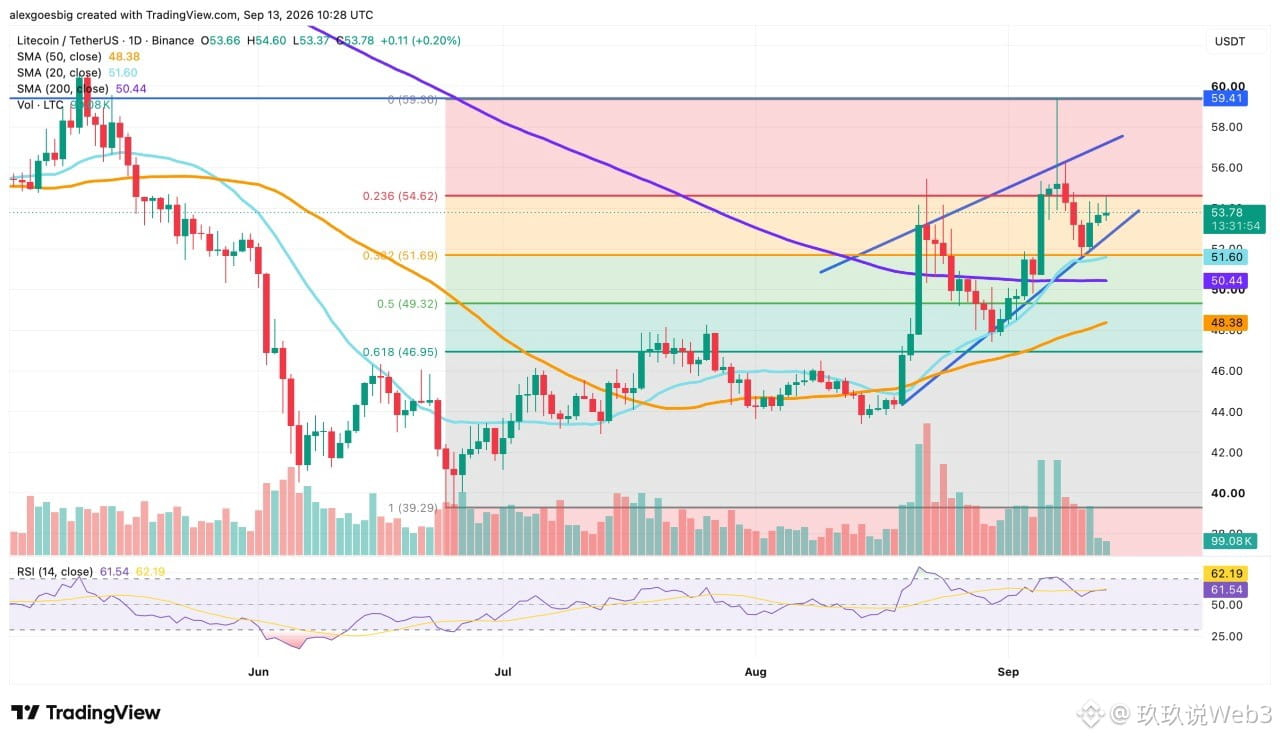
577
·
--
🚨 Thailand Steps In With Limits: Maximum of $151,000 Per Day—Funds Can Only Circulate Within Your Own Wallets. Is the Most Open Crypto Market in Southeast Asia Starting to Tighten?
Group: [点击进入玖玖的粉丝群](https://app.binance.com/uni-qr/YXXQJrPb)
👀 One-Sentence Recap: On September 11, Thailand’s SEC released a consultation paper proposing limits on crypto assets moving into and out of external wallets—capping transfers at 5 million Thai baht (about $151,000) per customer per operator per day.
📊 The Numbers: Deposits can only come from accounts or wallets that are verified as “belonging to the same person,” and withdrawals can only be sent to accounts in the same name. Transfers between wallets belonging to different people won’t be recognized. Transfers between licensed operators in Thailand are exempt. The exemption also covers enterprises, authorized institutions, and eligible market makers. Public comments will be accepted until September 25, and the rules are proposed to take effect after 60 days.
🔥 What It Really Means: The official rationale is to curb illegal funds flows, cybercrime, and attempts to bypass cross-border remittance controls. On the surface, it looks like compliance screening, but in substance it draws boundaries around the “free flow” of these assets—you can hold them, but you can’t freely move them around between individuals.
💡 What’s Worth Watching Isn’t the $151,000 Cap—It’s the Restriction on the Most Common Path: “Self-Custody Wallet to Exchange.” In effect, it pushes usage scenarios toward the licensed system.
⚠️ Cold Water: This is still only a consultation paper and not yet in effect. The amount will also fluctuate with the Thai baht exchange rate, and the final version may change. Don’t treat a draft as settled fact.
👀 One camp says this is a necessary step toward mainstream compliance; the other says it’s a tightening of crypto freedom—where do you stand? Let’s discuss in the comments below 👇
Click the avatar to watch the livestream + join the Jiujiu chat group to get daily strategies 🚀
#Web3 #全球市场 #稳定币 #USDT
🚨 Thailand Steps In With Limits: Maximum of $151,000 Per Day—Funds Can Only Circulate Within Your Own Wallets. Is the Most Open Crypto Market in Southeast Asia Starting to Tighten?
Group: 点击进入玖玖的粉丝群
👀 One-Sentence Recap: On September 11, Thailand’s SEC released a consultation paper proposing limits on crypto assets moving into and out of external wallets—capping transfers at 5 million Thai baht (about $151,000) per customer per operator per day.
📊 The Numbers: Deposits can only come from accounts or wallets that are verified as “belonging to the same person,” and withdrawals can only be sent to accounts in the same name. Transfers between wallets belonging to different people won’t be recognized. Transfers between licensed operators in Thailand are exempt. The exemption also covers enterprises, authorized institutions, and eligible market makers. Public comments will be accepted until September 25, and the rules are proposed to take effect after 60 days.
🔥 What It Really Means: The official rationale is to curb illegal funds flows, cybercrime, and attempts to bypass cross-border remittance controls. On the surface, it looks like compliance screening, but in substance it draws boundaries around the “free flow” of these assets—you can hold them, but you can’t freely move them around between individuals.
💡 What’s Worth Watching Isn’t the $151,000 Cap—It’s the Restriction on the Most Common Path: “Self-Custody Wallet to Exchange.” In effect, it pushes usage scenarios toward the licensed system.
⚠️ Cold Water: This is still only a consultation paper and not yet in effect. The amount will also fluctuate with the Thai baht exchange rate, and the final version may change. Don’t treat a draft as settled fact.
👀 One camp says this is a necessary step toward mainstream compliance; the other says it’s a tightening of crypto freedom—where do you stand? Let’s discuss in the comments below 👇
Click the avatar to watch the livestream + join the Jiujiu chat group to get daily strategies 🚀
#Web3 #全球市场 #稳定币 #USDT
Group: 点击进入玖玖的粉丝群
👀 One-Sentence Recap: On September 11, Thailand’s SEC released a consultation paper proposing limits on crypto assets moving into and out of external wallets—capping transfers at 5 million Thai baht (about $151,000) per customer per operator per day.
📊 The Numbers: Deposits can only come from accounts or wallets that are verified as “belonging to the same person,” and withdrawals can only be sent to accounts in the same name. Transfers between wallets belonging to different people won’t be recognized. Transfers between licensed operators in Thailand are exempt. The exemption also covers enterprises, authorized institutions, and eligible market makers. Public comments will be accepted until September 25, and the rules are proposed to take effect after 60 days.
🔥 What It Really Means: The official rationale is to curb illegal funds flows, cybercrime, and attempts to bypass cross-border remittance controls. On the surface, it looks like compliance screening, but in substance it draws boundaries around the “free flow” of these assets—you can hold them, but you can’t freely move them around between individuals.
💡 What’s Worth Watching Isn’t the $151,000 Cap—It’s the Restriction on the Most Common Path: “Self-Custody Wallet to Exchange.” In effect, it pushes usage scenarios toward the licensed system.
⚠️ Cold Water: This is still only a consultation paper and not yet in effect. The amount will also fluctuate with the Thai baht exchange rate, and the final version may change. Don’t treat a draft as settled fact.
👀 One camp says this is a necessary step toward mainstream compliance; the other says it’s a tightening of crypto freedom—where do you stand? Let’s discuss in the comments below 👇
Click the avatar to watch the livestream + join the Jiujiu chat group to get daily strategies 🚀
#Web3 #全球市场 #稳定币 #USDT

22
·
--
🚨 Goldman Sachs makes a 180-degree U-turn: from “stay put for now this year” to “raise rates by 25 bps next week”—Bitcoin still hasn’t broken above $80,000… is the tough moment coming?
Group: [点击进入玖玖的粉丝群](https://app.binance.com/uni-qr/YXXQJrPb)
👀 Event in one sentence: Goldman Sachs overturned its late-July view and now predicts that the Sept. 16 FOMC meeting will raise rates by 25 bps. The target range for the federal funds rate is raised from 3.50% to 3.75%.
📊 The numbers on the table: The trigger is August core CPI year-over-month +0.3%, higher than the expected +0.2% (year-over-year 3.4%). CME FedWatch shows the probability of a 25 bps hike jumped from about 69% before the data release to 86.5%. Goldman Sachs isn’t alone—JPMorgan, Citi, Mitsubishi UFJ, and TD Securities now share the same view.
🔥 Behind the figures: This disagreement isn’t about “whether to hike,” but “to hike once or hike a bunch.” The WSJ notes that once the Fed starts raising rates, it rarely stops after just one. So what the market is really watching is the interest-rate path after September. At the end of July, Goldman still thought core inflation would cool—yet one month of data already overturned that, suggesting this inflation’s persistence is stronger than Wall Street expected.
💡 What’s truly worth watching isn’t whether there’s a rate hike in September, but whether the crypto market has already priced in the “rate-hike cycle restart” storyline in advance.
⚠️ Cold water for now: Bitcoin is still below $80,000. The “golden cross” on the daily chart ultimately failed to hold through the close. Rising rate-hike expectations are direct pressure on high-leverage positions—don’t pile into your position before the news lands.
👀 One camp says the market has already digested it, and once it plays out there’s nothing left to worry about; the other says the interest-rate path is the real killer—where do you stand? Let’s discuss in the comments 👇
Click the avatar to watch the live broadcast + join the Jiujiu chat group to get daily strategies 🚀
#美联储 #美国10年期国债收益率逼近5% #比特币 #BTC
🚨 Goldman Sachs makes a 180-degree U-turn: from “stay put for now this year” to “raise rates by 25 bps next week”—Bitcoin still hasn’t broken above $80,000… is the tough moment coming?
Group: 点击进入玖玖的粉丝群
👀 Event in one sentence: Goldman Sachs overturned its late-July view and now predicts that the Sept. 16 FOMC meeting will raise rates by 25 bps. The target range for the federal funds rate is raised from 3.50% to 3.75%.
📊 The numbers on the table: The trigger is August core CPI year-over-month +0.3%, higher than the expected +0.2% (year-over-year 3.4%). CME FedWatch shows the probability of a 25 bps hike jumped from about 69% before the data release to 86.5%. Goldman Sachs isn’t alone—JPMorgan, Citi, Mitsubishi UFJ, and TD Securities now share the same view.
🔥 Behind the figures: This disagreement isn’t about “whether to hike,” but “to hike once or hike a bunch.” The WSJ notes that once the Fed starts raising rates, it rarely stops after just one. So what the market is really watching is the interest-rate path after September. At the end of July, Goldman still thought core inflation would cool—yet one month of data already overturned that, suggesting this inflation’s persistence is stronger than Wall Street expected.
💡 What’s truly worth watching isn’t whether there’s a rate hike in September, but whether the crypto market has already priced in the “rate-hike cycle restart” storyline in advance.
⚠️ Cold water for now: Bitcoin is still below $80,000. The “golden cross” on the daily chart ultimately failed to hold through the close. Rising rate-hike expectations are direct pressure on high-leverage positions—don’t pile into your position before the news lands.
👀 One camp says the market has already digested it, and once it plays out there’s nothing left to worry about; the other says the interest-rate path is the real killer—where do you stand? Let’s discuss in the comments 👇
Click the avatar to watch the live broadcast + join the Jiujiu chat group to get daily strategies 🚀
#美联储 #美国10年期国债收益率逼近5% #比特币 #BTC
Group: 点击进入玖玖的粉丝群
👀 Event in one sentence: Goldman Sachs overturned its late-July view and now predicts that the Sept. 16 FOMC meeting will raise rates by 25 bps. The target range for the federal funds rate is raised from 3.50% to 3.75%.
📊 The numbers on the table: The trigger is August core CPI year-over-month +0.3%, higher than the expected +0.2% (year-over-year 3.4%). CME FedWatch shows the probability of a 25 bps hike jumped from about 69% before the data release to 86.5%. Goldman Sachs isn’t alone—JPMorgan, Citi, Mitsubishi UFJ, and TD Securities now share the same view.
🔥 Behind the figures: This disagreement isn’t about “whether to hike,” but “to hike once or hike a bunch.” The WSJ notes that once the Fed starts raising rates, it rarely stops after just one. So what the market is really watching is the interest-rate path after September. At the end of July, Goldman still thought core inflation would cool—yet one month of data already overturned that, suggesting this inflation’s persistence is stronger than Wall Street expected.
💡 What’s truly worth watching isn’t whether there’s a rate hike in September, but whether the crypto market has already priced in the “rate-hike cycle restart” storyline in advance.
⚠️ Cold water for now: Bitcoin is still below $80,000. The “golden cross” on the daily chart ultimately failed to hold through the close. Rising rate-hike expectations are direct pressure on high-leverage positions—don’t pile into your position before the news lands.
👀 One camp says the market has already digested it, and once it plays out there’s nothing left to worry about; the other says the interest-rate path is the real killer—where do you stand? Let’s discuss in the comments 👇
Click the avatar to watch the live broadcast + join the Jiujiu chat group to get daily strategies 🚀
#美联储 #美国10年期国债收益率逼近5% #比特币 #BTC
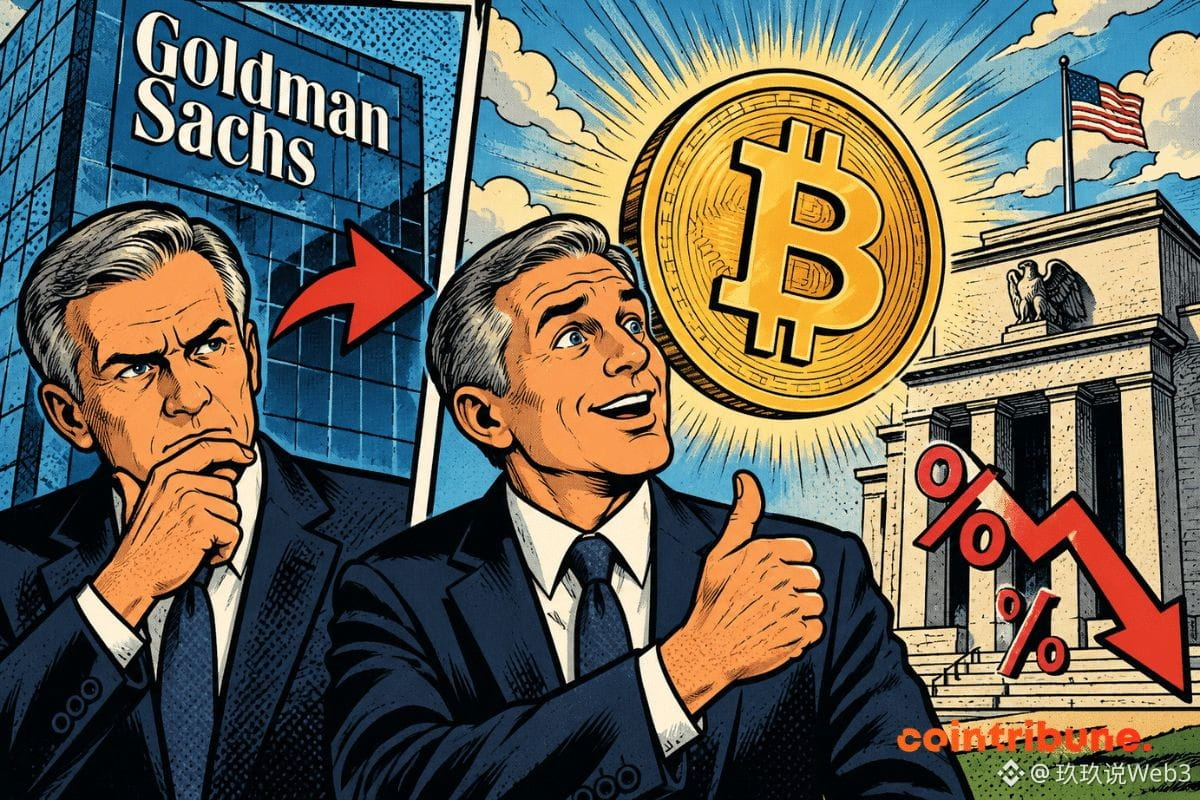
88
·
--
🚨 Crossing the 60-vote threshold: the GOP has only 53 seats. The Senate votes on crypto regulation on September 15—Treasury Secretary and the President personally urge votes, yet the market only assigns a 10% chance of success?
Group: [点击进入玖玖的粉丝群](https://app.binance.com/uni-qr/YXXQJrPb)
👀 One-sentence update: On Tuesday, September 15 at 2:15 PM, the U.S. Senate will hold a cloture vote on the procedural motion for the “CLARITY Act” (H.R.3633). This single vote determines whether this Congress can pass the crypto market structure bill.
📊 The numbers laid out: To pass, it needs 60 votes. The GOP holds 53 seats, meaning at least 7 Democrats must defect—but so far, no Democratic senator has publicly signaled support. Galaxy Digital has cut the probability of passage for 2026 to about 10% (it was 75% in May). The odds implied by the market also sit only in the low teens.
🔥 What’s behind the gap: The most intriguing part is the mismatch. Treasury Secretary Bessent has publicly urged the Senate to pass it, and the President personally lobbies senators in the White House (Ripple’s CEO and the SEC Chair are both present). Yet whoever is pricing the outcome only gives a 10% chance. One side is pushing votes with full force; the other doesn’t believe—so we’ll know on Tuesday which side is wrong.
💡 What’s really worth watching isn’t just whether the bill ultimately passes—it’s what the market will do to reprice crypto regulatory risk if this “window that should be the one” can’t stay open.
⚠️ A bucket of cold water: Galaxy’s 10% and the low double-digit odds are not offhand guesses—someone has genuinely put real money behind those bets. Don’t treat the Treasury Secretary’s urging as proof the bill is already through. Manage your position size before the vote.
👀 One camp says the political signal is strong enough, and it’s likely to pass on Tuesday. The other says there’s no way without public Democratic endorsement—where do you stand? Let’s discuss in the comments 👇
Click the profile to watch the live stream + join the Jiujiu chat group to get daily strategies 🚀
#Clarity法案9月15日程序性投票 #CLARITY法案 #Ripple
🚨 Crossing the 60-vote threshold: the GOP has only 53 seats. The Senate votes on crypto regulation on September 15—Treasury Secretary and the President personally urge votes, yet the market only assigns a 10% chance of success?
Group: 点击进入玖玖的粉丝群
👀 One-sentence update: On Tuesday, September 15 at 2:15 PM, the U.S. Senate will hold a cloture vote on the procedural motion for the “CLARITY Act” (H.R.3633). This single vote determines whether this Congress can pass the crypto market structure bill.
📊 The numbers laid out: To pass, it needs 60 votes. The GOP holds 53 seats, meaning at least 7 Democrats must defect—but so far, no Democratic senator has publicly signaled support. Galaxy Digital has cut the probability of passage for 2026 to about 10% (it was 75% in May). The odds implied by the market also sit only in the low teens.
🔥 What’s behind the gap: The most intriguing part is the mismatch. Treasury Secretary Bessent has publicly urged the Senate to pass it, and the President personally lobbies senators in the White House (Ripple’s CEO and the SEC Chair are both present). Yet whoever is pricing the outcome only gives a 10% chance. One side is pushing votes with full force; the other doesn’t believe—so we’ll know on Tuesday which side is wrong.
💡 What’s really worth watching isn’t just whether the bill ultimately passes—it’s what the market will do to reprice crypto regulatory risk if this “window that should be the one” can’t stay open.
⚠️ A bucket of cold water: Galaxy’s 10% and the low double-digit odds are not offhand guesses—someone has genuinely put real money behind those bets. Don’t treat the Treasury Secretary’s urging as proof the bill is already through. Manage your position size before the vote.
👀 One camp says the political signal is strong enough, and it’s likely to pass on Tuesday. The other says there’s no way without public Democratic endorsement—where do you stand? Let’s discuss in the comments 👇
Click the profile to watch the live stream + join the Jiujiu chat group to get daily strategies 🚀
#Clarity法案9月15日程序性投票 #CLARITY法案 #Ripple
Group: 点击进入玖玖的粉丝群
👀 One-sentence update: On Tuesday, September 15 at 2:15 PM, the U.S. Senate will hold a cloture vote on the procedural motion for the “CLARITY Act” (H.R.3633). This single vote determines whether this Congress can pass the crypto market structure bill.
📊 The numbers laid out: To pass, it needs 60 votes. The GOP holds 53 seats, meaning at least 7 Democrats must defect—but so far, no Democratic senator has publicly signaled support. Galaxy Digital has cut the probability of passage for 2026 to about 10% (it was 75% in May). The odds implied by the market also sit only in the low teens.
🔥 What’s behind the gap: The most intriguing part is the mismatch. Treasury Secretary Bessent has publicly urged the Senate to pass it, and the President personally lobbies senators in the White House (Ripple’s CEO and the SEC Chair are both present). Yet whoever is pricing the outcome only gives a 10% chance. One side is pushing votes with full force; the other doesn’t believe—so we’ll know on Tuesday which side is wrong.
💡 What’s really worth watching isn’t just whether the bill ultimately passes—it’s what the market will do to reprice crypto regulatory risk if this “window that should be the one” can’t stay open.
⚠️ A bucket of cold water: Galaxy’s 10% and the low double-digit odds are not offhand guesses—someone has genuinely put real money behind those bets. Don’t treat the Treasury Secretary’s urging as proof the bill is already through. Manage your position size before the vote.
👀 One camp says the political signal is strong enough, and it’s likely to pass on Tuesday. The other says there’s no way without public Democratic endorsement—where do you stand? Let’s discuss in the comments 👇
Click the profile to watch the live stream + join the Jiujiu chat group to get daily strategies 🚀
#Clarity法案9月15日程序性投票 #CLARITY法案 #Ripple

312
·
--
🚨 MoneyGram, a Remittance Giant, Makes a Move: 60 Million Users Can Tap and Pay With On-Chain Tokens—Will Traditional FX Be Skipped?
Group: [点击进入玖玖的粉丝群](https://app.binance.com/uni-qr/YXXQJrPb)
👀 In one sentence: The long-established US remittance company MoneyGram has launched its first crypto Visa card in Colombia. Users can directly use on-chain tokens to pay at Visa merchants, also make online payments; settlement runs on the Stellar network, and they can withdraw balances at MoneyGram branches.
📊 The numbers: MoneyGram operates across 200+ countries and serves 60 million active users. The cards initially integrate Circle’s USDC, then switch to its own MGUSD. Partners include Rain and Crossmint. The underlying infrastructure runs on Stellar, and collaboration with the Stellar Development Foundation has been under discussion for years. The official stance is to first get Colombia running smoothly, then expand to other Latin American markets.
🔥 What’s behind the numbers: “Fast” transfers have already been solved long ago. The real bottleneck is the last mile. Corner stores don’t accept USDC, and nobody wants to open a wallet just to buy a bottle of water and then go through an extra round of exchange. This card’s job is to, at the exact moment of payment, convert the balance into the local currency the merchant can accept—exchange exactly as much as needed.
💡 The real highlight isn’t “yet another crypto card,” but the fact that remittance companies and card networks are starting to embed stablecoins into everyday settlement. Once this path runs smoothly, cross-border transfer fees and settlement times will be rewritten.
⚠️ A bucket of cold water: For now, it’s only being piloted in a limited area in Colombia. MGUSD support and ATM withdrawals are still in the planning stages. Regulation, compliance, and merchant acceptance are all variables—rollout could be much slower than many expect.
👀 One camp says this is a signal that stablecoins are finally truly taking root; the other says it’s just a marketing pilot by an established remittance firm. Which side are you on? Let’s discuss in the comments.
Click the avatar to watch the livestream + join the Jiujiu chat group to get daily strategies 🚀
#美国合众银行完成Stellar跨境支付试点 #RWA #Web3
🚨 MoneyGram, a Remittance Giant, Makes a Move: 60 Million Users Can Tap and Pay With On-Chain Tokens—Will Traditional FX Be Skipped?
Group: 点击进入玖玖的粉丝群
👀 In one sentence: The long-established US remittance company MoneyGram has launched its first crypto Visa card in Colombia. Users can directly use on-chain tokens to pay at Visa merchants, also make online payments; settlement runs on the Stellar network, and they can withdraw balances at MoneyGram branches.
📊 The numbers: MoneyGram operates across 200+ countries and serves 60 million active users. The cards initially integrate Circle’s USDC, then switch to its own MGUSD. Partners include Rain and Crossmint. The underlying infrastructure runs on Stellar, and collaboration with the Stellar Development Foundation has been under discussion for years. The official stance is to first get Colombia running smoothly, then expand to other Latin American markets.
🔥 What’s behind the numbers: “Fast” transfers have already been solved long ago. The real bottleneck is the last mile. Corner stores don’t accept USDC, and nobody wants to open a wallet just to buy a bottle of water and then go through an extra round of exchange. This card’s job is to, at the exact moment of payment, convert the balance into the local currency the merchant can accept—exchange exactly as much as needed.
💡 The real highlight isn’t “yet another crypto card,” but the fact that remittance companies and card networks are starting to embed stablecoins into everyday settlement. Once this path runs smoothly, cross-border transfer fees and settlement times will be rewritten.
⚠️ A bucket of cold water: For now, it’s only being piloted in a limited area in Colombia. MGUSD support and ATM withdrawals are still in the planning stages. Regulation, compliance, and merchant acceptance are all variables—rollout could be much slower than many expect.
👀 One camp says this is a signal that stablecoins are finally truly taking root; the other says it’s just a marketing pilot by an established remittance firm. Which side are you on? Let’s discuss in the comments.
Click the avatar to watch the livestream + join the Jiujiu chat group to get daily strategies 🚀
#美国合众银行完成Stellar跨境支付试点 #RWA #Web3
Group: 点击进入玖玖的粉丝群
👀 In one sentence: The long-established US remittance company MoneyGram has launched its first crypto Visa card in Colombia. Users can directly use on-chain tokens to pay at Visa merchants, also make online payments; settlement runs on the Stellar network, and they can withdraw balances at MoneyGram branches.
📊 The numbers: MoneyGram operates across 200+ countries and serves 60 million active users. The cards initially integrate Circle’s USDC, then switch to its own MGUSD. Partners include Rain and Crossmint. The underlying infrastructure runs on Stellar, and collaboration with the Stellar Development Foundation has been under discussion for years. The official stance is to first get Colombia running smoothly, then expand to other Latin American markets.
🔥 What’s behind the numbers: “Fast” transfers have already been solved long ago. The real bottleneck is the last mile. Corner stores don’t accept USDC, and nobody wants to open a wallet just to buy a bottle of water and then go through an extra round of exchange. This card’s job is to, at the exact moment of payment, convert the balance into the local currency the merchant can accept—exchange exactly as much as needed.
💡 The real highlight isn’t “yet another crypto card,” but the fact that remittance companies and card networks are starting to embed stablecoins into everyday settlement. Once this path runs smoothly, cross-border transfer fees and settlement times will be rewritten.
⚠️ A bucket of cold water: For now, it’s only being piloted in a limited area in Colombia. MGUSD support and ATM withdrawals are still in the planning stages. Regulation, compliance, and merchant acceptance are all variables—rollout could be much slower than many expect.
👀 One camp says this is a signal that stablecoins are finally truly taking root; the other says it’s just a marketing pilot by an established remittance firm. Which side are you on? Let’s discuss in the comments.
Click the avatar to watch the livestream + join the Jiujiu chat group to get daily strategies 🚀
#美国合众银行完成Stellar跨境支付试点 #RWA #Web3

155
·
--
🚨 OpenAI, valued at hundreds of billions, says it won’t go public: Altman’s one sentence—tech and crypto are recalculating everything?
Group: [点击进入玖玖的粉丝群](https://app.binance.com/uni-qr/YXXQJrPb)
👀 One-sentence update: OpenAI CEO Sam Altman told the media that, given the various “safety”-related issues surrounding the company right now, it would be “not a rational time” to go public—meaning you likely won’t see an OpenAI IPO anytime this year.
📊 Putting numbers on it: In its previous funding round, OpenAI’s valuation was already in the range of several hundred billion dollars, and it was viewed as one of the most eagerly anticipated tech IPOs of 2026. Altman hit the pause button—not because of a lack of money, but because safety and regulatory uncertainty are simply too big.
🔥 What’s behind the numbers: Large tech IPOs have long been a barometer of risk appetite. If it’s delayed, it means the AI narrative that burns the most money still has to be absorbed by private funding and secondary markets. Capital’s “exit” becomes narrower, and the most expensive tech stories can’t enter the public market for now. Meanwhile, over in crypto, IPOs are being moved on-chain: CZ previously said an IPO would go on-chain, and the number of tokenized stock holders is still growing rapidly. The two tracks are, in fact, competing for the same pot of money.
💡 What’s really worth watching isn’t whether OpenAI goes public, but how the balance between tech and crypto shifts in “equity tokenization.” The more cautious traditional IPOs become, the bigger the imagination space for on-chain equity and RWA. Whoever first clears the compliant path gets the first bite of this wave of capital.
⚠️ A bucket of cold water: Delaying an IPO may also be interpreted as a sign that AI hype is cooling down. If sentiment toward risk assets weakens, crypto can’t really escape the impact either. When the news turns cold, assets with high valuations are often the first batch to be sold—don’t just pick the half-sentence that benefits you.
👀 One camp says this is proof that AI assets are getting more expensive; the other says it’s a sign that the tech IPO cycle has topped out—where do you stand? Let’s discuss in the comments.
Click the avatar to watch the livestream + join the Jiujiu chat group to get daily strategies 🚀
#OpenAI #美股 #AI #Cryptocurrency Market
🚨 OpenAI, valued at hundreds of billions, says it won’t go public: Altman’s one sentence—tech and crypto are recalculating everything?
Group: 点击进入玖玖的粉丝群
👀 One-sentence update: OpenAI CEO Sam Altman told the media that, given the various “safety”-related issues surrounding the company right now, it would be “not a rational time” to go public—meaning you likely won’t see an OpenAI IPO anytime this year.
📊 Putting numbers on it: In its previous funding round, OpenAI’s valuation was already in the range of several hundred billion dollars, and it was viewed as one of the most eagerly anticipated tech IPOs of 2026. Altman hit the pause button—not because of a lack of money, but because safety and regulatory uncertainty are simply too big.
🔥 What’s behind the numbers: Large tech IPOs have long been a barometer of risk appetite. If it’s delayed, it means the AI narrative that burns the most money still has to be absorbed by private funding and secondary markets. Capital’s “exit” becomes narrower, and the most expensive tech stories can’t enter the public market for now. Meanwhile, over in crypto, IPOs are being moved on-chain: CZ previously said an IPO would go on-chain, and the number of tokenized stock holders is still growing rapidly. The two tracks are, in fact, competing for the same pot of money.
💡 What’s really worth watching isn’t whether OpenAI goes public, but how the balance between tech and crypto shifts in “equity tokenization.” The more cautious traditional IPOs become, the bigger the imagination space for on-chain equity and RWA. Whoever first clears the compliant path gets the first bite of this wave of capital.
⚠️ A bucket of cold water: Delaying an IPO may also be interpreted as a sign that AI hype is cooling down. If sentiment toward risk assets weakens, crypto can’t really escape the impact either. When the news turns cold, assets with high valuations are often the first batch to be sold—don’t just pick the half-sentence that benefits you.
👀 One camp says this is proof that AI assets are getting more expensive; the other says it’s a sign that the tech IPO cycle has topped out—where do you stand? Let’s discuss in the comments.
Click the avatar to watch the livestream + join the Jiujiu chat group to get daily strategies 🚀
#OpenAI #美股 #AI #Cryptocurrency Market
Group: 点击进入玖玖的粉丝群
👀 One-sentence update: OpenAI CEO Sam Altman told the media that, given the various “safety”-related issues surrounding the company right now, it would be “not a rational time” to go public—meaning you likely won’t see an OpenAI IPO anytime this year.
📊 Putting numbers on it: In its previous funding round, OpenAI’s valuation was already in the range of several hundred billion dollars, and it was viewed as one of the most eagerly anticipated tech IPOs of 2026. Altman hit the pause button—not because of a lack of money, but because safety and regulatory uncertainty are simply too big.
🔥 What’s behind the numbers: Large tech IPOs have long been a barometer of risk appetite. If it’s delayed, it means the AI narrative that burns the most money still has to be absorbed by private funding and secondary markets. Capital’s “exit” becomes narrower, and the most expensive tech stories can’t enter the public market for now. Meanwhile, over in crypto, IPOs are being moved on-chain: CZ previously said an IPO would go on-chain, and the number of tokenized stock holders is still growing rapidly. The two tracks are, in fact, competing for the same pot of money.
💡 What’s really worth watching isn’t whether OpenAI goes public, but how the balance between tech and crypto shifts in “equity tokenization.” The more cautious traditional IPOs become, the bigger the imagination space for on-chain equity and RWA. Whoever first clears the compliant path gets the first bite of this wave of capital.
⚠️ A bucket of cold water: Delaying an IPO may also be interpreted as a sign that AI hype is cooling down. If sentiment toward risk assets weakens, crypto can’t really escape the impact either. When the news turns cold, assets with high valuations are often the first batch to be sold—don’t just pick the half-sentence that benefits you.
👀 One camp says this is proof that AI assets are getting more expensive; the other says it’s a sign that the tech IPO cycle has topped out—where do you stand? Let’s discuss in the comments.
Click the avatar to watch the livestream + join the Jiujiu chat group to get daily strategies 🚀
#OpenAI #美股 #AI #Cryptocurrency Market

25
Log in to explore more content
Join global crypto users on Binance Square
⚡️ Get latest and useful information about crypto.
💬 Trusted by the world’s largest crypto exchange.
👍 Discover real insights from verified creators.
Email / Phone number
Trending Topics
FedRateWatch
1.6M views
6,925 Discussing
Share & Win Traffic Reward in our Trending Hashtag Campaign
✨Topic: FOMC September, What's The Fed's Next Move?
👉How to Join:
Publish a short post or article with hashtag #FedRateWatch
Create content based on the below angles:
- August core CPI rose 0.3% month-over-month, and the odds of a 25bp hike this week are now close to 90%. Do you anticipate a rate hike this week? Is it a one-off, or the start of a longer hiking cycle?
- If the hike lands, how does it play out for BTC, tech stocks, and gold? Bullish or bearish?
- How are you planning to trade next? Share your BTC, stocks or gold trade/holdings with our trade sharing widget.
⏰Campaign Period:
- 2026-09-15 11:00 - 2026-09-17 3:00 UTC
🎁Reward:
- Qualified posts that comply with the above guidelines and contain more than 100 words will be reviewed and may receive a random traffic boost of 500 to 3,000 views. You will receive a notification from your feed secretary if your post is selected.
- Get a chance to have your article featured on Binance Square Official
Need ideas for your post? Visit the topic page #FedRateWatch or the Square Guide on How to Post for Better Reach.
Binance Square Official
·656 Likes
·1.7M views
ZcashRises6%
68,487 views
732 Discussing
XRPSinks10%
44,463 views
483 Discussing