
玖玖说Web3
551 Posts

玖玖说Web3
6年在圈子的经验,公众号:比特雷达。取每日CF资讯
8 Following
1.8K+ Followers
231 Liked
Posts
🚨 Offshore has already executed $8 billion in US stock perpetuals—want to "swim back" to the US? Ondo directly calls on the SEC and CFTC: the framework is already enough; there’s no need to create new rules!
Group: 点击进入玖玖的粉丝群
👀 One-sentence update: RWA leader Ondo Finance submitted three comment letters to the SEC and CFTC on August 24, asking to allow "single-stock perpetual contract" trading to be compliant within the United States. The reason: the existing securities and futures regulatory framework can already cover it, so no new legislation is needed.
📊 Data to back it up: Ondo isn’t just making proposals out of thin air—its related platform in Panama has already launched stablecoin-settled US stock perpetual contracts, with cumulative trading volume reaching $8 billion. It also delivered the "homework" to regulators: using a funding-rate mechanism for perpetuals can replicate the settlement logic of traditional futures; the price can still track the underlying stock, and it may not require a fixed expiration date.
🔥 What’s behind the numbers: The letters also addressed the operational questions regulators love most—how to maintain long-term price alignment, how funding rates incentivize arbitrage to return, and the "new normal" for blockchain derivatives such as on-chain market data and modern margin models. All of it was presented to both institutions.
💡 What’s truly worth watching isn’t whether Ondo alone will get approved, but whether the statutory definition of "securities and futures" could be opened up. If the SEC and CFTC give a nod, US stock perpetuals and tokenized stocks effectively gain a compliant entry point in the US—this could be the pass that the on-chain derivatives and RWA sector has been wanting most.
⚠️ A bucket of cold water: Those three comment letters are just a "petition"—the SEC/CFTC hasn’t given any signal yet. Regulatory clearance always moves slower than the market. Don’t treat a proposal as approval—first see whether the two regulators respond.
👀 Do you think US stock perpetual contracts should enter the US compliant market? Let’s discuss in the comments 👇
Click the avatar to watch the live stream + join the Jiuji chat group to get daily strategies 🚀
#RWA #稳定币 #DeFi #US stocks
Group: 点击进入玖玖的粉丝群
👀 One-sentence update: RWA leader Ondo Finance submitted three comment letters to the SEC and CFTC on August 24, asking to allow "single-stock perpetual contract" trading to be compliant within the United States. The reason: the existing securities and futures regulatory framework can already cover it, so no new legislation is needed.
📊 Data to back it up: Ondo isn’t just making proposals out of thin air—its related platform in Panama has already launched stablecoin-settled US stock perpetual contracts, with cumulative trading volume reaching $8 billion. It also delivered the "homework" to regulators: using a funding-rate mechanism for perpetuals can replicate the settlement logic of traditional futures; the price can still track the underlying stock, and it may not require a fixed expiration date.
🔥 What’s behind the numbers: The letters also addressed the operational questions regulators love most—how to maintain long-term price alignment, how funding rates incentivize arbitrage to return, and the "new normal" for blockchain derivatives such as on-chain market data and modern margin models. All of it was presented to both institutions.
💡 What’s truly worth watching isn’t whether Ondo alone will get approved, but whether the statutory definition of "securities and futures" could be opened up. If the SEC and CFTC give a nod, US stock perpetuals and tokenized stocks effectively gain a compliant entry point in the US—this could be the pass that the on-chain derivatives and RWA sector has been wanting most.
⚠️ A bucket of cold water: Those three comment letters are just a "petition"—the SEC/CFTC hasn’t given any signal yet. Regulatory clearance always moves slower than the market. Don’t treat a proposal as approval—first see whether the two regulators respond.
👀 Do you think US stock perpetual contracts should enter the US compliant market? Let’s discuss in the comments 👇
Click the avatar to watch the live stream + join the Jiuji chat group to get daily strategies 🚀
#RWA #稳定币 #DeFi #US stocks

🚨 Fidelity, which manages $71.0 trillion in assets, issues a warning: could quantum computers in the future directly derive Bitcoin private keys?
Group: 点击进入玖玖的粉丝群
👀 One-sentence update: In a report released on September 1, Fidelity Digital Assets’ research division said that once a sufficiently powerful quantum computer exists, it is theoretically possible to reverse-engineer private keys from already-exposed public keys. This could undermine the mathematical foundations behind the elliptic-curve signatures that currently protect Bitcoin (ECDSA/Schnorr).
📊 Data in plain terms: The real risk window hinges on “public key exposure.” If an address has been spent even once, its public key is placed on-chain, theoretically opening the threat. By contrast, addresses that have never been used are relatively safer. The upgrade cost is also concrete: today a signature is only about 64 bytes; the quantum-resistant SHRiNCS scheme has a minimum signature size of 548 bytes, and the stateless fallback version can reach 5,777 bytes—nearly 100x larger.
🔥 What’s behind the digital numbers: This is one of Bitcoin’s trickiest dilemmas—switching to quantum-resistant signatures would require a soft fork to change consensus. Wallets, miners, exchanges, and custodians would all need to upgrade together. Since signatures become nearly 100x larger, transaction congestion would noticeably drive fees higher. Fidelity added a blunt practical note: right now the mempool is nearly empty, which happens to be the period with the least “outfitting” pressure.
💡 What’s truly worth paying attention to isn’t “quantum computers are coming tomorrow to steal coins,” but the fact that big players have already quietly started moving. This July, Fidelity teamed up with 8 other financial and crypto firms to put up $15 million to establish a Bitcoin Security Special Fund—where anti-quantum research is on the list. The arms race for infrastructure is starting earlier than most people think.
⚠️ A splash of cold water: This is a “long-term insurance” topic, not a short-term market trigger. Don’t use it as a reason to trade or buy into speculation, and don’t rush to move funds out of panic—if you move chaotically now, you may expose your public keys first.
👀 Do you think Bitcoin should switch to quantum-resistant signatures sooner, or should we wait another decade? Let’s discuss in the comments below 👇
Click the avatar to watch the livestream + join the 99 Chat Group to get daily strategies 🚀
#比特币 #BTC #加密市场 #digital assets
Group: 点击进入玖玖的粉丝群
👀 One-sentence update: In a report released on September 1, Fidelity Digital Assets’ research division said that once a sufficiently powerful quantum computer exists, it is theoretically possible to reverse-engineer private keys from already-exposed public keys. This could undermine the mathematical foundations behind the elliptic-curve signatures that currently protect Bitcoin (ECDSA/Schnorr).
📊 Data in plain terms: The real risk window hinges on “public key exposure.” If an address has been spent even once, its public key is placed on-chain, theoretically opening the threat. By contrast, addresses that have never been used are relatively safer. The upgrade cost is also concrete: today a signature is only about 64 bytes; the quantum-resistant SHRiNCS scheme has a minimum signature size of 548 bytes, and the stateless fallback version can reach 5,777 bytes—nearly 100x larger.
🔥 What’s behind the digital numbers: This is one of Bitcoin’s trickiest dilemmas—switching to quantum-resistant signatures would require a soft fork to change consensus. Wallets, miners, exchanges, and custodians would all need to upgrade together. Since signatures become nearly 100x larger, transaction congestion would noticeably drive fees higher. Fidelity added a blunt practical note: right now the mempool is nearly empty, which happens to be the period with the least “outfitting” pressure.
💡 What’s truly worth paying attention to isn’t “quantum computers are coming tomorrow to steal coins,” but the fact that big players have already quietly started moving. This July, Fidelity teamed up with 8 other financial and crypto firms to put up $15 million to establish a Bitcoin Security Special Fund—where anti-quantum research is on the list. The arms race for infrastructure is starting earlier than most people think.
⚠️ A splash of cold water: This is a “long-term insurance” topic, not a short-term market trigger. Don’t use it as a reason to trade or buy into speculation, and don’t rush to move funds out of panic—if you move chaotically now, you may expose your public keys first.
👀 Do you think Bitcoin should switch to quantum-resistant signatures sooner, or should we wait another decade? Let’s discuss in the comments below 👇
Click the avatar to watch the livestream + join the 99 Chat Group to get daily strategies 🚀
#比特币 #BTC #加密市场 #digital assets

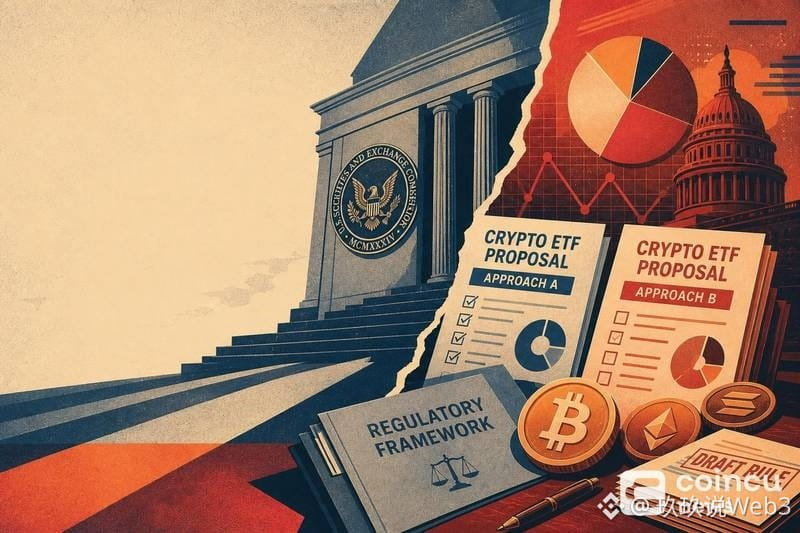
🚨 Grayscale and a16z “stir up a fight”? SEC seeks comments—making the question of “who deserves to be called an ETF” a tough one. Are crypto ETF rules about to change overnight?
Group: 点击进入玖玖的粉丝群
👀 One-sentence update: The SEC is seeking public comments on a proposed regulatory framework for “novel ETFs” (comments open June 30, due August 31). Grayscale, a16z, and the Crypto Council for Innovation (CCI) all submitted comments before the deadline, but they disagree on key points.
📊 Data says it all: The biggest disagreement is over who “deserves” to be called an ETF. a16z argues that only funds registered under the U.S. Investment Company Act should use the name; Grayscale believes the name should reflect the product’s actual economic characteristics; and CCI calls for strengthening disclosure. The SEC received comments from asset management firms, trading companies, investor organizations, and exchanges—far beyond just the crypto circle.
🔥 What’s behind the numbers: Behind this title dispute is the regulatory identity of multi-billion-dollar products. Spot Bitcoin ETFs and other digital-asset products currently often use commodity trust structures. If the SEC broadly sweeps them into a “novel ETF” category, they may face new registration and compliance requirements—so it won’t just be the name that changes, but the entire product structure.
💡 What really matters isn’t which side—Grayscale or a16z—convinces the other, but whether the SEC will use this consultation to rewrite approval paths for innovative products—clearer timelines and rules that determine whether the next batch of crypto, commodity, and leveraged ETFs will move faster or keep waiting in line.
⚠️ Cold water: Seeking comments doesn’t mean approving any product. Industry hype doesn’t automatically translate into good news. Regulatory chess matches usually play out over years—don’t expect new ETFs to be approved immediately in the short term, and don’t use this news to chase tokens.
👀 Should ETFs follow the rulebook first and then innovate, or start running and normalize later? Are you on Team Grayscale or Team a16z? Let’s discuss in the comments below 👇
Click the avatar to watch the live stream + join the Jiuji chat group to get daily strategy 🚀
#ETF #比特币 #crypto market
Group: 点击进入玖玖的粉丝群
👀 One-sentence update: The SEC is seeking public comments on a proposed regulatory framework for “novel ETFs” (comments open June 30, due August 31). Grayscale, a16z, and the Crypto Council for Innovation (CCI) all submitted comments before the deadline, but they disagree on key points.
📊 Data says it all: The biggest disagreement is over who “deserves” to be called an ETF. a16z argues that only funds registered under the U.S. Investment Company Act should use the name; Grayscale believes the name should reflect the product’s actual economic characteristics; and CCI calls for strengthening disclosure. The SEC received comments from asset management firms, trading companies, investor organizations, and exchanges—far beyond just the crypto circle.
🔥 What’s behind the numbers: Behind this title dispute is the regulatory identity of multi-billion-dollar products. Spot Bitcoin ETFs and other digital-asset products currently often use commodity trust structures. If the SEC broadly sweeps them into a “novel ETF” category, they may face new registration and compliance requirements—so it won’t just be the name that changes, but the entire product structure.
💡 What really matters isn’t which side—Grayscale or a16z—convinces the other, but whether the SEC will use this consultation to rewrite approval paths for innovative products—clearer timelines and rules that determine whether the next batch of crypto, commodity, and leveraged ETFs will move faster or keep waiting in line.
⚠️ Cold water: Seeking comments doesn’t mean approving any product. Industry hype doesn’t automatically translate into good news. Regulatory chess matches usually play out over years—don’t expect new ETFs to be approved immediately in the short term, and don’t use this news to chase tokens.
👀 Should ETFs follow the rulebook first and then innovate, or start running and normalize later? Are you on Team Grayscale or Team a16z? Let’s discuss in the comments below 👇
Click the avatar to watch the live stream + join the Jiuji chat group to get daily strategy 🚀
#ETF #比特币 #crypto market
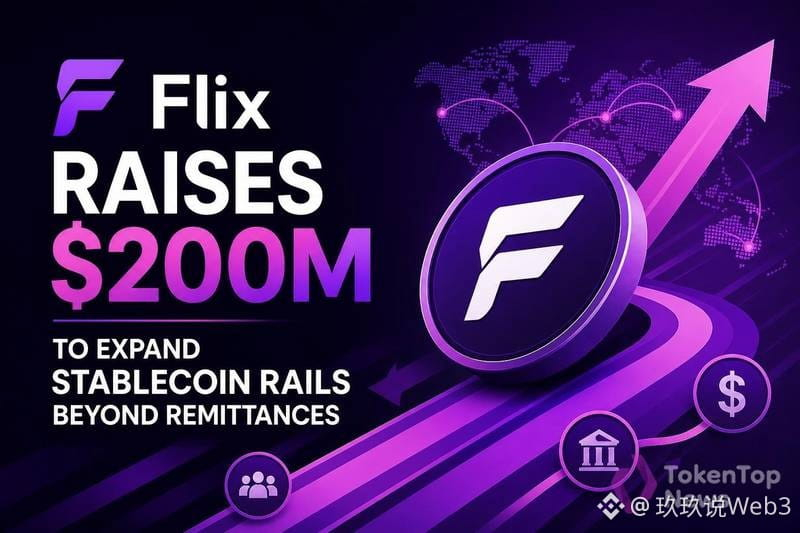
🚨 $200M poured into the “invisible USDC”! a16z leads investment in WhatsApp remittance platform—will stablecoins steal the traditional remittance business?
Groups: 点击进入玖玖的粉丝群
👀 One-sentence update: Félix Pago, which provides WhatsApp remittance services for Latin American immigrants in the U.S., announced it has completed a $200M funding round: $87M in equity led by a16z, plus a $113M credit facility from a fund under General Catalyst.
📊 Data speaks: Since its founding in 2020, the company has processed over $8B in transactions and served more than 6M users. Its revenue grew by more than 2.5x over the past year, covering 11 Latin American markets including Mexico, Colombia, and Brazil. Partners include Walmart, Visa, Stripe, and Mastercard.
🔥 What’s behind the numbers: The most distinctive part is the “frictionless stablecoin”—users simply send money in the WhatsApp chat box. Behind the scenes, most transactions are settled with USDC. Recipients are paid in local currency by partner institutions, with users never having to touch crypto at all. What a16z is betting on is hiding stablecoins inside the chat interface so ordinary people don’t even notice they’re there.
💡 What’s truly worth paying attention to isn’t yet another remittance company raising funds—it’s that stablecoins are shifting from “speculation use” to “utilities”: even Western Union launched a Solana stablecoin product this May. Traditional payments giants are starting to rebuild cross-border remittances with stablecoins—this is the most solid application scenario for stablecoins.
⚠️ Cold splash of reality: Of the $200M, $113M is a credit facility rather than equity—don’t treat it as a pure valuation signal. The remittance arena is crowded with giants, and regulation and bank channels remain the key battleground. Funding enthusiasm doesn’t necessarily mean stablecoin prices will rise—don’t confuse the narrative with a catalyst for coin price.
👀 Can the “invisible stablecoin” outperform Western Union, Stripe, and other traditional giants? Let’s discuss in the comments below 👇
Click the avatar to watch the livestream + join the Jiujiu chat group for daily strategies 🚀
#稳定币 #加密市场 #Web3
Groups: 点击进入玖玖的粉丝群
👀 One-sentence update: Félix Pago, which provides WhatsApp remittance services for Latin American immigrants in the U.S., announced it has completed a $200M funding round: $87M in equity led by a16z, plus a $113M credit facility from a fund under General Catalyst.
📊 Data speaks: Since its founding in 2020, the company has processed over $8B in transactions and served more than 6M users. Its revenue grew by more than 2.5x over the past year, covering 11 Latin American markets including Mexico, Colombia, and Brazil. Partners include Walmart, Visa, Stripe, and Mastercard.
🔥 What’s behind the numbers: The most distinctive part is the “frictionless stablecoin”—users simply send money in the WhatsApp chat box. Behind the scenes, most transactions are settled with USDC. Recipients are paid in local currency by partner institutions, with users never having to touch crypto at all. What a16z is betting on is hiding stablecoins inside the chat interface so ordinary people don’t even notice they’re there.
💡 What’s truly worth paying attention to isn’t yet another remittance company raising funds—it’s that stablecoins are shifting from “speculation use” to “utilities”: even Western Union launched a Solana stablecoin product this May. Traditional payments giants are starting to rebuild cross-border remittances with stablecoins—this is the most solid application scenario for stablecoins.
⚠️ Cold splash of reality: Of the $200M, $113M is a credit facility rather than equity—don’t treat it as a pure valuation signal. The remittance arena is crowded with giants, and regulation and bank channels remain the key battleground. Funding enthusiasm doesn’t necessarily mean stablecoin prices will rise—don’t confuse the narrative with a catalyst for coin price.
👀 Can the “invisible stablecoin” outperform Western Union, Stripe, and other traditional giants? Let’s discuss in the comments below 👇
Click the avatar to watch the livestream + join the Jiujiu chat group for daily strategies 🚀
#稳定币 #加密市场 #Web3
🚨 Nasdaq "crypto coin hoarder stocks" financing limit raised from $1 billion to $2.5 billion—ammunition capacity up 150%. What is it trying to do?
Group: 点击进入玖玖的粉丝群
👀 One-sentence update: On September 1, Hyperliquid Strategies (ticker PURR), a company listed on Nasdaq, filed documents with the U.S. SEC to increase the equity financing agreement with Chardan Capital from $1 billion to $2.5 billion—so it can load up more on HYPE.
📊 Data in numbers: As of August 23, the company held about 29.4 million HYPE tokens. The new agreement also adds protective “guardrails”: if the share price falls below $12.02, the maximum additional shares that can be issued is 42.64 million shares, not exceeding 19.99% of total outstanding shares—designed to prevent unlimited dilution of shareholders at lower prices.
🔥 What the numbers really mean: In plain terms, it’s a loop of “issue shares for cash, use cash to buy HYPE,” with the financing scale directly increased by 1.5x. Setting the share-sale price floor above $12 suggests management believes its stake is worth that price—and that, long term, they’re bullish on the 29.4 million HYPE tokens they hold.
💡 What’s truly worth watching isn’t just another company hoarding coins, but this “token treasury stock” model being repriced by capital markets: moving from hoarding BTC to hoarding HYPE. Public companies are starting to treat crypto assets as part of their core assets-and-liabilities balance sheet—this structural shift carries more signal value than a single buy.
⚠️ A bucket of cold water: The limit is the maximum, not a commitment. The $2.5 billion may not actually be fully used. Share financing also brings ongoing dilution pressure. Plus, Hyperliquid Strategies and the Hyperliquid platform itself have no direct affiliation—don’t automatically equate the company’s actions with the token’s price action. Stay clear-headed before emotions run wild.
👀 More and more listed companies are “borrowing money to hoard coins.” Do you think this is smart capital positioning, or the start of another round of musical chairs? Drop your thoughts in the comments below 👇
Click the avatar to watch the livestream + join the Jiuji chat group to get daily strategies 🚀
#HYPE #机构资金 #加密市场
Group: 点击进入玖玖的粉丝群
👀 One-sentence update: On September 1, Hyperliquid Strategies (ticker PURR), a company listed on Nasdaq, filed documents with the U.S. SEC to increase the equity financing agreement with Chardan Capital from $1 billion to $2.5 billion—so it can load up more on HYPE.
📊 Data in numbers: As of August 23, the company held about 29.4 million HYPE tokens. The new agreement also adds protective “guardrails”: if the share price falls below $12.02, the maximum additional shares that can be issued is 42.64 million shares, not exceeding 19.99% of total outstanding shares—designed to prevent unlimited dilution of shareholders at lower prices.
🔥 What the numbers really mean: In plain terms, it’s a loop of “issue shares for cash, use cash to buy HYPE,” with the financing scale directly increased by 1.5x. Setting the share-sale price floor above $12 suggests management believes its stake is worth that price—and that, long term, they’re bullish on the 29.4 million HYPE tokens they hold.
💡 What’s truly worth watching isn’t just another company hoarding coins, but this “token treasury stock” model being repriced by capital markets: moving from hoarding BTC to hoarding HYPE. Public companies are starting to treat crypto assets as part of their core assets-and-liabilities balance sheet—this structural shift carries more signal value than a single buy.
⚠️ A bucket of cold water: The limit is the maximum, not a commitment. The $2.5 billion may not actually be fully used. Share financing also brings ongoing dilution pressure. Plus, Hyperliquid Strategies and the Hyperliquid platform itself have no direct affiliation—don’t automatically equate the company’s actions with the token’s price action. Stay clear-headed before emotions run wild.
👀 More and more listed companies are “borrowing money to hoard coins.” Do you think this is smart capital positioning, or the start of another round of musical chairs? Drop your thoughts in the comments below 👇
Click the avatar to watch the livestream + join the Jiuji chat group to get daily strategies 🚀
#HYPE #机构资金 #加密市场
🚨 Japanese listed companies completely sold off ETH, SOL, XRP, and DOGE overnight, swapped the ¥879 million in proceeds for BTC—leaving not a single altcoin behind?
Group: 点击进入玖玖的粉丝群
👀 The one-line update: Tokyo-listed Remixpoint (code 3825) sold off all its holdings of Ethereum, Solana, XRP, and Dogecoin in one go on September 1; on September 2, it announced that from then on, its crypto treasury will hold only Bitcoin.
📊 Data speaks: This liquidation sold approximately 901 ETH, 13.9k SOL, 1.19M XRP, and 2.8M DOGE, bringing in about ¥879 million in proceeds, with an estimated profit of roughly ¥118 million; after the sales, the company’s account will hold only about 1,506 BTC—worth over $100 million USD at current prices.
🔥 What’s behind the numbers: This isn’t cashing out due to a shortage of funds—it’s an active “reduce positions” move. In its announcement, the company said that after a comprehensive assessment of market conditions and risk-reward, it decided to concentrate its assets into a single underlying asset. Even better, it also lent out its own BTC to earn interest—by February through August, it earned about ¥164 million in interest. With that, Bitcoin became an “interest-bearing asset” that can generate returns in its hands.
💡 What’s really worth watching isn’t just this company’s moves, but the wave of Japanese listed companies queued up to swap their treasuries for BTC: before this, Metaplanet bought continuously and became one of Asia’s largest holders; now Remixpoint has also fully zeroed out even its altcoin positions. Acceptance of the “Bitcoin standard” by traditional enterprises may be higher than we think.
⚠️ A bucket of cold water: One company going all-in doesn’t mean the market direction is the same. 1,506 BTC is only a light drizzle compared to the overall market; plus concentrating holdings is a double-edged sword—if BTC experiences a deep pullback, its balance sheet will feel the pressure too. Learn its logic, but don’t blindly copy its homework.
👀 When listed companies collectively shift to “keep only BTC,” will you follow and just inflate the hype? Let’s discuss in the comments below 👇
Click the avatar to watch the live stream + join the Jiuji chat group to get daily strategies 🚀
#比特币 #BTC #institutional capital
Group: 点击进入玖玖的粉丝群
👀 The one-line update: Tokyo-listed Remixpoint (code 3825) sold off all its holdings of Ethereum, Solana, XRP, and Dogecoin in one go on September 1; on September 2, it announced that from then on, its crypto treasury will hold only Bitcoin.
📊 Data speaks: This liquidation sold approximately 901 ETH, 13.9k SOL, 1.19M XRP, and 2.8M DOGE, bringing in about ¥879 million in proceeds, with an estimated profit of roughly ¥118 million; after the sales, the company’s account will hold only about 1,506 BTC—worth over $100 million USD at current prices.
🔥 What’s behind the numbers: This isn’t cashing out due to a shortage of funds—it’s an active “reduce positions” move. In its announcement, the company said that after a comprehensive assessment of market conditions and risk-reward, it decided to concentrate its assets into a single underlying asset. Even better, it also lent out its own BTC to earn interest—by February through August, it earned about ¥164 million in interest. With that, Bitcoin became an “interest-bearing asset” that can generate returns in its hands.
💡 What’s really worth watching isn’t just this company’s moves, but the wave of Japanese listed companies queued up to swap their treasuries for BTC: before this, Metaplanet bought continuously and became one of Asia’s largest holders; now Remixpoint has also fully zeroed out even its altcoin positions. Acceptance of the “Bitcoin standard” by traditional enterprises may be higher than we think.
⚠️ A bucket of cold water: One company going all-in doesn’t mean the market direction is the same. 1,506 BTC is only a light drizzle compared to the overall market; plus concentrating holdings is a double-edged sword—if BTC experiences a deep pullback, its balance sheet will feel the pressure too. Learn its logic, but don’t blindly copy its homework.
👀 When listed companies collectively shift to “keep only BTC,” will you follow and just inflate the hype? Let’s discuss in the comments below 👇
Click the avatar to watch the live stream + join the Jiuji chat group to get daily strategies 🚀
#比特币 #BTC #institutional capital

🚨 20 countries rarely agree: They acknowledge that crypto assets have a “transformative role” — are the people managing 85% of the world’s GDP changing their tune?
Group: 点击进入玖玖的粉丝群
👀 One-sentence event: As the United States holds the rotating chairmanship of the G20, on September 1 it issued a communiqué stating that all member economies unanimously agreed to recognize the “transformative role” of digital asset innovation in economic growth, and pledged to “lay out a clear path” for innovation.
📊 Data in plain numbers: G20 members account for about 85% of global GDP. This statement isn’t just about regulation; it also explicitly calls on countries to improve the efficiency of cross-border payments, connect financial-services data transmission across borders, and establish a regulatory framework aimed at “keeping financial stability while leaving room for innovation.”
🔥 What’s behind the numbers: This is a rare, collective positive tone at the G20 level — the message has shifted from “caution about risks” to “clear the road for innovation.” The competition behind it is visible: the EU’s MiCA is already in effect, and the U.S. GENIUS stablecoin bill has also passed. Whoever defines the rules first can seize the next wave of capital and talent.
💡 What’s truly worth watching isn’t the communiqué itself, but that the G20 is waiting for the Financial Stability Board (FSB) to deliver its stablecoin assessment results. Global unified rules for stablecoins are the real headline of this policy cycle — they may directly determine the underlying architecture of future cross-border payments.
⚠️ A bucket of cold water: The communiqué reflects directional consensus, but it’s still a distance away from being implemented into law in each country. Implementation standards differ among member states, and the “clear path” may also move in fits and starts. Policy tailwinds ≠ an immediate surge — don’t treat expectations as a market move.
👀 The global regulators have collectively shifted direction — do you think this is a long-term positive for BTC and stablecoins, or is the good news already priced in? Chat in the comments below 👇
Click the profile picture to watch the live stream + join the Jiujiu chat group to get daily strategy 🚀
#比特币 #稳定币 #crypto market
Group: 点击进入玖玖的粉丝群
👀 One-sentence event: As the United States holds the rotating chairmanship of the G20, on September 1 it issued a communiqué stating that all member economies unanimously agreed to recognize the “transformative role” of digital asset innovation in economic growth, and pledged to “lay out a clear path” for innovation.
📊 Data in plain numbers: G20 members account for about 85% of global GDP. This statement isn’t just about regulation; it also explicitly calls on countries to improve the efficiency of cross-border payments, connect financial-services data transmission across borders, and establish a regulatory framework aimed at “keeping financial stability while leaving room for innovation.”
🔥 What’s behind the numbers: This is a rare, collective positive tone at the G20 level — the message has shifted from “caution about risks” to “clear the road for innovation.” The competition behind it is visible: the EU’s MiCA is already in effect, and the U.S. GENIUS stablecoin bill has also passed. Whoever defines the rules first can seize the next wave of capital and talent.
💡 What’s truly worth watching isn’t the communiqué itself, but that the G20 is waiting for the Financial Stability Board (FSB) to deliver its stablecoin assessment results. Global unified rules for stablecoins are the real headline of this policy cycle — they may directly determine the underlying architecture of future cross-border payments.
⚠️ A bucket of cold water: The communiqué reflects directional consensus, but it’s still a distance away from being implemented into law in each country. Implementation standards differ among member states, and the “clear path” may also move in fits and starts. Policy tailwinds ≠ an immediate surge — don’t treat expectations as a market move.
👀 The global regulators have collectively shifted direction — do you think this is a long-term positive for BTC and stablecoins, or is the good news already priced in? Chat in the comments below 👇
Click the profile picture to watch the live stream + join the Jiujiu chat group to get daily strategy 🚀
#比特币 #稳定币 #crypto market

🚨 Top traders use the “Fisher Equation” to calculate XRP’s value at $6,000 — is it math derivation or faith-fueled hype?
Group: 点击进入玖玖的粉丝群
👀 One-sentence news: Well-known crypto trader Olesya publicly stated that she values XRP using the Fisher equation (MV=PQ), and the result points to $6,000. She also predicts that banks will soon launch pilot projects for XRP settlement.
📊 Data speaks: The core logic of the Fisher equation is: asset value = the total economic activity quantity settled using that asset ÷ (circulating supply × velocity). Under her assumptions, XRP at around $1.3 is massively undervalued; but in the equation, if you tweak any variable even slightly, the outcome can be wildly different.
🔥 What’s behind the number: $6,000 implies XRP must handle payment settlement volumes on the mega scale. The bet here is the grand narrative of “banks adopting XRP at massive scale.” The equation itself isn’t necessarily wrong—what may be wrong is that the assumptions are overly optimistic.
💡 What’s truly worth watching isn’t whether XRP can reach $6,000, but whether institutional interest in XRP payment use cases is genuinely heating up: spot ETFs keep attracting inflows, and on-chain payment volume is nearing one million transactions per day. These visible changes are more worth tracking than an aggressive target price.
⚠️ Cold shower: A valuation model isn’t a price prophecy. The Fisher equation’s input parameters are all subjective assumptions. Change a single number, and the conclusion can end up off by several orders of magnitude. Just listen to this kind of aggressive target price—don’t bet real money on an equation.
👀 Do you think XRP’s “bank settlement dream” can really hold up to $6,000? Let’s discuss in the comments below 👇
Click the avatar to watch the livestream + join the Jiuji chat group to get daily strategies 🚀
#XRP #Institutional funds
Group: 点击进入玖玖的粉丝群
👀 One-sentence news: Well-known crypto trader Olesya publicly stated that she values XRP using the Fisher equation (MV=PQ), and the result points to $6,000. She also predicts that banks will soon launch pilot projects for XRP settlement.
📊 Data speaks: The core logic of the Fisher equation is: asset value = the total economic activity quantity settled using that asset ÷ (circulating supply × velocity). Under her assumptions, XRP at around $1.3 is massively undervalued; but in the equation, if you tweak any variable even slightly, the outcome can be wildly different.
🔥 What’s behind the number: $6,000 implies XRP must handle payment settlement volumes on the mega scale. The bet here is the grand narrative of “banks adopting XRP at massive scale.” The equation itself isn’t necessarily wrong—what may be wrong is that the assumptions are overly optimistic.
💡 What’s truly worth watching isn’t whether XRP can reach $6,000, but whether institutional interest in XRP payment use cases is genuinely heating up: spot ETFs keep attracting inflows, and on-chain payment volume is nearing one million transactions per day. These visible changes are more worth tracking than an aggressive target price.
⚠️ Cold shower: A valuation model isn’t a price prophecy. The Fisher equation’s input parameters are all subjective assumptions. Change a single number, and the conclusion can end up off by several orders of magnitude. Just listen to this kind of aggressive target price—don’t bet real money on an equation.
👀 Do you think XRP’s “bank settlement dream” can really hold up to $6,000? Let’s discuss in the comments below 👇
Click the avatar to watch the livestream + join the Jiuji chat group to get daily strategies 🚀
#XRP #Institutional funds
🚨 The sleeping giant whale has just moved 253 million USD worth of ETH to exchanges, and then opened a 25x long—what is he really betting on?
Group: 点击进入玖玖的粉丝群
👀 One-sentence event: On-chain monitoring shows that a long-dormant trader recently transferred about 253 million USD worth of ETH to an exchange. At the same time, a 25x leveraged ETH long position appeared on the market, exactly hitting the key resistance level around $2,500.
📊 Data speaks: A 253 million USD large transfer + a 25x leveraged long + a rise in overall contract leverage all occur within the same time window—suggesting large capital is intensely battling right before the $2,500 threshold. And ETH’s repeated attempts to push above $2,500 have failed; this resistance is still holding for now.
🔥 What’s behind the numbers: When a whale transfers coins to an exchange, it’s often interpreted as “preparing to distribute.” But when you pair that with a 25x long, it looks more like stocking up for a potential breakout—either it will break above $2,500 with volume and rally in continuation, or the long gets trapped and turns into fuel for the other side.
💡 What matters isn’t how many coins the whale moved, but the long/short positions stacked at the $2,500 level. Once it breaks with volume, shorts covering could accelerate the move. If it keeps failing to break after repeated attempts, these highly leveraged longs may instead become the trigger for further downside.
⚠️ Cold water: 25x leverage is every bull-and-bear’s favorite—whether price spikes up or dives down with wick moves, the ones most likely to get liquidated first are the high-leverage players. Before following the whale, think it through: how many wick intrusions can your position withstand?
👀 Do you think ETH can hold steady at $2,500 this time? Let’s discuss in the comments below 👇
Click the avatar to watch the livestream + join the Jiujiu chat group to get daily strategies 🚀
#ETH #Ethereum
Group: 点击进入玖玖的粉丝群
👀 One-sentence event: On-chain monitoring shows that a long-dormant trader recently transferred about 253 million USD worth of ETH to an exchange. At the same time, a 25x leveraged ETH long position appeared on the market, exactly hitting the key resistance level around $2,500.
📊 Data speaks: A 253 million USD large transfer + a 25x leveraged long + a rise in overall contract leverage all occur within the same time window—suggesting large capital is intensely battling right before the $2,500 threshold. And ETH’s repeated attempts to push above $2,500 have failed; this resistance is still holding for now.
🔥 What’s behind the numbers: When a whale transfers coins to an exchange, it’s often interpreted as “preparing to distribute.” But when you pair that with a 25x long, it looks more like stocking up for a potential breakout—either it will break above $2,500 with volume and rally in continuation, or the long gets trapped and turns into fuel for the other side.
💡 What matters isn’t how many coins the whale moved, but the long/short positions stacked at the $2,500 level. Once it breaks with volume, shorts covering could accelerate the move. If it keeps failing to break after repeated attempts, these highly leveraged longs may instead become the trigger for further downside.
⚠️ Cold water: 25x leverage is every bull-and-bear’s favorite—whether price spikes up or dives down with wick moves, the ones most likely to get liquidated first are the high-leverage players. Before following the whale, think it through: how many wick intrusions can your position withstand?
👀 Do you think ETH can hold steady at $2,500 this time? Let’s discuss in the comments below 👇
Click the avatar to watch the livestream + join the Jiujiu chat group to get daily strategies 🚀
#ETH #Ethereum
🚨 XRP on-chain payment volume surged 33% in the past 24 hours, nearing one million transactions per day—will the familiar peak playbook repeat again?
Group: 点击进入玖玖的粉丝群
👀 One-sentence update: Latest on-chain data shows that the XRP Ledger processed nearly 900,000 payments over the past 24 hours, with a daily increase of 33%. It’s now pushing toward the milestone of “one million transactions per day.”
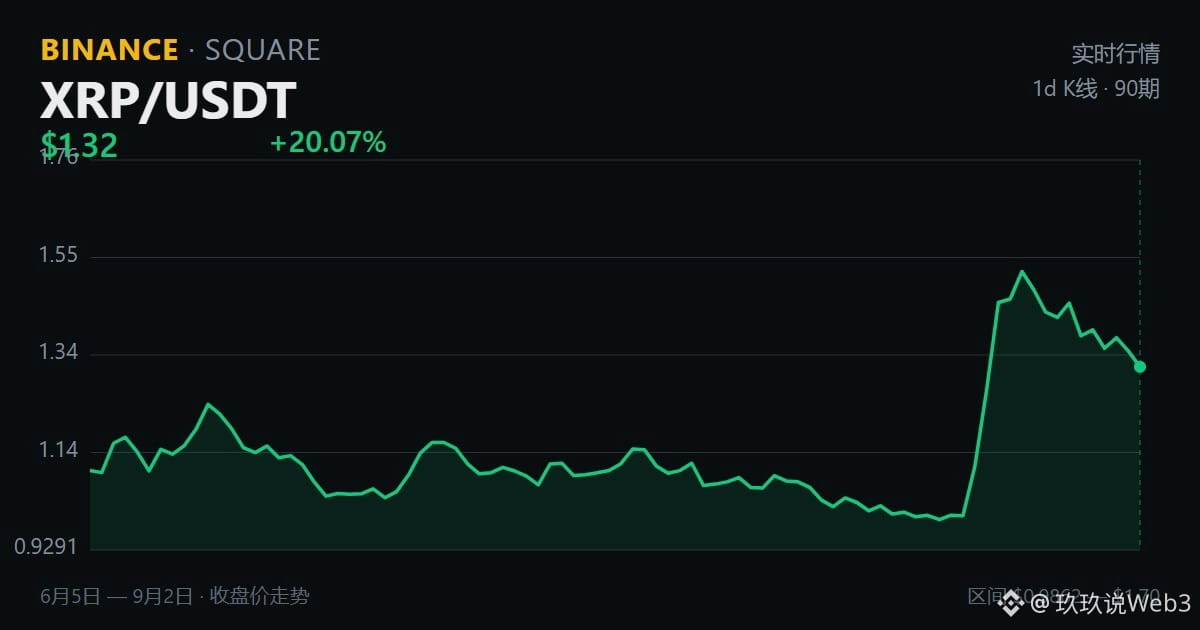
📊 Data speaks: A 33% day-over-day growth rate indicates the network’s activity is heating up quickly. And with payment volume nearing the one-million mark, this level hasn’t been seen for a long time. At the same time, the XRP price is also strengthening—currently around $1.3, up more than 20% over the past month. Price and on-chain activity are moving up together, a rare alignment.
🔥 What’s behind the numbers: Payment volume is real usage data, not emotion-driven speculation. XRPL’s fast transfer speed and low fees are drawing cross-border payment and stablecoin settlement use cases onto the chain. The busier the on-chain ecosystem becomes, the more market recognition XRP gets for its “payment network” positioning.
💡 What’s truly worth watching isn’t the “900,000 transactions in a single day” number itself, but the trend behind it: “more and more real use cases are emerging.” ETF capital inflows feed expectations, but on-chain payment volume reflects fundamentals.
⚠️ A splash of cold water: Daily figures can be volatile. It’s possible this surge is due to concentrated short-term events rather than a sustained trend. Whether payment volume can stay above 800,000 per day over the coming week is the real test.
👀 Do you think this XRP is a “real recovery,” or just “a lively event”? Let’s discuss in the comments below 👇
Click the avatar to watch the livestream + join the Jiujiu chat group to get daily strategies 🚀
#XRP #Ripple
Group: 点击进入玖玖的粉丝群
👀 One-sentence update: Latest on-chain data shows that the XRP Ledger processed nearly 900,000 payments over the past 24 hours, with a daily increase of 33%. It’s now pushing toward the milestone of “one million transactions per day.”
📊 Data speaks: A 33% day-over-day growth rate indicates the network’s activity is heating up quickly. And with payment volume nearing the one-million mark, this level hasn’t been seen for a long time. At the same time, the XRP price is also strengthening—currently around $1.3, up more than 20% over the past month. Price and on-chain activity are moving up together, a rare alignment.
🔥 What’s behind the numbers: Payment volume is real usage data, not emotion-driven speculation. XRPL’s fast transfer speed and low fees are drawing cross-border payment and stablecoin settlement use cases onto the chain. The busier the on-chain ecosystem becomes, the more market recognition XRP gets for its “payment network” positioning.
💡 What’s truly worth watching isn’t the “900,000 transactions in a single day” number itself, but the trend behind it: “more and more real use cases are emerging.” ETF capital inflows feed expectations, but on-chain payment volume reflects fundamentals.
⚠️ A splash of cold water: Daily figures can be volatile. It’s possible this surge is due to concentrated short-term events rather than a sustained trend. Whether payment volume can stay above 800,000 per day over the coming week is the real test.
👀 Do you think this XRP is a “real recovery,” or just “a lively event”? Let’s discuss in the comments below 👇
Click the avatar to watch the livestream + join the Jiujiu chat group to get daily strategies 🚀
#XRP #Ripple
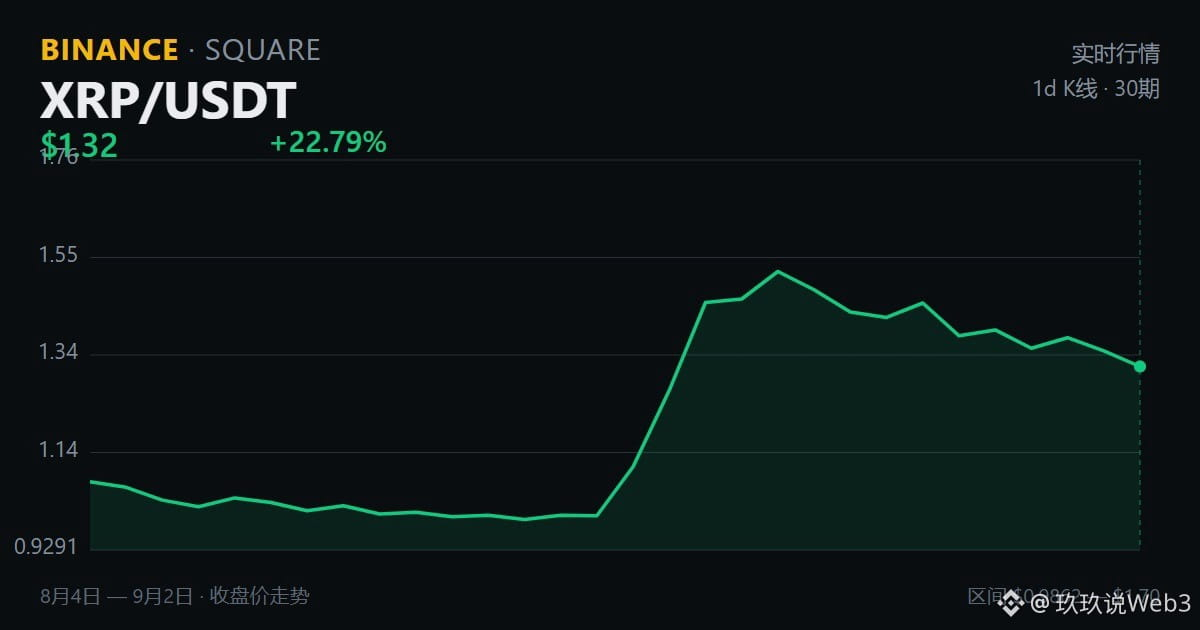
🚨 July up 7.36%, August up 24.95%——After Bitcoin surged for two straight months, is September really a “must-dump”?
Group: 点击进入玖玖的粉丝群
👀 The event in one sentence: According to CoinGlass’s latest statistics, Bitcoin rose 7.36% in July and surged 24.95% in August, closing green for two consecutive months. The “September curse” circulating in the market—that September will inevitably fall—may just be survivorship bias: historical data shows September isn’t always a drop.
📊 Let the data speak: Total gains over two months exceed 34%. Bitcoin has been repairing from July’s low all the way to August’s high, with continued ETF inflows acting as the strongest catalyst. Under the simple logic of “if it rises too much, it must fall,” September is indeed something to be cautious about—but the data does not support the absolute conclusion that “September must fall.”
🔥 Behind the numbers: The so-called “September curse” comes from a small number of down samples over a few years, repeatedly cited until it becomes a psychological anchor. What truly determines September’s trend isn’t the calendar—it’s the macro path: the Fed’s September policy meeting, the direction of Treasury yields, and whether ETF flows continue. These variables matter far more than “how many times it fell in September in the past.”
💡 What’s really worth watching isn’t whether Bitcoin goes up or down in September, but whether the driving logic behind this rally has changed: if ETF inflows and expectations of macro easing are still in place, pullbacks may be a “get in” window; if those two engines sputter out, then that’s when you truly need to worry.
⚠️ Pouring cold water: After consecutive big gains, volatility will inevitably rise. A single-day sharp drop in September is normal—don’t mistake a routine pullback for a trend reversal. Position management is always more important than predicting the month.
👀 What do you think Bitcoin will do in September? Let’s chat in the comments below 👇
Click the avatar to watch the live stream + join the Jiujiu chat group to get daily strategies 🚀
#比特币 #BTC #crypto market
Group: 点击进入玖玖的粉丝群
👀 The event in one sentence: According to CoinGlass’s latest statistics, Bitcoin rose 7.36% in July and surged 24.95% in August, closing green for two consecutive months. The “September curse” circulating in the market—that September will inevitably fall—may just be survivorship bias: historical data shows September isn’t always a drop.
📊 Let the data speak: Total gains over two months exceed 34%. Bitcoin has been repairing from July’s low all the way to August’s high, with continued ETF inflows acting as the strongest catalyst. Under the simple logic of “if it rises too much, it must fall,” September is indeed something to be cautious about—but the data does not support the absolute conclusion that “September must fall.”
🔥 Behind the numbers: The so-called “September curse” comes from a small number of down samples over a few years, repeatedly cited until it becomes a psychological anchor. What truly determines September’s trend isn’t the calendar—it’s the macro path: the Fed’s September policy meeting, the direction of Treasury yields, and whether ETF flows continue. These variables matter far more than “how many times it fell in September in the past.”
💡 What’s really worth watching isn’t whether Bitcoin goes up or down in September, but whether the driving logic behind this rally has changed: if ETF inflows and expectations of macro easing are still in place, pullbacks may be a “get in” window; if those two engines sputter out, then that’s when you truly need to worry.
⚠️ Pouring cold water: After consecutive big gains, volatility will inevitably rise. A single-day sharp drop in September is normal—don’t mistake a routine pullback for a trend reversal. Position management is always more important than predicting the month.
👀 What do you think Bitcoin will do in September? Let’s chat in the comments below 👇
Click the avatar to watch the live stream + join the Jiujiu chat group to get daily strategies 🚀
#比特币 #BTC #crypto market
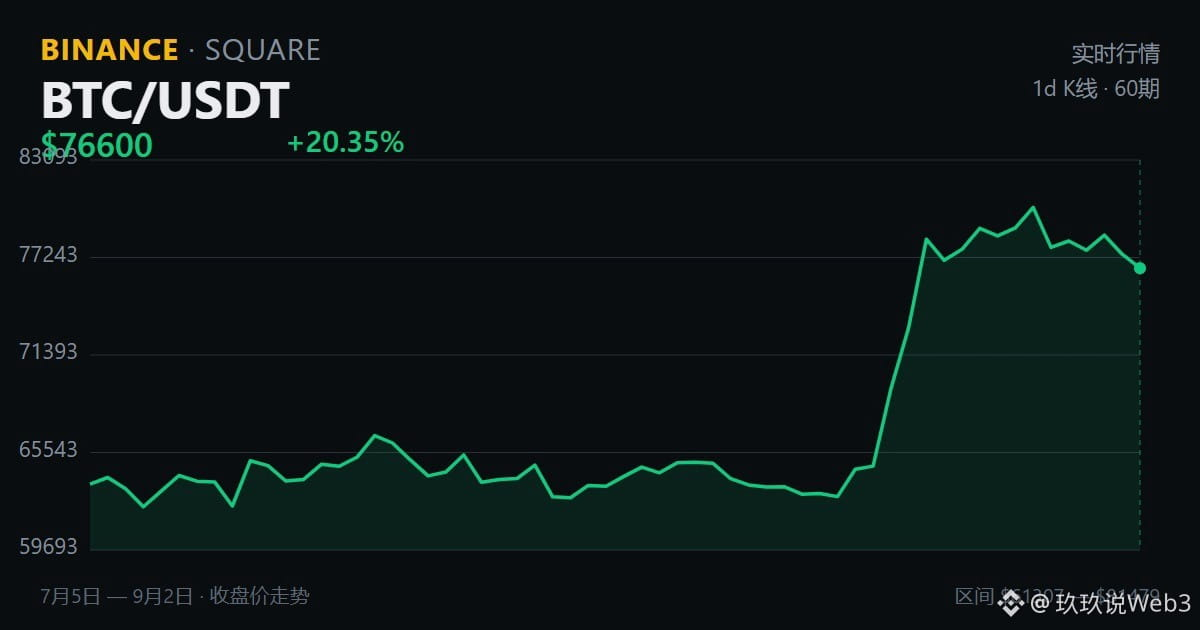
🚨 Did Bitcoin “break up” with US stocks? Correlation drops to a two-year low—77K is the key level. Can it hold tonight?
Group: 点击进入玖玖的粉丝群
👀 One-sentence update: Glassnode’s latest data shows Bitcoin’s correlation with the S&P 500 is approaching a two-year low. And with BTC currently trading at $77,495, it is right at the $77,000 key support level—this is where decoupling and a test arrive at the same time.
📊 Data speaks: Over the past two years, BTC has effectively been traded like a “high-volatility tech stock”: when US stocks fall, BTC falls too; when US stocks rally, BTC gets even more excited. Now that correlation has slid to a two-year low, this linkage logic is starting to loosen—if US stocks make new highs, BTC may not necessarily follow; if US stocks pull back, BTC may not necessarily decline alongside.
🔥 What’s behind the numbers: The decoupling reflects a shift in pricing power. When ETF fund flows, on-chain data, and regulatory progress start to dominate BTC’s moves, it stops being merely a “shadow asset” of macro liquidity, and instead begins to reclaim its own narrative—this is also why Glassnode describes it as the prelude to an independent market trend.
💡 What’s truly worth watching isn’t whether $77K can hold tonight (that’s short-term trading), but if decoupling persists, Bitcoin’s allocation logic as “digital gold” will be repriced: for institutions it’s a diversification tool; for retail investors it’s a purer form of volatility—two identities, two fates.
⚠️ A bucket of cold water: Correlation is a lagging indicator, and even a two-year low could be calm before the storm. If $77K is decisively broken, you’ll first need to watch how $75K holds. Decoupling doesn’t mean a guaranteed rise—it only means “going its own way.” As for where that road leads, the market decides.
👀 After BTC decouples from US stocks, do you think it will run an independent rally or catch up with the selloff? Let’s discuss in the comments below 👇
Click the avatar to watch the live stream + join the Jiujiu chat group to get daily strategies 🚀
#比特币 #BTC #加密市场
Group: 点击进入玖玖的粉丝群
👀 One-sentence update: Glassnode’s latest data shows Bitcoin’s correlation with the S&P 500 is approaching a two-year low. And with BTC currently trading at $77,495, it is right at the $77,000 key support level—this is where decoupling and a test arrive at the same time.
📊 Data speaks: Over the past two years, BTC has effectively been traded like a “high-volatility tech stock”: when US stocks fall, BTC falls too; when US stocks rally, BTC gets even more excited. Now that correlation has slid to a two-year low, this linkage logic is starting to loosen—if US stocks make new highs, BTC may not necessarily follow; if US stocks pull back, BTC may not necessarily decline alongside.
🔥 What’s behind the numbers: The decoupling reflects a shift in pricing power. When ETF fund flows, on-chain data, and regulatory progress start to dominate BTC’s moves, it stops being merely a “shadow asset” of macro liquidity, and instead begins to reclaim its own narrative—this is also why Glassnode describes it as the prelude to an independent market trend.
💡 What’s truly worth watching isn’t whether $77K can hold tonight (that’s short-term trading), but if decoupling persists, Bitcoin’s allocation logic as “digital gold” will be repriced: for institutions it’s a diversification tool; for retail investors it’s a purer form of volatility—two identities, two fates.
⚠️ A bucket of cold water: Correlation is a lagging indicator, and even a two-year low could be calm before the storm. If $77K is decisively broken, you’ll first need to watch how $75K holds. Decoupling doesn’t mean a guaranteed rise—it only means “going its own way.” As for where that road leads, the market decides.
👀 After BTC decouples from US stocks, do you think it will run an independent rally or catch up with the selloff? Let’s discuss in the comments below 👇
Click the avatar to watch the live stream + join the Jiujiu chat group to get daily strategies 🚀
#比特币 #BTC #加密市场

Verified
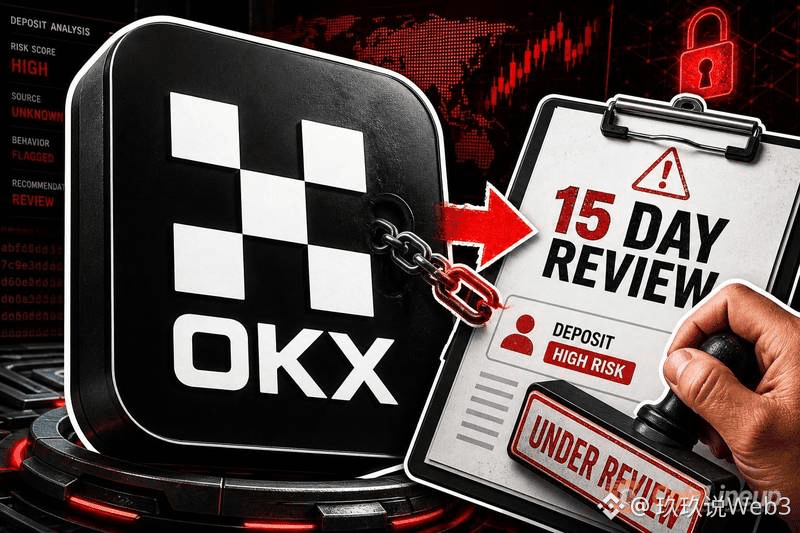
🚨 OKX suddenly issues an important notice!
Some high-risk deposits may take up to 15 days to review!
Group: 点击进入玖玖的粉丝群
When many people see “15-day review,” their first reaction might be: Is OKX starting to freeze funds on a large scale? Actually, no.
OKX is targeting deposits that have been flagged by the system as “high risk.” It does not mean that all top-ups will go into review, nor does it mean that accounts across the whole platform will be frozen.
If a deposit triggers enhanced compliance review, the funds may need to wait up to 15 days to be processed.
Why is this happening?
The core reason is risk control.
Exchanges need to further verify the source of certain funds to meet compliance requirements such as anti–money laundering and customer identity verification.
It’s also important to note that OKX currently has not公開 which specific transactions will definitely be marked as high risk.
So if someone online tells you outright that “a certain transfer will definitely be reviewed,” you should be cautious.
What ordinary users should truly pay attention to is this: in the past, people were used to on-chain transfers being credited within minutes or even seconds. But once funds are on an exchange platform, they may not be immediately usable.
If enhanced review is triggered, the time cost could suddenly increase.
This is especially noticeable for people who need to use funds promptly.
So if you find that your deposit has entered a review status, don’t panic and don’t keep making repeated attempts.
The most important thing is to check your account status, platform notifications, and any follow-up processing requirements.
Behind this issue, there’s also a bigger shift:
Crypto assets are becoming increasingly deeply integrated into compliance systems.
In the past, people cared more about whether transfers are fast. Now platforms are paying more attention to where the funds come from, what they pass through, and whether there are risks.
So when you do on-chain transfers in the future, besides checking the fees and speed, you should also start considering compliance and the time it takes for funds to arrive.
👀 Will it trigger a review?
👀 How long will the review take?
👀 Will the platform require additional information?
15 days doesn’t mean everyone will have to wait for 15 days—but it serves as a reminder to the market: transferring crypto assets doesn’t necessarily mean the funds can be used immediately.
Click the profile picture to watch the livestream + join the Jiuji Chat Group to get daily strategies 🚀
#OKX #加密资产 #Web3
Some high-risk deposits may take up to 15 days to review!
Group: 点击进入玖玖的粉丝群
When many people see “15-day review,” their first reaction might be: Is OKX starting to freeze funds on a large scale? Actually, no.
OKX is targeting deposits that have been flagged by the system as “high risk.” It does not mean that all top-ups will go into review, nor does it mean that accounts across the whole platform will be frozen.
If a deposit triggers enhanced compliance review, the funds may need to wait up to 15 days to be processed.
Why is this happening?
The core reason is risk control.
Exchanges need to further verify the source of certain funds to meet compliance requirements such as anti–money laundering and customer identity verification.
It’s also important to note that OKX currently has not公開 which specific transactions will definitely be marked as high risk.
So if someone online tells you outright that “a certain transfer will definitely be reviewed,” you should be cautious.
What ordinary users should truly pay attention to is this: in the past, people were used to on-chain transfers being credited within minutes or even seconds. But once funds are on an exchange platform, they may not be immediately usable.
If enhanced review is triggered, the time cost could suddenly increase.
This is especially noticeable for people who need to use funds promptly.
So if you find that your deposit has entered a review status, don’t panic and don’t keep making repeated attempts.
The most important thing is to check your account status, platform notifications, and any follow-up processing requirements.
Behind this issue, there’s also a bigger shift:
Crypto assets are becoming increasingly deeply integrated into compliance systems.
In the past, people cared more about whether transfers are fast. Now platforms are paying more attention to where the funds come from, what they pass through, and whether there are risks.
So when you do on-chain transfers in the future, besides checking the fees and speed, you should also start considering compliance and the time it takes for funds to arrive.
👀 Will it trigger a review?
👀 How long will the review take?
👀 Will the platform require additional information?
15 days doesn’t mean everyone will have to wait for 15 days—but it serves as a reminder to the market: transferring crypto assets doesn’t necessarily mean the funds can be used immediately.
Click the profile picture to watch the livestream + join the Jiuji Chat Group to get daily strategies 🚀
#OKX #加密资产 #Web3
Verified
🚨 $42.4 million just frozen?
Thai businessman sues Tether—without a court order, can USDT be frozen unilaterally?
Group: 点击进入玖玖的粉丝群
👀 One-sentence recap: Two Thai businessmen have officially filed a lawsuit against Tether. The reason: their $42.4 million USDT was frozen, and the freeze happened with no authorization from any court.
📊 Data speaks: This isn’t a small amount—$42.4 million, roughly on the scale of 300 million RMB in assets. It was frozen on the spot. The core question the plaintiffs raise is simple: on what grounds does Tether freeze a user’s assets unilaterally without a court order?
🔥 What’s behind the numbers: Tether’s ability to freeze has long existed. In the past, it was usually used in coordination with law enforcement to crack down on criminal funds. But this time, the dispute is about “procedural justice”—even if the goal is to stop illegal money, if the process skips the judicial procedure and freezes ordinary users’ assets directly, who protects users’ rights?
💡 What’s truly worth watching isn’t just the $42.4 million itself, but the “trust structure” of stablecoins being reconsidered: users hold USDT believing they’re holding on-chain assets, but the issuer actually holds the power to “freeze with one click.” So for supposedly decentralized stablecoins, who really controls the assets?
⚠️ Cold splash of reality: This is currently only at the lawsuit stage. Tether will most likely defend itself by saying it acted to “comply with law-enforcement anti–money laundering” requirements, and in similar past cases, most lawsuits ended without clear results. Don’t jump to conclusions yet—but this is worth every token holder thinking about: do your stablecoins really fully belong to you?
👀 Do you think a stablecoin issuer has the right to freeze users’ assets without a court order? Let’s discuss in the comments below 👇
Click the avatar to join the Jiujiu chat group for daily strategies 🚀
#稳定币 #USDT #加密市场
Thai businessman sues Tether—without a court order, can USDT be frozen unilaterally?
Group: 点击进入玖玖的粉丝群
👀 One-sentence recap: Two Thai businessmen have officially filed a lawsuit against Tether. The reason: their $42.4 million USDT was frozen, and the freeze happened with no authorization from any court.
📊 Data speaks: This isn’t a small amount—$42.4 million, roughly on the scale of 300 million RMB in assets. It was frozen on the spot. The core question the plaintiffs raise is simple: on what grounds does Tether freeze a user’s assets unilaterally without a court order?
🔥 What’s behind the numbers: Tether’s ability to freeze has long existed. In the past, it was usually used in coordination with law enforcement to crack down on criminal funds. But this time, the dispute is about “procedural justice”—even if the goal is to stop illegal money, if the process skips the judicial procedure and freezes ordinary users’ assets directly, who protects users’ rights?
💡 What’s truly worth watching isn’t just the $42.4 million itself, but the “trust structure” of stablecoins being reconsidered: users hold USDT believing they’re holding on-chain assets, but the issuer actually holds the power to “freeze with one click.” So for supposedly decentralized stablecoins, who really controls the assets?
⚠️ Cold splash of reality: This is currently only at the lawsuit stage. Tether will most likely defend itself by saying it acted to “comply with law-enforcement anti–money laundering” requirements, and in similar past cases, most lawsuits ended without clear results. Don’t jump to conclusions yet—but this is worth every token holder thinking about: do your stablecoins really fully belong to you?
👀 Do you think a stablecoin issuer has the right to freeze users’ assets without a court order? Let’s discuss in the comments below 👇
Click the avatar to join the Jiujiu chat group for daily strategies 🚀
#稳定币 #USDT #加密市场
🚨 SOL Breaks Downward Wedge
Targeting $400 — ETF Holdings Surpass $1B, Are Institutions Serious This Time?
Group: 点击进入玖玖的粉丝群
👀 One-sentence event: On September 2, Solana carved out a key pattern. After the downward wedge was broken, the price reversed strongly, with the price target pointing to $400. What’s driving this move isn’t retail sentiment—it’s institutions putting real money on the line.
📊 Data speaks: Solana spot ETF holdings have already surpassed the $1B mark. The size of liquid staking tokens, BSOL, has also climbed past $1B. With continuous ETF inflows and a surge in on-chain staking volumes, institutional accumulation is becoming increasingly obvious.
🔥 Behind the numbers: Over the past period, SOL has been moving with market-wide volatility, but ETF funds have been steadily flowing in quietly. Meanwhile, the market has been focused on short-term price action while overlooking this layer. This time, the pattern breakout is essentially a resonance between liquidity and technicals—institutions are not here just to bottom-pick; they’re building positions.
💡 What’s truly worth watching isn’t whether SOL can reach $400, but the fact that ETF holdings have broken through $1B: as the amount of SOL held by institutions via compliant channels keeps growing, SOL’s price-setting power is shifting from the retail market to the institutional market. This is almost the same path as what happened back when BTC and ETH were taken over by ETF capital.
⚠️ Pouring cold water: A breakout doesn’t guarantee a one-way rally. $400 is a target, not a promise. If the broader market remains under pressure, SOL may also pull back to retest and confirm support after the breakout. Don’t chase—wait for the dip and reassess.
👀 Do you think this wave can push SOL up to $400? Let’s talk in the comments below 👇
Click the avatar to join the Jiujiu chat group for daily strategies 🚀
#solana #SOL #ETF
Targeting $400 — ETF Holdings Surpass $1B, Are Institutions Serious This Time?
Group: 点击进入玖玖的粉丝群
👀 One-sentence event: On September 2, Solana carved out a key pattern. After the downward wedge was broken, the price reversed strongly, with the price target pointing to $400. What’s driving this move isn’t retail sentiment—it’s institutions putting real money on the line.
📊 Data speaks: Solana spot ETF holdings have already surpassed the $1B mark. The size of liquid staking tokens, BSOL, has also climbed past $1B. With continuous ETF inflows and a surge in on-chain staking volumes, institutional accumulation is becoming increasingly obvious.
🔥 Behind the numbers: Over the past period, SOL has been moving with market-wide volatility, but ETF funds have been steadily flowing in quietly. Meanwhile, the market has been focused on short-term price action while overlooking this layer. This time, the pattern breakout is essentially a resonance between liquidity and technicals—institutions are not here just to bottom-pick; they’re building positions.
💡 What’s truly worth watching isn’t whether SOL can reach $400, but the fact that ETF holdings have broken through $1B: as the amount of SOL held by institutions via compliant channels keeps growing, SOL’s price-setting power is shifting from the retail market to the institutional market. This is almost the same path as what happened back when BTC and ETH were taken over by ETF capital.
⚠️ Pouring cold water: A breakout doesn’t guarantee a one-way rally. $400 is a target, not a promise. If the broader market remains under pressure, SOL may also pull back to retest and confirm support after the breakout. Don’t chase—wait for the dip and reassess.
👀 Do you think this wave can push SOL up to $400? Let’s talk in the comments below 👇
Click the avatar to join the Jiujiu chat group for daily strategies 🚀
#solana #SOL #ETF

🚨 A major asset management giant quietly puts HYPE into a Nasdaq crypto index ETF, and the price jumps immediately—who will be the next one for institutions to “flip the switch”?
Event introduction: Brazilian asset manager Hashdex’s latest rebalancing has officially added Hyperliquid ecosystem token HYPE to its holdings in the Nasdaq crypto index ETF. The Nasdaq crypto index this ETF tracks has long been dominated by top assets like BTC and ETH, and HYPE is one of the few “new faces” that managed to squeeze into the list.
Making it concrete: After the news broke, HYPE surged noticeably in the short term, directly gaining institutional, index-level exposure. Previously, inflows into ETFs related to HYPE had already exceeded market expectations; now, with the index inclusion layered on top, it’s equivalent to upgrading from “community narrative” to “institutional allocation.”
Cross-analysis: This signal has two layers: first, the crypto index is no longer only watching the top ten by market cap—high-liquidity ecosystem tokens are being accepted by mainstream capital; second, Hashdex and other established asset managers are rebalancing frequently, suggesting that product innovation and compliance channels are opening up in tandem. HYPE isn’t an isolated case—more “outsider” tokens may be brought into the mainstream later.
Elevator pitch: Institutional entry is never a one-day event, but every time an index adds a token, it’s a “mainstreaming” vote for crypto assets.
Risk hedging: Reminder—index inclusion doesn’t automatically mean blind bullishness. Short-term price momentum can be volatile, so don’t let position management get ahead of you.
👀 Which ecosystem token do you think will be included in the next index? Let’s discuss in the comments.
Click the avatar to watch the live stream, and join the Jiujiu chat group to get daily strategies 🚀
#hype #DeFi #Web3
Group: 点击进入玖玖的粉丝群
Event introduction: Brazilian asset manager Hashdex’s latest rebalancing has officially added Hyperliquid ecosystem token HYPE to its holdings in the Nasdaq crypto index ETF. The Nasdaq crypto index this ETF tracks has long been dominated by top assets like BTC and ETH, and HYPE is one of the few “new faces” that managed to squeeze into the list.
Making it concrete: After the news broke, HYPE surged noticeably in the short term, directly gaining institutional, index-level exposure. Previously, inflows into ETFs related to HYPE had already exceeded market expectations; now, with the index inclusion layered on top, it’s equivalent to upgrading from “community narrative” to “institutional allocation.”
Cross-analysis: This signal has two layers: first, the crypto index is no longer only watching the top ten by market cap—high-liquidity ecosystem tokens are being accepted by mainstream capital; second, Hashdex and other established asset managers are rebalancing frequently, suggesting that product innovation and compliance channels are opening up in tandem. HYPE isn’t an isolated case—more “outsider” tokens may be brought into the mainstream later.
Elevator pitch: Institutional entry is never a one-day event, but every time an index adds a token, it’s a “mainstreaming” vote for crypto assets.
Risk hedging: Reminder—index inclusion doesn’t automatically mean blind bullishness. Short-term price momentum can be volatile, so don’t let position management get ahead of you.
👀 Which ecosystem token do you think will be included in the next index? Let’s discuss in the comments.
Click the avatar to watch the live stream, and join the Jiujiu chat group to get daily strategies 🚀
#hype #DeFi #Web3
Group: 点击进入玖玖的粉丝群
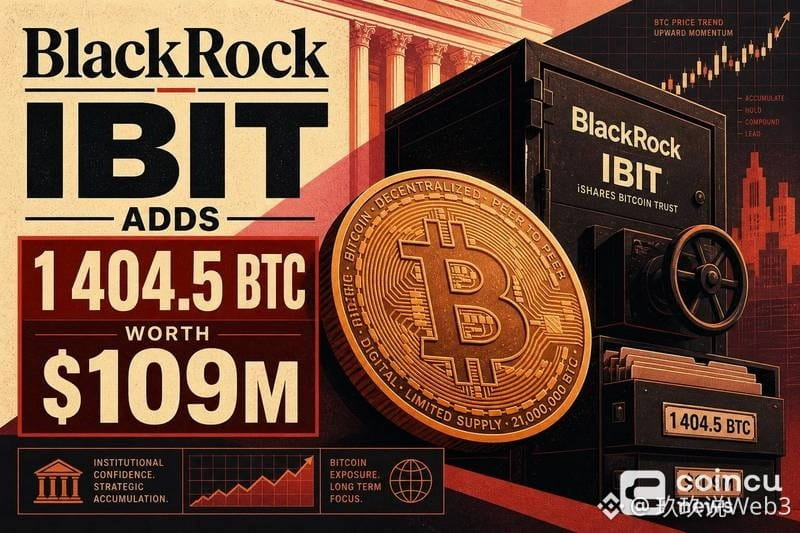
🚨 BlackRock’s iShares Bitcoin Trust (IBIT) added 1,404.5 BTC in a single day—worth about $109 million. When the market falls, the big players are scooping—are you game?
Right when Bitcoin dipped to around 77,000, it was reported that BlackRock’s iShares Bitcoin Trust (IBIT) saw a daily increase of 1,404.5 BTC. At the current price, that’s approximately $109 million. This isn’t pocket change—one buy can gobble up a lot of sell-side liquidity.
Let’s make it concrete: what does 1,404.5 BTC really mean? At $77,000 per coin, it’s about $108 million in hard cash—and that figure doesn’t even include inflows into other ETF funds at the same time. The moves of the world’s largest asset manager are always a gauge of institutional sentiment.
Cross-analysis: on the other side, Ethereum ETFs have already seen net inflows for 11 consecutive days. Both of the two mainstream asset ETFs are continuously attracting capital, suggesting that institutional money isn’t exiting—it’s using pullbacks to rotate and build positions. While retail traders panic-sell, the giants are quietly buying. Every sharp drop is essentially a reshuffling of position structures.
When retail traders are stuck debating short-term up or down, institutions are focused on the long-term logic of asset allocation. In the eyes of mainstream capital, Bitcoin’s position has already returned to what it should be—it’s not going back.
Risk hedging: note that this is a report not confirmed by official sources, and the single-day numbers may have errors. Don’t just go all-in based on one headline. Following along should be tied to your own position management—staggered entries are safer than a one-shot “all in.”
👀 BlackRock is already in—have you matched your position?
Click the avatar to watch the live stream, and join the Jiujiu chat group to get daily strategies 🚀
#以太坊ETF连续11日净流入 #Bitcoin August up 23% outperformed gold stock market
Group: 点击进入玖玖的粉丝群
Right when Bitcoin dipped to around 77,000, it was reported that BlackRock’s iShares Bitcoin Trust (IBIT) saw a daily increase of 1,404.5 BTC. At the current price, that’s approximately $109 million. This isn’t pocket change—one buy can gobble up a lot of sell-side liquidity.
Let’s make it concrete: what does 1,404.5 BTC really mean? At $77,000 per coin, it’s about $108 million in hard cash—and that figure doesn’t even include inflows into other ETF funds at the same time. The moves of the world’s largest asset manager are always a gauge of institutional sentiment.
Cross-analysis: on the other side, Ethereum ETFs have already seen net inflows for 11 consecutive days. Both of the two mainstream asset ETFs are continuously attracting capital, suggesting that institutional money isn’t exiting—it’s using pullbacks to rotate and build positions. While retail traders panic-sell, the giants are quietly buying. Every sharp drop is essentially a reshuffling of position structures.
When retail traders are stuck debating short-term up or down, institutions are focused on the long-term logic of asset allocation. In the eyes of mainstream capital, Bitcoin’s position has already returned to what it should be—it’s not going back.
Risk hedging: note that this is a report not confirmed by official sources, and the single-day numbers may have errors. Don’t just go all-in based on one headline. Following along should be tied to your own position management—staggered entries are safer than a one-shot “all in.”
👀 BlackRock is already in—have you matched your position?
Click the avatar to watch the live stream, and join the Jiujiu chat group to get daily strategies 🚀
#以太坊ETF连续11日净流入 #Bitcoin August up 23% outperformed gold stock market
Group: 点击进入玖玖的粉丝群
BTC-0.36%
IBITETF+0.02%
🚨 Bitcoin falls below $77,000,
Ethereum slips below $2,400, oil prices surge toward $95—yet Bitcoin ETFs are still seeing net inflows. What exactly is the market afraid of?
Group: 点击进入玖玖的粉丝群
Tensions between Iran and the U.S. escalate. As soon as news broke about missile attacks on U.S. military bases, Brent crude jumped straight toward the $95 level, and U.S. Treasury yields also rose to their highest level since January 2025. At the same time, U.S. stock tech sectors came under pressure. Bitcoin dropped below $77,000, while Ethereum lost the $2,400 support level.
Making it concrete: oil prices surged day-on-day, and the 10-year U.S. Treasury yield hit a fresh high since the beginning of this year. Risk assets were broadly pressured—but Bitcoin ETFs still continued to receive sustained net inflows. Money isn’t rushing for an exit in panic.
Cross analysis: geopolitical conflict lifts oil prices and bond yields, directly weighing on risk-asset valuations; however, ETF flows show funds are still buying. This suggests institutions are accumulating in tranches during the downturn. Retail panic versus institutional accumulation is stark. Historically, sharp sell-offs triggered by geopolitical events often fade quickly—what matters is whether the conflict escalates further.
In the short term, geopolitical fear dominates sentiment; in the long term, capital “votes with its feet.” Ultimately, liquidity is what determines the direction.
Hedging risk: if the conflict continues to escalate, oil could challenge the $100 mark, and risk assets may still have a second dip. Don’t rush to go all-in—keep your powder dry and add in batches. Position management will always matter more than prediction.
👀 Do you think this geopolitical shock is a chance to get in, or a reason to keep watching?
Click the avatar to watch the live stream and join the Jiujiu chat group for daily strategies 🚀
#原油 #美联储9月加息概率升至57%
Ethereum slips below $2,400, oil prices surge toward $95—yet Bitcoin ETFs are still seeing net inflows. What exactly is the market afraid of?
Group: 点击进入玖玖的粉丝群
Tensions between Iran and the U.S. escalate. As soon as news broke about missile attacks on U.S. military bases, Brent crude jumped straight toward the $95 level, and U.S. Treasury yields also rose to their highest level since January 2025. At the same time, U.S. stock tech sectors came under pressure. Bitcoin dropped below $77,000, while Ethereum lost the $2,400 support level.
Making it concrete: oil prices surged day-on-day, and the 10-year U.S. Treasury yield hit a fresh high since the beginning of this year. Risk assets were broadly pressured—but Bitcoin ETFs still continued to receive sustained net inflows. Money isn’t rushing for an exit in panic.
Cross analysis: geopolitical conflict lifts oil prices and bond yields, directly weighing on risk-asset valuations; however, ETF flows show funds are still buying. This suggests institutions are accumulating in tranches during the downturn. Retail panic versus institutional accumulation is stark. Historically, sharp sell-offs triggered by geopolitical events often fade quickly—what matters is whether the conflict escalates further.
In the short term, geopolitical fear dominates sentiment; in the long term, capital “votes with its feet.” Ultimately, liquidity is what determines the direction.
Hedging risk: if the conflict continues to escalate, oil could challenge the $100 mark, and risk assets may still have a second dip. Don’t rush to go all-in—keep your powder dry and add in batches. Position management will always matter more than prediction.
👀 Do you think this geopolitical shock is a chance to get in, or a reason to keep watching?
Click the avatar to watch the live stream and join the Jiujiu chat group for daily strategies 🚀
#原油 #美联储9月加息概率升至57%
Verified
🚨 Solana processed 5.2 billion on-chain transactions in August, setting a new all-time high. Does SOL’s valuation logic need to change?
Data released: In August, Solana handled over 5.2 billion non-voting transactions, breaking the historical record across the entire network—up 23% month-over-month from July.
What does 5.2 billion transactions mean? It’s more than 160 million per day. It leaves the previous record far behind. On-chain activity is completely turned up, and ecosystem usage is still accelerating. This isn’t a one-off spike—it’s sustained high-level operation throughout the month.
Cross-check for a clearer picture: The share of DEX spot trading volume relative to centralized exchanges is already approaching the 24% historical milestone—liquidity is migrating from CEXs to the chain, and Solana is one of the biggest beneficiaries of this shift. Behind the record-breaking transaction volumes are real users completing payments, trades, and asset allocation on-chain.
Look at the ecosystem structure as well: The circulation size of stablecoins on Solana continues to grow, and RWA projects are rolling out one after another. The “thickness” of the on-chain economy is completely different from two years ago, when things were mainly propped up by memes.
Usage is the most honest valuation anchor for a public chain. Solana is using data to prove that it’s not just “fast,” but that people truly are using it.
However, high transaction volume doesn’t automatically mean the token price must rise—ecosystem revenue, unlock supply, and sell-pressure all need close monitoring. Don’t get carried away just by a single month’s data; trend confirmation matters more than any one data point.
👀 Do you think this on-chain hype for Solana can support a new high for SOL?
Click the avatar to watch the livestream and join the Jiujiu chat group to get daily strategies 🚀
#solana #DeFi #Web3
Group: 点击进入玖玖的粉丝群
Data released: In August, Solana handled over 5.2 billion non-voting transactions, breaking the historical record across the entire network—up 23% month-over-month from July.
What does 5.2 billion transactions mean? It’s more than 160 million per day. It leaves the previous record far behind. On-chain activity is completely turned up, and ecosystem usage is still accelerating. This isn’t a one-off spike—it’s sustained high-level operation throughout the month.
Cross-check for a clearer picture: The share of DEX spot trading volume relative to centralized exchanges is already approaching the 24% historical milestone—liquidity is migrating from CEXs to the chain, and Solana is one of the biggest beneficiaries of this shift. Behind the record-breaking transaction volumes are real users completing payments, trades, and asset allocation on-chain.
Look at the ecosystem structure as well: The circulation size of stablecoins on Solana continues to grow, and RWA projects are rolling out one after another. The “thickness” of the on-chain economy is completely different from two years ago, when things were mainly propped up by memes.
Usage is the most honest valuation anchor for a public chain. Solana is using data to prove that it’s not just “fast,” but that people truly are using it.
However, high transaction volume doesn’t automatically mean the token price must rise—ecosystem revenue, unlock supply, and sell-pressure all need close monitoring. Don’t get carried away just by a single month’s data; trend confirmation matters more than any one data point.
👀 Do you think this on-chain hype for Solana can support a new high for SOL?
Click the avatar to watch the livestream and join the Jiujiu chat group to get daily strategies 🚀
#solana #DeFi #Web3
Group: 点击进入玖玖的粉丝群
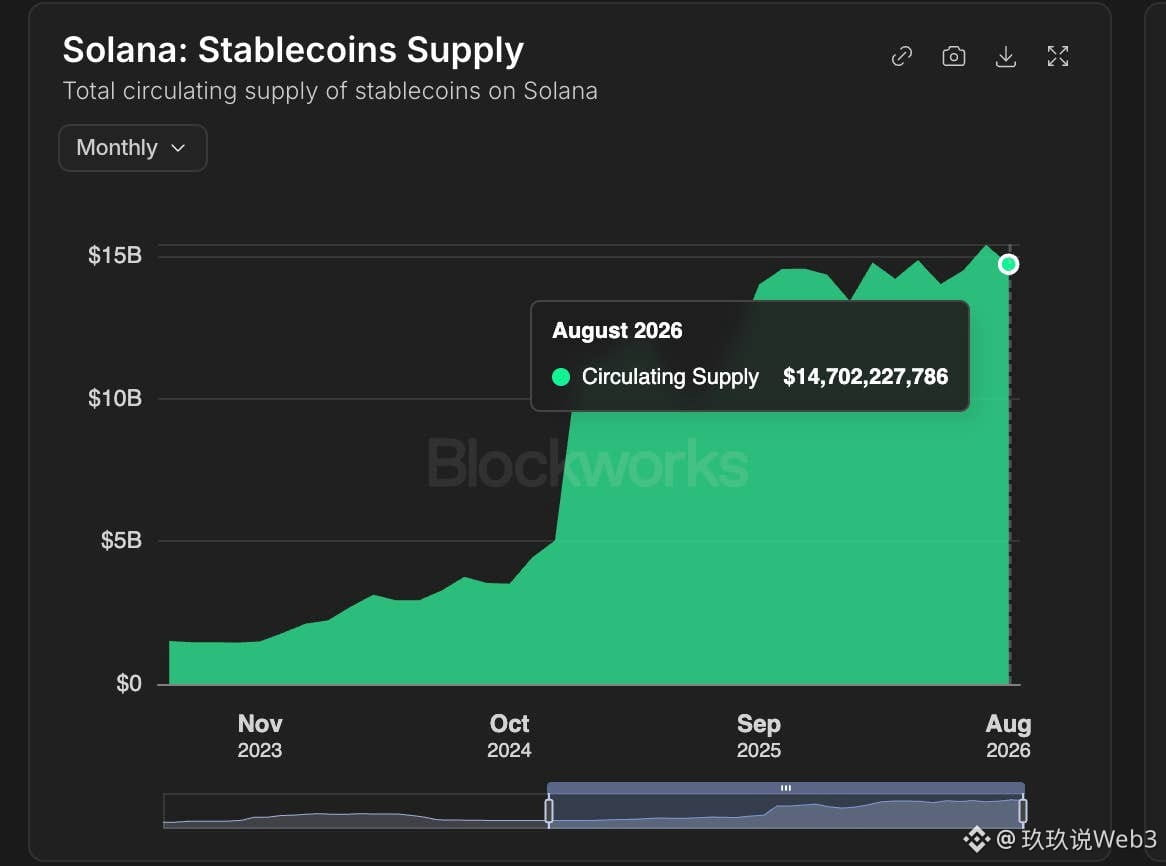
Verified
🚨 XRP spot ETF net inflow in August hits $1.67 billion—Goldman has the biggest position. Can you still chase this move?
Institutional buy orders pushed the August inflows of the XRP spot ETF to $1.67 billion, with Goldman’s holdings now the largest in the entire market.
How big is $1.67 billion? It far surpasses any previous weekly record—Goldman alone became the biggest holder, and market-making giants like Jane Street are also continuously adding.
The ETF channel is becoming the hardest entry point for XRP capital. Institutional participation is no longer just a slogan—it’s real, with tangible positions.
Even more intriguing is the cross-data: XRP is up 40% over two weeks, yet open interest in futures contracts has actually declined—suggesting this rally is driven more by spot institutional buying than by leveraged speculation. The structure is healthier than many expect. Spot-driven upside also tends to make pullbacks more resilient.
Add Ripple’s continued rollout in institutional custody and tokenized assets, and XRP is building a “dual-wheel path” of ETF capital plus an institutional ecosystem.
Once Wall Street’s ETF funds begin queuing up, XRP’s narrative shifts from “litigation concept” to “institutional allocation of assets”—the biggest identity change of this cycle.
But monthly inflows don’t equal daily inflows, and ETF money can just as easily rotate out. Before chasing, think clearly about where your stop-loss level is—don’t treat an institution’s position as your own belief.
👀 Will you allocate to XRP alongside institutions, or wait for a pullback to get on board?
Click the avatar to watch the livestream, and join the Jiuji chat group to get daily strategies 🚀
#XRP两周上涨40%未平仓合约下降 #xrp #Ripple
Group: 点击进入玖玖的粉丝群
Institutional buy orders pushed the August inflows of the XRP spot ETF to $1.67 billion, with Goldman’s holdings now the largest in the entire market.
How big is $1.67 billion? It far surpasses any previous weekly record—Goldman alone became the biggest holder, and market-making giants like Jane Street are also continuously adding.
The ETF channel is becoming the hardest entry point for XRP capital. Institutional participation is no longer just a slogan—it’s real, with tangible positions.
Even more intriguing is the cross-data: XRP is up 40% over two weeks, yet open interest in futures contracts has actually declined—suggesting this rally is driven more by spot institutional buying than by leveraged speculation. The structure is healthier than many expect. Spot-driven upside also tends to make pullbacks more resilient.
Add Ripple’s continued rollout in institutional custody and tokenized assets, and XRP is building a “dual-wheel path” of ETF capital plus an institutional ecosystem.
Once Wall Street’s ETF funds begin queuing up, XRP’s narrative shifts from “litigation concept” to “institutional allocation of assets”—the biggest identity change of this cycle.
But monthly inflows don’t equal daily inflows, and ETF money can just as easily rotate out. Before chasing, think clearly about where your stop-loss level is—don’t treat an institution’s position as your own belief.
👀 Will you allocate to XRP alongside institutions, or wait for a pullback to get on board?
Click the avatar to watch the livestream, and join the Jiuji chat group to get daily strategies 🚀
#XRP两周上涨40%未平仓合约下降 #xrp #Ripple
Group: 点击进入玖玖的粉丝群
Log in to explore more content