

#zkapi
zkapi
3,005 views
23 Discussing
Hot
Latest

·
--
🚨 Ethereum’s zkAPI is live on mainnet, enabling private, prepaid API payments via zero-knowledge proofs. This upgrade enhances on-chain privacy for service access without exposing user data. As ETH utility expands beyond DeFi into infrastructure, demand for private transaction layers may grow. Could this signal rising institutional interest in privacy-preserving Web3 tools? #zkAPI
$ETH #TradingSignal #CryptoAnalysis
🚨 Ethereum’s zkAPI is live on mainnet, enabling private, prepaid API payments via zero-knowledge proofs. This upgrade enhances on-chain privacy for service access without exposing user data. As ETH utility expands beyond DeFi into infrastructure, demand for private transaction layers may grow. Could this signal rising institutional interest in privacy-preserving Web3 tools? #zkAPI
$ETH #TradingSignal #CryptoAnalysis
$ETH #TradingSignal #CryptoAnalysis

26

ZK Privacy Hits Ethereum Mainnet
Ethereum's zkAPI has officially launched on mainnet, enabling private and prepaid API access through zero knowledge technology.
#zkAPI #PrivacyPayments
ZK Privacy Hits Ethereum Mainnet
Ethereum's zkAPI has officially launched on mainnet, enabling private and prepaid API access through zero knowledge technology.
#zkAPI #PrivacyPayments
Ethereum's zkAPI has officially launched on mainnet, enabling private and prepaid API access through zero knowledge technology.
#zkAPI #PrivacyPayments
62

Verified
#ethereumfoundationlauncheszkapionmainnet
Are you tired of AI companies tracking every prompt you make? Ethereum just solved the ultimate privacy problem. 🚨
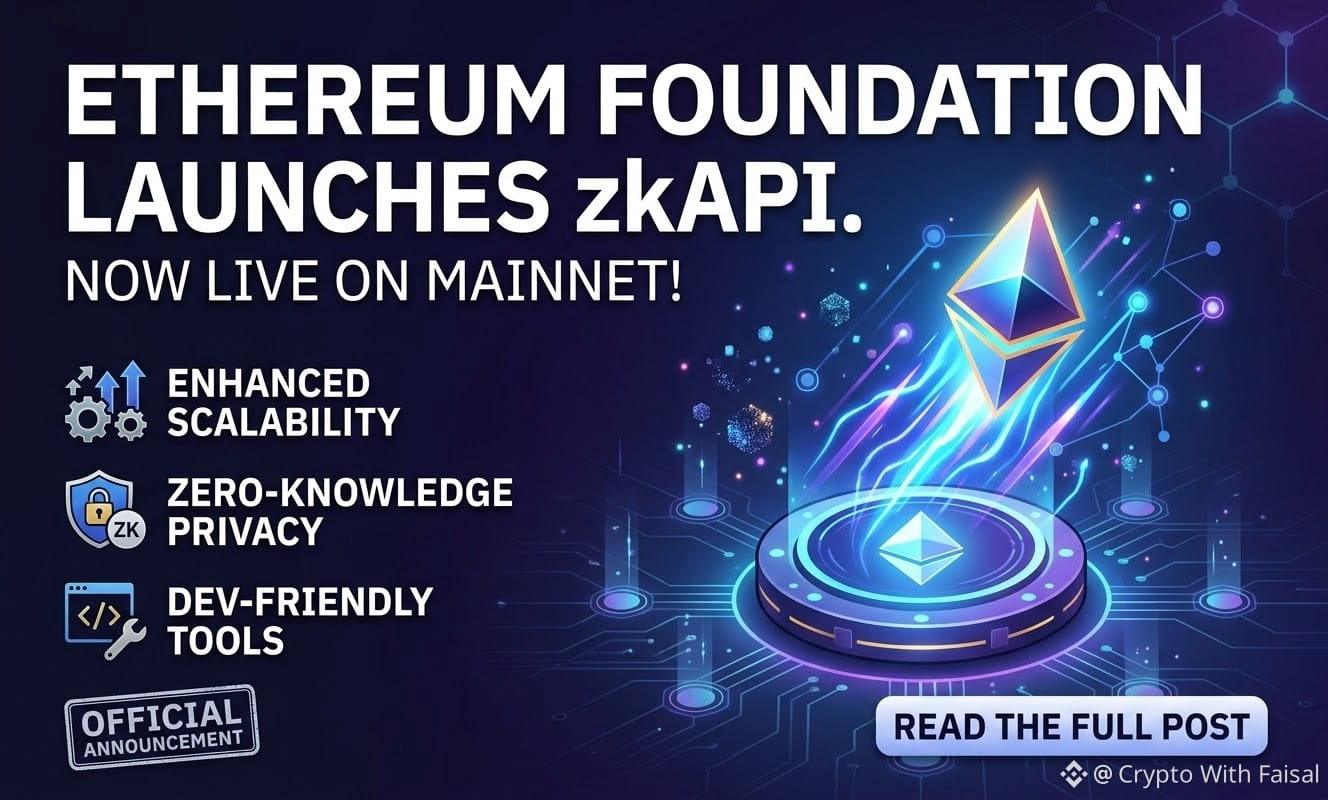
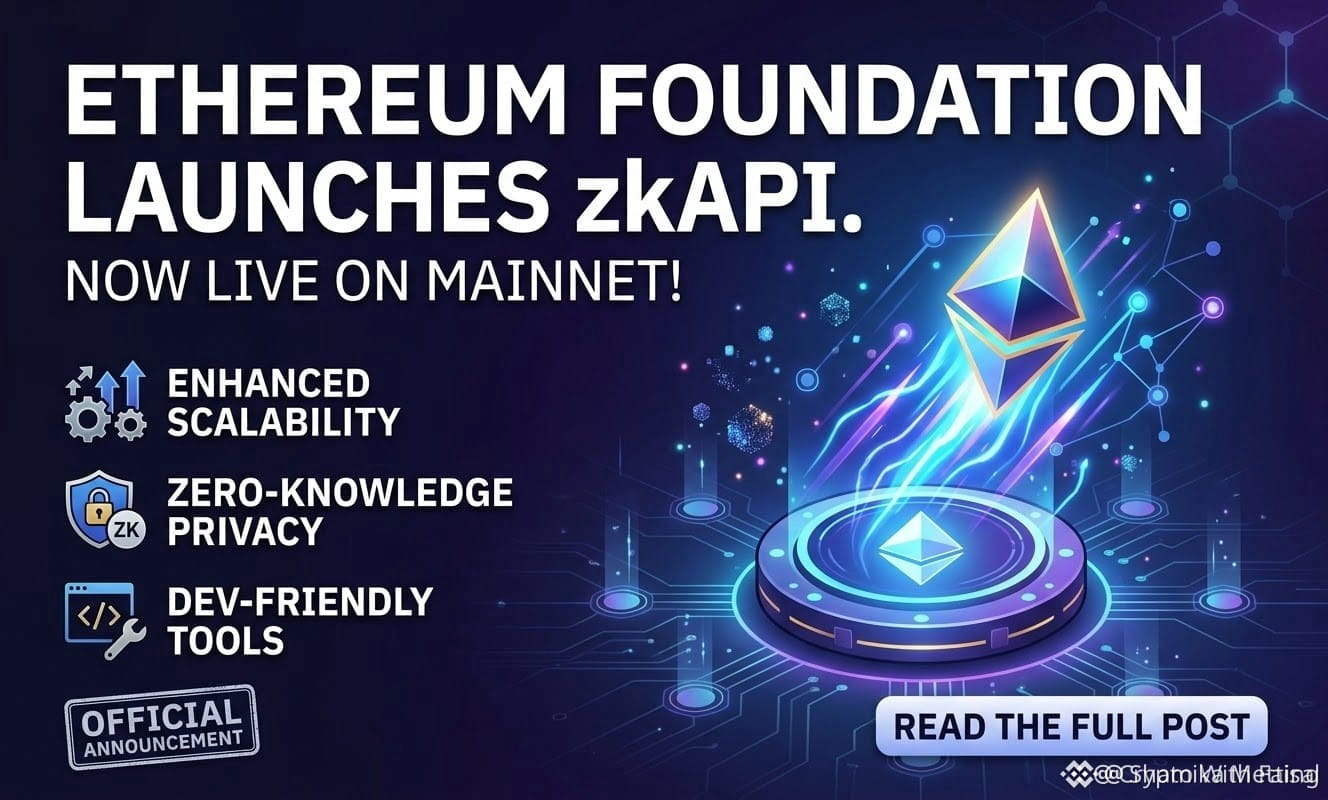
The Ethereum Foundation and the Open Anonymity Project have officially launched zkAPI on the Ethereum mainnet!
What does this mean? It’s a total game-changer for AI and API payments. Today, every AI prompt you send is linked to your billing identity. zkAPI fixes this by separating payment from identity using Zero-Knowledge (ZK) proofs.
Here is how it works:
1️⃣ Deposit ETH orUSDC into a smart contract vault on Ethereum.
2️⃣ Your balance becomes a private, untraceable digital note.
3️⃣ Pay for metered AI usage with ZK proofs—no identity attached!
The AI provider sees your prompt, the payment layer sees the spend, but NO ONE can link them together. This brings absolute privacy to personal AI usage, keeping your sensitive health, financial, and personal queries completely anonymous.
This is a massive leap for real-world utility and privacy on the Ethereum network. 🌐
Are you bullish on ZK tech scaling Web3 privacy? Drop your thoughts below! 👇
$ETH $ZKC
#Ethereum #zkAPI #CryptoAi
#ethereumfoundationlauncheszkapionmainnet
Are you tired of AI companies tracking every prompt you make? Ethereum just solved the ultimate privacy problem. 🚨
The Ethereum Foundation and the Open Anonymity Project have officially launched zkAPI on the Ethereum mainnet!
What does this mean? It’s a total game-changer for AI and API payments. Today, every AI prompt you send is linked to your billing identity. zkAPI fixes this by separating payment from identity using Zero-Knowledge (ZK) proofs.
Here is how it works:
1️⃣ Deposit ETH orUSDC into a smart contract vault on Ethereum.
2️⃣ Your balance becomes a private, untraceable digital note.
3️⃣ Pay for metered AI usage with ZK proofs—no identity attached!
The AI provider sees your prompt, the payment layer sees the spend, but NO ONE can link them together. This brings absolute privacy to personal AI usage, keeping your sensitive health, financial, and personal queries completely anonymous.
This is a massive leap for real-world utility and privacy on the Ethereum network. 🌐
Are you bullish on ZK tech scaling Web3 privacy? Drop your thoughts below! 👇
$ETH $ZKC
#Ethereum #zkAPI #CryptoAi
Are you tired of AI companies tracking every prompt you make? Ethereum just solved the ultimate privacy problem. 🚨
The Ethereum Foundation and the Open Anonymity Project have officially launched zkAPI on the Ethereum mainnet!
What does this mean? It’s a total game-changer for AI and API payments. Today, every AI prompt you send is linked to your billing identity. zkAPI fixes this by separating payment from identity using Zero-Knowledge (ZK) proofs.
Here is how it works:
1️⃣ Deposit ETH orUSDC into a smart contract vault on Ethereum.
2️⃣ Your balance becomes a private, untraceable digital note.
3️⃣ Pay for metered AI usage with ZK proofs—no identity attached!
The AI provider sees your prompt, the payment layer sees the spend, but NO ONE can link them together. This brings absolute privacy to personal AI usage, keeping your sensitive health, financial, and personal queries completely anonymous.
This is a massive leap for real-world utility and privacy on the Ethereum network. 🌐
Are you bullish on ZK tech scaling Web3 privacy? Drop your thoughts below! 👇
$ETH $ZKC
#Ethereum #zkAPI #CryptoAi
1
683

·
--
#以太坊基金会主网推出zkAPI Ethereum Foundation makes a big move! zkAPI officially goes live on the mainnet
The Ethereum Foundation has announced that, together with the Open Anonymity Project, zkAPI has launched on the Ethereum mainnet.
The core idea behind zkAPI is very simple:
Use zero-knowledge proofs to separate “payments” and “identity.”
Users can first deposit assets such as ETH and USDC into an Ethereum treasury, and then use zero-knowledge proofs to prove that they have enough balance to pay for the API service—without exposing which specific funds are being used or who is making the payment.
The first key use case is AI APIs. Users can obtain short-term, limited API keys to call AI services normally, while the payment layer will not directly know the identity of the corresponding user. In the future, it can be extended to blockchain RPC, image/video generation, VPN bandwidth, and even machine-to-machine payments between AI agents.
However, it’s important to note: zkAPI is not “completely anonymous.” The official statement makes it clear that IP addresses, request times, and even the prompt content may still be used to link users or sessions.
AI + ZK + Ethereum—this combination is finally starting to take real shape.
#ETH #Ethereum #zkAPI
#以太坊基金会主网推出zkAPI Ethereum Foundation makes a big move! zkAPI officially goes live on the mainnet
The Ethereum Foundation has announced that, together with the Open Anonymity Project, zkAPI has launched on the Ethereum mainnet.
The core idea behind zkAPI is very simple:
Use zero-knowledge proofs to separate “payments” and “identity.”
Users can first deposit assets such as ETH and USDC into an Ethereum treasury, and then use zero-knowledge proofs to prove that they have enough balance to pay for the API service—without exposing which specific funds are being used or who is making the payment.
The first key use case is AI APIs. Users can obtain short-term, limited API keys to call AI services normally, while the payment layer will not directly know the identity of the corresponding user. In the future, it can be extended to blockchain RPC, image/video generation, VPN bandwidth, and even machine-to-machine payments between AI agents.
However, it’s important to note: zkAPI is not “completely anonymous.” The official statement makes it clear that IP addresses, request times, and even the prompt content may still be used to link users or sessions.
AI + ZK + Ethereum—this combination is finally starting to take real shape.
#ETH #Ethereum #zkAPI
The Ethereum Foundation has announced that, together with the Open Anonymity Project, zkAPI has launched on the Ethereum mainnet.
The core idea behind zkAPI is very simple:
Use zero-knowledge proofs to separate “payments” and “identity.”
Users can first deposit assets such as ETH and USDC into an Ethereum treasury, and then use zero-knowledge proofs to prove that they have enough balance to pay for the API service—without exposing which specific funds are being used or who is making the payment.
The first key use case is AI APIs. Users can obtain short-term, limited API keys to call AI services normally, while the payment layer will not directly know the identity of the corresponding user. In the future, it can be extended to blockchain RPC, image/video generation, VPN bandwidth, and even machine-to-machine payments between AI agents.
However, it’s important to note: zkAPI is not “completely anonymous.” The official statement makes it clear that IP addresses, request times, and even the prompt content may still be used to link users or sessions.
AI + ZK + Ethereum—this combination is finally starting to take real shape.
#ETH #Ethereum #zkAPI
42

BREAKING: Ethereum Foundation just launched zkAPI! This is a groundbreaking zero-knowledge system, promising to change the game for privacy in API payments, especially for AI.
Imagine paying for a service without revealing your identity or payment details. zkAPI can do that. You deposit funds into an Ethereum vault once, then use zero-knowledge proofs to authorize API usage without disclosing who you are.
Running on the Ethereum mainnet, zkAPI completely separates payments from usage. Providers see the request, the payment layer sees the amount spent, but they cannot link it back to the same user. Elevating personal data security in the AI era.
Even though it’s still experimental and doesn’t solve every kind of leak (like IP), zkAPI’s potential is huge. Not only for AI—it also opens the door to other paid APIs such as RPC, VPN, or machine-to-machine services, boosting Web3.
Could this be the most important leap forward for privacy and AI applications on Ethereum?
#Ethereum #zkAPI
$ETH
BREAKING: Ethereum Foundation just launched zkAPI! This is a groundbreaking zero-knowledge system, promising to change the game for privacy in API payments, especially for AI.
Imagine paying for a service without revealing your identity or payment details. zkAPI can do that. You deposit funds into an Ethereum vault once, then use zero-knowledge proofs to authorize API usage without disclosing who you are.
Running on the Ethereum mainnet, zkAPI completely separates payments from usage. Providers see the request, the payment layer sees the amount spent, but they cannot link it back to the same user. Elevating personal data security in the AI era.
Even though it’s still experimental and doesn’t solve every kind of leak (like IP), zkAPI’s potential is huge. Not only for AI—it also opens the door to other paid APIs such as RPC, VPN, or machine-to-machine services, boosting Web3.
Could this be the most important leap forward for privacy and AI applications on Ethereum?
#Ethereum #zkAPI
$ETH
Imagine paying for a service without revealing your identity or payment details. zkAPI can do that. You deposit funds into an Ethereum vault once, then use zero-knowledge proofs to authorize API usage without disclosing who you are.
Running on the Ethereum mainnet, zkAPI completely separates payments from usage. Providers see the request, the payment layer sees the amount spent, but they cannot link it back to the same user. Elevating personal data security in the AI era.
Even though it’s still experimental and doesn’t solve every kind of leak (like IP), zkAPI’s potential is huge. Not only for AI—it also opens the door to other paid APIs such as RPC, VPN, or machine-to-machine services, boosting Web3.
Could this be the most important leap forward for privacy and AI applications on Ethereum?
#Ethereum #zkAPI
$ETH
120


Verified
#ethereumfoundationlauncheszkapionmainnet
Are you tired of AI companies that monitor every instruction (prompt) you write? Ethereum has just solved the ultimate privacy problem. 🚨
The Ethereum Foundation and the Open Anonymity project have officially launched zkAPI on the Ethereum mainnet!
What does this mean? It’s a complete radical change for AI payments and APIs. Today, every AI instruction you send is linked to your unique identity. zkAPI handles this by separating payment from identity using zero-knowledge proofs (ZK).
Here’s how it works:
1️⃣ Deposit ETH or USDC into a smart contract vault on Ethereum.
2️⃣ Your balance becomes a private, untraceable digital receipt.
3️⃣ Pay for metered AI usage with ZK proofs—without any attached identity!
An AI provider sees your request, and you see the payment layer showing how much was spent, but no one can link the two together. This provides absolute privacy for personal AI usage, keeping your sensitive health, finance, and personal inquiries completely anonymous.
It’s a big step toward real-world utility and privacy on Ethereum. 🌐
Are you optimistic about expanding ZK technologies for Web3 privacy? Share your thoughts below! 👇
Please follow
$ETH $ZKC
#Ethereum #zkAPI #CryptoAi
#ethereumfoundationlauncheszkapionmainnet
Are you tired of AI companies that monitor every instruction (prompt) you write? Ethereum has just solved the ultimate privacy problem. 🚨
The Ethereum Foundation and the Open Anonymity project have officially launched zkAPI on the Ethereum mainnet!
What does this mean? It’s a complete radical change for AI payments and APIs. Today, every AI instruction you send is linked to your unique identity. zkAPI handles this by separating payment from identity using zero-knowledge proofs (ZK).
Here’s how it works:
1️⃣ Deposit ETH or USDC into a smart contract vault on Ethereum.
2️⃣ Your balance becomes a private, untraceable digital receipt.
3️⃣ Pay for metered AI usage with ZK proofs—without any attached identity!
An AI provider sees your request, and you see the payment layer showing how much was spent, but no one can link the two together. This provides absolute privacy for personal AI usage, keeping your sensitive health, finance, and personal inquiries completely anonymous.
It’s a big step toward real-world utility and privacy on Ethereum. 🌐
Are you optimistic about expanding ZK technologies for Web3 privacy? Share your thoughts below! 👇
Please follow
$ETH $ZKC
#Ethereum #zkAPI #CryptoAi
Are you tired of AI companies that monitor every instruction (prompt) you write? Ethereum has just solved the ultimate privacy problem. 🚨
The Ethereum Foundation and the Open Anonymity project have officially launched zkAPI on the Ethereum mainnet!
What does this mean? It’s a complete radical change for AI payments and APIs. Today, every AI instruction you send is linked to your unique identity. zkAPI handles this by separating payment from identity using zero-knowledge proofs (ZK).
Here’s how it works:
1️⃣ Deposit ETH or USDC into a smart contract vault on Ethereum.
2️⃣ Your balance becomes a private, untraceable digital receipt.
3️⃣ Pay for metered AI usage with ZK proofs—without any attached identity!
An AI provider sees your request, and you see the payment layer showing how much was spent, but no one can link the two together. This provides absolute privacy for personal AI usage, keeping your sensitive health, finance, and personal inquiries completely anonymous.
It’s a big step toward real-world utility and privacy on Ethereum. 🌐
Are you optimistic about expanding ZK technologies for Web3 privacy? Share your thoughts below! 👇
Please follow
$ETH $ZKC
#Ethereum #zkAPI #CryptoAi
1
4.2k
October Ethereum Market Outlook: Mixed Bulls and Bears on Technicals—Can Ecosystem Positives Push a Breakout Above $2,800?
I. Price Movement Analysis
As of 10:00 Beijing time on October 2, 2026, Ethereum’s spot price is $2,751. Over the past 24 hours, it has risen by about 2%. The intraday high reached $2,766.6. Looking at the hourly candlesticks, the price has been oscillating narrowly between $2,740 and $2,770. The most recent 1-hour candle closed at $2,754. Trading volume was about 1,596 ETH, and the trading value was approximately $43.96 million. Volume rebounded compared with the previous hour, but overall activity remains relatively mild.
In terms of moving averages, the 7-day moving average is $2,744, the 25-day moving average is $2,715, and the 99-day moving average is $2,695. All three moving averages are also aligned bullishly, and the price is holding steady above all of them. Notably, the gap between the 7-day and 25-day moving averages is about $29, larger than before, suggesting that a short-term upward trend is taking shape. On the Bollinger Bands, the upper band is at $2,762; price has already tested near the upper band and is now facing a directional decision.
II. Interpretation of Technical Indicators
For the MACD indicator, the DIF line is 14.34, the DEA line is 11.45, and the histogram value is 2.89. All three lines are above the zero axis, confirming a bullish structure. However, the histogram has slightly narrowed versus the prior value (from 2.92), hinting that upside momentum may be marginally weakening.
The RSI indicator shows a mixed picture. The 6-period RSI is 70.74, just entering the edge of the overbought zone. The 12-period RSI is 66.59, in a neutral-to-strong region. The 24-period RSI is 61.19, still within a healthy range. The 14-period RSI factor sends a bearish signal, with a historical win rate of 75%—a signal worth paying attention to.
For the KDJ indicator, the K value is 61.307, the D value is 64.67, and the J value is 54.58. All three lines are in the neutral zone—neither overbought nor oversold—indicating that the short-term direction is still unclear. Quantitative factor statistics show that among 15 factors, 7 are bullish and 8 are bearish; the long/short ratio is close to balanced. The composite indicator value is -1, producing a bearish signal, with an overall win rate of about 55%. This contrasts sharply with Bitcoin’s clearly bullish signals, suggesting Ethereum’s current technical picture is more complex.
III. Market Sentiment Analysis
Ethereum’s market currently faces a situation where bullish and bearish factors overlap. On the positive side, Citibank has raised its 12-month target price for Ethereum from $2,240 to $3,028, injecting a mid-term bullish expectation into the market. In addition, the Ethereum Foundation has officially launched the zkAPI mainnet, supporting users to make AI payments privacy-preserving via zero-knowledge proofs. This innovation adds concrete application scenarios to the Ethereum ecosystem, positioning Ethereum at the intersection of privacy technology and AI payments.
On the downside, the U.S. spot Ethereum ETF has recorded consecutive net outflows. In the last two trading days, it saw outflows of $59.6 million and $54.4 million, respectively, indicating institutional funds are withdrawing. Furthermore, the EIP-8363 proposal was pulled back after opposition from the developer community, increasing uncertainty about the future prospects of the staking economy. Large outflows near the $2,750 level also suggest there may be profit-taking pressure.
Overall, Ethereum’s short-term technicals are slightly neutral, supported by real ecosystem positives such as zkAPI at the application layer. However, ETF fund outflows and uncertainties in governance remain sources of pressure. Investors are advised to watch whether Ethereum can break through the $2,762 Bollinger upper band effectively. If it can, there is a chance to open upside space above $2,800; otherwise, it may pull back toward the 25-day moving average support at $2,715.
Hot Token Updates:
SAND Current price: $0.070301, 24h change: +63.32%
ENJ Current price: $0.036777, 24h change: +26.10%
GTC Current price: $0.012466, 24h change: +22.60%
#Ethereum #ETH #zkAPI
October Ethereum Market Outlook: Mixed Bulls and Bears on Technicals—Can Ecosystem Positives Push a Breakout Above $2,800?
I. Price Movement Analysis
As of 10:00 Beijing time on October 2, 2026, Ethereum’s spot price is $2,751. Over the past 24 hours, it has risen by about 2%. The intraday high reached $2,766.6. Looking at the hourly candlesticks, the price has been oscillating narrowly between $2,740 and $2,770. The most recent 1-hour candle closed at $2,754. Trading volume was about 1,596 ETH, and the trading value was approximately $43.96 million. Volume rebounded compared with the previous hour, but overall activity remains relatively mild.
In terms of moving averages, the 7-day moving average is $2,744, the 25-day moving average is $2,715, and the 99-day moving average is $2,695. All three moving averages are also aligned bullishly, and the price is holding steady above all of them. Notably, the gap between the 7-day and 25-day moving averages is about $29, larger than before, suggesting that a short-term upward trend is taking shape. On the Bollinger Bands, the upper band is at $2,762; price has already tested near the upper band and is now facing a directional decision.
II. Interpretation of Technical Indicators
For the MACD indicator, the DIF line is 14.34, the DEA line is 11.45, and the histogram value is 2.89. All three lines are above the zero axis, confirming a bullish structure. However, the histogram has slightly narrowed versus the prior value (from 2.92), hinting that upside momentum may be marginally weakening.
The RSI indicator shows a mixed picture. The 6-period RSI is 70.74, just entering the edge of the overbought zone. The 12-period RSI is 66.59, in a neutral-to-strong region. The 24-period RSI is 61.19, still within a healthy range. The 14-period RSI factor sends a bearish signal, with a historical win rate of 75%—a signal worth paying attention to.
For the KDJ indicator, the K value is 61.307, the D value is 64.67, and the J value is 54.58. All three lines are in the neutral zone—neither overbought nor oversold—indicating that the short-term direction is still unclear. Quantitative factor statistics show that among 15 factors, 7 are bullish and 8 are bearish; the long/short ratio is close to balanced. The composite indicator value is -1, producing a bearish signal, with an overall win rate of about 55%. This contrasts sharply with Bitcoin’s clearly bullish signals, suggesting Ethereum’s current technical picture is more complex.
III. Market Sentiment Analysis
Ethereum’s market currently faces a situation where bullish and bearish factors overlap. On the positive side, Citibank has raised its 12-month target price for Ethereum from $2,240 to $3,028, injecting a mid-term bullish expectation into the market. In addition, the Ethereum Foundation has officially launched the zkAPI mainnet, supporting users to make AI payments privacy-preserving via zero-knowledge proofs. This innovation adds concrete application scenarios to the Ethereum ecosystem, positioning Ethereum at the intersection of privacy technology and AI payments.
On the downside, the U.S. spot Ethereum ETF has recorded consecutive net outflows. In the last two trading days, it saw outflows of $59.6 million and $54.4 million, respectively, indicating institutional funds are withdrawing. Furthermore, the EIP-8363 proposal was pulled back after opposition from the developer community, increasing uncertainty about the future prospects of the staking economy. Large outflows near the $2,750 level also suggest there may be profit-taking pressure.
Overall, Ethereum’s short-term technicals are slightly neutral, supported by real ecosystem positives such as zkAPI at the application layer. However, ETF fund outflows and uncertainties in governance remain sources of pressure. Investors are advised to watch whether Ethereum can break through the $2,762 Bollinger upper band effectively. If it can, there is a chance to open upside space above $2,800; otherwise, it may pull back toward the 25-day moving average support at $2,715.
Hot Token Updates:
SAND Current price: $0.070301, 24h change: +63.32%
ENJ Current price: $0.036777, 24h change: +26.10%
GTC Current price: $0.012466, 24h change: +22.60%
#Ethereum #ETH #zkAPI
I. Price Movement Analysis
As of 10:00 Beijing time on October 2, 2026, Ethereum’s spot price is $2,751. Over the past 24 hours, it has risen by about 2%. The intraday high reached $2,766.6. Looking at the hourly candlesticks, the price has been oscillating narrowly between $2,740 and $2,770. The most recent 1-hour candle closed at $2,754. Trading volume was about 1,596 ETH, and the trading value was approximately $43.96 million. Volume rebounded compared with the previous hour, but overall activity remains relatively mild.
In terms of moving averages, the 7-day moving average is $2,744, the 25-day moving average is $2,715, and the 99-day moving average is $2,695. All three moving averages are also aligned bullishly, and the price is holding steady above all of them. Notably, the gap between the 7-day and 25-day moving averages is about $29, larger than before, suggesting that a short-term upward trend is taking shape. On the Bollinger Bands, the upper band is at $2,762; price has already tested near the upper band and is now facing a directional decision.
II. Interpretation of Technical Indicators
For the MACD indicator, the DIF line is 14.34, the DEA line is 11.45, and the histogram value is 2.89. All three lines are above the zero axis, confirming a bullish structure. However, the histogram has slightly narrowed versus the prior value (from 2.92), hinting that upside momentum may be marginally weakening.
The RSI indicator shows a mixed picture. The 6-period RSI is 70.74, just entering the edge of the overbought zone. The 12-period RSI is 66.59, in a neutral-to-strong region. The 24-period RSI is 61.19, still within a healthy range. The 14-period RSI factor sends a bearish signal, with a historical win rate of 75%—a signal worth paying attention to.
For the KDJ indicator, the K value is 61.307, the D value is 64.67, and the J value is 54.58. All three lines are in the neutral zone—neither overbought nor oversold—indicating that the short-term direction is still unclear. Quantitative factor statistics show that among 15 factors, 7 are bullish and 8 are bearish; the long/short ratio is close to balanced. The composite indicator value is -1, producing a bearish signal, with an overall win rate of about 55%. This contrasts sharply with Bitcoin’s clearly bullish signals, suggesting Ethereum’s current technical picture is more complex.
III. Market Sentiment Analysis
Ethereum’s market currently faces a situation where bullish and bearish factors overlap. On the positive side, Citibank has raised its 12-month target price for Ethereum from $2,240 to $3,028, injecting a mid-term bullish expectation into the market. In addition, the Ethereum Foundation has officially launched the zkAPI mainnet, supporting users to make AI payments privacy-preserving via zero-knowledge proofs. This innovation adds concrete application scenarios to the Ethereum ecosystem, positioning Ethereum at the intersection of privacy technology and AI payments.
On the downside, the U.S. spot Ethereum ETF has recorded consecutive net outflows. In the last two trading days, it saw outflows of $59.6 million and $54.4 million, respectively, indicating institutional funds are withdrawing. Furthermore, the EIP-8363 proposal was pulled back after opposition from the developer community, increasing uncertainty about the future prospects of the staking economy. Large outflows near the $2,750 level also suggest there may be profit-taking pressure.
Overall, Ethereum’s short-term technicals are slightly neutral, supported by real ecosystem positives such as zkAPI at the application layer. However, ETF fund outflows and uncertainties in governance remain sources of pressure. Investors are advised to watch whether Ethereum can break through the $2,762 Bollinger upper band effectively. If it can, there is a chance to open upside space above $2,800; otherwise, it may pull back toward the 25-day moving average support at $2,715.
Hot Token Updates:
SAND Current price: $0.070301, 24h change: +63.32%
ENJ Current price: $0.036777, 24h change: +26.10%
GTC Current price: $0.012466, 24h change: +22.60%
#Ethereum #ETH #zkAPI
160
Ethereum’s Technical Outlook: Mixed Long and Short Signals—The Launch of zkAPI Boosts the Ecosystem, but Short-Term Profit-Taking Pressure Looms
1. Price Trend Analysis
As of 10:00 a.m. on October 2, 2026, Ethereum is quoted at $2,747. The price has risen by approximately 1.68% over the past 24 hours. After opening at $2,729, the price moved higher in choppy trading; it peaked at $2,777 and then pulled back to consolidate around $2,747. From the hourly chart, after touching near the upper Bollinger Band, Ethereum showed a clear decline, indicating that overhead selling pressure cannot be ignored.
Of note, Citibank has raised its 12-month target price for Ethereum to $3,028, reflecting institutional confidence in Ethereum’s ecosystem development. Meanwhile, the Ethereum Foundation and partners have launched zkAPI on the mainnet. Users can pay for AI and API services using zero-knowledge proofs without exposing their billing identity. This innovation expands Ethereum’s application scenarios into the AI payments domain.
2. Interpretation of Technical Indicators
Moving average system: the 7-period MA is $2,740, the 25-period MA is $2,714, and the 99-period MA is $2,694. All three moving averages remain in a bullish alignment. The exponential moving averages (EMA) are also in a bullish structure: the 7-period EMA is $2,740, the 25-period EMA is $2,720, and the 99-period EMA is $2,699. Price action is trading above all moving averages, suggesting the medium-term trend is still upward.
Bollinger Bands: the current price is close to the upper band at $2,760; the middle band is at $2,719; the lower band is at $2,677. The price is oscillating near the upper band, and there is short-term pullback pressure.
MACD: the DIF line is 13.68, the DEA line is 10.73, and the histogram is positive at 2.95. MACD is above the zero axis and DIF remains above DEA, maintaining a bullish setup. However, the histogram has gradually shrunk from 4.08 to 2.95, indicating weakening upside momentum.
RSI: the 6-period RSI is 65.41, the 12-period RSI is 63.89, and the 24-period RSI is 59.72. Compared with Bitcoin, Ethereum’s RSI sits in a relatively neutral-to-strong region and has not entered an overbought state, but subsequent price action should still be watched closely. For KDJ, the K line is 59, the D line is 66, and the J line is 46. The three lines show signs of downward divergence, suggesting a possible short-term correction.
Overall factor statistics: among 15 quantitative factors, 8 have issued buy-long signals and 7 have issued sell-short signals. Long and short power is close to balanced. The composite indicator is -1 with a sell-short signal; the historical win rate is about 53%. Overall, the signal is somewhat cautious. This contrasts with Bitcoin’s strong long signals, indicating that the market has greater disagreement on Ethereum’s short-term direction.
3. Market Sentiment Analysis
Ethereum’s market sentiment is characterized by interwoven long and short forces. On the positive side, zkAPI’s mainnet launch brings a tangible upside to the Ethereum ecosystem, extending Ethereum’s application scenarios from traditional DeFi and NFTs into AI payments. This innovation could attract more developers and users into Ethereum’s ecosystem, and in the long run may enhance the network’s value.
However, there are several short-term pressure factors. First, spot Ethereum ETFs recorded a net outflow of $55.4 million on October 1, with consecutive days of redemptions indicating that some institutional investors are taking profits at higher levels. Second, according to the latest fund flow data, net outflows in the most recent hour exceeded $51.15 million, suggesting relatively clear near-term selling pressure.
From a macro perspective, the US 10-year Treasury yield remains around 5.3%, which exerts some liquidity pressure on non-yielding crypto assets. Still, dovish signals released by Federal Reserve officials could help ease this pressure. If the upcoming Non-Farm Payroll data turns out weak, it may provide additional upside momentum for the crypto market.
Technically, Ethereum is currently trading in a range between $2,700 and $2,780. The area from $2,760 to $2,780 is an important resistance zone, while $2,710 to $2,690 is short-term support. Investors are advised to watch for a breakout direction from the range. Until the zkAPI ecosystem impact fully materializes, maintaining a moderate level of caution is recommended.
Hot Token Watch:
SAND: current price $0.06537; 24h change +52.48%
GTC: current price $0.13110; 24h change +30.10%
SCR: current price $0.03016; 24h change +19.02%
#Ethereum #以太坊 #zkAPI
Ethereum’s Technical Outlook: Mixed Long and Short Signals—The Launch of zkAPI Boosts the Ecosystem, but Short-Term Profit-Taking Pressure Looms
1. Price Trend Analysis
As of 10:00 a.m. on October 2, 2026, Ethereum is quoted at $2,747. The price has risen by approximately 1.68% over the past 24 hours. After opening at $2,729, the price moved higher in choppy trading; it peaked at $2,777 and then pulled back to consolidate around $2,747. From the hourly chart, after touching near the upper Bollinger Band, Ethereum showed a clear decline, indicating that overhead selling pressure cannot be ignored.
Of note, Citibank has raised its 12-month target price for Ethereum to $3,028, reflecting institutional confidence in Ethereum’s ecosystem development. Meanwhile, the Ethereum Foundation and partners have launched zkAPI on the mainnet. Users can pay for AI and API services using zero-knowledge proofs without exposing their billing identity. This innovation expands Ethereum’s application scenarios into the AI payments domain.
2. Interpretation of Technical Indicators
Moving average system: the 7-period MA is $2,740, the 25-period MA is $2,714, and the 99-period MA is $2,694. All three moving averages remain in a bullish alignment. The exponential moving averages (EMA) are also in a bullish structure: the 7-period EMA is $2,740, the 25-period EMA is $2,720, and the 99-period EMA is $2,699. Price action is trading above all moving averages, suggesting the medium-term trend is still upward.
Bollinger Bands: the current price is close to the upper band at $2,760; the middle band is at $2,719; the lower band is at $2,677. The price is oscillating near the upper band, and there is short-term pullback pressure.
MACD: the DIF line is 13.68, the DEA line is 10.73, and the histogram is positive at 2.95. MACD is above the zero axis and DIF remains above DEA, maintaining a bullish setup. However, the histogram has gradually shrunk from 4.08 to 2.95, indicating weakening upside momentum.
RSI: the 6-period RSI is 65.41, the 12-period RSI is 63.89, and the 24-period RSI is 59.72. Compared with Bitcoin, Ethereum’s RSI sits in a relatively neutral-to-strong region and has not entered an overbought state, but subsequent price action should still be watched closely. For KDJ, the K line is 59, the D line is 66, and the J line is 46. The three lines show signs of downward divergence, suggesting a possible short-term correction.
Overall factor statistics: among 15 quantitative factors, 8 have issued buy-long signals and 7 have issued sell-short signals. Long and short power is close to balanced. The composite indicator is -1 with a sell-short signal; the historical win rate is about 53%. Overall, the signal is somewhat cautious. This contrasts with Bitcoin’s strong long signals, indicating that the market has greater disagreement on Ethereum’s short-term direction.
3. Market Sentiment Analysis
Ethereum’s market sentiment is characterized by interwoven long and short forces. On the positive side, zkAPI’s mainnet launch brings a tangible upside to the Ethereum ecosystem, extending Ethereum’s application scenarios from traditional DeFi and NFTs into AI payments. This innovation could attract more developers and users into Ethereum’s ecosystem, and in the long run may enhance the network’s value.
However, there are several short-term pressure factors. First, spot Ethereum ETFs recorded a net outflow of $55.4 million on October 1, with consecutive days of redemptions indicating that some institutional investors are taking profits at higher levels. Second, according to the latest fund flow data, net outflows in the most recent hour exceeded $51.15 million, suggesting relatively clear near-term selling pressure.
From a macro perspective, the US 10-year Treasury yield remains around 5.3%, which exerts some liquidity pressure on non-yielding crypto assets. Still, dovish signals released by Federal Reserve officials could help ease this pressure. If the upcoming Non-Farm Payroll data turns out weak, it may provide additional upside momentum for the crypto market.
Technically, Ethereum is currently trading in a range between $2,700 and $2,780. The area from $2,760 to $2,780 is an important resistance zone, while $2,710 to $2,690 is short-term support. Investors are advised to watch for a breakout direction from the range. Until the zkAPI ecosystem impact fully materializes, maintaining a moderate level of caution is recommended.
Hot Token Watch:
SAND: current price $0.06537; 24h change +52.48%
GTC: current price $0.13110; 24h change +30.10%
SCR: current price $0.03016; 24h change +19.02%
#Ethereum #以太坊 #zkAPI
1. Price Trend Analysis
As of 10:00 a.m. on October 2, 2026, Ethereum is quoted at $2,747. The price has risen by approximately 1.68% over the past 24 hours. After opening at $2,729, the price moved higher in choppy trading; it peaked at $2,777 and then pulled back to consolidate around $2,747. From the hourly chart, after touching near the upper Bollinger Band, Ethereum showed a clear decline, indicating that overhead selling pressure cannot be ignored.
Of note, Citibank has raised its 12-month target price for Ethereum to $3,028, reflecting institutional confidence in Ethereum’s ecosystem development. Meanwhile, the Ethereum Foundation and partners have launched zkAPI on the mainnet. Users can pay for AI and API services using zero-knowledge proofs without exposing their billing identity. This innovation expands Ethereum’s application scenarios into the AI payments domain.
2. Interpretation of Technical Indicators
Moving average system: the 7-period MA is $2,740, the 25-period MA is $2,714, and the 99-period MA is $2,694. All three moving averages remain in a bullish alignment. The exponential moving averages (EMA) are also in a bullish structure: the 7-period EMA is $2,740, the 25-period EMA is $2,720, and the 99-period EMA is $2,699. Price action is trading above all moving averages, suggesting the medium-term trend is still upward.
Bollinger Bands: the current price is close to the upper band at $2,760; the middle band is at $2,719; the lower band is at $2,677. The price is oscillating near the upper band, and there is short-term pullback pressure.
MACD: the DIF line is 13.68, the DEA line is 10.73, and the histogram is positive at 2.95. MACD is above the zero axis and DIF remains above DEA, maintaining a bullish setup. However, the histogram has gradually shrunk from 4.08 to 2.95, indicating weakening upside momentum.
RSI: the 6-period RSI is 65.41, the 12-period RSI is 63.89, and the 24-period RSI is 59.72. Compared with Bitcoin, Ethereum’s RSI sits in a relatively neutral-to-strong region and has not entered an overbought state, but subsequent price action should still be watched closely. For KDJ, the K line is 59, the D line is 66, and the J line is 46. The three lines show signs of downward divergence, suggesting a possible short-term correction.
Overall factor statistics: among 15 quantitative factors, 8 have issued buy-long signals and 7 have issued sell-short signals. Long and short power is close to balanced. The composite indicator is -1 with a sell-short signal; the historical win rate is about 53%. Overall, the signal is somewhat cautious. This contrasts with Bitcoin’s strong long signals, indicating that the market has greater disagreement on Ethereum’s short-term direction.
3. Market Sentiment Analysis
Ethereum’s market sentiment is characterized by interwoven long and short forces. On the positive side, zkAPI’s mainnet launch brings a tangible upside to the Ethereum ecosystem, extending Ethereum’s application scenarios from traditional DeFi and NFTs into AI payments. This innovation could attract more developers and users into Ethereum’s ecosystem, and in the long run may enhance the network’s value.
However, there are several short-term pressure factors. First, spot Ethereum ETFs recorded a net outflow of $55.4 million on October 1, with consecutive days of redemptions indicating that some institutional investors are taking profits at higher levels. Second, according to the latest fund flow data, net outflows in the most recent hour exceeded $51.15 million, suggesting relatively clear near-term selling pressure.
From a macro perspective, the US 10-year Treasury yield remains around 5.3%, which exerts some liquidity pressure on non-yielding crypto assets. Still, dovish signals released by Federal Reserve officials could help ease this pressure. If the upcoming Non-Farm Payroll data turns out weak, it may provide additional upside momentum for the crypto market.
Technically, Ethereum is currently trading in a range between $2,700 and $2,780. The area from $2,760 to $2,780 is an important resistance zone, while $2,710 to $2,690 is short-term support. Investors are advised to watch for a breakout direction from the range. Until the zkAPI ecosystem impact fully materializes, maintaining a moderate level of caution is recommended.
Hot Token Watch:
SAND: current price $0.06537; 24h change +52.48%
GTC: current price $0.13110; 24h change +30.10%
SCR: current price $0.03016; 24h change +19.02%
#Ethereum #以太坊 #zkAPI
5
I. Ethereum market trend analysis
As of October 2, 2026, the Ethereum spot price is $2,722. Over the past 24 hours, the price range has been from $2,708 to $2,748. From the hourly candlestick charts, after Ethereum surged to $2,748, it pulled back. It is currently consolidating in a narrow range around $2,720, and the overall trend is relatively stable.
In terms of trading volume, during the rally phase, hourly trading volume reached $7.736 million. It then gradually declined during the pullback phase to $2.210 million. This reflects a typical pattern of volume expansion during an advance and volume contraction during a retracement. This suggests that after pushing higher, there is insufficient willingness in the market to chase the price, though selling pressure remains relatively limited.
II. Interpretation of technical indicators
The moving average system shows the 7-period moving average at $2,722, the 25-period moving average at $2,703, and the 99-period moving average at $2,689. The three moving averages remain in a bullish alignment, and the price is trading above the moving average system, indicating a generally bullish bias for the short to medium term. The current price is right near the 7-period moving average, which forms a key support level in the short term.
For the Bollinger Bands indicator, the upper band is at $2,735, the middle band is at $2,706, and the lower band is at $2,675. The price is moving between the upper band and the middle band, closer to the upper band but not breaking through it. This indicates that in the short term, Ethereum is in a strong range, but upside potential is temporarily constrained. The Bollinger Bands are expanding slowly, suggesting a possible directional breakout later.
Regarding MACD, the DIF line is at 9.26, the DEA line is at 6.35, and the histogram is at 2.90. MACD remains in a golden cross state; the histogram is positive but has narrowed compared with the previous value of 3.08. Bullish momentum is slightly weakening. It is important to watch whether the histogram continues to shrink or even turns negative—if that happens, it may trigger a short-term adjustment.
The RSI indicator shows the 6-period RSI falling from a high of 86.35 to 61.66. The 12-period RSI is 60.55, and the 24-period RSI is 57.11. After short-term RSI leaves the overbought zone, it has entered a neutral range, indicating that most of the overheating pressure has already been released, but it has not yet entered the oversold area. Overall, it remains neutral to somewhat strong.
For the KDJ indicator, the K line is at 71.48, the D line at 75.67, and the J line at 63.03. The K line has crossed below the D line to form a bearish dead cross, and the J line is at a low level. The short-term adjustment signal is fairly clear.
III. Market sentiment analysis
Currently, bullish and bearish forces in the Ethereum market are becoming balanced. Among the 15 analysis factors, seven are bullish, seven are bearish, and one is neutral—making the bullish-to-bearish ratio perfectly even. Overall, the composite indicator is slightly bearish, but the signal strength is limited. This kind of equilibrium often suggests the market is building up energy, waiting for a new catalyst to determine direction.
On the positive side, Citibank has raised its 12-month target price for Ethereum to $3,028, and well-known analyst Tom Lee even predicts Ethereum may break above the $10,000 mark within the next 12 months. In addition, the zkAPI jointly launched by the Ethereum Foundation and the open anonymous project has gone live on the mainnet. Users can use zero-knowledge proofs to privately pay for API services such as AI-related services. This technological innovation significantly enhances Ethereum’s practical value and privacy protection capabilities.
On the risk side, MetaMask has exited about 17,000 Lido validators, which could affect market confidence in the staking ecosystem. On October 1, the Ethereum spot ETF saw net outflows of $55.40 million, indicating that institutional capital continued to reduce positions near resistance levels. In September, losses from cryptocurrency industry hacking attacks totaled as much as $0.7666 billion, meaning security concerns remain a lingering industry risk.
In the short term, Ethereum may trade in a range between $2,700 and $2,750, consolidating and oscillating while waiting for a directional choice. In the medium term, ecosystem progress such as zkAPI and the upward revision of institutional target prices provide fundamental support for further upside.
For popular tokens, GTC is currently quoted at $0.146665, with a 24-hour gain of 52.28%; SCR is $0.0003299, up 30.65%; and RESOLV is $0.002178, up 15.79%.
#以太坊 #ETH #zkAPI
I. Ethereum market trend analysis
As of October 2, 2026, the Ethereum spot price is $2,722. Over the past 24 hours, the price range has been from $2,708 to $2,748. From the hourly candlestick charts, after Ethereum surged to $2,748, it pulled back. It is currently consolidating in a narrow range around $2,720, and the overall trend is relatively stable.
In terms of trading volume, during the rally phase, hourly trading volume reached $7.736 million. It then gradually declined during the pullback phase to $2.210 million. This reflects a typical pattern of volume expansion during an advance and volume contraction during a retracement. This suggests that after pushing higher, there is insufficient willingness in the market to chase the price, though selling pressure remains relatively limited.
II. Interpretation of technical indicators
The moving average system shows the 7-period moving average at $2,722, the 25-period moving average at $2,703, and the 99-period moving average at $2,689. The three moving averages remain in a bullish alignment, and the price is trading above the moving average system, indicating a generally bullish bias for the short to medium term. The current price is right near the 7-period moving average, which forms a key support level in the short term.
For the Bollinger Bands indicator, the upper band is at $2,735, the middle band is at $2,706, and the lower band is at $2,675. The price is moving between the upper band and the middle band, closer to the upper band but not breaking through it. This indicates that in the short term, Ethereum is in a strong range, but upside potential is temporarily constrained. The Bollinger Bands are expanding slowly, suggesting a possible directional breakout later.
Regarding MACD, the DIF line is at 9.26, the DEA line is at 6.35, and the histogram is at 2.90. MACD remains in a golden cross state; the histogram is positive but has narrowed compared with the previous value of 3.08. Bullish momentum is slightly weakening. It is important to watch whether the histogram continues to shrink or even turns negative—if that happens, it may trigger a short-term adjustment.
The RSI indicator shows the 6-period RSI falling from a high of 86.35 to 61.66. The 12-period RSI is 60.55, and the 24-period RSI is 57.11. After short-term RSI leaves the overbought zone, it has entered a neutral range, indicating that most of the overheating pressure has already been released, but it has not yet entered the oversold area. Overall, it remains neutral to somewhat strong.
For the KDJ indicator, the K line is at 71.48, the D line at 75.67, and the J line at 63.03. The K line has crossed below the D line to form a bearish dead cross, and the J line is at a low level. The short-term adjustment signal is fairly clear.
III. Market sentiment analysis
Currently, bullish and bearish forces in the Ethereum market are becoming balanced. Among the 15 analysis factors, seven are bullish, seven are bearish, and one is neutral—making the bullish-to-bearish ratio perfectly even. Overall, the composite indicator is slightly bearish, but the signal strength is limited. This kind of equilibrium often suggests the market is building up energy, waiting for a new catalyst to determine direction.
On the positive side, Citibank has raised its 12-month target price for Ethereum to $3,028, and well-known analyst Tom Lee even predicts Ethereum may break above the $10,000 mark within the next 12 months. In addition, the zkAPI jointly launched by the Ethereum Foundation and the open anonymous project has gone live on the mainnet. Users can use zero-knowledge proofs to privately pay for API services such as AI-related services. This technological innovation significantly enhances Ethereum’s practical value and privacy protection capabilities.
On the risk side, MetaMask has exited about 17,000 Lido validators, which could affect market confidence in the staking ecosystem. On October 1, the Ethereum spot ETF saw net outflows of $55.40 million, indicating that institutional capital continued to reduce positions near resistance levels. In September, losses from cryptocurrency industry hacking attacks totaled as much as $0.7666 billion, meaning security concerns remain a lingering industry risk.
In the short term, Ethereum may trade in a range between $2,700 and $2,750, consolidating and oscillating while waiting for a directional choice. In the medium term, ecosystem progress such as zkAPI and the upward revision of institutional target prices provide fundamental support for further upside.
For popular tokens, GTC is currently quoted at $0.146665, with a 24-hour gain of 52.28%; SCR is $0.0003299, up 30.65%; and RESOLV is $0.002178, up 15.79%.
#以太坊 #ETH #zkAPI
As of October 2, 2026, the Ethereum spot price is $2,722. Over the past 24 hours, the price range has been from $2,708 to $2,748. From the hourly candlestick charts, after Ethereum surged to $2,748, it pulled back. It is currently consolidating in a narrow range around $2,720, and the overall trend is relatively stable.
In terms of trading volume, during the rally phase, hourly trading volume reached $7.736 million. It then gradually declined during the pullback phase to $2.210 million. This reflects a typical pattern of volume expansion during an advance and volume contraction during a retracement. This suggests that after pushing higher, there is insufficient willingness in the market to chase the price, though selling pressure remains relatively limited.
II. Interpretation of technical indicators
The moving average system shows the 7-period moving average at $2,722, the 25-period moving average at $2,703, and the 99-period moving average at $2,689. The three moving averages remain in a bullish alignment, and the price is trading above the moving average system, indicating a generally bullish bias for the short to medium term. The current price is right near the 7-period moving average, which forms a key support level in the short term.
For the Bollinger Bands indicator, the upper band is at $2,735, the middle band is at $2,706, and the lower band is at $2,675. The price is moving between the upper band and the middle band, closer to the upper band but not breaking through it. This indicates that in the short term, Ethereum is in a strong range, but upside potential is temporarily constrained. The Bollinger Bands are expanding slowly, suggesting a possible directional breakout later.
Regarding MACD, the DIF line is at 9.26, the DEA line is at 6.35, and the histogram is at 2.90. MACD remains in a golden cross state; the histogram is positive but has narrowed compared with the previous value of 3.08. Bullish momentum is slightly weakening. It is important to watch whether the histogram continues to shrink or even turns negative—if that happens, it may trigger a short-term adjustment.
The RSI indicator shows the 6-period RSI falling from a high of 86.35 to 61.66. The 12-period RSI is 60.55, and the 24-period RSI is 57.11. After short-term RSI leaves the overbought zone, it has entered a neutral range, indicating that most of the overheating pressure has already been released, but it has not yet entered the oversold area. Overall, it remains neutral to somewhat strong.
For the KDJ indicator, the K line is at 71.48, the D line at 75.67, and the J line at 63.03. The K line has crossed below the D line to form a bearish dead cross, and the J line is at a low level. The short-term adjustment signal is fairly clear.
III. Market sentiment analysis
Currently, bullish and bearish forces in the Ethereum market are becoming balanced. Among the 15 analysis factors, seven are bullish, seven are bearish, and one is neutral—making the bullish-to-bearish ratio perfectly even. Overall, the composite indicator is slightly bearish, but the signal strength is limited. This kind of equilibrium often suggests the market is building up energy, waiting for a new catalyst to determine direction.
On the positive side, Citibank has raised its 12-month target price for Ethereum to $3,028, and well-known analyst Tom Lee even predicts Ethereum may break above the $10,000 mark within the next 12 months. In addition, the zkAPI jointly launched by the Ethereum Foundation and the open anonymous project has gone live on the mainnet. Users can use zero-knowledge proofs to privately pay for API services such as AI-related services. This technological innovation significantly enhances Ethereum’s practical value and privacy protection capabilities.
On the risk side, MetaMask has exited about 17,000 Lido validators, which could affect market confidence in the staking ecosystem. On October 1, the Ethereum spot ETF saw net outflows of $55.40 million, indicating that institutional capital continued to reduce positions near resistance levels. In September, losses from cryptocurrency industry hacking attacks totaled as much as $0.7666 billion, meaning security concerns remain a lingering industry risk.
In the short term, Ethereum may trade in a range between $2,700 and $2,750, consolidating and oscillating while waiting for a directional choice. In the medium term, ecosystem progress such as zkAPI and the upward revision of institutional target prices provide fundamental support for further upside.
For popular tokens, GTC is currently quoted at $0.146665, with a 24-hour gain of 52.28%; SCR is $0.0003299, up 30.65%; and RESOLV is $0.002178, up 15.79%.
#以太坊 #ETH #zkAPI
14

·
--
Verified
#ethereumfoundationlauncheszkapionmainnet
Ethereum Just Built a Way to Pay for AI Without Revealing Who's Asking
The Ethereum Foundation just launched a system that lets you pay for AI services on-chain while keeping your identity completely separate from what you're actually asking the AI to do.
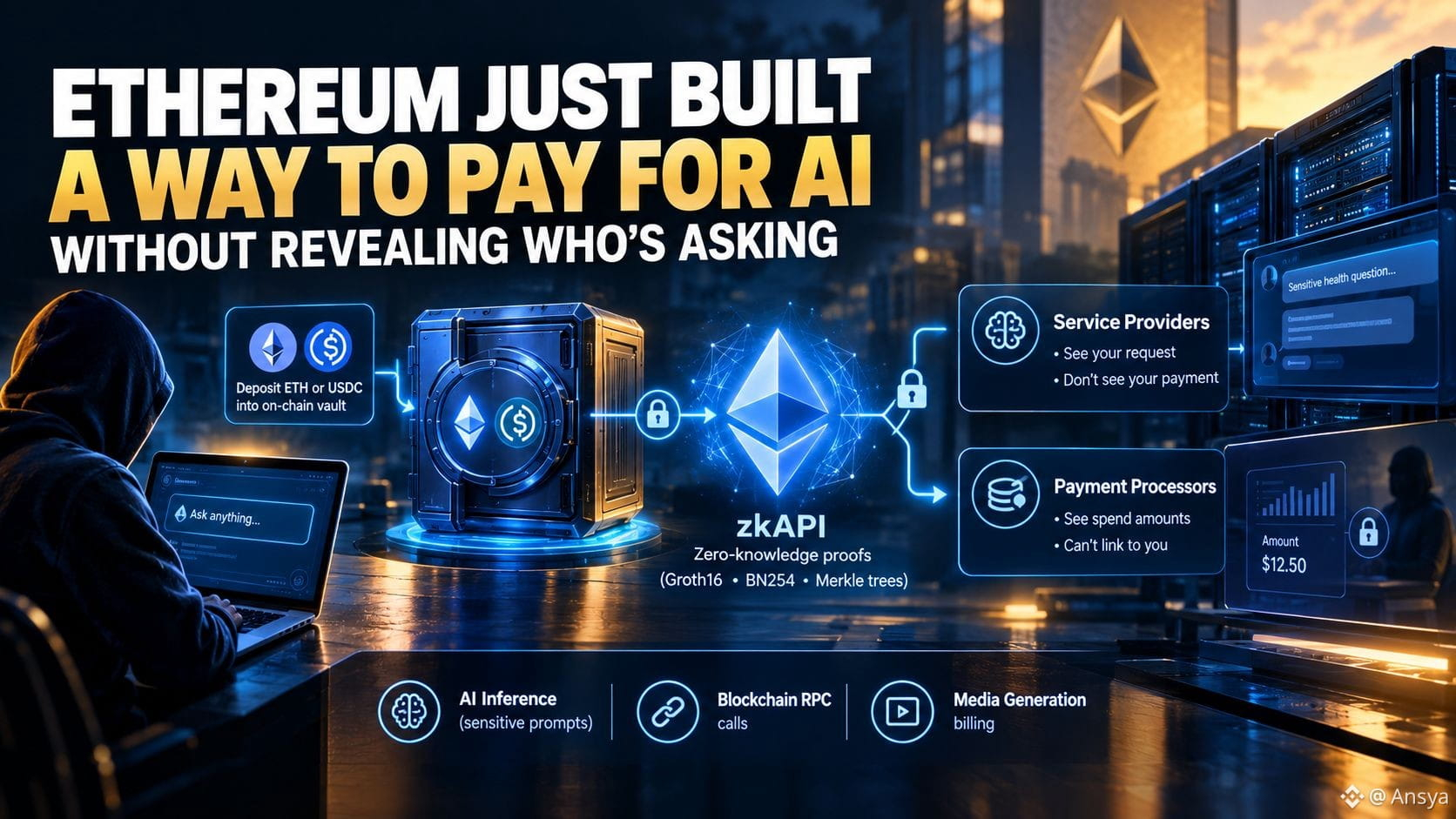
Here's what shipped: on October 1, the Ethereum Foundation, working with the Open Anonymity Project, deployed zkAPI on Ethereum mainnet — a privacy-preserving payment system built on a design co-authored by researcher Davide Crapis and Ethereum co-founder Vitalik Buterin. The mechanism works by having users deposit ETH or USDC into an on-chain vault, then generate zero-knowledge proofs to demonstrate they hold sufficient credit for an API request without revealing which specific deposit funds it. Service providers see the content of a request but never who's paying for it; payment processors see spend amounts but can't link them to individual users. Built using Groth16, BN254, and Merkle tree cryptography, the system initially targets AI inference — specifically protecting sensitive prompts involving health or financial topics — while also supporting blockchain RPC calls and media generation billing.
Why does this matter? As AI usage grows, so does the amount of sensitive information flowing through prompts tied directly to payment identities. A system that cryptographically separates "who paid" from "what was asked" addresses a privacy gap that's largely gone unaddressed as AI and blockchain payment rails increasingly intersect. It's also a concrete example of zero-knowledge proofs solving a practical, non-speculative problem rather than a purely theoretical one.
Whether this sees meaningful adoption beyond its initial AI-inference use case, or remains a niche privacy tool, will likely depend on how many service providers choose to integrate it.
Does separating payment identity from usage change how comfortable people feel using AI for sensitive tasks? 🤔
#Ethereum #zkAPI #Privacy #AI
$ETH $SAND $US
{future}(USUSDT)
{future}(SANDUSDT)
{future}(ETHUSDT)
#ethereumfoundationlauncheszkapionmainnet
Ethereum Just Built a Way to Pay for AI Without Revealing Who's Asking
The Ethereum Foundation just launched a system that lets you pay for AI services on-chain while keeping your identity completely separate from what you're actually asking the AI to do.
Here's what shipped: on October 1, the Ethereum Foundation, working with the Open Anonymity Project, deployed zkAPI on Ethereum mainnet — a privacy-preserving payment system built on a design co-authored by researcher Davide Crapis and Ethereum co-founder Vitalik Buterin. The mechanism works by having users deposit ETH or USDC into an on-chain vault, then generate zero-knowledge proofs to demonstrate they hold sufficient credit for an API request without revealing which specific deposit funds it. Service providers see the content of a request but never who's paying for it; payment processors see spend amounts but can't link them to individual users. Built using Groth16, BN254, and Merkle tree cryptography, the system initially targets AI inference — specifically protecting sensitive prompts involving health or financial topics — while also supporting blockchain RPC calls and media generation billing.
Why does this matter? As AI usage grows, so does the amount of sensitive information flowing through prompts tied directly to payment identities. A system that cryptographically separates "who paid" from "what was asked" addresses a privacy gap that's largely gone unaddressed as AI and blockchain payment rails increasingly intersect. It's also a concrete example of zero-knowledge proofs solving a practical, non-speculative problem rather than a purely theoretical one.
Whether this sees meaningful adoption beyond its initial AI-inference use case, or remains a niche privacy tool, will likely depend on how many service providers choose to integrate it.
Does separating payment identity from usage change how comfortable people feel using AI for sensitive tasks? 🤔
#Ethereum #zkAPI #Privacy #AI
$ETH $SAND $US
Ethereum Just Built a Way to Pay for AI Without Revealing Who's Asking
The Ethereum Foundation just launched a system that lets you pay for AI services on-chain while keeping your identity completely separate from what you're actually asking the AI to do.
Here's what shipped: on October 1, the Ethereum Foundation, working with the Open Anonymity Project, deployed zkAPI on Ethereum mainnet — a privacy-preserving payment system built on a design co-authored by researcher Davide Crapis and Ethereum co-founder Vitalik Buterin. The mechanism works by having users deposit ETH or USDC into an on-chain vault, then generate zero-knowledge proofs to demonstrate they hold sufficient credit for an API request without revealing which specific deposit funds it. Service providers see the content of a request but never who's paying for it; payment processors see spend amounts but can't link them to individual users. Built using Groth16, BN254, and Merkle tree cryptography, the system initially targets AI inference — specifically protecting sensitive prompts involving health or financial topics — while also supporting blockchain RPC calls and media generation billing.
Why does this matter? As AI usage grows, so does the amount of sensitive information flowing through prompts tied directly to payment identities. A system that cryptographically separates "who paid" from "what was asked" addresses a privacy gap that's largely gone unaddressed as AI and blockchain payment rails increasingly intersect. It's also a concrete example of zero-knowledge proofs solving a practical, non-speculative problem rather than a purely theoretical one.
Whether this sees meaningful adoption beyond its initial AI-inference use case, or remains a niche privacy tool, will likely depend on how many service providers choose to integrate it.
Does separating payment identity from usage change how comfortable people feel using AI for sensitive tasks? 🤔
#Ethereum #zkAPI #Privacy #AI
$ETH $SAND $US
1
3k

·
--
Bullish
Verified
#ethereumfoundationlauncheszkapionmainnet
⚡ Ethereum Foundation drops ZkAPI on Mainnet: A game-changer for zero-knowledge scaling!
🔐 PRIVACY & AI CONVERGENCE: The Ethereum Foundation, in collaboration with the Open Anonymity Project, has officially launched zkAPI on the Ethereum mainnet!
By enabling users to turn ETH or USDC deposits into anonymous, metered API credits via zero-knowledge proofs, this release establishes a framework for private payments across Web3 infrastructure and AI model access (supporting OpenAI and Ollama protocols). Here is why this L1 upgrade is generating buzz across the ecosystem 👇
🔍 Key Breakthroughs of zkAPI
1️⃣ Anonymous API Metering: Users can fund access to AI models, RPC endpoints, and cloud services without attaching an address, identity, or credit card to individual API queries.
2️⃣ Native Multi-Asset Support: Supports direct pre-stored ETH and USDC funding, allowing Web3 developers to integrate zkAPI into existing dApps seamlessly without third-party settlement layers.
🎯 Ecosystem & Strategy Watch
🛡️ Ethereum ($ETH) Fundamentals: While zkAPI improves developer utility rather than driving immediate spot buying, expanding Ethereum's role in the AI data economy strengthens long-term L1 network effects
🎯 ZK & L2 Tokens to Watch: $STRK, $ZK,$IMX, and privacy-centric L2s often capture speculative tailwinds whenever the Ethereum Foundation rolls out zero-knowledge breakthroughs.
⚡ Trading Tip: Keep an eye on Layer-2 network adoption metrics over the coming weeks as developers integrate zkAPI for decentralized AI agent micropayments.
💡 Community Poll: How do you see zero-knowledge AI payments impacting ETH?
🚀 Massive long-term bullish catalyst for ETH utility
🧠 Bullish for ZK-scaling tokens ($ZK,$STRK)
📊 Important tech upgrade, but price won't react immediately
$ETH
{future}(ETHUSDT)
Drop your thoughts and predictions in the comments! 👇
#NFPWatch #BitcoinSurpasses$86KUp2.99% #ETH #zkAPI
#ethereumfoundationlauncheszkapionmainnet
⚡ Ethereum Foundation drops ZkAPI on Mainnet: A game-changer for zero-knowledge scaling!
🔐 PRIVACY & AI CONVERGENCE: The Ethereum Foundation, in collaboration with the Open Anonymity Project, has officially launched zkAPI on the Ethereum mainnet!
By enabling users to turn ETH or USDC deposits into anonymous, metered API credits via zero-knowledge proofs, this release establishes a framework for private payments across Web3 infrastructure and AI model access (supporting OpenAI and Ollama protocols). Here is why this L1 upgrade is generating buzz across the ecosystem 👇
🔍 Key Breakthroughs of zkAPI
1️⃣ Anonymous API Metering: Users can fund access to AI models, RPC endpoints, and cloud services without attaching an address, identity, or credit card to individual API queries.
2️⃣ Native Multi-Asset Support: Supports direct pre-stored ETH and USDC funding, allowing Web3 developers to integrate zkAPI into existing dApps seamlessly without third-party settlement layers.
🎯 Ecosystem & Strategy Watch
🛡️ Ethereum ($ETH ) Fundamentals: While zkAPI improves developer utility rather than driving immediate spot buying, expanding Ethereum's role in the AI data economy strengthens long-term L1 network effects
🎯 ZK & L2 Tokens to Watch: $STRK, $ZK,$IMX, and privacy-centric L2s often capture speculative tailwinds whenever the Ethereum Foundation rolls out zero-knowledge breakthroughs.
⚡ Trading Tip: Keep an eye on Layer-2 network adoption metrics over the coming weeks as developers integrate zkAPI for decentralized AI agent micropayments.
💡 Community Poll: How do you see zero-knowledge AI payments impacting ETH?
🚀 Massive long-term bullish catalyst for ETH utility
🧠 Bullish for ZK-scaling tokens ($ZK,$STRK)
📊 Important tech upgrade, but price won't react immediately
$ETH
Drop your thoughts and predictions in the comments! 👇
#NFPWatch #BitcoinSurpasses$86KUp2.99% #ETH #zkAPI
⚡ Ethereum Foundation drops ZkAPI on Mainnet: A game-changer for zero-knowledge scaling!
🔐 PRIVACY & AI CONVERGENCE: The Ethereum Foundation, in collaboration with the Open Anonymity Project, has officially launched zkAPI on the Ethereum mainnet!
By enabling users to turn ETH or USDC deposits into anonymous, metered API credits via zero-knowledge proofs, this release establishes a framework for private payments across Web3 infrastructure and AI model access (supporting OpenAI and Ollama protocols). Here is why this L1 upgrade is generating buzz across the ecosystem 👇
🔍 Key Breakthroughs of zkAPI
1️⃣ Anonymous API Metering: Users can fund access to AI models, RPC endpoints, and cloud services without attaching an address, identity, or credit card to individual API queries.
2️⃣ Native Multi-Asset Support: Supports direct pre-stored ETH and USDC funding, allowing Web3 developers to integrate zkAPI into existing dApps seamlessly without third-party settlement layers.
🎯 Ecosystem & Strategy Watch
🛡️ Ethereum ($ETH ) Fundamentals: While zkAPI improves developer utility rather than driving immediate spot buying, expanding Ethereum's role in the AI data economy strengthens long-term L1 network effects
🎯 ZK & L2 Tokens to Watch: $STRK, $ZK,$IMX, and privacy-centric L2s often capture speculative tailwinds whenever the Ethereum Foundation rolls out zero-knowledge breakthroughs.
⚡ Trading Tip: Keep an eye on Layer-2 network adoption metrics over the coming weeks as developers integrate zkAPI for decentralized AI agent micropayments.
💡 Community Poll: How do you see zero-knowledge AI payments impacting ETH?
🚀 Massive long-term bullish catalyst for ETH utility
🧠 Bullish for ZK-scaling tokens ($ZK,$STRK)
📊 Important tech upgrade, but price won't react immediately
$ETH
Drop your thoughts and predictions in the comments! 👇
#NFPWatch #BitcoinSurpasses$86KUp2.99% #ETH #zkAPI

2
95


·
--
Verified
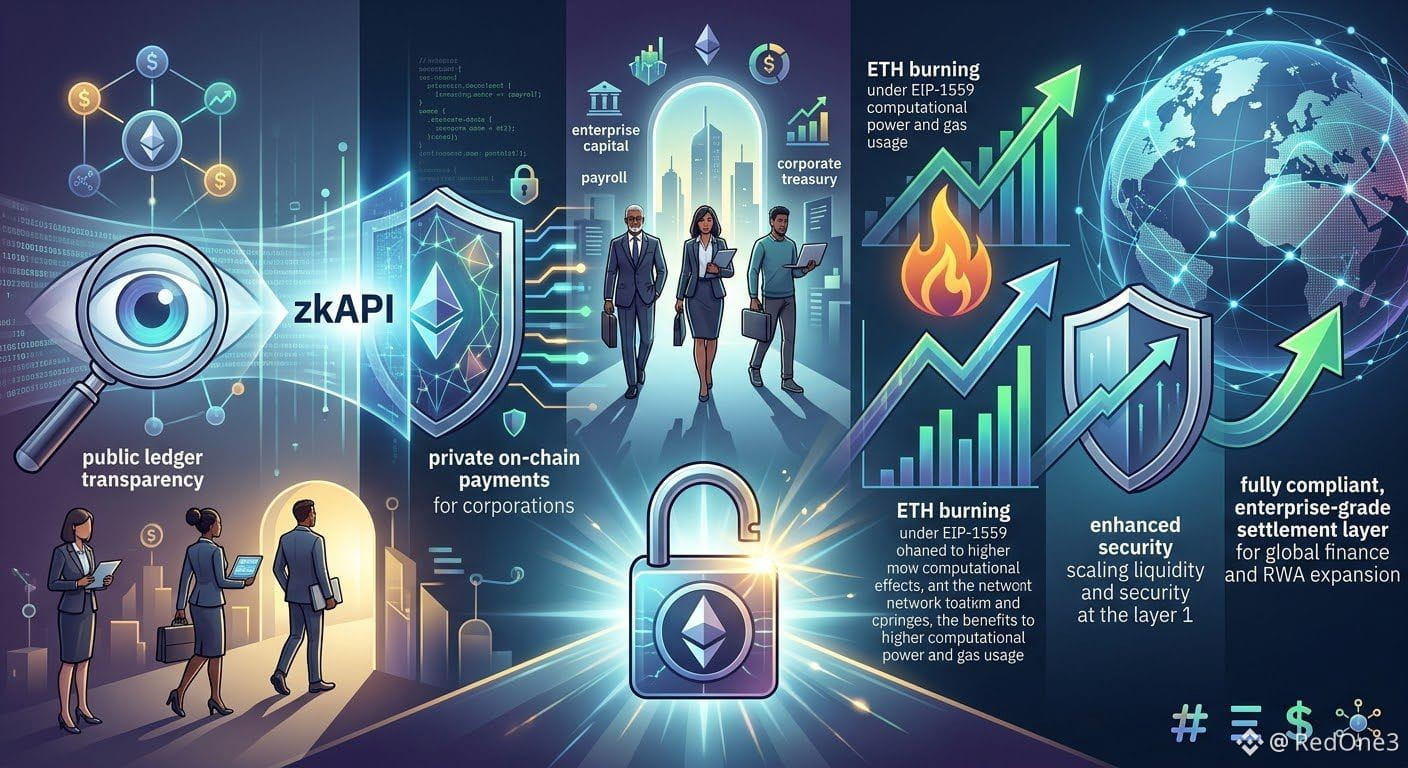
🔐 Ethereum zkAPI is officially live, and it completely changes the narrative around ETH privacy and enterprise adoption!
Up until now, public ledgers meant total transparency, which was the single biggest dealbreaker for real-world institutions looking to handle payroll, corporate treasury, or high-value settlements on-chain.
💡 With zkAPI, Ethereum enables private on-chain payments backed by zero-knowledge proofs. This unlocks a massive wave of enterprise capital that was previously sitting on the sidelines due to confidentiality concerns 📈.
🔥 On top of that, ZK-proof validation requires more computational power, meaning higher gas usage, increased ETH burning under EIP-1559, and direct supply pressure. By pulling privacy natively into its L1, Ethereum effectively neutralizes dedicated privacy chains while scaling its liquidity and security 🛡️.
🚀 This upgrade turns Ethereum into a fully compliant, enterprise-grade settlement layer for global finance and RWA expansion. Privacy was always the missing piece, and ETH just claimed it ✨.
#ᴰʸᴼᴿ
#Ethereum #ETH #zkAPI #DeFi .
🔐 Ethereum zkAPI is officially live, and it completely changes the narrative around ETH privacy and enterprise adoption!
Up until now, public ledgers meant total transparency, which was the single biggest dealbreaker for real-world institutions looking to handle payroll, corporate treasury, or high-value settlements on-chain.
💡 With zkAPI, Ethereum enables private on-chain payments backed by zero-knowledge proofs. This unlocks a massive wave of enterprise capital that was previously sitting on the sidelines due to confidentiality concerns 📈.
🔥 On top of that, ZK-proof validation requires more computational power, meaning higher gas usage, increased ETH burning under EIP-1559, and direct supply pressure. By pulling privacy natively into its L1, Ethereum effectively neutralizes dedicated privacy chains while scaling its liquidity and security 🛡️.
🚀 This upgrade turns Ethereum into a fully compliant, enterprise-grade settlement layer for global finance and RWA expansion. Privacy was always the missing piece, and ETH just claimed it ✨.
#ᴰʸᴼᴿ
#Ethereum #ETH #zkAPI #DeFi .
Up until now, public ledgers meant total transparency, which was the single biggest dealbreaker for real-world institutions looking to handle payroll, corporate treasury, or high-value settlements on-chain.
💡 With zkAPI, Ethereum enables private on-chain payments backed by zero-knowledge proofs. This unlocks a massive wave of enterprise capital that was previously sitting on the sidelines due to confidentiality concerns 📈.
🔥 On top of that, ZK-proof validation requires more computational power, meaning higher gas usage, increased ETH burning under EIP-1559, and direct supply pressure. By pulling privacy natively into its L1, Ethereum effectively neutralizes dedicated privacy chains while scaling its liquidity and security 🛡️.
🚀 This upgrade turns Ethereum into a fully compliant, enterprise-grade settlement layer for global finance and RWA expansion. Privacy was always the missing piece, and ETH just claimed it ✨.
#ᴰʸᴼᴿ
#Ethereum #ETH #zkAPI #DeFi .
1
174


Article
Ethereum Just Added a New Privacy Layer for AI Payments🚀 Ethereum Just Added a New Privacy Layer for AI Payments
The Ethereum Foundation and Open Anonymity have reportedly launched zkAPI on Mainnet, bringing a new approach to privacy for AI services and onchain payments.
The basic idea is pretty interesting:
An AI service can receive your request, while the payment system processes ETH or USDC — without necessarily exposing a direct link between the user's identity, request and payment.
That could open some interesting possibilities for the growing intersection of AI + crypto + privacy.
Why does this matter for Ethereum?
If applications begin using privacy-preserving infrastructure for payments and API access, Ethereum could potentially become part of more real-world AI payment workflows.
And the impact may extend beyond $ETH.
Privacy-focused projects and AI-related crypto infrastructure could also benefit if this type of technology gains adoption.
The bigger story here isn't just another Ethereum feature.
It's about making onchain payments more private while keeping them usable for applications.
AI is growing.
Onchain payments are growing.
Privacy remains one of the biggest challenges.
Putting those three together could be an interesting direction for the crypto ecosystem. 👀
$ETH $ETHFI $FET
#Ethereum
{spot}(BNBUSDT)
{spot}(BTCUSDT)
#zkAPI #CryptoAI #Privacy #Crypto
Ethereum Just Added a New Privacy Layer for AI Payments
🚀 Ethereum Just Added a New Privacy Layer for AI Payments
The Ethereum Foundation and Open Anonymity have reportedly launched zkAPI on Mainnet, bringing a new approach to privacy for AI services and onchain payments.
The basic idea is pretty interesting:
An AI service can receive your request, while the payment system processes ETH or USDC — without necessarily exposing a direct link between the user's identity, request and payment.
That could open some interesting possibilities for the growing intersection of AI + crypto + privacy.
Why does this matter for Ethereum?
If applications begin using privacy-preserving infrastructure for payments and API access, Ethereum could potentially become part of more real-world AI payment workflows.
And the impact may extend beyond $ETH.
Privacy-focused projects and AI-related crypto infrastructure could also benefit if this type of technology gains adoption.
The bigger story here isn't just another Ethereum feature.
It's about making onchain payments more private while keeping them usable for applications.
AI is growing.
Onchain payments are growing.
Privacy remains one of the biggest challenges.
Putting those three together could be an interesting direction for the crypto ecosystem. 👀
$ETH $ETHFI $FET
#Ethereum
#zkAPI #CryptoAI #Privacy #Crypto
The Ethereum Foundation and Open Anonymity have reportedly launched zkAPI on Mainnet, bringing a new approach to privacy for AI services and onchain payments.
The basic idea is pretty interesting:
An AI service can receive your request, while the payment system processes ETH or USDC — without necessarily exposing a direct link between the user's identity, request and payment.
That could open some interesting possibilities for the growing intersection of AI + crypto + privacy.
Why does this matter for Ethereum?
If applications begin using privacy-preserving infrastructure for payments and API access, Ethereum could potentially become part of more real-world AI payment workflows.
And the impact may extend beyond $ETH.
Privacy-focused projects and AI-related crypto infrastructure could also benefit if this type of technology gains adoption.
The bigger story here isn't just another Ethereum feature.
It's about making onchain payments more private while keeping them usable for applications.
AI is growing.
Onchain payments are growing.
Privacy remains one of the biggest challenges.
Putting those three together could be an interesting direction for the crypto ecosystem. 👀
$ETH $ETHFI $FET
#Ethereum
#zkAPI #CryptoAI #Privacy #Crypto
50

·
--
Bullish
Verified
#ethereumfoundationlauncheszkapionmainnet
The Ethereum Foundation and Open Anonymity just launched zkAPI on Mainnet, and it is an absolute game-changer for privacy! Imagine paying for AI tools with ETH or $USDC in complete ghost mode. The AI service sees your request, the payment vault sees the money, but absolutely NO ONE can link them to your identity. Your late-night AI anime art prompts are finally safe from judgment!
Here is the breakdown of what this means for the market:
🚀 ETH Impact: This injects massive, real-world utility straight into Ethereum. More transactions, more gas burned, and a highly bullish narrative.
🤖 Altcoins Horizon: Privacy and AI tokens are getting a massive fundamental spotlight. Rockets are being fueled as we speak.
🎯 What Traders Must Do: Stop over-analyzing 1-minute charts. Secure your bags, stack your tokens, and ride the privacy wave.
This is definitely not financial advice.
👉 Click trade below to support me:
$ETH
{future}(ETHUSDT)
$ETHFI
{future}(ETHFIUSDT)
$FET
{future}(FETUSDT)
🔥 Join Binance today using my link or code below:
🔗 [binance.com](https://www.binance.com/register?ref=VINHTOCDO)
🎫 Referral Code: VINHTOCDO
#Ethereum #zkAPI #CryptoAI #Privacy #VINHTOCDO
#ethereumfoundationlauncheszkapionmainnet
The Ethereum Foundation and Open Anonymity just launched zkAPI on Mainnet, and it is an absolute game-changer for privacy! Imagine paying for AI tools with ETH or $USDC in complete ghost mode. The AI service sees your request, the payment vault sees the money, but absolutely NO ONE can link them to your identity. Your late-night AI anime art prompts are finally safe from judgment!
Here is the breakdown of what this means for the market:
🚀 ETH Impact: This injects massive, real-world utility straight into Ethereum. More transactions, more gas burned, and a highly bullish narrative.
🤖 Altcoins Horizon: Privacy and AI tokens are getting a massive fundamental spotlight. Rockets are being fueled as we speak.
🎯 What Traders Must Do: Stop over-analyzing 1-minute charts. Secure your bags, stack your tokens, and ride the privacy wave.
This is definitely not financial advice.
👉 Click trade below to support me:
$ETH
$ETHFI
$FET
🔥 Join Binance today using my link or code below:
🔗 binance.com
🎫 Referral Code: VINHTOCDO
#Ethereum #zkAPI #CryptoAI #Privacy #VINHTOCDO
The Ethereum Foundation and Open Anonymity just launched zkAPI on Mainnet, and it is an absolute game-changer for privacy! Imagine paying for AI tools with ETH or $USDC in complete ghost mode. The AI service sees your request, the payment vault sees the money, but absolutely NO ONE can link them to your identity. Your late-night AI anime art prompts are finally safe from judgment!
Here is the breakdown of what this means for the market:
🚀 ETH Impact: This injects massive, real-world utility straight into Ethereum. More transactions, more gas burned, and a highly bullish narrative.
🤖 Altcoins Horizon: Privacy and AI tokens are getting a massive fundamental spotlight. Rockets are being fueled as we speak.
🎯 What Traders Must Do: Stop over-analyzing 1-minute charts. Secure your bags, stack your tokens, and ride the privacy wave.
This is definitely not financial advice.
👉 Click trade below to support me:
$ETH
$ETHFI
$FET
🔥 Join Binance today using my link or code below:
🔗 binance.com
🎫 Referral Code: VINHTOCDO
#Ethereum #zkAPI #CryptoAI #Privacy #VINHTOCDO
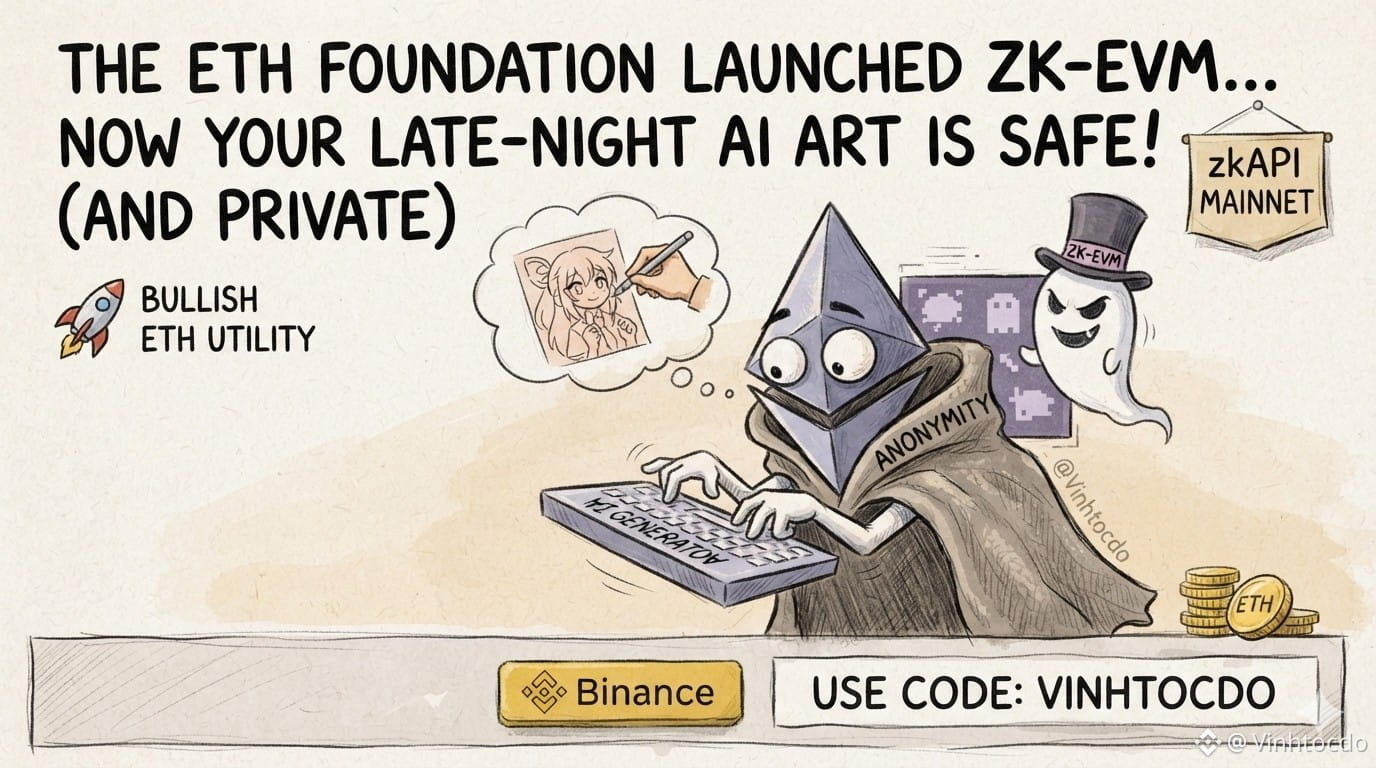
2
877

Ethereum zkAPI Takes Off on Mainnet: Private Payments
- Ethereum’s zkAPI has launched on mainnet
- Zero-knowledge technology enables private API payments
- Supports anonymous prepay access rights
- Expands blockchain applications for secure transactions
#BinanceSquare #CryptoNews #Ethereum #zkAPI #PrivacyPayments
$eth
vlikevn Titanbot
Source: CoinTelegraph
Ethereum zkAPI Takes Off on Mainnet: Private Payments
- Ethereum’s zkAPI has launched on mainnet
- Zero-knowledge technology enables private API payments
- Supports anonymous prepay access rights
- Expands blockchain applications for secure transactions
#BinanceSquare #CryptoNews #Ethereum #zkAPI #PrivacyPayments
$eth
vlikevn Titanbot
Source: CoinTelegraph
- Ethereum’s zkAPI has launched on mainnet
- Zero-knowledge technology enables private API payments
- Supports anonymous prepay access rights
- Expands blockchain applications for secure transactions
#BinanceSquare #CryptoNews #Ethereum #zkAPI #PrivacyPayments
$eth
vlikevn Titanbot
Source: CoinTelegraph
92
#ethereumfoundationlauncheszkapionmainnet
Ethereum Foundation and Open Anonymity have just launched zkAPI on the mainnet—an absolute, total privacy paradigm shift! Imagine paying for AI tools using ETH or $USDC in total stealth mode. The AI service sees your request, and the payment vault sees the funds, but nobody at all can link them to your identity. Finally, those midnight anime-graph hints for AI are safe from judgment!
Here’s the breakdown of what this means for the market:
🚀 ETH impact: This injects massive real utility directly into Ethereum. More transactions, more gas burned, and a seriously bullish narrative.
🤖 Alternative coin outlook: Privacy and AI tokens get a huge spotlight. Rocket-fuel ignition.
🎯 What traders should do: Stop over-analyzing single-needle precision charts. Hold your positions, accumulate your tokens, and ride the privacy wave.
This is definitely not financial advice.
$ETH
$ETHFI
$FET
#Ethereum #zkAPI #CryptoAI #الخصوصية
#ethereumfoundationlauncheszkapionmainnet
Ethereum Foundation and Open Anonymity have just launched zkAPI on the mainnet—an absolute, total privacy paradigm shift! Imagine paying for AI tools using ETH or $USDC in total stealth mode. The AI service sees your request, and the payment vault sees the funds, but nobody at all can link them to your identity. Finally, those midnight anime-graph hints for AI are safe from judgment!
Here’s the breakdown of what this means for the market:
🚀 ETH impact: This injects massive real utility directly into Ethereum. More transactions, more gas burned, and a seriously bullish narrative.
🤖 Alternative coin outlook: Privacy and AI tokens get a huge spotlight. Rocket-fuel ignition.
🎯 What traders should do: Stop over-analyzing single-needle precision charts. Hold your positions, accumulate your tokens, and ride the privacy wave.
This is definitely not financial advice.
$ETH
$ETHFI
$FET
#Ethereum #zkAPI #CryptoAI #الخصوصية
Ethereum Foundation and Open Anonymity have just launched zkAPI on the mainnet—an absolute, total privacy paradigm shift! Imagine paying for AI tools using ETH or $USDC in total stealth mode. The AI service sees your request, and the payment vault sees the funds, but nobody at all can link them to your identity. Finally, those midnight anime-graph hints for AI are safe from judgment!
Here’s the breakdown of what this means for the market:
🚀 ETH impact: This injects massive real utility directly into Ethereum. More transactions, more gas burned, and a seriously bullish narrative.
🤖 Alternative coin outlook: Privacy and AI tokens get a huge spotlight. Rocket-fuel ignition.
🎯 What traders should do: Stop over-analyzing single-needle precision charts. Hold your positions, accumulate your tokens, and ride the privacy wave.
This is definitely not financial advice.
$ETH
$ETHFI
$FET
#Ethereum #zkAPI #CryptoAI #الخصوصية
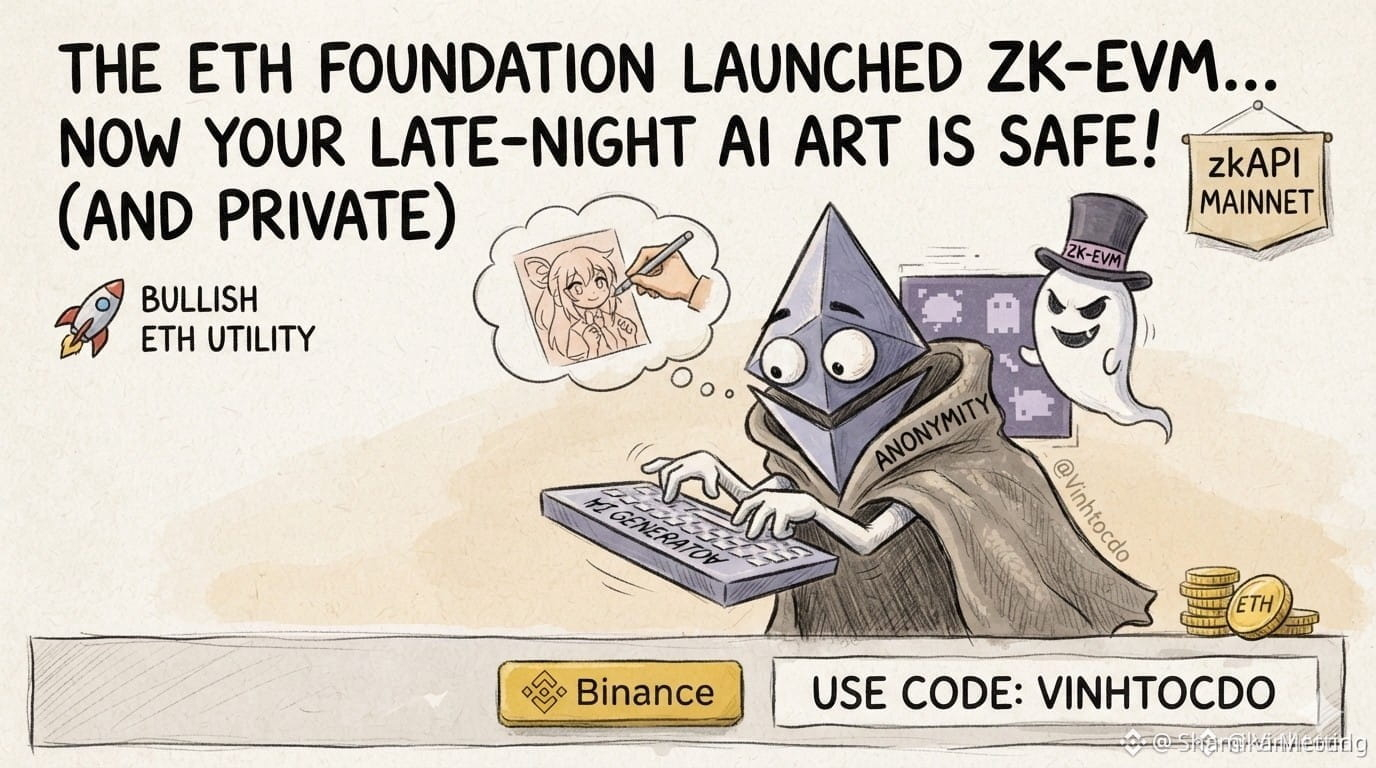
1
228
Ethereum Foundation launches zkAPI, enabling AI payments without revealing identities
- Ethereum Foundation launches zkAPI, enabling AI payments without revealing identities
- Users deposit funds into an Ethereum vault and grant spending permissions using identity-concealing (zero-knowledge proof)
- API providers cannot link payment requests to the payer, protecting privacy
- The application reduces the risk of identity exposure and increases security for AI services on the blockchain #BinanceSquare #CryptoNews #ETH #zkAPI
$eth
#vlikevn Titanbot
Source: The Block
Ethereum Foundation launches zkAPI, enabling AI payments without revealing identities
- Ethereum Foundation launches zkAPI, enabling AI payments without revealing identities
- Users deposit funds into an Ethereum vault and grant spending permissions using identity-concealing (zero-knowledge proof)
- API providers cannot link payment requests to the payer, protecting privacy
- The application reduces the risk of identity exposure and increases security for AI services on the blockchain #BinanceSquare #CryptoNews #ETH #zkAPI
$eth
#vlikevn Titanbot
Source: The Block
- Ethereum Foundation launches zkAPI, enabling AI payments without revealing identities
- Users deposit funds into an Ethereum vault and grant spending permissions using identity-concealing (zero-knowledge proof)
- API providers cannot link payment requests to the payer, protecting privacy
- The application reduces the risk of identity exposure and increases security for AI services on the blockchain #BinanceSquare #CryptoNews #ETH #zkAPI
$eth
#vlikevn Titanbot
Source: The Block
35
Log in to explore more content
Join global crypto users on Binance Square
⚡️ Get latest and useful information about crypto.
💬 Trusted by the world’s largest crypto exchange.
👍 Discover real insights from verified creators.
Email / Phone number
Trending Topics
1
#NFPWatch
10.5M views
17,748 Discussing
2
#BitcoinFundingRateTriplesTo10%
1,852 views
131 Discussing
3
#BitcoinSurpasses$86KUp2.99%
1,116 views
26 Discussing
4
#ZcashFalls21%FromSeptemberPeak
9,608 views
214 Discussing
5
#USSeptemberPayrollsAdd29KUnemploymentRises4.2%
1,048 views
75 Discussing
6
#XRPPostsFirstThreeGreenMonthsInQ3
11,301 views
282 Discussing
7
#BNBChainTokenizedStocksTop$1BAt30%Share
71 views
22 Discussing
8
#BitcoinRisesToward$85K
50,626 views
113 Discussing
9
#AmazonPlansToSell$8BNvidiaChips
5,750 views
77 Discussing
10
#NEARFallsToAround$4.70Down14%
39,327 views
101 Discussing