

#perpdex
perpdex
256,603 views
760 Discussing
Hot
Latest

·
--
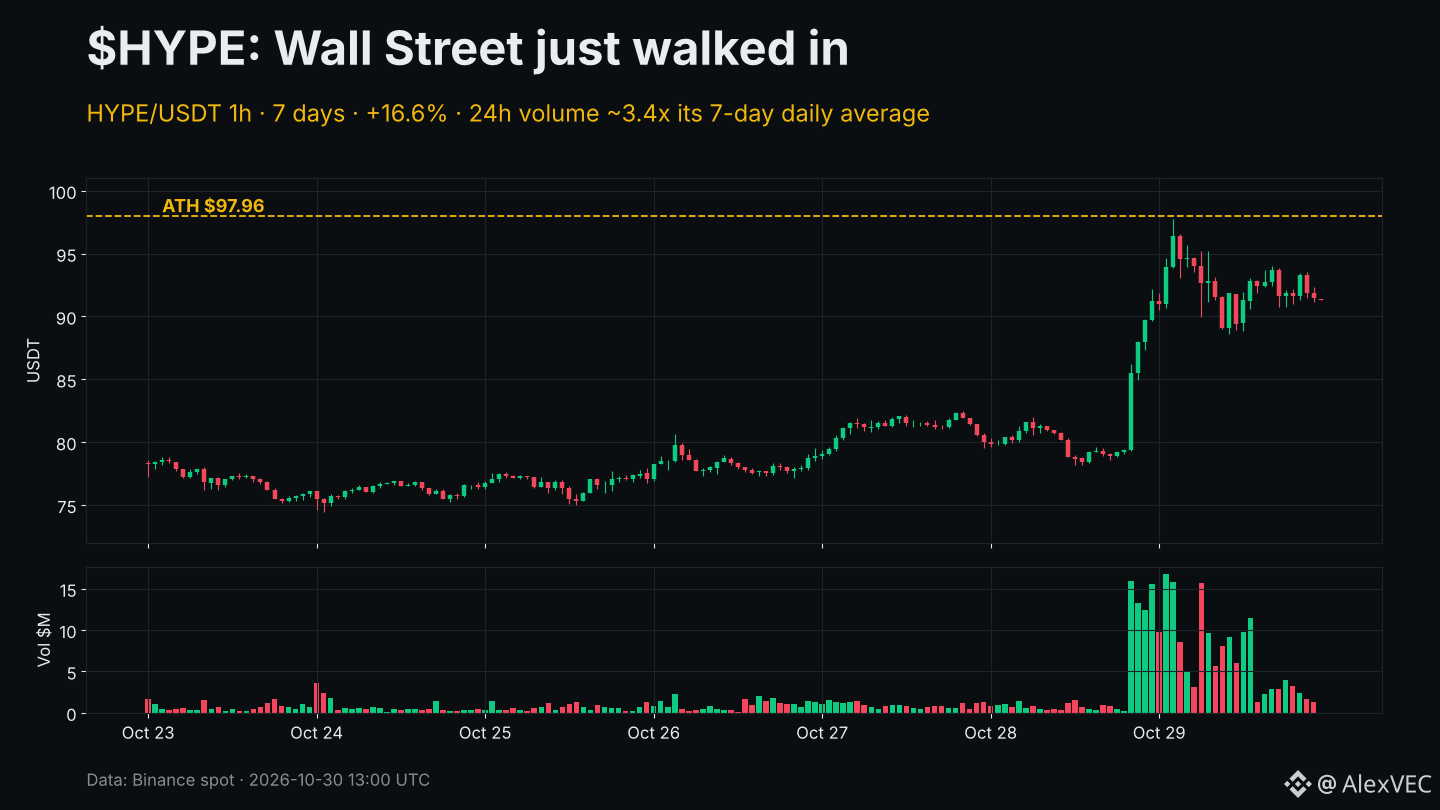
The NYSE's parent company just picked a side in the perp DEX race, and $HYPE is trading less than $7 below its all-time high because of it.
What happened: on Oct 29, ICE (Intercontinental Exchange) announced a partnership with TradeXYZ to bring Hyperliquid-based perpetual futures to US traders, built on Hyperliquid's HIP-3 framework. ICE runs the exchange and clearing side, takes a strategic stake in TradeXYZ, and the whole thing still needs regulatory approval. So: a big signal, not a done deal.
The tape on Binance spot:
• Price: $91.34, +1.8% in 24h, +16.6% over 7 days
• 24h range: $88.58 – $97.74
• ATH: $97.96 (set last month), less than 7% away
• 24h volume: ~$156M vs a 7-day daily average of ~$46M, roughly 3.4x
My read: the news candle took HYPE from the ~$79 area straight to $97.74, then it cooled and has been holding $89–94 since. Holding above $88.58 keeps the breakout structure intact; losing it and the $85 gap gets interesting. A clean daily close above the ATH is the real test. Until then, this is a range under resistance.
Risk check: HYPE is volatile, and "approval pending" headlines can unwind fast.
Do you think HYPE breaks the ATH this week, or does it fade back into the gap?
Not financial advice.
#Hyperliquid #PerpDEX #CryptoNews
HYPE-2.41%
ICEUS+3.87%
93

·
--
📈 Will you need to buy $HYPE or not?
🔹 Hyperliquid is an on-chain perpetuals exchange and Layer 1; HYPE is its native token.
📊 It is one of the biggest on-chain perps venues and has grown into a top-ranked token.
🚀 Strong trading volume and a loyal user base set it apart from newer perp DEX rivals.
⚠️ Only a part of its fully diluted value circulates, so token unlocks are the key risk.
Buy: $HYPE
#Hyperliquid #HYPE #PerpDEX

1
157
·
--
Article
NYSE's Owner Just Picked Hyperliquid Rails: What the HYPE Breakout Means for Perp DEXsFor most of this week the perp DEX trade was a slow grind. Today it stopped being slow.
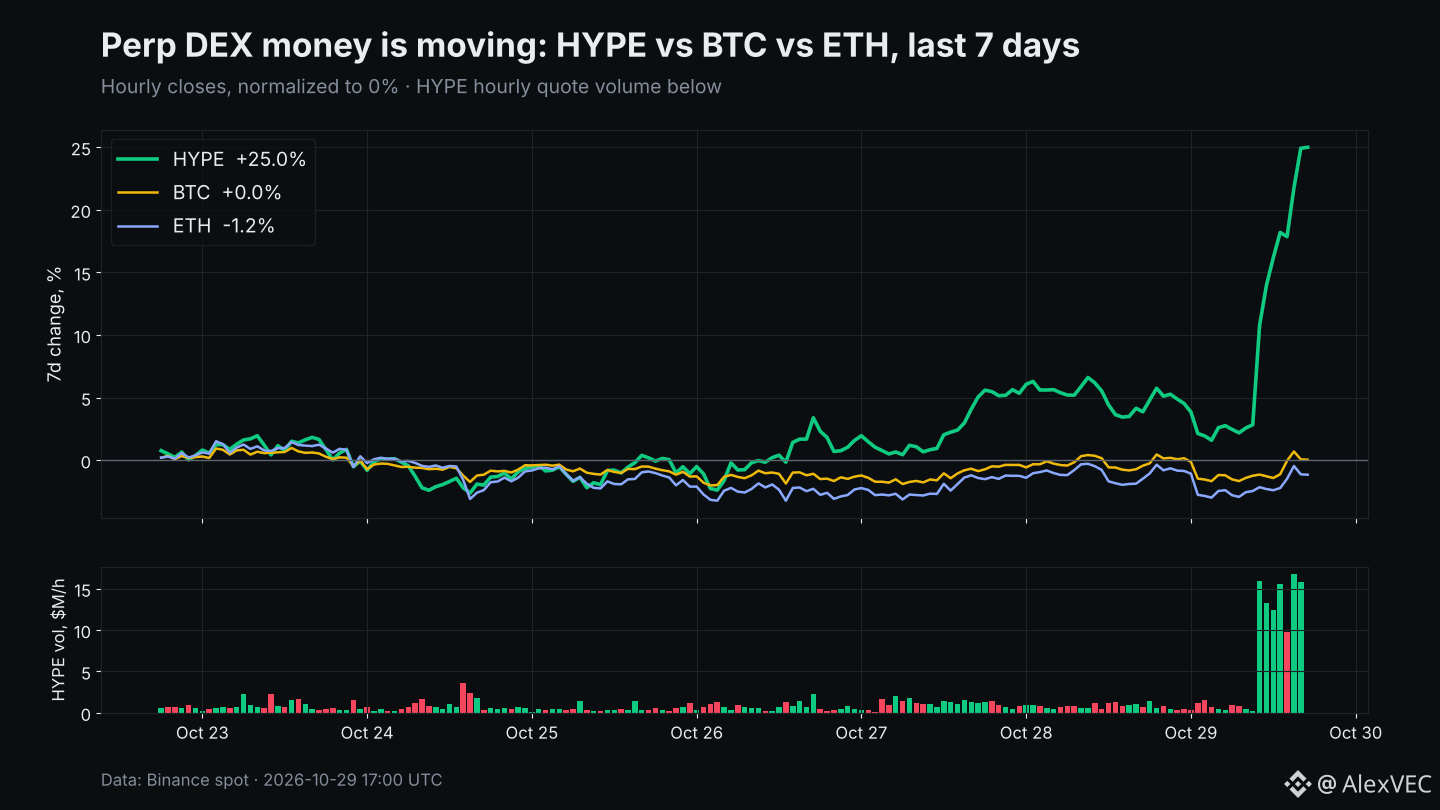
$HYPE is trading around 96.44 on Binance spot, up about 20% in 24 hours after printing a low of 78.19 and a high of 97.74. Over seven days it's up roughly 25%. For contrast, $BTC is flat on the week (81,270, about 0%) and $ETH is down around 1%. That gap is the whole story of the chart above.
What actually happened
On Oct 29, Intercontinental Exchange, the owner of the NYSE, announced a strategic investment in Trade.xyz, a platform that runs markets on Hyperliquid. The plan, as reported by crypto.news, is to build a US-regulated perpetual futures venue using Hyperliquid infrastructure, with contracts on stocks, indexes, commodities, FX and crypto, offered through brokers with KYC/AML controls. Stan Druckenmiller was named among a small group of investors joining in. Trade.xyz says its Hyperliquid markets have passed $650B in cumulative volume.
The important fine print: the venue still needs CFTC approval. No launch date, no investment size and no specific licensing route were disclosed, and Trade.xyz's existing HIP-3 markets stay closed to US users for now. So this is a headline about direction, not about volume landing on the chain next week.
Why the market cared anyway
Perp DEXs have always had one ceiling everyone talks around: the biggest pool of capital can't touch them. A traditional exchange operator betting on Hyperliquid rails is the first real crack in that ceiling. Whether it turns into flow is a 2027 question; whether it changes the narrative was answered within an hour.
The tape agrees. HYPE spot volume on Binance over the last 24h is about $110M, versus roughly $19.5M per day across the previous six days. That's close to 6x normal activity. Breakouts on volume like that tend to be more durable than quiet drifts, but they also attract the fastest money, and fast money leaves fast.
How I'd frame the next few days
Bull case: the 78–80 area, where this move started, becomes the floor the market defends. If price holds the low 90s while volume cools off gradually, that looks like repricing rather than a spike. The 30-day picture helps here: HYPE is up about 12% over the month while ETH is down about 12%, so relative strength was already building before the news.
Bear case: news pumps on regulatory announcements often retrace once traders realize the timeline. With no approval yet and no launch date, there's room for a "sell the news" fade back toward the mid-80s. Also remember that a 20% daily candle on a mid-cap means leverage piled in quickly, which makes sharp wicks in both directions more likely.
The bigger picture for the perp DEX sector is that the conversation has shifted from "can decentralized perps compete?" to "who gets the regulated on-ramp first?". That's a different market to trade, and it probably won't move in a straight line.
Risk note: HYPE is a volatile asset and moves like today's can reverse just as quickly. Size accordingly and don't chase a vertical candle with leverage you can't sit through.
Are you treating this as the start of a new leg or a headline spike to fade?
Not financial advice.
#Hyperliquid #PerpDEX #CryptoNews
NYSE's Owner Just Picked Hyperliquid Rails: What the HYPE Breakout Means for Perp DEXs
For most of this week the perp DEX trade was a slow grind. Today it stopped being slow.
$HYPE is trading around 96.44 on Binance spot, up about 20% in 24 hours after printing a low of 78.19 and a high of 97.74. Over seven days it's up roughly 25%. For contrast, $BTC is flat on the week (81,270, about 0%) and $ETH is down around 1%. That gap is the whole story of the chart above.
What actually happened
On Oct 29, Intercontinental Exchange, the owner of the NYSE, announced a strategic investment in Trade.xyz, a platform that runs markets on Hyperliquid. The plan, as reported by crypto.news, is to build a US-regulated perpetual futures venue using Hyperliquid infrastructure, with contracts on stocks, indexes, commodities, FX and crypto, offered through brokers with KYC/AML controls. Stan Druckenmiller was named among a small group of investors joining in. Trade.xyz says its Hyperliquid markets have passed $650B in cumulative volume.
The important fine print: the venue still needs CFTC approval. No launch date, no investment size and no specific licensing route were disclosed, and Trade.xyz's existing HIP-3 markets stay closed to US users for now. So this is a headline about direction, not about volume landing on the chain next week.
Why the market cared anyway
Perp DEXs have always had one ceiling everyone talks around: the biggest pool of capital can't touch them. A traditional exchange operator betting on Hyperliquid rails is the first real crack in that ceiling. Whether it turns into flow is a 2027 question; whether it changes the narrative was answered within an hour.
The tape agrees. HYPE spot volume on Binance over the last 24h is about $110M, versus roughly $19.5M per day across the previous six days. That's close to 6x normal activity. Breakouts on volume like that tend to be more durable than quiet drifts, but they also attract the fastest money, and fast money leaves fast.
How I'd frame the next few days
Bull case: the 78–80 area, where this move started, becomes the floor the market defends. If price holds the low 90s while volume cools off gradually, that looks like repricing rather than a spike. The 30-day picture helps here: HYPE is up about 12% over the month while ETH is down about 12%, so relative strength was already building before the news.
Bear case: news pumps on regulatory announcements often retrace once traders realize the timeline. With no approval yet and no launch date, there's room for a "sell the news" fade back toward the mid-80s. Also remember that a 20% daily candle on a mid-cap means leverage piled in quickly, which makes sharp wicks in both directions more likely.
The bigger picture for the perp DEX sector is that the conversation has shifted from "can decentralized perps compete?" to "who gets the regulated on-ramp first?". That's a different market to trade, and it probably won't move in a straight line.
Risk note: HYPE is a volatile asset and moves like today's can reverse just as quickly. Size accordingly and don't chase a vertical candle with leverage you can't sit through.
Are you treating this as the start of a new leg or a headline spike to fade?
Not financial advice.
#Hyperliquid #PerpDEX #CryptoNews
1
8

·
--
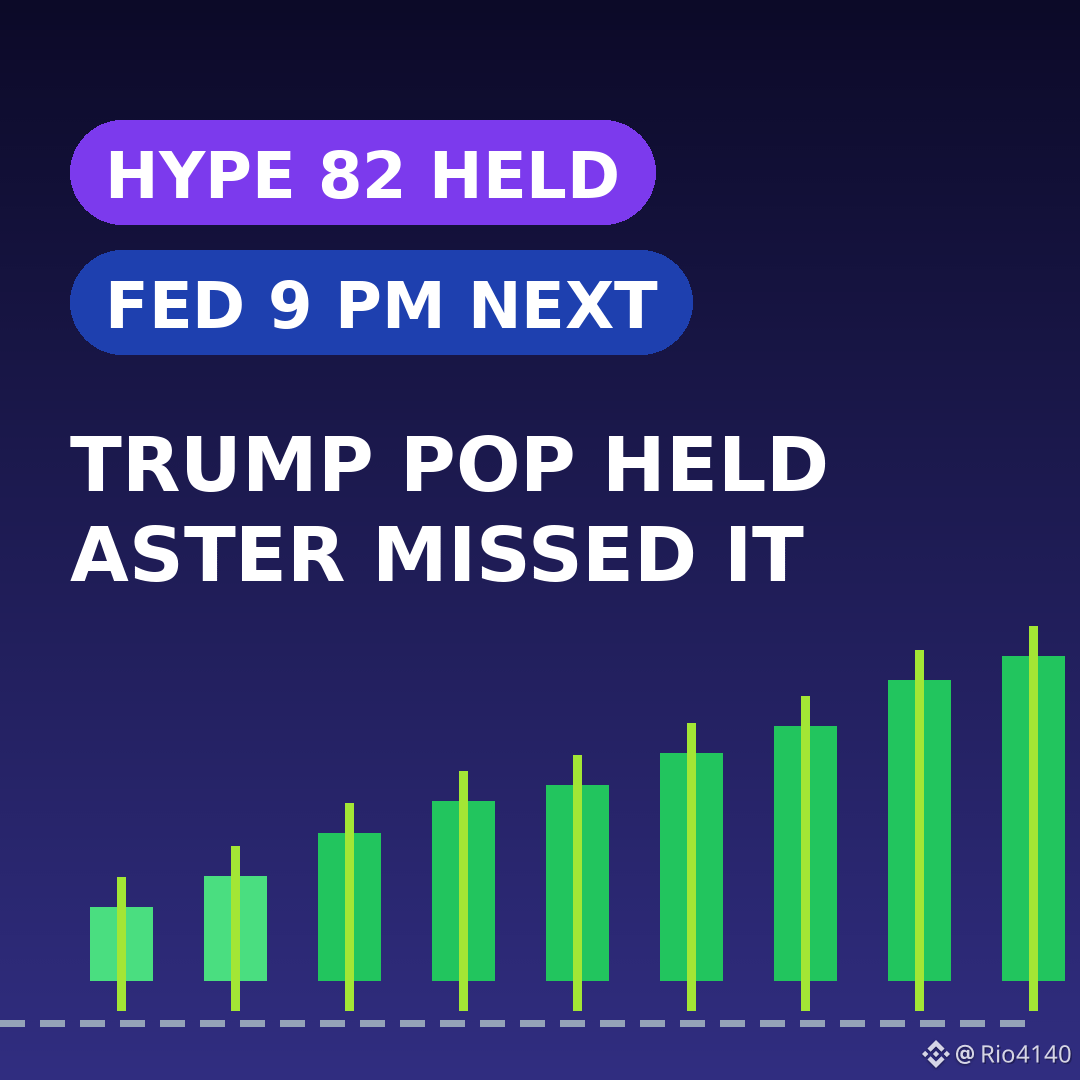
HYPE TURNED A TRUMP SHOUTOUT INTO 82 WHILE ASTER MISSED THE ENTIRE MOVE
Perp DEX money split in two directions this morning while Bitcoin sat near 81500 dollars and barely moved
$HYPE is the name everyone is talking about after same day coverage put its Trump mention pop at 21 percent
The 24 hour tape tells a calmer story
HYPE sits at 82 dollars and it is up 5 percent with a range from 77 dollars to 82 dollars and spot turnover near 23 million dollars
So the pop is real but most of the spike already faded and HYPE is just holding its highs now
$ASTER is the other side of the same sector and it did nothing
It sits near 72 cents and it is up 1 percent on a tight range from 71 cents to 72 cents with turnover near 4 million dollars
Jupiter rounds out the board at 28 cents and up 2 percent
Quiet tape everywhere else in the perp pack
Here is the map for tonight because the Fed decision lands at 9 PM Cairo tonight and Powell speaks at 930 PM
If the Fed cuts then risk money rotates back into the headline trade and HYPE breaking above 82 dollars puts the pop back in play with 82 dollars as the new floor
If the Fed holds hawkish then money hides in Bitcoin and HYPE fades back toward 77 dollars while Aster stays flat
I am not chasing the headline and I am not fading it blind either
Here is how I am playing the leader
Entry zone 78 dollars to 82 dollars right inside the morning range
Target a break above 82 dollars that holds into the night session
Stop on a daily close below 77 dollars because that kills the hold
My take as an analyst
The perp DEX crown still belongs to the venue doing near 6 billion dollars of daily volume but the trade is HYPE at 82 dollars not the sector as a whole
Wait for the Fed to pick a direction and let the level do the talking
So which branch are you trading tonight
Do you buy the break above 82 dollars on a cut or do you sit in Bitcoin until the hawkish fade plays out
$HYPE $ASTER
#BinanceSquare #WriteToEarn #Crypto #Bitcoin #PerpDEX
3

·
--
$HYPE: Its fundamentals remain those of a leading perpetual DEX, but its valuation thesis is being put to the test.
Data from Bitcoin.com News on 10/25:
· HYPE is down about 22% from its September high (around $98), with a market cap of about $17 billion
· Hyperliquid’s share of RWA perpetuals has fallen from around 80% to around 26%, as competitors draw away market share
· Buybacks are continuing, but they must contend with team unlocks and slowing trading volume at the same time
Supply side: The 3.75 million HYPE unlocked for the team in October (about $320 million) was sold in a single OTC block to one institution, rather than being dumped on the public order book (according to OptimistFi, citing a co-founder’s explanation on Discord).
Related developments:
· On 10/23, U.S.-listed HYPE treasury company Hyperliquid Strategies (NASDAQ: PURR) announced it had increased its share buyback authorization from $30 million to $100 million and extended the deadline to October 31, 2027
· The Hyperliquid Policy Center has submitted comments to the SEC, calling for clarity on the rules governing airdrops, buybacks, and on-chain secondary trading
What to watch next: Whether RWA perpetuals market share can stop falling, how the next round of unlocks will be handled, and the final version of the SEC rules.
#Hyperliquid #HYPE #PerpDEX #DeFi
For informational purposes only; not investment advice / NFA
Sources: Bitcoin.com News, PR Newswire, Cointelegraph
$HYPE : Its fundamentals remain those of a leading perpetual DEX, but its valuation thesis is being put to the test.
Data from Bitcoin.com News on 10/25:
· HYPE is down about 22% from its September high (around $98), with a market cap of about $17 billion
· Hyperliquid’s share of RWA perpetuals has fallen from around 80% to around 26%, as competitors draw away market share
· Buybacks are continuing, but they must contend with team unlocks and slowing trading volume at the same time
Supply side: The 3.75 million HYPE unlocked for the team in October (about $320 million) was sold in a single OTC block to one institution, rather than being dumped on the public order book (according to OptimistFi, citing a co-founder’s explanation on Discord).
Related developments:
· On 10/23, U.S.-listed HYPE treasury company Hyperliquid Strategies (NASDAQ: PURR) announced it had increased its share buyback authorization from $30 million to $100 million and extended the deadline to October 31, 2027
· The Hyperliquid Policy Center has submitted comments to the SEC, calling for clarity on the rules governing airdrops, buybacks, and on-chain secondary trading
What to watch next: Whether RWA perpetuals market share can stop falling, how the next round of unlocks will be handled, and the final version of the SEC rules.
#Hyperliquid #HYPE #PerpDEX #DeFi
For informational purposes only; not investment advice / NFA
Sources: Bitcoin.com News, PR Newswire, Cointelegraph
151

🎰 Delphi says “The House Always Wins,” and LIT jumps 20% in a day
Delphi Digital published a report these past couple of days titled “The House Always Wins.” Its main point is pretty straightforward: speculation will be the dominant theme over the next decade, so instead of being a gambler, bet on the platforms running the casinos.
It named three picks: Robinhood (HOOD), Hyperliquid (HYPE), and Lighter (LIT).
LIT rose around 20% that day, with CoinGecko showing it at around $3.90. Two factors drove the move:
🔹 Delphi is bullish on its zero fees for retail traders, plus the distribution channel provided by Robinhood Wallet
🔹 On its Q3 investor call, Lighter said it plans to apply for a derivatives license from the U.S. CFTC in November. Founder Vlad Novakovski said the team has been in discussions with regulators for more than 11 months
Here’s another set of figures compiled by the community, covering the past 30 days:
Trading volume: HYPE around $212.1 billion, Lighter around $66 billion, ASTER around $49.3 billion
Fees: HYPE around $82.04 million, Lighter around $6.03 million, ASTER around $4.36 million
My take:
I agree with the “be the house” thesis: platforms earn money from trading itself, regardless of whether prices go up or down. But there are two things to think through.
First, zero fees are a tool for attracting users, but they also mean a lower ceiling on revenue. Lighter’s trading volume is about 30% of HYPE’s, but its fees are less than a tenth. That gap is the cost of zero fees.
Second, there’s a long road between “plans to apply” and “gets a license.” The rally right now is based on expectations.
The irony is that reading a report saying “don’t be a gambler,” then chasing a coin that’s up 20% in a day, is itself a pretty gambler-like move 😂
What do you think: in Perp DEXs, which approach has more staying power—zero fees to capture volume, or charging fees to make money?
#LIT #Lighter #PerpDEX #Hyperliquid
436

·
--
📰 With a single announcement, StandX slammed the brakes on the “points farming frenzy” in Perp DEXs: it will gradually cease operations, abandon its original TGE plans, and instead compensate community users with a one-time DUSD airdrop. To be honest, this doesn’t erase the losses suffered by people who’ve been farming points for a long time.
🔥 This article reviews 9 major protocols. The most realistic takeaway is that established projects offer more certainty, but their points pools are already crowded. Variational has pledged 32% of its genesis airdrop to points holders, but its points program is already in its final sprint. Extended’s points are nearing the 70 million cap, and it has even cut points for some accounts—making things pretty uncomfortable for newcomers.
💡 Pacifica’s numbers look impressive: TVL is around $24.19 million, while 30-day trading volume has reached $10.751 billion. But its points algorithm is a dynamic black box, making it hard to calculate the return on investment. Nado, meanwhile, ties points to eligibility for an INK airdrop, but competition in its second-season points program is already in the middle-to-late stages.
👀 The project with a genuinely early window still open is TxFlow, which just launched its first points season on October 12, distributing 1.25 million points each week. The RISEx campaign could run until Q2 2027, while Perpl is still relatively small. The risks are clear, too: cross-chain issues, network stability, and capital tied up for the long term could all make “cheap-looking points” more expensive.
🤔 If it were you, would you choose a proven but highly competitive project, or bet on a protocol like TxFlow that has only just started?
#PerpDEX #空投 #积分活动 #Web3

1
40

Article
Ripple Prime Just Put 100+ RWA Perps on Hyperliquid — $HYPE Holds $81BTC gets the headlines. $HYPE gets the order flow.
And yesterday, the order flow got a lot more interesting.
Ripple Prime just opened 100+ real-world-asset perp markets on Hyperliquid — stocks, indices, ETFs and commodities, tradeable as perpetual swaps through Trade.xyz, with RLUSD as collateral. This launched on 15 October, and it is not another crypto-native casino table. It is Wall Street plumbing moving onto a perp DEX's rails.
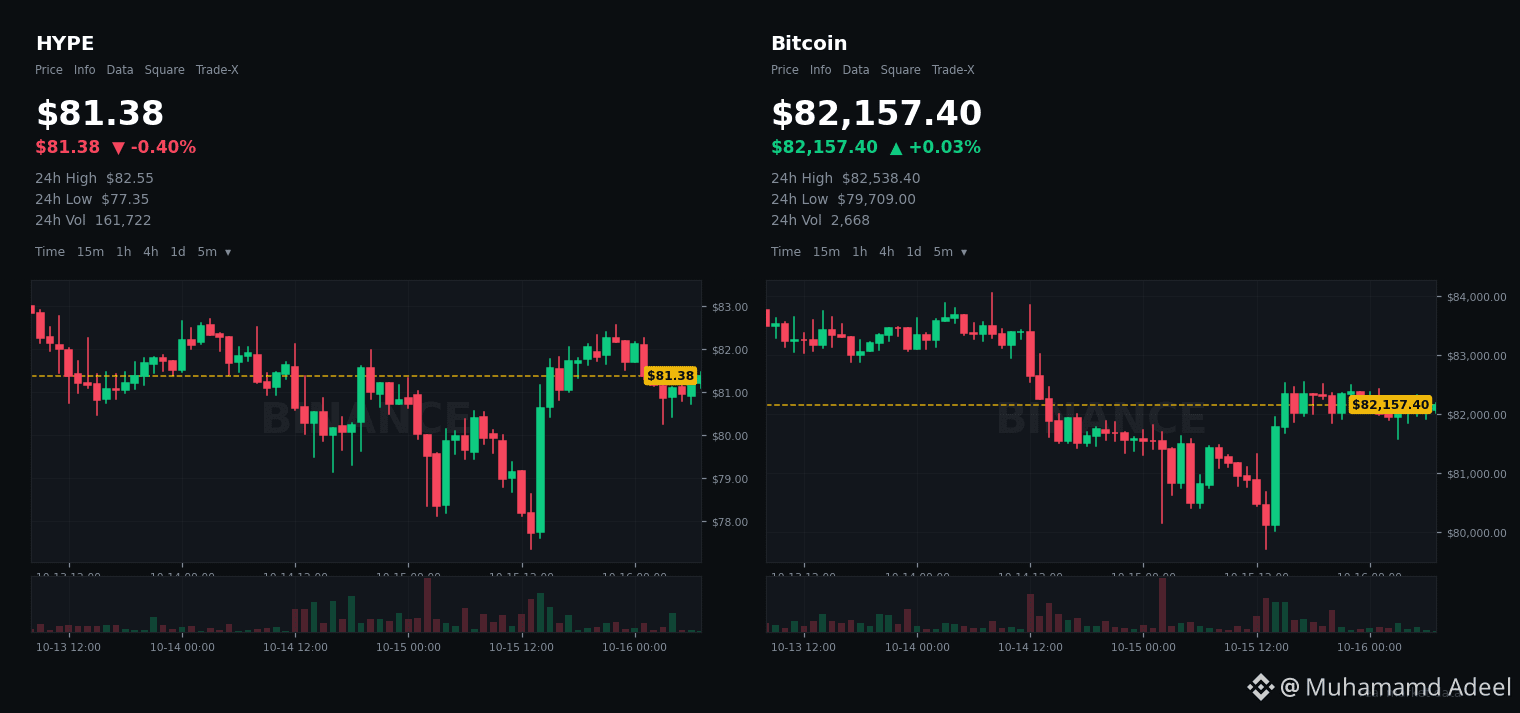
The timing is what makes it worth watching. A hotter-than-expected US PPI print knocked $HYPE below $80, with about $7M in longs liquidated against roughly $0.81M in shorts. Then it bounced straight back to around $81-82. $BTC, meanwhile, sat almost flat near $82,150. In a week where macro headlines have been doing the damage, $HYPE took the hit and held the floor.
Here is why the RWA launch matters more than the bounce. Hyperliquid started as a perp DEX, but its HIP-3 upgrade lets independent builders launch their own markets on top of it. Ripple Prime is the biggest test of that model yet: if institutions actually trade tokenised stocks and commodities here, Hyperliquid's volume stops depending only on crypto speculation. The base is already real — about $6.99B in TVL, roughly $88.45M in 30-day fees and about $71.37M in protocol revenue, per DeFiLlama's near-current snapshot. And positioning is not euphoric: whale positions total about $7.9B, split 46.8% long and 53.2% short, while funding sits at +0.0052% per 8 hours — positive in 20 of the last 21 periods, but far below overleveraged territory. Even founder Jeff Yan is pitching the long game, arguing on Bloomberg's Odd Lots on 15 October that US oversight should sit with the firms operating markets on Hyperliquid, not the chain itself.
So what decides it from here? Watch the floor first: $80-81 has held twice this week, with lows near $81.05 on 12 October and $80.52 on 14 October. Below that sits $77-78, and above it $85.82, then $90-91. Remember $HYPE is still about 17% below its all-time high near $98 from 23 September — this is not a token at the top. The bear case is honest too. A 6 November unlock releases about 9.92 million $HYPE, worth roughly $804M at current prices, to core contributors. Protocol revenue fell from about $357M in Q3 2025 to about $202M in Q2 2026, and perp-DEX share is no longer uncontested. One builder holding a large chunk of HIP-3 open interest is concentration risk, not decentralisation.
That is the real trade-off in one sentence: fresh institutional flow on one side, unlock supply and real competition on the other. The RWA perps will tell us which side is winning faster than any price chart. If stock and commodity perps actually trade here, $HYPE stops being just a DEX token and becomes a test of whether real-world assets live on-chain. If they don't, the unlock calendar does the talking.
#Hyperliquid #PerpDEX
Not financial advice. DYOR.
Ripple Prime Just Put 100+ RWA Perps on Hyperliquid — $HYPE Holds $81
BTC gets the headlines. $HYPE gets the order flow.
And yesterday, the order flow got a lot more interesting.
Ripple Prime just opened 100+ real-world-asset perp markets on Hyperliquid — stocks, indices, ETFs and commodities, tradeable as perpetual swaps through Trade.xyz, with RLUSD as collateral. This launched on 15 October, and it is not another crypto-native casino table. It is Wall Street plumbing moving onto a perp DEX's rails.
The timing is what makes it worth watching. A hotter-than-expected US PPI print knocked $HYPE below $80, with about $7M in longs liquidated against roughly $0.81M in shorts. Then it bounced straight back to around $81-82. $BTC , meanwhile, sat almost flat near $82,150. In a week where macro headlines have been doing the damage, $HYPE took the hit and held the floor.
Here is why the RWA launch matters more than the bounce. Hyperliquid started as a perp DEX, but its HIP-3 upgrade lets independent builders launch their own markets on top of it. Ripple Prime is the biggest test of that model yet: if institutions actually trade tokenised stocks and commodities here, Hyperliquid's volume stops depending only on crypto speculation. The base is already real — about $6.99B in TVL, roughly $88.45M in 30-day fees and about $71.37M in protocol revenue, per DeFiLlama's near-current snapshot. And positioning is not euphoric: whale positions total about $7.9B, split 46.8% long and 53.2% short, while funding sits at +0.0052% per 8 hours — positive in 20 of the last 21 periods, but far below overleveraged territory. Even founder Jeff Yan is pitching the long game, arguing on Bloomberg's Odd Lots on 15 October that US oversight should sit with the firms operating markets on Hyperliquid, not the chain itself.
So what decides it from here? Watch the floor first: $80-81 has held twice this week, with lows near $81.05 on 12 October and $80.52 on 14 October. Below that sits $77-78, and above it $85.82, then $90-91. Remember $HYPE is still about 17% below its all-time high near $98 from 23 September — this is not a token at the top. The bear case is honest too. A 6 November unlock releases about 9.92 million $HYPE , worth roughly $804M at current prices, to core contributors. Protocol revenue fell from about $357M in Q3 2025 to about $202M in Q2 2026, and perp-DEX share is no longer uncontested. One builder holding a large chunk of HIP-3 open interest is concentration risk, not decentralisation.
That is the real trade-off in one sentence: fresh institutional flow on one side, unlock supply and real competition on the other. The RWA perps will tell us which side is winning faster than any price chart. If stock and commodity perps actually trade here, $HYPE stops being just a DEX token and becomes a test of whether real-world assets live on-chain. If they don't, the unlock calendar does the talking.
#Hyperliquid #PerpDEX
Not financial advice. DYOR.
135
·
--
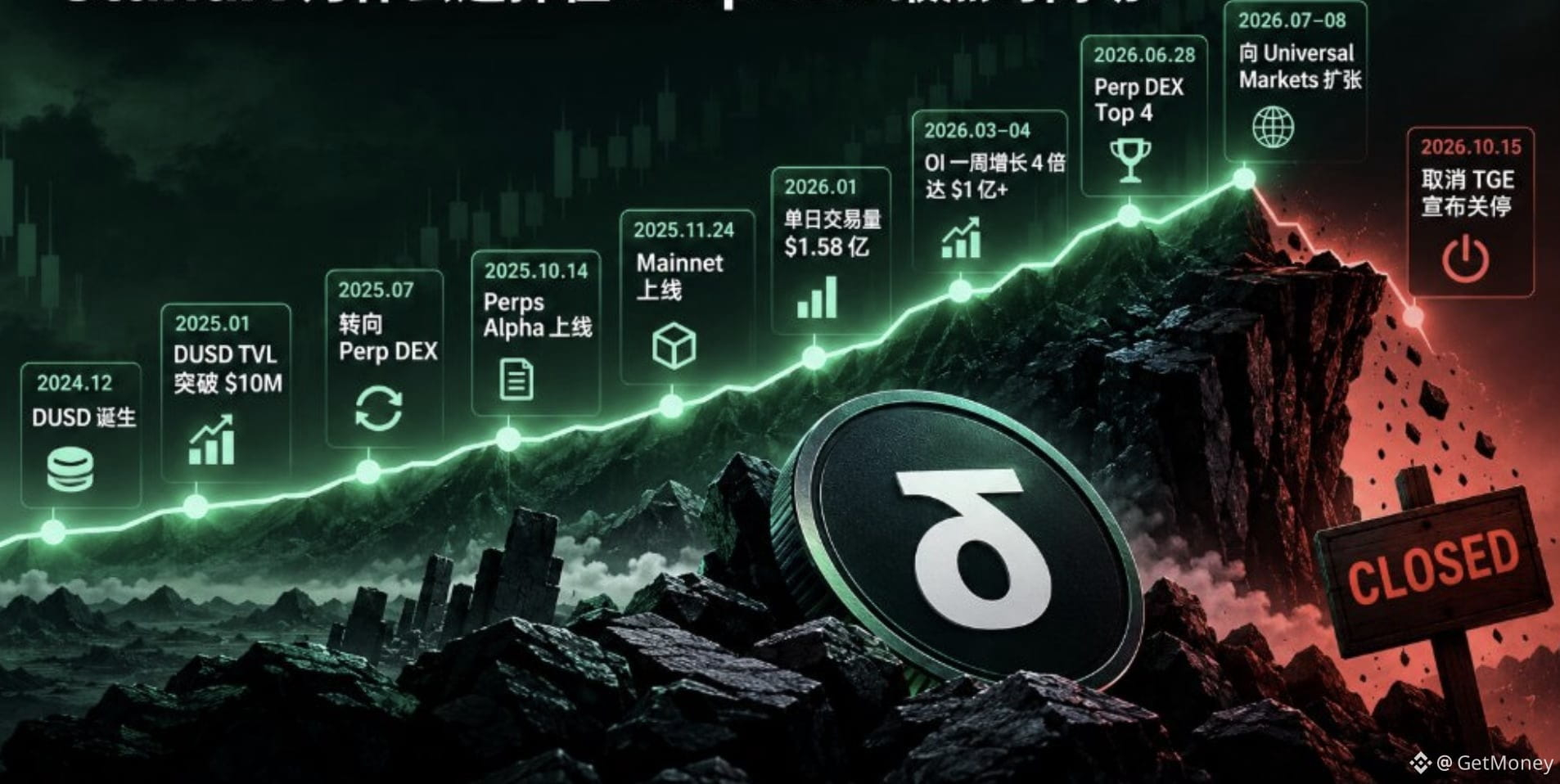
📰 Perp DEXs are still competing for users, but StandX has decided to shut down before its TGE. It’s not that the team failed to build a product: it pivoted to perpetual futures in the second half of 2025, briefly ranked fourth in daily trading volume among Perp DEXs on DeFiLlama in June 2026, and disclosed in July that it had around 235,000 users and $700 million in daily trading volume. It’s rare for a project to reach this scale and then choose to stop.
🔥 Honestly, all the hype doesn’t mean this is an easy business. Building an order book, finding market makers, subsidizing liquidity, and then using points and rebates to attract users—the larger the scale, the greater the ongoing investment required. StandX also chose to build its own order book and had no VC funding, so liquidity costs may have been a bill the team had to take seriously.
💡 What users care more about is what happens to the trading fees, slippage, funding rates, and locked-up capital they incurred in pursuit of points and the expected TGE. StandX’s plan is to skip issuing a token and distribute DUSD instead; eligible past participation includes Pre-deposit, Alpha, Mainnet trading, market making, and referrals.
👀 The team says the project’s remaining revenue will go toward the airdrop, with the team contributing additional funds. The checker will open on October 26, claims begin on November 1, and the deadline is December 31. There’s no vesting, which could be seen as the team giving the community an explanation—but the materials don’t say how much each person will receive.
🤔 This doesn’t mean Perp DEXs are doomed, but it is a reminder that rising trading volume and user numbers don’t mean a project can shoulder liquidity costs over the long term. Do you think skipping the TGE and compensating users with DUSD is a graceful way to wrap things up?
#StandX #PerpDEX #DUSD #Crypto Industry
1
49
·
--
📈 Top 3 Perp DEX Tokens to Watch
On-chain derivatives took a big slice of the futures market in 2025-26:
1️⃣ $HYPE (Hyperliquid): the market leader. Most trading fees go to buying back HYPE, and it has shown the deepest open interest.
2️⃣ $ASTER: Binance-ecosystem backed, with high volume.
3️⃣ $LIT (Lighter): zero-fee model with ZK verification.
⚠️ Some analysts say Aster and Lighter volume is partly incentive-driven. Hyperliquid also saw heavy outflows recently, so I'm watching open interest, not just volume.
Which perp DEX wins? 👇
Not financial advice. DYOR.
#PerpDEX #HYPE #Binance
📈 Top 3 Perp DEX Tokens to Watch
On-chain derivatives took a big slice of the futures market in 2025-26:
1️⃣ $HYPE (Hyperliquid): the market leader. Most trading fees go to buying back HYPE, and it has shown the deepest open interest.
2️⃣ $ASTER : Binance-ecosystem backed, with high volume.
3️⃣ $LIT (Lighter): zero-fee model with ZK verification.
⚠️ Some analysts say Aster and Lighter volume is partly incentive-driven. Hyperliquid also saw heavy outflows recently, so I'm watching open interest, not just volume.
Which perp DEX wins? 👇
Not financial advice. DYOR.
#PerpDEX #HYPE #Binance

1
991

·
--
Article
🚨 Hyperliquid Is Becoming a DeFi Powerhouse
The Perp DEX market is changing fast🚨 Hyperliquid Is Becoming a DeFi Powerhouse
The Perp DEX market is changing fast — and $HYPE / Hyperliquid is becoming one of the names to watch.
On-chain derivatives trading is increasingly moving toward Hyperliquid, driven by its:
⚡ Seamless trading experience
📖 Highly optimized order-book execution
🔗 On-chain transparency
📈 Growing Perp DEX market share
What makes this interesting is that Hyperliquid isn't simply competing for short-term volume. It is positioning itself as a potential core infrastructure layer for decentralized derivatives trading.
If this adoption trend continues, $HYPE could remain one of the most important assets in the DeFi derivatives narrative.
Is Hyperliquid becoming the DEX traders will default to? 👀
DYOR. Not financial advice.
#HYPE #PerpDEX #BinanceSquare
{spot}(HYPEUSDT)
🚨 Hyperliquid Is Becoming a DeFi Powerhouse The Perp DEX market is changing fast
🚨 Hyperliquid Is Becoming a DeFi Powerhouse
The Perp DEX market is changing fast — and $HYPE / Hyperliquid is becoming one of the names to watch.
On-chain derivatives trading is increasingly moving toward Hyperliquid, driven by its:
⚡ Seamless trading experience
📖 Highly optimized order-book execution
🔗 On-chain transparency
📈 Growing Perp DEX market share
What makes this interesting is that Hyperliquid isn't simply competing for short-term volume. It is positioning itself as a potential core infrastructure layer for decentralized derivatives trading.
If this adoption trend continues, $HYPE could remain one of the most important assets in the DeFi derivatives narrative.
Is Hyperliquid becoming the DEX traders will default to? 👀
DYOR. Not financial advice.
#HYPE #PerpDEX #BinanceSquare
119

·
--
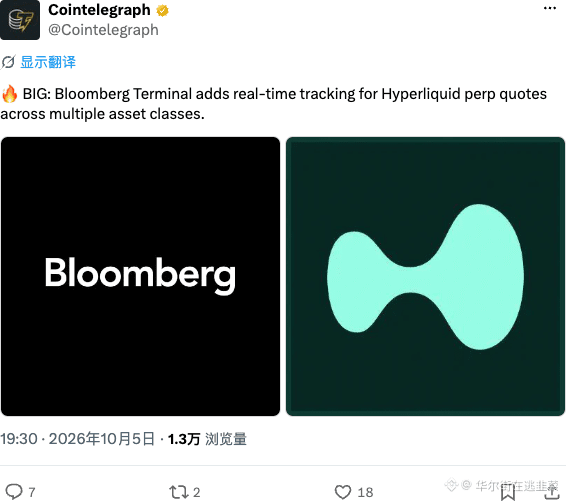
Bloomberg Terminal has added real-time quotes for Hyperliquid perpetuals, with coverage across multiple asset classes too. Wall Street’s go-to data terminal is actively plugging into onchain perps—this endorsement is a hundred times more convincing than a KOL shilling it. Institutions will be able to watch HYPE’s order book right from their terminals, with the user-acquisition pipeline delivered straight to their doorstep. TradFi may talk regulation, but its actions speak louder: it’s just waiting for the money to flow through the pipes.
$HYPE $BTC #Hyperliquid #PerpDEX
$HYPE $BTC #Hyperliquid #PerpDEX
259

·
--
ASTER Recap: Trading sideways like a straight ECG line—looks like the market maker might have clocked out 📊
First, the fundamentals: after the new economy model rolled out in June, the platform’s 99% of new day trading fees are automatically repurchased, plus a 1:1 burn. Total burned so far exceeds 188 million tokens. Translation: every trade is helping holders cash in—this kind of deflation pressure is one of a kind on perp DEXs.
Market action: $0.716. Low-volume consolidation for two days, sitting only at 26% of the 14-day range (0.694–0.781). Plain talk: it’s crouching right now—quietly. Low-position quiet is scarier than high-position partying. The ones partying are just having fun; the one crouching is holding it in.
Plan: copy the homework directly:
0.704–0.71 is the floor, and 0.694 is the foundation—if the foundation breaks, don’t ask; ask is basically just to run. If volume expands and it reclaims the 0.727 moving average, that suggests it’s standing up. Then watch for a bounce toward 0.78. At the moment, the best move might be: let it keep crouching—just don’t step on it.
The counterparty order flow on Hyperliquid is still the big boss by volume, but Aster has BNB-chain backing and even nasty moves like 1001x leverage. This show isn’t over.
Personal plan only, not investment advice.
#ASTER #PerpDEX #DeFi #buyback-and-burn
336
·
--
📰 The data from the Hong Kong Stock Exchange is very straightforward: in August 2026, the Hang Seng Tech Index futures saw an average daily trading volume of 154,986 contracts, while all single-stock futures combined totaled only 4,385. For a thematic index, trading activity far exceeds a bunch of single-stock contracts.
🔥 This is quite instructive for smaller CEXs and Perp DEXs. Keep listing trading pairs, increase leverage, and offer trading incentives—users may come fast, but they’ll also leave fast. Exclusively launching small-cap stocks isn’t a long-term advantage either. Once the underlying gets hot, big platforms will follow, and smaller platforms will have to find their next target again.
💡 A more interesting approach is to first attract attention with single-stock offerings, then group similar companies into an agreement-built small-cap index perpetual. Users don’t need to research every company individually—they can trade the entire sector directly. And the agreement can evolve from scouring stocks everywhere to organizing its own market.
👀 Liquidity might also be reorganized. A study from 2012 found that the ETF’s dollar-quoted depth reaches up to 35 times that of a single-stock sample. The portfolio dilutes the impact of single-company events. Market makers can manage their net exposure, without needing to synchronously buy and sell all constituent stocks for every index trade.
Honestly, the point of this path isn’t about “listing a few more new coin pairs,” but about concentrating fragmented demand into a product that can be traded repeatedly. Do you think a small trading platform can really keep users by offering small-cap stock index perpetuities?
#PerpDEX #永续合约 #小盘股 #加密衍生品

41

·
--
🚨 $ASTER COMPRESSION DEEPENS WHILE COMPETITORS EXPLODE 500% IS INSTITUTIONAL LIQUIDITY BUILDING? ⚡
While sector peers like $LIT and $HYPE have cleared massive upside imbalance pools with 500-700% expansions, $ASTER remains locked in an extended structural range. 🔍 Smart money often uses prolonged lagger compression to absorb supply quietly while retail sentiment drops to extreme apathy.
This widening structural divergence between $ASTER and the broader perp DEX sector creates a classic institutional inefficiency. 📊 When high-beta competitors finish their markup phase, capital rotation frequently triggers sharp repricing in dormant setups. 💬 Is $ASTER preparing for an explosive catch-up expansion or is smart money avoiding this order book entirely? 👇
⚠️ Not financial advice. Always manage your risk. 🛡️
🏷️ #ASTER #PerpDEX #Altcoins #MarketStructure
🎯 🦈
66
·
--
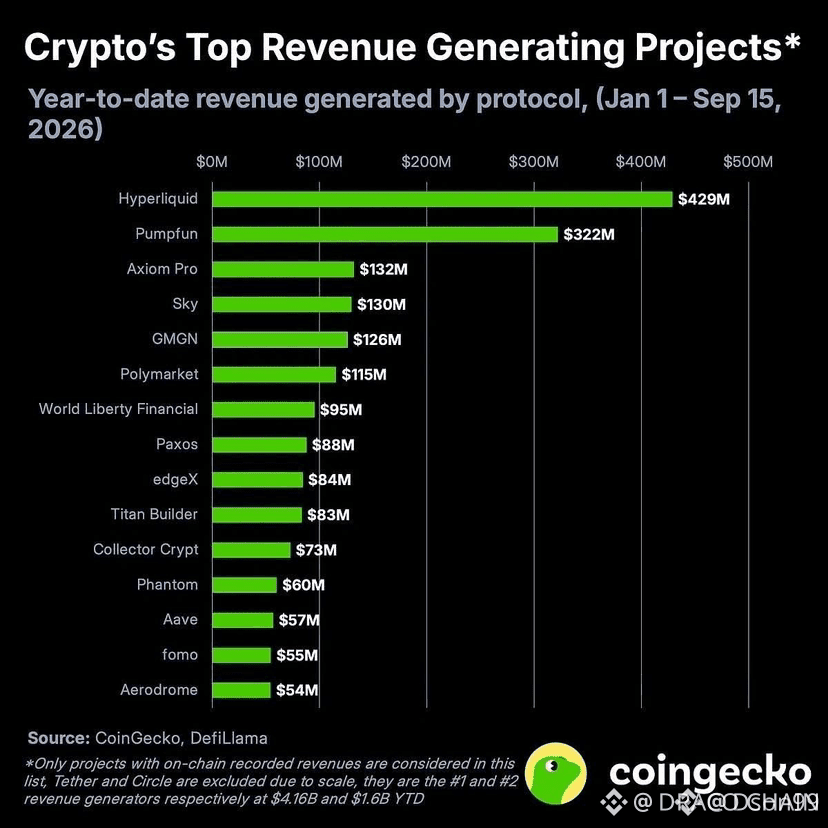
🚨 $HYPE DOMINATES PROTOCOL REVENUE WITH $429M GENERATED IN PERPETUAL ORDER FLOW! 📊
Institutional volume is consolidating around high-utility revenue engines. $HYPE has generated $429M year-to-date, driven largely by perpetual futures contracts liquidity, while secondary platforms like Pumpfun captured $322M. 🔍 Revenue generation reflects genuine institutional activity and protocol utilization, setting aside traditional stablecoin issuers.
💡 Protocols boasting real yield engines like $HYPE and solid order flow dynamics continue to demonstrate structural strength in this expansion. 📊 When protocol cash flow accelerates this aggressively, capital efficiency usually follows the institutional footprint. 💬 Which protocol revenue model do you believe holds the strongest structural edge long term? 👇
⚠️ Not financial advice. Always manage your risk. 🛡️
🏷️ #HYPE #PerpDEX #Crypto #MarketStructure
🦈 💡
81

·
--
Bullish
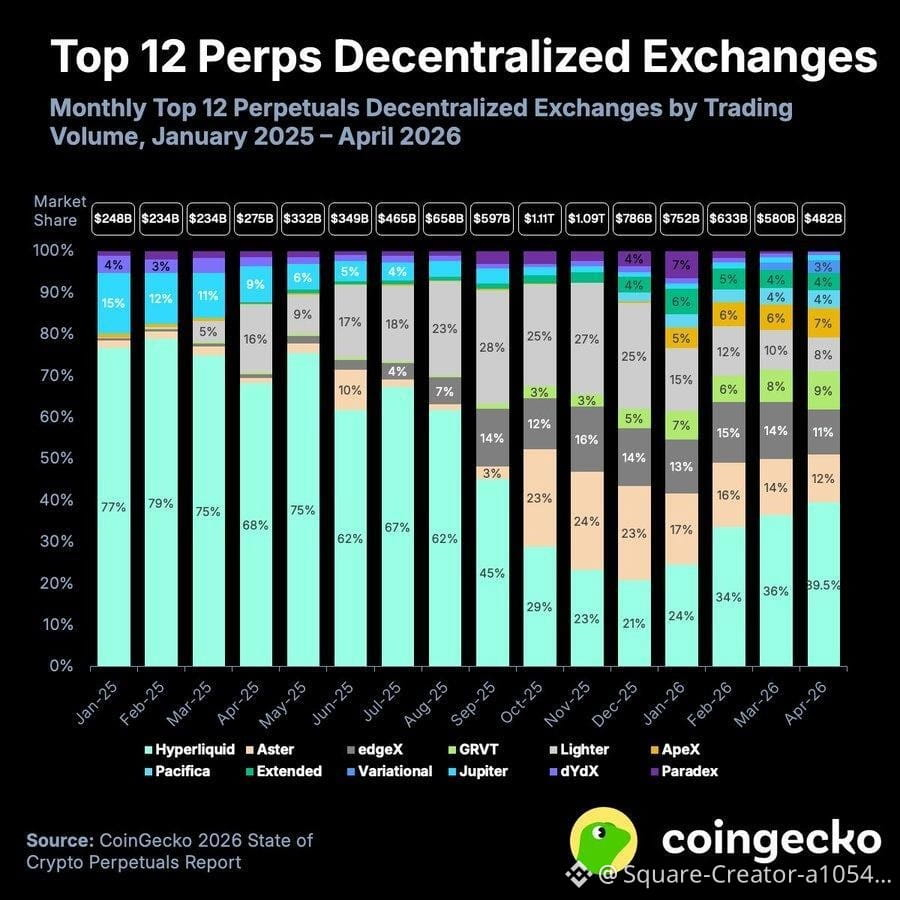
Why Hyperliquid ($HYPE) is Taking Over! 🚀
The data is in! According to CoinGecko, the top 12 perp DEXs averaged $611.6B in volume in 2026, and Hyperliquid is dominating the market.
It’s no surprise that $HYPE recently flipped Solana in fully diluted valuation. We are seeing a direct correlation between:
1.Massive growth in platform volume and user activity.
2.Market recognition of Hyperliquid as the leader in decentralized perpetual trading.
The "Perp DEX" wars are heating up, and Hyperliquid is currently holding the crown. Is this sustainable? The charts say yes! 📈
#Hyperliquid #PerpDEX #Solana #CryptoData #BinanceSquare
Why Hyperliquid ($HYPE ) is Taking Over! 🚀
The data is in! According to CoinGecko, the top 12 perp DEXs averaged $611.6B in volume in 2026, and Hyperliquid is dominating the market.
It’s no surprise that $HYPE recently flipped Solana in fully diluted valuation. We are seeing a direct correlation between:
1.Massive growth in platform volume and user activity.
2.Market recognition of Hyperliquid as the leader in decentralized perpetual trading.
The "Perp DEX" wars are heating up, and Hyperliquid is currently holding the crown. Is this sustainable? The charts say yes! 📈
#Hyperliquid #PerpDEX #Solana #CryptoData #BinanceSquare
1
272

GRVT THE PLATFORM THAT RECONCILES CEX AND TRANSPARENCY#grvt GRVT : the platform that reconciles CEX performance and on-chain transparency
The decentralized derivatives market is undergoing a major transformation, and $GRVT is emerging as one of the strongest players in this new generation of exchanges. Here's why this project deserves your attention. GRVT combines the best of both worlds: the speed of a centralized exchange and the transparency of a blockchain. The platform is built on its own ZK appchain, based on the ZKsync stack, with a central order book (CLOB) rather than a simple AMM. The result: ultra-low-latency execution, with a claimed capacity of 600,000 transactions per second (Grvt Blog), while still retaining the self-custody of funds that is native to DeFi. One of GRVT’s biggest strengths is its "composable yield" system. Thanks to an integration with Aave, collateral deposited on GRVT can be placed in Aave’s lending markets, allowing traders to earn an on-chain yield while their positions remain open. No more capital sitting idle in margin: every deposited dollar stays productive. GRVT uses a Validium layer with data confidentiality by default, protecting traders from MEV and information leaks about their order flows. This institutional approach is particularly appealing to market makers and crypto-native funds that are looking for discretion and a robust architecture. GRVT’s account system clearly separates identity, fund management, and trading activity: a central funding account, linked to multiple independent trading accounts. This separation strengthens security and makes capital management easier, whether you’re an individual trader or a professional team. GRVT is not limited to perpetual contracts: the platform already supports trading crypto, gold, and stocks 24/7, with a roadmap aimed at building a true on-chain brokerage model that combines trading, savings, and investing into a single system. GRVT was recently highlighted in an Animoca Brands Research report on the rise of Perp DEXs, praising its institutional-grade infrastructure and its yield-generating margin system as key features of the new era of on-chain finance. In a fast-growing decentralized derivatives market, GRVT stands out with a rare combination: execution speed, confidentiality, self-custody, and passive yield on collateral. A project worth keeping a close eye on for any trader who wants to combine performance and sovereignty over their assets.
GRVT THE PLATFORM THAT RECONCILES CEX AND TRANSPARENCY
#grvt GRVT : the platform that reconciles CEX performance and on-chain transparency
The decentralized derivatives market is undergoing a major transformation, and $GRVT is emerging as one of the strongest players in this new generation of exchanges. Here's why this project deserves your attention. GRVT combines the best of both worlds: the speed of a centralized exchange and the transparency of a blockchain. The platform is built on its own ZK appchain, based on the ZKsync stack, with a central order book (CLOB) rather than a simple AMM. The result: ultra-low-latency execution, with a claimed capacity of 600,000 transactions per second (Grvt Blog), while still retaining the self-custody of funds that is native to DeFi. One of GRVT’s biggest strengths is its "composable yield" system. Thanks to an integration with Aave, collateral deposited on GRVT can be placed in Aave’s lending markets, allowing traders to earn an on-chain yield while their positions remain open. No more capital sitting idle in margin: every deposited dollar stays productive. GRVT uses a Validium layer with data confidentiality by default, protecting traders from MEV and information leaks about their order flows. This institutional approach is particularly appealing to market makers and crypto-native funds that are looking for discretion and a robust architecture. GRVT’s account system clearly separates identity, fund management, and trading activity: a central funding account, linked to multiple independent trading accounts. This separation strengthens security and makes capital management easier, whether you’re an individual trader or a professional team. GRVT is not limited to perpetual contracts: the platform already supports trading crypto, gold, and stocks 24/7, with a roadmap aimed at building a true on-chain brokerage model that combines trading, savings, and investing into a single system. GRVT was recently highlighted in an Animoca Brands Research report on the rise of Perp DEXs, praising its institutional-grade infrastructure and its yield-generating margin system as key features of the new era of on-chain finance. In a fast-growing decentralized derivatives market, GRVT stands out with a rare combination: execution speed, confidentiality, self-custody, and passive yield on collateral. A project worth keeping a close eye on for any trader who wants to combine performance and sovereignty over their assets.
The decentralized derivatives market is undergoing a major transformation, and $GRVT is emerging as one of the strongest players in this new generation of exchanges. Here's why this project deserves your attention. GRVT combines the best of both worlds: the speed of a centralized exchange and the transparency of a blockchain. The platform is built on its own ZK appchain, based on the ZKsync stack, with a central order book (CLOB) rather than a simple AMM. The result: ultra-low-latency execution, with a claimed capacity of 600,000 transactions per second (Grvt Blog), while still retaining the self-custody of funds that is native to DeFi. One of GRVT’s biggest strengths is its "composable yield" system. Thanks to an integration with Aave, collateral deposited on GRVT can be placed in Aave’s lending markets, allowing traders to earn an on-chain yield while their positions remain open. No more capital sitting idle in margin: every deposited dollar stays productive. GRVT uses a Validium layer with data confidentiality by default, protecting traders from MEV and information leaks about their order flows. This institutional approach is particularly appealing to market makers and crypto-native funds that are looking for discretion and a robust architecture. GRVT’s account system clearly separates identity, fund management, and trading activity: a central funding account, linked to multiple independent trading accounts. This separation strengthens security and makes capital management easier, whether you’re an individual trader or a professional team. GRVT is not limited to perpetual contracts: the platform already supports trading crypto, gold, and stocks 24/7, with a roadmap aimed at building a true on-chain brokerage model that combines trading, savings, and investing into a single system. GRVT was recently highlighted in an Animoca Brands Research report on the rise of Perp DEXs, praising its institutional-grade infrastructure and its yield-generating margin system as key features of the new era of on-chain finance. In a fast-growing decentralized derivatives market, GRVT stands out with a rare combination: execution speed, confidentiality, self-custody, and passive yield on collateral. A project worth keeping a close eye on for any trader who wants to combine performance and sovereignty over their assets.
149

·
--
Many platforms claim that “decentralization” and “high performance” are mutually exclusive, but what I care about is whether transaction speed, control over funds, and privacy can coexist in the same system.
According to official materials, @grvt_io uses a hybrid architecture—order matching happens off-chain, while settlement and fund-related operations are verified on-chain through zero-knowledge proofs. ZKsync Validium also means that not all of the positions, trading sizes, and liquidation thresholds need to be fully disclosed. In addition, Grvt combines passwords, 2FA, private keys, and institution-level RBAC into a multi-layer access control scheme.
This approach is compelling, but “self-custody” doesn’t mean zero risk. Smart contracts, key management, liquidity, and extreme market conditions still require ongoing validation. When evaluating a Perp DEX, you should ultimately look at verifiable settlement, withdrawal performance, and real user experience—not just marketing slogans.
#零知识证明 #PerpDEX
#grvt

125

·
--
$LIT quietly pushed up to 1.21, and those who were bearish on PerpDEX got their faces slapped.
This sudden surge isn’t just riding the hype; it’s backed by solid logic.
Zero fees for new users, ZK-Rollup ramping up transaction speeds to CEX levels, and upgraded RFQ institutional liquidity.
It perfectly aligns with Hyperliquid leading the PerpDEX race, big whale transactions are proof, not just empty hype from random low-cap coins.
Don’t try to apply altcoin logic to LIT; this is a top-tier opportunity.
Previously, PerpDEX was either deep in the red or had fees higher than CEX.
LIT has directly attracted institutional liquidity, creating a massive hole in the moat of CEX derivatives, with whales buying into the breakthrough expectations, not just speculation.
The current market cap is only 302 million, with a 24-hour trading volume of 64.14 million; the volume-to-price ratio is impressively healthy.
You can hold long positions on contracts, but don’t chase the highs; it’s safer to add positions around 1.1.
The benefits of the PerpDEX sector are just beginning to unfold; this isn’t a short-term pump and dump.
Do you think LIT can reach a 500 million market cap? Are you willing to jump in now or wait for a pullback?
$LIT
#PerpDEX #加密货币 #ZKRollup
67
Log in to explore more content
Join global crypto users on Binance Square
⚡️ Get latest and useful information about crypto.
💬 Trusted by the world’s largest crypto exchange.
👍 Discover real insights from verified creators.
Email / Phone number
Trending Topics
1
#UniswapA16zSeekDeFiExemptionFromIllinoisCryptoTax
2,541 views
249 Discussing
2
#HKDollarStablecoinHKDAPToLaunchOnSolana
1,083 views
116 Discussing
3
#$1.5BInLeveragedCryptoBetsLiquidated
13,355 views
172 Discussing
4
#TrezorSaysCryptoBilisSoldWalletMayContainMaliciousComponents
288 views
23 Discussing
5
#KOSPIFalls3.53%BackBelow6000
36,212 views
801 Discussing
6
#AmazonSharesFallAbout7%InPremarketTrading
14,190 views
398 Discussing
7
#USMidtermElections
173,775 views
2,051 Discussing
8
#StrategySTRCReaches$99.95ForFirstTimeIn165Days
6,657 views
88 Discussing
9
#BinanceWillListPredictPREDICT
57,303 views
1,138 Discussing
10
#SwitzerlandFirstSpotBitcoinETFExpectedToTradeInNovember
1,863 views
94 Discussing