
#gasfees
gasfees
207,344 views
357 Discussing
Hot
Latest

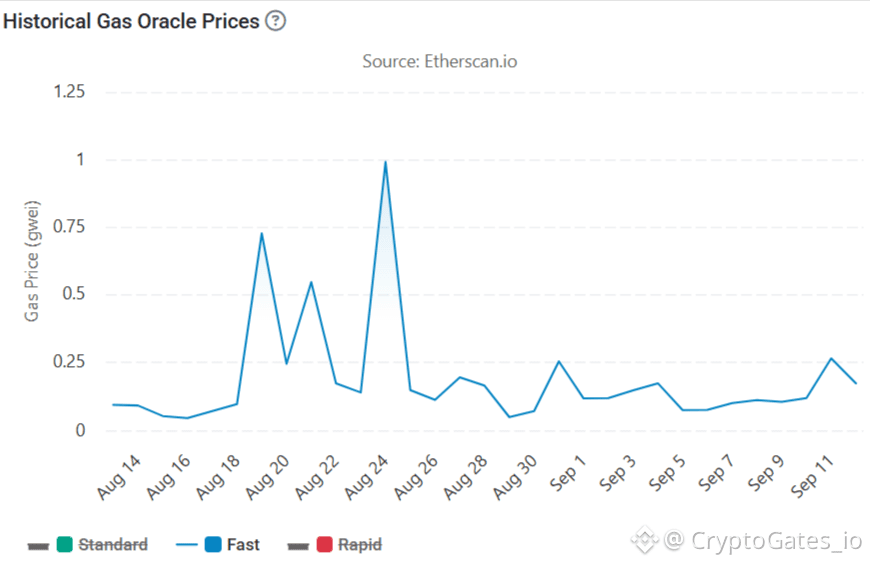
$ETH : Ethereum gas fees have dropped to multi-week lows, standard transactions currently at 0.053 gwei
Lower gas often lines up with reduced on-chain demand, fewer swaps and contract calls happening compared to a few weeks ago when fees briefly touched near 1 gwei.
For active traders, this is also a low-cost window for executing on-chain strategy adjustments.
Execution cost is part of the equation, not just entry price.
#Ethereum #GasFees #OnChainMetrics
$ETH : Ethereum gas fees have dropped to multi-week lows, standard transactions currently at 0.053 gwei
Lower gas often lines up with reduced on-chain demand, fewer swaps and contract calls happening compared to a few weeks ago when fees briefly touched near 1 gwei.
For active traders, this is also a low-cost window for executing on-chain strategy adjustments.
Execution cost is part of the equation, not just entry price.
#Ethereum #GasFees #OnChainMetrics
Lower gas often lines up with reduced on-chain demand, fewer swaps and contract calls happening compared to a few weeks ago when fees briefly touched near 1 gwei.
For active traders, this is also a low-cost window for executing on-chain strategy adjustments.
Execution cost is part of the equation, not just entry price.
#Ethereum #GasFees #OnChainMetrics
47

·
--
Ethereum moves toward paying gas without needing to hold ETH. The Frame Transactions feature, locked into the Hegóta upgrade last month, is progressing quickly, says Vitalik Buterin. A potential game-changer for onboarding and DeFi access. $ETH #Ethereum #GasFees
Ethereum moves toward paying gas without needing to hold ETH. The Frame Transactions feature, locked into the Hegóta upgrade last month, is progressing quickly, says Vitalik Buterin. A potential game-changer for onboarding and DeFi access. $ETH #Ethereum #GasFees
7

·
--
Why Gas Fees on Blockchain Networks Rise and FallGas fees are the cost users pay to have their transactions included in a blockchain block. They compensate the network for the computational resources required to validate and store the data. Most networks set a base fee per unit of work, often called gas, and add a tip to encourage quick inclusion. When many participants are competing for limited block space, the price of each unit rises; when activity subsides, the price falls.
Transaction complexity matters: a simple transfer uses less gas than a smart‑contract interaction, so larger scripts can increase the total fee. Network congestion is a primary driver. During periods of high trading volume on $ETH, for example, demand for block space spikes and fees climb. Conversely, during quieter intervals the same network may see lower costs. On $BTC, the fee market is influenced by block size and transaction weight, while networks such as $SOL may experience different fee patterns due to their consensus design.
Block size limits and the algorithm that adjusts difficulty also influence fee dynamics. Some chains employ a market‑based mechanism where users bid for priority, while others rely on a fixed schedule that changes based on usage. Practical steps for managing fees include checking real‑time estimators, batching multiple operations into a single transaction, and timing submissions when the network is less busy.
Warning signs to watch for include sudden fee jumps, long pending periods, and estimates that exceed typical ranges, which may indicate an upcoming congestion event. Balanced view: while fees reflect the cost of securing the network, they can also create barriers for small participants. Understanding the underlying supply‑and‑demand forces helps users plan interactions more predictably.
In practice, traders often monitor congestion dashboards and may delay transactions until after peak periods. Developers sometimes implement adaptive fee logic that selects an appropriate gas price based on current network conditions.
#GasFees #Blockchain #CryptoEducation
This article was produced with AI assistance; it is not financial advice. Always do your own research (DYOR).
Why Gas Fees on Blockchain Networks Rise and Fall
Gas fees are the cost users pay to have their transactions included in a blockchain block. They compensate the network for the computational resources required to validate and store the data. Most networks set a base fee per unit of work, often called gas, and add a tip to encourage quick inclusion. When many participants are competing for limited block space, the price of each unit rises; when activity subsides, the price falls.
Transaction complexity matters: a simple transfer uses less gas than a smart‑contract interaction, so larger scripts can increase the total fee. Network congestion is a primary driver. During periods of high trading volume on $ETH , for example, demand for block space spikes and fees climb. Conversely, during quieter intervals the same network may see lower costs. On $BTC , the fee market is influenced by block size and transaction weight, while networks such as $SOL may experience different fee patterns due to their consensus design.
Block size limits and the algorithm that adjusts difficulty also influence fee dynamics. Some chains employ a market‑based mechanism where users bid for priority, while others rely on a fixed schedule that changes based on usage. Practical steps for managing fees include checking real‑time estimators, batching multiple operations into a single transaction, and timing submissions when the network is less busy.
Warning signs to watch for include sudden fee jumps, long pending periods, and estimates that exceed typical ranges, which may indicate an upcoming congestion event. Balanced view: while fees reflect the cost of securing the network, they can also create barriers for small participants. Understanding the underlying supply‑and‑demand forces helps users plan interactions more predictably.
In practice, traders often monitor congestion dashboards and may delay transactions until after peak periods. Developers sometimes implement adaptive fee logic that selects an appropriate gas price based on current network conditions.
#GasFees #Blockchain #CryptoEducation
This article was produced with AI assistance; it is not financial advice. Always do your own research (DYOR).
Transaction complexity matters: a simple transfer uses less gas than a smart‑contract interaction, so larger scripts can increase the total fee. Network congestion is a primary driver. During periods of high trading volume on $ETH , for example, demand for block space spikes and fees climb. Conversely, during quieter intervals the same network may see lower costs. On $BTC , the fee market is influenced by block size and transaction weight, while networks such as $SOL may experience different fee patterns due to their consensus design.
Block size limits and the algorithm that adjusts difficulty also influence fee dynamics. Some chains employ a market‑based mechanism where users bid for priority, while others rely on a fixed schedule that changes based on usage. Practical steps for managing fees include checking real‑time estimators, batching multiple operations into a single transaction, and timing submissions when the network is less busy.
Warning signs to watch for include sudden fee jumps, long pending periods, and estimates that exceed typical ranges, which may indicate an upcoming congestion event. Balanced view: while fees reflect the cost of securing the network, they can also create barriers for small participants. Understanding the underlying supply‑and‑demand forces helps users plan interactions more predictably.
In practice, traders often monitor congestion dashboards and may delay transactions until after peak periods. Developers sometimes implement adaptive fee logic that selects an appropriate gas price based on current network conditions.
#GasFees #Blockchain #CryptoEducation
This article was produced with AI assistance; it is not financial advice. Always do your own research (DYOR).
77

·
--
🚨 Ethereum and Solana process trillions in volume, but native tokens like ETH may lose direct user demand as paymasters and sponsors absorb gas fees.
While apps hide ETH/SOL from users, the underlying gas bill remains—funded in native tokens.
This could weaken organic demand pressure on ETH despite high on-chain activity.
Is ETH’s value still tied to usage if users never touch it?
#GasFees
$ETH #TradingSignal #CryptoAnalysis
🚨 Ethereum and Solana process trillions in volume, but native tokens like ETH may lose direct user demand as paymasters and sponsors absorb gas fees.
While apps hide ETH/SOL from users, the underlying gas bill remains—funded in native tokens.
This could weaken organic demand pressure on ETH despite high on-chain activity.
Is ETH’s value still tied to usage if users never touch it?
#GasFees
$ETH #TradingSignal #CryptoAnalysis
While apps hide ETH/SOL from users, the underlying gas bill remains—funded in native tokens.
This could weaken organic demand pressure on ETH despite high on-chain activity.
Is ETH’s value still tied to usage if users never touch it?
#GasFees
$ETH #TradingSignal #CryptoAnalysis

17

Gas fees are the cost that users pay to perform certain operations within a blockchain.
In Ethereum, for example, these fees help to cover the resources needed to process transactions and execute smart contracts.
The cost can vary depending on network demand.
When many people want to use Ethereum at the same time, fees can increase.
That’s why “gas” is an important concept for understanding how $ETH works and the applications built on its network.
#Ethereum #gasfees
Gas fees are the cost that users pay to perform certain operations within a blockchain.
In Ethereum, for example, these fees help to cover the resources needed to process transactions and execute smart contracts.
The cost can vary depending on network demand.
When many people want to use Ethereum at the same time, fees can increase.
That’s why “gas” is an important concept for understanding how $ETH works and the applications built on its network.
#Ethereum #gasfees
In Ethereum, for example, these fees help to cover the resources needed to process transactions and execute smart contracts.
The cost can vary depending on network demand.
When many people want to use Ethereum at the same time, fees can increase.
That’s why “gas” is an important concept for understanding how $ETH works and the applications built on its network.
#Ethereum #gasfees

1
79
·
--
Ethereum’s next upgrade breaks the old '21,000 gas' baseline wallets have relied on. Sending ETH to a brand-new address will cost more than sending to an existing one, and software built around a flat fee will get the sum wrong. Expect wallets and dapps to adapt to more dynamic gas behavior. $ETH #Ethereum #GasFees #CryptoNews
Ethereum’s next upgrade breaks the old '21,000 gas' baseline wallets have relied on. Sending ETH to a brand-new address will cost more than sending to an existing one, and software built around a flat fee will get the sum wrong. Expect wallets and dapps to adapt to more dynamic gas behavior. $ETH #Ethereum #GasFees #CryptoNews
9

·
--
Verified
Ethereum Transforms Slash Gas Fees to Pennies in Historic 2026 Upgrade
Ethereum has achieved a breakthrough milestone, reducing average transaction fees from $50 to mere cents: developers attribute this to the Dencun upgrade and widespread Layer 2 adoption.
Network congestion dropped significantly as activity migrated to rollup-based scaling solutions, with mainnet now serving primarily as a settlement layer. Users on Arbitrum, Optimism, and Base now pay under $0.10 per transaction.
Analysts note this shift strengthens Ethereum's position as the foundation for institutional DeFi and real-world asset tokenization, while keeping everyday transactions affordable for retail users.
Is this the awakening Ethereum holders have awaited? Share your perspective below. 👇
#Ethereum #GasFees #CryptoLayer2
Ethereum Transforms Slash Gas Fees to Pennies in Historic 2026 Upgrade
Ethereum has achieved a breakthrough milestone, reducing average transaction fees from $50 to mere cents: developers attribute this to the Dencun upgrade and widespread Layer 2 adoption.
Network congestion dropped significantly as activity migrated to rollup-based scaling solutions, with mainnet now serving primarily as a settlement layer. Users on Arbitrum, Optimism, and Base now pay under $0.10 per transaction.
Analysts note this shift strengthens Ethereum's position as the foundation for institutional DeFi and real-world asset tokenization, while keeping everyday transactions affordable for retail users.
Is this the awakening Ethereum holders have awaited? Share your perspective below. 👇
#Ethereum #GasFees #CryptoLayer2
Ethereum has achieved a breakthrough milestone, reducing average transaction fees from $50 to mere cents: developers attribute this to the Dencun upgrade and widespread Layer 2 adoption.
Network congestion dropped significantly as activity migrated to rollup-based scaling solutions, with mainnet now serving primarily as a settlement layer. Users on Arbitrum, Optimism, and Base now pay under $0.10 per transaction.
Analysts note this shift strengthens Ethereum's position as the foundation for institutional DeFi and real-world asset tokenization, while keeping everyday transactions affordable for retail users.
Is this the awakening Ethereum holders have awaited? Share your perspective below. 👇
#Ethereum #GasFees #CryptoLayer2
53

·
--
Tired of commissions eating up your crypto profits? 📉 I’ll show you how to cut them down to a minimum with these 4 key tricks.
The "Gas Fee" is simply the toll you pay validators for processing your transaction on the blockchain. If the network is congested, the price goes up.
To stop giving away your money in fees, apply these strategies:
Trade during low-traffic hours: Transacting on weekends or late at night can save you up to 50% in commissions.
Use Layer 2 and efficient networks: Instead of Ethereum’s main network, move your funds to networks like Arbitrum, Optimism, Base, BNB Chain, or Solana. They’re ultra-fast and cost pennies.
Check a Gas Tracker: Look at live tools (like the Etherscan Gas Tracker) before you trade to see whether you’re paying during a price spike or a discount moment.
Batch your transactions: Avoid micro-moves. Making one large transaction is much cheaper than doing ten small ones, since you optimize the fixed cost per transfer.
Don’t let impatience drain your portfolio. Learn to move your money intelligently! 🧠
💬 Let’s discuss in the comments: What’s been the most ridiculous or painful fee you’ve ever been charged in your crypto story? I’m listening! 👇
🚀 Did this add value? Like this post, share it, and follow me for more optimization guides and market analysis. Let’s grow that portfolio together. #GasFees #Layer2 #CryptoTips #Blockchain #EducacionFinanciera
Tired of commissions eating up your crypto profits? 📉 I’ll show you how to cut them down to a minimum with these 4 key tricks.
The "Gas Fee" is simply the toll you pay validators for processing your transaction on the blockchain. If the network is congested, the price goes up.
To stop giving away your money in fees, apply these strategies:
Trade during low-traffic hours: Transacting on weekends or late at night can save you up to 50% in commissions.
Use Layer 2 and efficient networks: Instead of Ethereum’s main network, move your funds to networks like Arbitrum, Optimism, Base, BNB Chain, or Solana. They’re ultra-fast and cost pennies.
Check a Gas Tracker: Look at live tools (like the Etherscan Gas Tracker) before you trade to see whether you’re paying during a price spike or a discount moment.
Batch your transactions: Avoid micro-moves. Making one large transaction is much cheaper than doing ten small ones, since you optimize the fixed cost per transfer.
Don’t let impatience drain your portfolio. Learn to move your money intelligently! 🧠
💬 Let’s discuss in the comments: What’s been the most ridiculous or painful fee you’ve ever been charged in your crypto story? I’m listening! 👇
🚀 Did this add value? Like this post, share it, and follow me for more optimization guides and market analysis. Let’s grow that portfolio together. #GasFees #Layer2 #CryptoTips #Blockchain #EducacionFinanciera
The "Gas Fee" is simply the toll you pay validators for processing your transaction on the blockchain. If the network is congested, the price goes up.
To stop giving away your money in fees, apply these strategies:
Trade during low-traffic hours: Transacting on weekends or late at night can save you up to 50% in commissions.
Use Layer 2 and efficient networks: Instead of Ethereum’s main network, move your funds to networks like Arbitrum, Optimism, Base, BNB Chain, or Solana. They’re ultra-fast and cost pennies.
Check a Gas Tracker: Look at live tools (like the Etherscan Gas Tracker) before you trade to see whether you’re paying during a price spike or a discount moment.
Batch your transactions: Avoid micro-moves. Making one large transaction is much cheaper than doing ten small ones, since you optimize the fixed cost per transfer.
Don’t let impatience drain your portfolio. Learn to move your money intelligently! 🧠
💬 Let’s discuss in the comments: What’s been the most ridiculous or painful fee you’ve ever been charged in your crypto story? I’m listening! 👇
🚀 Did this add value? Like this post, share it, and follow me for more optimization guides and market analysis. Let’s grow that portfolio together. #GasFees #Layer2 #CryptoTips #Blockchain #EducacionFinanciera

320

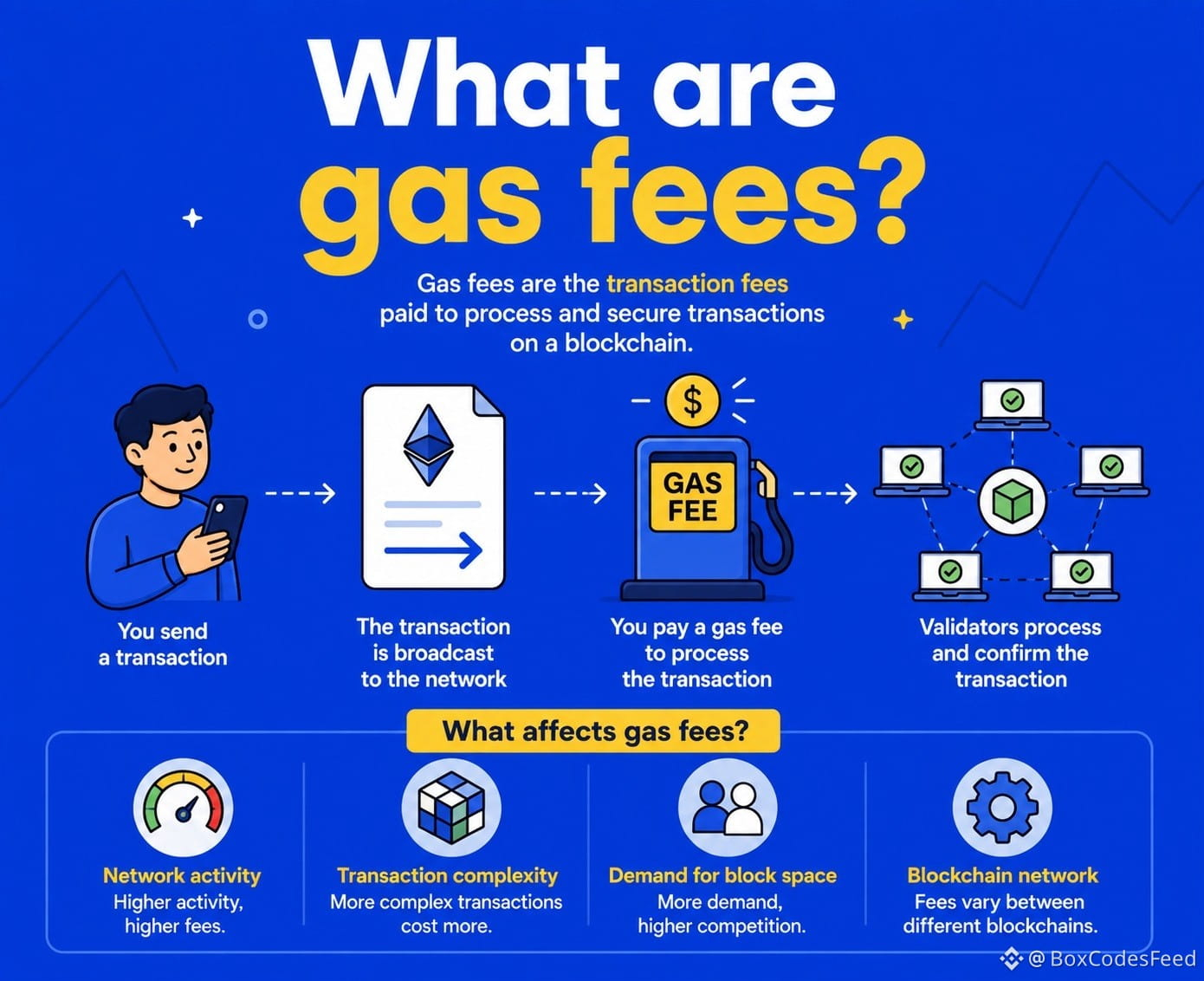

⚡ Gas Fees Explained: The cost of keeping blockchains running
On August 1, 2026, Gas fees are payments made to network validators for processing transactions. They spike when demand for blockspace is high — which is why fees on busy networks can dwarf the transaction itself.
Ethereum $ETH, with $7.95B in daily volume, is the reference case: its fee market prices congestion directly into every transaction.
📌 Key Takeaway:
Gas fees are supply and demand for security. Understanding when networks are congested — and why fees vary — is essential for anyone using blockchains regularly.
#GasFees #CryptoEducation
#BinanceAlphaAlert
⚡ Gas Fees Explained: The cost of keeping blockchains running
On August 1, 2026, Gas fees are payments made to network validators for processing transactions. They spike when demand for blockspace is high — which is why fees on busy networks can dwarf the transaction itself.
Ethereum $ETH , with $7.95B in daily volume, is the reference case: its fee market prices congestion directly into every transaction.
📌 Key Takeaway:
Gas fees are supply and demand for security. Understanding when networks are congested — and why fees vary — is essential for anyone using blockchains regularly.
#GasFees #CryptoEducation
#BinanceAlphaAlert
On August 1, 2026, Gas fees are payments made to network validators for processing transactions. They spike when demand for blockspace is high — which is why fees on busy networks can dwarf the transaction itself.
Ethereum $ETH , with $7.95B in daily volume, is the reference case: its fee market prices congestion directly into every transaction.
📌 Key Takeaway:
Gas fees are supply and demand for security. Understanding when networks are congested — and why fees vary — is essential for anyone using blockchains regularly.
#GasFees #CryptoEducation
#BinanceAlphaAlert
12
Save money by optimizing your network shipments using $ETH ⏰.
Blockchain network fees fluctuate depending on user activity. If you’re going to make large transfers that aren’t urgent, schedule them for the early morning hours or during periods of low activity over the weekend—it can save you a lot of money. 💰 Apply the scheduling trick!
Did you know that network fees drop dramatically during certain hours on Sundays? 👇
#gasfees #cryptohacks
👇 Click here to trade 👇
{future}(ETHUSDT)
Save money by optimizing your network shipments using $ETH ⏰.
Blockchain network fees fluctuate depending on user activity. If you’re going to make large transfers that aren’t urgent, schedule them for the early morning hours or during periods of low activity over the weekend—it can save you a lot of money. 💰 Apply the scheduling trick!
Did you know that network fees drop dramatically during certain hours on Sundays? 👇
#gasfees #cryptohacks
👇 Click here to trade 👇
Blockchain network fees fluctuate depending on user activity. If you’re going to make large transfers that aren’t urgent, schedule them for the early morning hours or during periods of low activity over the weekend—it can save you a lot of money. 💰 Apply the scheduling trick!
Did you know that network fees drop dramatically during certain hours on Sundays? 👇
#gasfees #cryptohacks
👇 Click here to trade 👇

1
449
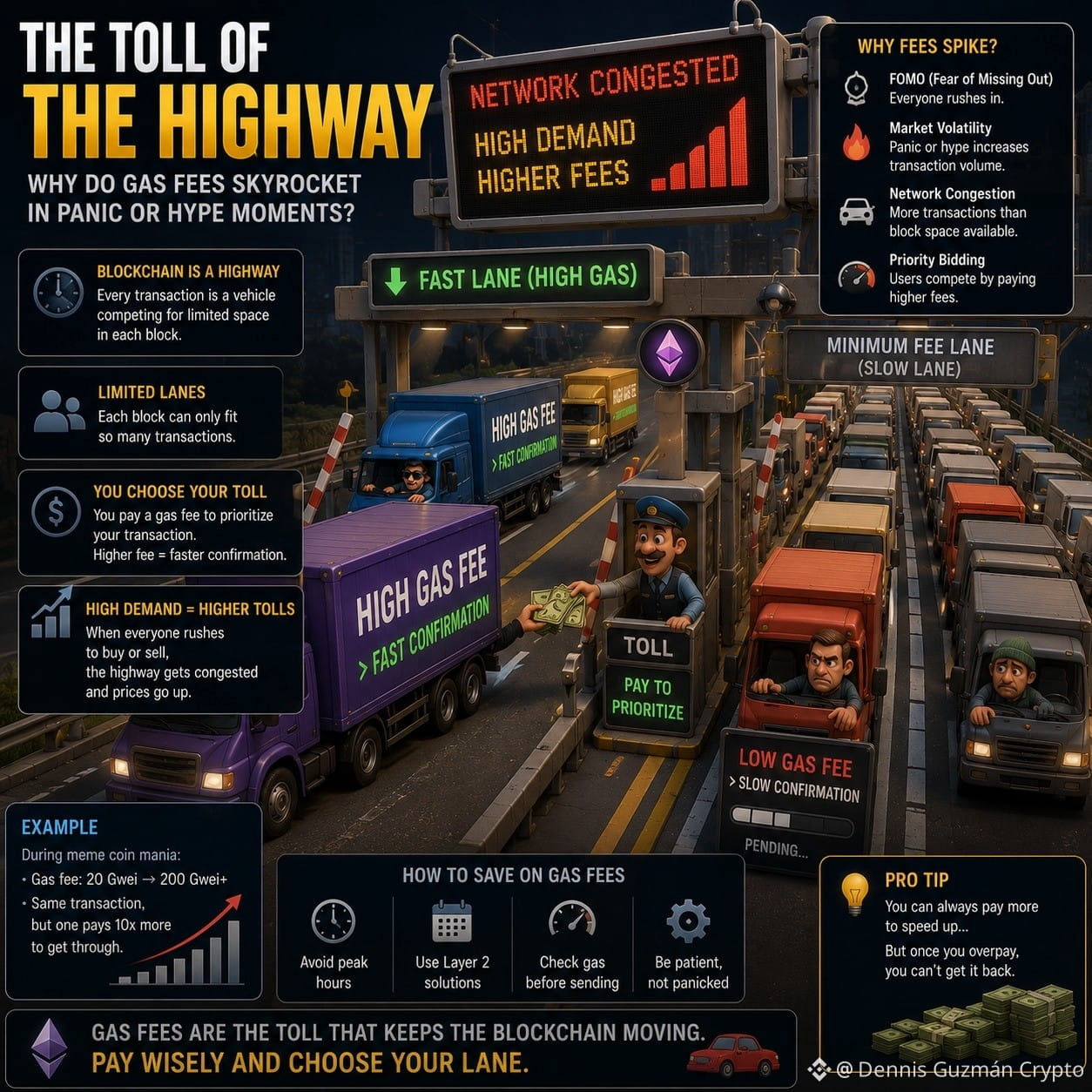
Understand the behavior of gas fees during key moments with $ETH 🛣️.
When the crypto market moves sharply, everyone wants to get in or out at the same time. Blockchains function like priority auctions: the one who pays the highest fee goes first. 🎟️
If you set a very low fee during a weekend congestion, your transaction will remain frozen in line.
Do you prefer to wait for network traffic to drop or do you pay more to pass quickly?
👇#gasfees #BlockchainTips👇
Click here to trade 👇
{future}(ETHUSDT)
Understand the behavior of gas fees during key moments with $ETH 🛣️.
When the crypto market moves sharply, everyone wants to get in or out at the same time. Blockchains function like priority auctions: the one who pays the highest fee goes first. 🎟️
If you set a very low fee during a weekend congestion, your transaction will remain frozen in line.
Do you prefer to wait for network traffic to drop or do you pay more to pass quickly?
👇#gasfees #BlockchainTips👇
Click here to trade 👇
When the crypto market moves sharply, everyone wants to get in or out at the same time. Blockchains function like priority auctions: the one who pays the highest fee goes first. 🎟️
If you set a very low fee during a weekend congestion, your transaction will remain frozen in line.
Do you prefer to wait for network traffic to drop or do you pay more to pass quickly?
👇#gasfees #BlockchainTips👇
Click here to trade 👇
1
55

·
--
Ethereum gas fees plummet to 0.10 Gwei.
ETHGas’s token drops 14% as Ethereum gas fees hit 0.10 Gwei
ETHGas's token suffered a significant drop as Ethereum demand weakened, leading to reduced exposure in derivatives markets. This decline may signal a shift in market sentiment. Traders should watch for further declines or potential rebounds.
#Crypto #Ethereum #GasFees #DeFi
Ethereum gas fees plummet to 0.10 Gwei.
ETHGas’s token drops 14% as Ethereum gas fees hit 0.10 Gwei
ETHGas's token suffered a significant drop as Ethereum demand weakened, leading to reduced exposure in derivatives markets. This decline may signal a shift in market sentiment. Traders should watch for further declines or potential rebounds.
#Crypto #Ethereum #GasFees #DeFi
ETHGas’s token drops 14% as Ethereum gas fees hit 0.10 Gwei
ETHGas's token suffered a significant drop as Ethereum demand weakened, leading to reduced exposure in derivatives markets. This decline may signal a shift in market sentiment. Traders should watch for further declines or potential rebounds.
#Crypto #Ethereum #GasFees #DeFi
35

·
--
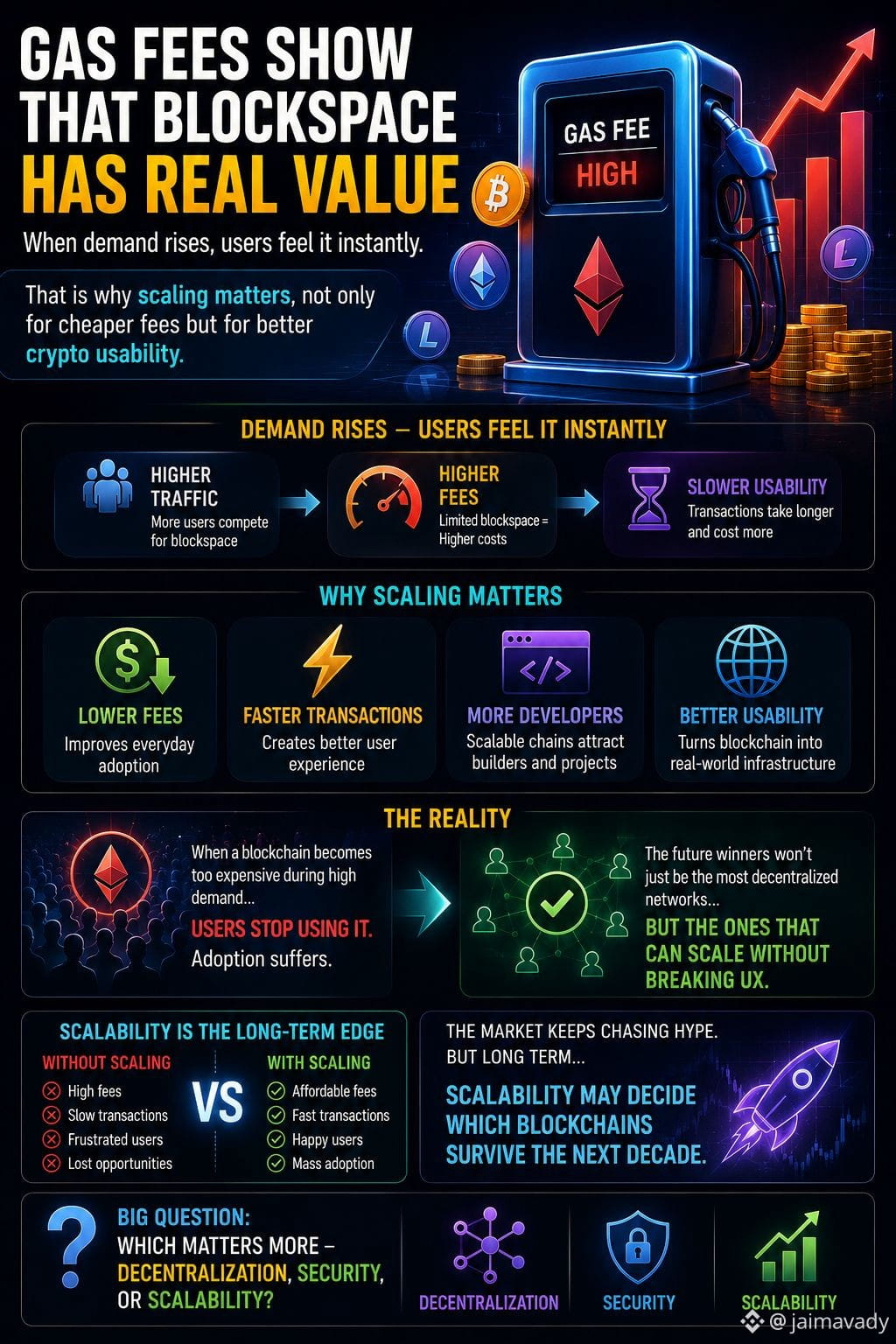
⛽ Gas fees prove one important truth in crypto… blockspace has real value. 👀📈
Every time network demand increases, users feel it immediately.
Higher traffic → Higher fees → Slower usability.
And this is exactly why scaling has become one of the biggest battles in crypto. ⚡
A lot of people think scaling is only about making transactions cheaper.
But the bigger picture is much more important 👇
✅ Lower fees improve everyday adoption 💰
✅ Faster transactions create better user experience 🚀
✅ More scalable networks attract developers building new apps 🌐
✅ Better usability is what turns blockchain from speculation into real-world infrastructure
The truth is simple:
If a blockchain becomes too expensive during high demand…
Average users eventually stop using it.
That means the future winners in crypto may not just be the most decentralized networks…
But the ones that can handle massive demand without breaking user experience. 🔥
The market keeps chasing hype.
But long term…
Scalability may decide which blockchains survive the next decade. 👀
Big question:
Which matters more — decentralization, security, or scalability? 🤔👇
#Crypto #GasFees #Web3 #Bitcoin #Ethereum
{spot}(ETHUSDT)
⛽ Gas fees prove one important truth in crypto… blockspace has real value. 👀📈
Every time network demand increases, users feel it immediately.
Higher traffic → Higher fees → Slower usability.
And this is exactly why scaling has become one of the biggest battles in crypto. ⚡
A lot of people think scaling is only about making transactions cheaper.
But the bigger picture is much more important 👇
✅ Lower fees improve everyday adoption 💰
✅ Faster transactions create better user experience 🚀
✅ More scalable networks attract developers building new apps 🌐
✅ Better usability is what turns blockchain from speculation into real-world infrastructure
The truth is simple:
If a blockchain becomes too expensive during high demand…
Average users eventually stop using it.
That means the future winners in crypto may not just be the most decentralized networks…
But the ones that can handle massive demand without breaking user experience. 🔥
The market keeps chasing hype.
But long term…
Scalability may decide which blockchains survive the next decade. 👀
Big question:
Which matters more — decentralization, security, or scalability? 🤔👇
#Crypto #GasFees #Web3 #Bitcoin #Ethereum
Every time network demand increases, users feel it immediately.
Higher traffic → Higher fees → Slower usability.
And this is exactly why scaling has become one of the biggest battles in crypto. ⚡
A lot of people think scaling is only about making transactions cheaper.
But the bigger picture is much more important 👇
✅ Lower fees improve everyday adoption 💰
✅ Faster transactions create better user experience 🚀
✅ More scalable networks attract developers building new apps 🌐
✅ Better usability is what turns blockchain from speculation into real-world infrastructure
The truth is simple:
If a blockchain becomes too expensive during high demand…
Average users eventually stop using it.
That means the future winners in crypto may not just be the most decentralized networks…
But the ones that can handle massive demand without breaking user experience. 🔥
The market keeps chasing hype.
But long term…
Scalability may decide which blockchains survive the next decade. 👀
Big question:
Which matters more — decentralization, security, or scalability? 🤔👇
#Crypto #GasFees #Web3 #Bitcoin #Ethereum
42
📚 Understanding Gas Fees: Why Ethereum Transactions Cost What They Do
On July 12, 2026, with Ethereum $ETH at $1,804 and daily volume of $6.68B, gas fees remain a key concept for users. Gas fees compensate validators for processing transactions.
Gas fees are measured in gwei (1 gwei = 0.000000001 ETH) and vary based on network congestion. High demand for block space drives fees up — this is the market mechanism at work.
Layer-2 solutions reduce fees by batching transactions off-chain. Understanding gas helps users optimize when to transact and which L2 to use.
📌 Key Takeaway:
Gas fees are the price of using Ethereum's decentralized settlement — understanding them helps users navigate the ecosystem efficiently.
#GasFees #Ethereum #ETH #CryptoEducation
#BinanceAlphaAlert
📚 Understanding Gas Fees: Why Ethereum Transactions Cost What They Do
On July 12, 2026, with Ethereum $ETH at $1,804 and daily volume of $6.68B, gas fees remain a key concept for users. Gas fees compensate validators for processing transactions.
Gas fees are measured in gwei (1 gwei = 0.000000001 ETH) and vary based on network congestion. High demand for block space drives fees up — this is the market mechanism at work.
Layer-2 solutions reduce fees by batching transactions off-chain. Understanding gas helps users optimize when to transact and which L2 to use.
📌 Key Takeaway:
Gas fees are the price of using Ethereum's decentralized settlement — understanding them helps users navigate the ecosystem efficiently.
#GasFees #Ethereum #ETH #CryptoEducation
#BinanceAlphaAlert
On July 12, 2026, with Ethereum $ETH at $1,804 and daily volume of $6.68B, gas fees remain a key concept for users. Gas fees compensate validators for processing transactions.
Gas fees are measured in gwei (1 gwei = 0.000000001 ETH) and vary based on network congestion. High demand for block space drives fees up — this is the market mechanism at work.
Layer-2 solutions reduce fees by batching transactions off-chain. Understanding gas helps users optimize when to transact and which L2 to use.
📌 Key Takeaway:
Gas fees are the price of using Ethereum's decentralized settlement — understanding them helps users navigate the ecosystem efficiently.
#GasFees #Ethereum #ETH #CryptoEducation
#BinanceAlphaAlert
15
📚 What Are Transaction Fees?: Understanding Gas, Network Costs, and Layer-2 Scaling
On July 3, 2026, with $86.17B in daily trading, billions of dollars move across blockchains. Each transaction incurs a fee paid to network validators or miners.
On Ethereum $ETH, fees (called 'gas') vary with network congestion. Today, with ETH at $1,701, high activity can push gas prices up significantly. That's where layer-2 solutions come in — they process transactions off the main chain at lower cost.
Solana $SOL offers lower fees due to its different architecture. Understanding fee structures helps users choose the right chain for their needs.
📌 Key Takeaway:
Transaction fees are the cost of using a blockchain — they compensate validators and prevent spam. Layer-2 solutions offer lower fees for everyday transactions.
#GasFees #CryptoEducation
#BinanceAlphaAlert
📚 What Are Transaction Fees?: Understanding Gas, Network Costs, and Layer-2 Scaling
On July 3, 2026, with $86.17B in daily trading, billions of dollars move across blockchains. Each transaction incurs a fee paid to network validators or miners.
On Ethereum $ETH , fees (called 'gas') vary with network congestion. Today, with ETH at $1,701, high activity can push gas prices up significantly. That's where layer-2 solutions come in — they process transactions off the main chain at lower cost.
Solana $SOL offers lower fees due to its different architecture. Understanding fee structures helps users choose the right chain for their needs.
📌 Key Takeaway:
Transaction fees are the cost of using a blockchain — they compensate validators and prevent spam. Layer-2 solutions offer lower fees for everyday transactions.
#GasFees #CryptoEducation
#BinanceAlphaAlert
On July 3, 2026, with $86.17B in daily trading, billions of dollars move across blockchains. Each transaction incurs a fee paid to network validators or miners.
On Ethereum $ETH , fees (called 'gas') vary with network congestion. Today, with ETH at $1,701, high activity can push gas prices up significantly. That's where layer-2 solutions come in — they process transactions off the main chain at lower cost.
Solana $SOL offers lower fees due to its different architecture. Understanding fee structures helps users choose the right chain for their needs.
📌 Key Takeaway:
Transaction fees are the cost of using a blockchain — they compensate validators and prevent spam. Layer-2 solutions offer lower fees for everyday transactions.
#GasFees #CryptoEducation
#BinanceAlphaAlert
45
📚 What Are Gas Fees?: Understanding transaction costs on Ethereum and other blockchains
On July 19, 2026, Gas fees are payments made by users to compensate for the computational energy required to process and validate transactions on a blockchain. On Ethereum $ETH, fees fluctuate based on network congestion, rising during high-demand periods like NFT mints or DeFi activity.
Solana $SOL offers significantly lower fees due to its high-throughput architecture, while Bitcoin $BTC uses a simpler fee model based on transaction size. Understanding gas helps users time their transactions for lower costs.
📌 Key Takeaway:
Gas fees are the price of decentralized computation. They're not a flaw — they're a feature that prevents spam and ensures network security by allocating block space to the most valuable transactions.
#GasFees #Ethereum #BlockchainBasics
#BinanceAlphaAlert
📚 What Are Gas Fees?: Understanding transaction costs on Ethereum and other blockchains
On July 19, 2026, Gas fees are payments made by users to compensate for the computational energy required to process and validate transactions on a blockchain. On Ethereum $ETH , fees fluctuate based on network congestion, rising during high-demand periods like NFT mints or DeFi activity.
Solana $SOL offers significantly lower fees due to its high-throughput architecture, while Bitcoin $BTC uses a simpler fee model based on transaction size. Understanding gas helps users time their transactions for lower costs.
📌 Key Takeaway:
Gas fees are the price of decentralized computation. They're not a flaw — they're a feature that prevents spam and ensures network security by allocating block space to the most valuable transactions.
#GasFees #Ethereum #BlockchainBasics
#BinanceAlphaAlert
On July 19, 2026, Gas fees are payments made by users to compensate for the computational energy required to process and validate transactions on a blockchain. On Ethereum $ETH , fees fluctuate based on network congestion, rising during high-demand periods like NFT mints or DeFi activity.
Solana $SOL offers significantly lower fees due to its high-throughput architecture, while Bitcoin $BTC uses a simpler fee model based on transaction size. Understanding gas helps users time their transactions for lower costs.
📌 Key Takeaway:
Gas fees are the price of decentralized computation. They're not a flaw — they're a feature that prevents spam and ensures network security by allocating block space to the most valuable transactions.
#GasFees #Ethereum #BlockchainBasics
#BinanceAlphaAlert
13

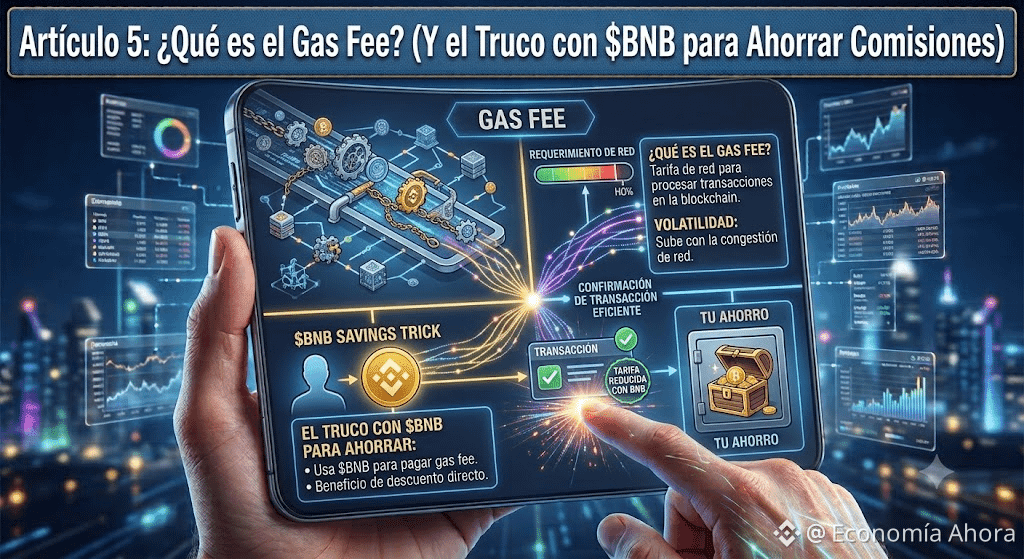
Article 5: What Is a Gas Fee? (And the Trick with $BNB to Save on Commissions)
If you’ve ever tried to move cryptocurrencies, you’ve probably seen a notice charging you a small commission called the Gas Fee (gas tariff). Why do you have to pay this, and how can you make it as cheap as possible? Let’s explain it in a super simple way.
Imagine the blockchain is a digital highway. For your crypto to travel from point A to point B, you need a vehicle (the network computers that process the transaction). And like any car, this vehicle needs fuel to move. The Gas Fee is literally that digital fuel you pay the network so it can process your transfer.
The price of this “gas” isn’t fixed: if the highway is empty, the fuel is cheap; but if everyone wants to use the network at the same time (on a day of heavy market congestion), the gas price goes up.
How does Binance help you avoid overspending?
This is where the magic of BNB and Binance networks comes in:
Use the right network: Older networks like Ethereum can end up charging tens of dollars for a single transaction. In contrast, if you send your assets using Binance’s own network (BNB Chain), the gas fees are ridiculously low—typically just a few cents of a dollar.
The big discount on the Exchange: If you enable the option to pay your trading fees inside Binance using your funds of $BNB , the platform gives you an automatic 25% discount on every operation.
How do you activate this discount?
It’s extremely easy: open your Binance app, go to your profile (top left), and look for the option “Use BNB to pay trading fees.” Make sure you leave a little bit of BNB in your Spot wallet, and you’ll start saving on every buy and sell. Smart trading is not giving commissions away!
#GasFees #AprendeCripto #AhorroFinanciero #BnbChain #BinanceSquare $BNB
{spot}(MSFTBUSDT)
{spot}(METABUSDT)
{spot}(BNBUSDT)
Article 5: What Is a Gas Fee? (And the Trick with $BNB to Save on Commissions)
If you’ve ever tried to move cryptocurrencies, you’ve probably seen a notice charging you a small commission called the Gas Fee (gas tariff). Why do you have to pay this, and how can you make it as cheap as possible? Let’s explain it in a super simple way.
Imagine the blockchain is a digital highway. For your crypto to travel from point A to point B, you need a vehicle (the network computers that process the transaction). And like any car, this vehicle needs fuel to move. The Gas Fee is literally that digital fuel you pay the network so it can process your transfer.
The price of this “gas” isn’t fixed: if the highway is empty, the fuel is cheap; but if everyone wants to use the network at the same time (on a day of heavy market congestion), the gas price goes up.
How does Binance help you avoid overspending?
This is where the magic of BNB and Binance networks comes in:
Use the right network: Older networks like Ethereum can end up charging tens of dollars for a single transaction. In contrast, if you send your assets using Binance’s own network (BNB Chain), the gas fees are ridiculously low—typically just a few cents of a dollar.
The big discount on the Exchange: If you enable the option to pay your trading fees inside Binance using your funds of $BNB , the platform gives you an automatic 25% discount on every operation.
How do you activate this discount?
It’s extremely easy: open your Binance app, go to your profile (top left), and look for the option “Use BNB to pay trading fees.” Make sure you leave a little bit of BNB in your Spot wallet, and you’ll start saving on every buy and sell. Smart trading is not giving commissions away!
#GasFees #AprendeCripto #AhorroFinanciero #BnbChain #BinanceSquare $BNB
If you’ve ever tried to move cryptocurrencies, you’ve probably seen a notice charging you a small commission called the Gas Fee (gas tariff). Why do you have to pay this, and how can you make it as cheap as possible? Let’s explain it in a super simple way.
Imagine the blockchain is a digital highway. For your crypto to travel from point A to point B, you need a vehicle (the network computers that process the transaction). And like any car, this vehicle needs fuel to move. The Gas Fee is literally that digital fuel you pay the network so it can process your transfer.
The price of this “gas” isn’t fixed: if the highway is empty, the fuel is cheap; but if everyone wants to use the network at the same time (on a day of heavy market congestion), the gas price goes up.
How does Binance help you avoid overspending?
This is where the magic of BNB and Binance networks comes in:
Use the right network: Older networks like Ethereum can end up charging tens of dollars for a single transaction. In contrast, if you send your assets using Binance’s own network (BNB Chain), the gas fees are ridiculously low—typically just a few cents of a dollar.
The big discount on the Exchange: If you enable the option to pay your trading fees inside Binance using your funds of $BNB , the platform gives you an automatic 25% discount on every operation.
How do you activate this discount?
It’s extremely easy: open your Binance app, go to your profile (top left), and look for the option “Use BNB to pay trading fees.” Make sure you leave a little bit of BNB in your Spot wallet, and you’ll start saving on every buy and sell. Smart trading is not giving commissions away!
#GasFees #AprendeCripto #AhorroFinanciero #BnbChain #BinanceSquare $BNB
1
190

·
--
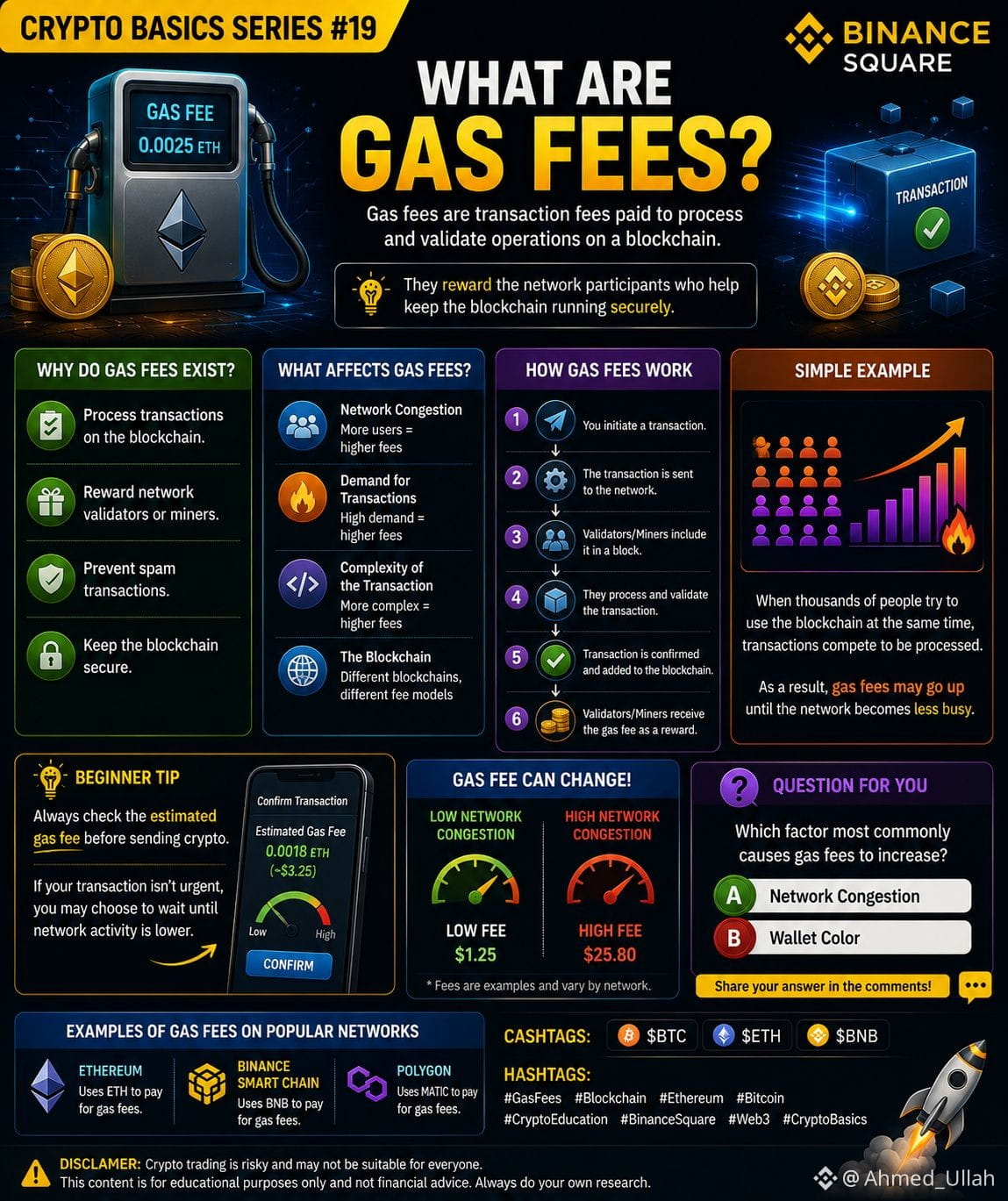
🚀 Crypto Basics Series #19: What Are Gas Fees?
Welcome back to Crypto Basics! Today, let's learn why blockchain transactions require a fee.
📌 What Are Gas Fees?
Gas Fees are transaction fees paid to process and validate operations on a blockchain.
These fees reward the network participants who help keep the blockchain running securely.
Different blockchains have different fee models, so the way gas fees work can vary from one network to another.
---
⚙️ Why Do Gas Fees Exist?
Gas fees help:
- ✅ Process transactions
- ✅ Reward network validators or miners
- ✅ Prevent spam transactions
- ✅ Keep the blockchain secure
Without transaction fees, blockchain networks would be more vulnerable to abuse.
---
💰 What Affects Gas Fees?
Gas fees can change depending on:
- 📈 Network congestion
- ⚡ Demand for transactions
- 🔄 Complexity of the transaction
- 🌐 The blockchain being used
During busy periods, fees may increase.
---
📊 Simple Example
Imagine thousands of people are trying to use the blockchain at the same time.
Because many transactions are competing to be processed, transaction fees may become higher until network activity decreases.
This is a simplified example for educational purposes.
---
💡 Beginner Tip
Always check the estimated transaction fee before sending crypto.
If your transaction is not urgent, you may choose to wait until network activity is lower, depending on the blockchain and wallet you use.
---
💬 Question for You
Which factor most commonly causes gas fees to increase?
🅰️ Network Congestion
🅱️ Wallet Color
👇 Share your answer in the comments!
$BTC $ETH $BNB
#GasFees #Blockchain #Ethereum
🚀 Crypto Basics Series #19: What Are Gas Fees?
Welcome back to Crypto Basics! Today, let's learn why blockchain transactions require a fee.
📌 What Are Gas Fees?
Gas Fees are transaction fees paid to process and validate operations on a blockchain.
These fees reward the network participants who help keep the blockchain running securely.
Different blockchains have different fee models, so the way gas fees work can vary from one network to another.
---
⚙️ Why Do Gas Fees Exist?
Gas fees help:
- ✅ Process transactions
- ✅ Reward network validators or miners
- ✅ Prevent spam transactions
- ✅ Keep the blockchain secure
Without transaction fees, blockchain networks would be more vulnerable to abuse.
---
💰 What Affects Gas Fees?
Gas fees can change depending on:
- 📈 Network congestion
- ⚡ Demand for transactions
- 🔄 Complexity of the transaction
- 🌐 The blockchain being used
During busy periods, fees may increase.
---
📊 Simple Example
Imagine thousands of people are trying to use the blockchain at the same time.
Because many transactions are competing to be processed, transaction fees may become higher until network activity decreases.
This is a simplified example for educational purposes.
---
💡 Beginner Tip
Always check the estimated transaction fee before sending crypto.
If your transaction is not urgent, you may choose to wait until network activity is lower, depending on the blockchain and wallet you use.
---
💬 Question for You
Which factor most commonly causes gas fees to increase?
🅰️ Network Congestion
🅱️ Wallet Color
👇 Share your answer in the comments!
$BTC $ETH $BNB
#GasFees #Blockchain #Ethereum
Welcome back to Crypto Basics! Today, let's learn why blockchain transactions require a fee.
📌 What Are Gas Fees?
Gas Fees are transaction fees paid to process and validate operations on a blockchain.
These fees reward the network participants who help keep the blockchain running securely.
Different blockchains have different fee models, so the way gas fees work can vary from one network to another.
---
⚙️ Why Do Gas Fees Exist?
Gas fees help:
- ✅ Process transactions
- ✅ Reward network validators or miners
- ✅ Prevent spam transactions
- ✅ Keep the blockchain secure
Without transaction fees, blockchain networks would be more vulnerable to abuse.
---
💰 What Affects Gas Fees?
Gas fees can change depending on:
- 📈 Network congestion
- ⚡ Demand for transactions
- 🔄 Complexity of the transaction
- 🌐 The blockchain being used
During busy periods, fees may increase.
---
📊 Simple Example
Imagine thousands of people are trying to use the blockchain at the same time.
Because many transactions are competing to be processed, transaction fees may become higher until network activity decreases.
This is a simplified example for educational purposes.
---
💡 Beginner Tip
Always check the estimated transaction fee before sending crypto.
If your transaction is not urgent, you may choose to wait until network activity is lower, depending on the blockchain and wallet you use.
---
💬 Question for You
Which factor most commonly causes gas fees to increase?
🅰️ Network Congestion
🅱️ Wallet Color
👇 Share your answer in the comments!
$BTC $ETH $BNB
#GasFees #Blockchain #Ethereum
1
84
📚 Why Transaction Fees Vary: Understanding gas fees across blockchains
On July 22, 2026, Transaction fees on Ethereum $ETH depend on network congestion — popular NFT mints or DeFi activity can spike gas to $50-100.
Solana $SOL and TRON $TRX offer lower fees at $78.04 and $0.329021 token prices, making them attractive for frequent transactions.
Layer-2 solutions dramatically reduce costs by batching transactions off the main chain.
📌 Key Takeaway:
Network congestion drives gas fees — Layer-2 solutions and alternative chains like $SOL and TRON offer cheaper alternatives to Ethereum.
#GasFees #Ethereum #Layer2
#BinanceAlphaAlert
📚 Why Transaction Fees Vary: Understanding gas fees across blockchains
On July 22, 2026, Transaction fees on Ethereum $ETH depend on network congestion — popular NFT mints or DeFi activity can spike gas to $50-100.
Solana $SOL and TRON $TRX offer lower fees at $78.04 and $0.329021 token prices, making them attractive for frequent transactions.
Layer-2 solutions dramatically reduce costs by batching transactions off the main chain.
📌 Key Takeaway:
Network congestion drives gas fees — Layer-2 solutions and alternative chains like $SOL and TRON offer cheaper alternatives to Ethereum.
#GasFees #Ethereum #Layer2
#BinanceAlphaAlert
On July 22, 2026, Transaction fees on Ethereum $ETH depend on network congestion — popular NFT mints or DeFi activity can spike gas to $50-100.
Solana $SOL and TRON $TRX offer lower fees at $78.04 and $0.329021 token prices, making them attractive for frequent transactions.
Layer-2 solutions dramatically reduce costs by batching transactions off the main chain.
📌 Key Takeaway:
Network congestion drives gas fees — Layer-2 solutions and alternative chains like $SOL and TRON offer cheaper alternatives to Ethereum.
#GasFees #Ethereum #Layer2
#BinanceAlphaAlert
34
Log in to explore more content
Join global crypto users on Binance Square
⚡️ Get latest and useful information about crypto.
💬 Trusted by the world’s largest crypto exchange.
👍 Discover real insights from verified creators.
Email / Phone number
Trending Topics
1
#FedRateWatch
1.2M views
5,949 Discussing
2
#ZcashRises6%
18,338 views
354 Discussing
3
#XRPSinks10%
10,694 views
230 Discussing
4
#BitcoinETFsShed$450M
1,515 views
46 Discussing
5
#CircleOpensArcMainnet
6,376 views
153 Discussing
6
#ZcashHoldersBackNU7Upgrade
15,602 views
321 Discussing
7
#MSTRTradingVolumeSurpassesMorganStanley
17,762 views
493 Discussing
8
#BitcoinFalls4%
37,315 views
793 Discussing
9
#SKHynixInTalksToMakeMemoryChipsInUS
16,484 views
322 Discussing
10
#OpenAIDiscussesNewFundingAt$1.2TValuation
3,724 views
54 Discussing