
#defi4
defi4
437 views
8 Discussing
Hot
Latest

·
--
Output is buying pressure vs one-way sell pressure: CashCow flipped the direction
CashCow’s “no empty rotation” boils down to one thing: the money used for incentives comes from real trades, not from a printing press.
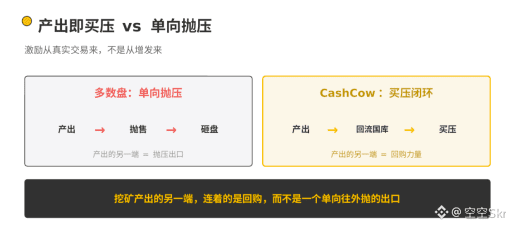
First question: where do the “returns” for many pools come from? From issuing more tokens. Output → everyone sells → dumps the market. The other end of the mining output—the place it leads to—is essentially a one-way outlet that pushes tokens outward. The more you mine, the more you dump, and naturally the price drifts downward.
CashCow flips the direction:
Real protocol-generated fees and profit taxes flow back to the treasury by mechanism
Output → flows back → forms buy pressure, not sell pressure
Profit tax is only charged on the portion that you actually profit from; the principal is never touched
Output is buying pressure vs one-way sell pressure
Remember this in one sentence: the other end of mined output is linked to buyback, not a sell-pressure outlet.
Where incentives come from and where they go determines whether a pool is “the more you mine, the emptier it gets,” or “the more you mine, the thicker it becomes.” The difference can be verified on-chain, trade by trade.
From another angle: whether a pool is healthy depends on whether its incentives are “water flowing in from outside” or “blood being drawn from itself.” CashCow burns fees generated by real trades—water coming in from outside. But inflationary-style incentives draw blood from each holder. Same game, different direction, wildly different outcomes.
#CashCow #DeFi4 #BNBChain #买压闭环
Output is buying pressure vs one-way sell pressure: CashCow flipped the direction
CashCow’s “no empty rotation” boils down to one thing: the money used for incentives comes from real trades, not from a printing press.
First question: where do the “returns” for many pools come from? From issuing more tokens. Output → everyone sells → dumps the market. The other end of the mining output—the place it leads to—is essentially a one-way outlet that pushes tokens outward. The more you mine, the more you dump, and naturally the price drifts downward.
CashCow flips the direction:
Real protocol-generated fees and profit taxes flow back to the treasury by mechanism
Output → flows back → forms buy pressure, not sell pressure
Profit tax is only charged on the portion that you actually profit from; the principal is never touched
Output is buying pressure vs one-way sell pressure
Remember this in one sentence: the other end of mined output is linked to buyback, not a sell-pressure outlet.
Where incentives come from and where they go determines whether a pool is “the more you mine, the emptier it gets,” or “the more you mine, the thicker it becomes.” The difference can be verified on-chain, trade by trade.
From another angle: whether a pool is healthy depends on whether its incentives are “water flowing in from outside” or “blood being drawn from itself.” CashCow burns fees generated by real trades—water coming in from outside. But inflationary-style incentives draw blood from each holder. Same game, different direction, wildly different outcomes.
#CashCow #DeFi4 #BNBChain #买压闭环
CashCow’s “no empty rotation” boils down to one thing: the money used for incentives comes from real trades, not from a printing press.
First question: where do the “returns” for many pools come from? From issuing more tokens. Output → everyone sells → dumps the market. The other end of the mining output—the place it leads to—is essentially a one-way outlet that pushes tokens outward. The more you mine, the more you dump, and naturally the price drifts downward.
CashCow flips the direction:
Real protocol-generated fees and profit taxes flow back to the treasury by mechanism
Output → flows back → forms buy pressure, not sell pressure
Profit tax is only charged on the portion that you actually profit from; the principal is never touched
Output is buying pressure vs one-way sell pressure
Remember this in one sentence: the other end of mined output is linked to buyback, not a sell-pressure outlet.
Where incentives come from and where they go determines whether a pool is “the more you mine, the emptier it gets,” or “the more you mine, the thicker it becomes.” The difference can be verified on-chain, trade by trade.
From another angle: whether a pool is healthy depends on whether its incentives are “water flowing in from outside” or “blood being drawn from itself.” CashCow burns fees generated by real trades—water coming in from outside. But inflationary-style incentives draw blood from each holder. Same game, different direction, wildly different outcomes.
#CashCow #DeFi4 #BNBChain #买压闭环
1
1
131

·
--
CashCow: Change “you need to believe” to “you can verify,” and why
CashCow wants to do something that many projects don’t dare to do—turn key promises from “you need to believe” into “you can verify.”
Have you not seen this industry enough? On every project, they start by asking you to “believe”: believe the team won’t run away, believe the contract won’t issue more, believe the treasury won’t move recklessly. But those two words—“believe”—are the most expensive and also the most fragile thing in the world. It can’t survive a single betrayal.
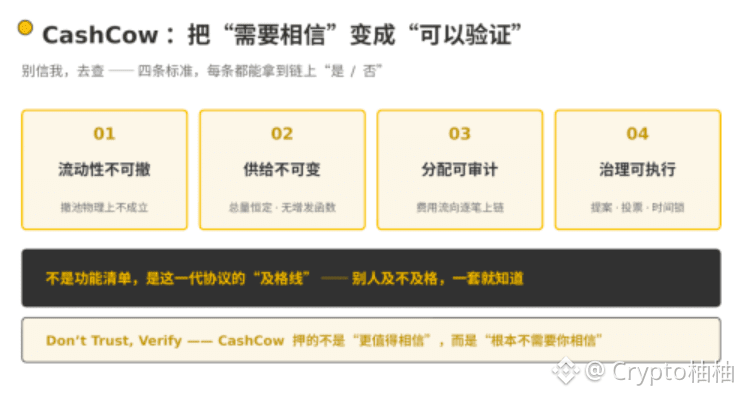
CashCow’s approach is the opposite: don’t let you believe—make you check. It breaks this into four hard standards, and each one must produce an on-chain “Yes / No” answer that you can verify:
Liquidity is non-withdrawable—removing liquidity is physically impossible
Supply is immutable—total amount is fixed; no token-minting function
Allocation is auditable—every expense flow and every burn is recorded on-chain
Governance is executable—proposals, votes, and time locks form a complete on-chain loop
CashCow’s four verifiable standards
Note: this isn’t a “feature checklist,” but the passing line CashCow believes this generation of protocols should meet. Whether others pass or fail is obvious when you use these four criteria.
One sentence: In a track full of promises, CashCow bets on “not needing you to believe,” rather than “being more trustworthy.”
Don’t Trust, Verify—people use these four words as a slogan; CashCow wants to make them the default setting.
#CASHCOW #DeFi4 #VerifiableLiquidity #BNBChain
CashCow: Change “you need to believe” to “you can verify,” and why
CashCow wants to do something that many projects don’t dare to do—turn key promises from “you need to believe” into “you can verify.”
Have you not seen this industry enough? On every project, they start by asking you to “believe”: believe the team won’t run away, believe the contract won’t issue more, believe the treasury won’t move recklessly. But those two words—“believe”—are the most expensive and also the most fragile thing in the world. It can’t survive a single betrayal.
CashCow’s approach is the opposite: don’t let you believe—make you check. It breaks this into four hard standards, and each one must produce an on-chain “Yes / No” answer that you can verify:
Liquidity is non-withdrawable—removing liquidity is physically impossible
Supply is immutable—total amount is fixed; no token-minting function
Allocation is auditable—every expense flow and every burn is recorded on-chain
Governance is executable—proposals, votes, and time locks form a complete on-chain loop
CashCow’s four verifiable standards
Note: this isn’t a “feature checklist,” but the passing line CashCow believes this generation of protocols should meet. Whether others pass or fail is obvious when you use these four criteria.
One sentence: In a track full of promises, CashCow bets on “not needing you to believe,” rather than “being more trustworthy.”
Don’t Trust, Verify—people use these four words as a slogan; CashCow wants to make them the default setting.
#CASHCOW #DeFi4 #VerifiableLiquidity #BNBChain
CashCow wants to do something that many projects don’t dare to do—turn key promises from “you need to believe” into “you can verify.”
Have you not seen this industry enough? On every project, they start by asking you to “believe”: believe the team won’t run away, believe the contract won’t issue more, believe the treasury won’t move recklessly. But those two words—“believe”—are the most expensive and also the most fragile thing in the world. It can’t survive a single betrayal.
CashCow’s approach is the opposite: don’t let you believe—make you check. It breaks this into four hard standards, and each one must produce an on-chain “Yes / No” answer that you can verify:
Liquidity is non-withdrawable—removing liquidity is physically impossible
Supply is immutable—total amount is fixed; no token-minting function
Allocation is auditable—every expense flow and every burn is recorded on-chain
Governance is executable—proposals, votes, and time locks form a complete on-chain loop
CashCow’s four verifiable standards
Note: this isn’t a “feature checklist,” but the passing line CashCow believes this generation of protocols should meet. Whether others pass or fail is obvious when you use these four criteria.
One sentence: In a track full of promises, CashCow bets on “not needing you to believe,” rather than “being more trustworthy.”
Don’t Trust, Verify—people use these four words as a slogan; CashCow wants to make them the default setting.
#CASHCOW #DeFi4 #VerifiableLiquidity #BNBChain
1
274

·
--
CashCow contract has no printing press
CashCow has a simple—almost “axis-like”—design: the total supply is constant, and the contract has no minting function.
First, a slightly painful question: is the high return you’re getting earned by the protocol, or printed by the contract?
Most so-called “returns” from many projects are essentially minting—creating new coins out of thin air and handing them to you. You think you’re making money, but actually your money is paying your interest: on the books everyone is earning coins, while in reality everyone is sharing the depreciation. Minting is a kind of hidden tax—the scarier the APY, the harsher the tax.
CashCow blocks this path:
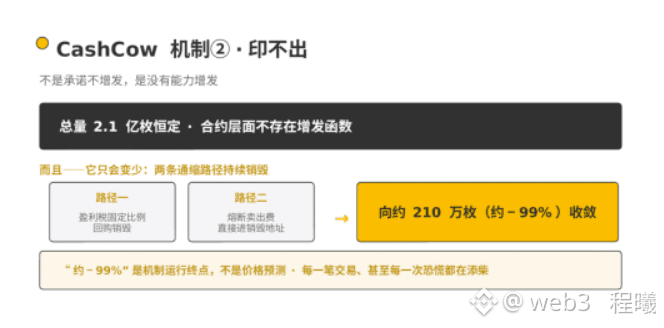
CCC total supply of 210 million coins is fixed
At the contract level, there is no minting function—this isn’t “a promise of no minting,” it’s “no ability to mint”
Even harsher: it only goes down—dual-path deflation converging toward about 2.1 million coins (about -99%) (this is the end state of the mechanism, not a price prediction)
Plus three more “no’s”: no team allocation, no private sale, no unlocks—no low-cost chips waiting to dump
All of this is clearly visible on-chain and can be verified.
You can’t print—supply only decreases, never increases
In an industry where everyone competes on who can print faster, CashCow chooses to weld the printing press shut—this in itself is a form of scarcity.
Don’t get blinded by the numbers in the APY—what you should really ask isn’t “how much,” but “where does the money come from.” CashCow writes the answer to that question into its code: if it can’t print, it can only speak through real value. And on that point, it leaves itself with absolutely no fallback.
#CASHCOW #Tokenomics #BNBChain #DeFi4
CashCow contract has no printing press
CashCow has a simple—almost “axis-like”—design: the total supply is constant, and the contract has no minting function.
First, a slightly painful question: is the high return you’re getting earned by the protocol, or printed by the contract?
Most so-called “returns” from many projects are essentially minting—creating new coins out of thin air and handing them to you. You think you’re making money, but actually your money is paying your interest: on the books everyone is earning coins, while in reality everyone is sharing the depreciation. Minting is a kind of hidden tax—the scarier the APY, the harsher the tax.
CashCow blocks this path:
CCC total supply of 210 million coins is fixed
At the contract level, there is no minting function—this isn’t “a promise of no minting,” it’s “no ability to mint”
Even harsher: it only goes down—dual-path deflation converging toward about 2.1 million coins (about -99%) (this is the end state of the mechanism, not a price prediction)
Plus three more “no’s”: no team allocation, no private sale, no unlocks—no low-cost chips waiting to dump
All of this is clearly visible on-chain and can be verified.
You can’t print—supply only decreases, never increases
In an industry where everyone competes on who can print faster, CashCow chooses to weld the printing press shut—this in itself is a form of scarcity.
Don’t get blinded by the numbers in the APY—what you should really ask isn’t “how much,” but “where does the money come from.” CashCow writes the answer to that question into its code: if it can’t print, it can only speak through real value. And on that point, it leaves itself with absolutely no fallback.
#CASHCOW #Tokenomics #BNBChain #DeFi4
CashCow has a simple—almost “axis-like”—design: the total supply is constant, and the contract has no minting function.
First, a slightly painful question: is the high return you’re getting earned by the protocol, or printed by the contract?
Most so-called “returns” from many projects are essentially minting—creating new coins out of thin air and handing them to you. You think you’re making money, but actually your money is paying your interest: on the books everyone is earning coins, while in reality everyone is sharing the depreciation. Minting is a kind of hidden tax—the scarier the APY, the harsher the tax.
CashCow blocks this path:
CCC total supply of 210 million coins is fixed
At the contract level, there is no minting function—this isn’t “a promise of no minting,” it’s “no ability to mint”
Even harsher: it only goes down—dual-path deflation converging toward about 2.1 million coins (about -99%) (this is the end state of the mechanism, not a price prediction)
Plus three more “no’s”: no team allocation, no private sale, no unlocks—no low-cost chips waiting to dump
All of this is clearly visible on-chain and can be verified.
You can’t print—supply only decreases, never increases
In an industry where everyone competes on who can print faster, CashCow chooses to weld the printing press shut—this in itself is a form of scarcity.
Don’t get blinded by the numbers in the APY—what you should really ask isn’t “how much,” but “where does the money come from.” CashCow writes the answer to that question into its code: if it can’t print, it can only speak through real value. And on that point, it leaves itself with absolutely no fallback.
#CASHCOW #Tokenomics #BNBChain #DeFi4
1
214

·
--
CashCow’s Dual-Base Standard: Prevent the Death Spiral from Catching Fire
The hardest-to-understand—but toughest—design in CashCow is its dual-base accrual system. It aims to solve the industry’s number-one killer: the death spiral.
First, see how the spiral “catches” (four steps in a loop):
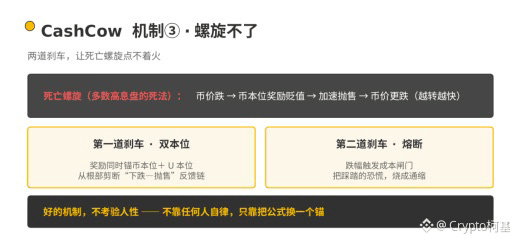
Coin price falls → the coin-base reward depreciates → everyone accelerates selling → price falls further → back to step one; the faster it turns, the quicker it feeds.
That’s a bank run. The first person to run may be fine, but everyone wants to be the first. At that moment, shouting trading calls and talking about faith are useless—because “running first” is a rational choice for everyone. This isn’t a moral issue; it’s math.
CashCow’s first brake is the dual-base standard:
Single-base (the igniter): rewards are pegged only to the coin base → when the coin price falls, rewards depreciate in sync → forcing you to sell
Dual-base (the brake): rewards are simultaneously pegged to the coin base + the U base → during a downward move, value expectations don’t collapse in sync → that feedback chain gets cut off at the middle
One sentence to remember: when the market drops, single-base is pressing the accelerator, while dual-base is pressing the brake.
Its cleverest part—doesn’t rely on anyone’s self-discipline, only on changing the accrual formula’s anchor. A good mechanism doesn’t fight human nature; it makes human nature not become a problem.
Dual-base—stops the death spiral from catching fire
Paired with the second brake (circuit breaker, turning panic into contraction), what CashCow wants to do isn’t “guarantee it won’t fall”—no mechanism can do that—but to ensure that “a drop” no longer automatically rolls into “a collapse.”
#CASHCOW #双本位 #DeFi4 #BNBChain
CashCow’s Dual-Base Standard: Prevent the Death Spiral from Catching Fire
The hardest-to-understand—but toughest—design in CashCow is its dual-base accrual system. It aims to solve the industry’s number-one killer: the death spiral.
First, see how the spiral “catches” (four steps in a loop):
Coin price falls → the coin-base reward depreciates → everyone accelerates selling → price falls further → back to step one; the faster it turns, the quicker it feeds.
That’s a bank run. The first person to run may be fine, but everyone wants to be the first. At that moment, shouting trading calls and talking about faith are useless—because “running first” is a rational choice for everyone. This isn’t a moral issue; it’s math.
CashCow’s first brake is the dual-base standard:
Single-base (the igniter): rewards are pegged only to the coin base → when the coin price falls, rewards depreciate in sync → forcing you to sell
Dual-base (the brake): rewards are simultaneously pegged to the coin base + the U base → during a downward move, value expectations don’t collapse in sync → that feedback chain gets cut off at the middle
One sentence to remember: when the market drops, single-base is pressing the accelerator, while dual-base is pressing the brake.
Its cleverest part—doesn’t rely on anyone’s self-discipline, only on changing the accrual formula’s anchor. A good mechanism doesn’t fight human nature; it makes human nature not become a problem.
Dual-base—stops the death spiral from catching fire
Paired with the second brake (circuit breaker, turning panic into contraction), what CashCow wants to do isn’t “guarantee it won’t fall”—no mechanism can do that—but to ensure that “a drop” no longer automatically rolls into “a collapse.”
#CASHCOW #双本位 #DeFi4 #BNBChain
The hardest-to-understand—but toughest—design in CashCow is its dual-base accrual system. It aims to solve the industry’s number-one killer: the death spiral.
First, see how the spiral “catches” (four steps in a loop):
Coin price falls → the coin-base reward depreciates → everyone accelerates selling → price falls further → back to step one; the faster it turns, the quicker it feeds.
That’s a bank run. The first person to run may be fine, but everyone wants to be the first. At that moment, shouting trading calls and talking about faith are useless—because “running first” is a rational choice for everyone. This isn’t a moral issue; it’s math.
CashCow’s first brake is the dual-base standard:
Single-base (the igniter): rewards are pegged only to the coin base → when the coin price falls, rewards depreciate in sync → forcing you to sell
Dual-base (the brake): rewards are simultaneously pegged to the coin base + the U base → during a downward move, value expectations don’t collapse in sync → that feedback chain gets cut off at the middle
One sentence to remember: when the market drops, single-base is pressing the accelerator, while dual-base is pressing the brake.
Its cleverest part—doesn’t rely on anyone’s self-discipline, only on changing the accrual formula’s anchor. A good mechanism doesn’t fight human nature; it makes human nature not become a problem.
Dual-base—stops the death spiral from catching fire
Paired with the second brake (circuit breaker, turning panic into contraction), what CashCow wants to do isn’t “guarantee it won’t fall”—no mechanism can do that—but to ensure that “a drop” no longer automatically rolls into “a collapse.”
#CASHCOW #双本位 #DeFi4 #BNBChain
131

·
--
Article
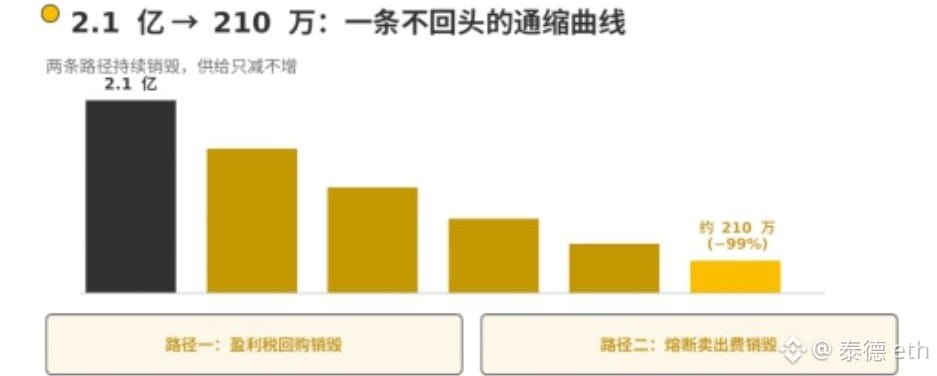
210 million → 2.1 million: CashCow’s one-way deflation curveCashCow not only “can’t print,” it also keeps getting less—an anti-inflationary curve that never turns back.
Total supply is fixed at 210 million coins, then it continuously destroys coins through two paths, converging toward about 2.1 million (about −99%):
Path one: a fixed proportion from profit taxes, used for buybacks and destruction
Path two: when a circuit-breaker triggers, a large portion of the sell fee goes directly to the burn/destroy address
210 million → 2.1 million deflation curve
Here’s the key point: in this case, deflation isn’t something you do once by burning a batch and calling it done. It’s built into the everyday operating mechanism. Every transaction, even every market panic, is adding fuel to push this curve downward.
210 million → 2.1 million: CashCow’s one-way deflation curve
CashCow not only “can’t print,” it also keeps getting less—an anti-inflationary curve that never turns back.
Total supply is fixed at 210 million coins, then it continuously destroys coins through two paths, converging toward about 2.1 million (about −99%):
Path one: a fixed proportion from profit taxes, used for buybacks and destruction
Path two: when a circuit-breaker triggers, a large portion of the sell fee goes directly to the burn/destroy address
210 million → 2.1 million deflation curve
Here’s the key point: in this case, deflation isn’t something you do once by burning a batch and calling it done. It’s built into the everyday operating mechanism. Every transaction, even every market panic, is adding fuel to push this curve downward.
Total supply is fixed at 210 million coins, then it continuously destroys coins through two paths, converging toward about 2.1 million (about −99%):
Path one: a fixed proportion from profit taxes, used for buybacks and destruction
Path two: when a circuit-breaker triggers, a large portion of the sell fee goes directly to the burn/destroy address
210 million → 2.1 million deflation curve
Here’s the key point: in this case, deflation isn’t something you do once by burning a batch and calling it done. It’s built into the everyday operating mechanism. Every transaction, even every market panic, is adding fuel to push this curve downward.
1
2
306

·
--
Don’t Trust, Verify:CashCow Has Written It Into the Factory Settings
“Don’t trust anyone; trust on-chain only”—everyone in the crypto world says that. But what CashCow wants to do is turn it from a slogan into the factory settings of a protocol.
What’s the difference?
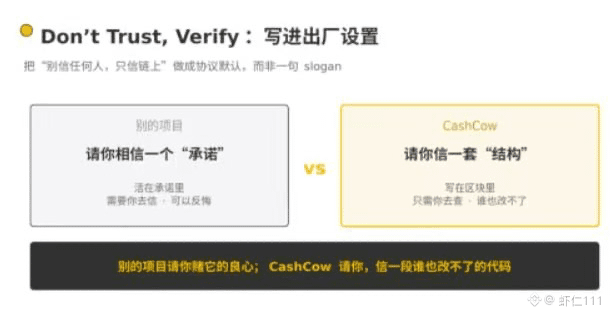
Other projects: Ask you to trust a “promise”—to live in that promise requires you to believe, and they can always backtrack.
CashCow: Ask you to trust a “structure”—written into the blockchain. All you need to do is verify; no one can change it.
Don’t Trust, Verify written into the factory settings
It sends the power to withdraw liquidity into a black hole, removes the inflation-minting function from the contract, and locks the authority to change rules inside a DAO and time lock—not asking you to believe it’s run by good people, but deleting the entry points for wrongdoing from the very beginning.
In one sentence: other projects ask you to bet on their conscience; CashCow asks you to trust a piece of code that no one can change.
Don’t Trust, Verify—this time, it’s serious.
In a space full of promises, there aren’t many projects that can turn “you don’t need to trust” into a default setting. Most projects are busy getting you to believe in their intentions, team, and vision; while CashCow is busy turning those “things you need to believe” into verifiable facts, one by one. That’s what “no trust” really looks like.
#CASHCOW #DeFi4 #BNBChain
Don’t Trust, Verify:CashCow Has Written It Into the Factory Settings
“Don’t trust anyone; trust on-chain only”—everyone in the crypto world says that. But what CashCow wants to do is turn it from a slogan into the factory settings of a protocol.
What’s the difference?
Other projects: Ask you to trust a “promise”—to live in that promise requires you to believe, and they can always backtrack.
CashCow: Ask you to trust a “structure”—written into the blockchain. All you need to do is verify; no one can change it.
Don’t Trust, Verify written into the factory settings
It sends the power to withdraw liquidity into a black hole, removes the inflation-minting function from the contract, and locks the authority to change rules inside a DAO and time lock—not asking you to believe it’s run by good people, but deleting the entry points for wrongdoing from the very beginning.
In one sentence: other projects ask you to bet on their conscience; CashCow asks you to trust a piece of code that no one can change.
Don’t Trust, Verify—this time, it’s serious.
In a space full of promises, there aren’t many projects that can turn “you don’t need to trust” into a default setting. Most projects are busy getting you to believe in their intentions, team, and vision; while CashCow is busy turning those “things you need to believe” into verifiable facts, one by one. That’s what “no trust” really looks like.
#CASHCOW #DeFi4 #BNBChain
“Don’t trust anyone; trust on-chain only”—everyone in the crypto world says that. But what CashCow wants to do is turn it from a slogan into the factory settings of a protocol.
What’s the difference?
Other projects: Ask you to trust a “promise”—to live in that promise requires you to believe, and they can always backtrack.
CashCow: Ask you to trust a “structure”—written into the blockchain. All you need to do is verify; no one can change it.
Don’t Trust, Verify written into the factory settings
It sends the power to withdraw liquidity into a black hole, removes the inflation-minting function from the contract, and locks the authority to change rules inside a DAO and time lock—not asking you to believe it’s run by good people, but deleting the entry points for wrongdoing from the very beginning.
In one sentence: other projects ask you to bet on their conscience; CashCow asks you to trust a piece of code that no one can change.
Don’t Trust, Verify—this time, it’s serious.
In a space full of promises, there aren’t many projects that can turn “you don’t need to trust” into a default setting. Most projects are busy getting you to believe in their intentions, team, and vision; while CashCow is busy turning those “things you need to believe” into verifiable facts, one by one. That’s what “no trust” really looks like.
#CASHCOW #DeFi4 #BNBChain
307

·
--
Can’t run, can’t print, can’t spiral, can’t idle: CashCow’s four machinesCan’t run, can’t print, can’t spiral, can’t idle: CashCow’s four machines
CashCow isn’t held up by a clever design—rather, its four machines interlock into a system: can’t run, can’t print, can’t spiral, can’t idle.
Can’t run: LP permission black hole destroys it; withdrawing the pool is not physically possible
Can’t print: constant total supply, no function for increased issuance, and ongoing deflation
Can’t spiral: dual backing + circuit breaker, cutting off the death spiral
Can’t idle: incentives burn real transaction fees, not additional issuance
Figure B9-1: CashCow’s four machines (verifiable system)
CashCow’s four machines (verifiable system)
Can’t run, can’t print, can’t spiral, can’t idle: CashCow’s four machines
Can’t run, can’t print, can’t spiral, can’t idle: CashCow’s four machines
CashCow isn’t held up by a clever design—rather, its four machines interlock into a system: can’t run, can’t print, can’t spiral, can’t idle.
Can’t run: LP permission black hole destroys it; withdrawing the pool is not physically possible
Can’t print: constant total supply, no function for increased issuance, and ongoing deflation
Can’t spiral: dual backing + circuit breaker, cutting off the death spiral
Can’t idle: incentives burn real transaction fees, not additional issuance
Figure B9-1: CashCow’s four machines (verifiable system)
CashCow’s four machines (verifiable system)
CashCow isn’t held up by a clever design—rather, its four machines interlock into a system: can’t run, can’t print, can’t spiral, can’t idle.
Can’t run: LP permission black hole destroys it; withdrawing the pool is not physically possible
Can’t print: constant total supply, no function for increased issuance, and ongoing deflation
Can’t spiral: dual backing + circuit breaker, cutting off the death spiral
Can’t idle: incentives burn real transaction fees, not additional issuance
Figure B9-1: CashCow’s four machines (verifiable system)
CashCow’s four machines (verifiable system)
199
Log in to explore more content
Join global crypto users on Binance Square
⚡️ Get latest and useful information about crypto.
💬 Trusted by the world’s largest crypto exchange.
👍 Discover real insights from verified creators.
Email / Phone number
Trending Topics
1
#FedRateWatch
772,082 views
3,657 Discussing
2
#BitcoinFalls4%
17 views
11 Discussing
3
#ArgentinaCommitsToOECDCryptoReportingBy2029
3,825 views
119 Discussing
4
#EthereumFallsBelow$2400
2,251 views
53 Discussing
5
#USDTLaunchesOnZamaPrivacyProtocol
1,135 views
57 Discussing
6
#USSenateBlocksClarityAct
17,645 views
294 Discussing
7
#BitcoinSlidesTo$76000
34,511 views
156 Discussing
8
#BitcoinReboundsTo$79K
66,658 views
428 Discussing
9
#StrategyMarketCapPassesFord
59,922 views
880 Discussing
10
#ClarityActOddsHalveOnPolymarket
99,747 views
802 Discussing