

#falconfinance
falconfinance
4.1M views
77,535 Discussing
Hot
Latest

·
--
Bearish
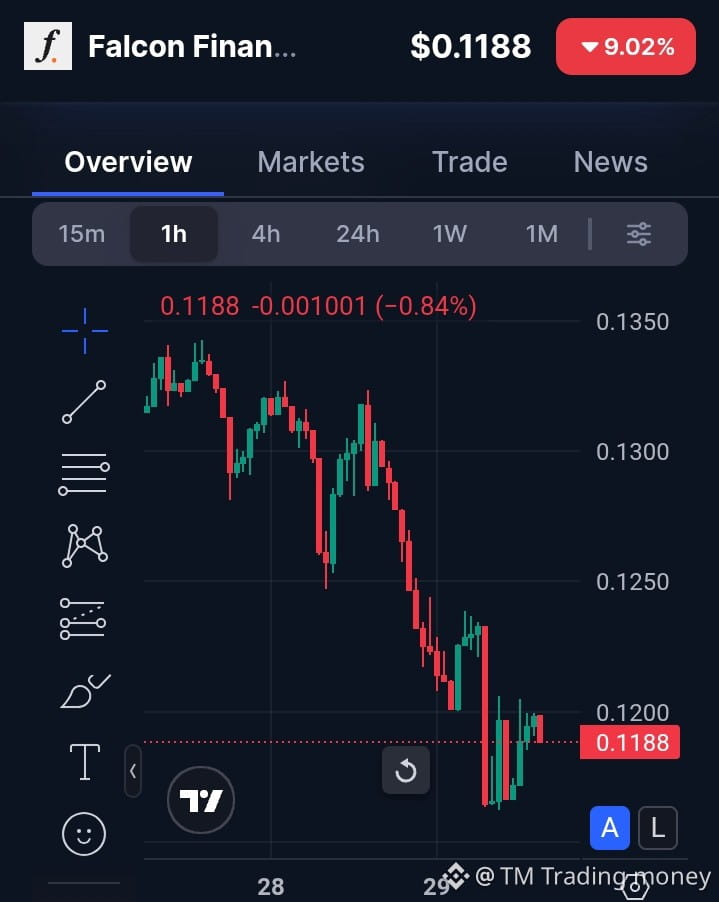
$FF drops 9.02% in 24H 📉
Price: $0.1188
Steady downtrend → sharp sell-off → small rebound.
#FF #FalconFinance #Crypto #Altcoins $FF
{future}(FFUSDT)
$FF drops 9.02% in 24H 📉
Price: $0.1188
Steady downtrend → sharp sell-off → small rebound.
#FF #FalconFinance #Crypto #Altcoins $FF
Price: $0.1188
Steady downtrend → sharp sell-off → small rebound.
#FF #FalconFinance #Crypto #Altcoins $FF
81


·
--
🚨 Trading can start moving! 🔥
$FF /USDT watchers, come here 👀
My LONG plan:
🟢 Entry: $0.120–0.123
🎯 TP1: $0.130
🎯 TP2: $0.138
🚀 TP3: $0.150
🛑 SL: $0.116
📌 If strong volume comes in above $0.123, momentum can accelerate.
Question: Will FF see $0.15 first, or $0.11? 👇
Write LONG 🔥 or SHORT 🔻 in the comments!
⚠️ Not investment advice. In volatile coins, stop-loss and risk management are important.
#FF #FalconFinance @falcon_finance
🚨 Trading can start moving! 🔥
$FF /USDT watchers, come here 👀
My LONG plan:
🟢 Entry: $0.120–0.123
🎯 TP1: $0.130
🎯 TP2: $0.138
🚀 TP3: $0.150
🛑 SL: $0.116
📌 If strong volume comes in above $0.123, momentum can accelerate.
Question: Will FF see $0.15 first, or $0.11? 👇
Write LONG 🔥 or SHORT 🔻 in the comments!
⚠️ Not investment advice. In volatile coins, stop-loss and risk management are important.
#FF #FalconFinance @Falcon Finance
$FF /USDT watchers, come here 👀
My LONG plan:
🟢 Entry: $0.120–0.123
🎯 TP1: $0.130
🎯 TP2: $0.138
🚀 TP3: $0.150
🛑 SL: $0.116
📌 If strong volume comes in above $0.123, momentum can accelerate.
Question: Will FF see $0.15 first, or $0.11? 👇
Write LONG 🔥 or SHORT 🔻 in the comments!
⚠️ Not investment advice. In volatile coins, stop-loss and risk management are important.
#FF #FalconFinance @Falcon Finance
1
128


Article
Falcon Finance Surges as fUSD Launches: A Stablecoin That Actually Shares Reserve YieldInstitutions holding fUSD can now earn roughly 3% annually, something no other regulated dollar stablecoin currently offers. Here's how it works.
💵 Stablecoin issuers have quietly collected billions in yield for years while holders earned nothing. Falcon Finance just built a stablecoin that flips that arrangement.
FF surged nearly 5% as Falcon Finance launched fUSD, a new U.S. dollar payment stablecoin issued by Anchorage Digital Bank, the first federally chartered crypto bank in the country.
🏦 Here's the actual problem this stablecoin is built to solve.
With over 320 billion dollars in dollar stablecoins now circulating and short-dated Treasury yields sitting near 4%, holders collectively forgo well over 10 billion dollars a year in potential returns. That income has historically gone entirely to issuers, not the people actually holding the tokens. fUSD is designed specifically to close that gap.
⚙️ Here's how it actually works.
fUSD is issued by Anchorage Digital Bank under direct federal oversight, built to be GENIUS Act ready, the federal framework for payment stablecoins. Because that law restricts stablecoin issuers from paying interest directly, Falcon Finance operates a separate institutional rewards program, targeting roughly 3% annually, tied to the stablecoin's underlying Treasury-backed reserves. It's a structure no other regulated U.S. dollar stablecoin currently offers.
🔐 This also extends something Falcon Finance already had running.
fUSD sits alongside USDf, Falcon's existing crypto-native synthetic dollar with over 1.6 billion dollars in circulating supply, already ranked among the top ten stablecoins on Ethereum. fUSD is positioned as its regulated counterpart, purpose-built for institutional trading, collateral, and treasury use cases rather than DeFi composability.
🧠 Why does this actually matter beyond one token launch?
This is a genuine structural innovation in a space that's mostly competed on trust and distribution rather than economics. Most major stablecoins keep 100% of their reserve yield as issuer profit. fUSD sharing a portion of that yield with institutional holders is a real, differentiated model, not just a new logo on the same product.
✅ What this means for you
If you're holding FF, understand what's actually driving this move, a genuine product differentiation in a crowded stablecoin market, not speculative hype. That kind of structural advantage tends to be more durable than a typical listing pump.
If you're an institutional user evaluating stablecoin options, fUSD's yield-sharing model is worth understanding directly, roughly 3% annually is a meaningful difference compared to holding a stablecoin that pays you nothing while the issuer earns Treasury yield on your deposits.
If you're trying to spot where stablecoin competition is heading next, this is a genuine signal, expect more issuers to eventually face pressure to share reserve economics as products like fUSD demonstrate it's both possible and in demand.
🟢 Bullish scenario
fUSD gains real institutional adoption, its yield-sharing model becomes a genuine competitive advantage, and Falcon Finance's broader stablecoin ecosystem, both USDf and fUSD, sees compounding demand.
🔴 Risk scenario
Institutional adoption stays limited to early partners, competing stablecoin issuers don't feel pressured to match the yield-sharing model, and this remains a niche product rather than reshaping the broader market.
👀 Three things to watch
1️⃣ Institutional adoption
Do major trading firms and treasury desks beyond Falcon's own initial deployment actually adopt fUSD at scale?
2️⃣ Competitor response
Do other major stablecoin issuers introduce similar yield-sharing structures in response, or does fUSD stay a unique offering?
3️⃣ USDf and fUSD synergy
Does the combined ecosystem of Falcon's regulated and synthetic stablecoins grow together, reinforcing each other's adoption?
💡 The key takeaway
This wasn't a hype-driven token pump. It was a real structural innovation, a stablecoin that finally shares reserve economics with the people actually holding it, launching with real institutional infrastructure behind it.
The real question is whether this yield-sharing model becomes the new institutional standard, forcing competitors to follow, or stays a differentiated niche product in a market that's historically kept all the yield for issuers alone.
That is the part worth watching.
This post is for informational and educational purposes only and is not financial advice. Crypto markets are volatile. Always conduct your own research before making financial decisions.
#BinanceSquare #FalconFinance #Stablecoin #fUSD #Crypto
{spot}(FFUSDT)
Falcon Finance Surges as fUSD Launches: A Stablecoin That Actually Shares Reserve Yield
Institutions holding fUSD can now earn roughly 3% annually, something no other regulated dollar stablecoin currently offers. Here's how it works.
💵 Stablecoin issuers have quietly collected billions in yield for years while holders earned nothing. Falcon Finance just built a stablecoin that flips that arrangement.
FF surged nearly 5% as Falcon Finance launched fUSD, a new U.S. dollar payment stablecoin issued by Anchorage Digital Bank, the first federally chartered crypto bank in the country.
🏦 Here's the actual problem this stablecoin is built to solve.
With over 320 billion dollars in dollar stablecoins now circulating and short-dated Treasury yields sitting near 4%, holders collectively forgo well over 10 billion dollars a year in potential returns. That income has historically gone entirely to issuers, not the people actually holding the tokens. fUSD is designed specifically to close that gap.
⚙️ Here's how it actually works.
fUSD is issued by Anchorage Digital Bank under direct federal oversight, built to be GENIUS Act ready, the federal framework for payment stablecoins. Because that law restricts stablecoin issuers from paying interest directly, Falcon Finance operates a separate institutional rewards program, targeting roughly 3% annually, tied to the stablecoin's underlying Treasury-backed reserves. It's a structure no other regulated U.S. dollar stablecoin currently offers.
🔐 This also extends something Falcon Finance already had running.
fUSD sits alongside USDf, Falcon's existing crypto-native synthetic dollar with over 1.6 billion dollars in circulating supply, already ranked among the top ten stablecoins on Ethereum. fUSD is positioned as its regulated counterpart, purpose-built for institutional trading, collateral, and treasury use cases rather than DeFi composability.
🧠 Why does this actually matter beyond one token launch?
This is a genuine structural innovation in a space that's mostly competed on trust and distribution rather than economics. Most major stablecoins keep 100% of their reserve yield as issuer profit. fUSD sharing a portion of that yield with institutional holders is a real, differentiated model, not just a new logo on the same product.
✅ What this means for you
If you're holding FF, understand what's actually driving this move, a genuine product differentiation in a crowded stablecoin market, not speculative hype. That kind of structural advantage tends to be more durable than a typical listing pump.
If you're an institutional user evaluating stablecoin options, fUSD's yield-sharing model is worth understanding directly, roughly 3% annually is a meaningful difference compared to holding a stablecoin that pays you nothing while the issuer earns Treasury yield on your deposits.
If you're trying to spot where stablecoin competition is heading next, this is a genuine signal, expect more issuers to eventually face pressure to share reserve economics as products like fUSD demonstrate it's both possible and in demand.
🟢 Bullish scenario
fUSD gains real institutional adoption, its yield-sharing model becomes a genuine competitive advantage, and Falcon Finance's broader stablecoin ecosystem, both USDf and fUSD, sees compounding demand.
🔴 Risk scenario
Institutional adoption stays limited to early partners, competing stablecoin issuers don't feel pressured to match the yield-sharing model, and this remains a niche product rather than reshaping the broader market.
👀 Three things to watch
1️⃣ Institutional adoption
Do major trading firms and treasury desks beyond Falcon's own initial deployment actually adopt fUSD at scale?
2️⃣ Competitor response
Do other major stablecoin issuers introduce similar yield-sharing structures in response, or does fUSD stay a unique offering?
3️⃣ USDf and fUSD synergy
Does the combined ecosystem of Falcon's regulated and synthetic stablecoins grow together, reinforcing each other's adoption?
💡 The key takeaway
This wasn't a hype-driven token pump. It was a real structural innovation, a stablecoin that finally shares reserve economics with the people actually holding it, launching with real institutional infrastructure behind it.
The real question is whether this yield-sharing model becomes the new institutional standard, forcing competitors to follow, or stays a differentiated niche product in a market that's historically kept all the yield for issuers alone.
That is the part worth watching.
This post is for informational and educational purposes only and is not financial advice. Crypto markets are volatile. Always conduct your own research before making financial decisions.
#BinanceSquare #FalconFinance #Stablecoin #fUSD #Crypto
💵 Stablecoin issuers have quietly collected billions in yield for years while holders earned nothing. Falcon Finance just built a stablecoin that flips that arrangement.
FF surged nearly 5% as Falcon Finance launched fUSD, a new U.S. dollar payment stablecoin issued by Anchorage Digital Bank, the first federally chartered crypto bank in the country.
🏦 Here's the actual problem this stablecoin is built to solve.
With over 320 billion dollars in dollar stablecoins now circulating and short-dated Treasury yields sitting near 4%, holders collectively forgo well over 10 billion dollars a year in potential returns. That income has historically gone entirely to issuers, not the people actually holding the tokens. fUSD is designed specifically to close that gap.
⚙️ Here's how it actually works.
fUSD is issued by Anchorage Digital Bank under direct federal oversight, built to be GENIUS Act ready, the federal framework for payment stablecoins. Because that law restricts stablecoin issuers from paying interest directly, Falcon Finance operates a separate institutional rewards program, targeting roughly 3% annually, tied to the stablecoin's underlying Treasury-backed reserves. It's a structure no other regulated U.S. dollar stablecoin currently offers.
🔐 This also extends something Falcon Finance already had running.
fUSD sits alongside USDf, Falcon's existing crypto-native synthetic dollar with over 1.6 billion dollars in circulating supply, already ranked among the top ten stablecoins on Ethereum. fUSD is positioned as its regulated counterpart, purpose-built for institutional trading, collateral, and treasury use cases rather than DeFi composability.
🧠 Why does this actually matter beyond one token launch?
This is a genuine structural innovation in a space that's mostly competed on trust and distribution rather than economics. Most major stablecoins keep 100% of their reserve yield as issuer profit. fUSD sharing a portion of that yield with institutional holders is a real, differentiated model, not just a new logo on the same product.
✅ What this means for you
If you're holding FF, understand what's actually driving this move, a genuine product differentiation in a crowded stablecoin market, not speculative hype. That kind of structural advantage tends to be more durable than a typical listing pump.
If you're an institutional user evaluating stablecoin options, fUSD's yield-sharing model is worth understanding directly, roughly 3% annually is a meaningful difference compared to holding a stablecoin that pays you nothing while the issuer earns Treasury yield on your deposits.
If you're trying to spot where stablecoin competition is heading next, this is a genuine signal, expect more issuers to eventually face pressure to share reserve economics as products like fUSD demonstrate it's both possible and in demand.
🟢 Bullish scenario
fUSD gains real institutional adoption, its yield-sharing model becomes a genuine competitive advantage, and Falcon Finance's broader stablecoin ecosystem, both USDf and fUSD, sees compounding demand.
🔴 Risk scenario
Institutional adoption stays limited to early partners, competing stablecoin issuers don't feel pressured to match the yield-sharing model, and this remains a niche product rather than reshaping the broader market.
👀 Three things to watch
1️⃣ Institutional adoption
Do major trading firms and treasury desks beyond Falcon's own initial deployment actually adopt fUSD at scale?
2️⃣ Competitor response
Do other major stablecoin issuers introduce similar yield-sharing structures in response, or does fUSD stay a unique offering?
3️⃣ USDf and fUSD synergy
Does the combined ecosystem of Falcon's regulated and synthetic stablecoins grow together, reinforcing each other's adoption?
💡 The key takeaway
This wasn't a hype-driven token pump. It was a real structural innovation, a stablecoin that finally shares reserve economics with the people actually holding it, launching with real institutional infrastructure behind it.
The real question is whether this yield-sharing model becomes the new institutional standard, forcing competitors to follow, or stays a differentiated niche product in a market that's historically kept all the yield for issuers alone.
That is the part worth watching.
This post is for informational and educational purposes only and is not financial advice. Crypto markets are volatile. Always conduct your own research before making financial decisions.
#BinanceSquare #FalconFinance #Stablecoin #fUSD #Crypto
1
2
143

·
--
Bullish
$FF
{spot}(FFUSDT)
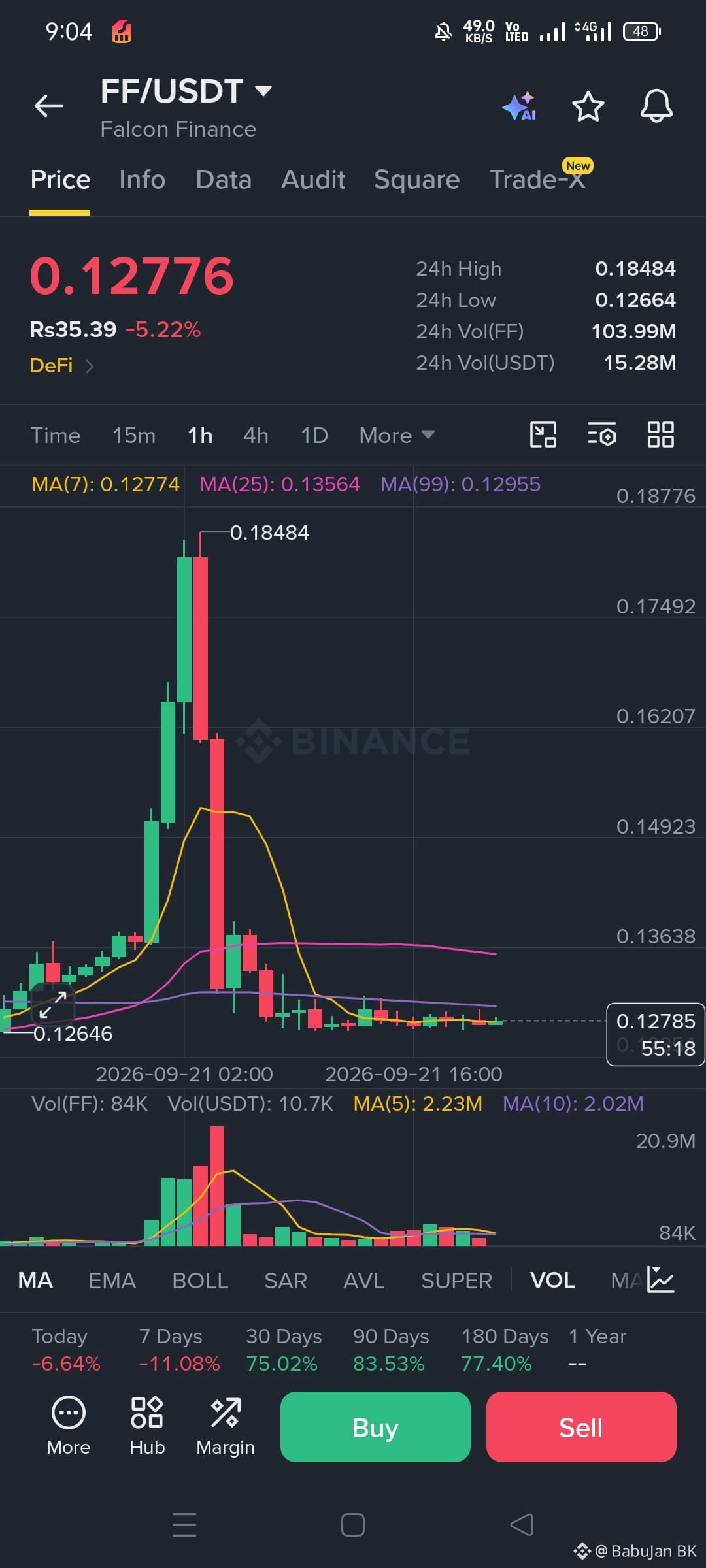
/USDT Spot Buying Setup
🟢 Buy: $0.127–$0.130
🟢 Second Buy: $0.118–$0.122
🎯 TP: $0.145 → $0.160
🔴 SL: Below $0.114
Don’t chase the pump—wait for the Buy zone.#ff #FalconFinance #SpotTrading
$FF
/USDT Spot Buying Setup
🟢 Buy: $0.127–$0.130
🟢 Second Buy: $0.118–$0.122
🎯 TP: $0.145 → $0.160
🔴 SL: Below $0.114
Don’t chase the pump—wait for the Buy zone.#ff #FalconFinance #SpotTrading
/USDT Spot Buying Setup
🟢 Buy: $0.127–$0.130
🟢 Second Buy: $0.118–$0.122
🎯 TP: $0.145 → $0.160
🔴 SL: Below $0.114
Don’t chase the pump—wait for the Buy zone.#ff #FalconFinance #SpotTrading
2
194

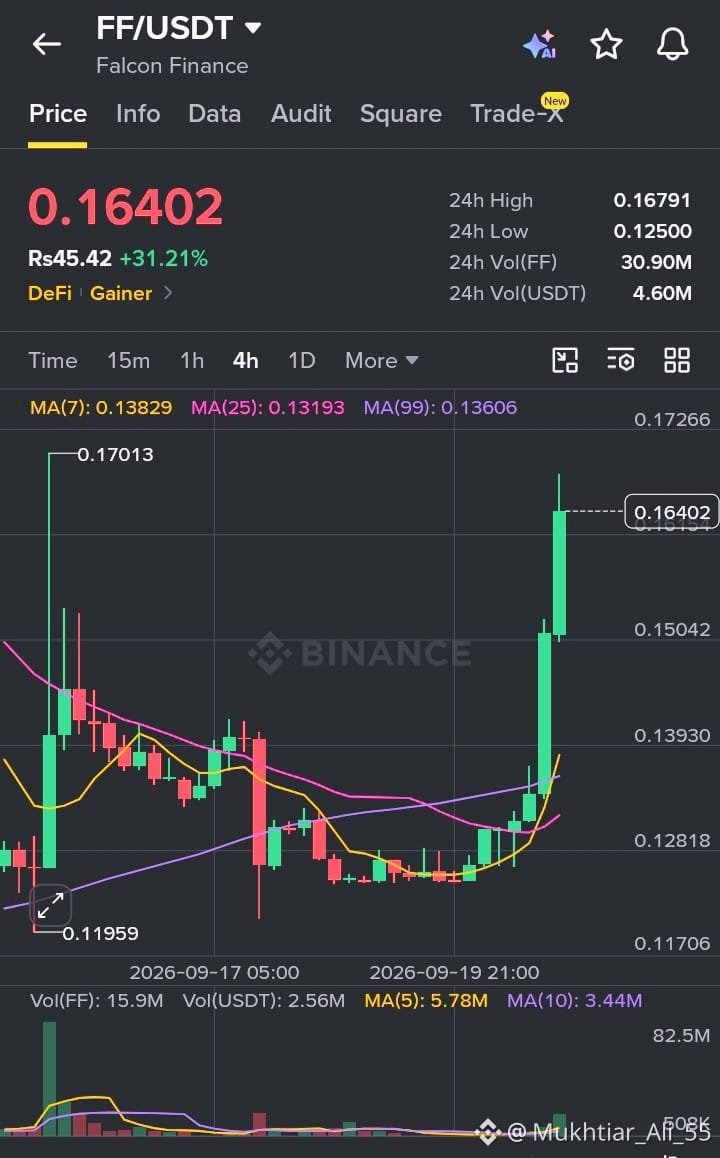
🚨 FALCON FINANCE ($FF) SURGES WITH IMPRESSIVE MOMENTUM — CAN BULLS BREAK LOCAL RESISTANCE? 🚀🔥
$FF | FF/USDT
💰 Price: 0.16402
📈 24H Change: +31.21%
📊 24H High: 0.16791
📉 24H Low: 0.12500
💵 24H Volume (USDT): 4.60M
⚠️ Market Breakdown (4H Timeframe):
Falcon Finance experienced a massive vertical breakout after breaking out of a tight consolidation base 🧨
🔻 A huge full-bodied green expansion candle pushed price straight toward the 0.16791 peak
🔻 Minor upper shadow near 0.16791 shows slight initial profit-taking near resistance levels
🔻 Strong price reaction above previous structural highs demonstrates robust demand 🧲
📈 Moving Averages Tell the Story:
📌 MA(7): 0.13829
📌 MA(25): 0.13193
📌 MA(99): 0.13606
✅ Price is trading well above MA(7), MA(25), and MA(99) moving averages
✅ MA(7) is curving sharply upward, confirming powerful short-term momentum
✅ Moving average cluster around 0.131–0.138 now acts as a strong macro support zone 🐂
📊 Volume Insight:
🟢 Strong volume green bars supporting the current breakout leg
💥 Confirms genuine market buying power rather than a low-liquidity spike
⚠️ Elevated volatility — watch for potential higher-level consolidation or retest
🧠 What This Means:
This is a powerful trend acceleration phase 🚀
Bulls are firmly in control as price approaches the previous high-water mark near 0.17013
🔹 Short-term trend: Strongly Bullish
🔹 Momentum: High / Expansion
🔹 Market emotion: Bullish / Greed 🤑
🎯 Key Levels to Watch:
🟢 Support: 0.15042 – 0.13829 zone
🔴 Resistance: 0.16791 – 0.17013 zone
📌 Holding above 0.15042 maintains immediate bullish pressure for another leg higher
📌 A clean break above 0.17013 opens the door for further price discovery ⬆️
💡 Final Take:
🧨 $FF is showing exceptional strength during this breakout push
🧘 Avoid chasing tops — wait for healthy setups
🛡️ Always enforce strict risk control
Trade discipline over fear of missing out 💎
#FalconFinance #FF
$FF
{spot}(FFUSDT)
🚨 FALCON FINANCE ($FF ) SURGES WITH IMPRESSIVE MOMENTUM — CAN BULLS BREAK LOCAL RESISTANCE? 🚀🔥
$FF | FF/USDT
💰 Price: 0.16402
📈 24H Change: +31.21%
📊 24H High: 0.16791
📉 24H Low: 0.12500
💵 24H Volume (USDT): 4.60M
⚠️ Market Breakdown (4H Timeframe):
Falcon Finance experienced a massive vertical breakout after breaking out of a tight consolidation base 🧨
🔻 A huge full-bodied green expansion candle pushed price straight toward the 0.16791 peak
🔻 Minor upper shadow near 0.16791 shows slight initial profit-taking near resistance levels
🔻 Strong price reaction above previous structural highs demonstrates robust demand 🧲
📈 Moving Averages Tell the Story:
📌 MA(7): 0.13829
📌 MA(25): 0.13193
📌 MA(99): 0.13606
✅ Price is trading well above MA(7), MA(25), and MA(99) moving averages
✅ MA(7) is curving sharply upward, confirming powerful short-term momentum
✅ Moving average cluster around 0.131–0.138 now acts as a strong macro support zone 🐂
📊 Volume Insight:
🟢 Strong volume green bars supporting the current breakout leg
💥 Confirms genuine market buying power rather than a low-liquidity spike
⚠️ Elevated volatility — watch for potential higher-level consolidation or retest
🧠 What This Means:
This is a powerful trend acceleration phase 🚀
Bulls are firmly in control as price approaches the previous high-water mark near 0.17013
🔹 Short-term trend: Strongly Bullish
🔹 Momentum: High / Expansion
🔹 Market emotion: Bullish / Greed 🤑
🎯 Key Levels to Watch:
🟢 Support: 0.15042 – 0.13829 zone
🔴 Resistance: 0.16791 – 0.17013 zone
📌 Holding above 0.15042 maintains immediate bullish pressure for another leg higher
📌 A clean break above 0.17013 opens the door for further price discovery ⬆️
💡 Final Take:
🧨 $FF is showing exceptional strength during this breakout push
🧘 Avoid chasing tops — wait for healthy setups
🛡️ Always enforce strict risk control
Trade discipline over fear of missing out 💎
#FalconFinance #FF
$FF
$FF | FF/USDT
💰 Price: 0.16402
📈 24H Change: +31.21%
📊 24H High: 0.16791
📉 24H Low: 0.12500
💵 24H Volume (USDT): 4.60M
⚠️ Market Breakdown (4H Timeframe):
Falcon Finance experienced a massive vertical breakout after breaking out of a tight consolidation base 🧨
🔻 A huge full-bodied green expansion candle pushed price straight toward the 0.16791 peak
🔻 Minor upper shadow near 0.16791 shows slight initial profit-taking near resistance levels
🔻 Strong price reaction above previous structural highs demonstrates robust demand 🧲
📈 Moving Averages Tell the Story:
📌 MA(7): 0.13829
📌 MA(25): 0.13193
📌 MA(99): 0.13606
✅ Price is trading well above MA(7), MA(25), and MA(99) moving averages
✅ MA(7) is curving sharply upward, confirming powerful short-term momentum
✅ Moving average cluster around 0.131–0.138 now acts as a strong macro support zone 🐂
📊 Volume Insight:
🟢 Strong volume green bars supporting the current breakout leg
💥 Confirms genuine market buying power rather than a low-liquidity spike
⚠️ Elevated volatility — watch for potential higher-level consolidation or retest
🧠 What This Means:
This is a powerful trend acceleration phase 🚀
Bulls are firmly in control as price approaches the previous high-water mark near 0.17013
🔹 Short-term trend: Strongly Bullish
🔹 Momentum: High / Expansion
🔹 Market emotion: Bullish / Greed 🤑
🎯 Key Levels to Watch:
🟢 Support: 0.15042 – 0.13829 zone
🔴 Resistance: 0.16791 – 0.17013 zone
📌 Holding above 0.15042 maintains immediate bullish pressure for another leg higher
📌 A clean break above 0.17013 opens the door for further price discovery ⬆️
💡 Final Take:
🧨 $FF is showing exceptional strength during this breakout push
🧘 Avoid chasing tops — wait for healthy setups
🛡️ Always enforce strict risk control
Trade discipline over fear of missing out 💎
#FalconFinance #FF
$FF
69

·
--
Bullish
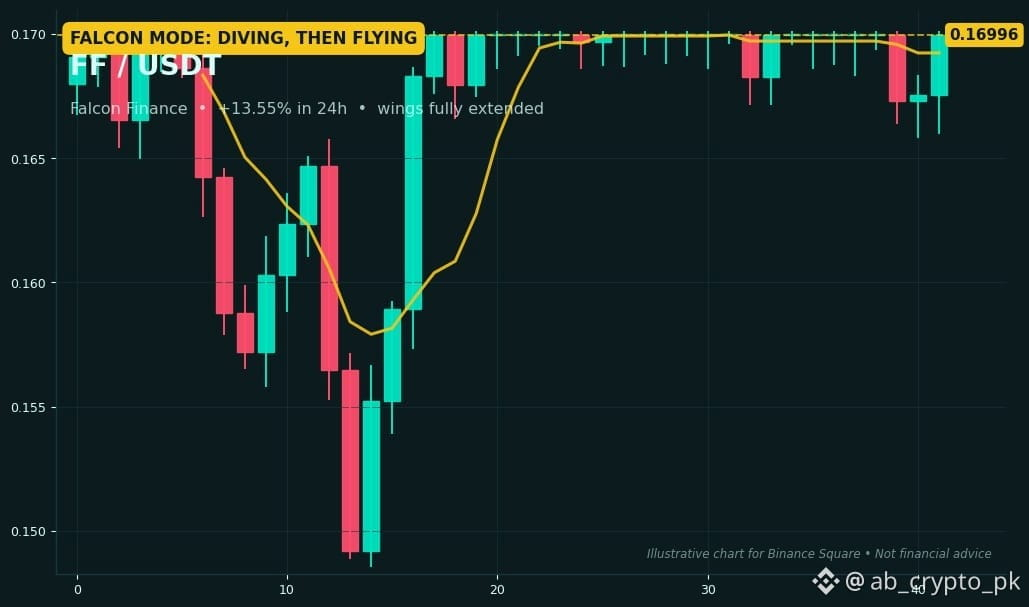
$FF (Falcon Finance — Wings Extended)
Falcon Finance (FF) +13.55%: This Bird Forgot It Could Fly 🦅💨
Body: FF spent the session diving like it lost its job, its keys, AND its will to live — bottoming near $0.11959. Then someone whispered "you're a FALCON" and it went from pigeon to predator in one candle.
📈 The numbers: • Price: 0.14384
• 24h High:0.17013 / Low: 0.11959 (that's a 42% intraday range, buckle up 😅)
• Volume: 142.46M FF (20.91M USDT) • 30 Days: +117.57% 🟢🟢 • 180 Days: +98.45% 🟢
🔍 What's actually happening: This chart is a masterclass in "diamond hands vs. paper hands." The dip to $0.1196 flushed the weaklings, and the recovery has been falcon-esque — sharp, aggressive, and slightly terrifying if you're short. DeFi season vibes are strong with this one.
The V-shaped recovery is beautiful... and also a warning. Coins that pump this hard can retrace just as fast. The $0.17 high is the next boss level. Beat it, and the sky's literally the name (Falcon, get it? I'll see myself out 🚪).
💡 My take: Momentum is real, but so is volatility. This is a rollercoaster that removed its safety bar for fun. Trade the trend, respect the stop-loss, and don't marry the bird. 💍🚫
⚠️ High risk, high reward. Not financial advice — my falcon is as good as yours.
#FF #FalconFinance #DeFi #Crypto #BinanceSquare #BullRun #CryptoHumor
#DYOR
$FF (Falcon Finance — Wings Extended)
Falcon Finance (FF) +13.55%: This Bird Forgot It Could Fly 🦅💨
Body: FF spent the session diving like it lost its job, its keys, AND its will to live — bottoming near $0.11959. Then someone whispered "you're a FALCON" and it went from pigeon to predator in one candle.
📈 The numbers: • Price: 0.14384
• 24h High:0.17013 / Low: 0.11959 (that's a 42% intraday range, buckle up 😅)
• Volume: 142.46M FF (20.91M USDT) • 30 Days: +117.57% 🟢🟢 • 180 Days: +98.45% 🟢
🔍 What's actually happening: This chart is a masterclass in "diamond hands vs. paper hands." The dip to $0.1196 flushed the weaklings, and the recovery has been falcon-esque — sharp, aggressive, and slightly terrifying if you're short. DeFi season vibes are strong with this one.
The V-shaped recovery is beautiful... and also a warning. Coins that pump this hard can retrace just as fast. The $0.17 high is the next boss level. Beat it, and the sky's literally the name (Falcon, get it? I'll see myself out 🚪).
💡 My take: Momentum is real, but so is volatility. This is a rollercoaster that removed its safety bar for fun. Trade the trend, respect the stop-loss, and don't marry the bird. 💍🚫
⚠️ High risk, high reward. Not financial advice — my falcon is as good as yours.
#FF #FalconFinance #DeFi #Crypto #BinanceSquare #BullRun #CryptoHumor
#DYOR
Falcon Finance (FF) +13.55%: This Bird Forgot It Could Fly 🦅💨
Body: FF spent the session diving like it lost its job, its keys, AND its will to live — bottoming near $0.11959. Then someone whispered "you're a FALCON" and it went from pigeon to predator in one candle.
📈 The numbers: • Price: 0.14384
• 24h High:0.17013 / Low: 0.11959 (that's a 42% intraday range, buckle up 😅)
• Volume: 142.46M FF (20.91M USDT) • 30 Days: +117.57% 🟢🟢 • 180 Days: +98.45% 🟢
🔍 What's actually happening: This chart is a masterclass in "diamond hands vs. paper hands." The dip to $0.1196 flushed the weaklings, and the recovery has been falcon-esque — sharp, aggressive, and slightly terrifying if you're short. DeFi season vibes are strong with this one.
The V-shaped recovery is beautiful... and also a warning. Coins that pump this hard can retrace just as fast. The $0.17 high is the next boss level. Beat it, and the sky's literally the name (Falcon, get it? I'll see myself out 🚪).
💡 My take: Momentum is real, but so is volatility. This is a rollercoaster that removed its safety bar for fun. Trade the trend, respect the stop-loss, and don't marry the bird. 💍🚫
⚠️ High risk, high reward. Not financial advice — my falcon is as good as yours.
#FF #FalconFinance #DeFi #Crypto #BinanceSquare #BullRun #CryptoHumor
#DYOR
86

·
--
Bullish
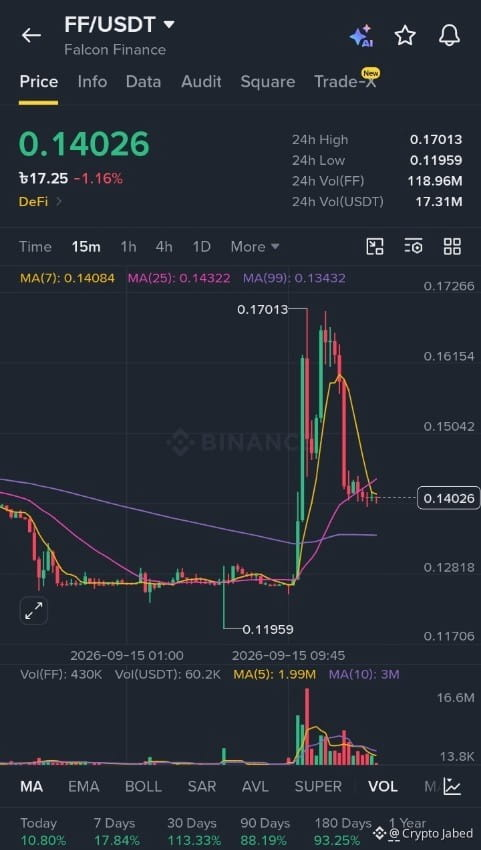
$FF — Sharp Rejection!
FF spiked to $0.170, then dropped hard. Now holding near $0.14.
🟢 LONG $FF
Entry: $0.1390 – $0.1410
TP1: $0.1500
TP2: $0.1620
SL: $0.1320
S: $0.1320 | R: $0.1500
Bounce or downside?
You can trade from here.👇$FF
{future}(FFUSDT)
#FF #FalconFinance #BinanceSquare
$FF — Sharp Rejection!
FF spiked to $0.170, then dropped hard. Now holding near $0.14.
🟢 LONG $FF
Entry: $0.1390 – $0.1410
TP1: $0.1500
TP2: $0.1620
SL: $0.1320
S: $0.1320 | R: $0.1500
Bounce or downside?
You can trade from here.👇$FF
#FF #FalconFinance #BinanceSquare
FF spiked to $0.170, then dropped hard. Now holding near $0.14.
🟢 LONG $FF
Entry: $0.1390 – $0.1410
TP1: $0.1500
TP2: $0.1620
SL: $0.1320
S: $0.1320 | R: $0.1500
Bounce or downside?
You can trade from here.👇$FF
#FF #FalconFinance #BinanceSquare
2
56

·
--
Bullish
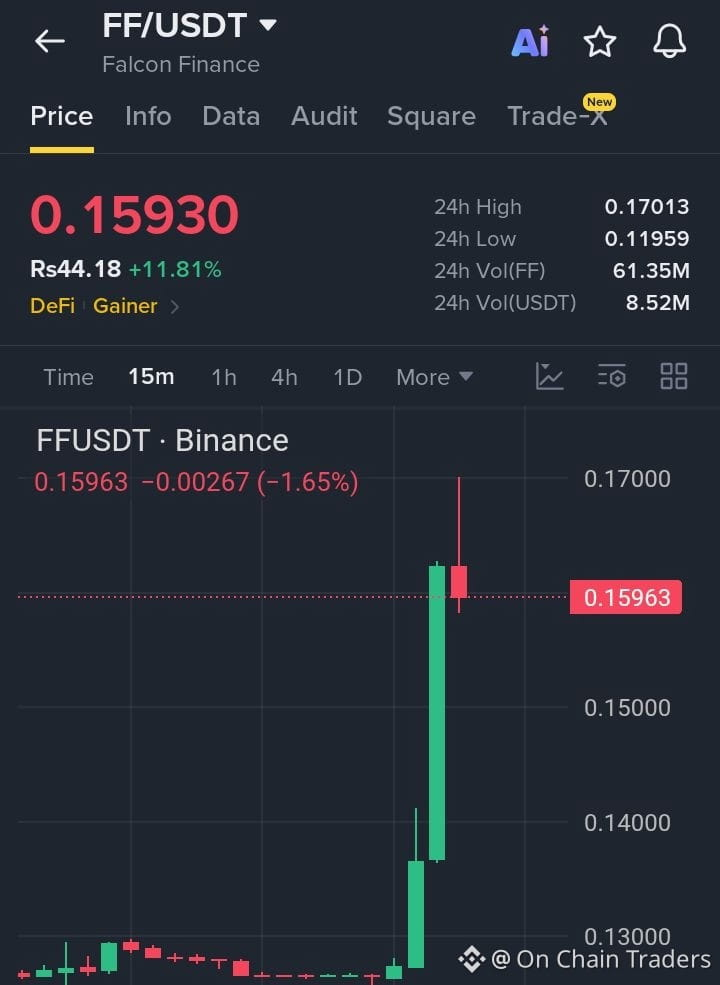
$FF
{spot}(FFUSDT)
is showing strong momentum with a potential bull flag forming after the rally. A breakout above $0.1700 could trigger the next leg up.
Entry: $0.1550–$0.1590 TP1: $0.1700 | TP2: $0.1850 | TP3: $0.2000 SL: $0.1480
Bullish above $0.1600 — watch for volume confirmation. #FF #FalconFinance #Binance
$FF
is showing strong momentum with a potential bull flag forming after the rally. A breakout above $0.1700 could trigger the next leg up.
Entry: $0.1550–$0.1590 TP1: $0.1700 | TP2: $0.1850 | TP3: $0.2000 SL: $0.1480
Bullish above $0.1600 — watch for volume confirmation. #FF #FalconFinance #Binance
is showing strong momentum with a potential bull flag forming after the rally. A breakout above $0.1700 could trigger the next leg up.
Entry: $0.1550–$0.1590 TP1: $0.1700 | TP2: $0.1850 | TP3: $0.2000 SL: $0.1480
Bullish above $0.1600 — watch for volume confirmation. #FF #FalconFinance #Binance
1
128

·
--
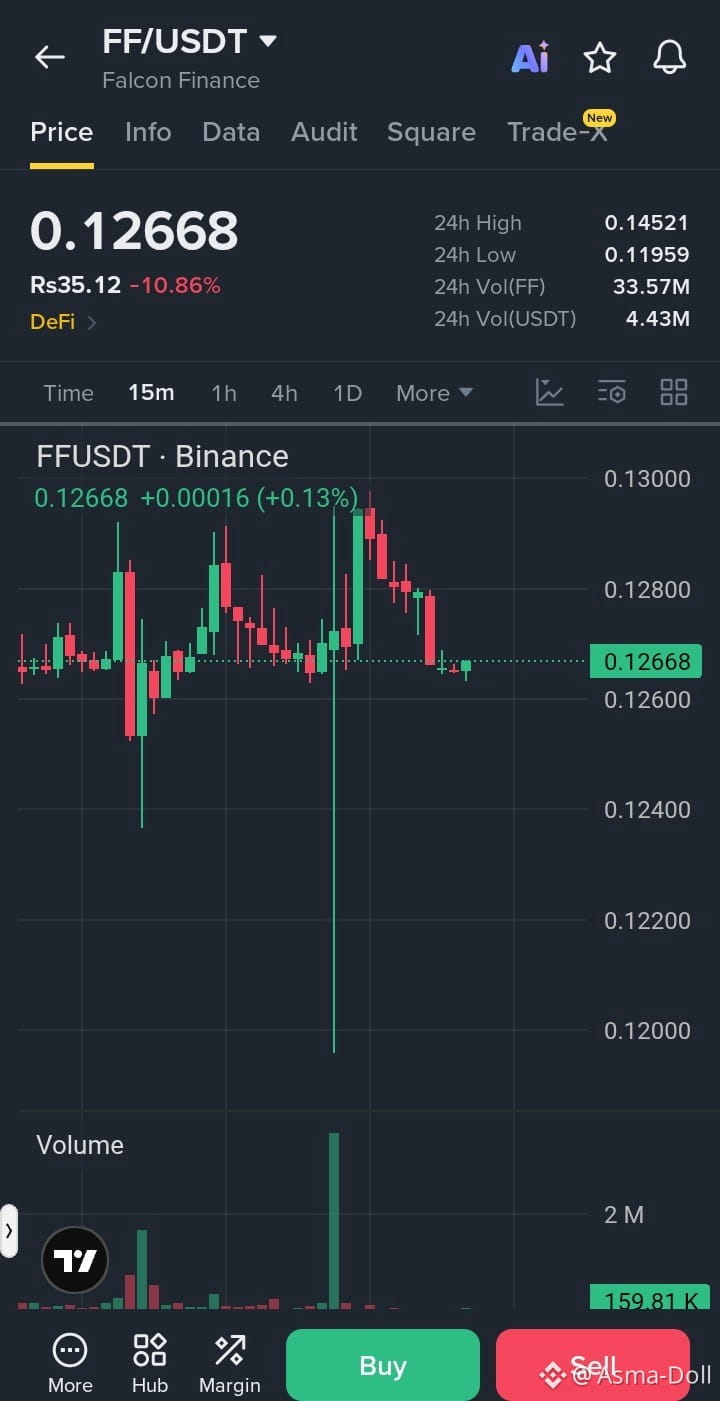
🔻 $FF /USDT — SHORT SIGNAL
Entry: 0.1260 – 0.1280
Stop Loss (SL): 0.1320
TP1: 0.1220
TP2: 0.1195
TP3: 0.1150
Trade here $FF
{future}(FFUSDT)
Analysis:
Strong rejection from 0.145+ zone
Currently down around 10%, showing strong selling pressure
Price is hovering close to the 0.1195–0.1200 support
Breakdown below 0.1240 can accelerate the bearish move
Current structure favors a short, but a bounce from support is possible.
Confirmation:
Clean break below 0.1240 with volume → stronger short continuation.
⚠️ Risk: High volatility. Keep position size small and don't over-leverage.
#FF #FalconFinance #FFUSDT #CryptoShort #Binance
🔻 $FF /USDT — SHORT SIGNAL
Entry: 0.1260 – 0.1280
Stop Loss (SL): 0.1320
TP1: 0.1220
TP2: 0.1195
TP3: 0.1150
Trade here $FF
Analysis:
Strong rejection from 0.145+ zone
Currently down around 10%, showing strong selling pressure
Price is hovering close to the 0.1195–0.1200 support
Breakdown below 0.1240 can accelerate the bearish move
Current structure favors a short, but a bounce from support is possible.
Confirmation:
Clean break below 0.1240 with volume → stronger short continuation.
⚠️ Risk: High volatility. Keep position size small and don't over-leverage.
#FF #FalconFinance #FFUSDT #CryptoShort #Binance
Entry: 0.1260 – 0.1280
Stop Loss (SL): 0.1320
TP1: 0.1220
TP2: 0.1195
TP3: 0.1150
Trade here $FF
Analysis:
Strong rejection from 0.145+ zone
Currently down around 10%, showing strong selling pressure
Price is hovering close to the 0.1195–0.1200 support
Breakdown below 0.1240 can accelerate the bearish move
Current structure favors a short, but a bounce from support is possible.
Confirmation:
Clean break below 0.1240 with volume → stronger short continuation.
⚠️ Risk: High volatility. Keep position size small and don't over-leverage.
#FF #FalconFinance #FFUSDT #CryptoShort #Binance
35

·
--
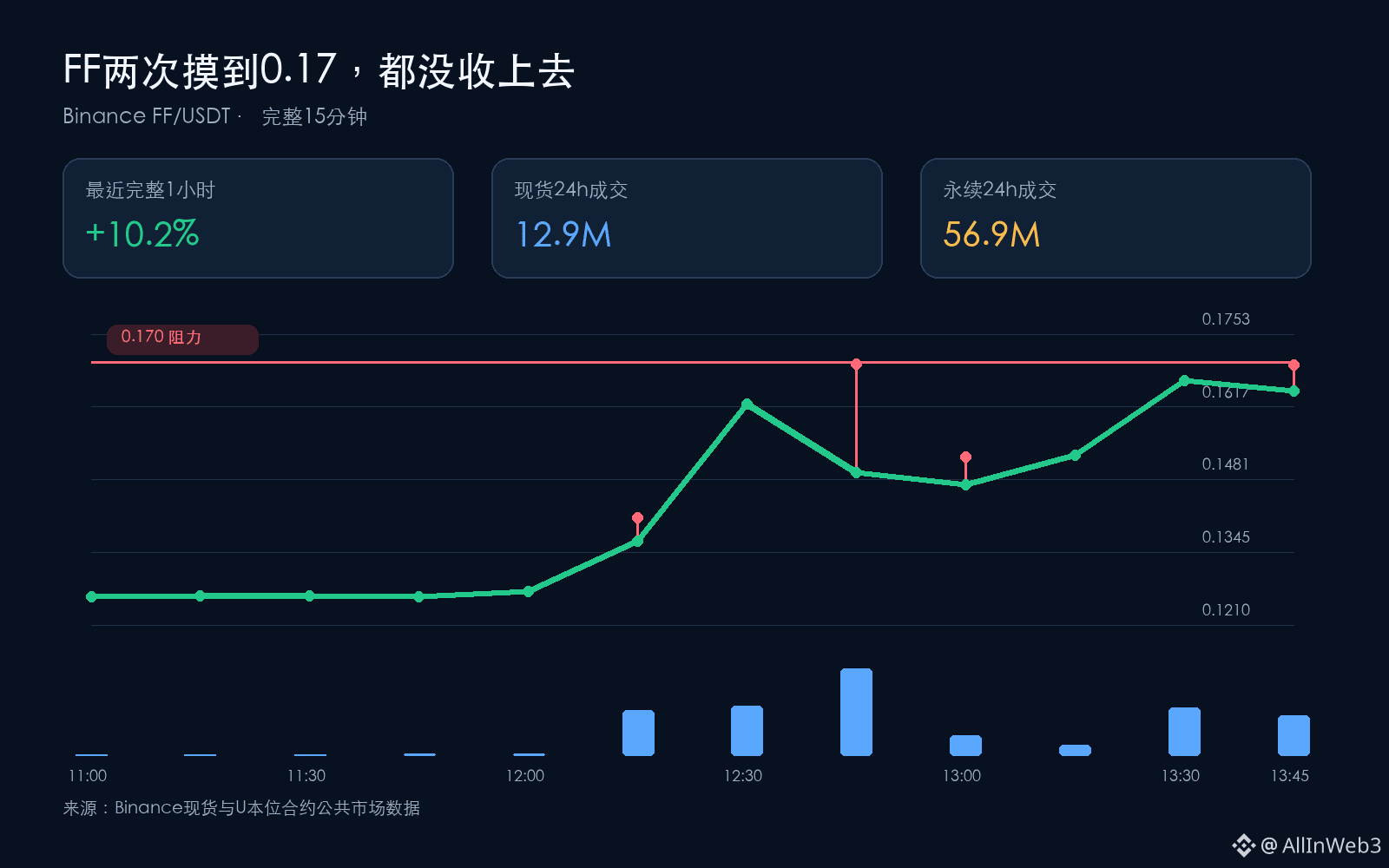
$FF I’m a bit biased toward this move, but I won’t chase above 0.165. At 12:45 I first touched 0.1697; the close got pushed back to 0.1493. At 13:45 I touched 0.1694 the second time—this time it closed at 0.1646. Both times it didn’t hold above 0.17, but the second pullback is clearly shallower—the sell pressure is still there, and the support is getting stronger.
This isn’t just a line drawn by contracts: Binance spot 24h volume is about $12.9M, perpetuals about $56.9M. On the BSC main pool, Alpha, spot and perp prices are all around 0.165. OI only increased about 0.7% in the last hour; the 4-hour funding rate is around +0.0009%. Leverage still hasn’t started to get heated.
I’m only waiting for 0.154—0.158 to hold on reduced volume, or for a 15-minute close above 0.170—then the next candle should still defend 0.165. If it closes below 0.145 within an hour, the repair fails. The only question left is this: when the spot buy orders are already in, who exactly is 0.17 still blocking? #FF #FalconFinance #合约
$FF I’m a bit biased toward this move, but I won’t chase above 0.165. At 12:45 I first touched 0.1697; the close got pushed back to 0.1493. At 13:45 I touched 0.1694 the second time—this time it closed at 0.1646. Both times it didn’t hold above 0.17, but the second pullback is clearly shallower—the sell pressure is still there, and the support is getting stronger.
This isn’t just a line drawn by contracts: Binance spot 24h volume is about $12.9M, perpetuals about $56.9M. On the BSC main pool, Alpha, spot and perp prices are all around 0.165. OI only increased about 0.7% in the last hour; the 4-hour funding rate is around +0.0009%. Leverage still hasn’t started to get heated.
I’m only waiting for 0.154—0.158 to hold on reduced volume, or for a 15-minute close above 0.170—then the next candle should still defend 0.165. If it closes below 0.145 within an hour, the repair fails. The only question left is this: when the spot buy orders are already in, who exactly is 0.17 still blocking? #FF #FalconFinance #合约
This isn’t just a line drawn by contracts: Binance spot 24h volume is about $12.9M, perpetuals about $56.9M. On the BSC main pool, Alpha, spot and perp prices are all around 0.165. OI only increased about 0.7% in the last hour; the 4-hour funding rate is around +0.0009%. Leverage still hasn’t started to get heated.
I’m only waiting for 0.154—0.158 to hold on reduced volume, or for a 15-minute close above 0.170—then the next candle should still defend 0.165. If it closes below 0.145 within an hour, the repair fails. The only question left is this: when the spot buy orders are already in, who exactly is 0.17 still blocking? #FF #FalconFinance #合约
1
99

·
--
Bullish
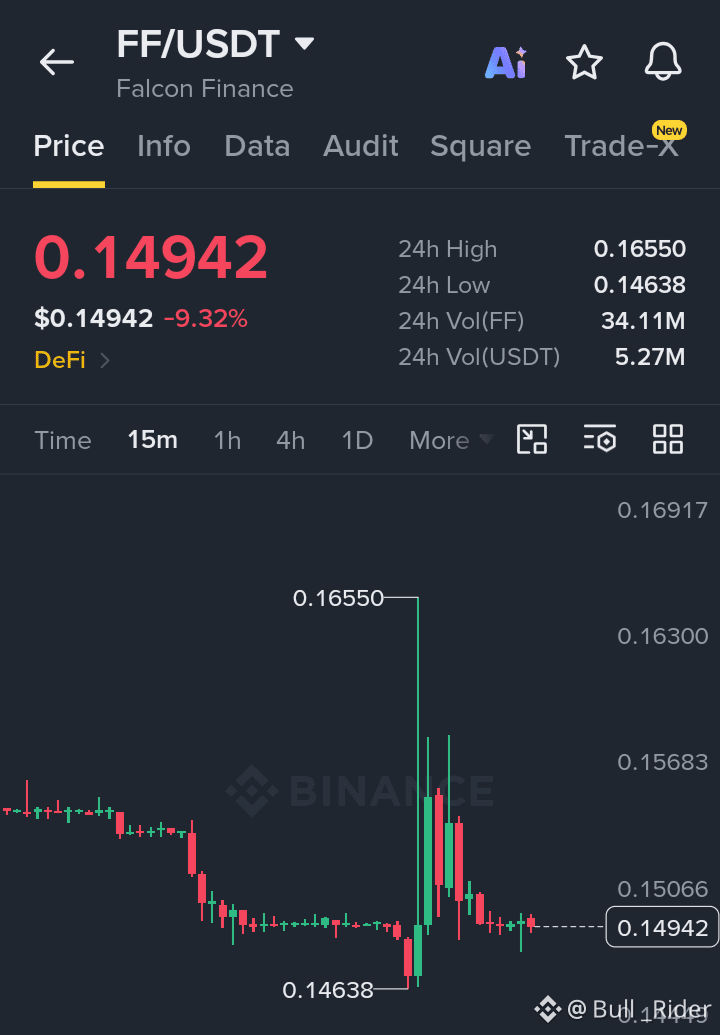
$FF $FF (Falcon Finance) on the 15m spot chart is forming a tight compression base (-9.32%), currently trading around 0.14942 following a sharp rejection from its spike high at 0.16550, attempting to build a local support floor directly above its 0.14638 launch floor base and 24h low of 0.14638.
* Target 1: 0.15066
* Target 2: 0.15683
* Target 3: 0.16550
Buy / Trade $FF #FF #FalconFinance #TradeCard
{future}(FFUSDT)
$FF $FF (Falcon Finance) on the 15m spot chart is forming a tight compression base (-9.32%), currently trading around 0.14942 following a sharp rejection from its spike high at 0.16550, attempting to build a local support floor directly above its 0.14638 launch floor base and 24h low of 0.14638.
* Target 1: 0.15066
* Target 2: 0.15683
* Target 3: 0.16550
Buy / Trade $FF #FF #FalconFinance #TradeCard
* Target 1: 0.15066
* Target 2: 0.15683
* Target 3: 0.16550
Buy / Trade $FF #FF #FalconFinance #TradeCard
1
53

🚀 $FF
{spot}(FFUSDT)
/USDT — BULLISH LONG TRADE SIGNAL 📈
🔥 Price: 0.16892 USDT
🟢 Supertrend: 0.16535 — bullish trend intact
📍 Support: 0.16535
🎯 Entry: 0.1680–0.1690
🎯 TP1: 0.17180 | TP2: 0.17500 | TP3: 0.18000
🛡️ SL: 0.16480
⚡ Momentum remains positive while price holds above the Supertrend. Trade with proper risk management.
#FF #FalconFinance #CryptoTrading
🚀 $FF
/USDT — BULLISH LONG TRADE SIGNAL 📈
🔥 Price: 0.16892 USDT
🟢 Supertrend: 0.16535 — bullish trend intact
📍 Support: 0.16535
🎯 Entry: 0.1680–0.1690
🎯 TP1: 0.17180 | TP2: 0.17500 | TP3: 0.18000
🛡️ SL: 0.16480
⚡ Momentum remains positive while price holds above the Supertrend. Trade with proper risk management.
#FF #FalconFinance #CryptoTrading
/USDT — BULLISH LONG TRADE SIGNAL 📈
🔥 Price: 0.16892 USDT
🟢 Supertrend: 0.16535 — bullish trend intact
📍 Support: 0.16535
🎯 Entry: 0.1680–0.1690
🎯 TP1: 0.17180 | TP2: 0.17500 | TP3: 0.18000
🛡️ SL: 0.16480
⚡ Momentum remains positive while price holds above the Supertrend. Trade with proper risk management.
#FF #FalconFinance #CryptoTrading

1
143

·
--
Holding $BTC 56.3 USDT
🔥 $FF COIN — ENTRY SETUP UPDATE
Falcon Finance (FF) is trading around $0.169, up roughly 12% in 24h and more than 66% over 7 days, so momentum is strong but chasing the pump carries risk.
📍 Entry Zone: $0.158–$0.164
✅ Confirmation: 15m candle closes above $0.171 with strong volume
🛑 Stop Loss: $0.151
🎯 TP1: $0.180
🎯 TP2: $0.195
🎯 TP3: $0.210
🟢 Support: $0.158–$0.160
🔴 Resistance: $0.170–$0.175
❌ Invalidation: 15m/1h close below $0.151
⚠️ Important: FF has already made a strong move, so wait for a pullback or confirmed breakout instead of FOMO entry. These are technical levels, not guaranteed outcomes.
#FF #FalconFinance #Crypto #BinanceSquare #Trading #Altcoins
🔥 $FF COIN — ENTRY SETUP UPDATE
Falcon Finance (FF) is trading around $0.169, up roughly 12% in 24h and more than 66% over 7 days, so momentum is strong but chasing the pump carries risk.
📍 Entry Zone: $0.158–$0.164
✅ Confirmation: 15m candle closes above $0.171 with strong volume
🛑 Stop Loss: $0.151
🎯 TP1: $0.180
🎯 TP2: $0.195
🎯 TP3: $0.210
🟢 Support: $0.158–$0.160
🔴 Resistance: $0.170–$0.175
❌ Invalidation: 15m/1h close below $0.151
⚠️ Important: FF has already made a strong move, so wait for a pullback or confirmed breakout instead of FOMO entry. These are technical levels, not guaranteed outcomes.
#FF #FalconFinance #Crypto #BinanceSquare #Trading #Altcoins
Falcon Finance (FF) is trading around $0.169, up roughly 12% in 24h and more than 66% over 7 days, so momentum is strong but chasing the pump carries risk.
📍 Entry Zone: $0.158–$0.164
✅ Confirmation: 15m candle closes above $0.171 with strong volume
🛑 Stop Loss: $0.151
🎯 TP1: $0.180
🎯 TP2: $0.195
🎯 TP3: $0.210
🟢 Support: $0.158–$0.160
🔴 Resistance: $0.170–$0.175
❌ Invalidation: 15m/1h close below $0.151
⚠️ Important: FF has already made a strong move, so wait for a pullback or confirmed breakout instead of FOMO entry. These are technical levels, not guaranteed outcomes.
#FF #FalconFinance #Crypto #BinanceSquare #Trading #Altcoins
88

·
--
$FF Update 🔎 Can Falcon Finance hold its gains after a powerful weekly breakout?
💰 Price now: ~$0.150 | 24h: Volatile
📊 Market cap: ~$471.6M | Rank: #110
📈 24h range: $0.1441 – $0.1596
📰 What's happening:
FF surged sharply this week, including a 24% daily jump on September 8 before consolidating near $0.15. Trading volume remains elevated, although recent 24-hour volume has cooled from the previous day.
🔥 Key catalyst:
Falcon Finance continues building infrastructure connecting traditional and decentralized finance, with $FF positioned as the protocol's native token tied to ecosystem growth and USDf adoption.
👀 Next step to watch:
🔴 Bearish case: Losing $0.144 could expose the $0.12–$0.13 area.
🟢 Bullish case: Breaking above $0.160 could put the recent breakout momentum back in focus.
📝 My take:
FF has delivered a strong breakout, but the sharp rally means volatility and profit-taking remain important risks.
Not financial advice, DYOR ⚠️
#FalconFinance #FF #CryptoAnalysis $FF
$FF Update 🔎 Can Falcon Finance hold its gains after a powerful weekly breakout?
💰 Price now: ~$0.150 | 24h: Volatile
📊 Market cap: ~$471.6M | Rank: #110
📈 24h range: $0.1441 – $0.1596
📰 What's happening:
FF surged sharply this week, including a 24% daily jump on September 8 before consolidating near $0.15. Trading volume remains elevated, although recent 24-hour volume has cooled from the previous day.
🔥 Key catalyst:
Falcon Finance continues building infrastructure connecting traditional and decentralized finance, with $FF positioned as the protocol's native token tied to ecosystem growth and USDf adoption.
👀 Next step to watch:
🔴 Bearish case: Losing $0.144 could expose the $0.12–$0.13 area.
🟢 Bullish case: Breaking above $0.160 could put the recent breakout momentum back in focus.
📝 My take:
FF has delivered a strong breakout, but the sharp rally means volatility and profit-taking remain important risks.
Not financial advice, DYOR ⚠️
#FalconFinance #FF #CryptoAnalysis $FF
💰 Price now: ~$0.150 | 24h: Volatile
📊 Market cap: ~$471.6M | Rank: #110
📈 24h range: $0.1441 – $0.1596
📰 What's happening:
FF surged sharply this week, including a 24% daily jump on September 8 before consolidating near $0.15. Trading volume remains elevated, although recent 24-hour volume has cooled from the previous day.
🔥 Key catalyst:
Falcon Finance continues building infrastructure connecting traditional and decentralized finance, with $FF positioned as the protocol's native token tied to ecosystem growth and USDf adoption.
👀 Next step to watch:
🔴 Bearish case: Losing $0.144 could expose the $0.12–$0.13 area.
🟢 Bullish case: Breaking above $0.160 could put the recent breakout momentum back in focus.
📝 My take:
FF has delivered a strong breakout, but the sharp rally means volatility and profit-taking remain important risks.
Not financial advice, DYOR ⚠️
#FalconFinance #FF #CryptoAnalysis $FF

66
·
--
Bullish
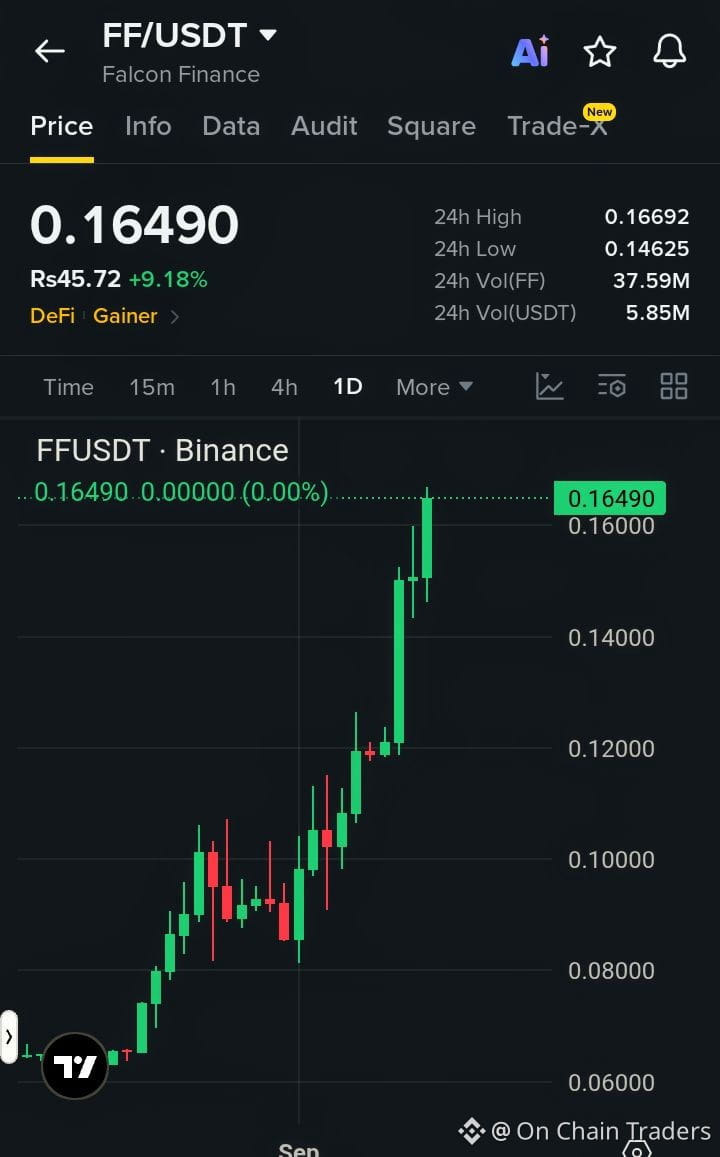
$FF
{spot}(FFUSDT)
is showing strong bullish momentum, up 9%+ with price pressing the 24H high near $0.1669. �
📌 Pattern: Bullish continuation / breakout attempt
🎯 Entry: $0.1600–$0.1640
🎯 TP1: $0.1700 | TP2: $0.1780 | TP3: $0.1850
🛑 SL: $0.1530 — below key support
🔥 Next move: Bullish above $0.1669; rejection there could trigger a pullback toward $0.1600.
#FF #FalconFinance #Binance #Crypto
$FF
is showing strong bullish momentum, up 9%+ with price pressing the 24H high near $0.1669. �
📌 Pattern: Bullish continuation / breakout attempt
🎯 Entry: $0.1600–$0.1640
🎯 TP1: $0.1700 | TP2: $0.1780 | TP3: $0.1850
🛑 SL: $0.1530 — below key support
🔥 Next move: Bullish above $0.1669; rejection there could trigger a pullback toward $0.1600.
#FF #FalconFinance #Binance #Crypto
is showing strong bullish momentum, up 9%+ with price pressing the 24H high near $0.1669. �
📌 Pattern: Bullish continuation / breakout attempt
🎯 Entry: $0.1600–$0.1640
🎯 TP1: $0.1700 | TP2: $0.1780 | TP3: $0.1850
🛑 SL: $0.1530 — below key support
🔥 Next move: Bullish above $0.1669; rejection there could trigger a pullback toward $0.1600.
#FF #FalconFinance #Binance #Crypto
1
54

·
--
$FF interesting zone to watch 👀
$FF is around $0.16558 after a +9.71% move in 24h. Momentum is positive, but I’d like to see whether this area can turn into support.
Zone to watch: around $0.16558 — confirmation and a clean hold are key.
Bullish scenario: hold ➝ reclaim ➝ breakout ➝ next resistance levels
Invalidation: no precise daily-close level from this snapshot alone.
Personally, I’d rather let price prove the setup than guess the top.
#FF #FalconFinance #CryptoTrading
$FF interesting zone to watch 👀
$FF is around $0.16558 after a +9.71% move in 24h. Momentum is positive, but I’d like to see whether this area can turn into support.
Zone to watch: around $0.16558 — confirmation and a clean hold are key.
Bullish scenario: hold ➝ reclaim ➝ breakout ➝ next resistance levels
Invalidation: no precise daily-close level from this snapshot alone.
Personally, I’d rather let price prove the setup than guess the top.
#FF #FalconFinance #CryptoTrading
$FF is around $0.16558 after a +9.71% move in 24h. Momentum is positive, but I’d like to see whether this area can turn into support.
Zone to watch: around $0.16558 — confirmation and a clean hold are key.
Bullish scenario: hold ➝ reclaim ➝ breakout ➝ next resistance levels
Invalidation: no precise daily-close level from this snapshot alone.
Personally, I’d rather let price prove the setup than guess the top.
#FF #FalconFinance #CryptoTrading
206
·
--
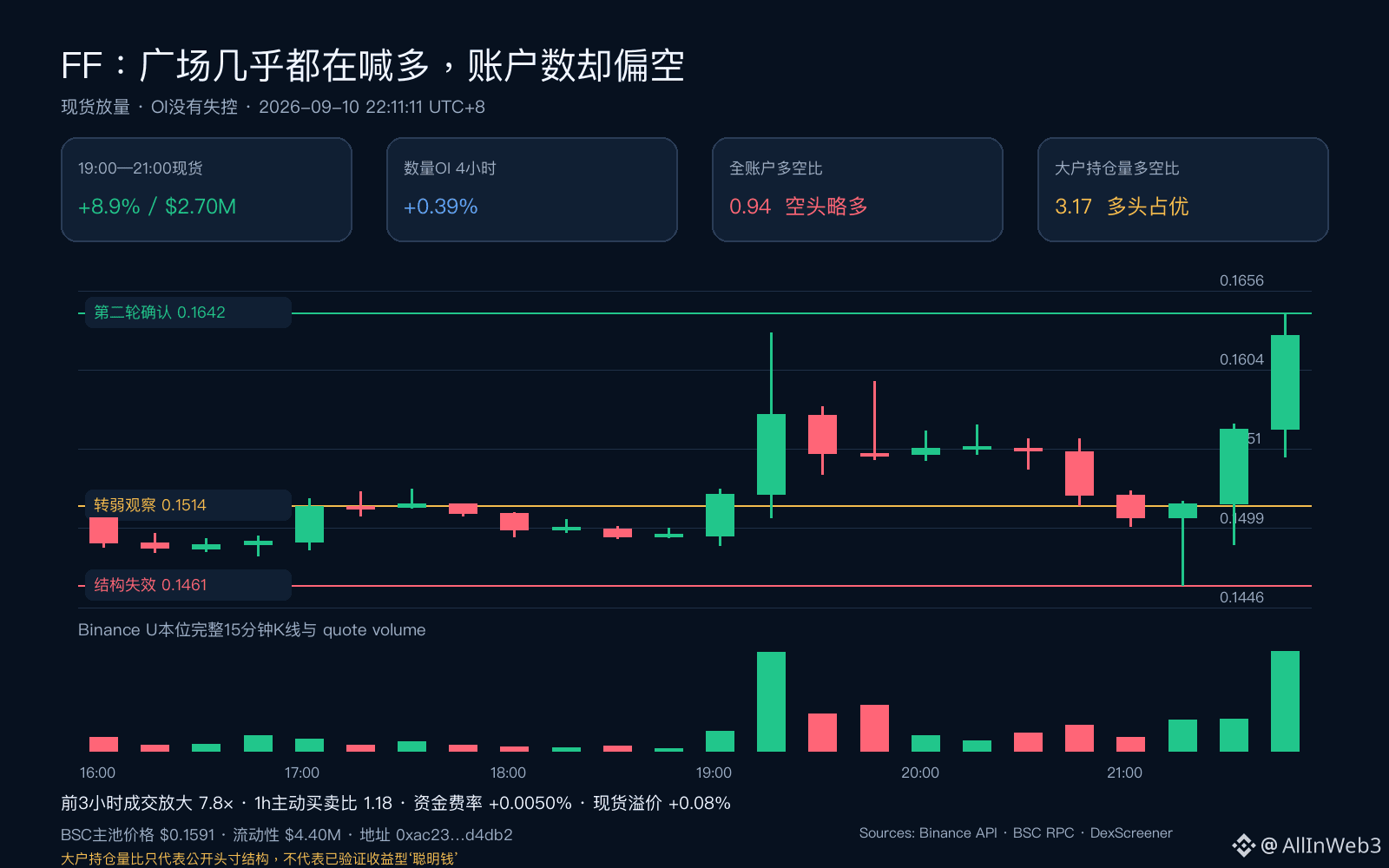
$FF Plaza is almost unanimously shouting for longs, yet Binance account counts still lean bearish. I’m short-term bullish, but I won’t chase above 0.16; I’ll first see whether this batch of shorts really gets squeezed out.
19:00—21:00, spot moved from 0.14947 to 0.16283 and closed, rising 8.9% over three hours. Turnover was about $2.7 million, which is 7.8 times the first three hours. However, OI (open interest) for four hours increased by only 0.39%. In the 22:11 snapshot, the long/short ratio across all accounts was 0.94—short accounts were slightly more. The large-holder positions long/short ratio was 3.17. In the most recent hour, active buy/sell was 1.18, and the funding rate was only +0.005%. This looks more like spot volume expanding and large holders leaning bullish, with shorts not having really surrendered yet—not like leverage longs are already packed and squeezing.
After a 15-minute volume expansion and a close above 0.1642 with OI also increasing, that’s when I recognized the second round. If it breaks below 0.1514, I’ll look at 0.1461; and if in an hour it loses 0.1461 again, then the structure of this move is broken. Even though everyone in the plaza is calling for longs, the real fuel may still be the shorts that haven’t admitted defeat.#FF #FalconFinance #多空博弈 #热点币
$FF Plaza is almost unanimously shouting for longs, yet Binance account counts still lean bearish. I’m short-term bullish, but I won’t chase above 0.16; I’ll first see whether this batch of shorts really gets squeezed out.
19:00—21:00, spot moved from 0.14947 to 0.16283 and closed, rising 8.9% over three hours. Turnover was about $2.7 million, which is 7.8 times the first three hours. However, OI (open interest) for four hours increased by only 0.39%. In the 22:11 snapshot, the long/short ratio across all accounts was 0.94—short accounts were slightly more. The large-holder positions long/short ratio was 3.17. In the most recent hour, active buy/sell was 1.18, and the funding rate was only +0.005%. This looks more like spot volume expanding and large holders leaning bullish, with shorts not having really surrendered yet—not like leverage longs are already packed and squeezing.
After a 15-minute volume expansion and a close above 0.1642 with OI also increasing, that’s when I recognized the second round. If it breaks below 0.1514, I’ll look at 0.1461; and if in an hour it loses 0.1461 again, then the structure of this move is broken. Even though everyone in the plaza is calling for longs, the real fuel may still be the shorts that haven’t admitted defeat.#FF #FalconFinance #多空博弈 #热点币
19:00—21:00, spot moved from 0.14947 to 0.16283 and closed, rising 8.9% over three hours. Turnover was about $2.7 million, which is 7.8 times the first three hours. However, OI (open interest) for four hours increased by only 0.39%. In the 22:11 snapshot, the long/short ratio across all accounts was 0.94—short accounts were slightly more. The large-holder positions long/short ratio was 3.17. In the most recent hour, active buy/sell was 1.18, and the funding rate was only +0.005%. This looks more like spot volume expanding and large holders leaning bullish, with shorts not having really surrendered yet—not like leverage longs are already packed and squeezing.
After a 15-minute volume expansion and a close above 0.1642 with OI also increasing, that’s when I recognized the second round. If it breaks below 0.1514, I’ll look at 0.1461; and if in an hour it loses 0.1461 again, then the structure of this move is broken. Even though everyone in the plaza is calling for longs, the real fuel may still be the shorts that haven’t admitted defeat.#FF #FalconFinance #多空博弈 #热点币
93

·
--
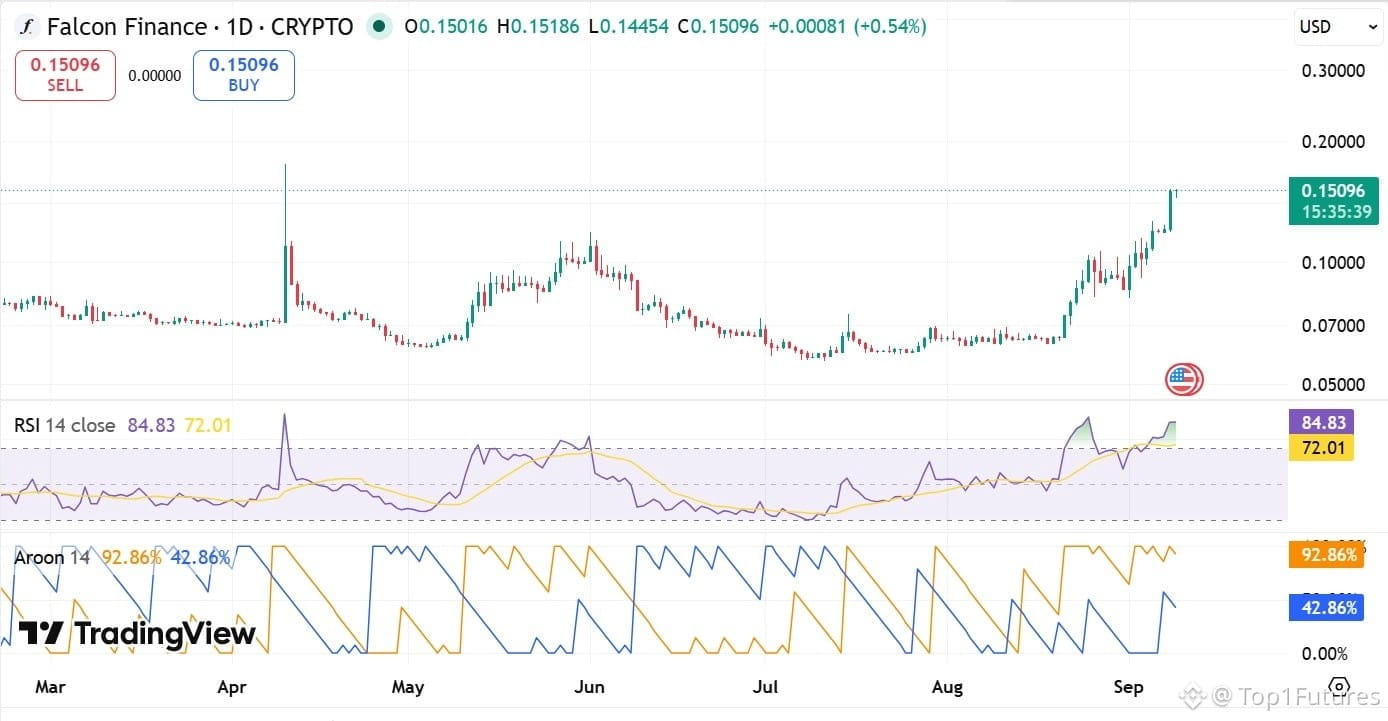
$FF is catching serious attention after a strong 25% move, pushing the token to around $0.159 and its market cap above $465M. 🚀
The rally came after #FF held the important $0.11 support, while trading activity exploded. Volume jumped more than 1,200%, showing that market interest has increased sharply.
At the same time, Open Interest and derivatives volume also climbed, meaning traders are taking bigger positions and expecting more volatility.
But there’s one thing to watch 👀 — profit-taking. Selling pressure has started increasing, while RSI has reached 84, suggesting FF is heavily overbought.
If buyers stay in control, $0.20 could become the next major target. But if selling pressure grows, FF could pull back toward the $0.11 support.
#FF
#FalconFinance
#Altcoins
$FF is catching serious attention after a strong 25% move, pushing the token to around $0.159 and its market cap above $465M. 🚀
The rally came after #FF held the important $0.11 support, while trading activity exploded. Volume jumped more than 1,200%, showing that market interest has increased sharply.
At the same time, Open Interest and derivatives volume also climbed, meaning traders are taking bigger positions and expecting more volatility.
But there’s one thing to watch 👀 — profit-taking. Selling pressure has started increasing, while RSI has reached 84, suggesting FF is heavily overbought.
If buyers stay in control, $0.20 could become the next major target. But if selling pressure grows, FF could pull back toward the $0.11 support.
#FF
#FalconFinance
#Altcoins
The rally came after #FF held the important $0.11 support, while trading activity exploded. Volume jumped more than 1,200%, showing that market interest has increased sharply.
At the same time, Open Interest and derivatives volume also climbed, meaning traders are taking bigger positions and expecting more volatility.
But there’s one thing to watch 👀 — profit-taking. Selling pressure has started increasing, while RSI has reached 84, suggesting FF is heavily overbought.
If buyers stay in control, $0.20 could become the next major target. But if selling pressure grows, FF could pull back toward the $0.11 support.
#FF
#FalconFinance
#Altcoins
1
156

Small-cap tokens don't usually move 24% in a day without a reason. $FF just did.
{future}(FFUSDT)
FF broke out sharply on September 8, and the move is still extending into September 9.
FACT: FF closed near $0.1502 on Sept 8, up ~24.1% from ~$0.121. FACT: Daily volume hit ~100.8M FF — a clear spike. SIGNAL: CoinGecko shows another ~22.6% move on Sept 9, suggesting continuation, not a one-off.
No confirmed fundamental catalyst has surfaced yet. This looks like liquidity + narrative rotation into a low-cap asset — the kind of move that's fast to build and fast to unwind.
FF may be in an early discovery phase, but without a clear catalyst, this stays speculative.
Price holding above the Sept 8 high with sustained volume.
Volume fades and price rejects back below the breakout zone.
Fast pumps are easy to spot. Real strength shows up in what happens next.
$SC
{spot}(SCUSDT)
$IQ
#FalconFinance #FFToken #CryptoResearch #SmallCapCrypto #MarketRotation
Small-cap tokens don't usually move 24% in a day without a reason. $FF just did.
FF broke out sharply on September 8, and the move is still extending into September 9.
FACT: FF closed near $0.1502 on Sept 8, up ~24.1% from ~$0.121. FACT: Daily volume hit ~100.8M FF — a clear spike. SIGNAL: CoinGecko shows another ~22.6% move on Sept 9, suggesting continuation, not a one-off.
No confirmed fundamental catalyst has surfaced yet. This looks like liquidity + narrative rotation into a low-cap asset — the kind of move that's fast to build and fast to unwind.
FF may be in an early discovery phase, but without a clear catalyst, this stays speculative.
Price holding above the Sept 8 high with sustained volume.
Volume fades and price rejects back below the breakout zone.
Fast pumps are easy to spot. Real strength shows up in what happens next.
$SC
$IQ
#FalconFinance #FFToken #CryptoResearch #SmallCapCrypto #MarketRotation
FF broke out sharply on September 8, and the move is still extending into September 9.
FACT: FF closed near $0.1502 on Sept 8, up ~24.1% from ~$0.121. FACT: Daily volume hit ~100.8M FF — a clear spike. SIGNAL: CoinGecko shows another ~22.6% move on Sept 9, suggesting continuation, not a one-off.
No confirmed fundamental catalyst has surfaced yet. This looks like liquidity + narrative rotation into a low-cap asset — the kind of move that's fast to build and fast to unwind.
FF may be in an early discovery phase, but without a clear catalyst, this stays speculative.
Price holding above the Sept 8 high with sustained volume.
Volume fades and price rejects back below the breakout zone.
Fast pumps are easy to spot. Real strength shows up in what happens next.
$SC
$IQ
#FalconFinance #FFToken #CryptoResearch #SmallCapCrypto #MarketRotation
1
141

·
--
Bullish
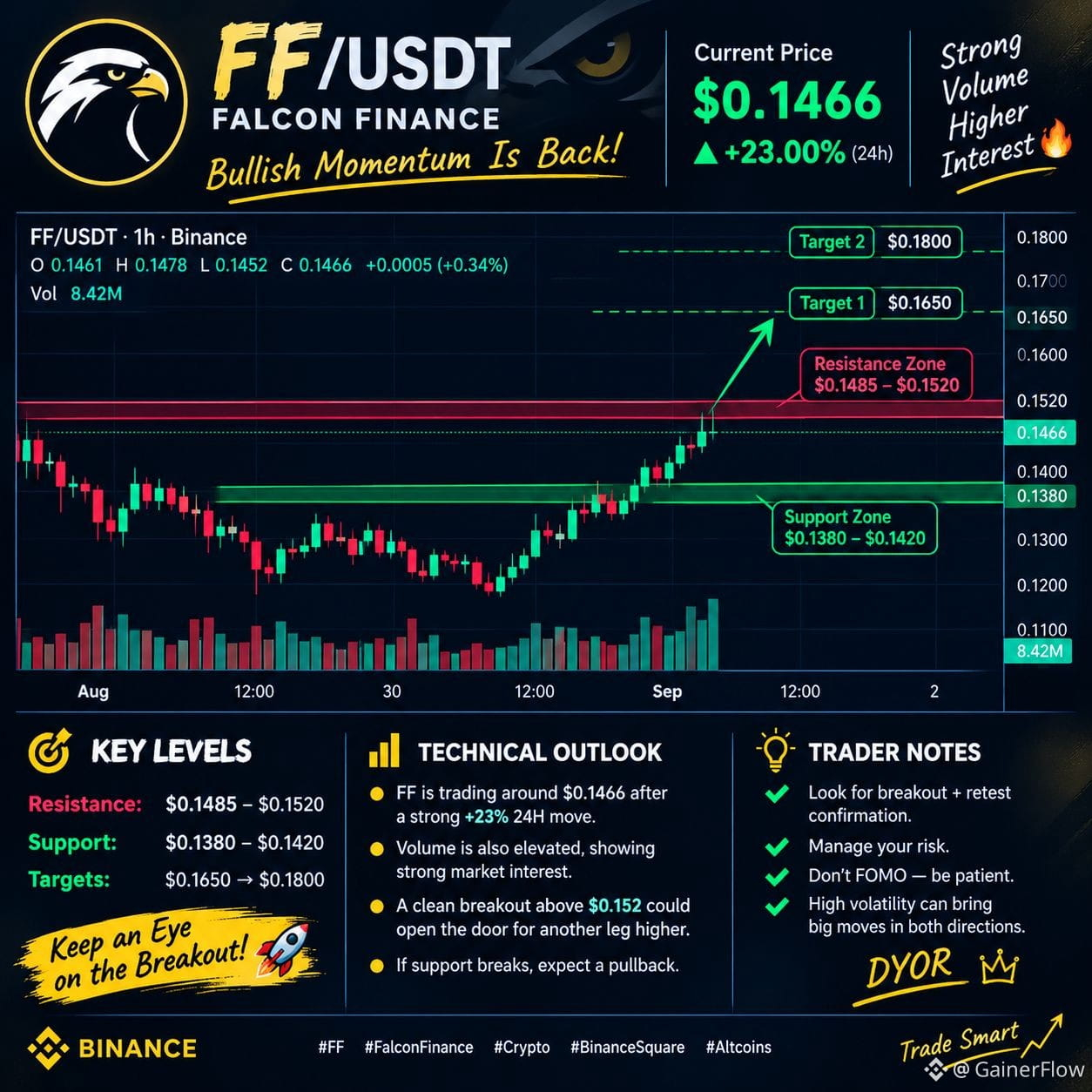
🚀 $FF — Bullish Momentum Is Back!
$FF
{future}(FFUSDT)
is trading around $0.1466 after a strong +23% 24H move. Volume is also elevated, showing strong market interest.
📌 Resistance: $0.1485–$0.1520
📌 Support: $0.138–$0.142
🎯 Targets: $0.165 → $0.180
A clean breakout above $0.152 could open the door for another leg higher. If support breaks, expect a pullback.
⚠️ High volatility — don’t FOMO. Wait for confirmation & manage risk. DYOR.
#ChinaAugustCPIRises0.8%YoY
#USStrikesTargetsNearHormuzAndJask
#ff #FalconFinance
#Crypto #BinanceSquare
#Altcoins
🚀 $FF — Bullish Momentum Is Back!
$FF
is trading around $0.1466 after a strong +23% 24H move. Volume is also elevated, showing strong market interest.
📌 Resistance: $0.1485–$0.1520
📌 Support: $0.138–$0.142
🎯 Targets: $0.165 → $0.180
A clean breakout above $0.152 could open the door for another leg higher. If support breaks, expect a pullback.
⚠️ High volatility — don’t FOMO. Wait for confirmation & manage risk. DYOR.
#ChinaAugustCPIRises0.8%YoY
#USStrikesTargetsNearHormuzAndJask
#ff #FalconFinance
#Crypto #BinanceSquare
#Altcoins
$FF
is trading around $0.1466 after a strong +23% 24H move. Volume is also elevated, showing strong market interest.
📌 Resistance: $0.1485–$0.1520
📌 Support: $0.138–$0.142
🎯 Targets: $0.165 → $0.180
A clean breakout above $0.152 could open the door for another leg higher. If support breaks, expect a pullback.
⚠️ High volatility — don’t FOMO. Wait for confirmation & manage risk. DYOR.
#ChinaAugustCPIRises0.8%YoY
#USStrikesTargetsNearHormuzAndJask
#ff #FalconFinance
#Crypto #BinanceSquare
#Altcoins
85
Log in to explore more content
Join global crypto users on Binance Square
⚡️ Get latest and useful information about crypto.
💬 Trusted by the world’s largest crypto exchange.
👍 Discover real insights from verified creators.
Email / Phone number
Trending Topics
1
#EarningsSeason
183,377 views
1,719 Discussing
2
#BitwiseLaunchesFirstSpotNEARETF
5,437 views
207 Discussing
3
#USJobOpeningsFallToFiveMonthLow
8,551 views
156 Discussing
4
#ECBToTestAIAgentsInDigitalEuroPayments
12,131 views
328 Discussing
5
#JapanFSABacksFourthStablecoinTradeSettlementPilot
13,913 views
380 Discussing
6
#BitgetHackerFailsToMoveStolenFunds
28,122 views
513 Discussing
7
#BitMineETHHoldingsTop6Million
25,504 views
641 Discussing
8
#StrategyAdds1666BTCHoldingsReach847666
21,839 views
449 Discussing
9
#NvidiaApproves$150BBuyback
4,255 views
68 Discussing
10
#OpenAIDelaysGPT6.1OverSafetyIssues
34,063 views
815 Discussing