
#educacioncripto
educacioncripto
211,262 views
554 Discussing
Hot
Latest

·
--
🧠 After hitting new 20-day lows, the market has left long lower wicks with volume spikes. How can we tell whether this is simply an oversold bounce or a firmer bottom?
📘 What is a high-volume absorption wick?
• When the price breaks below psychological support but closes well above the low on volume far above its average (>2x), it indicates that buy orders entered that zone and were able to absorb forced selling and liquidations.
• However, the first bounce after a capitulation is usually technical: to call it a structural shift on the 4-hour chart, the price needs to reclaim its EMA 20 and form a higher low.
📊 Example using today's real data from Binance:
• $BTC hit a 20-candle low on the 4-hour chart at $61,956.3 and bounced to $65,548, with daily volume at 1.94x its average and a daily RSI of 19.6, but it remains below its 4-hour EMA 20 ($67,841).
• $ETH defended $1,710.01 and recovered to $1,835.45 with daily volume at 2.14x and a daily RSI of 19.2, still below its 4-hour EMA 20 ($1,903.76).
• $SOL bounced from $67.35 to $73.02 with the highest daily volume among the large caps (2.41x) and an extreme daily RSI of 14.6. Its first dynamic resistance is at $76.30 (4-hour EMA 20).
❌ Common mistake: chasing the bounce just below the 4-hour EMA 20, thinking the danger has passed. After an absorption wick, it’s common for the market to retest part of that zone before choosing a direction.
📝 In one line: the volume spike shows you where the decline stalled; reclaiming the EMA 20 confirms who’s in control.
Are you waiting for a second test of support, or for a close above the 4-hour EMA 20 before validating a reversal? 👇
#EducacionCripto #AnalisisTecnico #Volumen #Cripto #Tra100d
⚠️ For informational and educational purposes only; this is not financial advice. Cryptocurrencies are volatile: do your own research and trade with caution.
61
·
--
🧠 Today, the five largest coins in the market have a daily RSI below 30, and four of them are below 25. Does that mean the price has to bounce immediately? Not necessarily.
📘 What the RSI actually measures when a coin is oversold:
• The RSI (14) compares the strength of recent bullish closes against bearish ones on a scale of 0 to 100.
• A drop below 30 indicates oversold conditions (the price fell very quickly over a few candles), while a drop below 25 reflects extreme selling pressure.
• However, in strong downtrends, the RSI can remain oversold while the price continues to make new lows if no buying volume appears and support levels aren't reclaimed.
📊 Example using today's daily data on Binance:
• $SOL: daily RSI at 19.3 and 4-hour RSI at 28.2 (down −12.9% over the last 6 daily candles, with volume at 1.62x its average).
• $XRP: daily RSI at 20.8 after losing the $1.00 level (−13.1% over 6 daily candles and volume at 1.48x).
• $BTC and ETH: daily RSI at 24.4 and 24.3, respectively, both with daily volume above their averages (2.04x for BTC and 1.76x for ETH).
❌ Common mistake: buying just because "the RSI is at 20" without waiting for confirmation. When relative volume remains high on red candles (like BTC's 2.04x today), a low RSI warns of downside overextension, but a reversal usually requires the price to reclaim key levels or selling pressure in futures to ease.
📝 In one line: an RSI below 25 tells you the rope is stretched very tight, not the exact moment it stops stretching.
Do you use the RSI on its own, or combine it with support levels and volume before making decisions? 👇
#EducacionCripto #AnalisisTecnico #RSI #Cripto #Tra100d
⚠️ For informational and educational purposes only; this is not financial advice. Cryptocurrencies are volatile: do your own research and trade with caution.
253
·
--
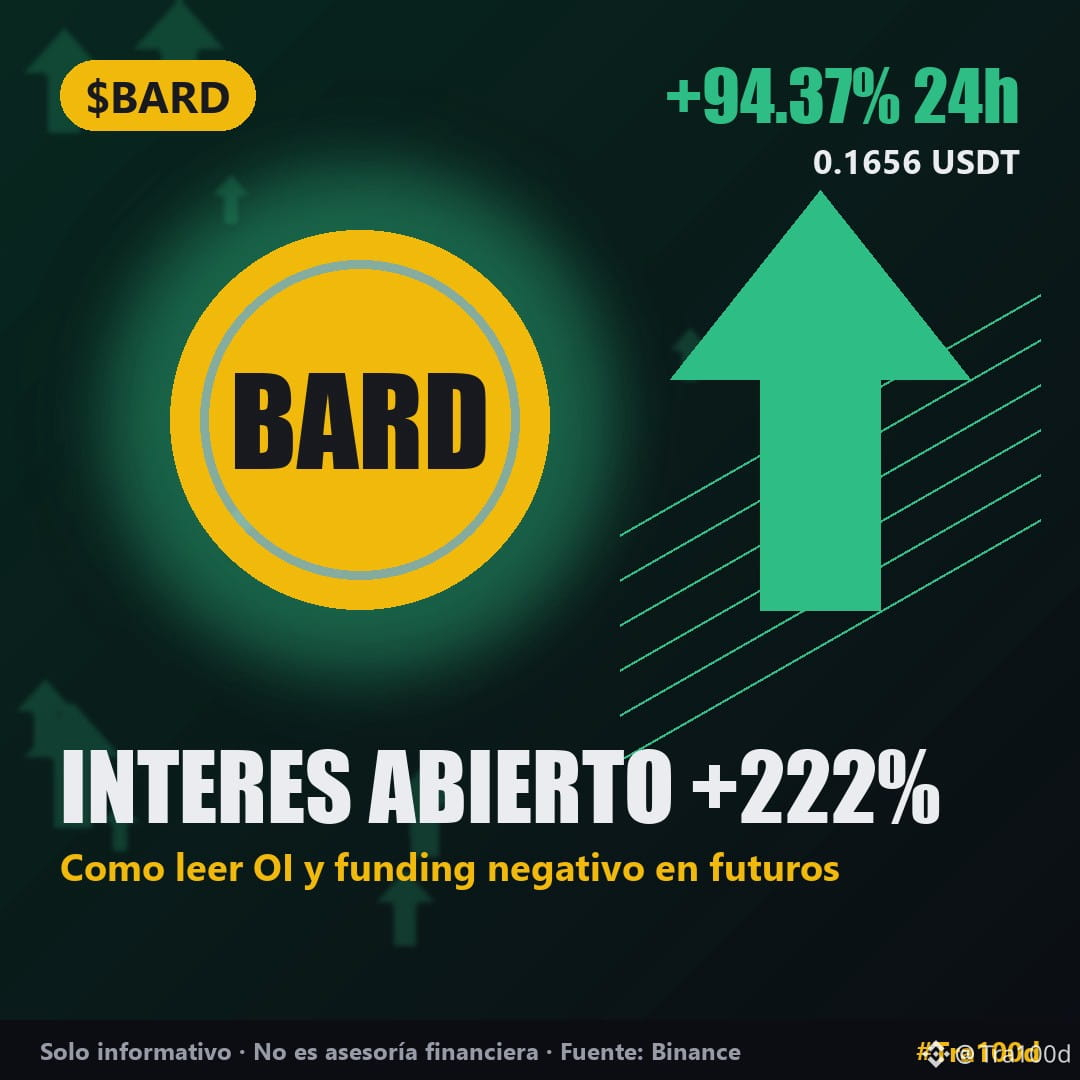
🧠 Why can a coin rise +94% while most futures traders are betting on a decline? The answer lies in combining two metrics: Open Interest (OI) and Funding Rate.
📘 The concept:
• Open Interest measures how many futures contracts remain open (whether leveraged money is flowing in or out).
• The Funding Rate shows which side is dominant: if it’s very negative, shorts are paying longs a fee to keep their positions open.
• When the price rises sharply, OI surges, and funding plunges into negative territory, many shorts get trapped. When they close their positions (by buying back), they push the price even higher: this is a short squeeze.
📊 Example using today’s Binance data:
• $BARD : up +94.4%, its open interest surges +222.1%, and its funding drops to −1.89% (with a 4-hour RSI of 82.4 and a daily ATR of 9.5%).
• $GRAM : down −7.4%, and its open interest falls −16.4% (positions closing after yesterday’s rise).
• $BTC : down −5.0%, with nearly flat open interest (+0.8%) and slightly negative funding (−0.0013%).
❌ Common mistake: opening a short just because a coin has “already risen too much,” without checking the funding rate. If funding is at −1.89%, you’re not only paying a very high fee every few hours, but also risking liquidation in another upward sweep.
📝 In one line: the price tells you what’s happening, but open interest and funding show you who’s trapped in the trade.
Do you check open interest and funding before trading futures? 👇
#EducacionCripto #Futuros #AnalisisTecnico #Cripto #Tra100d
⚠️ For informational and educational purposes only; this is not financial advice. Cryptocurrencies are volatile: do your own research and trade with caution.
241

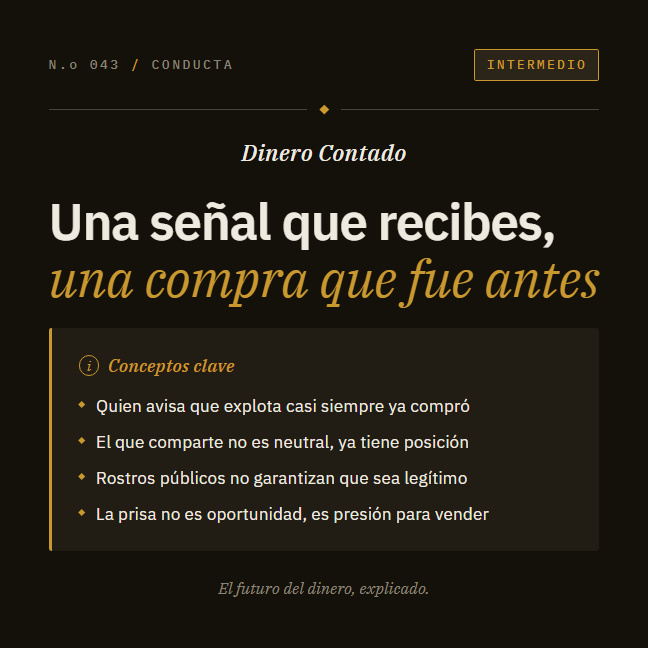
The person who tells you a token is about to explode has almost always bought before you.
Before the public sees any alert, a small group has already bought the token at a low price. They wait. When the price starts moving because of that very buying, someone in the group spreads the signal to outside accounts and channels that have no idea who set up the scheme. The person who seems generous for sharing the tip is almost always the same person who needs you to buy so they can sell before the price drops.
This tactic of inflating a price with false hype and then suddenly selling before anyone catches on is called price manipulation. In the crypto world, it’s more commonly known as a pump-and-dump scheme.
KEY CONCEPTS
- Just because someone shares a tip with you privately doesn’t make it trustworthy: the source is almost never neutral, because they already have a position in the token.
- An endorsement from a familiar face is no guarantee, either. Many of these schemes use public figures simply to attract new buyers.
- Not every opportunity promising quick profits is legitimate, even if it comes with charts and figures that look serious.
Urgency in a signal doesn’t measure the opportunity: it measures how many people the sender needs to get out first. You’ve seen this in other financial scams, even if the packaging is different this time: the more they rush you, the less time they give you to think.
Transparency: Binance may pay us a commission if you trade after clicking an asset symbol or a price link in this post.
#InflarYSoltar #ManipulacionDePrecios #EstafasCripto #CryptoEducation
1
544

·
--
Bullish
💡 3 Golden Rules Every Beginner Trader Should Master on Binance Square
- If you're looking to improve your strategies and boost your results in the crypto ecosystem, keep these key points in mind:
- Patience pays more than haste: Don't trade on emotional impulse.
- Smart diversification: Don't put all your eggs in one basket.
- Stay informed: Monitor market trends in real time.
Take a look at how the leading asset is moving today:
\u003e What's been your biggest lesson in crypto this month? Let me know in the comments!
#Criptomonedas #tradingtips #EducacionCripto #Binance
What has been your biggest lesson this month in crypto? Let me know in the comments! 👇
{spot}(BTCUSDT)
💡 3 Golden Rules Every Beginner Trader Should Master on Binance Square
- If you're looking to improve your strategies and boost your results in the crypto ecosystem, keep these key points in mind:
- Patience pays more than haste: Don't trade on emotional impulse.
- Smart diversification: Don't put all your eggs in one basket.
- Stay informed: Monitor market trends in real time.
Take a look at how the leading asset is moving today:
\u003e What's been your biggest lesson in crypto this month? Let me know in the comments!
#Criptomonedas #tradingtips #EducacionCripto #Binance
What has been your biggest lesson this month in crypto? Let me know in the comments! 👇
77
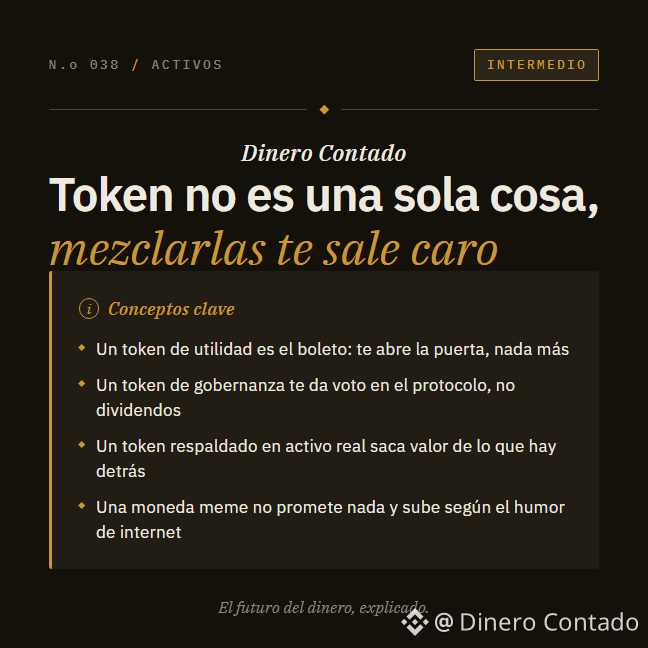
A token isn’t just one thing. Treating all four categories as if they were the same will cost you sooner or later.
Imagine four tokens stored in the same wallet. The first lets you use an app, like a movie ticket. The second gives you a vote in a protocol, like a share that lets you have a say at a shareholders’ meeting. The third is worth what it is because it’s backed by real gold: that’s how $PAXG works. And the fourth backs nothing. It exists only because a community decided to laugh at something on the internet and then bought it.
Those four categories are the types of tokens you’ll encounter in crypto, and each follows different rules.
KEY CONCEPTS
- A utility token isn’t money. It gives you access to a service, but on its own, it’s worthless outside that platform.
- A governance token gives you a vote, not a profit. Having a say in a protocol’s future isn’t the same as earning dividends.
- An asset-backed token, such as $PAXG, gets its value from what backs it, not from a promise. That’s why it usually comes with more rules than the others.
- A meme coin promises nothing. Its price rises and falls with the mood on the internet, not based on any real product or service behind it.
If you already know the difference between a share, a movie ticket, and a bar bet, you’ve got the basic idea for distinguishing these four types of tokens.
Transparency: Binance may pay us a commission if you trade after clicking an asset ticker or price link in this post.
#TiposDeToken #Criptomonedas #ActivosDigitales #CryptoEducation
A token isn’t just one thing. Treating all four categories as if they were the same will cost you sooner or later.
Imagine four tokens stored in the same wallet. The first lets you use an app, like a movie ticket. The second gives you a vote in a protocol, like a share that lets you have a say at a shareholders’ meeting. The third is worth what it is because it’s backed by real gold: that’s how $PAXG works. And the fourth backs nothing. It exists only because a community decided to laugh at something on the internet and then bought it.
Those four categories are the types of tokens you’ll encounter in crypto, and each follows different rules.
KEY CONCEPTS
- A utility token isn’t money. It gives you access to a service, but on its own, it’s worthless outside that platform.
- A governance token gives you a vote, not a profit. Having a say in a protocol’s future isn’t the same as earning dividends.
- An asset-backed token, such as $PAXG , gets its value from what backs it, not from a promise. That’s why it usually comes with more rules than the others.
- A meme coin promises nothing. Its price rises and falls with the mood on the internet, not based on any real product or service behind it.
If you already know the difference between a share, a movie ticket, and a bar bet, you’ve got the basic idea for distinguishing these four types of tokens.
Transparency: Binance may pay us a commission if you trade after clicking an asset ticker or price link in this post.
#TiposDeToken #Criptomonedas #ActivosDigitales #CryptoEducation
1
120
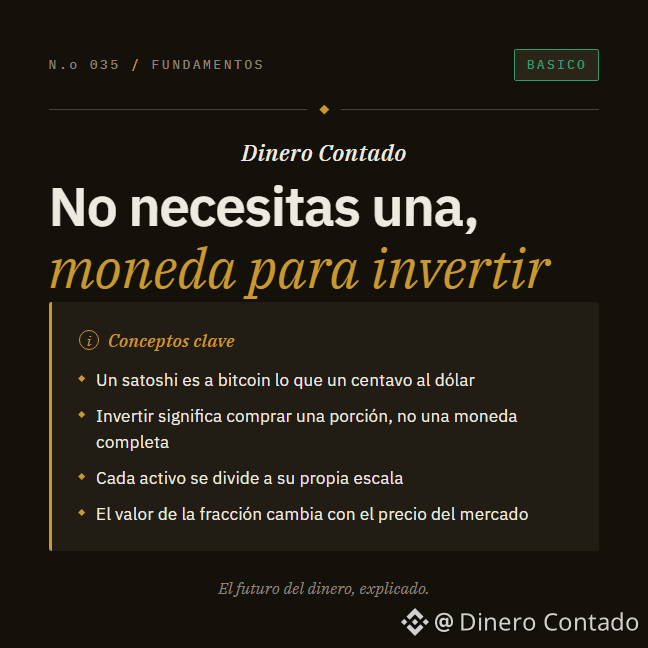
You don’t need to buy a whole bitcoin to start investing in crypto.
Each coin can be divided into tiny pieces, just as a dollar can be divided into cents. One bitcoin is divided into one hundred million parts. If someone puts in ten dollars, they aren’t buying a coin; they’re buying a tiny fraction of those one hundred million parts. And that fraction is worth whatever the market says it’s worth that day, no more and no less. It’s not magic, just division.
That smallest unit has a name: satoshi.
KEY CONCEPTS
- A satoshi is the smallest unit of bitcoin, just as a cent is the smallest unit of a dollar. It’s not a marketing gimmick; it’s how any amount smaller than a whole coin is counted.
- Buying crypto never means buying a whole coin. It means buying a portion, large or small, and that applies to any amount you put in.
- Each asset has its own scale of divisibility. $SOL can also be divided into smaller amounts for trading; you don’t need to own a whole SOL to get started.
- But having a few satoshis doesn’t mean they’ll always be worth little. The price of that fraction changes with the market, just like the price of a whole coin.
Thinking about a wallet this way changes the question you ask yourself. It’s no longer about how many coins you have, but how much the fraction you do have is worth.
Transparency: Binance may pay us a commission if you trade after clicking an asset symbol or a price link in this post.
#Satoshis #Divisibilidad #Criptomonedas #CryptoEducation
1
1
326
·
--
🚨 The 3-second mistake that makes you lose money in crypto (and how to avoid it)
Have you ever opened a BTC or ETH trade just based on “intuition” and the market stopped you out in less than a minute? 📉
90% of beginners fail not because they lack money, but because they lack risk management. Here are 3 golden rules that changed my trading:
1️⃣ Never risk more than 2% of your total capital per trade.
2️⃣ Stop Loss is non-negotiable: If it hurts to place it, it’s because your position size is too big.
3️⃣ Patience > Anxiety: Waiting for the right zone pays more than chasing the price.
What has been your biggest lesson in the market this month? I’m reading your comments! 👇
If you like learning straight to the point about cryptocurrencies, analysis, and strategy, follow me so we can grow together on this journey 🚀.
#Binance #Trading #EducacionCripto
1
175
·
--

Article
📊 WHAT IS FUNDAMENTAL ANALYSIS IN CRYPTO?💥 DON’T COMPROMISE FOR THE PRICE—BUY FOR THE PROJECT
Fundamental analysis is the study of the factors that determine the real value of a crypto project, beyond its market price.
It doesn’t matter if the price goes up or down today. The important thing is knowing whether the project has a future.
👇 Reply with 📊 if you already use fundamental analysis, or with 👀 if you want to learn
📌 WHAT IS FUNDAMENTAL ANALYSIS?
It means evaluating a project based on its intrinsic characteristics:
- The team.
📊 WHAT IS FUNDAMENTAL ANALYSIS IN CRYPTO?
💥 DON’T COMPROMISE FOR THE PRICE—BUY FOR THE PROJECT
Fundamental analysis is the study of the factors that determine the real value of a crypto project, beyond its market price.
It doesn’t matter if the price goes up or down today. The important thing is knowing whether the project has a future.
👇 Reply with 📊 if you already use fundamental analysis, or with 👀 if you want to learn
📌 WHAT IS FUNDAMENTAL ANALYSIS?
It means evaluating a project based on its intrinsic characteristics:
- The team.
1
1
2
105
·
--
💡 3 Golden Rules I learned the hard way in the crypto world.
When we start out, it’s easy to get carried away by the excitement of a coin rising 50% in a day (the famous FOMO). If you’re just starting out, engrave this in your mind:
Always DYOR: Never buy a token just because someone on the internet told you to. Check the project, the real utility, and who is behind it.
Split your purchases: Don’t go all in with your entire capital at once. Use DCA (periodic purchases) to average the price.
Safeguard your passwords: Your seed phrase is your financial life.
If you had to give just one piece of advice to someone who is going to buy their first 10 USDT today, what would it be?
#EducacionCripto #Binance #Criptomonedas #Write2Earn
216
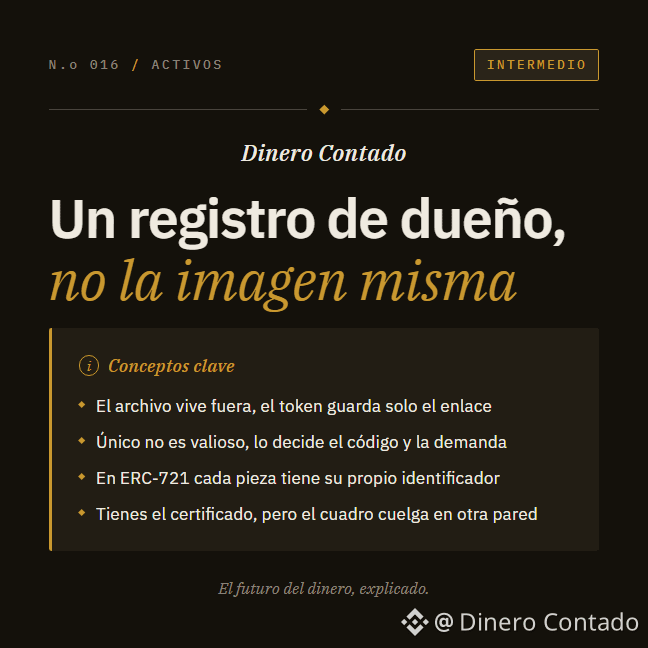
When you buy an NFT, you don’t buy the image.
You’re buying a record that says who owns that image. That’s it. The file almost never lives inside the chain; it’s too heavy. The token stores a link that points to it, stored on another server. If that server goes down, the token is still there. The image, not so much.
And here comes the same old mistake: thinking that “unique” is the same as “valuable.” It isn’t. Imagine someone mints the same photo ten times. Each copy has its own token number. That’s ten unique records, but the photo is identical in all ten. Uniqueness is set by the code. The price is set by someone else.
That—the record that distinguishes one piece from all the others—is what’s known as a non-fungible token, or NFT.
On Ethereum, most follow the ERC-721 standard: each piece has its own identifier, and you can’t swap one for another as easily as you can with $ETH.
KEY CONCEPTS
- An NFT is not the file: almost always, it’s a link pointing to a file stored off-chain.
- “Unique” is not synonymous with “valuable.” Uniqueness is guaranteed by the contract; the price is decided by demand.
- An NFT is not the same as a governance or utility token: those give voting power or access, but they don’t prove ownership of a piece.
- Not every NFT collection is 100% non-reproducible. Standards like ERC-1155 mix unique pieces with repeatable ones in the same contract.
It’s like having the certificate for a painting without the painting: the paper is real, but the artwork is still hanging on another wall.
Transparency: Binance may pay us a commission if you trade after clicking an asset symbol or a price link from this publication.
#TokensNoFungibles #ActivosDigitales #Coleccionables #EducacionCripto
When you buy an NFT, you don’t buy the image.
You’re buying a record that says who owns that image. That’s it. The file almost never lives inside the chain; it’s too heavy. The token stores a link that points to it, stored on another server. If that server goes down, the token is still there. The image, not so much.
And here comes the same old mistake: thinking that “unique” is the same as “valuable.” It isn’t. Imagine someone mints the same photo ten times. Each copy has its own token number. That’s ten unique records, but the photo is identical in all ten. Uniqueness is set by the code. The price is set by someone else.
That—the record that distinguishes one piece from all the others—is what’s known as a non-fungible token, or NFT.
On Ethereum, most follow the ERC-721 standard: each piece has its own identifier, and you can’t swap one for another as easily as you can with $ETH .
KEY CONCEPTS
- An NFT is not the file: almost always, it’s a link pointing to a file stored off-chain.
- “Unique” is not synonymous with “valuable.” Uniqueness is guaranteed by the contract; the price is decided by demand.
- An NFT is not the same as a governance or utility token: those give voting power or access, but they don’t prove ownership of a piece.
- Not every NFT collection is 100% non-reproducible. Standards like ERC-1155 mix unique pieces with repeatable ones in the same contract.
It’s like having the certificate for a painting without the painting: the paper is real, but the artwork is still hanging on another wall.
Transparency: Binance may pay us a commission if you trade after clicking an asset symbol or a price link from this publication.
#TokensNoFungibles #ActivosDigitales #Coleccionables #EducacionCripto
1
2
878
💵 What are Stablecoins? 💵
Are you afraid that the price of crypto goes up and down like a roller coaster? That’s what stablecoins are for.
In simple terms: they are cryptocurrencies designed to always be worth the same as a traditional currency—usually the US dollar.
The 3 most used are:
• $USDT (Tether)
• $USDC (USD Coin)
• $FDUSD (First Digital USD)
What are they for?
1️⃣ Safe haven: To protect your gains when the market is falling without having to withdraw the money to the bank.
2️⃣ Digitalize your savings: To save in digital dollars securely and quickly right from your phone.
💬 Do you already save in stable cryptocurrencies, or do you prefer volatile coins?
I’ll read your comment below! 👇
#Stablecoins #Principiantes #EducacionCripto
{spot}(USDCUSDT)
{spot}(FDUSDUSDT)
💵 What are Stablecoins? 💵
Are you afraid that the price of crypto goes up and down like a roller coaster? That’s what stablecoins are for.
In simple terms: they are cryptocurrencies designed to always be worth the same as a traditional currency—usually the US dollar.
The 3 most used are:
• $USDT (Tether)
• $USDC (USD Coin)
• $FDUSD (First Digital USD)
What are they for?
1️⃣ Safe haven: To protect your gains when the market is falling without having to withdraw the money to the bank.
2️⃣ Digitalize your savings: To save in digital dollars securely and quickly right from your phone.
💬 Do you already save in stable cryptocurrencies, or do you prefer volatile coins?
I’ll read your comment below! 👇
#Stablecoins #Principiantes #EducacionCripto
4
1
46
·
--

Article
📊 SPOT SWING TRADING STRATEGY FOR BEGINNERS💥 BUY ON DIPS, SELL ON RALLIES (NO LEVERAGE)
An interesting strategy on Binance Square: buy strong cryptocurrencies (BTC, ETH, SOL) when they dip a little and sell when they rise, all on Spot, with no leverage.
It’s simple, safe, and doesn’t require being an expert. In this article, I explain how it works and how to apply it.
👇 Reply with 📊 if you already use this strategy or 👀 if you want to learn
📌 WHAT IS IT ABOUT?
The strategy is based on buying on dips and selling on rallies, taking advantage of the market’s natural volatility.
📊 SPOT SWING TRADING STRATEGY FOR BEGINNERS
💥 BUY ON DIPS, SELL ON RALLIES (NO LEVERAGE)
An interesting strategy on Binance Square: buy strong cryptocurrencies (BTC, ETH, SOL) when they dip a little and sell when they rise, all on Spot, with no leverage.
It’s simple, safe, and doesn’t require being an expert. In this article, I explain how it works and how to apply it.
👇 Reply with 📊 if you already use this strategy or 👀 if you want to learn
📌 WHAT IS IT ABOUT?
The strategy is based on buying on dips and selling on rallies, taking advantage of the market’s natural volatility.
138

·
--
How many times have you let an opportunity slip by because you thought, "This is too complicated for me"? 🤯
That's probably the number one hurdle in the digital finance world. Today, we're going to break down once and for all one of the biggest myths of the ecosystem:
❌ Myth: Cryptocurrencies are only for experts, programmers, or "Wall Street wolves".
✅ Reality: Anyone with an internet connection and a desire to learn can participate and invest.
The ecosystem has evolved drastically. We're not in 2010 anymore. These days, entering the crypto world is as easy as signing up for a social media account. Here’s why:
📱 Intuitive platforms: Current interfaces (like Binance) are designed to be user-friendly and guide you step by step, from your first deposit to safely securing your assets.
📚 Free education at your fingertips: You don’t need a degree in economics. There are plenty of quality resources to learn from scratch and at your own pace.
💸 Minimal entry barrier: You don’t need to be a millionaire to start. You can take your first steps by buying fractions of cryptocurrencies with very little capital while gaining experience and confidence.
The real entry barrier isn’t the technology; it’s misinformation. Knowledge is the most valuable asset you can have in this market. 💡
👇 Tell me in the comments: What was your biggest fear before buying your first cryptocurrency? I’m listening!
Follow me to keep debunking myths, learn the ins and outs of the market, and take control of your digital finances. 🚀#Binance
#Crypto #EducacionCripto #AdopcionMasiva #CriptoParaTodos #FinanzasPersonales

173
·
--
Article
🧠 TRADER PSYCHOLOGY PART 2💥 YOUR EMOTIONS ARE YOUR WORST ENEMY (AND YOUR BEST ALLY)
In the first part of this series (you can find it on my profile), we looked at the most common psychological mistakes: FOMO (fear of missing out), FUD (fear, uncertainty, and doubt), and revenge trading.
Now let’s go deeper into how to master your emotions and turn psychology to your advantage.
👇 Reply with 🧠 if you’ve already worked on your trading psychology, or with 👀 if you want to learn
📌 ERROR 1: EXCESS CONFIDENCE AFTER SEVERAL WINS
🧠 TRADER PSYCHOLOGY PART 2
💥 YOUR EMOTIONS ARE YOUR WORST ENEMY (AND YOUR BEST ALLY)
In the first part of this series (you can find it on my profile), we looked at the most common psychological mistakes: FOMO (fear of missing out), FUD (fear, uncertainty, and doubt), and revenge trading.
Now let’s go deeper into how to master your emotions and turn psychology to your advantage.
👇 Reply with 🧠 if you’ve already worked on your trading psychology, or with 👀 if you want to learn
📌 ERROR 1: EXCESS CONFIDENCE AFTER SEVERAL WINS
1
116
·
--

Article
📈 HOW TO USE LEVERAGE INTELLIGENTLY?💥 LEVERAGE IS A TOOL, NOT A GAME OF CHANCE
Leverage lets you trade with more money than you have. With 100 USDT and 5x leverage, you can open a position of 500 USDT.
If the trade goes well, you multiply your profits. If it goes wrong, you multiply your losses.
👇 Reply with 📈 if you already use leverage or with 👀 if you want to learn how to use it properly
📌 WHAT IS LEVERAGE?
It’s a loan the exchange gives you to increase your exposure to the market.
You provide collateral (margin) and the exchange lends you the rest.
📈 HOW TO USE LEVERAGE INTELLIGENTLY?
💥 LEVERAGE IS A TOOL, NOT A GAME OF CHANCE
Leverage lets you trade with more money than you have. With 100 USDT and 5x leverage, you can open a position of 500 USDT.
If the trade goes well, you multiply your profits. If it goes wrong, you multiply your losses.
👇 Reply with 📈 if you already use leverage or with 👀 if you want to learn how to use it properly
📌 WHAT IS LEVERAGE?
It’s a loan the exchange gives you to increase your exposure to the market.
You provide collateral (margin) and the exchange lends you the rest.
1
1
171
⚠️ 3 Typical Mistakes When Starting on Binance (Avoid Them!) 🛑
If you’re just starting on Binance, memorize this so you don’t lose your money:
1️⃣ FOMO (Fear of Missing Out): Buying a cryptocurrency just because it’s rising fast and everyone is talking about it on social media. It almost always ends in losses. Buy with a strategy, not emotions.
2️⃣ The “Get Rich Tomorrow” story: Falling for scams that promise fixed profits or double your crypto. Binance will never ask for your keys via private message. If it sounds too good to be true, it’s a scam. ❌
3️⃣ Not using basic security: Having a weak password and not enabling 2FA (Two-Factor Authentication) or a Passkey. Protect your account like it’s your bank account.
💡 Golden tip: Invest only what you’re willing to lose and study before you buy.
💬 Which of these mistakes have you made—or are you most afraid of making? Leave it in the comments! 👇
#EducacionCripto #Principiante #SeguridadCripto $BNB
{spot}(BNBUSDT)
⚠️ 3 Typical Mistakes When Starting on Binance (Avoid Them!) 🛑
If you’re just starting on Binance, memorize this so you don’t lose your money:
1️⃣ FOMO (Fear of Missing Out): Buying a cryptocurrency just because it’s rising fast and everyone is talking about it on social media. It almost always ends in losses. Buy with a strategy, not emotions.
2️⃣ The “Get Rich Tomorrow” story: Falling for scams that promise fixed profits or double your crypto. Binance will never ask for your keys via private message. If it sounds too good to be true, it’s a scam. ❌
3️⃣ Not using basic security: Having a weak password and not enabling 2FA (Two-Factor Authentication) or a Passkey. Protect your account like it’s your bank account.
💡 Golden tip: Invest only what you’re willing to lose and study before you buy.
💬 Which of these mistakes have you made—or are you most afraid of making? Leave it in the comments! 👇
#EducacionCripto #Principiante #SeguridadCripto $BNB
1
1
152


$BTC ✨ $BNB ✨ $PAXG 🎉
MANY CONGRATULATIONS, @RamonaCryptos 🍾🥂
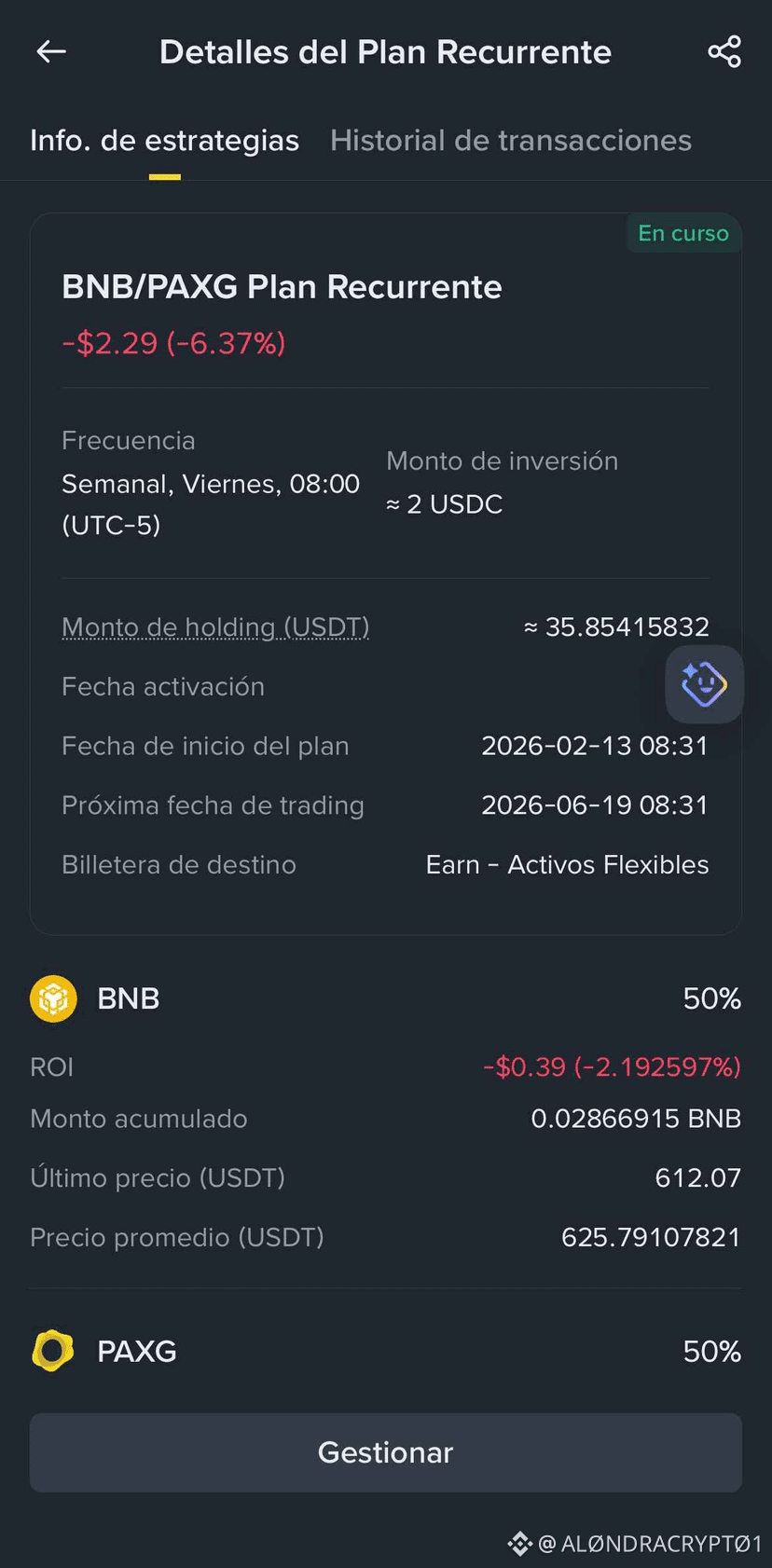
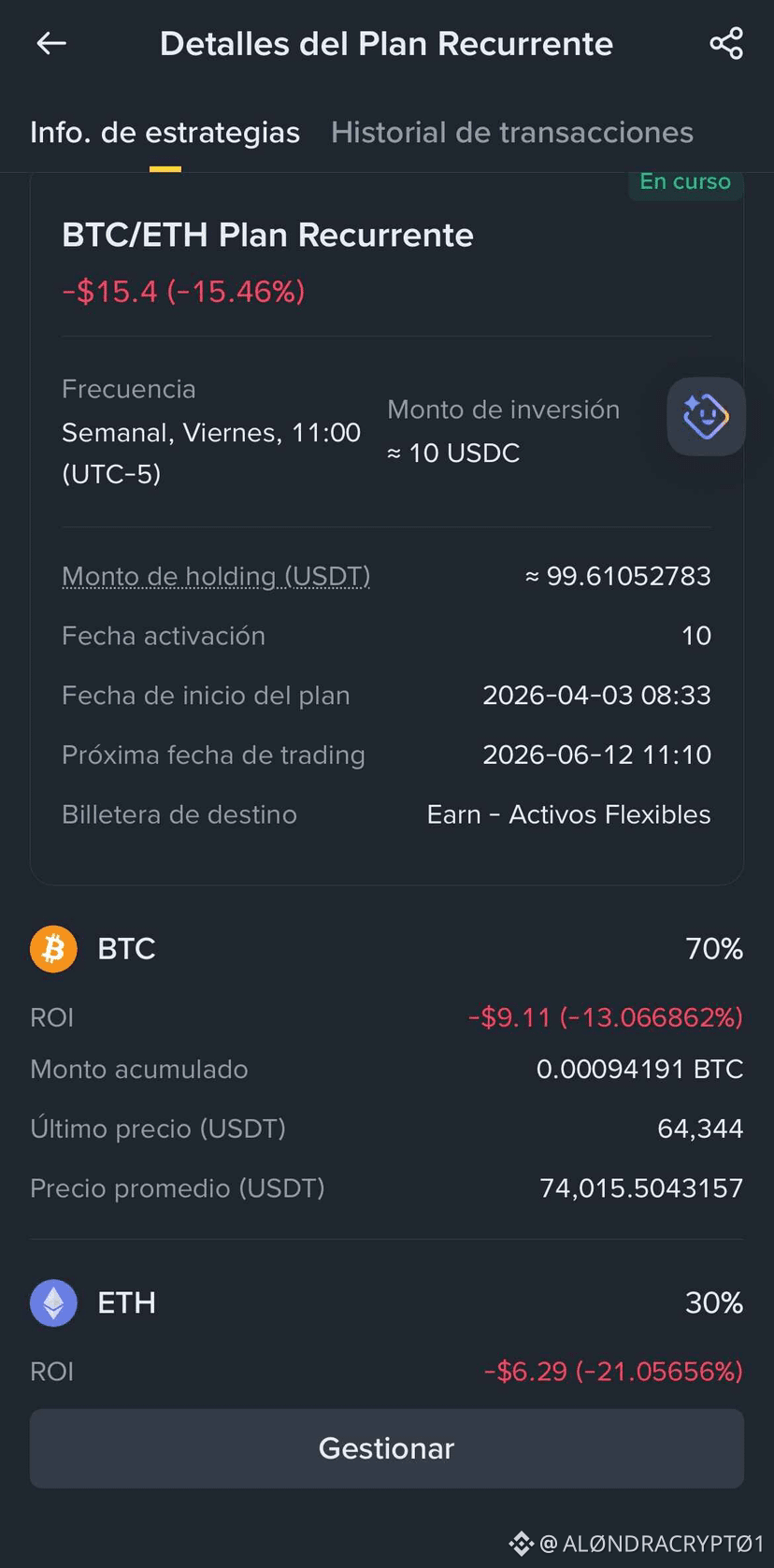
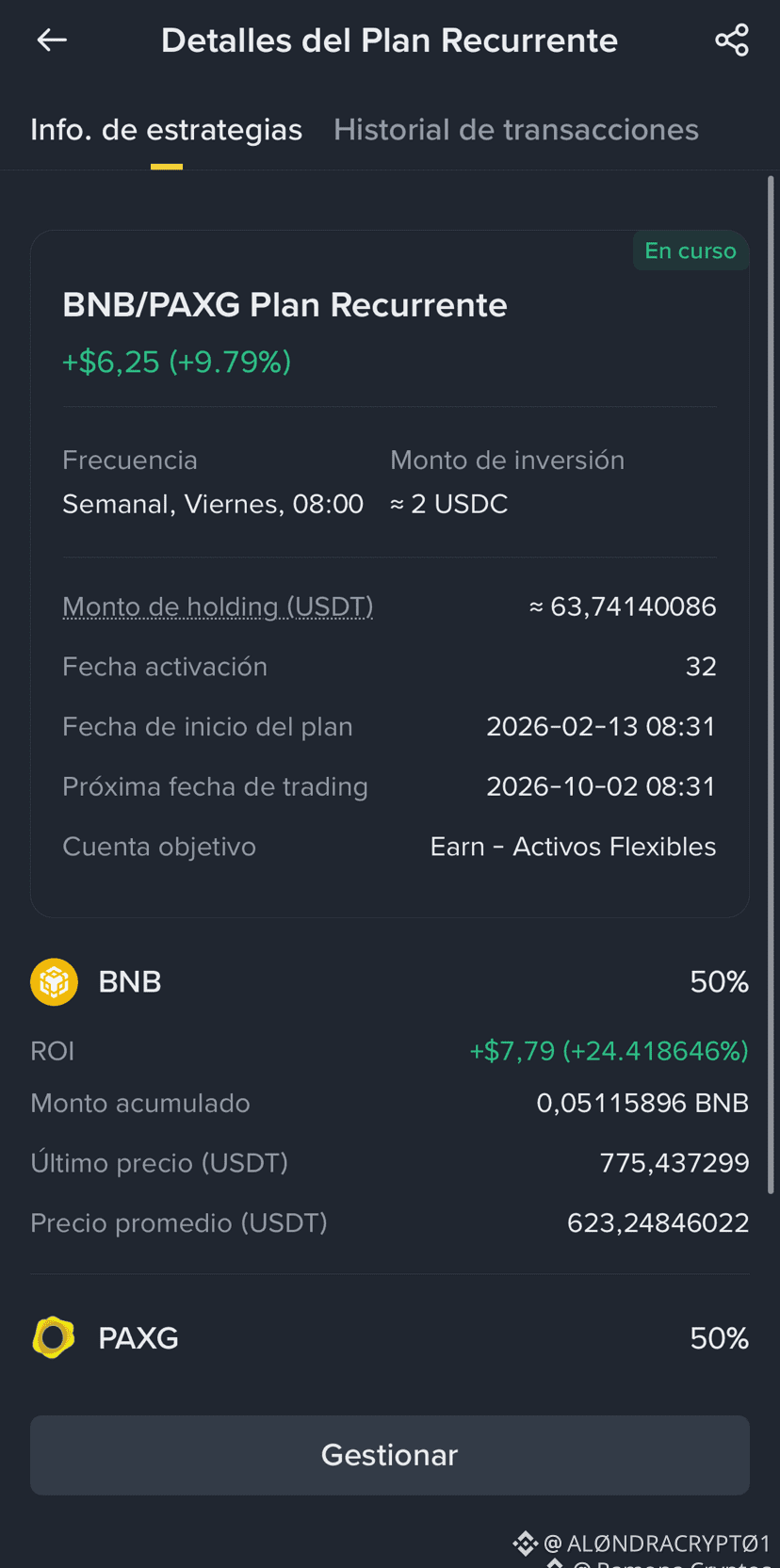
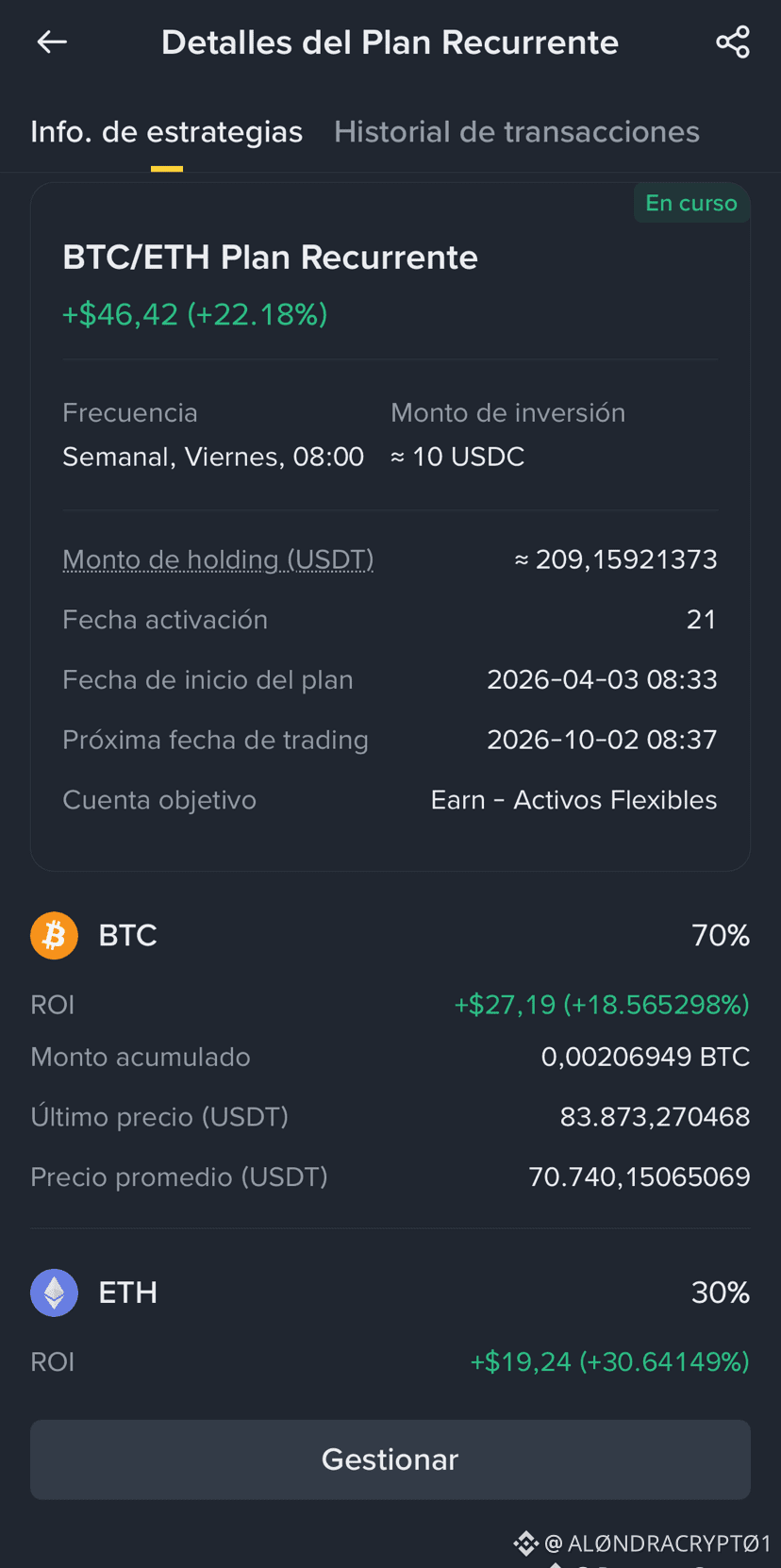
At the beginning of this year, I shared an educational post explaining step by step how to build a DCA plan using the recurring plan, suggesting projecting it through December.
I perfectly remember the moments when we were looking at your screenshots and the plan was in the red; I also had to sell in the red because I needed the money, but everything comes down to having discipline and patience. 🧘♀️
Truly, Ramona 🥂 met all the goals and to this day is still seeing the results, becoming a huge example to follow and an enormous example for the community to start from now on with their RECURRENT PLAN, knowing that this money has to be left there long-term in order to see results.
Also, remember the key advice: when strategies reach between 20% and 30% return, it’s time to start securing profits.
Thank you, Ramona, for showing that consistency outperforms any moment of volatility. You’re an amazing example for the whole community!
I’m attaching the screenshots she posted when it was in the red, and now I’m attaching the profits she has taken.
CONGRATULATIONS ON YOUR ENORMOUS PATIENCE 🎉
#DCA #PlanRecurrente #EducacionCripto
{spot}(PAXGUSDT)
{spot}(BNBUSDT)
{spot}(BTCUSDT)
$BTC ✨ $BNB ✨ $PAXG 🎉
MANY CONGRATULATIONS, @Ramona Cryptos 🍾🥂
At the beginning of this year, I shared an educational post explaining step by step how to build a DCA plan using the recurring plan, suggesting projecting it through December.
I perfectly remember the moments when we were looking at your screenshots and the plan was in the red; I also had to sell in the red because I needed the money, but everything comes down to having discipline and patience. 🧘♀️
Truly, Ramona 🥂 met all the goals and to this day is still seeing the results, becoming a huge example to follow and an enormous example for the community to start from now on with their RECURRENT PLAN, knowing that this money has to be left there long-term in order to see results.
Also, remember the key advice: when strategies reach between 20% and 30% return, it’s time to start securing profits.
Thank you, Ramona, for showing that consistency outperforms any moment of volatility. You’re an amazing example for the whole community!
I’m attaching the screenshots she posted when it was in the red, and now I’m attaching the profits she has taken.
CONGRATULATIONS ON YOUR ENORMOUS PATIENCE 🎉
#DCA #PlanRecurrente #EducacionCripto
Ramona Cryptos
·
--
💰📈 My recurring investment strategy (DCA) on Binance.
Thanks @ALØNDRACRYPTØ1 for supporting those of us who are learning in this crypto world.
Here’s something I’m learning on this crypto journey: it’s not always about finding the perfect time to buy.
That’s why I’m using the Recurring Convert option to gradually accumulate my cryptocurrencies.
Right now, I’ve set up these pairs:
₿ BTC/USDT
♦️ ETH/USDT
🟡 BNB/USDT
🔆 PAXG/USDT
The idea is simple: make periodic purchases with amounts I can stick with over time, and build my positions with the medium- and long-term in mind—rather than worrying about the price every day.
📚 For me, this strategy also means discipline:
Small buys + consistency + time + learning.
I’m not trying to guess the market or go all in at once. I’m learning to build my investment step by step and to use the tools Binance offers.
💡 Have you tried recurring buys, or do you still prefer to buy manually when you see an opportunity?
Tell me how you’re doing it 👇
Maybe together we can share different accumulation strategies. 🤝
#BinanceSquare #Conver $BTC #InversiónCripto #DCA #AprendiendoCripto
9
16
3.3k

·
--
Before your first trade on Binance, review three things: 1) that you’re in the correct market—Spot or Futures—, 2) how much risk and leverage you’re taking on, and 3) how much capital you’re going to commit. Learning the screen comes before looking for an entry.
If you still don’t have an account, you can use my Pro referral link:
https://www.binance.com/register?ref=YF56ZPCQ
Binance may pay me a commission if you trade through this link. This content is for educational purposes and does not constitute investment advice. #Binance #CryptoEducation
If you still don’t have an account, you can use my Pro referral link:
https://www.binance.com/register?ref=YF56ZPCQ
Binance may pay me a commission if you trade through this link. This content is for educational purposes and does not constitute investment advice. #Binance #CryptoEducation
2
1.1k
·
--

Article
📊 SPOT TRADING GUIDE FOR BEGINNERS💥 What is SPOT trading (spot)?
It’s the simplest and safest way to trade on Binance. You buy and sell cryptocurrencies at the current market price, and the coins you buy are truly yours.
👇 Reply with 📊 if you already trade in Spot, or 👀 if you want to learn
📌 WHAT IS A TRADING PAIR?
It’s the combination of two coins that are exchanged with each other.
Example: BTC/USDT. The first coin (BTC) is what you buy or sell. The second (USDT) is what you use to pay.
❓ Question 1: Which trading pair do you use most often? Comment with BTC/USDT, ETH/USDT, or another.
📊 SPOT TRADING GUIDE FOR BEGINNERS
💥 What is SPOT trading (spot)?
It’s the simplest and safest way to trade on Binance. You buy and sell cryptocurrencies at the current market price, and the coins you buy are truly yours.
👇 Reply with 📊 if you already trade in Spot, or 👀 if you want to learn
📌 WHAT IS A TRADING PAIR?
It’s the combination of two coins that are exchanged with each other.
Example: BTC/USDT. The first coin (BTC) is what you buy or sell. The second (USDT) is what you use to pay.
❓ Question 1: Which trading pair do you use most often? Comment with BTC/USDT, ETH/USDT, or another.
1
1
143
Log in to explore more content
Join global crypto users on Binance Square
⚡️ Get latest and useful information about crypto.
💬 Trusted by the world’s largest crypto exchange.
👍 Discover real insights from verified creators.
Email / Phone number
Trending Topics
1
#A Packed Week of Earnings and Data Tests Markets
54,395 views
365 Discussing
2
#AnthropicIPOTestsInvestorAppetiteForAI
96,241 views
1,257 Discussing
3
#BitcoinExtendsLosingStreakToSixWeeks
60,605 views
608 Discussing
4
#XRPFallsTo$0.89LowestSinceNovember2024
10,825 views
61 Discussing
5
#HuangReportedlyConsidersReturnToNvidia
104,996 views
1,164 Discussing
6
#SP500AndNasdaqFuturesHitQuarterlyLows
16,647 views
205 Discussing
7
#CaliforniaVotersBackProp42BarringNewCryptoTaxes
12,113 views
194 Discussing
8
#HKPlansDigitalAssetRegulatoryBillByYearEnd
11,882 views
141 Discussing
9
#MUFGSMFGMizuhoPlanYenBackedStablecoin
26,280 views
267 Discussing
10
#HKMAAndSwiftExploreTokenizedDepositInteroperability
1,281 views
17 Discussing