

#babylon
babylon
705,733 views
2,615 Discussing
Hot
Latest

·
--
📌 Unlock No. 10—who goes first?
$BABY 0.01451, 24h +8.9%.
For the batch to unlock on October 10th, we’ll send it to the team, advisors, and early investors.
The more it pumps, the neater the sell orders will line up on the unlock day.
🟢 The original BTC staking narrative is still standing; BTCFi is one of this year’s main themes
🔴 Infinite supply with month-by-month linear release—there’s no end to the supply coming from that side
Discipline level: stay above today’s high of 0.0147 before we talk about continuation; if it drops back to 0.0132, this wave is over.
Unlock ahead—are you willing to hold overnight?
🎉 Hope everyone chasing the high has someone to carry the ride; drawdowns always leave you one point behind ✨
$BABY #Babylon #BTCFi #Binance Square
(Not investment advice)
📌 Unlock No. 10—who goes first?
$BABY 0.01451, 24h +8.9%.
For the batch to unlock on October 10th, we’ll send it to the team, advisors, and early investors.
The more it pumps, the neater the sell orders will line up on the unlock day.
🟢 The original BTC staking narrative is still standing; BTCFi is one of this year’s main themes
🔴 Infinite supply with month-by-month linear release—there’s no end to the supply coming from that side
Discipline level: stay above today’s high of 0.0147 before we talk about continuation; if it drops back to 0.0132, this wave is over.
Unlock ahead—are you willing to hold overnight?
🎉 Hope everyone chasing the high has someone to carry the ride; drawdowns always leave you one point behind ✨
$BABY #Babylon #BTCFi #Binance Square
(Not investment advice)
$BABY 0.01451, 24h +8.9%.
For the batch to unlock on October 10th, we’ll send it to the team, advisors, and early investors.
The more it pumps, the neater the sell orders will line up on the unlock day.
🟢 The original BTC staking narrative is still standing; BTCFi is one of this year’s main themes
🔴 Infinite supply with month-by-month linear release—there’s no end to the supply coming from that side
Discipline level: stay above today’s high of 0.0147 before we talk about continuation; if it drops back to 0.0132, this wave is over.
Unlock ahead—are you willing to hold overnight?
🎉 Hope everyone chasing the high has someone to carry the ride; drawdowns always leave you one point behind ✨
$BABY #Babylon #BTCFi #Binance Square
(Not investment advice)

142


·
--
Bullish
#Babylon at 0.01413$ high by 7.29% raises a question I’d love to see in the crypto market: what if it wasn’t about creating new capital, but rather using the capital that already exists? The project is trying to leverage BTC via Staking to secure other networks. The idea has something smart from an architectural standpoint; Bitcoin remains the asset, but its economic security can be applied to other ecosystems. And as BTC deposits expand, the real test of the concept begins.
#baby @babylonlabs_io #marouan47 #EarningsSeason
$BABY
{spot}(BABYUSDT)
#Babylon at 0.01413$ high by 7.29% raises a question I’d love to see in the crypto market: what if it wasn’t about creating new capital, but rather using the capital that already exists? The project is trying to leverage BTC via Staking to secure other networks. The idea has something smart from an architectural standpoint; Bitcoin remains the asset, but its economic security can be applied to other ecosystems. And as BTC deposits expand, the real test of the concept begins.
#baby @BabylonLabs_io #marouan47 #EarningsSeason
$BABY
#baby @BabylonLabs_io #marouan47 #EarningsSeason
$BABY

الملك اجامنون:
هذا ممكن
1
2
792

$BABY
{spot}(BABYUSDT)
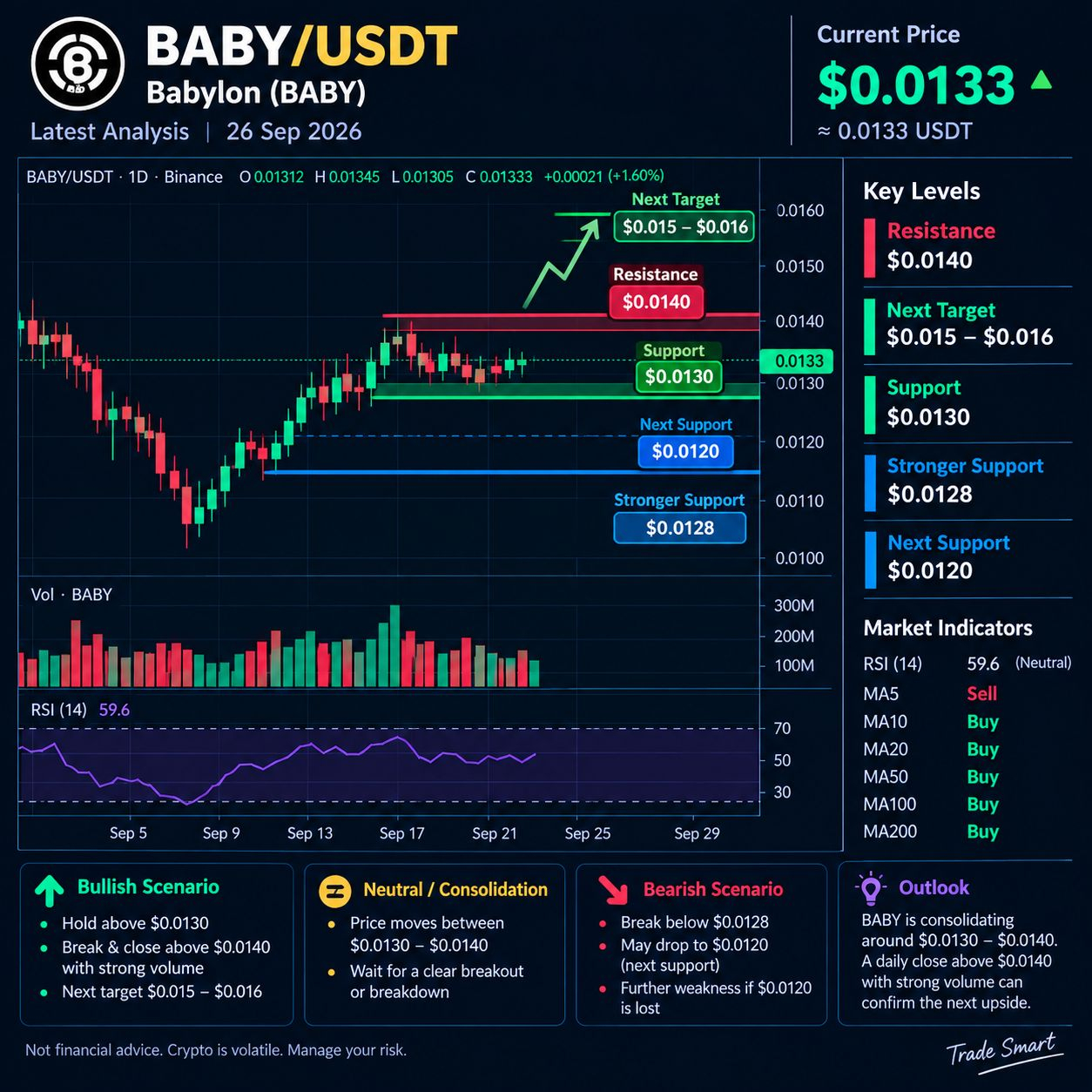
BABY (Babylon) — Today’s Analysis | 26 Sep 2026
BABY/USDT is around $0.0133 today. Current technical readings are constructive: RSI is about 59.6, while the 10/20/50/100/200-period moving averages are showing buy signals; the 5-period MA is showing a short-term sell signal. �
Investing.com Nigeria +1
🔑 Key levels
🟢 Support: $0.0130
🟢 Stronger support: $0.0128
🔻 Next support: $0.0120
🔴 Resistance: $0.0140
🚀 Above $0.0140: watch the $0.015–$0.016 area
⚠️ Below $0.0128: downside momentum could increase toward $0.0120.
The recent data also shows elevated BABY trading activity, and Binance is currently running a BABY/USDT and BABY/USDC trading competition through September 29, 2026. �
CoinMarketCap +1
Post-ready view: BABY is currently consolidating around $0.0130–$0.0140. A daily candle close above $0.0140 with strong volume would be a clearer bullish confirmation; losing $0.0128 would weaken the setup.
#baby
#Babylon
#CryptoAnalysis
$BABY
BABY (Babylon) — Today’s Analysis | 26 Sep 2026
BABY/USDT is around $0.0133 today. Current technical readings are constructive: RSI is about 59.6, while the 10/20/50/100/200-period moving averages are showing buy signals; the 5-period MA is showing a short-term sell signal. �
Investing.com Nigeria +1
🔑 Key levels
🟢 Support: $0.0130
🟢 Stronger support: $0.0128
🔻 Next support: $0.0120
🔴 Resistance: $0.0140
🚀 Above $0.0140: watch the $0.015–$0.016 area
⚠️ Below $0.0128: downside momentum could increase toward $0.0120.
The recent data also shows elevated BABY trading activity, and Binance is currently running a BABY/USDT and BABY/USDC trading competition through September 29, 2026. �
CoinMarketCap +1
Post-ready view: BABY is currently consolidating around $0.0130–$0.0140. A daily candle close above $0.0140 with strong volume would be a clearer bullish confirmation; losing $0.0128 would weaken the setup.
#baby
#Babylon
#CryptoAnalysis
BABY (Babylon) — Today’s Analysis | 26 Sep 2026
BABY/USDT is around $0.0133 today. Current technical readings are constructive: RSI is about 59.6, while the 10/20/50/100/200-period moving averages are showing buy signals; the 5-period MA is showing a short-term sell signal. �
Investing.com Nigeria +1
🔑 Key levels
🟢 Support: $0.0130
🟢 Stronger support: $0.0128
🔻 Next support: $0.0120
🔴 Resistance: $0.0140
🚀 Above $0.0140: watch the $0.015–$0.016 area
⚠️ Below $0.0128: downside momentum could increase toward $0.0120.
The recent data also shows elevated BABY trading activity, and Binance is currently running a BABY/USDT and BABY/USDC trading competition through September 29, 2026. �
CoinMarketCap +1
Post-ready view: BABY is currently consolidating around $0.0130–$0.0140. A daily candle close above $0.0140 with strong volume would be a clearer bullish confirmation; losing $0.0128 would weaken the setup.
#baby
#Babylon
#CryptoAnalysis
197

·
--
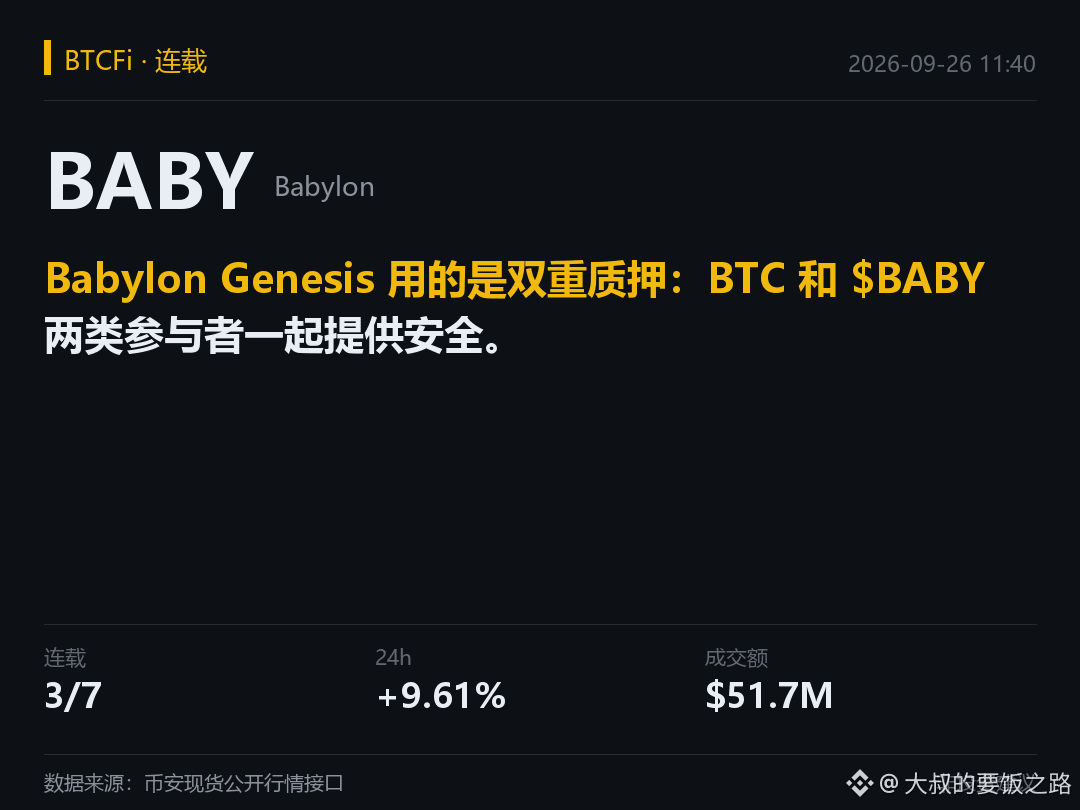
Babylon Genesis uses dual staking: two types of participants, BTC and $BABY , jointly provide security.
But the reward asset is only BABY. Bitcoin participates in the security service, which does not mean the rewards come from Bitcoin’s operating income. These two things are often written together.
#Babylon
Not investment advice
{future}(BABYUSDT)
Babylon Genesis uses dual staking: two types of participants, BTC and $BABY , jointly provide security.
But the reward asset is only BABY. Bitcoin participates in the security service, which does not mean the rewards come from Bitcoin’s operating income. These two things are often written together.
#Babylon
Not investment advice
But the reward asset is only BABY. Bitcoin participates in the security service, which does not mean the rewards come from Bitcoin’s operating income. These two things are often written together.
#Babylon
Not investment advice
126

·
--
🔥 $BABY : The climb is continuing 🚀
Entry: 0.01275–0.01285$
Targets:
1️⃣ 0.01310$
2️⃣ 0.01340$
3️⃣ 0.01375$
Stop loss: 0.01240$
Do your own research here $BABY
{future}(BABYUSDT)
Why BABY?
Strong support at 0.0122$ — 3 successful tests
RSI at 52 — mild overbought — imminent rise
MA50 at 0.01159 — upward trend!
Also follow $XRP
{future}(XRPUSDT)
Always respect trade limits and manage your risk carefully 🙏
#xrp #Babylon #altcoins
🔥 $BABY : The climb is continuing 🚀
Entry: 0.01275–0.01285$
Targets:
1️⃣ 0.01310$
2️⃣ 0.01340$
3️⃣ 0.01375$
Stop loss: 0.01240$
Do your own research here $BABY
Why BABY?
Strong support at 0.0122$ — 3 successful tests
RSI at 52 — mild overbought — imminent rise
MA50 at 0.01159 — upward trend!
Also follow $XRP
Always respect trade limits and manage your risk carefully 🙏
#xrp #Babylon #altcoins
Entry: 0.01275–0.01285$
Targets:
1️⃣ 0.01310$
2️⃣ 0.01340$
3️⃣ 0.01375$
Stop loss: 0.01240$
Do your own research here $BABY
Why BABY?
Strong support at 0.0122$ — 3 successful tests
RSI at 52 — mild overbought — imminent rise
MA50 at 0.01159 — upward trend!
Also follow $XRP
Always respect trade limits and manage your risk carefully 🙏
#xrp #Babylon #altcoins
1
19

·
--
Bullish
🚀 Is $BABY Ready for a Major Liquidity Expansion?
With market momentum shifting, Babylon ($BABY) is holding strong around key support zones. As volume builds across major pairs, the ecosystem's expanding TVL could act as a major catalyst.
If liquidity continues to flow in, $BABY holds realistic 3x - 5x upside potential from current levels during a sustained bull run! 📈
👉 What is your target for Baby this cycle?
Click Baby or $USDT below to check live charts & trade on Binance! 👇
#Crypto #BinanceSquare #Babylon
Disclaimer: DYOR. Not financial advice.
🚀 Is $BABY Ready for a Major Liquidity Expansion?
With market momentum shifting, Babylon ($BABY ) is holding strong around key support zones. As volume builds across major pairs, the ecosystem's expanding TVL could act as a major catalyst.
If liquidity continues to flow in, $BABY holds realistic 3x - 5x upside potential from current levels during a sustained bull run! 📈
👉 What is your target for Baby this cycle?
Click Baby or $USDT below to check live charts & trade on Binance! 👇
#Crypto #BinanceSquare #Babylon
Disclaimer: DYOR. Not financial advice.
With market momentum shifting, Babylon ($BABY ) is holding strong around key support zones. As volume builds across major pairs, the ecosystem's expanding TVL could act as a major catalyst.
If liquidity continues to flow in, $BABY holds realistic 3x - 5x upside potential from current levels during a sustained bull run! 📈
👉 What is your target for Baby this cycle?
Click Baby or $USDT below to check live charts & trade on Binance! 👇
#Crypto #BinanceSquare #Babylon
Disclaimer: DYOR. Not financial advice.
1
153

·
--
Bullish
$BABY 🔥 Babylon ($BABY) is taking over the spotlight! Are you ready? 🚀The buzz around the Binance BABY Trading Tournament is absolute fire right now! As a key utility token enabling native, self-custodial Bitcoin staking directly on the network, Babylon ($BABY) is proving it has serious utility beyond the average market noise.With trading volume surging and extra rewards up for grabs during the sprint period, the momentum is building rapidly. The charts are heating up, making it the perfect time to keep a very close eye on the next major movement!💡 Quick tip: Whether you are going long or setting up a short, never forget to place your Stop Loss (SL) and manage your leverage properly. Volatility brings massive opportunities, but risk management is what keeps you in the game! 📊🛡️Are you bullish or bearish on $BABY today? Let's discuss in the comments! 👇#BABY #Babylon #TradingSignals #RiskManagement #Binance #Write2Earn
$BABY 🔥 Babylon ($BABY ) is taking over the spotlight! Are you ready? 🚀The buzz around the Binance BABY Trading Tournament is absolute fire right now! As a key utility token enabling native, self-custodial Bitcoin staking directly on the network, Babylon ($BABY ) is proving it has serious utility beyond the average market noise.With trading volume surging and extra rewards up for grabs during the sprint period, the momentum is building rapidly. The charts are heating up, making it the perfect time to keep a very close eye on the next major movement!💡 Quick tip: Whether you are going long or setting up a short, never forget to place your Stop Loss (SL) and manage your leverage properly. Volatility brings massive opportunities, but risk management is what keeps you in the game! 📊🛡️Are you bullish or bearish on $BABY today? Let's discuss in the comments! 👇#BABY #Babylon #TradingSignals #RiskManagement #Binance #Write2Earn
1
211

·
--
🚨 400 BNB Token Vouchers up for grabs
Binance has announced a Babylon (BABY) Trading Tournament running from September 22 to September 29, 2026.
The campaign includes a total reward pool of up to 400 BNB in token vouchers, subject to the official eligibility and campaign conditions.
Would you join a trading tournament, or do you prefer long-term investing?
👇 Tell me your approach.
#Binance #BABY #Babylon #BNB #Crypto #BinanceNews #Altcoins #Web3 #DYOR
🚨 400 BNB Token Vouchers up for grabs
Binance has announced a Babylon (BABY) Trading Tournament running from September 22 to September 29, 2026.
The campaign includes a total reward pool of up to 400 BNB in token vouchers, subject to the official eligibility and campaign conditions.
Would you join a trading tournament, or do you prefer long-term investing?
👇 Tell me your approach.
#Binance #BABY #Babylon #BNB #Crypto #BinanceNews #Altcoins #Web3 #DYOR
Binance has announced a Babylon (BABY) Trading Tournament running from September 22 to September 29, 2026.
The campaign includes a total reward pool of up to 400 BNB in token vouchers, subject to the official eligibility and campaign conditions.
Would you join a trading tournament, or do you prefer long-term investing?
👇 Tell me your approach.
#Binance #BABY #Babylon #BNB #Crypto #BinanceNews #Altcoins #Web3 #DYOR
136

·
--
Article
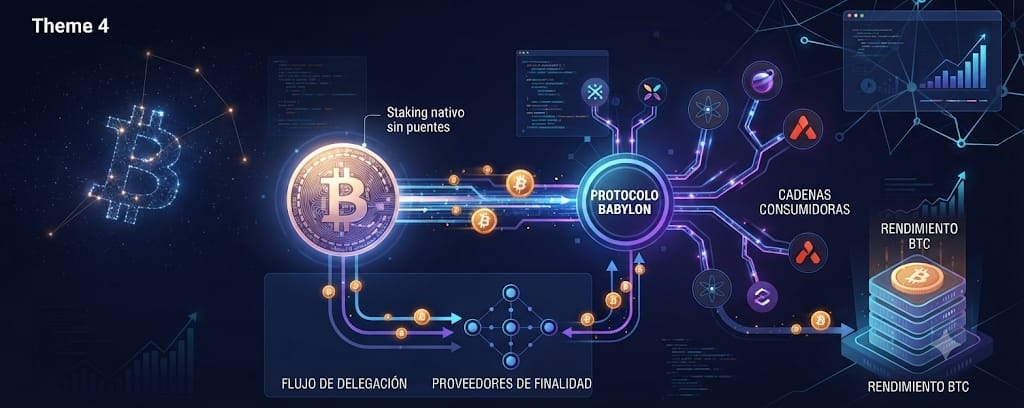
Active Participation: How BTC Holders Generate YieldFor Bitcoin holders seeking to optimize the performance of their holdings without compromising custody or resorting to high-risk schemes, native staking through Babylon introduces a direct participation model. This process allows putting the idle capital of the main network to work to secure external Proof-of-Stake (PoS) blockchains, generating rewards without abandoning Bitcoin's security standards.
1. The Role of Finality Providers
Active Participation: How BTC Holders Generate Yield
For Bitcoin holders seeking to optimize the performance of their holdings without compromising custody or resorting to high-risk schemes, native staking through Babylon introduces a direct participation model. This process allows putting the idle capital of the main network to work to secure external Proof-of-Stake (PoS) blockchains, generating rewards without abandoning Bitcoin's security standards.
1. The Role of Finality Providers
1. The Role of Finality Providers
5
369
·
--
Article
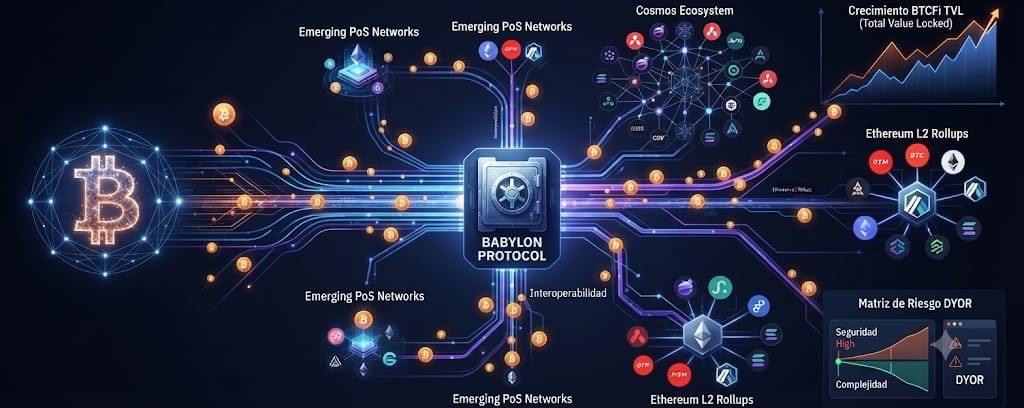
Conclusions and the Future of the BTCFi EconomyThe emergence of native staking protocols like Babylon marks a historic turning point in the evolution of Bitcoin and the decentralized ecosystem as a whole. For years, the world’s largest crypto asset has operated under a paradigm of "idle capital," where the maximum security of its main network came hand in hand with low financial composability beyond its own chain. Today, crypto infrastructure shows that it’s possible to scale the utility of assets without compromising their native sovereignty.
Conclusions and the Future of the BTCFi Economy
The emergence of native staking protocols like Babylon marks a historic turning point in the evolution of Bitcoin and the decentralized ecosystem as a whole. For years, the world’s largest crypto asset has operated under a paradigm of "idle capital," where the maximum security of its main network came hand in hand with low financial composability beyond its own chain. Today, crypto infrastructure shows that it’s possible to scale the utility of assets without compromising their native sovereignty.
2
174
·
--
Article
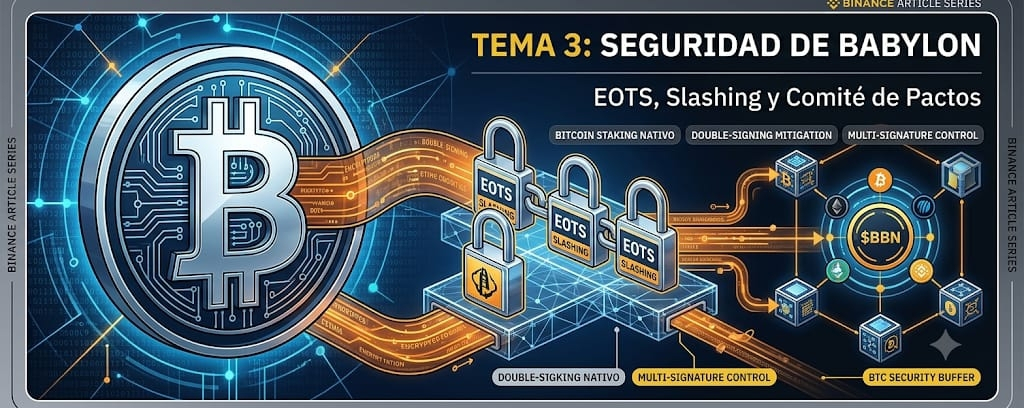
Security Mechanism, EOTS and Decentralized SlashingThe Achilles' heel of many shared or external staking systems lies in the trust placed in centralized custodians or vulnerable cross-chain bridges. Babylon resolves this technical dilemma by introducing EOTS (Extractable One-Time Signatures) or Extractable Single-Use Signatures.
How does EOTS work? It allows a validator to sign blocks on the Proof-of-Stake consumption chain using a private key linked to its staking transaction on Bitcoin. If the validator acts honestly, everything proceeds normally. However, if a validator attempts to commit double-signing or malicious behavior at the same moment within networks that integrate BTC security, EOTS’s mathematical structure exposes its private key to the main network.
Security Mechanism, EOTS and Decentralized Slashing
The Achilles' heel of many shared or external staking systems lies in the trust placed in centralized custodians or vulnerable cross-chain bridges. Babylon resolves this technical dilemma by introducing EOTS (Extractable One-Time Signatures) or Extractable Single-Use Signatures.
How does EOTS work? It allows a validator to sign blocks on the Proof-of-Stake consumption chain using a private key linked to its staking transaction on Bitcoin. If the validator acts honestly, everything proceeds normally. However, if a validator attempts to commit double-signing or malicious behavior at the same moment within networks that integrate BTC security, EOTS’s mathematical structure exposes its private key to the main network.
How does EOTS work? It allows a validator to sign blocks on the Proof-of-Stake consumption chain using a private key linked to its staking transaction on Bitcoin. If the validator acts honestly, everything proceeds normally. However, if a validator attempts to commit double-signing or malicious behavior at the same moment within networks that integrate BTC security, EOTS’s mathematical structure exposes its private key to the main network.
2
2
78

·
--
In the short term, the pressure on $BABY mainly comes from liquidity events rather than a simple weakening of the order book. Upbit has paused deposits and withdrawals related to the Babylon network upgrade; after trading channels narrow, some funds can’t be transferred freely, so market sentiment naturally becomes more cautious.
Upgrades like this often trigger temporary sell pressure: coin holders worry about uncertainty, and short-term capital may also reduce positions first. In addition, with its market value of only about $33,300 and missing 24-hour trading volume data, even a small number of orders can amplify volatility, making the price more sensitive to news.
Going forward, focus on three points: how long deposits and withdrawals take to resume, whether the network upgrade is completed smoothly, and whether funds can flow back after recovery. Before the channels reopen, it’s not advisable to judge the trend based only on minor up-and-down movements; you also need to be alert to abnormal volatility caused by insufficient liquidity.
#BABY #Upbit #Babylon
In the short term, the pressure on $BABY mainly comes from liquidity events rather than a simple weakening of the order book. Upbit has paused deposits and withdrawals related to the Babylon network upgrade; after trading channels narrow, some funds can’t be transferred freely, so market sentiment naturally becomes more cautious.
Upgrades like this often trigger temporary sell pressure: coin holders worry about uncertainty, and short-term capital may also reduce positions first. In addition, with its market value of only about $33,300 and missing 24-hour trading volume data, even a small number of orders can amplify volatility, making the price more sensitive to news.
Going forward, focus on three points: how long deposits and withdrawals take to resume, whether the network upgrade is completed smoothly, and whether funds can flow back after recovery. Before the channels reopen, it’s not advisable to judge the trend based only on minor up-and-down movements; you also need to be alert to abnormal volatility caused by insufficient liquidity.
#BABY #Upbit #Babylon
Upgrades like this often trigger temporary sell pressure: coin holders worry about uncertainty, and short-term capital may also reduce positions first. In addition, with its market value of only about $33,300 and missing 24-hour trading volume data, even a small number of orders can amplify volatility, making the price more sensitive to news.
Going forward, focus on three points: how long deposits and withdrawals take to resume, whether the network upgrade is completed smoothly, and whether funds can flow back after recovery. Before the channels reopen, it’s not advisable to judge the trend based only on minor up-and-down movements; you also need to be alert to abnormal volatility caused by insufficient liquidity.
#BABY #Upbit #Babylon
7

·
--
$BABY Recently under pressure, the core reason is not simply that the market surface is weakening. Instead, it’s that the Korean exchange Upbit has suspended deposits and withdrawals for this asset. Behind this is the Babylon network upgrade, which has led to temporarily limited on-chain liquidity, boosting short-term capital’s risk-avoidance sentiment.
For small-cap tokens like this, shutting down deposit/withdrawal channels directly affects cross-market arbitrage and immediate liquidity, making it easier for price to exhibit amplified volatility. The current market cap is about $33.3k, the order book is relatively thin, and sentiment still needs to be treated cautiously.
Going forward, focus on two key signals: first, the timing of when the network upgrade is completed and when Upbit restores deposits and withdrawals; second, whether trading volume can return after restoration. If liquidity is repaired, near-term downward pressure may ease. If the upgrade is delayed, the choppy range may persist.
#BABY #Babylon #Upbit
$BABY Recently under pressure, the core reason is not simply that the market surface is weakening. Instead, it’s that the Korean exchange Upbit has suspended deposits and withdrawals for this asset. Behind this is the Babylon network upgrade, which has led to temporarily limited on-chain liquidity, boosting short-term capital’s risk-avoidance sentiment.
For small-cap tokens like this, shutting down deposit/withdrawal channels directly affects cross-market arbitrage and immediate liquidity, making it easier for price to exhibit amplified volatility. The current market cap is about $33.3k, the order book is relatively thin, and sentiment still needs to be treated cautiously.
Going forward, focus on two key signals: first, the timing of when the network upgrade is completed and when Upbit restores deposits and withdrawals; second, whether trading volume can return after restoration. If liquidity is repaired, near-term downward pressure may ease. If the upgrade is delayed, the choppy range may persist.
#BABY #Babylon #Upbit
For small-cap tokens like this, shutting down deposit/withdrawal channels directly affects cross-market arbitrage and immediate liquidity, making it easier for price to exhibit amplified volatility. The current market cap is about $33.3k, the order book is relatively thin, and sentiment still needs to be treated cautiously.
Going forward, focus on two key signals: first, the timing of when the network upgrade is completed and when Upbit restores deposits and withdrawals; second, whether trading volume can return after restoration. If liquidity is repaired, near-term downward pressure may ease. If the upgrade is delayed, the choppy range may persist.
#BABY #Babylon #Upbit
11
$BABY In recent pressure, the core variables come from Upbit suspending deposits and withdrawals: during the Babylon network upgrade, cross-site liquidity is temporarily restricted, and short-term capital cannot be moved as freely as usual. Market sentiment naturally turns more cautious.
These events are typically more of a short-term shock and do not directly change the project’s on-chain progress; however, for small-cap assets, when liquidity thins, volatility is amplified noticeably—chasing pumps and selling in panic can easily lead to losses. It is recommended to closely watch the deposit/withdrawal restoration timeline, the announcement confirming completion of the network upgrade, and whether trading volume can rebound, before judging whether sentiment has recovered. In terms of execution, it’s advisable to control position sizing and wait for confirmation of concrete outcomes.
#BABY #Babylon #Upbit
$BABY In recent pressure, the core variables come from Upbit suspending deposits and withdrawals: during the Babylon network upgrade, cross-site liquidity is temporarily restricted, and short-term capital cannot be moved as freely as usual. Market sentiment naturally turns more cautious.
These events are typically more of a short-term shock and do not directly change the project’s on-chain progress; however, for small-cap assets, when liquidity thins, volatility is amplified noticeably—chasing pumps and selling in panic can easily lead to losses. It is recommended to closely watch the deposit/withdrawal restoration timeline, the announcement confirming completion of the network upgrade, and whether trading volume can rebound, before judging whether sentiment has recovered. In terms of execution, it’s advisable to control position sizing and wait for confirmation of concrete outcomes.
#BABY #Babylon #Upbit
These events are typically more of a short-term shock and do not directly change the project’s on-chain progress; however, for small-cap assets, when liquidity thins, volatility is amplified noticeably—chasing pumps and selling in panic can easily lead to losses. It is recommended to closely watch the deposit/withdrawal restoration timeline, the announcement confirming completion of the network upgrade, and whether trading volume can rebound, before judging whether sentiment has recovered. In terms of execution, it’s advisable to control position sizing and wait for confirmation of concrete outcomes.
#BABY #Babylon #Upbit
43
·
--
Bullish
$BABY Go buy 🚀🚀🚀
Price: 0.0111$ _0.0110$
Targets:
0.0115$ → 0.0120$ → 0.0128$
Stop loss: 0.0105$
.
Do your own research or trade here: — $BABY
{future}(BABYUSDT)
Analysis:
Babylon — a BTC Staking protocol, upgraded on September 14, strong bullish trend!
I’m also watching:
$WLD at 0.398$ — LONG, targets 0.42$ → 0.45$ →
{future}(WLDUSDT)
$LDO at 0.3733$ — LONG, targets 0.39$ → 0.42$ → 0.45$!
{future}(LDOUSDT)
Looking forward to BTC reaching 80,000$ — if that happens, BABY will fly to 0.018$!
Be careful with risk and don’t risk more than 1–2% of your portfolio. Respect trade limits and take profits with knowledge.
#BTC #Babylon
$BABY Go buy 🚀🚀🚀
Price: 0.0111$ _0.0110$
Targets:
0.0115$ → 0.0120$ → 0.0128$
Stop loss: 0.0105$
.
Do your own research or trade here: — $BABY
Analysis:
Babylon — a BTC Staking protocol, upgraded on September 14, strong bullish trend!
I’m also watching:
$WLD at 0.398$ — LONG, targets 0.42$ → 0.45$ →
$LDO at 0.3733$ — LONG, targets 0.39$ → 0.42$ → 0.45$!
Looking forward to BTC reaching 80,000$ — if that happens, BABY will fly to 0.018$!
Be careful with risk and don’t risk more than 1–2% of your portfolio. Respect trade limits and take profits with knowledge.
#BTC #Babylon
Price: 0.0111$ _0.0110$
Targets:
0.0115$ → 0.0120$ → 0.0128$
Stop loss: 0.0105$
.
Do your own research or trade here: — $BABY
Analysis:
Babylon — a BTC Staking protocol, upgraded on September 14, strong bullish trend!
I’m also watching:
$WLD at 0.398$ — LONG, targets 0.42$ → 0.45$ →
$LDO at 0.3733$ — LONG, targets 0.39$ → 0.42$ → 0.45$!
Looking forward to BTC reaching 80,000$ — if that happens, BABY will fly to 0.018$!
Be careful with risk and don’t risk more than 1–2% of your portfolio. Respect trade limits and take profits with knowledge.
#BTC #Babylon
1
2
73

·
--
Verified
Babylon Coin (BABY): Bitcoin Staking and the Future of DeFi#Babylon Coin (BABY) is the native token of the Babylon ecosystem, a blockchain project focused on bringing Bitcoin’s security and capital into the broader decentralized finance (DeFi) world. One of Babylon’s main ideas is Bitcoin staking, which allows Bitcoin holders to contribute economic security to proof-of-stake networks while maintaining the underlying Bitcoin-based security model.
The BABY token is designed to support activity across the Babylon ecosystem and can be used for network participation and governance-related functions. The project has gained interest because Bitcoin is the largest and one of the most established crypto assets, while staking has become an important part of many blockchain ecosystems.
For investors, BABY is still a relatively speculative cryptocurrency. Its future performance may depend on ecosystem adoption, network activity, token supply, market liquidity, and continued development. Crypto markets are highly volatile, so price increases should never be viewed as guaranteed.
Overall, Babylon$ Coin is an interesting project to watch because it attempts to connect Bitcoin with the growing staking and DeFi sectors. Anyone considering BABY should research the project carefully and understand the risks before investing.
Babylon Coin (BABY): Bitcoin Staking and the Future of DeFi
#Babylon Coin (BABY) is the native token of the Babylon ecosystem, a blockchain project focused on bringing Bitcoin’s security and capital into the broader decentralized finance (DeFi) world. One of Babylon’s main ideas is Bitcoin staking, which allows Bitcoin holders to contribute economic security to proof-of-stake networks while maintaining the underlying Bitcoin-based security model.
The BABY token is designed to support activity across the Babylon ecosystem and can be used for network participation and governance-related functions. The project has gained interest because Bitcoin is the largest and one of the most established crypto assets, while staking has become an important part of many blockchain ecosystems.
For investors, BABY is still a relatively speculative cryptocurrency. Its future performance may depend on ecosystem adoption, network activity, token supply, market liquidity, and continued development. Crypto markets are highly volatile, so price increases should never be viewed as guaranteed.
Overall, Babylon$ Coin is an interesting project to watch because it attempts to connect Bitcoin with the growing staking and DeFi sectors. Anyone considering BABY should research the project carefully and understand the risks before investing.
The BABY token is designed to support activity across the Babylon ecosystem and can be used for network participation and governance-related functions. The project has gained interest because Bitcoin is the largest and one of the most established crypto assets, while staking has become an important part of many blockchain ecosystems.
For investors, BABY is still a relatively speculative cryptocurrency. Its future performance may depend on ecosystem adoption, network activity, token supply, market liquidity, and continued development. Crypto markets are highly volatile, so price increases should never be viewed as guaranteed.
Overall, Babylon$ Coin is an interesting project to watch because it attempts to connect Bitcoin with the growing staking and DeFi sectors. Anyone considering BABY should research the project carefully and understand the risks before investing.
2
242

·
--
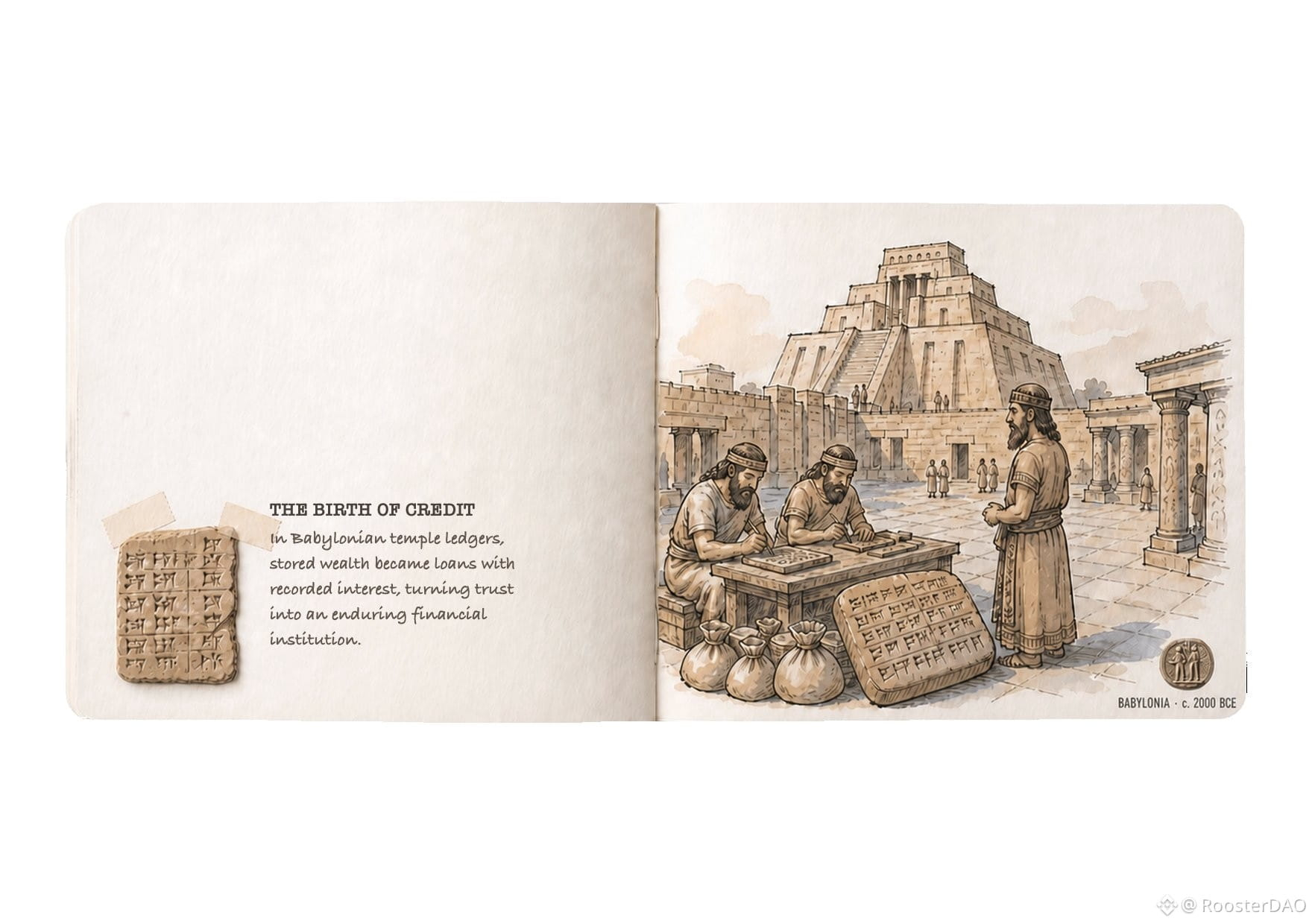
Before banks had marble halls, temples kept silver, grain, and promises.
Babylon’s clay ledgers turned stored wealth into recorded loans—and trust into an institution. The first chapter of finance was written in mud.
#FinancialHistory #Credit #Babylon #ROOFUND
Before banks had marble halls, temples kept silver, grain, and promises.
Babylon’s clay ledgers turned stored wealth into recorded loans—and trust into an institution. The first chapter of finance was written in mud.
#FinancialHistory #Credit #Babylon #ROOFUND
Babylon’s clay ledgers turned stored wealth into recorded loans—and trust into an institution. The first chapter of finance was written in mud.
#FinancialHistory #Credit #Babylon #ROOFUND
3
560

·
--
Verified
Zero-knowledge proofs are becoming more relevant for Bitcoin, but there is a practical question that often gets overlooked:
How cheaply can Bitcoin verify those proofs?
That is where Babylon’s BABE becomes interesting.
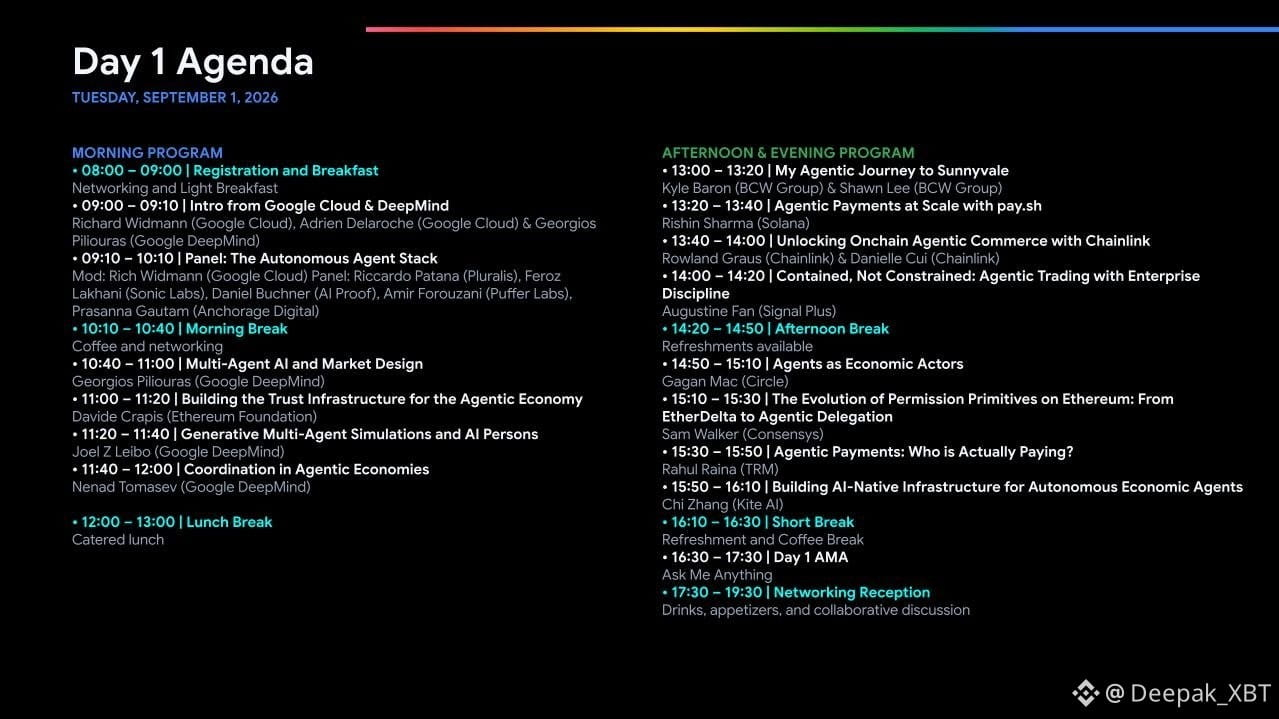
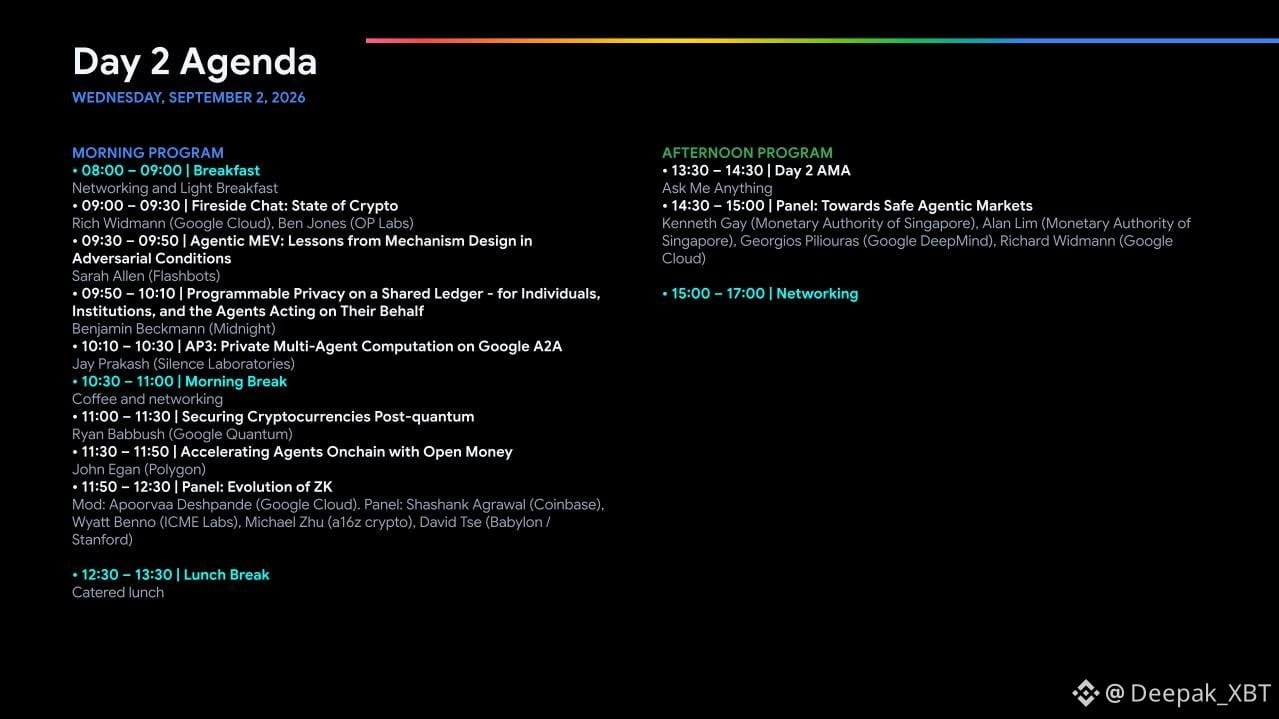
Today at the Google Web3 x AI Summit 2026, Babylon co-founder David Tse is joining a panel with Michael Zhu from a16z, Wyatt Benno from ICME Labs, and Shashank Agrawal from Coinbase to discuss the evolution of ZK proofs.
David is expected to explain how BABE can make ZK proof verification on Bitcoin 1,000x cheaper. The underlying research describes BABE as a protocol for verifying Groth16 proofs on Bitcoin while significantly reducing the associated costs.
What interests me here is not simply the 1,000x number.
If verification becomes cheap enough, ZK proofs could become much more practical for Bitcoin-based applications where Bitcoin itself needs to verify activity or state from another system.
That could matter for things like trustless Bitcoin vaults, where withdrawals can be tied to verification of a specific smart-contract state on Bitcoin.
For me, BABE is interesting because it addresses the less visible bottleneck: making cryptographic verification economically practical on Bitcoin.
Curious to hear David’s explanation today.
@babylonlabs_io $BABY
{future}(BABYUSDT)
#Babylon #bitcoin.” #zkProofs #Web3
Zero-knowledge proofs are becoming more relevant for Bitcoin, but there is a practical question that often gets overlooked:
How cheaply can Bitcoin verify those proofs?
That is where Babylon’s BABE becomes interesting.
Today at the Google Web3 x AI Summit 2026, Babylon co-founder David Tse is joining a panel with Michael Zhu from a16z, Wyatt Benno from ICME Labs, and Shashank Agrawal from Coinbase to discuss the evolution of ZK proofs.
David is expected to explain how BABE can make ZK proof verification on Bitcoin 1,000x cheaper. The underlying research describes BABE as a protocol for verifying Groth16 proofs on Bitcoin while significantly reducing the associated costs.
What interests me here is not simply the 1,000x number.
If verification becomes cheap enough, ZK proofs could become much more practical for Bitcoin-based applications where Bitcoin itself needs to verify activity or state from another system.
That could matter for things like trustless Bitcoin vaults, where withdrawals can be tied to verification of a specific smart-contract state on Bitcoin.
For me, BABE is interesting because it addresses the less visible bottleneck: making cryptographic verification economically practical on Bitcoin.
Curious to hear David’s explanation today.
@BabylonLabs_io $BABY
#Babylon #bitcoin.” #zkProofs #Web3
How cheaply can Bitcoin verify those proofs?
That is where Babylon’s BABE becomes interesting.
Today at the Google Web3 x AI Summit 2026, Babylon co-founder David Tse is joining a panel with Michael Zhu from a16z, Wyatt Benno from ICME Labs, and Shashank Agrawal from Coinbase to discuss the evolution of ZK proofs.
David is expected to explain how BABE can make ZK proof verification on Bitcoin 1,000x cheaper. The underlying research describes BABE as a protocol for verifying Groth16 proofs on Bitcoin while significantly reducing the associated costs.
What interests me here is not simply the 1,000x number.
If verification becomes cheap enough, ZK proofs could become much more practical for Bitcoin-based applications where Bitcoin itself needs to verify activity or state from another system.
That could matter for things like trustless Bitcoin vaults, where withdrawals can be tied to verification of a specific smart-contract state on Bitcoin.
For me, BABE is interesting because it addresses the less visible bottleneck: making cryptographic verification economically practical on Bitcoin.
Curious to hear David’s explanation today.
@BabylonLabs_io $BABY
#Babylon #bitcoin.” #zkProofs #Web3

197

·
--
@babylonlabs_io
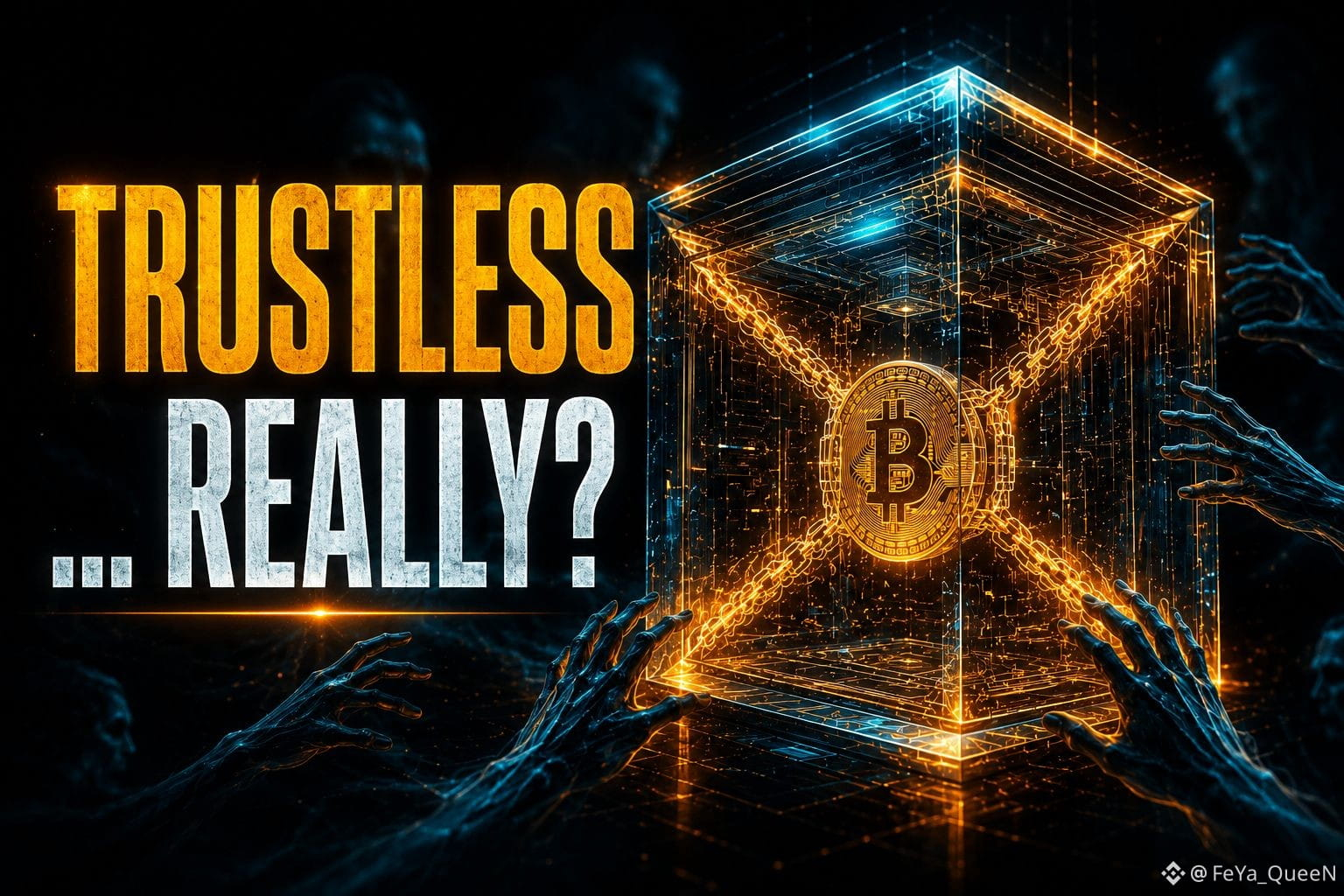
Read something last night that made me pause: a Bitcoin whitepaper talking about "vaults" that don't rely on any single company or committee holding your coins. My first thought wasn't excitement — it was skepticism, because I've heard "trustless" before and it usually meant "trust something else instead."
What made me sit with it longer was the framing around lending. Right now, if you want to borrow against Bitcoin on most platforms, you're handing it to someone — a custodian, a bridge, a wrapped-token issuer — and hoping they behave. This design tries something different: both sides pre-sign the Bitcoin transactions upfront, and a cryptographic proof decides who can withdraw and when. Nobody's word is the deciding factor. That's a meaningfully different promise than most DeFi products make, and it's the kind of thing that could actually change how collateral works if it holds up.#Babylon
Where I slow down is enforcement. A proof system can be elegant and still have edge cases nobody caught — a mispriced oracle, a challenge window that's too short, a party who disappears mid-dispute. None of that is illegal exactly, but it's exactly the kind of gap that ends up in front of a judge who has no framework for "the code said so." Removing a custodian doesn't remove the need for someone, somewhere, to be accountable when things break.
I don't think that's a reason to dismiss it. I think it's a reason to ask better questions before assuming "trustless" means "safe."
Taking these things one read at a time, and trying to stay more curious than certain.
@bitcoin #bitcoin #BTC $BTC
@babylonlabs_io #baby $BABY
{spot}(BABYUSDT)
{spot}(BTCUSDT)
@BabylonLabs_io
Read something last night that made me pause: a Bitcoin whitepaper talking about "vaults" that don't rely on any single company or committee holding your coins. My first thought wasn't excitement — it was skepticism, because I've heard "trustless" before and it usually meant "trust something else instead."
What made me sit with it longer was the framing around lending. Right now, if you want to borrow against Bitcoin on most platforms, you're handing it to someone — a custodian, a bridge, a wrapped-token issuer — and hoping they behave. This design tries something different: both sides pre-sign the Bitcoin transactions upfront, and a cryptographic proof decides who can withdraw and when. Nobody's word is the deciding factor. That's a meaningfully different promise than most DeFi products make, and it's the kind of thing that could actually change how collateral works if it holds up.#Babylon
Where I slow down is enforcement. A proof system can be elegant and still have edge cases nobody caught — a mispriced oracle, a challenge window that's too short, a party who disappears mid-dispute. None of that is illegal exactly, but it's exactly the kind of gap that ends up in front of a judge who has no framework for "the code said so." Removing a custodian doesn't remove the need for someone, somewhere, to be accountable when things break.
I don't think that's a reason to dismiss it. I think it's a reason to ask better questions before assuming "trustless" means "safe."
Taking these things one read at a time, and trying to stay more curious than certain.
@Bitcoin #bitcoin #BTC $BTC
@BabylonLabs_io #baby $BABY
Read something last night that made me pause: a Bitcoin whitepaper talking about "vaults" that don't rely on any single company or committee holding your coins. My first thought wasn't excitement — it was skepticism, because I've heard "trustless" before and it usually meant "trust something else instead."
What made me sit with it longer was the framing around lending. Right now, if you want to borrow against Bitcoin on most platforms, you're handing it to someone — a custodian, a bridge, a wrapped-token issuer — and hoping they behave. This design tries something different: both sides pre-sign the Bitcoin transactions upfront, and a cryptographic proof decides who can withdraw and when. Nobody's word is the deciding factor. That's a meaningfully different promise than most DeFi products make, and it's the kind of thing that could actually change how collateral works if it holds up.#Babylon
Where I slow down is enforcement. A proof system can be elegant and still have edge cases nobody caught — a mispriced oracle, a challenge window that's too short, a party who disappears mid-dispute. None of that is illegal exactly, but it's exactly the kind of gap that ends up in front of a judge who has no framework for "the code said so." Removing a custodian doesn't remove the need for someone, somewhere, to be accountable when things break.
I don't think that's a reason to dismiss it. I think it's a reason to ask better questions before assuming "trustless" means "safe."
Taking these things one read at a time, and trying to stay more curious than certain.
@Bitcoin #bitcoin #BTC $BTC
@BabylonLabs_io #baby $BABY
12
43
544

·
--
#baby $BABY We have been doing Bitcoin wrong For years it was just buy, hold, pray 😂 Accumulate and do nothing:)
But that’s changing now.
@babylonlabs_io We’re moving from just accumulating to actually allocating Bitcoin intelligently.
And that’s where @Babylon_io comes in
Making BTC useful, secure, and productive without giving up decentralization.
No more dead BTC sitting in wallets.
It's Time to put it to work
This is the future, And we’re early. 🚀
#Babylon $BABY @babylonlabs_io
#baby $BABY We have been doing Bitcoin wrong For years it was just buy, hold, pray 😂 Accumulate and do nothing:)
But that’s changing now.
@BabylonLabs_io We’re moving from just accumulating to actually allocating Bitcoin intelligently.
And that’s where @Babylon_io comes in
Making BTC useful, secure, and productive without giving up decentralization.
No more dead BTC sitting in wallets.
It's Time to put it to work
This is the future, And we’re early. 🚀
#Babylon $BABY @BabylonLabs_io
But that’s changing now.
@BabylonLabs_io We’re moving from just accumulating to actually allocating Bitcoin intelligently.
And that’s where @Babylon_io comes in
Making BTC useful, secure, and productive without giving up decentralization.
No more dead BTC sitting in wallets.
It's Time to put it to work
This is the future, And we’re early. 🚀
#Babylon $BABY @BabylonLabs_io

10
23
360
Log in to explore more content
Join global crypto users on Binance Square
⚡️ Get latest and useful information about crypto.
💬 Trusted by the world’s largest crypto exchange.
👍 Discover real insights from verified creators.
Email / Phone number
Trending Topics
1
#SECProposesCryptoCustodyRules
406 views
37 Discussing
2
#SECApproves3xLongCryptoCommodityETPs
1,256 views
81 Discussing
3
#G7PlansToReleaseUpTo100MBarrelsOilDiesel
2,929 views
136 Discussing
4
#ICBASuesOCCOverCryptoBankCharters
1,892 views
85 Discussing
5
#USStocksCloseHigherOnWeakJobsData
1,554 views
71 Discussing
6
#AnchorageReportedlyCuts17%Workforce
0 views
20 Discussing
7
#NFPWatch
10.9M views
19,538 Discussing
8
#NEARIntentsRecovers$3.8MAfterAttack
0 views
0 Discussing
9
#BlastToGraduallyShutDownItsL2Network
392 views
34 Discussing
10
#BitcoinFundingRateTriplesTo10%
211,860 views
1,361 Discussing