

#ston
ston
139,469 views
1,291 Discussing
Hot
Latest

·
--
Token and Fundamentals Piece
STON, the native token of #STON.fi, sits in an interesting position relative to the protocol's underlying fundamentals. Trading volume on the DEX remains strong, with over 100 million dollars processed in the past month and the protocol holding its position as the leading AMM by both volume and active wallets on TON. Yet the token itself trades far below its all-time high, a gap that often appears when infrastructure development outpaces market sentiment. The upcoming concentrated liquidity upgrade should materially improve capital efficiency for liquidity providers, and the fee-burn mechanics tied to #STON give the token a direct claim on protocol activity rather than functioning as a purely speculative asset. None of this guarantees near-term price performance, and traders should size positions accordingly, but the fundamentals-to-price divergence here is the kind of setup worth tracking closely into Q4. I remain constructively positioned on STON.fi as infrastructure, with conviction tied to execution on the cross-chain and concentrated liquidity roadmap rather than short-term price action. #STONfi #TON #DeFi #Omniston
Token and Fundamentals Piece
STON, the native token of #STON.fi, sits in an interesting position relative to the protocol's underlying fundamentals. Trading volume on the DEX remains strong, with over 100 million dollars processed in the past month and the protocol holding its position as the leading AMM by both volume and active wallets on TON. Yet the token itself trades far below its all-time high, a gap that often appears when infrastructure development outpaces market sentiment. The upcoming concentrated liquidity upgrade should materially improve capital efficiency for liquidity providers, and the fee-burn mechanics tied to #STON give the token a direct claim on protocol activity rather than functioning as a purely speculative asset. None of this guarantees near-term price performance, and traders should size positions accordingly, but the fundamentals-to-price divergence here is the kind of setup worth tracking closely into Q4. I remain constructively positioned on STON.fi as infrastructure, with conviction tied to execution on the cross-chain and concentrated liquidity roadmap rather than short-term price action. #STONfi #TON #DeFi #Omniston
STON, the native token of #STON.fi, sits in an interesting position relative to the protocol's underlying fundamentals. Trading volume on the DEX remains strong, with over 100 million dollars processed in the past month and the protocol holding its position as the leading AMM by both volume and active wallets on TON. Yet the token itself trades far below its all-time high, a gap that often appears when infrastructure development outpaces market sentiment. The upcoming concentrated liquidity upgrade should materially improve capital efficiency for liquidity providers, and the fee-burn mechanics tied to #STON give the token a direct claim on protocol activity rather than functioning as a purely speculative asset. None of this guarantees near-term price performance, and traders should size positions accordingly, but the fundamentals-to-price divergence here is the kind of setup worth tracking closely into Q4. I remain constructively positioned on STON.fi as infrastructure, with conviction tied to execution on the cross-chain and concentrated liquidity roadmap rather than short-term price action. #STONfi #TON #DeFi #Omniston
51

·
--
Article
STON Staking Is More Than Just Locking TokensWhen people hear “staking,” the first thing that usually comes to mind is yield.
But after looking more closely at how staking works on STON.fi, there is another part that is easy to miss:
Governance.
STON staking connects rewards with voting power inside the STON.fi DAO.
Here is how it works.
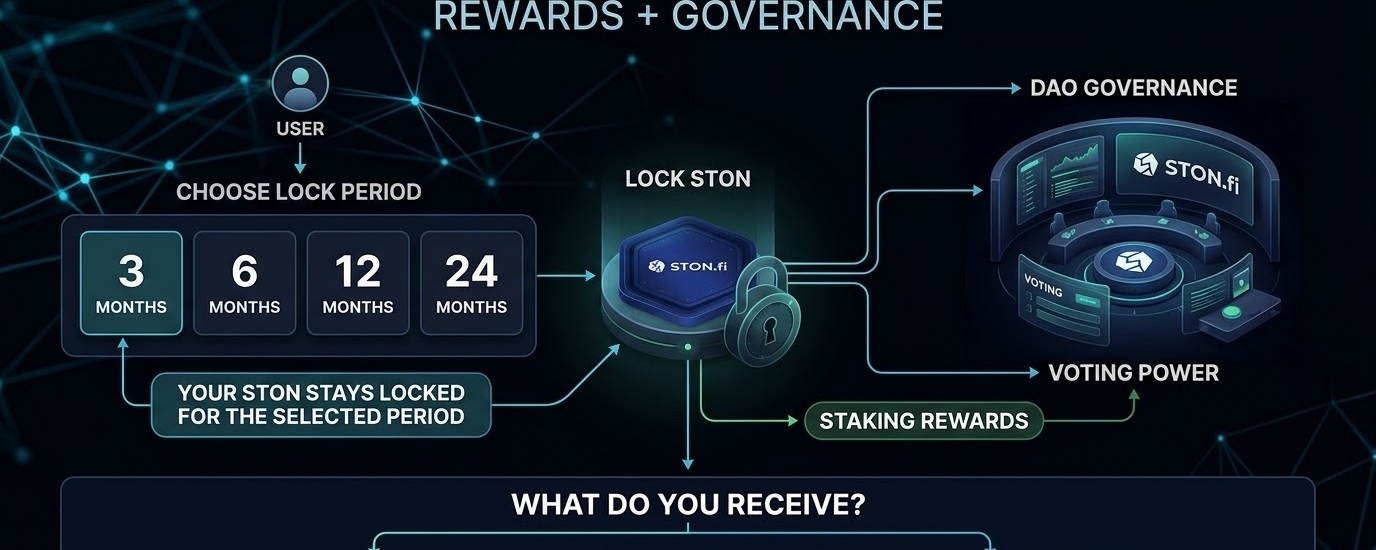
You choose the lock period
STON can be staked for:
✓ 3 months
✓ 6 months
✓ 12 months
✓ 24 months
The important thing is that this isn't flexible staking where you can simply deposit today and withdraw whenever you want.
Your STON stays locked for the period you select.
So the lock period is something to consider before staking.
What do you receive?
There are two different things to understand.
GEMSTON
When you create a STON stake, you receive GEMSTON as a one-time staking reward.
The reward is credited at the moment you create the stake.
It isn't something that keeps accumulating and gets paid out again when the lock period finishes.
That's an important distinction.
ARKENSTON
You also receive an ARKENSTON soulbound NFT.
This is where staking becomes more interesting.
ARKENSTON represents your voting power in the STON.fi DAO.
So staking isn't only about receiving a reward.
It also gives you a way to participate in decisions affecting the protocol.
So what does governance actually mean?
STON.fi uses a DAO structure where ARKENSTON holders can participate in proposals.
The basic process is:
Discussion → Voting → Implementation
A proposal first goes through a discussion period where the community can review it.
Then voting takes place.
If the required conditions are met and the proposal passes, it moves toward implementation.
That creates a direct connection between staking and protocol governance.
There is a trade-off
This is the part I think users should pay more attention to.
A longer lock period can give you a higher voting-power multiplier.
But your STON is also locked for longer.
So you shouldn't look at staking only through:
«“How much reward do I get?”»
A better question is:
«“How long am I comfortable locking these tokens, and do I actually want the governance exposure that comes with it?”»
That's a much more useful way to think about staking.
Staking vs liquidity provision
It's also important not to confuse STON staking with becoming a liquidity provider.
They serve different purposes.
With staking, you lock STON and receive GEMSTON plus ARKENSTON voting power.
With liquidity provision, you deposit a token pair into a liquidity pool and earn a share of swap fees, with the possibility of additional farming incentives.
LPs also take on risks such as impermanent loss.
So these are not simply two different ways of chasing yield.
They expose you to different mechanics and risks.
Why this matters for the STON ecosystem
This gives the STON token a role beyond being an asset that people buy or sell.
It connects the token to three parts of the ecosystem:
Staking → Rewards
ARKENSTON → Governance
DAO → Protocol decisions
That doesn't automatically make staking attractive for everyone.
The lock period, token exposure and individual strategy still matter.
But understanding the mechanics is more useful than looking at the staking APR alone.
My takeaway
The interesting part of STON staking isn't just the reward token.
It's the connection between capital commitment and governance participation.
You lock STON.
You receive GEMSTON.
You receive ARKENSTON.
And through ARKENSTON, you get voting power in the STON.fi DAO.
So before staking, don't just ask:
“What do I earn?”
Also ask:
“What am I committing, for how long, and what do I get to participate in?”
That's the part worth understanding before clicking “Stake.”
#STON #defi #TON #cryptooinsigts #Web3
STON Staking Is More Than Just Locking Tokens
When people hear “staking,” the first thing that usually comes to mind is yield.
But after looking more closely at how staking works on STON.fi, there is another part that is easy to miss:
Governance.
STON staking connects rewards with voting power inside the STON.fi DAO.
Here is how it works.
You choose the lock period
STON can be staked for:
✓ 3 months
✓ 6 months
✓ 12 months
✓ 24 months
The important thing is that this isn't flexible staking where you can simply deposit today and withdraw whenever you want.
Your STON stays locked for the period you select.
So the lock period is something to consider before staking.
What do you receive?
There are two different things to understand.
GEMSTON
When you create a STON stake, you receive GEMSTON as a one-time staking reward.
The reward is credited at the moment you create the stake.
It isn't something that keeps accumulating and gets paid out again when the lock period finishes.
That's an important distinction.
ARKENSTON
You also receive an ARKENSTON soulbound NFT.
This is where staking becomes more interesting.
ARKENSTON represents your voting power in the STON.fi DAO.
So staking isn't only about receiving a reward.
It also gives you a way to participate in decisions affecting the protocol.
So what does governance actually mean?
STON.fi uses a DAO structure where ARKENSTON holders can participate in proposals.
The basic process is:
Discussion → Voting → Implementation
A proposal first goes through a discussion period where the community can review it.
Then voting takes place.
If the required conditions are met and the proposal passes, it moves toward implementation.
That creates a direct connection between staking and protocol governance.
There is a trade-off
This is the part I think users should pay more attention to.
A longer lock period can give you a higher voting-power multiplier.
But your STON is also locked for longer.
So you shouldn't look at staking only through:
«“How much reward do I get?”»
A better question is:
«“How long am I comfortable locking these tokens, and do I actually want the governance exposure that comes with it?”»
That's a much more useful way to think about staking.
Staking vs liquidity provision
It's also important not to confuse STON staking with becoming a liquidity provider.
They serve different purposes.
With staking, you lock STON and receive GEMSTON plus ARKENSTON voting power.
With liquidity provision, you deposit a token pair into a liquidity pool and earn a share of swap fees, with the possibility of additional farming incentives.
LPs also take on risks such as impermanent loss.
So these are not simply two different ways of chasing yield.
They expose you to different mechanics and risks.
Why this matters for the STON ecosystem
This gives the STON token a role beyond being an asset that people buy or sell.
It connects the token to three parts of the ecosystem:
Staking → Rewards
ARKENSTON → Governance
DAO → Protocol decisions
That doesn't automatically make staking attractive for everyone.
The lock period, token exposure and individual strategy still matter.
But understanding the mechanics is more useful than looking at the staking APR alone.
My takeaway
The interesting part of STON staking isn't just the reward token.
It's the connection between capital commitment and governance participation.
You lock STON.
You receive GEMSTON.
You receive ARKENSTON.
And through ARKENSTON, you get voting power in the STON.fi DAO.
So before staking, don't just ask:
“What do I earn?”
Also ask:
“What am I committing, for how long, and what do I get to participate in?”
That's the part worth understanding before clicking “Stake.”
#STON #defi #TON #cryptooinsigts #Web3
But after looking more closely at how staking works on STON.fi, there is another part that is easy to miss:
Governance.
STON staking connects rewards with voting power inside the STON.fi DAO.
Here is how it works.
You choose the lock period
STON can be staked for:
✓ 3 months
✓ 6 months
✓ 12 months
✓ 24 months
The important thing is that this isn't flexible staking where you can simply deposit today and withdraw whenever you want.
Your STON stays locked for the period you select.
So the lock period is something to consider before staking.
What do you receive?
There are two different things to understand.
GEMSTON
When you create a STON stake, you receive GEMSTON as a one-time staking reward.
The reward is credited at the moment you create the stake.
It isn't something that keeps accumulating and gets paid out again when the lock period finishes.
That's an important distinction.
ARKENSTON
You also receive an ARKENSTON soulbound NFT.
This is where staking becomes more interesting.
ARKENSTON represents your voting power in the STON.fi DAO.
So staking isn't only about receiving a reward.
It also gives you a way to participate in decisions affecting the protocol.
So what does governance actually mean?
STON.fi uses a DAO structure where ARKENSTON holders can participate in proposals.
The basic process is:
Discussion → Voting → Implementation
A proposal first goes through a discussion period where the community can review it.
Then voting takes place.
If the required conditions are met and the proposal passes, it moves toward implementation.
That creates a direct connection between staking and protocol governance.
There is a trade-off
This is the part I think users should pay more attention to.
A longer lock period can give you a higher voting-power multiplier.
But your STON is also locked for longer.
So you shouldn't look at staking only through:
«“How much reward do I get?”»
A better question is:
«“How long am I comfortable locking these tokens, and do I actually want the governance exposure that comes with it?”»
That's a much more useful way to think about staking.
Staking vs liquidity provision
It's also important not to confuse STON staking with becoming a liquidity provider.
They serve different purposes.
With staking, you lock STON and receive GEMSTON plus ARKENSTON voting power.
With liquidity provision, you deposit a token pair into a liquidity pool and earn a share of swap fees, with the possibility of additional farming incentives.
LPs also take on risks such as impermanent loss.
So these are not simply two different ways of chasing yield.
They expose you to different mechanics and risks.
Why this matters for the STON ecosystem
This gives the STON token a role beyond being an asset that people buy or sell.
It connects the token to three parts of the ecosystem:
Staking → Rewards
ARKENSTON → Governance
DAO → Protocol decisions
That doesn't automatically make staking attractive for everyone.
The lock period, token exposure and individual strategy still matter.
But understanding the mechanics is more useful than looking at the staking APR alone.
My takeaway
The interesting part of STON staking isn't just the reward token.
It's the connection between capital commitment and governance participation.
You lock STON.
You receive GEMSTON.
You receive ARKENSTON.
And through ARKENSTON, you get voting power in the STON.fi DAO.
So before staking, don't just ask:
“What do I earn?”
Also ask:
“What am I committing, for how long, and what do I get to participate in?”
That's the part worth understanding before clicking “Stake.”
#STON #defi #TON #cryptooinsigts #Web3
94

·
--
STON Surges: Is TON DeFi Gaining Momentum?
$STON is trading around $ 0.6156, up roughly 7.9% over 24 hours and 29.2% over seven days.
The current circulating supply of STON is 35.39 Million, and the maximum supply of STON is 99.99 Million. STON’s 24 hour trading volume is $125,405 with a market cap of $61.19M.
The available data points to a few likely contributors:
TON ecosystem strength: Recent coverage highlights a broader TON ecosystem surge, which may be lifting TON-based DeFi assets such as STON.
Cross-chain campaign: STON.fi has reportedly launched a “One Swap. Across Chains.” campaign supporting swaps across multiple networks, potentially improving attention and usage.
Momentum and liquidity: STON has gained about 29% in a week, while reported 24-hour volume remains relatively modest, so the move may be amplified by limited liquidity and momentum buying.
$BTC $ETH #STON #TONDeFiEcosystem #CoinSurge #TrendingTopic
STON Surges: Is TON DeFi Gaining Momentum?
$STON is trading around $ 0.6156, up roughly 7.9% over 24 hours and 29.2% over seven days.
The current circulating supply of STON is 35.39 Million, and the maximum supply of STON is 99.99 Million. STON’s 24 hour trading volume is $125,405 with a market cap of $61.19M.
The available data points to a few likely contributors:
TON ecosystem strength: Recent coverage highlights a broader TON ecosystem surge, which may be lifting TON-based DeFi assets such as STON.
Cross-chain campaign: STON.fi has reportedly launched a “One Swap. Across Chains.” campaign supporting swaps across multiple networks, potentially improving attention and usage.
Momentum and liquidity: STON has gained about 29% in a week, while reported 24-hour volume remains relatively modest, so the move may be amplified by limited liquidity and momentum buying.
$BTC $ETH #STON #TONDeFiEcosystem #CoinSurge #TrendingTopic
$STON is trading around $ 0.6156, up roughly 7.9% over 24 hours and 29.2% over seven days.
The current circulating supply of STON is 35.39 Million, and the maximum supply of STON is 99.99 Million. STON’s 24 hour trading volume is $125,405 with a market cap of $61.19M.
The available data points to a few likely contributors:
TON ecosystem strength: Recent coverage highlights a broader TON ecosystem surge, which may be lifting TON-based DeFi assets such as STON.
Cross-chain campaign: STON.fi has reportedly launched a “One Swap. Across Chains.” campaign supporting swaps across multiple networks, potentially improving attention and usage.
Momentum and liquidity: STON has gained about 29% in a week, while reported 24-hour volume remains relatively modest, so the move may be amplified by limited liquidity and momentum buying.
$BTC $ETH #STON #TONDeFiEcosystem #CoinSurge #TrendingTopic
1
81


·
--
STON.fi Farming Digest: What’s Active This Week
STON.fi’s latest farming update highlights several pools where users can provide liquidity and earn rewards.
Here’s what each farm offers:
1️⃣ STON/USDT
10,000 STON monthly rewards
Ongoing farm
No LP-token lock-up
Up to 2× Boost Farm APR for eligible STON stakers
Boost runs until September 30
The actual return depends on the pool and your position.
2️⃣ JETTON/USDT & JETTON/GRAM
Both pools offer:
200,000 JETTON monthly rewards per farm
Farming through December 31, 2026
No LP-token lock-up
Users can choose between the two JETTON pairs based on their liquidity position.
3️⃣ STORM/GRAM
30,000 STORM daily rewards
Ongoing farm
No LP-token lock-up
How does farming work?
Provide liquidity → Receive LP tokens → Use them in the farm → Earn rewards.
But farming isn't guaranteed profit.
LPs can face impermanent loss, token volatility, changing APRs, liquidity changes and smart-contract risks. Reward figures are pool-level incentives, not guaranteed individual returns.
Before entering a farm, check the current APR, reward token, duration, liquidity, pool mechanics and risks.
Understand the farm before chasing the yield.
#STONfi #STON #web3 #Farming @stonfi $TON
STON.fi Farming Digest: What’s Active This Week
STON.fi’s latest farming update highlights several pools where users can provide liquidity and earn rewards.
Here’s what each farm offers:
1️⃣ STON/USDT
10,000 STON monthly rewards
Ongoing farm
No LP-token lock-up
Up to 2× Boost Farm APR for eligible STON stakers
Boost runs until September 30
The actual return depends on the pool and your position.
2️⃣ JETTON/USDT & JETTON/GRAM
Both pools offer:
200,000 JETTON monthly rewards per farm
Farming through December 31, 2026
No LP-token lock-up
Users can choose between the two JETTON pairs based on their liquidity position.
3️⃣ STORM/GRAM
30,000 STORM daily rewards
Ongoing farm
No LP-token lock-up
How does farming work?
Provide liquidity → Receive LP tokens → Use them in the farm → Earn rewards.
But farming isn't guaranteed profit.
LPs can face impermanent loss, token volatility, changing APRs, liquidity changes and smart-contract risks. Reward figures are pool-level incentives, not guaranteed individual returns.
Before entering a farm, check the current APR, reward token, duration, liquidity, pool mechanics and risks.
Understand the farm before chasing the yield.
#STONfi #STON #web3 #Farming @STONfi DEX $TON
STON.fi’s latest farming update highlights several pools where users can provide liquidity and earn rewards.
Here’s what each farm offers:
1️⃣ STON/USDT
10,000 STON monthly rewards
Ongoing farm
No LP-token lock-up
Up to 2× Boost Farm APR for eligible STON stakers
Boost runs until September 30
The actual return depends on the pool and your position.
2️⃣ JETTON/USDT & JETTON/GRAM
Both pools offer:
200,000 JETTON monthly rewards per farm
Farming through December 31, 2026
No LP-token lock-up
Users can choose between the two JETTON pairs based on their liquidity position.
3️⃣ STORM/GRAM
30,000 STORM daily rewards
Ongoing farm
No LP-token lock-up
How does farming work?
Provide liquidity → Receive LP tokens → Use them in the farm → Earn rewards.
But farming isn't guaranteed profit.
LPs can face impermanent loss, token volatility, changing APRs, liquidity changes and smart-contract risks. Reward figures are pool-level incentives, not guaranteed individual returns.
Before entering a farm, check the current APR, reward token, duration, liquidity, pool mechanics and risks.
Understand the farm before chasing the yield.
#STONfi #STON #web3 #Farming @STONfi DEX $TON
38

·
--
A big APR number can look attractive, but it should never be treated as a guaranteed payout.
With STON.fi liquidity pools, potential earnings may come from two main sources:
• Trading fees — Liquidity providers can receive a portion of fees generated by swaps in the pool.
• Farming incentives — Some farms offer extra token rewards according to their individual rules and distribution structure.
Your final result can still differ from the displayed APR.
Market conditions, pool activity, liquidity, token prices, reward changes, and how long you provide liquidity can all influence what you actually earn.
Before entering a farm, look beyond the APR and review the rewards, liquidity, fees, and risks involved.
#STON #Apr
A big APR number can look attractive, but it should never be treated as a guaranteed payout.
With STON.fi liquidity pools, potential earnings may come from two main sources:
• Trading fees — Liquidity providers can receive a portion of fees generated by swaps in the pool.
• Farming incentives — Some farms offer extra token rewards according to their individual rules and distribution structure.
Your final result can still differ from the displayed APR.
Market conditions, pool activity, liquidity, token prices, reward changes, and how long you provide liquidity can all influence what you actually earn.
Before entering a farm, look beyond the APR and review the rewards, liquidity, fees, and risks involved.
#STON #Apr
With STON.fi liquidity pools, potential earnings may come from two main sources:
• Trading fees — Liquidity providers can receive a portion of fees generated by swaps in the pool.
• Farming incentives — Some farms offer extra token rewards according to their individual rules and distribution structure.
Your final result can still differ from the displayed APR.
Market conditions, pool activity, liquidity, token prices, reward changes, and how long you provide liquidity can all influence what you actually earn.
Before entering a farm, look beyond the APR and review the rewards, liquidity, fees, and risks involved.
#STON #Apr
75

·
--
Arc Network in STON.fi
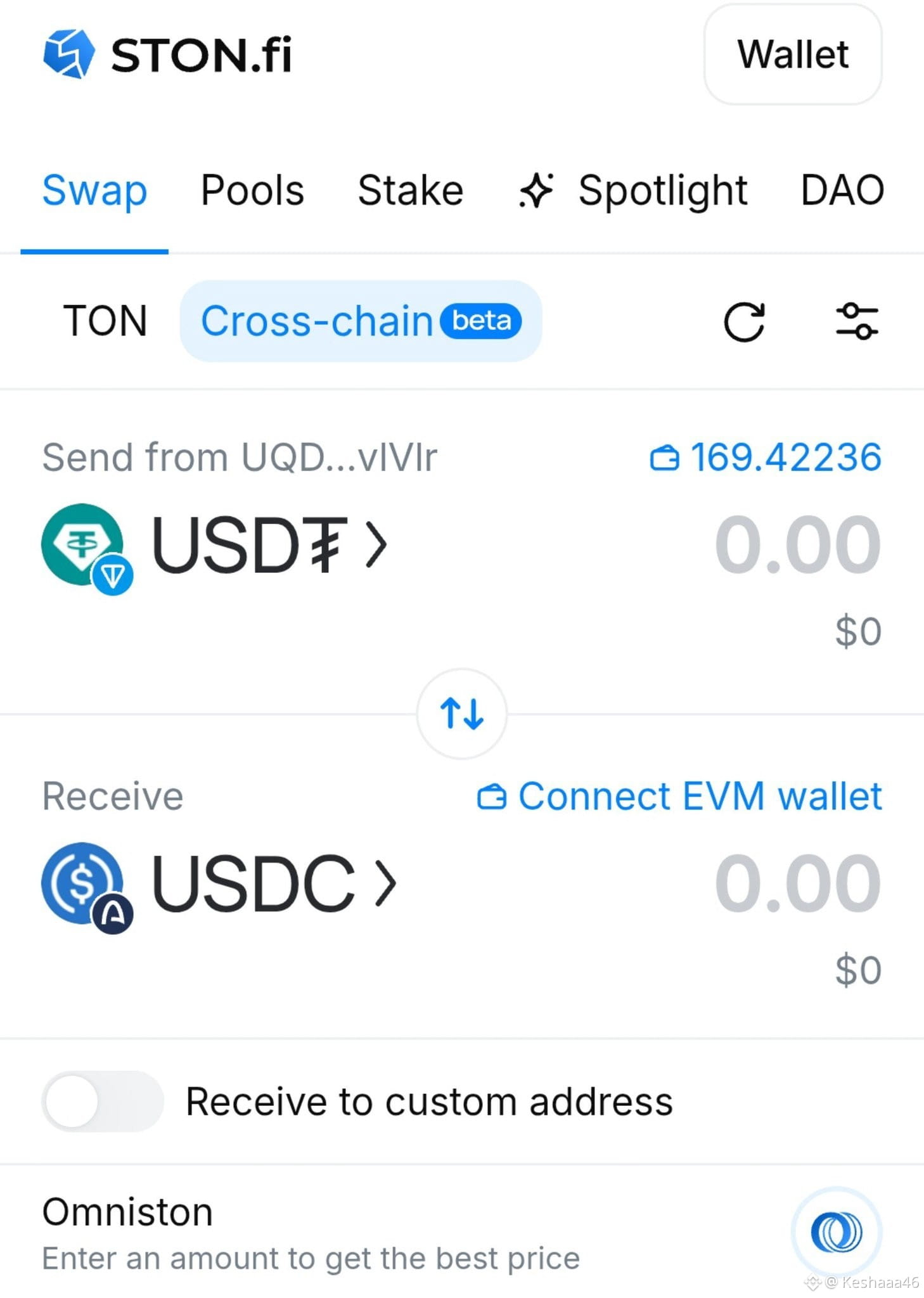
Friends, the new @arc network (from Circle) launched less than a week ago, and the STON.fi DEX has already connected it to its cross-chain infrastructure.
Now users can easily swap $USDC on the Arc network for TON network stablecoins.
In addition, right in the app, you have access to cross-chain swaps between the TON blockchain and other networks.
Currently supported tokens:
$USDT on TON
$USDG on Robinhood Chain
$USDT on TRON
$USDT and $USDC on Ethereum, BNB Chain, Base, and Avalanche
$USDT0 and $USDC on Arbitrum
$PUSD and $USDC on Polygon
$USDC and $USDT0 on X Layer
At the initial stage, a temporary limit applies: per transaction, you can swap tokens worth up to $1000.
#Arc #STON
Arc Network in STON.fi
Friends, the new @arc network (from Circle) launched less than a week ago, and the STON.fi DEX has already connected it to its cross-chain infrastructure.
Now users can easily swap $USDC on the Arc network for TON network stablecoins.
In addition, right in the app, you have access to cross-chain swaps between the TON blockchain and other networks.
Currently supported tokens:
$USDT on TON
$USDG on Robinhood Chain
$USDT on TRON
$USDT and $USDC on Ethereum, BNB Chain, Base, and Avalanche
$USDT0 and $USDC on Arbitrum
$PUSD and $USDC on Polygon
$USDC and $USDT0 on X Layer
At the initial stage, a temporary limit applies: per transaction, you can swap tokens worth up to $1000.
#Arc #STON
Friends, the new @arc network (from Circle) launched less than a week ago, and the STON.fi DEX has already connected it to its cross-chain infrastructure.
Now users can easily swap $USDC on the Arc network for TON network stablecoins.
In addition, right in the app, you have access to cross-chain swaps between the TON blockchain and other networks.
Currently supported tokens:
$USDT on TON
$USDG on Robinhood Chain
$USDT on TRON
$USDT and $USDC on Ethereum, BNB Chain, Base, and Avalanche
$USDT0 and $USDC on Arbitrum
$PUSD and $USDC on Polygon
$USDC and $USDT0 on X Layer
At the initial stage, a temporary limit applies: per transaction, you can swap tokens worth up to $1000.
#Arc #STON
1
207
·
--
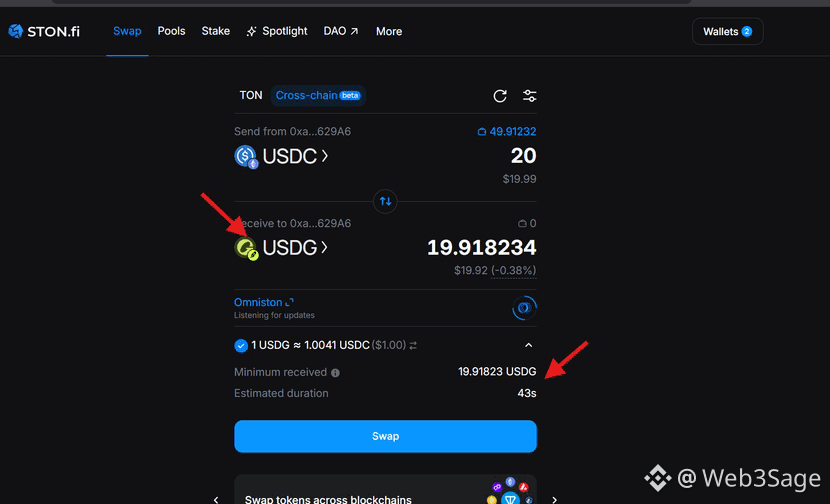
How to exchange stablecoins on the Ethereum network for stablecoins on the TON network?
Brothers, as you know, there used to be no convenient tools for exchanging stablecoins from the Ethereum network to the TON network. As a rule, one had to resort to using centralized exchanges.
Everything changed thanks to the integration of the Omniston protocol into the STON.fi DEX. Now, as quickly as possible and without any problems (and most importantly, with almost zero fees), you can swap stablecoins from the Ethereum network to the TON network or vice versa.
How does it work?
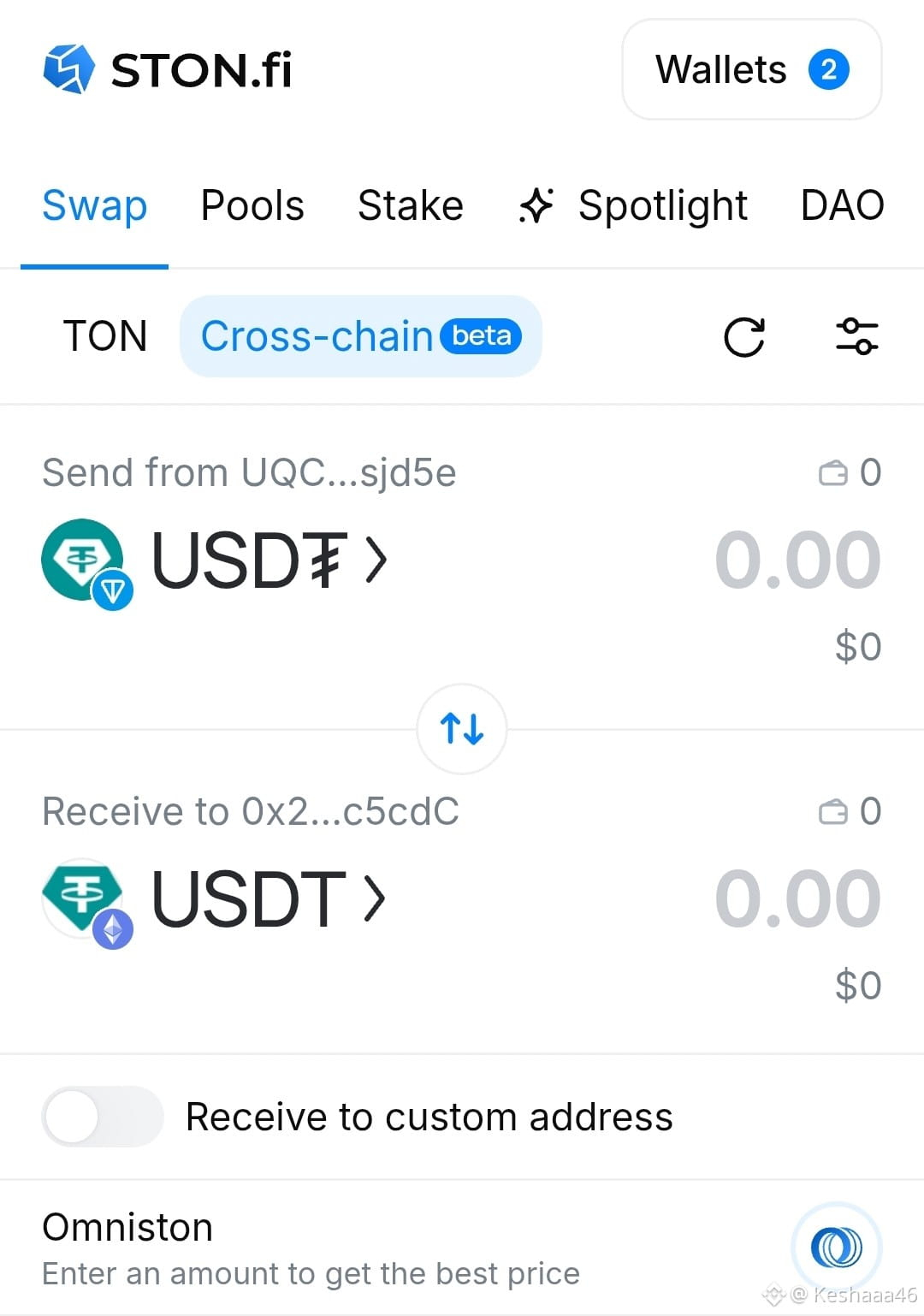
– Go to STON.fi and click on the "Cross-chain" section.
– In the "Wallet" section, connect a TON wallet and an EVM wallet to the terminal (I use MetaMask).
– Exchange stablecoins and sign the transactions in both wallets.
In addition, the app gives you access to exchanges between the TON blockchain and other networks (TRON, Polygon, Arbitrum, etc.).
At the initial stage, a temporary limit applies: per operation, you can exchange tokens worth up to $1000.
#STON #Ethereum #TON
How to exchange stablecoins on the Ethereum network for stablecoins on the TON network?
Brothers, as you know, there used to be no convenient tools for exchanging stablecoins from the Ethereum network to the TON network. As a rule, one had to resort to using centralized exchanges.
Everything changed thanks to the integration of the Omniston protocol into the STON.fi DEX. Now, as quickly as possible and without any problems (and most importantly, with almost zero fees), you can swap stablecoins from the Ethereum network to the TON network or vice versa.
How does it work?
– Go to STON.fi and click on the "Cross-chain" section.
– In the "Wallet" section, connect a TON wallet and an EVM wallet to the terminal (I use MetaMask).
– Exchange stablecoins and sign the transactions in both wallets.
In addition, the app gives you access to exchanges between the TON blockchain and other networks (TRON, Polygon, Arbitrum, etc.).
At the initial stage, a temporary limit applies: per operation, you can exchange tokens worth up to $1000.
#STON #Ethereum #TON
Brothers, as you know, there used to be no convenient tools for exchanging stablecoins from the Ethereum network to the TON network. As a rule, one had to resort to using centralized exchanges.
Everything changed thanks to the integration of the Omniston protocol into the STON.fi DEX. Now, as quickly as possible and without any problems (and most importantly, with almost zero fees), you can swap stablecoins from the Ethereum network to the TON network or vice versa.
How does it work?
– Go to STON.fi and click on the "Cross-chain" section.
– In the "Wallet" section, connect a TON wallet and an EVM wallet to the terminal (I use MetaMask).
– Exchange stablecoins and sign the transactions in both wallets.
In addition, the app gives you access to exchanges between the TON blockchain and other networks (TRON, Polygon, Arbitrum, etc.).
At the initial stage, a temporary limit applies: per operation, you can exchange tokens worth up to $1000.
#STON #Ethereum #TON
1
295
·
--
How to exchange stablecoins on the BNB BEP-20 network for stablecoins on the TON network?
Friends, exchanges between the TON and BNB BEP-20 networks have always been a big headache for crypto enthusiasts. As a rule, people had to resort to using centralized exchanges.
But everything changed after the BEP-20 network became available for cross-chain swaps on the largest DEX on TON, STON.fi.
Now you can, without any problems (and most importantly, with almost zero fees), swap stablecoins on the TON network to the BNB BEP-20 network or vice versa.
What do you need to do?
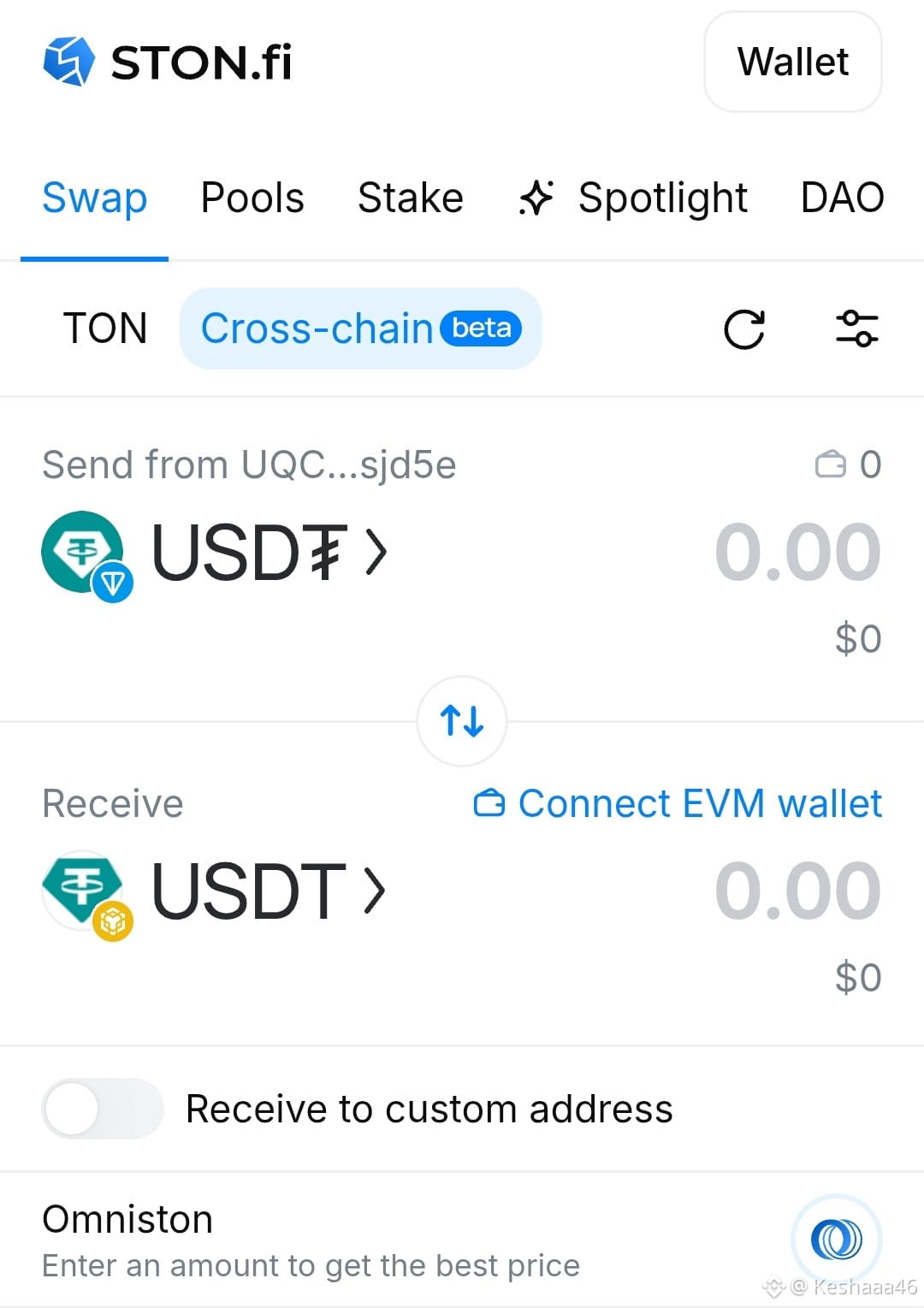
1️⃣ Go to STON.fi and click on the "Cross-chain" section.
2️⃣ In the "Wallet" section, connect a TON wallet and an EVM wallet to the terminal (I use MetaMask since it supports the BEP-20 network).
3️⃣ Swap the stablecoins and sign the transactions in both wallets.
In addition, the app gives you access to exchanges between the TON blockchain and other networks (TRON, Polygon, Arbitrum, and others).
At the initial stage, a temporary limit applies: in a single operation, you can exchange tokens worth up to $1,000.
#STON #bnb
How to exchange stablecoins on the BNB BEP-20 network for stablecoins on the TON network?
Friends, exchanges between the TON and BNB BEP-20 networks have always been a big headache for crypto enthusiasts. As a rule, people had to resort to using centralized exchanges.
But everything changed after the BEP-20 network became available for cross-chain swaps on the largest DEX on TON, STON.fi.
Now you can, without any problems (and most importantly, with almost zero fees), swap stablecoins on the TON network to the BNB BEP-20 network or vice versa.
What do you need to do?
1️⃣ Go to STON.fi and click on the "Cross-chain" section.
2️⃣ In the "Wallet" section, connect a TON wallet and an EVM wallet to the terminal (I use MetaMask since it supports the BEP-20 network).
3️⃣ Swap the stablecoins and sign the transactions in both wallets.
In addition, the app gives you access to exchanges between the TON blockchain and other networks (TRON, Polygon, Arbitrum, and others).
At the initial stage, a temporary limit applies: in a single operation, you can exchange tokens worth up to $1,000.
#STON #bnb
Friends, exchanges between the TON and BNB BEP-20 networks have always been a big headache for crypto enthusiasts. As a rule, people had to resort to using centralized exchanges.
But everything changed after the BEP-20 network became available for cross-chain swaps on the largest DEX on TON, STON.fi.
Now you can, without any problems (and most importantly, with almost zero fees), swap stablecoins on the TON network to the BNB BEP-20 network or vice versa.
What do you need to do?
1️⃣ Go to STON.fi and click on the "Cross-chain" section.
2️⃣ In the "Wallet" section, connect a TON wallet and an EVM wallet to the terminal (I use MetaMask since it supports the BEP-20 network).
3️⃣ Swap the stablecoins and sign the transactions in both wallets.
In addition, the app gives you access to exchanges between the TON blockchain and other networks (TRON, Polygon, Arbitrum, and others).
At the initial stage, a temporary limit applies: in a single operation, you can exchange tokens worth up to $1,000.
#STON #bnb
2
84
🦈 $STON IS PRINTING 300% MONTHLY CAPITAL VELOCITY WHILE WHALES ACCUMULATE ON TON! 💥
While retail sleeps on $TON consolidation, smart money is wringing max efficiency out of DEX liquidity on $STON . 📊 With just $25.13M in TVL generating $76.35M in monthly volume, capital turnover is humming at a fierce 3.0x ratio.
Cumulative volume hitting $8.634B proves this liquidity is actively working, not sitting idle like ghost chains. 🦈 Heavy order flow across top pools like $GRAM signals whales are quietly positioning right before the next volatility expansion.
When capital velocity hits these extreme tiers, price discovery rarely stays suppressed for long. 💬 Are you front-running this liquidity rotation or waiting for the breakout to print on your charts? 👇
⚠️ Not financial advice. Always manage your risk. 🛡️
🏷️ #STON #TON #DeFi #Altcoins #Crypto
🔥 ⚡
🦈 $STON IS PRINTING 300% MONTHLY CAPITAL VELOCITY WHILE WHALES ACCUMULATE ON TON! 💥
While retail sleeps on $TON consolidation, smart money is wringing max efficiency out of DEX liquidity on $STON . 📊 With just $25.13M in TVL generating $76.35M in monthly volume, capital turnover is humming at a fierce 3.0x ratio.
Cumulative volume hitting $8.634B proves this liquidity is actively working, not sitting idle like ghost chains. 🦈 Heavy order flow across top pools like $GRAM signals whales are quietly positioning right before the next volatility expansion.
When capital velocity hits these extreme tiers, price discovery rarely stays suppressed for long. 💬 Are you front-running this liquidity rotation or waiting for the breakout to print on your charts? 👇
⚠️ Not financial advice. Always manage your risk. 🛡️
🏷️ #STON #TON #DeFi #Altcoins #Crypto
🔥 ⚡
While retail sleeps on $TON consolidation, smart money is wringing max efficiency out of DEX liquidity on $STON . 📊 With just $25.13M in TVL generating $76.35M in monthly volume, capital turnover is humming at a fierce 3.0x ratio.
Cumulative volume hitting $8.634B proves this liquidity is actively working, not sitting idle like ghost chains. 🦈 Heavy order flow across top pools like $GRAM signals whales are quietly positioning right before the next volatility expansion.
When capital velocity hits these extreme tiers, price discovery rarely stays suppressed for long. 💬 Are you front-running this liquidity rotation or waiting for the breakout to print on your charts? 👇
⚠️ Not financial advice. Always manage your risk. 🛡️
🏷️ #STON #TON #DeFi #Altcoins #Crypto
🔥 ⚡

112
⚡ $STON DEX POSTS 300% CAPITAL EFFICIENCY AS INSTITUTIONAL FLOW ROTATES INTO TON! 📊
📌 Market structure across $STON reveals exceptional capital velocity, generating $76.35M in 30-day volume on a lean $25.13M TVL. This 3.0x monthly turnover ratio signals hyper-active liquidity utilization rather than passive capital dilution.
📊 With cumulative volume crossing $8.634B and 7-day throughput hitting $15.78M, smart money order flow is aggressively rotating through key pools like $GRAM . Capital isn't stagnant here; institutional operators are actively extracting maximum volume efficiency ahead of the next structural expansion.
💬 Are you tracking DEX volume velocity metrics, or only relying on headline TVL figures to spot ecosystem momentum? 👇
⚠️ Not financial advice. Always manage your risk. 🛡️
🏷️ #STON #TON #DeFi #Liquidity #Crypto
🦈 ⚡
⚡ $STON DEX POSTS 300% CAPITAL EFFICIENCY AS INSTITUTIONAL FLOW ROTATES INTO TON! 📊
📌 Market structure across $STON reveals exceptional capital velocity, generating $76.35M in 30-day volume on a lean $25.13M TVL. This 3.0x monthly turnover ratio signals hyper-active liquidity utilization rather than passive capital dilution.
📊 With cumulative volume crossing $8.634B and 7-day throughput hitting $15.78M, smart money order flow is aggressively rotating through key pools like $GRAM . Capital isn't stagnant here; institutional operators are actively extracting maximum volume efficiency ahead of the next structural expansion.
💬 Are you tracking DEX volume velocity metrics, or only relying on headline TVL figures to spot ecosystem momentum? 👇
⚠️ Not financial advice. Always manage your risk. 🛡️
🏷️ #STON #TON #DeFi #Liquidity #Crypto
🦈 ⚡
📌 Market structure across $STON reveals exceptional capital velocity, generating $76.35M in 30-day volume on a lean $25.13M TVL. This 3.0x monthly turnover ratio signals hyper-active liquidity utilization rather than passive capital dilution.
📊 With cumulative volume crossing $8.634B and 7-day throughput hitting $15.78M, smart money order flow is aggressively rotating through key pools like $GRAM . Capital isn't stagnant here; institutional operators are actively extracting maximum volume efficiency ahead of the next structural expansion.
💬 Are you tracking DEX volume velocity metrics, or only relying on headline TVL figures to spot ecosystem momentum? 👇
⚠️ Not financial advice. Always manage your risk. 🛡️
🏷️ #STON #TON #DeFi #Liquidity #Crypto
🦈 ⚡

65

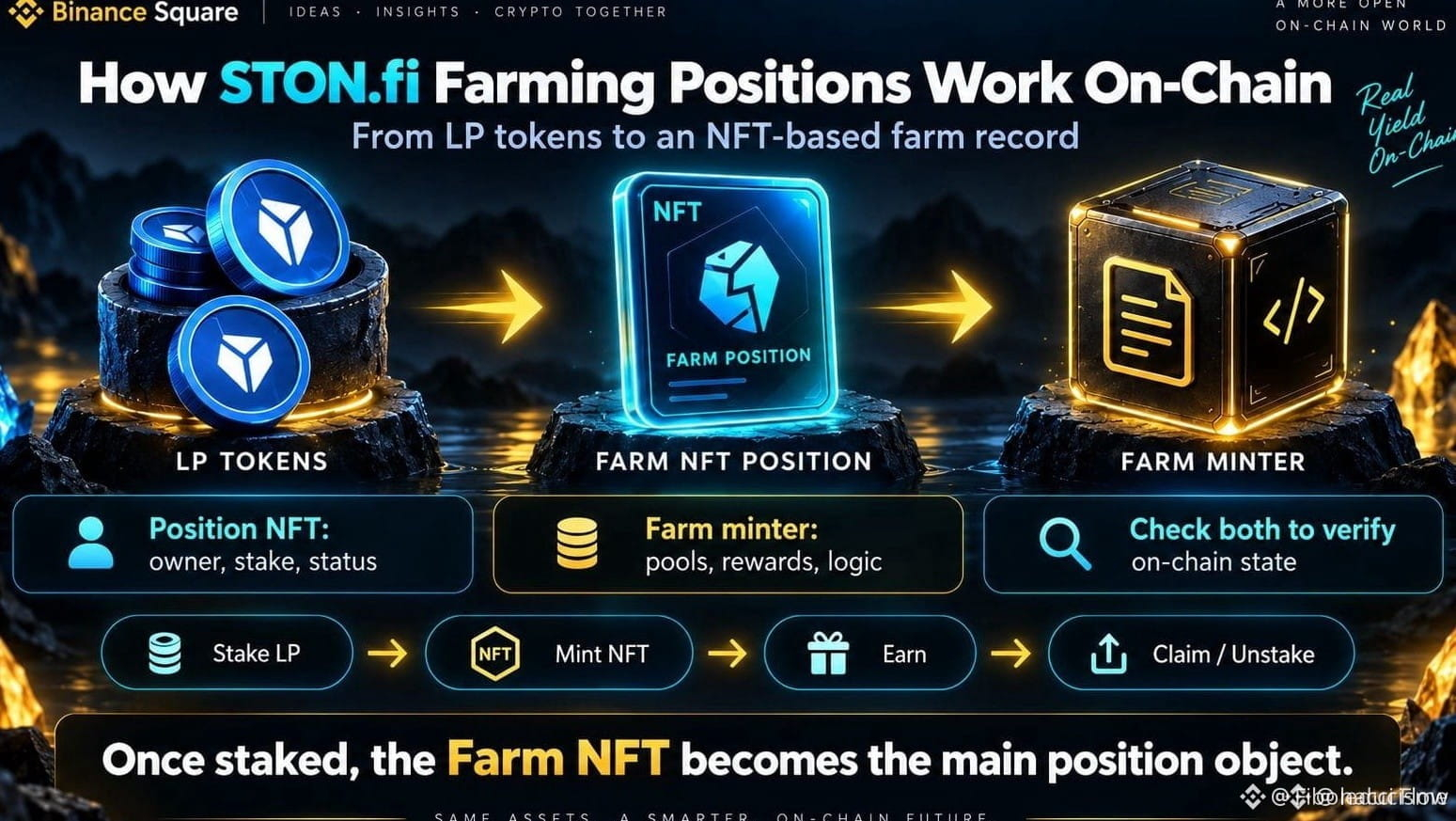
🚀 $STON & $GRAM YIELD BLAST: NFT FARM V3 UNLEASHES DOUBLE PROFITS! 🦈
📊 STON.fi just dropped Farm V3, swapping traditional staking for on‑chain NFT‑tracked LP positions. The NFT wrapper locks your stake, guarantees reward flow and wipes out slippage—smooth as silk on the blockchain.
⚡ Smart money isn’t idling on cash; they’re loading $STON + $GRAM into the dual‑farm to capture the full APY wave. With LP tokens minted as NFTs, you harvest compounded yields while the liquidity pool rides the current bullish tide. 🌊
💬 Are you staking your LP now or watching from the sidelines? 👇
⚠️ Not financial advice. Always manage your risk. 🛡️
🏷️ #STON #YieldFarming #NFT #DeFi #Crypto
🔥 💎
🚀 $STON & $GRAM YIELD BLAST: NFT FARM V3 UNLEASHES DOUBLE PROFITS! 🦈
📊 STON.fi just dropped Farm V3, swapping traditional staking for on‑chain NFT‑tracked LP positions. The NFT wrapper locks your stake, guarantees reward flow and wipes out slippage—smooth as silk on the blockchain.
⚡ Smart money isn’t idling on cash; they’re loading $STON + $GRAM into the dual‑farm to capture the full APY wave. With LP tokens minted as NFTs, you harvest compounded yields while the liquidity pool rides the current bullish tide. 🌊
💬 Are you staking your LP now or watching from the sidelines? 👇
⚠️ Not financial advice. Always manage your risk. 🛡️
🏷️ #STON #YieldFarming #NFT #DeFi #Crypto
🔥 💎
📊 STON.fi just dropped Farm V3, swapping traditional staking for on‑chain NFT‑tracked LP positions. The NFT wrapper locks your stake, guarantees reward flow and wipes out slippage—smooth as silk on the blockchain.
⚡ Smart money isn’t idling on cash; they’re loading $STON + $GRAM into the dual‑farm to capture the full APY wave. With LP tokens minted as NFTs, you harvest compounded yields while the liquidity pool rides the current bullish tide. 🌊
💬 Are you staking your LP now or watching from the sidelines? 👇
⚠️ Not financial advice. Always manage your risk. 🛡️
🏷️ #STON #YieldFarming #NFT #DeFi #Crypto
🔥 💎
157

·
--
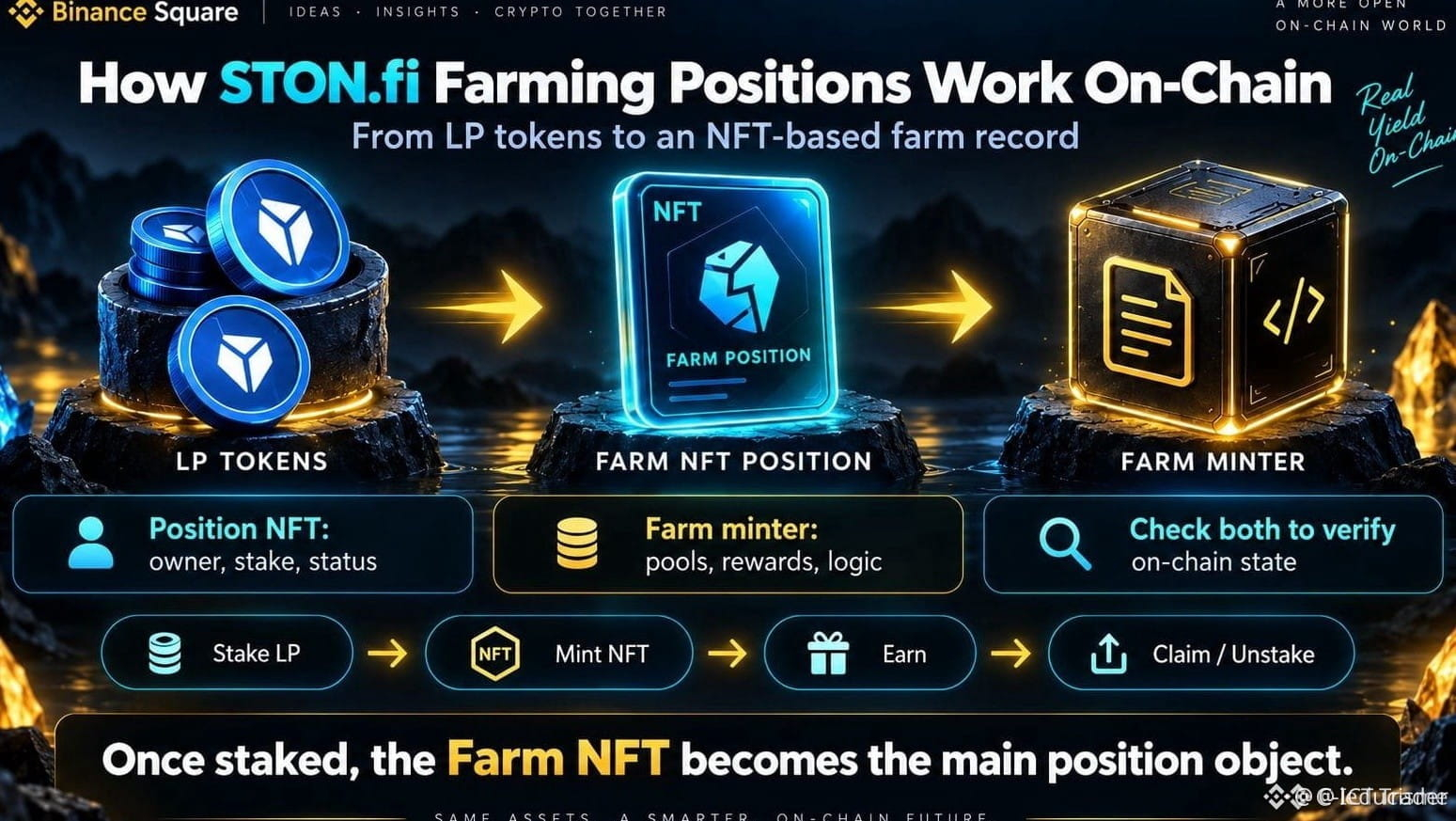
🚀 $STON & $GRAM YIELD FARM V3 UNLEASHES DOUBLE DIGIT APY! ⚡
📊 The freshly launched STON.fi Farm v3 pairs $STON and $GRAM LPs with on‑chain NFT position tracking, delivering a frictionless staking experience. NFTs lock institutional‑grade liquidity, guaranteeing immutable reward distribution.
🦈 Current APY metrics are soaring, with the dual‑token farm delivering near‑double‑digit yields that dwarf static cash holdings. Smart money is already reallocating capital from passive APY products into this LP‑stake, chasing the liquidity premium.
💡 Positioning now captures the yield wave before the next liquidity sweep resets rates. 💬 Are you ready to lock your LPs and let the NFT‑managed farm compound your exposure? 👇
⚠️ Not financial advice. Always manage your risk. 🛡️
🏷️ #STON #YieldFarm #DeFi #Liquidity #Crypto
🚀 🦈
🚀 $STON & $GRAM YIELD FARM V3 UNLEASHES DOUBLE DIGIT APY! ⚡
📊 The freshly launched STON.fi Farm v3 pairs $STON and $GRAM LPs with on‑chain NFT position tracking, delivering a frictionless staking experience. NFTs lock institutional‑grade liquidity, guaranteeing immutable reward distribution.
🦈 Current APY metrics are soaring, with the dual‑token farm delivering near‑double‑digit yields that dwarf static cash holdings. Smart money is already reallocating capital from passive APY products into this LP‑stake, chasing the liquidity premium.
💡 Positioning now captures the yield wave before the next liquidity sweep resets rates. 💬 Are you ready to lock your LPs and let the NFT‑managed farm compound your exposure? 👇
⚠️ Not financial advice. Always manage your risk. 🛡️
🏷️ #STON #YieldFarm #DeFi #Liquidity #Crypto
🚀 🦈
📊 The freshly launched STON.fi Farm v3 pairs $STON and $GRAM LPs with on‑chain NFT position tracking, delivering a frictionless staking experience. NFTs lock institutional‑grade liquidity, guaranteeing immutable reward distribution.
🦈 Current APY metrics are soaring, with the dual‑token farm delivering near‑double‑digit yields that dwarf static cash holdings. Smart money is already reallocating capital from passive APY products into this LP‑stake, chasing the liquidity premium.
💡 Positioning now captures the yield wave before the next liquidity sweep resets rates. 💬 Are you ready to lock your LPs and let the NFT‑managed farm compound your exposure? 👇
⚠️ Not financial advice. Always manage your risk. 🛡️
🏷️ #STON #YieldFarm #DeFi #Liquidity #Crypto
🚀 🦈
149
·
--
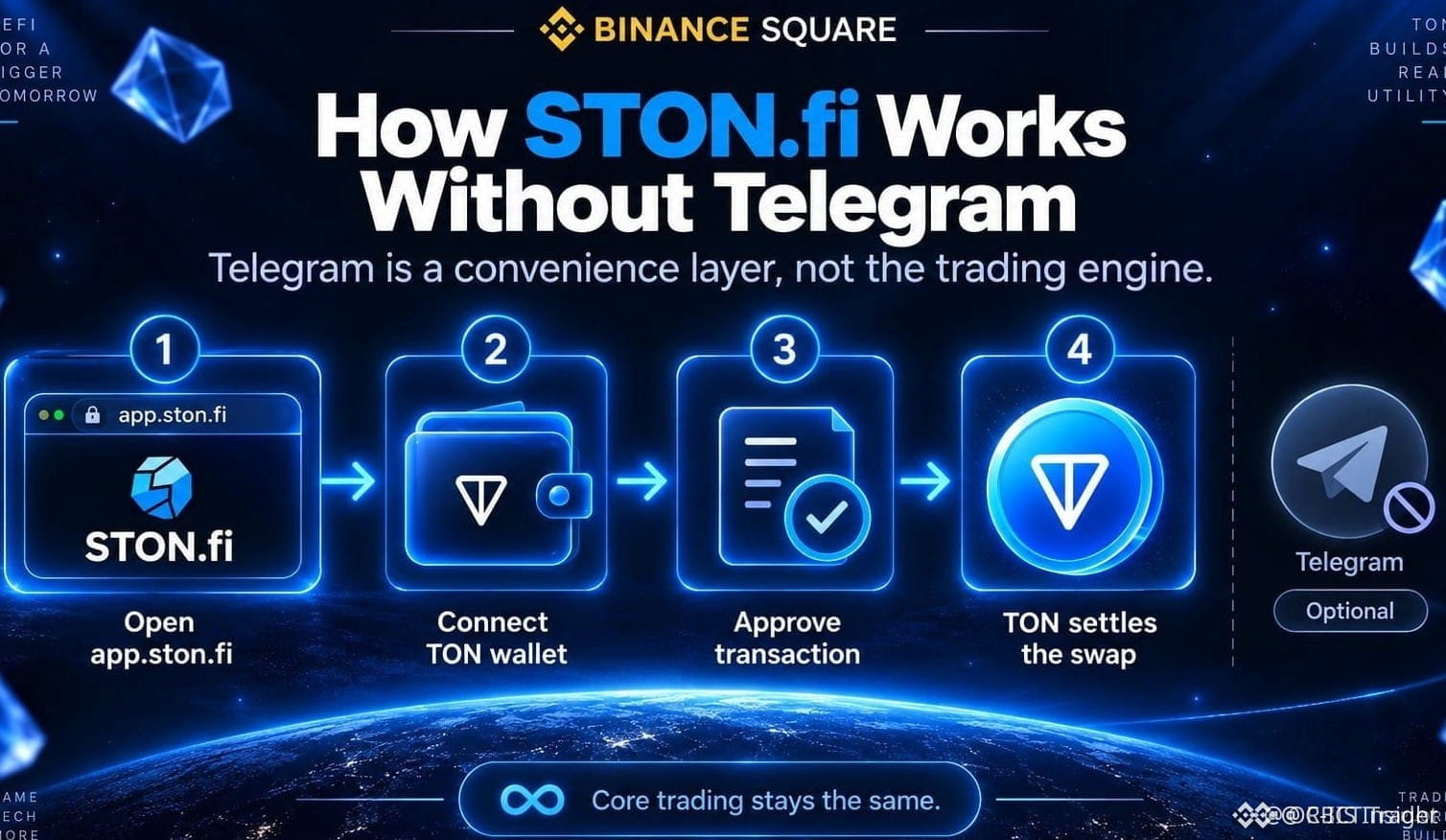
🚨 OPTIMIZING $STON EXECUTION: BYPASS TELEGRAM UI LATENCY FOR DIRECT DEX ROUTING ⚡
Execution speed and non-custodial integrity are paramount when navigating decentralized order flow. Bypassing Telegram mini-app interfaces in favor of dedicated browser endpoints gives traders direct smart contract interactions on the $TON network via standalone wallets like Tonkeeper. 🔍
This structural setup eliminates unnecessary interface lag, allowing seamless liquidity fills across pair pools like $STON and $GRAM without compromising private key security. ⚡ Standardizing your Web3 execution environment ensures optimal order placement during high-volatility liquidity events. 💡
💬 Are you routing your trades directly through web interfaces, or still relying on chat app latency? 👇
⚠️ Not financial advice. Always manage your risk. 🛡️
🏷️ #STON #TON #DEX #Web3 #Crypto
🎯 🦈
🚨 OPTIMIZING $STON EXECUTION: BYPASS TELEGRAM UI LATENCY FOR DIRECT DEX ROUTING ⚡
Execution speed and non-custodial integrity are paramount when navigating decentralized order flow. Bypassing Telegram mini-app interfaces in favor of dedicated browser endpoints gives traders direct smart contract interactions on the $TON network via standalone wallets like Tonkeeper. 🔍
This structural setup eliminates unnecessary interface lag, allowing seamless liquidity fills across pair pools like $STON and $GRAM without compromising private key security. ⚡ Standardizing your Web3 execution environment ensures optimal order placement during high-volatility liquidity events. 💡
💬 Are you routing your trades directly through web interfaces, or still relying on chat app latency? 👇
⚠️ Not financial advice. Always manage your risk. 🛡️
🏷️ #STON #TON #DEX #Web3 #Crypto
🎯 🦈
Execution speed and non-custodial integrity are paramount when navigating decentralized order flow. Bypassing Telegram mini-app interfaces in favor of dedicated browser endpoints gives traders direct smart contract interactions on the $TON network via standalone wallets like Tonkeeper. 🔍
This structural setup eliminates unnecessary interface lag, allowing seamless liquidity fills across pair pools like $STON and $GRAM without compromising private key security. ⚡ Standardizing your Web3 execution environment ensures optimal order placement during high-volatility liquidity events. 💡
💬 Are you routing your trades directly through web interfaces, or still relying on chat app latency? 👇
⚠️ Not financial advice. Always manage your risk. 🛡️
🏷️ #STON #TON #DEX #Web3 #Crypto
🎯 🦈
90
·
--
“One Swap. Across Chains” Campaign: Join the Waitlist and Earn 1,000 Bonus Miles
Stonfiers, “One Swap. Across Chains” is STON.fi’s guided campaign designed to introduce users to cross-chain swaps through interactive activities and missions.
Start by joining the waitlist, completing the initial onboarding tasks, and building your miles balance. As the campaign progresses, new swap missions and rewards will become available.
Priority Access for the First 1,000 Users
The first 1,000 participants who connect their TON wallet during the waitlist phase will receive:
1,000 bonus miles
A personalized Priority Passenger Ticket
Priority status with potential benefits to be revealed during the campaign
The campaign begins with a two-week waitlist period. This gives participants an opportunity to complete the initial tasks, accumulate miles, and prepare for the main campaign.
Earn Miles and Access Flight Deals
Miles serve as the campaign’s points system. You can earn them by completing waitlist activities and, later, participating in interactive missions.
Throughout the campaign, accumulated miles can be used for weekly limited Flight Deals featuring various reward opportunities.
The 1,000-mile joining bonus is available exclusively during the waitlist stage, with only 1,000 Priority Passenger spots available.
How to Get Started
Connect your TON wallet and link the Telegram bot
Complete the available waitlist tasks
Start building your miles balance
Secure your spot before all 1,000 Priority Passenger Tickets are claimed.
Join the Waitlist
Stay tuned as the cross chain journey continues.
#STON #swap #cryptonews
“One Swap. Across Chains” Campaign: Join the Waitlist and Earn 1,000 Bonus Miles
Stonfiers, “One Swap. Across Chains” is STON.fi’s guided campaign designed to introduce users to cross-chain swaps through interactive activities and missions.
Start by joining the waitlist, completing the initial onboarding tasks, and building your miles balance. As the campaign progresses, new swap missions and rewards will become available.
Priority Access for the First 1,000 Users
The first 1,000 participants who connect their TON wallet during the waitlist phase will receive:
1,000 bonus miles
A personalized Priority Passenger Ticket
Priority status with potential benefits to be revealed during the campaign
The campaign begins with a two-week waitlist period. This gives participants an opportunity to complete the initial tasks, accumulate miles, and prepare for the main campaign.
Earn Miles and Access Flight Deals
Miles serve as the campaign’s points system. You can earn them by completing waitlist activities and, later, participating in interactive missions.
Throughout the campaign, accumulated miles can be used for weekly limited Flight Deals featuring various reward opportunities.
The 1,000-mile joining bonus is available exclusively during the waitlist stage, with only 1,000 Priority Passenger spots available.
How to Get Started
Connect your TON wallet and link the Telegram bot
Complete the available waitlist tasks
Start building your miles balance
Secure your spot before all 1,000 Priority Passenger Tickets are claimed.
Join the Waitlist
Stay tuned as the cross chain journey continues.
#STON #swap #cryptonews
Stonfiers, “One Swap. Across Chains” is STON.fi’s guided campaign designed to introduce users to cross-chain swaps through interactive activities and missions.
Start by joining the waitlist, completing the initial onboarding tasks, and building your miles balance. As the campaign progresses, new swap missions and rewards will become available.
Priority Access for the First 1,000 Users
The first 1,000 participants who connect their TON wallet during the waitlist phase will receive:
1,000 bonus miles
A personalized Priority Passenger Ticket
Priority status with potential benefits to be revealed during the campaign
The campaign begins with a two-week waitlist period. This gives participants an opportunity to complete the initial tasks, accumulate miles, and prepare for the main campaign.
Earn Miles and Access Flight Deals
Miles serve as the campaign’s points system. You can earn them by completing waitlist activities and, later, participating in interactive missions.
Throughout the campaign, accumulated miles can be used for weekly limited Flight Deals featuring various reward opportunities.
The 1,000-mile joining bonus is available exclusively during the waitlist stage, with only 1,000 Priority Passenger spots available.
How to Get Started
Connect your TON wallet and link the Telegram bot
Complete the available waitlist tasks
Start building your miles balance
Secure your spot before all 1,000 Priority Passenger Tickets are claimed.
Join the Waitlist
Stay tuned as the cross chain journey continues.
#STON #swap #cryptonews
1
44
·
--
While many platforms compete mainly for visibility, others are centered on creating products people genuinely keep using over time.
By combining rapid trade execution, minimal fees, user friendly interfaces, and ongoing protocol upgrades, STONfi is contributing to a more efficient and scalable DeFi environment across the TON ecosystem.
Instead of depending on temporary hype cycles, the platform continues to emphasize long term utility, smooth user experience, and durable ecosystem development qualities that are becoming more valuable as TON adoption continues to grow.
#ston #Cryptonews #web3 #Ton
While many platforms compete mainly for visibility, others are centered on creating products people genuinely keep using over time.
By combining rapid trade execution, minimal fees, user friendly interfaces, and ongoing protocol upgrades, STONfi is contributing to a more efficient and scalable DeFi environment across the TON ecosystem.
Instead of depending on temporary hype cycles, the platform continues to emphasize long term utility, smooth user experience, and durable ecosystem development qualities that are becoming more valuable as TON adoption continues to grow.
#ston #Cryptonews #web3 #Ton
By combining rapid trade execution, minimal fees, user friendly interfaces, and ongoing protocol upgrades, STONfi is contributing to a more efficient and scalable DeFi environment across the TON ecosystem.
Instead of depending on temporary hype cycles, the platform continues to emphasize long term utility, smooth user experience, and durable ecosystem development qualities that are becoming more valuable as TON adoption continues to grow.
#ston #Cryptonews #web3 #Ton
87
·
--
STON.fi Expands Cross-Chain Swaps With Avalanche & Arbitrum
Stonfiers! The STON.fi cross-chain ecosystem continues to grow, with Avalanche and Arbitrum now added for stablecoin swaps.
Users can seamlessly swap supported stablecoins between TON and top EVM networks directly inside the STON.fi app — all in one interface, with no need for additional platforms or tabs.
Supported networks & assets:
• TON — USDT
• Avalanche — USDT, USDC
• Arbitrum — USDT0, USDC
• Base — USDT, USDC
• Ethereum — USDT, USDC
• BNB Chain — USDT, USDC
• Polygon — PUSD, USDC
The entire process is powered by Omniston, STON.fi’s cross chain execution protocol. Thanks to atomic execution, swaps only complete if the exact quoted amount can be delivered otherwise, the transaction is canceled and funds are fully returned.
Cross chain swaps are currently limited to $1,000 per transaction during the early rollout phase.
Start swapping across chains on STON.fi
Stay tuned for more network expansions and updates.
#Ston #Cryptonews #Markets
STON.fi Expands Cross-Chain Swaps With Avalanche & Arbitrum
Stonfiers! The STON.fi cross-chain ecosystem continues to grow, with Avalanche and Arbitrum now added for stablecoin swaps.
Users can seamlessly swap supported stablecoins between TON and top EVM networks directly inside the STON.fi app — all in one interface, with no need for additional platforms or tabs.
Supported networks & assets:
• TON — USDT
• Avalanche — USDT, USDC
• Arbitrum — USDT0, USDC
• Base — USDT, USDC
• Ethereum — USDT, USDC
• BNB Chain — USDT, USDC
• Polygon — PUSD, USDC
The entire process is powered by Omniston, STON.fi’s cross chain execution protocol. Thanks to atomic execution, swaps only complete if the exact quoted amount can be delivered otherwise, the transaction is canceled and funds are fully returned.
Cross chain swaps are currently limited to $1,000 per transaction during the early rollout phase.
Start swapping across chains on STON.fi
Stay tuned for more network expansions and updates.
#Ston #Cryptonews #Markets
Stonfiers! The STON.fi cross-chain ecosystem continues to grow, with Avalanche and Arbitrum now added for stablecoin swaps.
Users can seamlessly swap supported stablecoins between TON and top EVM networks directly inside the STON.fi app — all in one interface, with no need for additional platforms or tabs.
Supported networks & assets:
• TON — USDT
• Avalanche — USDT, USDC
• Arbitrum — USDT0, USDC
• Base — USDT, USDC
• Ethereum — USDT, USDC
• BNB Chain — USDT, USDC
• Polygon — PUSD, USDC
The entire process is powered by Omniston, STON.fi’s cross chain execution protocol. Thanks to atomic execution, swaps only complete if the exact quoted amount can be delivered otherwise, the transaction is canceled and funds are fully returned.
Cross chain swaps are currently limited to $1,000 per transaction during the early rollout phase.
Start swapping across chains on STON.fi
Stay tuned for more network expansions and updates.
#Ston #Cryptonews #Markets
77

·
--

Article
TON's Big Week: Cross Chain Swaps, A Name Change, And 4.7X Growth 📈Here's what happened this week in the TON ecosystem and why you should care.
STON.fi just dropped a massive update You can now swap tokens between TON and Ethereum, Base, BNB Chain, and Polygon all without leaving the app.No bridges, no complicated interfaces Just one click.
Oh, and Toncoin is now called Gram Community voted for it. It's official.
The Numbers That Made Me Do A Double Take $331 million swapped in May That's 4.7x HIGHER than April.
Let that sink in A nearly 5x jump in one month. If you've been around crypto long enough, you know that kind of growth doesn't happen by accident TON is heating up.Total Value Locked sits at $28.2 million, Weekly swap volume? $25.4 million, Liquidity providers earned almost $40,000 in fees this week alone.
My take: The "Mtonga Plan" they keep mentioning is clearly working. More activity = stronger DeFi = healthier ecosystem. Basic economics, but in crypto, execution is everything.
The Cross Chain Update: What It Actually Means. Remember when moving tokens between blockchains felt like navigating a maze blindfolded? Bridge this Wrap that. Wait 20 minutes Pay insane gas Hope nothing breaks.That pain? It's over on TON.
STON.fi integrated something called Omniston. Started as a TON liquidity tool. Now it coordinates swaps across multiple chains. You pick your token, pick your destination chain, and the system handles the rest.
What you can do: Move USDT from Ethereum to TON directly Swap TON for tokens on Polygon, Bridge assets to Base. All inside one interface.No more jumping between five different apps No more bridge anxiety.
This is actually huge Most people don't realize how fragmented DeFi has become This fixes one of the biggest friction points in crypto. Is Now Gram Here's Why It MattersThe community voted Toncoin becomes Gram. GRAM as the ticker.
Why? Nostalgia, mostly. The project originally had this name before the SEC drama. Now it's back Feels like a full circle moment.
Important: There's no token swap needed. Your Toncoin IS Gram now. Just updated names and logos across wallets. If you see "Toncoin (GRAM)" or just "GRAM" in your wallet over the next few days, that's why.
The tsTON Pool: 6x APR Growth Explained This deserves attention. Two recent TON blockchain upgrades changed how tsTON yields work. Result? APR on tsTON liquidity positions shot up 6x.
Simple breakdown:
. tsTON represents staked TON
· As TON staking rewards accumulate, tsTON increases in value
· Add swap fees on top of that
· You earn yield on yield
The tsTON/GRAM pool specifically is interesting because both tokens benefit from staking and trading activity. If you're yield farming, this one's worth a look APR numbers are looking spicy.
Stonbassadors Program: Get Paid To Create Content 511 ambassadors shared 10,400 STON this month.
Want in? They're specifically looking for cross-chain swap content right now tutorials, comparisons, analysis.If you're decent at making content and understand DeFi, this is an easy way to stack tokens.
Gramstox Integration: Real-World Use Case
Gramstox (a Telegram mini app for tokenized stocks) just integrated Omniston for xStocks swaps.Think of it this way You can now trade tokenized stocks directly in Telegram, and Omniston handles the swapping behind the scenes Seamless. If you're building on TON, the SDK is available Minimum effort integration.
My Honest Take:
This was a busy week for TON DeFi. The cross chain swap feature is genuinely useful. The name change is mostly symbolic but community driven decisions are always good to see The growth numbers speak for themselves.
What I'm watching How many people actually use the cross chain feature, and whether the tsTON yields stay attractive.
TON still has work to do on user education and mainstream adoption. But weeks like this show momentum And in crypto, momentum is everything.
Farms Worth Watching:
. USD₮/JETTON → 98% APR
· TONG/GRAM → 70% APR
· STON/USD₮ → 14% APR
More pools available on STON.fi.
Stay tuned for more updates TON isn't slowing down.
What do you think about the name change? And are you using cross chain swaps yet? Drop your thoughts below.👇
#defi #ston #STONfi #TON
TON's Big Week: Cross Chain Swaps, A Name Change, And 4.7X Growth 📈
Here's what happened this week in the TON ecosystem and why you should care.
STON.fi just dropped a massive update You can now swap tokens between TON and Ethereum, Base, BNB Chain, and Polygon all without leaving the app.No bridges, no complicated interfaces Just one click.
Oh, and Toncoin is now called Gram Community voted for it. It's official.
The Numbers That Made Me Do A Double Take $331 million swapped in May That's 4.7x HIGHER than April.
Let that sink in A nearly 5x jump in one month. If you've been around crypto long enough, you know that kind of growth doesn't happen by accident TON is heating up.Total Value Locked sits at $28.2 million, Weekly swap volume? $25.4 million, Liquidity providers earned almost $40,000 in fees this week alone.
My take: The "Mtonga Plan" they keep mentioning is clearly working. More activity = stronger DeFi = healthier ecosystem. Basic economics, but in crypto, execution is everything.
The Cross Chain Update: What It Actually Means. Remember when moving tokens between blockchains felt like navigating a maze blindfolded? Bridge this Wrap that. Wait 20 minutes Pay insane gas Hope nothing breaks.That pain? It's over on TON.
STON.fi integrated something called Omniston. Started as a TON liquidity tool. Now it coordinates swaps across multiple chains. You pick your token, pick your destination chain, and the system handles the rest.
What you can do: Move USDT from Ethereum to TON directly Swap TON for tokens on Polygon, Bridge assets to Base. All inside one interface.No more jumping between five different apps No more bridge anxiety.
This is actually huge Most people don't realize how fragmented DeFi has become This fixes one of the biggest friction points in crypto. Is Now Gram Here's Why It MattersThe community voted Toncoin becomes Gram. GRAM as the ticker.
Why? Nostalgia, mostly. The project originally had this name before the SEC drama. Now it's back Feels like a full circle moment.
Important: There's no token swap needed. Your Toncoin IS Gram now. Just updated names and logos across wallets. If you see "Toncoin (GRAM)" or just "GRAM" in your wallet over the next few days, that's why.
The tsTON Pool: 6x APR Growth Explained This deserves attention. Two recent TON blockchain upgrades changed how tsTON yields work. Result? APR on tsTON liquidity positions shot up 6x.
Simple breakdown:
. tsTON represents staked TON
· As TON staking rewards accumulate, tsTON increases in value
· Add swap fees on top of that
· You earn yield on yield
The tsTON/GRAM pool specifically is interesting because both tokens benefit from staking and trading activity. If you're yield farming, this one's worth a look APR numbers are looking spicy.
Stonbassadors Program: Get Paid To Create Content 511 ambassadors shared 10,400 STON this month.
Want in? They're specifically looking for cross-chain swap content right now tutorials, comparisons, analysis.If you're decent at making content and understand DeFi, this is an easy way to stack tokens.
Gramstox Integration: Real-World Use Case
Gramstox (a Telegram mini app for tokenized stocks) just integrated Omniston for xStocks swaps.Think of it this way You can now trade tokenized stocks directly in Telegram, and Omniston handles the swapping behind the scenes Seamless. If you're building on TON, the SDK is available Minimum effort integration.
My Honest Take:
This was a busy week for TON DeFi. The cross chain swap feature is genuinely useful. The name change is mostly symbolic but community driven decisions are always good to see The growth numbers speak for themselves.
What I'm watching How many people actually use the cross chain feature, and whether the tsTON yields stay attractive.
TON still has work to do on user education and mainstream adoption. But weeks like this show momentum And in crypto, momentum is everything.
Farms Worth Watching:
. USD₮/JETTON → 98% APR
· TONG/GRAM → 70% APR
· STON/USD₮ → 14% APR
More pools available on STON.fi.
Stay tuned for more updates TON isn't slowing down.
What do you think about the name change? And are you using cross chain swaps yet? Drop your thoughts below.👇
#defi #ston #STONfi #TON
STON.fi just dropped a massive update You can now swap tokens between TON and Ethereum, Base, BNB Chain, and Polygon all without leaving the app.No bridges, no complicated interfaces Just one click.
Oh, and Toncoin is now called Gram Community voted for it. It's official.
The Numbers That Made Me Do A Double Take $331 million swapped in May That's 4.7x HIGHER than April.
Let that sink in A nearly 5x jump in one month. If you've been around crypto long enough, you know that kind of growth doesn't happen by accident TON is heating up.Total Value Locked sits at $28.2 million, Weekly swap volume? $25.4 million, Liquidity providers earned almost $40,000 in fees this week alone.
My take: The "Mtonga Plan" they keep mentioning is clearly working. More activity = stronger DeFi = healthier ecosystem. Basic economics, but in crypto, execution is everything.
The Cross Chain Update: What It Actually Means. Remember when moving tokens between blockchains felt like navigating a maze blindfolded? Bridge this Wrap that. Wait 20 minutes Pay insane gas Hope nothing breaks.That pain? It's over on TON.
STON.fi integrated something called Omniston. Started as a TON liquidity tool. Now it coordinates swaps across multiple chains. You pick your token, pick your destination chain, and the system handles the rest.
What you can do: Move USDT from Ethereum to TON directly Swap TON for tokens on Polygon, Bridge assets to Base. All inside one interface.No more jumping between five different apps No more bridge anxiety.
This is actually huge Most people don't realize how fragmented DeFi has become This fixes one of the biggest friction points in crypto. Is Now Gram Here's Why It MattersThe community voted Toncoin becomes Gram. GRAM as the ticker.
Why? Nostalgia, mostly. The project originally had this name before the SEC drama. Now it's back Feels like a full circle moment.
Important: There's no token swap needed. Your Toncoin IS Gram now. Just updated names and logos across wallets. If you see "Toncoin (GRAM)" or just "GRAM" in your wallet over the next few days, that's why.
The tsTON Pool: 6x APR Growth Explained This deserves attention. Two recent TON blockchain upgrades changed how tsTON yields work. Result? APR on tsTON liquidity positions shot up 6x.
Simple breakdown:
. tsTON represents staked TON
· As TON staking rewards accumulate, tsTON increases in value
· Add swap fees on top of that
· You earn yield on yield
The tsTON/GRAM pool specifically is interesting because both tokens benefit from staking and trading activity. If you're yield farming, this one's worth a look APR numbers are looking spicy.
Stonbassadors Program: Get Paid To Create Content 511 ambassadors shared 10,400 STON this month.
Want in? They're specifically looking for cross-chain swap content right now tutorials, comparisons, analysis.If you're decent at making content and understand DeFi, this is an easy way to stack tokens.
Gramstox Integration: Real-World Use Case
Gramstox (a Telegram mini app for tokenized stocks) just integrated Omniston for xStocks swaps.Think of it this way You can now trade tokenized stocks directly in Telegram, and Omniston handles the swapping behind the scenes Seamless. If you're building on TON, the SDK is available Minimum effort integration.
My Honest Take:
This was a busy week for TON DeFi. The cross chain swap feature is genuinely useful. The name change is mostly symbolic but community driven decisions are always good to see The growth numbers speak for themselves.
What I'm watching How many people actually use the cross chain feature, and whether the tsTON yields stay attractive.
TON still has work to do on user education and mainstream adoption. But weeks like this show momentum And in crypto, momentum is everything.
Farms Worth Watching:
. USD₮/JETTON → 98% APR
· TONG/GRAM → 70% APR
· STON/USD₮ → 14% APR
More pools available on STON.fi.
Stay tuned for more updates TON isn't slowing down.
What do you think about the name change? And are you using cross chain swaps yet? Drop your thoughts below.👇
#defi #ston #STONfi #TON
1
109

·
--
Bullish
Every Great DeFi Ecosystem Needs a Liquidity Engine
A blockchain can have fast transactions.
It can have low fees.
It can attract developers and new users.
But without efficient liquidity, even the strongest ecosystem struggles to unlock its full potential.
Liquidity is what transforms a blockchain from a network into an economy.
As the TON ecosystem continues to grow, so does the number of tokens, protocols, and trading opportunities. While this growth is exciting, it also introduces a familiar challenge: liquidity becomes more distributed, making efficient trade execution increasingly important.
This is where Omniston brings a different perspective.
Rather than focusing solely on creating another place to trade, Omniston is designed to aggregate liquidity from supported sources and help applications access it through a unified execution layer.
In simple terms, it's about helping users find efficient execution without requiring them to search across multiple liquidity venues themselves.
For the $STON ecosystem, this represents an important evolution.
The conversation is no longer just about facilitating swaps, it's about improving how those swaps happen. Better routing, smarter liquidity access, and stronger developer infrastructure all contribute to a smoother DeFi experience.
As more applications are built on TON, infrastructure like Omniston could play an increasingly important role in connecting liquidity and reducing friction across the ecosystem.
The strongest DeFi ecosystems aren't defined only by how much liquidity they have.
They're also defined by how effectively that liquidity can be accessed.
💬 As TON continues to expand, what do you think will have the biggest impact on user experience: deeper liquidity, smarter execution, or better developer infrastructure?
#ston #TON #Omniston
Every Great DeFi Ecosystem Needs a Liquidity Engine
A blockchain can have fast transactions.
It can have low fees.
It can attract developers and new users.
But without efficient liquidity, even the strongest ecosystem struggles to unlock its full potential.
Liquidity is what transforms a blockchain from a network into an economy.
As the TON ecosystem continues to grow, so does the number of tokens, protocols, and trading opportunities. While this growth is exciting, it also introduces a familiar challenge: liquidity becomes more distributed, making efficient trade execution increasingly important.
This is where Omniston brings a different perspective.
Rather than focusing solely on creating another place to trade, Omniston is designed to aggregate liquidity from supported sources and help applications access it through a unified execution layer.
In simple terms, it's about helping users find efficient execution without requiring them to search across multiple liquidity venues themselves.
For the $STON ecosystem, this represents an important evolution.
The conversation is no longer just about facilitating swaps, it's about improving how those swaps happen. Better routing, smarter liquidity access, and stronger developer infrastructure all contribute to a smoother DeFi experience.
As more applications are built on TON, infrastructure like Omniston could play an increasingly important role in connecting liquidity and reducing friction across the ecosystem.
The strongest DeFi ecosystems aren't defined only by how much liquidity they have.
They're also defined by how effectively that liquidity can be accessed.
💬 As TON continues to expand, what do you think will have the biggest impact on user experience: deeper liquidity, smarter execution, or better developer infrastructure?
#ston #TON #Omniston
A blockchain can have fast transactions.
It can have low fees.
It can attract developers and new users.
But without efficient liquidity, even the strongest ecosystem struggles to unlock its full potential.
Liquidity is what transforms a blockchain from a network into an economy.
As the TON ecosystem continues to grow, so does the number of tokens, protocols, and trading opportunities. While this growth is exciting, it also introduces a familiar challenge: liquidity becomes more distributed, making efficient trade execution increasingly important.
This is where Omniston brings a different perspective.
Rather than focusing solely on creating another place to trade, Omniston is designed to aggregate liquidity from supported sources and help applications access it through a unified execution layer.
In simple terms, it's about helping users find efficient execution without requiring them to search across multiple liquidity venues themselves.
For the $STON ecosystem, this represents an important evolution.
The conversation is no longer just about facilitating swaps, it's about improving how those swaps happen. Better routing, smarter liquidity access, and stronger developer infrastructure all contribute to a smoother DeFi experience.
As more applications are built on TON, infrastructure like Omniston could play an increasingly important role in connecting liquidity and reducing friction across the ecosystem.
The strongest DeFi ecosystems aren't defined only by how much liquidity they have.
They're also defined by how effectively that liquidity can be accessed.
💬 As TON continues to expand, what do you think will have the biggest impact on user experience: deeper liquidity, smarter execution, or better developer infrastructure?
#ston #TON #Omniston
1
88

·
--
💣 $STON SWAPS FAILING? IT'S NOT LAG — IT'S YOUR EXECUTION SETUP
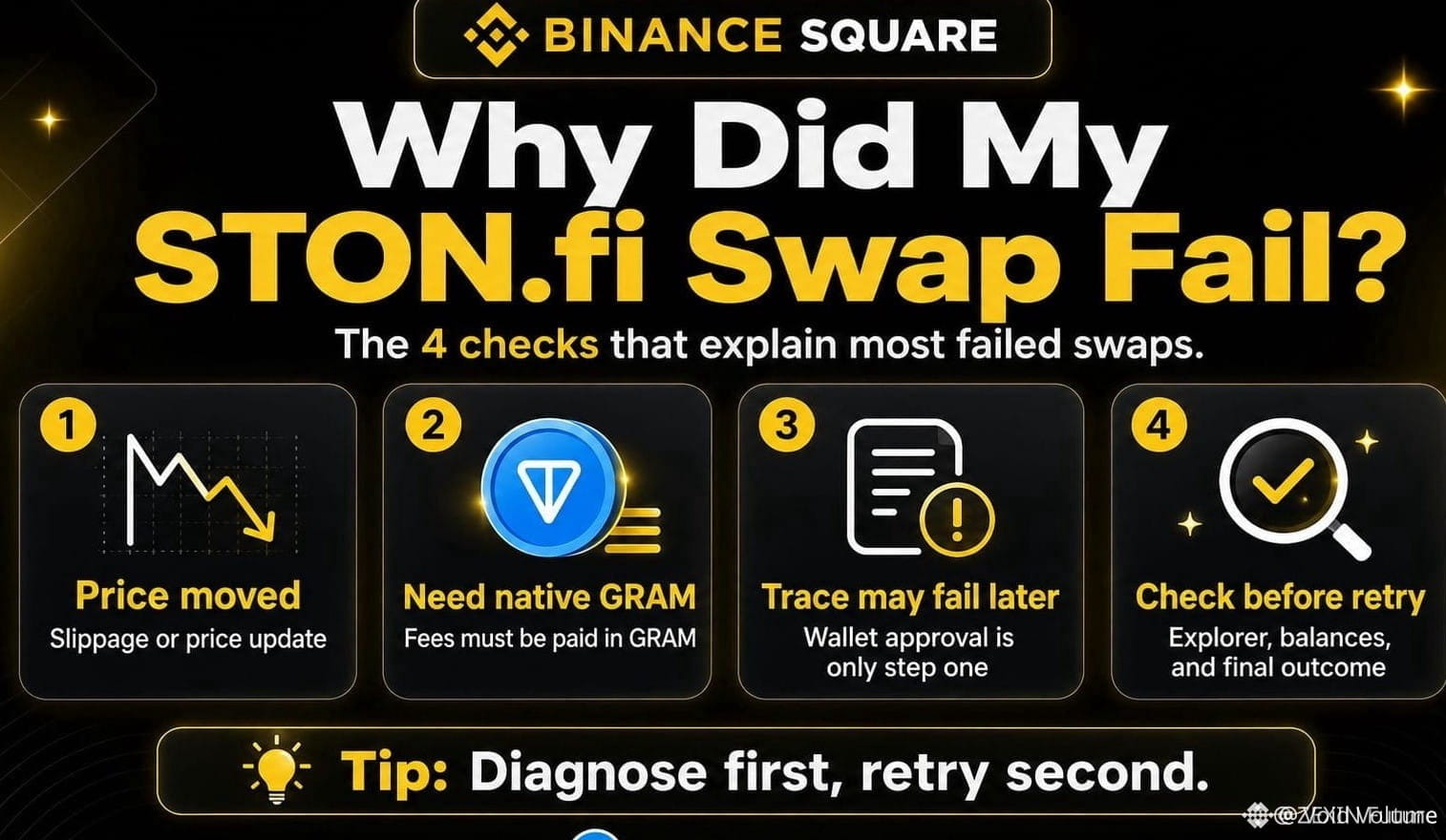
Most traders blame the network when their $STON orders bounce. The truth? TON moves on asynchronous traces — not instant fills. That 'lag' is simply your transaction waiting its turn in the queue. 🔍
The usual culprits: no $GRAM loaded for gas, slippage set too tight for a volatile tape, or a transaction that never left the wallet. Fix all three, and you stop fighting the mechanics. 📊
Market structure rewards those who respect the infrastructure. Top up gas, widen slippage, confirm broadcast — then step in with confidence. 💬 Which failure mode are you still hitting — gas, slippage, or broadcast?
⚠️ Not financial advice. Always manage your risk. 🛡️
🏷️ #STON #TON #DeFi #TradingTips #Crypto
🔥
💣 $STON SWAPS FAILING? IT'S NOT LAG — IT'S YOUR EXECUTION SETUP
Most traders blame the network when their $STON orders bounce. The truth? TON moves on asynchronous traces — not instant fills. That 'lag' is simply your transaction waiting its turn in the queue. 🔍
The usual culprits: no $GRAM loaded for gas, slippage set too tight for a volatile tape, or a transaction that never left the wallet. Fix all three, and you stop fighting the mechanics. 📊
Market structure rewards those who respect the infrastructure. Top up gas, widen slippage, confirm broadcast — then step in with confidence. 💬 Which failure mode are you still hitting — gas, slippage, or broadcast?
⚠️ Not financial advice. Always manage your risk. 🛡️
🏷️ #STON #TON #DeFi #TradingTips #Crypto
🔥
Most traders blame the network when their $STON orders bounce. The truth? TON moves on asynchronous traces — not instant fills. That 'lag' is simply your transaction waiting its turn in the queue. 🔍
The usual culprits: no $GRAM loaded for gas, slippage set too tight for a volatile tape, or a transaction that never left the wallet. Fix all three, and you stop fighting the mechanics. 📊
Market structure rewards those who respect the infrastructure. Top up gas, widen slippage, confirm broadcast — then step in with confidence. 💬 Which failure mode are you still hitting — gas, slippage, or broadcast?
⚠️ Not financial advice. Always manage your risk. 🛡️
🏷️ #STON #TON #DeFi #TradingTips #Crypto
🔥
105

·
--
Article
Understanding Token Swaps with STON.fiToken swapping is one of the most common activities in decentralized finance. A swap allows a user to exchange one digital asset for another through a blockchain-based protocol. STON.fi provides decentralized swapping functionality within the TON ecosystem.
For someone new to decentralized finance, the process can initially seem complicated. Users generally need a compatible wallet, sufficient network fees, and an understanding of the assets they want to exchange. Before confirming a transaction, it is important to review the token, amount, expected outcome, and applicable transaction costs.
One useful concept to understand is liquidity. Decentralized exchanges rely on liquidity to facilitate trading. Liquidity can influence how efficiently a swap is executed and how much price impact may occur for larger transactions.
Another important concept is slippage. Market conditions and available liquidity can affect the final amount received from a swap. Users should understand these factors rather than assuming every transaction will execute at exactly the displayed price.
STON.fi makes decentralized trading part of the TON experience. Its existence demonstrates how blockchain applications can provide practical financial tools without depending entirely on centralized intermediaries.
Learning how swaps work before trading is essential. Knowledge, careful transaction review, and responsible wallet security can help users navigate decentralized finance more confidently.
#stonfi
#GEMSTON
#ston
Understanding Token Swaps with STON.fi
Token swapping is one of the most common activities in decentralized finance. A swap allows a user to exchange one digital asset for another through a blockchain-based protocol. STON.fi provides decentralized swapping functionality within the TON ecosystem.
For someone new to decentralized finance, the process can initially seem complicated. Users generally need a compatible wallet, sufficient network fees, and an understanding of the assets they want to exchange. Before confirming a transaction, it is important to review the token, amount, expected outcome, and applicable transaction costs.
One useful concept to understand is liquidity. Decentralized exchanges rely on liquidity to facilitate trading. Liquidity can influence how efficiently a swap is executed and how much price impact may occur for larger transactions.
Another important concept is slippage. Market conditions and available liquidity can affect the final amount received from a swap. Users should understand these factors rather than assuming every transaction will execute at exactly the displayed price.
STON.fi makes decentralized trading part of the TON experience. Its existence demonstrates how blockchain applications can provide practical financial tools without depending entirely on centralized intermediaries.
Learning how swaps work before trading is essential. Knowledge, careful transaction review, and responsible wallet security can help users navigate decentralized finance more confidently.
#stonfi
#GEMSTON
#ston
For someone new to decentralized finance, the process can initially seem complicated. Users generally need a compatible wallet, sufficient network fees, and an understanding of the assets they want to exchange. Before confirming a transaction, it is important to review the token, amount, expected outcome, and applicable transaction costs.
One useful concept to understand is liquidity. Decentralized exchanges rely on liquidity to facilitate trading. Liquidity can influence how efficiently a swap is executed and how much price impact may occur for larger transactions.
Another important concept is slippage. Market conditions and available liquidity can affect the final amount received from a swap. Users should understand these factors rather than assuming every transaction will execute at exactly the displayed price.
STON.fi makes decentralized trading part of the TON experience. Its existence demonstrates how blockchain applications can provide practical financial tools without depending entirely on centralized intermediaries.
Learning how swaps work before trading is essential. Knowledge, careful transaction review, and responsible wallet security can help users navigate decentralized finance more confidently.
#stonfi
#GEMSTON
#ston
1
109
Log in to explore more content
Join global crypto users on Binance Square
⚡️ Get latest and useful information about crypto.
💬 Trusted by the world’s largest crypto exchange.
👍 Discover real insights from verified creators.
Email / Phone number
Trending Topics
1
#SECApproves3xLongCryptoCommodityETPs
120 views
26 Discussing
2
#G7PlansToReleaseUpTo100MBarrelsOilDiesel
1,186 views
71 Discussing
3
#ICBASuesOCCOverCryptoBankCharters
687 views
51 Discussing
4
#USStocksCloseHigherOnWeakJobsData
496 views
39 Discussing
5
#NFPWatch
10.9M views
19,484 Discussing
6
#BlastToGraduallyShutDownItsL2Network
162 views
24 Discussing
7
#BitcoinFundingRateTriplesTo10%
200,633 views
1,332 Discussing
8
#BitcoinSurpasses$86KUp2.99%
66,028 views
122 Discussing
9
#ZcashFalls21%FromSeptemberPeak
105,954 views
925 Discussing
10
#USSeptemberPayrollsAdd29KUnemploymentRises4.2%
81,796 views
570 Discussing