

#educational
educational
191,107 views
509 Discussing
Hot
Latest
·
--
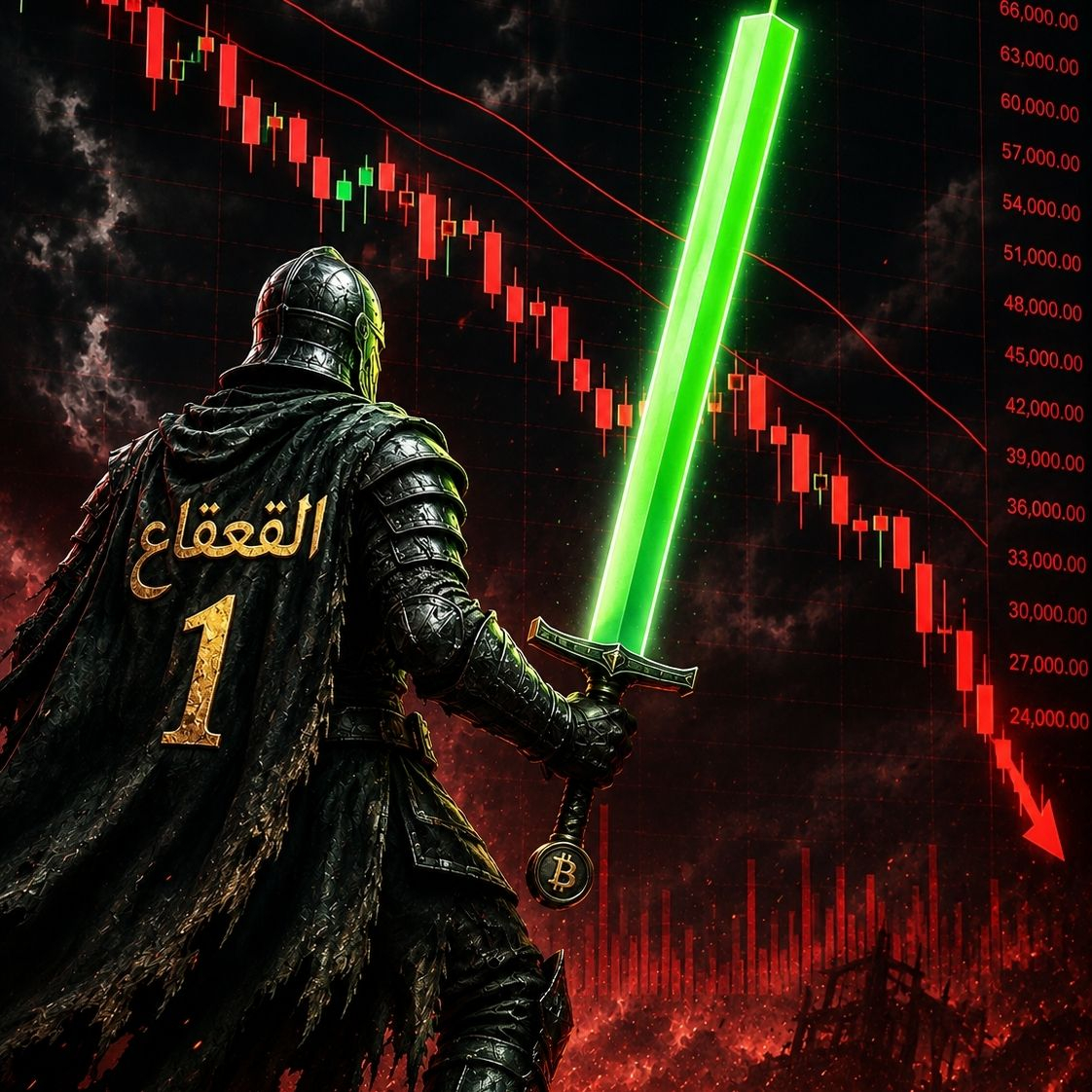
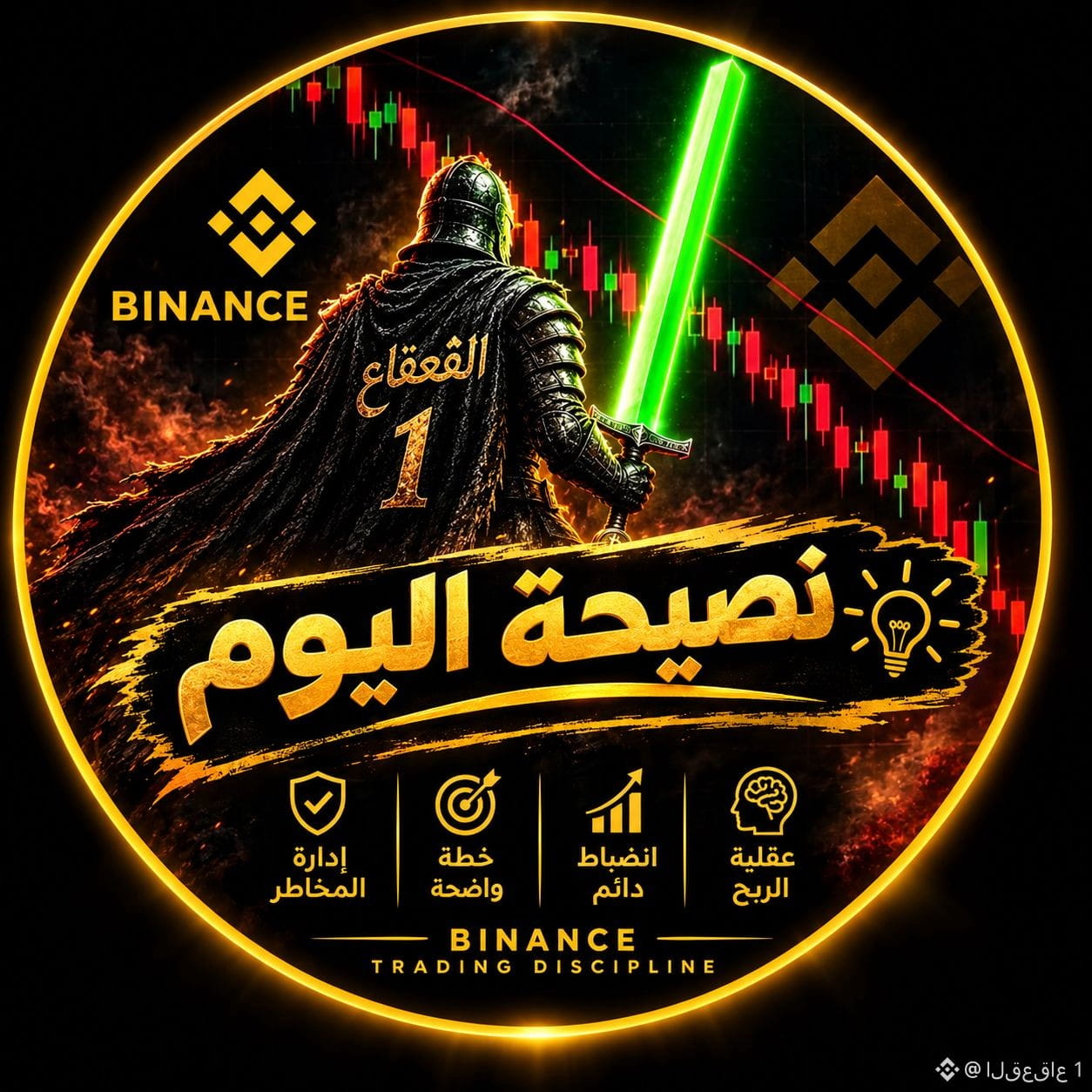
🎯 🎯 Today's Trading Tip | 10 Golden Rules
1️⃣ Plan: Set your entry, target, and stop-loss in advance.
2️⃣ Risk Management: Risk no more than 1–2% of your portfolio.
3️⃣ Accept Losses: Losses are a normal operating cost of trading.
4️⃣ No Revenge: Did you hit stop-loss? Step away from the screen.
5️⃣ Respect the Stop: Don’t move your stop-loss lower.
6️⃣ Avoid Greed: Take profits according to a defined plan.
7️⃣ Log Your Trades: Record your reasons for entry and the emotions behind it.
8️⃣ Don’t Fight the Market: Your flexibility is what protects your capital.
9️⃣ Quality Matters Most: One well-thought-out trade is better than 10 random ones.
🔟 Discipline: Success is a marathon that requires following the rules.
💡 Which rule is hardest for you? Share in the comments!
$BTC
{spot}(BTCUSDT)
$ETH
{spot}(ETHUSDT)
$QNT
{spot}(QNTUSDT)
#Crypto_Jobs🎯 #القعقاع #القعقاع_1 #TradingTips #educational
🎯 🎯 Today's Trading Tip | 10 Golden Rules
1️⃣ Plan: Set your entry, target, and stop-loss in advance.
2️⃣ Risk Management: Risk no more than 1–2% of your portfolio.
3️⃣ Accept Losses: Losses are a normal operating cost of trading.
4️⃣ No Revenge: Did you hit stop-loss? Step away from the screen.
5️⃣ Respect the Stop: Don’t move your stop-loss lower.
6️⃣ Avoid Greed: Take profits according to a defined plan.
7️⃣ Log Your Trades: Record your reasons for entry and the emotions behind it.
8️⃣ Don’t Fight the Market: Your flexibility is what protects your capital.
9️⃣ Quality Matters Most: One well-thought-out trade is better than 10 random ones.
🔟 Discipline: Success is a marathon that requires following the rules.
💡 Which rule is hardest for you? Share in the comments!
$BTC
$ETH
$QNT
#Crypto_Jobs🎯 #القعقاع #القعقاع_1 #TradingTips #educational
1️⃣ Plan: Set your entry, target, and stop-loss in advance.
2️⃣ Risk Management: Risk no more than 1–2% of your portfolio.
3️⃣ Accept Losses: Losses are a normal operating cost of trading.
4️⃣ No Revenge: Did you hit stop-loss? Step away from the screen.
5️⃣ Respect the Stop: Don’t move your stop-loss lower.
6️⃣ Avoid Greed: Take profits according to a defined plan.
7️⃣ Log Your Trades: Record your reasons for entry and the emotions behind it.
8️⃣ Don’t Fight the Market: Your flexibility is what protects your capital.
9️⃣ Quality Matters Most: One well-thought-out trade is better than 10 random ones.
🔟 Discipline: Success is a marathon that requires following the rules.
💡 Which rule is hardest for you? Share in the comments!
$BTC
$ETH
$QNT
#Crypto_Jobs🎯 #القعقاع #القعقاع_1 #TradingTips #educational
emran ALBADAWY :
وفقك الله نصايح في الصميم
2
3
264
🌐 How Does a Digital City Work? Blockchain Infrastructure Without Complication
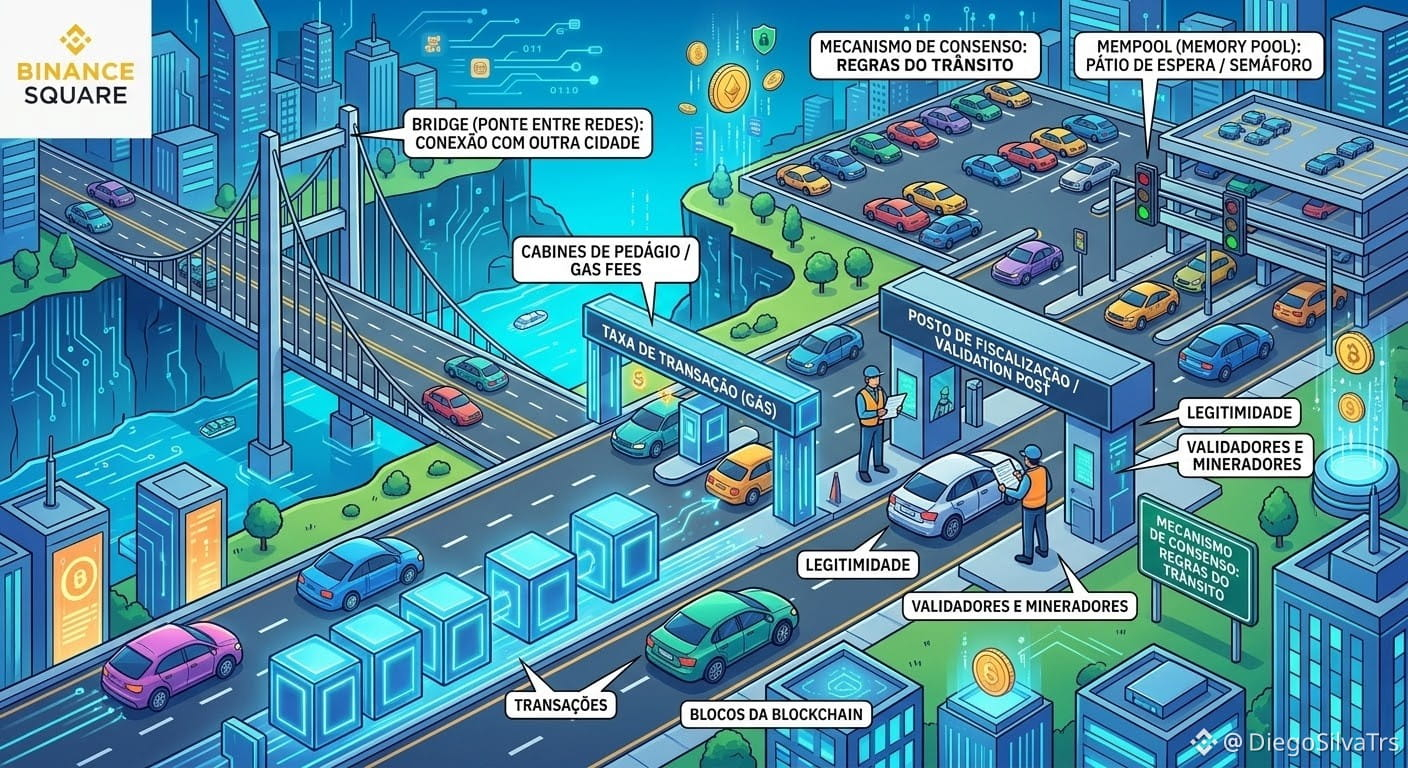
If a blockchain is a busy digital city, everything becomes easy to understand. To avoid turning into chaos, it needs infrastructure running in the background.
Understand 5 fundamental concepts:
1. Validators & Miners = Traffic Wardens
Wardens check license plates, driver’s licenses, and whether the car is stolen.
In blockchains, validators and miners check whether your transaction is valid, whether you have a balance, and whether you’re not trying to spend the same coin twice. Without them, nobody moves.
2. Consensus Mechanism (PoW / PoS) = Traffic Laws
For guards to act without conflict, the city needs official laws.
Consensus (Proof of Work / Proof of Stake) defines who can validate and how the network decides what is true or fraud.
3. Gas & Fees (Gas Fees) = Tolls and Fuel
Want to use the city roads? Pay the highway fee.
Gas pays for transaction processing. If the city gets jammed (a congested network), the toll goes up to prioritize those who pay more.
4. Mempool = the Waiting Lot and Traffic Light
This is the blockchain’s waiting room.
Your transactions stay parked there, waiting for the validator to pick up your car from the line and include it in the next block of traffic.
5. Bridges = the Ferries Between Cities
Imagine two isolated cities: “Ethereum City” and “Solana City”.
Bridges let you board your vehicle (token) on one side and safely disembark on the other, connecting different networks.
Summary: Your transfer leaves the Waiting Lot (Mempool), follows the Laws (Consensus), pays the Toll (Gas) to the Warden (Validator), and takes the Bridge (Bridge) if you’re going to another network.
Which part of the city did you find easiest to understand? Comment below!
#Web3 #Educational #Blockchain #Crypto #BinanceSquare
$BTC $ETH $SOL
🌐 How Does a Digital City Work? Blockchain Infrastructure Without Complication
If a blockchain is a busy digital city, everything becomes easy to understand. To avoid turning into chaos, it needs infrastructure running in the background.
Understand 5 fundamental concepts:
1. Validators & Miners = Traffic Wardens
Wardens check license plates, driver’s licenses, and whether the car is stolen.
In blockchains, validators and miners check whether your transaction is valid, whether you have a balance, and whether you’re not trying to spend the same coin twice. Without them, nobody moves.
2. Consensus Mechanism (PoW / PoS) = Traffic Laws
For guards to act without conflict, the city needs official laws.
Consensus (Proof of Work / Proof of Stake) defines who can validate and how the network decides what is true or fraud.
3. Gas & Fees (Gas Fees) = Tolls and Fuel
Want to use the city roads? Pay the highway fee.
Gas pays for transaction processing. If the city gets jammed (a congested network), the toll goes up to prioritize those who pay more.
4. Mempool = the Waiting Lot and Traffic Light
This is the blockchain’s waiting room.
Your transactions stay parked there, waiting for the validator to pick up your car from the line and include it in the next block of traffic.
5. Bridges = the Ferries Between Cities
Imagine two isolated cities: “Ethereum City” and “Solana City”.
Bridges let you board your vehicle (token) on one side and safely disembark on the other, connecting different networks.
Summary: Your transfer leaves the Waiting Lot (Mempool), follows the Laws (Consensus), pays the Toll (Gas) to the Warden (Validator), and takes the Bridge (Bridge) if you’re going to another network.
Which part of the city did you find easiest to understand? Comment below!
#Web3 #Educational #Blockchain #Crypto #BinanceSquare
$BTC $ETH $SOL
If a blockchain is a busy digital city, everything becomes easy to understand. To avoid turning into chaos, it needs infrastructure running in the background.
Understand 5 fundamental concepts:
1. Validators & Miners = Traffic Wardens
Wardens check license plates, driver’s licenses, and whether the car is stolen.
In blockchains, validators and miners check whether your transaction is valid, whether you have a balance, and whether you’re not trying to spend the same coin twice. Without them, nobody moves.
2. Consensus Mechanism (PoW / PoS) = Traffic Laws
For guards to act without conflict, the city needs official laws.
Consensus (Proof of Work / Proof of Stake) defines who can validate and how the network decides what is true or fraud.
3. Gas & Fees (Gas Fees) = Tolls and Fuel
Want to use the city roads? Pay the highway fee.
Gas pays for transaction processing. If the city gets jammed (a congested network), the toll goes up to prioritize those who pay more.
4. Mempool = the Waiting Lot and Traffic Light
This is the blockchain’s waiting room.
Your transactions stay parked there, waiting for the validator to pick up your car from the line and include it in the next block of traffic.
5. Bridges = the Ferries Between Cities
Imagine two isolated cities: “Ethereum City” and “Solana City”.
Bridges let you board your vehicle (token) on one side and safely disembark on the other, connecting different networks.
Summary: Your transfer leaves the Waiting Lot (Mempool), follows the Laws (Consensus), pays the Toll (Gas) to the Warden (Validator), and takes the Bridge (Bridge) if you’re going to another network.
Which part of the city did you find easiest to understand? Comment below!
#Web3 #Educational #Blockchain #Crypto #BinanceSquare
$BTC $ETH $SOL
2
3
6
770

·
--
Educational & Risk Management (Value-Driven)Headline: The #1 Mistake Crypto Traders Make (And How to Fix It) 🧠Most retail traders lose money not because of bad market conditions, but because of FOMO (Fear Of Missing Out). Buying the green pump usually leads to holding the red bag.3 Rules to Protect Your Capital:Never Chase Green Candles: Wait for a healthy retest or correction before entering.Set Strict Stop-Losses: Always know your exit point before you press the buy button.Take Profits Mechanically: Scale out of positions in parts as the price hits targets.Remember: Protecting your capital is step one. Profits come second.#CryptoTrading #RiskManagement #Educational #DYOR #Binance
Educational & Risk Management (Value-Driven)Headline: The #1 Mistake Crypto Traders Make (And How to Fix It) 🧠Most retail traders lose money not because of bad market conditions, but because of FOMO (Fear Of Missing Out). Buying the green pump usually leads to holding the red bag.3 Rules to Protect Your Capital:Never Chase Green Candles: Wait for a healthy retest or correction before entering.Set Strict Stop-Losses: Always know your exit point before you press the buy button.Take Profits Mechanically: Scale out of positions in parts as the price hits targets.Remember: Protecting your capital is step one. Profits come second.#CryptoTrading #RiskManagement #Educational #DYOR #Binance
70

💰 What is Market Cap: Understanding a Key Crypto Metric
On July 21, 2026, the total crypto market cap stands at $2.32T, but what exactly does this number mean? Market capitalization is calculated by multiplying a token's price by its circulating supply.
This metric helps investors compare the relative size of different assets. Bitcoin $BTC dominates with 56.54% of the total while Ethereum $ETH accounts for 9.99%.
Market cap is a useful tool for sizing positions and understanding the overall market structure.
📌 Key Takeaway:
Market capitalization is a fundamental metric for comparing asset sizes and understanding market structure in crypto.
#MarketCap #CryptoBasics #Educational
#BinanceAlphaAlert
💰 What is Market Cap: Understanding a Key Crypto Metric
On July 21, 2026, the total crypto market cap stands at $2.32T, but what exactly does this number mean? Market capitalization is calculated by multiplying a token's price by its circulating supply.
This metric helps investors compare the relative size of different assets. Bitcoin $BTC dominates with 56.54% of the total while Ethereum $ETH accounts for 9.99%.
Market cap is a useful tool for sizing positions and understanding the overall market structure.
📌 Key Takeaway:
Market capitalization is a fundamental metric for comparing asset sizes and understanding market structure in crypto.
#MarketCap #CryptoBasics #Educational
#BinanceAlphaAlert
On July 21, 2026, the total crypto market cap stands at $2.32T, but what exactly does this number mean? Market capitalization is calculated by multiplying a token's price by its circulating supply.
This metric helps investors compare the relative size of different assets. Bitcoin $BTC dominates with 56.54% of the total while Ethereum $ETH accounts for 9.99%.
Market cap is a useful tool for sizing positions and understanding the overall market structure.
📌 Key Takeaway:
Market capitalization is a fundamental metric for comparing asset sizes and understanding market structure in crypto.
#MarketCap #CryptoBasics #Educational
#BinanceAlphaAlert
37
📚 What Is a Layer-1 Blockchain: Understanding the Foundation of Crypto Networks
On July 4, 2026, the term 'L1' or Layer-1 is used constantly in crypto. Bitcoin $BTC, Ethereum $ETH, and Solana $SOL are all Layer-1 blockchains — the base settlement layer that processes and validates transactions.
Each L1 has different trade-offs. BTC prioritizes security and decentralization, with a market cap of $1.26T. ETH ($1759.89) balances security with programmability via smart contracts. SOL ($83.46) prioritizes speed and low fees.
Understanding L1 differences helps explain why some projects choose one chain over another. There's no perfect L1 — each optimizes for different priorities.
📌 Key Takeaway:
Layer-1 blockchains are the foundation of crypto. Their design choices — security vs speed vs decentralization — shape the entire ecosystem built on top.
#Layer1 #BlockchainBasics #Educational
#BinanceAlphaAlert
📚 What Is a Layer-1 Blockchain: Understanding the Foundation of Crypto Networks
On July 4, 2026, the term 'L1' or Layer-1 is used constantly in crypto. Bitcoin $BTC , Ethereum $ETH , and Solana $SOL are all Layer-1 blockchains — the base settlement layer that processes and validates transactions.
Each L1 has different trade-offs. BTC prioritizes security and decentralization, with a market cap of $1.26T. ETH ($1759.89) balances security with programmability via smart contracts. SOL ($83.46) prioritizes speed and low fees.
Understanding L1 differences helps explain why some projects choose one chain over another. There's no perfect L1 — each optimizes for different priorities.
📌 Key Takeaway:
Layer-1 blockchains are the foundation of crypto. Their design choices — security vs speed vs decentralization — shape the entire ecosystem built on top.
#Layer1 #BlockchainBasics #Educational
#BinanceAlphaAlert
On July 4, 2026, the term 'L1' or Layer-1 is used constantly in crypto. Bitcoin $BTC , Ethereum $ETH , and Solana $SOL are all Layer-1 blockchains — the base settlement layer that processes and validates transactions.
Each L1 has different trade-offs. BTC prioritizes security and decentralization, with a market cap of $1.26T. ETH ($1759.89) balances security with programmability via smart contracts. SOL ($83.46) prioritizes speed and low fees.
Understanding L1 differences helps explain why some projects choose one chain over another. There's no perfect L1 — each optimizes for different priorities.
📌 Key Takeaway:
Layer-1 blockchains are the foundation of crypto. Their design choices — security vs speed vs decentralization — shape the entire ecosystem built on top.
#Layer1 #BlockchainBasics #Educational
#BinanceAlphaAlert
81

·
--
Bullish
Title: 💡 Golden Rule for Crypto Beginners: Risk Management First! 🚀
The crypto market is exciting, but volatility can be challenging. If you are just starting your crypto journey, remember this: Never invest more than you can afford to lose.
Before chasing 100x gains, focus on protecting your capital:
Do Your Own Research (DYOR): Don't buy based on hype. Understand the project behind the coin.
Start Small: Use features like Binance Mock Trading to practice without real risk.
Diversify: Don't put all your eggs in one basket.
What is the best crypto advice you received when you started? Share your thoughts below! 👇
#CryptoForBeginners #BinanceSquareTalks eSquare #educational tional #dyor OR #RiskManagement anagement
$SPCXB
Title: 💡 Golden Rule for Crypto Beginners: Risk Management First! 🚀
The crypto market is exciting, but volatility can be challenging. If you are just starting your crypto journey, remember this: Never invest more than you can afford to lose.
Before chasing 100x gains, focus on protecting your capital:
Do Your Own Research (DYOR): Don't buy based on hype. Understand the project behind the coin.
Start Small: Use features like Binance Mock Trading to practice without real risk.
Diversify: Don't put all your eggs in one basket.
What is the best crypto advice you received when you started? Share your thoughts below! 👇
#CryptoForBeginners #BinanceSquareTalks eSquare #educational tional #dyor OR #RiskManagement anagement
$SPCXB
The crypto market is exciting, but volatility can be challenging. If you are just starting your crypto journey, remember this: Never invest more than you can afford to lose.
Before chasing 100x gains, focus on protecting your capital:
Do Your Own Research (DYOR): Don't buy based on hype. Understand the project behind the coin.
Start Small: Use features like Binance Mock Trading to practice without real risk.
Diversify: Don't put all your eggs in one basket.
What is the best crypto advice you received when you started? Share your thoughts below! 👇
#CryptoForBeginners #BinanceSquareTalks eSquare #educational tional #dyor OR #RiskManagement anagement
$SPCXB
118
🛡️ Private Keys and Seed Phrases: Security 101 for Crypto Users
On July 23, 2026, with billions flowing through crypto every day, understanding private keys is the most important security lesson. A private key is a cryptographic secret that proves ownership of blockchain assets — whoever holds the key controls the funds.
Seed phrases (also called recovery phrases) are human-readable representations of your private key, typically 12 or 24 words. Losing your seed phrase means losing access forever — there is no password reset, no customer support recovery.
Never share your private key or seed phrase with anyone. Legitimate services will never ask for them. Write them down on paper and store them in a secure offline location.
📌 Key Takeaway:
Your private key is the ultimate control over your crypto assets — losing it means permanent loss, and sharing it means giving away ownership.
#PrivateKeys #CryptoSecurity #Educational
#BinanceAlphaAlert
🛡️ Private Keys and Seed Phrases: Security 101 for Crypto Users
On July 23, 2026, with billions flowing through crypto every day, understanding private keys is the most important security lesson. A private key is a cryptographic secret that proves ownership of blockchain assets — whoever holds the key controls the funds.
Seed phrases (also called recovery phrases) are human-readable representations of your private key, typically 12 or 24 words. Losing your seed phrase means losing access forever — there is no password reset, no customer support recovery.
Never share your private key or seed phrase with anyone. Legitimate services will never ask for them. Write them down on paper and store them in a secure offline location.
📌 Key Takeaway:
Your private key is the ultimate control over your crypto assets — losing it means permanent loss, and sharing it means giving away ownership.
#PrivateKeys #CryptoSecurity #Educational
#BinanceAlphaAlert
On July 23, 2026, with billions flowing through crypto every day, understanding private keys is the most important security lesson. A private key is a cryptographic secret that proves ownership of blockchain assets — whoever holds the key controls the funds.
Seed phrases (also called recovery phrases) are human-readable representations of your private key, typically 12 or 24 words. Losing your seed phrase means losing access forever — there is no password reset, no customer support recovery.
Never share your private key or seed phrase with anyone. Legitimate services will never ask for them. Write them down on paper and store them in a secure offline location.
📌 Key Takeaway:
Your private key is the ultimate control over your crypto assets — losing it means permanent loss, and sharing it means giving away ownership.
#PrivateKeys #CryptoSecurity #Educational
#BinanceAlphaAlert
44

·
--
💡 Market Order vs. Limit Order: The Best Lesson I Learned as a Beginner! 🧐
When I made my first trade on Binance with $5, I had to understand how to buy and sell crypto properly. As a beginner, understanding orders is the most important step!
Here is what I learned in simple terms:
🟢 1. Market Order (Quick & Easy)
I used this to BUY my $BNB. It executes instantly at the best available price in the market. It's perfect when you want to get into a coin right away without waiting!
🔴 2. Limit Order (Smart & Patient)
I used this to set my SELL target for BNB at $600. It allows you to set your own price. The trade will ONLY execute when the market price touches your target.
Why I love Limit Orders:
Best of all, I don't need to stare at the charts 24/7! Even if I am sleeping or offline, Binance will automatically sell and lock in my profits. 🧠✨
If you are a beginner, always practice using Limit Orders to manage your risk and targets.
Which one do you use the most? Market or Limit? Let me know in the comments! 👇
👉 Don't forget to FOLLOW me for more real beginner trading tips!
#BinanceSquare #CryptoTips #TradingBasics #BNB #Write2Earn #Educational
💡 Market Order vs. Limit Order: The Best Lesson I Learned as a Beginner! 🧐
When I made my first trade on Binance with $5, I had to understand how to buy and sell crypto properly. As a beginner, understanding orders is the most important step!
Here is what I learned in simple terms:
🟢 1. Market Order (Quick & Easy)
I used this to BUY my $BNB. It executes instantly at the best available price in the market. It's perfect when you want to get into a coin right away without waiting!
🔴 2. Limit Order (Smart & Patient)
I used this to set my SELL target for BNB at $600. It allows you to set your own price. The trade will ONLY execute when the market price touches your target.
Why I love Limit Orders:
Best of all, I don't need to stare at the charts 24/7! Even if I am sleeping or offline, Binance will automatically sell and lock in my profits. 🧠✨
If you are a beginner, always practice using Limit Orders to manage your risk and targets.
Which one do you use the most? Market or Limit? Let me know in the comments! 👇
👉 Don't forget to FOLLOW me for more real beginner trading tips!
#BinanceSquare #CryptoTips #TradingBasics #BNB #Write2Earn #Educational
When I made my first trade on Binance with $5, I had to understand how to buy and sell crypto properly. As a beginner, understanding orders is the most important step!
Here is what I learned in simple terms:
🟢 1. Market Order (Quick & Easy)
I used this to BUY my $BNB. It executes instantly at the best available price in the market. It's perfect when you want to get into a coin right away without waiting!
🔴 2. Limit Order (Smart & Patient)
I used this to set my SELL target for BNB at $600. It allows you to set your own price. The trade will ONLY execute when the market price touches your target.
Why I love Limit Orders:
Best of all, I don't need to stare at the charts 24/7! Even if I am sleeping or offline, Binance will automatically sell and lock in my profits. 🧠✨
If you are a beginner, always practice using Limit Orders to manage your risk and targets.
Which one do you use the most? Market or Limit? Let me know in the comments! 👇
👉 Don't forget to FOLLOW me for more real beginner trading tips!
#BinanceSquare #CryptoTips #TradingBasics #BNB #Write2Earn #Educational
91
📚 Understanding Trading Volume: Why Volume Matters More Than Price
On July 4, 2026, total 24h volume reached $64.58B. Trading volume measures the total value of assets traded in a period. High volume confirms price moves are legitimate; low volume suggests they may be temporary.
For example, Bitcoin $BTC at $62,612 with $25.18B in volume is more significant than the same price with $2.52B in volume. Volume validates price discovery.
Volume leaders today: $USDT ($42.60B), Bitcoin $BTC ($25.18B), and Ethereum $ETH ($9.50B). Tracking volume trends helps identify where smart money is flowing.
📌 Key Takeaway:
Volume is the truth serum of price action. High volume + price up = genuine buying. Low volume + price up = potential manipulation or temporary move.
#TradingVolume #TechnicalAnalysis #Educational
#BinanceAlphaAlert
📚 Understanding Trading Volume: Why Volume Matters More Than Price
On July 4, 2026, total 24h volume reached $64.58B. Trading volume measures the total value of assets traded in a period. High volume confirms price moves are legitimate; low volume suggests they may be temporary.
For example, Bitcoin $BTC at $62,612 with $25.18B in volume is more significant than the same price with $2.52B in volume. Volume validates price discovery.
Volume leaders today: $USDT ($42.60B), Bitcoin $BTC ($25.18B), and Ethereum $ETH ($9.50B). Tracking volume trends helps identify where smart money is flowing.
📌 Key Takeaway:
Volume is the truth serum of price action. High volume + price up = genuine buying. Low volume + price up = potential manipulation or temporary move.
#TradingVolume #TechnicalAnalysis #Educational
#BinanceAlphaAlert
On July 4, 2026, total 24h volume reached $64.58B. Trading volume measures the total value of assets traded in a period. High volume confirms price moves are legitimate; low volume suggests they may be temporary.
For example, Bitcoin $BTC at $62,612 with $25.18B in volume is more significant than the same price with $2.52B in volume. Volume validates price discovery.
Volume leaders today: $USDT ($42.60B), Bitcoin $BTC ($25.18B), and Ethereum $ETH ($9.50B). Tracking volume trends helps identify where smart money is flowing.
📌 Key Takeaway:
Volume is the truth serum of price action. High volume + price up = genuine buying. Low volume + price up = potential manipulation or temporary move.
#TradingVolume #TechnicalAnalysis #Educational
#BinanceAlphaAlert
30

·
--
3 Golden Rules for Crypto Beginners in 2026 🚀Starting your crypto journey can feel overwhelming, but keeping it simple is the key to surviving and winning in this market. Here are 3 basic rules every beginner must follow:1️⃣ Never Invest More Than You Can Afford to LoseCrypto is volatile. Never use your rent money or life savings. Invest small, learn the market structure, and scale up only when you feel confident.2️⃣ DCA is Your Best FriendDon't try to time the perfect bottom. Use Dollar-Cost Averaging (DCA) — buy a fixed amount of your favorite crypto (like BTC or BNB) weekly or monthly. It smooths out the price drops.3️⃣ Secure Your Account FirstBefore making your first trade, enable 2FA (Two-Factor Authentication), use an authenticator app, and never click on suspicious links. Security always comes first!What is your #1 rule in crypto? Let’s discuss in the comments! 👇#CryptoBeginner #TradingTips #BinanceSquare #Educational
3 Golden Rules for Crypto Beginners in 2026 🚀Starting your crypto journey can feel overwhelming, but keeping it simple is the key to surviving and winning in this market. Here are 3 basic rules every beginner must follow:1️⃣ Never Invest More Than You Can Afford to LoseCrypto is volatile. Never use your rent money or life savings. Invest small, learn the market structure, and scale up only when you feel confident.2️⃣ DCA is Your Best FriendDon't try to time the perfect bottom. Use Dollar-Cost Averaging (DCA) — buy a fixed amount of your favorite crypto (like BTC or BNB) weekly or monthly. It smooths out the price drops.3️⃣ Secure Your Account FirstBefore making your first trade, enable 2FA (Two-Factor Authentication), use an authenticator app, and never click on suspicious links. Security always comes first!What is your #1 rule in crypto? Let’s discuss in the comments! 👇#CryptoBeginner #TradingTips #BinanceSquare #Educational
119
⚖️ Bridge Security Lessons: What the 24 Million Dollar AFX Exploit Teaches Us
On July 23, 2026, the $24 million AFX bridge exploit serves as an educational case study for crypto users. Blockchain bridges connect different networks by locking assets on one chain and minting wrapped versions on another — creating a tempting target for attackers.
The most common vulnerabilities include smart contract bugs in validation logic, compromised validator nodes that sign fraudulent transactions, and oracle manipulation that feeds false price data to the bridge.
Users can reduce bridge risk by using established protocols with multiple audits, avoiding new bridges with limited track records, and understanding that bridge-transferred assets carry additional risk.
📌 Key Takeaway:
Bridge exploits like the $24M AFX hack highlight the risks of cross-chain transfers — understanding validation mechanisms helps users evaluate bridge security.
#BridgeSecurity #DeFiSafety #Educational
#BinanceAlphaAlert
⚖️ Bridge Security Lessons: What the 24 Million Dollar AFX Exploit Teaches Us
On July 23, 2026, the $24 million AFX bridge exploit serves as an educational case study for crypto users. Blockchain bridges connect different networks by locking assets on one chain and minting wrapped versions on another — creating a tempting target for attackers.
The most common vulnerabilities include smart contract bugs in validation logic, compromised validator nodes that sign fraudulent transactions, and oracle manipulation that feeds false price data to the bridge.
Users can reduce bridge risk by using established protocols with multiple audits, avoiding new bridges with limited track records, and understanding that bridge-transferred assets carry additional risk.
📌 Key Takeaway:
Bridge exploits like the $24M AFX hack highlight the risks of cross-chain transfers — understanding validation mechanisms helps users evaluate bridge security.
#BridgeSecurity #DeFiSafety #Educational
#BinanceAlphaAlert
On July 23, 2026, the $24 million AFX bridge exploit serves as an educational case study for crypto users. Blockchain bridges connect different networks by locking assets on one chain and minting wrapped versions on another — creating a tempting target for attackers.
The most common vulnerabilities include smart contract bugs in validation logic, compromised validator nodes that sign fraudulent transactions, and oracle manipulation that feeds false price data to the bridge.
Users can reduce bridge risk by using established protocols with multiple audits, avoiding new bridges with limited track records, and understanding that bridge-transferred assets carry additional risk.
📌 Key Takeaway:
Bridge exploits like the $24M AFX hack highlight the risks of cross-chain transfers — understanding validation mechanisms helps users evaluate bridge security.
#BridgeSecurity #DeFiSafety #Educational
#BinanceAlphaAlert
20
📚 How to Research a Crypto Project: Due Diligence Checklist for New Investors
On July 4, 2026, with 17,387 coins tracked, knowing how to research projects is essential. Start with the whitepaper — does it solve a real problem? Then check the team, tokenomics, and community.
Data sources like CoinGecko provide key metrics: market cap ($2.26T), volume ($64.58B), and price action. For Bitcoin $BTC at $62,612, the fundamentals are well-established. For smaller projects, deeper digging is needed.
Look at: GitHub activity (are developers building?), token distribution (is it centralized?), and real users (not just bots). If a project's only narrative is 'price go up,' it's a speculation, not an investment.
📌 Key Takeaway:
Due diligence separates informed investors from gamblers. Whitepaper + team + tokenomics + community + usage = the five pillars of crypto research.
#CryptoResearch #DYOR #Educational
#BinanceAlphaAlert
📚 How to Research a Crypto Project: Due Diligence Checklist for New Investors
On July 4, 2026, with 17,387 coins tracked, knowing how to research projects is essential. Start with the whitepaper — does it solve a real problem? Then check the team, tokenomics, and community.
Data sources like CoinGecko provide key metrics: market cap ($2.26T), volume ($64.58B), and price action. For Bitcoin $BTC at $62,612, the fundamentals are well-established. For smaller projects, deeper digging is needed.
Look at: GitHub activity (are developers building?), token distribution (is it centralized?), and real users (not just bots). If a project's only narrative is 'price go up,' it's a speculation, not an investment.
📌 Key Takeaway:
Due diligence separates informed investors from gamblers. Whitepaper + team + tokenomics + community + usage = the five pillars of crypto research.
#CryptoResearch #DYOR #Educational
#BinanceAlphaAlert
On July 4, 2026, with 17,387 coins tracked, knowing how to research projects is essential. Start with the whitepaper — does it solve a real problem? Then check the team, tokenomics, and community.
Data sources like CoinGecko provide key metrics: market cap ($2.26T), volume ($64.58B), and price action. For Bitcoin $BTC at $62,612, the fundamentals are well-established. For smaller projects, deeper digging is needed.
Look at: GitHub activity (are developers building?), token distribution (is it centralized?), and real users (not just bots). If a project's only narrative is 'price go up,' it's a speculation, not an investment.
📌 Key Takeaway:
Due diligence separates informed investors from gamblers. Whitepaper + team + tokenomics + community + usage = the five pillars of crypto research.
#CryptoResearch #DYOR #Educational
#BinanceAlphaAlert
92
📚 How to Read a Crypto Price Chart: Candlestick Patterns and Technical Basics
On July 4, 2026, reading price charts is essential for understanding market moves. A candlestick shows four prices: open, high, low, close. Bitcoin $BTC today had open ~$61,400, high $62,821, low $61,427, close ~$62,612.
The body of the candle represents the open-to-close range. Green candles (close > open) mean buying pressure. Red (close < open) means selling pressure. The wicks show the full intraday range.
With Cardano $ADA showing an 11.6% range today ($0.1633 to $0.1823), understanding these patterns helps traders identify support, resistance, and momentum.
📌 Key Takeaway:
Candlestick charts are the language of market analysis. Learning to read them is the first step toward understanding price action and market psychology.
#TechnicalAnalysis #CryptoCharts #Educational
#BinanceAlphaAlert
📚 How to Read a Crypto Price Chart: Candlestick Patterns and Technical Basics
On July 4, 2026, reading price charts is essential for understanding market moves. A candlestick shows four prices: open, high, low, close. Bitcoin $BTC today had open ~$61,400, high $62,821, low $61,427, close ~$62,612.
The body of the candle represents the open-to-close range. Green candles (close > open) mean buying pressure. Red (close < open) means selling pressure. The wicks show the full intraday range.
With Cardano $ADA showing an 11.6% range today ($0.1633 to $0.1823), understanding these patterns helps traders identify support, resistance, and momentum.
📌 Key Takeaway:
Candlestick charts are the language of market analysis. Learning to read them is the first step toward understanding price action and market psychology.
#TechnicalAnalysis #CryptoCharts #Educational
#BinanceAlphaAlert
On July 4, 2026, reading price charts is essential for understanding market moves. A candlestick shows four prices: open, high, low, close. Bitcoin $BTC today had open ~$61,400, high $62,821, low $61,427, close ~$62,612.
The body of the candle represents the open-to-close range. Green candles (close > open) mean buying pressure. Red (close < open) means selling pressure. The wicks show the full intraday range.
With Cardano $ADA showing an 11.6% range today ($0.1633 to $0.1823), understanding these patterns helps traders identify support, resistance, and momentum.
📌 Key Takeaway:
Candlestick charts are the language of market analysis. Learning to read them is the first step toward understanding price action and market psychology.
#TechnicalAnalysis #CryptoCharts #Educational
#BinanceAlphaAlert
43

·
--
Bearish
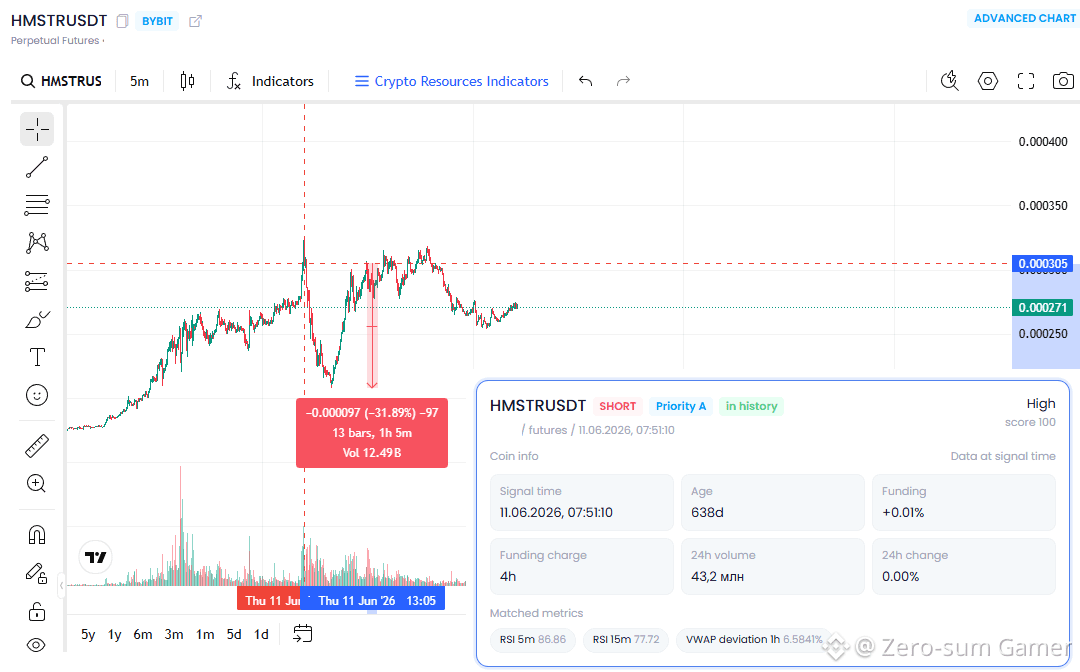
⚡️ $HMSTR : pump exhaustion before a sharp downside reaction
$HMSTR had already moved up almost 80% in 24h. Open interest more than doubled over the same period, which means a lot of leverage had been added into an already stretched move.
This is where the market structure became interesting.
Trap Radar PRO highlighted the pump exhaustion zone on #HMSTRUSDT. From the outside, the candle still looked strong. Under the hood, the setup was changing: OI started to pull back from the local high, volume expanded hard, and 5m CVD shifted toward sellers.
👀 What lined up
1️⃣ Pump: price was up almost 80% in 24h.
2️⃣ Leverage: OI more than doubled in 24h.
3️⃣ Exhaustion: 5m OI was already almost -2% from the high.
4️⃣ Volume: 5m volume was more than x5.6 above baseline.
5️⃣ CVD: 5m flow shifted toward sellers.
💥 What happened next
After that zone, price moved lower and the downside reaction reached almost 32%.
The useful part of this case is what happened before the red candle: leverage was loaded, shorts had already been squeezed, volume spiked, and OI started leaving the market.
A pump can still look strong on the chart while the internal metrics are already showing exhaustion.
Educational market case.
#trapradar #educational
⚡️ $HMSTR : pump exhaustion before a sharp downside reaction
$HMSTR had already moved up almost 80% in 24h. Open interest more than doubled over the same period, which means a lot of leverage had been added into an already stretched move.
This is where the market structure became interesting.
Trap Radar PRO highlighted the pump exhaustion zone on #HMSTRUSDT. From the outside, the candle still looked strong. Under the hood, the setup was changing: OI started to pull back from the local high, volume expanded hard, and 5m CVD shifted toward sellers.
👀 What lined up
1️⃣ Pump: price was up almost 80% in 24h.
2️⃣ Leverage: OI more than doubled in 24h.
3️⃣ Exhaustion: 5m OI was already almost -2% from the high.
4️⃣ Volume: 5m volume was more than x5.6 above baseline.
5️⃣ CVD: 5m flow shifted toward sellers.
💥 What happened next
After that zone, price moved lower and the downside reaction reached almost 32%.
The useful part of this case is what happened before the red candle: leverage was loaded, shorts had already been squeezed, volume spiked, and OI started leaving the market.
A pump can still look strong on the chart while the internal metrics are already showing exhaustion.
Educational market case.
#trapradar #educational
$HMSTR had already moved up almost 80% in 24h. Open interest more than doubled over the same period, which means a lot of leverage had been added into an already stretched move.
This is where the market structure became interesting.
Trap Radar PRO highlighted the pump exhaustion zone on #HMSTRUSDT. From the outside, the candle still looked strong. Under the hood, the setup was changing: OI started to pull back from the local high, volume expanded hard, and 5m CVD shifted toward sellers.
👀 What lined up
1️⃣ Pump: price was up almost 80% in 24h.
2️⃣ Leverage: OI more than doubled in 24h.
3️⃣ Exhaustion: 5m OI was already almost -2% from the high.
4️⃣ Volume: 5m volume was more than x5.6 above baseline.
5️⃣ CVD: 5m flow shifted toward sellers.
💥 What happened next
After that zone, price moved lower and the downside reaction reached almost 32%.
The useful part of this case is what happened before the red candle: leverage was loaded, shorts had already been squeezed, volume spiked, and OI started leaving the market.
A pump can still look strong on the chart while the internal metrics are already showing exhaustion.
Educational market case.
#trapradar #educational
2
279
₿ What is Bitcoin: The World's First Decentralized Digital Currency
On July 21, 2026, understanding the fundamentals of Bitcoin $BTC is essential for any crypto participant. Created in 2009 by the pseudonymous Satoshi Nakamoto, the asset introduced the world to blockchain technology and decentralized money.
Key concepts include proof-of-work mining, the 21 million supply cap, and peer-to-peer transactions without intermediaries. These properties make the asset a unique store of value in the digital age.
The current price of $65,472 and market cap of $1.31T reflect its status as the largest digital asset.
📌 Key Takeaway:
Bitcoin's innovation lies in its ability to enable trustless, peer-to-peer digital transactions without intermediaries.
#Bitcoin #CryptoEducation #Educational
#BinanceAlphaAlert
₿ What is Bitcoin: The World's First Decentralized Digital Currency
On July 21, 2026, understanding the fundamentals of Bitcoin $BTC is essential for any crypto participant. Created in 2009 by the pseudonymous Satoshi Nakamoto, the asset introduced the world to blockchain technology and decentralized money.
Key concepts include proof-of-work mining, the 21 million supply cap, and peer-to-peer transactions without intermediaries. These properties make the asset a unique store of value in the digital age.
The current price of $65,472 and market cap of $1.31T reflect its status as the largest digital asset.
📌 Key Takeaway:
Bitcoin's innovation lies in its ability to enable trustless, peer-to-peer digital transactions without intermediaries.
#Bitcoin #CryptoEducation #Educational
#BinanceAlphaAlert
On July 21, 2026, understanding the fundamentals of Bitcoin $BTC is essential for any crypto participant. Created in 2009 by the pseudonymous Satoshi Nakamoto, the asset introduced the world to blockchain technology and decentralized money.
Key concepts include proof-of-work mining, the 21 million supply cap, and peer-to-peer transactions without intermediaries. These properties make the asset a unique store of value in the digital age.
The current price of $65,472 and market cap of $1.31T reflect its status as the largest digital asset.
📌 Key Takeaway:
Bitcoin's innovation lies in its ability to enable trustless, peer-to-peer digital transactions without intermediaries.
#Bitcoin #CryptoEducation #Educational
#BinanceAlphaAlert
21
⚖️ Security Best Practices: Protecting Your Crypto Assets
On July 21, 2026, securing digital assets is more important than ever with over $72.00B in daily trading volume. Following security best practices can prevent loss from hacks, scams, and human error.
Key practices include using hardware wallets for long-term storage, enabling two-factor authentication, never sharing private keys, and verifying all transaction details before signing.
A cold wallet approach — keeping most funds offline — remains the gold standard for crypto security.
📌 Key Takeaway:
Self-custody and security best practices are essential for protecting crypto assets from theft and loss.
#CryptoSecurity #WalletSafety #Educational
#BinanceAlphaAlert
⚖️ Security Best Practices: Protecting Your Crypto Assets
On July 21, 2026, securing digital assets is more important than ever with over $72.00B in daily trading volume. Following security best practices can prevent loss from hacks, scams, and human error.
Key practices include using hardware wallets for long-term storage, enabling two-factor authentication, never sharing private keys, and verifying all transaction details before signing.
A cold wallet approach — keeping most funds offline — remains the gold standard for crypto security.
📌 Key Takeaway:
Self-custody and security best practices are essential for protecting crypto assets from theft and loss.
#CryptoSecurity #WalletSafety #Educational
#BinanceAlphaAlert
On July 21, 2026, securing digital assets is more important than ever with over $72.00B in daily trading volume. Following security best practices can prevent loss from hacks, scams, and human error.
Key practices include using hardware wallets for long-term storage, enabling two-factor authentication, never sharing private keys, and verifying all transaction details before signing.
A cold wallet approach — keeping most funds offline — remains the gold standard for crypto security.
📌 Key Takeaway:
Self-custody and security best practices are essential for protecting crypto assets from theft and loss.
#CryptoSecurity #WalletSafety #Educational
#BinanceAlphaAlert
11

·
--
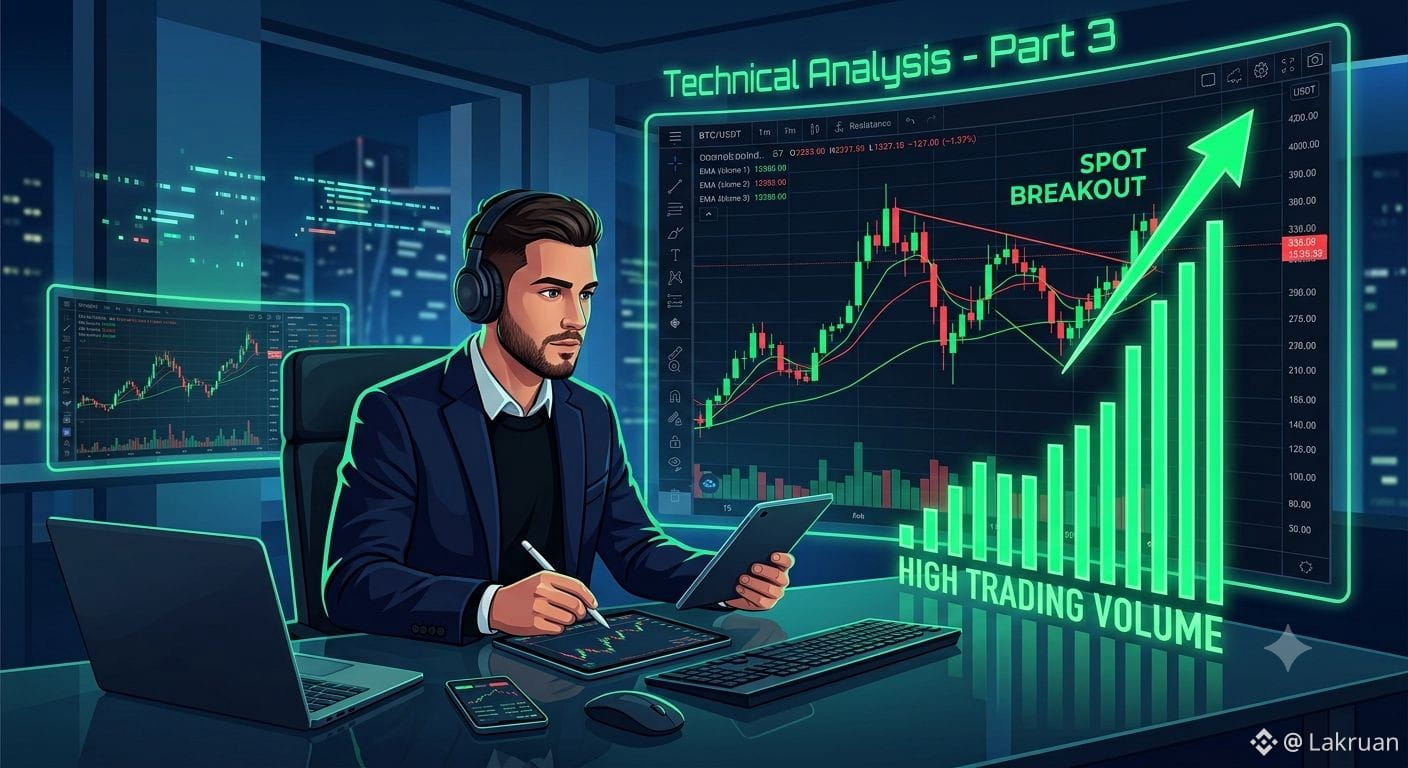
📊 Technical Analysis (Part 3): How I Use Volume in Spot Trading 📌️📌️📌️
In Spot trading, capital preservation is everything. When I first started, I used to buy whenever a price started pumping, only to get trapped at the exact top. Later, I realized that price movement without Volume is just an illusion. Volume is the fuel that validates every major breakout.
Here is exactly how I read trading Volume to find high-probability Spot entries:
📌 i.Volume Confirms the Strength of a Breakout
When a coin breaks above a strong resistance level or trendline, I instantly look at the volume bars at the bottom. If the price breaks out on massive green volume bars, it tells me that institutional buyers are driving the move. This is my green light for a safe Spot entry.
📌 ii.Spotting Fakeouts (The Volume Divergence)
If the price is moving up but the volume bars are shrinking, it is a major warning sign. This is a low-volume pump or a fakeout, often driven by retail FOMO. Since I don't use leverage in Spot, I avoid these traps and save my capital from sudden market reverses.
📌 iii.Accumulation During the Boring Days
Before a massive bull run, smart money accumulates coins silently. When I see a coin moving sideways in a tight range but the buying volume is slowly increasing, it signals heavy accumulation. This helps me patiently position myself before the actual pump starts.
💡Let's Chat: Do you check the volume bars before entering a Spot trade, or do you focus only on the price action? What is your rule? Share below! 👇🌹🌹
💥Disclaimer: Not financial advice. Educational only. DYOR.
#PriceAction #MyJourney #CryptoSL #BinanceSquare #Educational
{spot}(BNBUSDT)
📊 Technical Analysis (Part 3): How I Use Volume in Spot Trading 📌️📌️📌️
In Spot trading, capital preservation is everything. When I first started, I used to buy whenever a price started pumping, only to get trapped at the exact top. Later, I realized that price movement without Volume is just an illusion. Volume is the fuel that validates every major breakout.
Here is exactly how I read trading Volume to find high-probability Spot entries:
📌 i.Volume Confirms the Strength of a Breakout
When a coin breaks above a strong resistance level or trendline, I instantly look at the volume bars at the bottom. If the price breaks out on massive green volume bars, it tells me that institutional buyers are driving the move. This is my green light for a safe Spot entry.
📌 ii.Spotting Fakeouts (The Volume Divergence)
If the price is moving up but the volume bars are shrinking, it is a major warning sign. This is a low-volume pump or a fakeout, often driven by retail FOMO. Since I don't use leverage in Spot, I avoid these traps and save my capital from sudden market reverses.
📌 iii.Accumulation During the Boring Days
Before a massive bull run, smart money accumulates coins silently. When I see a coin moving sideways in a tight range but the buying volume is slowly increasing, it signals heavy accumulation. This helps me patiently position myself before the actual pump starts.
💡Let's Chat: Do you check the volume bars before entering a Spot trade, or do you focus only on the price action? What is your rule? Share below! 👇🌹🌹
💥Disclaimer: Not financial advice. Educational only. DYOR.
#PriceAction #MyJourney #CryptoSL #BinanceSquare #Educational
In Spot trading, capital preservation is everything. When I first started, I used to buy whenever a price started pumping, only to get trapped at the exact top. Later, I realized that price movement without Volume is just an illusion. Volume is the fuel that validates every major breakout.
Here is exactly how I read trading Volume to find high-probability Spot entries:
📌 i.Volume Confirms the Strength of a Breakout
When a coin breaks above a strong resistance level or trendline, I instantly look at the volume bars at the bottom. If the price breaks out on massive green volume bars, it tells me that institutional buyers are driving the move. This is my green light for a safe Spot entry.
📌 ii.Spotting Fakeouts (The Volume Divergence)
If the price is moving up but the volume bars are shrinking, it is a major warning sign. This is a low-volume pump or a fakeout, often driven by retail FOMO. Since I don't use leverage in Spot, I avoid these traps and save my capital from sudden market reverses.
📌 iii.Accumulation During the Boring Days
Before a massive bull run, smart money accumulates coins silently. When I see a coin moving sideways in a tight range but the buying volume is slowly increasing, it signals heavy accumulation. This helps me patiently position myself before the actual pump starts.
💡Let's Chat: Do you check the volume bars before entering a Spot trade, or do you focus only on the price action? What is your rule? Share below! 👇🌹🌹
💥Disclaimer: Not financial advice. Educational only. DYOR.
#PriceAction #MyJourney #CryptoSL #BinanceSquare #Educational
1
90

The Golden Rule of Crypto (Educational)
Market up or market down, never forget this rule! 🧠
Many newcomers jump into the crypto market looking for overnight riches. But the absolute most important skill is Risk Management.
1️⃣ Never invest money you cannot afford to lose.
2️⃣ Always Do Your Own Research (DYOR).
3️⃣ Don't let FOMO (Fear of Missing Out) drive your buying decisions.
What is your number one rule when trading? Let me know in the comments below! 👇
#BinanceSquare #CryptoTrading #DYOR #RiskManagement #Educational
The Golden Rule of Crypto (Educational)
Market up or market down, never forget this rule! 🧠
Many newcomers jump into the crypto market looking for overnight riches. But the absolute most important skill is Risk Management.
1️⃣ Never invest money you cannot afford to lose.
2️⃣ Always Do Your Own Research (DYOR).
3️⃣ Don't let FOMO (Fear of Missing Out) drive your buying decisions.
What is your number one rule when trading? Let me know in the comments below! 👇
#BinanceSquare #CryptoTrading #DYOR #RiskManagement #Educational
Market up or market down, never forget this rule! 🧠
Many newcomers jump into the crypto market looking for overnight riches. But the absolute most important skill is Risk Management.
1️⃣ Never invest money you cannot afford to lose.
2️⃣ Always Do Your Own Research (DYOR).
3️⃣ Don't let FOMO (Fear of Missing Out) drive your buying decisions.
What is your number one rule when trading? Let me know in the comments below! 👇
#BinanceSquare #CryptoTrading #DYOR #RiskManagement #Educational
74

·
--
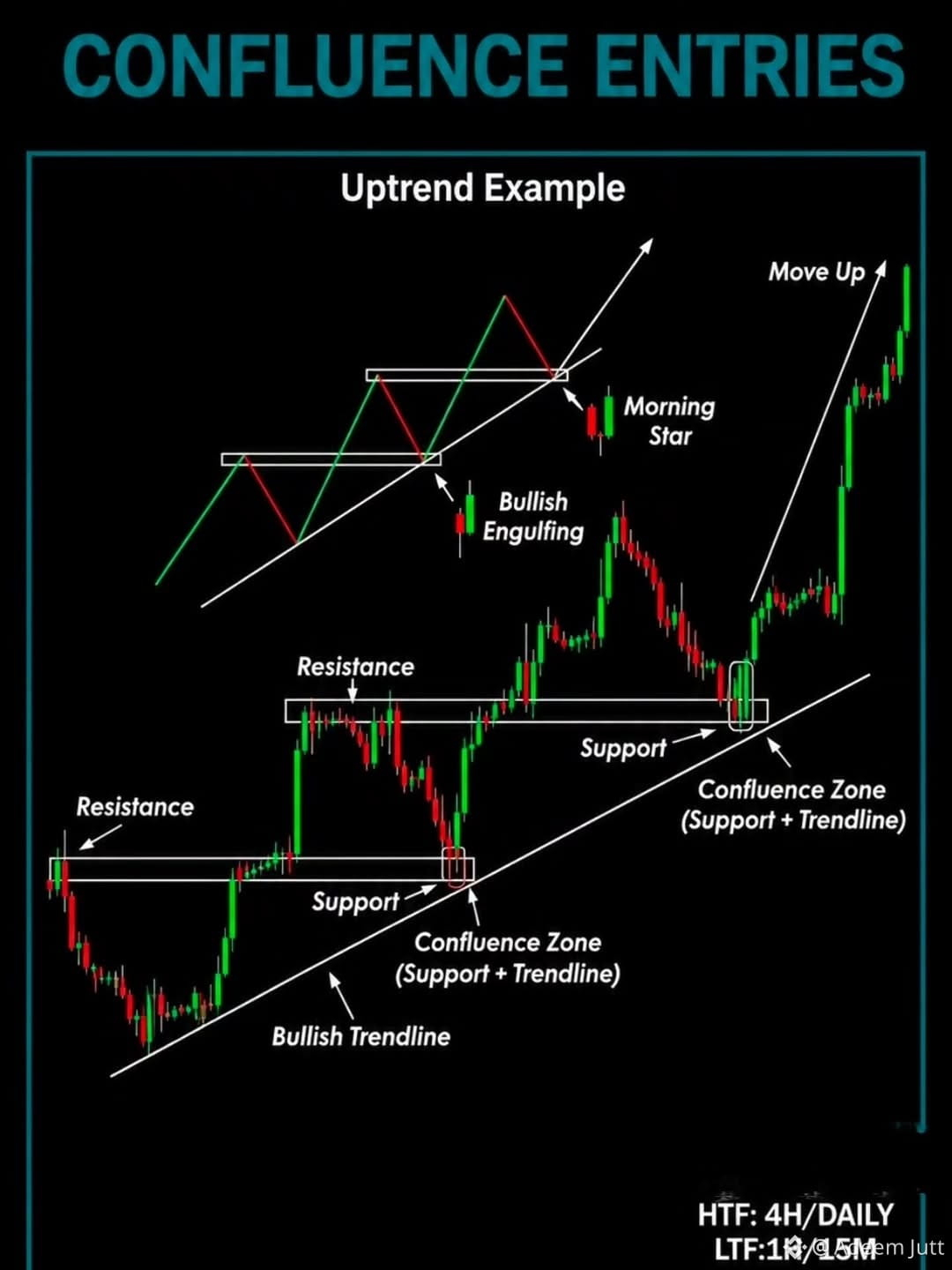
The 1% Secret: Stop Chasing Pumps and Start Trading "Confluence Zones" 🎯
Retail traders buy on a single hunch and get liquidated. Elite traders wait for Confluence—where multiple technical setups line up at the exact same price level to create a high-probability entry.
If you want to trade like the smart money, memorize this 4-step blueprint:
Step 1: Trend is Your Friend (HTF): Use the 4H/Daily charts to find the macro direction. Draw your Bullish Trendline.
Step 2: The Flip: Wait for the price to break above a major Resistance level. Don't FOMO. Wait for it to pull back and flip into Support.
Step 3: The Confluence Zone: Find the exact sweet spot where your Bullish Trendline intersects with the Horizontal Support. This creates a double floor that sellers struggle to break.
Step 4: The Sniper Trigger (LTF): Zoom into the 1H/15M charts. Don't front-run the market; wait for confirmation. Look for bullish reversal patterns like a Bullish Engulfing or a Morning Star right on the zone before executing.
Stop catching falling knives. Wait for the market structure to align, stack your probabilities, and execute with precision.
What is your go-to confirmation indicator before entering a trade? Let me know in the comments! 👇
$BANANAS31 $ZEN $ZEC
{spot}(ZECUSDT)
{spot}(ZENUSDT)
{spot}(BANANAS31USDT)
#CryptoTrading #TechnicalAnalysis #TradingTips #BinanceSquare #educational
The 1% Secret: Stop Chasing Pumps and Start Trading "Confluence Zones" 🎯
Retail traders buy on a single hunch and get liquidated. Elite traders wait for Confluence—where multiple technical setups line up at the exact same price level to create a high-probability entry.
If you want to trade like the smart money, memorize this 4-step blueprint:
Step 1: Trend is Your Friend (HTF): Use the 4H/Daily charts to find the macro direction. Draw your Bullish Trendline.
Step 2: The Flip: Wait for the price to break above a major Resistance level. Don't FOMO. Wait for it to pull back and flip into Support.
Step 3: The Confluence Zone: Find the exact sweet spot where your Bullish Trendline intersects with the Horizontal Support. This creates a double floor that sellers struggle to break.
Step 4: The Sniper Trigger (LTF): Zoom into the 1H/15M charts. Don't front-run the market; wait for confirmation. Look for bullish reversal patterns like a Bullish Engulfing or a Morning Star right on the zone before executing.
Stop catching falling knives. Wait for the market structure to align, stack your probabilities, and execute with precision.
What is your go-to confirmation indicator before entering a trade? Let me know in the comments! 👇
$BANANAS31 $ZEN $ZEC
#CryptoTrading #TechnicalAnalysis #TradingTips #BinanceSquare #educational
Retail traders buy on a single hunch and get liquidated. Elite traders wait for Confluence—where multiple technical setups line up at the exact same price level to create a high-probability entry.
If you want to trade like the smart money, memorize this 4-step blueprint:
Step 1: Trend is Your Friend (HTF): Use the 4H/Daily charts to find the macro direction. Draw your Bullish Trendline.
Step 2: The Flip: Wait for the price to break above a major Resistance level. Don't FOMO. Wait for it to pull back and flip into Support.
Step 3: The Confluence Zone: Find the exact sweet spot where your Bullish Trendline intersects with the Horizontal Support. This creates a double floor that sellers struggle to break.
Step 4: The Sniper Trigger (LTF): Zoom into the 1H/15M charts. Don't front-run the market; wait for confirmation. Look for bullish reversal patterns like a Bullish Engulfing or a Morning Star right on the zone before executing.
Stop catching falling knives. Wait for the market structure to align, stack your probabilities, and execute with precision.
What is your go-to confirmation indicator before entering a trade? Let me know in the comments! 👇
$BANANAS31 $ZEN $ZEC
#CryptoTrading #TechnicalAnalysis #TradingTips #BinanceSquare #educational
2
3
417
📚 What Is Market Cap in Crypto: Understanding How Projects Are Valued
On July 4, 2026, total crypto market cap is $2.26T. Bitcoin $BTC accounts for $1.26T (55.6%), Ethereum $ETH $212.37B (9.4%), and the rest is distributed across 17,387 other coins.
Market cap = price × circulating supply. It represents the total dollar value of all coins in circulation. However, it's not money that can be withdrawn — selling large amounts would move the price down.
Comparing market caps helps understand relative size. A top-10 coin like $HYPE at $15.91B is an order of magnitude smaller than BTC, meaning it has more growth potential but also more risk.
📌 Key Takeaway:
Market cap is the standard metric for comparing crypto project size, but it's not a bank balance. Use it as a sizing tool, not a liquidation estimate.
#MarketCap #CryptoBasics #Educational
#BinanceAlphaAlert
📚 What Is Market Cap in Crypto: Understanding How Projects Are Valued
On July 4, 2026, total crypto market cap is $2.26T. Bitcoin $BTC accounts for $1.26T (55.6%), Ethereum $ETH $212.37B (9.4%), and the rest is distributed across 17,387 other coins.
Market cap = price × circulating supply. It represents the total dollar value of all coins in circulation. However, it's not money that can be withdrawn — selling large amounts would move the price down.
Comparing market caps helps understand relative size. A top-10 coin like $HYPE at $15.91B is an order of magnitude smaller than BTC, meaning it has more growth potential but also more risk.
📌 Key Takeaway:
Market cap is the standard metric for comparing crypto project size, but it's not a bank balance. Use it as a sizing tool, not a liquidation estimate.
#MarketCap #CryptoBasics #Educational
#BinanceAlphaAlert
On July 4, 2026, total crypto market cap is $2.26T. Bitcoin $BTC accounts for $1.26T (55.6%), Ethereum $ETH $212.37B (9.4%), and the rest is distributed across 17,387 other coins.
Market cap = price × circulating supply. It represents the total dollar value of all coins in circulation. However, it's not money that can be withdrawn — selling large amounts would move the price down.
Comparing market caps helps understand relative size. A top-10 coin like $HYPE at $15.91B is an order of magnitude smaller than BTC, meaning it has more growth potential but also more risk.
📌 Key Takeaway:
Market cap is the standard metric for comparing crypto project size, but it's not a bank balance. Use it as a sizing tool, not a liquidation estimate.
#MarketCap #CryptoBasics #Educational
#BinanceAlphaAlert
13
Log in to explore more content
Join global crypto users on Binance Square
⚡️ Get latest and useful information about crypto.
💬 Trusted by the world’s largest crypto exchange.
👍 Discover real insights from verified creators.
Email / Phone number
Trending Topics
1
#BitcoinParesGainsAfterRallyTo$86.5K
23,590 views
90 Discussing
2
#CerebrasSinksNearly20%OnReportNvidiaToPowerOpenAI
41,448 views
490 Discussing
3
#SECProposesCryptoCustodyRules
70,903 views
669 Discussing
4
#SECApproves3xLongCryptoCommodityETPs
51,459 views
510 Discussing
5
#MASKHitsRecordMarketCapAbove$35M
2,494 views
28 Discussing
6
#G7PlansToReleaseUpTo100MBarrelsOilDiesel
40,079 views
477 Discussing
7
#ICBASuesOCCOverCryptoBankCharters
32,561 views
343 Discussing
8
#USStocksCloseHigherOnWeakJobsData
32,240 views
260 Discussing
9
#AnchorageReportedlyCuts17%Workforce
9,213 views
103 Discussing
10
#NFPWatch
11M views
19,813 Discussing