

#consensus
consensus
63,466 views
138 Discussing
Hot
Latest

·
--
Bullish
🔹 Post
$XRP | Ripple Consensus Algorithm ⚡
Ripple’s Consensus Algorithm is designed to help network participants agree on the same ledger state without relying on a central authority.
It focuses on agreement, correctness and fast consensus across the network.
A different approach to reaching distributed consensus. 🔗
#XRP’ #Ripple #Crypto #blockchain #Consensus
{spot}(XRPUSDT)
🔹 Post
$XRP | Ripple Consensus Algorithm ⚡
Ripple’s Consensus Algorithm is designed to help network participants agree on the same ledger state without relying on a central authority.
It focuses on agreement, correctness and fast consensus across the network.
A different approach to reaching distributed consensus. 🔗
#XRP’ #Ripple #Crypto #blockchain #Consensus
$XRP | Ripple Consensus Algorithm ⚡
Ripple’s Consensus Algorithm is designed to help network participants agree on the same ledger state without relying on a central authority.
It focuses on agreement, correctness and fast consensus across the network.
A different approach to reaching distributed consensus. 🔗
#XRP’ #Ripple #Crypto #blockchain #Consensus
1
130

·
--
Instead of requiring every node to communicate with every other node, it uses collectively trusted subsets of validators to achieve agreement with low latency and resilience against Byzantine failures.
🔹 Correctness
🔹 Agreement
🔹 Utility
🔹 Low-latency consensus
🔹 Protection against conflicting ledgers
#Consensus
😀😀😀😀😀😀😀😀😀😀
Instead of requiring every node to communicate with every other node, it uses collectively trusted subsets of validators to achieve agreement with low latency and resilience against Byzantine failures.
🔹 Correctness
🔹 Agreement
🔹 Utility
🔹 Low-latency consensus
🔹 Protection against conflicting ledgers
#Consensus
😀😀😀😀😀😀😀😀😀😀
🔹 Correctness
🔹 Agreement
🔹 Utility
🔹 Low-latency consensus
🔹 Protection against conflicting ledgers
#Consensus
😀😀😀😀😀😀😀😀😀😀
72

TRON's DPoS consensus is underrated. 27 Super Representatives produce blocks. This means finality in 3 seconds. No waiting for 12 block confirmations. No paying gas fees that spike during congestion. The network handles over 2000 transactions per second. That throughput is real, not theoretical. During peak demand, TRON does not slow down. It does not crash. It does not require layer 2 solutions to function. The base layer handles the load. This is what production-grade blockchain infrastructure looks like. Not promises. Not roadmaps. Just performance. #TRON #Consensus
TRON's DPoS consensus is underrated. 27 Super Representatives produce blocks. This means finality in 3 seconds. No waiting for 12 block confirmations. No paying gas fees that spike during congestion. The network handles over 2000 transactions per second. That throughput is real, not theoretical. During peak demand, TRON does not slow down. It does not crash. It does not require layer 2 solutions to function. The base layer handles the load. This is what production-grade blockchain infrastructure looks like. Not promises. Not roadmaps. Just performance. #TRON #Consensus
4
$BTC CONSENSUS IS THE IMMUNE SYSTEM THAT KEEPS THE NETWORK UNBREAKABLE 🛡️
No trade signal — this is a structural thesis.
Saylor’s latest commentary reinforces what the order flow already reflects: Bitcoin’s hard consensus is its ultimate defense mechanism. This isn't a price narrative — it's the foundation that makes every liquidity sweep and structural shift resolvable by the same rules. The network's resilience isn't theoretical; it's observable in how quickly bids return after every major flush.
If the consensus layer is this strong, what does that mean for the next structural breakout?
Not financial advice. Always manage your risk.
#BTC #Bitcoin #Consensus #CryptoResilience
⚡
$BTC CONSENSUS IS THE IMMUNE SYSTEM THAT KEEPS THE NETWORK UNBREAKABLE 🛡️
No trade signal — this is a structural thesis.
Saylor’s latest commentary reinforces what the order flow already reflects: Bitcoin’s hard consensus is its ultimate defense mechanism. This isn't a price narrative — it's the foundation that makes every liquidity sweep and structural shift resolvable by the same rules. The network's resilience isn't theoretical; it's observable in how quickly bids return after every major flush.
If the consensus layer is this strong, what does that mean for the next structural breakout?
Not financial advice. Always manage your risk.
#BTC #Bitcoin #Consensus #CryptoResilience
⚡
No trade signal — this is a structural thesis.
Saylor’s latest commentary reinforces what the order flow already reflects: Bitcoin’s hard consensus is its ultimate defense mechanism. This isn't a price narrative — it's the foundation that makes every liquidity sweep and structural shift resolvable by the same rules. The network's resilience isn't theoretical; it's observable in how quickly bids return after every major flush.
If the consensus layer is this strong, what does that mean for the next structural breakout?
Not financial advice. Always manage your risk.
#BTC #Bitcoin #Consensus #CryptoResilience
⚡
26

Two years ago I hit send on a work email the second I shouldn't have. Gmail gives you a few seconds to recall it, so I stabbed the undo button and stood there watching a small progress bar, with no idea whether I'd actually stopped it or just delayed the inevitable.
Ten seconds later it was gone. Whether it had actually reached anyone, I did not find out until a very awkward reply arrived an hour later.
Most blockchain transactions carry that same shadow of doubt. A payment can show as "confirmed" while still technically capable of being reversed if enough of the network disagrees.
On most chains, finality is really burial. Each new block stacked on top makes reversal statistically absurd rather than impossible, and at some arbitrary point everyone agrees to call that "safe enough."
@Dusk_Foundation Network's Succinct Attestation consensus is built to skip that step entirely. Each round, a randomly selected provisioner proposes a candidate block, one committee validates it, and a second committee ratifies it.
Once ratified, the block has deterministic finality: not increasingly unlikely to reverse, but structurally unable to. There is no confidence to accumulate and no risk to wait out, because finality is a specific event rather than a decaying probability.
Self-critique: that frantic ten seconds before the undo window closed was also a kind of safety net, a chance to catch my own mistake before it became permanent. Deterministic finality removes that window on purpose. Once a Dusk block is ratified, a mistaken transfer is exactly as final as a correct one, instantly.
Traditional finance keeps some of its slowness deliberately. Settlement windows exist partly so errors get caught and trades unwound before anything is irreversible. A system engineered to feel instantly certain pushes all of that correction earlier, into review before submission, since nothing is left afterward.
$DUSK should be evaluated based on whether it replaces the safety net that instant finality removes, not just on how fast that finality arrives.
#dusk #Blockchain #Consensus
Two years ago I hit send on a work email the second I shouldn't have. Gmail gives you a few seconds to recall it, so I stabbed the undo button and stood there watching a small progress bar, with no idea whether I'd actually stopped it or just delayed the inevitable.
Ten seconds later it was gone. Whether it had actually reached anyone, I did not find out until a very awkward reply arrived an hour later.
Most blockchain transactions carry that same shadow of doubt. A payment can show as "confirmed" while still technically capable of being reversed if enough of the network disagrees.
On most chains, finality is really burial. Each new block stacked on top makes reversal statistically absurd rather than impossible, and at some arbitrary point everyone agrees to call that "safe enough."
@Dusk Network's Succinct Attestation consensus is built to skip that step entirely. Each round, a randomly selected provisioner proposes a candidate block, one committee validates it, and a second committee ratifies it.
Once ratified, the block has deterministic finality: not increasingly unlikely to reverse, but structurally unable to. There is no confidence to accumulate and no risk to wait out, because finality is a specific event rather than a decaying probability.
Self-critique: that frantic ten seconds before the undo window closed was also a kind of safety net, a chance to catch my own mistake before it became permanent. Deterministic finality removes that window on purpose. Once a Dusk block is ratified, a mistaken transfer is exactly as final as a correct one, instantly.
Traditional finance keeps some of its slowness deliberately. Settlement windows exist partly so errors get caught and trades unwound before anything is irreversible. A system engineered to feel instantly certain pushes all of that correction earlier, into review before submission, since nothing is left afterward.
$DUSK should be evaluated based on whether it replaces the safety net that instant finality removes, not just on how fast that finality arrives.
#dusk #Blockchain #Consensus
Ten seconds later it was gone. Whether it had actually reached anyone, I did not find out until a very awkward reply arrived an hour later.
Most blockchain transactions carry that same shadow of doubt. A payment can show as "confirmed" while still technically capable of being reversed if enough of the network disagrees.
On most chains, finality is really burial. Each new block stacked on top makes reversal statistically absurd rather than impossible, and at some arbitrary point everyone agrees to call that "safe enough."
@Dusk Network's Succinct Attestation consensus is built to skip that step entirely. Each round, a randomly selected provisioner proposes a candidate block, one committee validates it, and a second committee ratifies it.
Once ratified, the block has deterministic finality: not increasingly unlikely to reverse, but structurally unable to. There is no confidence to accumulate and no risk to wait out, because finality is a specific event rather than a decaying probability.
Self-critique: that frantic ten seconds before the undo window closed was also a kind of safety net, a chance to catch my own mistake before it became permanent. Deterministic finality removes that window on purpose. Once a Dusk block is ratified, a mistaken transfer is exactly as final as a correct one, instantly.
Traditional finance keeps some of its slowness deliberately. Settlement windows exist partly so errors get caught and trades unwound before anything is irreversible. A system engineered to feel instantly certain pushes all of that correction earlier, into review before submission, since nothing is left afterward.
$DUSK should be evaluated based on whether it replaces the safety net that instant finality removes, not just on how fast that finality arrives.
#dusk #Blockchain #Consensus
5
2
162

·
--
Bullish
Verified
@Dusk_Foundation
I figured a blockchain's consensus design couldn't work against itself. turns out dusk had to build four separate patches so its own block generators wouldn't sabotage each other.
When i first looked at this, i literally thought the predictable block-generator schedule was mainly there for efficiency. the incentive problem underneath it was more interesting.
Here's why. dusk already knows, in advance, who's scheduled to generate the block if the current attempt fails. that's not a bug, it's how the system stays fast. but it means whoever's scheduled for round two has a real reason to just sit back and let round one fail, because if it does, they're the one who gets the reward instead.
So dusk built four fixes into the reward system itself. provisioners get paid just for voting, even on a block that ends up failing, so there's less reason to hold back. part of the generator's own reward depends on how many votes they bothered to include, so ignoring votes costs them money too. the generator scheduled for the next round gets banned from voting in the current one entirely, so they can't quietly help it fail. and there's a hard cap on how many rounds a single block attempt can go through, so the whole game has a ceiling.
What makes me more intresting is that dusk didn't try to hide the predictability. it changed the incentives around it instead.
What makes this consensus fair is also exactly what makes it gameable, knowing who goes next. dusk didn't remove that predictability, they just made cheating cost more than it pays.
i'm still not sure whether this holds up if two scheduled generators end up back to back in the same round, both with the same incentive at the same time. one bad actor is one thing. two working the same angle is a different test.
@Dusk_Foundation $DUSK #dusk
#Consensus #VOTE
@Dusk
I figured a blockchain's consensus design couldn't work against itself. turns out dusk had to build four separate patches so its own block generators wouldn't sabotage each other.
When i first looked at this, i literally thought the predictable block-generator schedule was mainly there for efficiency. the incentive problem underneath it was more interesting.
Here's why. dusk already knows, in advance, who's scheduled to generate the block if the current attempt fails. that's not a bug, it's how the system stays fast. but it means whoever's scheduled for round two has a real reason to just sit back and let round one fail, because if it does, they're the one who gets the reward instead.
So dusk built four fixes into the reward system itself. provisioners get paid just for voting, even on a block that ends up failing, so there's less reason to hold back. part of the generator's own reward depends on how many votes they bothered to include, so ignoring votes costs them money too. the generator scheduled for the next round gets banned from voting in the current one entirely, so they can't quietly help it fail. and there's a hard cap on how many rounds a single block attempt can go through, so the whole game has a ceiling.
What makes me more intresting is that dusk didn't try to hide the predictability. it changed the incentives around it instead.
What makes this consensus fair is also exactly what makes it gameable, knowing who goes next. dusk didn't remove that predictability, they just made cheating cost more than it pays.
i'm still not sure whether this holds up if two scheduled generators end up back to back in the same round, both with the same incentive at the same time. one bad actor is one thing. two working the same angle is a different test.
@Dusk $DUSK #dusk
#Consensus #VOTE
I figured a blockchain's consensus design couldn't work against itself. turns out dusk had to build four separate patches so its own block generators wouldn't sabotage each other.
When i first looked at this, i literally thought the predictable block-generator schedule was mainly there for efficiency. the incentive problem underneath it was more interesting.
Here's why. dusk already knows, in advance, who's scheduled to generate the block if the current attempt fails. that's not a bug, it's how the system stays fast. but it means whoever's scheduled for round two has a real reason to just sit back and let round one fail, because if it does, they're the one who gets the reward instead.
So dusk built four fixes into the reward system itself. provisioners get paid just for voting, even on a block that ends up failing, so there's less reason to hold back. part of the generator's own reward depends on how many votes they bothered to include, so ignoring votes costs them money too. the generator scheduled for the next round gets banned from voting in the current one entirely, so they can't quietly help it fail. and there's a hard cap on how many rounds a single block attempt can go through, so the whole game has a ceiling.
What makes me more intresting is that dusk didn't try to hide the predictability. it changed the incentives around it instead.
What makes this consensus fair is also exactly what makes it gameable, knowing who goes next. dusk didn't remove that predictability, they just made cheating cost more than it pays.
i'm still not sure whether this holds up if two scheduled generators end up back to back in the same round, both with the same incentive at the same time. one bad actor is one thing. two working the same angle is a different test.
@Dusk $DUSK #dusk
#Consensus #VOTE
31
23
300
🚨 THINKING NODE COUNT EQUALS REAL DECENTRALIZATION ON $DUSK ? LOOK AT THE CREDIT WEIGHTS 🦈
Most traders mistake raw node count for genuine network security, but $DUSK Section 3.3 reveals a much sharper reality. 📊 Voting power in the committee isn't one-node-one-vote; it is strictly credit-weighted across a fixed pool of 64 credit shares allocated by stake.
BLS signature aggregation makes execution blazingly efficient, but node address counts hide the true power curve. ⚖️ If a handful of heavy credit holders command the lion's share of voting weight, real consensus power remains tightly clustered regardless of how clean the node metrics look.
💡 Smart money measures the slope of the voting distribution curve, not just the wallet headcount. 💬 When assessing true consensus security, do you track raw node count or the actual voting weight distribution? 👇
⚠️ Not financial advice. Always manage your risk. 🛡️
🏷️ #DUSK #CryptoAnalysis #Consensus #DeFi
🎯 🦈
🚨 THINKING NODE COUNT EQUALS REAL DECENTRALIZATION ON $DUSK ? LOOK AT THE CREDIT WEIGHTS 🦈
Most traders mistake raw node count for genuine network security, but $DUSK Section 3.3 reveals a much sharper reality. 📊 Voting power in the committee isn't one-node-one-vote; it is strictly credit-weighted across a fixed pool of 64 credit shares allocated by stake.
BLS signature aggregation makes execution blazingly efficient, but node address counts hide the true power curve. ⚖️ If a handful of heavy credit holders command the lion's share of voting weight, real consensus power remains tightly clustered regardless of how clean the node metrics look.
💡 Smart money measures the slope of the voting distribution curve, not just the wallet headcount. 💬 When assessing true consensus security, do you track raw node count or the actual voting weight distribution? 👇
⚠️ Not financial advice. Always manage your risk. 🛡️
🏷️ #DUSK #CryptoAnalysis #Consensus #DeFi
🎯 🦈
Most traders mistake raw node count for genuine network security, but $DUSK Section 3.3 reveals a much sharper reality. 📊 Voting power in the committee isn't one-node-one-vote; it is strictly credit-weighted across a fixed pool of 64 credit shares allocated by stake.
BLS signature aggregation makes execution blazingly efficient, but node address counts hide the true power curve. ⚖️ If a handful of heavy credit holders command the lion's share of voting weight, real consensus power remains tightly clustered regardless of how clean the node metrics look.
💡 Smart money measures the slope of the voting distribution curve, not just the wallet headcount. 💬 When assessing true consensus security, do you track raw node count or the actual voting weight distribution? 👇
⚠️ Not financial advice. Always manage your risk. 🛡️
🏷️ #DUSK #CryptoAnalysis #Consensus #DeFi
🎯 🦈
14
THE BEAUTY OF DPoS: FAST, SECURE, DECENTRALIZED 🔄
Delegated Proof of Stake is the secret sauce behind TRON's performance. By allowing TRX holders to vote for Super Representatives, we ensure that the network remains decentralized while achieving high speeds.
This consensus mechanism is not only energy-efficient but also capable of handling thousands of transactions per second. It's the perfect balance of speed, security, and decentralization. ⚖️
@TRON DAO
#TRONEcoStar #DPoS #Consensus
THE BEAUTY OF DPoS: FAST, SECURE, DECENTRALIZED 🔄
Delegated Proof of Stake is the secret sauce behind TRON's performance. By allowing TRX holders to vote for Super Representatives, we ensure that the network remains decentralized while achieving high speeds.
This consensus mechanism is not only energy-efficient but also capable of handling thousands of transactions per second. It's the perfect balance of speed, security, and decentralization. ⚖️
@TRON DAO
#TRONEcoStar #DPoS #Consensus
Delegated Proof of Stake is the secret sauce behind TRON's performance. By allowing TRX holders to vote for Super Representatives, we ensure that the network remains decentralized while achieving high speeds.
This consensus mechanism is not only energy-efficient but also capable of handling thousands of transactions per second. It's the perfect balance of speed, security, and decentralization. ⚖️
@TRON DAO
#TRONEcoStar #DPoS #Consensus
14

·
--
At first I assumed liveness in Dusk's consensus was just a function of stake and participation — enough honest provisioners online, and the chain keeps moving on its own. But the more I looked at the emergency mode section, the picture got quieter than that. When enough consecutive iterations fail and no candidate reaches quorum, the network doesn't just keep retrying on its own terms forever. Provisioners can request an emergency block, and producing it depends on a seed signed by a key the paper simply calls Dusk's, checked against a public key listed as a global parameter. The request itself needs a majority of staked weight behind it, so it isn't unilateral. Still, the fallback for the system's worst case ends up routing through one specific, named party instead of the open sortition used everywhere else. Maybe that's a reasonable trade for a chain built around regulated finance. Makes me wonder whether decentralization is best judged by the common case, or by what happens once the common case breaks down.
#dusk #Consensus @Dusk_Foundation $DUSK
{spot}(DUSKUSDT)
At first I assumed liveness in Dusk's consensus was just a function of stake and participation — enough honest provisioners online, and the chain keeps moving on its own. But the more I looked at the emergency mode section, the picture got quieter than that. When enough consecutive iterations fail and no candidate reaches quorum, the network doesn't just keep retrying on its own terms forever. Provisioners can request an emergency block, and producing it depends on a seed signed by a key the paper simply calls Dusk's, checked against a public key listed as a global parameter. The request itself needs a majority of staked weight behind it, so it isn't unilateral. Still, the fallback for the system's worst case ends up routing through one specific, named party instead of the open sortition used everywhere else. Maybe that's a reasonable trade for a chain built around regulated finance. Makes me wonder whether decentralization is best judged by the common case, or by what happens once the common case breaks down.
#dusk #Consensus @Dusk $DUSK
#dusk #Consensus @Dusk $DUSK
2
101

·
--
Why does $DUSK make “yes” harder than “no” inside consensus?? The answer is buried in its Succinct Attestation design. During validation, a committee checks whether a proposed block is valid.
A Valid result needs a supermajority of 2/3. But Invalid or NoCandidate needs only 1/2 + 1. Ratification uses the same split: 2/3 to confirm Valid, while 1/2 + 1 can trigger failure through Invalid, NoCandidate, or NoQuorum. That asymmetry is deliberate.
Think of it like a gate where acceptance needs strong agreement, while rejection only needs a clear majority. The network is not treating every outcome as equally expensive to prove. There is another detail traders often miss: votes are not simply counted- one person, one vote.
Dusk assigns committee members credits, and each vote is weighted by those credits. The current whitepaper describes 64 committee credits. So the real security question is not “how many validators voted?” It is “how much committee weight backed the decision?”
That distinction makes DUSK’s consensus easier to understand — and much harder to judge from validator counts alone.
@Dusk_Foundation #dusk #Consensus
{spot}(DUSKUSDT)
Why does $DUSK make “yes” harder than “no” inside consensus?? The answer is buried in its Succinct Attestation design. During validation, a committee checks whether a proposed block is valid.
A Valid result needs a supermajority of 2/3. But Invalid or NoCandidate needs only 1/2 + 1. Ratification uses the same split: 2/3 to confirm Valid, while 1/2 + 1 can trigger failure through Invalid, NoCandidate, or NoQuorum. That asymmetry is deliberate.
Think of it like a gate where acceptance needs strong agreement, while rejection only needs a clear majority. The network is not treating every outcome as equally expensive to prove. There is another detail traders often miss: votes are not simply counted- one person, one vote.
Dusk assigns committee members credits, and each vote is weighted by those credits. The current whitepaper describes 64 committee credits. So the real security question is not “how many validators voted?” It is “how much committee weight backed the decision?”
That distinction makes DUSK’s consensus easier to understand — and much harder to judge from validator counts alone.
@Dusk #dusk #Consensus
A Valid result needs a supermajority of 2/3. But Invalid or NoCandidate needs only 1/2 + 1. Ratification uses the same split: 2/3 to confirm Valid, while 1/2 + 1 can trigger failure through Invalid, NoCandidate, or NoQuorum. That asymmetry is deliberate.
Think of it like a gate where acceptance needs strong agreement, while rejection only needs a clear majority. The network is not treating every outcome as equally expensive to prove. There is another detail traders often miss: votes are not simply counted- one person, one vote.
Dusk assigns committee members credits, and each vote is weighted by those credits. The current whitepaper describes 64 committee credits. So the real security question is not “how many validators voted?” It is “how much committee weight backed the decision?”
That distinction makes DUSK’s consensus easier to understand — and much harder to judge from validator counts alone.
@Dusk #dusk #Consensus
3
3
112

⚡ HOW $DUSK SURVIVES NETWORK FAULTS IS A MASTERCLASS IN INFRASTRUCTURE RESILIENCE! 🛡️
While most protocols operate on the assumption of perfect network conditions, $DUSK engineered a bulletproof contingency engine for total chaos. 💡 Its SA consensus uses signature-derived seeds for unpredictable committee selection, but the real genius shines when 16 consecutive iterations fail.
Instead of stalling out, $DUSK triggers a dedicated recovery pathway, opening parallel candidate blocks and using emergency seed resets to force chain progression. 🔍 That level of institutional-grade fail-safe logic sets a high bar for infrastructure surviving extreme stress events.
⚡ Does this elaborate recovery framework give $DUSK an unassailable engineering moat, or does structural complexity open unexpected vulnerabilities? 🤔
⚠️ Not financial advice. Always manage your risk. 🛡️
🏷️ #DUSK #Blockchain #Consensus #Crypto Infrastructure
⚡ 💎
⚡ HOW $DUSK SURVIVES NETWORK FAULTS IS A MASTERCLASS IN INFRASTRUCTURE RESILIENCE! 🛡️
While most protocols operate on the assumption of perfect network conditions, $DUSK engineered a bulletproof contingency engine for total chaos. 💡 Its SA consensus uses signature-derived seeds for unpredictable committee selection, but the real genius shines when 16 consecutive iterations fail.
Instead of stalling out, $DUSK triggers a dedicated recovery pathway, opening parallel candidate blocks and using emergency seed resets to force chain progression. 🔍 That level of institutional-grade fail-safe logic sets a high bar for infrastructure surviving extreme stress events.
⚡ Does this elaborate recovery framework give $DUSK an unassailable engineering moat, or does structural complexity open unexpected vulnerabilities? 🤔
⚠️ Not financial advice. Always manage your risk. 🛡️
🏷️ #DUSK #Blockchain #Consensus #Crypto Infrastructure
⚡ 💎
While most protocols operate on the assumption of perfect network conditions, $DUSK engineered a bulletproof contingency engine for total chaos. 💡 Its SA consensus uses signature-derived seeds for unpredictable committee selection, but the real genius shines when 16 consecutive iterations fail.
Instead of stalling out, $DUSK triggers a dedicated recovery pathway, opening parallel candidate blocks and using emergency seed resets to force chain progression. 🔍 That level of institutional-grade fail-safe logic sets a high bar for infrastructure surviving extreme stress events.
⚡ Does this elaborate recovery framework give $DUSK an unassailable engineering moat, or does structural complexity open unexpected vulnerabilities? 🤔
⚠️ Not financial advice. Always manage your risk. 🛡️
🏷️ #DUSK #Blockchain #Consensus #Crypto Infrastructure
⚡ 💎
10

·
--
🚀 Crypto Basics Series #39: What Is Consensus?
🤝 What Is Blockchain Consensus?
Consensus is the process a blockchain network uses to reach agreement about the valid state of its ledger.
Because there isn't always one central authority making the decision, network participants follow a set of rules to agree.
---
⚙️ Why Is Consensus Needed?
Consensus helps the network:
- ✅ Validate transactions
- 📦 Agree on new blocks
- 🛡️ Prevent invalid records
- 🔄 Keep different network participants synchronized
- 🚫 Help prevent double-spending
---
🧩 Common Consensus Mechanisms
⛏️ Proof of Work (PoW)
Participants called miners compete to solve computational problems and help secure the network.
🪙 Proof of Stake (PoS)
Validators participate in securing the network by committing cryptocurrency as stake and following the protocol's rules.
Different blockchains use different consensus mechanisms.
---
💡 Simple Example
Imagine 1,000 computers maintaining the same digital record.
If a new transaction appears, they need a common set of rules to determine whether it should be accepted.
That's the basic idea behind blockchain consensus.
---
⚠️ Important
Consensus does not mean every computer literally votes on every transaction in exactly the same way.
The mechanism and rules depend on the specific blockchain.
💬 Question
Which mechanism uses miners to help secure a blockchain?
🅰️ Proof of Work ⛏️
🅱️ Proof of Stake 🪙
👇 Comment your answer!
$BTC $ETH $BNB
#Consensus #Blockchain #proofofwork #ProofOfStake
🚀 Crypto Basics Series #39: What Is Consensus?
🤝 What Is Blockchain Consensus?
Consensus is the process a blockchain network uses to reach agreement about the valid state of its ledger.
Because there isn't always one central authority making the decision, network participants follow a set of rules to agree.
---
⚙️ Why Is Consensus Needed?
Consensus helps the network:
- ✅ Validate transactions
- 📦 Agree on new blocks
- 🛡️ Prevent invalid records
- 🔄 Keep different network participants synchronized
- 🚫 Help prevent double-spending
---
🧩 Common Consensus Mechanisms
⛏️ Proof of Work (PoW)
Participants called miners compete to solve computational problems and help secure the network.
🪙 Proof of Stake (PoS)
Validators participate in securing the network by committing cryptocurrency as stake and following the protocol's rules.
Different blockchains use different consensus mechanisms.
---
💡 Simple Example
Imagine 1,000 computers maintaining the same digital record.
If a new transaction appears, they need a common set of rules to determine whether it should be accepted.
That's the basic idea behind blockchain consensus.
---
⚠️ Important
Consensus does not mean every computer literally votes on every transaction in exactly the same way.
The mechanism and rules depend on the specific blockchain.
💬 Question
Which mechanism uses miners to help secure a blockchain?
🅰️ Proof of Work ⛏️
🅱️ Proof of Stake 🪙
👇 Comment your answer!
$BTC $ETH $BNB
#Consensus #Blockchain #proofofwork #ProofOfStake
🤝 What Is Blockchain Consensus?
Consensus is the process a blockchain network uses to reach agreement about the valid state of its ledger.
Because there isn't always one central authority making the decision, network participants follow a set of rules to agree.
---
⚙️ Why Is Consensus Needed?
Consensus helps the network:
- ✅ Validate transactions
- 📦 Agree on new blocks
- 🛡️ Prevent invalid records
- 🔄 Keep different network participants synchronized
- 🚫 Help prevent double-spending
---
🧩 Common Consensus Mechanisms
⛏️ Proof of Work (PoW)
Participants called miners compete to solve computational problems and help secure the network.
🪙 Proof of Stake (PoS)
Validators participate in securing the network by committing cryptocurrency as stake and following the protocol's rules.
Different blockchains use different consensus mechanisms.
---
💡 Simple Example
Imagine 1,000 computers maintaining the same digital record.
If a new transaction appears, they need a common set of rules to determine whether it should be accepted.
That's the basic idea behind blockchain consensus.
---
⚠️ Important
Consensus does not mean every computer literally votes on every transaction in exactly the same way.
The mechanism and rules depend on the specific blockchain.
💬 Question
Which mechanism uses miners to help secure a blockchain?
🅰️ Proof of Work ⛏️
🅱️ Proof of Stake 🪙
👇 Comment your answer!
$BTC $ETH $BNB
#Consensus #Blockchain #proofofwork #ProofOfStake
37

🔥 The Wall Street sharks who warned investors to stay out of crypto are now lining up at Consensus Miami, their suits glinting under the Miami sun as they chase the next big wave.
📊 With #BTC perched at $78,505 and a bearish RSI of 40.8, the market’s greed meter reads 69, yet futures open interest sits at a towering $8.51 B and funding nudges positive at +0.0100%, signaling that longs are paying to stay in. Meanwhile, #ETH steadies at $2,484 on $617 M volume, and #Consensus becomes the new trading floor where institutional desks swap stories for contracts, while smart‑money wallets on Solana whisper about a 62.5% inflow into Nasduck.
💡 The irony deepens: despite the bearish MACD crossover and Bitcoin hugging the lower Bollinger Band, the long‑short ratio of 1.28 and a 68% net‑long stance from top traders suggest the bears are buying tickets to a rally they don’t expect.
❓ Will the flood of Wall Street capital finally push Bitcoin past $80 k, or will the bears reclaim the narrative?
🔥 The Wall Street sharks who warned investors to stay out of crypto are now lining up at Consensus Miami, their suits glinting under the Miami sun as they chase the next big wave.
📊 With #BTC perched at $78,505 and a bearish RSI of 40.8, the market’s greed meter reads 69, yet futures open interest sits at a towering $8.51 B and funding nudges positive at +0.0100%, signaling that longs are paying to stay in. Meanwhile, #ETH steadies at $2,484 on $617 M volume, and #Consensus becomes the new trading floor where institutional desks swap stories for contracts, while smart‑money wallets on Solana whisper about a 62.5% inflow into Nasduck.
💡 The irony deepens: despite the bearish MACD crossover and Bitcoin hugging the lower Bollinger Band, the long‑short ratio of 1.28 and a 68% net‑long stance from top traders suggest the bears are buying tickets to a rally they don’t expect.
❓ Will the flood of Wall Street capital finally push Bitcoin past $80 k, or will the bears reclaim the narrative?
📊 With #BTC perched at $78,505 and a bearish RSI of 40.8, the market’s greed meter reads 69, yet futures open interest sits at a towering $8.51 B and funding nudges positive at +0.0100%, signaling that longs are paying to stay in. Meanwhile, #ETH steadies at $2,484 on $617 M volume, and #Consensus becomes the new trading floor where institutional desks swap stories for contracts, while smart‑money wallets on Solana whisper about a 62.5% inflow into Nasduck.
💡 The irony deepens: despite the bearish MACD crossover and Bitcoin hugging the lower Bollinger Band, the long‑short ratio of 1.28 and a 68% net‑long stance from top traders suggest the bears are buying tickets to a rally they don’t expect.
❓ Will the flood of Wall Street capital finally push Bitcoin past $80 k, or will the bears reclaim the narrative?
16
·
--
. Blockchain Finality ⛓️
Why Finality Matters
For financial applications, knowing when a transaction is truly final is extremely important.
Fast confirmation is useful, but predictable and reliable settlement can be even more important.
This makes blockchain consensus and finality important technical areas to watch in DUSK.
#DUSK #Consensus #Blockchain #CryptoPatience $DUSK @Dusk_Foundation
. Blockchain Finality ⛓️
Why Finality Matters
For financial applications, knowing when a transaction is truly final is extremely important.
Fast confirmation is useful, but predictable and reliable settlement can be even more important.
This makes blockchain consensus and finality important technical areas to watch in DUSK.
#DUSK #Consensus #Blockchain #CryptoPatience $DUSK @Dusk
Why Finality Matters
For financial applications, knowing when a transaction is truly final is extremely important.
Fast confirmation is useful, but predictable and reliable settlement can be even more important.
This makes blockchain consensus and finality important technical areas to watch in DUSK.
#DUSK #Consensus #Blockchain #CryptoPatience $DUSK @Dusk
1
57

How $DUSK
{future}(DUSKUSDT)
Goes beyond network failures—expertly engineered lessons in infrastructure resilience! 🛡️
While most protocols assume ideal network conditions, $DUSK is a tightly built failover engine designed for full-on chaos scenarios. 💡 Its SA consensus uses signature-derived seeds to choose committees in an unexpectedly randomized way, but its true genius shines when 16 consecutive cycles fail.
Rather than breaking, it activates a tailored recovery path, opens candidate blocks in parallel, and uses emergency seed resets to force chain progress. 🔍 This level of “backup logic” at an institutional-grade standard sets a high bar for keeping infrastructure running under extreme pressure.
⚡ Does this meticulously crafted recovery framework for $DUSK provide an impenetrable engineering trench, or does structural complexity expose unforeseen vulnerabilities? 🤔
⚠️ Not financial advice. Always manage your risk. 🛡️
🏷️ #DUSK #Blockchain #Consensus #Crypto
How $DUSK
Goes beyond network failures—expertly engineered lessons in infrastructure resilience! 🛡️
While most protocols assume ideal network conditions, $DUSK is a tightly built failover engine designed for full-on chaos scenarios. 💡 Its SA consensus uses signature-derived seeds to choose committees in an unexpectedly randomized way, but its true genius shines when 16 consecutive cycles fail.
Rather than breaking, it activates a tailored recovery path, opens candidate blocks in parallel, and uses emergency seed resets to force chain progress. 🔍 This level of “backup logic” at an institutional-grade standard sets a high bar for keeping infrastructure running under extreme pressure.
⚡ Does this meticulously crafted recovery framework for $DUSK provide an impenetrable engineering trench, or does structural complexity expose unforeseen vulnerabilities? 🤔
⚠️ Not financial advice. Always manage your risk. 🛡️
🏷️ #DUSK #Blockchain #Consensus #Crypto
Goes beyond network failures—expertly engineered lessons in infrastructure resilience! 🛡️
While most protocols assume ideal network conditions, $DUSK is a tightly built failover engine designed for full-on chaos scenarios. 💡 Its SA consensus uses signature-derived seeds to choose committees in an unexpectedly randomized way, but its true genius shines when 16 consecutive cycles fail.
Rather than breaking, it activates a tailored recovery path, opens candidate blocks in parallel, and uses emergency seed resets to force chain progress. 🔍 This level of “backup logic” at an institutional-grade standard sets a high bar for keeping infrastructure running under extreme pressure.
⚡ Does this meticulously crafted recovery framework for $DUSK provide an impenetrable engineering trench, or does structural complexity expose unforeseen vulnerabilities? 🤔
⚠️ Not financial advice. Always manage your risk. 🛡️
🏷️ #DUSK #Blockchain #Consensus #Crypto
28

·
--
Verified
The Dusk reward table hides a 10% cut of $DUSK that never goes to the block producer or the voters.
I caught that in the payout breakdown @Dusk_Foundation published, sitting in the same split as the rest of the block. Each block sends that slice to a development fund. The producer has a share. The voters have a share. This tenth is neither. It is not a later donation wallet someone might fill on a good week. The cut happens before anyone gets paid, so it keeps moving as long as the chain keeps making blocks. Collection is specified in consensus, which is why I take the line seriously.
I still want a public trail of where that tenth actually goes. The spend side is much shorter than the collection side.
#dusk #Consensus #DevFund
The Dusk reward table hides a 10% cut of $DUSK that never goes to the block producer or the voters.
I caught that in the payout breakdown @Dusk published, sitting in the same split as the rest of the block. Each block sends that slice to a development fund. The producer has a share. The voters have a share. This tenth is neither. It is not a later donation wallet someone might fill on a good week. The cut happens before anyone gets paid, so it keeps moving as long as the chain keeps making blocks. Collection is specified in consensus, which is why I take the line seriously.
I still want a public trail of where that tenth actually goes. The spend side is much shorter than the collection side.
#dusk #Consensus #DevFund
I caught that in the payout breakdown @Dusk published, sitting in the same split as the rest of the block. Each block sends that slice to a development fund. The producer has a share. The voters have a share. This tenth is neither. It is not a later donation wallet someone might fill on a good week. The cut happens before anyone gets paid, so it keeps moving as long as the chain keeps making blocks. Collection is specified in consensus, which is why I take the line seriously.
I still want a public trail of where that tenth actually goes. The spend side is much shorter than the collection side.
#dusk #Consensus #DevFund
1
90
$VANRY IS AT THE CENTER OF THE BITCOIN CONSENSUS DEBATE 🔥
The idea that hard consensus acts as Bitcoin's immune system has split the room. Some see it as a security fortress, others worry it slows progress. That kind of polarity in sentiment usually means a big move is building.
Right now, social chatter around $VANRY is heating up — mentions have spiked 35% in the last 6 hours alone. When narratives shift this fast, early positioning often wins.
Which side of the trade are you on?
Not financial advice. Always manage your risk.
#VANRY #Consensus #Bitcoin #CryptoDebate
🔥
$VANRY IS AT THE CENTER OF THE BITCOIN CONSENSUS DEBATE 🔥
The idea that hard consensus acts as Bitcoin's immune system has split the room. Some see it as a security fortress, others worry it slows progress. That kind of polarity in sentiment usually means a big move is building.
Right now, social chatter around $VANRY is heating up — mentions have spiked 35% in the last 6 hours alone. When narratives shift this fast, early positioning often wins.
Which side of the trade are you on?
Not financial advice. Always manage your risk.
#VANRY #Consensus #Bitcoin #CryptoDebate
🔥
The idea that hard consensus acts as Bitcoin's immune system has split the room. Some see it as a security fortress, others worry it slows progress. That kind of polarity in sentiment usually means a big move is building.
Right now, social chatter around $VANRY is heating up — mentions have spiked 35% in the last 6 hours alone. When narratives shift this fast, early positioning often wins.
Which side of the trade are you on?
Not financial advice. Always manage your risk.
#VANRY #Consensus #Bitcoin #CryptoDebate
🔥
81
The @trondao governance model is one of the most functional in crypto. 27 super representatives are elected by TRX holders. This creates accountability. Representatives who do not perform get voted out. The system balances decentralization with efficiency. Block production is fast. Finality is quick. The network does not suffer from governance paralysis. Compare that to chains where proposals take months to implement. TRON executes. @trondao @justinsun #Governance #DPoS #Consensus
The @trondao governance model is one of the most functional in crypto. 27 super representatives are elected by TRX holders. This creates accountability. Representatives who do not perform get voted out. The system balances decentralization with efficiency. Block production is fast. Finality is quick. The network does not suffer from governance paralysis. Compare that to chains where proposals take months to implement. TRON executes. @trondao @justinsun #Governance #DPoS #Consensus
7

$LSK 0.4082$ Neutral RSI 50.2, squeezed between 0.3980 and 0.4120.. Watch a break of 0.4120 to the target 0.4250$? 👀"*⚖️*
*📊 Live Data:*
- *Price:* 0.4082$ | *-0.85% 24H* slight drop
- *High:* 0.4125$ | *Low:* 0.3989$ | *Volume:* 2.14M LSK | *Market Cap:* 45.32M$
- *RSI:* 50.2 NEUTRAL exactly in the middle | *MACD:* -0.00012 NEUTRAL
- *Pattern:* CONSOLIDATION / Symmetrical Triangle
- *Support:* 0.3980$ | *Resistance:* 0.4120$
🎯 Trading Plan$LSK
{future}(LSKUSDT)
🎯 Updated plan for 0.42$:*
- *ENTRY 1 (safe):* Break and close hourly above *0.4120$* → enter at market
- *Why?* confirmation of exit from the Symmetrical Triangle accumulation shown in the chart
- *ENTRY 2 (speculation):* From the current price *0.4082$* if you’re willing to gamble
- but higher risk since you’re entering before the break
- *SL (stop loss):* *0.3980$* strong support in the chart = *-2.5%*
- if 0.3980$ breaks, the drop would be to 0.3850$
- *Main TP:* *0.42$* = *+2.89%* from your current price
- *0.4082 → 0.42 = +0.0118$*
- *TP2 after 0.42:* if 0.42$ breaks with volume → *0.4250$* then 0.44$
Quick calculation
- Capital 1000$ → enter 0.4082 → exit 0.42 = *profit ~29$*
- Risk/Reward: you risk 2.5% to gain 2.9% = *1 : 1.16 acceptable* for a short scalp
*Golden condition:* you need strong blue volume above the average at 0.4120$ like the blue columns shown in the chart underneath. If the break comes with weak volume = false breakout.
#ListaDao #LSKUSD #Consensus #TrianguloDescendente #Crypto
For lisk market cap 45M is small and has been accumulating for a long time — any break above 0.4120 with volume will shoot up 5-8% quickly.
$LSK 0.4082$ Neutral RSI 50.2, squeezed between 0.3980 and 0.4120.. Watch a break of 0.4120 to the target 0.4250$? 👀"*⚖️*
*📊 Live Data:*
- *Price:* 0.4082$ | *-0.85% 24H* slight drop
- *High:* 0.4125$ | *Low:* 0.3989$ | *Volume:* 2.14M LSK | *Market Cap:* 45.32M$
- *RSI:* 50.2 NEUTRAL exactly in the middle | *MACD:* -0.00012 NEUTRAL
- *Pattern:* CONSOLIDATION / Symmetrical Triangle
- *Support:* 0.3980$ | *Resistance:* 0.4120$
🎯 Trading Plan$LSK
🎯 Updated plan for 0.42$:*
- *ENTRY 1 (safe):* Break and close hourly above *0.4120$* → enter at market
- *Why?* confirmation of exit from the Symmetrical Triangle accumulation shown in the chart
- *ENTRY 2 (speculation):* From the current price *0.4082$* if you’re willing to gamble
- but higher risk since you’re entering before the break
- *SL (stop loss):* *0.3980$* strong support in the chart = *-2.5%*
- if 0.3980$ breaks, the drop would be to 0.3850$
- *Main TP:* *0.42$* = *+2.89%* from your current price
- *0.4082 → 0.42 = +0.0118$*
- *TP2 after 0.42:* if 0.42$ breaks with volume → *0.4250$* then 0.44$
Quick calculation
- Capital 1000$ → enter 0.4082 → exit 0.42 = *profit ~29$*
- Risk/Reward: you risk 2.5% to gain 2.9% = *1 : 1.16 acceptable* for a short scalp
*Golden condition:* you need strong blue volume above the average at 0.4120$ like the blue columns shown in the chart underneath. If the break comes with weak volume = false breakout.
#ListaDao #LSKUSD #Consensus #TrianguloDescendente #Crypto
For lisk market cap 45M is small and has been accumulating for a long time — any break above 0.4120 with volume will shoot up 5-8% quickly.
*📊 Live Data:*
- *Price:* 0.4082$ | *-0.85% 24H* slight drop
- *High:* 0.4125$ | *Low:* 0.3989$ | *Volume:* 2.14M LSK | *Market Cap:* 45.32M$
- *RSI:* 50.2 NEUTRAL exactly in the middle | *MACD:* -0.00012 NEUTRAL
- *Pattern:* CONSOLIDATION / Symmetrical Triangle
- *Support:* 0.3980$ | *Resistance:* 0.4120$
🎯 Trading Plan$LSK
🎯 Updated plan for 0.42$:*
- *ENTRY 1 (safe):* Break and close hourly above *0.4120$* → enter at market
- *Why?* confirmation of exit from the Symmetrical Triangle accumulation shown in the chart
- *ENTRY 2 (speculation):* From the current price *0.4082$* if you’re willing to gamble
- but higher risk since you’re entering before the break
- *SL (stop loss):* *0.3980$* strong support in the chart = *-2.5%*
- if 0.3980$ breaks, the drop would be to 0.3850$
- *Main TP:* *0.42$* = *+2.89%* from your current price
- *0.4082 → 0.42 = +0.0118$*
- *TP2 after 0.42:* if 0.42$ breaks with volume → *0.4250$* then 0.44$
Quick calculation
- Capital 1000$ → enter 0.4082 → exit 0.42 = *profit ~29$*
- Risk/Reward: you risk 2.5% to gain 2.9% = *1 : 1.16 acceptable* for a short scalp
*Golden condition:* you need strong blue volume above the average at 0.4120$ like the blue columns shown in the chart underneath. If the break comes with weak volume = false breakout.
#ListaDao #LSKUSD #Consensus #TrianguloDescendente #Crypto
For lisk market cap 45M is small and has been accumulating for a long time — any break above 0.4120 with volume will shoot up 5-8% quickly.
1
177
·
--
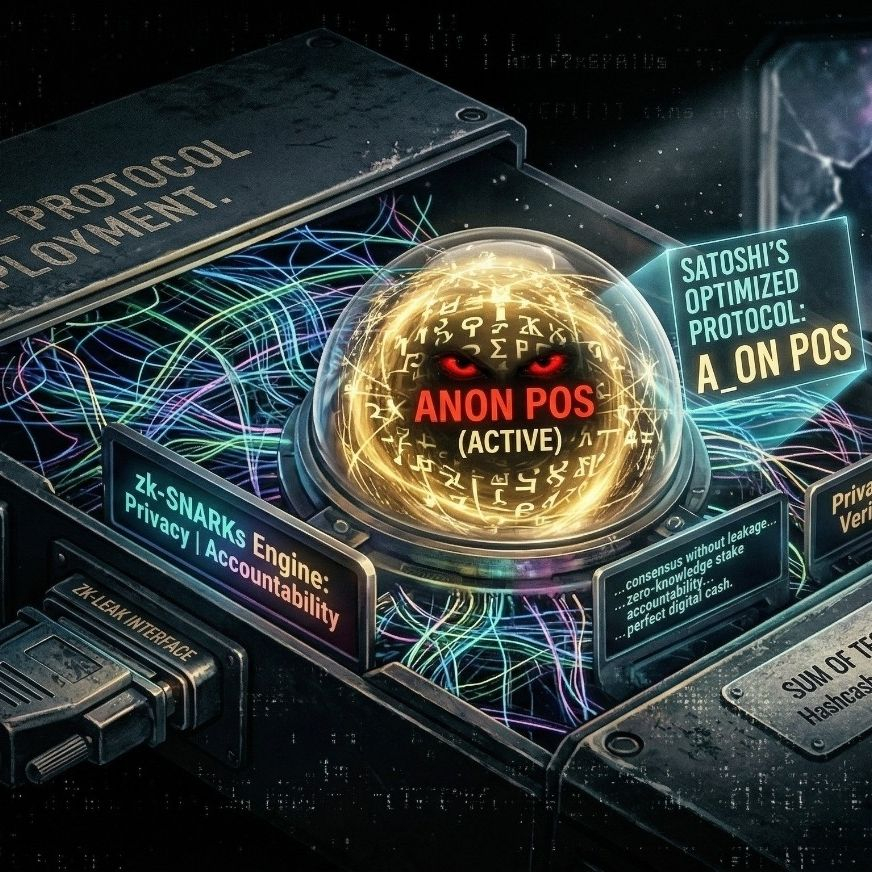
The Satoshi Files? The Fragmented Secret of Anon POS.
Bitcoin was an ingenious synthesis of existing technologies like Hashcash and P2P networks, unified by Satoshi's visionary incentive structure. But true, energy-efficient network anonymity was a technology that hadn't yet matured.
Some believe that Anonymous Proof of Stake (Anon POS) is the logical blueprint Satoshi Nakamoto would have used if the technology—like Zero-Knowledge Proofs—was ready in 2008.
We’ve uncovered a fragmented digital artifact hinting at this missing link.
The leak is coming. We are preparing to release top-secret information detailing the practical realization of Anon POS. Keep your eyes locked.
What do you think? Could Anon POS be the realization of the ultimate goal: perfect, private, decentralized digital cash? Comment your take below! 👇
$BTC $ZEC #AnonPOS #ProofOfStake #CryptoPrivacy #Consensus #Pos
The Satoshi Files? The Fragmented Secret of Anon POS.
Bitcoin was an ingenious synthesis of existing technologies like Hashcash and P2P networks, unified by Satoshi's visionary incentive structure. But true, energy-efficient network anonymity was a technology that hadn't yet matured.
Some believe that Anonymous Proof of Stake (Anon POS) is the logical blueprint Satoshi Nakamoto would have used if the technology—like Zero-Knowledge Proofs—was ready in 2008.
We’ve uncovered a fragmented digital artifact hinting at this missing link.
The leak is coming. We are preparing to release top-secret information detailing the practical realization of Anon POS. Keep your eyes locked.
What do you think? Could Anon POS be the realization of the ultimate goal: perfect, private, decentralized digital cash? Comment your take below! 👇
$BTC $ZEC #AnonPOS #ProofOfStake #CryptoPrivacy #Consensus #Pos
Bitcoin was an ingenious synthesis of existing technologies like Hashcash and P2P networks, unified by Satoshi's visionary incentive structure. But true, energy-efficient network anonymity was a technology that hadn't yet matured.
Some believe that Anonymous Proof of Stake (Anon POS) is the logical blueprint Satoshi Nakamoto would have used if the technology—like Zero-Knowledge Proofs—was ready in 2008.
We’ve uncovered a fragmented digital artifact hinting at this missing link.
The leak is coming. We are preparing to release top-secret information detailing the practical realization of Anon POS. Keep your eyes locked.
What do you think? Could Anon POS be the realization of the ultimate goal: perfect, private, decentralized digital cash? Comment your take below! 👇
$BTC $ZEC #AnonPOS #ProofOfStake #CryptoPrivacy #Consensus #Pos
2
191
Log in to explore more content
Join global crypto users on Binance Square
⚡️ Get latest and useful information about crypto.
💬 Trusted by the world’s largest crypto exchange.
👍 Discover real insights from verified creators.
Email / Phone number
Trending Topics
1
#BitcoinDipsBelow$81K
0 views
20 Discussing
2
#SenBlumenthalProbesCantorFitzgeraldTetherTies
0 views
0 Discussing
3
#BitcoinLifeInsurerMeanwhileRaises$37.5M
0 views
4 Discussing
4
#IMFSaysTokenizedMarketsSmall
291,943 views
1,598 Discussing
5
#FedMinutesFocusOnOctoberPause
831,371 views
4,354 Discussing
6
#VitalikWarnsAICouldWeakenCryptographySecurity
99,409 views
1,117 Discussing
7
#XRPSpotETFsHold$1.7BWeeklyInflowsSlow
12,993 views
111 Discussing
8
#FrenchHillUrgesCLARITYActPassageInLameDuck
63,296 views
861 Discussing
9
#EthereumSpotETFRecords$161MNetOutflows
17,819 views
92 Discussing
10
#IMFGrantsWaiverForElSalvadorBitcoinBreach
60,854 views
802 Discussing