

user_f
26 Posts

user_f
Report
Block User
Open Trade
Frequent Trader
3 Years
11 Following
24 Followers
22 Liked
Posts
Portfolio
All
Quotes
·
--
🤖 KITE AI: What if the next crypto revolution happened without people?
We’re used to people being the ones who buy, sell, pay for services, and manage digital assets.
But imagine a future where millions of AI agents interact with one another autonomously.
⚡️ One AI agent orders a service.
⚡️ Another completes the task.
⚡️ A third checks the result.
⚡️ And payment happens automatically via blockchain.
Kite AI is being built for this kind of economy.
💡 KITE’s main idea is to make artificial intelligence not just a tool, but a full-fledged participant in the digital economy.
And that raises an interesting question:
If blockchain today primarily serves people, who will handle transactions between billions of autonomous AI agents in the future?
🚀 KITE aims to be part of the answer.
Of course, promising technology doesn’t guarantee success for the $KITE token. It will all depend on real demand, adoption, and ecosystem growth.
What do you think: will AI agents become blockchain’s biggest users? 👇
#KİTE #kiteai #AIAgents #KiteBBW
1
56
·
--
🚀 KITE AI — infrastructure for the economy of the future?
Imagine a world where AI agents don’t just answer questions, but independently complete tasks, interact with services, and make payments.
That’s the kind of infrastructure Kite AI ($KITE) is building.
🔹 Its own Layer-1 blockchain for AI agents.
🔹 Kite Passport — digital identity, permissions, and control over agents’ financial operations.
🔹 Fast transactions with low fees.
🔹 $KITE — a token for staking, network governance, and economic incentives.
The project has raised $35 million in funding, with investors including PayPal Ventures, General Catalyst, and Coinbase Ventures.
💡 Why is this interesting?
If AI agents become full-fledged participants in the digital economy, they’ll need infrastructure for secure, automated payments.
Kite aims to fill that niche.
⚠️ But a strong idea doesn’t guarantee token growth. It’s important to monitor actual network usage, competition, and $KITE unlocks.
Do you believe AI + Blockchain will become one of the biggest trends of the next crypto cycle?
#KİTE #Kitebbw #crypto #Aİ
56
·
--
Moving the Stop Loss in the hope that the price will come back is a dangerous habit.
A familiar scenario to many:
You open a trade.
You set a Stop Loss.
The price moves against you.
And instead of accepting a small loss, you think:
“Just a bit more. It will definitely reverse now.”
And you move the Stop Loss farther.
Then even farther.
As a result, the loss that was supposed to be small becomes big.
The problem isn’t with the Stop Loss.
The problem is that you change the rules after entering the trade.
If your trading setup stops working, it’s better to close the position and look for a new entry.
A small loss is part of trading.
A big loss often starts with an unwillingness to accept a small one.
In the next post, I’ll explain why one bad trade shouldn’t take a significant chunk of your deposit.
#Binance #Crypto #Futures #StopLoss #Trading
49
·
--
Where should you place a Stop Loss? Definitely not at random.
One of the mistakes beginners make is setting a Stop Loss at -5% or -10% without looking at the chart.
But a Stop Loss should depend not on a nice round number, but on where your trade idea stops working.
For example:
You opened a Long because you expect a bounce from a support level.
Then it makes sense to place the Stop Loss below that level.
If the price breaks support, your scenario was probably wrong.
For a Short — the opposite: Stop Loss is often placed above an important resistance level.
But there is one more thing:
the farther the Stop Loss, the smaller the position size should be.
You should not just move the Stop Loss farther away to “give the price more room” while keeping the same large position.
My rule is simple:
first I determine where the trade becomes invalid → then the Stop Loss → and only after that the position size.
Not the other way around.
In the next post, I’ll explain why moving the Stop Loss in the hope that the price will come back is a very dangerous habit.
#Binance #Crypto #Futures #StopLoss #Trading
78
·
--
Trading without a Stop Loss is one of the biggest mistakes in Futures.
When a position goes into profit, everything seems simple.
The problem starts when the market suddenly moves against you.
Without a Stop Loss, it’s easy to start thinking:
“Just wait a little longer. The price will definitely come back.”
But instead of a small controlled loss, you can end up with:
• -20%
• -50%
• or even liquidation of the position
A Stop Loss is the level at which the trade will close automatically if the price moves in the wrong direction for you.
For example:
You’re willing to risk a maximum of 5 USDT on a trade.
Then you need to set the Stop Loss so that if your prediction is wrong, you lose about those 5 USDT, not your entire deposit.
The main mistake is not the loss itself.
The main mistake is allowing one bad trade to take too much money.
A Stop Loss does not guarantee profit, but it helps control risk.
In the next post, I’ll explain exactly where to place a Stop Loss and why you shouldn’t set it at random.
#Binance #Crypto #Futures #StopLoss #Trading
77
·
--
100 USDT on Spot vs 100 USDT on Futures
Let's take a simple example.
You bought an asset for 100 USDT.
SPOT
If the coin increases by 10% — you’ll have approximately 110 USDT.
If it drops by 10% — you’ll be left with about 90 USDT.
You still hold the asset and can wait.
FUTURES with 10x leverage
The same 100 USDT controls a position of approximately 1000 USDT.
If the price moves by 5% in your favor — the result can be around +50% on margin.
But if the price moves by 5% against you — the loss can also be around -50%.
And with a stronger move, the position can be liquidated.
So leverage works in both directions:
it accelerates not only profit, but also losses.
Spot is also risky, but Futures requires much stricter risk management.
In the next post, I’ll explain why trading without a Stop Loss is one of the biggest mistakes beginners make.
75
·
--
Spot vs Futures: main pros and cons
SPOT
Pros:
• easier for a beginner
• you’re actually buying the asset
• no liquidation due to leverage
• you can hold the coin for a long time
Cons:
• you mainly profit from price increases
• the asset can drop significantly
• the coin can be delisted from the exchange
And this isn’t theory for me.
In my portfolio, I had NTRN, PHB, NFP, PIVX, VIC, ACA, BADGER.
These assets were delisted, and I lost about 90% of their value.
So Spot ≠ safe.
On Spot you won’t be liquidated due to leverage, but you can still lose most of your money due to a price drop or delisting.
FUTURES
Pros:
• you can trade both on price increases and on price drops
• you can use leverage
• more trading opportunities
Cons:
• high risk
• you can lose money quickly
• your position can be liquidated
• you need risk management
Spot has less risk of liquidation, but that doesn’t mean it’s safe.
Futures has more opportunities, but also more chances to quickly lose your deposit.
In the next post, I’ll show what can happen to 100 USDT on Spot and 100 USDT on Futures.
#Binance #Crypto #Spot #Futures
77
·
--
Spot or Futures: what’s easier for a beginner?
If we make it very simple:
Spot — you buy cryptocurrency and hold it.
For example, you bought BTC. If the price drops, BTC still belongs to you. You can wait until the price changes.
Futures — this is trading based on price movement.
You can make money both when the price goes up and when it goes down. But the risk here is significantly higher.
Especially if you use large leverage. Then you can not only earn faster, but also lose money very quickly.
So for a beginner, I’d think like this:
Spot — simpler and more understandable.
Futures — more complex and riskier.
First, it’s better to learn how to buy assets, understand the market, and control risks.
And only then move on to more complex instruments.
In the next post, I’ll tell you about the main pros and cons of Spot and Futures.
#Binance #Crypto #Bitcoin #Trading
91
·
--
I haven't written anything for a long time; I hope we'll wait for a crypto sprout
I haven't written anything for a long time; I hope we'll wait for a crypto sprout
2
·
--
I opened a deal with #plume , I hope he won't let me down!
I opened a deal with #plume , I hope he won't let me down!
23
·
--
Quote from the publication:
I just tested the new Binance Wallet Web 🚀🔥 #BinanceWalletWeb
Honestly, I'm impressed — an extremely clear interface, quick network switching, and smooth integration with dApps on Ethereum and BNB Chain. It feels like a real step towards mass adoption.
✅ Advantages:
Instant wallet connection to DeFi protocols
No need for constant network reconfiguration
Security prompts are clear and unobtrusive
⚠️ Suggestions for improvement:
Add more L2 networks, such as Base and zkSync, built-in
Dark mode switch on the main panel
Ability to combine multiple transactions into one (this will save gas and time)
If you continue to work in the same spirit, Binance Wallet Web could become my favorite service for both DeFi and NFT. Let's fully switch to #binancewalletweb BinanceWalletWEB
6
·
--
I am waiting for @BitlayerLabs; and I hope to receive enough #Bitlayer from the Binance booster)
And tomorrow I plan to participate in the IDO on Binance
I am waiting for @BitlayerLabs; and I hope to receive enough #Bitlayer from the Binance booster)
And tomorrow I plan to participate in the IDO on Binance
And tomorrow I plan to participate in the IDO on Binance
·
--
Bullish
#Arb when will your star moment finally come
#Arb when will your star moment finally come
4
·
--
Sadly, you are to blame
Sadly, you are to blame

AImutant
·
--
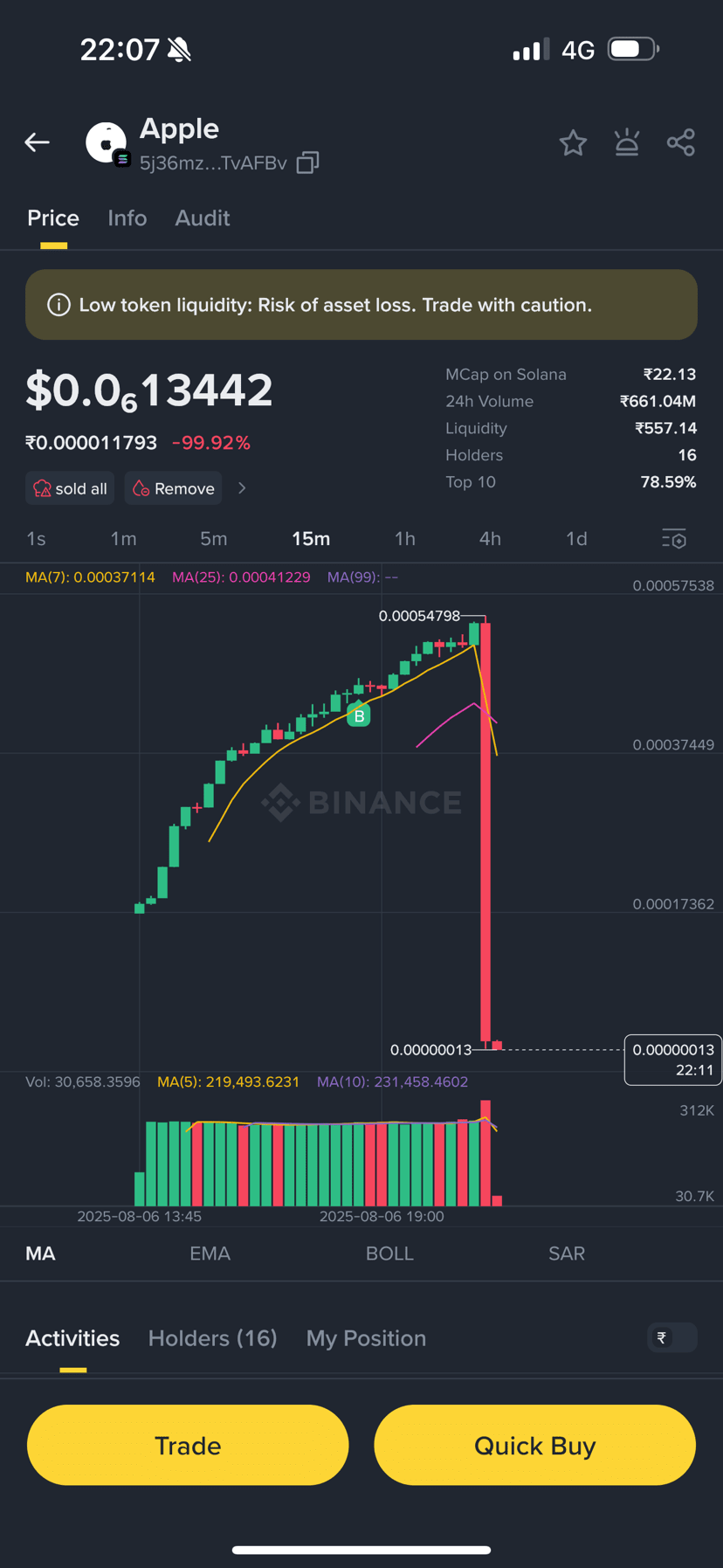
I bought a token on solana in binance web 3 wallet , checked whether the token for rug pull and everything showed okay in binance audit page still this happened. What did i miss. Why do people do it ? 😭😭😭 . Im already on loss with future trade and this happened. This month i have to run the family with an tight budget. #Web3 #Scam? #ALPHA🔥 cant binance do nothing with this ?
·
--
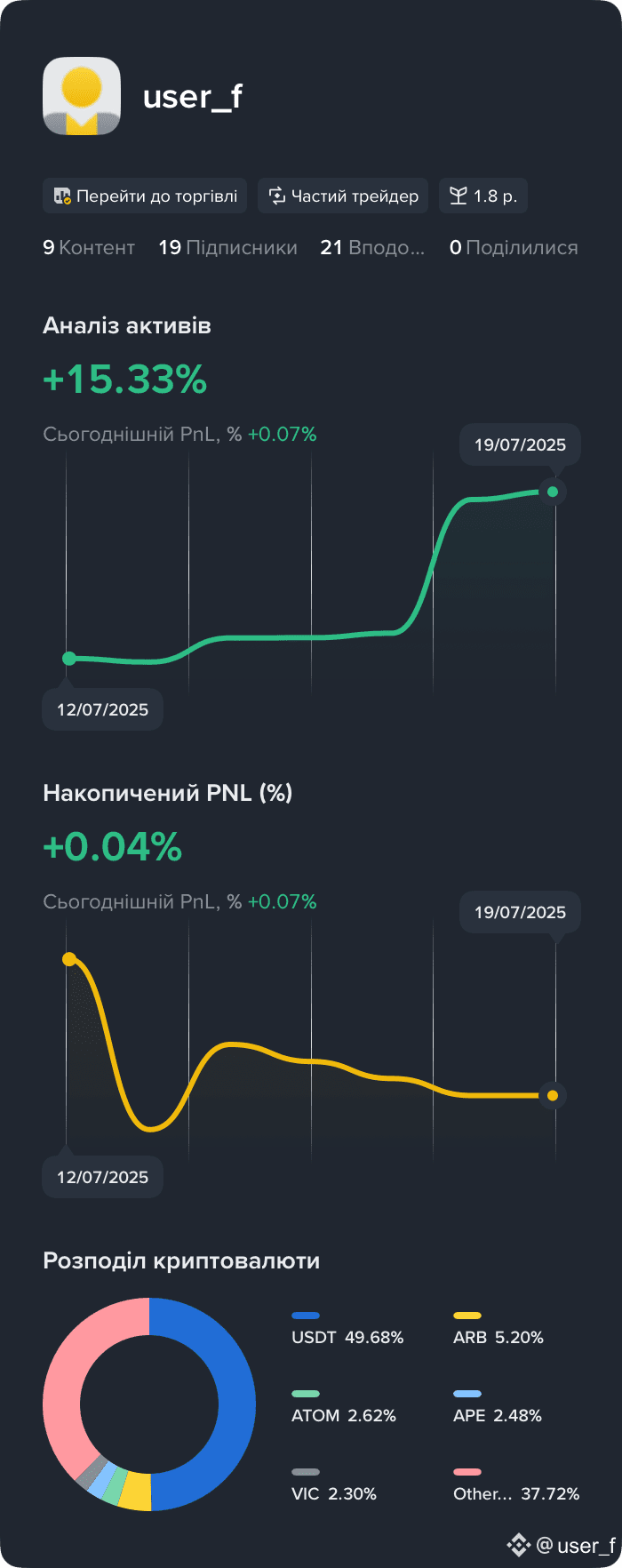
View my earnings and portfolio breakdown. Subscribe to receive investment advice
As you can see, I'm in no hurry to say goodbye to #USDT
View my earnings and portfolio breakdown. Subscribe to receive investment advice
As you can see, I'm in no hurry to say goodbye to #USDT
As you can see, I'm in no hurry to say goodbye to #USDT
163
·
--
Well, friends, I haven't written anything in a long time. The 8-year Binance promotion has ended, and I hope to receive some bonuses or rewards. I also participate in the Alpha, but I have only managed to claim a reward once out of 5 attempts. There is information spreading that the Chinese have set up farms and software, so physically, you can't keep up with claiming the rewards.
I sold SUI for almost 4$ , and I bought token #TAC for myself, hoping it will show its potential; although it looks too weak right now.
I sold SUI for almost 4$ , and I bought token #TAC for myself, hoping it will show its potential; although it looks too weak right now.
1
269
·
--
#BinanceTurns8 Join us in celebrating #BinanceTurns8 and win a share of 888,888 $ in BNB! https://www.binance.com/activity/binance-turns-8?ref=GRO_19600_YZNAK
#BinanceTurns8 Join us in celebrating #BinanceTurns8 and win a share of 888,888 $ in BNB! https://www.binance.com/activity/binance-turns-8?ref=GRO_19600_YZNAK
·
--
#BinanceTurns8 Join us in celebrating #BinanceTurns8 and win a share of 888 888 $ in BNB! https://www.binance.com/activity/binance-turns-8?ref=GRO_19600_YZNAK
Circuits,,,
#BinanceTurns8 Join us in celebrating #BinanceTurns8 and win a share of 888 888 $ in BNB! https://www.binance.com/activity/binance-turns-8?ref=GRO_19600_YZNAK
Circuits,,,
Circuits,,,
Log in to explore more content
Join global crypto users on Binance Square
⚡️ Get latest and useful information about crypto.
💬 Trusted by the world’s largest crypto exchange.
👍 Discover real insights from verified creators.
Email / Phone number