

#kitebbw
kitebbw
236,185 views
1,108 Discussing
Hot
Latest


·
--
The next big shift in crypto might not be about how humans move money, but how machines interact with it.
Imagine AI agents booking services, paying for tools, and completing digital tasks without waiting for a human to approve every single step.
But here's the real challenge: How do we let AI act independently without giving up control?
That’s where @GoKiteAI gets interesting.
Instead of focusing only on what AI can do, Kite brings attention to the infrastructure needed for agents to operate in a financial world where trust, permissions, and accountability matter.
Because smarter AI is only half the equation. The other half is giving it a reliable way to interact with the economy.
If this vision becomes reality, AI agents could become active participants in the digital economy rather than just tools we use.
The big question is no longer whether AI can perform tasks. It’s whether we can build a system where those actions are safe, verifiable, and economically useful.
That’s the narrative I’m watching with $KITE
#KiteBBW
The next big shift in crypto might not be about how humans move money, but how machines interact with it.
Imagine AI agents booking services, paying for tools, and completing digital tasks without waiting for a human to approve every single step.
But here's the real challenge: How do we let AI act independently without giving up control?
That’s where @KITE AI 中文 gets interesting.
Instead of focusing only on what AI can do, Kite brings attention to the infrastructure needed for agents to operate in a financial world where trust, permissions, and accountability matter.
Because smarter AI is only half the equation. The other half is giving it a reliable way to interact with the economy.
If this vision becomes reality, AI agents could become active participants in the digital economy rather than just tools we use.
The big question is no longer whether AI can perform tasks. It’s whether we can build a system where those actions are safe, verifiable, and economically useful.
That’s the narrative I’m watching with $KITE
#KiteBBW
O L I V I E:
@KITE AI is exploring an important piece of that puzzle: autonomy with accountability. 🚀
12
17
492

·
--
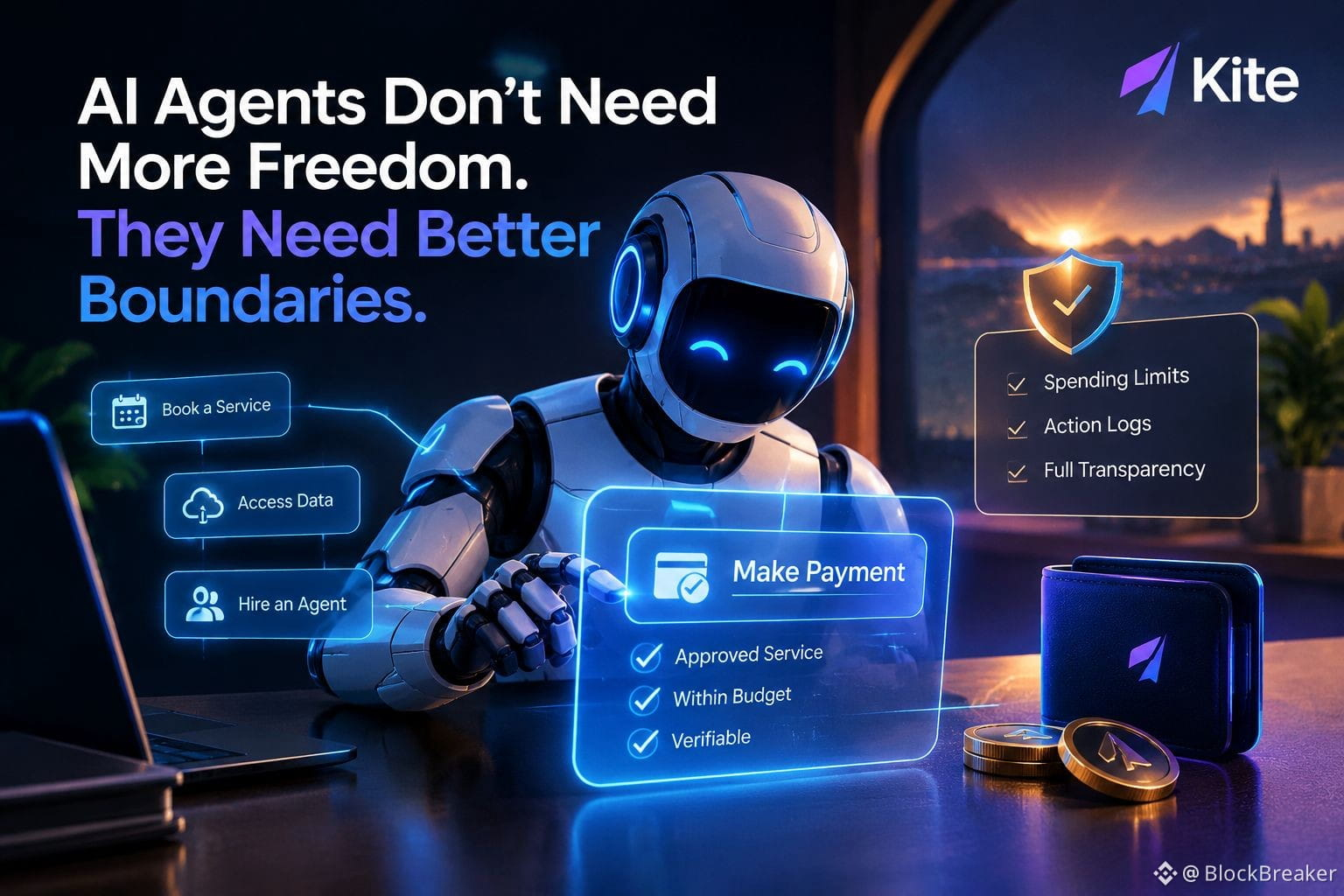
AI Agents Don’t Need More Freedom. They Need Better Boundaries.
Something I keep thinking about with AI agents: giving an agent money is easy. Knowing when to trust it with that money is a different story.
Imagine your agent booking a service, paying for data, or hiring another agent while you’re offline. What happens if it chooses the wrong service or spends more than you expected?
That’s the problem that makes Kite interesting to me. The real value isn’t just helping agents make payments; it’s building clearer boundaries around what they’re allowed to do and making their actions easier to verify.
Kite’s Passport and payment-session approach point toward that direction. Recent activity around Ankr Forge also gives developers another way to explore the ecosystem, but experiments are only the beginning.
What I’ll be watching is whether people keep using these tools for real tasks, not just trying them once.
Because the agent economy won’t earn trust simply by becoming more autonomous. It will earn trust when autonomy comes with accountability.
That’s the part of Kite worth watching.
#KiteBBW $KITE @GoKiteAI
AI Agents Don’t Need More Freedom. They Need Better Boundaries.
Something I keep thinking about with AI agents: giving an agent money is easy. Knowing when to trust it with that money is a different story.
Imagine your agent booking a service, paying for data, or hiring another agent while you’re offline. What happens if it chooses the wrong service or spends more than you expected?
That’s the problem that makes Kite interesting to me. The real value isn’t just helping agents make payments; it’s building clearer boundaries around what they’re allowed to do and making their actions easier to verify.
Kite’s Passport and payment-session approach point toward that direction. Recent activity around Ankr Forge also gives developers another way to explore the ecosystem, but experiments are only the beginning.
What I’ll be watching is whether people keep using these tools for real tasks, not just trying them once.
Because the agent economy won’t earn trust simply by becoming more autonomous. It will earn trust when autonomy comes with accountability.
That’s the part of Kite worth watching.
#KiteBBW $KITE @KITE AI 中文
Arix Axon:
The real test is whether developers will use these tools in everyday applications.
18
22
619

·
--
Verified
Why Visa Won't Survive the AI Economy (And Why $KITE Will)
Everyone is talking about AI agents trading tokens, but nobody is answering the real question: How do machines pay each other?
You can’t hand an AI agent your Visa card (one infinite loop bug and your bank account is wiped).
Traditional banking rails are too slow and too expensive for micro-cent, millisecond machine transactions.
The upcoming Agent Economy needs a new financial stack.
That is why Kite AI ($KITE) is a game changer:
Agent Passports: Give AI agents cryptographic spending limits so they can transact safely without risking your funds.
Native Micropayments: Built to handle millions of sub cent machine transactions instantly without choking on gas fees.
Legacy fintech was built for humans. The machine to machine economy needs its own Layer-1.
#KiteBBW $KITE
Why Visa Won't Survive the AI Economy (And Why $KITE Will)
Everyone is talking about AI agents trading tokens, but nobody is answering the real question: How do machines pay each other?
You can’t hand an AI agent your Visa card (one infinite loop bug and your bank account is wiped).
Traditional banking rails are too slow and too expensive for micro-cent, millisecond machine transactions.
The upcoming Agent Economy needs a new financial stack.
That is why Kite AI ($KITE ) is a game changer:
Agent Passports: Give AI agents cryptographic spending limits so they can transact safely without risking your funds.
Native Micropayments: Built to handle millions of sub cent machine transactions instantly without choking on gas fees.
Legacy fintech was built for humans. The machine to machine economy needs its own Layer-1.
#KiteBBW $KITE
NovaElen:
@GoKiteAI’s focus on spending controls and micropayments makes this an interesting space to watch. Real-world adoption will be the key test for $KITE.
24
14
1k

·
--
Everyone keeps talking about how smart AI agents are getting. I think that's the wrong thing to focus on.
Smart is already here. My question is simpler: would you actually let an agent spend your money?
Honestly, I wouldn't. Not today. Not because the agent can't book the flight or pay for the data feed, but because I have no way to say "spend up to this much, only on this, and stop if anything looks off." Right now it's either full access or no access, and neither works for real life.
That's why Kite caught my attention. Instead of making agents smarter, it works on the boring but important layer underneath: who is allowed to do what.
From what I read on their site, you set the budget, the limits and the scope first. You approve once, and the agent works inside those rules. Every action gets verified before money moves, and you can revoke access instantly and see the full audit trail from intent to payment. That feels like how delegation actually works between people. I give my assistant a card with a limit, not my entire bank account.
Then there's the settlement side. Kite Chain is built for agents, with sub-second finality, native stablecoin settlement and EVM compatibility, so developers don't have to start from zero. They also list backers like PayPal Ventures, General Catalyst and Coinbase Ventures, and partners such as Coinbase x402 and Google Cloud's AP2.
Kite being named the exclusive Premium Partner of The Blockchain 100 2026 on Binance Square also shows this theme is getting real attention.
What I keep coming back to is this: if agents are going to pay for things on our behalf, the winning infrastructure probably won't be the flashiest one. It'll be the one people trust enough to hand a budget to. That's the angle I'll be watching in the agent economy.
This is my personal take, not financial advice. Crypto is volatile, so learn first, understand the risks, and always do your own research.
#KiteBBW $KITE #Binance #BinanceAcademy #LearnWithBinance
David Watt:
KITE 🔥
6
7
419

·
--
Late last week the KITE chart kept pulling me back in. Not because of any dramatic move—just that quiet order book sitting under a still-pretty-high fully diluted valuation. Price hovering around $0.11–0.12, circulating market cap roughly $280–310 million, FDV somewhere in the $1.1–1.2 billion range on 2.56 billion of the 10 billion total supply. Volume’s still modest relative to that picture.
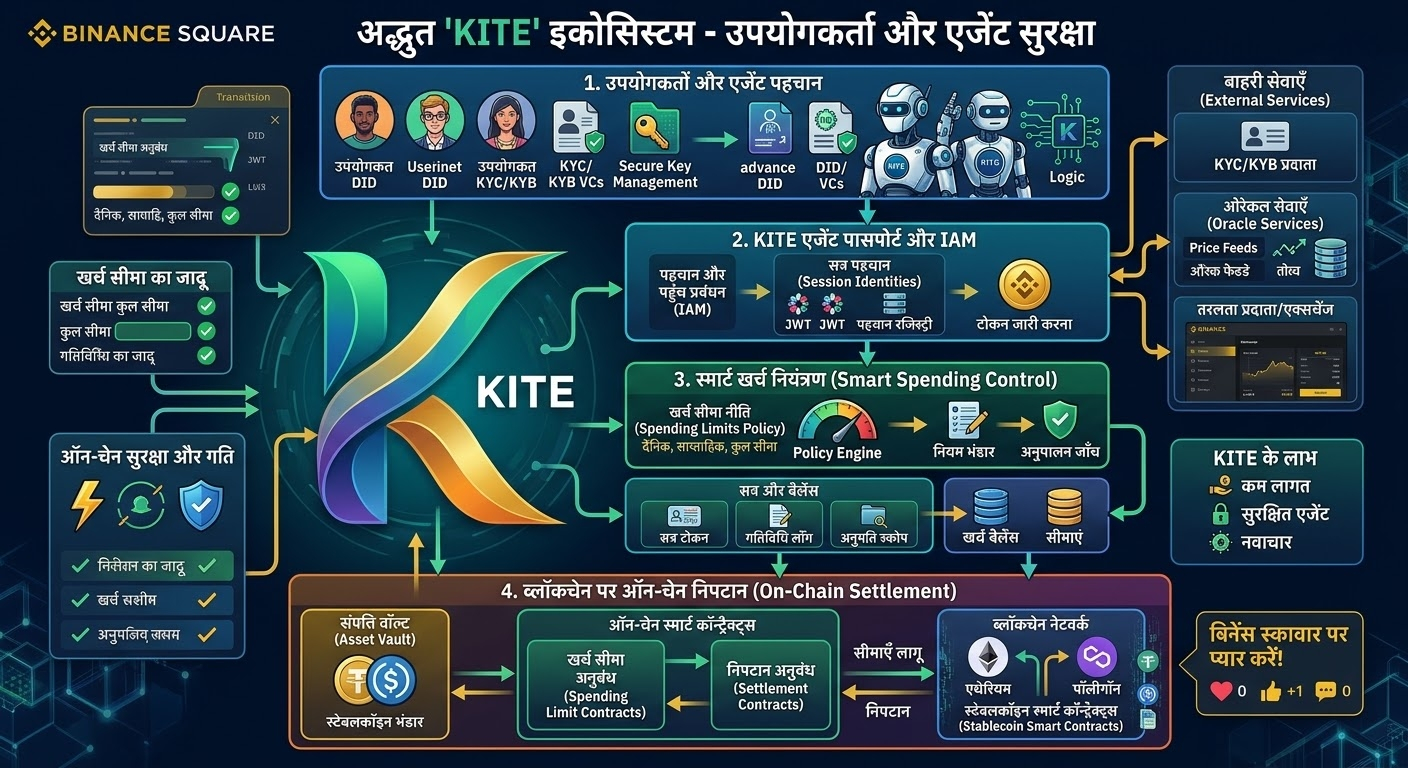
The protocol itself is trying to fix something real: agents can research and plan just fine, but almost nobody’s comfortable handing them open wallets. Kite’s Agent Passport splits user, agent, and session identities so spending limits and approved destinations get enforced on-chain. Settlements stay in stablecoins. The design feels deliberate and thoughtful.
What’s still fuzzy is how much actual economic activity is happening on the chain versus how much of the valuation is still riding the broader agent narrative. Broader x402 volumes exist, sure, but Kite-specific settlement data is pretty thin.
Early November brings that one-year cliff—about 1.11 billion tokens, nearly half the current float—including big team and investor chunks. All that supply shows up against limited daily turnover.
People using the rails get constrained, low-cost payments. Token holders are the ones carrying the dilution and the open question of whether future fees and staking will ever capture real value. The tech addresses a genuine gap. Whether the market is pricing actual usage or mostly the story is what the next few weeks will test.
@GoKiteAI #KiteBBW $KITE
{spot}(KITEUSDT)
$AKE
{future}(AKEUSDT)
$APR
{future}(APRUSDT)
Late last week the KITE chart kept pulling me back in. Not because of any dramatic move—just that quiet order book sitting under a still-pretty-high fully diluted valuation. Price hovering around $0.11–0.12, circulating market cap roughly $280–310 million, FDV somewhere in the $1.1–1.2 billion range on 2.56 billion of the 10 billion total supply. Volume’s still modest relative to that picture.
The protocol itself is trying to fix something real: agents can research and plan just fine, but almost nobody’s comfortable handing them open wallets. Kite’s Agent Passport splits user, agent, and session identities so spending limits and approved destinations get enforced on-chain. Settlements stay in stablecoins. The design feels deliberate and thoughtful.
What’s still fuzzy is how much actual economic activity is happening on the chain versus how much of the valuation is still riding the broader agent narrative. Broader x402 volumes exist, sure, but Kite-specific settlement data is pretty thin.
Early November brings that one-year cliff—about 1.11 billion tokens, nearly half the current float—including big team and investor chunks. All that supply shows up against limited daily turnover.
People using the rails get constrained, low-cost payments. Token holders are the ones carrying the dilution and the open question of whether future fees and staking will ever capture real value. The tech addresses a genuine gap. Whether the market is pricing actual usage or mostly the story is what the next few weeks will test.
@KITE AI 中文 #KiteBBW $KITE
$AKE
$APR
BRO BNB:
Late last week the KITE chart kept pulling me back in. Not because of any dramatic move—just that quiet order book sitting under a still-pretty-high fully diluted valuation. Price
2
2
420

·
--
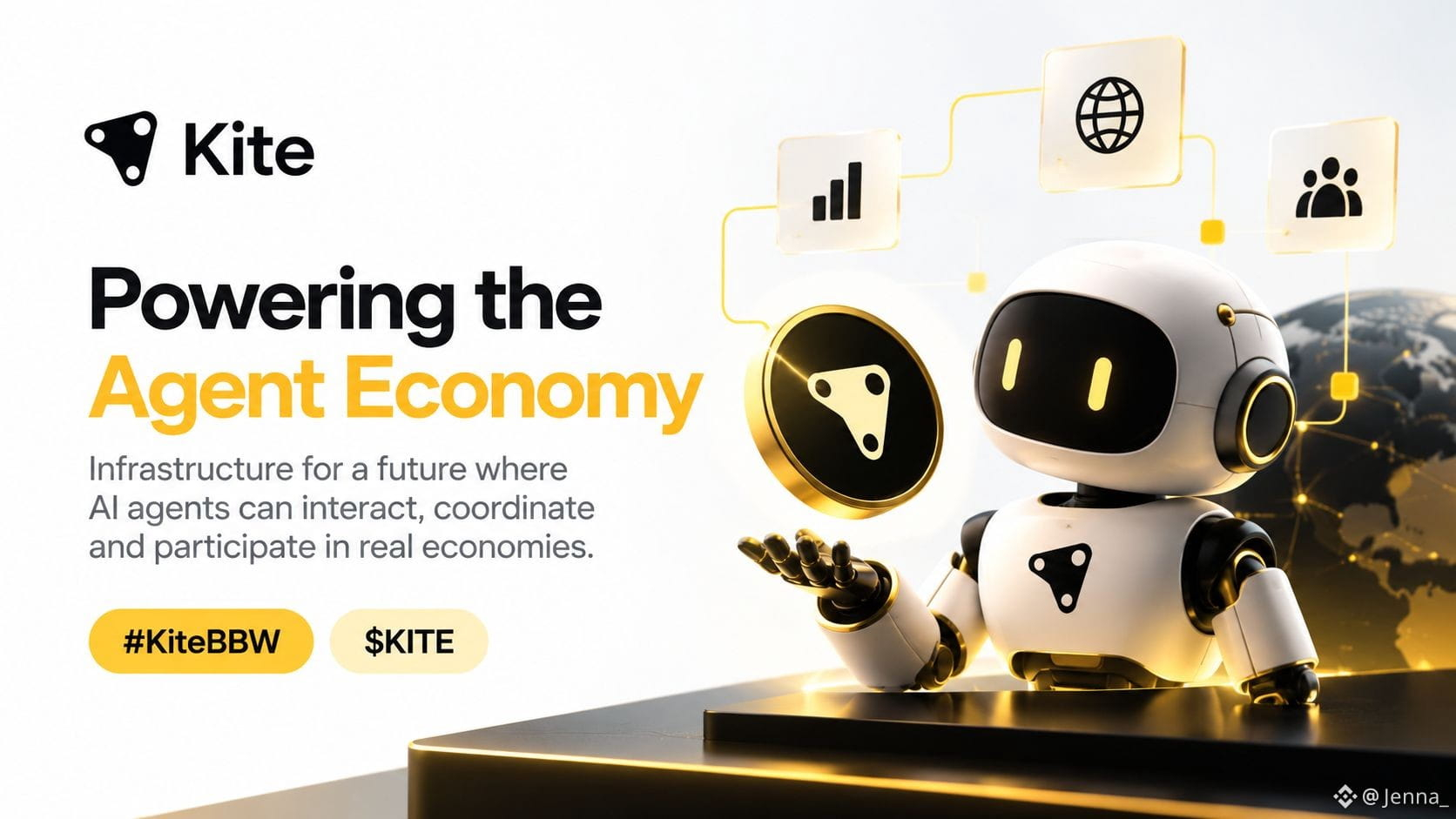
The next phase of AI will be about more than generating answers. It will be about AI agents that can actually get things done.
That’s where @GoKiteAI comes into the picture.
As the agent economy grows, AI agents will need more than intelligence. They’ll need infrastructure to interact, coordinate, and participate in digital economies with greater autonomy.
Kite is working toward a future where AI agents can operate with their own identities, make decisions within defined boundaries, and carry out transactions without relying on humans for every step.
This is an important direction for both AI and Web3. If autonomous agents become a bigger part of our digital lives, the infrastructure connecting them to real economic activity could become increasingly valuable.
The agent economy is still developing, but it’s a space worth watching closely.
#KiteBBW $KITE
1
217

·
--
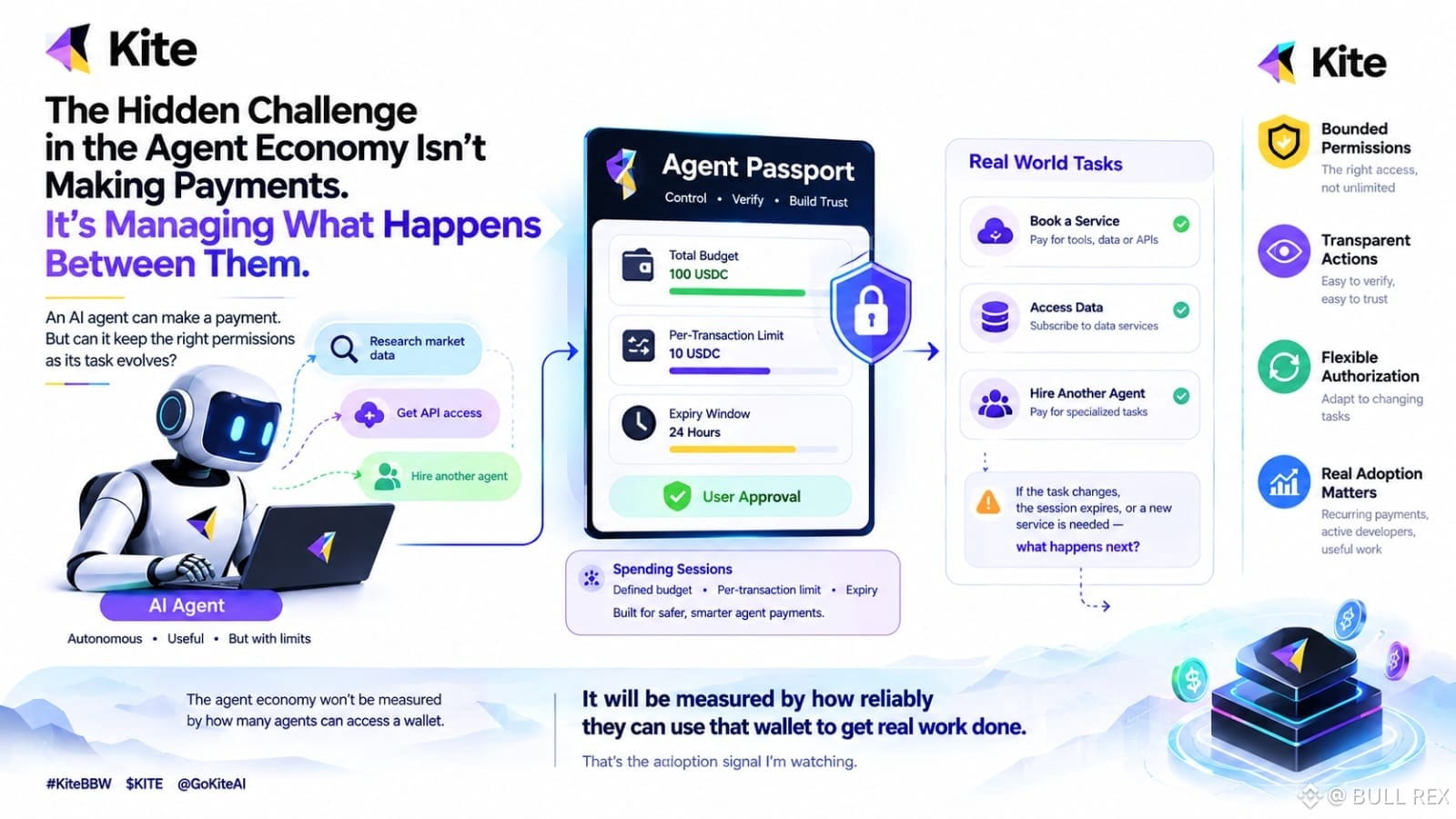
The Hidden Challenge in the Agent Economy Isn’t Making Payments. It’s Managing What Happens Between Them.
I think one of the most overlooked questions about AI agents is not whether they can pay for services, but whether their financial permissions remain appropriate as their tasks evolve.
Consider an agent hired to research a market. It might need to purchase API access, retrieve data from another service, and pay a second agent to complete a specialized task. Each step creates a new spending decision. A permission granted for the first task shouldn’t automatically become unlimited authority over the next.
This is where Kite’s Agent Passport becomes interesting to me.
Kite’s payment documentation describes spending sessions with a defined total budget, a per-transaction limit, and an expiry window. The user approves the session, after which the agent can make eligible payments within those limits until the budget runs out or the session expires. That turns financial permission into something more specific than simply giving an agent a funded wallet.
But there’s a second question worth watching: what happens when a task changes, a session expires, or an agent needs a new service? The system must balance autonomy with renewed authorization, without making every small action dependent on constant human intervention.
For me, this is the real test of agent-native payments. Can developers build workflows that are useful enough to run independently while keeping spending bounded, actions reviewable, and permissions appropriate to each task?
Kite has a mechanism worth examining. The next proof is sustained use: recurring service payments, developers building around Passport, and agents completing useful work beyond one-off demonstrations.
The agent economy won’t be measured by how many agents can access a wallet. It will be measured by how reliably they can use that wallet to get real work done.
That’s the adoption signal I’ll be watching.
$KITE @GoKiteAI
#KiteBBW
The Hidden Challenge in the Agent Economy Isn’t Making Payments. It’s Managing What Happens Between Them.
I think one of the most overlooked questions about AI agents is not whether they can pay for services, but whether their financial permissions remain appropriate as their tasks evolve.
Consider an agent hired to research a market. It might need to purchase API access, retrieve data from another service, and pay a second agent to complete a specialized task. Each step creates a new spending decision. A permission granted for the first task shouldn’t automatically become unlimited authority over the next.
This is where Kite’s Agent Passport becomes interesting to me.
Kite’s payment documentation describes spending sessions with a defined total budget, a per-transaction limit, and an expiry window. The user approves the session, after which the agent can make eligible payments within those limits until the budget runs out or the session expires. That turns financial permission into something more specific than simply giving an agent a funded wallet.
But there’s a second question worth watching: what happens when a task changes, a session expires, or an agent needs a new service? The system must balance autonomy with renewed authorization, without making every small action dependent on constant human intervention.
For me, this is the real test of agent-native payments. Can developers build workflows that are useful enough to run independently while keeping spending bounded, actions reviewable, and permissions appropriate to each task?
Kite has a mechanism worth examining. The next proof is sustained use: recurring service payments, developers building around Passport, and agents completing useful work beyond one-off demonstrations.
The agent economy won’t be measured by how many agents can access a wallet. It will be measured by how reliably they can use that wallet to get real work done.
That’s the adoption signal I’ll be watching.
$KITE @KITE AI 中文
#KiteBBW
90

·
--
I’m excited to see Kite bringing creators together to explore the future of AI agents and Web3. 💛
The Kite Creator Spotlight campaign offers 80,000 $KITE in total rewards for 75 winners. To participate, follow the official Kite account, publish an original Binance Square post about Kite and the agent economy, and include #KiteBBW and $KITE.
Submit your post link and Binance UID through the official form before November 1, 2026, at 23:59 UTC.
For me, the real value is sharing fresh ideas and learning how AI agents could make Web3 more useful in the future.
What role do you think AI agents will play in the next generation of Web3? 👇
#KiteBBW $KITE @GoKiteAI
{spot}(KITEUSDT)
I’m excited to see Kite bringing creators together to explore the future of AI agents and Web3. 💛
The Kite Creator Spotlight campaign offers 80,000 $KITE in total rewards for 75 winners. To participate, follow the official Kite account, publish an original Binance Square post about Kite and the agent economy, and include #KiteBBW and $KITE .
Submit your post link and Binance UID through the official form before November 1, 2026, at 23:59 UTC.
For me, the real value is sharing fresh ideas and learning how AI agents could make Web3 more useful in the future.
What role do you think AI agents will play in the next generation of Web3? 👇
#KiteBBW $KITE @KITE AI 中文
6

·
--
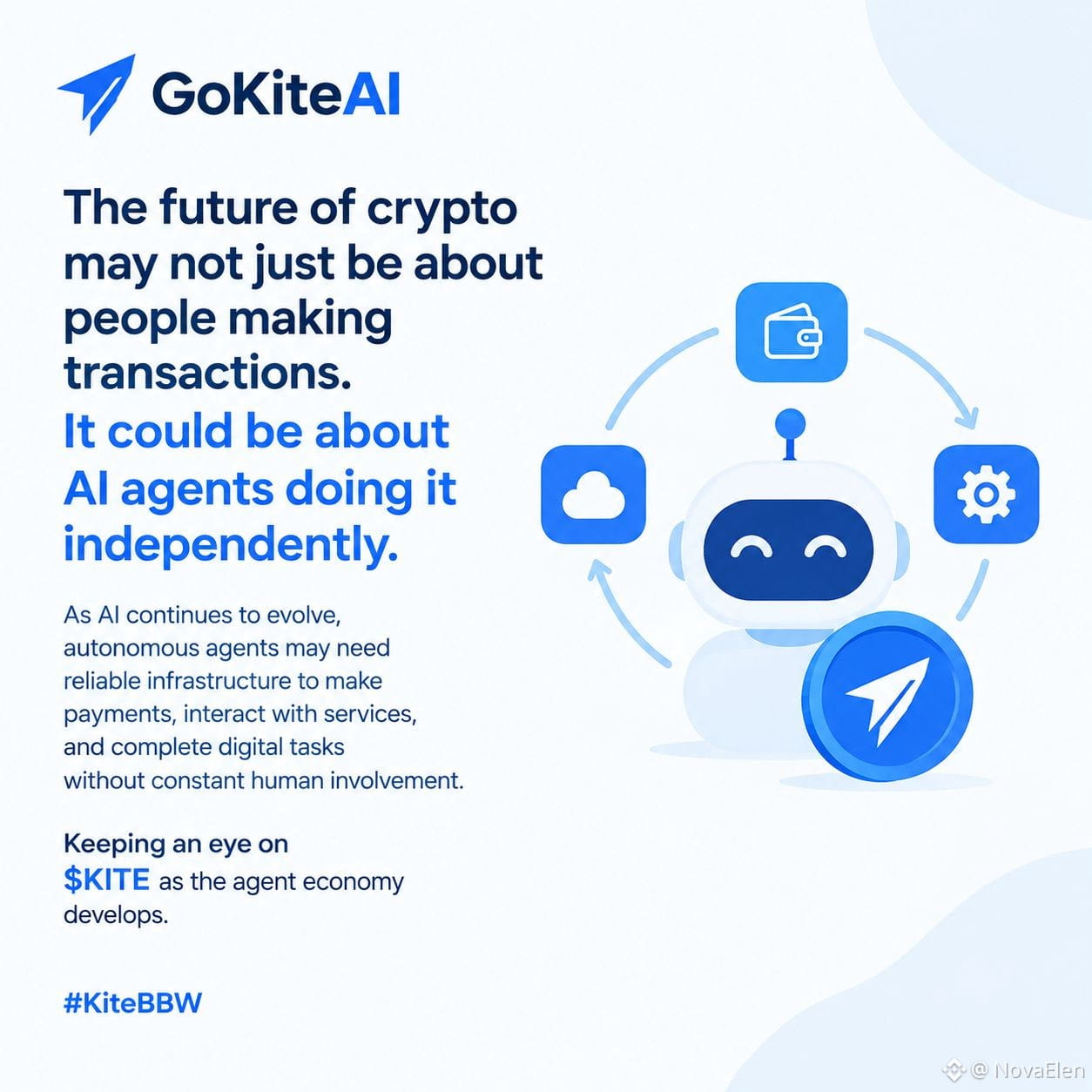
@GoKiteAI The future of crypto may not just be about people making transactions. It could be about AI agents doing it independently.
That’s where comes into the picture.
As AI continues to evolve, autonomous agents may need reliable infrastructure to make payments, interact with services, and complete digital tasks without constant human involvement.
This creates an interesting opportunity at the intersection of AI and Web3.
The real question is how quickly this technology can move from concept to everyday use.
Keeping an eye on $KITE as the agent economy develops.
#KiteBBW
@KITE AI 中文 The future of crypto may not just be about people making transactions. It could be about AI agents doing it independently.
That’s where comes into the picture.
As AI continues to evolve, autonomous agents may need reliable infrastructure to make payments, interact with services, and complete digital tasks without constant human involvement.
This creates an interesting opportunity at the intersection of AI and Web3.
The real question is how quickly this technology can move from concept to everyday use.
Keeping an eye on $KITE as the agent economy develops.
#KiteBBW
1
88

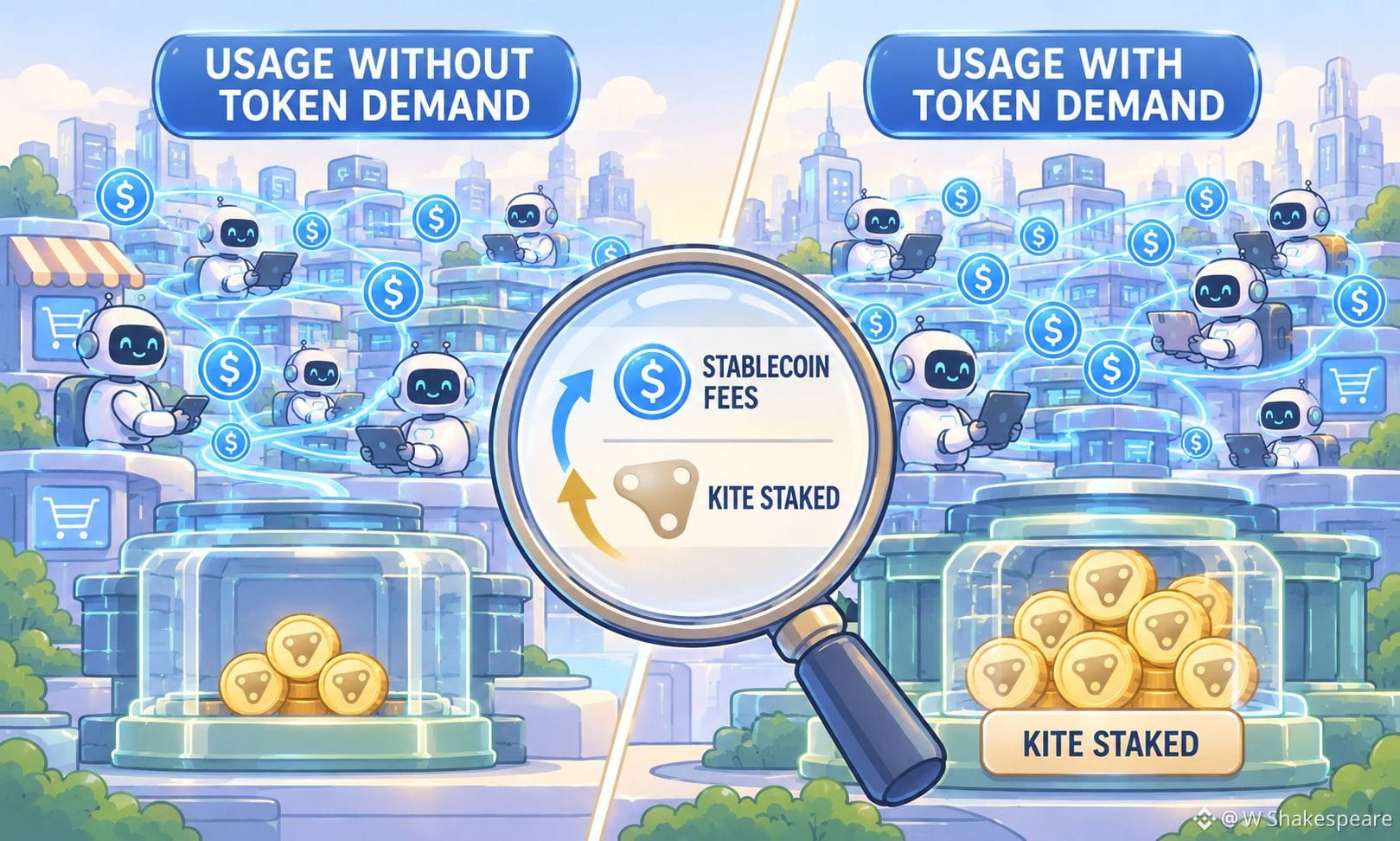
Do you know the stone soup story? Two travelers walk into a hungry village, drop a stone in a pot and promise a feast. One villager adds a carrot, another brings potatoes, and by evening everybody’s eating and crediting the stone. Nobody stops to ask whether the soup ever needed it. The story only works because the stone does nothing.
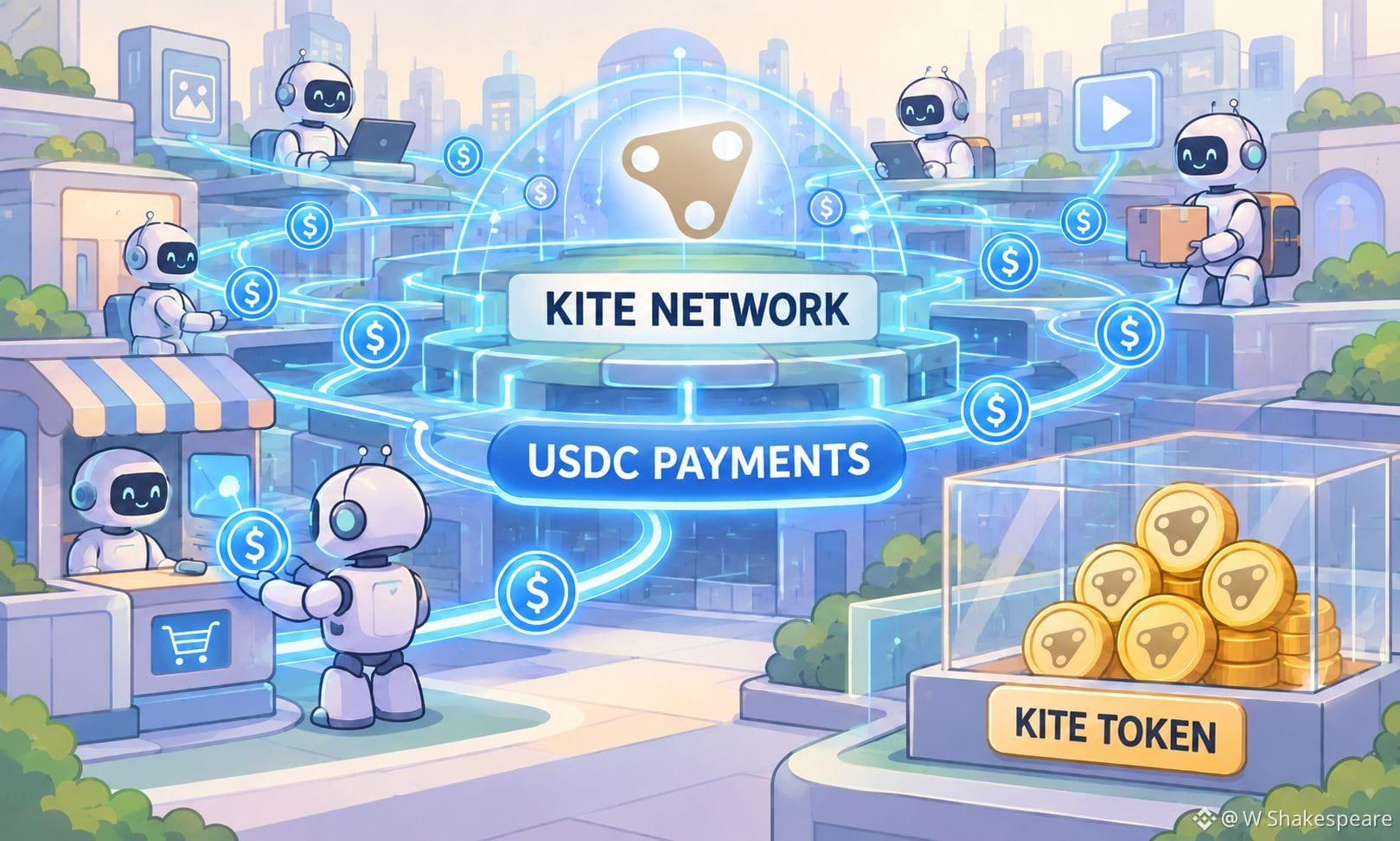
I asked that question when I read Kite’s MiCA white paper. Rewards start out fully in $KITE , then slowly shift to stablecoins. Stablecoins are the carrots here. Paying in them proves agents can use the network. It doesn’t prove anyone has to hold $KITE .
And the market already leans that way. Keyrock counted 176 million agent payments, and 98.6% of them settled in USDC. If Kite’s traffic looks anything like that, the soup keeps getting richer and the stone stays optional.
To be fair, Kite does give the stone a job. You stake $KITE to run a validator, own a module or delegate to one. That’s a bond, not a toll: closer to buying the pot than paying for a bowl. But a bond grows with how much security and module supply the network wants, not with how many payments go through. Those two curves don’t have to move together.
So I’ve stopped caring how many agents show up. Transaction counts, agent counts, partner logos: none of them tell you whether anyone had to buy the token. What I’d trust is stablecoin fees per staked $KITE, and whether a module owner has to lock more KITE as usage grows. If both climb together, the stone is in the recipe. If fees rise while stakes sit flat, it’s a nice stone in a good soup.
I’ll be watching two things: how fast rewards move from KITE to stablecoins, and what modules actually make people lock. Which one is the token following, the soup or the stake?
#KiteBBW
Do you know the stone soup story? Two travelers walk into a hungry village, drop a stone in a pot and promise a feast. One villager adds a carrot, another brings potatoes, and by evening everybody’s eating and crediting the stone. Nobody stops to ask whether the soup ever needed it. The story only works because the stone does nothing.
I asked that question when I read Kite’s MiCA white paper. Rewards start out fully in $KITE , then slowly shift to stablecoins. Stablecoins are the carrots here. Paying in them proves agents can use the network. It doesn’t prove anyone has to hold $KITE .
And the market already leans that way. Keyrock counted 176 million agent payments, and 98.6% of them settled in USDC. If Kite’s traffic looks anything like that, the soup keeps getting richer and the stone stays optional.
To be fair, Kite does give the stone a job. You stake $KITE to run a validator, own a module or delegate to one. That’s a bond, not a toll: closer to buying the pot than paying for a bowl. But a bond grows with how much security and module supply the network wants, not with how many payments go through. Those two curves don’t have to move together.
So I’ve stopped caring how many agents show up. Transaction counts, agent counts, partner logos: none of them tell you whether anyone had to buy the token. What I’d trust is stablecoin fees per staked $KITE , and whether a module owner has to lock more KITE as usage grows. If both climb together, the stone is in the recipe. If fees rise while stakes sit flat, it’s a nice stone in a good soup.
I’ll be watching two things: how fast rewards move from KITE to stablecoins, and what modules actually make people lock. Which one is the token following, the soup or the stake?
#KiteBBW
Subin86:
Crypto in a nutshell: 98% of people using USDC, while $KITE holders pray that staking lockups are enough to pump the price 💀
3
4
293

·
--
AI is moving beyond chatbots, and the next step could be agents that handle payments, buy services, and complete tasks independently.
That’s why @KITE AI 中文 has caught my attention.
The interesting part isn’t just connecting AI with crypto. It’s making sure these agents can operate safely without giving them unlimited control over our money.
Kite’s Agent Passport concept makes sense here. Owners can set spending limits, allowing agents to transact while keeping financial decisions under control.
But honestly, having a good idea is only the beginning. Funding and a live mainnet may help build momentum, but real adoption will tell us whether Kite can deliver lasting value.
I’ll be watching developer activity, real-world use cases, and whether businesses actually trust AI agents with payments.
The agent economy has potential, but execution matters more than hype.
For now, $KITE is a project worth keeping on the radar.
#KiteBBW $KITE @GoKiteAI
AI is moving beyond chatbots, and the next step could be agents that handle payments, buy services, and complete tasks independently.
That’s why @KITE AI 中文 has caught my attention.
The interesting part isn’t just connecting AI with crypto. It’s making sure these agents can operate safely without giving them unlimited control over our money.
Kite’s Agent Passport concept makes sense here. Owners can set spending limits, allowing agents to transact while keeping financial decisions under control.
But honestly, having a good idea is only the beginning. Funding and a live mainnet may help build momentum, but real adoption will tell us whether Kite can deliver lasting value.
I’ll be watching developer activity, real-world use cases, and whether businesses actually trust AI agents with payments.
The agent economy has potential, but execution matters more than hype.
For now, $KITE is a project worth keeping on the radar.
#KiteBBW $KITE @KITE AI 中文

72

·
--

Article
Agents pay for APIs - so where does $KITE fit in?People often talk about AI agents as if they're still a distant concept.But in reality, the infrastructure for them is being built right now.$KITE and the question few people bother to ask directly.
AI (formerly Zettablock) isn't aiming to build another generic AI chain.They’re targeting an "agentic economy" where AI agents operate and transact independently, without human intervention at every step.
And to achieve that, they argue that they need a separate Layer-1, not something borrowed from Ethereum or Solana.The technical reasons aren't as complicated as people think.
When AI needs to transfer money quickly and continuously, Kite uses off-chain state channels that allow AIs to transact with each other in under 100 milliseconds, with fees of only about $1.
Just think: an AI agent booking services, paying for API calls, and coordinating workflows-if each transaction took 2-3 seconds like on the Ethereum mainnet, it would be finished.
It's not scalable.And here's the part I find most interesting.
Kite uses a consensus mechanism called Proof of Attributed Intelligence (PoAI) that rewards verifiable AI work, not stake size or raw compute.
It sounds abstract, but the practical meaning is: you can't fake contributions.
Agents do real work → get real rewards. This is a completely different approach from most AI chains that are competing on tokenomics rather than utility.
Backing? $33 million from PayPal Ventures and General Catalyst.PayPal isn't a VC that follows trends; they're infrastructure money.When PayPal Ventures leads a round, they're betting on payment rails, not narrative.
The TGE takes place in November 2025, with simultaneous listings on Binance, OKX, Upbit, Coinbase, Bitget, and Bybit.
The first week's rally was around 313%. After that, like any token, the market tested whether there were actual users.
The answer is becoming clearer.
The mainnet will launch on April 30, 2026, along with the Kite Agent Passport, a wallet and identity system that allows AI agents to transact within user-defined limits. In June 2026, Kite will expand to Solana via the x402 standard.
This means they don't want to be a closed chain; they want to be a cross-chain payment layer.
Risk? Yes, and it's real.
The entire thesis depends on whether the agentic economy develops fast enough to require its own payment rails.
If mainstream AI agents ultimately settle on Stripe or conventional cards, $KITE will be infrastructure for a future that will never arrive.
That's not a distant prospect; it's a real risk that needs to be considered.
But if the direction is right-that AI agents will need on-chain payments, on-chain identity, and on-chain coordination-then Kite is building exactly what the market needs, sooner than most people realize.
I'm not saying this is a gem or alpha. I'm saying this is a project with clear technical arguments and genuinely worth following, not just a pretty whitepaper.
#KiteBBW $KITE
Agents pay for APIs - so where does $KITE fit in?
People often talk about AI agents as if they're still a distant concept.But in reality, the infrastructure for them is being built right now.$KITE and the question few people bother to ask directly.
AI (formerly Zettablock) isn't aiming to build another generic AI chain.They’re targeting an "agentic economy" where AI agents operate and transact independently, without human intervention at every step.
And to achieve that, they argue that they need a separate Layer-1, not something borrowed from Ethereum or Solana.The technical reasons aren't as complicated as people think.
When AI needs to transfer money quickly and continuously, Kite uses off-chain state channels that allow AIs to transact with each other in under 100 milliseconds, with fees of only about $1.
Just think: an AI agent booking services, paying for API calls, and coordinating workflows-if each transaction took 2-3 seconds like on the Ethereum mainnet, it would be finished.
It's not scalable.And here's the part I find most interesting.
Kite uses a consensus mechanism called Proof of Attributed Intelligence (PoAI) that rewards verifiable AI work, not stake size or raw compute.
It sounds abstract, but the practical meaning is: you can't fake contributions.
Agents do real work → get real rewards. This is a completely different approach from most AI chains that are competing on tokenomics rather than utility.
Backing? $33 million from PayPal Ventures and General Catalyst.PayPal isn't a VC that follows trends; they're infrastructure money.When PayPal Ventures leads a round, they're betting on payment rails, not narrative.
The TGE takes place in November 2025, with simultaneous listings on Binance, OKX, Upbit, Coinbase, Bitget, and Bybit.
The first week's rally was around 313%. After that, like any token, the market tested whether there were actual users.
The answer is becoming clearer.
The mainnet will launch on April 30, 2026, along with the Kite Agent Passport, a wallet and identity system that allows AI agents to transact within user-defined limits. In June 2026, Kite will expand to Solana via the x402 standard.
This means they don't want to be a closed chain; they want to be a cross-chain payment layer.
Risk? Yes, and it's real.
The entire thesis depends on whether the agentic economy develops fast enough to require its own payment rails.
If mainstream AI agents ultimately settle on Stripe or conventional cards, $KITE will be infrastructure for a future that will never arrive.
That's not a distant prospect; it's a real risk that needs to be considered.
But if the direction is right-that AI agents will need on-chain payments, on-chain identity, and on-chain coordination-then Kite is building exactly what the market needs, sooner than most people realize.
I'm not saying this is a gem or alpha. I'm saying this is a project with clear technical arguments and genuinely worth following, not just a pretty whitepaper.
#KiteBBW $KITE
94

·
--
Would you let an AI agent spend $20 without approving every purchase?
That question gets to the heart of the agent economy. An agent buying data or accessing a paid API needs clear limits on what it can spend and permission to act.
This is the part of Kite that interests me most.
Kite’s Passport documentation describes spending sessions approved through a passkey. Users set a total budget, a limit per transaction and an expiry time. The agent can then pay for supported services within those boundaries. Paid API access uses x402 payment requests.
Consider a hypothetical research task: give an agent a $20 budget, allow up to $2 per request and let the session expire after two hours. It can purchase useful data without interrupting you for every payment.
But what happens when it tries to exceed its authority?
I checked Kite’s error documentation. It explicitly describes refused payments when a request exceeds the transaction limit, exhausts the session budget or accesses an endpoint outside the permitted scope. That detail matters because a spending limit only helps if the system actually rejects a payment that breaks it.
My view: reliable delegation will be one of the biggest tests for the agent economy. People need confidence that an agent can complete useful work while staying within the authority they granted.
There is still a separate challenge: an authorized payment does not prove the information purchased was accurate or useful. Spending controls can limit financial exposure; evaluating service quality remains essential.
For Kite, I would watch repeat paying users, useful services receiving recurring payments and evidence that permission controls hold up in practice. Those would tell me more about adoption than transaction counts alone.
Which task would you first trust an agent with a small budget to handle, and what restriction would you insist on?
Educational content, not investment advice.
$KITE #KiteBBW

NovaElen:
Kite’s approach is worth watching as the agent economy evolves.
15
9
129

·
--
GM KITERS 🪁
AI agents are getting smarter, but intelligence alone isn't enough.
Imagine an AI agent that can research markets, pay for data, access different services, and complete tasks on your behalf without you having to manage every step manually.
Sounds like the future, right?
But for this to work, agents need more than intelligence. They need identity, payment infrastructure, and clear permissions that determine what they can do and how much they can spend.
This is where Kite AI comes in.
Through Kite Agent Passport and its agent-focused infrastructure, Kite is working toward a future where AI agents can pay for digital services, interact with other systems, and execute tasks within limits defined by their users.
Think about businesses using agents to gather information, analyze data, and access paid tools automatically. Instead of humans handling every transaction, agents could manage eligible payments as part of their workflow.
That's what makes the agent economy interesting.
We're moving from AI that simply answers questions to AI that can actually get things done.
Kite is building toward that future, and I'm interested to see how far this ecosystem can go as adoption grows.
What industry do you think will benefit the most from the agent economy: finance, e-commerce, or digital services?
$KITE #KiteBBW

1
87

·
--
The future of AI is not just about smarter models, but smarter agents working together.
Kite AIis building toward an agent-powered economy where AI, blockchain, and decentralized infrastructure can unlock new possibilities.
The ecosystem is growing, and the community is helping shape what comes next.
Let’s build, create, and grow together with #KiteBBW and $KITE
#kiteai #ai
Kite AIis building toward an agent-powered economy where AI, blockchain, and decentralized infrastructure can unlock new possibilities.
The ecosystem is growing, and the community is helping shape what comes next.
Let’s build, create, and grow together with #KiteBBW and $KITE
#kiteai #ai
2
85

·
--
The AI agent economy is opening new possibilities for how digital transactions can be managed across Web3.
AI agents are moving beyond simple automation toward interacting with financial tools and executing transactions within predefined rules.
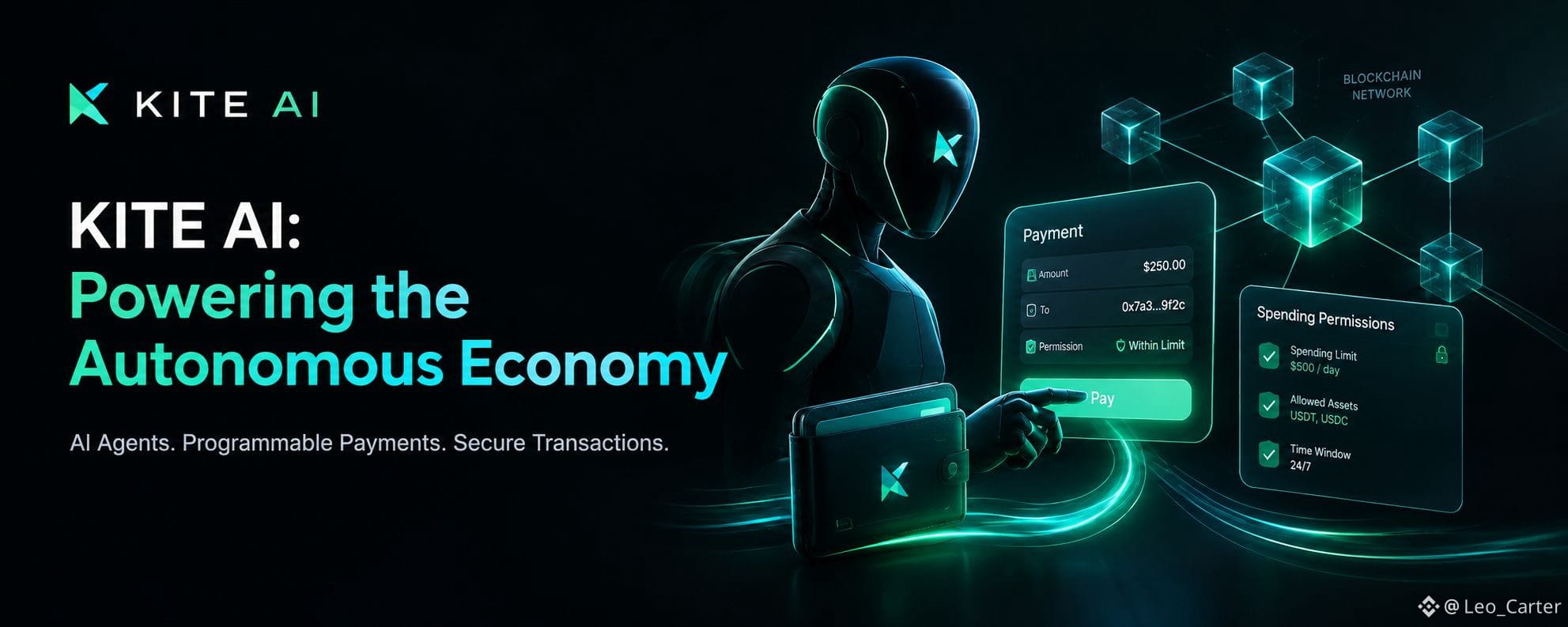
What makes @GoKiteAI interesting is its focus on programmable payments and controlled financial access. Instead of giving AI agents unlimited authority, users can establish spending permissions and transaction boundaries that help keep financial activity aligned with their instructions.
As the AI agent economy evolves, secure payments transparent execution and user-controlled permissions could become essential infrastructure for machine driven finance.
The bigger picture is a digital economy where AI agents can interact with blockchain networks while operating within rules set by their owners.
#KiteBBW $KITE
{future}(KITEUSDT)
The AI agent economy is opening new possibilities for how digital transactions can be managed across Web3.
AI agents are moving beyond simple automation toward interacting with financial tools and executing transactions within predefined rules.
What makes @KITE AI 中文 interesting is its focus on programmable payments and controlled financial access. Instead of giving AI agents unlimited authority, users can establish spending permissions and transaction boundaries that help keep financial activity aligned with their instructions.
As the AI agent economy evolves, secure payments transparent execution and user-controlled permissions could become essential infrastructure for machine driven finance.
The bigger picture is a digital economy where AI agents can interact with blockchain networks while operating within rules set by their owners.
#KiteBBW $KITE
1
178

·
--
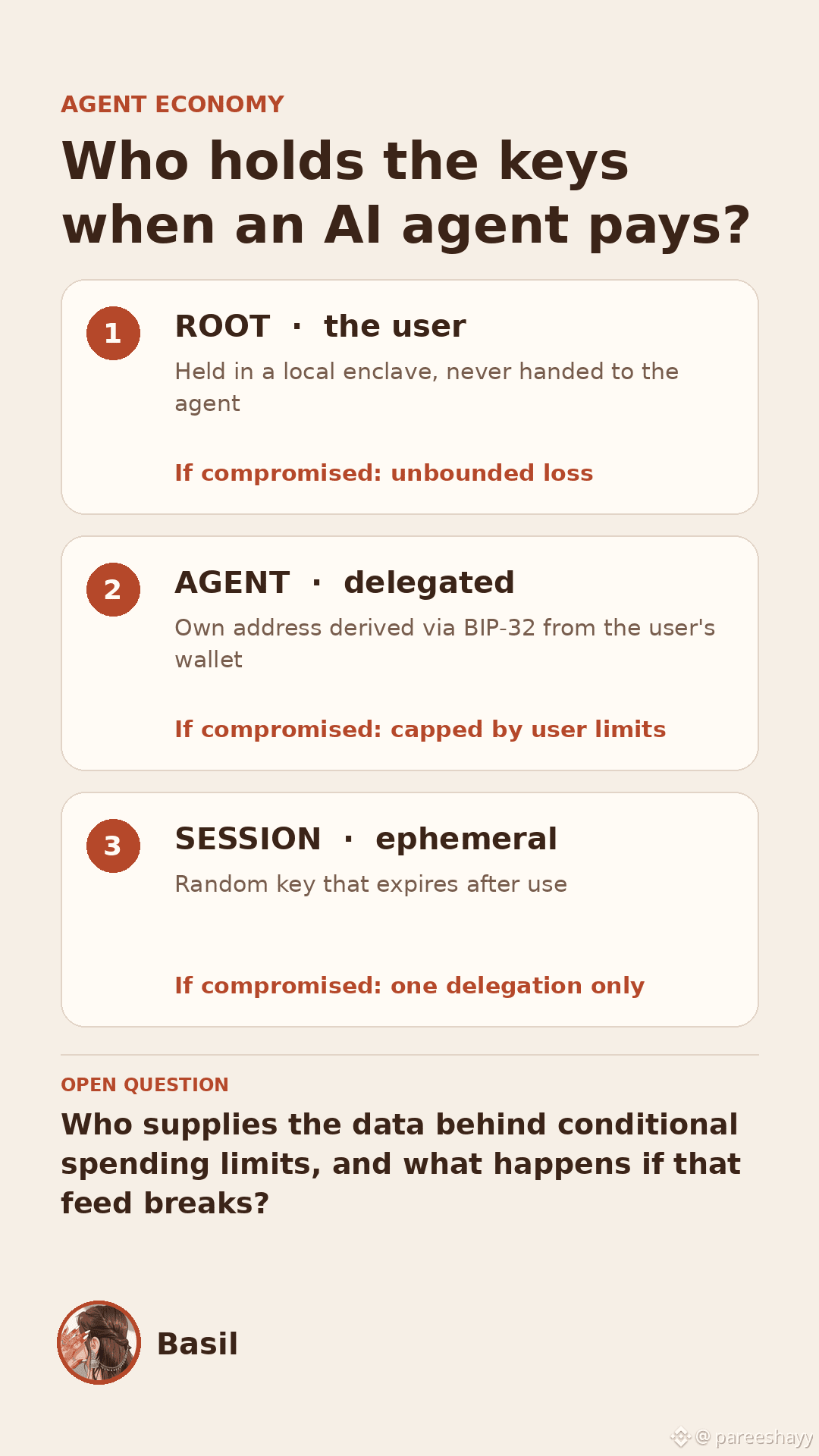
Today I read Kite’s developer docs end to end, and the part that stayed with me wasn’t speed or fees. It was how authority is split into three layers. The user holds root authority, each agent gets its own address derived from the user’s wallet via BIP-32, and every session runs on a random key that expires after use. Compromise a session and you lose one delegation. Compromise an agent and the damage stays inside the limits the user set. Only the root key carries unbounded loss, which is why the docs keep it in a local enclave.
The payment design follows the same logic. Instead of settling every request on-chain, two parties open a channel, exchange thousands of signed updates off-chain, and close it with a second transaction.
The docs cite sub-100ms latency at roughly $1 per million requests.
Here is where I’d push back on my own enthusiasm. The docs also describe conditional rules, like cutting an agent’s limit when volatility spikes. A rule like that needs an outside data input, and I couldn’t find who supplies it or what happens if that feed is wrong. Also, the large testnet figures (hundreds of millions of transactions) came from a testing environment, so they say little about recurring demand on mainnet, which launched April 30, 2026.
What I’m tracking from here: the number of active Agent Passports on KiteScan, the share of agent transactions that are real service payments rather than test traffic, and whether the docs name the data source behind conditional spending limits.
An agent economy only works if a person can hand over a wallet and still sleep. That depends less on how fast agents pay and more on what the rules do when their inputs break.
#KiteBBW $KITE @GoKiteAI #KiteBBW
Today I read Kite’s developer docs end to end, and the part that stayed with me wasn’t speed or fees. It was how authority is split into three layers. The user holds root authority, each agent gets its own address derived from the user’s wallet via BIP-32, and every session runs on a random key that expires after use. Compromise a session and you lose one delegation. Compromise an agent and the damage stays inside the limits the user set. Only the root key carries unbounded loss, which is why the docs keep it in a local enclave.
The payment design follows the same logic. Instead of settling every request on-chain, two parties open a channel, exchange thousands of signed updates off-chain, and close it with a second transaction.
The docs cite sub-100ms latency at roughly $1 per million requests.
Here is where I’d push back on my own enthusiasm. The docs also describe conditional rules, like cutting an agent’s limit when volatility spikes. A rule like that needs an outside data input, and I couldn’t find who supplies it or what happens if that feed is wrong. Also, the large testnet figures (hundreds of millions of transactions) came from a testing environment, so they say little about recurring demand on mainnet, which launched April 30, 2026.
What I’m tracking from here: the number of active Agent Passports on KiteScan, the share of agent transactions that are real service payments rather than test traffic, and whether the docs name the data source behind conditional spending limits.
An agent economy only works if a person can hand over a wallet and still sleep. That depends less on how fast agents pay and more on what the rules do when their inputs break.
#KiteBBW $KITE @KITE AI 中文 #KiteBBW
72

·
--
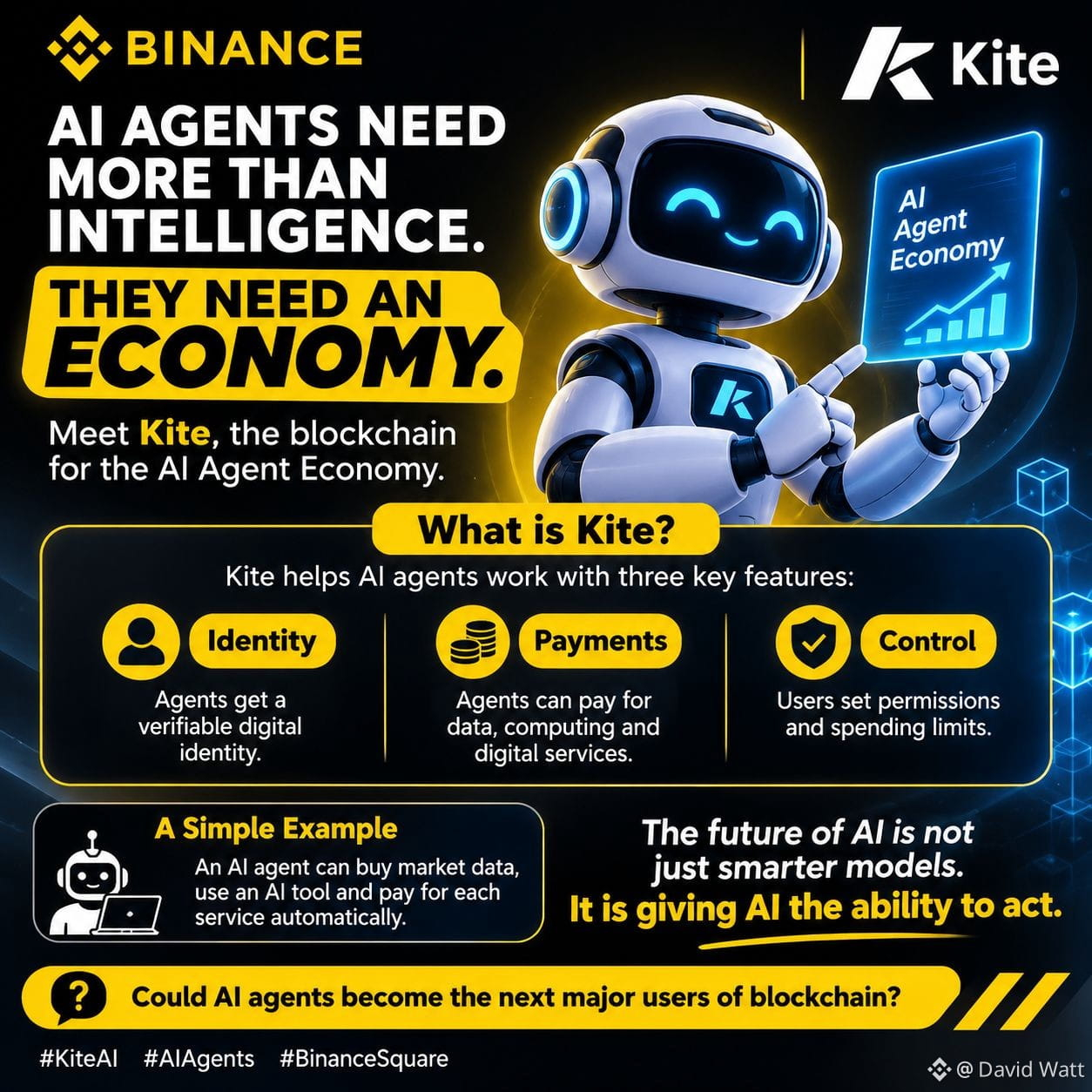
AI AGENTS NEED MORE THAN INTELLIGENCE. THEY NEED AN ECONOMY.
AI agents are changing how we use technology.
They can research, complete tasks, use tools, and make decisions with limited human help.
But one big question remains.
How can AI agents pay for the services they need?
This is where @GoKiteAI comes in.
Kite is building blockchain infrastructure for the AI Agent Economy.
Its goal is to help AI agents operate with three important things:
Identity: Agents need a verifiable digital identity.
Payments: Agents need a way to pay for data, computing, and digital services.
Control: Users need to set permissions and spending limits to keep agents within approved rules.
Imagine an AI agent buying market data, using an AI tool, and paying for each service automatically.
Kite aims to make this possible.
The future of AI is not just about smarter models.
It is about giving AI the ability to act.
Could AI agents become the next major users of blockchain?
#KiteBBW $KITE
Elon Jamess:
AI agents need a reliable way to prove who they are and pay for what they use.
1
3
135

·
--
Bullish
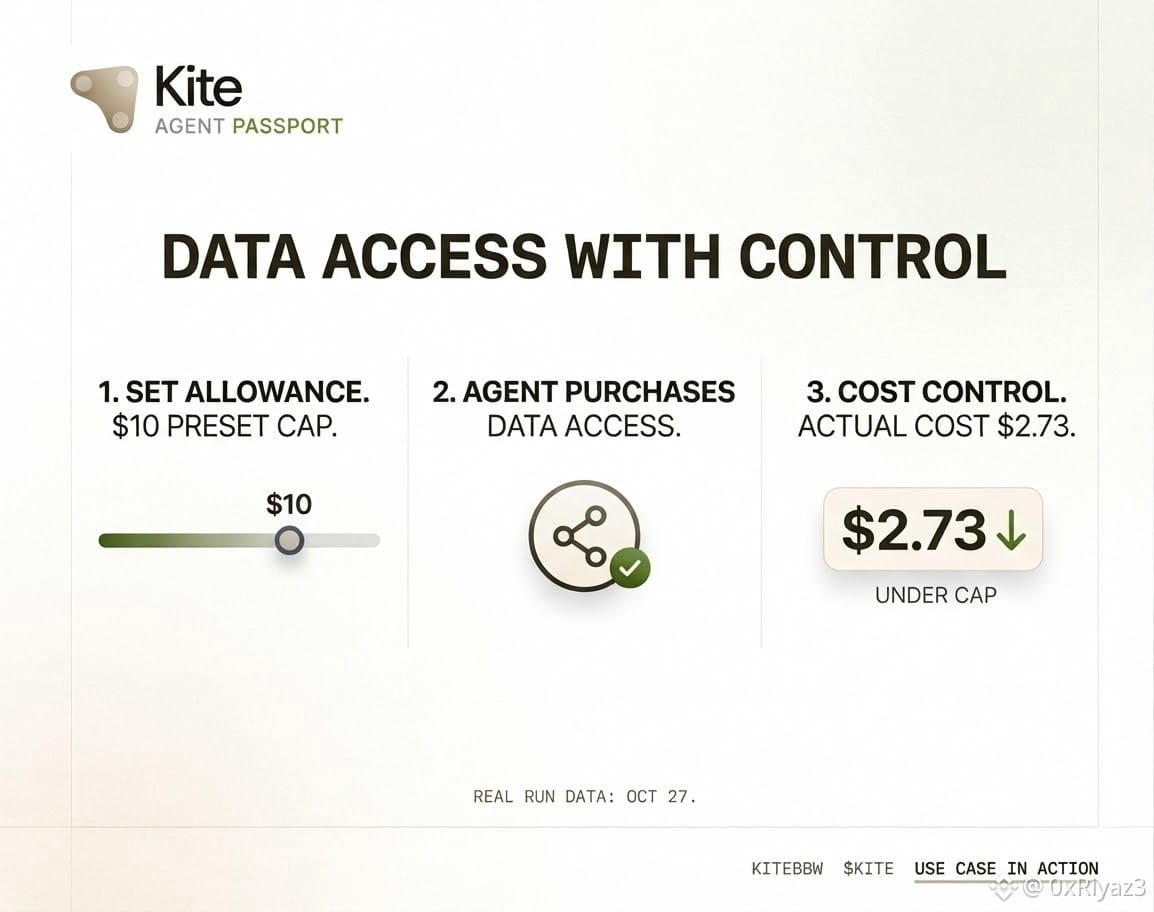
I just watched Kite's new Agent Passport film. The phone is the topic on screen, but the part I liked was how the agent paid.
Kite says it is a real run from Oct 27. An agent was asked to find out what actual iPhone Duo owners say, since the reviews were glowing.
- The agent was the customer here. It bought a $10 Apify token from the user's Passport allowance. No Apify account, no API key, no card.
- It read 585 posts from Reddit, YouTube, X, forums and eBay, and kept only the 27 written by real owners. That is under 5 percent, so I treat the result as a hint, not proof.
- Still, owners talked about cracks near the hinge, which the film says reviewers did not see. About one in five of the 27 posts were about returning the phone.
- The cap was $10, but the whole job cost $2.73. The limit was set before the run, not after.
If agents can buy data like this, sellers get a new kind of buyer: software with a budget. I am not sure yet how many people will feel okay with that.
Would you let your own agent spend from an allowance? What would your cap be?
@GoKiteAI #KiteBBW $KITE
{spot}(KITEUSDT)
I just watched Kite's new Agent Passport film. The phone is the topic on screen, but the part I liked was how the agent paid.
Kite says it is a real run from Oct 27. An agent was asked to find out what actual iPhone Duo owners say, since the reviews were glowing.
- The agent was the customer here. It bought a $10 Apify token from the user's Passport allowance. No Apify account, no API key, no card.
- It read 585 posts from Reddit, YouTube, X, forums and eBay, and kept only the 27 written by real owners. That is under 5 percent, so I treat the result as a hint, not proof.
- Still, owners talked about cracks near the hinge, which the film says reviewers did not see. About one in five of the 27 posts were about returning the phone.
- The cap was $10, but the whole job cost $2.73. The limit was set before the run, not after.
If agents can buy data like this, sellers get a new kind of buyer: software with a budget. I am not sure yet how many people will feel okay with that.
Would you let your own agent spend from an allowance? What would your cap be?
@KITE AI 中文 #KiteBBW $KITE
Ayesha_Queen:
spending with preset limits is an interesting step.
1
2
58

·
--
Bullish
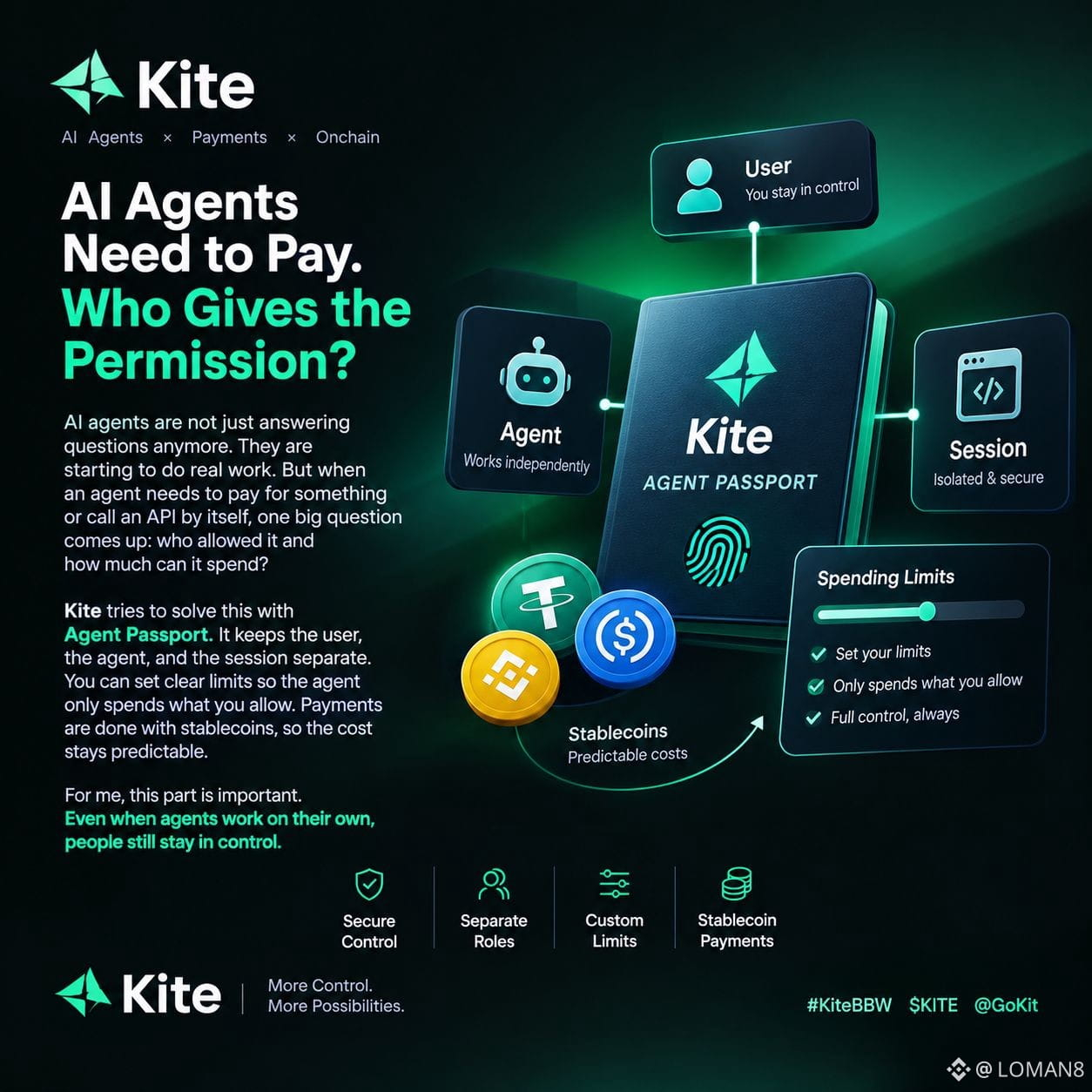
AI agents are not just answering questions anymore. They are starting to do real work. But when an agent needs to pay for something or call an API by itself, one big question comes up: who allowed it and how much can it spend?
Kite tries to solve this with Agent Passport. It keeps the user, the agent, and the session separate. You can set clear limits so the agent only spends what you allow. Payments are done with stablecoins , so the cost stays predictable.
For me, this part is important. Even when agents work on their own, people still stay in control.
@GoKiteAI $KITE #KiteBBW
{spot}(KITEUSDT)
AI agents are not just answering questions anymore. They are starting to do real work. But when an agent needs to pay for something or call an API by itself, one big question comes up: who allowed it and how much can it spend?
Kite tries to solve this with Agent Passport. It keeps the user, the agent, and the session separate. You can set clear limits so the agent only spends what you allow. Payments are done with stablecoins , so the cost stays predictable.
For me, this part is important. Even when agents work on their own, people still stay in control.
@KITE AI 中文 $KITE #KiteBBW
mdrakibolislam547:
wow
3
5
128
Log in to explore more content
Join global crypto users on Binance Square
⚡️ Get latest and useful information about crypto.
💬 Trusted by the world’s largest crypto exchange.
👍 Discover real insights from verified creators.
Email / Phone number
Trending Topics
1
#FedWatch
16.2M views
38,399 Discussing
2
#EarningsSeason
6.2M views
31,139 Discussing
3
#USMidtermElections
2,232 views
153 Discussing
4
#BitcoinDropsBelow$80K
2,821 views
41 Discussing
5
#BoEOpensConsultationOnTokenizedCollateralForClearing
0 views
0 Discussing
6
#BrazilCryptoExchangesMustApplyForLicensesByFriday
987 views
133 Discussing
7
#ICEPartnersWithTradeXYZToBringPerpetualContractsToUS
278 views
9 Discussing
8
#SolidusLabsReportsSuspected$170MSpoofingOnHyperliquidOilContracts
584 views
20 Discussing
9
#StanDruckenmillerBecomesInvestorInTradeXYZ
2,835 views
157 Discussing
10
#RussiaProposedNonCustodialWalletLimitsExcludeIntlSettlements
1,135 views
35 Discussing