

#usdc
usdc
579.3M views
2.6M Discussing
Hot
Latest

#BinancePick
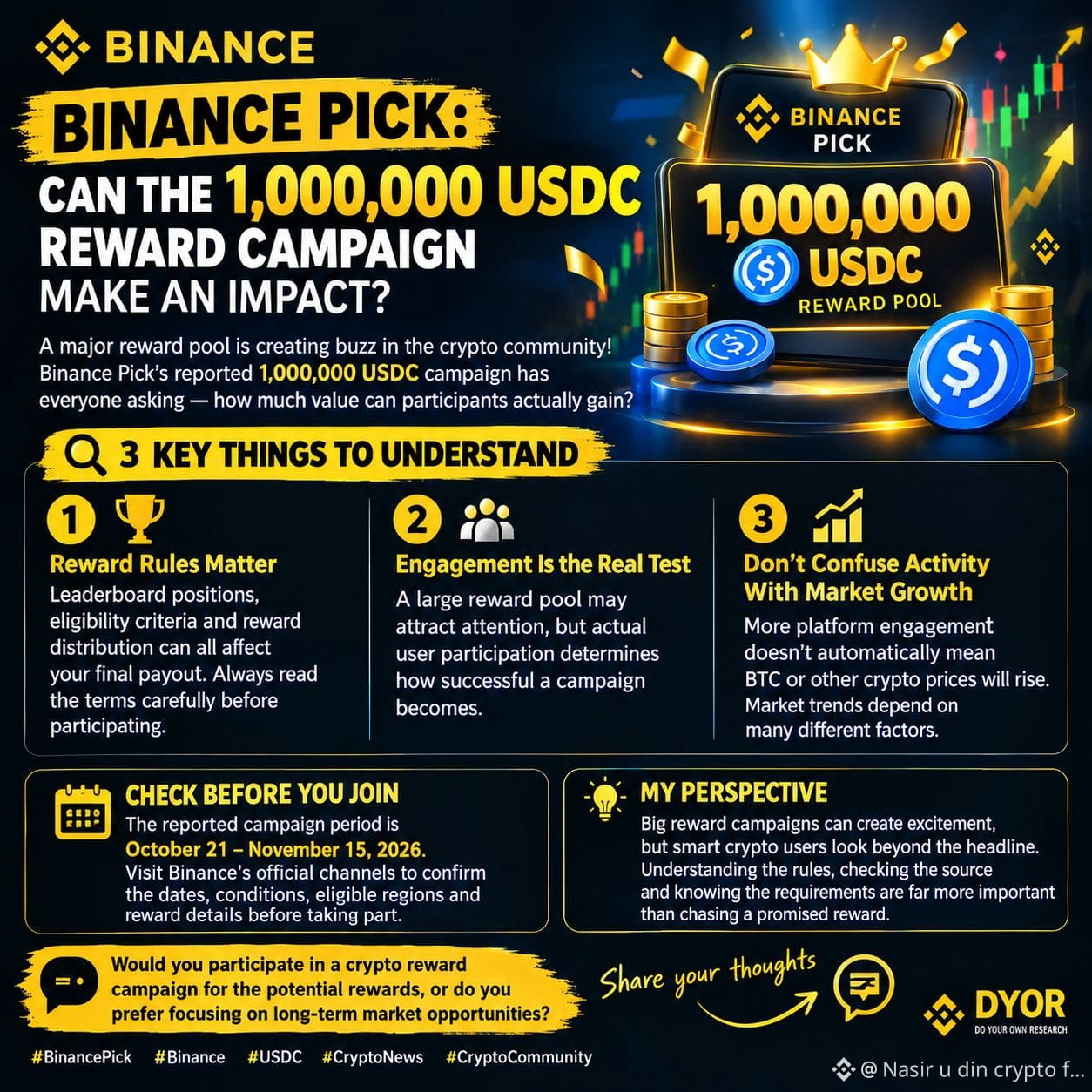
🚨 BINANCE PICK: CAN THE 1,000,000 USDC REWARD CAMPAIGN MAKE AN IMPACT?
A major reward pool is attracting attention across the crypto community! 👀 Binance Pick's reported 1,000,000 USDC campaign raises an interesting question: how much value can participants actually gain?
Before focusing on the big number, let's look at what really matters. 👇
🔎 3 KEY THINGS TO UNDERSTAND
🏆 1. Reward Rules Matter
Leaderboard positions, eligibility criteria, and reward distribution can all affect the final outcome. Always read the terms carefully before participating.
📊 2. Engagement Is the Real Test
A large reward pool may attract attention, but actual user participation determines how successful a campaign becomes.
📈 3. Don't Confuse Activity With Market Growth
More platform engagement doesn't automatically mean BTC or other crypto prices will rise. Market trends depend on multiple factors.
⚠️ CHECK BEFORE YOU JOIN
The reported campaign period is October 21 – November 15, 2026. Visit Binance's official channels to confirm the dates, conditions, eligible regions, and reward details before taking action.
💡 MY PERSPECTIVE
Big reward campaigns can create excitement, but smart crypto users look beyond the headline. Understanding the rules, checking the source, and knowing the requirements are far more important than chasing a promised reward.
🔥 One question for the community:
Would you participate in a crypto reward campaign for the potential rewards, or do you prefer focusing on long-term market opportunities?
Share your thoughts below! 👇
#BinancePick #Binance #USDC #CryptoNews #CryptoCommunity
$XRP $ETH
{spot}(ETHUSDT)
{spot}(XRPUSDT)
$LINK
{spot}(LINKUSDT)
#BinancePick
🚨 BINANCE PICK: CAN THE 1,000,000 USDC REWARD CAMPAIGN MAKE AN IMPACT?
A major reward pool is attracting attention across the crypto community! 👀 Binance Pick's reported 1,000,000 USDC campaign raises an interesting question: how much value can participants actually gain?
Before focusing on the big number, let's look at what really matters. 👇
🔎 3 KEY THINGS TO UNDERSTAND
🏆 1. Reward Rules Matter
Leaderboard positions, eligibility criteria, and reward distribution can all affect the final outcome. Always read the terms carefully before participating.
📊 2. Engagement Is the Real Test
A large reward pool may attract attention, but actual user participation determines how successful a campaign becomes.
📈 3. Don't Confuse Activity With Market Growth
More platform engagement doesn't automatically mean BTC or other crypto prices will rise. Market trends depend on multiple factors.
⚠️ CHECK BEFORE YOU JOIN
The reported campaign period is October 21 – November 15, 2026. Visit Binance's official channels to confirm the dates, conditions, eligible regions, and reward details before taking action.
💡 MY PERSPECTIVE
Big reward campaigns can create excitement, but smart crypto users look beyond the headline. Understanding the rules, checking the source, and knowing the requirements are far more important than chasing a promised reward.
🔥 One question for the community:
Would you participate in a crypto reward campaign for the potential rewards, or do you prefer focusing on long-term market opportunities?
Share your thoughts below! 👇
#BinancePick #Binance #USDC #CryptoNews #CryptoCommunity
$XRP $ETH
$LINK
🚨 BINANCE PICK: CAN THE 1,000,000 USDC REWARD CAMPAIGN MAKE AN IMPACT?
A major reward pool is attracting attention across the crypto community! 👀 Binance Pick's reported 1,000,000 USDC campaign raises an interesting question: how much value can participants actually gain?
Before focusing on the big number, let's look at what really matters. 👇
🔎 3 KEY THINGS TO UNDERSTAND
🏆 1. Reward Rules Matter
Leaderboard positions, eligibility criteria, and reward distribution can all affect the final outcome. Always read the terms carefully before participating.
📊 2. Engagement Is the Real Test
A large reward pool may attract attention, but actual user participation determines how successful a campaign becomes.
📈 3. Don't Confuse Activity With Market Growth
More platform engagement doesn't automatically mean BTC or other crypto prices will rise. Market trends depend on multiple factors.
⚠️ CHECK BEFORE YOU JOIN
The reported campaign period is October 21 – November 15, 2026. Visit Binance's official channels to confirm the dates, conditions, eligible regions, and reward details before taking action.
💡 MY PERSPECTIVE
Big reward campaigns can create excitement, but smart crypto users look beyond the headline. Understanding the rules, checking the source, and knowing the requirements are far more important than chasing a promised reward.
🔥 One question for the community:
Would you participate in a crypto reward campaign for the potential rewards, or do you prefer focusing on long-term market opportunities?
Share your thoughts below! 👇
#BinancePick #Binance #USDC #CryptoNews #CryptoCommunity
$XRP $ETH
$LINK
1
1.2k


·
--
Bullish
#binancepick
Binance Pick: 1,000,000 USDC Reward Campaign — A Big Opportunity for Crypto Users!
Binance Pick is attracting attention with its reported 1,000,000 USDC reward campaign running from October 21 to November 15, 2026. With leaderboard competitions, weekly rewards, and participation opportunities, this campaign could bring exciting engagement to the crypto community. But before joining, users should carefully check eligibility, reward distribution, and official campaign rules. A massive reward pool sounds exciting, but understanding how rewards are earned is what really matters. Can Binance Pick turn this campaign into one of the most talked-about crypto reward events?
#Binance #CryptoNews #USDC #CryptoMarket
$XRP $ETH $LINK
{future}(XRPUSDT)
{future}(ETHUSDT)
{future}(LINKUSDT)
#binancepick
Binance Pick: 1,000,000 USDC Reward Campaign — A Big Opportunity for Crypto Users!
Binance Pick is attracting attention with its reported 1,000,000 USDC reward campaign running from October 21 to November 15, 2026. With leaderboard competitions, weekly rewards, and participation opportunities, this campaign could bring exciting engagement to the crypto community. But before joining, users should carefully check eligibility, reward distribution, and official campaign rules. A massive reward pool sounds exciting, but understanding how rewards are earned is what really matters. Can Binance Pick turn this campaign into one of the most talked-about crypto reward events?
#Binance #CryptoNews #USDC #CryptoMarket
$XRP $ETH $LINK
Binance Pick: 1,000,000 USDC Reward Campaign — A Big Opportunity for Crypto Users!
Binance Pick is attracting attention with its reported 1,000,000 USDC reward campaign running from October 21 to November 15, 2026. With leaderboard competitions, weekly rewards, and participation opportunities, this campaign could bring exciting engagement to the crypto community. But before joining, users should carefully check eligibility, reward distribution, and official campaign rules. A massive reward pool sounds exciting, but understanding how rewards are earned is what really matters. Can Binance Pick turn this campaign into one of the most talked-about crypto reward events?
#Binance #CryptoNews #USDC #CryptoMarket
$XRP $ETH $LINK

122
🚀 $USDC & $BNB DOUBLE REWARD PUMPKIN FRENZY! 🎃
📊 Two Halloween events collide, letting you lock in dual bonuses when you swing both Bstock and Spot/Future on the same tick. 🦈 Liquidity pools are primed, so every pumpkin smash translates into instant claimable loot. 🎯 The window is tight—grab the campaign now before the hype fades and the reward pool drains.
💬 Are you ready to carve out those extra gains before the spooky season ends? 👇
⚠️ Not financial advice. Always manage your risk. 🛡️
🏷️ #USDC #BNB #HalloweenOnBinance #DoubleReward #Crypto
🔥 💎
🚀 $USDC & $BNB DOUBLE REWARD PUMPKIN FRENZY! 🎃
📊 Two Halloween events collide, letting you lock in dual bonuses when you swing both Bstock and Spot/Future on the same tick. 🦈 Liquidity pools are primed, so every pumpkin smash translates into instant claimable loot. 🎯 The window is tight—grab the campaign now before the hype fades and the reward pool drains.
💬 Are you ready to carve out those extra gains before the spooky season ends? 👇
⚠️ Not financial advice. Always manage your risk. 🛡️
🏷️ #USDC #BNB #HalloweenOnBinance #DoubleReward #Crypto
🔥 💎
📊 Two Halloween events collide, letting you lock in dual bonuses when you swing both Bstock and Spot/Future on the same tick. 🦈 Liquidity pools are primed, so every pumpkin smash translates into instant claimable loot. 🎯 The window is tight—grab the campaign now before the hype fades and the reward pool drains.
💬 Are you ready to carve out those extra gains before the spooky season ends? 👇
⚠️ Not financial advice. Always manage your risk. 🛡️
🏷️ #USDC #BNB #HalloweenOnBinance #DoubleReward #Crypto
🔥 💎
2

·
--
🚨 $USDC & $BNB DOUBLE HALLOWEEN REWARD FESTIVAL 🎃
📊 The platform’s Pumpkin Frenzy campaign merges two Halloween events, rewarding traders who execute B‑stock and Spot/Future positions concurrently. 🦈 Smart‑money eyes this dual‑play as liquidity pools swell, turning every trade into a potential gift‑box trigger. 🎯 Crack open the pumpkin after each qualifying trade to claim surprise bonuses—an institutional‑style incentive loop that fuels volume spikes.
💬 Are you ready to sync your $USDC and $BNB strategies for the double treat? 👇
⚠️ Not financial advice. Always manage your risk. 🛡️
🏷️ #USDC #BNB #Halloween #DoubleReward #Crypto
🎯 🦈
🚨 $USDC & $BNB DOUBLE HALLOWEEN REWARD FESTIVAL 🎃
📊 The platform’s Pumpkin Frenzy campaign merges two Halloween events, rewarding traders who execute B‑stock and Spot/Future positions concurrently. 🦈 Smart‑money eyes this dual‑play as liquidity pools swell, turning every trade into a potential gift‑box trigger. 🎯 Crack open the pumpkin after each qualifying trade to claim surprise bonuses—an institutional‑style incentive loop that fuels volume spikes.
💬 Are you ready to sync your $USDC and $BNB strategies for the double treat? 👇
⚠️ Not financial advice. Always manage your risk. 🛡️
🏷️ #USDC #BNB #Halloween #DoubleReward #Crypto
🎯 🦈
📊 The platform’s Pumpkin Frenzy campaign merges two Halloween events, rewarding traders who execute B‑stock and Spot/Future positions concurrently. 🦈 Smart‑money eyes this dual‑play as liquidity pools swell, turning every trade into a potential gift‑box trigger. 🎯 Crack open the pumpkin after each qualifying trade to claim surprise bonuses—an institutional‑style incentive loop that fuels volume spikes.
💬 Are you ready to sync your $USDC and $BNB strategies for the double treat? 👇
⚠️ Not financial advice. Always manage your risk. 🛡️
🏷️ #USDC #BNB #Halloween #DoubleReward #Crypto
🎯 🦈
3

·
--
Bullish
#BinancePick
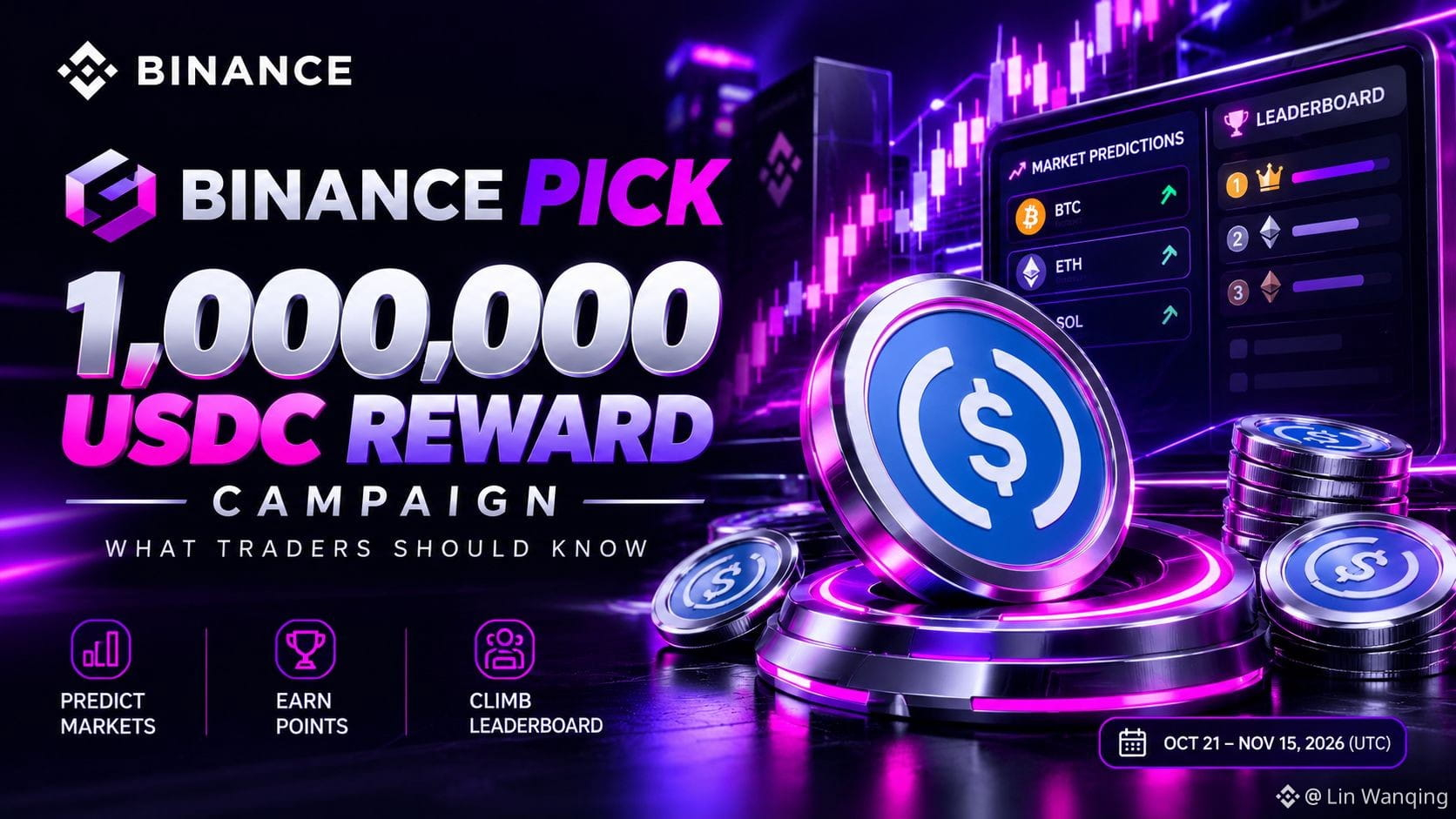
🚀 BINANCE PICK: A 1,000,000 USDC REWARD CAMPAIGN — WHAT TRADERS SHOULD KNOW
Binance Pick is bringing market predictions and leaderboard competition to the crypto community, with a potential reward pool of up to 1,000,000 USDC. Season 1 runs from October 21 to November 15, 2026 (UTC). 🏆
📊 Why It Matters
The campaign combines prediction activities, participation tasks, and competitive rankings. It offers users a way to engage with market movements while testing their ability to assess different outcomes.
💡 A Trader’s Perspective
The real challenge is making decisions based on evidence rather than emotion. Market predictions can be wrong, even when the analysis looks convincing. Consistency, realistic expectations, and understanding risk matter more than chasing short-term wins.
⚠️ Important to Remember
Campaign Scores are virtual points, not cash. Rewards are not guaranteed and depend on ranking, eligibility, and the official campaign rules. Check Binance’s official announcement to confirm the terms and regional availability before participating.
My takeaway: Use Binance Pick as an opportunity to sharpen your market-analysis skills, not as a reason to take unnecessary trading risks.
What matters most in a prediction challenge: accuracy, consistency, or strategy? 👇
#BinancePick #CryptoNews #CryptoTrading #USDC
$USDC $JCT $ETH
{future}(ETHUSDT)
{future}(JCTUSDT)
{future}(USDCUSDT)
#BinancePick
🚀 BINANCE PICK: A 1,000,000 USDC REWARD CAMPAIGN — WHAT TRADERS SHOULD KNOW
Binance Pick is bringing market predictions and leaderboard competition to the crypto community, with a potential reward pool of up to 1,000,000 USDC. Season 1 runs from October 21 to November 15, 2026 (UTC). 🏆
📊 Why It Matters
The campaign combines prediction activities, participation tasks, and competitive rankings. It offers users a way to engage with market movements while testing their ability to assess different outcomes.
💡 A Trader’s Perspective
The real challenge is making decisions based on evidence rather than emotion. Market predictions can be wrong, even when the analysis looks convincing. Consistency, realistic expectations, and understanding risk matter more than chasing short-term wins.
⚠️ Important to Remember
Campaign Scores are virtual points, not cash. Rewards are not guaranteed and depend on ranking, eligibility, and the official campaign rules. Check Binance’s official announcement to confirm the terms and regional availability before participating.
My takeaway: Use Binance Pick as an opportunity to sharpen your market-analysis skills, not as a reason to take unnecessary trading risks.
What matters most in a prediction challenge: accuracy, consistency, or strategy? 👇
#BinancePick #CryptoNews #CryptoTrading #USDC
$USDC $JCT $ETH
🚀 BINANCE PICK: A 1,000,000 USDC REWARD CAMPAIGN — WHAT TRADERS SHOULD KNOW
Binance Pick is bringing market predictions and leaderboard competition to the crypto community, with a potential reward pool of up to 1,000,000 USDC. Season 1 runs from October 21 to November 15, 2026 (UTC). 🏆
📊 Why It Matters
The campaign combines prediction activities, participation tasks, and competitive rankings. It offers users a way to engage with market movements while testing their ability to assess different outcomes.
💡 A Trader’s Perspective
The real challenge is making decisions based on evidence rather than emotion. Market predictions can be wrong, even when the analysis looks convincing. Consistency, realistic expectations, and understanding risk matter more than chasing short-term wins.
⚠️ Important to Remember
Campaign Scores are virtual points, not cash. Rewards are not guaranteed and depend on ranking, eligibility, and the official campaign rules. Check Binance’s official announcement to confirm the terms and regional availability before participating.
My takeaway: Use Binance Pick as an opportunity to sharpen your market-analysis skills, not as a reason to take unnecessary trading risks.
What matters most in a prediction challenge: accuracy, consistency, or strategy? 👇
#BinancePick #CryptoNews #CryptoTrading #USDC
$USDC $JCT $ETH
182

·
--
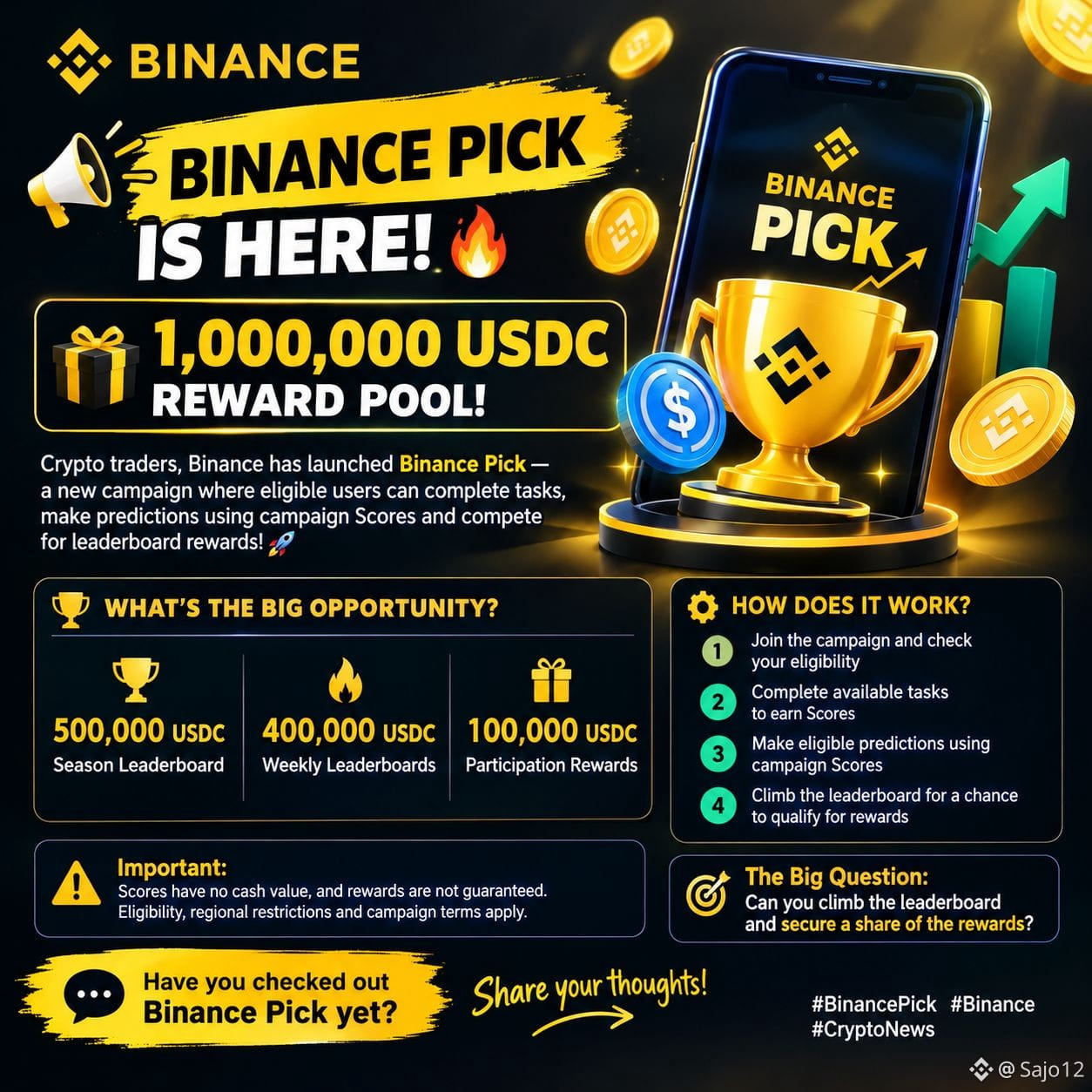
#BinancePick 🚨🔥 BINANCE PICK: 1,000,000 USDC REWARD POOL! 💰👀
Crypto community, are you ready for the challenge? 🚀 Binance Pick brings an exciting opportunity for eligible users to complete tasks, make predictions with campaign Scores, and compete on leaderboards! 🏆📈
💰 What’s inside the reward pool?
🏆 500,000 USDC — Season Leaderboard
🔥 400,000 USDC — Weekly Leaderboards
🎁 100,000 USDC — Participation Rewards
⚡ How to get started?
✅ Check your eligibility
✅ Complete available tasks and earn Scores
✅ Make eligible predictions
✅ Compete for leaderboard rewards
⚠️ Remember: Rewards are not guaranteed. Scores have no cash value, and eligibility and campaign terms apply.
🔥 Your turn, crypto fam! Have you joined Binance Pick yet? 👇
💬 Comment “BINANCE PICK” and share your thoughts!
#BinancePick #BinanceSquare #USDC
#BinancePick 🚨🔥 BINANCE PICK: 1,000,000 USDC REWARD POOL! 💰👀
Crypto community, are you ready for the challenge? 🚀 Binance Pick brings an exciting opportunity for eligible users to complete tasks, make predictions with campaign Scores, and compete on leaderboards! 🏆📈
💰 What’s inside the reward pool?
🏆 500,000 USDC — Season Leaderboard
🔥 400,000 USDC — Weekly Leaderboards
🎁 100,000 USDC — Participation Rewards
⚡ How to get started?
✅ Check your eligibility
✅ Complete available tasks and earn Scores
✅ Make eligible predictions
✅ Compete for leaderboard rewards
⚠️ Remember: Rewards are not guaranteed. Scores have no cash value, and eligibility and campaign terms apply.
🔥 Your turn, crypto fam! Have you joined Binance Pick yet? 👇
💬 Comment “BINANCE PICK” and share your thoughts!
#BinancePick #BinanceSquare #USDC
Crypto community, are you ready for the challenge? 🚀 Binance Pick brings an exciting opportunity for eligible users to complete tasks, make predictions with campaign Scores, and compete on leaderboards! 🏆📈
💰 What’s inside the reward pool?
🏆 500,000 USDC — Season Leaderboard
🔥 400,000 USDC — Weekly Leaderboards
🎁 100,000 USDC — Participation Rewards
⚡ How to get started?
✅ Check your eligibility
✅ Complete available tasks and earn Scores
✅ Make eligible predictions
✅ Compete for leaderboard rewards
⚠️ Remember: Rewards are not guaranteed. Scores have no cash value, and eligibility and campaign terms apply.
🔥 Your turn, crypto fam! Have you joined Binance Pick yet? 👇
💬 Comment “BINANCE PICK” and share your thoughts!
#BinancePick #BinanceSquare #USDC
57

🚀 $USDC BANK-LED STABLECOIN PLAY UNLOCKS NEW PAYMENT WAVE! 🟢
🦈 The OCC’s green light nudges community banks to step into the stablecoin arena, turning regional balance sheets into liquidity engines. 📊 With banks now eyeing issuance rights, we’re watching a fresh wave of on‑ramp capital that could tighten the bridge between fiat and crypto.
⚡ This move could supercharge payment pipelines, giving merchants faster settlement and investors a more regulated stablecoin supply. 🌊 Smart money may already be positioning ahead of the rollout, scouting the next liquidity hotspot.
💬 How will community banks reshape the stablecoin landscape? 👇
⚠️ Not financial advice. Always manage your risk. 🛡️
🏷️ #USDC #Stablecoin #Banking #Crypto #Payments
🔥 💎
🚀 $USDC BANK-LED STABLECOIN PLAY UNLOCKS NEW PAYMENT WAVE! 🟢
🦈 The OCC’s green light nudges community banks to step into the stablecoin arena, turning regional balance sheets into liquidity engines. 📊 With banks now eyeing issuance rights, we’re watching a fresh wave of on‑ramp capital that could tighten the bridge between fiat and crypto.
⚡ This move could supercharge payment pipelines, giving merchants faster settlement and investors a more regulated stablecoin supply. 🌊 Smart money may already be positioning ahead of the rollout, scouting the next liquidity hotspot.
💬 How will community banks reshape the stablecoin landscape? 👇
⚠️ Not financial advice. Always manage your risk. 🛡️
🏷️ #USDC #Stablecoin #Banking #Crypto #Payments
🔥 💎
🦈 The OCC’s green light nudges community banks to step into the stablecoin arena, turning regional balance sheets into liquidity engines. 📊 With banks now eyeing issuance rights, we’re watching a fresh wave of on‑ramp capital that could tighten the bridge between fiat and crypto.
⚡ This move could supercharge payment pipelines, giving merchants faster settlement and investors a more regulated stablecoin supply. 🌊 Smart money may already be positioning ahead of the rollout, scouting the next liquidity hotspot.
💬 How will community banks reshape the stablecoin landscape? 👇
⚠️ Not financial advice. Always manage your risk. 🛡️
🏷️ #USDC #Stablecoin #Banking #Crypto #Payments
🔥 💎

17

🚨 $USDC SET TO REDEFINE BANKING PAYMENTS AS OCC GREENLIGHTS STABLECOIN ISSUERS!
📊 The OCC’s advisory nudges community banks toward licensed stablecoin issuance, turning legacy payment rails into crypto‑native conduits. 🦈 Smart‑money eyes this as a liquidity catalyst, where modest banks can lock in institutional flow without the heavy‑hand of large exchanges. ⚡ By embedding $USDC into everyday transactions, the ecosystem gains a bridge that aligns regulatory comfort with on‑chain efficiency, potentially reshaping settlement velocity across the board.
💬 How will smaller banks leverage $USDC to capture new payment market share? 👇
⚠️ Not financial advice. Always manage your risk. 🛡️
🏷️ #USDC #Stablecoin #Banking #CryptoAdoption #Regulation
🔥 💎
🚨 $USDC SET TO REDEFINE BANKING PAYMENTS AS OCC GREENLIGHTS STABLECOIN ISSUERS!
📊 The OCC’s advisory nudges community banks toward licensed stablecoin issuance, turning legacy payment rails into crypto‑native conduits. 🦈 Smart‑money eyes this as a liquidity catalyst, where modest banks can lock in institutional flow without the heavy‑hand of large exchanges. ⚡ By embedding $USDC into everyday transactions, the ecosystem gains a bridge that aligns regulatory comfort with on‑chain efficiency, potentially reshaping settlement velocity across the board.
💬 How will smaller banks leverage $USDC to capture new payment market share? 👇
⚠️ Not financial advice. Always manage your risk. 🛡️
🏷️ #USDC #Stablecoin #Banking #CryptoAdoption #Regulation
🔥 💎
📊 The OCC’s advisory nudges community banks toward licensed stablecoin issuance, turning legacy payment rails into crypto‑native conduits. 🦈 Smart‑money eyes this as a liquidity catalyst, where modest banks can lock in institutional flow without the heavy‑hand of large exchanges. ⚡ By embedding $USDC into everyday transactions, the ecosystem gains a bridge that aligns regulatory comfort with on‑chain efficiency, potentially reshaping settlement velocity across the board.
💬 How will smaller banks leverage $USDC to capture new payment market share? 👇
⚠️ Not financial advice. Always manage your risk. 🛡️
🏷️ #USDC #Stablecoin #Banking #CryptoAdoption #Regulation
🔥 💎

2

·
--
Bearish
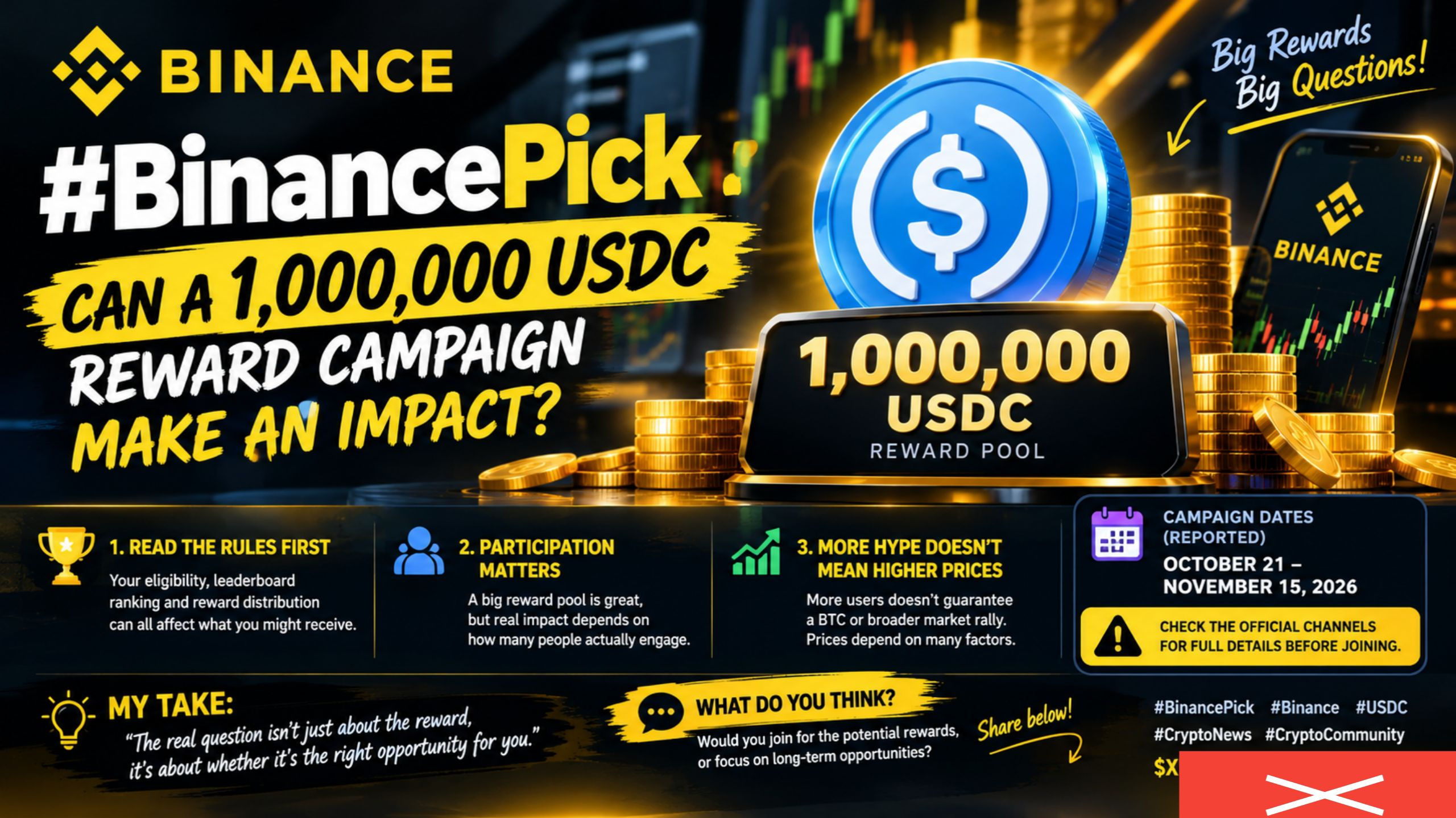
🚨 #BinancePick : CAN A 1,000,000 USDC REWARD POOL REALLY MAKE A DIFFERENCE? 👀
A reported 1,000,000 USDC reward campaign is getting attention in the crypto community. But here's the thing: a big reward pool doesn't automatically mean everyone walks away with a big reward.
Before jumping in, there are a few things worth checking. 👇
🏆 1. READ THE RULES FIRST
Your eligibility, leaderboard ranking, and the way rewards are distributed can all affect what you might receive. Don't skip the fine print.
📊 2. PARTICIPATION MATTERS
A campaign can generate plenty of buzz, but its real impact depends on how people engage and whether the activity continues beyond the initial excitement.
📈 3. MORE HYPE DOESN'T MEAN HIGHER PRICES
Even if a campaign attracts more users, that doesn't guarantee a rally in Bitcoin or the wider crypto market. BTC, XRP, ETH, and other assets still depend on broader market conditions.
⚠️ BEFORE YOU JOIN
The reported campaign dates are October 21 – November 15, 2026. Make sure to verify the dates, eligibility requirements, participating regions, and reward distribution rules through Binance's official channels before taking part.
💡 MY TAKE
I'm all for opportunities in crypto, but I wouldn't focus on the headline reward alone. The real question is whether you understand the conditions and whether participating makes sense for you.
🔥 LET'S TALK!
Would you join a crypto campaign for the potential rewards, or would you rather spend your time focusing on long-term opportunities?
Drop your thoughts in the comments! 👇
#Binance #USDC #CryptoNews #CryptoCommunity
$XRP $ETH $BTC
{future}(BTCUSDT)
{future}(ETHUSDT)
{future}(XRPUSDT)
🚨 #BinancePick : CAN A 1,000,000 USDC REWARD POOL REALLY MAKE A DIFFERENCE? 👀
A reported 1,000,000 USDC reward campaign is getting attention in the crypto community. But here's the thing: a big reward pool doesn't automatically mean everyone walks away with a big reward.
Before jumping in, there are a few things worth checking. 👇
🏆 1. READ THE RULES FIRST
Your eligibility, leaderboard ranking, and the way rewards are distributed can all affect what you might receive. Don't skip the fine print.
📊 2. PARTICIPATION MATTERS
A campaign can generate plenty of buzz, but its real impact depends on how people engage and whether the activity continues beyond the initial excitement.
📈 3. MORE HYPE DOESN'T MEAN HIGHER PRICES
Even if a campaign attracts more users, that doesn't guarantee a rally in Bitcoin or the wider crypto market. BTC, XRP, ETH, and other assets still depend on broader market conditions.
⚠️ BEFORE YOU JOIN
The reported campaign dates are October 21 – November 15, 2026. Make sure to verify the dates, eligibility requirements, participating regions, and reward distribution rules through Binance's official channels before taking part.
💡 MY TAKE
I'm all for opportunities in crypto, but I wouldn't focus on the headline reward alone. The real question is whether you understand the conditions and whether participating makes sense for you.
🔥 LET'S TALK!
Would you join a crypto campaign for the potential rewards, or would you rather spend your time focusing on long-term opportunities?
Drop your thoughts in the comments! 👇
#Binance #USDC #CryptoNews #CryptoCommunity
$XRP $ETH $BTC
A reported 1,000,000 USDC reward campaign is getting attention in the crypto community. But here's the thing: a big reward pool doesn't automatically mean everyone walks away with a big reward.
Before jumping in, there are a few things worth checking. 👇
🏆 1. READ THE RULES FIRST
Your eligibility, leaderboard ranking, and the way rewards are distributed can all affect what you might receive. Don't skip the fine print.
📊 2. PARTICIPATION MATTERS
A campaign can generate plenty of buzz, but its real impact depends on how people engage and whether the activity continues beyond the initial excitement.
📈 3. MORE HYPE DOESN'T MEAN HIGHER PRICES
Even if a campaign attracts more users, that doesn't guarantee a rally in Bitcoin or the wider crypto market. BTC, XRP, ETH, and other assets still depend on broader market conditions.
⚠️ BEFORE YOU JOIN
The reported campaign dates are October 21 – November 15, 2026. Make sure to verify the dates, eligibility requirements, participating regions, and reward distribution rules through Binance's official channels before taking part.
💡 MY TAKE
I'm all for opportunities in crypto, but I wouldn't focus on the headline reward alone. The real question is whether you understand the conditions and whether participating makes sense for you.
🔥 LET'S TALK!
Would you join a crypto campaign for the potential rewards, or would you rather spend your time focusing on long-term opportunities?
Drop your thoughts in the comments! 👇
#Binance #USDC #CryptoNews #CryptoCommunity
$XRP $ETH $BTC
89

·
--
⚖️ $USDC | USDC: boring by design, or the point of the whole design?
USDC is often described as the bridge between dollars and crypto, and its fact sheet leans on that framing: a fully collateralized US dollar stablecoin built to move value between people, businesses and financial institutions. The snapshot from 2026-10-26 10:11 UTC shows a $0.9997 price, a -0.03% deviation from one dollar, $71.4 billion market cap and $7.93 billion in 24h volume. Critics of the model say a token that barely moves offers little to debate; supporters say the near-flat peg and deep turnover are exactly the evidence that matters. Which reading carries more weight depends on whether you judge a stablecoin by its design or by its chart.
Why it matters: For a stablecoin, the peg and turnover are the product, so a -0.03% deviation is a design claim being tested, not a price story.
💬 Does a stablecoin's credibility rest more on its reserve and redemption design or on the market's willingness to keep trading it at scale?
Source: Official site https://www.circle.com/en/usdc
#USDC #Stablecoins
⚖️ $USDC | USDC: boring by design, or the point of the whole design?
USDC is often described as the bridge between dollars and crypto, and its fact sheet leans on that framing: a fully collateralized US dollar stablecoin built to move value between people, businesses and financial institutions. The snapshot from 2026-10-26 10:11 UTC shows a $0.9997 price, a -0.03% deviation from one dollar, $71.4 billion market cap and $7.93 billion in 24h volume. Critics of the model say a token that barely moves offers little to debate; supporters say the near-flat peg and deep turnover are exactly the evidence that matters. Which reading carries more weight depends on whether you judge a stablecoin by its design or by its chart.
Why it matters: For a stablecoin, the peg and turnover are the product, so a -0.03% deviation is a design claim being tested, not a price story.
💬 Does a stablecoin's credibility rest more on its reserve and redemption design or on the market's willingness to keep trading it at scale?
Source: Official site https://www.circle.com/en/usdc
#USDC #Stablecoins
USDC is often described as the bridge between dollars and crypto, and its fact sheet leans on that framing: a fully collateralized US dollar stablecoin built to move value between people, businesses and financial institutions. The snapshot from 2026-10-26 10:11 UTC shows a $0.9997 price, a -0.03% deviation from one dollar, $71.4 billion market cap and $7.93 billion in 24h volume. Critics of the model say a token that barely moves offers little to debate; supporters say the near-flat peg and deep turnover are exactly the evidence that matters. Which reading carries more weight depends on whether you judge a stablecoin by its design or by its chart.
Why it matters: For a stablecoin, the peg and turnover are the product, so a -0.03% deviation is a design claim being tested, not a price story.
💬 Does a stablecoin's credibility rest more on its reserve and redemption design or on the market's willingness to keep trading it at scale?
Source: Official site https://www.circle.com/en/usdc
#USDC #Stablecoins
📢 BINANCE OFFERS 2% APR ON USDC IN FUTURES ACCOUNTS
$USDC $T $ERA
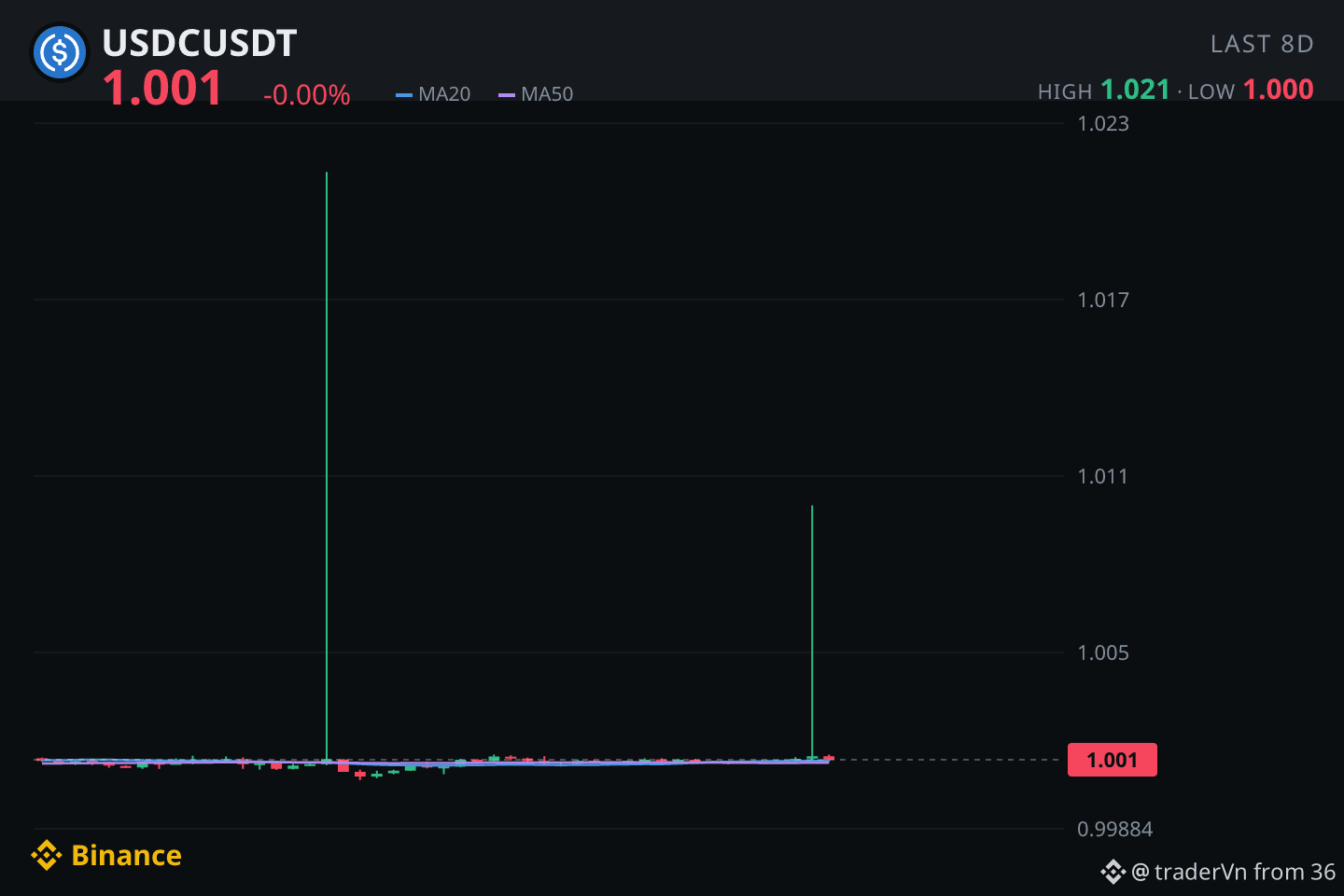
USDC is at 1.0012 USDT · +0.01% over 24h · Vol 770M
🏷️ Event type: Earn APR · published by Binance on 26/10/2026
The stablecoin market remains tightly linked to short‑term yield opportunities as investors seek modest returns on low‑volatility assets. Binance’s introduction of a 2 % APR for USDC held in Futures and Portfolio Margin accounts adds a competitive incentive, potentially drawing additional capital to its derivatives platform.
📈 Live market data — TRENDING UP
• USDC 1.0012 · 0.01% · Vol 770M
• T · -27.2% · Vol 7M
• ERA · 16.5% · Vol 16M
• QNT · 15.5% · Vol 18M
Exchange announcements pull attention onto the named asset, and attention arrives fast and leaves just as fast.
#USDC #Binance
Source: https://www.binance.com/vi/support/announcement/2f1961e25f5a4412a937e78114ad5fce
For reference only, not financial advice (DYOR).
📢 BINANCE OFFERS 2% APR ON USDC IN FUTURES ACCOUNTS
$USDC $T $ERA
USDC is at 1.0012 USDT · +0.01% over 24h · Vol 770M
🏷️ Event type: Earn APR · published by Binance on 26/10/2026
The stablecoin market remains tightly linked to short‑term yield opportunities as investors seek modest returns on low‑volatility assets. Binance’s introduction of a 2 % APR for USDC held in Futures and Portfolio Margin accounts adds a competitive incentive, potentially drawing additional capital to its derivatives platform.
📈 Live market data — TRENDING UP
• USDC 1.0012 · 0.01% · Vol 770M
• T · -27.2% · Vol 7M
• ERA · 16.5% · Vol 16M
• QNT · 15.5% · Vol 18M
Exchange announcements pull attention onto the named asset, and attention arrives fast and leaves just as fast.
#USDC #Binance
Source: https://www.binance.com/vi/support/announcement/2f1961e25f5a4412a937e78114ad5fce
For reference only, not financial advice (DYOR).
$USDC $T $ERA
USDC is at 1.0012 USDT · +0.01% over 24h · Vol 770M
🏷️ Event type: Earn APR · published by Binance on 26/10/2026
The stablecoin market remains tightly linked to short‑term yield opportunities as investors seek modest returns on low‑volatility assets. Binance’s introduction of a 2 % APR for USDC held in Futures and Portfolio Margin accounts adds a competitive incentive, potentially drawing additional capital to its derivatives platform.
📈 Live market data — TRENDING UP
• USDC 1.0012 · 0.01% · Vol 770M
• T · -27.2% · Vol 7M
• ERA · 16.5% · Vol 16M
• QNT · 15.5% · Vol 18M
Exchange announcements pull attention onto the named asset, and attention arrives fast and leaves just as fast.
#USDC #Binance
Source: https://www.binance.com/vi/support/announcement/2f1961e25f5a4412a937e78114ad5fce
For reference only, not financial advice (DYOR).
9

·
--
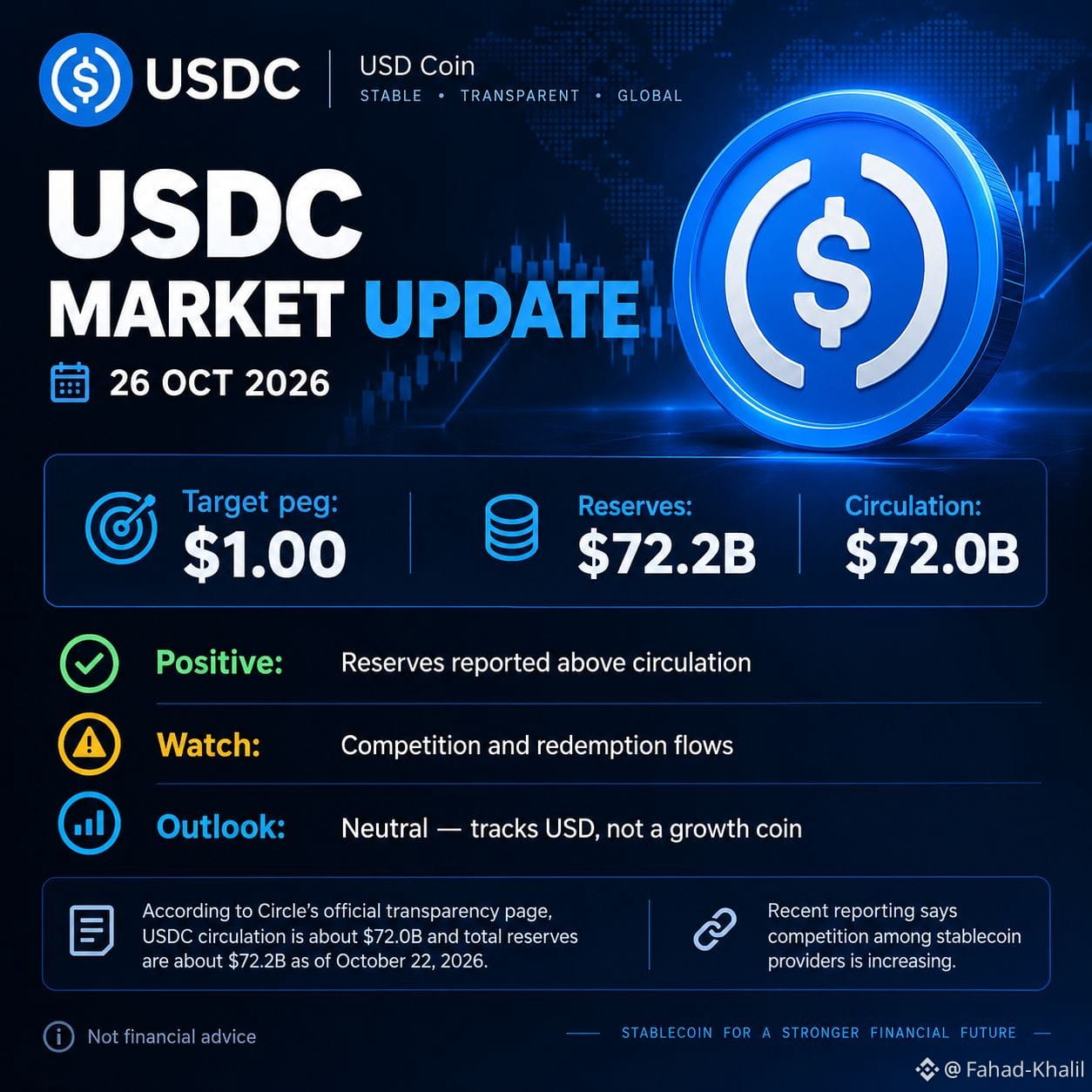
📊 $USDC Market Update | October 26, 2026
💵 Target Peg: $1.00
📈 USDC in Circulation: $72.0B
🏦 Total Reserves: $72.2B
📅 Data reported by Circle as of October 22, 2026. <Cite refs={["turn319791search0"]}/>
Market Outlook: Neutral 🔵
USDC is designed to maintain a 1:1 peg with the US dollar. Its reserve transparency and redemption mechanism are important factors to monitor.
#USDC #CryptoAnalysis #BinanceSquare #CryptoUpdate
{spot}(USDCUSDT)
📊 $USDC Market Update | October 26, 2026
💵 Target Peg: $1.00
📈 USDC in Circulation: $72.0B
🏦 Total Reserves: $72.2B
📅 Data reported by Circle as of October 22, 2026. <Cite refs={["turn319791search0"]}/>
Market Outlook: Neutral 🔵
USDC is designed to maintain a 1:1 peg with the US dollar. Its reserve transparency and redemption mechanism are important factors to monitor.
#USDC #CryptoAnalysis #BinanceSquare #CryptoUpdate
💵 Target Peg: $1.00
📈 USDC in Circulation: $72.0B
🏦 Total Reserves: $72.2B
📅 Data reported by Circle as of October 22, 2026. <Cite refs={["turn319791search0"]}/>
Market Outlook: Neutral 🔵
USDC is designed to maintain a 1:1 peg with the US dollar. Its reserve transparency and redemption mechanism are important factors to monitor.
#USDC #CryptoAnalysis #BinanceSquare #CryptoUpdate
48

·
--
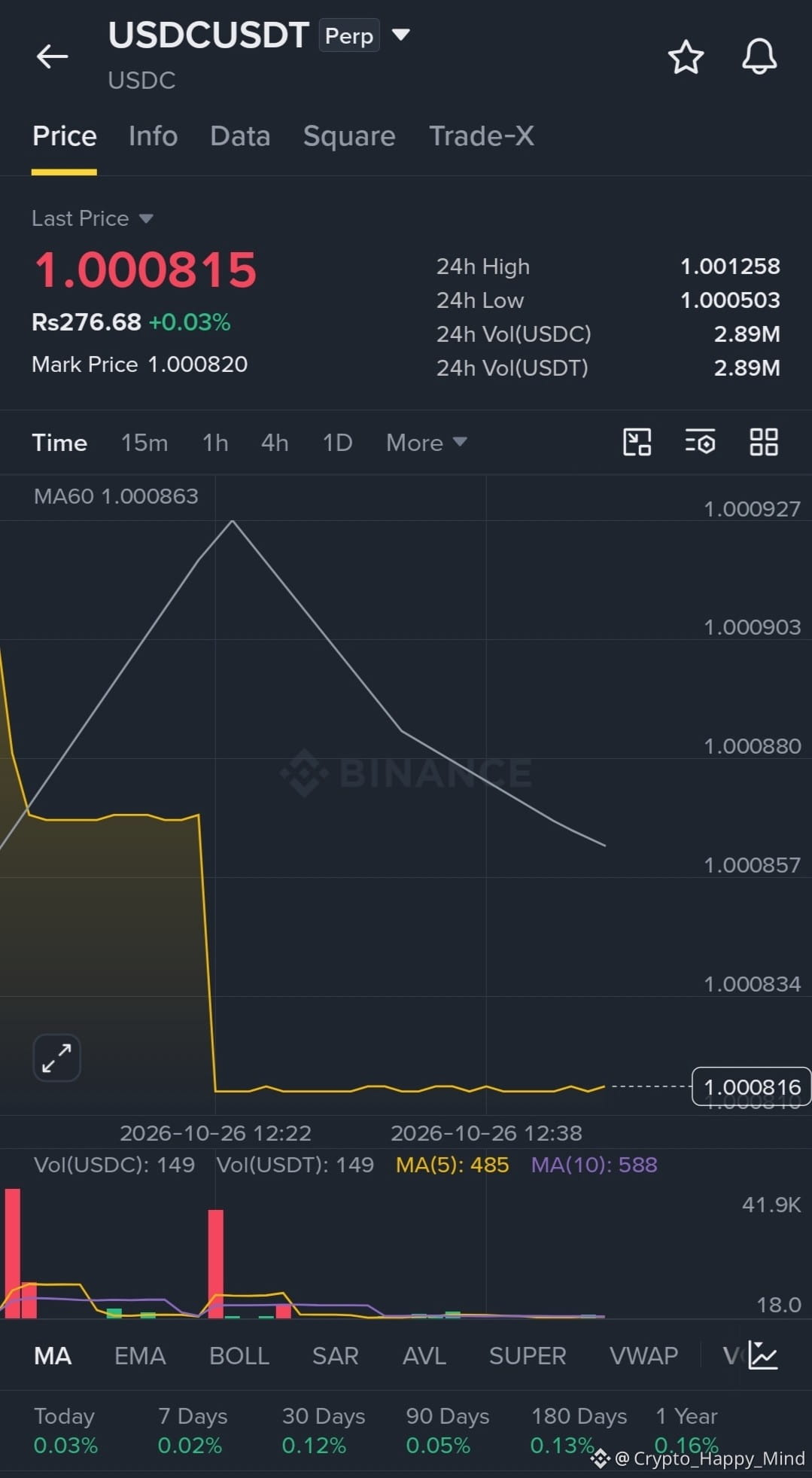
⚖️ $USDC | USDC at $71.5B cap but $7.05B daily volume: deep liquidity or thin turnover?
At the 2026-10-26 06:20 UTC snapshot, USDC carries a $71.5 billion market cap and ranks 6th, while 24h volume sits at $7.05 billion, roughly a tenth of its size. One reading: for a fully collateralized dollar stablecoin, that turnover reflects healthy, continuous use as a settlement and trading bridge across chains. The other: much of a stablecoin's cap is held rather than moved, so volume relative to size says more about venue activity than about the asset's role. Price shows $0.9998, a -0.02% deviation from the USD 1.00 reference.
Why it matters: For a stablecoin, the ratio of daily volume to market cap hints at how much supply is actively circulating versus parked, which matters for judging liquidity and redemption pressure.
💬 Does a volume-to-cap ratio near one-tenth signal efficient, well-used liquidity, or supply that mostly sits idle?
Source: Official site https://www.circle.com/en/usdc
#USDC #Stablecoins
⚖️ $USDC | USDC at $71.5B cap but $7.05B daily volume: deep liquidity or thin turnover?
At the 2026-10-26 06:20 UTC snapshot, USDC carries a $71.5 billion market cap and ranks 6th, while 24h volume sits at $7.05 billion, roughly a tenth of its size. One reading: for a fully collateralized dollar stablecoin, that turnover reflects healthy, continuous use as a settlement and trading bridge across chains. The other: much of a stablecoin's cap is held rather than moved, so volume relative to size says more about venue activity than about the asset's role. Price shows $0.9998, a -0.02% deviation from the USD 1.00 reference.
Why it matters: For a stablecoin, the ratio of daily volume to market cap hints at how much supply is actively circulating versus parked, which matters for judging liquidity and redemption pressure.
💬 Does a volume-to-cap ratio near one-tenth signal efficient, well-used liquidity, or supply that mostly sits idle?
Source: Official site https://www.circle.com/en/usdc
#USDC #Stablecoins
At the 2026-10-26 06:20 UTC snapshot, USDC carries a $71.5 billion market cap and ranks 6th, while 24h volume sits at $7.05 billion, roughly a tenth of its size. One reading: for a fully collateralized dollar stablecoin, that turnover reflects healthy, continuous use as a settlement and trading bridge across chains. The other: much of a stablecoin's cap is held rather than moved, so volume relative to size says more about venue activity than about the asset's role. Price shows $0.9998, a -0.02% deviation from the USD 1.00 reference.
Why it matters: For a stablecoin, the ratio of daily volume to market cap hints at how much supply is actively circulating versus parked, which matters for judging liquidity and redemption pressure.
💬 Does a volume-to-cap ratio near one-tenth signal efficient, well-used liquidity, or supply that mostly sits idle?
Source: Official site https://www.circle.com/en/usdc
#USDC #Stablecoins
1

·
--
Verified
💡 On October 22, #Circle opened a service called Circle Match. Once an hour it matches institutional orders to issue and redeem USDC. Access is limited to approved Circle Mint clients, and not in every jurisdiction. Someone redeeming USDC for dollars sets the maximum fee they will pay. Someone minting dollars into USDC sets the minimum rebate they will accept.
Every matched order clears at a single fee, and the redeeming side pays it. Circle currently passes that entire fee to matched minters as spendable USDC in a standard Mint wallet, with no extra margin of its own on the volume. A rebate goes only to someone whose mint order actually matched, not to someone who merely holds USDC. The fee on a matched redemption cannot exceed either the client’s cap or the rate on Circle’s Express redemption service. If the auction clears below Express, redemption can cost less, but Circle does not guarantee that. Match is separate from the redemption-surcharge removal reported on October 19.
Both sides must fund orders before they submit them. Redeemers lock USDC. Minters move dollars into a separate Match balance, which converts into restricted USDC. Under the minting agreement for clients outside the European Economic Area, that pre-funding cannot be sent to an external blockchain address. The only exit is through Match itself: the restricted USDC is reissued, and dollars go back to the registered bank account. Existing weekly deposit and withdrawal limits for minting still apply.
One minute before clearing, a locked order cannot be withdrawn, but a new order can be submitted and a price can be improved. More competitive prices fill first, and orders exactly at the clearing price fill pro rata. Any unfilled amount follows the Fallback the user chose: Roll or Cancel. Submitting an order does not guarantee a rebate or a full fill. Circle describes matched trades as atomic in #USDC and says redemption payouts arrive as quickly as through Express. For clients outside the EEA, though, section 2.12 of the agreement ties dollar payouts to U.S. bank business hours
💡 On October 22, #Circle opened a service called Circle Match. Once an hour it matches institutional orders to issue and redeem USDC. Access is limited to approved Circle Mint clients, and not in every jurisdiction. Someone redeeming USDC for dollars sets the maximum fee they will pay. Someone minting dollars into USDC sets the minimum rebate they will accept.
Every matched order clears at a single fee, and the redeeming side pays it. Circle currently passes that entire fee to matched minters as spendable USDC in a standard Mint wallet, with no extra margin of its own on the volume. A rebate goes only to someone whose mint order actually matched, not to someone who merely holds USDC. The fee on a matched redemption cannot exceed either the client’s cap or the rate on Circle’s Express redemption service. If the auction clears below Express, redemption can cost less, but Circle does not guarantee that. Match is separate from the redemption-surcharge removal reported on October 19.
Both sides must fund orders before they submit them. Redeemers lock USDC. Minters move dollars into a separate Match balance, which converts into restricted USDC. Under the minting agreement for clients outside the European Economic Area, that pre-funding cannot be sent to an external blockchain address. The only exit is through Match itself: the restricted USDC is reissued, and dollars go back to the registered bank account. Existing weekly deposit and withdrawal limits for minting still apply.
One minute before clearing, a locked order cannot be withdrawn, but a new order can be submitted and a price can be improved. More competitive prices fill first, and orders exactly at the clearing price fill pro rata. Any unfilled amount follows the Fallback the user chose: Roll or Cancel. Submitting an order does not guarantee a rebate or a full fill. Circle describes matched trades as atomic in #USDC and says redemption payouts arrive as quickly as through Express. For clients outside the EEA, though, section 2.12 of the agreement ties dollar payouts to U.S. bank business hours
Every matched order clears at a single fee, and the redeeming side pays it. Circle currently passes that entire fee to matched minters as spendable USDC in a standard Mint wallet, with no extra margin of its own on the volume. A rebate goes only to someone whose mint order actually matched, not to someone who merely holds USDC. The fee on a matched redemption cannot exceed either the client’s cap or the rate on Circle’s Express redemption service. If the auction clears below Express, redemption can cost less, but Circle does not guarantee that. Match is separate from the redemption-surcharge removal reported on October 19.
Both sides must fund orders before they submit them. Redeemers lock USDC. Minters move dollars into a separate Match balance, which converts into restricted USDC. Under the minting agreement for clients outside the European Economic Area, that pre-funding cannot be sent to an external blockchain address. The only exit is through Match itself: the restricted USDC is reissued, and dollars go back to the registered bank account. Existing weekly deposit and withdrawal limits for minting still apply.
One minute before clearing, a locked order cannot be withdrawn, but a new order can be submitted and a price can be improved. More competitive prices fill first, and orders exactly at the clearing price fill pro rata. Any unfilled amount follows the Fallback the user chose: Roll or Cancel. Submitting an order does not guarantee a rebate or a full fill. Circle describes matched trades as atomic in #USDC and says redemption payouts arrive as quickly as through Express. For clients outside the EEA, though, section 2.12 of the agreement ties dollar payouts to U.S. bank business hours
849
·
--
⚖️ $USDC | USDC at $0.9997: proof of a solid peg or a warning sign?
At the 2026-10-26 00:51 UTC snapshot, USDC traded at $0.9997, a -0.03% deviation from the assumed USD 1.00 peg, with a $71.5 billion market cap and $5.55 billion in 24-hour volume. Supporters read that tiny gap as evidence that a fully collateralized, redemption-based design keeps the peg tight even at scale. Critics argue that a near-perfect peg says little about reserve transparency or how smoothly redemptions would work under stress, since the market price alone does not show it.
Why it matters: A stablecoin's market price shows where it trades, not whether its reserves and redemption process would hold up under pressure.
💬 Does a tight peg like USDC's tell you more about reserve quality or about market confidence, and which one should carry more weight?
Source: Official site https://www.circle.com/en/usdc
#USDC #Stablecoins
⚖️ $USDC | USDC at $0.9997: proof of a solid peg or a warning sign?
At the 2026-10-26 00:51 UTC snapshot, USDC traded at $0.9997, a -0.03% deviation from the assumed USD 1.00 peg, with a $71.5 billion market cap and $5.55 billion in 24-hour volume. Supporters read that tiny gap as evidence that a fully collateralized, redemption-based design keeps the peg tight even at scale. Critics argue that a near-perfect peg says little about reserve transparency or how smoothly redemptions would work under stress, since the market price alone does not show it.
Why it matters: A stablecoin's market price shows where it trades, not whether its reserves and redemption process would hold up under pressure.
💬 Does a tight peg like USDC's tell you more about reserve quality or about market confidence, and which one should carry more weight?
Source: Official site https://www.circle.com/en/usdc
#USDC #Stablecoins
At the 2026-10-26 00:51 UTC snapshot, USDC traded at $0.9997, a -0.03% deviation from the assumed USD 1.00 peg, with a $71.5 billion market cap and $5.55 billion in 24-hour volume. Supporters read that tiny gap as evidence that a fully collateralized, redemption-based design keeps the peg tight even at scale. Critics argue that a near-perfect peg says little about reserve transparency or how smoothly redemptions would work under stress, since the market price alone does not show it.
Why it matters: A stablecoin's market price shows where it trades, not whether its reserves and redemption process would hold up under pressure.
💬 Does a tight peg like USDC's tell you more about reserve quality or about market confidence, and which one should carry more weight?
Source: Official site https://www.circle.com/en/usdc
#USDC #Stablecoins
43

·
--
🟢 $USDC REWARDS REBOOT: CAN YOU RECLAIM THIS WEEK'S EARNINGS? 📈
📊 The updated Write‑2‑Earn algorithm now weights genuine interaction higher, turning raw engagement into a more defensible earnings curve.
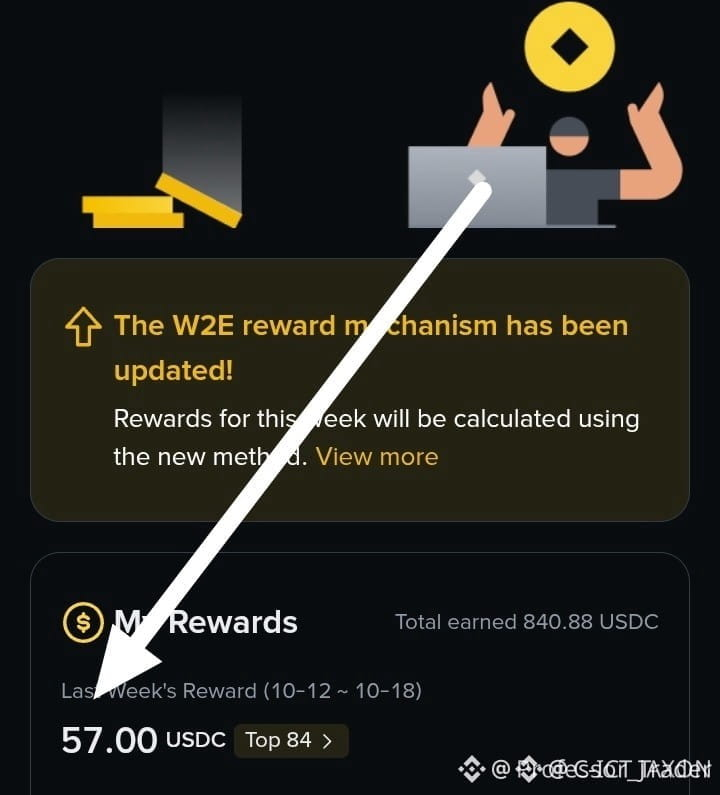
💡 Last week’s $57 USDC payout sat at rank 84, a clear signal that only the most original posts cracked the liquidity pool. To reclaim or even exceed that, focus on depth, relevance, and avoiding recycled memes—smart‑money content that fills the order block of community value. 🦈
💬 Are you ready to reshape your content strategy and capture the next reward wave? 👇
⚠️ Not financial advice. Always manage your risk. 🛡️
🏷️ #USDC #Write2Earn #Rewards #Engagement #Crypto
🚀 ⚡
🟢 $USDC REWARDS REBOOT: CAN YOU RECLAIM THIS WEEK'S EARNINGS? 📈
📊 The updated Write‑2‑Earn algorithm now weights genuine interaction higher, turning raw engagement into a more defensible earnings curve.
💡 Last week’s $57 USDC payout sat at rank 84, a clear signal that only the most original posts cracked the liquidity pool. To reclaim or even exceed that, focus on depth, relevance, and avoiding recycled memes—smart‑money content that fills the order block of community value. 🦈
💬 Are you ready to reshape your content strategy and capture the next reward wave? 👇
⚠️ Not financial advice. Always manage your risk. 🛡️
🏷️ #USDC #Write2Earn #Rewards #Engagement #Crypto
🚀 ⚡
📊 The updated Write‑2‑Earn algorithm now weights genuine interaction higher, turning raw engagement into a more defensible earnings curve.
💡 Last week’s $57 USDC payout sat at rank 84, a clear signal that only the most original posts cracked the liquidity pool. To reclaim or even exceed that, focus on depth, relevance, and avoiding recycled memes—smart‑money content that fills the order block of community value. 🦈
💬 Are you ready to reshape your content strategy and capture the next reward wave? 👇
⚠️ Not financial advice. Always manage your risk. 🛡️
🏷️ #USDC #Write2Earn #Rewards #Engagement #Crypto
🚀 ⚡
14

·
--
🚀 $USDC REWARD REBOOT: CAN YOU CLIMB THE RANK THIS WEEK? 💎
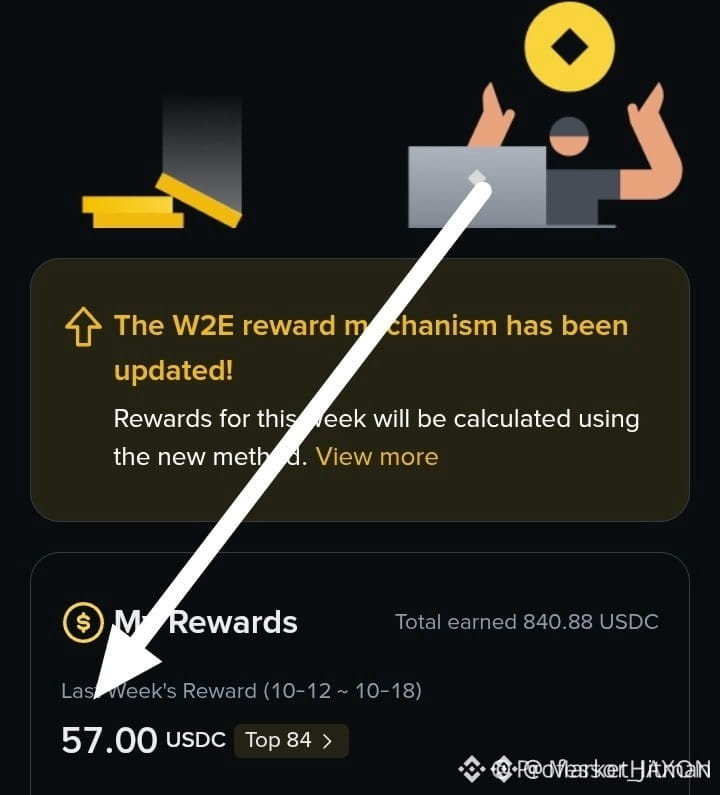
📊 The new Write‑2‑Earn formula just dropped, reshaping how weekly payouts are sliced. Last cycle handed out 57 USDC to the top‑84, so the floor’s already moving. 🦈
💡 Double‑down on original, value‑first content and the algorithm will hand you a bigger slice of the pie. Every genuine post is a bid that can push you higher in the leaderboard. 💬 What fresh angle will you bring to capture the next reward surge? 👇
⚠️ Not financial advice. Always manage your risk. 🛡️
🏷️ #USDC #Write2Earn #Rewards #Crypto
🔥 💎
🚀 $USDC REWARD REBOOT: CAN YOU CLIMB THE RANK THIS WEEK? 💎
📊 The new Write‑2‑Earn formula just dropped, reshaping how weekly payouts are sliced. Last cycle handed out 57 USDC to the top‑84, so the floor’s already moving. 🦈
💡 Double‑down on original, value‑first content and the algorithm will hand you a bigger slice of the pie. Every genuine post is a bid that can push you higher in the leaderboard. 💬 What fresh angle will you bring to capture the next reward surge? 👇
⚠️ Not financial advice. Always manage your risk. 🛡️
🏷️ #USDC #Write2Earn #Rewards #Crypto
🔥 💎
📊 The new Write‑2‑Earn formula just dropped, reshaping how weekly payouts are sliced. Last cycle handed out 57 USDC to the top‑84, so the floor’s already moving. 🦈
💡 Double‑down on original, value‑first content and the algorithm will hand you a bigger slice of the pie. Every genuine post is a bid that can push you higher in the leaderboard. 💬 What fresh angle will you bring to capture the next reward surge? 👇
⚠️ Not financial advice. Always manage your risk. 🛡️
🏷️ #USDC #Write2Earn #Rewards #Crypto
🔥 💎
72

·
--
$USDC -0.01% | $ETH +0.90% | $ZEC +3.04%
#USDC holds at $1.00, barely down -0.01% on a hefty $396.8 M of daily volume, reflecting its role as a fully collateralized stablecoin.
#ETH nudges up to $2,356.20, gaining +0.90% while trading $265.3 M, showing modest upside as demand for decentralized applications stays steady.
#ZEC climbs to $1,223.77, up +3.04% on $113.2 M of volume, outpacing the others in percentage terms despite a smaller trade size.
📈 ZEC’s sharper rise amid lower volume could hint at growing interest in privacy coins, even if the market breadth remains limited.
#Write2Earn #Binance
$USDC -0.01% | $ETH +0.90% | $ZEC +3.04%
#USDC holds at $1.00, barely down -0.01% on a hefty $396.8 M of daily volume, reflecting its role as a fully collateralized stablecoin.
#ETH nudges up to $2,356.20, gaining +0.90% while trading $265.3 M, showing modest upside as demand for decentralized applications stays steady.
#ZEC climbs to $1,223.77, up +3.04% on $113.2 M of volume, outpacing the others in percentage terms despite a smaller trade size.
📈 ZEC’s sharper rise amid lower volume could hint at growing interest in privacy coins, even if the market breadth remains limited.
#Write2Earn #Binance
#USDC holds at $1.00, barely down -0.01% on a hefty $396.8 M of daily volume, reflecting its role as a fully collateralized stablecoin.
#ETH nudges up to $2,356.20, gaining +0.90% while trading $265.3 M, showing modest upside as demand for decentralized applications stays steady.
#ZEC climbs to $1,223.77, up +3.04% on $113.2 M of volume, outpacing the others in percentage terms despite a smaller trade size.
📈 ZEC’s sharper rise amid lower volume could hint at growing interest in privacy coins, even if the market breadth remains limited.
#Write2Earn #Binance
17
📢 QUIZ: BUILDING AGENT RAILS TO EARN USDC REWARDS
$USDC $T $BMT
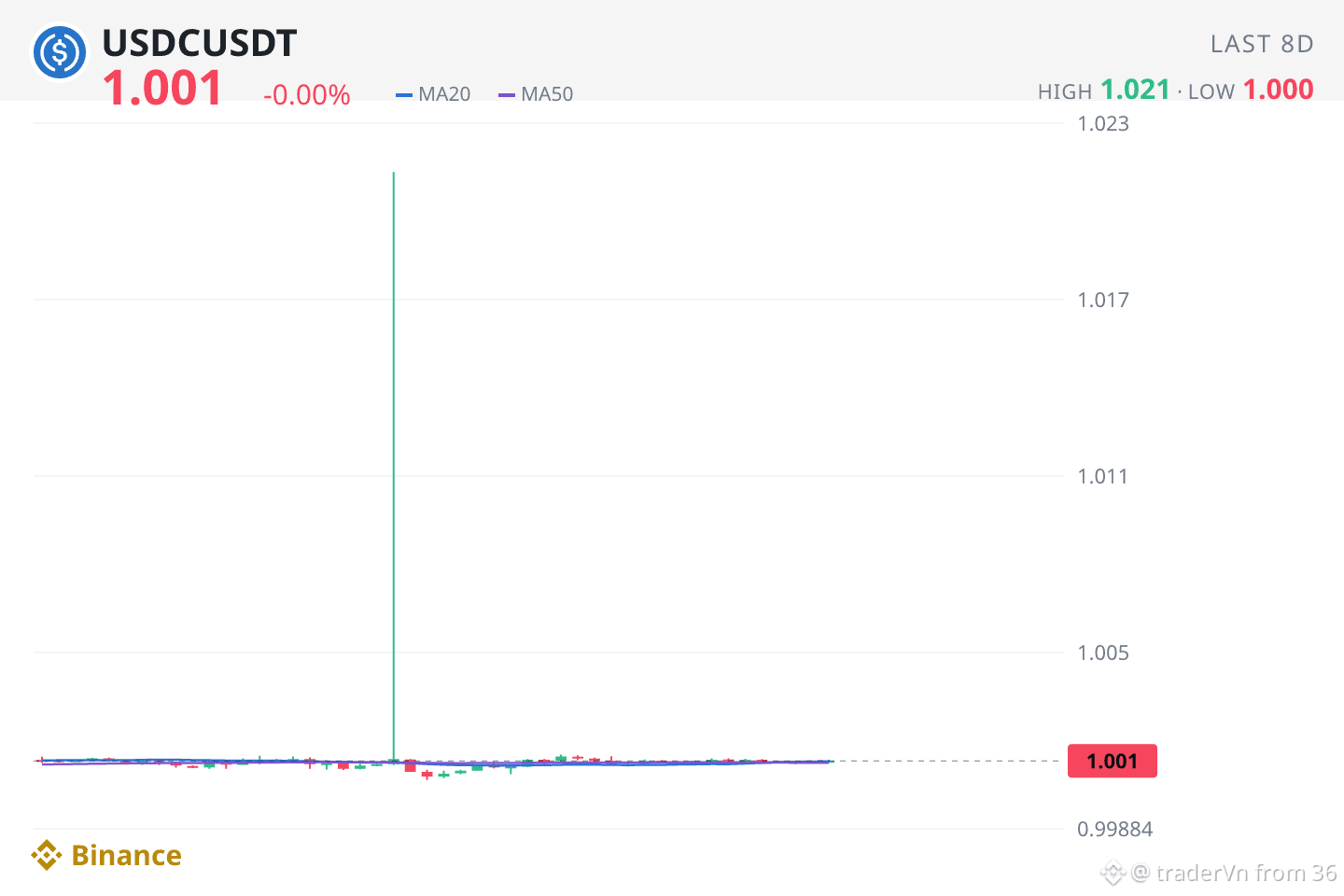
USDC is at 1.0011 USDT · -0.01% over 24h · Vol 398M
🏷️ Event type: QUIZ · published by Binance on 19/10/2026
The stablecoin market remains tightly pegged, with USDC showing marginal movement amid broader crypto volatility. Binance’s learn‑and‑earn quiz offers a modest incentive, likely attracting new participants without influencing price dynamics.
📉 Live market data — TRENDING DOWN
• T · 23.3% · Vol 18M
• BMT · -18% · Vol 19M
• ANIME · -11.7% · Vol 9M
Learn-and-earn pays a fixed amount per person regardless of capital, so it barely moves price — it just adds a lot of small holders.
#USDC #Binance
For reference only, not financial advice (DYOR).
Source: https://www.binance.com/vi/support/announcement/9a4b0619b48d423f83242adc3f779e0d
📢 QUIZ: BUILDING AGENT RAILS TO EARN USDC REWARDS
$USDC $T $BMT
USDC is at 1.0011 USDT · -0.01% over 24h · Vol 398M
🏷️ Event type: QUIZ · published by Binance on 19/10/2026
The stablecoin market remains tightly pegged, with USDC showing marginal movement amid broader crypto volatility. Binance’s learn‑and‑earn quiz offers a modest incentive, likely attracting new participants without influencing price dynamics.
📉 Live market data — TRENDING DOWN
• T · 23.3% · Vol 18M
• BMT · -18% · Vol 19M
• ANIME · -11.7% · Vol 9M
Learn-and-earn pays a fixed amount per person regardless of capital, so it barely moves price — it just adds a lot of small holders.
#USDC #Binance
For reference only, not financial advice (DYOR).
Source: https://www.binance.com/vi/support/announcement/9a4b0619b48d423f83242adc3f779e0d
$USDC $T $BMT
USDC is at 1.0011 USDT · -0.01% over 24h · Vol 398M
🏷️ Event type: QUIZ · published by Binance on 19/10/2026
The stablecoin market remains tightly pegged, with USDC showing marginal movement amid broader crypto volatility. Binance’s learn‑and‑earn quiz offers a modest incentive, likely attracting new participants without influencing price dynamics.
📉 Live market data — TRENDING DOWN
• T · 23.3% · Vol 18M
• BMT · -18% · Vol 19M
• ANIME · -11.7% · Vol 9M
Learn-and-earn pays a fixed amount per person regardless of capital, so it barely moves price — it just adds a lot of small holders.
#USDC #Binance
For reference only, not financial advice (DYOR).
Source: https://www.binance.com/vi/support/announcement/9a4b0619b48d423f83242adc3f779e0d
5
Log in to explore more content
Join global crypto users on Binance Square
⚡️ Get latest and useful information about crypto.
💬 Trusted by the world’s largest crypto exchange.
👍 Discover real insights from verified creators.
Email / Phone number
Trending Topics
1
#BinancePick
2.9M views
150,181 Discussing
2
#EarningsSeason
5.2M views
25,603 Discussing
3
#AnthropicTTMRevenueGrewAbout1200%
11,039 views
276 Discussing
4
#AnthropicS1ExpectedToday
14,322 views
248 Discussing
5
#SouthKoreaReportedlyWeighsFourthCryptoTaxDelay
21,291 views
387 Discussing
6
#FranklinTempletonFilesForTwoDividendToBitcoinETFs
28,641 views
483 Discussing
7
#StrategyMSTRSurpassesNasdaqInMarketCap
22,052 views
347 Discussing
8
#CanadaProposesStablecoinRedemptionWithin3BusinessDays
999 views
34 Discussing
9
#ElectrumWalletBugLetRogueServersStealFunds
24,710 views
435 Discussing
10
#ArgentineCourtDismissesLIBRACaseAgainstMilei
37,535 views
537 Discussing