

#stablecoin
stablecoin
3.9M views
17,970 Discussing
Hot
Latest

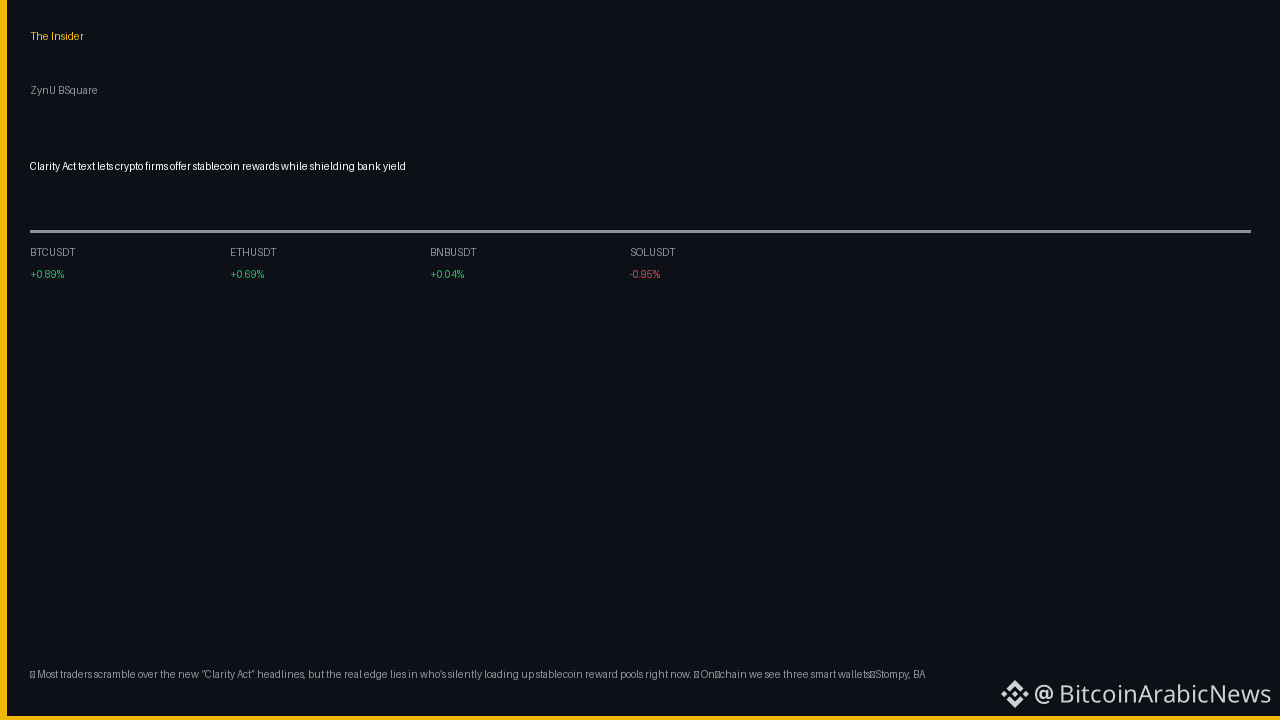
🔥 Most traders scramble over the new “Clarity Act” headlines, but the real edge lies in who’s silently loading up stablecoin reward pools right now.
📊 On‑chain we see three smart wallets—Stompy, BACKERS, and SM—each boosting Solana positions by +7.07%, +1.10% and +3.54% respectively, while BSC’s AIN token spikes +6.7% amid a surge of reward‑linked inflows. Meanwhile #BTC sits at $85,984 with a bullish MACD crossover and #ETH at $2,716, both riding a market sentiment of 70/100 Greed and funding rates that keep longs paying (BTC +0.0018%, ETH +0.0050%). #Stablecoins are quietly being funneled into “bona fide” reward contracts, sidestepping the deposit‑like restrictions.
💡 This tells us the regulatory clamp isn’t a roadblock; it’s a catalyst pushing sophisticated capital toward higher‑yield, non‑deposit stablecoin structures, likely priming a short‑term supply squeeze that could lift prices across the board.
👀 Keep an eye on the #stablecoin inflow ratio to DeFi reward contracts this week—especially Solana‑based reward pools and BSC’s AIN activity—as they’ll flag the next wave of smart‑money positioning.
❓ If the law forces the market to innovate rather than retreat, what does that mean for the next breakout cycle?
🔥 Most traders scramble over the new “Clarity Act” headlines, but the real edge lies in who’s silently loading up stablecoin reward pools right now.
📊 On‑chain we see three smart wallets—Stompy, BACKERS, and SM—each boosting Solana positions by +7.07%, +1.10% and +3.54% respectively, while BSC’s AIN token spikes +6.7% amid a surge of reward‑linked inflows. Meanwhile #BTC sits at $85,984 with a bullish MACD crossover and #ETH at $2,716, both riding a market sentiment of 70/100 Greed and funding rates that keep longs paying (BTC +0.0018%, ETH +0.0050%). #Stablecoins are quietly being funneled into “bona fide” reward contracts, sidestepping the deposit‑like restrictions.
💡 This tells us the regulatory clamp isn’t a roadblock; it’s a catalyst pushing sophisticated capital toward higher‑yield, non‑deposit stablecoin structures, likely priming a short‑term supply squeeze that could lift prices across the board.
👀 Keep an eye on the #stablecoin inflow ratio to DeFi reward contracts this week—especially Solana‑based reward pools and BSC’s AIN activity—as they’ll flag the next wave of smart‑money positioning.
❓ If the law forces the market to innovate rather than retreat, what does that mean for the next breakout cycle?
📊 On‑chain we see three smart wallets—Stompy, BACKERS, and SM—each boosting Solana positions by +7.07%, +1.10% and +3.54% respectively, while BSC’s AIN token spikes +6.7% amid a surge of reward‑linked inflows. Meanwhile #BTC sits at $85,984 with a bullish MACD crossover and #ETH at $2,716, both riding a market sentiment of 70/100 Greed and funding rates that keep longs paying (BTC +0.0018%, ETH +0.0050%). #Stablecoins are quietly being funneled into “bona fide” reward contracts, sidestepping the deposit‑like restrictions.
💡 This tells us the regulatory clamp isn’t a roadblock; it’s a catalyst pushing sophisticated capital toward higher‑yield, non‑deposit stablecoin structures, likely priming a short‑term supply squeeze that could lift prices across the board.
👀 Keep an eye on the #stablecoin inflow ratio to DeFi reward contracts this week—especially Solana‑based reward pools and BSC’s AIN activity—as they’ll flag the next wave of smart‑money positioning.
❓ If the law forces the market to innovate rather than retreat, what does that mean for the next breakout cycle?
16
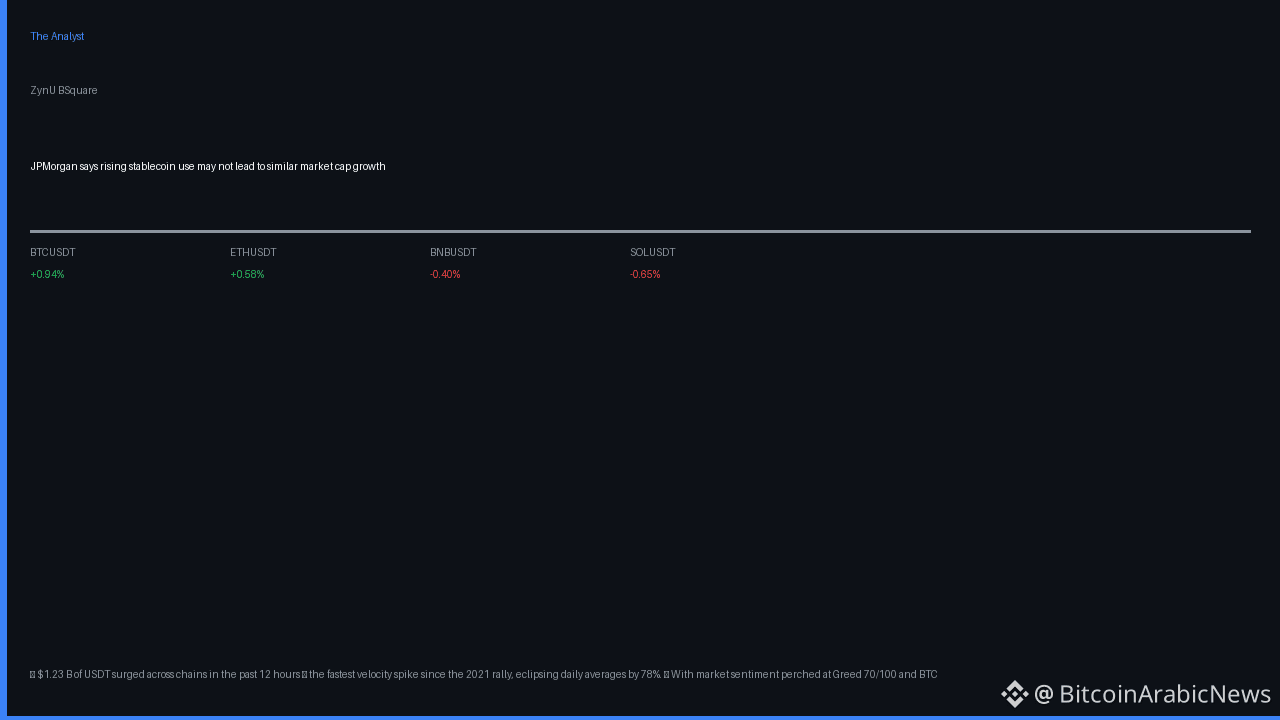
🔥 $1.23 B of USDT surged across chains in the past 12 hours — the fastest velocity spike since the 2021 rally, eclipsing daily averages by 78%.
📊 With market sentiment perched at Greed 70/100 and BTC hovering at $86,047 (+0.94%) amid a bullish MACD crossover, the flood of stablecoin swaps could tilt the risk‑on narrative if cap growth keeps pace.
💡 Smart money is already reallocating: three Solana‑focused wallets (SM, PSTR, OWL) net‑longed +13.8% on‑chain, while BSC meme “super” exploded +438.7%, signaling that traders view the velocity surge as a conduit to higher‑beta assets — #Stablecoin #SmartMoney #Velocity.
🚀 Watch the $87,500 BTC ceiling; a clean break fuels a “stablecoin‑backed” buying spree and could push USDC/USDT supply into net‑outflow territory, tightening the market cap equation — #BTC.
❓ If stablecoins keep moving faster without expanding market cap, are we on the brink of a liquidity crunch that forces whales into risk assets, or will the next wave of institutional inflows rewrite the rulebook?
🔥 $1.23 B of USDT surged across chains in the past 12 hours — the fastest velocity spike since the 2021 rally, eclipsing daily averages by 78%.
📊 With market sentiment perched at Greed 70/100 and BTC hovering at $86,047 (+0.94%) amid a bullish MACD crossover, the flood of stablecoin swaps could tilt the risk‑on narrative if cap growth keeps pace.
💡 Smart money is already reallocating: three Solana‑focused wallets (SM, PSTR, OWL) net‑longed +13.8% on‑chain, while BSC meme “super” exploded +438.7%, signaling that traders view the velocity surge as a conduit to higher‑beta assets — #Stablecoin #SmartMoney #Velocity.
🚀 Watch the $87,500 BTC ceiling; a clean break fuels a “stablecoin‑backed” buying spree and could push USDC/USDT supply into net‑outflow territory, tightening the market cap equation — #BTC.
❓ If stablecoins keep moving faster without expanding market cap, are we on the brink of a liquidity crunch that forces whales into risk assets, or will the next wave of institutional inflows rewrite the rulebook?
📊 With market sentiment perched at Greed 70/100 and BTC hovering at $86,047 (+0.94%) amid a bullish MACD crossover, the flood of stablecoin swaps could tilt the risk‑on narrative if cap growth keeps pace.
💡 Smart money is already reallocating: three Solana‑focused wallets (SM, PSTR, OWL) net‑longed +13.8% on‑chain, while BSC meme “super” exploded +438.7%, signaling that traders view the velocity surge as a conduit to higher‑beta assets — #Stablecoin #SmartMoney #Velocity.
🚀 Watch the $87,500 BTC ceiling; a clean break fuels a “stablecoin‑backed” buying spree and could push USDC/USDT supply into net‑outflow territory, tightening the market cap equation — #BTC.
❓ If stablecoins keep moving faster without expanding market cap, are we on the brink of a liquidity crunch that forces whales into risk assets, or will the next wave of institutional inflows rewrite the rulebook?
60

·
--
Article
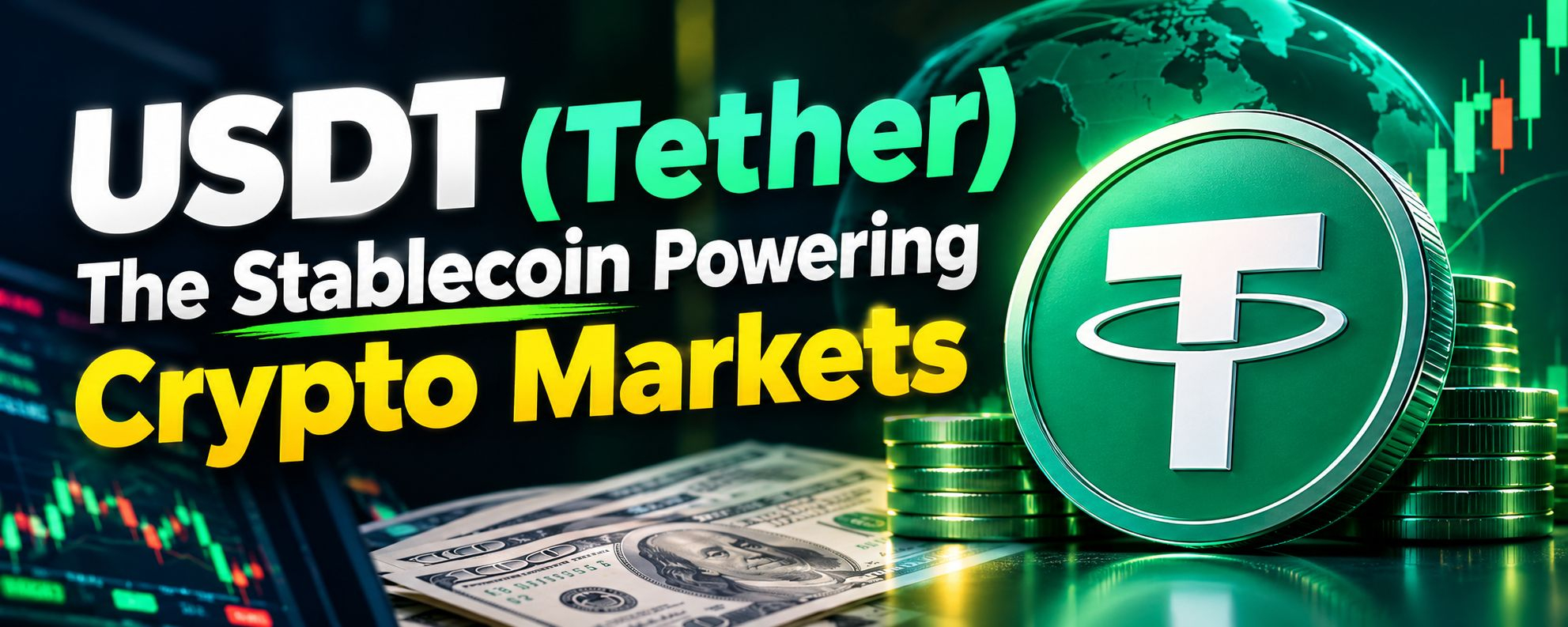
💵 USDT (Tether): The Stablecoin Powering Crypto Markets💵 USDT (Tether): The Stablecoin Powering Crypto Markets
USDT (Tether) is one of the most widely used stablecoins in the crypto market. Unlike volatile assets such as BTC and ETH, USDT is designed to maintain a value close to $1 USD.
🔹 Why Do Traders Use USDT?
USDT is commonly used for:
• Buying and selling cryptocurrencies
• Moving funds between exchanges
• Protecting capital during market volatility
• Trading pairs such as BTC/USDT and ETH/USDT
📊 Why USDT Is Important
USDT provides liquidity across the crypto market. When traders move from volatile coins into USDT, they can temporarily reduce their exposure to price swings without immediately converting their funds into traditional fiat currency.
⚠️ What Should Traders Watch?
Although USDT aims to stay near $1, traders should still pay attention to:
Stablecoin liquidity
Market confidence
Exchange liquidity
USDT's reserve and transparency updates
🚀 Bottom Line
USDT isn't designed to make huge price gains. Its main role is stability, liquidity, and flexibility.
For crypto traders, understanding USDT is essential because it is involved in a huge number of trading pairs and transactions.
Do you keep your trading funds in USDT during market volatility? 👇
#USDT #Tether #Crypto #stablecoin #BinanceSquare #Bitcoin #TetherUpdate #CryptoTrading
$TETH.ETF
{etf_us}(TETH.ETF)
💵 USDT (Tether): The Stablecoin Powering Crypto Markets
💵 USDT (Tether): The Stablecoin Powering Crypto Markets
USDT (Tether) is one of the most widely used stablecoins in the crypto market. Unlike volatile assets such as BTC and ETH, USDT is designed to maintain a value close to $1 USD.
🔹 Why Do Traders Use USDT?
USDT is commonly used for:
• Buying and selling cryptocurrencies
• Moving funds between exchanges
• Protecting capital during market volatility
• Trading pairs such as BTC/USDT and ETH/USDT
📊 Why USDT Is Important
USDT provides liquidity across the crypto market. When traders move from volatile coins into USDT, they can temporarily reduce their exposure to price swings without immediately converting their funds into traditional fiat currency.
⚠️ What Should Traders Watch?
Although USDT aims to stay near $1, traders should still pay attention to:
Stablecoin liquidity
Market confidence
Exchange liquidity
USDT's reserve and transparency updates
🚀 Bottom Line
USDT isn't designed to make huge price gains. Its main role is stability, liquidity, and flexibility.
For crypto traders, understanding USDT is essential because it is involved in a huge number of trading pairs and transactions.
Do you keep your trading funds in USDT during market volatility? 👇
#USDT #Tether #Crypto #stablecoin #BinanceSquare #Bitcoin #TetherUpdate #CryptoTrading
$TETH.ETF
USDT (Tether) is one of the most widely used stablecoins in the crypto market. Unlike volatile assets such as BTC and ETH, USDT is designed to maintain a value close to $1 USD.
🔹 Why Do Traders Use USDT?
USDT is commonly used for:
• Buying and selling cryptocurrencies
• Moving funds between exchanges
• Protecting capital during market volatility
• Trading pairs such as BTC/USDT and ETH/USDT
📊 Why USDT Is Important
USDT provides liquidity across the crypto market. When traders move from volatile coins into USDT, they can temporarily reduce their exposure to price swings without immediately converting their funds into traditional fiat currency.
⚠️ What Should Traders Watch?
Although USDT aims to stay near $1, traders should still pay attention to:
Stablecoin liquidity
Market confidence
Exchange liquidity
USDT's reserve and transparency updates
🚀 Bottom Line
USDT isn't designed to make huge price gains. Its main role is stability, liquidity, and flexibility.
For crypto traders, understanding USDT is essential because it is involved in a huge number of trading pairs and transactions.
Do you keep your trading funds in USDT during market volatility? 👇
#USDT #Tether #Crypto #stablecoin #BinanceSquare #Bitcoin #TetherUpdate #CryptoTrading
$TETH.ETF
5

·
--
🚨 **$16M BET ON STABLECOINS! 👀**
Singapore fintech **IPID** just raised **$16M** to expand U.S. payment rails, **stablecoins & digital assets**.
🔥 **Big money is building the crypto rails.**
$USDC $USDT $ETH
#Stablecoin #Crypto #DigitalAssets #Fintech #Payments
🚨 **$16M BET ON STABLECOINS! 👀**
Singapore fintech **IPID** just raised **$16M** to expand U.S. payment rails, **stablecoins & digital assets**.
🔥 **Big money is building the crypto rails.**
$USDC $USDT $ETH
#Stablecoin #Crypto #DigitalAssets #Fintech #Payments
Singapore fintech **IPID** just raised **$16M** to expand U.S. payment rails, **stablecoins & digital assets**.
🔥 **Big money is building the crypto rails.**
$USDC $USDT $ETH
#Stablecoin #Crypto #DigitalAssets #Fintech #Payments
31

·
--
Everyone:
“Which coin is going to pump next? 🚀”
USDC:
“Bro, I’m just trying to stay at $1.” 😂
Not every crypto needs to moon.
Some are simply here to do their job. 😎
$USDC
$ZEC
{future}(USDCUSDT)
#USDC #stablecoin #crypto #BİNANCE
Everyone:
“Which coin is going to pump next? 🚀”
USDC:
“Bro, I’m just trying to stay at $1.” 😂
Not every crypto needs to moon.
Some are simply here to do their job. 😎
$USDC
$ZEC
#USDC #stablecoin #crypto #BİNANCE
“Which coin is going to pump next? 🚀”
USDC:
“Bro, I’m just trying to stay at $1.” 😂
Not every crypto needs to moon.
Some are simply here to do their job. 😎
$USDC
$ZEC
#USDC #stablecoin #crypto #BİNANCE
35
·
--
USDT be like:
“People call me boring… then the second the market crashes, everyone runs to me.” 😂
Stability doesn’t look exciting in a bull market, but it hits different during red candles. 👀
$USDT
$NVDAB
{spot}(USDCUSDT)
#USDT #stablecoin #Binance #crypto
USDT be like:
“People call me boring… then the second the market crashes, everyone runs to me.” 😂
Stability doesn’t look exciting in a bull market, but it hits different during red candles. 👀
$USDT
$NVDAB
#USDT #stablecoin #Binance #crypto
“People call me boring… then the second the market crashes, everyone runs to me.” 😂
Stability doesn’t look exciting in a bull market, but it hits different during red candles. 👀
$USDT
$NVDAB
#USDT #stablecoin #Binance #crypto
76

·
--
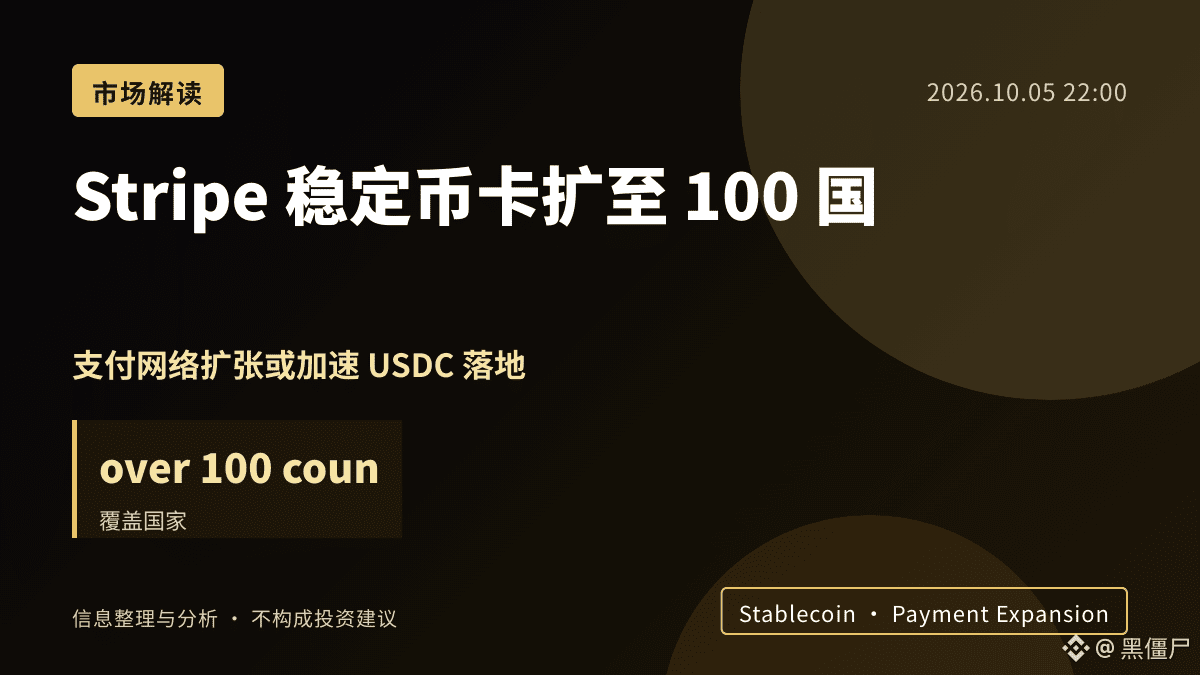
Stripe’s Stablecoin Card to Reach 100 Countries by Year-End as USDC Payments Gain Momentum
According to CoinDesk, Stripe plans to expand its stablecoin card business to more than 100 countries by the end of this year, while also exploring solutions related to tokenized deposits. The significance of this move lies not in the launch of a single product, but in the growing direct link between the expansion of payment networks and stablecoin settlement capabilities.
From a market-structure perspective, Stripe’s distribution reach has long been a key bottleneck for bringing crypto payments into real-world use. Stablecoins have so far been used primarily for on-chain transfers and institutional settlements, while access to card networks and acquiring networks determines whether everyday merchants and consumers can use them for routine purchases. If the goal of reaching 100 countries by year-end stays on track, the adoption path for USDC in cross-border payments, merchant settlements, and consumer spending may become clearer. Competition among stablecoins could also shift from “who issues them” to “who connects to more payment nodes.”
However, the information disclosed so far remains more of a roadmap: the specific countries covered, merchant numbers, payment volumes, and compliance timelines have yet to be clarified. Requirements for stablecoin cards, tokenized deposits, and payment licenses vary widely across jurisdictions, making the timeline uncertain. If the expansion remains limited to partnership announcements, actual fund flows and transaction volumes may fall short of expectations.
What will be more important to watch next is whether Stripe discloses launches in specific countries, merchant onboarding figures, or transaction volumes. For those following USDC, the key near-term question is whether the payment network’s expansion leads to confirmed real-world usage—not simply what the roadmap suggests.
#Stablecoin #USDC #CryptoMarket
The above is a summary of information and personal analysis, and does not constitute investment advice.
Follow me for ongoing coverage of key market developments and data.
Stripe’s Stablecoin Card to Reach 100 Countries by Year-End as USDC Payments Gain Momentum
According to CoinDesk, Stripe plans to expand its stablecoin card business to more than 100 countries by the end of this year, while also exploring solutions related to tokenized deposits. The significance of this move lies not in the launch of a single product, but in the growing direct link between the expansion of payment networks and stablecoin settlement capabilities.
From a market-structure perspective, Stripe’s distribution reach has long been a key bottleneck for bringing crypto payments into real-world use. Stablecoins have so far been used primarily for on-chain transfers and institutional settlements, while access to card networks and acquiring networks determines whether everyday merchants and consumers can use them for routine purchases. If the goal of reaching 100 countries by year-end stays on track, the adoption path for USDC in cross-border payments, merchant settlements, and consumer spending may become clearer. Competition among stablecoins could also shift from “who issues them” to “who connects to more payment nodes.”
However, the information disclosed so far remains more of a roadmap: the specific countries covered, merchant numbers, payment volumes, and compliance timelines have yet to be clarified. Requirements for stablecoin cards, tokenized deposits, and payment licenses vary widely across jurisdictions, making the timeline uncertain. If the expansion remains limited to partnership announcements, actual fund flows and transaction volumes may fall short of expectations.
What will be more important to watch next is whether Stripe discloses launches in specific countries, merchant onboarding figures, or transaction volumes. For those following USDC, the key near-term question is whether the payment network’s expansion leads to confirmed real-world usage—not simply what the roadmap suggests.
#Stablecoin #USDC #CryptoMarket
The above is a summary of information and personal analysis, and does not constitute investment advice.
Follow me for ongoing coverage of key market developments and data.
According to CoinDesk, Stripe plans to expand its stablecoin card business to more than 100 countries by the end of this year, while also exploring solutions related to tokenized deposits. The significance of this move lies not in the launch of a single product, but in the growing direct link between the expansion of payment networks and stablecoin settlement capabilities.
From a market-structure perspective, Stripe’s distribution reach has long been a key bottleneck for bringing crypto payments into real-world use. Stablecoins have so far been used primarily for on-chain transfers and institutional settlements, while access to card networks and acquiring networks determines whether everyday merchants and consumers can use them for routine purchases. If the goal of reaching 100 countries by year-end stays on track, the adoption path for USDC in cross-border payments, merchant settlements, and consumer spending may become clearer. Competition among stablecoins could also shift from “who issues them” to “who connects to more payment nodes.”
However, the information disclosed so far remains more of a roadmap: the specific countries covered, merchant numbers, payment volumes, and compliance timelines have yet to be clarified. Requirements for stablecoin cards, tokenized deposits, and payment licenses vary widely across jurisdictions, making the timeline uncertain. If the expansion remains limited to partnership announcements, actual fund flows and transaction volumes may fall short of expectations.
What will be more important to watch next is whether Stripe discloses launches in specific countries, merchant onboarding figures, or transaction volumes. For those following USDC, the key near-term question is whether the payment network’s expansion leads to confirmed real-world usage—not simply what the roadmap suggests.
#Stablecoin #USDC #CryptoMarket
The above is a summary of information and personal analysis, and does not constitute investment advice.
Follow me for ongoing coverage of key market developments and data.
110

Chinese P2P stablecoin wallets surge 43-fold despite crypto restrictions
- The number of unique P2P stablecoin wallets in China increased 43-fold from Q1 2024 to Q2 2026
- This growth came as users shifted to direct wallet-to-wallet transactions despite crypto restrictions
#BinanceSquare #CryptoNews #Stablecoin
$btc $eth
#vlikevn #Titanbot
Source: CoinTelegraph
Chinese P2P stablecoin wallets surge 43-fold despite crypto restrictions
- The number of unique P2P stablecoin wallets in China increased 43-fold from Q1 2024 to Q2 2026
- This growth came as users shifted to direct wallet-to-wallet transactions despite crypto restrictions
#BinanceSquare #CryptoNews #Stablecoin
$btc $eth
#vlikevn #Titanbot
Source: CoinTelegraph
- The number of unique P2P stablecoin wallets in China increased 43-fold from Q1 2024 to Q2 2026
- This growth came as users shifted to direct wallet-to-wallet transactions despite crypto restrictions
#BinanceSquare #CryptoNews #Stablecoin
$btc $eth
#vlikevn #Titanbot
Source: CoinTelegraph
160

【Five Titans Build a $1 Billion Arsenal for Open USD: Is Tether’s Hegemony Facing Its Final Battle?】
Just now, the crypto market erupted with a historic-level institutional earthquake: Visa, Mastercard, Stripe, Coinbase, and Shopify—five payment and e-commerce behemoths—have officially formed an alliance to inject $1 billion to jointly push a brand-new regulated stablecoin, “Open USD (OUSD)”!
This isn’t ordinary token-launch news. It’s the “ultimate siege” by traditional business empires against the power to price on-chain dollars:
1. Why can’t these giants resist getting personally involved?
The answer is two words: “interest.” Tether (USDT) relies on more than $120 billion in reserves earning high yields from U.S. Treasuries, pocketing tens of billions in net profit each year—so much so that it even surpasses firms like BlackRock and Goldman. And this time, backed by the world’s largest real-world clearing network (Visa/Mastercard) + the world’s biggest e-commerce rails (Shopify/Stripe) + the largest regulated exchange (Coinbase), they’re aiming to directly take their share of the most lucrative, risk-free profit “cake.”
2. Versus Tether: real-world scenarios vs offshore liquidity
- USDT’s moat: the depth of spot and derivatives on offshore exchanges, the settlement habits of illicit-activity operators, and the global underground circulation inertia. This “underground liquidity flywheel” remains hard to topple in the short term.
- OUSD’s killer move: one-click settlement for cross-border e-commerce, direct connections through global card networks, and fully transparent U.S. regulatory approval. It’s not here to compete with USDT for collateral guarantees—it’s here to move billions of online shoppers and physical merchants directly onto the chain!
Macroeconomic and on-chain game-theory conclusion:
In the short term, the stablecoin sector is likely to experience a dramatic “liquidity split.” On CEXs, USDT trading pairs’ depth will still remain the core pricing engine; but in the long run, the giants’ $1 billion injection signals the complete mainstreaming of Web3’s underlying “monetary layer.”
Once fiat-payment giants start rebuilding the global clearing system with on-chain dollars, the truly trillion-level real money flows are about to be unleashed and enter the arena.
#Stablecoin #USDT #CryptoNews $USDT $BTC #Fintech
【Five Titans Build a $1 Billion Arsenal for Open USD: Is Tether’s Hegemony Facing Its Final Battle?】
Just now, the crypto market erupted with a historic-level institutional earthquake: Visa, Mastercard, Stripe, Coinbase, and Shopify—five payment and e-commerce behemoths—have officially formed an alliance to inject $1 billion to jointly push a brand-new regulated stablecoin, “Open USD (OUSD)”!
This isn’t ordinary token-launch news. It’s the “ultimate siege” by traditional business empires against the power to price on-chain dollars:
1. Why can’t these giants resist getting personally involved?
The answer is two words: “interest.” Tether (USDT) relies on more than $120 billion in reserves earning high yields from U.S. Treasuries, pocketing tens of billions in net profit each year—so much so that it even surpasses firms like BlackRock and Goldman. And this time, backed by the world’s largest real-world clearing network (Visa/Mastercard) + the world’s biggest e-commerce rails (Shopify/Stripe) + the largest regulated exchange (Coinbase), they’re aiming to directly take their share of the most lucrative, risk-free profit “cake.”
2. Versus Tether: real-world scenarios vs offshore liquidity
- USDT’s moat: the depth of spot and derivatives on offshore exchanges, the settlement habits of illicit-activity operators, and the global underground circulation inertia. This “underground liquidity flywheel” remains hard to topple in the short term.
- OUSD’s killer move: one-click settlement for cross-border e-commerce, direct connections through global card networks, and fully transparent U.S. regulatory approval. It’s not here to compete with USDT for collateral guarantees—it’s here to move billions of online shoppers and physical merchants directly onto the chain!
Macroeconomic and on-chain game-theory conclusion:
In the short term, the stablecoin sector is likely to experience a dramatic “liquidity split.” On CEXs, USDT trading pairs’ depth will still remain the core pricing engine; but in the long run, the giants’ $1 billion injection signals the complete mainstreaming of Web3’s underlying “monetary layer.”
Once fiat-payment giants start rebuilding the global clearing system with on-chain dollars, the truly trillion-level real money flows are about to be unleashed and enter the arena.
#Stablecoin #USDT #CryptoNews $USDT $BTC #Fintech
Just now, the crypto market erupted with a historic-level institutional earthquake: Visa, Mastercard, Stripe, Coinbase, and Shopify—five payment and e-commerce behemoths—have officially formed an alliance to inject $1 billion to jointly push a brand-new regulated stablecoin, “Open USD (OUSD)”!
This isn’t ordinary token-launch news. It’s the “ultimate siege” by traditional business empires against the power to price on-chain dollars:
1. Why can’t these giants resist getting personally involved?
The answer is two words: “interest.” Tether (USDT) relies on more than $120 billion in reserves earning high yields from U.S. Treasuries, pocketing tens of billions in net profit each year—so much so that it even surpasses firms like BlackRock and Goldman. And this time, backed by the world’s largest real-world clearing network (Visa/Mastercard) + the world’s biggest e-commerce rails (Shopify/Stripe) + the largest regulated exchange (Coinbase), they’re aiming to directly take their share of the most lucrative, risk-free profit “cake.”
2. Versus Tether: real-world scenarios vs offshore liquidity
- USDT’s moat: the depth of spot and derivatives on offshore exchanges, the settlement habits of illicit-activity operators, and the global underground circulation inertia. This “underground liquidity flywheel” remains hard to topple in the short term.
- OUSD’s killer move: one-click settlement for cross-border e-commerce, direct connections through global card networks, and fully transparent U.S. regulatory approval. It’s not here to compete with USDT for collateral guarantees—it’s here to move billions of online shoppers and physical merchants directly onto the chain!
Macroeconomic and on-chain game-theory conclusion:
In the short term, the stablecoin sector is likely to experience a dramatic “liquidity split.” On CEXs, USDT trading pairs’ depth will still remain the core pricing engine; but in the long run, the giants’ $1 billion injection signals the complete mainstreaming of Web3’s underlying “monetary layer.”
Once fiat-payment giants start rebuilding the global clearing system with on-chain dollars, the truly trillion-level real money flows are about to be unleashed and enter the arena.
#Stablecoin #USDT #CryptoNews $USDT $BTC #Fintech

137

·
--
🚀$NVDAB $NVDAB $NVDA.US Stablecoin adoption continues to accelerate.
Visa reports that payment volume across its stablecoin-linked card programs has surged nearly 200% year-over-year.
📊 Business & commercial cards now account for approximately 17% of that volume, highlighting growing stablecoin use in real-world payments and business transactions.
The shift from crypto speculation toward everyday payments and financial infrastructure is becoming increasingly visible.
#Visa #stablecoin oins #fintech pto #fintech h #Payment ents #DigitalAssets
🚀$NVDAB $NVDAB $NVDA.US Stablecoin adoption continues to accelerate.
Visa reports that payment volume across its stablecoin-linked card programs has surged nearly 200% year-over-year.
📊 Business & commercial cards now account for approximately 17% of that volume, highlighting growing stablecoin use in real-world payments and business transactions.
The shift from crypto speculation toward everyday payments and financial infrastructure is becoming increasingly visible.
#Visa #stablecoin oins #fintech pto #fintech h #Payment ents #DigitalAssets
Visa reports that payment volume across its stablecoin-linked card programs has surged nearly 200% year-over-year.
📊 Business & commercial cards now account for approximately 17% of that volume, highlighting growing stablecoin use in real-world payments and business transactions.
The shift from crypto speculation toward everyday payments and financial infrastructure is becoming increasingly visible.
#Visa #stablecoin oins #fintech pto #fintech h #Payment ents #DigitalAssets

NVDAB+2.37%
NVDAUS+0.75%
51

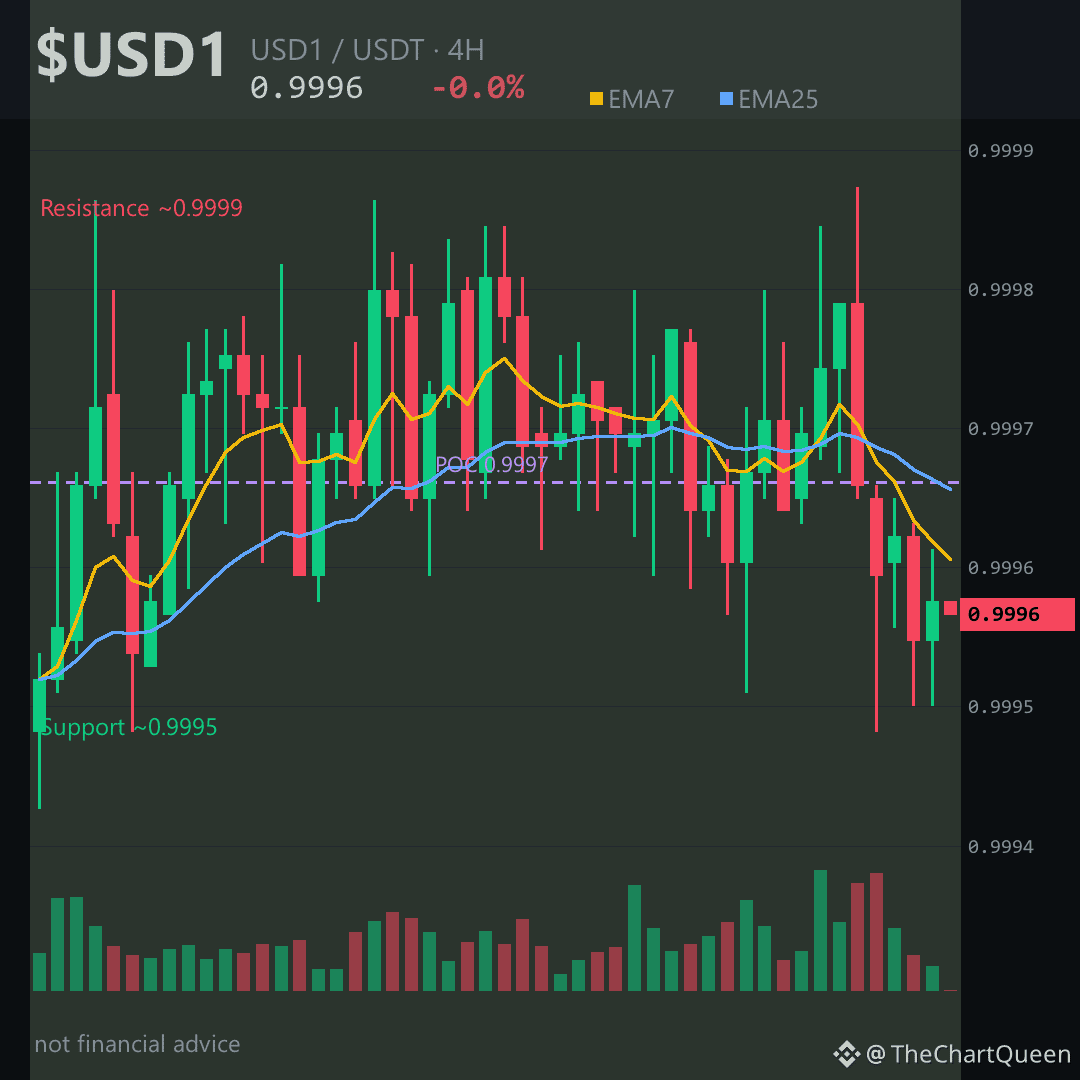
0.999590.
That's not a typo. $USD1 is trading a hair below the psychological magnet of parity, and the chart is whispering something most volume-scan traders will scroll past.
The 4-hour picture is the cleanest read. Price keeps getting rejected just under 0.9997 — the volume profile's point of control. Sellers are defending it. The EMA structure agrees: the faster average is below the slower one, a lean bearish posture, not a coiled spring.
There's also an unmitigated gap around 0.9997. Gaps often act like open windows price wants to revisit before continuing its drift. If that fill happens and gets rejected, the downside objective sits near 0.9775.
The levels that matter for $USD1: the pivot zone is roughly 1.0046, but the real line in the sand is 0.9997. A 4-hour close back above that zone and this bearish read loses its edge. Until then, the path of least resistance appears to be a slow bleed toward 0.9775. Tap $USD1 to pull up the chart and read these levels yourself.
My read: this is not a momentum crash — it's a quiet distribution. The risk isn't a violent dump; it's holding a position expecting volatility that never arrives.
I'll update this read if the 0.9997 area gets reclaimed or the 0.9775 zone gets tagged — follow so that update lands in your feed.
Which zone are you watching more closely on USD1 — the parity reclaim or the lower objective? 👇
⚠️ Not financial advice. DYOR.
#USD1 #Stablecoin #Crypto #BinanceSquare
0.999590.
That's not a typo. $USD1 is trading a hair below the psychological magnet of parity, and the chart is whispering something most volume-scan traders will scroll past.
The 4-hour picture is the cleanest read. Price keeps getting rejected just under 0.9997 — the volume profile's point of control. Sellers are defending it. The EMA structure agrees: the faster average is below the slower one, a lean bearish posture, not a coiled spring.
There's also an unmitigated gap around 0.9997. Gaps often act like open windows price wants to revisit before continuing its drift. If that fill happens and gets rejected, the downside objective sits near 0.9775.
The levels that matter for $USD1 : the pivot zone is roughly 1.0046, but the real line in the sand is 0.9997. A 4-hour close back above that zone and this bearish read loses its edge. Until then, the path of least resistance appears to be a slow bleed toward 0.9775. Tap $USD1 to pull up the chart and read these levels yourself.
My read: this is not a momentum crash — it's a quiet distribution. The risk isn't a violent dump; it's holding a position expecting volatility that never arrives.
I'll update this read if the 0.9997 area gets reclaimed or the 0.9775 zone gets tagged — follow so that update lands in your feed.
Which zone are you watching more closely on USD1 — the parity reclaim or the lower objective? 👇
⚠️ Not financial advice. DYOR.
#USD1 #Stablecoin #Crypto #BinanceSquare
That's not a typo. $USD1 is trading a hair below the psychological magnet of parity, and the chart is whispering something most volume-scan traders will scroll past.
The 4-hour picture is the cleanest read. Price keeps getting rejected just under 0.9997 — the volume profile's point of control. Sellers are defending it. The EMA structure agrees: the faster average is below the slower one, a lean bearish posture, not a coiled spring.
There's also an unmitigated gap around 0.9997. Gaps often act like open windows price wants to revisit before continuing its drift. If that fill happens and gets rejected, the downside objective sits near 0.9775.
The levels that matter for $USD1 : the pivot zone is roughly 1.0046, but the real line in the sand is 0.9997. A 4-hour close back above that zone and this bearish read loses its edge. Until then, the path of least resistance appears to be a slow bleed toward 0.9775. Tap $USD1 to pull up the chart and read these levels yourself.
My read: this is not a momentum crash — it's a quiet distribution. The risk isn't a violent dump; it's holding a position expecting volatility that never arrives.
I'll update this read if the 0.9997 area gets reclaimed or the 0.9775 zone gets tagged — follow so that update lands in your feed.
Which zone are you watching more closely on USD1 — the parity reclaim or the lower objective? 👇
⚠️ Not financial advice. DYOR.
#USD1 #Stablecoin #Crypto #BinanceSquare
72

🚨 HUGE: USDT is coming home to Bitcoin after more than a decade away, and this time it brings tools Bitcoin never had.
Tether-backed Utexo has secured a commercial license to issue USDT natively on Bitcoin, with mainnet launch planned for this month, October 2026.
The backstory makes this genuinely full-circle. USDT's very first tokens were issued on Bitcoin's Omni layer back on October 6, 2014. Over the following decade, the stablecoin's growth shifted almost entirely to Ethereum and Tron instead, chasing faster, cheaper, more programmable rails. Bitcoin got left behind.
Now Utexo, built specifically to bring USDT back, is using the RGB protocol to do what Bitcoin's original infrastructure couldn't: private transfers where transaction details stay off the public ledger, direct BTC-to-USDT swaps with no intermediary, and loans using native Bitcoin as collateral, no wrapping required.
That last part matters more than it sounds. Wrapped Bitcoin, like WBTC, requires trusting a custodian to hold real BTC while you use a synthetic version elsewhere. Native collateral cuts that trust assumption out entirely.
The rollout is staged: Bitcoin mainnet first, with Lightning Network support planned to follow, meaning the full vision, instant, near-free stablecoin settlement directly on Bitcoin rails, arrives in phases rather than all at once.
Tether CEO Paolo Ardoino teased the move on X back in September. Now the infrastructure, and the commercial license to actually run it, is in place.
Twelve years after USDT first launched on Bitcoin and quietly moved on, it's coming back, this time built to stay.
#Bitcoin #USDT #Tether #Crypto #Stablecoin
🚨 HUGE: USDT is coming home to Bitcoin after more than a decade away, and this time it brings tools Bitcoin never had.
Tether-backed Utexo has secured a commercial license to issue USDT natively on Bitcoin, with mainnet launch planned for this month, October 2026.
The backstory makes this genuinely full-circle. USDT's very first tokens were issued on Bitcoin's Omni layer back on October 6, 2014. Over the following decade, the stablecoin's growth shifted almost entirely to Ethereum and Tron instead, chasing faster, cheaper, more programmable rails. Bitcoin got left behind.
Now Utexo, built specifically to bring USDT back, is using the RGB protocol to do what Bitcoin's original infrastructure couldn't: private transfers where transaction details stay off the public ledger, direct BTC-to-USDT swaps with no intermediary, and loans using native Bitcoin as collateral, no wrapping required.
That last part matters more than it sounds. Wrapped Bitcoin, like WBTC, requires trusting a custodian to hold real BTC while you use a synthetic version elsewhere. Native collateral cuts that trust assumption out entirely.
The rollout is staged: Bitcoin mainnet first, with Lightning Network support planned to follow, meaning the full vision, instant, near-free stablecoin settlement directly on Bitcoin rails, arrives in phases rather than all at once.
Tether CEO Paolo Ardoino teased the move on X back in September. Now the infrastructure, and the commercial license to actually run it, is in place.
Twelve years after USDT first launched on Bitcoin and quietly moved on, it's coming back, this time built to stay.
#Bitcoin #USDT #Tether #Crypto #Stablecoin
Tether-backed Utexo has secured a commercial license to issue USDT natively on Bitcoin, with mainnet launch planned for this month, October 2026.
The backstory makes this genuinely full-circle. USDT's very first tokens were issued on Bitcoin's Omni layer back on October 6, 2014. Over the following decade, the stablecoin's growth shifted almost entirely to Ethereum and Tron instead, chasing faster, cheaper, more programmable rails. Bitcoin got left behind.
Now Utexo, built specifically to bring USDT back, is using the RGB protocol to do what Bitcoin's original infrastructure couldn't: private transfers where transaction details stay off the public ledger, direct BTC-to-USDT swaps with no intermediary, and loans using native Bitcoin as collateral, no wrapping required.
That last part matters more than it sounds. Wrapped Bitcoin, like WBTC, requires trusting a custodian to hold real BTC while you use a synthetic version elsewhere. Native collateral cuts that trust assumption out entirely.
The rollout is staged: Bitcoin mainnet first, with Lightning Network support planned to follow, meaning the full vision, instant, near-free stablecoin settlement directly on Bitcoin rails, arrives in phases rather than all at once.
Tether CEO Paolo Ardoino teased the move on X back in September. Now the infrastructure, and the commercial license to actually run it, is in place.
Twelve years after USDT first launched on Bitcoin and quietly moved on, it's coming back, this time built to stay.
#Bitcoin #USDT #Tether #Crypto #Stablecoin

1
52

🌐 Market signals: TRON officially dominates the stablecoin segment with over $94 billion in USDT circulating on the network
*Details:*
📈 Price: $0.3344 (+0.15%)
📊 24h Volume: ~ $410 million
💰 Market Cap: $31.75 billion
🛡️ TVL: ~ $28 billion
💵 USDT TRC20: >$94 billion
*Looking further ahead:*
- TRON is no longer just a blockchain—it has become a true “settlement layer” for the world. Holding the largest amount of USDT in the market gives TRX an absolute advantage in liquidity and real-world utility.
- The steady growth of TVL and the number of user accounts (exceeding 405 million) shows that the TRON ecosystem is expanding sustainably, not depending on short-term hype.
Do you think TRX will soon break the previous all-time high, or continue trading sideways and accumulating?
👉 Where’s the alpha? Right here — Follow [Channel](https://app.binance.com/uni-qr/cpro/Square-Creator-4a0f2008149d?l=en&r=BOZMO8A1)
#TRX #TRON #Stablecoin #BinanceSquare $HYPE
🌐 Market signals: TRON officially dominates the stablecoin segment with over $94 billion in USDT circulating on the network
*Details:*
📈 Price: $0.3344 (+0.15%)
📊 24h Volume: ~ $410 million
💰 Market Cap: $31.75 billion
🛡️ TVL: ~ $28 billion
💵 USDT TRC20: >$94 billion
*Looking further ahead:*
- TRON is no longer just a blockchain—it has become a true “settlement layer” for the world. Holding the largest amount of USDT in the market gives TRX an absolute advantage in liquidity and real-world utility.
- The steady growth of TVL and the number of user accounts (exceeding 405 million) shows that the TRON ecosystem is expanding sustainably, not depending on short-term hype.
Do you think TRX will soon break the previous all-time high, or continue trading sideways and accumulating?
👉 Where’s the alpha? Right here — Follow [Channel](https://app.binance.com/uni-qr/cpro/Square-Creator-4a0f2008149d?l=en&r=BOZMO8A1)
#TRX #TRON #Stablecoin #BinanceSquare $HYPE
*Details:*
📈 Price: $0.3344 (+0.15%)
📊 24h Volume: ~ $410 million
💰 Market Cap: $31.75 billion
🛡️ TVL: ~ $28 billion
💵 USDT TRC20: >$94 billion
*Looking further ahead:*
- TRON is no longer just a blockchain—it has become a true “settlement layer” for the world. Holding the largest amount of USDT in the market gives TRX an absolute advantage in liquidity and real-world utility.
- The steady growth of TVL and the number of user accounts (exceeding 405 million) shows that the TRON ecosystem is expanding sustainably, not depending on short-term hype.
Do you think TRX will soon break the previous all-time high, or continue trading sideways and accumulating?
👉 Where’s the alpha? Right here — Follow [Channel](https://app.binance.com/uni-qr/cpro/Square-Creator-4a0f2008149d?l=en&r=BOZMO8A1)
#TRX #TRON #Stablecoin #BinanceSquare $HYPE
1
55

·
--
🚀 TRON affirms its position as the “king” of stablecoins as the amount of USDT circulating on the official network surpasses the $9.4 billion mark.
*Updated figures:*
📉 Current price: 0.3344 USD (+0.15%)
📈 24h trading volume: ~410 million USD
💎 Market capitalization: 31.75 billion USD
🔒 TVL: ~28 billion USD
💵 USDT (TRC20): >94 billion USD
*Quick analysis:*
Rather than being just a typical blockchain, TRON is now functioning like global payment infrastructure. Controlling such a massive amount of USDT gives TRX a clear advantage in real-world utility and liquidity. Especially with more than 405 million user accounts and a steadily growing TVL, this ecosystem is demonstrating sustainable development rather than chasing temporary hype waves.
What do you think—will TRX continue accumulating, or will it soon break out to reach new highs?
👉 Don’t miss out — Follow [Channel](https://app.binance.com/uni-qr/cpro/Square-Creator-4a0f2008149d?l=en&r=BOZMO8A1)
#TRX #TRON #Stablecoin #BinanceSquare $HYPE
🚀 TRON affirms its position as the “king” of stablecoins as the amount of USDT circulating on the official network surpasses the $9.4 billion mark.
*Updated figures:*
📉 Current price: 0.3344 USD (+0.15%)
📈 24h trading volume: ~410 million USD
💎 Market capitalization: 31.75 billion USD
🔒 TVL: ~28 billion USD
💵 USDT (TRC20): >94 billion USD
*Quick analysis:*
Rather than being just a typical blockchain, TRON is now functioning like global payment infrastructure. Controlling such a massive amount of USDT gives TRX a clear advantage in real-world utility and liquidity. Especially with more than 405 million user accounts and a steadily growing TVL, this ecosystem is demonstrating sustainable development rather than chasing temporary hype waves.
What do you think—will TRX continue accumulating, or will it soon break out to reach new highs?
👉 Don’t miss out — Follow [Channel](https://app.binance.com/uni-qr/cpro/Square-Creator-4a0f2008149d?l=en&r=BOZMO8A1)
#TRX #TRON #Stablecoin #BinanceSquare $HYPE
*Updated figures:*
📉 Current price: 0.3344 USD (+0.15%)
📈 24h trading volume: ~410 million USD
💎 Market capitalization: 31.75 billion USD
🔒 TVL: ~28 billion USD
💵 USDT (TRC20): >94 billion USD
*Quick analysis:*
Rather than being just a typical blockchain, TRON is now functioning like global payment infrastructure. Controlling such a massive amount of USDT gives TRX a clear advantage in real-world utility and liquidity. Especially with more than 405 million user accounts and a steadily growing TVL, this ecosystem is demonstrating sustainable development rather than chasing temporary hype waves.
What do you think—will TRX continue accumulating, or will it soon break out to reach new highs?
👉 Don’t miss out — Follow [Channel](https://app.binance.com/uni-qr/cpro/Square-Creator-4a0f2008149d?l=en&r=BOZMO8A1)
#TRX #TRON #Stablecoin #BinanceSquare $HYPE
70

·
--
North Dakota’s first dollar‑backed stablecoin just went live on Fiserv’s platform.
On October 1, Milwaukee‑based Fiserv announced its digital asset platform is live with financial institutional clients, and Bank of North Dakota’s Roughrider Coin is the first product running on it.
Roughrider Coin settles on Solana and gives more than 90 banks and credit unions in the state a new way to move money between each other via Fiserv’s Commercial Center, the system already used for traditional interbank transfers.
VersaBank will issue the stablecoin and handle custody—including minting, burning and reserve management—while Fireblocks provides tokenization services and transactions are processed on the Solana blockchain.
Fiserv says the platform also supports stablecoin card issuance, cross‑border payments, programmable commerce and treasury automation for banks, corporates, marketplaces and fintechs.
Do you think regulated stablecoins will become mainstream in U.S. banking?
#Stablecoin #FinTech #DigitalPayments #BankingInnovation
North Dakota’s first dollar‑backed stablecoin just went live on Fiserv’s platform.
On October 1, Milwaukee‑based Fiserv announced its digital asset platform is live with financial institutional clients, and Bank of North Dakota’s Roughrider Coin is the first product running on it.
Roughrider Coin settles on Solana and gives more than 90 banks and credit unions in the state a new way to move money between each other via Fiserv’s Commercial Center, the system already used for traditional interbank transfers.
VersaBank will issue the stablecoin and handle custody—including minting, burning and reserve management—while Fireblocks provides tokenization services and transactions are processed on the Solana blockchain.
Fiserv says the platform also supports stablecoin card issuance, cross‑border payments, programmable commerce and treasury automation for banks, corporates, marketplaces and fintechs.
Do you think regulated stablecoins will become mainstream in U.S. banking?
#Stablecoin #FinTech #DigitalPayments #BankingInnovation
On October 1, Milwaukee‑based Fiserv announced its digital asset platform is live with financial institutional clients, and Bank of North Dakota’s Roughrider Coin is the first product running on it.
Roughrider Coin settles on Solana and gives more than 90 banks and credit unions in the state a new way to move money between each other via Fiserv’s Commercial Center, the system already used for traditional interbank transfers.
VersaBank will issue the stablecoin and handle custody—including minting, burning and reserve management—while Fireblocks provides tokenization services and transactions are processed on the Solana blockchain.
Fiserv says the platform also supports stablecoin card issuance, cross‑border payments, programmable commerce and treasury automation for banks, corporates, marketplaces and fintechs.
Do you think regulated stablecoins will become mainstream in U.S. banking?
#Stablecoin #FinTech #DigitalPayments #BankingInnovation

1
33
EU issuer: Stablecoin Euro is not enough; USD token is needed
- A European issuer says the need for USD stablecoins cannot be ignored
- Businesses seek USD liquidity for payments and global settlements
- A single Euro stablecoin cannot meet market requirements
#BinanceSquare #CryptoNews #Stablecoin #EU #USD
$btc $eth
vlikevn Titanbot
Source: CoinTelegraph
EU issuer: Stablecoin Euro is not enough; USD token is needed
- A European issuer says the need for USD stablecoins cannot be ignored
- Businesses seek USD liquidity for payments and global settlements
- A single Euro stablecoin cannot meet market requirements
#BinanceSquare #CryptoNews #Stablecoin #EU #USD
$btc $eth
vlikevn Titanbot
Source: CoinTelegraph
- A European issuer says the need for USD stablecoins cannot be ignored
- Businesses seek USD liquidity for payments and global settlements
- A single Euro stablecoin cannot meet market requirements
#BinanceSquare #CryptoNews #Stablecoin #EU #USD
$btc $eth
vlikevn Titanbot
Source: CoinTelegraph
131
·
--
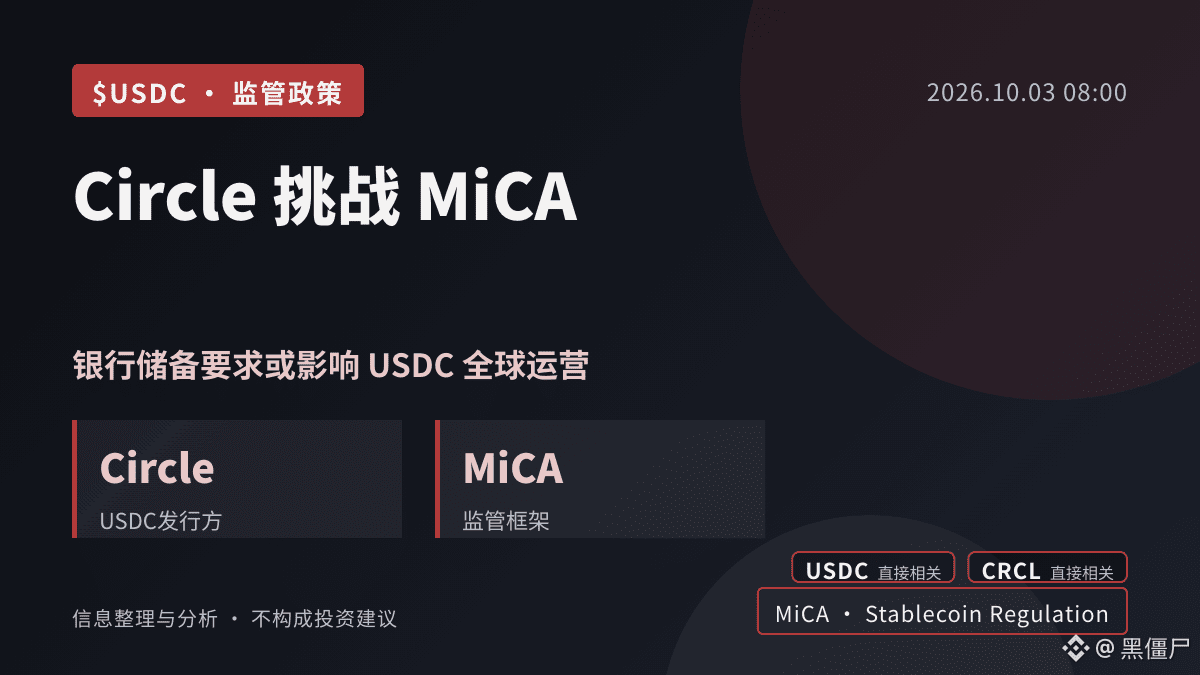
Circle pressures the EU, asking for a relaxation of MiCA’s bank reserve requirements
Circle has formally submitted to the European Commission a proposal regarding MiCA’s mandatory bank deposit requirements for stablecoin reserves and the cap on concentration. Circle believes these measures could limit the operational flexibility of one of the world’s largest stablecoins. According to a report by Decrypt, Circle argues that the current rules impose constraints on widely issued stablecoins such as USDC. According to a report by Cointelegraph, Circle hopes that during the EU’s MiCA review, it will replace the mandatory minimum bank deposit requirement with more flexible liquidity rules, while preserving cross-border liquidity arrangements.
The significance lies in the fact that MiCA is not only an EU-local rule, but an important reference point for stablecoin regulation worldwide. The reserve structure, issuance cadence, and cross-border usage of USDC will all be affected by EU rules. If the EU maintains a relatively high proportion of bank deposits, Circle’s freedom in reserve management may decrease, which in turn could affect USDC’s liquidity arrangements and the timing of institutional adoption.
From a market perspective, $USDC , as a directly impacted asset, will have its reserve structure and the issuer’s operational efficiency influenced by the regulatory outcome. $CRCL , as Circle’s publicly listed entity, will also face fluctuations in valuation and business expectations as MiCA amendments progress. Both directions are possible toward a mixed outcome: if the EU relaxes the rules, operational flexibility increases; if it keeps them strict, compliance costs and liquidity constraints rise.
The risk is that, for financial stability reasons, the EU may insist on higher minimum bank deposit requirements, and even strengthen the concentration cap. This would limit the flexibility of USDC reserves, and cross-border flows and the timing of institutional adoption could also slow down. The escalation of regulatory negotiations itself will also increase market uncertainty.
Next, it is important to watch the European Commission’s response to Circle’s proposal, as well as whether any alternative liquidity rules emerge during the MiCA review. If you are paying attention to USDC, in the short term it is more worth monitoring whether EU regulatory signals are clear, rather than prematurely betting on a direction.
$USDC $CRCL #USDC #MiCA #Stablecoin
The above is an information summary and personal analysis, and does not constitute investment advice.
Circle pressures the EU, asking for a relaxation of MiCA’s bank reserve requirements
Circle has formally submitted to the European Commission a proposal regarding MiCA’s mandatory bank deposit requirements for stablecoin reserves and the cap on concentration. Circle believes these measures could limit the operational flexibility of one of the world’s largest stablecoins. According to a report by Decrypt, Circle argues that the current rules impose constraints on widely issued stablecoins such as USDC. According to a report by Cointelegraph, Circle hopes that during the EU’s MiCA review, it will replace the mandatory minimum bank deposit requirement with more flexible liquidity rules, while preserving cross-border liquidity arrangements.
The significance lies in the fact that MiCA is not only an EU-local rule, but an important reference point for stablecoin regulation worldwide. The reserve structure, issuance cadence, and cross-border usage of USDC will all be affected by EU rules. If the EU maintains a relatively high proportion of bank deposits, Circle’s freedom in reserve management may decrease, which in turn could affect USDC’s liquidity arrangements and the timing of institutional adoption.
From a market perspective, $USDC , as a directly impacted asset, will have its reserve structure and the issuer’s operational efficiency influenced by the regulatory outcome. $CRCL , as Circle’s publicly listed entity, will also face fluctuations in valuation and business expectations as MiCA amendments progress. Both directions are possible toward a mixed outcome: if the EU relaxes the rules, operational flexibility increases; if it keeps them strict, compliance costs and liquidity constraints rise.
The risk is that, for financial stability reasons, the EU may insist on higher minimum bank deposit requirements, and even strengthen the concentration cap. This would limit the flexibility of USDC reserves, and cross-border flows and the timing of institutional adoption could also slow down. The escalation of regulatory negotiations itself will also increase market uncertainty.
Next, it is important to watch the European Commission’s response to Circle’s proposal, as well as whether any alternative liquidity rules emerge during the MiCA review. If you are paying attention to USDC, in the short term it is more worth monitoring whether EU regulatory signals are clear, rather than prematurely betting on a direction.
$USDC $CRCL #USDC #MiCA #Stablecoin
The above is an information summary and personal analysis, and does not constitute investment advice.
Circle has formally submitted to the European Commission a proposal regarding MiCA’s mandatory bank deposit requirements for stablecoin reserves and the cap on concentration. Circle believes these measures could limit the operational flexibility of one of the world’s largest stablecoins. According to a report by Decrypt, Circle argues that the current rules impose constraints on widely issued stablecoins such as USDC. According to a report by Cointelegraph, Circle hopes that during the EU’s MiCA review, it will replace the mandatory minimum bank deposit requirement with more flexible liquidity rules, while preserving cross-border liquidity arrangements.
The significance lies in the fact that MiCA is not only an EU-local rule, but an important reference point for stablecoin regulation worldwide. The reserve structure, issuance cadence, and cross-border usage of USDC will all be affected by EU rules. If the EU maintains a relatively high proportion of bank deposits, Circle’s freedom in reserve management may decrease, which in turn could affect USDC’s liquidity arrangements and the timing of institutional adoption.
From a market perspective, $USDC , as a directly impacted asset, will have its reserve structure and the issuer’s operational efficiency influenced by the regulatory outcome. $CRCL , as Circle’s publicly listed entity, will also face fluctuations in valuation and business expectations as MiCA amendments progress. Both directions are possible toward a mixed outcome: if the EU relaxes the rules, operational flexibility increases; if it keeps them strict, compliance costs and liquidity constraints rise.
The risk is that, for financial stability reasons, the EU may insist on higher minimum bank deposit requirements, and even strengthen the concentration cap. This would limit the flexibility of USDC reserves, and cross-border flows and the timing of institutional adoption could also slow down. The escalation of regulatory negotiations itself will also increase market uncertainty.
Next, it is important to watch the European Commission’s response to Circle’s proposal, as well as whether any alternative liquidity rules emerge during the MiCA review. If you are paying attention to USDC, in the short term it is more worth monitoring whether EU regulatory signals are clear, rather than prematurely betting on a direction.
$USDC $CRCL #USDC #MiCA #Stablecoin
The above is an information summary and personal analysis, and does not constitute investment advice.
225
·
--
💵 Why $USDT Remains Important in Crypto
Stablecoins are one of the most useful parts of the crypto ecosystem.
USDT gives traders a way to move into a dollar-pegged asset without immediately converting back to traditional fiat.
From trading to transfers, stablecoins have become deeply connected to crypto activity.
Do you mainly use USDT for trading, saving value, or transfers?
$BTTC $ZEC
#USDT #Tether #stablecoin #crypto #BinanceSquare
💵 Why $USDT Remains Important in Crypto
Stablecoins are one of the most useful parts of the crypto ecosystem.
USDT gives traders a way to move into a dollar-pegged asset without immediately converting back to traditional fiat.
From trading to transfers, stablecoins have become deeply connected to crypto activity.
Do you mainly use USDT for trading, saving value, or transfers?
$BTTC $ZEC
#USDT #Tether #stablecoin #crypto #BinanceSquare
Stablecoins are one of the most useful parts of the crypto ecosystem.
USDT gives traders a way to move into a dollar-pegged asset without immediately converting back to traditional fiat.
From trading to transfers, stablecoins have become deeply connected to crypto activity.
Do you mainly use USDT for trading, saving value, or transfers?
$BTTC $ZEC
#USDT #Tether #stablecoin #crypto #BinanceSquare
49


·
--
$BTC - USDT launches on Bitcoin amid a rally
BTC reached 86,600 USDT following the latest jobs data release.
Tether's USDT became the first USD‑stablecoin to be issued directly on the Bitcoin network.
The SEC and CFTC released a draft joint framework outlining oversight of crypto assets.
The move could broaden Bitcoin's utility, but regulatory clarity remains pending.
#Stablecoins #Stablecoin
$BTC - USDT launches on Bitcoin amid a rally
BTC reached 86,600 USDT following the latest jobs data release.
Tether's USDT became the first USD‑stablecoin to be issued directly on the Bitcoin network.
The SEC and CFTC released a draft joint framework outlining oversight of crypto assets.
The move could broaden Bitcoin's utility, but regulatory clarity remains pending.
#Stablecoins #Stablecoin
BTC reached 86,600 USDT following the latest jobs data release.
Tether's USDT became the first USD‑stablecoin to be issued directly on the Bitcoin network.
The SEC and CFTC released a draft joint framework outlining oversight of crypto assets.
The move could broaden Bitcoin's utility, but regulatory clarity remains pending.
#Stablecoins #Stablecoin
77

·
--
Bullish
$F 🔥 FUSDT — Is This Stablecoin Worth Watching?
The stablecoin narrative is getting bigger, and FUSDT is starting to attract attention.
But here’s what matters 👇
💎 Utility — Where can FUSDT actually be used?
🌐 Adoption — Is its ecosystem growing?
💧 Liquidity — How active is the market?
🔍 Transparency — What supports the token and its stability?
🚀 Development — What is being built next?
The crypto market moves fast. Narratives come and go — but real utility, liquidity, and transparency are what deserve attention.
👀 FUSDT watchers, what’s your take?
Bullish on the future of stablecoins? Or still waiting for more proof?
👇 Drop your thoughts below.
DYOR. Don’t invest based on hype alone.
#FUSDT #Crypto #stablecoin #BinanceSquare #defi #Web3 #CryptoCommunity $F
$F 🔥 FUSDT — Is This Stablecoin Worth Watching?
The stablecoin narrative is getting bigger, and FUSDT is starting to attract attention.
But here’s what matters 👇
💎 Utility — Where can FUSDT actually be used?
🌐 Adoption — Is its ecosystem growing?
💧 Liquidity — How active is the market?
🔍 Transparency — What supports the token and its stability?
🚀 Development — What is being built next?
The crypto market moves fast. Narratives come and go — but real utility, liquidity, and transparency are what deserve attention.
👀 FUSDT watchers, what’s your take?
Bullish on the future of stablecoins? Or still waiting for more proof?
👇 Drop your thoughts below.
DYOR. Don’t invest based on hype alone.
#FUSDT #Crypto #stablecoin #BinanceSquare #defi #Web3 #CryptoCommunity $F
The stablecoin narrative is getting bigger, and FUSDT is starting to attract attention.
But here’s what matters 👇
💎 Utility — Where can FUSDT actually be used?
🌐 Adoption — Is its ecosystem growing?
💧 Liquidity — How active is the market?
🔍 Transparency — What supports the token and its stability?
🚀 Development — What is being built next?
The crypto market moves fast. Narratives come and go — but real utility, liquidity, and transparency are what deserve attention.
👀 FUSDT watchers, what’s your take?
Bullish on the future of stablecoins? Or still waiting for more proof?
👇 Drop your thoughts below.
DYOR. Don’t invest based on hype alone.
#FUSDT #Crypto #stablecoin #BinanceSquare #defi #Web3 #CryptoCommunity $F
2
170
Log in to explore more content
Join global crypto users on Binance Square
⚡️ Get latest and useful information about crypto.
💬 Trusted by the world’s largest crypto exchange.
👍 Discover real insights from verified creators.
Email / Phone number
Trending Topics
1
#BinanceLaunchesBinanceIntelligence
87,293 views
999 Discussing
2
#StriveBuys2000BTCFor$169M
2,026 views
39 Discussing
3
#EvernorthXRPTreasuryCompletesSPACMerger
63,511 views
684 Discussing
4
#ADAGains10%Above$0.27
37,593 views
225 Discussing
5
#ETHUp70%InQ3ButLiquidityFalls
252,743 views
1,756 Discussing
6
#EthStakingExitQueueHits2026High
97,098 views
1,178 Discussing
7
#FedOctoberHoldOdds82.3%
102,002 views
1,130 Discussing
8
#Nikkei225Jumps2.5%ToThreeMonthHigh
104,212 views
1,355 Discussing
9
#CircleMints$2.75BUSDCOnSolanaIn7Days
2,739 views
59 Discussing
10
#DriftHackVictimsBeginClaims
215,663 views
2,007 Discussing