

#selfcustody
selfcustody
102,749 views
1,058 Discussing
Hot
Latest

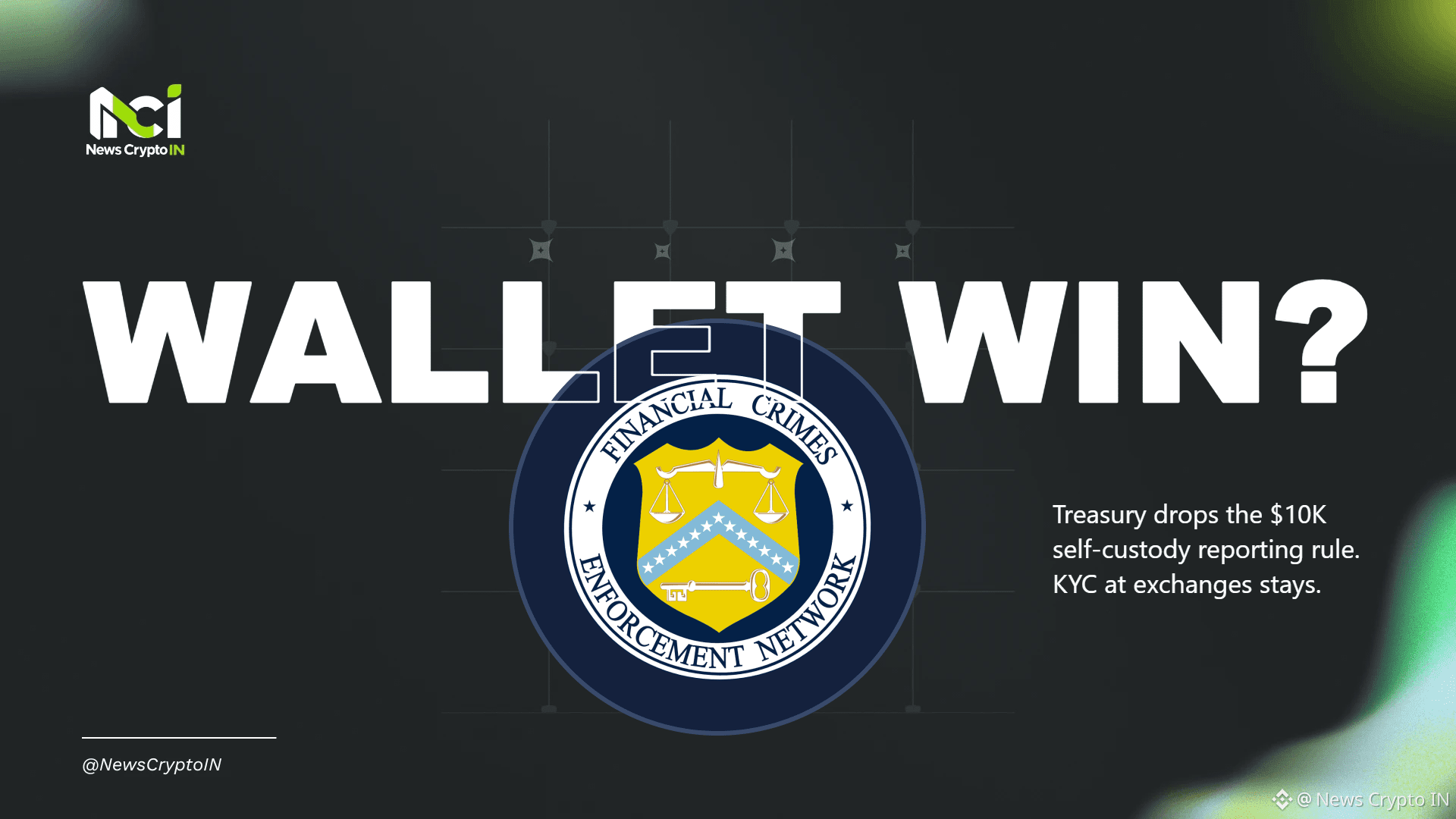
The US Treasury just killed the "unhosted wallet" rule. Self-custody won... sort of.
FinCEN withdrew two crypto proposals that had hung over the industry for years:
- The 2020 unhosted wallet rule, which would have required banks and money services businesses to keep records on transactions with self-custody wallets over $3,000 and report those over $10,000, including amounts that added up past $10K within 24 hours.
- The 2023 proposal to label international crypto mixing a "primary money laundering concern". FinCEN said its broad definition risked chilling legitimate activity and burying institutions in reporting.
Six years of pushback, and both are gone. Worth celebrating, but read what didn't change:
- Neither rule ever took effect. Nobody gains a freedom they actually lost; a threat was removed.
- Every existing AML and KYC requirement for regulated crypto businesses stays in place. The moment your coins touch an exchange, you're identified.
- A withdrawn proposal is not a ban on future ones. A different Treasury can draft a new version.
So the real change is narrow: banks and money transmitters won't be forced to log every transfer to a wallet you control. That matters, but it isn't a privacy regime.
The fair counterpoint: removing a pending rule ends years of uncertainty for wallet developers, and it signals that self-custody is being treated as normal, not suspicious.
Is this a real win for self-custody, or just a pause until the next administration?
Like and follow for regulation news that reads the fine print.
#SelfCustody #CryptoRegulation
The US Treasury just killed the "unhosted wallet" rule. Self-custody won... sort of.
FinCEN withdrew two crypto proposals that had hung over the industry for years:
- The 2020 unhosted wallet rule, which would have required banks and money services businesses to keep records on transactions with self-custody wallets over $3,000 and report those over $10,000, including amounts that added up past $10K within 24 hours.
- The 2023 proposal to label international crypto mixing a "primary money laundering concern". FinCEN said its broad definition risked chilling legitimate activity and burying institutions in reporting.
Six years of pushback, and both are gone. Worth celebrating, but read what didn't change:
- Neither rule ever took effect. Nobody gains a freedom they actually lost; a threat was removed.
- Every existing AML and KYC requirement for regulated crypto businesses stays in place. The moment your coins touch an exchange, you're identified.
- A withdrawn proposal is not a ban on future ones. A different Treasury can draft a new version.
So the real change is narrow: banks and money transmitters won't be forced to log every transfer to a wallet you control. That matters, but it isn't a privacy regime.
The fair counterpoint: removing a pending rule ends years of uncertainty for wallet developers, and it signals that self-custody is being treated as normal, not suspicious.
Is this a real win for self-custody, or just a pause until the next administration?
Like and follow for regulation news that reads the fine print.
#SelfCustody #CryptoRegulation
FinCEN withdrew two crypto proposals that had hung over the industry for years:
- The 2020 unhosted wallet rule, which would have required banks and money services businesses to keep records on transactions with self-custody wallets over $3,000 and report those over $10,000, including amounts that added up past $10K within 24 hours.
- The 2023 proposal to label international crypto mixing a "primary money laundering concern". FinCEN said its broad definition risked chilling legitimate activity and burying institutions in reporting.
Six years of pushback, and both are gone. Worth celebrating, but read what didn't change:
- Neither rule ever took effect. Nobody gains a freedom they actually lost; a threat was removed.
- Every existing AML and KYC requirement for regulated crypto businesses stays in place. The moment your coins touch an exchange, you're identified.
- A withdrawn proposal is not a ban on future ones. A different Treasury can draft a new version.
So the real change is narrow: banks and money transmitters won't be forced to log every transfer to a wallet you control. That matters, but it isn't a privacy regime.
The fair counterpoint: removing a pending rule ends years of uncertainty for wallet developers, and it signals that self-custody is being treated as normal, not suspicious.
Is this a real win for self-custody, or just a pause until the next administration?
Like and follow for regulation news that reads the fine print.
#SelfCustody #CryptoRegulation
1
677

The U.S. government just gave up on tracking your crypto wallet.
FinCEN has withdrawn a December 2020 proposal that would have forced banks and exchanges to report transfers over $10,000 to wallets you control yourself — even smaller transfers that added up past $10,000 within 24 hours. It also scrapped a 2023 plan for extra reporting on crypto mixer transactions. Neither rule ever took effect.
The agency says both moves fit the push to make digital-asset rules "fit-for-purpose." Thousands of public comments and nearly six years later, moving your own coins to your own keys is officially nobody's reporting business.
Is self-custody finally winning the regulation war?
#CryptoNews #SelfCustody
The U.S. government just gave up on tracking your crypto wallet.
FinCEN has withdrawn a December 2020 proposal that would have forced banks and exchanges to report transfers over $10,000 to wallets you control yourself — even smaller transfers that added up past $10,000 within 24 hours. It also scrapped a 2023 plan for extra reporting on crypto mixer transactions. Neither rule ever took effect.
The agency says both moves fit the push to make digital-asset rules "fit-for-purpose." Thousands of public comments and nearly six years later, moving your own coins to your own keys is officially nobody's reporting business.
Is self-custody finally winning the regulation war?
#CryptoNews #SelfCustody
FinCEN has withdrawn a December 2020 proposal that would have forced banks and exchanges to report transfers over $10,000 to wallets you control yourself — even smaller transfers that added up past $10,000 within 24 hours. It also scrapped a 2023 plan for extra reporting on crypto mixer transactions. Neither rule ever took effect.
The agency says both moves fit the push to make digital-asset rules "fit-for-purpose." Thousands of public comments and nearly six years later, moving your own coins to your own keys is officially nobody's reporting business.
Is self-custody finally winning the regulation war?
#CryptoNews #SelfCustody


·
--
If you keep coins in your own wallet, one old US proposal just disappeared. Here is what it was.
🧠 In plain words
In 2020, FinCEN proposed that banks and money services businesses check identities on transfers to or from personal wallets above $3,000, and report those over $10,000 to the agency. On Monday it formally withdrew that plan, per The Block. Picture a post office asking for the ID of whoever owns your home mailbox before delivering your own letters there.
✅ What it means for you
• Withdrawing $DOGE or any other coin from a US platform to your own wallet avoids that proposed extra check.
• Your exchange still verifies you as its own customer, as before.
• The rule is withdrawn, not banned, so a future version is possible.
The takeaway: self-custody in the US just lost one potential layer of friction.
#SelfCustody
If you keep coins in your own wallet, one old US proposal just disappeared. Here is what it was.
🧠 In plain words
In 2020, FinCEN proposed that banks and money services businesses check identities on transfers to or from personal wallets above $3,000, and report those over $10,000 to the agency. On Monday it formally withdrew that plan, per The Block. Picture a post office asking for the ID of whoever owns your home mailbox before delivering your own letters there.
✅ What it means for you
• Withdrawing $DOGE or any other coin from a US platform to your own wallet avoids that proposed extra check.
• Your exchange still verifies you as its own customer, as before.
• The rule is withdrawn, not banned, so a future version is possible.
The takeaway: self-custody in the US just lost one potential layer of friction.
#SelfCustody
🧠 In plain words
In 2020, FinCEN proposed that banks and money services businesses check identities on transfers to or from personal wallets above $3,000, and report those over $10,000 to the agency. On Monday it formally withdrew that plan, per The Block. Picture a post office asking for the ID of whoever owns your home mailbox before delivering your own letters there.
✅ What it means for you
• Withdrawing $DOGE or any other coin from a US platform to your own wallet avoids that proposed extra check.
• Your exchange still verifies you as its own customer, as before.
• The rule is withdrawn, not banned, so a future version is possible.
The takeaway: self-custody in the US just lost one potential layer of friction.
#SelfCustody
61
·
--
Article
Washington drops two crypto privacy rules it proposed years agoTwo of the most contested crypto proposals in US financial surveillance are officially gone. On Monday, the Treasury's financial crimes unit FinCEN withdrew both its 2023 crypto mixing rule and its 2020 self-hosted wallet rule, per The Block.
For anyone who uses a personal wallet or cares about on-chain privacy, this is one of the more meaningful policy shifts of the year.
📌 The news
FinCEN pulled two separate proposals at once:
• The 2023 mixing rule, which would have labelled international crypto mixing a primary money laundering concern under Section 311 of the USA PATRIOT Act.
• The 2020 self-hosted wallet rule, which would have required identity checks and record keeping for transactions with unhosted wallets above $3,000.
🔍 What the rules would have done
The mixing proposal would have pushed banks to report mixing-related transactions along with wallet addresses, transaction hashes and IP addresses. Its definition of mixing was wide: pooling funds, splitting transactions, single-use wallets, even user-chosen delays.
The wallet proposal would have required identity verification above $3,000 and reports to FinCEN for transfers over $10,000, including several smaller transfers adding up to that amount within 24 hours.
⚖️ Why FinCEN changed course
The agency said the broad mixing definition risked a chilling effect on legitimate activity. It also pointed to the July 2025 Presidential Working Group report, which acknowledged that lawful users may turn to mixers for financial privacy. The Block notes that Coin Center had opposed both rules, and Coinbase had objected to bulk reporting of transactions that were not suspicious.
👀 What to watch next
• Whether other agencies follow with similar rollbacks, or replace these proposals with narrower versions.
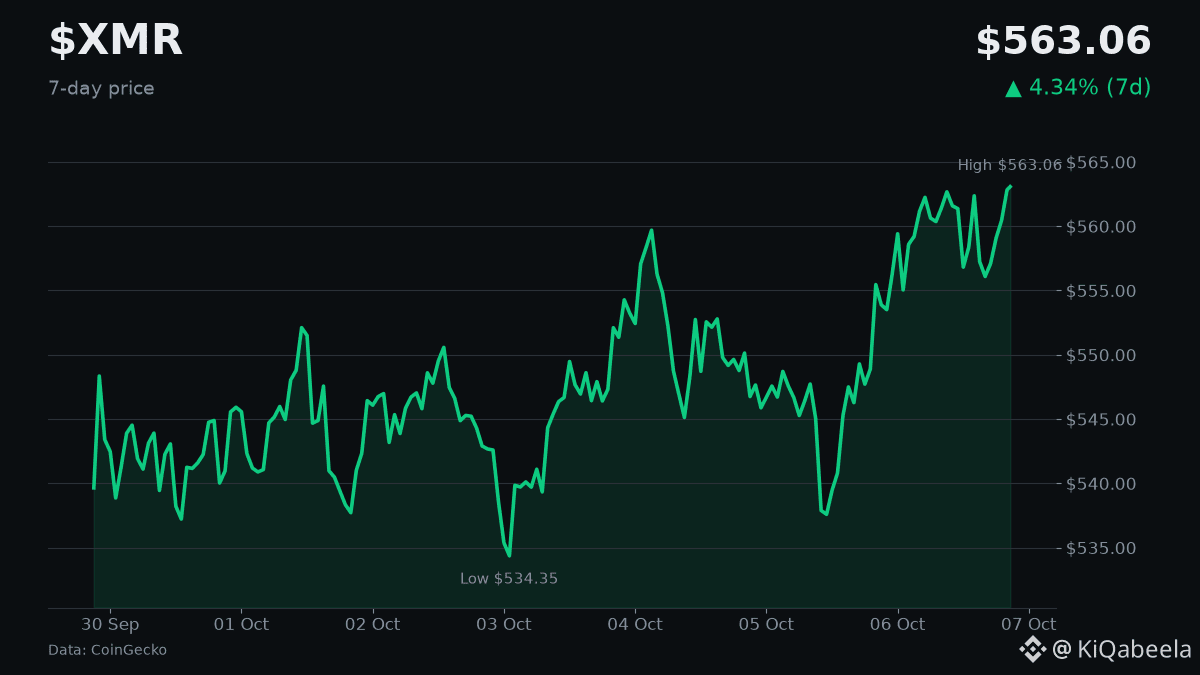
• How privacy-focused assets like $XMR trade as the US tone shifts. Monero is up about 3.4% over 24 hours per CoinGecko, though one day of price action says little about policy.
• Whether Congress steps in, since a withdrawal by one administration can be reversed by the next.
━━━━━━━━━━━━
💡 My take: Withdrawing a proposal is not the same as passing a law that protects self-custody. Still, the reasoning FinCEN used, that privacy itself is not suspicious, is a notable change in tone. For holders of $BTC in their own wallets, the risk of new reporting hurdles just got smaller, at least for now.
💬 Do you see this as a lasting win for self-custody, or a pause that the next administration could undo?
#CryptoRegulation #SelfCustody
Washington drops two crypto privacy rules it proposed years ago
Two of the most contested crypto proposals in US financial surveillance are officially gone. On Monday, the Treasury's financial crimes unit FinCEN withdrew both its 2023 crypto mixing rule and its 2020 self-hosted wallet rule, per The Block.
For anyone who uses a personal wallet or cares about on-chain privacy, this is one of the more meaningful policy shifts of the year.
📌 The news
FinCEN pulled two separate proposals at once:
• The 2023 mixing rule, which would have labelled international crypto mixing a primary money laundering concern under Section 311 of the USA PATRIOT Act.
• The 2020 self-hosted wallet rule, which would have required identity checks and record keeping for transactions with unhosted wallets above $3,000.
🔍 What the rules would have done
The mixing proposal would have pushed banks to report mixing-related transactions along with wallet addresses, transaction hashes and IP addresses. Its definition of mixing was wide: pooling funds, splitting transactions, single-use wallets, even user-chosen delays.
The wallet proposal would have required identity verification above $3,000 and reports to FinCEN for transfers over $10,000, including several smaller transfers adding up to that amount within 24 hours.
⚖️ Why FinCEN changed course
The agency said the broad mixing definition risked a chilling effect on legitimate activity. It also pointed to the July 2025 Presidential Working Group report, which acknowledged that lawful users may turn to mixers for financial privacy. The Block notes that Coin Center had opposed both rules, and Coinbase had objected to bulk reporting of transactions that were not suspicious.
👀 What to watch next
• Whether other agencies follow with similar rollbacks, or replace these proposals with narrower versions.
• How privacy-focused assets like $XMR trade as the US tone shifts. Monero is up about 3.4% over 24 hours per CoinGecko, though one day of price action says little about policy.
• Whether Congress steps in, since a withdrawal by one administration can be reversed by the next.
━━━━━━━━━━━━
💡 My take: Withdrawing a proposal is not the same as passing a law that protects self-custody. Still, the reasoning FinCEN used, that privacy itself is not suspicious, is a notable change in tone. For holders of $BTC in their own wallets, the risk of new reporting hurdles just got smaller, at least for now.
💬 Do you see this as a lasting win for self-custody, or a pause that the next administration could undo?
#CryptoRegulation #SelfCustody
For anyone who uses a personal wallet or cares about on-chain privacy, this is one of the more meaningful policy shifts of the year.
📌 The news
FinCEN pulled two separate proposals at once:
• The 2023 mixing rule, which would have labelled international crypto mixing a primary money laundering concern under Section 311 of the USA PATRIOT Act.
• The 2020 self-hosted wallet rule, which would have required identity checks and record keeping for transactions with unhosted wallets above $3,000.
🔍 What the rules would have done
The mixing proposal would have pushed banks to report mixing-related transactions along with wallet addresses, transaction hashes and IP addresses. Its definition of mixing was wide: pooling funds, splitting transactions, single-use wallets, even user-chosen delays.
The wallet proposal would have required identity verification above $3,000 and reports to FinCEN for transfers over $10,000, including several smaller transfers adding up to that amount within 24 hours.
⚖️ Why FinCEN changed course
The agency said the broad mixing definition risked a chilling effect on legitimate activity. It also pointed to the July 2025 Presidential Working Group report, which acknowledged that lawful users may turn to mixers for financial privacy. The Block notes that Coin Center had opposed both rules, and Coinbase had objected to bulk reporting of transactions that were not suspicious.
👀 What to watch next
• Whether other agencies follow with similar rollbacks, or replace these proposals with narrower versions.
• How privacy-focused assets like $XMR trade as the US tone shifts. Monero is up about 3.4% over 24 hours per CoinGecko, though one day of price action says little about policy.
• Whether Congress steps in, since a withdrawal by one administration can be reversed by the next.
━━━━━━━━━━━━
💡 My take: Withdrawing a proposal is not the same as passing a law that protects self-custody. Still, the reasoning FinCEN used, that privacy itself is not suspicious, is a notable change in tone. For holders of $BTC in their own wallets, the risk of new reporting hurdles just got smaller, at least for now.
💬 Do you see this as a lasting win for self-custody, or a pause that the next administration could undo?
#CryptoRegulation #SelfCustody
74

·
--
everyone thinks non-custodial means you never have to touch your setup again, but actually even self-custody infra can get sunset right under your nose.
most people leave their bags sitting on old web interfaces for months without checking updates, only to panic when the front-end disappears and they assume their funds got wiped.
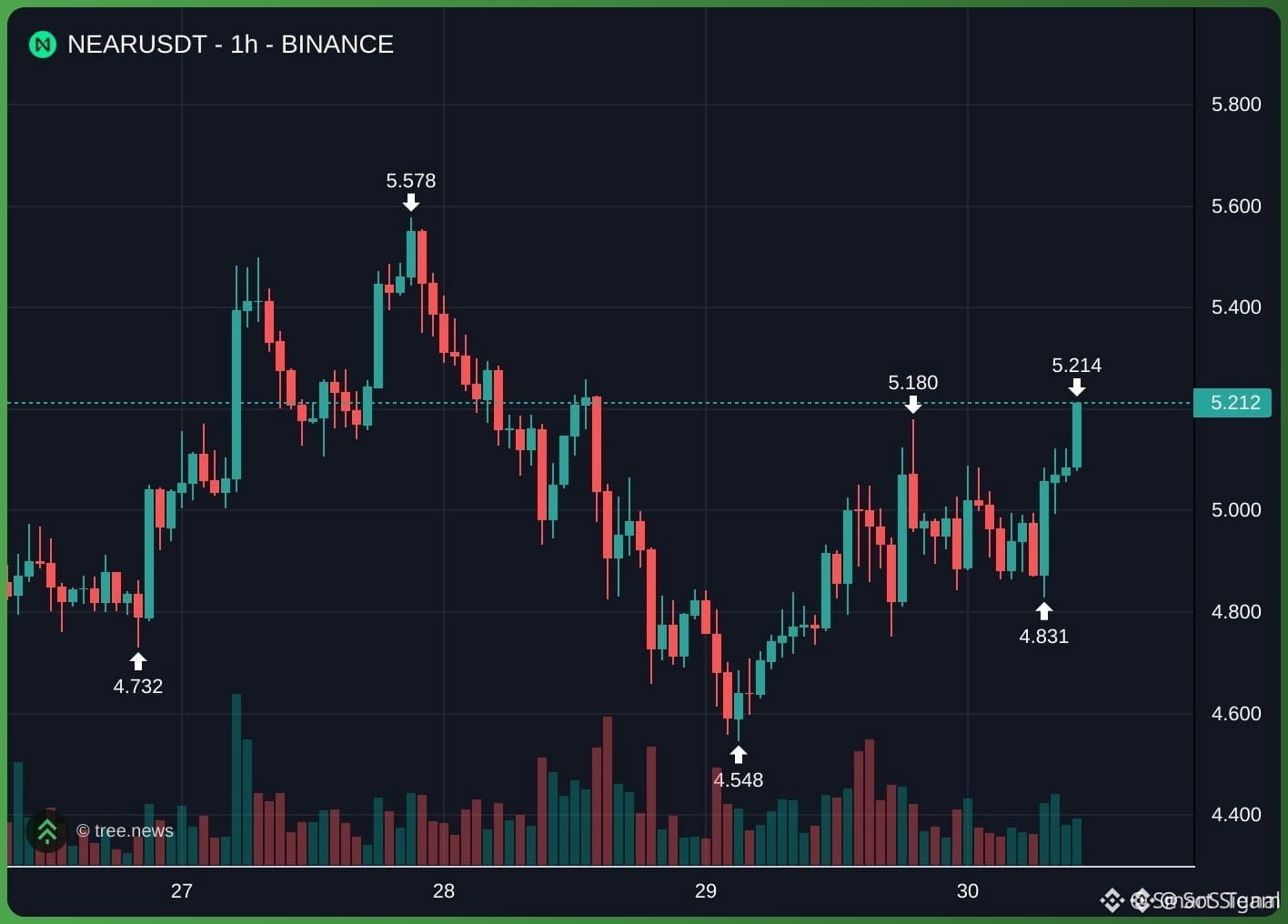
look at what is happening with $NEAR ecosystem right now. mynearwallet is officially shutting down on october 31, meaning anyone holding assets there has to migrate to another wallet interface or access method before the deadline hits. it is a classic case study on why relying on a single client is risky, even if your keys are technically safe on-chain.
ngl your $NEAR tokens and bridged $USDT aren't vanishing since the blockchain ledger remains intact, but scrambling to export private keys or connect alternative providers at the last minute is how costly mistakes happen. take ten minutes this week to sort your accounts over to another supported wallet so you do not get caught off guard.
which wallet are you migrating your stash to before the cutoff?
#NEAR #SelfCustody #CryptoWallets
everyone thinks non-custodial means you never have to touch your setup again, but actually even self-custody infra can get sunset right under your nose.
most people leave their bags sitting on old web interfaces for months without checking updates, only to panic when the front-end disappears and they assume their funds got wiped.
look at what is happening with $NEAR ecosystem right now. mynearwallet is officially shutting down on october 31, meaning anyone holding assets there has to migrate to another wallet interface or access method before the deadline hits. it is a classic case study on why relying on a single client is risky, even if your keys are technically safe on-chain.
ngl your $NEAR tokens and bridged $USDT aren't vanishing since the blockchain ledger remains intact, but scrambling to export private keys or connect alternative providers at the last minute is how costly mistakes happen. take ten minutes this week to sort your accounts over to another supported wallet so you do not get caught off guard.
which wallet are you migrating your stash to before the cutoff?
#NEAR #SelfCustody #CryptoWallets
most people leave their bags sitting on old web interfaces for months without checking updates, only to panic when the front-end disappears and they assume their funds got wiped.
look at what is happening with $NEAR ecosystem right now. mynearwallet is officially shutting down on october 31, meaning anyone holding assets there has to migrate to another wallet interface or access method before the deadline hits. it is a classic case study on why relying on a single client is risky, even if your keys are technically safe on-chain.
ngl your $NEAR tokens and bridged $USDT aren't vanishing since the blockchain ledger remains intact, but scrambling to export private keys or connect alternative providers at the last minute is how costly mistakes happen. take ten minutes this week to sort your accounts over to another supported wallet so you do not get caught off guard.
which wallet are you migrating your stash to before the cutoff?
#NEAR #SelfCustody #CryptoWallets
46


the US just dropped a crypto rule that sat on the table for almost 6 years.
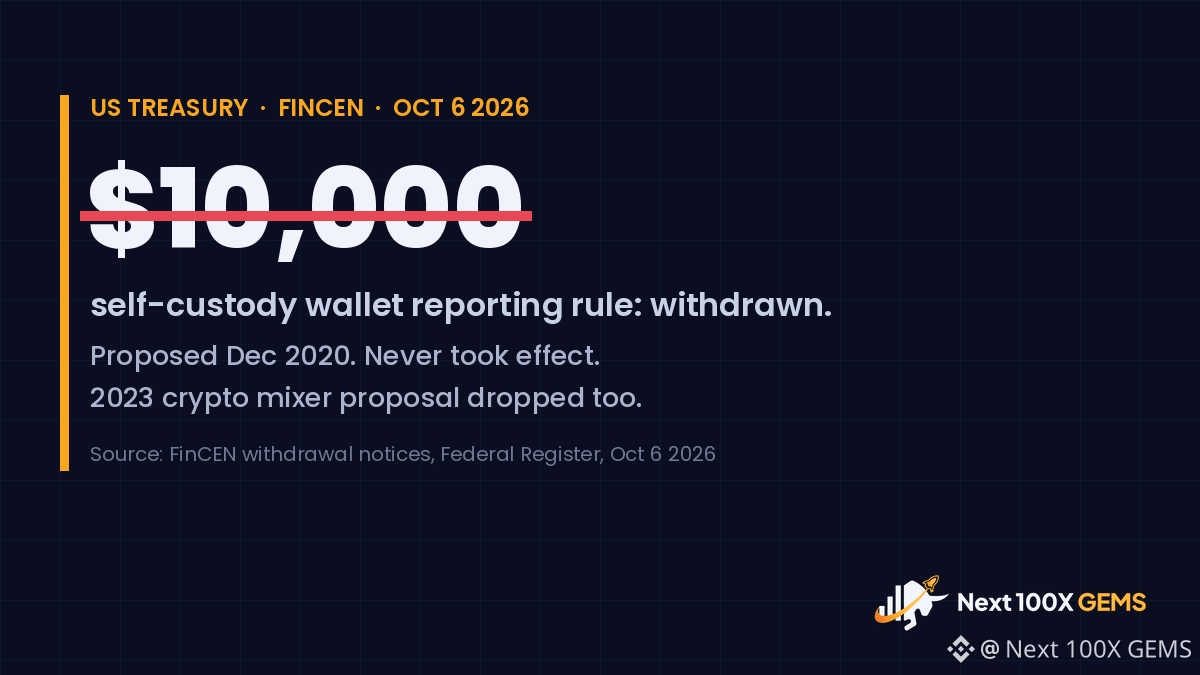
the 2020 plan: send more than $10,000 between a US exchange and your own wallet, and it gets reported to FinCEN. records kept from $3,000. smaller transfers counted too if they added up past $10k in 24 hours.
it never took effect. this week Treasury withdrew it, along with a 2023 proposal aimed at mixers.
honestly this matters more than most of today's headlines. moving $BTC to a wallet you control shouldn't come with paperwork.
the catch: nothing stops Treasury from proposing something similar later. Coin Center already pointed that out.
where do you keep most of your coins, on an exchange or in your own wallet?
$BTC
NFA. DYOR.
#FinCEN #SelfCustody #CryptoRegulation #CryptoNews
the US just dropped a crypto rule that sat on the table for almost 6 years.
the 2020 plan: send more than $10,000 between a US exchange and your own wallet, and it gets reported to FinCEN. records kept from $3,000. smaller transfers counted too if they added up past $10k in 24 hours.
it never took effect. this week Treasury withdrew it, along with a 2023 proposal aimed at mixers.
honestly this matters more than most of today's headlines. moving $BTC to a wallet you control shouldn't come with paperwork.
the catch: nothing stops Treasury from proposing something similar later. Coin Center already pointed that out.
where do you keep most of your coins, on an exchange or in your own wallet?
$BTC
NFA. DYOR.
#FinCEN #SelfCustody #CryptoRegulation #CryptoNews
the 2020 plan: send more than $10,000 between a US exchange and your own wallet, and it gets reported to FinCEN. records kept from $3,000. smaller transfers counted too if they added up past $10k in 24 hours.
it never took effect. this week Treasury withdrew it, along with a 2023 proposal aimed at mixers.
honestly this matters more than most of today's headlines. moving $BTC to a wallet you control shouldn't come with paperwork.
the catch: nothing stops Treasury from proposing something similar later. Coin Center already pointed that out.
where do you keep most of your coins, on an exchange or in your own wallet?
$BTC
NFA. DYOR.
#FinCEN #SelfCustody #CryptoRegulation #CryptoNews
1
782

Big win for crypto self-custody as U.S. regulators officially drop the controversial reporting rule that targeted private wallets and mixing services. For years, this proposal loomed like a dark cloud over decentralized finance, threatening user privacy. Now that FinCEN has officially withdrawn it, builders and holders can breathe easier. It is a massive step forward for financial sovereignty, proving that community pushback and advocacy actually work in shaping regulatory outcomes. $BTC $ETH #CryptoRegulation #SelfCustody #Privacy
Big win for crypto self-custody as U.S. regulators officially drop the controversial reporting rule that targeted private wallets and mixing services. For years, this proposal loomed like a dark cloud over decentralized finance, threatening user privacy. Now that FinCEN has officially withdrawn it, builders and holders can breathe easier. It is a massive step forward for financial sovereignty, proving that community pushback and advocacy actually work in shaping regulatory outcomes. $BTC $ETH #CryptoRegulation #SelfCustody #Privacy
19

·
--
🚨 Self-custody just got a big win.
FinCEN has withdrawn its 2020 proposal that would have forced banks and crypto businesses to report transfers over $10,000 involving self-hosted wallets. It also scrapped the 2023 proposal targeting crypto mixer transactions. Neither rule ever took effect.
Fewer reporting hoops for moving coins to your own wallet could be a quiet tailwind for $BTC, $ETH and the whole self-custody crowd. 🔐
Do you keep your crypto on an exchange or in your own wallet? 👇
#Crypto #Bitcoin #SelfCustody #Regulation
🚨 Self-custody just got a big win.
FinCEN has withdrawn its 2020 proposal that would have forced banks and crypto businesses to report transfers over $10,000 involving self-hosted wallets. It also scrapped the 2023 proposal targeting crypto mixer transactions. Neither rule ever took effect.
Fewer reporting hoops for moving coins to your own wallet could be a quiet tailwind for $BTC , $ETH and the whole self-custody crowd. 🔐
Do you keep your crypto on an exchange or in your own wallet? 👇
#Crypto #Bitcoin #SelfCustody #Regulation
FinCEN has withdrawn its 2020 proposal that would have forced banks and crypto businesses to report transfers over $10,000 involving self-hosted wallets. It also scrapped the 2023 proposal targeting crypto mixer transactions. Neither rule ever took effect.
Fewer reporting hoops for moving coins to your own wallet could be a quiet tailwind for $BTC , $ETH and the whole self-custody crowd. 🔐
Do you keep your crypto on an exchange or in your own wallet? 👇
#Crypto #Bitcoin #SelfCustody #Regulation
45

The US Treasury is withdrawing controversial rules that would have forced financial institutions to report on self custody wallets and mixers, marking a massive win for user privacy and decentralization.
#FinCEN #SelfCustody
The US Treasury is withdrawing controversial rules that would have forced financial institutions to report on self custody wallets and mixers, marking a massive win for user privacy and decentralization.
#FinCEN #SelfCustody
#FinCEN #SelfCustody
3

FINCEN DROPS SELF-CUSTODY RULES BUT $BTC TRADERS MUST READ THE FINE PRINT! ⚡ 🚨
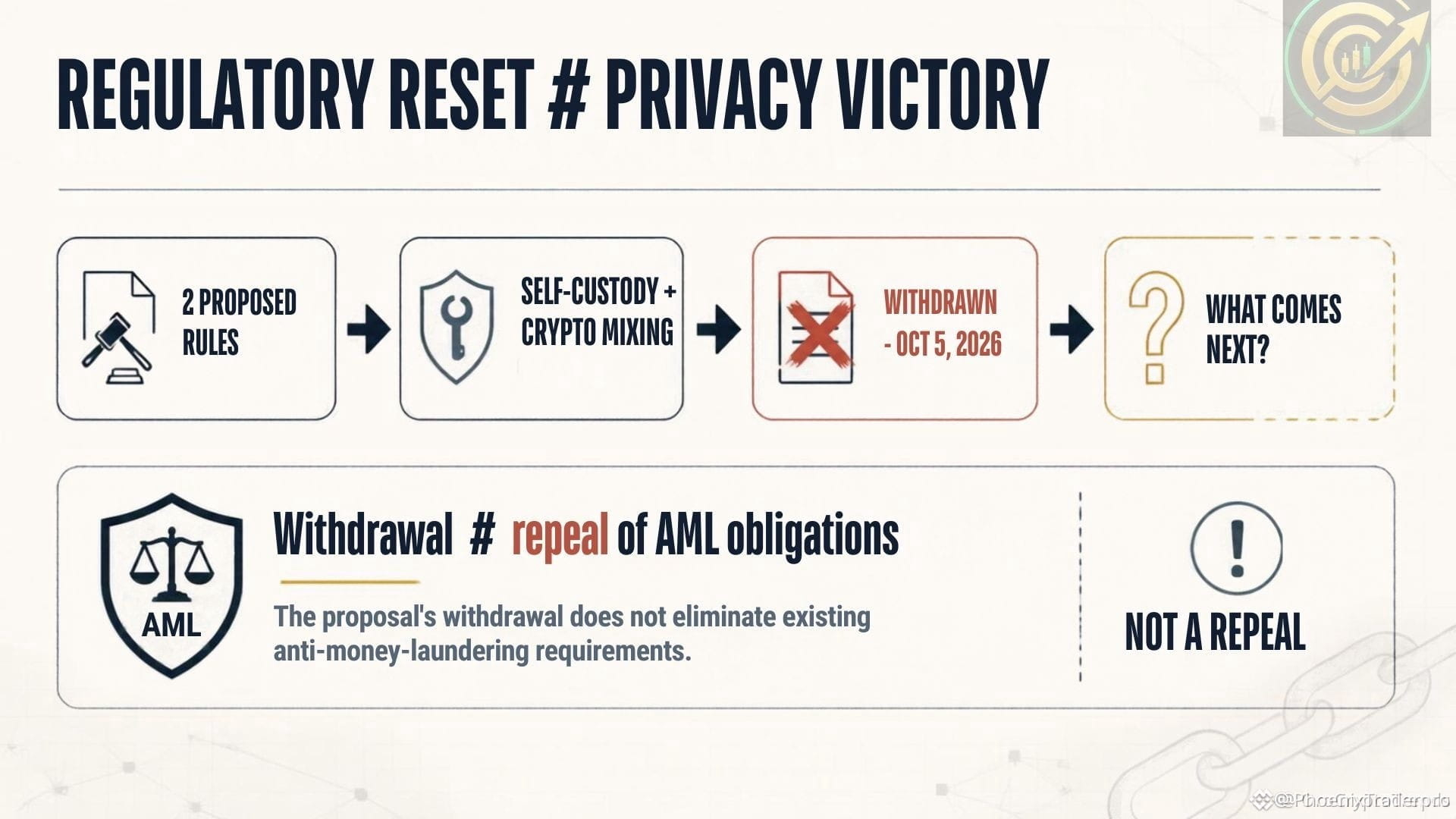
FinCEN officially pulled back proposed restrictions on self-custody wallets and mixing protocols, but calling this an easy victory misses the macro picture. 🔍 Smart money views this as a tactical regulatory reset rather than an outright surrender of oversight.
Existing AML obligations remain fully intact while regulators recalibrate toward more targeted surveillance mechanisms. 💡 The upcoming replacement framework will define the real rules of engagement for institutional capital flows.
Do you see this regulatory pivot unlocking fresh liquidity, or is a tighter framework lurking right around the corner? 👇
⚠️ Not financial advice. Always manage your risk. 🛡️
🏷️ #BTC #CryptoRegulation #SelfCustody #Macro
⚡ 💎
FINCEN DROPS SELF-CUSTODY RULES BUT $BTC TRADERS MUST READ THE FINE PRINT! ⚡ 🚨
FinCEN officially pulled back proposed restrictions on self-custody wallets and mixing protocols, but calling this an easy victory misses the macro picture. 🔍 Smart money views this as a tactical regulatory reset rather than an outright surrender of oversight.
Existing AML obligations remain fully intact while regulators recalibrate toward more targeted surveillance mechanisms. 💡 The upcoming replacement framework will define the real rules of engagement for institutional capital flows.
Do you see this regulatory pivot unlocking fresh liquidity, or is a tighter framework lurking right around the corner? 👇
⚠️ Not financial advice. Always manage your risk. 🛡️
🏷️ #BTC #CryptoRegulation #SelfCustody #Macro
⚡ 💎
FinCEN officially pulled back proposed restrictions on self-custody wallets and mixing protocols, but calling this an easy victory misses the macro picture. 🔍 Smart money views this as a tactical regulatory reset rather than an outright surrender of oversight.
Existing AML obligations remain fully intact while regulators recalibrate toward more targeted surveillance mechanisms. 💡 The upcoming replacement framework will define the real rules of engagement for institutional capital flows.
Do you see this regulatory pivot unlocking fresh liquidity, or is a tighter framework lurking right around the corner? 👇
⚠️ Not financial advice. Always manage your risk. 🛡️
🏷️ #BTC #CryptoRegulation #SelfCustody #Macro
⚡ 💎
18

·
--
Bullish
🤔 IF YOU ♱🩸DIE TODAY ▸ WHO IN YOUR ˗ˋˏ👨👩👧👦ˎˊ˗ FAMILY GETS YOUR $XRP ❓
✎𓂃Self-custody solves one problem⤵
YOU CONTROL THE KEYS.
But it creates another⤵
WHAT IF YOU’RE NO LONGER HERE TO USE THEM?
On the XRP Ledger, whoever has the seed/private key controls the account. If the key disappears, there’s no bank, support team, or recovery button that can simply restore access.
Now Uphold has launched a solution specifically for this problem⤵
🔐 VAULT INHERITANCE
Uphold Vault users can designate a beneficiary to receive:
XRP • BTC • $HBAR
But the heir⤵
❌ Cannot see the balance
❌ Cannot control the assets in advance
❌ Does not receive your keys while you’re alive.
The Vault uses a 2-of-3 multisig architecture:
2 KEYS → USER
1 KEY → UPHOLD
Two signatures are required to move the assets, so Uphold says it cannot unilaterally control the funds.
After the account holder’s death, the beneficiary submits a claim.
Uphold may require documents such as⤵
📄 Certified death certificate
⚖️ Applicable inheritance documents/orders
Only after legal verification are the assets transferred to the beneficiary’s account.
And the beneficiary can be changed while the account holder is alive.
⚠️ But be careful⤵
⚠ THIS IS NOT “AUTOMATIC XRPL INHERITANCE.”
It’s an Uphold Vault service combining assisted self-custody, multisig, and an inheritance process.
The conceptual shift is huge⤵
╰┈➤ˎˊ˗ CRYPTO → SELF-CUSTODY → BENEFICIARY → INHERITANCE
Because digital assets without an inheritance plan can end up being cryptographically inaccessible.
💭 IF YOUR FAMILY DOESN’T KNOW YOUR SEED, WOULD THEY BE ABLE TO INHERIT YOUR CRYPTO $XRP ?
#xrp #Ripple💰 #SelfCustody
🤔 IF YOU ♱🩸DIE TODAY ▸ WHO IN YOUR ˗ˋˏ👨👩👧👦ˎˊ˗ FAMILY GETS YOUR $XRP ❓
✎𓂃Self-custody solves one problem⤵
YOU CONTROL THE KEYS.
But it creates another⤵
WHAT IF YOU’RE NO LONGER HERE TO USE THEM?
On the XRP Ledger, whoever has the seed/private key controls the account. If the key disappears, there’s no bank, support team, or recovery button that can simply restore access.
Now Uphold has launched a solution specifically for this problem⤵
🔐 VAULT INHERITANCE
Uphold Vault users can designate a beneficiary to receive:
XRP • BTC • $HBAR
But the heir⤵
❌ Cannot see the balance
❌ Cannot control the assets in advance
❌ Does not receive your keys while you’re alive.
The Vault uses a 2-of-3 multisig architecture:
2 KEYS → USER
1 KEY → UPHOLD
Two signatures are required to move the assets, so Uphold says it cannot unilaterally control the funds.
After the account holder’s death, the beneficiary submits a claim.
Uphold may require documents such as⤵
📄 Certified death certificate
⚖️ Applicable inheritance documents/orders
Only after legal verification are the assets transferred to the beneficiary’s account.
And the beneficiary can be changed while the account holder is alive.
⚠️ But be careful⤵
⚠ THIS IS NOT “AUTOMATIC XRPL INHERITANCE.”
It’s an Uphold Vault service combining assisted self-custody, multisig, and an inheritance process.
The conceptual shift is huge⤵
╰┈➤ˎˊ˗ CRYPTO → SELF-CUSTODY → BENEFICIARY → INHERITANCE
Because digital assets without an inheritance plan can end up being cryptographically inaccessible.
💭 IF YOUR FAMILY DOESN’T KNOW YOUR SEED, WOULD THEY BE ABLE TO INHERIT YOUR CRYPTO $XRP ?
#xrp #Ripple💰 #SelfCustody
✎𓂃Self-custody solves one problem⤵
YOU CONTROL THE KEYS.
But it creates another⤵
WHAT IF YOU’RE NO LONGER HERE TO USE THEM?
On the XRP Ledger, whoever has the seed/private key controls the account. If the key disappears, there’s no bank, support team, or recovery button that can simply restore access.
Now Uphold has launched a solution specifically for this problem⤵
🔐 VAULT INHERITANCE
Uphold Vault users can designate a beneficiary to receive:
XRP • BTC • $HBAR
But the heir⤵
❌ Cannot see the balance
❌ Cannot control the assets in advance
❌ Does not receive your keys while you’re alive.
The Vault uses a 2-of-3 multisig architecture:
2 KEYS → USER
1 KEY → UPHOLD
Two signatures are required to move the assets, so Uphold says it cannot unilaterally control the funds.
After the account holder’s death, the beneficiary submits a claim.
Uphold may require documents such as⤵
📄 Certified death certificate
⚖️ Applicable inheritance documents/orders
Only after legal verification are the assets transferred to the beneficiary’s account.
And the beneficiary can be changed while the account holder is alive.
⚠️ But be careful⤵
⚠ THIS IS NOT “AUTOMATIC XRPL INHERITANCE.”
It’s an Uphold Vault service combining assisted self-custody, multisig, and an inheritance process.
The conceptual shift is huge⤵
╰┈➤ˎˊ˗ CRYPTO → SELF-CUSTODY → BENEFICIARY → INHERITANCE
Because digital assets without an inheritance plan can end up being cryptographically inaccessible.
💭 IF YOUR FAMILY DOESN’T KNOW YOUR SEED, WOULD THEY BE ABLE TO INHERIT YOUR CRYPTO $XRP ?
#xrp #Ripple💰 #SelfCustody

362

·
--
US TREASURY DROPS SELF-CUSTODY RULES AS $BTC GAINS MASSIVE REGULATORY TAILWINDS! 🚨 ⚡
The US Treasury just scrapped its aggressive proposal targeting non-custodial wallets and crypto mixers. 🔒 This removes a heavy regulatory overhang that threatened privacy and decentralized infrastructure across the entire market.
Smart money treats regulatory clarity as a green light for aggressive spot accumulation. 📊 With capital controls backing down, market participants gain fresh structural conviction to hold sovereign assets on-chain. 💬 Are you moving more funds into self-custody after this massive regulatory win? 👇
⚠️ Not financial advice. Always manage your risk. 🛡️
🏷️ #BTC #CryptoNews #SelfCustody #RegulatoryWin
🚀 💎
US TREASURY DROPS SELF-CUSTODY RULES AS $BTC GAINS MASSIVE REGULATORY TAILWINDS! 🚨 ⚡
The US Treasury just scrapped its aggressive proposal targeting non-custodial wallets and crypto mixers. 🔒 This removes a heavy regulatory overhang that threatened privacy and decentralized infrastructure across the entire market.
Smart money treats regulatory clarity as a green light for aggressive spot accumulation. 📊 With capital controls backing down, market participants gain fresh structural conviction to hold sovereign assets on-chain. 💬 Are you moving more funds into self-custody after this massive regulatory win? 👇
⚠️ Not financial advice. Always manage your risk. 🛡️
🏷️ #BTC #CryptoNews #SelfCustody #RegulatoryWin
🚀 💎
The US Treasury just scrapped its aggressive proposal targeting non-custodial wallets and crypto mixers. 🔒 This removes a heavy regulatory overhang that threatened privacy and decentralized infrastructure across the entire market.
Smart money treats regulatory clarity as a green light for aggressive spot accumulation. 📊 With capital controls backing down, market participants gain fresh structural conviction to hold sovereign assets on-chain. 💬 Are you moving more funds into self-custody after this massive regulatory win? 👇
⚠️ Not financial advice. Always manage your risk. 🛡️
🏷️ #BTC #CryptoNews #SelfCustody #RegulatoryWin
🚀 💎
27

【Policy Shift and Self-Custody Benefits】U.S. FinCEN officially withdraws proposed rules to monitor unhosted wallets and crypto mixers: Six years of regulatory uncertainty come to an end, ushering in an institutional easing of restrictions on crypto self-custody
On October 5, the U.S. Treasury Department’s Financial Crimes Enforcement Network (FinCEN) officially announced the withdrawal of two major proposed rules (NPRMs) on crypto assets that had been controversial for years, and filed the withdrawal for publication in the Federal Register. This move marks the end of federal requirements for intrusive reporting on “Unhosted Wallets” and “Crypto Mixing” services.
■ Key areas covered by the withdrawn rules and background:
1. 2020 proposed rule on reporting transactions involving unhosted wallets: The rule would have required regulated banks and money services businesses (MSBs) to record the counterparties’ identities (KYC) for transactions exceeding $3,000 involving unhosted wallets, and to file Currency Transaction Reports (CTRs) for deposits or withdrawals totaling more than $10,000 in a single day. Because the proposal directly threatened the decentralized nature of peer-to-peer settlement, it drew fierce industry opposition over the past six years.
2. 2023 Patriot Act Section 311 proposal on mixers: The rule would have designated international convertible virtual currency mixing transactions as a “Primary Money Laundering Concern,” requiring financial institutions to collect comprehensive monitoring data related to mixing, including IP addresses, wallet addresses, and transaction hashes.
■ Reasons for the withdrawal and official determination:
- Avoiding a “chilling effect” on legitimate economic activity: In its withdrawal notice, FinCEN specifically cited public feedback and the 2025 Presidential Working Group on Digital Asset Markets report, acknowledging that although mixing technology may be exploited by illegal actors, it also serves essential legitimate purposes for users concerned about financial privacy. Overly broad regulatory definitions have placed excessive constraints on lawful financial activity.
- Alignment with the federal deregulatory agenda: The withdrawal is consistent with the current administration’s policy agenda to ensure that digital asset rules are “fit for purpose,” and definitively ends the administrative process for advancing the proposed rules.
■ Institutional research perspective and analysis of structural impacts:
- Elimination of the “legal compliance discount” on the self-custody ecosystem: In recent years, institutions allocating to on-chain native assets and building cold-wallet treasuries have faced the potential policy tail risk that unhosted wallets could be subject to mandatory KYC tracing. The formal withdrawal of the proposals effectively removes a long-standing institutional ceiling for Ledger, Trezor, and various smart-contract custody structures.
- New room for on-chain privacy and DeFi settlement: Moving away from the default administrative presumption that privacy-enhancing technologies are inherently suspect and toward case-by-case risk management creates healthy breathing room for zero-knowledge proofs (ZKPs), privacy account abstraction, and cross-chain liquidity structures.
- A return to reasonable compliance boundaries: Note that this withdrawal does not remove existing obligations relating to anti-money laundering (AML), know-your-customer (KYC), or Office of Foreign Assets Control (OFAC) sanctions. Financial institutions must continue to conduct risk-based due diligence on high-risk transactions, but no longer need to bear the substantial administrative compliance burden of precautionary advance reporting.
#FinCEN #SelfCustody #CryptoRegulation #DeFi $BTC
【Policy Shift and Self-Custody Benefits】U.S. FinCEN officially withdraws proposed rules to monitor unhosted wallets and crypto mixers: Six years of regulatory uncertainty come to an end, ushering in an institutional easing of restrictions on crypto self-custody
On October 5, the U.S. Treasury Department’s Financial Crimes Enforcement Network (FinCEN) officially announced the withdrawal of two major proposed rules (NPRMs) on crypto assets that had been controversial for years, and filed the withdrawal for publication in the Federal Register. This move marks the end of federal requirements for intrusive reporting on “Unhosted Wallets” and “Crypto Mixing” services.
■ Key areas covered by the withdrawn rules and background:
1. 2020 proposed rule on reporting transactions involving unhosted wallets: The rule would have required regulated banks and money services businesses (MSBs) to record the counterparties’ identities (KYC) for transactions exceeding $3,000 involving unhosted wallets, and to file Currency Transaction Reports (CTRs) for deposits or withdrawals totaling more than $10,000 in a single day. Because the proposal directly threatened the decentralized nature of peer-to-peer settlement, it drew fierce industry opposition over the past six years.
2. 2023 Patriot Act Section 311 proposal on mixers: The rule would have designated international convertible virtual currency mixing transactions as a “Primary Money Laundering Concern,” requiring financial institutions to collect comprehensive monitoring data related to mixing, including IP addresses, wallet addresses, and transaction hashes.
■ Reasons for the withdrawal and official determination:
- Avoiding a “chilling effect” on legitimate economic activity: In its withdrawal notice, FinCEN specifically cited public feedback and the 2025 Presidential Working Group on Digital Asset Markets report, acknowledging that although mixing technology may be exploited by illegal actors, it also serves essential legitimate purposes for users concerned about financial privacy. Overly broad regulatory definitions have placed excessive constraints on lawful financial activity.
- Alignment with the federal deregulatory agenda: The withdrawal is consistent with the current administration’s policy agenda to ensure that digital asset rules are “fit for purpose,” and definitively ends the administrative process for advancing the proposed rules.
■ Institutional research perspective and analysis of structural impacts:
- Elimination of the “legal compliance discount” on the self-custody ecosystem: In recent years, institutions allocating to on-chain native assets and building cold-wallet treasuries have faced the potential policy tail risk that unhosted wallets could be subject to mandatory KYC tracing. The formal withdrawal of the proposals effectively removes a long-standing institutional ceiling for Ledger, Trezor, and various smart-contract custody structures.
- New room for on-chain privacy and DeFi settlement: Moving away from the default administrative presumption that privacy-enhancing technologies are inherently suspect and toward case-by-case risk management creates healthy breathing room for zero-knowledge proofs (ZKPs), privacy account abstraction, and cross-chain liquidity structures.
- A return to reasonable compliance boundaries: Note that this withdrawal does not remove existing obligations relating to anti-money laundering (AML), know-your-customer (KYC), or Office of Foreign Assets Control (OFAC) sanctions. Financial institutions must continue to conduct risk-based due diligence on high-risk transactions, but no longer need to bear the substantial administrative compliance burden of precautionary advance reporting.
#FinCEN #SelfCustody #CryptoRegulation #DeFi $BTC
On October 5, the U.S. Treasury Department’s Financial Crimes Enforcement Network (FinCEN) officially announced the withdrawal of two major proposed rules (NPRMs) on crypto assets that had been controversial for years, and filed the withdrawal for publication in the Federal Register. This move marks the end of federal requirements for intrusive reporting on “Unhosted Wallets” and “Crypto Mixing” services.
■ Key areas covered by the withdrawn rules and background:
1. 2020 proposed rule on reporting transactions involving unhosted wallets: The rule would have required regulated banks and money services businesses (MSBs) to record the counterparties’ identities (KYC) for transactions exceeding $3,000 involving unhosted wallets, and to file Currency Transaction Reports (CTRs) for deposits or withdrawals totaling more than $10,000 in a single day. Because the proposal directly threatened the decentralized nature of peer-to-peer settlement, it drew fierce industry opposition over the past six years.
2. 2023 Patriot Act Section 311 proposal on mixers: The rule would have designated international convertible virtual currency mixing transactions as a “Primary Money Laundering Concern,” requiring financial institutions to collect comprehensive monitoring data related to mixing, including IP addresses, wallet addresses, and transaction hashes.
■ Reasons for the withdrawal and official determination:
- Avoiding a “chilling effect” on legitimate economic activity: In its withdrawal notice, FinCEN specifically cited public feedback and the 2025 Presidential Working Group on Digital Asset Markets report, acknowledging that although mixing technology may be exploited by illegal actors, it also serves essential legitimate purposes for users concerned about financial privacy. Overly broad regulatory definitions have placed excessive constraints on lawful financial activity.
- Alignment with the federal deregulatory agenda: The withdrawal is consistent with the current administration’s policy agenda to ensure that digital asset rules are “fit for purpose,” and definitively ends the administrative process for advancing the proposed rules.
■ Institutional research perspective and analysis of structural impacts:
- Elimination of the “legal compliance discount” on the self-custody ecosystem: In recent years, institutions allocating to on-chain native assets and building cold-wallet treasuries have faced the potential policy tail risk that unhosted wallets could be subject to mandatory KYC tracing. The formal withdrawal of the proposals effectively removes a long-standing institutional ceiling for Ledger, Trezor, and various smart-contract custody structures.
- New room for on-chain privacy and DeFi settlement: Moving away from the default administrative presumption that privacy-enhancing technologies are inherently suspect and toward case-by-case risk management creates healthy breathing room for zero-knowledge proofs (ZKPs), privacy account abstraction, and cross-chain liquidity structures.
- A return to reasonable compliance boundaries: Note that this withdrawal does not remove existing obligations relating to anti-money laundering (AML), know-your-customer (KYC), or Office of Foreign Assets Control (OFAC) sanctions. Financial institutions must continue to conduct risk-based due diligence on high-risk transactions, but no longer need to bear the substantial administrative compliance burden of precautionary advance reporting.
#FinCEN #SelfCustody #CryptoRegulation #DeFi $BTC

$APEX OMNI SMASHES SELF-CUSTODY FRICTION WITH DIRECT TRON STABLECOIN INFLOWS ⚡ 🦈
Smart money knows the main barrier to decentralized order books has always been onboarding friction. 📊 $APEX Omni just dismantled that wall by enabling direct TRON USDT deposits, combining high-speed execution with zero gas fees while keeping full asset custody in your wallet.
By fusing zero-knowledge order book performance with frictionless cross-chain liquidity routing, this architecture delivers high-frequency execution without custodial risk. 💡 As multi-asset collateral and seamless funding converge, decentralized trading reaches a clear tipping point. 💬 Are you sticking with centralized custody or shifting your flow to self-custodial order books? 👇
⚠️ Not financial advice. Always manage your risk. 🛡️
🏷️ #APEX #SelfCustody #DeFi #Crypto
⚡ 💎
$APEX OMNI SMASHES SELF-CUSTODY FRICTION WITH DIRECT TRON STABLECOIN INFLOWS ⚡ 🦈
Smart money knows the main barrier to decentralized order books has always been onboarding friction. 📊 $APEX Omni just dismantled that wall by enabling direct TRON USDT deposits, combining high-speed execution with zero gas fees while keeping full asset custody in your wallet.
By fusing zero-knowledge order book performance with frictionless cross-chain liquidity routing, this architecture delivers high-frequency execution without custodial risk. 💡 As multi-asset collateral and seamless funding converge, decentralized trading reaches a clear tipping point. 💬 Are you sticking with centralized custody or shifting your flow to self-custodial order books? 👇
⚠️ Not financial advice. Always manage your risk. 🛡️
🏷️ #APEX #SelfCustody #DeFi #Crypto
⚡ 💎
Smart money knows the main barrier to decentralized order books has always been onboarding friction. 📊 $APEX Omni just dismantled that wall by enabling direct TRON USDT deposits, combining high-speed execution with zero gas fees while keeping full asset custody in your wallet.
By fusing zero-knowledge order book performance with frictionless cross-chain liquidity routing, this architecture delivers high-frequency execution without custodial risk. 💡 As multi-asset collateral and seamless funding converge, decentralized trading reaches a clear tipping point. 💬 Are you sticking with centralized custody or shifting your flow to self-custodial order books? 👇
⚠️ Not financial advice. Always manage your risk. 🛡️
🏷️ #APEX #SelfCustody #DeFi #Crypto
⚡ 💎
17

🚨 TARGETED CRYPTO HOME INVASION IN THE UK REVEALS THE ULTIMATE OFFLINE $BTC SECURITY THREAT! ⚠️
A targeted home invasion in Birmingham reminds us that off-chain operational security is just as crucial as cold storage. 🔒 Attackers forced a couple to transfer substantial holdings under physical threat, showing that bad actors are actively hunting high-net-worth holders offline. 👁️
As $BTC and crypto adoption accelerate, broadcasting your wealth or keeping large balances accessible on daily devices becomes your biggest vulnerability. 🛡️ Multisig setups, decoy wallets, and strict personal privacy aren't optional anymore—they are survival tools in modern finance. 💬 How are you protecting your physical security alongside your private keys? 👇
⚠️ Not financial advice. Always manage your risk. 🛡️
🏷️ #BTC #CryptoSecurity #SelfCustody #Crypto
🛡️ 💎
🚨 TARGETED CRYPTO HOME INVASION IN THE UK REVEALS THE ULTIMATE OFFLINE $BTC SECURITY THREAT! ⚠️
A targeted home invasion in Birmingham reminds us that off-chain operational security is just as crucial as cold storage. 🔒 Attackers forced a couple to transfer substantial holdings under physical threat, showing that bad actors are actively hunting high-net-worth holders offline. 👁️
As $BTC and crypto adoption accelerate, broadcasting your wealth or keeping large balances accessible on daily devices becomes your biggest vulnerability. 🛡️ Multisig setups, decoy wallets, and strict personal privacy aren't optional anymore—they are survival tools in modern finance. 💬 How are you protecting your physical security alongside your private keys? 👇
⚠️ Not financial advice. Always manage your risk. 🛡️
🏷️ #BTC #CryptoSecurity #SelfCustody #Crypto
🛡️ 💎
A targeted home invasion in Birmingham reminds us that off-chain operational security is just as crucial as cold storage. 🔒 Attackers forced a couple to transfer substantial holdings under physical threat, showing that bad actors are actively hunting high-net-worth holders offline. 👁️
As $BTC and crypto adoption accelerate, broadcasting your wealth or keeping large balances accessible on daily devices becomes your biggest vulnerability. 🛡️ Multisig setups, decoy wallets, and strict personal privacy aren't optional anymore—they are survival tools in modern finance. 💬 How are you protecting your physical security alongside your private keys? 👇
⚠️ Not financial advice. Always manage your risk. 🛡️
🏷️ #BTC #CryptoSecurity #SelfCustody #Crypto
🛡️ 💎
25

·
--
NatWest branch puts £10,000 in cash and you're done in five minutes; come back to withdraw and suddenly you’re asked to wait 24 hours—this video was captioned with that line, racked up more than 370,000 views, and nobody asked a single question: what does this have to do with whether to buy Bitcoin?
The video itself has nothing to do with Bitcoin. Depositing money is smooth, withdrawing hits process bottlenecks and a 24-hour notification—its original Dutch caption is exactly about this mismatch. Later, Bram Kanstein reinterpreted it as a Bitcoin story, and the comments immediately jumped in with "Is there Bitcoin?" "Banks can’t be trusted." A bank-complaint video was remixed into a meme about monetary sovereignty.
The numbers are right there: 8,894 likes, 1,513 reposts, 179 quotes, 1,442 favorites—favorites are roughly 8 times the quotes. This suggests people are quietly saving it as an “evidence” piece, not openly starting an argument or debate about buying, and certainly not placing orders to buy crypto. From start to finish, the post contains not a single call to action to buy, and no new information—it's just storytelling spreading.
This burst of narrative virality doesn’t mean money is rushing in. It can’t escape that: favorites far exceed reposts and quotes, which implies agreement is happening privately and hasn’t turned into a public trading signal. There’s still a gap before real cash arrives. The only way this gets “flipped” is if self-custody scenario stories like this continue to be amplified by more accounts, until ETF fund flows or on-chain cold-wallet transfers start climbing in step with the data—that’s when the narrative actually cashes out into demand. For now, it’s just a good story told well.
$BTC #Bitcoin #SelfCustody
NatWest branch puts £10,000 in cash and you're done in five minutes; come back to withdraw and suddenly you’re asked to wait 24 hours—this video was captioned with that line, racked up more than 370,000 views, and nobody asked a single question: what does this have to do with whether to buy Bitcoin?
The video itself has nothing to do with Bitcoin. Depositing money is smooth, withdrawing hits process bottlenecks and a 24-hour notification—its original Dutch caption is exactly about this mismatch. Later, Bram Kanstein reinterpreted it as a Bitcoin story, and the comments immediately jumped in with "Is there Bitcoin?" "Banks can’t be trusted." A bank-complaint video was remixed into a meme about monetary sovereignty.
The numbers are right there: 8,894 likes, 1,513 reposts, 179 quotes, 1,442 favorites—favorites are roughly 8 times the quotes. This suggests people are quietly saving it as an “evidence” piece, not openly starting an argument or debate about buying, and certainly not placing orders to buy crypto. From start to finish, the post contains not a single call to action to buy, and no new information—it's just storytelling spreading.
This burst of narrative virality doesn’t mean money is rushing in. It can’t escape that: favorites far exceed reposts and quotes, which implies agreement is happening privately and hasn’t turned into a public trading signal. There’s still a gap before real cash arrives. The only way this gets “flipped” is if self-custody scenario stories like this continue to be amplified by more accounts, until ETF fund flows or on-chain cold-wallet transfers start climbing in step with the data—that’s when the narrative actually cashes out into demand. For now, it’s just a good story told well.
$BTC #Bitcoin #SelfCustody
The video itself has nothing to do with Bitcoin. Depositing money is smooth, withdrawing hits process bottlenecks and a 24-hour notification—its original Dutch caption is exactly about this mismatch. Later, Bram Kanstein reinterpreted it as a Bitcoin story, and the comments immediately jumped in with "Is there Bitcoin?" "Banks can’t be trusted." A bank-complaint video was remixed into a meme about monetary sovereignty.
The numbers are right there: 8,894 likes, 1,513 reposts, 179 quotes, 1,442 favorites—favorites are roughly 8 times the quotes. This suggests people are quietly saving it as an “evidence” piece, not openly starting an argument or debate about buying, and certainly not placing orders to buy crypto. From start to finish, the post contains not a single call to action to buy, and no new information—it's just storytelling spreading.
This burst of narrative virality doesn’t mean money is rushing in. It can’t escape that: favorites far exceed reposts and quotes, which implies agreement is happening privately and hasn’t turned into a public trading signal. There’s still a gap before real cash arrives. The only way this gets “flipped” is if self-custody scenario stories like this continue to be amplified by more accounts, until ETF fund flows or on-chain cold-wallet transfers start climbing in step with the data—that’s when the narrative actually cashes out into demand. For now, it’s just a good story told well.
$BTC #Bitcoin #SelfCustody
158

·
--
"Not your keys, not your coins" was always true. It was never the full story.
Here's the uncomfortable math: more Bitcoin has been permanently lost to forgotten passwords and discarded hard drives than to every exchange hack combined. Self-custody solved counterparty risk and replaced it with a single point of failure: you.
The industry treated this as an education problem. It's actually a design problem.
People don't lose keys because they're careless. They lose keys because seed phrases are a recovery system built for machines, operated by humans, with no undo button.
The next generation of wallets won't win on security. They'll win on recovery:
- Social recovery through guardians instead of one fragile phrase
- Passkeys and MPC splitting key control across devices
- Smart contract wallets with spending limits and fallback modes
- Inheritance protocols so savings don't die with their owners
Notice that institutions never truly self-custody — they use qualified custodians with layered controls and redundancy. Retail deserves the same architecture without handing coins to a third party.
The endgame isn't "your keys." It's recoverable sovereignty: you hold ultimate control, and a lost phone doesn't mean a lost decade of savings.
The wallet that solves this won't need a pitch. It will just become the default.
$BTC $ETH $BNB
#SelfCustody #Wallets #CryptoSecurity #Bitcoin #Recovery
"Not your keys, not your coins" was always true. It was never the full story.
Here's the uncomfortable math: more Bitcoin has been permanently lost to forgotten passwords and discarded hard drives than to every exchange hack combined. Self-custody solved counterparty risk and replaced it with a single point of failure: you.
The industry treated this as an education problem. It's actually a design problem.
People don't lose keys because they're careless. They lose keys because seed phrases are a recovery system built for machines, operated by humans, with no undo button.
The next generation of wallets won't win on security. They'll win on recovery:
- Social recovery through guardians instead of one fragile phrase
- Passkeys and MPC splitting key control across devices
- Smart contract wallets with spending limits and fallback modes
- Inheritance protocols so savings don't die with their owners
Notice that institutions never truly self-custody — they use qualified custodians with layered controls and redundancy. Retail deserves the same architecture without handing coins to a third party.
The endgame isn't "your keys." It's recoverable sovereignty: you hold ultimate control, and a lost phone doesn't mean a lost decade of savings.
The wallet that solves this won't need a pitch. It will just become the default.
$BTC $ETH $BNB
#SelfCustody #Wallets #CryptoSecurity #Bitcoin #Recovery
Here's the uncomfortable math: more Bitcoin has been permanently lost to forgotten passwords and discarded hard drives than to every exchange hack combined. Self-custody solved counterparty risk and replaced it with a single point of failure: you.
The industry treated this as an education problem. It's actually a design problem.
People don't lose keys because they're careless. They lose keys because seed phrases are a recovery system built for machines, operated by humans, with no undo button.
The next generation of wallets won't win on security. They'll win on recovery:
- Social recovery through guardians instead of one fragile phrase
- Passkeys and MPC splitting key control across devices
- Smart contract wallets with spending limits and fallback modes
- Inheritance protocols so savings don't die with their owners
Notice that institutions never truly self-custody — they use qualified custodians with layered controls and redundancy. Retail deserves the same architecture without handing coins to a third party.
The endgame isn't "your keys." It's recoverable sovereignty: you hold ultimate control, and a lost phone doesn't mean a lost decade of savings.
The wallet that solves this won't need a pitch. It will just become the default.
$BTC $ETH $BNB
#SelfCustody #Wallets #CryptoSecurity #Bitcoin #Recovery
100

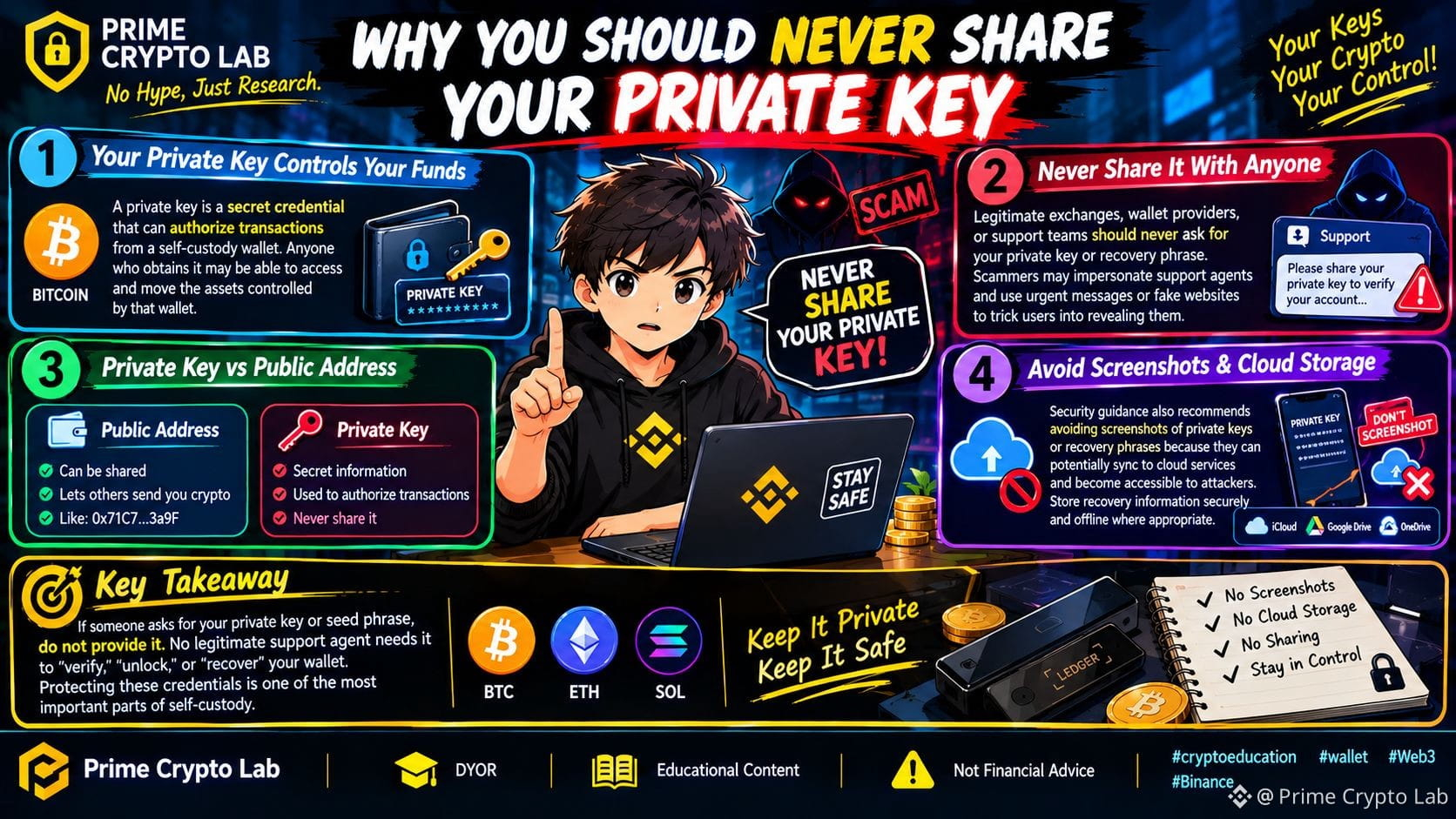
🔐 Why You Should Never Share Your Private Key
🛡️ 1. Your Private Key Controls Your Funds
Bitcoin $BTC — A private key is a secret credential that can authorize transactions from a self-custody wallet. Anyone who obtains it may be able to access and move the assets controlled by that wallet.
🚨 2. Never Share It With Anyone
Legitimate exchanges, wallet providers, or support teams should never ask for your private key or recovery phrase. Scammers may impersonate support agents and use urgent messages or fake websites to trick users into revealing them.
🔑 3. Private Key vs Public Address
A public wallet address can generally be shared so others can send you crypto. A private key is different: it is secret information used to authorize transactions. Keep it confidential at all times.
☁️ 4. Avoid Screenshots & Cloud Storage
Ethereum $ETH — Security guidance also recommends avoiding screenshots of private keys or recovery phrases because they can potentially sync to cloud services and become accessible to attackers. Store recovery information securely and offline where appropriate.
🎯 Key Takeaway
Solana $SOL — If someone asks for your private key or seed phrase, do not provide it. No legitimate support agent needs it to “verify,” “unlock,” or “recover” your wallet. Protecting these credentials is one of the most important parts of self-custody.
Prime Crypto Lab — No Hype, Just Research.
DYOR | Educational Content | Not Financial Advice
#cryptoeducation #WalletSecurity #Web3 #SelfCustody
🔐 Why You Should Never Share Your Private Key
🛡️ 1. Your Private Key Controls Your Funds
Bitcoin $BTC — A private key is a secret credential that can authorize transactions from a self-custody wallet. Anyone who obtains it may be able to access and move the assets controlled by that wallet.
🚨 2. Never Share It With Anyone
Legitimate exchanges, wallet providers, or support teams should never ask for your private key or recovery phrase. Scammers may impersonate support agents and use urgent messages or fake websites to trick users into revealing them.
🔑 3. Private Key vs Public Address
A public wallet address can generally be shared so others can send you crypto. A private key is different: it is secret information used to authorize transactions. Keep it confidential at all times.
☁️ 4. Avoid Screenshots & Cloud Storage
Ethereum $ETH — Security guidance also recommends avoiding screenshots of private keys or recovery phrases because they can potentially sync to cloud services and become accessible to attackers. Store recovery information securely and offline where appropriate.
🎯 Key Takeaway
Solana $SOL — If someone asks for your private key or seed phrase, do not provide it. No legitimate support agent needs it to “verify,” “unlock,” or “recover” your wallet. Protecting these credentials is one of the most important parts of self-custody.
Prime Crypto Lab — No Hype, Just Research.
DYOR | Educational Content | Not Financial Advice
#cryptoeducation #WalletSecurity #Web3 #SelfCustody
🛡️ 1. Your Private Key Controls Your Funds
Bitcoin $BTC — A private key is a secret credential that can authorize transactions from a self-custody wallet. Anyone who obtains it may be able to access and move the assets controlled by that wallet.
🚨 2. Never Share It With Anyone
Legitimate exchanges, wallet providers, or support teams should never ask for your private key or recovery phrase. Scammers may impersonate support agents and use urgent messages or fake websites to trick users into revealing them.
🔑 3. Private Key vs Public Address
A public wallet address can generally be shared so others can send you crypto. A private key is different: it is secret information used to authorize transactions. Keep it confidential at all times.
☁️ 4. Avoid Screenshots & Cloud Storage
Ethereum $ETH — Security guidance also recommends avoiding screenshots of private keys or recovery phrases because they can potentially sync to cloud services and become accessible to attackers. Store recovery information securely and offline where appropriate.
🎯 Key Takeaway
Solana $SOL — If someone asks for your private key or seed phrase, do not provide it. No legitimate support agent needs it to “verify,” “unlock,” or “recover” your wallet. Protecting these credentials is one of the most important parts of self-custody.
Prime Crypto Lab — No Hype, Just Research.
DYOR | Educational Content | Not Financial Advice
#cryptoeducation #WalletSecurity #Web3 #SelfCustody
103

$387.5 million left Bitget last week in the biggest hack of 2026.
Cold wallets were safe, private keys were safe, and users are being covered by a protection fund of over $460 million. Still, withdrawals were frozen for days.
Here is my rule after watching this happen cycle after cycle: exchanges are for trading, not for storing.
Keep what you actively trade on the exchange. Move long term holdings to a hardware wallet you control. Write the seed phrase on paper, never in your phone notes, never in a screenshot.
If a 72 hour freeze on your exchange would hurt you, your setup needs work. Not tomorrow, this week.
Where do you keep your long term $BTC and $ETH holdings, exchange or self custody?
#BitgetDetailsSecurityIncidentTimeline #CryptoSecurity #SelfCustody
$387.5 million left Bitget last week in the biggest hack of 2026.
Cold wallets were safe, private keys were safe, and users are being covered by a protection fund of over $460 million. Still, withdrawals were frozen for days.
Here is my rule after watching this happen cycle after cycle: exchanges are for trading, not for storing.
Keep what you actively trade on the exchange. Move long term holdings to a hardware wallet you control. Write the seed phrase on paper, never in your phone notes, never in a screenshot.
If a 72 hour freeze on your exchange would hurt you, your setup needs work. Not tomorrow, this week.
Where do you keep your long term $BTC and $ETH holdings, exchange or self custody?
#BitgetDetailsSecurityIncidentTimeline #CryptoSecurity #SelfCustody
Cold wallets were safe, private keys were safe, and users are being covered by a protection fund of over $460 million. Still, withdrawals were frozen for days.
Here is my rule after watching this happen cycle after cycle: exchanges are for trading, not for storing.
Keep what you actively trade on the exchange. Move long term holdings to a hardware wallet you control. Write the seed phrase on paper, never in your phone notes, never in a screenshot.
If a 72 hour freeze on your exchange would hurt you, your setup needs work. Not tomorrow, this week.
Where do you keep your long term $BTC and $ETH holdings, exchange or self custody?
#BitgetDetailsSecurityIncidentTimeline #CryptoSecurity #SelfCustody
3
2
2k

Picture this: you move your hard-earned funds off an exchange into a private hardware wallet, only to realize financial authorities just logged every detail of that exit.
For years, shifting capital between centralized platforms and private storage was the ultimate safety valve for traders trying to protect their assets from unexpected platform freezes. But as regulatory oversight tightens globally, managing larger positions without triggering compliance tripwires is becoming a major headache for everyday investors.
Brazil just gave the market a clear blueprint of how emerging economies plan to manage this boundary. Starting October 1, 2026, Brazil’s Central Bank will require regulated platforms to report any virtual asset transfer worth $10,000 or more to or from self-custody wallets directly to Coaf. Much like the compliance playbooks we watched roll out across Europe and North America, this is not an outright ban, but it creates a permanent paper trail whenever high-volume $BTC or $ETH transactions touch regulated rails.
The more interesting detail is the escalation scheduled right after. While the 2026 mandate focuses purely on surveillance for major assets and stablecoins like $USDT, a separate rule slated for January 2027 will allow qualifying transfers to self-custody wallets to actually be held. It represents a steady shift from simple oversight toward active capital monitoring at the gateway.
Where do you think the line should be drawn between regulatory compliance and financial privacy for self-custody transfers?
#CryptoRegulation #Bitcoin #SelfCustody
Picture this: you move your hard-earned funds off an exchange into a private hardware wallet, only to realize financial authorities just logged every detail of that exit.
For years, shifting capital between centralized platforms and private storage was the ultimate safety valve for traders trying to protect their assets from unexpected platform freezes. But as regulatory oversight tightens globally, managing larger positions without triggering compliance tripwires is becoming a major headache for everyday investors.
Brazil just gave the market a clear blueprint of how emerging economies plan to manage this boundary. Starting October 1, 2026, Brazil’s Central Bank will require regulated platforms to report any virtual asset transfer worth $10,000 or more to or from self-custody wallets directly to Coaf. Much like the compliance playbooks we watched roll out across Europe and North America, this is not an outright ban, but it creates a permanent paper trail whenever high-volume $BTC or $ETH transactions touch regulated rails.
The more interesting detail is the escalation scheduled right after. While the 2026 mandate focuses purely on surveillance for major assets and stablecoins like $USDT, a separate rule slated for January 2027 will allow qualifying transfers to self-custody wallets to actually be held. It represents a steady shift from simple oversight toward active capital monitoring at the gateway.
Where do you think the line should be drawn between regulatory compliance and financial privacy for self-custody transfers?
#CryptoRegulation #Bitcoin #SelfCustody
For years, shifting capital between centralized platforms and private storage was the ultimate safety valve for traders trying to protect their assets from unexpected platform freezes. But as regulatory oversight tightens globally, managing larger positions without triggering compliance tripwires is becoming a major headache for everyday investors.
Brazil just gave the market a clear blueprint of how emerging economies plan to manage this boundary. Starting October 1, 2026, Brazil’s Central Bank will require regulated platforms to report any virtual asset transfer worth $10,000 or more to or from self-custody wallets directly to Coaf. Much like the compliance playbooks we watched roll out across Europe and North America, this is not an outright ban, but it creates a permanent paper trail whenever high-volume $BTC or $ETH transactions touch regulated rails.
The more interesting detail is the escalation scheduled right after. While the 2026 mandate focuses purely on surveillance for major assets and stablecoins like $USDT, a separate rule slated for January 2027 will allow qualifying transfers to self-custody wallets to actually be held. It represents a steady shift from simple oversight toward active capital monitoring at the gateway.
Where do you think the line should be drawn between regulatory compliance and financial privacy for self-custody transfers?
#CryptoRegulation #Bitcoin #SelfCustody
42
Log in to explore more content
Join global crypto users on Binance Square
⚡️ Get latest and useful information about crypto.
💬 Trusted by the world’s largest crypto exchange.
👍 Discover real insights from verified creators.
Email / Phone number
Trending Topics
1
#BinanceLaunchesBinanceIntelligence
764,856 views
4,777 Discussing
2
#BTCFallsBelow$84K
37,317 views
128 Discussing
3
#DubaiVARAIssuesReserveAssetAuditCircular
12,160 views
433 Discussing
4
#SECApproves3XBitcoinETF
10,417 views
359 Discussing
5
#WinklevossFilesSpotZcashETFApplication
20,306 views
479 Discussing
6
#SouthKoreaAITradeLiftsWorldcoinTo$7.41B
2,382 views
41 Discussing
7
#StrategyEstimates$4.1BIncomeTaxBenefit
1,509 views
22 Discussing
8
#IglooShutsDownAbstractBlockchain
8,431 views
251 Discussing
9
#StrategyMarketCapSurpassesRumble
50,798 views
989 Discussing
10
#StriveBuys2000BTCFor$169M
18,939 views
163 Discussing