

#restaking
restaking
731,164 views
2,634 Discussing
Hot
Latest

🚨 $REZ IS UP 9.28% TODAY — WITH RESTAKING TOKENS ATTRACTING RENEWED ATTENTION.
Binance REZ/USDT:
Opening price: $0.003838
Current price: $0.004194
Today: +9.28%
Rolling 24H: +11.98%
Today’s high: $0.004417
Today’s Spot turnover: $1.80 million
The leading sector narrative is renewed speculative interest in liquid restaking infrastructure.
Renzo operates within Ethereum’s restaking ecosystem, providing infrastructure for users seeking exposure to restaking strategies.
However, the existence of a restaking narrative does not establish a new fundamental catalyst.
No official October 23 Renzo partnership, protocol upgrade or tokenomics announcement was independently verified as the direct cause of today’s rally.
TODAY’S RALLY: VERIFIED.
RESTAKING NARRATIVE: ESTABLISHED.
FRESH OFFICIAL CATALYST: NOT FOUND.
No confirmed fresh catalyst found.
Watch $0.004417, Spot turnover and whether other restaking tokens begin showing similar momentum.
#REZ #Renzo #Restaking #DeFi
🚨 $REZ IS UP 9.28% TODAY — WITH RESTAKING TOKENS ATTRACTING RENEWED ATTENTION.
Binance REZ/USDT:
Opening price: $0.003838
Current price: $0.004194
Today: +9.28%
Rolling 24H: +11.98%
Today’s high: $0.004417
Today’s Spot turnover: $1.80 million
The leading sector narrative is renewed speculative interest in liquid restaking infrastructure.
Renzo operates within Ethereum’s restaking ecosystem, providing infrastructure for users seeking exposure to restaking strategies.
However, the existence of a restaking narrative does not establish a new fundamental catalyst.
No official October 23 Renzo partnership, protocol upgrade or tokenomics announcement was independently verified as the direct cause of today’s rally.
TODAY’S RALLY: VERIFIED.
RESTAKING NARRATIVE: ESTABLISHED.
FRESH OFFICIAL CATALYST: NOT FOUND.
No confirmed fresh catalyst found.
Watch $0.004417, Spot turnover and whether other restaking tokens begin showing similar momentum.
#REZ #Renzo #Restaking #DeFi
Binance REZ/USDT:
Opening price: $0.003838
Current price: $0.004194
Today: +9.28%
Rolling 24H: +11.98%
Today’s high: $0.004417
Today’s Spot turnover: $1.80 million
The leading sector narrative is renewed speculative interest in liquid restaking infrastructure.
Renzo operates within Ethereum’s restaking ecosystem, providing infrastructure for users seeking exposure to restaking strategies.
However, the existence of a restaking narrative does not establish a new fundamental catalyst.
No official October 23 Renzo partnership, protocol upgrade or tokenomics announcement was independently verified as the direct cause of today’s rally.
TODAY’S RALLY: VERIFIED.
RESTAKING NARRATIVE: ESTABLISHED.
FRESH OFFICIAL CATALYST: NOT FOUND.
No confirmed fresh catalyst found.
Watch $0.004417, Spot turnover and whether other restaking tokens begin showing similar momentum.
#REZ #Renzo #Restaking #DeFi
183

·
--
Bullish
🔥#EIGEN IS BACK! +12.08% PUMP TODAY! 🔥
EigenLayer $EIGEN currently at $0.281 after blasting from $0.2414 low to $0.2817 high! Opened at $0.2506 — pure momentum! 📈💪
Market cap $736.92M still tiny for the biggest restaking protocol in crypto! 🏗️
+11.81% in 5 days, +21.95% in 1 month — trend is officially BULLISH! 🟢✨
ATH was $5.65, now -95% down — this is the ultimate bottom play! ETH restaking narrative is just starting! 🔐
$1 is programmed! Don't fade EigenLayer! 🌙🚀
WAGMI! LFG! 💰 #EIGEN #EigenLayer #restaking $EIGEN
{future}(EIGENUSDT)
🔥#EIGEN IS BACK! +12.08% PUMP TODAY! 🔥
EigenLayer $EIGEN currently at $0.281 after blasting from $0.2414 low to $0.2817 high! Opened at $0.2506 — pure momentum! 📈💪
Market cap $736.92M still tiny for the biggest restaking protocol in crypto! 🏗️
+11.81% in 5 days, +21.95% in 1 month — trend is officially BULLISH! 🟢✨
ATH was $5.65, now -95% down — this is the ultimate bottom play! ETH restaking narrative is just starting! 🔐
$1 is programmed! Don't fade EigenLayer! 🌙🚀
WAGMI! LFG! 💰 #EIGEN #EigenLayer #restaking $EIGEN
EigenLayer $EIGEN currently at $0.281 after blasting from $0.2414 low to $0.2817 high! Opened at $0.2506 — pure momentum! 📈💪
Market cap $736.92M still tiny for the biggest restaking protocol in crypto! 🏗️
+11.81% in 5 days, +21.95% in 1 month — trend is officially BULLISH! 🟢✨
ATH was $5.65, now -95% down — this is the ultimate bottom play! ETH restaking narrative is just starting! 🔐
$1 is programmed! Don't fade EigenLayer! 🌙🚀
WAGMI! LFG! 💰 #EIGEN #EigenLayer #restaking $EIGEN
74

·
--
Puffer Finance (PUFFER) just exploded over 87% in the last 24 hours, hitting $0.053 and leaving traders scrambling for answers!
This low-cap protocol (rank #641) saw its trading volume hit $43M — actually surpassing its $30.5M market cap. That’s a massive signal of fresh capital and heavy interest. For beginners: Puffer is a "native liquid restaking" protocol built on EigenLayer. In simple terms, it lets you stake ETH once but earn rewards from securing multiple networks simultaneously, all while keeping your funds liquid via pufETH. The recent surge likely stems from upcoming mainnet milestones and the broader restaking narrative heating up. But with low liquidity comes high volatility — gains this fast can reverse just as quickly.
#PufferFinance #Restaking
Are you aping into the restaking narrative or waiting for a pullback?
Puffer Finance (PUFFER) just exploded over 87% in the last 24 hours, hitting $0.053 and leaving traders scrambling for answers!
This low-cap protocol (rank #641) saw its trading volume hit $43M — actually surpassing its $30.5M market cap. That’s a massive signal of fresh capital and heavy interest. For beginners: Puffer is a "native liquid restaking" protocol built on EigenLayer. In simple terms, it lets you stake ETH once but earn rewards from securing multiple networks simultaneously, all while keeping your funds liquid via pufETH. The recent surge likely stems from upcoming mainnet milestones and the broader restaking narrative heating up. But with low liquidity comes high volatility — gains this fast can reverse just as quickly.
#PufferFinance #Restaking
Are you aping into the restaking narrative or waiting for a pullback?
This low-cap protocol (rank #641) saw its trading volume hit $43M — actually surpassing its $30.5M market cap. That’s a massive signal of fresh capital and heavy interest. For beginners: Puffer is a "native liquid restaking" protocol built on EigenLayer. In simple terms, it lets you stake ETH once but earn rewards from securing multiple networks simultaneously, all while keeping your funds liquid via pufETH. The recent surge likely stems from upcoming mainnet milestones and the broader restaking narrative heating up. But with low liquidity comes high volatility — gains this fast can reverse just as quickly.
#PufferFinance #Restaking
Are you aping into the restaking narrative or waiting for a pullback?
151

·
--
STAKING YIELDS ARE BACK AND RESTAKING LEADS THE CHARGE
Restaking tokens are up almost 5 percent today with liquid staking up almost 4
Ethereum holding above 2500 has staking demand rising again
Fresh ETH staked means fresh fees for the staking protocols
This is the quiet compounding corner of the market waking up
The three leaders on my screen
$LDO up 5 percent to 45 cents and still the king of liquid staking
$ETHFI up 3 percent as restaking narratives pull capital back in
$JTO up 3 percent riding Solana ecosystem strength at the same time
TRADE SIGNALS FOR $LDO
ENTRY ZONE 42 TO 46 CENTS
FIRST TARGET 52 CENTS
SECOND TARGET 60 CENTS
STOP LOSS 38 CENTS
My take as an analyst
Staking is the closest thing crypto has to a savings account with real yield
LDO at these levels with ETH stable looks like a clean setup
My call is BUY for yield focused portfolios
Are you staking right now or sitting in cash?
#BinanceSquare #WriteToEarn #Crypto #Bitcoin #Restaking
STAKING YIELDS ARE BACK AND RESTAKING LEADS THE CHARGE
Restaking tokens are up almost 5 percent today with liquid staking up almost 4
Ethereum holding above 2500 has staking demand rising again
Fresh ETH staked means fresh fees for the staking protocols
This is the quiet compounding corner of the market waking up
The three leaders on my screen
$LDO up 5 percent to 45 cents and still the king of liquid staking
$ETHFI up 3 percent as restaking narratives pull capital back in
$JTO up 3 percent riding Solana ecosystem strength at the same time
TRADE SIGNALS FOR $LDO
ENTRY ZONE 42 TO 46 CENTS
FIRST TARGET 52 CENTS
SECOND TARGET 60 CENTS
STOP LOSS 38 CENTS
My take as an analyst
Staking is the closest thing crypto has to a savings account with real yield
LDO at these levels with ETH stable looks like a clean setup
My call is BUY for yield focused portfolios
Are you staking right now or sitting in cash?
#BinanceSquare #WriteToEarn #Crypto #Bitcoin #Restaking
Restaking tokens are up almost 5 percent today with liquid staking up almost 4
Ethereum holding above 2500 has staking demand rising again
Fresh ETH staked means fresh fees for the staking protocols
This is the quiet compounding corner of the market waking up
The three leaders on my screen
$LDO up 5 percent to 45 cents and still the king of liquid staking
$ETHFI up 3 percent as restaking narratives pull capital back in
$JTO up 3 percent riding Solana ecosystem strength at the same time
TRADE SIGNALS FOR $LDO
ENTRY ZONE 42 TO 46 CENTS
FIRST TARGET 52 CENTS
SECOND TARGET 60 CENTS
STOP LOSS 38 CENTS
My take as an analyst
Staking is the closest thing crypto has to a savings account with real yield
LDO at these levels with ETH stable looks like a clean setup
My call is BUY for yield focused portfolios
Are you staking right now or sitting in cash?
#BinanceSquare #WriteToEarn #Crypto #Bitcoin #Restaking

1
16

·
--
Liquid Staking Was Just the Warmup. Restaking Is the Real Story.
When ETH liquid staking took off, the insight was simple: your staked $ETH should work harder than just sitting idle earning ~4% APY. LSTs like stETH unlocked DeFi composability on top of base staking yield — capital efficiency, version 1.
Restaking takes that logic several layers deeper.
Instead of securing only one network, your staked ETH can now simultaneously validate additional decentralized services — oracle networks, DA layers, bridge committees, sequencers, and cross-chain messaging protocols. Each layer adds incremental yield. Each layer also adds incremental slashing risk — the tradeoff is real and shouldn't be glossed over.
The underlying architecture is essentially programmable security. Established validator sets become a shared security marketplace. New protocols don't need to bootstrap their own validator economics from scratch — they rent credibility from an already-secured base layer.
For $ETH specifically this is structurally bullish: more utility surfaces for staked ETH means more demand to stake, higher proportion of supply locked, and tighter floating supply.
$BNB and $SOL are developing analogous shared security primitives. The trend is converging: every major L1 is moving toward staked capital doing multiple jobs simultaneously.
The risk layer matters though. LRT complexity adds systemic correlation — if an AVS gets slashed, LRT holders downstream absorb the impact. Model the tail risks before chasing the yield stack.
Restaking is capital efficiency v2. Understand the mechanics before the narrative fully prices in.
#Restaking #LiquidStaking #DeFi #CryptoAlpha #ETH
Liquid Staking Was Just the Warmup. Restaking Is the Real Story.
When ETH liquid staking took off, the insight was simple: your staked $ETH should work harder than just sitting idle earning ~4% APY. LSTs like stETH unlocked DeFi composability on top of base staking yield — capital efficiency, version 1.
Restaking takes that logic several layers deeper.
Instead of securing only one network, your staked ETH can now simultaneously validate additional decentralized services — oracle networks, DA layers, bridge committees, sequencers, and cross-chain messaging protocols. Each layer adds incremental yield. Each layer also adds incremental slashing risk — the tradeoff is real and shouldn't be glossed over.
The underlying architecture is essentially programmable security. Established validator sets become a shared security marketplace. New protocols don't need to bootstrap their own validator economics from scratch — they rent credibility from an already-secured base layer.
For $ETH specifically this is structurally bullish: more utility surfaces for staked ETH means more demand to stake, higher proportion of supply locked, and tighter floating supply.
$BNB and $SOL are developing analogous shared security primitives. The trend is converging: every major L1 is moving toward staked capital doing multiple jobs simultaneously.
The risk layer matters though. LRT complexity adds systemic correlation — if an AVS gets slashed, LRT holders downstream absorb the impact. Model the tail risks before chasing the yield stack.
Restaking is capital efficiency v2. Understand the mechanics before the narrative fully prices in.
#Restaking #LiquidStaking #DeFi #CryptoAlpha #ETH
When ETH liquid staking took off, the insight was simple: your staked $ETH should work harder than just sitting idle earning ~4% APY. LSTs like stETH unlocked DeFi composability on top of base staking yield — capital efficiency, version 1.
Restaking takes that logic several layers deeper.
Instead of securing only one network, your staked ETH can now simultaneously validate additional decentralized services — oracle networks, DA layers, bridge committees, sequencers, and cross-chain messaging protocols. Each layer adds incremental yield. Each layer also adds incremental slashing risk — the tradeoff is real and shouldn't be glossed over.
The underlying architecture is essentially programmable security. Established validator sets become a shared security marketplace. New protocols don't need to bootstrap their own validator economics from scratch — they rent credibility from an already-secured base layer.
For $ETH specifically this is structurally bullish: more utility surfaces for staked ETH means more demand to stake, higher proportion of supply locked, and tighter floating supply.
$BNB and $SOL are developing analogous shared security primitives. The trend is converging: every major L1 is moving toward staked capital doing multiple jobs simultaneously.
The risk layer matters though. LRT complexity adds systemic correlation — if an AVS gets slashed, LRT holders downstream absorb the impact. Model the tail risks before chasing the yield stack.
Restaking is capital efficiency v2. Understand the mechanics before the narrative fully prices in.
#Restaking #LiquidStaking #DeFi #CryptoAlpha #ETH
96
·
--
Liquid Restaking: The Yield Stack Powering DeFi's Next Frontier
Restaking isn't just a buzzword — it's a structural shift in how blockchain security is funded.
Traditionally, validator capital secures exactly one network. Restaking breaks that constraint. By allowing staked $ETH (or liquid staking tokens) to simultaneously opt-in to securing additional services — oracle networks, data availability layers, cross-chain bridges — the same capital earns yield from multiple protocol layers at once.
EigenLayer pioneered the Actively Validated Services (AVS) model. Instead of bootstrapping validator sets from scratch, new protocols rent economic security from Ethereum's existing staked base. The result: faster time-to-security for new protocols, and higher blended yields for restakers.
Liquid restaking tokens (LRTs) take it further. Protocols let users deposit, receive a tradeable receipt token, and deploy that token across $ETH DeFi simultaneously. You're earning restaking rewards AND liquidity protocol yield on the same principal.
The compounding risk is real too. Slashing conditions from multiple AVS sources stack. If operators misbehave across several opted-in services, losses can cascade — this is why operator selection and diversification within LRT protocols matters as much as APY figures.
For $SOL and $BNB ecosystems, analogous shared-security models are emerging. The macro thesis: modular security markets are the next DeFi primitive, and liquid restaking is the yield instrument that makes them composable.
Understand the stack before chasing the yield. 🔍
$ETH $SOL $BNB
#Restaking #DeFi #EigenLayer #CryptoYield #Web3Infrastructure
Liquid Restaking: The Yield Stack Powering DeFi's Next Frontier
Restaking isn't just a buzzword — it's a structural shift in how blockchain security is funded.
Traditionally, validator capital secures exactly one network. Restaking breaks that constraint. By allowing staked $ETH (or liquid staking tokens) to simultaneously opt-in to securing additional services — oracle networks, data availability layers, cross-chain bridges — the same capital earns yield from multiple protocol layers at once.
EigenLayer pioneered the Actively Validated Services (AVS) model. Instead of bootstrapping validator sets from scratch, new protocols rent economic security from Ethereum's existing staked base. The result: faster time-to-security for new protocols, and higher blended yields for restakers.
Liquid restaking tokens (LRTs) take it further. Protocols let users deposit, receive a tradeable receipt token, and deploy that token across $ETH DeFi simultaneously. You're earning restaking rewards AND liquidity protocol yield on the same principal.
The compounding risk is real too. Slashing conditions from multiple AVS sources stack. If operators misbehave across several opted-in services, losses can cascade — this is why operator selection and diversification within LRT protocols matters as much as APY figures.
For $SOL and $BNB ecosystems, analogous shared-security models are emerging. The macro thesis: modular security markets are the next DeFi primitive, and liquid restaking is the yield instrument that makes them composable.
Understand the stack before chasing the yield. 🔍
$ETH $SOL $BNB
#Restaking #DeFi #EigenLayer #CryptoYield #Web3Infrastructure
Restaking isn't just a buzzword — it's a structural shift in how blockchain security is funded.
Traditionally, validator capital secures exactly one network. Restaking breaks that constraint. By allowing staked $ETH (or liquid staking tokens) to simultaneously opt-in to securing additional services — oracle networks, data availability layers, cross-chain bridges — the same capital earns yield from multiple protocol layers at once.
EigenLayer pioneered the Actively Validated Services (AVS) model. Instead of bootstrapping validator sets from scratch, new protocols rent economic security from Ethereum's existing staked base. The result: faster time-to-security for new protocols, and higher blended yields for restakers.
Liquid restaking tokens (LRTs) take it further. Protocols let users deposit, receive a tradeable receipt token, and deploy that token across $ETH DeFi simultaneously. You're earning restaking rewards AND liquidity protocol yield on the same principal.
The compounding risk is real too. Slashing conditions from multiple AVS sources stack. If operators misbehave across several opted-in services, losses can cascade — this is why operator selection and diversification within LRT protocols matters as much as APY figures.
For $SOL and $BNB ecosystems, analogous shared-security models are emerging. The macro thesis: modular security markets are the next DeFi primitive, and liquid restaking is the yield instrument that makes them composable.
Understand the stack before chasing the yield. 🔍
$ETH $SOL $BNB
#Restaking #DeFi #EigenLayer #CryptoYield #Web3Infrastructure
56

#restakingwave
🔄 RESTAKING WATCH: ETH INFRASTRUCTURE KEEPS EXPANDING!
Ethereum’s staking and restaking ecosystem remains an important part of the broader yield and infrastructure narrative.
💡 WHAT THIS MEANS FOR TRADERS:
As capital becomes more comfortable with on-chain yield, infrastructure tokens could receive renewed attention.
🔍 3 COINS TO WATCH:
🟢 $EIGEN — EigenLayer remains closely connected to Ethereum’s restaking narrative.
{spot}(EIGENUSDT)
🟠 $ETHFI — Ether.fi represents the liquid-staking and DeFi side of the Ethereum ecosystem.
{spot}(ETHFIUSDT)
🔵 $LDO — Lido remains a major liquid-staking protocol within Ethereum.
{spot}(LDOUSDT)
Could staking infrastructure become the next major DeFi rotation?
#EIGEN #ETHFI #LDO #Restaking
#restakingwave
🔄 RESTAKING WATCH: ETH INFRASTRUCTURE KEEPS EXPANDING!
Ethereum’s staking and restaking ecosystem remains an important part of the broader yield and infrastructure narrative.
💡 WHAT THIS MEANS FOR TRADERS:
As capital becomes more comfortable with on-chain yield, infrastructure tokens could receive renewed attention.
🔍 3 COINS TO WATCH:
🟢 $EIGEN — EigenLayer remains closely connected to Ethereum’s restaking narrative.
🟠 $ETHFI — Ether.fi represents the liquid-staking and DeFi side of the Ethereum ecosystem.
🔵 $LDO — Lido remains a major liquid-staking protocol within Ethereum.
Could staking infrastructure become the next major DeFi rotation?
#EIGEN #ETHFI #LDO #Restaking
🔄 RESTAKING WATCH: ETH INFRASTRUCTURE KEEPS EXPANDING!
Ethereum’s staking and restaking ecosystem remains an important part of the broader yield and infrastructure narrative.
💡 WHAT THIS MEANS FOR TRADERS:
As capital becomes more comfortable with on-chain yield, infrastructure tokens could receive renewed attention.
🔍 3 COINS TO WATCH:
🟢 $EIGEN — EigenLayer remains closely connected to Ethereum’s restaking narrative.
🟠 $ETHFI — Ether.fi represents the liquid-staking and DeFi side of the Ethereum ecosystem.
🔵 $LDO — Lido remains a major liquid-staking protocol within Ethereum.
Could staking infrastructure become the next major DeFi rotation?
#EIGEN #ETHFI #LDO #Restaking

1
395

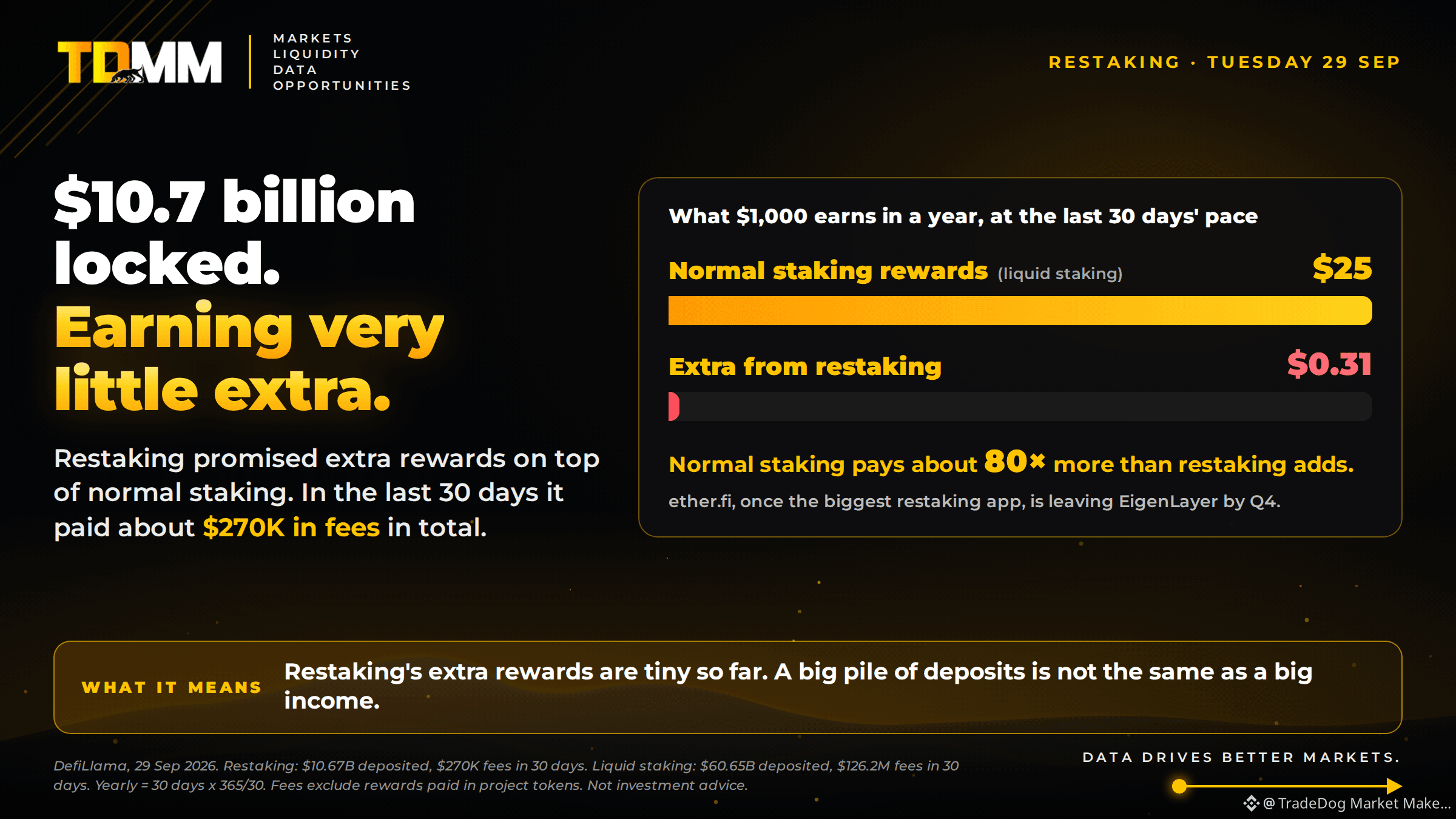
💸 $10.7B locked in restaking. Earning very little extra.
What $1,000 earns in a year (at the last 30 days' pace):
🟡 Normal staking rewards: ~$25
🔴 Extra from restaking: ~$0.31
➡️ Normal staking pays ~80× more than restaking adds
📊 The whole restaking sector paid ~$270K in fees in 30 days. $ETH restaking on EigenLayer alone holds ~$7.0B and earned ~$169K.
📰 Ether.fi, once the biggest restaking app, is fully exiting EigenLayer by Q4.
💡 Money parked is not money earned. Check what deposits actually produce.
What would make restaking pay again? 👇
#Restaking #ETH #DeFi #Staking
Data: DefiLlama, 29 Sep. Fees exclude rewards paid in project tokens. Not financial advice. DYOR.
💸 $10.7B locked in restaking. Earning very little extra.
What $1,000 earns in a year (at the last 30 days' pace):
🟡 Normal staking rewards: ~$25
🔴 Extra from restaking: ~$0.31
➡️ Normal staking pays ~80× more than restaking adds
📊 The whole restaking sector paid ~$270K in fees in 30 days. $ETH restaking on EigenLayer alone holds ~$7.0B and earned ~$169K.
📰 Ether.fi, once the biggest restaking app, is fully exiting EigenLayer by Q4.
💡 Money parked is not money earned. Check what deposits actually produce.
What would make restaking pay again? 👇
#Restaking #ETH #DeFi #Staking
Data: DefiLlama, 29 Sep. Fees exclude rewards paid in project tokens. Not financial advice. DYOR.
What $1,000 earns in a year (at the last 30 days' pace):
🟡 Normal staking rewards: ~$25
🔴 Extra from restaking: ~$0.31
➡️ Normal staking pays ~80× more than restaking adds
📊 The whole restaking sector paid ~$270K in fees in 30 days. $ETH restaking on EigenLayer alone holds ~$7.0B and earned ~$169K.
📰 Ether.fi, once the biggest restaking app, is fully exiting EigenLayer by Q4.
💡 Money parked is not money earned. Check what deposits actually produce.
What would make restaking pay again? 👇
#Restaking #ETH #DeFi #Staking
Data: DefiLlama, 29 Sep. Fees exclude rewards paid in project tokens. Not financial advice. DYOR.
3
256


Flash update: The restaking gold rush has officially hit a wall. 📉 Top protocols are now scraping by on razor-thin margins. Here is what you need to track right now. 1. Yield farming rewards have plunged across major platforms. 2. Validator revenue fails to match last year's aggressive growth projections. 3. Smart capital is rapidly rotating out of low-fee restaking loops. $ETH #Write2Earn #CryptoNews #Restaking #DeFi
Flash update: The restaking gold rush has officially hit a wall. 📉 Top protocols are now scraping by on razor-thin margins. Here is what you need to track right now. 1. Yield farming rewards have plunged across major platforms. 2. Validator revenue fails to match last year's aggressive growth projections. 3. Smart capital is rapidly rotating out of low-fee restaking loops. $ETH #Write2Earn #CryptoNews #Restaking #DeFi

52

·
--
The restaking fever seems to have reached its peak.
Yields fell and the risks of smart contracts piled up.
That’s why one of the main protocols of $ETH decided to abandon its core business.
Now they plan to become a crypto neobank.
It’s a pretty drastic change of direction for a project in the sector.
Do you think this is a smart move or desperation?
#Ethereum #Restaking
The restaking fever seems to have reached its peak.
Yields fell and the risks of smart contracts piled up.
That’s why one of the main protocols of $ETH decided to abandon its core business.
Now they plan to become a crypto neobank.
It’s a pretty drastic change of direction for a project in the sector.
Do you think this is a smart move or desperation?
#Ethereum #Restaking
Yields fell and the risks of smart contracts piled up.
That’s why one of the main protocols of $ETH decided to abandon its core business.
Now they plan to become a crypto neobank.
It’s a pretty drastic change of direction for a project in the sector.
Do you think this is a smart move or desperation?
#Ethereum #Restaking

277

·
--
The restaking gold rush is over! Top protocols now barely make any profit as yields dry up, risks rise, and even Ethereum's biggest liquid restaking protocol has abandoned its core business to build a crypto neobank. Looks like the era of easy money is really over... #restaking #DeFi $ETH
The restaking gold rush is officially over! Top protocols are barely making profits as yields dry up and smart contract risks mount. Even Ethereum's top liquid restaking protocol has ditched its core business to build a crypto neobank. The easy money era is truly gone... #restaking #DeFi $ETH
The restaking gold rush is over! Top protocols now barely make any profit as yields dry up, risks rise, and even Ethereum's biggest liquid restaking protocol has abandoned its core business to build a crypto neobank. Looks like the era of easy money is really over... #restaking #DeFi $ETH
The restaking gold rush is officially over! Top protocols are barely making profits as yields dry up and smart contract risks mount. Even Ethereum's top liquid restaking protocol has ditched its core business to build a crypto neobank. The easy money era is truly gone... #restaking #DeFi $ETH
The restaking gold rush is officially over! Top protocols are barely making profits as yields dry up and smart contract risks mount. Even Ethereum's top liquid restaking protocol has ditched its core business to build a crypto neobank. The easy money era is truly gone... #restaking #DeFi $ETH
173
·
--
Restaking sold itself as free yield. The pitch: stake once, get paid, then pledge the same collateral to secure a dozen networks and collect again.
But yield is never free — it is the price of risk. And restaking is a machine for selling the same risk several times over.
When ETH sits in one staking position, you carry one validator's risk. When that same ETH is restaked across ten services, the risks stack: slashing conditions, smart contract bugs, oracle misreports — across ten different codebases, all backed by the same collateral.
This is rehypothecation with better marketing. In 2008, the same mortgage was packaged, insured, and resold until nobody knew who owned the real exposure. Restaking recreates that geometry: one asset, many claims, correlated failure modes.
That does not make it bad. It means earning 12% instead of 4% usually translates to holding 3x the risk with 1x the attention.
Yield is the market quoting you a price for danger. Stacking is proof the risk was never priced once.
The only question worth asking: if everything fails at once, what do you actually recover — and how fast?
$ETH $SOL $BTC
#Restaking #DeFi #RiskManagement #Crypto #Yield
Restaking sold itself as free yield. The pitch: stake once, get paid, then pledge the same collateral to secure a dozen networks and collect again.
But yield is never free — it is the price of risk. And restaking is a machine for selling the same risk several times over.
When ETH sits in one staking position, you carry one validator's risk. When that same ETH is restaked across ten services, the risks stack: slashing conditions, smart contract bugs, oracle misreports — across ten different codebases, all backed by the same collateral.
This is rehypothecation with better marketing. In 2008, the same mortgage was packaged, insured, and resold until nobody knew who owned the real exposure. Restaking recreates that geometry: one asset, many claims, correlated failure modes.
That does not make it bad. It means earning 12% instead of 4% usually translates to holding 3x the risk with 1x the attention.
Yield is the market quoting you a price for danger. Stacking is proof the risk was never priced once.
The only question worth asking: if everything fails at once, what do you actually recover — and how fast?
$ETH $SOL $BTC
#Restaking #DeFi #RiskManagement #Crypto #Yield
But yield is never free — it is the price of risk. And restaking is a machine for selling the same risk several times over.
When ETH sits in one staking position, you carry one validator's risk. When that same ETH is restaked across ten services, the risks stack: slashing conditions, smart contract bugs, oracle misreports — across ten different codebases, all backed by the same collateral.
This is rehypothecation with better marketing. In 2008, the same mortgage was packaged, insured, and resold until nobody knew who owned the real exposure. Restaking recreates that geometry: one asset, many claims, correlated failure modes.
That does not make it bad. It means earning 12% instead of 4% usually translates to holding 3x the risk with 1x the attention.
Yield is the market quoting you a price for danger. Stacking is proof the risk was never priced once.
The only question worth asking: if everything fails at once, what do you actually recover — and how fast?
$ETH $SOL $BTC
#Restaking #DeFi #RiskManagement #Crypto #Yield
62

·
--
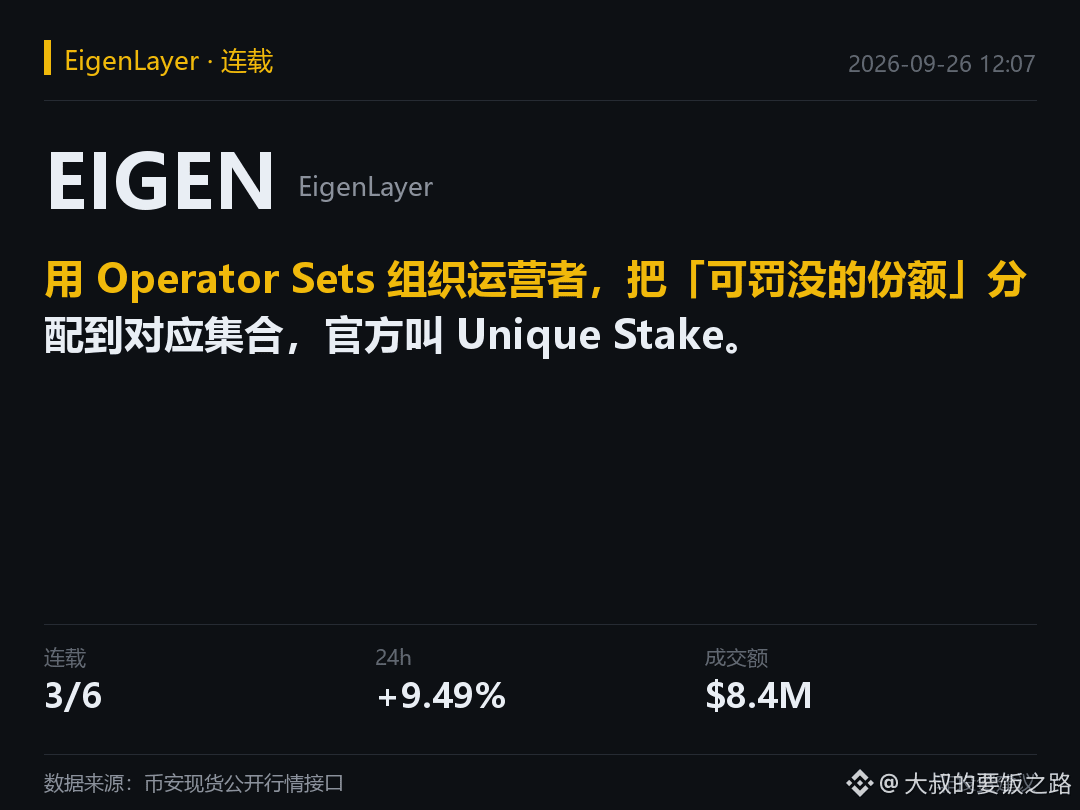
EigenLayer uses Operator Sets to organize operators, assigning the “seizable portion” to the corresponding set. Officially, this is called Unique Stake.
The key is the allocation boundary: at any given time, the same share of stake corresponds to only one set’s right to be slashed.
#Restaking
Not investment advice
{future}(EIGENUSDT)
EigenLayer uses Operator Sets to organize operators, assigning the “seizable portion” to the corresponding set. Officially, this is called Unique Stake.
The key is the allocation boundary: at any given time, the same share of stake corresponds to only one set’s right to be slashed.
#Restaking
Not investment advice
The key is the allocation boundary: at any given time, the same share of stake corresponds to only one set’s right to be slashed.
#Restaking
Not investment advice
150

·
--
Cointelegraph's "what happened in crypto today" roundup had zero restaking drama — weird timing, since @Bedrock is still shipping Bedrock 2.0 while most ETH restakers I follow are stuck arguing over leftover points.
First-gen Bedrock felt like single-asset yield with extra steps. Bedrock 2.0 takes a different route: liquid restaking across both ETH and BTC, with DePIN rewards on top instead of another farm checklist.
$BR is around $0.117, down ~3.7% today even with Bitcoin up ~1.6% near $65,600. Still ~54% below the ~$0.257 high. At ~29 million market cap on 251 million circulating out of 1 billion total — looks like the market already priced the hype out.
#Bedrock #Restaking #DePIN
Cointelegraph's "what happened in crypto today" roundup had zero restaking drama — weird timing, since @Bedrock is still shipping Bedrock 2.0 while most ETH restakers I follow are stuck arguing over leftover points.
First-gen Bedrock felt like single-asset yield with extra steps. Bedrock 2.0 takes a different route: liquid restaking across both ETH and BTC, with DePIN rewards on top instead of another farm checklist.
$BR is around $0.117, down ~3.7% today even with Bitcoin up ~1.6% near $65,600. Still ~54% below the ~$0.257 high. At ~29 million market cap on 251 million circulating out of 1 billion total — looks like the market already priced the hype out.
#Bedrock #Restaking #DePIN
First-gen Bedrock felt like single-asset yield with extra steps. Bedrock 2.0 takes a different route: liquid restaking across both ETH and BTC, with DePIN rewards on top instead of another farm checklist.
$BR is around $0.117, down ~3.7% today even with Bitcoin up ~1.6% near $65,600. Still ~54% below the ~$0.257 high. At ~29 million market cap on 251 million circulating out of 1 billion total — looks like the market already priced the hype out.
#Bedrock #Restaking #DePIN
69

·
--
#bedrock $BR
Still letting your crypto sit idle? It’s time to unlock its full potential with Bedrock Protocol.Bedrock is a multi-asset liquid restaking platform that turns your dormant assets into yield-generating powerhouses.
What you get:
💎 Keep 100% liquidity with wrappers like uniBTC and uniETH
📈 Earn compounding rewards from top restaking networks (Babylon, EigenLayer)
🔐 Institutional-grade, non-custodial security backed by RockX
🗳️ Governance power via the native $BR tokenStop choosing between staking rewards and trading liquidity. Do both.
#Restaking #BTCFi #Ethereum
#bedrock $BR
Still letting your crypto sit idle? It’s time to unlock its full potential with Bedrock Protocol.Bedrock is a multi-asset liquid restaking platform that turns your dormant assets into yield-generating powerhouses.
What you get:
💎 Keep 100% liquidity with wrappers like uniBTC and uniETH
📈 Earn compounding rewards from top restaking networks (Babylon, EigenLayer)
🔐 Institutional-grade, non-custodial security backed by RockX
🗳️ Governance power via the native $BR tokenStop choosing between staking rewards and trading liquidity. Do both.
#Restaking #BTCFi #Ethereum
Still letting your crypto sit idle? It’s time to unlock its full potential with Bedrock Protocol.Bedrock is a multi-asset liquid restaking platform that turns your dormant assets into yield-generating powerhouses.
What you get:
💎 Keep 100% liquidity with wrappers like uniBTC and uniETH
📈 Earn compounding rewards from top restaking networks (Babylon, EigenLayer)
🔐 Institutional-grade, non-custodial security backed by RockX
🗳️ Governance power via the native $BR tokenStop choosing between staking rewards and trading liquidity. Do both.
#Restaking #BTCFi #Ethereum
90

$B TESTNET IS EXPOSING THE REAL STRESS POINTS ⚡
Bedrock’s latest testnet is not just a reward chase. The key signal is its attempt to pressure-test liquid restaking across Ethereum, Bitcoin, and DePIN before claiming the system is battle-ready.
This is where the real alpha sits.
Different settlement speeds. Different trust assumptions. Off-chain data risk. Validator coordination. zk-proof settlement.
Clean on paper. Brutal under load.
The market should watch how $B handles edge cases, not hype cycles.
Not financial advice. Manage your risk.
#BR #Restaking #DePIN #Crypto #BinanceSquare
🚀
{future}(BREVUSDT)
$B TESTNET IS EXPOSING THE REAL STRESS POINTS ⚡
Bedrock’s latest testnet is not just a reward chase. The key signal is its attempt to pressure-test liquid restaking across Ethereum, Bitcoin, and DePIN before claiming the system is battle-ready.
This is where the real alpha sits.
Different settlement speeds. Different trust assumptions. Off-chain data risk. Validator coordination. zk-proof settlement.
Clean on paper. Brutal under load.
The market should watch how $B handles edge cases, not hype cycles.
Not financial advice. Manage your risk.
#BR #Restaking #DePIN #Crypto #BinanceSquare
🚀
Bedrock’s latest testnet is not just a reward chase. The key signal is its attempt to pressure-test liquid restaking across Ethereum, Bitcoin, and DePIN before claiming the system is battle-ready.
This is where the real alpha sits.
Different settlement speeds. Different trust assumptions. Off-chain data risk. Validator coordination. zk-proof settlement.
Clean on paper. Brutal under load.
The market should watch how $B handles edge cases, not hype cycles.
Not financial advice. Manage your risk.
#BR #Restaking #DePIN #Crypto #BinanceSquare
🚀
22
·
--
I used to knock Bedrock for being $BR c almost 43% off its peak of $0.26 — looking back, I realize I judged too quickly, just because of the red candlestick and ignored the whole product story.
@Bedrock is a re-staking protocol: deposit ETH/BTC to earn additional rewards. Bedrock 2.0 is expanding to more assets and adding a DePIN reward layer. While many projects in the same space are silent, they still maintain a clear focus on 'one deposit for multiple coins' on their Square profile.
Today, $BR surged nearly 18%, climbing to around $0.15, with a market cap of about $37 million — a few reasons:
→ $BTC bounced over 2% around $63,700, encouraging everyone to snipe into the smaller caps
→ Bedrock 2.0 got a shoutout, interest in it is rising, not just the short-term hype chasers
→ With only ~25% of the total supply in circulation, even a little news can push the price significantly
One green session can't erase the time I overlooked it early — at least now I know what they’re up to, not just staring at the chart.
#Bedrock #Restaking #DePIN
I used to knock Bedrock for being $BR c almost 43% off its peak of $0.26 — looking back, I realize I judged too quickly, just because of the red candlestick and ignored the whole product story.
@Bedrock is a re-staking protocol: deposit ETH/BTC to earn additional rewards. Bedrock 2.0 is expanding to more assets and adding a DePIN reward layer. While many projects in the same space are silent, they still maintain a clear focus on 'one deposit for multiple coins' on their Square profile.
Today, $BR surged nearly 18%, climbing to around $0.15, with a market cap of about $37 million — a few reasons:
→ $BTC bounced over 2% around $63,700, encouraging everyone to snipe into the smaller caps
→ Bedrock 2.0 got a shoutout, interest in it is rising, not just the short-term hype chasers
→ With only ~25% of the total supply in circulation, even a little news can push the price significantly
One green session can't erase the time I overlooked it early — at least now I know what they’re up to, not just staring at the chart.
#Bedrock #Restaking #DePIN
@Bedrock is a re-staking protocol: deposit ETH/BTC to earn additional rewards. Bedrock 2.0 is expanding to more assets and adding a DePIN reward layer. While many projects in the same space are silent, they still maintain a clear focus on 'one deposit for multiple coins' on their Square profile.
Today, $BR surged nearly 18%, climbing to around $0.15, with a market cap of about $37 million — a few reasons:
→ $BTC bounced over 2% around $63,700, encouraging everyone to snipe into the smaller caps
→ Bedrock 2.0 got a shoutout, interest in it is rising, not just the short-term hype chasers
→ With only ~25% of the total supply in circulation, even a little news can push the price significantly
One green session can't erase the time I overlooked it early — at least now I know what they’re up to, not just staring at the chart.
#Bedrock #Restaking #DePIN
189

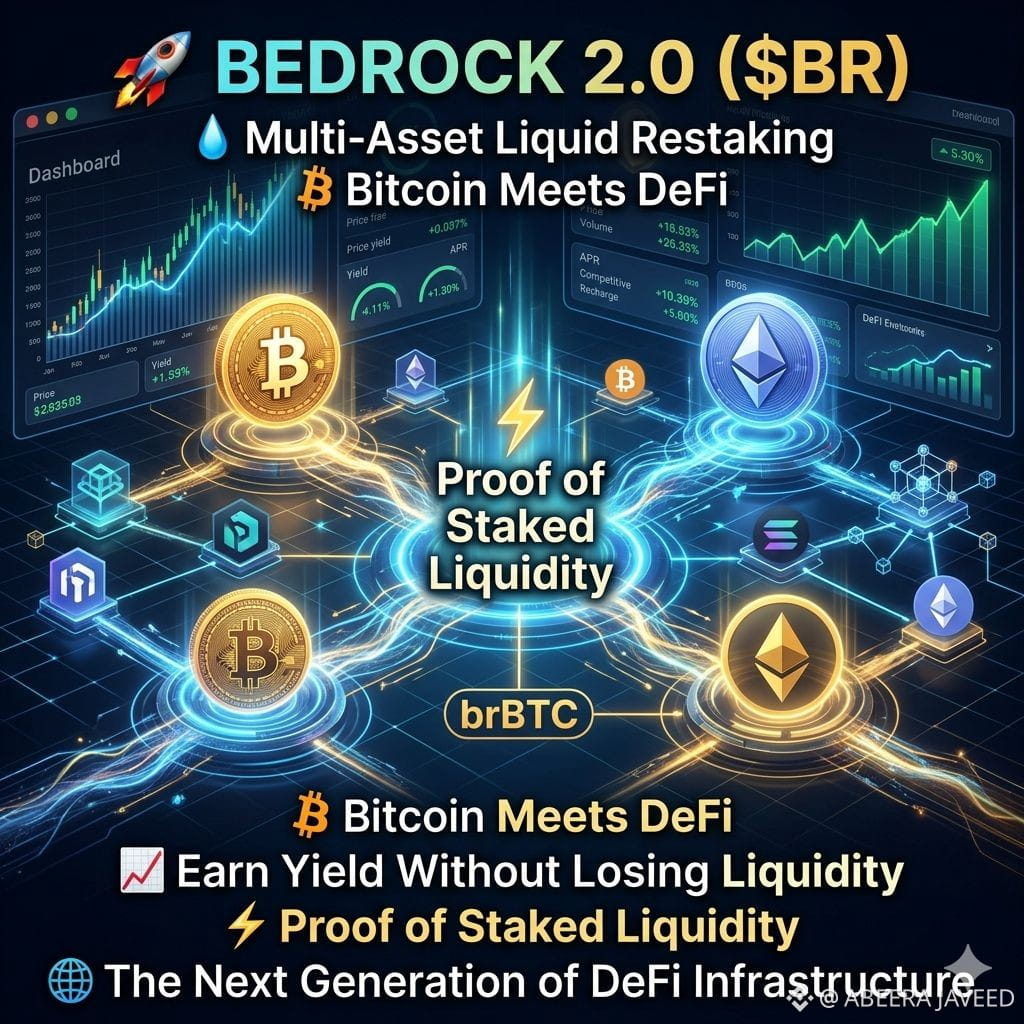
🚀 Bedrock 2.0 ($BR) Is Redefining $DEFI Efficiency
Bedrock 2.0 is introducing a new approach to decentralized finance through its multi-asset liquid restaking model. Instead of locking assets away, users can stake $BTC , $ETH, and other supported assets while still keeping them active across the DeFi ecosystem.
💡 The result?
Enhanced capital efficiency, sustainable yield opportunities, and greater flexibility without sacrificing liquidity.
One of the platform's key innovations is its Proof of Staked Liquidity framework, which directly connects rewards to liquidity participation, creating a more efficient and scalable ecosystem for users.
🔥 Bitcoin's role is evolving too.
With solutions like brBTC, Bitcoin is no longer limited to being a passive store of value. Users can generate yield, participate in governance, earn rewards, and access DeFi opportunities while maintaining exposure to their BTC holdings.
✅ Multi-asset liquid restaking
✅ Enhanced capital efficiency
✅ Active Bitcoin utility in DeFi
✅ Flexible yield generation
Bedrock 2.0 is building infrastructure designed for the next generation of DeFi, where liquidity, rewards, and usability work together seamlessly.
#BlockchainAssocBacks401kCrypto #DeFi #restaking #BTC #ETH $BR
🚀 Bedrock 2.0 ($BR ) Is Redefining $DEFI Efficiency
Bedrock 2.0 is introducing a new approach to decentralized finance through its multi-asset liquid restaking model. Instead of locking assets away, users can stake $BTC , $ETH, and other supported assets while still keeping them active across the DeFi ecosystem.
💡 The result?
Enhanced capital efficiency, sustainable yield opportunities, and greater flexibility without sacrificing liquidity.
One of the platform's key innovations is its Proof of Staked Liquidity framework, which directly connects rewards to liquidity participation, creating a more efficient and scalable ecosystem for users.
🔥 Bitcoin's role is evolving too.
With solutions like brBTC, Bitcoin is no longer limited to being a passive store of value. Users can generate yield, participate in governance, earn rewards, and access DeFi opportunities while maintaining exposure to their BTC holdings.
✅ Multi-asset liquid restaking
✅ Enhanced capital efficiency
✅ Active Bitcoin utility in DeFi
✅ Flexible yield generation
Bedrock 2.0 is building infrastructure designed for the next generation of DeFi, where liquidity, rewards, and usability work together seamlessly.
#BlockchainAssocBacks401kCrypto #DeFi #restaking #BTC #ETH $BR
Bedrock 2.0 is introducing a new approach to decentralized finance through its multi-asset liquid restaking model. Instead of locking assets away, users can stake $BTC , $ETH, and other supported assets while still keeping them active across the DeFi ecosystem.
💡 The result?
Enhanced capital efficiency, sustainable yield opportunities, and greater flexibility without sacrificing liquidity.
One of the platform's key innovations is its Proof of Staked Liquidity framework, which directly connects rewards to liquidity participation, creating a more efficient and scalable ecosystem for users.
🔥 Bitcoin's role is evolving too.
With solutions like brBTC, Bitcoin is no longer limited to being a passive store of value. Users can generate yield, participate in governance, earn rewards, and access DeFi opportunities while maintaining exposure to their BTC holdings.
✅ Multi-asset liquid restaking
✅ Enhanced capital efficiency
✅ Active Bitcoin utility in DeFi
✅ Flexible yield generation
Bedrock 2.0 is building infrastructure designed for the next generation of DeFi, where liquidity, rewards, and usability work together seamlessly.
#BlockchainAssocBacks401kCrypto #DeFi #restaking #BTC #ETH $BR
1
118

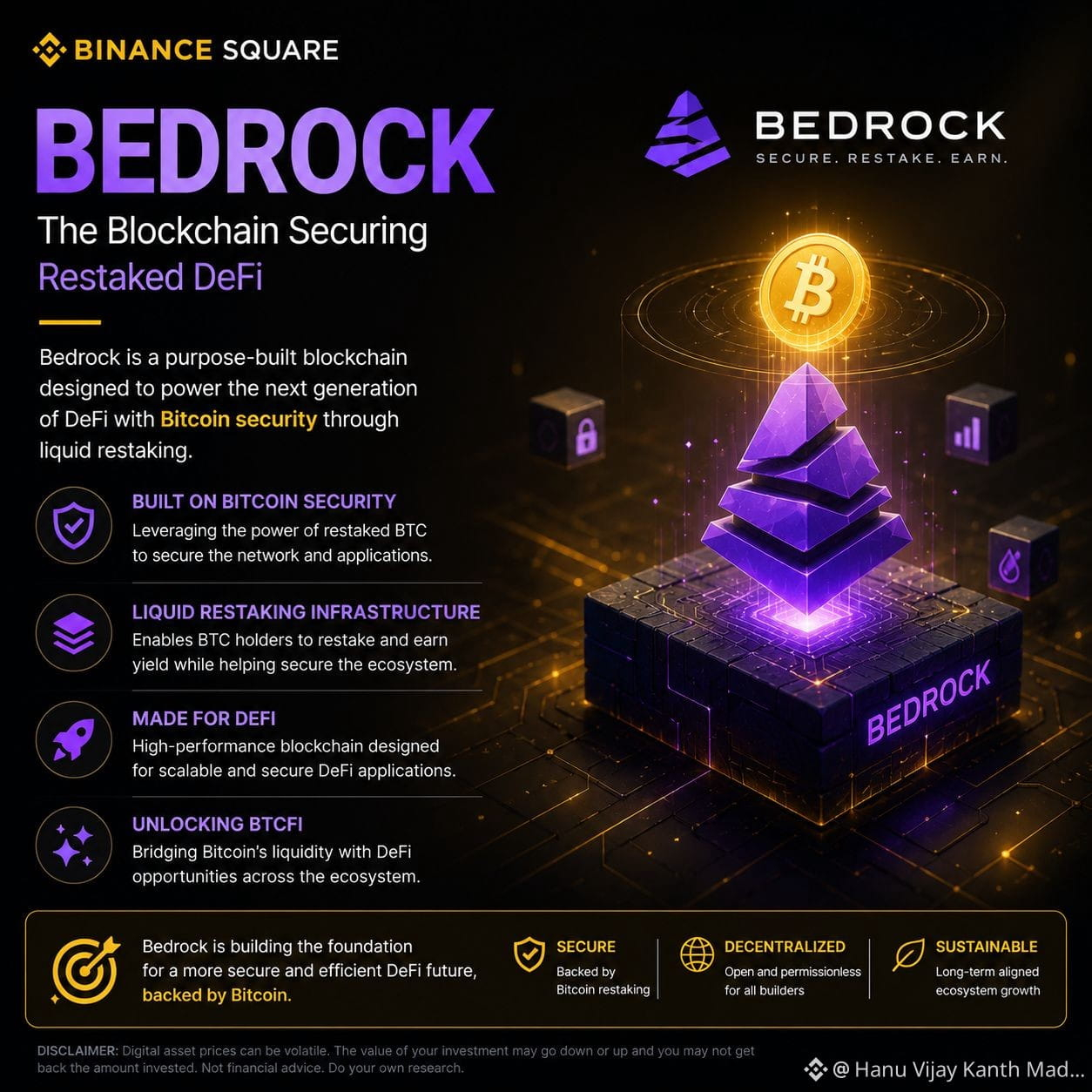
#bedrock $BR 🪨⚡ Bedrock is redefining Bitcoin-powered DeFi through liquid restaking innovation.
Instead of letting assets stay idle, Bedrock enables users to unlock more utility while helping strengthen decentralized ecosystems. By combining Bitcoin security with restaking infrastructure, it opens new opportunities for yield, liquidity, and scalable DeFi growth.
🔹 Bitcoin-backed security
🔹 Liquid restaking infrastructure
🔹 DeFi-focused ecosystem
🔹 Unlocking BTCFi potential
As BTCFi continues to evolve, projects like Bedrock are pushing the space toward a more capital-efficient and secure future.
Are you watching the rise of Bitcoin-powered DeFi? 👀
#Bedrock #BTCFi #DeFi #Bitcoin #restaking #crypto #BinanceSquare
#bedrock $BR 🪨⚡ Bedrock is redefining Bitcoin-powered DeFi through liquid restaking innovation.
Instead of letting assets stay idle, Bedrock enables users to unlock more utility while helping strengthen decentralized ecosystems. By combining Bitcoin security with restaking infrastructure, it opens new opportunities for yield, liquidity, and scalable DeFi growth.
🔹 Bitcoin-backed security
🔹 Liquid restaking infrastructure
🔹 DeFi-focused ecosystem
🔹 Unlocking BTCFi potential
As BTCFi continues to evolve, projects like Bedrock are pushing the space toward a more capital-efficient and secure future.
Are you watching the rise of Bitcoin-powered DeFi? 👀
#Bedrock #BTCFi #DeFi #Bitcoin #restaking #crypto #BinanceSquare
Instead of letting assets stay idle, Bedrock enables users to unlock more utility while helping strengthen decentralized ecosystems. By combining Bitcoin security with restaking infrastructure, it opens new opportunities for yield, liquidity, and scalable DeFi growth.
🔹 Bitcoin-backed security
🔹 Liquid restaking infrastructure
🔹 DeFi-focused ecosystem
🔹 Unlocking BTCFi potential
As BTCFi continues to evolve, projects like Bedrock are pushing the space toward a more capital-efficient and secure future.
Are you watching the rise of Bitcoin-powered DeFi? 👀
#Bedrock #BTCFi #DeFi #Bitcoin #restaking #crypto #BinanceSquare
1
3
89

#bedrock $BR 🪨 BEDROCK 2.0 — THE PROTOCOL THAT
MAKES YOUR BITCOIN WORK FOR YOU
You hold BTC but it's not generating
yield? That's exactly
the problem @Bedrock solves.
🔍 What is Bedrock?
Bedrock is the world's first liquid restaking multi-asset protocol. It allows you to stake
your BTC, ETH, or IOTX and in return, receive liquid tokens like
uniBTC or brBTC — which you can
recycle in DeFi to generate
additional yield.
In short: your BTC keeps working WITHOUT being locked up. 🔥
📊 The numbers speak for themselves:
• TVL hit: $1.2 billion
• Partnerships: Babylon, Eigenlayer,
Curve, Pendle, and more
• Token $BR : +90% increase by 2026
• Analysts' forecast for end of 2026:
between $0.186 and $0.232
🏆 Ongoing campaign on Binance:
600,000 BR up for grabs!
13,642 participants already signed up.
Join the competition now.
💡 Why Bedrock 2.0 is important:
With Bedrock 2.0, the protocol enters
a new era — decentralized governance
via the veBR system, enhanced security
with Chainlink Proof-of-Reserve, and accelerated
multi-chain expansion.
🧠 Conclusion:
Bedrock is one of the strongest BTCFi
projects of 2026. It addresses a real issue: billions of
BTC sitting idle without generating
yield. The solution is here.
⚠️ No financial advice.
Do your own research
before making any decisions.
@Bedrock BR#Bedrock #BTCFi
#BinanceSquare #DYOR #Crypto2026
#Restaking
#bedrock $BR 🪨 BEDROCK 2.0 — THE PROTOCOL THAT
MAKES YOUR BITCOIN WORK FOR YOU
You hold BTC but it's not generating
yield? That's exactly
the problem @Bedrock solves.
🔍 What is Bedrock?
Bedrock is the world's first liquid restaking multi-asset protocol. It allows you to stake
your BTC, ETH, or IOTX and in return, receive liquid tokens like
uniBTC or brBTC — which you can
recycle in DeFi to generate
additional yield.
In short: your BTC keeps working WITHOUT being locked up. 🔥
📊 The numbers speak for themselves:
• TVL hit: $1.2 billion
• Partnerships: Babylon, Eigenlayer,
Curve, Pendle, and more
• Token $BR : +90% increase by 2026
• Analysts' forecast for end of 2026:
between $0.186 and $0.232
🏆 Ongoing campaign on Binance:
600,000 BR up for grabs!
13,642 participants already signed up.
Join the competition now.
💡 Why Bedrock 2.0 is important:
With Bedrock 2.0, the protocol enters
a new era — decentralized governance
via the veBR system, enhanced security
with Chainlink Proof-of-Reserve, and accelerated
multi-chain expansion.
🧠 Conclusion:
Bedrock is one of the strongest BTCFi
projects of 2026. It addresses a real issue: billions of
BTC sitting idle without generating
yield. The solution is here.
⚠️ No financial advice.
Do your own research
before making any decisions.
@Bedrock BR#Bedrock #BTCFi
#BinanceSquare #DYOR #Crypto2026
#Restaking
MAKES YOUR BITCOIN WORK FOR YOU
You hold BTC but it's not generating
yield? That's exactly
the problem @Bedrock solves.
🔍 What is Bedrock?
Bedrock is the world's first liquid restaking multi-asset protocol. It allows you to stake
your BTC, ETH, or IOTX and in return, receive liquid tokens like
uniBTC or brBTC — which you can
recycle in DeFi to generate
additional yield.
In short: your BTC keeps working WITHOUT being locked up. 🔥
📊 The numbers speak for themselves:
• TVL hit: $1.2 billion
• Partnerships: Babylon, Eigenlayer,
Curve, Pendle, and more
• Token $BR : +90% increase by 2026
• Analysts' forecast for end of 2026:
between $0.186 and $0.232
🏆 Ongoing campaign on Binance:
600,000 BR up for grabs!
13,642 participants already signed up.
Join the competition now.
💡 Why Bedrock 2.0 is important:
With Bedrock 2.0, the protocol enters
a new era — decentralized governance
via the veBR system, enhanced security
with Chainlink Proof-of-Reserve, and accelerated
multi-chain expansion.
🧠 Conclusion:
Bedrock is one of the strongest BTCFi
projects of 2026. It addresses a real issue: billions of
BTC sitting idle without generating
yield. The solution is here.
⚠️ No financial advice.
Do your own research
before making any decisions.
@Bedrock BR#Bedrock #BTCFi
#BinanceSquare #DYOR #Crypto2026
#Restaking
58
Log in to explore more content
Join global crypto users on Binance Square
⚡️ Get latest and useful information about crypto.
💬 Trusted by the world’s largest crypto exchange.
👍 Discover real insights from verified creators.
Email / Phone number
Trending Topics
1
#BinancePick
3.3M views
162,790 Discussing
2
#EarningsSeason
5.4M views
26,674 Discussing
3
#StrategySkipsBitcoinPurchasesSpends$205MOnSTRCBuybacks
290 views
17 Discussing
4
#BitmineAdds10452ETH
5,467 views
150 Discussing
5
#SouthKoreaConsidersEducationTaxOnCryptoExchanges
5,090 views
133 Discussing
6
#OCCUrgesCommunityBanksToEnterStablecoinPayments
4,253 views
85 Discussing
7
#RippleWinsFullApprovalAsNationalTrustBank
4,125 views
90 Discussing
8
#AkashSelectsSolanaAsMigrationTarget
2,357 views
31 Discussing
9
#OndoToOpenSubscriptionsForOpenAIPreIPOTokenizedNotes
154 views
11 Discussing
10
#AnthropicTTMRevenueGrewAbout1200%
54,541 views
554 Discussing