

#dex
dex
18.6M views
115,055 Discussing
Hot
Latest

·
--
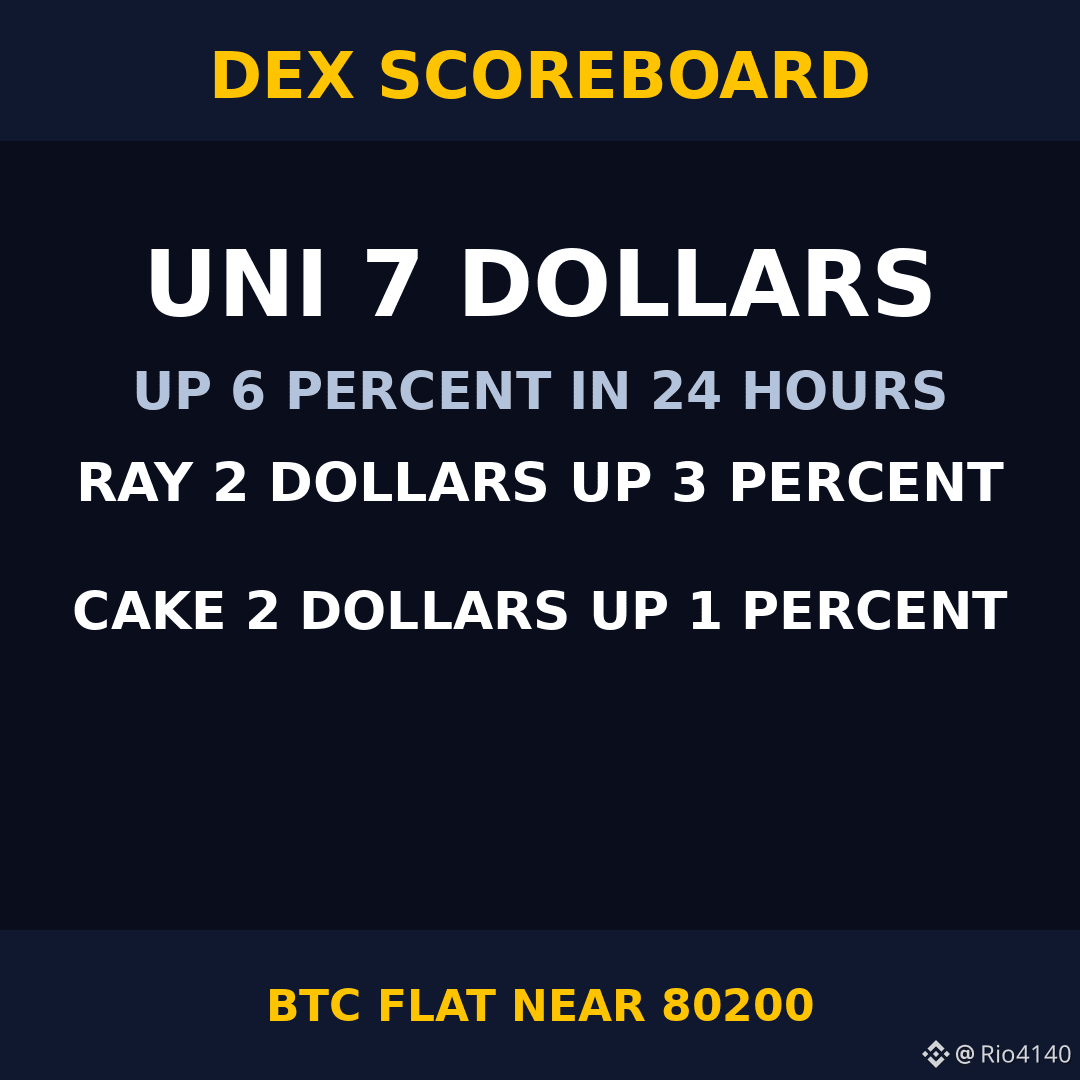
DEX LED A FLAT MARKET AS UNI RAN 6 PERCENT ON FEES
Bitcoin sat flat near 80200 at noon in Cairo and the big board went nowhere
Decentralized exchanges refused to sit still and the whole DEX shelf gained 2 percent in 24 hours on about 2 billion dollars in volume
$UNI leads the shelf at 7 dollars after a 6 percent jump in 24 hours and it is still down 5 percent on the week
The fee switch story keeps doing the lifting here and coverage of protocol revenue flowing toward UNI burns gives buyers a real reason to pay up while fresh CME futures talk keeps institutions looking at the name
$RAY trades at 2 dollars after a 3 percent gain and it is down 3 percent on the week as Solana trading keeps feeding it
CAKE trades at 2 dollars after a 1 percent gain and it is down 5 percent on the week as the quiet steady name in the group
Here is how I am playing the leader
Entry zone around 7 dollars on any pullback toward the morning range
Target one 8 dollars and target two 9 dollars if buyers keep paying for the fee story
Stop on a daily close below 6 dollars because that kills the whole setup
My take as an analyst
This is not a meme pump
A token that rallies on revenue math while Bitcoin goes nowhere is a rotation worth respecting
So tell me straight
Are you buying UNI on the fee story or waiting for a cheaper entry first?
#BinanceSquare #WriteToEarn #Crypto #Bitcoin #DEX
28
·
--
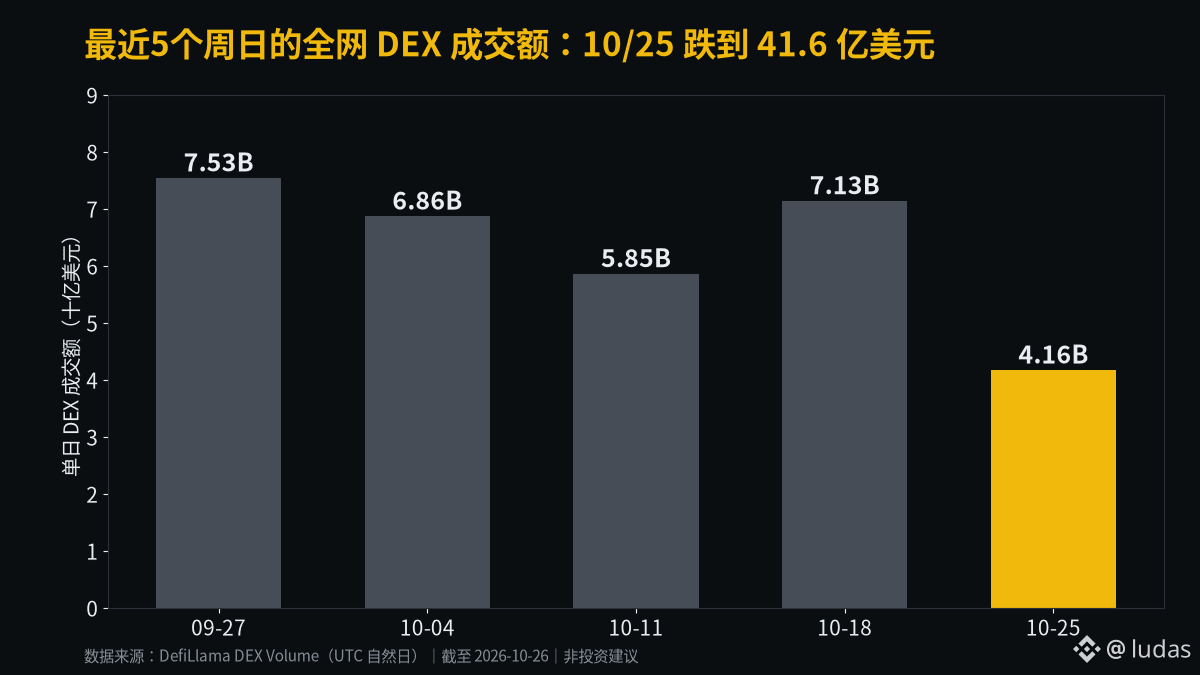
DEXs across the network traded just $4.16 billion on Sunday. Is on-chain activity really “cooling off”? 🧊
📊 DefiLlama data (UTC calendar days): DEX trading volume on the last 5 Sundays:
• 9/27: $7.53 billion
• 10/4: $6.86 billion
• 10/11: $5.85 billion
• 10/18: $7.13 billion
• 10/25: $4.16 billion ⚠️ About 42% lower than the previous Sunday
📉 According to DefiLlama, DEX trading volume is down 21.6% over 7 days. Weekdays are cooling too: volume was $11.7 billion on 9/29 and $8.98 billion on 10/20.
🔍 During the same period, BTC traded sideways around $80,000 (about $80,300 on Binance). Volatility was low, and on-chain trading appetite was weak too.
My take: Weekends are usually quiet, but this Sunday’s volume was clearly lower than on the previous few Sundays, so it’s not just the usual “weekend effect.” With a rate decision week ahead, investors are sitting on the sidelines. On-chain activity probably won’t pick up until the market chooses a direction. Not investment advice.
Has your on-chain trading activity been up or down lately? Share in the comments 👇
#链上数据 #DEX #DeFi
75

·
--
BNB Chain's DEX volume is accelerating, but the liquidity base isn't.
As of Oct 24, #DeFiLlama shows $6.665B in seven-day #DEX volume, up 24.1%, while stablecoin market cap is $13.097B and essentially flat over the same period. That gap matters more than another $BNB price candle.
It suggests existing capital is turning over faster rather than a broad wave of new liquidity arriving. That can support fees and short-term trading activity, but it is a weaker confirmation signal than volume and stablecoin supply rising together.
For traders, watch whether the stablecoin base starts expanding after the volume jump. If it does, the move gains depth. If it stays flat while volume fades, this was likely rotation, not fresh money.
{future}(BNBUSDT)
BNB Chain's DEX volume is accelerating, but the liquidity base isn't.
As of Oct 24, #DeFiLlama shows $6.665B in seven-day #DEX volume, up 24.1%, while stablecoin market cap is $13.097B and essentially flat over the same period. That gap matters more than another $BNB price candle.
It suggests existing capital is turning over faster rather than a broad wave of new liquidity arriving. That can support fees and short-term trading activity, but it is a weaker confirmation signal than volume and stablecoin supply rising together.
For traders, watch whether the stablecoin base starts expanding after the volume jump. If it does, the move gains depth. If it stays flat while volume fades, this was likely rotation, not fresh money.

62
·
--
Verified
The two largest DEXs on Base and OP Mainnet have officially merged. According to The Block’s report on October 21, Aerodrome and Velodrome have merged to form Aero, which has launched simultaneously across seven networks: Ethereum Mainnet, Base, Robinhood Chain, Ink, OP Mainnet, Arc, and Arbitrum. According to the project, Aerodrome accounted for 58% of DEX trading volume on Base in the third quarter, while Velodrome accounted for 60% on OP Mainnet. Combined, the seven networks see about $120 billion in monthly DEX trading volume. At the token level, the existing AERO and VELO will migrate to the new AERO, while veAERO and veVELO will convert to sAERO. A new feature in the mechanism is “Predictive Allocation”: stakers direct liquidity incentive budgets toward markets they expect to generate revenue. In addition, Slipstream V3 introduces dynamic fees that increase with market volatility and captures MEV on supported L2s. My take: the pain point with the ve(3,3) model has been that bribery steers incentives toward inefficient pools. Shifting to “betting on revenue” is a step in the right direction, but we’ll have to see the fee data after the migration is complete to judge how well it works. If you hold the old tokens, be sure to migrate through official channels and watch out for phishing links.
#DeFi #DEX #Base #Optimism $OP $ETH
#DeFi #DEX #Base #Optimism $OP $ETH
128
·
--
Verified
Uniswap v4 is turning itself into an aggregator. According to The Block’s October 22 report, Uniswap Labs has launched aggregator Hooks on Ethereum, Base, and Robinhood Chain. The first external liquidity sources to be integrated include Fluid, Curve, and PancakeSwap. The idea is to wrap liquidity from external platforms in a v4 Hook, so any router can treat it like a Uniswap pool, compare prices, and execute trades within a single transaction. Notably, trades that draw on external liquidity are also subject to Uniswap protocol fees, which will be used to burn $UNI . The idea first appeared in last November’s UNIfication proposal, and was trialed in March this year on Tempo, the payments chain from Stripe and Paradigm. My take: competition among DEXs is shifting from “whose pools are deeper” to “who controls the order flow.” Hooks let Uniswap expand its reach at lower cost, but it remains to be seen whether other DEXs will accept being “wrapped.”
#Uniswap #DeFi #DEX $UNI $ETH
#Uniswap #DeFi #DEX $UNI $ETH
509

On-chain activity is much livelier than on CEXs today: TokenPost/GeckoTerminal’s daily DEX report puts 24-hour DEX trading volume across the market at about $6.3 billion, down 17.9% from the previous period but up 11.35% from a week ago. The gainers’ list is so absurd it looks Photoshopped: BIBI surged 53,175% in a day, dope wif sword rose 51,259%, and iPhone Duo gained 46,752%. Meanwhile, Universal High Income, the hottest pair by trading volume, plunged 99.98% in a day and still ranked first among trending pairs. The top token by trading volume was Niannian (年年), at $234.6 million, with just over $1 million in liquidity and 206x turnover—take figures like these with a grain of salt; don’t put real money into it. DEX Screener reports about $5.65 billion in 24-hour volume on a comparable basis, in the same ballpark. #DEX #On-chainData
On-chain activity is much livelier than on CEXs today: TokenPost/GeckoTerminal’s daily DEX report puts 24-hour DEX trading volume across the market at about $6.3 billion, down 17.9% from the previous period but up 11.35% from a week ago. The gainers’ list is so absurd it looks Photoshopped: BIBI surged 53,175% in a day, dope wif sword rose 51,259%, and iPhone Duo gained 46,752%. Meanwhile, Universal High Income, the hottest pair by trading volume, plunged 99.98% in a day and still ranked first among trending pairs. The top token by trading volume was Niannian (年年), at $234.6 million, with just over $1 million in liquidity and 206x turnover—take figures like these with a grain of salt; don’t put real money into it. DEX Screener reports about $5.65 billion in 24-hour volume on a comparable basis, in the same ballpark. #DEX #On-chainData

73

·
--
Verified
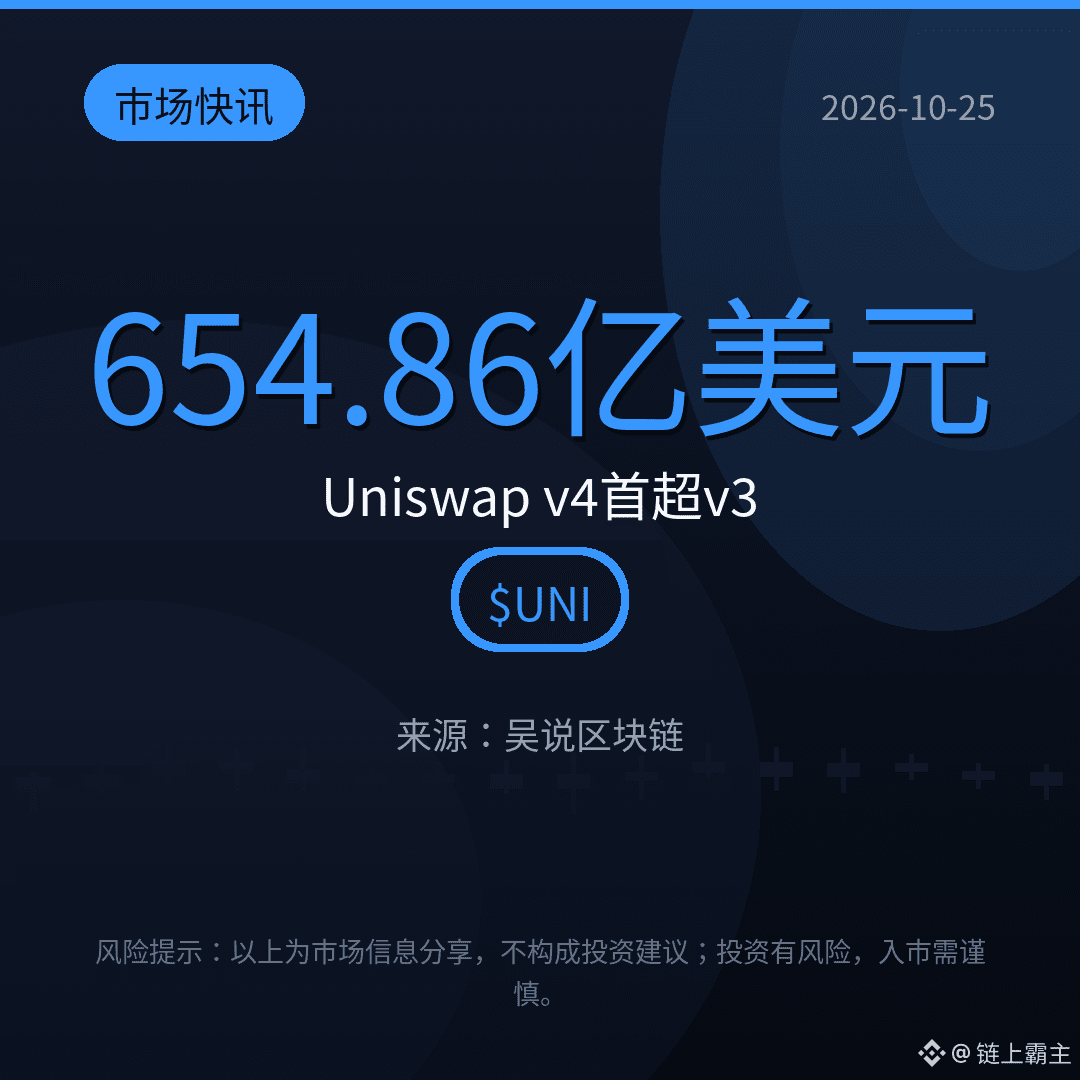
【Market Update】Uniswap’s trading volume over the past 30 days was approximately $65.486 billion. v4 accounted for about $32.772 billion (50.0%), surpassing v3 for the first time, which recorded $32.098 billion (49.0%), and ranking first among all versions. v2 accounted for just $616 million (0.9%). Liquidity is migrating from v3 to v4. Do you think v4 will continue to grow its market share, or will v3 hold its ground with its existing liquidity? Share your thoughts in the comments.
$UNI $ETH $ARB
#Uniswap #DeFi #DEX
(Source: Wu Blockchain)
⚠️Risk warning: The above is shared for informational purposes only and does not constitute investment advice. Investing involves risks; proceed with caution.
$UNI $ETH $ARB
#Uniswap #DeFi #DEX
(Source: Wu Blockchain)
⚠️Risk warning: The above is shared for informational purposes only and does not constitute investment advice. Investing involves risks; proceed with caution.
1
501

·
--
A weekend look at on-chain DEX trading: According to DefiLlama, total DEX volume over the past 24 hours was about $6.97 billion, down 9.0% day over day. Volume over the past 7 days totaled about $51.8 billion, up 23.4% week over week.
By platform, Uniswap V3 recorded about $820 million (-13.6%), Uniswap V4 about $660 million (-27.1%), PancakeSwap AMM V3 about $690 million, and Aerodrome Slipstream about $320 million (-9.4%).
My take: Overall volume picked up over the week, but there was a noticeable dip on the weekend’s daily figures—a common pattern of quieter weekend trading. V4’s daily decline was steeper than V3’s. It’s best not to read too much into short-term volume swings; weekly averages offer a steadier picture.
Source: DefiLlama. This is a compilation of public data only and does not constitute investment advice.
Which chain and DEX do you trade on most often, and why?
#DeFi #DEX #On-chainData
64

·
--
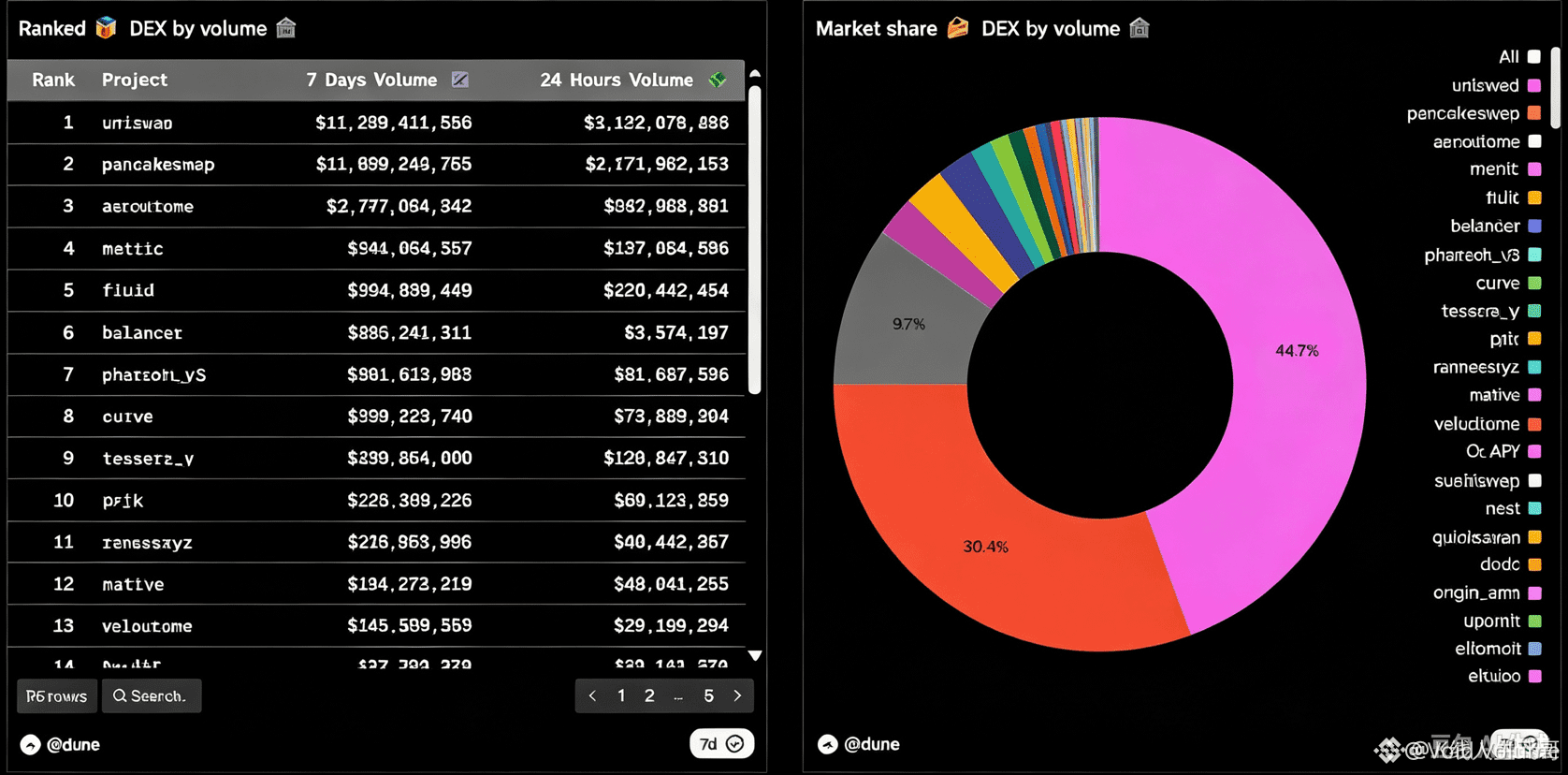
🚀 $UNI DOMINATES DEX VOLUME WHILE $CAKE STALLS 🦈
📊 Uniswap’s $UNI captured 44.7% of DEX flow, $172 B in the past week, cementing its position as the primary liquidity engine. Smart‑money pools keep gravitating toward this deep order‑book, reinforcing a robust demand zone that’s hard for competitors to breach.
📈 Meanwhile, $CAKE holds 30.4% share with $117 B volume but lacks price momentum, hinting at a liquidity imbalance. The gap between on‑chain activity and price action suggests an inefficiency that could trigger a corrective sweep once smart money redirects flow.
💬 How do you anticipate the next liquidity sweep will shape $CAKE ’s trajectory? 👇
⚠️ Not financial advice. Always manage your risk. 🛡️
🏷️ #UNI #DEX #Liquidity #Crypto
🔥 💎
18

·
--
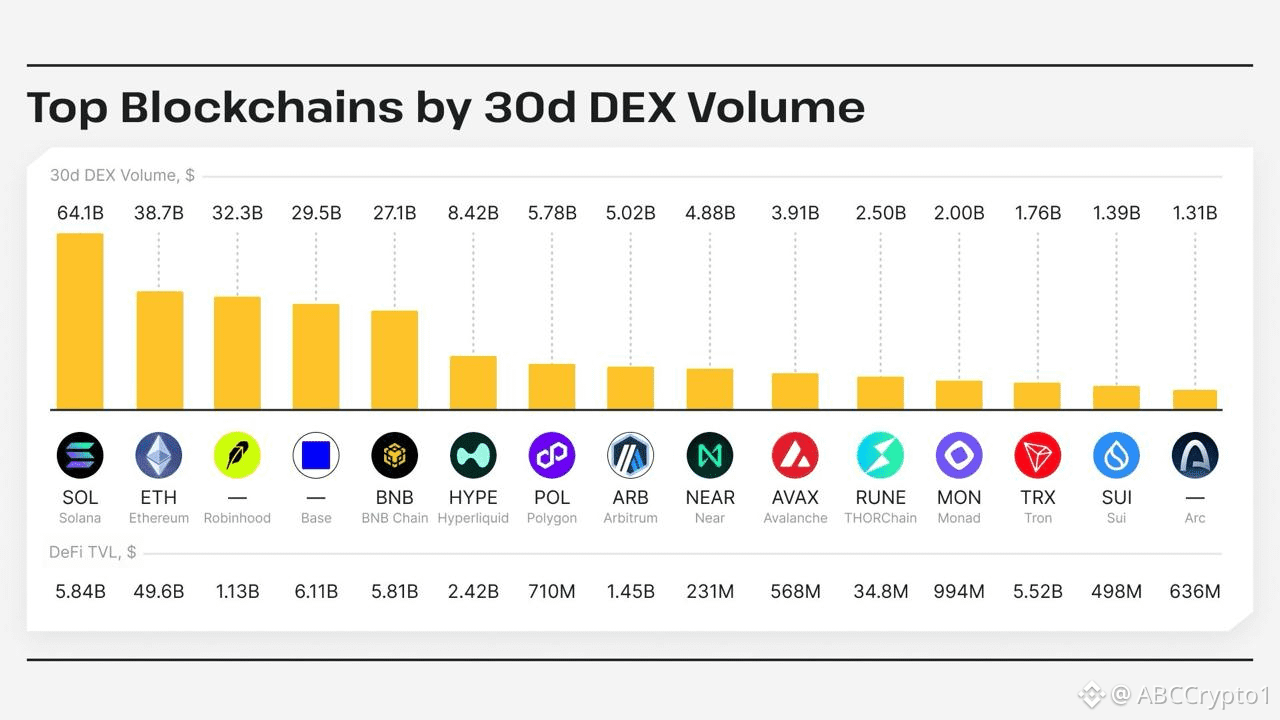
📢Top 15 blockchains by DEX trading volume over 30 days.
Decentralized exchanges let users swap crypto without a centralized intermediary. Volume shows how actively users are trading across different networks.
🟡 Solana — $64.1B
🟡 Ethereum — $38.7B
🟡 Robinhood — $32.3B
🟡 Base — $29.5B
🟡 BSC — $27.1B
🟡 Hyperliquid — $8.42B
🟡 Polygon — $5.78B
🟡 Arbitrum — $5.02B
🟡 NEAR — $4.88B
🟡 Avalanche — $3.91B
🟡 THOR — $2.50B
🟡 Monad — $2.00B
🟡 Tron — $1.76B
🟡 Sui — $1.39B
🟡 Arc — $1.31B
Solana leads by a wide margin. Notably, Robinhood has already climbed to 3rd place with $32.3B — ahead of Base and BSC. Interesting detail: Robinhood Chain’s DeFi TVL is just $1.13B, while Ethereum’s sits at $49.6B.
#DEX #defi #solana #Ethereum #BinanceSquare
234

·
--
【Market Flash】A new DEX shakes things up just two days after launch! Aero ranks first on both Base and Optimism, while Robinhood and Arc have also surged to second place. The signal is clear: traders are growing tired of established DEXs, and their money is voting with its feet in search of new battlegrounds. Is this a flash in the pan, or the opening salvo in a new round of DEX wars? Comment 1 if you're bullish, 2 if you're bearish!
$AERO $ETH $OP
#DEX #DeFi #Aero
(Source: Coinfomania)
⚠️Risk warning: The above is shared for market information purposes only and does not constitute investment advice. Investing involves risks; please exercise caution.
$AERO $ETH $OP
#DEX #DeFi #Aero
(Source: Coinfomania)
⚠️Risk warning: The above is shared for market information purposes only and does not constitute investment advice. Investing involves risks; please exercise caution.

443
·
--
LIGHTER RIPPED 22% TODAY ON CFTC FILING NEWS WHILE UNI AND HYPE BLED RED
This morning the DEX board split in two
One name ripped on real news
The old kings bled on no news
Scoreboard from today
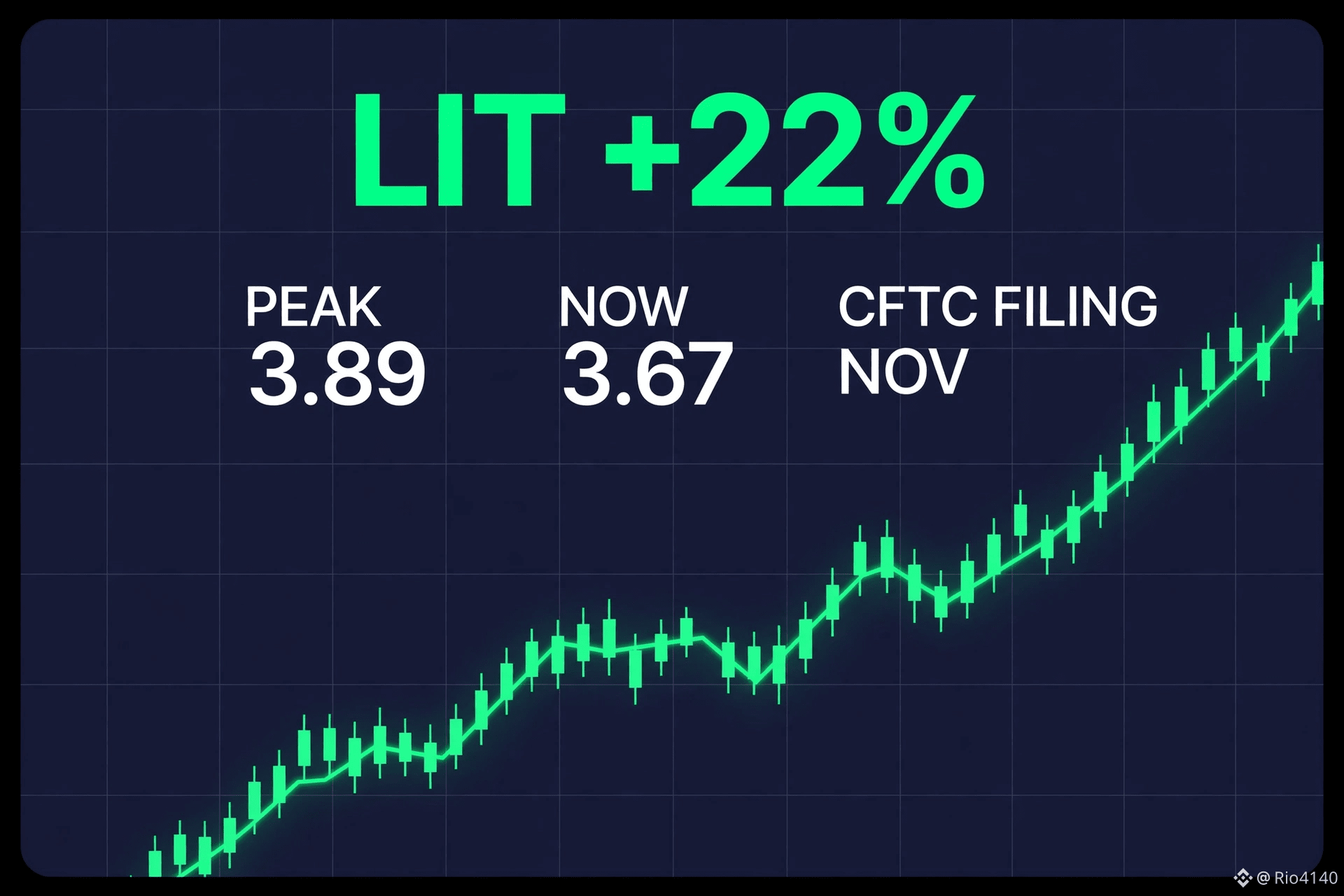
$LIT ripped 22 percent to 3 dollars 89 at the morning peak and is holding near 3 dollars 67 up about 9 percent
$UNI is down almost 6 percent near 7 dollars
$HYPE is down over 3 percent near 78 dollars
Same sector opposite tapes
The fuel is not a rumor
Lighter said on its third quarter call it will file for CFTC derivatives licenses in November
The goal is to become the first on chain perps exchange with a US federal license
The team says it has been talking to regulators for 11 months
It already runs perps through Robinhood Chain on an even revenue split
It has over 1 million accounts and it bought back 15 million 500 thousand LIT to burn
Delphi Digital just named LIT a core pick in a new speculative trading report
My take as an analyst?
Regulated perps is the trade of the next year and the market just picked its horse
I weight LIT over every spot DEX token until November proves otherwise
Trade setup on $LIT
Entry zone 3 dollars 20 to 3 dollars 40 on any pullback
Target one 4 dollars 50 target two 5 dollars
Stop under 2 dollars 90
Invalidation is clean
A daily close under 2 dollars 90 and the breakout story is dead
And if the November filing slips the whole premium evaporates with it
Is LIT the new perps king or is this a sell the filing event in slow motion
Pick a side and tell me why
#BinanceSquare #WriteToEarn #Crypto #Bitcoin #DEX
91

🦄 Uniswap v4 becomes an aggregator: liquidity from other pools can now be routed through Uniswap
On October 22, Uniswap officially announced the launch of Aggregator Hooks for v4. The first rollout is on Ethereum, Base, and Robinhood Chain, and is available on both the website and through the API.
Put simply: liquidity from other DEXs is “wrapped” as Uniswap pools, so the router treats it as native liquidity when calculating routes.
🔹 Uniswap says the launch connects to 7 liquidity sources, covering over 90% of DEX activity across these three chains
🔹 Sources named in community posts include Curve, Fluid, and PancakeSwap
🔹 Uniswap team member niko said swaps routed through Aggregator Hooks also pay protocol fees, which will be used to burn UNI
🔹 This is another official hook, following StablePair, VolatilePair, Permissioned Pools, and LitePSM
My take:
Previously, aggregators like 1inch called on Uniswap. Now Uniswap is doing the reverse, pulling other platforms into its own routing. The competition is for the entry point, not the pools.
But don’t get too excited just yet—there are two things to consider:
First, “fees used to burn UNI” sounds bullish, but how much UNI can actually be burned depends on how much volume flows through this route. There’s no public data yet, and some people on X have pointed out that growth without numbers is unlikely to have a lasting impact on price.
Second, this isn’t necessarily good for LPs. Some have warned that if volume gets routed to external pools, fee revenue for v4’s own pools could be diverted.
For everyday users, the most practical change is that you may get a better price within the same interface. Still, compare quotes and slippage before swapping—don’t assume “official” means “cheapest.”
Do you usually swap directly on Uniswap, or do you prefer using an aggregator? Will this change your habits? 👇
#Uniswap #UNI #DeFi #DEX
4
·
--
【Market Flash】Two DEXs commanding 58% of Base and 60% of OP have merged: Aerodrome and Velodrome are joining forces as Aero, targeting around $120 billion in monthly trading volume across seven chains. Together, they have already distributed $578 million to token holders. The new platform says it won’t take venture capital or sell tokens, and that 100% of exchange revenue will go to stakers. AERO and VELO will migrate to the new ecosystem. The DEX race is no longer about who has more pools, but who can dominate across chains. Do you think Aero can shake up the existing DEX landscape? Comment 1 if you’re bullish, 2 if you’re not.
$AERO $VELO $OP
#Aerodrome #Velodrome #DEX
(Source: CryptoEconomy)
⚠️Risk warning: The above is shared for market information purposes only and does not constitute investment advice. Investing involves risks; please exercise caution.
$AERO $VELO $OP
#Aerodrome #Velodrome #DEX
(Source: CryptoEconomy)
⚠️Risk warning: The above is shared for market information purposes only and does not constitute investment advice. Investing involves risks; please exercise caution.

47


·
--
Aerodrome and Velodrome merged into Aero this morning. The official account posted to confirm the launch, covering 7 chains: Ethereum, Base, Arbitrum, Optimism, Ink, Arc, and Robinhood Chain. Media summaries put the combined monthly trading volume of both sides at about $120 billion; AERO was carried over 1:1, VELO was converted into new AERO at roughly 0.044, self-custody must go through an irreversible portal, and locked positions will become sAERO. CoinGecko spot AERO is around $0.82 (snapshot around 10:10 Beijing time).
This is a liquidity realignment, not a new-token story. Two order books are being merged into one table, with fees and voting rules rearranged; short-term excitement can easily overshadow the real change in trading activity. The bearish side will focus on the fact that only about 5.5% of VELO supply remains; if, after conversion, cross-chain trading falls back to single-chain levels, then the merger is just a rebranding.
If cross-chain trading within two weeks stays above 80% of the combined pre-merger level of the two projects, then this will count as established; if the portal gets stuck or trading volume is cut in half, treat it as a brand integration rather than share expansion.
$AERO $VELO
#Aero #DEX

89
🔀 Aerodrome + Velodrome merge into Aero: Can this DEX M&A make 1+1 > 2?
At 8 a.m. Beijing time today (8 p.m. ET on October 21), Aerodrome, the top DEX on Base, and Velodrome, the top DEX on OP, officially merged into Aero and launched across seven chains: Ethereum, Base, OP Mainnet, Arbitrum, Ink, Arc, and Robinhood Chain.
Here are the key points:
🔹 AERO converts at a 1:1 rate, while VELO converts at roughly 1 VELO to 0.044 AERO. Existing AERO holders will receive 94.5% of the new supply.
🔹 The team says 100% of exchange revenue will go to staked AERO.
🔹 Binance has announced support for the VELO-to-AERO merger and the AERO contract swap. Community reports say Coinbase will pause AERO deposits and withdrawals from November 2–4 to facilitate the migration.
🔹 Figures cited by the community put combined TVL at around $422 million.
But two figures matter more to me.
One KOL calculated that emissions for incentives totaled about $15.6 million over the past 30 days, while fees distributed to voters came to about $8.1 million. Put simply, subsidies still exceed revenue. The new model claims to cap rewards based on each pool’s own revenue. Whether that works matters much more than the “seven chains” headline.
The second is the battleground. The same author noted that Uniswap accounts for about 81% of DEX trading volume on Robinhood Chain. As Aero enters the fray, will it actually capture volume, or will it simply add emissions costs across more chains? The data over the coming weeks will tell.
My take: The merger itself doesn’t create new demand; it just combines the two platforms’ activity. What really matters is the fees generated on the new chains—not whether the token price goes up or down today.
One reminder: fake “swap” and “claim your new tokens” links will inevitably pop up during the migration. Stick to official channels and exchange announcements.
Do you hold AERO or VELO? After the merger, will you keep staking for rewards or wait and see?
#AERO #DeFi #Base #DEX
17
Today, 10/21, at 8 p.m. ET, Aerodrome and Velodrome officially merge into Aero, with token swaps going live immediately: old AERO can be exchanged for the new token at a 1:1 ratio, while each VELO can be exchanged for about 0.044 new AERO. Aerodrome holders will receive 94.5% of the new supply, while Velodrome gets just 5.5%. The two protocols have a combined TVL of around $422 million. Dromos Labs CEO Cutler made a bold promise: to build the Hyperliquid of spot trading. “Every CME needs a New York Stock Exchange.” The goal is to take on the NYSE and NASDAQ. After the merger, Aero will expand to Ethereum mainnet, Arbitrum, and Robinhood Chain, quadrupling its market reach. AERO jumped more than 5% today in response. On-chain spot trading generated around $5 billion in fees last year—the biggest prize in DeFi. Let’s see if Aero can claim it. #AERO #DEX #DeFi
Today, 10/21, at 8 p.m. ET, Aerodrome and Velodrome officially merge into Aero, with token swaps going live immediately: old AERO can be exchanged for the new token at a 1:1 ratio, while each VELO can be exchanged for about 0.044 new AERO. Aerodrome holders will receive 94.5% of the new supply, while Velodrome gets just 5.5%. The two protocols have a combined TVL of around $422 million. Dromos Labs CEO Cutler made a bold promise: to build the Hyperliquid of spot trading. “Every CME needs a New York Stock Exchange.” The goal is to take on the NYSE and NASDAQ. After the merger, Aero will expand to Ethereum mainnet, Arbitrum, and Robinhood Chain, quadrupling its market reach. AERO jumped more than 5% today in response. On-chain spot trading generated around $5 billion in fees last year—the biggest prize in DeFi. Let’s see if Aero can claim it. #AERO #DEX #DeFi

60

·
--
Article
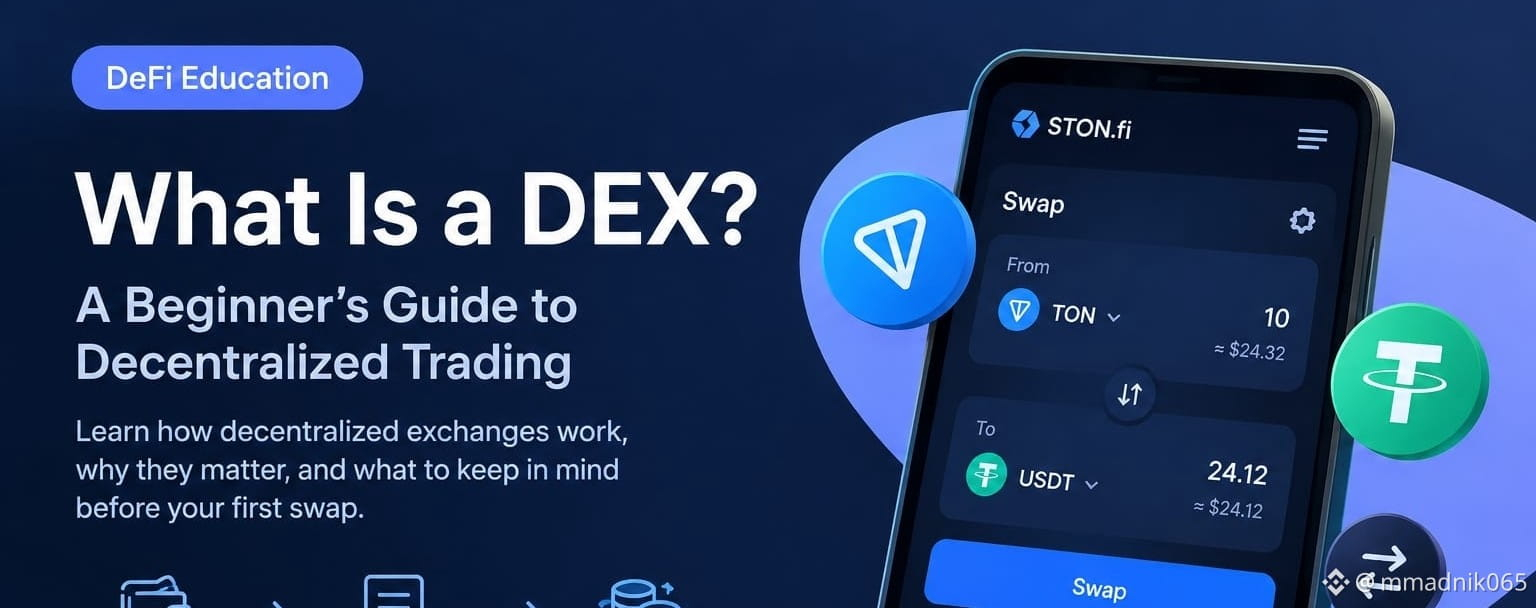
What Is a DEX?What Is a DEX? A Simple Guide to Decentralized Trading
When I first started learning about crypto, I realized that buying a token is only one part of the process. Understanding where and how a trade happens is important too.
One option is a decentralized exchange, commonly called a DEX.
What exactly is a DEX?
A DEX is a platform that allows users to exchange cryptocurrencies through blockchain-based smart contracts rather than relying on a centralized company to hold and process their trades.
Instead of depositing funds into a traditional exchange account, users generally connect their own wallets and authorize transactions themselves.
How does a DEX work?
Most DEXs use liquidity pools. These pools contain tokens supplied by liquidity providers, allowing other users to swap one token for another.
For example, if you want to exchange one supported token for another, the DEX calculates the expected output using the available liquidity and the pool's pricing mechanism.
Before confirming a swap, it's worth checking the expected amount received, transaction fees, and price impact.
DEX vs. centralized exchange
A centralized exchange usually manages trading through its own platform and may hold users' deposited assets.
A DEX generally allows users to trade directly from their own wallets through smart contracts.
Neither option is risk-free. Centralized exchanges have custody and platform risks, while DEX users must pay attention to smart-contract security, fake tokens, malicious websites, and transaction approvals.
Where can beginners learn more?
If you're new to decentralized trading, "WhatIsDEX.com" (https://whatisdex.com/) is a useful starting point for exploring the basic concepts behind decentralized exchanges.
For a practical example on The Open Network (TON), "STON.fi" (https://ston.fi/) lets users explore token swaps and decentralized trading.
Remember that connecting a wallet does not mean every transaction is safe. Always verify the website, check token addresses, and read transaction details before signing.
My takeaway: A DEX gives users another way to exchange crypto while maintaining control of their wallets, but that control also comes with responsibility. Understanding liquidity, fees, and security before your first swap can help you make better-informed decisions.
$STON $GRAM
#STONfi #DEX
What Is a DEX?
What Is a DEX? A Simple Guide to Decentralized Trading
When I first started learning about crypto, I realized that buying a token is only one part of the process. Understanding where and how a trade happens is important too.
One option is a decentralized exchange, commonly called a DEX.
What exactly is a DEX?
A DEX is a platform that allows users to exchange cryptocurrencies through blockchain-based smart contracts rather than relying on a centralized company to hold and process their trades.
Instead of depositing funds into a traditional exchange account, users generally connect their own wallets and authorize transactions themselves.
How does a DEX work?
Most DEXs use liquidity pools. These pools contain tokens supplied by liquidity providers, allowing other users to swap one token for another.
For example, if you want to exchange one supported token for another, the DEX calculates the expected output using the available liquidity and the pool's pricing mechanism.
Before confirming a swap, it's worth checking the expected amount received, transaction fees, and price impact.
DEX vs. centralized exchange
A centralized exchange usually manages trading through its own platform and may hold users' deposited assets.
A DEX generally allows users to trade directly from their own wallets through smart contracts.
Neither option is risk-free. Centralized exchanges have custody and platform risks, while DEX users must pay attention to smart-contract security, fake tokens, malicious websites, and transaction approvals.
Where can beginners learn more?
If you're new to decentralized trading, "WhatIsDEX.com" (https://whatisdex.com/) is a useful starting point for exploring the basic concepts behind decentralized exchanges.
For a practical example on The Open Network (TON), "STON.fi" (https://ston.fi/) lets users explore token swaps and decentralized trading.
Remember that connecting a wallet does not mean every transaction is safe. Always verify the website, check token addresses, and read transaction details before signing.
My takeaway: A DEX gives users another way to exchange crypto while maintaining control of their wallets, but that control also comes with responsibility. Understanding liquidity, fees, and security before your first swap can help you make better-informed decisions.
$STON $GRAM
#STONfi #DEX
1
269

·
--
Bullish
📉 Slippage and Price Impact: do you really know the difference?
You swapped a small token and got noticeably less than you expected. You check the fee, and it’s tiny. Where did the money go? 🤔
Most likely, slippage isn’t to blame—Price Impact is. People mix them up all the time, so here’s the short and simple version.
💥 Price Impact
This is what your own trade does to the pool. You buy, the price shifts, and you pay for that shift.
⏱️ Slippage
This is what happens between the moment you see a quote and the moment your trade is executed. The market may have moved while your transaction was processing.
🧮 Example with no fees
The pool has 1000 USDT and 1000 tokens. You swap 100 USDT.
At a 1:1 rate, you expect about 100 tokens. You get around 91.
That nearly 9% is the price impact. And the only reason is that the pool is small.
The same 100 USDT in a pool that’s 100 times deeper? Almost no impact 😌
✅ Before any swap, check two things
🔹 Price Impact: a high number means the pool is small or your trade is too large
🔹 Minimum received: the minimum you’re willing to accept. This protects you from slippage
📚 Just getting familiar with the topic and want to first understand how a DEX works? Start here:
https://whatisdex.com/
#DEX #DeFi #STONfi #Slippage #PriceImpact

91

·
--
🚨 ROBINHOOD DEX VOLUME SURGES TO $10.5B AS LIQUIDITY ROTATES INTO $SOPH ! ⚡
Retail capital is flooding back into decentralized venues with Robinhood Chain spot volume exploding 3.5x to $10.5B since August. 📊 That massive liquidity expansion catapulted the network into second place overall, driving intense market focus toward ecosystem runners like $SOPH and $SOLV . 🌊
Yet order flow data highlights a critical structural dynamic: roughly 79% of trading activity is locked within Uniswap liquidity pools. 💡 While smart money is aggressively bidding the momentum expansion, heavy concentration means sharp swings if market makers recalibrate their depth. 🔍
💬 Do you view this volume surge as a sustained retail breakout, or will concentration risk spark a pullback? 👇
⚠️ Not financial advice. Always manage your risk. 🛡️
🏷️ #SOPH #SOLV #DEX #Crypto #Liquidity
⚡ 🦈
8
Log in to explore more content
Join global crypto users on Binance Square
⚡️ Get latest and useful information about crypto.
💬 Trusted by the world’s largest crypto exchange.
👍 Discover real insights from verified creators.
Email / Phone number
Trending Topics
1
#BinancePick
2.9M views
150,181 Discussing
2
#EarningsSeason
5.2M views
25,603 Discussing
3
#AnthropicTTMRevenueGrewAbout1200%
11,039 views
276 Discussing
4
#AnthropicS1ExpectedToday
14,322 views
248 Discussing
5
#SouthKoreaReportedlyWeighsFourthCryptoTaxDelay
21,291 views
387 Discussing
6
#FranklinTempletonFilesForTwoDividendToBitcoinETFs
28,641 views
483 Discussing
7
#StrategyMSTRSurpassesNasdaqInMarketCap
22,052 views
347 Discussing
8
#CanadaProposesStablecoinRedemptionWithin3BusinessDays
999 views
34 Discussing
9
#ElectrumWalletBugLetRogueServersStealFunds
24,710 views
435 Discussing
10
#ArgentineCourtDismissesLIBRACaseAgainstMilei
37,535 views
537 Discussing