

#layer2
layer2
4.4M views
25,286 Discussing
Hot
Latest

·
--
🛡️ Layer 2 fees may be low, but security still matters.
Before bridging funds, check:
• The bridge’s security model
• Smart contract and validator risks
• Withdrawal delays and fees
• Official URLs and network details
Cheaper transactions ≠ zero risk.
Do you check bridge security before using it?
#Ethereum #Layer2 #Web3 $ETH
{spot}(ETHUSDT)
🛡️ Layer 2 fees may be low, but security still matters.
Before bridging funds, check:
• The bridge’s security model
• Smart contract and validator risks
• Withdrawal delays and fees
• Official URLs and network details
Cheaper transactions ≠ zero risk.
Do you check bridge security before using it?
#Ethereum #Layer2 #Web3 $ETH
Before bridging funds, check:
• The bridge’s security model
• Smart contract and validator risks
• Withdrawal delays and fees
• Official URLs and network details
Cheaper transactions ≠ zero risk.
Do you check bridge security before using it?
#Ethereum #Layer2 #Web3 $ETH
54

·
--
Bitcoin Hyper is heating up the BTC Layer-2 landscape! 🔥 Ahead of its official launch on Nov 26, the project just rolled out its new wallet, backed by an impressive $33M presale and a 35% APY staking yield.
With testnet momentum building, early participants are watching closely for high-yield potential. Is this the next major Bitcoin L2 to watch? Keep an eye on this space as the countdown begins! ⚡
#Bitcoin #CryptoNews #Layer2
With testnet momentum building, early participants are watching closely for high-yield potential. Is this the next major Bitcoin L2 to watch? Keep an eye on this space as the countdown begins! ⚡
#Bitcoin #CryptoNews #Layer2
59
·
--
Optimistic Rollups vs. ZK Rollups 🧵
Both help scale Ethereum, but they verify transactions differently.
🔹 Optimistic Rollups: assume transactions are valid unless challenged with a fraud proof.
🔹 ZK Rollups: use cryptographic validity proofs.
Which approach will shape the future of $ETH scaling?
#Ethereum #Layer2
{future}(ETHUSDT)
Optimistic Rollups vs. ZK Rollups 🧵
Both help scale Ethereum, but they verify transactions differently.
🔹 Optimistic Rollups: assume transactions are valid unless challenged with a fraud proof.
🔹 ZK Rollups: use cryptographic validity proofs.
Which approach will shape the future of $ETH scaling?
#Ethereum #Layer2
Both help scale Ethereum, but they verify transactions differently.
🔹 Optimistic Rollups: assume transactions are valid unless challenged with a fraud proof.
🔹 ZK Rollups: use cryptographic validity proofs.
Which approach will shape the future of $ETH scaling?
#Ethereum #Layer2
82


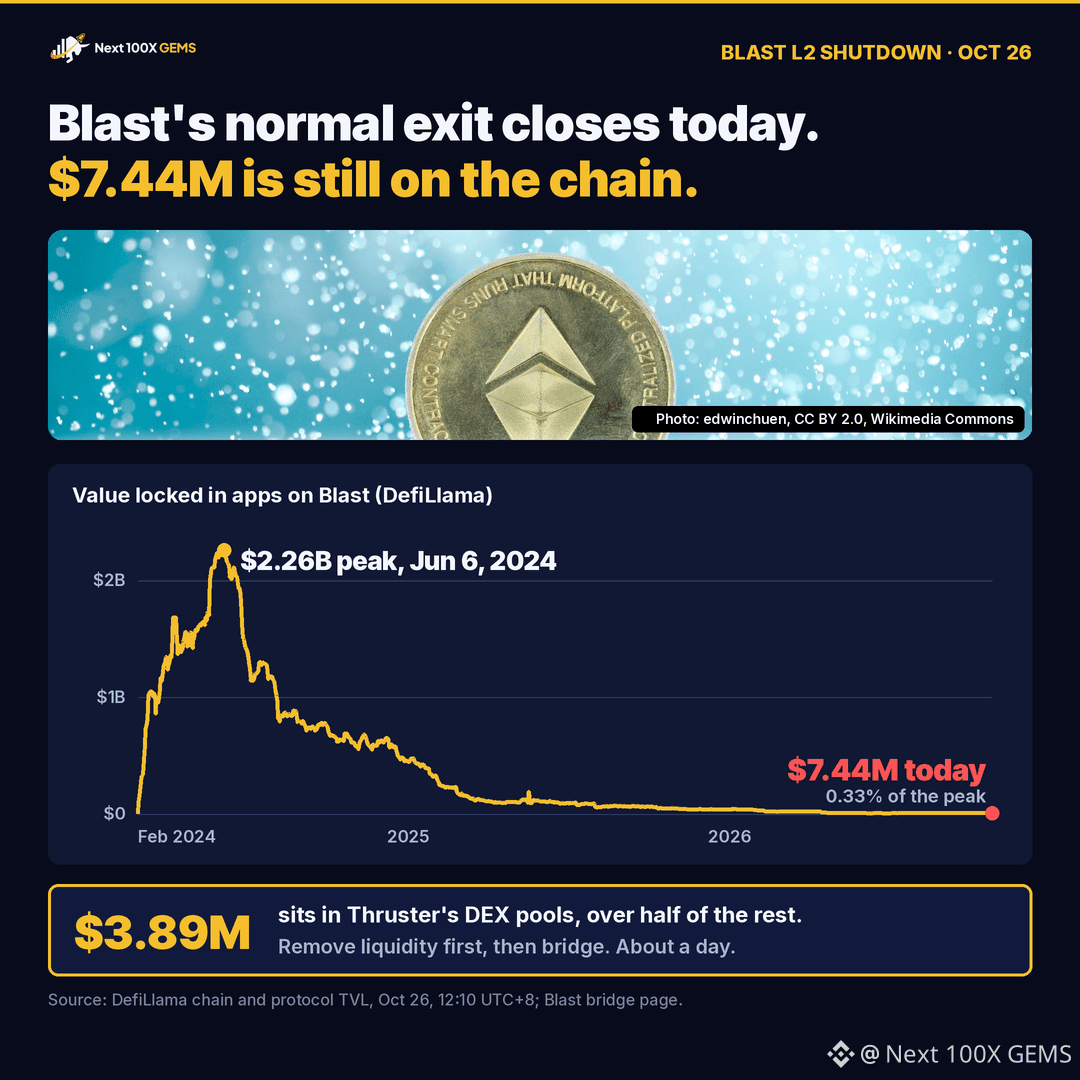
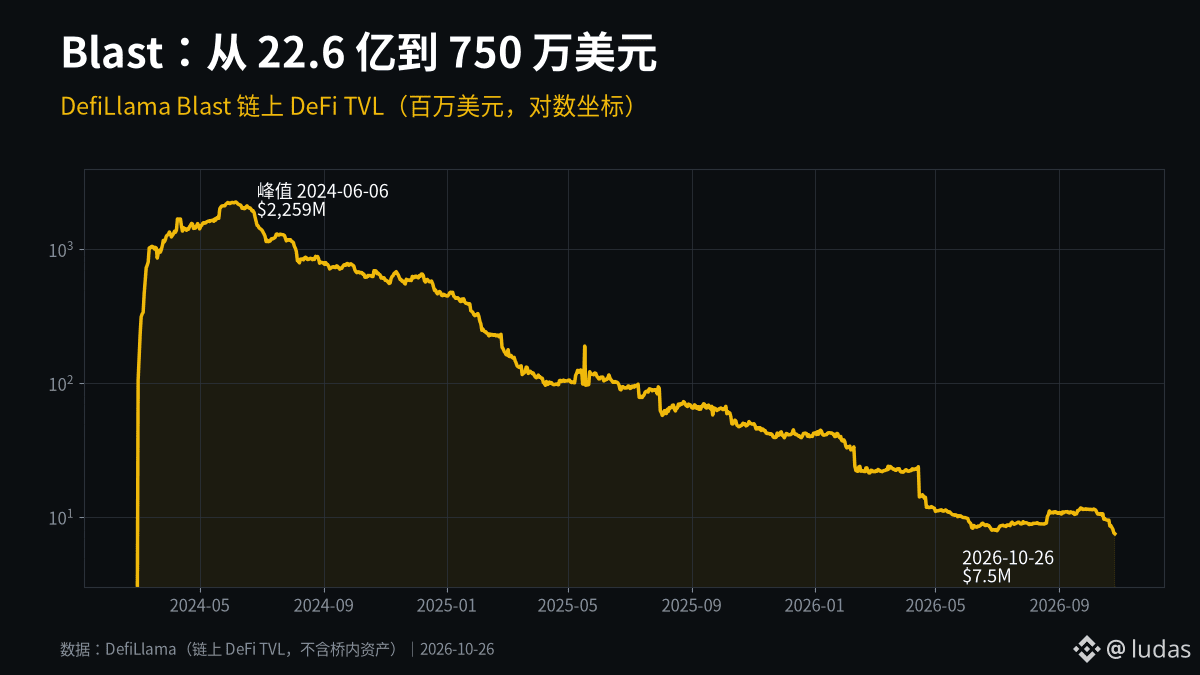
Blast's normal withdrawal route closes today, Oct 26, and DefiLlama still counts $7.44M sitting in apps on the chain.
That is about 0.33% of the $2.26B peak it recorded on June 6, 2024. The team announced the shutdown on Oct 2, saying the L2 costs more to run than it earns.
Over half of what's left sits in one DEX. Thruster's two pool versions hold about $3.89M (checked 12:10 UTC+8). LP tokens don't bridge on their own, so you remove the liquidity first and then bridge the coins back to Ethereum. Blast's bridge page says that leg takes about a day.
After today, Blast says funds can still come out, but only by calling its bridge contracts on Ethereum directly. It promised to publish instructions, and as of 12:10 UTC+8 its last post on X is a reminder from Oct 13.
Coinbase told users to move BLAST off before Oct 26 or lose access once the network shuts down.
Blast hasn't named a cutoff hour. If you still have anything on the chain, the PWA wallet included, start the exit now through the official Blast bridge. Anyone in your DMs offering to recover Blast funds is running a scam.
$BLAST
#Blast #Layer2
NFA. DYOR.
158

·
--
While everyone is busy arguing over short-term price charts around the 2308.96 mark for $ETH, the actual engineering reality of the network is shifting at a pace most retail desks are completely ignoring. The transition is no longer a theoretical roadmap; it is happening right now in the data plumbing of the Layer-2 ecosystem.
Looking closely at the on-chain metrics, daily active addresses and transaction throughput on rollups like Arbitrum and Optimism are soaking up the overwhelming majority of execution activity, leaving the base layer acting strictly as a high-security settlement layer. But the real structural evolution is happening in the zero-knowledge space. ZKsync and Starknet are aggressively compressing proof verification times, which is driving blob gas fees down to a fraction of last year's costs. This blob efficiency is the exact mechanism designed to make Ethereum scalable without sacrificing decentralization.
Bridge net inflows tell a clear story as well. Institutional capital is steadily rotating into these modular environments, favoring cryptographic validity over simple fraud-proof models. Meanwhile, developer commit frequency for core Ethereum clients remains unmatched across the entire crypto industry, providing a massive moat against fragmentation. When you combine this relentless developer activity with the automated supply burn governed by L2 data posting, the long-term fundamentals look entirely different from a standard high-inflation network. Are you seeing institutional capital lean heavier into ZK rollups or optimistic environments on your end?
#Layer2 #BlockchainScaling
While everyone is busy arguing over short-term price charts around the 2308.96 mark for $ETH , the actual engineering reality of the network is shifting at a pace most retail desks are completely ignoring. The transition is no longer a theoretical roadmap; it is happening right now in the data plumbing of the Layer-2 ecosystem.
Looking closely at the on-chain metrics, daily active addresses and transaction throughput on rollups like Arbitrum and Optimism are soaking up the overwhelming majority of execution activity, leaving the base layer acting strictly as a high-security settlement layer. But the real structural evolution is happening in the zero-knowledge space. ZKsync and Starknet are aggressively compressing proof verification times, which is driving blob gas fees down to a fraction of last year's costs. This blob efficiency is the exact mechanism designed to make Ethereum scalable without sacrificing decentralization.
Bridge net inflows tell a clear story as well. Institutional capital is steadily rotating into these modular environments, favoring cryptographic validity over simple fraud-proof models. Meanwhile, developer commit frequency for core Ethereum clients remains unmatched across the entire crypto industry, providing a massive moat against fragmentation. When you combine this relentless developer activity with the automated supply burn governed by L2 data posting, the long-term fundamentals look entirely different from a standard high-inflation network. Are you seeing institutional capital lean heavier into ZK rollups or optimistic environments on your end?
#Layer2 #BlockchainScaling
1
28

Arbitrum is leading the charge for Layer-2 networks, showing strong momentum with an active surge that has pushed it straight into today's top gainers! 💥
The network fundamentals have never looked stronger, with $ARB absorbing massive liquidity as dApp ecosystems across Ethereum search for cheap, lightning-fast settlement layers.
Key Metrics Driving This Pump:
🔹 Sudden influx of trading volume over the last 24 hours.
🔹 Massive increase in total transactions settled on-chain.
🔹 A decisive breakout from its multi-week horizontal range.
When large-cap utility tokens start pumping with volume like this, it usually signals that smart money is taking positions.
What is your next price target for $ARB? Are you going long or taking profits? Let's discuss! 📊
#ARBİTRUM #Layer2 #Ethereum #Altcoins
Arbitrum is leading the charge for Layer-2 networks, showing strong momentum with an active surge that has pushed it straight into today's top gainers! 💥
The network fundamentals have never looked stronger, with $ARB absorbing massive liquidity as dApp ecosystems across Ethereum search for cheap, lightning-fast settlement layers.
Key Metrics Driving This Pump:
🔹 Sudden influx of trading volume over the last 24 hours.
🔹 Massive increase in total transactions settled on-chain.
🔹 A decisive breakout from its multi-week horizontal range.
When large-cap utility tokens start pumping with volume like this, it usually signals that smart money is taking positions.
What is your next price target for $ARB ? Are you going long or taking profits? Let's discuss! 📊
#ARBİTRUM #Layer2 #Ethereum #Altcoins
243

Bitcoin Hyper ($HYPER ) - Part 2 | My Accumulation Plan 🚀
Part 1 got 282+ Views, thanks for the support!
Quick Update: BTC is down -1.34% but HYPER is holding better -0.47% - This is strength!
My Plan for $HYPER:
1️⃣ Why I like it: Bitcoin's Fast Layer-2 narrative is getting hot on Binance Square
2️⃣ My Entry: DCA on dips, not FOMO on pumps
3️⃣ My View: If BTC holds $80K, Layer-2 tokens could run fast
This is not financial advice. DYOR!
Are you buying $HYPER on this dip or waiting? Let's discuss 👇
$BTC
{spot}(BTCUSDT)
#BitcoinHyper #Layer2 #crypto #BinanceSquare #BTC☀
Bitcoin Hyper ($HYPER ) - Part 2 | My Accumulation Plan 🚀
Part 1 got 282+ Views, thanks for the support!
Quick Update: BTC is down -1.34% but HYPER is holding better -0.47% - This is strength!
My Plan for $HYPER :
1️⃣ Why I like it: Bitcoin's Fast Layer-2 narrative is getting hot on Binance Square
2️⃣ My Entry: DCA on dips, not FOMO on pumps
3️⃣ My View: If BTC holds $80K, Layer-2 tokens could run fast
This is not financial advice. DYOR!
Are you buying $HYPER on this dip or waiting? Let's discuss 👇
$BTC
#BitcoinHyper #Layer2 #crypto #BinanceSquare #BTC☀
2
264
·
--
Article
Ethereum Blobs Explained: How EIP-4844 Helps Layer 2 ScaleEthereum Blobs Explained: How EIP-4844 Helps Layer 2 Scale
Ethereum scaling isn't just about processing more transactions. It's also about making transaction data cheaper to publish and verify.
That's where blobs come in.
1. What are Ethereum blobs?
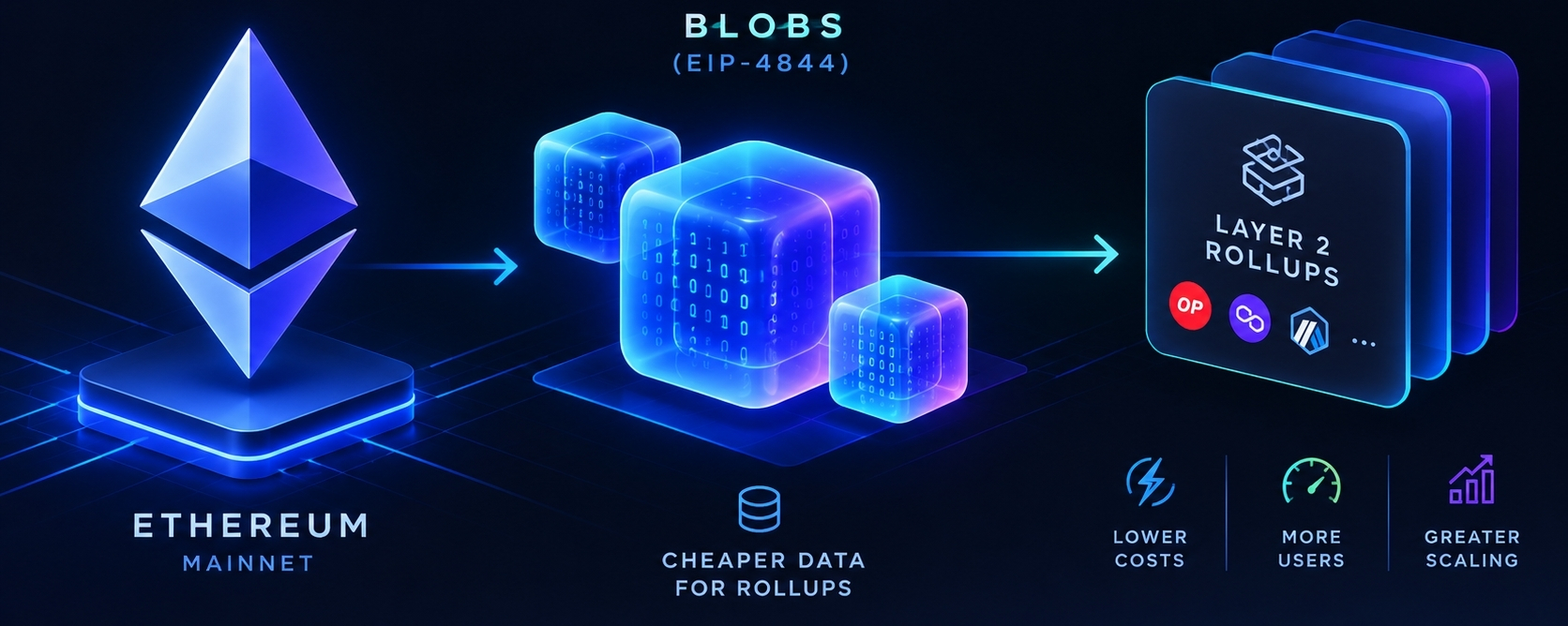
Blobs are temporary data packages introduced by EIP-4844, also known as Proto-Danksharding, as part of Ethereum's Dencun upgrade.
They give Layer 2 rollups a more cost-efficient way to publish transaction data to Ethereum.
Previously, rollups commonly used transaction calldata, which competes with regular Ethereum transactions for execution gas.
Blobs provide a separate data-fee market designed for this specific purpose.
2. Why do Layer 2 networks need them?
Layer 2 rollups process transactions outside Ethereum's main execution layer and submit batches of data back to Ethereum.
This helps scale transaction processing, but publishing data to Ethereum can be expensive.
Blobs help by providing:
🔹 Lower data costs: Rollups can publish data more cheaply than using calldata in many circumstances.
🔹 A separate fee market: Blob fees are calculated separately from ordinary execution gas fees.
🔹 Better scaling potential: Lower data costs can help rollups serve more users economically.
However, savings vary with network demand, rollup design, and other transaction costs. Lower blob fees don't automatically mean every transaction on every L2 becomes cheap.
3. Are blobs permanent storage?
No—and this distinction matters.
Blob data is not permanently stored by Ethereum's consensus protocol. Under EIP-4844, nodes are required to retain blob data for a limited period, initially about 18 days.
The blob's commitment remains available on-chain, but that commitment is not the same as the complete original data.
Rollups and other ecosystem participants may preserve historical data through their own infrastructure.
This design reduces long-term data-storage requirements while supporting the availability needs of rollups.
4. Do blobs make Ethereum infinitely scalable?
Not by themselves.
EIP-4844 was an intermediate step toward Ethereum's broader scaling roadmap.
Blobs improved the way rollups publish data, but the network still has capacity limits. Blob demand, fee levels, node requirements, and rollup architecture continue to matter.
Future data-availability improvements aim to increase capacity while maintaining Ethereum's security and decentralization goals.
5. What should users understand?
If you use an Ethereum Layer 2 network, remember three things:
• Lower data costs can help reduce transaction fees, but they don't guarantee a particular fee.
• Different rollups have different architectures, costs, and security assumptions.
• Ethereum scaling involves more than transaction speed. Data availability and the ability to verify transactions are also essential.
My takeaway: Ethereum blobs are an important infrastructure upgrade—not a magic solution. They help rollups publish data more efficiently while Ethereum continues working toward greater scalability.
Sources for further reading
1. Ethereum.org — Danksharding roadmap: https://ethereum.org/roadmap/danksharding
2. Ethereum Improvement Proposals — EIP-4844: https://eips.ethereum.org/EIPS/eip-4844
3. Ethereum.org — Blockchain data storage strategies: https://ethereum.org/developers/docs/data-availability/blockchain-data-storage-strategies/
What do you think matters most for Ethereum's future: cheaper L2 transactions, stronger decentralization, or greater data availability?
$ETH
#Ethereum #Layer2 #Web3 #Crypto
Ethereum Blobs Explained: How EIP-4844 Helps Layer 2 Scale
Ethereum Blobs Explained: How EIP-4844 Helps Layer 2 Scale
Ethereum scaling isn't just about processing more transactions. It's also about making transaction data cheaper to publish and verify.
That's where blobs come in.
1. What are Ethereum blobs?
Blobs are temporary data packages introduced by EIP-4844, also known as Proto-Danksharding, as part of Ethereum's Dencun upgrade.
They give Layer 2 rollups a more cost-efficient way to publish transaction data to Ethereum.
Previously, rollups commonly used transaction calldata, which competes with regular Ethereum transactions for execution gas.
Blobs provide a separate data-fee market designed for this specific purpose.
2. Why do Layer 2 networks need them?
Layer 2 rollups process transactions outside Ethereum's main execution layer and submit batches of data back to Ethereum.
This helps scale transaction processing, but publishing data to Ethereum can be expensive.
Blobs help by providing:
🔹 Lower data costs: Rollups can publish data more cheaply than using calldata in many circumstances.
🔹 A separate fee market: Blob fees are calculated separately from ordinary execution gas fees.
🔹 Better scaling potential: Lower data costs can help rollups serve more users economically.
However, savings vary with network demand, rollup design, and other transaction costs. Lower blob fees don't automatically mean every transaction on every L2 becomes cheap.
3. Are blobs permanent storage?
No—and this distinction matters.
Blob data is not permanently stored by Ethereum's consensus protocol. Under EIP-4844, nodes are required to retain blob data for a limited period, initially about 18 days.
The blob's commitment remains available on-chain, but that commitment is not the same as the complete original data.
Rollups and other ecosystem participants may preserve historical data through their own infrastructure.
This design reduces long-term data-storage requirements while supporting the availability needs of rollups.
4. Do blobs make Ethereum infinitely scalable?
Not by themselves.
EIP-4844 was an intermediate step toward Ethereum's broader scaling roadmap.
Blobs improved the way rollups publish data, but the network still has capacity limits. Blob demand, fee levels, node requirements, and rollup architecture continue to matter.
Future data-availability improvements aim to increase capacity while maintaining Ethereum's security and decentralization goals.
5. What should users understand?
If you use an Ethereum Layer 2 network, remember three things:
• Lower data costs can help reduce transaction fees, but they don't guarantee a particular fee.
• Different rollups have different architectures, costs, and security assumptions.
• Ethereum scaling involves more than transaction speed. Data availability and the ability to verify transactions are also essential.
My takeaway: Ethereum blobs are an important infrastructure upgrade—not a magic solution. They help rollups publish data more efficiently while Ethereum continues working toward greater scalability.
Sources for further reading
1. Ethereum.org — Danksharding roadmap: https://ethereum.org/roadmap/danksharding
2. Ethereum Improvement Proposals — EIP-4844: https://eips.ethereum.org/EIPS/eip-4844
3. Ethereum.org — Blockchain data storage strategies: https://ethereum.org/developers/docs/data-availability/blockchain-data-storage-strategies/
What do you think matters most for Ethereum's future: cheaper L2 transactions, stronger decentralization, or greater data availability?
$ETH
#Ethereum #Layer2 #Web3 #Crypto
57

·
--
Arbitrum plans to push Stylus forward again. This should be good news for Layer 2 scaling technology: bringing languages like Rust, C, and C++ into smart contract development opens up exciting possibilities for performance and lowering the barrier to entry.
But the controversy centers on who gets to approve new contracts. If deploying or activating a contract requires additional permission, developers will naturally worry: could this shift from “permissionless innovation” toward “approval-based launches”? It should be made clear who sets the approval criteria, whether decisions can be appealed, and whether these powers could be abused.
Technical upgrades are welcome, but governance boundaries are just as important. For Arbitrum, whether Stylus can earn trust depends not only on performance gains, but also on how it preserves decentralization and the principle of permissionlessness. Holders of $ARB should also keep a close eye on the proposal details.
#Arbitrum #Stylus #Layer2

·
--
Arbitrum plans to relaunch Stylus, but the controversy is about more than technology: who should control the approval of new contracts?
Stylus certainly has plenty of potential. Languages such as Rust, C, and C++ could join the ecosystem and interoperate with the EVM, potentially lowering gas costs and improving performance, while attracting gaming and other applications with frequent interactions. But if deploying new contracts requires additional approval, the “permissionless deployment” developers care most about will be compromised.
Security and risk management are understandable, but the core questions are whether approval rules are transparent, how authority is constrained, and how developers can appeal mistaken decisions. Layer 2 competition is no longer just about fees and TVL—it is also about credible neutrality. Technical upgrades can be rolled out in stages, but concentrating authority can easily create path dependence.
We hope Arbitrum clarifies the boundaries and timelines for approvals, as well as its decentralization roadmap. Don’t let Stylus become a tool that’s “easier to use, but harder to deploy freely.”
$ARB
#Arbitrum #Stylus #Layer2

Arbitrum wants to bring Stylus back, but the community has already argued itself into a frenzy. The controversy is not about the technology itself—being able to write contracts in Rust, C, and C++ is indeed a huge draw for developers—but about the accompanying "new contract approval authority": who gets to decide which contracts can be deployed, based on what criteria, and can those decisions be revoked? In other words, a layer 2 that originally prides itself on being permissionless would be given a centralized gate.
Supporters believe that a phased rollout and approval-before-launch can control risk, especially since the interaction boundaries between Stylus and EVM contracts still need time to be validated. Opponents worry that once approval power becomes entrenched, Arbitrum will slide from a "permissionless network" into a "licensed network," bringing censorship and power rent-seeking along with it—and power, once handed out, is easy to give but hard to take back.
What I care about more are three questions: whether the approval standards will be public and transparent, whether rejected projects will have an appeals path, and whether this mechanism is a temporary transition or something permanently written into governance. Technical upgrades can wait, but the governance bottom line cannot be surrendered. The voting weight of $ARB holders this time may be heavier than imagined.
#Arbitrum #Stylus #Layer2
Arbitrum is moving forward with Stylus again, which was a technical development worth watching: contracts written in Rust and C/C++ can interoperate on the same chain with EVM applications, while also opening up the possibility of lower costs for compute-intensive use cases. But the controversy in the community is not about Stylus itself; it is about the accompanying “new contract approval authority.”
The key questions are: Who has the authority to approve or reject contracts going live? Are the approval criteria transparent? Can developers appeal a rejection? Is this authority time-limited? If control over the gateway rests with a small number of multisig signers or the team, “permissionless deployment” could become “deployment by permission,” creating unfair barriers for major projects and anonymous teams.
Security reviews and risk isolation are understandable, but temporary powers must have clear boundaries, on-chain disclosure, timelocks, and an exit mechanism. Otherwise, a single technical upgrade could also rewrite Arbitrum’s commitment to openness. $ARB #Arbitrum #Stylus #Layer2
2
·
--
Arbitrum is planning to push Stylus forward again. It should be a positive development, attracting Rust and C/C++ developers and lowering the barrier to building high-performance contracts. But the proposal has sparked controversy over new contract approval permissions. Supporters say this is a security gate before launch that can filter out high-risk implementations; critics worry that opaque approval boundaries could reintroduce permission hurdles into the ecosystem, effectively creating a deployment whitelist.
The key issue is not just whether the technology works, but who has the authority to approve contracts, what standards they use, and who is responsible when something goes wrong. Without transparent governance rules, even a performance upgrade could come at the cost of trust.
Are you more optimistic about the ecosystem growth Stylus could bring, or wary of tighter controls on contract deployment?
$ARB #Arbitrum #Stylus #Layer2
Arbitrum’s renewed push to launch Stylus should have been good news for the ecosystem: languages such as Rust, C, and C++ can be used in the EVM+ development environment, supporting high-performance applications and bringing in new developers. But the real controversy isn’t about the technology—it’s about the accompanying “new contract approval authority.”
The key questions are: Who has the authority to approve contracts? Is the approval process transparent? Can that authority be limited or revoked? How will audit standards, lines of responsibility, and emergency pause mechanisms be designed? If the authority is too broad, deployment may become more efficient, but DAOs and users will also take on additional trust assumptions. If the governance terms, timelocks, and oversight mechanisms are sufficiently clear, Stylus will look more like a long-term upgrade in capabilities.
The benefits shouldn’t be judged by the narrative alone; we also need to look at how authority is allocated. $ARB holders and developers should pay closer attention to the proposal’s details, not just the launch timeline.
#Arbitrum #Stylus #Layer2
1
·
--
Arbitrum plans to relaunch Stylus. This should be good news for the Layer 2 developer ecosystem, but the addition of contract approval powers has sparked controversy.
Stylus lets developers write contracts in languages such as Rust, C, and C++, lowering the barrier to deploying high-performance applications. But what the community really cares about is this: Will new contracts need additional approval before going live? Could this turn on-chain deployment, which was originally meant to be permissionless, into a mechanism with access controls?
Supporters believe that introducing reviews early can reduce risks and prevent serious vulnerabilities. Critics worry that if approval powers remain in place long term, they could undermine Arbitrum’s decentralization and affect developers’ expectations. A technical upgrade is never just a technical issue; ultimately, it comes down to governance and the boundaries of authority.
The key now is how the official team explains who will approve contracts, how long the process will take, and how the approval mechanism can be removed. If it is only a temporary safeguard, the community may accept it; if the scope of these powers remains unclear, holders of $ARB will likely keep asking questions.
#Arbitrum #Stylus #Layer2
1

·
--
Arbitrum plans to resume pushing Stylus forward, originally to bring languages like Rust and C/C++ into smart contract development and lower the barrier to deploying high-performance applications. But what has really sparked controversy is the accompanying “new contract approval authority.”
The key questions are: Who gets to decide which Stylus contracts can go live? Are the approval standards transparent? Could this authority become a gateway to censorship, or be overused in an emergency? If deployment control is too centralized, developers may worry about the ecosystem’s freedom; if there is no review mechanism at all, security risks could grow.
The technical upgrade is worth looking forward to, but the design of this authority must first be clearly explained: its boundaries, time limits, review process, and community veto mechanism should all be openly discussed and put to a vote. Layer 2 competition is not just about performance and ecosystem metrics—it is also about the credibility of governance. Holders of $ARB need to consider not only whether Stylus can bring new applications, but also whether Arbitrum is still following a decentralized path.
#Arbitrum #Stylus #Layer2
4

·
--
The deadline has arrived, but the funds haven’t all made it out. Blast’s withdrawal interface has expired, yet around $40 million in assets is still locked in the cross-chain bridge. That figure says more than any announcement could—not everyone can get out, and not everyone knows how.
The official solution is a contract-level exit guide. It sounds comprehensive, but in practice, users have to submit proof and then wait a day. For ordinary users, that’s already enough friction to put many off. USDB holders have it even worse: they have to claim DAI separately, adding another step to the exit process. The window has closed, but the process hasn’t gotten any simpler, leaving stranded funds as a stark reality on-chain.
Layer 2 exit mechanisms rarely get much scrutiny—until the deadline arrives and their costs become clear. The $40 million in the bridge is no small sum. It means some people either missed the deadline, got stuck at the proof stage, or simply didn’t know about the separate step for USDB. The withdrawal interface closing doesn’t mean assets arrive automatically. That gap is worth remembering for everyone who has used an L2.
#Blast #Layer2 #Cross-chain bridge
$ETH
1

·
--
Unichain Mainnet Handover to Optimism on 10/29: Paving the Way for Native Cross-Chain Transfers
According to Uniswap’s official blog and an Optimism governance proposal, Unichain is moving to OP Enterprise. The testnet switched over on 10/13, and the mainnet handover is targeted for 10/29, when Optimism will take over operations of the sequencer, RPC, monitoring, and incident response. The chain ID, contracts, balances, and Uniswap v2/v3/v4 deployments will remain unchanged, and Unichain will continue to be a Stage 1 rollup. The proposer and L1 fee routing will also be adjusted. The goal is to adopt native interoperability on the OP Stack, allowing users to transfer assets between Unichain and other OP chains without a bridge (starting with ETH).
【Take】
L2s are moving from “running everything themselves” toward specialized operations and a shared interoperability layer. This reduces the operational burden for the UNI ecosystem and expands the Superchain footprint for OP. The real turning point is not the change in operator, but whether liquidity returns once native interoperability goes live.
【Opportunities/Risks】
Watch whether the 10/29 transition goes smoothly and whether block production or fees fluctuate; also monitor TVL in the $UNI ecosystem and cross-chain bridge activity. Risks: technical issues during the migration window, an interoperability timeline that remains uncertain, and a narrative that gets ahead of actual delivery.
Which do you favor: “dedicated appchains” or “shared liquidity across the OP Superchain”?
#Unichain #Optimism #Layer2 $UNI $OP
For informational purposes only; not investment advice.

229
·
--
An L2 that once held $2.26 billion has officially shut down its regular withdrawal channel today—with about $40 million still sitting in the bridge ⚠️
📊 Key figures:
• DefiLlama: Blast’s on-chain DeFi TVL peaked at about $2.26 billion (2024-06-06); by 10/26, only about $7.5 million remained, a drop of over 99%
• TokenPost: Assets in the official Ethereum bridge totaled about $63.5 million on 10/2; as of 10/26, about $40.41 million remained
• On 10/2, Blast announced it would shut down, citing operating costs exceeding revenue and no viable path to sustainability
🧵 What if you haven’t withdrawn yet? Your assets aren’t lost, but you’ll need to follow a contract-level process (see the official docs):
1️⃣ Initiate a withdrawal on Blast
2️⃣ After up to about 1 hour, submit a proof to Ethereum’s OptimismPortal
3️⃣ Wait through the 1-day challenge period, then execute the final transaction
To withdraw $BLAST to Ethereum, you must enter the official L1 address 0x71b9…b1Fa. Entering the wrong address will lock your funds permanently; USDB also requires an additional claim for DAI.
⚠️ There will almost certainly be phishing attempts using fake “withdrawal assistants” during this period—only trust the official docs.
My take: TVL attracted by points and airdrops will leave as soon as the incentives stop. The $ETH L2 space is undergoing a shake-up, and “can it generate real fee revenue?” matters far more than peak TVL.
Do you still have assets on a chain that has shut down? Who will be next? 👇
#Blast #Layer2 #以太坊 #On-chainData
114

·
--
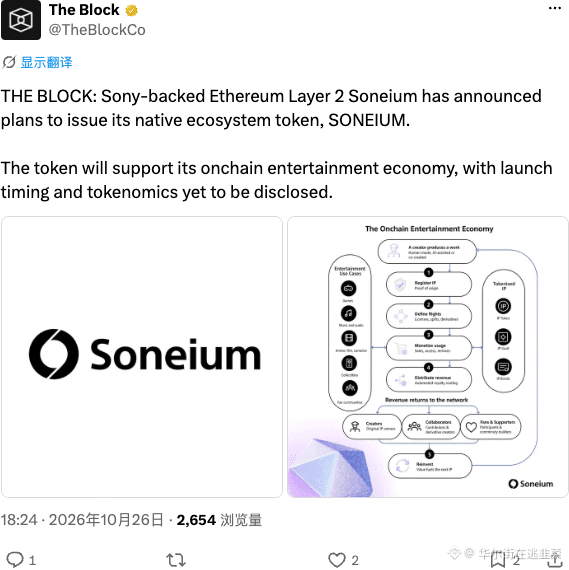
Sony-backed Soneium has finally launched its token, but we’re not quite ready to breathe easy yet.
Its positioning as an on-chain entertainment ecosystem makes sense, but the timing and tokenomics haven’t been announced yet, so there are still plenty of question marks. Sony IP alone can only carry it so far—as long as they don’t pull any extractive moves. The real test is whether the ecosystem can attract and sustain traffic. Waiting for something concrete.
SONEIUM
#Layer2
1
Log in to explore more content
Join global crypto users on Binance Square
⚡️ Get latest and useful information about crypto.
💬 Trusted by the world’s largest crypto exchange.
👍 Discover real insights from verified creators.
Email / Phone number
Trending Topics
1
#BinancePick
3.2M views
156,265 Discussing
2
#EarningsSeason
5.4M views
26,186 Discussing
3
#SouthKoreaConsidersEducationTaxOnCryptoExchanges
0 views
2 Discussing
4
#OCCUrgesCommunityBanksToEnterStablecoinPayments
0 views
0 Discussing
5
#RippleWinsFullApprovalAsNationalTrustBank
0 views
1 Discussing
6
#OndoToOpenSubscriptionsForOpenAIPreIPOTokenizedNotes
0 views
0 Discussing
7
#AnthropicTTMRevenueGrewAbout1200%
40,636 views
491 Discussing
8
#AnthropicS1ExpectedToday
33,379 views
382 Discussing
9
#SouthKoreaReportedlyWeighsFourthCryptoTaxDelay
35,527 views
513 Discussing
10
#FranklinTempletonFilesForTwoDividendToBitcoinETFs
46,947 views
588 Discussing