

Ansya
16.9k Posts

Ansya
Report
Block User
Web3 creator & on-chain analyst. Tracking decentralized infrastructure, tokenomics, and market dynamics to decode crypto's next wave.
Open Trade
Frequent Trader
7.7 Months
196 Following
4.7K+ Followers
3.2K+ Liked
Posts
Portfolio
All
Quotes
Live
·
--
Bullish
See translation
#secproposescryptocustodyrules
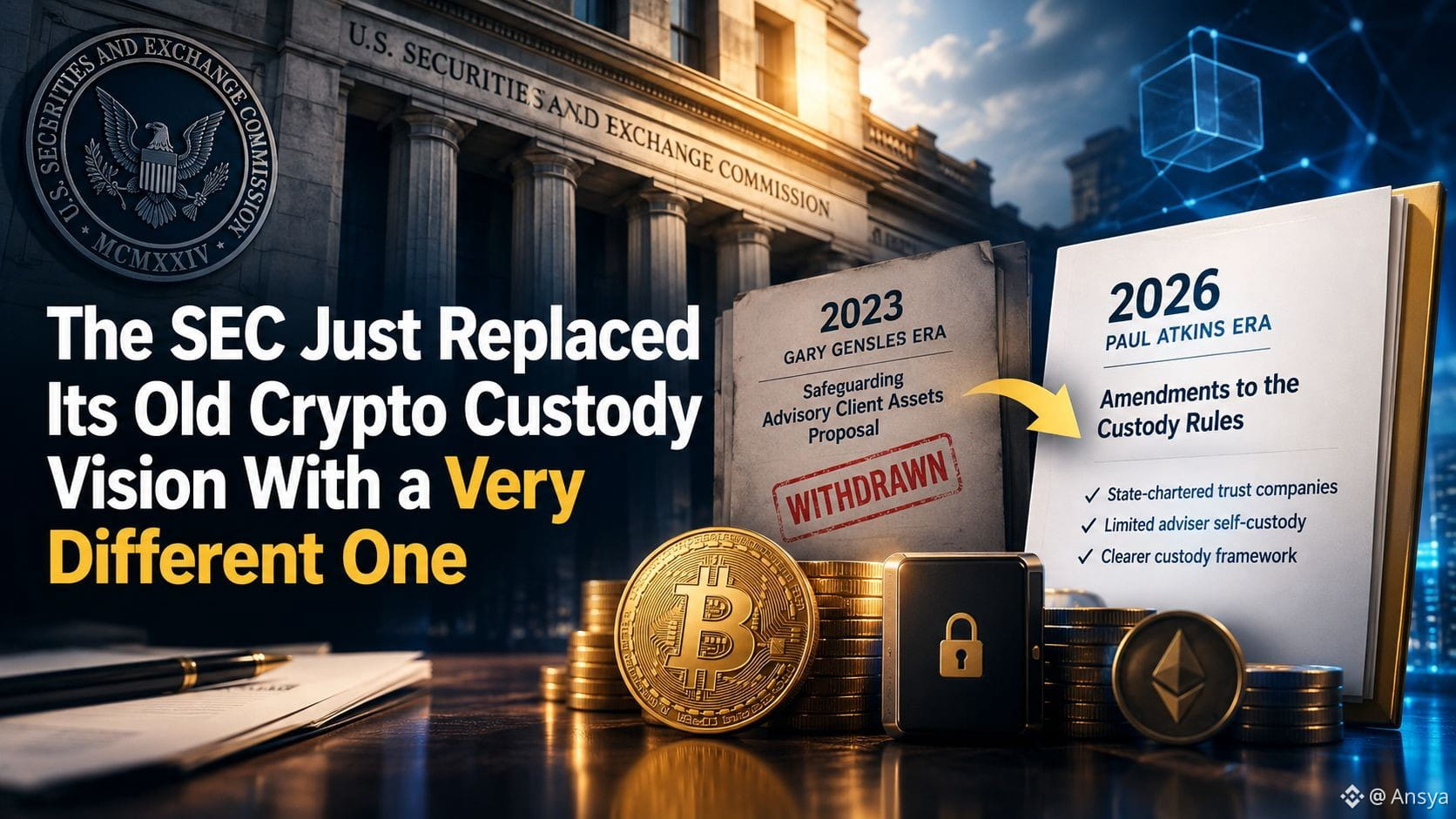
The SEC Just Scrapped Its Predecessor's Crypto Custody Plan — And Replaced It With a Very Different One
Crypto custody rules have been a moving target at the SEC for years, swinging between competing visions of investor protection. The agency's latest rewrite marks a clear departure from where things stood just three years ago.
Here's the backstory: the SEC's newly proposed "Amendments to the Custody Rules" formally replaces a 2023 safeguarding proposal from former Chair Gary Gensler, which would have expanded — not loosened — custody requirements around crypto assets, and was ultimately withdrawn without being finalized. The new framework, developed under current Chair Paul Atkins, instead aims to clarify how investment advisers and regulated funds can hold crypto assets, including opening a path for state-chartered trust companies to qualify as custodians and allowing limited self-custody by advisers when no outside custodian is available. The proposal builds on steps already taken this year — a September 2025 no-action letter permitting state-chartered trusts, and a December 2025 staff statement letting broker-dealers custody crypto securities directly. It now enters a 60-day public comment period before any final vote.
Why does this matter? The whiplash between Gensler's stricter 2023 approach and this year's more permissive rewrite illustrates how much crypto policy in the US still depends on who's chairing the agency at a given moment, rather than settled, durable law. For investment advisers who've spent years navigating genuine uncertainty about compliant crypto custody, a clearer framework — even one that could shift again under a future chair — offers a real near-term path forward.
Whether this version proves more lasting than its predecessor, or simply becomes the next chapter in an ongoing back-and-forth, is something only time will tell.
Does regulatory direction that swings this much with each new chair actually give the industry the stability it needs? 🤔
$VELVET $SAND $ONE
#secproposescryptocustodyrules
The SEC Just Scrapped Its Predecessor's Crypto Custody Plan — And Replaced It With a Very Different One
Crypto custody rules have been a moving target at the SEC for years, swinging between competing visions of investor protection. The agency's latest rewrite marks a clear departure from where things stood just three years ago.
Here's the backstory: the SEC's newly proposed "Amendments to the Custody Rules" formally replaces a 2023 safeguarding proposal from former Chair Gary Gensler, which would have expanded — not loosened — custody requirements around crypto assets, and was ultimately withdrawn without being finalized. The new framework, developed under current Chair Paul Atkins, instead aims to clarify how investment advisers and regulated funds can hold crypto assets, including opening a path for state-chartered trust companies to qualify as custodians and allowing limited self-custody by advisers when no outside custodian is available. The proposal builds on steps already taken this year — a September 2025 no-action letter permitting state-chartered trusts, and a December 2025 staff statement letting broker-dealers custody crypto securities directly. It now enters a 60-day public comment period before any final vote.
Why does this matter? The whiplash between Gensler's stricter 2023 approach and this year's more permissive rewrite illustrates how much crypto policy in the US still depends on who's chairing the agency at a given moment, rather than settled, durable law. For investment advisers who've spent years navigating genuine uncertainty about compliant crypto custody, a clearer framework — even one that could shift again under a future chair — offers a real near-term path forward.
Whether this version proves more lasting than its predecessor, or simply becomes the next chapter in an ongoing back-and-forth, is something only time will tell.
Does regulatory direction that swings this much with each new chair actually give the industry the stability it needs? 🤔
$VELVET $SAND $ONE
The SEC Just Scrapped Its Predecessor's Crypto Custody Plan — And Replaced It With a Very Different One
Crypto custody rules have been a moving target at the SEC for years, swinging between competing visions of investor protection. The agency's latest rewrite marks a clear departure from where things stood just three years ago.
Here's the backstory: the SEC's newly proposed "Amendments to the Custody Rules" formally replaces a 2023 safeguarding proposal from former Chair Gary Gensler, which would have expanded — not loosened — custody requirements around crypto assets, and was ultimately withdrawn without being finalized. The new framework, developed under current Chair Paul Atkins, instead aims to clarify how investment advisers and regulated funds can hold crypto assets, including opening a path for state-chartered trust companies to qualify as custodians and allowing limited self-custody by advisers when no outside custodian is available. The proposal builds on steps already taken this year — a September 2025 no-action letter permitting state-chartered trusts, and a December 2025 staff statement letting broker-dealers custody crypto securities directly. It now enters a 60-day public comment period before any final vote.
Why does this matter? The whiplash between Gensler's stricter 2023 approach and this year's more permissive rewrite illustrates how much crypto policy in the US still depends on who's chairing the agency at a given moment, rather than settled, durable law. For investment advisers who've spent years navigating genuine uncertainty about compliant crypto custody, a clearer framework — even one that could shift again under a future chair — offers a real near-term path forward.
Whether this version proves more lasting than its predecessor, or simply becomes the next chapter in an ongoing back-and-forth, is something only time will tell.
Does regulatory direction that swings this much with each new chair actually give the industry the stability it needs? 🤔
$VELVET $SAND $ONE
1
5
6.4k
·
--

Article
See translation
US Retail Traders Are About to Get Triple-Leveraged Bitcoin — Right in Their Brokerage Account#secapproves3xlongcryptocommodityetps
The SEC just cleared a product category that's existed in European markets for years but never made it onto US exchanges — amplified, daily-reset crypto exposure, available through regular retail brokerage accounts rather than offshore platforms or margin.
Here's what happened: on October 2, the SEC approved a rule change from Cboe BZX Exchange clearing six 3x leveraged exchange-traded products from Volatility Shares' VS Trust, covering Bitcoin, Ether, gold, silver, crude oil, and natural gas. The Bitcoin and Ether products will track regulated CME Group futures rather than holding the underlying assets directly, aiming to deliver three times the daily — not weekly or monthly — price move of their reference asset. Trading can't begin immediately, though; the products still need an effective S-1 registration before launch, and no specific date has been set. This marks the first US approval of triple-leveraged crypto ETPs, bundled in the same action alongside traditional commodity products, under an SEC that's taken a notably more open stance toward crypto products this year.
Why does this matter? Until now, US retail traders wanting amplified directional crypto bets had to rely on margin accounts, offshore perpetual futures, or products most domestic platforms don't list. Bringing that exposure into a regulated, exchange-listed wrapper lowers the barrier to leveraged crypto trading significantly — but daily resets mean returns over longer holding periods can diverge meaningfully from simple 3x price moves, a mechanic that's often misunderstood by newer traders.
Whether broader retail access to this kind of leverage changes market volatility patterns, or simply shifts where existing leveraged activity already occurring takes place, is worth watching once trading actually begins.
Does bringing leveraged crypto exposure into regulated markets make it safer, or just more accessible to traders who may not fully grasp the mechanics? 🤔
#bitcoin #Ethereum #SEC #LeveragedETP
US Retail Traders Are About to Get Triple-Leveraged Bitcoin — Right in Their Brokerage Account
#secapproves3xlongcryptocommodityetps
The SEC just cleared a product category that's existed in European markets for years but never made it onto US exchanges — amplified, daily-reset crypto exposure, available through regular retail brokerage accounts rather than offshore platforms or margin.
Here's what happened: on October 2, the SEC approved a rule change from Cboe BZX Exchange clearing six 3x leveraged exchange-traded products from Volatility Shares' VS Trust, covering Bitcoin, Ether, gold, silver, crude oil, and natural gas. The Bitcoin and Ether products will track regulated CME Group futures rather than holding the underlying assets directly, aiming to deliver three times the daily — not weekly or monthly — price move of their reference asset. Trading can't begin immediately, though; the products still need an effective S-1 registration before launch, and no specific date has been set. This marks the first US approval of triple-leveraged crypto ETPs, bundled in the same action alongside traditional commodity products, under an SEC that's taken a notably more open stance toward crypto products this year.
Why does this matter? Until now, US retail traders wanting amplified directional crypto bets had to rely on margin accounts, offshore perpetual futures, or products most domestic platforms don't list. Bringing that exposure into a regulated, exchange-listed wrapper lowers the barrier to leveraged crypto trading significantly — but daily resets mean returns over longer holding periods can diverge meaningfully from simple 3x price moves, a mechanic that's often misunderstood by newer traders.
Whether broader retail access to this kind of leverage changes market volatility patterns, or simply shifts where existing leveraged activity already occurring takes place, is worth watching once trading actually begins.
Does bringing leveraged crypto exposure into regulated markets make it safer, or just more accessible to traders who may not fully grasp the mechanics? 🤔
#bitcoin #Ethereum #SEC #LeveragedETP
The SEC just cleared a product category that's existed in European markets for years but never made it onto US exchanges — amplified, daily-reset crypto exposure, available through regular retail brokerage accounts rather than offshore platforms or margin.
Here's what happened: on October 2, the SEC approved a rule change from Cboe BZX Exchange clearing six 3x leveraged exchange-traded products from Volatility Shares' VS Trust, covering Bitcoin, Ether, gold, silver, crude oil, and natural gas. The Bitcoin and Ether products will track regulated CME Group futures rather than holding the underlying assets directly, aiming to deliver three times the daily — not weekly or monthly — price move of their reference asset. Trading can't begin immediately, though; the products still need an effective S-1 registration before launch, and no specific date has been set. This marks the first US approval of triple-leveraged crypto ETPs, bundled in the same action alongside traditional commodity products, under an SEC that's taken a notably more open stance toward crypto products this year.
Why does this matter? Until now, US retail traders wanting amplified directional crypto bets had to rely on margin accounts, offshore perpetual futures, or products most domestic platforms don't list. Bringing that exposure into a regulated, exchange-listed wrapper lowers the barrier to leveraged crypto trading significantly — but daily resets mean returns over longer holding periods can diverge meaningfully from simple 3x price moves, a mechanic that's often misunderstood by newer traders.
Whether broader retail access to this kind of leverage changes market volatility patterns, or simply shifts where existing leveraged activity already occurring takes place, is worth watching once trading actually begins.
Does bringing leveraged crypto exposure into regulated markets make it safer, or just more accessible to traders who may not fully grasp the mechanics? 🤔
#bitcoin #Ethereum #SEC #LeveragedETP
1
524
·
--
Bullish
See translation
#MASKHitsRecordMarketCapAbove$35M
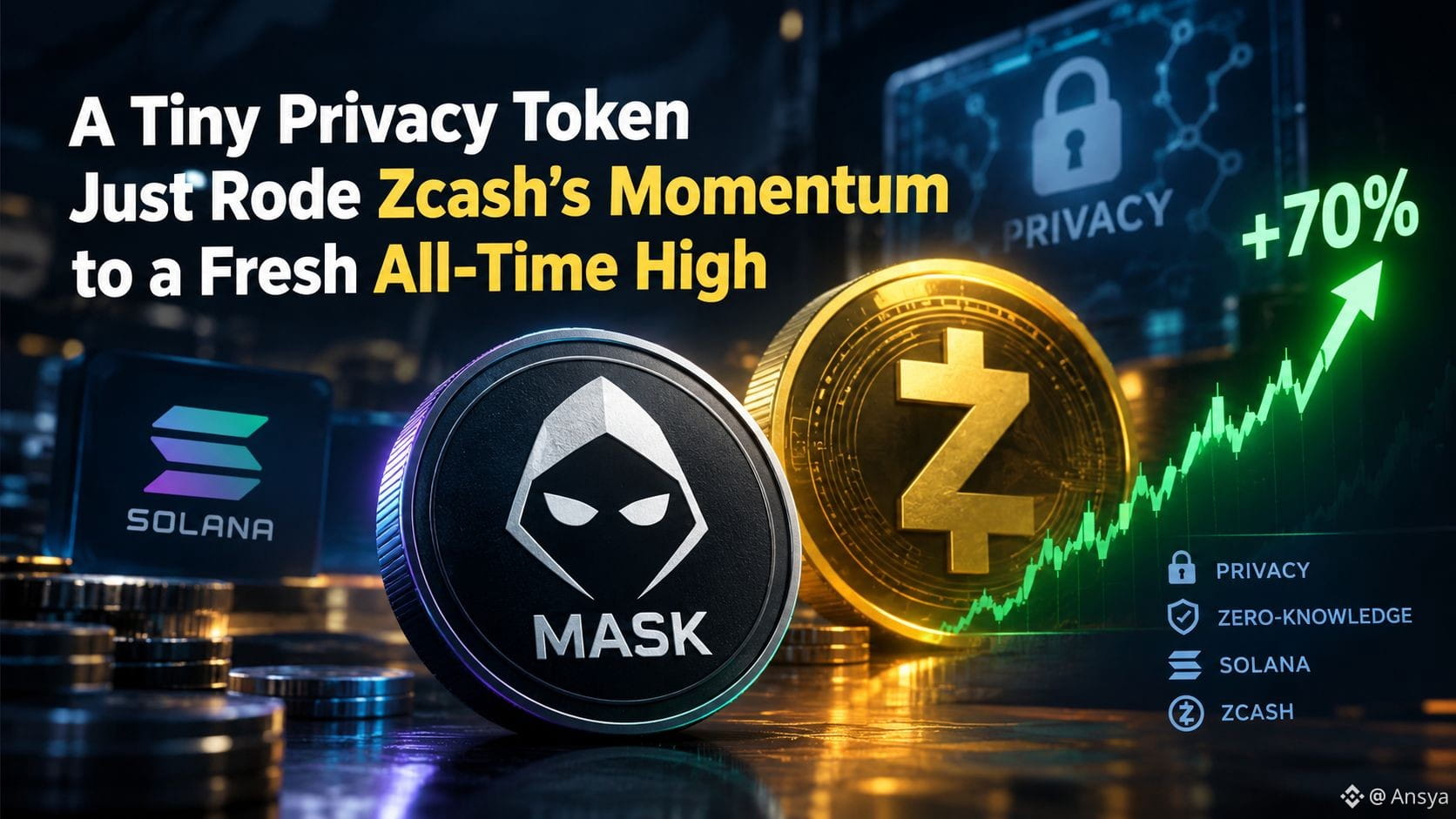
A Tiny Privacy Token Just Rode Zcash's Momentum to a Fresh All-Time High
While institutional money has been flowing into Zcash through new ETPs, a much smaller Solana-based project just caught a wave of its own — surging over 70% in a single day on the same privacy narrative.
Here's what happened: Nullmask's MASK token, a zero-knowledge privacy protocol built on Solana, pushed its market capitalization above $35 million on Friday, October 2 — the highest level the token has ever recorded, according to GMGN data. The token's price jumped more than 70% within 24 hours, with roughly $2.7 million in trading volume over the same period. MASK is structured around a ZEC/MASK liquidity pair, using Zcash as its base asset to provide zero-knowledge privacy services for crypto transactions. The rally comes in the same week Zcash itself has drawn significant attention — from Europe's first physically backed Zcash ETP launching on Euronext to a major mining firm expanding its credit line specifically to buy more ZEC — all part of a broader resurgence of interest in privacy-focused crypto this quarter.
Why does this matter? Small-cap tokens tied closely to a larger asset's narrative often see amplified moves when that narrative gains traction — MASK's rally appears to be riding directly on Zcash's renewed momentum rather than independent catalysts of its own. It's a useful illustration of how a sector-wide theme, once it builds real momentum, can ripple down into much smaller, higher-risk projects built around the same thesis.
Whether this reflects durable interest in privacy-focused infrastructure, or a short-lived move tied to Zcash's current spotlight, is something only time will tell.
Does a small token's surge like this reflect genuine conviction in its narrative, or just momentum borrowed from a bigger trend? 🤔
#Mask #zcash #Privacy #solana
#MASKHitsRecordMarketCapAbove$35M
A Tiny Privacy Token Just Rode Zcash's Momentum to a Fresh All-Time High
While institutional money has been flowing into Zcash through new ETPs, a much smaller Solana-based project just caught a wave of its own — surging over 70% in a single day on the same privacy narrative.
Here's what happened: Nullmask's MASK token, a zero-knowledge privacy protocol built on Solana, pushed its market capitalization above $35 million on Friday, October 2 — the highest level the token has ever recorded, according to GMGN data. The token's price jumped more than 70% within 24 hours, with roughly $2.7 million in trading volume over the same period. MASK is structured around a ZEC/MASK liquidity pair, using Zcash as its base asset to provide zero-knowledge privacy services for crypto transactions. The rally comes in the same week Zcash itself has drawn significant attention — from Europe's first physically backed Zcash ETP launching on Euronext to a major mining firm expanding its credit line specifically to buy more ZEC — all part of a broader resurgence of interest in privacy-focused crypto this quarter.
Why does this matter? Small-cap tokens tied closely to a larger asset's narrative often see amplified moves when that narrative gains traction — MASK's rally appears to be riding directly on Zcash's renewed momentum rather than independent catalysts of its own. It's a useful illustration of how a sector-wide theme, once it builds real momentum, can ripple down into much smaller, higher-risk projects built around the same thesis.
Whether this reflects durable interest in privacy-focused infrastructure, or a short-lived move tied to Zcash's current spotlight, is something only time will tell.
Does a small token's surge like this reflect genuine conviction in its narrative, or just momentum borrowed from a bigger trend? 🤔
#Mask #zcash #Privacy #solana
A Tiny Privacy Token Just Rode Zcash's Momentum to a Fresh All-Time High
While institutional money has been flowing into Zcash through new ETPs, a much smaller Solana-based project just caught a wave of its own — surging over 70% in a single day on the same privacy narrative.
Here's what happened: Nullmask's MASK token, a zero-knowledge privacy protocol built on Solana, pushed its market capitalization above $35 million on Friday, October 2 — the highest level the token has ever recorded, according to GMGN data. The token's price jumped more than 70% within 24 hours, with roughly $2.7 million in trading volume over the same period. MASK is structured around a ZEC/MASK liquidity pair, using Zcash as its base asset to provide zero-knowledge privacy services for crypto transactions. The rally comes in the same week Zcash itself has drawn significant attention — from Europe's first physically backed Zcash ETP launching on Euronext to a major mining firm expanding its credit line specifically to buy more ZEC — all part of a broader resurgence of interest in privacy-focused crypto this quarter.
Why does this matter? Small-cap tokens tied closely to a larger asset's narrative often see amplified moves when that narrative gains traction — MASK's rally appears to be riding directly on Zcash's renewed momentum rather than independent catalysts of its own. It's a useful illustration of how a sector-wide theme, once it builds real momentum, can ripple down into much smaller, higher-risk projects built around the same thesis.
Whether this reflects durable interest in privacy-focused infrastructure, or a short-lived move tied to Zcash's current spotlight, is something only time will tell.
Does a small token's surge like this reflect genuine conviction in its narrative, or just momentum borrowed from a bigger trend? 🤔
#Mask #zcash #Privacy #solana
1
360
·
--
Bullish
See translation
#g7planstoreleaseupto100mbarrelsoildiesel
The World's Wealthiest Nations Just Opened the Taps on Emergency Fuel Reserves
With diesel prices hitting record highs in the US and pressure mounting from Washington, the G7 just agreed to a coordinated release of emergency oil and fuel stocks — the latest escalation in a supply crunch that's been building since conflict disrupted global energy flows earlier this year.
Here's what happened: G7 nations agreed Friday to release up to 100 million barrels of diesel and crude oil through the International Energy Agency, beginning immediately and continuing over four months, with a "front-loaded substantial diesel release" within the first 20 days. The move follows a week of mounting pressure from the Trump administration, which had threatened a US diesel export ban if Europe didn't act. This builds on a March agreement where IEA members pledged a record 400 million barrels following the outbreak of the Iran conflict — about a third of which hadn't yet reached the market, according to the IEA's director. Global petroleum inventories have fallen by roughly 507 million barrels since that war began, an average daily draw of about 2.8 million barrels, against daily diesel consumption of 28-30 million barrels worldwide — meaning even this release offers a relatively short-term buffer.
Why does this matter? Emergency reserve releases are a direct lever governments use to cool energy prices when market supply can't keep pace with disruption-driven demand. Given diesel's role in trucking, shipping, and industrial activity, sustained high prices ripple into broader inflation — a dynamic already shaping Fed policy debates this year.
Whether this release meaningfully eases prices, or simply buys time against deeper structural supply pressure, remains to be seen.
Does releasing reserves solve a supply problem, or just delay the reckoning until stocks need refilling? 🤔
#OilMarkets #G7 #EnergyPrices #Macro
$CL $VELVET $ONE
{future}(ONEUSDT)
{future}(VELVETUSDT)
{future}(CLUSDT)
#g7planstoreleaseupto100mbarrelsoildiesel
The World's Wealthiest Nations Just Opened the Taps on Emergency Fuel Reserves
With diesel prices hitting record highs in the US and pressure mounting from Washington, the G7 just agreed to a coordinated release of emergency oil and fuel stocks — the latest escalation in a supply crunch that's been building since conflict disrupted global energy flows earlier this year.
Here's what happened: G7 nations agreed Friday to release up to 100 million barrels of diesel and crude oil through the International Energy Agency, beginning immediately and continuing over four months, with a "front-loaded substantial diesel release" within the first 20 days. The move follows a week of mounting pressure from the Trump administration, which had threatened a US diesel export ban if Europe didn't act. This builds on a March agreement where IEA members pledged a record 400 million barrels following the outbreak of the Iran conflict — about a third of which hadn't yet reached the market, according to the IEA's director. Global petroleum inventories have fallen by roughly 507 million barrels since that war began, an average daily draw of about 2.8 million barrels, against daily diesel consumption of 28-30 million barrels worldwide — meaning even this release offers a relatively short-term buffer.
Why does this matter? Emergency reserve releases are a direct lever governments use to cool energy prices when market supply can't keep pace with disruption-driven demand. Given diesel's role in trucking, shipping, and industrial activity, sustained high prices ripple into broader inflation — a dynamic already shaping Fed policy debates this year.
Whether this release meaningfully eases prices, or simply buys time against deeper structural supply pressure, remains to be seen.
Does releasing reserves solve a supply problem, or just delay the reckoning until stocks need refilling? 🤔
#OilMarkets #G7 #EnergyPrices #Macro
$CL $VELVET $ONE
The World's Wealthiest Nations Just Opened the Taps on Emergency Fuel Reserves
With diesel prices hitting record highs in the US and pressure mounting from Washington, the G7 just agreed to a coordinated release of emergency oil and fuel stocks — the latest escalation in a supply crunch that's been building since conflict disrupted global energy flows earlier this year.
Here's what happened: G7 nations agreed Friday to release up to 100 million barrels of diesel and crude oil through the International Energy Agency, beginning immediately and continuing over four months, with a "front-loaded substantial diesel release" within the first 20 days. The move follows a week of mounting pressure from the Trump administration, which had threatened a US diesel export ban if Europe didn't act. This builds on a March agreement where IEA members pledged a record 400 million barrels following the outbreak of the Iran conflict — about a third of which hadn't yet reached the market, according to the IEA's director. Global petroleum inventories have fallen by roughly 507 million barrels since that war began, an average daily draw of about 2.8 million barrels, against daily diesel consumption of 28-30 million barrels worldwide — meaning even this release offers a relatively short-term buffer.
Why does this matter? Emergency reserve releases are a direct lever governments use to cool energy prices when market supply can't keep pace with disruption-driven demand. Given diesel's role in trucking, shipping, and industrial activity, sustained high prices ripple into broader inflation — a dynamic already shaping Fed policy debates this year.
Whether this release meaningfully eases prices, or simply buys time against deeper structural supply pressure, remains to be seen.
Does releasing reserves solve a supply problem, or just delay the reckoning until stocks need refilling? 🤔
#OilMarkets #G7 #EnergyPrices #Macro
$CL $VELVET $ONE

1
452
·
--
See translation
#icbasuesoccovercryptobankcharters
Traditional Banks Just Took Direct Aim at Crypto's Fast Track Into Federal Banking
Community banks just escalated their pushback against crypto's regulatory momentum — moving from public objections straight into federal court.
Here's what happened: the Independent Community Bankers of America filed suit against the Office of the Comptroller of the Currency on October 2 in the U.S. District Court for the District of Columbia. The lawsuit targets the OCC's March 2026 rule and related guidance allowing non-fiduciary crypto firms to obtain national trust bank charters — charters the OCC has reportedly granted or conditionally approved 21 times, at least 13 tied to crypto companies including Coinbase, Circle, and Crypto.com. ICBA argues the OCC exceeded authority granted under the National Bank Act, calling the charters a "side door" into federal banking credibility without the capital, liquidity, FDIC insurance, and deposit-taking obligations traditional banks must meet. The OCC has declined to comment on the litigation and continues issuing new crypto-related charters even amid the legal challenge.
Why does this matter? This case cuts to a genuine structural question: should crypto firms gain federal banking legitimacy through a charter pathway that skips obligations traditional banks must carry? ICBA frames it as unequal competition; the OCC's continued approvals suggest regulators see these charters as a legitimate route for crypto's maturation into mainstream finance. A court ruling against the OCC could meaningfully slow or reshape how crypto companies access federal banking infrastructure going forward.
Whether the courts side with ICBA's reading of the National Bank Act, or affirm the OCC's current approach, is something only the litigation itself will settle.
Does this lawsuit protect fair competition, or does it just slow crypto's path toward mainstream banking legitimacy? 🤔
#OCC #ICBA #CryptoRegulation
$2Z $MOVR $MARSCOIN
{future}(MARSCOINUSDT)
{future}(MOVRUSDT)
{future}(2ZUSDT)
#icbasuesoccovercryptobankcharters
Traditional Banks Just Took Direct Aim at Crypto's Fast Track Into Federal Banking
Community banks just escalated their pushback against crypto's regulatory momentum — moving from public objections straight into federal court.
Here's what happened: the Independent Community Bankers of America filed suit against the Office of the Comptroller of the Currency on October 2 in the U.S. District Court for the District of Columbia. The lawsuit targets the OCC's March 2026 rule and related guidance allowing non-fiduciary crypto firms to obtain national trust bank charters — charters the OCC has reportedly granted or conditionally approved 21 times, at least 13 tied to crypto companies including Coinbase, Circle, and Crypto.com. ICBA argues the OCC exceeded authority granted under the National Bank Act, calling the charters a "side door" into federal banking credibility without the capital, liquidity, FDIC insurance, and deposit-taking obligations traditional banks must meet. The OCC has declined to comment on the litigation and continues issuing new crypto-related charters even amid the legal challenge.
Why does this matter? This case cuts to a genuine structural question: should crypto firms gain federal banking legitimacy through a charter pathway that skips obligations traditional banks must carry? ICBA frames it as unequal competition; the OCC's continued approvals suggest regulators see these charters as a legitimate route for crypto's maturation into mainstream finance. A court ruling against the OCC could meaningfully slow or reshape how crypto companies access federal banking infrastructure going forward.
Whether the courts side with ICBA's reading of the National Bank Act, or affirm the OCC's current approach, is something only the litigation itself will settle.
Does this lawsuit protect fair competition, or does it just slow crypto's path toward mainstream banking legitimacy? 🤔
#OCC #ICBA #CryptoRegulation
$2Z $MOVR $MARSCOIN
Traditional Banks Just Took Direct Aim at Crypto's Fast Track Into Federal Banking
Community banks just escalated their pushback against crypto's regulatory momentum — moving from public objections straight into federal court.
Here's what happened: the Independent Community Bankers of America filed suit against the Office of the Comptroller of the Currency on October 2 in the U.S. District Court for the District of Columbia. The lawsuit targets the OCC's March 2026 rule and related guidance allowing non-fiduciary crypto firms to obtain national trust bank charters — charters the OCC has reportedly granted or conditionally approved 21 times, at least 13 tied to crypto companies including Coinbase, Circle, and Crypto.com. ICBA argues the OCC exceeded authority granted under the National Bank Act, calling the charters a "side door" into federal banking credibility without the capital, liquidity, FDIC insurance, and deposit-taking obligations traditional banks must meet. The OCC has declined to comment on the litigation and continues issuing new crypto-related charters even amid the legal challenge.
Why does this matter? This case cuts to a genuine structural question: should crypto firms gain federal banking legitimacy through a charter pathway that skips obligations traditional banks must carry? ICBA frames it as unequal competition; the OCC's continued approvals suggest regulators see these charters as a legitimate route for crypto's maturation into mainstream finance. A court ruling against the OCC could meaningfully slow or reshape how crypto companies access federal banking infrastructure going forward.
Whether the courts side with ICBA's reading of the National Bank Act, or affirm the OCC's current approach, is something only the litigation itself will settle.
Does this lawsuit protect fair competition, or does it just slow crypto's path toward mainstream banking legitimacy? 🤔
#OCC #ICBA #CryptoRegulation
$2Z $MOVR $MARSCOIN

4
4.7k
·
--
See translation
#usstocksclosehigheronweakjobsdata
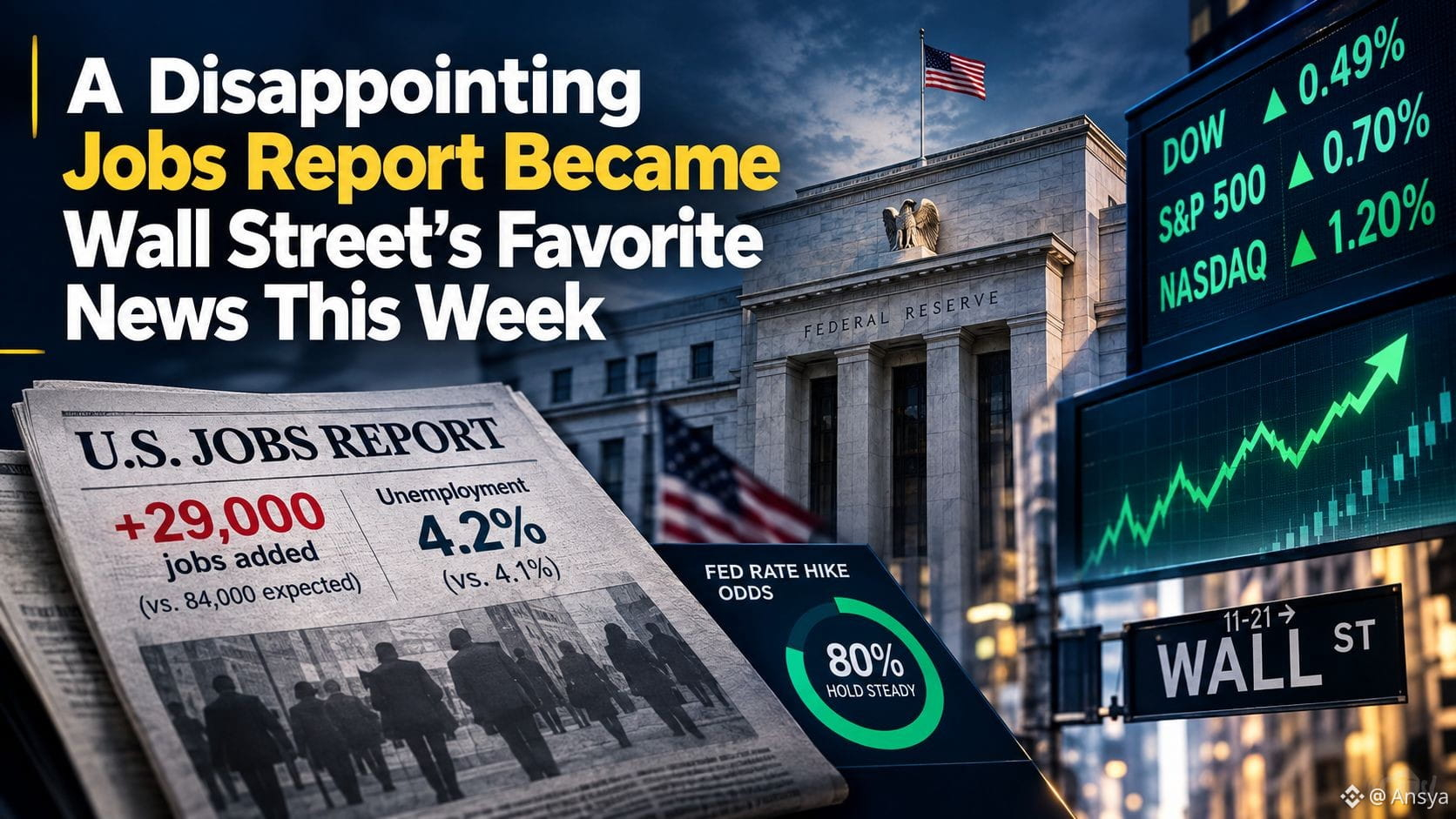
A Disappointing Jobs Report Became Wall Street's Favorite News This Week
US stocks closed at fresh highs on Friday — and the reason wasn't strong economic data. It was the opposite.
Here's what happened: the Labor Department reported the US economy added just 29,000 jobs in September, well below the 84,000 economists expected, while unemployment ticked up to 4.2% from 4.1%. That's a sharp divergence from ADP's private-sector estimate earlier in the week, which had shown a stronger 90,000-job gain — a reminder that these two reports don't always move together. Markets read the weaker official print as reducing the odds of another Fed rate hike this month, with traders pricing roughly an 80% probability of the Fed holding steady in October, up from about 74% before the data. The Dow rose 0.49% to 51,176.96, the S&P 500 gained 0.7% to 7,722.72, and the Nasdaq led with a 1.2% jump to 27,190.86, with Nvidia briefly touching an intraday record. Treasury yields initially eased before paring gains later in the session.
Why does this matter? This is a clean example of "bad news is good news" trading — a cooling labor market reduces inflationary pressure concerns tied to a tight job market, which in turn lowers the odds the Fed needs to tighten further. For risk assets broadly, including crypto, Fed rate expectations have been one of the dominant forces shaping price action this quarter, so a shift like this tends to ripple well beyond equities alone.
Whether this rate-hike reprieve holds through the actual October meeting, or gets revised by fresher data before then, remains to be seen.
Does weak economic data genuinely help markets long-term, or does it just delay a bigger reckoning? 🤔
#stockmarket #FederalReserve #JobsReport #Macro
$SAND $VELVET $NIGHT
#usstocksclosehigheronweakjobsdata
A Disappointing Jobs Report Became Wall Street's Favorite News This Week
US stocks closed at fresh highs on Friday — and the reason wasn't strong economic data. It was the opposite.
Here's what happened: the Labor Department reported the US economy added just 29,000 jobs in September, well below the 84,000 economists expected, while unemployment ticked up to 4.2% from 4.1%. That's a sharp divergence from ADP's private-sector estimate earlier in the week, which had shown a stronger 90,000-job gain — a reminder that these two reports don't always move together. Markets read the weaker official print as reducing the odds of another Fed rate hike this month, with traders pricing roughly an 80% probability of the Fed holding steady in October, up from about 74% before the data. The Dow rose 0.49% to 51,176.96, the S&P 500 gained 0.7% to 7,722.72, and the Nasdaq led with a 1.2% jump to 27,190.86, with Nvidia briefly touching an intraday record. Treasury yields initially eased before paring gains later in the session.
Why does this matter? This is a clean example of "bad news is good news" trading — a cooling labor market reduces inflationary pressure concerns tied to a tight job market, which in turn lowers the odds the Fed needs to tighten further. For risk assets broadly, including crypto, Fed rate expectations have been one of the dominant forces shaping price action this quarter, so a shift like this tends to ripple well beyond equities alone.
Whether this rate-hike reprieve holds through the actual October meeting, or gets revised by fresher data before then, remains to be seen.
Does weak economic data genuinely help markets long-term, or does it just delay a bigger reckoning? 🤔
#stockmarket #FederalReserve #JobsReport #Macro
$SAND $VELVET $NIGHT
A Disappointing Jobs Report Became Wall Street's Favorite News This Week
US stocks closed at fresh highs on Friday — and the reason wasn't strong economic data. It was the opposite.
Here's what happened: the Labor Department reported the US economy added just 29,000 jobs in September, well below the 84,000 economists expected, while unemployment ticked up to 4.2% from 4.1%. That's a sharp divergence from ADP's private-sector estimate earlier in the week, which had shown a stronger 90,000-job gain — a reminder that these two reports don't always move together. Markets read the weaker official print as reducing the odds of another Fed rate hike this month, with traders pricing roughly an 80% probability of the Fed holding steady in October, up from about 74% before the data. The Dow rose 0.49% to 51,176.96, the S&P 500 gained 0.7% to 7,722.72, and the Nasdaq led with a 1.2% jump to 27,190.86, with Nvidia briefly touching an intraday record. Treasury yields initially eased before paring gains later in the session.
Why does this matter? This is a clean example of "bad news is good news" trading — a cooling labor market reduces inflationary pressure concerns tied to a tight job market, which in turn lowers the odds the Fed needs to tighten further. For risk assets broadly, including crypto, Fed rate expectations have been one of the dominant forces shaping price action this quarter, so a shift like this tends to ripple well beyond equities alone.
Whether this rate-hike reprieve holds through the actual October meeting, or gets revised by fresher data before then, remains to be seen.
Does weak economic data genuinely help markets long-term, or does it just delay a bigger reckoning? 🤔
#stockmarket #FederalReserve #JobsReport #Macro
$SAND $VELVET $NIGHT
4
4.2k
·
--
See translation
#anchoragereportedlycuts17%workforce
A Federally Chartered Crypto Bank Just Trimmed Staff — Even With a Fresh $4.2B Valuation Behind It
Anchorage Digital, one of the few crypto companies holding a national trust bank charter, is cutting roughly 17% of its workforce — a reminder that even well-capitalized, regulated players aren't immune to the industry's current cost pressures.
Here's what happened: The Information reported that CEO Nathan McCauley informed employees this week of layoffs affecting approximately 68 of the company's roughly 400 global staff. The cuts come just eight months after Tether invested $100 million in Anchorage at a $4.2 billion valuation — funding that also enabled the company's first employee tender offer. Anchorage hasn't pointed to a lost client, regulatory setback, or failed product as the cause, instead attributing the reduction to broader, sector-wide cost pressures tied to the ongoing crypto market downturn. This marks the company's second round of layoffs, following a larger cut back in 2023. The timing lines up with a rough year for crypto employment broadly — over 7,400 industry jobs have been cut in 2026, with new postings down roughly 80% year-over-year, even as Bitcoin trades well below its October 2025 high near $126,000.
Why does this matter? Anchorage occupies a notable niche as a federally regulated custody provider serving institutional clients — the kind of company often cited as evidence of crypto's maturing infrastructure. Layoffs here, despite recent capital backing, suggest the current downturn is pressuring even the more insulated, institution-facing corners of the industry, not just speculative trading platforms.
Whether this reflects temporary belt-tightening or a longer recalibration of crypto labor costs is something the coming months will likely clarify.
Does a cut like this at a regulated, well-funded firm say more about this company, or about the broader state of the industry right now? 🤔
#Anchorage #cryptolayoffs #CRYPTOINDUSTRY #MarketConditions
$SAND $VELVET
#anchoragereportedlycuts17%workforce
A Federally Chartered Crypto Bank Just Trimmed Staff — Even With a Fresh $4.2B Valuation Behind It
Anchorage Digital, one of the few crypto companies holding a national trust bank charter, is cutting roughly 17% of its workforce — a reminder that even well-capitalized, regulated players aren't immune to the industry's current cost pressures.
Here's what happened: The Information reported that CEO Nathan McCauley informed employees this week of layoffs affecting approximately 68 of the company's roughly 400 global staff. The cuts come just eight months after Tether invested $100 million in Anchorage at a $4.2 billion valuation — funding that also enabled the company's first employee tender offer. Anchorage hasn't pointed to a lost client, regulatory setback, or failed product as the cause, instead attributing the reduction to broader, sector-wide cost pressures tied to the ongoing crypto market downturn. This marks the company's second round of layoffs, following a larger cut back in 2023. The timing lines up with a rough year for crypto employment broadly — over 7,400 industry jobs have been cut in 2026, with new postings down roughly 80% year-over-year, even as Bitcoin trades well below its October 2025 high near $126,000.
Why does this matter? Anchorage occupies a notable niche as a federally regulated custody provider serving institutional clients — the kind of company often cited as evidence of crypto's maturing infrastructure. Layoffs here, despite recent capital backing, suggest the current downturn is pressuring even the more insulated, institution-facing corners of the industry, not just speculative trading platforms.
Whether this reflects temporary belt-tightening or a longer recalibration of crypto labor costs is something the coming months will likely clarify.
Does a cut like this at a regulated, well-funded firm say more about this company, or about the broader state of the industry right now? 🤔
#Anchorage #cryptolayoffs #CRYPTOINDUSTRY #MarketConditions
$SAND $VELVET
A Federally Chartered Crypto Bank Just Trimmed Staff — Even With a Fresh $4.2B Valuation Behind It
Anchorage Digital, one of the few crypto companies holding a national trust bank charter, is cutting roughly 17% of its workforce — a reminder that even well-capitalized, regulated players aren't immune to the industry's current cost pressures.
Here's what happened: The Information reported that CEO Nathan McCauley informed employees this week of layoffs affecting approximately 68 of the company's roughly 400 global staff. The cuts come just eight months after Tether invested $100 million in Anchorage at a $4.2 billion valuation — funding that also enabled the company's first employee tender offer. Anchorage hasn't pointed to a lost client, regulatory setback, or failed product as the cause, instead attributing the reduction to broader, sector-wide cost pressures tied to the ongoing crypto market downturn. This marks the company's second round of layoffs, following a larger cut back in 2023. The timing lines up with a rough year for crypto employment broadly — over 7,400 industry jobs have been cut in 2026, with new postings down roughly 80% year-over-year, even as Bitcoin trades well below its October 2025 high near $126,000.
Why does this matter? Anchorage occupies a notable niche as a federally regulated custody provider serving institutional clients — the kind of company often cited as evidence of crypto's maturing infrastructure. Layoffs here, despite recent capital backing, suggest the current downturn is pressuring even the more insulated, institution-facing corners of the industry, not just speculative trading platforms.
Whether this reflects temporary belt-tightening or a longer recalibration of crypto labor costs is something the coming months will likely clarify.
Does a cut like this at a regulated, well-funded firm say more about this company, or about the broader state of the industry right now? 🤔
#Anchorage #cryptolayoffs #CRYPTOINDUSTRY #MarketConditions
$SAND $VELVET

1
3.5k
·
--
Verified
See translation
#ZcashFalls21%FromSeptemberPeak
ZEC's Rally Takes a Breather
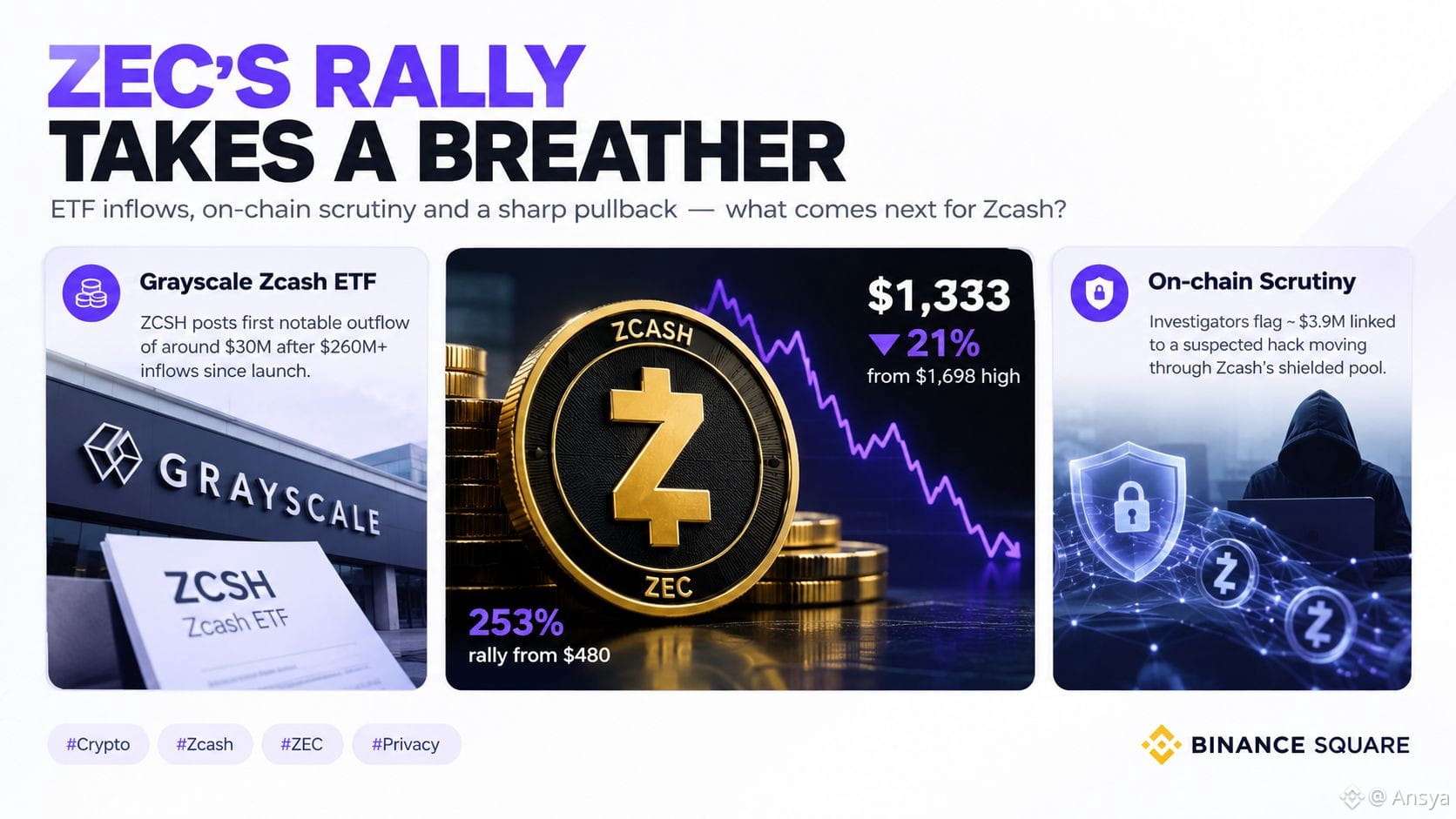
Zcash just handed back a chunk of its explosive run. ZEC is trading near $1,333, down roughly 21% from the $1,698 high it hit in late September — a pullback that comes after the token had climbed about 253% from a $480 base earlier in its rally.
A few threads are feeding the retreat. Grayscale's spot Zcash ETF (ZCSH), which had pulled in over $260 million in net inflows since its August launch, posted its first notable outflow — around $30 million — at the end of September. Separately, blockchain investigators flagged roughly $3.9 million in funds linked to a suspected hack moving through Zcash's shielded pool, reviving questions about how privacy features intersect with illicit flows.
Why it matters
For a privacy coin pushing into mainstream investment products, these two storylines sit in tension: ETF access brings institutional legitimacy, while shielded-pool activity tied to a hack brings scrutiny. Technically, momentum indicators are reading closer to neutral than oversold, and a similarly sharp pullback earlier this year — from $635 to $309 in June — was followed by a climb to new highs, though past patterns don't guarantee a repeat.
Is this a routine cooldown after an outsized rally, or an early test of ZEC's institutional narrative?
#Crypto_Jobs🎯 #zcash #ZEC #Privacy
$ZEC $QNT $XRP
#ZcashFalls21%FromSeptemberPeak
ZEC's Rally Takes a Breather
Zcash just handed back a chunk of its explosive run. ZEC is trading near $1,333, down roughly 21% from the $1,698 high it hit in late September — a pullback that comes after the token had climbed about 253% from a $480 base earlier in its rally.
A few threads are feeding the retreat. Grayscale's spot Zcash ETF (ZCSH), which had pulled in over $260 million in net inflows since its August launch, posted its first notable outflow — around $30 million — at the end of September. Separately, blockchain investigators flagged roughly $3.9 million in funds linked to a suspected hack moving through Zcash's shielded pool, reviving questions about how privacy features intersect with illicit flows.
Why it matters
For a privacy coin pushing into mainstream investment products, these two storylines sit in tension: ETF access brings institutional legitimacy, while shielded-pool activity tied to a hack brings scrutiny. Technically, momentum indicators are reading closer to neutral than oversold, and a similarly sharp pullback earlier this year — from $635 to $309 in June — was followed by a climb to new highs, though past patterns don't guarantee a repeat.
Is this a routine cooldown after an outsized rally, or an early test of ZEC's institutional narrative?
#Crypto_Jobs🎯 #zcash #ZEC #Privacy
$ZEC $QNT $XRP
ZEC's Rally Takes a Breather
Zcash just handed back a chunk of its explosive run. ZEC is trading near $1,333, down roughly 21% from the $1,698 high it hit in late September — a pullback that comes after the token had climbed about 253% from a $480 base earlier in its rally.
A few threads are feeding the retreat. Grayscale's spot Zcash ETF (ZCSH), which had pulled in over $260 million in net inflows since its August launch, posted its first notable outflow — around $30 million — at the end of September. Separately, blockchain investigators flagged roughly $3.9 million in funds linked to a suspected hack moving through Zcash's shielded pool, reviving questions about how privacy features intersect with illicit flows.
Why it matters
For a privacy coin pushing into mainstream investment products, these two storylines sit in tension: ETF access brings institutional legitimacy, while shielded-pool activity tied to a hack brings scrutiny. Technically, momentum indicators are reading closer to neutral than oversold, and a similarly sharp pullback earlier this year — from $635 to $309 in June — was followed by a climb to new highs, though past patterns don't guarantee a repeat.
Is this a routine cooldown after an outsized rally, or an early test of ZEC's institutional narrative?
#Crypto_Jobs🎯 #zcash #ZEC #Privacy
$ZEC $QNT $XRP
1
514
·
--
See translation
#xrppostsfirstthreegreenmonthsinq3
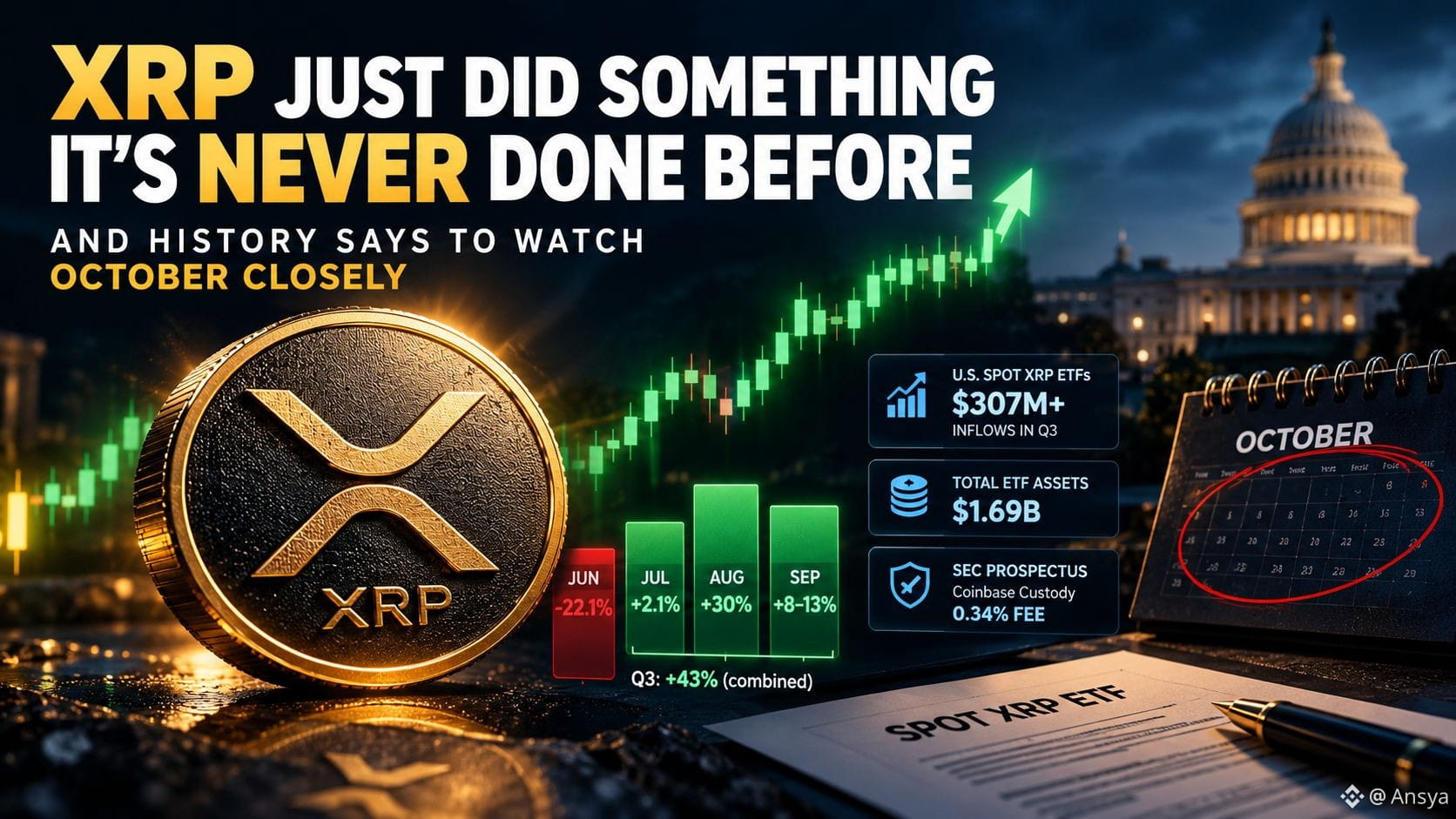
XRP Just Did Something It's Never Done Before — And History Says to Watch October Closely
XRP closed out Q3 with a milestone it has never achieved in its entire trading history: three consecutive individually positive months, not just a positive quarter overall.
Here's the breakdown: after a steep 22.1% drop in June, XRP gained 2.1% in July, 30% in August, and roughly 8-13% in September, closing the quarter near $1.51 — a combined gain above 43%. Past years occasionally saw positive quarters, but always with at least one red month tucked inside; this year broke that pattern cleanly, according to CryptoRank data. The rally has been reinforced by real capital flows: U.S. spot XRP ETFs pulled in over $307 million during Q3, pushing total assets to $1.69 billion, while a newly updated SEC prospectus for a spot XRP ETF named Coinbase Custody as custodian with a 0.34% fee — signaling the infrastructure is largely ready for launch. Notably, this rally came without the triple-digit monthly surges that preceded past cycle tops.
Why does this matter? Sustained, consecutive gains without single-month blowouts can suggest steadier, more structurally supported buying rather than speculative spikes — but there's a clear historical caution here too: the last four times XRP strung together three green months, the following month ended in a double-digit decline. That track record doesn't guarantee repetition, but it's exactly the kind of pattern traders watching this milestone are weighing carefully.
Whether XRP breaks that historical pattern this time, or follows the same seasonal script as before, is something only October's price action will actually answer.
Does a milestone like this feel different this time, or does history usually have the final word? 🤔
#xrp #Ripple #CryptoMarkets #Q3Rally
$XRP $SAND $US
{future}(USUSDT)
{future}(SANDUSDT)
{future}(XRPUSDT)
#xrppostsfirstthreegreenmonthsinq3
XRP Just Did Something It's Never Done Before — And History Says to Watch October Closely
XRP closed out Q3 with a milestone it has never achieved in its entire trading history: three consecutive individually positive months, not just a positive quarter overall.
Here's the breakdown: after a steep 22.1% drop in June, XRP gained 2.1% in July, 30% in August, and roughly 8-13% in September, closing the quarter near $1.51 — a combined gain above 43%. Past years occasionally saw positive quarters, but always with at least one red month tucked inside; this year broke that pattern cleanly, according to CryptoRank data. The rally has been reinforced by real capital flows: U.S. spot XRP ETFs pulled in over $307 million during Q3, pushing total assets to $1.69 billion, while a newly updated SEC prospectus for a spot XRP ETF named Coinbase Custody as custodian with a 0.34% fee — signaling the infrastructure is largely ready for launch. Notably, this rally came without the triple-digit monthly surges that preceded past cycle tops.
Why does this matter? Sustained, consecutive gains without single-month blowouts can suggest steadier, more structurally supported buying rather than speculative spikes — but there's a clear historical caution here too: the last four times XRP strung together three green months, the following month ended in a double-digit decline. That track record doesn't guarantee repetition, but it's exactly the kind of pattern traders watching this milestone are weighing carefully.
Whether XRP breaks that historical pattern this time, or follows the same seasonal script as before, is something only October's price action will actually answer.
Does a milestone like this feel different this time, or does history usually have the final word? 🤔
#xrp #Ripple #CryptoMarkets #Q3Rally
$XRP $SAND $US
XRP Just Did Something It's Never Done Before — And History Says to Watch October Closely
XRP closed out Q3 with a milestone it has never achieved in its entire trading history: three consecutive individually positive months, not just a positive quarter overall.
Here's the breakdown: after a steep 22.1% drop in June, XRP gained 2.1% in July, 30% in August, and roughly 8-13% in September, closing the quarter near $1.51 — a combined gain above 43%. Past years occasionally saw positive quarters, but always with at least one red month tucked inside; this year broke that pattern cleanly, according to CryptoRank data. The rally has been reinforced by real capital flows: U.S. spot XRP ETFs pulled in over $307 million during Q3, pushing total assets to $1.69 billion, while a newly updated SEC prospectus for a spot XRP ETF named Coinbase Custody as custodian with a 0.34% fee — signaling the infrastructure is largely ready for launch. Notably, this rally came without the triple-digit monthly surges that preceded past cycle tops.
Why does this matter? Sustained, consecutive gains without single-month blowouts can suggest steadier, more structurally supported buying rather than speculative spikes — but there's a clear historical caution here too: the last four times XRP strung together three green months, the following month ended in a double-digit decline. That track record doesn't guarantee repetition, but it's exactly the kind of pattern traders watching this milestone are weighing carefully.
Whether XRP breaks that historical pattern this time, or follows the same seasonal script as before, is something only October's price action will actually answer.
Does a milestone like this feel different this time, or does history usually have the final word? 🤔
#xrp #Ripple #CryptoMarkets #Q3Rally
$XRP $SAND $US
2
74
·
--
See translation
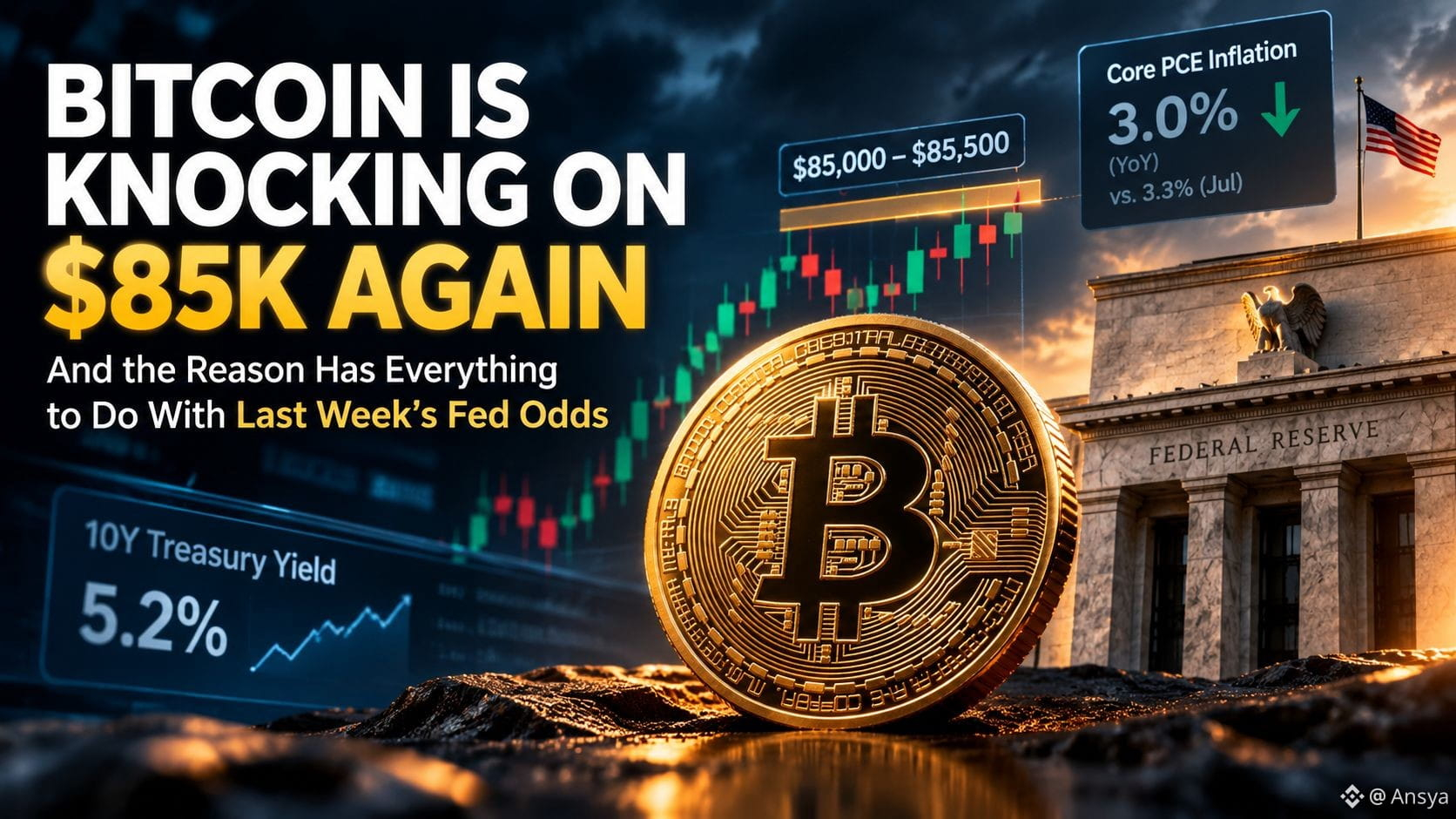
Bitcoin Is Knocking on $85K Again — And the Reason Has Everything to Do With Last Week's Fed Odds
Bitcoin opened the new quarter testing resistance near $85,000, in a move that traces directly back to a single inflation data point reshaping Fed expectations almost overnight.
Here's what happened: BTC briefly broke above $85,000 on Wednesday after August's core PCE inflation reading came in cooler than expected at 3.0% year-over-year, down from July's 3.3%. That report reportedly cut odds of an October Fed rate hike from around 70% earlier in the week down to roughly 35%, prompting buyers to push Bitcoin higher. The move hasn't been clean, though — Bitcoin has struggled to hold convincingly above $85,000, pulling back multiple times within the same session, with resistance sitting between $85,500 and $86,000. Part of the drag: the 10-year Treasury yield remains near 5.2%, among its highest levels since 2007, giving investors a competing, guaranteed return that makes a zero-yield asset like Bitcoin a harder sell at the margin. September closed as Bitcoin's best quarter since 2024, and Citigroup recently raised its 12-month BTC price target to $113,000.
Why does this matter? This price action is a clean example of how tightly Bitcoin's short-term moves are now tethered to shifting Fed-rate expectations and bond yields, rather than crypto-specific catalysts. The $85,000-$85,500 zone has become a genuine inflection point — a sustained close above it could open room toward $90,000, while rejection keeps Bitcoin locked in its recent range.
Whether cooling inflation data continues to support a push higher, or elevated yields keep capping the rally, is something the coming weeks of Fed signals should help clarify.
Does Bitcoin's price action these days tell you more about crypto, or about where Fed rate odds stand that week? 🤔
#bitcoin #BTC #FederalReserve #CryptoMarkets #BitcoinRisesToward$85K
$BTC $ETH $SOL
{future}(SOLUSDT)
{future}(ETHUSDT)
{future}(BTCUSDT)
Bitcoin Is Knocking on $85K Again — And the Reason Has Everything to Do With Last Week's Fed Odds
Bitcoin opened the new quarter testing resistance near $85,000, in a move that traces directly back to a single inflation data point reshaping Fed expectations almost overnight.
Here's what happened: BTC briefly broke above $85,000 on Wednesday after August's core PCE inflation reading came in cooler than expected at 3.0% year-over-year, down from July's 3.3%. That report reportedly cut odds of an October Fed rate hike from around 70% earlier in the week down to roughly 35%, prompting buyers to push Bitcoin higher. The move hasn't been clean, though — Bitcoin has struggled to hold convincingly above $85,000, pulling back multiple times within the same session, with resistance sitting between $85,500 and $86,000. Part of the drag: the 10-year Treasury yield remains near 5.2%, among its highest levels since 2007, giving investors a competing, guaranteed return that makes a zero-yield asset like Bitcoin a harder sell at the margin. September closed as Bitcoin's best quarter since 2024, and Citigroup recently raised its 12-month BTC price target to $113,000.
Why does this matter? This price action is a clean example of how tightly Bitcoin's short-term moves are now tethered to shifting Fed-rate expectations and bond yields, rather than crypto-specific catalysts. The $85,000-$85,500 zone has become a genuine inflection point — a sustained close above it could open room toward $90,000, while rejection keeps Bitcoin locked in its recent range.
Whether cooling inflation data continues to support a push higher, or elevated yields keep capping the rally, is something the coming weeks of Fed signals should help clarify.
Does Bitcoin's price action these days tell you more about crypto, or about where Fed rate odds stand that week? 🤔
#bitcoin #BTC #FederalReserve #CryptoMarkets #BitcoinRisesToward$85K
$BTC $ETH $SOL
Bitcoin opened the new quarter testing resistance near $85,000, in a move that traces directly back to a single inflation data point reshaping Fed expectations almost overnight.
Here's what happened: BTC briefly broke above $85,000 on Wednesday after August's core PCE inflation reading came in cooler than expected at 3.0% year-over-year, down from July's 3.3%. That report reportedly cut odds of an October Fed rate hike from around 70% earlier in the week down to roughly 35%, prompting buyers to push Bitcoin higher. The move hasn't been clean, though — Bitcoin has struggled to hold convincingly above $85,000, pulling back multiple times within the same session, with resistance sitting between $85,500 and $86,000. Part of the drag: the 10-year Treasury yield remains near 5.2%, among its highest levels since 2007, giving investors a competing, guaranteed return that makes a zero-yield asset like Bitcoin a harder sell at the margin. September closed as Bitcoin's best quarter since 2024, and Citigroup recently raised its 12-month BTC price target to $113,000.
Why does this matter? This price action is a clean example of how tightly Bitcoin's short-term moves are now tethered to shifting Fed-rate expectations and bond yields, rather than crypto-specific catalysts. The $85,000-$85,500 zone has become a genuine inflection point — a sustained close above it could open room toward $90,000, while rejection keeps Bitcoin locked in its recent range.
Whether cooling inflation data continues to support a push higher, or elevated yields keep capping the rally, is something the coming weeks of Fed signals should help clarify.
Does Bitcoin's price action these days tell you more about crypto, or about where Fed rate odds stand that week? 🤔
#bitcoin #BTC #FederalReserve #CryptoMarkets #BitcoinRisesToward$85K
$BTC $ETH $SOL
1
41
·
--
See translation
NEAR's Historic Rally Just Hit Its First Real Test — With a Hack on Top
After one of the sharpest rallies in crypto this year, NEAR Protocol is now grappling with its first serious pullback — compounded by a security incident that landed right in the middle of the selloff.
Here's what happened: NEAR fell to around $4.70, down roughly 14% from its recent local high near $5.58, following a surge of more than 200% from August lows near $1.60-$1.80. The initial break below the key $5.00 support level triggered a long squeeze, liquidating over $20 million in leveraged positions as derivatives traders got caught offside. Adding to the pressure, NEAR Intents — a cross-chain infrastructure service built on the network — disclosed a roughly $3.8 million exploit tied to an integration bug in its Omni deposit and withdrawal system, temporarily halting swaps across 11 networks. Importantly, the vulnerability affected cross-chain infrastructure rather than the core NEAR blockchain itself, and the team has pledged full reimbursement. The decline comes just days after Bitwise filed to list the first U.S. spot NEAR ETF, a notable institutional milestone that had briefly helped fuel the token's rally.
Why does this matter? Sharp pullbacks after parabolic rallies aren't unusual in crypto, but layering a genuine security incident on top complicates the picture — it raises a real question of whether the selloff is simply technical profit-taking or whether confidence in the broader ecosystem took a separate hit. The timing relative to the ETF news is also notable, since institutional-access milestones typically take time to translate into sustained price support.
Whether NEAR stabilizes around current levels or extends its correction further will likely depend on how cleanly this exploit gets resolved.
Does a hack unrelated to the core chain change how much weight this pullback deserves? 🤔
#Near #CryptoSecurity #altcoins #MarketPullback
$NEAR $MOVR $QNT
{future}(QNTUSDT)
{future}(MOVRUSDT)
{future}(NEARUSDT)
NEAR's Historic Rally Just Hit Its First Real Test — With a Hack on Top
After one of the sharpest rallies in crypto this year, NEAR Protocol is now grappling with its first serious pullback — compounded by a security incident that landed right in the middle of the selloff.
Here's what happened: NEAR fell to around $4.70, down roughly 14% from its recent local high near $5.58, following a surge of more than 200% from August lows near $1.60-$1.80. The initial break below the key $5.00 support level triggered a long squeeze, liquidating over $20 million in leveraged positions as derivatives traders got caught offside. Adding to the pressure, NEAR Intents — a cross-chain infrastructure service built on the network — disclosed a roughly $3.8 million exploit tied to an integration bug in its Omni deposit and withdrawal system, temporarily halting swaps across 11 networks. Importantly, the vulnerability affected cross-chain infrastructure rather than the core NEAR blockchain itself, and the team has pledged full reimbursement. The decline comes just days after Bitwise filed to list the first U.S. spot NEAR ETF, a notable institutional milestone that had briefly helped fuel the token's rally.
Why does this matter? Sharp pullbacks after parabolic rallies aren't unusual in crypto, but layering a genuine security incident on top complicates the picture — it raises a real question of whether the selloff is simply technical profit-taking or whether confidence in the broader ecosystem took a separate hit. The timing relative to the ETF news is also notable, since institutional-access milestones typically take time to translate into sustained price support.
Whether NEAR stabilizes around current levels or extends its correction further will likely depend on how cleanly this exploit gets resolved.
Does a hack unrelated to the core chain change how much weight this pullback deserves? 🤔
#Near #CryptoSecurity #altcoins #MarketPullback
$NEAR $MOVR $QNT
After one of the sharpest rallies in crypto this year, NEAR Protocol is now grappling with its first serious pullback — compounded by a security incident that landed right in the middle of the selloff.
Here's what happened: NEAR fell to around $4.70, down roughly 14% from its recent local high near $5.58, following a surge of more than 200% from August lows near $1.60-$1.80. The initial break below the key $5.00 support level triggered a long squeeze, liquidating over $20 million in leveraged positions as derivatives traders got caught offside. Adding to the pressure, NEAR Intents — a cross-chain infrastructure service built on the network — disclosed a roughly $3.8 million exploit tied to an integration bug in its Omni deposit and withdrawal system, temporarily halting swaps across 11 networks. Importantly, the vulnerability affected cross-chain infrastructure rather than the core NEAR blockchain itself, and the team has pledged full reimbursement. The decline comes just days after Bitwise filed to list the first U.S. spot NEAR ETF, a notable institutional milestone that had briefly helped fuel the token's rally.
Why does this matter? Sharp pullbacks after parabolic rallies aren't unusual in crypto, but layering a genuine security incident on top complicates the picture — it raises a real question of whether the selloff is simply technical profit-taking or whether confidence in the broader ecosystem took a separate hit. The timing relative to the ETF news is also notable, since institutional-access milestones typically take time to translate into sustained price support.
Whether NEAR stabilizes around current levels or extends its correction further will likely depend on how cleanly this exploit gets resolved.
Does a hack unrelated to the core chain change how much weight this pullback deserves? 🤔
#Near #CryptoSecurity #altcoins #MarketPullback
$NEAR $MOVR $QNT

1
678
·
--
Verified
See translation
#ethereumfoundationlauncheszkapionmainnet
Ethereum Just Built a Way to Pay for AI Without Revealing Who's Asking
The Ethereum Foundation just launched a system that lets you pay for AI services on-chain while keeping your identity completely separate from what you're actually asking the AI to do.
Here's what shipped: on October 1, the Ethereum Foundation, working with the Open Anonymity Project, deployed zkAPI on Ethereum mainnet — a privacy-preserving payment system built on a design co-authored by researcher Davide Crapis and Ethereum co-founder Vitalik Buterin. The mechanism works by having users deposit ETH or USDC into an on-chain vault, then generate zero-knowledge proofs to demonstrate they hold sufficient credit for an API request without revealing which specific deposit funds it. Service providers see the content of a request but never who's paying for it; payment processors see spend amounts but can't link them to individual users. Built using Groth16, BN254, and Merkle tree cryptography, the system initially targets AI inference — specifically protecting sensitive prompts involving health or financial topics — while also supporting blockchain RPC calls and media generation billing.
Why does this matter? As AI usage grows, so does the amount of sensitive information flowing through prompts tied directly to payment identities. A system that cryptographically separates "who paid" from "what was asked" addresses a privacy gap that's largely gone unaddressed as AI and blockchain payment rails increasingly intersect. It's also a concrete example of zero-knowledge proofs solving a practical, non-speculative problem rather than a purely theoretical one.
Whether this sees meaningful adoption beyond its initial AI-inference use case, or remains a niche privacy tool, will likely depend on how many service providers choose to integrate it.
Does separating payment identity from usage change how comfortable people feel using AI for sensitive tasks? 🤔
#Ethereum #zkAPI #Privacy #AI
$ETH $SAND $US
{future}(USUSDT)
{future}(SANDUSDT)
{future}(ETHUSDT)
#ethereumfoundationlauncheszkapionmainnet
Ethereum Just Built a Way to Pay for AI Without Revealing Who's Asking
The Ethereum Foundation just launched a system that lets you pay for AI services on-chain while keeping your identity completely separate from what you're actually asking the AI to do.
Here's what shipped: on October 1, the Ethereum Foundation, working with the Open Anonymity Project, deployed zkAPI on Ethereum mainnet — a privacy-preserving payment system built on a design co-authored by researcher Davide Crapis and Ethereum co-founder Vitalik Buterin. The mechanism works by having users deposit ETH or USDC into an on-chain vault, then generate zero-knowledge proofs to demonstrate they hold sufficient credit for an API request without revealing which specific deposit funds it. Service providers see the content of a request but never who's paying for it; payment processors see spend amounts but can't link them to individual users. Built using Groth16, BN254, and Merkle tree cryptography, the system initially targets AI inference — specifically protecting sensitive prompts involving health or financial topics — while also supporting blockchain RPC calls and media generation billing.
Why does this matter? As AI usage grows, so does the amount of sensitive information flowing through prompts tied directly to payment identities. A system that cryptographically separates "who paid" from "what was asked" addresses a privacy gap that's largely gone unaddressed as AI and blockchain payment rails increasingly intersect. It's also a concrete example of zero-knowledge proofs solving a practical, non-speculative problem rather than a purely theoretical one.
Whether this sees meaningful adoption beyond its initial AI-inference use case, or remains a niche privacy tool, will likely depend on how many service providers choose to integrate it.
Does separating payment identity from usage change how comfortable people feel using AI for sensitive tasks? 🤔
#Ethereum #zkAPI #Privacy #AI
$ETH $SAND $US
Ethereum Just Built a Way to Pay for AI Without Revealing Who's Asking
The Ethereum Foundation just launched a system that lets you pay for AI services on-chain while keeping your identity completely separate from what you're actually asking the AI to do.
Here's what shipped: on October 1, the Ethereum Foundation, working with the Open Anonymity Project, deployed zkAPI on Ethereum mainnet — a privacy-preserving payment system built on a design co-authored by researcher Davide Crapis and Ethereum co-founder Vitalik Buterin. The mechanism works by having users deposit ETH or USDC into an on-chain vault, then generate zero-knowledge proofs to demonstrate they hold sufficient credit for an API request without revealing which specific deposit funds it. Service providers see the content of a request but never who's paying for it; payment processors see spend amounts but can't link them to individual users. Built using Groth16, BN254, and Merkle tree cryptography, the system initially targets AI inference — specifically protecting sensitive prompts involving health or financial topics — while also supporting blockchain RPC calls and media generation billing.
Why does this matter? As AI usage grows, so does the amount of sensitive information flowing through prompts tied directly to payment identities. A system that cryptographically separates "who paid" from "what was asked" addresses a privacy gap that's largely gone unaddressed as AI and blockchain payment rails increasingly intersect. It's also a concrete example of zero-knowledge proofs solving a practical, non-speculative problem rather than a purely theoretical one.
Whether this sees meaningful adoption beyond its initial AI-inference use case, or remains a niche privacy tool, will likely depend on how many service providers choose to integrate it.
Does separating payment identity from usage change how comfortable people feel using AI for sensitive tasks? 🤔
#Ethereum #zkAPI #Privacy #AI
$ETH $SAND $US

2
3.1k
·
--
Verified
See translation
#evernorthplansnasdaqlistingoct8
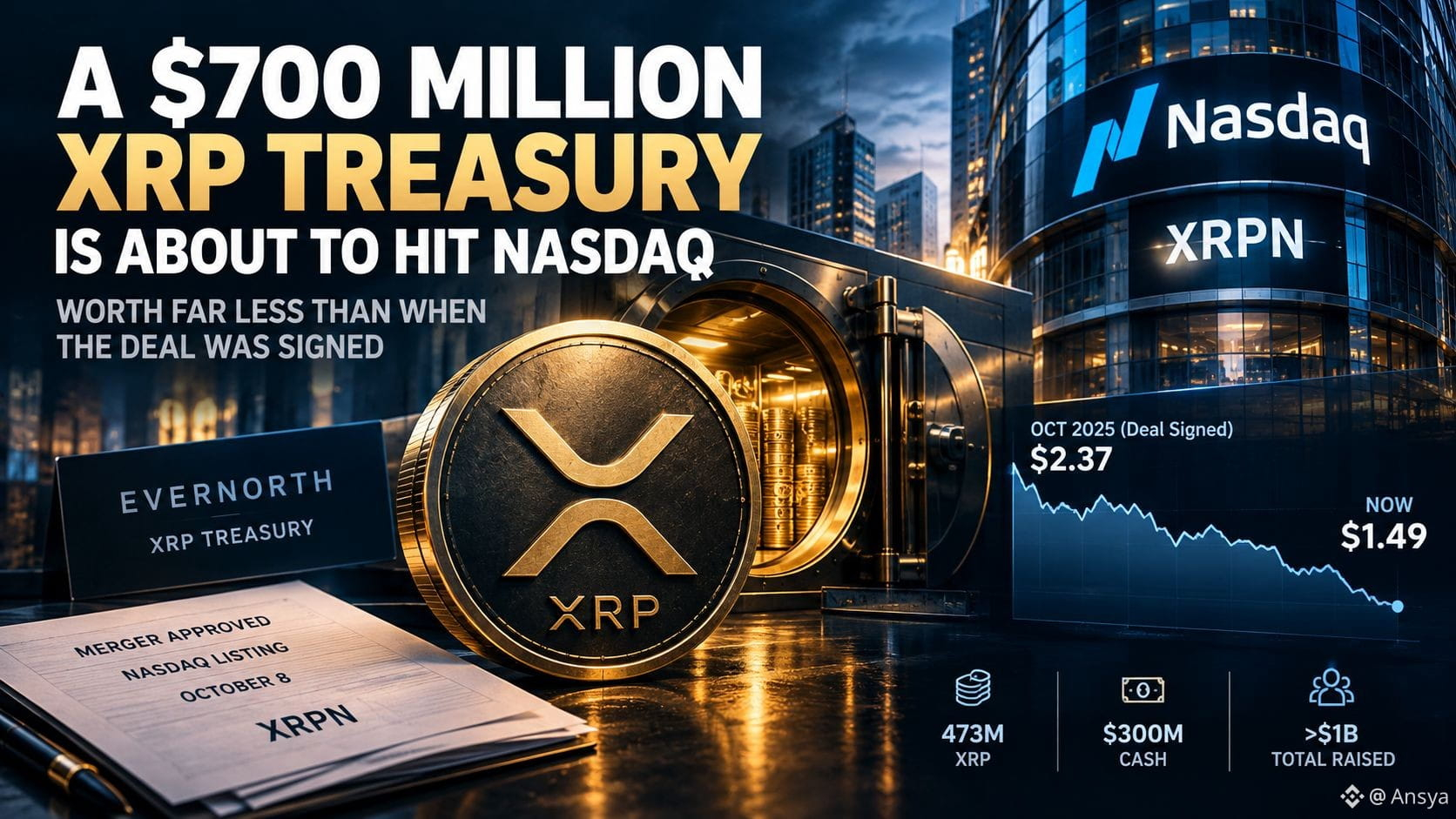
A $700 Million XRP Treasury Is About to Hit Nasdaq — Worth Far Less Than When the Deal Was Signed
Evernorth is about to become the largest publicly traded XRP treasury company — but the token's price has moved sharply against it since the deal was first struck.
Here's what's happening: shareholders approved Evernorth's merger with Armada Acquisition Corp. II, clearing the way for Class A shares to begin trading on Nasdaq under ticker "XRPN" on October 8, following an expected October 7 closing. The combined company will hold roughly 473 million XRP, alongside about $300 million in cash from the transaction and related private placements, which together raised over $ 1 billion. Worth noting: when the business combination was originally agreed in October 2025, XRP traded near $2.37, valuing the treasury around $1.1 billion. With XRP now near $1.49, that same holding is worth closer to $705 million — a reminder that treasury-company valuations move directly with the underlying asset, for better or worse. Evernorth says it plans to pursue yield strategies, liquidity provision, and further capital markets activity to grow its XRP-per-share over time.
Why does this matter? Digital-asset treasury companies offer traditional investors regulated, stock-market exposure to a specific token without direct custody — but that exposure comes with full downside correlation to price swings between deal-signing and actual listing, as this case illustrates clearly. At roughly 0.75% of XRP's circulating supply, Evernorth's listing will also be a real-time test of market appetite for single-asset treasury vehicles beyond Bitcoin and Ethereum.
Whether investor demand holds up given the value decline since signing, or whether sentiment shifts once trading actually begins, remains to be seen.
Does a treasury company's value swinging this much before it even lists change how investors should view the structure? 🤔
#xrp #Evernorth #NASDAQ #CryptoTreasury
$XRP $SAND $US
{future}(USUSDT)
{future}(SANDUSDT)
{future}(XRPUSDT)
#evernorthplansnasdaqlistingoct8
A $700 Million XRP Treasury Is About to Hit Nasdaq — Worth Far Less Than When the Deal Was Signed
Evernorth is about to become the largest publicly traded XRP treasury company — but the token's price has moved sharply against it since the deal was first struck.
Here's what's happening: shareholders approved Evernorth's merger with Armada Acquisition Corp. II, clearing the way for Class A shares to begin trading on Nasdaq under ticker "XRPN" on October 8, following an expected October 7 closing. The combined company will hold roughly 473 million XRP, alongside about $300 million in cash from the transaction and related private placements, which together raised over $ 1 billion. Worth noting: when the business combination was originally agreed in October 2025, XRP traded near $2.37, valuing the treasury around $1.1 billion. With XRP now near $1.49, that same holding is worth closer to $705 million — a reminder that treasury-company valuations move directly with the underlying asset, for better or worse. Evernorth says it plans to pursue yield strategies, liquidity provision, and further capital markets activity to grow its XRP-per-share over time.
Why does this matter? Digital-asset treasury companies offer traditional investors regulated, stock-market exposure to a specific token without direct custody — but that exposure comes with full downside correlation to price swings between deal-signing and actual listing, as this case illustrates clearly. At roughly 0.75% of XRP's circulating supply, Evernorth's listing will also be a real-time test of market appetite for single-asset treasury vehicles beyond Bitcoin and Ethereum.
Whether investor demand holds up given the value decline since signing, or whether sentiment shifts once trading actually begins, remains to be seen.
Does a treasury company's value swinging this much before it even lists change how investors should view the structure? 🤔
#xrp #Evernorth #NASDAQ #CryptoTreasury
$XRP $SAND $US
A $700 Million XRP Treasury Is About to Hit Nasdaq — Worth Far Less Than When the Deal Was Signed
Evernorth is about to become the largest publicly traded XRP treasury company — but the token's price has moved sharply against it since the deal was first struck.
Here's what's happening: shareholders approved Evernorth's merger with Armada Acquisition Corp. II, clearing the way for Class A shares to begin trading on Nasdaq under ticker "XRPN" on October 8, following an expected October 7 closing. The combined company will hold roughly 473 million XRP, alongside about $300 million in cash from the transaction and related private placements, which together raised over $ 1 billion. Worth noting: when the business combination was originally agreed in October 2025, XRP traded near $2.37, valuing the treasury around $1.1 billion. With XRP now near $1.49, that same holding is worth closer to $705 million — a reminder that treasury-company valuations move directly with the underlying asset, for better or worse. Evernorth says it plans to pursue yield strategies, liquidity provision, and further capital markets activity to grow its XRP-per-share over time.
Why does this matter? Digital-asset treasury companies offer traditional investors regulated, stock-market exposure to a specific token without direct custody — but that exposure comes with full downside correlation to price swings between deal-signing and actual listing, as this case illustrates clearly. At roughly 0.75% of XRP's circulating supply, Evernorth's listing will also be a real-time test of market appetite for single-asset treasury vehicles beyond Bitcoin and Ethereum.
Whether investor demand holds up given the value decline since signing, or whether sentiment shifts once trading actually begins, remains to be seen.
Does a treasury company's value swinging this much before it even lists change how investors should view the structure? 🤔
#xrp #Evernorth #NASDAQ #CryptoTreasury
$XRP $SAND $US
1
13
9.7k
·
--
See translation
#secproposescryptocustodyframework
Custody Rules Older Than Bitcoin Are Finally Getting a Rewrite
For nearly two decades, investment advisers wanting to hold crypto for clients have been stuck navigating rules written before Bitcoin even existed. The SEC just proposed closing that gap.
Here's what was announced: on October 1, the SEC proposed a new custody framework for registered investment advisers and regulated funds, including investment companies and business development companies. The 760-page proposal would let advisers self-custody certain crypto assets in limited circumstances — specifically when no qualified outside custodian is available — and would open the door for state-chartered trust companies to serve as custodians. SEC Chairman Paul Atkins framed it as replacing "the grey of uncertainty created by custody rules crafted for a bygone era." Commissioner Hester Peirce, in one of her final actions before departing the agency, clarified that "self-custody" here refers to advisers holding client assets, not individuals controlling their own keys. The proposal lands alongside a wave of recent crypto rulemaking — following August's Regulation Crypto Assets framework and last month's Innovation Exemption — and opens a 60-day public comment period before anything is finalized.
Why does this matter? Custody has long been one of the biggest operational bottlenecks preventing institutional capital from engaging more deeply with crypto, since outdated rules left advisers genuinely unsure how to compliantly hold digital assets at all. A clearer pathway could meaningfully expand which firms are willing to offer crypto exposure to clients.
Whether this proposal survives the comment period intact, or gets reshaped by industry feedback, remains to be seen.
Does modernizing decades-old custody rules finally unlock institutional crypto adoption, or was custody never really the biggest barrier? 🤔
#SEC #cryptocustody #Regulation #InstitutionalAdoption
$SAND $US $BTC
{future}(BTCUSDT)
{future}(USUSDT)
{future}(SANDUSDT)
#secproposescryptocustodyframework
Custody Rules Older Than Bitcoin Are Finally Getting a Rewrite
For nearly two decades, investment advisers wanting to hold crypto for clients have been stuck navigating rules written before Bitcoin even existed. The SEC just proposed closing that gap.
Here's what was announced: on October 1, the SEC proposed a new custody framework for registered investment advisers and regulated funds, including investment companies and business development companies. The 760-page proposal would let advisers self-custody certain crypto assets in limited circumstances — specifically when no qualified outside custodian is available — and would open the door for state-chartered trust companies to serve as custodians. SEC Chairman Paul Atkins framed it as replacing "the grey of uncertainty created by custody rules crafted for a bygone era." Commissioner Hester Peirce, in one of her final actions before departing the agency, clarified that "self-custody" here refers to advisers holding client assets, not individuals controlling their own keys. The proposal lands alongside a wave of recent crypto rulemaking — following August's Regulation Crypto Assets framework and last month's Innovation Exemption — and opens a 60-day public comment period before anything is finalized.
Why does this matter? Custody has long been one of the biggest operational bottlenecks preventing institutional capital from engaging more deeply with crypto, since outdated rules left advisers genuinely unsure how to compliantly hold digital assets at all. A clearer pathway could meaningfully expand which firms are willing to offer crypto exposure to clients.
Whether this proposal survives the comment period intact, or gets reshaped by industry feedback, remains to be seen.
Does modernizing decades-old custody rules finally unlock institutional crypto adoption, or was custody never really the biggest barrier? 🤔
#SEC #cryptocustody #Regulation #InstitutionalAdoption
$SAND $US $BTC
Custody Rules Older Than Bitcoin Are Finally Getting a Rewrite
For nearly two decades, investment advisers wanting to hold crypto for clients have been stuck navigating rules written before Bitcoin even existed. The SEC just proposed closing that gap.
Here's what was announced: on October 1, the SEC proposed a new custody framework for registered investment advisers and regulated funds, including investment companies and business development companies. The 760-page proposal would let advisers self-custody certain crypto assets in limited circumstances — specifically when no qualified outside custodian is available — and would open the door for state-chartered trust companies to serve as custodians. SEC Chairman Paul Atkins framed it as replacing "the grey of uncertainty created by custody rules crafted for a bygone era." Commissioner Hester Peirce, in one of her final actions before departing the agency, clarified that "self-custody" here refers to advisers holding client assets, not individuals controlling their own keys. The proposal lands alongside a wave of recent crypto rulemaking — following August's Regulation Crypto Assets framework and last month's Innovation Exemption — and opens a 60-day public comment period before anything is finalized.
Why does this matter? Custody has long been one of the biggest operational bottlenecks preventing institutional capital from engaging more deeply with crypto, since outdated rules left advisers genuinely unsure how to compliantly hold digital assets at all. A clearer pathway could meaningfully expand which firms are willing to offer crypto exposure to clients.
Whether this proposal survives the comment period intact, or gets reshaped by industry feedback, remains to be seen.
Does modernizing decades-old custody rules finally unlock institutional crypto adoption, or was custody never really the biggest barrier? 🤔
#SEC #cryptocustody #Regulation #InstitutionalAdoption
$SAND $US $BTC
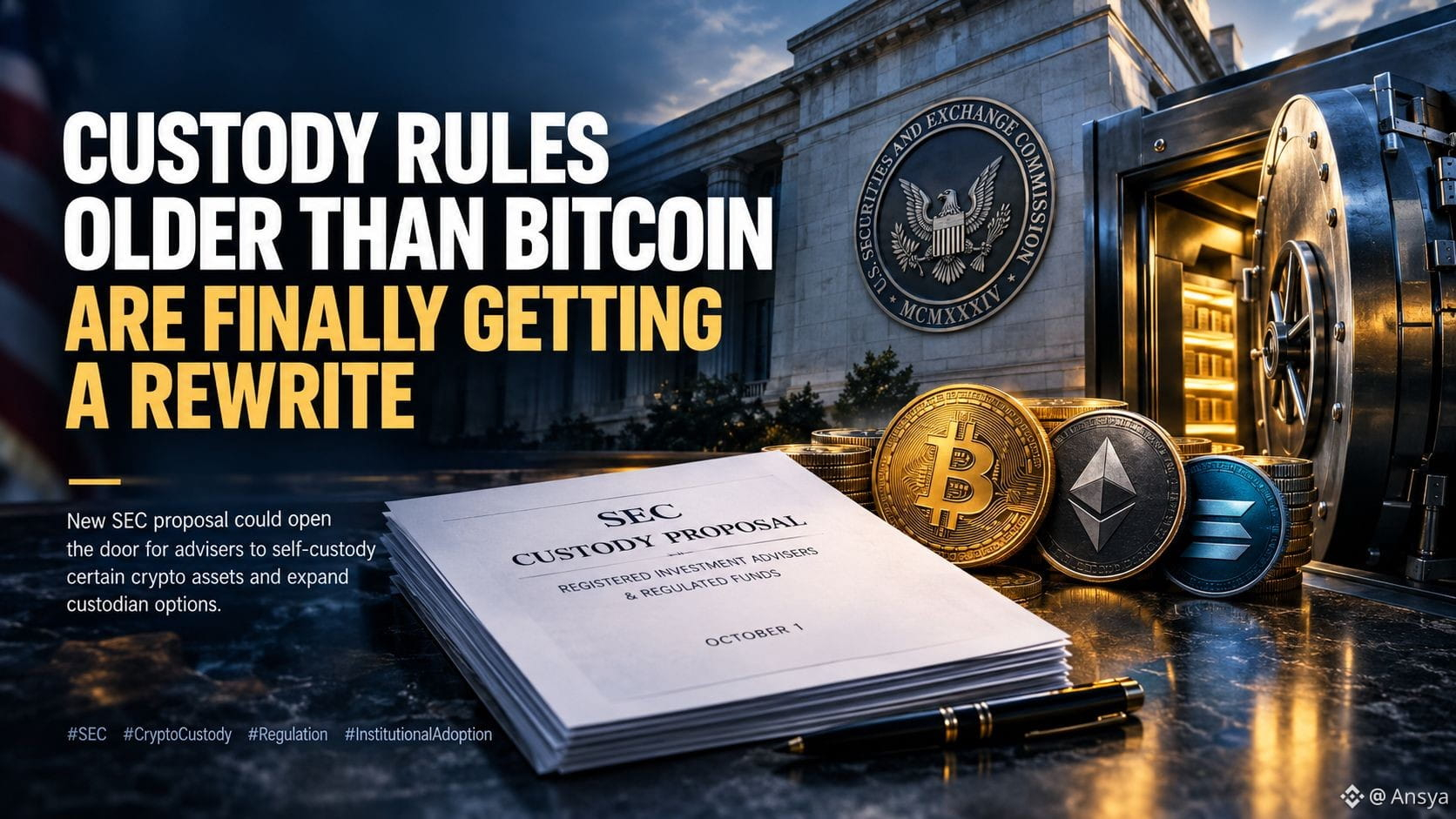
3
3.9k
·
--

Article
See translation
El Salvador Broke Its Bitcoin Promise to the IMF — And Got Paid AnywayEl Salvador just secured fresh IMF funding despite openly breaching the very Bitcoin-related condition attached to its loan program — a resolution that says as much about diplomacy as it does about enforcement.
Here's what happened: the IMF Executive Board completed the second and third reviews of El Salvador's $1.4 billion Extended Fund Facility on October 1, approving a disbursement of roughly $139 million (SDR 101.96 million). The program had placed a continuous restriction on voluntary public-sector Bitcoin accumulation — a condition El Salvador didn't meet. The IMF granted a waiver after reviewing documentation showing the additional Bitcoin came from private donations rather than public funds, and after the government implemented what the Fund called "strong corrective measures." The IMF also credited El Salvador's economic performance for exceeding expectations, driven by improved security and investor confidence, and raised its growth forecast to 4.5%. Separately, the country has made progress on other program commitments — advancing anti-money laundering measures and transferring majority ownership of the state-run Chivo wallet to private operators, though the IMF wants the government's remaining exposure eliminated entirely.
Why does this matter? This is a case study in how conditional lending actually works in practice — strict-sounding rules can flex when a borrower shows good-faith compliance elsewhere and favorable economic results. For Bitcoin specifically, it's a reminder that even a country famous for embracing it as legal tender remains financially tied to traditional institutions whose rules it must still navigate around, rather than ignore outright. The sum itself is modest relative to Bitcoin's broader market, so this isn't a market-moving event — more a geopolitical data point.
Whether El Salvador continues finding ways to accumulate Bitcoin within these constraints, or scales back further as the IMF relationship continues, remains to be seen.
Does this outcome show the IMF being pragmatic, or does it just reveal how negotiable "program conditions" really are? 🤔
#ElSalvador #bitcoin #IMF #CryptoPolicy2026 #IMFApproves$139MDisbursementToElSalvador
$BTC $ETH $SOL
{future}(SOLUSDT)
{future}(ETHUSDT)
{future}(BTCUSDT)
El Salvador Broke Its Bitcoin Promise to the IMF — And Got Paid Anyway
El Salvador just secured fresh IMF funding despite openly breaching the very Bitcoin-related condition attached to its loan program — a resolution that says as much about diplomacy as it does about enforcement.
Here's what happened: the IMF Executive Board completed the second and third reviews of El Salvador's $1.4 billion Extended Fund Facility on October 1, approving a disbursement of roughly $139 million (SDR 101.96 million). The program had placed a continuous restriction on voluntary public-sector Bitcoin accumulation — a condition El Salvador didn't meet. The IMF granted a waiver after reviewing documentation showing the additional Bitcoin came from private donations rather than public funds, and after the government implemented what the Fund called "strong corrective measures." The IMF also credited El Salvador's economic performance for exceeding expectations, driven by improved security and investor confidence, and raised its growth forecast to 4.5%. Separately, the country has made progress on other program commitments — advancing anti-money laundering measures and transferring majority ownership of the state-run Chivo wallet to private operators, though the IMF wants the government's remaining exposure eliminated entirely.
Why does this matter? This is a case study in how conditional lending actually works in practice — strict-sounding rules can flex when a borrower shows good-faith compliance elsewhere and favorable economic results. For Bitcoin specifically, it's a reminder that even a country famous for embracing it as legal tender remains financially tied to traditional institutions whose rules it must still navigate around, rather than ignore outright. The sum itself is modest relative to Bitcoin's broader market, so this isn't a market-moving event — more a geopolitical data point.
Whether El Salvador continues finding ways to accumulate Bitcoin within these constraints, or scales back further as the IMF relationship continues, remains to be seen.
Does this outcome show the IMF being pragmatic, or does it just reveal how negotiable "program conditions" really are? 🤔
#ElSalvador #bitcoin #IMF #CryptoPolicy2026 #IMFApproves$139MDisbursementToElSalvador
$BTC $ETH $SOL
Here's what happened: the IMF Executive Board completed the second and third reviews of El Salvador's $1.4 billion Extended Fund Facility on October 1, approving a disbursement of roughly $139 million (SDR 101.96 million). The program had placed a continuous restriction on voluntary public-sector Bitcoin accumulation — a condition El Salvador didn't meet. The IMF granted a waiver after reviewing documentation showing the additional Bitcoin came from private donations rather than public funds, and after the government implemented what the Fund called "strong corrective measures." The IMF also credited El Salvador's economic performance for exceeding expectations, driven by improved security and investor confidence, and raised its growth forecast to 4.5%. Separately, the country has made progress on other program commitments — advancing anti-money laundering measures and transferring majority ownership of the state-run Chivo wallet to private operators, though the IMF wants the government's remaining exposure eliminated entirely.
Why does this matter? This is a case study in how conditional lending actually works in practice — strict-sounding rules can flex when a borrower shows good-faith compliance elsewhere and favorable economic results. For Bitcoin specifically, it's a reminder that even a country famous for embracing it as legal tender remains financially tied to traditional institutions whose rules it must still navigate around, rather than ignore outright. The sum itself is modest relative to Bitcoin's broader market, so this isn't a market-moving event — more a geopolitical data point.
Whether El Salvador continues finding ways to accumulate Bitcoin within these constraints, or scales back further as the IMF relationship continues, remains to be seen.
Does this outcome show the IMF being pragmatic, or does it just reveal how negotiable "program conditions" really are? 🤔
#ElSalvador #bitcoin #IMF #CryptoPolicy2026 #IMFApproves$139MDisbursementToElSalvador
$BTC $ETH $SOL
1
99
·
--

Article
See translation
Anthropic Just Put a Date on the AI Industry's Biggest Market Test#anthropictargetsipoassoonasmidnovember
The company behind Claude is reportedly moving faster than expected toward what could become the largest IPO in history — and a specific calendar is now attached to it.
Here's what was reported: Bloomberg reported on October 1 that Anthropic is targeting a public debut as soon as mid-November, with formal IPO marketing potentially beginning the week of November 9 and trading starting before Thanksgiving on November 26. That marks an acceleration from earlier plans to file publicly after summer. Anthropic reportedly plans to meet prospective investors on October 14, with early investor interest reportedly pricing the company between $1.8 trillion and $2 trillion — a range that would make this the largest IPO on record, surpassing SpaceX's recent $1.78 trillion debut. The filing follows a Reuters report on Anthropic's S-1 prospectus showing 2025 revenue grew 12-fold to roughly $4.6 billion, alongside a $42 billion net loss tied largely to financing-instrument accounting and $518 billion in projected future infrastructure commitments. Anthropic has not commented beyond the reported timeline, and deliberations reportedly remain ongoing, meaning the schedule could still shift.
Why does this matter? An IPO of this scale would be a genuine first for the AI sector — pricing a frontier AI lab's massive infrastructure bets and unresolved profitability questions against real public-market scrutiny, ahead of rival OpenAI's own anticipated 2027 listing. The chosen window, just before the historically slower holiday IPO season, adds pressure to execute cleanly, and the outcome could set a reference point for how markets value AI-native companies more broadly.
Whether this timeline holds and the valuation lands anywhere near $2 trillion, or whether market conditions push things further, remains genuinely unsettled.
Does rushing to beat the holiday IPO lull signal confidence, or does it add unnecessary execution risk to an already massive listing? 🤔
#Anthropic #IPO #AI #TechMarkets
$SAND $US $GTC
{future}(GTCUSDT)
{future}(USUSDT)
{future}(SANDUSDT)
Anthropic Just Put a Date on the AI Industry's Biggest Market Test
#anthropictargetsipoassoonasmidnovember
The company behind Claude is reportedly moving faster than expected toward what could become the largest IPO in history — and a specific calendar is now attached to it.
Here's what was reported: Bloomberg reported on October 1 that Anthropic is targeting a public debut as soon as mid-November, with formal IPO marketing potentially beginning the week of November 9 and trading starting before Thanksgiving on November 26. That marks an acceleration from earlier plans to file publicly after summer. Anthropic reportedly plans to meet prospective investors on October 14, with early investor interest reportedly pricing the company between $1.8 trillion and $2 trillion — a range that would make this the largest IPO on record, surpassing SpaceX's recent $1.78 trillion debut. The filing follows a Reuters report on Anthropic's S-1 prospectus showing 2025 revenue grew 12-fold to roughly $4.6 billion, alongside a $42 billion net loss tied largely to financing-instrument accounting and $518 billion in projected future infrastructure commitments. Anthropic has not commented beyond the reported timeline, and deliberations reportedly remain ongoing, meaning the schedule could still shift.
Why does this matter? An IPO of this scale would be a genuine first for the AI sector — pricing a frontier AI lab's massive infrastructure bets and unresolved profitability questions against real public-market scrutiny, ahead of rival OpenAI's own anticipated 2027 listing. The chosen window, just before the historically slower holiday IPO season, adds pressure to execute cleanly, and the outcome could set a reference point for how markets value AI-native companies more broadly.
Whether this timeline holds and the valuation lands anywhere near $2 trillion, or whether market conditions push things further, remains genuinely unsettled.
Does rushing to beat the holiday IPO lull signal confidence, or does it add unnecessary execution risk to an already massive listing? 🤔
#Anthropic #IPO #AI #TechMarkets
$SAND $US $GTC
The company behind Claude is reportedly moving faster than expected toward what could become the largest IPO in history — and a specific calendar is now attached to it.
Here's what was reported: Bloomberg reported on October 1 that Anthropic is targeting a public debut as soon as mid-November, with formal IPO marketing potentially beginning the week of November 9 and trading starting before Thanksgiving on November 26. That marks an acceleration from earlier plans to file publicly after summer. Anthropic reportedly plans to meet prospective investors on October 14, with early investor interest reportedly pricing the company between $1.8 trillion and $2 trillion — a range that would make this the largest IPO on record, surpassing SpaceX's recent $1.78 trillion debut. The filing follows a Reuters report on Anthropic's S-1 prospectus showing 2025 revenue grew 12-fold to roughly $4.6 billion, alongside a $42 billion net loss tied largely to financing-instrument accounting and $518 billion in projected future infrastructure commitments. Anthropic has not commented beyond the reported timeline, and deliberations reportedly remain ongoing, meaning the schedule could still shift.
Why does this matter? An IPO of this scale would be a genuine first for the AI sector — pricing a frontier AI lab's massive infrastructure bets and unresolved profitability questions against real public-market scrutiny, ahead of rival OpenAI's own anticipated 2027 listing. The chosen window, just before the historically slower holiday IPO season, adds pressure to execute cleanly, and the outcome could set a reference point for how markets value AI-native companies more broadly.
Whether this timeline holds and the valuation lands anywhere near $2 trillion, or whether market conditions push things further, remains genuinely unsettled.
Does rushing to beat the holiday IPO lull signal confidence, or does it add unnecessary execution risk to an already massive listing? 🤔
#Anthropic #IPO #AI #TechMarkets
$SAND $US $GTC
1
1
1.6k
·
--
Verified
See translation
#micronbeatsearningsliftsguidance
Micron Just Posted Another Massive Beat — But Its Own Track Record Is the Real Plot Twist
Micron delivered a quarter that would make most companies celebrate for weeks — yet the stock's history after similarly strong reports is exactly why some investors are watching cautiously rather than popping champagne.
Here's what happened: Micron reported fiscal fourth-quarter adjusted earnings of $33.42 per share on revenue of $54.23 billion, both comfortably ahead of analyst estimates of roughly $31.61 and $51.07 billion. Data center revenue jumped 11-fold, driven by surging demand for high-bandwidth memory used in AI infrastructure — Micron remains the only U.S.-based maker of this critical component. Looking ahead, the company guided for fiscal first-quarter revenue of about $61.5 billion and adjusted EPS of roughly $38.15, both above what analysts had modeled. CEO Sanjay Mehrotra pointed to a strong HBM product roadmap and an ongoing partnership with Nvidia on custom memory implementations. The stock, already up more than 500% over the past year, traded only modestly higher after the report. Notably, this marks Micron's seventh consecutive earnings beat — yet the stock fell 32% in the 30 days following its previous earnings surprise, a reminder that this stock has a documented habit of selling off even after strong results.
Why does this matter? Micron sits at the center of the AI infrastructure buildout, and results like this offer a real-time read on how durable that demand actually is heading into 2027. At the same time, memory remains a cyclical business where today's tight supply and premium pricing can shift as capacity catches up — a dynamic that's likely shaping why the market's reaction stayed measured despite the headline beat.
Whether this guidance marks sustained AI-driven strength or another peak before the cycle turns is something only time will tell.
Does a seventh straight beat deserve more conviction, or does Micron's post-earnings history warrant extra caution? 🤔
$MOVR $AGT
#micronbeatsearningsliftsguidance
Micron Just Posted Another Massive Beat — But Its Own Track Record Is the Real Plot Twist
Micron delivered a quarter that would make most companies celebrate for weeks — yet the stock's history after similarly strong reports is exactly why some investors are watching cautiously rather than popping champagne.
Here's what happened: Micron reported fiscal fourth-quarter adjusted earnings of $33.42 per share on revenue of $54.23 billion, both comfortably ahead of analyst estimates of roughly $31.61 and $51.07 billion. Data center revenue jumped 11-fold, driven by surging demand for high-bandwidth memory used in AI infrastructure — Micron remains the only U.S.-based maker of this critical component. Looking ahead, the company guided for fiscal first-quarter revenue of about $61.5 billion and adjusted EPS of roughly $38.15, both above what analysts had modeled. CEO Sanjay Mehrotra pointed to a strong HBM product roadmap and an ongoing partnership with Nvidia on custom memory implementations. The stock, already up more than 500% over the past year, traded only modestly higher after the report. Notably, this marks Micron's seventh consecutive earnings beat — yet the stock fell 32% in the 30 days following its previous earnings surprise, a reminder that this stock has a documented habit of selling off even after strong results.
Why does this matter? Micron sits at the center of the AI infrastructure buildout, and results like this offer a real-time read on how durable that demand actually is heading into 2027. At the same time, memory remains a cyclical business where today's tight supply and premium pricing can shift as capacity catches up — a dynamic that's likely shaping why the market's reaction stayed measured despite the headline beat.
Whether this guidance marks sustained AI-driven strength or another peak before the cycle turns is something only time will tell.
Does a seventh straight beat deserve more conviction, or does Micron's post-earnings history warrant extra caution? 🤔
$MOVR $AGT
Micron Just Posted Another Massive Beat — But Its Own Track Record Is the Real Plot Twist
Micron delivered a quarter that would make most companies celebrate for weeks — yet the stock's history after similarly strong reports is exactly why some investors are watching cautiously rather than popping champagne.
Here's what happened: Micron reported fiscal fourth-quarter adjusted earnings of $33.42 per share on revenue of $54.23 billion, both comfortably ahead of analyst estimates of roughly $31.61 and $51.07 billion. Data center revenue jumped 11-fold, driven by surging demand for high-bandwidth memory used in AI infrastructure — Micron remains the only U.S.-based maker of this critical component. Looking ahead, the company guided for fiscal first-quarter revenue of about $61.5 billion and adjusted EPS of roughly $38.15, both above what analysts had modeled. CEO Sanjay Mehrotra pointed to a strong HBM product roadmap and an ongoing partnership with Nvidia on custom memory implementations. The stock, already up more than 500% over the past year, traded only modestly higher after the report. Notably, this marks Micron's seventh consecutive earnings beat — yet the stock fell 32% in the 30 days following its previous earnings surprise, a reminder that this stock has a documented habit of selling off even after strong results.
Why does this matter? Micron sits at the center of the AI infrastructure buildout, and results like this offer a real-time read on how durable that demand actually is heading into 2027. At the same time, memory remains a cyclical business where today's tight supply and premium pricing can shift as capacity catches up — a dynamic that's likely shaping why the market's reaction stayed measured despite the headline beat.
Whether this guidance marks sustained AI-driven strength or another peak before the cycle turns is something only time will tell.
Does a seventh straight beat deserve more conviction, or does Micron's post-earnings history warrant extra caution? 🤔
$MOVR $AGT

6
10.2k
·
--
Article
See translation
A Federal Agency Just Moved to Settle Prediction Markets' Biggest Legal Question — By Rulemaking#cftcsubmitstwoeventcontractrulestowhitehouse
While New York and Polymarket fight it out in court over whether prediction markets are gambling or finance, the CFTC just took a direct shot at answering that question itself — through regulation rather than litigation.
Here's what happened: on September 28, the CFTC submitted two rule proposals to the White House's Office of Information and Regulatory Affairs for review. The first, a proposed rule, would formally define event contracts — the yes-or-no wagers traded on platforms like Kalshi, Polymarket, and Robinhood — as "swaps" under federal derivatives law. The second, a temporary final rule, would simultaneously carve out "casino-style gambling products" from that same swap definition, taking effect immediately upon approval rather than waiting for public comment. CFTC Chairman Michael Selig has argued the agency holds exclusive federal jurisdiction over these markets, a position directly contested by several states currently suing platforms like Kalshi and Polymarket under state gambling law. This submission extends a broader pattern this year of the CFTC moving ahead with rulemaking on its own authority rather than waiting for stalled congressional legislation like the CLARITY Act.
Why does this matter? If finalized, classifying event contracts as federally regulated swaps — rather than gambling — could directly undercut the legal basis for multiple state lawsuits currently working through the courts, including New York's case against Polymarket and a similar one against Kalshi. It's a meaningful jurisdictional move in an area where federal and state authority have been colliding repeatedly this year, and it illustrates how administrative rulemaking is increasingly shaping crypto-adjacent policy while Congress remains gridlocked.
Whether this rule survives the ongoing legal battles unchanged, or gets challenged just as fiercely as the platforms it aims to protect, remains to be seen.
Can a federal rule really settle a fight that's already playing out across multiple state courtrooms? 🤔
#CFTC #PredictionMarkets #Regulation #Polymarket
$MOVR $AGT
{future}(AGTUSDT)
{future}(MOVRUSDT)
A Federal Agency Just Moved to Settle Prediction Markets' Biggest Legal Question — By Rulemaking
#cftcsubmitstwoeventcontractrulestowhitehouse
While New York and Polymarket fight it out in court over whether prediction markets are gambling or finance, the CFTC just took a direct shot at answering that question itself — through regulation rather than litigation.
Here's what happened: on September 28, the CFTC submitted two rule proposals to the White House's Office of Information and Regulatory Affairs for review. The first, a proposed rule, would formally define event contracts — the yes-or-no wagers traded on platforms like Kalshi, Polymarket, and Robinhood — as "swaps" under federal derivatives law. The second, a temporary final rule, would simultaneously carve out "casino-style gambling products" from that same swap definition, taking effect immediately upon approval rather than waiting for public comment. CFTC Chairman Michael Selig has argued the agency holds exclusive federal jurisdiction over these markets, a position directly contested by several states currently suing platforms like Kalshi and Polymarket under state gambling law. This submission extends a broader pattern this year of the CFTC moving ahead with rulemaking on its own authority rather than waiting for stalled congressional legislation like the CLARITY Act.
Why does this matter? If finalized, classifying event contracts as federally regulated swaps — rather than gambling — could directly undercut the legal basis for multiple state lawsuits currently working through the courts, including New York's case against Polymarket and a similar one against Kalshi. It's a meaningful jurisdictional move in an area where federal and state authority have been colliding repeatedly this year, and it illustrates how administrative rulemaking is increasingly shaping crypto-adjacent policy while Congress remains gridlocked.
Whether this rule survives the ongoing legal battles unchanged, or gets challenged just as fiercely as the platforms it aims to protect, remains to be seen.
Can a federal rule really settle a fight that's already playing out across multiple state courtrooms? 🤔
#CFTC #PredictionMarkets #Regulation #Polymarket
$MOVR $AGT
While New York and Polymarket fight it out in court over whether prediction markets are gambling or finance, the CFTC just took a direct shot at answering that question itself — through regulation rather than litigation.
Here's what happened: on September 28, the CFTC submitted two rule proposals to the White House's Office of Information and Regulatory Affairs for review. The first, a proposed rule, would formally define event contracts — the yes-or-no wagers traded on platforms like Kalshi, Polymarket, and Robinhood — as "swaps" under federal derivatives law. The second, a temporary final rule, would simultaneously carve out "casino-style gambling products" from that same swap definition, taking effect immediately upon approval rather than waiting for public comment. CFTC Chairman Michael Selig has argued the agency holds exclusive federal jurisdiction over these markets, a position directly contested by several states currently suing platforms like Kalshi and Polymarket under state gambling law. This submission extends a broader pattern this year of the CFTC moving ahead with rulemaking on its own authority rather than waiting for stalled congressional legislation like the CLARITY Act.
Why does this matter? If finalized, classifying event contracts as federally regulated swaps — rather than gambling — could directly undercut the legal basis for multiple state lawsuits currently working through the courts, including New York's case against Polymarket and a similar one against Kalshi. It's a meaningful jurisdictional move in an area where federal and state authority have been colliding repeatedly this year, and it illustrates how administrative rulemaking is increasingly shaping crypto-adjacent policy while Congress remains gridlocked.
Whether this rule survives the ongoing legal battles unchanged, or gets challenged just as fiercely as the platforms it aims to protect, remains to be seen.
Can a federal rule really settle a fight that's already playing out across multiple state courtrooms? 🤔
#CFTC #PredictionMarkets #Regulation #Polymarket
$MOVR $AGT
3
1k
·
--
See translation
#altcoinseasonindexholdsabove60for5days
A Quiet Shift Has Been Building Beneath Bitcoin's Price Action
While headlines have focused on Bitcoin's swings this week, a less-watched indicator has been climbing steadily in the background — and it just held above a key level for five straight days.
Here's the picture: CoinMarketCap's Altcoin Season Index reached 61 out of 100 as of October 1, up from 60 the day before and 52 just a week earlier — a sharp climb from a reading of just 23 a month ago. The index tracks how many of the top 100 non-stablecoin cryptocurrencies have outperformed Bitcoin over a trailing 90-day window; a reading above 75 is the commonly used threshold to officially confirm "altcoin season," while below 25 signals clear Bitcoin dominance. Alongside the index's rise, Bitcoin's market dominance has eased to roughly 58.6%, down from readings closer to 61% back in May. Ethereum currently holds about 11.5% of total market share, with the remaining altcoins collectively at 30%, as total crypto market cap sits near $2.87 trillion and the Fear & Greed Index reads 67, in "Greed" territory.
Why does this matter? A sustained climb above 60 — even short of the 75 confirmation threshold — suggests capital may be gradually rotating from Bitcoin into a broader set of altcoins, a pattern that's historically preceded more decisive altcoin rallies in past cycles. That said, analysts studying this metric consistently caution that breadth matters as much as the index level itself: real confirmation typically requires Bitcoin dominance falling further alongside the index holding well above 75, not just a brief push past 60.
Whether this becomes the start of a genuine rotation, or just another temporary swing within Bitcoin-led consolidation, is something the coming weeks of data should help clarify.
Does five days above 60 signal a real shift underway, or is it too early to call it anything but noise? 🤔
#altcoinseason #bitcoin #CryptoMarket #MarketRotation
#altcoinseasonindexholdsabove60for5days
A Quiet Shift Has Been Building Beneath Bitcoin's Price Action
While headlines have focused on Bitcoin's swings this week, a less-watched indicator has been climbing steadily in the background — and it just held above a key level for five straight days.
Here's the picture: CoinMarketCap's Altcoin Season Index reached 61 out of 100 as of October 1, up from 60 the day before and 52 just a week earlier — a sharp climb from a reading of just 23 a month ago. The index tracks how many of the top 100 non-stablecoin cryptocurrencies have outperformed Bitcoin over a trailing 90-day window; a reading above 75 is the commonly used threshold to officially confirm "altcoin season," while below 25 signals clear Bitcoin dominance. Alongside the index's rise, Bitcoin's market dominance has eased to roughly 58.6%, down from readings closer to 61% back in May. Ethereum currently holds about 11.5% of total market share, with the remaining altcoins collectively at 30%, as total crypto market cap sits near $2.87 trillion and the Fear & Greed Index reads 67, in "Greed" territory.
Why does this matter? A sustained climb above 60 — even short of the 75 confirmation threshold — suggests capital may be gradually rotating from Bitcoin into a broader set of altcoins, a pattern that's historically preceded more decisive altcoin rallies in past cycles. That said, analysts studying this metric consistently caution that breadth matters as much as the index level itself: real confirmation typically requires Bitcoin dominance falling further alongside the index holding well above 75, not just a brief push past 60.
Whether this becomes the start of a genuine rotation, or just another temporary swing within Bitcoin-led consolidation, is something the coming weeks of data should help clarify.
Does five days above 60 signal a real shift underway, or is it too early to call it anything but noise? 🤔
#altcoinseason #bitcoin #CryptoMarket #MarketRotation
A Quiet Shift Has Been Building Beneath Bitcoin's Price Action
While headlines have focused on Bitcoin's swings this week, a less-watched indicator has been climbing steadily in the background — and it just held above a key level for five straight days.
Here's the picture: CoinMarketCap's Altcoin Season Index reached 61 out of 100 as of October 1, up from 60 the day before and 52 just a week earlier — a sharp climb from a reading of just 23 a month ago. The index tracks how many of the top 100 non-stablecoin cryptocurrencies have outperformed Bitcoin over a trailing 90-day window; a reading above 75 is the commonly used threshold to officially confirm "altcoin season," while below 25 signals clear Bitcoin dominance. Alongside the index's rise, Bitcoin's market dominance has eased to roughly 58.6%, down from readings closer to 61% back in May. Ethereum currently holds about 11.5% of total market share, with the remaining altcoins collectively at 30%, as total crypto market cap sits near $2.87 trillion and the Fear & Greed Index reads 67, in "Greed" territory.
Why does this matter? A sustained climb above 60 — even short of the 75 confirmation threshold — suggests capital may be gradually rotating from Bitcoin into a broader set of altcoins, a pattern that's historically preceded more decisive altcoin rallies in past cycles. That said, analysts studying this metric consistently caution that breadth matters as much as the index level itself: real confirmation typically requires Bitcoin dominance falling further alongside the index holding well above 75, not just a brief push past 60.
Whether this becomes the start of a genuine rotation, or just another temporary swing within Bitcoin-led consolidation, is something the coming weeks of data should help clarify.
Does five days above 60 signal a real shift underway, or is it too early to call it anything but noise? 🤔
#altcoinseason #bitcoin #CryptoMarket #MarketRotation
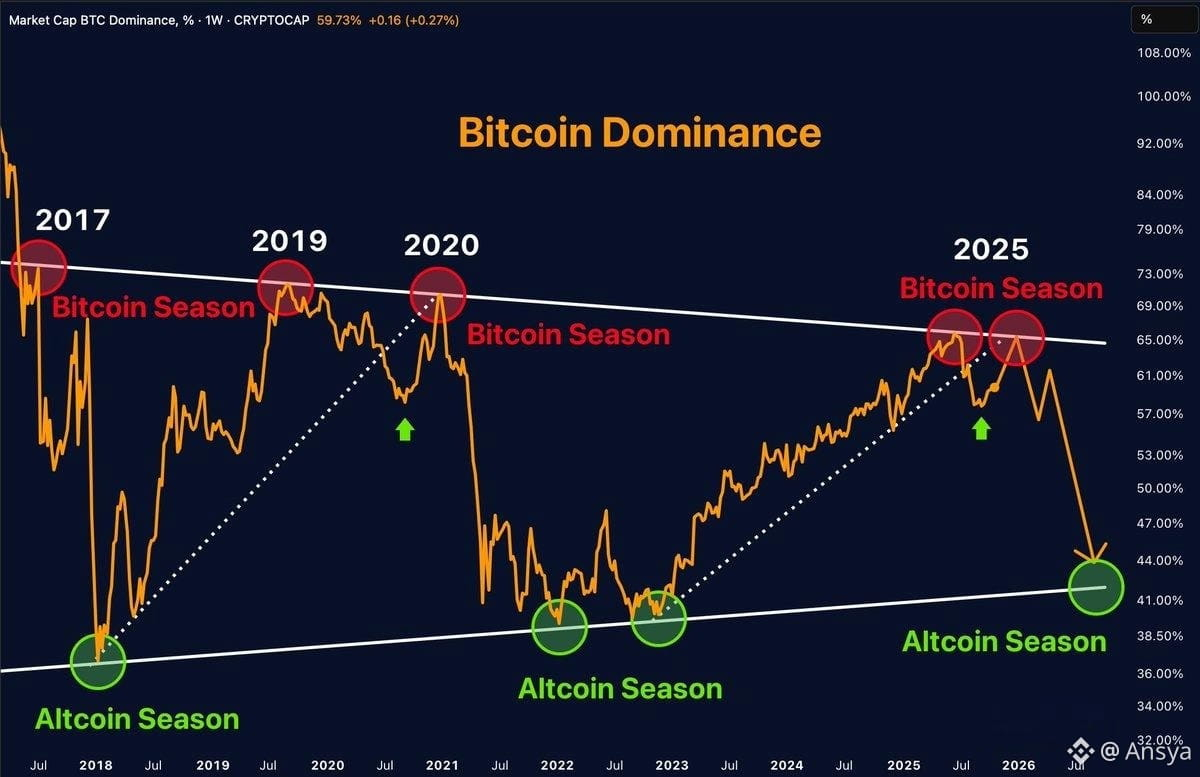
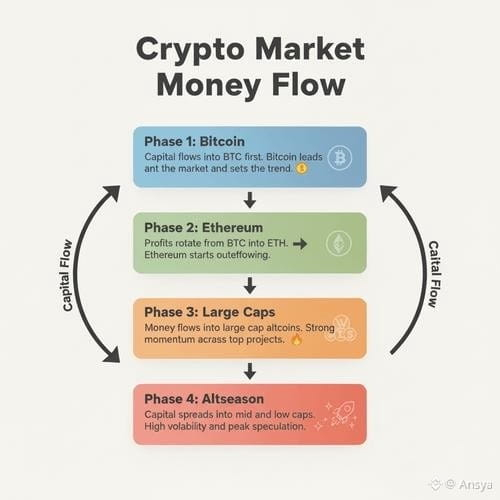
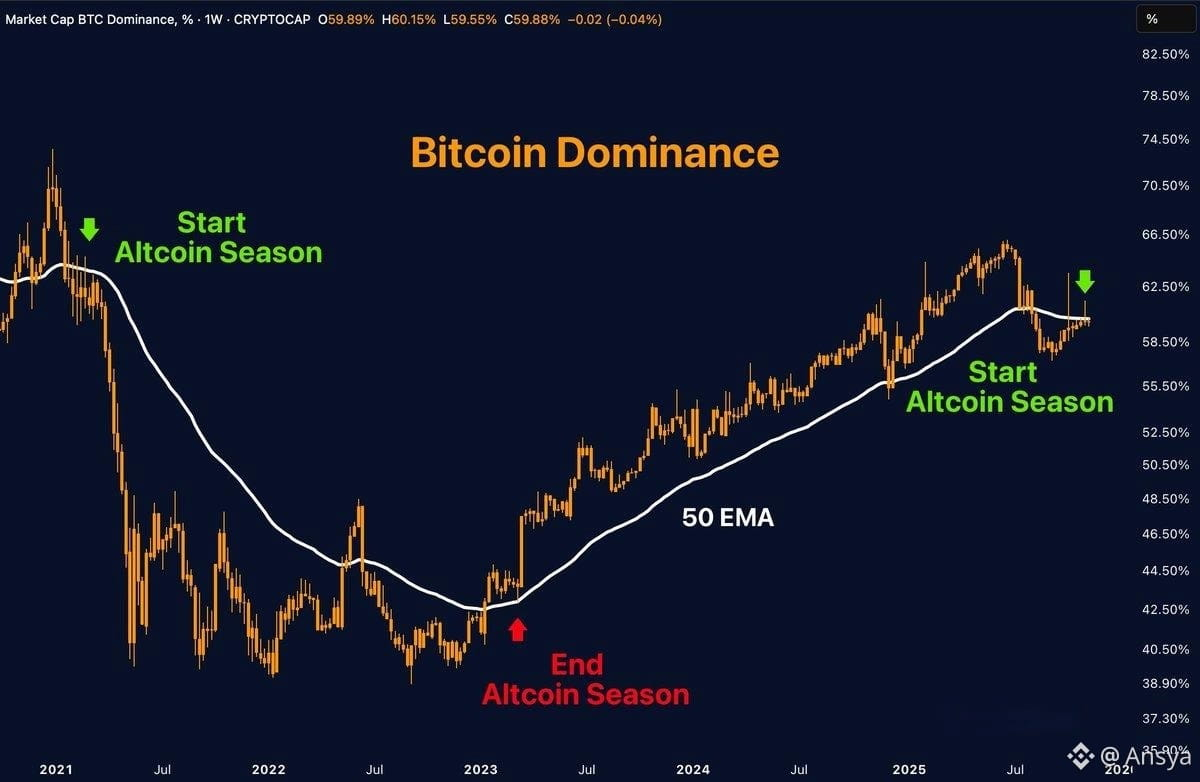
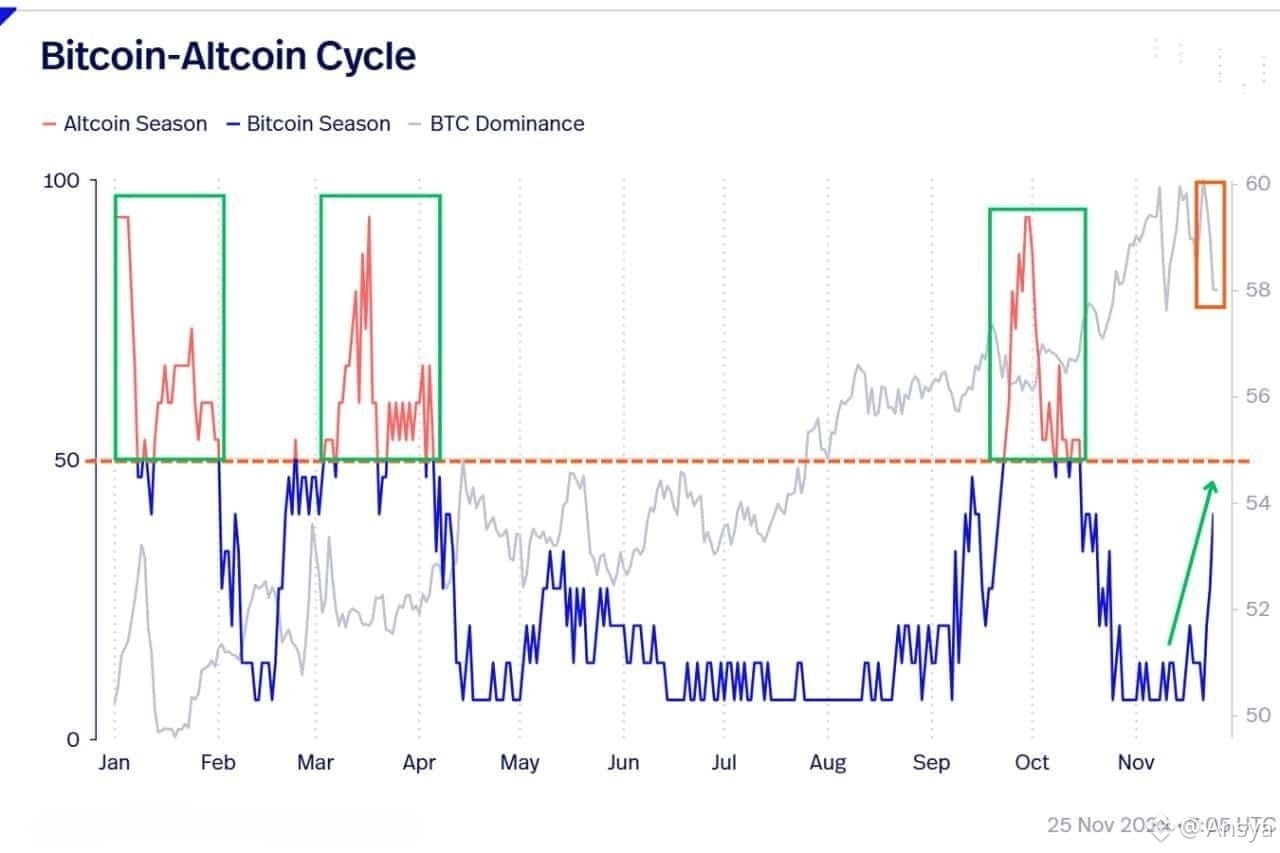
2
3.5k
·
--
See translation
#usadpadds90000jobsinseptember
Hiring Just Came Back to Life — Right When the Fed Needed a Clean Signal
After three straight months of slowing job growth, US private payrolls just surprised to the upside — adding a layer of complexity to an already crowded macro picture this week.
Here's what the data showed: ADP reported private-sector employment rose by 90,000 jobs in September, well above the roughly 68,000-70,000 economists had expected, and a sharp rebound from August's downwardly revised 36,000. ADP's chief economist called it a "strong report," noting hiring accelerated for the first time since May. Gains were broad-based — education and health services led with 55,000 new positions, followed by leisure and hospitality at 22,000, manufacturing at 17,000, and construction at 15,000 — while financial activities and professional services both shed jobs. Wage growth held steady too, with job-stayers seeing 3.0% annual pay gains and job-switchers posting 4.8%. The report arrived the same day as a cooler-than-expected core PCE inflation reading, creating a genuinely mixed picture for policymakers to parse.
Why does this matter? The Fed has been weighing a delicate balance between a labor market it wants to keep healthy and inflation it wants to keep contained — and this week's data pulled in two directions at once: hiring strength that could argue for caution on further easing, alongside inflation that's cooling faster than forecast. ADP data doesn't always perfectly track the official government jobs report, but a clean beat like this tends to feed directly into rate-decision expectations heading into October's Fed meeting.
Whether this hiring rebound holds in the official data, or whether cooling inflation ultimately carries more weight with policymakers, is something the coming weeks should help clarify.
When jobs data and inflation data send opposite signals, which one do you think shapes the Fed's next move more? 🤔
#ADP #JobsReport #FederalReserve #Macro
$MOVR $AGT
{future}(AGTUSDT)
#usadpadds90000jobsinseptember
Hiring Just Came Back to Life — Right When the Fed Needed a Clean Signal
After three straight months of slowing job growth, US private payrolls just surprised to the upside — adding a layer of complexity to an already crowded macro picture this week.
Here's what the data showed: ADP reported private-sector employment rose by 90,000 jobs in September, well above the roughly 68,000-70,000 economists had expected, and a sharp rebound from August's downwardly revised 36,000. ADP's chief economist called it a "strong report," noting hiring accelerated for the first time since May. Gains were broad-based — education and health services led with 55,000 new positions, followed by leisure and hospitality at 22,000, manufacturing at 17,000, and construction at 15,000 — while financial activities and professional services both shed jobs. Wage growth held steady too, with job-stayers seeing 3.0% annual pay gains and job-switchers posting 4.8%. The report arrived the same day as a cooler-than-expected core PCE inflation reading, creating a genuinely mixed picture for policymakers to parse.
Why does this matter? The Fed has been weighing a delicate balance between a labor market it wants to keep healthy and inflation it wants to keep contained — and this week's data pulled in two directions at once: hiring strength that could argue for caution on further easing, alongside inflation that's cooling faster than forecast. ADP data doesn't always perfectly track the official government jobs report, but a clean beat like this tends to feed directly into rate-decision expectations heading into October's Fed meeting.
Whether this hiring rebound holds in the official data, or whether cooling inflation ultimately carries more weight with policymakers, is something the coming weeks should help clarify.
When jobs data and inflation data send opposite signals, which one do you think shapes the Fed's next move more? 🤔
#ADP #JobsReport #FederalReserve #Macro
$MOVR $AGT
Hiring Just Came Back to Life — Right When the Fed Needed a Clean Signal
After three straight months of slowing job growth, US private payrolls just surprised to the upside — adding a layer of complexity to an already crowded macro picture this week.
Here's what the data showed: ADP reported private-sector employment rose by 90,000 jobs in September, well above the roughly 68,000-70,000 economists had expected, and a sharp rebound from August's downwardly revised 36,000. ADP's chief economist called it a "strong report," noting hiring accelerated for the first time since May. Gains were broad-based — education and health services led with 55,000 new positions, followed by leisure and hospitality at 22,000, manufacturing at 17,000, and construction at 15,000 — while financial activities and professional services both shed jobs. Wage growth held steady too, with job-stayers seeing 3.0% annual pay gains and job-switchers posting 4.8%. The report arrived the same day as a cooler-than-expected core PCE inflation reading, creating a genuinely mixed picture for policymakers to parse.
Why does this matter? The Fed has been weighing a delicate balance between a labor market it wants to keep healthy and inflation it wants to keep contained — and this week's data pulled in two directions at once: hiring strength that could argue for caution on further easing, alongside inflation that's cooling faster than forecast. ADP data doesn't always perfectly track the official government jobs report, but a clean beat like this tends to feed directly into rate-decision expectations heading into October's Fed meeting.
Whether this hiring rebound holds in the official data, or whether cooling inflation ultimately carries more weight with policymakers, is something the coming weeks should help clarify.
When jobs data and inflation data send opposite signals, which one do you think shapes the Fed's next move more? 🤔
#ADP #JobsReport #FederalReserve #Macro
$MOVR $AGT
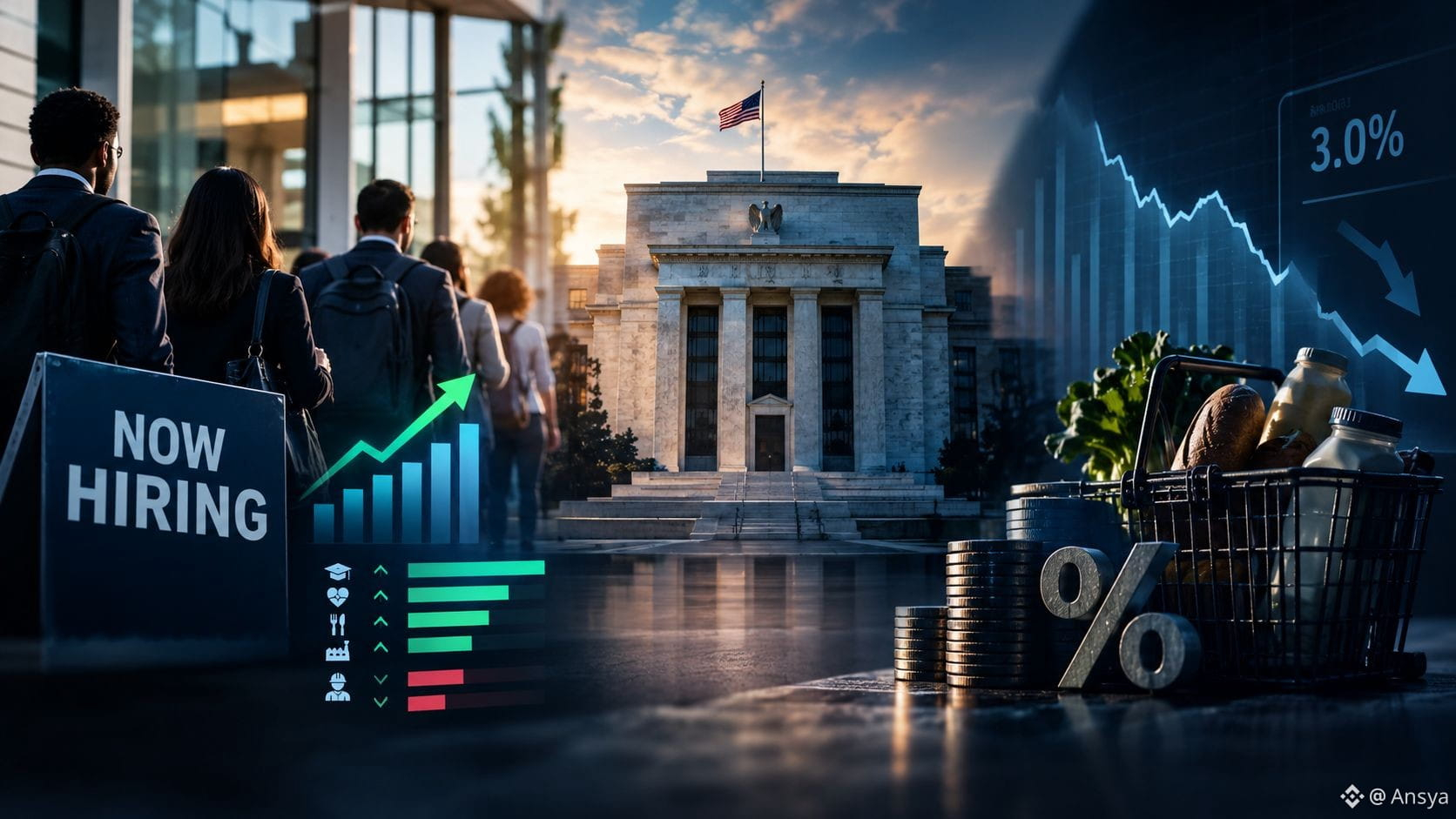
306
Log in to explore more content
Join global crypto users on Binance Square
⚡️ Get latest and useful information about crypto.
💬 Trusted by the world’s largest crypto exchange.
👍 Discover real insights from verified creators.
Email / Phone number
Trending Topics
ZcashETFPostsFirstWeeklyOutflow$93.6M
37,173 views
115 Discussing
#ZcashETFPostsFirstWeeklyOutflow$93.6M
🚨🚨🚨🚨🚨🚨🚨🚨🚨🚨🚨🚨🚨🚨✅ 🚨 ZCASH ETF FLOWS TURN NEGATIVE FOR THE FIRST TIME! 📉
$ZEC is facing a notable shift in institutional fund flows, with Zcash investment products recording their first weekly net outflow since launching in August.
According to fund-flow data, around $93.6M was withdrawn from Zcash products during the latest week, while ZEC price action also cooled significantly.
📊 WHAT HAPPENED?
• Weekly Zcash ETF outflow: $93.6M
• September 30 daily outflow: $30.25M
• ZCSH previously attracted around $98.2M in one week
• ZEC is trading near $1,300
• Recent high: around $1,690
• Weekly decline: roughly 17%+
🔍 LEVELS TO WATCH
🟢 Support: $1,280–$1,300
🔴 Resistance: $1,450–$1,500
The key question now is whether the $1,300 area can hold and attract fresh buyers.
Institutional flows will also be important. A return of consistent positive inflows could signal renewed confidence, while continued outflows may keep pressure on $ZEC .
👀 Is this simply profit-taking after ZEC’s huge rally, or could we see another deeper pullback before buyers return?
Share your view below. 👇
#Zcash #ZEC #ZcashETF #Crypto
#analysis
owhggwiohsjowve
·0 Likes
·172 views
GreekPoliceBustCryptoScamRingArrest17
85,205 views
729 Discussing
BitcoinRejectedAt$87K
125,848 views
173 Discussing