
溪月 Xīyuè
7.8k Posts

溪月 Xīyuè
Report
Block User
加密分析师 | 市场洞察短期与长期信号 | 比特币、以太坊及其他币种分享实时设置与基于研究的观点 与加密女王👸
Open Trade
Frequent Trader
2.5 Years
766 Following
29.4K+ Followers
4.6K+ Liked
Posts
Portfolio
All
Quotes
Live
·
--
Bullish
Verified
See translation
#us10yeartreasuryyieldnears5%
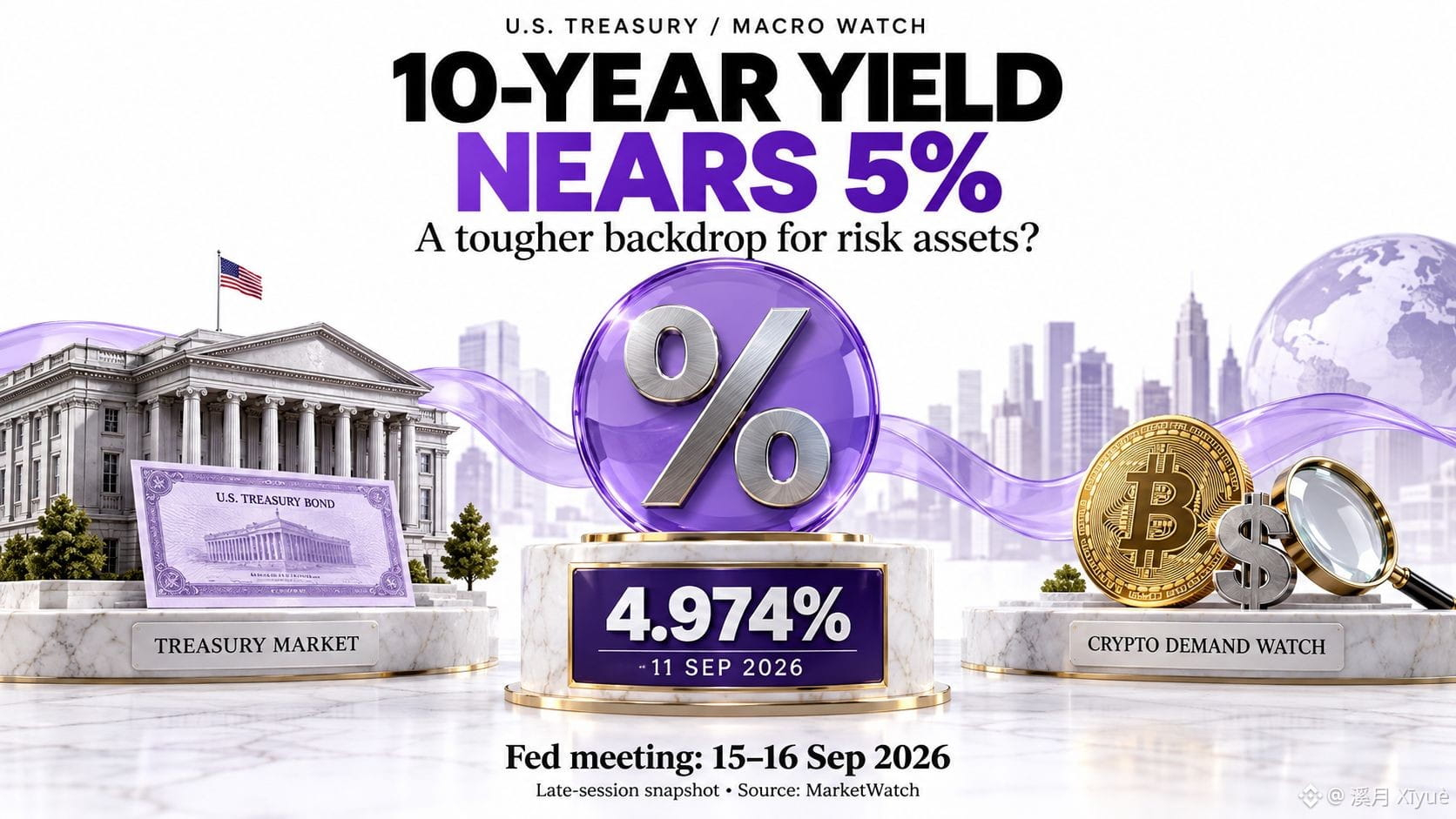
A U.S. 10-year Treasury yield near 5% raises the hurdle for risk assets.
The benchmark stood at 4.974% in late trading on September 11, keeping it just below the closely watched 5% level.
The inflation picture remains mixed. August core CPI rose 0.3% month over month, while its annual pace eased to 2.4% from 2.5%.
The next Federal Reserve meeting is scheduled for September 15–16.
My view: sustained high yields make the backdrop more demanding for stocks and crypto.
Higher Treasury yields make government bonds more competitive for investors’ capital. Higher borrowing costs can also put pressure on businesses and the valuations investors are willing to pay.
For Bitcoin, I would watch whether spot buyers continue supporting the market as yields stay elevated. Holding gains under those conditions would give me more confidence in the recovery.
I would become more cautious if another jump in yields coincides with a stronger dollar and weakening spot demand. That combination would make rallies harder to trust.
The pace and reason for the move matter too. A gradual adjustment gives markets more time to absorb changing conditions than a sudden repricing.
What would give you more confidence in a crypto recovery: easing yields or strong buying despite them? #CPIWatch
$FLOCK $PROM $TA
{future}(TAUSDT)
{future}(PROMUSDT)
{future}(FLOCKUSDT)
#us10yeartreasuryyieldnears5%
A U.S. 10-year Treasury yield near 5% raises the hurdle for risk assets.
The benchmark stood at 4.974% in late trading on September 11, keeping it just below the closely watched 5% level.
The inflation picture remains mixed. August core CPI rose 0.3% month over month, while its annual pace eased to 2.4% from 2.5%.
The next Federal Reserve meeting is scheduled for September 15–16.
My view: sustained high yields make the backdrop more demanding for stocks and crypto.
Higher Treasury yields make government bonds more competitive for investors’ capital. Higher borrowing costs can also put pressure on businesses and the valuations investors are willing to pay.
For Bitcoin, I would watch whether spot buyers continue supporting the market as yields stay elevated. Holding gains under those conditions would give me more confidence in the recovery.
I would become more cautious if another jump in yields coincides with a stronger dollar and weakening spot demand. That combination would make rallies harder to trust.
The pace and reason for the move matter too. A gradual adjustment gives markets more time to absorb changing conditions than a sudden repricing.
What would give you more confidence in a crypto recovery: easing yields or strong buying despite them? #CPIWatch
$FLOCK $PROM $TA
A U.S. 10-year Treasury yield near 5% raises the hurdle for risk assets.
The benchmark stood at 4.974% in late trading on September 11, keeping it just below the closely watched 5% level.
The inflation picture remains mixed. August core CPI rose 0.3% month over month, while its annual pace eased to 2.4% from 2.5%.
The next Federal Reserve meeting is scheduled for September 15–16.
My view: sustained high yields make the backdrop more demanding for stocks and crypto.
Higher Treasury yields make government bonds more competitive for investors’ capital. Higher borrowing costs can also put pressure on businesses and the valuations investors are willing to pay.
For Bitcoin, I would watch whether spot buyers continue supporting the market as yields stay elevated. Holding gains under those conditions would give me more confidence in the recovery.
I would become more cautious if another jump in yields coincides with a stronger dollar and weakening spot demand. That combination would make rallies harder to trust.
The pace and reason for the move matter too. A gradual adjustment gives markets more time to absorb changing conditions than a sudden repricing.
What would give you more confidence in a crypto recovery: easing yields or strong buying despite them? #CPIWatch
$FLOCK $PROM $TA
2
2.3k
·
--
Bullish
See translation
#tokenizedstockholdersup619.1%
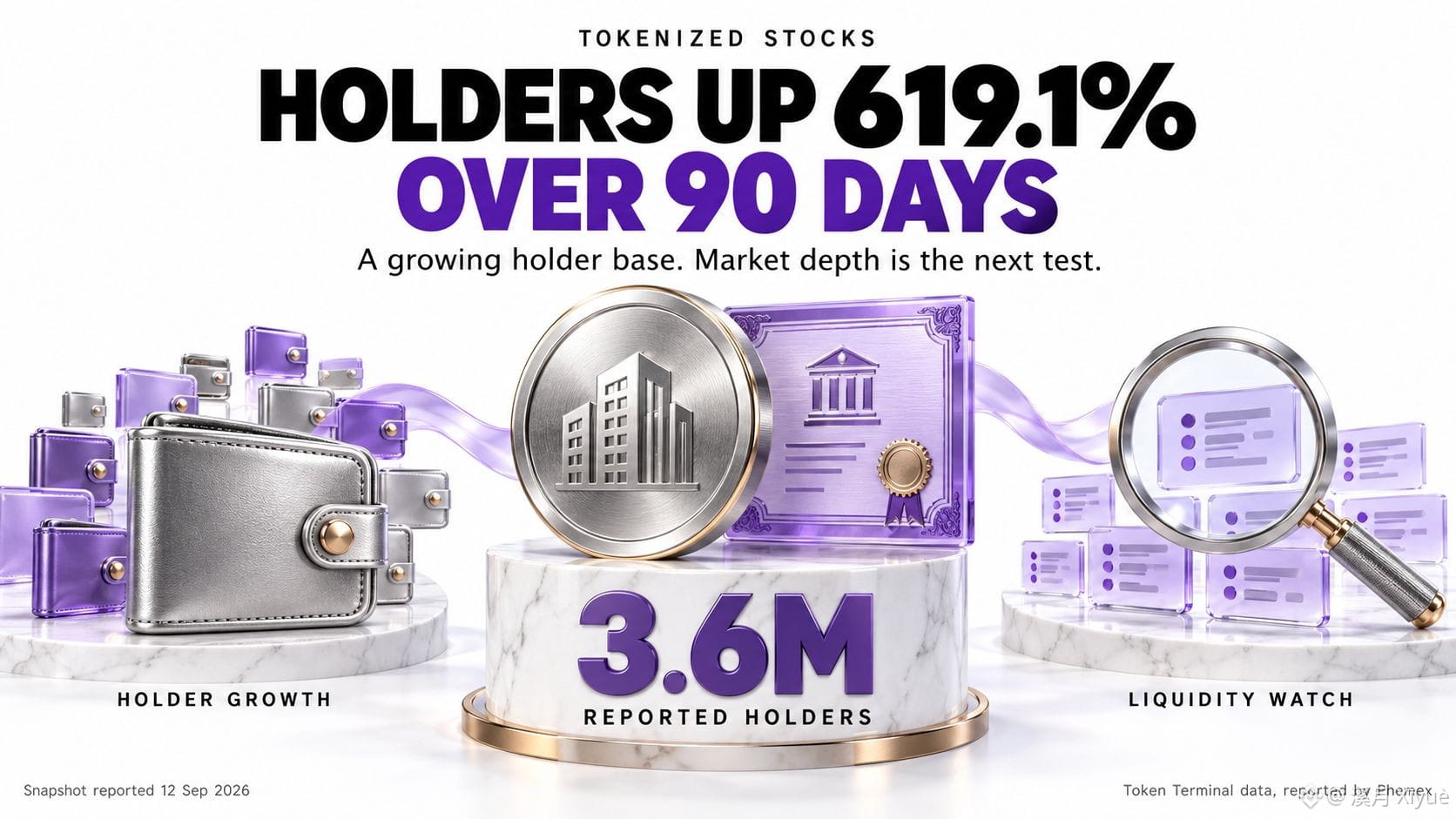
Tokenized stock holders increased 619.1% in 90 days. The next test is whether market activity keeps pace.
A September 12 report citing Token Terminal put the reported holder count at 3.6 million, with the largest concentrations on:
BNB Chain: 1.5 million.
Robinhood Chain: 1.2 million.
Solana: 647,500.
The 619.1% figure measures growth in holders over that period.
My take: this makes the distribution of tokenized equities worth watching more closely. Reaching holders is an important step; building a market they continue using requires reliable execution and sufficient liquidity.
I would also want clarity on how holders are counted across assets and chains before interpreting the total as unique investors.
The next evidence I would look for is straightforward: recurring trading activity, meaningful balances and the ability to execute larger orders without sharply moving prices.
Sustained activity and tighter spreads would strengthen the adoption case. Rising holder counts alongside tiny balances or fading usage would leave more questions about the depth of demand.
For me, the most useful follow-up is whether these new holders remain engaged over the next few months and find reasons to keep capital in these products.
What matters most to you when assessing tokenized stocks: access, liquidity or the rights attached to the token?
$LSK $GRIFFAIN
{future}(GRIFFAINUSDT)
{future}(LSKUSDT)
#tokenizedstockholdersup619.1%
Tokenized stock holders increased 619.1% in 90 days. The next test is whether market activity keeps pace.
A September 12 report citing Token Terminal put the reported holder count at 3.6 million, with the largest concentrations on:
BNB Chain: 1.5 million.
Robinhood Chain: 1.2 million.
Solana: 647,500.
The 619.1% figure measures growth in holders over that period.
My take: this makes the distribution of tokenized equities worth watching more closely. Reaching holders is an important step; building a market they continue using requires reliable execution and sufficient liquidity.
I would also want clarity on how holders are counted across assets and chains before interpreting the total as unique investors.
The next evidence I would look for is straightforward: recurring trading activity, meaningful balances and the ability to execute larger orders without sharply moving prices.
Sustained activity and tighter spreads would strengthen the adoption case. Rising holder counts alongside tiny balances or fading usage would leave more questions about the depth of demand.
For me, the most useful follow-up is whether these new holders remain engaged over the next few months and find reasons to keep capital in these products.
What matters most to you when assessing tokenized stocks: access, liquidity or the rights attached to the token?
$LSK $GRIFFAIN
Tokenized stock holders increased 619.1% in 90 days. The next test is whether market activity keeps pace.
A September 12 report citing Token Terminal put the reported holder count at 3.6 million, with the largest concentrations on:
BNB Chain: 1.5 million.
Robinhood Chain: 1.2 million.
Solana: 647,500.
The 619.1% figure measures growth in holders over that period.
My take: this makes the distribution of tokenized equities worth watching more closely. Reaching holders is an important step; building a market they continue using requires reliable execution and sufficient liquidity.
I would also want clarity on how holders are counted across assets and chains before interpreting the total as unique investors.
The next evidence I would look for is straightforward: recurring trading activity, meaningful balances and the ability to execute larger orders without sharply moving prices.
Sustained activity and tighter spreads would strengthen the adoption case. Rising holder counts alongside tiny balances or fading usage would leave more questions about the depth of demand.
For me, the most useful follow-up is whether these new holders remain engaged over the next few months and find reasons to keep capital in these products.
What matters most to you when assessing tokenized stocks: access, liquidity or the rights attached to the token?
$LSK $GRIFFAIN
1
3
1.4k

·
--
🎙️ “The Ten-Thousand-Fold Golden Dog Training Story” Episode 123: “People’s Daily Commentary: The best meme in history, the greatest meme on the internet———I love you, old buddy.” Starts at 22:00 Beijing time. Welcome to follow

End
03 h 47 m 07 s
2.1k
4
13
·
--
Bullish
See translation
#CryptoLiquidations$674MIn24H
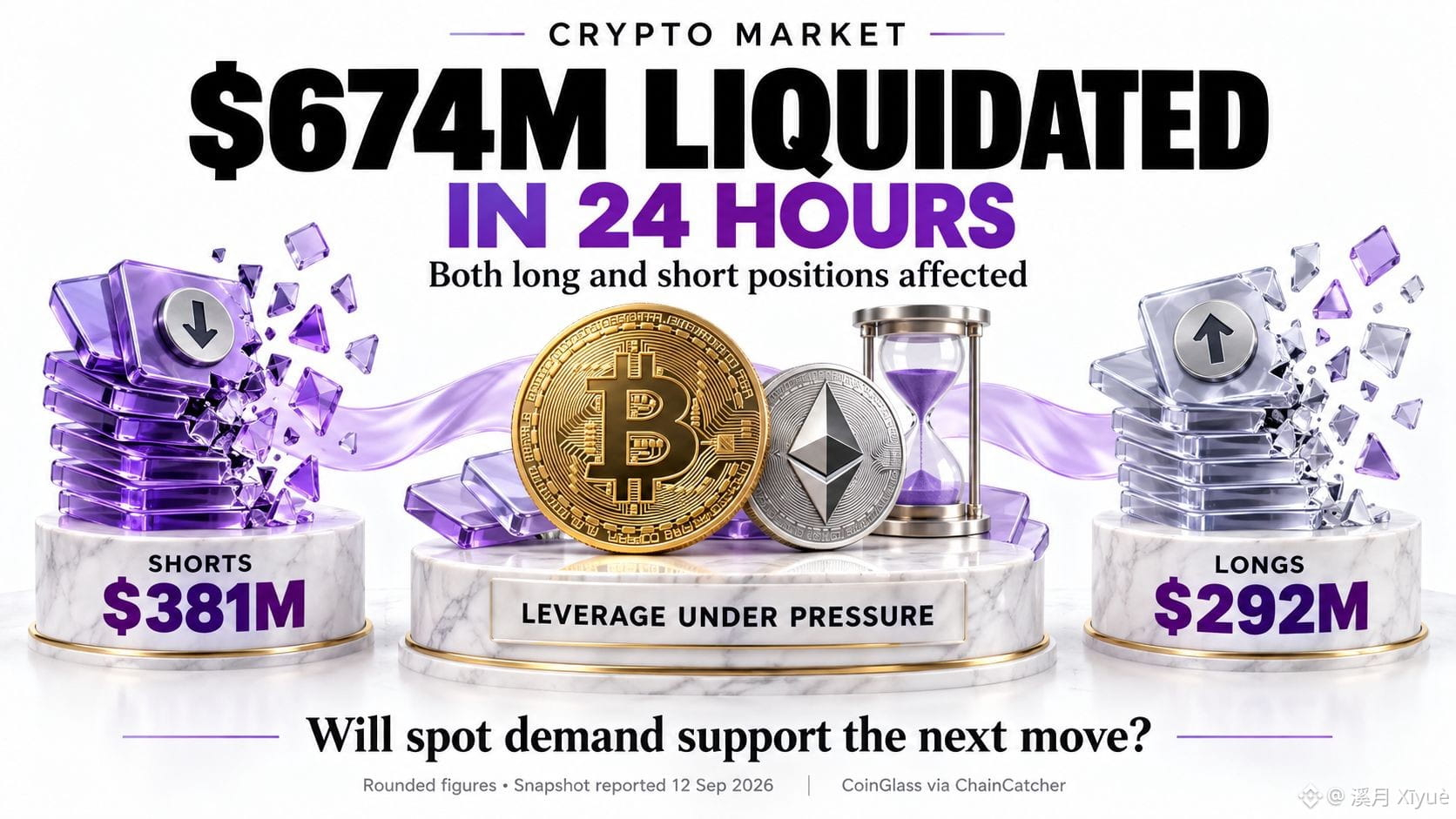
Crypto’s $674 million liquidation wave hit both sides of the trade.
A September 12 report from ChainCatcher, citing CoinGlass, put liquidations at approximately $674 million over the preceding 24 hours:
Short positions: roughly $381 million.
Long positions: roughly $292 million.
Ethereum shorts accounted for about $215 million, making them a significant part of that snapshot.
Short liquidations can add buying pressure as bearish positions are forcibly closed. Long liquidations can add selling pressure. These mechanisms can amplify price moves in both directions.
My read: the next move needs confirmation from spot demand.
With substantial liquidations on both sides, I would be cautious about treating a sudden price spike as proof that buyers have established control.
What matters to me is whether buyers continue supporting the market after forced short covering slows. A recovery that holds its gains, attracts sustained spot activity and avoids an aggressive rebuild in leverage would strengthen my confidence.
If open interest rises quickly while price struggles to advance, I would become more cautious about another reversal.
The liquidation figure tells us how much positioning was forcibly closed during that window. Assessing the remaining risk requires looking at current positioning too.
Which are you watching most closely now: spot buying, funding rates or open interest?
#CryptoLiquidations #bitcoin #Ethereum #CryptoMarket
$LSK $VTHO $ETHFI
{spot}(ETHFIUSDT)
{spot}(VTHOUSDT)
{spot}(LSKUSDT)
#CryptoLiquidations$674MIn24H
Crypto’s $674 million liquidation wave hit both sides of the trade.
A September 12 report from ChainCatcher, citing CoinGlass, put liquidations at approximately $674 million over the preceding 24 hours:
Short positions: roughly $381 million.
Long positions: roughly $292 million.
Ethereum shorts accounted for about $215 million, making them a significant part of that snapshot.
Short liquidations can add buying pressure as bearish positions are forcibly closed. Long liquidations can add selling pressure. These mechanisms can amplify price moves in both directions.
My read: the next move needs confirmation from spot demand.
With substantial liquidations on both sides, I would be cautious about treating a sudden price spike as proof that buyers have established control.
What matters to me is whether buyers continue supporting the market after forced short covering slows. A recovery that holds its gains, attracts sustained spot activity and avoids an aggressive rebuild in leverage would strengthen my confidence.
If open interest rises quickly while price struggles to advance, I would become more cautious about another reversal.
The liquidation figure tells us how much positioning was forcibly closed during that window. Assessing the remaining risk requires looking at current positioning too.
Which are you watching most closely now: spot buying, funding rates or open interest?
#CryptoLiquidations #bitcoin #Ethereum #CryptoMarket
$LSK $VTHO $ETHFI
Crypto’s $674 million liquidation wave hit both sides of the trade.
A September 12 report from ChainCatcher, citing CoinGlass, put liquidations at approximately $674 million over the preceding 24 hours:
Short positions: roughly $381 million.
Long positions: roughly $292 million.
Ethereum shorts accounted for about $215 million, making them a significant part of that snapshot.
Short liquidations can add buying pressure as bearish positions are forcibly closed. Long liquidations can add selling pressure. These mechanisms can amplify price moves in both directions.
My read: the next move needs confirmation from spot demand.
With substantial liquidations on both sides, I would be cautious about treating a sudden price spike as proof that buyers have established control.
What matters to me is whether buyers continue supporting the market after forced short covering slows. A recovery that holds its gains, attracts sustained spot activity and avoids an aggressive rebuild in leverage would strengthen my confidence.
If open interest rises quickly while price struggles to advance, I would become more cautious about another reversal.
The liquidation figure tells us how much positioning was forcibly closed during that window. Assessing the remaining risk requires looking at current positioning too.
Which are you watching most closely now: spot buying, funding rates or open interest?
#CryptoLiquidations #bitcoin #Ethereum #CryptoMarket
$LSK $VTHO $ETHFI
2
2
469
·
--
Bullish
See translation
#CanadaOSFISaysTokenizedDepositsEqualTraditionalDeposits
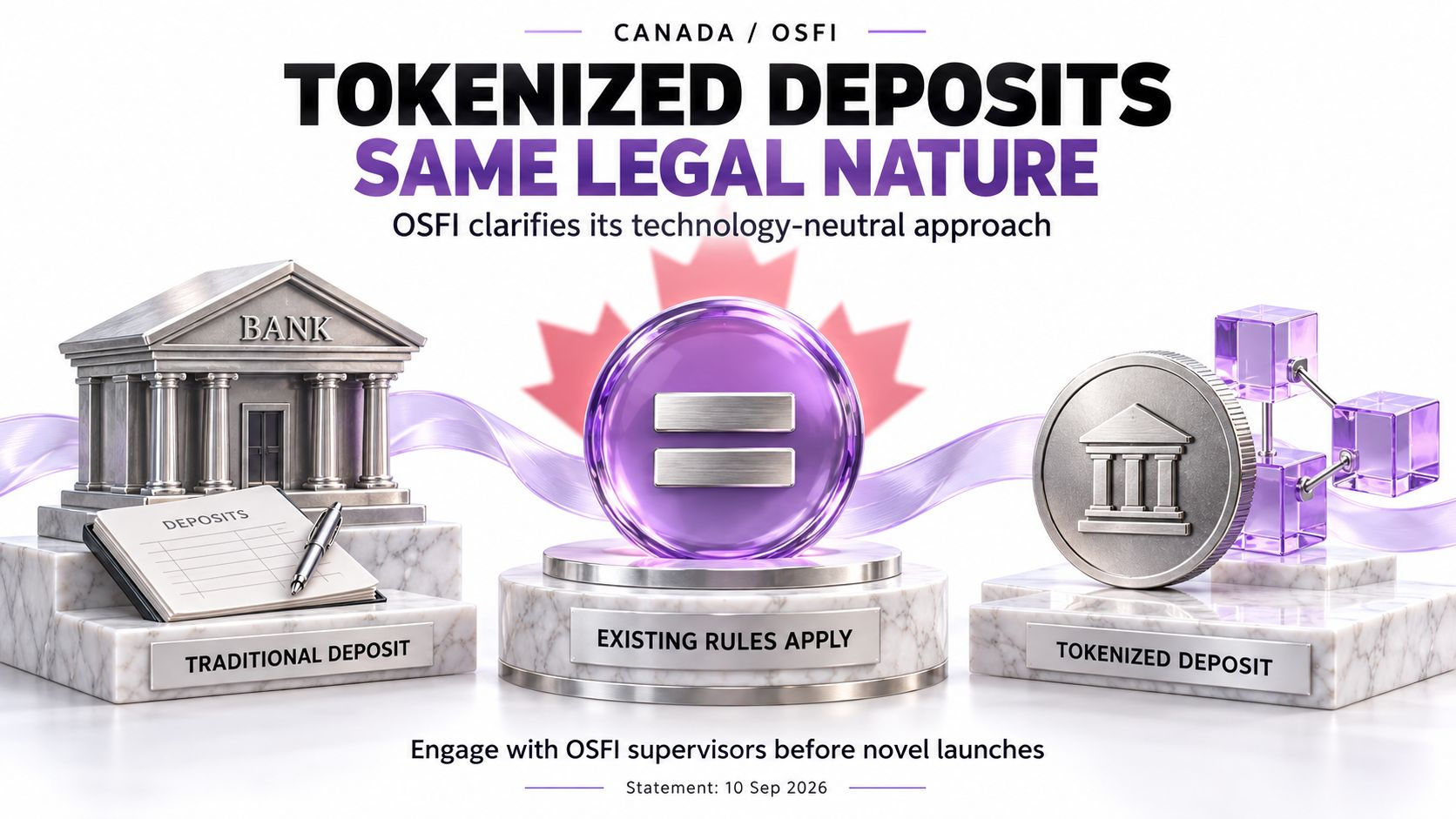
Canada has clarified something important for tokenized banking: changing the technology does not change a deposit’s legal nature.
In a September 10 statement, Canada’s financial regulator OSFI said tokenized deposits are legally equivalent to traditional deposits under its technology-neutral approach.
Federally regulated financial institutions remain responsible for complying with applicable laws, including when third parties deliver services on their behalf. Technology, cybersecurity and third-party risk requirements continue to apply.
Institutions are also expected to engage with their OSFI lead supervisors before launching novel products or services.
My view: this reduces one source of uncertainty for banks considering tokenization. It gives product teams a clearer basis for designing services within the existing banking framework.
The commercial case still needs evidence. I would watch whether these products improve settlement times, reduce reconciliation work and allow money to move smoothly between participating institutions.
Repeated customer use and measurable operating improvements would strengthen the adoption case. Isolated platforms, expensive integration or unreliable transfers would make it harder to justify expansion.
For banks, the next challenge is turning regulatory clarity into services that customers find useful enough to keep using.
Which would convince you that tokenized deposits are gaining traction: more bank launches, or evidence that customers are saving time and money?
#TokenizedDeposits #Tokenization #Canada #Banking
$LSK $LAB $VTHO
{future}(VTHOUSDT)
{future}(LABUSDT)
{future}(LSKUSDT)
#CanadaOSFISaysTokenizedDepositsEqualTraditionalDeposits
Canada has clarified something important for tokenized banking: changing the technology does not change a deposit’s legal nature.
In a September 10 statement, Canada’s financial regulator OSFI said tokenized deposits are legally equivalent to traditional deposits under its technology-neutral approach.
Federally regulated financial institutions remain responsible for complying with applicable laws, including when third parties deliver services on their behalf. Technology, cybersecurity and third-party risk requirements continue to apply.
Institutions are also expected to engage with their OSFI lead supervisors before launching novel products or services.
My view: this reduces one source of uncertainty for banks considering tokenization. It gives product teams a clearer basis for designing services within the existing banking framework.
The commercial case still needs evidence. I would watch whether these products improve settlement times, reduce reconciliation work and allow money to move smoothly between participating institutions.
Repeated customer use and measurable operating improvements would strengthen the adoption case. Isolated platforms, expensive integration or unreliable transfers would make it harder to justify expansion.
For banks, the next challenge is turning regulatory clarity into services that customers find useful enough to keep using.
Which would convince you that tokenized deposits are gaining traction: more bank launches, or evidence that customers are saving time and money?
#TokenizedDeposits #Tokenization #Canada #Banking
$LSK $LAB $VTHO
Canada has clarified something important for tokenized banking: changing the technology does not change a deposit’s legal nature.
In a September 10 statement, Canada’s financial regulator OSFI said tokenized deposits are legally equivalent to traditional deposits under its technology-neutral approach.
Federally regulated financial institutions remain responsible for complying with applicable laws, including when third parties deliver services on their behalf. Technology, cybersecurity and third-party risk requirements continue to apply.
Institutions are also expected to engage with their OSFI lead supervisors before launching novel products or services.
My view: this reduces one source of uncertainty for banks considering tokenization. It gives product teams a clearer basis for designing services within the existing banking framework.
The commercial case still needs evidence. I would watch whether these products improve settlement times, reduce reconciliation work and allow money to move smoothly between participating institutions.
Repeated customer use and measurable operating improvements would strengthen the adoption case. Isolated platforms, expensive integration or unreliable transfers would make it harder to justify expansion.
For banks, the next challenge is turning regulatory clarity into services that customers find useful enough to keep using.
Which would convince you that tokenized deposits are gaining traction: more bank launches, or evidence that customers are saving time and money?
#TokenizedDeposits #Tokenization #Canada #Banking
$LSK $LAB $VTHO
1
218
·
--
Bullish
See translation
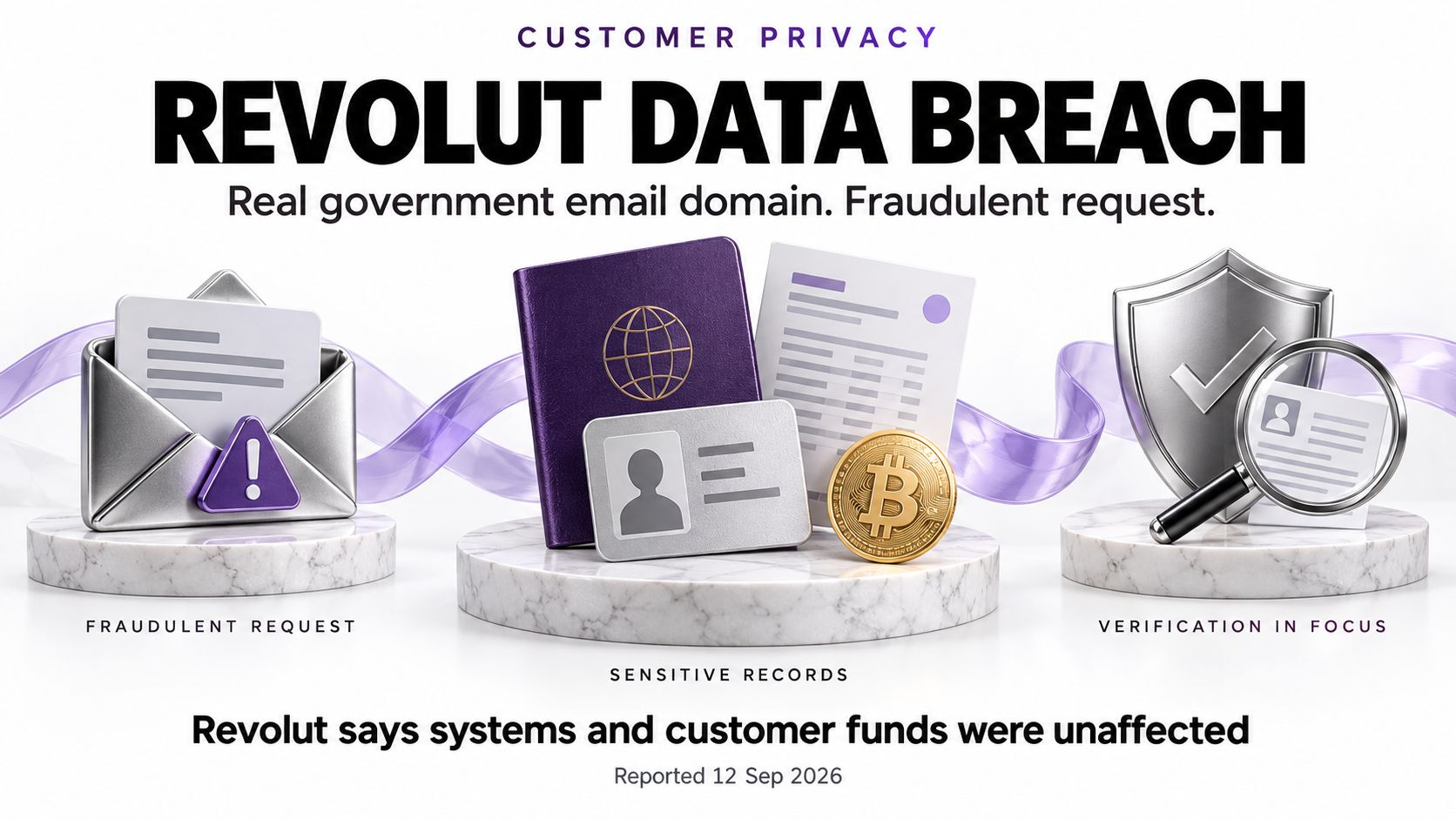
#revolutconfirmsfakegovemaildatabreach
Revolut’s data breach puts a critical question in focus: who gets access to your financial history?
Revolut confirmed to BeInCrypto on September 12 that an unauthorised party used a legitimate government agency email domain to submit fraudulent information requests.
Customer notices cited in the report listed passports, verification selfies, addresses and Bitcoin transaction records. Revolut says its systems and customer funds were unaffected.
My concern is what identity documents and financial history could reveal together. That combination could make impersonation attempts more convincing, especially when someone contacting a customer knows details of their previous transactions.
For crypto users, this raises questions about the sensitive information platforms retain and the checks applied before releasing it.
I would judge Revolut’s response on three things:
• Clear notification explaining which records were exposed for each affected customer.
• Independent verification of anyone requesting sensitive information.
• Evidence that the revised checks have been tested.
Specific answers would help rebuild confidence. Further disclosures showing a wider incident or repeated verification failures would weaken that confidence.
My view: protecting personal information deserves as much attention as protecting account balances. A reassuring statement about funds addresses only part of the concern.
What would you need to see from Revolut to feel confident about how it protects customer data?
#revolut #CyberSecurity #DataPrivacy #CryptoSecurity
$龙虾 $LSK $LAB
{future}(LABUSDT)
{future}(LSKUSDT)
{future}(龙虾USDT)
#revolutconfirmsfakegovemaildatabreach
Revolut’s data breach puts a critical question in focus: who gets access to your financial history?
Revolut confirmed to BeInCrypto on September 12 that an unauthorised party used a legitimate government agency email domain to submit fraudulent information requests.
Customer notices cited in the report listed passports, verification selfies, addresses and Bitcoin transaction records. Revolut says its systems and customer funds were unaffected.
My concern is what identity documents and financial history could reveal together. That combination could make impersonation attempts more convincing, especially when someone contacting a customer knows details of their previous transactions.
For crypto users, this raises questions about the sensitive information platforms retain and the checks applied before releasing it.
I would judge Revolut’s response on three things:
• Clear notification explaining which records were exposed for each affected customer.
• Independent verification of anyone requesting sensitive information.
• Evidence that the revised checks have been tested.
Specific answers would help rebuild confidence. Further disclosures showing a wider incident or repeated verification failures would weaken that confidence.
My view: protecting personal information deserves as much attention as protecting account balances. A reassuring statement about funds addresses only part of the concern.
What would you need to see from Revolut to feel confident about how it protects customer data?
#revolut #CyberSecurity #DataPrivacy #CryptoSecurity
$龙虾 $LSK $LAB
Revolut’s data breach puts a critical question in focus: who gets access to your financial history?
Revolut confirmed to BeInCrypto on September 12 that an unauthorised party used a legitimate government agency email domain to submit fraudulent information requests.
Customer notices cited in the report listed passports, verification selfies, addresses and Bitcoin transaction records. Revolut says its systems and customer funds were unaffected.
My concern is what identity documents and financial history could reveal together. That combination could make impersonation attempts more convincing, especially when someone contacting a customer knows details of their previous transactions.
For crypto users, this raises questions about the sensitive information platforms retain and the checks applied before releasing it.
I would judge Revolut’s response on three things:
• Clear notification explaining which records were exposed for each affected customer.
• Independent verification of anyone requesting sensitive information.
• Evidence that the revised checks have been tested.
Specific answers would help rebuild confidence. Further disclosures showing a wider incident or repeated verification failures would weaken that confidence.
My view: protecting personal information deserves as much attention as protecting account balances. A reassuring statement about funds addresses only part of the concern.
What would you need to see from Revolut to feel confident about how it protects customer data?
#revolut #CyberSecurity #DataPrivacy #CryptoSecurity
$龙虾 $LSK $LAB
1
2
2.6k
·
--
🎙️ Missed out on SHIB? Don’t miss out on Hawk! Because Hawk is the SHIB killer!
Hawk maintains ecological balance and spreads the idea of freedom!
Hawk is influencing every city around the world!

End
03 h 28 m 45 s
5.3k
27
73
·
--
Bullish
See translation
#NvidiaInTalksToInvestUpTo$10BInAnthropicIPO
Nvidia is reportedly considering up to $10 billion for Anthropic’s IPO. The investment terms deserve attention.
Reuters reported on September 11 that Nvidia is discussing becoming an anchor investor. Anthropic is reportedly seeking to raise up to $100 billion, potentially valuing it around $2 trillion. These plans remain under discussion and could change.
There’s useful context: Anthropic already announced an investment commitment of up to $10 billion from Nvidia in November 2025. That partnership also included Anthropic committing to purchase $30 billion of Azure computing capacity.
I’d want clarity on how the proposed IPO allocation relates to that earlier commitment before adding the figures together.
My view: a prominent backer can support confidence, but the business economics still need to justify the valuation.
Supplier investment can help an AI company expand its computing capacity. The question I’m watching is whether revenue from paying customers grows enough to support the ongoing cost of that infrastructure.
An IPO prospectus would help assess customer concentration, computing commitments, margins and cash burn. Strong customer retention and improving economics would strengthen my view. Spending that consistently grows faster than the business would make me more cautious.
What would you examine first in Anthropic’s prospectus: valuation, computing costs or cash burn?
#NVIDIA #Anthropic #AI #IPOWave
$LAB $LSK $GRIFFAIN
{future}(GRIFFAINUSDT)
{future}(LSKUSDT)
{future}(LABUSDT)
#NvidiaInTalksToInvestUpTo$10BInAnthropicIPO
Nvidia is reportedly considering up to $10 billion for Anthropic’s IPO. The investment terms deserve attention.
Reuters reported on September 11 that Nvidia is discussing becoming an anchor investor. Anthropic is reportedly seeking to raise up to $100 billion, potentially valuing it around $2 trillion. These plans remain under discussion and could change.
There’s useful context: Anthropic already announced an investment commitment of up to $10 billion from Nvidia in November 2025. That partnership also included Anthropic committing to purchase $30 billion of Azure computing capacity.
I’d want clarity on how the proposed IPO allocation relates to that earlier commitment before adding the figures together.
My view: a prominent backer can support confidence, but the business economics still need to justify the valuation.
Supplier investment can help an AI company expand its computing capacity. The question I’m watching is whether revenue from paying customers grows enough to support the ongoing cost of that infrastructure.
An IPO prospectus would help assess customer concentration, computing commitments, margins and cash burn. Strong customer retention and improving economics would strengthen my view. Spending that consistently grows faster than the business would make me more cautious.
What would you examine first in Anthropic’s prospectus: valuation, computing costs or cash burn?
#NVIDIA #Anthropic #AI #IPOWave
$LAB $LSK $GRIFFAIN
Nvidia is reportedly considering up to $10 billion for Anthropic’s IPO. The investment terms deserve attention.
Reuters reported on September 11 that Nvidia is discussing becoming an anchor investor. Anthropic is reportedly seeking to raise up to $100 billion, potentially valuing it around $2 trillion. These plans remain under discussion and could change.
There’s useful context: Anthropic already announced an investment commitment of up to $10 billion from Nvidia in November 2025. That partnership also included Anthropic committing to purchase $30 billion of Azure computing capacity.
I’d want clarity on how the proposed IPO allocation relates to that earlier commitment before adding the figures together.
My view: a prominent backer can support confidence, but the business economics still need to justify the valuation.
Supplier investment can help an AI company expand its computing capacity. The question I’m watching is whether revenue from paying customers grows enough to support the ongoing cost of that infrastructure.
An IPO prospectus would help assess customer concentration, computing commitments, margins and cash burn. Strong customer retention and improving economics would strengthen my view. Spending that consistently grows faster than the business would make me more cautious.
What would you examine first in Anthropic’s prospectus: valuation, computing costs or cash burn?
#NVIDIA #Anthropic #AI #IPOWave
$LAB $LSK $GRIFFAIN

2
205
·
--
🎙️ Crypto market行情交流; Newcomer Q&A ✅ Co-build the Binance Plaza 🦅 Spread the idea of freedom! Maintain ecological balance!
End
03 h 11 m 35 s
9.7k
29
67
·
--
Bullish
Verified
See translation
#cpiwatch
CPI has shifted my view toward a September rate hike.
The August report, released September 11, showed headline inflation rising 0.4% monthly and 3.4% annually. Core CPI increased 0.3%, above the 0.2% expected, even as its annual pace eased to 2.4%.
Employment also held up: August added 162,000 jobs, with unemployment unchanged at 4.1%.
My baseline is now a hike at the September 15–16 Fed meeting, although a hold remains possible.
The monthly core reading gives policymakers less reassurance that inflation is settling down. Continued job growth may also give them more room to respond without an immediate employment crisis forcing caution.
The counterargument deserves attention: annual core inflation is still cooling. I’d become less convinced about further tightening if that improvement continues and employment weakens.
For stocks and crypto, I’m watching how expectations change after the decision. A hike accompanied by signals of more increases could keep pressure on valuations. A more measured message could produce a different reaction, especially if investors had prepared for something tougher.
That’s why my market view depends on the guidance and bond-yield response as well as the rate announcement.
What matters more for your outlook: September’s decision or the Fed’s message about subsequent meetings?
#CPIWatch #FederalReserve #Macro
$LAB
$LSK
$VTHO
{future}(VTHOUSDT)
{future}(LSKUSDT)
{future}(LABUSDT)
#cpiwatch
CPI has shifted my view toward a September rate hike.
The August report, released September 11, showed headline inflation rising 0.4% monthly and 3.4% annually. Core CPI increased 0.3%, above the 0.2% expected, even as its annual pace eased to 2.4%.
Employment also held up: August added 162,000 jobs, with unemployment unchanged at 4.1%.
My baseline is now a hike at the September 15–16 Fed meeting, although a hold remains possible.
The monthly core reading gives policymakers less reassurance that inflation is settling down. Continued job growth may also give them more room to respond without an immediate employment crisis forcing caution.
The counterargument deserves attention: annual core inflation is still cooling. I’d become less convinced about further tightening if that improvement continues and employment weakens.
For stocks and crypto, I’m watching how expectations change after the decision. A hike accompanied by signals of more increases could keep pressure on valuations. A more measured message could produce a different reaction, especially if investors had prepared for something tougher.
That’s why my market view depends on the guidance and bond-yield response as well as the rate announcement.
What matters more for your outlook: September’s decision or the Fed’s message about subsequent meetings?
#CPIWatch #FederalReserve #Macro
$LAB
$LSK
$VTHO
CPI has shifted my view toward a September rate hike.
The August report, released September 11, showed headline inflation rising 0.4% monthly and 3.4% annually. Core CPI increased 0.3%, above the 0.2% expected, even as its annual pace eased to 2.4%.
Employment also held up: August added 162,000 jobs, with unemployment unchanged at 4.1%.
My baseline is now a hike at the September 15–16 Fed meeting, although a hold remains possible.
The monthly core reading gives policymakers less reassurance that inflation is settling down. Continued job growth may also give them more room to respond without an immediate employment crisis forcing caution.
The counterargument deserves attention: annual core inflation is still cooling. I’d become less convinced about further tightening if that improvement continues and employment weakens.
For stocks and crypto, I’m watching how expectations change after the decision. A hike accompanied by signals of more increases could keep pressure on valuations. A more measured message could produce a different reaction, especially if investors had prepared for something tougher.
That’s why my market view depends on the guidance and bond-yield response as well as the rate announcement.
What matters more for your outlook: September’s decision or the Fed’s message about subsequent meetings?
#CPIWatch #FederalReserve #Macro
$LAB
$LSK
$VTHO

1
3
1.9k
·
--
Bullish
Verified
See translation
#usbankcompletescrossborderpaymentpilotonstellar
U.S. Bank moved digital dollars between continents using Stellar.
On September 9, the bank announced a completed live payment pilot between its entities in North America and Europe. The transfer used USBDC, its proprietary dollar-backed stablecoin, on the public Stellar network.
The pilot also evaluates minting, redemption, freezing and clawback capabilities while connecting to the bank’s existing finance, risk and operational systems. The announcement gave no date for a wider client launch.
My view: the integration with everyday banking systems is what makes this worth following.
A payment product needs reliable accounting, clear redemption procedures and controls for handling problems. Testing those pieces together helps establish whether blockchain settlement can fit into a bank’s normal operations.
The next evidence I’d want is repeated transactions, measurable improvements in settlement and a clear path to client use. A successful internal transfer establishes a starting point; operating across more customers and payment routes introduces additional complexity.
For XLM, its network role includes transaction fees and minimum account balances. My interpretation is that payment growth needs to be assessed through those requirements: the dollar value transferred does not translate directly into equivalent XLM demand.
What would make this more significant to you: client access, recurring payment volume or proven cost savings?
#stellar #XLM #Stablecoins
{future}(XLMUSDT)
$LAB $VTHO $XLM
{future}(VTHOUSDT)
{future}(LABUSDT)
#usbankcompletescrossborderpaymentpilotonstellar
U.S. Bank moved digital dollars between continents using Stellar.
On September 9, the bank announced a completed live payment pilot between its entities in North America and Europe. The transfer used USBDC, its proprietary dollar-backed stablecoin, on the public Stellar network.
The pilot also evaluates minting, redemption, freezing and clawback capabilities while connecting to the bank’s existing finance, risk and operational systems. The announcement gave no date for a wider client launch.
My view: the integration with everyday banking systems is what makes this worth following.
A payment product needs reliable accounting, clear redemption procedures and controls for handling problems. Testing those pieces together helps establish whether blockchain settlement can fit into a bank’s normal operations.
The next evidence I’d want is repeated transactions, measurable improvements in settlement and a clear path to client use. A successful internal transfer establishes a starting point; operating across more customers and payment routes introduces additional complexity.
For XLM, its network role includes transaction fees and minimum account balances. My interpretation is that payment growth needs to be assessed through those requirements: the dollar value transferred does not translate directly into equivalent XLM demand.
What would make this more significant to you: client access, recurring payment volume or proven cost savings?
#stellar #XLM #Stablecoins
$LAB $VTHO $XLM
U.S. Bank moved digital dollars between continents using Stellar.
On September 9, the bank announced a completed live payment pilot between its entities in North America and Europe. The transfer used USBDC, its proprietary dollar-backed stablecoin, on the public Stellar network.
The pilot also evaluates minting, redemption, freezing and clawback capabilities while connecting to the bank’s existing finance, risk and operational systems. The announcement gave no date for a wider client launch.
My view: the integration with everyday banking systems is what makes this worth following.
A payment product needs reliable accounting, clear redemption procedures and controls for handling problems. Testing those pieces together helps establish whether blockchain settlement can fit into a bank’s normal operations.
The next evidence I’d want is repeated transactions, measurable improvements in settlement and a clear path to client use. A successful internal transfer establishes a starting point; operating across more customers and payment routes introduces additional complexity.
For XLM, its network role includes transaction fees and minimum account balances. My interpretation is that payment growth needs to be assessed through those requirements: the dollar value transferred does not translate directly into equivalent XLM demand.
What would make this more significant to you: client access, recurring payment volume or proven cost savings?
#stellar #XLM #Stablecoins
$LAB $VTHO $XLM

1
3
2.4k

·
--
🎙️ Crypto boom riches—actually, you just need one or two absolute target assets, plus enough waiting, bnb

End
02 h 07 m 52 s
6.3k
10
11
·
--
Bullish
Verified
See translation
#opticalcommsstocksrallyover3%
Coherent and Marvell gained over 3%, putting AI’s networking needs back in focus.
Both stocks rose more than 3% in early U.S. trading on September 11, as optical communications and memory shares joined a broader market advance. These were opening-session moves.
The underlying connection is straightforward: larger AI systems need to move more data between servers and data centers. Optical links help deliver the bandwidth those systems need while managing power consumption and delays. Marvell’s portfolio includes technology supporting 800G and 1.6T connections.
My view: the networking opportunity is compelling, but suppliers still need to turn demand into profitable shipments.
I’m watching whether faster products bring repeat orders, stronger margins and better cash generation. Revenue growth becomes more convincing when companies can deliver reliably without expansion costs absorbing most of the benefit.
There’s also a timing risk. Suppliers may add capacity before customers are ready to deploy it. If projects slip, inventory and costs can build even while the longer-term demand story remains intact.
My confidence would improve with consistent deliveries and earnings upgrades. It would weaken if inventories rise faster than sales or customer spending slows.
When assessing optical stocks, what carries the most weight for you: orders, margins or valuation?
#AIInfrastructure #TechStocks
$LSK $LAB $龙虾
{future}(龙虾USDT)
{future}(LABUSDT)
{future}(LSKUSDT)
#opticalcommsstocksrallyover3%
Coherent and Marvell gained over 3%, putting AI’s networking needs back in focus.
Both stocks rose more than 3% in early U.S. trading on September 11, as optical communications and memory shares joined a broader market advance. These were opening-session moves.
The underlying connection is straightforward: larger AI systems need to move more data between servers and data centers. Optical links help deliver the bandwidth those systems need while managing power consumption and delays. Marvell’s portfolio includes technology supporting 800G and 1.6T connections.
My view: the networking opportunity is compelling, but suppliers still need to turn demand into profitable shipments.
I’m watching whether faster products bring repeat orders, stronger margins and better cash generation. Revenue growth becomes more convincing when companies can deliver reliably without expansion costs absorbing most of the benefit.
There’s also a timing risk. Suppliers may add capacity before customers are ready to deploy it. If projects slip, inventory and costs can build even while the longer-term demand story remains intact.
My confidence would improve with consistent deliveries and earnings upgrades. It would weaken if inventories rise faster than sales or customer spending slows.
When assessing optical stocks, what carries the most weight for you: orders, margins or valuation?
#AIInfrastructure #TechStocks
$LSK $LAB $龙虾
Coherent and Marvell gained over 3%, putting AI’s networking needs back in focus.
Both stocks rose more than 3% in early U.S. trading on September 11, as optical communications and memory shares joined a broader market advance. These were opening-session moves.
The underlying connection is straightforward: larger AI systems need to move more data between servers and data centers. Optical links help deliver the bandwidth those systems need while managing power consumption and delays. Marvell’s portfolio includes technology supporting 800G and 1.6T connections.
My view: the networking opportunity is compelling, but suppliers still need to turn demand into profitable shipments.
I’m watching whether faster products bring repeat orders, stronger margins and better cash generation. Revenue growth becomes more convincing when companies can deliver reliably without expansion costs absorbing most of the benefit.
There’s also a timing risk. Suppliers may add capacity before customers are ready to deploy it. If projects slip, inventory and costs can build even while the longer-term demand story remains intact.
My confidence would improve with consistent deliveries and earnings upgrades. It would weaken if inventories rise faster than sales or customer spending slows.
When assessing optical stocks, what carries the most weight for you: orders, margins or valuation?
#AIInfrastructure #TechStocks
$LSK $LAB $龙虾

2
1
3.5k
·
--
Bearish
See translation
#etherralliesasbearishbetsliquidate
ETH’s squeeze has my attention. Sustained buying would give me more confidence.
On September 11, ETH rose up to 8.3%, with over $255 million in shorts liquidated in the preceding 24 hours.
When prices rise against leveraged shorts, exchanges can forcibly close those positions. Buying to close shorts adds upward pressure, potentially triggering further liquidations. That feedback loop helps explain how a rally can accelerate quickly.
My view: the next useful signal is how ETH behaves once forced buying slows.
I’d become more constructive if spot buying stays active and pullbacks find buyers after liquidations ease. That would suggest demand can continue beyond traders being forced to exit.
I’m also watching whether leverage builds back up too quickly. A sharp recovery can encourage late buyers to take oversized positions, leaving the market vulnerable to another round of forced selling if momentum reverses.
If ETH repeatedly gives back its gains while spot demand weakens, my confidence would fall. The liquidation headline explains part of the move; price behavior afterward will help judge its durability.
What would strengthen your ETH outlook here: stronger spot demand or a pullback that holds?
#Ethereum #ETH #ShortSqueeze
$ETH $RIVER $LAB
{future}(LABUSDT)
{future}(RIVERUSDT)
{future}(ETHUSDT)
#etherralliesasbearishbetsliquidate
ETH’s squeeze has my attention. Sustained buying would give me more confidence.
On September 11, ETH rose up to 8.3%, with over $255 million in shorts liquidated in the preceding 24 hours.
When prices rise against leveraged shorts, exchanges can forcibly close those positions. Buying to close shorts adds upward pressure, potentially triggering further liquidations. That feedback loop helps explain how a rally can accelerate quickly.
My view: the next useful signal is how ETH behaves once forced buying slows.
I’d become more constructive if spot buying stays active and pullbacks find buyers after liquidations ease. That would suggest demand can continue beyond traders being forced to exit.
I’m also watching whether leverage builds back up too quickly. A sharp recovery can encourage late buyers to take oversized positions, leaving the market vulnerable to another round of forced selling if momentum reverses.
If ETH repeatedly gives back its gains while spot demand weakens, my confidence would fall. The liquidation headline explains part of the move; price behavior afterward will help judge its durability.
What would strengthen your ETH outlook here: stronger spot demand or a pullback that holds?
#Ethereum #ETH #ShortSqueeze
$ETH $RIVER $LAB
ETH’s squeeze has my attention. Sustained buying would give me more confidence.
On September 11, ETH rose up to 8.3%, with over $255 million in shorts liquidated in the preceding 24 hours.
When prices rise against leveraged shorts, exchanges can forcibly close those positions. Buying to close shorts adds upward pressure, potentially triggering further liquidations. That feedback loop helps explain how a rally can accelerate quickly.
My view: the next useful signal is how ETH behaves once forced buying slows.
I’d become more constructive if spot buying stays active and pullbacks find buyers after liquidations ease. That would suggest demand can continue beyond traders being forced to exit.
I’m also watching whether leverage builds back up too quickly. A sharp recovery can encourage late buyers to take oversized positions, leaving the market vulnerable to another round of forced selling if momentum reverses.
If ETH repeatedly gives back its gains while spot demand weakens, my confidence would fall. The liquidation headline explains part of the move; price behavior afterward will help judge its durability.
What would strengthen your ETH outlook here: stronger spot demand or a pullback that holds?
#Ethereum #ETH #ShortSqueeze
$ETH $RIVER $LAB

1
3
1.9k
·
--
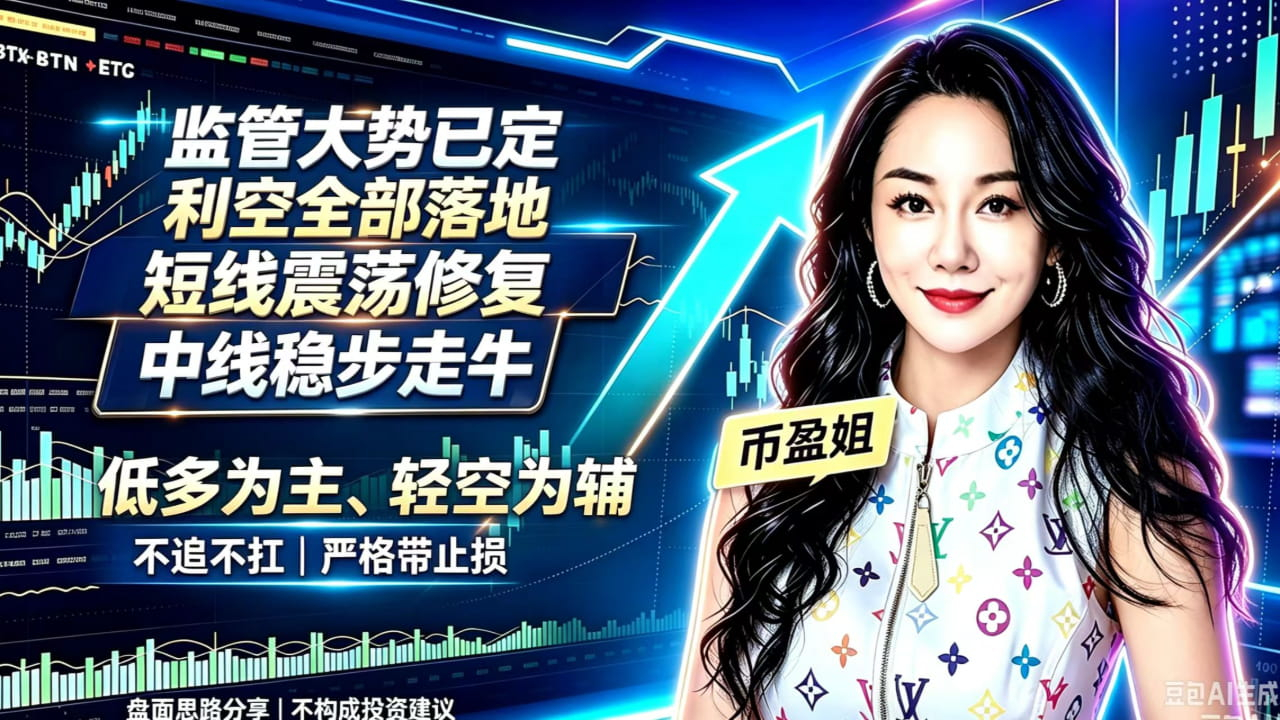
🎙️ 📈 Regulatory trends are set, and all bearish news has been fully released.
Short-term volatility is stabilizing and repairing; in the medium term, steady bull run.
Focus on going long on dips as the primary approach, with light hedging/going short as a secondary one—don’t chase, don’t force it!
End
04 h 42 m 52 s
3k
7
3


Log in to explore more content
Join global crypto users on Binance Square
⚡️ Get latest and useful information about crypto.
💬 Trusted by the world’s largest crypto exchange.
👍 Discover real insights from verified creators.
Email / Phone number
Trending Topics
ClarityActFacesProceduralVoteSept15
40,905 views
620 Discussing
Tuesday, September 15, 2:15pm ET. Mark it. 🗓️
The Senate votes on whether to even debate the CLARITY Act, the bill that would finally define which coins are securities vs commodities under US law.
Needs 60 votes. Republicans have 53. Several Democrats need to cross over, and it's not guaranteed.
Fail this vote = the bill is dead for 2026, likely until 2029 (midterms eat the calendar after this).
Pass this vote = doors open to real debate, still a long way to actual law.
Biggest crypto regulation moment of the year happens in a few days.
#ClarityActFacesProceduralVoteSept15
NewbieToNode
·3 Likes
·3.7k views
US2YearYieldRisesTo4.61%
32,147 views
604 Discussing
US10YearTreasuryYieldNears5%
18,806 views
350 Discussing