
#polymarket
polymarket
3.2M views
6,098 Discussing
Hot
Latest


·
--
Bullish
See translation
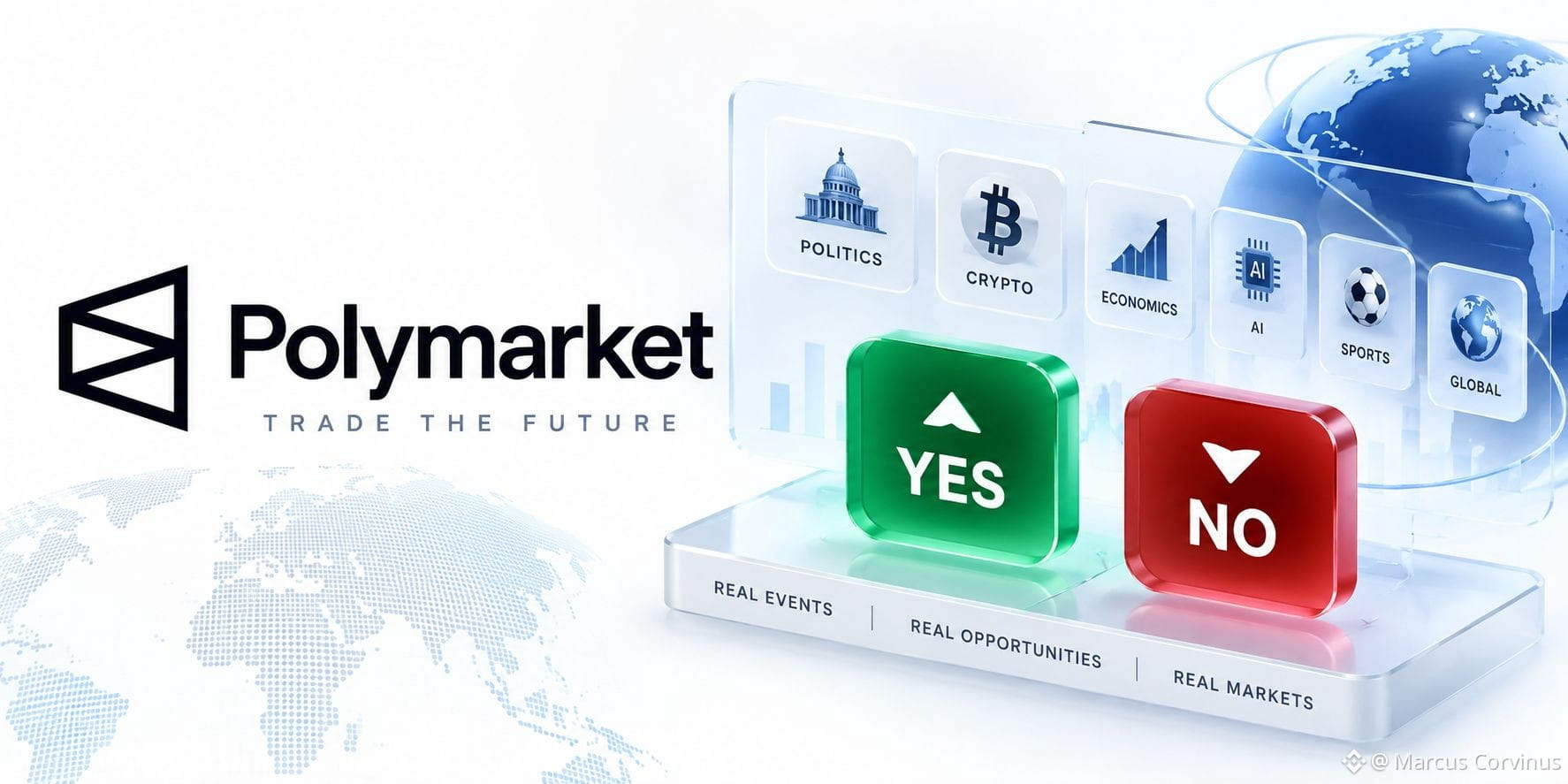
Polymarket is making real-world information tradeable, and that changes how I look at prediction markets.
The product is built around one simple idea: find an event, study the probabilities, and trade the outcome you understand better.
• Market price = crowd probability
• Higher price = stronger market confidence
• Lower price = weaker market confidence
• Price moves = expectations are changing as new information enters the market
So if an outcome moves from $0.40 → $0.65, the market has shifted from roughly 40% to 65% implied probability.
◉ Spot the market
◉ Research the event
◉ Compare probability with your own analysis
◉ Take a position
◉ Exit as probabilities move or hold until resolution
This creates markets around crypto, AI, economics, geopolitics, sports, culture, and other major narratives.
The campaign highlights 250K–500K monthly active traders, 17M+ monthly visits, and a projected $18B in 2025 trading volume.
Unlike simply tracking tokens such as $UMA and $GNO , Polymarket gives traders another arena: trading what happens next.
The biggest opportunity may appear when your research and the market’s probability disagree.
LFG 🥂
NFA + DYOR
#Polymarket
Polymarket is making real-world information tradeable, and that changes how I look at prediction markets.
The product is built around one simple idea: find an event, study the probabilities, and trade the outcome you understand better.
• Market price = crowd probability
• Higher price = stronger market confidence
• Lower price = weaker market confidence
• Price moves = expectations are changing as new information enters the market
So if an outcome moves from $0.40 → $0.65, the market has shifted from roughly 40% to 65% implied probability.
◉ Spot the market
◉ Research the event
◉ Compare probability with your own analysis
◉ Take a position
◉ Exit as probabilities move or hold until resolution
This creates markets around crypto, AI, economics, geopolitics, sports, culture, and other major narratives.
The campaign highlights 250K–500K monthly active traders, 17M+ monthly visits, and a projected $18B in 2025 trading volume.
Unlike simply tracking tokens such as $UMA and $GNO , Polymarket gives traders another arena: trading what happens next.
The biggest opportunity may appear when your research and the market’s probability disagree.
LFG 🥂
NFA + DYOR
#Polymarket
The product is built around one simple idea: find an event, study the probabilities, and trade the outcome you understand better.
• Market price = crowd probability
• Higher price = stronger market confidence
• Lower price = weaker market confidence
• Price moves = expectations are changing as new information enters the market
So if an outcome moves from $0.40 → $0.65, the market has shifted from roughly 40% to 65% implied probability.
◉ Spot the market
◉ Research the event
◉ Compare probability with your own analysis
◉ Take a position
◉ Exit as probabilities move or hold until resolution
This creates markets around crypto, AI, economics, geopolitics, sports, culture, and other major narratives.
The campaign highlights 250K–500K monthly active traders, 17M+ monthly visits, and a projected $18B in 2025 trading volume.
Unlike simply tracking tokens such as $UMA and $GNO , Polymarket gives traders another arena: trading what happens next.
The biggest opportunity may appear when your research and the market’s probability disagree.
LFG 🥂
NFA + DYOR
#Polymarket
BNB Wolf:
That 40% → 65% example makes the whole concept really easy to understand
72
42
6.6k

·
--
Bullish
See translation
Prediction markets aren’t just about guessing what happens next anymore.
@polymarket is turning real world events into live markets where probabilities can change the moment new information hits.
→ 250K–500K monthly active traders
→ 17M+ monthly website visits
→ Thousands of markets across politics, crypto, sports and global events
What makes it interesting is seeing where real conviction is moving. Instead of relying only on headlines or social media opinions, you can watch sentiment and probabilities shift in real time.
One headline can change the odds. One unexpected update can flip the entire market.
That’s why I keep watching Polymarket real events, live probabilities and opportunities that can change within minutes.
#Polymarket
Prediction markets aren’t just about guessing what happens next anymore.
@Polymarket is turning real world events into live markets where probabilities can change the moment new information hits.
→ 250K–500K monthly active traders
→ 17M+ monthly website visits
→ Thousands of markets across politics, crypto, sports and global events
What makes it interesting is seeing where real conviction is moving. Instead of relying only on headlines or social media opinions, you can watch sentiment and probabilities shift in real time.
One headline can change the odds. One unexpected update can flip the entire market.
That’s why I keep watching Polymarket real events, live probabilities and opportunities that can change within minutes.
#Polymarket
@Polymarket is turning real world events into live markets where probabilities can change the moment new information hits.
→ 250K–500K monthly active traders
→ 17M+ monthly website visits
→ Thousands of markets across politics, crypto, sports and global events
What makes it interesting is seeing where real conviction is moving. Instead of relying only on headlines or social media opinions, you can watch sentiment and probabilities shift in real time.
One headline can change the odds. One unexpected update can flip the entire market.
That’s why I keep watching Polymarket real events, live probabilities and opportunities that can change within minutes.
#Polymarket
Leo_Carter:
Prediction markets are becoming their own information layer
16
14
5.4k

·
--
See translation
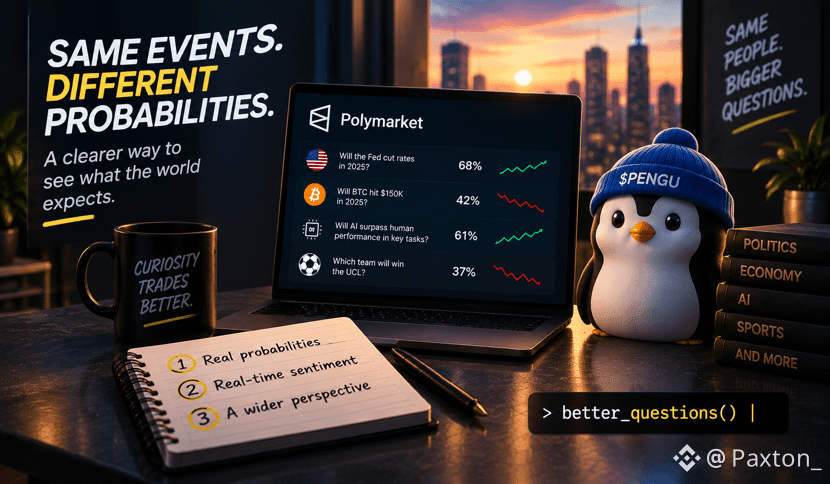
One habit that can save traders from a lot of bad decisions:
Don’t only look for information that agrees with you.
This is one reason @polymarket caught my attention.
The space has grown quickly, with estimates of roughly 250K to 500K monthly active traders, millions of monthly visits and billions in trading activity.
But the part I find more useful is how quickly expectations can change.
A market can price an event at 70%, then one new development can push that probability much lower.
You can see the same kind of attention-driven narratives across Web3, including communities around $PENGU and $DOOD
For me, the useful question isn’t just:
“Will this happen?”
It’s:
“How much of this expectation is already priced in?”
That question can change the way you read a market.
#PredictionMarkets #Polymarket #web3空投
One habit that can save traders from a lot of bad decisions:
Don’t only look for information that agrees with you.
This is one reason @Polymarket caught my attention.
The space has grown quickly, with estimates of roughly 250K to 500K monthly active traders, millions of monthly visits and billions in trading activity.
But the part I find more useful is how quickly expectations can change.
A market can price an event at 70%, then one new development can push that probability much lower.
You can see the same kind of attention-driven narratives across Web3, including communities around $PENGU and $DOOD
For me, the useful question isn’t just:
“Will this happen?”
It’s:
“How much of this expectation is already priced in?”
That question can change the way you read a market.
#PredictionMarkets #Polymarket #web3空投
Don’t only look for information that agrees with you.
This is one reason @Polymarket caught my attention.
The space has grown quickly, with estimates of roughly 250K to 500K monthly active traders, millions of monthly visits and billions in trading activity.
But the part I find more useful is how quickly expectations can change.
A market can price an event at 70%, then one new development can push that probability much lower.
You can see the same kind of attention-driven narratives across Web3, including communities around $PENGU and $DOOD
For me, the useful question isn’t just:
“Will this happen?”
It’s:
“How much of this expectation is already priced in?”
That question can change the way you read a market.
#PredictionMarkets #Polymarket #web3空投
omar Rashid:
I’ve missed fewer bad trades since actively searching for reasons my thesis fails.
39
1
37
6.7k

·
--
Bullish
˗ˋˏ📰ˎˊ˗ 𝐅𝐋𝐀́𝐕𝐈𝐎 𝐁𝐎𝐋𝐒𝐎𝐍𝐀𝐑𝐎 𝐏𝐀𝐒𝐒𝐀 𝐋𝐔𝐋𝐀 𝐍𝐎 𝐏𝐎𝐋𝐘𝐌𝐀𝐑𝐊𝐄𝐓❗
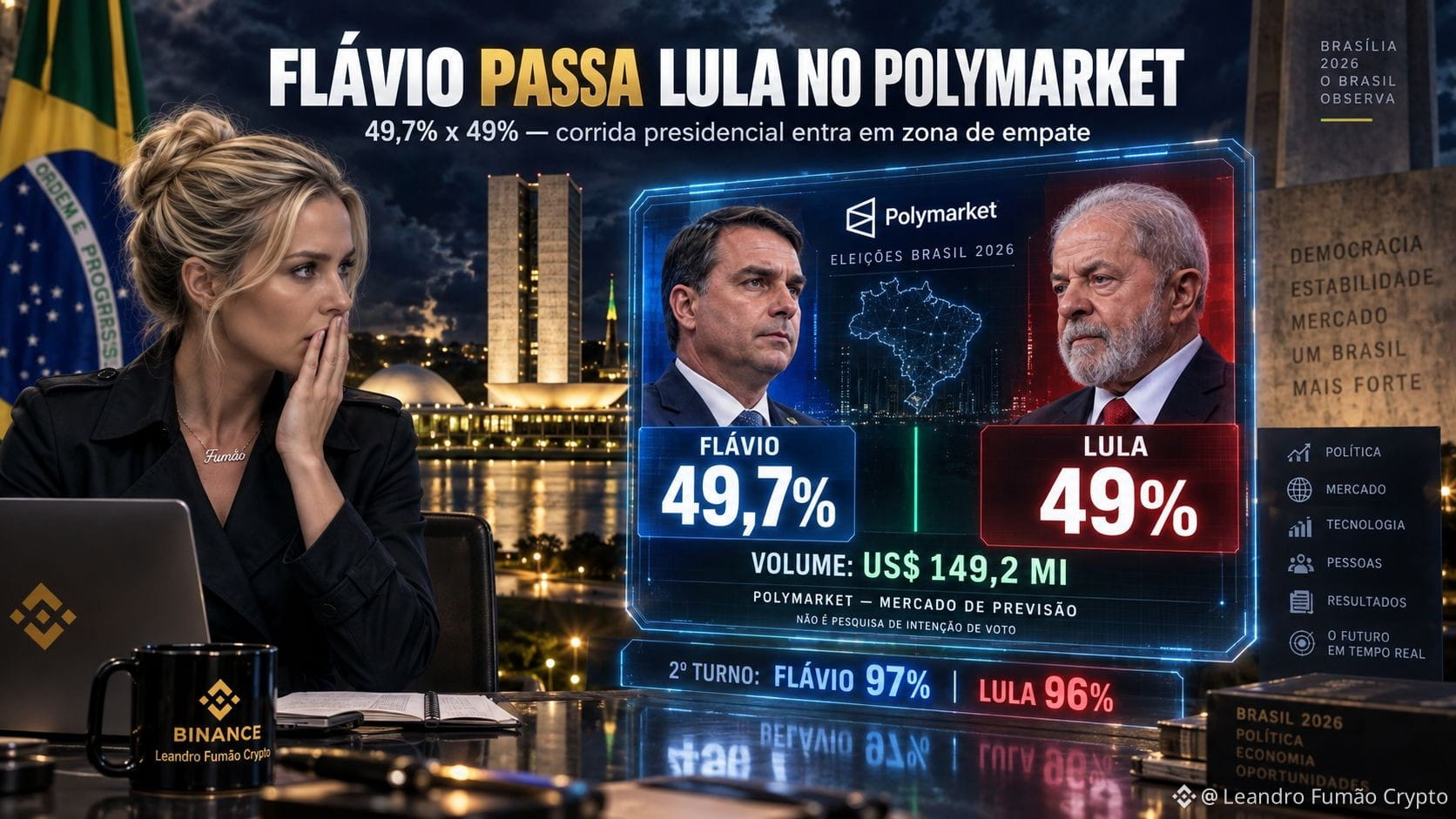
In Brazil, the 2026 presidential race has picked up a new sign of tension.
On Polymarket, consulted on September 13, Flávio Bolsonaro appears with 49.7% implied probability of victory, versus 49% for Lula. The difference is just 0.7 percentage points.
🔥 The dashboard also shows a strong shift in perception: Lula is down by -11%, while Flávio is up by +48%.
But pay attention: this doesn’t mean Lula lost 11 points of voting intention. Those figures represent changes within the prediction market, and the story itself notes that the window used by Polymarket isn’t clear.
The main market has already moved approximately:
US$ 149.2 MILLION
🧐And the second-round scenario shows practically the same two names:
➜ Flávio▸ 97% chance to advance
➜ Lula▸96%
👀 But electoral polls tell a slightly different story.
In Datafolha released on September 11, Lula has 39% in the first round, versus 35% for Flávio. In the second round, the score is 46% x 44%, a technical tie. Meanwhile, AtlasIntel/Bloomberg showed 46.4% for Flávio and 46.2% for Lula in a direct simulation.
That is:
POLYMARKET: Flávio slightly ahead.
POLLING: extremely tight race.
🔥 The most important point is not to confuse the two things.
Polymarket measures probability traded by market participants.
Election polling measures voting intention from interviewed voters.
Decisive weeks are still ahead — and this race is becoming more and more unpredictable.
..........................................⟡$DOT ⟡.............................................
👇 Do you think the prediction market is anticipating a turning point, or just reacting to the moment?
{spot}(ZECUSDT)
#Eleicoes2026 #Polymarket #brasil
˗ˋˏ📰ˎˊ˗ 𝐅𝐋𝐀́𝐕𝐈𝐎 𝐁𝐎𝐋𝐒𝐎𝐍𝐀𝐑𝐎 𝐏𝐀𝐒𝐒𝐀 𝐋𝐔𝐋𝐀 𝐍𝐎 𝐏𝐎𝐋𝐘𝐌𝐀𝐑𝐊𝐄𝐓❗
In Brazil, the 2026 presidential race has picked up a new sign of tension.
On Polymarket, consulted on September 13, Flávio Bolsonaro appears with 49.7% implied probability of victory, versus 49% for Lula. The difference is just 0.7 percentage points.
🔥 The dashboard also shows a strong shift in perception: Lula is down by -11%, while Flávio is up by +48%.
But pay attention: this doesn’t mean Lula lost 11 points of voting intention. Those figures represent changes within the prediction market, and the story itself notes that the window used by Polymarket isn’t clear.
The main market has already moved approximately:
US$ 149.2 MILLION
🧐And the second-round scenario shows practically the same two names:
➜ Flávio▸ 97% chance to advance
➜ Lula▸96%
👀 But electoral polls tell a slightly different story.
In Datafolha released on September 11, Lula has 39% in the first round, versus 35% for Flávio. In the second round, the score is 46% x 44%, a technical tie. Meanwhile, AtlasIntel/Bloomberg showed 46.4% for Flávio and 46.2% for Lula in a direct simulation.
That is:
POLYMARKET: Flávio slightly ahead.
POLLING: extremely tight race.
🔥 The most important point is not to confuse the two things.
Polymarket measures probability traded by market participants.
Election polling measures voting intention from interviewed voters.
Decisive weeks are still ahead — and this race is becoming more and more unpredictable.
..........................................⟡$DOT ⟡.............................................
👇 Do you think the prediction market is anticipating a turning point, or just reacting to the moment?
#Eleicoes2026 #Polymarket #brasil
In Brazil, the 2026 presidential race has picked up a new sign of tension.
On Polymarket, consulted on September 13, Flávio Bolsonaro appears with 49.7% implied probability of victory, versus 49% for Lula. The difference is just 0.7 percentage points.
🔥 The dashboard also shows a strong shift in perception: Lula is down by -11%, while Flávio is up by +48%.
But pay attention: this doesn’t mean Lula lost 11 points of voting intention. Those figures represent changes within the prediction market, and the story itself notes that the window used by Polymarket isn’t clear.
The main market has already moved approximately:
US$ 149.2 MILLION
🧐And the second-round scenario shows practically the same two names:
➜ Flávio▸ 97% chance to advance
➜ Lula▸96%
👀 But electoral polls tell a slightly different story.
In Datafolha released on September 11, Lula has 39% in the first round, versus 35% for Flávio. In the second round, the score is 46% x 44%, a technical tie. Meanwhile, AtlasIntel/Bloomberg showed 46.4% for Flávio and 46.2% for Lula in a direct simulation.
That is:
POLYMARKET: Flávio slightly ahead.
POLLING: extremely tight race.
🔥 The most important point is not to confuse the two things.
Polymarket measures probability traded by market participants.
Election polling measures voting intention from interviewed voters.
Decisive weeks are still ahead — and this race is becoming more and more unpredictable.
..........................................⟡$DOT ⟡.............................................
👇 Do you think the prediction market is anticipating a turning point, or just reacting to the moment?
#Eleicoes2026 #Polymarket #brasil
4
869

·
--
I’ve noticed a slightly knotty phenomenon: on Polymarket, the odds for a rate hike are 83%, while the probability priced by CME interest rate futures is over 90%.
Both markets claim they’re powered by “smart money” voting, yet the conclusion differs by seven points. What are those seven points? They’re disagreement itself.
In prediction markets, some people tell the truth to win money; in interest rate futures, some people place heavier bets to hedge. Both sides mix genuine signals with noise—who’s closer to the truth, you only find out when the outcome arrives.
I generally don’t look at the reading from a single market. The gap between what two markets quote for the same thing is more interesting than either quote alone. The bigger the gap, the more underpriced or insufficiently priced the situation is.
If tonight the policy makers “do nothing,” then both markets will look bad. When a low-probability event actually happens, the catch-up bid is the most brutal kind.
#BTC #Polymarket #利率期货 #FOMC #FuturaKey
I’ve noticed a slightly knotty phenomenon: on Polymarket, the odds for a rate hike are 83%, while the probability priced by CME interest rate futures is over 90%.
Both markets claim they’re powered by “smart money” voting, yet the conclusion differs by seven points. What are those seven points? They’re disagreement itself.
In prediction markets, some people tell the truth to win money; in interest rate futures, some people place heavier bets to hedge. Both sides mix genuine signals with noise—who’s closer to the truth, you only find out when the outcome arrives.
I generally don’t look at the reading from a single market. The gap between what two markets quote for the same thing is more interesting than either quote alone. The bigger the gap, the more underpriced or insufficiently priced the situation is.
If tonight the policy makers “do nothing,” then both markets will look bad. When a low-probability event actually happens, the catch-up bid is the most brutal kind.
#BTC #Polymarket #利率期货 #FOMC #FuturaKey
Both markets claim they’re powered by “smart money” voting, yet the conclusion differs by seven points. What are those seven points? They’re disagreement itself.
In prediction markets, some people tell the truth to win money; in interest rate futures, some people place heavier bets to hedge. Both sides mix genuine signals with noise—who’s closer to the truth, you only find out when the outcome arrives.
I generally don’t look at the reading from a single market. The gap between what two markets quote for the same thing is more interesting than either quote alone. The bigger the gap, the more underpriced or insufficiently priced the situation is.
If tonight the policy makers “do nothing,” then both markets will look bad. When a low-probability event actually happens, the catch-up bid is the most brutal kind.
#BTC #Polymarket #利率期货 #FOMC #FuturaKey
1
81

·
--
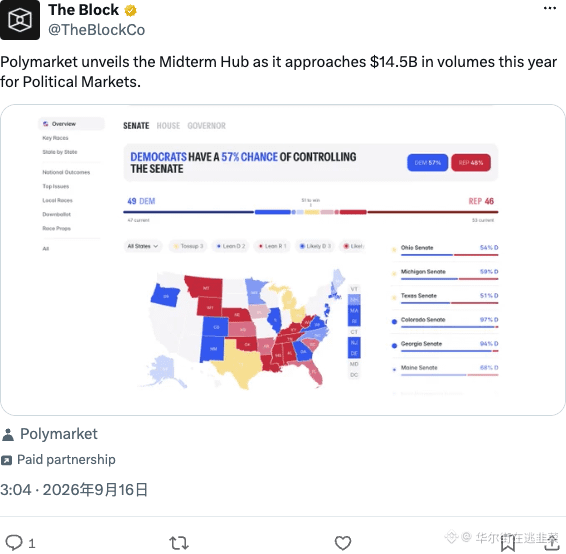
Polymarket’s political market is on track to reach $14.5 billion this year, and it conveniently throws out a midterm election hub along the way. This is a clear-play strategy to cash in on election traffic—odds fluctuations are basically a printing press. But don’t get carried away: the old foxes in the political markets are all clustered together, and if retail traders rush in, they’re probably just handing fees to the market makers. If you want to scalp profits, focus on the price gap on the first day of the new market—only then is the risk-reward worth looking at.
$POLY #Polymarket #预测市场
Polymarket’s political market is on track to reach $14.5 billion this year, and it conveniently throws out a midterm election hub along the way. This is a clear-play strategy to cash in on election traffic—odds fluctuations are basically a printing press. But don’t get carried away: the old foxes in the political markets are all clustered together, and if retail traders rush in, they’re probably just handing fees to the market makers. If you want to scalp profits, focus on the price gap on the first day of the new market—only then is the risk-reward worth looking at.
$POLY #Polymarket #预测市场
$POLY #Polymarket #预测市场
35

·
--
Bullish
Real-world events are becoming tradable markets.
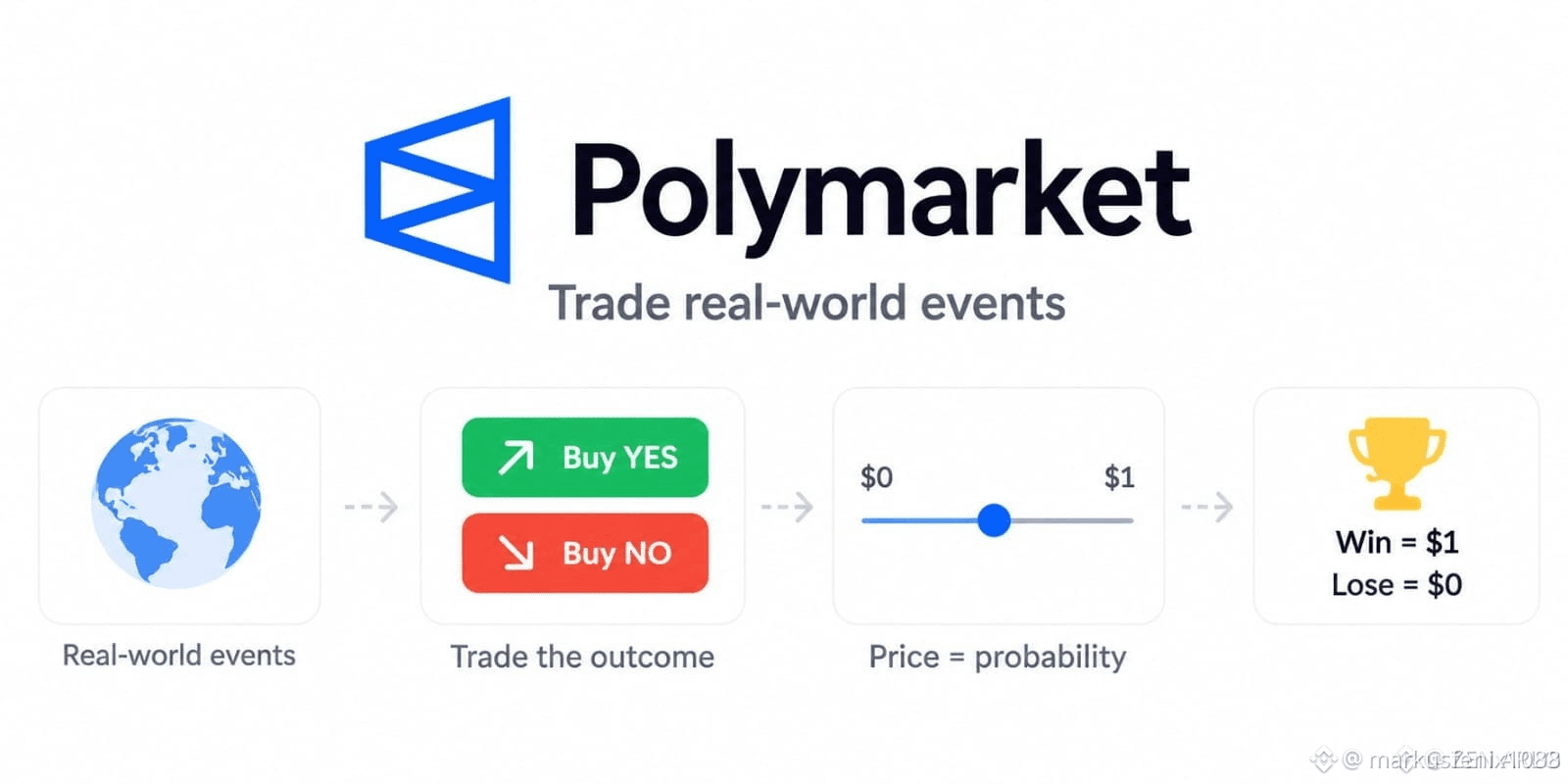
Polymarket turns real-world events into crypto, politics, sports, finance, technology, and more prediction markets you can trade.
Each outcome trades between $0 and $1, effectively showing the probability that traders are assigning to that outcome. A YES action at $0.40 represents an approximately 40% market probability.
Think the probability is too low? Buy YES.
Think it’s too high? Buy NO.
You also don’t always have to wait for the final outcome. Positions can be sold before resolution if the market moves in your favor or if your opinion changes.
Limit orders give you more control over your entry price, while market orders go against available liquidity.
When the event is resolved, the winning side is worth $1 per share, while the losing side goes to $0.
That’s why understanding the resolution rules, liquidity, and the order book depth is just as important as predicting the event itself.
For crypto users who are already following ecosystems around $UMA, $GNO, and $LINK, prediction markets offer another angle: trading information and probabilities instead of simply betting on the token price direction.
The biggest question is whether, over time, prediction markets become one of crypto’s most useful tools for measuring what people truly think will happen.
Just information, not financial advice
#Polymarket Polymarket #PredictionMarkets #Crypto
$NVDAB
{spot}(NVDABUSDT)
Real-world events are becoming tradable markets.
Polymarket turns real-world events into crypto, politics, sports, finance, technology, and more prediction markets you can trade.
Each outcome trades between $0 and $1, effectively showing the probability that traders are assigning to that outcome. A YES action at $0.40 represents an approximately 40% market probability.
Think the probability is too low? Buy YES.
Think it’s too high? Buy NO.
You also don’t always have to wait for the final outcome. Positions can be sold before resolution if the market moves in your favor or if your opinion changes.
Limit orders give you more control over your entry price, while market orders go against available liquidity.
When the event is resolved, the winning side is worth $1 per share, while the losing side goes to $0.
That’s why understanding the resolution rules, liquidity, and the order book depth is just as important as predicting the event itself.
For crypto users who are already following ecosystems around $UMA, $GNO, and $LINK, prediction markets offer another angle: trading information and probabilities instead of simply betting on the token price direction.
The biggest question is whether, over time, prediction markets become one of crypto’s most useful tools for measuring what people truly think will happen.
Just information, not financial advice
#Polymarket Polymarket #PredictionMarkets #Crypto
$NVDAB
Polymarket turns real-world events into crypto, politics, sports, finance, technology, and more prediction markets you can trade.
Each outcome trades between $0 and $1, effectively showing the probability that traders are assigning to that outcome. A YES action at $0.40 represents an approximately 40% market probability.
Think the probability is too low? Buy YES.
Think it’s too high? Buy NO.
You also don’t always have to wait for the final outcome. Positions can be sold before resolution if the market moves in your favor or if your opinion changes.
Limit orders give you more control over your entry price, while market orders go against available liquidity.
When the event is resolved, the winning side is worth $1 per share, while the losing side goes to $0.
That’s why understanding the resolution rules, liquidity, and the order book depth is just as important as predicting the event itself.
For crypto users who are already following ecosystems around $UMA, $GNO, and $LINK, prediction markets offer another angle: trading information and probabilities instead of simply betting on the token price direction.
The biggest question is whether, over time, prediction markets become one of crypto’s most useful tools for measuring what people truly think will happen.
Just information, not financial advice
#Polymarket Polymarket #PredictionMarkets #Crypto
$NVDAB
1
343

·
--
Article
See translation
Bitcoin September 14: What Is Polymarket Predicting?Bitcoin is back in the spotlight today, but the bigger question is not simply whether BTC is bullish or bearish.
The real question is: what price level does the prediction market think Bitcoin can actually reach next?
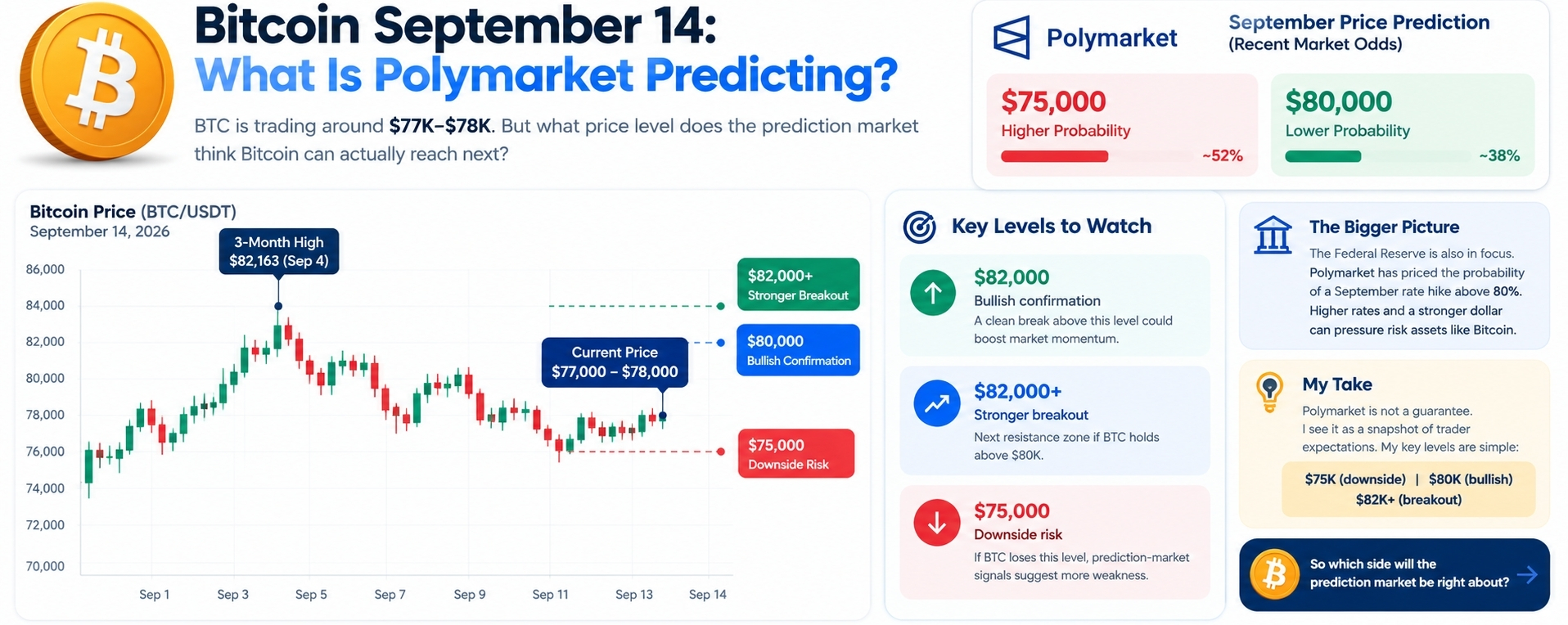
As of September 14, Bitcoin is trading around the $77,000–$78,000 area. BTC remains below the important $80,000 psychological level after recently reaching a three-month high near $82,163 on September 4.
Polymarket data shows an interesting battle between upside and downside expectations. Recent September contracts gave a higher probability to Bitcoin touching $75,000 than reaching $80,000, showing that traders were still protecting against another pullback. At the same time, the $80,000 target remains very much alive because Bitcoin has already traded close to that level this month.
This creates an important range for traders to watch.
If BTC can break and hold above $80,000, market psychology could change quickly. A clean move above that level would put $82,000 and then higher resistance zones back into focus.
But if Bitcoin loses the $75,000 area, the prediction-market signals suggest that traders are already prepared for deeper weakness.
There is another major factor: the Federal Reserve. Polymarket has recently priced the probability of a September rate hike above 80%, while higher rates and a stronger dollar can pressure risk assets such as Bitcoin.
So for September 14, I would not treat Polymarket as a guaranteed prediction. I see it more as a snapshot of trader expectations.
My key levels are simple: $75K for downside risk, $80K for bullish confirmation, and $82K+ for a stronger breakout scenario.
The interesting part is that Bitcoin is sitting almost exactly between fear and recovery — so which side will the prediction market be right about?
#Polymarket #bitcoin
{spot}(BTCUSDT)
Bitcoin September 14: What Is Polymarket Predicting?
Bitcoin is back in the spotlight today, but the bigger question is not simply whether BTC is bullish or bearish.
The real question is: what price level does the prediction market think Bitcoin can actually reach next?
As of September 14, Bitcoin is trading around the $77,000–$78,000 area. BTC remains below the important $80,000 psychological level after recently reaching a three-month high near $82,163 on September 4.
Polymarket data shows an interesting battle between upside and downside expectations. Recent September contracts gave a higher probability to Bitcoin touching $75,000 than reaching $80,000, showing that traders were still protecting against another pullback. At the same time, the $80,000 target remains very much alive because Bitcoin has already traded close to that level this month.
This creates an important range for traders to watch.
If BTC can break and hold above $80,000, market psychology could change quickly. A clean move above that level would put $82,000 and then higher resistance zones back into focus.
But if Bitcoin loses the $75,000 area, the prediction-market signals suggest that traders are already prepared for deeper weakness.
There is another major factor: the Federal Reserve. Polymarket has recently priced the probability of a September rate hike above 80%, while higher rates and a stronger dollar can pressure risk assets such as Bitcoin.
So for September 14, I would not treat Polymarket as a guaranteed prediction. I see it more as a snapshot of trader expectations.
My key levels are simple: $75K for downside risk, $80K for bullish confirmation, and $82K+ for a stronger breakout scenario.
The interesting part is that Bitcoin is sitting almost exactly between fear and recovery — so which side will the prediction market be right about?
#Polymarket #bitcoin
The real question is: what price level does the prediction market think Bitcoin can actually reach next?
As of September 14, Bitcoin is trading around the $77,000–$78,000 area. BTC remains below the important $80,000 psychological level after recently reaching a three-month high near $82,163 on September 4.
Polymarket data shows an interesting battle between upside and downside expectations. Recent September contracts gave a higher probability to Bitcoin touching $75,000 than reaching $80,000, showing that traders were still protecting against another pullback. At the same time, the $80,000 target remains very much alive because Bitcoin has already traded close to that level this month.
This creates an important range for traders to watch.
If BTC can break and hold above $80,000, market psychology could change quickly. A clean move above that level would put $82,000 and then higher resistance zones back into focus.
But if Bitcoin loses the $75,000 area, the prediction-market signals suggest that traders are already prepared for deeper weakness.
There is another major factor: the Federal Reserve. Polymarket has recently priced the probability of a September rate hike above 80%, while higher rates and a stronger dollar can pressure risk assets such as Bitcoin.
So for September 14, I would not treat Polymarket as a guaranteed prediction. I see it more as a snapshot of trader expectations.
My key levels are simple: $75K for downside risk, $80K for bullish confirmation, and $82K+ for a stronger breakout scenario.
The interesting part is that Bitcoin is sitting almost exactly between fear and recovery — so which side will the prediction market be right about?
#Polymarket #bitcoin
3
97
·
--
📋 Cipher Vault | Prediction Markets15 September 2026
⏱️ — Key moves in prediction markets and what smart money is watching.
━━━━━━━━━━━━━━━━━━
🔥 Highlights
1️⃣ Federal decision in September
Rate hike probability: 86% ↑3% within 24 hours.
Probability of holding rates unchanged: 12% ↓3%.
The market is pricing in the hike as the base case, but the repricing higher may reflect a speculative premium.
📋 Cipher Vault | Prediction Markets
15 September 2026
⏱️ — Key moves in prediction markets and what smart money is watching.
━━━━━━━━━━━━━━━━━━
🔥 Highlights
1️⃣ Federal decision in September
Rate hike probability: 86% ↑3% within 24 hours.
Probability of holding rates unchanged: 12% ↓3%.
The market is pricing in the hike as the base case, but the repricing higher may reflect a speculative premium.
⏱️ — Key moves in prediction markets and what smart money is watching.
━━━━━━━━━━━━━━━━━━
🔥 Highlights
1️⃣ Federal decision in September
Rate hike probability: 86% ↑3% within 24 hours.
Probability of holding rates unchanged: 12% ↓3%.
The market is pricing in the hike as the base case, but the repricing higher may reflect a speculative premium.
1
31

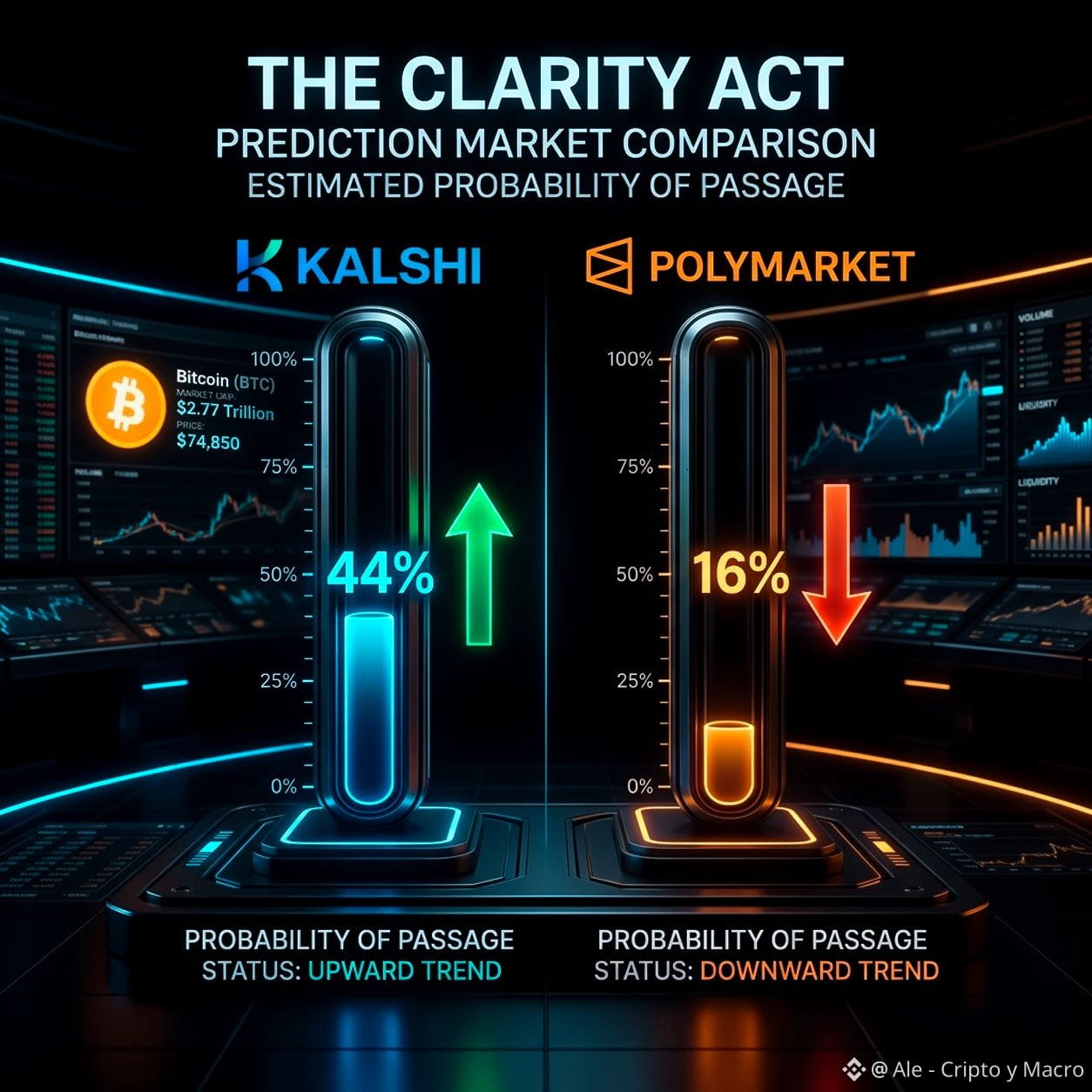
Prediction markets don’t have much faith in the Clarity Act today.
After the final text was published, Kalshi raised the probability of approval from 18% to 44%, but Polymarket is far more pessimistic: it fell from 82% in February to just 16% in September.
Why so much pessimism? Three disputes are still not fully resolved:
1. Ethics rules (who can hold crypto in government) .
2. Legal liability in DeFi.
3. Stablecoin yield.
Also, the calendar is working against it: the House canceled the weeks of September 21 and 28, and the period for federal work begins on October 5.
There’s very little legislative time left before the November 3 midterm elections; in the meantime, $BTC bajo 2.40% is hovering around $76.000,00
Do you believe more in Kalshi (44%) or Polymarket (16%)? 👇
#ClarityAct #Polymarket #Bitcoin #CreatorPad
Prediction markets don’t have much faith in the Clarity Act today.
After the final text was published, Kalshi raised the probability of approval from 18% to 44%, but Polymarket is far more pessimistic: it fell from 82% in February to just 16% in September.
Why so much pessimism? Three disputes are still not fully resolved:
1. Ethics rules (who can hold crypto in government) .
2. Legal liability in DeFi.
3. Stablecoin yield.
Also, the calendar is working against it: the House canceled the weeks of September 21 and 28, and the period for federal work begins on October 5.
There’s very little legislative time left before the November 3 midterm elections; in the meantime, $BTC bajo 2.40% is hovering around $76.000,00
Do you believe more in Kalshi (44%) or Polymarket (16%)? 👇
#ClarityAct #Polymarket #Bitcoin #CreatorPad
After the final text was published, Kalshi raised the probability of approval from 18% to 44%, but Polymarket is far more pessimistic: it fell from 82% in February to just 16% in September.
Why so much pessimism? Three disputes are still not fully resolved:
1. Ethics rules (who can hold crypto in government) .
2. Legal liability in DeFi.
3. Stablecoin yield.
Also, the calendar is working against it: the House canceled the weeks of September 21 and 28, and the period for federal work begins on October 5.
There’s very little legislative time left before the November 3 midterm elections; in the meantime, $BTC bajo 2.40% is hovering around $76.000,00
Do you believe more in Kalshi (44%) or Polymarket (16%)? 👇
#ClarityAct #Polymarket #Bitcoin #CreatorPad
93

·
--
Bullish
See translation
Real-world events are becoming tradable markets.
Polymarket turns real-world events across crypto, politics, sports, finance, tech and more into tradable prediction markets.
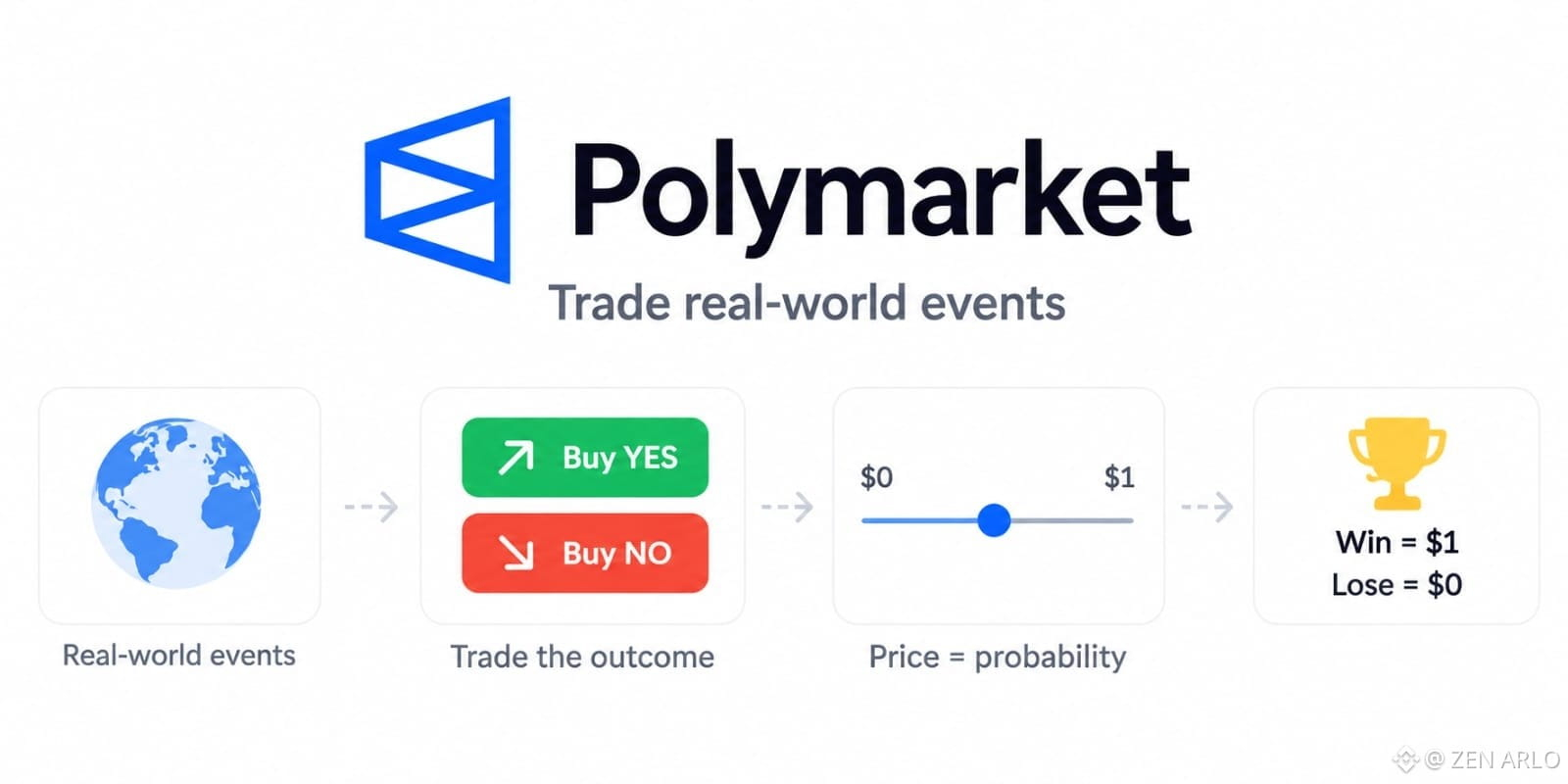
Each outcome trades between $0 and $1, effectively showing the probability traders are assigning to that result. A YES share at $0.40 roughly represents a 40% market probability.
Think the probability is too low? Buy YES.
Think it’s too high? Buy NO.
You don’t always need to wait for the final result either. Positions can be sold before resolution if the market moves in your favor or if your view changes.
Limit orders give you more control over entry price, while immediate orders trade against available liquidity.
When the event resolves, the winning outcome becomes worth $1 per share while the losing side goes to $0.
That makes understanding the resolution rules, liquidity and order-book depth just as important as predicting the event itself.
For crypto users already watching ecosystems around $UMA , $GNO and $LINK prediction markets add another angle: trading information and probabilities instead of simply betting on token price direction.
The bigger question is whether prediction markets eventually become one of crypto’s most useful tools for measuring what people actually believe will happen.
Only information not financial advice
#Polymarket #PredictionMarkets #Crypto
Real-world events are becoming tradable markets.
Polymarket turns real-world events across crypto, politics, sports, finance, tech and more into tradable prediction markets.
Each outcome trades between $0 and $1, effectively showing the probability traders are assigning to that result. A YES share at $0.40 roughly represents a 40% market probability.
Think the probability is too low? Buy YES.
Think it’s too high? Buy NO.
You don’t always need to wait for the final result either. Positions can be sold before resolution if the market moves in your favor or if your view changes.
Limit orders give you more control over entry price, while immediate orders trade against available liquidity.
When the event resolves, the winning outcome becomes worth $1 per share while the losing side goes to $0.
That makes understanding the resolution rules, liquidity and order-book depth just as important as predicting the event itself.
For crypto users already watching ecosystems around $UMA , $GNO and $LINK prediction markets add another angle: trading information and probabilities instead of simply betting on token price direction.
The bigger question is whether prediction markets eventually become one of crypto’s most useful tools for measuring what people actually believe will happen.
Only information not financial advice
#Polymarket #PredictionMarkets #Crypto
Polymarket turns real-world events across crypto, politics, sports, finance, tech and more into tradable prediction markets.
Each outcome trades between $0 and $1, effectively showing the probability traders are assigning to that result. A YES share at $0.40 roughly represents a 40% market probability.
Think the probability is too low? Buy YES.
Think it’s too high? Buy NO.
You don’t always need to wait for the final result either. Positions can be sold before resolution if the market moves in your favor or if your view changes.
Limit orders give you more control over entry price, while immediate orders trade against available liquidity.
When the event resolves, the winning outcome becomes worth $1 per share while the losing side goes to $0.
That makes understanding the resolution rules, liquidity and order-book depth just as important as predicting the event itself.
For crypto users already watching ecosystems around $UMA , $GNO and $LINK prediction markets add another angle: trading information and probabilities instead of simply betting on token price direction.
The bigger question is whether prediction markets eventually become one of crypto’s most useful tools for measuring what people actually believe will happen.
Only information not financial advice
#Polymarket #PredictionMarkets #Crypto
Sia Lenne:
As these platforms scale up, they are proving that crowds can often forecast outcomes better than individual experts.
67
41
10.4k

·
--
🔷 The wisdom of the crowd — myth: prices are set by 3% of wallets
Facts:
• Yale study: 3% of Polymarket traders take 27% of all profits; market volume $67 billion
• Two-thirds of 1.72 million accounts are losing
• The advantage of the informed minority shrinks quickly — the market is maturing
🧠 My take: “wisdom of the crowd” is actually the wisdom of a few: prices are set by the pros, while the crowd provides liquidity and the source of their profits. The shrinking edge is the key signal: prediction markets are turning into ordinary markets—alpha dies off here just like everywhere else. The chances you read about (including my 19% on CLARITY) are the beliefs of a handful of wallets.
⚠️ The crowd in prediction markets isn’t an oracle: the odds are backed by 3% of pros.
❓ Have you traded on Polymarket? 👇
#Polymarket $BTC
{future}(BTCUSDT)
🔷 The wisdom of the crowd — myth: prices are set by 3% of wallets
Facts:
• Yale study: 3% of Polymarket traders take 27% of all profits; market volume $67 billion
• Two-thirds of 1.72 million accounts are losing
• The advantage of the informed minority shrinks quickly — the market is maturing
🧠 My take: “wisdom of the crowd” is actually the wisdom of a few: prices are set by the pros, while the crowd provides liquidity and the source of their profits. The shrinking edge is the key signal: prediction markets are turning into ordinary markets—alpha dies off here just like everywhere else. The chances you read about (including my 19% on CLARITY) are the beliefs of a handful of wallets.
⚠️ The crowd in prediction markets isn’t an oracle: the odds are backed by 3% of pros.
❓ Have you traded on Polymarket? 👇
#Polymarket $BTC
Facts:
• Yale study: 3% of Polymarket traders take 27% of all profits; market volume $67 billion
• Two-thirds of 1.72 million accounts are losing
• The advantage of the informed minority shrinks quickly — the market is maturing
🧠 My take: “wisdom of the crowd” is actually the wisdom of a few: prices are set by the pros, while the crowd provides liquidity and the source of their profits. The shrinking edge is the key signal: prediction markets are turning into ordinary markets—alpha dies off here just like everywhere else. The chances you read about (including my 19% on CLARITY) are the beliefs of a handful of wallets.
⚠️ The crowd in prediction markets isn’t an oracle: the odds are backed by 3% of pros.
❓ Have you traded on Polymarket? 👇
#Polymarket $BTC
2
41

·
--
A weather tweet that got 1.16 million views on Polymarket.
First, let’s make it clear: seeing it doesn’t mean betting.
It was reposted 1,058 times, quoted 246 times, and the like rate is only 1.4%—what does that ratio tell you?
Everyone’s just watching the drama; nobody is putting real money down.
The tweet combines three things—“historical records,” “this season’s forecast,” and “climate attribution”—into one sentence. It looks explosive, but the logic is actually scattered.
There’s no independent meteorological data source, no odds changes, no position data, and no fund-flow information.
This “scoop” proves nothing except that it “went viral.”
The prediction market platform is turning into a media outlet—packaging uncertain information as clickbait. What rises is exposure, not liquidity.
I won’t move my BTC or ETH positions because of this tweet.
Views aren’t order flow, and hype isn’t a price signal.
If you really want to verify whether this is true: check whether the odds actually moved, whether positions actually increased, and whether new money has come in.
Before the numbers speak, this is just a good-looking tweet—nothing more.
#Polymarket
A weather tweet that got 1.16 million views on Polymarket.
First, let’s make it clear: seeing it doesn’t mean betting.
It was reposted 1,058 times, quoted 246 times, and the like rate is only 1.4%—what does that ratio tell you?
Everyone’s just watching the drama; nobody is putting real money down.
The tweet combines three things—“historical records,” “this season’s forecast,” and “climate attribution”—into one sentence. It looks explosive, but the logic is actually scattered.
There’s no independent meteorological data source, no odds changes, no position data, and no fund-flow information.
This “scoop” proves nothing except that it “went viral.”
The prediction market platform is turning into a media outlet—packaging uncertain information as clickbait. What rises is exposure, not liquidity.
I won’t move my BTC or ETH positions because of this tweet.
Views aren’t order flow, and hype isn’t a price signal.
If you really want to verify whether this is true: check whether the odds actually moved, whether positions actually increased, and whether new money has come in.
Before the numbers speak, this is just a good-looking tweet—nothing more.
#Polymarket
First, let’s make it clear: seeing it doesn’t mean betting.
It was reposted 1,058 times, quoted 246 times, and the like rate is only 1.4%—what does that ratio tell you?
Everyone’s just watching the drama; nobody is putting real money down.
The tweet combines three things—“historical records,” “this season’s forecast,” and “climate attribution”—into one sentence. It looks explosive, but the logic is actually scattered.
There’s no independent meteorological data source, no odds changes, no position data, and no fund-flow information.
This “scoop” proves nothing except that it “went viral.”
The prediction market platform is turning into a media outlet—packaging uncertain information as clickbait. What rises is exposure, not liquidity.
I won’t move my BTC or ETH positions because of this tweet.
Views aren’t order flow, and hype isn’t a price signal.
If you really want to verify whether this is true: check whether the odds actually moved, whether positions actually increased, and whether new money has come in.
Before the numbers speak, this is just a good-looking tweet—nothing more.
#Polymarket
26

·
--
📊 The Emmys are awarding tonight—markets have already “split the trophies” first
In the U.S. Eastern time, September 14 at 8:00 PM, the 78th Primetime Emmy Awards kick off at the Peacock Theater in Los Angeles, hosted by Mariska Hargitay, and broadcast live on NBC and Peacock. Here in Beijing, it’s 8:00 AM tomorrow.
Before the awards even begin, the odds on Kalshi have already run through. Best Drama Series: HBO’s “The Pitt” at 94%. Best Comedy Series: Apple’s “Widow’s Bay” at 82%, beating “Hacks.” Lead Actor in a Drama: Noah Wyle at 94%. Lead Actor in a Comedy: Matthew Rhys at 96%. Lead Actress in a Drama: Rhea Seehorn at 84%.
The numbers come from USA Today’s roundup yesterday. The press corps isn’t at odds with the market this time—both Rotten Tomatoes and Variety have backed “Widow’s Bay.” Last weekend it already won eight Creative Emmys, making it Apple’s top contender this year.
What’s really worth watching, though, is where these contracts are being hung. Polymarket is crypto-native: you can only bet with cryptocurrency. Funds go in, and settlement happens on-chain—fiat can’t get in. Back in January, the Golden Globes signed an exclusive deal with it, becoming the first awards show to put real-time market data on display. Tonight, it’s the Emmys’ turn.
This year, the two platforms each pulled their own single-month peak in June, and combined they’re over $45 billion. A Rolling Stone investigation from September 11 dug up something: that street-video hype-fest the night the Knicks won—the guy snatched the mic and shouted “My mayor Muslim, My bagels Jewish”—from start to finish was recorded, edited, and promoted by Kalshi.
The “why” is pretty direct. Crypto has been trying to squeeze into the living room for years—solutions have been issuing tokens, hiring celebrities, and slapping on logos. Prediction markets took a different route: they don’t create new assets; they attach themselves to a night that already has tens of millions of people watching. The winners of this year’s Emmys will be announced tonight, and that probability board will keep hanging there.
When I wrote this, three major spot-quote sources all had BTC between 77,500 and 77,570, up 0.47% over the past 24 hours. Even more nail-biting than the awards tonight is next Wednesday’s 25-basis-point move by the Fed.
Keep an eye on two things: tomorrow morning, who slaps down Kalshi’s 94%, and the single vote in the Senate on September 15 on the Clarity Act. That’s the ceiling for the legitimacy of prediction markets—written right on that paper.
$BTC
#中本聪国际社区Baoluo币商资本 #Polymarket #Entertainment Culture
📊 The Emmys are awarding tonight—markets have already “split the trophies” first
In the U.S. Eastern time, September 14 at 8:00 PM, the 78th Primetime Emmy Awards kick off at the Peacock Theater in Los Angeles, hosted by Mariska Hargitay, and broadcast live on NBC and Peacock. Here in Beijing, it’s 8:00 AM tomorrow.
Before the awards even begin, the odds on Kalshi have already run through. Best Drama Series: HBO’s “The Pitt” at 94%. Best Comedy Series: Apple’s “Widow’s Bay” at 82%, beating “Hacks.” Lead Actor in a Drama: Noah Wyle at 94%. Lead Actor in a Comedy: Matthew Rhys at 96%. Lead Actress in a Drama: Rhea Seehorn at 84%.
The numbers come from USA Today’s roundup yesterday. The press corps isn’t at odds with the market this time—both Rotten Tomatoes and Variety have backed “Widow’s Bay.” Last weekend it already won eight Creative Emmys, making it Apple’s top contender this year.
What’s really worth watching, though, is where these contracts are being hung. Polymarket is crypto-native: you can only bet with cryptocurrency. Funds go in, and settlement happens on-chain—fiat can’t get in. Back in January, the Golden Globes signed an exclusive deal with it, becoming the first awards show to put real-time market data on display. Tonight, it’s the Emmys’ turn.
This year, the two platforms each pulled their own single-month peak in June, and combined they’re over $45 billion. A Rolling Stone investigation from September 11 dug up something: that street-video hype-fest the night the Knicks won—the guy snatched the mic and shouted “My mayor Muslim, My bagels Jewish”—from start to finish was recorded, edited, and promoted by Kalshi.
The “why” is pretty direct. Crypto has been trying to squeeze into the living room for years—solutions have been issuing tokens, hiring celebrities, and slapping on logos. Prediction markets took a different route: they don’t create new assets; they attach themselves to a night that already has tens of millions of people watching. The winners of this year’s Emmys will be announced tonight, and that probability board will keep hanging there.
When I wrote this, three major spot-quote sources all had BTC between 77,500 and 77,570, up 0.47% over the past 24 hours. Even more nail-biting than the awards tonight is next Wednesday’s 25-basis-point move by the Fed.
Keep an eye on two things: tomorrow morning, who slaps down Kalshi’s 94%, and the single vote in the Senate on September 15 on the Clarity Act. That’s the ceiling for the legitimacy of prediction markets—written right on that paper.
$BTC
#中本聪国际社区Baoluo币商资本 #Polymarket #Entertainment Culture
In the U.S. Eastern time, September 14 at 8:00 PM, the 78th Primetime Emmy Awards kick off at the Peacock Theater in Los Angeles, hosted by Mariska Hargitay, and broadcast live on NBC and Peacock. Here in Beijing, it’s 8:00 AM tomorrow.
Before the awards even begin, the odds on Kalshi have already run through. Best Drama Series: HBO’s “The Pitt” at 94%. Best Comedy Series: Apple’s “Widow’s Bay” at 82%, beating “Hacks.” Lead Actor in a Drama: Noah Wyle at 94%. Lead Actor in a Comedy: Matthew Rhys at 96%. Lead Actress in a Drama: Rhea Seehorn at 84%.
The numbers come from USA Today’s roundup yesterday. The press corps isn’t at odds with the market this time—both Rotten Tomatoes and Variety have backed “Widow’s Bay.” Last weekend it already won eight Creative Emmys, making it Apple’s top contender this year.
What’s really worth watching, though, is where these contracts are being hung. Polymarket is crypto-native: you can only bet with cryptocurrency. Funds go in, and settlement happens on-chain—fiat can’t get in. Back in January, the Golden Globes signed an exclusive deal with it, becoming the first awards show to put real-time market data on display. Tonight, it’s the Emmys’ turn.
This year, the two platforms each pulled their own single-month peak in June, and combined they’re over $45 billion. A Rolling Stone investigation from September 11 dug up something: that street-video hype-fest the night the Knicks won—the guy snatched the mic and shouted “My mayor Muslim, My bagels Jewish”—from start to finish was recorded, edited, and promoted by Kalshi.
The “why” is pretty direct. Crypto has been trying to squeeze into the living room for years—solutions have been issuing tokens, hiring celebrities, and slapping on logos. Prediction markets took a different route: they don’t create new assets; they attach themselves to a night that already has tens of millions of people watching. The winners of this year’s Emmys will be announced tonight, and that probability board will keep hanging there.
When I wrote this, three major spot-quote sources all had BTC between 77,500 and 77,570, up 0.47% over the past 24 hours. Even more nail-biting than the awards tonight is next Wednesday’s 25-basis-point move by the Fed.
Keep an eye on two things: tomorrow morning, who slaps down Kalshi’s 94%, and the single vote in the Senate on September 15 on the Clarity Act. That’s the ceiling for the legitimacy of prediction markets—written right on that paper.
$BTC
#中本聪国际社区Baoluo币商资本 #Polymarket #Entertainment Culture
133

See translation
🚨POLYMARKET TAPS RIPPLE BOARD MEMBER AS CFO
Polymarket has appointed Warren Jenson as its first Chief Financial Officer.
Jenson brings serious Wall Street and tech experience — he previously served as CFO of Amazon, Electronic Arts, Delta Air Lines and NBC, and currently sits on Ripple’s board.
💰 Capital strategy
📊 Long-term financial planning
🌎 U.S. & global expansion
🏦 Building institutional-grade financial infrastructure
The timing is significant as Polymarket scales its regulated U.S. exchange and competes aggressively in the booming prediction-market sector.
Amazon + Ripple experience inside Polymarket — is this a major signal for the future of prediction markets? 🔥
#Polymarket #Ripple #PredictionMarkets #Blockchain #Finance
$XRP
{spot}(XRPUSDT)
$DOGE
{spot}(DOGEUSDT)
🚨POLYMARKET TAPS RIPPLE BOARD MEMBER AS CFO
Polymarket has appointed Warren Jenson as its first Chief Financial Officer.
Jenson brings serious Wall Street and tech experience — he previously served as CFO of Amazon, Electronic Arts, Delta Air Lines and NBC, and currently sits on Ripple’s board.
💰 Capital strategy
📊 Long-term financial planning
🌎 U.S. & global expansion
🏦 Building institutional-grade financial infrastructure
The timing is significant as Polymarket scales its regulated U.S. exchange and competes aggressively in the booming prediction-market sector.
Amazon + Ripple experience inside Polymarket — is this a major signal for the future of prediction markets? 🔥
#Polymarket #Ripple #PredictionMarkets #Blockchain #Finance
$XRP
$DOGE
Polymarket has appointed Warren Jenson as its first Chief Financial Officer.
Jenson brings serious Wall Street and tech experience — he previously served as CFO of Amazon, Electronic Arts, Delta Air Lines and NBC, and currently sits on Ripple’s board.
💰 Capital strategy
📊 Long-term financial planning
🌎 U.S. & global expansion
🏦 Building institutional-grade financial infrastructure
The timing is significant as Polymarket scales its regulated U.S. exchange and competes aggressively in the booming prediction-market sector.
Amazon + Ripple experience inside Polymarket — is this a major signal for the future of prediction markets? 🔥
#Polymarket #Ripple #PredictionMarkets #Blockchain #Finance
$XRP
$DOGE
54
·
--
Bullish
See translation
The most interesting thing about @polymarket isn’t just making a prediction.
It’s watching the market change its mind in real time.
A headline drops → probabilities move.
New data comes out → traders reposition.
One unexpected update → the entire market can flip within minutes.
That’s what makes prediction markets so interesting to watch.
Politics, crypto, macro, sports, AI every market becomes a live battle between expectations and reality.
Instead of scrolling through hundreds of opinions, you can see how people are actually pricing the chances of an outcome.
And the more information that enters the market, the more those probabilities can change.
Sometimes slowly.
Sometimes within minutes.
That’s what keeps me checking Polymarket.
You’re not just reading what people think.
You’re watching where conviction is actually moving.
For me, that makes Polymarket more than just a place to predict outcomes.
It becomes a live window into how the crowd is reacting to what could happen next.
And sometimes, that tells a much better story than the headline itself.
#polymarket
The most interesting thing about @Polymarket isn’t just making a prediction.
It’s watching the market change its mind in real time.
A headline drops → probabilities move.
New data comes out → traders reposition.
One unexpected update → the entire market can flip within minutes.
That’s what makes prediction markets so interesting to watch.
Politics, crypto, macro, sports, AI every market becomes a live battle between expectations and reality.
Instead of scrolling through hundreds of opinions, you can see how people are actually pricing the chances of an outcome.
And the more information that enters the market, the more those probabilities can change.
Sometimes slowly.
Sometimes within minutes.
That’s what keeps me checking Polymarket.
You’re not just reading what people think.
You’re watching where conviction is actually moving.
For me, that makes Polymarket more than just a place to predict outcomes.
It becomes a live window into how the crowd is reacting to what could happen next.
And sometimes, that tells a much better story than the headline itself.
#polymarket
It’s watching the market change its mind in real time.
A headline drops → probabilities move.
New data comes out → traders reposition.
One unexpected update → the entire market can flip within minutes.
That’s what makes prediction markets so interesting to watch.
Politics, crypto, macro, sports, AI every market becomes a live battle between expectations and reality.
Instead of scrolling through hundreds of opinions, you can see how people are actually pricing the chances of an outcome.
And the more information that enters the market, the more those probabilities can change.
Sometimes slowly.
Sometimes within minutes.
That’s what keeps me checking Polymarket.
You’re not just reading what people think.
You’re watching where conviction is actually moving.
For me, that makes Polymarket more than just a place to predict outcomes.
It becomes a live window into how the crowd is reacting to what could happen next.
And sometimes, that tells a much better story than the headline itself.
#polymarket

Bianca Sofia:
Polymarket feels different when you watch conviction shift instead of just reading another person’s prediction
22
16
6.8k

·
--
The prediction market is re-pricing the progress of U.S. crypto legislation.
On Polymarket, the probability for “The ‘CLARITY Act’ (H.R.3633) is signed into law in 2026” has risen to 30%, well above the 12% low point on August 31. The contract’s cumulative trading volume is about $15.67 million, indicating that capital is showing growing interest in this legislative milestone.
Under the market rules, the outcome will be judged “Yes” if the bill is passed by both the House and the Senate before 12:59 p.m. on January 1, 2027, and is formally enacted through any mechanism; otherwise, it will be judged “No.” The data mainly references the U.S. Congress official legislative tracking and official information.
From 12% to 30%, market pricing is not about “guaranteed passage,” but rather that the legislative window is improving. Future developments—such as the congressional schedule, progress on bipartisan negotiations, and the administration’s stance—may still cause rapid fluctuations.
#Polymarket #CLARITYAct #Crypto regulation
The prediction market is re-pricing the progress of U.S. crypto legislation.
On Polymarket, the probability for “The ‘CLARITY Act’ (H.R.3633) is signed into law in 2026” has risen to 30%, well above the 12% low point on August 31. The contract’s cumulative trading volume is about $15.67 million, indicating that capital is showing growing interest in this legislative milestone.
Under the market rules, the outcome will be judged “Yes” if the bill is passed by both the House and the Senate before 12:59 p.m. on January 1, 2027, and is formally enacted through any mechanism; otherwise, it will be judged “No.” The data mainly references the U.S. Congress official legislative tracking and official information.
From 12% to 30%, market pricing is not about “guaranteed passage,” but rather that the legislative window is improving. Future developments—such as the congressional schedule, progress on bipartisan negotiations, and the administration’s stance—may still cause rapid fluctuations.
#Polymarket #CLARITYAct #Crypto regulation
On Polymarket, the probability for “The ‘CLARITY Act’ (H.R.3633) is signed into law in 2026” has risen to 30%, well above the 12% low point on August 31. The contract’s cumulative trading volume is about $15.67 million, indicating that capital is showing growing interest in this legislative milestone.
Under the market rules, the outcome will be judged “Yes” if the bill is passed by both the House and the Senate before 12:59 p.m. on January 1, 2027, and is formally enacted through any mechanism; otherwise, it will be judged “No.” The data mainly references the U.S. Congress official legislative tracking and official information.
From 12% to 30%, market pricing is not about “guaranteed passage,” but rather that the legislative window is improving. Future developments—such as the congressional schedule, progress on bipartisan negotiations, and the administration’s stance—may still cause rapid fluctuations.
#Polymarket #CLARITYAct #Crypto regulation
10

The predicted market is once again pricing U.S. crypto regulatory legislation. The probability on Polymarket for “The ‘CLARITY Act’ (H.R.3633) is signed into law in 2026” has risen to about 30%, up from the low point of roughly 12% on August 31; the event’s cumulative trading volume is about $15.67 million, indicating growing disagreement among traders over the legislative timeline.
Per the rules, as long as the bill is passed by both the U.S. House and the Senate by 12:59 p.m. on January 1, 2027, and is formally enacted through any mechanism—regardless of whether the President personally signs it—the market will resolve to “Yes.” The data primarily references authoritative sources such as official congressional legislation tracking.
At 30%, it’s still not high certainty, but the clear recovery from the prior low suggests traders are pricing in the possibility of advancing the text by year-end and coordinating the two chambers’ versions. What to watch next includes committee votes, amendments in both chambers, and the end-of-year legislative calendar.
#CLARITYAct #Polymarket #加密监管
The predicted market is once again pricing U.S. crypto regulatory legislation. The probability on Polymarket for “The ‘CLARITY Act’ (H.R.3633) is signed into law in 2026” has risen to about 30%, up from the low point of roughly 12% on August 31; the event’s cumulative trading volume is about $15.67 million, indicating growing disagreement among traders over the legislative timeline.
Per the rules, as long as the bill is passed by both the U.S. House and the Senate by 12:59 p.m. on January 1, 2027, and is formally enacted through any mechanism—regardless of whether the President personally signs it—the market will resolve to “Yes.” The data primarily references authoritative sources such as official congressional legislation tracking.
At 30%, it’s still not high certainty, but the clear recovery from the prior low suggests traders are pricing in the possibility of advancing the text by year-end and coordinating the two chambers’ versions. What to watch next includes committee votes, amendments in both chambers, and the end-of-year legislative calendar.
#CLARITYAct #Polymarket #加密监管
Per the rules, as long as the bill is passed by both the U.S. House and the Senate by 12:59 p.m. on January 1, 2027, and is formally enacted through any mechanism—regardless of whether the President personally signs it—the market will resolve to “Yes.” The data primarily references authoritative sources such as official congressional legislation tracking.
At 30%, it’s still not high certainty, but the clear recovery from the prior low suggests traders are pricing in the possibility of advancing the text by year-end and coordinating the two chambers’ versions. What to watch next includes committee votes, amendments in both chambers, and the end-of-year legislative calendar.
#CLARITYAct #Polymarket #加密监管
5

·
--
The outlook for Polymarket on «The “CLARITY Act” (H.R.3633) will be signed into law in 2026» is warming up: contract probability has risen to 30%, a clear rebound from the low point of 12% on August 31, with cumulative event trading volume of about $15.67 million.
According to market rules, if the bill is passed by both houses of the U.S. Congress and formally enacted before 12:59 p.m. on January 1, 2027, the result will be determined as “Yes.” Subsequent rules also specify that, regardless of whether the President signs it personally, it counts as meeting the condition as long as it becomes law through any mechanism after being passed.
This suggests that market bets on the pace of advancing stablecoin legislation in the U.S. are gaining momentum. However, the predicted price ultimately reflects capital expectations and does not necessarily mean the bill will definitely be enacted within the deadline. Further developments still need to be closely monitored, including votes in both houses, harmonizing the two versions, and the signing timeline.
#CLARITYAct #Polymarket #Stablecoin regulation
The outlook for Polymarket on «The “CLARITY Act” (H.R.3633) will be signed into law in 2026» is warming up: contract probability has risen to 30%, a clear rebound from the low point of 12% on August 31, with cumulative event trading volume of about $15.67 million.
According to market rules, if the bill is passed by both houses of the U.S. Congress and formally enacted before 12:59 p.m. on January 1, 2027, the result will be determined as “Yes.” Subsequent rules also specify that, regardless of whether the President signs it personally, it counts as meeting the condition as long as it becomes law through any mechanism after being passed.
This suggests that market bets on the pace of advancing stablecoin legislation in the U.S. are gaining momentum. However, the predicted price ultimately reflects capital expectations and does not necessarily mean the bill will definitely be enacted within the deadline. Further developments still need to be closely monitored, including votes in both houses, harmonizing the two versions, and the signing timeline.
#CLARITYAct #Polymarket #Stablecoin regulation
According to market rules, if the bill is passed by both houses of the U.S. Congress and formally enacted before 12:59 p.m. on January 1, 2027, the result will be determined as “Yes.” Subsequent rules also specify that, regardless of whether the President signs it personally, it counts as meeting the condition as long as it becomes law through any mechanism after being passed.
This suggests that market bets on the pace of advancing stablecoin legislation in the U.S. are gaining momentum. However, the predicted price ultimately reflects capital expectations and does not necessarily mean the bill will definitely be enacted within the deadline. Further developments still need to be closely monitored, including votes in both houses, harmonizing the two versions, and the signing timeline.
#CLARITYAct #Polymarket #Stablecoin regulation
1
·
--
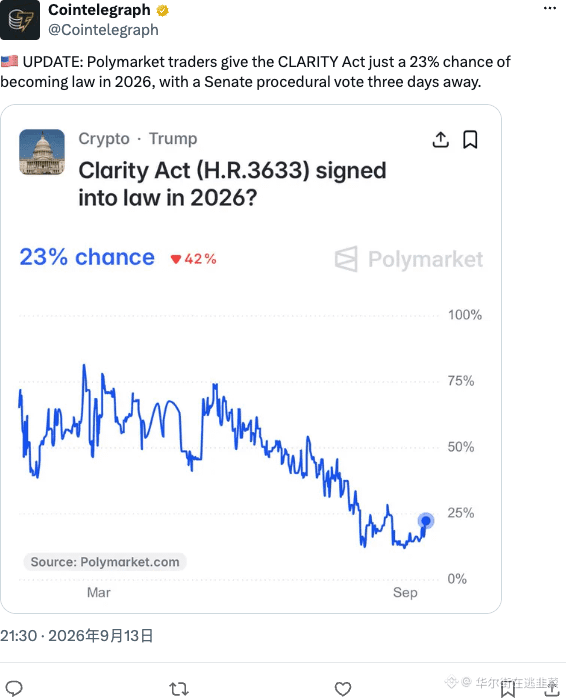
The CLARITY Act: A 23% chance of landing in 2026, according to Polymarket. After three days comes a procedural vote in the Senate. This price level really doesn’t leave much room to survive—either the market is sniffing out that there won’t be enough votes ahead of time, or else panic sellers have overdone the sell-off. A procedural vote is usually just a formality, but if Republicans haven’t reached an internal agreement, then 23% might still be an overestimate. For bets on legislative progress, the best risk-reward ratio is often in the last one or two days before the vote.
$POLY #Polymarket
The CLARITY Act: A 23% chance of landing in 2026, according to Polymarket. After three days comes a procedural vote in the Senate. This price level really doesn’t leave much room to survive—either the market is sniffing out that there won’t be enough votes ahead of time, or else panic sellers have overdone the sell-off. A procedural vote is usually just a formality, but if Republicans haven’t reached an internal agreement, then 23% might still be an overestimate. For bets on legislative progress, the best risk-reward ratio is often in the last one or two days before the vote.
$POLY #Polymarket
$POLY #Polymarket
44
Log in to explore more content
Join global crypto users on Binance Square
⚡️ Get latest and useful information about crypto.
💬 Trusted by the world’s largest crypto exchange.
👍 Discover real insights from verified creators.
Email / Phone number
Trending Topics
1
#FedRateWatch
1.1M views
5,418 Discussing
2
#ZcashRises6%
3,475 views
98 Discussing
3
#XRPSinks10%
1,332 views
66 Discussing
4
#BitcoinETFsShed$450M
220 views
27 Discussing
5
#CircleOpensArcMainnet
941 views
41 Discussing
6
#ZcashHoldersBackNU7Upgrade
9,609 views
214 Discussing
7
#MSTRTradingVolumeSurpassesMorganStanley
12,838 views
406 Discussing
8
#BitcoinFalls4%
29,079 views
681 Discussing
9
#SKHynixInTalksToMakeMemoryChipsInUS
13,576 views
286 Discussing
10
#OpenAIDiscussesNewFundingAt$1.2TValuation
3,130 views
47 Discussing