
#bstocks
bstocks
1.5M views
6,563 Discussing
Hot
Latest
Article
See translation
$1.5B in 145 Days: What's Actually Behind the bStocks Growth Story?Growth is impressive. Understanding what drives it is even more important.
The tokenized equities market is entering a new phase of development, and the latest numbers suggest that investor interest is expanding rapidly.
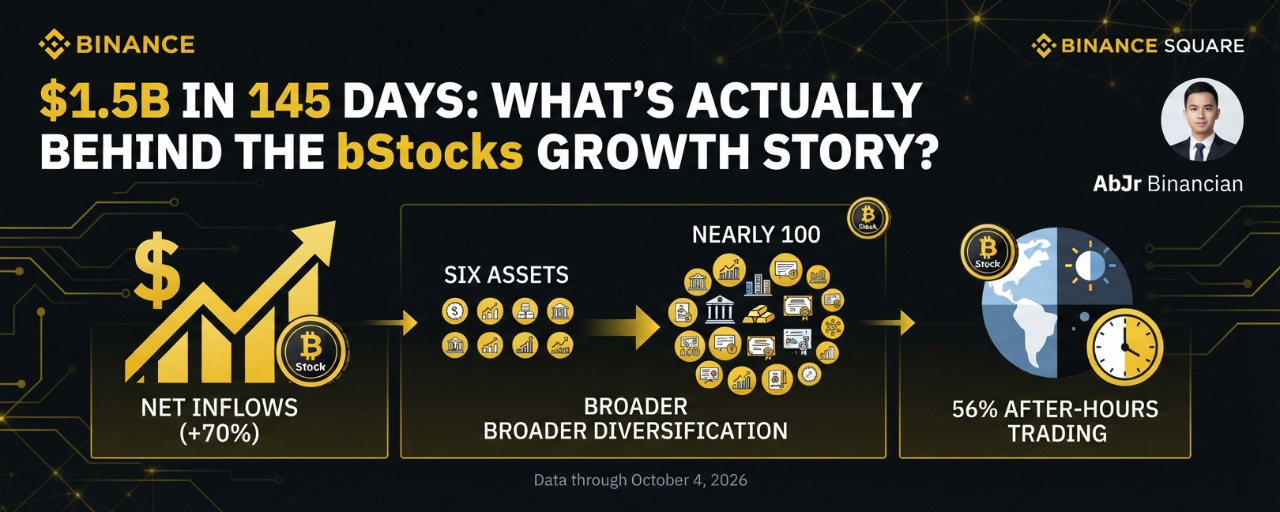
According to the figures in this report, bStocks surpassed $1.5 billion in assets under management (AUM) within just 145 days, while the wider tokenized equities market reached a record $4.8 billion.
But the headline numbers only tell part of the story.
Behind this growth are three important developments: substantial net inflows, a more diversified range of assets, and trading activity extending beyond traditional US stock-market hours.
Let's examine what these trends reveal.
1. The Growth Is More Than a Price Story
When an investment product increases in value, there are generally two major contributors:
Existing assets appreciate in price.New capital enters the product through net inflows.
These are not the same thing.
If an asset's AUM increases because its underlying securities rise in value, that does not necessarily mean more investors are allocating capital.
However, when net inflows account for most of the increase, the growth story becomes more interesting.
It suggests that investors are actively adding exposure rather than simply benefiting from market appreciation.
For bStocks, the reported contribution of net inflows points toward growing participation and demand for tokenized equity exposure.
This distinction matters because sustainable product growth depends on more than favorable market conditions.
2. From Six Assets to Nearly 100: Diversification Is Changing the Picture
Another important development is the expansion of the available asset selection.
The reported number of listings increased from just six to nearly 100.
At the same time, the top five assets reportedly declined from representing approximately 97% of total AUM to less than half.
Why does this matter?
In the early stages of a new investment market, capital often concentrates around a small number of recognizable assets.
As the product develops, additional listings can provide investors with more opportunities to diversify their exposure.
A declining concentration among the largest five assets may indicate that capital is spreading across a wider selection.
However, a larger number of listings does not automatically mean every asset has sufficient liquidity or investor demand.
The quality of diversification matters just as much as the number of available assets.
3. The 56% After-Hours Trading Signal
Perhaps the most interesting statistic is that approximately 56% of trading activity reportedly takes place outside traditional US market hours.
Traditional US equity markets operate within defined trading sessions.
Tokenized equity products can introduce a different trading experience, potentially allowing users to access markets beyond those conventional sessions, subject to product and platform availability.
This creates an important distinction between traditional market access and blockchain-based trading infrastructure.
For international investors, the ability to trade outside standard US market hours may provide additional flexibility.
But there are important considerations.
Underlying stock markets may be closed, which can affect price discovery, spreads, liquidity and the relationship between token prices and their underlying assets.
Investors should understand the trading hours, settlement arrangements, redemption terms and liquidity conditions of each product.
4. What Does This Mean for the Tokenized Equity Market?
The combination of increasing AUM, expanding listings and activity outside traditional market hours suggests that tokenized equities are developing beyond an early experimental phase.
Three trends deserve attention:
Greater participation: Net inflows indicate that new capital is contributing to product growth.
Broader asset selection: More listings provide opportunities for investors to access different companies and sectors.
Changing market access: Trading beyond traditional sessions demonstrates how tokenization can introduce new ways of interacting with financial markets.
However, growth alone does not establish long-term sustainability.
Investors should also examine liquidity, underlying asset arrangements, custody, regulatory compliance and the rights attached to each tokenized product.
5. What Should Investors Watch Next?
As the market develops, several indicators will help determine whether the current growth can continue:
Net inflows versus price-driven AUM increases.Concentration across the largest assets.Trading volume and liquidity by individual listing.Bid-ask spreads during and outside US market hours.Redemption and settlement arrangements.Regulatory developments affecting tokenized securities.
These indicators provide a more complete picture than AUM alone.
Final Thoughts
The reported $1.5 billion milestone is an important headline, but the more meaningful story is what sits behind it.
Capital entering the market, a broader selection of assets and changing trading patterns suggest that tokenized equities are attracting attention for more than just novelty.
The next stage will be determined by whether these products can maintain liquidity, transparency, reliable infrastructure and investor confidence as participation grows.
The real question is no longer just how quickly tokenized equities can grow. It's whether the market can build the foundations to support that growth.
#Binance #BStocks #TokenizedEquities #RWA #CryptoMarkets
$1.5B in 145 Days: What's Actually Behind the bStocks Growth Story?
Growth is impressive. Understanding what drives it is even more important.
The tokenized equities market is entering a new phase of development, and the latest numbers suggest that investor interest is expanding rapidly.
According to the figures in this report, bStocks surpassed $1.5 billion in assets under management (AUM) within just 145 days, while the wider tokenized equities market reached a record $4.8 billion.
But the headline numbers only tell part of the story.
Behind this growth are three important developments: substantial net inflows, a more diversified range of assets, and trading activity extending beyond traditional US stock-market hours.
Let's examine what these trends reveal.
1. The Growth Is More Than a Price Story
When an investment product increases in value, there are generally two major contributors:
Existing assets appreciate in price.New capital enters the product through net inflows.
These are not the same thing.
If an asset's AUM increases because its underlying securities rise in value, that does not necessarily mean more investors are allocating capital.
However, when net inflows account for most of the increase, the growth story becomes more interesting.
It suggests that investors are actively adding exposure rather than simply benefiting from market appreciation.
For bStocks, the reported contribution of net inflows points toward growing participation and demand for tokenized equity exposure.
This distinction matters because sustainable product growth depends on more than favorable market conditions.
2. From Six Assets to Nearly 100: Diversification Is Changing the Picture
Another important development is the expansion of the available asset selection.
The reported number of listings increased from just six to nearly 100.
At the same time, the top five assets reportedly declined from representing approximately 97% of total AUM to less than half.
Why does this matter?
In the early stages of a new investment market, capital often concentrates around a small number of recognizable assets.
As the product develops, additional listings can provide investors with more opportunities to diversify their exposure.
A declining concentration among the largest five assets may indicate that capital is spreading across a wider selection.
However, a larger number of listings does not automatically mean every asset has sufficient liquidity or investor demand.
The quality of diversification matters just as much as the number of available assets.
3. The 56% After-Hours Trading Signal
Perhaps the most interesting statistic is that approximately 56% of trading activity reportedly takes place outside traditional US market hours.
Traditional US equity markets operate within defined trading sessions.
Tokenized equity products can introduce a different trading experience, potentially allowing users to access markets beyond those conventional sessions, subject to product and platform availability.
This creates an important distinction between traditional market access and blockchain-based trading infrastructure.
For international investors, the ability to trade outside standard US market hours may provide additional flexibility.
But there are important considerations.
Underlying stock markets may be closed, which can affect price discovery, spreads, liquidity and the relationship between token prices and their underlying assets.
Investors should understand the trading hours, settlement arrangements, redemption terms and liquidity conditions of each product.
4. What Does This Mean for the Tokenized Equity Market?
The combination of increasing AUM, expanding listings and activity outside traditional market hours suggests that tokenized equities are developing beyond an early experimental phase.
Three trends deserve attention:
Greater participation: Net inflows indicate that new capital is contributing to product growth.
Broader asset selection: More listings provide opportunities for investors to access different companies and sectors.
Changing market access: Trading beyond traditional sessions demonstrates how tokenization can introduce new ways of interacting with financial markets.
However, growth alone does not establish long-term sustainability.
Investors should also examine liquidity, underlying asset arrangements, custody, regulatory compliance and the rights attached to each tokenized product.
5. What Should Investors Watch Next?
As the market develops, several indicators will help determine whether the current growth can continue:
Net inflows versus price-driven AUM increases.Concentration across the largest assets.Trading volume and liquidity by individual listing.Bid-ask spreads during and outside US market hours.Redemption and settlement arrangements.Regulatory developments affecting tokenized securities.
These indicators provide a more complete picture than AUM alone.
Final Thoughts
The reported $1.5 billion milestone is an important headline, but the more meaningful story is what sits behind it.
Capital entering the market, a broader selection of assets and changing trading patterns suggest that tokenized equities are attracting attention for more than just novelty.
The next stage will be determined by whether these products can maintain liquidity, transparency, reliable infrastructure and investor confidence as participation grows.
The real question is no longer just how quickly tokenized equities can grow. It's whether the market can build the foundations to support that growth.
#Binance #BStocks #TokenizedEquities #RWA #CryptoMarkets
82

See translation
MSTRB, CRCLB and NVDAB Market Analysis: Three Distinct Narratives Driving bStocks AttentionThe latest bStocks market session is showing strong activity across MSTRB, CRCLB and NVDAB, with all three tokenized securities moving higher against USDT. The common theme is improving short term momentum, but the reasons behind each move are very different. MSTRB is closely tied to the market’s appetite for Bitcoin related equity exposure, CRCLB reflects attention around stablecoin infrastructure and digital payments, while NVDAB remains a core proxy for the global AI, data center and semiconductor narrative.
These are not interchangeable assets. Each has its own risk profile, liquidity behaviour and market driver. For traders following bStocks, the important focus is not simply which ticker is gaining the most today. It is whether the price move is supported by sustained participation, whether the asset can hold above its session range, and whether the underlying narrative remains relevant as broader risk sentiment changes.
MSTRB is trading near $82.77, up 6.63% in the current session. It opened near $77.62, traded as low as $76.96 and reached a session high of $82.81. The intraday range is notable, covering 7.60%, which highlights strong volatility and aggressive price discovery. The move places MSTRB close to its session high, a sign that buyers have maintained control through much of the trading period.
MSTRB represents tokenized economic exposure to Strategy, a company widely followed because of its Bitcoin focused corporate treasury strategy. This means MSTRB can be influenced by several forces at once. Bitcoin market conditions matter, but so do equity market risk appetite, company specific developments, capital market sentiment and the premium or discount investors assign to Bitcoin related corporate exposure.
The latest price action suggests renewed demand, but traders should remember that high beta Bitcoin linked equities can move more sharply than Bitcoin itself during both positive and negative market phases. The current session volume is about 227.38K MSTRB, with turnover near $18.25M. That level of activity shows meaningful attention, but rapid gains near session highs can also bring short term volatility as participants react to changes in the wider crypto and equity environment.
CRCLB is trading near $49.98, up 4.10% in the current session. It opened near $48.01, reached a low of $47.69 and printed a high of $50.07. The session range is 4.99%, showing active but comparatively more measured trading than MSTRB. CRCLB is currently holding close to the upper end of its daily range, which indicates constructive short term momentum.
CRCLB provides tokenized exposure to Circle Internet Group. Its market narrative is closely connected to stablecoin adoption, payment infrastructure, regulatory developments and the expansion of digital finance. As stablecoins become a larger part of trading, settlement, remittances and onchain liquidity, companies operating around this infrastructure can attract significant market attention.
The current session volume is about 339.21K CRCLB, with turnover near $16.56M. This shows that the move is supported by active trading interest. Still, stablecoin related equities can react quickly to headlines involving regulation, partnerships, competitive developments and changes in the broader crypto market. A sustained recovery would depend on continued demand rather than a single positive session.
NVDAB is trading near $132.92, up 2.66% in the current session. It opened near $129.48, fell to $127.87 and reached a high of $133.19. The trading range is 4.16%, and price is holding close to the session high. Compared with MSTRB and CRCLB, NVDAB is posting the smallest percentage gain, yet it remains highly relevant because NVIDIA sits at the center of the AI infrastructure narrative.
NVDAB reflects tokenized economic exposure to NVIDIA, whose market attention is driven by data center demand, AI computing, GPU supply, cloud spending, enterprise adoption and the broader semiconductor cycle. The latest session volume is approximately 105.88K NVDAB, with turnover near $13.87M. The steady advance suggests buyers are active, although the relatively narrower gain compared with MSTRB and CRCLB may indicate a more balanced battle between buyers and sellers.
The larger takeaway is clear. MSTRB is leading the session with a 6.63% gain and the widest intraday range, making it the most volatile setup among the three. CRCLB is up 4.10%, supported by active turnover and the expanding stablecoin infrastructure narrative. NVDAB is up 2.66%, reflecting steady demand for AI related exposure while remaining linked to broader semiconductor and equity market sentiment.
MSTRB, CRCLB and NVDAB all offer different forms of tokenized market exposure. Their current momentum is constructive, but price strength alone is not enough to define a lasting trend. Sustained participation, broader market conditions and narrative durability will remain central to how these bStocks perform in the sessions ahead.
#MSTRB #CRCLB #NVDAB #bStocks #MarketAnalysis
$MSTRB
{spot}(MSTRBUSDT)
$CRCLB
{spot}(CRCLBUSDT)
$NVDAB
{spot}(NVDABUSDT)
MSTRB, CRCLB and NVDAB Market Analysis: Three Distinct Narratives Driving bStocks Attention
The latest bStocks market session is showing strong activity across MSTRB, CRCLB and NVDAB, with all three tokenized securities moving higher against USDT. The common theme is improving short term momentum, but the reasons behind each move are very different. MSTRB is closely tied to the market’s appetite for Bitcoin related equity exposure, CRCLB reflects attention around stablecoin infrastructure and digital payments, while NVDAB remains a core proxy for the global AI, data center and semiconductor narrative.
These are not interchangeable assets. Each has its own risk profile, liquidity behaviour and market driver. For traders following bStocks, the important focus is not simply which ticker is gaining the most today. It is whether the price move is supported by sustained participation, whether the asset can hold above its session range, and whether the underlying narrative remains relevant as broader risk sentiment changes.
MSTRB is trading near $82.77, up 6.63% in the current session. It opened near $77.62, traded as low as $76.96 and reached a session high of $82.81. The intraday range is notable, covering 7.60%, which highlights strong volatility and aggressive price discovery. The move places MSTRB close to its session high, a sign that buyers have maintained control through much of the trading period.
MSTRB represents tokenized economic exposure to Strategy, a company widely followed because of its Bitcoin focused corporate treasury strategy. This means MSTRB can be influenced by several forces at once. Bitcoin market conditions matter, but so do equity market risk appetite, company specific developments, capital market sentiment and the premium or discount investors assign to Bitcoin related corporate exposure.
The latest price action suggests renewed demand, but traders should remember that high beta Bitcoin linked equities can move more sharply than Bitcoin itself during both positive and negative market phases. The current session volume is about 227.38K MSTRB, with turnover near $18.25M. That level of activity shows meaningful attention, but rapid gains near session highs can also bring short term volatility as participants react to changes in the wider crypto and equity environment.
CRCLB is trading near $49.98, up 4.10% in the current session. It opened near $48.01, reached a low of $47.69 and printed a high of $50.07. The session range is 4.99%, showing active but comparatively more measured trading than MSTRB. CRCLB is currently holding close to the upper end of its daily range, which indicates constructive short term momentum.
CRCLB provides tokenized exposure to Circle Internet Group. Its market narrative is closely connected to stablecoin adoption, payment infrastructure, regulatory developments and the expansion of digital finance. As stablecoins become a larger part of trading, settlement, remittances and onchain liquidity, companies operating around this infrastructure can attract significant market attention.
The current session volume is about 339.21K CRCLB, with turnover near $16.56M. This shows that the move is supported by active trading interest. Still, stablecoin related equities can react quickly to headlines involving regulation, partnerships, competitive developments and changes in the broader crypto market. A sustained recovery would depend on continued demand rather than a single positive session.
NVDAB is trading near $132.92, up 2.66% in the current session. It opened near $129.48, fell to $127.87 and reached a high of $133.19. The trading range is 4.16%, and price is holding close to the session high. Compared with MSTRB and CRCLB, NVDAB is posting the smallest percentage gain, yet it remains highly relevant because NVIDIA sits at the center of the AI infrastructure narrative.
NVDAB reflects tokenized economic exposure to NVIDIA, whose market attention is driven by data center demand, AI computing, GPU supply, cloud spending, enterprise adoption and the broader semiconductor cycle. The latest session volume is approximately 105.88K NVDAB, with turnover near $13.87M. The steady advance suggests buyers are active, although the relatively narrower gain compared with MSTRB and CRCLB may indicate a more balanced battle between buyers and sellers.
The larger takeaway is clear. MSTRB is leading the session with a 6.63% gain and the widest intraday range, making it the most volatile setup among the three. CRCLB is up 4.10%, supported by active turnover and the expanding stablecoin infrastructure narrative. NVDAB is up 2.66%, reflecting steady demand for AI related exposure while remaining linked to broader semiconductor and equity market sentiment.
MSTRB, CRCLB and NVDAB all offer different forms of tokenized market exposure. Their current momentum is constructive, but price strength alone is not enough to define a lasting trend. Sustained participation, broader market conditions and narrative durability will remain central to how these bStocks perform in the sessions ahead.
#MSTRB #CRCLB #NVDAB #bStocks #MarketAnalysis
$MSTRB
$CRCLB
$NVDAB
1
6

·
--
Bullish
See translation
*📈 WHAT IS BINANCE STOCK TRADING? BUY APPLE, TESLA, NVIDIA WITH $USDT - EXPLAINED*
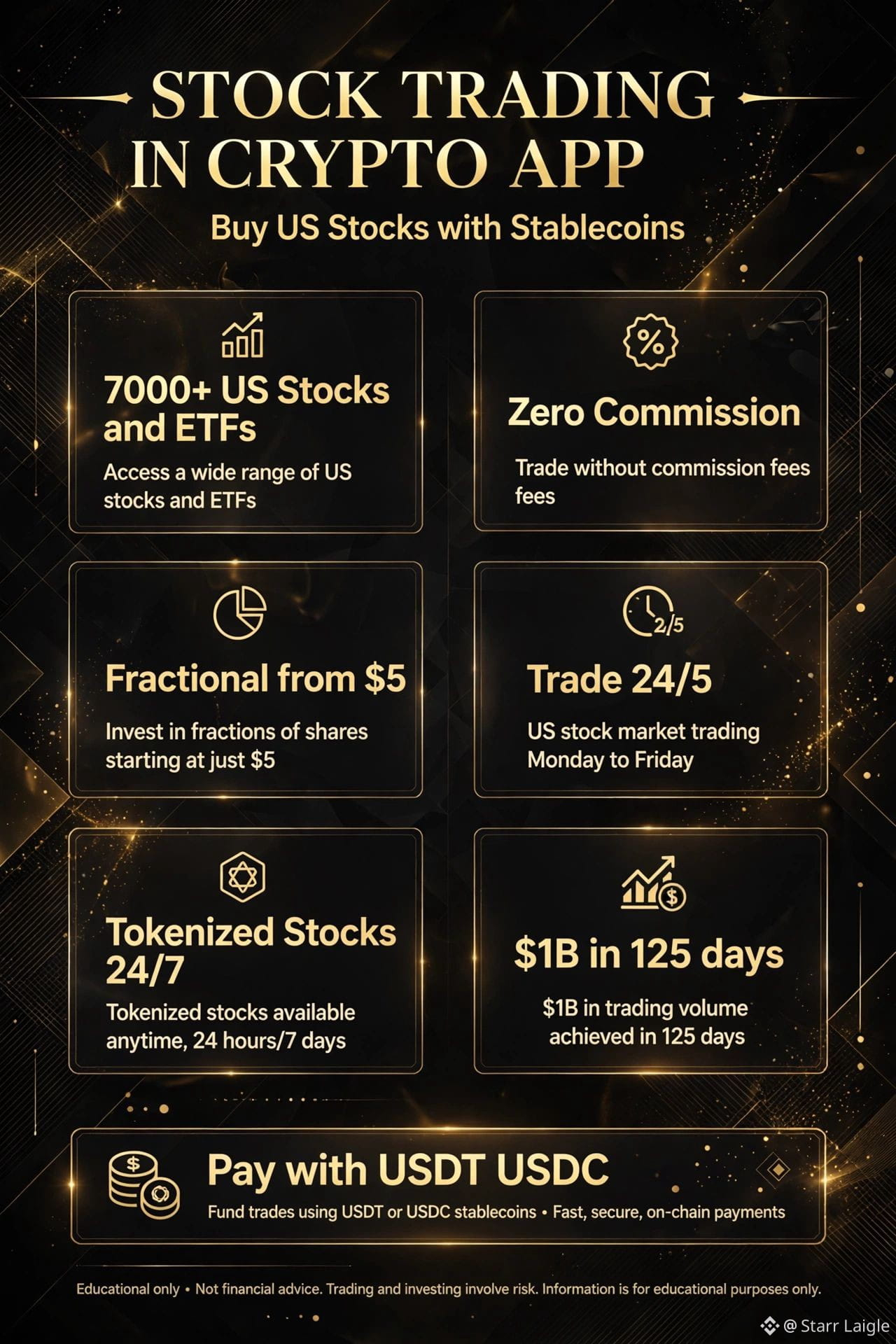
Binance is no longer just crypto. On *13 Nov 2026*, Binance officially added *7,000+ US Stocks and ETFs* to its app. Now you can buy *Apple, Tesla, NVIDIA, Google* with your $USDT - in the same app where you buy Bitcoin.
*WHAT IS BINANCE STOCK TRADING?*
It is *2 different products* in one app. Don't confuse them:
*1. DIRECT STOCKS - REAL SHARES*
Launched *1 June 2026*. You buy real US stocks through Binance broker *Nest Trading*.
- *7,000+ stocks and ETFs* - Apple, Tesla, NVIDIA, Amazon, S&P 500 ETF, Nasdaq ETF, etc.
- *Zero commission* - no broker fee
- *Fractional shares from $5* - You don't need $500 for 1 NVIDIA share. Buy $5 worth.
- *Trade 24/5* - Not just US market hours. Trade almost all week.
*2. bSTOCKS - TOKENIZED STOCKS*
Launched *11 June 2026*. This is the crypto version.
- First listings: *NVDAB (NVIDIA), TSLAB (Tesla), CRCLB (Circle), MUB (Micron), SNDKB (Sandisk), SPCXB (SpaceX)*
- *Trade 24/7* - Even Saturday, Sunday, night. Stocks never sleep.
- *BEP-20 token on $BNB Chain* - You can withdraw to your own wallet, use in DeFi, lend, use as collateral.
- *Convert 1:1 FREE* - Convert real stock to bStock and back, zero fee, anytime.
- *BUT - You do NOT own the share* - bStock is a *certificate*, not a share.
*WHO CAN USE IT?*
*Eligible NON-US users only.* US residents are banned. You need full KYC. Pakistan, India, Nigeria, Philippines, Brazil - eligible.
*RISKS - READ THIS:*
1. bStock is NOT a share. If Binance / issuer fails, you have issuer risk.
2. Zero commission is not zero cost. You pay spread, stablecoin conversion spread.
3. US tax: *30% withholding* on dividends for non-US.
4. US regulation still unclear. SEC delayed tokenized asset exemption.
5. Binance had a *$6.34B wallet breach on 29 Oct* - they say they covered all losses on 12 Nov, but remember risk.
Are you trading stocks on Binance yet?
Comment "STOCKS YES" / "CRYPTO ONLY" / "NEED GUIDE"
#BİNANCE #stocks #BStocks
{spot}(USDCUSDT)
*📈 WHAT IS BINANCE STOCK TRADING? BUY APPLE, TESLA, NVIDIA WITH $USDT - EXPLAINED*
Binance is no longer just crypto. On *13 Nov 2026*, Binance officially added *7,000+ US Stocks and ETFs* to its app. Now you can buy *Apple, Tesla, NVIDIA, Google* with your $USDT - in the same app where you buy Bitcoin.
*WHAT IS BINANCE STOCK TRADING?*
It is *2 different products* in one app. Don't confuse them:
*1. DIRECT STOCKS - REAL SHARES*
Launched *1 June 2026*. You buy real US stocks through Binance broker *Nest Trading*.
- *7,000+ stocks and ETFs* - Apple, Tesla, NVIDIA, Amazon, S&P 500 ETF, Nasdaq ETF, etc.
- *Zero commission* - no broker fee
- *Fractional shares from $5* - You don't need $500 for 1 NVIDIA share. Buy $5 worth.
- *Trade 24/5* - Not just US market hours. Trade almost all week.
*2. bSTOCKS - TOKENIZED STOCKS*
Launched *11 June 2026*. This is the crypto version.
- First listings: *NVDAB (NVIDIA), TSLAB (Tesla), CRCLB (Circle), MUB (Micron), SNDKB (Sandisk), SPCXB (SpaceX)*
- *Trade 24/7* - Even Saturday, Sunday, night. Stocks never sleep.
- *BEP-20 token on $BNB Chain* - You can withdraw to your own wallet, use in DeFi, lend, use as collateral.
- *Convert 1:1 FREE* - Convert real stock to bStock and back, zero fee, anytime.
- *BUT - You do NOT own the share* - bStock is a *certificate*, not a share.
*WHO CAN USE IT?*
*Eligible NON-US users only.* US residents are banned. You need full KYC. Pakistan, India, Nigeria, Philippines, Brazil - eligible.
*RISKS - READ THIS:*
1. bStock is NOT a share. If Binance / issuer fails, you have issuer risk.
2. Zero commission is not zero cost. You pay spread, stablecoin conversion spread.
3. US tax: *30% withholding* on dividends for non-US.
4. US regulation still unclear. SEC delayed tokenized asset exemption.
5. Binance had a *$6.34B wallet breach on 29 Oct* - they say they covered all losses on 12 Nov, but remember risk.
Are you trading stocks on Binance yet?
Comment "STOCKS YES" / "CRYPTO ONLY" / "NEED GUIDE"
#BİNANCE #stocks #BStocks
90

·
--
See translation
Anthropic just got a tokenized version on BNB Chain — and it is already listed on Binance.
On Nov 19 Binance opened ANTB/USDT Spot trading at 18:00 UTC (01:00 WIB on Nov 20). ANTB is a bStock: a tokenized representation of Anthropic, not the share itself. The official announcement also says:
• Convert vs BTC, USDT and other tokens at zero fees, starting within one hour of the Spot listing
• Zero maker fees on ANTB/USDT from listing until 30 Nov 23:59 UTC
• Deposits and withdrawals opened at 19:00 UTC the same day
• ANTB became eligible collateral on Cross Margin, Portfolio Margin and Portfolio Margin Pro at listing time — borrowing is not currently supported
• The smart contract is on #BNBChain
A Nov 20 BNB Chain blog post says ANTB is the latest bStock on supported platforms, and points to competitions on Binance Wallet, Pancake, Trust Wallet, Four.Meme and Ave.ai with combined pools of $250,000 plus additional fee-funded rewards. Those pools are the total available, rules and eligible assets differ by platform, and individual rewards are not guaranteed. Check each platform’s own terms.
bStocks are not available in every region (including the US), and are offered through an ADGM prospectus to eligible users only. Check eligibility before you touch them.
Not financial advice. DYOR.
$BNB #BNBChain #bStocks #ANTB #Binance
102

See translation
🔥 $SKDDB – A Different Way to Explore the Market!
The world of technology and semiconductors is full of exciting market movements, and SK Hynix is one of the companies attracting global attention.
🚀 Introducing $SKDDB B!
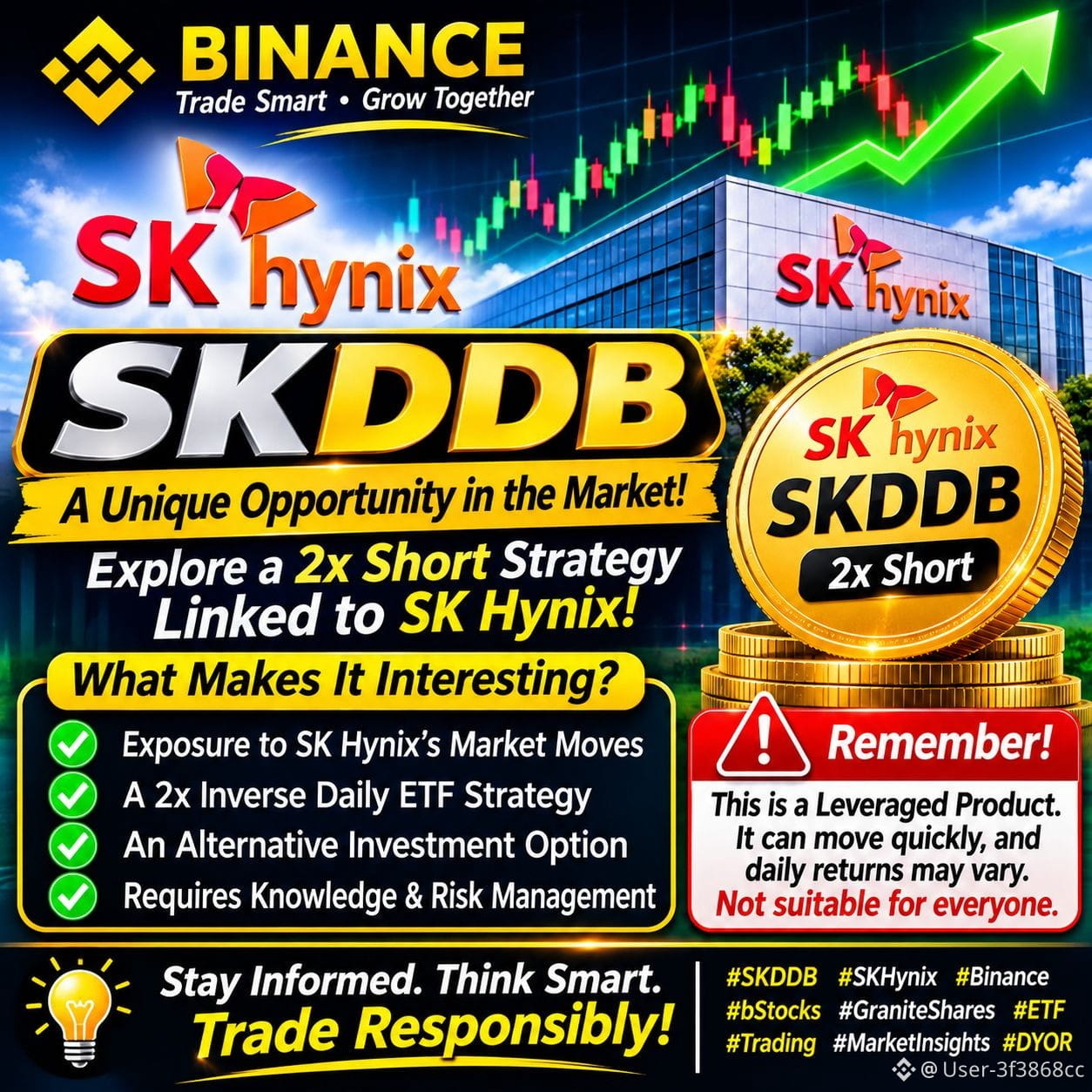
$SKDDB is a tokenized bStock linked to the GraniteShares 2x Short SK Hynix Daily ETF.
📊 Why is it interesting?
- Offers exposure to a unique market strategy.
- Designed to target 2x the inverse of SK Hynix's daily share-price movement.
- Provides an alternative way to participate in market movements.
- A product that requires knowledge, timing, and careful risk management.
💡 Every market instrument has its own strategy. Understanding how it works is the first step toward making informed decisions.
⚠️ Remember: This is a leveraged product. Its value can move quickly, and daily returns may differ significantly over longer periods.
Stay informed. Think smart. Trade responsibly! 🚀
#SKDDB #Binance #bStocks
119

·
--
AI Bubble Alert: Nvidia Down 48% From Its High—Is NVDAB at 131 a Buy?AI trading is once again raising bubble alarms. Decrypt reports that Nvidia has fallen 48% from its previous high, with tech stocks under pressure following Anthropic's IPO and a crisis in Nvidia's management; the same report cites BTC falling below $60,000 as a sign of a synchronized contraction in risk assets (November 21).
Binance bStocks $NVDAB was at $131.22 at 05:12 CST on November 22, up 2.716% over 24 hours, with a range of $127.28–$131.61. The day's open, high, and low were $129.66, $131.30, and $127.40, respectively, still about 21% below the November 15 high of $165.55. It has rebounded just 1.2% from the current low of $127.28 and has yet to recover the November 20 high of $146.82.
AI Bubble Alert: Nvidia Down 48% From Its High—Is NVDAB at 131 a Buy?
AI trading is once again raising bubble alarms. Decrypt reports that Nvidia has fallen 48% from its previous high, with tech stocks under pressure following Anthropic's IPO and a crisis in Nvidia's management; the same report cites BTC falling below $60,000 as a sign of a synchronized contraction in risk assets (November 21).
Binance bStocks $NVDAB was at $131.22 at 05:12 CST on November 22, up 2.716% over 24 hours, with a range of $127.28–$131.61. The day's open, high, and low were $129.66, $131.30, and $127.40, respectively, still about 21% below the November 15 high of $165.55. It has rebounded just 1.2% from the current low of $127.28 and has yet to recover the November 20 high of $146.82.
Binance bStocks $NVDAB was at $131.22 at 05:12 CST on November 22, up 2.716% over 24 hours, with a range of $127.28–$131.61. The day's open, high, and low were $129.66, $131.30, and $127.40, respectively, still about 21% below the November 15 high of $165.55. It has rebounded just 1.2% from the current low of $127.28 and has yet to recover the November 20 high of $146.82.
217

See translation
Gold is correcting. Tokenized stocks are growing. Is the market offering two different opportunities?
Something interesting is happening in the RWA market, and I think investors should pay attention.
Look at the historical numbers.
PAXG delivered approximately 64.7% growth in 2025. But by November 20, 2026, it had fallen around 18.6% year-to-date. That's a significant correction, not a guaranteed bargain. Still, it gives long-term gold investors a reason to reassess their entry levels.
Now look at Binance bStocks.
The tokenized-equity market reached $4.8 billion in AUM by November 2026, while bStocks crossed $1.5 billion. That's a major adoption milestone for bringing traditional equities into crypto markets.
My investment perspective:
🟡 Gold (PAXG / XAUT): Consider gradual accumulation during corrections. Gold offers an alternative to pure crypto exposure, although it can fall too.
📈 bStocks: Watch established businesses with strong earnings, cash flow and reasonable valuations. Tokenization makes access easier, but it doesn't make an overpriced stock cheap.
I wouldn't put all my capital into either category. I'd consider staggered entries rather than chasing green candles.
One lesson from 2025 is worth remembering: PAXG's 64% annual gain rewarded those who understood the longer-term trend, not necessarily those who bought at the top.
The next opportunity may belong to investors who prepare during corrections rather than chase rallies.
Research the asset. Check its backing, valuation, liquidity and fees before buying.
#XAUT #bStocks #TokenizedStocks
580

Have you heard of bStocks on Binance? Let me explain it simply 🧾
On November 18, Binance added seven new tokenized stock pairs against USDT for spot trading and conversion. According to reports, Maker fees are zero until November 30.
But keep these points in mind:
🔹 These are certificates linked to the price of a stock or fund, not actual shares.
🔹 They don't give you ownership in the company or voting rights.
🔹 They're not available to U.S. citizens.
So you can get exposure to traditional market movements from your account, but read the details before you jump in—especially on days like this, when stocks themselves are falling sharply.
Not financial advice.
Have you tried tokenized stocks, or are you still wary of them?
#BinanceSquare #bStocks #Tokenization

37

·
--
Bullish
See translation
WHAT IF YOU COULD TRADE THE STOCK MARKET USING BLOCKCHAIN TECHNOLOGY?
Crypto traders are used to buying Bitcoin, Ethereum, and altcoins, but the financial markets are much bigger than cryptocurrency.
Imagine accessing traditional financial market exposure through blockchain-based tokens.
This is where BStocks Finance and tokenized financial products become interesting.
One product worth researching is the Direxion Semiconductor Bear 3X ETF Tokenized B-Stocks.
Here are 4 things every trader should understand:
🔥 1. Tokenized Financial Exposure: BStocks bring exposure to selected traditional financial instruments into a tokenized format.
🔥 2. Semiconductor Market: This particular product tracks the Direxion Daily Semiconductor Bear 3X ETF, which targets three times the inverse of the daily performance of its semiconductor benchmark.
🔥 3. Market Opportunities: It gives eligible traders a way to gain bearish exposure to the semiconductor sector through a tokenized product structure.
🔥 4. Blockchain Integration: Tokenization connects traditional financial instruments with blockchain-based infrastructure and digital asset markets.
But here is something important: this is not a normal cryptocurrency.
A 3X leveraged inverse ETF is designed around DAILY returns. Its performance over several days can differ significantly from simply multiplying the semiconductor sector's overall decline by three.
Volatility and compounding can work against traders.
HERE IS MY CONTROVERSIAL QUESTION:
Why are crypto traders limiting themselves to Bitcoin and altcoins when blockchain technology is increasingly connecting crypto with traditional financial markets?
Do you think tokenized financial markets are the next major evolution of crypto?
Let's discuss.
#BStocks #Tokenization #RWA #Crypto #Semiconductors #askanda $SOXLB $SOXSB
{spot}(SOXSBUSDT)
WHAT IF YOU COULD TRADE THE STOCK MARKET USING BLOCKCHAIN TECHNOLOGY?
Crypto traders are used to buying Bitcoin, Ethereum, and altcoins, but the financial markets are much bigger than cryptocurrency.
Imagine accessing traditional financial market exposure through blockchain-based tokens.
This is where BStocks Finance and tokenized financial products become interesting.
One product worth researching is the Direxion Semiconductor Bear 3X ETF Tokenized B-Stocks.
Here are 4 things every trader should understand:
🔥 1. Tokenized Financial Exposure: BStocks bring exposure to selected traditional financial instruments into a tokenized format.
🔥 2. Semiconductor Market: This particular product tracks the Direxion Daily Semiconductor Bear 3X ETF, which targets three times the inverse of the daily performance of its semiconductor benchmark.
🔥 3. Market Opportunities: It gives eligible traders a way to gain bearish exposure to the semiconductor sector through a tokenized product structure.
🔥 4. Blockchain Integration: Tokenization connects traditional financial instruments with blockchain-based infrastructure and digital asset markets.
But here is something important: this is not a normal cryptocurrency.
A 3X leveraged inverse ETF is designed around DAILY returns. Its performance over several days can differ significantly from simply multiplying the semiconductor sector's overall decline by three.
Volatility and compounding can work against traders.
HERE IS MY CONTROVERSIAL QUESTION:
Why are crypto traders limiting themselves to Bitcoin and altcoins when blockchain technology is increasingly connecting crypto with traditional financial markets?
Do you think tokenized financial markets are the next major evolution of crypto?
Let's discuss.
#BStocks #Tokenization #RWA #Crypto #Semiconductors #askanda $SOXLB $SOXSB
Mari Tigert 64:
Am new to crypto and don't have experience
Am very sorry to bother you please...
I lost everything i have in the drop
Please 🥺 I need ur help
Anything would do
0xddbfcbdaf79de3b1b82fe2d7bbb16f04503628ac
This is my usdt evm address
I have a little girl
2
2
940


See translation
Kenya Exclusive! 🇰🇪
The #bStocks Kenya Duo Challenge is live!
🔸 Trade bStocks worth at least 10 USDT
🔸 Invite friends to complete their first bStocks trade
🔸 Use your spins to get rewarded
Campaign runs up to 28 Nov 2026.
T&Cs apply.
Join now 👉 [Click on the Link to Participate](https://www.binance.com/en/events/kenyabstocksduochallenge)
$TSLAB
{spot}(TSLABUSDT)
Kenya Exclusive! 🇰🇪
The #bStocks Kenya Duo Challenge is live!
🔸 Trade bStocks worth at least 10 USDT
🔸 Invite friends to complete their first bStocks trade
🔸 Use your spins to get rewarded
Campaign runs up to 28 Nov 2026.
T&Cs apply.
Join now 👉 Click on the Link to Participate
$TSLAB
The #bStocks Kenya Duo Challenge is live!
🔸 Trade bStocks worth at least 10 USDT
🔸 Invite friends to complete their first bStocks trade
🔸 Use your spins to get rewarded
Campaign runs up to 28 Nov 2026.
T&Cs apply.
Join now 👉 Click on the Link to Participate
$TSLAB

11
1.5k

·
--
Verified
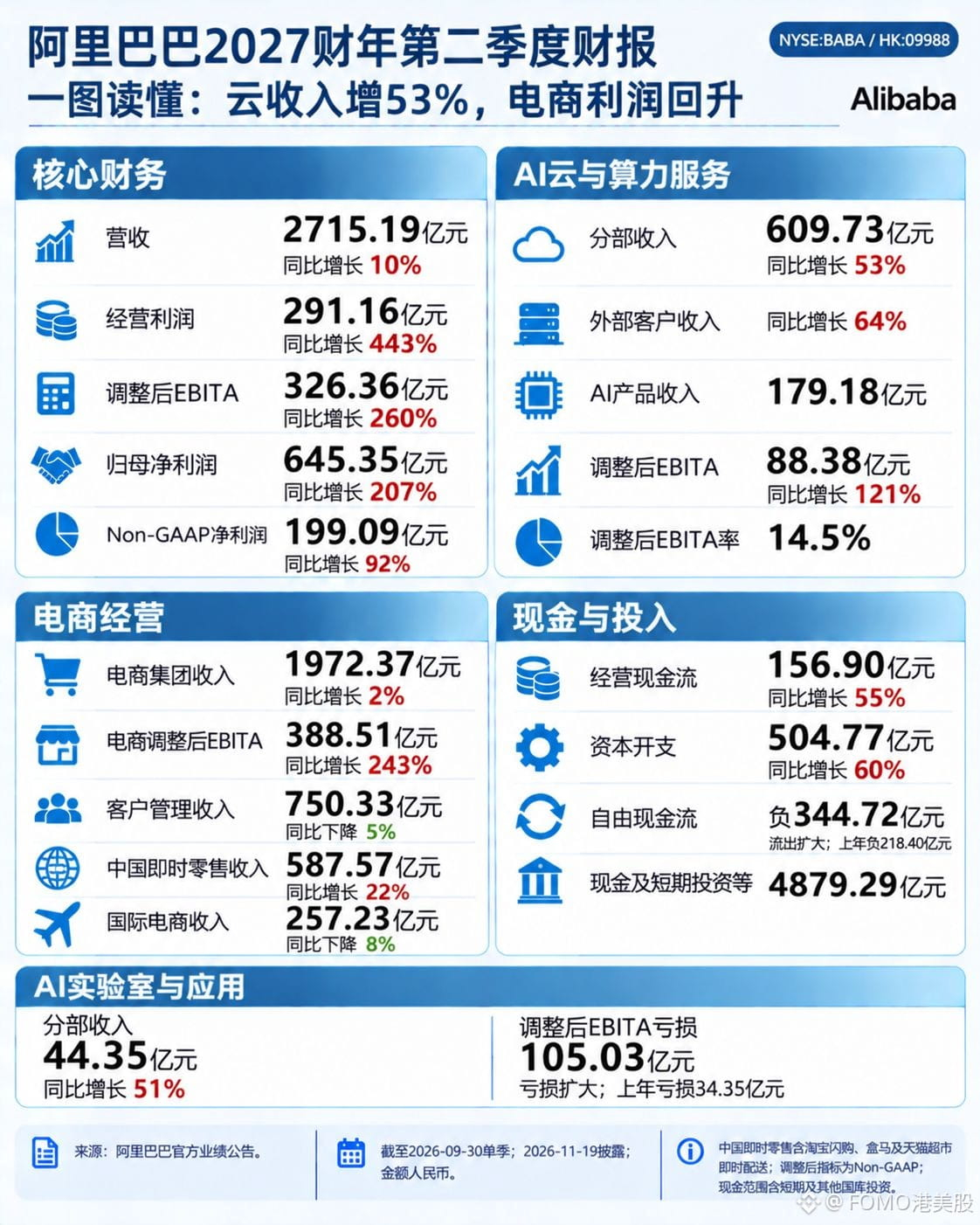
【Chinese Concept Stocks Q3 Earnings Series—Alibaba】
Alibaba $BABAB reported revenue of 271.519 billion yuan for the September quarter, up 10%. Cloud revenue rose 53%, and adjusted EBITA increased 260%. The stock fell 1.26% that day, down 53.7% from its 52-week high.
The profit recovery came from two segments. Cloud revenue was 60.973 billion yuan, up 53%, while segment EBITA rose 121%. E-commerce EBITA climbed 243% to 38.851 billion yuan. Together, the two segments drove operating profit up 443%.
Profit included investment gains.
Net profit attributable to shareholders rose 207% to 64.535 billion yuan, but net investment gains for the quarter totaled 73.305 billion yuan, from fair value changes. Excluding these, adjusted net profit was 19.909 billion yuan, up 92%—a figure that better reflects improvement in the core business.
On earnings day, the stock closed at $83.31, down 1.26%, and 53.7% below its 52-week high, close to its year-to-date low of $83.25. The market is pricing in the cost of AI investment: losses from AI applications widened to 10.503 billion yuan, capital expenditure rose 60% to 50.477 billion yuan, and free cash flow was negative 34.472 billion yuan. The market may be right about the direction, but the scale of the selloff is debatable. Cloud revenue growth of 53% and e-commerce EBITA growth of 243% are real, and the company has ample cash on hand at 487.929 billion yuan. Being punished as if there will be no returns, with the stock pushed to its 52-week low, seems at odds with the recovery in the core business. Whether the cloud margin can hold at 14.5% is key.
The swing factor is AI losses. They are eating into the profits released by e-commerce, and whether they narrow will determine if the profit recovery can continue.
{spot}(BABABUSDT)
#阿里巴巴 #BStocks #股票财报季
【Chinese Concept Stocks Q3 Earnings Series—Alibaba】
Alibaba $BABAB reported revenue of 271.519 billion yuan for the September quarter, up 10%. Cloud revenue rose 53%, and adjusted EBITA increased 260%. The stock fell 1.26% that day, down 53.7% from its 52-week high.
The profit recovery came from two segments. Cloud revenue was 60.973 billion yuan, up 53%, while segment EBITA rose 121%. E-commerce EBITA climbed 243% to 38.851 billion yuan. Together, the two segments drove operating profit up 443%.
Profit included investment gains.
Net profit attributable to shareholders rose 207% to 64.535 billion yuan, but net investment gains for the quarter totaled 73.305 billion yuan, from fair value changes. Excluding these, adjusted net profit was 19.909 billion yuan, up 92%—a figure that better reflects improvement in the core business.
On earnings day, the stock closed at $83.31, down 1.26%, and 53.7% below its 52-week high, close to its year-to-date low of $83.25. The market is pricing in the cost of AI investment: losses from AI applications widened to 10.503 billion yuan, capital expenditure rose 60% to 50.477 billion yuan, and free cash flow was negative 34.472 billion yuan. The market may be right about the direction, but the scale of the selloff is debatable. Cloud revenue growth of 53% and e-commerce EBITA growth of 243% are real, and the company has ample cash on hand at 487.929 billion yuan. Being punished as if there will be no returns, with the stock pushed to its 52-week low, seems at odds with the recovery in the core business. Whether the cloud margin can hold at 14.5% is key.
The swing factor is AI losses. They are eating into the profits released by e-commerce, and whether they narrow will determine if the profit recovery can continue.
#阿里巴巴 #BStocks #股票财报季
811
·
--
See translation
ANTB DISTRIBUTION UPDATE: ELIGIBLE BINANCE WALLET USERS SHOULD CHECK THEIR SPOT ACCOUNT
Binance Wallet has shared an update on the Anthropic IPO xStocks event.
Eligible participants will receive their ANTB distribution automatically on November 20, 2026. No extra action is required after the distribution is processed.
According to the announcement:
Each eligible user will receive at least approximately $6 worth of ANTB.
Any remaining distribution will depend on each user’s subscription amount compared with the total subscription amount.
The final value can change because the calculation uses the market price of Anthropic shares after trading stabilizes.
Eligible users can check their Binance Spot account to see whether the distribution has arrived.
One important reminder for beginners:
$ANTB is a tokenized security. It is not the same as directly owning shares in Anthropic.
Access, eligibility and product availability depend on the applicable Binance terms and your jurisdiction.
Crypto and tokenized securities can both involve price volatility, so always read the official announcement before participating in any campaign.
Did you take part in the Anthropic xStocks event or would you like a simple explanation of how bStocks work? #BinanceWallet #ANTB #BStocks #cryptoeducation #BinanceSquare
1
210

·
--
Article
See translation
🚨 UVXYB: The "Fear Index" Token Just Broke Out. Should You Panic?📉 First, what is UVXYB?
$UVXYB is a bStock on Binance: a BEP-20 token on BNB Smart Chain that tracks the ProShares Ultra VIX Short-Term Futures ETF (UVXY).
🔹 Backed 1:1 by ETF shares held with a regulated custodian
🔹 Listed on Binance Spot (UVXYB/USDT) on October 14, 2026
🔹 The first leveraged ETF product in Binance's bStocks lineup
🔹 Tracks the underlying ETF price, no staking, no inflation
In plain English: it's a bet on market fear. When Wall Street gets nervous, the VIX spikes and UVXYB tends to jump. When things calm down, it usually bleeds. Think of it as a smoke detector: very useful, but you don't want it ringing all day. 🔥
⚠️ Important: this is NOT a normal stock token. UVXY uses daily leverage and suffers from contango decay, so it is structurally built to lose value over time. It has even needed reverse splits to keep its price afloat. Treat it as a trading tool, not a long-term hold.
📊 TECHNICAL ANALYSIS (price ≈ 25.80 USDT, +19%)
🗓 Daily (1D)
🔹 Range between ~15.7 and ~24 since the listing
🔹 Today: a big green breakout candle, new high at 25.89
🔹 RSI at 67.9: strong, but not extreme yet
🔹 Volume still below its average, but the day isn't over
⏱ 4-Hour (4H)
🔹 All EMAs are bullish and perfectly stacked (9 > 21 > 50 > 100 > 200)
🔹 RSI at 72.8, OBV at its highs: buyers are in control
🔹 The old 16 to 24 range was broken in basically one candle 🚀
🕐 1-Hour (1H)
👀 The "easy there, champ" timeframe
🔹 RSI at 82.4: clearly overbought
🔹 Price sits ~8% above the EMA 9 (23.91)
🔹 The last candle is near vertical on very thin volume: it looks more like a liquidity spike than steady accumulation
🎯 KEY LEVELS
🔹 Resistance: 25.89, then 26.36 to 26.40
🔹 Supports: 23.9 (EMA 9 1H), 22.7 (EMA 9 4H), 21.5 to 21.7 (EMA 21/50)
🔹 Bullish structure invalidated below ~20.2 (EMA 200 1H)
🧭 SCENARIOS
🔹 Most likely short term: a pullback toward 23.9 to 22.7 to cool the overbought RSI. Healthy, not scary.
🔹 Bullish continuation: a successful retest of the 24 to 25 zone with real volume could open the path to 26.4.
🧠 THE REAL DRIVER
Don't just stare at the chart. UVXYB follows the VIX, so watch Wall Street's mood. When equities wobble, this token wakes up. When markets relax, gravity usually wins. 🍿
💬 Are you trading the fear, or fading it?
⚠️ Not financial advice. Leveraged volatility products are high risk. Always DYOR and manage your risk.
#UVXYB #bStocks #VIX
🚨 UVXYB: The "Fear Index" Token Just Broke Out. Should You Panic?
📉 First, what is UVXYB?
$UVXYB is a bStock on Binance: a BEP-20 token on BNB Smart Chain that tracks the ProShares Ultra VIX Short-Term Futures ETF (UVXY).
🔹 Backed 1:1 by ETF shares held with a regulated custodian
🔹 Listed on Binance Spot (UVXYB/USDT) on October 14, 2026
🔹 The first leveraged ETF product in Binance's bStocks lineup
🔹 Tracks the underlying ETF price, no staking, no inflation
In plain English: it's a bet on market fear. When Wall Street gets nervous, the VIX spikes and UVXYB tends to jump. When things calm down, it usually bleeds. Think of it as a smoke detector: very useful, but you don't want it ringing all day. 🔥
⚠️ Important: this is NOT a normal stock token. UVXY uses daily leverage and suffers from contango decay, so it is structurally built to lose value over time. It has even needed reverse splits to keep its price afloat. Treat it as a trading tool, not a long-term hold.
📊 TECHNICAL ANALYSIS (price ≈ 25.80 USDT, +19%)
🗓 Daily (1D)
🔹 Range between ~15.7 and ~24 since the listing
🔹 Today: a big green breakout candle, new high at 25.89
🔹 RSI at 67.9: strong, but not extreme yet
🔹 Volume still below its average, but the day isn't over
⏱ 4-Hour (4H)
🔹 All EMAs are bullish and perfectly stacked (9 > 21 > 50 > 100 > 200)
🔹 RSI at 72.8, OBV at its highs: buyers are in control
🔹 The old 16 to 24 range was broken in basically one candle 🚀
🕐 1-Hour (1H)
👀 The "easy there, champ" timeframe
🔹 RSI at 82.4: clearly overbought
🔹 Price sits ~8% above the EMA 9 (23.91)
🔹 The last candle is near vertical on very thin volume: it looks more like a liquidity spike than steady accumulation
🎯 KEY LEVELS
🔹 Resistance: 25.89, then 26.36 to 26.40
🔹 Supports: 23.9 (EMA 9 1H), 22.7 (EMA 9 4H), 21.5 to 21.7 (EMA 21/50)
🔹 Bullish structure invalidated below ~20.2 (EMA 200 1H)
🧭 SCENARIOS
🔹 Most likely short term: a pullback toward 23.9 to 22.7 to cool the overbought RSI. Healthy, not scary.
🔹 Bullish continuation: a successful retest of the 24 to 25 zone with real volume could open the path to 26.4.
🧠 THE REAL DRIVER
Don't just stare at the chart. UVXYB follows the VIX, so watch Wall Street's mood. When equities wobble, this token wakes up. When markets relax, gravity usually wins. 🍿
💬 Are you trading the fear, or fading it?
⚠️ Not financial advice. Leveraged volatility products are high risk. Always DYOR and manage your risk.
#UVXYB #bStocks #VIX
171

·
--
Verified
🔴 NVIDIA (bStock) falls 7.41% in 24h, pressured by rate hike expectations
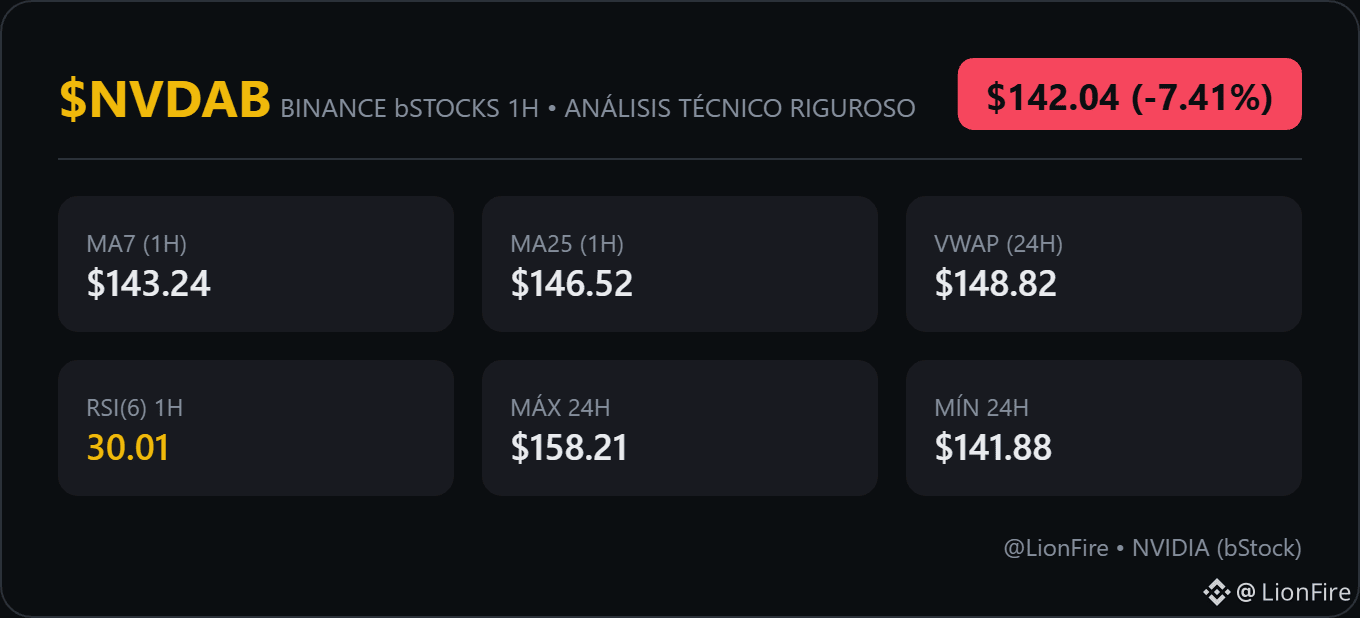
$NVDAB is currently trading at $142.04 after closing down 7.41%, reflecting the pressure from expectations of further rate hikes, according to the Fed minutes. NVIDIA's tokenized stock on Binance bStock is directly affected by the macroeconomic environment, with a clear impact on tech assets.
🔍 1. Technical and macroeconomic analysis of the move:
The price drop is putting direct pressure on the 24h support at $141.88, while the current price ($142.04) is below the MA7 ($143.24), the MA25 ($146.52), and the 24h VWAP ($148.82). The short-term technical structure reflects clear selling pressure, reinforced by an RSI(6) of 30.01, which signals weakness but not extreme capitulation.
Expectations of further rate hikes, according to the Fed minutes, have generated liquidity in the market, with a 24h volume of $67,009,418 USDT. This dynamic adds to a broader trend: Bitcoin is also facing technical pressure following Anthropic's initial public offering and massive liquidations.
🧠 2. Tactical discipline in the face of panic:
When an asset falls, investors commonly react with impulsive selling or try to catch falling knives. However, for a professional trader, discipline always takes precedence over panic. A clear technical structure and strict risk management are the most powerful tools in moments like this.
💡 The drop in $NVDAB is not the end, but a signal: an opportunity for those who trade with a cool head and a plan. Stay calm, analyze the move, and execute according to your strategy.
#bStocks #NVIDIA #TechStocks
$NVDAB
66

See translation
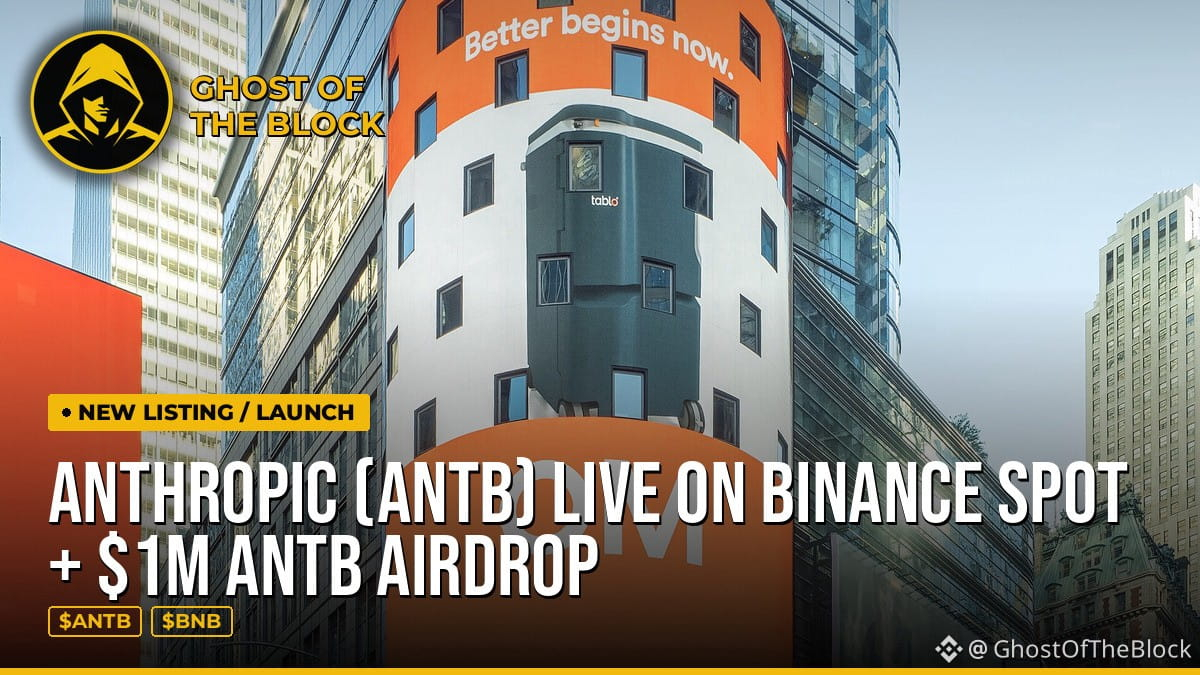
🚀 Anthropic just landed on Binance Spot — and it opened at $110.
$ANTB (Anthropic bStocks) is LIVE:
• Pair: ANTB/USDT — trading opened 18:00 UTC today
• Deposits/withdrawals: open from 19:00 UTC (BNB Chain)
• Zero maker fees on ANTB/USDT until Nov 30, 23:59 UTC
• Zero-fee Convert vs BTC, USDT & more
• Added as Cross/Portfolio Margin collateral from 18:00 UTC
🎁 Bonus: Binance is sharing $1,000,000 in ANTB with everyone who applied to the Anthropic IPO xStocks campaign on Binance Wallet (min 6 USDC each, pro-rata) + full USDC refunds. Auto-credited by Nov 20 — no action needed.
📊 First hours:
Open $110 → now ~$96.9 (−11.9%)
Low $92.98 | ~$4.1M volume
Why it matters: a ~$1.5T AI giant now trades 24/7 against USDT on a crypto exchange. That's the TradFi-meets-crypto bridge in real time.
👻 Levels:
Hold $93 → base forming, $110 retest in play
Lose $93 → price discovery lower, $85–88 zone
Day-one listings are volatile — size small.
Are you buying Anthropic on-chain or waiting for Nasdaq to settle? 👇
Source: Binance announcements. Availability depends on your region.
#Binance #Anthropic #bStocks
Not financial advice.
— Ghost of the Block 👻
143
·
--
SEC Nominee Backs Rulemaking for Tokenized Stocks: SPCXB Down 6.6%—Is 135 a Buy?SEC nominee Kristin Johnson supported regulating tokenized stocks through formal rulemaking at a Senate hearing, emphasizing a notice-and-comment period. Nominee Steven Levine, meanwhile, stressed the SEC’s authority to grant exemptions, noting that the current innovation exemption is time-limited and includes investor protections (Cointelegraph, Nov. 20, 04:06 CST).
The SEC’s Sept. 17 innovation exemption allows eligible platforms to trade on-chain versions of U.S. stocks under certain conditions without registering as securities exchanges. Johnson also mentioned anti-money-laundering and KYC compliance. Cointelegraph reported that, as of Nov. 5, 67 publicly listed companies opposed having their shares tokenized on OKXICE. The nominations are still awaiting Senate confirmation.
SEC Nominee Backs Rulemaking for Tokenized Stocks: SPCXB Down 6.6%—Is 135 a Buy?
SEC nominee Kristin Johnson supported regulating tokenized stocks through formal rulemaking at a Senate hearing, emphasizing a notice-and-comment period. Nominee Steven Levine, meanwhile, stressed the SEC’s authority to grant exemptions, noting that the current innovation exemption is time-limited and includes investor protections (Cointelegraph, Nov. 20, 04:06 CST).
The SEC’s Sept. 17 innovation exemption allows eligible platforms to trade on-chain versions of U.S. stocks under certain conditions without registering as securities exchanges. Johnson also mentioned anti-money-laundering and KYC compliance. Cointelegraph reported that, as of Nov. 5, 67 publicly listed companies opposed having their shares tokenized on OKXICE. The nominations are still awaiting Senate confirmation.
The SEC’s Sept. 17 innovation exemption allows eligible platforms to trade on-chain versions of U.S. stocks under certain conditions without registering as securities exchanges. Johnson also mentioned anti-money-laundering and KYC compliance. Cointelegraph reported that, as of Nov. 5, 67 publicly listed companies opposed having their shares tokenized on OKXICE. The nominations are still awaiting Senate confirmation.
265
·
--
See translation
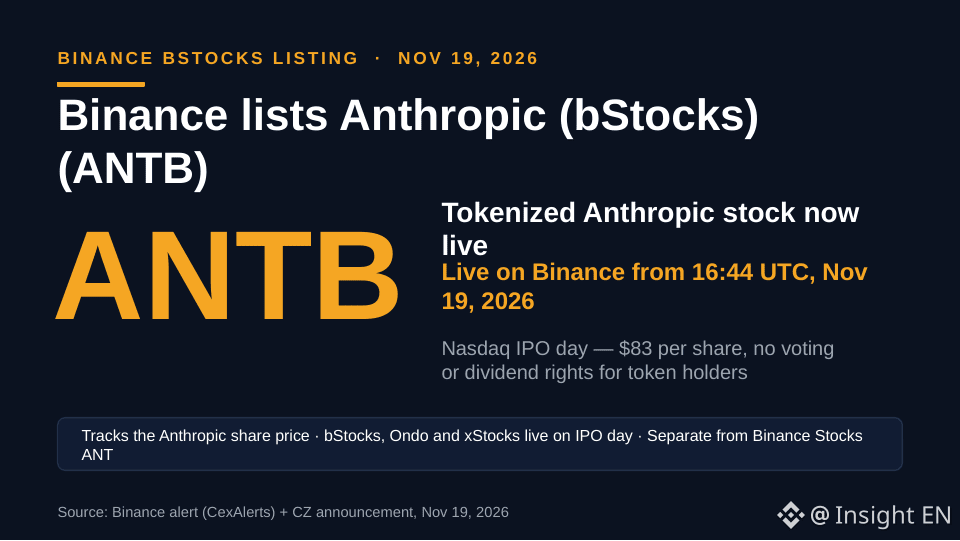
Binance Lists Anthropic (bStocks) ($ANTB)
Binance has listed Anthropic (bStocks) ($ANTB) — the tokenized Anthropic stock is now live on Binance, detected at 16:44 UTC, 19 Nov 2026.
$ANTB tracks the Anthropic share price. Anthropic priced its Nasdaq IPO at $83 per share and began trading today under the ticker ANT. The tokenized rollout covers bStocks, Ondo and xStocks on BNB Chain, as announced by Binance founder CZ.
This is the bStocks token, separate from the Binance Stocks ANT equity product listed earlier today.
Note: $ANTB carries no voting rights, dividends or other shareholder rights, and Binance does not independently verify the backing assets.
#Binance #bStocks
149

·
--
Another tokenized stock event surfaced this afternoon. Don’t lump it together with the subscription refund from earlier this morning.
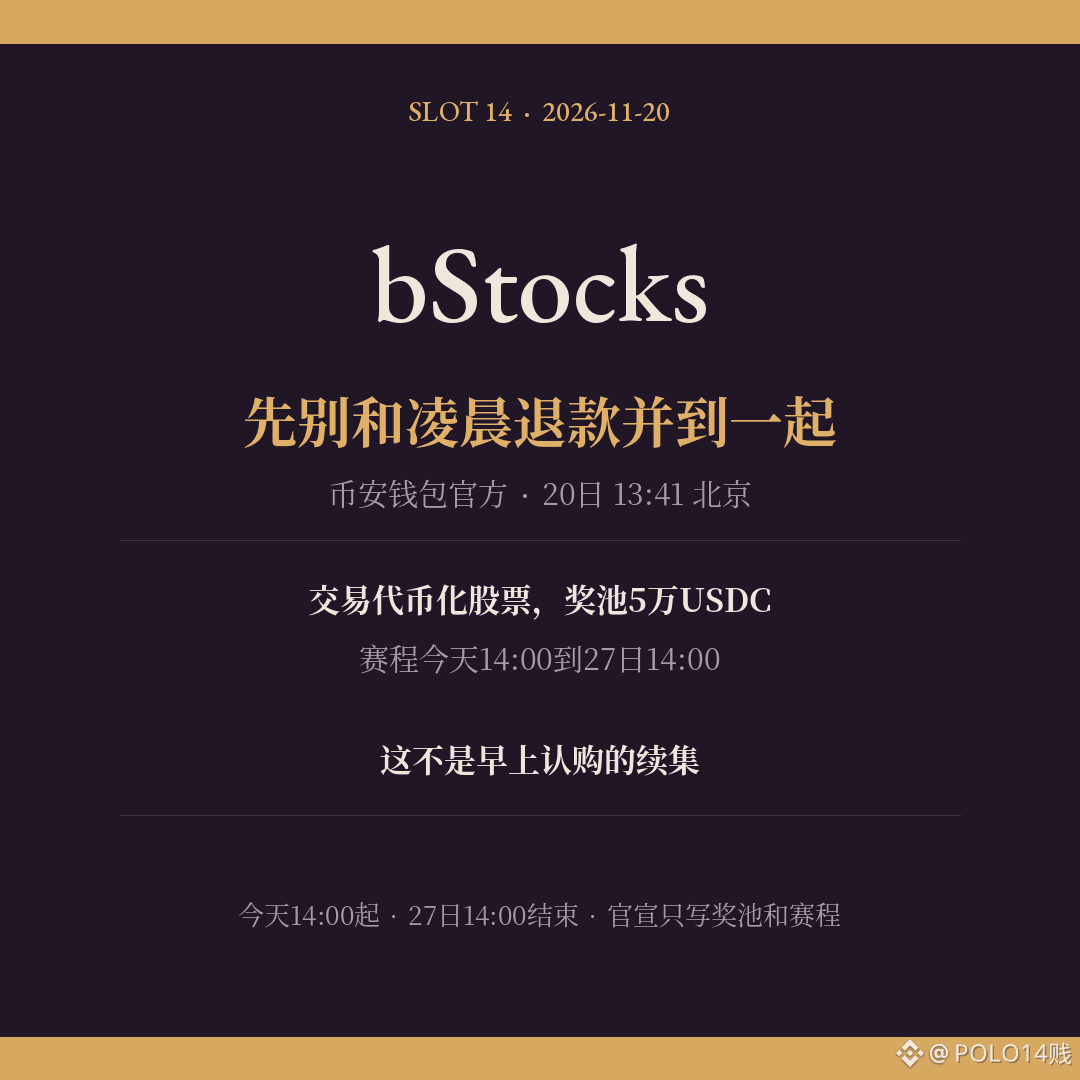
At 13:41 Beijing time today, Binance Wallet’s official account announced the launch of the bStocks Tokenized Securities Trading Competition. bStocks is a product that turns stocks into on-chain tokens. The announcement said that trading tokenized stocks of artificial intelligence companies on-chain would be eligible for a total of 50,000 USDC in rewards. The event runs from 14:00 today until 14:00 on November 27. So far, the announcement only specifies the prize pool and the competition dates for this week.
This isn’t a follow-up to this morning’s subscription event. The 50,000 USDC is a competition prize pool, not a fixed return you can claim just by holding tokens. The scoring rules also aren’t included in this official post.
The competition starts at 14:00 this afternoon. Check again once the event page fills in the eligible trading scope, qualifying volume, and distribution schedule. If the event page doesn’t match the announced prize pool and schedule, or if the official account withdraws the competition, don’t treat it as having already started.
#bStocks #币安钱包 #Cryptocurrency
Anneliese Melandez Uq85:
热粥
1
50

·
--
Article
Wall Street Faces a Tough Test: Is the AI Magic Over?Interestingly, NVIDIA’s strong results didn’t stop its stock from falling about 2.9% after reversing course during the session.
What’s happening?@Binance_Square_Official
It seems investors have begun asking an important question: Do the future profits of AI companies justify their current valuations?#BStocks
The tech sector’s decline may not be the end of the AI story, but it reminds us that an excellent company is not necessarily an excellent stock at any price.
Wall Street Faces a Tough Test: Is the AI Magic Over?
Interestingly, NVIDIA’s strong results didn’t stop its stock from falling about 2.9% after reversing course during the session.
What’s happening?@Binance Square Official
It seems investors have begun asking an important question: Do the future profits of AI companies justify their current valuations?#BStocks
The tech sector’s decline may not be the end of the AI story, but it reminds us that an excellent company is not necessarily an excellent stock at any price.
340

Article
Everything you need to know about Binance bStocks in 3 minutesWant to invest in U.S. stocks without being limited by stock market hours? Binance offers bStocks, tokenized stocks on the blockchain.
1. What are bStocks?
They are digital tokens (issued by BTech Holdings Limited) that track the prices of U.S. stocks.
- 1:1 backing: Each bStock is backed by a real share held with an authorized custodian (verifiable on Binance’s “Proof of Collateral” page).
- Accessible from just $5: You can buy fractional shares with a small budget.
Everything you need to know about Binance bStocks in 3 minutes
Want to invest in U.S. stocks without being limited by stock market hours? Binance offers bStocks, tokenized stocks on the blockchain.
1. What are bStocks?
They are digital tokens (issued by BTech Holdings Limited) that track the prices of U.S. stocks.
- 1:1 backing: Each bStock is backed by a real share held with an authorized custodian (verifiable on Binance’s “Proof of Collateral” page).
- Accessible from just $5: You can buy fractional shares with a small budget.
278
Log in to explore more content
Join global crypto users on Binance Square
⚡️ Get latest and useful information about crypto.
💬 Trusted by the world’s largest crypto exchange.
👍 Discover real insights from verified creators.
Email / Phone number
Trending Topics
1
#BTCReboundsAbove$60KAmidWhaleDipBuying
87,462 views
386 Discussing
2
#SolanaSets2027RoadmapToDoubleComputeCapacity
72,115 views
1,116 Discussing
3
#CaliforniaNvidiaProbeExaminesPotentialCriminalViolations
19,625 views
159 Discussing
4
#BlackRockLaunchesHKDollarDigitalLiquidityFund
60,494 views
837 Discussing
5
#NvidiaLoses$2.7TrillionInMonthAndAHalf
82,199 views
329 Discussing
6
#GlobalStocksFaceLongestLosingStreakSince2023
590,969 views
3,564 Discussing
7
#BlackRockIBITPostsRecord$541MSingleDayOutflow
100,178 views
186 Discussing
8
#AnthropicPlungesTowardIPOPriceonDay2
329,451 views
2,394 Discussing
9
#TwentyOneCapitalAdds172.25BTC
178,604 views
1,707 Discussing
10
#HKBillWouldExcludeTokenizedDepositsFromVirtualAssets
19,138 views
109 Discussing