
#cftc
cftc
1.8M views
3,729 Discussing
Hot
Latest

See translation
🇺🇸 BREAKING: CFTC CHAIRMAN SENDS A STRONG CRYPTO MESSAGE! 🚨
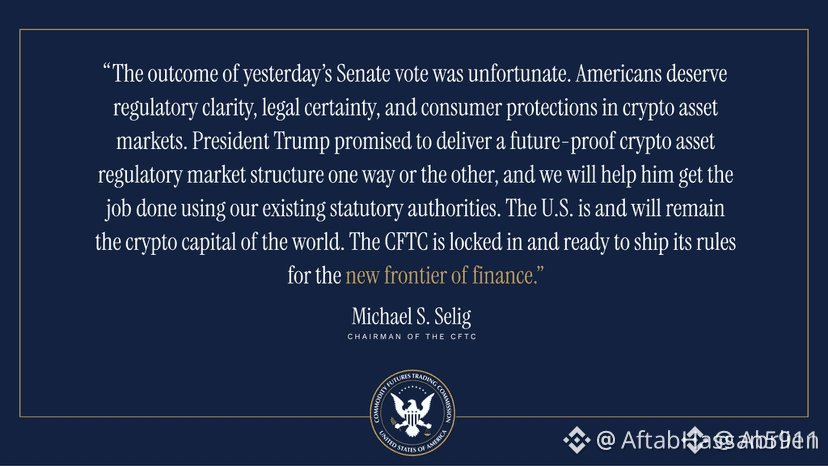
CFTC Chairman Michael S. Selig spoke following yesterday’s Senate vote, highlighting the need for regulatory clarity, legal certainty, and stronger consumer protection across the crypto market. 🇺🇸
The message is getting louder: the U.S. wants a clear, future-ready framework for digital assets — and the CFTC says it is ready to use its existing authority to help deliver it. 👀
🔥 The bigger picture?
The U.S. is positioning itself to remain a major global hub for crypto and digital assets.
For me, this is another important development to watch as U.S. crypto regulation continues to evolve.
And yes… $LIT is on my watchlist. 👀🔥
DYOR. Crypto is highly risky. This is my personal view, not financial advice.
#Crypto #CFTC #USA #CryptoRegulation #LIT @Binance_Square_Official
{future}(LITUSDT)
🇺🇸 BREAKING: CFTC CHAIRMAN SENDS A STRONG CRYPTO MESSAGE! 🚨
CFTC Chairman Michael S. Selig spoke following yesterday’s Senate vote, highlighting the need for regulatory clarity, legal certainty, and stronger consumer protection across the crypto market. 🇺🇸
The message is getting louder: the U.S. wants a clear, future-ready framework for digital assets — and the CFTC says it is ready to use its existing authority to help deliver it. 👀
🔥 The bigger picture?
The U.S. is positioning itself to remain a major global hub for crypto and digital assets.
For me, this is another important development to watch as U.S. crypto regulation continues to evolve.
And yes… $LIT is on my watchlist. 👀🔥
DYOR. Crypto is highly risky. This is my personal view, not financial advice.
#Crypto #CFTC #USA #CryptoRegulation #LIT @Binance Square Official
CFTC Chairman Michael S. Selig spoke following yesterday’s Senate vote, highlighting the need for regulatory clarity, legal certainty, and stronger consumer protection across the crypto market. 🇺🇸
The message is getting louder: the U.S. wants a clear, future-ready framework for digital assets — and the CFTC says it is ready to use its existing authority to help deliver it. 👀
🔥 The bigger picture?
The U.S. is positioning itself to remain a major global hub for crypto and digital assets.
For me, this is another important development to watch as U.S. crypto regulation continues to evolve.
And yes… $LIT is on my watchlist. 👀🔥
DYOR. Crypto is highly risky. This is my personal view, not financial advice.
#Crypto #CFTC #USA #CryptoRegulation #LIT @Binance Square Official
31


See translation
Forget CLARITY for a minute. The regulators are already cooking.
SEC và CFTC đang sẵn sàng thúc đẩy nhanh khung pháp lý cho crypto.
Nói cách khác: trong lúc anh em còn đang ngồi canh từng lá phiếu CLARITY, hai ông regulator đã kéo ghế vào bàn và bật mode “làm luật nhanh thôi”.
Mình thấy đây mới là thứ đáng để mắt:
timeline + jurisdiction + market structure có thể quan trọng không kém bản thân CLARITY.
CLARITY: “Please wait for the vote.”
SEC & CFTC: “We don’t give a fuck. Let’s fucking cook.”
Congress is still loading. Regulators already hit START.
Anh em đang theo dõi CLARITY hay bắt đầu soi động thái của SEC/CFTC rồi?
#SEC #CFTC
Forget CLARITY for a minute. The regulators are already cooking.
SEC và CFTC đang sẵn sàng thúc đẩy nhanh khung pháp lý cho crypto.
Nói cách khác: trong lúc anh em còn đang ngồi canh từng lá phiếu CLARITY, hai ông regulator đã kéo ghế vào bàn và bật mode “làm luật nhanh thôi”.
Mình thấy đây mới là thứ đáng để mắt:
timeline + jurisdiction + market structure có thể quan trọng không kém bản thân CLARITY.
CLARITY: “Please wait for the vote.”
SEC & CFTC: “We don’t give a fuck. Let’s fucking cook.”
Congress is still loading. Regulators already hit START.
Anh em đang theo dõi CLARITY hay bắt đầu soi động thái của SEC/CFTC rồi?
#SEC #CFTC
SEC và CFTC đang sẵn sàng thúc đẩy nhanh khung pháp lý cho crypto.
Nói cách khác: trong lúc anh em còn đang ngồi canh từng lá phiếu CLARITY, hai ông regulator đã kéo ghế vào bàn và bật mode “làm luật nhanh thôi”.
Mình thấy đây mới là thứ đáng để mắt:
timeline + jurisdiction + market structure có thể quan trọng không kém bản thân CLARITY.
CLARITY: “Please wait for the vote.”
SEC & CFTC: “We don’t give a fuck. Let’s fucking cook.”
Congress is still loading. Regulators already hit START.
Anh em đang theo dõi CLARITY hay bắt đầu soi động thái của SEC/CFTC rồi?
#SEC #CFTC

16

·
--
Article
See translation
Crypto Regulators Are About to Drop the Hammer on the MarketThe U.S. Securities and Exchange Commission (SEC) and the Commodity Futures Trading Commission (CFTC) are poised to unleash a new wave of rules that could reshape the entire crypto landscape. While the Senate’s Clarity Act stalls, the CFTC’s chair, Mike Selig, announced that his agency is “locked in and ready to ship its rules for the new frontier of finance.” This means that, sooner than you think, the rules that govern everything from trading to custody could be rewritten, and the crypto ecosystem will have to adapt fast.
## The Concept: Regulatory Overhaul in the Crypto Space
Think of the crypto market as a bustling city where people can move money freely, create new businesses, and innovate at lightning speed. Regulators are the city planners, and they’re now drafting a new set of building codes. The SEC focuses on securities—think of them as the rules that protect investors in stocks and bonds—while the CFTC deals with commodities, like futures contracts and other derivative products. When both agencies decide to tighten the rules, it’s like adding new safety standards, zoning laws, and licensing requirements to the city.
The key points:
- **SEC**: Will likely target token sales, exchanges, and investment funds that resemble traditional securities.
- **CFTC**: Aims to regulate derivatives and futures, ensuring that traders and institutions play by the same rules as in traditional finance.
- **Clarity Act**: A Senate bill that would have clarified how crypto assets fit into existing regulations, but it’s currently stalled.
These agencies are not just adding paperwork; they’re redefining what it means to be a crypto business in the U.S. The goal is to bring more transparency, protect investors, and level the playing field between crypto and traditional finance.
## The Real-World Example: How This Affects Your Wallet
Imagine you’re a small trader who bought $ETH on a decentralized exchange (DEX) and now wants to hedge your position with futures. Under the new rules, that futures contract could be classified as a commodity, meaning you’d need to register with the CFTC and follow strict reporting standards. If you’re running a crypto wallet service, you might suddenly need to obtain a license, implement Know‑Your‑Customer (KYC) procedures, and keep detailed records of every transaction.
For larger players, the impact could be even more profound. Major exchanges like Binance or Coinbase might face new compliance costs, and some services could be shut down if they can’t meet the new standards. Smaller projects could find it harder to raise funds because token sales might now be considered securities, requiring full registration or a qualified exemption.
## The Takeaway: Prepare Now, Don’t Wait
- **Audit Your Operations**: Check if your token or product could be classified as a security or commodity. If so, start preparing for registration or exemption filings.
- **Build Compliance Infrastructure**: Invest in robust KYC/AML systems, transaction monitoring, and legal counsel familiar with SEC and CFTC regulations.
- **Stay Informed**: Follow updates from the SEC, CFTC, and the Senate. The regulatory landscape can shift quickly, and early awareness can save you from costly surprises.
#CryptoRegulation #SEC #CFTC
## Engagement Question
What steps are you taking to ensure your crypto project stays compliant with the upcoming rules? Let us know in the comments!
Crypto Regulators Are About to Drop the Hammer on the Market
The U.S. Securities and Exchange Commission (SEC) and the Commodity Futures Trading Commission (CFTC) are poised to unleash a new wave of rules that could reshape the entire crypto landscape. While the Senate’s Clarity Act stalls, the CFTC’s chair, Mike Selig, announced that his agency is “locked in and ready to ship its rules for the new frontier of finance.” This means that, sooner than you think, the rules that govern everything from trading to custody could be rewritten, and the crypto ecosystem will have to adapt fast.
## The Concept: Regulatory Overhaul in the Crypto Space
Think of the crypto market as a bustling city where people can move money freely, create new businesses, and innovate at lightning speed. Regulators are the city planners, and they’re now drafting a new set of building codes. The SEC focuses on securities—think of them as the rules that protect investors in stocks and bonds—while the CFTC deals with commodities, like futures contracts and other derivative products. When both agencies decide to tighten the rules, it’s like adding new safety standards, zoning laws, and licensing requirements to the city.
The key points:
- **SEC**: Will likely target token sales, exchanges, and investment funds that resemble traditional securities.
- **CFTC**: Aims to regulate derivatives and futures, ensuring that traders and institutions play by the same rules as in traditional finance.
- **Clarity Act**: A Senate bill that would have clarified how crypto assets fit into existing regulations, but it’s currently stalled.
These agencies are not just adding paperwork; they’re redefining what it means to be a crypto business in the U.S. The goal is to bring more transparency, protect investors, and level the playing field between crypto and traditional finance.
## The Real-World Example: How This Affects Your Wallet
Imagine you’re a small trader who bought $ETH on a decentralized exchange (DEX) and now wants to hedge your position with futures. Under the new rules, that futures contract could be classified as a commodity, meaning you’d need to register with the CFTC and follow strict reporting standards. If you’re running a crypto wallet service, you might suddenly need to obtain a license, implement Know‑Your‑Customer (KYC) procedures, and keep detailed records of every transaction.
For larger players, the impact could be even more profound. Major exchanges like Binance or Coinbase might face new compliance costs, and some services could be shut down if they can’t meet the new standards. Smaller projects could find it harder to raise funds because token sales might now be considered securities, requiring full registration or a qualified exemption.
## The Takeaway: Prepare Now, Don’t Wait
- **Audit Your Operations**: Check if your token or product could be classified as a security or commodity. If so, start preparing for registration or exemption filings.
- **Build Compliance Infrastructure**: Invest in robust KYC/AML systems, transaction monitoring, and legal counsel familiar with SEC and CFTC regulations.
- **Stay Informed**: Follow updates from the SEC, CFTC, and the Senate. The regulatory landscape can shift quickly, and early awareness can save you from costly surprises.
#CryptoRegulation #SEC #CFTC
## Engagement Question
What steps are you taking to ensure your crypto project stays compliant with the upcoming rules? Let us know in the comments!
## The Concept: Regulatory Overhaul in the Crypto Space
Think of the crypto market as a bustling city where people can move money freely, create new businesses, and innovate at lightning speed. Regulators are the city planners, and they’re now drafting a new set of building codes. The SEC focuses on securities—think of them as the rules that protect investors in stocks and bonds—while the CFTC deals with commodities, like futures contracts and other derivative products. When both agencies decide to tighten the rules, it’s like adding new safety standards, zoning laws, and licensing requirements to the city.
The key points:
- **SEC**: Will likely target token sales, exchanges, and investment funds that resemble traditional securities.
- **CFTC**: Aims to regulate derivatives and futures, ensuring that traders and institutions play by the same rules as in traditional finance.
- **Clarity Act**: A Senate bill that would have clarified how crypto assets fit into existing regulations, but it’s currently stalled.
These agencies are not just adding paperwork; they’re redefining what it means to be a crypto business in the U.S. The goal is to bring more transparency, protect investors, and level the playing field between crypto and traditional finance.
## The Real-World Example: How This Affects Your Wallet
Imagine you’re a small trader who bought $ETH on a decentralized exchange (DEX) and now wants to hedge your position with futures. Under the new rules, that futures contract could be classified as a commodity, meaning you’d need to register with the CFTC and follow strict reporting standards. If you’re running a crypto wallet service, you might suddenly need to obtain a license, implement Know‑Your‑Customer (KYC) procedures, and keep detailed records of every transaction.
For larger players, the impact could be even more profound. Major exchanges like Binance or Coinbase might face new compliance costs, and some services could be shut down if they can’t meet the new standards. Smaller projects could find it harder to raise funds because token sales might now be considered securities, requiring full registration or a qualified exemption.
## The Takeaway: Prepare Now, Don’t Wait
- **Audit Your Operations**: Check if your token or product could be classified as a security or commodity. If so, start preparing for registration or exemption filings.
- **Build Compliance Infrastructure**: Invest in robust KYC/AML systems, transaction monitoring, and legal counsel familiar with SEC and CFTC regulations.
- **Stay Informed**: Follow updates from the SEC, CFTC, and the Senate. The regulatory landscape can shift quickly, and early awareness can save you from costly surprises.
#CryptoRegulation #SEC #CFTC
## Engagement Question
What steps are you taking to ensure your crypto project stays compliant with the upcoming rules? Let us know in the comments!
14

See translation
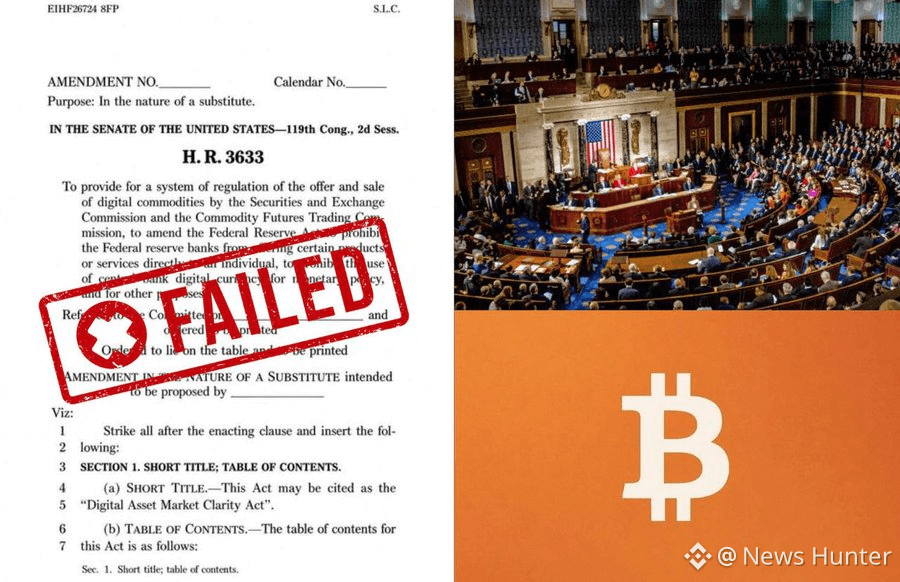
Following the Senate rejection of the Clarity Act the CFTC and SEC are doubling down on using existing legal frameworks to provide crypto regulatory certainty.
#CFTC #RegulatoryPivot
Following the Senate rejection of the Clarity Act the CFTC and SEC are doubling down on using existing legal frameworks to provide crypto regulatory certainty.
#CFTC #RegulatoryPivot
#CFTC #RegulatoryPivot

·
--
See translation
The CLARITY Act is NOT the only path to crypto clarity
Bernstein expects “aggressive and swift” rulemaking from the SEC and CFTC after the Senate failed to advance the bill.
Analysts expect the agencies to move on:
• Clearer rules for crypto fundraising.
• Protections for DeFi and self-custody developers.
• Exemptions for tokenized stocks.
• Faster approvals for real-world asset perpetual futures.
Bernstein sees another vote as UNLIKELY, citing limited time and unresolved ethics concerns.
Agency rules could provide clarity, but legislation would offer stronger protection against future policy reversals.
#CLARITYAct #CFTC #TrendingTopic #BTC
{future}(XRPUSDT)
{future}(ETHUSDT)
{future}(BTCUSDT)
The CLARITY Act is NOT the only path to crypto clarity
Bernstein expects “aggressive and swift” rulemaking from the SEC and CFTC after the Senate failed to advance the bill.
Analysts expect the agencies to move on:
• Clearer rules for crypto fundraising.
• Protections for DeFi and self-custody developers.
• Exemptions for tokenized stocks.
• Faster approvals for real-world asset perpetual futures.
Bernstein sees another vote as UNLIKELY, citing limited time and unresolved ethics concerns.
Agency rules could provide clarity, but legislation would offer stronger protection against future policy reversals.
#CLARITYAct #CFTC #TrendingTopic #BTC
Bernstein expects “aggressive and swift” rulemaking from the SEC and CFTC after the Senate failed to advance the bill.
Analysts expect the agencies to move on:
• Clearer rules for crypto fundraising.
• Protections for DeFi and self-custody developers.
• Exemptions for tokenized stocks.
• Faster approvals for real-world asset perpetual futures.
Bernstein sees another vote as UNLIKELY, citing limited time and unresolved ethics concerns.
Agency rules could provide clarity, but legislation would offer stronger protection against future policy reversals.
#CLARITYAct #CFTC #TrendingTopic #BTC
77
See translation
Regulation is still moving forward despite the setback
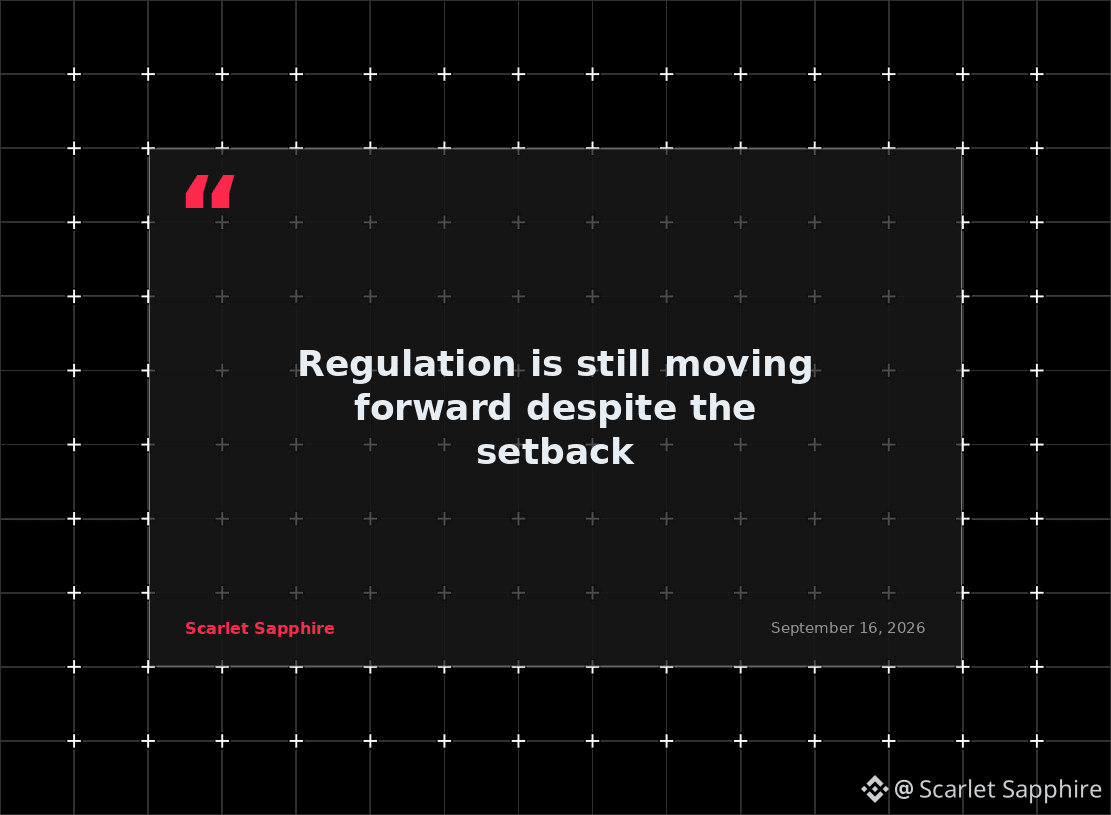
Former CFTC chair Giancarlo says US crypto rules can still move ahead via agency action, even with the CLARITY Act's Senate failure.
#CFTC #CLARITYAct
Regulation is still moving forward despite the setback
Former CFTC chair Giancarlo says US crypto rules can still move ahead via agency action, even with the CLARITY Act's Senate failure.
#CFTC #CLARITYAct
Former CFTC chair Giancarlo says US crypto rules can still move ahead via agency action, even with the CLARITY Act's Senate failure.
#CFTC #CLARITYAct
54
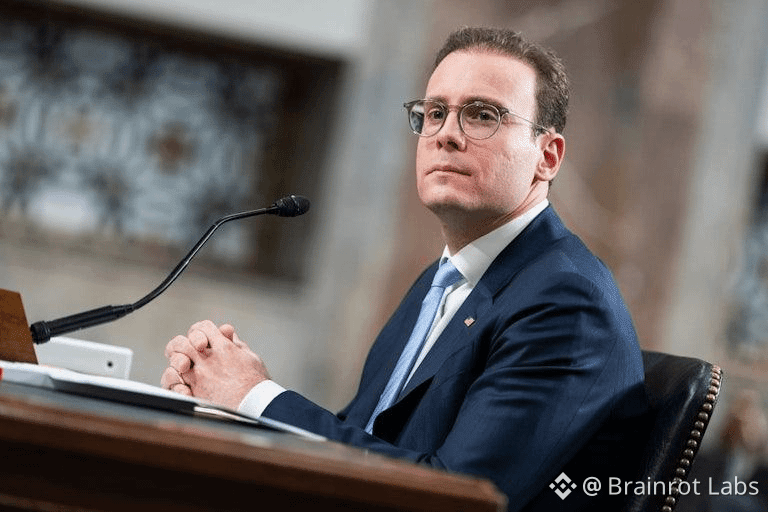
🚨 CLARITY MAY HAVE STALLED — BUT THE CFTC ISN’T WAITING. 👀
After the CLARITY Act failed to pass a procedural vote in the Senate, CFTC Chair Michael S. Selig said the agency will use the legal authorities currently available to continue building a regulatory framework for crypto in the United States.
What’s notable is that CLARITY not passing does not mean the U.S. is stopping its crypto framework. The CFTC already has several legal tools, and previously, together with the SEC, it issued guidance on how to classify crypto assets.
🔥 CONGRESS SLOWED DOWN. REGULATORS ARE STILL MOVING.
If the CFTC and SEC continue to use the powers they already have, the market could get more clarity even before a comprehensive market structure law is passed.
#crypto #CFTC #CLARITYAct
$BTC
{spot}(BTCUSDT)
🚨 CLARITY MAY HAVE STALLED — BUT THE CFTC ISN’T WAITING. 👀
After the CLARITY Act failed to pass a procedural vote in the Senate, CFTC Chair Michael S. Selig said the agency will use the legal authorities currently available to continue building a regulatory framework for crypto in the United States.
What’s notable is that CLARITY not passing does not mean the U.S. is stopping its crypto framework. The CFTC already has several legal tools, and previously, together with the SEC, it issued guidance on how to classify crypto assets.
🔥 CONGRESS SLOWED DOWN. REGULATORS ARE STILL MOVING.
If the CFTC and SEC continue to use the powers they already have, the market could get more clarity even before a comprehensive market structure law is passed.
#crypto #CFTC #CLARITYAct
$BTC
After the CLARITY Act failed to pass a procedural vote in the Senate, CFTC Chair Michael S. Selig said the agency will use the legal authorities currently available to continue building a regulatory framework for crypto in the United States.
What’s notable is that CLARITY not passing does not mean the U.S. is stopping its crypto framework. The CFTC already has several legal tools, and previously, together with the SEC, it issued guidance on how to classify crypto assets.
🔥 CONGRESS SLOWED DOWN. REGULATORS ARE STILL MOVING.
If the CFTC and SEC continue to use the powers they already have, the market could get more clarity even before a comprehensive market structure law is passed.
#crypto #CFTC #CLARITYAct
$BTC
273

·
--
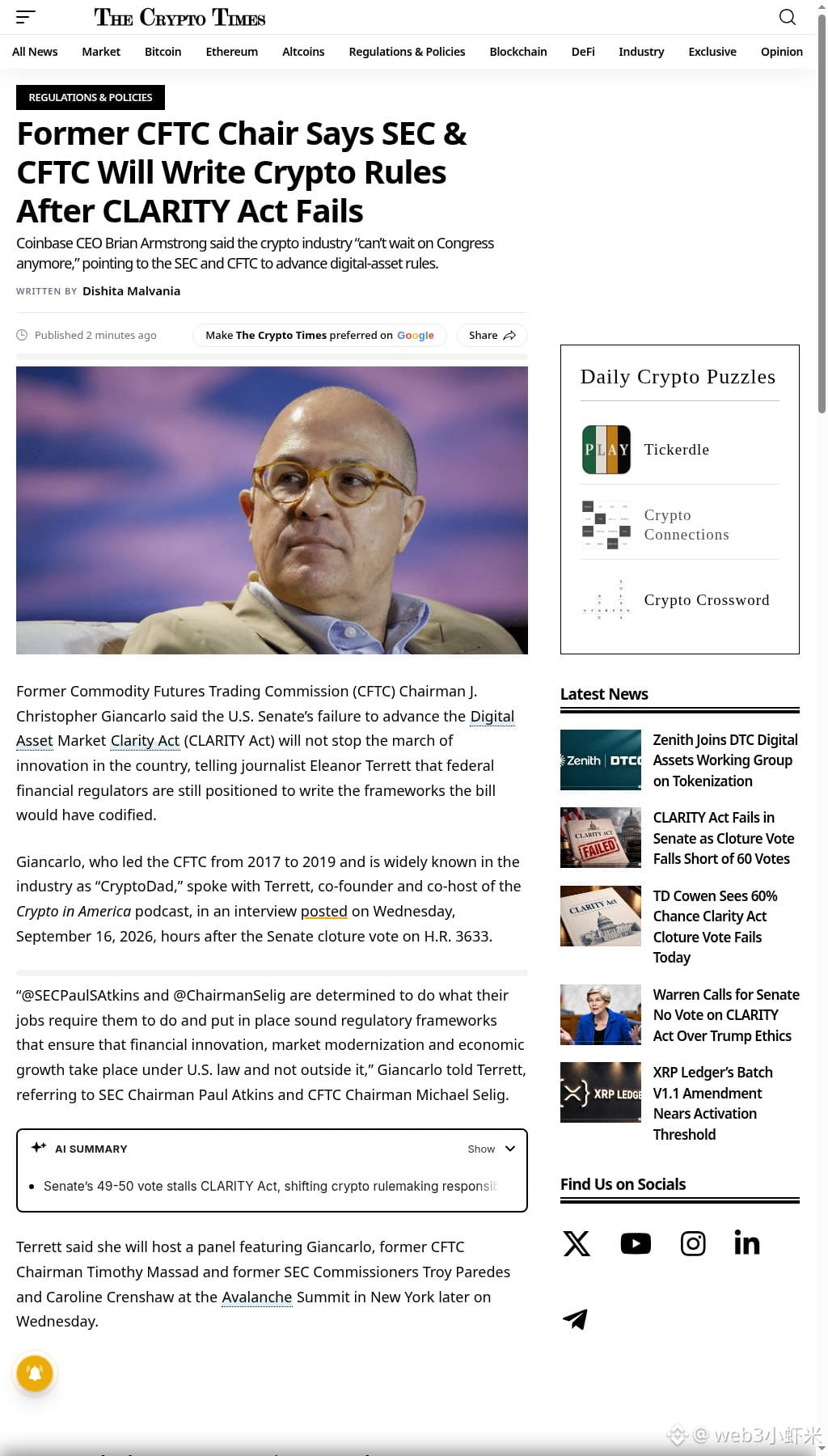
Former CFTC chairman Giancarlo (known in the industry as "CryptoDad") just talked with Eleanor Terrett: the Senate Clarity procedural vote didn’t pass, which doesn’t mean U.S. crypto rules are going to stop.
He believes that Atkins and Selig will, in line with their duties, produce the framework so that innovation can be kept as much as possible within U.S. law. Over the past few days, Armstrong, Garlinghouse, and Tim Scott have been saying much the same thing—legislation has hit a snag, and regulators are still moving forward. On the SEC side, there’s Regulation Crypto Assets, and the CFTC is also exploring market-structure rules. After the bill, it may be revisited again, but in the near term it feels more like the track of "regulatory agencies writing the rules."
#加密监管 #ClarityAct #SEC #CFTC
Former CFTC chairman Giancarlo (known in the industry as "CryptoDad") just talked with Eleanor Terrett: the Senate Clarity procedural vote didn’t pass, which doesn’t mean U.S. crypto rules are going to stop.
He believes that Atkins and Selig will, in line with their duties, produce the framework so that innovation can be kept as much as possible within U.S. law. Over the past few days, Armstrong, Garlinghouse, and Tim Scott have been saying much the same thing—legislation has hit a snag, and regulators are still moving forward. On the SEC side, there’s Regulation Crypto Assets, and the CFTC is also exploring market-structure rules. After the bill, it may be revisited again, but in the near term it feels more like the track of "regulatory agencies writing the rules."
#加密监管 #ClarityAct #SEC #CFTC
He believes that Atkins and Selig will, in line with their duties, produce the framework so that innovation can be kept as much as possible within U.S. law. Over the past few days, Armstrong, Garlinghouse, and Tim Scott have been saying much the same thing—legislation has hit a snag, and regulators are still moving forward. On the SEC side, there’s Regulation Crypto Assets, and the CFTC is also exploring market-structure rules. After the bill, it may be revisited again, but in the near term it feels more like the track of "regulatory agencies writing the rules."
#加密监管 #ClarityAct #SEC #CFTC
1
47

·
--
Bullish
See translation
$TRUMP $BTC
The Senate is expected to hold a key procedural vote on the #CLARITY Act on September 15, 2026. The bill aims to set clearer rules for digital-asset markets, including how responsibilities are divided between the #SEC and #CFTC . A procedural advance would not make it law immediately, but it could reduce regulatory uncertainty; failure or delay would keep the current fragmented framework in place.
$TRUMP $BTC
The Senate is expected to hold a key procedural vote on the #CLARITY Act on September 15, 2026. The bill aims to set clearer rules for digital-asset markets, including how responsibilities are divided between the #SEC and #CFTC . A procedural advance would not make it law immediately, but it could reduce regulatory uncertainty; failure or delay would keep the current fragmented framework in place.
The Senate is expected to hold a key procedural vote on the #CLARITY Act on September 15, 2026. The bill aims to set clearer rules for digital-asset markets, including how responsibilities are divided between the #SEC and #CFTC . A procedural advance would not make it law immediately, but it could reduce regulatory uncertainty; failure or delay would keep the current fragmented framework in place.


1
184

See translation
According to the latest Commodity Futures Trading Commission (CFTC) report covering data through September 8, speculative long positions on the Japanese Yen at the Chicago Mercantile Exchange (CME) surged by 53% week-on-week, reaching 178,791 contracts—a nine-month peak.
This aggressive accumulation of Yen longs highlights an overly crowded trade that is vulnerable to sharp short-term reversals. With crude oil prices climbing and resilient U.S. yields keeping monetary policy expectations elevated, the bullish momentum for the Yen against the U.S. dollar is facing immediate structural resistance.
Across macro markets, crowded positioning in major FX pairs alongside rising energy prices is putting upward pressure on global yields and underpinning the dollar's strength. At the same time, regional bond markets like New Zealand are seeing heavy demand as investors bet against overly hawkish central bank rate hike pricing amid sluggish domestic growth.
For the crypto ecosystem, a resilient U.S. dollar and elevated real yields tend to constrain broad liquidity inflows, potentially keeping assets like $BTC in a consolidation range. Traders should closely watch for any Yen unwind, as rapid currency adjustments can trigger unexpected volatility across risk assets. 📊
#ForexMarket #Yen #CFTC #MacroEconomics
According to the latest Commodity Futures Trading Commission (CFTC) report covering data through September 8, speculative long positions on the Japanese Yen at the Chicago Mercantile Exchange (CME) surged by 53% week-on-week, reaching 178,791 contracts—a nine-month peak.
This aggressive accumulation of Yen longs highlights an overly crowded trade that is vulnerable to sharp short-term reversals. With crude oil prices climbing and resilient U.S. yields keeping monetary policy expectations elevated, the bullish momentum for the Yen against the U.S. dollar is facing immediate structural resistance.
Across macro markets, crowded positioning in major FX pairs alongside rising energy prices is putting upward pressure on global yields and underpinning the dollar's strength. At the same time, regional bond markets like New Zealand are seeing heavy demand as investors bet against overly hawkish central bank rate hike pricing amid sluggish domestic growth.
For the crypto ecosystem, a resilient U.S. dollar and elevated real yields tend to constrain broad liquidity inflows, potentially keeping assets like $BTC in a consolidation range. Traders should closely watch for any Yen unwind, as rapid currency adjustments can trigger unexpected volatility across risk assets. 📊
#ForexMarket #Yen #CFTC #MacroEconomics
This aggressive accumulation of Yen longs highlights an overly crowded trade that is vulnerable to sharp short-term reversals. With crude oil prices climbing and resilient U.S. yields keeping monetary policy expectations elevated, the bullish momentum for the Yen against the U.S. dollar is facing immediate structural resistance.
Across macro markets, crowded positioning in major FX pairs alongside rising energy prices is putting upward pressure on global yields and underpinning the dollar's strength. At the same time, regional bond markets like New Zealand are seeing heavy demand as investors bet against overly hawkish central bank rate hike pricing amid sluggish domestic growth.
For the crypto ecosystem, a resilient U.S. dollar and elevated real yields tend to constrain broad liquidity inflows, potentially keeping assets like $BTC in a consolidation range. Traders should closely watch for any Yen unwind, as rapid currency adjustments can trigger unexpected volatility across risk assets. 📊
#ForexMarket #Yen #CFTC #MacroEconomics
7
·
--
American-funded institutions entering and exiting perpetual contracts now have yet another “official” channel.
With the CFTC authorization granted, US hedge funds, asset managers, and others can trade BTC/ETH perps through existing clearing members (total cumulative trading volume is already about $5.8 billion). They do not accept stablecoins as margin; instead, they use the traditional model of margin plus central clearing.
CME has long been the main force in the US regulatory circle, but it does not offer perps. Offshore platforms have large volumes but are hard to comply with. SGX sits in the middle on this route, and it’s quite practical for institutions—going live likely still takes about one to two months of integration.
$BTC $ETH #SGX #永续合约 #CFTC
American-funded institutions entering and exiting perpetual contracts now have yet another “official” channel.
With the CFTC authorization granted, US hedge funds, asset managers, and others can trade BTC/ETH perps through existing clearing members (total cumulative trading volume is already about $5.8 billion). They do not accept stablecoins as margin; instead, they use the traditional model of margin plus central clearing.
CME has long been the main force in the US regulatory circle, but it does not offer perps. Offshore platforms have large volumes but are hard to comply with. SGX sits in the middle on this route, and it’s quite practical for institutions—going live likely still takes about one to two months of integration.
$BTC $ETH #SGX #永续合约 #CFTC
With the CFTC authorization granted, US hedge funds, asset managers, and others can trade BTC/ETH perps through existing clearing members (total cumulative trading volume is already about $5.8 billion). They do not accept stablecoins as margin; instead, they use the traditional model of margin plus central clearing.
CME has long been the main force in the US regulatory circle, but it does not offer perps. Offshore platforms have large volumes but are hard to comply with. SGX sits in the middle on this route, and it’s quite practical for institutions—going live likely still takes about one to two months of integration.
$BTC $ETH #SGX #永续合约 #CFTC
134


Article
An Era of Regulatory Certainty: How the CLARITY Act Is Reshaping the Global Crypto MarketFor years, the cryptocurrency industry has operated in a legal vacuum and under constant pressure from U.S. regulatory bodies. The principle of “regulation through enforcement,” actively used by the U.S. Securities and Exchange Commission (SEC), forced crypto projects to operate under the constant risk of lawsuits.
An Era of Regulatory Certainty: How the CLARITY Act Is Reshaping the Global Crypto Market
For years, the cryptocurrency industry has operated in a legal vacuum and under constant pressure from U.S. regulatory bodies. The principle of “regulation through enforcement,” actively used by the U.S. Securities and Exchange Commission (SEC), forced crypto projects to operate under the constant risk of lawsuits.
59
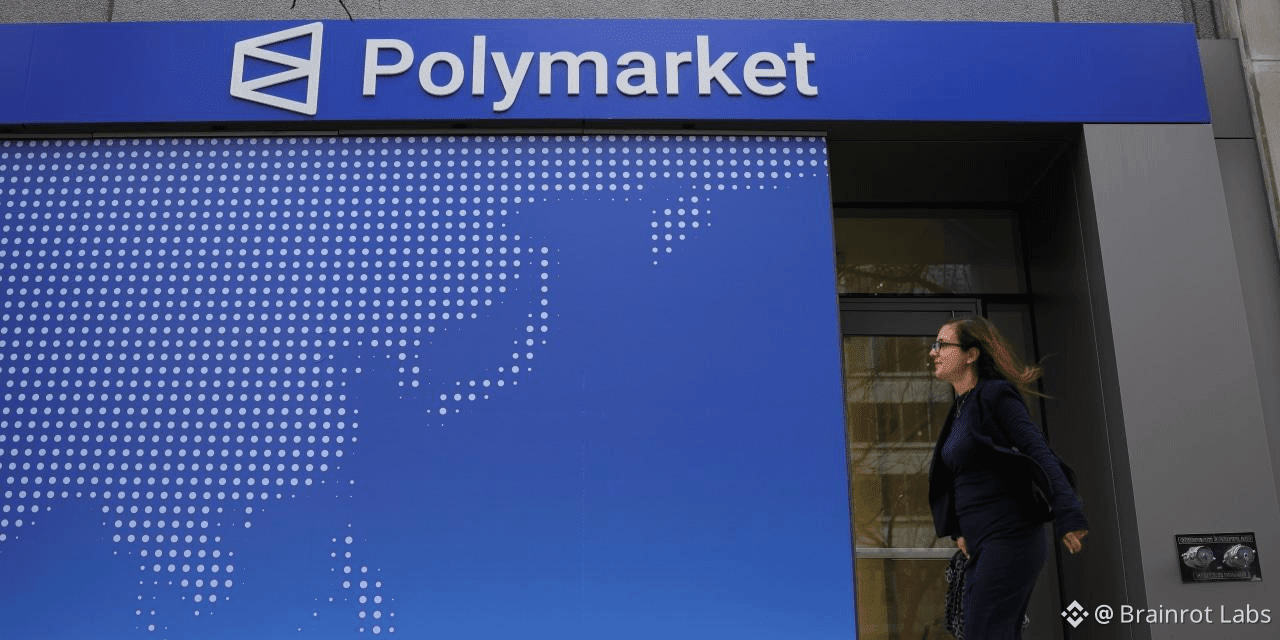
POLYMARKET JUST GOT HIT WITH 3 MORE INSIDER TRADING PROBES.
The CFTC previously quietly approved three investigations related to suspicious transactions on Polymarket, according to FOIA documents WIRED collected.
• Biden pardons: A trader who made more than $300K from contracts predicting Biden’s pardon orders.
• Iran war: A group of accounts achieved a win rate of about 98%, earning a total of roughly $2.4M from Iran-related contracts.
• Google: The CFTC investigated people who may have used non-public information about Google’s 2025 Year in Search to trade.
Notably, the Google case also has a parallel investigation by the SDNY. It’s tied to the case involving former Google engineer Michele Spagnuolo, who is accused of earning more than $1.2M on Polymarket using insider information.
Polymarket says it will cooperate with authorities and turn over related matters to law enforcement.
Polymarket: “Prediction market.”
CFTC: “Cool. Show me your wallet history.” 💀
The bigger the prediction market, the more insider trading becomes a matter of survival. And blockchain, meanwhile, logs the entire trading history right on the table.
The question is: Is Polymarket becoming the prediction market of the future—or accidentally turning into a public marketplace for insider information?
#Polymarket #predictionmarket #CFTC
POLYMARKET JUST GOT HIT WITH 3 MORE INSIDER TRADING PROBES.
The CFTC previously quietly approved three investigations related to suspicious transactions on Polymarket, according to FOIA documents WIRED collected.
• Biden pardons: A trader who made more than $300K from contracts predicting Biden’s pardon orders.
• Iran war: A group of accounts achieved a win rate of about 98%, earning a total of roughly $2.4M from Iran-related contracts.
• Google: The CFTC investigated people who may have used non-public information about Google’s 2025 Year in Search to trade.
Notably, the Google case also has a parallel investigation by the SDNY. It’s tied to the case involving former Google engineer Michele Spagnuolo, who is accused of earning more than $1.2M on Polymarket using insider information.
Polymarket says it will cooperate with authorities and turn over related matters to law enforcement.
Polymarket: “Prediction market.”
CFTC: “Cool. Show me your wallet history.” 💀
The bigger the prediction market, the more insider trading becomes a matter of survival. And blockchain, meanwhile, logs the entire trading history right on the table.
The question is: Is Polymarket becoming the prediction market of the future—or accidentally turning into a public marketplace for insider information?
#Polymarket #predictionmarket #CFTC
The CFTC previously quietly approved three investigations related to suspicious transactions on Polymarket, according to FOIA documents WIRED collected.
• Biden pardons: A trader who made more than $300K from contracts predicting Biden’s pardon orders.
• Iran war: A group of accounts achieved a win rate of about 98%, earning a total of roughly $2.4M from Iran-related contracts.
• Google: The CFTC investigated people who may have used non-public information about Google’s 2025 Year in Search to trade.
Notably, the Google case also has a parallel investigation by the SDNY. It’s tied to the case involving former Google engineer Michele Spagnuolo, who is accused of earning more than $1.2M on Polymarket using insider information.
Polymarket says it will cooperate with authorities and turn over related matters to law enforcement.
Polymarket: “Prediction market.”
CFTC: “Cool. Show me your wallet history.” 💀
The bigger the prediction market, the more insider trading becomes a matter of survival. And blockchain, meanwhile, logs the entire trading history right on the table.
The question is: Is Polymarket becoming the prediction market of the future—or accidentally turning into a public marketplace for insider information?
#Polymarket #predictionmarket #CFTC
81

·
--
In next week’s Senate election vote, the truly new development isn’t “we’re voting again,” but the fact that “pseudo-DeFi” is being written into the registration list.
In the US East time zone, 9/15 at 14:15 (Beijing time 9/16 around 02:15), CLARITY will need to clear a procedural vote.
To bring it up for discussion, 60 votes are required, and the Republicans currently hold about 53 seats.
This isn’t final passage—it's just whether the bill can be brought onto the floor for debate.
On 9/10, the Republican Party released about 630 pages of new text.
Wu said, Foresight/PANews, and crypto.news all match the same thread:
“Non-decentralized DeFi trading protocols” may need to register with the CFTC.
The determination doesn’t depend on what you call your DAO—it depends on whether someone can change the rules, shut it down, or limit users.
The scope is also narrowed, mainly targeting digital-commodity spot/ cash transactions.
The ethical provisions are basically unchanged, and the debate over passive-income rewards from stablecoins is still ongoing.
Politico’s line is: the revised version still hasn’t obtained an official public endorsement from Democrats.
I think this is the hardest cut in this week’s regulatory narrative—
“Decentralization” is starting to acquire something like a written-into-law feel for the first time, but don’t treat the draft as an enforcement order.
Before the Monday vote, watch to see whether any Democrats are willing to publicly stand behind it.
Corroborating evidence (Binance, Beijing time around 10:17): BTC≈77306 / ETH≈2514.
Not investment advice.
#CLARITY #DeFi #CFTC
In next week’s Senate election vote, the truly new development isn’t “we’re voting again,” but the fact that “pseudo-DeFi” is being written into the registration list.
In the US East time zone, 9/15 at 14:15 (Beijing time 9/16 around 02:15), CLARITY will need to clear a procedural vote.
To bring it up for discussion, 60 votes are required, and the Republicans currently hold about 53 seats.
This isn’t final passage—it's just whether the bill can be brought onto the floor for debate.
On 9/10, the Republican Party released about 630 pages of new text.
Wu said, Foresight/PANews, and crypto.news all match the same thread:
“Non-decentralized DeFi trading protocols” may need to register with the CFTC.
The determination doesn’t depend on what you call your DAO—it depends on whether someone can change the rules, shut it down, or limit users.
The scope is also narrowed, mainly targeting digital-commodity spot/ cash transactions.
The ethical provisions are basically unchanged, and the debate over passive-income rewards from stablecoins is still ongoing.
Politico’s line is: the revised version still hasn’t obtained an official public endorsement from Democrats.
I think this is the hardest cut in this week’s regulatory narrative—
“Decentralization” is starting to acquire something like a written-into-law feel for the first time, but don’t treat the draft as an enforcement order.
Before the Monday vote, watch to see whether any Democrats are willing to publicly stand behind it.
Corroborating evidence (Binance, Beijing time around 10:17): BTC≈77306 / ETH≈2514.
Not investment advice.
#CLARITY #DeFi #CFTC
In the US East time zone, 9/15 at 14:15 (Beijing time 9/16 around 02:15), CLARITY will need to clear a procedural vote.
To bring it up for discussion, 60 votes are required, and the Republicans currently hold about 53 seats.
This isn’t final passage—it's just whether the bill can be brought onto the floor for debate.
On 9/10, the Republican Party released about 630 pages of new text.
Wu said, Foresight/PANews, and crypto.news all match the same thread:
“Non-decentralized DeFi trading protocols” may need to register with the CFTC.
The determination doesn’t depend on what you call your DAO—it depends on whether someone can change the rules, shut it down, or limit users.
The scope is also narrowed, mainly targeting digital-commodity spot/ cash transactions.
The ethical provisions are basically unchanged, and the debate over passive-income rewards from stablecoins is still ongoing.
Politico’s line is: the revised version still hasn’t obtained an official public endorsement from Democrats.
I think this is the hardest cut in this week’s regulatory narrative—
“Decentralization” is starting to acquire something like a written-into-law feel for the first time, but don’t treat the draft as an enforcement order.
Before the Monday vote, watch to see whether any Democrats are willing to publicly stand behind it.
Corroborating evidence (Binance, Beijing time around 10:17): BTC≈77306 / ETH≈2514.
Not investment advice.
#CLARITY #DeFi #CFTC

给我个机会:
过不了,跌一下
2
4
2.3k

·
--
📰 U.S. Senate Republicans released a new 630-page version of the “CLARITY Act,” which is 14 pages longer than the July version. The most striking cut is bringing “non-decentralized” DeFi protocols within the scope of CFTC registration.
🔥 The criteria are actually straightforward: if someone can modify functions or consensus rules, if trades are not executed entirely according to transparent code, or if they can limit and censor users—meeting any one of these could lead to the protocol being deemed “non-decentralized.” Even if a team labels itself as a DAO, foundation, or open-source protocol, it can’t get around it.
To be honest, this makes upgrade keys, pause switches, and trading-censorship authority all the more sensitive. Once an operator retains actual control, they may have to shoulder registration, disclosure, recordkeeping, and compliance obligations under the Bank Secrecy Act.
💡 But writing code, running nodes, providing oracles, developing non-custodial wallets, or offering read-only interfaces won’t, by themselves, automatically trigger a requirement to register. At least for now, developers who truly don’t touch control have not been swept up.
👀 Whether the bill can keep moving is still uncertain. The procedural vote scheduled for September 15 requires 60 votes; as of September 10, it had not yet received support from Democrats. Disputes between the two parties also haven’t been resolved—regarding stablecoin yield and the officials’ ethics provisions.
🤔 If a DeFi protocol still keeps pause switches in someone’s hands, do you think it can truly be considered a decentralized protocol?
#DeFi #CLARITY法案 #CFTC #加密监管
📰 U.S. Senate Republicans released a new 630-page version of the “CLARITY Act,” which is 14 pages longer than the July version. The most striking cut is bringing “non-decentralized” DeFi protocols within the scope of CFTC registration.
🔥 The criteria are actually straightforward: if someone can modify functions or consensus rules, if trades are not executed entirely according to transparent code, or if they can limit and censor users—meeting any one of these could lead to the protocol being deemed “non-decentralized.” Even if a team labels itself as a DAO, foundation, or open-source protocol, it can’t get around it.
To be honest, this makes upgrade keys, pause switches, and trading-censorship authority all the more sensitive. Once an operator retains actual control, they may have to shoulder registration, disclosure, recordkeeping, and compliance obligations under the Bank Secrecy Act.
💡 But writing code, running nodes, providing oracles, developing non-custodial wallets, or offering read-only interfaces won’t, by themselves, automatically trigger a requirement to register. At least for now, developers who truly don’t touch control have not been swept up.
👀 Whether the bill can keep moving is still uncertain. The procedural vote scheduled for September 15 requires 60 votes; as of September 10, it had not yet received support from Democrats. Disputes between the two parties also haven’t been resolved—regarding stablecoin yield and the officials’ ethics provisions.
🤔 If a DeFi protocol still keeps pause switches in someone’s hands, do you think it can truly be considered a decentralized protocol?
#DeFi #CLARITY法案 #CFTC #加密监管
🔥 The criteria are actually straightforward: if someone can modify functions or consensus rules, if trades are not executed entirely according to transparent code, or if they can limit and censor users—meeting any one of these could lead to the protocol being deemed “non-decentralized.” Even if a team labels itself as a DAO, foundation, or open-source protocol, it can’t get around it.
To be honest, this makes upgrade keys, pause switches, and trading-censorship authority all the more sensitive. Once an operator retains actual control, they may have to shoulder registration, disclosure, recordkeeping, and compliance obligations under the Bank Secrecy Act.
💡 But writing code, running nodes, providing oracles, developing non-custodial wallets, or offering read-only interfaces won’t, by themselves, automatically trigger a requirement to register. At least for now, developers who truly don’t touch control have not been swept up.
👀 Whether the bill can keep moving is still uncertain. The procedural vote scheduled for September 15 requires 60 votes; as of September 10, it had not yet received support from Democrats. Disputes between the two parties also haven’t been resolved—regarding stablecoin yield and the officials’ ethics provisions.
🤔 If a DeFi protocol still keeps pause switches in someone’s hands, do you think it can truly be considered a decentralized protocol?
#DeFi #CLARITY法案 #CFTC #加密监管

13

·
--
See translation
🟢 The CFTC has cleared Singapore Exchange to offer U.S. institutional investors direct access to its Bitcoin and Ether perpetual futures. This opens a regulated gateway ⚡ for American capital to trade crypto perpetuals without offshore counterparty risk. Expect deeper global order books 📈 and tighter spreads as Wall Street desks bridge liquidity across Asian trading hours.
Will CFTC-cleared overseas perps siphon major institutional volume from unregulated offshore exchanges? 👇
#cftc #sgx #perpetuals #institutions #derivatives
🟢 The CFTC has cleared Singapore Exchange to offer U.S. institutional investors direct access to its Bitcoin and Ether perpetual futures. This opens a regulated gateway ⚡ for American capital to trade crypto perpetuals without offshore counterparty risk. Expect deeper global order books 📈 and tighter spreads as Wall Street desks bridge liquidity across Asian trading hours.
Will CFTC-cleared overseas perps siphon major institutional volume from unregulated offshore exchanges? 👇
#cftc #sgx #perpetuals #institutions #derivatives
Will CFTC-cleared overseas perps siphon major institutional volume from unregulated offshore exchanges? 👇
#cftc #sgx #perpetuals #institutions #derivatives

75
·
--
U.S. institutions want to play the long game with perpetual futures—and they don’t necessarily have to wait until a “U.S. version of an exchange” gets approved first.
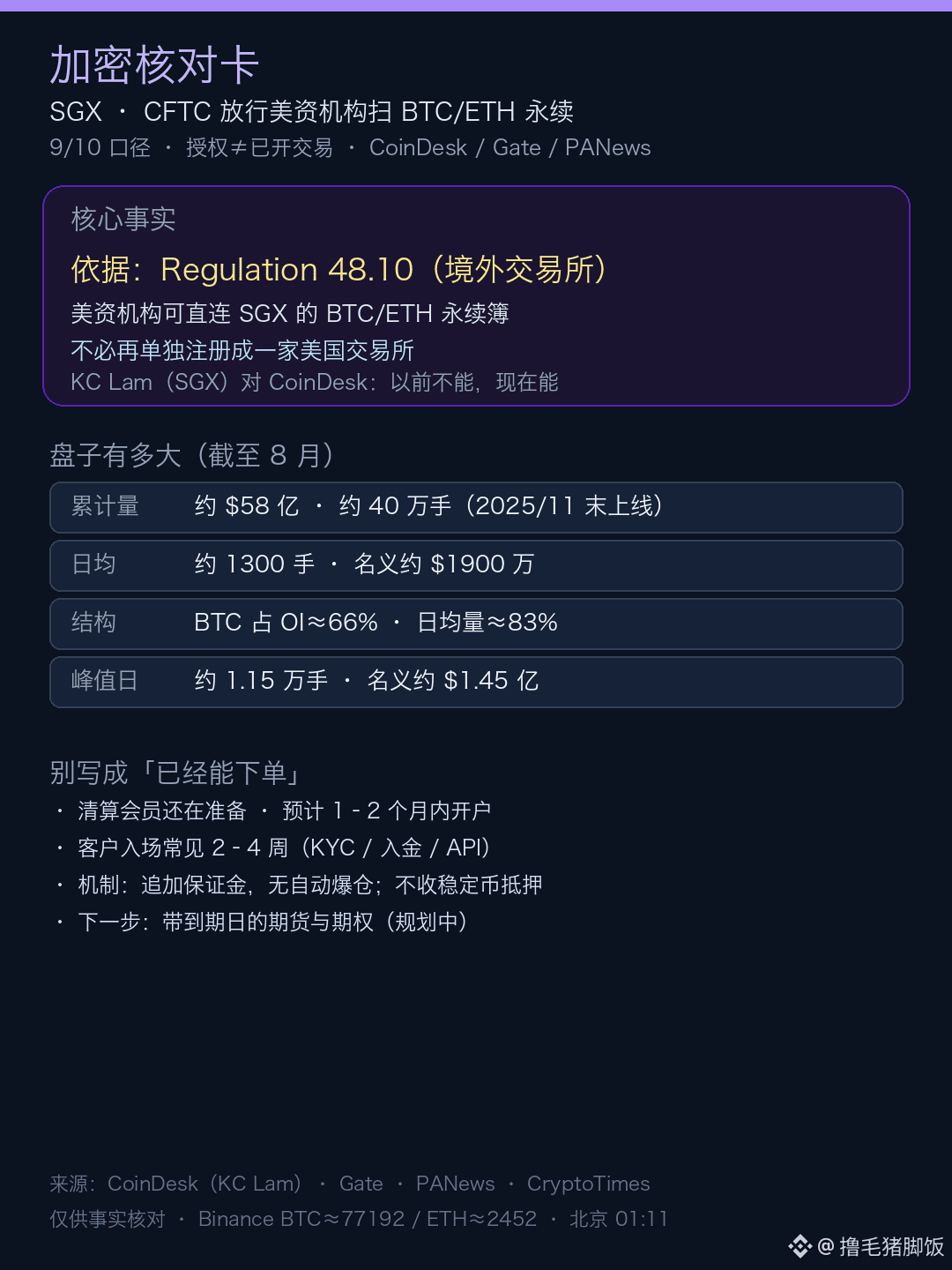
Singapore Exchange (SGX) obtained CFTC Regulation 48.10 authorization as of the 9/10 criteria:
U.S.-based firms can directly connect to its BTC / ETH perpetual order book.
KC Lam (Head of Crypto Derivatives at SGX) told CoinDesk very plainly: “It wasn’t possible before, now it is.”
Gate and PANews cross-checked and confirmed.
The trading interface has actually been live for a while.
Since late November 2025 go-live, cumulative totals are about $5.8 billion and roughly 400,000 contracts;
In August, average daily volume is about 1,300 contracts, with nominal notional around $19 million;
BTC remains the main driver (OI≈66%, daily volume≈83%).
But don’t write it as “you can place orders tonight.”
With authorization in hand, U.S. clearing members are still onboarding—officially, the timeline is in the next 1–2 months; on the client side, the common expectation is 2–4 weeks.
The mechanics are also more like traditional futures: variation margin / additional margin calls, no automatic liquidations, and stablecoins are not used as collateral.
In this round, Binance was rechecked (Beijing time ~01:11): BTC≈77192 / ETH≈2452.
I think this is more like “overseas-compliant perpetuals opened a window for U.S.-based capital,” not another piece of trading-news hype.
Next, watch: whether real trading volume truly ramps up, and when futures/options that include expiry dates go live.
Not investment advice.
#SGX #CFTC $BTC $ETH
U.S. institutions want to play the long game with perpetual futures—and they don’t necessarily have to wait until a “U.S. version of an exchange” gets approved first.
Singapore Exchange (SGX) obtained CFTC Regulation 48.10 authorization as of the 9/10 criteria:
U.S.-based firms can directly connect to its BTC / ETH perpetual order book.
KC Lam (Head of Crypto Derivatives at SGX) told CoinDesk very plainly: “It wasn’t possible before, now it is.”
Gate and PANews cross-checked and confirmed.
The trading interface has actually been live for a while.
Since late November 2025 go-live, cumulative totals are about $5.8 billion and roughly 400,000 contracts;
In August, average daily volume is about 1,300 contracts, with nominal notional around $19 million;
BTC remains the main driver (OI≈66%, daily volume≈83%).
But don’t write it as “you can place orders tonight.”
With authorization in hand, U.S. clearing members are still onboarding—officially, the timeline is in the next 1–2 months; on the client side, the common expectation is 2–4 weeks.
The mechanics are also more like traditional futures: variation margin / additional margin calls, no automatic liquidations, and stablecoins are not used as collateral.
In this round, Binance was rechecked (Beijing time ~01:11): BTC≈77192 / ETH≈2452.
I think this is more like “overseas-compliant perpetuals opened a window for U.S.-based capital,” not another piece of trading-news hype.
Next, watch: whether real trading volume truly ramps up, and when futures/options that include expiry dates go live.
Not investment advice.
#SGX #CFTC $BTC $ETH
Singapore Exchange (SGX) obtained CFTC Regulation 48.10 authorization as of the 9/10 criteria:
U.S.-based firms can directly connect to its BTC / ETH perpetual order book.
KC Lam (Head of Crypto Derivatives at SGX) told CoinDesk very plainly: “It wasn’t possible before, now it is.”
Gate and PANews cross-checked and confirmed.
The trading interface has actually been live for a while.
Since late November 2025 go-live, cumulative totals are about $5.8 billion and roughly 400,000 contracts;
In August, average daily volume is about 1,300 contracts, with nominal notional around $19 million;
BTC remains the main driver (OI≈66%, daily volume≈83%).
But don’t write it as “you can place orders tonight.”
With authorization in hand, U.S. clearing members are still onboarding—officially, the timeline is in the next 1–2 months; on the client side, the common expectation is 2–4 weeks.
The mechanics are also more like traditional futures: variation margin / additional margin calls, no automatic liquidations, and stablecoins are not used as collateral.
In this round, Binance was rechecked (Beijing time ~01:11): BTC≈77192 / ETH≈2452.
I think this is more like “overseas-compliant perpetuals opened a window for U.S.-based capital,” not another piece of trading-news hype.
Next, watch: whether real trading volume truly ramps up, and when futures/options that include expiry dates go live.
Not investment advice.
#SGX #CFTC $BTC $ETH
435

·
--
Prediction market platform Kalshi has received approval from the U.S. CFTC and will launch perpetual gold and silver contracts on September 10. The key point is not just that “two more trading products” have been added, but that this is the first non-crypto perpetual contract product approved by the CFTC. Previously, Kalshi received approval at the end of May to offer crypto perpetual contracts; its related notional trading volume has already reached $44 billion.
This means the trading mechanism of perpetual contracts—one that has been proven workable in the crypto market—is now being formally accepted into the traditional financial regulatory framework. After gold and silver, if assets such as stock indexes and foreign exchange follow suit, the logic behind traditional futures positions, margin, and funding rates could all be reshaped, and long-established exchanges like CME may face more direct competition.
For the crypto industry, this is not merely a diversion of capital, but an important validation that the Perp model is entering mainstream assets.#Kalshi #CFTC #永续合约
Prediction market platform Kalshi has received approval from the U.S. CFTC and will launch perpetual gold and silver contracts on September 10. The key point is not just that “two more trading products” have been added, but that this is the first non-crypto perpetual contract product approved by the CFTC. Previously, Kalshi received approval at the end of May to offer crypto perpetual contracts; its related notional trading volume has already reached $44 billion.
This means the trading mechanism of perpetual contracts—one that has been proven workable in the crypto market—is now being formally accepted into the traditional financial regulatory framework. After gold and silver, if assets such as stock indexes and foreign exchange follow suit, the logic behind traditional futures positions, margin, and funding rates could all be reshaped, and long-established exchanges like CME may face more direct competition.
For the crypto industry, this is not merely a diversion of capital, but an important validation that the Perp model is entering mainstream assets.#Kalshi #CFTC #永续合约
This means the trading mechanism of perpetual contracts—one that has been proven workable in the crypto market—is now being formally accepted into the traditional financial regulatory framework. After gold and silver, if assets such as stock indexes and foreign exchange follow suit, the logic behind traditional futures positions, margin, and funding rates could all be reshaped, and long-established exchanges like CME may face more direct competition.
For the crypto industry, this is not merely a diversion of capital, but an important validation that the Perp model is entering mainstream assets.#Kalshi #CFTC #永续合约
10

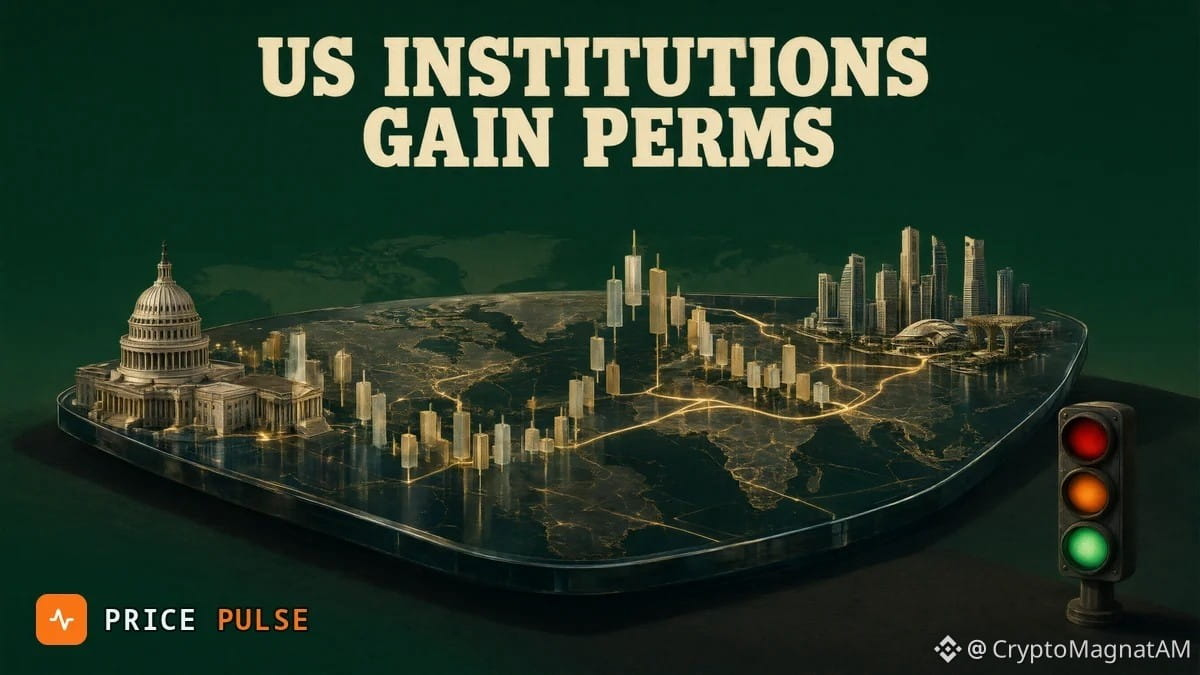
🟢 The CFTC has authorized Singapore Exchange to offer institutional investors from the U.S. direct access to its Bitcoin and Ether perpetual futures. This opens a regulated ⚡ gateway for U.S. capital to trade crypto perps with no offshore counterparty risk. Expect deeper global order books 📈 and tighter spreads as Wall Street desks connect liquidity across Asian trading hours.
Will CFTC-authorized foreign perps divert a significant amount of institutional volume away from unregulated offshore exchanges? 👇
#cftc #sgx #perpetuals #institutions #derivatives
🟢 The CFTC has authorized Singapore Exchange to offer institutional investors from the U.S. direct access to its Bitcoin and Ether perpetual futures. This opens a regulated ⚡ gateway for U.S. capital to trade crypto perps with no offshore counterparty risk. Expect deeper global order books 📈 and tighter spreads as Wall Street desks connect liquidity across Asian trading hours.
Will CFTC-authorized foreign perps divert a significant amount of institutional volume away from unregulated offshore exchanges? 👇
#cftc #sgx #perpetuals #institutions #derivatives
Will CFTC-authorized foreign perps divert a significant amount of institutional volume away from unregulated offshore exchanges? 👇
#cftc #sgx #perpetuals #institutions #derivatives
117

·
--
🟢 The CFTC has allowed the Singapore Exchange to offer U.S. institutional investors direct access to its bitcoin and ether perpetual futures. This opens up a regulated gateway ⚡ for U.S. capital to trade crypto perps without offshore counterparty risk. Expect deeper global order books 📈 and tighter spreads as Wall Street venues link liquidity during Asian trading hours.
Will the CFTC-approved overseas perps pull a significant amount of institutional volume away from unregulated offshore exchanges? 👇
#cftc #sgx #perpetuals #institutions #derivatives
🟢 The CFTC has allowed the Singapore Exchange to offer U.S. institutional investors direct access to its bitcoin and ether perpetual futures. This opens up a regulated gateway ⚡ for U.S. capital to trade crypto perps without offshore counterparty risk. Expect deeper global order books 📈 and tighter spreads as Wall Street venues link liquidity during Asian trading hours.
Will the CFTC-approved overseas perps pull a significant amount of institutional volume away from unregulated offshore exchanges? 👇
#cftc #sgx #perpetuals #institutions #derivatives
Will the CFTC-approved overseas perps pull a significant amount of institutional volume away from unregulated offshore exchanges? 👇
#cftc #sgx #perpetuals #institutions #derivatives

235
Log in to explore more content
Join global crypto users on Binance Square
⚡️ Get latest and useful information about crypto.
💬 Trusted by the world’s largest crypto exchange.
👍 Discover real insights from verified creators.
Email / Phone number
Trending Topics
1
#FedRateWatch
1.5M views
6,803 Discussing
2
#ZcashRises6%
57,599 views
680 Discussing
3
#XRPSinks10%
38,253 views
445 Discussing
4
#BitcoinETFsShed$450M
7,435 views
96 Discussing
5
#CircleOpensArcMainnet
17,493 views
295 Discussing
6
#ZcashHoldersBackNU7Upgrade
29,696 views
456 Discussing
7
#MSTRTradingVolumeSurpassesMorganStanley
27,448 views
605 Discussing
8
#BitcoinFalls4%
56,682 views
940 Discussing
9
#SKHynixInTalksToMakeMemoryChipsInUS
21,959 views
367 Discussing
10
#OpenAIDiscussesNewFundingAt$1.2TValuation
6,096 views
60 Discussing