
Cynu4ka
60 Posts
Cynu4ka
42 Following
12 Followers
26 Liked
Posts
TradFi or crypto? But why choose just one at all? 👀
Traditional finance has a huge history, understandable instruments, and a well-established infrastructure.
The crypto market offers a different approach: global access, speed, digital assets, and new financial mechanisms.
But it gets more interesting when these two worlds start to overlap.
Products like bStocks show that the line between TradFi and Web3 is gradually becoming less obvious.
For investors, this can mean more ways to diversify a portfolio and manage assets.
That said, different tools mean different risks. Volatility, liquidity, the terms of a specific product, and regulatory factors must be considered before you hit Buy.
Personally, I believe the future of finance won’t be about “TradFi versus Crypto,” but about their gradual convergence. 🌐
#TradFi #Crypto #bStocks
$ETH
$BTC
Traditional finance has a huge history, understandable instruments, and a well-established infrastructure.
The crypto market offers a different approach: global access, speed, digital assets, and new financial mechanisms.
But it gets more interesting when these two worlds start to overlap.
Products like bStocks show that the line between TradFi and Web3 is gradually becoming less obvious.
For investors, this can mean more ways to diversify a portfolio and manage assets.
That said, different tools mean different risks. Volatility, liquidity, the terms of a specific product, and regulatory factors must be considered before you hit Buy.
Personally, I believe the future of finance won’t be about “TradFi versus Crypto,” but about their gradual convergence. 🌐
#TradFi #Crypto #bStocks
$ETH
$BTC
#dusk $DUSK @Dusk
Not every project needs to be bought.
And this is probably one of the most important things you realize after enough crypto markets.
DUCK 🦆 interests me specifically as a project that you actually want to follow.
Not because of FOMO.
Not because of “100X guaranteed.”
But because of whether it can truly keep users’ attention.
For me, there are three main questions:
1️⃣ What can DUCK offer to the user?
2️⃣ Will the community be able to keep growing?
3️⃣ Will interest in the project remain after the market narrative changes?
If strong answers to these questions appear over time — then the story becomes much more interesting.
Crypto isn’t only about hunting for the next pump.
Sometimes the best strategy is simply to watch closely what’s being built in front of you. 🦆
$BTC
I don’t know, it looks very promising, especially since the market is growing
Not every project needs to be bought.
And this is probably one of the most important things you realize after enough crypto markets.
DUCK 🦆 interests me specifically as a project that you actually want to follow.
Not because of FOMO.
Not because of “100X guaranteed.”
But because of whether it can truly keep users’ attention.
For me, there are three main questions:
1️⃣ What can DUCK offer to the user?
2️⃣ Will the community be able to keep growing?
3️⃣ Will interest in the project remain after the market narrative changes?
If strong answers to these questions appear over time — then the story becomes much more interesting.
Crypto isn’t only about hunting for the next pump.
Sometimes the best strategy is simply to watch closely what’s being built in front of you. 🦆
$BTC
I don’t know, it looks very promising, especially since the market is growing
There are projects that look interesting on the chart.
And there are those that are interesting to watch even BEFORE the chart starts telling its story.
DUCK 🦆 is exactly in this category.
Crypto is not only candles.
It’s narrative.
It’s community.
It’s attention.
It’s liquidity.
And most importantly—people who are ready to stay after the first hype.
Now it’s interesting to see whether DUCK can pass the most important test of any Web3 project:
🔥 capture attention;
🔥 retain the community;
🔥 create activity;
🔥 turn the narrative into a real ecosystem.
Because a pump can be done by any hype.
But keeping people after the pump—that’s a completely different game.
🦆 DUCK on the radar.
$ETH
$BTC
#dusk $DUSK @Dusk
And there are those that are interesting to watch even BEFORE the chart starts telling its story.
DUCK 🦆 is exactly in this category.
Crypto is not only candles.
It’s narrative.
It’s community.
It’s attention.
It’s liquidity.
And most importantly—people who are ready to stay after the first hype.
Now it’s interesting to see whether DUCK can pass the most important test of any Web3 project:
🔥 capture attention;
🔥 retain the community;
🔥 create activity;
🔥 turn the narrative into a real ecosystem.
Because a pump can be done by any hype.
But keeping people after the pump—that’s a completely different game.
🦆 DUCK on the radar.
$ETH
$BTC
#dusk $DUSK @Dusk
I like crypto projects that make you look not only at the chart, but also at what’s behind it.
DUCK is exactly that kind of case for me right now. 🦆
In Web3, it’s not enough to just create a token.
You need a product, users, an active community, development, and a reason to come back to the ecosystem.
So instead of the question:
“When will it pump?” 📈
it’s much more interesting to ask:
“What will support DUCK in the next 6–12 months?”
If the project can give a strong answer, today’s attention may be only the beginning.
Keep watching DUCK. 🦆
#Blockchain
#dusk $DUSK @Dusk
DUCK is exactly that kind of case for me right now. 🦆
In Web3, it’s not enough to just create a token.
You need a product, users, an active community, development, and a reason to come back to the ecosystem.
So instead of the question:
“When will it pump?” 📈
it’s much more interesting to ask:
“What will support DUCK in the next 6–12 months?”
If the project can give a strong answer, today’s attention may be only the beginning.
Keep watching DUCK. 🦆
#Blockchain
#dusk $DUSK @Dusk
🔥 In crypto, I love the moments when nothing is obvious yet.
When there’s no crowd shouting:
«BUY NOW OR REGRET FOREVER!»
When you can still calmly open the project, read it, check the activity, and draw your own conclusions.
That’s why DUCK looks interesting right now.
I don’t know if this duck will become a big player.
I don’t know if we’ll get a strong narrative.
And I definitely don’t know what the outcome will be.
But I know one thing:
it’s interesting to watch DUCK’s development.
Because in crypto, opportunity often doesn’t start with a pump.
It starts with the moment when you first say:
«Hmm… there’s something here». 👀
🦆 DUCK in focus.
Now all that’s left is to see whether this will be just swimming…
or a real takeoff. 🚀
#dusk $DUSK @Dusk
When there’s no crowd shouting:
«BUY NOW OR REGRET FOREVER!»
When you can still calmly open the project, read it, check the activity, and draw your own conclusions.
That’s why DUCK looks interesting right now.
I don’t know if this duck will become a big player.
I don’t know if we’ll get a strong narrative.
And I definitely don’t know what the outcome will be.
But I know one thing:
it’s interesting to watch DUCK’s development.
Because in crypto, opportunity often doesn’t start with a pump.
It starts with the moment when you first say:
«Hmm… there’s something here». 👀
🦆 DUCK in focus.
Now all that’s left is to see whether this will be just swimming…
or a real takeoff. 🚀
#dusk $DUSK @Dusk
There are two types of crypto guys.
The first:
“ I researched DUCK three months ago.”
The second:
“ BROTHER, WHY DIDN’T I GET INTO DUCK YESTERDAY?” 🤡
For now I’m trying to be the third type — the one who doesn’t buy just because they saw a green candle. 😂
DUCK is interesting specifically as a project you want to follow at an early stage.
Let’s look at development, activity, the community, and the overall narrative.
No fairy tales about guaranteed x’s.
No FOMO.
Just normal research.
And if this duck really takes off — it’ll be nice to say:
“ I noticed it before the flight.” 🦆🚀
$ETH
$BTC
#dusk $DUSK @Dusk
The first:
“ I researched DUCK three months ago.”
The second:
“ BROTHER, WHY DIDN’T I GET INTO DUCK YESTERDAY?” 🤡
For now I’m trying to be the third type — the one who doesn’t buy just because they saw a green candle. 😂
DUCK is interesting specifically as a project you want to follow at an early stage.
Let’s look at development, activity, the community, and the overall narrative.
No fairy tales about guaranteed x’s.
No FOMO.
Just normal research.
And if this duck really takes off — it’ll be nice to say:
“ I noticed it before the flight.” 🦆🚀
$ETH
$BTC
#dusk $DUSK @Dusk
💭 What I like about DeFi — new ways to work with capital are constantly appearing here.
@TermMax is exactly building infrastructure around decentralized lending with a fixed rate and options.
It sounds technical, but the idea itself is pretty simple:
less dependence on constant interest-rate fluctuations → more opportunities to plan a strategy.
Of course, as with any DeFi protocol, it’s important to first understand the mechanics and risks, and only then draw conclusions.
But the direction is definitely interesting. 👀
$SOL
#termmax @TermMax
@TermMax is exactly building infrastructure around decentralized lending with a fixed rate and options.
It sounds technical, but the idea itself is pretty simple:
less dependence on constant interest-rate fluctuations → more opportunities to plan a strategy.
Of course, as with any DeFi protocol, it’s important to first understand the mechanics and risks, and only then draw conclusions.
But the direction is definitely interesting. 👀
$SOL
#termmax @TermMax
#dusk $DUSK @Dusk
👀 The more crypto evolves, the more important the issue of privacy becomes.
@Dusk is building a blockchain where confidentiality is not an extra feature, but part of the infrastructure itself.
It’s especially interesting that Dusk focuses specifically on financial use cases and combines privacy with smart contracts through the Confidential Security Contract (XSC).
Maybe the next big step in blockchain development isn’t just faster and cheaper, but more private. 🔥
$SOL
👀 The more crypto evolves, the more important the issue of privacy becomes.
@Dusk is building a blockchain where confidentiality is not an extra feature, but part of the infrastructure itself.
It’s especially interesting that Dusk focuses specifically on financial use cases and combines privacy with smart contracts through the Confidential Security Contract (XSC).
Maybe the next big step in blockchain development isn’t just faster and cheaper, but more private. 🔥
$SOL
#termmax @TermMax gggggemmmm
An interesting thing in finance: sometimes the most important number is not profit.
It can be time.
How much liquidity do you need?
For what period are you willing to borrow capital?
What interest rate do you consider acceptable?
What happens if the market changes?
That’s why TermMax looks like an exciting direction in DeFi to me.
When terms and conditions become part of the agreement itself, you’re no longer just reacting to the market — you’re trying to account for it before it even starts to move.
And here’s the interesting question:
will time management become as important for DeFi as risk management?
An interesting thing in finance: sometimes the most important number is not profit.
It can be time.
How much liquidity do you need?
For what period are you willing to borrow capital?
What interest rate do you consider acceptable?
What happens if the market changes?
That’s why TermMax looks like an exciting direction in DeFi to me.
When terms and conditions become part of the agreement itself, you’re no longer just reacting to the market — you’re trying to account for it before it even starts to move.
And here’s the interesting question:
will time management become as important for DeFi as risk management?
#dusk $DUSK @Dusk
Crypto has taught us to look at money in a completely different way.
But there is one thing that we still often take for granted—financial privacy.
Imagine that every payment you make, every purchase you make, and every change to your balance is forever available to anyone.
For crypto people, that might sound normal.
For big business—it’s not really anymore. 😅
That’s why I like the direction Dusk is moving in.
If a blockchain wants to work not only with traders and DeFi enthusiasts, it will have to learn how to meet the real requirements of the financial world.
And privacy, in my opinion, will be one of the key issues here.
Crypto has taught us to look at money in a completely different way.
But there is one thing that we still often take for granted—financial privacy.
Imagine that every payment you make, every purchase you make, and every change to your balance is forever available to anyone.
For crypto people, that might sound normal.
For big business—it’s not really anymore. 😅
That’s why I like the direction Dusk is moving in.
If a blockchain wants to work not only with traders and DeFi enthusiasts, it will have to learn how to meet the real requirements of the financial world.
And privacy, in my opinion, will be one of the key issues here.
There are two phrases that crypto nerds love the most:
“APY 100%” 😍
and
“Without risk” 🤡
And then the most interesting part begins—reading the fine print.
That’s where, in my opinion, projects like TermMax become interesting. Not because they remove risk—this doesn’t work that way in DeFi.
But because structured financial instruments help you better understand what exactly you’re dealing with: which asset, which term, what rate, and which scenario.
Maybe the next stage of DeFi development is when users stop chasing only the biggest number on the screen.
#termmax @TermMax
“APY 100%” 😍
and
“Without risk” 🤡
And then the most interesting part begins—reading the fine print.
That’s where, in my opinion, projects like TermMax become interesting. Not because they remove risk—this doesn’t work that way in DeFi.
But because structured financial instruments help you better understand what exactly you’re dealing with: which asset, which term, what rate, and which scenario.
Maybe the next stage of DeFi development is when users stop chasing only the biggest number on the screen.
#termmax @TermMax
There are projects you want to buy after a single tweet.
And there are projects you want to understand.
For me, Dusk is more about the second option.
I’m interested in the blockchain infrastructure concept itself—one that tries to take privacy into account in financial scenarios.
Because if the technology really wants to go beyond the crypto community, it has to solve real-world problems.
In the real world, companies and people don’t want to choose between “data is fully open” and “no one can verify the data.”
We need a third option.
And it’s finding that balance that makes Dusk interesting to me.
#dusk $DUSK @Dusk
And there are projects you want to understand.
For me, Dusk is more about the second option.
I’m interested in the blockchain infrastructure concept itself—one that tries to take privacy into account in financial scenarios.
Because if the technology really wants to go beyond the crypto community, it has to solve real-world problems.
In the real world, companies and people don’t want to choose between “data is fully open” and “no one can verify the data.”
We need a third option.
And it’s finding that balance that makes Dusk interesting to me.
#dusk $DUSK @Dusk
It’s interesting to think about how investing will change in 10 years.
Maybe nobody will ask anymore:
“Are you a crypto guy or a stock guy?”
There will be a simple question:
“What do you have in your portfolio?”
BTC?
Stocks?
Stablecoins?
Bonds?
Other digital assets?
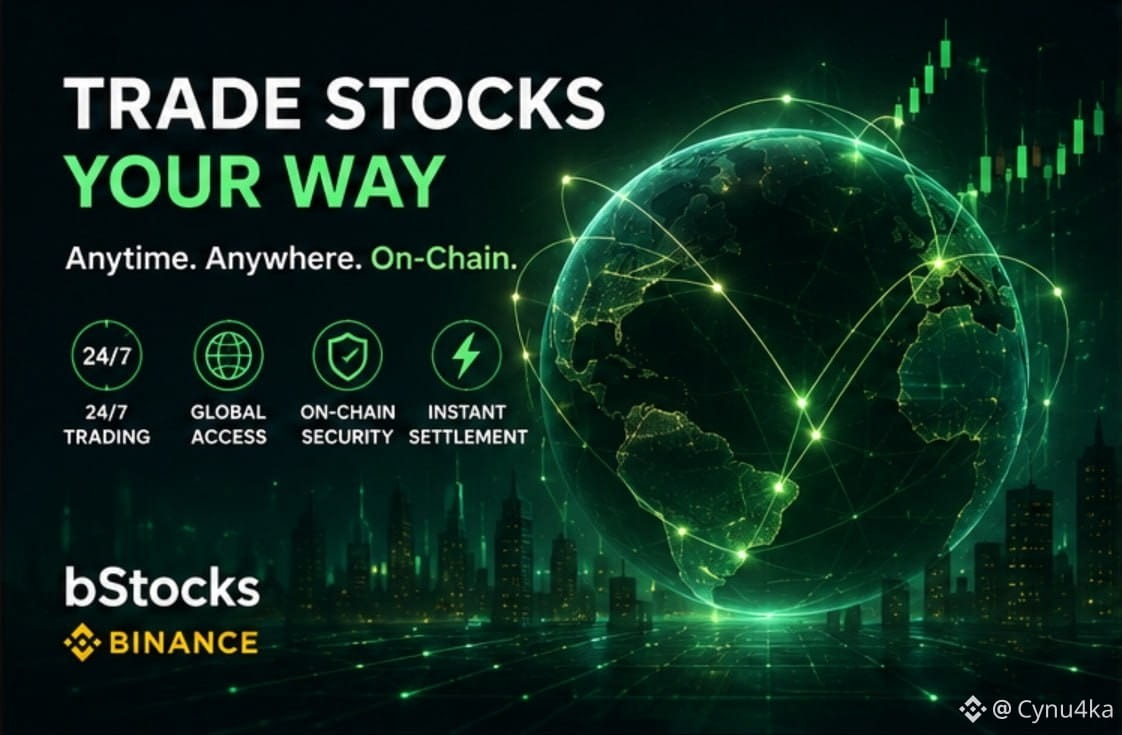
bStocks interest me specifically because of this possible shift in mindset.
Technology is gradually blurring the boundaries between different financial products, and for the user the main thing remains — choosing what they need.
Maybe a future investor won’t even think in categories of TradFi and Crypto.
They’ll just be an investor.
$MSFTB
$NVDAB
$AMZNB
#bstockscis @BinanceCIS
Maybe nobody will ask anymore:
“Are you a crypto guy or a stock guy?”
There will be a simple question:
“What do you have in your portfolio?”
BTC?
Stocks?
Stablecoins?
Bonds?
Other digital assets?
bStocks interest me specifically because of this possible shift in mindset.
Technology is gradually blurring the boundaries between different financial products, and for the user the main thing remains — choosing what they need.
Maybe a future investor won’t even think in categories of TradFi and Crypto.
They’ll just be an investor.
$MSFTB
$NVDAB
$AMZNB
#bstockscis @BinanceCIS
Maybe the best blockchain is the one that the average user doesn’t even think about.
They just make a transaction.
They don’t think about consensus.
They don’t think about infrastructure.
They don’t think about cryptography.
They simply get the result they need.
I like looking at Dusk through this lens.
If a blockchain wants to become part of the serious financial world, it needs to solve not only issues of speed or transaction cost.
It needs to think about privacy, data, and the real needs of financial participants.
Will a blockchain one day become so invisible that we stop calling it a blockchain?
That’s the kind of thing I’d love to see.
#dusk $DUSK @Dusk
They just make a transaction.
They don’t think about consensus.
They don’t think about infrastructure.
They don’t think about cryptography.
They simply get the result they need.
I like looking at Dusk through this lens.
If a blockchain wants to become part of the serious financial world, it needs to solve not only issues of speed or transaction cost.
It needs to think about privacy, data, and the real needs of financial participants.
Will a blockchain one day become so invisible that we stop calling it a blockchain?
That’s the kind of thing I’d love to see.
#dusk $DUSK @Dusk
When the market is growing, everyone talks about profit.
When the market is falling, everyone suddenly starts talking about risk. 😄
But a good financial strategy should take both scenarios into account even before they become real.
My interest in TermMax comes precisely from this. Time-based instruments let you look at capital not only through the question “how much will I make?”, but also through “for what time period and under what conditions am I willing to use it?”.
This is already a slightly different approach to DeFi.
Will managing time horizon and rate become as important as managing the asset itself?
#termmax @TermMax
When the market is falling, everyone suddenly starts talking about risk. 😄
But a good financial strategy should take both scenarios into account even before they become real.
My interest in TermMax comes precisely from this. Time-based instruments let you look at capital not only through the question “how much will I make?”, but also through “for what time period and under what conditions am I willing to use it?”.
This is already a slightly different approach to DeFi.
Will managing time horizon and rate become as important as managing the asset itself?
#termmax @TermMax
Unpopular opinion: a high APY doesn’t always mean a good deal.
If the rate changes every hour, the risk changes too. Sometimes it’s better to know in advance the terms you’re entering the position with than to chase the biggest number on the screen.
That’s why I paid attention to TermMax.
Fixed terms may sound less exciting than “100% APY right now,” but for proper risk management, predictability is sometimes far more valuable than a pretty number.
Which would you choose: the maximum APY or pre-known terms?
#termmax @TermMax
If the rate changes every hour, the risk changes too. Sometimes it’s better to know in advance the terms you’re entering the position with than to chase the biggest number on the screen.
That’s why I paid attention to TermMax.
Fixed terms may sound less exciting than “100% APY right now,” but for proper risk management, predictability is sometimes far more valuable than a pretty number.
Which would you choose: the maximum APY or pre-known terms?
#termmax @TermMax
#dusk $DUSK @Dusk
Maybe we’re misunderstanding the word “transparency.”
For some reason, logic is often stated like this: the more information is available to everyone, the better the blockchain.
But imagine a fund, a bank, or a large company carrying out a serious transaction. Do they really need their competitors to see all the details?
It seems to me the future will be about compromise:
data can be verified ✅
rules are followed ✅
but private information isn’t on display for the whole world ✅
That’s why the topic of Dusk interests me not as another crypto narrative, but as an attempt to answer a fairly fundamental question:
can a blockchain be both transparent for verification and private for the user?
Now that’s a technological question I genuinely enjoy watching unfold.
Maybe we’re misunderstanding the word “transparency.”
For some reason, logic is often stated like this: the more information is available to everyone, the better the blockchain.
But imagine a fund, a bank, or a large company carrying out a serious transaction. Do they really need their competitors to see all the details?
It seems to me the future will be about compromise:
data can be verified ✅
rules are followed ✅
but private information isn’t on display for the whole world ✅
That’s why the topic of Dusk interests me not as another crypto narrative, but as an attempt to answer a fairly fundamental question:
can a blockchain be both transparent for verification and private for the user?
Now that’s a technological question I genuinely enjoy watching unfold.
#bstockscis @BinanceCIS
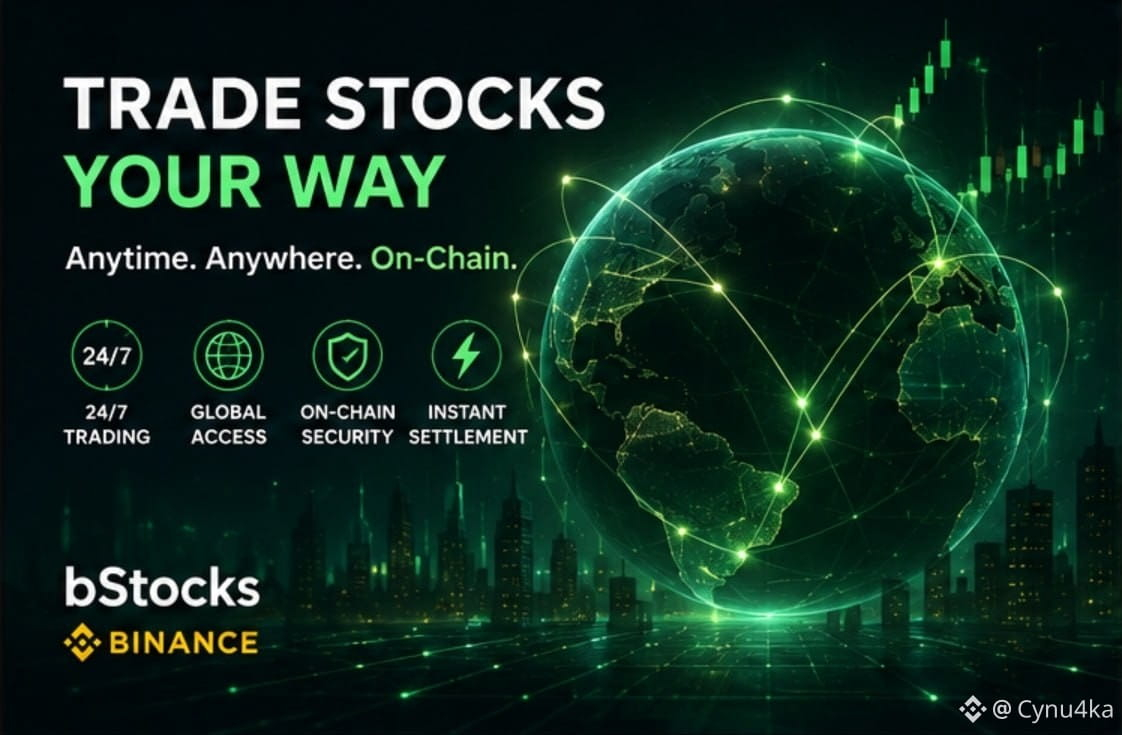
I feel like we’re right in the middle of a major change.
The old-school investor thought in terms of platforms:
“These are stocks—I go there.”
“This is crypto—I go over there.”
The new investor may think very differently:
“This is my portfolio. I want to see it all.”
Stocks are interesting to me precisely in this transition.
It’s not necessarily that traditional stocks will become part of every crypto holder’s portfolio. But the very possibility of combining different types of assets in a single digital environment is gradually changing user expectations.
And there’s an interesting question here:
will there be a clear line between a “crypto investor” and a “stock investor” at all in 10 years?
Maybe there will just be the word “investor”.
I feel like we’re right in the middle of a major change.
The old-school investor thought in terms of platforms:
“These are stocks—I go there.”
“This is crypto—I go over there.”
The new investor may think very differently:
“This is my portfolio. I want to see it all.”
Stocks are interesting to me precisely in this transition.
It’s not necessarily that traditional stocks will become part of every crypto holder’s portfolio. But the very possibility of combining different types of assets in a single digital environment is gradually changing user expectations.
And there’s an interesting question here:
will there be a clear line between a “crypto investor” and a “stock investor” at all in 10 years?
Maybe there will just be the word “investor”.
#dusk $DUSK @Dusk - maybe this is a new gem
There are projects everyone talks about.
And there are projects you find it interesting just to watch while they’re being built.
I’m increasingly thinking that in crypto we reward noise too much. Loud Twitter, memes, hype—everything can generate huge attention in a few days.
But infrastructure doesn’t work like that.
Dusk interests me for this very reason. It’s not just about how loudly people are talking about the project today. The question is whether its technology will be needed when the next wave of hype has long been forgotten.
Maybe this is a boring way to look at crypto.
But maybe those “boring” projects one day turn out to be the most interesting.
There are projects everyone talks about.
And there are projects you find it interesting just to watch while they’re being built.
I’m increasingly thinking that in crypto we reward noise too much. Loud Twitter, memes, hype—everything can generate huge attention in a few days.
But infrastructure doesn’t work like that.
Dusk interests me for this very reason. It’s not just about how loudly people are talking about the project today. The question is whether its technology will be needed when the next wave of hype has long been forgotten.
Maybe this is a boring way to look at crypto.
But maybe those “boring” projects one day turn out to be the most interesting.
#bstockscis @BinanceCIS - future
A dilemma for a crypto bro:
📈 BTC is rising — you want to buy BTC.
📉 BTC is falling — you want to buy even more BTC.
💰 A profit appears — and you want to buy BTC again.
And somewhere in the corner, diversification quietly stands there and says: “Maybe at least some in other assets?” 😂
That’s why I’m interested in the bStocks direction.
Not because traditional stocks suddenly became better than crypto. But because a normal portfolio doesn’t necessarily have to consist of just one class of assets.
Interesting—what would you do with $100,000:
50% crypto / 50% traditional assets?
70/30?
90/10?
Or all-in BTC and no extra talk? 😅
$MSFTB
A dilemma for a crypto bro:
📈 BTC is rising — you want to buy BTC.
📉 BTC is falling — you want to buy even more BTC.
💰 A profit appears — and you want to buy BTC again.
And somewhere in the corner, diversification quietly stands there and says: “Maybe at least some in other assets?” 😂
That’s why I’m interested in the bStocks direction.
Not because traditional stocks suddenly became better than crypto. But because a normal portfolio doesn’t necessarily have to consist of just one class of assets.
Interesting—what would you do with $100,000:
50% crypto / 50% traditional assets?
70/30?
90/10?
Or all-in BTC and no extra talk? 😅
$MSFTB
Log in to explore more content