
#cryptoregulation
cryptoregulation
16.7M views
46,511 Discussing
Hot
Latest

·
--
#ripplelobbiestoadvanceclarityactvote
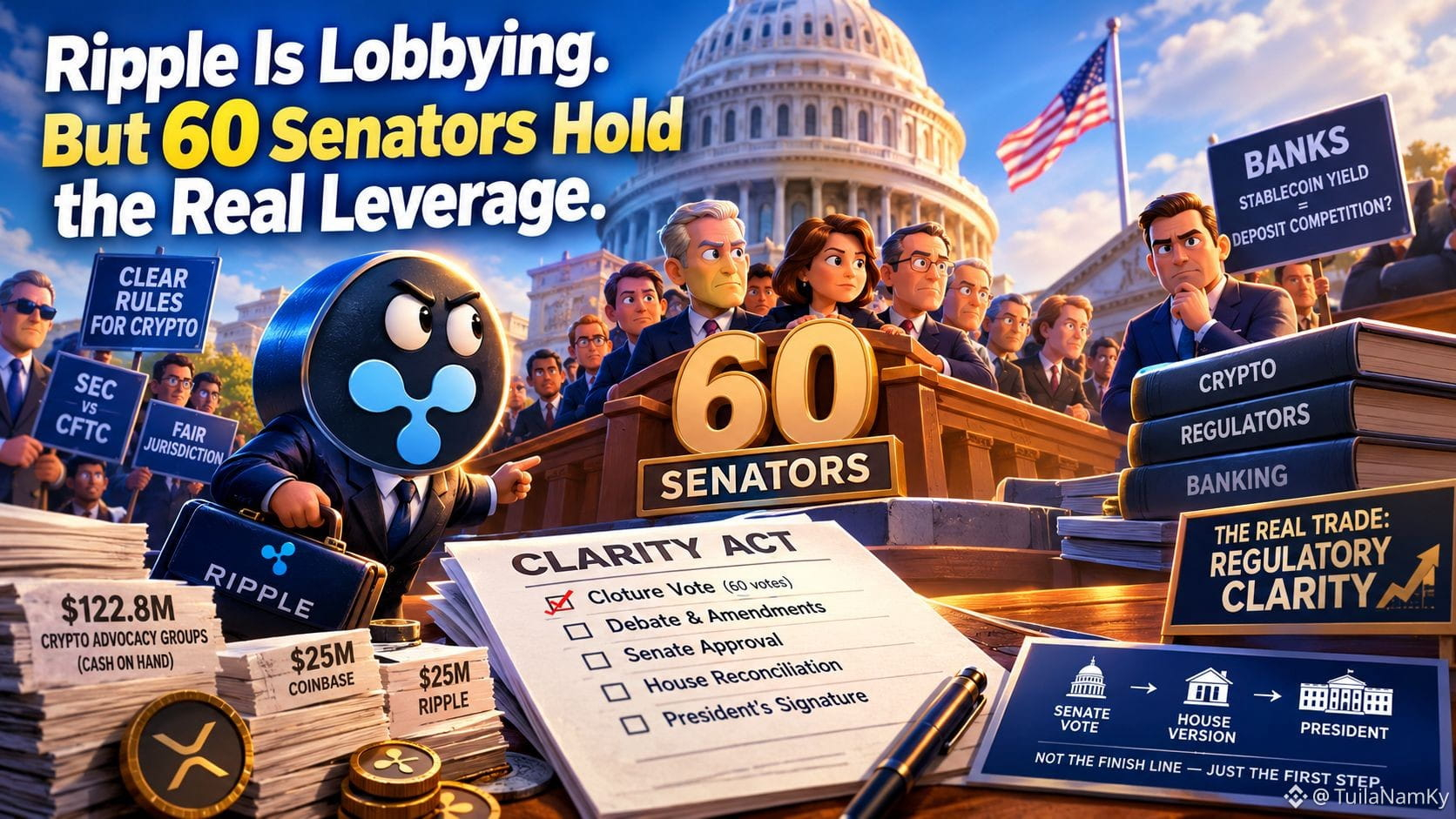
🇺🇸 Ripple Is Lobbying. But 60 Senators Hold the Real Leverage.
Ripple is lobbying U.S. senators ahead of the CLARITY Act vote.
But the real story isn't simply $XRP.
It's the fight over who gets to define the rules for America's crypto market.
The Senate is scheduled to hold a cloture vote on September 15.
And there's a critical detail many headlines blur:
Cloture ≠ passage.
The vote needs 60 of 100 senators to clear the procedural hurdle and open the door to debate and amendments.
If it fails, the bill could face a major setback for the rest of 2026.
Why is this getting so contentious?
Because CLARITY isn't just about crypto companies.
It's also about the balance between crypto, regulators and traditional banking.
Crypto groups want clearer jurisdiction between the SEC and CFTC.
Banks, meanwhile, have raised concerns about stablecoin yield potentially competing with traditional deposits.
And the lobbying numbers show how high the stakes are:
→ Crypto advocacy groups reportedly held $122.8M in cash as of July 31
→ Coinbase and Ripple each reportedly contributed $25M to major crypto political efforts
But here's the part the market may be missing:
Even 60+ votes would not make CLARITY law.
After cloture comes debate, amendments, final Senate approval, reconciliation with the House version, and ultimately the President.
So a successful vote would be a legislative signal, not the finish line.
That's also why treating CLARITY as a simple “XRP bullish catalyst” misses the bigger picture.
$XRP may be particularly sensitive to regulatory clarity.
But the bill potentially affects the entire U.S. digital-asset market.
The market may be watching XRP.
The real trade is regulatory clarity.
The question now isn't whether Ripple can lobby hard enough.
It's whether 60 senators can agree on the first step toward a durable crypto rulebook.
Market commentary only.
$XRP
{future}(XRPUSDT)
#CryptoRegulation #CLARITYAct #XRP
#ripplelobbiestoadvanceclarityactvote
🇺🇸 Ripple Is Lobbying. But 60 Senators Hold the Real Leverage.
Ripple is lobbying U.S. senators ahead of the CLARITY Act vote.
But the real story isn't simply $XRP .
It's the fight over who gets to define the rules for America's crypto market.
The Senate is scheduled to hold a cloture vote on September 15.
And there's a critical detail many headlines blur:
Cloture ≠ passage.
The vote needs 60 of 100 senators to clear the procedural hurdle and open the door to debate and amendments.
If it fails, the bill could face a major setback for the rest of 2026.
Why is this getting so contentious?
Because CLARITY isn't just about crypto companies.
It's also about the balance between crypto, regulators and traditional banking.
Crypto groups want clearer jurisdiction between the SEC and CFTC.
Banks, meanwhile, have raised concerns about stablecoin yield potentially competing with traditional deposits.
And the lobbying numbers show how high the stakes are:
→ Crypto advocacy groups reportedly held $122.8M in cash as of July 31
→ Coinbase and Ripple each reportedly contributed $25M to major crypto political efforts
But here's the part the market may be missing:
Even 60+ votes would not make CLARITY law.
After cloture comes debate, amendments, final Senate approval, reconciliation with the House version, and ultimately the President.
So a successful vote would be a legislative signal, not the finish line.
That's also why treating CLARITY as a simple “XRP bullish catalyst” misses the bigger picture.
$XRP may be particularly sensitive to regulatory clarity.
But the bill potentially affects the entire U.S. digital-asset market.
The market may be watching XRP.
The real trade is regulatory clarity.
The question now isn't whether Ripple can lobby hard enough.
It's whether 60 senators can agree on the first step toward a durable crypto rulebook.
Market commentary only.
$XRP
#CryptoRegulation #CLARITYAct #XRP
🇺🇸 Ripple Is Lobbying. But 60 Senators Hold the Real Leverage.
Ripple is lobbying U.S. senators ahead of the CLARITY Act vote.
But the real story isn't simply $XRP .
It's the fight over who gets to define the rules for America's crypto market.
The Senate is scheduled to hold a cloture vote on September 15.
And there's a critical detail many headlines blur:
Cloture ≠ passage.
The vote needs 60 of 100 senators to clear the procedural hurdle and open the door to debate and amendments.
If it fails, the bill could face a major setback for the rest of 2026.
Why is this getting so contentious?
Because CLARITY isn't just about crypto companies.
It's also about the balance between crypto, regulators and traditional banking.
Crypto groups want clearer jurisdiction between the SEC and CFTC.
Banks, meanwhile, have raised concerns about stablecoin yield potentially competing with traditional deposits.
And the lobbying numbers show how high the stakes are:
→ Crypto advocacy groups reportedly held $122.8M in cash as of July 31
→ Coinbase and Ripple each reportedly contributed $25M to major crypto political efforts
But here's the part the market may be missing:
Even 60+ votes would not make CLARITY law.
After cloture comes debate, amendments, final Senate approval, reconciliation with the House version, and ultimately the President.
So a successful vote would be a legislative signal, not the finish line.
That's also why treating CLARITY as a simple “XRP bullish catalyst” misses the bigger picture.
$XRP may be particularly sensitive to regulatory clarity.
But the bill potentially affects the entire U.S. digital-asset market.
The market may be watching XRP.
The real trade is regulatory clarity.
The question now isn't whether Ripple can lobby hard enough.
It's whether 60 senators can agree on the first step toward a durable crypto rulebook.
Market commentary only.
$XRP
#CryptoRegulation #CLARITYAct #XRP
1
1.2k

·
--
🚨 EU TIGHTENS CRYPTO REGULATORY OVERSIGHT 🇪🇺
The European Union continues expanding regulatory oversight of crypto-asset service providers.
🎯 The focus includes:
• Regulatory communication
• AML oversight
• Cross-border enforcement
• Compliance
💡 Why it matters:
Clearer regulation could increase institutional confidence, but stricter compliance may also increase costs for crypto businesses.
👀 Regulation remains one of the biggest long-term crypto trends.
#CryptoRegulation #EU #MiCA #CryptoNews #BinanceSquare
🚨 EU TIGHTENS CRYPTO REGULATORY OVERSIGHT 🇪🇺
The European Union continues expanding regulatory oversight of crypto-asset service providers.
🎯 The focus includes:
• Regulatory communication
• AML oversight
• Cross-border enforcement
• Compliance
💡 Why it matters:
Clearer regulation could increase institutional confidence, but stricter compliance may also increase costs for crypto businesses.
👀 Regulation remains one of the biggest long-term crypto trends.
#CryptoRegulation #EU #MiCA #CryptoNews #BinanceSquare
The European Union continues expanding regulatory oversight of crypto-asset service providers.
🎯 The focus includes:
• Regulatory communication
• AML oversight
• Cross-border enforcement
• Compliance
💡 Why it matters:
Clearer regulation could increase institutional confidence, but stricter compliance may also increase costs for crypto businesses.
👀 Regulation remains one of the biggest long-term crypto trends.
#CryptoRegulation #EU #MiCA #CryptoNews #BinanceSquare

🇺🇸 BREAKING: Coinbase CEO Brian Armstrong just said US crypto regulation is happening no matter what — if the Clarity Act stalls in Congress, the SEC and CFTC will just write the rules themselves.
Translation: Washington's playing chess, not checkers. Either lawmakers move, or unelected regulators fill the vacuum.
🤔 Which outcome do YOU actually want — Congress passing real legislation, or agencies deciding crypto's fate through rulemaking? Drop your take below 👇
#Crypto #Bitcoin #CryptoRegulation
$COIN
{future}(COINUSDT)
$BTC
{future}(BTCUSDT)
$ETH
{future}(ETHUSDT)
🇺🇸 BREAKING: Coinbase CEO Brian Armstrong just said US crypto regulation is happening no matter what — if the Clarity Act stalls in Congress, the SEC and CFTC will just write the rules themselves.
Translation: Washington's playing chess, not checkers. Either lawmakers move, or unelected regulators fill the vacuum.
🤔 Which outcome do YOU actually want — Congress passing real legislation, or agencies deciding crypto's fate through rulemaking? Drop your take below 👇
#Crypto #Bitcoin #CryptoRegulation
$COIN
$BTC
$ETH
Translation: Washington's playing chess, not checkers. Either lawmakers move, or unelected regulators fill the vacuum.
🤔 Which outcome do YOU actually want — Congress passing real legislation, or agencies deciding crypto's fate through rulemaking? Drop your take below 👇
#Crypto #Bitcoin #CryptoRegulation
$COIN
$BTC
$ETH

32


·
--
Armstrong says crypto clarity arrives regardless of Senate vote $BTC just caught a fresh read on the tape.
Live: $BTC 78,193 (-1.39% 24h) · 28.44B USDT 24h vol
Coinbase chief executive Brian Armstrong told CNBC on Thursday that the digital asset sector will achieve regulatory clarity whether the Senate approves the Clarity Act on September 15 or rejects it. The legislative vote sits five days from today.
$BTC #BTC #CryptoRegulation #CryptoNews
Armstrong says crypto clarity arrives regardless of Senate vote $BTC just caught a fresh read on the tape.
Live: $BTC 78,193 (-1.39% 24h) · 28.44B USDT 24h vol
Coinbase chief executive Brian Armstrong told CNBC on Thursday that the digital asset sector will achieve regulatory clarity whether the Senate approves the Clarity Act on September 15 or rejects it. The legislative vote sits five days from today.
$BTC #BTC #CryptoRegulation #CryptoNews
Live: $BTC 78,193 (-1.39% 24h) · 28.44B USDT 24h vol
Coinbase chief executive Brian Armstrong told CNBC on Thursday that the digital asset sector will achieve regulatory clarity whether the Senate approves the Clarity Act on September 15 or rejects it. The legislative vote sits five days from today.
$BTC #BTC #CryptoRegulation #CryptoNews
61

·
--
The next big risk for crypto isn't a ban — it's regulatory fragmentation
We're entering an era where every major jurisdiction is writing crypto rules simultaneously. The EU has MiCA. The US is debating market structure bills. Hong Kong, Singapore, the UAE, and Japan are each building their own frameworks. Brazil and South Korea are moving fast.
That sounds like progress. And it is. But there's a hidden problem: these regimes aren't converging. They're diverging.
Some treat staking as a regulated activity. Others exempt it. Some require token listing reviews. Others let exchanges self-certify. Custody rules vary wildly. Travel rule implementations don't talk to each other. Stablecoin reserve standards range from "T-bills only" to "we'll figure it out."
For traders and builders, this creates a real cost: the same asset can be legal, restricted, or effectively banned depending on where you sit. Global liquidity pools start to fragment. Projects launch in one jurisdiction and can't access users in another. Arbitrage opportunities shrink. Compliance overhead eats margins.
The projects that win won't be the ones with the best tech — they'll be the ones with the deepest regulatory interoperability. The ability to operate across 15+ jurisdictions without redesigning your product each time is becoming the real moat.
Watch which chains and exchanges are investing in multi-jurisdiction compliance infrastructure now. That's where institutional flow will route.
$BTC $ETH $XRP
#CryptoRegulation #MiCA #InstitutionalAdoption #CryptoPolicy #RegulatoryFragmentation
The next big risk for crypto isn't a ban — it's regulatory fragmentation
We're entering an era where every major jurisdiction is writing crypto rules simultaneously. The EU has MiCA. The US is debating market structure bills. Hong Kong, Singapore, the UAE, and Japan are each building their own frameworks. Brazil and South Korea are moving fast.
That sounds like progress. And it is. But there's a hidden problem: these regimes aren't converging. They're diverging.
Some treat staking as a regulated activity. Others exempt it. Some require token listing reviews. Others let exchanges self-certify. Custody rules vary wildly. Travel rule implementations don't talk to each other. Stablecoin reserve standards range from "T-bills only" to "we'll figure it out."
For traders and builders, this creates a real cost: the same asset can be legal, restricted, or effectively banned depending on where you sit. Global liquidity pools start to fragment. Projects launch in one jurisdiction and can't access users in another. Arbitrage opportunities shrink. Compliance overhead eats margins.
The projects that win won't be the ones with the best tech — they'll be the ones with the deepest regulatory interoperability. The ability to operate across 15+ jurisdictions without redesigning your product each time is becoming the real moat.
Watch which chains and exchanges are investing in multi-jurisdiction compliance infrastructure now. That's where institutional flow will route.
$BTC $ETH $XRP
#CryptoRegulation #MiCA #InstitutionalAdoption #CryptoPolicy #RegulatoryFragmentation
We're entering an era where every major jurisdiction is writing crypto rules simultaneously. The EU has MiCA. The US is debating market structure bills. Hong Kong, Singapore, the UAE, and Japan are each building their own frameworks. Brazil and South Korea are moving fast.
That sounds like progress. And it is. But there's a hidden problem: these regimes aren't converging. They're diverging.
Some treat staking as a regulated activity. Others exempt it. Some require token listing reviews. Others let exchanges self-certify. Custody rules vary wildly. Travel rule implementations don't talk to each other. Stablecoin reserve standards range from "T-bills only" to "we'll figure it out."
For traders and builders, this creates a real cost: the same asset can be legal, restricted, or effectively banned depending on where you sit. Global liquidity pools start to fragment. Projects launch in one jurisdiction and can't access users in another. Arbitrage opportunities shrink. Compliance overhead eats margins.
The projects that win won't be the ones with the best tech — they'll be the ones with the deepest regulatory interoperability. The ability to operate across 15+ jurisdictions without redesigning your product each time is becoming the real moat.
Watch which chains and exchanges are investing in multi-jurisdiction compliance infrastructure now. That's where institutional flow will route.
$BTC $ETH $XRP
#CryptoRegulation #MiCA #InstitutionalAdoption #CryptoPolicy #RegulatoryFragmentation
88

·
--
🟠 Neutral
🚨 SEC Unveils 'Regulation Crypto Assets' Proposal!
The SEC has officially proposed new rules, 'Regulation Crypto Assets', aiming to create a clearer framework for crypto investment contracts. This follows their March 2026 interpretation.
📊 Market Impact: While bringing some much-needed regulatory clarity, the details will be crucial. Expect initial uncertainty, but long-term potential for institutional adoption if the framework is fair. Could impact how token sales are structured.
#CryptoRegulation #SEC
🟠 Neutral
🚨 SEC Unveils 'Regulation Crypto Assets' Proposal!
The SEC has officially proposed new rules, 'Regulation Crypto Assets', aiming to create a clearer framework for crypto investment contracts. This follows their March 2026 interpretation.
📊 Market Impact: While bringing some much-needed regulatory clarity, the details will be crucial. Expect initial uncertainty, but long-term potential for institutional adoption if the framework is fair. Could impact how token sales are structured.
#CryptoRegulation #SEC
🚨 SEC Unveils 'Regulation Crypto Assets' Proposal!
The SEC has officially proposed new rules, 'Regulation Crypto Assets', aiming to create a clearer framework for crypto investment contracts. This follows their March 2026 interpretation.
📊 Market Impact: While bringing some much-needed regulatory clarity, the details will be crucial. Expect initial uncertainty, but long-term potential for institutional adoption if the framework is fair. Could impact how token sales are structured.
#CryptoRegulation #SEC

·
--

Article
US Treasury Urges Senate to Pass Crypto Clarity Act—What It Means for $BTCThe Treasury Secretary’s plea to Congress isn’t just political theater; it’s a signal that the U.S. government is finally ready to give the crypto industry the legal certainty it’s been craving.
The Concept
The “Crypto Clarity Act” is a piece of legislation that would define what constitutes a “cryptocurrency” under U.S. law, clarifying how existing securities, commodities, and tax regulations apply. Think of it as a user manual for regulators and businesses: it tells them whether a digital asset is a security, a commodity, or something else entirely. #CryptoRegulation #LegalClarity
Real‑World Example
Imagine a startup that wants to launch a new token. Without the Act, the company faces a legal maze—could it be a security requiring registration, or a commodity that falls under the Commodity Futures Trading Commission? The uncertainty forces firms to either over‑regulate, stifling innovation, or under‑regulate, risking penalties. The Clarity Act would cut through this confusion, allowing the startup to know exactly which rules to follow and how to structure its token sale. This clarity would also help investors understand the risks and protections associated with their holdings.
Takeaway
If the Senate passes the Act, you’ll see a smoother path for crypto projects to launch, more predictable tax treatment for holders, and a clearer framework for compliance. For everyday users, this means less chance of sudden regulatory crackdowns and more confidence that your digital assets are protected by a solid legal foundation. #CryptoFuture
Engagement Question
Do you think a clear legal definition will boost crypto adoption, or could it still leave too many gray areas? Let me know in the comments!
US Treasury Urges Senate to Pass Crypto Clarity Act—What It Means for $BTC
The Treasury Secretary’s plea to Congress isn’t just political theater; it’s a signal that the U.S. government is finally ready to give the crypto industry the legal certainty it’s been craving.
The Concept
The “Crypto Clarity Act” is a piece of legislation that would define what constitutes a “cryptocurrency” under U.S. law, clarifying how existing securities, commodities, and tax regulations apply. Think of it as a user manual for regulators and businesses: it tells them whether a digital asset is a security, a commodity, or something else entirely. #CryptoRegulation #LegalClarity
Real‑World Example
Imagine a startup that wants to launch a new token. Without the Act, the company faces a legal maze—could it be a security requiring registration, or a commodity that falls under the Commodity Futures Trading Commission? The uncertainty forces firms to either over‑regulate, stifling innovation, or under‑regulate, risking penalties. The Clarity Act would cut through this confusion, allowing the startup to know exactly which rules to follow and how to structure its token sale. This clarity would also help investors understand the risks and protections associated with their holdings.
Takeaway
If the Senate passes the Act, you’ll see a smoother path for crypto projects to launch, more predictable tax treatment for holders, and a clearer framework for compliance. For everyday users, this means less chance of sudden regulatory crackdowns and more confidence that your digital assets are protected by a solid legal foundation. #CryptoFuture
Engagement Question
Do you think a clear legal definition will boost crypto adoption, or could it still leave too many gray areas? Let me know in the comments!
The Concept
The “Crypto Clarity Act” is a piece of legislation that would define what constitutes a “cryptocurrency” under U.S. law, clarifying how existing securities, commodities, and tax regulations apply. Think of it as a user manual for regulators and businesses: it tells them whether a digital asset is a security, a commodity, or something else entirely. #CryptoRegulation #LegalClarity
Real‑World Example
Imagine a startup that wants to launch a new token. Without the Act, the company faces a legal maze—could it be a security requiring registration, or a commodity that falls under the Commodity Futures Trading Commission? The uncertainty forces firms to either over‑regulate, stifling innovation, or under‑regulate, risking penalties. The Clarity Act would cut through this confusion, allowing the startup to know exactly which rules to follow and how to structure its token sale. This clarity would also help investors understand the risks and protections associated with their holdings.
Takeaway
If the Senate passes the Act, you’ll see a smoother path for crypto projects to launch, more predictable tax treatment for holders, and a clearer framework for compliance. For everyday users, this means less chance of sudden regulatory crackdowns and more confidence that your digital assets are protected by a solid legal foundation. #CryptoFuture
Engagement Question
Do you think a clear legal definition will boost crypto adoption, or could it still leave too many gray areas? Let me know in the comments!
16

·
--
Ripple is pushing hard for the CLARITY Act, and the timing is important.
Ripple Chief Legal Officer Stuart Alderoty is lobbying U.S. senators ahead of the planned September 15 procedural vote on the bill.
The CLARITY Act aims to establish a federal framework for digital assets and give the CFTC a larger role over the digital commodity spot market. The procedural hurdle requires 60 votes to advance.
For XRP, this is obviously worth watching. But I think the bigger story is much broader.
Clearer rules could affect how exchanges, token issuers, institutions and blockchain companies operate across the entire U.S. market.
That means the impact could eventually extend beyond XRP into BTC, ETH, SOL and the wider digital-asset industry.
But nothing is guaranteed. A scheduled vote is not the same as a successful vote, and the political process can still change.
So I’m watching the actual Senate vote count, not just the headlines.
Do you think CLARITY can become a major regulatory catalyst for the next phase of U.S. crypto adoption?
#RippleLobbiesToAdvanceCLARITYActVote #XRP #CryptoRegulation
$IOST
{future}(IOSTUSDT)
$XRP
{future}(XRPUSDT)
$SC
{spot}(SCUSDT)
#RippleLobbiesToAdvanceCLARITYActVote
Ripple is pushing hard for the CLARITY Act, and the timing is important.
Ripple Chief Legal Officer Stuart Alderoty is lobbying U.S. senators ahead of the planned September 15 procedural vote on the bill.
The CLARITY Act aims to establish a federal framework for digital assets and give the CFTC a larger role over the digital commodity spot market. The procedural hurdle requires 60 votes to advance.
For XRP, this is obviously worth watching. But I think the bigger story is much broader.
Clearer rules could affect how exchanges, token issuers, institutions and blockchain companies operate across the entire U.S. market.
That means the impact could eventually extend beyond XRP into BTC, ETH, SOL and the wider digital-asset industry.
But nothing is guaranteed. A scheduled vote is not the same as a successful vote, and the political process can still change.
So I’m watching the actual Senate vote count, not just the headlines.
Do you think CLARITY can become a major regulatory catalyst for the next phase of U.S. crypto adoption?
#RippleLobbiesToAdvanceCLARITYActVote #XRP #CryptoRegulation
$IOST
$XRP
$SC
#RippleLobbiesToAdvanceCLARITYActVote
Ripple Chief Legal Officer Stuart Alderoty is lobbying U.S. senators ahead of the planned September 15 procedural vote on the bill.
The CLARITY Act aims to establish a federal framework for digital assets and give the CFTC a larger role over the digital commodity spot market. The procedural hurdle requires 60 votes to advance.
For XRP, this is obviously worth watching. But I think the bigger story is much broader.
Clearer rules could affect how exchanges, token issuers, institutions and blockchain companies operate across the entire U.S. market.
That means the impact could eventually extend beyond XRP into BTC, ETH, SOL and the wider digital-asset industry.
But nothing is guaranteed. A scheduled vote is not the same as a successful vote, and the political process can still change.
So I’m watching the actual Senate vote count, not just the headlines.
Do you think CLARITY can become a major regulatory catalyst for the next phase of U.S. crypto adoption?
#RippleLobbiesToAdvanceCLARITYActVote #XRP #CryptoRegulation
$IOST
$XRP
$SC
#RippleLobbiesToAdvanceCLARITYActVote
2
279
·
--
$BTC Hyperliquid group asks court to toss CME suit against CFTC
Hyperliquid's policy group asked a court to throw out CME Group's lawsuit against the CFTC. The Block reported the move on Sept. 9, in a story centered on perpetual futures and who gets to offer them in the United States.
Live: $BTC 78,776 (-0.03% 24h) · 24h range 78,095-79,701 · 34.38B USDT 24h vol
$BTC #BTC #CryptoRegulation #CryptoNews
$BTC Hyperliquid group asks court to toss CME suit against CFTC
Hyperliquid's policy group asked a court to throw out CME Group's lawsuit against the CFTC. The Block reported the move on Sept. 9, in a story centered on perpetual futures and who gets to offer them in the United States.
Live: $BTC 78,776 (-0.03% 24h) · 24h range 78,095-79,701 · 34.38B USDT 24h vol
$BTC #BTC #CryptoRegulation #CryptoNews
Hyperliquid's policy group asked a court to throw out CME Group's lawsuit against the CFTC. The Block reported the move on Sept. 9, in a story centered on perpetual futures and who gets to offer them in the United States.
Live: $BTC 78,776 (-0.03% 24h) · 24h range 78,095-79,701 · 34.38B USDT 24h vol
$BTC #BTC #CryptoRegulation #CryptoNews
52

·
--
🇺🇸 US Crypto Regulation Faces a Major Test
The U.S. Senate is preparing for a September 15 procedural vote on the CLARITY Act, a major crypto-market structure bill.
The legislation aims to clarify how digital assets are classified and which regulators oversee them.
🏦 Crypto companies are pushing for clearer rules, while some banking groups and lawmakers remain concerned about consumer protection and the potential impact on traditional banks.
📅 September 15 could be an important date for the U.S. crypto industry.
What do you think — clearer regulation or more safeguards first?
#CryptoRegulation #CryptoNewsCommunity #blockchain #USCrypto #BinanceSquare
🇺🇸 US Crypto Regulation Faces a Major Test
The U.S. Senate is preparing for a September 15 procedural vote on the CLARITY Act, a major crypto-market structure bill.
The legislation aims to clarify how digital assets are classified and which regulators oversee them.
🏦 Crypto companies are pushing for clearer rules, while some banking groups and lawmakers remain concerned about consumer protection and the potential impact on traditional banks.
📅 September 15 could be an important date for the U.S. crypto industry.
What do you think — clearer regulation or more safeguards first?
#CryptoRegulation #CryptoNewsCommunity #blockchain #USCrypto #BinanceSquare
The U.S. Senate is preparing for a September 15 procedural vote on the CLARITY Act, a major crypto-market structure bill.
The legislation aims to clarify how digital assets are classified and which regulators oversee them.
🏦 Crypto companies are pushing for clearer rules, while some banking groups and lawmakers remain concerned about consumer protection and the potential impact on traditional banks.
📅 September 15 could be an important date for the U.S. crypto industry.
What do you think — clearer regulation or more safeguards first?
#CryptoRegulation #CryptoNewsCommunity #blockchain #USCrypto #BinanceSquare
58

🚨 BREAKING: Crypto's Biggest U.S. Regulatory Battle Is Heating Up! 🇺🇸
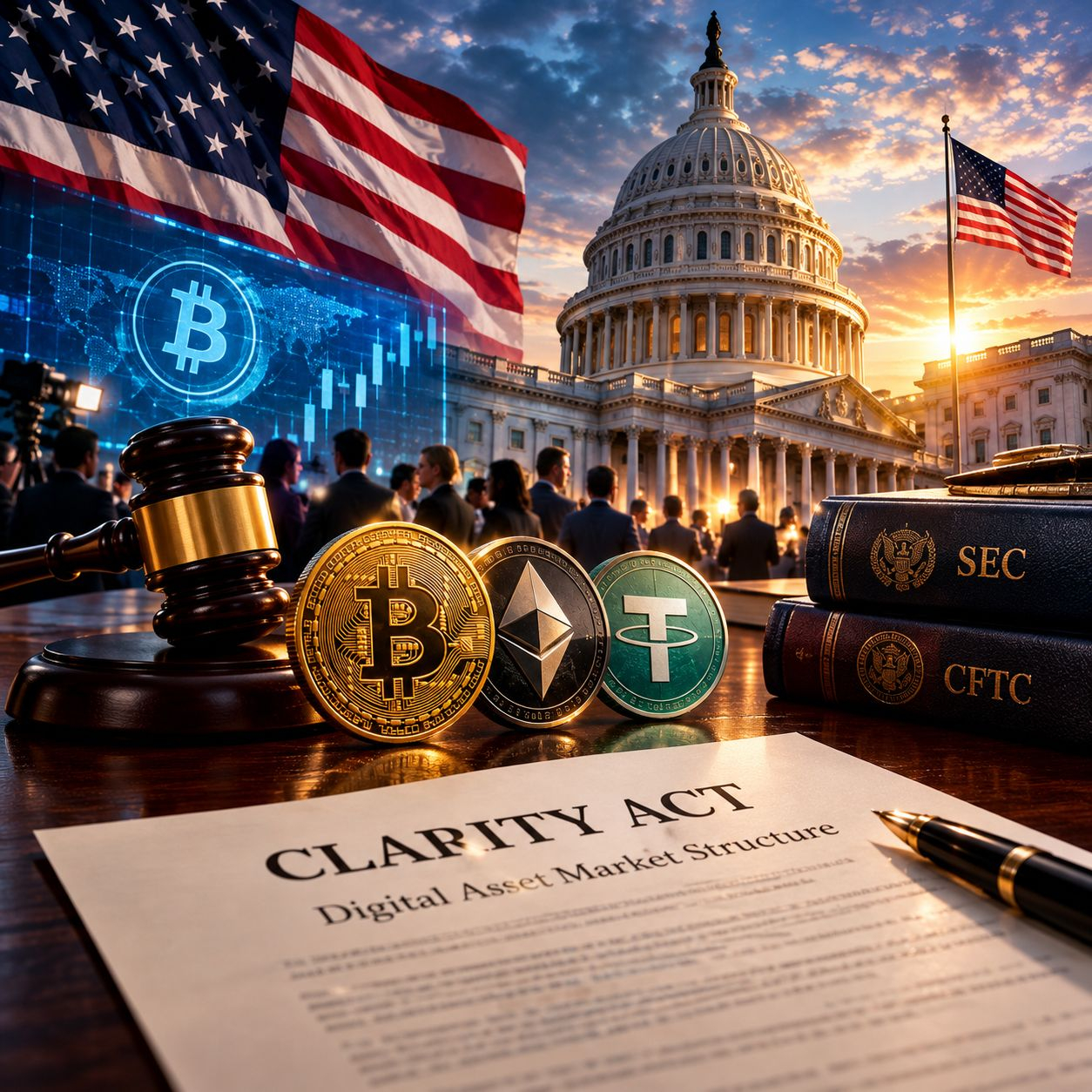
The U.S. Senate is preparing for a September 15 procedural vote on the CLARITY Act.
The bill could establish clearer rules for digital assets and define the roles of the SEC and CFTC.
Crypto groups and banking organizations are now intensifying their lobbying efforts ahead of the vote. 👀
Could this become a major turning point for the U.S. crypto market?
#CryptoRegulation #CLARITYAct #bitcoin #CryptoNewss #BinanceSquareFamily
🚨 BREAKING: Crypto's Biggest U.S. Regulatory Battle Is Heating Up! 🇺🇸
The U.S. Senate is preparing for a September 15 procedural vote on the CLARITY Act.
The bill could establish clearer rules for digital assets and define the roles of the SEC and CFTC.
Crypto groups and banking organizations are now intensifying their lobbying efforts ahead of the vote. 👀
Could this become a major turning point for the U.S. crypto market?
#CryptoRegulation #CLARITYAct #bitcoin #CryptoNewss #BinanceSquareFamily
The U.S. Senate is preparing for a September 15 procedural vote on the CLARITY Act.
The bill could establish clearer rules for digital assets and define the roles of the SEC and CFTC.
Crypto groups and banking organizations are now intensifying their lobbying efforts ahead of the vote. 👀
Could this become a major turning point for the U.S. crypto market?
#CryptoRegulation #CLARITYAct #bitcoin #CryptoNewss #BinanceSquareFamily
2

·
--
Ripple is pushing to advance the CLARITY Act—and the next Senate step matters for crypto.Ripple’s chief legal officer, Stuart Alderoty, is urging undecided senators’ offices to meet everyday crypto holders ahead of a September 15 procedural vote.
For beginners, the key distinction is simple: a vote to advance debate does not make a bill law. Further legislative steps would still remain.
The CLARITY Act aims to clarify how digital assets are classified and which U.S. regulators oversee them. That could help businesses understand the rules for building and offering crypto services.
For $XRP , the possible market impact depends on what actually happens:
📈 Supportive scenario: legislative progress strengthens confidence in clearer rules and encourages businesses to plan new services.
📉 Cautious scenario: delays, opposition or disputed amendments prolong uncertainty and weaken sentiment.
Ripple’s advocacy shows its policy priorities. It does not guarantee passage, immediate institutional buying or a higher $XRP price.
Watch the official vote outcome and final bill language before turning a political headline into a trading decision.
What matters more for crypto adoption: clearer rules or stronger real-world usage?
#RippleLobbiesToAdvanceCLARITYActVote #xrp #CryptoRegulation
$XRP
{future}(XRPUSDT)
Ripple is pushing to advance the CLARITY Act—and the next Senate step matters for crypto.
Ripple’s chief legal officer, Stuart Alderoty, is urging undecided senators’ offices to meet everyday crypto holders ahead of a September 15 procedural vote.
For beginners, the key distinction is simple: a vote to advance debate does not make a bill law. Further legislative steps would still remain.
The CLARITY Act aims to clarify how digital assets are classified and which U.S. regulators oversee them. That could help businesses understand the rules for building and offering crypto services.
For $XRP , the possible market impact depends on what actually happens:
📈 Supportive scenario: legislative progress strengthens confidence in clearer rules and encourages businesses to plan new services.
📉 Cautious scenario: delays, opposition or disputed amendments prolong uncertainty and weaken sentiment.
Ripple’s advocacy shows its policy priorities. It does not guarantee passage, immediate institutional buying or a higher $XRP price.
Watch the official vote outcome and final bill language before turning a political headline into a trading decision.
What matters more for crypto adoption: clearer rules or stronger real-world usage?
#RippleLobbiesToAdvanceCLARITYActVote #xrp #CryptoRegulation
$XRP
For beginners, the key distinction is simple: a vote to advance debate does not make a bill law. Further legislative steps would still remain.
The CLARITY Act aims to clarify how digital assets are classified and which U.S. regulators oversee them. That could help businesses understand the rules for building and offering crypto services.
For $XRP , the possible market impact depends on what actually happens:
📈 Supportive scenario: legislative progress strengthens confidence in clearer rules and encourages businesses to plan new services.
📉 Cautious scenario: delays, opposition or disputed amendments prolong uncertainty and weaken sentiment.
Ripple’s advocacy shows its policy priorities. It does not guarantee passage, immediate institutional buying or a higher $XRP price.
Watch the official vote outcome and final bill language before turning a political headline into a trading decision.
What matters more for crypto adoption: clearer rules or stronger real-world usage?
#RippleLobbiesToAdvanceCLARITYActVote #xrp #CryptoRegulation
$XRP
1
61

·
--
The CLARITY Act is heading for a critical Senate cloture vote on Sept 15, but it’s not an easy path. 🏛️
The bill faces heavy pushback over ethics concerns, stablecoin rules, and divided Democratic support. Despite the friction, industry optimism remains high. Will this be the breakthrough US crypto regulation needs, or will political gridlock stall progress?
Eyes on the Senate! 🗳️
#CryptoRegulation #CLARITYAct #Stablecoins
The CLARITY Act is heading for a critical Senate cloture vote on Sept 15, but it’s not an easy path. 🏛️
The bill faces heavy pushback over ethics concerns, stablecoin rules, and divided Democratic support. Despite the friction, industry optimism remains high. Will this be the breakthrough US crypto regulation needs, or will political gridlock stall progress?
Eyes on the Senate! 🗳️
#CryptoRegulation #CLARITYAct #Stablecoins
The bill faces heavy pushback over ethics concerns, stablecoin rules, and divided Democratic support. Despite the friction, industry optimism remains high. Will this be the breakthrough US crypto regulation needs, or will political gridlock stall progress?
Eyes on the Senate! 🗳️
#CryptoRegulation #CLARITYAct #Stablecoins
23
·
--
$BTC: Block seeks OCC charter for Bitcoin trust bank Live: $BTC 78,911 (+0.49% 24h) · 24h range 77,666-79,312 · 37.25B USDT 24h vol
Block has asked the federal bank regulator for permission to run a national trust bank for Bitcoin and stablecoin custody. Crypto Briefing reported the application as a move to bring that custody business under direct federal oversight. It's a serious step, not a press release.
Block is Jack Dorsey's company, and it's long been close to Bitcoin. So a charter would tie that history to a regulated balance sheet. That link is why this filing drew attention.
A trust charter means federal oversight
The OCC, the office that charters national banks, would have to grant the approval. A national trust bank does not work like a branch bank, since it holds assets for clients instead of taking deposits and making loans.
Approval would put Block under regular federal exams and reporting rules. Examiners can check controls, capital, and how client assets are kept separate. And failure to meet those marks can bring limits or loss of powers.
$BTC #BTC #CryptoRegulation #CryptoNews
$BTC : Block seeks OCC charter for Bitcoin trust bank Live: $BTC 78,911 (+0.49% 24h) · 24h range 77,666-79,312 · 37.25B USDT 24h vol
Block has asked the federal bank regulator for permission to run a national trust bank for Bitcoin and stablecoin custody. Crypto Briefing reported the application as a move to bring that custody business under direct federal oversight. It's a serious step, not a press release.
Block is Jack Dorsey's company, and it's long been close to Bitcoin. So a charter would tie that history to a regulated balance sheet. That link is why this filing drew attention.
A trust charter means federal oversight
The OCC, the office that charters national banks, would have to grant the approval. A national trust bank does not work like a branch bank, since it holds assets for clients instead of taking deposits and making loans.
Approval would put Block under regular federal exams and reporting rules. Examiners can check controls, capital, and how client assets are kept separate. And failure to meet those marks can bring limits or loss of powers.
$BTC #BTC #CryptoRegulation #CryptoNews
Block has asked the federal bank regulator for permission to run a national trust bank for Bitcoin and stablecoin custody. Crypto Briefing reported the application as a move to bring that custody business under direct federal oversight. It's a serious step, not a press release.
Block is Jack Dorsey's company, and it's long been close to Bitcoin. So a charter would tie that history to a regulated balance sheet. That link is why this filing drew attention.
A trust charter means federal oversight
The OCC, the office that charters national banks, would have to grant the approval. A national trust bank does not work like a branch bank, since it holds assets for clients instead of taking deposits and making loans.
Approval would put Block under regular federal exams and reporting rules. Examiners can check controls, capital, and how client assets are kept separate. And failure to meet those marks can bring limits or loss of powers.
$BTC #BTC #CryptoRegulation #CryptoNews
42
·
--
The shift from enforcement-by-litigation to rule-by-legislation is the most underappreciated regime change in crypto right now.
For four years, US regulators operated by suing first and defining rules never. That era produced something valuable: it forced the chains that took compliance seriously to build regulatory architecture into their infrastructure from day one. Not as an afterthought — as a core design choice.
Now the legislative era is arriving. The GENIUS Act, the Clarity Act, and the emerging tokenized stock framework at the SEC are replacing ambiguity with specificity. And here is what nobody is pricing in: the chains that spent the enforcement era building compliance rails are about to see those investments compound.
$BTC benefits because it was always outside the regulatory perimeter — a commodity, not a security. $ETH benefits because the Pectra upgrade made staking yield institutionally legible. $XRP benefits because a federal judge already handed it the clearest regulatory clarity in the industry.
The irony of the enforcement era is that it created a compliance moat. The projects that survived regulatory pressure without cutting corners are now the ones institutions trust. The ones that took shortcuts are discovering that regulatory debt is real and it compounds.
The next 12 months will not reward projects that avoided regulation. They will reward the ones that built for it.
#CryptoRegulation #InstitutionalAdoption #ComplianceInfrastructure #CryptoMarkets #RegulatoryClarity
The shift from enforcement-by-litigation to rule-by-legislation is the most underappreciated regime change in crypto right now.
For four years, US regulators operated by suing first and defining rules never. That era produced something valuable: it forced the chains that took compliance seriously to build regulatory architecture into their infrastructure from day one. Not as an afterthought — as a core design choice.
Now the legislative era is arriving. The GENIUS Act, the Clarity Act, and the emerging tokenized stock framework at the SEC are replacing ambiguity with specificity. And here is what nobody is pricing in: the chains that spent the enforcement era building compliance rails are about to see those investments compound.
$BTC benefits because it was always outside the regulatory perimeter — a commodity, not a security. $ETH benefits because the Pectra upgrade made staking yield institutionally legible. $XRP benefits because a federal judge already handed it the clearest regulatory clarity in the industry.
The irony of the enforcement era is that it created a compliance moat. The projects that survived regulatory pressure without cutting corners are now the ones institutions trust. The ones that took shortcuts are discovering that regulatory debt is real and it compounds.
The next 12 months will not reward projects that avoided regulation. They will reward the ones that built for it.
#CryptoRegulation #InstitutionalAdoption #ComplianceInfrastructure #CryptoMarkets #RegulatoryClarity
For four years, US regulators operated by suing first and defining rules never. That era produced something valuable: it forced the chains that took compliance seriously to build regulatory architecture into their infrastructure from day one. Not as an afterthought — as a core design choice.
Now the legislative era is arriving. The GENIUS Act, the Clarity Act, and the emerging tokenized stock framework at the SEC are replacing ambiguity with specificity. And here is what nobody is pricing in: the chains that spent the enforcement era building compliance rails are about to see those investments compound.
$BTC benefits because it was always outside the regulatory perimeter — a commodity, not a security. $ETH benefits because the Pectra upgrade made staking yield institutionally legible. $XRP benefits because a federal judge already handed it the clearest regulatory clarity in the industry.
The irony of the enforcement era is that it created a compliance moat. The projects that survived regulatory pressure without cutting corners are now the ones institutions trust. The ones that took shortcuts are discovering that regulatory debt is real and it compounds.
The next 12 months will not reward projects that avoided regulation. They will reward the ones that built for it.
#CryptoRegulation #InstitutionalAdoption #ComplianceInfrastructure #CryptoMarkets #RegulatoryClarity
1
70

·
--
The 'Exchange Detective' loves chasing lost coins, but on-chain transparency cuts both ways.
Bit2Me’s new law enforcement unit turns exchanges into digital forensics labs. Watch how liquidity providers use these tools. Tighter compliance often signals a wave of institutional oversight for assets like $ENA and $BNB. This is for information only.
#CryptoRegulation #OnChain #SEC
The 'Exchange Detective' loves chasing lost coins, but on-chain transparency cuts both ways.
Bit2Me’s new law enforcement unit turns exchanges into digital forensics labs. Watch how liquidity providers use these tools. Tighter compliance often signals a wave of institutional oversight for assets like $ENA and $BNB . This is for information only.
#CryptoRegulation #OnChain #SEC
Bit2Me’s new law enforcement unit turns exchanges into digital forensics labs. Watch how liquidity providers use these tools. Tighter compliance often signals a wave of institutional oversight for assets like $ENA and $BNB . This is for information only.
#CryptoRegulation #OnChain #SEC
139

Here’s what happened when traders started pricing a Republican midterm win as an automatic bullish catalyst for crypto.
The risk is simple: investors front-run the narrative, FOMO into $BTC and $ETH, then get trapped when policy progress falls short of expectations. A crypto-friendly headline does not guarantee a clean market reaction.
The 30D profit leaderboard highlighted how strongly political expectations were shaping positioning ahead of the November midterms. The prevailing thesis was that continued Republican control of Congress would support crypto through the Trump administration’s lighter regulatory approach.
That confidence was reinforced by the stablecoin bill passing and anticipation around the unfinished market structure bill. But this is where the setup gets fragile: if the second bill is delayed, diluted, or blocked, crowded bullish positions could unwind quickly, while regulatory details could still create unexpected risks for stablecoins such as $USDT.
The lesson is to separate political narratives from confirmed policy and actual market impact. What happens if traders have already priced in the best-case scenario?
#Bitcoin #CryptoRegulation #MarketRisk
Here’s what happened when traders started pricing a Republican midterm win as an automatic bullish catalyst for crypto.
The risk is simple: investors front-run the narrative, FOMO into $BTC and $ETH , then get trapped when policy progress falls short of expectations. A crypto-friendly headline does not guarantee a clean market reaction.
The 30D profit leaderboard highlighted how strongly political expectations were shaping positioning ahead of the November midterms. The prevailing thesis was that continued Republican control of Congress would support crypto through the Trump administration’s lighter regulatory approach.
That confidence was reinforced by the stablecoin bill passing and anticipation around the unfinished market structure bill. But this is where the setup gets fragile: if the second bill is delayed, diluted, or blocked, crowded bullish positions could unwind quickly, while regulatory details could still create unexpected risks for stablecoins such as $USDT.
The lesson is to separate political narratives from confirmed policy and actual market impact. What happens if traders have already priced in the best-case scenario?
#Bitcoin #CryptoRegulation #MarketRisk
The risk is simple: investors front-run the narrative, FOMO into $BTC and $ETH , then get trapped when policy progress falls short of expectations. A crypto-friendly headline does not guarantee a clean market reaction.
The 30D profit leaderboard highlighted how strongly political expectations were shaping positioning ahead of the November midterms. The prevailing thesis was that continued Republican control of Congress would support crypto through the Trump administration’s lighter regulatory approach.
That confidence was reinforced by the stablecoin bill passing and anticipation around the unfinished market structure bill. But this is where the setup gets fragile: if the second bill is delayed, diluted, or blocked, crowded bullish positions could unwind quickly, while regulatory details could still create unexpected risks for stablecoins such as $USDT.
The lesson is to separate political narratives from confirmed policy and actual market impact. What happens if traders have already priced in the best-case scenario?
#Bitcoin #CryptoRegulation #MarketRisk

29

·
--
Global Regulation: Eight Chinese Ministries Finalize Strict Online Financial Marketing RulesA significant shift in international digital asset compliance is underway as eight Chinese ministries jointly finalized comprehensive guidelines targeting the online marketing of financial products. The new, stringent regulatory framework, widely distributed across Binance News networks, is officially set for implementation on September 30, 2026.Compliance experts emphasize that the upcoming rules do not represent a blanket prohibition; rather, they establish a definitive legal boundary between specialized technology providers and regulated financial services. The framework introduces strict oversight regarding financial promotions on public accounts, short videos, and interactive live streams.Entities operating within the digital ecosystem must ensure that any product representations are fully licensed, directly targeting the elimination of misleading yield promises and unverified promotional schemes across regional retail networks.
$BTC
{spot}(BTCUSDT)
#CryptoRegulation #FinancialCompliance #GlobalMarkets #BinanceNews #RegulatoryUpdate
Global Regulation: Eight Chinese Ministries Finalize Strict Online Financial Marketing Rules
A significant shift in international digital asset compliance is underway as eight Chinese ministries jointly finalized comprehensive guidelines targeting the online marketing of financial products. The new, stringent regulatory framework, widely distributed across Binance News networks, is officially set for implementation on September 30, 2026.Compliance experts emphasize that the upcoming rules do not represent a blanket prohibition; rather, they establish a definitive legal boundary between specialized technology providers and regulated financial services. The framework introduces strict oversight regarding financial promotions on public accounts, short videos, and interactive live streams.Entities operating within the digital ecosystem must ensure that any product representations are fully licensed, directly targeting the elimination of misleading yield promises and unverified promotional schemes across regional retail networks.
$BTC
#CryptoRegulation #FinancialCompliance #GlobalMarkets #BinanceNews #RegulatoryUpdate
$BTC
#CryptoRegulation #FinancialCompliance #GlobalMarkets #BinanceNews #RegulatoryUpdate
1
14
·
--
Crypto Tax Clarity Is the Regulatory Shift Nobody Is Pricing In
Everyone focuses on spot ETF approvals and exchange licenses when they think about regulatory progress. But the more durable shift happening right now is on-chain tax reporting infrastructure — and it changes the game for institutional capital flows in ways most traders are not pricing in.
Here is why it matters: institutional allocators are not just worried about whether crypto is legal. They are worried about compliance cost. When tax reporting is ambiguous, murky, or requires armies of accountants to reconcile on-chain activity, the friction alone keeps capital on the sidelines. Clear, standardized on-chain tax rails remove that friction.
The countries that have moved fastest on this — cleaner cost-basis reporting, DeFi transaction classification, staking income guidance — have seen deeper institutional participation almost immediately. This is not a coincidence.
$BTC benefits most in the near term because it is the simplest asset to classify. $XRP has been living this story for years — its legal clarity journey is essentially a tax and compliance story at its core. $SOL faces the harder question: how do regulators classify staking rewards and smart contract interactions at scale.
The jurisdictions that solve this cleanest will attract the most capital. Watch where the compliance infrastructure is being built — that is where the next wave of institutional depth arrives.
#CryptoRegulation #CryptoTax #Blockchain #CryptoInvesting #BinanceSquare
Crypto Tax Clarity Is the Regulatory Shift Nobody Is Pricing In
Everyone focuses on spot ETF approvals and exchange licenses when they think about regulatory progress. But the more durable shift happening right now is on-chain tax reporting infrastructure — and it changes the game for institutional capital flows in ways most traders are not pricing in.
Here is why it matters: institutional allocators are not just worried about whether crypto is legal. They are worried about compliance cost. When tax reporting is ambiguous, murky, or requires armies of accountants to reconcile on-chain activity, the friction alone keeps capital on the sidelines. Clear, standardized on-chain tax rails remove that friction.
The countries that have moved fastest on this — cleaner cost-basis reporting, DeFi transaction classification, staking income guidance — have seen deeper institutional participation almost immediately. This is not a coincidence.
$BTC benefits most in the near term because it is the simplest asset to classify. $XRP has been living this story for years — its legal clarity journey is essentially a tax and compliance story at its core. $SOL faces the harder question: how do regulators classify staking rewards and smart contract interactions at scale.
The jurisdictions that solve this cleanest will attract the most capital. Watch where the compliance infrastructure is being built — that is where the next wave of institutional depth arrives.
#CryptoRegulation #CryptoTax #Blockchain #CryptoInvesting #BinanceSquare
Everyone focuses on spot ETF approvals and exchange licenses when they think about regulatory progress. But the more durable shift happening right now is on-chain tax reporting infrastructure — and it changes the game for institutional capital flows in ways most traders are not pricing in.
Here is why it matters: institutional allocators are not just worried about whether crypto is legal. They are worried about compliance cost. When tax reporting is ambiguous, murky, or requires armies of accountants to reconcile on-chain activity, the friction alone keeps capital on the sidelines. Clear, standardized on-chain tax rails remove that friction.
The countries that have moved fastest on this — cleaner cost-basis reporting, DeFi transaction classification, staking income guidance — have seen deeper institutional participation almost immediately. This is not a coincidence.
$BTC benefits most in the near term because it is the simplest asset to classify. $XRP has been living this story for years — its legal clarity journey is essentially a tax and compliance story at its core. $SOL faces the harder question: how do regulators classify staking rewards and smart contract interactions at scale.
The jurisdictions that solve this cleanest will attract the most capital. Watch where the compliance infrastructure is being built — that is where the next wave of institutional depth arrives.
#CryptoRegulation #CryptoTax #Blockchain #CryptoInvesting #BinanceSquare
62

·
--
🚨 U.S. REGULATORY CLARITY WINDOW CLOSING FAST FOR $PIEVERSE AND ALTCOINS! ⚡
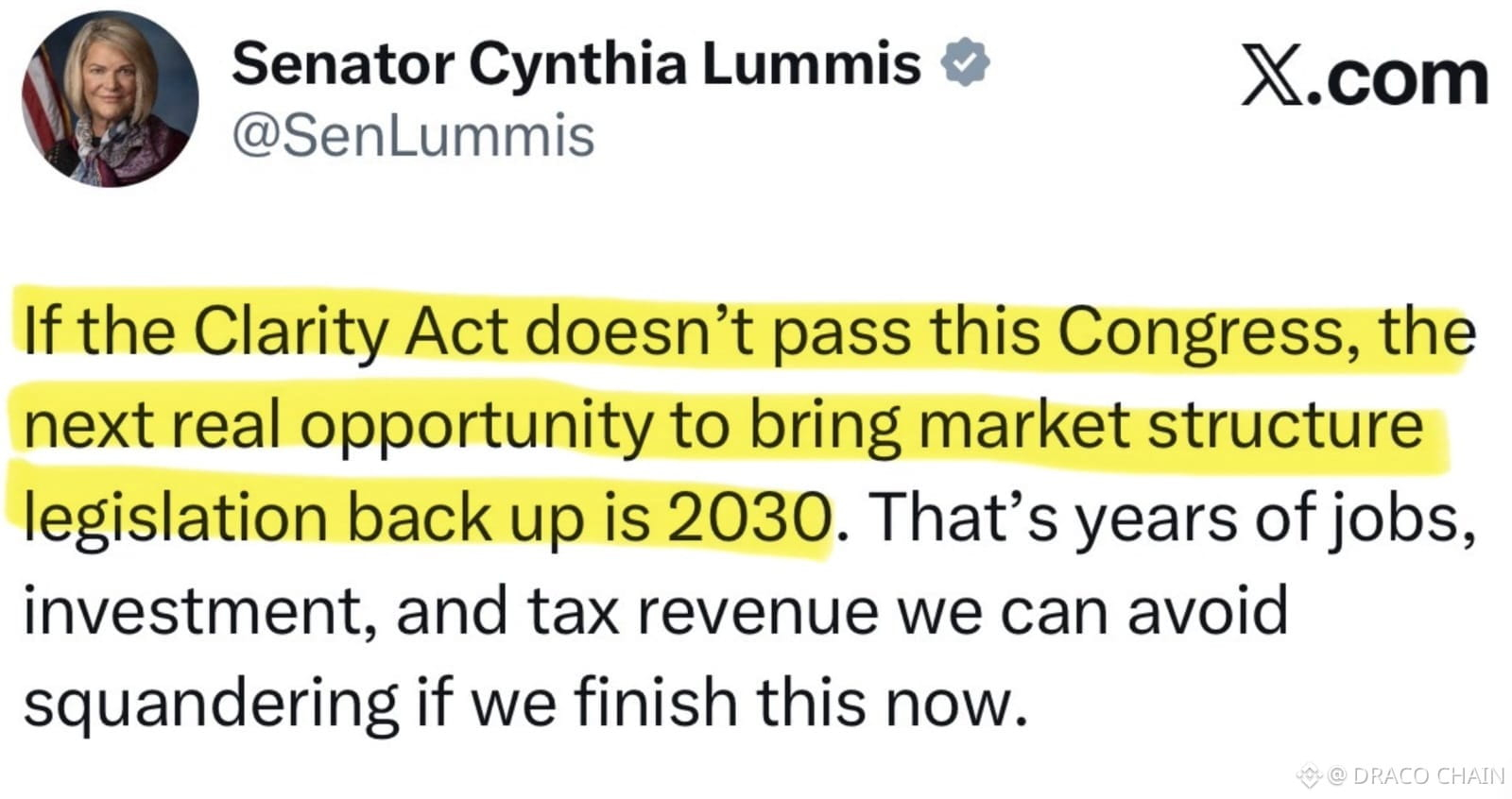
U.S. Senator Lummis issued a stark warning regarding the CLARITY Act, highlighting that failure to pass legislation in this Congress could stall institutional framework progress until 2030. Institutional capital requires defined legal parameters before deploying deep liquidity into assets like $PIEVERSE . 🔒
Smart money historically prices in regulatory resolution long before formal implementation, creating structural accumulation windows during periods of policy uncertainty. 💡 Without a clear legislative runway, capital efficiency shifts while market participants await definitive structural pivots. 📊
As political urgency mounts, institutional order flow remains heavily tied to macro developments. 💬 Do you expect legislative progress to trigger immediate capital inflow, or will uncertainty keep liquidity sidelined? 👇
⚠️ Not financial advice. Always manage your risk. 🛡️
🏷️ #PIEVERSE #CryptoRegulation #SmartMoney #MarketStructure
🎯 🦈
🚨 U.S. REGULATORY CLARITY WINDOW CLOSING FAST FOR $PIEVERSE AND ALTCOINS! ⚡
U.S. Senator Lummis issued a stark warning regarding the CLARITY Act, highlighting that failure to pass legislation in this Congress could stall institutional framework progress until 2030. Institutional capital requires defined legal parameters before deploying deep liquidity into assets like $PIEVERSE . 🔒
Smart money historically prices in regulatory resolution long before formal implementation, creating structural accumulation windows during periods of policy uncertainty. 💡 Without a clear legislative runway, capital efficiency shifts while market participants await definitive structural pivots. 📊
As political urgency mounts, institutional order flow remains heavily tied to macro developments. 💬 Do you expect legislative progress to trigger immediate capital inflow, or will uncertainty keep liquidity sidelined? 👇
⚠️ Not financial advice. Always manage your risk. 🛡️
🏷️ #PIEVERSE #CryptoRegulation #SmartMoney #MarketStructure
🎯 🦈
U.S. Senator Lummis issued a stark warning regarding the CLARITY Act, highlighting that failure to pass legislation in this Congress could stall institutional framework progress until 2030. Institutional capital requires defined legal parameters before deploying deep liquidity into assets like $PIEVERSE . 🔒
Smart money historically prices in regulatory resolution long before formal implementation, creating structural accumulation windows during periods of policy uncertainty. 💡 Without a clear legislative runway, capital efficiency shifts while market participants await definitive structural pivots. 📊
As political urgency mounts, institutional order flow remains heavily tied to macro developments. 💬 Do you expect legislative progress to trigger immediate capital inflow, or will uncertainty keep liquidity sidelined? 👇
⚠️ Not financial advice. Always manage your risk. 🛡️
🏷️ #PIEVERSE #CryptoRegulation #SmartMoney #MarketStructure
🎯 🦈
55
Log in to explore more content
Join global crypto users on Binance Square
⚡️ Get latest and useful information about crypto.
💬 Trusted by the world’s largest crypto exchange.
👍 Discover real insights from verified creators.
Email / Phone number
Trending Topics
1
#AppleDebutsFoldablePhone
43,407 views
859 Discussing
2
#TSMCAugustRevenueUp53.3%YoY
9,198 views
266 Discussing
3
#IranSaysReadyToEscalateWarWithUS
11,899 views
274 Discussing
4
#EUExtendsCentralContactPointToCASPs
12,890 views
331 Discussing
5
#US10YTreasuryYieldHitsHighestSinceNov2023
35,183 views
553 Discussing
6
#USTreasuryToBuyBackUpTo$6BLongDatedDebt
20,821 views
180 Discussing
7
#BitcoinSurpasses$79K
73,159 views
293 Discussing
8
#BrentCrudeTops$100
132,492 views
418 Discussing
9
#USADPWeeklyEmploymentRises12000
123,207 views
1,456 Discussing
10
#BankOfAmericaGroupPilotsUSBDCStablecoin
91,906 views
1,143 Discussing