

Bilal_With_Crypto
982 Posts

Bilal_With_Crypto
Report
Block User
X • @Bilal_With_Crypto | 📊 Trader & Alpha Provider | 🔥 Futures • Spot • BNB Edge | 💎 Profit with Precision | 🚀 Guiding
Open Trade
Frequent Trader
3.5 Years
71 Following
2.5K+ Followers
1.2K+ Liked
Posts
Portfolio
All
Quotes
Videos
Live
$DEBIT Holds Firm — Bullish Setup Still Alive 🚀
$DEBIT rallied from $1.76 to $2.43 before entering consolidation. Price is now around $2.07, holding near the MA7 while staying above the MA200.
Key Levels:
🟢 Support: $2.05–$2.07
🔴 Resistance: $2.10–$2.15
🎯 Target: $2.25+
🛑 Stop: Below $2.00
A strong reclaim of $2.10 with volume could bring $2.43 back into focus.
Trading Bias: Mildly Bullish
Farm to Earn on @ston_fi — but always check APR, pool conditions and risks before entering.
DYOR. NFA.
#AltcoinSeason #debit #ston
$DEBIT Holds Firm — Bullish Setup Still Alive 🚀
$DEBIT rallied from $1.76 to $2.43 before entering consolidation. Price is now around $2.07, holding near the MA7 while staying above the MA200.
Key Levels:
🟢 Support: $2.05–$2.07
🔴 Resistance: $2.10–$2.15
🎯 Target: $2.25+
🛑 Stop: Below $2.00
A strong reclaim of $2.10 with volume could bring $2.43 back into focus.
Trading Bias: Mildly Bullish
Farm to Earn on @ston_fi — but always check APR, pool conditions and risks before entering.
DYOR. NFA.
#AltcoinSeason #debit #ston
$DEBIT rallied from $1.76 to $2.43 before entering consolidation. Price is now around $2.07, holding near the MA7 while staying above the MA200.
Key Levels:
🟢 Support: $2.05–$2.07
🔴 Resistance: $2.10–$2.15
🎯 Target: $2.25+
🛑 Stop: Below $2.00
A strong reclaim of $2.10 with volume could bring $2.43 back into focus.
Trading Bias: Mildly Bullish
Farm to Earn on @ston_fi — but always check APR, pool conditions and risks before entering.
DYOR. NFA.
#AltcoinSeason #debit #ston

431
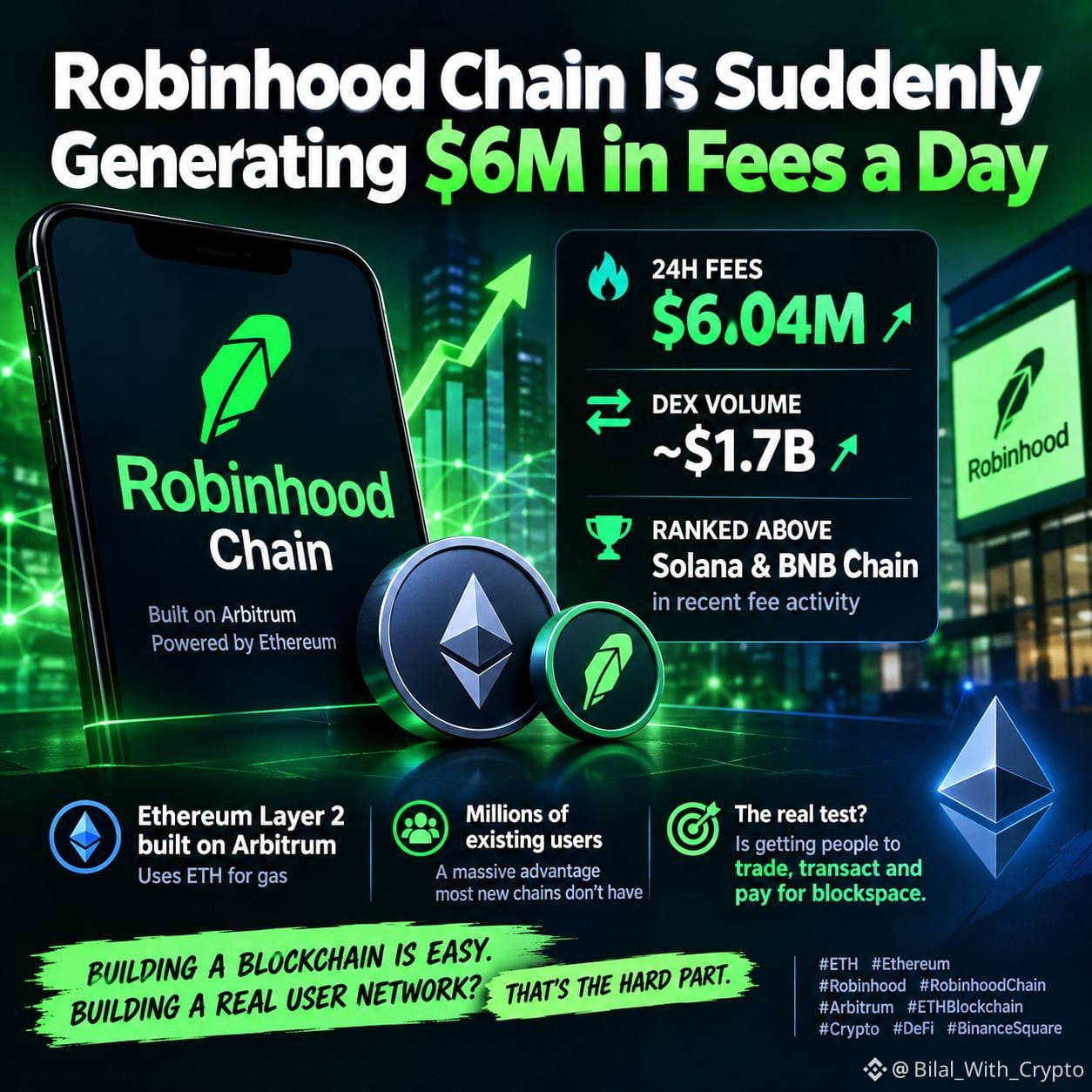
🚨 Robinhood Chain Is Suddenly Printing $6M+ in Daily Fees
$HOOD’s blockchain experiment is getting hard to ignore.
Robinhood Chain recently hit a record ~$6.04M in 24H fees, while DEX volume reached roughly $1.7B. The network has even ranked ahead of major chains like Solana and BNB Chain in recent fee activity.
And this is where the story gets interesting.
Robinhood Chain is an Ethereum Layer 2 built on Arbitrum, using $ETH for gas.
The real test for any new blockchain isn't just launching the chain.
It’s getting people to trade, transact and actually pay for blockspace.
Robinhood has one massive advantage most new chains don't:
Millions of existing users.
Building another blockchain is becoming easier.
Building a network with real users and real economic activity?
That's the hard part.
Now we get to see how valuable Robinhood’s distribution really is. 👀
#ETHBlockchai #Ethereum #Robinhood #Arbitrum
🚨 Robinhood Chain Is Suddenly Printing $6M+ in Daily Fees
$HOOD’s blockchain experiment is getting hard to ignore.
Robinhood Chain recently hit a record ~$6.04M in 24H fees, while DEX volume reached roughly $1.7B. The network has even ranked ahead of major chains like Solana and BNB Chain in recent fee activity.
And this is where the story gets interesting.
Robinhood Chain is an Ethereum Layer 2 built on Arbitrum, using $ETH for gas.
The real test for any new blockchain isn't just launching the chain.
It’s getting people to trade, transact and actually pay for blockspace.
Robinhood has one massive advantage most new chains don't:
Millions of existing users.
Building another blockchain is becoming easier.
Building a network with real users and real economic activity?
That's the hard part.
Now we get to see how valuable Robinhood’s distribution really is. 👀
#ETHBlockchai #Ethereum #Robinhood #Arbitrum
$HOOD’s blockchain experiment is getting hard to ignore.
Robinhood Chain recently hit a record ~$6.04M in 24H fees, while DEX volume reached roughly $1.7B. The network has even ranked ahead of major chains like Solana and BNB Chain in recent fee activity.
And this is where the story gets interesting.
Robinhood Chain is an Ethereum Layer 2 built on Arbitrum, using $ETH for gas.
The real test for any new blockchain isn't just launching the chain.
It’s getting people to trade, transact and actually pay for blockspace.
Robinhood has one massive advantage most new chains don't:
Millions of existing users.
Building another blockchain is becoming easier.
Building a network with real users and real economic activity?
That's the hard part.
Now we get to see how valuable Robinhood’s distribution really is. 👀
#ETHBlockchai #Ethereum #Robinhood #Arbitrum
103
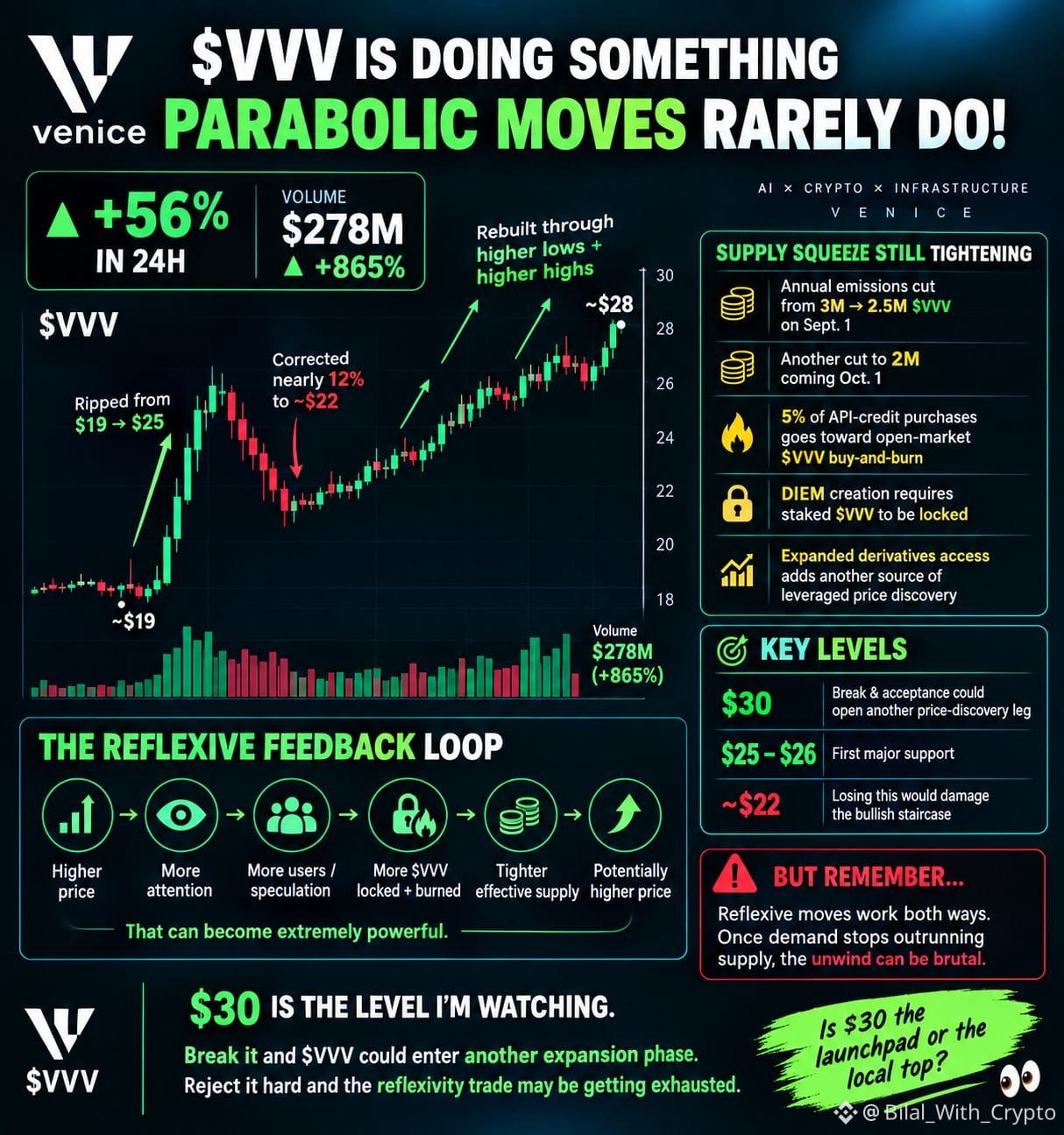
🚨 $VVV IS DOING SOMETHING PARABOLIC MOVES RARELY DO!
$VVV is still up +56% in 24H, with volume exploding to ~$278M — an 865% surge.
But the real signal isn’t the first pump. It’s what happened AFTER it. 👀
Price ripped from ~$19 → $25, pulled back nearly 12% to ~$22, then rebuilt the entire move through a staircase of higher lows + higher highs, pushing back toward ~$28.
Meanwhile, the supply side keeps tightening:
🔥 Annual emissions cut from 3M → 2.5M $VVV on Sept. 1
🔥 Another cut to 2M coming Oct. 1
🔥 5% of API-credit purchases goes toward open-market $VVV buy-and-burn
🔥 DIEM creation requires staked $VVV to be locked
🔥 Expanded derivatives access adds another source of leveraged price discovery
Now the battlefield is clear:
🎯 $30 → Break & acceptance could open another price-discovery leg
🟢 $25–$26 → First major support
⚠️ ~$22 → Losing this would damage the bullish staircase
The bigger story is the reflexive feedback loop:
Higher price → more attention → more users/speculation → more $VVV locked + burned → tighter effective supply → potentially higher price.
That can become extremely powerful.
But remember: reflexive moves work both ways. Once demand stops outrunning supply, the unwind can be brutal.
$30 is the level I’m watching.
Break it and $VVV could enter another expansion phase.
Reject it hard and the reflexivity trade may be getting exhausted.
Is $30 the launchpad or the local top? 👀
#VVV #Venice #crypto #Altcoins #Aİ
🚨 $VVV IS DOING SOMETHING PARABOLIC MOVES RARELY DO!
$VVV is still up +56% in 24H, with volume exploding to ~$278M — an 865% surge.
But the real signal isn’t the first pump. It’s what happened AFTER it. 👀
Price ripped from ~$19 → $25, pulled back nearly 12% to ~$22, then rebuilt the entire move through a staircase of higher lows + higher highs, pushing back toward ~$28.
Meanwhile, the supply side keeps tightening:
🔥 Annual emissions cut from 3M → 2.5M $VVV on Sept. 1
🔥 Another cut to 2M coming Oct. 1
🔥 5% of API-credit purchases goes toward open-market $VVV buy-and-burn
🔥 DIEM creation requires staked $VVV to be locked
🔥 Expanded derivatives access adds another source of leveraged price discovery
Now the battlefield is clear:
🎯 $30 → Break & acceptance could open another price-discovery leg
🟢 $25–$26 → First major support
⚠️ ~$22 → Losing this would damage the bullish staircase
The bigger story is the reflexive feedback loop:
Higher price → more attention → more users/speculation → more $VVV locked + burned → tighter effective supply → potentially higher price.
That can become extremely powerful.
But remember: reflexive moves work both ways. Once demand stops outrunning supply, the unwind can be brutal.
$30 is the level I’m watching.
Break it and $VVV could enter another expansion phase.
Reject it hard and the reflexivity trade may be getting exhausted.
Is $30 the launchpad or the local top? 👀
#VVV #Venice #crypto #Altcoins #Aİ
$VVV is still up +56% in 24H, with volume exploding to ~$278M — an 865% surge.
But the real signal isn’t the first pump. It’s what happened AFTER it. 👀
Price ripped from ~$19 → $25, pulled back nearly 12% to ~$22, then rebuilt the entire move through a staircase of higher lows + higher highs, pushing back toward ~$28.
Meanwhile, the supply side keeps tightening:
🔥 Annual emissions cut from 3M → 2.5M $VVV on Sept. 1
🔥 Another cut to 2M coming Oct. 1
🔥 5% of API-credit purchases goes toward open-market $VVV buy-and-burn
🔥 DIEM creation requires staked $VVV to be locked
🔥 Expanded derivatives access adds another source of leveraged price discovery
Now the battlefield is clear:
🎯 $30 → Break & acceptance could open another price-discovery leg
🟢 $25–$26 → First major support
⚠️ ~$22 → Losing this would damage the bullish staircase
The bigger story is the reflexive feedback loop:
Higher price → more attention → more users/speculation → more $VVV locked + burned → tighter effective supply → potentially higher price.
That can become extremely powerful.
But remember: reflexive moves work both ways. Once demand stops outrunning supply, the unwind can be brutal.
$30 is the level I’m watching.
Break it and $VVV could enter another expansion phase.
Reject it hard and the reflexivity trade may be getting exhausted.
Is $30 the launchpad or the local top? 👀
#VVV #Venice #crypto #Altcoins #Aİ
138
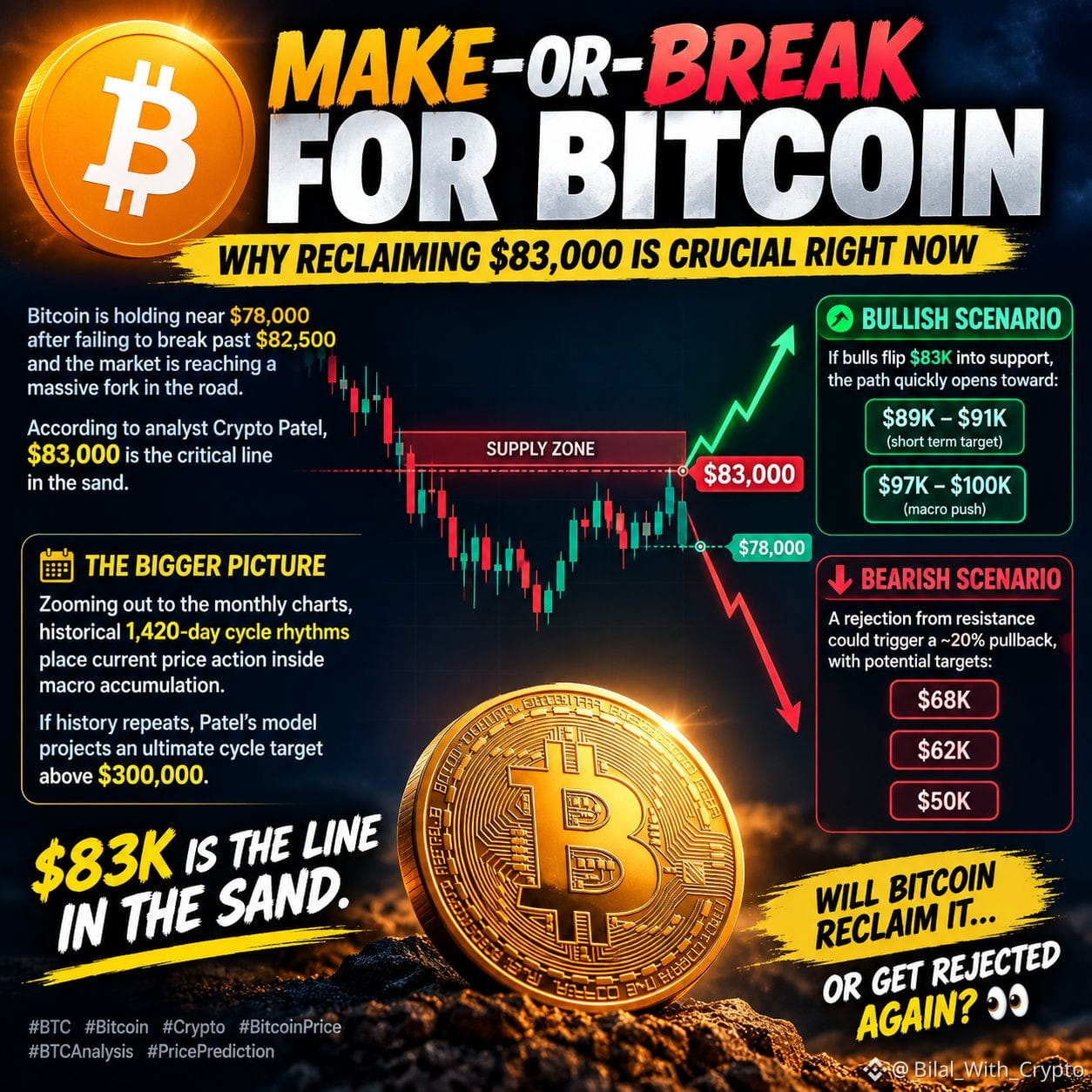
🚨 $BTC MAKE-OR-BREAK ZONE 🚨
Bitcoin is hovering around $78K after failing to reclaim $82.5K — and the next move could define the trend.
According to analyst Crypto Patel, $83K is the key level to watch.
🔴 Bearish Scenario
A rejection from resistance could trigger a ~20% correction, with potential targets:
$68K → $62K → $50K
🟢 Bullish Scenario
A strong daily close above $83K could flip the structure bullish and open the door toward:
$89K–$91K → $97K–$100K
And the long-term chart?
📈 Patel’s 1,420-day cycle model points toward a potential $300K+ BTC target if the historical cycle rhythm continues.
For now, $83K is the line in the sand.
Will Bitcoin reclaim it… or get rejected again? 👀
#bitcoin #BTC #crypto #Bitcoinprice #BTCanalysis
🚨 $BTC MAKE-OR-BREAK ZONE 🚨
Bitcoin is hovering around $78K after failing to reclaim $82.5K — and the next move could define the trend.
According to analyst Crypto Patel, $83K is the key level to watch.
🔴 Bearish Scenario
A rejection from resistance could trigger a ~20% correction, with potential targets:
$68K → $62K → $50K
🟢 Bullish Scenario
A strong daily close above $83K could flip the structure bullish and open the door toward:
$89K–$91K → $97K–$100K
And the long-term chart?
📈 Patel’s 1,420-day cycle model points toward a potential $300K+ BTC target if the historical cycle rhythm continues.
For now, $83K is the line in the sand.
Will Bitcoin reclaim it… or get rejected again? 👀
#bitcoin #BTC #crypto #Bitcoinprice #BTCanalysis
Bitcoin is hovering around $78K after failing to reclaim $82.5K — and the next move could define the trend.
According to analyst Crypto Patel, $83K is the key level to watch.
🔴 Bearish Scenario
A rejection from resistance could trigger a ~20% correction, with potential targets:
$68K → $62K → $50K
🟢 Bullish Scenario
A strong daily close above $83K could flip the structure bullish and open the door toward:
$89K–$91K → $97K–$100K
And the long-term chart?
📈 Patel’s 1,420-day cycle model points toward a potential $300K+ BTC target if the historical cycle rhythm continues.
For now, $83K is the line in the sand.
Will Bitcoin reclaim it… or get rejected again? 👀
#bitcoin #BTC #crypto #Bitcoinprice #BTCanalysis
68
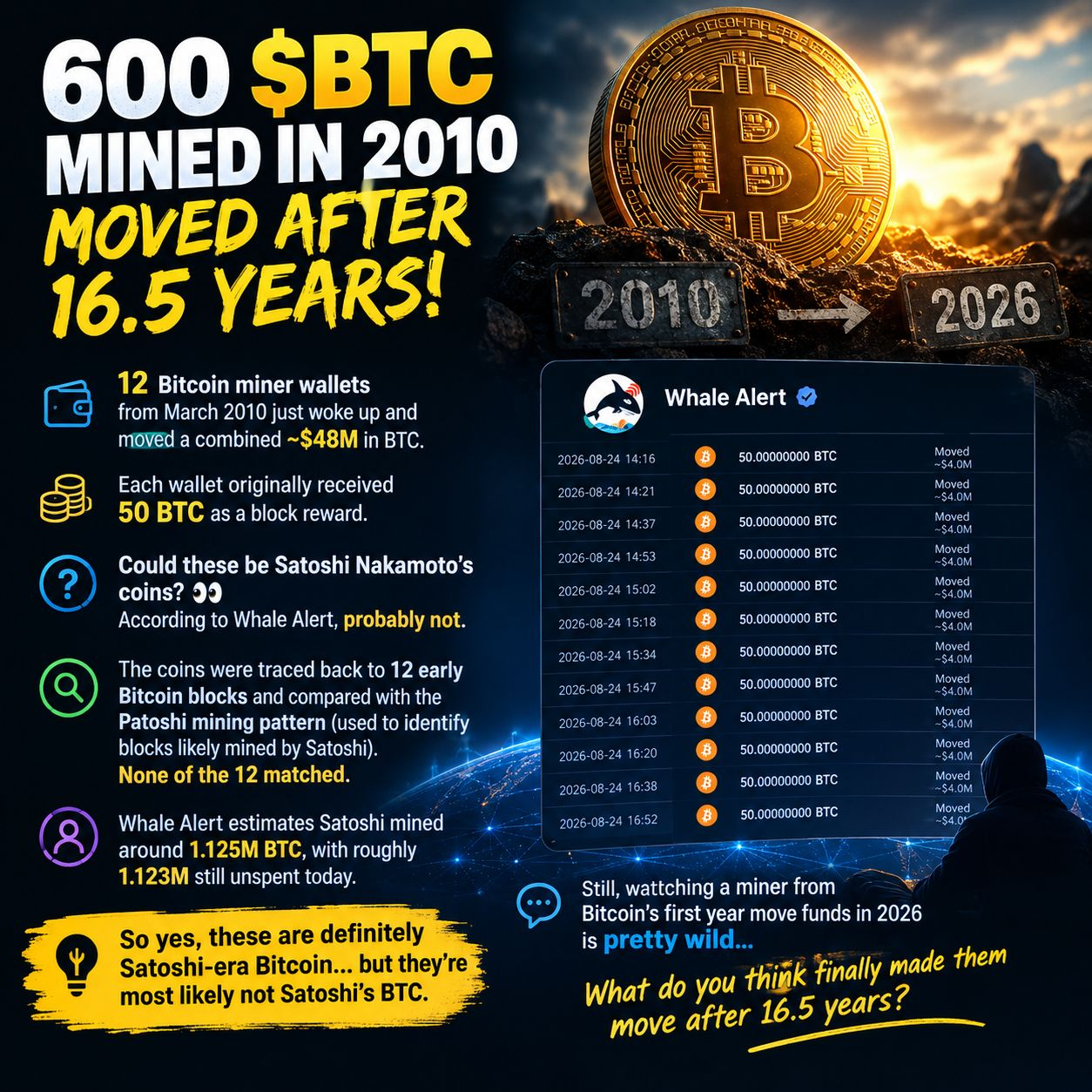
🚨 600 $BTC MOVED AFTER 16.5 YEARS!
12 Bitcoin miner wallets from March 2010 suddenly became active and moved a combined ~$48M in $BTC.
Each wallet originally received 50 BTC as a block reward.
Naturally, the big question is:
Could these be Satoshi Nakamoto’s coins? 👀
According to Whale Alert, probably not.
The coins were traced back to 12 early Bitcoin blocks and compared against the so-called Patoshi mining pattern, which is used to identify blocks believed to have been mined by Satoshi.
None of the 12 wallets matched.
So yes, these are definitely Satoshi-era Bitcoin… but they’re most likely not Satoshi’s BTC.
Whale Alert estimates Satoshi mined around 1.125M $BTC, with roughly 1.123M still untouched.
Still, seeing Bitcoin from the network’s first year suddenly move in 2026 is crazy. 🔥
What do you think finally made these coins move after 16.5 YEARS?
#bitcoin #Bitcoinprice #BTCPricePrediction #crypto $BTC
🚨 600 $BTC MOVED AFTER 16.5 YEARS!
12 Bitcoin miner wallets from March 2010 suddenly became active and moved a combined ~$48M in $BTC .
Each wallet originally received 50 BTC as a block reward.
Naturally, the big question is:
Could these be Satoshi Nakamoto’s coins? 👀
According to Whale Alert, probably not.
The coins were traced back to 12 early Bitcoin blocks and compared against the so-called Patoshi mining pattern, which is used to identify blocks believed to have been mined by Satoshi.
None of the 12 wallets matched.
So yes, these are definitely Satoshi-era Bitcoin… but they’re most likely not Satoshi’s BTC.
Whale Alert estimates Satoshi mined around 1.125M $BTC , with roughly 1.123M still untouched.
Still, seeing Bitcoin from the network’s first year suddenly move in 2026 is crazy. 🔥
What do you think finally made these coins move after 16.5 YEARS?
#bitcoin #Bitcoinprice #BTCPricePrediction #crypto $BTC
12 Bitcoin miner wallets from March 2010 suddenly became active and moved a combined ~$48M in $BTC .
Each wallet originally received 50 BTC as a block reward.
Naturally, the big question is:
Could these be Satoshi Nakamoto’s coins? 👀
According to Whale Alert, probably not.
The coins were traced back to 12 early Bitcoin blocks and compared against the so-called Patoshi mining pattern, which is used to identify blocks believed to have been mined by Satoshi.
None of the 12 wallets matched.
So yes, these are definitely Satoshi-era Bitcoin… but they’re most likely not Satoshi’s BTC.
Whale Alert estimates Satoshi mined around 1.125M $BTC , with roughly 1.123M still untouched.
Still, seeing Bitcoin from the network’s first year suddenly move in 2026 is crazy. 🔥
What do you think finally made these coins move after 16.5 YEARS?
#bitcoin #Bitcoinprice #BTCPricePrediction #crypto $BTC
83
🔥 ARBITRUM vs SOLANA: WHO WINS THE ROBINHOOD BET?
A fresh debate between Arbitrum’s Steven Goldfeder and Solana’s Anatoly Yakovenko is putting blockchain economics under the microscope.
Goldfeder’s argument: Robinhood chose Arbitrum because it wants to be a “landlord, not a tenant.”
That means Robinhood Chain can potentially capture a huge share of the economics — reportedly around 90% of net protocol revenue.
📊 24H Fees: $6.04M
📈 Recent DEX Volume: ~$1.71B
💰 TVL: ~$1.17B
$ARB: $0.1956
Yakovenko’s counterpoint is simple: Robinhood could have built on Solana, subsidized users and monetized activity directly through its own app — without running a separate L2.
But there’s the key difference 👀
Robinhood Chain can potentially earn from third-party apps, bots, DEXs, launchpads and other activity happening across its network.
And now comes the real test:
📅 September 29
That’s when Robinhood’s 90-day gas subsidy expires.
Will users keep transacting when they have to pay real gas?
If activity survives the subsidy cliff, the L2-as-a-business model gets a major validation.
If volume collapses… Solana’s argument gets much stronger.
September 29 could be the day we find out who was right.
$ARB #Arbitrum #sol #solana #Robinhood #crypto $SOL
🔥 ARBITRUM vs SOLANA: WHO WINS THE ROBINHOOD BET?
A fresh debate between Arbitrum’s Steven Goldfeder and Solana’s Anatoly Yakovenko is putting blockchain economics under the microscope.
Goldfeder’s argument: Robinhood chose Arbitrum because it wants to be a “landlord, not a tenant.”
That means Robinhood Chain can potentially capture a huge share of the economics — reportedly around 90% of net protocol revenue.
📊 24H Fees: $6.04M
📈 Recent DEX Volume: ~$1.71B
💰 TVL: ~$1.17B
$ARB : $0.1956
Yakovenko’s counterpoint is simple: Robinhood could have built on Solana, subsidized users and monetized activity directly through its own app — without running a separate L2.
But there’s the key difference 👀
Robinhood Chain can potentially earn from third-party apps, bots, DEXs, launchpads and other activity happening across its network.
And now comes the real test:
📅 September 29
That’s when Robinhood’s 90-day gas subsidy expires.
Will users keep transacting when they have to pay real gas?
If activity survives the subsidy cliff, the L2-as-a-business model gets a major validation.
If volume collapses… Solana’s argument gets much stronger.
September 29 could be the day we find out who was right.
$ARB #Arbitrum #sol #solana #Robinhood #crypto $SOL
A fresh debate between Arbitrum’s Steven Goldfeder and Solana’s Anatoly Yakovenko is putting blockchain economics under the microscope.
Goldfeder’s argument: Robinhood chose Arbitrum because it wants to be a “landlord, not a tenant.”
That means Robinhood Chain can potentially capture a huge share of the economics — reportedly around 90% of net protocol revenue.
📊 24H Fees: $6.04M
📈 Recent DEX Volume: ~$1.71B
💰 TVL: ~$1.17B
$ARB : $0.1956
Yakovenko’s counterpoint is simple: Robinhood could have built on Solana, subsidized users and monetized activity directly through its own app — without running a separate L2.
But there’s the key difference 👀
Robinhood Chain can potentially earn from third-party apps, bots, DEXs, launchpads and other activity happening across its network.
And now comes the real test:
📅 September 29
That’s when Robinhood’s 90-day gas subsidy expires.
Will users keep transacting when they have to pay real gas?
If activity survives the subsidy cliff, the L2-as-a-business model gets a major validation.
If volume collapses… Solana’s argument gets much stronger.
September 29 could be the day we find out who was right.
$ARB #Arbitrum #sol #solana #Robinhood #crypto $SOL

137
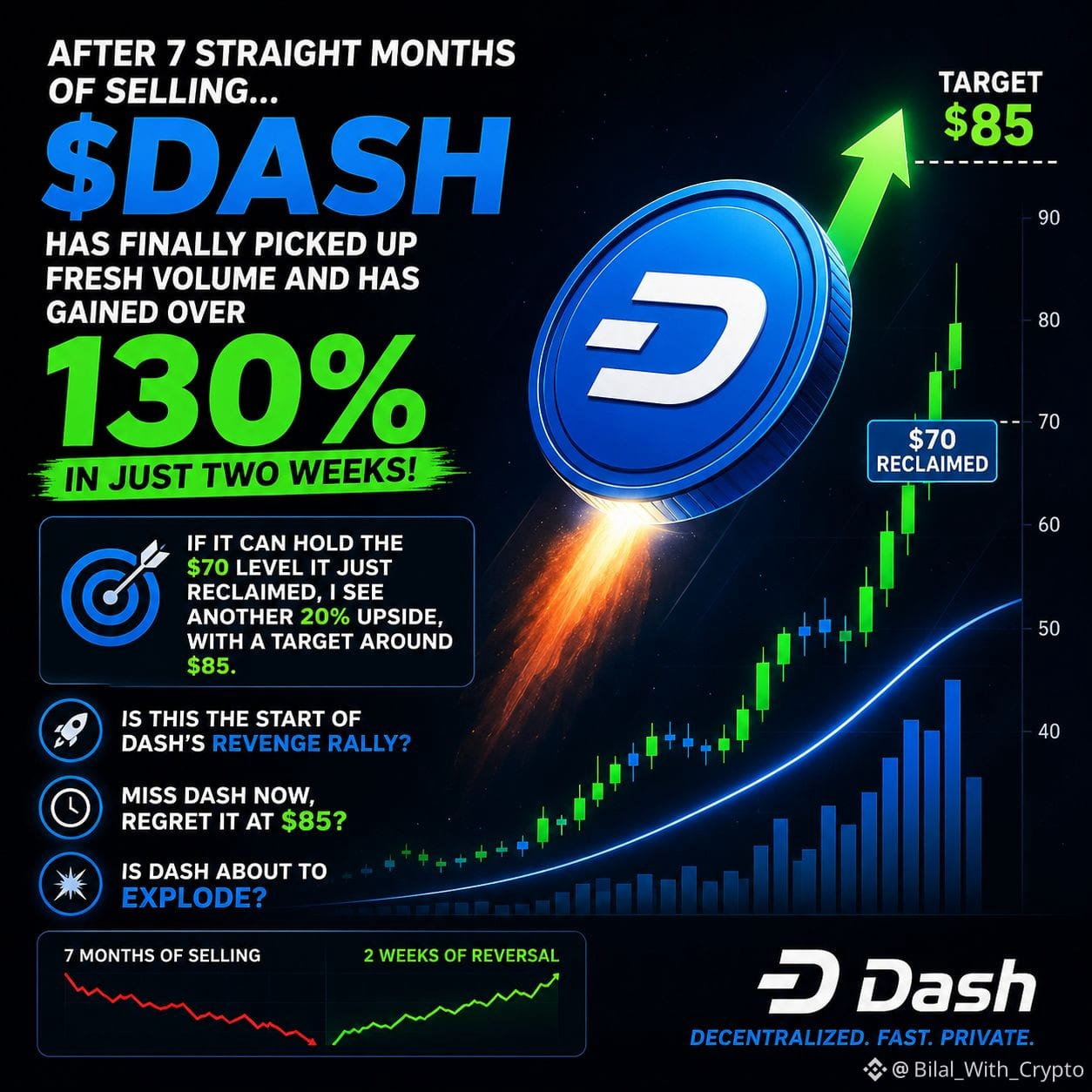
🚨 $DASH REVENGE RALLY INCOMING?
After 7 straight months of selling, $DASH is finally showing signs of life.
🔥 Fresh volume has entered
📈 +130% in just 2 weeks
🎯 $70 is the key level to hold
If DASH can turn $70 into solid support, the next move could be toward $85 — another ~20% upside from the current zone.
The question is simple:
Is this the start of DASH’s revenge rally? 👀
Miss $DASH now… regret it at $85?
Is DASH about to EXPLODE? 🚀
#DASH #Crypto #Altcoins #trading
🚨 $DASH REVENGE RALLY INCOMING?
After 7 straight months of selling, $DASH is finally showing signs of life.
🔥 Fresh volume has entered
📈 +130% in just 2 weeks
🎯 $70 is the key level to hold
If DASH can turn $70 into solid support, the next move could be toward $85 — another ~20% upside from the current zone.
The question is simple:
Is this the start of DASH’s revenge rally? 👀
Miss $DASH now… regret it at $85?
Is DASH about to EXPLODE? 🚀
#DASH #Crypto #Altcoins #trading
After 7 straight months of selling, $DASH is finally showing signs of life.
🔥 Fresh volume has entered
📈 +130% in just 2 weeks
🎯 $70 is the key level to hold
If DASH can turn $70 into solid support, the next move could be toward $85 — another ~20% upside from the current zone.
The question is simple:
Is this the start of DASH’s revenge rally? 👀
Miss $DASH now… regret it at $85?
Is DASH about to EXPLODE? 🚀
#DASH #Crypto #Altcoins #trading
103
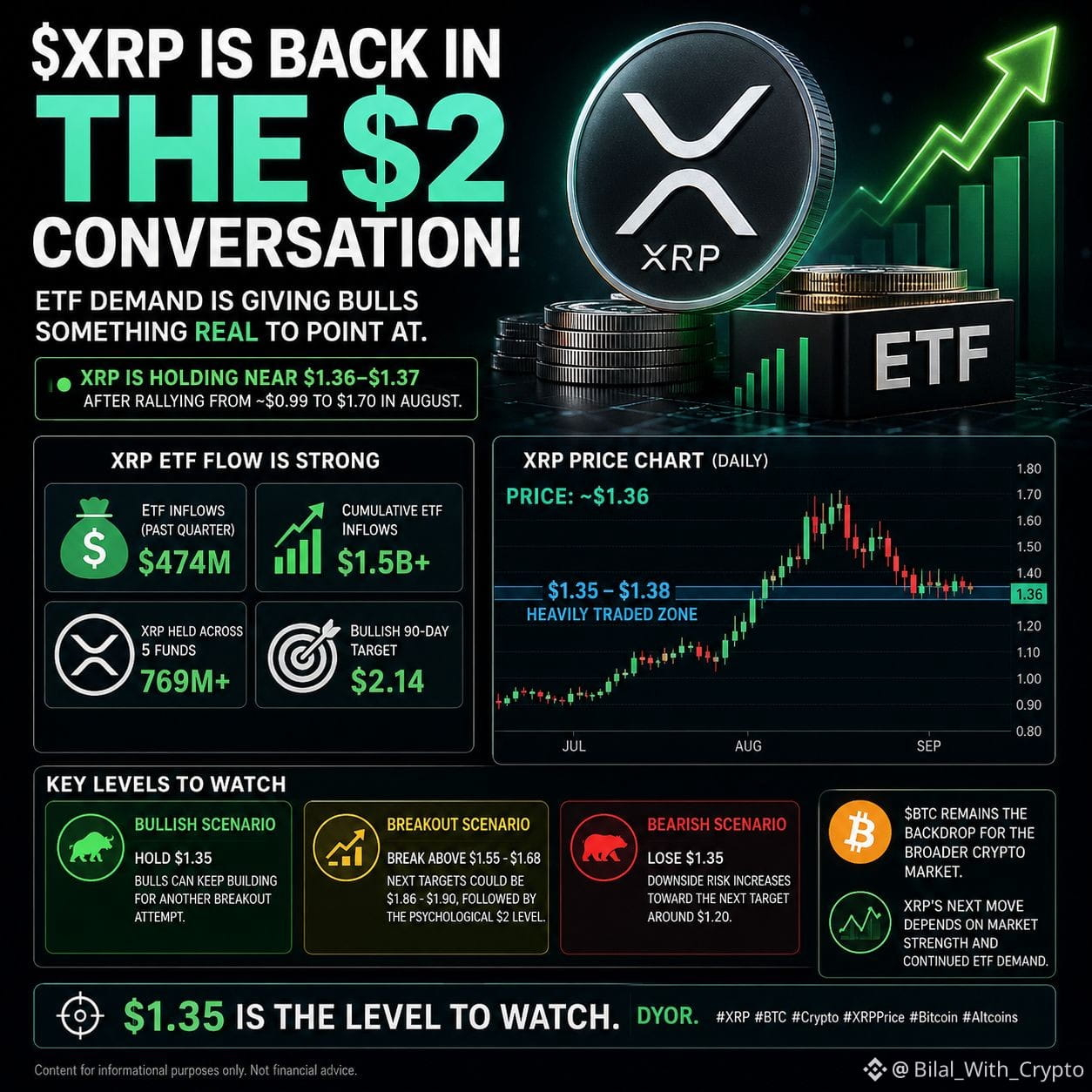
🚨 $XRP IS BACK IN THE $2 CONVERSATION 🚨
$XRP is holding around the $1.36–$1.37 zone after rallying from roughly $0.99 to $1.70 in August.
Now, ETF demand is giving the bulls another reason to stay interested. 👀
📊 Key numbers: • XRP price: ~$1.36 • ETF inflows: ~$474M over the past quarter • Cumulative ETF inflows: $1.5B+ • XRP held across 5 funds: 769M+ • Bullish 90-day target: $2.14
Technically, the setup is straightforward:
🟢 Hold $1.35 → bulls can keep building for another breakout attempt.
🔥 Break above $1.55–$1.68 → next targets could be $1.86–$1.90, followed by the psychological $2 level.
🔴 Lose $1.35 → downside risk increases toward ~$1.20.
With $BTC still setting the tone for the broader crypto market, XRP's next move could depend on both market strength and continued ETF demand.
$1.35 is the level to watch.
DYOR.
#xrp #BTC #crypto #XRPPrice #altcoins
🚨 $XRP IS BACK IN THE $2 CONVERSATION 🚨
$XRP is holding around the $1.36–$1.37 zone after rallying from roughly $0.99 to $1.70 in August.
Now, ETF demand is giving the bulls another reason to stay interested. 👀
📊 Key numbers: • XRP price: ~$1.36 • ETF inflows: ~$474M over the past quarter • Cumulative ETF inflows: $1.5B+ • XRP held across 5 funds: 769M+ • Bullish 90-day target: $2.14
Technically, the setup is straightforward:
🟢 Hold $1.35 → bulls can keep building for another breakout attempt.
🔥 Break above $1.55–$1.68 → next targets could be $1.86–$1.90, followed by the psychological $2 level.
🔴 Lose $1.35 → downside risk increases toward ~$1.20.
With $BTC still setting the tone for the broader crypto market, XRP's next move could depend on both market strength and continued ETF demand.
$1.35 is the level to watch.
DYOR.
#xrp #BTC #crypto #XRPPrice #altcoins
$XRP is holding around the $1.36–$1.37 zone after rallying from roughly $0.99 to $1.70 in August.
Now, ETF demand is giving the bulls another reason to stay interested. 👀
📊 Key numbers: • XRP price: ~$1.36 • ETF inflows: ~$474M over the past quarter • Cumulative ETF inflows: $1.5B+ • XRP held across 5 funds: 769M+ • Bullish 90-day target: $2.14
Technically, the setup is straightforward:
🟢 Hold $1.35 → bulls can keep building for another breakout attempt.
🔥 Break above $1.55–$1.68 → next targets could be $1.86–$1.90, followed by the psychological $2 level.
🔴 Lose $1.35 → downside risk increases toward ~$1.20.
With $BTC still setting the tone for the broader crypto market, XRP's next move could depend on both market strength and continued ETF demand.
$1.35 is the level to watch.
DYOR.
#xrp #BTC #crypto #XRPPrice #altcoins
105
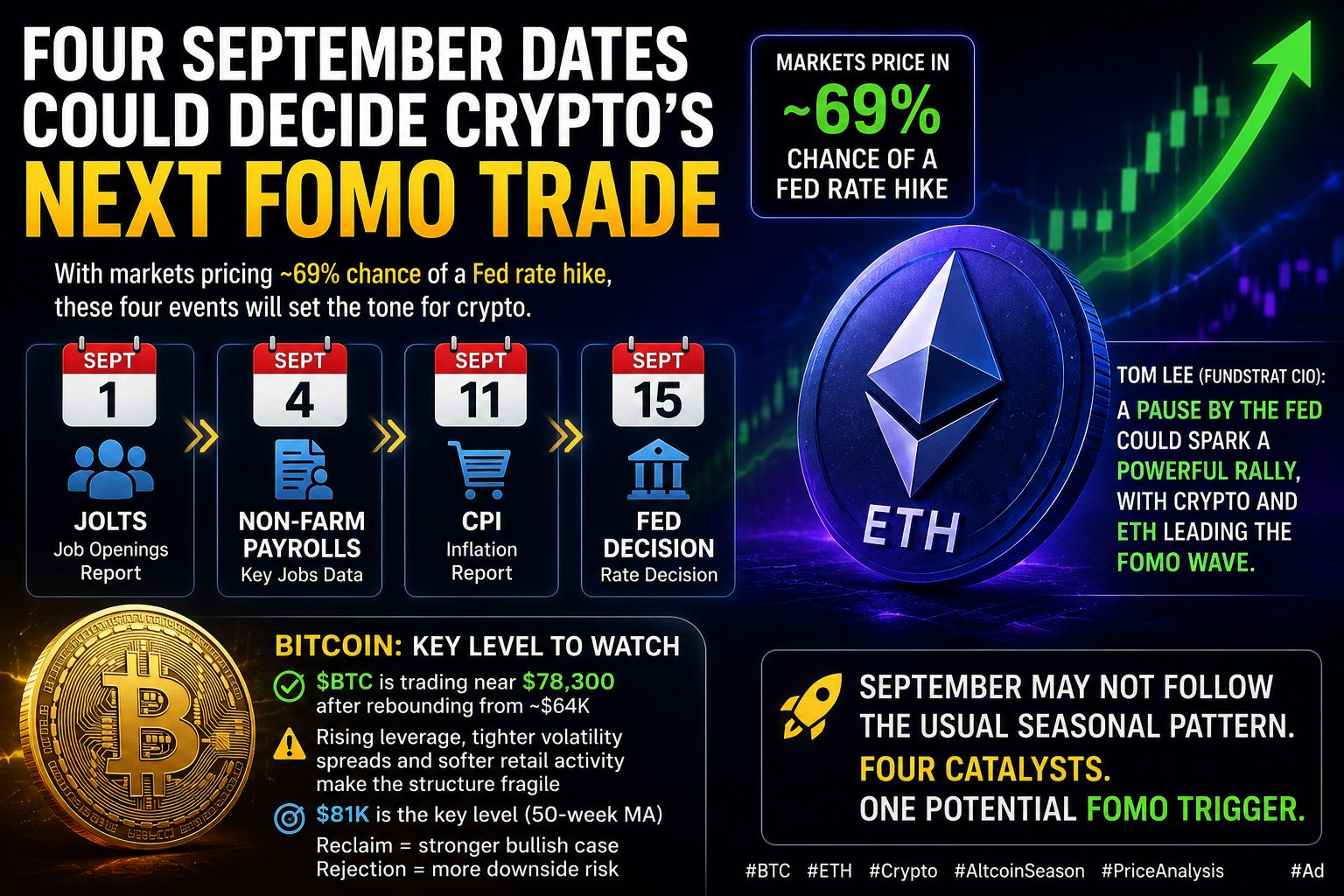
🚨 SEPTEMBER COULD TRIGGER THE NEXT CRYPTO FOMO
Four key dates could decide the next big move:
📅 Sept 4 — NFP
📅 Sept 11 — CPI
📅 Sept 15 — Fed Decision
$BTC needs to reclaim $81K to strengthen the bullish setup.
If macro data turns favorable, $ETH could become the center of the next FOMO wave. 🔥
#BTC #ETH #altcoinseason #PriceAnalysis #ad
🚨 SEPTEMBER COULD TRIGGER THE NEXT CRYPTO FOMO
Four key dates could decide the next big move:
📅 Sept 4 — NFP
📅 Sept 11 — CPI
📅 Sept 15 — Fed Decision
$BTC needs to reclaim $81K to strengthen the bullish setup.
If macro data turns favorable, $ETH could become the center of the next FOMO wave. 🔥
#BTC #ETH #altcoinseason #PriceAnalysis #ad
Four key dates could decide the next big move:
📅 Sept 4 — NFP
📅 Sept 11 — CPI
📅 Sept 15 — Fed Decision
$BTC needs to reclaim $81K to strengthen the bullish setup.
If macro data turns favorable, $ETH could become the center of the next FOMO wave. 🔥
#BTC #ETH #altcoinseason #PriceAnalysis #ad
127
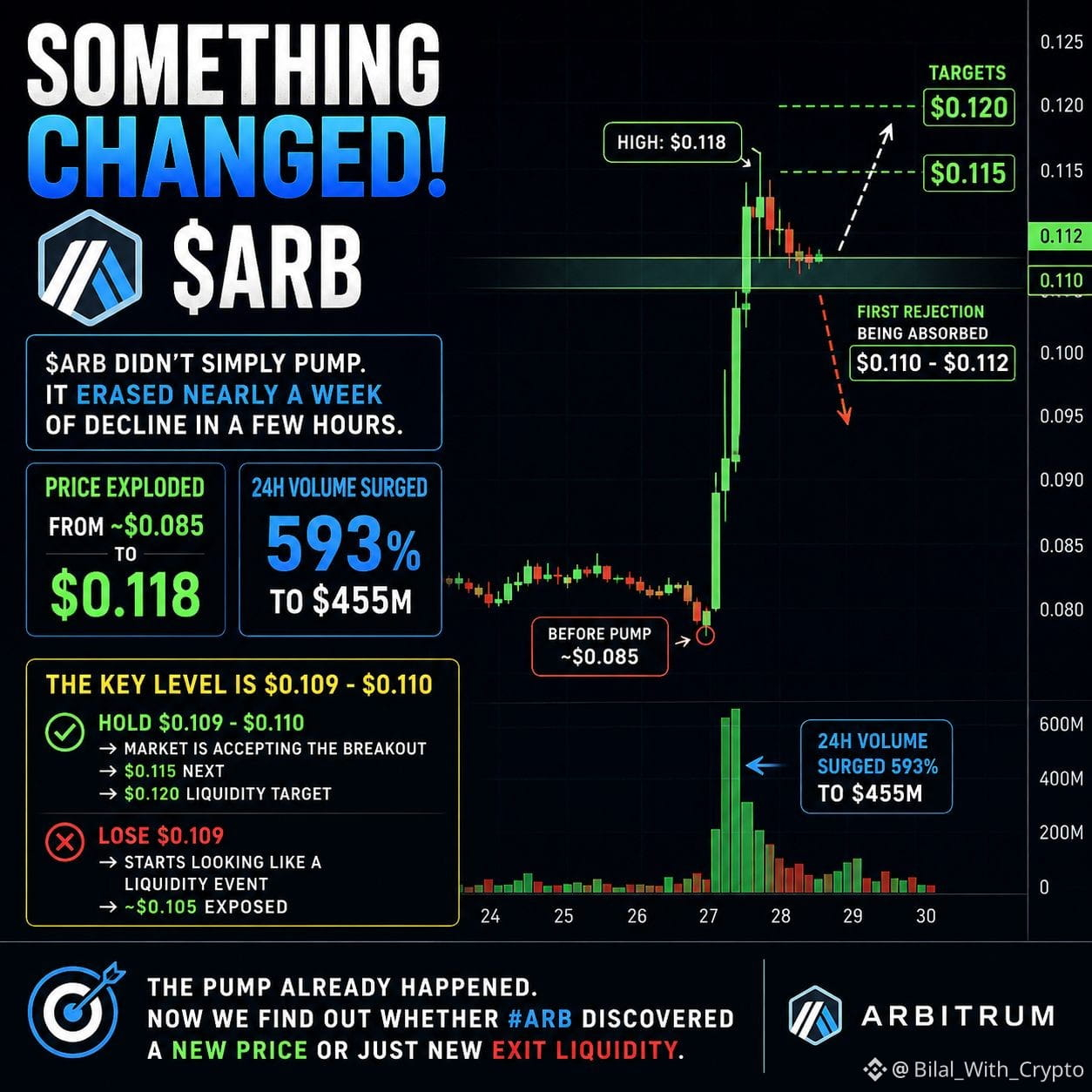
🚨 SOMETHING CHANGED ON $ARB
$ARB didn’t just pump — it erased nearly a WEEK of decline in just a few hours. 🔥
Price exploded from ~$0.085 → $0.118 while 24H volume surged 593% to $455M.
But the real signal isn’t the vertical candle.
It’s what happened AFTER. 👀
The first rejection is being absorbed around $0.110–$0.112 instead of immediately retracing the entire move.
That zone is now the key.
📈 Hold $0.109–$0.110 → Breakout acceptance
→ $0.115 next
→ $0.120 liquidity target
📉 Lose $0.109 → Pump could turn into a liquidity event
→ ~$0.105 becomes vulnerable
The pump already happened.
Now we find out whether #ARB discovered a new price… or just new exit liquidity.
Watch the reaction at $0.110. 👀
#ARB #crypto #altcoins #trading
🚨 SOMETHING CHANGED ON $ARB
$ARB didn’t just pump — it erased nearly a WEEK of decline in just a few hours. 🔥
Price exploded from ~$0.085 → $0.118 while 24H volume surged 593% to $455M.
But the real signal isn’t the vertical candle.
It’s what happened AFTER. 👀
The first rejection is being absorbed around $0.110–$0.112 instead of immediately retracing the entire move.
That zone is now the key.
📈 Hold $0.109–$0.110 → Breakout acceptance
→ $0.115 next
→ $0.120 liquidity target
📉 Lose $0.109 → Pump could turn into a liquidity event
→ ~$0.105 becomes vulnerable
The pump already happened.
Now we find out whether #ARB discovered a new price… or just new exit liquidity.
Watch the reaction at $0.110. 👀
#ARB #crypto #altcoins #trading
$ARB didn’t just pump — it erased nearly a WEEK of decline in just a few hours. 🔥
Price exploded from ~$0.085 → $0.118 while 24H volume surged 593% to $455M.
But the real signal isn’t the vertical candle.
It’s what happened AFTER. 👀
The first rejection is being absorbed around $0.110–$0.112 instead of immediately retracing the entire move.
That zone is now the key.
📈 Hold $0.109–$0.110 → Breakout acceptance
→ $0.115 next
→ $0.120 liquidity target
📉 Lose $0.109 → Pump could turn into a liquidity event
→ ~$0.105 becomes vulnerable
The pump already happened.
Now we find out whether #ARB discovered a new price… or just new exit liquidity.
Watch the reaction at $0.110. 👀
#ARB #crypto #altcoins #trading
125
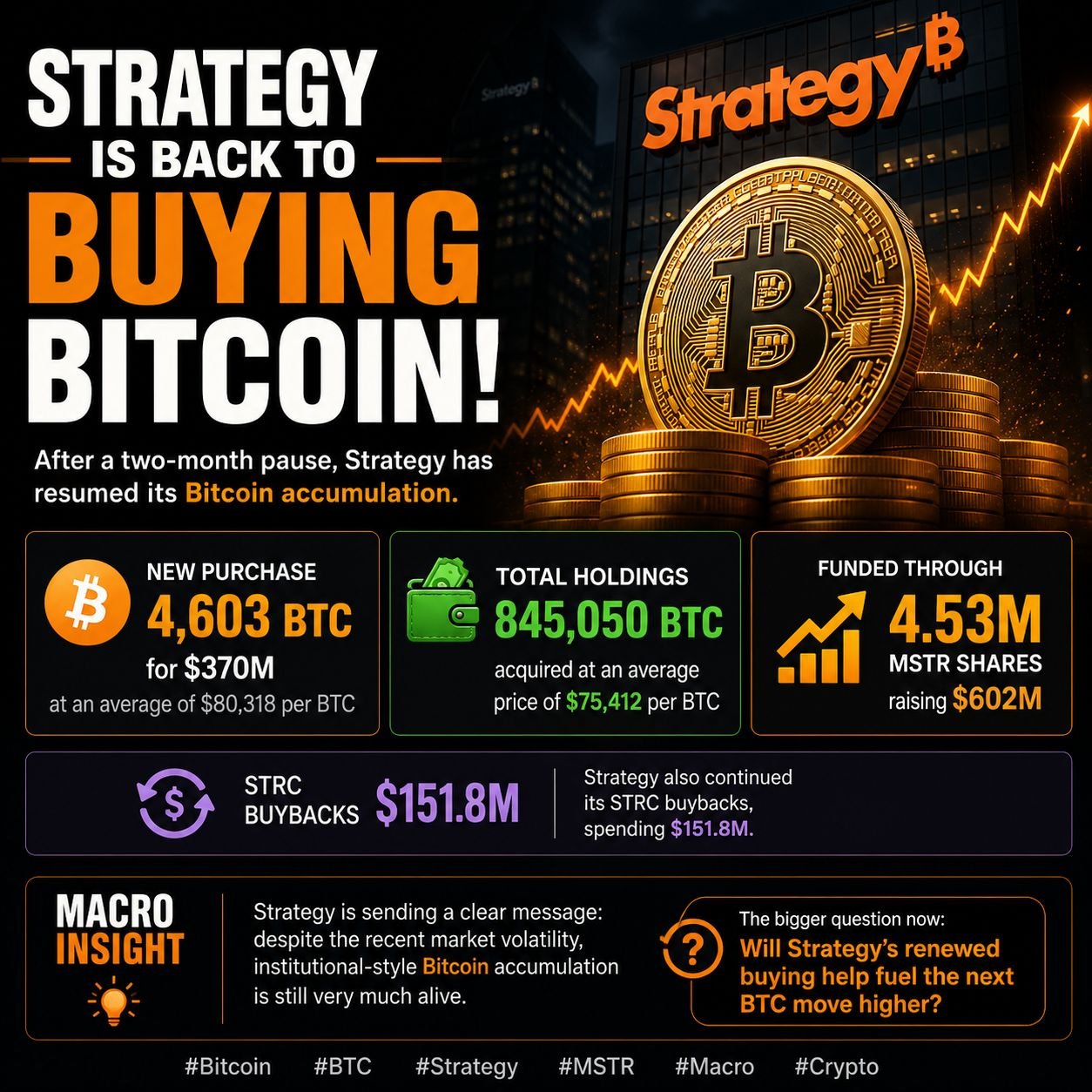
🚨 STRATEGY IS BACK TO BUYING BITCOIN!
After a two-month pause, Strategy has resumed its $BTC accumulation — purchasing 4,603 BTC for $370M at an average price of $80,318 per BTC.
Strategy now holds a massive 845,050 $BTC, acquired at an average cost of $75,412 per coin. 🟠
The purchase was funded through the sale of 4.53M $MSTR shares, raising approximately $602M.
And Strategy isn't slowing down elsewhere either — it also spent $151.8M on STRC buybacks.
📊 Macro Insight:
Strategy is sending a clear message: despite the recent market volatility, institutional-style Bitcoin accumulation is still very much alive.
The bigger question now:
Will Strategy's renewed buying help fuel the next $BTC move higher? 👀
#Bitcoin #BTC #Strategy #MSTR؛ #macroeconomic #crypto
🚨 STRATEGY IS BACK TO BUYING BITCOIN!
After a two-month pause, Strategy has resumed its $BTC accumulation — purchasing 4,603 BTC for $370M at an average price of $80,318 per BTC.
Strategy now holds a massive 845,050 $BTC , acquired at an average cost of $75,412 per coin. 🟠
The purchase was funded through the sale of 4.53M $MSTR shares, raising approximately $602M.
And Strategy isn't slowing down elsewhere either — it also spent $151.8M on STRC buybacks.
📊 Macro Insight:
Strategy is sending a clear message: despite the recent market volatility, institutional-style Bitcoin accumulation is still very much alive.
The bigger question now:
Will Strategy's renewed buying help fuel the next $BTC move higher? 👀
#Bitcoin #BTC #Strategy #MSTR؛ #macroeconomic #crypto
After a two-month pause, Strategy has resumed its $BTC accumulation — purchasing 4,603 BTC for $370M at an average price of $80,318 per BTC.
Strategy now holds a massive 845,050 $BTC , acquired at an average cost of $75,412 per coin. 🟠
The purchase was funded through the sale of 4.53M $MSTR shares, raising approximately $602M.
And Strategy isn't slowing down elsewhere either — it also spent $151.8M on STRC buybacks.
📊 Macro Insight:
Strategy is sending a clear message: despite the recent market volatility, institutional-style Bitcoin accumulation is still very much alive.
The bigger question now:
Will Strategy's renewed buying help fuel the next $BTC move higher? 👀
#Bitcoin #BTC #Strategy #MSTR؛ #macroeconomic #crypto
79
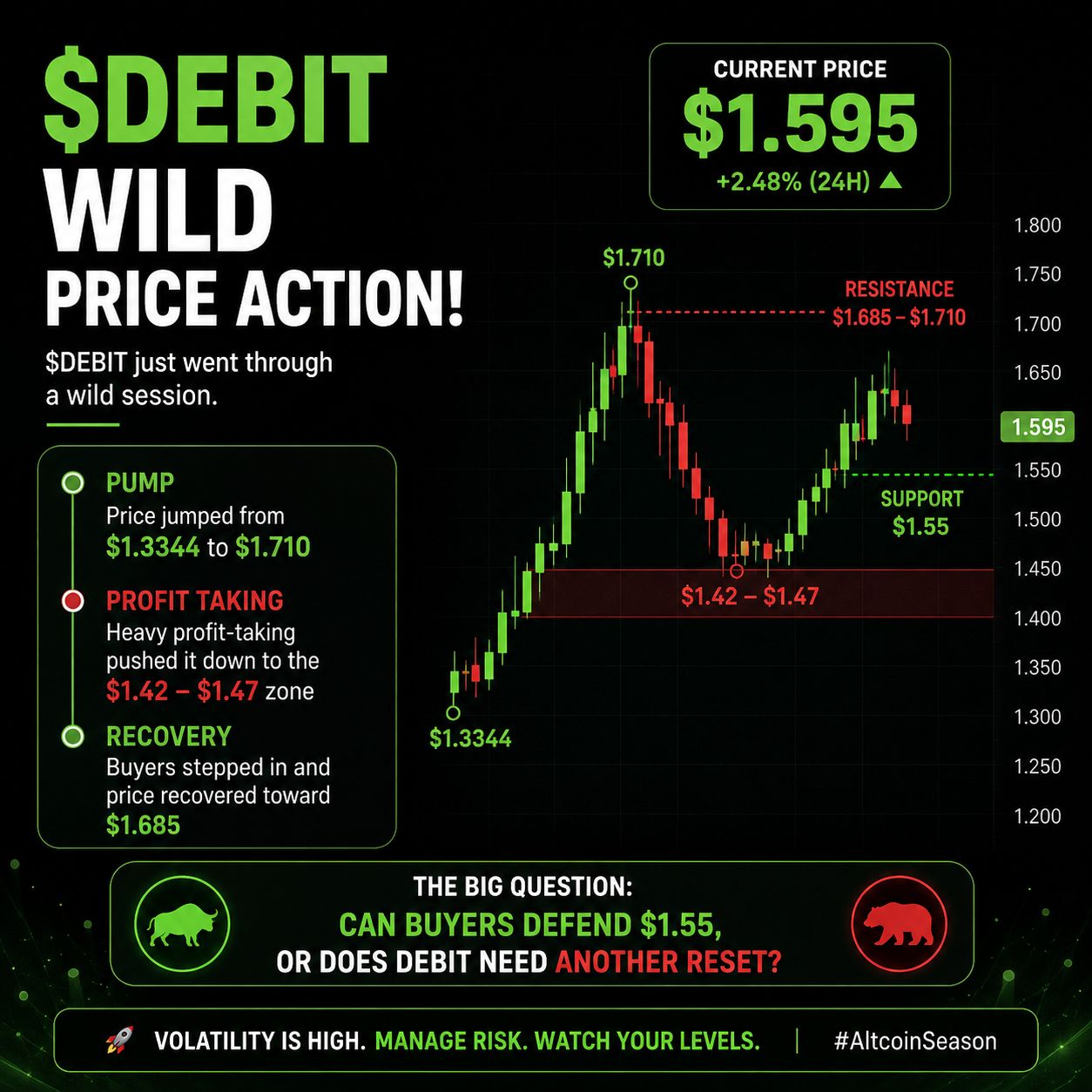
🚨 $DEBIT WILD PRICE ACTION!
$DEBIT just had a crazy session.
Price ripped from $1.3344 → $1.710, followed by heavy profit-taking that pushed it back into the $1.42–$1.47 zone.
Buyers stepped in again, sending it back toward $1.685. Now trading around $1.595.
🔑 Key levels: • Support: $1.55
• Resistance: $1.685–$1.710
The big question now:
Can buyers defend $1.55, or is another reset coming? 👀
Watch the reaction around this level.
#DEBIT #AltcoinSeason #Crypto #Altcoins
🚨 $DEBIT WILD PRICE ACTION!
$DEBIT just had a crazy session.
Price ripped from $1.3344 → $1.710, followed by heavy profit-taking that pushed it back into the $1.42–$1.47 zone.
Buyers stepped in again, sending it back toward $1.685. Now trading around $1.595.
🔑 Key levels: • Support: $1.55
• Resistance: $1.685–$1.710
The big question now:
Can buyers defend $1.55, or is another reset coming? 👀
Watch the reaction around this level.
#DEBIT #AltcoinSeason #Crypto #Altcoins
$DEBIT just had a crazy session.
Price ripped from $1.3344 → $1.710, followed by heavy profit-taking that pushed it back into the $1.42–$1.47 zone.
Buyers stepped in again, sending it back toward $1.685. Now trading around $1.595.
🔑 Key levels: • Support: $1.55
• Resistance: $1.685–$1.710
The big question now:
Can buyers defend $1.55, or is another reset coming? 👀
Watch the reaction around this level.
#DEBIT #AltcoinSeason #Crypto #Altcoins
375
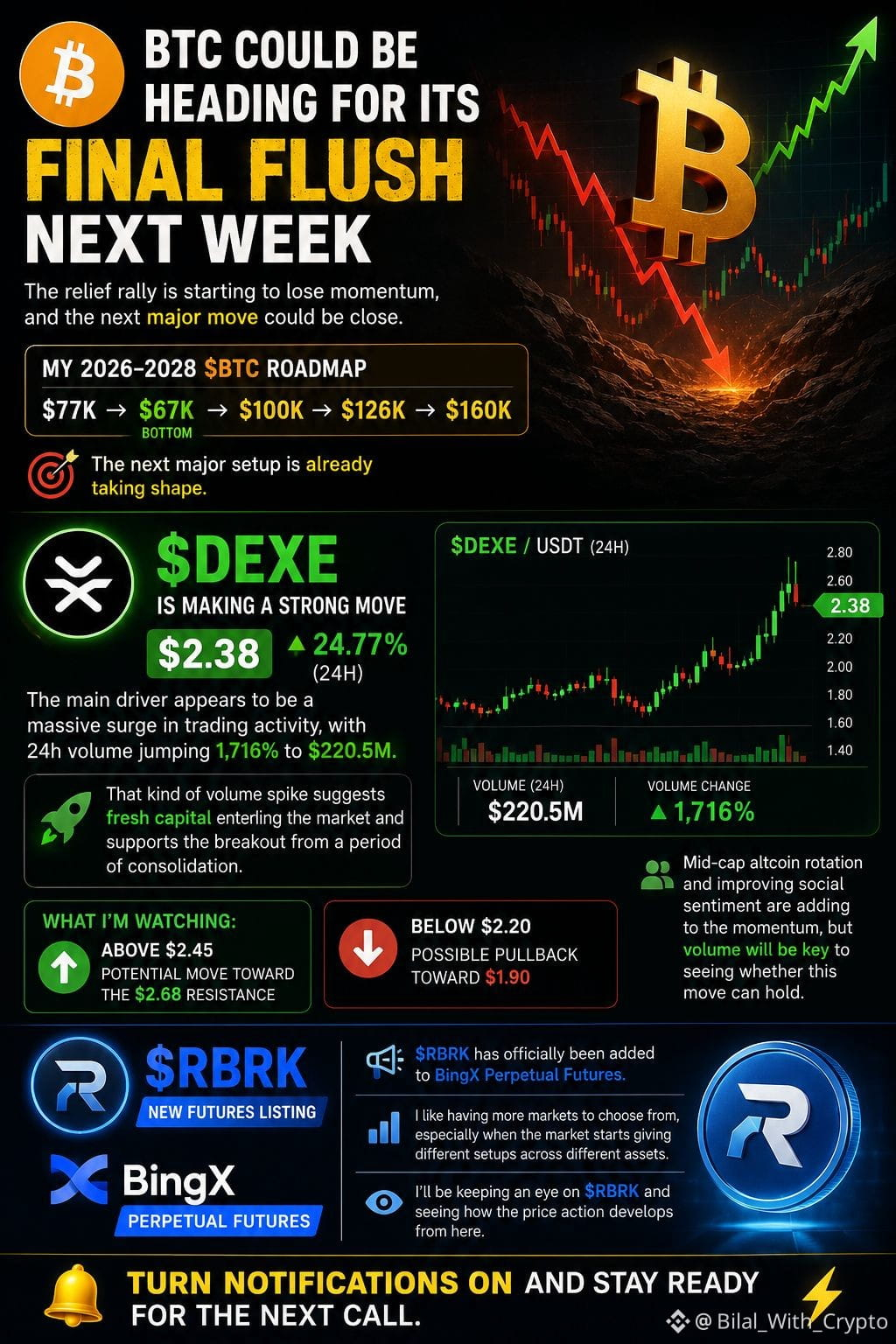
🚨 BTC COULD BE HEADING FOR ITS FINAL FLUSH NEXT WEEK
The relief rally is starting to lose momentum, and the next major move could be close.
My 2026–2028 $BTC roadmap remains unchanged:
$77K → $67K BOTTOM → $100K → $126K → $160K
The next major setup is already taking shape. 👀
Meanwhile, DEXE is making a strong move, up 24.77% to $2.38 in 24H.
📊 24H Volume: $220.5M
🔥 Volume Change: +1,716%
That massive spike in activity suggests fresh capital is entering and could support the breakout from consolidation.
Key levels I’m watching:
🟢 Above $2.45 → $2.68 resistance
🔴 Below $2.20 → $1.90 potential pullback
Mid-cap rotation and improving sentiment are adding momentum, but volume will be key to confirm whether DEXE can hold the move.
And one more update 👀
🚨 $RBRK.US is now LIVE on BingX Perpetual Futures.
More futures markets mean more setups to watch as volatility picks up.
I’ll be watching BTC, $DEXE and RBRK closely.
Turn notifications ON 🔔
The next call could come fast.
#BTC #Bitcoin #DEXE #RBRK #Crypto #Altcoins #priceanalysis
🚨 BTC COULD BE HEADING FOR ITS FINAL FLUSH NEXT WEEK
The relief rally is starting to lose momentum, and the next major move could be close.
My 2026–2028 $BTC roadmap remains unchanged:
$77K → $67K BOTTOM → $100K → $126K → $160K
The next major setup is already taking shape. 👀
Meanwhile, DEXE is making a strong move, up 24.77% to $2.38 in 24H.
📊 24H Volume: $220.5M
🔥 Volume Change: +1,716%
That massive spike in activity suggests fresh capital is entering and could support the breakout from consolidation.
Key levels I’m watching:
🟢 Above $2.45 → $2.68 resistance
🔴 Below $2.20 → $1.90 potential pullback
Mid-cap rotation and improving sentiment are adding momentum, but volume will be key to confirm whether DEXE can hold the move.
And one more update 👀
🚨 $RBRK.US is now LIVE on BingX Perpetual Futures.
More futures markets mean more setups to watch as volatility picks up.
I’ll be watching BTC, $DEXE and RBRK closely.
Turn notifications ON 🔔
The next call could come fast.
#BTC #Bitcoin #DEXE #RBRK #Crypto #Altcoins #priceanalysis
The relief rally is starting to lose momentum, and the next major move could be close.
My 2026–2028 $BTC roadmap remains unchanged:
$77K → $67K BOTTOM → $100K → $126K → $160K
The next major setup is already taking shape. 👀
Meanwhile, DEXE is making a strong move, up 24.77% to $2.38 in 24H.
📊 24H Volume: $220.5M
🔥 Volume Change: +1,716%
That massive spike in activity suggests fresh capital is entering and could support the breakout from consolidation.
Key levels I’m watching:
🟢 Above $2.45 → $2.68 resistance
🔴 Below $2.20 → $1.90 potential pullback
Mid-cap rotation and improving sentiment are adding momentum, but volume will be key to confirm whether DEXE can hold the move.
And one more update 👀
🚨 $RBRK.US is now LIVE on BingX Perpetual Futures.
More futures markets mean more setups to watch as volatility picks up.
I’ll be watching BTC, $DEXE and RBRK closely.
Turn notifications ON 🔔
The next call could come fast.
#BTC #Bitcoin #DEXE #RBRK #Crypto #Altcoins #priceanalysis
33
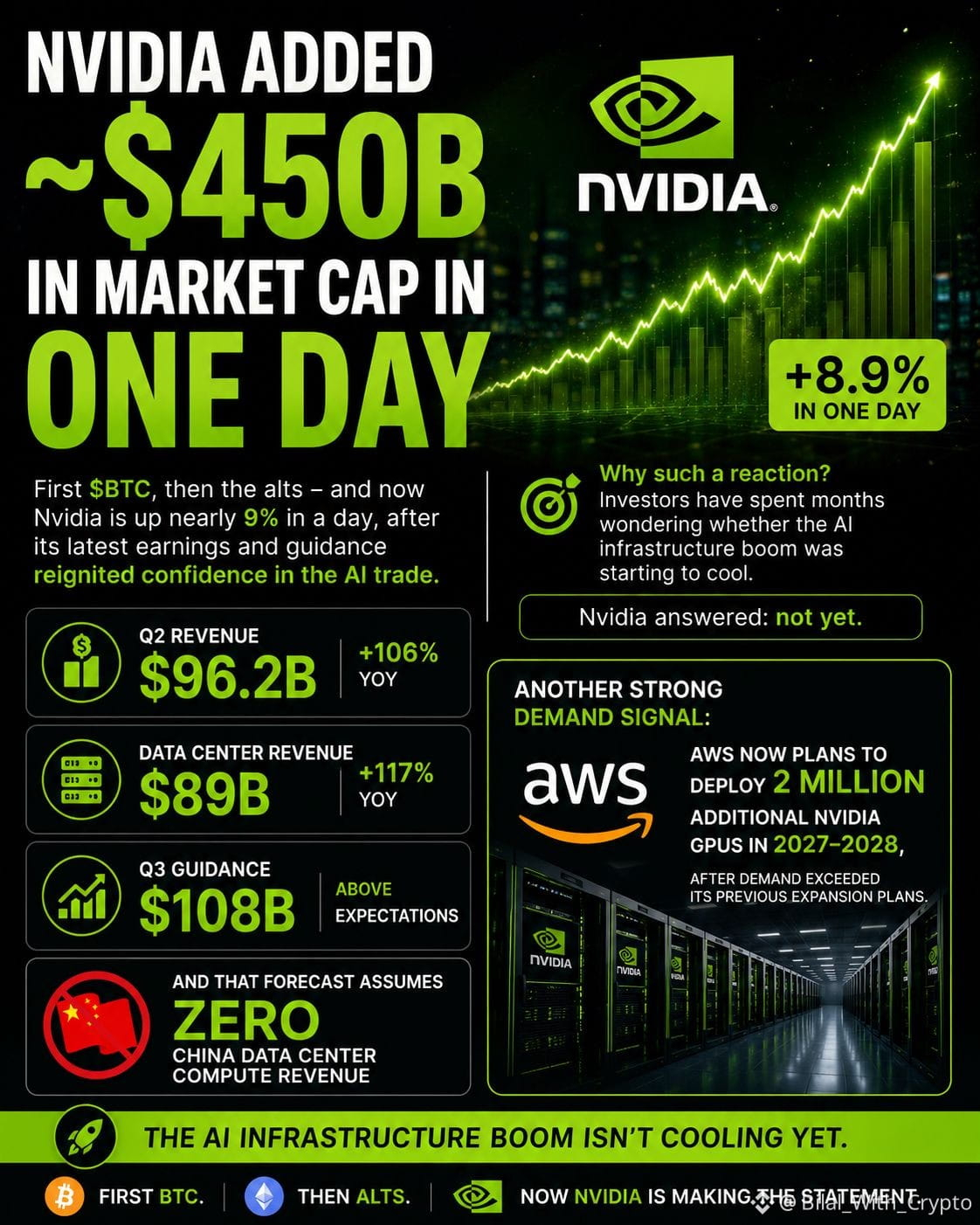
🚨 NVIDIA JUST ADDED ~$450B IN MARKET CAP IN ONE DAY
AI demand is showing no signs of slowing down.
NVIDIA surged nearly 9% after its latest earnings and guidance crushed expectations and reignited confidence in the AI trade.
📊 Q2 Revenue: $96.2B — +106% YoY
🏢 Data Center Revenue: $89B — +117% YoY
🔥 Q3 Guidance: $108B — above expectations
🇨🇳 Guidance assumes ZERO China data-center compute revenue
And the demand story gets even bigger…
AWS plans to deploy 2 MILLION additional NVIDIA GPUs in 2027–2028 after demand exceeded its previous expansion plans.
The AI infrastructure boom isn’t cooling yet.
First BTC. Then alts.
Now NVIDIA is making the statement. 🚀
#NVIDIA #NVDA #BTC #crypto #stocks
$BTC
🚨 NVIDIA JUST ADDED ~$450B IN MARKET CAP IN ONE DAY
AI demand is showing no signs of slowing down.
NVIDIA surged nearly 9% after its latest earnings and guidance crushed expectations and reignited confidence in the AI trade.
📊 Q2 Revenue: $96.2B — +106% YoY
🏢 Data Center Revenue: $89B — +117% YoY
🔥 Q3 Guidance: $108B — above expectations
🇨🇳 Guidance assumes ZERO China data-center compute revenue
And the demand story gets even bigger…
AWS plans to deploy 2 MILLION additional NVIDIA GPUs in 2027–2028 after demand exceeded its previous expansion plans.
The AI infrastructure boom isn’t cooling yet.
First BTC. Then alts.
Now NVIDIA is making the statement. 🚀
#NVIDIA #NVDA #BTC #crypto #stocks
$BTC
AI demand is showing no signs of slowing down.
NVIDIA surged nearly 9% after its latest earnings and guidance crushed expectations and reignited confidence in the AI trade.
📊 Q2 Revenue: $96.2B — +106% YoY
🏢 Data Center Revenue: $89B — +117% YoY
🔥 Q3 Guidance: $108B — above expectations
🇨🇳 Guidance assumes ZERO China data-center compute revenue
And the demand story gets even bigger…
AWS plans to deploy 2 MILLION additional NVIDIA GPUs in 2027–2028 after demand exceeded its previous expansion plans.
The AI infrastructure boom isn’t cooling yet.
First BTC. Then alts.
Now NVIDIA is making the statement. 🚀
#NVIDIA #NVDA #BTC #crypto #stocks
$BTC
125
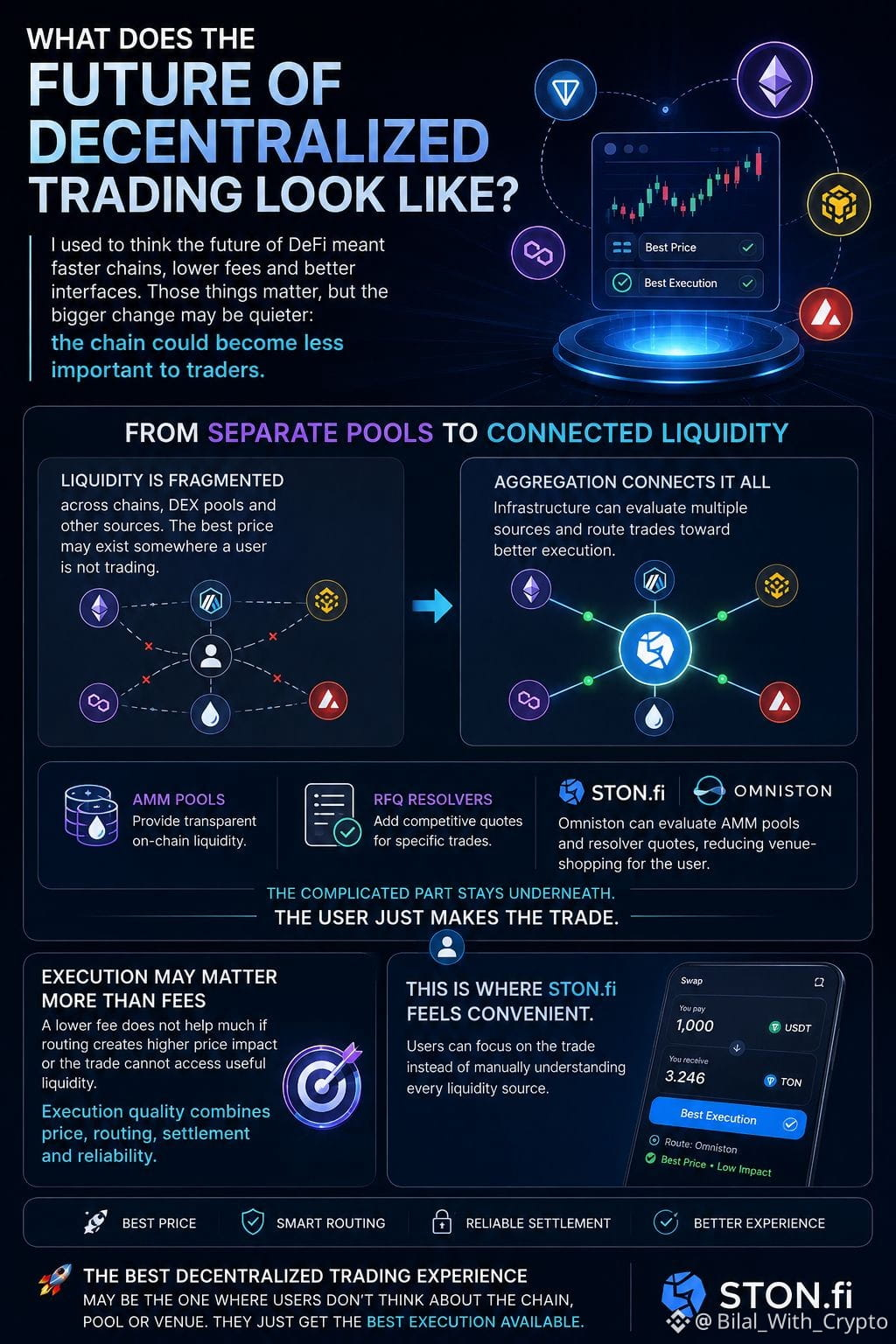
The Future of Decentralized Trading 🚀
I used to think the future of DeFi was mainly about faster chains, lower fees, and better interfaces.
Those things still matter. But I think the bigger shift is happening underneath: the chain may become less important to the trader.
🔄 From fragmented liquidity to connected liquidity
Today, liquidity is spread across different chains, DEX pools, and liquidity sources. The best price might exist somewhere users aren't even looking.
Aggregation can change that.
Instead of manually comparing venues, infrastructure can evaluate multiple liquidity sources and route trades toward better execution.
AMMs provide transparent on-chain liquidity, while RFQ resolvers can compete to provide quotes for specific trades.
STON.fi and Omniston are good examples of this direction.
Omniston can evaluate AMM liquidity and resolver quotes, helping reduce the need for users to shop around between venues.
The complexity stays underneath.
The user simply makes the trade.
💡 Execution may matter more than fees
A lower fee means little if poor routing causes higher price impact or limited access to liquidity.
The real goal is better execution:
Price + Routing + Liquidity + Settlement + Reliability
That’s where I think DeFi is heading.
The best decentralized trading experience may eventually be the one where users don't need to think about which chain, pool, or venue their trade is using.
They just get the best execution available.
#DeFi #Crypto #DEX #trading #Blockchain $VET $BNB $SOL
{future}(VETUSDT)
The Future of Decentralized Trading 🚀
I used to think the future of DeFi was mainly about faster chains, lower fees, and better interfaces.
Those things still matter. But I think the bigger shift is happening underneath: the chain may become less important to the trader.
🔄 From fragmented liquidity to connected liquidity
Today, liquidity is spread across different chains, DEX pools, and liquidity sources. The best price might exist somewhere users aren't even looking.
Aggregation can change that.
Instead of manually comparing venues, infrastructure can evaluate multiple liquidity sources and route trades toward better execution.
AMMs provide transparent on-chain liquidity, while RFQ resolvers can compete to provide quotes for specific trades.
STON.fi and Omniston are good examples of this direction.
Omniston can evaluate AMM liquidity and resolver quotes, helping reduce the need for users to shop around between venues.
The complexity stays underneath.
The user simply makes the trade.
💡 Execution may matter more than fees
A lower fee means little if poor routing causes higher price impact or limited access to liquidity.
The real goal is better execution:
Price + Routing + Liquidity + Settlement + Reliability
That’s where I think DeFi is heading.
The best decentralized trading experience may eventually be the one where users don't need to think about which chain, pool, or venue their trade is using.
They just get the best execution available.
#DeFi #Crypto #DEX #trading #Blockchain $VET $BNB $SOL
I used to think the future of DeFi was mainly about faster chains, lower fees, and better interfaces.
Those things still matter. But I think the bigger shift is happening underneath: the chain may become less important to the trader.
🔄 From fragmented liquidity to connected liquidity
Today, liquidity is spread across different chains, DEX pools, and liquidity sources. The best price might exist somewhere users aren't even looking.
Aggregation can change that.
Instead of manually comparing venues, infrastructure can evaluate multiple liquidity sources and route trades toward better execution.
AMMs provide transparent on-chain liquidity, while RFQ resolvers can compete to provide quotes for specific trades.
STON.fi and Omniston are good examples of this direction.
Omniston can evaluate AMM liquidity and resolver quotes, helping reduce the need for users to shop around between venues.
The complexity stays underneath.
The user simply makes the trade.
💡 Execution may matter more than fees
A lower fee means little if poor routing causes higher price impact or limited access to liquidity.
The real goal is better execution:
Price + Routing + Liquidity + Settlement + Reliability
That’s where I think DeFi is heading.
The best decentralized trading experience may eventually be the one where users don't need to think about which chain, pool, or venue their trade is using.
They just get the best execution available.
#DeFi #Crypto #DEX #trading #Blockchain $VET $BNB $SOL
116
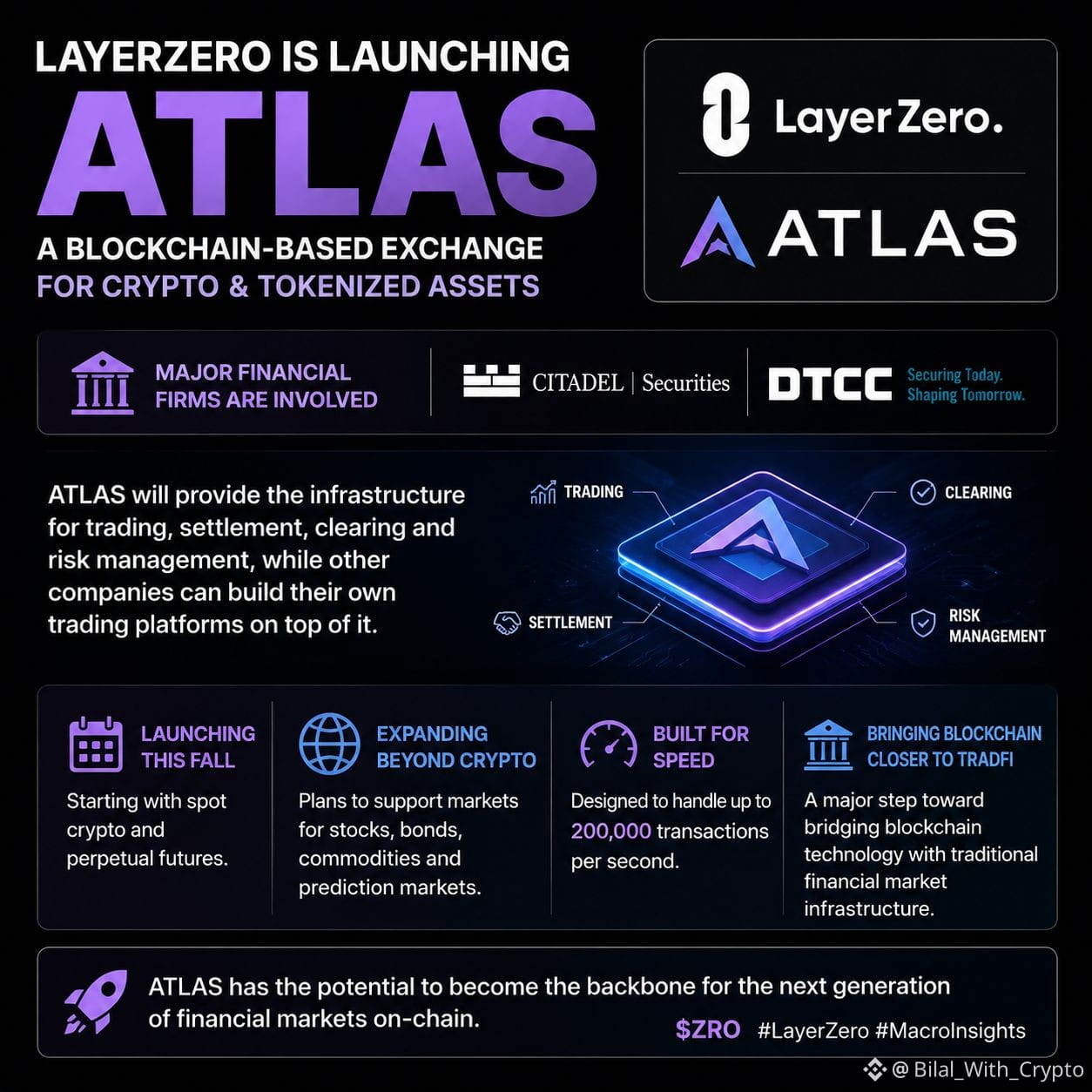
🚨 LayerZero is making a big move with ATLAS — a blockchain-based exchange built for crypto and tokenized assets.
Big names like Citadel Securities and DTCC are involved, adding serious TradFi credibility to the project.
ATLAS is designed to handle trading, clearing, settlement and risk management, while allowing other companies to build their own platforms on top.
The launch is expected this fall, starting with spot crypto and perpetuals, with plans to expand into stocks, bonds, commodities and prediction markets.
The target? Up to 200,000 transactions per second. 👀
If LayerZero can pull this off, blockchain infrastructure could move much closer to traditional financial markets.
$ZRO #LayerZero #MacroInsights
🚨 LayerZero is making a big move with ATLAS — a blockchain-based exchange built for crypto and tokenized assets.
Big names like Citadel Securities and DTCC are involved, adding serious TradFi credibility to the project.
ATLAS is designed to handle trading, clearing, settlement and risk management, while allowing other companies to build their own platforms on top.
The launch is expected this fall, starting with spot crypto and perpetuals, with plans to expand into stocks, bonds, commodities and prediction markets.
The target? Up to 200,000 transactions per second. 👀
If LayerZero can pull this off, blockchain infrastructure could move much closer to traditional financial markets.
$ZRO #LayerZero #MacroInsights
Big names like Citadel Securities and DTCC are involved, adding serious TradFi credibility to the project.
ATLAS is designed to handle trading, clearing, settlement and risk management, while allowing other companies to build their own platforms on top.
The launch is expected this fall, starting with spot crypto and perpetuals, with plans to expand into stocks, bonds, commodities and prediction markets.
The target? Up to 200,000 transactions per second. 👀
If LayerZero can pull this off, blockchain infrastructure could move much closer to traditional financial markets.
$ZRO #LayerZero #MacroInsights
93
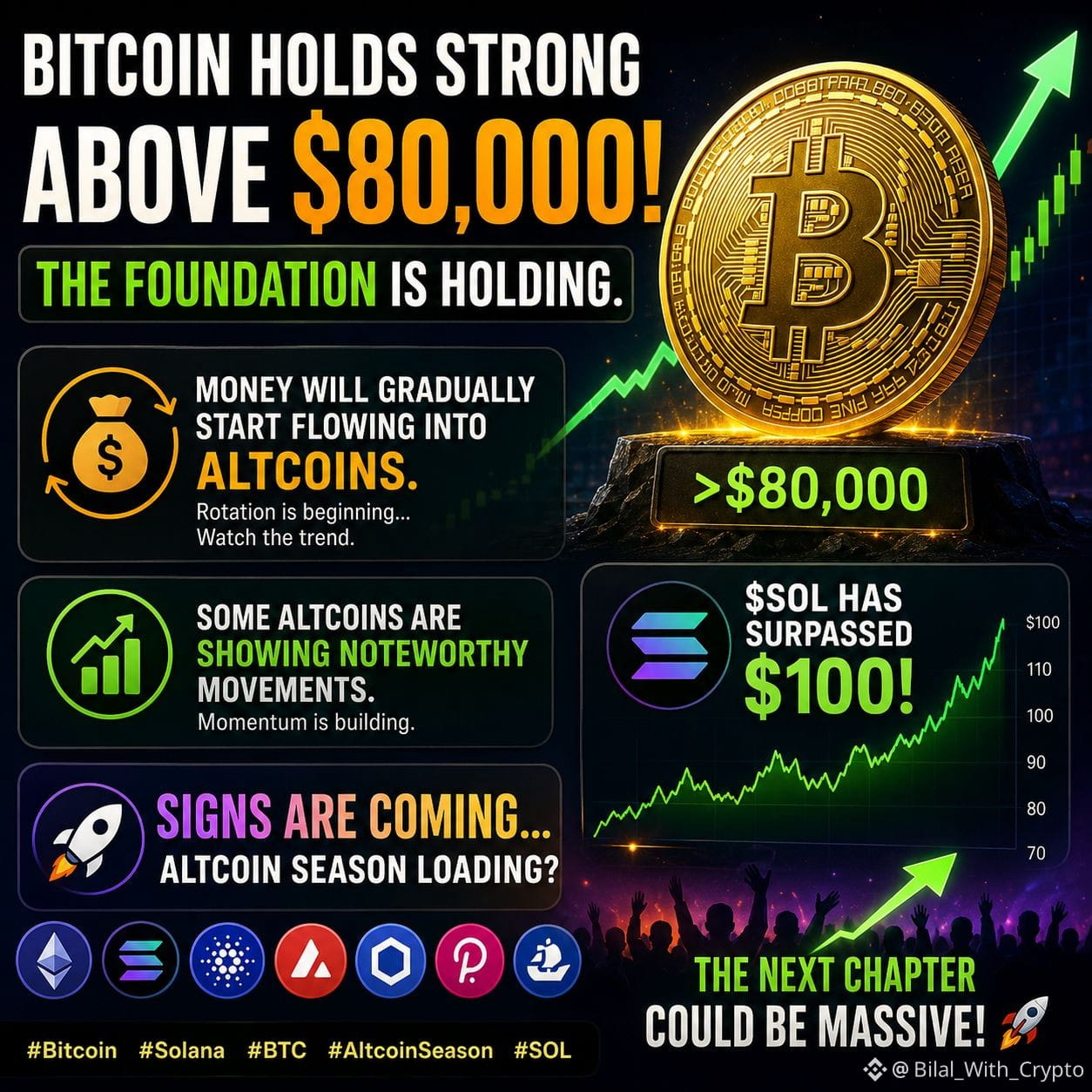
🚨 Bitcoin is holding strong above $80K!
That could be an early sign that money is starting to rotate into altcoins. 👀
Some altcoins are already showing strong moves, and $SOL has reclaimed the $100 level.
If BTC continues to hold its ground, the next phase could get very interesting for altcoins. 🔥
Are we seeing the first signs of an #AltcoinSeason?
$BTC #Bitcoin #Solana #altcoins
🚨 Bitcoin is holding strong above $80K!
That could be an early sign that money is starting to rotate into altcoins. 👀
Some altcoins are already showing strong moves, and $SOL has reclaimed the $100 level.
If BTC continues to hold its ground, the next phase could get very interesting for altcoins. 🔥
Are we seeing the first signs of an #AltcoinSeason?
$BTC #Bitcoin #Solana #altcoins
That could be an early sign that money is starting to rotate into altcoins. 👀
Some altcoins are already showing strong moves, and $SOL has reclaimed the $100 level.
If BTC continues to hold its ground, the next phase could get very interesting for altcoins. 🔥
Are we seeing the first signs of an #AltcoinSeason?
$BTC #Bitcoin #Solana #altcoins
107
🚀 $TRUMP & $MELANIA are back in the spotlight!
Both memecoins have surged more than 100% since the White House Crypto Summit on August 19.
With the US midterm elections coming in November, political narratives could bring even more attention and volatility to these tokens.
The next few months could get interesting 👀
#crypto #memecoins #SamsungFalls8.97%DraggingKospiDown3.24%
🚀 $TRUMP & $MELANIA are back in the spotlight!
Both memecoins have surged more than 100% since the White House Crypto Summit on August 19.
With the US midterm elections coming in November, political narratives could bring even more attention and volatility to these tokens.
The next few months could get interesting 👀
#crypto #memecoins #SamsungFalls8.97%DraggingKospiDown3.24%
Both memecoins have surged more than 100% since the White House Crypto Summit on August 19.
With the US midterm elections coming in November, political narratives could bring even more attention and volatility to these tokens.
The next few months could get interesting 👀
#crypto #memecoins #SamsungFalls8.97%DraggingKospiDown3.24%

238
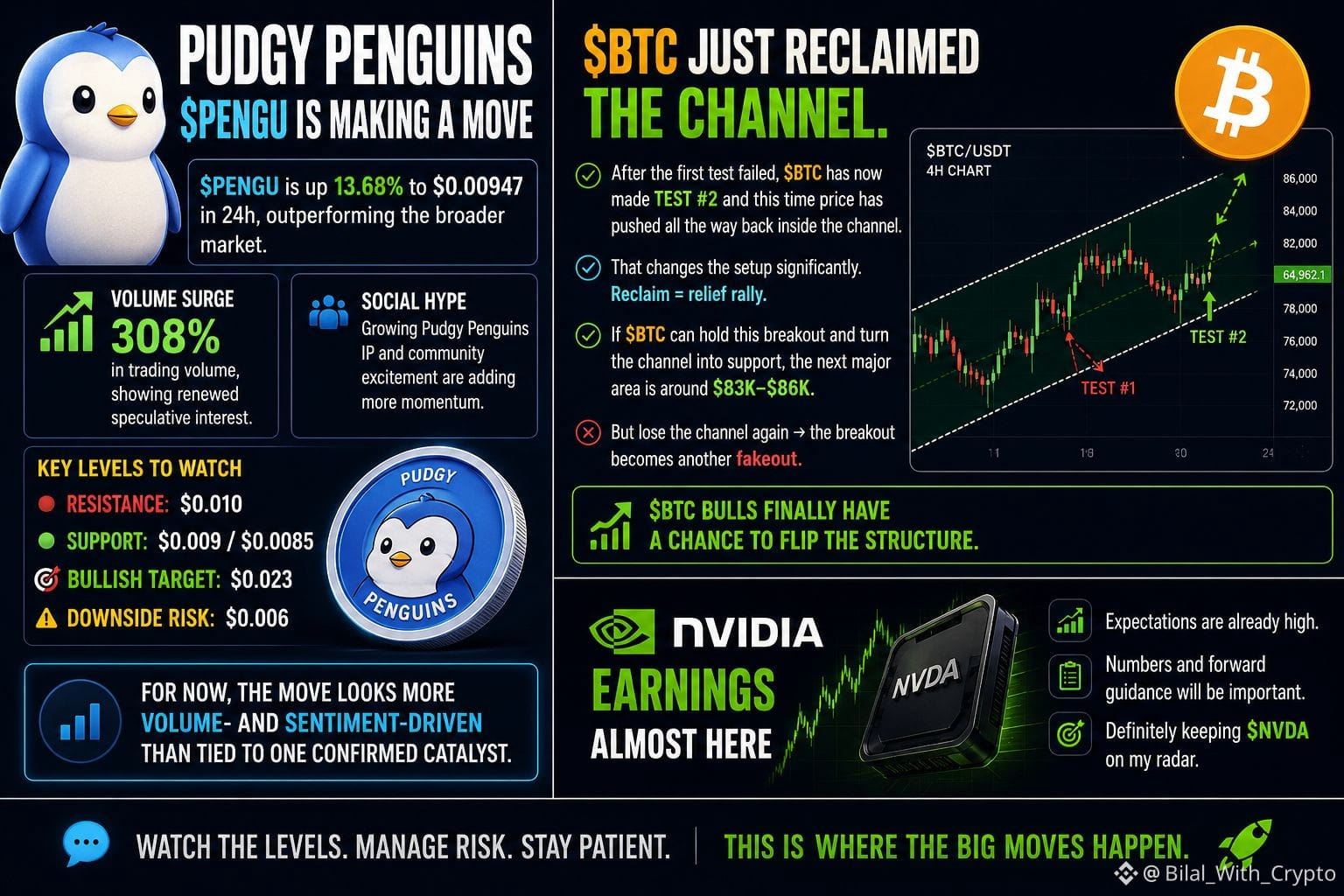
$PENGU is starting to wake up 👀
Pudgy Penguins is up 13.68% to $0.00947 in the last 24H, clearly outperforming the broader market.
The interesting part? Trading volume has exploded by 308%, showing renewed speculative interest. The growing Pudgy Penguins IP and social hype are adding fuel too.
Key levels I’m watching: 🔴 Resistance: $0.010 🟢 Support: $0.009 / $0.0085 🎯 Bullish target: $0.023 ⚠️ Downside risk: $0.006
For now, this looks more volume + sentiment driven than a move backed by one confirmed catalyst.
Meanwhile, $BTC JUST RECLAIMED THE CHANNEL. 🔥
The first test failed, but on TEST #2, BTC pushed back inside the channel.
That changes the setup.
If BTC holds the reclaim and turns the channel into support, I’m watching the $83K–$86K area next.
Lose the channel again and this could turn into another fakeout.
BTC bulls finally have a chance to flip the structure. 📈
And with Nvidia earnings almost here, $NVDA is also staying on my radar. Expectations are already high, so the numbers and forward guidance could be key.
#BTC #bitcoin #PENGU #NVDA #crypto
$PENGU is starting to wake up 👀
Pudgy Penguins is up 13.68% to $0.00947 in the last 24H, clearly outperforming the broader market.
The interesting part? Trading volume has exploded by 308%, showing renewed speculative interest. The growing Pudgy Penguins IP and social hype are adding fuel too.
Key levels I’m watching: 🔴 Resistance: $0.010 🟢 Support: $0.009 / $0.0085 🎯 Bullish target: $0.023 ⚠️ Downside risk: $0.006
For now, this looks more volume + sentiment driven than a move backed by one confirmed catalyst.
Meanwhile, $BTC JUST RECLAIMED THE CHANNEL. 🔥
The first test failed, but on TEST #2, BTC pushed back inside the channel.
That changes the setup.
If BTC holds the reclaim and turns the channel into support, I’m watching the $83K–$86K area next.
Lose the channel again and this could turn into another fakeout.
BTC bulls finally have a chance to flip the structure. 📈
And with Nvidia earnings almost here, $NVDA is also staying on my radar. Expectations are already high, so the numbers and forward guidance could be key.
#BTC #bitcoin #PENGU #NVDA #crypto
Pudgy Penguins is up 13.68% to $0.00947 in the last 24H, clearly outperforming the broader market.
The interesting part? Trading volume has exploded by 308%, showing renewed speculative interest. The growing Pudgy Penguins IP and social hype are adding fuel too.
Key levels I’m watching: 🔴 Resistance: $0.010 🟢 Support: $0.009 / $0.0085 🎯 Bullish target: $0.023 ⚠️ Downside risk: $0.006
For now, this looks more volume + sentiment driven than a move backed by one confirmed catalyst.
Meanwhile, $BTC JUST RECLAIMED THE CHANNEL. 🔥
The first test failed, but on TEST #2, BTC pushed back inside the channel.
That changes the setup.
If BTC holds the reclaim and turns the channel into support, I’m watching the $83K–$86K area next.
Lose the channel again and this could turn into another fakeout.
BTC bulls finally have a chance to flip the structure. 📈
And with Nvidia earnings almost here, $NVDA is also staying on my radar. Expectations are already high, so the numbers and forward guidance could be key.
#BTC #bitcoin #PENGU #NVDA #crypto
133
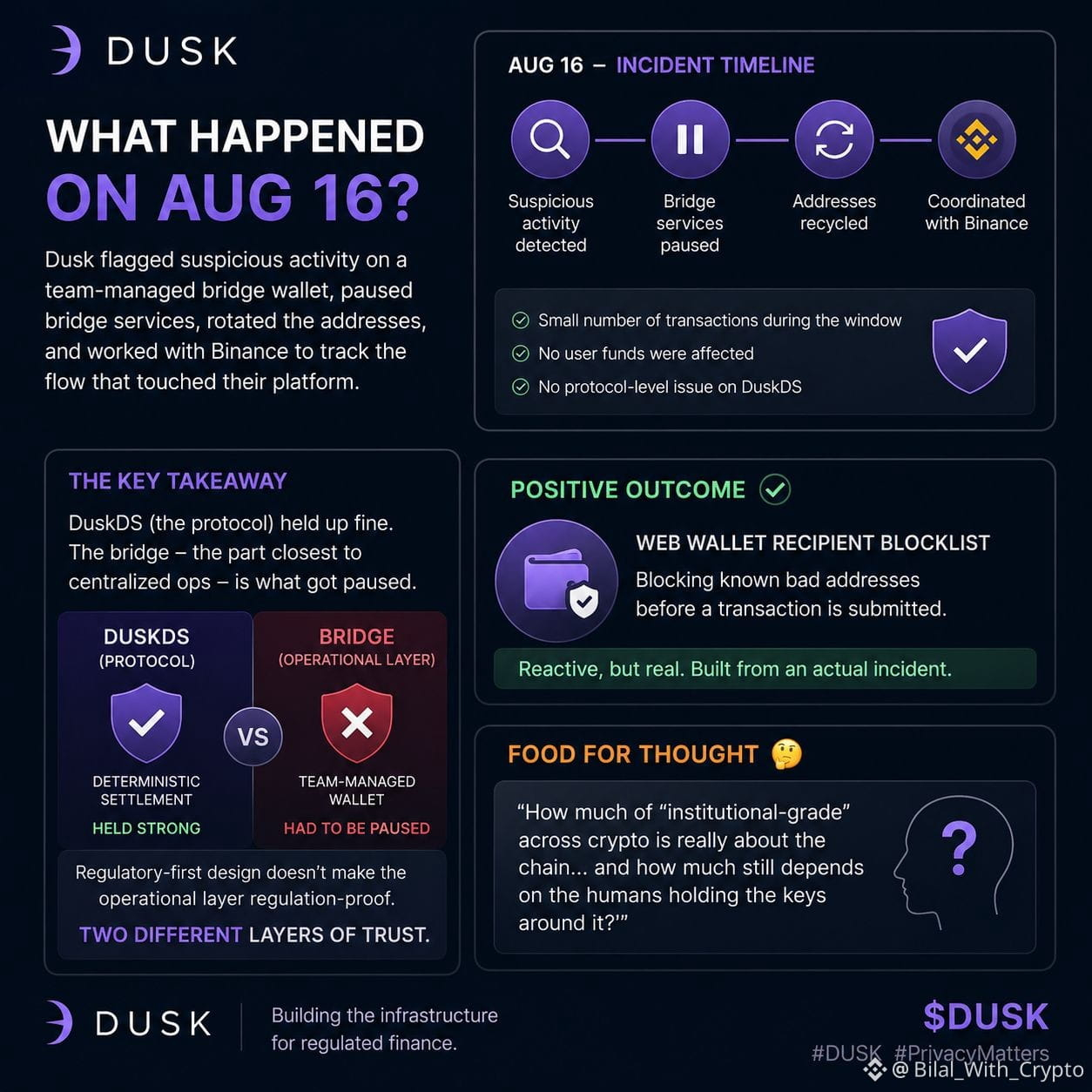
Spent the afternoon digging through #dusk chain activity and almost missed the part that actually stood out.
On Aug. 16, the team flagged suspicious activity involving a team-managed bridge wallet, paused bridge services, rotated the addresses, and worked with Binance to track the flow that touched their platform.
The important part? Only a small number of transactions happened during the window, no user funds were affected, and there was no protocol-level issue with DuskDS itself. The bridge is still paused a week later while the security review continues.
What caught my attention is the contrast.
Dusk is marketed around “deterministic settlement,” regulated infrastructure, and institutional-grade security. But the weak point here wasn't the protocol.
It was the boring human layer: an operationally managed wallet.
DuskDS held up. The bridge, which sits much closer to centralized operations, is what had to be shut down.
That's a useful reminder: regulatory-first design doesn't automatically make the operational layer regulation-proof.
They're different layers of trust.
One more positive: Dusk shipped a Web Wallet recipient blocklist after the incident, blocking known bad addresses before transactions are submitted. Reactive, yes — but at least it's a real security improvement built from an actual incident.
Makes me wonder how much of the “institutional-grade” narrative across crypto is really about the chain itself… and how much still depends on the humans holding the keys around it.
$DUSK #dusk @Dusk_Foundation
Spent the afternoon digging through #dusk chain activity and almost missed the part that actually stood out.
On Aug. 16, the team flagged suspicious activity involving a team-managed bridge wallet, paused bridge services, rotated the addresses, and worked with Binance to track the flow that touched their platform.
The important part? Only a small number of transactions happened during the window, no user funds were affected, and there was no protocol-level issue with DuskDS itself. The bridge is still paused a week later while the security review continues.
What caught my attention is the contrast.
Dusk is marketed around “deterministic settlement,” regulated infrastructure, and institutional-grade security. But the weak point here wasn't the protocol.
It was the boring human layer: an operationally managed wallet.
DuskDS held up. The bridge, which sits much closer to centralized operations, is what had to be shut down.
That's a useful reminder: regulatory-first design doesn't automatically make the operational layer regulation-proof.
They're different layers of trust.
One more positive: Dusk shipped a Web Wallet recipient blocklist after the incident, blocking known bad addresses before transactions are submitted. Reactive, yes — but at least it's a real security improvement built from an actual incident.
Makes me wonder how much of the “institutional-grade” narrative across crypto is really about the chain itself… and how much still depends on the humans holding the keys around it.
$DUSK #dusk @Dusk
On Aug. 16, the team flagged suspicious activity involving a team-managed bridge wallet, paused bridge services, rotated the addresses, and worked with Binance to track the flow that touched their platform.
The important part? Only a small number of transactions happened during the window, no user funds were affected, and there was no protocol-level issue with DuskDS itself. The bridge is still paused a week later while the security review continues.
What caught my attention is the contrast.
Dusk is marketed around “deterministic settlement,” regulated infrastructure, and institutional-grade security. But the weak point here wasn't the protocol.
It was the boring human layer: an operationally managed wallet.
DuskDS held up. The bridge, which sits much closer to centralized operations, is what had to be shut down.
That's a useful reminder: regulatory-first design doesn't automatically make the operational layer regulation-proof.
They're different layers of trust.
One more positive: Dusk shipped a Web Wallet recipient blocklist after the incident, blocking known bad addresses before transactions are submitted. Reactive, yes — but at least it's a real security improvement built from an actual incident.
Makes me wonder how much of the “institutional-grade” narrative across crypto is really about the chain itself… and how much still depends on the humans holding the keys around it.
$DUSK #dusk @Dusk
80
Log in to explore more content
Join global crypto users on Binance Square
⚡️ Get latest and useful information about crypto.
💬 Trusted by the world’s largest crypto exchange.
👍 Discover real insights from verified creators.
Email / Phone number
Trending Topics
BinancePick
2.6M views
141,579 Discussing
Join #EarningsSeason: Predict Earnings on Binance Pick, Share Your Take on Binance Square!
Binance Square Official
·401 Likes
·338.5k views
EarningsSeason
5M views
24,354 Discussing
FranklinTempletonFilesForTwoDividendToBitcoinETFs
1,564 views
93 Discussing