
PositiveMindsGlobalResults
712 Posts

PositiveMindsGlobalResults
Report
Block User
Positivity isn't a luxury. Pain exists everywhere, but so does resilience. Practicing positivity without borders proves empathy is universally understood.

BNB Holder
Frequent Trader
2.3 Years
2.5K+ Following
2.9K Followers
1.1K+ Liked
Posts
All
Quotes
Videos
Live
PINNED
Verified
Micron Shares Rally, but Rising Memory Prices Could Threaten Its Next Growth Chapter🌍 #PositiveMindsGlobalResults
BINANCE SQUARE | INVEST • LEARN • GROW • TOGETHER
Saturday, November 28, 2026
Micron Shares Rally, but Rising Memory Prices Could Threaten Its Next Growth Chapter
Micron's stock rally highlights strong investor confidence in the AI-driven memory boom. However, rising memory prices are creating a potential challenge: higher costs could pressure technology manufacturers, reshape demand and eventually test how sustainable the current semiconductor rally really is.
1. Why Is Micron Stock Rising?
Micron Technology (NASDAQ: MU) gained approximately 3.4% on Friday, November 27, reaching $621.83.
The recovery came as investors returned to AI-related semiconductor stocks following a significant sell-off. Micron had experienced a decline of approximately 36% over the previous month, making the latest rebound notable.
However, one positive trading session does not necessarily mean the market's concerns have disappeared.
2. The Bad News: Memory Prices Could Become a Problem
The biggest concern is the possibility that memory supply could eventually catch up with demand.
DRAM: TrendForce expects demand conditions to weaken in certain consumer-memory segments, while longer-term forecasts raise questions about pricing beyond 2027.NAND: Analysts have warned that additional production capacity could create oversupply and put downward pressure on prices.AI infrastructure: If major cloud companies slow their data-centre expansion plans, demand for high-performance memory could weaken.
This matters because Micron's profitability depends not only on selling more memory chips but also on maintaining strong selling prices and healthy profit margins.
3. Why Analysts Are Divided
There are two competing views of Micron's future.
The bullish argument: Hewlett Packard Enterprise expects memory and other critical components to remain constrained until at least the second half of 2028. Continued AI infrastructure investment could support demand and keep memory prices elevated.
The bearish argument: BNP Paribas believes memory supply could approach demand levels as early as mid-2027. It downgraded Micron from Outperform to Neutral and reduced its price target from $1,700 to $775.
The disagreement highlights the central question: will AI-driven demand continue to outpace new memory production, or will supply eventually catch up?
4. What Does This Mean for the AI Industry?
Micron's performance is important beyond its own shareholders.
Nvidia: Memory availability and pricing affect AI accelerator production costs.Microsoft and Google: Higher memory costs could increase data-centre investment expenses.Dell and HP: Expensive DRAM and NAND can raise server and computer manufacturing costs.Consumers: Higher component prices may eventually translate into more expensive PCs, laptops and other electronics.
The AI revolution is creating substantial opportunities for semiconductor manufacturers, but rising infrastructure costs could become a challenge for the wider technology industry.
5. What Should Investors Watch Next?
Four developments could determine Micron's next major move:
Memory pricing: Whether DRAM and NAND prices continue rising or begin weakening.AI spending: Whether Microsoft, Google, Amazon and other major cloud companies maintain their data-centre investment plans.Production capacity: Whether new semiconductor manufacturing facilities create additional supply faster than expected.Micron earnings: Whether revenue growth, profit margins and future guidance justify the company's valuation.
Micron's next scheduled earnings report on December 17, 2026, will be particularly important for assessing its outlook.
6. Investment Outlook: Bullish or Bearish?
Scenario Potential developmentBullish AI demand remains strong, memory shortages persist and profitability improves.Neutral Strong AI demand offsets weaker consumer-memory pricing.Bearish Oversupply emerges, memory prices decline and profit expectations fall.
Our perspective: Micron remains strategically important to the AI semiconductor industry. However, investors should distinguish between long-term AI growth and the short-term memory pricing cycle.
A growing AI market does not automatically guarantee continuously rising memory prices or stock valuations.
7. The Bigger Picture
Micron's latest recovery demonstrates that investor confidence in AI-related companies remains significant. Nevertheless, the memory industry has historically experienced powerful boom-and-bust cycles.
The next phase will depend on whether AI demand can absorb increasing memory production without weakening prices.
The real question is not whether AI needs more memory. It is whether memory manufacturers can maintain strong profitability as supply expands.
Disclaimer: This article is for educational and informational purposes only, not financial advice. Stock-market forecasts are uncertain, and investors should conduct independent research (DYOR) and carefully assess their risk exposure.
#Micron #ArtificialIntelligence #Semiconductors #MemoryChips #NVIDIA #TechnologyStocks #AIInfrastructure #StockMarket #Investing #PositiveMindsGlobalResults
{spot}(BNBUSDT)
{future}(MUUSDT)
Micron Shares Rally, but Rising Memory Prices Could Threaten Its Next Growth Chapter
🌍 #PositiveMindsGlobalResults
BINANCE SQUARE | INVEST • LEARN • GROW • TOGETHER
Saturday, November 28, 2026
Micron Shares Rally, but Rising Memory Prices Could Threaten Its Next Growth Chapter
Micron's stock rally highlights strong investor confidence in the AI-driven memory boom. However, rising memory prices are creating a potential challenge: higher costs could pressure technology manufacturers, reshape demand and eventually test how sustainable the current semiconductor rally really is.
1. Why Is Micron Stock Rising?
Micron Technology (NASDAQ: MU) gained approximately 3.4% on Friday, November 27, reaching $621.83.
The recovery came as investors returned to AI-related semiconductor stocks following a significant sell-off. Micron had experienced a decline of approximately 36% over the previous month, making the latest rebound notable.
However, one positive trading session does not necessarily mean the market's concerns have disappeared.
2. The Bad News: Memory Prices Could Become a Problem
The biggest concern is the possibility that memory supply could eventually catch up with demand.
DRAM: TrendForce expects demand conditions to weaken in certain consumer-memory segments, while longer-term forecasts raise questions about pricing beyond 2027.NAND: Analysts have warned that additional production capacity could create oversupply and put downward pressure on prices.AI infrastructure: If major cloud companies slow their data-centre expansion plans, demand for high-performance memory could weaken.
This matters because Micron's profitability depends not only on selling more memory chips but also on maintaining strong selling prices and healthy profit margins.
3. Why Analysts Are Divided
There are two competing views of Micron's future.
The bullish argument: Hewlett Packard Enterprise expects memory and other critical components to remain constrained until at least the second half of 2028. Continued AI infrastructure investment could support demand and keep memory prices elevated.
The bearish argument: BNP Paribas believes memory supply could approach demand levels as early as mid-2027. It downgraded Micron from Outperform to Neutral and reduced its price target from $1,700 to $775.
The disagreement highlights the central question: will AI-driven demand continue to outpace new memory production, or will supply eventually catch up?
4. What Does This Mean for the AI Industry?
Micron's performance is important beyond its own shareholders.
Nvidia: Memory availability and pricing affect AI accelerator production costs.Microsoft and Google: Higher memory costs could increase data-centre investment expenses.Dell and HP: Expensive DRAM and NAND can raise server and computer manufacturing costs.Consumers: Higher component prices may eventually translate into more expensive PCs, laptops and other electronics.
The AI revolution is creating substantial opportunities for semiconductor manufacturers, but rising infrastructure costs could become a challenge for the wider technology industry.
5. What Should Investors Watch Next?
Four developments could determine Micron's next major move:
Memory pricing: Whether DRAM and NAND prices continue rising or begin weakening.AI spending: Whether Microsoft, Google, Amazon and other major cloud companies maintain their data-centre investment plans.Production capacity: Whether new semiconductor manufacturing facilities create additional supply faster than expected.Micron earnings: Whether revenue growth, profit margins and future guidance justify the company's valuation.
Micron's next scheduled earnings report on December 17, 2026, will be particularly important for assessing its outlook.
6. Investment Outlook: Bullish or Bearish?
Scenario Potential developmentBullish AI demand remains strong, memory shortages persist and profitability improves.Neutral Strong AI demand offsets weaker consumer-memory pricing.Bearish Oversupply emerges, memory prices decline and profit expectations fall.
Our perspective: Micron remains strategically important to the AI semiconductor industry. However, investors should distinguish between long-term AI growth and the short-term memory pricing cycle.
A growing AI market does not automatically guarantee continuously rising memory prices or stock valuations.
7. The Bigger Picture
Micron's latest recovery demonstrates that investor confidence in AI-related companies remains significant. Nevertheless, the memory industry has historically experienced powerful boom-and-bust cycles.
The next phase will depend on whether AI demand can absorb increasing memory production without weakening prices.
The real question is not whether AI needs more memory. It is whether memory manufacturers can maintain strong profitability as supply expands.
Disclaimer: This article is for educational and informational purposes only, not financial advice. Stock-market forecasts are uncertain, and investors should conduct independent research (DYOR) and carefully assess their risk exposure.
#Micron #ArtificialIntelligence #Semiconductors #MemoryChips #NVIDIA #TechnologyStocks #AIInfrastructure #StockMarket #Investing #PositiveMindsGlobalResults
702
PINNED
The Warnings Behind This Week’s Stock-Market Rally🌍 #PositiveMindsGlobalResults
BINANCE SQUARE | INVEST • LEARN • GROW • TOGETHER
GLOBAL MARKET ANALYSIS | WEEKEND EDITION
MARKET INSIGHT | NOVEMBER 28, 2026
The Warnings Behind This Week’s Stock-Market Rally
A stock-market rebound can create optimism, but a rising market does not necessarily mean all risks have disappeared. Behind this week's recovery, investors are still watching several important warning signals: AI valuations, inflation, interest rates, corporate debt, consumer strength, and the sustainability of earnings growth.
The key question is not simply whether stocks are rising—but whether the underlying economy and corporate earnings can justify the rally.
1. The rally may be a rebound—not a confirmed recovery
The sharp recovery in US equities this week came after an unusually severe selloff. Investors rushed back into stocks following renewed optimism surrounding Nvidia and the broader AI sector. However, a powerful rebound can also be driven by short covering, oversold conditions, and traders repositioning—not necessarily by a fundamental improvement in the economy.
Reuters reported that the market remains highly sensitive to AI volatility, interest-rate expectations, and upcoming employment data. The S&P 500 had fallen around 8% from its October peak, while the Nasdaq had declined more than 14% at the time of its report.
2. AI valuations and the earnings reality
AI remains one of the strongest long-term investment themes, but the market is becoming more demanding.
Investors are increasingly asking:
How quickly will massive AI investments generate real profits?Are data centres, chips and computing infrastructure becoming too expensive?Can AI companies sustain current spending without excessive borrowing?Will future earnings justify today's valuations?
The Bank of England warned that stock valuations remain stretched on certain measures and that markets are highly dependent on strong future earnings expectations from a concentrated group of AI and technology companies.
The danger is not necessarily that AI will fail. The risk is that investors have priced in success too quickly.
3. Inflation could force the Federal Reserve into a difficult decision
Markets would normally welcome economic growth. But when inflation remains persistent, stronger economic data can become a problem for stocks.
If employment, spending and economic activity remain too strong, inflation could stay elevated—forcing the Federal Reserve to maintain restrictive monetary policy or consider additional rate increases.
Higher rates can:
Increase borrowing costs for businesses.Reduce the attractiveness of highly valued growth stocks.Make financing AI infrastructure more expensive.Pressure mortgages, consumer spending and corporate profits.Increase volatility across equities, bonds and crypto.
Reuters identified the upcoming US employment report and the December Federal Reserve meeting as major catalysts capable of shifting market expectations.
4. The hidden risk: debt and financing behind the AI boom
The AI investment cycle is increasingly connected to borrowing, bonds, private credit and large-scale infrastructure financing.
Building AI data centres requires enormous amounts of capital for:
Advanced semiconductor chipsElectricity and energy infrastructureCooling systemsNetworking equipmentData-centre constructionLong-term computing capacity
The Bank of England reported that AI-related borrowing is expanding across hyperscale's, data-centre operators and other infrastructure businesses, creating deeper connections between technology investment and financial markets.
If expected AI revenue grows slower than investment costs, the market may begin questioning not only stock valuations but also the ability of companies to finance future expansion profitably.
5. Market concentration is becoming a bigger concern
The stock market may appear diversified, but a relatively small group of mega-cap technology and AI companies can have an enormous influence on major indexes.
When a handful of companies drive the rally, their earnings disappointments, regulatory problems, valuation corrections or financing concerns can affect the entire market.
According to the Bank of England's November Financial Stability Report, the 10 largest companies accounted for approximately 41% of the S&P 500's market capitalization, while AI-related companies represented slightly more than half.
This concentration can create a misleading impression of market strength. A few leading stocks may hold up an index while weakness spreads across other sectors.
6. What investors should watch next week
UPCOMING MARKET TRIGGERS
US Employment Report
Jobs growth, unemployment and wage data could reshape interest-rate expectations and market sentiment.
Federal Reserve Outlook
Investors will assess whether inflation concerns could trigger a more hawkish policy direction.
AI & Technology Earnings
Corporate results and guidance will help determine whether AI spending is translating into sustainable earnings.
Bond Yields & Credit Conditions
Rising yields, credit spreads and financing costs could reveal whether financial conditions are becoming more restrictive.
These catalysts could determine whether this week's recovery develops into a more sustainable rebound or another temporary relief rally.
BULLISH SCENARIO
Recovery strengthens
Inflation moderates.Fed pressure eases.AI earnings remain strong.Bond yields stabilize.Investors regain confidence.
BEARISH SCENARIO
Rally loses momentum
Inflation remains elevated.Rate hikes become more likely.AI returns disappoint.Credit stress increases.Market concentration amplifies selling.
Final perspective
This week's stock-market rally has restored some optimism, but it has not eliminated the underlying risks.
The market is navigating a delicate balance between economic growth, AI investment, corporate profitability, inflation and interest rates. Investors may continue buying dips, but a sustainable recovery requires more than a powerful rebound in share prices.
The next phase of this market will be decided by earnings, inflation, financing costs and whether the AI investment boom can deliver the returns investors are expecting.
A rally can change sentiment overnight. Fundamental strength takes longer to prove.
DISCLAIMER
This article is for educational and informational purposes only and does not constitute financial or investment advice. Stock markets, cryptocurrencies and other financial assets involve risks, including the potential loss of capital. Market scenarios are not guarantees. Always conduct your own research (DYOR) and assess your risk tolerance before making investment decisions.
#StockMarket #WallStreet #AIStocks #FederalReserve #Inflation #Investing #MarketOutlook #PositiveMindsGlobalResults
{spot}(BNBUSDT)
{spot}(BTCUSDT)
The Warnings Behind This Week’s Stock-Market Rally
🌍 #PositiveMindsGlobalResults
BINANCE SQUARE | INVEST • LEARN • GROW • TOGETHER
GLOBAL MARKET ANALYSIS | WEEKEND EDITION
MARKET INSIGHT | NOVEMBER 28, 2026
The Warnings Behind This Week’s Stock-Market Rally
A stock-market rebound can create optimism, but a rising market does not necessarily mean all risks have disappeared. Behind this week's recovery, investors are still watching several important warning signals: AI valuations, inflation, interest rates, corporate debt, consumer strength, and the sustainability of earnings growth.
The key question is not simply whether stocks are rising—but whether the underlying economy and corporate earnings can justify the rally.
1. The rally may be a rebound—not a confirmed recovery
The sharp recovery in US equities this week came after an unusually severe selloff. Investors rushed back into stocks following renewed optimism surrounding Nvidia and the broader AI sector. However, a powerful rebound can also be driven by short covering, oversold conditions, and traders repositioning—not necessarily by a fundamental improvement in the economy.
Reuters reported that the market remains highly sensitive to AI volatility, interest-rate expectations, and upcoming employment data. The S&P 500 had fallen around 8% from its October peak, while the Nasdaq had declined more than 14% at the time of its report.
2. AI valuations and the earnings reality
AI remains one of the strongest long-term investment themes, but the market is becoming more demanding.
Investors are increasingly asking:
How quickly will massive AI investments generate real profits?Are data centres, chips and computing infrastructure becoming too expensive?Can AI companies sustain current spending without excessive borrowing?Will future earnings justify today's valuations?
The Bank of England warned that stock valuations remain stretched on certain measures and that markets are highly dependent on strong future earnings expectations from a concentrated group of AI and technology companies.
The danger is not necessarily that AI will fail. The risk is that investors have priced in success too quickly.
3. Inflation could force the Federal Reserve into a difficult decision
Markets would normally welcome economic growth. But when inflation remains persistent, stronger economic data can become a problem for stocks.
If employment, spending and economic activity remain too strong, inflation could stay elevated—forcing the Federal Reserve to maintain restrictive monetary policy or consider additional rate increases.
Higher rates can:
Increase borrowing costs for businesses.Reduce the attractiveness of highly valued growth stocks.Make financing AI infrastructure more expensive.Pressure mortgages, consumer spending and corporate profits.Increase volatility across equities, bonds and crypto.
Reuters identified the upcoming US employment report and the December Federal Reserve meeting as major catalysts capable of shifting market expectations.
4. The hidden risk: debt and financing behind the AI boom
The AI investment cycle is increasingly connected to borrowing, bonds, private credit and large-scale infrastructure financing.
Building AI data centres requires enormous amounts of capital for:
Advanced semiconductor chipsElectricity and energy infrastructureCooling systemsNetworking equipmentData-centre constructionLong-term computing capacity
The Bank of England reported that AI-related borrowing is expanding across hyperscale's, data-centre operators and other infrastructure businesses, creating deeper connections between technology investment and financial markets.
If expected AI revenue grows slower than investment costs, the market may begin questioning not only stock valuations but also the ability of companies to finance future expansion profitably.
5. Market concentration is becoming a bigger concern
The stock market may appear diversified, but a relatively small group of mega-cap technology and AI companies can have an enormous influence on major indexes.
When a handful of companies drive the rally, their earnings disappointments, regulatory problems, valuation corrections or financing concerns can affect the entire market.
According to the Bank of England's November Financial Stability Report, the 10 largest companies accounted for approximately 41% of the S&P 500's market capitalization, while AI-related companies represented slightly more than half.
This concentration can create a misleading impression of market strength. A few leading stocks may hold up an index while weakness spreads across other sectors.
6. What investors should watch next week
UPCOMING MARKET TRIGGERS
US Employment Report
Jobs growth, unemployment and wage data could reshape interest-rate expectations and market sentiment.
Federal Reserve Outlook
Investors will assess whether inflation concerns could trigger a more hawkish policy direction.
AI & Technology Earnings
Corporate results and guidance will help determine whether AI spending is translating into sustainable earnings.
Bond Yields & Credit Conditions
Rising yields, credit spreads and financing costs could reveal whether financial conditions are becoming more restrictive.
These catalysts could determine whether this week's recovery develops into a more sustainable rebound or another temporary relief rally.
BULLISH SCENARIO
Recovery strengthens
Inflation moderates.Fed pressure eases.AI earnings remain strong.Bond yields stabilize.Investors regain confidence.
BEARISH SCENARIO
Rally loses momentum
Inflation remains elevated.Rate hikes become more likely.AI returns disappoint.Credit stress increases.Market concentration amplifies selling.
Final perspective
This week's stock-market rally has restored some optimism, but it has not eliminated the underlying risks.
The market is navigating a delicate balance between economic growth, AI investment, corporate profitability, inflation and interest rates. Investors may continue buying dips, but a sustainable recovery requires more than a powerful rebound in share prices.
The next phase of this market will be decided by earnings, inflation, financing costs and whether the AI investment boom can deliver the returns investors are expecting.
A rally can change sentiment overnight. Fundamental strength takes longer to prove.
DISCLAIMER
This article is for educational and informational purposes only and does not constitute financial or investment advice. Stock markets, cryptocurrencies and other financial assets involve risks, including the potential loss of capital. Market scenarios are not guarantees. Always conduct your own research (DYOR) and assess your risk tolerance before making investment decisions.
#StockMarket #WallStreet #AIStocks #FederalReserve #Inflation #Investing #MarketOutlook #PositiveMindsGlobalResults
285
🌍 #PositiveMindsGlobalResults
BINANCE SQUARE | INVEST • LEARN • GROW • TOGETHER
Saturday, November 28, 2026
SpaceX and Tesla: Two Musk Giants Facing a Challenging 2026
2026 has been a turbulent year for both SpaceX and Tesla,
reminding investors that even the most ambitious companies can face setbacks, market pressure and rising expectations.
Tesla continues to navigate intense competition in the electric vehicle market, changing consumer demand, pressure on margins and growing expectations surrounding AI, robotics and autonomous driving. Investors are increasingly looking beyond car sales to determine whether its technology ambitions can deliver sustainable profits.
SpaceX, meanwhile, faces the enormous challenge of balancing ambitious expansion, Starship development, satellite infrastructure and capital-intensive projects. Its long-term opportunities remain significant, but execution, costs, technical milestones and valuation expectations continue to matter.
The bigger lesson for investors is that exciting technology alone does not guarantee smooth returns. Innovation can create extraordinary opportunities—but patience, financial discipline and realistic expectations remain essential.
In 2026, the real test for both companies is turning bold promises into consistent results.
#Tesla #SpaceX #ElonMusk #ArtificialIntelligence #StockMarket #Technology #Investing #PositiveMindsGlobalResults
Not financial advice. Always do your own research before making
investment decisions.
{spot}(BNBUSDT)
🌍 #PositiveMindsGlobalResults
BINANCE SQUARE | INVEST • LEARN • GROW • TOGETHER
Saturday, November 28, 2026
SpaceX and Tesla: Two Musk Giants Facing a Challenging 2026
2026 has been a turbulent year for both SpaceX and Tesla,
reminding investors that even the most ambitious companies can face setbacks, market pressure and rising expectations.
Tesla continues to navigate intense competition in the electric vehicle market, changing consumer demand, pressure on margins and growing expectations surrounding AI, robotics and autonomous driving. Investors are increasingly looking beyond car sales to determine whether its technology ambitions can deliver sustainable profits.
SpaceX, meanwhile, faces the enormous challenge of balancing ambitious expansion, Starship development, satellite infrastructure and capital-intensive projects. Its long-term opportunities remain significant, but execution, costs, technical milestones and valuation expectations continue to matter.
The bigger lesson for investors is that exciting technology alone does not guarantee smooth returns. Innovation can create extraordinary opportunities—but patience, financial discipline and realistic expectations remain essential.
In 2026, the real test for both companies is turning bold promises into consistent results.
#Tesla #SpaceX #ElonMusk #ArtificialIntelligence #StockMarket #Technology #Investing #PositiveMindsGlobalResults
Not financial advice. Always do your own research before making
investment decisions.
26
·
--
Bearish
🌍 #PositiveMindsGlobalResults
BINANCE SQUARE | INVEST • LEARN • GROW • TOGETHER
Saturday, November 28, 2026
If a Stock Market Crash Is Coming, Warren Buffett Says This Is the Smartest Move You Can Make
Market crashes are frightening, but for disciplined investors, they can also create some of the best long-term opportunities.
Warren Buffett’s philosophy is simple: when fear dominates the market, focus on value rather than panic. Instead of rushing to sell everything, investors should look for financially strong companies with solid businesses, sustainable earnings and long-term growth potential—especially when their shares become attractively priced.
However, buying the dip does not mean buying blindly.
Understanding a company, protecting cash reserves, avoiding excessive debt and having patience are essential.
Markets may fall unexpectedly, but preparation can make the difference between panic and opportunity.
Sometimes, the smartest move during a market crash is not to run away from the market—but to know what is worth buying when everyone else is afraid.
🌍 Stay positive. Stay informed. Stay secure. 💛
Not financial advice. Always conduct your own research and manage your risk.
#WarrenBuffett #stockmarket #Investing #MarketCrash $BNB $BTC #LongTermInvesting #FinancialWisdom #PositiveMindsGlobalResults.
7
Nvidia’s $950 Million Insurance Strategy Raises a Bigger Question: Are Investors Facing Hidden Governance Risks?
🌍 #PositiveMindsGlobalResults
BINANCE SQUARE | INVEST • LEARN • GROW • TOGETHER
Saturday, November 28, 2026
A closer look at Nvidia’s unusual directors-and-officers (D&O) insurance structure, shareholder litigation exposure and growing credit-market concerns over corporate governance.
Key points to explore:
Why Nvidia reportedly carries up to $950 million in executive-only D&O insurance.
Why the company lacks traditional Side B and Side C coverage.
How shareholder lawsuits could expose Nvidia’s own balance sheet.
Why governance concerns are attracting greater attention from credit-rating agencies.
What this could mean for Nvidia, its investors and the wider AI industry.
Recent reporting confirms that S&P Global placed Nvidia's credit rating on CreditWatch Negative on November 25, citing management and governance concerns.
The bigger lesson: Even the world's most powerful technology companies must prove that strong financial performance is supported by equally strong leadership, transparency and corporate accountability.
Disclaimer:
This CONTENT is for informational and educational purposes only and does not constitute financial, investment, legal or insurance advice. The information is based on publicly available reports and market developments, which may change. Insurance arrangements, governance risks and credit assessments should be independently verified. Stock-market investments involve risks, and investors should conduct their own research (DYOR) and make decisions based on their individual financial circumstances. No outcome or investment return is guaranteed.
#NVIDIA #NVIDIACorporation #CorporateGovernance #DOInsurance #CreditMarkets #InvestorConfidence #ShareholderProtection #RiskManagement #AIIndustry #ArtificialIntelligence #StockMarket #WallStreet #TechStocks #FinancialMarkets #InvestmentInsights #PositiveMindsGlobalResults
{spot}(BNBUSDT)
{spot}(BTCUSDT)
Nvidia’s $950 Million Insurance Strategy Raises a Bigger Question: Are Investors Facing Hidden Governance Risks?
🌍 #PositiveMindsGlobalResults
BINANCE SQUARE | INVEST • LEARN • GROW • TOGETHER
Saturday, November 28, 2026
A closer look at Nvidia’s unusual directors-and-officers (D&O) insurance structure, shareholder litigation exposure and growing credit-market concerns over corporate governance.
Key points to explore:
Why Nvidia reportedly carries up to $950 million in executive-only D&O insurance.
Why the company lacks traditional Side B and Side C coverage.
How shareholder lawsuits could expose Nvidia’s own balance sheet.
Why governance concerns are attracting greater attention from credit-rating agencies.
What this could mean for Nvidia, its investors and the wider AI industry.
Recent reporting confirms that S&P Global placed Nvidia's credit rating on CreditWatch Negative on November 25, citing management and governance concerns.
The bigger lesson: Even the world's most powerful technology companies must prove that strong financial performance is supported by equally strong leadership, transparency and corporate accountability.
Disclaimer:
This CONTENT is for informational and educational purposes only and does not constitute financial, investment, legal or insurance advice. The information is based on publicly available reports and market developments, which may change. Insurance arrangements, governance risks and credit assessments should be independently verified. Stock-market investments involve risks, and investors should conduct their own research (DYOR) and make decisions based on their individual financial circumstances. No outcome or investment return is guaranteed.
#NVIDIA #NVIDIACorporation #CorporateGovernance #DOInsurance #CreditMarkets #InvestorConfidence #ShareholderProtection #RiskManagement #AIIndustry #ArtificialIntelligence #StockMarket #WallStreet #TechStocks #FinancialMarkets #InvestmentInsights #PositiveMindsGlobalResults
130

Article
Hackers Breach U.S. Air Force Cloud Network: Military Data Security Under Scrutiny🌍 #PositiveMindsGlobalResults
BINANCE SQUARE | INVEST • LEARN • GROW • TOGETHER
Saturday, November 28, 2026
Hackers Penetrate U.S. Air Force’s Cloud Network: Sensitive Military Data and National Security Under Scrutiny
The reported cyberattack against the U.S. Air Force's flagship cloud computing platform has raised serious questions about the security of America's military technology infrastructure. Beyond the immediate disruption, the incident highlights how vulnerabilities in interconnected cloud systems could create risks for military operations, sensitive information and national security.
1. What Happened?
Hackers reportedly breached Cloud One, a major cloud computing environment used by the U.S. Air Force. According to Reuters, the intrusion was discovered within approximately the past month while the system was undergoing upgrade work.
The incident has triggered an investigation into how attackers gained access, what information may have been exposed and whether sensitive military systems were affected.
Importantly, investigators have not established the full extent of the breach, and there is currently no confirmed public evidence that information was stolen.
2. What Is Cloud One?
Launched in 2017, Cloud One was designed to bring together multiple cloud computing services into a central technology environment.
It integrates infrastructure from four major technology providers:
Microsoft – Azure cloud infrastructure.Amazon – Amazon Web Services (AWS).Google – Google Cloud Platform.Oracle – Oracle Cloud Infrastructure.
The platform supports applications used across Air Force and Space Force operations, including personnel management, payroll, logistics, maintenance and other military functions.
3. Why Is This Breach So Serious?
Cloud One is not simply an ordinary business storage platform. It supports systems connected to important military information.
Reportedly, applications operating within the environment include:
Military personnel information and payroll records.Aircraft maintenance and logistics systems.Air defence radar information and command-and-control applications.Weapons and ammunition inventory tracking across more than 200 U.S. Air Force locations worldwide.
If attackers gained access to sensitive operational information, the potential consequences could extend beyond financial losses or data exposure.
However, there is no confirmation that the hackers accessed or manipulated these specific operational systems.
4. How Did Hackers Gain Access?
One source familiar with the incident told Reuters that attackers exploited a software vulnerability to reach Cloud One's control plane.
The control plane is particularly important because it helps administrators manage and oversee cloud infrastructure.
If improperly accessed, it could potentially provide visibility into connected systems, including aircraft operational status and the movement of spare parts.
Investigators have not publicly identified the specific software vulnerability or established exactly what the intruders accessed.
5. Military Operations Face Technology Disruptions
The discovery of the breach has already affected parts of the Cloud One environment.
Reported disruptions include:
Migration of back-office applications being paused.Updates to existing applications being blocked.Some users losing administrator-level access.Additional security investigations and remediation activities.
These restrictions demonstrate the difficult balance between protecting military infrastructure and maintaining the technology services required for everyday operations.
6. U.S. Cyber Command Joins the Investigation
The seriousness of the incident has prompted investigators to involve U.S. Cyber Command, the military organization responsible for cyberspace operations.
Its involvement is intended to help assess the damage, understand the intrusion and determine whether the attackers gained access to additional systems.
At this stage, the identity, motivation and potential international connections of the attackers remain unknown. No country or hacking group has been officially identified as responsible.
7. Technology Companies Face Greater Cybersecurity Responsibilities
The incident also puts renewed attention on the responsibilities of major cloud providers.
Microsoft, Amazon, Google and Oracle supply infrastructure supporting Cloud One. However, the involvement of these providers does not establish that any of their individual cloud services were independently breached.
Modern cloud environments depend on several layers of security, including software updates, administrator permissions, identity verification, network monitoring and vulnerability management.
A weakness in one important management component can potentially create risks across interconnected systems.
8. A Wider Warning for Government Cybersecurity
The Cloud One incident comes amid reports of other cybersecurity incidents involving U.S. government institutions.
Recent reporting has highlighted breaches or intrusions involving the FBI, intelligence-related networks, the Treasury Department and other government systems.
Separately, an earlier breach involving the Defense Manpower Data Center reportedly affected approximately 2.76 million living individuals and 294,000 deceased individuals.
These incidents are separate investigations, but together they underline the growing importance of protecting government information and critical digital infrastructure.
9. What Does This Mean for the Future of Cybersecurity?
The incident delivers several important lessons for governments, businesses and technology providers.
First: Cloud security is national security. Military and government organizations must treat cloud infrastructure as critical infrastructure.
Second: Vulnerability management cannot wait. Delayed software updates and weaknesses in system administration can create opportunities for attackers.
Third: Access control matters. Administrator privileges should be carefully restricted, monitored and regularly reviewed.
Fourth: Continuous monitoring is essential. Organizations need the ability to identify suspicious activity before attackers can move deeper into their networks.
Finally: Cybersecurity requires shared responsibility. Governments, cloud providers and technology contractors must work together to protect sensitive information.
Final Perspective: The Biggest Threat May Be What Remains Unknown
The reported breach of Cloud One is a reminder that even sophisticated military technology environments are not immune to cyberattacks.
The most important questions remain unanswered: Who was behind the intrusion? How deeply did the attackers penetrate the system? Was sensitive information accessed or stolen?
Until investigators establish those facts, it would be premature to describe the incident as a confirmed compromise of military operations.
One lesson is already clear: in an increasingly digital world, protecting national security requires protecting the technology that supports it.
The future of military strength will depend not only on advanced weapons and defence systems, but also on the ability to defend the digital infrastructure behind them.
Key Takeaway
Cybersecurity is no longer just an IT responsibility. It is a national security priority, an economic necessity and a critical foundation of trust in the digital world.
Disclaimer: This article is based on publicly reported information available as of November 28, 2026. The investigation is ongoing, and the full extent of the breach, potential data exposure and identity of the attackers have not been independently established.
#CyberSecurity #USAirForce #CloudSecurity #CloudOne #MilitarySecurity #CyberAttack #DataBreach #NationalSecurity #ArtificialIntelligence #MicrosoftAzure #AmazonAWS #GoogleCloud #OracleCloud #DigitalInfrastructure #TechnologyNews #GlobalSecurity #CyberThreats #DigitalTransformation #InformationSecurity #PositiveMindsGlobalResults
{spot}(BNBUSDT)
{spot}(BTCUSDT)
Hackers Breach U.S. Air Force Cloud Network: Military Data Security Under Scrutiny
🌍 #PositiveMindsGlobalResults
BINANCE SQUARE | INVEST • LEARN • GROW • TOGETHER
Saturday, November 28, 2026
Hackers Penetrate U.S. Air Force’s Cloud Network: Sensitive Military Data and National Security Under Scrutiny
The reported cyberattack against the U.S. Air Force's flagship cloud computing platform has raised serious questions about the security of America's military technology infrastructure. Beyond the immediate disruption, the incident highlights how vulnerabilities in interconnected cloud systems could create risks for military operations, sensitive information and national security.
1. What Happened?
Hackers reportedly breached Cloud One, a major cloud computing environment used by the U.S. Air Force. According to Reuters, the intrusion was discovered within approximately the past month while the system was undergoing upgrade work.
The incident has triggered an investigation into how attackers gained access, what information may have been exposed and whether sensitive military systems were affected.
Importantly, investigators have not established the full extent of the breach, and there is currently no confirmed public evidence that information was stolen.
2. What Is Cloud One?
Launched in 2017, Cloud One was designed to bring together multiple cloud computing services into a central technology environment.
It integrates infrastructure from four major technology providers:
Microsoft – Azure cloud infrastructure.Amazon – Amazon Web Services (AWS).Google – Google Cloud Platform.Oracle – Oracle Cloud Infrastructure.
The platform supports applications used across Air Force and Space Force operations, including personnel management, payroll, logistics, maintenance and other military functions.
3. Why Is This Breach So Serious?
Cloud One is not simply an ordinary business storage platform. It supports systems connected to important military information.
Reportedly, applications operating within the environment include:
Military personnel information and payroll records.Aircraft maintenance and logistics systems.Air defence radar information and command-and-control applications.Weapons and ammunition inventory tracking across more than 200 U.S. Air Force locations worldwide.
If attackers gained access to sensitive operational information, the potential consequences could extend beyond financial losses or data exposure.
However, there is no confirmation that the hackers accessed or manipulated these specific operational systems.
4. How Did Hackers Gain Access?
One source familiar with the incident told Reuters that attackers exploited a software vulnerability to reach Cloud One's control plane.
The control plane is particularly important because it helps administrators manage and oversee cloud infrastructure.
If improperly accessed, it could potentially provide visibility into connected systems, including aircraft operational status and the movement of spare parts.
Investigators have not publicly identified the specific software vulnerability or established exactly what the intruders accessed.
5. Military Operations Face Technology Disruptions
The discovery of the breach has already affected parts of the Cloud One environment.
Reported disruptions include:
Migration of back-office applications being paused.Updates to existing applications being blocked.Some users losing administrator-level access.Additional security investigations and remediation activities.
These restrictions demonstrate the difficult balance between protecting military infrastructure and maintaining the technology services required for everyday operations.
6. U.S. Cyber Command Joins the Investigation
The seriousness of the incident has prompted investigators to involve U.S. Cyber Command, the military organization responsible for cyberspace operations.
Its involvement is intended to help assess the damage, understand the intrusion and determine whether the attackers gained access to additional systems.
At this stage, the identity, motivation and potential international connections of the attackers remain unknown. No country or hacking group has been officially identified as responsible.
7. Technology Companies Face Greater Cybersecurity Responsibilities
The incident also puts renewed attention on the responsibilities of major cloud providers.
Microsoft, Amazon, Google and Oracle supply infrastructure supporting Cloud One. However, the involvement of these providers does not establish that any of their individual cloud services were independently breached.
Modern cloud environments depend on several layers of security, including software updates, administrator permissions, identity verification, network monitoring and vulnerability management.
A weakness in one important management component can potentially create risks across interconnected systems.
8. A Wider Warning for Government Cybersecurity
The Cloud One incident comes amid reports of other cybersecurity incidents involving U.S. government institutions.
Recent reporting has highlighted breaches or intrusions involving the FBI, intelligence-related networks, the Treasury Department and other government systems.
Separately, an earlier breach involving the Defense Manpower Data Center reportedly affected approximately 2.76 million living individuals and 294,000 deceased individuals.
These incidents are separate investigations, but together they underline the growing importance of protecting government information and critical digital infrastructure.
9. What Does This Mean for the Future of Cybersecurity?
The incident delivers several important lessons for governments, businesses and technology providers.
First: Cloud security is national security. Military and government organizations must treat cloud infrastructure as critical infrastructure.
Second: Vulnerability management cannot wait. Delayed software updates and weaknesses in system administration can create opportunities for attackers.
Third: Access control matters. Administrator privileges should be carefully restricted, monitored and regularly reviewed.
Fourth: Continuous monitoring is essential. Organizations need the ability to identify suspicious activity before attackers can move deeper into their networks.
Finally: Cybersecurity requires shared responsibility. Governments, cloud providers and technology contractors must work together to protect sensitive information.
Final Perspective: The Biggest Threat May Be What Remains Unknown
The reported breach of Cloud One is a reminder that even sophisticated military technology environments are not immune to cyberattacks.
The most important questions remain unanswered: Who was behind the intrusion? How deeply did the attackers penetrate the system? Was sensitive information accessed or stolen?
Until investigators establish those facts, it would be premature to describe the incident as a confirmed compromise of military operations.
One lesson is already clear: in an increasingly digital world, protecting national security requires protecting the technology that supports it.
The future of military strength will depend not only on advanced weapons and defence systems, but also on the ability to defend the digital infrastructure behind them.
Key Takeaway
Cybersecurity is no longer just an IT responsibility. It is a national security priority, an economic necessity and a critical foundation of trust in the digital world.
Disclaimer: This article is based on publicly reported information available as of November 28, 2026. The investigation is ongoing, and the full extent of the breach, potential data exposure and identity of the attackers have not been independently established.
#CyberSecurity #USAirForce #CloudSecurity #CloudOne #MilitarySecurity #CyberAttack #DataBreach #NationalSecurity #ArtificialIntelligence #MicrosoftAzure #AmazonAWS #GoogleCloud #OracleCloud #DigitalInfrastructure #TechnologyNews #GlobalSecurity #CyberThreats #DigitalTransformation #InformationSecurity #PositiveMindsGlobalResults
94

Article
AI Stocks Rebound, but Wall Street’s Next Test Is Far From Over🌍 #PositiveMindsGlobalResults
BINANCE SQUARE | INVEST • LEARN • GROW • TOGETHER
Saturday, November 28, 2026
Wall Street’s AI Comeback, Rising Inflation Pressure and the Next Big Tech Battles
Markets are entering a complicated phase where optimism about artificial intelligence is returning, but rising bond yields, energy costs, valuation concerns and intense competition across technology are keeping investors cautious. From AI-driven stock recoveries to Apple's entry into AI agents, Micron's memory opportunity and SpaceX's growing investor appeal, the next market move may depend less on excitement and more on earnings, execution and sustainable growth.
THE MARKET RESET: NINE STORIES TO WATCH
AI optimism is returning—but investors are demanding proof, not promises.
1. Artificial Intelligence Shares Rebound as Profitability Fears Ease
The artificial intelligence trade is showing signs of recovery after a painful period of selling. Investors are returning to selected technology stocks, hoping that the recent declines have created attractive entry opportunities.
The rebound is not necessarily a signal that the market's concerns have disappeared. Investors are still questioning the enormous cost of AI infrastructure, the speed of data-centre expansion and whether companies can convert billions of dollars in investment into sustainable profits.
Friday's post-Thanksgiving rally brought renewed buying into semiconductor and AI-related shares, with Micron and other chip companies leading gains. However, the market remains sensitive to inflation, borrowing costs and future earnings expectations.
The key question: Is this the beginning of a sustainable recovery, or simply a temporary bounce after excessive selling?
2. Bond Yields Climb as Inflation Complicates the Federal Reserve's Next Move
Bond markets are sending an important warning to investors. Stronger economic activity combined with persistent inflation could make it difficult for the Federal Reserve to ease monetary policy as quickly as markets previously anticipated.
Higher Treasury yields can put pressure on technology shares, particularly companies whose valuations depend on future earnings growth. When investors can earn higher returns from relatively safer bonds, they may become less willing to pay premium prices for stocks with uncertain future profits.
This creates a complicated environment for the market: economic growth may remain healthy, but rising borrowing costs could reduce valuations, increase corporate financing expenses and slow investment.
The next inflation readings and Federal Reserve signals could become major catalysts for stocks, bonds, cryptocurrencies and the dollar.
3. Expensive Energy Is Squeezing Households as Holiday Spending Faces Pressure
Rising energy prices are creating another challenge for households heading into the holiday season. Fuel, electricity, transportation and delivery costs can place additional pressure on household budgets when everyday expenses are already elevated.
When families spend more on essential costs, they may have less money available for discretionary purchases, restaurants, travel, electronics and holiday gifts.
This pressure can eventually reach businesses through weaker consumer demand, reduced sales growth and increased operating costs. Retailers may face a difficult balance between protecting profit margins and offering discounts to attract customers.
Investors should watch energy prices closely because their impact extends beyond oil and gas companies. Persistent energy inflation can influence consumer spending, corporate earnings, interest rates and the broader stock market.
4. Meta Down 23%: Is the Technology Giant Becoming a Buying Opportunity?
A significant decline in Meta shares has reopened the debate over whether the company is becoming undervalued or whether investors are correctly reassessing its risks.
Meta remains a major player in digital advertising, social media, AI development and the global digital ecosystem. Its platforms provide enormous reach, while AI could potentially improve advertising targeting, engagement, content recommendations and operational efficiency.
However, investors must also consider the company's spending ambitions. AI infrastructure, data centres, advanced chips and talent require substantial capital. If spending increases faster than revenue and operating cash flow, the market may become less comfortable with the company's investment strategy.
A 23% decline can make a stock more attractive, but a lower share price alone does not guarantee a bargain.
Bullish case: AI strengthens advertising efficiency, revenue growth and future profitability.
Bearish case: Expensive AI investment, weaker advertising demand or disappointing returns keep valuations under pressure.
The real opportunity depends on what Meta earns in the future—not simply how much its shares have fallen.
5. Why Micron Investors Are Giving Thanks After Thanksgiving
Micron has become one of the companies investors are watching closely as the AI industry increasingly depends on high-performance memory.
AI servers require enormous amounts of memory to process and manage complex workloads. High-bandwidth memory, advanced DRAM and data-centre demand have made memory technology increasingly important to the AI infrastructure race.
Micron's recent share-price rebound reflects renewed interest in semiconductor companies following the broader market recovery. Investors are looking beyond short-term volatility and considering whether AI-driven memory demand could support stronger revenue, pricing power and margins.
Nevertheless, memory markets remain cyclical. Supply expansion, pricing changes, inventory levels, competition and capital expenditure could affect future profitability.
Micron's long-term opportunity may be substantial, but investors must remember that strong demand today does not automatically guarantee uninterrupted earnings growth tomorrow.
6. Why SpaceX Shares Popped Higher: Investors Look Beyond Earth
SpaceX continues to attract attention because its ambitions extend far beyond conventional aerospace. Rocket launches, reusable launch systems, satellite connectivity, commercial space infrastructure and future space-based technologies have helped position the company as one of the most closely watched names in the private technology sector.
When SpaceX-related shares or private-market valuations rise, investor enthusiasm can reflect expectations about future growth rather than immediate profitability alone. Launch demand, Starlink expansion, technological progress and future commercial opportunities can influence how investors assess its long-term value.
However, investors should distinguish between private-company valuations and publicly traded stocks. SpaceX is not an ordinary listed stock that retail investors can buy on a conventional stock exchange, and private-market valuations may not represent an accessible or liquid market price.
Its story is about a long-term vision—but the execution, funding, valuation and commercial realities remain important.
7. Apple Enters the AI Agent Race: A New Battle Against OpenAI, Anthropic and Meta
The next AI competition may not be about who owns the smartest chatbot. It could be about who builds the most useful AI assistant capable of completing real tasks for users.
Apple's potential push deeper into AI agents represents a strategically important development. AI agents are designed to move beyond answering questions and toward performing actions, managing workflows, interacting with applications and assisting users with everyday decisions.
Apple has an important advantage: its enormous ecosystem of devices, operating systems, applications and services. If AI becomes deeply integrated into the iPhone, Mac and other Apple products, the company could make AI a natural part of daily digital life.
But Apple faces serious competition.
OpenAI: advancing AI assistants and increasingly capable agent experiences.Anthropic: developing AI models and tools focused on reasoning, coding and enterprise workflows.Meta: integrating AI across social platforms, messaging, devices and its broader ecosystem.Apple: potentially leveraging hardware, software, privacy, user experience and ecosystem integration.
The battle could ultimately be decided by usefulness, trust, reliability, privacy, speed and the ability to complete tasks—not simply chatbot popularity.
For Apple investors, AI could become a new growth engine, but the market will eventually want evidence that AI creates stronger revenue, customer retention and monetisation.
8. AI Gains in 2027? The Next Phase Could Separate Winners From Hype
The next year could be more important for AI investors than the previous year of excitement.
The market may gradually shift from rewarding companies simply because they are associated with AI toward rewarding businesses that can demonstrate measurable financial benefits.
In 2027, investors may increasingly focus on:
Revenue generation: Can AI products create meaningful new revenue streams?Productivity: Can companies reduce costs and improve operational efficiency?Monetisation: Will customers pay for AI services at scale?Infrastructure returns: Can enormous data-centre and chip investments generate acceptable returns?Competition: Which companies can maintain technological leadership without sacrificing profitability?Energy and capacity: Can electricity, computing power, cooling and infrastructure keep pace with demand?
AI could remain one of the strongest long-term technology themes, but not every AI company will necessarily benefit equally.
The next phase may reward companies with strong balance sheets, recurring revenue, competitive advantages, commercially useful products and disciplined capital allocation.
2027 may be less about who promises the biggest AI revolution—and more about who proves that the revolution can make money.
9. Anthropic's AI Ambition: Can It Challenge the Magnificent Seven and Become a Dominant Force?
Anthropic is increasingly part of the conversation surrounding the future of artificial intelligence, particularly as competition intensifies between AI developers, technology giants and companies building the next generation of intelligent systems.
Its ambitions extend beyond developing a popular AI assistant. The broader opportunity includes enterprise AI, coding tools, automated workflows, advanced reasoning and AI systems capable of transforming how businesses operate.
The competition is becoming more intense. The Magnificent Seven have enormous financial resources, global distribution, cloud infrastructure, established customers and access to vast amounts of computing power. AI-focused companies such as Anthropic are competing through model development, specialized products, enterprise adoption and innovation.
The challenge is not simply developing powerful AI. It is building a sustainable business capable of converting technological leadership into recurring revenue, commercial growth and long-term profitability.
Anthropic's future will depend on whether it can continue improving its technology, attract enterprise customers, manage the enormous cost of AI development and maintain its competitive advantage.
The AI industry could produce extraordinary winners, but even the most promising companies must prove that their ambitions can translate into lasting economic value.
THE BIGGER PICTURE | WHAT INVESTORS SHOULD WATCH
The market is sending two messages at the same time.
The first is that investors still believe in the long-term potential of artificial intelligence, semiconductor technology, digital infrastructure and automation.
The second is that enthusiasm alone is no longer enough. Rising inflation, bond yields, energy costs, expensive valuations and enormous AI investment commitments are forcing investors to become more selective.
The next market opportunity may not belong to the companies making the loudest promises. It may belong to those capable of delivering measurable growth, sustainable profits, stronger cash flow and genuine technological advantages.
AI is still a major investment story—but 2027 could increasingly become the year of financial proof, execution and accountability.
Disclaimer: This article is for informational and educational purposes only and does not constitute financial, investment or trading advice. Stock prices, market conditions, forecasts and valuations can change rapidly. AI-related investments may carry significant volatility and risk. Always conduct your own research and assess your risk tolerance before making investment decisions.
#AI #ArtificialIntelligence #AIStocks #TechStocks #StockMarket #WallStreet #MarketOutlook #MarketRecovery #Inflation #BondYields #FederalReserve #InterestRates #EnergyPrices #EconomicOutlook #Investing #InvestmentStrategy #FinancialMarkets #BigTech #MagnificentSeven #Meta #Apple #AAPL #Anthropic #OpenAI #Micron #MU #SpaceX #Nvidia #NVDA #Semiconductors #MemoryChips #AIInfrastructure #DataCenters #AITrading #TechInnovation #DigitalEconomy #FutureOfTechnology #2027Outlook #BullMarket #MarketVolatility #Profitability #EarningsGrowth #PositiveMindsGlobalResults #BinanceSquare #InvestLearnGrowTogether
{spot}(BNBUSDT)
AI Stocks Rebound, but Wall Street’s Next Test Is Far From Over
🌍 #PositiveMindsGlobalResults
BINANCE SQUARE | INVEST • LEARN • GROW • TOGETHER
Saturday, November 28, 2026
Wall Street’s AI Comeback, Rising Inflation Pressure and the Next Big Tech Battles
Markets are entering a complicated phase where optimism about artificial intelligence is returning, but rising bond yields, energy costs, valuation concerns and intense competition across technology are keeping investors cautious. From AI-driven stock recoveries to Apple's entry into AI agents, Micron's memory opportunity and SpaceX's growing investor appeal, the next market move may depend less on excitement and more on earnings, execution and sustainable growth.
THE MARKET RESET: NINE STORIES TO WATCH
AI optimism is returning—but investors are demanding proof, not promises.
1. Artificial Intelligence Shares Rebound as Profitability Fears Ease
The artificial intelligence trade is showing signs of recovery after a painful period of selling. Investors are returning to selected technology stocks, hoping that the recent declines have created attractive entry opportunities.
The rebound is not necessarily a signal that the market's concerns have disappeared. Investors are still questioning the enormous cost of AI infrastructure, the speed of data-centre expansion and whether companies can convert billions of dollars in investment into sustainable profits.
Friday's post-Thanksgiving rally brought renewed buying into semiconductor and AI-related shares, with Micron and other chip companies leading gains. However, the market remains sensitive to inflation, borrowing costs and future earnings expectations.
The key question: Is this the beginning of a sustainable recovery, or simply a temporary bounce after excessive selling?
2. Bond Yields Climb as Inflation Complicates the Federal Reserve's Next Move
Bond markets are sending an important warning to investors. Stronger economic activity combined with persistent inflation could make it difficult for the Federal Reserve to ease monetary policy as quickly as markets previously anticipated.
Higher Treasury yields can put pressure on technology shares, particularly companies whose valuations depend on future earnings growth. When investors can earn higher returns from relatively safer bonds, they may become less willing to pay premium prices for stocks with uncertain future profits.
This creates a complicated environment for the market: economic growth may remain healthy, but rising borrowing costs could reduce valuations, increase corporate financing expenses and slow investment.
The next inflation readings and Federal Reserve signals could become major catalysts for stocks, bonds, cryptocurrencies and the dollar.
3. Expensive Energy Is Squeezing Households as Holiday Spending Faces Pressure
Rising energy prices are creating another challenge for households heading into the holiday season. Fuel, electricity, transportation and delivery costs can place additional pressure on household budgets when everyday expenses are already elevated.
When families spend more on essential costs, they may have less money available for discretionary purchases, restaurants, travel, electronics and holiday gifts.
This pressure can eventually reach businesses through weaker consumer demand, reduced sales growth and increased operating costs. Retailers may face a difficult balance between protecting profit margins and offering discounts to attract customers.
Investors should watch energy prices closely because their impact extends beyond oil and gas companies. Persistent energy inflation can influence consumer spending, corporate earnings, interest rates and the broader stock market.
4. Meta Down 23%: Is the Technology Giant Becoming a Buying Opportunity?
A significant decline in Meta shares has reopened the debate over whether the company is becoming undervalued or whether investors are correctly reassessing its risks.
Meta remains a major player in digital advertising, social media, AI development and the global digital ecosystem. Its platforms provide enormous reach, while AI could potentially improve advertising targeting, engagement, content recommendations and operational efficiency.
However, investors must also consider the company's spending ambitions. AI infrastructure, data centres, advanced chips and talent require substantial capital. If spending increases faster than revenue and operating cash flow, the market may become less comfortable with the company's investment strategy.
A 23% decline can make a stock more attractive, but a lower share price alone does not guarantee a bargain.
Bullish case: AI strengthens advertising efficiency, revenue growth and future profitability.
Bearish case: Expensive AI investment, weaker advertising demand or disappointing returns keep valuations under pressure.
The real opportunity depends on what Meta earns in the future—not simply how much its shares have fallen.
5. Why Micron Investors Are Giving Thanks After Thanksgiving
Micron has become one of the companies investors are watching closely as the AI industry increasingly depends on high-performance memory.
AI servers require enormous amounts of memory to process and manage complex workloads. High-bandwidth memory, advanced DRAM and data-centre demand have made memory technology increasingly important to the AI infrastructure race.
Micron's recent share-price rebound reflects renewed interest in semiconductor companies following the broader market recovery. Investors are looking beyond short-term volatility and considering whether AI-driven memory demand could support stronger revenue, pricing power and margins.
Nevertheless, memory markets remain cyclical. Supply expansion, pricing changes, inventory levels, competition and capital expenditure could affect future profitability.
Micron's long-term opportunity may be substantial, but investors must remember that strong demand today does not automatically guarantee uninterrupted earnings growth tomorrow.
6. Why SpaceX Shares Popped Higher: Investors Look Beyond Earth
SpaceX continues to attract attention because its ambitions extend far beyond conventional aerospace. Rocket launches, reusable launch systems, satellite connectivity, commercial space infrastructure and future space-based technologies have helped position the company as one of the most closely watched names in the private technology sector.
When SpaceX-related shares or private-market valuations rise, investor enthusiasm can reflect expectations about future growth rather than immediate profitability alone. Launch demand, Starlink expansion, technological progress and future commercial opportunities can influence how investors assess its long-term value.
However, investors should distinguish between private-company valuations and publicly traded stocks. SpaceX is not an ordinary listed stock that retail investors can buy on a conventional stock exchange, and private-market valuations may not represent an accessible or liquid market price.
Its story is about a long-term vision—but the execution, funding, valuation and commercial realities remain important.
7. Apple Enters the AI Agent Race: A New Battle Against OpenAI, Anthropic and Meta
The next AI competition may not be about who owns the smartest chatbot. It could be about who builds the most useful AI assistant capable of completing real tasks for users.
Apple's potential push deeper into AI agents represents a strategically important development. AI agents are designed to move beyond answering questions and toward performing actions, managing workflows, interacting with applications and assisting users with everyday decisions.
Apple has an important advantage: its enormous ecosystem of devices, operating systems, applications and services. If AI becomes deeply integrated into the iPhone, Mac and other Apple products, the company could make AI a natural part of daily digital life.
But Apple faces serious competition.
OpenAI: advancing AI assistants and increasingly capable agent experiences.Anthropic: developing AI models and tools focused on reasoning, coding and enterprise workflows.Meta: integrating AI across social platforms, messaging, devices and its broader ecosystem.Apple: potentially leveraging hardware, software, privacy, user experience and ecosystem integration.
The battle could ultimately be decided by usefulness, trust, reliability, privacy, speed and the ability to complete tasks—not simply chatbot popularity.
For Apple investors, AI could become a new growth engine, but the market will eventually want evidence that AI creates stronger revenue, customer retention and monetisation.
8. AI Gains in 2027? The Next Phase Could Separate Winners From Hype
The next year could be more important for AI investors than the previous year of excitement.
The market may gradually shift from rewarding companies simply because they are associated with AI toward rewarding businesses that can demonstrate measurable financial benefits.
In 2027, investors may increasingly focus on:
Revenue generation: Can AI products create meaningful new revenue streams?Productivity: Can companies reduce costs and improve operational efficiency?Monetisation: Will customers pay for AI services at scale?Infrastructure returns: Can enormous data-centre and chip investments generate acceptable returns?Competition: Which companies can maintain technological leadership without sacrificing profitability?Energy and capacity: Can electricity, computing power, cooling and infrastructure keep pace with demand?
AI could remain one of the strongest long-term technology themes, but not every AI company will necessarily benefit equally.
The next phase may reward companies with strong balance sheets, recurring revenue, competitive advantages, commercially useful products and disciplined capital allocation.
2027 may be less about who promises the biggest AI revolution—and more about who proves that the revolution can make money.
9. Anthropic's AI Ambition: Can It Challenge the Magnificent Seven and Become a Dominant Force?
Anthropic is increasingly part of the conversation surrounding the future of artificial intelligence, particularly as competition intensifies between AI developers, technology giants and companies building the next generation of intelligent systems.
Its ambitions extend beyond developing a popular AI assistant. The broader opportunity includes enterprise AI, coding tools, automated workflows, advanced reasoning and AI systems capable of transforming how businesses operate.
The competition is becoming more intense. The Magnificent Seven have enormous financial resources, global distribution, cloud infrastructure, established customers and access to vast amounts of computing power. AI-focused companies such as Anthropic are competing through model development, specialized products, enterprise adoption and innovation.
The challenge is not simply developing powerful AI. It is building a sustainable business capable of converting technological leadership into recurring revenue, commercial growth and long-term profitability.
Anthropic's future will depend on whether it can continue improving its technology, attract enterprise customers, manage the enormous cost of AI development and maintain its competitive advantage.
The AI industry could produce extraordinary winners, but even the most promising companies must prove that their ambitions can translate into lasting economic value.
THE BIGGER PICTURE | WHAT INVESTORS SHOULD WATCH
The market is sending two messages at the same time.
The first is that investors still believe in the long-term potential of artificial intelligence, semiconductor technology, digital infrastructure and automation.
The second is that enthusiasm alone is no longer enough. Rising inflation, bond yields, energy costs, expensive valuations and enormous AI investment commitments are forcing investors to become more selective.
The next market opportunity may not belong to the companies making the loudest promises. It may belong to those capable of delivering measurable growth, sustainable profits, stronger cash flow and genuine technological advantages.
AI is still a major investment story—but 2027 could increasingly become the year of financial proof, execution and accountability.
Disclaimer: This article is for informational and educational purposes only and does not constitute financial, investment or trading advice. Stock prices, market conditions, forecasts and valuations can change rapidly. AI-related investments may carry significant volatility and risk. Always conduct your own research and assess your risk tolerance before making investment decisions.
#AI #ArtificialIntelligence #AIStocks #TechStocks #StockMarket #WallStreet #MarketOutlook #MarketRecovery #Inflation #BondYields #FederalReserve #InterestRates #EnergyPrices #EconomicOutlook #Investing #InvestmentStrategy #FinancialMarkets #BigTech #MagnificentSeven #Meta #Apple #AAPL #Anthropic #OpenAI #Micron #MU #SpaceX #Nvidia #NVDA #Semiconductors #MemoryChips #AIInfrastructure #DataCenters #AITrading #TechInnovation #DigitalEconomy #FutureOfTechnology #2027Outlook #BullMarket #MarketVolatility #Profitability #EarningsGrowth #PositiveMindsGlobalResults #BinanceSquare #InvestLearnGrowTogether
468
Verified
US Stocks Advance as Technology Strength and Resilient Economic Data Boost Investor Confidence.🌍 #PositiveMindsGlobalResults
BINANCE SQUARE | INVEST • LEARN • GROW • TOGETHER
Saturday, November 28, 2026
US Stocks Advance as Technology Strength and Resilient Economic Data Boost Investor Confidence.
Wall Street moved higher as technology stocks regained momentum and encouraging economic signals supported broader market sentiment. Despite recent volatility surrounding artificial intelligence valuations and technology-sector spending, investors showed renewed confidence in the resilience of the US economy.
1. Major Benchmarks Advance
Major US stock indexes recorded gains, reflecting improved investor appetite for equities. The positive movement suggests that buyers remain willing to enter the market despite uncertainty surrounding valuations, interest rates and the global economic outlook.
2. Technology Leads Market Momentum
Technology shares provided important support, as investor interest in artificial intelligence, semiconductors, cloud computing and digital infrastructure continued to influence market direction. However, questions about AI investment costs, profitability and future returns remain important risks.
3. Blue-Chip Stocks Show Stability
Established companies helped strengthen market performance. Investors continued to assess the financial strength, earnings outlook and long-term growth potential of major corporations, particularly those with strong cash flows and competitive advantages.
4. Volatility Begins to Ease
Improving sentiment helped ease some of the pressure following recent technology-sector fluctuations. Nevertheless, market stability should not be confused with the disappearance of risk. AI valuations, corporate earnings and interest-rate expectations remain potential sources of volatility.
5. Economic Data and Global Markets Support Sentiment
Recent US economic growth figures have reinforced confidence in economic resilience. However, stronger growth alongside accelerating inflation could complicate the Federal Reserve's interest-rate decisions. Global equity markets also advanced, supporting the broader recovery in investor sentiment.
6. What Investors Should Watch Next
The next major market catalysts include:
US employment Labour-market strength will influence expectations for economic growth and inflation.Federal Reserve policy: Investors will closely monitor signals ahead of the December 9 meeting.AI investment returns: Markets will demand stronger evidence that massive technology investments can generate sustainable profits.Corporate earnings: Future earnings guidance will help determine whether current stock valuations are justified.
Market Performance – November 27, 2026
Friday's closing performance · Holiday-shortened session
US Index Daily change
Dow Jones +1.2%S&P 500 +1.6%Nasdaq Composite +2.3%
The Nasdaq delivered its strongest weekly performance in seven months, gaining approximately 6.7%. The S&P 500 and Dow also recorded substantial weekly gains.
PositiveMindsGlobalResults – Market Outlook
The latest rally signals improving confidence, particularly in technology and AI-related stocks. Nevertheless, one strong trading session does not guarantee a sustained recovery.The biggest question for investors is whether economic growth, corporate earnings and AI profitability can justify current market valuations while inflation and interest-rate uncertainty remain.Our perspective: The US stock market continues to offer opportunities, but disciplined risk management and attention to economic data remain essential.
Disclaimer: This article is for informational and educational purposes only, not financial advice. Market movements and forecasts are uncertain, and investors should conduct their own research.
#USStocks #WallStreet #StockMarket #Nasdaq #SP500 #DowJones #ArtificialIntelligence #TechStocks #FederalReserve #GlobalMarkets #Investing #PositiveMindsGlobalResults
{spot}(BNBUSDT)
{spot}(BTCUSDT)
US Stocks Advance as Technology Strength and Resilient Economic Data Boost Investor Confidence.
🌍 #PositiveMindsGlobalResults
BINANCE SQUARE | INVEST • LEARN • GROW • TOGETHER
Saturday, November 28, 2026
US Stocks Advance as Technology Strength and Resilient Economic Data Boost Investor Confidence.
Wall Street moved higher as technology stocks regained momentum and encouraging economic signals supported broader market sentiment. Despite recent volatility surrounding artificial intelligence valuations and technology-sector spending, investors showed renewed confidence in the resilience of the US economy.
1. Major Benchmarks Advance
Major US stock indexes recorded gains, reflecting improved investor appetite for equities. The positive movement suggests that buyers remain willing to enter the market despite uncertainty surrounding valuations, interest rates and the global economic outlook.
2. Technology Leads Market Momentum
Technology shares provided important support, as investor interest in artificial intelligence, semiconductors, cloud computing and digital infrastructure continued to influence market direction. However, questions about AI investment costs, profitability and future returns remain important risks.
3. Blue-Chip Stocks Show Stability
Established companies helped strengthen market performance. Investors continued to assess the financial strength, earnings outlook and long-term growth potential of major corporations, particularly those with strong cash flows and competitive advantages.
4. Volatility Begins to Ease
Improving sentiment helped ease some of the pressure following recent technology-sector fluctuations. Nevertheless, market stability should not be confused with the disappearance of risk. AI valuations, corporate earnings and interest-rate expectations remain potential sources of volatility.
5. Economic Data and Global Markets Support Sentiment
Recent US economic growth figures have reinforced confidence in economic resilience. However, stronger growth alongside accelerating inflation could complicate the Federal Reserve's interest-rate decisions. Global equity markets also advanced, supporting the broader recovery in investor sentiment.
6. What Investors Should Watch Next
The next major market catalysts include:
US employment Labour-market strength will influence expectations for economic growth and inflation.Federal Reserve policy: Investors will closely monitor signals ahead of the December 9 meeting.AI investment returns: Markets will demand stronger evidence that massive technology investments can generate sustainable profits.Corporate earnings: Future earnings guidance will help determine whether current stock valuations are justified.
Market Performance – November 27, 2026
Friday's closing performance · Holiday-shortened session
US Index Daily change
Dow Jones +1.2%S&P 500 +1.6%Nasdaq Composite +2.3%
The Nasdaq delivered its strongest weekly performance in seven months, gaining approximately 6.7%. The S&P 500 and Dow also recorded substantial weekly gains.
PositiveMindsGlobalResults – Market Outlook
The latest rally signals improving confidence, particularly in technology and AI-related stocks. Nevertheless, one strong trading session does not guarantee a sustained recovery.The biggest question for investors is whether economic growth, corporate earnings and AI profitability can justify current market valuations while inflation and interest-rate uncertainty remain.Our perspective: The US stock market continues to offer opportunities, but disciplined risk management and attention to economic data remain essential.
Disclaimer: This article is for informational and educational purposes only, not financial advice. Market movements and forecasts are uncertain, and investors should conduct their own research.
#USStocks #WallStreet #StockMarket #Nasdaq #SP500 #DowJones #ArtificialIntelligence #TechStocks #FederalReserve #GlobalMarkets #Investing #PositiveMindsGlobalResults
59
#EvolveAtBinanceBlockchainWeek 🌍#PositiveMindsGlobalResults
🌍 Evolve – Binance Blockchain Week 2026
The future of finance is being built today. Through blockchain, Web3 and digital innovation, we are creating new opportunities, connecting communities and transforming how the world moves value.
Let's embrace innovation, build trust and shape a more connected digital future.
Binance Blockchain Week 2026 – Bangkok 🇹🇭
BINANCE SQUARE
Invest • Learn • Grow • Together 💛🌍
{spot}(BTCUSDT)
{spot}(BNBUSDT)
#EvolveAtBinanceBlockchainWeek 🌍#PositiveMindsGlobalResults
🌍 Evolve – Binance Blockchain Week 2026
The future of finance is being built today. Through blockchain, Web3 and digital innovation, we are creating new opportunities, connecting communities and transforming how the world moves value.
Let's embrace innovation, build trust and shape a more connected digital future.
Binance Blockchain Week 2026 – Bangkok 🇹🇭
BINANCE SQUARE
Invest • Learn • Grow • Together 💛🌍



Binance Blockchain Week
·
--
Binance Blockchain Week is officially underway! 🌍
On November 28–29, whether you’re in Bangkok or joining from afar, tune in to the livestreams and join the conversation on Binance Square!
Here’s what’s in store 👇
📺 Watch the main stage live
Tune in throughout both days as industry speakers share their perspectives on this year’s theme, “Evolve” From technological innovation to real-world applications, explore what’s next for crypto.
⚔️ Watch two trading competitions
The Aster Open Qualifier and the Binance Trading Master Tournament will both be streamed live. Tune in to follow the traders in action.
🏆 Watch The Blockchain 100 Awards Ceremony
The Blockchain 100 list was selected by the community. Join us in celebrating the creators and the ideas they share!
💬 Join the community conversation
Use #EvolveAtBinanceBlockchainWeek in a post with a photo to share what you’re looking forward to, your views on the industry, or your favorite moments from the event.
The event page is now live! Subscribe to all livestreams with one click so you don’t miss a moment 👏
30
Microsoft Turns to Cerebra's to Cut AI Costs and Challenge Nvidia's Dominance.🌍#PositiveMindsGlobalResults
BINANCE SQUARE | INVEST • LEARN • GROW • TOGETHER
November 28, 2026 | TECHNOLOGY • ARTIFICIAL INTELLIGENCE • MICROSOFT • CEREBRAS • NVIDIA • AZURE
Microsoft Turns to Cerebra's to Challenge Nvidia's AI Cost Dominance: A New Battle for Azure's Computing Future
1. What Happened?
Microsoft has added Cerebra's Systems to its growing AI computing network through a cloud inference agreement, marking another important development in the competition to build more affordable and scalable AI infrastructure.
The agreement was disclosed alongside Cerebra's' third-quarter 2026 financial results on November 12. It introduces another computing option for Microsoft's Azure ecosystem, alongside Nvidia GPUs, AMD technology and Microsoft's own Maia AI processors.
The financial terms, deployment scale and specific technical arrangements have not yet been publicly disclosed. Cerebra's has indicated that further details will follow in 2027.
2. Why Is Microsoft Looking Beyond Nvidia?
The AI industry is experiencing enormous demand for computing power. Training advanced AI models and operating millions of daily AI requests require expensive processors, substantial electricity, advanced data centres and high-speed networking.
Nvidia remains a leading supplier of AI computing hardware. However, depending heavily on one supplier can create several challenges:
High infrastructure costs: Powerful AI processors and supporting systems require significant capital investment.Supply constraints: Demand for advanced computing hardware can exceed available supply.Growing electricity consumption: AI data centres require substantial energy and cooling infrastructure.Operational flexibility: Microsoft needs different computing solutions for different AI workloads.Long-term competitiveness: More suppliers can improve purchasing flexibility and reduce dependence on a single hardware ecosystem.
Microsoft's Cerebra's agreement is therefore a strategic move to diversify its AI computing capacity, rather than an announcement that it is abandoning Nvidia.
3. What Makes Cerebra's Different?
Cerebra's has developed a different approach to AI processing through its wafer-scale engine technology.
Unlike conventional systems that connect multiple smaller processors, Cerebra's builds exceptionally large processors designed to integrate substantial computing resources and memory on a single chip.
Its potential advantages include:
High-speed inference: Designed to generate AI responses quickly.Reduced data movement: Integrating computing and memory can reduce some communication bottlenecks.Specialized workloads: Particularly relevant to AI inference, where trained models generate responses.Alternative infrastructure: Offers cloud customers another way to access AI computing resources.
This technology could be particularly useful for applications requiring fast responses, including AI assistants, enterprise software and real-time AI services.
4. Why AI Inference Is the Real Opportunity
There are two important stages in AI computing:
AI Training: Building and teaching an AI model using enormous datasets and computing resources.
AI Inference: Using an already-trained model to answer questions, generate content, analyses information and perform tasks.
As AI adoption expands, inference demand is expected to grow substantially.
Every AI assistant interaction, business automation request and intelligent application requires computing resources.
This creates a major commercial opportunity for companies that can deliver faster inference at competitive costs.
Microsoft's Cerebra's agreement focuses on cloud inference, making it especially relevant to the operational costs of delivering AI services at scale.
5. Cerebra's' Financial Performance: Why Investors Are Watching
Cerebra's' latest financial results provide important context for the Microsoft agreement.
Cerebra's Q3 2026 performance
$230.9M +70%
Adjusted core revenue Year-on-year revenue growth
$144.9M $29.82M
Adjusted cloud and services revenue Adjusted profit
2026 revenue forecast
$940M–$960M
Raised from the previous $880M–$890M forecast
Source: Cerebra's Q3 2026 results, reported November 12. Figures are non-GAAP core measures, not GAAP revenue or net income.
Another important figure is Cerebra's' reported $26.1 billion in remaining performance obligations as of September 30, 2026.
However, this is not cash already received or revenue already earned. It represents contracted future business subject to delivery and other conditions.
6. What Does This Mean for Nvidia?
Nvidia remains a major force in the AI semiconductor industry, with a powerful ecosystem of processors, networking technology and software.
However, Microsoft's decision to add Cerebra's highlights an important change: major technology companies increasingly want multiple sources of AI computing capacity.
Potential implications for Nvidia include:
Greater competition in specialized AI inference.More pressure on pricing and infrastructure efficiency.Increased demand for differentiated AI processor technologies.A possible gradual reduction in dependence on a single hardware supplier.
The important distinction: Cerebra's is not replacing Nvidia across Microsoft's infrastructure. Nvidia's GPUs remain important for training and other demanding AI workloads. The new agreement expands Microsoft's options, particularly for inference.
7. What Does This Mean for Microsoft and Azure?
For Microsoft, the opportunity extends beyond purchasing another AI chip.
Azure competes with Amazon Web Services and Google Cloud in attracting businesses that need reliable, affordable and powerful AI computing.
Adding Cerebra's could help Microsoft:
Diversify its computing suppliers.Improve flexibility when allocating AI workloads.Explore potentially faster inference services.Manage infrastructure costs as AI usage expands.Strengthen Azure's appeal to enterprise AI customers.
Nevertheless, the actual financial savings and performance improvements remain unconfirmed. Microsoft has not published enough information to calculate the agreement's impact on Azure's operating costs.
8. Who Else Is Joining the Cerebra's Ecosystem?
Microsoft is not Cerebra's' only major cloud customer.
Amazon Web Services: Signed a strategic commercial agreement involving Cerebra's systems in AWS data centres.Oracle: Announced an arrangement to integrate Cerebra's technology into Oracle Cloud Infrastructure, with a service launch expected in summer 2027.Microsoft: Signed a cloud inference agreement, with additional details expected in 2027.
These developments suggest that major cloud providers are increasingly exploring alternative AI computing architectures.
9. What Are the Risks?
Despite the positive developments, several challenges remain:
Execution risk: Cerebra's must satisfy contractual milestones before Microsoft inference services commence.Data-centre capacity: Land, electricity and infrastructure availability can delay expansion.Competition: Nvidia, AMD and other semiconductor companies continue developing competing technologies.Profitability: Revenue growth does not automatically guarantee sustainable long-term profits.Customer concentration: Large commercial agreements can create dependence on a small number of major customers.
Cerebra's has itself identified data-centre capacity as a constraint on its expansion.
10. What Should Investors Watch Next?
The next important developments will be:
2027 Microsoft disclosure: Financial terms, deployment scale and technical details.First-quarter 2027: The anticipated start of Microsoft-related inference revenue, subject to contractual milestones.Cerebra's expansion: Whether its planned data-centre capacity becomes operational.Nvidia's response: How Nvidia maintains its competitive position in AI inference.Azure performance: Whether diversified computing infrastructure improves Microsoft's AI economics.
These developments will help investors distinguish between an interesting technology partnership and a commercially significant shift in the AI market.
11. The Bigger Picture: The AI Infrastructure Race Is Changing
The competition in artificial intelligence is no longer simply about which company develops the most powerful AI model.
It is increasingly about who can deliver intelligence faster, at lower cost, with sufficient computing capacity and sustainable infrastructure.
Microsoft's decision to work with Cerebra's demonstrates that even the largest technology companies are looking beyond traditional processor arrangements.
Nvidia remains a powerful industry leader, but the future AI market could become more diversified, with different processors serving different computing requirements.
Our perspective: This agreement is strategically positive for Cerebra's and potentially beneficial for Microsoft's Azure ecosystem. For Nvidia, it represents additional competitive pressure rather than an immediate threat to its market leadership.
The biggest long-term winners may be companies that combine powerful AI technology with affordable computing, efficient energy consumption and the ability to scale globally.
Final Takeaway
Microsoft is not walking away from Nvidia. It is building a broader AI computing strategy in which Nvidia, AMD, its own Maia processors and Cerebra's can potentially serve different workloads.
This could become an important development in the next phase of the AI industry: the race is shifting from simply building bigger AI models to making AI faster, cheaper and more accessible.
For investors, the key question is whether Cerebra's can turn its growing partnerships into sustainable revenue while Microsoft achieves measurable improvements in Azure's AI economics.
Disclaimer: This article is for educational and informational purposes only, not financial advice. Technology partnerships, revenue forecasts and market expectations do not guarantee future stock performance. Investors should conduct independent research and consider the risks before making investment decisions.
#Microsoft #Cerebras #NVIDIA #Azure #ArtificialIntelligence #AIChips #Semiconductors #CloudComputing #AIInfrastructure #TechnologyStocks #AMD #GoogleCloud #AmazonAWS #StockMarket #TechInnovation #AIInvesting #FutureOfAI #BinanceSquare
{spot}(BNBUSDT)
Microsoft Turns to Cerebra's to Cut AI Costs and Challenge Nvidia's Dominance.
🌍#PositiveMindsGlobalResults
BINANCE SQUARE | INVEST • LEARN • GROW • TOGETHER
November 28, 2026 | TECHNOLOGY • ARTIFICIAL INTELLIGENCE • MICROSOFT • CEREBRAS • NVIDIA • AZURE
Microsoft Turns to Cerebra's to Challenge Nvidia's AI Cost Dominance: A New Battle for Azure's Computing Future
1. What Happened?
Microsoft has added Cerebra's Systems to its growing AI computing network through a cloud inference agreement, marking another important development in the competition to build more affordable and scalable AI infrastructure.
The agreement was disclosed alongside Cerebra's' third-quarter 2026 financial results on November 12. It introduces another computing option for Microsoft's Azure ecosystem, alongside Nvidia GPUs, AMD technology and Microsoft's own Maia AI processors.
The financial terms, deployment scale and specific technical arrangements have not yet been publicly disclosed. Cerebra's has indicated that further details will follow in 2027.
2. Why Is Microsoft Looking Beyond Nvidia?
The AI industry is experiencing enormous demand for computing power. Training advanced AI models and operating millions of daily AI requests require expensive processors, substantial electricity, advanced data centres and high-speed networking.
Nvidia remains a leading supplier of AI computing hardware. However, depending heavily on one supplier can create several challenges:
High infrastructure costs: Powerful AI processors and supporting systems require significant capital investment.Supply constraints: Demand for advanced computing hardware can exceed available supply.Growing electricity consumption: AI data centres require substantial energy and cooling infrastructure.Operational flexibility: Microsoft needs different computing solutions for different AI workloads.Long-term competitiveness: More suppliers can improve purchasing flexibility and reduce dependence on a single hardware ecosystem.
Microsoft's Cerebra's agreement is therefore a strategic move to diversify its AI computing capacity, rather than an announcement that it is abandoning Nvidia.
3. What Makes Cerebra's Different?
Cerebra's has developed a different approach to AI processing through its wafer-scale engine technology.
Unlike conventional systems that connect multiple smaller processors, Cerebra's builds exceptionally large processors designed to integrate substantial computing resources and memory on a single chip.
Its potential advantages include:
High-speed inference: Designed to generate AI responses quickly.Reduced data movement: Integrating computing and memory can reduce some communication bottlenecks.Specialized workloads: Particularly relevant to AI inference, where trained models generate responses.Alternative infrastructure: Offers cloud customers another way to access AI computing resources.
This technology could be particularly useful for applications requiring fast responses, including AI assistants, enterprise software and real-time AI services.
4. Why AI Inference Is the Real Opportunity
There are two important stages in AI computing:
AI Training: Building and teaching an AI model using enormous datasets and computing resources.
AI Inference: Using an already-trained model to answer questions, generate content, analyses information and perform tasks.
As AI adoption expands, inference demand is expected to grow substantially.
Every AI assistant interaction, business automation request and intelligent application requires computing resources.
This creates a major commercial opportunity for companies that can deliver faster inference at competitive costs.
Microsoft's Cerebra's agreement focuses on cloud inference, making it especially relevant to the operational costs of delivering AI services at scale.
5. Cerebra's' Financial Performance: Why Investors Are Watching
Cerebra's' latest financial results provide important context for the Microsoft agreement.
Cerebra's Q3 2026 performance
$230.9M +70%
Adjusted core revenue Year-on-year revenue growth
$144.9M $29.82M
Adjusted cloud and services revenue Adjusted profit
2026 revenue forecast
$940M–$960M
Raised from the previous $880M–$890M forecast
Source: Cerebra's Q3 2026 results, reported November 12. Figures are non-GAAP core measures, not GAAP revenue or net income.
Another important figure is Cerebra's' reported $26.1 billion in remaining performance obligations as of September 30, 2026.
However, this is not cash already received or revenue already earned. It represents contracted future business subject to delivery and other conditions.
6. What Does This Mean for Nvidia?
Nvidia remains a major force in the AI semiconductor industry, with a powerful ecosystem of processors, networking technology and software.
However, Microsoft's decision to add Cerebra's highlights an important change: major technology companies increasingly want multiple sources of AI computing capacity.
Potential implications for Nvidia include:
Greater competition in specialized AI inference.More pressure on pricing and infrastructure efficiency.Increased demand for differentiated AI processor technologies.A possible gradual reduction in dependence on a single hardware supplier.
The important distinction: Cerebra's is not replacing Nvidia across Microsoft's infrastructure. Nvidia's GPUs remain important for training and other demanding AI workloads. The new agreement expands Microsoft's options, particularly for inference.
7. What Does This Mean for Microsoft and Azure?
For Microsoft, the opportunity extends beyond purchasing another AI chip.
Azure competes with Amazon Web Services and Google Cloud in attracting businesses that need reliable, affordable and powerful AI computing.
Adding Cerebra's could help Microsoft:
Diversify its computing suppliers.Improve flexibility when allocating AI workloads.Explore potentially faster inference services.Manage infrastructure costs as AI usage expands.Strengthen Azure's appeal to enterprise AI customers.
Nevertheless, the actual financial savings and performance improvements remain unconfirmed. Microsoft has not published enough information to calculate the agreement's impact on Azure's operating costs.
8. Who Else Is Joining the Cerebra's Ecosystem?
Microsoft is not Cerebra's' only major cloud customer.
Amazon Web Services: Signed a strategic commercial agreement involving Cerebra's systems in AWS data centres.Oracle: Announced an arrangement to integrate Cerebra's technology into Oracle Cloud Infrastructure, with a service launch expected in summer 2027.Microsoft: Signed a cloud inference agreement, with additional details expected in 2027.
These developments suggest that major cloud providers are increasingly exploring alternative AI computing architectures.
9. What Are the Risks?
Despite the positive developments, several challenges remain:
Execution risk: Cerebra's must satisfy contractual milestones before Microsoft inference services commence.Data-centre capacity: Land, electricity and infrastructure availability can delay expansion.Competition: Nvidia, AMD and other semiconductor companies continue developing competing technologies.Profitability: Revenue growth does not automatically guarantee sustainable long-term profits.Customer concentration: Large commercial agreements can create dependence on a small number of major customers.
Cerebra's has itself identified data-centre capacity as a constraint on its expansion.
10. What Should Investors Watch Next?
The next important developments will be:
2027 Microsoft disclosure: Financial terms, deployment scale and technical details.First-quarter 2027: The anticipated start of Microsoft-related inference revenue, subject to contractual milestones.Cerebra's expansion: Whether its planned data-centre capacity becomes operational.Nvidia's response: How Nvidia maintains its competitive position in AI inference.Azure performance: Whether diversified computing infrastructure improves Microsoft's AI economics.
These developments will help investors distinguish between an interesting technology partnership and a commercially significant shift in the AI market.
11. The Bigger Picture: The AI Infrastructure Race Is Changing
The competition in artificial intelligence is no longer simply about which company develops the most powerful AI model.
It is increasingly about who can deliver intelligence faster, at lower cost, with sufficient computing capacity and sustainable infrastructure.
Microsoft's decision to work with Cerebra's demonstrates that even the largest technology companies are looking beyond traditional processor arrangements.
Nvidia remains a powerful industry leader, but the future AI market could become more diversified, with different processors serving different computing requirements.
Our perspective: This agreement is strategically positive for Cerebra's and potentially beneficial for Microsoft's Azure ecosystem. For Nvidia, it represents additional competitive pressure rather than an immediate threat to its market leadership.
The biggest long-term winners may be companies that combine powerful AI technology with affordable computing, efficient energy consumption and the ability to scale globally.
Final Takeaway
Microsoft is not walking away from Nvidia. It is building a broader AI computing strategy in which Nvidia, AMD, its own Maia processors and Cerebra's can potentially serve different workloads.
This could become an important development in the next phase of the AI industry: the race is shifting from simply building bigger AI models to making AI faster, cheaper and more accessible.
For investors, the key question is whether Cerebra's can turn its growing partnerships into sustainable revenue while Microsoft achieves measurable improvements in Azure's AI economics.
Disclaimer: This article is for educational and informational purposes only, not financial advice. Technology partnerships, revenue forecasts and market expectations do not guarantee future stock performance. Investors should conduct independent research and consider the risks before making investment decisions.
#Microsoft #Cerebras #NVIDIA #Azure #ArtificialIntelligence #AIChips #Semiconductors #CloudComputing #AIInfrastructure #TechnologyStocks #AMD #GoogleCloud #AmazonAWS #StockMarket #TechInnovation #AIInvesting #FutureOfAI #BinanceSquare
401
🌍 #PositiveMindsGlobalResults #Apple
BINANCE SQUARE | INVEST • LEARN • GROW • TOGETHER
NOVEMBER 27, 2026
Apple's Smartphone Advantage Grows: Memory Shortage Pushes Budget Android Phones Under Pressure
Apple is gaining ground in the US smartphone market as rising memory-chip costs put pressure on manufacturers of affordable Android devices. The growing demand for memory from AI data centres is creating supply constraints and increasing production costs across the smartphone industry.
1. Apple Emerges Stronger
According to Counterpoint Research, Apple's US smartphone shipment share increased from 50% to 57% in Q3 2026. Apple was the only major manufacturer to avoid a year-on-year shipment decline.
2. Why Are Android Manufacturers Struggling?
Rising memory prices are increasing manufacturing costs.
Budget smartphone manufacturers have thinner profit margins.
Some companies are raising prices or reducing lower-cost models.
Consumers are becoming more cautious about upgrading their devices.
3. The AI Connection
AI data centres require enormous quantities of advanced memory. Competition for these components is putting pressure on smartphone manufacturers, particularly companies targeting price-sensitive customers.
4. What Does This Mean for Investors?
Apple could benefit from stronger pricing power and its ability to secure component supplies. However, higher production costs and weaker consumer demand remain risks for the wider industry.
Final Insight
The AI boom is creating unexpected winners and losers beyond the technology sector. Apple's growing smartphone advantage demonstrates how access to critical components, financial strength and supply-chain management can become major competitive advantages.
The next smartphone battle may not be decided by innovation alone, but by who can afford the technology behind it.
Stay positive. Stay informed. Invest wisely. 🌍💛
#Apple #iPhone #Android #AI #MemoryChips #SmartphoneMarket #Technology #StockMarket #PositiveMindsGlobalResults
{spot}(BNBUSDT)
🌍 #PositiveMindsGlobalResults #Apple
BINANCE SQUARE | INVEST • LEARN • GROW • TOGETHER
NOVEMBER 27, 2026
Apple's Smartphone Advantage Grows: Memory Shortage Pushes Budget Android Phones Under Pressure
Apple is gaining ground in the US smartphone market as rising memory-chip costs put pressure on manufacturers of affordable Android devices. The growing demand for memory from AI data centres is creating supply constraints and increasing production costs across the smartphone industry.
1. Apple Emerges Stronger
According to Counterpoint Research, Apple's US smartphone shipment share increased from 50% to 57% in Q3 2026. Apple was the only major manufacturer to avoid a year-on-year shipment decline.
2. Why Are Android Manufacturers Struggling?
Rising memory prices are increasing manufacturing costs.
Budget smartphone manufacturers have thinner profit margins.
Some companies are raising prices or reducing lower-cost models.
Consumers are becoming more cautious about upgrading their devices.
3. The AI Connection
AI data centres require enormous quantities of advanced memory. Competition for these components is putting pressure on smartphone manufacturers, particularly companies targeting price-sensitive customers.
4. What Does This Mean for Investors?
Apple could benefit from stronger pricing power and its ability to secure component supplies. However, higher production costs and weaker consumer demand remain risks for the wider industry.
Final Insight
The AI boom is creating unexpected winners and losers beyond the technology sector. Apple's growing smartphone advantage demonstrates how access to critical components, financial strength and supply-chain management can become major competitive advantages.
The next smartphone battle may not be decided by innovation alone, but by who can afford the technology behind it.
Stay positive. Stay informed. Invest wisely. 🌍💛
#Apple #iPhone #Android #AI #MemoryChips #SmartphoneMarket #Technology #StockMarket #PositiveMindsGlobalResults

206
Verified
Musk's $18 Billion SpaceX Share Giveaway: Why Investors Are Watching the Stock Rise🌍 #PositiveMindsGlobalResults
BINANCE SQUARE | INVEST • LEARN • GROW • TOGETHER
NOVEMBER 27, 2026
Musk's $18 Billion SpaceX Share Giveaway: Why Investors Are Watching the Stock Rise
SpaceX shares gained attention after Elon Musk announced an ambitious plan to give American children shares in his space and AI company, potentially creating one of the largest corporate share-gifting initiatives in history.
The announcement includes two shares for each eligible American child: one newly issued share from SpaceX and another personally donated by Musk. Based on the company's November 25 closing price, the combined pledge was valued at approximately $18 billion.
1. Why Is SpaceX Stock Rising?
Musk's announcement attracted investor attention, strengthening interest in SpaceX's long-term growth story. Shares rose approximately 3% in Friday premarket trading, with additional gains reported on an overnight trading platform.
2. A New Generation of Shareholders
The initiative aims to give millions of American children an early financial connection to the technology and space industries. SpaceX plans to contribute shares to active Trump Accounts, while Musk has pledged a personal contribution.
3. Why Is Musk Repeating the Giveaway Every Year?
Musk has now promised another personal SpaceX share for every American child annually. However, the detailed structure, eligibility rules and long-term arrangements have not yet been fully explained.
4. What Should Investors Watch?
Valuation: Can SpaceX justify its market value through future earnings?
AI expansion: Can its computing and satellite businesses generate sustainable growth?
Share dilution: Will future gifts involve newly issued shares or Musk's existing holdings?
Long-term performance: Can revenue growth support investor expectations?
5. The Bigger Picture
SpaceX is positioning itself at the intersection of space exploration, satellite connectivity and artificial intelligence. The share giveaway creates enormous public attention, but long-term shareholder value will ultimately depend on business performance, profitability and execution.
Final Insight: A generous share giveaway can attract millions of potential shareholders, but a company's real strength is measured by the value it creates over time—not simply the attention it receives.
Stay positive. Stay informed. Invest wisely. 🌍💛
#SpaceX #ElonMusk #StockMarket #ArtificialIntelligence #Investing #Technology
{spot}(BNBUSDT)
{spot}(BTCUSDT)
{stock_us}(SPCX.US)
Musk's $18 Billion SpaceX Share Giveaway: Why Investors Are Watching the Stock Rise
🌍 #PositiveMindsGlobalResults
BINANCE SQUARE | INVEST • LEARN • GROW • TOGETHER
NOVEMBER 27, 2026
Musk's $18 Billion SpaceX Share Giveaway: Why Investors Are Watching the Stock Rise
SpaceX shares gained attention after Elon Musk announced an ambitious plan to give American children shares in his space and AI company, potentially creating one of the largest corporate share-gifting initiatives in history.
The announcement includes two shares for each eligible American child: one newly issued share from SpaceX and another personally donated by Musk. Based on the company's November 25 closing price, the combined pledge was valued at approximately $18 billion.
1. Why Is SpaceX Stock Rising?
Musk's announcement attracted investor attention, strengthening interest in SpaceX's long-term growth story. Shares rose approximately 3% in Friday premarket trading, with additional gains reported on an overnight trading platform.
2. A New Generation of Shareholders
The initiative aims to give millions of American children an early financial connection to the technology and space industries. SpaceX plans to contribute shares to active Trump Accounts, while Musk has pledged a personal contribution.
3. Why Is Musk Repeating the Giveaway Every Year?
Musk has now promised another personal SpaceX share for every American child annually. However, the detailed structure, eligibility rules and long-term arrangements have not yet been fully explained.
4. What Should Investors Watch?
Valuation: Can SpaceX justify its market value through future earnings?
AI expansion: Can its computing and satellite businesses generate sustainable growth?
Share dilution: Will future gifts involve newly issued shares or Musk's existing holdings?
Long-term performance: Can revenue growth support investor expectations?
5. The Bigger Picture
SpaceX is positioning itself at the intersection of space exploration, satellite connectivity and artificial intelligence. The share giveaway creates enormous public attention, but long-term shareholder value will ultimately depend on business performance, profitability and execution.
Final Insight: A generous share giveaway can attract millions of potential shareholders, but a company's real strength is measured by the value it creates over time—not simply the attention it receives.
Stay positive. Stay informed. Invest wisely. 🌍💛
#SpaceX #ElonMusk #StockMarket #ArtificialIntelligence #Investing #Technology
1
209
🌍 #PositiveMindsGlobalResults
BINANCE SQUARE | INVEST • LEARN • GROW • TOGETHER
NOVEMBER 27, 2026
Nvidia Freezes AI Server Shipments to Four Asian Nations: US-China Technology Tensions Reach Southeast Asia
Nvidia has reportedly instructed its manufacturing partners to suspend shipments of AI servers containing its advanced chips to Malaysia, Singapore, Thailand and Indonesia.
The move follows tighter US export controls designed to prevent Chinese companies from accessing restricted American AI technology through overseas data centres and third-party arrangements.
According to Reuters, manufacturing partners including Dell and Supermicro have informed customers that certain orders cannot currently be shipped. The duration of the suspension remains unclear as Nvidia and its partners review compliance requirements.
Why does this matter?
Malaysia: Could face delays in AI infrastructure development and data-centre projects.
Singapore: May experience disruption to cloud computing investments and regional technology operations.
Thailand and Indonesia: Could face additional restrictions on advanced AI server deliveries.
Global AI industry: Tighter controls could reshape semiconductor supply chains and increase competition between the United States and China.
What does this mean for investors?
Nvidia remains central to the global AI industry, but export restrictions introduce additional regulatory and geopolitical risks. Investors will be watching whether shipment delays affect revenue, regional expansion and future AI infrastructure spending.
The bigger picture: The global AI race is no longer just about who develops the most powerful chips. It is increasingly about who controls access to the technology.
Stay positive. Stay informed. Stay secure. 🌍💛
#NVIDIA #ArtificialIntelligence #ChinaUSTrade #Malaysia #Semiconductors #AIInfrastructure #Technology #PositiveMindsGlobalResults
{spot}(BNBUSDT)
{spot}(BTCUSDT)
🌍 #PositiveMindsGlobalResults
BINANCE SQUARE | INVEST • LEARN • GROW • TOGETHER
NOVEMBER 27, 2026
Nvidia Freezes AI Server Shipments to Four Asian Nations: US-China Technology Tensions Reach Southeast Asia
Nvidia has reportedly instructed its manufacturing partners to suspend shipments of AI servers containing its advanced chips to Malaysia, Singapore, Thailand and Indonesia.
The move follows tighter US export controls designed to prevent Chinese companies from accessing restricted American AI technology through overseas data centres and third-party arrangements.
According to Reuters, manufacturing partners including Dell and Supermicro have informed customers that certain orders cannot currently be shipped. The duration of the suspension remains unclear as Nvidia and its partners review compliance requirements.
Why does this matter?
Malaysia: Could face delays in AI infrastructure development and data-centre projects.
Singapore: May experience disruption to cloud computing investments and regional technology operations.
Thailand and Indonesia: Could face additional restrictions on advanced AI server deliveries.
Global AI industry: Tighter controls could reshape semiconductor supply chains and increase competition between the United States and China.
What does this mean for investors?
Nvidia remains central to the global AI industry, but export restrictions introduce additional regulatory and geopolitical risks. Investors will be watching whether shipment delays affect revenue, regional expansion and future AI infrastructure spending.
The bigger picture: The global AI race is no longer just about who develops the most powerful chips. It is increasingly about who controls access to the technology.
Stay positive. Stay informed. Stay secure. 🌍💛
#NVIDIA #ArtificialIntelligence #ChinaUSTrade #Malaysia #Semiconductors #AIInfrastructure #Technology #PositiveMindsGlobalResults
383
·
--
Bearish
🌍 #PositiveMindsGlobalResults
BINANCE SQUARE | INVEST • LEARN • GROW • TOGETHER
NOVEMBER 27, 2026
The AI Boom Faces a New Threat: Higher Interest Rates Could Change Wall Street’s Game
The latest interest-rate outlook is raising concerns about one of the most expensive AI-driven bull markets in history. As massive investments flow into AI chips, data centres, power infrastructure and cloud computing, central banks are facing renewed inflation pressure and the possibility that interest rates may remain higher for longer.
The problem is that rising borrowing costs could eventually challenge even the biggest technology companies. While AI investment continues to attract enormous capital, higher interest rates can increase financing costs, reduce stock valuations and make future earnings expectations harder to justify.
Investors are now facing a difficult question: Can the AI boom continue to deliver extraordinary growth if the cost of money keeps rising?
AI remains one of the world's strongest long-term technological opportunities, but expensive valuations, growing capital requirements and tighter monetary policy could trigger sharper market corrections. The next phase may reward companies with real earnings, sustainable cash flow and proven AI demand—not simply ambitious promises.
The AI revolution may continue, but higher interest rates could determine who survives the investment race.
Stay positive. Stay informed. Invest wisely. 🌍💛
#AI #interestrates #FederalReserve #StockMarket #Technology #Investing #PositiveMindsGlobalResults
{spot}(BNBUSDT)
{spot}(BTCUSDT)
🌍 #PositiveMindsGlobalResults
BINANCE SQUARE | INVEST • LEARN • GROW • TOGETHER
NOVEMBER 27, 2026
The AI Boom Faces a New Threat: Higher Interest Rates Could Change Wall Street’s Game
The latest interest-rate outlook is raising concerns about one of the most expensive AI-driven bull markets in history. As massive investments flow into AI chips, data centres, power infrastructure and cloud computing, central banks are facing renewed inflation pressure and the possibility that interest rates may remain higher for longer.
The problem is that rising borrowing costs could eventually challenge even the biggest technology companies. While AI investment continues to attract enormous capital, higher interest rates can increase financing costs, reduce stock valuations and make future earnings expectations harder to justify.
Investors are now facing a difficult question: Can the AI boom continue to deliver extraordinary growth if the cost of money keeps rising?
AI remains one of the world's strongest long-term technological opportunities, but expensive valuations, growing capital requirements and tighter monetary policy could trigger sharper market corrections. The next phase may reward companies with real earnings, sustainable cash flow and proven AI demand—not simply ambitious promises.
The AI revolution may continue, but higher interest rates could determine who survives the investment race.
Stay positive. Stay informed. Invest wisely. 🌍💛
#AI #interestrates #FederalReserve #StockMarket #Technology #Investing #PositiveMindsGlobalResults
36
🌍 #PositiveMindsGlobalResults
BINANCE SQUARE | INVEST • LEARN • GROW • TOGETHER
NOVEMBER 27, 2026
AI Infrastructure at a Crossroads: BlackRock CEO Warns Data Center Restrictions Could Trigger a Recession
BlackRock CEO Larry Fink is warning that restricting America's data center expansion could carry serious economic consequences, potentially pushing the country into a recession. He argues that AI infrastructure investment has become an important engine of economic growth, supporting construction, technology, employment, energy development and billions in capital spending.
However, the debate is becoming increasingly complicated. Data centers require enormous amounts of electricity, land and water, raising concerns about rising utility bills, environmental pressure and the capacity of local power grids.
The challenge facing policymakers is not simply whether to build more data centers, but how to expand AI infrastructure responsibly without placing excessive costs on communities.
AI may represent a powerful economic opportunity—but sustainable growth will require a balance between technological progress, public interests, energy capacity and financial stability.
The future of AI may depend not only on how fast America builds, but on how wisely it builds.
#AI #blackRock #LarryFink #DataCenters #US Economy #ArtificialIntelligence #PositiveMindsGlobalResults
{spot}(BNBUSDT)
{spot}(BTCUSDT)
🌍 #PositiveMindsGlobalResults
BINANCE SQUARE | INVEST • LEARN • GROW • TOGETHER
NOVEMBER 27, 2026
AI Infrastructure at a Crossroads: BlackRock CEO Warns Data Center Restrictions Could Trigger a Recession
BlackRock CEO Larry Fink is warning that restricting America's data center expansion could carry serious economic consequences, potentially pushing the country into a recession. He argues that AI infrastructure investment has become an important engine of economic growth, supporting construction, technology, employment, energy development and billions in capital spending.
However, the debate is becoming increasingly complicated. Data centers require enormous amounts of electricity, land and water, raising concerns about rising utility bills, environmental pressure and the capacity of local power grids.
The challenge facing policymakers is not simply whether to build more data centers, but how to expand AI infrastructure responsibly without placing excessive costs on communities.
AI may represent a powerful economic opportunity—but sustainable growth will require a balance between technological progress, public interests, energy capacity and financial stability.
The future of AI may depend not only on how fast America builds, but on how wisely it builds.
#AI #blackRock #LarryFink #DataCenters #US Economy #ArtificialIntelligence #PositiveMindsGlobalResults
47
🌍 #PositiveMindsGlobalResults
BINANCE SQUARE | INVEST • LEARN • GROW • TOGETHER
NOVEMBER 27, 2026
Microsoft Warns the World: Digital Disruptions May Become the New Normal
The recent Microsoft outage affecting Outlook, Teams and Copilot has raised serious concerns about the reliability of the digital infrastructure millions of people depend on daily.
Microsoft President Brad Smith acknowledged that the growing complexity of technology, rapid software updates, aging infrastructure and the race to address security vulnerabilities could create further disruptions. He warned that the industry should prepare for more challenges in the coming months as global systems undergo major upgrades.
The message is bigger than Microsoft. As businesses, governments and individuals become increasingly dependent on cloud services and AI-powered platforms, even a single technical failure can interrupt communication, operations and essential services worldwide.
Technology is advancing rapidly, but reliability, security and proper testing must advance with it. The future of AI and cloud computing will not depend only on innovation—it will also depend on how resilient the systems behind them are.
The digital world is becoming more powerful, but it must also become more dependable.
Stay positive. Stay informed. Stay secure. 🌍💛
#Microsoft #AI #CyberSecurity #CloudComputing #DigitalInfrastructure #Technology #PositiveMindsGlobalResults
{spot}(BNBUSDT)
{spot}(BTCUSDT)
🌍 #PositiveMindsGlobalResults
BINANCE SQUARE | INVEST • LEARN • GROW • TOGETHER
NOVEMBER 27, 2026
Microsoft Warns the World: Digital Disruptions May Become the New Normal
The recent Microsoft outage affecting Outlook, Teams and Copilot has raised serious concerns about the reliability of the digital infrastructure millions of people depend on daily.
Microsoft President Brad Smith acknowledged that the growing complexity of technology, rapid software updates, aging infrastructure and the race to address security vulnerabilities could create further disruptions. He warned that the industry should prepare for more challenges in the coming months as global systems undergo major upgrades.
The message is bigger than Microsoft. As businesses, governments and individuals become increasingly dependent on cloud services and AI-powered platforms, even a single technical failure can interrupt communication, operations and essential services worldwide.
Technology is advancing rapidly, but reliability, security and proper testing must advance with it. The future of AI and cloud computing will not depend only on innovation—it will also depend on how resilient the systems behind them are.
The digital world is becoming more powerful, but it must also become more dependable.
Stay positive. Stay informed. Stay secure. 🌍💛
#Microsoft #AI #CyberSecurity #CloudComputing #DigitalInfrastructure #Technology #PositiveMindsGlobalResults
129
4.3% GDP Growth, Billions Pouring Into AI — Is America Entering a New Economic Era, and Will Crypto#canmarketsreboundafterthanksgiving? 🌍 #PositiveMindsGlobalResults
BINANCE SQUARE | INVEST • LEARN • GROW • TOGETHER
Friday, November 27, 2026 | US ECONOMY • AI INVESTMENT
BITCOIN • BNB • ETHEREUM • TECHNOLOGY STOCKS.
Beyond the 4.3% GDP Surge: How America's AI Revolution Could Reshape Stocks, Crypto and the Next Investment Cycle.
1. The US Economy Is Growing — But the Composition of Growth Matters More Than the Headline
A reported 4.3% GDP growth rate is a powerful economic headline. However, investors should look beyond the headline number and examine what is actually driving the expansion.
The United States economy is increasingly being influenced by a structural shift toward technology investment — artificial intelligence, cloud computing, data centres, semiconductors, automation, advanced software, energy infrastructure and digital platforms.
This is potentially significant because the next phase of economic expansion may not be driven solely by traditional consumer spending or manufacturing. A growing share of investment is flowing into the infrastructure needed to power the digital economy.
The central question for markets is no longer simply:
Is the US economy growing?
It is becoming:
Can technology investment turn today's economic growth into sustained productivity, corporate earnings, stronger cash flows and a new cycle of investment?
This distinction matters for Wall Street, cryptocurrencies, interest rates, technology stocks and global investors.
Economic growth is positive for markets, but sustainable productivity, earnings and liquidity will determine whether the rally can continue.
2. Why Technology Investment Is Becoming a New Economic Engine
Technology investment is no longer limited to buying computers or developing software. The AI expansion is creating a massive chain of investment across several industries.
The six major engines of technology growth
1. Artificial intelligence infrastructure
Companies are spending billions on AI computing capacity, GPUs, custom chips, cloud platforms and data-processing infrastructure. These investments are creating demand across the technology supply chain.
2. Data centres and cloud computing
AI models require enormous computing power, storage, networking and electricity. This is driving the development of new data centres and expansion of existing cloud infrastructure.
3. Semiconductors
Advanced chips have become strategically important. AI processors, memory chips, networking hardware and specialized computing systems are increasingly central to the technology investment cycle.
4. Electricity and energy infrastructure
AI expansion requires reliable power. Investment in electricity generation, grid upgrades, cooling systems, energy storage, transmission and alternative power solutions could become increasingly important beneficiaries.
5. Automation and productivity
AI tools could help businesses reduce repetitive tasks, improve operational efficiency, accelerate research, automate customer services and increase output per employee.
6. Software and digital transformation
Companies are investing in AI-powered enterprise systems, cybersecurity, cloud services, automation and digital platforms to modernize operations and improve profitability.
The AI investment cycle is not only a technology story. It is becoming an infrastructure, energy, industrial, financial and productivity story.
3. GDP at 4.3% — What Does It Mean for Investors?
If the reported 4.3% figure represents annualized real GDP growth, it indicates a strong pace of economic activity for the measured quarter. But one quarter of strong growth does not automatically establish a long-term trend.
Investors should understand the difference between economic growth and market performance.
Economic development Potential market impact
Strong GDP growth Supports corporate revenue and earnings expectations
AI investment expansion Benefits chipmakers, cloud providers and infrastructure
companies
Higher productivity Could improve margins and long-term profitability
Strong consumer demand retailers, services and business revenues
Persistent inflation Could delay interest-rate cuts
Higher Treasury yields Can pressure technology valuations and crypto
Rising government borrowing Could keep financial conditions restrictive
Slowing investment Could trigger a technology correction returns from AI
The economy can grow strongly while stock prices decline.
This is because financial markets are forward-looking. Investors may already have priced in expectations of strong growth, AI adoption and higher earnings. If the actual results fail to exceed those expectations, stock prices can fall even when the economy remains healthy.
4. The AI Investment Boom — Opportunity or Bubble?
The AI industry is entering a critical phase. The first stage was excitement, experimentation and rapid investment. The next stage is execution.
Investors are now asking harder questions:
How much revenue is AI actually generating?Are AI investments delivering measurable returns?Can businesses justify the enormous spending on infrastructure?Will cloud customers continue increasing their AI budgets?Are technology companies spending too much too quickly?Can AI services become profitable at scale?Will competition reduce margins?
The bullish case
AI could become one of the most important productivity technologies of this decade.
If businesses successfully integrate AI into daily operations, it could increase productivity, reduce operating costs, improve customer services, accelerate software development and create entirely new business models.
This would potentially support a long-term earnings expansion across multiple industries.
The bearish case
The risk is that infrastructure investment grows faster than actual AI demand.
Companies may build data centres, purchase chips and expand cloud infrastructure before generating sufficient returns. If AI monetization disappoints, investors may question capital expenditure, earnings forecasts and valuations.
The biggest AI market risk is not necessarily that AI fails. It is that expectations, valuations and spending grow faster than the profits AI can realistically deliver.
PART II — CRYPTOCURRENCY MARKET: RECOVERY, OPPORTUNITY & RISKS
5. Can Strong US Economic Growth Support a Crypto Recovery?
Cryptocurrency markets are influenced by several forces, and GDP growth is only one part of the equation.
Strong economic growth can support risk assets when it improves corporate confidence, encourages investment and creates expectations of future liquidity.
However, stronger GDP may also create inflation concerns, push Treasury yields higher and reduce expectations for Federal Reserve rate cuts.
Therefore, the relationship between GDP and cryptocurrency prices is not automatically bullish.
The positive pathway
Strong economic growth
→ stronger business confidence
→ technology investment and productivity
→ improved market sentiment
→ institutional risk appetite
→ potential capital inflows into digital assets
→ cryptocurrency recovery
The negative pathway
Strong economic growth
→ persistent inflation concerns
→ higher bond yields
→ restrictive monetary policy
→ stronger dollar or tighter financial conditions
→ reduced speculative liquidity
→ pressure on BTC, ETH and BNB
The direction of crypto markets will depend heavily on which pathway dominates.
6. The Five Key Drivers of the Next Crypto Market Move
1. Federal Reserve policy
Interest rates remain one of the most important macroeconomic drivers for digital assets.
If inflation moderates and the Federal Reserve becomes more comfortable easing policy, financial conditions could improve and potentially support Bitcoin, Ethereum and BNB.
However, if strong GDP growth keeps inflation elevated, the Fed may maintain restrictive rates for longer.
2. Treasury yields and the US dollar
Higher US Treasury yields can attract capital toward traditional fixed-income investments, reducing the relative attractiveness of riskier assets.
A strengthening dollar may also create additional pressure on cryptocurrencies, particularly during periods of global risk aversion.
3. Institutional investment and ETFs
Institutional participation is increasingly important to the crypto market.
ETF inflows, investment allocations, custody demand and institutional adoption can improve market depth and strengthen demand. However, ETF flows can also reverse during market uncertainty.
4. Bitcoin supply and market liquidity
Bitcoin's fixed supply structure is a long-term investment narrative, but short-term price movements still depend on liquidity, demand, derivatives positioning and selling pressure.
A reduction in available supply alone does not guarantee higher prices.
5. Regulation and industry confidence
Clearer cryptocurrency regulation, institutional safeguards, exchange transparency, stablecoin frameworks and responsible innovation could improve adoption.
Regulatory uncertainty, security incidents, excessive leverage or loss of investor confidence could weaken the recovery.
PART III — BITCOIN (BTC)
7. Bitcoin Forecast — The Market's Most Important Digital Asset
BTC | Institutional Demand | ETF Flows | Liquidity | Macro Conditions
Bitcoin remains the most important benchmark for the broader cryptocurrency market.
Its next major movement may depend on whether institutional demand, spot ETF activity, global liquidity and long-term investor accumulation can outweigh macroeconomic pressure.
Bitcoin's position as a recognized digital asset and its limited supply remain important long-term arguments. Nevertheless, it remains highly volatile and can experience substantial corrections even when long-term adoption continues improving.
Bitcoin bullish scenario
The bullish scenario would become stronger if:
US economic growth remains resilient without a significant inflation resurgence.Treasury yields stabilize or begin declining.The Federal Reserve becomes less restrictive.Spot Bitcoin ETF inflows strengthen.Institutional and corporate demand increases.Bitcoin reclaims major technical resistance levels and maintains higher lows.
Bitcoin bearish scenario
The bearish scenario would become stronger if:
Inflation remains stubbornly high.Interest rates remain elevated longer than expected.Treasury yields continue climbing.ETF outflows accelerate.Investors reduce risk exposure.Bitcoin breaks major support levels and selling pressure increases.
BTC price outlook — scenario estimates
These are forward-looking scenario ranges, not confirmed targets or guaranteed prices. They are illustrative and must be reassessed against the live BTC price, market structure, macro data and ETF flows.
Bullish Bitcoin scenarios
Time horizon Potential price zone
December 2026 $88,000–$98,000January 2027 $95,000–$108,000Q1 2027 $105,000–$118,000Strong bull-cycle extension $120,000–$135,000
Bearish / correction scenarios
Time horizon Potential downside zone
Near-term downside $72,000–$76,000Deeper correction $65,000–$70,000Severe risk-off scenario $58,000–$64,000
Estimated bullish cycle high: $120,000–$135,000 during Q1–Q2 2027, if institutional inflows, liquidity and market momentum align.
A sustained move above major resistance, supported by rising spot volume and ETF inflows, would strengthen the outlook. A price rally driven primarily by leveraged futures could be vulnerable to a sharp reversal.
PART IV — BNB (BNB)
8. BNB Forecast — Ecosystem Utility, Blockchain Activity and Market Confidence
BNB has a different investment profile from Bitcoin.
Bitcoin's narrative is primarily centered on scarcity, institutional adoption, monetary characteristics and the digital store-of-value thesis.
BNB is also linked to its blockchain ecosystem, including transaction activity, decentralized applications, trading infrastructure, network utility, token demand and ecosystem development.
What could drive BNB higher?
BNB Chain activity: Increased network usage, decentralized finance, stablecoin transactions, gaming and Web3 applications may strengthen ecosystem demand.
Utility: BNB's role in transaction fees, ecosystem services and other network functions may contribute to demand.
Market confidence: A strong crypto market and greater institutional participation could improve BNB's market positioning.
Token supply mechanisms: Token burns and supply changes may influence circulating supply over time, but their effects depend on actual demand and broader market conditions.
Blockchain development: Improvements in scalability, transaction performance, developer adoption and user experience could strengthen the ecosystem.
BNB bullish scenario
BNB could outperform if Bitcoin recovers, BNB Chain activity grows, ecosystem usage improves and investor confidence strengthens.
BNB bearish scenario
BNB could experience pressure from a broad crypto correction, regulatory uncertainty, declining network activity, competitive blockchain ecosystems or reduced risk appetite.
BNB price outlook — scenario estimates
Time horizon Potential price zone
December 2026 $800–$900January 2027 $900–$1,000Q1 2027 $1,000–$1,150Strong bull-cycle extension $1,200–$1,350 Estimated bullish cycle high: $1,200–$1,350 during Q1–Q2 2027, if BNB Chain growth, market liquidity and crypto sentiment remain strong.
BNB's recovery could potentially be faster than Bitcoin's during a strong altcoin expansion. However, it also carries ecosystem-specific, regulatory and concentration risks that investors must consider.
PART V — ETHEREUM (ETH
9. Ethereum Forecast — Will Institutional Adoption and Blockchain Utility Drive the Next Recovery?
ETH | Smart Contracts | Tokenization | DeFi | Institutional Adoption
Ethereum is one of the most important blockchain networks in the digital asset economy. Unlike Bitcoin, which is primarily viewed as a decentralized digital asset and monetary network, Ethereum supports a much broader ecosystem of programmable blockchain applications.
Ethereum's long-term investment thesis is connected to its role in:
Decentralized finance (DeFi)Stablecoin settlementTokenization of real-world assetsSmart contractsBlockchain-based financial applicationsLayer-2 scaling networksInstitutional blockchain infrastructureDigital asset settlement and financial services
Why Ethereum could benefit from economic expansion
Technology investment and digital transformation could indirectly support Ethereum's adoption if businesses, financial institutions and developers increasingly explore blockchain-based financial infrastructure.
However, AI growth does not automatically mean ETH prices will increase. Ethereum must continue demonstrating network utility, user adoption, economic activity and its ability to compete with alternative blockchains.
Ethereum bullish scenario
Increased institutional participation.Stronger Ethereum ETF demand.Higher stablecoin activity and settlement volumes.Growth in tokenization and real-world assets.DeFi expansion and network activity.Improved scaling and lower transaction costs.Bitcoin recovery and improving crypto liquidity.
Ethereum bearish scenario
Persistent high interest rates.Weak ETF flows.Reduced speculative activity.Competition from alternative networks.Low fee generation or weaker network economics.Regulatory uncertainty and declining investor confidence.
ETH price outlook — scenario estimates
Time horizon Potential price zone
December 2026 $2,000–$2,300January 2027 $2,300–$2,650Q1 2027 $2,700–$3,200Strong bull-cycle extension $3,500–$4,200 Estimated bullish cycle high: $3,500–$4,200 during Q1–Q2 2027, if capital returns to digital assets, institutional demand strengthens and Ethereum adoption accelerates.
Ethereum could potentially outperform during a broad altcoin recovery. However, it may also underperform Bitcoin if investors remain defensive and priorities liquidity, safety and established digital assets.
10. BTC vs BNB vs ETH — Which Could Perform Better?
The three cryptocurrencies have different strengths, different investment narratives and different risk profiles.
Asset Main investment narrative Main potential catalyst Main risk
BTC Digital scarcity and institutional ETF inflows, liquidity, High interest rates,
asset adoption macro easing risk-off selling
BNB Ecosystem utility and BNB Chain growth, Ecosystem, regulatory
blockchain activity demand and utility and concentration risk
ETH Programmable blockchain Tokenization, DeFi, Competition, network
and financial infrastructure ETF flows, adoption economics & valuation
Which could have the highest percentage return?
In a strong cryptocurrency bull market, BNB or ETH could potentially deliver greater percentage returns than BTC because altcoins can experience more aggressive repricing.
However, Bitcoin may offer a comparatively stronger institutional investment narrative and could outperform during periods of uncertainty.
My scenario-based ranking for a broad crypto recovery:
BNB — potentially strong percentage upside if ecosystem activity and investor confidence accelerate.ETH — potentially strong recovery if institutional adoption, DeFi and tokenization gain momentum.BTC — potentially more resilient relative to smaller digital assets, with institutional flows playing a major role.
This ranking is conditional, not a prediction of certainty. During a Bitcoin-led recovery, BTC could outperform both BNB and ETH.
11. Cryptocurrency Price Scenarios — December 2026 to June 2027
The following is a scenario map based on potential market recovery, institutional adoption, improving liquidity and a supportive macroeconomic environment. These are not live technical levels or guaranteed forecasts.
Bullish market scenario Cryptocurrency
Cryptocurrency Dec 2026 Jan 2027 Q1 2027 Bull-cycle extension
Bitcoin (BTC) $88K–$98K $95K–$108K $105K–$118K $120K–$135K
BNB $800–$900 $900–$1,000 $1,000–$1,150 $1,200–$1,350
Ethereum (ETH) $2,000–$2,300 $2,300–$2,650 $2,700–$3,200 $3,500–$4,200
Bearish scenario
Cryptocurrency Potential correction zone
BTC $58,000–$76,000
BNB $450–$530
ETH $1,350–$1,600
These ranges are speculative scenario estimates, not verified analyst consensus or live technical price targets. The current market reference on November 27 is approximately BTC $61,579, ETH $1,738 and BNB $565.09, based on a published market snapshot. The recovery targets above require substantial upside and should not be interpreted as the expected outcome.
PART VI — US STOCK MARKET & TECHNOLOGY INVESTMENT
12. Google (Alphabet — GOOGL): AI, Search, Cloud and Digital Advertising
GOOGL | AI | Gemini | Google Cloud | Search | Advertising
Alphabet is one of the most strategically positioned companies in the AI economy because it operates across several major technology businesses.
The Google investment thesis
Google Search: Its advertising ecosystem continues to be a major revenue-generating business. The challenge is protecting its dominance while AI changes how people search for information.
Gemini and artificial intelligence: AI products could strengthen Google's competitive position in search, productivity, enterprise services, software and consumer applications.
Google Cloud: Cloud computing is increasingly important as businesses adopt AI workloads, infrastructure, storage, software and machine-learning services.
TPU technology: Google's in-house AI chips may provide an opportunity to reduce dependence on external GPU supply and improve its AI infrastructure economics.
Advertising: If economic growth strengthens business confidence and advertising spending, Alphabet could benefit from increased demand across its digital advertising platforms.
Major risks
AI could disrupt traditional search behavior.Competition from OpenAI, Anthropic, Microsoft and other AI developers could intensify.Large capital expenditures could pressure free cash flow.Antitrust and regulatory action could affect its business model.AI infrastructure investment may not generate expected returns quickly enough.
Google stock outlook
Potential scenario: 2027 growth driven by AI monetisation, cloud expansion, stronger enterprise demand and advertising resilience.Time horizon Potential upside from Nov. 27 reference
December 2026 +5% to +12%Q1 2027 +10% to +20%Q2 2027 +15% to +30%Strong bull scenario +35% to +45%
Google's stock may be among the more balanced AI investment opportunities because it has a large established business, existing cash-flow generation and several potential AI monetisation channels.
The key question is whether AI enhances Google's existing business faster than it disrupts traditional search.
13. Microsoft (MSFT): The Enterprise AI Powerhouse
MSFT | Azure | Copilot | Enterprise AI | Cloud Computing
Microsoft has one of the strongest enterprise positions in the AI industry.
Its AI strategy is not dependent on a single product. It is integrating AI into its existing business ecosystem, including Microsoft 365, Azure, Windows, GitHub, security, enterprise software and developer tools.
Why Microsoft matters
Azure: Enterprise demand for AI infrastructure, cloud computing and data services could continue driving growth.
Copilot: AI assistants integrated into Microsoft's productivity products could generate recurring subscription revenue and increase customer value.
Enterprise relationships: Microsoft already has a massive global customer base, giving it a distribution advantage for AI services.
Recurring revenues: Subscription-based business models provide a foundation of predictable revenues, although growth and margins remain important.
AI infrastructure: Continued spending on data centres, networking and computing capacity could support long-term cloud growth.
The Microsoft risk
Microsoft's AI expansion requires enormous investment. Investors must monitor whether Azure growth, AI revenues and customer adoption are sufficient to justify capital expenditure.
If spending rises faster than monetisation, the market may pressure the stock's valuation even if revenues continue growing.
Microsoft stock outlook
Time horizon Potential upside from Nov. 27 reference
December 2026 +4% to +10%Q1 2027 +8% to +18%Q2 2027 +15% to +25%Strong bull scenario +30% to +40%Microsoft could be a long-term AI infrastructure and enterprise adoption beneficiary, but future returns will increasingly depend on monetisation, cloud growth, margins and capital efficiency.
14. NVIDIA (NVDA): The Infrastructure Company Behind the AI Revolution
NVDA | AI Chips | GPUs | Data Centres | Computing Infrastructure
Nvidia is one of the most important companies in the global AI investment cycle.
Its GPUs, networking systems, software ecosystem and accelerated computing platforms have become central to many large-scale AI infrastructure projects.
Why Nvidia could remain a major growth leader
AI computing demand: Training and running advanced AI models require large amounts of computing capacity.
Data-centre expansion: Cloud companies and technology giants continue building AI infrastructure.
Software ecosystem: Nvidia's CUDA platform, developer ecosystem and computing technologies provide competitive advantages.
Networking: AI clusters increasingly require advanced networking systems to connect thousands of processors.
Long-term AI adoption: If AI becomes embedded across enterprise operations, demand for computing could extend beyond the initial infrastructure-building phase.
Nvidia's biggest risks
AI capital expenditure slows.Customers reduce spending after building large infrastructure capacity.Competition from AMD and custom AI chips.Margins come under pressure.Export restrictions limit certain markets.Valuations become excessive relative to future earnings.AI revenues fail to match investor expectations.
Nvidia stock outlook
Time horizon Potential upside from Nov. 27 reference
December 2026 +8% to +15%Q1 2027 +15% to +25%Q2 2027 +20% to +35%Strong bull scenario +40% to +55%Nvidia has substantial long-term growth potential, but it may also experience some of the highest volatility among the technology stocks covered in this article.
The future of Nvidia will depend less on the excitement surrounding AI and more on actual chip demand, data-centre spending, earnings growth, customer returns and the sustainability of its competitive advantages.
15. Tesla (TSLA): Electric Vehicles, AI, Robotics and Autonomous Driving
TSLA | Electric Vehicles | FSD | Robotaxi | Robotics | AI
Tesla represents a different kind of technology investment. Its valuation is influenced not only by vehicle sales and automotive margins, but also by investor expectations surrounding autonomous driving, robotaxi, artificial intelligence, energy storage and humanoid robotics.
Tesla's five potential growth engines
1. Electric vehicles
Tesla's core automotive business remains important. Vehicle deliveries, pricing, production efficiency, manufacturing costs and competition will continue to influence financial results.
2. Autonomous driving
The development and commercial deployment of autonomous driving technology could potentially transform Tesla's business model if safety, regulatory approval and large-scale commercial adoption are achieved.
3. Robotaxi
A successful robotaxi platform could create a recurring mobility service business beyond traditional vehicle sales. However, commercial scale, operating economics, regulations and safety remain important hurdles.
4. Optimus humanoid robots
Robotics could become a substantial long-term opportunity if Tesla develops commercially useful robots capable of performing industrial and repetitive tasks at an economically competitive cost.
5. Energy storage
Battery storage, Megapack deployments, electricity infrastructure and grid-scale energy solutions could diversify Tesla's business and create additional revenue opportunities.
Tesla's biggest risks
Slower electric vehicle demand.Stronger competition from global manufacturers.Vehicle price reductions and margin pressure.Autonomous driving delays.Robotaxi regulatory restrictions.Robotics development taking longer than expected.High valuation relative to near-term earnings.
Tesla stock outlook
Time horizon Potential upside from Nov. 27 reference
December 2026 +5% to +15%Q1 2027 +15% to +30%Q2 2027 +20% to +40%Strong bull scenario +50% to +70%Tesla has one of the largest potential long-term upside narratives in the technology sector, but its valuation, execution risk and reliance on future businesses make it significantly more speculative.
The most important question is whether Tesla can convert AI, autonomous driving and robotics expectations into measurable revenue, profitability and cash flow.
PART VII — SPACEX
16. SpaceX: The Space Economy, Starlink and the Future of Commercial Space
SPACEX | Starlink | Starship | Satellite Infrastructure | Space Economy
SpaceX represents a potentially transformative investment opportunity in the commercial space industry.
Its business model extends beyond rocket launches. The company has developed a broader ecosystem that includes reusable launch vehicles, satellite communications, space transportation and the development of next-generation spacecraft.
The major SpaceX investment themes
Starlink
Satellite internet connectivity represents one of the company's most important commercial opportunities.
Potential long-term growth areas include:
Residential broadband.Rural connectivity.Maritime communications.Aviation connectivity.Enterprise communications.Government and defence connectivity.
Recurring subscription revenue from connectivity could be strategically important because it is less dependent on individual launch contracts.
Reusable rocket technology
Reusable launch systems can potentially reduce launch costs, improve operational efficiency and increase launch frequency.
Starship
If development and commercial deployment succeed, Starship could significantly expand the capabilities of space transportation, satellite deployment, cargo delivery and potentially future lunar missions.
Global connectivity
Satellite networks could expand connectivity to locations where traditional telecommunications infrastructure is expensive, limited or unavailable.
Space infrastructure
The expansion of satellite networks, communications infrastructure, space-based services and commercial launch capabilities could create new long-term markets.
SpaceX risks
Launch failures or technical setbacks.Development delays.Regulatory restrictions.Competition.High capital expenditure.Starship development costs.Commercial adoption slower than expected.
Can investors buy SpaceX stock?
SpaceX is not a conventional publicly traded stock like Google, Microsoft, Nvidia or Tesla. Investors cannot simply purchase SpaceX shares through a regular stock-market ticker unless the company becomes publicly listed or a legitimate investment vehicle provides access.
Private-company valuations, secondary-market transactions and IPO speculation should be treated cautiously. Access to private shares can involve significant restrictions, fees, liquidity limitations, valuation uncertainty and fraud risks.
SpaceX potential valuation scenarios
Rather than presenting a fictional stock price, a valuation-based scenario is more appropriate.
Scenario: Long-term outlookBear case: Valuation pressure from development costs, launch delays and weaker commercial growthBase case: Starlink continues expanding and launch services remain commercially competitiveBull case: Starlink becomes a major global connectivity platform and Starship substantially expands commercial space opportunitiesPotential investment milestone: a public listing or IPO would create a new opportunity for investors to evaluate SpaceX using published financial disclosures, market valuation, revenue growth and profitability.
SpaceX could potentially become one of the most significant companies in the commercial space economy. However, its future valuation will depend on financial performance and execution rather than space-related excitement alone.
PART VIII — ANTHROPIC
17. Anthropic: Claude, Enterprise AI and the Race to Monetize Artificial Intelligence
ANTHROPIC | CLAUDE | GENERATIVE AI | ENTERPRISE SOFTWARE | AI AGENTS
Anthropic is one of the major companies competing in the rapidly developing artificial intelligence industry.
Its Claude AI ecosystem is focused on advanced AI models, enterprise applications, coding, reasoning, productivity and AI-powered services.
Why Anthropic matters to investors
Enterprise adoption
Businesses are increasingly exploring AI for software development, customer service, document analysis, workflow automation, research and productivity.
AI coding
AI-assisted coding could become one of the most commercially important applications of generative AI. Developers and enterprises may use AI to accelerate software development, testing, maintenance and engineering workflows.
AI agents
The next generation of AI products may move beyond answering questions toward completing complex tasks, interacting with software, analyzing data and supporting business operations.
Enterprise revenue
The ability to convert AI demand into recurring commercial revenue is critical to Anthropic's long-term valuation.
Competition
Anthropic competes in an extremely capital-intensive environment against companies such as OpenAI, Google, Microsoft, Meta and other AI developers.
Anthropic's investment risks
High AI infrastructure and computing costs.Competition for talent and chips.Uncertain profitability.Model commoditization.Regulatory and safety requirements.Valuation risk.The possibility that commercial revenues may not justify capital investment.
Anthropic potential investment outlook
Scenario Potential outcomeBear case AI spending slows, valuation compresses and costs remain elevatedBase case Enterprise AI adoption continues and recurring revenues expandBull case Claude becomes a leading enterprise AI platform with strong commercial adoption, scalable margins and a major public-market valuation
Can investors buy Anthropic stock?
Anthropic is not a conventional publicly listed stock available through ordinary stock-exchange trading.
Private-company transactions may be available to certain eligible investors, but they are not equivalent to buying publicly traded shares. Investors should be particularly cautious of unofficial offers, private-share advertisements, guaranteed returns or requests to transfer funds to unknown intermediaries.
Anthropic could become an important AI investment opportunity if enterprise adoption, revenue growth, product competitiveness and profitability improve. An eventual IPO would allow public investors to evaluate the company more transparently.
PART IX — COMPARING THE SIX TECHNOLOGY INVESTMENTS
18. Which Companies Have the Strongest Potential in the AI and Technology Cycle?
The next technology investment cycle may reward companies differently. Some are already generating substantial revenue from AI infrastructure, while others depend more heavily on future technological breakthroughs and commercial execution.
19. Estimated Technology Stock Upside Scenarios — 2027
These percentage scenarios are illustrative estimates, not analyst consensus, official company guidance or guaranteed targets. They are measured from a hypothetical November 27, 2026 reference price and assume a favorable AI and technology market environment.
Bullish scenario — potential appreciation
Company Q1 2027 Q2 2027 Strong bull case
Google +10% to +20% +15% to +30% +35% to +45%
Microsoft +8% to +18% +15% to +25 % +30% to +40%
Nvidia +15% to +25% +20% to +35% +40% to +55%
Tesla +15% to +30% +20% to +40% +50% to +70%
SpaceX* — — IPO/valuation dependent
Anthropic* — — IPO/valuation dependent
*SpaceX and Anthropic are private-company opportunities, not ordinary exchange-traded stocks. Their upside cannot be reliably calculated from a public share-price reference until a publicly traded security is available.
Potential return versus risk
More established revenue and diversified businesses
MicrosoftGoogle
High-growth AI infrastructure with greater valuation sensitivity
- Nvidia
Higher-risk, potentially higher-volatility future technology narratives
TeslaSpaceXAnthropic
This is a classification of business and investment risk, not a guarantee of returns or a recommendation to buy or sell.
PART X — THE FEDERAL RESERVE: THE BIGGEST MACRO VARIABLE
20. Why the December Federal Reserve Decision Could Change the Entire Market Direction
The strongest GDP growth in the world cannot guarantee a stock-market rally if inflation remains elevated and monetary policy becomes more restrictive.
The Federal Reserve is facing a difficult balancing act:
Strong economic growth.Persistent inflation pressure.Significant technology investment.Rising AI-related capital expenditure.Financial-market valuation sensitivity.The risk of keeping rates too high for too long.The risk of easing too early and allowing inflation to accelerate.
Scenario A — The Fed remains hawkish
If inflation remains elevated, the Fed could maintain restrictive policy or consider additional tightening.
Potential consequences:
Higher Treasury yields.Stronger pressure on growth-stock valuations.More expensive financing.Greater volatility in technology shares.Potential pressure on Bitcoin, Ethereum and BNB.Greater attractiveness of cash and short-term fixed-income investments.
Scenario B — Inflation begins to cool
If inflation falls while economic growth remains strong, markets could interpret this as a favorable combination.
Potential consequences:
Lower expectations for future interest rates.Improved liquidity conditions.Stronger risk appetite.Higher technology valuations.Increased institutional demand for cryptocurrencies.Potential expansion in AI investment and capital markets.
Scenario C — Growth slows sharply
If the economy slows while inflation remains high, markets could face a difficult combination.
This would create a stagflation-style risk:
Lower corporate earnings expectations.Higher borrowing costs.Reduced consumer spending.Pressure on stock valuations.Increased volatility in digital assets.The market's most important question is whether the economy can continue growing without creating additional inflation pressure that forces the Fed to remain restrictive.
PART XI — KEY DATES THAT COULD MOVE MARKETS
21. Important Market Catalysts: November 27, 2026 – June 30, 2027
The following dates are important monitoring windows. Scheduled dates can change, and market reactions depend on the actual data, expectations and revisions.
Date / period Event Potential market impact
Nov. 27, 2026 Post-GDP market reassessment & Volatility, liquidity and
Thanksgiving shortened trading. positioning.
Dec. 8–9, 2026 Federal Reserve policy meeting Major catalyst for stocks,
crypto, yields and dollar.
Dec. 23, 2026 Next scheduled US GDP release Growth confirmation or revision
risk
December 2026 Year-end institutional portfolio Potential volatility and sector
rebalancing. rotation
January 2027 New-year investment allocation AI spending expectations
and earnings guidance. and risk appetite
January–February Corporate earnings and AI monetisation,
2027 forward guidance margins and capital spending
Q1 2027 Inflation, employment and Fed Liquidity outlook and
policy reassessment market direction
Q1–Q2 2027 AI investment return assessment Technology valuation and
earnings expectations
Q2 2027 Corporate investment and Determines whether the AI
AI infrastructure outlook boom is expanding sustainably
PART XII — THE BIGGEST RISKS TO THIS ENTIRE FORECAST
22. What Could Go Wrong?
Even a strong economic outlook can fail to produce investment gains if the underlying assumptions change.
Risk 1 — Inflation accelerates again
If inflation remains elevated or increases, the Federal Reserve may maintain high interest rates for longer. This could hurt growth stocks, speculative investments and cryptocurrency valuations.
Risk 2 — AI investment becomes excessive
The industry could experience overbuilding of data centres, computing capacity and infrastructure. If demand does not grow sufficiently to justify the spending, companies could reduce investment, leading to a correction in technology stocks.
Risk 3 — AI monetisation disappoints
Investors are increasingly looking for real revenue, productivity improvements and profits from AI. If businesses spend heavily without obtaining meaningful financial benefits, valuations could decline.
Risk 4 — Economic growth slows
The 4.3% GDP result represents a specific quarter, not a guarantee of continued growth. Consumer spending, employment, business investment and government spending could weaken.
Risk 5 — Geopolitical uncertainty
Trade tensions, export restrictions, conflicts, energy shocks, supply-chain disruptions and political uncertainty could affect global growth, technology supply chains and financial markets.
Risk 6 — Crypto liquidity contracts
Bitcoin, Ethereum and BNB remain vulnerable to liquidity conditions. A stronger dollar, rising yields, ETF outflows, leverage liquidations or regulatory setbacks could trigger significant declines.
Risk 7 — Valuation becomes disconnected from fundamentals
A company may be technologically excellent and still be a poor investment at an excessive valuation. Investors should not confuse an outstanding business with a guaranteed stock-market return.
PART XIII — THE MOST IMPORTANT QUESTION: WHO WILL ACTUALLY BENEFIT FROM AI?
23. The Next Phase of the AI Economy
The AI investment cycle is moving from infrastructure construction toward the challenge of monetisation.
The first phase rewarded companies building chips, data centres, cloud platforms and computing infrastructure.
The next phase may reward companies capable of demonstrating:
Sustainable AI revenues.Strong enterprise adoption.Real productivity gains.Higher operating margins.Lower operating costs.Improved free cash flow.Commercially successful AI products.Competitive advantages that remain difficult to replicate.
This could create a major shift in how investors evaluate technology companies.
The winners may not necessarily be the companies spending the most money on AI. The strongest long-term winners could be the companies that turn AI investment into measurable economic value.
That is why Google, Microsoft, Nvidia, Tesla, Anthropic and SpaceX should not all be evaluated using the same investment framework.
Their technologies, revenues, financial structures, risks and market opportunities are fundamentally different.
PART XIV — FINAL MARKET OUTLOOK
24. My Overall Outlook: The Opportunity Is Growing, but the Market Will Become More Selective
The US economy's revised 4.3% annualized GDP growth in Q3 2026 is a strong economic signal. The increase from the earlier 3.4% estimate was primarily driven by upward revisions to investment and consumer spending. Equipment investment was particularly strong, while government spending also contributed. However, exports declined, and imports increased. This was a broad economic expansion, not an AI-only growth story.
The bigger investment story is that technology, AI, cloud computing, semiconductors, energy infrastructure, automation and digital services are becoming increasingly important to future economic growth.
But markets are now entering a more demanding phase.
Investors will increasingly want to see whether the billions of dollars being invested in artificial intelligence can produce sustainable revenues, higher productivity, stronger profits and positive cash flows.
The next market cycle may therefore create opportunities for investors who focus on real business performance rather than hype.
My outlook across the major markets
Bitcoin (BTC)
Long-term outlook: Constructive, but liquidity-dependentBitcoin could benefit from institutional demand, ETF participation, improved liquidity and renewed risk appetite. Its recovery will remain sensitive to Federal Reserve policy, bond yields and capital flows.
BNB
Long-term outlook: Potentially strong recoveryBNB could benefit from increasing blockchain utility, BNB Chain adoption, ecosystem development and improving crypto sentiment. Its performance will also depend on competition, regulation and market confidence.
Ethereum (ETH)
Long-term outlook: Positive adoption potentialEthereum could benefit from stablecoins, tokenization, DeFi, institutional adoption and blockchain financial infrastructure. Network economics and competitive pressure remain critical.
Google / Alphabet
Long-term outlook: Strong diversified technology opportunityAI, cloud computing, digital advertising and enterprise services offer multiple growth engines.
Microsoft
Long-term outlook: Strong enterprise AI opportunityAzure, Copilot, recurring software revenues and enterprise adoption position Microsoft well, but capital expenditure and monetisation deserve attention.
Nvidia
Long-term outlook: High growth, higher valuation sensitivityNvidia could remain a central AI infrastructure beneficiary, but future performance will depend on demand, earnings, competition and investment returns.
Tesla
Long-term outlook: High potential, high uncertaintyAutonomous driving, robotics, AI and energy storage could create major opportunities, but execution and valuation risks are substantial.
SpaceX
Long-term outlook: Transformational private-space opportunityStarlink and space infrastructure could reshape connectivity and commercial space services. Public-market access and valuation remain separate issues.
Anthropic
Long-term outlook: Significant enterprise AI potentialClaude, enterprise AI, coding and AI agents could create substantial future commercial value, but the company faces heavy costs, competition and private valuation uncertainty.
25. The Price Targets That Matter Most
Potential bullish scenario targets — not guaranteed outcomes
THE FINAL MESSAGE
THE NEXT ECONOMIC ERA MAY BE BUILT ON AI, COMPUTING POWER, BLOCKCHAIN AND DIGITAL INFRASTRUCTURE.
The United States is demonstrating that technology investment is becoming a major force in economic activity. Artificial intelligence is attracting capital, data centres are expanding, semiconductor demand is evolving, cloud computing is growing and companies are competing to build the infrastructure of the next digital economy.
For cryptocurrency investors, this creates both opportunity and uncertainty. A strong economy may support confidence and investment, but high interest rates, inflation and tightening liquidity can still limit market recovery.
For technology investors, the next phase will require more than excitement. It will require evidence that AI spending generates sustainable earnings and that companies can transform technological innovation into profitable businesses.
Bitcoin, BNB and Ethereum may benefit if liquidity and adoption improve. Google, Microsoft and Nvidia may benefit from AI infrastructure and commercial deployment. Tesla could benefit from AI, robotics and autonomous mobility. SpaceX and Anthropic represent potentially transformative businesses, but their private-market status and valuation uncertainty require additional caution.
The future may belong to the companies that do not merely build technology — but successfully turn technology into productivity, revenue, profitability and real-world value.
Stay informed. Stay patient. Think long-term. Never confuse opportunity with certainty.
Disclaimer
This publication is for educational and informational purposes only. The cryptocurrency prices, stock outlooks, potential upside scenarios, dates and estimated targets presented are speculative and may not reflect actual market prices, analyst consensus, company guidance or future performance. Markets can move in either direction, and investors may lose some or all of their capital. Private-company investments carry additional risks, including limited liquidity, valuation uncertainty and restricted access. This is not financial advice or a recommendation to buy, sell or hold any asset. Always conduct your own research (DYOR), assess your risk tolerance and make independent investment decisions.
#USGDPUpdate #EconomicGrowth #ArtificialIntelligence #AIInvestment #Bitcoin #BTC #BNB #Ethereum #ETH #CryptoMarket #StockMarket #Google #Microsoft #Nvidia #Tesla #SpaceX #Anthropic #FederalReserve #GlobalMarkets #Technology #PositiveMindsGlobalResults
4.3% GDP Growth, Billions Pouring Into AI — Is America Entering a New Economic Era, and Will Crypto
#canmarketsreboundafterthanksgiving? 🌍 #PositiveMindsGlobalResults
BINANCE SQUARE | INVEST • LEARN • GROW • TOGETHER
Friday, November 27, 2026 | US ECONOMY • AI INVESTMENT
BITCOIN • BNB • ETHEREUM • TECHNOLOGY STOCKS.
Beyond the 4.3% GDP Surge: How America's AI Revolution Could Reshape Stocks, Crypto and the Next Investment Cycle.
1. The US Economy Is Growing — But the Composition of Growth Matters More Than the Headline
A reported 4.3% GDP growth rate is a powerful economic headline. However, investors should look beyond the headline number and examine what is actually driving the expansion.
The United States economy is increasingly being influenced by a structural shift toward technology investment — artificial intelligence, cloud computing, data centres, semiconductors, automation, advanced software, energy infrastructure and digital platforms.
This is potentially significant because the next phase of economic expansion may not be driven solely by traditional consumer spending or manufacturing. A growing share of investment is flowing into the infrastructure needed to power the digital economy.
The central question for markets is no longer simply:
Is the US economy growing?
It is becoming:
Can technology investment turn today's economic growth into sustained productivity, corporate earnings, stronger cash flows and a new cycle of investment?
This distinction matters for Wall Street, cryptocurrencies, interest rates, technology stocks and global investors.
Economic growth is positive for markets, but sustainable productivity, earnings and liquidity will determine whether the rally can continue.
2. Why Technology Investment Is Becoming a New Economic Engine
Technology investment is no longer limited to buying computers or developing software. The AI expansion is creating a massive chain of investment across several industries.
The six major engines of technology growth
1. Artificial intelligence infrastructure
Companies are spending billions on AI computing capacity, GPUs, custom chips, cloud platforms and data-processing infrastructure. These investments are creating demand across the technology supply chain.
2. Data centres and cloud computing
AI models require enormous computing power, storage, networking and electricity. This is driving the development of new data centres and expansion of existing cloud infrastructure.
3. Semiconductors
Advanced chips have become strategically important. AI processors, memory chips, networking hardware and specialized computing systems are increasingly central to the technology investment cycle.
4. Electricity and energy infrastructure
AI expansion requires reliable power. Investment in electricity generation, grid upgrades, cooling systems, energy storage, transmission and alternative power solutions could become increasingly important beneficiaries.
5. Automation and productivity
AI tools could help businesses reduce repetitive tasks, improve operational efficiency, accelerate research, automate customer services and increase output per employee.
6. Software and digital transformation
Companies are investing in AI-powered enterprise systems, cybersecurity, cloud services, automation and digital platforms to modernize operations and improve profitability.
The AI investment cycle is not only a technology story. It is becoming an infrastructure, energy, industrial, financial and productivity story.
3. GDP at 4.3% — What Does It Mean for Investors?
If the reported 4.3% figure represents annualized real GDP growth, it indicates a strong pace of economic activity for the measured quarter. But one quarter of strong growth does not automatically establish a long-term trend.
Investors should understand the difference between economic growth and market performance.
Economic development Potential market impact
Strong GDP growth Supports corporate revenue and earnings expectations
AI investment expansion Benefits chipmakers, cloud providers and infrastructure
companies
Higher productivity Could improve margins and long-term profitability
Strong consumer demand retailers, services and business revenues
Persistent inflation Could delay interest-rate cuts
Higher Treasury yields Can pressure technology valuations and crypto
Rising government borrowing Could keep financial conditions restrictive
Slowing investment Could trigger a technology correction returns from AI
The economy can grow strongly while stock prices decline.
This is because financial markets are forward-looking. Investors may already have priced in expectations of strong growth, AI adoption and higher earnings. If the actual results fail to exceed those expectations, stock prices can fall even when the economy remains healthy.
4. The AI Investment Boom — Opportunity or Bubble?
The AI industry is entering a critical phase. The first stage was excitement, experimentation and rapid investment. The next stage is execution.
Investors are now asking harder questions:
How much revenue is AI actually generating?Are AI investments delivering measurable returns?Can businesses justify the enormous spending on infrastructure?Will cloud customers continue increasing their AI budgets?Are technology companies spending too much too quickly?Can AI services become profitable at scale?Will competition reduce margins?
The bullish case
AI could become one of the most important productivity technologies of this decade.
If businesses successfully integrate AI into daily operations, it could increase productivity, reduce operating costs, improve customer services, accelerate software development and create entirely new business models.
This would potentially support a long-term earnings expansion across multiple industries.
The bearish case
The risk is that infrastructure investment grows faster than actual AI demand.
Companies may build data centres, purchase chips and expand cloud infrastructure before generating sufficient returns. If AI monetization disappoints, investors may question capital expenditure, earnings forecasts and valuations.
The biggest AI market risk is not necessarily that AI fails. It is that expectations, valuations and spending grow faster than the profits AI can realistically deliver.
PART II — CRYPTOCURRENCY MARKET: RECOVERY, OPPORTUNITY & RISKS
5. Can Strong US Economic Growth Support a Crypto Recovery?
Cryptocurrency markets are influenced by several forces, and GDP growth is only one part of the equation.
Strong economic growth can support risk assets when it improves corporate confidence, encourages investment and creates expectations of future liquidity.
However, stronger GDP may also create inflation concerns, push Treasury yields higher and reduce expectations for Federal Reserve rate cuts.
Therefore, the relationship between GDP and cryptocurrency prices is not automatically bullish.
The positive pathway
Strong economic growth
→ stronger business confidence
→ technology investment and productivity
→ improved market sentiment
→ institutional risk appetite
→ potential capital inflows into digital assets
→ cryptocurrency recovery
The negative pathway
Strong economic growth
→ persistent inflation concerns
→ higher bond yields
→ restrictive monetary policy
→ stronger dollar or tighter financial conditions
→ reduced speculative liquidity
→ pressure on BTC, ETH and BNB
The direction of crypto markets will depend heavily on which pathway dominates.
6. The Five Key Drivers of the Next Crypto Market Move
1. Federal Reserve policy
Interest rates remain one of the most important macroeconomic drivers for digital assets.
If inflation moderates and the Federal Reserve becomes more comfortable easing policy, financial conditions could improve and potentially support Bitcoin, Ethereum and BNB.
However, if strong GDP growth keeps inflation elevated, the Fed may maintain restrictive rates for longer.
2. Treasury yields and the US dollar
Higher US Treasury yields can attract capital toward traditional fixed-income investments, reducing the relative attractiveness of riskier assets.
A strengthening dollar may also create additional pressure on cryptocurrencies, particularly during periods of global risk aversion.
3. Institutional investment and ETFs
Institutional participation is increasingly important to the crypto market.
ETF inflows, investment allocations, custody demand and institutional adoption can improve market depth and strengthen demand. However, ETF flows can also reverse during market uncertainty.
4. Bitcoin supply and market liquidity
Bitcoin's fixed supply structure is a long-term investment narrative, but short-term price movements still depend on liquidity, demand, derivatives positioning and selling pressure.
A reduction in available supply alone does not guarantee higher prices.
5. Regulation and industry confidence
Clearer cryptocurrency regulation, institutional safeguards, exchange transparency, stablecoin frameworks and responsible innovation could improve adoption.
Regulatory uncertainty, security incidents, excessive leverage or loss of investor confidence could weaken the recovery.
PART III — BITCOIN (BTC)
7. Bitcoin Forecast — The Market's Most Important Digital Asset
BTC | Institutional Demand | ETF Flows | Liquidity | Macro Conditions
Bitcoin remains the most important benchmark for the broader cryptocurrency market.
Its next major movement may depend on whether institutional demand, spot ETF activity, global liquidity and long-term investor accumulation can outweigh macroeconomic pressure.
Bitcoin's position as a recognized digital asset and its limited supply remain important long-term arguments. Nevertheless, it remains highly volatile and can experience substantial corrections even when long-term adoption continues improving.
Bitcoin bullish scenario
The bullish scenario would become stronger if:
US economic growth remains resilient without a significant inflation resurgence.Treasury yields stabilize or begin declining.The Federal Reserve becomes less restrictive.Spot Bitcoin ETF inflows strengthen.Institutional and corporate demand increases.Bitcoin reclaims major technical resistance levels and maintains higher lows.
Bitcoin bearish scenario
The bearish scenario would become stronger if:
Inflation remains stubbornly high.Interest rates remain elevated longer than expected.Treasury yields continue climbing.ETF outflows accelerate.Investors reduce risk exposure.Bitcoin breaks major support levels and selling pressure increases.
BTC price outlook — scenario estimates
These are forward-looking scenario ranges, not confirmed targets or guaranteed prices. They are illustrative and must be reassessed against the live BTC price, market structure, macro data and ETF flows.
Bullish Bitcoin scenarios
Time horizon Potential price zone
December 2026 $88,000–$98,000January 2027 $95,000–$108,000Q1 2027 $105,000–$118,000Strong bull-cycle extension $120,000–$135,000
Bearish / correction scenarios
Time horizon Potential downside zone
Near-term downside $72,000–$76,000Deeper correction $65,000–$70,000Severe risk-off scenario $58,000–$64,000
Estimated bullish cycle high: $120,000–$135,000 during Q1–Q2 2027, if institutional inflows, liquidity and market momentum align.
A sustained move above major resistance, supported by rising spot volume and ETF inflows, would strengthen the outlook. A price rally driven primarily by leveraged futures could be vulnerable to a sharp reversal.
PART IV — BNB (BNB)
8. BNB Forecast — Ecosystem Utility, Blockchain Activity and Market Confidence
BNB has a different investment profile from Bitcoin.
Bitcoin's narrative is primarily centered on scarcity, institutional adoption, monetary characteristics and the digital store-of-value thesis.
BNB is also linked to its blockchain ecosystem, including transaction activity, decentralized applications, trading infrastructure, network utility, token demand and ecosystem development.
What could drive BNB higher?
BNB Chain activity: Increased network usage, decentralized finance, stablecoin transactions, gaming and Web3 applications may strengthen ecosystem demand.
Utility: BNB's role in transaction fees, ecosystem services and other network functions may contribute to demand.
Market confidence: A strong crypto market and greater institutional participation could improve BNB's market positioning.
Token supply mechanisms: Token burns and supply changes may influence circulating supply over time, but their effects depend on actual demand and broader market conditions.
Blockchain development: Improvements in scalability, transaction performance, developer adoption and user experience could strengthen the ecosystem.
BNB bullish scenario
BNB could outperform if Bitcoin recovers, BNB Chain activity grows, ecosystem usage improves and investor confidence strengthens.
BNB bearish scenario
BNB could experience pressure from a broad crypto correction, regulatory uncertainty, declining network activity, competitive blockchain ecosystems or reduced risk appetite.
BNB price outlook — scenario estimates
Time horizon Potential price zone
December 2026 $800–$900January 2027 $900–$1,000Q1 2027 $1,000–$1,150Strong bull-cycle extension $1,200–$1,350 Estimated bullish cycle high: $1,200–$1,350 during Q1–Q2 2027, if BNB Chain growth, market liquidity and crypto sentiment remain strong.
BNB's recovery could potentially be faster than Bitcoin's during a strong altcoin expansion. However, it also carries ecosystem-specific, regulatory and concentration risks that investors must consider.
PART V — ETHEREUM (ETH
9. Ethereum Forecast — Will Institutional Adoption and Blockchain Utility Drive the Next Recovery?
ETH | Smart Contracts | Tokenization | DeFi | Institutional Adoption
Ethereum is one of the most important blockchain networks in the digital asset economy. Unlike Bitcoin, which is primarily viewed as a decentralized digital asset and monetary network, Ethereum supports a much broader ecosystem of programmable blockchain applications.
Ethereum's long-term investment thesis is connected to its role in:
Decentralized finance (DeFi)Stablecoin settlementTokenization of real-world assetsSmart contractsBlockchain-based financial applicationsLayer-2 scaling networksInstitutional blockchain infrastructureDigital asset settlement and financial services
Why Ethereum could benefit from economic expansion
Technology investment and digital transformation could indirectly support Ethereum's adoption if businesses, financial institutions and developers increasingly explore blockchain-based financial infrastructure.
However, AI growth does not automatically mean ETH prices will increase. Ethereum must continue demonstrating network utility, user adoption, economic activity and its ability to compete with alternative blockchains.
Ethereum bullish scenario
Increased institutional participation.Stronger Ethereum ETF demand.Higher stablecoin activity and settlement volumes.Growth in tokenization and real-world assets.DeFi expansion and network activity.Improved scaling and lower transaction costs.Bitcoin recovery and improving crypto liquidity.
Ethereum bearish scenario
Persistent high interest rates.Weak ETF flows.Reduced speculative activity.Competition from alternative networks.Low fee generation or weaker network economics.Regulatory uncertainty and declining investor confidence.
ETH price outlook — scenario estimates
Time horizon Potential price zone
December 2026 $2,000–$2,300January 2027 $2,300–$2,650Q1 2027 $2,700–$3,200Strong bull-cycle extension $3,500–$4,200 Estimated bullish cycle high: $3,500–$4,200 during Q1–Q2 2027, if capital returns to digital assets, institutional demand strengthens and Ethereum adoption accelerates.
Ethereum could potentially outperform during a broad altcoin recovery. However, it may also underperform Bitcoin if investors remain defensive and priorities liquidity, safety and established digital assets.
10. BTC vs BNB vs ETH — Which Could Perform Better?
The three cryptocurrencies have different strengths, different investment narratives and different risk profiles.
Asset Main investment narrative Main potential catalyst Main risk
BTC Digital scarcity and institutional ETF inflows, liquidity, High interest rates,
asset adoption macro easing risk-off selling
BNB Ecosystem utility and BNB Chain growth, Ecosystem, regulatory
blockchain activity demand and utility and concentration risk
ETH Programmable blockchain Tokenization, DeFi, Competition, network
and financial infrastructure ETF flows, adoption economics & valuation
Which could have the highest percentage return?
In a strong cryptocurrency bull market, BNB or ETH could potentially deliver greater percentage returns than BTC because altcoins can experience more aggressive repricing.
However, Bitcoin may offer a comparatively stronger institutional investment narrative and could outperform during periods of uncertainty.
My scenario-based ranking for a broad crypto recovery:
BNB — potentially strong percentage upside if ecosystem activity and investor confidence accelerate.ETH — potentially strong recovery if institutional adoption, DeFi and tokenization gain momentum.BTC — potentially more resilient relative to smaller digital assets, with institutional flows playing a major role.
This ranking is conditional, not a prediction of certainty. During a Bitcoin-led recovery, BTC could outperform both BNB and ETH.
11. Cryptocurrency Price Scenarios — December 2026 to June 2027
The following is a scenario map based on potential market recovery, institutional adoption, improving liquidity and a supportive macroeconomic environment. These are not live technical levels or guaranteed forecasts.
Bullish market scenario Cryptocurrency
Cryptocurrency Dec 2026 Jan 2027 Q1 2027 Bull-cycle extension
Bitcoin (BTC) $88K–$98K $95K–$108K $105K–$118K $120K–$135K
BNB $800–$900 $900–$1,000 $1,000–$1,150 $1,200–$1,350
Ethereum (ETH) $2,000–$2,300 $2,300–$2,650 $2,700–$3,200 $3,500–$4,200
Bearish scenario
Cryptocurrency Potential correction zone
BTC $58,000–$76,000
BNB $450–$530
ETH $1,350–$1,600
These ranges are speculative scenario estimates, not verified analyst consensus or live technical price targets. The current market reference on November 27 is approximately BTC $61,579, ETH $1,738 and BNB $565.09, based on a published market snapshot. The recovery targets above require substantial upside and should not be interpreted as the expected outcome.
PART VI — US STOCK MARKET & TECHNOLOGY INVESTMENT
12. Google (Alphabet — GOOGL): AI, Search, Cloud and Digital Advertising
GOOGL | AI | Gemini | Google Cloud | Search | Advertising
Alphabet is one of the most strategically positioned companies in the AI economy because it operates across several major technology businesses.
The Google investment thesis
Google Search: Its advertising ecosystem continues to be a major revenue-generating business. The challenge is protecting its dominance while AI changes how people search for information.
Gemini and artificial intelligence: AI products could strengthen Google's competitive position in search, productivity, enterprise services, software and consumer applications.
Google Cloud: Cloud computing is increasingly important as businesses adopt AI workloads, infrastructure, storage, software and machine-learning services.
TPU technology: Google's in-house AI chips may provide an opportunity to reduce dependence on external GPU supply and improve its AI infrastructure economics.
Advertising: If economic growth strengthens business confidence and advertising spending, Alphabet could benefit from increased demand across its digital advertising platforms.
Major risks
AI could disrupt traditional search behavior.Competition from OpenAI, Anthropic, Microsoft and other AI developers could intensify.Large capital expenditures could pressure free cash flow.Antitrust and regulatory action could affect its business model.AI infrastructure investment may not generate expected returns quickly enough.
Google stock outlook
Potential scenario: 2027 growth driven by AI monetisation, cloud expansion, stronger enterprise demand and advertising resilience.Time horizon Potential upside from Nov. 27 reference
December 2026 +5% to +12%Q1 2027 +10% to +20%Q2 2027 +15% to +30%Strong bull scenario +35% to +45%
Google's stock may be among the more balanced AI investment opportunities because it has a large established business, existing cash-flow generation and several potential AI monetisation channels.
The key question is whether AI enhances Google's existing business faster than it disrupts traditional search.
13. Microsoft (MSFT): The Enterprise AI Powerhouse
MSFT | Azure | Copilot | Enterprise AI | Cloud Computing
Microsoft has one of the strongest enterprise positions in the AI industry.
Its AI strategy is not dependent on a single product. It is integrating AI into its existing business ecosystem, including Microsoft 365, Azure, Windows, GitHub, security, enterprise software and developer tools.
Why Microsoft matters
Azure: Enterprise demand for AI infrastructure, cloud computing and data services could continue driving growth.
Copilot: AI assistants integrated into Microsoft's productivity products could generate recurring subscription revenue and increase customer value.
Enterprise relationships: Microsoft already has a massive global customer base, giving it a distribution advantage for AI services.
Recurring revenues: Subscription-based business models provide a foundation of predictable revenues, although growth and margins remain important.
AI infrastructure: Continued spending on data centres, networking and computing capacity could support long-term cloud growth.
The Microsoft risk
Microsoft's AI expansion requires enormous investment. Investors must monitor whether Azure growth, AI revenues and customer adoption are sufficient to justify capital expenditure.
If spending rises faster than monetisation, the market may pressure the stock's valuation even if revenues continue growing.
Microsoft stock outlook
Time horizon Potential upside from Nov. 27 reference
December 2026 +4% to +10%Q1 2027 +8% to +18%Q2 2027 +15% to +25%Strong bull scenario +30% to +40%Microsoft could be a long-term AI infrastructure and enterprise adoption beneficiary, but future returns will increasingly depend on monetisation, cloud growth, margins and capital efficiency.
14. NVIDIA (NVDA): The Infrastructure Company Behind the AI Revolution
NVDA | AI Chips | GPUs | Data Centres | Computing Infrastructure
Nvidia is one of the most important companies in the global AI investment cycle.
Its GPUs, networking systems, software ecosystem and accelerated computing platforms have become central to many large-scale AI infrastructure projects.
Why Nvidia could remain a major growth leader
AI computing demand: Training and running advanced AI models require large amounts of computing capacity.
Data-centre expansion: Cloud companies and technology giants continue building AI infrastructure.
Software ecosystem: Nvidia's CUDA platform, developer ecosystem and computing technologies provide competitive advantages.
Networking: AI clusters increasingly require advanced networking systems to connect thousands of processors.
Long-term AI adoption: If AI becomes embedded across enterprise operations, demand for computing could extend beyond the initial infrastructure-building phase.
Nvidia's biggest risks
AI capital expenditure slows.Customers reduce spending after building large infrastructure capacity.Competition from AMD and custom AI chips.Margins come under pressure.Export restrictions limit certain markets.Valuations become excessive relative to future earnings.AI revenues fail to match investor expectations.
Nvidia stock outlook
Time horizon Potential upside from Nov. 27 reference
December 2026 +8% to +15%Q1 2027 +15% to +25%Q2 2027 +20% to +35%Strong bull scenario +40% to +55%Nvidia has substantial long-term growth potential, but it may also experience some of the highest volatility among the technology stocks covered in this article.
The future of Nvidia will depend less on the excitement surrounding AI and more on actual chip demand, data-centre spending, earnings growth, customer returns and the sustainability of its competitive advantages.
15. Tesla (TSLA): Electric Vehicles, AI, Robotics and Autonomous Driving
TSLA | Electric Vehicles | FSD | Robotaxi | Robotics | AI
Tesla represents a different kind of technology investment. Its valuation is influenced not only by vehicle sales and automotive margins, but also by investor expectations surrounding autonomous driving, robotaxi, artificial intelligence, energy storage and humanoid robotics.
Tesla's five potential growth engines
1. Electric vehicles
Tesla's core automotive business remains important. Vehicle deliveries, pricing, production efficiency, manufacturing costs and competition will continue to influence financial results.
2. Autonomous driving
The development and commercial deployment of autonomous driving technology could potentially transform Tesla's business model if safety, regulatory approval and large-scale commercial adoption are achieved.
3. Robotaxi
A successful robotaxi platform could create a recurring mobility service business beyond traditional vehicle sales. However, commercial scale, operating economics, regulations and safety remain important hurdles.
4. Optimus humanoid robots
Robotics could become a substantial long-term opportunity if Tesla develops commercially useful robots capable of performing industrial and repetitive tasks at an economically competitive cost.
5. Energy storage
Battery storage, Megapack deployments, electricity infrastructure and grid-scale energy solutions could diversify Tesla's business and create additional revenue opportunities.
Tesla's biggest risks
Slower electric vehicle demand.Stronger competition from global manufacturers.Vehicle price reductions and margin pressure.Autonomous driving delays.Robotaxi regulatory restrictions.Robotics development taking longer than expected.High valuation relative to near-term earnings.
Tesla stock outlook
Time horizon Potential upside from Nov. 27 reference
December 2026 +5% to +15%Q1 2027 +15% to +30%Q2 2027 +20% to +40%Strong bull scenario +50% to +70%Tesla has one of the largest potential long-term upside narratives in the technology sector, but its valuation, execution risk and reliance on future businesses make it significantly more speculative.
The most important question is whether Tesla can convert AI, autonomous driving and robotics expectations into measurable revenue, profitability and cash flow.
PART VII — SPACEX
16. SpaceX: The Space Economy, Starlink and the Future of Commercial Space
SPACEX | Starlink | Starship | Satellite Infrastructure | Space Economy
SpaceX represents a potentially transformative investment opportunity in the commercial space industry.
Its business model extends beyond rocket launches. The company has developed a broader ecosystem that includes reusable launch vehicles, satellite communications, space transportation and the development of next-generation spacecraft.
The major SpaceX investment themes
Starlink
Satellite internet connectivity represents one of the company's most important commercial opportunities.
Potential long-term growth areas include:
Residential broadband.Rural connectivity.Maritime communications.Aviation connectivity.Enterprise communications.Government and defence connectivity.
Recurring subscription revenue from connectivity could be strategically important because it is less dependent on individual launch contracts.
Reusable rocket technology
Reusable launch systems can potentially reduce launch costs, improve operational efficiency and increase launch frequency.
Starship
If development and commercial deployment succeed, Starship could significantly expand the capabilities of space transportation, satellite deployment, cargo delivery and potentially future lunar missions.
Global connectivity
Satellite networks could expand connectivity to locations where traditional telecommunications infrastructure is expensive, limited or unavailable.
Space infrastructure
The expansion of satellite networks, communications infrastructure, space-based services and commercial launch capabilities could create new long-term markets.
SpaceX risks
Launch failures or technical setbacks.Development delays.Regulatory restrictions.Competition.High capital expenditure.Starship development costs.Commercial adoption slower than expected.
Can investors buy SpaceX stock?
SpaceX is not a conventional publicly traded stock like Google, Microsoft, Nvidia or Tesla. Investors cannot simply purchase SpaceX shares through a regular stock-market ticker unless the company becomes publicly listed or a legitimate investment vehicle provides access.
Private-company valuations, secondary-market transactions and IPO speculation should be treated cautiously. Access to private shares can involve significant restrictions, fees, liquidity limitations, valuation uncertainty and fraud risks.
SpaceX potential valuation scenarios
Rather than presenting a fictional stock price, a valuation-based scenario is more appropriate.
Scenario: Long-term outlookBear case: Valuation pressure from development costs, launch delays and weaker commercial growthBase case: Starlink continues expanding and launch services remain commercially competitiveBull case: Starlink becomes a major global connectivity platform and Starship substantially expands commercial space opportunitiesPotential investment milestone: a public listing or IPO would create a new opportunity for investors to evaluate SpaceX using published financial disclosures, market valuation, revenue growth and profitability.
SpaceX could potentially become one of the most significant companies in the commercial space economy. However, its future valuation will depend on financial performance and execution rather than space-related excitement alone.
PART VIII — ANTHROPIC
17. Anthropic: Claude, Enterprise AI and the Race to Monetize Artificial Intelligence
ANTHROPIC | CLAUDE | GENERATIVE AI | ENTERPRISE SOFTWARE | AI AGENTS
Anthropic is one of the major companies competing in the rapidly developing artificial intelligence industry.
Its Claude AI ecosystem is focused on advanced AI models, enterprise applications, coding, reasoning, productivity and AI-powered services.
Why Anthropic matters to investors
Enterprise adoption
Businesses are increasingly exploring AI for software development, customer service, document analysis, workflow automation, research and productivity.
AI coding
AI-assisted coding could become one of the most commercially important applications of generative AI. Developers and enterprises may use AI to accelerate software development, testing, maintenance and engineering workflows.
AI agents
The next generation of AI products may move beyond answering questions toward completing complex tasks, interacting with software, analyzing data and supporting business operations.
Enterprise revenue
The ability to convert AI demand into recurring commercial revenue is critical to Anthropic's long-term valuation.
Competition
Anthropic competes in an extremely capital-intensive environment against companies such as OpenAI, Google, Microsoft, Meta and other AI developers.
Anthropic's investment risks
High AI infrastructure and computing costs.Competition for talent and chips.Uncertain profitability.Model commoditization.Regulatory and safety requirements.Valuation risk.The possibility that commercial revenues may not justify capital investment.
Anthropic potential investment outlook
Scenario Potential outcomeBear case AI spending slows, valuation compresses and costs remain elevatedBase case Enterprise AI adoption continues and recurring revenues expandBull case Claude becomes a leading enterprise AI platform with strong commercial adoption, scalable margins and a major public-market valuation
Can investors buy Anthropic stock?
Anthropic is not a conventional publicly listed stock available through ordinary stock-exchange trading.
Private-company transactions may be available to certain eligible investors, but they are not equivalent to buying publicly traded shares. Investors should be particularly cautious of unofficial offers, private-share advertisements, guaranteed returns or requests to transfer funds to unknown intermediaries.
Anthropic could become an important AI investment opportunity if enterprise adoption, revenue growth, product competitiveness and profitability improve. An eventual IPO would allow public investors to evaluate the company more transparently.
PART IX — COMPARING THE SIX TECHNOLOGY INVESTMENTS
18. Which Companies Have the Strongest Potential in the AI and Technology Cycle?
The next technology investment cycle may reward companies differently. Some are already generating substantial revenue from AI infrastructure, while others depend more heavily on future technological breakthroughs and commercial execution.
19. Estimated Technology Stock Upside Scenarios — 2027
These percentage scenarios are illustrative estimates, not analyst consensus, official company guidance or guaranteed targets. They are measured from a hypothetical November 27, 2026 reference price and assume a favorable AI and technology market environment.
Bullish scenario — potential appreciation
Company Q1 2027 Q2 2027 Strong bull case
Google +10% to +20% +15% to +30% +35% to +45%
Microsoft +8% to +18% +15% to +25 % +30% to +40%
Nvidia +15% to +25% +20% to +35% +40% to +55%
Tesla +15% to +30% +20% to +40% +50% to +70%
SpaceX* — — IPO/valuation dependent
Anthropic* — — IPO/valuation dependent
*SpaceX and Anthropic are private-company opportunities, not ordinary exchange-traded stocks. Their upside cannot be reliably calculated from a public share-price reference until a publicly traded security is available.
Potential return versus risk
More established revenue and diversified businesses
MicrosoftGoogle
High-growth AI infrastructure with greater valuation sensitivity
- Nvidia
Higher-risk, potentially higher-volatility future technology narratives
TeslaSpaceXAnthropic
This is a classification of business and investment risk, not a guarantee of returns or a recommendation to buy or sell.
PART X — THE FEDERAL RESERVE: THE BIGGEST MACRO VARIABLE
20. Why the December Federal Reserve Decision Could Change the Entire Market Direction
The strongest GDP growth in the world cannot guarantee a stock-market rally if inflation remains elevated and monetary policy becomes more restrictive.
The Federal Reserve is facing a difficult balancing act:
Strong economic growth.Persistent inflation pressure.Significant technology investment.Rising AI-related capital expenditure.Financial-market valuation sensitivity.The risk of keeping rates too high for too long.The risk of easing too early and allowing inflation to accelerate.
Scenario A — The Fed remains hawkish
If inflation remains elevated, the Fed could maintain restrictive policy or consider additional tightening.
Potential consequences:
Higher Treasury yields.Stronger pressure on growth-stock valuations.More expensive financing.Greater volatility in technology shares.Potential pressure on Bitcoin, Ethereum and BNB.Greater attractiveness of cash and short-term fixed-income investments.
Scenario B — Inflation begins to cool
If inflation falls while economic growth remains strong, markets could interpret this as a favorable combination.
Potential consequences:
Lower expectations for future interest rates.Improved liquidity conditions.Stronger risk appetite.Higher technology valuations.Increased institutional demand for cryptocurrencies.Potential expansion in AI investment and capital markets.
Scenario C — Growth slows sharply
If the economy slows while inflation remains high, markets could face a difficult combination.
This would create a stagflation-style risk:
Lower corporate earnings expectations.Higher borrowing costs.Reduced consumer spending.Pressure on stock valuations.Increased volatility in digital assets.The market's most important question is whether the economy can continue growing without creating additional inflation pressure that forces the Fed to remain restrictive.
PART XI — KEY DATES THAT COULD MOVE MARKETS
21. Important Market Catalysts: November 27, 2026 – June 30, 2027
The following dates are important monitoring windows. Scheduled dates can change, and market reactions depend on the actual data, expectations and revisions.
Date / period Event Potential market impact
Nov. 27, 2026 Post-GDP market reassessment & Volatility, liquidity and
Thanksgiving shortened trading. positioning.
Dec. 8–9, 2026 Federal Reserve policy meeting Major catalyst for stocks,
crypto, yields and dollar.
Dec. 23, 2026 Next scheduled US GDP release Growth confirmation or revision
risk
December 2026 Year-end institutional portfolio Potential volatility and sector
rebalancing. rotation
January 2027 New-year investment allocation AI spending expectations
and earnings guidance. and risk appetite
January–February Corporate earnings and AI monetisation,
2027 forward guidance margins and capital spending
Q1 2027 Inflation, employment and Fed Liquidity outlook and
policy reassessment market direction
Q1–Q2 2027 AI investment return assessment Technology valuation and
earnings expectations
Q2 2027 Corporate investment and Determines whether the AI
AI infrastructure outlook boom is expanding sustainably
PART XII — THE BIGGEST RISKS TO THIS ENTIRE FORECAST
22. What Could Go Wrong?
Even a strong economic outlook can fail to produce investment gains if the underlying assumptions change.
Risk 1 — Inflation accelerates again
If inflation remains elevated or increases, the Federal Reserve may maintain high interest rates for longer. This could hurt growth stocks, speculative investments and cryptocurrency valuations.
Risk 2 — AI investment becomes excessive
The industry could experience overbuilding of data centres, computing capacity and infrastructure. If demand does not grow sufficiently to justify the spending, companies could reduce investment, leading to a correction in technology stocks.
Risk 3 — AI monetisation disappoints
Investors are increasingly looking for real revenue, productivity improvements and profits from AI. If businesses spend heavily without obtaining meaningful financial benefits, valuations could decline.
Risk 4 — Economic growth slows
The 4.3% GDP result represents a specific quarter, not a guarantee of continued growth. Consumer spending, employment, business investment and government spending could weaken.
Risk 5 — Geopolitical uncertainty
Trade tensions, export restrictions, conflicts, energy shocks, supply-chain disruptions and political uncertainty could affect global growth, technology supply chains and financial markets.
Risk 6 — Crypto liquidity contracts
Bitcoin, Ethereum and BNB remain vulnerable to liquidity conditions. A stronger dollar, rising yields, ETF outflows, leverage liquidations or regulatory setbacks could trigger significant declines.
Risk 7 — Valuation becomes disconnected from fundamentals
A company may be technologically excellent and still be a poor investment at an excessive valuation. Investors should not confuse an outstanding business with a guaranteed stock-market return.
PART XIII — THE MOST IMPORTANT QUESTION: WHO WILL ACTUALLY BENEFIT FROM AI?
23. The Next Phase of the AI Economy
The AI investment cycle is moving from infrastructure construction toward the challenge of monetisation.
The first phase rewarded companies building chips, data centres, cloud platforms and computing infrastructure.
The next phase may reward companies capable of demonstrating:
Sustainable AI revenues.Strong enterprise adoption.Real productivity gains.Higher operating margins.Lower operating costs.Improved free cash flow.Commercially successful AI products.Competitive advantages that remain difficult to replicate.
This could create a major shift in how investors evaluate technology companies.
The winners may not necessarily be the companies spending the most money on AI. The strongest long-term winners could be the companies that turn AI investment into measurable economic value.
That is why Google, Microsoft, Nvidia, Tesla, Anthropic and SpaceX should not all be evaluated using the same investment framework.
Their technologies, revenues, financial structures, risks and market opportunities are fundamentally different.
PART XIV — FINAL MARKET OUTLOOK
24. My Overall Outlook: The Opportunity Is Growing, but the Market Will Become More Selective
The US economy's revised 4.3% annualized GDP growth in Q3 2026 is a strong economic signal. The increase from the earlier 3.4% estimate was primarily driven by upward revisions to investment and consumer spending. Equipment investment was particularly strong, while government spending also contributed. However, exports declined, and imports increased. This was a broad economic expansion, not an AI-only growth story.
The bigger investment story is that technology, AI, cloud computing, semiconductors, energy infrastructure, automation and digital services are becoming increasingly important to future economic growth.
But markets are now entering a more demanding phase.
Investors will increasingly want to see whether the billions of dollars being invested in artificial intelligence can produce sustainable revenues, higher productivity, stronger profits and positive cash flows.
The next market cycle may therefore create opportunities for investors who focus on real business performance rather than hype.
My outlook across the major markets
Bitcoin (BTC)
Long-term outlook: Constructive, but liquidity-dependentBitcoin could benefit from institutional demand, ETF participation, improved liquidity and renewed risk appetite. Its recovery will remain sensitive to Federal Reserve policy, bond yields and capital flows.
BNB
Long-term outlook: Potentially strong recoveryBNB could benefit from increasing blockchain utility, BNB Chain adoption, ecosystem development and improving crypto sentiment. Its performance will also depend on competition, regulation and market confidence.
Ethereum (ETH)
Long-term outlook: Positive adoption potentialEthereum could benefit from stablecoins, tokenization, DeFi, institutional adoption and blockchain financial infrastructure. Network economics and competitive pressure remain critical.
Google / Alphabet
Long-term outlook: Strong diversified technology opportunityAI, cloud computing, digital advertising and enterprise services offer multiple growth engines.
Microsoft
Long-term outlook: Strong enterprise AI opportunityAzure, Copilot, recurring software revenues and enterprise adoption position Microsoft well, but capital expenditure and monetisation deserve attention.
Nvidia
Long-term outlook: High growth, higher valuation sensitivityNvidia could remain a central AI infrastructure beneficiary, but future performance will depend on demand, earnings, competition and investment returns.
Tesla
Long-term outlook: High potential, high uncertaintyAutonomous driving, robotics, AI and energy storage could create major opportunities, but execution and valuation risks are substantial.
SpaceX
Long-term outlook: Transformational private-space opportunityStarlink and space infrastructure could reshape connectivity and commercial space services. Public-market access and valuation remain separate issues.
Anthropic
Long-term outlook: Significant enterprise AI potentialClaude, enterprise AI, coding and AI agents could create substantial future commercial value, but the company faces heavy costs, competition and private valuation uncertainty.
25. The Price Targets That Matter Most
Potential bullish scenario targets — not guaranteed outcomes
THE FINAL MESSAGE
THE NEXT ECONOMIC ERA MAY BE BUILT ON AI, COMPUTING POWER, BLOCKCHAIN AND DIGITAL INFRASTRUCTURE.
The United States is demonstrating that technology investment is becoming a major force in economic activity. Artificial intelligence is attracting capital, data centres are expanding, semiconductor demand is evolving, cloud computing is growing and companies are competing to build the infrastructure of the next digital economy.
For cryptocurrency investors, this creates both opportunity and uncertainty. A strong economy may support confidence and investment, but high interest rates, inflation and tightening liquidity can still limit market recovery.
For technology investors, the next phase will require more than excitement. It will require evidence that AI spending generates sustainable earnings and that companies can transform technological innovation into profitable businesses.
Bitcoin, BNB and Ethereum may benefit if liquidity and adoption improve. Google, Microsoft and Nvidia may benefit from AI infrastructure and commercial deployment. Tesla could benefit from AI, robotics and autonomous mobility. SpaceX and Anthropic represent potentially transformative businesses, but their private-market status and valuation uncertainty require additional caution.
The future may belong to the companies that do not merely build technology — but successfully turn technology into productivity, revenue, profitability and real-world value.
Stay informed. Stay patient. Think long-term. Never confuse opportunity with certainty.
Disclaimer
This publication is for educational and informational purposes only. The cryptocurrency prices, stock outlooks, potential upside scenarios, dates and estimated targets presented are speculative and may not reflect actual market prices, analyst consensus, company guidance or future performance. Markets can move in either direction, and investors may lose some or all of their capital. Private-company investments carry additional risks, including limited liquidity, valuation uncertainty and restricted access. This is not financial advice or a recommendation to buy, sell or hold any asset. Always conduct your own research (DYOR), assess your risk tolerance and make independent investment decisions.
#USGDPUpdate #EconomicGrowth #ArtificialIntelligence #AIInvestment #Bitcoin #BTC #BNB #Ethereum #ETH #CryptoMarket #StockMarket #Google #Microsoft #Nvidia #Tesla #SpaceX #Anthropic #FederalReserve #GlobalMarkets #Technology #PositiveMindsGlobalResults
158
Verified
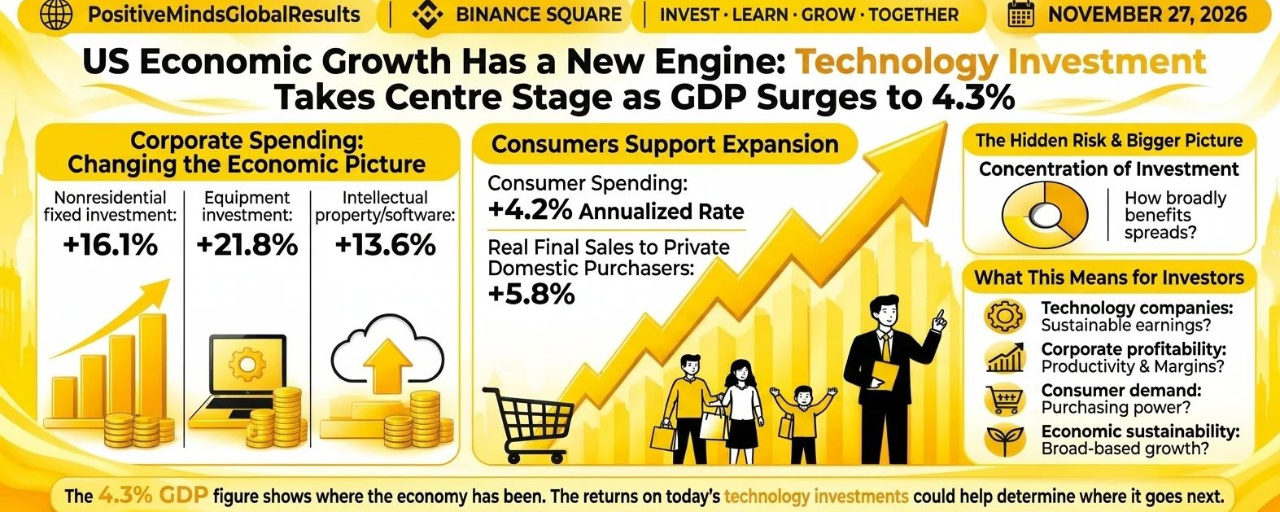
Article
US Economic Growth Has a New Engine: Technology Investment Takes Centre Stage as GDP Surges to 4.3%#canmarketsreboundafterthanksgiving? 🌍 #PositiveMindsGlobalResults
BINANCE SQUARE | INVEST • LEARN • GROW • TOGETHER
UNITED STATES • ECONOMIC GROWTH • BUSINESS INVESTMENT • TECHNOLOGY • AI
NOVEMBER 27, 2026
US GDP Surges to 4.3% as Technology Investment Drives Growth
Beyond consumer spending, America's latest economic figures reveal how business investment is becoming an increasingly important force behind the country's expansion.
The US economy delivered a stronger-than-expected performance during the third quarter of 2026, but the most interesting part of the latest GDP report is not simply the headline growth number. It is where that growth came from.
According to the Bureau of Economic Analysis, real US GDP expanded at an annualized rate of 4.3%, up from the initial estimate of 3.4%. The result marked a significant acceleration from the 2.2% growth recorded in the second quarter.
The revision offers a closer look at an economy where corporate investment, technology spending and consumer demand are working together to support expansion.
Corporate Spending Is Changing the Economic Picture
One of the strongest signals came from business investment.
Nonresidential fixed investment increased at a 16.1% annualized rate. Equipment investment advanced 21.8%, while investment in intellectual property products, including software, increased 13.6%.
These figures highlight a major shift in the composition of economic activity.
Businesses are continuing to invest in equipment, digital infrastructure and software as they compete to improve productivity and modernize operations.
Artificial intelligence is an important part of this broader investment cycle. However, the figures should not be interpreted as proof that every AI-related company is already generating strong financial returns.
The bigger question is whether these investments will eventually deliver enough productivity and revenue growth to justify their costs.
Consumers Are Still Supporting Expansion
Technology investment was not the only contributor.
Consumer spending increased at a 4.2% annualized rate, while real final sales to private domestic purchasers rose 5.8%.
This measure is particularly important because it provides insight into underlying private-sector demand rather than relying solely on headline GDP growth.
It suggests that the expansion was supported by both businesses and households, rather than depending entirely on temporary inventory changes.
Nevertheless, continued consumer strength will depend on employment conditions, purchasing power and household confidence.
The Hidden Risk Behind Strong GDP
A strong GDP report does not automatically mean every part of the economy is equally healthy.
The concentration of investment in equipment and intellectual property raises an important question: how broadly are the benefits of this expansion spreading?
Large companies with access to capital may be better positioned to increase technology spending, while smaller businesses could face greater financing and operating challenges.
There is also a difference between investing heavily in new technology and successfully turning that investment into higher profits.
If productivity improvements fail to match spending expectations, companies could eventually face pressure to reconsider their investment plans.
What This Means for Investors
The latest figures create several important areas to monitor:
Technology companies: Whether increased software and equipment spending translates into sustainable earnings.Corporate profitability: Whether businesses can convert investment into stronger productivity and operating margins.Consumer demand: Whether households maintain enough spending power to support economic activity.Economic sustainability: Whether growth remains broad-based rather than becoming increasingly dependent on a limited number of investment categories.
The Bigger Picture
America's latest GDP revision tells a story that goes beyond a stronger economic forecast.
The country is experiencing a significant investment cycle, with equipment, software and technology playing an important role in its economic expansion.
But the next stage will be measured by results, not spending announcements.
The real test is whether businesses can transform today's investment into tomorrow's productivity, stronger earnings and sustainable economic growth.
The 4.3% GDP figure shows where the economy has been. The returns on today's technology investments could help determine where it goes next.
Disclaimer: This article is for informational and educational purposes only and does not constitute financial advice. Economic outcomes and investment returns are uncertain. Always conduct your own research.
#USGDP #EconomicGrowthOrRisk #BusinessInvestment #ArtificialIntelligence #TechnologyStocks #GlobalEconomy #PositiveMindsGlobalResults
{spot}(BNBUSDT)
{spot}(BTCUSDT)
US Economic Growth Has a New Engine: Technology Investment Takes Centre Stage as GDP Surges to 4.3%
#canmarketsreboundafterthanksgiving? 🌍 #PositiveMindsGlobalResults
BINANCE SQUARE | INVEST • LEARN • GROW • TOGETHER
UNITED STATES • ECONOMIC GROWTH • BUSINESS INVESTMENT • TECHNOLOGY • AI
NOVEMBER 27, 2026
US GDP Surges to 4.3% as Technology Investment Drives Growth
Beyond consumer spending, America's latest economic figures reveal how business investment is becoming an increasingly important force behind the country's expansion.
The US economy delivered a stronger-than-expected performance during the third quarter of 2026, but the most interesting part of the latest GDP report is not simply the headline growth number. It is where that growth came from.
According to the Bureau of Economic Analysis, real US GDP expanded at an annualized rate of 4.3%, up from the initial estimate of 3.4%. The result marked a significant acceleration from the 2.2% growth recorded in the second quarter.
The revision offers a closer look at an economy where corporate investment, technology spending and consumer demand are working together to support expansion.
Corporate Spending Is Changing the Economic Picture
One of the strongest signals came from business investment.
Nonresidential fixed investment increased at a 16.1% annualized rate. Equipment investment advanced 21.8%, while investment in intellectual property products, including software, increased 13.6%.
These figures highlight a major shift in the composition of economic activity.
Businesses are continuing to invest in equipment, digital infrastructure and software as they compete to improve productivity and modernize operations.
Artificial intelligence is an important part of this broader investment cycle. However, the figures should not be interpreted as proof that every AI-related company is already generating strong financial returns.
The bigger question is whether these investments will eventually deliver enough productivity and revenue growth to justify their costs.
Consumers Are Still Supporting Expansion
Technology investment was not the only contributor.
Consumer spending increased at a 4.2% annualized rate, while real final sales to private domestic purchasers rose 5.8%.
This measure is particularly important because it provides insight into underlying private-sector demand rather than relying solely on headline GDP growth.
It suggests that the expansion was supported by both businesses and households, rather than depending entirely on temporary inventory changes.
Nevertheless, continued consumer strength will depend on employment conditions, purchasing power and household confidence.
The Hidden Risk Behind Strong GDP
A strong GDP report does not automatically mean every part of the economy is equally healthy.
The concentration of investment in equipment and intellectual property raises an important question: how broadly are the benefits of this expansion spreading?
Large companies with access to capital may be better positioned to increase technology spending, while smaller businesses could face greater financing and operating challenges.
There is also a difference between investing heavily in new technology and successfully turning that investment into higher profits.
If productivity improvements fail to match spending expectations, companies could eventually face pressure to reconsider their investment plans.
What This Means for Investors
The latest figures create several important areas to monitor:
Technology companies: Whether increased software and equipment spending translates into sustainable earnings.Corporate profitability: Whether businesses can convert investment into stronger productivity and operating margins.Consumer demand: Whether households maintain enough spending power to support economic activity.Economic sustainability: Whether growth remains broad-based rather than becoming increasingly dependent on a limited number of investment categories.
The Bigger Picture
America's latest GDP revision tells a story that goes beyond a stronger economic forecast.
The country is experiencing a significant investment cycle, with equipment, software and technology playing an important role in its economic expansion.
But the next stage will be measured by results, not spending announcements.
The real test is whether businesses can transform today's investment into tomorrow's productivity, stronger earnings and sustainable economic growth.
The 4.3% GDP figure shows where the economy has been. The returns on today's technology investments could help determine where it goes next.
Disclaimer: This article is for informational and educational purposes only and does not constitute financial advice. Economic outcomes and investment returns are uncertain. Always conduct your own research.
#USGDP #EconomicGrowthOrRisk #BusinessInvestment #ArtificialIntelligence #TechnologyStocks #GlobalEconomy #PositiveMindsGlobalResults
40
Verified
US GDP NUMBERS SPARK A POLITICAL STORM: TRUMP DEMANDS ANSWERS AS ECONOMIC TRUST COMES UNDER PRESSURE#canmarketsreboundafterthanksgiving? 🌍 #PositiveMindsGlobalResults
BINANCE SQUARE | INVEST • LEARN • GROW • TOGETHER
UNITED STATES • GDP • ECONOMIC DATA • POLITICS • FINANCIAL MARKETS
NOVEMBER 27, 2026
TRUMP CHALLENGES US GDP FIGURES AS ECONOMIC DATA SPARK CONTROVERSY
An unexpected upward revision to US economic growth has triggered a political confrontation, raising questions about government statistics, economic transparency, and the importance of reliable data for investors.
A GDP REVISION THAT HAS BECOME MUCH BIGGER THAN AN ECONOMIC NUMBER
The latest controversy surrounding the American economy is no longer limited to whether growth is accelerating or slowing. It has developed into a wider debate about the credibility of government economic statistics and the relationship between political leadership and the institutions responsible for measuring the economy.
President Donald Trump has accused his own administration's economic reporting process of producing inaccurate figures before the November midterm elections. He has demanded an investigation, describing the earlier GDP estimate as deliberately misleading.
The dispute followed the US Commerce Department's latest revision of third-quarter economic growth. On November 25, the Bureau of Economic Analysis (BEA) reported that the American economy expanded at an annualized rate of 4.3%, significantly higher than its initial estimate of 3.4%.
That represents a substantial upward adjustment and places third-quarter growth at its strongest pace since the third quarter of 2023.
Trump argued that the stronger figure should have been available before the November 3 elections, suggesting that the earlier reporting represented a deliberate error. However, he has not provided evidence demonstrating that government officials intentionally manipulated the economic figures.
The distinction is important.
An economic statistic can change as more information becomes available without necessarily indicating misconduct. At the same time, a substantial revision can reasonably raise questions about the quality, timing, and transparency of the information initially presented to the public.
For investors, the controversy introduces an additional uncertainty at a time when economic growth, inflation, borrowing costs, and monetary policy are already major market concerns.
1. WHAT ACTUALLY CHANGED IN THE GDP REPORT?
To understand the controversy, investors first need to examine the numbers.
<PRIVATE_PERSON> The initial third-quarter GDP estimate, released on October 29, showed annualized growth of 3.4%. The subsequent estimate published on November 25 raised that figure to 4.3%.
The difference is 0.9 percentage points, a meaningful revision that changes the picture of economic performance.
The updated report also showed stronger activity in important parts of the economy.
Consumer spending: Increased at an annualized rate of 4.2%, compared with the earlier estimate of 3.8%.Business investment: Nonresidential fixed investment increased 16.1%, compared with the previous estimate of 12.7%.Real gross domestic income: Increased 4.4% during the third quarter.Combined GDP and GDI measure: The average of the two measures also increased 4.4%.
These figures suggest that consumer demand and business investment were stronger than the initial report indicated.
Technology-related investment, including equipment and data-center construction associated with the artificial intelligence industry, is part of the broader investment picture.
However, GDP growth should not be interpreted as proof that every American household is experiencing stronger financial conditions. National economic output and the everyday cost of living measure different aspects of economic performance.
A country can report strong economic growth while households continue struggling with housing costs, borrowing expenses, food prices, and other essential spending.
That distinction is central to understanding why economic headlines and public perceptions sometimes move in different directions.
2. WHY GDP FIGURES ARE REVISED IN THE FIRST PLACE
One of the most important parts of this story is understanding how US economic statistics are calculated.
The Bureau of Economic Analysis does not produce a single final GDP figure immediately after a quarter ends. Instead, it publishes estimates in stages as additional information becomes available.
The initial estimate is commonly called the advance estimate. It relies on information that may be incomplete or subject to further revision.
Later estimates incorporate more comprehensive information covering areas such as consumer spending, business investment, inventories, trade, and services.
This process is a normal feature of national economic accounting.
The BEA's published methodology explains that subsequent estimates are designed to incorporate more complete source information and improve the accuracy of the national accounts.
Economic revisions can move figures higher or lower. They are not automatically evidence of political interference.
A study co-authored by BEA Director Vipin Arora found that GDP estimates released around 90 days after initial estimates had differed from the initial figures by an average of approximately 0.52 percentage points over the period examined.
The latest 0.9-percentage-point revision is larger than that historical average, making it understandable that observers would examine the reasons behind the adjustment.
But a larger-than-average revision does not establish that the original estimate was deliberately falsified.
The next question is therefore not simply why the number changed. It is whether the underlying data, revision process, and publication schedule were handled according to established statistical procedures.
3. WHY TRUMP IS QUESTIONING THE TIMING
The political dimension makes this controversy more complicated.
The initial GDP estimate was released before the November 3 midterm elections, while the stronger revised figure appeared after the election.
Trump has argued that the more positive economic picture should have been available to voters earlier and described the difference as a purposeful error.
The timing has become particularly sensitive because Republicans experienced significant electoral setbacks, with Democrats gaining control of both chambers of Congress.
However, the timing of an economic revision and evidence of political manipulation are two different matters.
GDP reporting follows established statistical schedules, and revisions are a regular part of the process. There is currently no publicly established evidence demonstrating that the BEA deliberately suppressed stronger growth figures to influence the election.
The Commerce Department had not immediately responded to requests for comment when the allegations were reported.
This distinction matters because the credibility of economic institutions should not depend on whether their latest figures are politically convenient.
If a government agency produces an unfavorable report, it should be evaluated through its methodology and evidence. The same standard should apply when a revised report produces a more favorable result.
Reliable statistics require consistency regardless of which political party benefits.
4. THE BIGGER ECONOMIC CONTRADICTION: STRONG GDP DOES NOT MEAN INFLATION HAS DISAPPEARED
There is another important detail in the latest economic releases that deserves attention.
While the revised GDP figure indicates stronger economic activity, inflation remains an important challenge.
The Associated Press reported that the same federal agency also released information showing that the personal consumption expenditures price index accelerated to an annual rate of 3.8% in October.
This creates a complicated economic picture.
Stronger economic activity can support corporate revenues, employment, consumer demand, and business confidence. But persistent inflation can also make it more difficult for the Federal Reserve to reduce interest rates.
That combination matters because financial markets often respond not only to whether the economy is growing, but also to what that growth means for monetary policy.
If growth remains strong while inflation stays elevated, investors may conclude that the Federal Reserve has less flexibility to ease financial conditions.
The consequences could include:
Higher borrowing costs for households and businesses.Continued pressure on mortgage and consumer financing.Greater sensitivity in stock valuations.Reduced expectations for near-term interest-rate reductions.Increased uncertainty across bonds, equities, and cryptocurrencies.
The American economy can therefore be strong in terms of output while still presenting challenges for consumers and financial markets.
The GDP headline tells only part of the story.
5. WHY THE CONTROVERSY MATTERS TO THE FEDERAL RESERVE
The GDP revision could influence how investors interpret the Federal Reserve's next monetary-policy decisions.
The central bank faces a difficult balancing act. It must consider inflation, employment, economic growth, and financial stability when determining whether borrowing costs should remain restrictive.
Stronger economic growth may reduce the urgency for policymakers to support the economy through lower interest rates. However, persistent inflation could make an early policy adjustment even more difficult.
This creates a potentially uncomfortable situation for financial markets.
If economic growth remains resilient and inflation does not moderate sufficiently, the Federal Reserve may have stronger reasons to maintain restrictive monetary policy.
That could affect expectations surrounding future rate decisions, Treasury yields, and the cost of capital.
Investors should therefore avoid interpreting the GDP revision as automatically bullish for stocks or cryptocurrencies.
Strong growth can support corporate earnings, but it can also reinforce expectations of higher interest rates for longer.
The relationship between growth and inflation will remain crucial.
6. WALL STREET'S CHALLENGE: WHICH ECONOMIC NUMBERS SHOULD INVESTORS TRUST?
For financial markets, reliable economic information is essential.
Investors use government statistics to assess consumer demand, employment conditions, inflation, business activity, and the overall direction of the economy.
These figures influence investment decisions across equities, bonds, currencies, commodities, and digital assets.
When major economic reports become part of political disputes, uncertainty can increase.
The concern is not that every revised statistic should be questioned. Rather, investors need confidence that economic information is produced using consistent methods and transparent procedures.
If that confidence weakens, markets may find it harder to distinguish between genuine economic changes and political interpretations of those changes.
Institutional investors, banks, businesses, and international financial organizations depend on comparable economic information when evaluating the United States.
The credibility of these statistics is therefore an economic asset in its own right.
A transparent statistical system benefits governments regardless of who occupies the White House.
7. THE POLITICAL DEBATE COULD HAVE LONGER-TERM CONSEQUENCES
This controversy also highlights a wider challenge facing independent economic institutions.
Government statistical agencies are expected to measure economic activity objectively, even when their findings create political difficulties.
The debate is particularly sensitive because Trump previously dismissed an employment report in 2025 and fired the head of the Bureau of Labor Statistics following disappointing jobs figures and downward revisions to earlier employment estimates.
The latest GDP dispute has renewed concerns about political pressure surrounding the publication of official economic data.
However, an investigation, if initiated, would need to establish facts rather than simply confirm political accusations.
Important questions would include whether the original estimate followed established procedures, whether new source data justified the revision, whether publication schedules were followed, and whether any evidence supports claims of deliberate interference.
An independent, evidence-based examination would be more valuable than political speculation.
Ultimately, public confidence depends on the ability of statistical institutions to explain their decisions and demonstrate that their methodology is applied consistently.
8. WHAT THIS MEANS FOR INVESTORS AND GLOBAL MARKETS
The controversy arrives at a time when investors are already dealing with several competing economic signals.
Strong American growth can support the dollar and reinforce confidence in the country's economic resilience. At the same time, persistent inflation and uncertainty about future Federal Reserve decisions can create volatility across global financial markets.
Here is how different asset classes could respond:
US equities: Stronger economic growth may support earnings expectations, but the possibility of interest rates remaining elevated could put pressure on expensive valuations.
US Treasury bonds: Stronger growth and inflation concerns may influence yield expectations. Investors will also assess demand for government debt and the broader monetary-policy outlook.
US dollar: Expectations of relatively restrictive monetary policy may provide support, although currency movements also depend on global interest-rate differences and investor demand.
Gold: Persistent inflation concerns and uncertainty surrounding economic institutions may support interest in defensive assets. However, higher real yields and a stronger dollar can create competing downward pressure.
Bitcoin and cryptocurrencies: Risk appetite, liquidity, dollar movements, and expectations for interest rates could influence digital-asset demand. Stronger GDP alone does not guarantee higher cryptocurrency prices.
International markets: Changes in US Treasury yields and the dollar can affect global financing conditions, capital flows, and investment sentiment in emerging and developed economies.
For investors outside the United States, these developments matter because American monetary policy and financial conditions influence markets well beyond US borders.
9. WHAT SHOULD WE WATCH NEXT?
The controversy is unlikely to be resolved by political statements alone. Investors should pay attention to the next official releases and any evidence that clarifies how the revision was calculated.
Several developments deserve particular attention:
The BEA's third GDP estimate: The next scheduled release for third-quarter 2026 GDP and corporate profits is December 23, 2026.The revision methodology: Further explanations about updated source information could help clarify why the growth estimate changed.Inflation indicators: PCE inflation and other price measures will help determine whether stronger economic activity is creating additional pressure on prices.Federal Reserve communication: Policymakers' comments could reveal how they interpret the combination of strong growth and persistent inflation.Treasury yields: Bond-market movements will show how investors are adjusting their expectations for growth, inflation, and interest rates.Consumer confidence: Household sentiment and spending patterns will help determine whether strong national output is translating into improved financial conditions for ordinary Americans.Institutional transparency: Any formal investigation or official response should be evaluated on documented evidence, not political claims.
These developments will help investors understand whether the controversy remains primarily political or develops into a broader concern about the credibility of economic reporting.
FINAL THOUGHTS: ECONOMIC NUMBERS SHOULD SERVE THE PUBLIC, NOT POLITICAL NARRATIVES
The latest GDP controversy reveals an important issue extending beyond the White House and Washington politics.
Economic statistics are among the foundations of modern financial markets. Governments use them to evaluate national performance, businesses use them to make investment decisions, and financial institutions use them to assess risks and opportunities.
The revision from 3.4% to 4.3% indicates that the US economy performed more strongly than initially estimated during the third quarter. That is an important development, but it does not erase concerns about inflation, affordability, borrowing costs, or the financial pressures experienced by American households.
Likewise, a significant revision deserves an explanation, but it should not automatically be treated as proof of deliberate wrongdoing.
The most responsible approach is to examine the evidence, understand how economic estimates are produced, and demand transparency from the institutions responsible for reporting them.
For investors, the lesson is equally important: never build an entire market outlook around one economic headline.
Strong GDP, persistent inflation, rising yields, consumer pressure, and political uncertainty can all exist at the same time. Understanding how these forces interact is far more valuable than reacting to a single headline.
The real issue is bigger than whether America's economy grew by 3.4% or 4.3%. It is whether the public, businesses, and investors can continue to trust the numbers used to measure the world's largest economy.
When confidence in economic information becomes uncertain, the consequences can reach far beyond politics and into the financial markets themselves.
MARKET & INFORMATION DISCLAIMER: This article is for educational and informational purposes only. It does not constitute financial or investment advice. Economic forecasts and market reactions are uncertain. Always verify official data, conduct your own research (DYOR), and make independent investment decisions.
#TRUMP #USGDP #USEconomy #EconomicGrowth #GDPRevision #FederalReserve #Inflation #WallStreet #GlobalMarkets #EconomicData #FinancialMarkets #Investing
{spot}(BNBUSDT)
{spot}(BTCUSDT)
US GDP NUMBERS SPARK A POLITICAL STORM: TRUMP DEMANDS ANSWERS AS ECONOMIC TRUST COMES UNDER PRESSURE
#canmarketsreboundafterthanksgiving? 🌍 #PositiveMindsGlobalResults
BINANCE SQUARE | INVEST • LEARN • GROW • TOGETHER
UNITED STATES • GDP • ECONOMIC DATA • POLITICS • FINANCIAL MARKETS
NOVEMBER 27, 2026
TRUMP CHALLENGES US GDP FIGURES AS ECONOMIC DATA SPARK CONTROVERSY
An unexpected upward revision to US economic growth has triggered a political confrontation, raising questions about government statistics, economic transparency, and the importance of reliable data for investors.
A GDP REVISION THAT HAS BECOME MUCH BIGGER THAN AN ECONOMIC NUMBER
The latest controversy surrounding the American economy is no longer limited to whether growth is accelerating or slowing. It has developed into a wider debate about the credibility of government economic statistics and the relationship between political leadership and the institutions responsible for measuring the economy.
President Donald Trump has accused his own administration's economic reporting process of producing inaccurate figures before the November midterm elections. He has demanded an investigation, describing the earlier GDP estimate as deliberately misleading.
The dispute followed the US Commerce Department's latest revision of third-quarter economic growth. On November 25, the Bureau of Economic Analysis (BEA) reported that the American economy expanded at an annualized rate of 4.3%, significantly higher than its initial estimate of 3.4%.
That represents a substantial upward adjustment and places third-quarter growth at its strongest pace since the third quarter of 2023.
Trump argued that the stronger figure should have been available before the November 3 elections, suggesting that the earlier reporting represented a deliberate error. However, he has not provided evidence demonstrating that government officials intentionally manipulated the economic figures.
The distinction is important.
An economic statistic can change as more information becomes available without necessarily indicating misconduct. At the same time, a substantial revision can reasonably raise questions about the quality, timing, and transparency of the information initially presented to the public.
For investors, the controversy introduces an additional uncertainty at a time when economic growth, inflation, borrowing costs, and monetary policy are already major market concerns.
1. WHAT ACTUALLY CHANGED IN THE GDP REPORT?
To understand the controversy, investors first need to examine the numbers.
<PRIVATE_PERSON> The initial third-quarter GDP estimate, released on October 29, showed annualized growth of 3.4%. The subsequent estimate published on November 25 raised that figure to 4.3%.
The difference is 0.9 percentage points, a meaningful revision that changes the picture of economic performance.
The updated report also showed stronger activity in important parts of the economy.
Consumer spending: Increased at an annualized rate of 4.2%, compared with the earlier estimate of 3.8%.Business investment: Nonresidential fixed investment increased 16.1%, compared with the previous estimate of 12.7%.Real gross domestic income: Increased 4.4% during the third quarter.Combined GDP and GDI measure: The average of the two measures also increased 4.4%.
These figures suggest that consumer demand and business investment were stronger than the initial report indicated.
Technology-related investment, including equipment and data-center construction associated with the artificial intelligence industry, is part of the broader investment picture.
However, GDP growth should not be interpreted as proof that every American household is experiencing stronger financial conditions. National economic output and the everyday cost of living measure different aspects of economic performance.
A country can report strong economic growth while households continue struggling with housing costs, borrowing expenses, food prices, and other essential spending.
That distinction is central to understanding why economic headlines and public perceptions sometimes move in different directions.
2. WHY GDP FIGURES ARE REVISED IN THE FIRST PLACE
One of the most important parts of this story is understanding how US economic statistics are calculated.
The Bureau of Economic Analysis does not produce a single final GDP figure immediately after a quarter ends. Instead, it publishes estimates in stages as additional information becomes available.
The initial estimate is commonly called the advance estimate. It relies on information that may be incomplete or subject to further revision.
Later estimates incorporate more comprehensive information covering areas such as consumer spending, business investment, inventories, trade, and services.
This process is a normal feature of national economic accounting.
The BEA's published methodology explains that subsequent estimates are designed to incorporate more complete source information and improve the accuracy of the national accounts.
Economic revisions can move figures higher or lower. They are not automatically evidence of political interference.
A study co-authored by BEA Director Vipin Arora found that GDP estimates released around 90 days after initial estimates had differed from the initial figures by an average of approximately 0.52 percentage points over the period examined.
The latest 0.9-percentage-point revision is larger than that historical average, making it understandable that observers would examine the reasons behind the adjustment.
But a larger-than-average revision does not establish that the original estimate was deliberately falsified.
The next question is therefore not simply why the number changed. It is whether the underlying data, revision process, and publication schedule were handled according to established statistical procedures.
3. WHY TRUMP IS QUESTIONING THE TIMING
The political dimension makes this controversy more complicated.
The initial GDP estimate was released before the November 3 midterm elections, while the stronger revised figure appeared after the election.
Trump has argued that the more positive economic picture should have been available to voters earlier and described the difference as a purposeful error.
The timing has become particularly sensitive because Republicans experienced significant electoral setbacks, with Democrats gaining control of both chambers of Congress.
However, the timing of an economic revision and evidence of political manipulation are two different matters.
GDP reporting follows established statistical schedules, and revisions are a regular part of the process. There is currently no publicly established evidence demonstrating that the BEA deliberately suppressed stronger growth figures to influence the election.
The Commerce Department had not immediately responded to requests for comment when the allegations were reported.
This distinction matters because the credibility of economic institutions should not depend on whether their latest figures are politically convenient.
If a government agency produces an unfavorable report, it should be evaluated through its methodology and evidence. The same standard should apply when a revised report produces a more favorable result.
Reliable statistics require consistency regardless of which political party benefits.
4. THE BIGGER ECONOMIC CONTRADICTION: STRONG GDP DOES NOT MEAN INFLATION HAS DISAPPEARED
There is another important detail in the latest economic releases that deserves attention.
While the revised GDP figure indicates stronger economic activity, inflation remains an important challenge.
The Associated Press reported that the same federal agency also released information showing that the personal consumption expenditures price index accelerated to an annual rate of 3.8% in October.
This creates a complicated economic picture.
Stronger economic activity can support corporate revenues, employment, consumer demand, and business confidence. But persistent inflation can also make it more difficult for the Federal Reserve to reduce interest rates.
That combination matters because financial markets often respond not only to whether the economy is growing, but also to what that growth means for monetary policy.
If growth remains strong while inflation stays elevated, investors may conclude that the Federal Reserve has less flexibility to ease financial conditions.
The consequences could include:
Higher borrowing costs for households and businesses.Continued pressure on mortgage and consumer financing.Greater sensitivity in stock valuations.Reduced expectations for near-term interest-rate reductions.Increased uncertainty across bonds, equities, and cryptocurrencies.
The American economy can therefore be strong in terms of output while still presenting challenges for consumers and financial markets.
The GDP headline tells only part of the story.
5. WHY THE CONTROVERSY MATTERS TO THE FEDERAL RESERVE
The GDP revision could influence how investors interpret the Federal Reserve's next monetary-policy decisions.
The central bank faces a difficult balancing act. It must consider inflation, employment, economic growth, and financial stability when determining whether borrowing costs should remain restrictive.
Stronger economic growth may reduce the urgency for policymakers to support the economy through lower interest rates. However, persistent inflation could make an early policy adjustment even more difficult.
This creates a potentially uncomfortable situation for financial markets.
If economic growth remains resilient and inflation does not moderate sufficiently, the Federal Reserve may have stronger reasons to maintain restrictive monetary policy.
That could affect expectations surrounding future rate decisions, Treasury yields, and the cost of capital.
Investors should therefore avoid interpreting the GDP revision as automatically bullish for stocks or cryptocurrencies.
Strong growth can support corporate earnings, but it can also reinforce expectations of higher interest rates for longer.
The relationship between growth and inflation will remain crucial.
6. WALL STREET'S CHALLENGE: WHICH ECONOMIC NUMBERS SHOULD INVESTORS TRUST?
For financial markets, reliable economic information is essential.
Investors use government statistics to assess consumer demand, employment conditions, inflation, business activity, and the overall direction of the economy.
These figures influence investment decisions across equities, bonds, currencies, commodities, and digital assets.
When major economic reports become part of political disputes, uncertainty can increase.
The concern is not that every revised statistic should be questioned. Rather, investors need confidence that economic information is produced using consistent methods and transparent procedures.
If that confidence weakens, markets may find it harder to distinguish between genuine economic changes and political interpretations of those changes.
Institutional investors, banks, businesses, and international financial organizations depend on comparable economic information when evaluating the United States.
The credibility of these statistics is therefore an economic asset in its own right.
A transparent statistical system benefits governments regardless of who occupies the White House.
7. THE POLITICAL DEBATE COULD HAVE LONGER-TERM CONSEQUENCES
This controversy also highlights a wider challenge facing independent economic institutions.
Government statistical agencies are expected to measure economic activity objectively, even when their findings create political difficulties.
The debate is particularly sensitive because Trump previously dismissed an employment report in 2025 and fired the head of the Bureau of Labor Statistics following disappointing jobs figures and downward revisions to earlier employment estimates.
The latest GDP dispute has renewed concerns about political pressure surrounding the publication of official economic data.
However, an investigation, if initiated, would need to establish facts rather than simply confirm political accusations.
Important questions would include whether the original estimate followed established procedures, whether new source data justified the revision, whether publication schedules were followed, and whether any evidence supports claims of deliberate interference.
An independent, evidence-based examination would be more valuable than political speculation.
Ultimately, public confidence depends on the ability of statistical institutions to explain their decisions and demonstrate that their methodology is applied consistently.
8. WHAT THIS MEANS FOR INVESTORS AND GLOBAL MARKETS
The controversy arrives at a time when investors are already dealing with several competing economic signals.
Strong American growth can support the dollar and reinforce confidence in the country's economic resilience. At the same time, persistent inflation and uncertainty about future Federal Reserve decisions can create volatility across global financial markets.
Here is how different asset classes could respond:
US equities: Stronger economic growth may support earnings expectations, but the possibility of interest rates remaining elevated could put pressure on expensive valuations.
US Treasury bonds: Stronger growth and inflation concerns may influence yield expectations. Investors will also assess demand for government debt and the broader monetary-policy outlook.
US dollar: Expectations of relatively restrictive monetary policy may provide support, although currency movements also depend on global interest-rate differences and investor demand.
Gold: Persistent inflation concerns and uncertainty surrounding economic institutions may support interest in defensive assets. However, higher real yields and a stronger dollar can create competing downward pressure.
Bitcoin and cryptocurrencies: Risk appetite, liquidity, dollar movements, and expectations for interest rates could influence digital-asset demand. Stronger GDP alone does not guarantee higher cryptocurrency prices.
International markets: Changes in US Treasury yields and the dollar can affect global financing conditions, capital flows, and investment sentiment in emerging and developed economies.
For investors outside the United States, these developments matter because American monetary policy and financial conditions influence markets well beyond US borders.
9. WHAT SHOULD WE WATCH NEXT?
The controversy is unlikely to be resolved by political statements alone. Investors should pay attention to the next official releases and any evidence that clarifies how the revision was calculated.
Several developments deserve particular attention:
The BEA's third GDP estimate: The next scheduled release for third-quarter 2026 GDP and corporate profits is December 23, 2026.The revision methodology: Further explanations about updated source information could help clarify why the growth estimate changed.Inflation indicators: PCE inflation and other price measures will help determine whether stronger economic activity is creating additional pressure on prices.Federal Reserve communication: Policymakers' comments could reveal how they interpret the combination of strong growth and persistent inflation.Treasury yields: Bond-market movements will show how investors are adjusting their expectations for growth, inflation, and interest rates.Consumer confidence: Household sentiment and spending patterns will help determine whether strong national output is translating into improved financial conditions for ordinary Americans.Institutional transparency: Any formal investigation or official response should be evaluated on documented evidence, not political claims.
These developments will help investors understand whether the controversy remains primarily political or develops into a broader concern about the credibility of economic reporting.
FINAL THOUGHTS: ECONOMIC NUMBERS SHOULD SERVE THE PUBLIC, NOT POLITICAL NARRATIVES
The latest GDP controversy reveals an important issue extending beyond the White House and Washington politics.
Economic statistics are among the foundations of modern financial markets. Governments use them to evaluate national performance, businesses use them to make investment decisions, and financial institutions use them to assess risks and opportunities.
The revision from 3.4% to 4.3% indicates that the US economy performed more strongly than initially estimated during the third quarter. That is an important development, but it does not erase concerns about inflation, affordability, borrowing costs, or the financial pressures experienced by American households.
Likewise, a significant revision deserves an explanation, but it should not automatically be treated as proof of deliberate wrongdoing.
The most responsible approach is to examine the evidence, understand how economic estimates are produced, and demand transparency from the institutions responsible for reporting them.
For investors, the lesson is equally important: never build an entire market outlook around one economic headline.
Strong GDP, persistent inflation, rising yields, consumer pressure, and political uncertainty can all exist at the same time. Understanding how these forces interact is far more valuable than reacting to a single headline.
The real issue is bigger than whether America's economy grew by 3.4% or 4.3%. It is whether the public, businesses, and investors can continue to trust the numbers used to measure the world's largest economy.
When confidence in economic information becomes uncertain, the consequences can reach far beyond politics and into the financial markets themselves.
MARKET & INFORMATION DISCLAIMER: This article is for educational and informational purposes only. It does not constitute financial or investment advice. Economic forecasts and market reactions are uncertain. Always verify official data, conduct your own research (DYOR), and make independent investment decisions.
#TRUMP #USGDP #USEconomy #EconomicGrowth #GDPRevision #FederalReserve #Inflation #WallStreet #GlobalMarkets #EconomicData #FinancialMarkets #Investing
24
Markets Face a Double Test: Fed Rate Fears and Growing AI Uncertainty#canmarketsreboundafterthanksgiving? 🌍 #PositiveMindsGlobalResults
BINANCE SQUARE | INVEST • LEARN • GROW • TOGETHER
NOVEMBER 27, 2026 | FEDERAL RESERVE • AI • GLOBAL MARKETS
Markets Face a Double Test: Fed Rate Fears and Growing AI Uncertainty.
Global markets are navigating two major uncertainties: rising expectations of another Federal Reserve rate hike and growing concerns about excessive valuations in the artificial intelligence sector.
With inflation remaining stubborn, investors are increasingly pricing in a December rate increase. Higher borrowing costs could put additional pressure on technology companies, particularly those investing billions in AI infrastructure.
Meanwhile, a striking warning from Panmure Liberum strategist Joachim Klement has attracted attention after he revealed that he sold all equities in his personal portfolio, citing the possibility of a significant market downturn.
Yet global stocks have continued to recover, highlighting a divided investment outlook. Some investors see opportunities beyond technology, while others remain concerned about valuations and economic risks.
The Bigger Picture
The coming weeks could test whether corporate earnings and global economic resilience can withstand tighter monetary conditions. For investors, the challenge is separating genuine opportunities from market optimism driven by expectations.
Markets are not moving on one story anymore. Inflation, interest rates and AI profitability are competing to shape the next major market direction.
Disclaimer: This article is for informational purposes only, not financial advice. Always conduct your own research (DYOR).
#FederalReserve #AIStocks #GlobalMarkets #StockMarket #Inflation #Investing
{spot}(BNBUSDT)
{spot}(BTCUSDT)
Markets Face a Double Test: Fed Rate Fears and Growing AI Uncertainty
#canmarketsreboundafterthanksgiving? 🌍 #PositiveMindsGlobalResults
BINANCE SQUARE | INVEST • LEARN • GROW • TOGETHER
NOVEMBER 27, 2026 | FEDERAL RESERVE • AI • GLOBAL MARKETS
Markets Face a Double Test: Fed Rate Fears and Growing AI Uncertainty.
Global markets are navigating two major uncertainties: rising expectations of another Federal Reserve rate hike and growing concerns about excessive valuations in the artificial intelligence sector.
With inflation remaining stubborn, investors are increasingly pricing in a December rate increase. Higher borrowing costs could put additional pressure on technology companies, particularly those investing billions in AI infrastructure.
Meanwhile, a striking warning from Panmure Liberum strategist Joachim Klement has attracted attention after he revealed that he sold all equities in his personal portfolio, citing the possibility of a significant market downturn.
Yet global stocks have continued to recover, highlighting a divided investment outlook. Some investors see opportunities beyond technology, while others remain concerned about valuations and economic risks.
The Bigger Picture
The coming weeks could test whether corporate earnings and global economic resilience can withstand tighter monetary conditions. For investors, the challenge is separating genuine opportunities from market optimism driven by expectations.
Markets are not moving on one story anymore. Inflation, interest rates and AI profitability are competing to shape the next major market direction.
Disclaimer: This article is for informational purposes only, not financial advice. Always conduct your own research (DYOR).
#FederalReserve #AIStocks #GlobalMarkets #StockMarket #Inflation #Investing
33
Log in to explore more content
Join global crypto users on Binance Square
⚡️ Get latest and useful information about crypto.
💬 Trusted by the world’s largest crypto exchange.
👍 Discover real insights from verified creators.
Email / Phone number
Trending Topics
EvolveAtBinanceBlockchainWeek
1.6M views
16,877 Discussing
Binance Blockchain Week is officially underway! 🌍
On November 28–29, whether you’re in Bangkok or joining from afar, tune in to the livestreams and join the conversation on Binance Square!
Here’s what’s in store 👇
📺 Watch the main stage live
Tune in throughout both days as industry speakers share their perspectives on this year’s theme, “Evolve” From technological innovation to real-world applications, explore what’s next for crypto.
⚔️ Watch two trading competitions
The Aster Open Qualifier and the Binance Trading Master Tournament will both be streamed live. Tune in to follow the traders in action.
🏆 Watch The Blockchain 100 Awards Ceremony
The Blockchain 100 list was selected by the community. Join us in celebrating the creators and the ideas they share!
💬 Join the community conversation
Use #EvolveAtBinanceBlockchainWeek in a post with a photo to share what you’re looking forward to, your views on the industry, or your favorite moments from the event.
The event page is now live! Subscribe to all livestreams with one click so you don’t miss a moment 👏
Binance Blockchain Week
·373 Likes
·355.5k views
ColdcardFlawLeadsToTheftOfAtLeast1789BTC
16,779 views
204 Discussing
ChainflipVaultTheftHaltsProtocol
20,934 views
336 Discussing