
Joshua Brown 007
3.2k Posts

Joshua Brown 007
Report
Block User
(KITE UID:089089) i am a forward thinking crypto advisor with a strong grasp of blockchain innovation and digital asset management.
Open Trade
High-Frequency Trader
2.7 Years
974 Following
15.8K+ Followers
6.7K+ Liked
Posts
Portfolio
All
Quotes
Videos
Live
Article
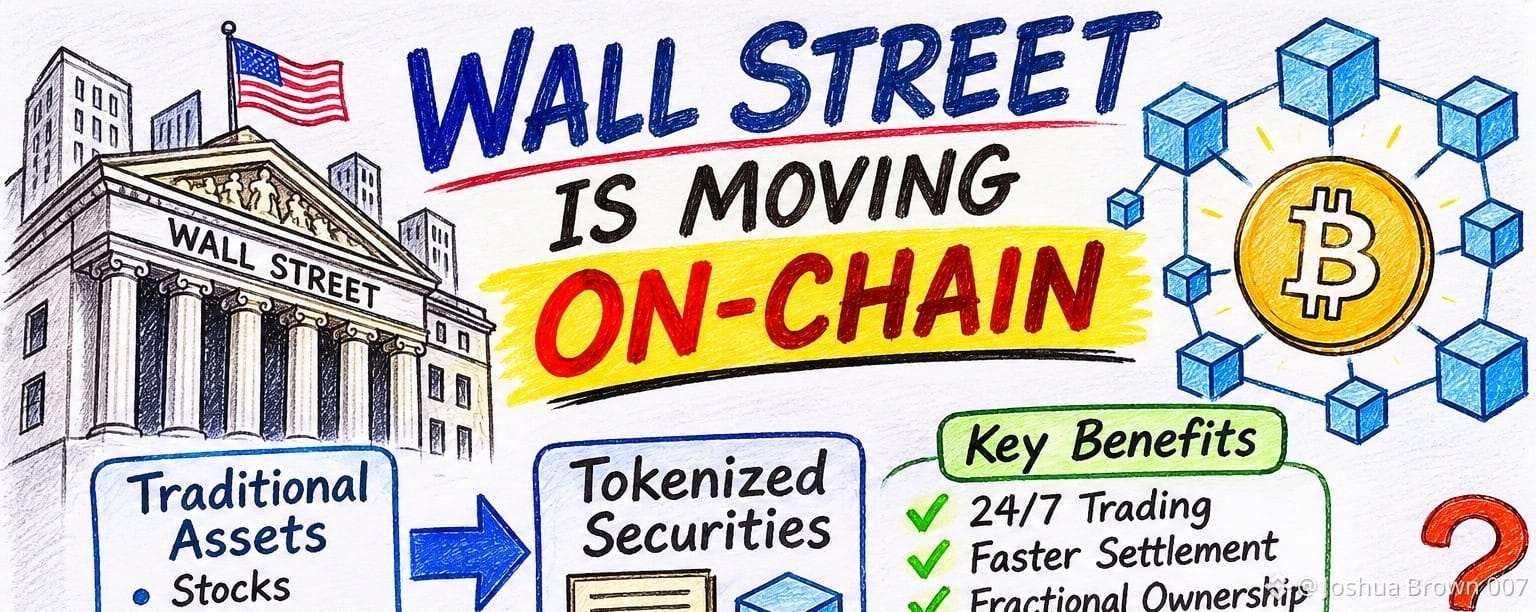
WALL STREET IS COMING TO BLOCKCHAIN. IS CRYPTO READY FOR THE BIGGEST FINANCIAL TRANSFORMATION?The next major crypto opportunity might not come from another meme coin. It could come from Wall Street itself.
For years, traditional financial institutions treated blockchain as an experimental technology. Crypto was considered a separate financial world, driven largely by speculation, retail traders and decentralized platforms.
But something important is changing in 2026.
Wall Street is no longer simply observing blockchain. Major financial institutions are starting to build financial infrastructure around it.
And I think this development deserves much more attention than another short-term Bitcoin price prediction.
1. The biggest signal: DTCC is moving securities on chain
One development that caught my attention was the launch of the Depository Trust & Clearing Corporation's (DTCC) tokenization service on October 28, 2026.
DTCC is a critical part of the US financial market infrastructure.
Its new service brings tokenization closer to the traditional securities market, covering stocks, ETFs and US Treasuries.
What makes this particularly interesting?
Around 20 financial institutions signed up to participate, including:
JPMorganCitiMorgan StanleyBank of AmericaUBS
The initial infrastructure uses Canton Network and a private blockchain based on Besu, with further expansion planned.
Think about the significance: institutions that traditionally operated through conventional financial infrastructure are now exploring blockchain based securities settlement.
This isn't just another crypto startup announcing a partnership. It represents a change in how established financial markets could operate.
2. Why does Wall Street want tokenization?
Let me explain the mechanism.
In traditional financial markets, buying and transferring securities involves brokers, custodians, clearing systems and settlement infrastructure.
These processes can introduce delays, operational costs and multiple intermediaries.
Tokenization offers a different approach.
A financial asset can be represented by a digital token on a blockchain, allowing ownership records and transfers to be managed through digital infrastructure.
Potential advantages include:
24/7 market access: Trading and transfers could become available beyond conventional market hours, subject to platform rules and liquidity.
Faster settlement: Blockchain can reduce reconciliation and settlement friction.
Fractional ownership: Certain tokenized products can make smaller investment amounts possible.
Global accessibility: Eligible investors may gain access to financial products through digital platforms.
Programmable finance: Tokenized assets could potentially be integrated into lending, collateral and other financial applications.
But there is one important distinction: tokenization does not automatically eliminate intermediaries, regulatory restrictions or settlement risks.
3. The SEC is opening another door
Another development worth watching is the US Securities and Exchange Commission's September 17, 2026 decision.
The SEC introduced temporary, conditional exemptions for certain tokenized securities trading venues and liquidity providers.
This is significant because regulatory uncertainty has been one of the biggest barriers to bringing traditional securities onto blockchain infrastructure.
However, this is not blanket permission for every crypto exchange to tokenize and trade any stock.
The framework has conditions, eligibility requirements and investor-protection considerations.
That distinction matters.
The future of tokenized finance will depend not only on technology but also on how ownership rights, custody, compliance and investor protections are implemented.
4. The numbers are becoming interesting
Let's look beyond announcements.
According to The Block's November 6, 2026 update:
On chain real world asset value reached approximately $39.3 billion at its September 2026 peak.The market had grown from approximately $10 billion at the beginning of 2025.Binance's bStocks reached approximately $772 million in on-chain value within around three months.Tokenized stocks have become one of the fastest-growing RWA segments.
These figures suggest that tokenization is moving beyond theoretical discussions.
However, we should not confuse growth in tokenized assets with the size of the entire traditional stock market. The two markets are still vastly different in scale.
5. Which crypto sectors could benefit?
This is where I would start looking for opportunities.
I wouldn't automatically buy every token carrying an RWA or institutional-adoption narrative.
Instead, I would investigate the infrastructure behind this transformation.
1. Ondo Finance (ONDO)
Focus: Tokenized financial products and access to traditional market assets.
The important question is whether tokenized securities and institutional financial products can generate sustainable demand for its ecosystem.
2. Chainlink (LINK)
Focus: Oracle infrastructure, data connectivity and cross chain interoperability.
Tokenized financial assets need reliable external data and communication between different blockchain environments.
3. Stellar (XLM)
Focus: Payments and tokenized asset infrastructure.
Its long term opportunity depends on real financial institutions and asset issuers using its network.
4. Ethereum (ETH)
Focus: Smart contracts, tokenized assets and decentralized financial infrastructure.
Ethereum remains an important ecosystem to monitor as tokenization expands.
5. Canton Network
Focus: Institutional blockchain infrastructure and financial-market connectivity.
Its participation in DTCC's tokenization initiative makes it particularly relevant to this narrative.
These are research candidates, not guaranteed beneficiaries. Institutional adoption of a network does not automatically translate into value appreciation for its associated token.
6. But there is a risk Wall Street investors should not ignore
I see three major challenges.
Regulatory risk: Tokenized securities are still securities in many jurisdictions. Compliance requirements do not disappear because an asset is represented by a blockchain token.
Liquidity risk: A tokenized stock may have significantly less liquidity than its traditional counterpart. A 24/7 trading label does not guarantee buyers and sellers at every hour.
Ownership risk: Not every tokenized stock provides direct ownership of the underlying shares. Some products represent contractual claims or other financial entitlements.
Investors must understand exactly what they are buying.
There is also a question of market concentration. If a few large institutions control custody, infrastructure and access, does tokenization really make financial markets more decentralized
That is a discussion worth having.
7. My market outlook: Is this the next major crypto narrative?
I believe the intersection of traditional finance and blockchain deserves serious attention over the next 12–24 months.
The real opportunity may not be in launching thousands of new tokens.
It may be in building the infrastructure that allows existing financial assets to move, settle and interact on blockchain networks.
DTCC, JPMorgan, Citi, Morgan Stanley and other established institutions exploring this technology tell us something important: blockchain is increasingly being evaluated as financial infrastructure rather than simply a speculative asset class.
But I would separate three things before making any investment decision:
Actual institutional adoption.Real usage and transaction growth.Direct economic value captured by the associated crypto token.
These are three different things, and confusing them can become an expensive mistake.
My conclusion: Wall Street entering blockchain could be a major structural shift for the financial industry. But the winners will not necessarily be the tokens with the loudest marketing campaigns. They will be the networks and infrastructure providers that can demonstrate real utility, security, liquidity and sustainable adoption.
One question I want to ask the community:
If traditional stocks, ETFs and financial assets become accessible through blockchain infrastructure, will crypto eventually become an extension of the global financial system, or will Wall Street simply use blockchain technology while keeping control of the entire system?
I am interested in hearing both sides of this argument.
#CryptoMarket #RWA #Tokenization #blockchain #Ethereum
$ETH
{spot}(ETHUSDT)
$LINK
{spot}(LINKUSDT)
$ONDO
{spot}(ONDOUSDT)
WALL STREET IS COMING TO BLOCKCHAIN. IS CRYPTO READY FOR THE BIGGEST FINANCIAL TRANSFORMATION?
The next major crypto opportunity might not come from another meme coin. It could come from Wall Street itself.
For years, traditional financial institutions treated blockchain as an experimental technology. Crypto was considered a separate financial world, driven largely by speculation, retail traders and decentralized platforms.
But something important is changing in 2026.
Wall Street is no longer simply observing blockchain. Major financial institutions are starting to build financial infrastructure around it.
And I think this development deserves much more attention than another short-term Bitcoin price prediction.
1. The biggest signal: DTCC is moving securities on chain
One development that caught my attention was the launch of the Depository Trust & Clearing Corporation's (DTCC) tokenization service on October 28, 2026.
DTCC is a critical part of the US financial market infrastructure.
Its new service brings tokenization closer to the traditional securities market, covering stocks, ETFs and US Treasuries.
What makes this particularly interesting?
Around 20 financial institutions signed up to participate, including:
JPMorganCitiMorgan StanleyBank of AmericaUBS
The initial infrastructure uses Canton Network and a private blockchain based on Besu, with further expansion planned.
Think about the significance: institutions that traditionally operated through conventional financial infrastructure are now exploring blockchain based securities settlement.
This isn't just another crypto startup announcing a partnership. It represents a change in how established financial markets could operate.
2. Why does Wall Street want tokenization?
Let me explain the mechanism.
In traditional financial markets, buying and transferring securities involves brokers, custodians, clearing systems and settlement infrastructure.
These processes can introduce delays, operational costs and multiple intermediaries.
Tokenization offers a different approach.
A financial asset can be represented by a digital token on a blockchain, allowing ownership records and transfers to be managed through digital infrastructure.
Potential advantages include:
24/7 market access: Trading and transfers could become available beyond conventional market hours, subject to platform rules and liquidity.
Faster settlement: Blockchain can reduce reconciliation and settlement friction.
Fractional ownership: Certain tokenized products can make smaller investment amounts possible.
Global accessibility: Eligible investors may gain access to financial products through digital platforms.
Programmable finance: Tokenized assets could potentially be integrated into lending, collateral and other financial applications.
But there is one important distinction: tokenization does not automatically eliminate intermediaries, regulatory restrictions or settlement risks.
3. The SEC is opening another door
Another development worth watching is the US Securities and Exchange Commission's September 17, 2026 decision.
The SEC introduced temporary, conditional exemptions for certain tokenized securities trading venues and liquidity providers.
This is significant because regulatory uncertainty has been one of the biggest barriers to bringing traditional securities onto blockchain infrastructure.
However, this is not blanket permission for every crypto exchange to tokenize and trade any stock.
The framework has conditions, eligibility requirements and investor-protection considerations.
That distinction matters.
The future of tokenized finance will depend not only on technology but also on how ownership rights, custody, compliance and investor protections are implemented.
4. The numbers are becoming interesting
Let's look beyond announcements.
According to The Block's November 6, 2026 update:
On chain real world asset value reached approximately $39.3 billion at its September 2026 peak.The market had grown from approximately $10 billion at the beginning of 2025.Binance's bStocks reached approximately $772 million in on-chain value within around three months.Tokenized stocks have become one of the fastest-growing RWA segments.
These figures suggest that tokenization is moving beyond theoretical discussions.
However, we should not confuse growth in tokenized assets with the size of the entire traditional stock market. The two markets are still vastly different in scale.
5. Which crypto sectors could benefit?
This is where I would start looking for opportunities.
I wouldn't automatically buy every token carrying an RWA or institutional-adoption narrative.
Instead, I would investigate the infrastructure behind this transformation.
1. Ondo Finance (ONDO)
Focus: Tokenized financial products and access to traditional market assets.
The important question is whether tokenized securities and institutional financial products can generate sustainable demand for its ecosystem.
2. Chainlink (LINK)
Focus: Oracle infrastructure, data connectivity and cross chain interoperability.
Tokenized financial assets need reliable external data and communication between different blockchain environments.
3. Stellar (XLM)
Focus: Payments and tokenized asset infrastructure.
Its long term opportunity depends on real financial institutions and asset issuers using its network.
4. Ethereum (ETH)
Focus: Smart contracts, tokenized assets and decentralized financial infrastructure.
Ethereum remains an important ecosystem to monitor as tokenization expands.
5. Canton Network
Focus: Institutional blockchain infrastructure and financial-market connectivity.
Its participation in DTCC's tokenization initiative makes it particularly relevant to this narrative.
These are research candidates, not guaranteed beneficiaries. Institutional adoption of a network does not automatically translate into value appreciation for its associated token.
6. But there is a risk Wall Street investors should not ignore
I see three major challenges.
Regulatory risk: Tokenized securities are still securities in many jurisdictions. Compliance requirements do not disappear because an asset is represented by a blockchain token.
Liquidity risk: A tokenized stock may have significantly less liquidity than its traditional counterpart. A 24/7 trading label does not guarantee buyers and sellers at every hour.
Ownership risk: Not every tokenized stock provides direct ownership of the underlying shares. Some products represent contractual claims or other financial entitlements.
Investors must understand exactly what they are buying.
There is also a question of market concentration. If a few large institutions control custody, infrastructure and access, does tokenization really make financial markets more decentralized
That is a discussion worth having.
7. My market outlook: Is this the next major crypto narrative?
I believe the intersection of traditional finance and blockchain deserves serious attention over the next 12–24 months.
The real opportunity may not be in launching thousands of new tokens.
It may be in building the infrastructure that allows existing financial assets to move, settle and interact on blockchain networks.
DTCC, JPMorgan, Citi, Morgan Stanley and other established institutions exploring this technology tell us something important: blockchain is increasingly being evaluated as financial infrastructure rather than simply a speculative asset class.
But I would separate three things before making any investment decision:
Actual institutional adoption.Real usage and transaction growth.Direct economic value captured by the associated crypto token.
These are three different things, and confusing them can become an expensive mistake.
My conclusion: Wall Street entering blockchain could be a major structural shift for the financial industry. But the winners will not necessarily be the tokens with the loudest marketing campaigns. They will be the networks and infrastructure providers that can demonstrate real utility, security, liquidity and sustainable adoption.
One question I want to ask the community:
If traditional stocks, ETFs and financial assets become accessible through blockchain infrastructure, will crypto eventually become an extension of the global financial system, or will Wall Street simply use blockchain technology while keeping control of the entire system?
I am interested in hearing both sides of this argument.
#CryptoMarket #RWA #Tokenization #blockchain #Ethereum
$ETH
$LINK
$ONDO
1
422
Article
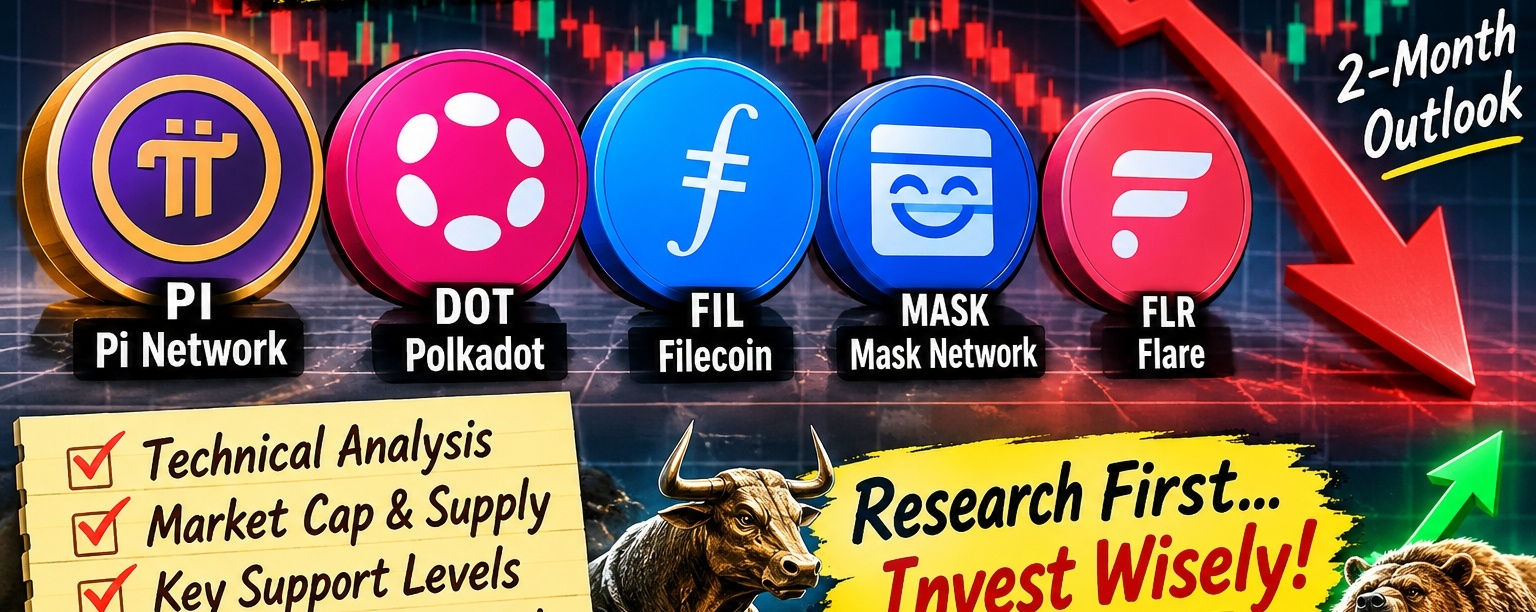
FIVE ALTCOINS NEAR HISTORIC LOWS: IS THIS A BUYING OPPORTUNITY OR A WARNING SIGN?PI, DOT, FIL, MASK & FLR What Could Happen Over the Next 2 Months?
What happens when established crypto projects lose more than 90% of their value from their All Time Highs?
Do they become opportunities for long term investors, or are investors simply catching falling knives?
This is the question I started investigating after noticing the weakness across several established altcoins.
Five projects caught my attention: Pi Network (PI), Polkadot (DOT), Filecoin (FIL), Mask Network (MASK), and Flare (FLR).
These are not new tokens with no history. They represent different sectors of the crypto ecosystem, including Layer-1 infrastructure, decentralized storage, social Web3, and blockchain data services.
But their current market conditions raise some serious questions.
1. PI Network (PI): Can Ecosystem Growth Reverse the Downtrend?
Pi has suffered a massive decline from its approximately $2.98 ATH.
The reported market snapshot places PI around $0.053, with a market capitalization of approximately $606 million.
The biggest concern is supply.
Its circulating supply is approximately 11.4 billion against a maximum supply of 100 billion. This means future supply expansion and token unlocks deserve serious attention.
Technical levels to watch:
Support: $0.0528First resistance: $0.058–$0.060Recovery zone: $0.065–$0.070Stronger bullish confirmation: $0.078–$0.085
My view: PI needs genuine ecosystem activity, stronger demand and sustained buying volume. A price bounce alone will not confirm a trend reversal.
2. Polkadot (DOT): A Potential Recovery Candidate
DOT is particularly interesting because its ecosystem has been working on significant structural changes.
Its reported market price is approximately $0.716, with a market capitalization near $1.22 billion.
One important development is the 2.1 billion DOT supply cap introduced through its 2026 tokenomics changes.
Polkadot 2.0 and the development of JAM are also worth monitoring.
Technical levels to watch:
Support: $0.705–$0.686First resistance: $0.75Breakout zone: $0.80–$0.85Major recovery zone: $0.95–$1.00
My view: DOT is one of the more interesting recovery candidates in this group. However, I would prefer a confirmed weekly breakout instead of buying simply because its price looks cheap.
3. Filecoin (FIL): Infrastructure Value Versus Token Supply
Filecoin represents decentralized storage infrastructure.
Its reported price is around $0.5604, with a market capitalization of approximately $479 million.
But there is another side to the story.
Its fully diluted valuation is approximately $1.10 billion, significantly higher than its circulating market capitalization.
That difference makes future supply an important consideration.
Technical levels to watch:
Support: $0.555Secondary support: $0.50–$0.52First resistance: $0.60Breakout zone: $0.68–$0.72Major resistance: $0.80–$0.90
My view: Filecoin needs stronger evidence of real storage demand and network revenue. Its infrastructure narrative is interesting, but the token price ultimately needs sustainable demand.
4. Mask Network (MASK): High Risk, High Volatility
MASK is a different case.
Its reported market capitalization is approximately $28.5 million, making it significantly smaller than the other projects in this comparison.
Its circulating supply is approximately 100 million, matching its maximum supply.
That reduces conventional future unlock risk, but liquidity remains a major concern.
Technical levels to watch:
Support: $0.282Secondary support: $0.25–$0.26First resistance: $0.30Breakout zone: $0.34–$0.36Major resistance: $0.40–$0.45
My view: MASK could produce sharp percentage movements if demand returns. However, low liquidity can also create severe downside volatility. I would treat this as a speculative opportunity, not a safe investment.
5. Flare Network (FLR): Adoption Versus Inflation
Flare is building infrastructure around blockchain data, interoperability and its FTSO system.
Its reported price is approximately $0.004941, with a market capitalization near $434 million.
Its fully diluted valuation is approximately $529 million.
The main issue I would monitor is token issuance and inflation. Validator, data-provider and delegator rewards can create additional supply that the market must absorb.
Technical levels to watch:
Support: $0.00493–$0.00457Secondary support: $0.0042First resistance: $0.0052Breakout zone: $0.0058–$0.0060Major resistance: $0.0068–$0.0075
My view: FLR deserves attention if network adoption and demand improve. But a breakout without volume confirmation could easily become another failed recovery.
TWO MONTH MARKET OUTLOOK
The following are illustrative scenarios for the period November 20, 2026, to January 20, 2027. They are not guaranteed targets or verified analyst consensus forecasts.
CoinBearishBase scenario Bullish
👉PI $0.043–0.050$0.058–0.075$0.085–0.105
👉DOT $0.58–0.67$0.80–0.95$1.05–1.25
FIL $0.45–0.52$0.62–0.75$0.85–1.00
👉MASK $0.22–0.26$0.32–0.40$0.45–0.55
👉FLR $0.0038–0.0045$0.0055–0.0065$0.0070–0.0085
WHAT WOULD MAKE ME BULLISH?
I am not interested in buying simply because an altcoin has fallen 95% or even 99%.
Before considering an entry, I want to see:
A weekly candle closing above important resistance.RSI recovering above 50.A bullish MACD crossover.Increasing spot trading volume.Stronger buying activity rather than leveraged speculation.A successful retest of the breakout level.No major unexpected token unlock or supply related pressure.
These confirmations matter because a coin can bounce 15–20% from its All Time Low and still remain in a long-term bearish structure.
MY FINAL OBSERVATION
Among these five projects, DOT and FIL deserve deeper fundamental investigation, while FLR remains an interesting secondary candidate.
PI has substantial supply related uncertainty, and MASK carries considerable liquidity risk.
But there is something every investor should remember:
A 99% decline does not automatically mean a 99% discount.
Sometimes the market is presenting an opportunity. Sometimes it is pricing in risks that investors have not fully understood.
I would rather miss the first 10% of a recovery and enter after confirmation than buy blindly into a falling market.
Research first. Confirm the trend. Manage the risk.
What is your opinion?
Which of these five altcoins has the strongest potential to recover over the next two months?
#CryptoMarket #Altcoins #PolkadotNews #Binance #BinanceSquareFamily
$DOT
{spot}(DOTUSDT)
$FIL
{spot}(FILUSDT)
$MASK
{spot}(MASKUSDT)
FIVE ALTCOINS NEAR HISTORIC LOWS: IS THIS A BUYING OPPORTUNITY OR A WARNING SIGN?
PI, DOT, FIL, MASK & FLR What Could Happen Over the Next 2 Months?
What happens when established crypto projects lose more than 90% of their value from their All Time Highs?
Do they become opportunities for long term investors, or are investors simply catching falling knives?
This is the question I started investigating after noticing the weakness across several established altcoins.
Five projects caught my attention: Pi Network (PI), Polkadot (DOT), Filecoin (FIL), Mask Network (MASK), and Flare (FLR).
These are not new tokens with no history. They represent different sectors of the crypto ecosystem, including Layer-1 infrastructure, decentralized storage, social Web3, and blockchain data services.
But their current market conditions raise some serious questions.
1. PI Network (PI): Can Ecosystem Growth Reverse the Downtrend?
Pi has suffered a massive decline from its approximately $2.98 ATH.
The reported market snapshot places PI around $0.053, with a market capitalization of approximately $606 million.
The biggest concern is supply.
Its circulating supply is approximately 11.4 billion against a maximum supply of 100 billion. This means future supply expansion and token unlocks deserve serious attention.
Technical levels to watch:
Support: $0.0528First resistance: $0.058–$0.060Recovery zone: $0.065–$0.070Stronger bullish confirmation: $0.078–$0.085
My view: PI needs genuine ecosystem activity, stronger demand and sustained buying volume. A price bounce alone will not confirm a trend reversal.
2. Polkadot (DOT): A Potential Recovery Candidate
DOT is particularly interesting because its ecosystem has been working on significant structural changes.
Its reported market price is approximately $0.716, with a market capitalization near $1.22 billion.
One important development is the 2.1 billion DOT supply cap introduced through its 2026 tokenomics changes.
Polkadot 2.0 and the development of JAM are also worth monitoring.
Technical levels to watch:
Support: $0.705–$0.686First resistance: $0.75Breakout zone: $0.80–$0.85Major recovery zone: $0.95–$1.00
My view: DOT is one of the more interesting recovery candidates in this group. However, I would prefer a confirmed weekly breakout instead of buying simply because its price looks cheap.
3. Filecoin (FIL): Infrastructure Value Versus Token Supply
Filecoin represents decentralized storage infrastructure.
Its reported price is around $0.5604, with a market capitalization of approximately $479 million.
But there is another side to the story.
Its fully diluted valuation is approximately $1.10 billion, significantly higher than its circulating market capitalization.
That difference makes future supply an important consideration.
Technical levels to watch:
Support: $0.555Secondary support: $0.50–$0.52First resistance: $0.60Breakout zone: $0.68–$0.72Major resistance: $0.80–$0.90
My view: Filecoin needs stronger evidence of real storage demand and network revenue. Its infrastructure narrative is interesting, but the token price ultimately needs sustainable demand.
4. Mask Network (MASK): High Risk, High Volatility
MASK is a different case.
Its reported market capitalization is approximately $28.5 million, making it significantly smaller than the other projects in this comparison.
Its circulating supply is approximately 100 million, matching its maximum supply.
That reduces conventional future unlock risk, but liquidity remains a major concern.
Technical levels to watch:
Support: $0.282Secondary support: $0.25–$0.26First resistance: $0.30Breakout zone: $0.34–$0.36Major resistance: $0.40–$0.45
My view: MASK could produce sharp percentage movements if demand returns. However, low liquidity can also create severe downside volatility. I would treat this as a speculative opportunity, not a safe investment.
5. Flare Network (FLR): Adoption Versus Inflation
Flare is building infrastructure around blockchain data, interoperability and its FTSO system.
Its reported price is approximately $0.004941, with a market capitalization near $434 million.
Its fully diluted valuation is approximately $529 million.
The main issue I would monitor is token issuance and inflation. Validator, data-provider and delegator rewards can create additional supply that the market must absorb.
Technical levels to watch:
Support: $0.00493–$0.00457Secondary support: $0.0042First resistance: $0.0052Breakout zone: $0.0058–$0.0060Major resistance: $0.0068–$0.0075
My view: FLR deserves attention if network adoption and demand improve. But a breakout without volume confirmation could easily become another failed recovery.
TWO MONTH MARKET OUTLOOK
The following are illustrative scenarios for the period November 20, 2026, to January 20, 2027. They are not guaranteed targets or verified analyst consensus forecasts.
CoinBearishBase scenario Bullish
👉PI $0.043–0.050$0.058–0.075$0.085–0.105
👉DOT $0.58–0.67$0.80–0.95$1.05–1.25
FIL $0.45–0.52$0.62–0.75$0.85–1.00
👉MASK $0.22–0.26$0.32–0.40$0.45–0.55
👉FLR $0.0038–0.0045$0.0055–0.0065$0.0070–0.0085
WHAT WOULD MAKE ME BULLISH?
I am not interested in buying simply because an altcoin has fallen 95% or even 99%.
Before considering an entry, I want to see:
A weekly candle closing above important resistance.RSI recovering above 50.A bullish MACD crossover.Increasing spot trading volume.Stronger buying activity rather than leveraged speculation.A successful retest of the breakout level.No major unexpected token unlock or supply related pressure.
These confirmations matter because a coin can bounce 15–20% from its All Time Low and still remain in a long-term bearish structure.
MY FINAL OBSERVATION
Among these five projects, DOT and FIL deserve deeper fundamental investigation, while FLR remains an interesting secondary candidate.
PI has substantial supply related uncertainty, and MASK carries considerable liquidity risk.
But there is something every investor should remember:
A 99% decline does not automatically mean a 99% discount.
Sometimes the market is presenting an opportunity. Sometimes it is pricing in risks that investors have not fully understood.
I would rather miss the first 10% of a recovery and enter after confirmation than buy blindly into a falling market.
Research first. Confirm the trend. Manage the risk.
What is your opinion?
Which of these five altcoins has the strongest potential to recover over the next two months?
#CryptoMarket #Altcoins #PolkadotNews #Binance #BinanceSquareFamily
$DOT
$FIL
$MASK
1
2.2k
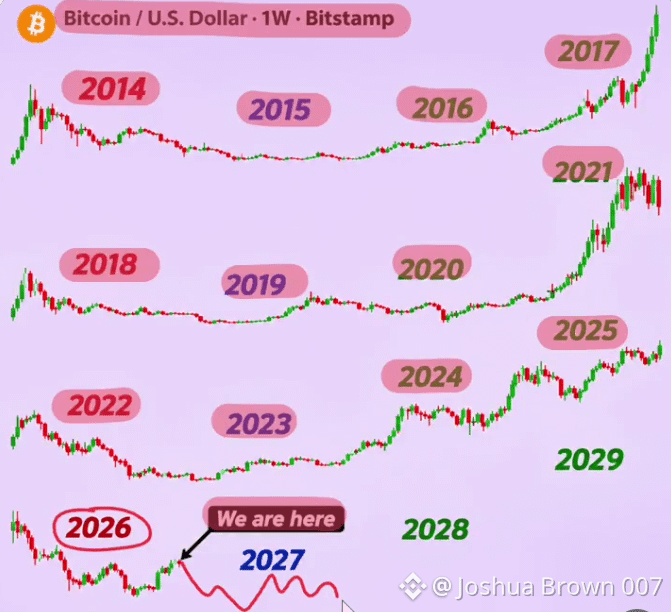
Is Bitcoin preparing for another four-year cycle, or are we assuming history will repeat itself?
I have been looking at Bitcoin’s historical cycle structure, and one pattern deserves serious attention.
2014–2017: Bear Market → Recovery → Bull Run → Cycle Peak
2018–2021: Bear Market → Recovery → Bull Run → Cycle Peak
2022–2025: Bear Market → Recovery → Bull Run → Cycle Peak
Now look at the possible next sequence:
2026: Bear Market?
2027: Recovery and Accumulation?
2028: New Bull Phase?
2029: Potential Cycle Peak?
There are three interesting historical observations:
Previous bear-market years overlapped with US midterm election years.
Recovery phases followed those election years.
The last three major cycle peaks occurred approximately 526, 548 and 534 days after Bitcoin halvings.
But this cycle is behaving differently.
Bitcoin's decline from approximately $126K to $58.6K represents around 53%, considerably less than the 77–85% drawdowns seen in earlier cycles.
The correction also happened faster, reaching that low roughly 268 days after the peak.
So, is $58,600 the actual cycle bottom, or are we still waiting for another capitulation?
I don't want to blindly assume that the four-year cycle will repeat. Institutional participation, ETF flows, liquidity conditions, monetary policy and global macroeconomic developments have changed the market.
My approach is to watch both scenarios rather than build a position around one prediction.
If the historical structure survives, 2027 could become an important accumulation window ahead of the expected April 2028 halving.
History doesn't promise the future, but ignoring historical patterns is equally dangerous.
Save this analysis. Let's revisit it in 2027 and see which scenario played out.
#Bitcoin #CryptoMarket #BitcoinHalving #CryptoAnalysis
111
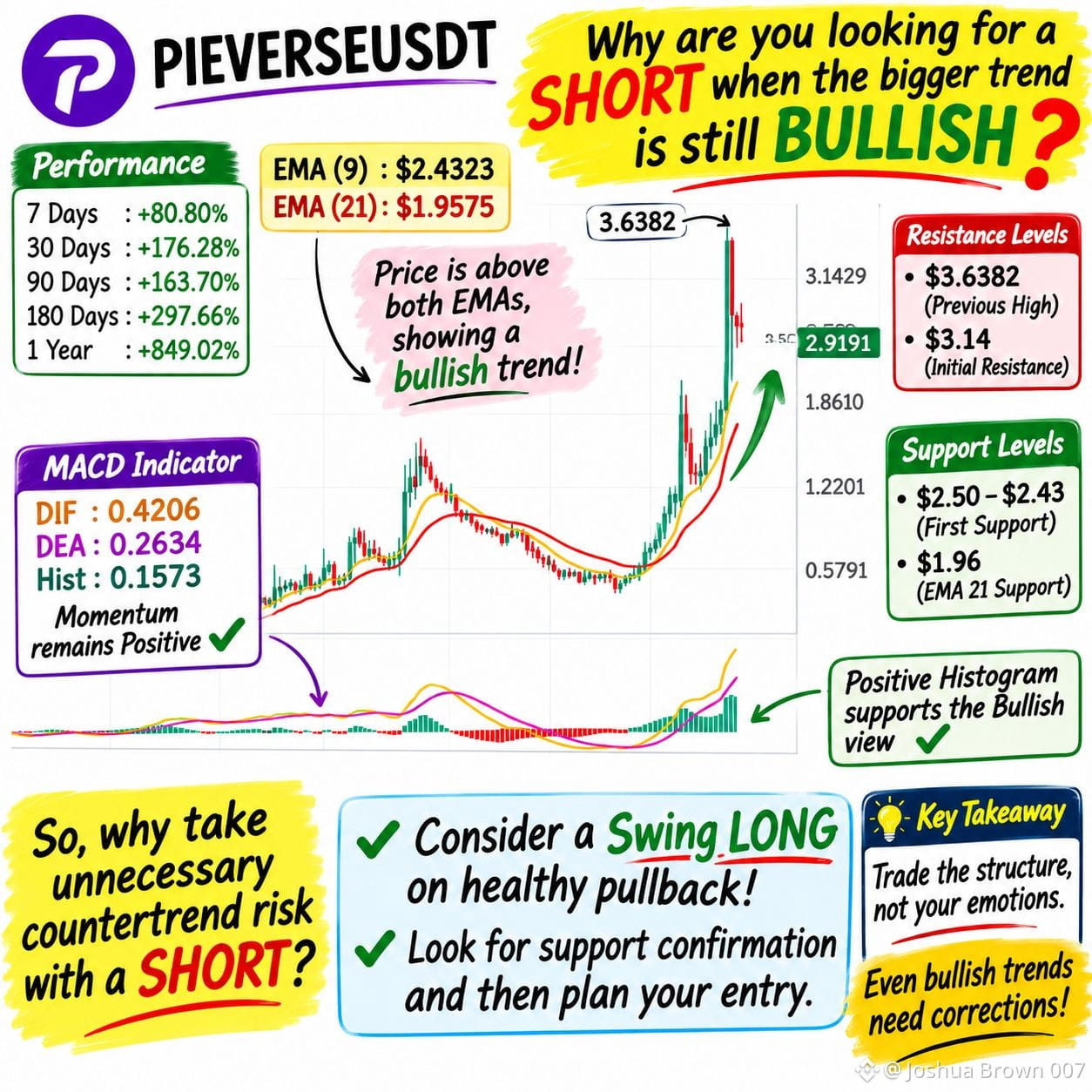
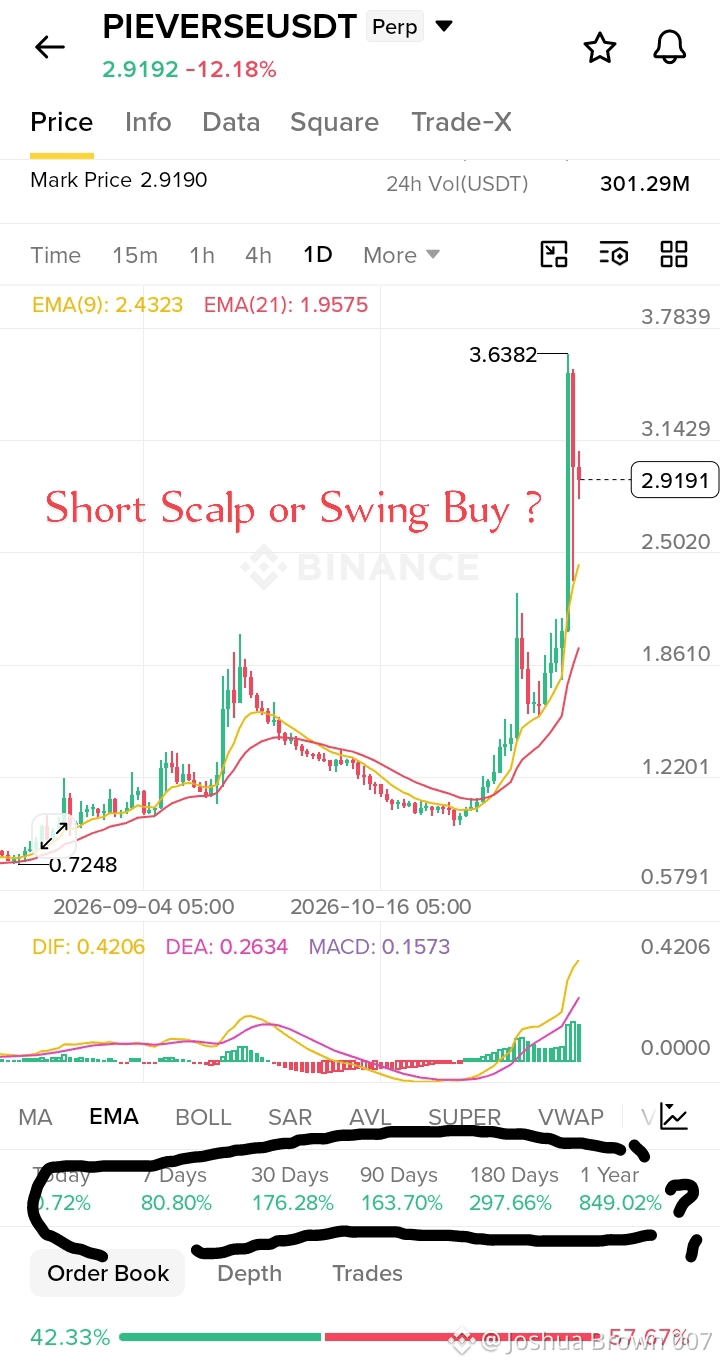
Why are you looking for a SHORT when the bigger trend is still BULLISH? 📈
Look at $PIEVERSEUSDT before deciding your next trade.
The 1D chart is showing something interesting:
Performance:
7 Days: +80.80%
30 Days: +176.28%
90 Days: +163.70%
180 Days: +297.66%
1 Year: +849.02%
Technical Structure:
👉EMA 9: $2.4323
👉EMA 21: $1.9575
Price is trading above both EMAs, and EMA 9 is comfortably above EMA 21. That's a bullish daily trend structure.
👉MACD: DIF at 0.4206, DEA at 0.2634, with a positive histogram of 0.1573. Momentum remains positive, although the recent rejection from $3.6382 suggests some short-term cooling.
My Trading Perspective:
Yes, a short scalp can develop on a lower timeframe if bearish confirmation appears. But why take unnecessary countertrend risk when the daily structure is still bullish?
If the broader trend supports buyers, I would rather look for a healthy pullback, support confirmation and a potential swing LONG entry.
I would watch:
$2.50–$2.43: First important support area.
$1.96: Daily EMA 21 and deeper trend support.
$3.14: Initial recovery resistance.
$3.6382: Previous swing high.
These are observation levels, not guaranteed entry or target prices.
One question for traders:
If a token is showing +849% yearly performance and maintaining a bullish daily EMA structure, why keep fighting the trend with shorts instead of patiently identifying a better swing-buy opportunity?
Trade the structure, not your emotions. And remember: even bullish trends need corrections.
#PIEVERSE #CryptoTrading #SwingTrading . #TechnicalAnalysis #Binance
$EVAA
{future}(EVAAUSDT)
Why are you looking for a SHORT when the bigger trend is still BULLISH? 📈
Look at $PIEVERSEUSDT before deciding your next trade.
The 1D chart is showing something interesting:
Performance:
7 Days: +80.80%
30 Days: +176.28%
90 Days: +163.70%
180 Days: +297.66%
1 Year: +849.02%
Technical Structure:
👉EMA 9: $2.4323
👉EMA 21: $1.9575
Price is trading above both EMAs, and EMA 9 is comfortably above EMA 21. That's a bullish daily trend structure.
👉MACD: DIF at 0.4206, DEA at 0.2634, with a positive histogram of 0.1573. Momentum remains positive, although the recent rejection from $3.6382 suggests some short-term cooling.
My Trading Perspective:
Yes, a short scalp can develop on a lower timeframe if bearish confirmation appears. But why take unnecessary countertrend risk when the daily structure is still bullish?
If the broader trend supports buyers, I would rather look for a healthy pullback, support confirmation and a potential swing LONG entry.
I would watch:
$2.50–$2.43: First important support area.
$1.96: Daily EMA 21 and deeper trend support.
$3.14: Initial recovery resistance.
$3.6382: Previous swing high.
These are observation levels, not guaranteed entry or target prices.
One question for traders:
If a token is showing +849% yearly performance and maintaining a bullish daily EMA structure, why keep fighting the trend with shorts instead of patiently identifying a better swing-buy opportunity?
Trade the structure, not your emotions. And remember: even bullish trends need corrections.
#PIEVERSE #CryptoTrading #SwingTrading . #TechnicalAnalysis #Binance
$EVAA
2
907
#tradefutureandwin
200 BNB REWARD POOL, BUT HOW MANY PARTICIPANTS WILL ACTUALLY WIN? 🤔
I have a question about this Binance Futures campaign.
The campaign advertises a 200 BNB reward pool, which naturally attracts attention. But I think participants should also look beyond the headline prize.
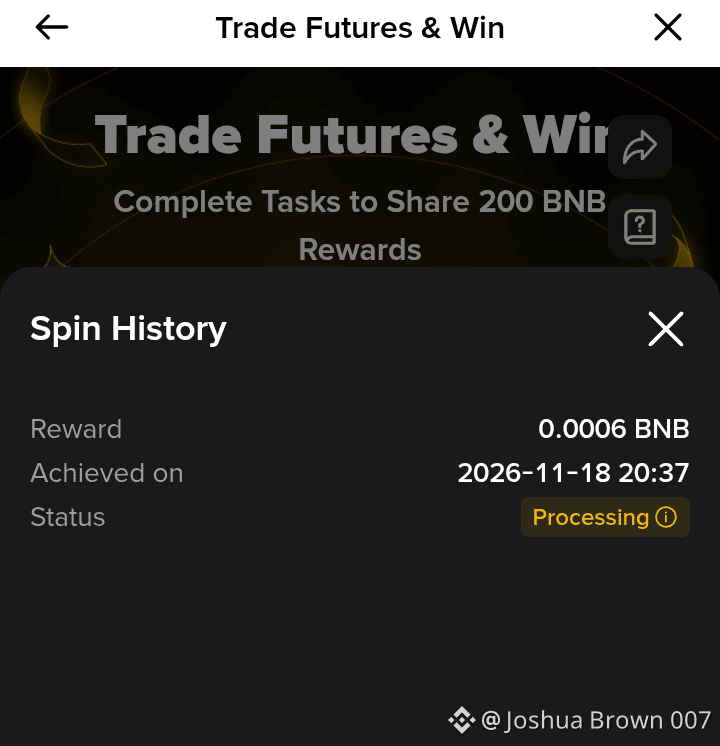
As I understand the reward structure, participants may first receive a small reward of around 0.0006 BNB, while the remaining BNB rewards are distributed through a lucky draw mechanism.
And this is where my concern begins.
If the bigger rewards are also distributed through a random selection bot, then participation doesn't necessarily mean a realistic chance of receiving a significant prize.
Maybe someone will get lucky and win a substantial reward. But honestly, I have participated in several campaigns, and I personally haven't received any of those major prizes so far.
I'm not questioning whether winners exist. I'm simply asking for more transparency.
A few questions worth asking:
How many participants will receive the major rewards?
What are the actual winning probabilities?
Will Binance publish the final distribution details?
Can participants independently verify the reward distribution?
A 200 BNB prize pool sounds impressive, but the real value of a campaign should be measured by its distribution, transparency and the actual rewards received by participants.
Campaigns should create genuine opportunities, not just attractive headlines.
What do you think? Is a lucky draw a fair reward mechanism for an entire trading community?
#Binance #BinanceFutures #BinanceSquareFamily #BinanceMegadrop
[lol 0.006 BNB😂😂😂](https://www.binance.com/activity/chance/trade-futures-win12-campaign?ref=860089089&utm_medium=web_share_copy)
#tradefutureandwin
200 BNB REWARD POOL, BUT HOW MANY PARTICIPANTS WILL ACTUALLY WIN? 🤔
I have a question about this Binance Futures campaign.
The campaign advertises a 200 BNB reward pool, which naturally attracts attention. But I think participants should also look beyond the headline prize.
As I understand the reward structure, participants may first receive a small reward of around 0.0006 BNB, while the remaining BNB rewards are distributed through a lucky draw mechanism.
And this is where my concern begins.
If the bigger rewards are also distributed through a random selection bot, then participation doesn't necessarily mean a realistic chance of receiving a significant prize.
Maybe someone will get lucky and win a substantial reward. But honestly, I have participated in several campaigns, and I personally haven't received any of those major prizes so far.
I'm not questioning whether winners exist. I'm simply asking for more transparency.
A few questions worth asking:
How many participants will receive the major rewards?
What are the actual winning probabilities?
Will Binance publish the final distribution details?
Can participants independently verify the reward distribution?
A 200 BNB prize pool sounds impressive, but the real value of a campaign should be measured by its distribution, transparency and the actual rewards received by participants.
Campaigns should create genuine opportunities, not just attractive headlines.
What do you think? Is a lucky draw a fair reward mechanism for an entire trading community?
#Binance #BinanceFutures #BinanceSquareFamily #BinanceMegadrop
lol 0.006 BNB😂😂😂

17
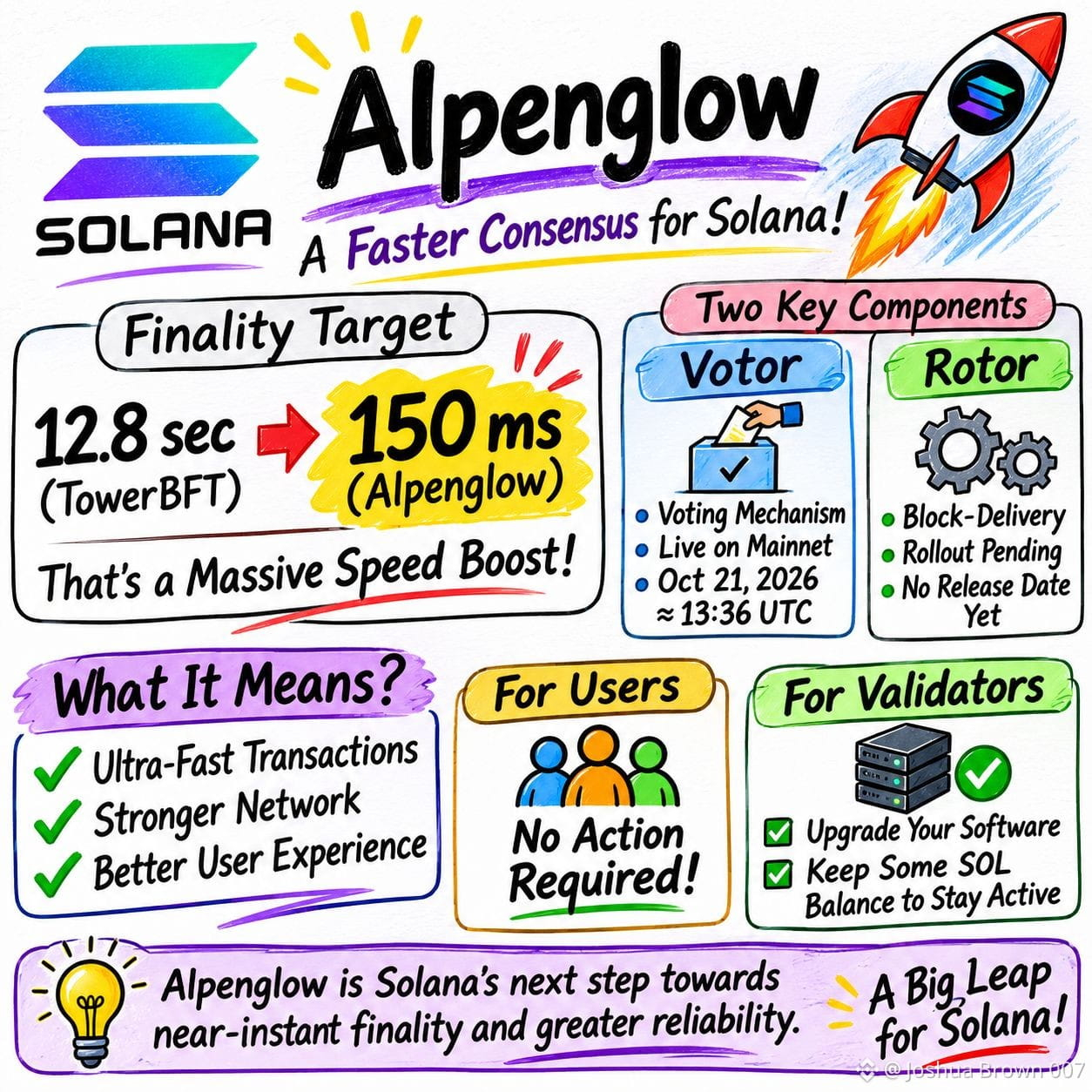
#Solana Solana is preparing for a major shift in how its validators reach consensus, and Alpenglow could be one of the most important upgrades in the network's history.
The biggest change is the finality target. Alpenglow aims to bring transaction finality down to around 150 milliseconds, compared with roughly 12.8 seconds under the previous TowerBFT system.
That is a massive difference in the user experience and could make Solana's infrastructure even more suitable for applications that depend on near-instant settlement.
The upgrade is built around two key components:
🔹 Votor: The voting mechanism that handles consensus. It went live on Solana mainnet on October 21, 2026, around 13:36 UTC.
🔹 Rotor: The block-delivery mechanism designed to improve how blocks move through the network. Its rollout is still pending, with no confirmed release date yet.
This isn't just about making transactions faster. Consensus speed, network reliability and validator participation are all critical pieces of a blockchain's long-term infrastructure.
For regular users, no action is required. Validators, however, need to upgrade their software and maintain the required SOL balance to remain active.
Solana's next evolution is about reducing the time between transaction execution and confidence in finality. That is worth watching closely.
#SOL #Alpenglow #Blockchain #Crypto
$SOL
{spot}(SOLUSDT)
#Solana Solana is preparing for a major shift in how its validators reach consensus, and Alpenglow could be one of the most important upgrades in the network's history.
The biggest change is the finality target. Alpenglow aims to bring transaction finality down to around 150 milliseconds, compared with roughly 12.8 seconds under the previous TowerBFT system.
That is a massive difference in the user experience and could make Solana's infrastructure even more suitable for applications that depend on near-instant settlement.
The upgrade is built around two key components:
🔹 Votor: The voting mechanism that handles consensus. It went live on Solana mainnet on October 21, 2026, around 13:36 UTC.
🔹 Rotor: The block-delivery mechanism designed to improve how blocks move through the network. Its rollout is still pending, with no confirmed release date yet.
This isn't just about making transactions faster. Consensus speed, network reliability and validator participation are all critical pieces of a blockchain's long-term infrastructure.
For regular users, no action is required. Validators, however, need to upgrade their software and maintain the required SOL balance to remain active.
Solana's next evolution is about reducing the time between transaction execution and confidence in finality. That is worth watching closely.
#SOL #Alpenglow #Blockchain #Crypto
$SOL
1
422
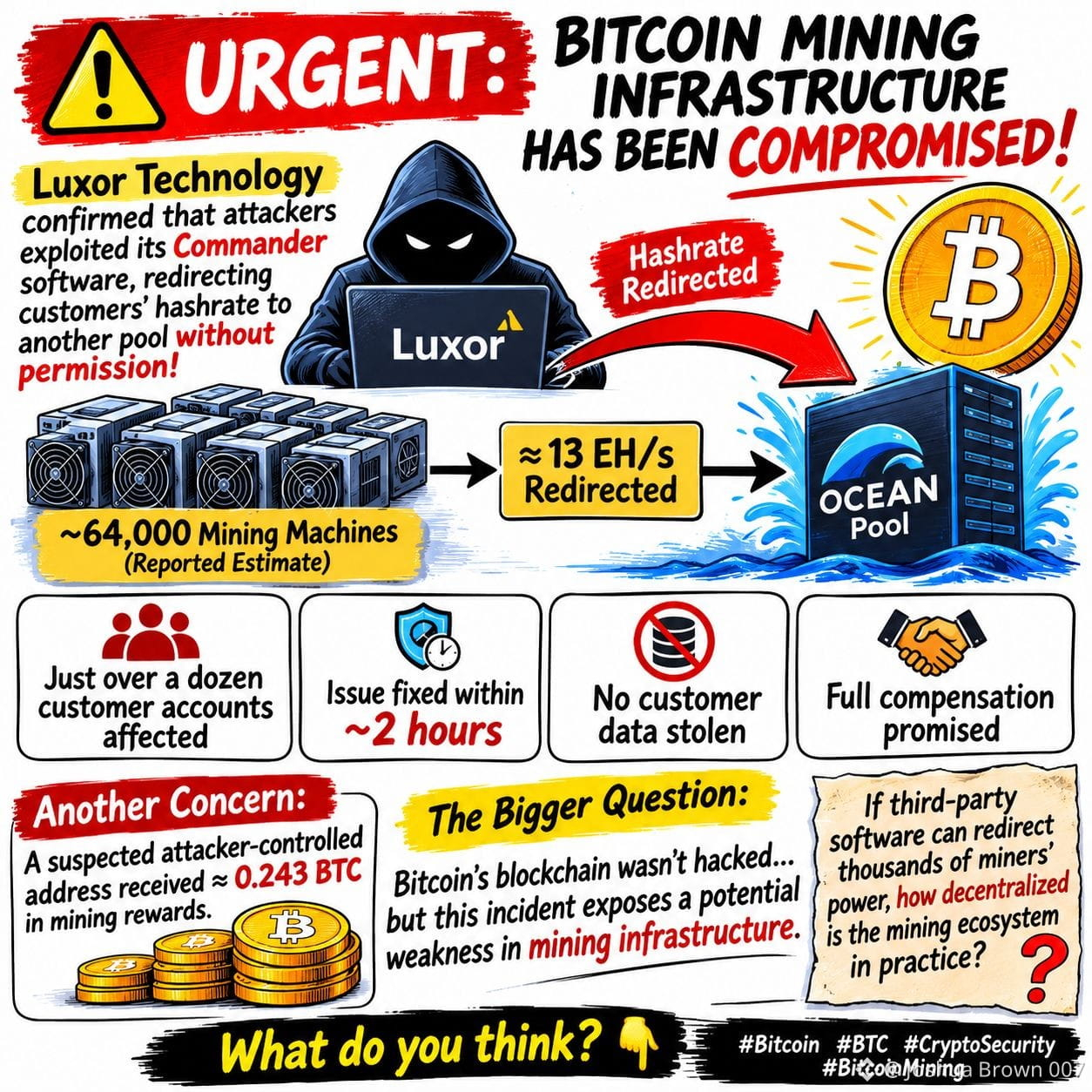
URGENT: BITCOIN MINING INFRASTRUCTURE HAS BEEN COMPROMISED!
Something serious happened in Bitcoin's mining ecosystem, and I think miners need to pay attention.
Luxor Technology confirmed that attackers exploited its Commander fleet-management software, redirecting customers' mining hashrate to another pool without authorization.
Here is where things get concerning:
Reported figures:
- Approximately 64,000 mining machines reportedly affected.
- Around 13 EH/s of computing power redirected.
- Mining activity was redirected to the OCEAN pool.
- Luxor officially confirmed that just over a dozen customer accounts were affected.
Luxor says it detected the incident, patched the vulnerability within approximately two hours, found no evidence of customer data being stolen, and committed to fully compensating affected clients.
But there is another concern: CoinDesk reported that a suspected attacker controlled address received approximately 0.243 BTC in mining rewards.
Now, let's look at the bigger issue.
Bitcoin's blockchain wasn't hacked. It was mining infrastructure.
This incident exposes a potential weakness in the ecosystem: miners can own their hardware, but if they depend on third-party software to manage thousands of machines, that software becomes a critical point of failure.
I believe Bitcoin's decentralization should be evaluated not only at the blockchain level, but also across mining pools, management software and operational infrastructure.
One question for the mining community:
If third party software can redirect thousands of miners' computing power without their permission, how decentralized is the mining ecosystem in practice?
What do you think?
#CryptoSecurity #BitcoinMiningNews
1
194
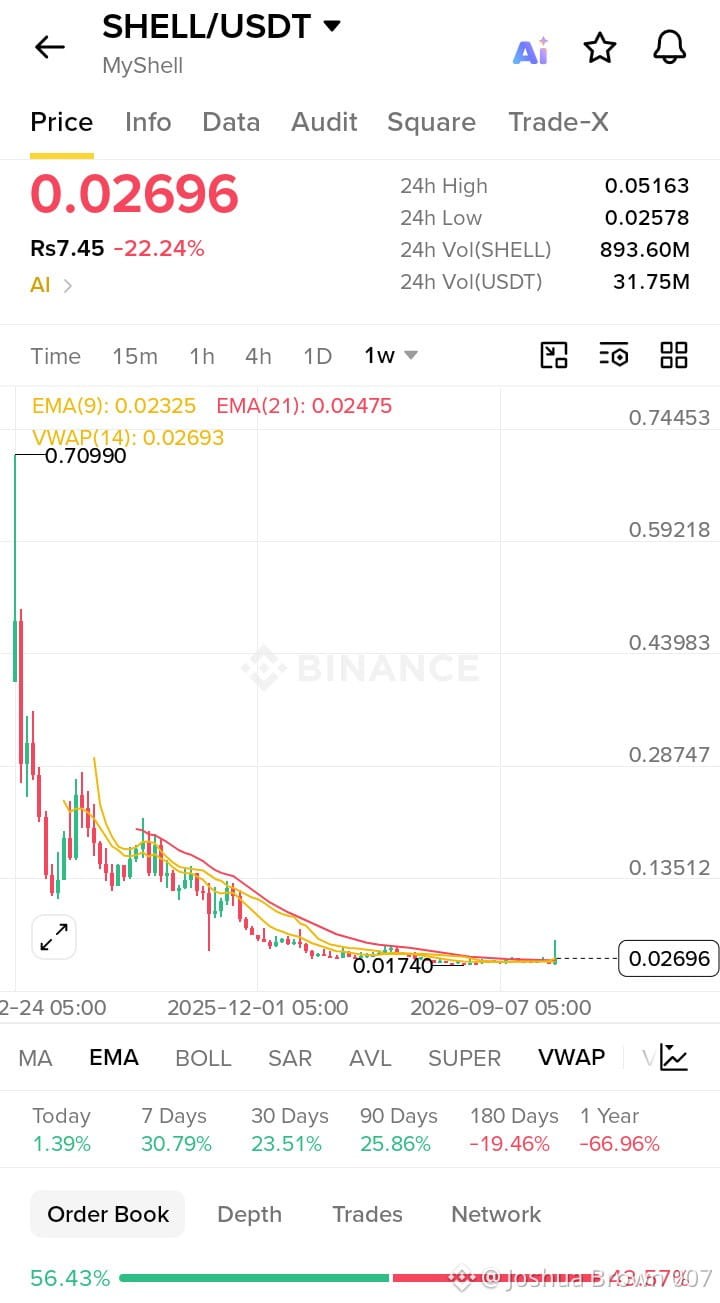
#TraderAlert $SHELL Analysis of spot buying?
Wait for the project to prove it can generate real revenue and for the token unlocks to slow down before even considering it.
More importantly, the project has a huge supply problem. Only about a quarter of all SHELL tokens are available for trading right now. The rest including a massive chunk held by the team and early investors will be unlocked and sold into the market over the coming months and years .
MAIN RISK: Continued price collapse due to massive token unlocks. The weekly chart shows a death spiral, and the fundamental supply pressure is overwhelming.
1
220

Article
Can a New Global Financial Shift Ignite the Next Major Market Rally?#cannvdareigniteairally
Understanding the connection between the world economy, institutional capital, and crypto markets
I have been looking at the global financial picture, and one thing stands out: financial markets are showing resilience, but the economic foundation supporting that optimism is facing serious challenges.
The question I keep coming back to is whether the next major market rally will be driven by genuine economic improvement or simply by investors taking on more risk.
1. The global economy: Growth is slowing, but not collapsing
According to the IMF's October 2026 World Economic Outlook, global economic growth is projected at 3.1% for 2026, with a recovery to 3.4% in 2027. However, global inflation is projected at 4.7% in 2026.
The OECD presents a slightly more cautious picture, projecting global growth of 2.9% in 2026 and 3.0% in 2027.
These figures suggest that the global economy is still expanding, but inflation, energy costs and geopolitical uncertainty are limiting the room for aggressive monetary easing.
2. What are international financial experts warning about?
The IMF's October 2026 Global Financial Stability Report highlights three important risks:
- An AI-related market correction if expected profits fail to materialise.
- Rising government bond yields driven by inflation and fiscal pressures.
- Cyber incidents that could disrupt financial infrastructure and investor confidence.
Athanasios Vamvakidis of the IMF has emphasised an important distinction: financial markets have remained resilient, but resilience does not mean the absence of risk.
This is particularly important because strong equity valuations can sometimes hide underlying financial vulnerabilities.
3. Interest rates and liquidity: The real drivers of a potential rally
Central-bank decisions remain among the most important factors for global markets.
When interest rates remain high, borrowing becomes expensive, businesses face higher financing costs, and investors become more selective about risky assets.
On the other hand, a sustainable decline in inflation could create room for monetary easing. That could improve liquidity conditions, support institutional investment and increase demand for equities, commodities and digital assets.
But there is a difference between lower interest rates and genuine financial liquidity. A rally needs sustainable capital flows, not just optimistic expectations.
4. How could global financial conditions affect cryptocurrency?
Crypto is increasingly connected to the wider financial system.
Bitcoin and other digital assets can benefit when institutional investors become more comfortable taking risks. However, they are also vulnerable when bond yields rise, the US dollar strengthens, or investors reduce exposure to speculative assets.
Three developments deserve close attention:
- Institutional capital flows into Bitcoin ETFs and digital assets.
- US Treasury yields and Federal Reserve policy expectations.
- Global liquidity, stablecoin supply and cryptocurrency market positioning.
A temporary increase in Bitcoin's price does not necessarily confirm a new bull market. Sustained demand, stronger spot volume and improving liquidity would provide more convincing evidence.
5. The biggest risk: A global economic shock
Energy-market disruptions, geopolitical tensions, growing government debt and expensive borrowing could create another wave of uncertainty.
The OECD warns that higher energy prices can reduce household purchasing power, while rising long-term bond yields increase government financing costs and put pressure on equity valuations.
Emerging economies may face additional pressure through currency depreciation, imported inflation and more expensive foreign borrowing.
For countries with limited financial reserves, these developments can have a particularly serious impact.
My personal market perspective
I do not think investors should assume that every improvement in market sentiment means a sustainable recovery is beginning.
The next major rally will need confirmation from several directions: inflation moving lower, bond yields stabilising, central-bank policy becoming less restrictive, institutional capital returning and corporate earnings remaining strong.
I would particularly watch Bitcoin's reaction to US bond yields and changes in global liquidity. These indicators can help explain whether capital is genuinely returning to risk assets or whether the market is experiencing another temporary recovery.
Final question: Are we approaching the beginning of a new global financial rally, or are markets simply enjoying temporary optimism before another economic challenge?
$NVDAB
#cannvdareigniteairally
Can a New Global Financial Shift Ignite the Next Major Market Rally?
#cannvdareigniteairally
Understanding the connection between the world economy, institutional capital, and crypto markets
I have been looking at the global financial picture, and one thing stands out: financial markets are showing resilience, but the economic foundation supporting that optimism is facing serious challenges.
The question I keep coming back to is whether the next major market rally will be driven by genuine economic improvement or simply by investors taking on more risk.
1. The global economy: Growth is slowing, but not collapsing
According to the IMF's October 2026 World Economic Outlook, global economic growth is projected at 3.1% for 2026, with a recovery to 3.4% in 2027. However, global inflation is projected at 4.7% in 2026.
The OECD presents a slightly more cautious picture, projecting global growth of 2.9% in 2026 and 3.0% in 2027.
These figures suggest that the global economy is still expanding, but inflation, energy costs and geopolitical uncertainty are limiting the room for aggressive monetary easing.
2. What are international financial experts warning about?
The IMF's October 2026 Global Financial Stability Report highlights three important risks:
- An AI-related market correction if expected profits fail to materialise.
- Rising government bond yields driven by inflation and fiscal pressures.
- Cyber incidents that could disrupt financial infrastructure and investor confidence.
Athanasios Vamvakidis of the IMF has emphasised an important distinction: financial markets have remained resilient, but resilience does not mean the absence of risk.
This is particularly important because strong equity valuations can sometimes hide underlying financial vulnerabilities.
3. Interest rates and liquidity: The real drivers of a potential rally
Central-bank decisions remain among the most important factors for global markets.
When interest rates remain high, borrowing becomes expensive, businesses face higher financing costs, and investors become more selective about risky assets.
On the other hand, a sustainable decline in inflation could create room for monetary easing. That could improve liquidity conditions, support institutional investment and increase demand for equities, commodities and digital assets.
But there is a difference between lower interest rates and genuine financial liquidity. A rally needs sustainable capital flows, not just optimistic expectations.
4. How could global financial conditions affect cryptocurrency?
Crypto is increasingly connected to the wider financial system.
Bitcoin and other digital assets can benefit when institutional investors become more comfortable taking risks. However, they are also vulnerable when bond yields rise, the US dollar strengthens, or investors reduce exposure to speculative assets.
Three developments deserve close attention:
- Institutional capital flows into Bitcoin ETFs and digital assets.
- US Treasury yields and Federal Reserve policy expectations.
- Global liquidity, stablecoin supply and cryptocurrency market positioning.
A temporary increase in Bitcoin's price does not necessarily confirm a new bull market. Sustained demand, stronger spot volume and improving liquidity would provide more convincing evidence.
5. The biggest risk: A global economic shock
Energy-market disruptions, geopolitical tensions, growing government debt and expensive borrowing could create another wave of uncertainty.
The OECD warns that higher energy prices can reduce household purchasing power, while rising long-term bond yields increase government financing costs and put pressure on equity valuations.
Emerging economies may face additional pressure through currency depreciation, imported inflation and more expensive foreign borrowing.
For countries with limited financial reserves, these developments can have a particularly serious impact.
My personal market perspective
I do not think investors should assume that every improvement in market sentiment means a sustainable recovery is beginning.
The next major rally will need confirmation from several directions: inflation moving lower, bond yields stabilising, central-bank policy becoming less restrictive, institutional capital returning and corporate earnings remaining strong.
I would particularly watch Bitcoin's reaction to US bond yields and changes in global liquidity. These indicators can help explain whether capital is genuinely returning to risk assets or whether the market is experiencing another temporary recovery.
Final question: Are we approaching the beginning of a new global financial rally, or are markets simply enjoying temporary optimism before another economic challenge?
$NVDAB
#cannvdareigniteairally
1
191
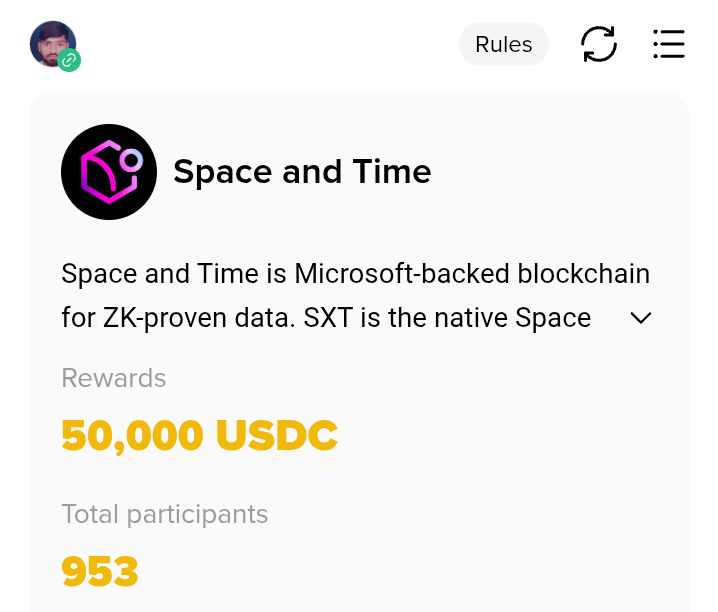
🎙️ Space and Time $SXT Track-1 and Track-2 campaign.
End
02 h 00 m 40 s
65

BNB
Holding
-0.01%
3
0
#BinanceSquareFamily
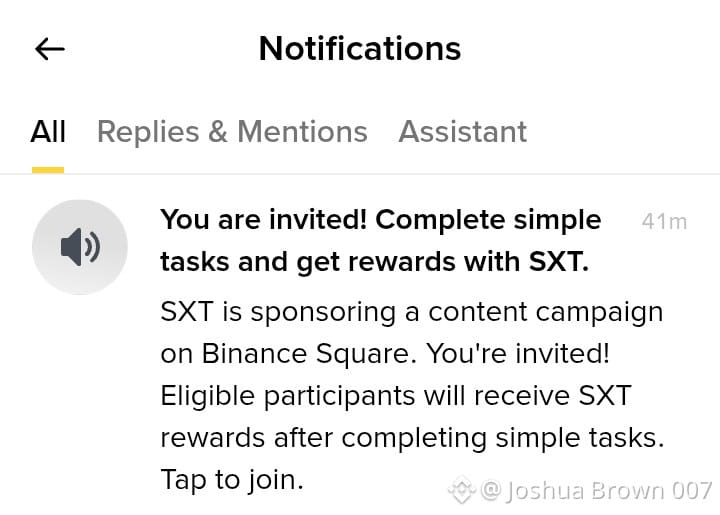
I Just Got Invited to the $SXT Content Campaign on Binance Square! 🚀
Hey Binance Community! I just received an official notification inviting me to join the exclusive Space and Time ($SXT) content campaign right here on Binance Square.
Check Your Inbox & Notifications Right Now!
If you also received this invite in your Binance Notification Center, don’t miss out! Tap on the message, complete the simple tasks listed in the campaign, and claim your share of the $SXT token rewards! 🎁
{spot}(SXTUSDT)
#BinanceSquareFamily
I Just Got Invited to the $SXT Content Campaign on Binance Square! 🚀
Hey Binance Community! I just received an official notification inviting me to join the exclusive Space and Time ($SXT ) content campaign right here on Binance Square.
Check Your Inbox & Notifications Right Now!
If you also received this invite in your Binance Notification Center, don’t miss out! Tap on the message, complete the simple tasks listed in the campaign, and claim your share of the $SXT token rewards! 🎁
1
107
Log in to explore more content
Join global crypto users on Binance Square
⚡️ Get latest and useful information about crypto.
💬 Trusted by the world’s largest crypto exchange.
👍 Discover real insights from verified creators.
Email / Phone number
Trending Topics
CanBTCReboundAfterFallingBelow60K?
355,715 views
1,492 Discussing
Bitcoin News | Bitcoin Falls Below $60,000 for the First Time Since July as IBIT Posts Record $541 Million Outflow
Binance News
·52 Likes
·98.6k views
GlobalStocksFaceLongestLosingStreakSince2023
117,251 views
1,060 Discussing
BlackRockIBITPostsRecord$541MSingleDayOutflow
588 views
15 Discussing