

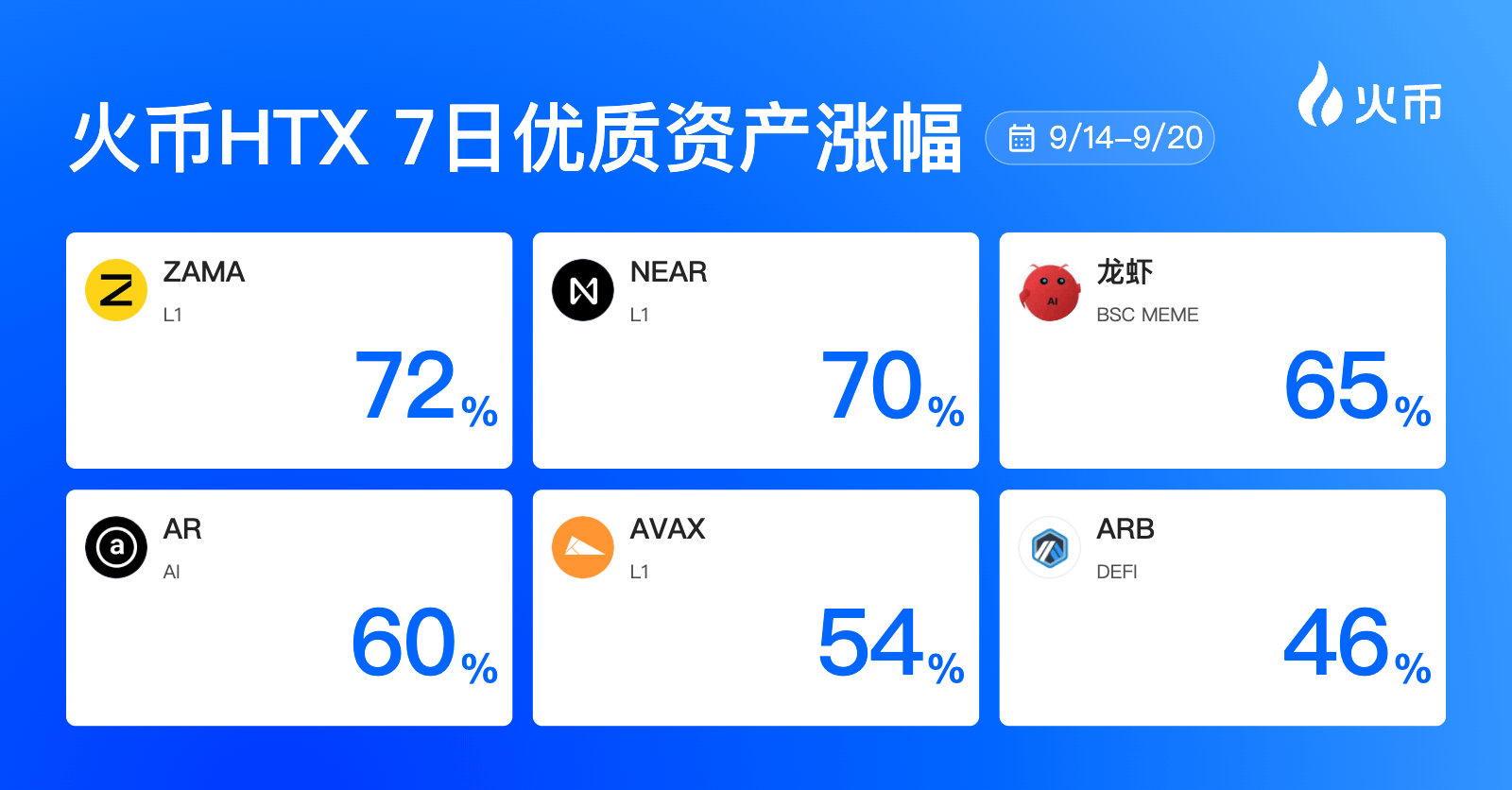
Last week, the crypto market suffered two negative factors in succession: the was blocked in the Senate, and the Federal Reserve raised interest rates for the first time in three years. Bitcoin briefly slipped to around $75,000. However, soon after, the SEC granted a five-year exemption for on-chain trading of tokenized stocks, and the CFTC also submitted its proposed crypto market regulatory rules to the White House for review. Concerns about legislative gridlock were eased, and Bitcoin regained the $80,000 level. Data from the Huobi HTX platform shows that from September 14 to 20, the L1 and DeFi sectors performed strongly, with ZAMA leading the way with a weekly gain of 72%.
L1: Confidential transaction products roll out in a concentrated manner, and institutional assets accelerate on-chain
In the same week, ZAMA and NEAR launched new products for confidential trading; meanwhile, AVAX saw tokenized funds from traditional asset-management institutions and integration with regulated infrastructure.
ZAMA: Up 72%. Zama leverages fully homomorphic encryption, allowing existing smart contracts on public chains to directly process data in encrypted form. On September 15, Zama opened 16 confidential vaults on Morpho, enabling depositors to participate in on-chain yield without disclosing their positions and strategies. At the same time, the Zama Swap protocol was launched to support swaps between confidential assets. The ZAMA price then climbed continuously and set a new all-time high over the weekend.
NEAR: Up 70%. On September 17, NEAR introduced confidential perpetual contracts through its integration with Hyperliquid, so traders’ position information is no longer exposed to the public. In parallel, the confidential funds under NEAR Intents surpassed $70 million. On September 18, the NEAR price rose to a level not seen in nearly a year.
AVAX: Up 54%. On September 17, New York Life Investment Management—managing about $807 billion—deployed its first tokenized fund, HYB, via Centrifuge to Avalanche. The fund invests in U.S. high-yield corporate bonds. On the same day, regulated blockchain infrastructure provider Paxos announced it would integrate Avalanche into its platform, supporting AVAX and Avalanche-native USDC. Its services for more than 650 institutions enable them to build products directly on Avalanche. In addition, the Helicon mainnet upgrade will be activated on September 22, shortening the staking lock-up period from two weeks to 48 hours. After that, the AVAX price briefly broke above $10.
DeFi: SEC tokenized-stock exemption landed, ARB and UNI move higher in sync
The innovative exemption issued by the SEC on September 17 allowed qualifying platforms to trade tokenized U.S. stocks through permissioned AMM liquidity pools under a licensing regime. The relevant tokens must grant holders the same rights as the underlying common stock. This arrangement directly aligns with the business direction of Arbitrum and Uniswap, and the gains for both also appeared to cluster together.
ARB: Up 46%. Arbitrum is one of the Ethereum Layer-2 networks with a relatively high concentration of tokenized assets. On September 17, the market value of tokenized funds on Arbitrum One hit a new high. Products include Treasury bills, credit funds, and a variety of yield strategies. After the SEC exemption took effect, the market expected Arbitrum could become one of the settlement networks for tokenized securities, and the ARB price rose to its highest level since January this year.
UNI: Up 39%. The permissioned AMM model adopted in the SEC exemption aligns with Uniswap v4’s permissioned pool design, which can restrict participation to verified wallet addresses. The SEC did not directly endorse a specific platform, but the market generally viewed this as an opportunity for Uniswap to expand tokenized securities trading.
Meme, storage, and launch-platform assets rose in sync
Lobster: Up 65%. Lobster is a Meme asset on BNB Chain, with its imagery originating from the lobster graphic and text published by Binance’s official in Chinese, and its name also echoes the AI field’s OpenClaw topic. This is Lobster’s second consecutive week entering the gain leaderboard. Its market cap exceeded $240 million last week, setting a new all-time high. Meme asset prices heavily depend on community sentiment; pullbacks often happen as quickly as rallies, so participants should fully assess the related risks.
AR: Up 60%. Arweave is a network that provides permanent on-chain data storage. The AO network running on top of it provides a decentralized computing environment for applications such as AI agents.
STONK: Up 40%. StonkFun is a token issuance platform on Solana. New tokens can choose tokenized stocks, ETFs, or other crypto assets as trading pairs, and STONK itself is paired with SPYx, which tracks the S&P 500 index. The platform repurchases and burns STONK using revenue. By mid-September, it had burned more than 14% of the supply.
After legislative hurdles, tokenization became the entry point for regulatory push
AVAX, ARB, and UNI all saw gains last week that are tied to tokenized assets. New York Life chose to deploy its fund on Avalanche and Arbitrum, refreshing the record size of its tokenized fund. These developments happened to occur in the same week that the SEC laid out a trading path for tokenized stocks. During the days when legislative progress stalled, regulators provided more specific arrangements in this direction, and the market reacted accordingly.
How far the rebound can go remains uncertain. The Federal Reserve’s interest-rate projections indicate that another rate hike could happen again within the year. Glassnode noted that stablecoin market-cap growth has slowed, and the pace of public companies accumulating Bitcoin has weakened, meaning new liquidity outside the market is still not sufficient. Whether Bitcoin can continue breaking through above $80,000 will determine whether this rally can spread to more assets. Huobi HTX will continue to track progress across each track, providing users with timely asset information and stable trading services.