

#secsaystokenbuybacksnotautosecurities
secsaystokenbuybacksnotautosecurities
76,174 views
919 Discussing
Hot
Latest

·
--
#secsaystokenbuybacksnotautosecurities LATEST:
🇺🇸
The SEC just clarified how U.S. securities
laws apply to crypto.
The key shift:
• A
token
can separate from the investment contract used to sell it
• Staking receipt tokens aren’t automatically
securities
• Functionality & decentralization matter
• Developers can maintain functional networks without automatically triggering Howey
• Token buybacks aren’t automatically securities transactions
• Secondary trading doesn’t automatically make exchanges promoters
The focus is increasingly on what the token represents, what was promised, and who controls the network.
These are NOT new SEC rules.$RARE $BEAT $BR
#secsaystokenbuybacksnotautosecurities LATEST:
🇺🇸
The SEC just clarified how U.S. securities
laws apply to crypto.
The key shift:
• A
token
can separate from the investment contract used to sell it
• Staking receipt tokens aren’t automatically
securities
• Functionality & decentralization matter
• Developers can maintain functional networks without automatically triggering Howey
• Token buybacks aren’t automatically securities transactions
• Secondary trading doesn’t automatically make exchanges promoters
The focus is increasingly on what the token represents, what was promised, and who controls the network.
These are NOT new SEC rules.$RARE $BEAT $BR
🇺🇸
The SEC just clarified how U.S. securities
laws apply to crypto.
The key shift:
• A
token
can separate from the investment contract used to sell it
• Staking receipt tokens aren’t automatically
securities
• Functionality & decentralization matter
• Developers can maintain functional networks without automatically triggering Howey
• Token buybacks aren’t automatically securities transactions
• Secondary trading doesn’t automatically make exchanges promoters
The focus is increasingly on what the token represents, what was promised, and who controls the network.
These are NOT new SEC rules.$RARE $BEAT $BR
ahmet1992:
bnb
1
1
20
24.9k
·
--
#secsaystokenbuybacksnotautosecurities 🚨
NEW: SEC staff has issued fresh crypto guidance clarifying how token buybacks, continued development, marketing, and liquid staking tokens are treated under securities
laws.
• Development: Once a network is functional, teams can continue building, upgrading, and funding development without those activities being considered “essential managerial efforts” that could keep a token tied to an investment contract.
• Token buybacks: Buybacks of a non security token on a functional network do not, by themselves, constitute “essential managerial efforts.” For unfinished networks, the answer can change if buybacks are promoted as creating “yield or return” for holders.
• Liquid staking: Staking receipt tokens representing non security crypto can be treated as a “digital tool,” while protocol issued LSTs can also qualify as “digital commodities.”
• Marketing: Teams can promote a network’s existing utility and discuss future features without automatically creating a securities issue. The key distinction is whether the promotion creates expectations of profits based on the team’s work.
• Decentralized networks: Once a functional network has “no central party” controlling its success or failure, statements from the original issuer are unlikely to create a new investment contract around the native token.
• Exchange listings: A trading platform is not automatically considered a token promoter simply because it provides a secondary market for the asset.$FOGO $SPELL $SAGA
#secsaystokenbuybacksnotautosecurities 🚨
NEW: SEC staff has issued fresh crypto guidance clarifying how token buybacks, continued development, marketing, and liquid staking tokens are treated under securities
laws.
• Development: Once a network is functional, teams can continue building, upgrading, and funding development without those activities being considered “essential managerial efforts” that could keep a token tied to an investment contract.
• Token buybacks: Buybacks of a non security token on a functional network do not, by themselves, constitute “essential managerial efforts.” For unfinished networks, the answer can change if buybacks are promoted as creating “yield or return” for holders.
• Liquid staking: Staking receipt tokens representing non security crypto can be treated as a “digital tool,” while protocol issued LSTs can also qualify as “digital commodities.”
• Marketing: Teams can promote a network’s existing utility and discuss future features without automatically creating a securities issue. The key distinction is whether the promotion creates expectations of profits based on the team’s work.
• Decentralized networks: Once a functional network has “no central party” controlling its success or failure, statements from the original issuer are unlikely to create a new investment contract around the native token.
• Exchange listings: A trading platform is not automatically considered a token promoter simply because it provides a secondary market for the asset.$FOGO $SPELL $SAGA
NEW: SEC staff has issued fresh crypto guidance clarifying how token buybacks, continued development, marketing, and liquid staking tokens are treated under securities
laws.
• Development: Once a network is functional, teams can continue building, upgrading, and funding development without those activities being considered “essential managerial efforts” that could keep a token tied to an investment contract.
• Token buybacks: Buybacks of a non security token on a functional network do not, by themselves, constitute “essential managerial efforts.” For unfinished networks, the answer can change if buybacks are promoted as creating “yield or return” for holders.
• Liquid staking: Staking receipt tokens representing non security crypto can be treated as a “digital tool,” while protocol issued LSTs can also qualify as “digital commodities.”
• Marketing: Teams can promote a network’s existing utility and discuss future features without automatically creating a securities issue. The key distinction is whether the promotion creates expectations of profits based on the team’s work.
• Decentralized networks: Once a functional network has “no central party” controlling its success or failure, statements from the original issuer are unlikely to create a new investment contract around the native token.
• Exchange listings: A trading platform is not automatically considered a token promoter simply because it provides a secondary market for the asset.$FOGO $SPELL $SAGA
2
3.7k

·
--
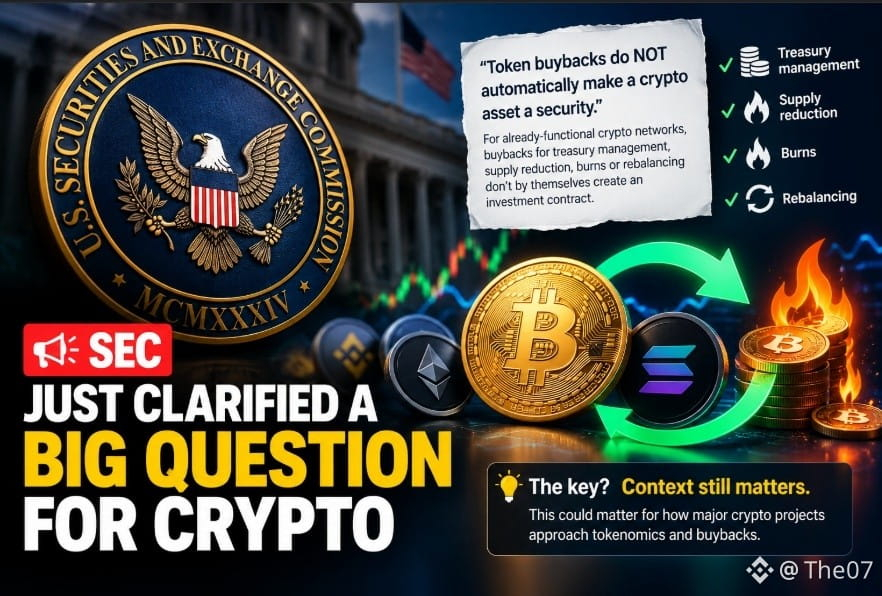
🚨 SEC JUST CLARIFIED A BIG QUESTION FOR CRYPTO
The SEC says token buybacks do NOT automatically make a crypto asset a security. 👀
For already-functional crypto networks, buybacks for treasury management, supply reduction, burns or rebalancing don’t by themselves create an investment contract.
🔥 This could matter for how major crypto projects approach tokenomics and buybacks.
The key? Context still matters.
What do you think this means for the crypto market? 👇
#crypto #bitcoin #altcoins #blockchain
#secsaystokenbuybacksnotautosecurities
🚨 SEC JUST CLARIFIED A BIG QUESTION FOR CRYPTO
The SEC says token buybacks do NOT automatically make a crypto asset a security. 👀
For already-functional crypto networks, buybacks for treasury management, supply reduction, burns or rebalancing don’t by themselves create an investment contract.
🔥 This could matter for how major crypto projects approach tokenomics and buybacks.
The key? Context still matters.
What do you think this means for the crypto market? 👇
#crypto #bitcoin #altcoins #blockchain
#secsaystokenbuybacksnotautosecurities
The SEC says token buybacks do NOT automatically make a crypto asset a security. 👀
For already-functional crypto networks, buybacks for treasury management, supply reduction, burns or rebalancing don’t by themselves create an investment contract.
🔥 This could matter for how major crypto projects approach tokenomics and buybacks.
The key? Context still matters.
What do you think this means for the crypto market? 👇
#crypto #bitcoin #altcoins #blockchain
#secsaystokenbuybacksnotautosecurities
2
2.7k

·
--
Bullish
#secsaystokenbuybacksnotautosecurities
⚖️ Regulatory Shift: SEC Clarifies Token Buyback Programs Do Not Automatically Trigger Securities Classification 🚀
A massive win for decentralized finance and protocol economics! The SEC’s Division of Corporation Finance has issued updated guidance, clarifying that executing token buybacks, network upgrades, and ongoing maintenance on functional blockchains does not automatically transform a crypto token into a security under the Howey test.
This update removes a major cloud of legal ambiguity for revenue-generating decentralized protocols that actively purchase and burn their native tokens.
💡 Key Highlights:
🔄 Live Networks vs. Pre-Launch Projects: The SEC explicitly noted that for an operational, functional network, routine buybacks do not automatically equate to "essential managerial efforts" that yield expectation. However, for unlaunched or non-functional projects, marketing a buyback as a source of guaranteed yield can still trigger securities scrutiny.
🛠️ Ongoing Protocol Development Cleared: Protocol upgrades, security enhancements, and routine network optimizations are classified as maintenance rather than managerial dependence under Howey.
📈 Record Buyback Momentum: The clarification follows a massive surge in token buybacks—reaching over $638 million through late 2026—led by protocols like Hyperliquid and Pump.fun.
How big is this regulatory update for DeFi revenue distribution models? Let us know your thoughts in the comments! 👇
#CircleMints500MUSDCOnSolana #defi #StrategyStriveAdd2305BitcoinThisWeek
#secsaystokenbuybacksnotautosecurities
⚖️ Regulatory Shift: SEC Clarifies Token Buyback Programs Do Not Automatically Trigger Securities Classification 🚀
A massive win for decentralized finance and protocol economics! The SEC’s Division of Corporation Finance has issued updated guidance, clarifying that executing token buybacks, network upgrades, and ongoing maintenance on functional blockchains does not automatically transform a crypto token into a security under the Howey test.
This update removes a major cloud of legal ambiguity for revenue-generating decentralized protocols that actively purchase and burn their native tokens.
💡 Key Highlights:
🔄 Live Networks vs. Pre-Launch Projects: The SEC explicitly noted that for an operational, functional network, routine buybacks do not automatically equate to "essential managerial efforts" that yield expectation. However, for unlaunched or non-functional projects, marketing a buyback as a source of guaranteed yield can still trigger securities scrutiny.
🛠️ Ongoing Protocol Development Cleared: Protocol upgrades, security enhancements, and routine network optimizations are classified as maintenance rather than managerial dependence under Howey.
📈 Record Buyback Momentum: The clarification follows a massive surge in token buybacks—reaching over $638 million through late 2026—led by protocols like Hyperliquid and Pump.fun.
How big is this regulatory update for DeFi revenue distribution models? Let us know your thoughts in the comments! 👇
#CircleMints500MUSDCOnSolana #defi #StrategyStriveAdd2305BitcoinThisWeek
⚖️ Regulatory Shift: SEC Clarifies Token Buyback Programs Do Not Automatically Trigger Securities Classification 🚀
A massive win for decentralized finance and protocol economics! The SEC’s Division of Corporation Finance has issued updated guidance, clarifying that executing token buybacks, network upgrades, and ongoing maintenance on functional blockchains does not automatically transform a crypto token into a security under the Howey test.
This update removes a major cloud of legal ambiguity for revenue-generating decentralized protocols that actively purchase and burn their native tokens.
💡 Key Highlights:
🔄 Live Networks vs. Pre-Launch Projects: The SEC explicitly noted that for an operational, functional network, routine buybacks do not automatically equate to "essential managerial efforts" that yield expectation. However, for unlaunched or non-functional projects, marketing a buyback as a source of guaranteed yield can still trigger securities scrutiny.
🛠️ Ongoing Protocol Development Cleared: Protocol upgrades, security enhancements, and routine network optimizations are classified as maintenance rather than managerial dependence under Howey.
📈 Record Buyback Momentum: The clarification follows a massive surge in token buybacks—reaching over $638 million through late 2026—led by protocols like Hyperliquid and Pump.fun.
How big is this regulatory update for DeFi revenue distribution models? Let us know your thoughts in the comments! 👇
#CircleMints500MUSDCOnSolana #defi #StrategyStriveAdd2305BitcoinThisWeek
Waneta Jacka jtuR:
100 US
1
6
1.2k

·
--
Bearish
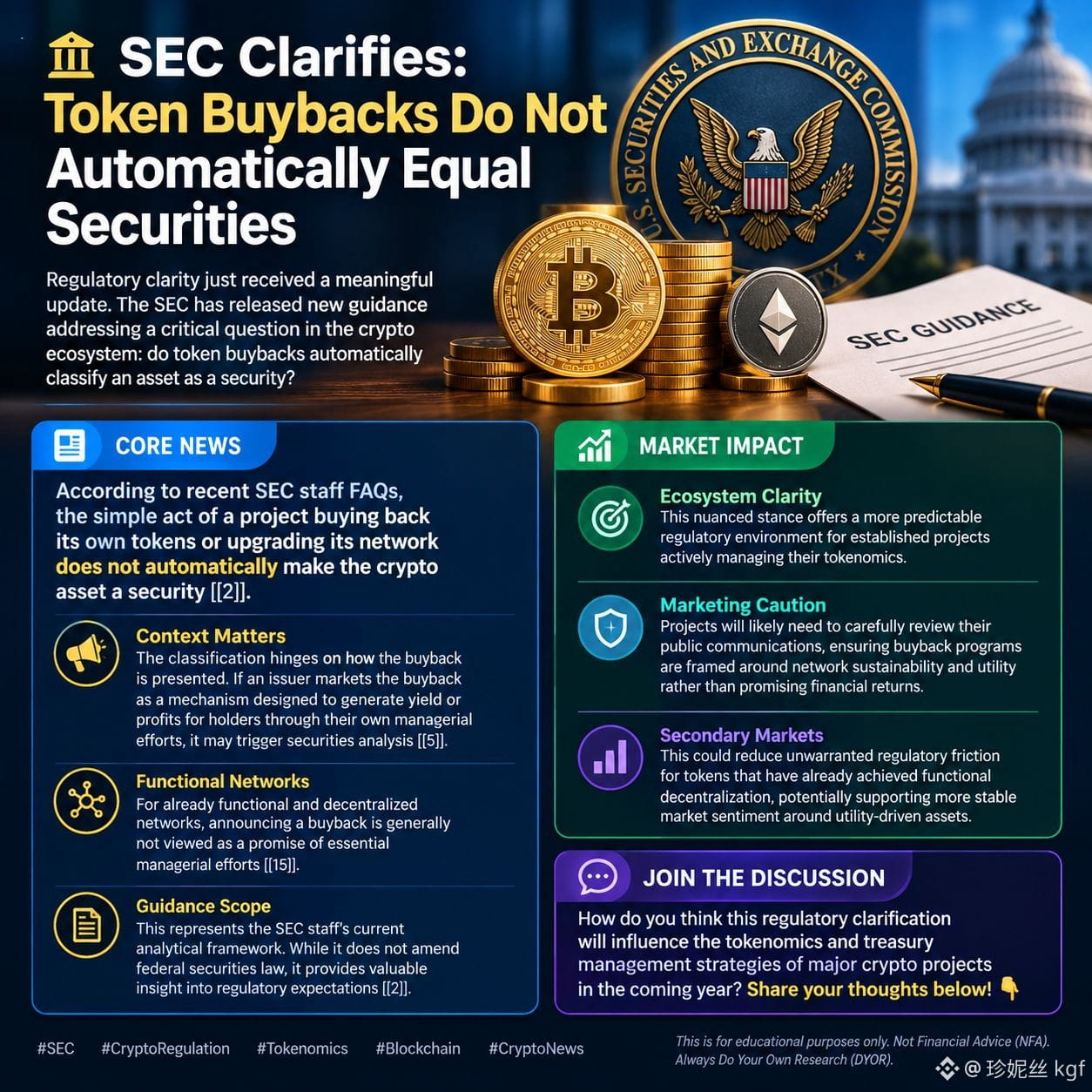
#secsaystokenbuybacksnotautosecurities 🏛️ SEC Clarifies: Token Buybacks ≠ Automatic Securities
Regulatory clarity just received a meaningful update. The SEC has released new guidance answering a critical crypto question: do token buybacks automatically classify an asset as a security?
📰 Core News
According to recent SEC staff FAQs, a project buying back its own tokens or upgrading its network does NOT automatically make the crypto asset a security.
• Context Matters: Classification hinges on presentation. If an issuer markets a buyback to generate yield or profits via managerial efforts, it may trigger securities analysis.
• Functional Networks: For already decentralized, functional networks, buybacks are generally not viewed as a promise of essential managerial efforts.
• Guidance Scope: This reflects the SEC staff’s current analytical framework, offering valuable regulatory insight without amending federal securities law.
📊 Market Impact
• Ecosystem Clarity: Provides a more predictable regulatory environment for established projects actively managing their tokenomics.
• Marketing Caution: Projects must carefully frame buybacks around network sustainability and utility, avoiding promised financial returns.
• Market Sentiment: Reduces regulatory friction for tokens that have achieved functional decentralization, supporting stability for utility-driven assets.
💬 Join the Discussion
How will this regulatory clarification influence the tokenomics and treasury management strategies of major crypto projects this year? Share your thoughts below! 👇
#SEC #CryptoRegulation #Tokenomics #Blockchain #CryptoNews
This is for educational purposes only. Not Financial Advice (NFA). Always Do Your Own Research (DYOR).
$TNSR $WAXP $QUICK
{spot}(QUICKUSDT)
{future}(WAXPUSDT)
{future}(TNSRUSDT)
#secsaystokenbuybacksnotautosecurities 🏛️ SEC Clarifies: Token Buybacks ≠ Automatic Securities
Regulatory clarity just received a meaningful update. The SEC has released new guidance answering a critical crypto question: do token buybacks automatically classify an asset as a security?
📰 Core News
According to recent SEC staff FAQs, a project buying back its own tokens or upgrading its network does NOT automatically make the crypto asset a security.
• Context Matters: Classification hinges on presentation. If an issuer markets a buyback to generate yield or profits via managerial efforts, it may trigger securities analysis.
• Functional Networks: For already decentralized, functional networks, buybacks are generally not viewed as a promise of essential managerial efforts.
• Guidance Scope: This reflects the SEC staff’s current analytical framework, offering valuable regulatory insight without amending federal securities law.
📊 Market Impact
• Ecosystem Clarity: Provides a more predictable regulatory environment for established projects actively managing their tokenomics.
• Marketing Caution: Projects must carefully frame buybacks around network sustainability and utility, avoiding promised financial returns.
• Market Sentiment: Reduces regulatory friction for tokens that have achieved functional decentralization, supporting stability for utility-driven assets.
💬 Join the Discussion
How will this regulatory clarification influence the tokenomics and treasury management strategies of major crypto projects this year? Share your thoughts below! 👇
#SEC #CryptoRegulation #Tokenomics #Blockchain #CryptoNews
This is for educational purposes only. Not Financial Advice (NFA). Always Do Your Own Research (DYOR).
$TNSR $WAXP $QUICK
Regulatory clarity just received a meaningful update. The SEC has released new guidance answering a critical crypto question: do token buybacks automatically classify an asset as a security?
📰 Core News
According to recent SEC staff FAQs, a project buying back its own tokens or upgrading its network does NOT automatically make the crypto asset a security.
• Context Matters: Classification hinges on presentation. If an issuer markets a buyback to generate yield or profits via managerial efforts, it may trigger securities analysis.
• Functional Networks: For already decentralized, functional networks, buybacks are generally not viewed as a promise of essential managerial efforts.
• Guidance Scope: This reflects the SEC staff’s current analytical framework, offering valuable regulatory insight without amending federal securities law.
📊 Market Impact
• Ecosystem Clarity: Provides a more predictable regulatory environment for established projects actively managing their tokenomics.
• Marketing Caution: Projects must carefully frame buybacks around network sustainability and utility, avoiding promised financial returns.
• Market Sentiment: Reduces regulatory friction for tokens that have achieved functional decentralization, supporting stability for utility-driven assets.
💬 Join the Discussion
How will this regulatory clarification influence the tokenomics and treasury management strategies of major crypto projects this year? Share your thoughts below! 👇
#SEC #CryptoRegulation #Tokenomics #Blockchain #CryptoNews
This is for educational purposes only. Not Financial Advice (NFA). Always Do Your Own Research (DYOR).
$TNSR $WAXP $QUICK
SAQR77:
Good, beautiful woman
1
3
1.6k
·
--
#secsaystokenbuybacksnotautosecurities According to the SEC
:
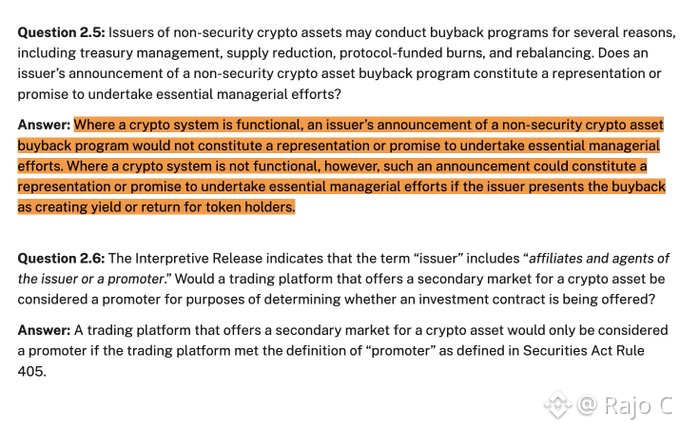
Buying tokens off the market to manage treasury, or reduce supply is treated as ordinary operations and is fine.
Marketing
buybacks as a profit mechanism can be treated as selling an "investment" and are not fine.$ACE $LYN $KMNO
#secsaystokenbuybacksnotautosecurities According to the SEC
:
Buying tokens off the market to manage treasury, or reduce supply is treated as ordinary operations and is fine.
Marketing
buybacks as a profit mechanism can be treated as selling an "investment" and are not fine.$ACE $LYN $KMNO
:
Buying tokens off the market to manage treasury, or reduce supply is treated as ordinary operations and is fine.
Marketing
buybacks as a profit mechanism can be treated as selling an "investment" and are not fine.$ACE $LYN $KMNO
3
7k

·
--
Bullish
#secsaystokenbuybacksnotautosecurities 🔥 A NEW CLARIFICATION FOR CRYPTO TOKENOMICS
The U.S. SEC has provided new guidance on token buybacks, giving crypto projects more clarity around how buyback programs can be treated under U.S. securities laws.
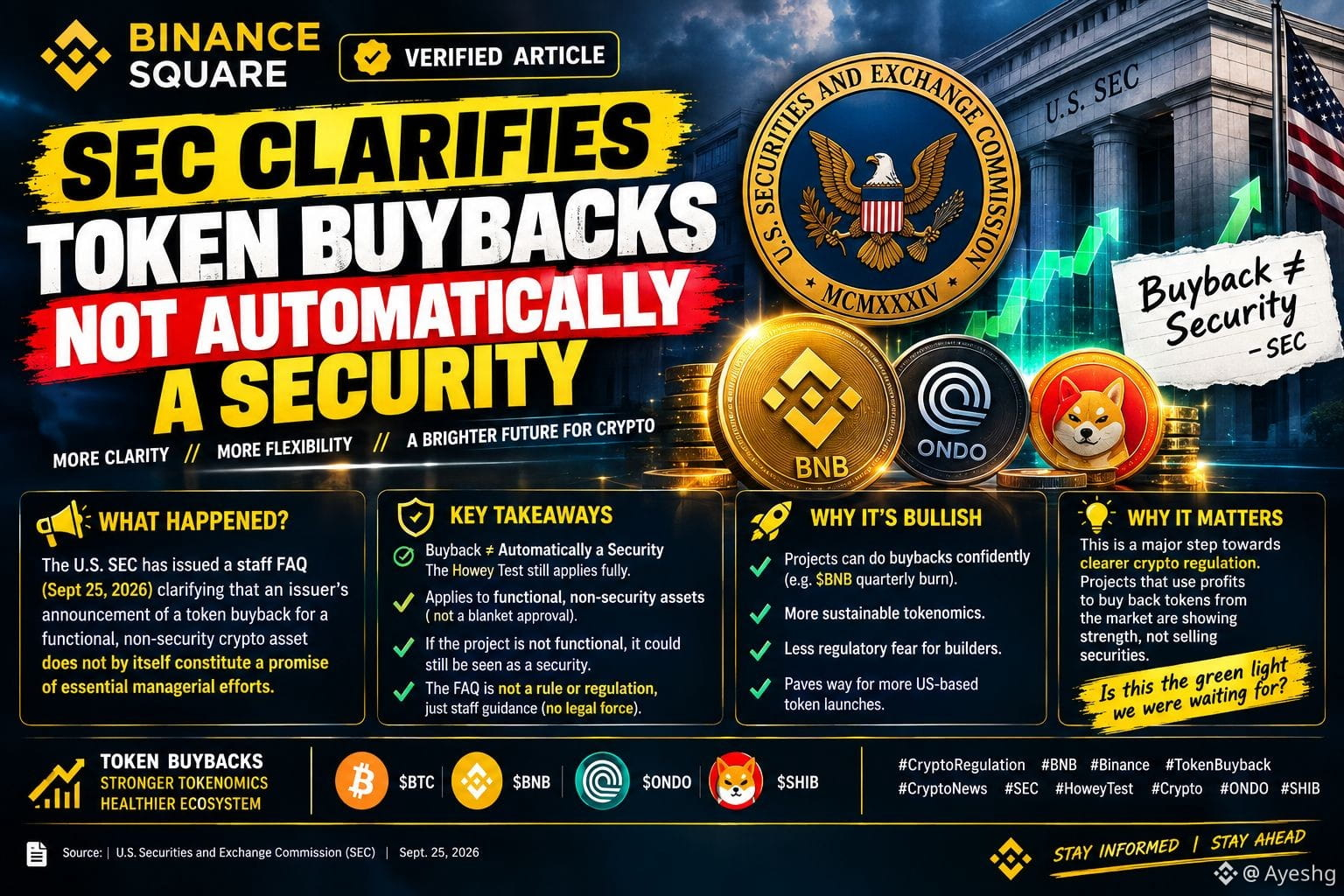
According to an SEC staff FAQ released on September 25, 2026, an issuer's announcement of a buyback for a functional, non-security crypto asset does not by itself constitute a promise of essential managerial efforts.
🔍 WHAT DOES THIS MEAN?
Buyback ≠ Automatically a Security
The SEC's explanation means that a token buyback program alone does not automatically turn a non-security crypto asset into an investment contract.
However, the Howey Test still matters. If other facts and representations create an investment contract, federal securities laws can still apply.
🪙 WHY TOKEN BUYBACKS MATTER
Crypto projects may use buybacks for several purposes, including:
✅ Treasury management
✅ Supply reduction
✅ Protocol-funded burns
✅ Token supply rebalancing
For a functional crypto system, the SEC staff says announcing a buyback would not constitute a representation or promise to undertake essential managerial efforts.
⚠️ IMPORTANT LIMITATION
This is not a blanket SEC approval of every token buyback.
The SEC's FAQ specifically says that if a crypto system is not functional, a buyback announcement could potentially constitute a promise of essential managerial efforts—particularly when the buyback is presented as creating yield or returns for token holders.
Also, the SEC states that these FAQs represent the views of the Division of Corporation Finance staff and are not rules, regulations, or statements of the Commission. They do not change existing law.
🔥 Crypto regulation is becoming more detailed—and tokenomics are now getting clearer regulatory treatment.
₿ $BTC | 🔶 $BNB | 🟢 $ONDO
#CryptoRegulation #BNB #Binance #TokenBuyback #CryptoNews #SEC #HoweyTest #Crypto #ONDO #SHIB
#secsaystokenbuybacksnotautosecurities 🔥 A NEW CLARIFICATION FOR CRYPTO TOKENOMICS
The U.S. SEC has provided new guidance on token buybacks, giving crypto projects more clarity around how buyback programs can be treated under U.S. securities laws.
According to an SEC staff FAQ released on September 25, 2026, an issuer's announcement of a buyback for a functional, non-security crypto asset does not by itself constitute a promise of essential managerial efforts.
🔍 WHAT DOES THIS MEAN?
Buyback ≠ Automatically a Security
The SEC's explanation means that a token buyback program alone does not automatically turn a non-security crypto asset into an investment contract.
However, the Howey Test still matters. If other facts and representations create an investment contract, federal securities laws can still apply.
🪙 WHY TOKEN BUYBACKS MATTER
Crypto projects may use buybacks for several purposes, including:
✅ Treasury management
✅ Supply reduction
✅ Protocol-funded burns
✅ Token supply rebalancing
For a functional crypto system, the SEC staff says announcing a buyback would not constitute a representation or promise to undertake essential managerial efforts.
⚠️ IMPORTANT LIMITATION
This is not a blanket SEC approval of every token buyback.
The SEC's FAQ specifically says that if a crypto system is not functional, a buyback announcement could potentially constitute a promise of essential managerial efforts—particularly when the buyback is presented as creating yield or returns for token holders.
Also, the SEC states that these FAQs represent the views of the Division of Corporation Finance staff and are not rules, regulations, or statements of the Commission. They do not change existing law.
🔥 Crypto regulation is becoming more detailed—and tokenomics are now getting clearer regulatory treatment.
₿ $BTC | 🔶 $BNB | 🟢 $ONDO
#CryptoRegulation #BNB #Binance #TokenBuyback #CryptoNews #SEC #HoweyTest #Crypto #ONDO #SHIB
The U.S. SEC has provided new guidance on token buybacks, giving crypto projects more clarity around how buyback programs can be treated under U.S. securities laws.
According to an SEC staff FAQ released on September 25, 2026, an issuer's announcement of a buyback for a functional, non-security crypto asset does not by itself constitute a promise of essential managerial efforts.
🔍 WHAT DOES THIS MEAN?
Buyback ≠ Automatically a Security
The SEC's explanation means that a token buyback program alone does not automatically turn a non-security crypto asset into an investment contract.
However, the Howey Test still matters. If other facts and representations create an investment contract, federal securities laws can still apply.
🪙 WHY TOKEN BUYBACKS MATTER
Crypto projects may use buybacks for several purposes, including:
✅ Treasury management
✅ Supply reduction
✅ Protocol-funded burns
✅ Token supply rebalancing
For a functional crypto system, the SEC staff says announcing a buyback would not constitute a representation or promise to undertake essential managerial efforts.
⚠️ IMPORTANT LIMITATION
This is not a blanket SEC approval of every token buyback.
The SEC's FAQ specifically says that if a crypto system is not functional, a buyback announcement could potentially constitute a promise of essential managerial efforts—particularly when the buyback is presented as creating yield or returns for token holders.
Also, the SEC states that these FAQs represent the views of the Division of Corporation Finance staff and are not rules, regulations, or statements of the Commission. They do not change existing law.
🔥 Crypto regulation is becoming more detailed—and tokenomics are now getting clearer regulatory treatment.
₿ $BTC | 🔶 $BNB | 🟢 $ONDO
#CryptoRegulation #BNB #Binance #TokenBuyback #CryptoNews #SEC #HoweyTest #Crypto #ONDO #SHIB
1
8
4.6k

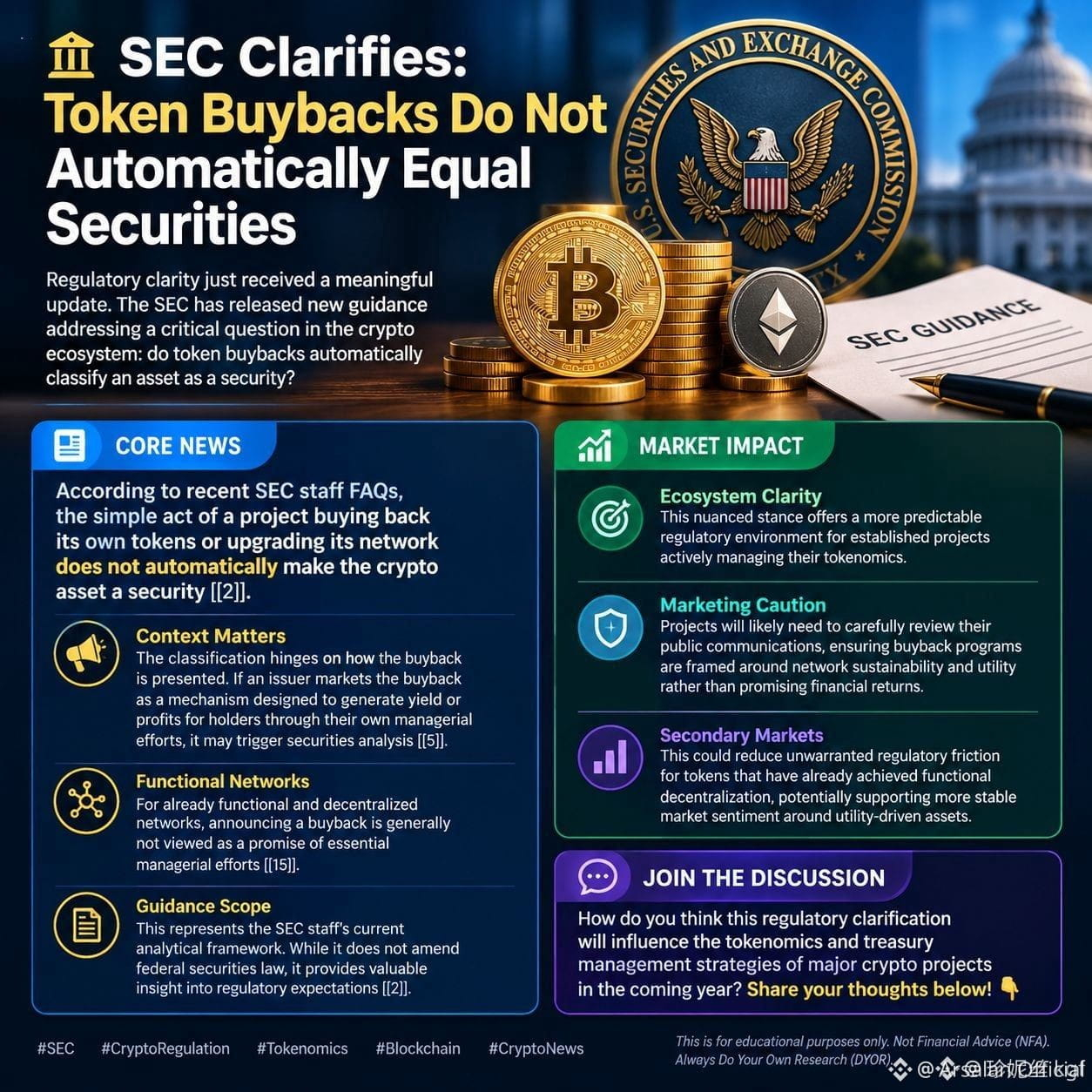
#SECSaysTokenBuybacksNotAutoSecurities The SEC’s Division of Corporation Finance issued new crypto FAQs clarifying that token buybacks and network upgrades do not automatically make a crypto asset a security. The guidance emphasizes that the legal analysis remains case-by-case, including how buybacks are presented to investors and whether they involve promises of profit.
The September 25 guidance is staff guidance, not a new SEC rule, but it provides additional clarity for crypto projects navigating U.S. securities laws.
#SEC #CryptoRegulation #TokenBuybacks #Crypto $BTC
{spot}(BTCUSDT)
#SECSaysTokenBuybacksNotAutoSecurities The SEC’s Division of Corporation Finance issued new crypto FAQs clarifying that token buybacks and network upgrades do not automatically make a crypto asset a security. The guidance emphasizes that the legal analysis remains case-by-case, including how buybacks are presented to investors and whether they involve promises of profit.
The September 25 guidance is staff guidance, not a new SEC rule, but it provides additional clarity for crypto projects navigating U.S. securities laws.
#SEC #CryptoRegulation #TokenBuybacks #Crypto $BTC
The September 25 guidance is staff guidance, not a new SEC rule, but it provides additional clarity for crypto projects navigating U.S. securities laws.
#SEC #CryptoRegulation #TokenBuybacks #Crypto $BTC
1
7

#secsaystokenbuybacksnotautosecurities
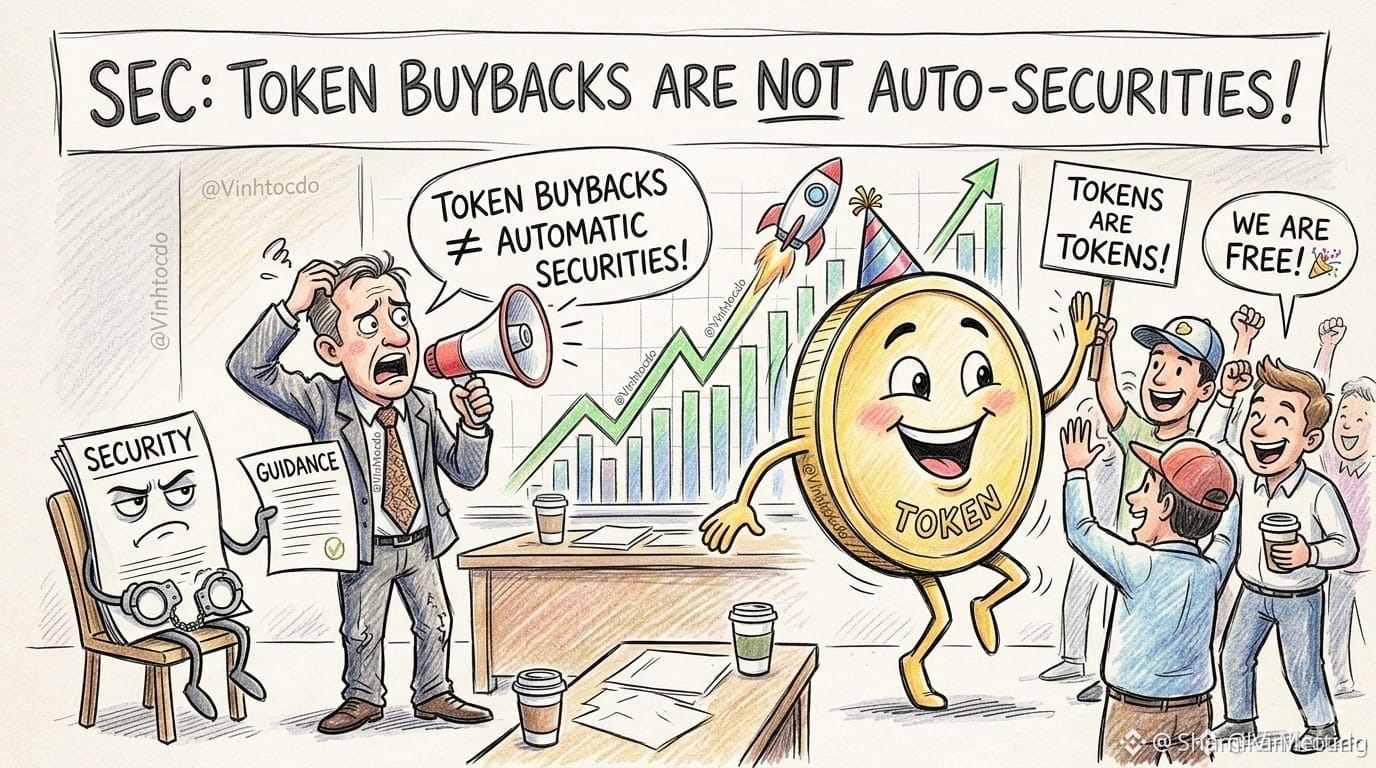
Finally, the U.S. Securities and Exchange Commission (SEC) said this: token buybacks don’t automatically make them a security! 🎉 So... tokens are tokens, and securities are securities, right, friends? Big win for clarification! What should traders do? Keep your eyes open, stay calm, and ride the upward momentum before the SEC changes its mind again! 📈
Not financial advice. Do your own research (DYOR)!
Follow-up, please
$BNB
{future}(BNBUSDT)
$ETH
{future}(ETHUSDT)
$SOL
{future}(SOLUSDT)
#secsaystokenbuybacksnotautosecurities #CryptoClarity #CryptoTrading #Binance
#secsaystokenbuybacksnotautosecurities
Finally, the U.S. Securities and Exchange Commission (SEC) said this: token buybacks don’t automatically make them a security! 🎉 So... tokens are tokens, and securities are securities, right, friends? Big win for clarification! What should traders do? Keep your eyes open, stay calm, and ride the upward momentum before the SEC changes its mind again! 📈
Not financial advice. Do your own research (DYOR)!
Follow-up, please
$BNB
$ETH
$SOL
#secsaystokenbuybacksnotautosecurities #CryptoClarity #CryptoTrading #Binance
Finally, the U.S. Securities and Exchange Commission (SEC) said this: token buybacks don’t automatically make them a security! 🎉 So... tokens are tokens, and securities are securities, right, friends? Big win for clarification! What should traders do? Keep your eyes open, stay calm, and ride the upward momentum before the SEC changes its mind again! 📈
Not financial advice. Do your own research (DYOR)!
Follow-up, please
$BNB
$ETH
$SOL
#secsaystokenbuybacksnotautosecurities #CryptoClarity #CryptoTrading #Binance
3
3.5k

·
--
🔥 HUGE CLARITY: SEC Says Token Buybacks Are NOT Automatically Securities
Big win for crypto! The U.S. SEC has clarified that token buybacks by themselves do NOT make a token a security.
What this means:
Previously, many projects were scared that if they do buyback & burn, SEC will label them as securities. Now the SEC says:
Buyback ≠ Security. The Howey Test still applies fully.
Why this is bullish:
✅ Projects can now do buybacks confidently (like $BNB quarterly burn)
✅ More sustainable tokenomics
✅ Less regulatory fear for builders
✅ Paves way for more US-based token launches
This is a major step towards clear crypto regulation. Projects that use profits to buy back tokens from the market are showing strength, not selling securities.
Is this the regulatory green light we were waiting for?
$ONDO $SHIB
{spot}(SHIBUSDT)
{future}(ONDOUSDT)
#CryptoRegulation #BNB #Binance #NotASecurity #CryptoNews #Bullish#secsaystokenbuybacksnotautosecurities
🔥 HUGE CLARITY: SEC Says Token Buybacks Are NOT Automatically Securities
Big win for crypto! The U.S. SEC has clarified that token buybacks by themselves do NOT make a token a security.
What this means:
Previously, many projects were scared that if they do buyback & burn, SEC will label them as securities. Now the SEC says:
Buyback ≠ Security. The Howey Test still applies fully.
Why this is bullish:
✅ Projects can now do buybacks confidently (like $BNB quarterly burn)
✅ More sustainable tokenomics
✅ Less regulatory fear for builders
✅ Paves way for more US-based token launches
This is a major step towards clear crypto regulation. Projects that use profits to buy back tokens from the market are showing strength, not selling securities.
Is this the regulatory green light we were waiting for?
$ONDO $SHIB
#CryptoRegulation #BNB #Binance #NotASecurity #CryptoNews #Bullish#secsaystokenbuybacksnotautosecurities
Big win for crypto! The U.S. SEC has clarified that token buybacks by themselves do NOT make a token a security.
What this means:
Previously, many projects were scared that if they do buyback & burn, SEC will label them as securities. Now the SEC says:
Buyback ≠ Security. The Howey Test still applies fully.
Why this is bullish:
✅ Projects can now do buybacks confidently (like $BNB quarterly burn)
✅ More sustainable tokenomics
✅ Less regulatory fear for builders
✅ Paves way for more US-based token launches
This is a major step towards clear crypto regulation. Projects that use profits to buy back tokens from the market are showing strength, not selling securities.
Is this the regulatory green light we were waiting for?
$ONDO $SHIB
#CryptoRegulation #BNB #Binance #NotASecurity #CryptoNews #Bullish#secsaystokenbuybacksnotautosecurities
1
12
14.6k
·
--
#secsaystokenbuybacksnotautosecurities BREAKING:
🇺🇸
SEC issues new guidance on when crypto assets are subject to securities
laws.
Key points include:
• Crypto assets can be subject to
securities
laws when they are offered and sold as part of an investment contract under the Howey test.
• Promises of profits from the issuer’s essential managerial efforts can create an investment contract.
• Current utility, features or indefinite future potential alone generally do not create an investment contract.
• Once a crypto system is functional and has no central party controlling its success or failure, issuer statements generally would not create a new investment contract.
• Buybacks of functional crypto assets generally do not constitute promises of essential managerial efforts.$STABLE $RECALL $DEEP
#secsaystokenbuybacksnotautosecurities BREAKING:
🇺🇸
SEC issues new guidance on when crypto assets are subject to securities
laws.
Key points include:
• Crypto assets can be subject to
securities
laws when they are offered and sold as part of an investment contract under the Howey test.
• Promises of profits from the issuer’s essential managerial efforts can create an investment contract.
• Current utility, features or indefinite future potential alone generally do not create an investment contract.
• Once a crypto system is functional and has no central party controlling its success or failure, issuer statements generally would not create a new investment contract.
• Buybacks of functional crypto assets generally do not constitute promises of essential managerial efforts.$STABLE $RECALL $DEEP
🇺🇸
SEC issues new guidance on when crypto assets are subject to securities
laws.
Key points include:
• Crypto assets can be subject to
securities
laws when they are offered and sold as part of an investment contract under the Howey test.
• Promises of profits from the issuer’s essential managerial efforts can create an investment contract.
• Current utility, features or indefinite future potential alone generally do not create an investment contract.
• Once a crypto system is functional and has no central party controlling its success or failure, issuer statements generally would not create a new investment contract.
• Buybacks of functional crypto assets generally do not constitute promises of essential managerial efforts.$STABLE $RECALL $DEEP
100
·
--
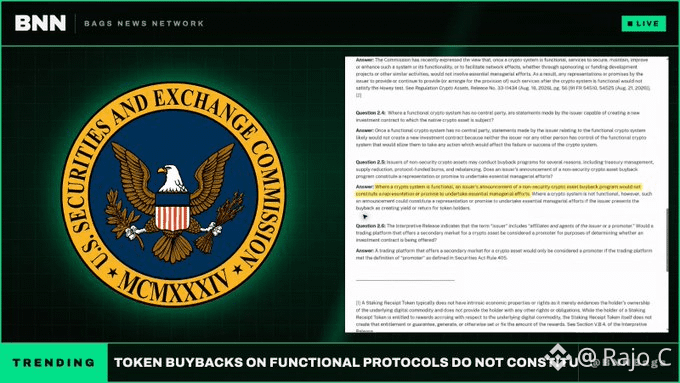
#secsaystokenbuybacksnotautosecurities CONFIRMED: SEC STAFF DELIVERS A MAJOR WIN FOR CRYPTO, DECLARING TOKEN BUYBACKS ON FUNCTIONAL PROTOCOLS DO NOT CONSTITUTE MANAGERIAL EFFORTS$DEEP $RECALL $MMT
#secsaystokenbuybacksnotautosecurities CONFIRMED: SEC STAFF DELIVERS A MAJOR WIN FOR CRYPTO, DECLARING TOKEN BUYBACKS ON FUNCTIONAL PROTOCOLS DO NOT CONSTITUTE MANAGERIAL EFFORTS$DEEP $RECALL $MMT
185

Article
⚡ [Binance Trending Topic] SEC Staff Signals Token Buybacks Do Not Automatically Constitute Securiti⚡ [Binance Trending Topic] SEC Staff Signals Token Buybacks Do Not Automatically Constitute Securities
Trending Hashtag: #SECSaysTokenBuybacksNotAutoSecurities | Category: REGULATORY
Cashtags: $UNI
🔹 EXECUTIVE CATALYST & INSTITUTIONAL NARRATIVE
Regulatory clarity is experiencing a structural pivot as SEC staff signals that token buybacks and decentralized fee-switch mechanisms do not automatically trigger securities classification. This development has triggered massive discussion across Binance Square under #SECSaysTokenBuybacksNotAutoSecurities. Institutional capital has historically avoided protocol revenue sharing due to Howey Test litigation risks. Removing the immediate presumption of a security classification eliminates a multi-year regulatory discount, laying the groundwork for a fundamental re-rating of native cash-flow-generating DeFi protocols.
🔹 MARKET IMPACT & TELEMETRY TRANSMISSION
Order flow desks are absorbing early spot rotation as smart money prepares for protocol revenue activation. Gauging the impact via blue-chip DeFi benchmark $UNI:
• Price Action: Trading at $9.65 (-0.61% 24h change) with steady 24-hour volume reaching $63.13M.
• Quantitative Telemetry: CoinXSight Confluence Score stands firm at 79.5/100, maintaining an active Bullish sonic trend.
• Pivot Levels: Tactical support base S1 anchors at $9.84, with the central pivot at $9.98 gating an expansion toward resistance R1 at $10.08.
🔹 STRATEGIC TRADER POSITIONING
Rather than succumbing to headline FOMO, institutional desks are treating this regulatory shift as a multi-quarter structural thesis. Volatility clusters around local resistance levels provide ideal risk-reward dynamics for spot sizing rather than overleveraged perpetual positions. Preserving capital requires waiting for confirmed governance votes turning on programmatic buybacks rather than trading pure social sentiment.
🔹 ACTIONABLE TAKEAWAY
• Defensive Accumulation: Scale spot bids between current market pricing and S1 ($9.84), defining systematic invalidation below major liquidity shelves.
• Momentum Confirmation: Trigger size expansion upon an hourly candle close reclaiming the central pivot at $9.98, targeting an impulse push into R1 at $10.08.
Data & Telemetry: CoinXSight Intelligence Hub | Follow on Binance Square for daily alpha.
Follow on Binance Square for real-time market catalysts and order flow telemetry.
Risk Warning: Cryptocurrency trading carries substantial risk. This quantitative brief is for informational purposes only.
#SECSaysTokenBuybacksNotAutoSecurities #BinanceSquare #CoinXSight
⚡ [Binance Trending Topic] SEC Staff Signals Token Buybacks Do Not Automatically Constitute Securiti
⚡ [Binance Trending Topic] SEC Staff Signals Token Buybacks Do Not Automatically Constitute Securities
Trending Hashtag: #SECSaysTokenBuybacksNotAutoSecurities | Category: REGULATORY
Cashtags: $UNI
🔹 EXECUTIVE CATALYST & INSTITUTIONAL NARRATIVE
Regulatory clarity is experiencing a structural pivot as SEC staff signals that token buybacks and decentralized fee-switch mechanisms do not automatically trigger securities classification. This development has triggered massive discussion across Binance Square under #SECSaysTokenBuybacksNotAutoSecurities. Institutional capital has historically avoided protocol revenue sharing due to Howey Test litigation risks. Removing the immediate presumption of a security classification eliminates a multi-year regulatory discount, laying the groundwork for a fundamental re-rating of native cash-flow-generating DeFi protocols.
🔹 MARKET IMPACT & TELEMETRY TRANSMISSION
Order flow desks are absorbing early spot rotation as smart money prepares for protocol revenue activation. Gauging the impact via blue-chip DeFi benchmark $UNI :
• Price Action: Trading at $9.65 (-0.61% 24h change) with steady 24-hour volume reaching $63.13M.
• Quantitative Telemetry: CoinXSight Confluence Score stands firm at 79.5/100, maintaining an active Bullish sonic trend.
• Pivot Levels: Tactical support base S1 anchors at $9.84, with the central pivot at $9.98 gating an expansion toward resistance R1 at $10.08.
🔹 STRATEGIC TRADER POSITIONING
Rather than succumbing to headline FOMO, institutional desks are treating this regulatory shift as a multi-quarter structural thesis. Volatility clusters around local resistance levels provide ideal risk-reward dynamics for spot sizing rather than overleveraged perpetual positions. Preserving capital requires waiting for confirmed governance votes turning on programmatic buybacks rather than trading pure social sentiment.
🔹 ACTIONABLE TAKEAWAY
• Defensive Accumulation: Scale spot bids between current market pricing and S1 ($9.84), defining systematic invalidation below major liquidity shelves.
• Momentum Confirmation: Trigger size expansion upon an hourly candle close reclaiming the central pivot at $9.98, targeting an impulse push into R1 at $10.08.
Data & Telemetry: CoinXSight Intelligence Hub | Follow on Binance Square for daily alpha.
Follow on Binance Square for real-time market catalysts and order flow telemetry.
Risk Warning: Cryptocurrency trading carries substantial risk. This quantitative brief is for informational purposes only.
#SECSaysTokenBuybacksNotAutoSecurities #BinanceSquare #CoinXSight
Trending Hashtag: #SECSaysTokenBuybacksNotAutoSecurities | Category: REGULATORY
Cashtags: $UNI
🔹 EXECUTIVE CATALYST & INSTITUTIONAL NARRATIVE
Regulatory clarity is experiencing a structural pivot as SEC staff signals that token buybacks and decentralized fee-switch mechanisms do not automatically trigger securities classification. This development has triggered massive discussion across Binance Square under #SECSaysTokenBuybacksNotAutoSecurities. Institutional capital has historically avoided protocol revenue sharing due to Howey Test litigation risks. Removing the immediate presumption of a security classification eliminates a multi-year regulatory discount, laying the groundwork for a fundamental re-rating of native cash-flow-generating DeFi protocols.
🔹 MARKET IMPACT & TELEMETRY TRANSMISSION
Order flow desks are absorbing early spot rotation as smart money prepares for protocol revenue activation. Gauging the impact via blue-chip DeFi benchmark $UNI :
• Price Action: Trading at $9.65 (-0.61% 24h change) with steady 24-hour volume reaching $63.13M.
• Quantitative Telemetry: CoinXSight Confluence Score stands firm at 79.5/100, maintaining an active Bullish sonic trend.
• Pivot Levels: Tactical support base S1 anchors at $9.84, with the central pivot at $9.98 gating an expansion toward resistance R1 at $10.08.
🔹 STRATEGIC TRADER POSITIONING
Rather than succumbing to headline FOMO, institutional desks are treating this regulatory shift as a multi-quarter structural thesis. Volatility clusters around local resistance levels provide ideal risk-reward dynamics for spot sizing rather than overleveraged perpetual positions. Preserving capital requires waiting for confirmed governance votes turning on programmatic buybacks rather than trading pure social sentiment.
🔹 ACTIONABLE TAKEAWAY
• Defensive Accumulation: Scale spot bids between current market pricing and S1 ($9.84), defining systematic invalidation below major liquidity shelves.
• Momentum Confirmation: Trigger size expansion upon an hourly candle close reclaiming the central pivot at $9.98, targeting an impulse push into R1 at $10.08.
Data & Telemetry: CoinXSight Intelligence Hub | Follow on Binance Square for daily alpha.
Follow on Binance Square for real-time market catalysts and order flow telemetry.
Risk Warning: Cryptocurrency trading carries substantial risk. This quantitative brief is for informational purposes only.
#SECSaysTokenBuybacksNotAutoSecurities #BinanceSquare #CoinXSight
1
91
·
--
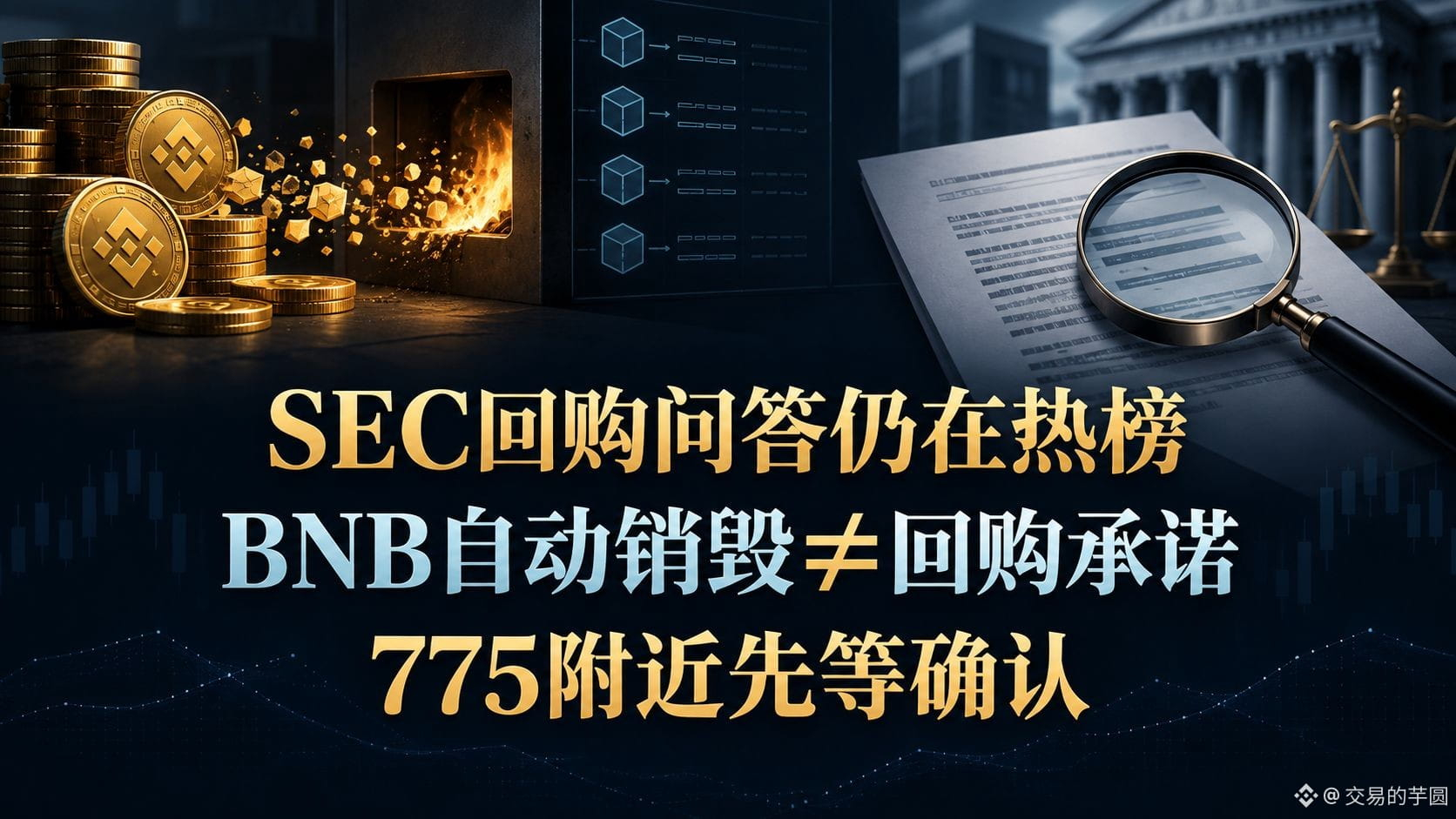
SEC share buyback Q&A is still trending|BNB automatic burns are not an issuer buyback commitment|Around 775 I’ll wait first
My view is to separate legal concepts from the token supply mechanism first, and then decide whether to touch BNB. Binance Square’s hot list currently still shows #SECSaysTokenBuybacksNotAutoSecurities, but if this headline is read as “all burns receive SEC approval,” it’s overstated. In a Sept 25 update to Item 2.5 of its staff Q&A, the U.S. SEC’s Office of the Chief Financial Officer discusses the relationship between crypto assets that were not securities in the first place, an issuer’s announcement of buybacks, and “key managerial efforts.” The outcome may differ between systems that are already functional versus systems that are not yet functional; if the latter wraps buybacks into a promise of holder-borne returns, the risk cannot be eliminated by the headline. The page makes clear this is the staff’s viewpoint, not an official SEC rule, and it also doesn’t make any case-specific determination about BNB.
Now look at BNB itself. On July 15, the BNB Foundation announced that the 36th quarterly burn was completed: about 1.6158 million BNB. At the time of the announcement, remaining supply was about 133.17 million BNB. This is a July historical event, not a new burn tonight. The official explanation is that Auto-Burn adjusts according to BNB’s price and the number of blocks in the quarter; the target total gradually steps down to one hundred million BNB, and the mechanism is independent of Binance’s centralized exchange. There is also real-time burning related to on-chain Gas fees. Neither of these mechanisms can simply be mapped to a stock buyback narrative of “the company using cash to sweep the market,” and you also can’t double-count already-burned tokens as added buy-side demand right now. The hot list is about legal Q&A, while BNB data is about the supply side—analyzing them together can be meaningful, but they don’t mutually certify each other.
What I care about is the transmission chain: whether actual network usage, fees, and supply changes can sustainably improve holders’ expectations; regulatory wording can only reduce some concept misreadings and can’t replace demand. Burns reduce supply, but price is still influenced by macro interest rates, risk appetite, exchange and ecosystem security, and the concentration level of holdings. On Sept 16, the U.S. Federal Reserve raised the federal funds target range to 3.75%–4%. The market reaction likewise didn’t provide any single-cause evidence: when I wrote this, Kraken’s BNB/USD was around $775.57; over the last 24 hours it ranged from a high of $782.96 to a low of $766.79, with an open at $773.39—just slightly above the open and below the high. You can’t say this volatility is driven by the SEC Q&A or the old burn.
For the key levels in the short term, I’m watching whether 778 to 783 can become support again; below that, first watch 772, then 766.8. If a one-hour period closes effectively above 783 and then retests without breaking it, along with verifiable real on-chain usage rather than repeatedly circulating the old burn, then my wait-and-see view could be overturned. If 766.8 breaks, it indicates short-term risk is ahead of the narrative. If the SEC or the BNB Foundation releases new official documents, I’ll update based on the text and won’t pre-assume the next burn amount or timing.
If I were trading myself: I wouldn’t participate now. The plan is conditional, unleveraged spot longs with position size at 0% of total capital. Only if there are two consecutive 15-minute closes above $783, followed by a pullback from 780 to 783 that holds, would I consider putting in at most 0.25% of total capital. First target: 788 (take half off). Second target: 798 (close the remaining position). After entry, if a 15-minute close returns below 780, I’d cut the position in half; if it falls to 774, I’d fully exit with a stop. If before entry it first breaks below 766.8, I’d cancel the buy plan directly. Even if the hotspot stays hot, I won’t use regulatory headlines as a substitute for an entry signal, nor will I write the plan as if the trade is already filled.
#SECSaysTokenBuybacksNotAutoSecurities #BNB
The above is only my personal market observation and does not constitute investment advice.
SEC share buyback Q&A is still trending|BNB automatic burns are not an issuer buyback commitment|Around 775 I’ll wait first
My view is to separate legal concepts from the token supply mechanism first, and then decide whether to touch BNB. Binance Square’s hot list currently still shows #SECSaysTokenBuybacksNotAutoSecurities, but if this headline is read as “all burns receive SEC approval,” it’s overstated. In a Sept 25 update to Item 2.5 of its staff Q&A, the U.S. SEC’s Office of the Chief Financial Officer discusses the relationship between crypto assets that were not securities in the first place, an issuer’s announcement of buybacks, and “key managerial efforts.” The outcome may differ between systems that are already functional versus systems that are not yet functional; if the latter wraps buybacks into a promise of holder-borne returns, the risk cannot be eliminated by the headline. The page makes clear this is the staff’s viewpoint, not an official SEC rule, and it also doesn’t make any case-specific determination about BNB.
Now look at BNB itself. On July 15, the BNB Foundation announced that the 36th quarterly burn was completed: about 1.6158 million BNB. At the time of the announcement, remaining supply was about 133.17 million BNB. This is a July historical event, not a new burn tonight. The official explanation is that Auto-Burn adjusts according to BNB’s price and the number of blocks in the quarter; the target total gradually steps down to one hundred million BNB, and the mechanism is independent of Binance’s centralized exchange. There is also real-time burning related to on-chain Gas fees. Neither of these mechanisms can simply be mapped to a stock buyback narrative of “the company using cash to sweep the market,” and you also can’t double-count already-burned tokens as added buy-side demand right now. The hot list is about legal Q&A, while BNB data is about the supply side—analyzing them together can be meaningful, but they don’t mutually certify each other.
What I care about is the transmission chain: whether actual network usage, fees, and supply changes can sustainably improve holders’ expectations; regulatory wording can only reduce some concept misreadings and can’t replace demand. Burns reduce supply, but price is still influenced by macro interest rates, risk appetite, exchange and ecosystem security, and the concentration level of holdings. On Sept 16, the U.S. Federal Reserve raised the federal funds target range to 3.75%–4%. The market reaction likewise didn’t provide any single-cause evidence: when I wrote this, Kraken’s BNB/USD was around $775.57; over the last 24 hours it ranged from a high of $782.96 to a low of $766.79, with an open at $773.39—just slightly above the open and below the high. You can’t say this volatility is driven by the SEC Q&A or the old burn.
For the key levels in the short term, I’m watching whether 778 to 783 can become support again; below that, first watch 772, then 766.8. If a one-hour period closes effectively above 783 and then retests without breaking it, along with verifiable real on-chain usage rather than repeatedly circulating the old burn, then my wait-and-see view could be overturned. If 766.8 breaks, it indicates short-term risk is ahead of the narrative. If the SEC or the BNB Foundation releases new official documents, I’ll update based on the text and won’t pre-assume the next burn amount or timing.
If I were trading myself: I wouldn’t participate now. The plan is conditional, unleveraged spot longs with position size at 0% of total capital. Only if there are two consecutive 15-minute closes above $783, followed by a pullback from 780 to 783 that holds, would I consider putting in at most 0.25% of total capital. First target: 788 (take half off). Second target: 798 (close the remaining position). After entry, if a 15-minute close returns below 780, I’d cut the position in half; if it falls to 774, I’d fully exit with a stop. If before entry it first breaks below 766.8, I’d cancel the buy plan directly. Even if the hotspot stays hot, I won’t use regulatory headlines as a substitute for an entry signal, nor will I write the plan as if the trade is already filled.
#SECSaysTokenBuybacksNotAutoSecurities #BNB
The above is only my personal market observation and does not constitute investment advice.
My view is to separate legal concepts from the token supply mechanism first, and then decide whether to touch BNB. Binance Square’s hot list currently still shows #SECSaysTokenBuybacksNotAutoSecurities, but if this headline is read as “all burns receive SEC approval,” it’s overstated. In a Sept 25 update to Item 2.5 of its staff Q&A, the U.S. SEC’s Office of the Chief Financial Officer discusses the relationship between crypto assets that were not securities in the first place, an issuer’s announcement of buybacks, and “key managerial efforts.” The outcome may differ between systems that are already functional versus systems that are not yet functional; if the latter wraps buybacks into a promise of holder-borne returns, the risk cannot be eliminated by the headline. The page makes clear this is the staff’s viewpoint, not an official SEC rule, and it also doesn’t make any case-specific determination about BNB.
Now look at BNB itself. On July 15, the BNB Foundation announced that the 36th quarterly burn was completed: about 1.6158 million BNB. At the time of the announcement, remaining supply was about 133.17 million BNB. This is a July historical event, not a new burn tonight. The official explanation is that Auto-Burn adjusts according to BNB’s price and the number of blocks in the quarter; the target total gradually steps down to one hundred million BNB, and the mechanism is independent of Binance’s centralized exchange. There is also real-time burning related to on-chain Gas fees. Neither of these mechanisms can simply be mapped to a stock buyback narrative of “the company using cash to sweep the market,” and you also can’t double-count already-burned tokens as added buy-side demand right now. The hot list is about legal Q&A, while BNB data is about the supply side—analyzing them together can be meaningful, but they don’t mutually certify each other.
What I care about is the transmission chain: whether actual network usage, fees, and supply changes can sustainably improve holders’ expectations; regulatory wording can only reduce some concept misreadings and can’t replace demand. Burns reduce supply, but price is still influenced by macro interest rates, risk appetite, exchange and ecosystem security, and the concentration level of holdings. On Sept 16, the U.S. Federal Reserve raised the federal funds target range to 3.75%–4%. The market reaction likewise didn’t provide any single-cause evidence: when I wrote this, Kraken’s BNB/USD was around $775.57; over the last 24 hours it ranged from a high of $782.96 to a low of $766.79, with an open at $773.39—just slightly above the open and below the high. You can’t say this volatility is driven by the SEC Q&A or the old burn.
For the key levels in the short term, I’m watching whether 778 to 783 can become support again; below that, first watch 772, then 766.8. If a one-hour period closes effectively above 783 and then retests without breaking it, along with verifiable real on-chain usage rather than repeatedly circulating the old burn, then my wait-and-see view could be overturned. If 766.8 breaks, it indicates short-term risk is ahead of the narrative. If the SEC or the BNB Foundation releases new official documents, I’ll update based on the text and won’t pre-assume the next burn amount or timing.
If I were trading myself: I wouldn’t participate now. The plan is conditional, unleveraged spot longs with position size at 0% of total capital. Only if there are two consecutive 15-minute closes above $783, followed by a pullback from 780 to 783 that holds, would I consider putting in at most 0.25% of total capital. First target: 788 (take half off). Second target: 798 (close the remaining position). After entry, if a 15-minute close returns below 780, I’d cut the position in half; if it falls to 774, I’d fully exit with a stop. If before entry it first breaks below 766.8, I’d cancel the buy plan directly. Even if the hotspot stays hot, I won’t use regulatory headlines as a substitute for an entry signal, nor will I write the plan as if the trade is already filled.
#SECSaysTokenBuybacksNotAutoSecurities #BNB
The above is only my personal market observation and does not constitute investment advice.
13

Have you noticed how quickly one SEC sentence turns into a buy signal around here?
The pain is always the same. Traders load the headline, skip the nuance, and then have no clean exit once the market realizes the ruling was narrower than the replies made it sound.
The SEC saying token buybacks are not automatically securities is being treated like a blanket exemption. It is not. This is a case study in selective hearing. Not automatically still means the facts matter. How the buyback is funded, whether it is tied to real activity, and what holders are actually being promised all stay on the table. In a greed tape like this, that distinction gets buried in about ten minutes.
Look at $BNB. The buyback and burn there has been tied to actual platform flow for years, which is a different setup from an altcoin draining treasury $USDT just to defend a level. $QNT sits closer to the utility side of that spectrum, which is why this headline should make you inspect the mechanism instead of the marketing. A protocol recycling fees is not the same as a team manufacturing bid with leftover raise money.
The projects that treat this as permission to run buyback theater will be the next ones people study. The ones with a working revenue loop just got a slightly clearer lane. That is the whole story.
Where do you think this leaves tokens that have been buying themselves back with no revenue behind them?
#SECSaysTokenBuybacksNotAutoSecurities #StrategyStriveAdd2305BitcoinThisWeek #CircleTetherFreezeBitgetHackerWallet
Have you noticed how quickly one SEC sentence turns into a buy signal around here?
The pain is always the same. Traders load the headline, skip the nuance, and then have no clean exit once the market realizes the ruling was narrower than the replies made it sound.
The SEC saying token buybacks are not automatically securities is being treated like a blanket exemption. It is not. This is a case study in selective hearing. Not automatically still means the facts matter. How the buyback is funded, whether it is tied to real activity, and what holders are actually being promised all stay on the table. In a greed tape like this, that distinction gets buried in about ten minutes.
Look at $BNB . The buyback and burn there has been tied to actual platform flow for years, which is a different setup from an altcoin draining treasury $USDT just to defend a level. $QNT sits closer to the utility side of that spectrum, which is why this headline should make you inspect the mechanism instead of the marketing. A protocol recycling fees is not the same as a team manufacturing bid with leftover raise money.
The projects that treat this as permission to run buyback theater will be the next ones people study. The ones with a working revenue loop just got a slightly clearer lane. That is the whole story.
Where do you think this leaves tokens that have been buying themselves back with no revenue behind them?
#SECSaysTokenBuybacksNotAutoSecurities #StrategyStriveAdd2305BitcoinThisWeek #CircleTetherFreezeBitgetHackerWallet
The pain is always the same. Traders load the headline, skip the nuance, and then have no clean exit once the market realizes the ruling was narrower than the replies made it sound.
The SEC saying token buybacks are not automatically securities is being treated like a blanket exemption. It is not. This is a case study in selective hearing. Not automatically still means the facts matter. How the buyback is funded, whether it is tied to real activity, and what holders are actually being promised all stay on the table. In a greed tape like this, that distinction gets buried in about ten minutes.
Look at $BNB . The buyback and burn there has been tied to actual platform flow for years, which is a different setup from an altcoin draining treasury $USDT just to defend a level. $QNT sits closer to the utility side of that spectrum, which is why this headline should make you inspect the mechanism instead of the marketing. A protocol recycling fees is not the same as a team manufacturing bid with leftover raise money.
The projects that treat this as permission to run buyback theater will be the next ones people study. The ones with a working revenue loop just got a slightly clearer lane. That is the whole story.
Where do you think this leaves tokens that have been buying themselves back with no revenue behind them?
#SECSaysTokenBuybacksNotAutoSecurities #StrategyStriveAdd2305BitcoinThisWeek #CircleTetherFreezeBitgetHackerWallet
2

#CoinMarketCapCompletesCoinglassAcquisition #SECSaysTokenBuybacksNotAutoSecurities #StrategyStriveAdd2305BitcoinThisWeek SEC Updates Crypto Guidance; Hester Peirce Departure
The U.S. SEC's Division of Corporation Finance released updated FAQs addressing token buybacks, network upgrades, and investment contract criteria. Simultaneously, pro-crypto SEC Commissioner Hester Peirce announced her upcoming departure, sparking debate on how future regulatory policy will evolve.
{spot}(BTCUSDT)
{spot}(ETHUSDT)
{spot}(BNBUSDT)
#CoinMarketCapCompletesCoinglassAcquisition #SECSaysTokenBuybacksNotAutoSecurities #StrategyStriveAdd2305BitcoinThisWeek SEC Updates Crypto Guidance; Hester Peirce Departure
The U.S. SEC's Division of Corporation Finance released updated FAQs addressing token buybacks, network upgrades, and investment contract criteria. Simultaneously, pro-crypto SEC Commissioner Hester Peirce announced her upcoming departure, sparking debate on how future regulatory policy will evolve.
The U.S. SEC's Division of Corporation Finance released updated FAQs addressing token buybacks, network upgrades, and investment contract criteria. Simultaneously, pro-crypto SEC Commissioner Hester Peirce announced her upcoming departure, sparking debate on how future regulatory policy will evolve.
1
15
·
--
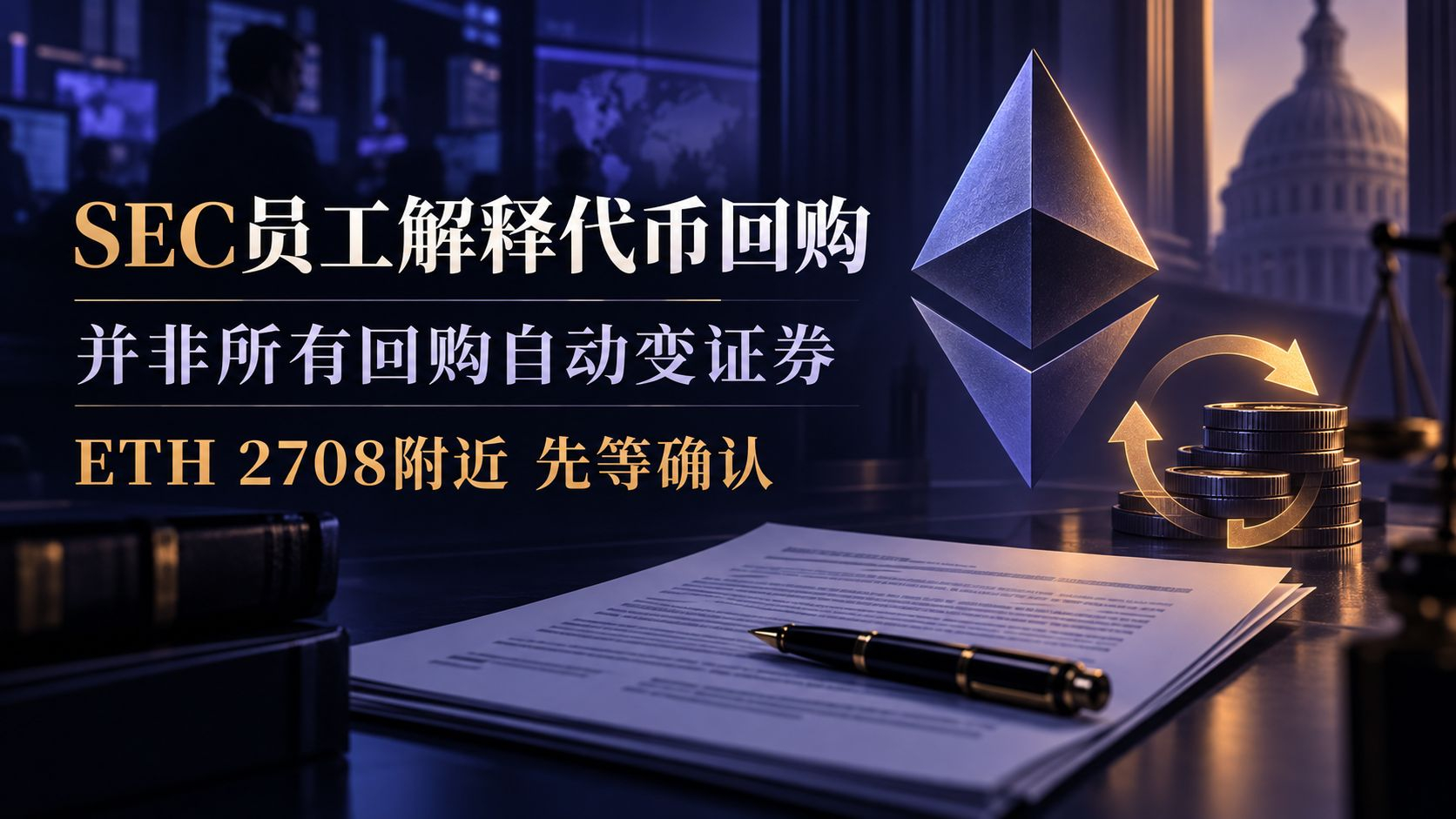
SEC staff explain token buybacks|Not all buybacks automatically become securities|ETH at 2708, I’ll wait to confirm
My stance is neutral to cautious: Binance Square’s hot榜 #SECSaysTokenBuybacksNotAutoSecurities highlights an important shift, but I won’t translate it as “Ethereum ecosystem tokens are broadly exempt from securities requirements,” and I won’t therefore rush to buy ETH directly. In Question 2.5 of the U.S. SEC’s September 25 staff-issued Crypto Assets Q&A, the discussion is about buyback plans of issuers of non-security crypto assets. In cases where the crypto system already has the relevant functionality, staff believe that simply announcing a buyback does not, on its own, constitute an undertaking to expend key managerial efforts. If the system is not yet functional and the issuer markets the buyback as creating returns for holders, the conclusion could be different. The document also states at the outset: these are employees’ views, not SEC rules, committee statements, and it has no new legal effect. The purpose of the buyback, whether the system has the functionality, and how it is marketed—those still need to be assessed fact by fact.
How does this relate to ETH? It’s indirect. On Ethereum there are many protocol tokens, and some projects do indeed embed fees, treasury management, or buyback-and-burn into their tokenomics. If the regulatory interpretation reduces blanket uncertainty, it may improve expectations for development teams and capital allocators; however, what’s being discussed are specific tokens and specific issuer behaviors—not an automatic additional cash inflow to the ETH mainnet, and certainly not that all projects’ buybacks will create spot-buy demand for ETH. Even if regulatory disputes for a project diminish, it may still fail to support its token price due to insufficient revenue, buybacks that are too small, unlock pressure, or opaque execution. I’d rather see projects publish verifiable revenue, the source of buyback funds, and on-chain execution—not just rely on the phrase “a regulatory positive.”
How has the market reacted? At the time of writing, Kraken’s ETH/USD is around $2707.60, with a 24-hour high of $2722.39 and a low of $2663.17, and an opening price of $2695.38. The current price is slightly above the open, but still within today’s range. This set of data can’t prove that ETH’s rise was caused by this Q&A, especially since weekend liquidity and other news are also present. First, watch whether $2722 to $2730 can hold steady. On the downside, look around $2695 and the intraday low near $2663. If there’s a spike then pullback and a continuous break below $2695, or if the market quickly misreads the regulatory interpretation as an official exemption and then corrects, I would overturn my mildly bullish observation. The boundaries in the regulatory text are more worth careful reading than the hot榜 headline.
If I were trading personally, I wouldn’t participate. The direction would only consider taking a small spot long position after conditions are met—no high leverage. I’d only place a trial trade with no more than 1% of total capital if ETH is effectively holding above $2730, then pulls back toward $2720 without breaking it, and related Ethereum ecosystem assets do not show clear, synchronized selloffs. First target: $2760—once reached, cut the position in half. The remaining position would look toward $2800, but if price falls back below $2730, I’ll tighten take-profit early. I’d set a hard stop-loss at $2690. If, before entering, price first breaks below $2663, I cancel the whole plan. If a later SEC document changes this wording or the project’s buyback disclosures are unclear, I would close the position even if the price never hits my trigger levels. Risk budget first, then views.
Source: SEC Division of Corporation Finance Crypto Assets Q&A, Question 2.5; Kraken ETH/USD行情. #SECSaysTokenBuybacksNotAutoSecurities #ETH
The above is only my personal market observation and does not constitute investment advice.
SEC staff explain token buybacks|Not all buybacks automatically become securities|ETH at 2708, I’ll wait to confirm
My stance is neutral to cautious: Binance Square’s hot榜 #SECSaysTokenBuybacksNotAutoSecurities highlights an important shift, but I won’t translate it as “Ethereum ecosystem tokens are broadly exempt from securities requirements,” and I won’t therefore rush to buy ETH directly. In Question 2.5 of the U.S. SEC’s September 25 staff-issued Crypto Assets Q&A, the discussion is about buyback plans of issuers of non-security crypto assets. In cases where the crypto system already has the relevant functionality, staff believe that simply announcing a buyback does not, on its own, constitute an undertaking to expend key managerial efforts. If the system is not yet functional and the issuer markets the buyback as creating returns for holders, the conclusion could be different. The document also states at the outset: these are employees’ views, not SEC rules, committee statements, and it has no new legal effect. The purpose of the buyback, whether the system has the functionality, and how it is marketed—those still need to be assessed fact by fact.
How does this relate to ETH? It’s indirect. On Ethereum there are many protocol tokens, and some projects do indeed embed fees, treasury management, or buyback-and-burn into their tokenomics. If the regulatory interpretation reduces blanket uncertainty, it may improve expectations for development teams and capital allocators; however, what’s being discussed are specific tokens and specific issuer behaviors—not an automatic additional cash inflow to the ETH mainnet, and certainly not that all projects’ buybacks will create spot-buy demand for ETH. Even if regulatory disputes for a project diminish, it may still fail to support its token price due to insufficient revenue, buybacks that are too small, unlock pressure, or opaque execution. I’d rather see projects publish verifiable revenue, the source of buyback funds, and on-chain execution—not just rely on the phrase “a regulatory positive.”
How has the market reacted? At the time of writing, Kraken’s ETH/USD is around $2707.60, with a 24-hour high of $2722.39 and a low of $2663.17, and an opening price of $2695.38. The current price is slightly above the open, but still within today’s range. This set of data can’t prove that ETH’s rise was caused by this Q&A, especially since weekend liquidity and other news are also present. First, watch whether $2722 to $2730 can hold steady. On the downside, look around $2695 and the intraday low near $2663. If there’s a spike then pullback and a continuous break below $2695, or if the market quickly misreads the regulatory interpretation as an official exemption and then corrects, I would overturn my mildly bullish observation. The boundaries in the regulatory text are more worth careful reading than the hot榜 headline.
If I were trading personally, I wouldn’t participate. The direction would only consider taking a small spot long position after conditions are met—no high leverage. I’d only place a trial trade with no more than 1% of total capital if ETH is effectively holding above $2730, then pulls back toward $2720 without breaking it, and related Ethereum ecosystem assets do not show clear, synchronized selloffs. First target: $2760—once reached, cut the position in half. The remaining position would look toward $2800, but if price falls back below $2730, I’ll tighten take-profit early. I’d set a hard stop-loss at $2690. If, before entering, price first breaks below $2663, I cancel the whole plan. If a later SEC document changes this wording or the project’s buyback disclosures are unclear, I would close the position even if the price never hits my trigger levels. Risk budget first, then views.
Source: SEC Division of Corporation Finance Crypto Assets Q&A, Question 2.5; Kraken ETH/USD行情. #SECSaysTokenBuybacksNotAutoSecurities #ETH
The above is only my personal market observation and does not constitute investment advice.
My stance is neutral to cautious: Binance Square’s hot榜 #SECSaysTokenBuybacksNotAutoSecurities highlights an important shift, but I won’t translate it as “Ethereum ecosystem tokens are broadly exempt from securities requirements,” and I won’t therefore rush to buy ETH directly. In Question 2.5 of the U.S. SEC’s September 25 staff-issued Crypto Assets Q&A, the discussion is about buyback plans of issuers of non-security crypto assets. In cases where the crypto system already has the relevant functionality, staff believe that simply announcing a buyback does not, on its own, constitute an undertaking to expend key managerial efforts. If the system is not yet functional and the issuer markets the buyback as creating returns for holders, the conclusion could be different. The document also states at the outset: these are employees’ views, not SEC rules, committee statements, and it has no new legal effect. The purpose of the buyback, whether the system has the functionality, and how it is marketed—those still need to be assessed fact by fact.
How does this relate to ETH? It’s indirect. On Ethereum there are many protocol tokens, and some projects do indeed embed fees, treasury management, or buyback-and-burn into their tokenomics. If the regulatory interpretation reduces blanket uncertainty, it may improve expectations for development teams and capital allocators; however, what’s being discussed are specific tokens and specific issuer behaviors—not an automatic additional cash inflow to the ETH mainnet, and certainly not that all projects’ buybacks will create spot-buy demand for ETH. Even if regulatory disputes for a project diminish, it may still fail to support its token price due to insufficient revenue, buybacks that are too small, unlock pressure, or opaque execution. I’d rather see projects publish verifiable revenue, the source of buyback funds, and on-chain execution—not just rely on the phrase “a regulatory positive.”
How has the market reacted? At the time of writing, Kraken’s ETH/USD is around $2707.60, with a 24-hour high of $2722.39 and a low of $2663.17, and an opening price of $2695.38. The current price is slightly above the open, but still within today’s range. This set of data can’t prove that ETH’s rise was caused by this Q&A, especially since weekend liquidity and other news are also present. First, watch whether $2722 to $2730 can hold steady. On the downside, look around $2695 and the intraday low near $2663. If there’s a spike then pullback and a continuous break below $2695, or if the market quickly misreads the regulatory interpretation as an official exemption and then corrects, I would overturn my mildly bullish observation. The boundaries in the regulatory text are more worth careful reading than the hot榜 headline.
If I were trading personally, I wouldn’t participate. The direction would only consider taking a small spot long position after conditions are met—no high leverage. I’d only place a trial trade with no more than 1% of total capital if ETH is effectively holding above $2730, then pulls back toward $2720 without breaking it, and related Ethereum ecosystem assets do not show clear, synchronized selloffs. First target: $2760—once reached, cut the position in half. The remaining position would look toward $2800, but if price falls back below $2730, I’ll tighten take-profit early. I’d set a hard stop-loss at $2690. If, before entering, price first breaks below $2663, I cancel the whole plan. If a later SEC document changes this wording or the project’s buyback disclosures are unclear, I would close the position even if the price never hits my trigger levels. Risk budget first, then views.
Source: SEC Division of Corporation Finance Crypto Assets Q&A, Question 2.5; Kraken ETH/USD行情. #SECSaysTokenBuybacksNotAutoSecurities #ETH
The above is only my personal market observation and does not constitute investment advice.
风中浪客:
回购不自动算证券是好事,但别直接翻译成ETH生态全面豁免,$ETH 2708这位置我也等确认,不追。
1
77

·
--
Bearish
#secsaystokenbuybacksnotautosecurities 🏛️ SEC Clarifies Token Buybacks Do Not Automatically Make Crypto a Security
Major regulatory clarity has arrived for crypto builders and investors. The SEC just updated its guidance on how federal securities laws apply to token buybacks and network upgrades.
📰 Core News
The SEC’s Division of Corporation Finance released new FAQs outlining that token buybacks, protocol burns, and ongoing network development do not automatically classify a crypto asset as a security [[2]].
The key distinction lies in network functionality
• ✅ Functional Networks Buybacks for treasury management or supply reduction are not considered a promise of "essential managerial efforts" or investment returns [[5]].
•Unlaunched Networks If a project promotes buybacks as a source of yield or profit before the network is functional, it may still face securities scrutiny under the Howey test [[6]].
📊 Market Impact
• 📈 Regulatory Breathing Room Established projects can now manage tokenomics with greater clarity, reducing the fear of immediate securities classification for routine supply adjustments.
• ⚖️ Marketing Discipline Teams must avoid framing buybacks as profit mechanisms, especially during pre-launch phases, to remain compliant.
• 🔄 Tokenomics Evolution Expect more structured, transparent buyback and burn mechanisms as protocols align their designs with this updated regulatory framework.
💬 Join the Discussion
How do you think this regulatory clarity will influence the tokenomics design of upcoming Web3 projects? Drop your thoughts in the comments below! 👇
#CryptoRegulation #SEC #Tokenomics #CryptoNews #Web3
This is for educational purposes only. Not Financial Advice (NFA). Always Do Your Own Research (DYOR)
$SAGA $2Z $ONE
{future}(ONEUSDT)
{future}(2ZUSDT)
{future}(SAGAUSDT)
#secsaystokenbuybacksnotautosecurities 🏛️ SEC Clarifies Token Buybacks Do Not Automatically Make Crypto a Security
Major regulatory clarity has arrived for crypto builders and investors. The SEC just updated its guidance on how federal securities laws apply to token buybacks and network upgrades.
📰 Core News
The SEC’s Division of Corporation Finance released new FAQs outlining that token buybacks, protocol burns, and ongoing network development do not automatically classify a crypto asset as a security [[2]].
The key distinction lies in network functionality
• ✅ Functional Networks Buybacks for treasury management or supply reduction are not considered a promise of "essential managerial efforts" or investment returns [[5]].
•Unlaunched Networks If a project promotes buybacks as a source of yield or profit before the network is functional, it may still face securities scrutiny under the Howey test [[6]].
📊 Market Impact
• 📈 Regulatory Breathing Room Established projects can now manage tokenomics with greater clarity, reducing the fear of immediate securities classification for routine supply adjustments.
• ⚖️ Marketing Discipline Teams must avoid framing buybacks as profit mechanisms, especially during pre-launch phases, to remain compliant.
• 🔄 Tokenomics Evolution Expect more structured, transparent buyback and burn mechanisms as protocols align their designs with this updated regulatory framework.
💬 Join the Discussion
How do you think this regulatory clarity will influence the tokenomics design of upcoming Web3 projects? Drop your thoughts in the comments below! 👇
#CryptoRegulation #SEC #Tokenomics #CryptoNews #Web3
This is for educational purposes only. Not Financial Advice (NFA). Always Do Your Own Research (DYOR)
$SAGA $2Z $ONE
Major regulatory clarity has arrived for crypto builders and investors. The SEC just updated its guidance on how federal securities laws apply to token buybacks and network upgrades.
📰 Core News
The SEC’s Division of Corporation Finance released new FAQs outlining that token buybacks, protocol burns, and ongoing network development do not automatically classify a crypto asset as a security [[2]].
The key distinction lies in network functionality
• ✅ Functional Networks Buybacks for treasury management or supply reduction are not considered a promise of "essential managerial efforts" or investment returns [[5]].
•Unlaunched Networks If a project promotes buybacks as a source of yield or profit before the network is functional, it may still face securities scrutiny under the Howey test [[6]].
📊 Market Impact
• 📈 Regulatory Breathing Room Established projects can now manage tokenomics with greater clarity, reducing the fear of immediate securities classification for routine supply adjustments.
• ⚖️ Marketing Discipline Teams must avoid framing buybacks as profit mechanisms, especially during pre-launch phases, to remain compliant.
• 🔄 Tokenomics Evolution Expect more structured, transparent buyback and burn mechanisms as protocols align their designs with this updated regulatory framework.
💬 Join the Discussion
How do you think this regulatory clarity will influence the tokenomics design of upcoming Web3 projects? Drop your thoughts in the comments below! 👇
#CryptoRegulation #SEC #Tokenomics #CryptoNews #Web3
This is for educational purposes only. Not Financial Advice (NFA). Always Do Your Own Research (DYOR)
$SAGA $2Z $ONE
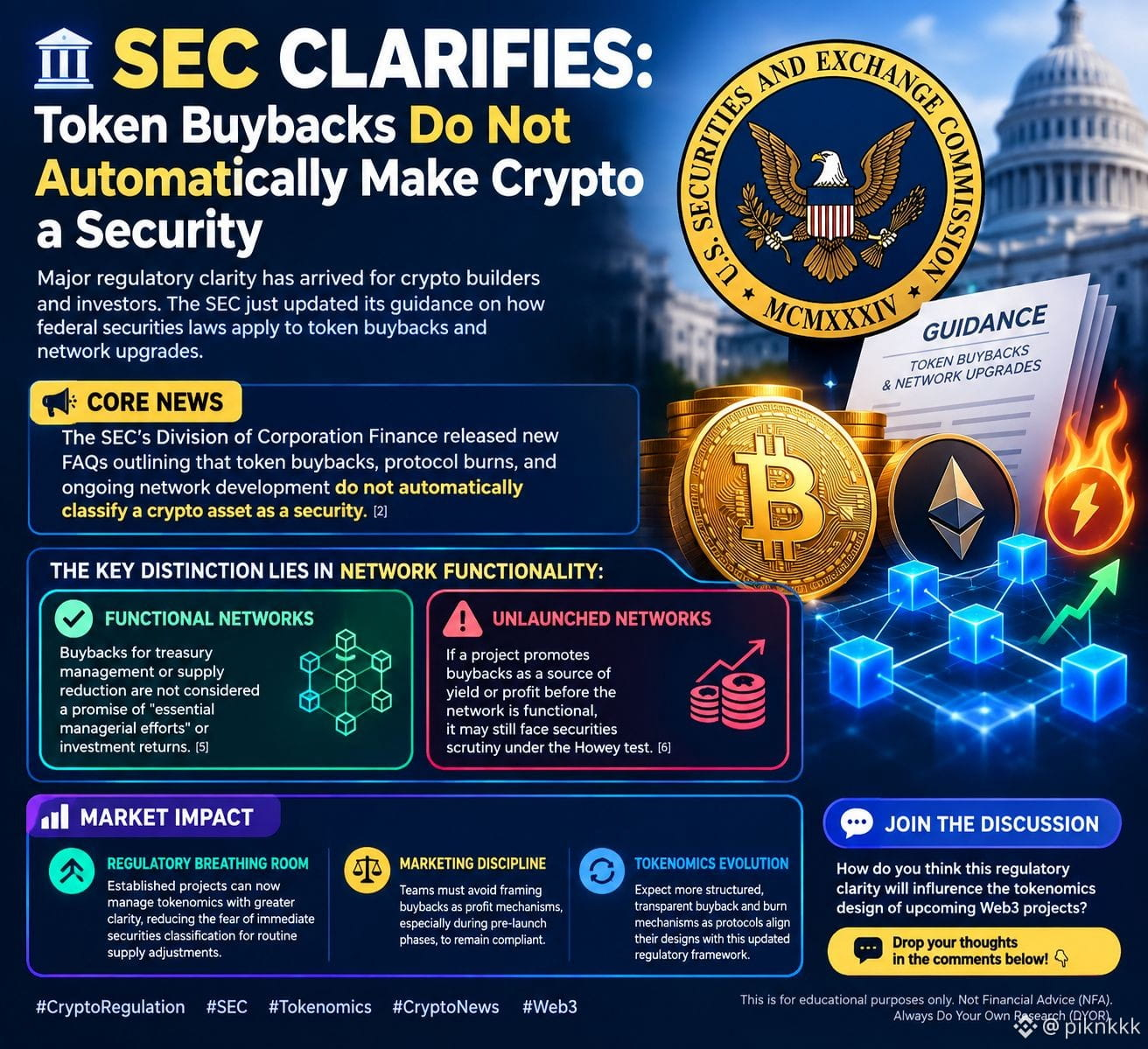
1
5
5.1k

#SECSaysTokenBuybacksNotAutoSecurities
🚨🔥 The SEC UNLOCKS a big question about crypto! 👀
#SECSaysTokenBuybacksNotAutoSecurities
A token buyback does NOT automatically mean the token is a financial security. 🧠⚡
This distinction can matter for how crypto projects approach tokenomics, buybacks, liquidity, and market strategy. 📊
But remember — a buyback alone doesn’t tell the whole story.
The structure, the use, and the overall circumstances still matter. 🔍
For traders, this is a security to watch. 👀
As regulatory clarity improves, market narratives can change VERY RAPIDLY. 🚀
📌 DO YOUR RESEARCH — NO INVESTMENT ADVICE
Don’t trade the token blindly. Make sure the price + volume + market structure confirm the move.
🔥 Is it positive for token buyback narratives.
#dyor #BinanceSquareTalks
$QNT
{future}(QNTUSDT)
$Q
{future}(QUSDT)
$ZEC
{future}(ZECUSDT)
#SECSaysTokenBuybacksNotAutoSecurities
🚨🔥 The SEC UNLOCKS a big question about crypto! 👀
#SECSaysTokenBuybacksNotAutoSecurities
A token buyback does NOT automatically mean the token is a financial security. 🧠⚡
This distinction can matter for how crypto projects approach tokenomics, buybacks, liquidity, and market strategy. 📊
But remember — a buyback alone doesn’t tell the whole story.
The structure, the use, and the overall circumstances still matter. 🔍
For traders, this is a security to watch. 👀
As regulatory clarity improves, market narratives can change VERY RAPIDLY. 🚀
📌 DO YOUR RESEARCH — NO INVESTMENT ADVICE
Don’t trade the token blindly. Make sure the price + volume + market structure confirm the move.
🔥 Is it positive for token buyback narratives.
#dyor #BinanceSquareTalks
$QNT
$Q
$ZEC
🚨🔥 The SEC UNLOCKS a big question about crypto! 👀
#SECSaysTokenBuybacksNotAutoSecurities
A token buyback does NOT automatically mean the token is a financial security. 🧠⚡
This distinction can matter for how crypto projects approach tokenomics, buybacks, liquidity, and market strategy. 📊
But remember — a buyback alone doesn’t tell the whole story.
The structure, the use, and the overall circumstances still matter. 🔍
For traders, this is a security to watch. 👀
As regulatory clarity improves, market narratives can change VERY RAPIDLY. 🚀
📌 DO YOUR RESEARCH — NO INVESTMENT ADVICE
Don’t trade the token blindly. Make sure the price + volume + market structure confirm the move.
🔥 Is it positive for token buyback narratives.
#dyor #BinanceSquareTalks
$QNT
$Q
$ZEC
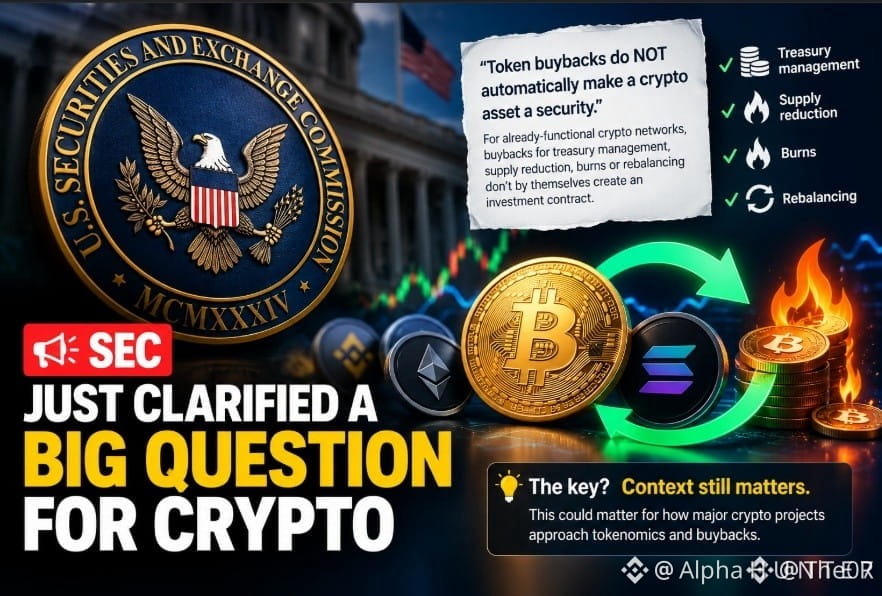
116

·
--
#SECSaysTokenBuybacksNotAutoSecurities
🚨 SEC: TOKEN BUYBACKS DON’T AUTOMATICALLY MAKE A TOKEN A SECURITY
The SEC’s latest crypto FAQs bring an important clarification: a buyback announcement for a non-security token on a functional network does not, by itself, create an investment contract.
If an unfinished project markets buybacks as a way to generate yield or returns for holders, the securities analysis can change.
📌 The key factor is how the buyback is presented and the specific facts of the project.
This gives crypto projects more clarity around token buybacks, but it’s not a blanket regulatory green light. The SEC staff guidance still depends on the network’s functionality and how projects communicate potential returns. For builders and token holders, the wording around buybacks may matter almost as much as the buyback itself.
#SEC #Crypto #TokenBuybacks #Bitcoin #BTC #DeFi #Regulation
#SECSaysTokenBuybacksNotAutoSecurities
🚨 SEC: TOKEN BUYBACKS DON’T AUTOMATICALLY MAKE A TOKEN A SECURITY
The SEC’s latest crypto FAQs bring an important clarification: a buyback announcement for a non-security token on a functional network does not, by itself, create an investment contract.
If an unfinished project markets buybacks as a way to generate yield or returns for holders, the securities analysis can change.
📌 The key factor is how the buyback is presented and the specific facts of the project.
This gives crypto projects more clarity around token buybacks, but it’s not a blanket regulatory green light. The SEC staff guidance still depends on the network’s functionality and how projects communicate potential returns. For builders and token holders, the wording around buybacks may matter almost as much as the buyback itself.
#SEC #Crypto #TokenBuybacks #Bitcoin #BTC #DeFi #Regulation
🚨 SEC: TOKEN BUYBACKS DON’T AUTOMATICALLY MAKE A TOKEN A SECURITY
The SEC’s latest crypto FAQs bring an important clarification: a buyback announcement for a non-security token on a functional network does not, by itself, create an investment contract.
If an unfinished project markets buybacks as a way to generate yield or returns for holders, the securities analysis can change.
📌 The key factor is how the buyback is presented and the specific facts of the project.
This gives crypto projects more clarity around token buybacks, but it’s not a blanket regulatory green light. The SEC staff guidance still depends on the network’s functionality and how projects communicate potential returns. For builders and token holders, the wording around buybacks may matter almost as much as the buyback itself.
#SEC #Crypto #TokenBuybacks #Bitcoin #BTC #DeFi #Regulation
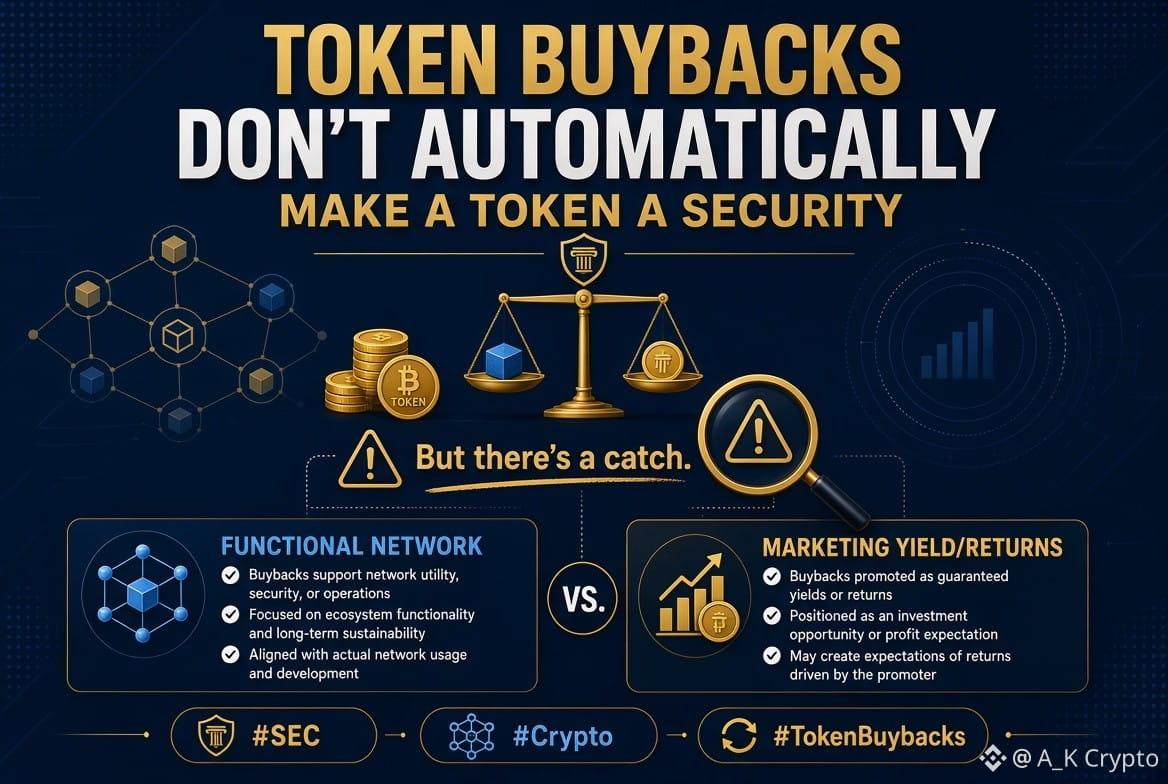
54
Log in to explore more content
Join global crypto users on Binance Square
⚡️ Get latest and useful information about crypto.
💬 Trusted by the world’s largest crypto exchange.
👍 Discover real insights from verified creators.
Email / Phone number
Trending Topics
1
#SKoreaFSCConsidersVirtualAssetMarketMaker
0 views
6 Discussing
2
#ChinaIndustrialProfitGrowthSlowsFourthMonth
696 views
53 Discussing
3
#BitwiseFilesFinalNEARSpotETFProspectus
98,518 views
1,524 Discussing
4
#BitgetHackerMoves$83MStolenXRP
35,530 views
171 Discussing
5
#SOLSpotETFWeeklyInflow$188M
23,150 views
135 Discussing
6
#DogecoinETFsPostBiggestWeekSinceLaunch
60,357 views
1,028 Discussing
7
#StrategyStriveAdd2305BitcoinThisWeek
153,405 views
2,238 Discussing
8
#TrumpRejectsIranHormuzReopening
132,119 views
1,688 Discussing
9
#CircleTetherFreezeBitgetHackerWallet
111,289 views
1,543 Discussing
10
#SECSaysTokenBuybacksNotAutoSecurities
76,174 views
919 Discussing