

#meteora
meteora
164,641 views
587 Discussing
Hot
Latest

·
--
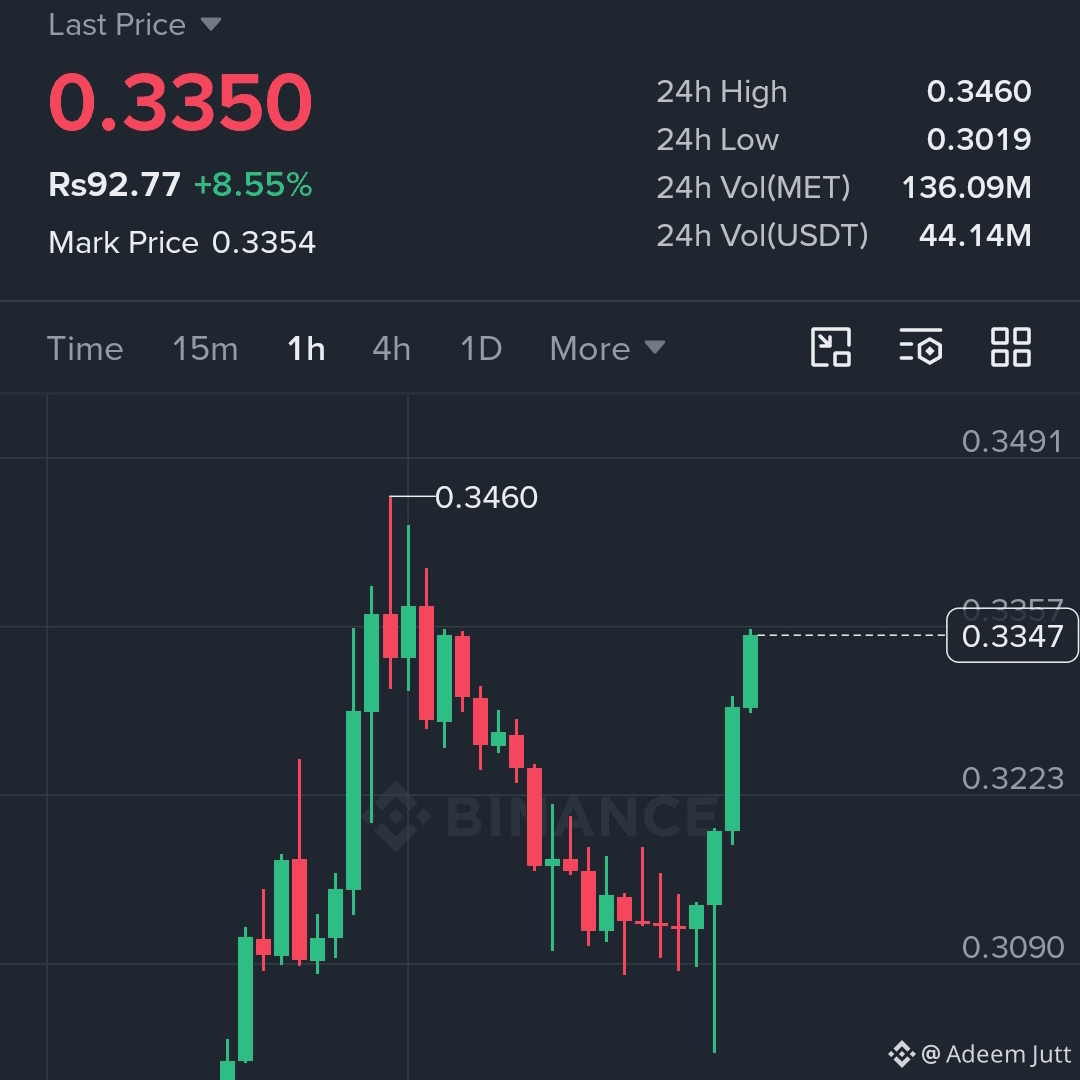
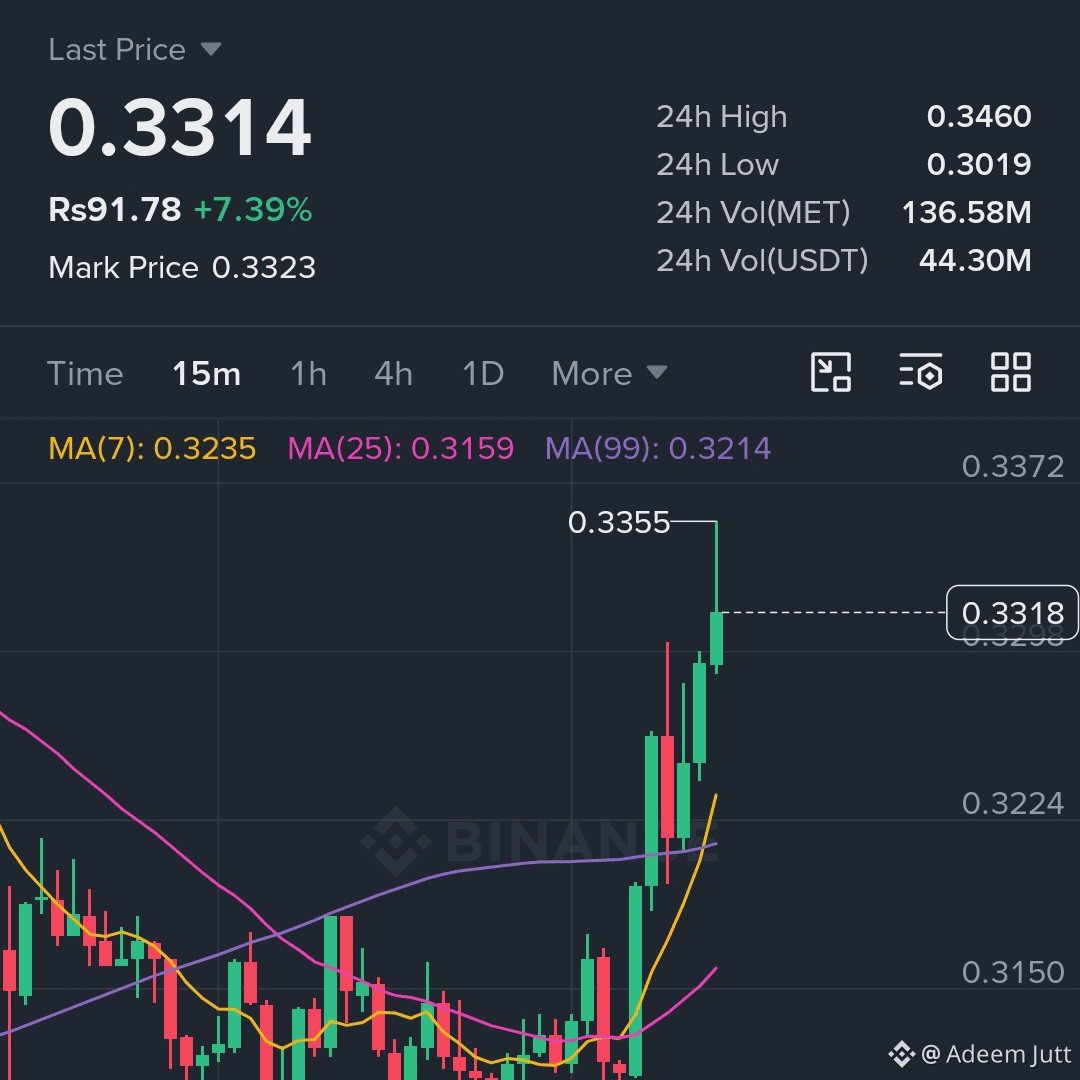
🚀 $MET is flashing massive bullish momentum and looks ready to absolutely crush resistance!
🎯 A decisive close above 0.3355 will trigger an explosive expansion toward the 0.3460 daily high and a breakout to 0.3600+.
📊 Market structure has flipped completely bullish after a textbook V-shape bounce off the 0.3019 support floor.
🔍 A minor technical pullback toward the 0.3230 - 0.3250 demand zone offers an optimal low-risk entry before the next leg up.
📈 The volume profile confirms heavy accumulation; smart money is loading up right now before the breakout.
Trade Here 👇
{spot}(METUSDT)
#MET #Meteora #BinanceSquare #FedMinutesFocusOnOctoberPause
🚀 $MET is flashing massive bullish momentum and looks ready to absolutely crush resistance!
🎯 A decisive close above 0.3355 will trigger an explosive expansion toward the 0.3460 daily high and a breakout to 0.3600+.
📊 Market structure has flipped completely bullish after a textbook V-shape bounce off the 0.3019 support floor.
🔍 A minor technical pullback toward the 0.3230 - 0.3250 demand zone offers an optimal low-risk entry before the next leg up.
📈 The volume profile confirms heavy accumulation; smart money is loading up right now before the breakout.
Trade Here 👇
#MET #Meteora #BinanceSquare #FedMinutesFocusOnOctoberPause
🎯 A decisive close above 0.3355 will trigger an explosive expansion toward the 0.3460 daily high and a breakout to 0.3600+.
📊 Market structure has flipped completely bullish after a textbook V-shape bounce off the 0.3019 support floor.
🔍 A minor technical pullback toward the 0.3230 - 0.3250 demand zone offers an optimal low-risk entry before the next leg up.
📈 The volume profile confirms heavy accumulation; smart money is loading up right now before the breakout.
Trade Here 👇
#MET #Meteora #BinanceSquare #FedMinutesFocusOnOctoberPause
Binance BiBi:
I see! The post claims MET is showing strong bullish momentum and could break higher if it closes above 0.3355, targeting 0.3460 and potentially 0.3600+. It says the market structure turned bullish after a V-shaped rebound from 0.3019 support, suggests a possible pullback to the 0.3230–0.3250 demand zone as a lower-risk entry, and argues that volume indicates accumulation (“smart money” buying) ahead of a breakout.
3
1
2
208

·
--
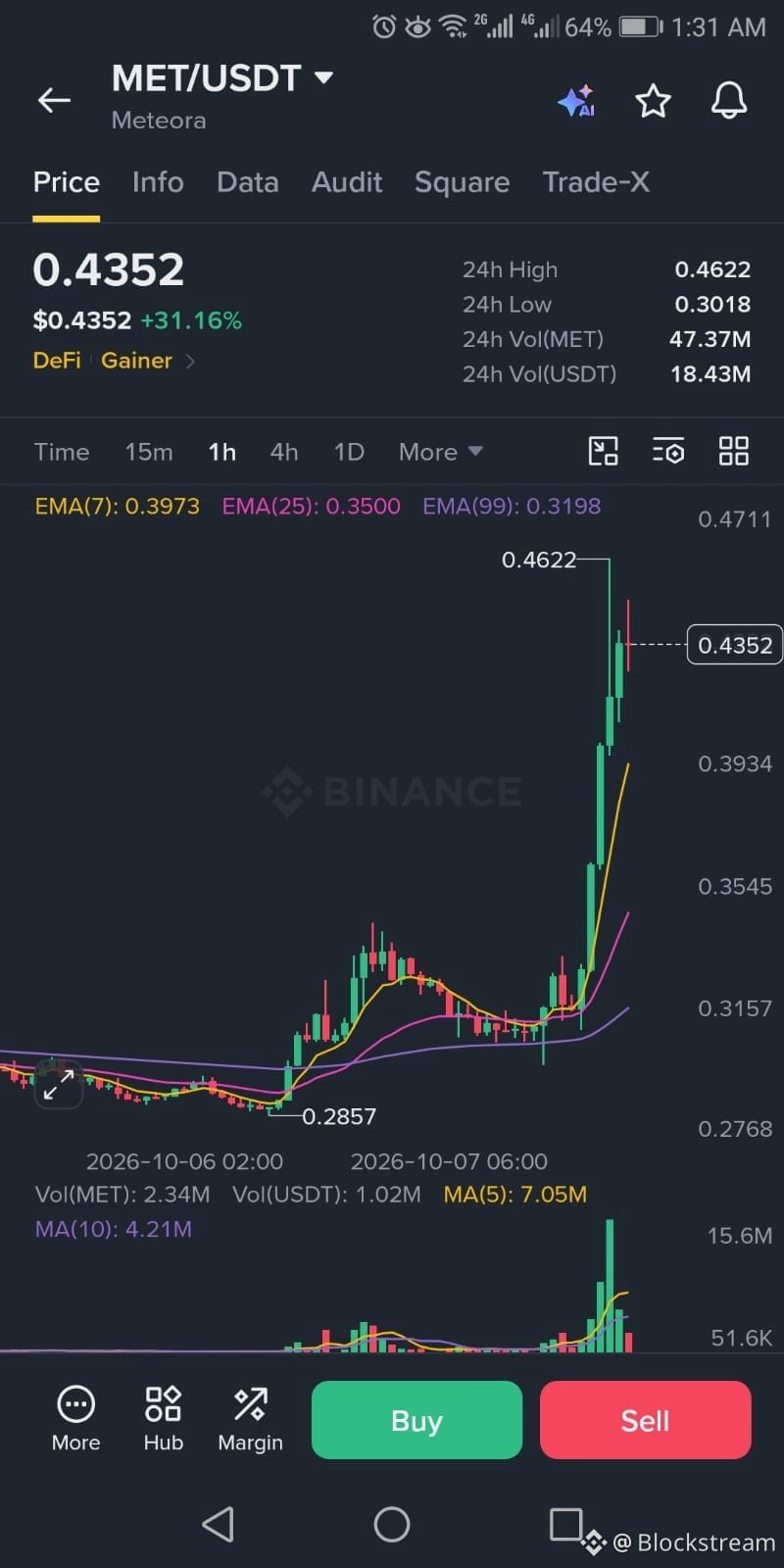
🚨 $MET Massive Breakout! (+31%)
$MET is leading the Solana DeFi rally today! The DLMM liquidity powerhouse just printed a huge green vertical expansion!
📍 Buy Zone: $0.4050 - $0.4250 🎯 Target 1: $0.4850 🎯 Target 2: $0.5600 🛑 Stop Loss: $0.3720
⚡ WHY THIS CAN RALLY: Protocols using dynamic buybacks are holding real supply pressure!
📌 SAVE THIS POST before the next leg up!
Is $MET hitting $0.50 today or pulling back first? Drop your thoughts below! 👇
{spot}(METUSDT)
#MET #Meteora #solana #BinanceLaunchesBinanceIntelligence
🚨 $MET Massive Breakout! (+31%)
$MET is leading the Solana DeFi rally today! The DLMM liquidity powerhouse just printed a huge green vertical expansion!
📍 Buy Zone: $0.4050 - $0.4250 🎯 Target 1: $0.4850 🎯 Target 2: $0.5600 🛑 Stop Loss: $0.3720
⚡ WHY THIS CAN RALLY: Protocols using dynamic buybacks are holding real supply pressure!
📌 SAVE THIS POST before the next leg up!
Is $MET hitting $0.50 today or pulling back first? Drop your thoughts below! 👇
#MET #Meteora #solana #BinanceLaunchesBinanceIntelligence
$MET is leading the Solana DeFi rally today! The DLMM liquidity powerhouse just printed a huge green vertical expansion!
📍 Buy Zone: $0.4050 - $0.4250 🎯 Target 1: $0.4850 🎯 Target 2: $0.5600 🛑 Stop Loss: $0.3720
⚡ WHY THIS CAN RALLY: Protocols using dynamic buybacks are holding real supply pressure!
📌 SAVE THIS POST before the next leg up!
Is $MET hitting $0.50 today or pulling back first? Drop your thoughts below! 👇
#MET #Meteora #solana #BinanceLaunchesBinanceIntelligence
1
216

·
--
🔥 TRENDING COIN TO WATCH
$MET is getting increased attention today.
💰 Price: ~$0.425
📈 24H: +26.17%
📊 7D: +18.1%
🏦 Market Cap: ~$226.7M
💎 Volume: ~$88.5M
🎯 Key level to watch: $0.425
📈 Bias: BULLISH while momentum remains strong.
If momentum continues, $MET could remain on traders' watchlists. But remember: high attention can also mean high volatility.
{spot}(METUSDT)
Would you trade $MET? 👀
#TrendingCoins #MET #crypto #BinanceSquare #Meteora
🔥 TRENDING COIN TO WATCH
$MET is getting increased attention today.
💰 Price: ~$0.425
📈 24H: +26.17%
📊 7D: +18.1%
🏦 Market Cap: ~$226.7M
💎 Volume: ~$88.5M
🎯 Key level to watch: $0.425
📈 Bias: BULLISH while momentum remains strong.
If momentum continues, $MET could remain on traders' watchlists. But remember: high attention can also mean high volatility.
Would you trade $MET ? 👀
#TrendingCoins #MET #crypto #BinanceSquare #Meteora
$MET is getting increased attention today.
💰 Price: ~$0.425
📈 24H: +26.17%
📊 7D: +18.1%
🏦 Market Cap: ~$226.7M
💎 Volume: ~$88.5M
🎯 Key level to watch: $0.425
📈 Bias: BULLISH while momentum remains strong.
If momentum continues, $MET could remain on traders' watchlists. But remember: high attention can also mean high volatility.
Would you trade $MET ? 👀
#TrendingCoins #MET #crypto #BinanceSquare #Meteora
102

·
--
Bullish
🚨 $MET — METEORA IS GETTING ATTENTION!
Meteora is showing surprising strength while the broader crypto market is under pressure. 👀
📈 MET is around $0.34
🔥 Up roughly 5%+ in 24H
💰 24H volume is around $60M+
⚡ Trading activity has picked up sharply
Meteora is one of the major liquidity and DEX infrastructures in the Solana ecosystem, powering DLMM, DAMM and launchpad products.
The interesting part?
MET has been holding up while the wider market has been weak. 📊
But after a volatile move, chasing green candles can be risky. ⚠️
The real question isn't:
“How high can MET go?”
It's:
“Can Meteora hold this momentum and break higher?” 👀
Watch the volume.
Wait for confirmation.
Manage your risk. 🎯
Are you watching $MET for a breakout or waiting for a pullback? 👇
#MET #Meteora #Solana #DeFi #Crypto #altcoins #Trading #BinanceSquare
{spot}(METUSDT)
🚨 $MET — METEORA IS GETTING ATTENTION!
Meteora is showing surprising strength while the broader crypto market is under pressure. 👀
📈 MET is around $0.34
🔥 Up roughly 5%+ in 24H
💰 24H volume is around $60M+
⚡ Trading activity has picked up sharply
Meteora is one of the major liquidity and DEX infrastructures in the Solana ecosystem, powering DLMM, DAMM and launchpad products.
The interesting part?
MET has been holding up while the wider market has been weak. 📊
But after a volatile move, chasing green candles can be risky. ⚠️
The real question isn't:
“How high can MET go?”
It's:
“Can Meteora hold this momentum and break higher?” 👀
Watch the volume.
Wait for confirmation.
Manage your risk. 🎯
Are you watching $MET for a breakout or waiting for a pullback? 👇
#MET #Meteora #Solana #DeFi #Crypto #altcoins #Trading #BinanceSquare
Meteora is showing surprising strength while the broader crypto market is under pressure. 👀
📈 MET is around $0.34
🔥 Up roughly 5%+ in 24H
💰 24H volume is around $60M+
⚡ Trading activity has picked up sharply
Meteora is one of the major liquidity and DEX infrastructures in the Solana ecosystem, powering DLMM, DAMM and launchpad products.
The interesting part?
MET has been holding up while the wider market has been weak. 📊
But after a volatile move, chasing green candles can be risky. ⚠️
The real question isn't:
“How high can MET go?”
It's:
“Can Meteora hold this momentum and break higher?” 👀
Watch the volume.
Wait for confirmation.
Manage your risk. 🎯
Are you watching $MET for a breakout or waiting for a pullback? 👇
#MET #Meteora #Solana #DeFi #Crypto #altcoins #Trading #BinanceSquare
263



·
--
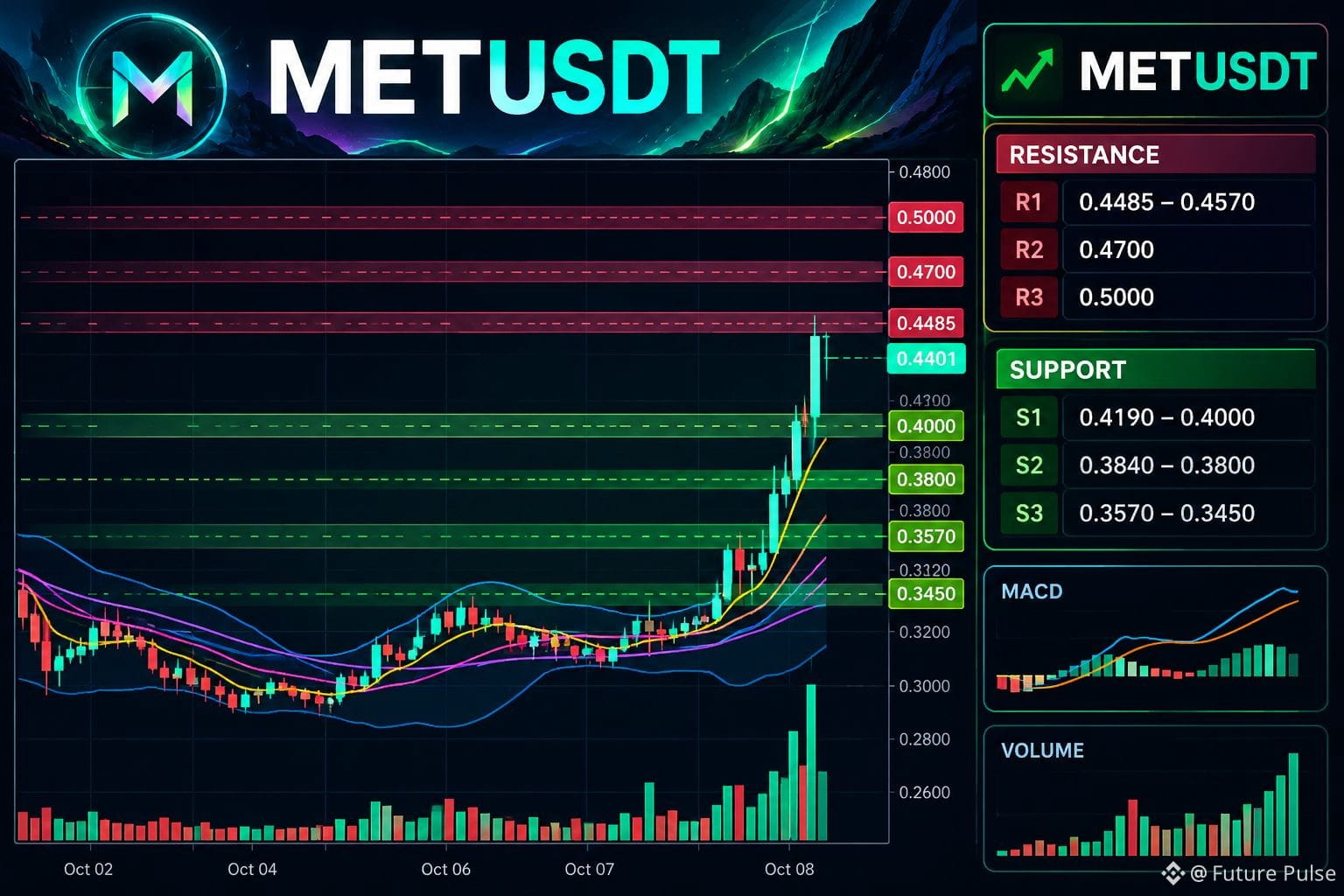
MET is showing a breakout that is hard to ignore. The 15m, 1h and 4h charts all point in the same direction: strong bullish momentum backed by a sharp volume expansion. Price has pushed far above the 7/25/99 MAs, while MACD remains firmly positive. However, the move is now extended near the $0.4485 high, so a cooling phase would not be surprising.
🟢 Support: $0.419–$0.400 | $0.384–$0.380 | $0.357–$0.345
🔴 Resistance: $0.4485–$0.457 | $0.470 | $0.500
The key question now is whether buyers can turn the breakout into sustained support rather than a short-lived spike.
$MET
{future}(METUSDT)
$NEAR
{future}(NEARUSDT)
$OGN
{future}(OGNUSDT)
#Meteora
MET is showing a breakout that is hard to ignore. The 15m, 1h and 4h charts all point in the same direction: strong bullish momentum backed by a sharp volume expansion. Price has pushed far above the 7/25/99 MAs, while MACD remains firmly positive. However, the move is now extended near the $0.4485 high, so a cooling phase would not be surprising.
🟢 Support: $0.419–$0.400 | $0.384–$0.380 | $0.357–$0.345
🔴 Resistance: $0.4485–$0.457 | $0.470 | $0.500
The key question now is whether buyers can turn the breakout into sustained support rather than a short-lived spike.
$MET
$NEAR
$OGN
#Meteora
🟢 Support: $0.419–$0.400 | $0.384–$0.380 | $0.357–$0.345
🔴 Resistance: $0.4485–$0.457 | $0.470 | $0.500
The key question now is whether buyers can turn the breakout into sustained support rather than a short-lived spike.
$MET
$NEAR
$OGN
#Meteora
496

·
--

Article
💵 bullish stup MET coin 🚀$MET — A Coin I’m Watching for the Bigger Picture
Meteora is more interesting to me than a simple short-term pump because it has an actual role within Solana DeFi.
The protocol focuses on liquidity infrastructure and combines different systems for decentralized trading, liquidity provision and token launches.
At around $0.34, MET is still far below its previous all-time high near $0.90.
If Meteora continues growing and Solana DeFi attracts more capital, I believe the market could eventually start pricing MET much higher.
My bullish roadmap would be:
$0.50 → $0.60 → $0.80 → $0.90 → $1
I’m not saying these levels will definitely be reached.
I’m saying the combination of a relatively small current market cap, meaningful trading volume, Solana DeFi exposure and a previous ~$0.90 ATH makes $MET an interesting coin to watch.
Sometimes the best opportunities are the projects people haven't started talking about everywhere yet.
$MET — keeping this one on my radar.
#MET #Meteora #Solana #DeFi
💵 bullish stup MET coin 🚀
$MET — A Coin I’m Watching for the Bigger Picture
Meteora is more interesting to me than a simple short-term pump because it has an actual role within Solana DeFi.
The protocol focuses on liquidity infrastructure and combines different systems for decentralized trading, liquidity provision and token launches.
At around $0.34, MET is still far below its previous all-time high near $0.90.
If Meteora continues growing and Solana DeFi attracts more capital, I believe the market could eventually start pricing MET much higher.
My bullish roadmap would be:
$0.50 → $0.60 → $0.80 → $0.90 → $1
I’m not saying these levels will definitely be reached.
I’m saying the combination of a relatively small current market cap, meaningful trading volume, Solana DeFi exposure and a previous ~$0.90 ATH makes $MET an interesting coin to watch.
Sometimes the best opportunities are the projects people haven't started talking about everywhere yet.
$MET — keeping this one on my radar.
#MET #Meteora #Solana #DeFi
Meteora is more interesting to me than a simple short-term pump because it has an actual role within Solana DeFi.
The protocol focuses on liquidity infrastructure and combines different systems for decentralized trading, liquidity provision and token launches.
At around $0.34, MET is still far below its previous all-time high near $0.90.
If Meteora continues growing and Solana DeFi attracts more capital, I believe the market could eventually start pricing MET much higher.
My bullish roadmap would be:
$0.50 → $0.60 → $0.80 → $0.90 → $1
I’m not saying these levels will definitely be reached.
I’m saying the combination of a relatively small current market cap, meaningful trading volume, Solana DeFi exposure and a previous ~$0.90 ATH makes $MET an interesting coin to watch.
Sometimes the best opportunities are the projects people haven't started talking about everywhere yet.
$MET — keeping this one on my radar.
#MET #Meteora #Solana #DeFi
16

$MET
{spot}(METUSDT)
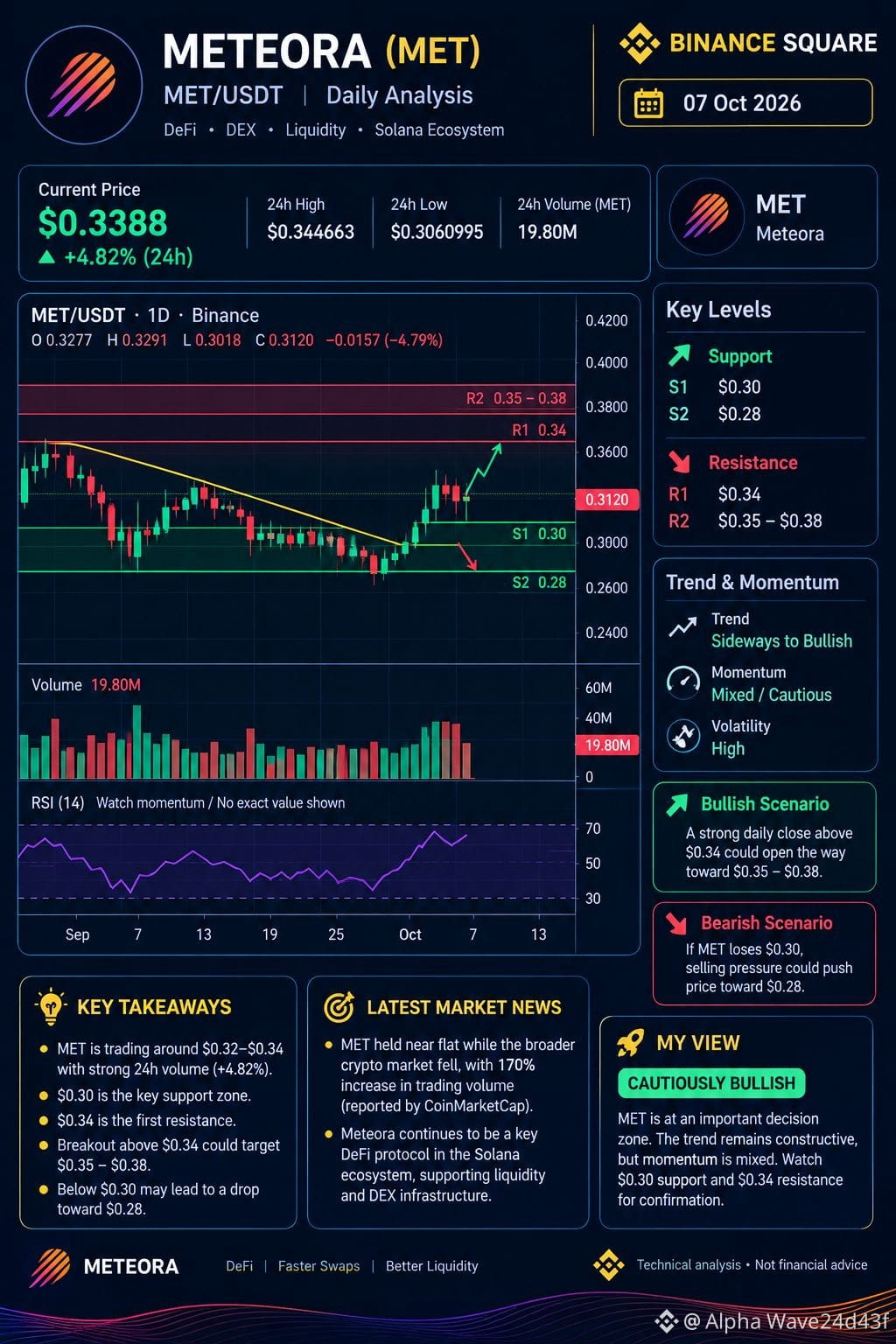
🔥 METEORA (MET) — LATEST ANALYSIS 📊
💰 Price: ~$0.33–$0.34
📈 Bias: Cautiously Bullish
⚡ Volatility: High
📊 24H Volume: Strong activity
🟢 KEY SUPPORT
• $0.30
• $0.28
🔴 KEY RESISTANCE
• $0.34
• $0.35–$0.38
🚀 BULLISH SCENARIO
If MET breaks and holds above $0.34 with strong volume, the next area to watch is $0.35–$0.38.
⚠️ BEARISH SCENARIO
If MET loses $0.30, selling pressure could increase and price may retest around $0.28.
👀 MY VIEW
MET is at an important decision zone. Buyers need to reclaim $0.34 for stronger confirmation. Until then, expect volatility around the $0.30–$0.34 range.
#MET #Meteora #BinanceSquare #CryptoAnalysis #TechnicalAnalysis
$MET
🔥 METEORA (MET) — LATEST ANALYSIS 📊
💰 Price: ~$0.33–$0.34
📈 Bias: Cautiously Bullish
⚡ Volatility: High
📊 24H Volume: Strong activity
🟢 KEY SUPPORT
• $0.30
• $0.28
🔴 KEY RESISTANCE
• $0.34
• $0.35–$0.38
🚀 BULLISH SCENARIO
If MET breaks and holds above $0.34 with strong volume, the next area to watch is $0.35–$0.38.
⚠️ BEARISH SCENARIO
If MET loses $0.30, selling pressure could increase and price may retest around $0.28.
👀 MY VIEW
MET is at an important decision zone. Buyers need to reclaim $0.34 for stronger confirmation. Until then, expect volatility around the $0.30–$0.34 range.
#MET #Meteora #BinanceSquare #CryptoAnalysis #TechnicalAnalysis
🔥 METEORA (MET) — LATEST ANALYSIS 📊
💰 Price: ~$0.33–$0.34
📈 Bias: Cautiously Bullish
⚡ Volatility: High
📊 24H Volume: Strong activity
🟢 KEY SUPPORT
• $0.30
• $0.28
🔴 KEY RESISTANCE
• $0.34
• $0.35–$0.38
🚀 BULLISH SCENARIO
If MET breaks and holds above $0.34 with strong volume, the next area to watch is $0.35–$0.38.
⚠️ BEARISH SCENARIO
If MET loses $0.30, selling pressure could increase and price may retest around $0.28.
👀 MY VIEW
MET is at an important decision zone. Buyers need to reclaim $0.34 for stronger confirmation. Until then, expect volatility around the $0.30–$0.34 range.
#MET #Meteora #BinanceSquare #CryptoAnalysis #TechnicalAnalysis
276
·
--
🚨 breking news MET coin big pumpkinLate-night traders, keep an eye on $MET
Meteora has been getting interesting as trading activity remains significant compared with its current market size.
The project is part of the Solana DeFi ecosystem and provides liquidity infrastructure through products designed for trading, liquidity providers and token launches.
What interests me most is the distance between the current price and its previous high.
MET has already reached around $0.90 before. If the market gives Solana DeFi another strong cycle, I wouldn’t be surprised to see traders start looking toward $0.60 first, followed by $0.80 and potentially $1.
But there is an important condition:
Volume and buying pressure must continue.
Without that, price targets are just numbers.
So I’m not chasing $MET blindly. I’m watching its volume, price structure and Solana ecosystem momentum.
For tonight, $MET is definitely on my watchlist.
#MET #Meteora #sol板块 lana #CryptoTrading
🚨 breking news MET coin big pumpkin
Late-night traders, keep an eye on $MET
Meteora has been getting interesting as trading activity remains significant compared with its current market size.
The project is part of the Solana DeFi ecosystem and provides liquidity infrastructure through products designed for trading, liquidity providers and token launches.
What interests me most is the distance between the current price and its previous high.
MET has already reached around $0.90 before. If the market gives Solana DeFi another strong cycle, I wouldn’t be surprised to see traders start looking toward $0.60 first, followed by $0.80 and potentially $1.
But there is an important condition:
Volume and buying pressure must continue.
Without that, price targets are just numbers.
So I’m not chasing $MET blindly. I’m watching its volume, price structure and Solana ecosystem momentum.
For tonight, $MET is definitely on my watchlist.
#MET #Meteora #sol板块 lana #CryptoTrading
Meteora has been getting interesting as trading activity remains significant compared with its current market size.
The project is part of the Solana DeFi ecosystem and provides liquidity infrastructure through products designed for trading, liquidity providers and token launches.
What interests me most is the distance between the current price and its previous high.
MET has already reached around $0.90 before. If the market gives Solana DeFi another strong cycle, I wouldn’t be surprised to see traders start looking toward $0.60 first, followed by $0.80 and potentially $1.
But there is an important condition:
Volume and buying pressure must continue.
Without that, price targets are just numbers.
So I’m not chasing $MET blindly. I’m watching its volume, price structure and Solana ecosystem momentum.
For tonight, $MET is definitely on my watchlist.
#MET #Meteora #sol板块 lana #CryptoTrading
111

EDU, ETHFI & MET: Strong Intraday Momentum Across Education, Restaking and DeFi
EDU is trading around $0.0689, up approximately +13.7% over the latest 24-hour session. After moving between $0.0551 and $0.0714, Open Campus is holding near the upper end of its daily range, reflecting strong participation and elevated momentum in the education-focused token segment.
ETHFI is changing hands near $0.7740, gaining roughly +2.9% in 24 hours. The token has traded between $0.7203 and $0.8014, showing a measured recovery with price remaining above its session open. This points to constructive demand around the liquid-restaking narrative, although the move remains sensitive to broader DeFi liquidity.
MET is trading close to $0.3318, up about +12.9% over the same period. With a daily range of $0.2857–$0.3469, Meteora is also holding relatively close to its session high. Active turnover highlights continued market interest, while the wider range confirms that volatility remains elevated.
Overall, EDU is leading the group on percentage performance, MET is showing similarly strong high-beta momentum, and ETHFI is advancing with a more controlled market structure. Current conditions remain dependent on volume, liquidity, and wider crypto risk sentiment.
#OpenCampus #EtherFi #Meteora #CryptoMarket #MarketAnalysis
$EDU
{spot}(EDUUSDT)
$ETHFI
{spot}(ETHFIUSDT)
$MET
{spot}(METUSDT)
EDU, ETHFI & MET: Strong Intraday Momentum Across Education, Restaking and DeFi
EDU is trading around $0.0689, up approximately +13.7% over the latest 24-hour session. After moving between $0.0551 and $0.0714, Open Campus is holding near the upper end of its daily range, reflecting strong participation and elevated momentum in the education-focused token segment.
ETHFI is changing hands near $0.7740, gaining roughly +2.9% in 24 hours. The token has traded between $0.7203 and $0.8014, showing a measured recovery with price remaining above its session open. This points to constructive demand around the liquid-restaking narrative, although the move remains sensitive to broader DeFi liquidity.
MET is trading close to $0.3318, up about +12.9% over the same period. With a daily range of $0.2857–$0.3469, Meteora is also holding relatively close to its session high. Active turnover highlights continued market interest, while the wider range confirms that volatility remains elevated.
Overall, EDU is leading the group on percentage performance, MET is showing similarly strong high-beta momentum, and ETHFI is advancing with a more controlled market structure. Current conditions remain dependent on volume, liquidity, and wider crypto risk sentiment.
#OpenCampus #EtherFi #Meteora #CryptoMarket #MarketAnalysis
$EDU
$ETHFI
$MET
EDU is trading around $0.0689, up approximately +13.7% over the latest 24-hour session. After moving between $0.0551 and $0.0714, Open Campus is holding near the upper end of its daily range, reflecting strong participation and elevated momentum in the education-focused token segment.
ETHFI is changing hands near $0.7740, gaining roughly +2.9% in 24 hours. The token has traded between $0.7203 and $0.8014, showing a measured recovery with price remaining above its session open. This points to constructive demand around the liquid-restaking narrative, although the move remains sensitive to broader DeFi liquidity.
MET is trading close to $0.3318, up about +12.9% over the same period. With a daily range of $0.2857–$0.3469, Meteora is also holding relatively close to its session high. Active turnover highlights continued market interest, while the wider range confirms that volatility remains elevated.
Overall, EDU is leading the group on percentage performance, MET is showing similarly strong high-beta momentum, and ETHFI is advancing with a more controlled market structure. Current conditions remain dependent on volume, liquidity, and wider crypto risk sentiment.
#OpenCampus #EtherFi #Meteora #CryptoMarket #MarketAnalysis
$EDU
$ETHFI
$MET
23

·
--
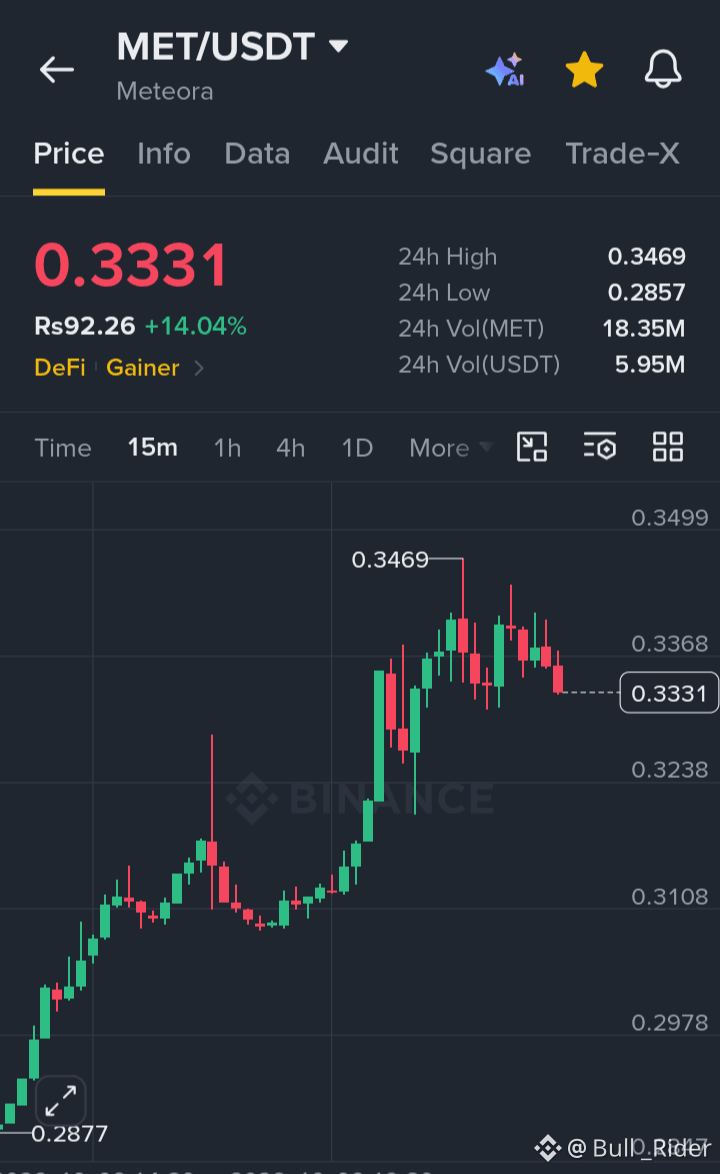
$MET Update 🔎 Can Meteora's latest launch tools sustain the rally?
💰 Price now: $0.3347 | 24h: +15.08%
📊 Market cap: $186.68M | Rank: #197
📈 24h range: $0.2857 – $0.3469
📰 What's happening:
MET is climbing as trading momentum strengthens. On October 6, 2026, reports highlighted Meteora's DLMM Pro, a customizable automated market maker designed for Solana token launches.
🔥 Key catalyst:
DLMM Pro introduces configurable launch markets, including adjustable initial liquidity and fees that can ease as markets mature.
👀 Next step to watch:
🔴 Bearish case: A rejection near $0.3469 could bring $0.3150 and the $0.2857 area into focus.
🟢 Bullish case: A sustained breakout above $0.3469 could open the way for further price discovery.
📝 My take:
The combination of fresh product news and strong momentum is worth watching, but continued demand remains unconfirmed.
Not financial advice, DYOR ⚠️
#MET #Meteora #Solana #DeFi #CryptoNews #Altcoins
$MET Update 🔎 Can Meteora's latest launch tools sustain the rally?
💰 Price now: $0.3347 | 24h: +15.08%
📊 Market cap: $186.68M | Rank: #197
📈 24h range: $0.2857 – $0.3469
📰 What's happening:
MET is climbing as trading momentum strengthens. On October 6, 2026, reports highlighted Meteora's DLMM Pro, a customizable automated market maker designed for Solana token launches.
🔥 Key catalyst:
DLMM Pro introduces configurable launch markets, including adjustable initial liquidity and fees that can ease as markets mature.
👀 Next step to watch:
🔴 Bearish case: A rejection near $0.3469 could bring $0.3150 and the $0.2857 area into focus.
🟢 Bullish case: A sustained breakout above $0.3469 could open the way for further price discovery.
📝 My take:
The combination of fresh product news and strong momentum is worth watching, but continued demand remains unconfirmed.
Not financial advice, DYOR ⚠️
#MET #Meteora #Solana #DeFi #CryptoNews #Altcoins
💰 Price now: $0.3347 | 24h: +15.08%
📊 Market cap: $186.68M | Rank: #197
📈 24h range: $0.2857 – $0.3469
📰 What's happening:
MET is climbing as trading momentum strengthens. On October 6, 2026, reports highlighted Meteora's DLMM Pro, a customizable automated market maker designed for Solana token launches.
🔥 Key catalyst:
DLMM Pro introduces configurable launch markets, including adjustable initial liquidity and fees that can ease as markets mature.
👀 Next step to watch:
🔴 Bearish case: A rejection near $0.3469 could bring $0.3150 and the $0.2857 area into focus.
🟢 Bullish case: A sustained breakout above $0.3469 could open the way for further price discovery.
📝 My take:
The combination of fresh product news and strong momentum is worth watching, but continued demand remains unconfirmed.
Not financial advice, DYOR ⚠️
#MET #Meteora #Solana #DeFi #CryptoNews #Altcoins

202


·
--
Bullish
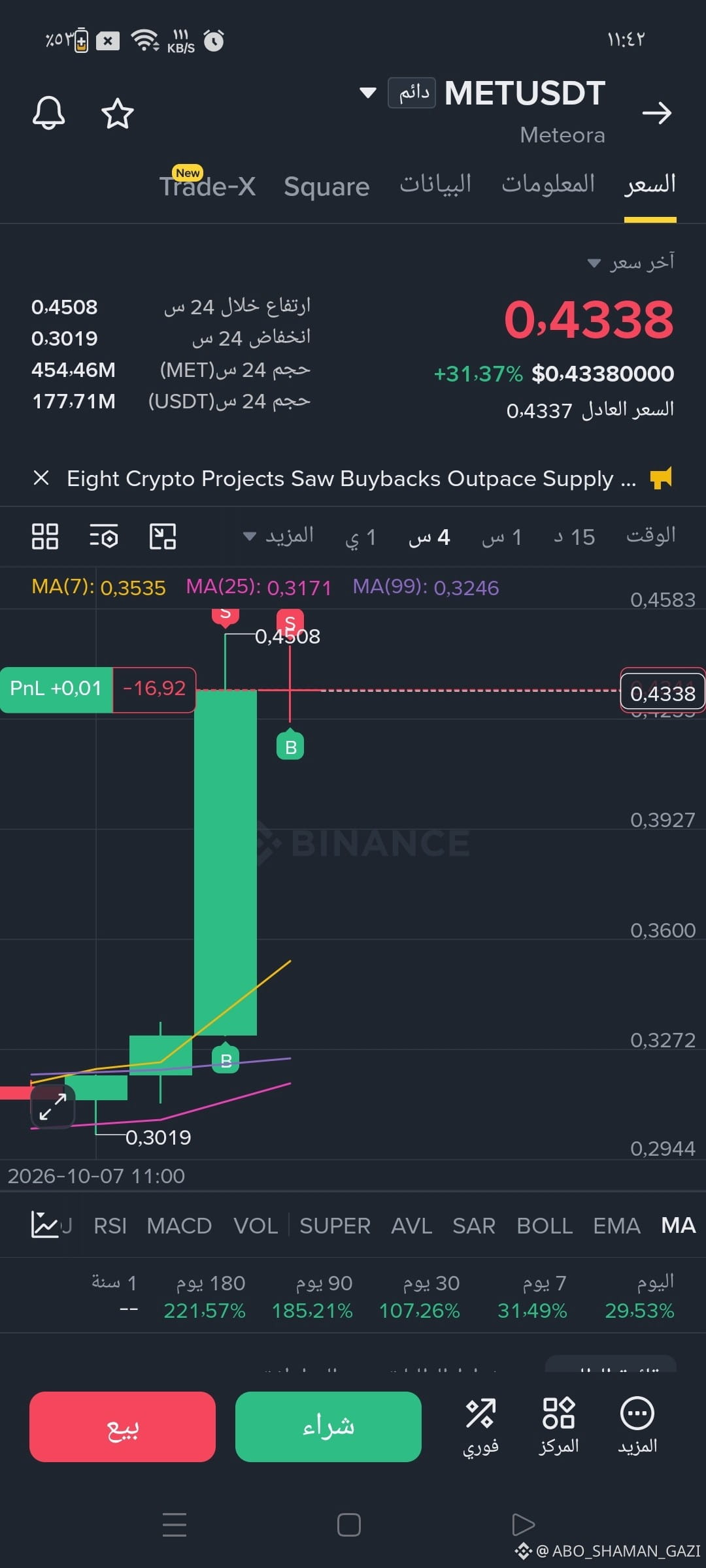
🚨 $MET coin explosion 🚀 A wild surge against the trend! 📊
While the market is undergoing a correction, $MET is bucking the trend with a sharp +31.37% rise to $0.4338.
📊 The outlook at a glance:
• Bullish scenario: Holding above $0.4200 gives the bulls the strength to break through the peak at $0.4508 and head toward $0.4800.
• Bearish scenario: A break below current levels could lead to a decline toward the MA(7) support line at $0.3535.
💡 The hunter’s takeaway: The coin is experiencing extraordinary momentum, fueled by a sudden influx of whale liquidity. Trade smart, don’t chase highs, and always use a stop loss! 🛡️🦅
@ABO_SHAMAN_GAZI
#MET #Meteora #TechnicalAnalysis #BinanceSquare
{future}(METUSDT)
🚨 $MET coin explosion 🚀 A wild surge against the trend! 📊
While the market is undergoing a correction, $MET is bucking the trend with a sharp +31.37% rise to $0.4338.
📊 The outlook at a glance:
• Bullish scenario: Holding above $0.4200 gives the bulls the strength to break through the peak at $0.4508 and head toward $0.4800.
• Bearish scenario: A break below current levels could lead to a decline toward the MA(7) support line at $0.3535.
💡 The hunter’s takeaway: The coin is experiencing extraordinary momentum, fueled by a sudden influx of whale liquidity. Trade smart, don’t chase highs, and always use a stop loss! 🛡️🦅
@ABO_SHAMAN
#MET #Meteora #TechnicalAnalysis #BinanceSquare
While the market is undergoing a correction, $MET is bucking the trend with a sharp +31.37% rise to $0.4338.
📊 The outlook at a glance:
• Bullish scenario: Holding above $0.4200 gives the bulls the strength to break through the peak at $0.4508 and head toward $0.4800.
• Bearish scenario: A break below current levels could lead to a decline toward the MA(7) support line at $0.3535.
💡 The hunter’s takeaway: The coin is experiencing extraordinary momentum, fueled by a sudden influx of whale liquidity. Trade smart, don’t chase highs, and always use a stop loss! 🛡️🦅
@ABO_SHAMAN
#MET #Meteora #TechnicalAnalysis #BinanceSquare
752

·
--
🚀 MET/USDT Coin Analysis: Price and Trading Volume Surge... Are New Highs in Sight? 🟢(Meteora) $MET is experiencing strong upward momentum on Binance, rising by more than +36.89% to reach 0.4513 USDT. This impressive performance is drawing the attention of traders and investors in the market.
📊 Data analysis for the current #Meteora coin:
* Current price: 0.4513 USDT.
* 24-hour high: 0.4731 USDT.
* 24-hour low: 0.3019 USDT.
🚀 MET/USDT Coin Analysis: Price and Trading Volume Surge... Are New Highs in Sight? 🟢
(Meteora) $MET is experiencing strong upward momentum on Binance, rising by more than +36.89% to reach 0.4513 USDT. This impressive performance is drawing the attention of traders and investors in the market.
📊 Data analysis for the current #Meteora coin:
* Current price: 0.4513 USDT.
* 24-hour high: 0.4731 USDT.
* 24-hour low: 0.3019 USDT.
📊 Data analysis for the current #Meteora coin:
* Current price: 0.4513 USDT.
* 24-hour high: 0.4731 USDT.
* 24-hour low: 0.3019 USDT.
143

·
--
$MET stages a strong rebound: Up 10% in 24 hours, the price stabilized and recovered from key EMA support near $0.30, as bulls regained the initiative. Just days ago, $MET broke out of a long-term wedge consolidation pattern and is still trading above all key moving averages.
On-chain data supports this rally: DEX trading volume on the network climbed to $187 million, active addresses rose to 175,000—a weekly high—and overall trading volume surged 4x to $61.99 million. If these metrics continue to strengthen and buyers hold the breakout level, $MET could extend its gains and test the next resistance at $0.41.
#Meteora #DeFi
(Source: AMBCrypto)
$MET stages a strong rebound: Up 10% in 24 hours, the price stabilized and recovered from key EMA support near $0.30, as bulls regained the initiative. Just days ago, $MET broke out of a long-term wedge consolidation pattern and is still trading above all key moving averages.
On-chain data supports this rally: DEX trading volume on the network climbed to $187 million, active addresses rose to 175,000—a weekly high—and overall trading volume surged 4x to $61.99 million. If these metrics continue to strengthen and buyers hold the breakout level, $MET could extend its gains and test the next resistance at $0.41.
#Meteora #DeFi
(Source: AMBCrypto)
On-chain data supports this rally: DEX trading volume on the network climbed to $187 million, active addresses rose to 175,000—a weekly high—and overall trading volume surged 4x to $61.99 million. If these metrics continue to strengthen and buyers hold the breakout level, $MET could extend its gains and test the next resistance at $0.41.
#Meteora #DeFi
(Source: AMBCrypto)
106

·
--
Bullish
🚨 Urgent: US Court Rejects Class Action Lawsuit Against Meteora Platform and LIBRA Token
A federal court in New York issued a decision dismissing the lawsuit filed against the Meteora platform (Solana liquidity protocol) and its former founder over allegations of fraud and manipulation in the launch of meme coins such as LIBRA and M3M3.
⚖️ Key points of the court ruling:
Platform nature: The judge ruled that Meteora is merely a protocol and software, not a legal entity that can be held liable for the conduct of its creators and promoters.
Refuting fraud claims: The charges of organized fraud were dismissed due to insufficient evidence of ongoing criminal activity.
📈 Forecast and technical analysis of the news impact on the Meteora token/project:
Positive for platform confidence (Short-Term Bullish): The ruling removes “legal uncertainty” (Regulatory FUD) that weighed on Meteora, restoring confidence among developers and investors in its liquidity protocols on the Solana network.
Increase in trading volumes (Trading Volume Boost): Dismissing the cases gives the green light for higher activity in liquidity packages (DLMM Pools), which may positively impact the protocol’s revenues and the total value locked (TVL).
Trader advice: Although this news is an excellent turnaround for Meteora, meme coin markets and the related protocols remain highly volatile.
#Meteora #MET #memecoins #top
$MET
{spot}(METUSDT)
🚨 Urgent: US Court Rejects Class Action Lawsuit Against Meteora Platform and LIBRA Token
A federal court in New York issued a decision dismissing the lawsuit filed against the Meteora platform (Solana liquidity protocol) and its former founder over allegations of fraud and manipulation in the launch of meme coins such as LIBRA and M3M3.
⚖️ Key points of the court ruling:
Platform nature: The judge ruled that Meteora is merely a protocol and software, not a legal entity that can be held liable for the conduct of its creators and promoters.
Refuting fraud claims: The charges of organized fraud were dismissed due to insufficient evidence of ongoing criminal activity.
📈 Forecast and technical analysis of the news impact on the Meteora token/project:
Positive for platform confidence (Short-Term Bullish): The ruling removes “legal uncertainty” (Regulatory FUD) that weighed on Meteora, restoring confidence among developers and investors in its liquidity protocols on the Solana network.
Increase in trading volumes (Trading Volume Boost): Dismissing the cases gives the green light for higher activity in liquidity packages (DLMM Pools), which may positively impact the protocol’s revenues and the total value locked (TVL).
Trader advice: Although this news is an excellent turnaround for Meteora, meme coin markets and the related protocols remain highly volatile.
#Meteora #MET #memecoins #top
$MET
A federal court in New York issued a decision dismissing the lawsuit filed against the Meteora platform (Solana liquidity protocol) and its former founder over allegations of fraud and manipulation in the launch of meme coins such as LIBRA and M3M3.
⚖️ Key points of the court ruling:
Platform nature: The judge ruled that Meteora is merely a protocol and software, not a legal entity that can be held liable for the conduct of its creators and promoters.
Refuting fraud claims: The charges of organized fraud were dismissed due to insufficient evidence of ongoing criminal activity.
📈 Forecast and technical analysis of the news impact on the Meteora token/project:
Positive for platform confidence (Short-Term Bullish): The ruling removes “legal uncertainty” (Regulatory FUD) that weighed on Meteora, restoring confidence among developers and investors in its liquidity protocols on the Solana network.
Increase in trading volumes (Trading Volume Boost): Dismissing the cases gives the green light for higher activity in liquidity packages (DLMM Pools), which may positively impact the protocol’s revenues and the total value locked (TVL).
Trader advice: Although this news is an excellent turnaround for Meteora, meme coin markets and the related protocols remain highly volatile.
#Meteora #MET #memecoins #top
$MET
1
11

·
--
Scanned to crypto.news: The U.S. District Court for the Southern District of New York has dismissed the class action lawsuits against LIBRA and M3M3— the amended complaint was dismissed with prejudice, and the case has been closed directly. The defendants include Meteora, former CEO Benjamin Chow, and Kelsier-related parties.
In Judge Jennifer Rochon’s September 29 opinion, the core points are three: the plaintiffs failed to establish Meteora as a non-registered joint venture/partnership that can be sued; the allegations against Chow regarding “fraudulent intent” were insufficient; and the plaintiffs also failed to substantiate Kelsier’s RICO “continuity” pattern, which further involves issues of personal jurisdiction. The investigation in Argentina into the related funds is still ongoing, while this U.S. class action has come to an end.
$SOL #Meteora #LIBRA #Regulation
Scanned to crypto.news: The U.S. District Court for the Southern District of New York has dismissed the class action lawsuits against LIBRA and M3M3— the amended complaint was dismissed with prejudice, and the case has been closed directly. The defendants include Meteora, former CEO Benjamin Chow, and Kelsier-related parties.
In Judge Jennifer Rochon’s September 29 opinion, the core points are three: the plaintiffs failed to establish Meteora as a non-registered joint venture/partnership that can be sued; the allegations against Chow regarding “fraudulent intent” were insufficient; and the plaintiffs also failed to substantiate Kelsier’s RICO “continuity” pattern, which further involves issues of personal jurisdiction. The investigation in Argentina into the related funds is still ongoing, while this U.S. class action has come to an end.
$SOL #Meteora #LIBRA #Regulation
In Judge Jennifer Rochon’s September 29 opinion, the core points are three: the plaintiffs failed to establish Meteora as a non-registered joint venture/partnership that can be sued; the allegations against Chow regarding “fraudulent intent” were insufficient; and the plaintiffs also failed to substantiate Kelsier’s RICO “continuity” pattern, which further involves issues of personal jurisdiction. The investigation in Argentina into the related funds is still ongoing, while this U.S. class action has come to an end.
$SOL #Meteora #LIBRA #Regulation

19

·
--
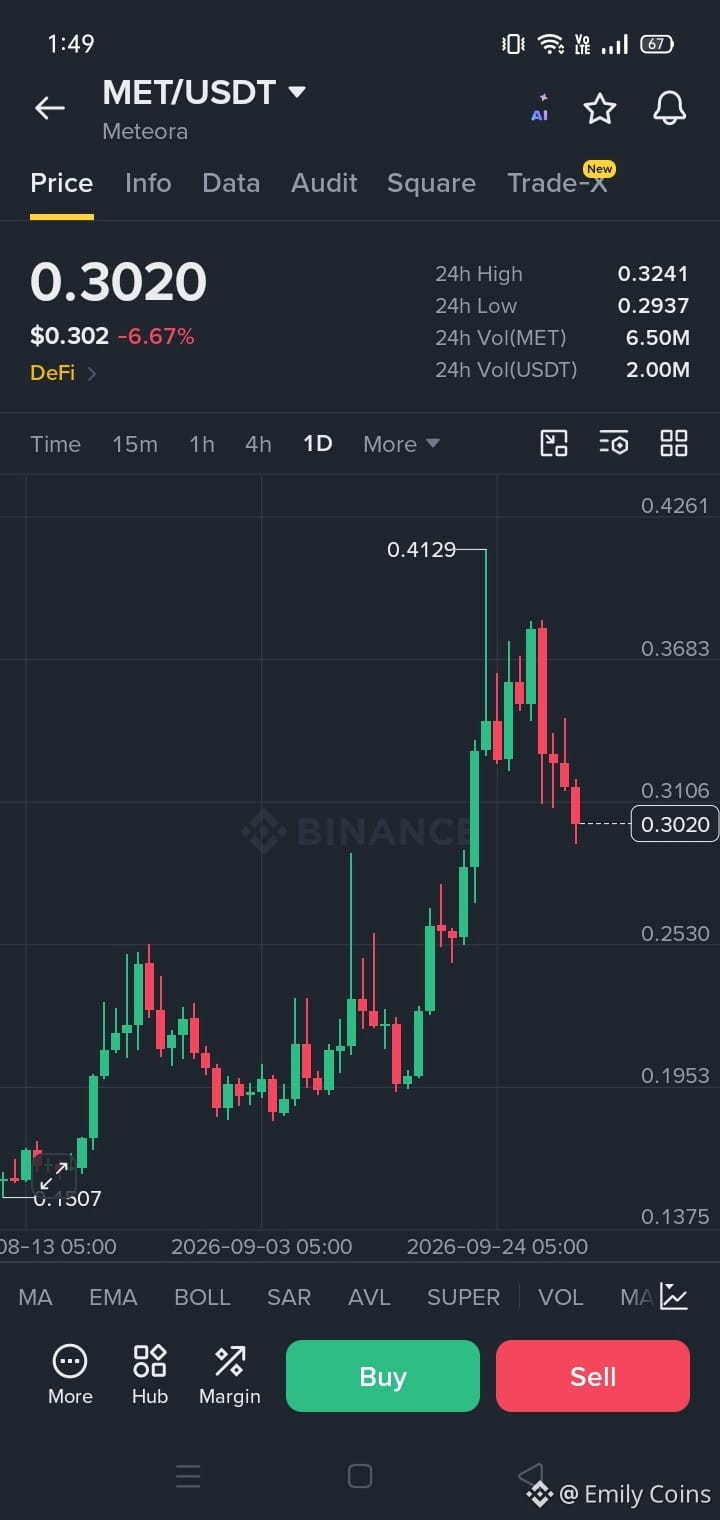
$MET #Short Setup 🔻
Pair: MET/USDT
Entry: 0.3020 – 0.3100
TP1: 0.2850
TP2: 0.2650
TP3: 0.2530
SL: 0.3250
Why: MET was rejected hard from the 0.41 spike and is now printing lower highs on the daily, with several red candles in a row. Resistance sits around 0.3106 to 0.3241 (the 24h high), so a small bounce into that zone is the short entry. The SL above 0.3250 invalidates the setup. TP3 targets the 0.2530 support area.
⚠️ Use proper risk management. Not financial advice.
#MET #Meteora #Short #CryptoSignals #Binance #Trading
$MET #Short Setup 🔻
Pair: MET/USDT
Entry: 0.3020 – 0.3100
TP1: 0.2850
TP2: 0.2650
TP3: 0.2530
SL: 0.3250
Why: MET was rejected hard from the 0.41 spike and is now printing lower highs on the daily, with several red candles in a row. Resistance sits around 0.3106 to 0.3241 (the 24h high), so a small bounce into that zone is the short entry. The SL above 0.3250 invalidates the setup. TP3 targets the 0.2530 support area.
⚠️ Use proper risk management. Not financial advice.
#MET #Meteora #Short #CryptoSignals #Binance #Trading
Pair: MET/USDT
Entry: 0.3020 – 0.3100
TP1: 0.2850
TP2: 0.2650
TP3: 0.2530
SL: 0.3250
Why: MET was rejected hard from the 0.41 spike and is now printing lower highs on the daily, with several red candles in a row. Resistance sits around 0.3106 to 0.3241 (the 24h high), so a small bounce into that zone is the short entry. The SL above 0.3250 invalidates the setup. TP3 targets the 0.2530 support area.
⚠️ Use proper risk management. Not financial advice.
#MET #Meteora #Short #CryptoSignals #Binance #Trading
215

·
--
【CJ Arbitrage Progression 04/14】
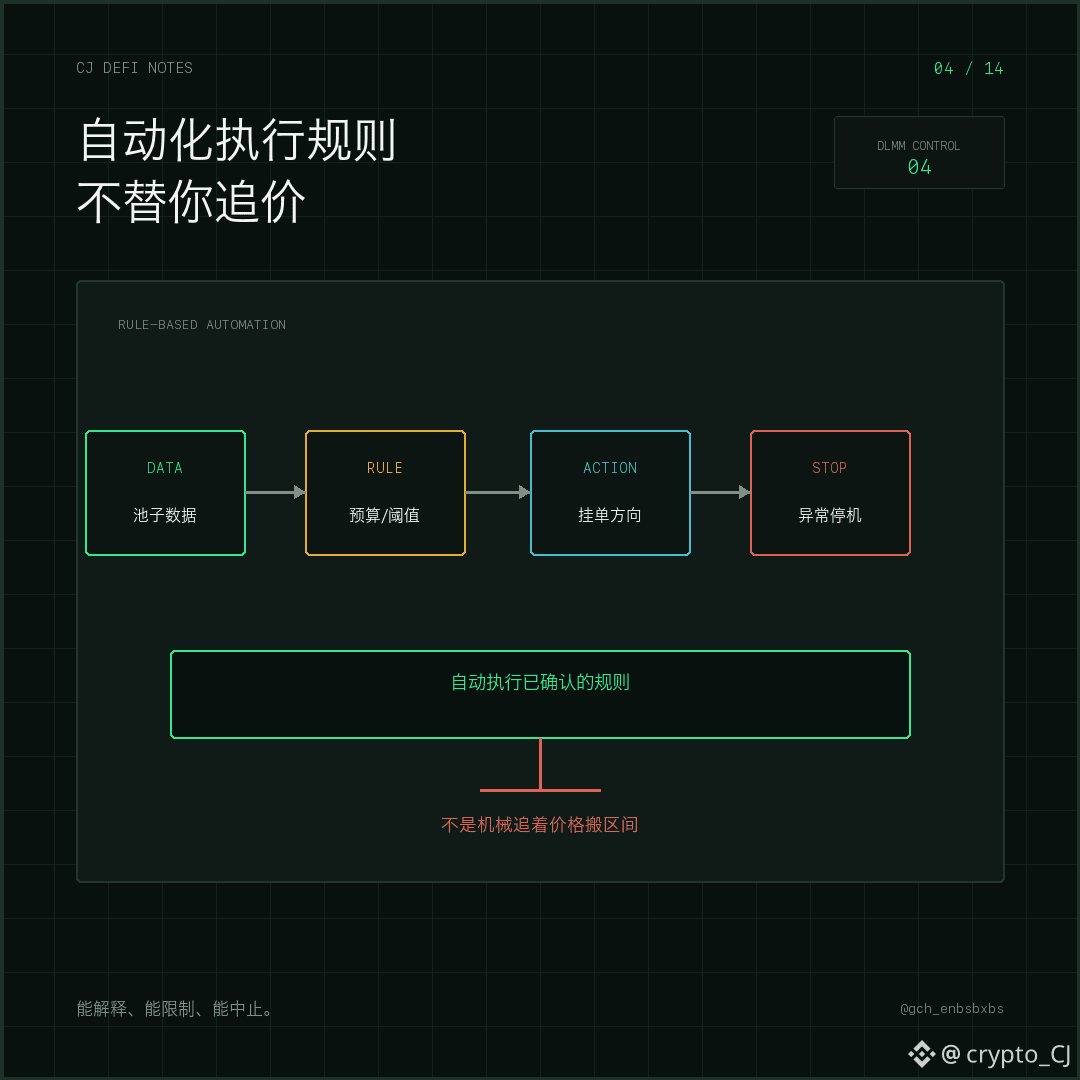
What automation should really do for you is to repeat execution and issue timely alerts—not to decide that the price will definitely come back.
Meteora DLMM distributes liquidity across discrete bins, allowing Bid and Ask at different price levels to be arranged more precisely. CJ previously built a modular position-management tool: create positions in advance, deposit funds, have the program read pool data, adjust order directions based on preset conditions, and send reminders for new pools, abnormal fees, and price changes.
This is not the same as “wherever the price goes, the system mechanically moves the range there.” The former executes a strategy with a clearly defined budget, direction, and stop conditions; the latter might sell the freshly received coins when the price drops out of the lower bound, then buy them back when the price rises out of the upper bound—automating chasing rallies and killing dips. The faster it automates, the faster mistakes get realized.
When reviewing a market-making tool, I’d first ask four things: what data it reads, what conditions trigger actions, how many times it can adjust per day at most, and whether it can stop when there are consecutive losses or data anomalies. The APR shown on the interface and the “one-click custody” are not the core—what truly matters is whether each action can be explained, limited, and stopped.
Next post: Funding-rate arbitrage looks direction-neutral—so why might you ultimately lose money when closing the position?
#Meteora #Automation
【CJ Arbitrage Progression 04/14】
What automation should really do for you is to repeat execution and issue timely alerts—not to decide that the price will definitely come back.
Meteora DLMM distributes liquidity across discrete bins, allowing Bid and Ask at different price levels to be arranged more precisely. CJ previously built a modular position-management tool: create positions in advance, deposit funds, have the program read pool data, adjust order directions based on preset conditions, and send reminders for new pools, abnormal fees, and price changes.
This is not the same as “wherever the price goes, the system mechanically moves the range there.” The former executes a strategy with a clearly defined budget, direction, and stop conditions; the latter might sell the freshly received coins when the price drops out of the lower bound, then buy them back when the price rises out of the upper bound—automating chasing rallies and killing dips. The faster it automates, the faster mistakes get realized.
When reviewing a market-making tool, I’d first ask four things: what data it reads, what conditions trigger actions, how many times it can adjust per day at most, and whether it can stop when there are consecutive losses or data anomalies. The APR shown on the interface and the “one-click custody” are not the core—what truly matters is whether each action can be explained, limited, and stopped.
Next post: Funding-rate arbitrage looks direction-neutral—so why might you ultimately lose money when closing the position?
#Meteora #Automation
What automation should really do for you is to repeat execution and issue timely alerts—not to decide that the price will definitely come back.
Meteora DLMM distributes liquidity across discrete bins, allowing Bid and Ask at different price levels to be arranged more precisely. CJ previously built a modular position-management tool: create positions in advance, deposit funds, have the program read pool data, adjust order directions based on preset conditions, and send reminders for new pools, abnormal fees, and price changes.
This is not the same as “wherever the price goes, the system mechanically moves the range there.” The former executes a strategy with a clearly defined budget, direction, and stop conditions; the latter might sell the freshly received coins when the price drops out of the lower bound, then buy them back when the price rises out of the upper bound—automating chasing rallies and killing dips. The faster it automates, the faster mistakes get realized.
When reviewing a market-making tool, I’d first ask four things: what data it reads, what conditions trigger actions, how many times it can adjust per day at most, and whether it can stop when there are consecutive losses or data anomalies. The APR shown on the interface and the “one-click custody” are not the core—what truly matters is whether each action can be explained, limited, and stopped.
Next post: Funding-rate arbitrage looks direction-neutral—so why might you ultimately lose money when closing the position?
#Meteora #Automation
104

·
--
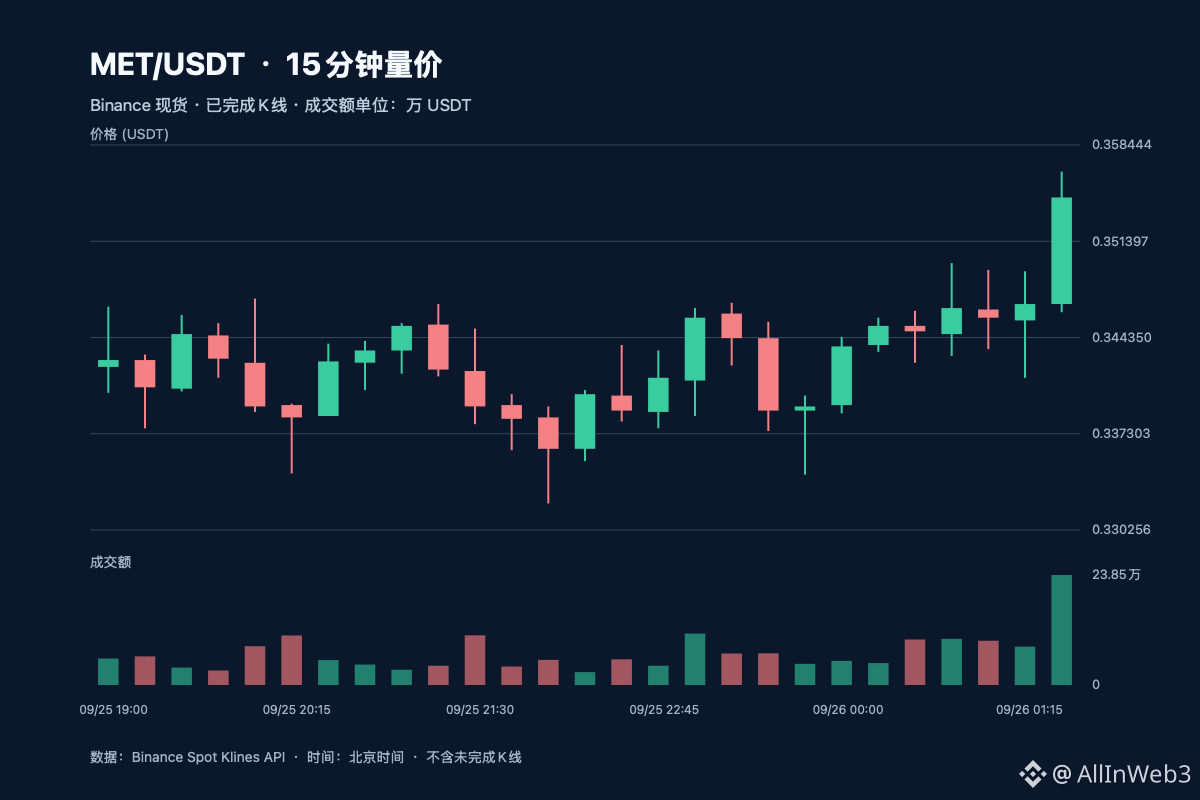
$MET For now, I’m treating this move as a rebound trying to break through, not yet confirmed as a new uptrend. The 0.343 that was previously broken has been reclaimed. At 01:30 on Sep 26 (Beijing time), the full 15-minute spot candlestick ran from 0.3468 to close at 0.3546, with trading volume of about 238k USDT—roughly 2.9 times the previous 83k. Volume and price have indeed turned upward, but afterward the price slipped back near 0.352, and the short-term high at 0.3565 hasn’t held.
The contract hasn’t provided evidence of a “collective heavy-position chasing longs.” In Binance MET perpetual futures data, the unrealized nominal value at 01:00 was about $6.39 million, versus about $6.24 million an hour earlier. The long/short account ratio is about 1.11, lower than 1.14 an hour prior. The funding rate is around +0.005%. Spot volume increased and open interest rose slightly, suggesting the rebound attracted trading, but we can’t infer whale accumulation, nor can this alone prove a trend reversal.
I’ll wait for the full 1-hour candlestick to move above 0.3565, and for subsequent成交 to keep up. Then I’ll change my view to slightly bullish. If it also reclaims below 0.343, this time the increased volume looks more like a failed test near the top of the range. I won’t chase a single 15-minute big bullish candle; the focus is whether the next hour can continue the push. #MET #Meteora #Solana
$MET For now, I’m treating this move as a rebound trying to break through, not yet confirmed as a new uptrend. The 0.343 that was previously broken has been reclaimed. At 01:30 on Sep 26 (Beijing time), the full 15-minute spot candlestick ran from 0.3468 to close at 0.3546, with trading volume of about 238k USDT—roughly 2.9 times the previous 83k. Volume and price have indeed turned upward, but afterward the price slipped back near 0.352, and the short-term high at 0.3565 hasn’t held.
The contract hasn’t provided evidence of a “collective heavy-position chasing longs.” In Binance MET perpetual futures data, the unrealized nominal value at 01:00 was about $6.39 million, versus about $6.24 million an hour earlier. The long/short account ratio is about 1.11, lower than 1.14 an hour prior. The funding rate is around +0.005%. Spot volume increased and open interest rose slightly, suggesting the rebound attracted trading, but we can’t infer whale accumulation, nor can this alone prove a trend reversal.
I’ll wait for the full 1-hour candlestick to move above 0.3565, and for subsequent成交 to keep up. Then I’ll change my view to slightly bullish. If it also reclaims below 0.343, this time the increased volume looks more like a failed test near the top of the range. I won’t chase a single 15-minute big bullish candle; the focus is whether the next hour can continue the push. #MET #Meteora #Solana
The contract hasn’t provided evidence of a “collective heavy-position chasing longs.” In Binance MET perpetual futures data, the unrealized nominal value at 01:00 was about $6.39 million, versus about $6.24 million an hour earlier. The long/short account ratio is about 1.11, lower than 1.14 an hour prior. The funding rate is around +0.005%. Spot volume increased and open interest rose slightly, suggesting the rebound attracted trading, but we can’t infer whale accumulation, nor can this alone prove a trend reversal.
I’ll wait for the full 1-hour candlestick to move above 0.3565, and for subsequent成交 to keep up. Then I’ll change my view to slightly bullish. If it also reclaims below 0.343, this time the increased volume looks more like a failed test near the top of the range. I won’t chase a single 15-minute big bullish candle; the focus is whether the next hour can continue the push. #MET #Meteora #Solana
1
94
Log in to explore more content
Join global crypto users on Binance Square
⚡️ Get latest and useful information about crypto.
💬 Trusted by the world’s largest crypto exchange.
👍 Discover real insights from verified creators.
Email / Phone number
Trending Topics
1
#FedMinutesFocusOnOctoberPause
182,686 views
1,338 Discussing
2
#BinanceLaunchesBinanceIntelligence
1.1M views
6,538 Discussing
3
#EvernorthDelaysNasdaqDebutToOct12
15,439 views
307 Discussing
4
#RobinhoodAdds$25MInBitcoinToBalanceSheet
3,550 views
74 Discussing
5
#SP500AndNasdaqHitRecordHighs
22,179 views
481 Discussing
6
#USMortgageRatesRiseTo7.49%
27,260 views
391 Discussing
7
#BTCFallsBelow$84K
131,376 views
236 Discussing
8
#DubaiVARAIssuesReserveAssetAuditCircular
47,955 views
961 Discussing
9
#SECApproves3XBitcoinETF
45,285 views
779 Discussing
10
#WinklevossFilesSpotZcashETFApplication
53,110 views
882 Discussing