
#defi
defi
58.4M views
313,174 Discussing
Hot
Latest

·
--
Partly True
AVAX’s tokenized assets surged past $3 B this month! 🌟
$AVAX backs $850 M of real‑world asset flow and $204 M staked, 43 % of supply.
The NYSE chose Avalanche for tokenised securities, a big institutional nod.
Bullish or bearish, what’s the next move for $AVAX?
$AVAX #Avalanche #DeFi #Tokenomics
AVAX’s tokenized assets surged past $3 B this month! 🌟
$AVAX backs $850 M of real‑world asset flow and $204 M staked, 43 % of supply.
The NYSE chose Avalanche for tokenised securities, a big institutional nod.
Bullish or bearish, what’s the next move for $AVAX ?
$AVAX #Avalanche #DeFi #Tokenomics
$AVAX backs $850 M of real‑world asset flow and $204 M staked, 43 % of supply.
The NYSE chose Avalanche for tokenised securities, a big institutional nod.
Bullish or bearish, what’s the next move for $AVAX ?
$AVAX #Avalanche #DeFi #Tokenomics
2
1k

·
--
🚀 $ASTER : A New Chapter in DeFi Innovation! 🌟
The crypto market is full of opportunities, and $ASTER is a project worth keeping on your watchlist! 🔥
Aster is gaining attention for its vision of building a powerful decentralized trading ecosystem. With innovation, technology, and community growth at its core, $ASTER has the potential to remain an interesting project in the evolving DeFi space.
📊 What Makes ASTER Interesting?
🔹 Decentralized trading innovation
🔹 Growing DeFi ecosystem
🔹 Long-term development potential
💡 My Take: Don't just follow the hype. Research the fundamentals, monitor market trends, and always manage your risk.
🔥 ASTER WATCHLIST: Innovation Today, Possibilities Tomorrow!
What is your opinion about ASTER? Are you bullish or bearish? 👇
{spot}(ASTERUSDT)
#ASTERCoin #crypto #BinanceSquare #DeFi
🚀 $ASTER : A New Chapter in DeFi Innovation! 🌟
The crypto market is full of opportunities, and $ASTER is a project worth keeping on your watchlist! 🔥
Aster is gaining attention for its vision of building a powerful decentralized trading ecosystem. With innovation, technology, and community growth at its core, $ASTER has the potential to remain an interesting project in the evolving DeFi space.
📊 What Makes ASTER Interesting?
🔹 Decentralized trading innovation
🔹 Growing DeFi ecosystem
🔹 Long-term development potential
💡 My Take: Don't just follow the hype. Research the fundamentals, monitor market trends, and always manage your risk.
🔥 ASTER WATCHLIST: Innovation Today, Possibilities Tomorrow!
What is your opinion about ASTER? Are you bullish or bearish? 👇
#ASTERCoin #crypto #BinanceSquare #DeFi

1
274

·
--
Verified
🍇 ENA: ETHENA’S BUYBACK FRAMEWORK IS NOW APPROVED — WHAT DOES IT MEAN?
Ethena has made a major change to ENA's token economics.
🔹 Governance approved a programmatic ENA buyback framework.
🔹 Buybacks are linked to USDe supply milestones, including a $7.5B threshold.
🔹 The October governance update reported USDe supply at $4.86B at publication.
🔹 This means the first $7.5B milestone had not yet been reached in that update.
The framework is approved, but milestone-based buybacks should not be confused with guaranteed ongoing purchases.
$ENA
{future}(ENAUSDT)
.
.
.
#Ethena #ENA #DeFi
Not financial advice. DYOR.
🍇 ENA: ETHENA’S BUYBACK FRAMEWORK IS NOW APPROVED — WHAT DOES IT MEAN?
Ethena has made a major change to ENA's token economics.
🔹 Governance approved a programmatic ENA buyback framework.
🔹 Buybacks are linked to USDe supply milestones, including a $7.5B threshold.
🔹 The October governance update reported USDe supply at $4.86B at publication.
🔹 This means the first $7.5B milestone had not yet been reached in that update.
The framework is approved, but milestone-based buybacks should not be confused with guaranteed ongoing purchases.
$ENA
.
.
.
#Ethena #ENA #DeFi
Not financial advice. DYOR.
Olin Tapanes oEJ3:
ETHENA promete muito, e esta na baixa historica, o projetoja vem se comportando bem no Bear, daqui 1 ano ou menos, tem tudo pra voar valendo 5 a 10x mais, se continuar assim.
1
10
3.4k
·
--
🌐 ENA: ETHENA'S BUYBACK PLAN HAS ONE BIG CONDITION!
Ethena's governance-approved fee switch links ENA buybacks to USDe supply growth.
🔹 The first activation milestone is a 14-day average USDe supply of $7.5 billion.
🔹 The approved framework starts allocating 5% of protocol revenue at that milestone.
🔹 The allocation increases at higher supply levels, reaching 20% at $20 billion.
🔹 Ethena's October governance update confirmed that USDe supply was still below the first threshold.
The framework is approved, but that does not mean buybacks have already started.
Will USDe growth eventually activate this mechanism?
$ENA
{future}(ENAUSDT)
.
.
.
.
#ENA #Ethena #defi
Not financial advice. DYOR.
🌐 ENA: ETHENA'S BUYBACK PLAN HAS ONE BIG CONDITION!
Ethena's governance-approved fee switch links ENA buybacks to USDe supply growth.
🔹 The first activation milestone is a 14-day average USDe supply of $7.5 billion.
🔹 The approved framework starts allocating 5% of protocol revenue at that milestone.
🔹 The allocation increases at higher supply levels, reaching 20% at $20 billion.
🔹 Ethena's October governance update confirmed that USDe supply was still below the first threshold.
The framework is approved, but that does not mean buybacks have already started.
Will USDe growth eventually activate this mechanism?
$ENA
.
.
.
.
#ENA #Ethena #defi
Not financial advice. DYOR.
1
338

·
--
Article
Three-Tier Portfolios: Allocating by Access, Size, and ScenarioIf you have read the previous twelve chapters and are ready to actually allocate some money, this chapter assembles their conclusions into three tiers of portfolio, replays them with real data since August, and then looks at how each would fare in three scenarios.
First, Answer Three Questions
Before choosing a portfolio, answer three questions. They decide which tier suits you more than any yield does:
Where are you? U.S. users can get Earn's subsidy but cannot hold stock tokens; international users are the reverse (Chapter 3). This alone rules out half the options.How much money do you have? $10,000 and $1 million face completely different chains. The former can trade anywhere. The latter is constrained by bridge limits, spot-token depth, and LP capacity.How large a drawdown can you bear? Drawdowns in income portfolios come from tail events (a USDe depeg, bad debt in the vault) and are almost zero the rest of the time. Drawdowns in portfolios with stock tokens are as real as those in U.S. stocks themselves.
Three Tiers
Income: Interest Only, Diversified by Trigger
U.S. user version: 70% in the Steakhouse USDG vault through Robinhood Earn, 30% in Spark Savings USDG.
International user version: 40% deposited directly into the Steakhouse vault (base interest only), 30% in Spark Savings, 30% in an SPY basis trade (holding SPY tokens + shorting an equal amount of the SPY perpetual, Chapter 8).
Why put some in Spark? Because of the principle from Chapter 11: diversify by trigger, not by product. The main tail risk in the Steakhouse vault comes from USDe (Chapter 5); Spark's yield comes from a different set of assets and a different issuer. Putting 30% in Spark caps your exposure to USDe risk.
International users do not get Earn's subsidy, so they use the basis trade to recover part of the yield. Its return comes from perpetual longs' demand for leverage, unrelated to lending-market subsidies, and it too is a different trigger.
Enhanced: Interest as the Base, Plus Some Stock Exposure
International user version: 20% Steakhouse vault, 20% Spark, 20% SPY basis, 30% SPY tokens, 10% NVDA tokens.
60% of the portfolio is still income, and 40% is stock tokens. The stock portion is mainly SPY, with only a small share in individual stocks. If you already planned to hold U.S. stocks long term, you can put part of the SPY tokens into a stock-against-stock pool such as QQQ/SPY and collect fees and UNI rewards while you hold (Chapter 7).
Growth: Mainly Stock Exposure
International user version: 10% Steakhouse vault, 10% SPY basis, 40% SPY tokens, 25% NVDA tokens, 15% TSLA tokens.
High-volatility launchpad tokens are not part of this tier's core allocation. If you must hold some, follow the rules in Chapter 9 and manage them separately as a "lottery allocation" of no more than 5% of total assets.
U.S. users have no enhanced or growth tier: under the terms, they cannot hold stock tokens. To get stock exposure onchain, they must wait for perpetuals in Wallet to open in the U.S., or hold stocks in a brokerage account.
Replay: August 1 to November 2
We replayed these four portfolios with real daily data for each component (rebalanced at the start of each month):
Vault yield: DefiLlama's daily yield for the Steakhouse vault, including Robinhood's reward for the U.S. version and base interest only for the international version.Spark: DefiLlama daily yield.Stock tokens: daily closes in the main onchain pool (dividend reinvestment through the multiplier already included).SPY basis: Lighter's hourly SPY perpetual funding summed by day, converted on total capital (tokens + 15% margin).
Income (U.S. users): Period return: 1.56%; Annualized: 6.27%; Annualized volatility: Near 0; Maximum drawdown: 0Income (international users): Period return: 0.99%; Annualized: 3.94%; Annualized volatility: Near 0; Maximum drawdown: 0Enhanced (international users): Period return: 1.60%; Annualized: 6.44%; Annualized volatility: 6.8%; Maximum drawdown: −2.25%Growth (international users): Period return: 6.76%; Annualized: 29.27%; Annualized volatility: 16.1%; Maximum drawdown: −5.04%
Component returns over the same period: Earn vault (with rewards) 1.83%, vault base interest 0.97%, Spark 0.93%, SPY basis 1.08%, SPY tokens 1.68%, NVDA tokens 3.97%, TSLA tokens 32.37%.
Keep four things in mind when reading this table:
Three months is too short. The growth portfolio's 29% annualized return comes mainly from the 32% rise in TSLA tokens over these three months. In a different three months it could easily be negative. What this table can show is each portfolio's structure (sources of return, level of volatility), not its future returns.The income portfolios' "zero drawdown" does not mean zero risk. Their risk lives in the tails. In Chapter 11's Scenario 4 (a 10% USDe depeg), vault depositors could lose 1–5%. That this did not occur in a three-month replay does not mean it cannot.The basis-trade replay is simplified. We counted only funding income, without simulating tracking error between the two legs, margin adjustments, or weekend mismatches (the five risks in Chapter 8). Actual returns and volatility would both be larger than in the table.The U.S. income portfolio earns the most because of the subsidy. About 3 percentage points of its 6.27% come from Robinhood's Earn reward. Cut the subsidy and this number falls directly.
Three Scenarios
A replay can only describe the past three months. Below, we use three scenarios to work through how each portfolio's sources of return would change. This is not a forecast of which scenario will occur; it is a way to show you what each portfolio is betting on.
Scenario 1: onchain activity expands. Stock tokens grow, U.S. access opens up, and demand to go long on perpetuals keeps rising.
Income: borrowing demand rises, and so do the vault's utilization and base interest. Even if subsidies taper, the unsubsidized portion grows.Basis trade: funding rises (QQQ and GOOGL already reached 7–12% in October), and returns improve.Stock tokens: liquidity improves, and the weekend premium and trading costs fall.
Scenario 2: the status quo holds. Size moves sideways, and subsidies continue at the current pace.
Income: about 6–7% (U.S.), about 4% (international).Basis trade: about 4–6%.Stock tokens: the return equals that of U.S. stocks themselves, minus the holding costs measured in this book (about 0.3 percentage points of dividend loss, plus trading costs).
Scenario 3: subsidies taper or rules tighten. Ethena stops the USDe reward, Robinhood cuts the Earn reward, or a stock token is paused.
Income: if Ethena withdraws, the vault's base interest could fall below 1%, leaving U.S. users mainly with Robinhood's reward. If both withdraw, the yield approaches Spark's level (about 3.5–4%) or lower.Basis trade: essentially unaffected by subsidies, but if demand to go long fades at the same time, funding returns to the 3.5% floor.Stock tokens: the paused token and any pools containing it freeze (Chapter 11, Scenario 2).
The income portfolio bets on subsidies continuing, the basis trade bets on demand to go long continuing, and stock tokens bet on U.S. stocks themselves. The three are driven by different forces, which is exactly the reason to combine them.
Adjusting for Size
Under $10,000: Main constraint: Round-trip costs are a large share (Chapter 3); Adjustment: Use only the income tier; hold for a month or more; buy stock tokens in one go during trading hours$10,000 to $100,000: Main constraint: Essentially none; Adjustment: All three tiers work$100,000 to $500,000: Main constraint: Spot-token depth ($100,000 of SPY spot costs ~29 bp); Adjustment: Use perpetuals or order books for stock exposure; build positions in tranchesOver $500,000: Main constraint: Bridge limit per transfer ($500,000), LP capacity, vault concentration; Adjustment: Split deposits; get stock exposure mainly through perpetuals; keep each vault or pool position below 5% of its size
The last row deserves a word more. If your money exceeds 5% of a vault or pool, you are no longer a price taker; you are part of the price. Your entries and exits change utilization, rates, and the pool's yield, and the capacity curves in Chapter 7 and the concentration analysis in Chapter 12 apply to you.
Rebalancing Rules
Rebalance monthly. At the start of each month, bring each component back to its target weight. Rebalance stock tokens during U.S. trading hours, not on weekends (Chapter 6).Adjust on signals, not on prices. The watchlist in Chapter 14 lists the signals that trigger adjustments, such as Ethena failing to renew, the USDe backup price falling below 0.995, or SPY funding falling below 3.5%. When a signal appears, adjust the relevant component without waiting for the start of the month.Recompare when subsidies change. For every percentage point Earn's reward is cut, the U.S. income portfolio's yield falls by about 0.7 percentage points. Past a certain point, Spark or another dollar yield may be the better choice.
If You Are Ready to Act
Settle your region, size, and drawdown tolerance before choosing a tier. Those three answers determine which tools you can use.Start with the income tier. It has the lowest round-trip cost and is the simplest to run. Spend a month getting familiar with the wallet, the bridge, and the vault before considering the enhanced tier.Write down the trigger for each component. Income bets on subsidies, the basis trade bets on demand to go long, and stock tokens bet on U.S. stocks. You know when to change only if you know what you are betting on.
A good portfolio is not the one with the highest return. It is one where you know who is paying for each part, what each part is betting on, and when it is time to leave.
Sources for This Chapter
Replay: scripts/backtest.py (August 1 to November 2, 2026; daily; rebalanced at the start of each month). Data from DefiLlama yields chart (Steakhouse vault, Spark Savings), GeckoTerminal hourly candles for the main stock-token pools (last close of each day), and Lighter hourly SPY perpetual fundingScenarios: parameters from Chapters 5, 8, 10, and 11Size constraints: Chapter 3 (bridge limits, order-book depth), Chapter 7 (LP capacity), Chapter 12 (concentration)
—
This is Chapter 13 of 14 from my new book Where the Yield Comes From, serialized one chapter a day. For research only; not investment advice.
Author: Blue Lotus
#DeFi #RobinhoodChain #Stablecoins #RWA
Three-Tier Portfolios: Allocating by Access, Size, and Scenario
If you have read the previous twelve chapters and are ready to actually allocate some money, this chapter assembles their conclusions into three tiers of portfolio, replays them with real data since August, and then looks at how each would fare in three scenarios.
First, Answer Three Questions
Before choosing a portfolio, answer three questions. They decide which tier suits you more than any yield does:
Where are you? U.S. users can get Earn's subsidy but cannot hold stock tokens; international users are the reverse (Chapter 3). This alone rules out half the options.How much money do you have? $10,000 and $1 million face completely different chains. The former can trade anywhere. The latter is constrained by bridge limits, spot-token depth, and LP capacity.How large a drawdown can you bear? Drawdowns in income portfolios come from tail events (a USDe depeg, bad debt in the vault) and are almost zero the rest of the time. Drawdowns in portfolios with stock tokens are as real as those in U.S. stocks themselves.
Three Tiers
Income: Interest Only, Diversified by Trigger
U.S. user version: 70% in the Steakhouse USDG vault through Robinhood Earn, 30% in Spark Savings USDG.
International user version: 40% deposited directly into the Steakhouse vault (base interest only), 30% in Spark Savings, 30% in an SPY basis trade (holding SPY tokens + shorting an equal amount of the SPY perpetual, Chapter 8).
Why put some in Spark? Because of the principle from Chapter 11: diversify by trigger, not by product. The main tail risk in the Steakhouse vault comes from USDe (Chapter 5); Spark's yield comes from a different set of assets and a different issuer. Putting 30% in Spark caps your exposure to USDe risk.
International users do not get Earn's subsidy, so they use the basis trade to recover part of the yield. Its return comes from perpetual longs' demand for leverage, unrelated to lending-market subsidies, and it too is a different trigger.
Enhanced: Interest as the Base, Plus Some Stock Exposure
International user version: 20% Steakhouse vault, 20% Spark, 20% SPY basis, 30% SPY tokens, 10% NVDA tokens.
60% of the portfolio is still income, and 40% is stock tokens. The stock portion is mainly SPY, with only a small share in individual stocks. If you already planned to hold U.S. stocks long term, you can put part of the SPY tokens into a stock-against-stock pool such as QQQ/SPY and collect fees and UNI rewards while you hold (Chapter 7).
Growth: Mainly Stock Exposure
International user version: 10% Steakhouse vault, 10% SPY basis, 40% SPY tokens, 25% NVDA tokens, 15% TSLA tokens.
High-volatility launchpad tokens are not part of this tier's core allocation. If you must hold some, follow the rules in Chapter 9 and manage them separately as a "lottery allocation" of no more than 5% of total assets.
U.S. users have no enhanced or growth tier: under the terms, they cannot hold stock tokens. To get stock exposure onchain, they must wait for perpetuals in Wallet to open in the U.S., or hold stocks in a brokerage account.
Replay: August 1 to November 2
We replayed these four portfolios with real daily data for each component (rebalanced at the start of each month):
Vault yield: DefiLlama's daily yield for the Steakhouse vault, including Robinhood's reward for the U.S. version and base interest only for the international version.Spark: DefiLlama daily yield.Stock tokens: daily closes in the main onchain pool (dividend reinvestment through the multiplier already included).SPY basis: Lighter's hourly SPY perpetual funding summed by day, converted on total capital (tokens + 15% margin).
Income (U.S. users): Period return: 1.56%; Annualized: 6.27%; Annualized volatility: Near 0; Maximum drawdown: 0Income (international users): Period return: 0.99%; Annualized: 3.94%; Annualized volatility: Near 0; Maximum drawdown: 0Enhanced (international users): Period return: 1.60%; Annualized: 6.44%; Annualized volatility: 6.8%; Maximum drawdown: −2.25%Growth (international users): Period return: 6.76%; Annualized: 29.27%; Annualized volatility: 16.1%; Maximum drawdown: −5.04%
Component returns over the same period: Earn vault (with rewards) 1.83%, vault base interest 0.97%, Spark 0.93%, SPY basis 1.08%, SPY tokens 1.68%, NVDA tokens 3.97%, TSLA tokens 32.37%.
Keep four things in mind when reading this table:
Three months is too short. The growth portfolio's 29% annualized return comes mainly from the 32% rise in TSLA tokens over these three months. In a different three months it could easily be negative. What this table can show is each portfolio's structure (sources of return, level of volatility), not its future returns.The income portfolios' "zero drawdown" does not mean zero risk. Their risk lives in the tails. In Chapter 11's Scenario 4 (a 10% USDe depeg), vault depositors could lose 1–5%. That this did not occur in a three-month replay does not mean it cannot.The basis-trade replay is simplified. We counted only funding income, without simulating tracking error between the two legs, margin adjustments, or weekend mismatches (the five risks in Chapter 8). Actual returns and volatility would both be larger than in the table.The U.S. income portfolio earns the most because of the subsidy. About 3 percentage points of its 6.27% come from Robinhood's Earn reward. Cut the subsidy and this number falls directly.
Three Scenarios
A replay can only describe the past three months. Below, we use three scenarios to work through how each portfolio's sources of return would change. This is not a forecast of which scenario will occur; it is a way to show you what each portfolio is betting on.
Scenario 1: onchain activity expands. Stock tokens grow, U.S. access opens up, and demand to go long on perpetuals keeps rising.
Income: borrowing demand rises, and so do the vault's utilization and base interest. Even if subsidies taper, the unsubsidized portion grows.Basis trade: funding rises (QQQ and GOOGL already reached 7–12% in October), and returns improve.Stock tokens: liquidity improves, and the weekend premium and trading costs fall.
Scenario 2: the status quo holds. Size moves sideways, and subsidies continue at the current pace.
Income: about 6–7% (U.S.), about 4% (international).Basis trade: about 4–6%.Stock tokens: the return equals that of U.S. stocks themselves, minus the holding costs measured in this book (about 0.3 percentage points of dividend loss, plus trading costs).
Scenario 3: subsidies taper or rules tighten. Ethena stops the USDe reward, Robinhood cuts the Earn reward, or a stock token is paused.
Income: if Ethena withdraws, the vault's base interest could fall below 1%, leaving U.S. users mainly with Robinhood's reward. If both withdraw, the yield approaches Spark's level (about 3.5–4%) or lower.Basis trade: essentially unaffected by subsidies, but if demand to go long fades at the same time, funding returns to the 3.5% floor.Stock tokens: the paused token and any pools containing it freeze (Chapter 11, Scenario 2).
The income portfolio bets on subsidies continuing, the basis trade bets on demand to go long continuing, and stock tokens bet on U.S. stocks themselves. The three are driven by different forces, which is exactly the reason to combine them.
Adjusting for Size
Under $10,000: Main constraint: Round-trip costs are a large share (Chapter 3); Adjustment: Use only the income tier; hold for a month or more; buy stock tokens in one go during trading hours$10,000 to $100,000: Main constraint: Essentially none; Adjustment: All three tiers work$100,000 to $500,000: Main constraint: Spot-token depth ($100,000 of SPY spot costs ~29 bp); Adjustment: Use perpetuals or order books for stock exposure; build positions in tranchesOver $500,000: Main constraint: Bridge limit per transfer ($500,000), LP capacity, vault concentration; Adjustment: Split deposits; get stock exposure mainly through perpetuals; keep each vault or pool position below 5% of its size
The last row deserves a word more. If your money exceeds 5% of a vault or pool, you are no longer a price taker; you are part of the price. Your entries and exits change utilization, rates, and the pool's yield, and the capacity curves in Chapter 7 and the concentration analysis in Chapter 12 apply to you.
Rebalancing Rules
Rebalance monthly. At the start of each month, bring each component back to its target weight. Rebalance stock tokens during U.S. trading hours, not on weekends (Chapter 6).Adjust on signals, not on prices. The watchlist in Chapter 14 lists the signals that trigger adjustments, such as Ethena failing to renew, the USDe backup price falling below 0.995, or SPY funding falling below 3.5%. When a signal appears, adjust the relevant component without waiting for the start of the month.Recompare when subsidies change. For every percentage point Earn's reward is cut, the U.S. income portfolio's yield falls by about 0.7 percentage points. Past a certain point, Spark or another dollar yield may be the better choice.
If You Are Ready to Act
Settle your region, size, and drawdown tolerance before choosing a tier. Those three answers determine which tools you can use.Start with the income tier. It has the lowest round-trip cost and is the simplest to run. Spend a month getting familiar with the wallet, the bridge, and the vault before considering the enhanced tier.Write down the trigger for each component. Income bets on subsidies, the basis trade bets on demand to go long, and stock tokens bet on U.S. stocks. You know when to change only if you know what you are betting on.
A good portfolio is not the one with the highest return. It is one where you know who is paying for each part, what each part is betting on, and when it is time to leave.
Sources for This Chapter
Replay: scripts/backtest.py (August 1 to November 2, 2026; daily; rebalanced at the start of each month). Data from DefiLlama yields chart (Steakhouse vault, Spark Savings), GeckoTerminal hourly candles for the main stock-token pools (last close of each day), and Lighter hourly SPY perpetual fundingScenarios: parameters from Chapters 5, 8, 10, and 11Size constraints: Chapter 3 (bridge limits, order-book depth), Chapter 7 (LP capacity), Chapter 12 (concentration)
—
This is Chapter 13 of 14 from my new book Where the Yield Comes From, serialized one chapter a day. For research only; not investment advice.
Author: Blue Lotus
#DeFi #RobinhoodChain #Stablecoins #RWA
165



·
--
Verified
Fidelity just opened the door to DeFi for millions of retirement savers.
The $7.9T asset manager added $AAVE, $LINK and $UNI to Fidelity Crypto, now live for eligible US customers in individual, joint and crypto IRA accounts. The roster grows from 5 to 8 assets, alongside BTC, ETH, SOL, LTC and its own FIDD stablecoin.
This is not a small listing. Aave is lending, Chainlink is oracles, Uniswap is DEX infrastructure. Fidelity is now selling the core DeFi stack inside retirement accounts, with a 1% fee and a $1 minimum to start.
Wall Street keeps absorbing crypto, one product at a time. The question now is which DeFi names come next.
Risk: customers get price exposure only, no staking or governance inside Fidelity, and the market is still in extreme fear. A listing is access, not a price guarantee.
Which DeFi token should Fidelity add next? Drop it below.
📌 Sharing personal opinions only, not financial advice or a recommendation to buy/sell. Crypto is highly risky; DYOR and you are solely responsible. No coin promotion.
#Fidelity #DeFi #Binance
Fidelity just opened the door to DeFi for millions of retirement savers.
The $7.9T asset manager added $AAVE , $LINK and $UNI to Fidelity Crypto, now live for eligible US customers in individual, joint and crypto IRA accounts. The roster grows from 5 to 8 assets, alongside BTC, ETH, SOL, LTC and its own FIDD stablecoin.
This is not a small listing. Aave is lending, Chainlink is oracles, Uniswap is DEX infrastructure. Fidelity is now selling the core DeFi stack inside retirement accounts, with a 1% fee and a $1 minimum to start.
Wall Street keeps absorbing crypto, one product at a time. The question now is which DeFi names come next.
Risk: customers get price exposure only, no staking or governance inside Fidelity, and the market is still in extreme fear. A listing is access, not a price guarantee.
Which DeFi token should Fidelity add next? Drop it below.
📌 Sharing personal opinions only, not financial advice or a recommendation to buy/sell. Crypto is highly risky; DYOR and you are solely responsible. No coin promotion.
#Fidelity #DeFi #Binance
783

·
--
🏦 Fidelity added three altcoins. Here’s the part I’d watch after the headline.
Fidelity Crypto added $LINK , $AAVE and UNI. For me, the interesting part is what happens after the listing gets its first wave of attention.
Tap LINK and mark the high of the first hour after the announcement. Then check whether it held that level into the next session.
Run the same check on AAVE and UNI. Three tokens got the same distribution headline.
Which one actually kept its move?
📊 For a separate DeFi benchmark, $LISTA was up 28.83% in 24h on Binance.
#Fidelity #Chainlink #DeFi
1
91

AAVE just lost $100 and honestly, nobody even blinked.
The biggest lending protocol in DeFi — the place everyone parks their coins to borrow against — and its own token is sitting around $93, down 5% today and about 15% this week.
It traded above $600 once. Now it's 86% below its all-time high while BTC camps under $60K at $59,200 and the Fear & Greed index reads 13.
The protocol is fine. The token just can't catch a bid. That's the 2026 market for you.
Not financial advice. DYOR.
#Aave #DeFi #Crypto

🚨 Wall Street is opening more doors to DeFi! 🔥
Fidelity Crypto has added $AAVE, $LINK and $UNI to its tradable assets!
This is an interesting development for decentralized finance. 👀
Could traditional finance and DeFi become closer than ever?
Which token has the biggest potential: AAVE, LINK or UNI?
Let's hear your pick! 👇
#DeFi #AAVE #Chainlink #Uniswap #CryptoNews

27

·
--
🦈 TRADITIONAL WEALTH GIANTS ARE QUIETLY UNLOCKING THE FLOODGATES FOR $AAVE $LINK AND $UNI ⚡
Retirement accounts and traditional retail platforms opening up to blue-chip decentralized finance assets changes the fundamental liquidity game. 🌊 When legacy finance pipelines hook directly into foundational infrastructure tokens, baseline demand gets an invisible structural floor. 📊
Even without governance rights attached on these specific custodian offerings, price exposure alone brings massive fresh liquidity pools into the ecosystem. 💬 Are legacy brokerage inflows enough to spark a sustained re-rating for top-tier decentralized assets? 👇
⚠️ Not financial advice. Always manage your risk. 🛡️
🏷️ #AAVE #DeFi #Crypto #InstitutionalFlow
🔥 💎

15

·
--
DEXs Pump and Uniswap alone drive 83.6% of 2026 token listings.
The 11 largest decentralized exchanges listed over 23.1 million tokens in 2026 – more than 4,931 times the total on the top 11 centralized exchanges.
Pump contributed 10.33 million listings and Uniswap added almost 6.6 million in Q1, together accounting for 83.6% of all token listings on DEXs.
Robinhood Chain’s mainnet launch lifted listings from 228,000 in July to 983,000 in October, while BNB Chain’s PancakeSwap listed roughly 779,000 tokens across September and October.
Spot trading volume across the top 20 exchanges fell from $1.21 trillion in January to $538.2 billion, rebounded to $860.1 billion in September, then slipped to $758.8 billion, with DEXs rising to 19.9% of combined volume.
What does the shift toward DEX token listings mean for the future balance between decentralized and centralized exchanges?
#DeFi #Crypto #DEX #TokenListings #Blockchain

2
🦈 $AAVE ATTRACTS INSTITUTIONAL LIQUIDITY AS TOKENIZED CREDIT EXPANDS BEYOND TREASURIES! ⚡
Institutional order flow is shifting as a $230 billion heavyweight brings high-yield corporate credit and CLO tranches directly on-chain via Aave Horizon. 🏦 This marks a crucial structural evolution for real-world asset tokenization, moving past basic treasury collateral into risk-adjusted yield generation.
With protocol deposits clearing the $500 million threshold, institutional liquidity channels are deepening rapidly. 📊 This structural integration creates sustainable utility and demand loops that few protocol architectures can replicate. 💡
💬 How will this expansion of private credit change institutional risk appetite across decentralized finance? 👇
⚠️ Not financial advice. Always manage your risk. 🛡️
🏷️ #AAVE #RWA #DeFi #Tokenization
🦈 ⚖️
27

🦈 WALL STREET GIANT FIDELITY BRIDGES INSTITUTIONAL LIQUIDITY STRAIGHT INTO $AAVE , $LINK , AND $UNI ! ⚡
Traditional retirement portfolios are quietly absorbing the foundational pillars of decentralized finance as major asset managers integrate core infrastructure assets. 📊 By opening direct access to lending primitives, oracle networks, and automated liquidity protocols, legacy capital is establishing structural footprints in top-tier protocols. 💡
While current sentiment lingers in fear and products restrict direct staking functionality, this bridge marks a structural shift in how institutional liquidity enters protocol layers. 🔍 Which foundational DeFi asset will capture the next wave of legacy capital inflows? 👇
⚠️ Not financial advice. Always manage your risk. 🛡️
🏷️ #AAVE #DeFi #InstitutionalFlow #Crypto
🦈 ⚖️
5

·
--
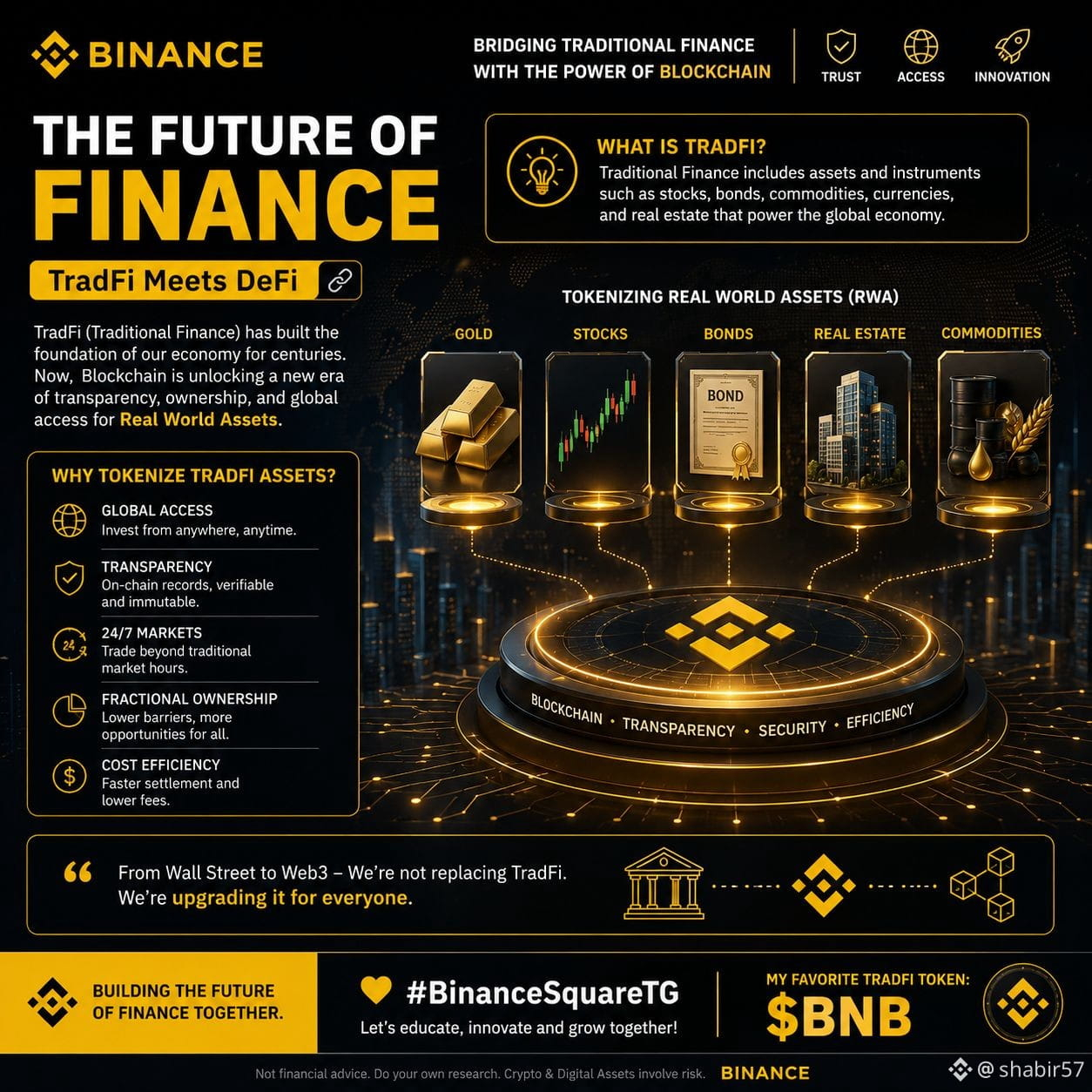
💛 THE FUTURE OF FINANCE: TradFi Meets DeFi
Traditional Finance built the foundation of the global economy. Blockchain is opening new doors for the future.
🚀 Tokenized Gold & Silver
📈 Tokenized Stocks & Bonds
🌍 Global Financial Access
🔐 Transparency & Security
⚡ 24/7 Digital Markets
Real World Assets (RWA) are bringing traditional assets into the blockchain world.
I believe the future of finance will connect TradFi with DeFi, creating new opportunities for everyone.
💛 My favorite TradFi-related token: $BNB
What do you think will lead the future of finance?
#BinanceSquareTG #TradFi #DeFi #RWA $BNB
84


·
--
Uniswap remains the undeniable heavyweight champion of the decentralized exchange (DEX) world, but the protocol is currently undergoing its most ambitious transformation yet.
From pioneering the Automated Market Maker (AMM) model to handling billions in daily trading volume, Uniswap defined how modern DeFi operates. Now, all eyes are on two major catalysts driving its next phase: the rollout of Uniswap v4 and the launch of Unichain, its dedicated Ethereum Layer 2 network.
Uniswap v4 introduces hooks, allowing developers to create custom liquidity pools with features like dynamic fees, on-chain limit orders, and automated risk management strategies directly on top of the core contract. This modular architecture drastically lowers gas costs while unlocking unmatched flexibility for liquidity providers and traders.
However, the strategic game-changer is Unichain. By building its own L2 network, Uniswap Labs aims to offer sub-second transaction times, cross-chain liquidity access, and significantly reduced fees for users. This move transitions Uniswap from a protocol deployed across multiple chains into a self-sustaining DeFi blockchain ecosystem.
For UNI token holders, these architectural upgrades bring renewed focus to protocol governance, MEV internalisation, and potential value capture mechanisms. While regulatory scrutiny around decentralized finance remains an industry challenge, Uniswap's aggressive product iteration keeps it steps ahead of both centralized and decentralized rivals.
As Uniswap transitions to its own dedicated blockchain infrastructure, will Unichain solidify its absolute dominance in DeFi, or will competing multi-chain DEXs siphon away market share? Share your perspective below.
#Uniswap #DeFi #Crypto
94
🦈 $AAVE TOKENOMICS SHIFT: ANALYZING V4 GROWTH VERSUS PAUSED BUYBACKS 📊
While protocol revenue remains robust with V4 deposits surging past one billion dollars, institutional participants must evaluate the structural impact of paused token buybacks. 🌊 The DAO currently balances risk management and treasury reserves following earlier bridge exposures, meaning value accumulation relies more on governance direction than open-market absorption. 💡
Higher reserve factors aim to boost annualized earnings, yet compressing supplier yields risks capital migration to competing lending pools. 🔍 How is your evaluation of $AAVE changing as V4 expands external partnerships without active token repurchases? 💬
⚠️ Not financial advice. Always manage your risk. 🛡️
🏷️ #AAVE #DeFi #SmartMoney #Tokenomics
🦈 ⚖️
14

·
--
📊 Counter-Trend Momentum: $LISTA Surges 29.31% as Capital Rotates into BNB DeFi
While the broader market faces selling pressure, $LISTA is trading at $0.1147 (+29.31% in 24h, Vol $12.83M), tagging its 7-day high at $0.1197 after rallying from a 7-day low of $0.061.
🔎 Key Catalyst:
Lista DAO completed its CDP migration onto Lista Lending and expanded collateral options to include tokenized stock products alongside its StableSwap v3 infrastructure. That utility push is drawing selective liquidity back into $BNB ($546.49, -2.11%) ecosystem DeFi.
🎯 Key Levels & Risk:
Immediate resistance sits at $0.1197-$0.120; a clean breakout on sustained volume is needed for continuation. Key support zones sit around $0.095-$0.100 and the 24h low at $0.0877. With short-term RSI stretched into overbought territory, watch closely for profit-taking pullbacks.
Market observation only, NFA.
#ListaDAO #BNBChain #DeFi
1

Fidelity Adds $LINK & $UNI Alongside $AAVE — Which DeFi Blue Chip Looks Stronger? 🔵🦄
Wall Street just opened the door wider for DeFi. With Fidelity now offering spot trading for Chainlink ($LINK) and Uniswap ($UNI) alongside $AAVE, traders are watching which token reacts first once market sentiment stabilizes.
🔹 Chainlink ($LINK):
• Remains the core infrastructure play for on-chain data and institutional tokenization. Watching how $LINK holds its key intraday support before looking for momentum continuation.
🔹 Uniswap ($UNI):
• The largest decentralized exchange token by volume — direct beneficiary whenever on-chain trading activity picks up.
My Take: Institutional listings rarely pump prices instantly during a broader market pullback, but they set the stage for stronger moves when buyers return. I’m keeping both $LINK and $UNI on my watchlist for volume confirmation.
Which one are you watching closer right now — $LINK, $UNI, or $AAVE? 👇
Disclaimer: Not financial advice. Always DYOR.
#Write2Earn #LINK #UNI #DeFi
{future}(LINKUSDT)
Fidelity Adds $LINK & $UNI Alongside $AAVE — Which DeFi Blue Chip Looks Stronger? 🔵🦄
Wall Street just opened the door wider for DeFi. With Fidelity now offering spot trading for Chainlink ($LINK ) and Uniswap ($UNI) alongside $AAVE, traders are watching which token reacts first once market sentiment stabilizes.
🔹 Chainlink ($LINK ):
• Remains the core infrastructure play for on-chain data and institutional tokenization. Watching how $LINK holds its key intraday support before looking for momentum continuation.
🔹 Uniswap ($UNI):
• The largest decentralized exchange token by volume — direct beneficiary whenever on-chain trading activity picks up.
My Take: Institutional listings rarely pump prices instantly during a broader market pullback, but they set the stage for stronger moves when buyers return. I’m keeping both $LINK and $UNI on my watchlist for volume confirmation.
Which one are you watching closer right now — $LINK , $UNI, or $AAVE? 👇
Disclaimer: Not financial advice. Always DYOR.
#Write2Earn #LINK #UNI #DeFi
43
Log in to explore more content
Join global crypto users on Binance Square
⚡️ Get latest and useful information about crypto.
💬 Trusted by the world’s largest crypto exchange.
👍 Discover real insights from verified creators.
Email / Phone number
Trending Topics
1
#BitcoinAndStocksSlipAgainAmidTrump’sTariffPlans
5,090 views
128 Discussing
2
#JensenHuangSaysNvidiaDoesn’tNeedASuccessionPlan
5,914 views
91 Discussing
3
#AnthropicBreaksBelowIPOPriceAmidAISlump
94,123 views
856 Discussing
4
#CFTCApprovesTradeReportingRuleForPredictionMarkets
5,791 views
99 Discussing
5
#Bitcoin'sReboundFadesBelow$60K
149,805 views
429 Discussing
6
#WillMarketsStageAThanksgivingReliefRally?
676,902 views
3,715 Discussing
7
#EthereumFoundationPlansShiftToHashBasedSignaturesBy2028
7,165 views
145 Discussing
8
#ADPWeeklyPrivatePayrollsSlowTo21000
20,610 views
325 Discussing
9
#WillOctCorePCEShiftFedHikeExpectations?
288,134 views
1,998 Discussing
10
#USReportedlyPreparesNewTariffsOn16TradingPartners
32,805 views
266 Discussing