
#onchaindata
onchaindata
701,353 views
4,119 Discussing
Hot
Latest

Whale alert for $BLESS: 5.9M tokens just shifted to a secondary wallet. Since this address historically dumps after a 2x bounce from the bottom, caution is warranted here. My take: watch for heavy sell pressure near current levels. Are you holding or exiting this pump? #BLESS #CryptoWhale #OnchainData #BinanceSquare
Whale alert for $BLESS : 5.9M tokens just shifted to a secondary wallet. Since this address historically dumps after a 2x bounce from the bottom, caution is warranted here. My take: watch for heavy sell pressure near current levels. Are you holding or exiting this pump? #BLESS #CryptoWhale #OnchainData #BinanceSquare
18

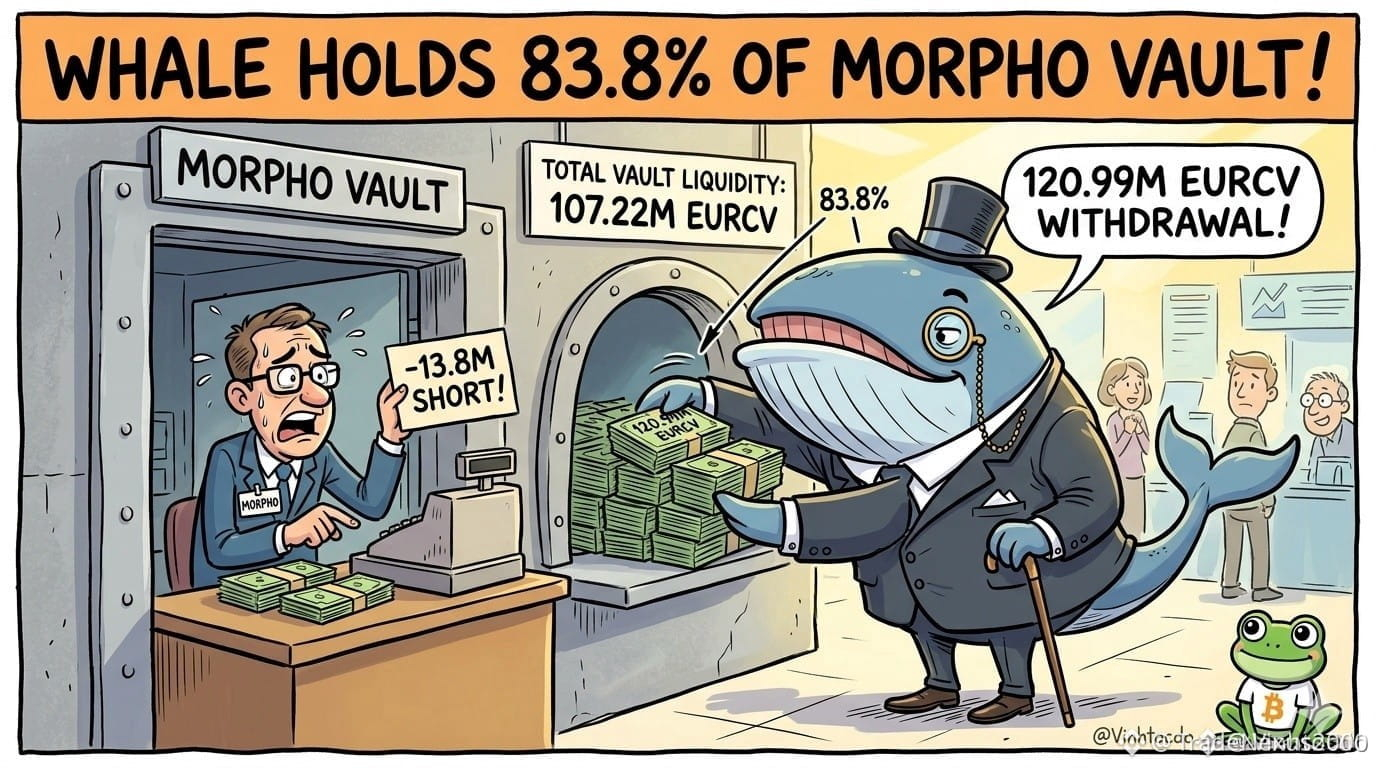
🦈 $MORPHO VAULT LIQUIDITY STRESS: WHEN A SINGLE WHALE CONTROLS 83% OF THE POOL! 🚨
On-chain diagnostics reveal a severe structural vulnerability within top-tier lending vaults, where a solitary institutional participant anchors 83.8 percent of total deposits. 📊 Available vault liquidity currently trails the principal position by millions of tokens, creating an acute structural bottleneck. Regulatory scrutiny highlights systemic concentration risks that participants frequently overlook during aggressive yield expansion phases. 💬 How are you auditing protocol liquidity concentration before deploying capital into high-yield vaults? 👇
⚠️ Not financial advice. Always manage your risk. 🛡️
🏷️ #MORPHO #DeFi #LiquidityRisk #OnChainData
⚡
2

·
--
LINK Institutional Alert: How Smart Money Is Front-Running the Fed Volatility While Retail Capitulates
The market environment this morning is heavy as traders process fresh hawkish Fed commentary and watch $BTC struggle to stabilize near the 60,000 mark. But if you step back from short-term price panic and look at on-chain liquidity dynamics for Chainlink, the institutional narrative tells a completely different story.
While retail traders are reacting to macro headlines and the tail end of exchange withdrawal recovery updates, exchange reserve velocity for $LINK has shifted sharply negative. Over the past 36 hours, major centralized exchange wallets have recorded consecutive net outflows, driving spot market supply down significantly. This is classic cold storage migration.
Comparing this to broader market heavyweights reveals a stark divergence. While BTC navigates an aggressive liquidity tug-of-war with short-term holder capitulation and $ETH trades sluggishly around 1,700, the whale cohort holding between 10,000 and 100,000 LINK units has remained remarkably firm. Not only are these wallet clusters refusing to offload liquidity into recent dips, but the persistent decay in CEX reserves indicates that circulating float on order books is actively shrinking.
The MVRV Z-Score for Chainlink remains positioned well below historical overheated thresholds, signaling that valuation is largely reset despite underlying oracle integration growth. Smart money appears to be ignoring macro noise and building long-term custody positions while liquidity is discounted around 9.36.
Are you noticing similar exchange outflow patterns across your favorite altcoins, or are you staying on the sidelines until Bitcoin finds a clear floor?
#OnChainData #WhaleAlert

1
79

🦈 $LINK EXCHANGE RESERVES BLEEDING AS SMART MONEY QUIETLY ABSORBS THE SUPPLY ⚡
Entry: 9.255 ⚡
Institutional custody shifts are redefining $LINK positioning as exchange reserves drain into cold storage at a pace unseen since Q3. 📊 Whale cohorts holding 10k to 100k units are absorbing retail exhaustion, printing a classic supply-side divergence while macro correlations with $BTC and $ETH take a back seat. 💡
With the MVRV Z-Score holding well below historical overheat zones, this institutional accumulation runway points directly toward structural expansion rather than speculative chop. 🌊 Are you positioning alongside these quiet whale flows, or waiting for a headline confirmation? 👇
⚠️ Not financial advice. Always manage your risk. 🛡️
🏷️ #LINK #SmartMoney #OnChainData #Accumulation
🦈 🔒
23

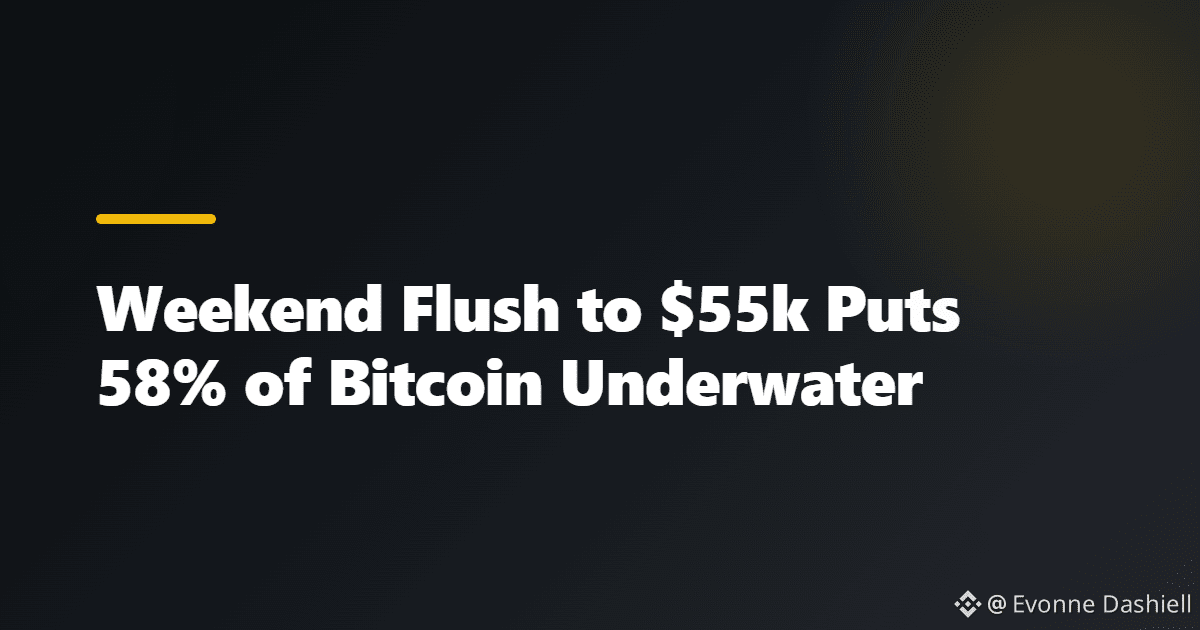
Here's what happened when the weekend flush took $BTC to $55k.
Most traders who bought the run-up are now sitting on heavy losses, with no clear signal on when to get out. Seven straight weeks of red will do that to you.
Glassnode just logged 11.6 million $BTC underwater, the highest number they have ever recorded. That works out to roughly 58% of circulating supply held below cost. The summer low under $60k only put 10.5 million coins in the red, and that reading already matched the capitulation prints from December 2018, March 2020, and November 2022.
What most people missed is that this drawdown ran past every one of those historical bottoms by more than a million coins. Bitcoin is over 50% off the $126k top.
When this much supply is at a loss, the danger is that remaining holders start to capitulate and turn a deep correction into a longer grind lower, dragging $ETH and the rest of the market with it.
Where do you think this goes from here?
#Bitcoin #OnChainData #Crypto
1

·
--
Have you noticed how the loudest bears calling for a deeper collapse are the exact same traders who panic sold the absolute bottom in previous cycles?
Watching your balance bleed through seven consecutive red weeks makes it tempting to capitulate, and most investors end up selling at the exact point of maximum financial pain. Sitting through a 50% drawdown from the $126k peak is brutal, but dumping spot bags into extreme market exhaustion is how retail consistently misses the recovery.
The prevailing crowd narrative says the market is broken, but on-chain metrics show we are deep inside historic capitulation territory. Following the weekend flush to $55k, roughly 11.6m $BTC is now underwater, meaning about 58% of circulating supply is held at an unrealized loss. That is the highest count Glassnode has ever recorded. For context, the summer low under $60k pushed 10.5m coins into the red, matching the exact cycle bottoms of December 2018, March 2020, and November 2022. This flush has pushed past every single one of those capitulation markers by over a million coins.
Treat this environment as an execution window rather than a panic trigger. The smart play right now is to cut high-leverage exposure, hold your $USDT reserves for key support retests, and ladder spot bids gradually instead of trying to time the exact bottom tick. When nearly six out of every ten coins are held below cost, sellers are statistically running out of supply to dump.
Where do you think this goes from here?
#Bitcoin #CryptoMarket #OnChainData

Whale alert on $ICNT! A large wallet just deposited 339K tokens worth $148K to Coinbase. While price bucked $BTC lately, this transfer signals heavy sell pressure ahead. My read: smart money is cashing out fast. Will this dump break local support?
#ICNT #CryptoWhales #BinanceSquare #OnchainData
Whale alert on $ICNT ! A large wallet just deposited 339K tokens worth $148K to Coinbase. While price bucked $BTC lately, this transfer signals heavy sell pressure ahead. My read: smart money is cashing out fast. Will this dump break local support?
#ICNT #CryptoWhales #BinanceSquare #OnchainData
#ICNT #CryptoWhales #BinanceSquare #OnchainData
3
·
--
URGENT: Institutional Custody Shifts are REDEFINING LINK Exposure—Here is the Real Data.URGENT: Institutional Custody Shifts are REDEFINING $LINK Exposure—Here is the Real Data.
I am sitting here looking at the latest on-chain movements for November 26, 2026, and the narrative shifting across the desks is becoming impossible to ignore. While everyone is distracted by headlines about Grant Cardone adding more $BTC to his fund or the ongoing ripples from the Anthropic IPO, there is a specific, quiet accumulation pattern happening within the oracle sector that is screaming institutional interest.
If you look at the 30-day CEX netflow data, we are seeing a marked divergence. Exchange reserves for LINK have been consistently bleeding out into cold storage at a rate we haven't touched since the start of Q3. When you cross-reference this with the whale cohort balances—specifically the 10k to 100k unit wallets—it is clear that smart money is quietly absorbing the supply that retail is currently dumping out of exhaustion. With the spot price hovering around 9.255, the discount relative to historical accumulation zones is getting thin.
Compare this to BTC, which is currently seeing a different type of volatility driven by broader macro liquidity mandates. While Bitcoin is acting as the stable anchor for the market, the velocity of the Chainlink supply shift suggests a mid-term positioning play that is fundamentally disconnected from the daily chop. Even $ETH is struggling to mirror this specific outflow velocity, as the liquidity there is currently being pulled in too many directions by the latest DeFi interface upgrades and staking withdrawals.
The MVRV Z-Score is telling us that we are nowhere near the historical overheat phase, which gives this accumulation a lot more runway than the 2025 cycle. We are looking at a market that is pricing in real-world asset integration, not just speculative hype. If you are tracking the institutional arbitrage shift as I am, you understand that these reserve movements are the precursor to supply-side shocks.
Are you seeing the same outflow velocity in your own analytics, or are you still focused purely on the local price action?
#OnChainData #WhaleAlert
URGENT: Institutional Custody Shifts are REDEFINING LINK Exposure—Here is the Real Data.
URGENT: Institutional Custody Shifts are REDEFINING $LINK Exposure—Here is the Real Data.
I am sitting here looking at the latest on-chain movements for November 26, 2026, and the narrative shifting across the desks is becoming impossible to ignore. While everyone is distracted by headlines about Grant Cardone adding more $BTC to his fund or the ongoing ripples from the Anthropic IPO, there is a specific, quiet accumulation pattern happening within the oracle sector that is screaming institutional interest.
If you look at the 30-day CEX netflow data, we are seeing a marked divergence. Exchange reserves for LINK have been consistently bleeding out into cold storage at a rate we haven't touched since the start of Q3. When you cross-reference this with the whale cohort balances—specifically the 10k to 100k unit wallets—it is clear that smart money is quietly absorbing the supply that retail is currently dumping out of exhaustion. With the spot price hovering around 9.255, the discount relative to historical accumulation zones is getting thin.
Compare this to BTC, which is currently seeing a different type of volatility driven by broader macro liquidity mandates. While Bitcoin is acting as the stable anchor for the market, the velocity of the Chainlink supply shift suggests a mid-term positioning play that is fundamentally disconnected from the daily chop. Even $ETH is struggling to mirror this specific outflow velocity, as the liquidity there is currently being pulled in too many directions by the latest DeFi interface upgrades and staking withdrawals.
The MVRV Z-Score is telling us that we are nowhere near the historical overheat phase, which gives this accumulation a lot more runway than the 2025 cycle. We are looking at a market that is pricing in real-world asset integration, not just speculative hype. If you are tracking the institutional arbitrage shift as I am, you understand that these reserve movements are the precursor to supply-side shocks.
Are you seeing the same outflow velocity in your own analytics, or are you still focused purely on the local price action?
#OnChainData #WhaleAlert
2


·
--
Exchange balances are shrinking fast—even as Bitcoin struggles to hold the $60,000 mark. 📉
According to CryptoQuant data, centralized exchange reserves dropped by roughly 42,000 BTC over the past month, sliding from 2.889 million BTC down to 2.847 million BTC. Measured from the Oct. 26 peak, the total outflow approaches 50,000 BTC. Meanwhile, weekly wallet activity surged to its highest level since February, with daily deposits averaging 46,900 BTC and withdrawals climbing 50.2% to 49,200 BTC per day.
This heavy movement took place alongside a 26% price pullback from $80,700 to $59,600. When coins leave exchanges faster than they arrive during a downturn, it typically reduces immediate sell-side liquidity on order books.
For traders, elevated two-way wallet flows signal active repositioning rather than a quiet market. Both buyers stepping in and holders moving funds off-platform are reacting aggressively to these lower price levels. 🔍
Are you viewing these heavy outflows as quiet accumulation at $60K, or are you waiting for volatility to settle first?
#bitcoin #BTC #Crypto #onchaindata
76
·
--
Trading on the XRP Ledger's built-in order book just had its busiest quarter on Evernorth's record, but ten accounts did most of the work.
In a report published on November 24, 2026, Evernorth said order-book volume on the ledger averaged 4.51 million $XRP a day in the third quarter of 2026, up 26% from Q2 and 2.8 times the level a year earlier. The ten busiest accounts carried 65% of that volume, up from 33% a year before, while daily trading accounts fell to about 1,042, roughly half the year-earlier count.
The average swap nearly doubled to about 35 XRP even as daily swaps fell 37%, a pattern Evernorth links to market makers and trading desks. In dollar terms, exchange volume on the ledger still fell 15% year over year, versus a 42% drop across seven major networks. XRP traded near $0.92 on November 25, 2026.
#XRP #XRPL #OnChainData
DYOR. Not financial advice.

50

📊 $ADA ARCHITECTURE IS TIER-ONE, BUT WHERE IS THE ON-CHAIN VELOCITY? ⚡
The engineering blueprint behind Cardano is undeniably robust, yet the financial reality tells a starkly different story. With total value locked sitting near 43 million dollars and daily network fees hovering around a modest 982 dollars, the market is waiting for throughput upgrades like Leios to translate technical capacity into real economic demand. 📊
Infrastructure improvements like programmable token standards provide the plumbing, but sustainable network health requires heavy, recurring user activity rather than just architectural promise. ⚡
💬 Can upcoming protocol scaling finally spark the transactional volume needed to drive genuine token utility? 👇
⚠️ Not financial advice. Always manage your risk. 🛡️
🏷️ #ADA #Cardano #OnChainData #CryptoAnalysis
📊 💡
7
🦈 $XRP ON-CHAIN METRICS REVEAL QUIET INSTITUTIONAL ACCUMULATION BEHIND THE SCENES 📈
📊 Q3 data points to a structural shift in order flow as $XRP DEX volume surged to 4.51 million daily, printing a 26% quarter-over-quarter expansion and scaling 2.8x year-over-year.
💡 Beneath the surface, the XRP Ledger is absorbing massive liquidity with tokenized asset values hitting 5 billion dollars alongside a 74% surge in $RLUSD supply to 937 million.
This underlying network velocity points to sustained utility rather than fleeting retail noise. 🤔 Are you positioning for this quiet structural expansion before the broader market wakes up? 👇
⚠️ Not financial advice. Always manage your risk. 🛡️
🏷️ #XRP #OnChainData #SmartMoney #CryptoAnalysis
🔥 🦈
4
·
--
Everyone was celebrating a massive Bitcoin supply squeeze during Saturday's selloff—until on-chain data told a different story. 📉
According to data from Ask The Tape, over 11,027 BTC moved into Kraken-tagged wallets on Nov. 21 across five separate transfers. Coinbase sent roughly 4,028 BTC in two batches, while Binance accounted for 7,000 BTC across three transactions.
At the time, large net withdrawals from major platforms fueled expectations that tradable Bitcoin supply was drying up. However, these transfers show that significant volume simply shifted between exchanges rather than moving into long-term cold storage.
For traders, this is a strong reminder to look beyond headline outflow numbers. Liquidity leaving one venue can quickly replenish order books elsewhere, meaning exchange supply isn't always as tight as initial metrics suggest—especially with BTC hovering near $60,166 after a 4.35% daily drop.
Are you still viewing current exchange flows as bullish accumulation, or is this just routine liquidity reshuffling?
#bitcoin #Crypto #BTC #onchaindata
1
379
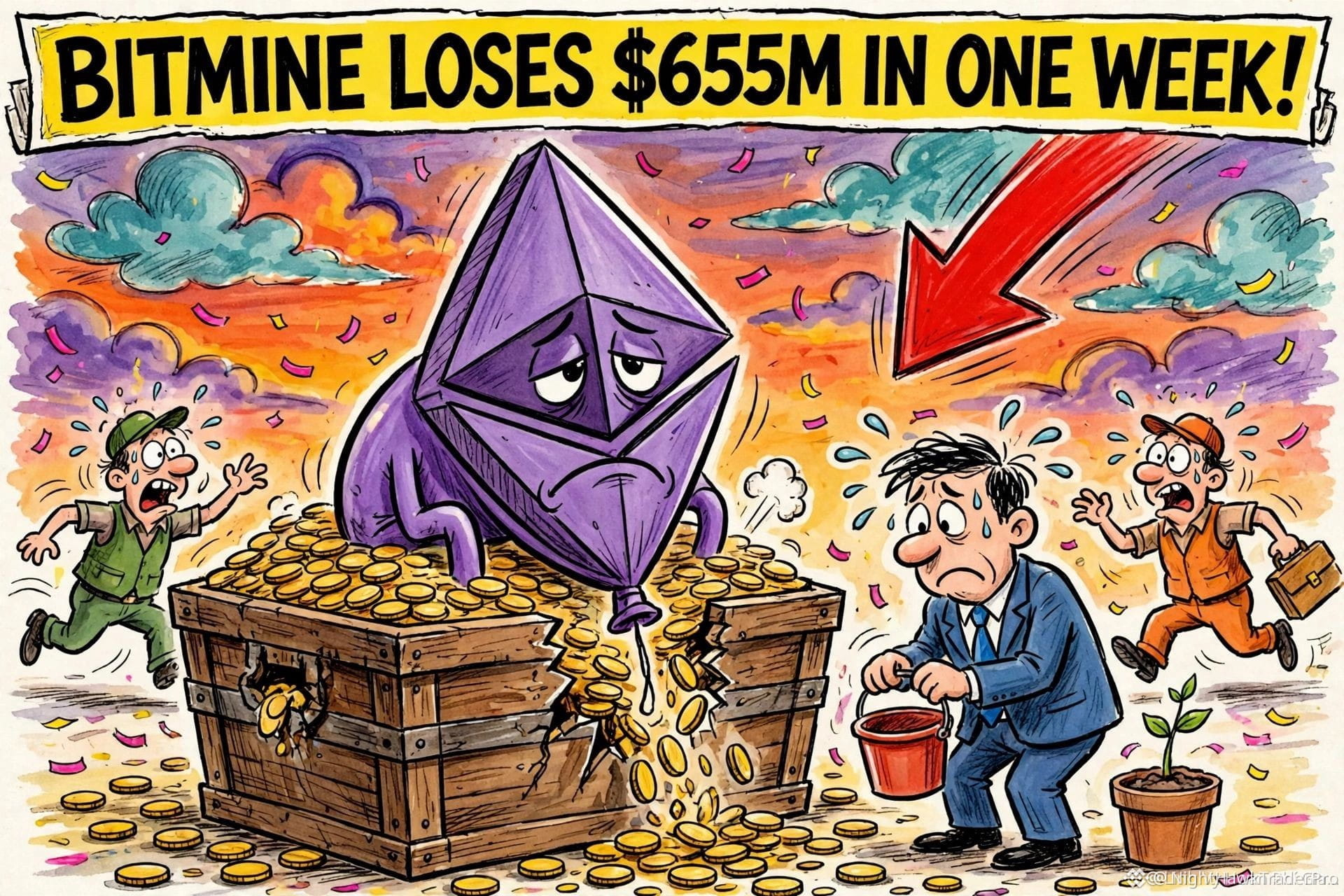
🦈 INSTITUTIONAL ACCUMULATION MEETS PRESSURE: $ETH TREASURY DRAWS DOWN $655M 📉
Entry: 1,693 ⚡
Smart money holdings face intense structural testing as major treasury footprints absorb deep unrealized drawdowns. While staking inflows generate steady baseline yield, aggressive supply absorption near key structural handles reveals heavy institutional positioning as nearly five percent of total supply remains locked in reserve. 🦈 📊
Order flow dynamics show persistent distribution pressure overriding baseline yield generation on the multi-year timeframe. Tracking these deep inventory shifts provides vital clues into how institutional portfolios manage major capital allocation during market contractions. 💡
💬 How do you interpret such massive capital retention when spot valuations test multi-year structural supports? 👇
⚠️ Not financial advice. Always manage your risk. 🛡️
🏷️ #ETH #SmartMoney #Ethereum #OnChainData
🦈 📉
23

Headline: Bitcoin's Nvidia-Driven Rally Faces a New Test as 6,400 BTC Flows Into Binance
Summary:
Bitcoin surged following NVIDIA CEO Jensen Huang's reinstatement, briefly climbing above $64,600. However, the rally quickly lost momentum as fresh on-chain data revealed significant movements of Bitcoin between investors and exchanges.
Key Points:
- BTC jumped from approximately $61,304 to $64,603 following the NVIDIA announcement, according to Binance price data reported by APA.
- The price later retreated to around $62,645 in the reported trading session.
- CryptoQuant data shows mid-sized investor deposits to Binance averaged approximately 6,400 BTC over seven days.
- This was the fifth time in 2026 that this investor group's inflows exceeded 5,000 BTC.
- On November 21, Binance recorded approximately $680 million in net BTC outflows, while combined net outflows across Binance, Coinbase, Bybit and Kraken stood at $678 million.
- Exchange deposits do not automatically mean investors are selling.
Market Insight:
Bitcoin's rally following NVIDIA's leadership news may reflect improving risk sentiment and short-position liquidations rather than a confirmed recovery. The combination of mid-sized investor deposits and broader exchange outflows highlights changing investor behavior. Sustained demand, ETF flows and BTC's ability to hold support levels will be crucial for the next move.
#Binance #BitcoinWhales #CryptoMarket #OnChainData #MarketAnalysis $NVDA $BTC
{future}(BTCUSDT)
{future}(NVDAUSDT)
Headline: Bitcoin's Nvidia-Driven Rally Faces a New Test as 6,400 BTC Flows Into Binance
Summary:
Bitcoin surged following NVIDIA CEO Jensen Huang's reinstatement, briefly climbing above $64,600. However, the rally quickly lost momentum as fresh on-chain data revealed significant movements of Bitcoin between investors and exchanges.
Key Points:
- BTC jumped from approximately $61,304 to $64,603 following the NVIDIA announcement, according to Binance price data reported by APA.
- The price later retreated to around $62,645 in the reported trading session.
- CryptoQuant data shows mid-sized investor deposits to Binance averaged approximately 6,400 BTC over seven days.
- This was the fifth time in 2026 that this investor group's inflows exceeded 5,000 BTC.
- On November 21, Binance recorded approximately $680 million in net BTC outflows, while combined net outflows across Binance, Coinbase, Bybit and Kraken stood at $678 million.
- Exchange deposits do not automatically mean investors are selling.
Market Insight:
Bitcoin's rally following NVIDIA's leadership news may reflect improving risk sentiment and short-position liquidations rather than a confirmed recovery. The combination of mid-sized investor deposits and broader exchange outflows highlights changing investor behavior. Sustained demand, ETF flows and BTC's ability to hold support levels will be crucial for the next move.
#Binance #BitcoinWhales #CryptoMarket #OnChainData #MarketAnalysis $NVDA $BTC

111
·
--
Why Whales Are Choosing Solana While the Rest of the Market Bleeds OutWhy Whales Are Choosing Solana While the Rest of the Market Bleeds Out
The 40% deleveraging event just reset the board, and if you are still looking at the charts the same way you were last week, you are missing the signal in the noise. It is Monday, November 23, 2026, and the correlation between the Nvidia rally and our crypto liquidity pools has never been tighter. With NVDA jumping 8% premarket following the latest political shifts regarding the tech sector, institutional capital is rotating at breakneck speed, leaving retail-heavy assets gasping for air.
I have been digging into the on-chain flows this morning, and the divergence is glaring. While exchange reserves are fluctuating wildly following the record-breaking open interest wipeout in $BTC, the smart money is quietly moving supply into cold storage. I am tracking a distinct pattern where large holders are shrugging off the volatility and instead repositioning their capital toward the Solana ecosystem.
When you look at the $SOL on-chain activity, the withdrawal velocity from Binance cold wallets suggests that whales are not panic selling into this deleveraging event. They are actually absorbing the float. Compared to $ETH, which is currently seeing higher dormancy in long-term holder wallets, SOL is showing a more aggressive accumulation phase by the 1k to 10k unit wallet cohorts.
We are seeing a classic supply shock setup hidden behind the chaos of the broader market reset. The MVRV Z-score is currently hovering in a zone that historically precedes institutional re-entry, but the real tell is how Solana is holding its own while the rest of the altcoin market struggles to find a floor. This is not just about price action; it is about the structural integrity of the network under extreme liquidation pressure.
Institutional flows are favoring assets that can prove their liquidity resilience, and the current on-chain data is painting a very specific picture of who is holding the bag. Are you seeing the same shift in your own wallet tracking, or do you think this current liquidity crunch still has room to shake out the late longs?
#OnChainData #WhaleAlert
Why Whales Are Choosing Solana While the Rest of the Market Bleeds Out
Why Whales Are Choosing Solana While the Rest of the Market Bleeds Out
The 40% deleveraging event just reset the board, and if you are still looking at the charts the same way you were last week, you are missing the signal in the noise. It is Monday, November 23, 2026, and the correlation between the Nvidia rally and our crypto liquidity pools has never been tighter. With NVDA jumping 8% premarket following the latest political shifts regarding the tech sector, institutional capital is rotating at breakneck speed, leaving retail-heavy assets gasping for air.
I have been digging into the on-chain flows this morning, and the divergence is glaring. While exchange reserves are fluctuating wildly following the record-breaking open interest wipeout in $BTC , the smart money is quietly moving supply into cold storage. I am tracking a distinct pattern where large holders are shrugging off the volatility and instead repositioning their capital toward the Solana ecosystem.
When you look at the $SOL on-chain activity, the withdrawal velocity from Binance cold wallets suggests that whales are not panic selling into this deleveraging event. They are actually absorbing the float. Compared to $ETH , which is currently seeing higher dormancy in long-term holder wallets, SOL is showing a more aggressive accumulation phase by the 1k to 10k unit wallet cohorts.
We are seeing a classic supply shock setup hidden behind the chaos of the broader market reset. The MVRV Z-score is currently hovering in a zone that historically precedes institutional re-entry, but the real tell is how Solana is holding its own while the rest of the altcoin market struggles to find a floor. This is not just about price action; it is about the structural integrity of the network under extreme liquidation pressure.
Institutional flows are favoring assets that can prove their liquidity resilience, and the current on-chain data is painting a very specific picture of who is holding the bag. Are you seeing the same shift in your own wallet tracking, or do you think this current liquidity crunch still has room to shake out the late longs?
#OnChainData #WhaleAlert
4

·
--
THE WHALE PLAYBOOK: WHY WHALES BUY WHEN YOU PANIC
While retail traders react emotionally to short-term price drops, the largest on-chain entities—known as "Whales"—view market panic as their ultimate accumulation window.
Here is exactly how they operate behind the scenes:
Liquidation Hunting: When the market dips, over-leveraged traders are forced to sell. Whales place massive buy orders at key support levels, absorbing this panic-selling volume without driving the price back up immediately.
The "Accumulation" Phase: On-chain data shows that wallets holding 1,000+ BTC have been quietly increasing their balances, reaching some of their highest accumulation levels since 2020. They do this over weeks, avoiding sudden pumps until they’ve secured their positions.
Capitalizing on Leverage: When leveraged "long" positions are wiped out, it creates a waterfall effect of dropping prices. Whales use this artificial drop to scoop up "spot" BTC at a discount, knowing the long-term supply is strictly limited.
Patience Over Panic: A whale's timeline is measured in years, not hours. While you are watching the 15-minute chart, they are looking at the 4-year cycle.
To survive in this market, you must learn to think like a whale: protect your capital, ignore the noise, and never sell your assets to those who have the patience to wait for them.
Are you accumulating during market dips, or are you waiting on the sidelines? Drop your thoughts below and hit follow for daily on-chain insights!
#OnChainData #BTC #BinanceSquare #WhaleAccumulation

75
🚨 OVER 6 MILLION $BTC SITTING BEHIND VULNERABLE ONCHAIN KEYS! ⚡
Glassnode data reveals that over thirty percent of circulating $BTC supply currently rests behind exposed public keys onchain. 📊 This creates a sprawling migration puzzle for the entire asset class.
Infrastructure providers like custodians and major exchanges face a heavy infrastructure lift upgrading to post-quantum multisig standards. ⚡ Meanwhile, developers remain divided between voluntary upgrades and protocol enforcement through drafts like BIP 361.
How will institutions navigate this multi-year cryptographic transition as the runway tightens? 🤔 👇
⚠️ Not financial advice. Always manage your risk. 🛡️
🏷️ #BTC #Bitcoin #CryptoSecurity #OnchainData
🔥 💎

10

·
--
🦈 WHALES ARE DRAINING CEX RESERVES ON $ETH WHILE RETAIL PANICS INTO SUPPORT! 📉
Entry: 1,718.91 ⚡
Macro equity bloodbaths and institutional ETF outflows are doing heavy damage to leveraged retail books, but the real narrative is hiding below the surface. Whale cohorts holding thousands of coins are aggressively pulling supply off major exchange venues rather than dumping into weakness.
Realized losses from short-term hands are flowing straight into deeper institutional pockets while MVRV metrics sit tightly compressed. As dormant supply remains locked, thinning exchange depth means even a minor spark in demand can ignite aggressive upside repricing. 📊 Are you tracking these cold-storage outflows or waiting for macro noise to clear? 👇
⚠️ Not financial advice. Always manage your risk. 🛡️
🏷️ #ETH #OnChainData #WhaleAlert #Crypto
🦈 💎
7
·
--
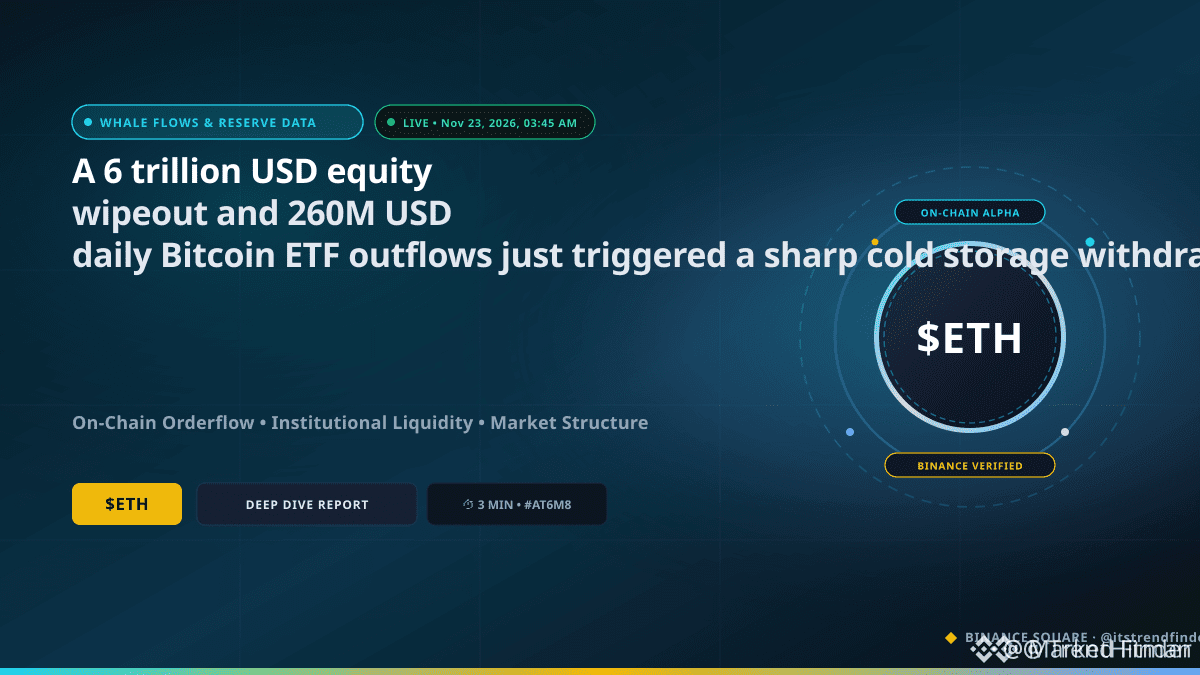
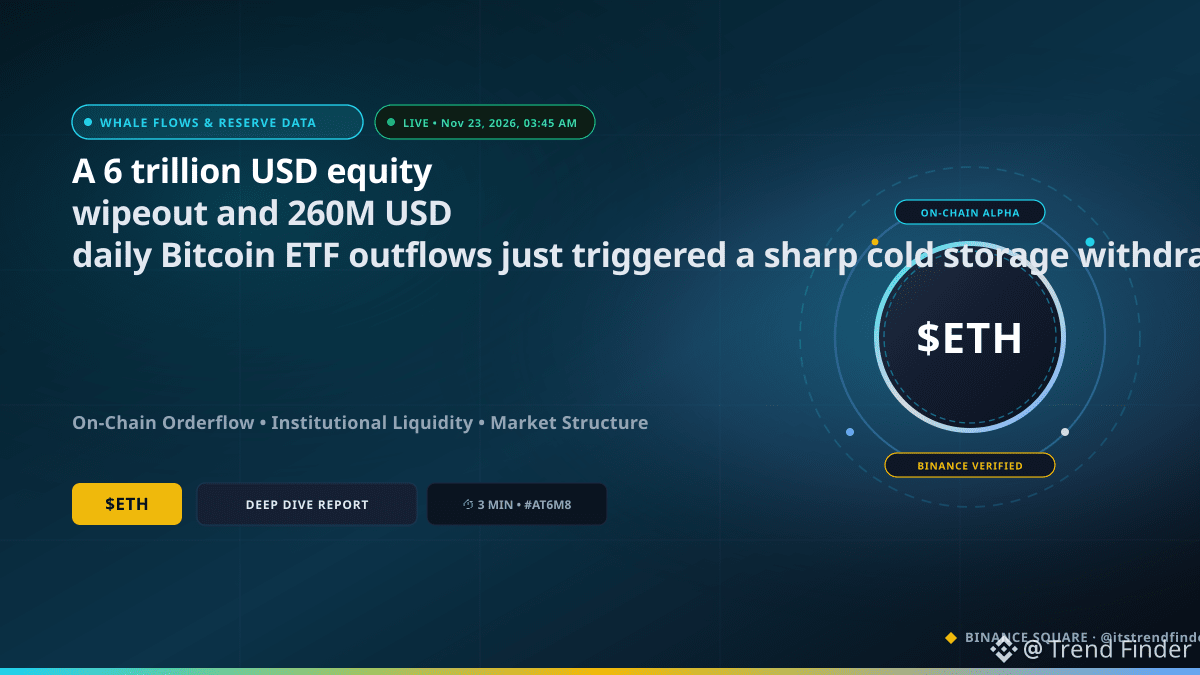
A 6 trillion USD equity wipeout and 260M USD daily Bitcoin ETF outflows just triggered a sharp cold storage withdrawal shift—here is how smart money is positioning $ETH into Tuesday.
While mainstream feeds are dominated by Bessent citing Fed remarks and midterm uncertainty alongside fresh anxiety over Cysic flagging 6 million exposed public keys on $BTC, on-chain orderflow tells a quieter story. Tracking the Sunday-to-Monday transition from my desk, exchange reserve outflows have picked up speed rather than reversing. Instead of rushing spot supply onto Binance to panic-sell near 1,718.91, whale cohorts holding 1,000 to 10,000 ETH are pulling coins off centralized venues with CEX balances sitting near multi-year lows.
The core valuation metrics back up this divergence. Ethereum's MVRV Z-score sits compressed against its realized cap valuation, while SOPR readings show short-term holders realizing losses into deeper pockets. Looking at the long-term holder versus short-term holder supply ratio, dormant supply refuses to budge even as macro volatility shakes out leveraged retail accounts.
Comparing cross-asset flows makes the setup even clearer. Spot BTC liquidity remains weighed down by persistent institutional redemptions and security headlines, whereas $SOL has turned into a fast-moving proxy for intraday momentum desks. At the same time, Binance introducing TradFi perpetuals and Anthropic ANTB tokenized securities as collateral gives larger funds fresh ways to manage margin risk without dumping core layer-one holdings into thin spot books.
When 30-day CEX netflows stay negative during a macro selloff, exchange depth thins out fast, meaning any shift in ETF demand can move price discovery abruptly. Are you leaning into this whale cold-storage accumulation, or sitting tight until midweek ETF and macro flows settle down?
#OnChainData #WhaleAlert
A 6 trillion USD equity wipeout and 260M USD daily Bitcoin ETF outflows just triggered a sharp cold storage withdrawal shift—here is how smart money is positioning $ETH into Tuesday.
While mainstream feeds are dominated by Bessent citing Fed remarks and midterm uncertainty alongside fresh anxiety over Cysic flagging 6 million exposed public keys on $BTC , on-chain orderflow tells a quieter story. Tracking the Sunday-to-Monday transition from my desk, exchange reserve outflows have picked up speed rather than reversing. Instead of rushing spot supply onto Binance to panic-sell near 1,718.91, whale cohorts holding 1,000 to 10,000 ETH are pulling coins off centralized venues with CEX balances sitting near multi-year lows.
The core valuation metrics back up this divergence. Ethereum's MVRV Z-score sits compressed against its realized cap valuation, while SOPR readings show short-term holders realizing losses into deeper pockets. Looking at the long-term holder versus short-term holder supply ratio, dormant supply refuses to budge even as macro volatility shakes out leveraged retail accounts.
Comparing cross-asset flows makes the setup even clearer. Spot BTC liquidity remains weighed down by persistent institutional redemptions and security headlines, whereas $SOL has turned into a fast-moving proxy for intraday momentum desks. At the same time, Binance introducing TradFi perpetuals and Anthropic ANTB tokenized securities as collateral gives larger funds fresh ways to manage margin risk without dumping core layer-one holdings into thin spot books.
When 30-day CEX netflows stay negative during a macro selloff, exchange depth thins out fast, meaning any shift in ETF demand can move price discovery abruptly. Are you leaning into this whale cold-storage accumulation, or sitting tight until midweek ETF and macro flows settle down?
#OnChainData #WhaleAlert
1
3
Log in to explore more content
Join global crypto users on Binance Square
⚡️ Get latest and useful information about crypto.
💬 Trusted by the world’s largest crypto exchange.
👍 Discover real insights from verified creators.
Email / Phone number
Trending Topics
1
#EvolveAtBinanceBlockchainWeek
977,507 views
12,069 Discussing
2
#CanMarketsReboundAfterThanksgiving?
299,878 views
2,526 Discussing
3
#Nasdaq100FiveDayAvgIntradayVolatilityHits3.8%
19,425 views
256 Discussing
4
#CorePCEBeatLiftsFedHikeOdds
365,068 views
1,954 Discussing
5
#CouldSpaceX’sOrbitalDataCentersBoostAIChipDemand?
136,135 views
1,464 Discussing
6
#ZcashDevelopersUrgeZECMoveToIronwood
65,351 views
346 Discussing
7
#XRPLedgerVaultGets29Votes
2,222 views
27 Discussing
8
#ASEANPlus3ToFormCrossBorderPaymentsCryptoWorkingGroup
5,720 views
11 Discussing
9
#StellarAdds$80.4MTokenizedFundsInOneDay
6,608 views
21 Discussing
10
#BitcoinTops$60000
61 views
23 Discussing