
#islamicfinance
islamicfinance
731,818 views
737 Discussing
Hot
Latest
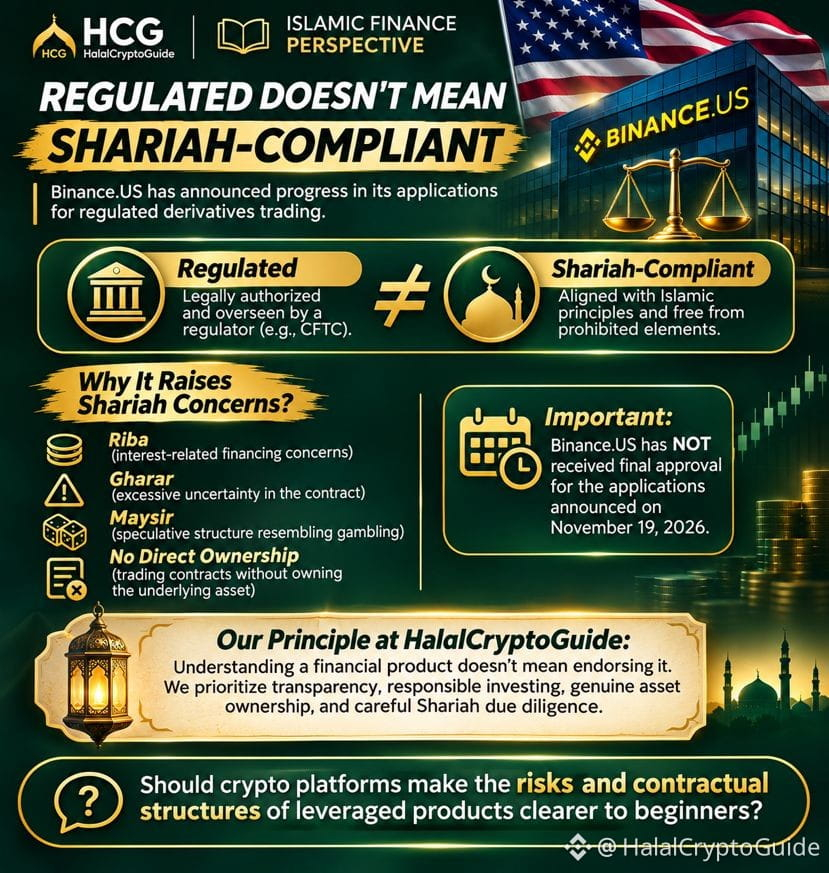
⚖️ REGULATED DOESN’T MEAN SHARIAH-COMPLIANT
Binance.US has announced progress in its applications for regulated derivatives trading.
But here’s something every Muslim investor should understand:
Regulatory approval and Shariah compliance are NOT the same thing.
A financial product can be legally authorized while still raising Islamic-finance concerns.
⚠️ Conventional crypto futures and leveraged derivatives may involve:
🔹 Riba-related financing concerns
🔹 Excessive uncertainty (gharar)
🔹 Speculative structures resembling gambling (maysir)
🔹 Contracts without direct ownership of the underlying asset
Importantly, Binance.US has not received final approval for the applications announced on November 19.
☪️ Our principle at HalalCryptoGuide:
Understanding a financial product doesn’t mean endorsing it.
We prioritize transparency, responsible investing, genuine asset ownership, and careful Shariah due diligence.
💬 Should crypto platforms make the risks and contractual structures of leveraged products clearer to beginners?
#IslamicFinance #CryptoEducation #InvestorProtection #HalalCryptoGuide
91

·
--
Crypto Market Update & Halal Earning Focus
Title: 🚀 Crypto & Islamic Finance: How to Grow Portfolio the Halal Way!
Salam Binance Square Family! 👋
Cryptocurrency ki dunya din ba din evolve ho rahi hai, aur aaj ke dor mein Muslim investors ke liye Shariah-compliant tareeqon se earning karna pehle se kahin zyada asaan ho gaya hai.
Agar aap bhi Riba (interest) aur excessive risk (Gharar) se bach kar crypto market mein growth chahte hain, toh yeh cheezein zaroori hain:
1. Spot Trading & HODLing: Fundamental strong projects mein invest karein jo real utility rakhte hon.
2. Binance Sharia Earn: BNB, ETH, aur SOL ke liye Shariah-compliant staking options ko explore karein jo Amanie Advisors se certified hain (Wakala agreement ke zariye transparent returns).
Market mein roz new updates aur opportunities aa rahi hain, bas zaroorat hai apni research (DYOR) ki! 📈
💬 Aap kis coin ko HODL kar rahe hain? Comments mein batayein! 👇
#BinanceSquare #HalalCrypto #CryptoNews #ShariaEarn #IslamicFinance
123
·
--
Indonesia's sharia banks now hold Rp1,108.45 trillion in assets, and OJK just added three new product rulebooks.
• Sharia banking assets reached Rp1,108.45T in September 2026, up 10.16% y/y, a 7.53% share of national banking assets
• The three guidelines add to nine earlier ones under the RP3SI 2023-2027 roadmap
Why it matters: Clearer sharia product rules can widen Indonesia's Islamic financing base.
Source: OJK (Otoritas Jasa Keuangan)
Not financial advice.
💬 Should Islamic finance standards play a bigger role in how Southeast Asia regulates digital assets?
#OJK #Indonesia #IslamicFinance
14
·
--
OJK used IIFS 2026 in Makassar to push collaboration and innovation for sustainable halal economic growth.
• OJK held Indonesia Islamic Finance Summit (IIFS) 2026 in Makassar on Nov 2–3, 2026
• Theme: Strengthening Islamic Finance Ecosystem to Advance Sustainable Halal Economic Growth
Why it matters: Indonesia’s financial regulator is tying Islamic-finance policy and digital-asset oversight into one national blueprint.
Source: Katadata / OJK
Not financial advice.
💬 Will OJK’s Islamic-finance blueprint change how sharia-compliant digital assets are supervised in Indonesia?
#OJK #Indonesia #IslamicFinance
18
🚨 Binance just expanded bStocks into Margin — and Muslim investors should understand what changes when a “stock” becomes collateral.
Binance announced today that bStocks can now be used as collateral across Cross Margin and Portfolio Margin accounts.
That means an investor may now:
hold a tokenized security → use it as collateral → take on margin exposure
But there’s an important detail buried in Binance’s own disclosure:
📌 bStocks are NOT stocks or shares and do not give you direct ownership of the underlying company’s shares.
They are classified as certificates representing certain financial instruments.
Now add margin to that structure, and there are multiple layers to understand:
Underlying company
↓
bStock certificate/tokenized security
↓
Collateral
↓
Margin borrowing / leveraged exposure
🕌 For Muslim investors, screening the underlying company alone may therefore be insufficient.
Separate questions may include:
• What exactly does the bStock holder legally own?
• How closely does it represent the underlying security?
• What happens when that instrument becomes collateral?
• Is borrowing involved?
• What fees or financing mechanisms apply to the margin position?
I’m not declaring bStocks or this margin feature halal or haram.
The broader principle is more useful:
📌 A Shariah-compliant underlying company does not automatically answer whether every financial structure built around its shares is Shariah-compliant.
Before using a product, understand both the asset AND the contract.
👇 Should I break down the complete bStocks structure — from the real share to the tokenized certificate to margin collateral — next?
#IslamicFinance #BinanceStocks #HalalCryptoGuide
Educational only — not financial advice or a fatwa.
84
🚨 BINANCE ADDED NEW WAYS TO EARN OPTION PREMIUMS — BUT WHAT'S THE HIDDEN OBLIGATION?
Binance has introduced Covered Call and Cash-Secured Put strategies for eligible stock-options users.
📌 Covered Call: You hold shares and sell a call option. Your shares may be sold at a predetermined price, limiting potential gains.
📌 Cash-Secured Put: You reserve USDC and may be required to buy shares at an agreed price, even if their market value drops sharply.
⚠️ Premium income is NOT guaranteed risk-free profit. Collateral does not eliminate losses.
🕌 IMPORTANT FOR MUSLIM INVESTORS:
The International Islamic Fiqh Academy (OIC) has ruled conventional options contracts traded in financial markets impermissible under its published resolutions.
This concerns the contractual structure, not a blanket judgment on any particular stock or cryptocurrency. Review the actual product terms and seek qualified Shariah guidance.
📌 SAVE THIS: A product being offered by an exchange does not establish Shariah compliance.
💬 Should exchanges explain the risks and contractual obligations before promoting premium income?
#Binance #IslamicFinance #RiskManagement #CryptoEducation
77

·
--
Pakistan’s crypto chief is fighting for digital assets! This news reveals a crucial conversation happening in Pakistan about cryptocurrency. An important religious scholar has advised against using crypto for payments, citing Islamic principles. This doesn't mean crypto is banned, but it sparks a debate about its role in the country. The virtual assets regulator is actively seeking dialogue, which is a positive sign. It shows they want to understand concerns and find common ground, rather than impose an outright ban. This "dialogue" is key to finding a regulatory path forward. This situation highlights the ongoing global challenge of integrating new technologies like crypto with existing cultural, legal, and religious frameworks. How nations adapt to this will shape crypto adoption. A clear regulatory framework, which could emerge from this dialogue, is vital for long-term growth. While some nations debate, we saw $SXT rise over 25% today, showing the market's dynamism. What do you think is the future of crypto in Islamic finance? #CryptoRegulation #IslamicFinance #GlobalAdoption $BTC
Pakistan’s crypto chief is fighting for digital assets! This news reveals a crucial conversation happening in Pakistan about cryptocurrency. An important religious scholar has advised against using crypto for payments, citing Islamic principles. This doesn't mean crypto is banned, but it sparks a debate about its role in the country. The virtual assets regulator is actively seeking dialogue, which is a positive sign. It shows they want to understand concerns and find common ground, rather than impose an outright ban. This "dialogue" is key to finding a regulatory path forward. This situation highlights the ongoing global challenge of integrating new technologies like crypto with existing cultural, legal, and religious frameworks. How nations adapt to this will shape crypto adoption. A clear regulatory framework, which could emerge from this dialogue, is vital for long-term growth. While some nations debate, we saw $SXT rise over 25% today, showing the market's dynamism. What do you think is the future of crypto in Islamic finance? #CryptoRegulation #IslamicFinance #GlobalAdoption $BTC
94
Binance.US reportedly wants to enter prediction markets.
But when does predicting an outcome become gambling rather than investing?
The Financial Times reports today that Binance.US has sought regulatory approval to offer prediction markets in the United States.
Approval has NOT been confirmed.
Prediction markets let participants take financial positions on outcomes such as elections, sporting events or economic decisions.
Here's what Muslim investors should examine:
• Are you acquiring a productive asset or wagering on an uncertain event?
• Where does the payout come from?
• Does the contract create genuine economic ownership or simply a win-or-lose payoff?
• Does regulatory approval address the same questions as Shariah compliance? No — they are separate assessments.
Not every forecasting or hedging arrangement has the same structure, and no blanket ruling follows from this announcement.
The important question isn't whether you can predict correctly. It's whether the financial arrangement itself is appropriate.
Where should the line be drawn between forecasting, hedging and gambling?
#Binance #PredictionMarkets #IslamicFinance #CryptoEducation
69
🚨 Binance is teaching users about U.S. stock options this week — but Muslim investors should know something important before trading them.
Buying an option is NOT the same as buying the underlying stock.
Binance now offers call and put options on 1,000+ U.S. stocks and ETFs, and its current educational campaign specifically highlights these products.
An option gives you a contractual right to buy or sell a security at a specified price before expiry.
You pay a premium for that right.
But you do not own the underlying shares simply because you bought the option.
🕌 And unlike many crypto questions where scholars may differ substantially, there is significant institutional Shariah guidance on conventional financial-market options.
The International Islamic Fiqh Academy states that options contracts as currently traded in international financial markets are not permissible under Shariah.
AAOIFI’s Shariah Standard No. 20 likewise states that conventional options are not permitted in their formation or trading.
So don’t assume:
“The underlying stock is Shariah-compliant → therefore its option must also be Shariah-compliant.”
The underlying asset and the contract used to gain exposure to it are two separate questions.
📌 Save this principle:
Don’t research only WHAT you’re investing in.
Research HOW you’re investing in it.
👇 Should the next post explain why scholars distinguish owning a share from buying an option on that share?
#IslamicFinance #Binance #CryptoEducation #HalalCryptoGuide
Educational only. For personal religious rulings, consult a qualified Shariah scholar.
84

·
--
🚨 Is Crypto Really Haram? Let's Discuss Respectfully.
Millions of people use crypto every day, while many respected scholars have issued different opinions. Some consider many forms of crypto impermissible, while others distinguish between owning digital assets and speculative or leveraged trading.
One point most scholars agree on: ❌ Gambling and excessive speculation are prohibited. Using high leverage or treating trading like gambling is very different from discussing whether owning certain digital assets is permissible.
💭 So here's my question for the Binance Square community:
🔹 Can cryptocurrencies become "Maal" (wealth/property) if they gain widespread acceptance and are regulated? 🔹 Or do you believe crypto remains impermissible regardless?
👇 Share your opinion in the comments:
🟢 "MAAL" — if you believe some cryptocurrencies can be permissible under certain conditions.
🔴 "HARAM" — if you believe crypto is impermissible.
⚠️ Please keep the discussion respectful. This post is for learning and exchanging views, not issuing fatwas. Always consult qualified scholars for religious rulings.
$LAB
{future}(LABUSDT)
$EVAA
{future}(EVAAUSDT)
$CLO
{future}(CLOUSDT)
❤️ Like • 🔄 Share • 💬 Comment
#Crypto #IslamicFinance #Blockchain #BinanceSquare #Bitcoin #Trading #DYOR #Discussion #Web3
🚨 Is Crypto Really Haram? Let's Discuss Respectfully.
Millions of people use crypto every day, while many respected scholars have issued different opinions. Some consider many forms of crypto impermissible, while others distinguish between owning digital assets and speculative or leveraged trading.
One point most scholars agree on: ❌ Gambling and excessive speculation are prohibited. Using high leverage or treating trading like gambling is very different from discussing whether owning certain digital assets is permissible.
💭 So here's my question for the Binance Square community:
🔹 Can cryptocurrencies become "Maal" (wealth/property) if they gain widespread acceptance and are regulated? 🔹 Or do you believe crypto remains impermissible regardless?
👇 Share your opinion in the comments:
🟢 "MAAL" — if you believe some cryptocurrencies can be permissible under certain conditions.
🔴 "HARAM" — if you believe crypto is impermissible.
⚠️ Please keep the discussion respectful. This post is for learning and exchanging views, not issuing fatwas. Always consult qualified scholars for religious rulings.
$LAB
$EVAA
$CLO
❤️ Like • 🔄 Share • 💬 Comment
#Crypto #IslamicFinance #Blockchain #BinanceSquare #Bitcoin #Trading #DYOR #Discussion #Web3
3
1
302

·
--
Bullish
Partly True
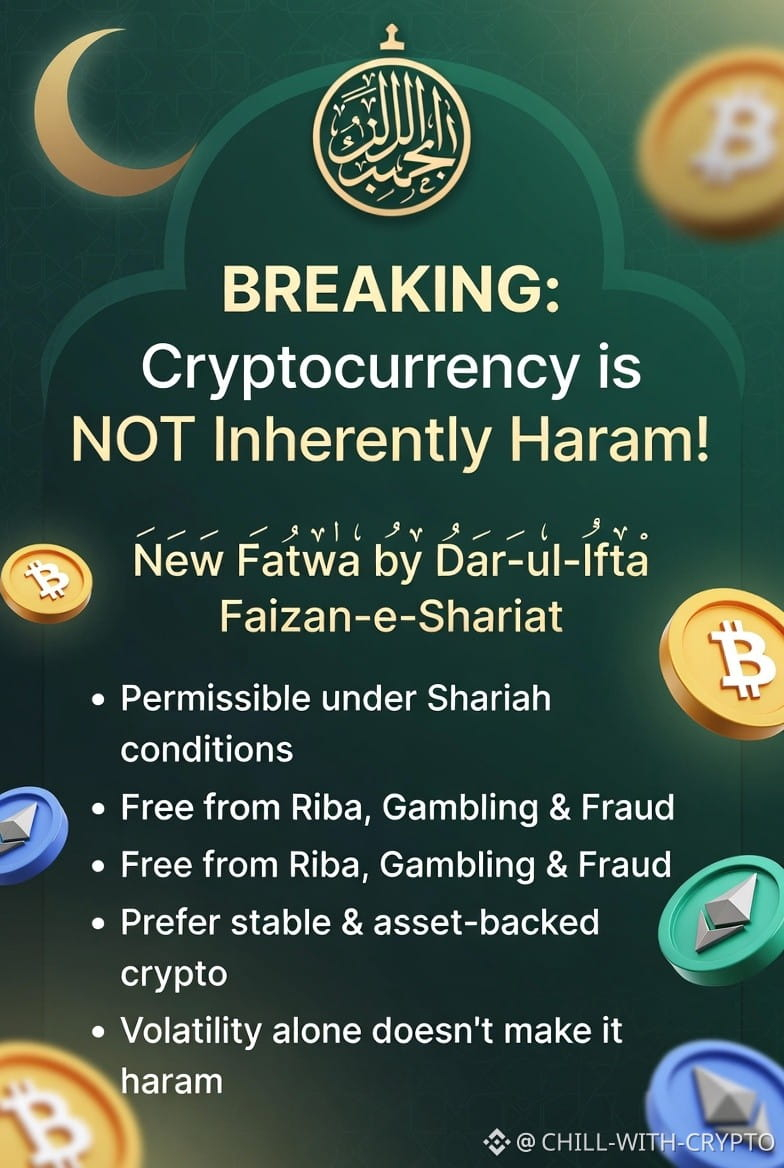
🔥BREAKING: A new Islamic ruling (FATWA) from Dar-ul-Ifta Faizan-e-Shariat states that cryptocurrency is not inherently haram. According to the fatwa, buying, selling, and transferring crypto can be permissible under specific Shariah-compliant conditions.
The ruling recognizes cryptocurrency as a transferable digital asset, similar to software, domain names, copyrights, and other legally owned digital property. However, it emphasizes that crypto transactions must remain free from Riba (interest), gambling, fraud, deception, and fake or unlawful activities.
The fatwa also advises investors to avoid highly speculative meme coins due to their extreme risk and instead consider more stable or asset-backed cryptocurrencies. It further clarifies that price volatility alone does not make crypto haram, as fluctuations are common in many lawful assets.
Key takeaway: Crypto itself is not automatically forbidden the nature of the transaction, the type of asset, and compliance with Islamic principles determine whether it is halal or not.
Source: Dar-ul-Ifta Faizan-e-Shariat | Reference 9351 | Issued: July 15, 2026
#Crypto #Bitcoin #Blockchain #IslamicFinance #CryptoNews $BTC
{spot}(BTCUSDT)
$ETH
{spot}(ETHUSDT)
$BNB
{spot}(BNBUSDT)
🔥BREAKING: A new Islamic ruling (FATWA) from Dar-ul-Ifta Faizan-e-Shariat states that cryptocurrency is not inherently haram. According to the fatwa, buying, selling, and transferring crypto can be permissible under specific Shariah-compliant conditions.
The ruling recognizes cryptocurrency as a transferable digital asset, similar to software, domain names, copyrights, and other legally owned digital property. However, it emphasizes that crypto transactions must remain free from Riba (interest), gambling, fraud, deception, and fake or unlawful activities.
The fatwa also advises investors to avoid highly speculative meme coins due to their extreme risk and instead consider more stable or asset-backed cryptocurrencies. It further clarifies that price volatility alone does not make crypto haram, as fluctuations are common in many lawful assets.
Key takeaway: Crypto itself is not automatically forbidden the nature of the transaction, the type of asset, and compliance with Islamic principles determine whether it is halal or not.
Source: Dar-ul-Ifta Faizan-e-Shariat | Reference 9351 | Issued: July 15, 2026
#Crypto #Bitcoin #Blockchain #IslamicFinance #CryptoNews $BTC
$ETH
$BNB
59

·
--
Is Bitcoin Halal? My Honest Research
And I also using AI for Verify It
Islamic Way
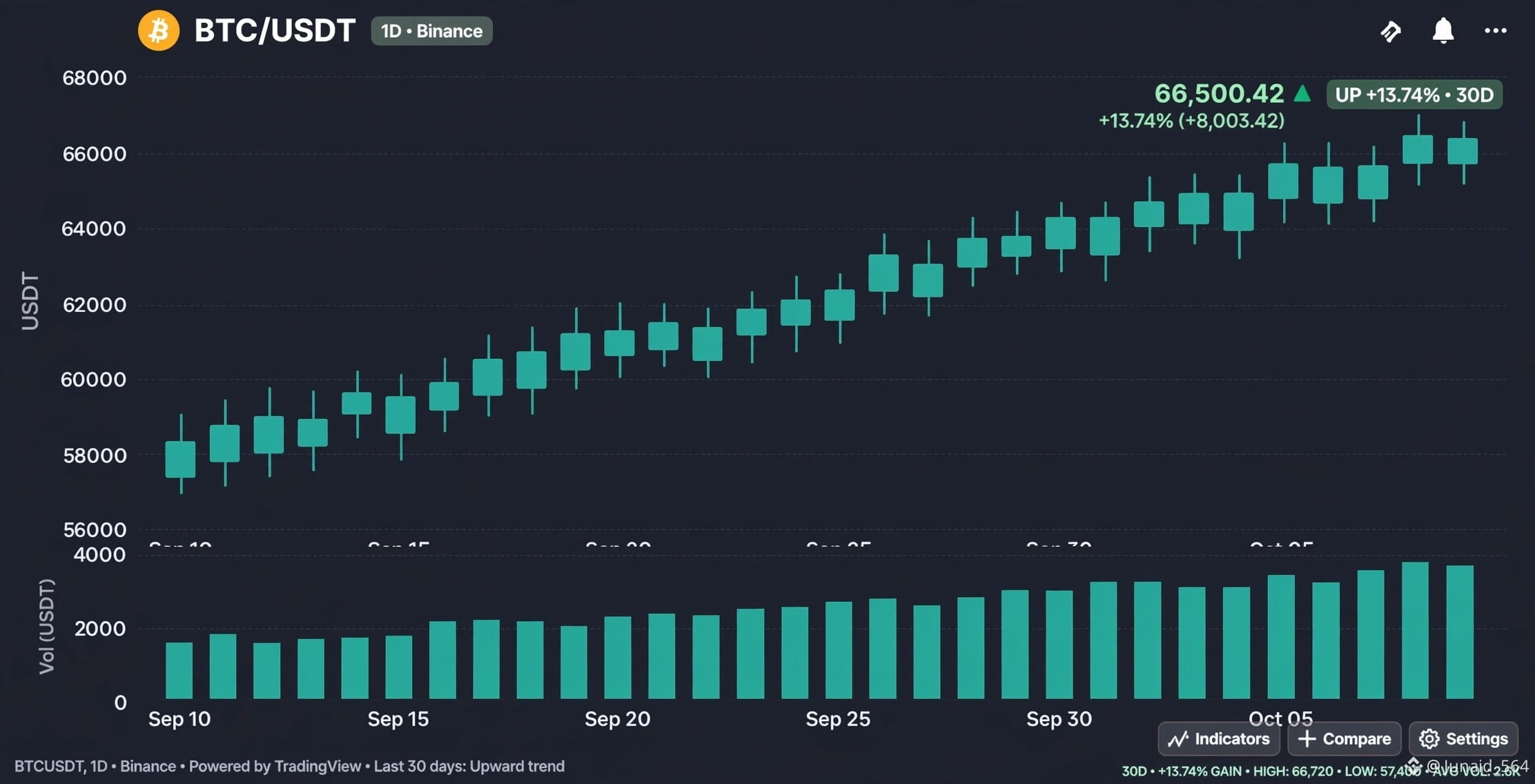
$BTC
Many people ask if Bitcoin is halal or haram. After my 5 min research, here is what I found:
Why many scholars consider BTC Halal:
1. *No Riba:* Bitcoin is not based on interest. It's a decentralized payment system Yeah If you trade on future then its haram probably
2. *Real Asset:* Like gold, its value is determined by market demand and supply, not gambling.
3. *No Deception:* Transactions are transparent on blockchain.
But not every crypto is halal. We should avoid interest-based, gambling and highly uncertain coins
And also Avoid Future trading
In my opinion, buying BTC in *Spot and holding it* without leverage/futures is the safest approach from Islamic perspective.
This is not financial advice, just my personal research. Please confirm with your own scholar.
What do you think about $BTC
#IslamicFinance #Islamic #IslamicPosts
47
Most people will read this as “Binance invested $100M.”
The more interesting question is: why does Binance want USDC to become much more important inside its ecosystem?
Binance has reportedly invested $100 MILLION in Circle, the company behind USDC.
And this isn’t just a passive investment.
The expanded partnership is expected to bring USDC into more Binance products, including savings/investment offerings, while Binance may also provide incentives such as reduced fees on USDC trading pairs.
That matters because stablecoins are becoming much more than something traders temporarily hold between trades.
They increasingly sit underneath:
• Trading pairs
• Payments
• Lending
• Yield products
• Tokenized assets
• Cross-border settlement
🕌 For Muslim investors, there’s an important distinction here.
Holding or transferring a stablecoin is one question.
Putting that same stablecoin into a product promising a return is a different contractual question.
Before using any USDC “Earn,” lending or yield product, research:
Where does the return actually come from?
Interest from lending, trading incentives, protocol rewards and other revenue structures should not automatically be treated as equivalent simply because the same stablecoin is involved.
I’m not declaring USDC—or any Binance product—halal or haram.
📌 The token may stay the same while the financial contract around it changes completely.
That’s why understanding the source of yield matters.
👇 Would you like me to make a simple checklist for researching whether a crypto “Earn” product contains interest or other Shariah concerns?
$USDC
#USDC #IslamicFinance #HalalCryptoGuide
Educational only — not financial advice or a fatwa.
{spot}(USDCUSDT)
Most people will read this as “Binance invested $100M.”
The more interesting question is: why does Binance want USDC to become much more important inside its ecosystem?
Binance has reportedly invested $100 MILLION in Circle, the company behind USDC.
And this isn’t just a passive investment.
The expanded partnership is expected to bring USDC into more Binance products, including savings/investment offerings, while Binance may also provide incentives such as reduced fees on USDC trading pairs.
That matters because stablecoins are becoming much more than something traders temporarily hold between trades.
They increasingly sit underneath:
• Trading pairs
• Payments
• Lending
• Yield products
• Tokenized assets
• Cross-border settlement
🕌 For Muslim investors, there’s an important distinction here.
Holding or transferring a stablecoin is one question.
Putting that same stablecoin into a product promising a return is a different contractual question.
Before using any USDC “Earn,” lending or yield product, research:
Where does the return actually come from?
Interest from lending, trading incentives, protocol rewards and other revenue structures should not automatically be treated as equivalent simply because the same stablecoin is involved.
I’m not declaring USDC—or any Binance product—halal or haram.
📌 The token may stay the same while the financial contract around it changes completely.
That’s why understanding the source of yield matters.
👇 Would you like me to make a simple checklist for researching whether a crypto “Earn” product contains interest or other Shariah concerns?
$USDC
#USDC #IslamicFinance #HalalCryptoGuide
Educational only — not financial advice or a fatwa.
50
🚨 Binance is extending its USD1 airdrop campaign — with 150M WLFI in rewards.
Starting October 2, eligible users holding USD1 on Binance can receive weekly rewards.
The campaign includes:
• 150 million WLFI total rewards
• Up to 2.5 million USD1 additional rewards in Stage 2
• Weekly distributions every Friday
• USD1 held in Spot and Funding accounts can qualify
• Certain Margin/Futures balances can also qualify
But here’s the part Muslim investors should notice:
Binance calculates the weekly WLFI reward using an effective APR.
And users maintaining at least 300 USD1 of qualifying Futures open interest can receive a 1.2× reward multiplier. Binance’s own example illustrates a 20% base APR becoming a 24% boosted APR.
🕌 That means “airdrop” alone doesn’t describe the whole financial structure.
There are several separate questions worth researching:
• What economically generates the APR-based reward?
• What exactly is USD1 backed by?
• What is WLFI’s utility and underlying ecosystem?
• Is simply holding USD1 structurally different from using it in Margin/Futures?
• Does chasing the 1.2× multiplier introduce contracts or risks you would otherwise avoid?
I’m not declaring USD1, WLFI or this campaign halal or haram.
📌 Never judge a promotion from the word “airdrop” alone. Read how the reward is actually earned.
Would you like me to break down this USD1/WLFI campaign specifically from a Shariah-research perspective?
#Binance #CryptoEducation #IslamicFinance #HalalCryptoGuide
81
🚨 Binance is taking tokenized stocks one step further: they can now become collateral for margin trading.
Today Binance announced 7 more bStocks as eligible collateral across Cross Margin, Portfolio Margin and Portfolio Margin Pro.
That distinction matters.
A Binance bStock is already different from directly owning a company share.
Binance describes bStocks as tokenized securities backed 1:1 by U.S. shares held at a regulated custodian. Holders receive an interest in the underlying security — not direct ownership of the company’s stock itself.
Now add another layer:
Underlying company share
↓
Tokenized security (bStock)
↓
Used as margin collateral
↓
Leveraged trading position
🕌 For Muslim investors, screening only the company at the top of that chain may not answer every question.
There are separate structures to investigate:
• the underlying company’s business and financials
• the bStock certificate itself
• the collateral arrangement
• the margin contract
• leverage and any financing charges involved
I’m not declaring bStocks or Binance Margin halal or haram.
The useful principle is:
📌 A Shariah-compliant underlying asset would not automatically make every financial contract built around that asset compliant too.
The asset and the way it is used both matter.
Would you like me to make a simple Stock → bStock → Margin Shariah-research checklist?
#IslamicFinance #TokenizedStocks #Binance #HalalCryptoGuide
Educational only — not financial advice or a fatwa.
100
🚨 $19 BILLION LIQUIDATED — ONE YEAR LATER!
October 10, 2025, became one of crypto’s most painful days.
📉 Over $19 BILLION in leveraged positions liquidated.
👥 Approximately 1.62 MILLION accounts affected.
⚠️ Some assets experienced extraordinary price dislocations.
But here’s the lesson many investors overlook.
During the crash, USDe temporarily traded near $0.65 on Binance, even while maintaining prices closer to $1 elsewhere.
A stable target price doesn’t eliminate market risk.
Before trusting any crypto asset, ask:
1️⃣ What actually supports its value?
2️⃣ Can it be redeemed during a market crisis?
3️⃣ What happens when trading liquidity disappears?
4️⃣ Does its structure depend on derivatives or other financial arrangements?
🕌 For Muslim investors:
Financial stability and Shariah compliance are separate questions.
Understanding how an asset maintains its value, generates returns, and handles financial obligations is essential before making an investment decision.
Neither a stable price target nor an exchange listing establishes Shariah compliance.
📌 Save these four questions for your next crypto research session.
Which risk do you think investors underestimate most: leverage, liquidity, or redemption risk?
#CryptoEducation #RiskManagement #IslamicFinance #HalalCryptoGuide
127
🚨 Binance is adding 25 new stocks today — but “available on Binance” does NOT mean every one should be evaluated the same way.
Look closer at today’s new Binance Stocks lineup.
Alongside ordinary company shares, it includes:
• Individual company stocks
• Gold exposure through $IAUM.ETF
• Silver exposure through $SIVR.ETF
• A 2× Long $DRAM.ETF product
• 2× Long SK Hynix
• 2× Short SK Hynix
Binance also says these securities can become eligible for Fully Paid Securities Lending (FPSL) once trades settle.
🕌 For Muslim investors, this distinction matters.
Researching a normal company share is not necessarily the same exercise as researching:
an ETF → a leveraged ETF → an inverse/short product → or securities lending.
Even if two products reference the same company or asset, their contract structure, leverage, financing mechanisms, underlying holdings and method of generating returns can differ substantially.
I’m not declaring any of today’s products halal or haram.
The useful rule is:
📌 Don’t Shariah-screen the ticker only. Screen the structure too.
Before buying, ask:
1. What do I actually own?
2. What assets does the product hold?
3. Is leverage or short exposure involved?
4. How is that exposure created?
5. Am I separately opting into securities lending?
👇 Should I build a simple 5-step Shariah research checklist for stocks and ETFs on Binance?
#IslamicFinance #BinanceStocks #HalalCryptoGuide
Educational only — not financial advice or a fatwa.
DRAMETF-0.72%
810
Seeing “APR” on Binance does NOT automatically tell you whether the return is interest.
Today Binance launched a new $PLUME Simple Earn Flexible promotion with 70 $BNB in additional APR Boost rewards.
But look at how Binance describes the reward structure:
• Hold PLUME in Simple Earn Flexible
• Receive the existing Real-Time APR
• Receive an additional daily BNB APR Boost during the campaign
• Binance says the promotional BNB rewards are contributed by the protocol team specifically for promotional activities
That distinction matters.
🕌 For Muslim investors, simply seeing “5% APR,” “yield,” or “Earn” is not enough to determine the Shariah status of a product.
The more useful questions are:
Where does the return come from?
Is it a promotional reward?
Lending income?
Staking/network rewards?
Trading activity?
Another protocol mechanism?
Two products can display an APR on the same screen while generating that return in completely different ways.
I’m not declaring $PLUME Simple Earn halal or haram here. The underlying Real-Time APR mechanism still needs to be understood separately from the promotional BNB giveaway.
📌 Don’t judge the label. Trace the source of the yield.
👇 Should I make a simple “Where does the yield come from?” checklist for Binance Earn products?
#IslamicFinance #BinanceEarn #HalalCryptoGuide
Educational only — not financial advice or a fatwa.
{spot}(PLUMEUSDT)
Seeing “APR” on Binance does NOT automatically tell you whether the return is interest.
Today Binance launched a new $PLUME Simple Earn Flexible promotion with 70 $BNB in additional APR Boost rewards.
But look at how Binance describes the reward structure:
• Hold PLUME in Simple Earn Flexible
• Receive the existing Real-Time APR
• Receive an additional daily BNB APR Boost during the campaign
• Binance says the promotional BNB rewards are contributed by the protocol team specifically for promotional activities
That distinction matters.
🕌 For Muslim investors, simply seeing “5% APR,” “yield,” or “Earn” is not enough to determine the Shariah status of a product.
The more useful questions are:
Where does the return come from?
Is it a promotional reward?
Lending income?
Staking/network rewards?
Trading activity?
Another protocol mechanism?
Two products can display an APR on the same screen while generating that return in completely different ways.
I’m not declaring $PLUME Simple Earn halal or haram here. The underlying Real-Time APR mechanism still needs to be understood separately from the promotional BNB giveaway.
📌 Don’t judge the label. Trace the source of the yield.
👇 Should I make a simple “Where does the yield come from?” checklist for Binance Earn products?
#IslamicFinance #BinanceEarn #HalalCryptoGuide
Educational only — not financial advice or a fatwa.
148
Would you spend 50+ USDT on a prediction trade just to earn 5 extra Alpha Points?
Binance Wallet launched a new promotion today:
Complete a qualifying Buy trade of more than 50 USDT in the Soccer category of Binance Prediction → receive 5 additional Binance Alpha Points.
The promotion runs until September 29 and the reward can only be earned once.
But for Muslim users, I think there is a much more important lesson here.
🕌 Never let an airdrop, bonus or points reward make you skip researching the activity required to earn it.
Before participating, ask:
• What exactly am I paying for?
• What determines whether I gain or lose money?
• Am I purchasing an asset or entering a prediction contract?
• Does the structure involve wagering or other Shariah concerns?
• Would I still enter this transaction if there were no Alpha Points reward?
I’m not issuing a halal/haram ruling on Binance Prediction here.
But a promotional reward doesn’t change the underlying transaction.
📌 Evaluate the activity first. Evaluate the reward second.
That principle applies far beyond this campaign—to airdrops, trading competitions, referral bonuses and other crypto incentives.
👇 Would 5 Alpha Points influence your decision to participate?
#IslamicFinance #BinanceAlpha #HalalCryptoGuide
Educational only — not financial advice or a fatwa.
71
🚨 Binance just launched an October campaign offering up to 5,888 USDC — but don’t let the reward headline replace understanding the product.
The competition is based on Binance Dual Investment, and Binance itself describes Dual Investment as a high-yield structured financial product.
It lets users choose a future target price and settlement date using either:
• Buy Low — deposit assets such as USDT/USDC and potentially receive crypto if the target is reached
• Sell High — deposit crypto and potentially have it converted at the target price
In either case, Binance calculates an additional reward using an advertised APR. Once subscribed, the position generally cannot be cancelled or redeemed before settlement.
🕌 For Muslim investors, this is where the research should begin — not end.
A promotional reward doesn’t tell us whether the underlying financial structure meets a particular Shariah standard.
Questions worth investigating include:
• What contract actually creates the additional return?
• Why is the APR being paid?
• How does the conditional conversion at a future target price work economically?
• Does the structure contain elements that a qualified Shariah scholar would consider problematic?
I’m not declaring Binance Dual Investment halal or haram here.
📌 The lesson: investigate the financial contract behind the reward — not just the size of the reward.
Would you like me to break down Binance Dual Investment step-by-step from a Shariah-research perspective?
#IslamicFinance #BinanceEarn #CryptoEducation #HalalCryptoGuide
Educational only — not financial advice or a fatwa.
106
Log in to explore more content
Join global crypto users on Binance Square
⚡️ Get latest and useful information about crypto.
💬 Trusted by the world’s largest crypto exchange.
👍 Discover real insights from verified creators.
Email / Phone number
Trending Topics
1
#CanMarketsReboundAfterThanksgiving?
202,458 views
1,993 Discussing
2
#CouldSpaceX’sOrbitalDataCentersBoostAIChipDemand?
99,642 views
1,197 Discussing
3
#SouthKoreaProposesMandatoryDigitalAssetTransactionDisclosure
5,356 views
111 Discussing
4
#EvolveAtBinanceBlockchainWeek
850,202 views
10,568 Discussing
5
#KoreaFSCSeeksPowerToSuspendCryptoListings
22,660 views
332 Discussing
6
#SouthKoreaPlansToRequireTetherCircleLocalReserves
20,998 views
236 Discussing
7
#UKFCAReportedlyPlansDeFiAuthorizationRules
15,874 views
139 Discussing
8
#ZcashDevelopersUrgeZECMoveToIronwood
34,629 views
171 Discussing
9
#TetherGoldFaces$2.55BUnrealizedLoss
3,506 views
17 Discussing
10
#CorePCEBeatLiftsFedHikeOdds
311,577 views
1,842 Discussing