
Crypto _Mars
2k Posts

Crypto _Mars
 Square Verified
Welcome to Crypto Mars Platform ! 🚀 Join our vibrant community to explore blockchain and cryptocurrency. X : @Henrycd85
Open Trade

SIGN Holder
Frequent Trader
1.7 Years
402 Following
32.9K+ Followers
12.8K+ Liked
Posts
Portfolio
All
Quotes
Videos
Live
🔥 MARSCOIN SHORT IS STILL IN PROFIT! 📉💰
How’s your trade going? 👀
🟢 Profit or 🔴 Loss?
I’m still holding my $MARSCOIN Short — and the trade is currently in profit. 😎
Drop your PnL below 👇
#marscoin $MARSCOIN
How’s your trade going? 👀
🟢 Profit or 🔴 Loss?
I’m still holding my $MARSCOIN Short — and the trade is currently in profit. 😎
Drop your PnL below 👇
#marscoin $MARSCOIN
🎯 Where do you think INJ goes next?
🚀 INJ just broke out with strong volume!
Vote your prediction 👇
🟢 $6.80–$7.00 🚀
🟡 $6.35–$6.60 📈
🔴 $5.60–$5.98 📉
⚡ $7+ — Mega Pump 🔥
Comment your exact price target 🎯👇
Not financial advice. DYOR.
$INJ
🚀 INJ just broke out with strong volume!
Vote your prediction 👇
🟢 $6.80–$7.00 🚀
🟡 $6.35–$6.60 📈
🔴 $5.60–$5.98 📉
⚡ $7+ — Mega Pump 🔥
Comment your exact price target 🎯👇
Not financial advice. DYOR.
$INJ
🟢 $6.80–$7.00 🚀
57%
🟡 $6.35–$6.60 📈
9%
🔴 $5.60–$5.98 📉
17%
⚡ $7+ — Mega Pump 🔥
17%
42 votes • Voting closed
Guys🤑
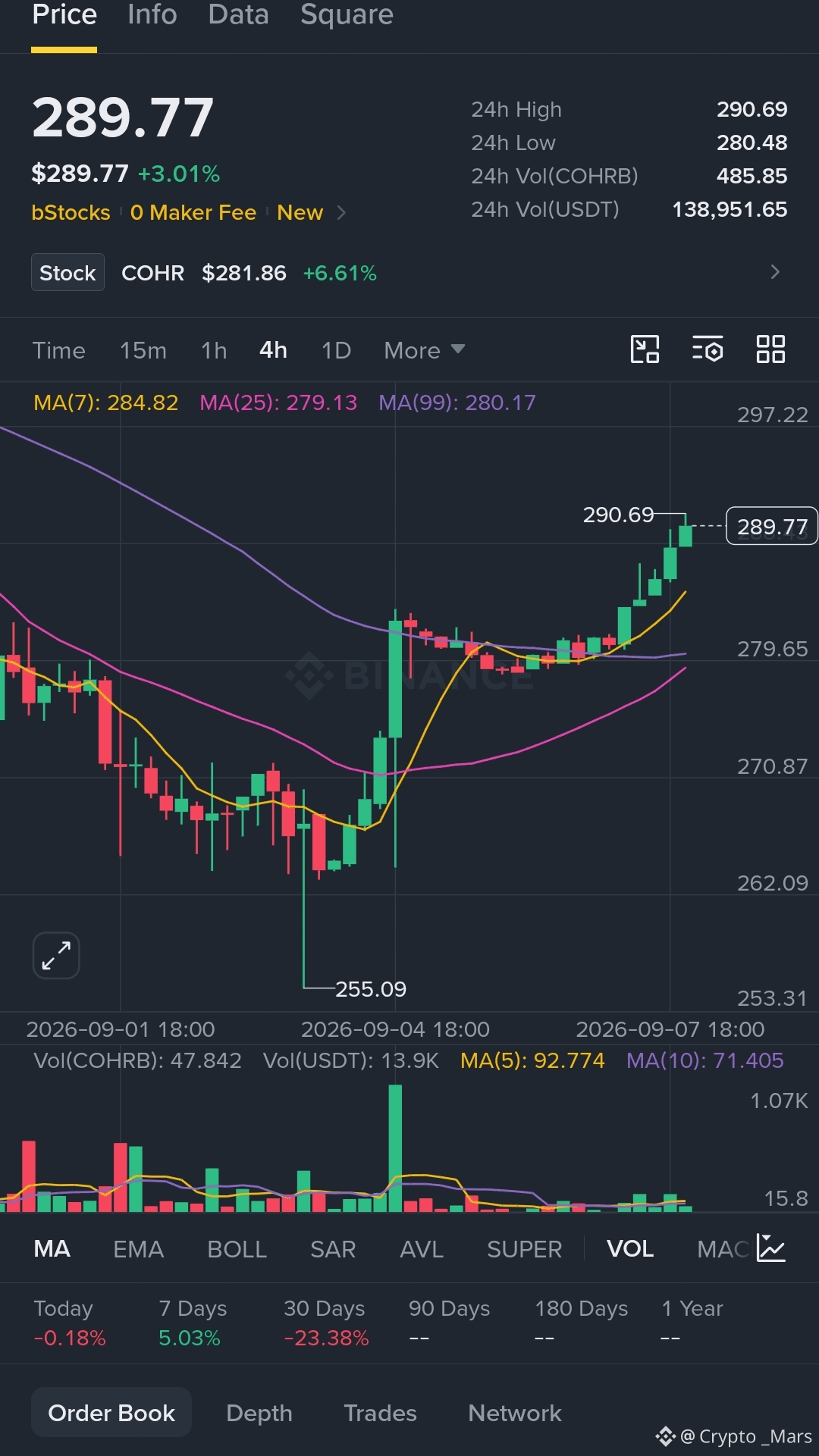
$COHRB Opening LoNG📈
Entry: $284–286
SL: $279
🎯 TP1: $297
🎯 TP2: $305
🎯 TP3: $315+
🚀 Breakout Entry: $291+ confirmed 4H close
⚠️ Bearish invalidation: 4H close below $279
Bulls or bears? Drop your entry & target 👇🎯
Not financial advice. DYOR
$COHRB Opening LoNG📈
Entry: $284–286
SL: $279
🎯 TP1: $297
🎯 TP2: $305
🎯 TP3: $315+
🚀 Breakout Entry: $291+ confirmed 4H close
⚠️ Bearish invalidation: 4H close below $279
Bulls or bears? Drop your entry & target 👇🎯
Not financial advice. DYOR
ETH — WHERE IS THE NEXT MOVE? 👀🔥
$2,490… Bulls or Bears? 🐂🐻
📈 $2,550+
📉 $2,440–
Drop your exact ETH price prediction below 👇🎯
#USIranTradeTankerStrikesEscalate #CanadaToImpose15%To50%TariffsOnUSGoods #ZcashRises45%WeeklyToHighestSince2016 #ZcashRises45%WeeklyToHighestSince2016
$2,490… Bulls or Bears? 🐂🐻
📈 $2,550+
📉 $2,440–
Drop your exact ETH price prediction below 👇🎯
#USIranTradeTankerStrikesEscalate #CanadaToImpose15%To50%TariffsOnUSGoods #ZcashRises45%WeeklyToHighestSince2016 #ZcashRises45%WeeklyToHighestSince2016
🔴$2550+🚀Up📈
66%
🔴$2440- Down📉
34%
32 votes • Voting closed
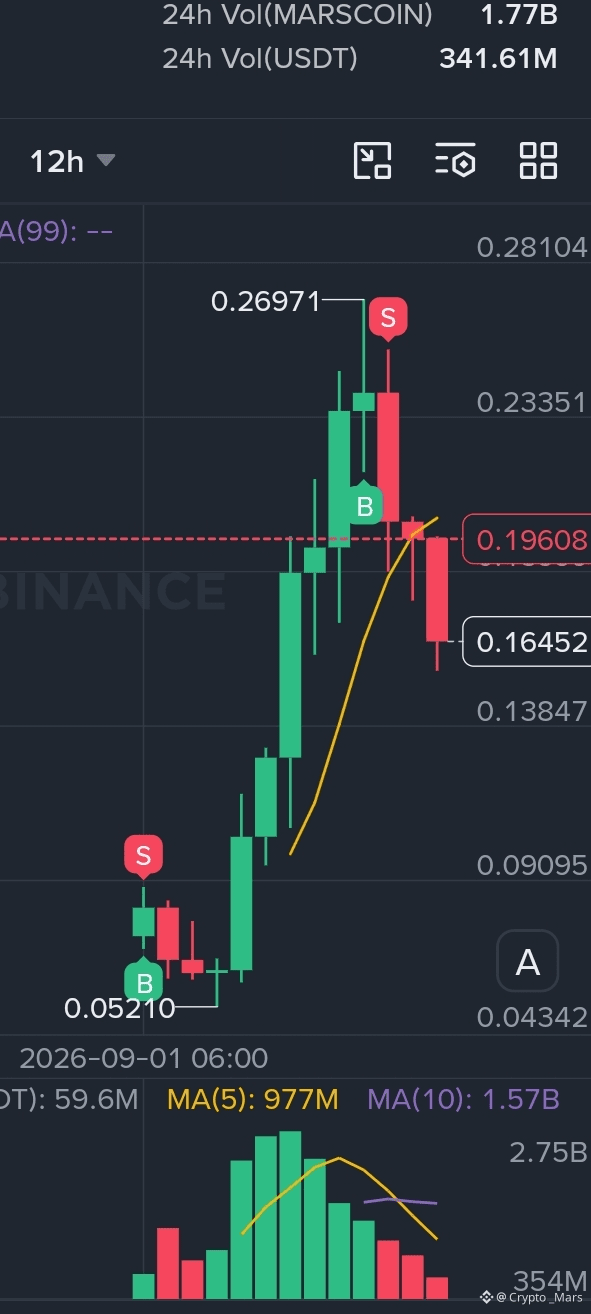
🔥 GUYS, SHORT OPENED! 📉
MAKE MONEY🤑🤑🤑
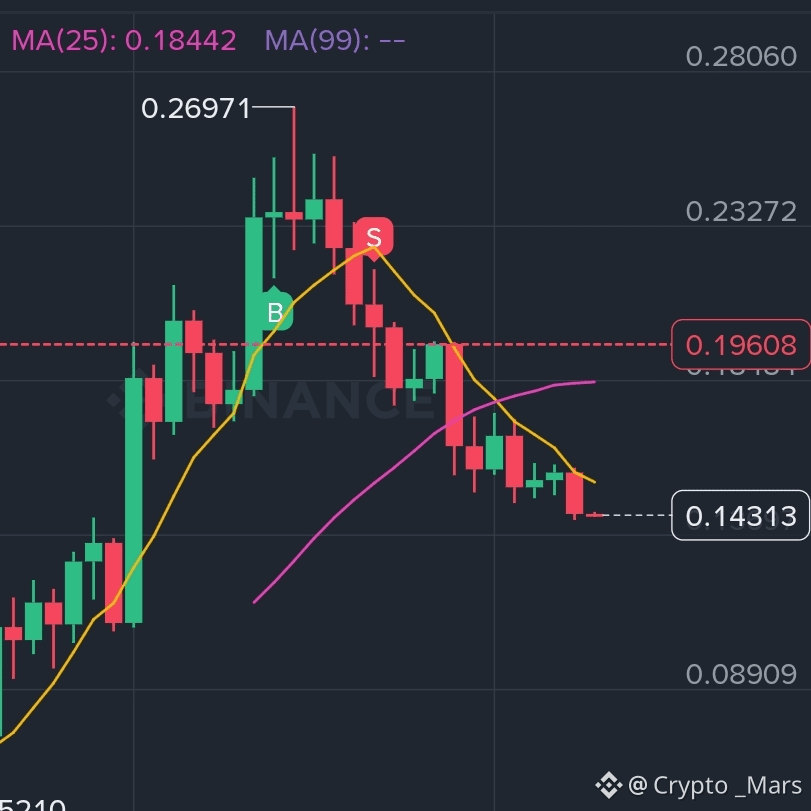
$MARSCOIN is showing a sharp rejection from the highs.
🎯 SHORT SETUP
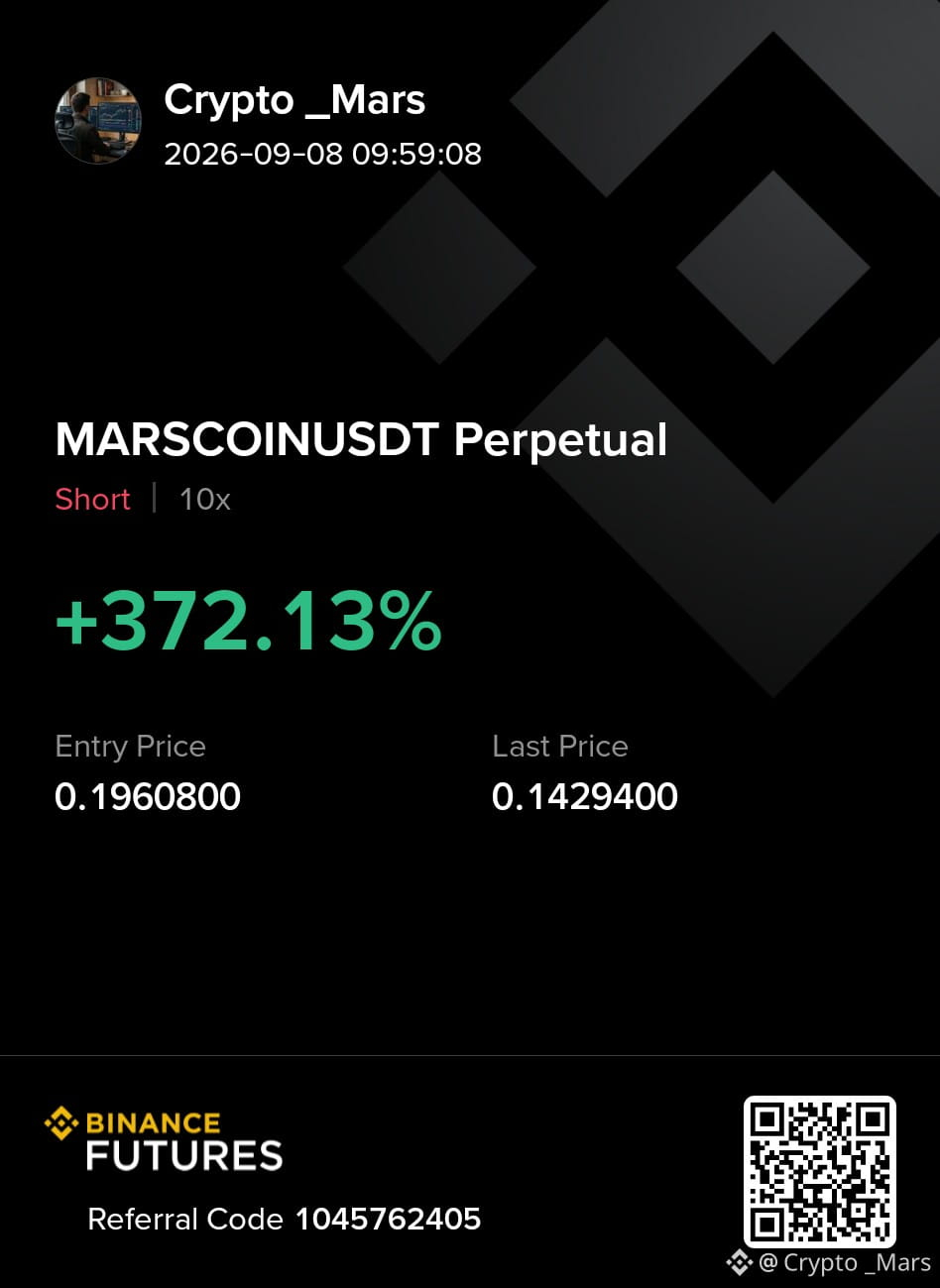
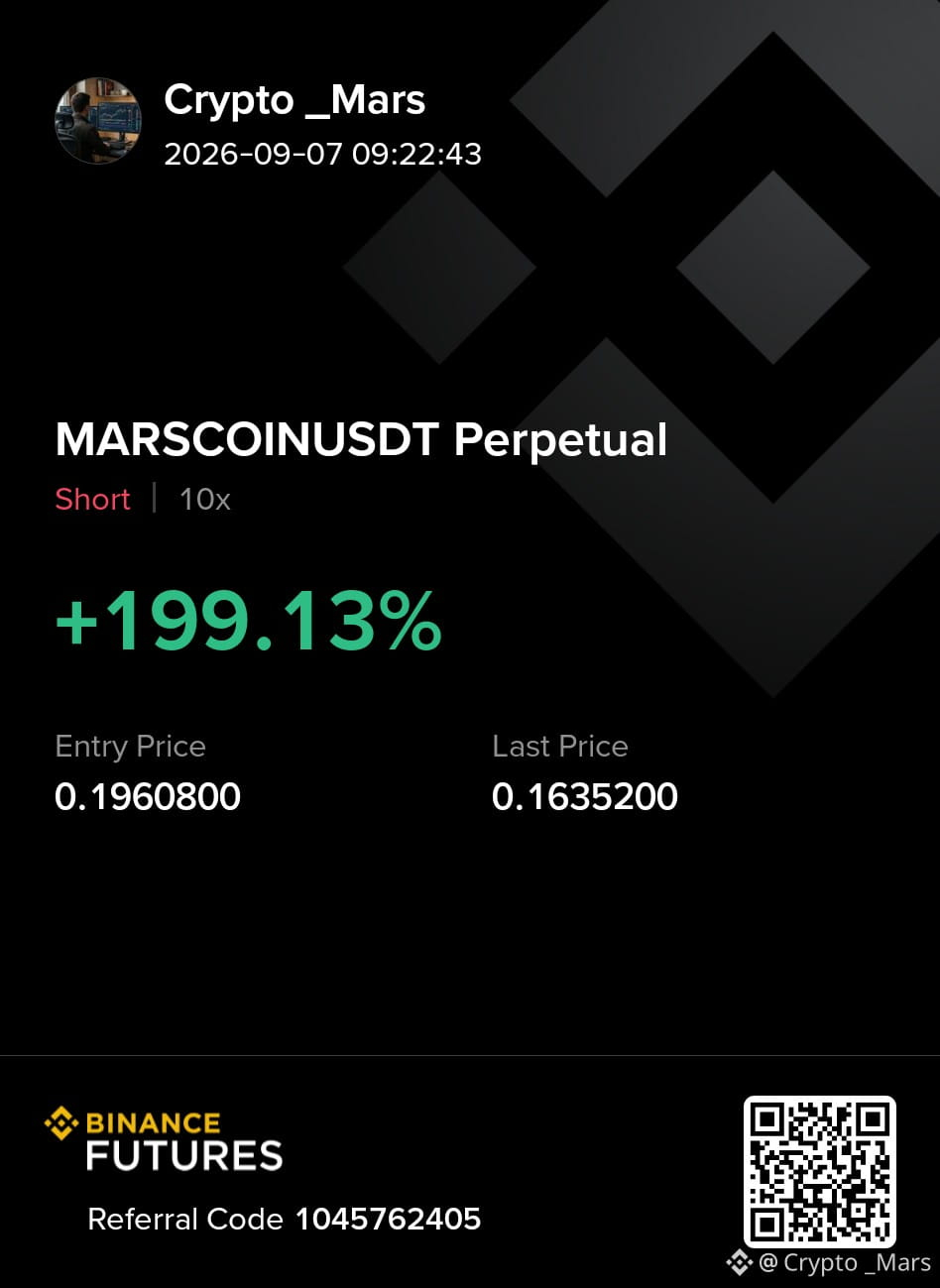
Entry: $0.1960
Current: ~$0.1645
Momentum: 🔻 Bearish
Who’s catching the next move? 👀
👇 Comment your SHORT TP 🎯
Not financial advice. DYOR.
#marscoin $MARSCOIN
MAKE MONEY🤑🤑🤑
$MARSCOIN is showing a sharp rejection from the highs.
🎯 SHORT SETUP
Entry: $0.1960
Current: ~$0.1645
Momentum: 🔻 Bearish
Who’s catching the next move? 👀
👇 Comment your SHORT TP 🎯
Not financial advice. DYOR.
#marscoin $MARSCOIN
🚨 Where do you think ZEC goes next?🚀
$ZEC is testing the $1,241 resistance after a strong rally. 👀
Vote your range 👇
Then comment your exact price prediction 🎯
Let’s see who calls it right. 👀
$ZEC is testing the $1,241 resistance after a strong rally. 👀
Vote your range 👇
Then comment your exact price prediction 🎯
Let’s see who calls it right. 👀
🔴$1250-$1300
23%
🔴$1300-$1350
10%
🔴$1350-$1400
9%
🔴$1400+🚀Boom
58%
286 votes • Voting closed
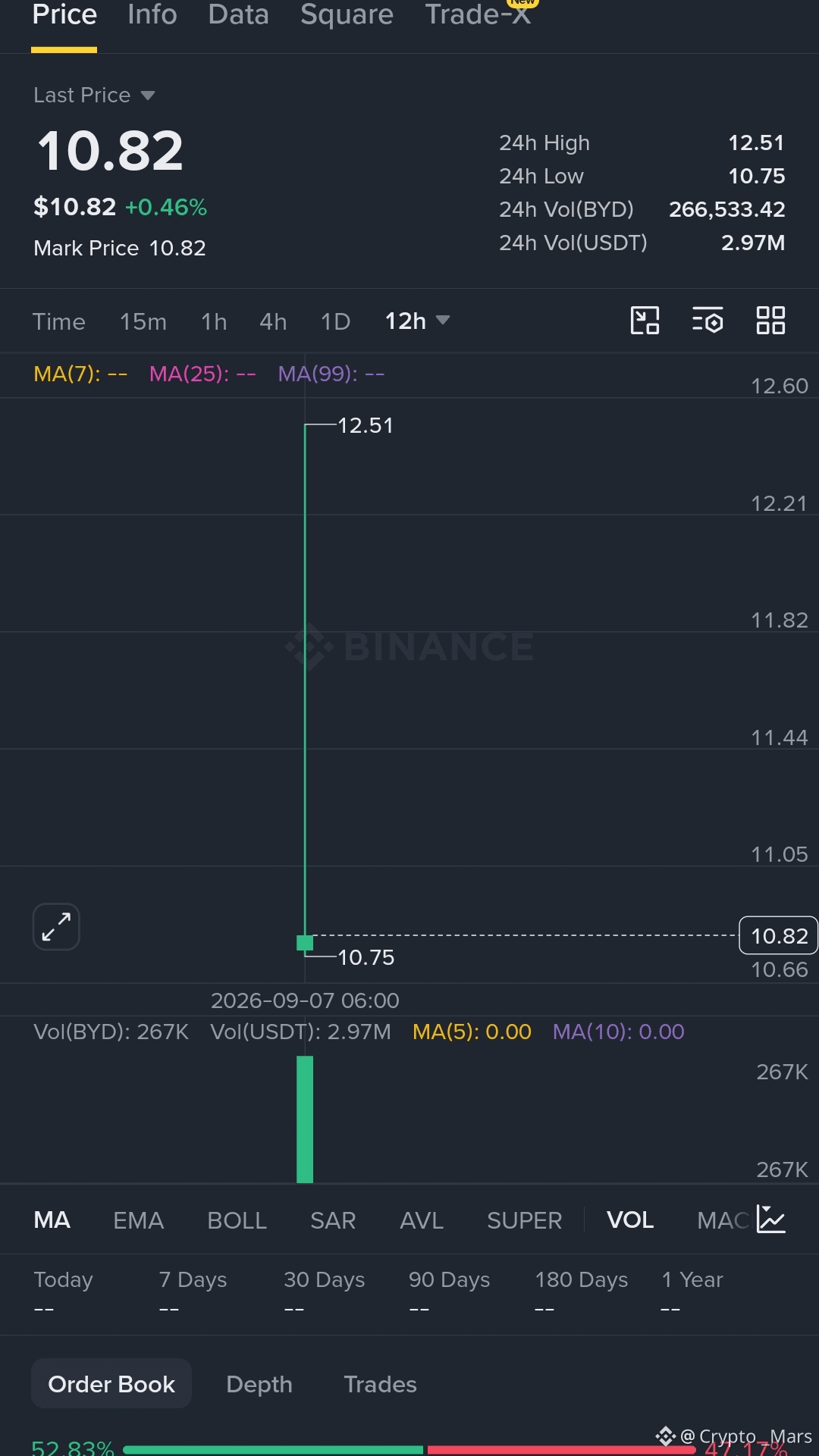
🚨 $BYD — DON’T JUST VOTE. MAKE A CALL.
Vote your range below 👇
Then comment your exact price prediction 🎯
Everyone will be watching the first candle.
But the smarter question is:
Where will the market find its first real price discovery?
$BYD Perp hasn’t even opened yet — currently $0 price, $0 volume.
That means we have a rare moment:
No chart bias. No hindsight. Just your thesis.
So before the first trade hits the book:
📊 WHERE DO YOU THINK $BYD WILL TRADE IN ITS FIRST 5 MINUTES?
🔘 $0.50 – $0.60
🔘 $0.60 – $0.70
🔘 $0.70 – $0.80
🔘 $0.80+ 🚀#ZECHitsANewAllTimeHigh #BYD
#RussiaUkraine72-hourCeasefire #BitcoinETFsBiggestDailyInflowSinceJanuary
But here’s the challenge 👇
Don’t just vote. Comment WHY.
Is it liquidity + hype?
Is it opening volatility?
Or do you expect an early FOMO trap & reversal?
I’ll be watching the comments before the market opens.
Let’s see who predicts the market — and who simply follows it. 👀
⏳ BYDUSDT Perp — Almost Live
Your price target? 🎯👇
Not financial advice. DYOR.
Vote your range below 👇
Then comment your exact price prediction 🎯
Everyone will be watching the first candle.
But the smarter question is:
Where will the market find its first real price discovery?
$BYD Perp hasn’t even opened yet — currently $0 price, $0 volume.
That means we have a rare moment:
No chart bias. No hindsight. Just your thesis.
So before the first trade hits the book:
📊 WHERE DO YOU THINK $BYD WILL TRADE IN ITS FIRST 5 MINUTES?
🔘 $0.50 – $0.60
🔘 $0.60 – $0.70
🔘 $0.70 – $0.80
🔘 $0.80+ 🚀#ZECHitsANewAllTimeHigh #BYD
#RussiaUkraine72-hourCeasefire #BitcoinETFsBiggestDailyInflowSinceJanuary
But here’s the challenge 👇
Don’t just vote. Comment WHY.
Is it liquidity + hype?
Is it opening volatility?
Or do you expect an early FOMO trap & reversal?
I’ll be watching the comments before the market opens.
Let’s see who predicts the market — and who simply follows it. 👀
⏳ BYDUSDT Perp — Almost Live
Your price target? 🎯👇
Not financial advice. DYOR.
🔴$0.50 – $0.60
22%
🔴$0.60 – $0.70
8%
🔴$0.70 – $0.80
8%
$0.80+🔥🚀
62%
174 votes • Voting closed
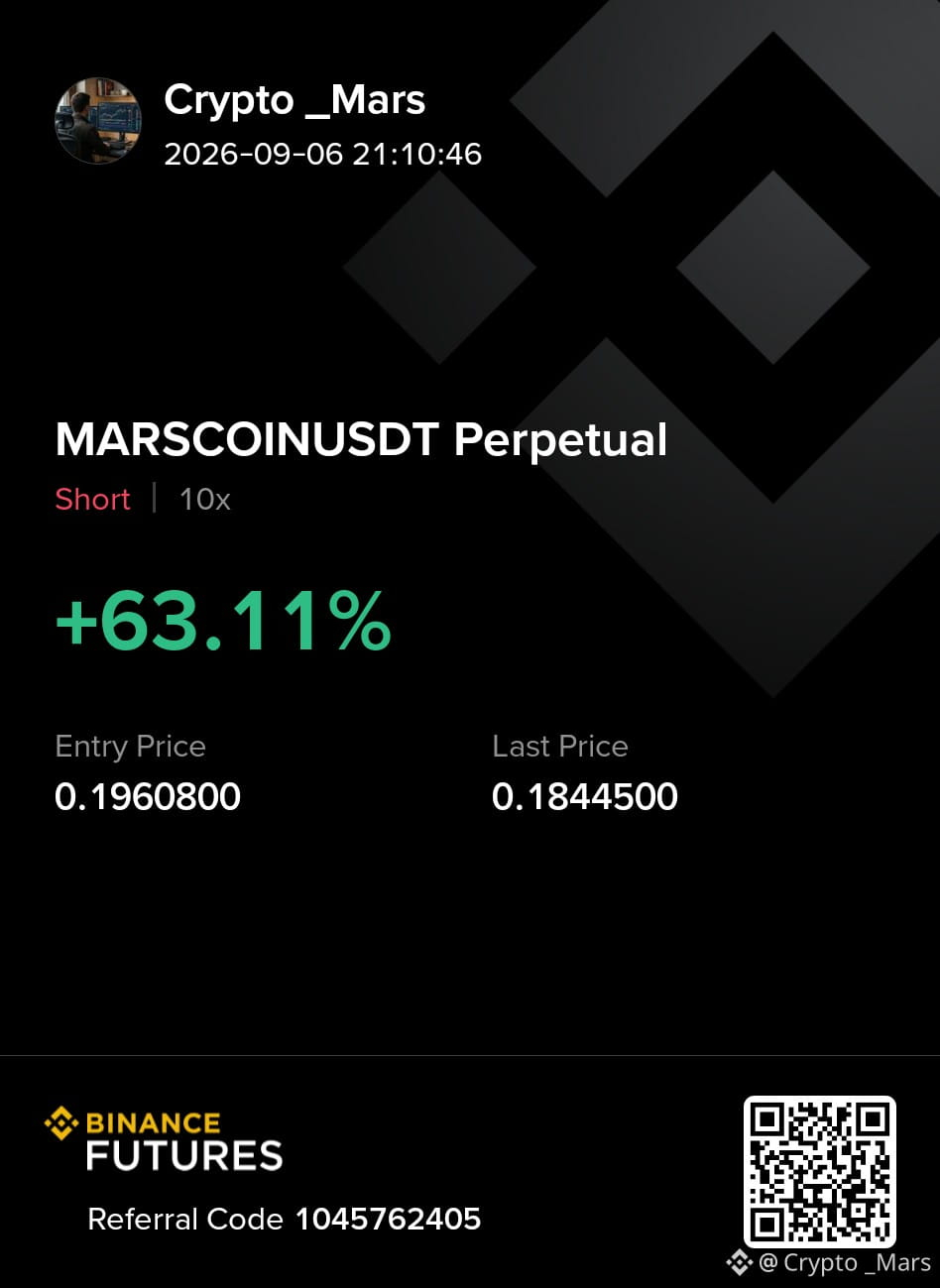
🚨 MARSCOIN SHORT ALERT! 🚨
Opened a 10X SHORT on $MARS — and already sitting at +63.11% 📉🔥
Entry: $0.19608
Current: $0.18445
👀 Is $MARS heading lower, or are bulls ready for a comeback?
Short sellers — are you still holding?
Bulls — where’s your entry? 👇
Let’s see who gets it right. 🐂 vs 🐻
Not financial advice. DYOR.
#marscoin
Opened a 10X SHORT on $MARS — and already sitting at +63.11% 📉🔥
Entry: $0.19608
Current: $0.18445
👀 Is $MARS heading lower, or are bulls ready for a comeback?
Short sellers — are you still holding?
Bulls — where’s your entry? 👇
Let’s see who gets it right. 🐂 vs 🐻
Not financial advice. DYOR.
#marscoin
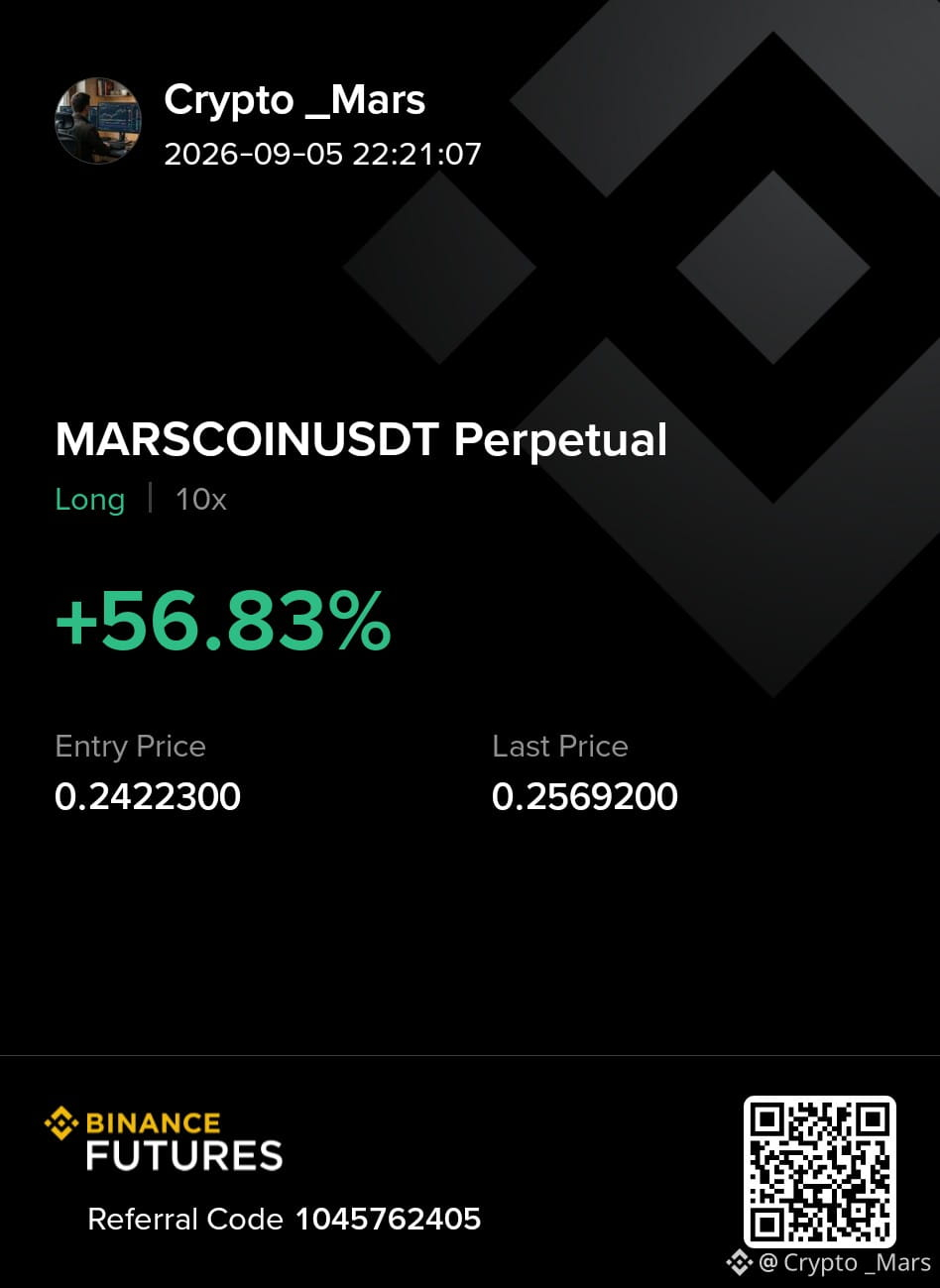
MARSCOIN: $1 Incoming or Correction First? 👀
MARSCOIN has momentum—but after a move like this, the real question isn’t “Can it pump?”
It’s “Will it consolidate or continue price discovery?”
If $0.30 → $0.50 breaks with strong volume, $1 suddenly becomes a serious narrative. 🚀
But if you’re a trader, answer this:
$1 BEFORE a major correction, or correction BEFORE $1?
Drop your target below. 👇
Bullish 🟢 or Bearish 🔴?
Not financial advice. DYOR.
#marscoin $MARSCOIN
MARSCOIN has momentum—but after a move like this, the real question isn’t “Can it pump?”
It’s “Will it consolidate or continue price discovery?”
If $0.30 → $0.50 breaks with strong volume, $1 suddenly becomes a serious narrative. 🚀
But if you’re a trader, answer this:
$1 BEFORE a major correction, or correction BEFORE $1?
Drop your target below. 👇
Bullish 🟢 or Bearish 🔴?
Not financial advice. DYOR.
#marscoin $MARSCOIN
·
--
🎙️ Catching Impulses on DUSK Trading scenarios, levels, and risks for today
End
01 h 27 m 40 s
984
2

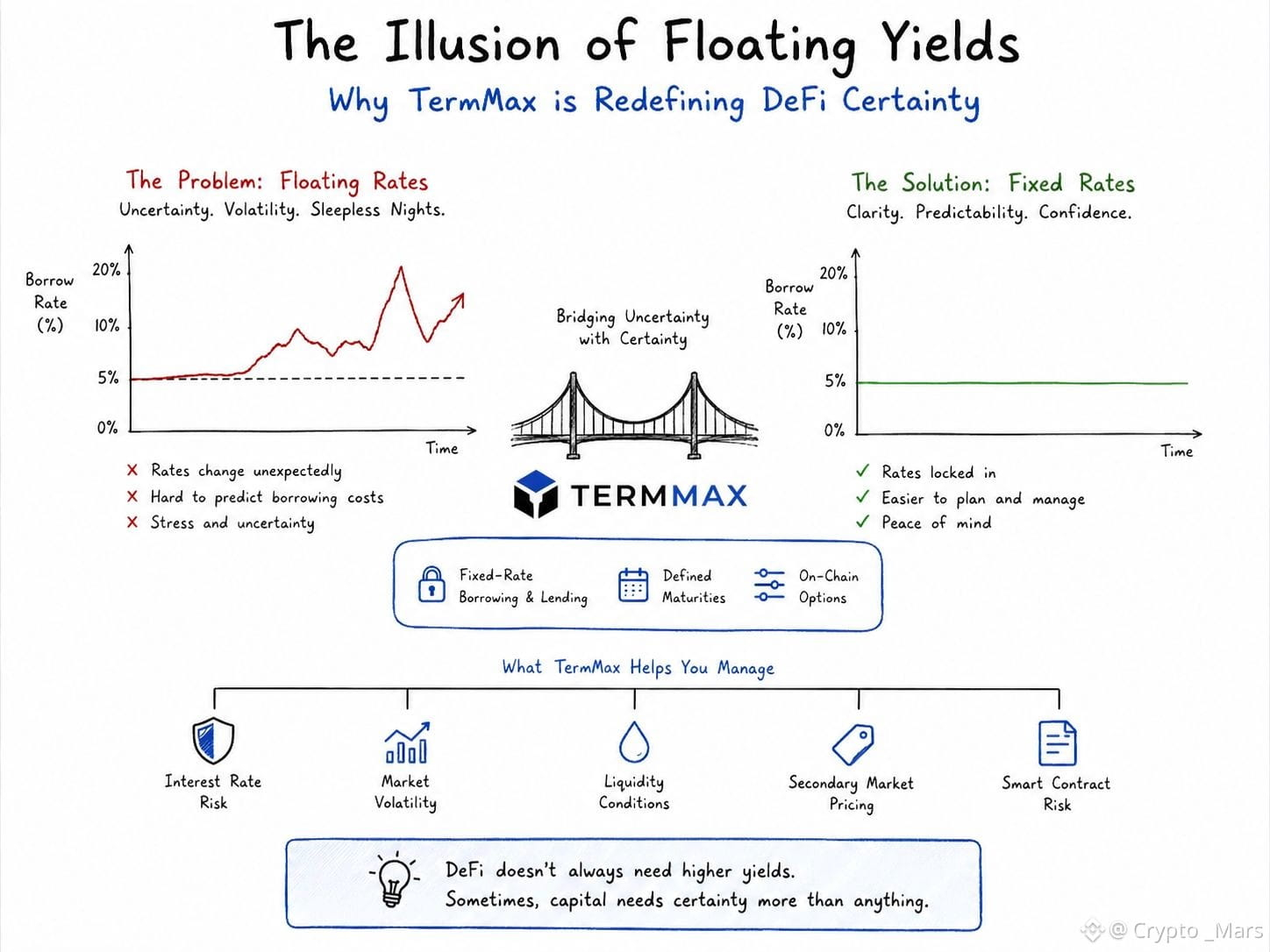
The Illusion of Floating Yields: Why TermMax is Redefining DeFi Certainty
I checked my lending positions yesterday, and the numbers caught me off guard again. You enter a position expecting something around 5%, go to sleep, and wake up to borrowing costs that have suddenly jumped much higher. Hmmm… that kind of uncertainty gets old pretty quickly.
Variable yields can look great when markets are calm. But when volatility picks up, that flexibility can become the problem. Rates move, borrowing costs change, and suddenly it becomes difficult to know what your position will actually cost tomorrow.
That’s what makes TermMax interesting to me. Instead of simply accepting constantly changing rates, it focuses on fixed-rate borrowing and lending, defined maturities, and on-chain options that can help participants manage different forms of risk.
Of course, fixed-rate markets don’t magically remove risk. Smart-contract issues, liquidity conditions, and secondary-market pricing still matter. But the bigger idea feels important: DeFi may not always need higher yields. Sometimes, what capital really needs is a better sense of certainty.
Because financial maturity isn’t only about how much you can earn.
It’s also about how confidently you can understand what tomorrow might look like.
@TermMax #TermMax
I checked my lending positions yesterday, and the numbers caught me off guard again. You enter a position expecting something around 5%, go to sleep, and wake up to borrowing costs that have suddenly jumped much higher. Hmmm… that kind of uncertainty gets old pretty quickly.
Variable yields can look great when markets are calm. But when volatility picks up, that flexibility can become the problem. Rates move, borrowing costs change, and suddenly it becomes difficult to know what your position will actually cost tomorrow.
That’s what makes TermMax interesting to me. Instead of simply accepting constantly changing rates, it focuses on fixed-rate borrowing and lending, defined maturities, and on-chain options that can help participants manage different forms of risk.
Of course, fixed-rate markets don’t magically remove risk. Smart-contract issues, liquidity conditions, and secondary-market pricing still matter. But the bigger idea feels important: DeFi may not always need higher yields. Sometimes, what capital really needs is a better sense of certainty.
Because financial maturity isn’t only about how much you can earn.
It’s also about how confidently you can understand what tomorrow might look like.
@TermMax #TermMax
·
--
🎙️ Bull run fast return—has Musk’s little dogecoin got on board?

End
04 h 09 m 31 s
6.7k
273

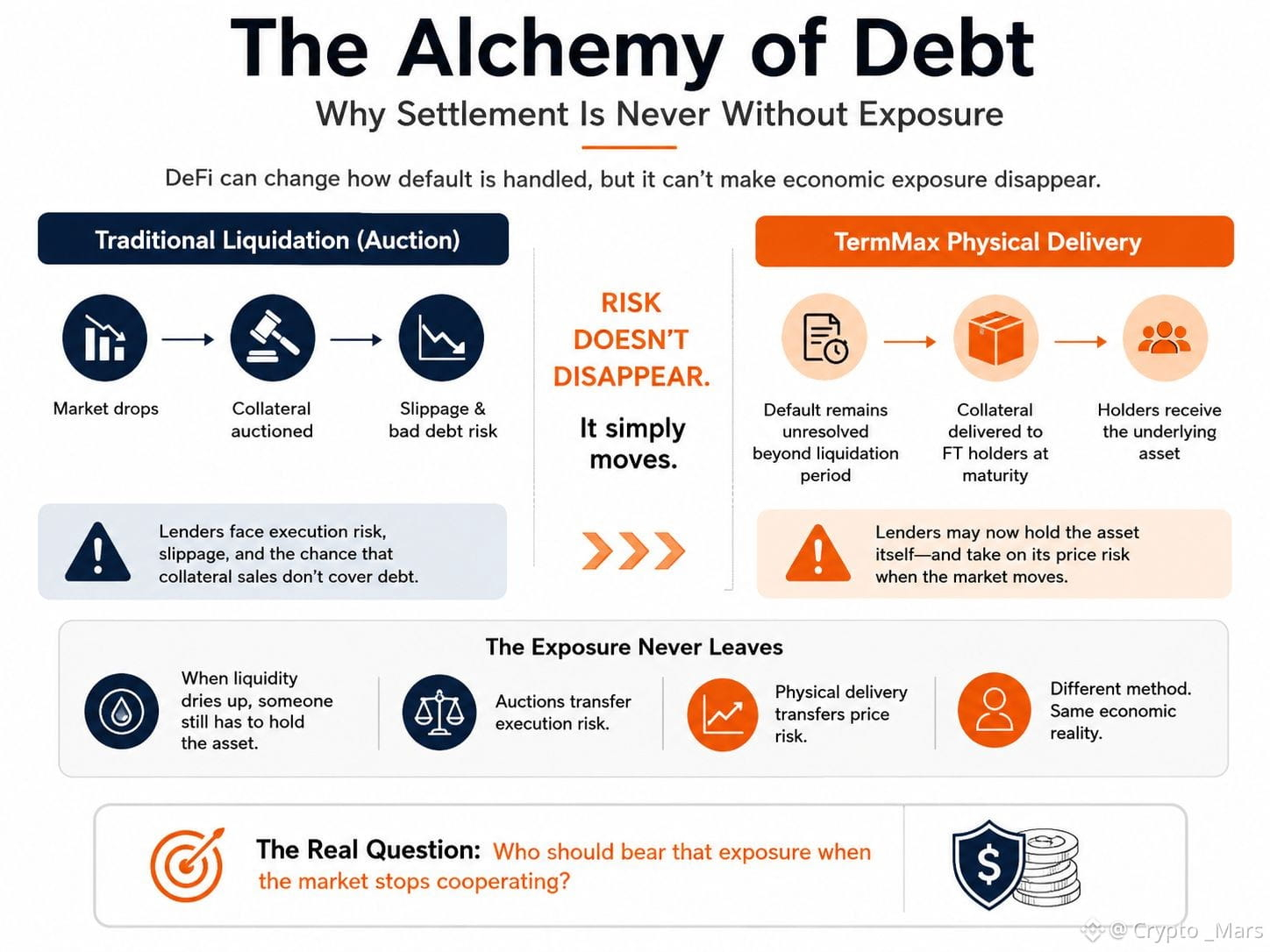
The Alchemy of Debt: Why Settlement Is Never Without Exposure
I’ve always found liquidation events a little uncomfortable to watch. A market drops quickly, collateral gets sold, and suddenly a position that looked manageable can turn into a much bigger problem. The strange part is that the liquidation itself can sometimes make the situation worse.
That got me thinking about TermMax and a different way of dealing with default.
Instead of relying entirely on a secondary-market auction to get rid of distressed collateral, TermMax’s design can move toward physical delivery. If a default remains unresolved beyond the liquidation period, the pledged collateral can ultimately be distributed to Fixed-Rate Token (FT) holders at maturity.
At first glance, that sounds like a way around liquidation-driven slippage. And in some situations, it could be useful, especially when the collateral isn’t something that can be sold easily without moving the market.
But there’s an important catch.
The risk hasn’t disappeared. It has simply moved.
With an auction, lenders face execution and slippage risk. With physical delivery, they may end up holding the underlying asset itself—and therefore its price risk.
That’s probably the more interesting lesson here. DeFi can change how default is handled, but it can’t make economic exposure disappear.
When liquidity dries up, someone still has to hold the asset.
who should bear that exposure when the market stops cooperating?
@TermMax #TermMax
I’ve always found liquidation events a little uncomfortable to watch. A market drops quickly, collateral gets sold, and suddenly a position that looked manageable can turn into a much bigger problem. The strange part is that the liquidation itself can sometimes make the situation worse.
That got me thinking about TermMax and a different way of dealing with default.
Instead of relying entirely on a secondary-market auction to get rid of distressed collateral, TermMax’s design can move toward physical delivery. If a default remains unresolved beyond the liquidation period, the pledged collateral can ultimately be distributed to Fixed-Rate Token (FT) holders at maturity.
At first glance, that sounds like a way around liquidation-driven slippage. And in some situations, it could be useful, especially when the collateral isn’t something that can be sold easily without moving the market.
But there’s an important catch.
The risk hasn’t disappeared. It has simply moved.
With an auction, lenders face execution and slippage risk. With physical delivery, they may end up holding the underlying asset itself—and therefore its price risk.
That’s probably the more interesting lesson here. DeFi can change how default is handled, but it can’t make economic exposure disappear.
When liquidity dries up, someone still has to hold the asset.
who should bear that exposure when the market stops cooperating?
@TermMax #TermMax
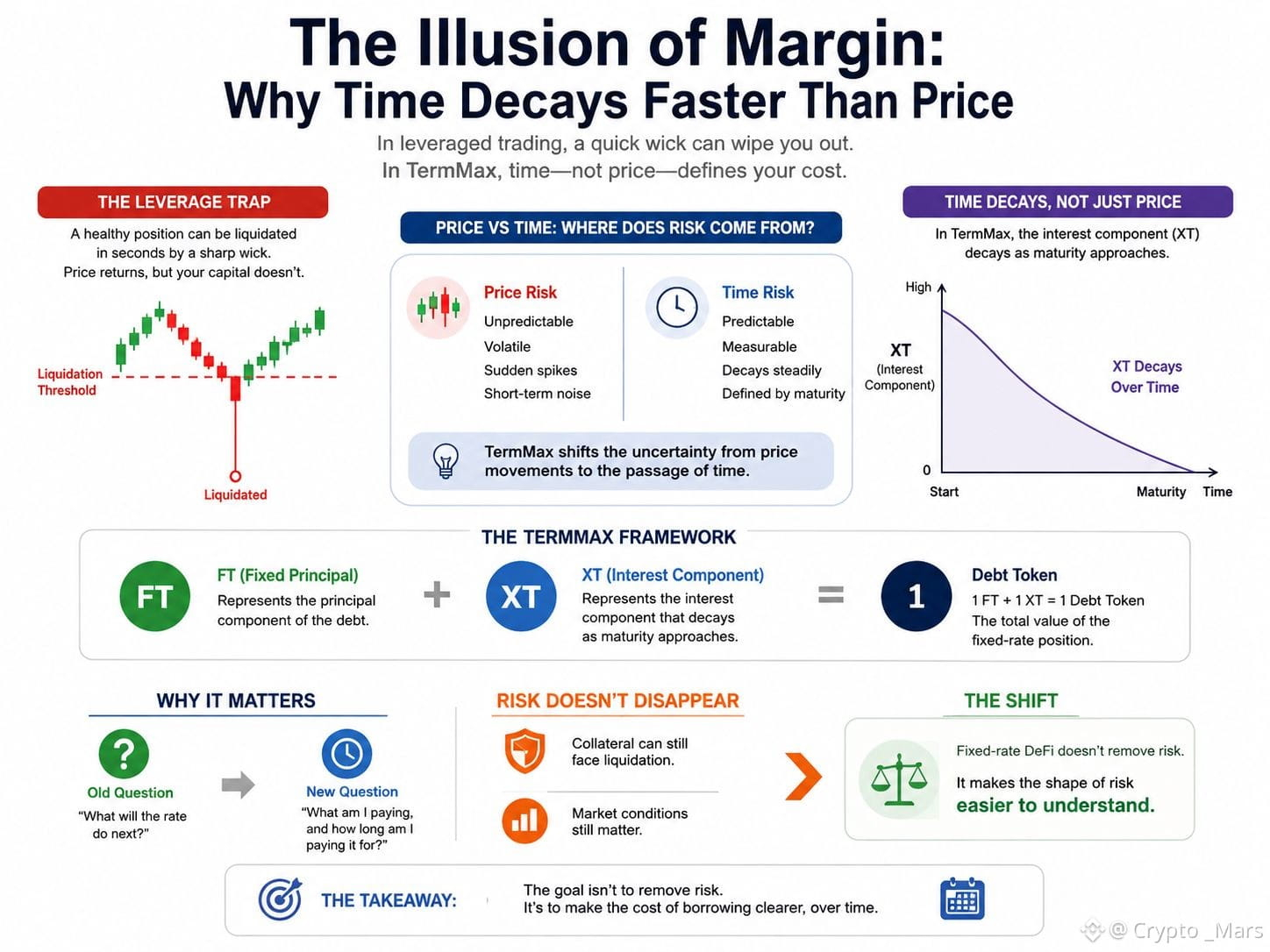
The Illusion of Margin: Why Time Decays Faster Than Price
I’ve always found leveraged positions a little strange. A position can look perfectly healthy, then one sharp wick hits the market, liquidation happens, and a few seconds later price is back where it started. The market didn’t really change its mind. The position simply ran out of room.
That made me look at TermMax from a slightly different angle: what if borrowing risk could be understood through time, not just price?
@TermMax separates a debt position into FT and XT. In simple terms, FT represents the principal component while XT represents the interest component that decays as maturity approaches. Since 1 FT + 1 XT = 1 Debt Token, the cost of the fixed-rate position becomes much easier to reason about over a defined period.
But this doesn’t mean risk disappears. Collateral can still face liquidation, and market conditions still matter. What changes is where the uncertainty sits.
Instead of constantly asking, “What will the rate do next?”, a fixed-maturity structure lets you ask a different question: “What am I paying, and how long am I paying it for?”
Maybe that is the more interesting part of fixed-rate DeFi. The goal isn’t to remove risk. It is to make the shape of the risk easier to understand.
@TermMax #TermMax
I’ve always found leveraged positions a little strange. A position can look perfectly healthy, then one sharp wick hits the market, liquidation happens, and a few seconds later price is back where it started. The market didn’t really change its mind. The position simply ran out of room.
That made me look at TermMax from a slightly different angle: what if borrowing risk could be understood through time, not just price?
@TermMax separates a debt position into FT and XT. In simple terms, FT represents the principal component while XT represents the interest component that decays as maturity approaches. Since 1 FT + 1 XT = 1 Debt Token, the cost of the fixed-rate position becomes much easier to reason about over a defined period.
But this doesn’t mean risk disappears. Collateral can still face liquidation, and market conditions still matter. What changes is where the uncertainty sits.
Instead of constantly asking, “What will the rate do next?”, a fixed-maturity structure lets you ask a different question: “What am I paying, and how long am I paying it for?”
Maybe that is the more interesting part of fixed-rate DeFi. The goal isn’t to remove risk. It is to make the shape of the risk easier to understand.
@TermMax #TermMax

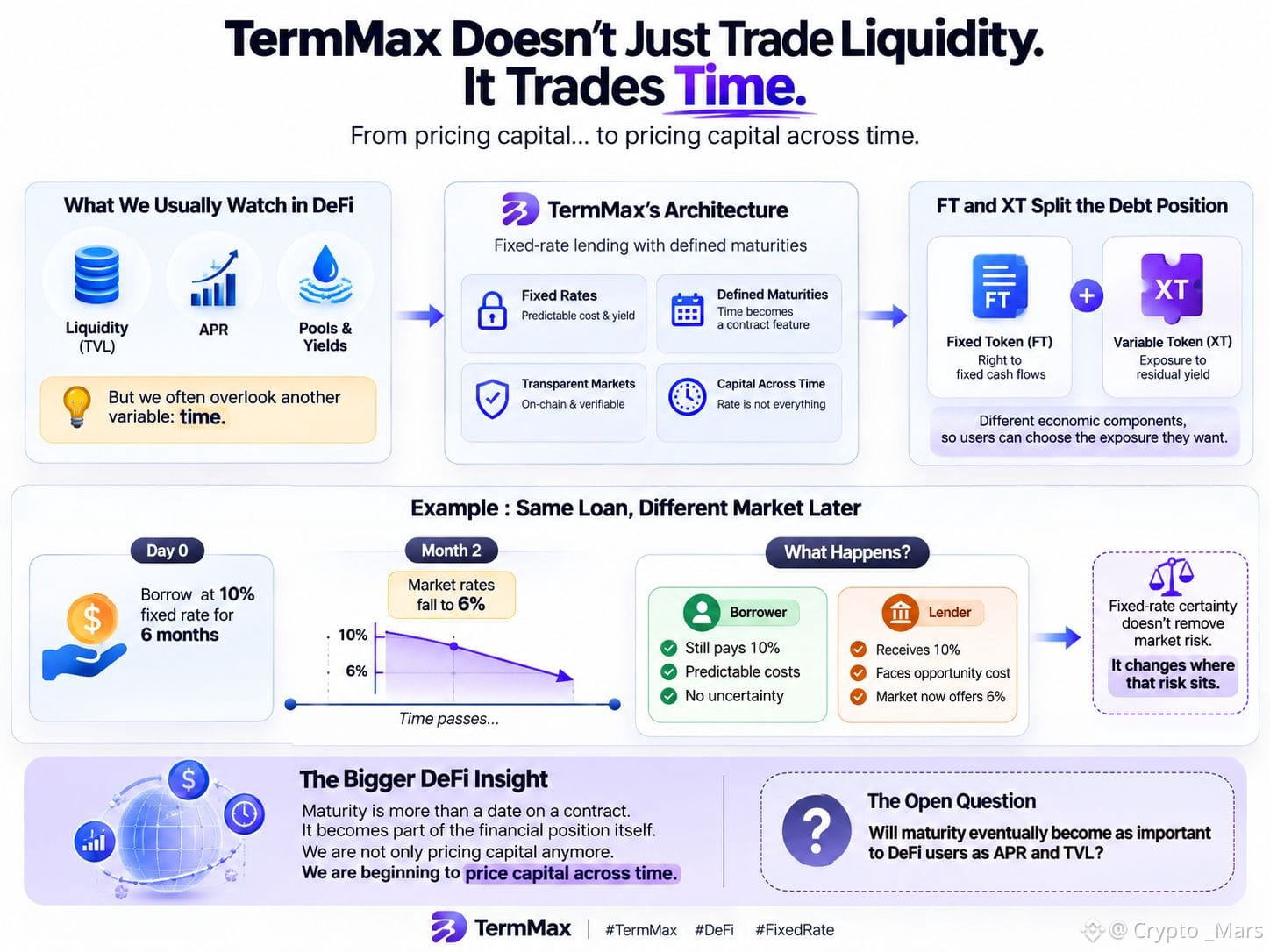
DeFi lending is usually viewed through liquidity, TVL and APR. But the deeper I look at fixed-rate markets, the more I think we often overlook another variable: time.
That is what makes TermMax interesting to me. Its architecture combines fixed-rate lending with defined maturities, while FT and XT separate different economic components of a debt position.
This changes the question from simply “What is the interest rate?” to “What is the rate for, and until when?”
Imagine borrowing at a 10% fixed rate for six months. Two months later, market rates fall to 6%. The borrower still has predictable costs, while the lender now faces an opportunity-cost question.
So fixed-rate certainty doesn't remove market risk. It changes where that risk sits.
That makes maturity more than a date on a contract. It becomes part of the financial position itself.
Maybe this is the bigger idea behind fixed-rate DeFi: we are not only pricing capital anymore. We are beginning to price capital across time.
And that leaves me with one question:
Will maturity eventually become as important to DeFi users as APR and TVL?
@TermMax $TERM
#TermMax #DeFi
That is what makes TermMax interesting to me. Its architecture combines fixed-rate lending with defined maturities, while FT and XT separate different economic components of a debt position.
This changes the question from simply “What is the interest rate?” to “What is the rate for, and until when?”
Imagine borrowing at a 10% fixed rate for six months. Two months later, market rates fall to 6%. The borrower still has predictable costs, while the lender now faces an opportunity-cost question.
So fixed-rate certainty doesn't remove market risk. It changes where that risk sits.
That makes maturity more than a date on a contract. It becomes part of the financial position itself.
Maybe this is the bigger idea behind fixed-rate DeFi: we are not only pricing capital anymore. We are beginning to price capital across time.
And that leaves me with one question:
Will maturity eventually become as important to DeFi users as APR and TVL?
@TermMax $TERM
#TermMax #DeFi
·
--
🎙️ Crypto market updates and discussion; answering questions from newcomers ✅ Keep up community building 🦅 Spread the idea of free exchange! Maintain ecological balance!

End
03 h 11 m 24 s
10.4k
78
Log in to explore more content